EP1422015B1 - Laserbearbeitungsvorrichtung - Google Patents
Laserbearbeitungsvorrichtung Download PDFInfo
- Publication number
- EP1422015B1 EP1422015B1 EP03257285A EP03257285A EP1422015B1 EP 1422015 B1 EP1422015 B1 EP 1422015B1 EP 03257285 A EP03257285 A EP 03257285A EP 03257285 A EP03257285 A EP 03257285A EP 1422015 B1 EP1422015 B1 EP 1422015B1
- Authority
- EP
- European Patent Office
- Prior art keywords
- laser
- laser output
- period
- control signal
- time
- Prior art date
- Legal status (The legal status is an assumption and is not a legal conclusion. Google has not performed a legal analysis and makes no representation as to the accuracy of the status listed.)
- Expired - Lifetime
Links
Images


Classifications
-
- G—PHYSICS
- G05—CONTROLLING; REGULATING
- G05B—CONTROL OR REGULATING SYSTEMS IN GENERAL; FUNCTIONAL ELEMENTS OF SUCH SYSTEMS; MONITORING OR TESTING ARRANGEMENTS FOR SUCH SYSTEMS OR ELEMENTS
- G05B19/00—Program-control systems
- G05B19/02—Program-control systems electric
- G05B19/18—Numerical control [NC], i.e. automatically operating machines, in particular machine tools, e.g. in a manufacturing environment, so as to execute positioning, movement or co-ordinated operations by means of program data in numerical form
- G05B19/404—Numerical control [NC], i.e. automatically operating machines, in particular machine tools, e.g. in a manufacturing environment, so as to execute positioning, movement or co-ordinated operations by means of program data in numerical form characterised by control arrangements for compensation, e.g. for backlash, overshoot, tool offset, tool wear, temperature, machine construction errors, load, inertia
-
- B—PERFORMING OPERATIONS; TRANSPORTING
- B23—MACHINE TOOLS; METAL-WORKING NOT OTHERWISE PROVIDED FOR
- B23K—SOLDERING OR UNSOLDERING; WELDING; CLADDING OR PLATING BY SOLDERING OR WELDING; CUTTING BY APPLYING HEAT LOCALLY, e.g. FLAME CUTTING; WORKING BY LASER BEAM
- B23K26/00—Working by laser beam, e.g. welding, cutting or boring
- B23K26/02—Positioning or observing the workpiece, e.g. with respect to the point of impact; Aligning, aiming or focusing the laser beam
- B23K26/03—Observing, e.g. monitoring, the workpiece
- B23K26/0344—Observing the speed of the workpiece
-
- B—PERFORMING OPERATIONS; TRANSPORTING
- B23—MACHINE TOOLS; METAL-WORKING NOT OTHERWISE PROVIDED FOR
- B23K—SOLDERING OR UNSOLDERING; WELDING; CLADDING OR PLATING BY SOLDERING OR WELDING; CUTTING BY APPLYING HEAT LOCALLY, e.g. FLAME CUTTING; WORKING BY LASER BEAM
- B23K26/00—Working by laser beam, e.g. welding, cutting or boring
- B23K26/02—Positioning or observing the workpiece, e.g. with respect to the point of impact; Aligning, aiming or focusing the laser beam
- B23K26/06—Shaping the laser beam, e.g. by masks or multi-focusing
-
- B—PERFORMING OPERATIONS; TRANSPORTING
- B23—MACHINE TOOLS; METAL-WORKING NOT OTHERWISE PROVIDED FOR
- B23K—SOLDERING OR UNSOLDERING; WELDING; CLADDING OR PLATING BY SOLDERING OR WELDING; CUTTING BY APPLYING HEAT LOCALLY, e.g. FLAME CUTTING; WORKING BY LASER BEAM
- B23K26/00—Working by laser beam, e.g. welding, cutting or boring
- B23K26/02—Positioning or observing the workpiece, e.g. with respect to the point of impact; Aligning, aiming or focusing the laser beam
- B23K26/06—Shaping the laser beam, e.g. by masks or multi-focusing
- B23K26/062—Shaping the laser beam, e.g. by masks or multi-focusing by direct control of the laser beam
- B23K26/0626—Energy control of the laser beam
-
- B—PERFORMING OPERATIONS; TRANSPORTING
- B23—MACHINE TOOLS; METAL-WORKING NOT OTHERWISE PROVIDED FOR
- B23K—SOLDERING OR UNSOLDERING; WELDING; CLADDING OR PLATING BY SOLDERING OR WELDING; CUTTING BY APPLYING HEAT LOCALLY, e.g. FLAME CUTTING; WORKING BY LASER BEAM
- B23K26/00—Working by laser beam, e.g. welding, cutting or boring
- B23K26/08—Devices involving relative movement between laser beam and workpiece
-
- B—PERFORMING OPERATIONS; TRANSPORTING
- B23—MACHINE TOOLS; METAL-WORKING NOT OTHERWISE PROVIDED FOR
- B23K—SOLDERING OR UNSOLDERING; WELDING; CLADDING OR PLATING BY SOLDERING OR WELDING; CUTTING BY APPLYING HEAT LOCALLY, e.g. FLAME CUTTING; WORKING BY LASER BEAM
- B23K26/00—Working by laser beam, e.g. welding, cutting or boring
- B23K26/08—Devices involving relative movement between laser beam and workpiece
- B23K26/0869—Devices involving movement of the laser head in at least one axial direction
- B23K26/0876—Devices involving movement of the laser head in at least one axial direction in at least two axial directions
- B23K26/0884—Devices involving movement of the laser head in at least one axial direction in at least two axial directions in at least three axial directions, e.g. manipulators, robots
-
- G—PHYSICS
- G05—CONTROLLING; REGULATING
- G05B—CONTROL OR REGULATING SYSTEMS IN GENERAL; FUNCTIONAL ELEMENTS OF SUCH SYSTEMS; MONITORING OR TESTING ARRANGEMENTS FOR SUCH SYSTEMS OR ELEMENTS
- G05B19/00—Program-control systems
- G05B19/02—Program-control systems electric
- G05B19/18—Numerical control [NC], i.e. automatically operating machines, in particular machine tools, e.g. in a manufacturing environment, so as to execute positioning, movement or co-ordinated operations by means of program data in numerical form
- G05B19/41—Numerical control [NC], i.e. automatically operating machines, in particular machine tools, e.g. in a manufacturing environment, so as to execute positioning, movement or co-ordinated operations by means of program data in numerical form characterised by interpolation, e.g. the computation of intermediate points between programmed end points to define the path to be followed and the rate of travel along that path
-
- G—PHYSICS
- G05—CONTROLLING; REGULATING
- G05B—CONTROL OR REGULATING SYSTEMS IN GENERAL; FUNCTIONAL ELEMENTS OF SUCH SYSTEMS; MONITORING OR TESTING ARRANGEMENTS FOR SUCH SYSTEMS OR ELEMENTS
- G05B2219/00—Program-control systems
- G05B2219/30—Nc systems
- G05B2219/45—Nc applications
- G05B2219/45041—Laser cutting
-
- G—PHYSICS
- G05—CONTROLLING; REGULATING
- G05B—CONTROL OR REGULATING SYSTEMS IN GENERAL; FUNCTIONAL ELEMENTS OF SUCH SYSTEMS; MONITORING OR TESTING ARRANGEMENTS FOR SUCH SYSTEMS OR ELEMENTS
- G05B2219/00—Program-control systems
- G05B2219/30—Nc systems
- G05B2219/45—Nc applications
- G05B2219/45165—Laser machining
-
- G—PHYSICS
- G05—CONTROLLING; REGULATING
- G05B—CONTROL OR REGULATING SYSTEMS IN GENERAL; FUNCTIONAL ELEMENTS OF SUCH SYSTEMS; MONITORING OR TESTING ARRANGEMENTS FOR SUCH SYSTEMS OR ELEMENTS
- G05B2219/00—Program-control systems
- G05B2219/30—Nc systems
- G05B2219/49—Nc machine tool, till multiple
- G05B2219/49353—Control of output power of tool, laser beam
-
- Y—GENERAL TAGGING OF NEW TECHNOLOGICAL DEVELOPMENTS; GENERAL TAGGING OF CROSS-SECTIONAL TECHNOLOGIES SPANNING OVER SEVERAL SECTIONS OF THE IPC; TECHNICAL SUBJECTS COVERED BY FORMER USPC CROSS-REFERENCE ART COLLECTIONS [XRACs] AND DIGESTS
- Y02—TECHNOLOGIES OR APPLICATIONS FOR MITIGATION OR ADAPTATION AGAINST CLIMATE CHANGE
- Y02P—CLIMATE CHANGE MITIGATION TECHNOLOGIES IN THE PRODUCTION OR PROCESSING OF GOODS
- Y02P90/00—Enabling technologies with a potential contribution to greenhouse gas [GHG] emissions mitigation
- Y02P90/02—Total factory control, e.g. smart factories, flexible manufacturing systems [FMS] or integrated manufacturing systems [IMS]
Definitions
- the present invention relates to a laser machining apparatus.
- a laser machining apparatus generally uses a numerical control apparatus as its controller.
- Such numerical control apparatus for laser machining apparatus outputs a motion command at intervals of a predetermined interpolation period, to thereby move a workpiece to be machined relative to a laser head, thus performing laser beam machining.
- Laser output, etc. of a laser oscillator are also often on/off controlled in units of the interpolation period.
- machining speed is not high, no substantial problem is caused so that the required machining accuracy may be attained, even when the laser output of the laser oscillator is on/off controlled in units of the interpolation period that is intended to be used for control of the numerical control apparatus.
- a higher machining speed however, it is difficult to start or finish the laser machining at intended positions with high accuracy, without the laser oscillator being controlled in the course of the interpolation period.
- Motion commands of the current and next blocks in an NC machining program that is input to the numerical control apparatus are sometimes required to be executed such that a command speed is maintained unchanged between these blocks. If a remaining motion amount of the current block (the distance to go) is less than a motion amount corresponding to the command speed for one distribution period, such deficiency is supplemented by block overlap processing to add part of a motion amount for the next block to the remaining motion amount for the current block, thus obtaining the motion command for the distribution period between these blocks which is capable of maintaining the moving speed unchanged.
- the movement corresponding to the motion command for one block comes to end in the course of the interpolation period, but the laser output of the laser oscillator that is on/off controlled in units of the interpolation period cannot be turned on or off at the end of the one block, i.e., between two successive blocks.
- the on/off timing is delayed with increase in machining speed at the maximum for a period of time corresponding to the interpolation period length, resulting in inaccurate machining.
- Such delay can be decreased by shortening the interpolation period length so as to improve the machining accuracy, however, the shortening of the interpolation period length for speedup results in increased costs.
- JP 07 223085 A discloses a laser beam output control method to correctly synchronize the ON/OFF of the laser beam to the delay in the movement of each axis of a laser beam machine, wherein a laser beam output control means delays the start of the laser beam, output by the ON delay time when the ON command is given, and delays the stop of the laser beam output by the OFF delay time when the OFF command is given.
- the delay time data can be easily changed by the key input from an operation key even when the machining program is executed.
- WO 00/53363 A discloses a laser machining apparatus comprising program analyzing means for analyzing a machining program and outputting a command to move the axes and an on/off command to turn on/off a laser beam, interpolating means for performing interpolation according to the moving command and outputting a movement distance to a servoamplifier, movement distance setting means for setting a movement distance for delay processing, and beam on/off delay means for delaying the beam on/off command outputted to a laser oscillator depending on the actual movement distance after the on/off command is outputted and the movement distance for delay processing.
- US-A-5 453 594 discloses coordinating the emission and position of a radiation beam to accurately move the beam along an intended path. This is accompanied by a technique that synchronizes the fixed clock that directs the servo with the variable clock that controls beam emission. The synchronized clocks allow the beam to start emission when the servo moves the substrate target.
- US-A-5 632 913 discloses an NC laser system having a laser beam machine and a numerical control system associated therewith, comprising a preprocessing operation unit for decoding a machining program to deliver a move command for movements along axes, and an ON-OFF command for turning on or off a laser oscillator, an interpolating unit responsive to the move command for executing interpolation processing to deliver interpolation pulses, an acceleration/deceleration control unit for controlling the interpolation pulses for acceleration and deceleration, to deliver a deceleration-starting signal and a deceleration-terminating signal, and a timing control unit for delivering an ON-OFF signal for turning on or off the laser oscillator according to the ON-OFF command.
- the present invention provides a laser machining apparatus which is capable of changing a laser output condition at a desired machining position and at a desired point of time without regard to an interpolation period.
- a laser machining apparatus of the present invention is defined in claim 1.
- a laser output condition can be changed without regard to the interpolation period.
- the controller may deliver a machining condition designation signal to designate a laser output condition including on/off of the laser output or to select one of laser output conditions stored in the laser output control signal generating means to the laser output control signal generating means, together with the timing data.
- the timing data generating means may be arranged to determine the time period from the start of the interpolation period in which the laser output control signal is to be delivered, based on the elapsed time and a total delay time. This total delay time may be determined taking account of one or both of a delay time in a servo feedback system for processing motion commands and a delay time in the laser oscillator.
- a predetermined period, at intervals of which a control signal including the timing data is delivered to the laser output control signal generating means, may be several times longer than the predetermined interpolation period at intervals of which the motion command is delivered.
- the timing data generating means may be arranged to deliver the timing data to said laser output control signal generating means at an interpolation period one period prior to the interpolation period in which the laser output control signal is to be delivered.
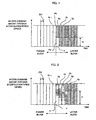
- FIG. 1 is a view for explaining the principle of this invention.
- time is taken along the abscissa
- an amount of motion command (corresponding to speed) for every interpolation period ITP is taken along the ordinate
- a boundary between two successive blocks is shown, with the former or preceding block being indicated in white and the latter or next block indicated by hutching.
- the block overlap processing if the remaining amount of movement Pa for the preceding block is less than the motion command amount per interpolation period corresponding to a commanded speed, such deficiency is supplemented by adding part of movement amount Pb for the next block to the remaining movement amount, thereby obtaining a motion command for the distribution period at the boundary between these two blocks, so that a constant speed movement may be attained.
- a laser output on/off command for instance, is supplied to the laser oscillator at a time point of a in FIG. 1 at which the movement based on the motion command instructed in the next block (hutched portion) starts.
- the laser output on/off command is not delivered at the movement start position instructed in the next block, i.e., at the end position determined by the motion command instructed in the preceding block, but is delivered earlier by the remaining movement amount Pa of motion command of the preceding block, i.e., at a position different from the intended position, resulting in degraded machining accuracy.
- the remaining movement amount Pa varies depending on the amount of movement and speed instructed in the preceding block, and is not constant.
- the laser output condition can be changed at the instructed position.
- a numerical control apparatus serving as a controller to control a laser beam machine and carrying out a control operation solely in units of interpolation period. In this invention, therefore, such control is carried out with the aid of laser output control signal generating means, mentioned later.
- the laser output control signal can also be used to change the power level of the laser output other than changing the on/off state thereof.
- the laser output condition is changed such that a relative high output at, e.g., 1000 W (Duty 100%) is used for cutting, whereas a low output, i.e., pulsed output (1000 W, 1000 Hz, 20%) is used for marking.
- This invention is intended to make it possible to change such laser output control signal without regard to the interpolation period.
- a command for changeover of output conditions such as laser output on/off state is delivered at a time point when the remaining motion amount Pa for the preceding block has been output.
- the motion amount (Pa+Pb) is output in the interpolation period ITP.
- a laser output control signal to change the laser output condition In order to change the laser output condition such as the on/off state just when a workpiece reaches a target position, a laser output control signal to change the laser output condition must be output after elapse of a time period T obtained by adding the delay time t2 to the time period t1 determined in accordance with formula (1) and measured from the time point a at which the interpolation period Q0 starts.
- the t1 represents a time period required for the sum of the remaining motion amount Pa for the preceding block and the partial motion amount Pb for the next block to be output, wherein the sum represents a motion amount per interpolation period ITP corresponding to the command speed.
- T t ⁇ 1 + t ⁇ 2
- a dotted area corresponds to the delay time.
- the laser output control signal is output in the course of the interpolation period Q 3 , at which the time period T determined from formula (2) has elapsed from the time point of a, whereby the laser output condition can be changed at the commanded position.
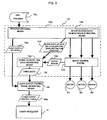
- FIG. 3 is a functional block diagram of an embodiment of this invention.
- program decoding means 10b decodes an input machining program 10a
- interpolation data generating/distributing means 10c distributes a motion command for every interpolation period to a servo control system 10d on the basis of a motion command instructed by the NC machining program 10a.
- the servo control system 10d Based on the distributed motion command, the servo control system 10d performs feedback control of position, speed and current, to thereby drive axis servomotors 31-33 to move a workpiece.
- the interpolation data generating/distributing means 10c supplies signal delivery time data generating means 10h with a ratio (Pa/(Pa+Pb)) between the remaining motion amount Pa, i.e., block overlap data, and the motion amount per interpolation period corresponding to the command speed and with an acceleration/deceleration time constant, which are shown by 10f.
- the servo control system 10d delivers a servo error 10g to the signal delivery time data generating means 10h which, based on these data, supplies laser output control signal generating means 40 with timing data 10i regarding the laser output control signal that serves as a command for changing the laser output condition.
- the laser output control signal generating means 40 receives a laser output set signal 10e indicative of the laser output condition instructed by the program 10a output from the program decoding means 10b of the numerical control apparatus 10, and outputs the received laser output set signal 10e, as a laser output control signal 40a, to a laser oscillator 41 at a time point determined based on the received timing data 10i.
- FIG. 4 is a schematic view of the laser beam machine 30 of this embodiment, in which reference numeral 10 denotes the numerical control apparatus (CNC) serving as a control unit to control the laser beam machine.
- the numerical control apparatus 10 is mainly constituted by a processor (CPU) 11 to which connected through a bus 20 are a ROM 12, a RAM 14, a non-volatile memory 13 constituted by a battery backed-up CMOSRAM, an input/output interface 15, an MDI (manual input mean) 19 with a display unit (such as CRT or liquid crystal display), X-axis and Y-axis (machining feed axis) servo amplifiers 16, 17, and a Z-axis (gap control axis) servo amplifier 18.
- the ROM 12 is stored with a system program used to control the entirety of the laser beam machine 30, and the non-volatile memory 13 is stored with an NC program which is prepared utilizing the MDI 19 with display unit or which is input through an input interface, not shown.
- the RAM 14 is utilized for temporal data storage during various processing.
- Connected to the input/output interface 15 is the laser output control signal generating means 40 to which the laser oscillator 41 is connected.
- the laser output control signal generating means 40 is constituted by a processor, a memory, etc., determines a laser output condition changeover timing based on the timing data for changeover of laser output conditions output from the processor 11 of the numerical control apparatus 10, and changes the laser output condition based on the laser output control signal that is output from the numerical control apparatus 10, thus controlling the laser oscillator 41.
- the laser oscillator 41 emits a laser beam 43, which is reflected by a bending mirror 42 to be transmitted to a machining head 35 by which the laser beam 43 are focused and irradiated onto a workpiece 38 through a distal end of a machining nozzle 36 attached to the machining head 35.
- the X-axis servomotor 31 is connected to the X-axis servo amplifier 16 of the numerical control apparatus 10, the Y-axis servomotor 32 is connected to the Y-axis servo amplifier 17, and the Z-axis servomotor 33 is connected to the Z-axis servomotor 18.
- the servomotors 31, 32 and 33 are each attached with a position/speed detector such as a pulse coder for position/speed detection, from which the position and speed of the servomotor 31, 32 or 33 are fed back to the servo amplifier 16, 17 or 18.
- the servo amplifiers 16, 17 and 18 control the positions and speeds of the servomotors 31, 32 and 33, respectively, each of which also carries out a current control based on a current detector, not shown.
- the X-axis servo amplifier 16 cooperates with the Y-axis servo amplifier 17 and the Z-axis servo amplifier 18 to form the servo control system.
- the above-mentioned laser beam machining apparatus differs in hardware construction from the conventionally known laser beam machining apparatus in that the laser output signal generating means 40 is added.
- FIG. 5 is a flowchart of processing executed for every interpolation period by the processor 11 of the numerical control apparatus
- FIG. 6 is a flowchart of processing executed by the laser output control signal generating means 40 for every period that is the same as the interpolation period.
- the processor 11 of the numerical control apparatus 10 reads and decodes command blocks in sequence, and performs processing such as output of motion commands to the X-axis, Y-axis and Z-axis servo amplifiers 16-18 for every interpolation period, whereby the drive of the laser beam machine is controlled.
- the processing is the same as the conventional one.
- the processor 11 executes the processing shown in FIG. 5 for every interpolation period.
- Step 100 a determination is made as to whether a flag F1 is set at "1" indicating that preparations for changeover of laser output conditions are currently underway (Step 100), and if not so, whether a changeover to the next block will be made in the next interpolation period is determined (Step 101). More specifically, a determination is made as to whether the remaining of a command motion amount, i.e., the distance to go, in the current block is less than the total of motion amounts delivered in the current and next interpolation periods. If no block changeover will be made in the next interpolation period, the processing in the current interpolation period is finished.
- the calculation based on formula (1) is carried out, using the remaining motion amount Pa of the current block for the next interpolation period immediately after the block changeover and the command motion amount (Pa+Pb) for the interpolation period determined by the command speed, thus determining the time period t1 from when the next block starts to when the block changeover will occur. Further, the delay time t2 is determined from an amount of servo error and an acceleration/deceleration time constant, and the calculation of formula (2) is performed to determine the time period T measured from the start of the interpolation period in which the block changeover will occur.
- the laser output control signal and the changeover time T are set in the interpolation period that is one period earlier than the period in which the block changeover will commence, and thus the time T' is determined by adding the interpolation period length ITP to the changeover time T (Step 102). Then, the flag F1 is set at "1" to indicate that the preparations of changeover of laser output conditions are under way (Step 103).
- Step 104 a determination is made as to whether the time T' determined at Step 102 is more than two times as large as the interpolation period length ITP (Step 104), and if so, the time T' is renewed by subtracting the interpolation period length ITP from the time T' (Step 108), whereupon the processing in the current interpolation period is finished.
- Step 104 the processing of Steps 100, 104 and 108 is executed since the flag F1 is set at 1.
- Step 104 determines that the time T' is not more than two times as large as the interpolation period length ITP, i.e., when the current interpolation period is one period earlier than the interpolation period in which the laser output condition will be changed.
- Step 105 the interpolation period length ITP is subtracted from the time T', to determine the changeover time Tc from the start of the interpolation period in which the laser output condition will be changed.
- the determined changeover time Tc, serving as signal delivery time data, and the laser output condition are output, as the laser output control signal, to the laser output control signal generating means 40 (Step 106).
- the flag F1 is set to 0, and the processing of the current interpolation period is finished.
- Step 102 the processing of Step 102 is performed in the interpolation period Q-1 that is one period earlier than the interpolation period Q0 in which the block changeover is made.
- Step 102 the processing of Step 102 is carried out in the interpolation period Q-1 that is one period earlier than the interpolation period Q0 in which the block changeover is made.
- the interpolation period in which the laser output control signal and the changeover time Tc are delivered is one period earlier than the interpolation period in which the laser output condition is changed.
- Such period is the interpolation period Q-1 for the example of FIG. 1 and the period Q2 for the example of FIG. 2 .
- the processor of the laser output control signal generating means 40 executes the processing shown in FIG. 6 at intervals of a period that is the same as the interpolation period. First, whether a flag F2 is set at "1" indicating that the changeover of laser output conditions has been set is determined (Step 200), and if not so, whether the changeover time Tc and the laser output control signal have been transmitted from the numerical control apparatus 10 is determined (Step 201). If they have not been transmitted as yet, the processing at the current period is finished.
- Step 201 if the changeover time Tc and the laser output control signal have been transmitted from the numerical control apparatus 10 as a result of the processing of Step 106 (Step 201), the changeover time Tc is set to a timer, and the laser output condition is set to a buffer (Step 202). Then, the flag F2 is set to 1 and the processing of the current period is finished.
- Step 204 the flow advances from Step 200 to Step 204 since the flag F2 has been set at 1, where the timer in which the changeover time is set is started. Then, a standby state is entered to await until the changeover time Tc has been measured by the timer (Step 205).
- the changeover time has elapsed, the laser output control signal stored in the buffer is output to the laser oscillator 41 (Step 206), the flag F2 is set to 0, and the processing of the current period is finished.
- the laser output control signal and the changeover time are delivered to the laser output control signal generating means 40 in the interpolation period that is one period earlier than the period in which the laser output condition is changed.
- the number of interpolation periods may be counted on the side of the laser output control signal generating means 40, to determine the interpolation period in which the laser output control signal for changing the laser output condition is to be delivered, and when the transmitted changeover time has elapsed from the start of the determined interpolation period, the laser output control signal may be output.
- the laser output condition is changed at the boundary between successive blocks, such change may be made at an arbitrary position or time point other than between the successive blocks.
- an external changeover command may be input to the laser output control signal generating means 40 which responds to this input signal to change the laser output condition.
- a time period from start of machining used for changeover of laser output conditions and the laser output condition may be set in advance using an NC machining program or input means 19, so as to change the laser output condition when the thus set time period has elapsed from the start of machining.
- a time Ts' is determined by subtracting the time (2 ⁇ ITP), which is twice as large as the interpolation period length, from the time period Ts that is set using the NC machining program or input means 19, and the determined time Ts' and the laser output condition corresponding to the time period Ts are stored in pair.
- times Ts0', Ts1', Ts2' and Ts3' individually obtained by subtracting the time (2xITP) twice as large as the interpolation period length from the set time periods are stored into the non-volatile memory 13 in pair with the laser output condition concerned, in the form of the table prepared as shown in FIG. 7 in which i indicates index.
- the processor 11 of the numerical control apparatus 10 executes the processing of FIG. 8 for every interpolation period.
- the time Tsi' corresponding to the index i (which is initially set to 0) is read out from the table (Step 300).
- whether a value in a register T for time measurement is equal to or larger than the read out time Tsi' is determined (Step 301). If the value in the register T is not equal to or larger than the time Tsi', the interpolation period length ITP is added to the register T (Step 302), and the processing of the current interpolation period is finished.
- FIG. 9 is a view for explaining the laser output condition changeover time Tc, in which Q0-Q6 each denote an interpolation period, and T0-T6 each denote a value of the register T at start of a corresponding interpolation period, i.e., a time point at which that interpolation period starts.
- the time Ts used to change the laser output condition is in the course of the interpolation period Q 4 , at which time ⁇ has elapsed from the start time point T4 of the interpolation period Q 4 .
- the time Ts' obtained by subtracting the doubled interpolation period length (2 ⁇ ITP) indicates a time point at which ⁇ has elapsed from the start time point Ts of the interpolation period Q 2 .
- the laser output condition is output from the numerical control apparatus to the laser output control signal generating means 40, together with the output start time Tc, as the laser output control signal.
- a plurality of laser output conditions including start/end of laser output, may be stored in the laser output control signal generating means 40, and the numerical control apparatus may output a selection signal for selecting one of the stored laser output conditions to the laser output control signal generating means 40 together with the time Tc.
- the laser beam may be irradiated for 0.137 msec from when 0.232 msec has elapsed from the start of the interpolation period concerned.
- the numerical control apparatus 10 may output and set the times of 0.232 msec and (0.232+0.137) msec at which the laser output is to be turned off and turned off to the laser output control signal generating means 40 for every interpolation period (or these times may be set in timers), and a turn on command or a turn off command may be output to the laser oscillator 41 when elapse of the turn on time or the turn off time is determined by measurement means which measures the time elapsed from start of interpolation period (or when the corresponding timer is time up).
- a ratio by which the interpolation period length ITP is divided may be delivered, as the signal delivery time data, from the numerical control apparatus 10 to the laser output control signal generating means 40 that multiplies the interpolation period length ITP by the transmitted division ratio to determine a turn on time and turn of time at which a laser output turn on or off command may be delivered.
- the laser output turn on time and turn off time may be set to the laser output control signal generating means 40 that turns on/off the laser output at that time for every interpolation period.
- the laser irradiation time is 6.25 msec, if the workpiece is rotated at a speed of 2400 rpm.
- the laser irradiation is stopped upon elapse of 0.25 msec in the 7th interpolation period, and the laser machining can be made accurately.
- the interpolation period at intervals of which the motion command is output is the same as the period at intervals of which signals are delivered to the laser output control signal generating means 40.
- these two periods may be different from each other.
- the interpolation period for delivery of motion command to the servo control system may be 0.5 msec and the period for delivery of signal to the laser output control signal generating means 40 may be 16 msec, so that the numerical control apparatus may only be required to carry out the arithmetic processing for laser operations at a frequency that is 1/32 part of the frequency of processing for servo operations.
- a load of the numerical control apparatus can be reduced, and the laser output condition such as turning on/off of laser output can be changed in units of time that is shorter than the interpolation period in the numerical control apparatus, thus making it possible to perform laser machining with high accuracy at high speeds.
Landscapes
- Physics & Mathematics (AREA)
- Engineering & Computer Science (AREA)
- Optics & Photonics (AREA)
- Plasma & Fusion (AREA)
- Mechanical Engineering (AREA)
- Manufacturing & Machinery (AREA)
- Human Computer Interaction (AREA)
- General Physics & Mathematics (AREA)
- Automation & Control Theory (AREA)
- Computing Systems (AREA)
- Theoretical Computer Science (AREA)
- Robotics (AREA)
- Laser Beam Processing (AREA)
- Numerical Control (AREA)
Claims (6)
- Laserbearbeitungsvorrichtung, umfassend:eine Laserstrahlmaschine (30), die einen Bearbeitungskopf (35) aufweist, der einen Laserstrahl (43) auf ein Werkstück (38) einstrahlt;einen Laseroszillator (41), der den Laserstrahl (43) erzeugt;einen Controller (10), der die Laserstrahlmaschine (30) kontrolliert, indem er Bewegungsbefehle zum Bewegen des Bearbeitungskopfs (35) relativ zum Werkstück (38) für jede vorbestimmte Interpolationsperiode (ITP) liefert, und der dafür ausgelegt ist, den Laseroszillator (41) zu kontrollieren, indem er ein Laserausgabe-Steuersignal (40a) über eine Laserausgabe-Steuersignal-Erzeugungsvorrichtung (40) abhängig von der vorbestimmten Interpolationsperiode (ITP) und übereinstimmend mit der Bewegung des Bearbeitungskopfs (35) der Laserstrahlmaschine (30) liefert,dadurch gekennzeichnet, dass der Controller (10) eine Zeitsteuerungsdaten-Erzeugungsvorrichtung (10h) enthält, die Zeitsteuerungsdaten (10i) erzeugt, die die Zeit zum Ausgeben des Laserausgabe-Steuersignals (40a) an den Laseroszillator (41) in Form einer Zeitperiode (Tc) ab dem Beginn einer Interpolationsperiode (ITP) definieren, in der das Laserausgabe-Steuersignal (40a) zu liefern ist, wobei die Zeitperiode (Tc) bestimmt wird abhängig von einer verstrichenen Zeit (t1) ab dem Beginn einer Interpolationsperiode (ITP), in der die Bewegungsgrößen (Pa, Pb) von aufeinander folgenden Bewegungsbefehlen aufaddiert werden, damit die gesamte Bewegungsgröße für die Interpolationsperiode (ITP) gebildet wird, und die verstrichene Zeit (t1) auf einem Verhältnis (Pa/(Pa + Pb)) zwischen den Bewegungsgrößen der aufeinander folgenden Bewegungsbefehle beruht; unddass die Laserausgabe-Steuersignal-Erzeugungsvorrichtung (40) dafür eingerichtet ist, die Zeitsteuerungsdaten (10i) von der Zeitsteuerungsdaten-Erzeugungsvorrichtung (10h) zu empfangen und das Liefern des Laserausgabe-Steuersignals (40a) an den Laseroszillator (41) um die Zeitperiode (Tc) ab dem Beginn der Interpolationsperiode (ITP) zu verzögern, in der das Laserausgabe-Steuersignal zu liefern ist.
- Laserbearbeitungsvorrichtung nach Anspruch 1, worin der Controller (10) so ausgelegt ist, dass er ein Bearbeitungszustands-Bezeichnungssignal liefert, das einen Laserausgabezustand bezeichnet, zu dem das Ein/Ausschalten der Laserausgabe oder das Wählen eines der Laserausgabezustände gehört, die in der Laserausgabe-Steuersignal-Erzeugungsvorrichtung (40) gespeichert sind, und zwar für die Laserausgabe-Steuersignal-Erzeugungsvorrichtung (40) zusammen mit den Zeitsteuerungsdaten (10i).
- Laserbearbeitungsvorrichtung nach Anspruch 1, worin die Zeitsteuerungsdaten-Erzeugungsvorrichtung (10h) so beschaffen ist, dass sie die Zeitperiode (Tc) ab dem Beginn der Interpolationsperiode (ITP) feststellt, in der das Laserausgabe-Steuersignal (40a) zu liefern ist, und zwar abhängig von der verstrichenen Zeit (t1 ) und einer Gesamtverzögerungszeit (t2).
- Laserbearbeitungsvorrichtung nach Anspruch 3, worin die Zeitsteuerungsdaten-Erzeugungsvorrichtung (10h) so beschaffen ist, dass sie die Gesamtverzögerungszeit (t2) unter Einbeziehung entweder einer Verzögerungszeit in einem Servorückführsystem zum Verarbeiten von Bewegungsbefehlen oder einer Verzögerungszeit im Laseroszillator (41) oder beider Größen bestimmt.
- Laserbearbeitungsvorrichtung nach Anspruch 1, worin eine vorbestimmte Periode in Intervallen, von denen ein Steuersignal, zu dem die Zeitsteuerungsdaten (10i) gehören, an die Laserausgabe-Steuersignal-Erzeugungsvorrichtung (40) geliefert wird, um ein Mehrfaches länger ist als die vorbestimmte Interpolationsperiode (ITP) in Intervallen, zu denen der Bewegungsbefehl geliefert wird.
- Laserbearbeitungsvorrichtung nach Anspruch 1, worin die Zeitsteuerungsdaten-Erzeugungsvorrichtung (10h) so beschaffen ist, dass sie die Zeitsteuerungsdaten (10i) an die Laserausgabe-Steuersignal-Erzeugungsvorrichtung (40) in einer Interpolationsperiode (ITP) liefert, die der Interpolationsperiode (ITP) um eine Periode vorausgeht, in der das Laserausgabe-Steuersignal (40a) zu liefern ist.
Applications Claiming Priority (2)
| Application Number | Priority Date | Filing Date | Title |
|---|---|---|---|
| JP2002336302 | 2002-11-20 | ||
| JP2002336302A JP3795854B2 (ja) | 2002-11-20 | 2002-11-20 | レーザ加工装置 |
Publications (3)
| Publication Number | Publication Date |
|---|---|
| EP1422015A2 EP1422015A2 (de) | 2004-05-26 |
| EP1422015A3 EP1422015A3 (de) | 2007-09-05 |
| EP1422015B1 true EP1422015B1 (de) | 2010-07-21 |
Family
ID=32212086
Family Applications (1)
| Application Number | Title | Priority Date | Filing Date |
|---|---|---|---|
| EP03257285A Expired - Lifetime EP1422015B1 (de) | 2002-11-20 | 2003-11-18 | Laserbearbeitungsvorrichtung |
Country Status (4)
| Country | Link |
|---|---|
| US (1) | US7012215B2 (de) |
| EP (1) | EP1422015B1 (de) |
| JP (1) | JP3795854B2 (de) |
| DE (1) | DE60333429D1 (de) |
Families Citing this family (13)
| Publication number | Priority date | Publication date | Assignee | Title |
|---|---|---|---|---|
| JP3830475B2 (ja) * | 2003-08-05 | 2006-10-04 | ファナック株式会社 | 制御装置 |
| EP1690629B1 (de) | 2005-02-09 | 2013-01-23 | Fanuc Corporation | Laserbearbeitungssystem |
| WO2011127601A1 (en) * | 2010-04-13 | 2011-10-20 | National Research Council Of Canada | Laser processing control method |
| JP5091287B2 (ja) | 2010-08-06 | 2012-12-05 | ファナック株式会社 | 加工点にエネルギー又は物質を供給する加工機における加工情報取得装置 |
| JP5778430B2 (ja) * | 2011-01-12 | 2015-09-16 | Dmg森精機株式会社 | 工作機械の制御装置 |
| JP5166589B1 (ja) * | 2011-10-21 | 2013-03-21 | ファナック株式会社 | 加工ヘッドのアプローチ動作を制御するレーザ加工用制御装置 |
| JP5710713B2 (ja) * | 2013-08-22 | 2015-04-30 | ファナック株式会社 | モータ制御システム |
| JP5911939B1 (ja) * | 2014-10-14 | 2016-04-27 | ファナック株式会社 | 共通加減速制御部による任意ブロック間のオーバラップ機能を備えた数値制御装置 |
| JP6235623B2 (ja) * | 2015-02-23 | 2017-11-22 | ファナック株式会社 | 出力指令を切換えるタイミングを調整可能なレーザ加工システム |
| DE102016001768B4 (de) * | 2015-02-23 | 2020-06-18 | Fanuc Corporation | Laserbearbeitungssystem mit zeitangepasster Abgabebefehlsschaltung |
| JP6777618B2 (ja) * | 2017-11-01 | 2020-10-28 | ファナック株式会社 | 数値制御装置、数値制御方法及び数値制御プログラム |
| JPWO2024218841A1 (de) * | 2023-04-17 | 2024-10-24 | ||
| JPWO2024218842A1 (de) * | 2023-04-17 | 2024-10-24 |
Family Cites Families (12)
| Publication number | Priority date | Publication date | Assignee | Title |
|---|---|---|---|---|
| US5521696A (en) * | 1989-03-27 | 1996-05-28 | Laser Technology, Inc. | Laser-based speed measuring device |
| US5206889A (en) * | 1992-01-17 | 1993-04-27 | Hewlett-Packard Company | Timing interpolator |
| US5453594A (en) | 1993-10-06 | 1995-09-26 | Electro Scientific Industries, Inc. | Radiation beam position and emission coordination system |
| JPH07112287A (ja) * | 1993-10-15 | 1995-05-02 | Fanuc Ltd | Ncレーザ装置 |
| JP3405797B2 (ja) | 1994-02-17 | 2003-05-12 | ファナック株式会社 | レーザ出力制御方式 |
| US5856649A (en) * | 1994-02-25 | 1999-01-05 | Fanuc Ltd. | Laser beam machine |
| JP3315556B2 (ja) * | 1994-04-27 | 2002-08-19 | 三菱電機株式会社 | レーザ加工装置 |
| JPH09101814A (ja) * | 1995-10-06 | 1997-04-15 | Fanuc Ltd | 数値制御装置及び自動プログラミング装置 |
| JP2795255B2 (ja) | 1996-03-26 | 1998-09-10 | 日本電気株式会社 | 数値制御装置 |
| US6144007A (en) * | 1998-10-26 | 2000-11-07 | Levin; Theodore L. | Method and apparatus for forming a perforated non-planar object using a pulsed energy beam |
| CN1167533C (zh) * | 1999-03-05 | 2004-09-22 | 三菱电机株式会社 | 激光加工装置 |
| JP3660328B2 (ja) * | 2002-06-21 | 2005-06-15 | ファナック株式会社 | レーザ加工機 |
-
2002
- 2002-11-20 JP JP2002336302A patent/JP3795854B2/ja not_active Expired - Lifetime
-
2003
- 2003-11-18 US US10/715,124 patent/US7012215B2/en not_active Expired - Lifetime
- 2003-11-18 EP EP03257285A patent/EP1422015B1/de not_active Expired - Lifetime
- 2003-11-18 DE DE60333429T patent/DE60333429D1/de not_active Expired - Lifetime
Also Published As
| Publication number | Publication date |
|---|---|
| US20040129688A1 (en) | 2004-07-08 |
| JP2004167549A (ja) | 2004-06-17 |
| DE60333429D1 (de) | 2010-09-02 |
| EP1422015A2 (de) | 2004-05-26 |
| US7012215B2 (en) | 2006-03-14 |
| EP1422015A3 (de) | 2007-09-05 |
| JP3795854B2 (ja) | 2006-07-12 |
Similar Documents
| Publication | Publication Date | Title |
|---|---|---|
| EP0917033B1 (de) | Maschinensteuerung | |
| US8374718B2 (en) | Numerical control method and apparatus therefor | |
| US7012215B2 (en) | Laser machining apparatus | |
| US7167772B2 (en) | Machining time calculating apparatus | |
| EP1967924A1 (de) | Gerät zur synchron Steuerung mehrerer Servomotoren | |
| KR880002680B1 (ko) | 라인에 다수의 프레스를 동기시키기 위한 제어시스템 | |
| US5777294A (en) | Laser beam machining system and method using preliminary work commands | |
| US20130317641A1 (en) | Numerical control device | |
| CN105843167B (zh) | 机床的热位移校正装置 | |
| US6539275B1 (en) | Machine controller and process with two-step interpolation | |
| US20070177128A1 (en) | Laser control method and laser control apparatus | |
| EP2600217A1 (de) | Vorrichtung für numerische steuerung | |
| CN108873818B (zh) | 数值控制装置 | |
| CN110554656A (zh) | 数值控制装置 | |
| US7613541B2 (en) | Thread control method and system therefor | |
| JPH1039915A (ja) | 数値制御装置 | |
| US10569358B2 (en) | Laser processing system capable of adjusting timing to switch output command | |
| US7480541B2 (en) | Numerical controller | |
| JP6105548B2 (ja) | 干渉回避位置決め機能を備えた数値制御装置 | |
| US6100498A (en) | Method of reducing time for laser piercing and cutting | |
| JPH06143093A (ja) | 工具の摩耗補正方式 | |
| JP4436809B2 (ja) | レーザ加工システム | |
| JPH0750407B2 (ja) | 数値制御システム | |
| US10514674B2 (en) | Numerical controller | |
| JPH0573128A (ja) | 数値制御装置の送り速度制御方法 |
Legal Events
| Date | Code | Title | Description |
|---|---|---|---|
| PUAI | Public reference made under article 153(3) epc to a published international application that has entered the european phase |
Free format text: ORIGINAL CODE: 0009012 |
|
| AK | Designated contracting states |
Kind code of ref document: A2 Designated state(s): AT BE BG CH CY CZ DE DK EE ES FI FR GB GR HU IE IT LI LU MC NL PT RO SE SI SK TR |
|
| AX | Request for extension of the european patent |
Extension state: AL LT LV MK |
|
| PUAL | Search report despatched |
Free format text: ORIGINAL CODE: 0009013 |
|
| AK | Designated contracting states |
Kind code of ref document: A3 Designated state(s): AT BE BG CH CY CZ DE DK EE ES FI FR GB GR HU IE IT LI LU MC NL PT RO SE SI SK TR |
|
| AX | Request for extension of the european patent |
Extension state: AL LT LV MK |
|
| RIC1 | Information provided on ipc code assigned before grant |
Ipc: G05B 19/404 20060101ALI20070730BHEP Ipc: G05B 19/41 20060101ALI20070730BHEP Ipc: B23K 26/08 20060101AFI20040227BHEP |
|
| 17P | Request for examination filed |
Effective date: 20080227 |
|
| AKX | Designation fees paid |
Designated state(s): DE |
|
| 17Q | First examination report despatched |
Effective date: 20081023 |
|
| GRAP | Despatch of communication of intention to grant a patent |
Free format text: ORIGINAL CODE: EPIDOSNIGR1 |
|
| GRAS | Grant fee paid |
Free format text: ORIGINAL CODE: EPIDOSNIGR3 |
|
| GRAA | (expected) grant |
Free format text: ORIGINAL CODE: 0009210 |
|
| AK | Designated contracting states |
Kind code of ref document: B1 Designated state(s): DE |
|
| REF | Corresponds to: |
Ref document number: 60333429 Country of ref document: DE Date of ref document: 20100902 Kind code of ref document: P |
|
| RAP2 | Party data changed (patent owner data changed or rights of a patent transferred) |
Owner name: FANUC CORPORATION |
|
| PLBE | No opposition filed within time limit |
Free format text: ORIGINAL CODE: 0009261 |
|
| STAA | Information on the status of an ep patent application or granted ep patent |
Free format text: STATUS: NO OPPOSITION FILED WITHIN TIME LIMIT |
|
| 26N | No opposition filed |
Effective date: 20110426 |
|
| REG | Reference to a national code |
Ref country code: DE Ref legal event code: R097 Ref document number: 60333429 Country of ref document: DE Effective date: 20110426 |
|
| REG | Reference to a national code |
Ref country code: DE Ref legal event code: R082 Ref document number: 60333429 Country of ref document: DE Representative=s name: HASELTINE LAKE LLP, DE |
|
| REG | Reference to a national code |
Ref country code: DE Ref legal event code: R082 Ref document number: 60333429 Country of ref document: DE Representative=s name: HL KEMPNER PATENTANWALT, RECHTSANWALT, SOLICIT, DE |
|
| PGFP | Annual fee paid to national office [announced via postgrant information from national office to epo] |
Ref country code: DE Payment date: 20220621 Year of fee payment: 20 |
|
| REG | Reference to a national code |
Ref country code: DE Ref legal event code: R071 Ref document number: 60333429 Country of ref document: DE |