EP1399766B1 - Exposure apparatus comprising an optical element made of an isometric crystal - Google Patents
Exposure apparatus comprising an optical element made of an isometric crystal Download PDFInfo
- Publication number
- EP1399766B1 EP1399766B1 EP02736104A EP02736104A EP1399766B1 EP 1399766 B1 EP1399766 B1 EP 1399766B1 EP 02736104 A EP02736104 A EP 02736104A EP 02736104 A EP02736104 A EP 02736104A EP 1399766 B1 EP1399766 B1 EP 1399766B1
- Authority
- EP
- European Patent Office
- Prior art keywords
- axis
- optical
- optical system
- optical element
- intrinsic birefringence
- Prior art date
- Legal status (The legal status is an assumption and is not a legal conclusion. Google has not performed a legal analysis and makes no representation as to the accuracy of the status listed.)
- Revoked
Links
- 230000003287 optical effect Effects 0.000 title claims abstract description 465
- 239000013078 crystal Substances 0.000 title claims abstract description 91
- 238000004519 manufacturing process Methods 0.000 claims abstract description 29
- 238000000034 method Methods 0.000 claims description 44
- 230000008569 process Effects 0.000 claims description 24
- 239000004065 semiconductor Substances 0.000 claims description 10
- 238000005286 illumination Methods 0.000 claims description 8
- 238000011161 development Methods 0.000 claims description 3
- 238000004806 packaging method and process Methods 0.000 claims description 2
- 230000003252 repetitive effect Effects 0.000 claims description 2
- 230000000694 effects Effects 0.000 abstract description 12
- WUKWITHWXAAZEY-UHFFFAOYSA-L calcium difluoride Chemical compound [F-].[F-].[Ca+2] WUKWITHWXAAZEY-UHFFFAOYSA-L 0.000 description 46
- 229910001634 calcium fluoride Inorganic materials 0.000 description 41
- 238000004088 simulation Methods 0.000 description 14
- 239000000463 material Substances 0.000 description 13
- 238000010586 diagram Methods 0.000 description 12
- 230000005855 radiation Effects 0.000 description 8
- 230000009471 action Effects 0.000 description 7
- 238000000137 annealing Methods 0.000 description 7
- OYLGJCQECKOTOL-UHFFFAOYSA-L barium fluoride Chemical compound [F-].[F-].[Ba+2] OYLGJCQECKOTOL-UHFFFAOYSA-L 0.000 description 7
- 229910001632 barium fluoride Inorganic materials 0.000 description 7
- FVRNDBHWWSPNOM-UHFFFAOYSA-L strontium fluoride Chemical compound [F-].[F-].[Sr+2] FVRNDBHWWSPNOM-UHFFFAOYSA-L 0.000 description 7
- 229910001637 strontium fluoride Inorganic materials 0.000 description 7
- KRHYYFGTRYWZRS-UHFFFAOYSA-M Fluoride anion Chemical compound [F-] KRHYYFGTRYWZRS-UHFFFAOYSA-M 0.000 description 6
- 230000006872 improvement Effects 0.000 description 5
- 239000000203 mixture Substances 0.000 description 4
- 238000002834 transmittance Methods 0.000 description 4
- BHHYHSUAOQUXJK-UHFFFAOYSA-L zinc fluoride Chemical compound F[Zn]F BHHYHSUAOQUXJK-UHFFFAOYSA-L 0.000 description 4
- 238000001444 catalytic combustion detection Methods 0.000 description 3
- 230000008859 change Effects 0.000 description 3
- 239000010408 film Substances 0.000 description 3
- 238000010438 heat treatment Methods 0.000 description 3
- FFUAGWLWBBFQJT-UHFFFAOYSA-N hexamethyldisilazane Chemical compound C[Si](C)(C)N[Si](C)(C)C FFUAGWLWBBFQJT-UHFFFAOYSA-N 0.000 description 3
- 229920002120 photoresistant polymer Polymers 0.000 description 3
- 239000002516 radical scavenger Substances 0.000 description 3
- 239000000126 substance Substances 0.000 description 3
- VTYYLEPIZMXCLO-UHFFFAOYSA-L Calcium carbonate Chemical compound [Ca+2].[O-]C([O-])=O VTYYLEPIZMXCLO-UHFFFAOYSA-L 0.000 description 2
- KRHYYFGTRYWZRS-UHFFFAOYSA-N Fluorane Chemical compound F KRHYYFGTRYWZRS-UHFFFAOYSA-N 0.000 description 2
- VYPSYNLAJGMNEJ-UHFFFAOYSA-N Silicium dioxide Chemical compound O=[Si]=O VYPSYNLAJGMNEJ-UHFFFAOYSA-N 0.000 description 2
- 230000004075 alteration Effects 0.000 description 2
- 238000000151 deposition Methods 0.000 description 2
- 230000008021 deposition Effects 0.000 description 2
- 239000006185 dispersion Substances 0.000 description 2
- 238000005530 etching Methods 0.000 description 2
- 229910000040 hydrogen fluoride Inorganic materials 0.000 description 2
- 238000007689 inspection Methods 0.000 description 2
- PQXKHYXIUOZZFA-UHFFFAOYSA-M lithium fluoride Chemical compound [Li+].[F-] PQXKHYXIUOZZFA-UHFFFAOYSA-M 0.000 description 2
- 238000001459 lithography Methods 0.000 description 2
- 230000002265 prevention Effects 0.000 description 2
- 230000009467 reduction Effects 0.000 description 2
- 238000007670 refining Methods 0.000 description 2
- 238000007493 shaping process Methods 0.000 description 2
- PUZPDOWCWNUUKD-UHFFFAOYSA-M sodium fluoride Chemical compound [F-].[Na+] PUZPDOWCWNUUKD-UHFFFAOYSA-M 0.000 description 2
- 229920002994 synthetic fiber Polymers 0.000 description 2
- 238000007738 vacuum evaporation Methods 0.000 description 2
- 241000276498 Pollachius virens Species 0.000 description 1
- QVGXLLKOCUKJST-UHFFFAOYSA-N atomic oxygen Chemical compound [O] QVGXLLKOCUKJST-UHFFFAOYSA-N 0.000 description 1
- 230000015572 biosynthetic process Effects 0.000 description 1
- BRCWHGIUHLWZBK-UHFFFAOYSA-K bismuth;trifluoride Chemical compound F[Bi](F)F BRCWHGIUHLWZBK-UHFFFAOYSA-K 0.000 description 1
- LVEULQCPJDDSLD-UHFFFAOYSA-L cadmium fluoride Chemical compound F[Cd]F LVEULQCPJDDSLD-UHFFFAOYSA-L 0.000 description 1
- 229910000019 calcium carbonate Inorganic materials 0.000 description 1
- 150000004653 carbonic acids Chemical class 0.000 description 1
- 238000006243 chemical reaction Methods 0.000 description 1
- 238000004140 cleaning Methods 0.000 description 1
- 238000003776 cleavage reaction Methods 0.000 description 1
- 229910052681 coesite Inorganic materials 0.000 description 1
- 230000001427 coherent effect Effects 0.000 description 1
- 238000012937 correction Methods 0.000 description 1
- 229910052906 cristobalite Inorganic materials 0.000 description 1
- 230000018044 dehydration Effects 0.000 description 1
- 238000006297 dehydration reaction Methods 0.000 description 1
- 230000003111 delayed effect Effects 0.000 description 1
- 238000013461 design Methods 0.000 description 1
- 230000006866 deterioration Effects 0.000 description 1
- 238000006073 displacement reaction Methods 0.000 description 1
- 238000001035 drying Methods 0.000 description 1
- 230000005684 electric field Effects 0.000 description 1
- 230000001747 exhibiting effect Effects 0.000 description 1
- 238000002474 experimental method Methods 0.000 description 1
- 239000011521 glass Substances 0.000 description 1
- 239000012535 impurity Substances 0.000 description 1
- 238000005468 ion implantation Methods 0.000 description 1
- 150000002500 ions Chemical class 0.000 description 1
- 239000004973 liquid crystal related substance Substances 0.000 description 1
- ORUIBWPALBXDOA-UHFFFAOYSA-L magnesium fluoride Chemical compound [F-].[F-].[Mg+2] ORUIBWPALBXDOA-UHFFFAOYSA-L 0.000 description 1
- 229910001635 magnesium fluoride Inorganic materials 0.000 description 1
- 230000008018 melting Effects 0.000 description 1
- 238000002844 melting Methods 0.000 description 1
- 239000012528 membrane Substances 0.000 description 1
- QSHDDOUJBYECFT-UHFFFAOYSA-N mercury Chemical compound [Hg] QSHDDOUJBYECFT-UHFFFAOYSA-N 0.000 description 1
- 229910052753 mercury Inorganic materials 0.000 description 1
- 239000012788 optical film Substances 0.000 description 1
- 238000007254 oxidation reaction Methods 0.000 description 1
- TWNQGVIAIRXVLR-UHFFFAOYSA-N oxo(oxoalumanyloxy)alumane Chemical compound O=[Al]O[Al]=O TWNQGVIAIRXVLR-UHFFFAOYSA-N 0.000 description 1
- 239000001301 oxygen Substances 0.000 description 1
- 229910052760 oxygen Inorganic materials 0.000 description 1
- BPUBBGLMJRNUCC-UHFFFAOYSA-N oxygen(2-);tantalum(5+) Chemical compound [O-2].[O-2].[O-2].[O-2].[O-2].[Ta+5].[Ta+5] BPUBBGLMJRNUCC-UHFFFAOYSA-N 0.000 description 1
- 239000000843 powder Substances 0.000 description 1
- 238000002407 reforming Methods 0.000 description 1
- 230000002000 scavenging effect Effects 0.000 description 1
- 230000007017 scission Effects 0.000 description 1
- 238000007789 sealing Methods 0.000 description 1
- 238000000926 separation method Methods 0.000 description 1
- 229910052710 silicon Inorganic materials 0.000 description 1
- 239000010703 silicon Substances 0.000 description 1
- 239000000377 silicon dioxide Substances 0.000 description 1
- 239000011775 sodium fluoride Substances 0.000 description 1
- 235000013024 sodium fluoride Nutrition 0.000 description 1
- 239000007787 solid Substances 0.000 description 1
- 238000007711 solidification Methods 0.000 description 1
- 230000008023 solidification Effects 0.000 description 1
- 239000002904 solvent Substances 0.000 description 1
- 238000004544 sputter deposition Methods 0.000 description 1
- 229910052682 stishovite Inorganic materials 0.000 description 1
- 239000000758 substrate Substances 0.000 description 1
- 239000004094 surface-active agent Substances 0.000 description 1
- 229910001936 tantalum oxide Inorganic materials 0.000 description 1
- 239000010409 thin film Substances 0.000 description 1
- 229910052905 tridymite Inorganic materials 0.000 description 1
- 238000007740 vapor deposition Methods 0.000 description 1
- 229910052724 xenon Inorganic materials 0.000 description 1
- FHNFHKCVQCLJFQ-UHFFFAOYSA-N xenon atom Chemical compound [Xe] FHNFHKCVQCLJFQ-UHFFFAOYSA-N 0.000 description 1
Images







Classifications
-
- G—PHYSICS
- G02—OPTICS
- G02B—OPTICAL ELEMENTS, SYSTEMS OR APPARATUS
- G02B1/00—Optical elements characterised by the material of which they are made; Optical coatings for optical elements
-
- G—PHYSICS
- G03—PHOTOGRAPHY; CINEMATOGRAPHY; ANALOGOUS TECHNIQUES USING WAVES OTHER THAN OPTICAL WAVES; ELECTROGRAPHY; HOLOGRAPHY
- G03F—PHOTOMECHANICAL PRODUCTION OF TEXTURED OR PATTERNED SURFACES, e.g. FOR PRINTING, FOR PROCESSING OF SEMICONDUCTOR DEVICES; MATERIALS THEREFOR; ORIGINALS THEREFOR; APPARATUS SPECIALLY ADAPTED THEREFOR
- G03F7/00—Photomechanical, e.g. photolithographic, production of textured or patterned surfaces, e.g. printing surfaces; Materials therefor, e.g. comprising photoresists; Apparatus specially adapted therefor
- G03F7/70—Microphotolithographic exposure; Apparatus therefor
- G03F7/708—Construction of apparatus, e.g. environment aspects, hygiene aspects or materials
- G03F7/7095—Materials, e.g. materials for housing, stage or other support having particular properties, e.g. weight, strength, conductivity, thermal expansion coefficient
- G03F7/70958—Optical materials or coatings, e.g. with particular transmittance, reflectance or anti-reflection properties
- G03F7/70966—Birefringence
-
- C—CHEMISTRY; METALLURGY
- C30—CRYSTAL GROWTH
- C30B—SINGLE-CRYSTAL GROWTH; UNIDIRECTIONAL SOLIDIFICATION OF EUTECTIC MATERIAL OR UNIDIRECTIONAL DEMIXING OF EUTECTOID MATERIAL; REFINING BY ZONE-MELTING OF MATERIAL; PRODUCTION OF A HOMOGENEOUS POLYCRYSTALLINE MATERIAL WITH DEFINED STRUCTURE; SINGLE CRYSTALS OR HOMOGENEOUS POLYCRYSTALLINE MATERIAL WITH DEFINED STRUCTURE; AFTER-TREATMENT OF SINGLE CRYSTALS OR A HOMOGENEOUS POLYCRYSTALLINE MATERIAL WITH DEFINED STRUCTURE; APPARATUS THEREFOR
- C30B11/00—Single-crystal growth by normal freezing or freezing under temperature gradient, e.g. Bridgman-Stockbarger method
-
- C—CHEMISTRY; METALLURGY
- C30—CRYSTAL GROWTH
- C30B—SINGLE-CRYSTAL GROWTH; UNIDIRECTIONAL SOLIDIFICATION OF EUTECTIC MATERIAL OR UNIDIRECTIONAL DEMIXING OF EUTECTOID MATERIAL; REFINING BY ZONE-MELTING OF MATERIAL; PRODUCTION OF A HOMOGENEOUS POLYCRYSTALLINE MATERIAL WITH DEFINED STRUCTURE; SINGLE CRYSTALS OR HOMOGENEOUS POLYCRYSTALLINE MATERIAL WITH DEFINED STRUCTURE; AFTER-TREATMENT OF SINGLE CRYSTALS OR A HOMOGENEOUS POLYCRYSTALLINE MATERIAL WITH DEFINED STRUCTURE; APPARATUS THEREFOR
- C30B29/00—Single crystals or homogeneous polycrystalline material with defined structure characterised by the material or by their shape
- C30B29/10—Inorganic compounds or compositions
- C30B29/12—Halides
-
- G—PHYSICS
- G02—OPTICS
- G02B—OPTICAL ELEMENTS, SYSTEMS OR APPARATUS
- G02B1/00—Optical elements characterised by the material of which they are made; Optical coatings for optical elements
- G02B1/02—Optical elements characterised by the material of which they are made; Optical coatings for optical elements made of crystals, e.g. rock-salt, semi-conductors
-
- Y—GENERAL TAGGING OF NEW TECHNOLOGICAL DEVELOPMENTS; GENERAL TAGGING OF CROSS-SECTIONAL TECHNOLOGIES SPANNING OVER SEVERAL SECTIONS OF THE IPC; TECHNICAL SUBJECTS COVERED BY FORMER USPC CROSS-REFERENCE ART COLLECTIONS [XRACs] AND DIGESTS
- Y10—TECHNICAL SUBJECTS COVERED BY FORMER USPC
- Y10S—TECHNICAL SUBJECTS COVERED BY FORMER USPC CROSS-REFERENCE ART COLLECTIONS [XRACs] AND DIGESTS
- Y10S117/00—Single-crystal, oriented-crystal, and epitaxy growth processes; non-coating apparatus therefor
- Y10S117/918—Single-crystal waveguide
Definitions
- This invention relates generally to an optical element, and more particularly to optical elements consisting of an isometric crystal such as calcium fluoride (CaF 2 ), barium fluoride (BaF 2 ), and strontium fluoride (SrF 2 ), which elements are used in the short wavelength range from vacuum ultraviolet radiation to deep ultraviolet radiation, and a manufacturing method therefor.
- an isometric crystal such as calcium fluoride (CaF 2 ), barium fluoride (BaF 2 ), and strontium fluoride (SrF 2 ), which elements are used in the short wavelength range from vacuum ultraviolet radiation to deep ultraviolet radiation, and a manufacturing method therefor.
- the calcium fluoride (CaF 2 ) single crystal is most suitably used as an optical material for optical elements such as lenses and diffraction gratings for use with an exposure optical system in that light transmittance (i.e ., internal transmittance) in the above wavelength range is high.
- light transmittance i.e ., internal transmittance
- the barium fluoride (BaF 2 ) single crystal and strontium fluoride (SrF 2 ) single crystal are also high in transmittance, thus their application has been under consideration.
- the calcium fluoride (CaF 2 ) single crystal has been manufactured up to this time by the crucible descent method (also known as "Bridgman method").
- crucible descent method also known as "Bridgman method”
- materials for crystalline substances are filled in a crucible, melted by application of heat using a heater, and cooled by lowering the materials in the crucible, whereby the materials are crystallized.
- a seed crystal having a desired face orientation to induce growth of a crystal is placed at a bottom of the crucible, so that the face orientation of the crystal to be grown is controlled.
- the calcium fluoride is generally advantageous in easy handling of cleavage plane of a ⁇ 1 1 1> face perpendicular to the crystal orientation [1 1 1] axis, and further in less effect of birefringence due to photoelasticity with respect to light beams incident from a direction of the [1 1 1] axis.
- the calcium fluoride grows to form a desired optical element under control of the face orientation using the seed crystal oriented to the ⁇ 1 1 1> face, or by slicing the ⁇ 1 1 1> face of the crystal, and thereby the optical element having a light beam incident surface at the ⁇ 1 1 1> face is obtained. Consequently, an optical system constituted of the above optical element has an optical axis identical with the [1 1 1] axis, to contribute to improved optical properties of the optical element (or optical system).
- the maximum value of the intrinsic birefringence of the calcium fluoride is 6.5nm/cm with the wavelength of 157nm, and the directions in which the maximum value is exhibited are twelve directions including an [1 1 0] axis direction.
- the above-described optical element using the ⁇ 1 1 1> face has an optical axis identical with the [1 1 1] axis, which is only 35.26 degrees apart from the [1 1 0] axis exhibiting the maximum birefringence.
- the numerical aperture (NA) of the calcium fluoride for a beam passing along the [1 1 0] axis is 0.87 with the wavelength of 193nm, and 0.90 with the wavelength 157nm.
- exposure apparatuses in recent years have been required to achieve improvement in resolution and thus tend to include a projection optical system with increased NA, and the NA ranging between 0.65 and 0.80 has become the mainstream.
- the light beam passes through an area near the [1 1 0] axis where the intrinsic birefringence represents a large value. This makes it difficult for the conventional exposure apparatuses to perform exposure of good image-forming quality.
- US-A-5,867,315 discloses a biofocal crystal optic lens formed from two uniaxial crystals and an isotropic crystal, in which the uniaxial crystals have two surfaces having a common axis that is parallel to the axis of an incident ray.
- the lens generates two focal points, and may be used for example in video optical disc players and the like.
- EP-A-0 942 297 discloses a method of calculating the birefringence of an optical element and selecting the minimum birefringence in such an optical element, and discloses a system using such an optical element, for example a photolithographic apparatus such as a stepper.
- the optical element is preferably constructed from a crystal with the direction of the optical axis coinciding with the ⁇ 111> axial direction.
- an exposure apparatus comprising an illumination optical system illuminating a reticle using light from a light source, and a projection optical system for projecting a repetitive pattern on the reticle onto an object to be exposed, said exposure apparatus being characterised in that:
- the [010] axis perpendicular to the [001] axis in the isometric crystal is inclined to a direction of repetition of the pattern by 10° or greater.
- the intrinsic birefringence represents the largest value when the ray is tilted at 45° from the [0 0 1] axis. Therefore, comparing an embodiment in which the optical axis is made identical with a [1 1 1] axis with another embodiment in which the optical axis is made identical with the [0 0 1] axis, the ray angle at which the intrinsic birefringence represents the maximum value may be greater when the optical axis is made identical with the [0 0 1] axis.
- the optical element using ⁇ 0 0 1> face i.e ., optical element in which the optical axis is made identical with the [0 0 1] axis may be less susceptible to deterioration of image-forming quality under high NA conditions.
- the ray angle of the maximum intrinsic birefringence is larger than the critical angle. This may prevent the birefringence from being the maximum even under high NA conditions when a light-emitting surface of the optical element is flat.
- the inventive optical element does not require the optical axis of light beams to be strictly identical with the [0 0 1] axis.
- the optical element needs to make an angle between the optical axis and the [0 0 1] axis at least less than 10°. This may prevent a relationship between the intrinsic birefringence quantities and the ray angle in the crystal from being substantially the same as in the conventional embodiment in which the optical axis is made identical with the [1 1 1] axis. Moreover, the above angle may prevent the maximum value of the intrinsic birefringence from being within the critical angle.
- the critical angle is an index used when a surface at the light emitting side is nearly flat.
- the optical element may be manufactured by a method comprising the steps of growing an isometric crystal and forming the optical element from the isometric crystal that has been grown, and the above growing step includes the step of controlling growth so that a face orientation of the growing crystal is a ⁇ 0 0 1> face.
- the manufacturing method comprises the steps of growing an isometric crystal and forming the optical element from the isometric crystal that has been grown, and the above forming step is performed by slicing the isometric crystal that has been grown with respect to a ⁇ 0 0 1> face.
- an optical element in which the optical axis of light beams is identical with the [0 0 1] axis of the calcium fluoride may be manufactured, and thus an optical element having excellent optical properties may be provided.
- These manufacturing methods for an optical element are suitably applicable to manufacture of the above-described optical elements.
- the optical component having a maximum angle between a light beam and an optical axis of 25° or greater includes any one of the optical elements, and.
- This projection optical system includes the above optical element, thus has the same action as described above, and is suitably applicable to an projection optical system having a ray angle at 25° or greater, i.e ., NA of 0.65 or larger.
- This projection optical system may allow the direction in which the maximum value of the intrinsic birefringence around the optical axis in the optical element to be deviated from the characteristic direction of the pattern of the object, and thus achieve the image-forming quality.
- the characteristic direction of the object forms an angle of 0°, 45°, or 90° with, respect to another direction of the object.
- More than one of the optical elements as described above, the number of which is n, may be used in the projection optical system; wherein the optical elements are located with one displaced from another around the optical axis so that a [0 1 0] axis perpendicular to the [0 0 1] axis of one of the optical elements and a [0 1 0] axis perpendicular to the [0 0 1] axis of another of the optical elements form an angle within 90/n ⁇ 10° with each other.
- This projection optical system may achieve an excellent image-forming quality by displacing the directions in which the intrinsic birefringence represents the maximum value around the optical axis in the optical elements, the number of which is 2 or larger.
- the at least one optical element may have an intrinsic birefringence, wherein the birefringence in the optical system for all pencils of light contributing image forming satisfies b ⁇ ⁇ /4, where b denotes wavefront deviation caused by birefringence (unit: nm), and ⁇ denotes a wavelength in use (unit: nm).
- This optical system is excellent in image-forming qualities because the relationship between an axis with respect to a crystal orientation of an isometric crystal and an optical axis makes the intrinsic birefringence of the optical system in entirety less than ⁇ /4.
- This birefringence b may include birefringence by stress, while the stress birefringence is substantially zero, and the intrinsic birefringence is less than ⁇ /4.
- the above birefringence (wavefront deviation) b may also satisfy b ⁇ ⁇ /10.
- the above birefringence n may further satisfy b ⁇ ⁇ /20.
- Each optical element as described above consists of an isometric crystal, and a relationship between an axis in a crystal orientation of the optical element and an optical axis is so configured that the intrinsic birefringence of the optical system is ⁇ /4 or less, and preferably ⁇ /10 or less.
- a projection optical system including the optical system as described above may also work as part of the present invention.
- an optical system may include a plurality of optical elements in which an angle between a [1 1 0] axis of an isometric crystal and an optical axis is less than 10°, and preferably 0°, and one axis of more than one of the optical elements perpendicular to the [1 1 0] axis has a relative angle different from each other.
- This optical system may delay (or advance) a phase of a polarized component that has advanced (or delayed) in one optical element by using another optical element in which one axis perpendicular to the [1 1 0] axis has a relative angle different from that of the former optical element, thus canceling the phase difference between the polarized components and reducing the effect of the intrinsic birefringence.
- the more than one of the optical elements is substitutive for an optical component derived from division of the optical elements in a plane perpendicular to the [1 1 0] axis.
- a relative angle of axes of the two optical elements perpendicular to the [1 1 0] axis is 90°.
- the two optical elements may be parallel flat plates that are equal in thickness to each other or lenses that are equal in thickness to each other.
- the isometric crystal in the above optical system may be fluoride.
- the isometric crystal may typically be calcium fluoride, barium fluoride, or strontium fluoride.
- a projection optical system may include an optical system that includes more than one of the optical elements in which each optical axis is identical with the [1 1 0] axis.
- a demagnification projection optical system and more than one of the optical elements at an image side in which an angle of marginal rays passing through the optical element forms an angle of 24.6° or greater may include any one of the optical elements as described above.
- This projection optical system includes the above optical element, and thus have the same action as described above.
- the optical elements other than the two or more of prescribed optical elements in the above projection optical system have the crystal orientation such that the angle between a [1 1 1] axis and an optical axis is less than 10°.
- optical elements other than the two or more of prescribed optical elements in the above projection optical system have the crystal orientation such that the angle between a [.0 0 1] axis and an optical axis is less than 10°.
- the optical elements other than the two or more of prescribed optical elements in the above projection optical system have the crystal orientation such that the angle between a [1 1 1] axis or [0 0 1] axis and an optical axis is less than 10°.
- the projection optical system may include more than one of the optical elements as described above, forming a first set of optical elements, wherein a second set of optical elements within the first set of optical elements have the [0 0 1] axis substantially parallel with each other, wherein the rest of the first set of optical elements, forming a third set of optical elements, have the [0 0 1] axis substantially parallel with each other and perpendicular to the [0 0 1] axis of the second set of optical elements, and wherein a difference between a total thickness (element thickness on axis) of the second set of optical elements and a total thickness of the third set of optical elements is less than 10mm.
- a relative angle of axes perpendicular to the optical axis of the optical elements other than two or more of prescribed optical elements in the projection optical system may be changed to reduce intrinsic birefringence.
- the above optical system may use a light source of which the wavelength is 200nm or shorter.
- the light source may be an ArF excimer laser or an F 2 excimer laser.
- the exposure apparatus uses ultraviolet radiation, deep ultraviolet radiation, and vacuum-ultraviolet radiation as exposure light, which is projected onto an object to be processed through the above optical system, and exposes the object to be processed to light.
- This exposure apparatus includes the above optical element, and thus may achieve excellence in image-forming quality upon exposure to light.
- a device manufacturing method as another aspect of the present invention comprises the steps of projecting the light for exposure onto the object to be processed using the above exposure apparatus, and performing a predetermined process against the object to be processed to which the light has been projected and exposed.
- This device manufacturing method has the same action as the above exposure apparatus.
- the device manufacturing method and a device as a result of manufacture works as one aspect of the present invention.
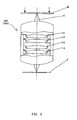
- Fig. 1 is a schematic illustration of the optical element 100 of the present invention.
- Fig. 2 is a schematic side view of the projection optical system 200 to which the optical element 100 as shown in Fig. 1 is applied.
- Fig. 3 is a result of simulation in which intrinsic birefringence quantities of calcium fluoride and orientations thereof with the wavelength of 157nm are three-dimensionally illustrated.
- Fig. 1 is a schematic illustration of the optical element 100 of the present invention.
- Fig. 2 is a schematic side view of the projection optical system 200 to which the optical element 100 as shown in Fig. 1 is applied.
- Fig. 3 is a result of simulation in which intrinsic birefringence quantities of calcium fluoride and orientations thereof with the wavelength of 157nm are three-dimensionally illustrated.
- Fig. 1 is a schematic illustration of the optical element 100 of the present invention.
- Fig. 2 is a schematic side view of the projection optical system 200 to which the optical element 100 as shown in Fig. 1 is applied.
- Fig. 4 shows a result of simulation in which the intrinsic birefringence quantities and orientations thereof in a plane containing an [0 0 1] axis and a [1 0 0] axis are two-dimensionally illustrated, and indicates an optical axis and an angle formed between the optical axis and a light beam for which intrinsic birefringence represents a peak, when the [0 0 1] axis is made identical with the optical axis.
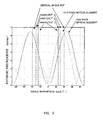
- Fig. 5 is a diagram for showing a relationship between an angle of a light beam in a crystal and intrinsic birefringence. In Figs. 3 and 4, a distance from a point of origin indicates the intrinsic birefringence (quantities). The intrinsic birefringence as shown in Fig.
- the [0 0 1] axis may be substituted with the [1 0 0], [0 1 0], and other five axes, and that the [0 0 1] axis typifies these six axes in the present application.
- a CaF 2 single crystal represents small quantities of the intrinsic birefringence; in this respect, an optical element such as a lens could advantageously be formed by making the optical axis identical with the [1 1 1] axis.
- CaF 2 exhibits, for example, peaks of the intrinsic birefringence quantities (6.5nm/cm, the experimental results by Burnett, et al.) for twelve symmetrical directions such as the [1 1 0] axis and other axes.
- NA tends to increase associated with the trends toward systems with higher NA in recent years.
- a ⁇ 1 1 1> face of CaF 2 exhibits very small birefringence quantities with respect to a light beam identical with the [1 1 1] axis, but the light beams tilted apart from the [1 1 1] axis (i.e., having larger NA) could include such a beam as is tilted at 35.26° and exhibits a peak of the intrinsic birefringence, as described above.
- the critical angle of light beams with the wavelength of 157nm incident on CaF 2 is about 39.9°, and if the [1 1 1] axis is adopted as an optical axis of an optical element to be applied to an optical system with high NA, the marginal light beam passes near a place in which the peak of the intrinsic birefringence quantities is exhibited; therefore, the projection optical system having such an optical element would disadvantageously deteriorate an image-forming quality.
- the optical element 100 according to the present invention is characterized in that an optical axis O is made identical with the [0 0 1] axis with respect to a crystal orientation.
- the intrinsic birefringence quantity of a light beam passing along the [0 0 1] axis represents a small value.
- the intrinsic birefringence exhibits the largest value when a light beam enters at 45° apart from the [0 0 1] axis.
- a ray angle at which the intrinsic birefringence exhibits the peak is 35.2° ⁇ 45° that is greater when the optical axis is made identical with the [0 0 1] axis. Consequently, the optical element using ⁇ 0 0 1> face, i.e ., optical element 100 in which the optical axis O is made identical with the [0 0 1] axis could hardly deteriorate image-forming quality under high NA conditions.
- the use of the [0 0 1] axis may prevent the birefringence from representing the peak in an optical system with high NA.
- the intrinsic birefringence of the optical element 100 in which the optical axis is made identical with the [0 0 1] axis exhibits a smaller value, even if the NA is 0.65, 0.7, or 0.8.
- the optical element 100 of the present invention even if the optical system 100 is manufactured with an effort to make the optical axis 0 of a light beam identical with the [0 0 1] axis, the [0 0 1] axis would, in actuality, not precisely identical with the optical axis O due to manufacturing errors.
- the inventive optical element 100 does not require the optical axis O of the light beam to be strictly identical with the [0 0 1] axis.
- the optical element 100 should be so configured that an angle between the optical axis O and the [0 0 1] axis is at least less than 10°.
- Fig. 5 explains that.
- the optical axis O of the optical element 100 is tilted at 10° with the [0 0 1] axis, and light beams parallel to the optical axis 0 are emitted into the optical element 100.
- the incident light emitted into the optical element 100 at right angles enters obliquely at 10° with the [0 0 1] axis ( e.g ., the optical axis as in Fig. 4 is tilted at 10° to the left). In this case, unless a solid line shown in Fig.
- the actual optical axis of the right beams is not emitted in such a direction in which the intrinsic birefringence (quantities) exhibits the smallest value.
- the solid line becomes substantially identical with a broken line, and the relationship between the intrinsic birefringence and an angle of light incidents in the crystal would become substantially the same as in the case where the optical axis of the light beams is made identical with the [1 1 1] axis as in the conventional embodiment. (Assuming that the optical axis in Fig. 4 is tilted at 10° to the right, the intrinsic birefringence (quantities) would not exhibit appropriate values unless the solid line shown in Fig. 5 is shifted to the left by 10°.
- the optical axis 0 is deviated from the [0 0 1] axis by more than 10°, the optical axis O is unfavorably so close to an orientation in which the intrinsic birefringence exhibits the peak. Consequently, in order to eliminate the above-described disadvantages, the present invention restricts an angle formed between the [0 0 1] axis and the optical axis O of the optical element 100 to less than 10°, with consideration given to the manufacturing errors.
- the above optical element 10 is suitably applicable to a projection optical system 200, and preferably applicable to an optical component L1 located at a side of an image plane P of the projection optical system in particular when the power of the projection optical system is demagnification.
- the projection optical system 200 is comprised of four optical components L1 through L4, and in the present embodiment, the optical element 100 is applied to the optical component L1 that comes first when counted from the side of the image plane P.
- the number of the optical components L1 through L4 in the projection optical system 200 is exemplary only and not limited to four.
- the optical element 100 may be applied to the optical component L2 that comes second when counted from the side of image plain P.
- the optical components so located as above have the maximum angle formed between the light beams and the light axis O representing a large value in the optical components.
- the optical element 100 may be used for the optical components that have the maximum angle of 25° or greater. The angle of 25° corresponds to 0.65 of NA, and the present invention is suitable for a high NA value of 0.65 or greater.
- peaks of the intrinsic birefringence lie along two intersecting orientations in 90° intervals around the optical axis O on the ⁇ 0 0 1> face of the optical element 100.
- Fig. 6 is a result of simulation for showing the intrinsic birefringence when the result of simulation shown in Fig. 3 is viewed from a direction of the [0 0 1] axis.
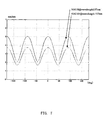
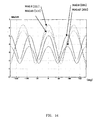
- Fig. 7 shows intrinsic birefringence for orientation angles around an optical axis. Referring to Fig. 14, peaks of the intrinsic birefringence appears in 120° intervals around the optical axis on the ⁇ 1 1 1> face.
- FIG. 14 is a diagram in which intrinsic birefringence for orientation angles around an optical axis in the ⁇ 1 1 1> face is added to the diagram shown in Fig. 7.
- the intrinsic birefringence for orientation angles around the optical axis exhibits a relatively smaller value in the ⁇ 0 0 1> face compared with the ⁇ 1 1 1> face; in this respect, too, it is understood that the inventive optical element 100 has little tendency to suffer from the effect of the intrinsic birefringence.
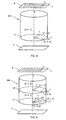
- Fig. 8 is a schematic perspective view of the projection optical system 200 as shown in Fig. 2. In Fig. 8, part of optical components in the projection optical system 200 is not illustrated.
- the characteristic patterns include a pattern forming an angle of 0°, 45°, or 90° with respect to one direction (e.g., y-direction) of the object M, or a pattern formed in combination with more than one of these patterns. In Fig. 8, a pattern forming an angle of 0° with respect to the y-direction is illustrated.
- the projection optical system 200 forms a pattern as above, if any one of two orientations of the peaks of the intrinsic birefringence and a light path of pencils of light that forms the pattern of the object M were identical, the image-forming quality would be deteriorated. Therefore, the projection optical system including the optical element 100 of the present invention preferably has the optical component L1 located with an orientation thereof shifted by 10° or greater so that any one of orientations of the peaks of the intrinsic birefringence is not made identical with the direction of the pattern.
- Fig. 9 is a schematic perspective view for showing an exemplified embodiment of the projection optical system 200 as shown in Fig. 2. In Fig. 9, part of optical components in the projection optical system 200 is not illustrated.
- the projection optical system 200 including two of the optical elements 100 in which the peaks of the intrinsic birefringence appearing as two intersecting directions are not made identical with the respective optical axes may achieve improvement in the optical properties of the projection optical system 200.
- the projection optical system 200 includes more than one of the optical elements 100, the number of which is n, then the optical elements may preferably be located with one displaced from another around the optical axis so that a [0 1 0] axis perpendicular to the [0 0 1] axis of one of the optical elements and a [0 1 0] axis perpendicular to the [0 0 1] axis of another of the optical elements form an angle within 90/n ⁇ 10° with each other.
- Fig. 15 is a result of simulation for showing the intrinsic birefringence when the result of simulation shown in Fig. 3 is viewed from a direction of the [1 1 0] axis.
- the present invention is not limited to the [1 1 0] axis.
- the intrinsic birefringence exhibits peaks in twelve directions, and the use of the [1 1 0] axis in the present embodiment is exemplary only. Accordingly, it is to be understood that the [1 1 0] axis as referred to in the description may be substituted with other axes such as the [1 0 1] axis and the [0 1 1] axis, and the [1 1 0] axis represents these twelve axes.
- Fig. 16 is a schematic illustration of the optical system 300 of the present invention.
- Fig. 17 is a schematic sectional view of the optical system 300 as shown in Fig. 16.
- the optical system 300 which includes two optical elements (parallel flat plates) 310 and 320, characteristically achieves reduction of the intrinsic birefringence by combination of these two parallel flat plates 310 and 320.
- the parallel flat plates 310 and 320 are the parallel flat plates of the same type (i.e., having the same orientation and thickness with respect to the crystal orientation), and the parallel flat plates 310 and 320 are so constructed that the optical axes of the parallel flat plates 310 and 320 (that are identical with a line normal to the plates 310 and 320) are made identical with the [1 1 0] axis of the crystal.
- the optical system 300 has these parallel flat plates 310 and 320 so arranged that the [1 1 0] axis of the parallel flat plates 310 and 320 is identical with the optical axis O.
- the parallel flat plates 310 and 320 respectively have one axis perpendicular to the [1 1 0] axis identical with the optical axis, e.g ., the [0 0 1] axis, so arranged as to relatively form a different angle with each other (where as the [0 0 1] axis is also exemplary only, the axis perpendicular to the [1 1 0] axis is not limited thereto).
- the parallel flat plates 310 and 320 have their [0 0 1] axes so arranged as in an orientation orthogonal to each other, that is, as to form a relative angle of 90°.
- this optical system 300 may retard (or advance) a phase of a polarized component that has advanced (or retarded) in the parallel flat plate 310 with respect to light beams incident on the optical system 300 by using the parallel flat plate 320, and thus may cancel displacement between the phases of the polarized components and reduce the effect of the intrinsic birefringence.
- the birefringence essentially has directions in which split light beams travel: one goes along the fast phase axis; the other along the slow phase axis.
- the fast phase axis works in a phenomenon where a polarized light beam travels in a medium (optical element in the present embodiment), which polarized light beam having an electric field component that oscillates in a plane containing an optical axis oriented to a light beam traveling direction and the fast phase axis, and thereby advances a phase with respect to another polarized light beam traveling in a direction orthogonal to the polarized light beam.
- the slow phase axis works in an opposite phenomenon where a polarized light beam travels in a medium (optical element in the present embodiment) and thereby retards the phase. Accordingly, light beams passing through only one parallel flat plate 310 would produce phase deviation of the polarized light component, that is, intrinsic birefringence.
- one more parallel flat plate 320 in which a fast phase axis and a slow phase axis changes places, that is, to have axes perpendicular to the [1 1 0] axis are perpendicular to each other is provided, so that phase deviation is cancelled.
- the two parallel flat plates 310 and 320 orienting each [1 1 0] axis to an optical axis direction may be so oriented as to change a relative angle around the optical axis, to reduce overall intrinsic birefringence of the optical system 300 comprised of the two parallel flat plates 31 and 320.
- Fig. 18 is a result of simulation for showing intrinsic birefringence produced when a relative angle of two parallel flat plate, of which a [1 1 0] axis is the direction of an optical axis, around the optical axis is changed.
- the two parallel flat plates have a thickness of 1cm, and the wavelength in use is 157nm. Referring to Fig.
- the intrinsic birefringence may represent the minimum value (Onm/cm).
- one parallel flat plate consists of a section containing [1 0 0] , [1 1 0], and [0 1 0] axes
- the other parallel flat plate consists of a section containing [0 0 1], [1 1 0], and [0 0 -1] axes.
- FIG. 19 shows intrinsic birefringence (quantities) when an optical axis is tilted apart from a [1 1 0] axis with respect to a section containing [1 0 0], [1 1 0], and [0 1 0] axes and a section containing [0 0 1], [1 1 0], and [0 0 -1] axes.
- the intrinsic birefringence values with respect to each section substantially coincide with each other in a range between -30° and 30°.
- Fig. 19 shows intrinsic birefringence (quantities) when an optical axis is tilted apart from a [1 1 0] axis with respect to a section containing [1 0 0], [1 1 0], and [0 0 -1] axes.
- the intrinsic birefringence is indicated in absolute value, and the intrinsic birefringence (quantities) in the section containing [0 0 1], [1 1 0], and [0 0 -1] axes are of opposite sign in a range between -35.26° and 35.26°. This indicates that, in a range between -30° and 30°, even if light beams is tilted from the optical axis O, the intrinsic birefringence may be canceled using the two parallel flat plates 310 and 320. Since an angle of 30° (more specifically 30.9°) corresponds to 0.8 in NA, it is suggested that the optical system 300 in the present invention is suitable for an optical system with high NA of 0.8 or more.
- the optical system 300 in the present invention has an axis of peaks of the intrinsic birefringence, i.e ., [1 1 0] axis
- the two parallel flat plates 310 and 320 may be used in combination, and thus the intrinsic birefringence in the optical system 300 is reduced. Accordingly, this optical system 300 may also achieve improvement of image-forming quality. It is proved that the optical system 300 is sufficiently applicable to the optical system with high NA.
- the optical system 300 is exemplarily constituted of two parallel flat plates 310 and 320, but the number of optical elements is not limited.
- the optical system 300 may be constituted of more than two optical elements such as parallel flat plates, lenses, and diffraction optical elements.
- a relative angle of the [0 0 1] axis perpendicular to these [1 1 0] axes of the optical elements should be varied to relatively reduce the intrinsic birefringence in the optical system 300.
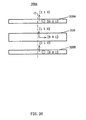
- an optical system 300A constituted of three parallel flat plates is made by separating the parallel flat plate 320 (or parallel flat plate 310) as shown in Figs. 16 and 17 into two.
- Fig. 20 is a schematic diagram for showing the optical system 300A as a variation of the optical system 300 as shown in Figs. 16 and 17.
- the parallel flat plates 320A and 320B are made by separation of the parallel flat plates 320 as shown in Figs. 16 and 17 with respect to a plane perpendicular to the [1 1 0] axis, and in Fig. 20, a thickness of each parallel flat plate 320A and 320B is exemplarily half of the parallel flat plate 320.
- the parallel flat plate 320A and 320B to have a varied relative angle of axes (e.g., [0 0 1] axis) perpendicular to the [1 1 0] axis with respect to the parallel flat plate 310, and to exert the same action as the parallel flat plate 320.
- the parallel flat plates 320A and 320B are so constructed as to sandwich the parallel flat plate 310, but the parallel flat plates 320A and 320B may be located in a row at one side of the parallel flat plate 310. Even in this configuration, a phase difference in polarized components may be canceled and the same effect as in the optical system 300 may be obtained.
- one more parallel flat plate (having the same crystal orientation and thickness as the parallel flat plates 310 and 320) may be added to the optical system 300 in such a manner that the [1 1 0] axis coincides with the optical axis, to configure the optical as one that consists of three parallel flat plates.
- this optical system should be constructed by varying a relative angle of one axis (e.g., the [0 0 1] axis) perpendicular to the [1 1 0] axis of three parallel flat plates so as to minimize the phase difference of polarized components.
- the optical system 300 is a system 300B (not shown) that consists of four or more parallel flat plates, of which the number is n (n: an even number), the above-described parallel flat plates 310 and 320 are paired, and the pairs, the number of which is n/2, is used to constitute the optical system. Moreover, if the optical system 300 consists of five or more parallel flat plates, of which the number is m (m: an odd number), the above-described parallel flat plates 310 and 320 are paired, and the pairs, the number of which is (m-3)/2, is used and the above-described combination is applied to the remaining three of the parallel flat plates, to constitute the optical system.
- parallel flat plates are exemplarily described as more than one optical element of the optical systems 300A, 300B in the present embodiment, this embodiment may apply also when the optical element is a lens or a diffraction optical element, or when these optical elements of multiple kinds including a parallel flat plate are incorporated in combination.
- the optical system 300 of the present invention is suitable for a projection optical system 400 as well as the above optical element 100.
- the projection optical system 400 is constituted of four optical components L1 through L4 for illustration purposes, and thus a description will be given with reference to Fig. 2 again.
- the number of optical components L1 through L4 in the optical system 200 is exemplary only, and not limited to four. If the power of the projection optical system 400 of the present invention is demagnification, the parallel flat plates 310 and 320 of the optical system 300 are suitably applicable to optical components L1 and L2 located at a side of an image plate P of the projection optical system 400.
- the optical system 300 is counted as one system including one pair of the parallel flat plates 310 and 320, it may be understood that the optical system 300 is applied to the optical component L1 as shown in Fig. 2.
- the optical components L1 and L2 is preferably achieved as parallel flat plates.
- the optical system 300 may be applied also to the optical component L3 or the like that is the third or farther component from the side of the image plane P.
- the optical system 300 may preferably applied to an optical component in which the maximum angle is 25° or greater.
- the angle of 25° corresponds to an NA value of 0.65, and the present invention is suitably applicable for a high NA value of 0.65 or greater. This would not deteriorate an image-forming quality even with a marginal light beam (outmost light beam among those in the projection optical system 400) incident, and contributes to improved optical properties of the projection optical system 400.
- optical components L3 and L4 to which the optical system 300 is not applied among optical components consisting of the projection optical system 400 are preferably used an optical element in which the above [1 0 0] axis is made identical with the optical axis, or an optical element in which the [1 1 1] axis is made identical with the optical axis, or a combination thereof.
- a relative angle of an axis perpendicular to the optical axis i.e., the [1 0 0] or [1 1 1] axis
- an adjustment is made to make the intrinsic birefringence of the projection optical system 400 smaller (e.g., rotate the optical element about the optical axis).
- the optical systems 300 may be adjusted relatively so as to make the intrinsic birefringence smaller.
- the image-forming quality would disadvantageously be deteriorated due to the birefringence (including stress birefringence and intrinsic birefringence).
- the birefringence quantum density throughout the optical system
- the birefringence throughout the optical system may be measured for example by interference experiments and commercially available birefringence measuring equipment, and it is preferable the optical system should be adjusted using these means.
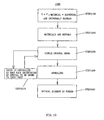
- Fig. 10 shows a flowchart of the manufacturing method for an optical element using CaF 2 according to the present invention.
- a row material prepared is a high-purity CaF 2 synthetic material, which is blended with a scavenger (step 1100).
- the high-purity CaF 2 synthetic material is prepared by treating calcium carbonate with hydrogen fluoride.
- the present invention is not limited thereto but also applicable to a method for eliminating adulterant (e.g ., SiO 2 ) by treating CaF 2 in ore with hydrogen fluoride; however, the high-purity CaF 2 is, unlike CaF 2 in ore, powdery, and is preferably very low in volume density (approximately 10 through 20 ⁇ ).
- the vessel is preferably rotated to obtain a uniform blend.
- a scavenger is preferably employed a fluoride such as zinc fluoride, cadmium fluoride, bismuth fluoride, sodium fluoride, lithium fluoride, and the like, which are more likely to combine with oxygen than fluoride that induces growth.
- a substance that easily reacts with an oxide mixed in a fluoride material to vaporize is selected.
- zinc fluoride is preferable.
- the resultant blend of calcium fluoride powder and scavengers are refined (step 1200).
- the refining process is a process to remove impurities (e.g., carbonic acids) to highly refine calcium fluoride, and comprises the steps of dehydration, scavenging reaction, removal of scavenged products, melting, and solidification.
- the blend is put into a crucible of a refinement furnace. Thereafter, a heater is energized to heat and dehydrate the blend in the crucible.
- the refined crystal is used as a secondary material to grow a single crystal of calcium fluoride in a crystal growth furnace (not shown) (step 1300).
- a heater is energized and a calcium fluoride material (crystal) is heated to approximately 1,390 through 1,450°C, to completely melt the calcium fluoride crystal.
- the crucible is gradually lowered at a velocity of 0.1 through 5.0mm/h (to experience a predetermined temperature gradient), and the melted calcium fluoride is gradually cooled; thereby a single crystal grows based upon the seed crystal.
- the fluoride single crystal that has grown is heat-treated in an annealing furnace (annealing process) (step 1400).
- the anneal process is such that a grown calcium fluoride single crystal is treated with heat to remove internal stresses and to make the crystal less brittle.
- the grown single crystal is put in the crucible stored in a chamber in the annealing furnace.
- the crucible In the annealing process, the crucible is uniformly heated at about 900°C through 1,000°C and internal stresses in the calcium fluoride are removed while the material is kept solid. Heating at about 1,140°C or higher temperature would disadvantageously cause a structural change or the like. Heating time should be about 20 hours or longer, and preferably about 20 through 30 hours. In the annealing process, annealing reduces dislocation of the crystal. Thereafter, the calcium fluoride crystal is kept without internal stress and left to cool into room temperature.
- the optical element 100 may include a lens, a diffraction grating, a transparent parallel flat plate, an optical film, or a combination thereof, and the lens may, for example, include a multi-lens, a lens array, a lenticular lens, and an aspherical lens.
- the optical element 100 may be an optical sensor (e.g ., sensor for controlling a focus).
- a reflection prevention film may be provided on a surface of an optical article of fluoride crystal.
- magnesium fluoride, aluminum oxide, or tantalum oxide which may be formed by vacuum evaporation using resistance heating, vacuum evaporation using electronic beams, and sputtering.
- a calcium fluoride crystal is formed with consideration given to face orientations in the present embodiment, usable method is not limited thereto.
- a horizontal face of calcium fluoride may be selected at random for each growing crystal without priority placed on a particular growth orientation.
- the calcium fluoride crystal may be sliced in such a manner that the ⁇ 0 0 1> faces are two parallel flat planes from a calcium fluoride crystal obtained through crystal growth or from calcium fluoride crystal obtained through crystal growth followed by annealing process, and then the component may be treated with heat to improve optical properties thereof.
- the above process is characterized in that the calcium fluoride crystal is sliced with the ⁇ 0 0 1> face being parallel flat planes. This enables manufacture of the optical element 100 with consideration given to the intrinsic birefringence.
- the optical elements (parallel flat plates 310 and 320) applicable to the optical system 300 may be manufactured by having a seed crystal as an origin of growth placed at a bottom of the crucible, which seed crystal has a desired face orientation, i.e., to the ⁇ 0 0 1> face, in which deposition should proceed, so that the face orientation of the crystal to be grown is controlled, as in step 1300 shown in Fig. 10, or by slicing a calcium fluoride crystal in such a manner that the ⁇ 1 1 0> faces are two parallel flat planes.
- the manufacturing method for an optical element is as described above, and thus a detailed description will be omitted.
- Fig. 13 is a schematic sectional view of the exposure apparatus 1 of the present invention.
- the exposure apparatus 1 includes, as shown in Fig. 13, an illumination apparatus 10, a reticle 20, a projection optical system 30, a plate 40, and a stage 45.
- the exposure apparatus 1 is a scanning projection exposure apparatus that exposes the plate 40 to light through a circuit pattern formed on the reticle 20, using step-and-repeat or step-and-scan schemes.
- the illumination apparatus 10 which includes a light source part 12 and an illumination optical system 14, illuminates the reticle 20 on which a circuit patter to be transferred is formed.
- the light source part 12 may use, for example, a laser as a light source.
- a laser As a light source.
- An ArF excimer laser with the wavelength of approximately 193nm and an F 2 excimer laser with the wavelength of approximately 157nm may be used as the laser for the light source, but the types of usable lasers are not limited to such an excimer laser; therefore, a YAG laser may be used, and the number of lasers to be used is not limited.
- a laser is used for the light source part 12, it is preferable to use a light beam shaping optical system for shaping collimated light beams from the laser light source into a desired beam shape, and a coherence-reducing optical system for making coherent laser beams incoherent.
- usable light sources for the light source part 12 is not limited to lasers, but one or more of mercury lamps or xenon lamps may also be usable.
- the illumination optical system 14 is an optical system for illuminating a mask or reticle 20, and includes a lens, a mirror, a light integrator, an aperture, and the like.
- a condensing lens, a fly-eye lens, an aperture stop, a condensing lens, a slit, and an image-forming optical system may be arranged in this sequence, or otherwise.
- the illumination optical system 14 may use light on axis or light out of axis.
- the optical integrator may include integrators or the like made by overlaying fly-eye lenses or a pair of cylindrical lens array (or lenticular lens) plates, but may be substituted with an optical rod or a diffraction element.
- the reticle 20, on which a circuit pattern (or image) to be transferred is formed, is held on a reticle stage (not shown) and driven.
- the reticle stage (not shown) may be two-dimensionally moved along a reticle surface by the action of a driving system (also not shown). Coordinates of the reticle stage may be measured and adjusted by an interferometer using a reticle movement mirror (not shown), and the positioning of the reticle may be controlled.
- Diffraction light emitted from the reticle 20 passes through the projection optical system 30, and projected on the plate 40.
- the plate 40 is an object to be processed such as a wafer and a liquid crystal substrate, and resist is applied to the plate 40.
- the reticle 20 and the plate 40 have a conjugate relationship.
- the mask 20 and the plate 40 are scanned and a pattern is transferred on the plate 40.
- a stepper exposure apparatus using step-and-repeat exposure method
- the exposure is performed while the mask 20 and the plate 40 stands still.
- the projection optical system 30 which has a magnification of 1/5 through 1/2, projects a demagnified image of a circuit pattern of the reticle 20 on the plate 40.
- the projection optical system 30 consists of a refraction system, and a substantially telecentric area at the both sides of the reticle 20 and the plate 40. All of multiple refraction optical elements (lenses and transparent plates) in the projection optical system 30 consist of calcium fluoride (CaF 2 ).
- the projection optical systems 200 and 400 as described above are preferably applied to the projection optical system 30, so that the projection optical system 30 may achieve better image-forming conditions than conventional projection optical systems.
- the optical element closest to the plate 40 in the projection optical system 30 is a transparent parallel flat plate, which is tilted from a horizontal plane as necessary to correct aberration.
- the projection optical system 30 of the present invention may use, other than the above, an optical system including a plurality of lens elements and at least one concave mirror (catadioptric optical system), an optical system including a plurality of lens elements and at least one diffraction optical element such as a kinoform.
- a plurality of lens elements may be made of glass materials, which vary with each other in the degree of dispersion (Abbe number), or a diffraction optical element may be so constructed as to produce dispersion in a direction opposite to a lens element.
- the photoresist application process includes a post-process, an adhesion improver application process, a photoresist application process, and a prebaking process.
- the post-process includes a cleaning step and a drying step.
- the adhesion improver application process is a surface reforming (i.e., hydrophobicity enhancement by application of surfactant) process, which coats the surface with an organic membrane such as HMDS (Hexamethyl-disilazane) or treats the same with vapor.
- the prebaking is a baking (burning) process that is softer than that after the development process, and serves to remove a solvent.
- the stage 45 holds the plate 40. Since any components known in the art may be applied to the stage 45, a detailed description of a structure and operation thereof will be omitted.
- the stage 45 may two-dimensionally move along a surface of the plate 40 by the action of a driving system (not shown), and coordinates of the stage 45 may be measured by an interferometer using a plate movement mirror (not shown), and thereby the positioning of the plate 40 may be controlled.
- the reticle 20 and the plate 30 is simultaneously scanned, with the scanning projection exposure apparatus used, and the positions of the stage 45 and the reticle stage (not shown) are monitored, for example, by a laser interferometer or the like, so that the both components are driven at a constant rate of velocity.
- the stage 45 is provided, for example, on a stage board supported on a floor or the like through a damper, while the reticle stage and the projection optical system 30 is provided, for example, on a lens barrel board (not shown) supported on a base frame placed on a floor or the like through a damper.
- the projection optical system 30 used in the exposure apparatus 1, which includes the inventive optical element 100, allows ultraviolet radiation, deep ultraviolet radiation, and vacuum ultraviolet radiation to pass with high transmittance and less refractive index uniformity or birefringence, and thus may provide elements (semiconductor elements, LCD elements, image pickup elements such as CCDs, thin-film magnetic heads, or the like) with high resolution and throughput, in a cost-effective manner.
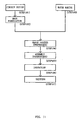
- Fig. 11 is a flowchart for explaining manufacture of a device (e.g ., semiconductor chips such as IC and LSI, LCD, CCD, and the like). A manufacturing process of semiconductor chips will now be explained by way of example.
- a device circuit e.g ., semiconductor chips such as IC and LSI, LCD, CCD, and the like.
- step 101 circuit design
- step 102 Mask fabrication
- step 103 wafer is made using materials such as silicon.
- step 104 Wafer process
- step 105 Assembly
- step 106 Inspections such as an operation check, a durability check, and the like of the semiconductor device assembled in step 105 are conducted. A semiconductor device is finished through these steps, and shipped (in step 107).
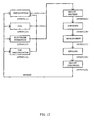
- Fig. 12 is a detailed flowchart of the wafer process in step 104.
- step 111 Oxidization
- step 112 CVD
- step 113 Electrode formation
- step 114 Ion implantation
- step 115 Resist process
- step 116 Exposure
- step 117 Development
- the exposed wafer is developed.
- step 118 In step 118 (Etching), part other than a developed resist image is etched. In step 119 (Resist stripping), the resist disused after etching is removed. These steps are repeatedly followed, and thus overlaid circuit patterns are formed on the wafer.
- the use of the manufacturing method of the instant embodiments enables the manufacture of high-precision semiconductor elements that was conventionally impossible.
- a ray angle in a crystal face at which the intrinsic birefringence represents the maximum value may be greater when the optical axis is made identical with the [0 0 1] axis. Consequently, the optical element using ⁇ 0 0 1> face, i.e ., optical element 100 in which the optical axis is made identical with the [0 0 1] axis may hardly deteriorate image-forming quality under high NA conditions.
- the peak of the intrinsic birefringence is out of the critical angle. This may prevent the birefringence from reaching the peak even under high NA conditions.
- the birefringence in the optical system for all pencils of light contributing to image forming satisfies b ⁇ ⁇ /4, where b denotes wavefront deviation caused by birefringence (unit: nm), and ⁇ denotes a wavelength in use (unit: nm), and thus the optical system may achieve improvement in image-forming qualities.
- an axis of peaks of the intrinsic birefringence i.e ., the [1 1 0] axis is identical with the optical axis
- combination of two parallel flat plates would reduce the intrinsic birefringence in the optical system. Consequently, even such an optical system may achieve improvement in image-forming qualities.
- the projection optical system including the inventive optical system, and an exposure apparatus including the inventive optical element, and the exposure apparatus including the projection optical system may provide a high-quality device that is excellent in image-forming quality with good exposure performance such as throughput.
Landscapes
- Chemical & Material Sciences (AREA)
- Physics & Mathematics (AREA)
- Engineering & Computer Science (AREA)
- Crystallography & Structural Chemistry (AREA)
- General Physics & Mathematics (AREA)
- Materials Engineering (AREA)
- Metallurgy (AREA)
- Organic Chemistry (AREA)
- Optics & Photonics (AREA)
- Health & Medical Sciences (AREA)
- Inorganic Chemistry (AREA)
- Environmental & Geological Engineering (AREA)
- Epidemiology (AREA)
- Public Health (AREA)
- Exposure And Positioning Against Photoresist Photosensitive Materials (AREA)
- Lenses (AREA)
- Exposure Of Semiconductors, Excluding Electron Or Ion Beam Exposure (AREA)
- Crystals, And After-Treatments Of Crystals (AREA)
- Polarising Elements (AREA)
- Pressure Sensors (AREA)
- Liquid Crystal (AREA)
Applications Claiming Priority (5)
| Application Number | Priority Date | Filing Date | Title |
|---|---|---|---|
| JP2001234254 | 2001-06-27 | ||
| JP2001234254 | 2001-06-27 | ||
| JP2001244970A JP3639807B2 (ja) | 2001-06-27 | 2001-07-06 | 光学素子及び製造方法 |
| JP2001244970 | 2001-07-06 | ||
| PCT/JP2002/005952 WO2003003072A2 (en) | 2001-06-27 | 2002-06-13 | Optical element and manufacturing method therefor |
Publications (2)
| Publication Number | Publication Date |
|---|---|
| EP1399766A2 EP1399766A2 (en) | 2004-03-24 |
| EP1399766B1 true EP1399766B1 (en) | 2007-01-17 |
Family
ID=26619804
Family Applications (1)
| Application Number | Title | Priority Date | Filing Date |
|---|---|---|---|
| EP02736104A Revoked EP1399766B1 (en) | 2001-06-27 | 2002-06-13 | Exposure apparatus comprising an optical element made of an isometric crystal |
Country Status (8)
| Country | Link |
|---|---|
| US (2) | US7102828B2 (enExample) |
| EP (1) | EP1399766B1 (enExample) |
| JP (1) | JP3639807B2 (enExample) |
| KR (1) | KR100544394B1 (enExample) |
| AT (1) | ATE352048T1 (enExample) |
| DE (1) | DE60217673T2 (enExample) |
| TW (1) | TWI244679B (enExample) |
| WO (1) | WO2003003072A2 (enExample) |
Families Citing this family (125)
| Publication number | Priority date | Publication date | Assignee | Title |
|---|---|---|---|---|
| DE10028434B4 (de) * | 2000-06-14 | 2005-09-29 | Ludwig Felser | Stahlbausystem |
| US6870668B2 (en) * | 2000-10-10 | 2005-03-22 | Nikon Corporation | Method for evaluating image formation performance |
| US7239447B2 (en) * | 2001-05-15 | 2007-07-03 | Carl Zeiss Smt Ag | Objective with crystal lenses |
| DE10210782A1 (de) * | 2002-03-12 | 2003-10-09 | Zeiss Carl Smt Ag | Objektiv mit Kristall-Linsen |
| KR20040015251A (ko) * | 2001-05-15 | 2004-02-18 | 칼 짜이스 에스엠티 아게 | 불화물 결정 렌즈들을 포함하는 렌즈 시스템 |
| DE10123725A1 (de) | 2001-05-15 | 2002-11-21 | Zeiss Carl | Projektionsbelichtungsanlage der Mikrolithographie, Optisches System und Herstellverfahren |
| US6683710B2 (en) * | 2001-06-01 | 2004-01-27 | Optical Research Associates | Correction of birefringence in cubic crystalline optical systems |
| US20030011893A1 (en) * | 2001-06-20 | 2003-01-16 | Nikon Corporation | Optical system and exposure apparatus equipped with the optical system |
| US6831731B2 (en) * | 2001-06-28 | 2004-12-14 | Nikon Corporation | Projection optical system and an exposure apparatus with the projection optical system |
| US6788389B2 (en) * | 2001-07-10 | 2004-09-07 | Nikon Corporation | Production method of projection optical system |
| US6775063B2 (en) | 2001-07-10 | 2004-08-10 | Nikon Corporation | Optical system and exposure apparatus having the optical system |
| US6844915B2 (en) * | 2001-08-01 | 2005-01-18 | Nikon Corporation | Optical system and exposure apparatus provided with the optical system |
| KR20040032994A (ko) * | 2001-09-07 | 2004-04-17 | 가부시키가이샤 니콘 | 광학계 및 이 광학계를 구비한 노광장치, 그리고디바이스의 제조방법 |
| US20030070606A1 (en) * | 2001-10-05 | 2003-04-17 | Leblond Nicolas | Preparation of feedstock of alkaline earth and alkali metal fluorides |
| US6995908B2 (en) * | 2001-10-30 | 2006-02-07 | Asml Netherlands B.V. | Methods for reducing aberration in optical systems |
| US6970232B2 (en) * | 2001-10-30 | 2005-11-29 | Asml Netherlands B.V. | Structures and methods for reducing aberration in integrated circuit fabrication systems |
| US7453641B2 (en) | 2001-10-30 | 2008-11-18 | Asml Netherlands B.V. | Structures and methods for reducing aberration in optical systems |
| DE10162796B4 (de) * | 2001-12-20 | 2007-10-31 | Carl Zeiss Smt Ag | Verfahren zur Optimierung der Abbildungseigenschaften von mindestens zwei optischen Elementen sowie photolithographisches Fertigungsverfahren |
| US7075721B2 (en) * | 2002-03-06 | 2006-07-11 | Corning Incorporated | Compensator for radially symmetric birefringence |
| JP2003309059A (ja) * | 2002-04-17 | 2003-10-31 | Nikon Corp | 投影光学系、その製造方法、露光装置および露光方法 |
| JP4333078B2 (ja) * | 2002-04-26 | 2009-09-16 | 株式会社ニコン | 投影光学系、該投影光学系を備えた露光装置および該投影光学系を用いた露光方法並びにデバイス製造方法 |
| US7292388B2 (en) * | 2002-05-08 | 2007-11-06 | Carl Zeiss Smt Ag | Lens made of a crystalline material |
| JP2004045692A (ja) * | 2002-07-11 | 2004-02-12 | Canon Inc | 投影光学系、露光装置及びデバイス製造方法 |
| US6958864B2 (en) * | 2002-08-22 | 2005-10-25 | Asml Netherlands B.V. | Structures and methods for reducing polarization aberration in integrated circuit fabrication systems |
| US20040237880A1 (en) * | 2002-10-01 | 2004-12-02 | Nikon Corporation | Method for manufacturing an optical member formed of a fluoride crystal |
| US20060171138A1 (en) * | 2003-07-24 | 2006-08-03 | Kenichi Muramatsu | Illuminating optical system, exposure system and exposure method |
| US7239450B2 (en) | 2004-11-22 | 2007-07-03 | Carl Zeiss Smt Ag | Method of determining lens materials for a projection exposure apparatus |
| US7463422B2 (en) * | 2004-01-14 | 2008-12-09 | Carl Zeiss Smt Ag | Projection exposure apparatus |
| JP4776891B2 (ja) * | 2004-04-23 | 2011-09-21 | キヤノン株式会社 | 照明光学系、露光装置、及びデバイス製造方法 |
| KR20070105976A (ko) * | 2005-02-25 | 2007-10-31 | 칼 짜이스 에스엠티 아게 | 광학시스템, 특히 마이크로리소그래픽 투사노출장치용대물렌즈 또는 조명장치 |
| US20110180781A1 (en) * | 2008-06-05 | 2011-07-28 | Soraa, Inc | Highly Polarized White Light Source By Combining Blue LED on Semipolar or Nonpolar GaN with Yellow LED on Semipolar or Nonpolar GaN |
| US8847249B2 (en) * | 2008-06-16 | 2014-09-30 | Soraa, Inc. | Solid-state optical device having enhanced indium content in active regions |
| US8805134B1 (en) | 2012-02-17 | 2014-08-12 | Soraa Laser Diode, Inc. | Methods and apparatus for photonic integration in non-polar and semi-polar oriented wave-guided optical devices |
| US8259769B1 (en) | 2008-07-14 | 2012-09-04 | Soraa, Inc. | Integrated total internal reflectors for high-gain laser diodes with high quality cleaved facets on nonpolar/semipolar GaN substrates |
| US8143148B1 (en) | 2008-07-14 | 2012-03-27 | Soraa, Inc. | Self-aligned multi-dielectric-layer lift off process for laser diode stripes |
| WO2010017148A1 (en) | 2008-08-04 | 2010-02-11 | Soraa, Inc. | White light devices using non-polar or semipolar gallium containing materials and phosphors |
| US8284810B1 (en) | 2008-08-04 | 2012-10-09 | Soraa, Inc. | Solid state laser device using a selected crystal orientation in non-polar or semi-polar GaN containing materials and methods |
| US20100295088A1 (en) * | 2008-10-02 | 2010-11-25 | Soraa, Inc. | Textured-surface light emitting diode and method of manufacture |
| US8247886B1 (en) | 2009-03-09 | 2012-08-21 | Soraa, Inc. | Polarization direction of optical devices using selected spatial configurations |
| US8422525B1 (en) | 2009-03-28 | 2013-04-16 | Soraa, Inc. | Optical device structure using miscut GaN substrates for laser applications |
| US8634442B1 (en) | 2009-04-13 | 2014-01-21 | Soraa Laser Diode, Inc. | Optical device structure using GaN substrates for laser applications |
| US8242522B1 (en) | 2009-05-12 | 2012-08-14 | Soraa, Inc. | Optical device structure using non-polar GaN substrates and growth structures for laser applications in 481 nm |
| US8294179B1 (en) | 2009-04-17 | 2012-10-23 | Soraa, Inc. | Optical device structure using GaN substrates and growth structures for laser applications |
| US9531164B2 (en) | 2009-04-13 | 2016-12-27 | Soraa Laser Diode, Inc. | Optical device structure using GaN substrates for laser applications |
| US8254425B1 (en) | 2009-04-17 | 2012-08-28 | Soraa, Inc. | Optical device structure using GaN substrates and growth structures for laser applications |
| US8837545B2 (en) | 2009-04-13 | 2014-09-16 | Soraa Laser Diode, Inc. | Optical device structure using GaN substrates and growth structures for laser applications |
| US8416825B1 (en) | 2009-04-17 | 2013-04-09 | Soraa, Inc. | Optical device structure using GaN substrates and growth structure for laser applications |
| US8791499B1 (en) | 2009-05-27 | 2014-07-29 | Soraa, Inc. | GaN containing optical devices and method with ESD stability |
| US9800017B1 (en) | 2009-05-29 | 2017-10-24 | Soraa Laser Diode, Inc. | Laser device and method for a vehicle |
| US10108079B2 (en) | 2009-05-29 | 2018-10-23 | Soraa Laser Diode, Inc. | Laser light source for a vehicle |
| US9250044B1 (en) | 2009-05-29 | 2016-02-02 | Soraa Laser Diode, Inc. | Gallium and nitrogen containing laser diode dazzling devices and methods of use |
| US8509275B1 (en) | 2009-05-29 | 2013-08-13 | Soraa, Inc. | Gallium nitride based laser dazzling device and method |
| US9829780B2 (en) | 2009-05-29 | 2017-11-28 | Soraa Laser Diode, Inc. | Laser light source for a vehicle |
| US8247887B1 (en) * | 2009-05-29 | 2012-08-21 | Soraa, Inc. | Method and surface morphology of non-polar gallium nitride containing substrates |
| US8427590B2 (en) | 2009-05-29 | 2013-04-23 | Soraa, Inc. | Laser based display method and system |
| US20110056429A1 (en) * | 2009-08-21 | 2011-03-10 | Soraa, Inc. | Rapid Growth Method and Structures for Gallium and Nitrogen Containing Ultra-Thin Epitaxial Structures for Devices |
| US9000466B1 (en) | 2010-08-23 | 2015-04-07 | Soraa, Inc. | Methods and devices for light extraction from a group III-nitride volumetric LED using surface and sidewall roughening |
| US8314429B1 (en) | 2009-09-14 | 2012-11-20 | Soraa, Inc. | Multi color active regions for white light emitting diode |
| US8355418B2 (en) | 2009-09-17 | 2013-01-15 | Soraa, Inc. | Growth structures and method for forming laser diodes on {20-21} or off cut gallium and nitrogen containing substrates |
| US8750342B1 (en) | 2011-09-09 | 2014-06-10 | Soraa Laser Diode, Inc. | Laser diodes with scribe structures |
| US9293644B2 (en) | 2009-09-18 | 2016-03-22 | Soraa, Inc. | Power light emitting diode and method with uniform current density operation |
| US8933644B2 (en) | 2009-09-18 | 2015-01-13 | Soraa, Inc. | LED lamps with improved quality of light |
| WO2011035265A1 (en) | 2009-09-18 | 2011-03-24 | Soraa, Inc. | Power light emitting diode and method with current density operation |
| US9583678B2 (en) | 2009-09-18 | 2017-02-28 | Soraa, Inc. | High-performance LED fabrication |
| US20110182056A1 (en) * | 2010-06-23 | 2011-07-28 | Soraa, Inc. | Quantum Dot Wavelength Conversion for Optical Devices Using Nonpolar or Semipolar Gallium Containing Materials |
| US20110186874A1 (en) * | 2010-02-03 | 2011-08-04 | Soraa, Inc. | White Light Apparatus and Method |
| US8905588B2 (en) | 2010-02-03 | 2014-12-09 | Sorra, Inc. | System and method for providing color light sources in proximity to predetermined wavelength conversion structures |
| US10147850B1 (en) | 2010-02-03 | 2018-12-04 | Soraa, Inc. | System and method for providing color light sources in proximity to predetermined wavelength conversion structures |
| US9927611B2 (en) | 2010-03-29 | 2018-03-27 | Soraa Laser Diode, Inc. | Wearable laser based display method and system |
| US8451876B1 (en) | 2010-05-17 | 2013-05-28 | Soraa, Inc. | Method and system for providing bidirectional light sources with broad spectrum |
| US9450143B2 (en) | 2010-06-18 | 2016-09-20 | Soraa, Inc. | Gallium and nitrogen containing triangular or diamond-shaped configuration for optical devices |
| US8816319B1 (en) | 2010-11-05 | 2014-08-26 | Soraa Laser Diode, Inc. | Method of strain engineering and related optical device using a gallium and nitrogen containing active region |
| US9048170B2 (en) | 2010-11-09 | 2015-06-02 | Soraa Laser Diode, Inc. | Method of fabricating optical devices using laser treatment |
| US8975615B2 (en) | 2010-11-09 | 2015-03-10 | Soraa Laser Diode, Inc. | Method of fabricating optical devices using laser treatment of contact regions of gallium and nitrogen containing material |
| US9318875B1 (en) | 2011-01-24 | 2016-04-19 | Soraa Laser Diode, Inc. | Color converting element for laser diode |
| US9595813B2 (en) | 2011-01-24 | 2017-03-14 | Soraa Laser Diode, Inc. | Laser package having multiple emitters configured on a substrate member |
| US9025635B2 (en) | 2011-01-24 | 2015-05-05 | Soraa Laser Diode, Inc. | Laser package having multiple emitters configured on a support member |
| US8786053B2 (en) | 2011-01-24 | 2014-07-22 | Soraa, Inc. | Gallium-nitride-on-handle substrate materials and devices and method of manufacture |
| US9093820B1 (en) | 2011-01-25 | 2015-07-28 | Soraa Laser Diode, Inc. | Method and structure for laser devices using optical blocking regions |
| US9287684B2 (en) | 2011-04-04 | 2016-03-15 | Soraa Laser Diode, Inc. | Laser package having multiple emitters with color wheel |
| US8686431B2 (en) | 2011-08-22 | 2014-04-01 | Soraa, Inc. | Gallium and nitrogen containing trilateral configuration for optical devices |
| US8971370B1 (en) | 2011-10-13 | 2015-03-03 | Soraa Laser Diode, Inc. | Laser devices using a semipolar plane |
| US8912025B2 (en) | 2011-11-23 | 2014-12-16 | Soraa, Inc. | Method for manufacture of bright GaN LEDs using a selective removal process |
| JP2015509669A (ja) | 2012-03-06 | 2015-03-30 | ソラア インコーポレーテッドSoraa Inc. | 導波光効果を低減させる低屈折率材料層を有する発光ダイオード |
| US9020003B1 (en) | 2012-03-14 | 2015-04-28 | Soraa Laser Diode, Inc. | Group III-nitride laser diode grown on a semi-polar orientation of gallium and nitrogen containing substrates |
| US10559939B1 (en) | 2012-04-05 | 2020-02-11 | Soraa Laser Diode, Inc. | Facet on a gallium and nitrogen containing laser diode |
| US9800016B1 (en) | 2012-04-05 | 2017-10-24 | Soraa Laser Diode, Inc. | Facet on a gallium and nitrogen containing laser diode |
| US9343871B1 (en) | 2012-04-05 | 2016-05-17 | Soraa Laser Diode, Inc. | Facet on a gallium and nitrogen containing laser diode |
| US9088135B1 (en) | 2012-06-29 | 2015-07-21 | Soraa Laser Diode, Inc. | Narrow sized laser diode |
| US9184563B1 (en) | 2012-08-30 | 2015-11-10 | Soraa Laser Diode, Inc. | Laser diodes with an etched facet and surface treatment |
| US9978904B2 (en) | 2012-10-16 | 2018-05-22 | Soraa, Inc. | Indium gallium nitride light emitting devices |
| US8802471B1 (en) | 2012-12-21 | 2014-08-12 | Soraa, Inc. | Contacts for an n-type gallium and nitrogen substrate for optical devices |
| US9166372B1 (en) | 2013-06-28 | 2015-10-20 | Soraa Laser Diode, Inc. | Gallium nitride containing laser device configured on a patterned substrate |
| US8994033B2 (en) | 2013-07-09 | 2015-03-31 | Soraa, Inc. | Contacts for an n-type gallium and nitrogen substrate for optical devices |
| US9368939B2 (en) | 2013-10-18 | 2016-06-14 | Soraa Laser Diode, Inc. | Manufacturable laser diode formed on C-plane gallium and nitrogen material |
| US9520695B2 (en) | 2013-10-18 | 2016-12-13 | Soraa Laser Diode, Inc. | Gallium and nitrogen containing laser device having confinement region |
| US9362715B2 (en) | 2014-02-10 | 2016-06-07 | Soraa Laser Diode, Inc | Method for manufacturing gallium and nitrogen bearing laser devices with improved usage of substrate material |
| US9379525B2 (en) | 2014-02-10 | 2016-06-28 | Soraa Laser Diode, Inc. | Manufacturable laser diode |
| US9419189B1 (en) | 2013-11-04 | 2016-08-16 | Soraa, Inc. | Small LED source with high brightness and high efficiency |
| US9209596B1 (en) | 2014-02-07 | 2015-12-08 | Soraa Laser Diode, Inc. | Manufacturing a laser diode device from a plurality of gallium and nitrogen containing substrates |
| US9871350B2 (en) | 2014-02-10 | 2018-01-16 | Soraa Laser Diode, Inc. | Manufacturable RGB laser diode source |
| US9520697B2 (en) | 2014-02-10 | 2016-12-13 | Soraa Laser Diode, Inc. | Manufacturable multi-emitter laser diode |
| US10175165B2 (en) | 2014-02-28 | 2019-01-08 | Halliburton Energy Services, Inc. | Multi-characteristic integrated computational element using light incidence angle manipulation |
| US9564736B1 (en) | 2014-06-26 | 2017-02-07 | Soraa Laser Diode, Inc. | Epitaxial growth of p-type cladding regions using nitrogen gas for a gallium and nitrogen containing laser diode |
| US9246311B1 (en) | 2014-11-06 | 2016-01-26 | Soraa Laser Diode, Inc. | Method of manufacture for an ultraviolet laser diode |
| US12126143B2 (en) | 2014-11-06 | 2024-10-22 | Kyocera Sld Laser, Inc. | Method of manufacture for an ultraviolet emitting optoelectronic device |
| US9653642B1 (en) | 2014-12-23 | 2017-05-16 | Soraa Laser Diode, Inc. | Manufacturable RGB display based on thin film gallium and nitrogen containing light emitting diodes |
| US9666677B1 (en) | 2014-12-23 | 2017-05-30 | Soraa Laser Diode, Inc. | Manufacturable thin film gallium and nitrogen containing devices |
| US11437774B2 (en) | 2015-08-19 | 2022-09-06 | Kyocera Sld Laser, Inc. | High-luminous flux laser-based white light source |
| US10938182B2 (en) | 2015-08-19 | 2021-03-02 | Soraa Laser Diode, Inc. | Specialized integrated light source using a laser diode |
| US11437775B2 (en) | 2015-08-19 | 2022-09-06 | Kyocera Sld Laser, Inc. | Integrated light source using a laser diode |
| US10879673B2 (en) | 2015-08-19 | 2020-12-29 | Soraa Laser Diode, Inc. | Integrated white light source using a laser diode and a phosphor in a surface mount device package |
| US9787963B2 (en) | 2015-10-08 | 2017-10-10 | Soraa Laser Diode, Inc. | Laser lighting having selective resolution |
| US10771155B2 (en) | 2017-09-28 | 2020-09-08 | Soraa Laser Diode, Inc. | Intelligent visible light with a gallium and nitrogen containing laser source |
| US12659034B2 (en) | 2017-09-28 | 2026-06-16 | Kyocera Sld Laser, Inc. | Laser based white light system configured for communication |
| US10222474B1 (en) | 2017-12-13 | 2019-03-05 | Soraa Laser Diode, Inc. | Lidar systems including a gallium and nitrogen containing laser light source |
| US10551728B1 (en) | 2018-04-10 | 2020-02-04 | Soraa Laser Diode, Inc. | Structured phosphors for dynamic lighting |
| US11421843B2 (en) | 2018-12-21 | 2022-08-23 | Kyocera Sld Laser, Inc. | Fiber-delivered laser-induced dynamic light system |
| US11239637B2 (en) | 2018-12-21 | 2022-02-01 | Kyocera Sld Laser, Inc. | Fiber delivered laser induced white light system |
| US11884202B2 (en) | 2019-01-18 | 2024-01-30 | Kyocera Sld Laser, Inc. | Laser-based fiber-coupled white light system |
| US12152742B2 (en) | 2019-01-18 | 2024-11-26 | Kyocera Sld Laser, Inc. | Laser-based light guide-coupled wide-spectrum light system |
| US12000552B2 (en) | 2019-01-18 | 2024-06-04 | Kyocera Sld Laser, Inc. | Laser-based fiber-coupled white light system for a vehicle |
| US11228158B2 (en) | 2019-05-14 | 2022-01-18 | Kyocera Sld Laser, Inc. | Manufacturable laser diodes on a large area gallium and nitrogen containing substrate |
| US10903623B2 (en) | 2019-05-14 | 2021-01-26 | Soraa Laser Diode, Inc. | Method and structure for manufacturable large area gallium and nitrogen containing substrate |
| US12191626B1 (en) | 2020-07-31 | 2025-01-07 | Kyocera Sld Laser, Inc. | Vertically emitting laser devices and chip-scale-package laser devices and laser-based, white light emitting devices |
Family Cites Families (43)
| Publication number | Priority date | Publication date | Assignee | Title |
|---|---|---|---|---|
| US2934993A (en) | 1955-11-18 | 1960-05-03 | Benjamin J Chromy | Device for optical examination of gem materials |
| US3904267A (en) * | 1973-07-02 | 1975-09-09 | American Optical Corp | Compensating plate to provide uniformity in interference microscopes |
| JPS5418160U (enExample) | 1977-04-14 | 1979-02-06 | ||
| US5042922A (en) | 1986-05-20 | 1991-08-27 | Hughes Aircraft Company | Method for improvidng the spatial resolution in an integrated adaptive optics apparatus |
| NL8900991A (nl) * | 1989-04-20 | 1990-11-16 | Asm Lithography Bv | Apparaat voor het afbeelden van een maskerpatroon op een substraat. |
| US5194344A (en) * | 1991-03-26 | 1993-03-16 | Micron Technology, Inc. | Method of fabricating phase shift reticles including chemically mechanically planarizing |
| US5194346A (en) * | 1991-04-15 | 1993-03-16 | Micron Technology, Inc. | Method of fabricating phase shifting reticles with an accurate phase shift layer |
| JPH0527200A (ja) | 1991-07-18 | 1993-02-05 | Fujitsu Ltd | 偏波カプラ |
| US5308211A (en) * | 1992-06-22 | 1994-05-03 | Bayne Machine Works, Inc. | Residential refuse collection cart lifter with universal features |
| US5538158A (en) * | 1994-05-05 | 1996-07-23 | Toter, Inc. | Rotationally-molded refuse container with integrally-molded handle sealed from communication with refuse-carrying compartment |
| US5795047A (en) * | 1994-12-09 | 1998-08-18 | Matsushita Electric Industrial Co., Ltd. | Projection lens and projection display apparatus |
| US6518210B1 (en) * | 1995-01-06 | 2003-02-11 | Nikon Corporation | Exposure apparatus including silica glass and method for producing silica glass |
| JP3534363B2 (ja) | 1995-07-31 | 2004-06-07 | パイオニア株式会社 | 結晶レンズ及びこれを用いた光ピックアップ光学系 |
| US6680803B2 (en) * | 1996-12-21 | 2004-01-20 | Carl-Zeiss Smt Ag | Partial objective in an illuminating systems |
| JP3413067B2 (ja) | 1997-07-29 | 2003-06-03 | キヤノン株式会社 | 投影光学系及びそれを用いた投影露光装置 |
| US6201634B1 (en) | 1998-03-12 | 2001-03-13 | Nikon Corporation | Optical element made from fluoride single crystal, method for manufacturing optical element, method for calculating birefringence of optical element and method for determining direction of minimum birefringence of optical element |
| JP3856265B2 (ja) | 1998-03-12 | 2006-12-13 | 株式会社ニコン | 光学素子の製造方法、光学素子の複屈折算出方法及び複屈折判定方法 |
| JP2000128696A (ja) | 1998-10-16 | 2000-05-09 | Nikon Corp | フッ化物単結晶からなる光学素子作製用素材とその製造方法 |
| JP2000089450A (ja) | 1998-09-09 | 2000-03-31 | Canon Inc | レチクル及び投影露光装置 |
| JP2000086394A (ja) | 1998-09-17 | 2000-03-28 | Natl Space Development Agency Of Japan | 氷の結晶成長方向制御方法および氷の結晶成長実験装置 |
| DE19942281A1 (de) * | 1999-05-14 | 2000-11-16 | Zeiss Carl Fa | Projektionsobjektiv |
| WO2000033138A1 (de) * | 1998-11-30 | 2000-06-08 | Carl Zeiss | Hochaperturiges projektionsobjektiv mit minimalem blendenfehler |
| KR20010041257A (ko) * | 1998-12-25 | 2001-05-15 | 오노 시게오 | 반사굴절 결상 광학계 및 그 광학계를 구비한 투영 노광장치 |
| JP2000331927A (ja) | 1999-03-12 | 2000-11-30 | Canon Inc | 投影光学系及びそれを用いた投影露光装置 |
| EP1200796A1 (en) | 1999-07-02 | 2002-05-02 | Cambridge Research & Instrumentation, Inc. | Birefringement interferometer |
| EP1102100A3 (de) * | 1999-11-12 | 2003-12-10 | Carl Zeiss | Katadioptrisches Objektiv mit physikalischem Strahlteiler |
| US6330256B1 (en) * | 2000-02-01 | 2001-12-11 | Raytheon Company | Method and apparatus for non-dispersive face-cooling of multi-crystal nonlinear optical devices |
| JP2001332696A (ja) | 2000-05-24 | 2001-11-30 | Nec Corp | 基板電位検知回路及び基板電位発生回路 |
| US7405884B2 (en) * | 2000-12-21 | 2008-07-29 | Olympus Corporation | Optical apparatus |
| JP2004531764A (ja) * | 2001-05-16 | 2004-10-14 | コーニング インコーポレイテッド | 好ましい結晶方位をもつ立方晶系結晶材料光学素子 |
| US6683710B2 (en) | 2001-06-01 | 2004-01-27 | Optical Research Associates | Correction of birefringence in cubic crystalline optical systems |
| US20030011893A1 (en) * | 2001-06-20 | 2003-01-16 | Nikon Corporation | Optical system and exposure apparatus equipped with the optical system |
| US6775063B2 (en) | 2001-07-10 | 2004-08-10 | Nikon Corporation | Optical system and exposure apparatus having the optical system |
| US6788389B2 (en) * | 2001-07-10 | 2004-09-07 | Nikon Corporation | Production method of projection optical system |
| WO2003009017A1 (en) * | 2001-07-17 | 2003-01-30 | Nikon Corporation | Method for producing optical member |
| US20030023498A1 (en) * | 2001-07-25 | 2003-01-30 | Day Money, Inc. | Method of buying and selling goods and services |
| US6844972B2 (en) | 2001-10-30 | 2005-01-18 | Mcguire, Jr. James P. | Reducing aberration in optical systems comprising cubic crystalline optical elements |
| US7453641B2 (en) | 2001-10-30 | 2008-11-18 | Asml Netherlands B.V. | Structures and methods for reducing aberration in optical systems |
| US6970232B2 (en) | 2001-10-30 | 2005-11-29 | Asml Netherlands B.V. | Structures and methods for reducing aberration in integrated circuit fabrication systems |
| WO2003038479A2 (en) | 2001-10-30 | 2003-05-08 | Optical Research Associates | Structures and methods for reducing aberration in optical systems |
| US6995908B2 (en) | 2001-10-30 | 2006-02-07 | Asml Netherlands B.V. | Methods for reducing aberration in optical systems |
| SG135052A1 (en) * | 2002-11-12 | 2007-09-28 | Asml Netherlands Bv | Lithographic apparatus and device manufacturing method |
| US7154582B2 (en) * | 2003-02-14 | 2006-12-26 | Canon Kabushiki Kaisha | Exposure apparatus and method |
-
2001
- 2001-07-06 JP JP2001244970A patent/JP3639807B2/ja not_active Expired - Fee Related
- 2001-08-22 US US09/934,947 patent/US7102828B2/en not_active Expired - Fee Related
-
2002
- 2002-04-25 TW TW091108576A patent/TWI244679B/zh not_active IP Right Cessation
- 2002-06-13 AT AT02736104T patent/ATE352048T1/de not_active IP Right Cessation
- 2002-06-13 WO PCT/JP2002/005952 patent/WO2003003072A2/en not_active Ceased
- 2002-06-13 DE DE60217673T patent/DE60217673T2/de not_active Expired - Lifetime
- 2002-06-13 KR KR1020037014060A patent/KR100544394B1/ko not_active Expired - Fee Related
- 2002-06-13 EP EP02736104A patent/EP1399766B1/en not_active Revoked
-
2003
- 2003-10-10 US US10/684,294 patent/US7262920B2/en not_active Expired - Fee Related
Also Published As
| Publication number | Publication date |
|---|---|
| TWI244679B (en) | 2005-12-01 |
| KR20040015179A (ko) | 2004-02-18 |
| WO2003003072A2 (en) | 2003-01-09 |
| EP1399766A2 (en) | 2004-03-24 |
| JP2003131002A (ja) | 2003-05-08 |
| JP3639807B2 (ja) | 2005-04-20 |
| ATE352048T1 (de) | 2007-02-15 |
| US7102828B2 (en) | 2006-09-05 |
| DE60217673D1 (de) | 2007-03-08 |
| KR100544394B1 (ko) | 2006-01-23 |
| US20030000453A1 (en) | 2003-01-02 |
| US20040136084A1 (en) | 2004-07-15 |
| WO2003003072A3 (en) | 2003-10-30 |
| US7262920B2 (en) | 2007-08-28 |
| DE60217673T2 (de) | 2007-10-18 |
Similar Documents
| Publication | Publication Date | Title |
|---|---|---|
| US7102828B2 (en) | Optical element and manufacturing method thereof | |
| US6788389B2 (en) | Production method of projection optical system | |
| US6395657B2 (en) | Fluoride crystalline optical lithography lens element blank | |
| KR20030082451A (ko) | 광학계와 그 제조 방법, 투영 광학계와 그 제조 방법,노광 장치, 및 노광 방법 | |
| JP2003161708A (ja) | 光リソグラフィー用光学部材及びその評価方法 | |
| EP1662553A1 (en) | Illuminating optical system, exposure system and exposure method | |
| TWI232968B (en) | Projection optical system, exposure apparatus and device fabrication method | |
| US6989060B2 (en) | Calcium fluoride crystal and method and apparatus for using the same | |
| US20040261691A1 (en) | Crystallization apparatus and method | |
| EP0938030A1 (en) | Projection exposure apparatus | |
| US20040005266A1 (en) | Optical member, process for producing the same, and projection aligner | |
| JP2002293685A (ja) | 結晶製造方法及び装置 | |
| JP2004103746A (ja) | 露光装置および露光方法 | |
| US6929694B2 (en) | Crystal manufacture method | |
| US20020166500A1 (en) | Calcium fluoride crystal and method and apparatus for producing the same | |
| US7706074B2 (en) | Projection optical system, method of manufacturing projection optical system, exposure apparatus, and exposure method | |
| JP2003279854A (ja) | 投影光学系、露光装置、デバイス製造方法及びデバイス | |
| JP2004157349A (ja) | 光学系の製造方法、投影光学系、露光装置、および露光方法 | |
| JP2004253583A (ja) | 投影光学系の調整方法、投影光学系の製造方法、投影光学系、露光装置、および露光方法 | |
| JP2004022951A (ja) | 投影光学系、露光装置及びデバイス製造方法 | |
| KR19990070213A (ko) | 투영노광장치 | |
| JP2005170776A (ja) | 坩堝、及び該坩堝を備えた結晶製造装置 | |
| HK1042120A (en) | Fluoride crystalline optical lithography lens element blank |
Legal Events
| Date | Code | Title | Description |
|---|---|---|---|
| PUAI | Public reference made under article 153(3) epc to a published international application that has entered the european phase |
Free format text: ORIGINAL CODE: 0009012 |
|
| 17P | Request for examination filed |
Effective date: 20031027 |
|
| AK | Designated contracting states |
Kind code of ref document: A2 Designated state(s): AT BE CH CY DE DK ES FI FR GB GR IE IT LI LU MC NL PT SE TR |
|
| AX | Request for extension of the european patent |
Extension state: AL LT LV MK RO SI |
|
| RIN1 | Information on inventor provided before grant (corrected) |
Inventor name: UNNO, YASUYUKI C/O CANON KABUSHIKI KAISHA Inventor name: TAKEUCHI, SEIJI C/O CANON KABUSHIKI KAISHA |
|
| 17Q | First examination report despatched |
Effective date: 20040406 |
|
| GRAP | Despatch of communication of intention to grant a patent |
Free format text: ORIGINAL CODE: EPIDOSNIGR1 |
|
| RTI1 | Title (correction) |
Free format text: EXPOSURE APPARATUS COMPRISING AN OPTICAL ELEMENT MADE OF AN ISOMETRIC CRYSTAL |
|
| GRAS | Grant fee paid |
Free format text: ORIGINAL CODE: EPIDOSNIGR3 |
|
| GRAA | (expected) grant |
Free format text: ORIGINAL CODE: 0009210 |
|
| AK | Designated contracting states |
Kind code of ref document: B1 Designated state(s): AT BE CH CY DE DK ES FI FR GB GR IE IT LI LU MC NL PT SE TR |
|
| PG25 | Lapsed in a contracting state [announced via postgrant information from national office to epo] |
Ref country code: FI Free format text: LAPSE BECAUSE OF FAILURE TO SUBMIT A TRANSLATION OF THE DESCRIPTION OR TO PAY THE FEE WITHIN THE PRESCRIBED TIME-LIMIT Effective date: 20070117 Ref country code: DK Free format text: LAPSE BECAUSE OF FAILURE TO SUBMIT A TRANSLATION OF THE DESCRIPTION OR TO PAY THE FEE WITHIN THE PRESCRIBED TIME-LIMIT Effective date: 20070117 Ref country code: AT Free format text: LAPSE BECAUSE OF FAILURE TO SUBMIT A TRANSLATION OF THE DESCRIPTION OR TO PAY THE FEE WITHIN THE PRESCRIBED TIME-LIMIT Effective date: 20070117 Ref country code: CH Free format text: LAPSE BECAUSE OF FAILURE TO SUBMIT A TRANSLATION OF THE DESCRIPTION OR TO PAY THE FEE WITHIN THE PRESCRIBED TIME-LIMIT Effective date: 20070117 Ref country code: LI Free format text: LAPSE BECAUSE OF FAILURE TO SUBMIT A TRANSLATION OF THE DESCRIPTION OR TO PAY THE FEE WITHIN THE PRESCRIBED TIME-LIMIT Effective date: 20070117 |
|
| REG | Reference to a national code |
Ref country code: GB Ref legal event code: FG4D |
|
| REG | Reference to a national code |
Ref country code: CH Ref legal event code: EP |
|
| REG | Reference to a national code |
Ref country code: IE Ref legal event code: FG4D |
|
| REF | Corresponds to: |
Ref document number: 60217673 Country of ref document: DE Date of ref document: 20070308 Kind code of ref document: P |
|
| PG25 | Lapsed in a contracting state [announced via postgrant information from national office to epo] |
Ref country code: SE Free format text: LAPSE BECAUSE OF FAILURE TO SUBMIT A TRANSLATION OF THE DESCRIPTION OR TO PAY THE FEE WITHIN THE PRESCRIBED TIME-LIMIT Effective date: 20070417 |
|
| PG25 | Lapsed in a contracting state [announced via postgrant information from national office to epo] |
Ref country code: ES Free format text: LAPSE BECAUSE OF FAILURE TO SUBMIT A TRANSLATION OF THE DESCRIPTION OR TO PAY THE FEE WITHIN THE PRESCRIBED TIME-LIMIT Effective date: 20070428 |
|
| PG25 | Lapsed in a contracting state [announced via postgrant information from national office to epo] |
Ref country code: PT Free format text: LAPSE BECAUSE OF FAILURE TO SUBMIT A TRANSLATION OF THE DESCRIPTION OR TO PAY THE FEE WITHIN THE PRESCRIBED TIME-LIMIT Effective date: 20070618 |
|
| REG | Reference to a national code |
Ref country code: CH Ref legal event code: PL |
|
| PLBI | Opposition filed |
Free format text: ORIGINAL CODE: 0009260 |
|
| PLAX | Notice of opposition and request to file observation + time limit sent |
Free format text: ORIGINAL CODE: EPIDOSNOBS2 |
|
| 26 | Opposition filed |
Opponent name: CARL ZEISS SMT AG Effective date: 20071016 |
|
| NLR1 | Nl: opposition has been filed with the epo |
Opponent name: CARL ZEISS SMT AG |
|
| PG25 | Lapsed in a contracting state [announced via postgrant information from national office to epo] |
Ref country code: BE Free format text: LAPSE BECAUSE OF FAILURE TO SUBMIT A TRANSLATION OF THE DESCRIPTION OR TO PAY THE FEE WITHIN THE PRESCRIBED TIME-LIMIT Effective date: 20070117 |
|
| PLBP | Opposition withdrawn |
Free format text: ORIGINAL CODE: 0009264 |
|
| PG25 | Lapsed in a contracting state [announced via postgrant information from national office to epo] |
Ref country code: MC Free format text: LAPSE BECAUSE OF NON-PAYMENT OF DUE FEES Effective date: 20070630 |
|
| PLAF | Information modified related to communication of a notice of opposition and request to file observations + time limit |
Free format text: ORIGINAL CODE: EPIDOSCOBS2 |
|
| PG25 | Lapsed in a contracting state [announced via postgrant information from national office to epo] |
Ref country code: FR Free format text: LAPSE BECAUSE OF FAILURE TO SUBMIT A TRANSLATION OF THE DESCRIPTION OR TO PAY THE FEE WITHIN THE PRESCRIBED TIME-LIMIT Effective date: 20070907 Ref country code: GR Free format text: LAPSE BECAUSE OF FAILURE TO SUBMIT A TRANSLATION OF THE DESCRIPTION OR TO PAY THE FEE WITHIN THE PRESCRIBED TIME-LIMIT Effective date: 20070418 Ref country code: IT Free format text: LAPSE BECAUSE OF FAILURE TO SUBMIT A TRANSLATION OF THE DESCRIPTION OR TO PAY THE FEE WITHIN THE PRESCRIBED TIME-LIMIT Effective date: 20070117 |
|
| PG25 | Lapsed in a contracting state [announced via postgrant information from national office to epo] |
Ref country code: IE Free format text: LAPSE BECAUSE OF NON-PAYMENT OF DUE FEES Effective date: 20070613 |
|
| PLBB | Reply of patent proprietor to notice(s) of opposition received |
Free format text: ORIGINAL CODE: EPIDOSNOBS3 |
|
| PG25 | Lapsed in a contracting state [announced via postgrant information from national office to epo] |
Ref country code: FR Free format text: LAPSE BECAUSE OF FAILURE TO SUBMIT A TRANSLATION OF THE DESCRIPTION OR TO PAY THE FEE WITHIN THE PRESCRIBED TIME-LIMIT Effective date: 20070117 |
|
| PG25 | Lapsed in a contracting state [announced via postgrant information from national office to epo] |
Ref country code: CY Free format text: LAPSE BECAUSE OF FAILURE TO SUBMIT A TRANSLATION OF THE DESCRIPTION OR TO PAY THE FEE WITHIN THE PRESCRIBED TIME-LIMIT Effective date: 20070117 |
|
| PG25 | Lapsed in a contracting state [announced via postgrant information from national office to epo] |
Ref country code: LU Free format text: LAPSE BECAUSE OF NON-PAYMENT OF DUE FEES Effective date: 20070613 |
|
| PG25 | Lapsed in a contracting state [announced via postgrant information from national office to epo] |
Ref country code: TR Free format text: LAPSE BECAUSE OF FAILURE TO SUBMIT A TRANSLATION OF THE DESCRIPTION OR TO PAY THE FEE WITHIN THE PRESCRIBED TIME-LIMIT Effective date: 20070117 |
|
| PLAY | Examination report in opposition despatched + time limit |
Free format text: ORIGINAL CODE: EPIDOSNORE2 |
|
| PLBC | Reply to examination report in opposition received |
Free format text: ORIGINAL CODE: EPIDOSNORE3 |
|
| PGFP | Annual fee paid to national office [announced via postgrant information from national office to epo] |
Ref country code: NL Payment date: 20110615 Year of fee payment: 10 Ref country code: GB Payment date: 20110621 Year of fee payment: 10 |
|
| REG | Reference to a national code |
Ref country code: DE Ref legal event code: R103 Ref document number: 60217673 Country of ref document: DE Ref country code: DE Ref legal event code: R064 Ref document number: 60217673 Country of ref document: DE |
|
| RDAF | Communication despatched that patent is revoked |
Free format text: ORIGINAL CODE: EPIDOSNREV1 |
|
| PGFP | Annual fee paid to national office [announced via postgrant information from national office to epo] |
Ref country code: DE Payment date: 20110630 Year of fee payment: 10 |
|
| RDAG | Patent revoked |
Free format text: ORIGINAL CODE: 0009271 |
|
| STAA | Information on the status of an ep patent application or granted ep patent |
Free format text: STATUS: PATENT REVOKED |
|
| 27W | Patent revoked |
Effective date: 20111011 |
|
| GBPR | Gb: patent revoked under art. 102 of the ep convention designating the uk as contracting state |
Effective date: 20111011 |
|
| REG | Reference to a national code |
Ref country code: DE Ref legal event code: R107 Ref document number: 60217673 Country of ref document: DE Effective date: 20120614 |