EP1388546A2 - Utilisation des composés ioniques ayant une charge anionique délocalisée comme composants de catalyseur - Google Patents
Utilisation des composés ioniques ayant une charge anionique délocalisée comme composants de catalyseur Download PDFInfo
- Publication number
- EP1388546A2 EP1388546A2 EP03292375A EP03292375A EP1388546A2 EP 1388546 A2 EP1388546 A2 EP 1388546A2 EP 03292375 A EP03292375 A EP 03292375A EP 03292375 A EP03292375 A EP 03292375A EP 1388546 A2 EP1388546 A2 EP 1388546A2
- Authority
- EP
- European Patent Office
- Prior art keywords
- ionic compound
- compound according
- cation
- ions
- radicals
- Prior art date
- Legal status (The legal status is an assumption and is not a legal conclusion. Google has not performed a legal analysis and makes no representation as to the accuracy of the status listed.)
- Granted
Links
- 0 *S([N-]S(*)(=C)=N)(=C)=* Chemical compound *S([N-]S(*)(=C)=N)(=C)=* 0.000 description 2
- OZLBDYMWFAHSOQ-UHFFFAOYSA-N c(cc1)ccc1[I+]c1ccccc1 Chemical compound c(cc1)ccc1[I+]c1ccccc1 OZLBDYMWFAHSOQ-UHFFFAOYSA-N 0.000 description 1
Classifications
-
- H—ELECTRICITY
- H01—ELECTRIC ELEMENTS
- H01M—PROCESSES OR MEANS, e.g. BATTERIES, FOR THE DIRECT CONVERSION OF CHEMICAL ENERGY INTO ELECTRICAL ENERGY
- H01M10/00—Secondary cells; Manufacture thereof
- H01M10/05—Accumulators with non-aqueous electrolyte
- H01M10/056—Accumulators with non-aqueous electrolyte characterised by the materials used as electrolytes, e.g. mixed inorganic/organic electrolytes
- H01M10/0564—Accumulators with non-aqueous electrolyte characterised by the materials used as electrolytes, e.g. mixed inorganic/organic electrolytes the electrolyte being constituted of organic materials only
- H01M10/0566—Liquid materials
- H01M10/0568—Liquid materials characterised by the solutes
-
- C—CHEMISTRY; METALLURGY
- C07—ORGANIC CHEMISTRY
- C07C—ACYCLIC OR CARBOCYCLIC COMPOUNDS
- C07C311/00—Amides of sulfonic acids, i.e. compounds having singly-bound oxygen atoms of sulfo groups replaced by nitrogen atoms, not being part of nitro or nitroso groups
- C07C311/48—Amides of sulfonic acids, i.e. compounds having singly-bound oxygen atoms of sulfo groups replaced by nitrogen atoms, not being part of nitro or nitroso groups having nitrogen atoms of sulfonamide groups further bound to another hetero atom
-
- C—CHEMISTRY; METALLURGY
- C07—ORGANIC CHEMISTRY
- C07C—ACYCLIC OR CARBOCYCLIC COMPOUNDS
- C07C381/00—Compounds containing carbon and sulfur and having functional groups not covered by groups C07C301/00 - C07C337/00
- C07C381/10—Compounds containing sulfur atoms doubly-bound to nitrogen atoms
-
- C—CHEMISTRY; METALLURGY
- C07—ORGANIC CHEMISTRY
- C07D—HETEROCYCLIC COMPOUNDS
- C07D233/00—Heterocyclic compounds containing 1,3-diazole or hydrogenated 1,3-diazole rings, not condensed with other rings
- C07D233/54—Heterocyclic compounds containing 1,3-diazole or hydrogenated 1,3-diazole rings, not condensed with other rings having two double bonds between ring members or between ring members and non-ring members
- C07D233/56—Heterocyclic compounds containing 1,3-diazole or hydrogenated 1,3-diazole rings, not condensed with other rings having two double bonds between ring members or between ring members and non-ring members with only hydrogen atoms or radicals containing only hydrogen and carbon atoms, attached to ring carbon atoms
-
- C—CHEMISTRY; METALLURGY
- C07—ORGANIC CHEMISTRY
- C07D—HETEROCYCLIC COMPOUNDS
- C07D277/00—Heterocyclic compounds containing 1,3-thiazole or hydrogenated 1,3-thiazole rings
- C07D277/60—Heterocyclic compounds containing 1,3-thiazole or hydrogenated 1,3-thiazole rings condensed with carbocyclic rings or ring systems
- C07D277/62—Benzothiazoles
- C07D277/64—Benzothiazoles with only hydrocarbon or substituted hydrocarbon radicals attached in position 2
-
- C—CHEMISTRY; METALLURGY
- C07—ORGANIC CHEMISTRY
- C07F—ACYCLIC, CARBOCYCLIC OR HETEROCYCLIC COMPOUNDS CONTAINING ELEMENTS OTHER THAN CARBON, HYDROGEN, HALOGEN, OXYGEN, NITROGEN, SULFUR, SELENIUM OR TELLURIUM
- C07F17/00—Metallocenes
-
- C—CHEMISTRY; METALLURGY
- C07—ORGANIC CHEMISTRY
- C07F—ACYCLIC, CARBOCYCLIC OR HETEROCYCLIC COMPOUNDS CONTAINING ELEMENTS OTHER THAN CARBON, HYDROGEN, HALOGEN, OXYGEN, NITROGEN, SULFUR, SELENIUM OR TELLURIUM
- C07F7/00—Compounds containing elements of Groups 4 or 14 of the Periodic Table
- C07F7/02—Silicon compounds
- C07F7/08—Compounds having one or more C—Si linkages
- C07F7/18—Compounds having one or more C—Si linkages as well as one or more C—O—Si linkages
- C07F7/1804—Compounds having Si-O-C linkages
-
- H—ELECTRICITY
- H01—ELECTRIC ELEMENTS
- H01B—CABLES; CONDUCTORS; INSULATORS; SELECTION OF MATERIALS FOR THEIR CONDUCTIVE, INSULATING OR DIELECTRIC PROPERTIES
- H01B1/00—Conductors or conductive bodies characterised by the conductive materials; Selection of materials as conductors
- H01B1/06—Conductors or conductive bodies characterised by the conductive materials; Selection of materials as conductors mainly consisting of other non-metallic substances
- H01B1/12—Conductors or conductive bodies characterised by the conductive materials; Selection of materials as conductors mainly consisting of other non-metallic substances organic substances
- H01B1/122—Ionic conductors
-
- H—ELECTRICITY
- H01—ELECTRIC ELEMENTS
- H01G—CAPACITORS; CAPACITORS, RECTIFIERS, DETECTORS, SWITCHING DEVICES, LIGHT-SENSITIVE OR TEMPERATURE-SENSITIVE DEVICES OF THE ELECTROLYTIC TYPE
- H01G11/00—Hybrid capacitors, i.e. capacitors having different positive and negative electrodes; Electric double-layer [EDL] capacitors; Processes for the manufacture thereof or of parts thereof
- H01G11/54—Electrolytes
- H01G11/58—Liquid electrolytes
- H01G11/62—Liquid electrolytes characterised by the solute, e.g. salts, anions or cations therein
-
- H—ELECTRICITY
- H01—ELECTRIC ELEMENTS
- H01M—PROCESSES OR MEANS, e.g. BATTERIES, FOR THE DIRECT CONVERSION OF CHEMICAL ENERGY INTO ELECTRICAL ENERGY
- H01M10/00—Secondary cells; Manufacture thereof
- H01M10/05—Accumulators with non-aqueous electrolyte
- H01M10/056—Accumulators with non-aqueous electrolyte characterised by the materials used as electrolytes, e.g. mixed inorganic/organic electrolytes
- H01M10/0564—Accumulators with non-aqueous electrolyte characterised by the materials used as electrolytes, e.g. mixed inorganic/organic electrolytes the electrolyte being constituted of organic materials only
- H01M10/0565—Polymeric materials, e.g. gel-type or solid-type
-
- H—ELECTRICITY
- H01—ELECTRIC ELEMENTS
- H01M—PROCESSES OR MEANS, e.g. BATTERIES, FOR THE DIRECT CONVERSION OF CHEMICAL ENERGY INTO ELECTRICAL ENERGY
- H01M6/00—Primary cells; Manufacture thereof
- H01M6/14—Cells with non-aqueous electrolyte
- H01M6/16—Cells with non-aqueous electrolyte with organic electrolyte
- H01M6/162—Cells with non-aqueous electrolyte with organic electrolyte characterised by the electrolyte
- H01M6/166—Cells with non-aqueous electrolyte with organic electrolyte characterised by the electrolyte by the solute
-
- H—ELECTRICITY
- H01—ELECTRIC ELEMENTS
- H01M—PROCESSES OR MEANS, e.g. BATTERIES, FOR THE DIRECT CONVERSION OF CHEMICAL ENERGY INTO ELECTRICAL ENERGY
- H01M10/00—Secondary cells; Manufacture thereof
- H01M10/05—Accumulators with non-aqueous electrolyte
- H01M10/052—Li-accumulators
-
- H—ELECTRICITY
- H01—ELECTRIC ELEMENTS
- H01M—PROCESSES OR MEANS, e.g. BATTERIES, FOR THE DIRECT CONVERSION OF CHEMICAL ENERGY INTO ELECTRICAL ENERGY
- H01M2300/00—Electrolytes
- H01M2300/0017—Non-aqueous electrolytes
- H01M2300/0065—Solid electrolytes
- H01M2300/0082—Organic polymers
-
- H—ELECTRICITY
- H01—ELECTRIC ELEMENTS
- H01M—PROCESSES OR MEANS, e.g. BATTERIES, FOR THE DIRECT CONVERSION OF CHEMICAL ENERGY INTO ELECTRICAL ENERGY
- H01M2300/00—Electrolytes
- H01M2300/0088—Composites
- H01M2300/0091—Composites in the form of mixtures
-
- H—ELECTRICITY
- H01—ELECTRIC ELEMENTS
- H01M—PROCESSES OR MEANS, e.g. BATTERIES, FOR THE DIRECT CONVERSION OF CHEMICAL ENERGY INTO ELECTRICAL ENERGY
- H01M6/00—Primary cells; Manufacture thereof
- H01M6/14—Cells with non-aqueous electrolyte
- H01M6/18—Cells with non-aqueous electrolyte with solid electrolyte
- H01M6/181—Cells with non-aqueous electrolyte with solid electrolyte with polymeric electrolytes
-
- Y—GENERAL TAGGING OF NEW TECHNOLOGICAL DEVELOPMENTS; GENERAL TAGGING OF CROSS-SECTIONAL TECHNOLOGIES SPANNING OVER SEVERAL SECTIONS OF THE IPC; TECHNICAL SUBJECTS COVERED BY FORMER USPC CROSS-REFERENCE ART COLLECTIONS [XRACs] AND DIGESTS
- Y02—TECHNOLOGIES OR APPLICATIONS FOR MITIGATION OR ADAPTATION AGAINST CLIMATE CHANGE
- Y02E—REDUCTION OF GREENHOUSE GAS [GHG] EMISSIONS, RELATED TO ENERGY GENERATION, TRANSMISSION OR DISTRIBUTION
- Y02E60/00—Enabling technologies; Technologies with a potential or indirect contribution to GHG emissions mitigation
- Y02E60/10—Energy storage using batteries
-
- Y—GENERAL TAGGING OF NEW TECHNOLOGICAL DEVELOPMENTS; GENERAL TAGGING OF CROSS-SECTIONAL TECHNOLOGIES SPANNING OVER SEVERAL SECTIONS OF THE IPC; TECHNICAL SUBJECTS COVERED BY FORMER USPC CROSS-REFERENCE ART COLLECTIONS [XRACs] AND DIGESTS
- Y02—TECHNOLOGIES OR APPLICATIONS FOR MITIGATION OR ADAPTATION AGAINST CLIMATE CHANGE
- Y02E—REDUCTION OF GREENHOUSE GAS [GHG] EMISSIONS, RELATED TO ENERGY GENERATION, TRANSMISSION OR DISTRIBUTION
- Y02E60/00—Enabling technologies; Technologies with a potential or indirect contribution to GHG emissions mitigation
- Y02E60/13—Energy storage using capacitors
Definitions
- the subject of the present invention is compounds ionic including a strongly anionic charge relocated, a process for their preparation, as well as their applications.
- the long fluorinated chains are both hydrophobic and oleophobic and do not allow the solubility in organic media to be increased significantly.
- the replacement of R F groups in simple imides with non-perfluorinated or only partially fluorinated groups significantly reduces the acidity and solubility.
- the object of the present invention is to provide new ionic compounds derived from perfluorosulfonimides in which the delocalization of the anionic charge is improved, resulting in acidity and dissociation significantly superior to those of known compounds, while retaining good stability.
- M m + is a metal cation
- it can be an alkali metal (in particular Li + and K + ), an alkaline earth metal (in particular Mg ++ , Ca ++ or Ba ++ ), a transition metal (in particular Cu ++ , Zn ++ or Fe ++ ) or a rare earth (in particular Re +++ ).
- M m + is an onium cation
- it can be chosen from ammonium ions [N (Y j ) 4 ] + , amidinium ions RC [N (Y j ) 2 ] + , guanidinium ions C [N (Y j ) 2 ] 3 + , pyridinium ions C 5 [N (Y j ) 6 ] + , imidazolium ions C 3 N 2 (Y j ) 4 + , imidazolinium ions C 3 N 2 (Y j ) 7 + , ions triazolium C 2 N 3 (Y j ) 4 + , carbonium ions C 6 (Y j ) 5 C + , NO + (nitrosyl) or NO 2 + ions, sulfonium ions [S (Y j ) 3 ] + , phosphonium ions [P (Y j ) 4 ] + and iodonium ions [I (Y j )
- M m + is an organometallic cation
- it can be chosen from metalloceniums.
- metalloceniums By way of example, mention may be made of cations derived from ferrocene, titanocene, zirconocene, an indenocenium or a metallocenium arene. It can also be chosen from metal cations coordinated by atoms such as O, S, Se N, P or As, carried by organic molecules, in particular in the form of carbonyl, phosphine or porphyrin ligands optionally having a chirality.
- M m + can also be a cation derived from the alkyl groups defined for Y above and limited to those having from 1 to 10 carbon atoms, for example a trialkyl-silyl, tetraalkyl-germanyl or dialkyl-stannyl derivative; in this case, M is linked to the group [R 1 -X 1 (Z 1 ) -Q - -X 2 (Z 2 ) -R 2 ] by a very labile covalent bond and the compound behaves like a salt.
- the cation M + can also be the repeating unit of a conjugated polymer in cationic oxidized form.
- organometallic cation can be part of a polymer chain.
- the compounds according to the invention in which at least one of the X i represents a phosphorus group are particularly advantageous for the high stability of the PN and PC bonds and for their flexibility. These compounds therefore have better solubility and a lower melting temperature than the homologous sulfur compounds.
- a large number of phosphorus compounds carrying two R substituents are commercially available or can be synthesized easily.
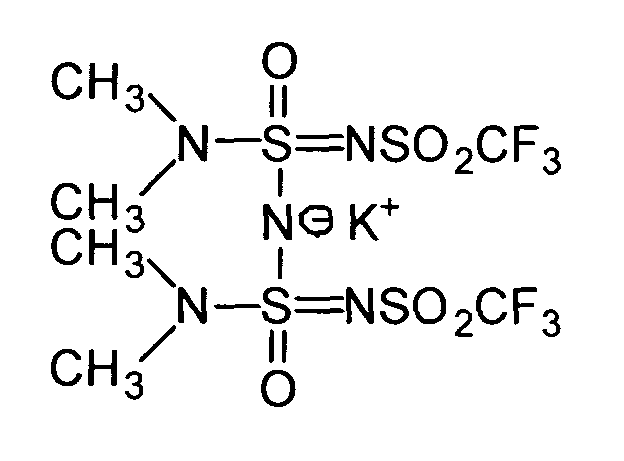
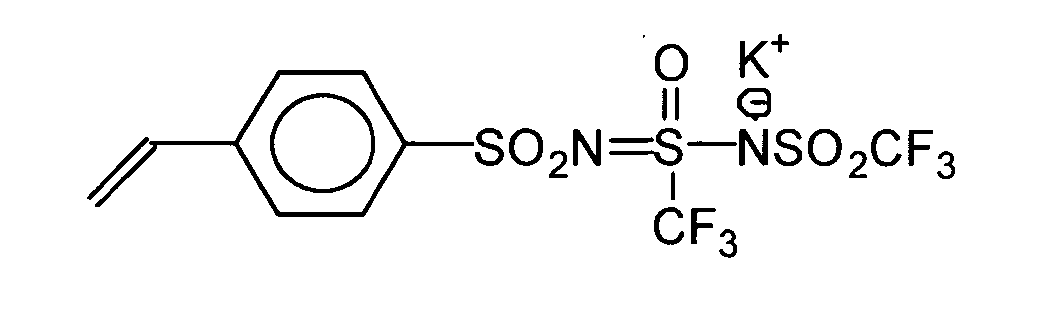
- radicals R 1 and R 2 are chosen independently of one another from the perfluoroalkyl radicals preferably having from 1 to 8 carbon atoms, alkyl radicals preferably having from 1 to 8 carbon atoms, alkenyl radicals preferably having from 2 to 18 carbon atoms, dialkylamino radicals in which the alkyl radicals preferably have from 1 to 18 carbon atoms, and the radicals styrenyl.
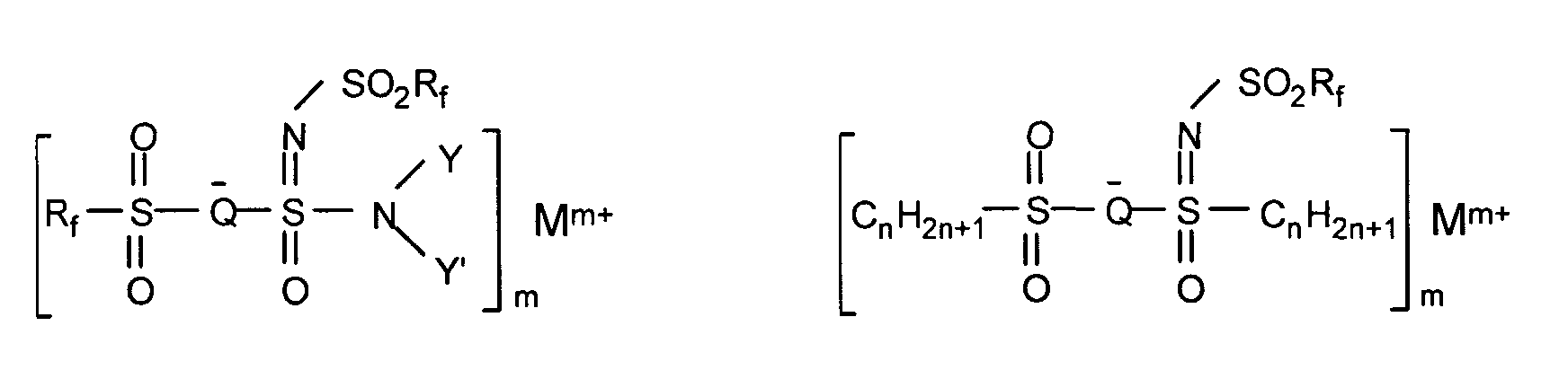
- R f represents a perfluorinated radical
- Q and M have the meaning indicated above
- Y, Y ', Y ", Y"' and Y "" have the meaning indicated above for Y:
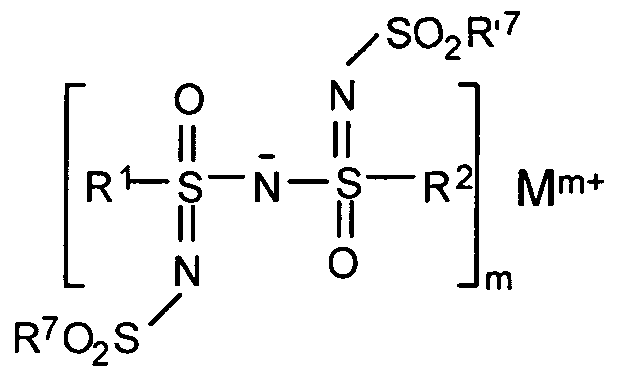
- R f and R ′ f represent perfluoroalkyl radicals, the Z i and the R i have the meaning given above, in particular the compounds in which the Z i are O, and R f is CF 3 .
- R i in the compounds of the present invention makes it possible to obtain compounds in which the anion has an intrinsic chirality on a sulfur atom.
- Such compounds are useful for inducing eniantomeric selectivity during the preparation of active organic compounds or for inducing stereoselectivity in polymerization reactions.
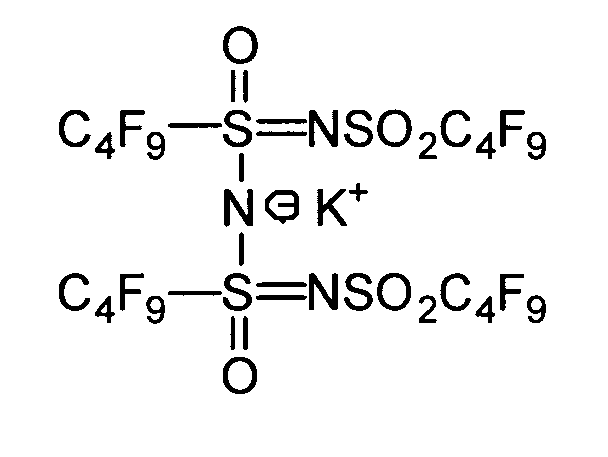
- R 1 and R 6 independently of one another represent a radical chosen from F, CF 3 , C 2 F 5 , C 4 F 9 , C 6 F 13 and C 8 F 17 , and R 2 and R 5 represent, independently of one another, an alkyl, an aryl, an alkylaryl or a dialkylamino preferably having from 1 to 20 carbon atoms.
- the ionic compounds of the present invention can be prepared by various processes.
- a compound corresponding to the formula is prepared by reacting a precursor compound noted below (Z 1 , L) comprising the group Z 1 and a leaving group L on a derivative A 2 Z 2 of the group Z 2 according to one of the following reaction schemes: R 1 -X 1 (Z 1 ) -QX 2 (L) R 2 + A 2 Z 2 ⁇ [R 1 -X 1 (Z 1 ) -X 2 (L) (Z 2 ) R 2 ] - A + + THE or R 1 -X 1 (Z 1 ) -QA 2 + LX 2 (Z 2 ) R 2 ⁇ [R 1 -X 1 (Z 1 ) -X 2 (L) (Z 2 ) R 2 ] + A - + LA
- A represents an alkali metal, a proton, a base amine or phosphorus, a trialkyl silyl group, a group dialkyl stannyl, MgL1, ZnL1, CdL1, Cu, Mg, Zn, Cd, Hg, un trialkyl-silyl, trialkyl-germanyl group or trialkyl-stannyl.
- the leaving groups L or L1 are advantageously chosen from halogens, pseudohalogens including sulfonates, fluorinated or not, imidazoyl radicals, triazolyl and benzotriazoyl.
- the compounds (Z 1 , L) in which the leaving group is a halogen can be prepared for example by the action of a halogenating agent on a salt R 1 -X 1 (Z 1 ) -QX 2 (O) (R 2 ) - A + or on the corresponding acid.
- the cation A is preferably chosen from alkali metal cations, inorganic ammonium ions NH 4 + or organic R 3 NH + (including pyridinium) and the ion Ag + which has a strong affinity for Cl, Br, I .
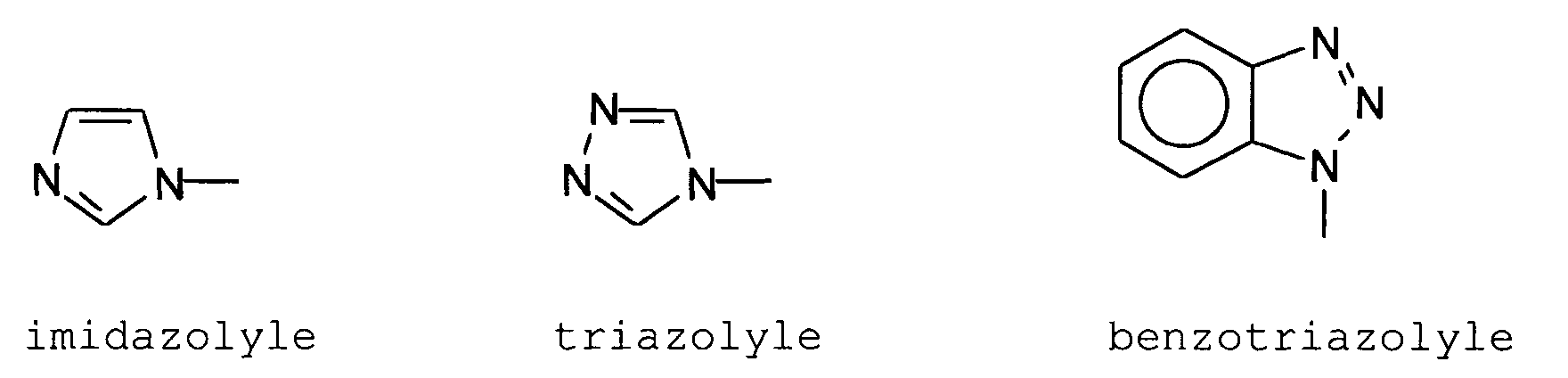
- the precursor compounds (Z 1 , L) in which the leaving group is imidazolyl, triazolyl or benzotriazolyl can be obtained by the action of their alkaline salt, their trimethyl-silyl derivative or their dimethyl-stannyl derivative on the corresponding halogenated precursor compound, for example according to the following reaction scheme: [CF 3 SO 2 NSO (C 4 H 9 ) Cl] + ImSi (CH 3 ) 3 ⁇ ClSi (CH 3 ) 3 + [CF 3 SO 2 NSO ( C 4 H 9 ) Im], in which Im represents
- the precursor compounds (Z 1 , L) in which the leaving group is a pseudohalogen such as a sulfonate can be obtained by the action of the acid chloride or the anhydride of the sulfonic acid corresponding to the sulfonate, on a aforementioned salt R 1 -X 1 (Z 1 ) -QX 2 (O) R 2 -M + .
- the precursor compounds R 1 -X 1 (Z 1 ) -QX 2 (L) R 2 from a compound comprising an anion in which the sulfur or phosphorus are in the state oxidation IV and III respectively.
- the sulfur VI or phosphorus V derivatives are obtained according to the reaction scheme R 1 -X (Z 1 ) -QX 2 (R 2 ) - A + + 2L ⁇ R 1 -X (Z 1 ) -QX 2 (L) R 2 + LA
- the preferred compounds for L are halogens, such as fluorine, chlorine, bromine.
- the different leaving groups can be exchanged by techniques well known to those skilled in the art.
- the imidazole or triazole derivatives can be obtained by the action of their alkaline salt or of their derivative of trimethyl-silyl or of dimethyl-stannyl) on the corresponding derivative, according to the reaction scheme: [CF 3 SO 2 NSO (C 4 H 9 ) Cl] + ImSi (CH 3 ) 3 ⁇ ClSi (CH 3 ) 3 + [CF 3 SO 2 NSO (C 4 H 9 ) Im] in which Im represents imidazolyl, triazolyl or benzotriazolyl.
- a symmetrical compound, in which X 1 (Z 1 ) is identical to X 2 (Z 2 ) can be prepared by the action of an ionic nitride or a metallic derivative of hexamethydisilazane or ammonia in the presence of a base on a precursor having a leaving group L, according to the following reaction scheme, in which R, X and Z have the meaning given above respectively for R i , X i and Z i , A and L are as defined above : 2RX (Z) L + A 3 N ⁇ [RX (Z)] 2 N - A + + 2LA.
- the nitriding agent can advantageously be Li 3 N, ammonia, its derivatives with silanes and their alkaline derivatives such as N [SiCH 3 ) 3 ] 2 Li, N [SiCH 3 ) 3 ] 2 Na and N [SiCH 3 ) 3 ] 2 K.
- the compounds of the invention make it possible to induce ion conduction properties in most organic, liquid or polymeric media with polarity, even weak. Applications are important in the field of electrochemistry, in particular of energy storage in primary generators or secondary, in supercapacitors, in combustible and in light emitting diodes.
- the compatibility of the ionic compounds of the invention with the polymers or body fluids can induce marked antistatic properties, even when the content of ionic compound is extremely weak. This is why a another object of the present invention is constituted by a ion conduction material consisting of a compound solution of the present invention in solution in a solvent.
- the ionic compound used for the preparation of a ion conduction material is preferably chosen from compounds whose cation is ammonium, or a cation derived from a metal, in particular lithium or potassium, zinc, calcium, rare earth metals, or an organic cation, such as a substituted ammonium, a imidazolium, a triazolium, a pyridinium, a 4-dimethylamino-pyridinium, said cations possibly carrying a substituting on the ring carbon atoms.
- the material with ion conduction thus obtained has a conductivity and high solubility in solvents due to weak interactions between positive charge and charge negative.
- the solvent for an ionically conductive material of the invention may be an aprotic liquid solvent, a solvating polymer, a polar polymer or one of their mixtures.
- the aprotic liquid solvent is chosen by example among linear ethers and cyclic ethers, esters, nitriles, nitrates, amides, sulfones, sulfolanes, alkyl sulfamides and partially hydrogenated hydrocarbons.
- Solvents particularly preferred are diethyl ether, dimethoxyethane, glyme, tetrahydrofuran, dioxane, dimethyltetrahydrofuran, methyl formate or ethyl, propylene or ethylene carbonate, alkyl carbonates (especially dimethyl carbonate, diethyl carbonate and methylpropyl carbonate), butyrolactones, acetonitrile, benzonitrile, nitromethane, nitrobenzene, dimethylformamide, diethylformamide, N-methylpyrrolidone, dimethylsulfone, tetramethylene sulfone, tetramethylene sulfone and tetraalkylsulfonamides having 5 to 10 carbon atoms.
- the solvent for the ionically conductive material can be a polar polymer chosen from solvating polymers, crosslinked or not, bearing or not ionic groups grafted.
- a solvating polymer is a polymer which comprises solvating units containing at least one heteroatom chosen from sulfur, oxygen, nitrogen and fluorine.
- solvating polymers By way of example of solvating polymers, mention may be made of polyethers of linear, comb or block structure, forming or not a network, based on poly (ethylene oxide), or the copolymers containing the ethylene oxide or oxide propylene or allylglycidylether, polyphosphazenes, crosslinked networks based on polyethylene glycol crosslinked by isocyanates or the networks obtained by polycondensation and carrying groups which allow the incorporation of crosslinkable groups.
- block copolymers in which certain blocks bear functions that have redox properties. Of course, the above list is not exhaustive, and all polymers having solvating properties can be used.
- An ionically conductive material of the present invention can simultaneously include a liquid solvent aprotic chosen from aprotic liquid solvents cited above and a polar polymer solvent comprising units containing at least one heteroatom chosen from the sulfur, nitrogen, oxygen and fluorine. He can understand from 2 to 98% of liquid solvent.
- a polar polymer mention may be made of polymers which mainly contain units derived from acrylonitrile, vinylidene fluoride, N-vinylpyrrolidone or methyl methacrylate. These polymers can carry ionic groups.
- the proportion of aprotic liquid in the solvent can vary from 2% (corresponding to a plasticized solvent) at 98% (corresponding to a gelled solvent).
- a material to ion conduction of the present invention may contain in in addition to a salt conventionally used in the prior art for the development of an ionically conductive material.
- a particularly preferred salt is preferred among the perfluoroalkanesulfonates, bis (perfluoroalkylsulfonyl) imides, bis (perfluoroalkylsulfonyl) methanes and methane tris (perfluoroalkylsulfonyl).
- an ionically conductive material of the invention may also contain the additives used classic in this type of material, and in particular mineral or organic fillers in the form of powder or fibers.
- An ion-conducting material of the invention can be used as an electrolyte in an electrochemical generator.
- Another subject of the present invention is therefore an electrochemical generator comprising a negative electrode and a positive electrode separated by an electrolyte, characterized in that the electrolyte is an ionically conductive material as defined above.
- the cation of the ionic compound of the electrolyte is Li + or K + .
- such a generator comprises a negative electrode constituted by metallic lithium, or by one of its alloys, optionally in the form of a nanometric dispersion in lithium oxide, or by a double lithium nitride and a transition metal, or by a low potential oxide having the general formula Li 1 + y Ti 2-x / 4 O 4 (0 ⁇ x, y ⁇ 1), or by carbon and carbonaceous products derived pyrolysis of organic materials.
- the negative electrode operates by exchange of lithium ions, it is particularly advantageous to use for the electrolyte, a compound of the invention in which the cation is a Li + ion.
- the collector of the positive electrode is preferably made of aluminum.
- An ionic compound of the present invention can also be used to induce ionic conductivity in low polarity media, such as aliphatic and aromatic hydrocarbons and the media that contain a significant fraction, polymers with not very polar and / or hydrophobic in nature, and supercritical carbon.
- An ionically conductive material of the present invention can also be used in a supercapacitor.
- Another object of the present invention is therefore a supercapacitor using at least one carbon electrode with a high specific surface, or a electrode containing a redox polymer, in which the electrolyte is an ionically conductive material such as defined above.
- the ionic compounds of the present invention can be used for doping polymers in order to give them improved electronic conduction.
- the doping process consists in partially oxidizing the polymer to create carbocations whose charge is compensated by the anions of the compounds of the invention. This doping can be carried out chemically or electrochemically, possibly simultaneously with the formation of the polymer.
- Another object of the present invention is the polymers thus doped.
- an ionically conductive material of the present invention can be used as an electrolyte in an electrochromic device.
- Another object of the present invention is an electrochromic device in which the electrolyte is an ionically conductive material according to the invention.
- Such a device also comprises electrodes, the active material of which is chosen from WO 3 , MoO 3 , the iridium oxyhydroxides IrO x H y , (2 ⁇ x ⁇ 3; 0 ⁇ y ⁇ 3), prussian blue, viologenes and their polymers, and aromatic polyimides.
- the compounds of the present invention can be used for the catalysis of various types of reactions chemical, and in particular for reactions of polymerization, condensation reactions, reactions addition or elimination, oxidation or reduction, solvolysis, Friedel-Crafts reactions and Diels-Alder reactions.
- the compounds will be chosen essentially depending on the cation associated with the part anionic.
- cations of alkali metal, alkaline earth metal, transition metal or rare earth are suitable.
- Compounds having a cation H + , Li + , Mg ++ , Ca ++ , Cu ++ , Zn ++ , Al +++ , Fe +++ or Fe +++ are preferred.
- the compounds of the invention in which the cation is an onium of the diazonium, sulfonium, iodonium or metallocenium type can be used as cationic polymerization initiators, in particular for polymerizing or crosslinking vinyl ethers, epoxides, acetals and cyclic ethers, vinylamides, oxazolines, isobutylene, styrene or siloxanes. Under the action of actinic radiation, such compounds generate the corresponding acid form capable of initiating a cationic polymerization reaction.
- a compound of the invention can be used as a photoinitiator optionally in the presence of a sensitizer, or of a radical initiator which can be initiated thermally or by actinic radiation.
- the compounds of the invention in the form of amine salt can serve as initiator of cationic polymerizations by heating releasing the corresponding proton form.
- the cation is a salt of a cationic azo compound (for example as shown below), it can be used, by heating, to initiate radical polymerizations.
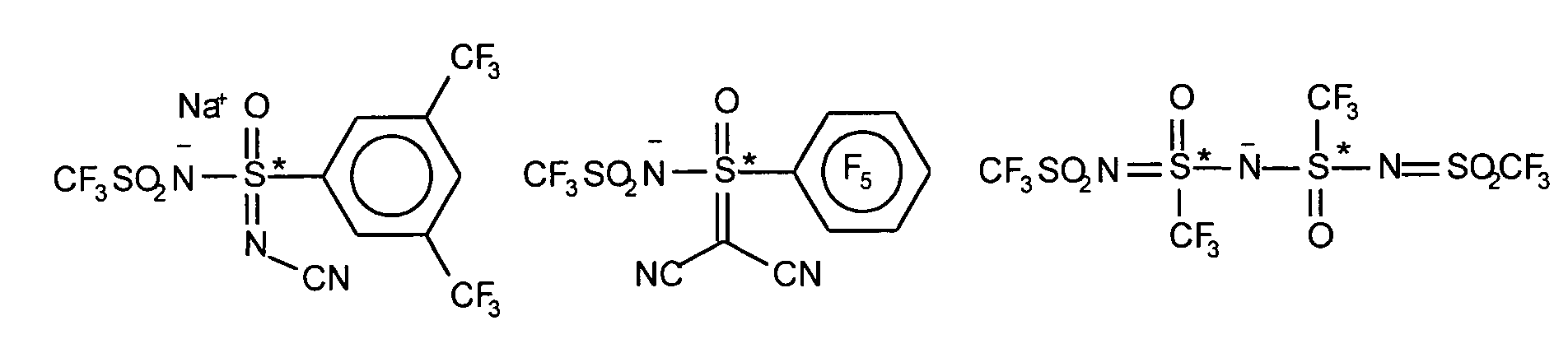
- the present invention provides compounds in which the anion has an intrinsic chirality, this which allows to induce enantiomeric asymmetries during the use of said compounds as catalysts, prepare stereoregular polymers and impart a rotary power to the materials containing them.
- the sulfur compound in state IV [CF 3 SO 2 NS (O) CF 3 ] - Na + was prepared according to one or the other of the two possible reaction schemes: a) CF 3 S-SCF 3 + CF 3 SO 2 NCl 2 ⁇ CF 3 SO 2 NS (Cl) CF 3 + CF 3 SCl CF 3 SO 2 NS (Cl) CF 3 + NaOS (CH 3 ) 3 ⁇ [CF 3 SO 2 NS (O) CF 3 ] - Na + + ClSi (CH 3 ) 3 or b) CF 3 SO 2 NNa 2 + CF 3 SO 2 Cl ⁇ [CF 3 SO 2 NS (O) CF 3 ] - Na + + NaCl
- the halogenated compound CF 3 SO 2 NS (Cl) CF 3 was prepared by chlorination of the sodium salt [obtained by one of the routes a) or b)] in the absence of solvent and transformed into fluorinated derivative by action of N (CH 3 ) 4 F in ether at -35 ° C.
- Example 2 5 g of salt of Example 2 were treated with 1.17 g of lithium tetrafluoroborate in isopropanol. The KBF 4 precipitate was filtered and the lithium salt was obtained by evaporation of the solvent and drying under vacuum at 60 ° C.
- This salt is soluble in slightly polar solvents such as ethyl carbonate (dielectric constant of 2.8) to form a solution which has a conductivity greater than 4.10 -3 Scm -1 and an anodic oxidation stability of + 5, 5 V vs. Li °: Li + .
- slightly polar solvents such as ethyl carbonate (dielectric constant of 2.8) to form a solution which has a conductivity greater than 4.10 -3 Scm -1 and an anodic oxidation stability of + 5, 5 V vs. Li °: Li + .
- This compound either in the initial form of potassium, either in the form of a lithium salt obtained by ion exchange, has surfactant properties and marked lubricants, and it is soluble in solvents low dielectric constant, especially in aromatic hydrocarbons.
- Li salt or K the compound facilitates the extrusion of homo- and copolymers based on ethylene oxide for preparation of ionic conductive films, as well as for the preparation composite electrodes whose active material is a insertion compound usable for the manufacture of electrochemical generators.
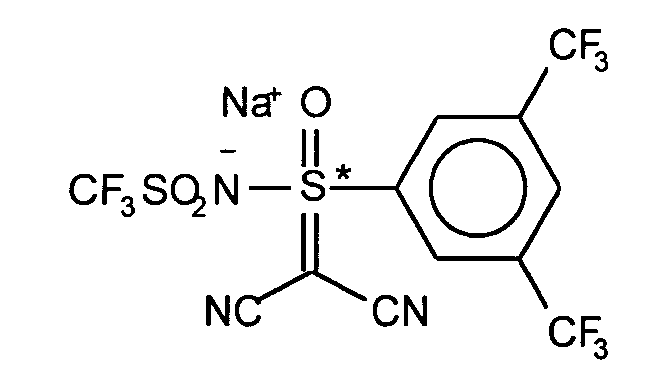
- the ionic compound [CF 3 SO 2 NSO 2 (3.5-C 6 H 3 (CF 3 ) 2 ] - K + was prepared by a method similar to that of Example 2 from chloride of 3.5 -bis (trifluoromethyl) benzene sulfonyl and trifluomethane sulfonamide 18.6 g of salt were treated with 7 g of DAST (C 2 H 5 ) 2 NSF 3.
- a cationic polymerization catalyst was prepared by the action of acetyl chloride in a stoichiometric amount on the silver salt, itself obtained by exchange of the sodium salt with toluene-silver sulfonate in an isopropanol-toluene mixture. This catalyst induces a polymerization of propylene oxide into an optically active polymer.
- methyl vinyl ether is polymerized into a crystalline isotactic macromolecule insoluble in water, unlike the polymers obtained with non-chiral cationic initiators.
- the compounds also have an intrinsic chirality on the anion center, allowing the catalysis of reactions promoting an eniantomer, the polymerizations giving optically active polymers or having a tacticity.
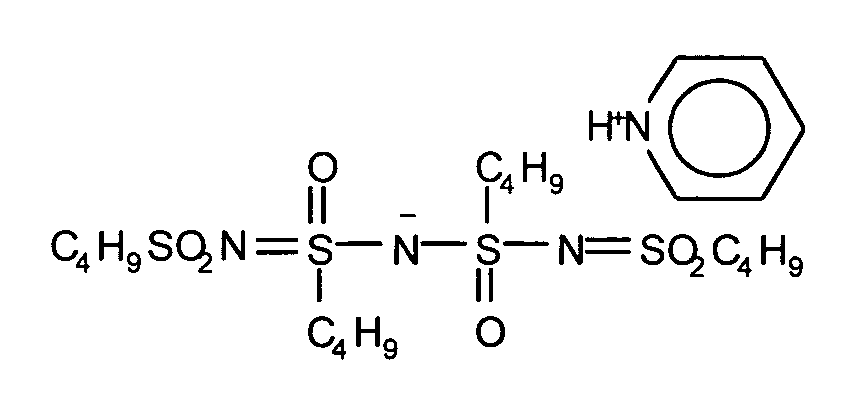
- the compound [(C 4 H 9 SO 2 ) 2 N] Na was prepared according to the method of Runge et al. (Chem. Ber. 88-4, 533 (1955)) and halogenated with thionyl chloride in acetonitrile, the reaction being catalyzed by DMF.
- the chloride C 4 H 9 SO 2 NSO (Cl) C 4 H 9 in solution in THF was treated with ammonia so as to form the sulfimidosulfamide C 4 H 9 SO 2 NSO (NH 2 ) C 4 H 9 .
- Equimolecular amounts of the chloride and the amide in the pyridine were reacted to form the pyridinium salt:
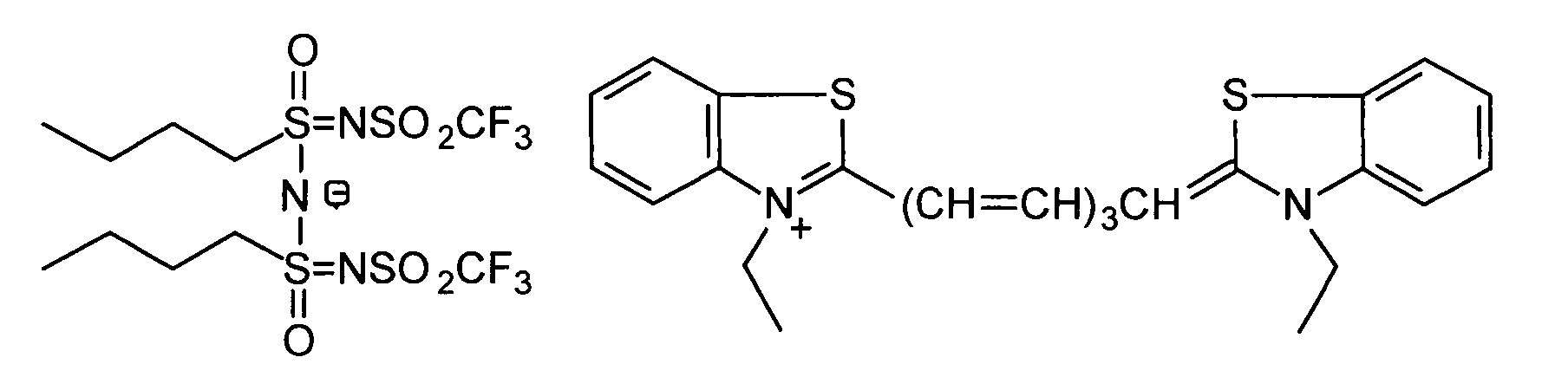
- the salt of the rhodamine dye 6G of this anion has been precipitated by simple mixing in water of perchlorate rhodamine 6G and pyridinium salt.
- This salt has a marked solubility in a large number of compounds organic, in particular in type monomers methyl methacrylate or styrene, and this solubility is maintained during the polymerization of these monomers.
- the solid solutions thus formed are highly fluorescent and allow the production of lasers solid, thin films or fibers.
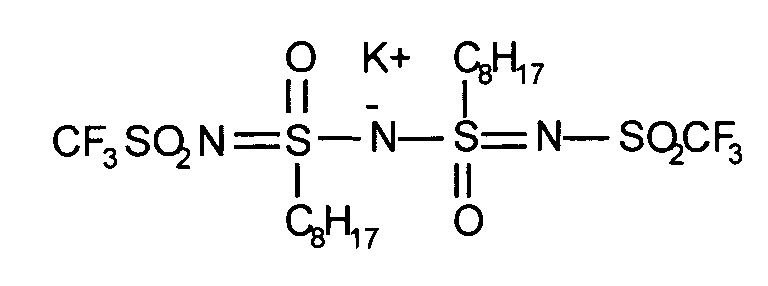
- the bis (indenyl) zirconium dichloride was treated with the silver salt of the compound of Example 6 and the compound was obtained in which X- is [CF 3 SO 2 NSOC 8 H 17 ] 2 N - .
- This metallocene has excellent solubility in the usual polymerization solvents such as toluene or aliphatic hydrocarbons, and it shows activity notable for the polymerization of ⁇ -olefins, in particular for ethylene and propylene.
- the corresponding lithium salt was obtained by exchange ionic with lithium chloride in THF.
- the concentrated solutions of this lithium salt in ether are active for the catalysis of Diels & Alder reactions.
- This salt makes it possible to initiate under the effect of radiation actinic (light, y-rays, electron beams) polymerization reactions or crosslinking reactions cationic of electron-rich monomers, in particular vinyl ethers, propenyl ethers, epoxides, isobutylene or N-vinylpyrolidinone.
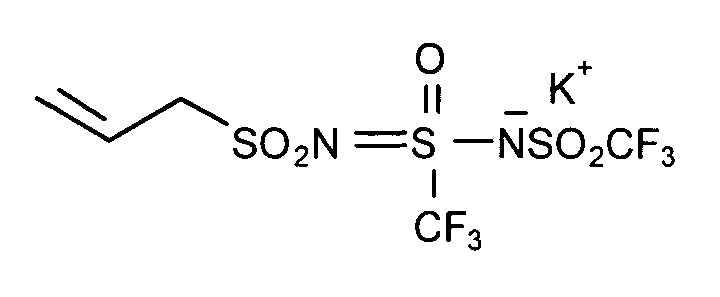
- Example 15 The allylsulfonimide of Example 15 was epoxidized with the magnesium salt of commercial peroxypthalic acid and the salt was obtained:
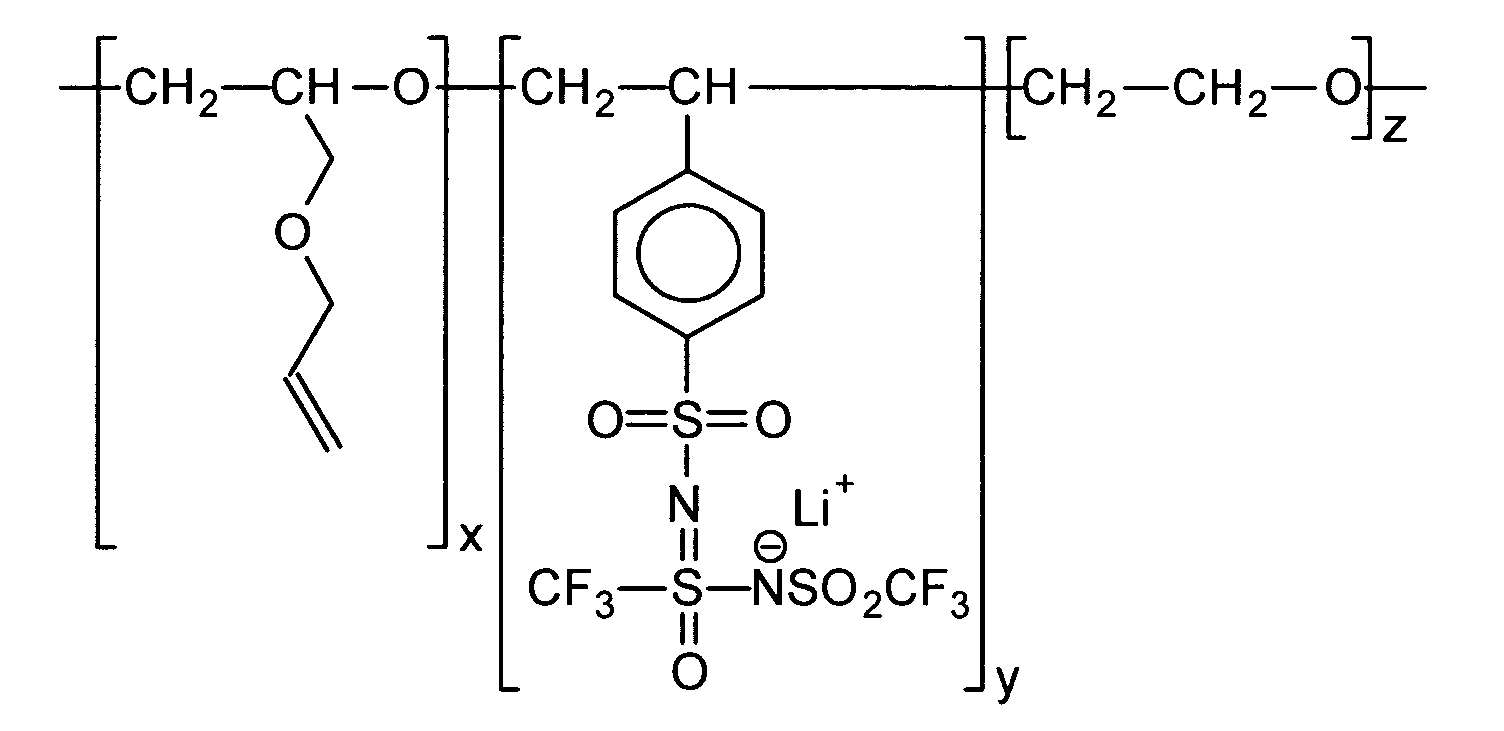
- a solution was introduced into 100 ml of anhydrous tetrahydrofuran of 50 mmol of said salt, and of 6 mmol of allylglycidylether. After having purged the reactor with argon, 146 mmol of ethylene oxide were introduced using a valve, then 100 ⁇ l of a 10 -2 M solution of potassium t-butoxide in THF. The polymerization was then carried out under argon by heating the reaction medium at 60 ° C for 48 hours. After cooling, the solution was concentrated, then the polymer was recovered by reprecipitation in ether.
- a gelled electrolyte 40 ⁇ m thick was thus produced containing (by weight) 30% of the above polyelectrolyte, 35% ethylene carbonate and 35% propylene carbonate), after crosslinking of the allyl functions by UV irradiation in the presence of 1,2-diphenyl-1-keto-2,2-dimethoxyethane.
- This gel has good mechanical properties and a conductivity greater than 10 -3 S.cm -1 at 30 ° C.
- the number of cationic transport in this electrolyte has been estimated at 0.85.
- An electrochemical generator was assembled using as the electrolyte, the gelled electrolyte described above.
- the anode material was carbon coke (80% by volume) mixed with the copolymer (PANSDTFSI) of this example in the non-crosslinked form as a binder (20% by volume).
- the cathode material was a composite material consisting of carbon black (6% by volume), LiCoNiO 2 (75% by volume) and uncrosslinked copolymer (PANSDTFSI) (20% by volume).
- This generator gave good cycling performance at 25 ° C. It was possible to perform 1000 charge / discharge cycles between 3 and 4.2 V while retaining a capacity greater than 80% of the capacity in the first cycle.
- the generator has very good performance during a power call due to the use of fixed anions.
- the use of fixed anions has also made it possible to improve the evolution of the interface resistance.
- This salt is very soluble in slightly polar solvents like dichloromethane or methylene chloride as well that in slightly polar polymer matrices like the polymethyl methacrylate.
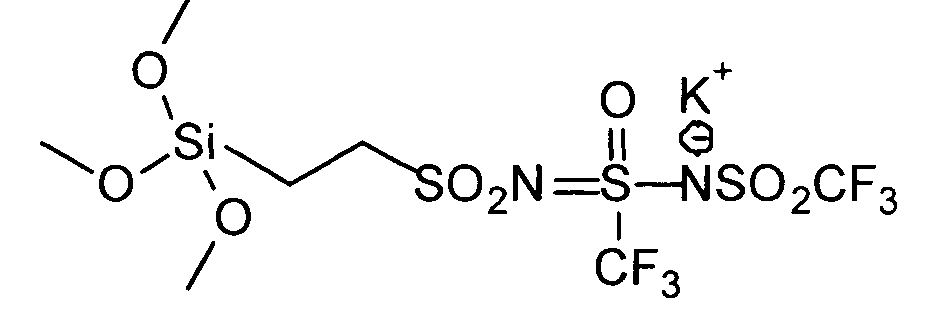
- This compound was grafted onto the surface of particles of silica previously treated in an acid solution hydrochloric.
- Such silica particles are particularly useful for carrying out catalysis supported using an appropriate cation.
- fluorinated solvents such as Fluorinert® (sold by the company 3M)
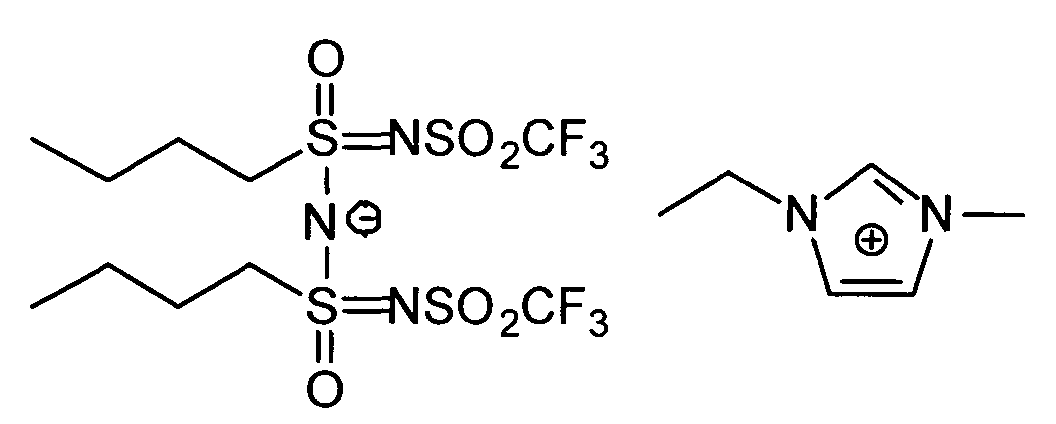
- This molten salt has a conductivity greater than 4.10 -3 S.cm -1 and a freezing point less than - -20 ° C. Its wide range of redox stability makes it an electrolyte particularly interesting for electrochemical generators such as lithium batteries, supercapacitors, light modulation systems, photovoltaic cells.
Landscapes
- Chemical & Material Sciences (AREA)
- Organic Chemistry (AREA)
- Chemical Kinetics & Catalysis (AREA)
- Electrochemistry (AREA)
- Engineering & Computer Science (AREA)
- Manufacturing & Machinery (AREA)
- Physics & Mathematics (AREA)
- General Chemical & Material Sciences (AREA)
- Power Engineering (AREA)
- Condensed Matter Physics & Semiconductors (AREA)
- General Physics & Mathematics (AREA)
- Inorganic Chemistry (AREA)
- Spectroscopy & Molecular Physics (AREA)
- Dispersion Chemistry (AREA)
- Microelectronics & Electronic Packaging (AREA)
- Catalysts (AREA)
- Organic Low-Molecular-Weight Compounds And Preparation Thereof (AREA)
- Secondary Cells (AREA)
- Polymerization Catalysts (AREA)
- Addition Polymer Or Copolymer, Post-Treatments, Or Chemical Modifications (AREA)
- Primary Cells (AREA)
- Low-Molecular Organic Synthesis Reactions Using Catalysts (AREA)
- Polymerisation Methods In General (AREA)
- Conductive Materials (AREA)
Abstract
Description
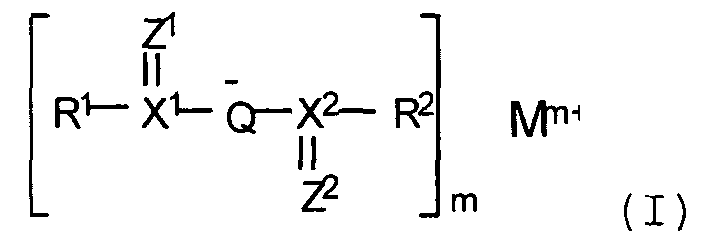
- Mm+ est le proton, ou un cation métallique ayant la valence m choisi parmi les ions des métaux alcalins, des métaux alcalino-terreux, des métaux de transition, des terres rares, ou un cation organique onium, ou un cation organo-métallique, 1 ≤ m ≤ 3 ;
- X1 et X2, désignés ci-après par Xi, représentent indépendamment l'un de l'autre S=Z3, S=Z4, P-R3 ou P-R4 ;
- Q représente N, CR5, CCN ou CSO2R5 ;
- Z1, Z2, Z3 et Z4, désignés ci-après par Zi, représentent indépendamment les uns des autres =O, =NC≡N, =C(C≡N)2, =NS(=Z)2R6 ou =C[S(=Z)2R6]2, Z ayant la même signification que Zi, étant entendu que, dans un segment -X1-Q-X2-, au plus 3 groupes Zi représentent =O ;
- R1, R2, R3, R4, R5 et R6, désignés ci-après par Ri, représentent indépendamment les uns des autres Y, YO-, YS-, Y2N- ou F ;
- Y représente un radical organique monovalent, ayant de préférence de 1 à 16 atomes de carbone, choisi parmi les radicaux alkyles, alkényles, oxa-alkyles, oxa-alkényles, aza-alkyles, aza-alkényles, aryles ou alkylaryles, perfluoroalkyles, ou parmi les radicaux obtenus à partir des radicaux précités par substitution, dans les chaínes et / ou la partie aromatique, par des hétéroatomes tels que les halogènes, l'oxygène, l'azote, le soufre, le phosphore ; étant entendu que si le soufre ou le phosphore sont présents, ils peuvent éventuellement être liés à des atomes d'oxygène ou d'azote substitués, ou bien Y est une unité de répétition d'une trame polymérique.










+ NaCl
ClSi(CH3)3 + [CF3SO2NSO(C4H9)Im]


CF3SO2NS(Cl)CF3 + NaOS(CH3)3 ⇒ [CF3SO2NS(O)CF3]-Na+ +
ClSi(CH3)3

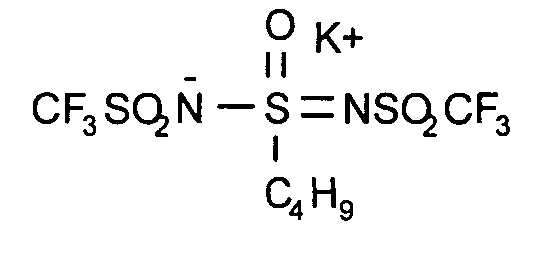
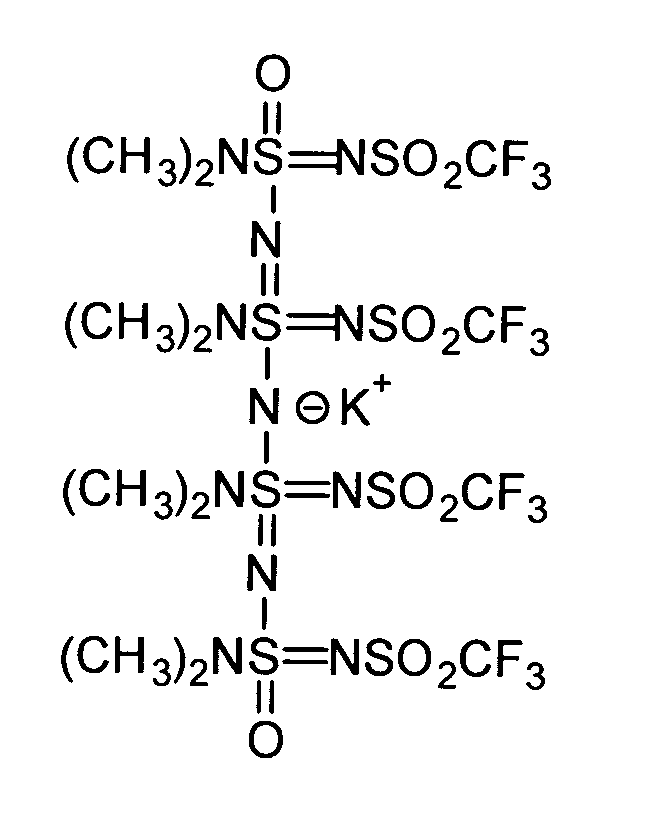
[C4H9SO(NSO2CF3)NSO2CF3]-N(C2H4)3NH+
[C4H9SO(NSO2CF3)NSO2CF3]-K+,








Claims (22)
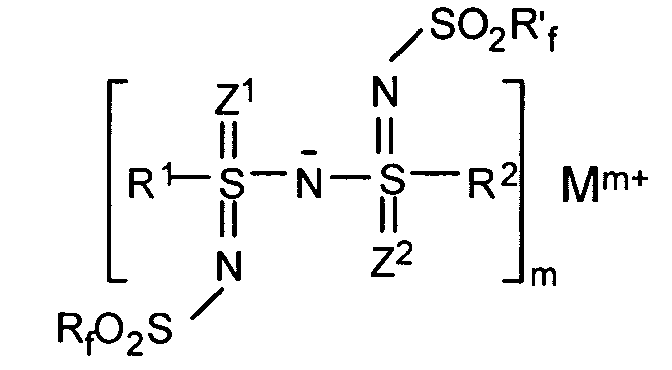
- Utilisation d'un composé ionique en tant que catalyseur pour une réaction de polymérisation, une réaction de condensation, une réaction d'addition ou d'élimination, une réaction d'oxydation ou de réduction, une solvolyse, une réaction de Friedel et Craft ou une réaction de Diels Alder, caractérisée en ce que ledit composé ionique répond à la formuledans laquelle :
 Mm+ est le proton, ou un cation métallique ayant la valence m choisi parmi les ions des métaux alcalins, des métaux alcalino-terreux, des métaux de transition, des terres rares, ou un cation organique onium, ou un cation organo-métallique, 1 ≤ m ≤ 3 ;X1 et X2, désignés ci-après par Xi, représentent indépendamment l'un de l'autre S=Z3, S=Z4, P-R3 ou P-R4 ;Q représente N, CR5, CCN ou CSO2R5 ;Z1, Z2, Z3 et Z4, désignés ci-après par Zi, représentent indépendamment les uns des autres =O, =NC≡N, =C(C≡N)2, =NS(=Z)2R6 ou =C[S(=Z)2R6]2, Z ayant la même signification que Zi, étant entendu que, dans un segment - X1-Q-X2-, au plus 3 groupes Zi représentent =O ;R1, R2, R3, R4, R5 et R6, désignés ci-après par Ri, représentent indépendamment les uns des autres Y, YO-, YS-, Y2N- ou F ;Y représente un radical organique monovalent, ayant de préférence de 1 à 16 atomes de carbone, choisi parmi les radicaux alkyles, alkényles, oxa-alkyles, oxa-alkényles, aza-alkyles, aza-alkényles, aryles ou alkylaryles, perfluoroalkyles , ou parmi les radicaux obtenus à partir des radicaux précités par substitution, dans les chaínes et / ou la partie aromatique, par des hétéroatomes tels que les halogènes, l'oxygène, l'azote, le soufre, le phosphore, étant entendu que si le soufre ou le phosphore sont présents, ils peuvent éventuellement être liés à des atomes d'oxygène ou d'azote substitués, ou bien Y est une unité de répétition d'une trame polymérique.
 - Utilisation d'un composé ionique selon la revendication 1, caractérisé en ce que le cation Mm+ est un cation métallique choisi parmi K+, Li+, Mg++, Ca++ ou Ba++, Cu++, Zn++, Fe++ ou Re+++.
- Utilisation d'un composé ionique selon la revendication 1, caractérisé en ce que le cation Mm+ est un cation onium choisi dans le groupe constitué par les ions ammonium, les ions guanidinium, les ions amidinium, les ions pyridinium, les ions imidazolium, les ions imidazolinium, les ions triazolium, les ions sulfonium, les ions iodonium, les ions phosphonium, le nitrosyle et NO2 +.
- Utilisation d'un composé ionique selon la revendication 1, caractérisé en ce que le cation Mm+ est un cation organo-métallique choisi parmi les ions métallocénium, les cations métalliques coordonnés par des atomes tels que O, S, Se N, P ou As et portés par des molécules organiques, les groupes trialkyl-silyle, tétraalkyl-germanyle et dialkyl-stannyle dans lesquels les radicaux alkyles ont de 1 à 10 atomes de carbone.
- Utilisation d'un composé ionique selon la revendication 4, caractérisé en ce que le cation organo-métallique fait partie d'une chaíne polymère.
- Utilisation d'un composé ionique selon la revendication 1, caractérisé en ce que le cation Mm+ est l'unité de répétition d'un polymère conjugué sous forme oxydée cationique.
- Utilisation d'un composé ionique selon la revendication 1, caractérisé en ce que l'un au moins des Xi représente un groupe phosphoré.
- Utilisation d'un composé ionique selon la revendication 7, caractérisé en ce qu'il répond à l'une des formules

- Utilisation d'un composé ionique selon la revendication 8, caractérisé en ce que Q représente N.
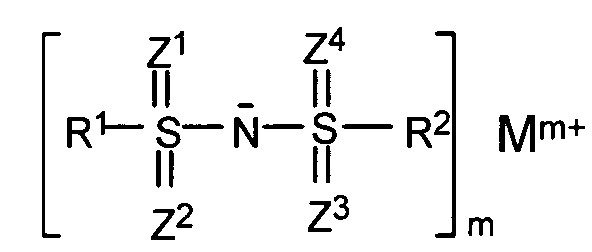
- Utilisation d'un composé ionique selon la revendication 1, caractérisé en ce que les groupements Xi représentent un groupement S-Zi.
- Utilisation d'un composé ionique selon la revendication 10, caractérisé en ce que Q représente N, étant entendu que si R1 est CF3, R2 est un phényle portant éventuellement un halogène ou un NO2, trois substituants Zi représentent O et un substituant Zi représente =NSO2CF3, alors M est différent d'un cation de métal alcalin ou d'un proton.
- Utilisation d'un composé ionique selon la revendication 1, caractérisé en ce que les radicaux R1 et R2 sont choisis indépendamment l'un de l'autre parmi les radicaux perfluoroalkyles, les radicaux alkyles, les radicaux alkényle, les radicaux dialkylamino et les radicaux styrényles.
- Utilisation d'un composé ionique selon la revendication 12, caractérisé en ce que les radicaux perfluoroalkyles ont de 1 à 8 atomes de carbone, les radicaux alkyles ont de 1 à 8 atome de carbone, les radicaux alkényles ont de 2 à 18 atomes de carbone, les radicaux alkyles des groupements dialkylamino ont de 1 à 18 atomes de carbone.
- Utilisation d'un composé ionique selon la revendication 12, caractérisé en ce que au moins deux Zi représentent =O, les Zi différents de =O étant =NSO2RF, RF étant un groupe perfluoroalkyle.
- Utilisation d'un composé ionique selon la revendication 1, caractérisé en ce que les Zi représentent indépendamment les uns des autres =CO, =N-C≡N ou =C(C≡N)2.
- Utilisation d'un composé ionique selon la revendication 1, caractérisé en ce que Z1 à Z3 représentent =O et Z4 représente =C[S(=Z)2R6]2.
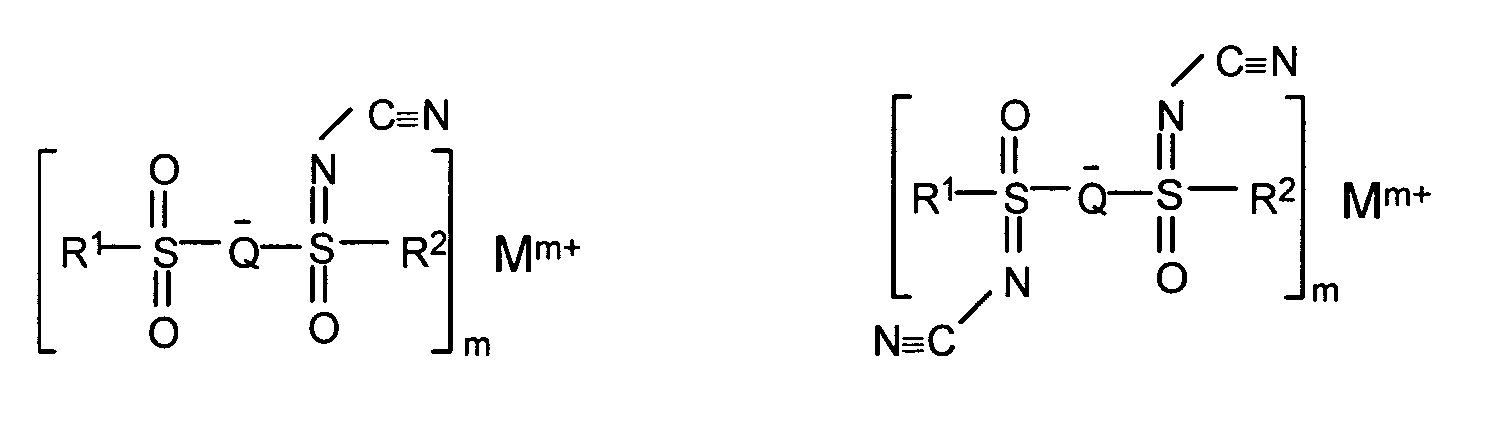
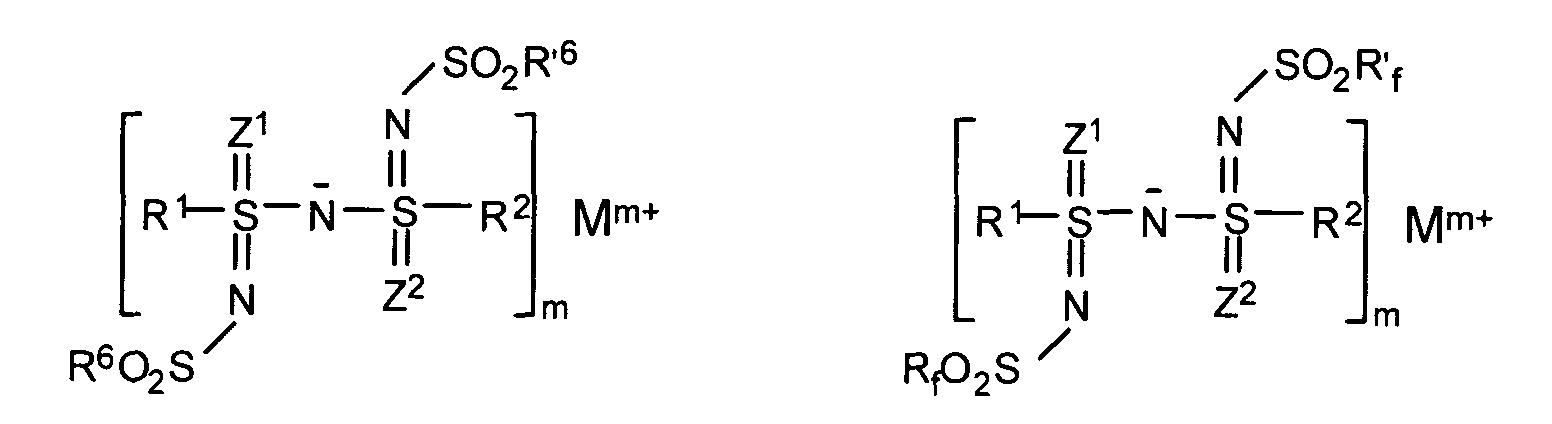
- Utilisation d'un composé ionique selon la revendication 1, caractérisé en ce qu'il répond à l'une des formulesdans lesquelles R'6 a la même signification que R6 et Rf et R'f représentent un radical perfluoroalkyle.
- Utilisation d'un composé ionique selon la revendication 1, caractérisé en ce qu'il répond à la formule [R1SO2N-S*=O(R2)=NSO2R6]- dans laquelle R1 est différent de R6.
- Utilisation d'un composé ionique selon la revendication 1, caractérisé en ce qu'il répond à la formule [R1SO2N-S*=O(R2)=N-S*=O(R5)=NSO2R6]-.
- Utilisation d'un composé ionique selon la revendication 19, caractérisé en ce que R1 et R6 représentent indépendamment l'un de l'autre un radical choisi parmi F, CF3, C2F5, C4F9, C6F13 et C8F17, et R2 et R5 représentent indépendamment l'un de l'autre un alkyle, un aryle, un alkylaryle ou un dialkylamino ayant de préférence de 1 à 20 atomes de carbone.
- Utilisation d'un composé ionique selon la revendication 1, pour une réaction de polymérisation ou de réticulation de monomères ou de prépolymères capables de réagir par voie cationique, ledit composé ionique agissant comme photoinitiateur source d'acide catalysant la réaction.
- Utilisation d'un composé ionique selon l'une des revendications 18 ou 19 pour la préparation de composés organiques optiquement actifs ou pour les réactions de polymérisation énantiosélectives.
Applications Claiming Priority (3)
| Application Number | Priority Date | Filing Date | Title |
|---|---|---|---|
| CA2211465 | 1997-07-25 | ||
| CA2211465 | 1997-07-25 | ||
| EP98941464A EP0928287B1 (fr) | 1997-07-25 | 1998-07-27 | Composes ioniques ayant une charge anionique delocalisee, leur utilisation comme composants de conducteurs ioniques ou de catalyseur |
Related Parent Applications (2)
| Application Number | Title | Priority Date | Filing Date |
|---|---|---|---|
| EP98941464A Division EP0928287B1 (fr) | 1997-07-25 | 1998-07-27 | Composes ioniques ayant une charge anionique delocalisee, leur utilisation comme composants de conducteurs ioniques ou de catalyseur |
| EP98941464.4 Division | 1998-07-27 |
Publications (3)
| Publication Number | Publication Date |
|---|---|
| EP1388546A2 true EP1388546A2 (fr) | 2004-02-11 |
| EP1388546A3 EP1388546A3 (fr) | 2004-03-03 |
| EP1388546B1 EP1388546B1 (fr) | 2010-09-08 |
Family
ID=4161113
Family Applications (2)
| Application Number | Title | Priority Date | Filing Date |
|---|---|---|---|
| EP03292375A Expired - Lifetime EP1388546B1 (fr) | 1997-07-25 | 1998-07-27 | Utilisation des composés ioniques ayant une charge anionique délocalisée comme composants de catalyseur |
| EP98941464A Expired - Lifetime EP0928287B1 (fr) | 1997-07-25 | 1998-07-27 | Composes ioniques ayant une charge anionique delocalisee, leur utilisation comme composants de conducteurs ioniques ou de catalyseur |
Family Applications After (1)
| Application Number | Title | Priority Date | Filing Date |
|---|---|---|---|
| EP98941464A Expired - Lifetime EP0928287B1 (fr) | 1997-07-25 | 1998-07-27 | Composes ioniques ayant une charge anionique delocalisee, leur utilisation comme composants de conducteurs ioniques ou de catalyseur |
Country Status (6)
| Country | Link |
|---|---|
| US (5) | US6340716B1 (fr) |
| EP (2) | EP1388546B1 (fr) |
| JP (1) | JP4939679B2 (fr) |
| DE (2) | DE69818627T2 (fr) |
| UA (1) | UA73914C2 (fr) |
| WO (1) | WO1999005100A1 (fr) |
Families Citing this family (53)
| Publication number | Priority date | Publication date | Assignee | Title |
|---|---|---|---|---|
| EP1088814A1 (fr) * | 1999-09-29 | 2001-04-04 | MERCK PATENT GmbH | Sulphonamides fluorés comme solvants ignifuges pour utilisation dans des cellules électrochimiques |
| CN1428012A (zh) * | 2000-05-12 | 2003-07-02 | 株式会社汤浅 | 非水电解质锂二次电池 |
| FR2821354B1 (fr) * | 2001-02-26 | 2003-05-30 | Rhodia Chimie Sa | Procede d'ouverture d'un heterocycle a trois chainons par un compose nucleophile |
| US20030211389A1 (en) * | 2002-05-09 | 2003-11-13 | Schlaikjer Carl R. | Guanidine derivatives as cations for ambient temperature molten salts in electrochemical power sources |
| FR2841255B1 (fr) * | 2002-06-21 | 2005-10-28 | Inst Nat Polytech Grenoble | Materiau a conduction ionique renforce, son utilisation dans les electrodes et les electrolytes |
| FR2843399B1 (fr) * | 2002-08-06 | 2004-09-03 | Commissariat Energie Atomique | Polymeres de type polyphenylenes, leur procede de preparation, membranes et dispositif de pile a combustible comprenant ces membranes |
| JP4549621B2 (ja) * | 2002-12-02 | 2010-09-22 | 日東電工株式会社 | 電池用セパレータのための架橋性ポリマー担持多孔質フィルムとそれを用いた電池の製造方法 |
| US20080188392A1 (en) * | 2002-12-02 | 2008-08-07 | Diamond Chemical Company, Inc. | Laundry Compositions |
| US7423164B2 (en) * | 2003-12-31 | 2008-09-09 | Ut-Battelle, Llc | Synthesis of ionic liquids |
| EP1571163A1 (fr) * | 2004-03-02 | 2005-09-07 | Total Petrochemicals Research Feluy | Liquides ioniques utilisés comme solvants pour catalyse métallocène |
| US7220510B2 (en) * | 2004-10-01 | 2007-05-22 | General Motors Corporation | Sulfonated poly(arylene) films as polyelectrolyte membranes |
| US20070129568A1 (en) * | 2005-12-06 | 2007-06-07 | Ngimat, Co. | Ionic liquids |
| DE102006005103A1 (de) * | 2006-02-04 | 2007-08-09 | Merck Patent Gmbh | Oxonium- und Sulfoniumsalze |
| JP2007246485A (ja) * | 2006-03-17 | 2007-09-27 | Fujifilm Corp | 感光性組成物、該感光性組成物を用いたパターン形成方法及び化合物 |
| DE102007004698A1 (de) * | 2007-01-31 | 2008-08-07 | Merck Patent Gmbh | Verbindungen enthaltend Organofluorochlorophosphatanionen |
| US8540899B2 (en) | 2007-02-07 | 2013-09-24 | Esionic Es, Inc. | Liquid composite compositions using non-volatile liquids and nanoparticles and uses thereof |
| US20090043016A1 (en) * | 2007-08-06 | 2009-02-12 | Jing-Chung Chang | Flame retardant polytrimethylene terephthalate composition |
| US8432601B2 (en) * | 2009-05-01 | 2013-04-30 | Gemalto, S.A. | Electrochromic display module and composition with improved performance |
| EP2450907B1 (fr) * | 2010-11-05 | 2014-02-12 | Max-Planck-Gesellschaft zur Förderung der Wissenschaften e.V. | Conducteurs mono-ioniques d'alcaline ayant une conductivité élevée et nombre de transport et leurs procédés de préparation |
| CN102816096B (zh) * | 2011-06-10 | 2014-09-24 | 华中科技大学 | 一种亚胺碱金属盐和离子液体及其作为非水电解质的应用 |
| CN103626682A (zh) * | 2011-06-10 | 2014-03-12 | 华中科技大学 | 一种亚胺碱金属盐和离子液体及其作为非水电解质的应用 |
| JP5834771B2 (ja) * | 2011-10-26 | 2015-12-24 | 三菱化学株式会社 | 非水系電解液、それを用いた電池 |
| WO2013072470A1 (fr) * | 2011-11-17 | 2013-05-23 | Jonsson Erlendur | Anions et sels dérivés présentant une dissociation élevée dans des solvants non protogènes |
| JP5817008B1 (ja) * | 2013-09-25 | 2015-11-18 | 国立大学法人 東京大学 | 非水系二次電池 |
| DE112014004442T5 (de) | 2013-09-25 | 2016-06-23 | The University Of Tokyo | Nichtwässrige Elektrolytsekundärbatterie |
| JP5816998B2 (ja) * | 2013-09-25 | 2015-11-18 | 国立大学法人 東京大学 | アルカリ金属、アルカリ土類金属又はアルミニウムをカチオンとする塩と、ヘテロ元素を有する有機溶媒とを含む電解液 |
| JP5817000B2 (ja) * | 2013-09-25 | 2015-11-18 | 国立大学法人 東京大学 | アルカリ金属、アルカリ土類金属又はアルミニウムをカチオンとする塩と、ヘテロ元素を有する有機溶媒とを含む電解液群 |
| JP5817002B2 (ja) * | 2013-09-25 | 2015-11-18 | 国立大学法人 東京大学 | 非水系二次電池 |
| WO2015045389A1 (fr) * | 2013-09-25 | 2015-04-02 | 国立大学法人東京大学 | Solution d'électrolyte pour dispositifs de stockage d'électricité tels que des batteries et des condensateurs contenant du sel, un métal alcalin, un métal terreux alcalin ou de l'aluminium servant de cations, et un solvant organique possédant un hétéro-élément, procédé de production de celle-ci, et condensateur muni de ladite solution d'électrolyte. |
| JP5828493B2 (ja) * | 2013-09-25 | 2015-12-09 | 国立大学法人 東京大学 | アルカリ金属、アルカリ土類金属又はアルミニウムをカチオンとする塩と、ヘテロ元素を有する有機溶媒とを含む電解液を具備するキャパシタ |
| JP5817004B2 (ja) * | 2013-09-25 | 2015-11-18 | 国立大学法人 東京大学 | リチウムイオン二次電池 |
| JP5816999B2 (ja) * | 2013-09-25 | 2015-11-18 | 国立大学法人 東京大学 | アルカリ金属、アルカリ土類金属又はアルミニウムをカチオンとする塩と、ヘテロ元素を有する有機溶媒とを含む電解液の製造方法 |
| US20160218394A1 (en) * | 2013-09-25 | 2016-07-28 | The University Of Tokyo | Electrolytic solution, for electrical storage devices such as batteries and capacitors, containing salt whose cation is alkali metal, alkaline earth metal, or aluminum, and organic solvent having heteroelement, method for producing said electrolytic solution, and capacitor including said electrolytic solution |
| JP5817007B1 (ja) * | 2013-09-25 | 2015-11-18 | 国立大学法人 東京大学 | 非水系二次電池 |
| WO2015045386A1 (fr) * | 2013-09-25 | 2015-04-02 | 国立大学法人東京大学 | Batterie rechargeable non aqueuse |
| WO2015045387A1 (fr) * | 2013-09-25 | 2015-04-02 | 国立大学法人東京大学 | Batterie secondaire à électrolyte non aqueux |
| JP5965445B2 (ja) | 2013-09-25 | 2016-08-03 | 国立大学法人 東京大学 | 非水電解質二次電池 |
| JP5817009B1 (ja) * | 2013-09-25 | 2015-11-18 | 国立大学法人 東京大学 | 非水系二次電池 |
| JP5817003B2 (ja) * | 2013-09-25 | 2015-11-18 | 国立大学法人 東京大学 | 非水電解質二次電池 |
| JP5816997B2 (ja) * | 2013-09-25 | 2015-11-18 | 国立大学法人 東京大学 | アルカリ金属、アルカリ土類金属又はアルミニウムをカチオンとする塩と、ヘテロ元素を有する有機溶媒とを含む高粘度電解液 |
| JP5817006B1 (ja) * | 2013-09-25 | 2015-11-18 | 国立大学法人 東京大学 | 非水系二次電池 |
| JP5817005B2 (ja) * | 2013-09-25 | 2015-11-18 | 国立大学法人 東京大学 | 非水系二次電池 |
| JP5817001B2 (ja) * | 2013-09-25 | 2015-11-18 | 国立大学法人 東京大学 | 非水系二次電池 |
| EP3138845A1 (fr) * | 2015-09-01 | 2017-03-08 | Studiengesellschaft Kohle MbH | Phosphoramidimidates chiraux et leurs dérivés |
| CN113782817B (zh) * | 2015-12-22 | 2024-04-12 | 中央硝子株式会社 | 非水电解液电池用电解液和使用其的非水电解液电池 |
| CN105914399B (zh) * | 2016-05-04 | 2019-02-22 | 宁德新能源科技有限公司 | 一种电解液以及含有该电解液的锂离子电池 |
| JP7223221B2 (ja) * | 2017-09-12 | 2023-02-16 | セントラル硝子株式会社 | 非水電解液用添加剤、非水電解液、及び非水電解液電池 |
| CN109911870A (zh) * | 2017-11-28 | 2019-06-21 | 株式会社日本触媒 | 磺酰亚胺化合物、其制造方法、电解质组合物、电解液及锂离子电池 |
| CN109535045A (zh) * | 2018-11-15 | 2019-03-29 | 华中科技大学 | 一种氟烷基(s–氟烷基磺酰亚胺基)磺酰胺的制备方法 |
| DE102019208914A1 (de) * | 2019-06-19 | 2020-12-24 | Robert Bosch Gmbh | Salz mit Anion mit unfluorierter Dialkylamid-Sulfonyl- und/oder -Sulfoximid-Gruppe und mit Perfluoralkyl-Sulfonyl-Gruppe |
| CN113871718B (zh) * | 2021-08-17 | 2023-03-21 | 清华大学 | 一种内盐型有机锂盐、锂电池电解液和快充型锂电池 |
| EP4457885A1 (fr) | 2021-12-27 | 2024-11-06 | Fundación Centro de Investigación Cooperativa de Energías Alternativas, CIC Energigune Fundazioa | Électrolytes polymères solides comprenant des composés ioniques et leurs utilisations |
| CN118632833A (zh) | 2021-12-27 | 2024-09-10 | 可替代能源Cic研究合作中心基金会 | 用于制备离子化合物的方法 |
Family Cites Families (27)
| Publication number | Priority date | Publication date | Assignee | Title |
|---|---|---|---|---|
| US4026783A (en) * | 1973-12-17 | 1977-05-31 | E. I. Du Pont De Nemours And Company | Electrolysis cell using cation exchange membranes of improved permselectivity |
| FR2527602A1 (fr) * | 1982-06-01 | 1983-12-02 | Anvar | Bis perhalogenoacyl- ou sulfonyl- imidures de metaux alcalins, leurs solutions solides avec des matieres plastiques et leur application a la constitution d'elements conducteurs pour des generateurs electrochimiques |
| US5256821A (en) * | 1988-10-05 | 1993-10-26 | Societe Nationale Elf Aquitaine | Method of synthesis of sulphonylimides |
| FR2673769B1 (fr) * | 1991-03-07 | 1993-06-18 | Centre Nat Rech Scient | Materiaux polymeriques a conduction ionique. |
| FR2683524A1 (fr) * | 1991-11-08 | 1993-05-14 | Centre Nat Rech Scient | Derives des bis(perfluorosulfonyl)methanes, leur procede de preparation, et leurs utilisations . |
| US5463005A (en) * | 1992-01-03 | 1995-10-31 | Gas Research Institute | Copolymers of tetrafluoroethylene and perfluorinated sulfonyl monomers and membranes made therefrom |
| EP0574791B1 (fr) * | 1992-06-13 | 1999-12-22 | Aventis Research & Technologies GmbH & Co. KG | Membrane d'électrolyte polymère et procédé pour sa fabrication |
| JP3078153B2 (ja) * | 1993-07-08 | 2000-08-21 | 富士写真フイルム株式会社 | 感光性組成物 |
| US5538812A (en) * | 1994-02-04 | 1996-07-23 | Moltech Corporation | Electrolyte materials containing highly dissociated metal ion salts |
| EP0718288B8 (fr) * | 1994-12-21 | 2005-10-26 | Hydro Quebec | Sels liquides hydrophobes, leur préparation et leur application en électrochimie |
| US5554664A (en) * | 1995-03-06 | 1996-09-10 | Minnesota Mining And Manufacturing Company | Energy-activatable salts with fluorocarbon anions |
| US5827602A (en) * | 1995-06-30 | 1998-10-27 | Covalent Associates Incorporated | Hydrophobic ionic liquids |
| US5652072A (en) * | 1995-09-21 | 1997-07-29 | Minnesota Mining And Manufacturing Company | Battery containing bis(perfluoroalkylsulfonyl)imide and cyclic perfluoroalkylene disulfonylimide salts |
| US5691081A (en) * | 1995-09-21 | 1997-11-25 | Minnesota Mining And Manufacturing Company | Battery containing bis(perfluoroalkylsulfonyl)imide and cyclic perfluoroalkylene disulfonylimide salts |
| JP3589365B2 (ja) * | 1996-02-02 | 2004-11-17 | 富士写真フイルム株式会社 | ポジ画像形成組成物 |
| CA2187046A1 (fr) * | 1996-10-03 | 1998-04-03 | Alain Vallee | Sulfonylimidures et sulfonylmethylures, leur utilisation comme photoinitiateur |
| JP4823401B2 (ja) * | 1996-12-30 | 2011-11-24 | イドロ―ケベック | 過フッ化アミド塩及びイオン伝導物質としてのその使用方法 |
| KR100551653B1 (ko) * | 1997-08-18 | 2006-05-25 | 제이에스알 가부시끼가이샤 | 감방사선성수지조성물 |
| CA2215849A1 (fr) * | 1997-09-11 | 1999-03-11 | Christophe Michot | Nouveau solvant et composition electrolytique a haute conductivite ayant une stabilite a large plage |
| JP3817045B2 (ja) * | 1997-09-12 | 2006-08-30 | 四国化成工業株式会社 | 溶融塩型高分子電解質 |
| EP0903224B1 (fr) * | 1997-09-12 | 2007-11-14 | FUJIFILM Corporation | Precurseur de plaque lithographique sensible aux radiations et plaque lithographique |
| KR100559110B1 (ko) * | 1997-12-10 | 2006-03-13 | 미네소타 마이닝 앤드 매뉴팩춰링 캄파니 | 전기화학 시스템에서의 비스(퍼플루오로알킬설포닐)이미드 계면활성제 염 |
| JPH11209338A (ja) * | 1998-01-20 | 1999-08-03 | Central Glass Co Ltd | スルホンイミドの製造方法 |
| EP1314552B1 (fr) * | 1998-04-06 | 2009-08-05 | FUJIFILM Corporation | Composition de résine photosensible |
| EP0959389B1 (fr) * | 1998-05-19 | 2004-03-31 | JSR Corporation | Composé diazodisulfone et composition à base de résine sensible aux radiations |
| US6555510B2 (en) * | 2001-05-10 | 2003-04-29 | 3M Innovative Properties Company | Bis(perfluoroalkanesulfonyl)imides and their salts as surfactants/additives for applications having extreme environments and methods therefor |
| US7135537B2 (en) * | 2003-05-01 | 2006-11-14 | E.I. Du Pont De Nemours And Company | Sulfonimide-containing poly(arylene ether)s and poly(arylene ether sulfone)s, methods for producing the same, and uses thereof |
-
1998
- 1998-07-27 WO PCT/FR1998/001663 patent/WO1999005100A1/fr not_active Ceased
- 1998-07-27 JP JP50945199A patent/JP4939679B2/ja not_active Expired - Lifetime
- 1998-07-27 DE DE69818627T patent/DE69818627T2/de not_active Expired - Lifetime
- 1998-07-27 EP EP03292375A patent/EP1388546B1/fr not_active Expired - Lifetime
- 1998-07-27 US US09/269,264 patent/US6340716B1/en not_active Expired - Lifetime
- 1998-07-27 DE DE69841891T patent/DE69841891D1/de not_active Expired - Lifetime
- 1998-07-27 UA UA99031703A patent/UA73914C2/uk unknown
- 1998-07-27 EP EP98941464A patent/EP0928287B1/fr not_active Expired - Lifetime
-
2001
- 2001-08-17 US US09/931,076 patent/US6548567B2/en not_active Expired - Lifetime
-
2003
- 2003-02-14 US US10/366,450 patent/US6841638B2/en not_active Expired - Lifetime
-
2005
- 2005-01-11 US US11/032,038 patent/US20050158631A1/en not_active Abandoned
-
2007
- 2007-01-17 US US11/654,035 patent/US7378034B2/en not_active Expired - Fee Related
Non-Patent Citations (2)
| Title |
|---|
| D.A. JAEGER, ET AL.: "Diels-Alder reactions in ethylammonium nitrate, a low melting fused salt" TETRAHEDRON LETTERS, vol. 30, no. 14, 1989, pages 1785-1788, XP002265852 ELSEVIER SCIENCE PUBLISHERS, AMSTERDAM, NL * |
| J.A. BOON, ET AL.: "Friedel-Crafts reactions in ambient-temperature molten salts" JOURNAL OF ORGANIC CHEMISTRY, vol. 51, no. 4, 21 février 1986 (1986-02-21), pages 480-483, XP000943014 AMERICAN CHEMICAL SOCIETY, WASHINGTON, DC, US ISSN: 0022-3263 * |
Also Published As
| Publication number | Publication date |
|---|---|
| JP4939679B2 (ja) | 2012-05-30 |
| DE69818627D1 (de) | 2003-11-06 |
| EP0928287A1 (fr) | 1999-07-14 |
| DE69841891D1 (de) | 2010-10-21 |
| WO1999005100A1 (fr) | 1999-02-04 |
| US6548567B2 (en) | 2003-04-15 |
| US6340716B1 (en) | 2002-01-22 |
| US20020013381A1 (en) | 2002-01-31 |
| US20040162362A9 (en) | 2004-08-19 |
| US20070205388A1 (en) | 2007-09-06 |
| DE69818627T2 (de) | 2004-08-12 |
| EP1388546B1 (fr) | 2010-09-08 |
| US6841638B2 (en) | 2005-01-11 |
| US7378034B2 (en) | 2008-05-27 |
| US20050158631A1 (en) | 2005-07-21 |
| EP0928287B1 (fr) | 2003-10-01 |
| US20030195269A1 (en) | 2003-10-16 |
| JP2001507043A (ja) | 2001-05-29 |
| UA73914C2 (en) | 2005-10-17 |
| EP1388546A3 (fr) | 2004-03-03 |
Similar Documents
| Publication | Publication Date | Title |
|---|---|---|
| EP1388546A2 (fr) | Utilisation des composés ioniques ayant une charge anionique délocalisée comme composants de catalyseur | |
| EP0850921B1 (fr) | Matériaux à conduction ionique comprenant un composé ionique dérivé du malononitrile et leurs utilisations | |
| EP0968181B1 (fr) | Sels de sulfones perfluores, et leurs utilisations comme materiaux a conduction ionique | |
| EP1626041B1 (fr) | Nouveaux matériaux utiles en tant que solutés électrolytiques | |
| EP0567637A1 (fr) | Derives de bis(perfluorosulfonyl)methanes, leur procede de preparation, et leurs utilisations | |
| EP2928003A1 (fr) | Sel d'anion pentacyclique et son utilisation comme electrolyte | |
| CA2266643C (fr) | Composes ioniques ayant une charge anionique delocalisee, leur utilisation comme composants de conducteurs ioniques ou de catalyseur |
Legal Events
| Date | Code | Title | Description |
|---|---|---|---|
| PUAI | Public reference made under article 153(3) epc to a published international application that has entered the european phase |
Free format text: ORIGINAL CODE: 0009012 |
|
| PUAL | Search report despatched |
Free format text: ORIGINAL CODE: 0009013 |
|
| 17P | Request for examination filed |
Effective date: 20031001 |
|
| AC | Divisional application: reference to earlier application |
Ref document number: 0928287 Country of ref document: EP Kind code of ref document: P |
|
| AK | Designated contracting states |
Kind code of ref document: A2 Designated state(s): DE FR GB IT |
|
| AK | Designated contracting states |
Kind code of ref document: A3 Designated state(s): DE FR GB IT |
|
| AKX | Designation fees paid |
Designated state(s): DE FR GB IT |
|
| 17Q | First examination report despatched |
Effective date: 20070206 |
|
| GRAP | Despatch of communication of intention to grant a patent |
Free format text: ORIGINAL CODE: EPIDOSNIGR1 |
|
| GRAS | Grant fee paid |
Free format text: ORIGINAL CODE: EPIDOSNIGR3 |
|
| GRAA | (expected) grant |
Free format text: ORIGINAL CODE: 0009210 |
|
| AC | Divisional application: reference to earlier application |
Ref document number: 0928287 Country of ref document: EP Kind code of ref document: P |
|
| AK | Designated contracting states |
Kind code of ref document: B1 Designated state(s): DE FR GB IT |
|
| REG | Reference to a national code |
Ref country code: GB Ref legal event code: FG4D Free format text: NOT ENGLISH |
|
| REF | Corresponds to: |
Ref document number: 69841891 Country of ref document: DE Date of ref document: 20101021 Kind code of ref document: P |
|
| PLBE | No opposition filed within time limit |
Free format text: ORIGINAL CODE: 0009261 |
|
| STAA | Information on the status of an ep patent application or granted ep patent |
Free format text: STATUS: NO OPPOSITION FILED WITHIN TIME LIMIT |
|
| 26N | No opposition filed |
Effective date: 20110609 |
|
| REG | Reference to a national code |
Ref country code: DE Ref legal event code: R097 Ref document number: 69841891 Country of ref document: DE Effective date: 20110609 |
|
| REG | Reference to a national code |
Ref country code: FR Ref legal event code: PLFP Year of fee payment: 19 |
|
| REG | Reference to a national code |
Ref country code: FR Ref legal event code: PLFP Year of fee payment: 20 |
|
| PGFP | Annual fee paid to national office [announced via postgrant information from national office to epo] |
Ref country code: FR Payment date: 20170621 Year of fee payment: 20 Ref country code: GB Payment date: 20170620 Year of fee payment: 20 |
|
| PGFP | Annual fee paid to national office [announced via postgrant information from national office to epo] |
Ref country code: IT Payment date: 20170621 Year of fee payment: 20 |
|
| PGFP | Annual fee paid to national office [announced via postgrant information from national office to epo] |
Ref country code: DE Payment date: 20170620 Year of fee payment: 20 |
|
| REG | Reference to a national code |
Ref country code: DE Ref legal event code: R071 Ref document number: 69841891 Country of ref document: DE |
|
| REG | Reference to a national code |
Ref country code: GB Ref legal event code: PE20 Expiry date: 20180726 |
|
| PG25 | Lapsed in a contracting state [announced via postgrant information from national office to epo] |
Ref country code: GB Free format text: LAPSE BECAUSE OF EXPIRATION OF PROTECTION Effective date: 20180726 |