EP1377537B1 - Metathese-reaktion von ungesättigten fettsäurestern oder fettsäuren mit niedermolekularen olefinen - Google Patents
Metathese-reaktion von ungesättigten fettsäurestern oder fettsäuren mit niedermolekularen olefinen Download PDFInfo
- Publication number
- EP1377537B1 EP1377537B1 EP02721181A EP02721181A EP1377537B1 EP 1377537 B1 EP1377537 B1 EP 1377537B1 EP 02721181 A EP02721181 A EP 02721181A EP 02721181 A EP02721181 A EP 02721181A EP 1377537 B1 EP1377537 B1 EP 1377537B1
- Authority
- EP
- European Patent Office
- Prior art keywords
- fatty acid
- unsaturated fatty
- catalyst
- olefin
- metathesis
- Prior art date
- Legal status (The legal status is an assumption and is not a legal conclusion. Google has not performed a legal analysis and makes no representation as to the accuracy of the status listed.)
- Revoked
Links
- 235000021122 unsaturated fatty acids Nutrition 0.000 title claims abstract description 117
- 150000001336 alkenes Chemical class 0.000 title claims abstract description 92
- -1 unsaturated fatty acid esters Chemical class 0.000 title claims abstract description 81
- 238000005649 metathesis reaction Methods 0.000 title claims abstract description 80
- 150000004670 unsaturated fatty acids Chemical class 0.000 title claims abstract description 65
- 239000003054 catalyst Substances 0.000 claims abstract description 115
- 238000000034 method Methods 0.000 claims abstract description 81
- 230000008569 process Effects 0.000 claims abstract description 76
- JRZJOMJEPLMPRA-UHFFFAOYSA-N olefin Natural products CCCCCCCC=C JRZJOMJEPLMPRA-UHFFFAOYSA-N 0.000 claims abstract description 69
- 239000003446 ligand Substances 0.000 claims abstract description 65
- 229910052707 ruthenium Inorganic materials 0.000 claims abstract description 47
- KJTLSVCANCCWHF-UHFFFAOYSA-N Ruthenium Chemical compound [Ru] KJTLSVCANCCWHF-UHFFFAOYSA-N 0.000 claims abstract description 44
- 239000005977 Ethylene Substances 0.000 claims abstract description 25
- VGGSQFUCUMXWEO-UHFFFAOYSA-N Ethene Chemical compound C=C VGGSQFUCUMXWEO-UHFFFAOYSA-N 0.000 claims abstract description 24
- 229910052762 osmium Inorganic materials 0.000 claims abstract description 21
- 238000005865 alkene metathesis reaction Methods 0.000 claims abstract description 20
- QYDYPVFESGNLHU-UHFFFAOYSA-N elaidic acid methyl ester Natural products CCCCCCCCC=CCCCCCCCC(=O)OC QYDYPVFESGNLHU-UHFFFAOYSA-N 0.000 claims abstract description 18
- QYDYPVFESGNLHU-KHPPLWFESA-N methyl oleate Chemical compound CCCCCCCC\C=C/CCCCCCCC(=O)OC QYDYPVFESGNLHU-KHPPLWFESA-N 0.000 claims abstract description 18
- 229940073769 methyl oleate Drugs 0.000 claims abstract description 18
- SYQBFIAQOQZEGI-UHFFFAOYSA-N osmium atom Chemical compound [Os] SYQBFIAQOQZEGI-UHFFFAOYSA-N 0.000 claims abstract description 16
- HZVOZRGWRWCICA-UHFFFAOYSA-N methanediyl Chemical group [CH2] HZVOZRGWRWCICA-UHFFFAOYSA-N 0.000 claims abstract description 12
- SBIGSHCJXYGFMX-UHFFFAOYSA-N methyl dec-9-enoate Chemical compound COC(=O)CCCCCCCC=C SBIGSHCJXYGFMX-UHFFFAOYSA-N 0.000 claims abstract description 11
- KHAVLLBUVKBTBG-UHFFFAOYSA-N dec-9-enoic acid Chemical compound OC(=O)CCCCCCCC=C KHAVLLBUVKBTBG-UHFFFAOYSA-N 0.000 claims abstract description 8
- ZQPPMHVWECSIRJ-KTKRTIGZSA-N oleic acid Chemical compound CCCCCCCC\C=C/CCCCCCCC(O)=O ZQPPMHVWECSIRJ-KTKRTIGZSA-N 0.000 claims abstract description 8
- WRIDQFICGBMAFQ-UHFFFAOYSA-N (E)-8-Octadecenoic acid Natural products CCCCCCCCCC=CCCCCCCC(O)=O WRIDQFICGBMAFQ-UHFFFAOYSA-N 0.000 claims abstract description 7
- LQJBNNIYVWPHFW-UHFFFAOYSA-N 20:1omega9c fatty acid Natural products CCCCCCCCCCC=CCCCCCCCC(O)=O LQJBNNIYVWPHFW-UHFFFAOYSA-N 0.000 claims abstract description 7
- QSBYPNXLFMSGKH-UHFFFAOYSA-N 9-Heptadecensaeure Natural products CCCCCCCC=CCCCCCCCC(O)=O QSBYPNXLFMSGKH-UHFFFAOYSA-N 0.000 claims abstract description 7
- 239000005642 Oleic acid Substances 0.000 claims abstract description 7
- ZQPPMHVWECSIRJ-UHFFFAOYSA-N Oleic acid Natural products CCCCCCCCC=CCCCCCCCC(O)=O ZQPPMHVWECSIRJ-UHFFFAOYSA-N 0.000 claims abstract description 7
- QXJSBBXBKPUZAA-UHFFFAOYSA-N isooleic acid Natural products CCCCCCCC=CCCCCCCCCC(O)=O QXJSBBXBKPUZAA-UHFFFAOYSA-N 0.000 claims abstract description 7
- 239000002952 polymeric resin Substances 0.000 claims abstract description 3
- 229920003002 synthetic resin Polymers 0.000 claims abstract description 3
- AFFLGGQVNFXPEV-UHFFFAOYSA-N 1-decene Chemical compound CCCCCCCCC=C AFFLGGQVNFXPEV-UHFFFAOYSA-N 0.000 claims description 22
- 239000000203 mixture Substances 0.000 claims description 18
- WLPUWLXVBWGYMZ-UHFFFAOYSA-N tricyclohexylphosphine Chemical compound C1CCCCC1P(C1CCCCC1)C1CCCCC1 WLPUWLXVBWGYMZ-UHFFFAOYSA-N 0.000 claims description 18
- 125000004429 atom Chemical group 0.000 claims description 16
- 125000000217 alkyl group Chemical group 0.000 claims description 15
- 125000004432 carbon atom Chemical group C* 0.000 claims description 15
- OKTJSMMVPCPJKN-UHFFFAOYSA-N Carbon Chemical compound [C] OKTJSMMVPCPJKN-UHFFFAOYSA-N 0.000 claims description 12
- 239000011203 carbon fibre reinforced carbon Substances 0.000 claims description 12
- 235000014113 dietary fatty acids Nutrition 0.000 claims description 12
- 239000000194 fatty acid Substances 0.000 claims description 12
- 229930195729 fatty acid Natural products 0.000 claims description 12
- LFQSCWFLJHTTHZ-UHFFFAOYSA-N Ethanol Chemical compound CCO LFQSCWFLJHTTHZ-UHFFFAOYSA-N 0.000 claims description 11
- 230000000087 stabilizing effect Effects 0.000 claims description 11
- 125000003118 aryl group Chemical group 0.000 claims description 10
- 239000004793 Polystyrene Substances 0.000 claims description 9
- 125000000753 cycloalkyl group Chemical group 0.000 claims description 9
- 239000001257 hydrogen Substances 0.000 claims description 9
- 229910052739 hydrogen Inorganic materials 0.000 claims description 9
- 125000004435 hydrogen atom Chemical group [H]* 0.000 claims description 8
- 150000004665 fatty acids Chemical class 0.000 claims description 7
- 125000003107 substituted aryl group Chemical group 0.000 claims description 7
- 125000006552 (C3-C8) cycloalkyl group Chemical group 0.000 claims description 6
- VEXZGXHMUGYJMC-UHFFFAOYSA-M Chloride anion Chemical compound [Cl-] VEXZGXHMUGYJMC-UHFFFAOYSA-M 0.000 claims description 6
- 229910052799 carbon Inorganic materials 0.000 claims description 6
- 229910052751 metal Inorganic materials 0.000 claims description 6
- 239000002184 metal Substances 0.000 claims description 6
- 125000000843 phenylene group Chemical group C1(=C(C=CC=C1)*)* 0.000 claims description 6
- CPELXLSAUQHCOX-UHFFFAOYSA-M Bromide Chemical compound [Br-] CPELXLSAUQHCOX-UHFFFAOYSA-M 0.000 claims description 5
- 230000007935 neutral effect Effects 0.000 claims description 5
- 150000003003 phosphines Chemical class 0.000 claims description 5
- MCMNRKCIXSYSNV-UHFFFAOYSA-N Zirconium dioxide Chemical compound O=[Zr]=O MCMNRKCIXSYSNV-UHFFFAOYSA-N 0.000 claims description 4
- 150000002170 ethers Chemical class 0.000 claims description 4
- 150000004820 halides Chemical class 0.000 claims description 4
- 239000002638 heterogeneous catalyst Substances 0.000 claims description 4
- 125000004957 naphthylene group Chemical group 0.000 claims description 4
- 125000001997 phenyl group Chemical group [H]C1=C([H])C([H])=C(*)C([H])=C1[H] 0.000 claims description 4
- 229910000323 aluminium silicate Inorganic materials 0.000 claims description 3
- 150000005840 aryl radicals Chemical class 0.000 claims description 3
- 230000003197 catalytic effect Effects 0.000 claims description 3
- 125000005678 ethenylene group Chemical group [H]C([*:1])=C([H])[*:2] 0.000 claims description 3
- 230000000737 periodic effect Effects 0.000 claims description 3
- XLYOFNOQVPJJNP-UHFFFAOYSA-N water Substances O XLYOFNOQVPJJNP-UHFFFAOYSA-N 0.000 claims description 3
- XFXPMWWXUTWYJX-UHFFFAOYSA-N Cyanide Chemical compound N#[C-] XFXPMWWXUTWYJX-UHFFFAOYSA-N 0.000 claims description 2
- KRHYYFGTRYWZRS-UHFFFAOYSA-M Fluoride anion Chemical compound [F-] KRHYYFGTRYWZRS-UHFFFAOYSA-M 0.000 claims description 2
- ZMZDMBWJUHKJPS-UHFFFAOYSA-M Thiocyanate anion Chemical compound [S-]C#N ZMZDMBWJUHKJPS-UHFFFAOYSA-M 0.000 claims description 2
- 150000001412 amines Chemical class 0.000 claims description 2
- 125000000129 anionic group Chemical group 0.000 claims description 2
- 125000005456 glyceride group Chemical group 0.000 claims description 2
- XMBWDFGMSWQBCA-UHFFFAOYSA-N hydrogen iodide Chemical compound I XMBWDFGMSWQBCA-UHFFFAOYSA-N 0.000 claims description 2
- ZMZDMBWJUHKJPS-UHFFFAOYSA-N hydrogen thiocyanate Natural products SC#N ZMZDMBWJUHKJPS-UHFFFAOYSA-N 0.000 claims description 2
- CPLXHLVBOLITMK-UHFFFAOYSA-N magnesium oxide Inorganic materials [Mg]=O CPLXHLVBOLITMK-UHFFFAOYSA-N 0.000 claims description 2
- 239000000395 magnesium oxide Substances 0.000 claims description 2
- AXZKOIWUVFPNLO-UHFFFAOYSA-N magnesium;oxygen(2-) Chemical compound [O-2].[Mg+2] AXZKOIWUVFPNLO-UHFFFAOYSA-N 0.000 claims description 2
- MPQXHAGKBWFSNV-UHFFFAOYSA-N oxidophosphanium Chemical class [PH3]=O MPQXHAGKBWFSNV-UHFFFAOYSA-N 0.000 claims description 2
- 125000005538 phosphinite group Chemical group 0.000 claims description 2
- XRBCRPZXSCBRTK-UHFFFAOYSA-N phosphonous acid Chemical class OPO XRBCRPZXSCBRTK-UHFFFAOYSA-N 0.000 claims description 2
- 125000004193 piperazinyl group Chemical group 0.000 claims description 2
- 125000005936 piperidyl group Chemical group 0.000 claims description 2
- 229920005990 polystyrene resin Polymers 0.000 claims description 2
- 150000003222 pyridines Chemical class 0.000 claims description 2
- 150000003568 thioethers Chemical class 0.000 claims description 2
- 235000010215 titanium dioxide Nutrition 0.000 claims description 2
- UFHFLCQGNIYNRP-UHFFFAOYSA-N Hydrogen Chemical compound [H][H] UFHFLCQGNIYNRP-UHFFFAOYSA-N 0.000 claims 1
- 150000008300 phosphoramidites Chemical class 0.000 claims 1
- 239000004711 α-olefin Substances 0.000 abstract description 36
- 239000000047 product Substances 0.000 description 51
- 150000002148 esters Chemical class 0.000 description 24
- 239000002904 solvent Substances 0.000 description 15
- YMWUJEATGCHHMB-UHFFFAOYSA-N Dichloromethane Chemical compound ClCCl YMWUJEATGCHHMB-UHFFFAOYSA-N 0.000 description 14
- 150000002500 ions Chemical class 0.000 description 12
- YXFVVABEGXRONW-UHFFFAOYSA-N Toluene Chemical compound CC1=CC=CC=C1 YXFVVABEGXRONW-UHFFFAOYSA-N 0.000 description 9
- 239000003153 chemical reaction reagent Substances 0.000 description 9
- 239000002253 acid Chemical group 0.000 description 8
- 239000003085 diluting agent Substances 0.000 description 8
- 125000002524 organometallic group Chemical group 0.000 description 8
- 239000012327 Ruthenium complex Substances 0.000 description 7
- 238000006243 chemical reaction Methods 0.000 description 7
- 230000000694 effects Effects 0.000 description 7
- 229920000642 polymer Polymers 0.000 description 7
- 229920002223 polystyrene Polymers 0.000 description 7
- 239000000376 reactant Substances 0.000 description 7
- 125000001424 substituent group Chemical group 0.000 description 7
- IJGRMHOSHXDMSA-UHFFFAOYSA-N Atomic nitrogen Chemical compound N#N IJGRMHOSHXDMSA-UHFFFAOYSA-N 0.000 description 6
- OKKJLVBELUTLKV-UHFFFAOYSA-N Methanol Chemical compound OC OKKJLVBELUTLKV-UHFFFAOYSA-N 0.000 description 6
- XYFCBTPGUUZFHI-UHFFFAOYSA-N Phosphine Chemical compound P XYFCBTPGUUZFHI-UHFFFAOYSA-N 0.000 description 6
- WYURNTSHIVDZCO-UHFFFAOYSA-N Tetrahydrofuran Chemical compound C1CCOC1 WYURNTSHIVDZCO-UHFFFAOYSA-N 0.000 description 6
- 230000000052 comparative effect Effects 0.000 description 6
- 239000007789 gas Substances 0.000 description 6
- 239000007788 liquid Substances 0.000 description 6
- 239000011541 reaction mixture Substances 0.000 description 5
- 238000000926 separation method Methods 0.000 description 5
- 239000000126 substance Substances 0.000 description 5
- XKRFYHLGVUSROY-UHFFFAOYSA-N Argon Chemical compound [Ar] XKRFYHLGVUSROY-UHFFFAOYSA-N 0.000 description 4
- RTZKZFJDLAIYFH-UHFFFAOYSA-N Diethyl ether Chemical compound CCOCC RTZKZFJDLAIYFH-UHFFFAOYSA-N 0.000 description 4
- OFBQJSOFQDEBGM-UHFFFAOYSA-N Pentane Chemical compound CCCCC OFBQJSOFQDEBGM-UHFFFAOYSA-N 0.000 description 4
- 150000001875 compounds Chemical class 0.000 description 4
- 229910052757 nitrogen Inorganic materials 0.000 description 4
- 238000011084 recovery Methods 0.000 description 4
- 238000005872 self-metathesis reaction Methods 0.000 description 4
- 229920001187 thermosetting polymer Polymers 0.000 description 4
- OISVCGZHLKNMSJ-UHFFFAOYSA-N 2,6-dimethylpyridine Chemical compound CC1=CC=CC(C)=N1 OISVCGZHLKNMSJ-UHFFFAOYSA-N 0.000 description 3
- UHOVQNZJYSORNB-UHFFFAOYSA-N Benzene Chemical compound C1=CC=CC=C1 UHOVQNZJYSORNB-UHFFFAOYSA-N 0.000 description 3
- PEDCQBHIVMGVHV-UHFFFAOYSA-N Glycerine Chemical compound OCC(O)CO PEDCQBHIVMGVHV-UHFFFAOYSA-N 0.000 description 3
- ATJFFYVFTNAWJD-UHFFFAOYSA-N Tin Chemical compound [Sn] ATJFFYVFTNAWJD-UHFFFAOYSA-N 0.000 description 3
- 125000002877 alkyl aryl group Chemical group 0.000 description 3
- 125000003710 aryl alkyl group Chemical group 0.000 description 3
- 230000015572 biosynthetic process Effects 0.000 description 3
- 238000011109 contamination Methods 0.000 description 3
- 230000000875 corresponding effect Effects 0.000 description 3
- 238000002474 experimental method Methods 0.000 description 3
- 125000002485 formyl group Chemical class [H]C(*)=O 0.000 description 3
- 125000000468 ketone group Chemical group 0.000 description 3
- 239000007791 liquid phase Substances 0.000 description 3
- VLKZOEOYAKHREP-UHFFFAOYSA-N n-Hexane Chemical compound CCCCCC VLKZOEOYAKHREP-UHFFFAOYSA-N 0.000 description 3
- 229910000073 phosphorus hydride Inorganic materials 0.000 description 3
- 229920000647 polyepoxide Polymers 0.000 description 3
- 238000002360 preparation method Methods 0.000 description 3
- 150000003254 radicals Chemical class 0.000 description 3
- 238000003786 synthesis reaction Methods 0.000 description 3
- YLQBMQCUIZJEEH-UHFFFAOYSA-N tetrahydrofuran Natural products C=1C=COC=1 YLQBMQCUIZJEEH-UHFFFAOYSA-N 0.000 description 3
- HSNQNPCNYIJJHT-ISLYRVAYSA-N trans-octadec-9-ene Chemical compound CCCCCCCC\C=C\CCCCCCCC HSNQNPCNYIJJHT-ISLYRVAYSA-N 0.000 description 3
- HBEDSQVIWPRPAY-UHFFFAOYSA-N 2,3-dihydrobenzofuran Chemical compound C1=CC=C2OCCC2=C1 HBEDSQVIWPRPAY-UHFFFAOYSA-N 0.000 description 2
- BSKHPKMHTQYZBB-UHFFFAOYSA-N 2-methylpyridine Chemical compound CC1=CC=CC=N1 BSKHPKMHTQYZBB-UHFFFAOYSA-N 0.000 description 2
- KAKZBPTYRLMSJV-UHFFFAOYSA-N Butadiene Chemical compound C=CC=C KAKZBPTYRLMSJV-UHFFFAOYSA-N 0.000 description 2
- HEDRZPFGACZZDS-UHFFFAOYSA-N Chloroform Chemical compound ClC(Cl)Cl HEDRZPFGACZZDS-UHFFFAOYSA-N 0.000 description 2
- IAZDPXIOMUYVGZ-UHFFFAOYSA-N Dimethylsulphoxide Chemical compound CS(C)=O IAZDPXIOMUYVGZ-UHFFFAOYSA-N 0.000 description 2
- 229930194542 Keto Natural products 0.000 description 2
- 239000002879 Lewis base Substances 0.000 description 2
- BAECOWNUKCLBPZ-HIUWNOOHSA-N Triolein Natural products O([C@H](OCC(=O)CCCCCCC/C=C\CCCCCCCC)COC(=O)CCCCCCC/C=C\CCCCCCCC)C(=O)CCCCCCC/C=C\CCCCCCCC BAECOWNUKCLBPZ-HIUWNOOHSA-N 0.000 description 2
- PHYFQTYBJUILEZ-UHFFFAOYSA-N Trioleoylglycerol Natural products CCCCCCCCC=CCCCCCCCC(=O)OCC(OC(=O)CCCCCCCC=CCCCCCCCC)COC(=O)CCCCCCCC=CCCCCCCCC PHYFQTYBJUILEZ-UHFFFAOYSA-N 0.000 description 2
- 150000007513 acids Chemical class 0.000 description 2
- 230000004913 activation Effects 0.000 description 2
- 150000001335 aliphatic alkanes Chemical class 0.000 description 2
- RDOXTESZEPMUJZ-UHFFFAOYSA-N anisole Chemical compound COC1=CC=CC=C1 RDOXTESZEPMUJZ-UHFFFAOYSA-N 0.000 description 2
- 229910052786 argon Inorganic materials 0.000 description 2
- 150000004945 aromatic hydrocarbons Chemical class 0.000 description 2
- CREMABGTGYGIQB-UHFFFAOYSA-N carbon carbon Chemical compound C.C CREMABGTGYGIQB-UHFFFAOYSA-N 0.000 description 2
- MVPPADPHJFYWMZ-UHFFFAOYSA-N chlorobenzene Chemical compound ClC1=CC=CC=C1 MVPPADPHJFYWMZ-UHFFFAOYSA-N 0.000 description 2
- 239000003426 co-catalyst Substances 0.000 description 2
- 125000003963 dichloro group Chemical group Cl* 0.000 description 2
- 238000004821 distillation Methods 0.000 description 2
- 239000003822 epoxy resin Substances 0.000 description 2
- 239000003925 fat Substances 0.000 description 2
- 238000001914 filtration Methods 0.000 description 2
- 238000004817 gas chromatography Methods 0.000 description 2
- 238000007429 general method Methods 0.000 description 2
- 150000002367 halogens Chemical class 0.000 description 2
- 229910052734 helium Inorganic materials 0.000 description 2
- 239000001307 helium Substances 0.000 description 2
- SWQJXJOGLNCZEY-UHFFFAOYSA-N helium atom Chemical compound [He] SWQJXJOGLNCZEY-UHFFFAOYSA-N 0.000 description 2
- 239000002815 homogeneous catalyst Substances 0.000 description 2
- 125000002887 hydroxy group Chemical group [H]O* 0.000 description 2
- 239000011261 inert gas Substances 0.000 description 2
- 150000007527 lewis bases Chemical class 0.000 description 2
- 238000004519 manufacturing process Methods 0.000 description 2
- 229910021645 metal ion Inorganic materials 0.000 description 2
- 229910052754 neon Inorganic materials 0.000 description 2
- GKAOGPIIYCISHV-UHFFFAOYSA-N neon atom Chemical compound [Ne] GKAOGPIIYCISHV-UHFFFAOYSA-N 0.000 description 2
- 239000003921 oil Substances 0.000 description 2
- 235000019198 oils Nutrition 0.000 description 2
- 229910052760 oxygen Inorganic materials 0.000 description 2
- 239000011949 solid catalyst Substances 0.000 description 2
- BGHCVCJVXZWKCC-UHFFFAOYSA-N tetradecane Chemical compound CCCCCCCCCCCCCC BGHCVCJVXZWKCC-UHFFFAOYSA-N 0.000 description 2
- 150000003624 transition metals Chemical class 0.000 description 2
- PHYFQTYBJUILEZ-IUPFWZBJSA-N triolein Chemical compound CCCCCCCC\C=C/CCCCCCCC(=O)OCC(OC(=O)CCCCCCC\C=C/CCCCCCCC)COC(=O)CCCCCCC\C=C/CCCCCCCC PHYFQTYBJUILEZ-IUPFWZBJSA-N 0.000 description 2
- 229940117972 triolein Drugs 0.000 description 2
- RIOQSEWOXXDEQQ-UHFFFAOYSA-N triphenylphosphine Chemical compound C1=CC=CC=C1P(C=1C=CC=CC=1)C1=CC=CC=C1 RIOQSEWOXXDEQQ-UHFFFAOYSA-N 0.000 description 2
- 235000015112 vegetable and seed oil Nutrition 0.000 description 2
- 239000008158 vegetable oil Substances 0.000 description 2
- 125000000008 (C1-C10) alkyl group Chemical group 0.000 description 1
- 125000004169 (C1-C6) alkyl group Chemical group 0.000 description 1
- 125000005913 (C3-C6) cycloalkyl group Chemical group 0.000 description 1
- 125000006564 (C4-C8) cycloalkyl group Chemical group 0.000 description 1
- OCJBOOLMMGQPQU-UHFFFAOYSA-N 1,4-dichlorobenzene Chemical compound ClC1=CC=C(Cl)C=C1 OCJBOOLMMGQPQU-UHFFFAOYSA-N 0.000 description 1
- LIKMAJRDDDTEIG-UHFFFAOYSA-N 1-hexene Chemical compound CCCCC=C LIKMAJRDDDTEIG-UHFFFAOYSA-N 0.000 description 1
- LWTIGYSPAXKMDG-UHFFFAOYSA-N 2,3-dihydro-1h-imidazole Chemical compound C1NC=CN1 LWTIGYSPAXKMDG-UHFFFAOYSA-N 0.000 description 1
- MBTGBRYMJKYYOE-UHFFFAOYSA-N 2,6-difluoropyridine Chemical compound FC1=CC=CC(F)=N1 MBTGBRYMJKYYOE-UHFFFAOYSA-N 0.000 description 1
- HBAHZZVIEFRTEY-UHFFFAOYSA-N 2-heptylcyclohex-2-en-1-one Chemical compound CCCCCCCC1=CCCCC1=O HBAHZZVIEFRTEY-UHFFFAOYSA-N 0.000 description 1
- UUIMDJFBHNDZOW-UHFFFAOYSA-N 2-tert-butylpyridine Chemical compound CC(C)(C)C1=CC=CC=N1 UUIMDJFBHNDZOW-UHFFFAOYSA-N 0.000 description 1
- UDTGFOFBLQBOFX-UHFFFAOYSA-N 9,10-dimethyloctadec-9-enoic acid Chemical compound CCCCCCCCC(=C(C)CCCCCCCC(=O)O)C UDTGFOFBLQBOFX-UHFFFAOYSA-N 0.000 description 1
- NLHHRLWOUZZQLW-UHFFFAOYSA-N Acrylonitrile Chemical group C=CC#N NLHHRLWOUZZQLW-UHFFFAOYSA-N 0.000 description 1
- 235000017060 Arachis glabrata Nutrition 0.000 description 1
- 244000105624 Arachis hypogaea Species 0.000 description 1
- 235000010777 Arachis hypogaea Nutrition 0.000 description 1
- 235000018262 Arachis monticola Nutrition 0.000 description 1
- 240000002791 Brassica napus Species 0.000 description 1
- 235000004977 Brassica sinapistrum Nutrition 0.000 description 1
- COWPTMLRSANSMQ-UHFFFAOYSA-N CC1NCCNC1C Chemical compound CC1NCCNC1C COWPTMLRSANSMQ-UHFFFAOYSA-N 0.000 description 1
- 244000020518 Carthamus tinctorius Species 0.000 description 1
- 235000003255 Carthamus tinctorius Nutrition 0.000 description 1
- 241000283153 Cetacea Species 0.000 description 1
- 229910021591 Copper(I) chloride Inorganic materials 0.000 description 1
- XDTMQSROBMDMFD-UHFFFAOYSA-N Cyclohexane Chemical compound C1CCCCC1 XDTMQSROBMDMFD-UHFFFAOYSA-N 0.000 description 1
- YXHKONLOYHBTNS-UHFFFAOYSA-N Diazomethane Chemical compound C=[N+]=[N-] YXHKONLOYHBTNS-UHFFFAOYSA-N 0.000 description 1
- 241000196324 Embryophyta Species 0.000 description 1
- 239000004593 Epoxy Substances 0.000 description 1
- 244000068988 Glycine max Species 0.000 description 1
- 235000010469 Glycine max Nutrition 0.000 description 1
- 244000020551 Helianthus annuus Species 0.000 description 1
- 235000003222 Helianthus annuus Nutrition 0.000 description 1
- 239000002841 Lewis acid Substances 0.000 description 1
- 240000006240 Linum usitatissimum Species 0.000 description 1
- 235000004431 Linum usitatissimum Nutrition 0.000 description 1
- 229920001367 Merrifield resin Polymers 0.000 description 1
- 241001465754 Metazoa Species 0.000 description 1
- 240000007817 Olea europaea Species 0.000 description 1
- XKGDWZQXVZSXAO-ADYSOMBNSA-N Ricinoleic Acid methyl ester Chemical compound CCCCCC[C@@H](O)C\C=C/CCCCCCCC(=O)OC XKGDWZQXVZSXAO-ADYSOMBNSA-N 0.000 description 1
- 235000004443 Ricinus communis Nutrition 0.000 description 1
- 244000000231 Sesamum indicum Species 0.000 description 1
- 235000003434 Sesamum indicum Nutrition 0.000 description 1
- VYPSYNLAJGMNEJ-UHFFFAOYSA-N Silicium dioxide Chemical compound O=[Si]=O VYPSYNLAJGMNEJ-UHFFFAOYSA-N 0.000 description 1
- 240000008042 Zea mays Species 0.000 description 1
- 235000005824 Zea mays ssp. parviglumis Nutrition 0.000 description 1
- 235000002017 Zea mays subsp mays Nutrition 0.000 description 1
- XICKSZLRNZWFBR-UHFFFAOYSA-N [diazo(propan-2-yloxy)methyl]benzene Chemical compound CC(C)OC(=[N+]=[N-])C1=CC=CC=C1 XICKSZLRNZWFBR-UHFFFAOYSA-N 0.000 description 1
- 230000002411 adverse Effects 0.000 description 1
- 150000001298 alcohols Chemical class 0.000 description 1
- PNEYBMLMFCGWSK-UHFFFAOYSA-N aluminium oxide Inorganic materials [O-2].[O-2].[O-2].[Al+3].[Al+3] PNEYBMLMFCGWSK-UHFFFAOYSA-N 0.000 description 1
- 150000001408 amides Chemical class 0.000 description 1
- 238000004458 analytical method Methods 0.000 description 1
- QVGXLLKOCUKJST-UHFFFAOYSA-N atomic oxygen Chemical compound [O] QVGXLLKOCUKJST-UHFFFAOYSA-N 0.000 description 1
- 150000001555 benzenes Chemical class 0.000 description 1
- 125000001797 benzyl group Chemical group [H]C1=C([H])C([H])=C(C([H])=C1[H])C([H])([H])* 0.000 description 1
- 125000001246 bromo group Chemical group Br* 0.000 description 1
- 125000000484 butyl group Chemical group [H]C([*])([H])C([H])([H])C([H])([H])C([H])([H])[H] 0.000 description 1
- 150000001721 carbon Chemical group 0.000 description 1
- 150000001732 carboxylic acid derivatives Chemical class 0.000 description 1
- 125000002843 carboxylic acid group Chemical group 0.000 description 1
- 229910052798 chalcogen Inorganic materials 0.000 description 1
- 125000001309 chloro group Chemical group Cl* 0.000 description 1
- 238000004587 chromatography analysis Methods 0.000 description 1
- 239000008139 complexing agent Substances 0.000 description 1
- OXBLHERUFWYNTN-UHFFFAOYSA-M copper(I) chloride Chemical compound [Cu]Cl OXBLHERUFWYNTN-UHFFFAOYSA-M 0.000 description 1
- 235000005822 corn Nutrition 0.000 description 1
- 230000002596 correlated effect Effects 0.000 description 1
- 235000012343 cottonseed oil Nutrition 0.000 description 1
- 238000005686 cross metathesis reaction Methods 0.000 description 1
- 125000000113 cyclohexyl group Chemical group [H]C1([H])C([H])([H])C([H])([H])C([H])(*)C([H])([H])C1([H])[H] 0.000 description 1
- ZXKWUYWWVSKKQZ-UHFFFAOYSA-N cyclohexyl(diphenyl)phosphane Chemical compound C1CCCCC1P(C=1C=CC=CC=1)C1=CC=CC=C1 ZXKWUYWWVSKKQZ-UHFFFAOYSA-N 0.000 description 1
- 125000001511 cyclopentyl group Chemical group [H]C1([H])C([H])([H])C([H])([H])C([H])(*)C1([H])[H] 0.000 description 1
- OKYQNDLNFYYAPS-GMFCBQQYSA-N dec-1-ene methyl (Z)-octadec-9-enoate Chemical compound CCCCCCCCC=C.CCCCCCCC\C=C/CCCCCCCC(=O)OC OKYQNDLNFYYAPS-GMFCBQQYSA-N 0.000 description 1
- 238000013461 design Methods 0.000 description 1
- 229940117389 dichlorobenzene Drugs 0.000 description 1
- VPLLTGLLUHLIHA-UHFFFAOYSA-N dicyclohexyl(phenyl)phosphane Chemical compound C1CCCCC1P(C=1C=CC=CC=1)C1CCCCC1 VPLLTGLLUHLIHA-UHFFFAOYSA-N 0.000 description 1
- 150000001993 dienes Chemical class 0.000 description 1
- 125000003700 epoxy group Chemical group 0.000 description 1
- 125000001495 ethyl group Chemical group [H]C([H])([H])C([H])([H])* 0.000 description 1
- 239000000706 filtrate Substances 0.000 description 1
- 229940013317 fish oils Drugs 0.000 description 1
- 235000004426 flaxseed Nutrition 0.000 description 1
- 239000008246 gaseous mixture Substances 0.000 description 1
- 229910052736 halogen Inorganic materials 0.000 description 1
- 125000005843 halogen group Chemical group 0.000 description 1
- LNEPOXFFQSENCJ-UHFFFAOYSA-N haloperidol Chemical compound C1CC(O)(C=2C=CC(Cl)=CC=2)CCN1CCCC(=O)C1=CC=C(F)C=C1 LNEPOXFFQSENCJ-UHFFFAOYSA-N 0.000 description 1
- 239000012456 homogeneous solution Substances 0.000 description 1
- 238000005470 impregnation Methods 0.000 description 1
- 230000006872 improvement Effects 0.000 description 1
- 238000005342 ion exchange Methods 0.000 description 1
- 125000003253 isopropoxy group Chemical group [H]C([H])([H])C([H])(O*)C([H])([H])[H] 0.000 description 1
- 238000002386 leaching Methods 0.000 description 1
- 150000007517 lewis acids Chemical class 0.000 description 1
- 239000000463 material Substances 0.000 description 1
- UZKWTJUDCOPSNM-UHFFFAOYSA-N methoxybenzene Substances CCCCOC=C UZKWTJUDCOPSNM-UHFFFAOYSA-N 0.000 description 1
- 125000002496 methyl group Chemical group [H]C([H])([H])* 0.000 description 1
- 238000002156 mixing Methods 0.000 description 1
- 238000012986 modification Methods 0.000 description 1
- 230000004048 modification Effects 0.000 description 1
- 239000000178 monomer Substances 0.000 description 1
- 150000002894 organic compounds Chemical class 0.000 description 1
- 239000003960 organic solvent Substances 0.000 description 1
- 239000001301 oxygen Substances 0.000 description 1
- 125000004430 oxygen atom Chemical group O* 0.000 description 1
- 235000020232 peanut Nutrition 0.000 description 1
- YWAKXRMUMFPDSH-UHFFFAOYSA-N pentene Chemical compound CCCC=C YWAKXRMUMFPDSH-UHFFFAOYSA-N 0.000 description 1
- 238000005191 phase separation Methods 0.000 description 1
- GTBPUYSGSDIIMM-UHFFFAOYSA-N phosphane;ruthenium Chemical compound P.[Ru] GTBPUYSGSDIIMM-UHFFFAOYSA-N 0.000 description 1
- 239000010773 plant oil Substances 0.000 description 1
- 229920001223 polyethylene glycol Polymers 0.000 description 1
- 229920000098 polyolefin Polymers 0.000 description 1
- 238000001556 precipitation Methods 0.000 description 1
- 238000004321 preservation Methods 0.000 description 1
- 125000001436 propyl group Chemical group [H]C([*])([H])C([H])([H])C([H])([H])[H] 0.000 description 1
- QQONPFPTGQHPMA-UHFFFAOYSA-N propylene Natural products CC=C QQONPFPTGQHPMA-UHFFFAOYSA-N 0.000 description 1
- 239000002994 raw material Substances 0.000 description 1
- 230000035484 reaction time Effects 0.000 description 1
- 238000006798 ring closing metathesis reaction Methods 0.000 description 1
- YAYGSLOSTXKUBW-UHFFFAOYSA-N ruthenium(2+) Chemical compound [Ru+2] YAYGSLOSTXKUBW-UHFFFAOYSA-N 0.000 description 1
- 239000000741 silica gel Substances 0.000 description 1
- 229910002027 silica gel Inorganic materials 0.000 description 1
- 239000002002 slurry Substances 0.000 description 1
- ODZPKZBBUMBTMG-UHFFFAOYSA-N sodium amide Chemical compound [NH2-].[Na+] ODZPKZBBUMBTMG-UHFFFAOYSA-N 0.000 description 1
- WSWCOQWTEOXDQX-MQQKCMAXSA-N sorbic acid group Chemical group C(\C=C\C=C\C)(=O)O WSWCOQWTEOXDQX-MQQKCMAXSA-N 0.000 description 1
- 241000894007 species Species 0.000 description 1
- 239000007858 starting material Substances 0.000 description 1
- 150000005846 sugar alcohols Polymers 0.000 description 1
- 229910052717 sulfur Inorganic materials 0.000 description 1
- 239000013589 supplement Substances 0.000 description 1
- 230000002194 synthesizing effect Effects 0.000 description 1
- 239000003760 tallow Substances 0.000 description 1
- 150000003606 tin compounds Chemical class 0.000 description 1
- 125000003944 tolyl group Chemical group 0.000 description 1
- 229910052723 transition metal Inorganic materials 0.000 description 1
- TUQOTMZNTHZOKS-UHFFFAOYSA-N tributylphosphine Chemical compound CCCCP(CCCC)CCCC TUQOTMZNTHZOKS-UHFFFAOYSA-N 0.000 description 1
- DHWBYAACHDUFAT-UHFFFAOYSA-N tricyclopentylphosphane Chemical compound C1CCCC1P(C1CCCC1)C1CCCC1 DHWBYAACHDUFAT-UHFFFAOYSA-N 0.000 description 1
- 125000005457 triglyceride group Chemical group 0.000 description 1
- JSPLKZUTYZBBKA-UHFFFAOYSA-N trioxidane Chemical compound OOO JSPLKZUTYZBBKA-UHFFFAOYSA-N 0.000 description 1
- FIQMHBFVRAXMOP-UHFFFAOYSA-N triphenylphosphane oxide Chemical compound C=1C=CC=CC=1P(C=1C=CC=CC=1)(=O)C1=CC=CC=C1 FIQMHBFVRAXMOP-UHFFFAOYSA-N 0.000 description 1
- COIOYMYWGDAQPM-UHFFFAOYSA-N tris(2-methylphenyl)phosphane Chemical compound CC1=CC=CC=C1P(C=1C(=CC=CC=1)C)C1=CC=CC=C1C COIOYMYWGDAQPM-UHFFFAOYSA-N 0.000 description 1
- GEPJPYNDFSOARB-UHFFFAOYSA-N tris(4-fluorophenyl)phosphane Chemical compound C1=CC(F)=CC=C1P(C=1C=CC(F)=CC=1)C1=CC=C(F)C=C1 GEPJPYNDFSOARB-UHFFFAOYSA-N 0.000 description 1
- 229930195735 unsaturated hydrocarbon Natural products 0.000 description 1
- 150000003673 urethanes Chemical class 0.000 description 1
- 238000007740 vapor deposition Methods 0.000 description 1
- 235000013311 vegetables Nutrition 0.000 description 1
- 239000003039 volatile agent Substances 0.000 description 1
- 239000008096 xylene Substances 0.000 description 1
- 150000003738 xylenes Chemical class 0.000 description 1
- 125000005023 xylyl group Chemical group 0.000 description 1
- 239000010457 zeolite Substances 0.000 description 1
Classifications
-
- C—CHEMISTRY; METALLURGY
- C07—ORGANIC CHEMISTRY
- C07C—ACYCLIC OR CARBOCYCLIC COMPOUNDS
- C07C67/00—Preparation of carboxylic acid esters
- C07C67/30—Preparation of carboxylic acid esters by modifying the acid moiety of the ester, such modification not being an introduction of an ester group
- C07C67/333—Preparation of carboxylic acid esters by modifying the acid moiety of the ester, such modification not being an introduction of an ester group by isomerisation; by change of size of the carbon skeleton
- C07C67/343—Preparation of carboxylic acid esters by modifying the acid moiety of the ester, such modification not being an introduction of an ester group by isomerisation; by change of size of the carbon skeleton by increase in the number of carbon atoms
- C07C67/347—Preparation of carboxylic acid esters by modifying the acid moiety of the ester, such modification not being an introduction of an ester group by isomerisation; by change of size of the carbon skeleton by increase in the number of carbon atoms by addition to unsaturated carbon-to-carbon bonds
-
- C—CHEMISTRY; METALLURGY
- C07—ORGANIC CHEMISTRY
- C07C—ACYCLIC OR CARBOCYCLIC COMPOUNDS
- C07C51/00—Preparation of carboxylic acids or their salts, halides or anhydrides
- C07C51/347—Preparation of carboxylic acids or their salts, halides or anhydrides by reactions not involving formation of carboxyl groups
- C07C51/353—Preparation of carboxylic acids or their salts, halides or anhydrides by reactions not involving formation of carboxyl groups by isomerisation; by change of size of the carbon skeleton
-
- B—PERFORMING OPERATIONS; TRANSPORTING
- B01—PHYSICAL OR CHEMICAL PROCESSES OR APPARATUS IN GENERAL
- B01J—CHEMICAL OR PHYSICAL PROCESSES, e.g. CATALYSIS OR COLLOID CHEMISTRY; THEIR RELEVANT APPARATUS
- B01J31/00—Catalysts comprising hydrides, coordination complexes or organic compounds
- B01J31/16—Catalysts comprising hydrides, coordination complexes or organic compounds containing coordination complexes
- B01J31/165—Polymer immobilised coordination complexes, e.g. organometallic complexes
- B01J31/1658—Polymer immobilised coordination complexes, e.g. organometallic complexes immobilised by covalent linkages, i.e. pendant complexes with optional linking groups, e.g. on Wang or Merrifield resins
-
- B—PERFORMING OPERATIONS; TRANSPORTING
- B01—PHYSICAL OR CHEMICAL PROCESSES OR APPARATUS IN GENERAL
- B01J—CHEMICAL OR PHYSICAL PROCESSES, e.g. CATALYSIS OR COLLOID CHEMISTRY; THEIR RELEVANT APPARATUS
- B01J31/00—Catalysts comprising hydrides, coordination complexes or organic compounds
- B01J31/16—Catalysts comprising hydrides, coordination complexes or organic compounds containing coordination complexes
- B01J31/22—Organic complexes
- B01J31/2204—Organic complexes the ligands containing oxygen or sulfur as complexing atoms
- B01J31/2208—Oxygen, e.g. acetylacetonates
-
- B—PERFORMING OPERATIONS; TRANSPORTING
- B01—PHYSICAL OR CHEMICAL PROCESSES OR APPARATUS IN GENERAL
- B01J—CHEMICAL OR PHYSICAL PROCESSES, e.g. CATALYSIS OR COLLOID CHEMISTRY; THEIR RELEVANT APPARATUS
- B01J31/00—Catalysts comprising hydrides, coordination complexes or organic compounds
- B01J31/16—Catalysts comprising hydrides, coordination complexes or organic compounds containing coordination complexes
- B01J31/22—Organic complexes
- B01J31/2265—Carbenes or carbynes, i.e.(image)
-
- B—PERFORMING OPERATIONS; TRANSPORTING
- B01—PHYSICAL OR CHEMICAL PROCESSES OR APPARATUS IN GENERAL
- B01J—CHEMICAL OR PHYSICAL PROCESSES, e.g. CATALYSIS OR COLLOID CHEMISTRY; THEIR RELEVANT APPARATUS
- B01J31/00—Catalysts comprising hydrides, coordination complexes or organic compounds
- B01J31/16—Catalysts comprising hydrides, coordination complexes or organic compounds containing coordination complexes
- B01J31/22—Organic complexes
- B01J31/2265—Carbenes or carbynes, i.e.(image)
- B01J31/2269—Heterocyclic carbenes
- B01J31/2273—Heterocyclic carbenes with only nitrogen as heteroatomic ring members, e.g. 1,3-diarylimidazoline-2-ylidenes
-
- B—PERFORMING OPERATIONS; TRANSPORTING
- B01—PHYSICAL OR CHEMICAL PROCESSES OR APPARATUS IN GENERAL
- B01J—CHEMICAL OR PHYSICAL PROCESSES, e.g. CATALYSIS OR COLLOID CHEMISTRY; THEIR RELEVANT APPARATUS
- B01J31/00—Catalysts comprising hydrides, coordination complexes or organic compounds
- B01J31/16—Catalysts comprising hydrides, coordination complexes or organic compounds containing coordination complexes
- B01J31/24—Phosphines, i.e. phosphorus bonded to only carbon atoms, or to both carbon and hydrogen atoms, including e.g. sp2-hybridised phosphorus compounds such as phosphabenzene, phosphole or anionic phospholide ligands
-
- B—PERFORMING OPERATIONS; TRANSPORTING
- B01—PHYSICAL OR CHEMICAL PROCESSES OR APPARATUS IN GENERAL
- B01J—CHEMICAL OR PHYSICAL PROCESSES, e.g. CATALYSIS OR COLLOID CHEMISTRY; THEIR RELEVANT APPARATUS
- B01J31/00—Catalysts comprising hydrides, coordination complexes or organic compounds
- B01J31/16—Catalysts comprising hydrides, coordination complexes or organic compounds containing coordination complexes
- B01J31/24—Phosphines, i.e. phosphorus bonded to only carbon atoms, or to both carbon and hydrogen atoms, including e.g. sp2-hybridised phosphorus compounds such as phosphabenzene, phosphole or anionic phospholide ligands
- B01J31/2404—Cyclic ligands, including e.g. non-condensed polycyclic ligands, the phosphine-P atom being a ring member or a substituent on the ring
-
- C—CHEMISTRY; METALLURGY
- C07—ORGANIC CHEMISTRY
- C07C—ACYCLIC OR CARBOCYCLIC COMPOUNDS
- C07C67/00—Preparation of carboxylic acid esters
- C07C67/30—Preparation of carboxylic acid esters by modifying the acid moiety of the ester, such modification not being an introduction of an ester group
- C07C67/333—Preparation of carboxylic acid esters by modifying the acid moiety of the ester, such modification not being an introduction of an ester group by isomerisation; by change of size of the carbon skeleton
-
- C—CHEMISTRY; METALLURGY
- C07—ORGANIC CHEMISTRY
- C07C—ACYCLIC OR CARBOCYCLIC COMPOUNDS
- C07C7/00—Purification; Separation; Use of additives
- C07C7/04—Purification; Separation; Use of additives by distillation
-
- C—CHEMISTRY; METALLURGY
- C07—ORGANIC CHEMISTRY
- C07C—ACYCLIC OR CARBOCYCLIC COMPOUNDS
- C07C7/00—Purification; Separation; Use of additives
- C07C7/12—Purification; Separation; Use of additives by adsorption, i.e. purification or separation of hydrocarbons with the aid of solids, e.g. with ion-exchangers
-
- B—PERFORMING OPERATIONS; TRANSPORTING
- B01—PHYSICAL OR CHEMICAL PROCESSES OR APPARATUS IN GENERAL
- B01J—CHEMICAL OR PHYSICAL PROCESSES, e.g. CATALYSIS OR COLLOID CHEMISTRY; THEIR RELEVANT APPARATUS
- B01J2231/00—Catalytic reactions performed with catalysts classified in B01J31/00
- B01J2231/50—Redistribution or isomerisation reactions of C-C, C=C or C-C triple bonds
- B01J2231/54—Metathesis reactions, e.g. olefin metathesis
- B01J2231/543—Metathesis reactions, e.g. olefin metathesis alkene metathesis
-
- B—PERFORMING OPERATIONS; TRANSPORTING
- B01—PHYSICAL OR CHEMICAL PROCESSES OR APPARATUS IN GENERAL
- B01J—CHEMICAL OR PHYSICAL PROCESSES, e.g. CATALYSIS OR COLLOID CHEMISTRY; THEIR RELEVANT APPARATUS
- B01J2531/00—Additional information regarding catalytic systems classified in B01J31/00
- B01J2531/80—Complexes comprising metals of Group VIII as the central metal
- B01J2531/82—Metals of the platinum group
- B01J2531/821—Ruthenium
-
- B—PERFORMING OPERATIONS; TRANSPORTING
- B01—PHYSICAL OR CHEMICAL PROCESSES OR APPARATUS IN GENERAL
- B01J—CHEMICAL OR PHYSICAL PROCESSES, e.g. CATALYSIS OR COLLOID CHEMISTRY; THEIR RELEVANT APPARATUS
- B01J2531/00—Additional information regarding catalytic systems classified in B01J31/00
- B01J2531/80—Complexes comprising metals of Group VIII as the central metal
- B01J2531/82—Metals of the platinum group
- B01J2531/825—Osmium
-
- B—PERFORMING OPERATIONS; TRANSPORTING
- B01—PHYSICAL OR CHEMICAL PROCESSES OR APPARATUS IN GENERAL
- B01J—CHEMICAL OR PHYSICAL PROCESSES, e.g. CATALYSIS OR COLLOID CHEMISTRY; THEIR RELEVANT APPARATUS
- B01J31/00—Catalysts comprising hydrides, coordination complexes or organic compounds
- B01J31/26—Catalysts comprising hydrides, coordination complexes or organic compounds containing in addition, inorganic metal compounds not provided for in groups B01J31/02 - B01J31/24
- B01J31/28—Catalysts comprising hydrides, coordination complexes or organic compounds containing in addition, inorganic metal compounds not provided for in groups B01J31/02 - B01J31/24 of the platinum group metals, iron group metals or copper
-
- Y—GENERAL TAGGING OF NEW TECHNOLOGICAL DEVELOPMENTS; GENERAL TAGGING OF CROSS-SECTIONAL TECHNOLOGIES SPANNING OVER SEVERAL SECTIONS OF THE IPC; TECHNICAL SUBJECTS COVERED BY FORMER USPC CROSS-REFERENCE ART COLLECTIONS [XRACs] AND DIGESTS
- Y02—TECHNOLOGIES OR APPLICATIONS FOR MITIGATION OR ADAPTATION AGAINST CLIMATE CHANGE
- Y02P—CLIMATE CHANGE MITIGATION TECHNOLOGIES IN THE PRODUCTION OR PROCESSING OF GOODS
- Y02P20/00—Technologies relating to chemical industry
- Y02P20/10—Process efficiency
Definitions
- this invention pertains to an olefin metathesis process wherein an unsaturated fatty acid ester or an unsaturated fatty acid is metathesized with a lower olefin in the presence of a metathesis catalyst to prepare a first product olefin, preferably, a reduced chain ⁇ -olefin, and a second product olefin, preferably, a reduced chain ester or acid-functionalized ⁇ -olefin.
- this invention pertains to a catalyst composition containing ruthenium or osmium.
- methyloleate or oleic acid can be metathesized with ethylene in the presence of a metathesis catalyst to prepare methyl-9-decenoate or 9-decenoic acid, respectively, and co-product 1-decene.
- the aforementioned products are ⁇ -olefins of reduced chain length, as compared with the chain length of methyloleate or oleic acid.
- ⁇ -Olefins find utility in the manufacture of poly(olefin) polymers.
- Ester-functionalized ⁇ -olefins can be readily hydrolyzed to the corresponding acid-functionalized ⁇ -olefins, which find utility in thermoset polymer applications, such as thermoset urethanes and epoxies.
- acid-functionalized ⁇ -olefins can be converted into acid-functionalized ⁇ -epoxides, which also find utility, for example, in the manufacture of epoxy resins.
- the metathesis catalyst is taught to comprise a tungsten (VI) halide, a tetraalkyl tin compound, and an organoaluminum compound.
- this metathesis catalyst requires three components and performs less efficiently with ester or acid-functionalized olefins, which features adversely affect the economics of the process.
- the tin component of the catalyst can leach into the metathesis product stream, thereby producing contamination problems in downstream applications.
- organorhenium oxide catalyst Similar olefin metathesis processes are known that employ an organorhenium oxide catalyst, as disclosed, for example, in WO 91/14665 .
- the organorhenium oxide catalyst also exhibits instability in the presence of ester or acid-functionalized olefins, and also requires a tin co-catalyst for activation.
- the tin co-catalyst can disadvantageously contaminate the metathesis product stream.
- Metathesis reactions have also been disclosed, as illustrated, for example, by WO 96/04289 , wherein an unsaturated fatty acid ester or unsaturated fatty acid is metathesized with an olefin in the presence of an organometallic catalyst comprising ruthenium or osmium bonded to a monodentate carbene ligand and other monodentate ligands.
- a monodentate ligand has one binding site to the metal atom or ion, for example, the ruthenium or osmium.
- this catalyst characterized by its monodentate ligands exhibits low activity and a slow metathesis reaction rate.
- ruthenium-based metathesis catalyst A more robust and recyclable ruthenium-based metathesis catalyst is known, as disclosed by Jason S. Kingsbury et al. in the Journal of the American Chemical Society, 1999, 121, 791-799 , wherein ruthenium is bound to a chelating ligand containing a carbene moiety and a second electron donor moiety, both moieties being bound to the ruthenium atom.
- a chelating ligand has two or more binding sites to the metal atom or ion.
- This catalyst which is not bound to a catalyst support, is disclosed to catalyze the metathesis of styrenyl cycloalkenyl ethers to 2-substituted chromenes; but the reference is silent with respect to use of this catalyst in the metathesis of ester or acid-functionalized long chain olefins.
- metathesis catalyst was robust and recyclable, and exhibited good activity, even when anchored to a catalyst support.
- An anchored catalyst by being heterogeneous, needs no complex separation and recovery from the reaction mixture, in contrast to a homogeneous catalyst, which by being dissolved in the reaction mixture requires more complex separation and recovery schemes.
- the olefin metathesis process operated efficiently with an improved reaction rate, as compared with prior art metathesis processes. All of the above properties would render the olefin metathesis process highly desirable for converting unsaturated fatty acid esters and unsaturated fatty acids to product olefins, preferably, reduced chain ⁇ -olefins and reduced chain ester or acid-functionalized ⁇ -olefins.
- YAO "Ein lösmaschine, polymerrealer Rutheniumcarbenkomplex" ANGEW. CHEMIE, vol. 112, no. 21, 27 October 2000 (2000-10-27), pages 4060-4062 , XP002204967 discloses a homogeneous organometallic catalyst for olefin metathesis, supported on a soluble poly(ethyleneglycol) support.
- DOWDEN AND SAVOVIC "Olefin metathesis in non-degassed solvent using a recyclable, polymer supported alkylideneruthenium" CHEM. COMMUN., no. 1, 11 December 2000 (2000-12-11), pages 37-38 , XP002204968 also discloses an organometallic complex, supported on a heterogeneous cross-linked polystyrene support. The support is linked to the catalyst by an amide linkage.
- WO 99/00397 discloses a ring-closing metathesis process of an ester-substituted diolefin.
- the two terminal olefins are in close proximity to each other, so as to lend a thermodynamic impetus to the ring closing, and only one ring-closed product is produced.
- WO-A-96/04289 discloses further ruthenium and osmium carbine catalysts which can be used to catalyse olefin metathesis.
- This invention provides for a novel olefin metathesis process for converting two reactant olefins into two product olefins that are different from the reactant olefins.
- the novel metathesis process of this invention comprises contacting an internally-unsaturated fatty acid ester or internally-unsaturated fatty acid, which has more than 8 carbon atoms, with a lower (less than C10) olefin in the presence of an olefin metathesis catalyst, the contacting being conducted under process conditions sufficient to prepare a first product olefin and an ester-functionalized or acid-functionalized second product olefin.
- the olefin metathesis catalyst which is employed in the novel process of this invention, is an organometallic complex comprising ruthenium or osmium and a chelating ligand.
- the novel process of this invention finds utility in the preparation of olefins, preferably ⁇ -olefins and ester or acid-functionalizedo ⁇ -olefins, even more preferably, reduced chain ⁇ -olefins and reduced chain ester or acid-functionalized ⁇ -olefins.
- ⁇ -olefins are valuable starting monomers in the preparation of poly (olefin) polymers.
- Ester-functionalized ⁇ -olefins are also useful in that they can be hydrolyzed to acid-functionatized ⁇ -olefins, which find utility in thermoset polymer applications.
- acid-functionalized ⁇ -olefins can be epoxidized to form acid-functionalized ⁇ -epoxides, which are likewise useful in epoxy resin applications.
- the olefin functionality and the ester or acid functionality in the metathesis products of this invention occupy terminal positions on the carbon chain, making them highly desirable materials for thermoset polymer applications.
- the novel olefin metathesis process of this invention advantageously employs an olefin metathesis catalyst that performs well in the presence of ester and acid functionalities, as compared with prior art catalysts. Moreover, the metathesis catalyst employed in the process of this invention is less prone to leaching, which lessens downstream contamination problems. Additionally, the metathesis catalyst in its homogeneous form is robust, readily separated from the metathesis reaction mixture by conventional chromatographic methods, and readily recycled. Most advantageously, the unique olefin metathesis process of this invention employs a metathesis catalyst having good activity and efficiency, even when the catalyst is anchored to a catalyst support.
- this invention provides for a heterogeneous catalyst composition that is useful in the aforementioned metathesis process.
- the catalyst composition comprises an organometallic complex on a catalyst support, the organometallic complex comprising ruthenium or osmium and a chelating ligand.
- the chelating ligand is characterized specifically as comprising a carbene moiety and a second electron donor moiety, both moieties being bonded to the ruthenium or osmium atom.
- the aforementioned heterogeneous catalyst composition of this invention exhibits good activity in processes wherein an unsaturated fatty acid ester or unsaturated fatty acid is metathesized with a lower olefin, such as ethylene, to form olefinic products, preferably, reduced chain ⁇ -olefins and reduced chain ester and acid-functionalized ⁇ -olefins.
- a lower olefin such as ethylene
- the catalyst of this invention requires no complex separation or recovery from the olefin metathesis reaction mixture, because the catalyst claimed herein is provided in a heterogeneous form.
- this invention provides for a unique metathesis process of preparing useful olefins, preferably, ⁇ -olefins.
- This unique process comprises contacting an unsaturated fatty acid ester or unsaturated fatty acid with a lower olefin in the presence of an olefin metathesis catalyst, the contacting being conducted under process conditions sufficient to prepare a first product olefin and an ester-functionalized or acid-functionalized second product olefin.
- the metathesis catalyst which is employed in the novel process of this invention, is an organometallic complex comprising ruthenium or osmium and a chelating ligand.
- chelating ligand shall mean any neutral molecule or charged ion having two or more moieties that each independently are capable of binding to the ruthenium or osmium ion.
- the novel process of this invention comprises contacting an internally unsaturated fatty acid ester or an internally unsaturated fatty acid, either one having a C 8-25 fatty acid chain length, with a C 2-4 lower olefin in the presence of a metathesis catalyst comprising ruthenium and a chelating ligand, the contacting being conducted under conditions sufficient to prepare a reduced chain first product olefin and a reduced chain ester or acid-functionalized second product olefin.
- the term "reduced chain” shall refer to a carbon chain having a shorter length than the carbon chain in the fatty acid segment of the unsaturated fatty acid ester or unsaturated fatty acid.
- the novel process of this invention comprises contacting an unsaturated fatty acid ester or an unsaturated fatty acid, either one having a C 8-25 fatty acid chain length, with ethylene in the presence of a metathesis catalyst comprising ruthenium and a chelating ligand, the contacting being conducted under conditions sufficient to prepare a reduced chain first product ⁇ -olefin and a reduced chain ester or acid-functionalized second product ⁇ -olefin.
- the olefin functionality and the ester or acid functionality occupy terminal positions on the carbon chain.
- the unsaturated fatty acid ester is methyloleate; the lower olefin is ethylene; and the olefinic metathesis products include 1-decene and methyl-9-decenoate.
- the fatty acid ester is a triglyceride, such as triolein.
- the unsaturated fatty acid is oleic acid; the lower olefin is ethylene; and the olefinic metathesis products include 1-decene and 9-decenoic acid.
- Any unsaturated fatty acid can be suitably employed in the process of this invention, provided that the unsaturated fatty acid can be metathesized in the manner disclosed herein.
- An unsaturated fatty acid comprises a long carbon chain containing at least one carbon-carbon double bond and terminating in a carboxylic acid group.
- the unsaturated fatty acid contains more than 8 carbon atoms, preferably, more than 10 carbon atoms, and more preferably, more than 12 carbon atoms.
- the unsaturated fatty acid will contain less than about 50 carbon atoms, preferably, less than about 35 carbon atoms, and more preferably, less than about 25 carbon atoms.
- At least one carbon-carbon double bond is present along the carbon chain, this double bond usually occurring about the middle of the chain, but not necessarily.
- the carbon-carbon double bond may also occur at any other internal location along the chain. Since metathesis can occur at any of the carbon-carbon double bonds, a fatty acid having more than one double bond may produce a variety of metathesis products, which may then require more extensive separation efforts. Accordingly, unsaturated fatty acids containing one carbon-carbon double bond are preferred.
- the unsaturated fatty acid may be straight or branched and substituted along the fatty acid chain with one or more substituents, provided that the one or more substituents are substantially inert with respect to the metathesis process.
- Non-limiting examples of suitable substituents include alkyl moieties, preferably C 1-10 alkyl moieties, including, for example, methyl, ethyl, propyl, butyl, and the like; cycloalkyl moieties, preferably, C 4-8 cycloalkyl moieties, including for example, cyclopentyl and cyclohexyl; monocyclic aromatic moieties, preferably, C 6 aromatic moieties, that is, phenyl; arylalkyl moieties, preferably, C 7-16 arylalkyl moieties, including, for example, benzyl; and alkylaryl moieties, preferably, C 7-16 alkylaryl moieties, including, for example, tolyl, ethylphenyl, xylyl, and the like; as well as hydroxyl, ether, keto, aldehyde, and halide, preferably, chloro and bromo, functionalities.
- Non-limiting examples of suitable unsaturated fatty acids include 3-hexenoic (hydrosorbic), trans-2-heptenoic, 2-octenoic, 2-nonenoic, cis- and trans-4-decenoic, 9-decenoic (caproleic), 10-undecenoic (undecylenic), trans-3-dodecenoic (linderic), tridecenoic, cis-9-tetradeceonic (myristoleic), pentadecenoic, cis-9-hexadecenoic (cis-9-palmitoelic), trans-9-hexadecenoic (trans-9-palinitoleic), 9-heptadecenoic, cis-6-octadecenoic (petroselinic), trans-6-octadecenoic (petroselaidic), cis-9-octadecenoic (oleic), trans-9-octadecenoic (elai
- an unsaturated fatty acid ester shall be defined as the ester product of an unsaturated fatty acid and an alcohol.
- the alcohol can be any monohydric, dihydric, or polyhydric alcohol that is capable of condensing with the unsaturated fatty acid to form the corresponding unsaturated fatty acid ester.
- the alcohol contains at least one carbon atom.
- the alcohol contains less than about 20 carbon atoms, preferably, less than about 12 carbon atoms, and more preferably, less than about 8 carbon atoms.
- the carbon atoms may be arranged in a straight-chain or branched structure, and may be substituted with a variety of substituents, such as those previously disclosed hereinabove in connection with the fatty acid, including the aforementioned alkyl, cycloalkyl, monocyclic aromatic, arylalkyl, alkylaryl, hydroxyl, halogen, ether, ester, aldehyde and keto substituents.
- the alcohol is a straight-chain or branched C 1-12 alkanol.
- a preferred alcohol is the trihydric alcohol glycerol, the fatty acid esters of which are known as "glycerides.”
- Other preferred alcohols include methanol and ethanol.
- Suitable unsaturated fatty acid esters can be obtained from vegetable and animal fats and oils, including palm, butterfat, lard and tallow fats; vegetable oils, including castor, olive, peanut, rapeseed, corn, sesame, cottonseed, soybean, sunflower, safflower, linseed, and like oils; as well as whale and fish oils.
- the fatty acid ester is selected from the fatty acid esters found in plant and vegetable oils. More preferably, the fatty acid ester is derived from a C 8-25 unsaturated fatty acid segment and a C 1-12 alcohol segment. Most preferably, the fatty acid ester is methyloleate, methylricinolate, or triolein.
- the metathesis process of this invention requires a lower olefin as a reactant.
- the term "lower olefin” shall imply an organic compound having less than about 10 carbon atoms and containing at least one carbon-carbon double bond.
- the lower olefin may have one carbon-carbon unsaturated bond, or alternatively, two or more carbon-carbon unsaturated bonds. Since the metathesis reaction can occur at any double bond, olefins having more than one double bond will produce more metathesis products, which will lead to more extensive downstream separation operations. Accordingly, it is preferred to employ a lower olefin having only one carbon-carbon double bond.
- the double bond may be, without limitation, a terminal double bond or an internal double bond.
- the lower olefin may also be substituted at any position along the carbon chain with one or more substituents, provided that the one or more substituents are essentially inert with respect to the metathesis process.
- Suitable substituents include, without limitation, alkyl, preferably, C 1-6 alkyl; cycloalkyl, preferably, C 3-6 cycloalkyl; as well as hydroxy, ether, keto, aldehyde, and halogen functionalities.
- Non-limiting examples of suitable lower olefins include ethylene, propylene, butene, butadiene, pentene, hexene, the various isomers thereof, as well as higher homologues thereof.
- the lower olefin is a C 2-8 olefin. More preferably, the lower olefin is a C 2-6 olefin, even more preferably, a C 2-4 olefin, and most preferably, ethylene.
- the unsaturated fatty acid ester or unsaturated fatty acid and the lower olefin may be fed to the process of this invention in any amounts that provide for an operable metathesis process.
- the actual molar ratio of lower olefin to unsaturated fatty acid ester or unsaturated fatty acid can vary depending upon the specific reactants and the specific reactor design.
- the molar ratio of lower olefin to unsaturated fatty acid ester or unsaturated fatty acid is greater than about 0.8/1.0, preferably, greater than about 0.9/1.0.
- the molar ratio of lower olefin to unsaturated fatty acid ester or unsaturated fatty acid is less than about 3.0/1.0, preferably, less than about 2.0/1.0. Depending upon the specific reagents, other molar ratios may also be suitable.
- the molar ratio of ethylene to unsaturated fatty acid ester or unsaturated fatty acid may range from greater than about 0.8/1 to typically less than about 20/1.
- the unsaturated fatty acid ester or unsaturated fatty acid is provided as a liquid at the process temperature, and it is generally preferred to be used neat, that is, without a diluent or solvent.
- a solvent will increase recycle requirements and increase costs.
- a solvent can be employed with the unsaturated fatty acid ester or unsaturated fatty acid.
- a solvent may be desirable, for instance, where a liquid lower olefin and the unsaturated fatty acid ester or unsaturated fatty acid are not entirely miscible, and both then can be solubilized in a suitable solvent.
- the solvent can be any thermally stable and chemically stable liquid that is also miscible with the unsaturated fatty acid ester or unsaturated fatty acid.
- thermally stable means that the solvent does not substantially decompose at the process temperature.
- chemically stable means that the solvent is substantially non-reactive with the metathesis reagents and products, and also implies that the solvent does not substantially coordinate or bond to the metathesis catalyst in a way that inhibits or impedes catalyst performance.
- miscible means that the solvent and unsaturated fatty acid ester or unsaturated fatty acid form a homogeneous solution essentially without phase separation.
- Non-limiting examples of suitable solvents include aromatic hydrocarbons, such as benzene, toluene, xylenes, and the like; chlorinated aromatic hydrocarbons, preferably chlorinated benzenes, such as chlorobenzene and dichlorobenzene; alkanes, such as pentane, hexane, cyclohexane, and the like; and chlorinated alkanes, such as methylene chloride and chloroform. If a solvent is used, then any amount can be employed, provided that the metathesis process proceeds as desired.
- the concentration of the unsaturated fatty acid ester or unsaturated fatty acid in the solvent is greater than about 0.05 M, preferably, greater than about 0.5 M.
- the concentration of unsaturated fatty acid ester or unsaturated fatty acid in the solvent is less than about the saturation concentration, preferably, less than about 5.0 M.
- the metathesis process is preferably conducted under an inert atmosphere, so as to minimize interference by oxygen.
- the inert atmosphere may comprise any gas or gaseous mixture that is essentially inert with respect to the metathesis process. Suitable inert atmospheres include, without limitation, helium, neon, argon, nitrogen, and mixtures thereof.
- the lower olefin may be fed to the reactor as an essentially pure gas or, optionally, diluted with a gaseous diluent.
- a gaseous diluent any essentially inert gas may be used, suitable examples of which include, without limitation, helium, neon, argon, nitrogen, and mixtures thereof.
- the concentration of lower olefin in the gaseous diluent may be any concentration which provides for an operable metathesis process.
- Suitable concentrations typically are greater than about 5 mole percent lower olefin, and preferably, greater than about 10 mole percent lower olefin, based on the total moles of lower olefin and gaseous diluent. Suitable concentrations are typically less than about 90 mole percent lower olefin, based on the total moles of lower olefin and gaseous diluent; however, concentrations other than the aforementioned concentrations also may be found to be suitable.
- a stabilizing ligand may be added to the metathesis reaction mixture.
- the stabilizing ligand may be any molecule or ion that promotes catalyst stability in the metathesis process, as measured, for example, by increased activity or extended catalyst lifetime.
- Non-limiting examples of stabilizing ligands include tri(alkyl)phosphines, such as tricyclohexylphosphine, tricyclopentylphosphine, and tributylphosphine; tri(aryl)phosphines, such as tri(phenyl)phosphine, tri(methylphenyl)phosphine (ortho, meta, and para substituted isomers), and tri(p-fluorophenyl)phosphine; diarylalkylphosphines, for example, diphenylcyclohexylphosphine; dialkylarylphosphines, such as dicyclohexylphenylphosphine; ethers, such as anisole;
- the stabilizing ligand is a tri(alkyl)phosphine, more preferably, tri(cyclohexyl)phosphine.
- Any quantity of stabilizing ligand may be employed, provided that the process proceeds to the desired metathesis products.
- the quantity of stabilizing ligand can vary, however, depending upon the specific catalyst employed and its specific ligand components.
- the molar ratio of stabilizing ligand to catalyst is greater than about 0.05/1, and preferably, greater than about 0.5/1.
- the molar ratio of stabilizing ligand to catalyst is less than about 2.0/1, and preferably, less than about 1.5/1.
- the metathesis catalyst comprises ruthenium or osmium and a chelating ligand.
- Ruthenium is preferred.
- chelating ligand refers to any molecule or ion that has a plurality of moieties (two or more groups), each of which is capable of binding to the ruthenium or osmium atom.
- the metathesis catalyst is represented by the following formula: wherein M is Ru or Os; each L is independently selected from neutral and anionic ligands in any combination that balances the bonding and charge requirements of M; a is an integer, preferably from 1 to about 4, which represents the total number of ligands L; R' is selected from hydrogen, straight-chain or branched alkyl, cycloalkyl, aryl, and substituted aryl radicals; Y is an electron donor group, otherwise known as a Lewis base, of an element from Group 15 or 16 of the Periodic Table, as referenced by the IUPAC in Nomenclature of Inorganic Chemistry: Recommendations 1990, G. J.
- Y being more preferably O, S, N, or P; each R" is independently selected from hydrogen, alkyl, cycloalkyl, aryl, and substituted aryl radicals sufficient to satisfy the valency of Y, preferably such that Y is formally neutral; b is an integer, preferably 0 to about 2, representing the total number of R" radicals; and Z is an organic diradical that is bonded to both Y and the carbene carbon (C) so as to form a bidentate ligand, which ligand in connection with the M atom forms a ring of from about 4 to about 8 atoms.
- a bidentate ligand has two binding sites to the metal atom.
- each L is independently selected from the group consisting of halides, most preferably, fluoride, chloride, bromide, and iodide; cyanide, thiocyanate, phosphines of the formula PR 3 , amines of the formula NR 3 , water and ethers of the formula OR 2 , thioethers of the formula SR 2 , and ligands having the formulas II and III hereinafter: wherein each R in any of the aforementioned formulas is independently selected from the group consisting of hydrogen, alkyl, preferably, C 1-15 alkyl; cycloalkyl, preferably, C 3-8 cycloalkyl; aryl, preferably, C 6-15 aryl, and substituted aryl, preferably C 6-15 substituted aryl, radicals.
- R' is selected from the group consisting of hydrogen, C 1-15 alkyl, C 3-8 cycloalkyl, and C 6-15 aryl radicals. More preferably, each R" is independently selected from the group consisting of C 1-15 alkyl, C 3-8 cycloalkyl, and C 6-15 aryl radicals.
- Z is selected from the following diradicals: ethylene (IV), vinylene (V), phenylene (VI), substituted vinylenes (VII), substituted phenylenes (VIII), naphthylene (IX), substituted naphthylenes (X), piperazinyl (XI), piperidyl (XII): wherein each R may be, as noted above, selected from hydrogen, alkyl, preferably, C 1-15 alkyl; cycloalkyl, preferably, C 3-8 cycloalkyl; and aryl, preferably, C 6-15 aryl, radicals; and wherein each n is an integer from 1 to about 4.
- each L is independently selected from tri(alkyl)phosphines, chloride, and bromide; Y is an oxygen atom; R" is an alkyl radical; and Z is a phenylene.
- the metathesis catalyst is ⁇ dihalo[2(1-methylethoxy- ⁇ -O)phenyl]methylene- ⁇ -C](tricyclohexylphosphine)ruthenium ⁇ , represented by formula XIII: wherein each T is independently selected from Cl and Br, and PCy 3 is tricyclohexylphosphine.
- a typical preparation of XIII involves, for example, treating a solution containing a reactant complex of ruthenium, such as dichloro-bis-(triphenylphosphine)ruthenium (II), with an excess of aryldiazomethane, such as ⁇ -alkoxyphenyldiazomethane, more preferably, ⁇ -isopropoxyphenyldiazomethane, to yield the corresponding monophosphine ruthenium carbene complex, with addition thereafter, if desired, of a more preferred phosphine ligand, such as tricyclohexylphosphine.
- ruthenium such as dichloro-bis-(triphenylphosphine)ruthenium (II)
- aryldiazomethane such as ⁇ -alkoxyphenyldiazomethane, more preferably, ⁇ -isopropoxyphenyldiazomethane
- the reaction conditions typically include mixing the ruthenium reactant complex and the aryldiazomethane in an organic solvent, such as methylene dichloride, pentane, or a mixture thereof, for several minutes (about 5-30 minutes typically) at a temperature typically less than about ambient (taken as 22°C), and preferably, as low as about -78°C.
- the diazomethane is used in a molar excess ranging generally from greater than about 1:1 to less than about 3:1, as compared with the reactant ruthenium complex.
- the phosphine ligand of interest is added in excess, from greater than about 1:1 to less than about 3:1, relative to the starting ruthenium complex; and the mixture is allowed to warm to room temperature.
- ruthenium carbene catalyst which may optionally be purified by passage through a column of silica gel, as described in the art.
- Other general methods of preparing ruthenium and osmium organometallic complexes having the ligands, preferably bidentate ligands, described herein can also be found in the prior art.
- the catalyst employed in the process of this invention may be bound to or deposited on a solid catalyst support.
- the solid catalyst support will render the catalyst heterogeneous, which will simplify catalyst recovery.
- the catalyst support may increase catalyst strength and attrition resistance.
- Suitable catalyst supports include, without limitation, silicas, aluminas, silica-aluminas, aluminosilicates, including zeolites and other crystalline porous aluminosilicates; as well as titanias, zirconia, magnesium oxide, carbon, and cross-linked, reticular polymeric resins, such as functionalized cross-linked polystyrenes, e.g., chloromethyl-functionalized cross-linked polystyrenes.
- the catalyst may be deposited onto the support by any method known to those skilled in the art, including, for example, impregnation, ion-exchange, deposition-precipitation, and vapor deposition.
- the catalyst may be chemically bound to the support via one or more covalent chemical bonds, a preferred example of which is shown hereinafter in Formula XIV for the most preferred ruthenium catalyst bonded to cross-linked polystyrene (X-PS): wherein PCy 3 is tricyclohexylphosphine, and wherein one or both chloride ligands may optionally be replaced by bromide.
- X-PS cross-linked polystyrene
- the catalyst may be loaded onto the catalyst support in any amount, provided that the metathesis process of this invention proceeds to the desired metathesis products.
- the catalyst is loaded onto the support in an amount that is greater than about 0.01 weight percent ruthenium or osmium, and preferably, greater than about 0.05 weight percent ruthenium or osmium, based on the total weight of the catalyst plus support.
- the catalyst is loaded onto the support in an amount that is less than about 20 weight percent ruthenium or osmium, and preferably, less than about 10 weight percent ruthenium or osmium, based on the total weight of the catalyst and support.
- the metathesis process of this invention can be conducted in any reactor suitably designed for such processes, including batch reactors, continuous stirred tank reactors, continuous flow fixed bed reactors, slurry reactors, fluidized bed reactors, and catalytic distillation reactors.
- the form of the catalyst may influence the choice of reactor. For example, if the catalyst is provided in homogeneous form, then a batch reactor may be preferable. If the catalyst is provided in heterogeneous form, then a continuous flow fixed bed reactor, fluidized bed reactor, or catalytic distillation reactor may be preferable.
- the unsaturated fatty acid ester or unsaturated fatty acid is provided in a liquid phase, preferably neat; while the lower olefin is provided as a gas that is dissolved in the liquid phase.
- the metathesis process of this invention can be conducted under any process conditions, for example, temperature, pressure, and liquid and gas flow rates, sufficient to produce the desired metathesis products.
- the process temperature is greater than about 0°C, preferably, greater than about 20°C.
- the process temperature is less than about 150°C, preferably, less than about 120°C, and more preferably, less than about 90°C.
- the olefin pressure is greater than about 5 psig (34.5 kPa), preferably, greater than about 10 psig (68.9 kPa), and more preferably, greater than about 45 psig (310 kPa).
- the olefin pressure is less than about 1,000 psig (6,895 kPa), preferably, less than about 750 psig (3,447 kPa), and more preferably, less than about 500 psig (2,758 kPa).
- the aforementioned pressure ranges may also be suitably employed as the total pressure of olefin and diluent.
- the aforementioned pressure ranges may be suitably employed for the inert gas pressure.
- the quantity of metathesis catalyst that is employed in the process of this invention is any quantity that provides for an operable metathesis reaction. If the process is conducted in a batch reactor, the ratio of moles of unsaturated fatty acid ester or unsaturated fatty acid to moles of metathesis catalyst is typically greater than about 10:1, preferably, greater than about 50:1, and more preferably, greater than about 100:1. If the process is conducted in a batch reactor, the molar ratio of unsaturated fatty acid ester or unsaturated fatty acid to metathesis catalyst is typically less than about 10,000,000:1, preferably, less than about 1,000,000:1, and more preferably, less than about 500,000:1.
- the contacting time of the reagents and catalyst in a batch reactor can be any duration, provided that the desired olefin metathesis products are obtained.
- the contacting time in a batch reactor is greater than about 5 minutes, and preferably, greater than about 10 minutes.
- the contacting time in a batch reactor is less than about 25 hours, preferably, less than about 15 hours, and more preferably, less than about 10 hours.
- the weight hourly space velocity given in units of grams unsaturated fatty acid ester or grams unsaturated fatty acid per gram catalyst per hour (h -1 ), will determine the relative quantities of unsaturated fatty acid ester or unsaturated fatty acid to catalyst employed, as well as the residence time in the reactor of the unsaturated starting compound.
- the weight hourly space velocity of the unsaturated fatty acid ester or unsaturated fatty acid is typically greater than about 0.04 g unsaturated fatty acid ester or unsaturated fatty acid per g catalyst per hour (h -1 ), and preferably, greater than about 0.1 h -1 .
- the weight hourly space velocity of the unsaturated fatty acid ester or unsaturated fatty acid is typically less than about 100 h -1 , and preferably, less than about 20 h -1 .
- the flow of the lower olefin which may be introduced into the reactor as a gas or a liquid stream, may be adjusted so as to produce the desired ratio of olefin to unsaturated fatty acid ester or unsaturated fatty acid, as the case may be, this ratio having been described hereinabove.
- first and second product olefins preferably, a reduced chain first product ⁇ -olefin and a second product reduced chain terminal ester or acid-functionalized ⁇ -olefin.
- first and second product olefins preferably, a reduced chain first product ⁇ -olefin and a second product reduced chain terminal ester or acid-functionalized ⁇ -olefin.
- the metathesis of methyloleate with ethylene will yield co-metathesis products of 1-decene and methyl-9-decenoate. Both products are ⁇ -olefins; the decenoate also terminates in an ester moiety at the opposite end of the chain from the carbon-carbon double bond.
- the conversion of unsaturated fatty acid ester or unsaturated fatty acid can vary widely depending upon the specific reagent olefins, the specific catalyst, and specific process conditions employed.
- conversion is defined as the mole percentage of unsaturated fatty acid ester or unsaturated fatty acid that is converted or reacted to products.
- the conversion of unsaturated fatty acid ester or unsaturated fatty acid is greater than about 50 mole percent, preferably, greater than about 60 mole percent, and more preferably, greater than about 70 mole percent.
- the yields of first product olefin and ester or acid-functionalized second product olefin can also vary depending upon the specific reagent olefins, catalyst, and process conditions employed.
- Yield will be defined as the mole percentage of product olefin formed relative to the initial moles of unsaturated fatty acid ester or unsaturated fatty acid in the feed.
- the yield of ⁇ -olefin will be greater than about 35 mole percent, preferably, greater than about 50 mole percent.
- the yield of ester or acid-functionalized ⁇ -olefin will be greater than about 35 mole percent, preferably, greater than about 50 mole percent.
- Ligand shall refer to a molecule, ion, or atom that is bonded or attached to a central atom, typically a metal atom, in a complex or coordination compound.
- Ligands may be either neutral, positively, or negatively charged.
- Ligands may be a single atom, a single ion, or an inorganic or organic molecule, e.g., halide or trialkylphosphine.
- complex or “coordination compound” shall refer to a compound formed by the union of a metal atom or ion, such as a central transition metal atom or ion, with a ligand or complexing agent, particularly non-metallic varieties thereof.
- the metal ion typically acts as a Lewis acid (electron acceptor).
- the ligand typically a Lewis base (electron donor)
- chelating ligand shall refer to a ligand that possesses a plurality of sites or functionalities (two or more) that are capable of bonding to the central atom or ion.
- identity ligand shall refer to a ligand that possesses two sites or functionalities that are capable of bonding to the central atom or ion.
- a "tridentate ligand” shall possess three sites or functionalities that are capable of bonding to the central atom or ion.
- a ruthenium complex with a chelating ligand was prepared following the literature procedure of J. S. Kingsbury et al., Journal of the American Chemical Society, 121 (1999), 791 . Specifically, the complex prepared was ⁇ dichloro[2(1-methylethoxy- ⁇ -O)phenyl]methylene- ⁇ -C](tricyclohexyl-phosphine)ruthenium ⁇ having Formula XIII, wherein the two halo moieties were chloride.
- the chelating ligand contained one carbene moiety and an isopropoxy moiety, both of which were capable of bonding to the Ru atom.
- a solution was prepared of the ruthenium complex (0.01 M) in toluene.
- Methyloleate purchased from Aldrich Company
- Methyloleate was degassed with nitrogen and passed through a column of activated alumina prior to use.
- a reactor was charged with the following reagents: methyloleate (3.50 g, purified as described above), tetradecane (0.50 g, used as an internal standard for gas chromatography analysis), and the catalyst solution (265 microliters, 0.01 M solution).
- the molar ratio of methyloleate to ruthenium was 4,500/1.
- methyl oleate/catalyst molar ratio 4,500:1; 30°C; 60 psig (413.7 kPa) From Table 1 it is seen that 1-decene, an ⁇ -olefin, and methyl-9-decenoate, an ester-terminated ⁇ -olefin, were produced in yields of 54 percent in only 1 h of reaction time.
- Example 1 was repeated, with the exception that [dichloro(phenylmethylene)bis(tricyclohexylphosphine)ruthenium] of formula (XV) was used in place of the chelated ruthenium catalyst of Example 1.
- PCy 3 in Formula XV represents tricyclohexylphosphine.
- the catalyst was purchased from Strem Chemicals, Inc. Note that the ligands in the comparative catalyst were all monodentate ligands.
- Results are set forth in Table 1, where it is seen that the comparative catalyst achieved a 37 percent yield of 1-decene and a 38 percent yield of methyl-9-decenoate in 1 h and a 48 percent yield of 1-decene and a 47 percent yield of methyl-9-decenoate in 3 h.
- Example 1 was compared with Comparative Experiment 1, it was seen that the process of this invention, which employed a catalyst with a chelating ligand, proceeded to a higher yield of ⁇ -olefin products at a faster reaction rate, as compared with the comparative process, wherein a catalyst having monodentate ligands was employed.
- a polystyrene-supported chelated ruthenium complex was prepared as follows. First, a cross-linked polystyrene was functionalized. A solution of 2,3-dihydrobenzofuran (1.44 g, 11.9 mmol) in approximately 30 mL of degassed, anhydrous dimethylsulfoxide was added via cannula to sodium amide (0.466 g, 11.9 mmol) at room temperature. The resulting pale yellow solution was stirred at room temperature for 4 hours.
- the supported ruthenium catalyst was evaluated in the metathesis of methyloleate with ethylene, in the manner described in Example 1, with the exception that the polymer-supported catalyst was weighed into the reactor first and swollen with 1 g of anhydrous, degassed toluene. A quantity of polymer-supported catalyst was used that correlated to a mole ratio of methyloleate to ruthenium of 4,500/1. Ethylene pressure was 60 psig (414 kPa); temperature was 50°C.
- the supported catalyst achieved at 20 h a 1-decene yield of 44.6 percent, and a methyl-9-decenoate yield of 43.4 percent
- the chelated ruthenium complex can be supported on a catalyst support and used as a heterogeneous catalyst in the olefin metathesis process of this invention.
- Example 1 The process of Example 1 was repeated, with the exception that tricyclohexylphosphine (1 equivalent per equivalent of chelating catalyst) was added as a stabilizing ligand to the process. Under the same process conditions as Example 1, the catalyst achieved a 53 percent yield of 1-decene at 2 h, a 57 percent yield at 5 h, and a 66 percent yield at 23 h. A second olefin product, methyl-9-decenoate, was obtained with similar results.
- This example shows the effect of ethylene pressure on the metathesis of methyloleate using the chelated ruthenium catalyst of Example 1.
- the example was conducted in a manner similar to Example 1, with the results shown in Table 2.
- Metathesis of Methyloleate with Ethylene Using Chelated Ruthenium Catalyst Effect of Pressure Pressure Time % Conv % Yield % Yield % Yield psig (hrs) Methyl-Oleate 1-Decene Methyl-9- 9-Octa-decene (kPa) decenoate 60 1 65.2 54.5 53.9 3.2 (414) " 3 70.8 57.6 56.9 3.7 200 1 55.6 56.2 54.9 0.7 (1,379) " 4 57.5 58.1 56.8 0.7 450 4 53.0 54.8 53.5 0.4 (3,103)
Landscapes
- Chemical & Material Sciences (AREA)
- Organic Chemistry (AREA)
- Engineering & Computer Science (AREA)
- Inorganic Chemistry (AREA)
- Chemical Kinetics & Catalysis (AREA)
- Materials Engineering (AREA)
- Oil, Petroleum & Natural Gas (AREA)
- Analytical Chemistry (AREA)
- Water Supply & Treatment (AREA)
- Organic Low-Molecular-Weight Compounds And Preparation Thereof (AREA)
- Catalysts (AREA)
- Low-Molecular Organic Synthesis Reactions Using Catalysts (AREA)
Claims (21)
- Olefinmetatheseverfahren, bei dem ein innerlich ungesättigter Fettsäureester oder eine innerlich ungesättigte Fettsäure, mit mehr als 8 Kohlenstoffatomen, mit einem Olefin mit weniger als 10 Kohlenstoffatomen in Gegenwart eines Metathesekatalysators unter Verfahrensbedingungen in Kontakt gebracht wird, die ausreichen, um ein erstes Olefinprodukt und ein esterfunktionalisiertes oder säurefunktionalisiertes zweites Olefinprodukt herzustellen, wobei der Katalysator Ruthenium oder Osmium und einen chelatbildenden Liganden umfasst.
- Verfahren nach Anspruch 1, wobei die ungesättigte Fettsäure von mehr als 8 bis weniger als 50 Kohlenstoffatome enthält und mindestens eine Kohlenstoff-Kohlenstoff-Doppelbindung enthält.
- Verfahren nach Anspruch 1 oder 2, wobei die ungesättigte Fettsäure Ölsäure ist.
- Verfahren nach Anspruch 1, wobei der ungesättigte Fettsäureester von einem ungesättigten C8-50-Fettsäuresegment mit mindestens einer Kohlenstoff-Kohlenstoff-Doppelbindung und von einem C1-20-Alkoholsegment stammt.
- Verfahren nach Anspruch 1 oder 4, wobei der ungesättigte Fettsäureester Methyloleat oder ein Glycerid ist.
- Verfahren nach einem der Ansprüche 1 bis 5, wobei das niedere Olefin ein C2-8-Olefin ist.
- Verfahren nach einem der Ansprüche 1 bis 6, wobei das niedere Olefin Ethylen ist und wobei das Molverhältnis von Ethylen zu ungesättigtem Fettsäureester oder ungesättigter Fettsäure größer ist als 0,8:1 und kleiner als 20:1.
- Verfahren nach einem der Ansprüche 1 bis 7, wobei der Metathesekatalysator repräsentiert wird durch die Formel:
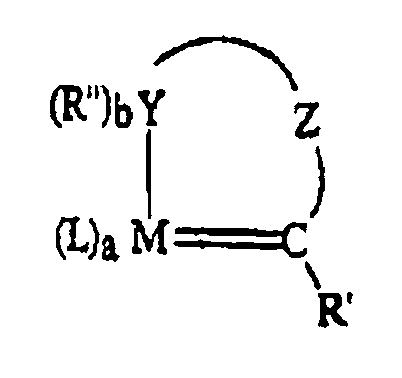
- Verfahren nach Anspruch 8, wobei jedes L unabhängig voneinander ausgewählt ist aus der aus Fluorid, Chlorid, Bromid, Iodid, Cyanid, Thiocyanat, Phosphinen der Formel PR3, Aminen der Formel NR3, Wasser und Ethern der Formel OR2, Thioethern der Formel SR2 und Liganden mit den nachstehenden Formeln bestehenden Gruppe:

- Verfahren nach Anspruch 8, wobei Z ausgewählt ist aus der aus Ethylen (IV), Vinylen (V), Phenylen (VI), substituierten Vinylenen (VII), substituierten Phenylenen (VIII), Naphthylen (IX), substituierten Naphthylenen (X), Piperazinidyl (XI), Piperidinyl (XII) bestehenden Gruppe, wie mit den nachstehenden Formeln gezeigt:


- Verfahren nach Anspruch 8, wobei M Ruthenium ist, und optional, wobei L ausgewählt ist aus Halogeniden und Trialkylphosphinen und Z Phenylen ist.
- Verfahren nach einem der Ansprüche 1 bis 11, wobei der Katalysator auf einem Katalysatorträger gehalten wird, der ausgewählt ist aus der aus Siliciumdioxiden, Aluminiumoxiden, Siliciumdioxid-Aluminiumoxiden, Alumosilicaten, Titandioxiden, Zirconiumdioxid, Magnesiumoxid, Kohlenstoff und vernetzten retikulären Polymerharzen bestehenden Gruppe.
- Verfahren nach Anspruch 12, wobei der Katalysator in einer Menge, die größer ist als 0,01 Gew.-% und kleiner als 20 Gew.-% katalytisches Metall, bezogen auf das Gesamtgewicht von Katalysator und Träger, auf den Träger aufgebracht wird.
- Verfahren nach einem der Ansprüche 1 bis 13, wobei dem Verfahren ein stabilisierender Ligand zugesetzt wird, der ausgewählt ist aus der aus Trialkylphosphinen, Triarylphosphinen, Diarylalkylphosphinen, Aryldialkylphosphinen, Ethern, Pyridinen, Phosphinoxiden, Phosphiniten, Phosphoniten, Phosphoramiditen und Mischungen davon bestehenden Gruppe.
- Verfahren nach Anspruch 14, wobei das Molverhältnis von stabilisierendem Ligand zu Katalysator größer ist als 0,05:1 und kleiner als 2,0:1.
- Verfahren nach einem der Ansprüche 1 bis 15, wobei das Verfahren bei einer Temperatur größer als 0°C und kleiner als 150°C und bei einem Gesamtdruck größer als 5 psig (34,5 kPa) und kleiner als 1000 psig (6895 kPa) durchgeführt wird.
- Verfahren nach einem der Ansprüche 1 bis 16, wobei das Verfahren in einem Chargenreaktor bei einem Molverhältnis von ungesättigtem Fettsäureester oder ungesättigter Fettsäure zu Katalysator von größer als 10:1 und kleiner als 10.000.000:1 durchgeführt wird; oder wobei das Verfahren in einem Reaktor mit kontinuierlichem oder diskontinuierlichem Strom mit einer gewichtsstündlichen Raumgeschwindigkeit (WHSV) von ungesättigtem Fettsäureester oder ungesättigter Fettsäure von größer als 0,04 h-1 bis kleiner als 100 h-1 durchgeführt wird.
- Verfahren nach einem der Ansprüche 1 bis 17, wobei der Fettsäureester Methyloleat ist oder die Fettsäure Ölsäure ist, und die Metatheseprodukte 1-Decen und entweder Methyl-9-decenoat oder 9-Decensäure sind.
- Verfahren nach einem der Ansprüche 1 bis 18, wobei der chelatbildende Ligand eine Carbeneinheit und eine zweite Donatoreinheit eines Elements der Gruppe 15 oder 16 des Periodensystems enthält.
- Verfahren nach einem der Ansprüche 1 bis 19, wobei der Katalysator {Dihalogen[2(1-methylethoxy-α-O)phenyl]methylen-α-C](tricyclohexylphosphin)ruthenium} ist, das repräsentiert wird durch die Formel:

- Heterogene Katalysatorzusammensetzung mit der Formel:

Applications Claiming Priority (3)
| Application Number | Priority Date | Filing Date | Title |
|---|---|---|---|
| US27891401P | 2001-03-26 | 2001-03-26 | |
| US278914P | 2001-03-26 | ||
| PCT/US2002/005894 WO2002076920A1 (en) | 2001-03-26 | 2002-02-27 | Metathesis of unsaturated fatty acid esters or unsaturated fatty acids with lower olefins |
Publications (2)
| Publication Number | Publication Date |
|---|---|
| EP1377537A1 EP1377537A1 (de) | 2004-01-07 |
| EP1377537B1 true EP1377537B1 (de) | 2009-04-22 |
Family
ID=23066924
Family Applications (1)
| Application Number | Title | Priority Date | Filing Date |
|---|---|---|---|
| EP02721181A Revoked EP1377537B1 (de) | 2001-03-26 | 2002-02-27 | Metathese-reaktion von ungesättigten fettsäurestern oder fettsäuren mit niedermolekularen olefinen |
Country Status (14)
| Country | Link |
|---|---|
| US (2) | US7119216B2 (de) |
| EP (1) | EP1377537B1 (de) |
| JP (1) | JP4226906B2 (de) |
| KR (2) | KR100869981B1 (de) |
| CN (3) | CN1501906B (de) |
| AR (1) | AR033202A1 (de) |
| AU (1) | AU2002252124B2 (de) |
| BR (1) | BR0208639A (de) |
| CA (1) | CA2441980C (de) |
| DE (1) | DE60232062D1 (de) |
| MX (1) | MXPA03008323A (de) |
| PE (1) | PE20021029A1 (de) |
| RU (1) | RU2289568C2 (de) |
| WO (1) | WO2002076920A1 (de) |
Families Citing this family (93)
| Publication number | Priority date | Publication date | Assignee | Title |
|---|---|---|---|---|
| EP1377537B1 (de) | 2001-03-26 | 2009-04-22 | Dow Global Technologies Inc. | Metathese-reaktion von ungesättigten fettsäurestern oder fettsäuren mit niedermolekularen olefinen |
| CA2471043C (en) | 2001-12-21 | 2012-06-19 | Rhodia Inc. | Stable surfactant compositions for suspending components |
| JP4011022B2 (ja) * | 2002-03-11 | 2007-11-21 | 独立行政法人科学技術振興機構 | 高分子固定化アレンルテニウム錯体とその触媒並びにこれを用いた有機合成反応方法 |
| JP2005523931A (ja) | 2002-04-29 | 2005-08-11 | ダウ グローバル テクノロジーズ インコーポレイティド | 種子油の工業的利用のための統合化学プロセス |
| EP1603857A4 (de) * | 2003-01-13 | 2006-05-17 | Cargill Inc | Verfahren zur herstellung von industriechemikalien |
| US7176336B2 (en) | 2003-10-09 | 2007-02-13 | Dow Global Technologies Inc. | Process for the synthesis of unsaturated alcohols |
| DE102004033312A1 (de) * | 2004-07-08 | 2006-01-26 | Boehringer Ingelheim Pharma Gmbh & Co. Kg | Kontinuierliches Metatheseverfahren mit Ruthenium-Katalysatoren |
| EP1786550A2 (de) | 2004-09-02 | 2007-05-23 | Eastman Chemical Company | Optimierte herstellung von aromatischen dicarbonsäuren |
| FR2878246B1 (fr) | 2004-11-23 | 2007-03-30 | Inst Francais Du Petrole | Procede de co-production d'olefines et d'esters par ethenolyse de corps gras insatures dans des liquides ioniques non-aqueux |
| WO2006076364A2 (en) | 2005-01-10 | 2006-07-20 | Cargill, Incorporated | Candle and candle wax containing metathesis and metathesis-like products |
| JP5437628B2 (ja) * | 2005-06-06 | 2014-03-12 | ダウ グローバル テクノロジーズ エルエルシー | α,ω−官能基を有するオレフィンを調製する複分解法 |
| EP1899398A4 (de) * | 2005-07-01 | 2009-09-02 | Orica Australia Pty Ltd | Vernetzungsverfahren |
| WO2007081987A2 (en) | 2006-01-10 | 2007-07-19 | Elevance Renewable Sciences, Inc. | Method of making hydrogenated metathesis products |
| FR2896498B1 (fr) * | 2006-01-24 | 2008-08-29 | Inst Francais Du Petrole | Procede de co-production d'olefines et de diesters ou de diacides a partir de corps gras insatures. |
| WO2007092632A2 (en) * | 2006-02-09 | 2007-08-16 | Elevance Renawable Sciences, Inc. | Surface coating compositions and methods |
| BRPI0707714A2 (pt) * | 2006-02-09 | 2011-05-10 | Elevance Renewablewable Sciences Inc | composiÇÕes, mÉtodos e sistemas antimicrobianos |
| WO2007103460A2 (en) * | 2006-03-07 | 2007-09-13 | Elevance Renewable Sciences, Inc. | Colorant compositions comprising metathesized unsaturated polyol esters |
| US8815257B2 (en) | 2006-03-07 | 2014-08-26 | Elevance Renewable Sciences, Inc. | Compositions comprising metathesized unsaturated polyol esters |
| CN101563434B (zh) | 2006-07-12 | 2012-01-25 | 埃莱文斯可更新科学公司 | 包含复分解不饱和多元醇酯蜡的热熔性胶粘剂组合物 |
| EP2046719B1 (de) | 2006-07-12 | 2013-09-04 | Elevance Renewable Sciences, Inc. | Ringöffnungs-kreuzmetathese zyklischer olefine mit samenölen und dergleichen |
| US8067610B2 (en) | 2006-07-13 | 2011-11-29 | Yann Schrodi | Synthesis of terminal alkenes from internal alkenes and ethylene via olefin metathesis |
| RU2311231C1 (ru) * | 2006-08-15 | 2007-11-27 | ООО "Объединенный центр исследований и разработок" | Катализатор для получения эфиров акриловой кислоты по реакции метатезиса диалкилмалеатов (варианты) и каталитическая композиция на его основе |
| DE102006040569A1 (de) * | 2006-08-30 | 2008-03-06 | Lanxess Deutschland Gmbh | Verfahren zum Metathese-Abbau von Nitrilkautschuken |
| WO2008046106A2 (en) * | 2006-10-13 | 2008-04-17 | Elevance Renewable Sciences, Inc. | Synthesis of terminal alkenes from internal alkenes via olefin metathesis |
| EP2121546B1 (de) | 2006-10-13 | 2017-12-13 | Elevance Renewable Sciences, Inc. | Verfahren zur herstellung von alpha, omega-dicarbonsäurealkenderivaten durch metathese |
| WO2008048522A1 (en) * | 2006-10-13 | 2008-04-24 | Elevance Renewable Sciences, Inc. | Methods of making monounsaturated functionalized alkene compounds by metathesis |
| EP2076483A4 (de) | 2006-10-13 | 2013-12-04 | Elevance Renewable Sciences | Verfahren zur herstellung organischer verbindungen durch metathese und hydrocyanierung |
| US8614344B2 (en) * | 2006-10-13 | 2013-12-24 | Elevance Renewable Sciences, Inc. | Metathesis methods involving hydrogenation and compositions relating to same |
| RU2326733C1 (ru) * | 2007-03-29 | 2008-06-20 | ООО "Объединенный центр исследований и разработок" | Каталитическая композиция для получения эфиров акриловой кислоты по реакции метатезиса диалкилмалеатов с этиленом |
| US7691258B2 (en) * | 2007-06-04 | 2010-04-06 | Emirates National Oil Company Limited (Enoc) Llc | Process for treating hydrocarbon liquid compositions |
| WO2009003085A1 (en) * | 2007-06-27 | 2008-12-31 | Arkema Inc. | Process for the manufacture of hydrofluoroolefins via metathesis |
| MX2010001614A (es) | 2007-08-09 | 2010-04-22 | Elevance Renewable Sciences | Metodos quimicos para tratar un material de alimentacion para la metatesis. |
| FR2921362B1 (fr) * | 2007-09-20 | 2012-09-21 | Arkema France | Procede de synthese d'acides gras omega-insatures |
| US20090203950A1 (en) * | 2008-02-12 | 2009-08-13 | Halsey Richard B | Metathesis process using a fluidized bed reactor |
| US8436110B2 (en) * | 2008-10-31 | 2013-05-07 | Dow Global Technologies Llc | Olefin metathesis process employing bimetallic ruthenium complex with bridging hydrido ligands |
| WO2010062932A1 (en) | 2008-11-26 | 2010-06-03 | Elevance Renewable Sciences, Inc. | Methods of producing jet fuel from natural oil feedstocks through oxygen-cleaved reactions |
| MY156576A (en) | 2008-11-26 | 2016-03-15 | Elevance Renewable Sciences | Methods of producing jet fuel from natural oil feedstocks through metathesis reactions |
| US8071799B2 (en) | 2009-01-29 | 2011-12-06 | Energy & Environmental Research Center Foundation | Chain-selective synthesis of fuel components and chemical feedstocks |
| US9365487B2 (en) | 2009-10-12 | 2016-06-14 | Elevance Renewable Sciences, Inc. | Methods of refining and producing dibasic esters and acids from natural oil feedstocks |
| US9169447B2 (en) | 2009-10-12 | 2015-10-27 | Elevance Renewable Sciences, Inc. | Methods of refining natural oils, and methods of producing fuel compositions |
| US8735640B2 (en) | 2009-10-12 | 2014-05-27 | Elevance Renewable Sciences, Inc. | Methods of refining and producing fuel and specialty chemicals from natural oil feedstocks |
| US9175231B2 (en) | 2009-10-12 | 2015-11-03 | Elevance Renewable Sciences, Inc. | Methods of refining natural oils and methods of producing fuel compositions |
| US9222056B2 (en) | 2009-10-12 | 2015-12-29 | Elevance Renewable Sciences, Inc. | Methods of refining natural oils, and methods of producing fuel compositions |
| PL2488474T3 (pl) * | 2009-10-12 | 2017-07-31 | Elevance Renewable Sciences, Inc. | Sposoby rafinacji i wytwarzania paliw z surowców na bazie olejów naturalnych |
| US9382502B2 (en) | 2009-10-12 | 2016-07-05 | Elevance Renewable Sciences, Inc. | Methods of refining and producing isomerized fatty acid esters and fatty acids from natural oil feedstocks |
| US9000246B2 (en) | 2009-10-12 | 2015-04-07 | Elevance Renewable Sciences, Inc. | Methods of refining and producing dibasic esters and acids from natural oil feedstocks |
| US9051519B2 (en) | 2009-10-12 | 2015-06-09 | Elevance Renewable Sciences, Inc. | Diene-selective hydrogenation of metathesis derived olefins and unsaturated esters |
| US8809563B2 (en) | 2009-11-09 | 2014-08-19 | Exxonmobil Chemical Patents Inc. | Metathesis catalyst and process for use thereof |
| EP2498909B1 (de) * | 2009-11-09 | 2014-08-27 | ExxonMobil Chemical Patents Inc. | Metathesekatalysator und verfahren zu siner verwendung |
| US8237003B2 (en) * | 2009-11-09 | 2012-08-07 | Exxonmobil Chemical Patents Inc. | Metathesis catalyst and process for use thereof |
| US9024034B2 (en) * | 2009-11-09 | 2015-05-05 | Exxonmobil Chemical Patents Inc. | Metathesis catalysts and processes for use thereof |
| US8329921B2 (en) | 2009-11-09 | 2012-12-11 | Exxonmobil Chemical Patents Inc. | Metathesis catalyst and process for use thereof |
| BR112012020146A2 (pt) * | 2010-02-12 | 2020-08-18 | Exxonmobil Chemical Patents Inc | catalisador de metátese e processos para uso do mesmo. |
| US8748641B2 (en) | 2010-05-05 | 2014-06-10 | The United States Of America, As Represented By The Secretary Of Agriculture | Process for preparing saturated branched chain fatty acids |
| US9115076B2 (en) | 2010-04-26 | 2015-08-25 | The United States Of America, As Represented By The Secretary Of Agriculture | Process for preparing saturated branched chain fatty acids |
| WO2011136903A1 (en) * | 2010-04-26 | 2011-11-03 | The United States Of America As Represented By The Secretary Of Agriculture | Process for preparing saturated branched chain fatty acids |
| WO2011150410A2 (en) | 2010-05-28 | 2011-12-01 | Solazyme, Inc. | Tailored oils produced from recombinant heterotrophic microorganisms |
| AU2011296575B2 (en) | 2010-08-31 | 2014-04-24 | Biosynthetic Technologies, Llc | High-and low-viscosity estolide base oils and lubricants |
| US8227371B2 (en) | 2010-09-24 | 2012-07-24 | Exxonmobil Chemical Patents Inc. | Class of olefin metathesis catalysts, methods of preparation, and processes for the use thereof |
| US9249436B2 (en) | 2011-02-02 | 2016-02-02 | Solazyme, Inc. | Tailored oils produced from recombinant oleaginous microorganisms |
| US20120289617A1 (en) * | 2011-05-10 | 2012-11-15 | Saudi Arabian Oil Company | Hybrid Catalyst for Olefin Metathesis |
| US9181360B2 (en) | 2011-08-12 | 2015-11-10 | Exxonmobil Chemical Patents Inc. | Polymers prepared by ring opening / cross metathesis |
| KR102006515B1 (ko) * | 2011-12-19 | 2019-08-01 | 바이오신세틱 테크놀로지스 엘엘씨 | 교차 복분해를 포함하는 에스톨라이드 기유 및 올리고머성 화합물의 제조 방법 |
| US9169174B2 (en) | 2011-12-22 | 2015-10-27 | Elevance Renewable Sciences, Inc. | Methods for suppressing isomerization of olefin metathesis products |
| US9133416B2 (en) | 2011-12-22 | 2015-09-15 | Elevance Renewable Sciences, Inc. | Methods for suppressing isomerization of olefin metathesis products |
| US9139493B2 (en) | 2011-12-22 | 2015-09-22 | Elevance Renewable Sciences, Inc. | Methods for suppressing isomerization of olefin metathesis products |
| WO2014168602A2 (en) | 2011-12-28 | 2014-10-16 | Elevance Renewable Sciences, Inc. | Renewable fatty acid waxes and methods of making |
| GB201204715D0 (en) | 2012-03-18 | 2012-05-02 | Croda Int Plc | Metathesis of olefins using ruthenium-based catalytic complexes |
| SG11201406711TA (en) | 2012-04-18 | 2014-11-27 | Solazyme Inc | Tailored oils |
| JPWO2013175894A1 (ja) * | 2012-05-21 | 2016-01-12 | 日本ゼオン株式会社 | 架橋環状オレフィン樹脂フィルム、積層体及びそれらの製造方法 |
| WO2013191750A1 (en) | 2012-06-18 | 2013-12-27 | Biosynthetic Technologies, Llc | Processes of preparing estolide compounds that include removing sulfonate residues |
| CN104583369A (zh) | 2012-06-20 | 2015-04-29 | 埃莱万斯可再生能源科学股份有限公司 | 天然油易位组合物 |
| PL400162A1 (pl) * | 2012-07-27 | 2014-02-03 | Apeiron Synthesis Spólka Z Ograniczona Odpowiedzialnoscia | Nowe kompleksy rutenu, ich zastosowanie w reakcjach metatezy oraz sposób prowadzenia reakcji metatezy |
| KR102224298B1 (ko) * | 2012-10-09 | 2021-03-05 | 윌마르 트레이딩 피티이 엘티디 | 천연 오일 공급원료로부터 이염기성 에스테르 및 산을 정제하고 생성하는 방법 |
| US9388098B2 (en) | 2012-10-09 | 2016-07-12 | Elevance Renewable Sciences, Inc. | Methods of making high-weight esters, acids, and derivatives thereof |
| EP2993993A2 (de) | 2013-04-26 | 2016-03-16 | Solazyme, Inc. | Öle mit niedrigem gehalt an mehrfach ungesättigten fettsäuren und verwendungen davon |
| SG11201602638SA (en) | 2013-10-04 | 2016-05-30 | Solazyme Inc | Tailored oils |
| US20160244397A1 (en) * | 2015-02-20 | 2016-08-25 | Biosynthetic Technologies, Llc. | Processes for preparing estolide base oils and biobased compounds that include ethyleneolysis |
| JP2018512851A (ja) | 2015-04-06 | 2018-05-24 | テラヴィア ホールディングス, インコーポレイテッド | Lpaatアブレーションを有する油産生微細藻類 |
| CN105419941B (zh) * | 2015-11-18 | 2017-08-22 | 天津斯瑞吉高新科技研究院有限公司 | 从棉籽油来制取高附加值产品的一种有效预处理方法 |
| US10280256B2 (en) * | 2016-04-20 | 2019-05-07 | Elevance Renewable Sciences, Inc. | Renewably derived polyesters and methods of making and using the same |
| CN109862963B (zh) | 2016-10-19 | 2022-05-24 | 优美科股份公司及两合公司 | Ru亚烷基络合物的合成与表征 |
| EP3532528A4 (de) * | 2016-10-25 | 2020-07-01 | Elevance Renewable Sciences, Inc. | Erneuerbar gewonnene polyamide und verfahren zur herstellung davon |
| KR102321960B1 (ko) * | 2017-06-23 | 2021-11-08 | 광주과학기술원 | 루테늄 착물 형성을 위한 리간드, 루테늄 착물 촉매 및 이의 제조방법과 용도 |
| CN109364998B (zh) * | 2018-10-15 | 2021-07-06 | 天津科技大学 | 一种用于烯烃复分解反应的催化剂及其制备和应用方法 |
| EP3650436A1 (de) | 2018-11-06 | 2020-05-13 | Skotan S.A. | Verfahren zur herstellung einer mischung aus 9-decensäureethyl und 1-decen in einer ethenolysereaktion aus einem rohmaterial von technischer reinheit |
| EP4115975A4 (de) * | 2020-03-03 | 2024-05-15 | Takasago International Corporation | Aktivkohlehaltiger katalysator mit darauf adsorbiertem rutheniumkomplex und verfahren zur herstellung eines reduktionsproduktes unter verwendung desselben |
| DE102020119024A1 (de) | 2020-07-17 | 2022-01-20 | Werner & Mertz Gmbh | Verfahren zur Herstellung eines biobasierten Produkts, entsprechendes Produkt und Verwendungen |
| EP4182423A1 (de) | 2020-07-17 | 2023-05-24 | Werner & Mertz GmbH | Verfahren zur herstellung eines biobasierten produkts, entsprechendes produkt und verwendungen |
| EP3974499A1 (de) | 2020-09-28 | 2022-03-30 | Indian Oil Corporation Limited | Herstellung von linearen alpha-olefinen |
| CN112876360A (zh) * | 2021-01-25 | 2021-06-01 | 南京工业大学 | 一种植物油多元醇及其制备方法与应用 |
| EP4292706A4 (de) | 2021-02-11 | 2025-01-22 | Petroleo Brasileiro S.A. - PETROBRAS | Verfahren zur gleichzeitigen herstellung von c10- bis c13-olefinen und -estern aus fettsäuremethylestern |
| US11858872B2 (en) * | 2021-03-30 | 2024-01-02 | ExxonMobil Technology and Engineering Company | High yield jet fuel from mixed fatty acids |
Family Cites Families (41)
| Publication number | Priority date | Publication date | Assignee | Title |
|---|---|---|---|---|
| DE281594C (de) | ||||
| JPS5677243A (en) | 1979-11-29 | 1981-06-25 | Takasago Corp | Production of 9-octadecenedioic acid diester |
| EP0328230A3 (de) | 1981-11-19 | 1990-03-21 | Fuji Oil Company, Limited | Verfahren zur Modifizierung von Fetten und Ölen |
| JPS58164545A (ja) | 1982-01-13 | 1983-09-29 | ビ−ピ−・ケミカルズ・リミテツド | 官能基のあるオレフインの不均化法 |
| CA1219596A (en) | 1982-07-20 | 1987-03-24 | Dennis S. Banasiak | Disproportionation of functional olefins |
| US4560792A (en) | 1982-07-20 | 1985-12-24 | Phillips Petroleum Company | Disproportionation of functional olefins |
| US4545941A (en) | 1983-06-20 | 1985-10-08 | A. E. Staley Manufacturing Company | Co-metathesis of triglycerides and ethylene |
| DE3612539A1 (de) | 1986-04-14 | 1987-10-15 | Huels Chemische Werke Ag | Verfahren zur herstellung von technisch reinem, chlorfreiem cyclohexadecadien |
| US4943397A (en) | 1988-09-22 | 1990-07-24 | Shell Oil Company | Metathesis of functional olefins |
| US5342985A (en) | 1988-12-10 | 1994-08-30 | Hoechst Ag | Organic derivatives of rhenium oxides and their preparation and use for the metathesis of olefins |
| JPH0366725A (ja) | 1989-08-04 | 1991-03-22 | Japan Synthetic Rubber Co Ltd | 重合体の製造方法 |
| DE4006540A1 (de) | 1990-03-02 | 1991-09-05 | Huels Chemische Werke Ag | Katalysatoren fuer die metathese von olefinen und funktionalisierten olefinen |
| DE4006539A1 (de) | 1990-03-02 | 1991-09-05 | Huels Chemische Werke Ag | Verfahren zur metathese von olefinen und funktionalisierten olefinen |
| WO1991014665A1 (de) | 1990-03-28 | 1991-10-03 | Hoechst Aktiengesellschaft | Verwendung von organischen derivaten von rheniumoxiden als katalysatoren zur äthenolytischen metathese olefinischer verbindungen und verfahren zur äthenolytischen metathese von olefinischen verbindungen mit hilfe dieser katalysatoren |
| DE4107056A1 (de) | 1991-03-06 | 1992-09-10 | Huels Chemische Werke Ag | Rheniumkatalysatoren fuer die metathese von olefinen und funktionalisierten olefinen |
| US5312940A (en) | 1992-04-03 | 1994-05-17 | California Institute Of Technology | Ruthenium and osmium metal carbene complexes for olefin metathesis polymerization |
| AU691645B2 (en) | 1992-04-03 | 1998-05-21 | California Institute Of Technology | High activity ruthenium or osmium metal carbene complexes for olefin metathesis reactions and synthesis thereof |
| US5352812A (en) | 1993-07-08 | 1994-10-04 | E. I. Du Pont De Nemours And Company | Metathesis of acyclic olefins using an iridium/silver catalyst composition |
| US5539060A (en) | 1993-07-30 | 1996-07-23 | Nippon Zeon Co., Ltd. | Method for hydrogenation of metathesis polymers |
| US5831108A (en) | 1995-08-03 | 1998-11-03 | California Institute Of Technology | High metathesis activity ruthenium and osmium metal carbene complexes |
| US6225426B1 (en) | 1996-04-10 | 2001-05-01 | Uniroyal Chemical Company, Inc. | Process for producing polyolefin elastomer employing a metallocene catalyst |
| US6156692A (en) | 1996-04-30 | 2000-12-05 | Bp Amoco Corporation | Ruthenium-containing catalyst composition for olefin metathesis |
| US6159890A (en) | 1996-04-30 | 2000-12-12 | Bp Amoco Corporation | Ruthenium-containing catalyst system for olefin metathesis |
| DE19654074C2 (de) | 1996-12-23 | 2001-01-25 | Bayer Ag | Verfahren zur Herstellung hydrierter ringgeöffneter Metathesepolymeren |
| US6197894B1 (en) | 1997-05-28 | 2001-03-06 | Mitsui Chemicals, Inc. | Preparation of hydrogenated product of cyclic olefin ring-opening metathesis polymer |
| BR9810488A (pt) | 1997-06-27 | 2000-09-12 | Ciba Sc Holding Ag | Novos catalisadores. |
| DE19815275B4 (de) | 1998-04-06 | 2009-06-25 | Evonik Degussa Gmbh | Alkylidenkomplexe des Rutheniums mit N-heterozyklischen Carbenliganden und deren Verwendung als hochaktive, selektive Katalysatoren für die Olefin-Metathese |
| ATE438462T1 (de) | 1998-09-10 | 2009-08-15 | Univ New Orleans Foundation | Katalysatorkomplex mit phenylindenyliden-ligand |
| DE60039166D1 (de) | 1999-03-31 | 2008-07-24 | California Inst Of Techn | Mit triazolydin-liganden koordinierte rutheniummetall-alkyliden-komplexe die hohe olefin-metathese-aktivität aufweisen |
| CN1213032C (zh) | 1999-05-24 | 2005-08-03 | 加州理工学院 | 咪唑烷基金属卡宾易位催化剂 |
| DE10041345A1 (de) | 2000-08-23 | 2002-03-07 | Basf Ag | Verfahren zur Synthese von terminalen Olefinen mit enger Molgewichtsverteilung |
| EP1377537B1 (de) | 2001-03-26 | 2009-04-22 | Dow Global Technologies Inc. | Metathese-reaktion von ungesättigten fettsäurestern oder fettsäuren mit niedermolekularen olefinen |
| JP2005523931A (ja) | 2002-04-29 | 2005-08-11 | ダウ グローバル テクノロジーズ インコーポレイティド | 種子油の工業的利用のための統合化学プロセス |
| US7147749B2 (en) | 2002-09-30 | 2006-12-12 | Tokyo Electron Limited | Method and apparatus for an improved upper electrode plate with deposition shield in a plasma processing system |
| US7176336B2 (en) | 2003-10-09 | 2007-02-13 | Dow Global Technologies Inc. | Process for the synthesis of unsaturated alcohols |
| US20080103346A1 (en) | 2004-10-21 | 2008-05-01 | Dow Global Technologies, Inc. | Membrane Separation Of A Metathesis Reaction Mixture |
| JP5437628B2 (ja) | 2005-06-06 | 2014-03-12 | ダウ グローバル テクノロジーズ エルエルシー | α,ω−官能基を有するオレフィンを調製する複分解法 |
| WO2008027283A2 (en) | 2006-08-25 | 2008-03-06 | Dow Global Technologies Inc. | Production of meta-block copolymers by polymer segment interchange |
| JP2010501719A (ja) | 2006-08-25 | 2010-01-21 | ダウ グローバル テクノロジーズ インコーポレイティド | メタセシスによる非晶質ポリマーセグメント交換によるブロックコポリマーの製造 |
| EP2061826B1 (de) | 2006-08-25 | 2012-08-01 | Dow Global Technologies LLC | Herstellung von zufallsblockcopolymeren durch metathese von polymersegmenten mit hohem schmelzpunkt |
| DE602007004998D1 (de) | 2006-08-25 | 2010-04-08 | Dow Global Technologies Inc | Herstellung telecheler verbindungen durch metathesen-depolymerisierung |
-
2002
- 2002-02-27 EP EP02721181A patent/EP1377537B1/de not_active Revoked
- 2002-02-27 CA CA2441980A patent/CA2441980C/en not_active Expired - Lifetime
- 2002-02-27 CN CN028073797A patent/CN1501906B/zh not_active Expired - Lifetime
- 2002-02-27 DE DE60232062T patent/DE60232062D1/de not_active Expired - Lifetime
- 2002-02-27 US US10/469,321 patent/US7119216B2/en not_active Expired - Lifetime
- 2002-02-27 MX MXPA03008323A patent/MXPA03008323A/es not_active Application Discontinuation
- 2002-02-27 CN CNB2005101080146A patent/CN100509155C/zh not_active Expired - Lifetime
- 2002-02-27 WO PCT/US2002/005894 patent/WO2002076920A1/en not_active Ceased
- 2002-02-27 KR KR1020037012499A patent/KR100869981B1/ko not_active Expired - Fee Related
- 2002-02-27 RU RU2003131325/04A patent/RU2289568C2/ru active
- 2002-02-27 JP JP2002576183A patent/JP4226906B2/ja not_active Expired - Fee Related
- 2002-02-27 KR KR1020087012895A patent/KR100898876B1/ko not_active Expired - Fee Related
- 2002-02-27 BR BR0208639-5A patent/BR0208639A/pt not_active Application Discontinuation
- 2002-02-27 CN CN201110031972.3A patent/CN102146031B/zh not_active Expired - Lifetime
- 2002-02-27 AU AU2002252124A patent/AU2002252124B2/en not_active Expired
- 2002-03-25 AR ARP020101077A patent/AR033202A1/es active IP Right Grant
- 2002-03-26 PE PE2002000236A patent/PE20021029A1/es not_active Application Discontinuation
-
2003
- 2003-09-26 US US10/528,472 patent/US7696398B2/en not_active Expired - Fee Related
Also Published As
| Publication number | Publication date |
|---|---|
| CN102146031B (zh) | 2014-08-06 |
| CN1501906A (zh) | 2004-06-02 |
| CN100509155C (zh) | 2009-07-08 |
| MXPA03008323A (es) | 2003-12-11 |
| BR0208639A (pt) | 2004-08-10 |
| PE20021029A1 (es) | 2002-11-07 |
| WO2002076920A1 (en) | 2002-10-03 |
| KR20030086323A (ko) | 2003-11-07 |
| AU2002252124B2 (en) | 2007-09-06 |
| US20050070750A1 (en) | 2005-03-31 |
| CN1501906B (zh) | 2012-07-04 |
| AR033202A1 (es) | 2003-12-10 |
| CN102146031A (zh) | 2011-08-10 |
| US7696398B2 (en) | 2010-04-13 |
| CN1748864A (zh) | 2006-03-22 |
| CA2441980C (en) | 2011-07-19 |
| EP1377537A1 (de) | 2004-01-07 |
| JP2004525934A (ja) | 2004-08-26 |
| CA2441980A1 (en) | 2002-10-03 |
| KR100898876B1 (ko) | 2009-05-25 |
| KR100869981B1 (ko) | 2008-11-24 |
| US20060167326A1 (en) | 2006-07-27 |
| US7119216B2 (en) | 2006-10-10 |
| DE60232062D1 (de) | 2009-06-04 |
| RU2289568C2 (ru) | 2006-12-20 |
| KR20080066829A (ko) | 2008-07-16 |
| JP4226906B2 (ja) | 2009-02-18 |
| RU2003131325A (ru) | 2005-01-27 |
Similar Documents
| Publication | Publication Date | Title |
|---|---|---|
| EP1377537B1 (de) | Metathese-reaktion von ungesättigten fettsäurestern oder fettsäuren mit niedermolekularen olefinen | |
| AU2002252124A1 (en) | Metathesis of unsaturated fatty acid esters or unsaturated fatty acids with lower olefins | |
| EP1673328B1 (de) | Verbessertes verfahren zur synthese ungesättigter alkohole | |
| US6803429B2 (en) | Selective ring-opening cross-metathesis of cycloolefins | |
| US8227371B2 (en) | Class of olefin metathesis catalysts, methods of preparation, and processes for the use thereof | |
| Dinger et al. | High turnover numbers with ruthenium‐based metathesis catalysts | |
| JP5437628B2 (ja) | α,ω−官能基を有するオレフィンを調製する複分解法 | |
| US8524930B2 (en) | Class of olefin metathesis catalysts, methods of preparation, and processes for the use thereof | |
| US20050203324A1 (en) | Impurity reduction in Olefin metathesis reactions | |
| CA2814266A1 (en) | Stabilization of olefin metathesis product mixtures | |
| EP2618930A2 (de) | Neue klasse von olefin-metathese-katalysatoren, herstellungsverfahren dafür und verfahren zu ihrer verwendung | |
| EP2714272A2 (de) | Neue klasse von olefin-metathese-katalysatoren, herstellungsverfahren dafür und verfahren zu ihrer verwendung | |
| WO2002094748A1 (en) | Impurity inhibition in olefin metathesis reactions |
Legal Events
| Date | Code | Title | Description |
|---|---|---|---|
| PUAI | Public reference made under article 153(3) epc to a published international application that has entered the european phase |
Free format text: ORIGINAL CODE: 0009012 |
|
| 17P | Request for examination filed |
Effective date: 20031027 |
|
| AK | Designated contracting states |
Kind code of ref document: A1 Designated state(s): AT BE CH CY DE DK ES FI FR GB GR IE IT LI LU MC NL PT SE TR |
|
| AX | Request for extension of the european patent |
Extension state: AL LT LV MK RO SI |
|
| GRAP | Despatch of communication of intention to grant a patent |
Free format text: ORIGINAL CODE: EPIDOSNIGR1 |
|
| GRAP | Despatch of communication of intention to grant a patent |
Free format text: ORIGINAL CODE: EPIDOSNIGR1 |
|
| GRAS | Grant fee paid |
Free format text: ORIGINAL CODE: EPIDOSNIGR3 |
|
| GRAA | (expected) grant |
Free format text: ORIGINAL CODE: 0009210 |
|
| AK | Designated contracting states |
Kind code of ref document: B1 Designated state(s): BE DE FR GB IT NL |
|
| REG | Reference to a national code |
Ref country code: GB Ref legal event code: FG4D |
|
| REF | Corresponds to: |
Ref document number: 60232062 Country of ref document: DE Date of ref document: 20090604 Kind code of ref document: P |
|
| PLAZ | Examination of admissibility of opposition: despatch of communication + time limit |
Free format text: ORIGINAL CODE: EPIDOSNOPE2 |
|
| PLBI | Opposition filed |
Free format text: ORIGINAL CODE: 0009260 |
|
| PLBA | Examination of admissibility of opposition: reply received |
Free format text: ORIGINAL CODE: EPIDOSNOPE4 |
|
| PLAX | Notice of opposition and request to file observation + time limit sent |
Free format text: ORIGINAL CODE: EPIDOSNOBS2 |
|
| 26 | Opposition filed |
Opponent name: ELEVANCE RENEWABLE SCIENCES INC. Effective date: 20100121 |
|
| PLAF | Information modified related to communication of a notice of opposition and request to file observations + time limit |
Free format text: ORIGINAL CODE: EPIDOSCOBS2 |
|
| PLBB | Reply of patent proprietor to notice(s) of opposition received |
Free format text: ORIGINAL CODE: EPIDOSNOBS3 |
|
| RAP2 | Party data changed (patent owner data changed or rights of a patent transferred) |
Owner name: DOW GLOBAL TECHNOLOGIES LLC |
|
| REG | Reference to a national code |
Ref country code: DE Ref legal event code: R103 Ref document number: 60232062 Country of ref document: DE Ref country code: DE Ref legal event code: R064 Ref document number: 60232062 Country of ref document: DE |
|
| PGFP | Annual fee paid to national office [announced via postgrant information from national office to epo] |
Ref country code: FR Payment date: 20120221 Year of fee payment: 11 |
|
| RDAF | Communication despatched that patent is revoked |
Free format text: ORIGINAL CODE: EPIDOSNREV1 |
|
| PGFP | Annual fee paid to national office [announced via postgrant information from national office to epo] |
Ref country code: DE Payment date: 20120222 Year of fee payment: 11 |
|
| PGFP | Annual fee paid to national office [announced via postgrant information from national office to epo] |
Ref country code: BE Payment date: 20120214 Year of fee payment: 11 Ref country code: GB Payment date: 20120222 Year of fee payment: 11 Ref country code: IT Payment date: 20120220 Year of fee payment: 11 |
|
| PGFP | Annual fee paid to national office [announced via postgrant information from national office to epo] |
Ref country code: NL Payment date: 20120217 Year of fee payment: 11 |
|
| RDAG | Patent revoked |
Free format text: ORIGINAL CODE: 0009271 |
|
| STAA | Information on the status of an ep patent application or granted ep patent |
Free format text: STATUS: PATENT REVOKED |
|
| 27W | Patent revoked |
Effective date: 20120322 |
|
| GBPR | Gb: patent revoked under art. 102 of the ep convention designating the uk as contracting state |
Effective date: 20120322 |
|
| REG | Reference to a national code |
Ref country code: DE Ref legal event code: R107 Ref document number: 60232062 Country of ref document: DE Effective date: 20121129 |