EP1375477B1 - Verfahren zur Herstellung von mono-N-sulfonylierten Diaminen - Google Patents
Verfahren zur Herstellung von mono-N-sulfonylierten Diaminen Download PDFInfo
- Publication number
- EP1375477B1 EP1375477B1 EP03012670A EP03012670A EP1375477B1 EP 1375477 B1 EP1375477 B1 EP 1375477B1 EP 03012670 A EP03012670 A EP 03012670A EP 03012670 A EP03012670 A EP 03012670A EP 1375477 B1 EP1375477 B1 EP 1375477B1
- Authority
- EP
- European Patent Office
- Prior art keywords
- formula
- compounds
- iii
- water
- alkyl
- Prior art date
- Legal status (The legal status is an assumption and is not a legal conclusion. Google has not performed a legal analysis and makes no representation as to the accuracy of the status listed.)
- Expired - Lifetime
Links
Classifications
-
- B—PERFORMING OPERATIONS; TRANSPORTING
- B01—PHYSICAL OR CHEMICAL PROCESSES OR APPARATUS IN GENERAL
- B01J—CHEMICAL OR PHYSICAL PROCESSES, e.g. CATALYSIS OR COLLOID CHEMISTRY; THEIR RELEVANT APPARATUS
- B01J31/00—Catalysts comprising hydrides, coordination complexes or organic compounds
- B01J31/16—Catalysts comprising hydrides, coordination complexes or organic compounds containing coordination complexes
- B01J31/18—Catalysts comprising hydrides, coordination complexes or organic compounds containing coordination complexes containing nitrogen, phosphorus, arsenic or antimony as complexing atoms, e.g. in pyridine ligands, or in resonance therewith, e.g. in isocyanide ligands C=N-R or as complexed central atoms
- B01J31/1805—Catalysts comprising hydrides, coordination complexes or organic compounds containing coordination complexes containing nitrogen, phosphorus, arsenic or antimony as complexing atoms, e.g. in pyridine ligands, or in resonance therewith, e.g. in isocyanide ligands C=N-R or as complexed central atoms the ligands containing nitrogen
-
- B—PERFORMING OPERATIONS; TRANSPORTING
- B01—PHYSICAL OR CHEMICAL PROCESSES OR APPARATUS IN GENERAL
- B01J—CHEMICAL OR PHYSICAL PROCESSES, e.g. CATALYSIS OR COLLOID CHEMISTRY; THEIR RELEVANT APPARATUS
- B01J31/00—Catalysts comprising hydrides, coordination complexes or organic compounds
- B01J31/16—Catalysts comprising hydrides, coordination complexes or organic compounds containing coordination complexes
- B01J31/22—Organic complexes
- B01J31/2282—Unsaturated compounds used as ligands
- B01J31/2295—Cyclic compounds, e.g. cyclopentadienyls
-
- C—CHEMISTRY; METALLURGY
- C07—ORGANIC CHEMISTRY
- C07C—ACYCLIC OR CARBOCYCLIC COMPOUNDS
- C07C29/00—Preparation of compounds having hydroxy or O-metal groups bound to a carbon atom not belonging to a six-membered aromatic ring
- C07C29/132—Preparation of compounds having hydroxy or O-metal groups bound to a carbon atom not belonging to a six-membered aromatic ring by reduction of an oxygen containing functional group
- C07C29/136—Preparation of compounds having hydroxy or O-metal groups bound to a carbon atom not belonging to a six-membered aromatic ring by reduction of an oxygen containing functional group of >C=O containing groups, e.g. —COOH
- C07C29/143—Preparation of compounds having hydroxy or O-metal groups bound to a carbon atom not belonging to a six-membered aromatic ring by reduction of an oxygen containing functional group of >C=O containing groups, e.g. —COOH of ketones
-
- C—CHEMISTRY; METALLURGY
- C07—ORGANIC CHEMISTRY
- C07C—ACYCLIC OR CARBOCYCLIC COMPOUNDS
- C07C303/00—Preparation of esters or amides of sulfuric acids; Preparation of sulfonic acids or of their esters, halides, anhydrides or amides
- C07C303/36—Preparation of esters or amides of sulfuric acids; Preparation of sulfonic acids or of their esters, halides, anhydrides or amides of amides of sulfonic acids
- C07C303/38—Preparation of esters or amides of sulfuric acids; Preparation of sulfonic acids or of their esters, halides, anhydrides or amides of amides of sulfonic acids by reaction of ammonia or amines with sulfonic acids, or with esters, anhydrides, or halides thereof
-
- C—CHEMISTRY; METALLURGY
- C07—ORGANIC CHEMISTRY
- C07C—ACYCLIC OR CARBOCYCLIC COMPOUNDS
- C07C311/00—Amides of sulfonic acids, i.e. compounds having singly-bound oxygen atoms of sulfo groups replaced by nitrogen atoms, not being part of nitro or nitroso groups
- C07C311/15—Sulfonamides having sulfur atoms of sulfonamide groups bound to carbon atoms of six-membered aromatic rings
- C07C311/16—Sulfonamides having sulfur atoms of sulfonamide groups bound to carbon atoms of six-membered aromatic rings having the nitrogen atom of at least one of the sulfonamide groups bound to hydrogen atoms or to an acyclic carbon atom
- C07C311/18—Sulfonamides having sulfur atoms of sulfonamide groups bound to carbon atoms of six-membered aromatic rings having the nitrogen atom of at least one of the sulfonamide groups bound to hydrogen atoms or to an acyclic carbon atom to an acyclic carbon atom of a hydrocarbon radical substituted by nitrogen atoms, not being part of nitro or nitroso groups
-
- C—CHEMISTRY; METALLURGY
- C07—ORGANIC CHEMISTRY
- C07C—ACYCLIC OR CARBOCYCLIC COMPOUNDS
- C07C319/00—Preparation of thiols, sulfides, hydropolysulfides or polysulfides
- C07C319/02—Preparation of thiols, sulfides, hydropolysulfides or polysulfides of thiols
- C07C319/12—Preparation of thiols, sulfides, hydropolysulfides or polysulfides of thiols by reactions not involving the formation of mercapto groups
-
- B—PERFORMING OPERATIONS; TRANSPORTING
- B01—PHYSICAL OR CHEMICAL PROCESSES OR APPARATUS IN GENERAL
- B01J—CHEMICAL OR PHYSICAL PROCESSES, e.g. CATALYSIS OR COLLOID CHEMISTRY; THEIR RELEVANT APPARATUS
- B01J2231/00—Catalytic reactions performed with catalysts classified in B01J31/00
- B01J2231/60—Reduction reactions, e.g. hydrogenation
- B01J2231/64—Reductions in general of organic substrates, e.g. hydride reductions or hydrogenations
- B01J2231/641—Hydrogenation of organic substrates, i.e. H2 or H-transfer hydrogenations, e.g. Fischer-Tropsch processes
- B01J2231/643—Hydrogenation of organic substrates, i.e. H2 or H-transfer hydrogenations, e.g. Fischer-Tropsch processes of R2C=O or R2C=NR (R= C, H)
-
- B—PERFORMING OPERATIONS; TRANSPORTING
- B01—PHYSICAL OR CHEMICAL PROCESSES OR APPARATUS IN GENERAL
- B01J—CHEMICAL OR PHYSICAL PROCESSES, e.g. CATALYSIS OR COLLOID CHEMISTRY; THEIR RELEVANT APPARATUS
- B01J2531/00—Additional information regarding catalytic systems classified in B01J31/00
- B01J2531/80—Complexes comprising metals of Group VIII as the central metal
- B01J2531/82—Metals of the platinum group
- B01J2531/821—Ruthenium
-
- B—PERFORMING OPERATIONS; TRANSPORTING
- B01—PHYSICAL OR CHEMICAL PROCESSES OR APPARATUS IN GENERAL
- B01J—CHEMICAL OR PHYSICAL PROCESSES, e.g. CATALYSIS OR COLLOID CHEMISTRY; THEIR RELEVANT APPARATUS
- B01J2531/00—Additional information regarding catalytic systems classified in B01J31/00
- B01J2531/80—Complexes comprising metals of Group VIII as the central metal
- B01J2531/82—Metals of the platinum group
- B01J2531/822—Rhodium
-
- B—PERFORMING OPERATIONS; TRANSPORTING
- B01—PHYSICAL OR CHEMICAL PROCESSES OR APPARATUS IN GENERAL
- B01J—CHEMICAL OR PHYSICAL PROCESSES, e.g. CATALYSIS OR COLLOID CHEMISTRY; THEIR RELEVANT APPARATUS
- B01J2531/00—Additional information regarding catalytic systems classified in B01J31/00
- B01J2531/80—Complexes comprising metals of Group VIII as the central metal
- B01J2531/82—Metals of the platinum group
- B01J2531/827—Iridium
-
- C—CHEMISTRY; METALLURGY
- C07—ORGANIC CHEMISTRY
- C07B—GENERAL METHODS OF ORGANIC CHEMISTRY; APPARATUS THEREFOR
- C07B2200/00—Indexing scheme relating to specific properties of organic compounds
- C07B2200/07—Optical isomers
Definitions
- the present invention relates to a process for the preparation of mono-N-sulfonylated diamines by reacting diamines with sulfonyl halides in the presence of water, base and organic solvent.
- Mono-N-sulfonylated diamines in particular in optically active form, have attained high industrial significance, for example, as ligands in catalysis (see, for example Noyori et al. J. Amer. Chem. Soc. 1995, 117, 7562 ).
- MEUZELAAR G ET AL "Chemistry of Opium Alkaloids, 45. Improvements in Total Synthesis of Morphine" EUROPEAN JOURNAL OF ORGANIC CHEMISTRY, WILEY-VCH VERLAG, WEINHEIM, DE, Vol. 9, 1999, pages 2315-2321 , describes hydrogenation catalysts obtained by reacting ruthenium complexes of the formula (IV) with solutions of monosulfonamides of the formula (I).
- a disadvantage of this process is that usually mixtures of unsulfonated, mono-N-sulfonated and di-N-sulfonated products are formed, which must be subjected to a complex chromatographic separation (see also EP-A 1 174 426 ).
- the selectivities in the known processes range from 30 to 85% based on the desired mono-N-substituted diamine, which is unsatisfactory for the technical implementation.
- the organic solvent is chosen so that the reaction mixture forms two liquid phases.
- optionally halogenated aliphatic or aromatic solvents having up to 16 carbon atoms, with carbon tetrachloride, chloroform, dichloromethane, and chlorobenzene being preferred and dichloromethane being even more preferred.
- the volume ratio of water to organic solvent is 20: 1 to 1:20.
- the inventive method is carried out so that the reaction mixture forms two liquid phases and the aqueous phase has a pH based on 25 ° C of 8 or more, preferably 11 to 14.
- the pH is adjusted by using a base.
- Suitable bases are alkali and alkaline earth hydroxides and carbonates, particularly preferred are potassium and sodium hydroxide.
- the molar total amount of the base used can be, for example, 1 to 10 equivalents based on the diamine of the formula (II) used, preferably 1.1 to 3 equivalents. Larger amounts of base are possible but uneconomical.
- the total amount of base may be added, for example, from the beginning or at least partially during the course of the reaction.
- the molar ratio of compounds of the formula (II) to compounds of the formula (III) is 0.8 to 1.3 equivalents.
- the temperature in the reaction is -20 ° C to 50 ° C,.
- the reaction time may be, for example, 10 minutes to 24 hours, preferably 30 minutes to 2 hours.
- reaction mixture contains two liquid phases
- the products for example, by conversion into the hydrohalide, crystallization or precipitation of the hydrohalide and release the compound of formula (I) can be isolated from the hydrohalide with base.
- the conversion into the hydrohalide can advantageously be carried out by reacting the reaction solution with aqueous hydrohalic acid, preferably aqueous hydrochloric acid.
- the compounds of formula (I) may also be further purified by crystallization from a suitable solvent or mixture of solvents or from the reaction solution or by chromatography.
- the reaction preferably takes place in a reaction mixture which forms two liquid phases.
- the removal of water for example by separation of the aqueous phase and optionally subsequent drying of the organic phase.
- Drying methods for organic phases are well known to those skilled in the art and include, for example, the azeotropic distillation optionally under reduced pressure, drying over sodium or magnesium sulfate, molecular sieves and other drying agents inert to organic solvents and subsequent filtration.
- the solutions according to the invention preferably have a water content of 2% by volume or less, preferably 1% or less.
- solutions according to the invention comprising the compounds of the formula (I) and the compounds of the formula (I) which can be prepared according to the invention are suitable in particular for use in catalysis, in particular homogeneous catalysis or for the preparation of metal complexes, in particular transition metal complexes.
- solutions according to the invention containing the compounds of the formula (I) and the compounds of the formula (I) which can be prepared according to the invention are preferably suitable for the preparation of ruthenium, rhodium or iridium complexes and for use in hydrogenations, in particular for the hydrogenation of imines and ketones in the presence of ruthenium, rhodium or iridium complexes, hydrogen donors and bases, the so-called transfer hydrogenation.
- Typical hydrogen donors are, for example, formic acid and isopropanol
- typical bases are, for example, alkali metal hydroxides and amines, in particular triethylamine.
- the reaction preferably takes place in a reaction mixture which forms two liquid phases.
- the removal of water can be carried out, for example, by separating the aqueous phase and optionally drying the organic phase.
- those compounds of the formula (IV) are used in which M is ruthenium and n is equal to two.
- R 4 is preferably benzene or naphthalene which may be substituted by one, two, three, four, five or six radicals, which are each independently selected from the group of methyl, ethyl, n-propyl , Isopropyl and tert-butyl or pentamethylcyclopentadienyl.
- R 4 is preferably mesitylene, benzene or cumene.
- Benzoldichlororuthenium dimer mesitylene dichlororuthenium dimer, cumene dichlororuthenium dimer, pentamethylcyclopentadienyl rhodium chloro-dimer and pentamethylcyclopentadienyliridium chloro-dimer.
- cumene dichlororuthenium dimer is particularly preferred as compound of the formula (IV).
- the molar ratio of originally used compound of the formula (II) to compounds of the formula (IV) is 2: 1 to 3: 1, particularly preferably 2.2: 1 to 2.6: 1.
- the catalysts of the invention are preferably suitable for use in hydrogenations, in particular for the hydrogenation of imines and ketones in the presence of hydrogen donors and bases, the so-called transfer hydrogenation.
- the advantage of the invention is that the compounds of formula (I) can be obtained in high yield and very good selectivity. Furthermore, it has been found that the products of sulfonylation can be used without intermediate isolation for the preparation of catalysts, which represents a considerable simplification in industrial application.
- the oily viscous residue is mixed with a little hexane and crystallized at -20 ° C. 23 g (46%) of the white crystalline product p-bromo-1-phenylethan-1-ol are obtained in the first crystallizate (ee:> 99%).
Landscapes
- Chemical & Material Sciences (AREA)
- Organic Chemistry (AREA)
- Chemical Kinetics & Catalysis (AREA)
- Inorganic Chemistry (AREA)
- Engineering & Computer Science (AREA)
- Materials Engineering (AREA)
- Organic Low-Molecular-Weight Compounds And Preparation Thereof (AREA)
- Catalysts (AREA)
- Acyclic And Carbocyclic Compounds In Medicinal Compositions (AREA)
- Low-Molecular Organic Synthesis Reactions Using Catalysts (AREA)
- Micro-Organisms Or Cultivation Processes Thereof (AREA)
- Preparation Of Compounds By Using Micro-Organisms (AREA)
Description
- Die vorliegende Erfindung betrifft ein Verfahren zur Herstellung von mono-N-sulfonylierten Diaminen durch Umsetzung von Diaminen mit Sulfonylhalogeniden in Gegenwart von Wasser, Base und organischem Lösungsmittel.
- Mono-N-sulfonylierte Diamine, insbesondere in optisch aktiver Form haben beispielsweise als Liganden in der Katalyse hohe technische Bedeutung erlangt (siehe zum Beispiel Noyori et al. J. Amer. Chem. Soc. 1995, 117, 7562).
- Die Herstellung mono-N-sulfonylierter Diamine ist prinzipiell bekannt. So ist in R.A. Sheldon et al., Eur. J. Org. Chem. 1999, 2315 beispielsweise deren Herstellung aus Diaminen mit Sulfonylhalogeniden in Gegenwart von Triethylamin beschrieben.
- BALSELLS, JAUME ET AL: J. ORG. CHEM., Bd.65, 2000, Seiten 5005-5008, beschreibt die Herstellung von Monosulfonamiden von 1,2-Diamincyclohexan, ausgehend von einer Lösung des Diamintartrates in wässriger Natronlauge durch Umsetzung von Sulfonylchlorid.
- BALSELLS, JAUME ET AL.: TETRAHEDON-ASYMMETRY, Bd. 9, 1998, Seiten 4135-4142, beschreibt eine Lösung eines Monosulfonamids der Formel (I), die zur Herstellung eines Imins und letztlich zur Herstellung eines Katalysators verwendet wird.
- MEUZELAAR G ET AL:: "Chemistry of Opium Alkaloids, 45. Improvements in the Total Synthesis of Morphine" EUROPEAN JOURNAL OF ORGANIC CHEMISTRY, WILEY-VCH VERLAG, WEINHEIM, DE, Bd. 9, 1999, Seiten 2315-2321, beschreibt Hydrierkatalysatoren, die durch Umsetzung von Rutheniumkomplexen der Formel (IV) mit Lösungen von Monosulfonamiden der Formel (I) erhalten werden.
- Nachteilig an diesem Verfahren ist jedoch, dass üblicherweise Gemische von unsulfonierten, mono-N-sulfonierten und di-N-sulfonierten Produkten entstehen, die einer aufwändigen chromatographischen Trennung unterzogen werden müssen (siehe auch
EP-A 1 174 426 ). Die Selektivitäten reichen bei den bekannten Verfahren von 30 bis 85 % bezogen auf das gewünschte mono-N-substitutierte Diamin, was für die technische Durchführung unbefriedigend ist. - Es bestand daher das Bedürfnis ein Verfahren bereitzustellen, das die Herstellung von mono-N-sulfonierten Diaminen in effizienter Weise mit guten Selektivitäten ermöglicht.
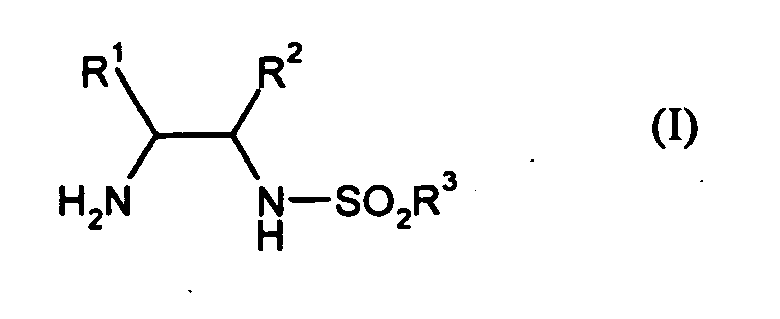
- Es wurde nun ein Verfahren zur Herstellung von Verbindungen der Formel (I),

- R1 und R2 für Phenyl stehen und
- R3 für C1-C4-Alkyl, C1-C4-Fluoralkyl, Phenyl oder Naphthyl steht, das mit keinem, einem, zwei, drei, vier oder fünf Resten weiter substituiert sein kann, die ausgewählt sind aus der Gruppe C1-C4-Alkyl, C1-C4-Alkoxy, C1-C4-Fluoralkyl, Fluor und Chlor ,
dadurch gekennzeichnet, dass
Diamine der Formel (II)
- R1 und R2 die unter der Formel (I) genannte Bedeutung besitzen
- in Gegenwart von Wasser und
- in Gegenwart von organischem Lösungsmittel,
wobei und Volumenverhältnis von Wasser in organischen Lösungsmittel 20:1 bis 1:20 beträgt, und - in Gegenwart von Basen aus der Gruppe Alkali- oder Erdalkalihydroxide oder -carbonate
- bei einer Temperatur im Bereich von -20°C bis 50°C
mit Sulfonylhalogeniden der Formel (III) umgesetzt werden,
R3SO2X (III)
in der
- X für Fluor, Chlor, Brom oder Iod steht und
- R3 die unter der Formel (I) genannte Bedeutung besitzt,
- Die Verbindungen der Formel (I) und gegebenenfalls die Verbindungen der Formeln (II) und oder (III) sind chiral. Der Rahmen der Erfindung umfasst ausdrücklich sowohl die reinen Stereoisomeren (Enantiomeren und Diastereomeren) als auch beliebige Mischungen davon wie zum Beispiel Racemate.
- R3 steht besonders bevorzugt für Methyl, Trifluormethyl, Pentafluorethyl, Nonafluorbutyl, Phenyl, p-Tolyl, p-Ethylphenyl, p-Anisyl, p-Ethoxyphenyl, p-Chlorphenyl, 2,4,6-Trimethylphenyl, 2,4,6-Triisopropylphenyl, p-Fluorphenyl, Pentafluorphenyl und Naphthyl.
- R3 steht ganz besonders bevorzugt für p-Tolyl, Phenyl und Naphtyl, wobei p-Tolyl noch weiter bevorzugt ist.
- X steht bevorzugt für Fluor oder Chlor, besonders bevorzugt für Chlor.
- Bevorzugt werden chirale Verbindungen der Formel (II) eingesetzt, die eine optische Reinheit von 80 % ee oder mehr, besonders bevorzugt von 90 % ee oder mehr und ganz besonders bevorzugt von 98,5 % ee oder mehr aufweisen.
- Die optische Reinheit ist dabei definiert als:

wobei
ee (S) die optische Reinheit des Enantiomers S, m(S) die Stoffmenge des Enantiomers S und m(R) die Stoffmenge des Enantiomers R ist. Die Angebe erfolgt üblicherweise in Prozent "enantiomeric excess" (% ee = ee/100). - Insbesondere ist das erfindungsgemäße Verfahren für die Herstellung folgender Verbindungen der Formel (II) geeignet:
- N-[(1R,2R) und (1S,2S)-2-amino-1,2-diphenylethyl]-p-tolylsulfonamid, N-[(1R,2R) und (1S,2S)-2-amino-1,2-diphenylethyl]-o-tolylsulfonamid, N-[(1R,2R) und (1S,2S)-2-amino-1,2-diphenylethyl]-m-tolylsulfonamid, N-[(1R,2R) und (1S,2S)-2-amino-1,2-diphenylethyl]-phenylsulfonamid, N-[(1R,2R) und (1S,2S)-2-amino-1,2-diphenylethyl]-4-ethylphenylsulfonamid, N-[(1R,2R) und (1S,2S)-2-amino-1,2-diphenylethyl]-3-ethylphenylsulfonamid, N-[(1R,2R) und (1S,2S)-2-amino-1,2-diphenylethyl]-2-ethylphenylsulfonamid, N-[(1R,2R) und (1S,2S)-2-amino-1,2-diphenylethyl]-2,4,6-trimethylphenylsulfonamid, N-[(1R,2R) und (1S,2S)-2-amino-1,2-diphenylethyl]-2,4,6-triisopropylphenylsulfonamid, N-[(1R,2R) und (1S,2S)-2-amino-1,2-diphenylethyl]-4-chlorphenylsulfonamid, N-[(1R,2R) und (1S,2S)-2-amino-1,2-diphenylethyl]-3-chlorphenylsulfonamid, N-[(1R,2R) und (1S,2S)-2-amino-1,2-diphenylethyl]-2-chlorphenylsulfonamid, N-[(1R,2R) und (1S,2S)-2-amino-1,2-diphenylethyl]-4-fluorphenylsulfonamid, N-[(1R,2R) und (1S,2S)-2-amino-1,2-diphenylethyl]-3-fluorphenylsulfonamid, N-[(1R,2R) und (1S,2S)-2-amino-1,2-diphenylethyl]-2-fluorphenylsulfonamid, N-[(1R,2R) und (1S,2S)-2-amino-1,2-diphenylethyl]-4-methoxyphenylsulfonamid, N-[(1R,2R) und (1S,2S)-2-amino-1,2-diphenylethyl]-3-methoxyphenylsulfonamid, N-[(1R,2R) und (1S,2S)-2-amino-1,2-diphenyethyl]-2-methoxyphenylsulfonamid, N-[(1R,2R) und (1S,2S)-2-amino-1,2-diphenylethyl]-1-naphtylsulfonamid, N-[(1R,2R) und (1S,2S)-2-amino-1,2-diphenylethyl]-2-naphtylsulfonamid, N-[(1R,2R) und (1S,2S)-2-amino-1,2-diphenylethyl]-pentafluorphenylsulfonamid, N-[(1R,2R) und (1S,2S)-2-amino-1,2-diphenylethyl]-methansulfonamid, oder Mischungen der jeweiligen Enantiomere wie insbesondere die Racemate.
- Das erfindungsgemäße Verfahren wird in Gegenwart von Wasser, Base und organischem Lösungsmittel durchgeführt. Geeignete organische Lösungsmittel sind beispielsweise:
- Amide wie z.B. Dimethylformamid, N-Methylpyrrolidinon, gegebenenfalls halogenierte aliphatische oder aromatische Lösungsmittel mit bis zu 16 Kohlenstoffatomen wie z.B. Toluol, o-, m-, p-Xylol, Tetrachlorkohlenstoff, Chloroform, Dichlormethan, Chlorbenzol, die isomeren Dichlorbenzole, Fluorbenzol, Nitrile wie zum Beispiel Acetonitril und Benzonitril, Sulfoxide wie Dimethylsulfoxid oder Mischungen davon.
- Vorteilhafterweise wählt man das organische Lösungsmittel so aus, dass das Reaktionsgemisch zwei flüssige Phasen ausbildet. Besonders geeignet sind dafür gegebenenfalls halogenierte aliphatische oder aromatische Lösungsmittel mit bis zu 16 Kohlenstoffatomen, wobei Tetrachlorkohlenstoff, Chloroform, Dichlormethan, und Chlorbenzol bevorzugt und Dichlormethan noch weiter bevorzugt sind.
- Das Volumenverhältnis von Wasser zu organischem Lösungsmittel beträgt 20:1 bis 1:20.
- In einer bevorzugten Ausführungsform wird das erfindungsgemäße Verfahren so durchgeführt, dass das Reaktionsgemisch zwei flüssige Phasen ausbildet und die wässrige Phase einen pH-Wert bezogen auf 25°C von 8 oder mehr, bevorzugt 11 bis 14 aufweist.
- Die Einstellung des pH-Wertes erfolgt durch den Einsatz einer Base.
- Als Basen eignen sich Alkali- und Erdalkalihydroxide und -carbonate, besonders bevorzugt sind Kalium- und Natriumhydroxid.
- Die molare Gesamtmenge der eingesetzten Base kann beispielsweise 1 bis 10 Äquivalente bezogen auf das eingesetzte Diamin der Formel (II) betragen, bevorzugt sind 1,1 bis 3 Äquivalente. Größere Mengen an Base sind möglich aber unwirtschaftlich.
- Dabei kann die Gesamtmenge Base beispielsweise von Beginn an oder zumindest teilweise im Verlauf der Reaktion zugegeben werden.
- Das molare Verhältnis von Verbindungen der Formel (II) zu Verbindungen der Formel (III) beträgt 0,8 bis 1,3 Äquivalente.
Die Temperatur bei der Umsetzung beträgt -20°C bis 50°C,. - Die Reaktionsdauer kann beispielsweise 10 Minuten bis 24 Stunden, bevorzugt 30 min bis 2 h, betragen.
- In Fällen, in denen die Reaktionsmischung zwei flüssige Phasen enthält, ist es besonders vorteilhaft, für eine ausreichende Durchmischung zu sorgen. Das kann beispielsweise durch intensives Rühren erfolgen.
- Aus der Reaktionslösung können die Produkte beispielsweise durch Überführung in das Hydrohalogenid, Kristallisation oder Fällung des Hydrohalogenids und Freisetzung der Verbindung der Formel (I) aus dem Hydrohalogenid mit Base isoliert werden.
- Die Umsetzung in das Hydrohalogenid, vorzugsweise das Hydrochlorid kann vorteilhaft durch Umsetzung der Reaktionslösung mit wässriger Halogenwasserstoffsäure, vorzugsweise wässriger Salzsäure erfolgen.
- Alternativ dazu können die Verbindungen der Formel (I) auch durch Kristallisation aus einem geeigneten Lösungsmittel oder Lösungsmittelgemisch bzw. aus der Reaktionslösung oder durch Chromatographie weiter gereinigt werden.
- Als besonders vorteilhaft hat es sich erwiesen, die durch das erfindungsgemäße Verfahren herstellbaren Reaktionslösungen nach Abtrennung der wässrigen Phase und gegebenenfalls Trocknung der organischen Phase direkt und ohne weitere Aufreinigung weiter einzusetzen.
- Von der Erfindung sind daher auch Verfahren zur Herstellung von Lösungen enthaltend Verbindungen der Formel (I),

- R1 und R2 für Phenyl stehen und
- R3 für C1-C4-Alkyl, C1-C4-Fluoralkyl, Phenyl oder Naphthyl steht, das mit keinem, einem, zwei, drei, vier oder fünf Resten weiter substituiert sein kann, die ausgewählt sind aus der Gruppe C1-C4-Alkyl, C1-C4-Alkoxy, C1-C4-Fluoralkyl, Fluor und Chlor,
welches folgende Schritte umfasst:- a) Umsetzung von Verbindungen der Formel (II)

- R1 und R2 die unter der Formel (I) genannte Bedeutung besitzen
- in Gegenwart von Wasser und
- in Gegenwart von organischen Lösungsmittel,
- wobei das Volumenverhältnis von Wasser zu organischen Lösungsmittel 20:1 bis 1:20 beträgt, und
- in Gegenwart von Basen aus der Gruppe Alkali- oder Erdalkalihydroxide oder - carbonate,
- bei einer Temperatur im Bereich von -20°C bis 50°C
mit Sulfonylhalogeniden der Formel (III) ,
R3SO2X (III)
in der
- X für Fluor, Chlor, Brom oder Iod steht und
- R3 die unter der Formel (I) genannte Bedeutung besitzt,
- R1 und R2 die unter der Formel (I) genannte Bedeutung besitzen
- b) zumindest teilweises Entfernen von Wasser.
- a) Umsetzung von Verbindungen der Formel (II)
- Bevorzugt erfolgt die Umsetzung in einem Reaktionsgemisch, das zwei flüssige Phasen ausbildet. In diesem Fall kann das Entfernen von Wasser beispielsweise durch Abtrennung der wässrigen Phase und gegebenenfalls anschließender Trocknung der organischen Phase erfolgen.
- Trocknungsmethoden für organische Phasen sind dem Fachmann hinlänglich bekannt und umfassen beispielsweise die azeotrope Destillation gegebenenfalls unter vermindertem Druck, die Trocknung über Natrium- oder Magnesiumsulfat, Molsieben und anderen gegenüber organischen Lösungsmitteln inerten Trocknungsmitteln und anschließende Filtration.
- Bevorzugt weisen die erfindungsgemäßen Lösungen einen Wassergehalt von 2 Volumen-% oder weniger, bevorzugt 1 % oder weniger auf.
- Die erfindungsgemäßen Lösungen enthaltend die Verbindungen der Formel(I) sowie die erfindungsgemäß herstellbaren Verbindungen der Formel (I) eignen sich insbesondere zur Anwendung in der Katalyse insbesondere der homogenen Katalyse bzw. zur Herstellung von Metallkomplexen, insbesondere Übergangsmetallkomplexen.
- Bevorzugt eignen sich die erfindungsgemäßen Lösungen enthaltend die Verbindungen der Formel(I) sowie die erfindungsgemäß herstellbaren Verbindungen der Formel (I) zur Herstellung von Ruthenium-, Rhodium- oder Iridiumkomplexen und zur Anwendung in Hydrierungen, wie insbesondere zur Hydrierung von Iminen und Ketonen in Gegenwart von Ruthenium-, Rhodium- oder Iridiumkomplexen, Wasserstoffdonoren und Basen, der sogenannten Transferhydrierung. Typische Wasserstoffdonoren sind dabei beispielsweise Ameisensäure und Isopropanol, typische Basen beispielsweise Alkalimetallhydroxide und Amine wie insbesondere Triethylamin.
- Eine zusammenfassende Darstellung über Transferhydrierungen als Methode zur katalytischen Reduktion geben z.B. Zassinovich et al. in Chem. Rev. 1992, 92, 1051-1069 und Noyori et al. in Acc. Chem. Res. 1997, 30, 97-102 und Wills et al. in Tetrahedron, Asymmetry, 1999, 2045.
- Von der Erfindung ist weiterhin ein Verfahren zur Herstellung von Katalysatoren, welches folgende Schritte umfasst:
- a) Umsetzung von Verbindungen der Formel (II)

- R1 und R2 für Phenyl stehen,
- in Gegenwart von Wasser und
- in Gegenwart von organischen Lösungsmittel,
- in Gegenwart von Basen aus der Gruppe Alkali- oder Erdalkalihydroxide oder - carboante,
- bei einer Temperatur im Bereich von -20 bis 50°C
mit Sulfonylhalogeniden der Formel (III),
R3SO2X (III)
in der
- X für Fluor, Chlor, Brom oder Iod steht und
- R3 für C1-C4-Alkyl, C1-C4-Fluoralkyl, Phenyl oder Naphthyl steht, das mit keinem, einem, zwei, drei, vier oder fünf Resten weiter substituiert sein kann, die ausgewählt sind aus der Gruppe C1-C4-Alkyl, C1-C4-Alkoxy, C1-C4-Fluoralkyl, Fluor und Chlor,
wobei das molare Verhältnis der Verbindungen (II) zu (III) 0,8 bis 1,3 Äquivalente beträgt,
- R1 und R2 für Phenyl stehen,
- b) zumindest teilweises Entfernen von Wasser und
- c) Umsetzung der nach Schritt b) erhaltenen Lösung ohne weitere Zwischenisolierung
mit Verbindungen der Formel (IV)
[MZn(R4)]2 (IV)
in der- M für Ruthenium, Rhodium oder Iridium,
- R4 für eine aromatische Verbindung mit 6 bis 12 Ringkohlenstoffatomen steht, die weiterhin mit bis zu 6 Resten substituiert sein kann, die jeweils unabhängig voneinander ausgewählt sind aus der Gruppe C1-C8-Alkyl, Benzyl und Phenyl, oder mit bis zu fünf Resten substituiertes Cyclopentadienyl oder Indenyl steht und
- Z steht für Chlor, Brom oder Iod und
- n im Falle dass M für Ruthenium steht zwei ist
- n im Falle dass M für Rhodium oder Iridium steht, eins ist.
gegebenenfalls und bevorzugt in Gegenwart eines tertiären Amins.
- Bevorzugt erfolgt die Umsetzung in einem Reaktionsgemisch, das zwei flüssige Phasen ausbildet. In diesem Fall kann das Entfernen von Wasser beispielsweise durch Abtrennung der wässrigen Phase und gegebenenfalls Trocknung der organischen Phase erfolgen.
- Beispielsweise und bevorzugt werden solche Verbindungen der Formel (IV) eingesetzt, in denen M für Ruthenium steht und n gleich zwei ist.
- Bevorzugt steht in Verbindungen der Formel (IV) R4 für Benzol oder Naphthalin, das mit einem, zwei, drei, vier, fünf oder sechs Resten substituiert sein kann, die jeweils unabhängig voneinander ausgewählt sind aus der Gruppe Methyl, Ethyl, n-Propyl, Isopropyl und tert.-Butyl oder für Pentamethylcyclopentadienyl.
- Bevorzugt steht in Verbindungen der Formel (IV) R4 für Mesitylen, Benzol oder Cumol.
- Benzoldichlororuthenium-Dimer, Mesitylendichlororuthenium-Dimer, Cumoldichlororuthenium-Dimer, Pentamethylcyclopentadienylrhodiumchloro-Dimer und Pentamethylcyclopentadienyliridiumchloro-Dimer.
- Im Rahmen der Erfindung ist als Verbindung der Formel (IV) Cumoldichlororuthenium-Dimer besonders bevorzugt.
- In einer bevorzugten Ausführungsform beträgt das molare Verhältnis von ursprünglich eingesetzter Verbindung der Formel (II) zu Verbindungen der Formel (IV) 2:1 bis 3:1, besonders bevorzugt 2,2:1 bis 2,6:1.
- Bevorzugt eignen sich die erfindungsgemäßen Katalysatoren zur Anwendung in Hydrierungen, wie insbesondere zur Hydrierung von Iminen und Ketonen in Gegenwart von Wasserstoffdonoren und Basen, der sogenannten Transferhydrierung.
- Der Vorteil der Erfindung liegt darin, dass die Verbindungen der Formel (I) in hoher Ausbeute und sehr guter Selektivität erhalten werden können. Weiterhin wurde gefunden, dass die Produkte der Sulfonylierung ohne Zwischenisolierung für die Herstellung von Katalysatoren eingesetzt werden können, was eine erhebliche Vereinfachung in der technischen Anwendung darstellt.
- In einem 3-Halskolben werden 5,0 g S,S-Diphenylethylendiamin in 40 ml CH2Cl2 gelöst. Anschließend werden 40 ml 1 M Natronlauge zugegeben und mittels Eisbad gekühlt. Danach wird innerhalb von 60 min eine Lösung aus 4,49 g p-Toluolsulfonylchlorid in 80 mL CH2Cl2, bei 0°C eingetropft. Nach 1 h bei 0°C wird die Reaktion abgebrochen. Die organische Phase wird abgetrennt, mit Wasser gewaschen und das Lösungsmittel am Rotationsverdampfer entfernt. Rohprodukt-Selektivität Diamin:Mono:Disubstitutionsprodukt: 3,5:93:3,5
Es wird aus Toluol : Hexan kristallisiert.
Ausbeute: 7,8 g kristallines Produkt (91 %), Selektivität: Mono: Disubstitutionsprodukt: 95,5:4,5. - In einer 3-Halskolben werden 2.21 g p-Toluolsulfonylchlorid in 40 ml CH2Cl2und mit 3,0 ml Triethylamin (1,8 eq) versetzt. Es wird auf 0°C gekühlt und 2,46 g S,S-Diphenyethylendiamin werden zugeben. Nach 1 h bei 0°C und 4 h bei RT wird die Reaktion aufgearbeitet. Es wird mit 50 ml Dichlormethan verdünnt und mit 50 ml 0,5 M NaOH gewaschen, die trübe organische Phase abgetrennt, mit 20 ml Wasser und 50 ml NaCl-Lösung gewaschen und das Lösungsmittel am Rotationsverdampfer entfernt. Es wird mit Toluol versetzt und restliches Triethylamin azeotrop entfernt.
- Ausbeute: 2,93 g ("69 %") Rohprodukt, Selektivität: Mono: Disubstitutionsprodukt: 83:17.
- In einer 3-Halskolben werden 2,0 g S,S-Diphenyethylendiamin in 20 ml CH2Cl2 gelöst. Anschließend werden 10 ml 2 M Natronlauge zugegeben und mittels Eisbad gekühlt. Danach wird innerhalb von 20 min eine Lösung aus 2,08 g Mesitylsulfonylchlorid in 20 ml CH2Cl2 bei 0°C eingetropft. Nach 1 h bei 0°C wird die Reaktion aufgearbeitet. Die organische Phase wird abgetrennt, mit Wasser und Natriumchlorid-Lösung gewaschen und das Lösungsmittel am Rotationsverdampfer entfernt. Der Rückstand von 3,9 g zeigt eine Selektivität: Diamin:Mono:Disubstitutionsprodukt: 1,7:92:6,5.
Rekristallisation aus Toluol/Hexan ergibt 3,1 g kristallines Produkt (83 %), Selektivität: Mono:Disubstitutionsprodukt: 94,8:5,2. - In einer 3-Halskolben werden 2,0 g S,S-Diphenyethylendiamin in 20 ml CH2Cl2 gelöst, 1,98 ml Et3N (1,5 eq) zugegeben und auf 0°C gekühlt. Es wird eine Lösung von 2,08 g Mesitylsulfonylchlorid in 20 mL CH2Cl2 bei dieser Temperatur innerhalb von 20 min zugetropft. Es wird innerhalb von einer Stunde auf Raumtemperatur aufgetaut. Es wird mit 20 ml Wasser und 50 ml NaCl-Lösung gewaschen und das Lösungsmittel am Rotationsverdampfer entfernt. Es wird mit Toluol versetzt und restliches Triethylamin azeotrop entfernt.
- Selektivität: Mono:Disubstitutionsprodukt 84:16.
- In einer 3-Halskolben werden 2,0 g S,S-Diphenyethylendiamin in 20 ml CH2Cl2 gelöst. Anschließend werden 10 ml 2 M Natronlauge zugegeben und mittels Eisbad gekühlt. Danach wird innerhalb von 20 min eine Lösung aus 1,68 g Phenylsulfonylchlorid in 20 ml CH2Cl2, bei 0°C eingetropft. Nach 1 h bei 0°C wird die Reaktion für 12 h bei Raumtemperatur weitergerührt. Die organische Phase wird abgetrennt, mit Wasser und Natriumchlorid-Lösung gewaschen und das Lösungsmittel am Rotationsverdampfer entfernt. Der Rückstand von 3,1 g zeigt eine Selektivität: Diamin:Mono:Disubstitutionsprodukt: 2:94:4.
Rekristallisation aus Toluol:Hexan ergibt 2,9 g kristallines Produkt (87 %), Selektivität: Mono:Disubstitutionsprodukt: 95:5. - In einer 3-Halskolben werden 2,0 g S,S-Diphenyethylendiamin in 20 ml CH2Cl2 gelöst, 1,98 ml Et3N (1,5 eq) zugegeben und auf 0°C gekühlt. Es wird eine Lösung von 1,68 g Phenylsulfonylchlorid in 20 ml CH2Cl2 bei dieser Temperatur innerhalb von 20 min zugetropft. Es wird innerhalb von einer Stunde auf RT aufgetaut und weitere 12 h bei Raumtemperatur gerührt. Es wird mit 20 ml Wasser und 50 ml NaCl-Lösung gewaschen und das Lösungsmittel am Rotationsverdampfer entfernt. Es wird mit Toluol versetzt und restliches Triethylamin azeotrop entfernt.
- Selektivität: Mono:Disubstitutionsprodukt: 91:9.
- In einer 3-Halskolben werden 1,0 g S,S-Diphenyethylendiamin in 20 ml CH2Cl2 gelöst. Anschließend werden 10 ml 1 M Natronlauge zugegeben und mittels Eisbad gekühlt. Danach wird innerhalb von 20 min eine Lösung aus 0,70 Pentafluorphenylsulfonylchlorid in 20 ml CH2Cl2, bei 0°C eingetropft. Nach 1 h bei 0°C wird die Reaktion für 12 h bei Raumtemperatur weitergerührt. Die organische Phase wird abgetrennt, mit Wasser und Natriumchlorid-Lösung gewaschen und das Lösungsmittel am Rotationsverdampfer entfernt.
Es werden 1,5 g kristallines Produkt (72 %) isoliert, Selektivität: Mono:Disubstitutionsprodukt: 83:17. - In einer 3-Halskolben werden 1,0 g S,S-Diphenyethylendiamin in 20 ml CH2Cl2 gelöst. 0,99 ml Et3N (1,5 eq) zugegeben und auf 0°C gekühlt. Es wird eine Lösung von 1,68 g Phenylsulfonylchlorid in 20 ml CH2Cl2 bei dieser Temperatur innerhalb von 20 min zugetropft. Es wird innerhalb von einer Stunde auf RT aufgetaut und weitere 12 h bei Raumtemperatur gerührt. Es wird mit 20 ml Wasser und 50 ml NaCl-Lösung gewaschen und das Lösungsmittel am Rotationsverdampfer entfernt. Es wird mit Toluol versetzt und restliches Triethylamin azeotrop entfernt.
- Selektivität: Mono:Disubstitutionsprodukt: 76:24.
- Herstellung einer Katalysatorstammlösung in situ ohne Isolierung des Liganden
- In einem Schlenkkolben werden 0,4 g S,S-Diphenylethylendiamin in 10 ml CH2Cl2 gelöst. Anschließend werden 4 ml 1 M Natronlauge zugegeben und mittels Eisbad gekühlt. Danach wird innerhalb von 10 min. unter starkem Rühren eine Lösung aus 0,36 g Tosylchlorid in 10 ml CH2Cl2, bei 0°C eingetropft. Nach 1 h bei 0°C werden die Phasen getrennt. Die organische Phase wird abgetrennt, mit Wasser und NaCl-Lösung gewaschen.
Die so hergestellte Ligandlösung wird entgast und in einem Schlenkgefäß mit 0,56 g [(Cumol)RuCl2]2 (= 0,44 Mol-Äquivalente bezogen auf das S,S-Diphenylethylendiamin) und 550 µl Et3N für 20 min gerührt. - Die Hälfte der in Beispiel 9 hergestellten Katalysator-Lösung wird für diesen Versuch eingesetzt.
In einem 500 ml-Vierhalskolben mit Begasungs-Rührer, Rückflusskühler und Thermometer wird eine Ameisensäure/Et3N-Mischung aus 70 ml Triethylamin und 20 ml HCOOH durch langsames Zutropfen innerhalb von 5 min per Tropftrichter von HCOOH zum Et3N unter Rührung und Eiskühlung hergestellt. Zu diesem zweiphasigen Gemisch werden 76 g Methyl-3-keto-3-(2-thiophen-yl)propanoat (S/C = 500) gegeben, die homogene gelbe Lösung mit 50 ml Dichlormethan versetzt und die Gesamtmischung durch Durchleiten von Argon für 20 min. entgast. Es wird auf 40°C temperiert und unter starkem Rühren die Hälfte der Katalysatorlösung aus Beispiel 5 auf einmal zum Reaktionsansatz per Spritze geben. Es wird unter Argondurchleitung für 18 h gerührt, dann die Reaktionslösung mit Wasser und CH2Cl2 verdünnt, für 10 min nachgerührt, nach Phasentrennung die H2O Phase 2 x mit CH2Cl2 extrahiert. Die vereinigten org. Phasen werden mit Wasser und NaCl-Lösung gewaschen, über MgSO4 getrocknet, filtriert und dann das Lösungsmittel am Rotationsverdampfer entfernt. Es werden 75 g S-Methyl-3-hydroxy-3-(2-thiophen-yl)propanoat erhalten (97,7 %).
Umsatz (GC): 99,9 %. Ee (Chiral-GC, IVADEX 3): 97,2 %. - Versuchsdurchführung wie Beispiel 10, allerdings werden als Katalysator unabhängig präparierte 0,52 g [N-[(1R,2R)-2-(amino-mN)-1,2-diphenylethyl]-p-tolylsulfontolylsulfonamidato-κN]chloro[(η6)-cumol]-ruthenium(II) eingesetzt. Es wird für 18 h gerührt und nachfolgend aufgearbeitet wie in Beispiel 6 beschrieben. Es werden 75 g R-Methyl-3-hydroxy-3-(2-thiophen-yl)propanoat erhalten (97,7 %).
Umsatz: 99,5 %. ee: 96,9 %. - In einem 250 ml-Vierhalskolben mit Begasungs-Rührer, Rückflusskühler und Thermometer wird eine Ameisensäure/Et3N-Mischung aus 41 ml Triethylamin und 12 ml HCOOH durch langsames Zutropfen innerhalb von 5 min per Tropftrichter von HCOOH zum Et3N unter Rührung und Eiskühlung hergestellt. Zu diesem zweiphasigen Gemisch werden 49,5 g 4-Bromacetophenon (S/C = 300) gegeben, die homogene gelbe Lösung mit 30 ml Dichlormethan versetzt und die Gesamtmischung durch Durchleiten von Argon für 20 min entgast. Es bei Raumtemperatur und unter starkem Rühren die Hälfte der Katalysatorlösung aus Beispiel 9 auf einmal zum Reaktionsansatz per Spritze geben. Es wird unter Argondurchleitung für 18 h gerührt, nachfolgend mit Wasser und CH2Cl2 verdünnt, für 10 min nachgerührt, nach Phasentrennung die H2O Phase 2 x mit CH2Cl2 extrahiert. Die vereinigten org. Phasen werden mit NaCl-Lösung gewaschen, über MgSO4 getrocknet, filtriert und dann das Lösungsmittel am Rotationsverdampfer entfernt. Der Umsatz beträgt 99,5 % (GC). ee (Chiral-GC): 93,9 %.
- Der ölige viskose Rückstand wird mit wenig Hexan vermischt und bei -20°C kristallisiert. Man erhält im ersten Kristallisat 23 g (46 %) des weißen kristallinen Produktes p-Brom-1-phenylethan-1-ol (ee: >99 %).
- Die Durchführung erfolgt analog zu Beispiel 11, mit dem Unterschied, dass als Substrat 4,98 g 4-Bromacetophenon und als Katalysator 31 mg [N-[(1R,2R)-2-(amino-κN)-1,2-diphenylethyl]-p-tolylsulfonamidato-κN]chloro[(η6)-1,3,5-trimethylbenzol]-ruthenium(II) eingesetzt werden.
Es werden nach 48 h Reaktionszeit (nicht optimiert) >99 % Umsatz erreicht. Das Rohprodukt hat einen Enantiomerenüberschuss von 95,3 %. Durch Kristallisation bei -20 °C aus Hexan gelingt die Aufreinigung auf >99 % Enantiomerenüberschuss. - In einem 250 ml-Vierhalskolben mit Begasungs-Rührer, Rückflusskühler und Thermometer wird eine Ameisensäure/Et3N-Mischung aus 41 ml Triethylamin und 12 ml HCOOH durch langsames Zutropfen innerhalb von 5 min per Tropftrichter von HCOOH zum Et3N unter Rührung und Eiskühlung hergestellt. Zu diesem zweiphasigen Gemisch werden 49,5 g 2-Bromacetophenon (S/C = 300) gegeben, die homogene gelbe Lösung mit 30 ml Dichlormethan versetzt und die Gesamtmischung durch Durchleiten von Argon für 20 min entgast. Es wird auf 25°C temperiert und unter starkem Rühren eine analog zu Beispiel 9 (halber Ansatz) hergestellte Katalysatorlösung auf einmal zum Reaktionsansatz per Spritze geben. Es wird unter Argon für 18 h gerührt, mit Wasser und CH2Cl2 verdünnt, für 10 min nachgerührt, nach Phasentrennung die H2O Phase 2 x mit CH2Cl2 extrahiert. Die vereinigten org. Phasen werden mit NaCl-Lösung gewaschen, über MgSO4 getrocknet, filtriert und dann das Lösungsmittel am Rotationsverdampfer entfernt. Der Umsatz beträgt 99,8 % (GC). ee (Chiral-GC): 92,6 %.
Der Rückstand wird in Hexan gelöst und bei -20°C kristallisiert. Man erhält im ersten Kristallisat 35 g (70 %) des weißen kristallinen Produktes 2-Brom-1-phenylethan-1-ol (ee: >99,5 %).
Claims (12)
- Verfahren zur Herstellung von Verbindungen der Formel (I),
 R1 und R2 für Phenyl stehen undR3 für C1-C4-Alkyl, C1-C4-Fluoralkyl, Phenyl oder Naphthyl steht, das mit keinem, einem, zwei, drei, vier oder fünf Resten weiter substituiert sein kann, die ausgewählt sind aus der Gruppe C1-C4-Alkyl, C1-C4-Alkoxy, C1-C4-Fluoralkyl, Fluor und Chlor,
dadurch gekennzeichnet, dass
Diamine der Formel (II) R1 und R2 die unter der Formel (I) genannte Bedeutung besitzen- in Gegenwart von Wasser und- in Gegenwart von organischem Lösungsmittel,wobei und Volumenverhältnis von Wasser in organischen Lösungsmittel 20:1 bis 1:20 beträgt, und- in Gegenwart von Basen aus der Gruppe Alkali- oder Erdalkalihydroxide oder- carbonate- bei einer Temperatur im Bereich von -20°C bis 50°C
mit Sulfonylhalogeniden der Formel (III) umgesetzt werden,
R3SO2X (III)
in derX für Fluor, Chlor, Brom oder Iod steht undR3 die unter der Formel (I) genannte Bedeutung besitzt,wobei das molare Verhältnis der Verbindungen (II) zu den Verbindungen der Formel (III) 0,8 bis 1,3 Äquivalente beträgt. - Verfahren gemäß Anspruch 1, dadurch gekennzeichnet, dass X für Fluor oder Chlor steht.
- Verfahren gemäß Ansprüchen 1 oder 2, dadurch gekennzeichnet, dass chirale Verbindungen der Formel (II) eingesetzt werden, die eine optische Reinheit von 80 % ee oder mehr aufweisen.
- Verfahren gemäß einem oder mehreren der Ansprüche 1 bis 3, dadurch gekennzeichnet, dass als organische Lösungsmittel eingesetzt werden:Amide, gegebenenfalls halogenierte aliphatische oder aromatische Lösungsmittel mit bis zu 16 Kohlenstoffatomen, Nitrile, Sulfoxide oder Mischungen davon.
- Verfahren gemäß einem oder mehreren der Ansprüche 1 bis 4, dadurch gekennzeichnet, dass als organische Lösungsmittel eingesetzt werden:Tetrachlorkohlenstoff, Chloroform, Dichlormethan oder Chlorbenzol.
- Verfahren gemäß einem oder mehreren der Ansprüche 1 bis 5, dadurch gekennzeichnet, dass das Reaktionsgemisch zwei flüssige Phasen ausbildet und die wässrige Phase einen pH-Wert bezogen auf 25°C von 8 oder mehr aufweist.
- Verfahren gemäß einem oder mehreren der Ansprüche 1 bis 6, dadurch gekennzeichnet, dass aus der Reaktionslösung die Produkte beispielsweise durch Überführung in das Hydrohalogenid, Kristallisation oder Fällung des Hydrohalogenids und Freisetzung der Verbindung der Formel (I) aus dem Hydrohalogenid mit Base isoliert werden.
- Verfahren zur Herstellung von Lösungen enthaltend Verbindungen der Formel (I),
 R1 und R2 für Phenyl stehen undR3 für C1-C4-Alkyl, C1-C4-Fluoralkyl, Phenyl oder Naphthyl steht, das mit keinem, einem, zwei, drei, vier oder fünf Resten weiter substituiert sein kann, die ausgewählt sind aus der Gruppe C1-C4-Alkyl, C1-C4-Alkoxy, C1-C4-Fluoralkyl, Fluor und Chlor,welches folgende Schritte umfasst:a) Umsetzung von Verbindungen der Formel (II)
 R1 und R2 die unter der Formel (I) genannte Bedeutung besitzen- in Gegenwart von Wasser und- in Gegenwart von organischen Lösungsmittel,- wobei das Volumenverhältnis von Wasser zu organischen Lösungsmittel 20:1 bis 1:20 beträgt, und- in Gegenwart von Basen aus der Gruppe Alkali- oder Erdalkalihydroxide oder -carbonate,- bei einer Temperatur im Bereich von -20°C bis 50°C
mit Sulfonylhalogeniden der Formel (III),
R3SO2X (III)
in derX für Fluor, Chlor, Brom oder Iod steht undR3 die unter der Formel (I) genannte Bedeutung besitzt,wobei das molare Verhältnis der Verbindungen (II) zu (III) 0,8 bis 1,3 Äquivalente beträgt, undb) zumindest teilweises Entfernen von Wasser. - Verfahren zur Herstellung von Katalysatoren, welches folgende Schritte umfasst:a) Umsetzung von Verbindungen der Formel (II)
 R1 und R2 für Phenyl stehen,- in Gegenwart von Wasser und- in Gegenwart von organischen Lösungsmittel,wobei das Volumenverhältnis von Wasser zu organischen Lösungsmittel 20:1 bis 1:20 beträgt, und- in Gegenwart von Basen aus der Gruppe Alkali- oder Erdalkalihydroxide oder -carbonate,- bei einer Temperatur im Bereich von -20 bis 50°C
mit Sulfonylhalogeniden der Formel (III),
R3SO2X (III)
in derX für Fluor, Chlor, Brom oder Iod steht undR3 für C1-C4-Alkyl, C1-C4-Fluoralkyl, Phenyl oder Naphthyl steht, das mit keinem, einem, zwei, drei, vier oder fünf Resten weiter substituiert sein kann, die ausgewählt sind aus der Gruppe C1-C4-Alkyl, C1-C4-Alkoxy, C1-C4-Fluoralkyl, Fluor und Chlor,wobei das molare Verhältnis der Verbindungen (II) zu (III) 0,8 bis 1,3 Äquivalente beträgt,b) zumindest teilweises Entfernen von Wasser undc) Umsetzung der nach Schritt b) erhaltenen Lösung ohne weitere Zwischenisolierung
mit Verbindungen der Formel (IV)
[MZn(R4)]2 (IV)
in derM für Ruthenium, Rhodium oder Iridium,R4 für eine aromatische Verbindung mit 6 bis 12 Ringkohlenstoffatomen steht, die weiterhin mit bis zu 6 Resten substituiert sein kann, die jeweils unabhängig voneinander ausgewählt sind aus der Gruppe C1-C8-Alkyl, Benzyl und Phenyl, oder mit bis zu fünf Resten substituiertes Cyclopentadienyl oder Indenyl steht undZ für Chlor, Brom oder Iod steht undn im Falle dass M für Ruthenium steht zwei istn im Falle dass M für Rhodium oder Iridium steht, eins ist. - Verfahren gemäß Anspruch 9, dadurch gekennzeichnet, dass Z für Chlor steht.
- Verfahren zur Herstellung von Katalysatoren gemäß Anspruch 9, dadurch gekennzeichnet, dass solche Verbindungen der Formel (IV) eingesetzt werden, in denen M für Ruthenium steht und n gleich zwei ist.
- Hydrierverfahren, welches die Herstellung des Katalysators gemäß Anspruch 9 und die Verwendung des so hergestellten Katalysators bei der Hydrierung umfasst.
Applications Claiming Priority (2)
| Application Number | Priority Date | Filing Date | Title |
|---|---|---|---|
| DE10226944 | 2002-06-17 | ||
| DE10226944 | 2002-06-17 |
Publications (3)
| Publication Number | Publication Date |
|---|---|
| EP1375477A2 EP1375477A2 (de) | 2004-01-02 |
| EP1375477A3 EP1375477A3 (de) | 2004-01-21 |
| EP1375477B1 true EP1375477B1 (de) | 2009-09-30 |
Family
ID=29716512
Family Applications (1)
| Application Number | Title | Priority Date | Filing Date |
|---|---|---|---|
| EP03012670A Expired - Lifetime EP1375477B1 (de) | 2002-06-17 | 2003-06-04 | Verfahren zur Herstellung von mono-N-sulfonylierten Diaminen |
Country Status (9)
| Country | Link |
|---|---|
| US (3) | US20040023348A1 (de) |
| EP (1) | EP1375477B1 (de) |
| JP (1) | JP4531353B2 (de) |
| CN (1) | CN1319941C (de) |
| AT (1) | ATE444284T1 (de) |
| DE (1) | DE50311954D1 (de) |
| DK (1) | DK1375477T3 (de) |
| ES (1) | ES2331911T3 (de) |
| PT (1) | PT1375477E (de) |
Families Citing this family (6)
| Publication number | Priority date | Publication date | Assignee | Title |
|---|---|---|---|---|
| ATE444284T1 (de) * | 2002-06-17 | 2009-10-15 | Saltigo Gmbh | Verfahren zur herstellung von mono-n- sulfonylierten diaminen |
| GB0425320D0 (en) | 2004-11-17 | 2004-12-22 | Johnson Matthey Plc | Diamines |
| CA2656126A1 (en) * | 2006-07-03 | 2008-01-10 | Ranbaxy Laboratories Limited | Polymorphic form of duloxetine hydrochloride |
| US20100280093A1 (en) * | 2006-07-03 | 2010-11-04 | Ranbaxy Laboratories Limited | Process for the preparation enantiomerically pure salts of n-methyl-3-(1-naphthaleneoxy)-3-(2-thienyl)propanamine |
| JP5076682B2 (ja) * | 2006-07-26 | 2012-11-21 | セントラル硝子株式会社 | N−(ビシクロ[2,2,1]ヘプト−5−エン−2−イルメチル)−1,1,1−トリフルオロメタンスルホンアミドの製造方法 |
| US12258435B1 (en) | 2024-02-06 | 2025-03-25 | Patcham Usa Llc | Method for preparing low density polyurethanes using catalysts that are free from tertiary amines and tin |
Family Cites Families (15)
| Publication number | Priority date | Publication date | Assignee | Title |
|---|---|---|---|---|
| CZ279464B6 (cs) * | 1990-09-24 | 1995-05-17 | Lonza A.G. | Způsob hydroxylace methylových skupin v aromatických heterocyklech, hybridní plasmidy pL05 a p L04 uložené v mikroorganismech Pseudomonas putida a Escherichia coli |
| IE75349B1 (en) * | 1991-03-07 | 1997-08-27 | Lonza Ag | A process for the terminal hydroxylation of ethyl groups on aromatic 5- or 6-membered heterocyclic compounds |
| AU706642B2 (en) * | 1994-04-22 | 1999-06-17 | G.D. Searle & Co. | Diagnostic image analysis with metal complexes |
| US6887820B1 (en) * | 1995-12-06 | 2005-05-03 | Japan Science And Technology Corporation | Method for producing optically active compounds |
| DE69634639T2 (de) * | 1995-12-06 | 2006-03-02 | Japan Science And Technology Agency, Kawaguchi | Verfahren zur herstellung optische aktive verbindungen |
| US6187961B1 (en) * | 1997-11-06 | 2001-02-13 | Roche Vitamins Inc. | Process for the preparation of trans-(R,R)-actinol |
| US6017245A (en) * | 1998-08-19 | 2000-01-25 | Amphenol Corporation | Stamped backshell assembly with integral front shield and rear cable clamp |
| JP2000327659A (ja) * | 1999-03-15 | 2000-11-28 | Mitsubishi Chemicals Corp | 光学活性ピリジルアルコール類の製造方法 |
| WO2000059885A1 (en) * | 1999-04-01 | 2000-10-12 | Asahi Kasei Kabushiki Kaisha | Method for the preparation of tricyclic amino alcohol derivatives through azides |
| JP2000344694A (ja) * | 1999-06-01 | 2000-12-12 | Mitsubishi Chemicals Corp | 光学活性3−ペンチン−2−オールの製造方法 |
| CA2374553A1 (fr) * | 1999-06-15 | 2000-12-21 | Rhodia Chimie | Sulfonylamides et carboxamides et leur application en catalyse asymetrique |
| JP3870647B2 (ja) * | 2000-01-24 | 2007-01-24 | 三菱化学株式会社 | 光学活性α−ヒドロキシケトン類の製造方法 |
| GB0021831D0 (en) * | 2000-09-06 | 2000-10-18 | Astrazeneca Ab | Chemical compounds |
| DE10225352A1 (de) * | 2002-06-07 | 2003-12-18 | Bayer Ag | Verfahren zur stereoselektiven Reduktion von 4-Aryl-4-oxobutansäure-derivaten |
| ATE444284T1 (de) * | 2002-06-17 | 2009-10-15 | Saltigo Gmbh | Verfahren zur herstellung von mono-n- sulfonylierten diaminen |
-
2003
- 2003-06-04 AT AT03012670T patent/ATE444284T1/de active
- 2003-06-04 EP EP03012670A patent/EP1375477B1/de not_active Expired - Lifetime
- 2003-06-04 DE DE50311954T patent/DE50311954D1/de not_active Expired - Lifetime
- 2003-06-04 ES ES03012670T patent/ES2331911T3/es not_active Expired - Lifetime
- 2003-06-04 PT PT03012670T patent/PT1375477E/pt unknown
- 2003-06-04 DK DK03012670.0T patent/DK1375477T3/da active
- 2003-06-06 US US10/456,397 patent/US20040023348A1/en not_active Abandoned
- 2003-06-17 US US10/463,799 patent/US7232927B2/en not_active Expired - Fee Related
- 2003-06-17 JP JP2003172229A patent/JP4531353B2/ja not_active Expired - Fee Related
- 2003-06-17 CN CNB03141091XA patent/CN1319941C/zh not_active Expired - Fee Related
-
2007
- 2007-06-19 US US11/820,407 patent/US20070259776A1/en not_active Abandoned
Also Published As
| Publication number | Publication date |
|---|---|
| DK1375477T3 (da) | 2010-01-25 |
| ES2331911T3 (es) | 2010-01-20 |
| CN1319941C (zh) | 2007-06-06 |
| ATE444284T1 (de) | 2009-10-15 |
| PT1375477E (pt) | 2009-11-20 |
| CN1468850A (zh) | 2004-01-21 |
| US20070259776A1 (en) | 2007-11-08 |
| EP1375477A3 (de) | 2004-01-21 |
| US20040023348A1 (en) | 2004-02-05 |
| US20050059842A1 (en) | 2005-03-17 |
| JP2004043463A (ja) | 2004-02-12 |
| US7232927B2 (en) | 2007-06-19 |
| DE50311954D1 (de) | 2009-11-12 |
| EP1375477A2 (de) | 2004-01-02 |
| JP4531353B2 (ja) | 2010-08-25 |
Similar Documents
| Publication | Publication Date | Title |
|---|---|---|
| DE69824958T2 (de) | Enantioselektive additions-reaktion mit hilfe eines organozink reagenzes | |
| MX2010014224A (es) | Un proceso para la preparacion del promotor de apoptosis abt-263. | |
| EP1876168A1 (de) | Verfahren zur Herstellung von beta-Amino-alpha-hydroxy-carbonsäureamiden | |
| US20070259776A1 (en) | Preparation of Mono-N-sulphonylated diamines | |
| EP0206993A1 (de) | Neue Sulfonsäureester | |
| DE69611303T2 (de) | Benzolsulfonamidderivate, ihre herstellung und ihre therapeutische verwendung | |
| HUE033534T2 (en) | Asymmetric synthesis of substituted pyrrolidine-2-carboxamide | |
| DE60103959T2 (de) | Neue azetidin-derivate und ein verfahren zur herstellung derselben | |
| EP0915076B1 (de) | Verfahren zur Herstellung von trans-(R,R)-Actinol | |
| EP0850931A2 (de) | Verfahren zur Herstellung optisch aktiver (R oder S)-1-(4-Methoxy-benzyl)-1,2,3,4,5,6,7,8-Octahydro-isochinoline | |
| EP0923534B1 (de) | Verfahren zur herstellung von racemischen phenethylaminen | |
| EP0138030B1 (de) | Phenäthylamin-Derivate | |
| DE60009518T2 (de) | Substituierte cyclopentene, verfahren zu deren herstellung und deren verwendungals chirale gerüste | |
| WO2004089920A2 (de) | Amin-substituierte diphenyldiphosphine und deren verwendung in metallkomplexen für asymmetrische synthesen | |
| EP1518850B1 (de) | Enantiomerenangereichertes 2-Butanol | |
| WO2008029267A2 (de) | Hydrochloride von 3-amino-2-hydroxycarbonsäureamiden | |
| JPH10231286A (ja) | 光学活性2−フェニル−2−(2’−ピペリジニル) 酢酸エステル誘導体の製造方法 | |
| DE60308170T2 (de) | Verfahren zur herstellung von chinolinderivaten | |
| WO2003091199A1 (de) | Verfahren zur chlorierung tertiärer alkohole | |
| EP0759425A2 (de) | Verfahren zur Herstellung von optisch aktiven 1-Aryl-alkylaminen | |
| DE69527683T2 (de) | Verfahren zur herstellung von optisch aktivem n-tert-butyl-2-piperazincarboxamidamid | |
| EP0265388A1 (de) | Pyrrol-Derivate, therapeutische Mittel, die sie enthalten und ihre Verwendung | |
| JP2000198775A (ja) | 環状グアニジン類及びその製造法 | |
| WO1997016417A1 (en) | Novel sulfamate compound containing carbamoyl group | |
| LV11461B (en) | Dichloro-substituted imidazole derivatives as antifungal agents |
Legal Events
| Date | Code | Title | Description |
|---|---|---|---|
| PUAI | Public reference made under article 153(3) epc to a published international application that has entered the european phase |
Free format text: ORIGINAL CODE: 0009012 |
|
| PUAL | Search report despatched |
Free format text: ORIGINAL CODE: 0009013 |
|
| AK | Designated contracting states |
Kind code of ref document: A2 Designated state(s): AT BE BG CH CY CZ DE DK EE ES FI FR GB GR HU IE IT LI LU MC NL PT RO SE SI SK TR |
|
| AX | Request for extension of the european patent |
Extension state: AL LT LV MK |
|
| AK | Designated contracting states |
Kind code of ref document: A3 Designated state(s): AT BE BG CH CY CZ DE DK EE ES FI FR GB GR HU IE IT LI LU MC NL PT RO SE SI SK TR |
|
| AX | Request for extension of the european patent |
Extension state: AL LT LV MK |
|
| 17P | Request for examination filed |
Effective date: 20040721 |
|
| AKX | Designation fees paid |
Designated state(s): AT BE BG CH CY CZ DE DK EE ES FI FR GB GR HU IE IT LI LU MC NL PT RO SE SI SK TR |
|
| 17Q | First examination report despatched |
Effective date: 20050415 |
|
| RAP1 | Party data changed (applicant data changed or rights of an application transferred) |
Owner name: LANXESS DEUTSCHLAND GMBH |
|
| RAP1 | Party data changed (applicant data changed or rights of an application transferred) |
Owner name: SALTIGO GMBH |
|
| 17Q | First examination report despatched |
Effective date: 20050415 |
|
| RAP1 | Party data changed (applicant data changed or rights of an application transferred) |
Owner name: SALTIGO GMBH |
|
| GRAP | Despatch of communication of intention to grant a patent |
Free format text: ORIGINAL CODE: EPIDOSNIGR1 |
|
| GRAS | Grant fee paid |
Free format text: ORIGINAL CODE: EPIDOSNIGR3 |
|
| GRAA | (expected) grant |
Free format text: ORIGINAL CODE: 0009210 |
|
| AK | Designated contracting states |
Kind code of ref document: B1 Designated state(s): AT BE BG CH CY CZ DE DK EE ES FI FR GB GR HU IE IT LI LU MC NL PT RO SE SI SK TR |
|
| REG | Reference to a national code |
Ref country code: GB Ref legal event code: FG4D Free format text: NOT ENGLISH Ref country code: CH Ref legal event code: EP |
|
| REG | Reference to a national code |
Ref country code: IE Ref legal event code: FG4D |
|
| REF | Corresponds to: |
Ref document number: 50311954 Country of ref document: DE Date of ref document: 20091112 Kind code of ref document: P |
|
| REG | Reference to a national code |
Ref country code: PT Ref legal event code: SC4A Free format text: AVAILABILITY OF NATIONAL TRANSLATION Effective date: 20091113 |
|
| REG | Reference to a national code |
Ref country code: ES Ref legal event code: FG2A Ref document number: 2331911 Country of ref document: ES Kind code of ref document: T3 |
|
| REG | Reference to a national code |
Ref country code: DK Ref legal event code: T3 |
|
| PG25 | Lapsed in a contracting state [announced via postgrant information from national office to epo] |
Ref country code: SE Free format text: LAPSE BECAUSE OF FAILURE TO SUBMIT A TRANSLATION OF THE DESCRIPTION OR TO PAY THE FEE WITHIN THE PRESCRIBED TIME-LIMIT Effective date: 20090930 |
|
| PG25 | Lapsed in a contracting state [announced via postgrant information from national office to epo] |
Ref country code: SI Free format text: LAPSE BECAUSE OF FAILURE TO SUBMIT A TRANSLATION OF THE DESCRIPTION OR TO PAY THE FEE WITHIN THE PRESCRIBED TIME-LIMIT Effective date: 20090930 |
|
| PG25 | Lapsed in a contracting state [announced via postgrant information from national office to epo] |
Ref country code: EE Free format text: LAPSE BECAUSE OF FAILURE TO SUBMIT A TRANSLATION OF THE DESCRIPTION OR TO PAY THE FEE WITHIN THE PRESCRIBED TIME-LIMIT Effective date: 20090930 Ref country code: RO Free format text: LAPSE BECAUSE OF FAILURE TO SUBMIT A TRANSLATION OF THE DESCRIPTION OR TO PAY THE FEE WITHIN THE PRESCRIBED TIME-LIMIT Effective date: 20090930 |
|
| PG25 | Lapsed in a contracting state [announced via postgrant information from national office to epo] |
Ref country code: SK Free format text: LAPSE BECAUSE OF FAILURE TO SUBMIT A TRANSLATION OF THE DESCRIPTION OR TO PAY THE FEE WITHIN THE PRESCRIBED TIME-LIMIT Effective date: 20090930 Ref country code: CY Free format text: LAPSE BECAUSE OF FAILURE TO SUBMIT A TRANSLATION OF THE DESCRIPTION OR TO PAY THE FEE WITHIN THE PRESCRIBED TIME-LIMIT Effective date: 20090930 |
|
| REG | Reference to a national code |
Ref country code: HU Ref legal event code: AG4A Ref document number: E007228 Country of ref document: HU |
|
| PLBE | No opposition filed within time limit |
Free format text: ORIGINAL CODE: 0009261 |
|
| STAA | Information on the status of an ep patent application or granted ep patent |
Free format text: STATUS: NO OPPOSITION FILED WITHIN TIME LIMIT |
|
| 26N | No opposition filed |
Effective date: 20100701 |
|
| PG25 | Lapsed in a contracting state [announced via postgrant information from national office to epo] |
Ref country code: GR Free format text: LAPSE BECAUSE OF FAILURE TO SUBMIT A TRANSLATION OF THE DESCRIPTION OR TO PAY THE FEE WITHIN THE PRESCRIBED TIME-LIMIT Effective date: 20091231 |
|
| PG25 | Lapsed in a contracting state [announced via postgrant information from national office to epo] |
Ref country code: MC Free format text: LAPSE BECAUSE OF NON-PAYMENT OF DUE FEES Effective date: 20100630 |
|
| PG25 | Lapsed in a contracting state [announced via postgrant information from national office to epo] |
Ref country code: BG Free format text: LAPSE BECAUSE OF FAILURE TO SUBMIT A TRANSLATION OF THE DESCRIPTION OR TO PAY THE FEE WITHIN THE PRESCRIBED TIME-LIMIT Effective date: 20090930 Ref country code: LU Free format text: LAPSE BECAUSE OF NON-PAYMENT OF DUE FEES Effective date: 20100604 |
|
| PG25 | Lapsed in a contracting state [announced via postgrant information from national office to epo] |
Ref country code: TR Free format text: LAPSE BECAUSE OF FAILURE TO SUBMIT A TRANSLATION OF THE DESCRIPTION OR TO PAY THE FEE WITHIN THE PRESCRIBED TIME-LIMIT Effective date: 20090930 |
|
| REG | Reference to a national code |
Ref country code: DE Ref legal event code: R082 Ref document number: 50311954 Country of ref document: DE Representative=s name: WICHMANN, BIRGID, DIPL.-CHEM. DR.RER.NAT., DE |
|
| REG | Reference to a national code |
Ref country code: DE Ref legal event code: R082 Ref document number: 50311954 Country of ref document: DE Representative=s name: WICHMANN, BIRGID, DIPL.-CHEM. DR.RER.NAT., DE Effective date: 20131213 Ref country code: DE Ref legal event code: R081 Ref document number: 50311954 Country of ref document: DE Owner name: SALTIGO GMBH, DE Free format text: FORMER OWNER: SALTIGO GMBH, 40764 LANGENFELD, DE Effective date: 20131213 |
|
| PGFP | Annual fee paid to national office [announced via postgrant information from national office to epo] |
Ref country code: IE Payment date: 20140610 Year of fee payment: 12 Ref country code: GB Payment date: 20140604 Year of fee payment: 12 |
|
| PGFP | Annual fee paid to national office [announced via postgrant information from national office to epo] |
Ref country code: CZ Payment date: 20140514 Year of fee payment: 12 Ref country code: ES Payment date: 20140513 Year of fee payment: 12 Ref country code: CH Payment date: 20140612 Year of fee payment: 12 Ref country code: IT Payment date: 20140620 Year of fee payment: 12 Ref country code: FI Payment date: 20140610 Year of fee payment: 12 Ref country code: DE Payment date: 20140528 Year of fee payment: 12 Ref country code: PT Payment date: 20140602 Year of fee payment: 12 Ref country code: AT Payment date: 20140528 Year of fee payment: 12 |
|
| PGFP | Annual fee paid to national office [announced via postgrant information from national office to epo] |
Ref country code: DK Payment date: 20140610 Year of fee payment: 12 Ref country code: HU Payment date: 20140512 Year of fee payment: 12 |
|
| PGFP | Annual fee paid to national office [announced via postgrant information from national office to epo] |
Ref country code: NL Payment date: 20140610 Year of fee payment: 12 Ref country code: BE Payment date: 20140611 Year of fee payment: 12 |
|
| PGFP | Annual fee paid to national office [announced via postgrant information from national office to epo] |
Ref country code: FR Payment date: 20140609 Year of fee payment: 12 |
|
| REG | Reference to a national code |
Ref country code: PT Ref legal event code: MM4A Free format text: LAPSE DUE TO NON-PAYMENT OF FEES Effective date: 20151204 |
|
| REG | Reference to a national code |
Ref country code: DE Ref legal event code: R119 Ref document number: 50311954 Country of ref document: DE |
|
| REG | Reference to a national code |
Ref country code: DK Ref legal event code: EBP Effective date: 20150630 |
|
| PG25 | Lapsed in a contracting state [announced via postgrant information from national office to epo] |
Ref country code: FI Free format text: LAPSE BECAUSE OF NON-PAYMENT OF DUE FEES Effective date: 20150604 Ref country code: IT Free format text: LAPSE BECAUSE OF NON-PAYMENT OF DUE FEES Effective date: 20150604 |
|
| REG | Reference to a national code |
Ref country code: CH Ref legal event code: PL |
|
| REG | Reference to a national code |
Ref country code: AT Ref legal event code: MM01 Ref document number: 444284 Country of ref document: AT Kind code of ref document: T Effective date: 20150604 |
|
| GBPC | Gb: european patent ceased through non-payment of renewal fee |
Effective date: 20150604 |
|
| PG25 | Lapsed in a contracting state [announced via postgrant information from national office to epo] |
Ref country code: CZ Free format text: LAPSE BECAUSE OF NON-PAYMENT OF DUE FEES Effective date: 20150604 Ref country code: PT Free format text: LAPSE BECAUSE OF NON-PAYMENT OF DUE FEES Effective date: 20151204 |
|
| REG | Reference to a national code |
Ref country code: NL Ref legal event code: MM Effective date: 20150701 |
|
| REG | Reference to a national code |
Ref country code: IE Ref legal event code: MM4A |
|
| REG | Reference to a national code |
Ref country code: FR Ref legal event code: ST Effective date: 20160229 |
|
| PG25 | Lapsed in a contracting state [announced via postgrant information from national office to epo] |
Ref country code: DE Free format text: LAPSE BECAUSE OF NON-PAYMENT OF DUE FEES Effective date: 20160101 Ref country code: GB Free format text: LAPSE BECAUSE OF NON-PAYMENT OF DUE FEES Effective date: 20150604 Ref country code: IE Free format text: LAPSE BECAUSE OF NON-PAYMENT OF DUE FEES Effective date: 20150604 Ref country code: CH Free format text: LAPSE BECAUSE OF NON-PAYMENT OF DUE FEES Effective date: 20150630 Ref country code: NL Free format text: LAPSE BECAUSE OF NON-PAYMENT OF DUE FEES Effective date: 20150701 Ref country code: LI Free format text: LAPSE BECAUSE OF NON-PAYMENT OF DUE FEES Effective date: 20150630 |
|
| PG25 | Lapsed in a contracting state [announced via postgrant information from national office to epo] |
Ref country code: HU Free format text: LAPSE BECAUSE OF NON-PAYMENT OF DUE FEES Effective date: 20150605 Ref country code: FR Free format text: LAPSE BECAUSE OF NON-PAYMENT OF DUE FEES Effective date: 20150630 Ref country code: AT Free format text: LAPSE BECAUSE OF NON-PAYMENT OF DUE FEES Effective date: 20150604 |
|
| REG | Reference to a national code |
Ref country code: ES Ref legal event code: FD2A Effective date: 20160728 |
|
| PG25 | Lapsed in a contracting state [announced via postgrant information from national office to epo] |
Ref country code: DK Free format text: LAPSE BECAUSE OF NON-PAYMENT OF DUE FEES Effective date: 20150630 |
|
| PG25 | Lapsed in a contracting state [announced via postgrant information from national office to epo] |
Ref country code: ES Free format text: LAPSE BECAUSE OF NON-PAYMENT OF DUE FEES Effective date: 20150605 |
|
| PG25 | Lapsed in a contracting state [announced via postgrant information from national office to epo] |
Ref country code: BE Free format text: LAPSE BECAUSE OF NON-PAYMENT OF DUE FEES Effective date: 20150630 |