FIELD OF THE INVENTION
-
The present invention relates to a novel process for the preparation of tricyclic amino-alcohol
derivatives or salts thereof which are useful for treating and preventing diabetes,
obesity, hyperlipidemia and the like and have the formula (1):
wherein
- R1 represents a lower alkyl group or a benzyl group;
- *1 represents an asymmetric carbon atom;
- R2 represents a hydrogen atom, a halogen atom or a hydroxyl group; and
- A represents one of the following groups:
wherein X represents NH, O or S; R5 represents a hydrogen atom, a hydroxyl group, an amino
group or an acetylamino group; and *2 represents an asymmetric carbon atom when R5 is not
a hydrogen atom. This invention also relates to intermediates useful for the preparing
process.-
BACKGROUND OF THE INVENTION
-
JP-A-9-249623 (WO 97/25311) and WO 99/01431 disclose in detail processes for the
preparation of the compounds of the above-mentioned formula (1) and also describe that these
compounds are very useful for treating and preventing diabetes, obesity, hyperlipidemia and
the like.
PROBLEMS TO BE SOLVED
-
However, the study on the above known processes carried out by the present inventors
showed that the said processes were not necessarily a practical process. It is supposed that
there is a need for a convenient, practical preparing process with low cost which comprises a
small number of steps with good industrial work efficiency.
MEANS TO SOLVE THE PROBLEMS
-
The study carried out by the present inventors showed some disadvantages involved in
the conventional processes for preparing a compound of the formula (1) set forth above,
wherein the disadvantages were that the processes required many reaction steps and several
purifying works including chromatography, and did not necessarily provide a good yield. In
addition, if an optical isomer, such as R-form of a compound of the formula (1) is to be finally
obtained according to the synthesizing route disclosed in the above patent publications, the
carbonyl group is reduced with borane as a reducing agent in the presence of a chiral auxiliary
agent of the following formula (16):
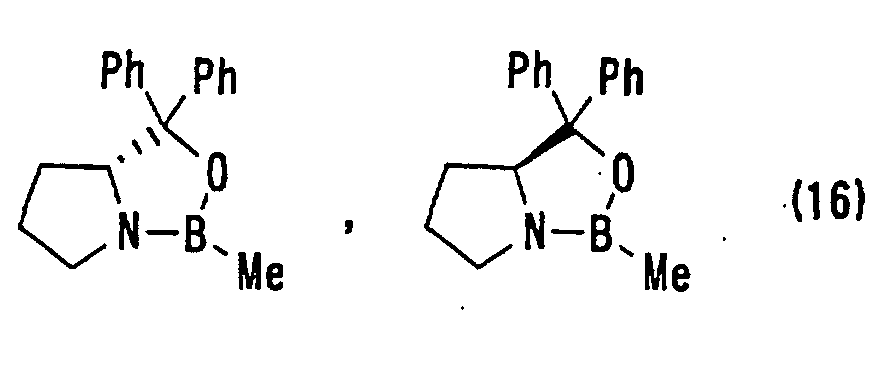
This chiral auxiliary agent is very expensive and the process for the preparation thereof is
very complicated. The chiral auxiliary agent is a hazardous combustible substance and an
asymmetric reduction using the said chiral auxiliary agent requires strictly anhydrous
conditions, strict temperature controls, complicated works and the like, which will become
problematic when the chiral auxiliary agent is industrially used.
-
In order to solve the above problems, the present inventors examined a variety of
synthesizing processes. As a result, the present inventors have established preferred
synthesizing processes successfully and completed the present invention.
-
That is, the present invention is a process for the preparation of a compound of the
formula (1):
wherein R
1 represents a lower alkyl group or a benzyl group; R
2 represents a hydrogen atom, a
halogen atom or a hydroxyl group; *1 represents an asymmetric carbon atom; and A
represents one of the following groups:
wherein X represents NH, O or S; R
5 represents a hydrogen atom, a hydroxyl group, an amino
group or an acetylamino group; and *2 represents an asymmetric carbon atom when R
5 is not
a hydrogen atom,
said process comprising:
- (a)
- i) azidating a compound of the formula (8):
wherein R1 is as defined above; R21 represents a hydrogen atom, a halogen atom,
a hydroxyl group or a protected hydroxyl group; R3 represents an amino-protecting
group or a hydrogen atom,
with an azidating agent to give a compound of the formula (7):
wherein R1, R21 and R3 are as defined above; and then reducing the compound of
the formula (7) to give a compound of the formula (5):
wherein R1, R21, R3 and *1 are as defined above; or - ii) asymmetrically reducing the compound of the formula (7) to give a compound of
the formula (6):
wherein R1, R21, R3 and * 1 are as defined above; and then reducing the azido
group to give a compound of the formula (5); or alternatively
- iii) converting the terminal bromine atom of the side-chain of a compound of the
formula (8) into an amino group by amination reaction to give a compound of
the formula (9):
wherein R1, R21 and R3 are as defined above; and then reducing the compound of
the formula (9) to give a compound of the formula (5);
and then,
- (b) where necessary, protecting the compound of the formula (5) obtained in any one of the
above steps to give a compound of the formula (4):
wherein R1, R21, R3 and * 1 are as defined above, and R4 represents an amino-protecting
group or a hydrogen atom;
and then,
- i) reacting the compound of the formula (4) with a compound of the formula (10):
wherein A' represents one of the following groups:
wherein X represents NH, O or S; R51 represents a hydrogen atom, a protected
hydroxyl group, a protected amino group or an acetylamino group; and *2
represents an asymmetric carbon atom when R51 is not a hydrogen atom, to give
a compound of the formula (3):
wherein R1, R21, R3, R4, A' and * 1 are as defined above; or reacting the compound
of the formula (4) with a compound of the formula (15):
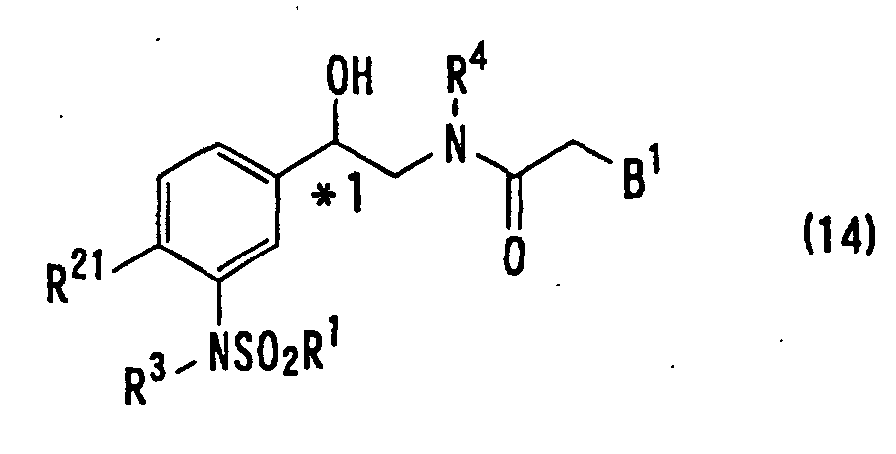
wherein B1 represents a leaving group, to give a compound of the formula (14):
wherein R1, R21, R3, R4, B1 and * 1 are as defined above; and then reacting the
resulting compound with a compound represented by A'-OH, wherein A' is as
defined above, to give a compound of the formula (3); and then further reducing
the compound of the formula (3) obtained in any one of the above steps to give a
compound of the formula (2):
wherein R1, R21, R3, R4, A' and *1 are as defined above; or
ii) reacting the compound of the formula (4) with a compound of the formula (11):
wherein A' is as defined above; and then reducing the resulting compound to
give a compound of the formula (2); or
- iii) reacting the compound of the formula (4) with a compound of the formula (12):
wherein B2 represents a leaving group and A' is as defined above, to give a
compound of the formula (2);
and then, - (c) where necessary, simultaneously or sequentially removing the protecting groups of the
compound of the formula (2) obtained in any one of the above steps to give a compound of
the formula (1).
-
-
The aspect of the first synthesizing route of the present invention is a process for the
preparation of a compound of the formula (1):
wherein R
1 represents a lower alkyl group or a benzyl group; R
2 represents a hydrogen atom, a
halogen atom or a hydroxyl group; *1 represents an asymmetric carbon atom; and A
represents one of the following groups:
wherein X represents NH, O or S; R
5 represents a hydrogen atom, a hydroxyl group, an amino
group or an acetylamino group; and *2 represents an asymmetric carbon atom when R
5 is not
a hydrogen atom,
said process comprising:
- (a)
- i) azidating a compound of the formula (8):
wherein R1 is as defined above; R21 represents a hydrogen atom, a halogen atom,
a hydroxyl group or a protected hydroxyl group; R3 represents an amino-protecting
group or a hydrogen atom,
with an azidating agent to give a compound of the formula (7):
wherein R1, R21 and R3 are as defined above; and then reducing the compound of
the formula (7) to give a compound of the formula (5):
wherein R1, R21, R3 and * 1 are as defined above; or - ii) asymmetrically reducing the compound of the formula (7) to give a compound of
the formula (6):
wherein R1, R21, R3 and *1 are as defined above; and then reducing the azido
group to give a compound of the formula (5); or alternatively
- iii) converting the terminal bromine atom of the side-chain of a compound of the
formula (8) into an amino group by amination reaction to give a compound of
the formula (9):
wherein R1, R21 and R3 are as defined above; and then reducing the compound of
the formula (9) to give a compound of the formula (5);
and then,
- (b) where necessary, protecting the compound of the formula (5) obtained in any one of the
above steps to give a compound of the formula (4):
wherein R1, R21, R3 and * 1 are as defined above, and R4 represents an amino-protecting
group or a hydrogen atom; and then,
reacting the compound of the formula (4) with a compound of the formula (10):
wherein A' represents one of the following groups:
wherein X represents NH, O or S; R51 represents a hydrogen atom, a protected hydroxyl
group, a protected amino group or an acetylamino group; and *2 represents an
asymmetric carbon atom when R51 is not a hydrogen atom, to give a compound of the
formula (3):
wherein R1, R21, R3, R4, A' and * 1 are as defined above; and then further reducing the
compound of the formula (3) to give a compound of the formula (2):
wherein R1, R21, R3, R4, A' and *1 are as defined above;
and then,
- (c) where necessary, simultaneously or sequentially removing the protecting groups of the
compound of the formula (2) to give a compound of the formula (1).
-
-
In the aspect of the first synthesizing route set forth above, a compound of the formula
(7), a compound of the formula (6) and a compound of the formula (3) are the preferred
intermediates which are novel and relatively good in crystallinity. The said compounds do
not necessarily need a column chromatography purifying step and may be used in the
following reaction step after being subjected to a recrystallizing treatment and the like.
-
Specific examples of a compound of the formula (7) include:
- 2-azido-1-[3-(N-benzyl-N-methylsulfonyl)amino]phenylethanone;
- 2-azido-1-[3-(N-benzyl-N-methylsulfonyl)amino-4-hydroxy]phenylethanone;
- 2-azido-1-[3-(N-benzyl-N-methylsulfonyl)amino-4-benzyloxy]phenylethanone;
- 2-azido-1-[3-(N-benzyl-N-methylsulfonyl)amino-4-bromo]phenylethanone;
- 2-azido-1-[3-(N-benzyl-N-methylsulfonyl)amino-4-chloro]phenylethanone;
- 2-azido-1-[3-(N-methylsulfonylamino)]phenylethanone;
- 2-azido-1-(4-benzyloxy-3-methylsulfonylamino)phenylethanone and the like.
-
-
Specific examples of a compound of the formula (6) include:
- (±)-2-azido-1-[3-(N-benzyl-N-methylsulfonyl)amino]phenylethanol;
- (±)-2-azido-1-[3-(M-benzyl-N-methylsulfonyl)amino-4-hydroxy]phenylethanol;
- (±)-2-azido-1-[3-(N-benzyl-N-methylsulfonyl)amino-4-benzyloxy]phenylethanol;
- (±)-2-azido-1-[4-bromo-3-(N-benzyl-N-methylsulfonyl)amino]phenylethanol;
- (±)-2-azido-1-[4-chloro-3-(N-benzyl-N-methylsulfonyl)amino]phenylethanol;
- (±)-2-azido-1-(3-methylsulfonylamino)phenylethanol;
- (±)-2-azido-1-(4-chloro-3-methylsulfonylamino)phenylethanol;
- (±)-2-azido-1-(4-benzyloxy-3-methylsulfonylamino)phenylethanol;
- (R)-2-azido-1-[3-(N-benzyl-N-methylsulfonyl)amino]phenylethanol;
- (R)-2-azido-1-[3-(N-benzyl-N-methylsulfonyl)amino-4-hydroxy]phenylethanol;
- (R)-2-azido-1-[3-(N-benzyl-N-methylsulfonyl)amino-4-benzyloxy]phenylethanol;
- (R)-2-azido-1-[4-bromo-3-(N-benzyl-N-methylsulfonyl)amino]phenylethanol;
- (R)-2-azido-1-[4-chloro-3-(N-benzyl-N-methylsulfonyl)amino]phenylethanol;
- (R)-2-azido-1-(3-methylsulfonylamino)phenylethanol;
- (R)-2-azido-1-(4-chloro-3-methylsulfonylamino)phenylethanol;
- (R)-2-azido-1-(4-benzyloxy-3-methylsulfonylamino)phenylethanol and the like.
-
-
Specific examples of a compound of the formula (3) include:
- (± )-N'-[2-hydroxy-2-[3-(N-benzyl-N-methylsulfonyl)amino]phenyl]ethyl (9H-carbazol)-2-yloxyacetamide;
- (±)-N'-[2-hydroxy-2-[3-(N-benzyl-N-methylsulfonyl)amino-4-benzyloxy]phenyl]ethyl
(9H-carbazol)-2-yloxyacetamide;
- (±)-N'-[2-hydroxy-2-[3-(N-benzyl-N-methylsulfonyl)amino-4-bromo]phenyl]ethyl
(9H-carbazol)-2-yloxyacetamide;
- (±)-N'-[2-hydroxy-2-[3-(N-benzyl-N-methylsulfonyl)amino-4-chloro]phenylJethyl
(9H-carbazol)-2-yloxyacetamide;
- (±)-N-[2-hydroxy-2-(3-methylsulfonylamino)phenyl]ethyl (9H-carbazol)-2-yloxyacetamide;
- (±)-N-[2-hydroxy-2-(3-methylsulfonylamino-4-benzyloxy)phenyl]ethyl (9H-carbazol)-2-yloxyacetamide;
- (±)-N-[2-hydroxy-2-(4-chloro-3-methylsulfonylamino)phenyl]ethyl (9H-carbazol)-2-yloxyacetamide;
- (±)-N-[2-hydroxy-2-(3-methylsulfonylamino)phenyl]ethyl (6-benzyloxy-9H-carbazol)-2-yloxyacetamide;
- (R)-N'-[2-hydroxy-2-[3-(N-benzyl-N-methylsulfonyl)amino]phenyl]ethyl (9H-carbazol)-2-yloxyacetamide;
- (R)-N'-[2-hydroxy-2-[3-(N-benzyl-N-methylsulfonyl)amino-4-hydroxy]phenyl]ethyl
(9H-carbazol)-2-yloxyacetamide;
- (R)-N'-[2-hydroxy-2-[3-(N-benzyl-N-methylsulfonyl)amino-4-benzyloxy]phenyl]ethyl
(9H-carbazol)-2-yloxyacetamide;
- (R)-N'-[2-hydroxy-2-[3-(N-benzyl-N-methylsulfonyl)amino-4-bromo]phenyl]ethyl
(9H-carbazol)-2-yloxyacetamide;
- (R)-N'-[2-hydroxy-2-[3-(N-benzyl-N-methylsulfonyl)amino-4-chloro]phenyl]ethyl
(9H-carbazol)-2-yloxyacetamide;
- (R)-N-[2-hydroxy-2-(3-methylsulfonylamino)phenyl]ethyl (9H-carbazol)-2-yloxyacetamide;
- (R)-N-[2-hydroxy-2-(3-methylsulfonylamino-4-chloro)phenyl]ethyl (9H-carbazol)-2-yloxyacetamide;
- (R)-N-[2-hydroxy-2-(3-methylsulfonylamino-4-benzyloxy)phenyl]ethyl (9H-carbazol)-2-yloxyacetamide;
- (R)-N'-[2-hydroxy-2-[3-(N-benzyl-N-methylsulfonyl)amino]phenyl]ethyl (6-benzyloxy-9H-carbazol)-2-yloxyacetamide
and the like.
-
-
The aspect of the second synthesizing route of the present invention is a process for
the preparation of a compound of the formula (1), said process comprising:
- reacting a compound of the above-mentioned formula (4) with a compound of the
formula (15) or its activated form:
wherein B1 represents a leaving group, to give a compound of the formula (14):
wherein R1, R21, R3, R4, B1 and *1 are as defined above; and
- reacting the compound of the formula (14) with a compound represented by A'-OH
wherein A' is as defined above, to give a compound of the formula (3); and
- subjecting the thus obtained compound of the formula (3) to the sequential reaction
steps as set forth above to give a compound of the formula (1) via a compound of the formula
(2).
-
-
In the aspect of the second synthesizing route set forth above, a compound of the
formula (14) is a preferred intermediate which is novel and relatively good in crystallinity.
The said compound does not necessarily need a column chromatography purifying step and
may be used in the following reaction step after being subjected to a recrystallizing treatment
and the like.
-
Specific examples of a compound represented by the formula (14) include:
- (±)-N'-[2-hydroxy-2-[3-(N-benzyl-N-methylsulfonyl)amino]phenyl]ethyl
bromoacetamide;
- (±)-N'-[2-hydroxy-2-[3-(N-benzyl-N-methylsulfonyl)amino-4-hydroxy]phenyl]ethyl
bromoacetamide;
- (±)-N'-[2-hydroxy-2-[3-(N-benzyl-N-methylsulfonyl)amino-4-
benzyloxy]phenyl]ethyl bromoacetamide;
- (±)-N'-[2-hydroxy-2-[3-(N-benzyl-N-methylsulfonyl)amino-4-bromo]phenyl]ethyl
bromoacetamide;
- (±)-N'-[2-hydroxy-2-[3-(N-benzyl-N-methylsulfonyl)amino-4-chloro]phenyl]ethyl
bromoacetamide;
- (±)-N-[2-hydroxy-2-(3-methylsulfonylamino)phenyl]ethyl bromoacetamide;
- (±)-N-[2-hydroxy-2-(3-methylsulfonylamino-4-chloro)phenyl]ethyl bromoacetamide;
- (±)-N-[2-hydroxy-2-(3-methylsulfonylamino-4-benzyloxy)phenyl]ethyl
bromoacetamide;
- (R)-N'-[2-hydroxy-2-[3-(N-benzyl-N-methylsulfonyl)amino]phenyl]ethyl
bromoacetamide;
- (R)-N'-[2-hydroxy-2-[3-(N-benzyl-N-methylsulfonyl)amino-4-hydroxy]phenyl]ethyl
bromoacetamide;
- (R)-N'-[2-hydroxy-2-[3-(N-benzyl-N-methylsulfonyl)amino-4-benzyloxy]phenyl]ethyl
bromoacetamide;
- (R)-N'-[2-hydroxy-2-[3-(N-benzyl-N-methylsulfonyl)amino-4-bromo]phenyl]ethyl
bromoacetamide;
- (R)-N'-[2-hydroxy-2-[3-(N-benzyl-N-methylsulfonyl)amino-4-chloro]phenyl]ethyl
bromoacetamide;
- (R)-N-[2-hydroxy-2-(3-methylsulfonylamino-4-chloro)phenyl]ethyl bromoacetamide;
- (R)-N-[2-hydroxy-2-(3-methylsulfonylamino)phenyl]ethyl bromoacetamide;
- (R)-N-[2-hydroxy-2-(3-methylsulfonylamino-4-benzyloxy)phenyl]ethyl
bromoacetamide and the like.
-
-
The aspect of the third synthesizing route of the present invention is a process for the
preparation of a compound of the formula (1), said process comprising:
- reacting a compound of the above-mentioned formula (4) with a compound of the
formula (11):
wherein A' is as defined above; and reducing the resulting compound to give a compound of
the formula (2); or
- reacting a compound of the above-mentioned formula (4) with a compound of the
formula (12):
wherein B2 and A' are as defined above, to give a compound of the formula (2); and
- subjecting the thus obtained compound of the formula (2) to the sequential reaction
steps as set forth above to give a compound of the formula (1).
-
PREFERRED EMBODIMENT OF THE INVENTION
-
As used herein, "halogen atom" includes fluorine, chlorine, bromine and iodine, and
among them, chlorine, bromine and iodine are generally preferred. Chlorine and bromine
are particularly preferred.
-
R21 and R2 may be a hydrogen atom, a halogen atom or a hydroxyl group (R21 may also
be a protected hydroxyl group), with hydrogen being particularly preferred. R21 may be a
hydroxyl group or a protected hydroxyl group, with a protected hydroxyl group being
preferred. A halogen atom is also preferred as R21 and R2. The halogen atom may be
fluorine, chlorine or bromine, with chlorine and bromine being preferred.
-
The leaving group B1 may be, for example, a halogen atom, a substituted sulfonyloxy
group and the like. The halogen atom includes chlorine, bromine and iodine. The
substituted sulfonyloxy group includes methanesulfonyloxy, p-toluenesulfonyloxy
trifluoromethanesulfonyloxy and the like.
-
The term "lower alkyl" means a straight or branched saturated hydrocarbon containing
1 to 6 carbon atoms and may be preferably a straight or branched alkyl group, such as methyl,
ethyl, n-propyl, i-propyl, n-butyl, i-butyl, sec-butyl, tert-butyl, pentyl, hexyl and the like, or a
cycloalkyl group such as cyclopropyl, cyclobutyl, cyclopentyl, cyclohexyl and the like.
Methyl is particularly preferred.
-
R1 may be preferably the lower alkyl group set forth above, with methyl being
particularly preferred. A benzyl group may be also preferred as R1.
-
R3 and R4 may be a hydrogen atom and are preferably an amino-protecting group.
Examples of the amino-protecting group include, for example, an acyl group, an acyloxy
group, an easily removable aralkyl group and the like. The easily removable aralkyl group
may be benzyl, substituted benzyl, naphthyl, substituted naphthyl and the like, with benzyl
being particularly preferred. The aralkyl group to be used may be, for example, an aralkyl
group containing 7 to 16 carbon atoms. Specific examples thereof include benzyl,
phenethyl, 3-phenylpropyl, 4-phenylbutyl, (1-naphthyl)methyl, 2-(1-naphthyl)ethyl, 2-(2-naphthyl)ethyl
and the like, wherein the phenyl or naphthyl moiety may have suitable
substituents such as an alkyl group, an alkoxy group, a halogen atom and the like on suitable
positions.
-
R51 and R5 in A' and A may be a hydrogen atom, a hydroxyl group (in case of R51, a
protected hydroxyl group), an amino group (in case of R51, a protected amino group) or an
acetylamino group, with hydrogen being particularly preferred. In addition, a hydroxyl
group (in case of R51, a protected hydroxyl group) may be also preferred. *2 represents an
asymmetric carbon atom when R51 and R5 is not a hydrogen atom. A compound containing
*2 may be an optically active form or a racemic mixture.
-
A carbazole group is particularly preferred as A.
-
Each compound of the formulae (1), (2), (3), (4), (5), (6) and (14), in which formulae
*1 means an asymmetric carbon atom, can be in the form of two optical isomers. Therefore,
not only optically pure isomers of the said compounds, but also a mixture of any two isomers
are encompassed in the present invention. From the viewpoint of pharmacological activity,
a preferred configuration of the asymmetric carbon may be the absolute configuration R.
-
The hydroxyl-protecting group is not limited as long as it is commonly used as a
hydroxyl-protecting group. Preferred examples of easily and selectively removable
protecting group generally include, for example, a trialkylsilyl group, an alkoxyalkyl group,
an acyl group and the like. These hydroxyl-protecting groups can be introduced and
removed by a known method indicated in literatures accepted in the art (for example, T. W.
Greene, P. G. M. Wuts, et al., Protective Groups in Organic Synthesis, Wiley-Interscience
Publication). For example, a tert-butyldimethylsilyl group (TBDMS) may be introduced
into the alcohol by the treatment of the alcohol with a sililating agent such as tertbutyldimethylchlorosilane,
tert-butyldimethylsilyl trifluoromethanesulfonate and the like in
the presence of an acid scavenger. The amount of the sililating agent to be added may be
generally about 1.0 to 1.5 mol for 1 mol of the alcohol. Generally, this reaction is preferably
carried out in an inert medium. The inert medium may be dichloromethane, tetrahydrofuran,
acetonitrile, pyridine and the like. The inert medium may be preferably N,N-dimethylformamide.
The amount of the inert medium to be used may be about 1 to 5 mL for
1 g of the alcohol. The acid scavenger may be triethylamine, N,N-diisopropylethylamine,
pyridine, N,N-dimethylaminopyridine and the like. The acid scavenger may be preferably
imidazole. The amount of the acid scavenger to be added may be generally about 1 to 3 mol
for 1 mol of the alcohol. Generally, this reaction is preferably carried out at a temperature of
about -20 to 80°C, particularly about 0°C to room temperature, for example, for 1 to 5 hours.
-
A benzyloxymethyl group (BOM) may be introduced into the alcohol by the treatment
of the alcohol with chloromethyl benzyl ether in the presence of an acid scavenger. The
amount of chloromethyl benzyl ether to be added may be generally about 1.0 to 1.5 mol for 1
mol of the alcohol. Generally, this reaction is preferably carried out in an inert medium.
The inert medium may be tetrahydrofuran, acetonitrile, N,N-dimethylformamide and the like.
The inert medium may be preferably dichloromethane. The amount of the inert medium to
be used may be about 1 to 5 mL for 1 g of the alcohol. The acid scavenger may be
triethylamine, pyridine or N,N-dimethylaminopyridine. The acid scavenger may be
preferably N,N-diisopropylethylamine. The amount of the acid scavenger to be added may
be generally about 1 to 3 mol for 1 mol of the alcohol. Generally, this reaction is preferably
carried out at a temperature of about -20 to 80°C, particularly about 0°C to room temperature,
for example, for 1 to 5 hours.
-
In addition, an acetyl group (Ac) may be introduced into the alcohol by the treatment
of the alcohol with an acetylating agent such as acetic anhydride, acetyl chloride and the like
in the presence of an acid scavenger. The amount of the acetylating agent to be added may
be generally about 1 to 3 mol for 1 mol of the alcohol. Generally, this reaction is preferably
carried out in an inert medium. The inert medium may be preferably tetrahydrofuran,
acetonitrile, dichloromethane, pyridine and the like. The amount of the inert medium to be
used may be about 1 to 5 mL for 1 g of the alcohol. The acid scavenger may be preferably
triethylamine, N,N-diisopropylethylamine, pyridine, N,N-dimethylaminopyridine and the like.
The amount of the acid scavenger to be added may be generally about 1 to 3 mol for 1 mol of
the alcohol. Generally, this reaction is preferably carried out at a temperature of about -20 to
80°C, particularly about 0°C to room temperature, for example, for 1 to 5 hours.
-
The hydroxyl-protecting group may be removed as follows. For example, the tert-butyldimethylsilyl
group may be removed by the treatment of the tert-butyldimethylsilyl ether
with tetrabutylammonium fluoride. The amount of tetrabutylammonium fluoride to be
added may be generally about 1 to 3 mol for 1 mol of the tert-butyldimethylsilyl ether.
Generally, this reaction is preferably carried out in a medium such as tetrahydrofuran and the
like. The amount of the medium to be used may be generally about 1 to 5 mL for 1 g of the
ether. Generally, this reaction is preferably carried out at a temperature of about -20 to 60°C,
particularly about 0°C to room temperature, for example, for 1 to 5 hours. This reaction is
preferably carried out in the presence of acetic acid. The amount of acetic acid to be added
may be generally about 1 to 2 mol for 1 mol of the tert-butyldimethylsilyl ether.
-
The benzyloxymethyl group may be removed by hydrogenolysis reaction using a
catalyst such as palladium/carbon, palladium hydroxide/carbon and the like. The amount of
the catalyst to be used may be generally about 5 to 20% by weight with respect to the
benzyloxymethyl ether. Generally, this reaction is preferably carried out in a medium such
as methanol, ethanol, tetrahydrofuran, acetic acid and the like. The amount of the medium
to be used may be generally about 1 to 5 mL for 1 g of the benzyloxymethyl ether.
Generally, this reaction is preferably carried out at a temperature of about -10 to 50°C,
particularly at room temperature, for example, for 3 to 10 hours.
-
The acetyl group may be removed by subjecting the acetate to hydrolysis reaction
using a base such as sodium carbonate, potassium carbonate, sodium hydroxide, potassium
hydroxide and the like. The amount of the base to be added may be generally about 0.1 to
10 mol for 1 mol of the acetate. Generally, this reaction is preferably carried out in a
medium such as methanol, ethanol, tetrahydrofuran, 1,4-dioxane, or a mixture thereof with
water. The amount of the medium to be used may be generally about 1 to 5 mL for 1 g of
the acetic ester. Generally, this reaction is preferably carried out at a temperature of about-20
to 100°C, particularly about 0 to 50°C, for example, for 1 to 5 hours.
-
In accordance with the present invention, a compound having the hydroxyl group
attached to the asymmetric carbon atom *1, which is derived from the reduction of the
corresponding carbonyl group, can be used in the following reactions without protection of
the hydroxyl group. It is preferred, however, that such a compound is used after being
protected with a suitable protecting group as occasion requires.
-
The amino-protecting group may be removed by a known method indicated in
literatures accepted in the art (for example, T. W. Greene, P. G. M. Wuts, et al., Protective
Groups in Organic Synthesis, Wiley-Interscience Publication). For example, the benzyl
group may be removed by hydrogenolysis reaction using a catalyst such as palladium/carbon,
palladium hydroxide/carbon and the like. The amount of the catalyst to be used may be
generally about 5 to 20% by weight with respect to the protected amine. Generally, this
reaction is preferably carried out in a medium such as methanol, ethanol, tetrahydrofuran,
acetic acid and the like. The amount of the medium to be used may be generally about I to 5
mL for 1 g of the protected amine. Generally, this reaction is preferably carried out at a
temperature of about -10 to 50°C, particularly at room temperature, for example, for 3 to 10
hours. When R21 is a halogen atom, however, the amino-protecting group is removed by a
known method indicated in the literatures (M. Koreeda et al., Journal of Organic Chemistry,
49, p. 2081 (1984) and S. Gubert et al., Synthesis, 4, p. 318 (1991)).
-
The acetyl group may be removed according to the acetate hydrolyzing process using
a base as set forth above. When an acyl group is used as the amino-protecting group,
however, it may be preferred that this hydrolysis reaction is generally carried out at a
temperature of room temperature to about 100°C.
-
The tert-butoxycarbonyl group (Boc) may be removed by reacting the corresponding
protected amine with a known mineral acid or Lewis acid. The known mineral acid or
Lewis acid may be hydrochloric acid, hydrobromic acid, sulfuric acid, acetic acid,
trifluoroacetic acid, aluminium chloride, bromotrimethylsilane, iodotrimethylsilane and the
like, with hydrochloric acid being preferred. The amount of the mineral acid or Lewis acid
to be added can generally vary from about the same molar amount to a solvent amount with
respect to the protected amine. This reaction can be carried out in a medium. However,
this reaction may also be preferably carried out using the above acid as a medium. The
medium may be a lower alcohol such as methanol, ethanol, n-propanol and the like, 1,4-dioxane,
tetrahydrofuran, acetonitrile, dichloromethane and the like, with methanol and
ethanol being preferred. Generally, this reaction is preferably carried out at a temperature of
about -30 to 100°C, particularly about 0°C to room temperature, for example, for 1 to 10
hours.
-
The hydroxyl- and amino-protecting groups may be sequentially or simultaneously
removed. For example, when R21 is a benzyloxy group, R3 is a benzyl group and R4 is a
benzyl or benzyloxycarbonyl group, they can be removed under the same reaction condition
and are preferably simultaneously removed. When R21 is a benzyloxy group and R4 is a tert-butoxycarbonyl
group, they are removed by sequential steps comprising, for example, the first
removal of the tert-butoxycarbonyl group as R4 followed by the removal of the benzyloxy
group as R21. The sequence of the removals is not limited to the above and is preferably
selected depending on the physical properties of the compound to be deprotected. The
condition for removing each protecting group is as set forth above. In addition, these
deprotections can be carried out with reference to the teachings of JP-A-9-249623.
-
Examples of a compound represented by the formula (1) include
- 2-[N-[2-(9H-carbazol-2-yloxy)]ethyl]amino-1-(3-methylsulfonylamino)phenylethanol;
- 2-[N-[2-(9H-carbazol-2-yloxy)]ethyl]amino-1-(4-hydroxy-3-methylsulfonylamino)phenylethanol;
- 2-[N-[2-(9H-carbazol-2-yloxy)]ethyl]amino-1-(4-bromo-3-methylsulfonylamino)phenylethanol;
- 2-[N-[2-(9H-carbazol-2-yloxy)]ethyl]amino-1-(4-chloro-3-methylsulfonylamino)phenylethanol;
- 2-[N-[2-(6-hydroxy-9H-carbazol-2-yloxy)]ethyl]amino-1-(3-methylsulfonylamino)phenylethanol
and the like.
-
-
The most preferred examples are the above-mentioned compounds in the R-form.
-
The present processes for the preparation of a compound represented by the formula
(1) are illustrated in more detail in the followings.
[Preparing Process 1]
-
A compound of the formula (8) is azidated with an azidating agent to give a compound
of the formula (7); and (i) the compound of the formula (7) is reduced to give a compound of
the formula (5); or
(ii) the compound of the formula (7) is asymmetrically reduced to give a compound of the
formula (6), which is further reduced to give a compound of the formula (5); or alternatively
(iii) the terminal bromine atom of the side-chain of a compound of the formula (8) is
converted into an amino group by amination reaction to give a compound of the formula (9),
which is then reduced to give a compound of the formula (5); and then
- the compound of the formula (5) obtained in any one of the above steps is, where
necessarily, protected to give a compound of the formula (4); and then
- the compound of the formula (4) is reacted with a compound of the formula (10) or its
activated form to give a compound of the formula (3);
- the compound of the formula (3) is reduced to give a compound of the formula (2);
and
where necessarily, the protecting groups are simultaneously or sequentially removed
to give a compound of the formula (1). -
-
A compound represented by the formula (8) can be synthesized, for example, by the
method of A. A. Larsen et al., J. Med. Chem., 10, p. 462 (1967), or C. Kaiser et al., J. Med.
Chem., 7, p. 49 (1974). Examples of a compound of the formula (8) include those of the
formula (8) in which R1 is preferably a methyl group, an ethyl group, a propyl group or a
benzyl group; R21 is preferably a hydrogen atom, a chlorine atom, a bromine atom or a
benzyloxy group; R3 is preferably a hydrogen atom or a benzyl group.
-
A compound of the above-mentioned formula (8) is azidated with an azidating agent.
The azidating agent may be sodium azide, potassium azide and the like, and is generally used
in an amount of 1 to 10 equivalents, preferably 1 to 4 equivalents, with respect to the
compound of the formula (8). Generally, this reaction is preferably carried out in an inert
medium. Examples of the inert medium include ether solvents such as diethyl ether,
tetrahydrofuran, 1,4-dioxane and the like, ketone solvents such as acetone, methyl ethyl
ketone and the like, polar solvents such as N,N-dimethylformamide, N,N-dimethylacetamide
and the like, sulfoxide solvents such as dimethylsulfoxide, sulfolane and the like, nitrile
solvents such as acetonitrile and the like, ester solvents such as ethyl acetate, n-butyl acetate,
methyl acetate, propyl acetate and the like, alcohol solvents such as methanol, ethanol, i-propanol
and the like, and halogen-containing solvents such as dichloromethane, chloroform
and the like. Among them, a ketone solvent, such as acetone, methyl ethyl ketone and the
like is preferably used. This reaction is generally carried out at a temperature of 0 to 100°C,
preferably 10 to 30°C, for 1 to 24 hours, preferably 1 to 5 hours.
-
A compound of the formula (7) to be produced is characterized in that it has a good
crystallinity and is easily purified. Therefore, the present process can produce a highly pure
product. A compound of the formula (7) can be obtained without any purifying work such
as a column chromatography purifying treatment. It may be obtained after being subjected to
a simple treatment, such as a recrystallizing treatment according to a preferred example of the
process of the present invention.
-
When a compound of the formula (7) is reduced to give a compound of the formula (6)
in the form of racemic mixture, the reducing agent to be used is preferably sodium
borohydride. The reducing agent is generally used in an amount of 0.5 to 5 equivalents,
preferably 0.5 to 2 equivalents, with respect to the compound of the formula (7). The
reaction solvent may be an alcohol solvent such as methanol, ethanol, i-propanol and the like,
or a mixed solvent of the alcohol solvent with an ether solvent such as tetrahydrofuran,
dioxane and the like. An alcohol solvent such as methanol, ethanol, i-propanol and the like
is preferably used. The reaction temperature is generally 0 to 50°C, preferably 0 to 30°C.
The reaction time is 0.5 to 10 hours, preferably 0.5 to 5 hours.
-
If a compound of the formula (7) is reduced with an asymmetric reduction catalyst, an
optical isomer of a compound of the formula (6) can be obtained.
-
Further, WO 97/20789 and JP-A-9-157196 each teach a variety of processes for the
preparation of an optically active alcohol from a ketone. That is, a variety of transition
metals with various ligands are used as a metal complex. Most preferably, a transition metal
complex is used which may be represented by MXmLn wherein M represents a transition metal
of the VIII group such as iron, cobalt, nickel, ruthenium, rhodium, iridium, osmium,
palladium, platinum and the like; X represents a hydrogen atom, a halogen atom, a carboxyl
group, a hydroxyl group, an alkoxyl group and the like; L represents a neutral ligand such as
an aromatic compound, an olefin compound and the like; and, m and n represent an integer.
Ruthenium is one of preferred transition metal to be contained in such transition metal
complexes. When the neutral ligand is an aromatic compound, it may be a monocyclic
aromatic compound. The aromatic compound may be substituted with one or more of
various substituents including a hydrogen atom, a saturated or unsaturated hydrocarbon
group, an allyl group, a functional group containing heteroatom(s) and the like, on any
positions of the aromatic compound. The substituents may be specifically an alkyl group
such as methyl, ethyl, propyl, i-propyl, butyl, tert-butyl, pentyl, hexyl, heptyl and the like; a
cycloalkyl group such as cyclopropyl, cyclobutyl, cyclopentyl, cyclohexyl and the like; an
unsaturated hydrocarbon group such as benzyl, vinyl, allyl and the like; or a functional group
containing heteroatom(s) such as hydroxyl, alkoxyl, alkoxycarbonyl and the like.
-
In addition, specific examples of the metal complex include
- [(R,R)-N-(p-toluenesulfonyl)-1,2-diphenylethylenediamine]benzene ruthenium complex;
- [(S,S)-N-(p-toluenesulfonyl)-1,2-diphenylethylenediamine]benzene ruthenium complex;
- [(R,R)-N-(p-toluenesulfonyl)-1,2-diphenylethylenediamine](p-cymene) ruthenium
complex;
- [(R,R)-N-(o-toluenesulfonyl)-1,2-diphenylethylenediamine](p-cymene) ruthenium
complex;
- [(R,R)-N-(2-mesitylenesulfonyl)-1,2-diphenylethylenediamine](p-cymene) ruthenium
complex;
- [(S,S)-N-(2-mesitylenesulfonyl)-1,2-diphenylethylenediamine](p-cymene) ruthenium
complex;
- ((R,R)-N-methanesulfonyl-1,2-diphenylethylenediamine)(p-cymene) ruthenium complex;
- [(R,R)-N-benzenesulfonyl-1,2-diphenylethylenediamine](p-cymene) ruthenium complex;
- [(R,R)-N-(p-fluorobenzenesulfonyl)-1,2-diphenylethylenediamine](p-cymene) ruthenium
complex;
- [(R,R)-N-trifluoromethanesulfonyl-1,2-diphenylethylenediamine](p-cymene) ruthenium
complex;
- [(R,R)-N-(p-methoxybenzenesulfonyl)-1,2-diphenylethylene-diamine](p-cymene)
ruthenium complex;
- [(R,R)-N-methanesulfonyl-1,2-diphenylethylenediamine]mesitylene ruthenium complex;
- [(R,R)-N-(p-toluenesulfonyl)-1,2-diphenylethylenediamine]mesitylene ruthenium
complex;
- hydride-[(R,R)-N-(p-toluenesulfonyl)-1,2-diphenylethylenediamine]benzene ruthenium
complex;
- hydride-[(R,R)-N-(p-toluenesulfonyl)-1,2-diphenylethylenediamine](p-cymene)
ruthenium complex;
- hydride-[(R,R)-N-(o-toluenesulfonyl)-1,2-diphenylethylenediamine](p-cymene)
ruthenium complex;
- hydride-[(R,R)-N-(2-mesitylenesulfonyl)-1,2-diphenylethylenediamine](p-cymene)
ruthenium complex;
- hydride-[(R,R)-N-methanesulfonyl-1,2-diphenylethylenediamine](p-cymene) ruthenium
complex;
- hydride-[(R,R)-N-benzenesulfonyl-1,2-diphenylethylenediamine](p-cymene) ruthenium
complex;
- hydride-[(R,R)-N-(p-fluorobenzenesulfonyl)-1,2-diphenylethylenediamine](p-cymene)
ruthenium complex;
- hydride-[(R,R)-N-trifluoromethanesulfonyl-1,2-diphenylethylenediamine](p-cymene)
ruthenium complex;
- hydride-[(R,R)-N-(p-methoxybenzenesulfonyl)-1,2-diphenylethylenediamine](p-cymene)
ruthenium complex;
- hydride-[(R,R)-N-methanesulfonyl-1,2-diphenylethylenediamine]mesitylene ruthenium
complex;
- hydride-[(R,R)-N-(p-toluenesulfonyl)-1,2-diphenylethylenediamine]mesitylene ruthenium
complex;
- chloro-[(R,R)-N-(p-toluenesulfonyl)-1,2-diphenylethylenediamine]benzene ruthenium
complex;
- chloro-[(R,R)-N-(p-toluenesulfonyl)-1,2-diphenylethylenediamine](p-cymene) ruthenium
complex;
- chloro-[(R,R)-N-(o-toluenesulfonyl)-1,2-diphenylethylenediamine](p-cymene) ruthenium
complex;
- chloro-[(R,R)-N-(2-mesitylenesulfonyl)-1,2-diphenylethylenediamine](p-cymene)
ruthenium complex;
- chloro-[(R,R)-N-methanesulfonyl-1,2-diphenylethylenediamine] (p-cymene) ruthenium
complex;
- chloro-[(R,R)-N-benzenesulfonyl-1,2-diphenylethylenediamine](p-cymene) ruthenium
complex;
- chloro-[(R,R)-N-(p-fluorobenzenesulfonyl)-1,2-diphenylethylenediamine](p-cymene)
ruthenium complex;
- chloro-[(R,R)-N-trifluoromethanesulfonyl-1,2-diphenylethylenediamine](p-cymene)
ruthenium complex;
- chloro-[(R,R)-N-(p-methoxybenzenesulfonyl)-1,2-diphenylethylenediamine](p-cymene)
ruthenium complex;
- chloro-[(R,R)-N-methanesulfonyl-1,2-diphenylethylenediamine]mesitylene ruthenium
complex;
- chloro-[(R,R)-N-(p-toluenesulfonyl)-1,2-diphenylethylenediamine]mesitylene ruthenium
complex and the like.
-
-
Further, an asymmetric reduction using a catalyst obtained by the reaction of the
following rhodium complex with the following chiral phosphine ligand is known. For
example, [Rh(nbd)2]ClO4 (wherein nbd means norbornadiene), [Rh(nbd)Cl]2, [Rh(cod)Cl]2
(wherein cod means cycloocta-1,5-diene), and the like are known as a rhodium complex.
Examples of chiral phosphine ligand include (2R,3R)-2,3-bis(diphenylphosphino)-bicyclo[2,2,1]-hept-5-ene
[abbr.: (R,R)-NORPHOS]; (R)-5,5'-dimethoxy-4,4',6,6'-tetramethyl-2-diphenylphosphino-2'-dicyclohexylphosphino-1,1'-biphenyl
[abbr.: (R)-MOC-BIMOP];
(R)-5,5'-dimethoxy-4,4',6,6'-tetramethyl-2,2'-bis(dicyclohexylphosphino)-1,1'-biphenyl
[abbr.: (R)-Cy-BIMOP]; (2S,3S)-1,4-bis[bis(4-methoxy-3,5-dimethylphenyl)phosphino]-2,3-O-isopropylidene-2,3-butanediol
[abbr.: (S,S)-MOD-DIOP];
(2S,3S)-1,4-bis(diphenylphosphino)-2,3-O-isopropylidene-2,3-butanediol [abbr.: (S,S)-DIOP];
(2S,3S)-1-diphenylphosphino-4-dicyclohexylphosphino-2,3-O-isopropylidene-2,3-butanediol
[abbr.: (S,S)-DIOCP]; (R)-1-[(S)-1',2-bis(diphenylphosphino)ferrocenyl]ethanol
[abbr.: (R)-(S)-BPPFOH]; (S)-1-[(S)-1',2-bis(diphenylphosphino)ferrocenyl]ethanol [abbr.:
(S)-(S)-BPPFOH]; (1S,2S)-1-(diphenylphosphino)-2-[(diphenylphosphino)methyl]-cyclopentane
[abbr.: (S,S)-PPCP]; (1R,2R)-1-(dicyclohexylphosphino)-2-[(diphenylphosphino)methyl]cyclopentane
[abbr.: (R,R)-CPCP] and the like.
-
In addition, the literature (Achiwa et al.
Chem. Pharm. Bull., 43, p. 748 (1995))
teaches that preferred examples of the catalyst include those obtained by reacting
[Rh(cod)Cl]
2 wherein cod means cycloocta-1,5-dienea (hereinafter, optionally referred to as
"rhodium complex") with a chiral phosphine ligand represented by the formula (17):
or the formula (18):
wherein Cy means a cyclohexyl group.
-
Further, JP-A-1-19085 teaches the preparation of rhodium-phosphine ligands, such as
rhodium-1,5-cyclooctadiene-(2R,4R)-N-(tert-butoxycarbonyl)-4-dicyclohexylphosphino-2-diphenylphosphinomethylpyrrolidine
complex, rhodium-1,5-cyclooctadiene-(2R,4R)-N-(methylcarbamoyl)-4-dicyclohexylphosphino-2-diphenylphosphinomethylpyrrolidine
complex, rhodium-1,5-cyclooctadiene-(2R,4R)-N-(ethylcarbamoyl)-4-dicyclohexylphosphino-2-diphenylphosphinomethylpyrrolidine
complex and the like. J.
Org. Chem., 52, p. 5406 (1987) teaches the preparation of diisopinocampheylchloroborane.
-
Examples of a catalyst for asymmetric reduction catalyst which can be used for
obtaining an optical isomer of a compound of the formula (6) include, for example,
(diphenylethylenediamine) ruthenium complex. More specific examples thereof include
[(R,R)-N-methanesulfonyl-1,2-diphenylethylenediamine](p-cymene) ruthenium complex and
[(S,S)-N-methanesulfonyl-1,2-diphenylethylenediamine](p-cymene) ruthenium complex. If
a compound of the formula (7) is asymmetrically reduced with (diphenylethylenediamine)
ruthenium complex, the compound may be reacted with a hydrogen donating compound in the
presence of the catalyst. The amount of the catalyst to be added may be generally 0.000001
to 1 equivalent, preferably 0.0001 to 0.02 equivalent, with respect to the compound of the
formula (7). The hydrogen donating compound may be hydrogen gas, an alcohol solvent
such as methanol, ethanol, n-propanol, i-propanol and the like, formic acid or salts thereof, an
amine compound such as triethylamine and the like, an unsaturated hydrocarbon having
partially saturated carbon bond such as tetralin, decalin and the like, a heterocyclic compound,
hydroquinone, phosphorous acid and the like. The reaction is preferably carried out in a
reaction solvent. Examples of the reaction solvent include aromatic solvents such as
toluene, xylene and the like, halogen-containing solvents such as dichloromethane,
chloroform and the like, polar solvents such as N,N-dimethylformamide, N,N-dimethylacetamide
and the like, sulfoxide solvents such as dimethylsulfoxide, sulfolane and
the like, nitrile solvents such as acetonitrile and the like, and ether solvents such as diethyl
ether, tetrahydrofuran, 1,4-dioxane and the like. The reaction solvent is preferably an ether
solvent such as tetrahydrofuran and the like. It is also preferred that the above mentioned
hydrogen donor is used as the reaction solvent. The amount of the reaction solvent may be
generally 0.1 to 100% by weight with respect to the compound of the formula (7). The
reaction is carried out at a temperature of -30 to 50°C, preferably at a temperature of -20 to 10
°C with good optical yield. The reaction time is 0.5 to 10 days, preferably 1 to 3 days.
-
If a compound of the formula (7) is asymmetrically reduced with rhodium-phosphine
ligand, the compound may be reacted with a hydrogen donating compound in the presence of
the catalyst. The amount of the catalyst to be added may be generally 0.000001 to 0.1
equivalent, preferably 0.0001 to 0.1 equivalent. Hydrogen gas is used as the hydrogen
donor. The reaction pressure is generally atmospheric pressure to 50 atm, preferably
atmospheric pressure to 20 atm. In addition, this reaction may be carried out in the presence
of a base. The base to be used may be triethylamine, diisopropylethylamine, sodium
hydroxide, potassium hydroxide, lithium hydroxide, potassium methoxide, potassium tertbutoxide
and the like, with an organic base such as triethylamine and the like being preferred.
The amount of the base may be generally 0.0005 to 0.5 equivalent, preferably 0.005 to 0.05
equivalent, with respect to the compound of the formula (7). The reaction is preferably
carried out in a reaction solvent. Examples of the reaction solvent include aromatic solvents
such as toluene, xylene and the like, ether solvents such as diethyl ether, tetrahydrofuran, 1,4-dioxane
and the like, alcohol solvents such as methanol, ethanol, i-propanol and the like, and
water. The reaction solvent is preferably an alcohol solvent such as methanol and the like.
The reaction is carried out at a temperature of 0 to 100°C, preferably 20 to 50°C. The
reaction time is 0.5 to 10 days, preferably 0.5 to 2 days.
-
A compound of the formula (7) may be asymmetrically reduced with
diisopinocampheylchloroborane. The amount of the reducing agent to be used may be
generally 1.0 to 10.0 equivalents, preferably 1.0 to 3.0 equivalents with respect to the
compound of the formula (7). Examples of the reaction solvent to be used include aromatic
solvents such as toluene, xylene and the like, ether solvents such as diethyl ether,
tetrahydrofuran, 1,4-dioxane and the like, halogen-containing solvents such as
dichloromethane, chloroform and the like, and saturated aliphatic solvents such as pentane,
hexane and the like. The reaction solvent is preferably an ether solvent such as
tetrahydrofuran and the like. The reaction is carried out at a temperature of -50 to 50°C,
preferably at a temperature of -20 to 0°C with good optical yield. The reaction time is 1.0 to
24 hours, preferably 5 to 15 hours.
-
If a compound of the formula (6) is reduced to prepare a compound of the formula (5),
the reducing agent to be used may be lithium aluminium hydride or a hydrogen donor with a
catalyst such as platinum oxide or palladium/carbon. Hydrogen gas with platinum oxide as
the catalyst is preferably used in view of safety and easiness of work-up. Platinum oxide is
generally used in an amount of 0.001 to 0.1 equivalent, preferably 0.01 to 0.1 equivalent with
respect to the compound of the formula (6). Hydrogen gas is used as the hydrogen donor
and the reaction pressure is generally atmospheric pressure to 10 atm, preferably atmospheric
pressure to 5 atm. Examples of the reaction solvent include alcohol solvents such as
methanol, ethanol, i-propanol and the like, and ether solvents such as diethyl ether,
tetrahydrofuran, 1,4-dioxane and the like. Preferred reaction solvent is an alcohol solvent
such as methanol and the like. The reaction is carried out at a temperature of 0 to 100°C,
preferably 10 to 40°C. The reaction time is 1 to 50 hours, preferably 10 to 30 hours.
-
Further, a compound of the formula (5) may be obtained by reducing a compound of
the formula (7). The reducing agent to be used may be selected from, for example, lithium
aluminium hydride and hydrogen gas with a catalyst such as palladium/carbon depending on
the nature of R21 and the like. Generally, the preferred reducing agent may be lithium
aluminium hydride. The reducing agent (lithium aluminium hydride) may be generally used
in an amount of 2 to 5 equivalents, preferably 2 to 3 equivalents with respect to the compound
of the formula (7). The reaction solvent to be used may be ether solvents such as diethyl
ether, tetrahydrofuran, 1,4-dioxane and the like. The reaction temperature may be generally
0 to 100°C, preferably 10 to 40°C. The reaction time may be generally 1 to 50 hours,
preferably 10 to 30 hours. When a compound of the formula (7) in which R21 is a halogen
atom is reduced to obtain a compound of the formula (5), borane is preferably used as the
reducing agent. In this case, the amount of the reducing agent (borane) to be used may be
generally 1 to 10 equivalents, preferably 2 to 4 equivalents with respect to the compound of
the formula (7). Examples of the reaction solvent include ether solvents such as diethyl
ether, tetrahydrofuran, 1,4-dioxane and the like, and aromatic solvents such as toluene, xylene
and the like. Preferred reaction solvent may be an ether solvent such as tetrahydrofuran.
The reaction temperature may be generally 0 to 100°C, preferably 10 to 40°C. The reaction
time may be generally 1 to 50 hours, preferably.10 to 30 hours.
-
Further, a compound of the formula (5) may be directly obtained from a compound of
the formula (9) by reducing the said compound. A compound of the formula (9) can be
synthesized according to a known method indicated in a literature (for example, A. A. Larsen
et al., J. Med. Chem., 10, p. 462 (1967) or C. Kaiser, J. Med. Chem., 7, p. 49 (1974)).
-
Further, a compound of the formula (9) may also be obtained by converting the
terminal bromine atom of the side-chain of a compound of the formula (8) into an amino
group by amination reaction. Hexamethylenetetramine, ammonia and the like may be used
in a reaction for aminating a compound of the formula (8). Hexamethylenetetramine may be
preferably used. If hexamethylenetetramine is used, a compound of the formula (9) may be
obtained by reacting a compound of the formula (8) with hexamethylenetetramine followed
by treating with an acid to form an amino group. The amount of hexamethylenetetramine,
ammonia and the like to be used may be generally I to 10 equivalents, preferably 1 to 3
equivalents with respect to the compound of the formula (8). Examples of the reaction
solvent to be used include halogen-containing solvents such as chloroform, methylene
chloride and the like, and ether solvents such as tetrahydrofuran, 1,4-dioxane and the like.
The preferred reaction solvent may be an ether solvent such as tetrahydrofuran and the like.
The reaction may be carried out at a temperature of 0 to 100°C, preferably 10 to 40°C. The
reaction time may be generally 1 to 50 hours, preferably 10 to 30 hours. The acid to be used
after the reaction with hexamethylenetetramine may be, for example, hydrochloric acid,
sulfuric acid, acetic acid and the like. The amount of the acid to be used may be generally 1
to 10 equivalents, preferably 5 to 8 equivalents with respect to the compound of the formula
(8). The reaction solvents may be an alcohol solvent such as methanol, ethanol, propanol
and the like. The reaction temperature may be generally 0 to 100°C, preferably 70 to 80°C.
The reaction time may be generally 1 to 10 minutes, preferably 5 to 8 minutes.
-
The reducing reaction of a compound of the formula (9) to a compound of the formula
(5) can be carried out according to the reducing reaction of a compound of the formula (7) to
a compound of the formula (5) in the racemic form; the reducing reaction of a compound of
the formula (7) to a compound of the formula (6) in the racemic form; the reducing reaction
of a compound of the formula (6) to a compound of the formula (5); or the asymmetrically
reducing reaction of a compound of the formula (7) to one of the optical isomers of a
compound of the formula (6), as set forth above.
-
The thus obtained compound of the formula (5) by one of the above methods is
preferred in that it does not necessarily need a purifying treatment such as column
chromatography and may be subjected to an easy treatment such as a recrystallizing
treatment.
-
A compound of the formula (5) is, where necessarily, subjected to a protecting
treatment to give a compound of the formula (4). Protecting a compound of the formula (5)
is not always necessary. A benzyl group as R4 can be introduced by reacting a compound of
the formula (5) with benzaldehyde to give a Shiff base and then reducing the Shiff base. The
amount of benzaldehyde to be used may be generally 1.0 to 5.0 equivalents, preferably 1.0 to
2.0 equivalents with respect to the compound of the formula (5). The reducing agent may be
platinum oxide with a hydrogen donor, sodium borohydride, sodium cyanoborohydride and
the like, with platinum oxide with a hydrogen donor being preferred. The amount of the
reducing agent (platinum oxide) to be used may be generally 0.001 to 0.1 equivalent,
preferably 0.01 to 0.1 equivalent. Hydrogen gas is used as the hydrogen donor generally at a
reaction pressure of atmospheric pressure to 10 atm, preferably atmospheric pressure to 5 atm.
Examples of the reaction solvent include alcohol solvents such as methanol, ethanol, i-propanol
and the like, and ether solvents such as diethyl ether, tetrahydrofuran, 1,4-dioxane
and the like. The preferred reaction solvent is an alcohol solvent such as methanol and the
like. The reaction is carried out at a temperature of 0 to 100°C, preferably 10 to 40°C. The
reaction time is 1 to 50 hours, preferably 10 to 30 hours.
-
A compound of the formula (3) may be obtained by reacting a compound of the
formula (4) with a compound of the formula (10) or its activated form.
-
A compound of the formula (10) may be obtained by reacting a compound represented
by A'-OH with a bromoacetate such as methyl bromoacetate, ethyl bromoacetate, tert-butyl
bromoacetate or n-butyl bromoacetate, followed by ester hydrolysis reaction.
-
Using commercially available methyl bromoacetate (mfd. by Aldrich) is easy and
preferred. A compound represented by A'-OH can be obtained by the methods disclosed in
JP-A-9-249623 (WO 97/25311) and WO 99/01431. However, in case of 2-hydroxycarbazole,
using a commercially available product (mfd. by Aldrich) is easy and
preferred. The reaction of a compound represented by A'-OH with methyl bromoacetate is
preferably carried out in the presence of a base. The amount of methyl bromoacetate to be
used may be generally 1 to 10 equivalents, preferably 1 to 3 equivalents with respect to the
compound represented by A'-OH. The base may be potassium carbonate, sodium hydride
and the like, with potassium carbonate being preferred. The amount of the base to be used is
1 to 10 equivalents, preferably 2 to 5 equivalents. Examples of the reaction solvent to be
used include ether solvents such as diethyl ether, tetrahydrofuran, 1,4-dioxane and the like,
ketone solvents such as acetone, methyl ethyl ketone and the like, polar solvents such as N,N-dimethylformamide,
N,N-dimethylacetamide and the like, and sulfoxide solvents such as
dimethylsulfoxide, sulfolane and the like. A ketone solvent such as acetone, methyl ethyl
ketone and the like is preferably used. The reaction is carried out at a temperature of 20 to
100°C, preferably 20 to 60°C. The reaction time is 1 to 24 hours, preferably 1 to 5 hours.
After the reaction of a compound represented by A' -OH with methyl bromoacetate is
completed, the resulting ester is preferably hydrolyzed by allowing the ester to stand in the
presence of a base for a long period of time or accelerating such a hydrolysis reaction under a
thermal condition.
-
When the thus obtained compound of the formula (10) is reacted with a compound of
the formula (4), a compound of the formula (4) may be previously converted into its activated
form before the reaction with the compound of the formula (10). The amount of the
compound of the formula (4) or its activated form to be used may be generally 1 to 10
equivalents, preferably 1 to 3 equivalents with respect to the compound of the formula (10).
-
The reaction of a compound of the formula (10) with a compound of the formula (4) is
generally carried out using a condensing agent. The condensing agent may be N,N'-dicyclohexylcarbodiimide,
1,1'-carbonyldiimidazole, 1-ethyl-3-(3'-dimethylaminopropyl)carbodiimide
hydrochloride and the like, with N,N'-dicyclohexylcarbodiimide
being preferred.
-
The condensing agent (N,N'-dicyclohexylcarbodiimide) may be generally used in an
amount of 1 to 10 equivalents, preferably 1 to 3 equivalents, with respect to the compound of
the formula (4). Examples of the reaction solvent to be used include ether solvents such as
diethyl ether, tetrahydrofuran, 1,4-dioxane and the like, ketone solvents such as acetone,
methyl ethyl ketone and the like, polar solvents such as N,N-dimethylformamide, N,N-dimethylacetamide
and the like, sulfoxide solvents such as dimethylsulfoxide, sulfolane and
the like, nitrile solvents such as acetonitrile and the like, ester solvents such as ethyl acetate,
n-butyl acetate, methyl acetate, propyl acetate and the like, and halogen-containing solvents
such as dichloromethane, chloroform and the like. An ether solvent such as tetrahydrofuran
and the like is preferably used. The reaction is carried out at a temperature of 0 to 100°C,
preferably 10 to 40°C. The reaction time is 1 to 50 hours, preferably 10 to 30 hours.
-
When a compound of the formula (10) is reacted with a compound of the formula (4),
it is also preferred to previously convert the compound of the formula (10) into its activated
form before the reaction with a compound of the formula (4). A method for activating a
compound of the formula (10) may be an activated ester method which uses chliro
butylcarbonate and the like for converting a compound into its activated form. The other
reaction conditions are as set forth above.
-
The thus obtained reaction product is preferred in that it does not necessarily need a
purifying treatment such as column chromatography and a compound of the formula (3) can
be obtained after subjecting the reaction product to an easy treatment such as a recrystallizing
treatment.
-
When a compound of the formula (3) is further reduced to obtain a compound of the
formula (2), the reducing agent to be used may be borane, lithium aluminium hydride and the
like, with borane being preferred. The reducing agent (borane) may be generally used in an
amount of 1 to 10 equivalents, preferably 2 to 4 equivalents, with respect to the compound of
the formula (3). Examples of the reaction solvent to be used include ether solvents such as
diethyl ether, tetrahydrofuran, dioxane and the like, and aromatic solvents such as toluene,
xylene and the like. An ether solvent such as tetrahydrofuran and the like is preferably used.
The reaction is carried out at a temperature of 0 to 100°C, preferably 10 to 40°C. The
reaction time is 1 to 50 hours, preferably 10 to 30 hours
-
Next, the simultaneous or sequential removals of the protecting groups according to
the methods as set forth above can provide a compound of the formula (1).
-
For example, the deprotecting treatment of a compound of the formula (2) may be
carried out using palladium/carbon in the presence of a hydrogen donor. Palladium/carbon
may be generally used in an amount of 10 to 50% by weight, preferably 10 to 30% by weight
with respect to the compound of the formula (2). Hydrogen gas is used as the hydrogen
donor generally at a reaction pressure of atmospheric pressure to 10 atm, preferably
atmospheric pressure to 5 atm. Examples of the reaction solvent include alcohol solvents
such as methanol, ethanol, i-propanol and the like, and ether solvents such as diethyl ether,
tetrahydrofuran, 1,4-dioxane and the like. The preferred reaction solvent is an alcohol
solvent such as methanol and the like. The reaction is carried out at a temperature of 0 to
100°C, preferably 10 to 40°C. The reaction time is 1 to 20 hours, preferably 2 to 5 hours.
-
In each step of the synthesizing routes set forth above, the produced material is
preferably purified by a known purifying means, such as column chromatography and the
like. However, each intermediate compound is relatively good in crystallinity and can be
used in the following reaction step after being subjected to a simple recrystallizing treatment
without hard labor. Therefore, the present process, which can save cost and complicated
process, is a preferred process. In addition, the present process is also preferred in that each
reaction step results in good yield and that the number of reaction steps is relatively few.
[Preparing Process 2]
-
The compound of the above-mentioned formula (4) can be reacted with a compound
of the formula (15) or its activated form to prepare a compound of the formula (14). The
amount of the compound of the formula (15) or its activated form to be added is generally 1 to
10 equivalent, preferably 1 to 3 equivalent, with respect to the compound of the formula (4).
The said reaction is preferably carried out in the presence of a base. The base may be an
organic base such as triethylamine, diisopropylethylamine and the like, with triethylamine
being preferred. The amount of the base to be added is generally I to 10 equivalent,
preferably 1 to 5 equivalent. Examples of the reaction solvent to be generally used include
ether solvents such as diethyl ether, tetrahydrofuran, 1,4-dioxane and the like, ketone solvents
such as acetone, methyl ethyl ketone and the like, polar solvents such as N,N-dimethylformamide,
N,N-dimethylacetamide and the like, sulfoxide solvents such as
dimethylsulfoxide, sulfolane and the like, nitrile solvents such as acetonitrile and the like,
ester solvents such as ethyl acetate, n-butyl acetate, methyl acetate, propyl acetate and the
like, and halogen-containing solvents such as dichloromethane, chloroform and the like. An
ether solvent such as diethyl ether, tetrahydrofuran, 1,4-dioxane and the like is preferably
used. The reaction is generally carried out at a temperature of 0 to 50°C, preferably 0 to 20°C
. The reaction time is 1 to 10 hours, preferably 1 to 5 hours.
-
The leaving group B1 of a compound of the formula (15) or its activated form may be a
halogen atom, in particular, a chlorine or bromine atom. A compound of the formula (15)
in the form of acid bromide or acid chloride is preferably selected as the activated form.
That is, a compound of the formula (15) or its activated form is preferably chloroacetyl
chloride, bromoacetyl chloride or bromoacetyl bromide, which are commercially available
(mfd. by Aldrich). Using such commercially available product is easy and preferred.
-
Next, a compound of the formula (14) can be reacted with a compound represented by
A'-OH to prepare a compound of the formula (3). The amount of the compound represented
by A'-OH to be used is generally 1 to 10 equivalents, preferably 1 to 3 equivalents, with
respect to the compound of the formula (14). The said reaction is preferably carried out in
the presence of a base. The base may be sodium hydroxide, potassium hydroxide, potassium
carbonate and the like, with potassium carbonate being preferred. Examples of the reaction
solvent to be generally used include ether solvents such as diethyl ether, tetrahydrofuran, 1,4-dioxane
and the like, ketone solvents such as acetone, methyl ethyl ketone and the like, polar
solvents such as N,N-dimethylformamide, N,N-dimethylacetamide and the like, sulfoxide
solvents such as dimethylsulfoxide, sulfolane and the like, and ester solvents such as ethyl
acetate, n-butyl acetate, methyl acetate, propyl acetate and the like. A ketone solvent such as
acetone, methyl ethyl ketone and the like is preferably used. The reaction is carried out at a
temperature of 20 to 100°C, preferably 50 to 100°C. The reaction time is 1 to 10 hours,
preferably 1 to 5 hours.
-
The thus obtained compound of the formula (3) can be subjected to the sequential
reaction steps according to Preparing Process 1 set forth above to give a compound of the
formula (2) and then a compound of the formula (1).
-
In each step of the synthesizing routes set forth above, the produced material is
preferably purified by a known purifying means, such as column chromatography and the
like. However, each intermediate compound is relatively good in crystallinity and can be
used in the following reaction step after being subjected to a simple recrystallizing treatment
without hard labor. Therefore, the present process, which can save cost and complicated
process, is a preferred process. In addition, the present process is also preferred in that each
reaction step results in good yield and that the number of reaction steps is relatively few.
[Preparing Process 3]
-
When a compound of the formula (11) is selected in the process of reacting a
compound of the above-mentioned formula (4) with a compound of the formula (11) or (12)
set forth above, the reaction product derived from the compound of the formula (11) can be
then reduced to provide a compound of the formula (2).
-
The reaction of a compound of the formula (4) with a compound of the formula (11) is
carried out by mixing an acetal compound which is a precursor of a compound of the formula
(11) and a compound of the formula (4) in the presence of an acid. The precursor acetal is
converted into the corresponding compound of the formula (11). The acid to be used may be
hydrochloric acid, p-toluenesulfonic acid, trifluoroacetic acid and the like, with hydrochloric
acid being preferred. The amount of the acid to be added is generally 1 to 10 equivalents,
preferably 1 to 3 equivalents. Examples of the reaction solvent to be generally used include
ether solvents such as diethyl ether, tetrahydrofuran, 1,4-dioxane and the like, ketone solvents
such as acetone, methyl ethyl ketone and the like, nitrile solvents such as acetonitrile and the
like, ester solvents such as ethyl acetate, n-butyl acetate, methyl acetate, propyl acetate and
the like, and halogen-containing solvents such as dichloromethane, chloroform and the like.
An ether solvent such as diethyl ether, tetrahydrofuran, 1,4-dioxane and the like is preferably
used.
-
An acetal compound which is a precursor of a compound of the formula (11) can be
obtained by reacting a compound represented by A'-OH with commercially available
bromoacetaldehyde dimethylacetal or bromoacetaldehyde diethylacetal (mfd. by Aldrich).
A compound of the formula (11) is preferably stored in the form of a precursor acetal and
converted into the corresponding aldehyde compound prior to or upon the reaction, since a
compound of the formula (11) may be easily oxidized.
-
The reaction conditions for synthesizing such a precursor acetal are as follows. That
is, the amount of bromoacetaldehyde dimethylacetal or bromoacetaldehyde diethylacetal to be
added is generally 1 to 10 equivalents, preferably 2 to 5 equivalents, with respect to the
compound represented by A'-OH. This reaction is preferably carried out in the presence of a
base. The base may be sodium hydroxide, potassium hydroxide, potassium carbonate and
the like, with potassium carbonate being preferred. The amount of the base to be added is
generally 1 to 10 equivalents, preferably 2 to 6 equivalents. Examples of the reaction
solvent to be generally used include ether solvents such as diethyl ether, tetrahydrofuran, 1,4-dioxane
and the like, ketone solvents such as acetone, methyl ethyl ketone and the like, polar
solvents such as N,N-dimethylformamide, N,N-dimethylacetamide and the like, sulfoxide
solvents such as dimethylsulfoxide, sulfolane and the like, ester solvents such as ethyl acetate,
n-butyl acetate, methyl acetate, propyl acetate and the like, and alcohol solvents such as
methanol, ethanol, i-propanol and the like. A polar solvent such as N,N-dimethylformamide
and the like is preferably used. The reaction is carried out at a temperature of 20 to 100°C,
preferably 30 to 80°C. The reaction time is 5 to 30 hours, preferably 10 to 20 hours.
-
A compound of the formula (2) can be obtained by reacting a compound of the
formula (4) with a compound of the formula (11) and then reducing the reaction product.
The reducing agent may be platinum oxide in the presence of a hydrogen donor, sodium
borohydride, sodium cyanoborohydride and the like, with platinum oxide in the presence of a
hydrogen donor being preferred. The amount of the reducing agent (platinum oxide) to be
used may be generally 0.001 to 0.1 equivalent, preferably 0.01 to 0.1 equivalent, with respect
to the compound of the formula (4). Hydrogen gas is used as the hydrogen donor generally
at a reaction pressure of atmospheric pressure to 10 atm, preferably atmospheric pressure to 5
atm. Examples of the reaction solvent include alcohol solvents such as methanol, ethanol, i-propanol
and the like, and ether solvents such as diethyl ether, tetrahydrofuran, 1,4-dioxane
and the like. The preferred reaction solvent is an alcohol solvent such as methanol and the
like. The reaction is carried out at a temperature of 0 to 100°C, preferably 10 to 40°C. The
reaction time is 1 to 50 hours, preferably 10 to 30 hours.
-
In addition, a compound of the formula (2) can be obtained by reacting a compound of
the formula (4) with a compound of the formula (12). This reaction is preferably carried out
in the presence of a base. The amount of the compound of the formula (12) to be added may
be generally 1 to 5 equivalents, preferably 1 to 2 equivalents, with respect to the compound of
the formula (4). The base may be triethylamine, diisopropylethylamine, sodium hydroxide,
potassium hydroxide, potassium carbonate and the like, with diisopropylethylamine being
preferred. The amount of the base to be added is generally 1 to 10 equivalents, preferably 2
to 5 equivalents. Examples of the reaction solvent to be generally used include ether
solvents such as diethyl ether, tetrahydrofuran, 1,4-dioxane and the like, ketone solvents such
as acetone, methyl ethyl ketone and the like, polar solvents such as N,N-dimethylformamide,
N,N-dimethylacetamide and the like, and ester solvents such as ethyl acetate, n-butyl acetate,
methyl acetate, propyl acetate and the like. An ether solvent such as diethyl ether,
tetrahydrofuran, 1,4-dioxane and the like is preferably used. The reaction is carried out at a
temperature of 0 to 100°C, preferably 20 to 50°C. The reaction time is 1 to 50 hours,
preferably 10 to 30 hours.
-
A compound of the formula (12) can be obtained by reacting a compound represented
by A' -OH with commercially available 1,2-bromoethane (mfd. by Aldrich; referred to as a
compound the formula (13)). This reaction is preferably carried out in the presence of a
base. The amount of the compound of the formula (13) to be used is generally 5 to 50
equivalents, preferably 10 to 50 equivalents, with respect to the compound represented by A'-OH.
The base may be sodium hydroxide, potassium hydroxide, potassium carbonate and the
like, with potassium carbonate being preferred. The amount of the base to be added is
generally 1 to 10 equivalents, preferably 2 to 6 equivalents. Examples of the reaction
solvent to be generally used include ether solvents such as diethyl ether, tetrahydrofuran, 1,4-dioxane
and the like, ketone solvents such as acetone, methyl ethyl ketone and the like, ester
solvents such as ethyl acetate, n-butyl acetate, methyl acetate, propyl acetate and the like, and
alcohol solvents such as methanol, ethanol, i-propanol and the like. A polar solvent such as
N,N-dimethylformamide and the like is preferably used. The reaction is carried out at a
temperature of 20 to 100°C, preferably 30 to 80°C. The reaction time is 5 to 30 hours,
preferably 10 to 20 hours.
-
The thus obtained compound of the formula (2) can be subjected to the reaction steps
according to Preparing Process 1 set forth above to give a compound of the formula (1).
-
In each step of the synthesizing routes set forth above, the produced material is
preferably purified by a known purifying means, such as column chromatography and the
like. However, each intermediate compound is relatively good in crystallinity and can be
used in the following reaction step after being subjected to a simple recrystallizing treatment
without hard labor. Therefore, the present process, which can save cost and complicated
process, is a preferred process. In addition, the present process is also preferred in that each
reaction step results in good yield and that the number of reaction steps is relatively few.
-
As set forth above, a compound of the formula (1) in which R5 is a hydrogen atom can
exist in the two different optically active substances. The processes described herein can
provide a racemic mixture and also an optically active substance as occasion requires. The
reactions set forth above should not alter the relating stereochemistry.
-
When R5 is a hydrogen atom, a mixture of two optical isomers with respect to *1 may
be obtained. The mixture can be resolved into the optical isomers as their acid addition salts
with an optically active acid such as camphorsulfonic acid, mandelic acid or substituted
mandelic acid by a suitable method such as fractional crystallization. Such a fractional
crystallization may be carried out using a suitable solvent, preferably a lower alcohol, such as
methanol, ethanol, i-propanol or a mixture thereof. Each pair of enantiomers can be
resolved into pure isomers by formation of diastereomeric salt, chromatography using an
optically active column, or other means. When one of starting materials is optically active,
the thus obtained mixture of diastereomers can be resolved into pure isomers by the above-mentioned
means.
-
Salts of a compound of the formula (1) according to the present invention may be a
known salt, and examples thereof include hydrochloride, hydrobromide, sulfate,
hydrogensulfate, dihydrogen phosphate, citrate, maleate, tartrate, fumarate, gluconate and
methanesulfonate, and acid addition salts with an optically active acid such as
camphorsulfonic acid, mandelic acid or substituted mandelic acid. Among them,
pharmaceutically acceptable salts are particularly preferred. When a compound of the
formula (1) is converted into its salt, an acid addition salt of the compound can be obtained by
dissolving the compound in an alcohol such as methanol, ethanol and the like, to which the
equivalent amount to several times amount of the acid is then added. The acid to be used
may be a pharmaceutically acceptable mineral or organic acid, such as hydrochloric acid,
hydrobromic acid, sulfuric acid, hydrogensulfate, dihydrogen phosphate, citric acid, maleic
acid, tartaric acid, fumaric acid, gluconic acid, methanesulfonic acid and the like.
-
Further, salts of each compound of the formulae (2), (4), (5) and (9) which is an
intermediate of each preparing process may also be preferred.
Examples
-
The following examples further illustrate this invention but are not intended to limit it
in any way. The high performance liquid chromatography (HPLC) manufactured by
Hitachi was used for HPLC measurements. The thin layer chromatography (TLC) used was
Precoated silica gel 60 F254 (mfd. by MERCK). The detecting process was carried out with
UV (254 nm) irradiation and coloration with ninhydrin. Rf values of TLC were obtained on
free amines. The column chromatography process was carried out on silica gel 60 (230-400
mesh; mfd. by MERCK). The determination of nuclear magnetic resonance spectrum
(NMR) was carried out using Gemini-300 (FT-NMR; mfd. by Varian). The solvent used
was CDCl3 unless otherwise noted. Chemical shift was determined using tetramethylsilane
(TMS) as the internal standard and is indicated herein in δ (ppm). Coupling constant is
indicated herein in J(Hz). Mass spectrum (MS) was determined by the fast atom
bombardment mass spectrometry (FAB-MS) with JEOL-JMS-SX102.
Example 1
Synthesis of 2-azido-1-(4-benzyloxy-3-methylsulfonylamino)phenylethanone (Preparation
Process 1)
-
Sodium azide (4.9 g) was added to a solution of2-bromo-1-(4-benzyloxy-3-methylsulfonylamino)phenylethanone
(10 g; synthesized by the method reported by A. A.
Larsen et al.,
J. Med. Chem.,
10, p. 462 (1967) or C. Kaiser,
J. Med. Chem.,
7, p. 49 (1974))
in acetone (200 mL). The mixture was then stirred at room temperature for 3.5 hours.
After the reaction was completed, the crystal precipitated in the reaction system was filtered
off and the solvent was distilled off under reduced pressure. The residue was dissolved in
ethyl acetate, and then washed sequentially with a saturated ammonium chloride aqueous
solution and water. The organic layer was dried over anhydrous magnesium sulfate and the
solvent was distilled off under reduced pressure. The residue was recrystalized from i-propanol
(40 mL) and then dried under reduced pressure to give the title compound (8.75 g;
yield 96.7%) as a slightly yellowish crystal.
- Rf: 0.33 (1:2 ethyl acetate/hexane);
- 1H-NMR: 2.9-3.0 (3H, s), 4.4-4.6 (2H, s), 5.1-5.3 (2H, s), 6.8-7.0 (1H, bs), 7.0-8.1 (8H, m);
- MS: 361 (MH+).
-
Example 2
Synthesis of (±)-2-azido-1-(4-benzyloxy-3-methylsulfonylamino)phenylethanol (Preparing
Process 1)
-
Sodium borohydride (472 mg) was added to a suspension of the compound (6 g;
obtained in Example 1) in methanol (40 mL). The mixture was then stirred at room
temperature for 4.5 hours. After the reaction was completed, the solvent was distilled off
under reduced pressure. The residue was dissolved in ethyl acetate and water.
Hydrochloric acid was added until the aqueous layer was neutralized. The organic layer was
washed sequentially with water and saturated brine and dried over anhydrous magnesium
sulfate. After the solvent was distilled off under reduced pressure, the residue was dried
under reduced pressure to give the title compound (6.00 g; yield 99.4%) as a slightly
yellowish crystal.
- Rf: 0.16 (1:9 ethyl acetate/chloroform);
- 1H-NMR: 2.9-3.0 (3H, s), 3.4-3.6 (2H, d), 4.8-5.0 (1H, m), 5.0-5.2 (2H, s), 6.7-6.9 (1H, bs),
6.9-7.6 (8H, m);
- MS: 363 (MH+).
-
Example 3
Synthesis of (±)-2-amino-1-(4-benzyloxy-3-methylsulfonylamino)phenylethanol (Preparing
Process 1)
-
Platinum oxide (85 mg) was added to a solution of the compound (5.0 g; obtained in
Example 2) in methanol (30 mL) under an argon atmosphere. The mixture was stirred under
a hydrogen atmosphere at atmospheric pressure at room temperature for 22 hours. After the
reaction was completed, the atmosphere was replaced with argon and the catalyst was filtered
off. The solvent was distilled off under reduced pressure. The residue was recrystalized
from diethyl ether and dried under reduced pressure to give the title compound (4.04 g; yield
87%) as a white crystal.
- Rf: 0.05 (1:10 methanol/chloroform);
- 1H-NMR (DMSO-d6): 2.5-2.7 (2H, m), 2.8-3.0 (3H, s), 3.2-3.8 (4H, bs), 4.2-4.5 (1H, m), 5.0-5.2
(2H, s), 7.0-7.6 (8H, m);
- MS: 337 (MH+).
-
Example 4
Synthesis of (±)-2-benzylamino-1-(4-benzyloxy-3-methylsulfonylamino)phenylethanol
(Preparing Process 1)
-
Platinum oxide (107 mg) was added to a solution of the compound (3.15 g; obtained in
Example 3) and benzaldehyde (1.0 g) in methanol (45 mL) under an argon atmosphere. The
mixture was stirred under a hydrogen atmosphere at atmospheric pressure at room
temperature for 15 hours. After the reaction was completed, the atmosphere was replaced
with argon and the catalyst was filtered off. The solvent was distilled off under reduced
pressure and the residue was purified by silica gel chromatography (1:30
methanol/chloroform) to give the title compound (3.23 g; yield 81%) as an amorphous solid.
- Rf: 0.29 (1:10 methanol/chloroform);
- 1H-NMR (DMSO-d6): 2.5-2.7 (2H, m), 2.8-3.0 (3H, s), 3.2-3.5 (3H, bs), 3.6-3.8 (2H, s), 4.5-4.7
(1H, m), 5.0-5.2 (2H, s), 7.0-7.6 (13H, m);
- MS: 427 (MH+).
-
Referential Example 1
Synthesis of (9H-carbazol)-2-yloxyacetic acid
-
Methyl bromoacetate (5.0 g; mfd. by Aldrich) and potassium carbonate (6.9 g) were
added to a solution of 2-hydroxycarbazole (3 g; mfd, by Aldrich) in acetone (30 mL). The
mixture was stirred at 50°C for 4 hours. After the reaction was completed, the solvent was
distilled off under reduced pressure. The residue was dissolved in methanol (20 mL) and
water (20 mL), to which lithium hydroxide (1.2 g) was added. The mixture was stirred at 50
°C for 5 hours and the solvent was distilled off under reduced pressure. The residue was
dissolved in ethyl acetate and water. The aqueous layer was acidified with hydrochloric
acid, washed with saturated brine and dried over anhydrous magnesium sulfate. The solvent
was distilled off under reduced pressure and the residue was recrystalized from
ethanol/hexane and dried under reduced pressure to give the title compound (3.08 g; yield
78%) as a slightly yellowish crystal.
- Rf: 0.05 (1:10 methanol/chloroform);
- MS: 242 (MH+).
-
Example 5
Synthesis of (±)-N-benzyl-N-[2-hydroxy-2-(4-benzyloxy-3-methylsulfonylamino)phenyl]ethyl
(9H-carbazol)-2-yloxyacetamide (Preparing Process 1)
-
A solution of the compound (283 mg; obtained in Referential Example 1) and N,N'-dicyclohexylcarbodiimide
(255 mg; mfd. by Wako Pure Chemical Industries) in
tetrahydrofuran (10 mL) was slowly added to a solution of the compound (500 mg; obtained
in Example 4) in tetrahydrofuran (10 mL). The mixture was stirred at room temperature for
23 hours. After the reaction was completed, the solvent was distilled off under reduced
pressure. The residue was dissolved in ethyl acetate, washed sequentially with water and
saturated brine and dried over anhydrous magnesium sulfate. The solvent was then distilled
off under reduced pressure. The residue was recrystalized from ethanol/hexane and dried
under reduced pressure to give the title compound (468 mg; yield 61.6%) as a white crystal.
- Rf: 0.29 (1:10 methanol/chloroform);
- 1H-NMR (CDCl3/CD3OD): 2.7-3.0 (3H, s), 3.2-3.8 (2H, m), 4.2-5.2 (7H, m), 6.6-7.6 (18H, m), 7.6-8.0 (2H, m);
- MS: 650 (MH+).
-
Example 6
Synthesis of (±)-2-[N-benzyl-N-[2-(9H-carbazol-2-yloxy)]ethyl]amino-1-(4-benzyloxy-3-methylsulfonylamino)phenylethanol
(Preparing Process 1)
-
0.9 M borane/tetrahydrofuran (1.07 mL; mfd. by KANTO CHEMICAL) was added to
a solution of the compound (234 mg; obtained in Example 5) in tetrahydrofuran (5 mL) while
the solution was cooled with ice-water. The mixture was stirred at room temperature for 17
hours. After the reaction was completed, the solvent was distilled off under reduced
pressure. The residue was dissolved in ethyl acetate, washed sequentially with saturated
sodium bicarbonate water and saturated brine. The organic layer was dried over anhydrous
magnesium sulfate. The solvent was then distilled off under reduced pressure. The residue
was purified by silica gel chromatography (1:2 ethyl acetate/hexane) to give the title
compound (183 mg; yield 80%) as an amorphous solid.
- Rf: 0.33 (1:1 ethyl acetate/hexane);
- MS: 636 (MH+).
-
Example 7
Synthesis of (±)-2-[N-[2-(9H-carbazol-2-yloxy)]ethyl]amino-1-(4-hydroxy-3-methylsulfonylamino)phenylethanol
(Preparing Process 1)
-
10% Palladium/carbon (15 mg) was added to a solution of the compound (150 mg;
obtained in Example 6) in methanol (2 mL) under an argon atmosphere. The mixture was
stirred under a hydrogen atmosphere at atmospheric pressure at room temperature for 5 hours.
After the reaction was completed, the atmosphere was replaced with argon and the catalyst
was filtered off. The solvent was distilled off under reduced pressure. The residue was
recrystalized from ethanol and dried under reduced pressure to give the title compound (103
mg) as a white crystal.
- Rf: 0.3 (1:10 methanol/chloroform);
- MS: 456 (MH+).
-
-
The thus obtained compound was shown to be identical to (±)-2-[N-[2-(9H-carbazol-2-yloxy)]ethyl]amino-1-(4-hydroxy-3-methylsulfonylamino)phenylethanol
prepared
according to the known method (JP-A-9-249623) by the fact that they had the same retention
time in HPLC measurements.
Example 8
Synthesis of (±)-2-amino-1-(4-benzyloxy-3-methylsulfonylamino)phenylethanol (Preparing
Process 1)
-
Lithium aluminium hydride (632 mg) was added to a solution of the compound (2.0 g;
obtained in Example 1) in tetrahydrofuran (50 mL) under an argon atmosphere. The mixture
was stirred at room temperature for 20 hours. After the reaction was completed, water (10
mL) and 10% sodium hydroxide (5 mL) were added. The mixture was then filtered, dried
over magnesium sulfate and filtered again. The solvent was distilled off under reduced
pressure. The residue was recrystalized from diethyl ether and dried under reduced pressure
to give the title compound (1.4 g; yield 75%) as a white crystal.
- Rf: 0.05 (1:10 methanol/chloroform);
- MS: 337 (MH+).
-
-
The thus obtained compound was shown to be identical to (±)-2-amino-1-(4-benzyloxy-3-methylsulfonylamino)phenylethanol
obtained in Example 3 by the fact that they
had the same retention time in HPLC measurements.
Example 9
Synthesis of 2-amino-1-(4-benzyloxy-3-methylsulfonylamino)phenylethanone hydrochloride
(Preparation process 1)
-
Hexamethylenetetramine (2.6 g; mfd. by TOKYO KASEI KOGYO) was added to a
solution of 2-bromo-1-(4-benzyloxy-3-methylsulfonylamino)phenylethanone (5 g;
synthesized by the method reported by A. A. Larsen et al.,
J. Med. Chem.,
10, p. 462 (1967))
in tetrahydrofuran (100 mL). The mixture was then stirred at room temperature for 15
hours. After the reaction was completed, the crystal precipitated in the reaction system was
separated by filtration. Concentrated hydrochloric acid (6.3 mL) was added to a solution of
the thus obtained crystal in ethanol (160 mL). The mixture was stirred at 80°C for 5
minutes. After the reaction system was cooled with ice, the crystal precipitated was
separated by filtration and dried under reduced pressure to give the title compound (3.4 g;
yield 73%) as a white crystal.
- Rf (as the free amine): 0.1 (1:10 methanol/chloroform);
- MS (as the free amine): 335 (MH+).
-
Example 10
Synthesis of (±)-2-amino-1-(4-benzyloxy-3-methylsulfonylamino)phenylethanol (Preparing
Process 1)
-
The compound (hydrochloride)(3.4 g; synthesized in Example 9) was added to ethyl
acetate (100 mL) and a saturated sodium hydrogen carbonate aqueous solution (100 mL).
The mixture was stirred at room temperature for 30 minutes. The ethyl acetate layer was
separated, dried over anhydrous magnesium sulfate and filtered. The solvent was distilled
off to give a free amine compound (3 g). Sodium borohydride (255 mg) was added to a
suspension of the free amine (3 g) in methanol (20 mL). The mixture was stirred at room
temperature for 3 hours. After the reaction was completed, the solvent was distilled off
under reduced pressure. The residue was dissolved in ethyl acetate and water.
Hydrochloric acid was added until the aqueous layer was neutralized. The organic layer was
washed sequentially with water and saturated brine and dried over anhydrous magnesium
sulfate. The solvent was distilled off under reduced pressure and the residue was dried under
reduced pressure to give the title compound (2.9 g) as a slightly yellowish crystal.
- Rf: 0.05 (1:10 methanol/chloroform);
- MS: 337 (MH+).
-
-
The thus obtained compound was shown to be identical to (±)-2-amino-1-(4-benzyloxy-3-methylsulfonylamino)phenylethanol
obtained in Example 3 by the fact that they
had the same retention time in HPLC measurements.
Referential Example 2
Synthesis of [(S,S)-N-methanesulfonyl-1,2-diphenylethylenediamine](p-cymene) ruthenium
(S,S)-1,2-diphenylethylenediamine (5.0 g; mfd. by KANKYO KAGAKU CENTER)
was dissolved in methylene chloride (25 mL), to which triethylamine (16.4 mL) was added.
The mixture was cooled to 0°C under a nitrogen atmosphere. Then, to the mixture was
added dropwise methanesulfonyl chloride (1.82 mL; mfd. by Wako Pure Chemical Industries)
mixed with methylene chloride (175 mL) over 30 minutes while the internal temperature was
maintained at 0 to 5°C. After the adding was completed, the mixture was stirred at 0 to 5°C
for 30 minutes.
-
After the reaction was completed, the solvent was distilled off under reduced pressure.
The white residue was purified by silica gel chromatography (50:1 chloroform/methanol) and
then recrystalized from ethanol to give (S,S)-N-methanesulfonyl-1,2-diphenylethylenediamine
(3.2 g) as a white powder.
- Rf: 0.3 (10:1 chloroform/methanol);
- 1H-NMR (CDCl3): 1.51 (2H, br), 2.25 (3H, s), 4.29 (1H, d, J=4.9), 4.55 (1H, d, J=4.9), 5.97
(1H, br), 7.25-7.36 (10H, m).
-
-
Next, this compound (3.2 g), dichloro(p-cymene)ruthenium(II) dimer (3.37 g; mfd. by
Aldrich) and triethylamine (3.08 mL) were mixed in 2-propanol (100 mL). The mixture was
stirred at 80°C for 1 hour. The reaction solution was cooled and the solvent was distilled off
under reduced pressure. The residue was washed with water and dried under reduced
pressure to give the title compound (6.1 g).
Example 11
Synthesis of (R)-2-azido-1-(4-benzyloxy-3-methylsulfonylamino)phenylethanol (Preparing
Process 1)
-
[(S,S)-N-methanesulfonyl-1,2-diphenylethylenediamine](p-cymene) ruthenium (58
mg; synthesized in Referential Example 2 according to the method of Noyori et al.,
J. Am.
Chem. Soc.,
117, p. 7562 (1995)) was added to a solution of 2-azido-1-(4-benzyloxy-3-methylsulfonylamino)phenylethanone
(3.6 g; synthesized in Example 1) in formic
acid/triethylamine (2.5 mL; 5:2 formic acid/triethylamine complex; mfd. by FLUKA) and
tetrahydrofuran (6.5 mL). The mixture was stirred at 5°C for 43 hours. After the reaction
was completed, the reaction solution was diluted with ethyl acetate, washed sequentially with
water and saturated brine and dried over anhydrous magnesium sulfate. The solvent was
distilled off under reduced pressure. The residue was then recrystalized from ethanol and
dried under reduced pressure to give the title compound (3.44 g; yield 95.0%).
- Rf: 0.16 (1:9 ethyl acetate/chloroform);
- MS: 363 (MH+);
- HPLC: Optical Purity: 94.2% e.e.
-
-
Column: CHIRALCEL OJ (mfd. by DAICEL CHEMICAL INDUSTRIES; 4.6 mm ID
× 250 mm);
- Solvent: 1:1 hexane/ethanol;
- Flow rate: 0.5 mL/min;
- Detecting wave length: 254 nm.
-
Example 12
Synthesis of (R)-2-amino-1-(4-benzyloxy-3-methylsulfonylamino)phenylethanol (Preparing
Process 1)
-
Under an argon atmosphere, to a solution of chloro(1,5-cyclooctadiene)rhodium(I)
dimer (133 mg; mfd. by Wako Pure Chemical Industries) and (2R,4R)-N-(tertbutoxycarbonyl)-4-dicyclohexylphosphino-2-diphenylphosphinomethylpyrrolidine
(397 mg;
mfd. by FUJI YAKUHIN) in degassed methanol (5 mL) were added 2-amino-1-(4-benzyloxy-3-methylsulfonylamino)phenylethanone
hydrochloride (1.0 g; synthesized in Example 9) and
triethylamine (2 µL). The mixture was stirred under a hydrogen atmosphere at
atmospheric pressure at room temperature for 24 hours. After the reaction was completed,
the solvent was distilled off under reduced pressure. The residue was dissolved in ethyl
acetate and washed sequentially with saturated sodium bicarbonate water and saturated brine.
Organic layer was dried over anhydrous magnesium sulfate and the solvent was distilled off
under reduced pressure. The residue was recrystalized from diethyl ether and dried under
reduced pressure to give the title compound (854 mg; yield 94.0%) as a white crystal, which
was shown to have a high optical purity.
- Rf: 0.05 (1:10 methanol/chloroform);
- MS: 337 (MH+).
-
Example 13
Synthesis of (R)-2-[N-[2-(9H-carbazol-2-yloxy)]ethyl]amino-1-(4-hydroxy-3-methylsulfonylamino)phenylethanol
(Preparing Process 1)
-
The title compound was obtained according to Examples 4 to 7. That is, the same
reaction as that of Example 4 was carried out, except that (R)-2-amino-1-(4-benzyloxy-3-methylsulfonylamino)phenylethanol
(3.15 g; synthesized in Example 12) was used instead of
(±)-2-benzylamino-1-(4-benzyloxy-3-methylsulfonylamino)phenylethanol (3.15 g) used in
Example 4, to give a reaction product. The resultant product was sequentially treated
according to Examples 5, 6 and 7 to give the title compound.
MS: 456 (MH+).
-
The structure of this compound was identified by the retention time in HPLC
measurements which was the same retention time as that of the compound obtained in
Example 7.
Example 14
Synthesis of (±)-2-[N-[2-(9H-carbazol-2-yloxy)]ethyl]amino-1-(3-methylsulfonylamino)phenylethanol
(Preparing Process 1)
-
The title compound was obtained according to Examples 1 to 7. That is, the same
reaction as that of Example 1 was carried out, except that 2-bromo-1-(3-methylsulfonylamino)phenylethanone
was used instead of 2-bromo-1-(4-benzyloxy-3-methylsulfonylamino)phenylethanone
used in Example 1, to give a reaction product. The
resultant product was sequentially treated according to Examples 2 to 7 to give the title
compound.
-
The thus obtained compound was shown to be identical to (±)-2-[N-[2-(9H-carbazol-2-yloxy)]ethyl]amino-1-(3-methylsulfonylamino)phenylethanol
prepared according to the
known method (JP-A-9-249623) by the fact that they had the same retention time in HPLC
measurements.
Example 15
Synthesis of (±)-2-amino-1-(4-chloro-3-methylsulfonylamino)phenylethanol (Preparing
Process 1)
-
The title compound was obtained according to Examples 1 to 3. That is, the same
reaction as that of Example 1 was carried out, except that 2-bromo-1-(4-chloro-3-methylsulfonylamino)phenylethanone
(8.2 g; synthesized according to the method described
in JP-A-9-249623) was used instead of 2-bromo-1-(4-benzyloxy-3-methylsulfonylamino)phenylethanone
(10 g) used in Example 1, to give a reaction product.
The resultant product was sequentially treated according to Examples 2 and 3 to give the title
compound (3.31 g).
MS: 265 (MH+).
Example 16
Synthesis of (±)-N-[2-hydroxy-2-(4-chloro-3-methylsulfonylamino)phenyl]ethyl (9H-carbazol)-2-yloxyacetamide
(Preparing Process 1)
-
The title compound was obtained according to Example 5. That is, the same reaction
as that of Example 5 was carried out, except that (±)-2-amino-1-(4-chloro-3-methylsulfonylamino)phenylethanol
(312 mg; obtained in Example 15) was used instead of (
±)-2-benzylamino-1-(4-benzyloxy-3-methylsulfonylamino)phenylethanol (500 mg) used in
Example 5, to give the title compound (351 mg).
MS: 488 (MH+).
Example 17
Synthesis of (±)-2-[N-[2-(9H-carbazol-2-yloxy)]ethyl]amino-1-(4-chloro-3-methylsulfonylamino)phenylethanol
(Preparing Process 1)
-
The title compound was obtained according to Example 6. That is, the same reaction
as that of Example 6 was carried out, except that (±)-N-[2-hydroxy-2-(4-chloro-3-methylsulfonylamino)phenyl]ethyl
(9H-carbazol)-2-yloxyacetamide (176 mg; obtained in
Example 16) was used instead of (±)-N-[2-hydroxy-2-(4-benzyloxy-3-methylsulfonylamino)phenyl]ethyl
(9H-carbazol)-2-yloxyacetamide (234 mg) used in
Example 6, to give the title compound (136 mg).
MS: 474 (MH+).
-
The thus obtained compound was shown to be identical to (±)-2-[N-[2-(9H-carbazol-2-yloxy)]ethyl]amino-1-(4-chloro-3-methylsulfonylamino)phenylethanol
prepared according
to the known method (JP-A-9-249623) by the fact that they had the same retention time in
HPLC measurements.
Example 18
Synthesis of (±)-2-amino-1-(4-bromo-3-methylsulfonylamino)phenylethanol (Preparing
Process 1)
-
The title compound was obtained according to Examples 1 to 3. That is, the same
reaction as that of Example 1 was carried out, except that 2-bromo-1-(4-bromo-3-methylsulfonylamino)phenylethanone
(9.3 g; synthesized according to the method described
in JP-A-9-249623) was used instead of 2-bromo-1-(4-benzyloxy-3-methylsulfonylamino)phenylethanone
(10 g) used in Example 1, to give a reaction product.
The resultant product was sequentially treated according to Examples 2 and 3 to give the title
compound (3.76 g).
Example 19
Synthesis of (±)-N-[2-hydroxy-2-(4-bromo-3-methylsulfonylamino)phenyl]ethyl (9H-carbazol)-2-yloxyacetamide
(Preparing Process 1)
-
The title compound was obtained according to Example 5. That is, the same reaction
as that of Example 5 was carried out, except that (±)-2-amino-1-(4-bromo-3-methylsulfonylamino)phenylethanol
(354 mg; obtained in Example 18) was used instead of (
±)-2-benzylamino-1-(4-benzyloxy-3-methylsulfonylamino)phenylethanol (500 mg) used in
Example 5, to give the title compound (399 mg).
Example 20
Synthesis of (±)-2-[N-[2-(9H-carbazol-2-yloxy)]ethyl]amino-1-(4-bromo-3-methylsulfonylamino)phenylethanol
(Preparing Process 1)
-
The title compound was obtained according to Example 6. That is, the same reaction
as that of Example 6 was carried out, except that (±)-N-[2-hydroxy-2-(4-bromo-3-methylsulfonylamino)phenyl]ethyl
(9H-carbazol)-2-yloxyacetamide (200 mg; obtained in
Example 19) was used instead of (±)-N-[2-hydroxy-2-(3-methylsulfonylamino-4-benzyloxy)phenyl]ethyl
(9H-carbazol)-2-yloxyacetamide (234 mg) used in Example 6, to give
the title compound (155 mg).
-
The thus obtained compound was shown to be identical to (±)-2-[N-[2-(9H-carbazol-2-yloxy)]ethyl]amino-1-(4-bromo-3-methylsulfonylamino)phenylethanol
prepared according
to the known method (JP-A-9-249623) by the fact that they had the same retention time in
HPLC measurements.
Example 21
Synthesis of 1-[3-(N-benzyl-N-methylsulfonyl)amino]phenylethanone (preparing Process 2)
-
Potassium carbonate (7.0 g) was added to a solution of 1-(3-methylsulfonylamino)phenylethanone
(10.0 g; synthesized according to the method reported
by A. A. Larsen et al.,
J. Med. Chem.,
9, pp. 88-97 (1966)) in acetone (70 mL) with stirring,
to which benzyl bromide (8.7 g) and sodium iodide (1.4 g) were then added. The mixture
was then warmed up and heated to reflux for 4 hours. The reaction solution was cooled to
room temperature, then extracted with ethyl acetate and water, and washed with water. The
organic layer was dried over anhydrous magnesium sulfate and the solvent was distilled off
under reduced pressure. The thus obtained residue was recrystalized from a mixed solvent
(ethyl acetate/hexane) and dried under reduced pressure to give the title compound (11.7 g;
yield 82%) as a slightly yellowish crystal.
- Rf: 0.32 (1:1 ethyl acetate/hexane);
- MS: 304 (MH+).
-
Example 22
Synthesis of 2-bromo-1-[3-(N-benzyl-N-methylsulfonylamino)]phenylethanone (Preparing
Process 2)
-
A solution of the compound (10.0 g; obtained in Example 21) in methanol (500 mL)
was heated to 40°C with stirring. Tetra-n-butylammonium tribromide (17.0 g; mfd. by
TOKYO KASEI KOGYO) was added and the mixture was then stirred at 45 to 50°C for 2
hours. The reaction mixture was cooled to 40°C. Hydrobromic acid (140 mL) and water
(140 mL) were added and the mixture was stirred at 30 to 40°C for 1 hour. Water (140 mL)
was then added to the reaction mixture. This was allowed to cool with stirring for 1 to 2
hours and then cooled with ice. The crystal precipitated was separated by filtration, washed
with a mixed solvent of water (300 mL) and methanol (30 mL), and dried under reduced
pressure to give the title compound (11.8 g; yield 94%) as a light yellow crystal.
Rf: 0.27 (1:1 ethyl acetate/hexane).
Example 23
Synthesis of 2-azido-1-[3-(N-benzyl-N-methylsulfonyl)amino]phenylethanone (Preparing
Process 2)
-
Sodium azide (5.1 g) was added to a solution of the compound (10.0 g; obtained in
Example 22) in acetone (200 mL). The mixture was stirred at room temperature for 3 hours.
After the reaction was completed, the crystal precipitated in the reaction system was filtered
off and the solvent was distilled off under reduced pressure. The residue was dissolved in
ethyl acetate, and washed sequentially with a saturated ammonium chloride aqueous solution
and water. The organic layer was dried over anhydrous magnesium sulfate and the solvent
was then distilled off under reduced pressure. The residue was recrystalized from acetone
and dried under reduced pressure to give the title compound (8.6 g; yield 96%) as a slightly
yellowish crystal.
- MS: 345 (MH+);
- 1H-NMR (DMSO-d6): 3.14 (3H, s), 4.87 (2H, s), 4.94 (2H, s), 7.19-7.26 (5H, m), 7.28-7.54
(1H, m), 7.62-7.64 (1H, m), 7.78-7.82 (1H, m), 7.93 (1H, d).
-
Example 24
Synthesis of (±)-2-azido-1-[3-(N-benzyl-N-methylsulfonyl)amino]phenylethanol (Preparing
Process 2)
-
Sodium borohydride (247 mg) was added to a suspension of the compound (3 g;
obtained in Example 23) in methanol (20 mL) and the mixture was stirred at room
temperature for 5 hours. After the reaction was completed, the solvent of the reaction
mixture was distilled off under reduced pressure and the residue was then dissolved in ethyl
acetate and water. Hydrochloric acid was added until the aqueous layer was neutralized.
The organic layer was washed sequentially with water and saturated brine, and dried over
anhydrous magnesium sulfate. The solvent was distilled off under reduced pressure and the
residue was dried under reduced pressure to give the title compound (2.9 g; yield 97%) as a
slightly yellowish crystal.
MS: 347 (MH+).
Example 25
Synthesis of (±)-2-amino-1-[3-(N-benzyl-N-methylsulfonyl)amino]phenylethanol (Preparing
Process 2)
-
Platinum oxide (53 mg) was added to a solution of the compound (3 g; obtained in
Example 24) in methanol under an argon atmosphere. The mixture was then stirred under a
hydrogen atmosphere at atmospheric pressure at room temperature for 24 hours. After the
atmosphere was replaced with argon, the catalyst was filtered off and the solvent was distilled
off under reduced pressure to give the title compound (2.4 g; yield 86%) as a white crystal.
MS: 321 (MH+).
Example 26
Synthesis of (±)-2-benzylamino-1-[3-(N-benzyl-N-methylsulfonyl)amino]phenylethanol
(Preparing Process 2)
-
Platinum oxide (113 mg) was added to a solution of the compound (3.2 g; obtained in
Example 25) and benzaldehyde (1.1 g) in methanol (60 mL) under an argon atmosphere.
The mixture was then stirred under a hydrogen atmosphere at atmospheric pressure at room
temperature for 18 hours. After the atmosphere was replaced with argon, the catalyst was
filtered off and the solvent was distilled off under reduced pressure. The residue was
purified by silica gel chromatography to give the title compound (3.5 g; yield 85%).
MS: 411 (MH+).
Example 27
Synthesis of (±)-N'-benzyl-N'-[2-hydroxy-2-[3-(N-benzyl-N-methylsulfonyl)amino]phenyl)ethyl
bromoacetamide (Preparing Process 2)
-
Triethylamine (1.2 g) was added to a solution of the compound (4.1 g; obtained in
Example 26) in tetrahydrofuran (100 mL) with stirring. Bromoacetyl chloride (1.89 g) was
added dropwise to the mixture with stirring while the mixture was cooled with ice. The
mixture was allowed to warm to room temperature and further stirred for 30 minutes. The
reaction mixture was extracted with ethyl acetate and water, and washed with water. The
organic layer was dried over anhydrous magnesium sulfate and the solvent was distilled off
under reduced pressure. The residue was purified by column chromatography to give the
title compound (4.2 g; yield 79%).
MS: 532 (MH+).
Example 28
Synthesis of (±)-N'-benzyl-N'-[2-hydroxy-2-[3-(N-benzyl-N-methylsulfonyl)amino]phenyl]ethyl
(9H-carbazol-2-yloxy)acetamide (Preparing Process 2)
-
2-Hydroxycarbazole (1.8 g; mfd. by Aldrich) and a 2 N potassium carbonate aqueous
solution (10 mL) were added to a solution of the compound (5.3 g; obtained in Example 27)
in acetone (60 mL) with stirring. The mixture was stirred at room temperature for 5 hours.
The reaction mixture was concentrated under reduced pressure and the residue was extracted
with toluene and a sodium hydroxide aqueous solution, and then washed with water. The
organic layer was dried over anhydrous magnesium sulfate and the solvent was distilled off
under reduced pressure. The residue was purified by column chromatography to give the
title compound (4.7 g; yield 74%).
MS: 634 (MH+).
Example 29
Synthesis of (±)-2-[N'-benzyl-N'-[2-(9H-carbazol-2-yloxy)]ethyl]amino-1-[3-(N-benzyl-N-methylsulfonyl)amino]phenylethanol
(Preparing Process 2)
-
0.9 M borane/tetrahydrofuran (1.85 mL; mfd. by KANTO CHEMICAL) was added to
a solution of the compound (634 mg; obtained in Example 28) in tetrahydrofuran (20 mL)
while the solution was cooed with ice-water. The mixture was stirred at room temperature
for 24 hours. The solvent was distilled off under reduced pressure. The residue was
dissolved in ethyl acetate, washed sequentially with saturated sodium bicarbonate water and
saturated brine. The organic layer was dried over anhydrous magnesium sulfate. The
solvent was then distilled off under reduced pressure. The residue was purified by silica gel
chromatography (1:2 ethyl acetate/hexane) to give the title compound (502 mg; yield 81%).
Rf: 0.5 (2:1 ethyl acetate/hexane);
MS: 620 (MH+).
Example 30
Synthesis of (±)-2-[N-[2-(9H-carbazol-2-yloxy)]ethyl]amino-1-(3-methylsulfonylamino)phenylethanol
(Preparing Process 2)
-
10% Palladium/carbon (45 mg) was added to a solution of the compound (450 mg;
obtained in Example 29) in methanol (10 mL) under an argon atmosphere. The mixture was
stirred under a hydrogen atmosphere at atmospheric pressure at room temperature for 5 hours.
After the atmosphere was replaced with argon, the catalyst was filtered off and the solvent
was distilled off under reduced pressure. The residue was recrystalized from ethanol and
dried under reduced pressure to give the title compound (303 mg; yield 95%) as a white
crystal.
-
The thus obtained compound was shown to be identical to (±)-2-[N-[2-(9H-carbazol-2-yloxy)]ethyl]amino-1-(3-methylsulfonylamino)phenylethanol
prepared according to the
known method (JP-A-9-249623) by the fact that they had the same retention time in HPLC
measurements.
- Rf: 0.32 (1:4 methanol/chloroform);
- MS: 440 (MH+).
-
Example 31
Synthesis of (±)-2-[N-[2-(9H-carbazol-2-yloxy)]ethyl]amino-1-(3-methylsulfonylamino)phenylethanol
(Preparing Process 2)
-
The title compound was obtained according to Examples 27 to 30. That is, the same
reaction as that of Example 27 was carried out, except that (±)-2-amino-1-[3-(N-benzyl-N-methylsulfonyl)amino]phenylethanol
(synthesized in Example 25) was used instead of (±)-2-benzylamino-1-[3-(N-benzyl-N-methylsulfonyl)amino]phenylethanol
used in Example 27, to
give a reaction product. The resultant product was sequentially treated according to
Examples 28 to 30 to give the title compound as a white crystal.
-
The thus obtained compound was shown to be identical to (+)-2-[N-[2-(9H-carbazol-2-yloxy)]ethyl]amino-1-(3-methylsulfonylamino)phenylethanol
prepared according to the
known method (JP-A-9-249623) by the fact that they had the same retention time in HPLC
measurements.
- Rf: 0.32 (1:4 methanol/chloroform);
- MS: 440 (MH+).
-
Example 32
Synthesis of (±)-2-[N-[2-(9H-carbazol-2-yloxy)]ethyl]amino-1-(3-methylsulfonylamino)phenylethanol
(Preparing Process 2)
-
The title compound was obtained according to Examples 23 to 30. That is, the same
reaction as that of Example 23 was carried out, except that 2-bromo-1-(3-methylsulfonylamino)phenylethanone
(synthesized according to the method reported by A. A.
Larsen et al., J. Med. Chem., 9, pp. 88-97 (1966)) was used instead of 2-bromo-1-[3-(N-benzyl-N-methylsulfonyl)amino]phenylethanone
used in Example 23, to give a reaction
product. The resultant product was sequentially treated according to Examples 24 to 30 to
give the title compound as a white crystal.
-
The thus obtained compound was shown to be identical to (±)-2-[N-[2-(9H-carbazol-2-yloxy)]ethyl]amino-1-(3-methylsulfonylamino)phenylethanol
prepared according to the
known method (JP-A-9-249623) by the fact that they had the same retention time in HPLC
measurements.
- Rf: 0.32 (1:4 methanol/chloroform);
- MS: 440 (MH+).
-
Example 33
Synthesis of (±)-2-[N-[2-(9H-carbazol-2-yloxy)]ethyl]amino-1-(3-methylsulfonylamino)phenylethanol
(Preparing Process 2)
-
The title compound was obtained according to Examples 23 to 25 and 27 to 29. That
is, the same reaction as that of Example 23 was carried out, except that 2-bromo-1-(3-methylsulfonylamino)phenylethanone
(synthesized according to the method reported by A. A.
Larsen et al., J. Med. Chem., 9, pp. 88-97 (1966)) was used instead of 2-bromo-1-[3-(N-benzyl-N-methylsulfonyl)amino]phenylethanone
used in Example 23, to give a reaction
product. The resultant product was sequentially treated according to Examples 24, 25 and
27 to 29 to give the title compound.
-
The thus obtained compound was shown to be identical to (±)-2-[N-[2-(9H-carbazol-2-yloxy)]ethyl]amino-1-(3-methylsulfonylamino)phenylethanol
prepared according to the
known method (JP-A-9-249623) by the fact that they had the same retention time in HPLC
measurements.
- Rf: 0.32 (1:4 methanol/chloroform);
- MS: 440 (MH+).
-
Example 34
Synthesis of (±)-2-[N-[2-(9H-carbazol-2-yloxy)]ethyl]amino-1-(4-hydroxy-3-methylsulfonylamino)phenylethanol(Preparing
Process 2)
-
The title compound was obtained according to Examples 27 to 30. That is, the same
reaction as that of Example 27 was carried out, except that (±)-2-benzylamino-1-(4-benzyloxy-3-methylsulfonylamino)phenylethanol
(synthesized in Example 4) was used
instead of (±)-2-benzylamino-1-[3-(N-benzyl-N-methylsulfonyl)amino]phenylethanol used
in Example 27, to give a reaction product. The resultant product was sequentially treated
according to Examples 28 to 30 to give the title compound as a white crystal.
-
The thus obtained compound was shown to be identical to (±)-2-[N-[2-(9H-carbazol-2-yloxy)]ethyl]amino-1-(4-hydroxy-3-methylsulfonylamino)phenylethanol
prepared
according to the known method (JP-A-9-249623) by the fact that they had the same retention
time in HPLC measurements.
- Rf: 0.41 (1:10 methanol/chloroform);
- MS: 456 (MH+).
-
Example 35
Synthesis of (±)-2-[N-[2-(9H-carbazol-2-yloxy)]ethyl]amino-1-(4-chloro-3-methylsulfonylamino)phenylethanol
(Preparing Process 2)
-
The title compound was obtained according to Examples 27 to 29. That is, the same
reaction as that of Example 27 was carried out, except that (±)-2-amino-1-(4-chloro-3-methylsulfonylamino)phenylethanol
(synthesized in Example 15) was used instead of (±)-2-benzylamino-1-[3-(N-benzyl-N-methylsulfonyl)amino]phenylethanol
used in Example 27, to
give a reaction product. The resultant product was sequentially treated according to
Examples 28 and 29 to give the title compound.
-
The thus obtained compound was shown to be identical to (±)-2-[N-[2-(9H-carbazol-2-yloxy)]ethyl]amino-1-(4-chloro-3-methylsulfonylamino)phenylethanol
prepared according
to the known method (JP-A-9-249623) by the fact that they had the same retention time in
HPLC measurements.
MS: 474 (MH+).
Example 36
Synthesis of (±)-2-[N-[2-(9H-carbazol-2-yloxy)lethyl]amino-1-(4-bromo-3-methylsulfonylamino)phenylethanol
(Preparing Process 2)
-
The title compound was obtained according to Examples 27 to 29. That is, the same
reaction as that of Example 27 was carried out, except that (±)-2-amino-1-(4-bromo-3-methylsulfonylamino)phenylethanol
(synthesized in Example 18) was used instead of (±)-2-benzylamino-1-[3-(N-benzyl-N-methylsulfonyl)amino]phenylethanol
used in Example 27, to
give a reaction product. The resultant product was sequentially treated according to
Examples 28 and 29 to give the title compound.
-
The thus obtained compound was shown to be identical to (±)-2-[N-[2-(9H-carbazol-2-yloxy)]ethyl]amino-1-(4-bromo-3-methylsulfonylamino)phenylethanol
prepared according
to the known method (JP-A-9-249623) by the fact that they had the same retention time in
HPLC measurements.
Rf: 0.58 (1:3 methanol/ethyl acetate).
Referential Example 3
Synthesis of (9H-carbazol-2-yloxy)acetaldehyde (Preparing Process 3)
-
2-Hydroxycarbazole (2.5 g) and potassium carbonate (9.74 g) were added to N,N-dimethylformamide
(50 mL), to which bromoacetaldehyde dimethyl acetal (4.84 mL) and
sodium iodide (2.05 g) were then added. The mixture was stirred at room temperature for 1
day, and then extracted with ethyl acetate (50 mL) and water (50 mL). The ethyl acetate
layer was dried over anhydrous magnesium sulfate and filtered. Ethyl acetate was distilled
off under reduced pressure. Tetrahydrofuran (125 mL) and 3 N hydrochloric acid (13.6 mL)
were added to the residue and stirred at room temperature for 16 hours. The mixture was
extracted with ethyl acetate (100 mL) and water (50 mL). The ethyl acetate layer was dried
over anhydrous magnesium sulfate and filtered. Ethyl acetate was distilled off under
reduced pressure. The residue was purified by silica gel column chromatography (1:2 ethyl
acetate/hexane) to give the title compound (1.26 g; yield 41%).
MS: 226 (MH+).
Example 37
Synthesis of (±)-2-[N-[2-(9H-carbazol-2-yloxy)]ethyl]amino-1-(4-benzyloxy-3-methylsulfonylamino)phenylethanol
(Preparing Process 3)
-
The compound (3.364 g; synthesized in Example 3) and the compound (2.252 g;
synthesized in Referential Example 3) were added to methanol (50 mL). The mixture was
stirred at room temperature for 8 hours. After platinum oxide (110 mg) was added under an
argon atmosphere, the mixture was stirred under a hydrogen atmosphere at atmospheric
pressure at room temperature for 22 hours. After the atmosphere was replaced with argon,
the catalyst was filtered off and the solvent was distilled off under reduced pressure. The
residue was recrystalized from diethyl ether and dried under reduced pressure to give the title
compound (2.67 g; yield 49%).
MS: 546 (MH+).
Example 38
Synthesis of (±)-2-[N-[2-(9H-carbazol-2-yloxy)]ethyl]amino-1-(4-hydroxy-3-methylsulfonylamino)phenylethanol
(Preparing Process 3)
-
(± )-2-[N-[2-(9H-carbazol-2-yloxy)]ethyl]amino-1-(4-benzyloxy-3-methylsulfonylamino)phenylethanol
synthesized in Example 37 was reacted according to
Example 7 to give the title compound.
-
The thus obtained compound was shown to be identical to the compound obtained in
Example 7 by the fact that they had the same Rf value in TLC measurements.
Rf: 0.3 (1:10 methanol/chloroform).
Referential Example 4
Synthesis of (9H-carbazol-2-yloxy)ethyl bromide (Preparing Process 3)
-
2-Hydroxycarbazole (2.5 g) and potassium carbonate (9.74 g) were added to N,N-dimethylformamide
(100 mL), to which 1,2-dibromoethane (38.47 g) was then added. The
mixture was stirred at 50°C for 1 day, and then extracted with ethyl acetate (100 mL) and
water (100 mL). The ethyl acetate layer was dried over anhydrous magnesium sulfate and
filtered. Ethyl acetate was distilled off under reduced pressure. The residue was
recrystalized from ethanol (30 mL) and the crystal was filtered to give the title compound
(2.73 g; yield 69%).
Example 39
Synthesis of (±)-2-[N-benzyl-N-[2-(9H-carbazol-2-yloxy)]ethyl]amino-1-(4-benzyloxy-3-methylsulfonylamino)phenylethanol
(Preparing Process 3)
-
The compound (46.2 mg; synthesized in Example 4), the compound (286 mg;
synthesized in Referential Example 4) and N,N-diisopropylethylamine (17.2 µL) were
added to tetrahydrofuran (1 mL). The mixture was stirred at room temperature for 8 hours,
and then extracted with ethyl acetate (50 mL) and water (50 mL). The ethyl acetate layer
was dried over anhydrous magnesium sulfate and filtered. Ethyl acetate was distilled off
under reduced pressure. The residue was purified by silica gel column chromatography (1:1
ethyl acetate/hexane) to give the title compound (35.1 mg; yield 51%).
MS: 636 (MH+).
Example 40
Synthesis of (±)-2-[N-[2-(9H-carbazol-2-yloxy)]ethyl]amino-1-(4-hydroxy-3-methylsulfonylamino)phenylethanol
(Preparing Process 3)
-
(± )-2-[N-benzyl-N-[2-(9H-carbazol-2-yloxy)]ethyl]amino-1-(4-benzyloxy-3-methylsulfonylamino)phenylethanol
synthesized in Example 39 was reacted according to
Example 7 to give the title compound.
-
The thus obtained compound was shown to be identical to the compound obtained in
Example 7 by the fact that they had the same Rf value in TLC measurements.
Rf: 0.3 (1:10 methanol/chloroform).
Example 41
Synthesis of (±)-2-[N-[2-(9H-carbazol-2-yloxy)]ethyl]amino-1-(3-methylsulfonylamino)phenylethanol
(Preparing Process 3)
-
The title compound was obtained according to Examples 1 to 3 and 37. That is, the
same reaction as that of Example 1 was carried out, except that 2-bromo-1-(3-methylsulfonylamino)phenylethanone
(synthesized according to the method reported by A. A.
Larsen et al., J. Med. Chem., 9, pp. 88-97 (1966)) was used instead of 2-bromo-1-(4-benzyloxy-3-methylsulfonylamino)phenylethanone
used in Example 1, to give a reaction
product. The resultant product was sequentially treated according to Examples 2 and 3 and
then Example 37 to give the title compound.
-
The thus obtained compound was shown to be identical to (±)-2-[N-[2-(9H-carbazol-2-yloxy)]ethyl]amino-1-(3-methylsulfonylamino)phenylethanol
prepared according to the
known method (JP-A-9-249623) by the fact that they had the same retention time in HPLC
measurements.
Example 42
Synthesis of (±)-2-[N-[2-(9H-carbazol-2-yloxy)]ethyl]amino-1-(4-chloro-3-methylsulfonylamino)phenylethanol
(Preparing Process 3)
-
The title compound was obtained according to Example 37. That is, the same
reaction as that of Example 37 was carried out, except that (±)-2-amino-1-(4-chloro-3-methylsulfonylamino)phenylethanol
(synthesized in Example 15) was used instead of (±)-2-amino-1-(4-benzyloxy-3-methylsulfonylamino)phenylethanol
used in Example 37, to give the
title compound.
-
The thus obtained compound was shown to be identical to (±)-2-[N-[2-(9H-carbazol-2-yloxy)]ethyl]amino-1-(4-chloro-3-methylsulfonylamino)phenylethanol
prepared according
to the known method (JP-A-9-249623) by the fact that they had the same retention time in
HPLC measurements.
Example 43
Synthesis of (±)-2-[N-[2-(9H-carbazol-2-yloxy)]ethyl]amino-1-(4-bromo-3-methylsulfonylamino)phenylethanol
(Preparing Process 3)
-
The title compound was obtained according to Example 37. That is, the same
reaction as that of Example 37 was carried out, except that (±)-2-amino-1-(4-bromo-3-methylsulfonylamino)phenylethanol
(synthesized in Example 18) was used instead of (±)-2-amino-1-(4-benzyloxy-3-methylsulfonylamino)phenylethanol
used in Example 37, to give the
title compound.
-
The thus obtained compound was shown to be identical to (±)-2-[N-[2-(9H-carbazol-2-yloxy)]ethyl]amino-1-(4-bromo-3-methylsulfonylamino)phenylethanol
prepared according
to the known method (JP-A-9-249623) by the fact that they had the same retention time in
HPLC measurements.
Example 44
Synthesis of (R)-2-[N-[2-(9H-carbazol-2-yloxy)]ethyl]amino-1-(4-hydroxy-3-methylsulfonylamino)phenylethanol
(Preparing Process 3)
-
The title compound was obtained according to Examples 37 and 38. That is, the
same reaction as that of Example 37 was carried out, except that (R)-2-amino-1-(4-benzyloxy-3-methylsulfonylamino)phenylethanol
(synthesized in Example 12) was used instead of (±)-2-amino-1-(4-benzyloxy-3-methylsulfonylamino)phenylethanol
used in Example 37, to give a
reaction product. The resultant product was further treated according to Example 38 to give
the title compound.
-
The thus obtained compound was shown to be identical to (R)-2-[N-[2-(9H-carbazol-2-yloxy)]ethyl]amino-1-(4-hydroxy-3-methylsulfonylamino)phenylethanol
prepared
according to the known method (JP-A-9-249623) by the fact that they had the same retention
time in HPLC measurements.
Referential Example 5
Synthesis of [(S,S)-N-(p-toluenesulfonyl)-1,2-diphenylethylenediamine](p-cymene)
ruthenium
-
Methylene chloride (5 mL) and triethylamine (3.28 mL) were added to (S,S)-1,2-diphenylethylenediamine
(1.0 g; mfd. by KANKYO KAGAKU CENTER). To the mixture
was added dropwise a solution of p-toluenesulfonyl chloride (916 mg; mfd. by KANTO
CHEMICAL) in methylene chloride (10 mL) with stirring under a nitrogen atmosphere at 0°C.
The mixture was stirred at 5°C for 17 hours. After the reaction was completed, a 1 N
sodium hydroxide aqueous solution (30 mL) was added to the reaction solution. The
separated organic layer was dried over anhydrous magnesium sulfate and the solvent was
distilled off under reduced pressure. The residue was purified by silica gel chromatography
(50:1 chloroform/methanol) to give (S,S)-N-(p-toluenesulfonyl)-1,2-diphenylethylenediamine
(1.05 g).
-
Next, this compound (367 mg), dichloro(p-cymene)ruthenium(II) dimer (306 mg; mfd.
by Aldrich) and triethylamine (0.28 mL) were mixed in 2-propanol (7 mL). The mixture
was stirred at 80°C for 1 hour. The reaction solution was cooled and the solvent was
distilled off under reduced pressure. The residue was washed with water and dried under
reduced pressure to give the title compound (637 mg).
Example 45
Synthesis of (R)-2-axido-1-(4-benzyloxy-3-methylsulfonylamino)phenylethanol (Preparing
Process 1)
-
[(S,S)-N-(p-toluenesulfonyl)-1,2-diphenylethylenediamine](p-cymene) ruthenium (6.4
mg; synthesized in Referential Example 5) was added to a solution of 2-azido-1-(4-benzyloxy-3-methylsulfonylamino)phenylethanone
(180 mg; synthesized in Example 1) in
formic acid/triethylamine (0.25 mL; 5:2 formic acid/triethylamine complex; mfd. by FLUKA)
and tetrahydrofuran (0.65 mL). The mixture was stirred at 5°C for 2 days. After the
reaction was completed, the reaction solution was diluted with ethyl acetate, washed
sequentially with water and saturated brine, and dried over anhydrous magnesium sulfate.
The solvent was distilled off under reduced pressure. The residue was then recrystalized
from ethanol and dried under reduced pressure to give the title compound (170 mg).
-
The thus obtained compound was shown to be identical to the compound obtained in
Example 11 by the fact that they showed the same behavior in TLC and HPLC measurements.
Rf:0.16 (1:9 ethyl acetate/chloroform);
HPLC: Optical Purity: 91.4% e.e.
-
Column: CHIRALCEL OJ (mfd. by DAICEL CHEMICAL INDUSTRIES; 4.6 mm ID
× 250 mm);
- Solvent: 1:1 hexane/ethanol;
- Flow rate: 0.5 mL/min;
- Detecting wave length: 254 nm.
- Column temperature: 25°C.
-
Referential Example 6
Synthesis of [(S,S)-N-(o-toluenesulfonyl)-1,2-diphenylethylenediamine](p-cymene)ruthenium
-
Methylene chloride (5 mL) and triethylamine (3.28 mL) were added to (S,S)-1,2-diphenylethylenediamine
(1.0 g; mfd. by KANKYO KAGAKU CENTER). To the mixture
was added dropwise a mixture of o-toluenesulfonyl chloride (670 µL; mfd. by KANTO
CHEMICAL) in methylene chloride (35 mL) with stirring under a nitrogen atmosphere at 0°C.
The mixture was stirred at 5°C for 17 hours. After the reaction was completed, a 1 N
sodium hydroxide aqueous solution (30 mL) was added to the reaction solution. The
separated organic layer was dried over anhydrous magnesium sulfate and the solvent was
distilled off under reduced pressure. The residue (1.799 g) was purified by silica gel
chromatography (50:1 to 20:1 chloroform/methanol) to give (S,S)-N-(o-toluenesulfonyl)-1,2-diphenylethylenediamine
(1.05 g).
Rf: 0.58 (10:1 chloroform/methanol).
-
Next, this compound (367 mg), dichloro(p-cymene)ruthenium(II) dimer (306 mg; mfd.
by Aldrich) and triethylamine (0.28 mL) were mixed in 2-propanol (7 mL). The mixture
was stirred at 80°C for 1 hour. The reaction solution was cooled and the solvent was
distilled off under reduced pressure. The residue was washed with water and dried under
reduced pressure to give the title compound (615 mg).
Example 46
Synthesis of (R)-2-azido-1-(4-benzyloxy-3-methy]sulfonylamino)phenylethano] (Preparing
Process 1)
-
The same reaction as that of Example 45 was carried out for 2 days, except that [(S,S)-N-(o-toluenesulfonyl)-1,2-diphenylethylenediamine](p-cymene)
ruthenium (synthesized in
Referential Example 6) was used instead of [(S,S)-N-(p-toluenesulfonyl)-1,2-diphenylethylenediamine](p-cymene)
ruthenium used in Example 45, to give the title
compound.
-
The thus obtained compound was shown to be identical to the compound obtained in
Example 11 by the fact that they showed the same behavior in TLC and HPLC measurements.
HPLC: Optical Purity: 91.6% e.e.
-
Column: CHIRALCEL OJ (mfd. by DAICEL CHEMICAL INDUSTRIES; 4.6 mm ID
× 250 mm);
- Solvent: 1:1 hexane/ethanol;
- Flow rate: 0.5 mL/min;
- Detecting wave length: 254 nm.
- Column temperature: 25°C.
-
Referential Example 7
Synthesis of [(S,S)-N-benzenesulfonyl-1,2-diphenylethylenediamine](p-cymene) ruthenium
-
Methylene chloride (5 mL) and triethylamine (3.28 mL) were added to (S,S)-1,2-diphenylethylenediamine
(1.0 g; mfd. by KANKYO KAGAKU CENTER). To the mixture
was added a mixture of benzenesulfonyl chloride (601 µL; mfd. by TOKYO KASEI
KOGYO) in methylene chloride (35 mL) with stirring at 0°C. The mixture was stirred at 0°C
for 17 hours. After the reaction was completed, the solvent was distilled off under reduced
pressure. The residue was purified by silica gel chromatography (50:1
chloroform/methanol) and recrystalized from an ethanol/acetonitrile mixed solvent to give
(S,S)-N-benzenesulfonyl-1,2-diphenylethylenediamine (925 mg).
Rf: 0.70 (10:1 chloroform/methanol).
-
Next, this compound (150 mg), dichloro(p-cymene)ruthenium(II) dimer (130 mg; mfd.
by Aldrich) and triethylamine (0.11 mL) were mixed in 2-propanol (4 mL). The mixture
was stirred at 80°C for 1 hour. The reaction solution was cooled and the solvent was
distilled off under reduced pressure. The residue was washed with water and dried under
reduced pressure to give the title compound (254 mg).
Example 47
Synthesis of (R)-2-azido-1-(4-benzyloxy-3-methylsulfonylamino)phenylethanol (Preparing
Process 1)
-
The same reaction as that of Example 45 was carried out for 2 days, except that [(S,S)-N-benzenesulfonyl-1,2-diphenylethylenediamine](p-cymene)
ruthenium (synthesized in
Referential Example 7) was used instead of [(S,S)-N-(p-toluenesulfonyl)-1,2-diphenylethylenediamine](p-cymene)
ruthenium used in Example 45, to give the title
compound.
-
The thus obtained compound was shown to be identical to the compound obtained in
Example 11 by the fact that they showed the same behavior in TLC and HPLC measurements.
HPLC: Optical Purity: 91.1% e.e.
-
Column: CHIRALCEL OJ (mfd. by DAICEL CHEMICAL INDUSTRIES; 4.6 mm ID
× 250 mm);
- Solvent: 1:1 hexane/ethanol;
- Flow rate: 0.5 mL/min;
- Detecting wave length: 254 nm.
- Column temperature: 25°C.
-
Referential Example 8
Synthesis of [(S,S)-N-(4-fluorobenzenesulfonyl)-1,2-diphenylethylenediamine](p-cymene)
ruthenium
-
Methylene chloride (5 mL) and triethylamine (3.28 mL) were added to (S,S)-1,2-diphenylethylenediamine
(1.0 g; mfd. by KANKYO KAGAKU CENTER). To the mixture
was added a solution of 4-fluorobenzenesulfonyl chloride (0.92 g; mfd. by TOKYO KASEI
KOGYO) in methylene chloride (35 mL) with stirring at -3°C. The mixture was stirred at -3
°C for 17 hours. After the reaction was completed, the solvent was distilled off under
reduced pressure. The residue was purified by silica gel chromatography (1:1 to 1:2 n-hexane/ethyl
acetate) and recrystalized from an ethanol/acetonitrile mixed solvent to give
(S,S)-N-(p-fluorobenzenesulfonyl)-1,2-diphenylethylenediamine (1.16 g).
Rf: 0.35 (10:1 chloroform/methanol).
-
Next, this compound (150 mg), dichloro(p-cymene)ruthenium(II) dimer (124 mg; mfd.
by Aldrich) and triethylamine (0.113 mL) were mixed in 2-propanol (4 mL). The mixture
was stirred at 80°C for 2 hours. The reaction solution was cooled and the solvent was
distilled off under reduced pressure. The residue was washed with water and dried under
reduced pressure to give the title compound (254 mg).
Example 48
Synthesis of (R)-2-azido-1-(4-benzyloxy-3-methylsulfonylamino)phenylethanol (Preparing
Process 1)
-
The same reaction as that of Example 45 was carried out for 3 days, except that [(S,S)-N-(4-fluorobenzenesulfonyl)-1,2-diphenylethylenediamine](p-cymene)
ruthenium
(synthesized in Referential Example 8) was used instead of [(S,S)-N-(p-toluenesulfonyl)-1,2-diphenylethylenediamine](p-cymene)
ruthenium used in Example 45, to give the title
compound.
-
The thus obtained compound was shown to be identical to the compound obtained in
Example 11 by the fact that they showed the same behavior in TLC and HPLC measurements.
HPLC: Optical Purity: 90.1% e.e.
-
Column: CHIRALCEL OJ (mfd. by DAICEL CHEMICAL INDUSTRIES; 4.6 mm ID
× 250 mm);
- Solvent: 1:1 hexane/ethanol;
- Flow rate: 0.5 mL/min;
- Detecting wave length: 254 nm.
- Column temperature: 25°C.
-
Referential Example 9
Synthesis of [(S,S)-N-trifluoromethanesulfonyl-1,2-diphenylethylenediamine](p-cymene)ruthenium
-
Methylene chloride (10 mL) and triethylamine (6.56 mL) were added to (S,S)-1,2-diphenylethylenediamine
(2.0 g; mfd. by KANKYO KAGAKU CENTER). To the mixture
was added dropwise a mixture of trifluoromethanesulfonyl chloride (1.05 mL; mfd. by
TOKYO KASEI KOGYO) in methylene chloride (70 mL) with stirring under a nitrogen
atmosphere at 0°C. The mixture was stirred at -10°C for 17 hours. After the reaction was
completed, the solvent was distilled off under reduced pressure. The residue was purified by
silica gel chromatography (1:1 to 1:5 n-hexane/ethyl acetate) to give (S,S)-N-trifluoromethanesulfonyl-1,2-diphenylethylenediamine
(200 mg).
Rf: 0.50 (10:1 chloroform/methanol).
-
Next, this compound (50 mg), dichloro(p-cymene)ruthenium(II) dimer (44.5 mg; mfd.
by Aldrich) and triethylamine (40.5 µL) were mixed in 2-propanol (2 mL). The mixture
was stirred at 80°C for 1 hour. The reaction solution was cooled and the solvent was
distilled off under reduced pressure. The residue was washed with 2-propanol and dried
under reduced pressure to give the title compound (64 mg).
Example 49
Synthesis of (R)-2-azido-1-(4-benzyloxy-3-methylsulfonylamino)phenylethanol (Preparing
Process 1)
-
The same reaction as that of Example 45 was carried out for 2 days, except that [(S,S)-N-trifluoromethanesulfonyl-1,2-diphenylethylenediamine](p-cymene)
ruthenium (synthesized
in Referential Example 9) was used instead of [(S,S)-N-(p-toluenesulfonyl)-1,2-diphenylethylenediamine](p-cymene)
ruthenium used in Example 45, to give the title
compound.
-
The thus obtained compound was shown to be identical to the compound obtained in
Example 11 by the fact that they showed the same behavior in TLC and HPLC measurements.
HPLC: Optical Purity: 65.3% e.e.
-
Column: CHIRALCEL OJ (mfd. by DAICEL CHEMICAL INDUSTRIES; 4.6 mm ID
× 250 mm);
- Solvent: 1:1 hexane/ethanol;
- Flow rate: 0.5 mL/min;
- Detecting wave length: 254 nm.
- Column temperature: 25°C.
-
Referential Example 10
Synthesis of [(S,S)-N-(4-methoxybenzenesulfonyl)-1,2-diphenylethylenediamine](p-cymene)
ruthenium
-
Methylene chloride (10 mL) and triethylamine (3.28 mL) were added to (S,S)-1,2-diphenylethylenediamine
(1.0 g; mfd. by KANKYO KAGAKU CENTER). To the mixture
was added dropwise a solution of 4-methoxybenzenesulfonyl chloride (0.973 g; mfd. by
TOKYO KASEI KOGYO) in methylene chloride (30 mL) with stirring under a nitrogen
atmosphere at 0°C. The mixture was stirred at 0°C for 17 hours. After the reaction was
completed, the solvent was distilled off under reduced pressure. The residue was purified by
silica gel chromatography (50:1 chloroform/methanol) and recrystalized from acetonitrile to
give (S,S)-N-(4-methoxybenzenesulfonyl)-1,2-diphenylethylenediamine (0.791 g).
Rf: 0.33 (10:1 chloroform/methanol).
-
Next, this compound (100 mg), dichloro(p-cymene)ruthenium(II) dimer (80 mg; mfd.
by Aldrich) and triethylamine (73 µL) were mixed in 2-propanol (3 mL). The mixture was
stirred at 80°C for 1 hour. The reaction solution was cooled and the solvent was distilled off
under reduced pressure. The residue was washed with water and dried under reduced
pressure to give the title compound (141 mg).
Example 50
Synthesis of (R)-2-azido-1-(4-benzyloxy-3-methylsulfonylamino)phenylethanol (Preparing
Process 1)
-
The same reaction as that of Example 45 was carried out for 2 days, except that [(S,S)-N-(4-methoxybenzenesulfonyl)-1,2-diphenylethylenediamine](p-cymene)
ruthenium
(synthesized in Referential Example 10) was used instead of [(S,S)-N-(p-toluenesulfonyl)-1,2-diphenylethylenediamine](p-cymene)
ruthenium used in Example 45, to give the title
compound.
-
The thus obtained compound was shown to be identical to the compound obtained in
Example 11 by the fact that they showed the same behavior in TLC and HPLC measurements.
HPLC: Optical Purity: 92.0% e.e.
-
Column: CHIRALCEL OJ (mfd. by DAICEL CHEMICAL INDUSTRIES; 4.6 mm ID
× 250 mm);
- Solvent: 1:1 hexane/ethanol;
- Flow rate: 0.5 mL/min;
- Detecting wave length: 254 nm.
- Column temperature: 25°C.
-
Referential Example 11
Synthesis of [(S,S)-N-methanesulfonyl-1,2-diphenylethylenediamine]mesitylene ruthenium
-
(S,S)-N-methanesulfonyl-1,2-diphenylethylenediamine (100 mg; synthesized
according to Referential Example 4), dichloro-mesityleneruthenium(II) dimer (100.6 mg) and
triethylamine (96 µL) were mixed in 2-propanol (3 mL). The mixture was stirred at 80°C
for 1 hour. The reaction solution was cooled and the solvent was distilled off under reduced
pressure. The residue was washed with water and dried under reduced pressure to give the
title compound (43 mg).
Example 51
Synthesis of (R)-2-azido-1-(4-benzyloxy-3-methylsulfonylamino)phenylethanol (Preparing
Process 1)
-
The same reaction as that of Example 45 was carried out for 2 days, except that [(S,S)-N-methanesulfonyl-1,2-diphenylethylenediamine]mesitylene
ruthenium (synthesized in
Referential Example 11) was used instead of [(S,S)-N-(p-toluenesulfonyl)-1 ,2-diphenylethylenediamine](p-cymene)
ruthenium used in Example 45, to give the title
compound.
-
The thus obtained compound was shown to be identical to the compound obtained in
Example 11 by the fact that they showed the same behavior in TLC and HPLC measurements.
HPLC: Optical Purity: 91.1% e.e.
-
Column: CHIRALCEL OJ (mfd. by DAICEL CHEMICAL INDUSTRIES; 4.6 mm ID
× 250 mm);
- Solvent: 1:1 hexane/ethanol;
- Flow rate: 0.5 mL/min;
- Detecting wave length: 254 nm.
- Column temperature: 25°C.
-
Referential Example 12
Synthesis of [(S,S)-N-(p-toluenesulfonyl)-1,2-diphenylethylenediamine]mesitylene ruthenium
-
(S,S)-N-(p-toluenesulfonyl)-1,2-diphenylethylenediamine (183 mg; synthesized
according to Referential Example 5), dichloro-mesityleneruthenium(II) dimer (146 mg) and
triethylamine (140 µL) were mixed in 2-propanol (5 mL). The mixture was stirred at 80°C
for 1 hour. The reaction solution was cooled and the solvent was distilled off under reduced
pressure. The residue was washed with water and dried under reduced pressure to give the
title compound (246 mg).
Referential Example 13
Synthesis of [(S,S)-N-(2-mesitylenesulfonyl)-1,2-diphenylethylenediamine](p-cymene)
ruthenium
-
Methylene chloride (5 mL) and triethylamine (3.28 mL) were added to (S,S)-1,2-diphenylethylenediamine
(1.0 g; mfd. by KANKYO KAGAKU CENTER). To the mixture
was added a solution of 2-mesitylenesulfonyl chloride (1.03 g; mfd. by TOKYO KASEI
KOGYO) in methylene chloride (35 mL) with stirring at 0°C. The mixture was stirred at 5°C
for 17 hours. After the reaction was completed, the reaction solution was washed twice with
a 1 N sodium hydroxide aqueous solution (30 mL). The organic layer was dried over
anhydrous magnesium sulfate and the solvent was distilled off under reduced pressure. The
residue was purified by silica gel chromatography (50:1 chloroform/methanol) and
recrystalized from ethanol to give (S,S)-N-(2-mesitylenesulfonyl)-1,2-diphenylethylenediamine
(865 mg).
Rf: 0.50 (20:1 chloroform/methanol).
-
Next, this compound (100 mg), dichloro(p-cymene)ruthenium(II) dimer (77.5 mg;
mfd. by Aldrich) and triethylamine (70.6 µL) were mixed in 2-propanol (4 mL). The
mixture was stirred at 80°C for 1 hour. The reaction solution was cooled and the solvent
was distilled off under reduced pressure. The residue was washed with water and dried
under reduced pressure to give the title compound (158 mg).
Example 52
Synthesis of (R)-2-azido-1-(4-benzyloxy-3-methylsulfonylamino)phenylethanol (Preparing
Process 1)
-
A reaction was carried out for 5 days according to Example 45, except that [(S,S)-N-(p-toluenesulfonyl)-1,2-diphenylethylenediamine]mesitylene
ruthenium (synthesized in
Referential Example 12) was used instead of [(S,S)-N-(p-toluenesulfonyl)-1,2-diphenylethylenediamine](p-cymene)
ruthenium used in Example 45, to give the title
compound.
-
The thus obtained compound was shown to be identical to the compound obtained in
Example 11 by the fact that they showed the same behavior in TLC and HPLC measurements.
HPLC: Optical Purity: 88.6% e.e.
-
Column: CHIRALCEL OJ (mfd. by DAICEL CHEMICAL INDUSTRIES; 4.6 mm ID
× 250 mm);
- Solvent: 1:1 hexane/ethanol;
- Flow rate: 0.5 mL/min;
- Detecting wave length: 254 nm.
- Column temperature: 25°C.
-
Example 53
Synthesis of 2-bromo-1-(3-methylsulfonylamino)phenylethanone (Preparing Process 1)
-
A solution of 1-(3-methylsulfonylamino)phenylethanone (20.0 g; prepared according
to the method reported by A. A. Larsen et al., J. Med. Chem., 9, pp. 88-97 (1966)) in
methanol (1000 mL) was heated to 40°C with stirring. Tetra-n-butylammonium tribromide
(50.9 g; mfd. by TOKYO KASEI KOGYO) was added and the mixture was then stirred at 45
to 50°C for 2 hours. The reaction mixture was cooled to 40°C. Hydrobromic acid (280
mL) and water (280 mL) were added and the mixture was stirred at 30 to 40°C for 1 hour.
Water (280 mL) was then added and the reaction mixture was allowed to cool with stirring for
1 to 2 hours and then cooled with ice. The solid precipitated was separated by filtration, and
dissolved in ethyl acetate (200 mL). After n-hexane (200 mL) was added, the mixture was
stirred at room temperature for 5 hours. The crystal precipitated was filtered, and dried
under reduced pressure to give the title compound (12.3 g) as a light yellow crystal.
Rf: 0.50 (1:1 ethyl acetate/hexane).
Example 54
Synthesis of 2-azido-1-(3-methylsulfonylamino)phenylethanone (Preparing Process 1)
-
Sodium azide (6.68 g) was added to a solution of the compound (10 g; obtained in
Example 53) in acetone (100 mL). The mixture was stirred at room temperature for 2.5
hours. After the reaction was completed, the crystal precipitated in the reaction system was
filtered off and the solvent was distilled off under reduced pressure. The residue was
dissolved in acetone (45 mL). This was then cooled to precipitate a crystal. Further, n-hexane
(150 mL) was added. The crystal was separated by filtration and dried under
reduced pressure to give the title compound (7.95 g).
- Rf: 0.25 (2:1 n-hexane/ethyl acetate; developed twice);
- 1H-NMR (DMSO-d6): 3.15 (3H, s), 4.85 (2H, s), 7.45-7.55 (2H, m), 7.65-7.75 (2H, m), 10.05
(1H, bs);
- MS: 255 (MH+).
-
Example 55
Synthesis of (R)-2-azido-1-(3-methylsulfonylamino) phenylethanol (Preparing Process 1)
-
[(S,S)-N-methanesulfonyl-1,2-diphenylethylenediamine](p-cymene) ruthenium (5.8
mg; synthesized in Referential Example 2) was added to a solution of the compound (127 mg;
synthesized in Example 54) in formic acid/triethylamine (0.25 mL; 5:2 formic
acid/triethylamine complex; mfd. by FLUKA) and tetrahydrofuran (0.65 mL). The mixture
was stirred at 5°C for 8 days. After the reaction was completed, the reaction solution was
diluted with ethyl acetate, and washed sequentially with water and saturated brine. The
organic layer was dried over anhydrous magnesium sulfate and the solvent was distilled off
under reduced pressure to give the title compound (115 mg).
- Rf:0.22 (2:1 n-hexane/ethyl acetate; developed twice);
- 1H-NMR (DMSO-d6): 2.98 (3H, s), 3.30 (2H, bs), 4.75 (1H, bs), 5.85 (1H, bs), 7.05-7.15 (2H,
m), 7.24-7.31 (2H, m), 9.72 (1H, bs);
- MS: 257 (MH+);
- HPLC: Optical Purity: 88.7% e.e.
-
-
Column: CHIRALCEL OJ (mfd. by DAICEL CHEMICAL INDUSTRIES; 4.6 mm ID
× 250 mm);
- Solvent: 1:1 hexane/ethanol;
- Flow rate: 0.5 mL/min;
- Detecting wave length: 254 nm.
- Column temperature: 25°C.
-
Example 56
Synthesis of (R)-2-[N-[2-(6-hydroxy-9H-carbazol-2-yloxy)]ethyl]amino-1-(3-methylsulfonylamino)phenylethanol
hydrochloride (Preparing Process 1)
Step A. Synthesis of 2-methoxy-6-hydroxycarbazole
-
Water (30 mL) and concentrated hydrochloric acid (160 mL) were added to 2-nitro-4-methoxyaniline
(16.8 g). The mixture was stirred at room temperature for 20 minutes and
further at 70°C for 75 minutes. An aqueous solution (30 mL) containing sodium nitrite (11.5
g) was added dropwise to the reaction solution while the reaction solution was maintained at a
temperature of 5°C or less with ice cooling. The reaction solution was then stirred for 1
hour while the temperature was maintained at 10°C. The reaction solution was filtered and
the residue was washed with water (50 mL). To the filtrate cooled with ice was added
dropwise a solution of sodium hydrogencarbonate (123 g) and 1,4-benzoquinone (12.3 g) in
water (120 mL) over 1 hour. The reaction solution was then stirred with ice cooling for 4
hours and filtered. The crystal was washed with water and dried. The thus obtained crystal
was dissolved in methanol (200 mL) and acetic acid (20 mL) followed by adding 10%
palladium/carbon (1.0 g). The mixture was stirred under a hydrogen atmosphere at room
temperature for 3 hours. The reaction solution was filtered and the residue was washed with
methanol (30 mL). A concentrated aqueous ammonia (50 mL) was added dropwise to the
filtrate with ice cooling over 5 minutes. The mixture was then warmed to room temperature
and stirred for 12 hours. The reaction solution was filtered and the crystal-was washed with
water and then dried in vacuo. The thus obtained crude product was purified by silica gel
column chromatography (3:1 to 0:1 hexane/ethyl acetate) to give the title compound (2.71 g).
- Rf: 0.38 (1:1 ethyl acetate/n-hexane);
- 1H-NMR (DMSO-d6): 3.82 (3H, s), 6.68 (1H, dd, J=2.2, 8.5), 6.77 (1H, dd, J=2.2, 8.5), 6.88
(1H, d, J=2.2), 7.20 (1H, d, J=8.5), 7.30 (1H, d, J=2.2), 7.83 (1H, d, J=8.5), 8.82 (1H, br),
10.73 (1H, br).
-
Step B.Synthesis of 2-methoxy-6-benzyloxycarbazole
-
The compound (3.90 g; synthesized in Step A) was dissolved in acetone (90 mL) and
DMF (6 mL), to which potassium carbonate (10.1 g) and benzyl bromide (3.12 g) were added.
The mixture was stirred at room temperature for 25 hours. After benzyl bromide (1.56 g)
was added, the mixture was further stirred at room temperature for 24 hours. Water (500
mL) was added to the reaction solution and the crystal precipitated was separated by filtration.
The residue was washed with water and dried in vacuo. The thus obtained crude product
was added to ethyl acetate (40 mL) and the mixture was stirred for 10 minutes. The crystal
separated by filtration was dried under reduced pressure to give the title compound (3.28 g).
- Rf: 0.66 (1:1 ethyl acetate/n-hexane);
- 1H-NMR (DMSO-d6): 3.83 (3H, s), 5.16 (2H, s), 6.73 (1H, dd, J=2.2, 8.5), 6.92 (1H, d, J=2.2),
6.99 (1H, dd, J=2.5, 8.5), 7.30-7.43 (4H, m), 7.50-7.52 (2H, m), 7.67 (1H, d, J=2.2), 7.92 (1H,
d, J=8.5), 10.90 (1H, br).
-
Step C.Synthesis of 2-hydroxy-6-benzyloxycarbazole
-
The compound (5.93 g; obtained in Step B) was dissolved in DMSO (110 mL), to
which sodium cyanide (5.75 g) was added. The mixture was stirred at 170°C for 7 hours.
After water (150 mL) was added, the reaction solution was extracted with ethyl acetate. The
organic layer was washed with water and dried. The solvent was distilled off under reduced
pressure. The residue was purified by silica gel column chromatography (1:1 hexane/ethyl
acetate) to give a 1:1 mixture (1.24 g) of the title compound and 2-methoxy-6-hydroxycarbazole.
Rf: 0.69 (1:1 ethyl acetate/n-hexane).
The following is a spectral data of 2-hydroxy-6-benzyloxycarbazole.
1H-NMR (DMSO-d6): 5.15 (2H, s), 6.59 (1H, dd, J=2.2, 8.2), 6.76 (1H, d, J=2.5), 6.95 (1H,
dd, J=2.5, 8.5), 7.26 (1H, d, J=8.5), 7.32-7.43 (3H, m), 7.49-7.52 (2H, m), 7.60 (1H, d, J=2.5),
7.80 (1H, d, J=8.2), 9.35 (1H, br), 10.72 (1H, br).
Step D. Synthesis of (R)-2-[N-benzyl-N-[2-(6-benzyloxy-9H-carbazol-2-yloxy)]ethyl]amino-1-[3-(N-benzyl-N-methylsulfonylamino)]phenylethanol
-
A reaction/treatment in accordance with Referential Example 1 was carried out, except
that the 1:1 mixture synthesized in Step C was used instead of 2-hydroxycarbazole to give a
mixture of (6-benzyloxy-9H-carbazole)-2-yloxyacetic acid and (2-methoxy-9H-carbazole)-2-yloxyacetic
acid.
-
The said mixture and (R)-2-benzylamino-1-[3-(N-benzyl-N-methylsulfonylamino)]phenylethanol
(synthesized from the compound obtained in Example
23 by asymmetric reduction of the compound in accordance with Example 11, then reducing
the azido group in accordance with Example 25 and then treating the resulting compound in
accordance with Example 26) were subjected to reaction/treatment in accordance with
Examples 5 and 6 to give the title compound and (R)-2-[N-benzyl-N-[2-(2-methoxy-9H-carbazol-6-yloxy)]ethyl]amino-1-[3-(N-benzyl-N-methylsulfonylamino)]phenylethanol,
Step E. Synthesis of (R)-2-[N-[2-(6-hydroxy-9H-carbazol-2-yloxy)]ethyl]amino-1-(3-methylsulfonylamino)phenylethanol
hydrochloride
-
The mixture (2.4 g) of (R)-2-[N-benzyl-N-[2-(6-benzyloxy-9H-carbazol-2-yloxy)]ethyl]amino-1-[3-(N-benzyl-N-methylsulfonylamino)]phenylethanol
and the above-mentioned
by-product was dissolved in a mixed solvent of tetrahydrofuran (35 mL) and
methanol (35 mL), to which acetic acid (2.4 mL) was added. 20% Palladium
hydroxide/carbon (1.2 g) was added to the mixture under an argon atmosphere. After the
atmosphere was replaced with hydrogen, the mixture was stirred for 15 hours. The catalyst
was filtered and washed. The filtrate was placed under reduced pressure to distill off the
solvent. The residue was purified by silica gel column chromatography (19:1 to 8:1
chloroform/methanol). An alcoholic 0.5 N hydrochloric acid (3.9 mL) was added to the
fraction containing the title compound in the free form and the resultant product was
concentrated. The crystal precipitated was separated by filtration, washed with cooled
methanol and then dried to give the title compound (370 mg).
1H-NMR (DMSO-d6): 3.00 (3H, s), 3.05-3.53 (4H, m), 4.33-4.42 (2H, m), 5.02 (1H, d, J=9.9),
6.27 (1H, br), 6.75 (1H, dd, J=2.2, 8.5), 6.80 (1H, dd, J=2.2, 8.5), 6.95 (1H, d, J=2.2), 7.13-7.24
(3H, m), 7.31-7.39 (3H, m), 7.88 (1H, d, J=8.5), 8.88 (1H, br), 8.99 (1H, br), 9.24 (1H,
br), 9.86 (1H, br), 10.85 (1H, br).
 wherein R1 represents a lower alkyl group or a benzyl group; *1 represents an asymmetric
carbon atom; R2 represents a hydrogen atom, a halogen atom or a hydroxyl group; and A
represents one of the following groups:
wherein R1 represents a lower alkyl group or a benzyl group; *1 represents an asymmetric
carbon atom; R2 represents a hydrogen atom, a halogen atom or a hydroxyl group; and A
represents one of the following groups:
 wherein X represents NH, O or S; R5 represents a hydrogen atom, a hydroxyl group, an amino
group or an acetylamino group; and *2 represents an asymmetric carbon atom when R5 is not
a hydrogen atom. The processes of the present invention proceed via azide derivatives and
are convenient, practical preparing processes with low cost which comprise a small number of
steps with good industrial work efficiency.
wherein X represents NH, O or S; R5 represents a hydrogen atom, a hydroxyl group, an amino
group or an acetylamino group; and *2 represents an asymmetric carbon atom when R5 is not
a hydrogen atom. The processes of the present invention proceed via azide derivatives and
are convenient, practical preparing processes with low cost which comprise a small number of
steps with good industrial work efficiency.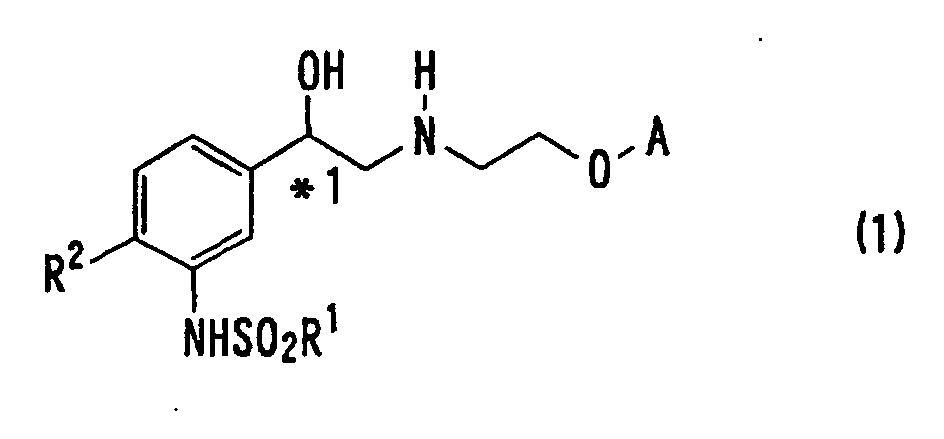
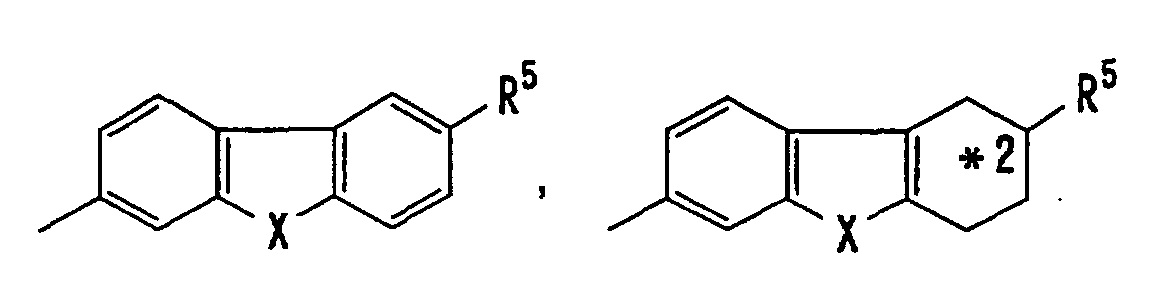 wherein X represents NH, O or S; R5 represents a hydrogen atom, a hydroxyl group, an amino
group or an acetylamino group; and *2 represents an asymmetric carbon atom when R5 is not
a hydrogen atom. This invention also relates to intermediates useful for the preparing
process.
wherein X represents NH, O or S; R5 represents a hydrogen atom, a hydroxyl group, an amino
group or an acetylamino group; and *2 represents an asymmetric carbon atom when R5 is not
a hydrogen atom. This invention also relates to intermediates useful for the preparing
process. wherein X represents NH, O or S; R5 represents a hydrogen atom, a hydroxyl group, an amino group or an acetylamino group; and *2 represents an asymmetric carbon atom when R5 is not a hydrogen atom, said process comprising:
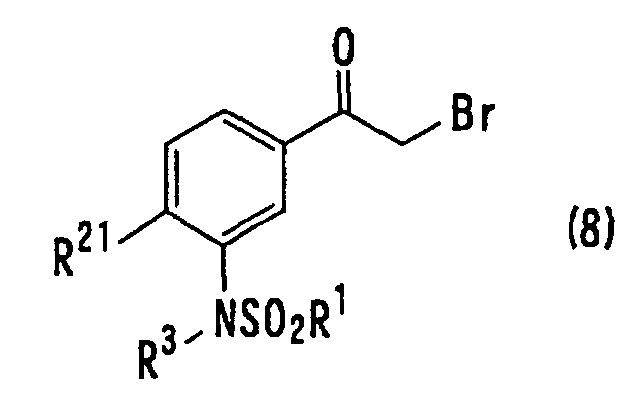
 wherein R1, R21, R3 and *1 are as defined above; or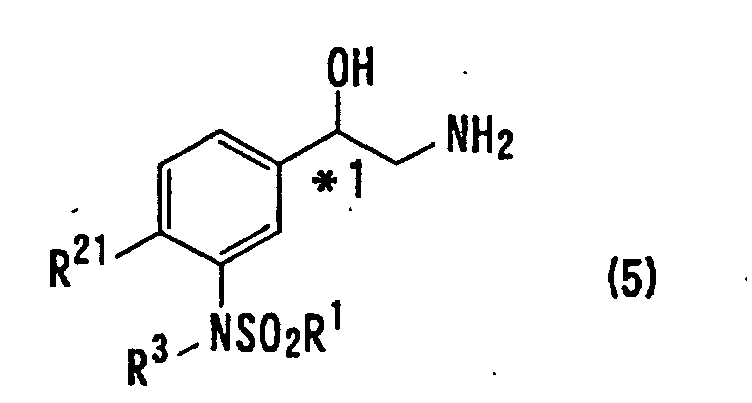
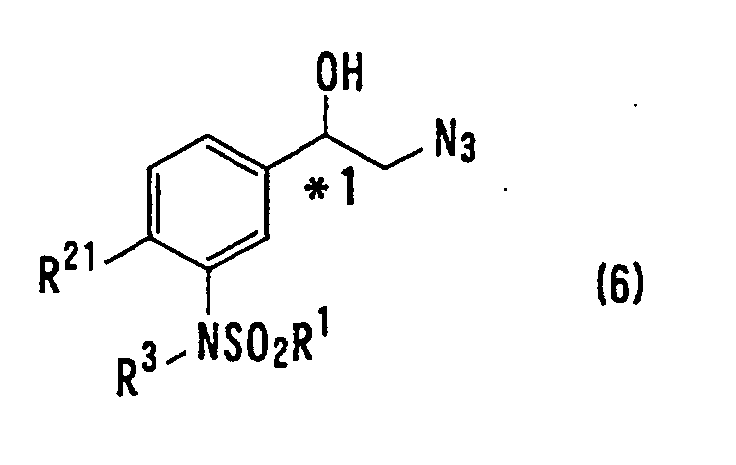
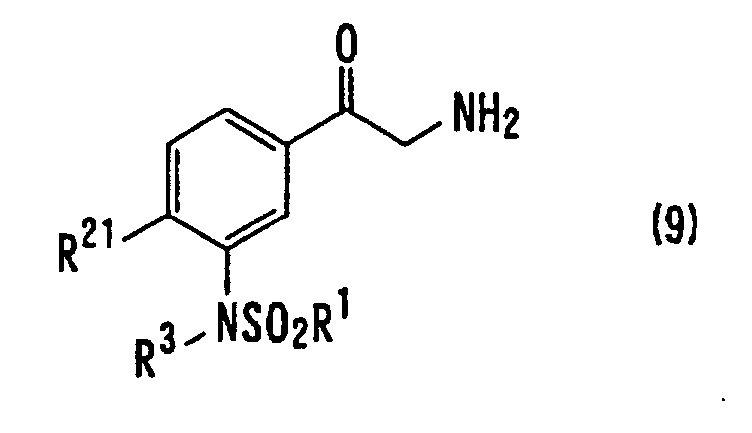
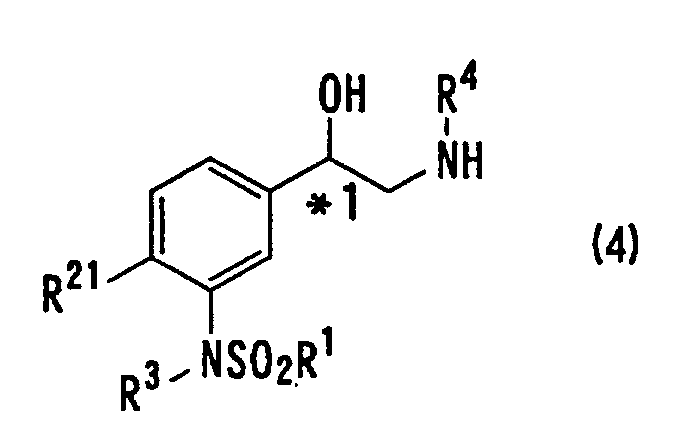
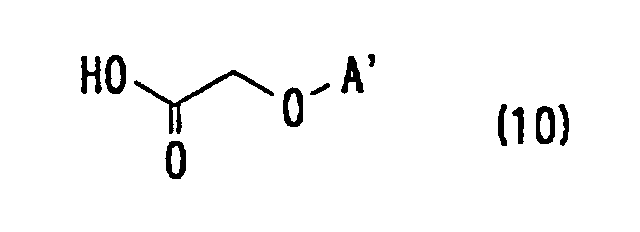 wherein X represents NH, O or S; R51 represents a hydrogen atom, a protected hydroxyl group, a protected amino group or an acetylamino group; and *2 represents an asymmetric carbon atom when R51 is not a hydrogen atom, to give a compound of the formula (3):
 wherein R1, R21, R3, R4, A' and * 1 are as defined above; or reacting the compound of the formula (4) with a compound of the formula (15):
 wherein B1 represents a leaving group, to give a compound of the formula (14):
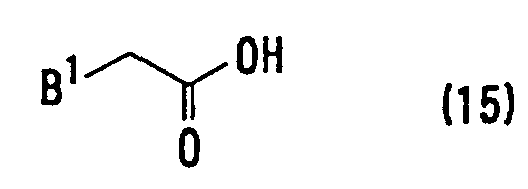 wherein R1, R21, R3, R4, B1 and * 1 are as defined above; and then reacting the resulting compound with a compound represented by A'-OH, wherein A' is as defined above, to give a compound of the formula (3); and then further reducing the compound of the formula (3) obtained in any one of the above steps to give a compound of the formula (2):
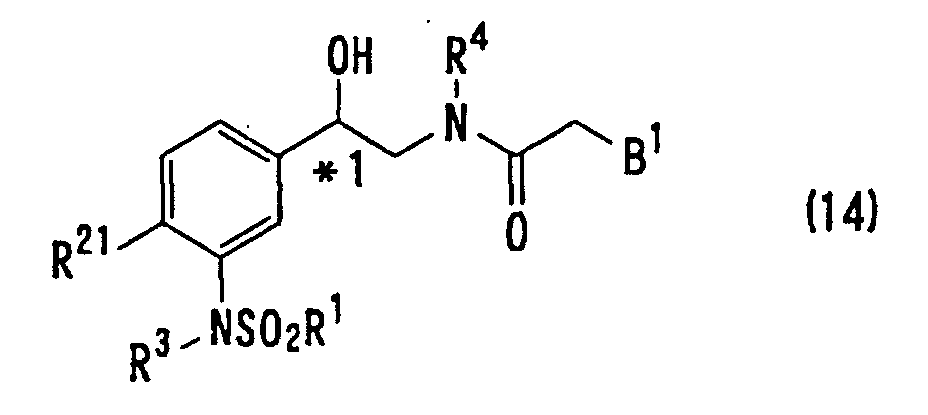 wherein R1, R21, R3, R4, A' and *1 are as defined above; or ii) reacting the compound of the formula (4) with a compound of the formula (11):
 wherein A' is as defined above; and then reducing the resulting compound to give a compound of the formula (2); or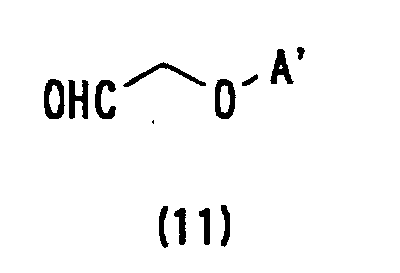
 wherein B2 represents a leaving group and A' is as defined above, to give a
compound of the formula (2);
and then,
wherein B2 represents a leaving group and A' is as defined above, to give a
compound of the formula (2);
and then,  wherein X represents NH, O or S; R5 represents a hydrogen atom, a hydroxyl group, an amino group or an acetylamino group; and *2 represents an asymmetric carbon atom when R5 is not a hydrogen atom, said process comprising:
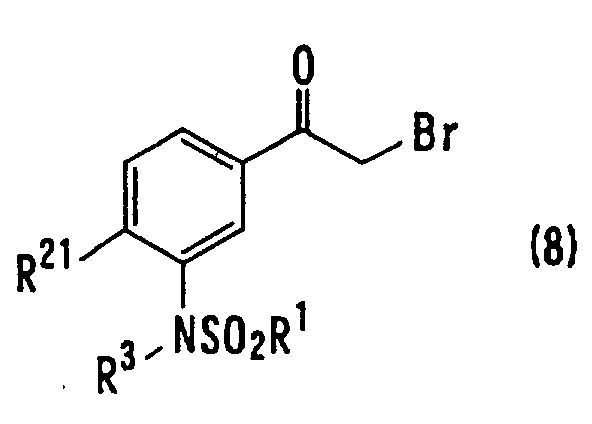
 wherein R1, R21, R3 and * 1 are as defined above; or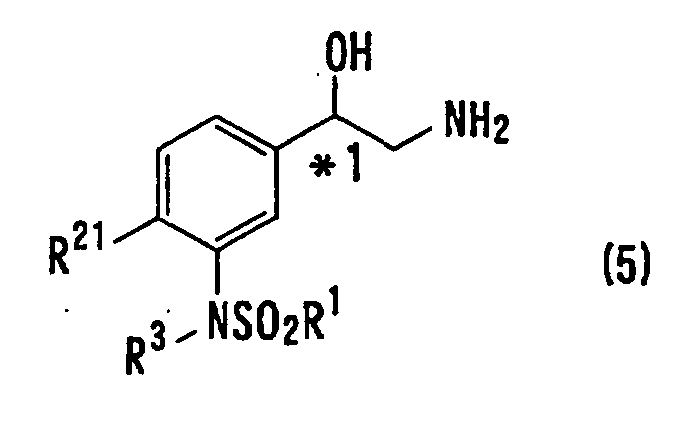
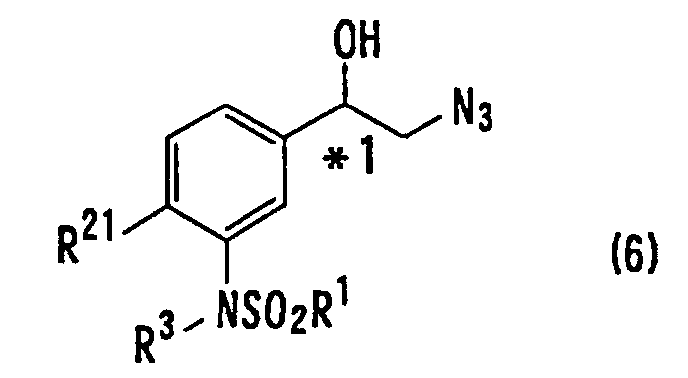

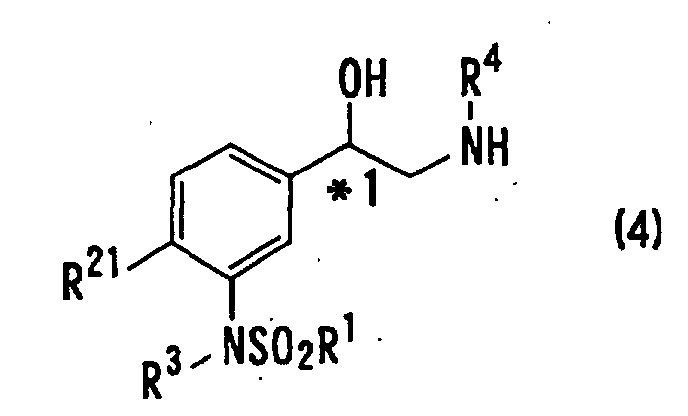 wherein A' represents one of the following groups:
 wherein X represents NH, O or S; R51 represents a hydrogen atom, a protected hydroxyl group, a protected amino group or an acetylamino group; and *2 represents an asymmetric carbon atom when R51 is not a hydrogen atom, to give a compound of the formula (3):
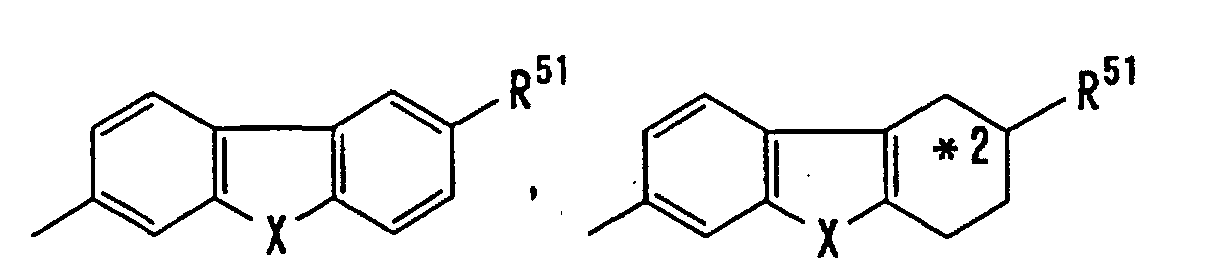 wherein R1, R21, R3, R4, A' and * 1 are as defined above; and then further reducing the compound of the formula (3) to give a compound of the formula (2):
 wherein R1, R21, R3, R4, A' and *1 are as defined above; and then,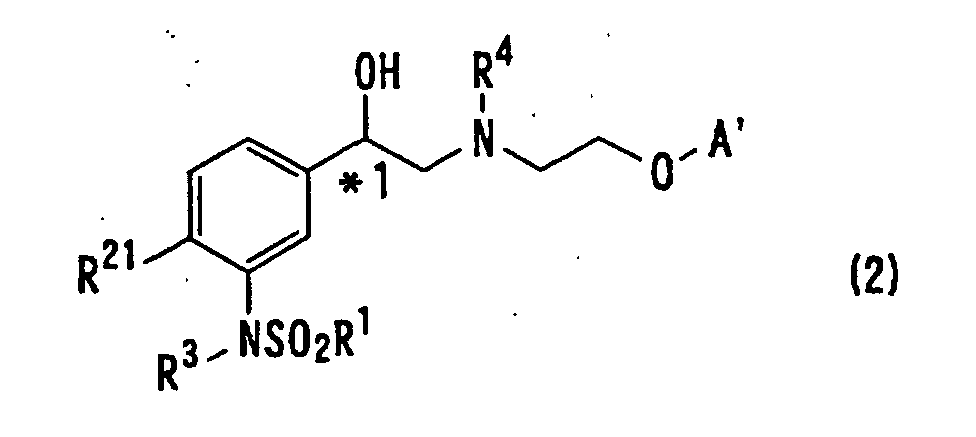
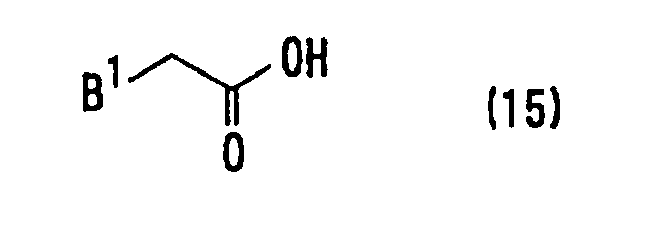 wherein R1, R21, R3, R4, B1 and *1 are as defined above; and
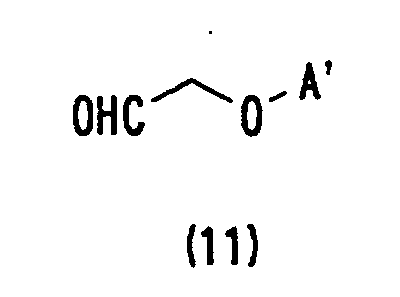
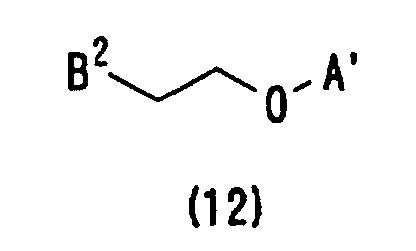
 wherein Cy means a cyclohexyl group.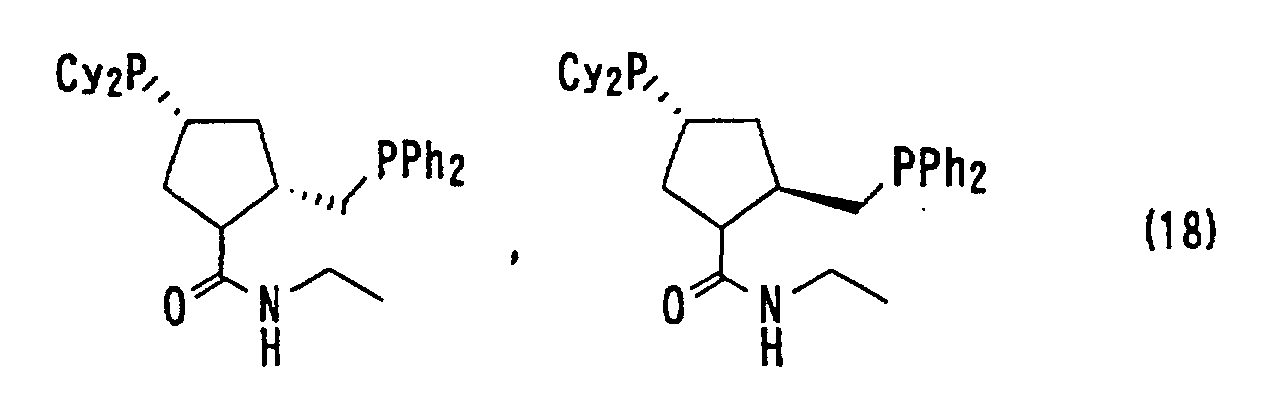
 wherein X represents NH, O or S; R5 represents a hydrogen atom, a hydroxyl group, an amino group or an acetylamino group; and *2 represents an asymmetric carbon atom when R5 is not a hydrogen atom, said process comprising:
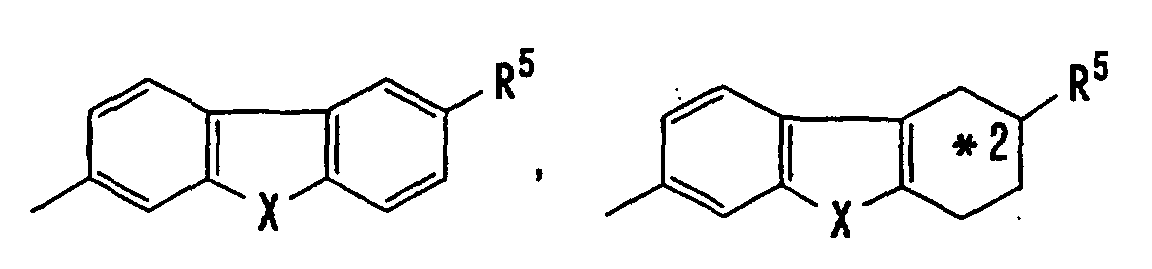 (a)i) azidating a compound of the formula (8):wherein R1 is as defined above; R21 represents a hydrogen atom, a halogen atom, a hydroxyl group or a protected hydroxyl group; R3 represents an amino-protecting group or a hydrogen atom, with an azidating agent to give a compound of the formula (7):
 wherein R1, R21 and R3 are as defined above; and then reducing the compound of the formula (7) to give a compound of the formula (5):
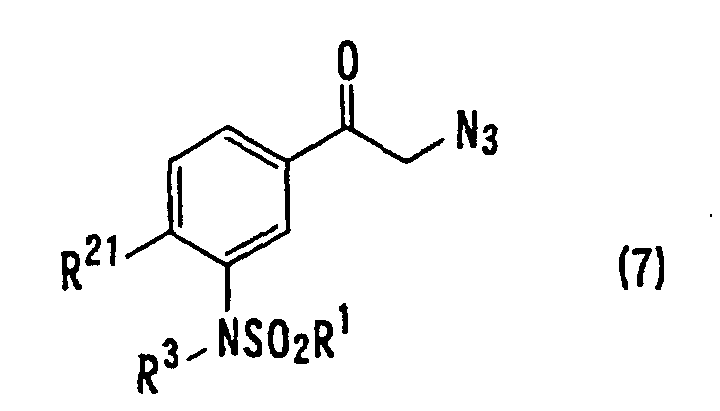 wherein R1, R21, R3 and * 1 are as defined above; or
 ii) asymmetrically reducing the compound of the formula (7) to give a compound of the formula (6):wherein R1, R21, R3 and *1 are as defined above; and then reducing the azido group to give a compound of the formula (5); or alternatively
 iii) converting the terminal bromine atom of the side-chain of a compound of the formula (8) into an amino group by amination reaction to give a compound of the formula (9):wherein R1, R21 and R3 are as defined above; and then reducing the compound of the formula (9) to give a compound of the formula (5); and then,
 (b) where necessary, protecting the compound of the formula (5) obtained in any one of the above steps to give a compound of the formula (4):wherein R1, R21, R3 and *1 are as defined above, and R4 represents an amino-protecting group or a hydrogen atom; and then,
 wherein B2 represents a leaving group and A' is as defined above, to give a compound of the formula (2); and then,i) reacting the compound of the formula (4) with a compound of the formula (10):wherein A' represents one of the following groups:
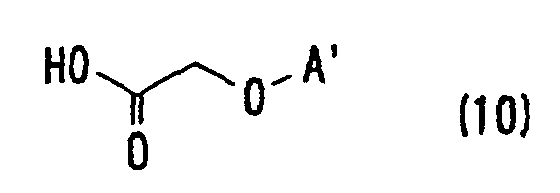 wherein X represents NH, O or S; R51 represents a hydrogen atom, a protected hydroxyl group, a protected amino group or an acetylamino group; and *2 represents an asymmetric carbon atom when R51 is not a hydrogen atom, to give a compound of the formula (3):
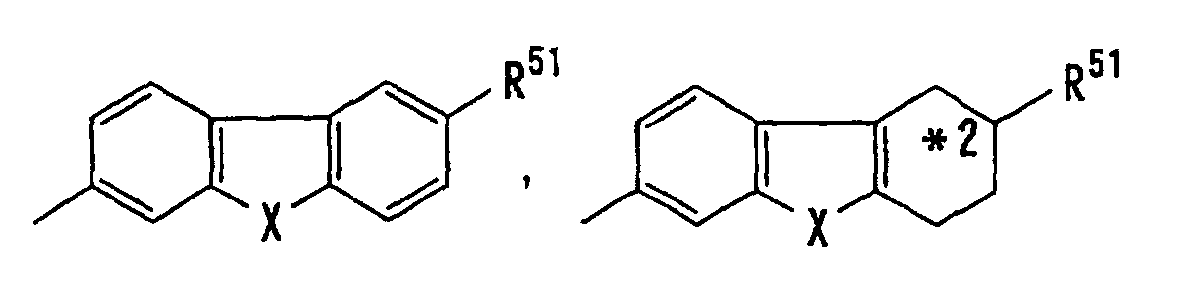 wherein R1, R21, R3, R4, A' and * 1 are as defined above; or reacting the compound of the formula (4) with a compound of the formula (15):
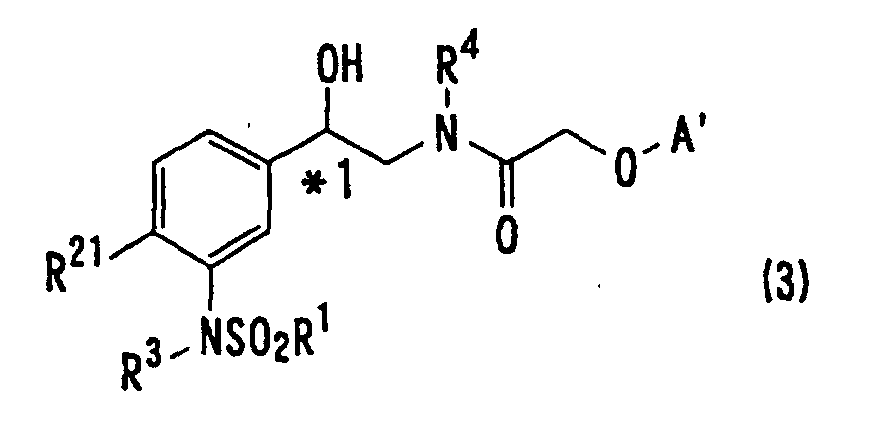 wherein B1 represents a leaving group, to give a compound of the formula (14):
 wherein R1, R21, R3, R4, B1 and * 1 are as defined above; and then reacting the resulting compound with a compound represented by A'-OH, wherein A' is as defined above, to give a compound of the formula (3); and then further reducing the compound of the formula (3) obtained in any one of the above steps to give a compound of the formula (2):
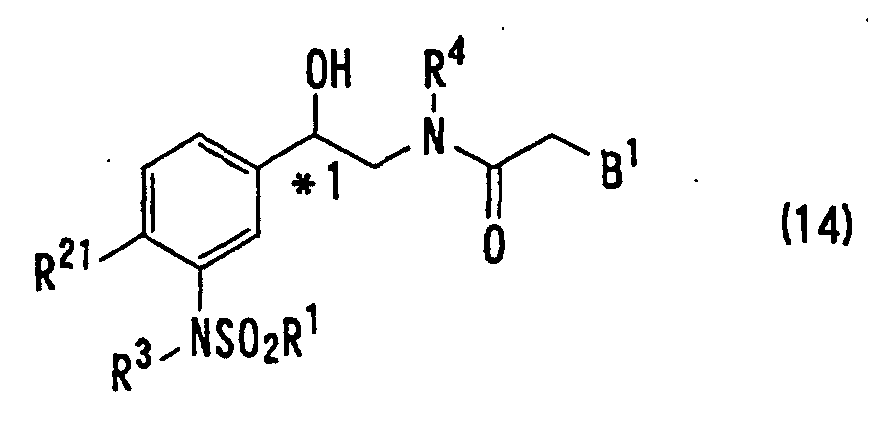 wherein R1, R21, R3, R4, A' and *1 are as defined above; or
 ii) reacting the compound of the formula (4) with a compound of the formula (11):wherein A1 is as defined above; and then reducing the resulting compound to give a compound of the formula (2); or
 iii) reacting the compound of the formula (4) with a compound of the formula (12):
 (c) where necessary, simultaneously or sequentially removing the protecting groups of the compound of the formula (2) obtained in any one of the above steps to give a compound of the formula (1).
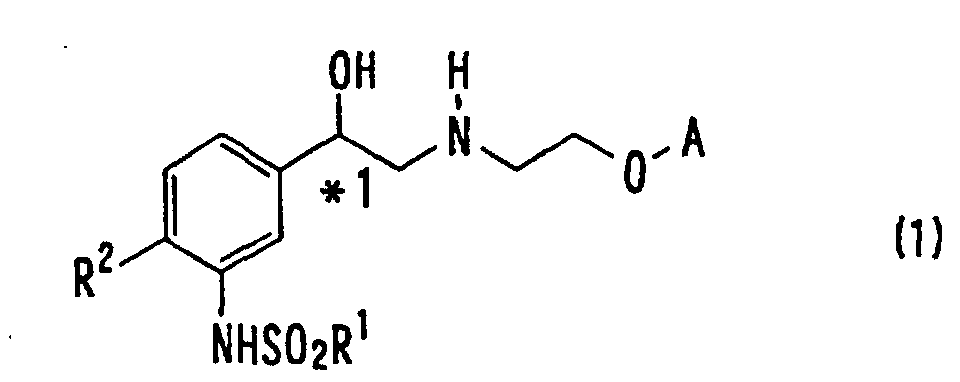 wherein X represents NH, O or S; R5 represents a hydrogen atom, a hydroxyl group, an amino group or an acetylamino group; and *2 represents an asymmetric carbon atom when R5 is not a hydrogen atom, said process comprising:
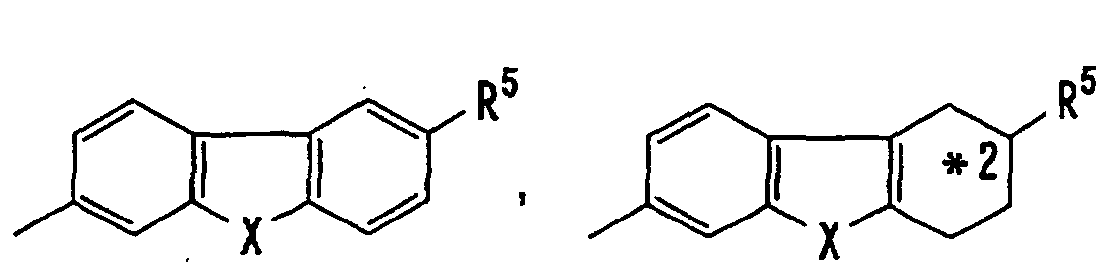 (a)i) azidating a compound of the formula (8):wherein R1 is as defined above; R21 represents a hydrogen atom, a halogen atom, a hydroxyl group or a protected hydroxyl group; R3 represents an amino-protecting group or a hydrogen atom,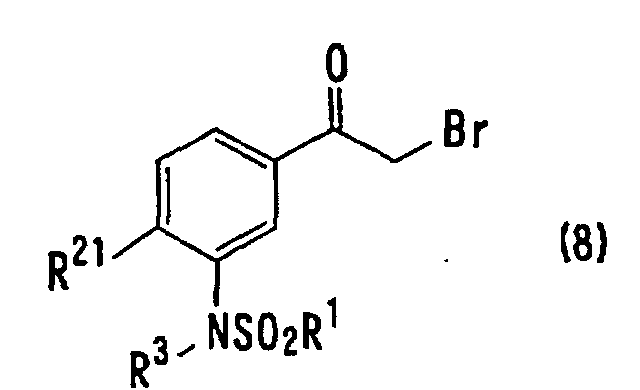
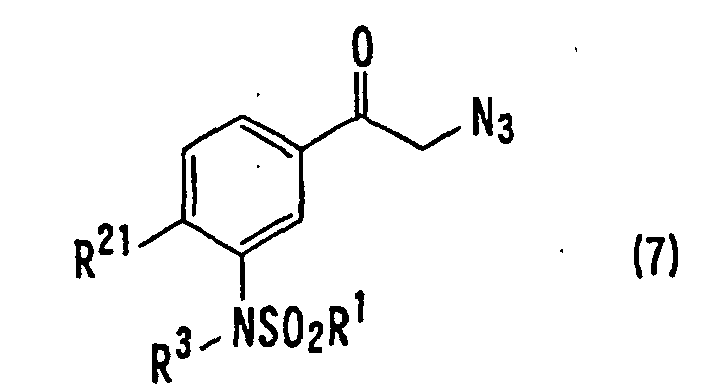 wherein R1, R21, R3 and * 1 are as defined above; or
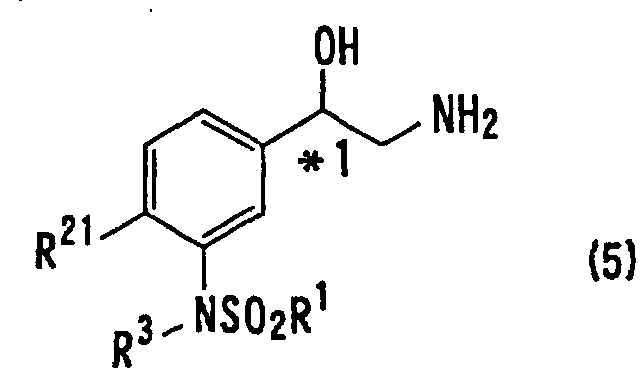 ii) asymmetrically reducing the compound of the formula (7) to give a compound of the formula (6):wherein R1, R21, R3 and * 1 are as defined above; and then reducing the azido group to give a compound of the formula (5); or alternatively
 iii) converting the terminal bromine atom of the side-chain of a compound of the formula (8) into an amino group by amination reaction to give a compound of the formula (9):wherein R1, R21 and R3 are as defined above; and then reducing the compound of the formula (9) to give a compound of the formula (5); and then,
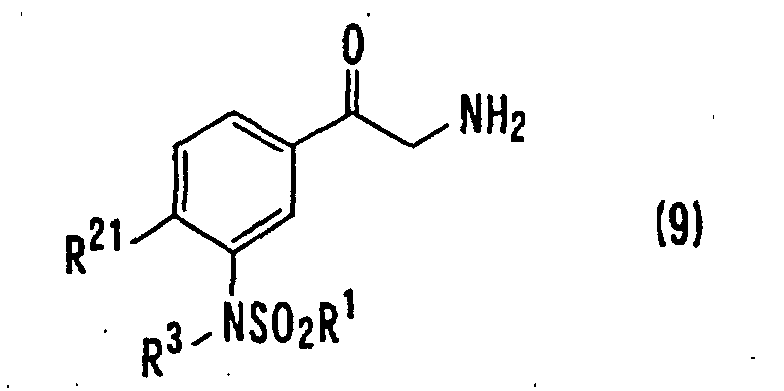 (b) where necessary, protecting the compound of the formula (5) obtained in any one of the above steps to give a compound of the formula (4):wherein R1, R21, R3 and *1 are as defined above, and R4 represents an amino-protecting group or a hydrogen atom; and then,
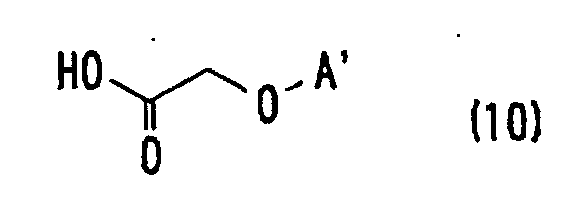 wherein X represents NH, O or S; R51 represents a hydrogen atom, a protected hydroxyl group, a protected amino group or an acetylamino group; and *2 represents an asymmetric carbon atom when R51 is not a hydrogen atom, to give a compound of the formula (3):
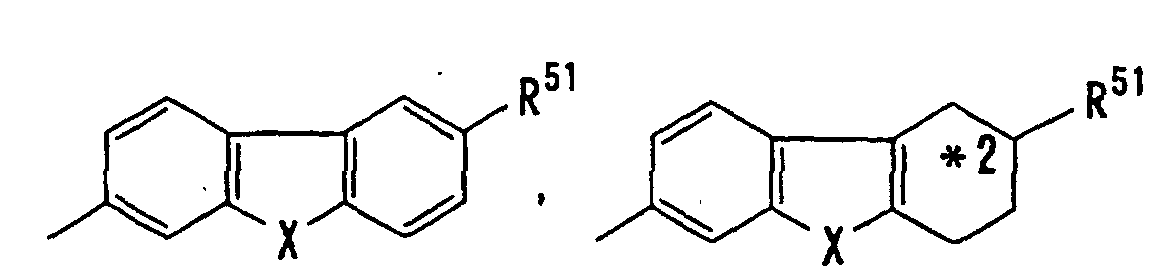 wherein R1, R21, R3, R4, A' and *1 are as defined above; and then further reducing the compound of the formula (3) to give a compound of the formula (2):
 wherein R1, R21, R3, R4, A' and * 1 are as defined above; and then,
 (c) where necessary, simultaneously or sequentially removing the protecting groups of the compound of the formula (2) to give a compound of the formula (1).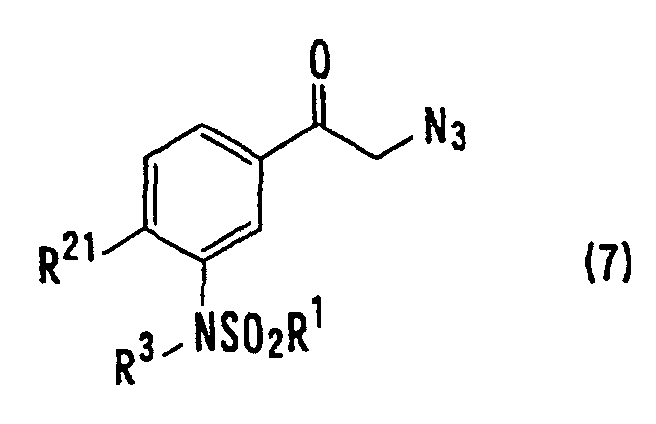


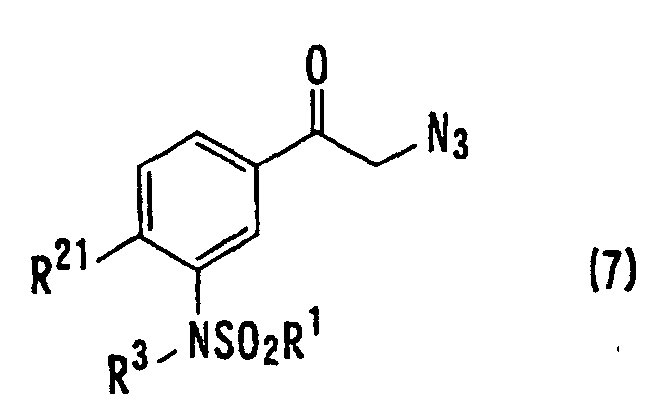
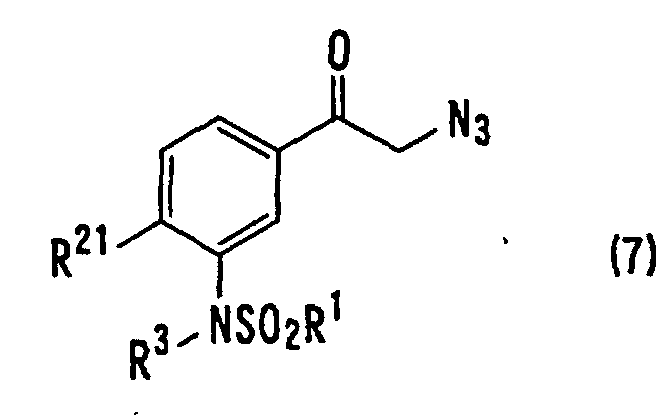


 wherein X represents NH, O or S; R51 represents a hydrogen atom, a protected hydroxyl group, a protected amino group or an acetylamino group; and *2 represents an asymmetric carbon atom when R51 is not a hydrogen atom.