EP1374983A1 - Reaction system of organic substance employing supercritical fluid or sub-critical fluid - Google Patents
Reaction system of organic substance employing supercritical fluid or sub-critical fluid Download PDFInfo
- Publication number
- EP1374983A1 EP1374983A1 EP02703925A EP02703925A EP1374983A1 EP 1374983 A1 EP1374983 A1 EP 1374983A1 EP 02703925 A EP02703925 A EP 02703925A EP 02703925 A EP02703925 A EP 02703925A EP 1374983 A1 EP1374983 A1 EP 1374983A1
- Authority
- EP
- European Patent Office
- Prior art keywords
- fluid
- substance
- organic
- reaction
- subcritical
- Prior art date
- Legal status (The legal status is an assumption and is not a legal conclusion. Google has not performed a legal analysis and makes no representation as to the accuracy of the status listed.)
- Withdrawn
Links
Images







Classifications
-
- C—CHEMISTRY; METALLURGY
- C10—PETROLEUM, GAS OR COKE INDUSTRIES; TECHNICAL GASES CONTAINING CARBON MONOXIDE; FUELS; LUBRICANTS; PEAT
- C10J—PRODUCTION OF PRODUCER GAS, WATER-GAS, SYNTHESIS GAS FROM SOLID CARBONACEOUS MATERIAL, OR MIXTURES CONTAINING THESE GASES; CARBURETTING AIR OR OTHER GASES
- C10J3/00—Production of combustible gases containing carbon monoxide from solid carbonaceous fuels
-
- B—PERFORMING OPERATIONS; TRANSPORTING
- B01—PHYSICAL OR CHEMICAL PROCESSES OR APPARATUS IN GENERAL
- B01J—CHEMICAL OR PHYSICAL PROCESSES, e.g. CATALYSIS OR COLLOID CHEMISTRY; THEIR RELEVANT APPARATUS
- B01J3/00—Processes of utilising sub-atmospheric or super-atmospheric pressure to effect chemical or physical change of matter; Apparatus therefor
-
- B—PERFORMING OPERATIONS; TRANSPORTING
- B01—PHYSICAL OR CHEMICAL PROCESSES OR APPARATUS IN GENERAL
- B01J—CHEMICAL OR PHYSICAL PROCESSES, e.g. CATALYSIS OR COLLOID CHEMISTRY; THEIR RELEVANT APPARATUS
- B01J3/00—Processes of utilising sub-atmospheric or super-atmospheric pressure to effect chemical or physical change of matter; Apparatus therefor
- B01J3/006—Processes utilising sub-atmospheric pressure; Apparatus therefor
-
- B—PERFORMING OPERATIONS; TRANSPORTING
- B01—PHYSICAL OR CHEMICAL PROCESSES OR APPARATUS IN GENERAL
- B01J—CHEMICAL OR PHYSICAL PROCESSES, e.g. CATALYSIS OR COLLOID CHEMISTRY; THEIR RELEVANT APPARATUS
- B01J3/00—Processes of utilising sub-atmospheric or super-atmospheric pressure to effect chemical or physical change of matter; Apparatus therefor
- B01J3/008—Processes carried out under supercritical conditions
-
- C—CHEMISTRY; METALLURGY
- C10—PETROLEUM, GAS OR COKE INDUSTRIES; TECHNICAL GASES CONTAINING CARBON MONOXIDE; FUELS; LUBRICANTS; PEAT
- C10J—PRODUCTION OF PRODUCER GAS, WATER-GAS, SYNTHESIS GAS FROM SOLID CARBONACEOUS MATERIAL, OR MIXTURES CONTAINING THESE GASES; CARBURETTING AIR OR OTHER GASES
- C10J3/00—Production of combustible gases containing carbon monoxide from solid carbonaceous fuels
- C10J3/72—Other features
- C10J3/78—High-pressure apparatus
-
- B—PERFORMING OPERATIONS; TRANSPORTING
- B01—PHYSICAL OR CHEMICAL PROCESSES OR APPARATUS IN GENERAL
- B01J—CHEMICAL OR PHYSICAL PROCESSES, e.g. CATALYSIS OR COLLOID CHEMISTRY; THEIR RELEVANT APPARATUS
- B01J2219/00—Chemical, physical or physico-chemical processes in general; Their relevant apparatus
- B01J2219/00002—Chemical plants
- B01J2219/00004—Scale aspects
- B01J2219/00006—Large-scale industrial plants
-
- B—PERFORMING OPERATIONS; TRANSPORTING
- B01—PHYSICAL OR CHEMICAL PROCESSES OR APPARATUS IN GENERAL
- B01J—CHEMICAL OR PHYSICAL PROCESSES, e.g. CATALYSIS OR COLLOID CHEMISTRY; THEIR RELEVANT APPARATUS
- B01J2219/00—Chemical, physical or physico-chemical processes in general; Their relevant apparatus
- B01J2219/00049—Controlling or regulating processes
- B01J2219/00245—Avoiding undesirable reactions or side-effects
- B01J2219/00247—Fouling of the reactor or the process equipment
-
- C—CHEMISTRY; METALLURGY
- C10—PETROLEUM, GAS OR COKE INDUSTRIES; TECHNICAL GASES CONTAINING CARBON MONOXIDE; FUELS; LUBRICANTS; PEAT
- C10J—PRODUCTION OF PRODUCER GAS, WATER-GAS, SYNTHESIS GAS FROM SOLID CARBONACEOUS MATERIAL, OR MIXTURES CONTAINING THESE GASES; CARBURETTING AIR OR OTHER GASES
- C10J2300/00—Details of gasification processes
- C10J2300/09—Details of the feed, e.g. feeding of spent catalyst, inert gas or halogens
- C10J2300/0913—Carbonaceous raw material
- C10J2300/0916—Biomass
- C10J2300/092—Wood, cellulose
-
- C—CHEMISTRY; METALLURGY
- C10—PETROLEUM, GAS OR COKE INDUSTRIES; TECHNICAL GASES CONTAINING CARBON MONOXIDE; FUELS; LUBRICANTS; PEAT
- C10J—PRODUCTION OF PRODUCER GAS, WATER-GAS, SYNTHESIS GAS FROM SOLID CARBONACEOUS MATERIAL, OR MIXTURES CONTAINING THESE GASES; CARBURETTING AIR OR OTHER GASES
- C10J2300/00—Details of gasification processes
- C10J2300/09—Details of the feed, e.g. feeding of spent catalyst, inert gas or halogens
- C10J2300/0913—Carbonaceous raw material
- C10J2300/0946—Waste, e.g. MSW, tires, glass, tar sand, peat, paper, lignite, oil shale
-
- C—CHEMISTRY; METALLURGY
- C10—PETROLEUM, GAS OR COKE INDUSTRIES; TECHNICAL GASES CONTAINING CARBON MONOXIDE; FUELS; LUBRICANTS; PEAT
- C10J—PRODUCTION OF PRODUCER GAS, WATER-GAS, SYNTHESIS GAS FROM SOLID CARBONACEOUS MATERIAL, OR MIXTURES CONTAINING THESE GASES; CARBURETTING AIR OR OTHER GASES
- C10J2300/00—Details of gasification processes
- C10J2300/09—Details of the feed, e.g. feeding of spent catalyst, inert gas or halogens
- C10J2300/0953—Gasifying agents
- C10J2300/0973—Water
- C10J2300/0979—Water as supercritical steam
-
- Y—GENERAL TAGGING OF NEW TECHNOLOGICAL DEVELOPMENTS; GENERAL TAGGING OF CROSS-SECTIONAL TECHNOLOGIES SPANNING OVER SEVERAL SECTIONS OF THE IPC; TECHNICAL SUBJECTS COVERED BY FORMER USPC CROSS-REFERENCE ART COLLECTIONS [XRACs] AND DIGESTS
- Y02—TECHNOLOGIES OR APPLICATIONS FOR MITIGATION OR ADAPTATION AGAINST CLIMATE CHANGE
- Y02P—CLIMATE CHANGE MITIGATION TECHNOLOGIES IN THE PRODUCTION OR PROCESSING OF GOODS
- Y02P20/00—Technologies relating to chemical industry
- Y02P20/141—Feedstock
- Y02P20/145—Feedstock the feedstock being materials of biological origin
-
- Y—GENERAL TAGGING OF NEW TECHNOLOGICAL DEVELOPMENTS; GENERAL TAGGING OF CROSS-SECTIONAL TECHNOLOGIES SPANNING OVER SEVERAL SECTIONS OF THE IPC; TECHNICAL SUBJECTS COVERED BY FORMER USPC CROSS-REFERENCE ART COLLECTIONS [XRACs] AND DIGESTS
- Y02—TECHNOLOGIES OR APPLICATIONS FOR MITIGATION OR ADAPTATION AGAINST CLIMATE CHANGE
- Y02P—CLIMATE CHANGE MITIGATION TECHNOLOGIES IN THE PRODUCTION OR PROCESSING OF GOODS
- Y02P20/00—Technologies relating to chemical industry
- Y02P20/50—Improvements relating to the production of bulk chemicals
- Y02P20/54—Improvements relating to the production of bulk chemicals using solvents, e.g. supercritical solvents or ionic liquids
Definitions
- the present invention relates to a reaction apparatus for organic and/or other substances employing supercritical fluid(s) or subcritical fluid(s). More specifically, the present invention relates to a reaction apparatus using supercritical fluid(s) and/or subcritical fluid(s) for reactive treatment or decomposition of reactant substance(s); biomass(es) and/or other such organic substance(s) and/or the like being employed as such reactant substance(s).
- This supercritical water possesses excellent advantages such as the fact that the polar nature thereof can be controlled based on temperature and pressure, permitting solubilization of paraffinic hydrocarbons, benzene, and other such nonpolar substances; the fact that it displays extremely excellent properties as reaction solvent for oxidative decomposition of organic matter in that it mixes in arbitrary ratios even with oxygen and other such gases, and also the fact that because it is possible to raise temperature to the critical temperature or higher using only heat of oxidation where the fractional carbon content of the material being decomposed is several percent, it is extremely excellent from a thermal energy standpoint as well; and the fact that by using supercritical water it is possible through hydrolytic reaction and/or thermolytic reaction to more or less completely decompose almost any kind of decomposition-resistant organic matter, poisonous organic matter, or the like.
- Methods for reducing energy during pressurization in the case of supercritical-fluid and/or subcritical-fluid high-temperature, high-pressure fluid(s) include the development of the continuous autoclave utilizing the pipeline system (Nakamichi Yamasaki, Suinetsu Kagaku Jikkensho Houkoku, Vol. 3 1 - 4 (1979).
- piston(s) and cylinder(s) are used to recover pressure from post-treatment high-temperature, high-pressure fluid(s); and reduction in energy during pressurization of unpressurized fluid(s) is achieved through use of other piston(s) and cylinder(s) linked to piston(s) used for recovery.
- This apparatus is provided with second drive means accepting the load of the driving force from first drive means employing piston(s) within cylinder(s) to receive pressure from post-treatment high-temperature, high-pressure fluid(s) and transmitting same as force to pressurize pre-treatment fluid(s). That is, the apparatus is such that, after being reduced using back pressure valve(s), energy of post-treatment high-pressure fluid(s) is introduced into cylinder(s) at the aforesaid first drive means. The apparatus is such that this permits fluid(s) including reactant substance(s) to be made to assume high temperature(s) and high pressure(s) and to be supplied in stable fashion to reaction system(s).
- Methods for shortening time for rapid treatment of reactant substance(s) with supercritical-fluid and/or subcritical-fluid high-temperature, high-pressure fluid(s) include methods employing continuous reaction apparatuses for cellulose hydrolysis (M. Sasaki, B. Kabyemela, R. Malaluan S. Hirose, N. Takeda, T. Adschiri, K. Arai; Cellulose hydrolysis in subcritical and supercritical water, J. Supercrit. Fluids 1998. 13. 261-268.). This method is carried out using a flow-type reaction apparatus, treatment of reactant substance(s) being carried out according to the following sequence.
- reactant substance(s) are directly mixed in the vicinity of reaction vessel inlet(s) with supercritical water which has been heated and pressurized under prescribed conditions, rapidly raising the temperature thereof until target optimum reaction temperature(s) are reached. Furthermore, at reaction vessel outlet(s), rapid cooling is carried out through external cooling by direct delivery of cold water to reaction liquid(s). In such case, shortening of the time for treating reactant substance(s) with supercritical water is made possible by reducing reaction vessel volume and/or increasing flow rate.
- reaction apparatuses for organic substance(s) and/or the like employing supercritical fluid(s), e.g., where reactant substance(s) are wood meal and/or other such organic substance(s), water under high pressure and wherein organic substance(s) have been dispersed is rapidly heated and is maintained in supercritical and/or subcritical state(s) for fixed period(s) of time, hydrolytic reaction(s) occurring while in such supercritical and/or subcritical state(s) permitting saccharification reaction(s) to be carried out wherein wood meal and/or other such organic substance(s) are made into glucose and/or other such low-molecular-weight sugar(s).
- supercritical fluid(s) e.g., where reactant substance(s) are wood meal and/or other such organic substance(s), water under high pressure and wherein organic substance(s) have been dispersed is rapidly heated and is maintained in supercritical and/or subcritical state(s) for fixed period(s) of time, hydrolytic reaction(s) occurring while in such supercritical and/or sub
- Such saccharification reaction(s) may be carried out fluid(s) to occur in extremely brief period(s) of time, and also permitting actuation to occur in industrial fashion and at high energy efficiency.
- a reaction apparatus for organic and/or other substance(s) employing supercritical fluid(s) and/or subcritical fluid(s) in accordance with the present invention is characterized in that means for compressing vapor(s) and obtaining supercritical fluid(s) and/or subcritical fluid(s), means for bringing such supercritical fluid(s) and/or subcritical fluid(s) into contact with organic matter and/or other reactant substance(s) and causing occurrence of chemical reaction(s), and means for causing expansion and decompression of fluid(s) including product(s) produced as a result of such chemical reaction(s) comprise cylinder(s) and piston(s) provided at such cylinder(s), the reaction apparatus being made to actuate in periodic fashion by actuating such piston(s) to cause compression of fluid(s); actuating piston(s) in reverse direction(s) following chemical reaction(s) involving reactant substance(s) and lowering temperature(s) and pressure(s); and removing, from
- a reaction apparatus for organic and/or other substance(s) employing supercritical fluid(s) and/or subcritical fluid(s) in accordance with the present invention is constituted such that means for compressing vapor(s) and obtaining supercritical fluid(s) and/or subcritical fluid(s), means for bringing supercritical fluid(s) and/or subcritical fluid(s) into contact with organic matter and/or other reactant substance(s) and causing occurrence of chemical reaction(s), and means for causing expansion and decompression of fluid(s) including product(s) produced as a result of chemical reaction(s) comprise cylinder(s) and piston(s) provided at such cylinder(s), the reaction apparatus being made to actuate in periodic fashion by operating such piston(s) to cause compression of vapor(s); operating piston(s) in reverse direction(s) following conclusion of chemical reaction(s) and lowering temperature(s) and pressure(s); and removing, from cylinder(s), fluid(s) including product(s) obtained and delivering new charge(s) of vapor
- the aforesaid cylinder(s) and piston(s) are reciprocating-type reactor(s), and from a functional standpoint, are of the exact same physical type as plunger-type apparatuses wherein plunger(s) engage in reciprocating motion within cylinder(s).
- Reaction apparatus(es) in accordance with the present invention are such that pressurization, heating, reaction, cooling, and decompression take place within the same cylinder(s) as a result of operation of piston(s) at cylinder(s). This being the case, simplification of the reaction apparatus is made possible.
- a reaction apparatus in accordance with the present invention employs piston(s) to adiabaticly compress vapor(s) introduced into cylinder(s) and attain supercritical and/or subcritical state(s) of fluid(s). Thereafter, piston(s) are again driven, adiabatic expansion of fluid(s) causing cooling of supercritical and/or subcritical state(s) of such fluid(s).
- reaction apparatuses where implemented in the context of flow-type apparatuses, make use of apparatus constitutions employing processes wherein realization of high-temperature supercritical water state(s) occurs as a result of mixing of low-temperature, supercritical-pressure water wherein wood meal is dispersed with high-temperature supercritical water and causing reaction(s) to proceed, and wherein stopping of such reaction(s) is carried out through injection of cold water therein.
- Supercritical-fluid temperature and pressure conditions realized inside the apparatus of the present invention may be freely controlled based on fluid compression ratio(s), temperature(s) of saturated vapor(s) introduced thereinto, and amount(s) of liquid(s) (water in the case where the fluid is water) added.
- introduction of substance(s) being treated into reactor(s) is carried out using nozzle(s) to spray same at high pressure together with liquid(s) at stage(s) where saturated vapor(s) of fluid(s) are introduced into cylinder(s) and/or during mid-compression of vapor(s), introduction can be carried out such that substance(s) being treated are homogeneously dispersed in reactor(s).
- reaction apparatus(es) in accordance with the present invention as examples of fluids which may attain supercritical state(s)-in addition to water-carbon dioxide, nitrous oxide, Freon 12, Freon 13, ethane, ethylene, propane, propylene, butane, hexane, methanol, ethanol, benzene, toluene, ammonia-and a wide variety of other substances in addition thereto-may be cited.
- Vapor(s) in reaction apparatus(es) in accordance with the present invention may be vapor(s) of any of the aforesaid varieties of fluids, and may be obtained using boiler(s) or the like. Compressive action occurring within reactor(s) into which such fluid vapor(s) have been introduced causes same to assume supercritical state(s). Such compression causes high-temperature, high-pressure fluid(s) in target supercritical and/or subcritical state(s) to be produced in short period(s) of time when piston(s) are near top dead center. Contact between such high-temperature, high-pressure fluid(s) and reactant substance(s) causes hydrolytic reaction(s) and/or the like to occur at reactant substance(s), and this permits reactant substance(s) to be decomposed and/or the like.
- reaction apparatus(es) in accordance with the present invention temperature(s) and pressure(s) of target [value(s)] or greater might for example be attained for approximately 1/20th of the stroke(s) of the piston(s) in the reactor(s), and if dwell time(s) thereat were to be made to be 0.01 sec this would work out to be approximately 300 rpm.
- Supercritical conditions for fluid(s) in reaction apparatus(es) in accordance with the present invention include supercritical fluid(s) and subcritical fluid(s).
- supercritical fluid(s) and subcritical fluid(s) For example, while both the temperature and the pressure of a supercritical fluid might be in supercritical states, the temperature or the pressure of a subcritical fluid might be at supercritical conditions, which would mean that conditions are calmer than supercritical conditions. Accordingly, with respect to reaction conditions, selection of supercritical fluid(s) and subcritical conditions should be carried out as appropriate based on type(s) of reactant substance(s), type(s) of reaction product(s), and so forth.
- high-temperature, high-pressure fluid(s) at reactor(s) in reaction apparatus(es) in accordance with the present invention are thereafter rapidly cooled by rapid expansion of cylinder volume(s) or the like due to piston(s) or the like.
- This rapid cooling causes chemical reaction(s) of reactant substance(s) to be frozen (forcibly stopped).
- This freezing of reaction(s) may be carried out in extremely brief period(s) of time, as was the case with the aforesaid compression process(es).
- Product(s) are moreover discharged from reactor interior(s) together with vapor(s) when piston(s) are near bottom dead center.
- Reaction apparatus(es) in accordance with the present invention may be constituted such that driving of piston(s) causes vapor(s) to be compressed at only one side within cylinder(s).
- Reaction apparatuses for organic and/or other substance(s) employing supercritical fluid(s) and/or subcritical fluid(s) in accordance with the present invention include constitutions wherein delivery of new charge(s) of vapor(s) to cylinder(s) only involves saturated vapor(s), saturated fluid liquid(s) or cold fluid(s) being injected into cylinder(s) together with reactant substance(s) during initiation of compression by piston(s), in mid-compression, or following conclusion of compression.
- Reaction apparatuses for organic and/or other substance(s) employing supercritical fluid(s) and/or subcritical fluid(s) in accordance with the present invention include constitutions wherein volume(s), at which vapor compression is carried out, formed by piston(s) and cylinder(s) are provided to either side of piston(s), and/or constitutions wherein compressor-expander(s) is or are provided to either side of piston(s), with injector(s) (feedstock spray apparatus(es)) being provided at each thereof.
- Reaction apparatuses for organic and/or other substance(s) employing supercritical fluid(s) and/or subcritical fluid(s) in accordance with the present invention include constitutions wherein wet vapor(s) are compressed by one of volumes or sets of volumes, at which compression of vapor(s) is carried out, formed by piston(s) and cylinder(s) and provided to either side of piston(s), the other of volumes or sets of volumes being maintained at high pressure(s).
- Reaction apparatuses for organic and/or other substance(s) employing supercritical fluid(s) and/or subcritical fluid(s) in accordance with the present invention include constitutions wherein, at mechanism(s) comprising cylinder(s) and piston(s) provided at such cylinder(s), work of piston(s) is recovered. Recovery of work of piston(s) makes it possible to drive reactor(s) with high energy efficiency.
- Reaction apparatus(es) for organic and/or other substance(s) employing supercritical fluid(s) and/or subcritical fluid(s) in accordance with the present invention include constitutions wherein means for compressing vapor(s) and obtaining supercritical fluid(s) and/or subcritical fluid(s), means for bringing supercritical fluid(s) and/or subcritical fluid(s) into contact with organic matter and/or other reactant substance(s) and causing occurrence of chemical reaction(s), and means for causing expansion and decompression of fluid(s) including product(s) produced as a result of chemical reaction(s) comprise rotor chamber(s) and rotor(s) provided at such rotor chamber(s), the reaction apparatus being made to actuate in periodic fashion by rotating such rotor(s) within rotor chamber(s) to cause compression of vapor(s); further rotating rotor(s) following the aforesaid chemical reaction(s) and lowering temperature(s) and pressure(s), and removing, from rotor chamber
- rotary mechanism(s) comprising rotor chamber(s) and rotor(s) provided at such rotor chamber(s) possess the advantage that compression and expansion of substance(s) to be treated which are introduced into rotor chamber(s) can be carried out more rapidly, as well as the fact that reductions in size and weight can be achieved.
- Reaction apparatuses for organic and/or other substance(s) employing supercritical fluid(s) and/or subcritical fluid(s) in accordance with the present invention include constitutions wherein means for compressing vapor(s) and obtaining supercritical fluid(s) and/or subcritical fluid(s), means for bringing supercritical fluid(s) and/or subcritical fluid(s) into contact with organic matter and/or other reactant substance(s) and causing occurrence of chemical reaction(s), and means for causing expansion and decompression of fluid(s) including product(s) produced as a result of chemical reaction(s) comprise turbocompressor(s) and turbine(s) directly coupled to such turbocompressor(s); operation of turbocompressor(s) causing compression of vapor(s), temperature(s) and pressure(s) being lowered by way of turbine(s) following conclusion of chemical reaction(s), and motive force(s) being recovered as a result of direct coupling of turbocompressor(s) and turbine(s) extracting therefrom fluid(s) including
- Reaction apparatuses for organic and/or other substance(s) employing supercritical fluid(s) and/or subcritical fluid(s) in accordance with the present invention include constitutions provided with means for causing fluid(s) including product(s) obtained from reaction(s) to be separated into saturated fluid(s) and saturated vapor fluid(s) by cyclone separator(s) and/or centrifugal separator(s).
- reaction apparatuses for organic and/or other substance(s) employing supercritical fluid(s) and/or subcritical fluid(s) in accordance with the present invention there are constitutions provided with explosive disintegration apparatus(es) that rapidly depressurize reactant substance(s) while same is or are immersed in high-pressure saturated fluid(s); reactant substance(s) being pulverized by such explosive disintegration apparatus(es). This is for making it possible, through pulverization, to easily and quickly introduce reactant substance(s) into the reaction apparatus of the present invention.
- reaction apparatuses for organic and/or other substance(s) employing supercritical fluid(s) and/or subcritical fluid(s) in accordance with the present invention are constitutions wherein passage switching valve(s) and/or other such open-/close-type member(s) are respectively provided at introductive port(s) and scavenging valves(s) in mechanism(s) comprising cylinder(s), rotor chamber(s), and/or turbocompressor(s) and piston(s) for such cylinder(s), rotor(s) for such rotor chamber(s), and/or turbine(s) for such turbocompressor(s); such open-/close-type member(s) being such as to allow setting of open and/or closed time(s) thereof, and setting of such open-/close-type member(s) so as to cause closure thereof for fixed period(s) of time permitting supercritical treatment at such mechanism(s) to be carried out continuously and in ongoing fashion.
- Reaction apparatuses for organic and/or other substance(s) employing supercritical fluid(s) and/or subcritical fluid(s) in accordance with the present invention include constitutions wherein mechanism(s) comprising cylinder(s), rotor chamber(s), and/or turbocompressor(s) and piston(s), rotor(s), and/or turbine(s) for same are such that a plurality thereof are provided.
- Ways of increasing reaction yield(s) of reaction(s) include, in addition to formation of multiple banks of cylinders and/or the like, provision of a plurality of such mechanisms.
- this may be constituted such that scavenger member(s) and member(s) introducing vapor(s) into respective cylinder(s), respective rotor chamber(s), and/or respective turbocompressor(s) in mechanism(s) comprising cylinder(s), rotor chamber(s), and/or turbocompressor(s) and piston(s), rotor(s), and/or turbine(s) for same, there being a plurality thereof, are sequentially coupled by way of passage coupling valve(s) and/or other such open-/close-type member(s); permitting respective processes performed by means for compressing vapor(s) and obtaining supercritical fluid(s) and/or subcritical fluid(s), means for bringing supercritical fluid(s) and/or subcritical fluid(s) into contact with organic matter and/or other reactant substance(s) and causing occurrence of chemical reaction(s), and means for causing expansion and decompression of fluid(s) including product(s) produced as a result of
- Reaction apparatuses for organic and/or other substance(s) employing supercritical fluid(s) and/or subcritical fluid(s) in accordance with the present invention include constitutions provided with oxidant-introducing apparatus(es) permitting introduction of oxidant(s) into cylinder(s), rotor chamber(s), and/or turbocompressor(s); introduced organic matter and/or other reactant substance(s) being oxidatively decomposed while in supercritical and/or subcritical state(s).
- reaction apparatuses for organic and/or other substance(s) employing supercritical fluid(s) and/or subcritical fluid(s) in accordance with the present invention include constitutions provided with gasification apparatus(es) further separating, into gas component(s) and vapor component(s), saturated vapor(s) separated from fluid(s) including product(s).
- reaction apparatuses for organic and/or other substance(s) employing supercritical fluid(s) and/or subcritical fluid(s) in accordance with the present invention are constitutions provided with ethanol fermentor(s) having yeast(s), colon bacillus or bacilli, and/or other such microorganism(s) into which, where product(s) are glucose and/or other such low-molecular-weight sugar(s) and/or the like obtained from decomposition of biomass(es) and same is or are introduced thereinto; sugar substrate(s) introduced into ethanol fermentor(s) being converted as far as ethanol by the aforesaid microorganism(s).
- reaction apparatuses for organic and/or other substance(s) employing supercritical fluid(s) and/or subcritical fluid(s) in accordance with the present invention are constitutions provided with ABE fermentor(s) having ABE fermentation microorganism(s) into which, where product(s) are low-molecular-weight sugar(s) and/or the like obtained from decomposition of biomass(es) and same is or are introduced thereinto; sugar substrate(s) introduced into ABE fermentor(s) being decomposed as far as acetone, butanol, and ethanol by ABE fermentation microorganism(s).
- ABE fermentor(s) in comparison with the aforesaid conventional methods, ethanol and/or other such low-molecular-weight sugar(s) and/or other such substrate(s) produced as a result of contact with supercritical fluid(s) can be broken down into lower-molecular-weight molecule(s) and solubilized in fluid(s) more efficiently and with less consumption of energy; and moreover, ABE fermentation microorganism(s) permit treatment to be carried out such that conversion proceeds as far as acetone, butanol, and ethanol.
- reaction apparatuses for organic and/or other substance(s) employing supercritical fluid(s) and/or subcritical fluid(s) in accordance with the present invention are constitutions provided with methane fermentor(s) having methane fermentation microorganism(s) into which, where product(s) are low-molecular-weight product component(s) obtained from decomposition of biomass(es) and same is or are introduced thereinto; substrate(s) broken down into lower-molecular-weight molecule(s) which are introduced into methane fermentor(s) being converted as far as methane gas by methane fermentation microorganism(s).
- biomass(es) can be broken down into lower-molecular-weight molecule(s) and solubilized in fluid(s) as a result of contact with supercritical fluid(s) more efficiently and with less consumption of energy; and moreover, methane microorganism(s) permit conversion to proceed as far as methane gas.
- Reaction apparatus(es) for organic and/or other substance(s) employing supercritical fluid(s) and/or subcritical fluid(s) in accordance with the present invention permit decomposition treatment where biomass feedstock(s) including municipal refuse is or are employed as reactant substance(s). That is, this is the case where reactant substance(s) are sugar(s) obtained as a result of decomposition of biomass(es).
- reactant substance(s) is or are any substance(s) selected from among biomass feedstock(s) including municipal refuse, discarded tire(s), coal and/or other such carbon-containing substance(s); and product(s) is or are synthesized gas(es) including methane gas, hydrogen, carbon dioxide, and carbon monoxide obtainable through decomposition of the aforesaid selected substance(s).
- reactant substance(s) is or are PET bottle(s) and/or other such high-molecular-weight polymer(s), and product(s) is or are high-molecular-weight-polymer-material feedstock substance(s); this is the case where reactant substance(s) is or are PCB(s), R-series refrigerant(s), DXN(s) (dioxin(s)), and/or other such substance(s) having decomposition-resistant content, and reactant substance(s) is or are decomposed and rendered harmless; and this is the case where reactant substance(s) is or are waste cooking oil(s) and/or other such fat(s) and/or oil(s) which is or are converted into fatty acid ester(s) by supercritical fluid(s) and/or subcritical fluid(s).
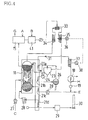
- FIG 1 is a flowchart of a reaction apparatus for organic and/or other substances employing supercritical fluid(s) and/or subcritical fluid(s) in accordance with the present invention.
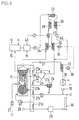
- FIG 2 is a partial flowchart in a situation where cam-type actuation mechanism(s) are employed at reactor(s) in a reaction apparatus for organic and/or other substances employing supercritical fluid(s) and/or subcritical fluid(s) in accordance with the present invention.
- FIG. 1 is a flowchart of a reaction apparatus for organic and/or other substances employing supercritical fluid(s) and/or subcritical fluid(s) in accordance with the present invention.
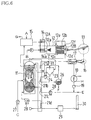
- FIG 3 is a partial flowchart in a situation where rotary-type compressor-expander(s) are used instead of reciprocating-type compressor-expander(s) in a reaction apparatus for organic and/or other substances employing supercritical fluid(s) and/or subcritical fluid(s) in accordance with the present invention.
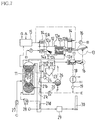
- FIG 4 is a flowchart in a situation where turbo-type compressor-expander(s) are used in a reaction apparatus for organic and/or other substances employing supercritical fluid(s) and/or subcritical fluid(s) in accordance with the present invention.
- FIG 5 is a flowchart in a situation where turbo-type compressor-expander(s) are used in a reaction apparatus for organic and/or other substances employing supercritical fluid(s) and/or subcritical fluid(s) in accordance with the present invention.
- FIG 6 is a flowchart of another embodiment of a reaction apparatus for organic and/or other substances employing supercritical fluid(s) and/or subcritical fluid(s) in accordance with the present invention.
- FIG 7 is a flowchart of another embodiment of a reaction apparatus for organic and/or other substances employing supercritical fluid(s) and/or subcritical fluid(s) in accordance with the present invention.
- FIG 8 is a partial flowchart illustrating an embodiment in which a reaction apparatus for organic and/or other substances employing supercritical fluid(s) and/or subcritical fluid(s) in accordance with the present invention is used to cause reactant substance(s) to undergo continuous and repeated treatment.
- FIG 9 is a partial flowchart illustrating an embodiment in which, in a reaction apparatus for organic and/or other substances employing supercritical fluid(s) and/or subcritical fluid(s) in accordance with the present invention, a plurality of reactors are provided therein.
- FIG 10 is a partial flowchart illustrating an embodiment in which oxidant supply apparatus(es) is or are provided at a reaction apparatus for organic and/or other substances employing supercritical fluid(s) and/or subcritical fluid(s) in accordance with the present invention.
- FIG 11 is a partial flowchart illustrating an embodiment in which gasification treatment apparatus(es) is or are provided at a reaction apparatus for organic and/or other substances employing supercritical fluid(s) and/or subcritical fluid(s) in accordance with the present invention.
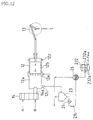
- FIG 12 is a partial flowchart illustrating an embodiment in which ethanol fermentation apparatus(es) is or are provided at a reaction apparatus for organic and/or other substances employing supercritical fluid(s) and/or subcritical fluid(s) in accordance with the present invention.
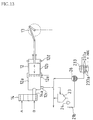
- FIG. 13 is a partial flowchart illustrating an embodiment in which ABE fermentation apparatus(es) is or are provided at a reaction apparatus for organic and/or other substances employing supercritical fluid(s) and/or subcritical fluid(s) in accordance with the present invention.
- FIG 14 is a partial flowchart illustrating an embodiment in which methane gas fermentation apparatus(es) is or are provided at a reaction apparatus for organic and/or other substances employing supercritical fluid(s) and/or subcritical fluid(s) in accordance with the present invention.
- FIG 15 is a drawing illustrating work cycles in a flow-type supercritical-fluid and/or subcritical-fluid reaction apparatus presented as a comparative example.
- FIG 16 is a drawing showing specific enthalpy during processes occurring at a flow-type supercritical-fluid and/or subcritical-fluid reaction apparatus presented as a comparative example.
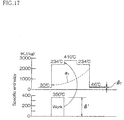
- FIG. 17 is a drawing showing specific enthalpy during processes occurring at a reaction apparatus for organic and/or other substances employing supercritical fluid(s) and/or subcritical fluid(s) associated with the present invention.
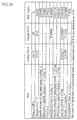
- FIG. 18 is a drawing showing values for compression ratio ⁇ calculated for a situation where the pressure of the wet vapor prior to compression is 3 MPa and for the state existing at the target point when the fluid medium is water.
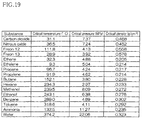
- FIG. 19 is a drawing showing critical conditions for various fluid media.
- FIG. 20 is a drawing showing values for compression ratio ⁇ calculated for a situation where the pressure of the wet vapor prior to compression is 3 MPa and for the state existing at the target point when the fluid medium is Freon 12.
- Reaction apparatus 10 for organic and/or other substances employing supercritical fluid(s) and/or subcritical fluid(s) and shown in FIG 1 uses water as fluid medium.
- Reaction apparatus 10 has as its basic component reciprocating-type reactor 12 which is made up of boiler 11 for obtaining vapor from water; means for compressing this vapor and obtaining supercritical water and/or subcritical water; means for bringing this supercritical water and/or subcritical water into contact with organic matter and/or other reactant substance(s) and causing occurrence of chemical reaction(s); and means for causing expansion and decompression of water including product(s) produced as a result of such chemical reaction(s).
- Boiler 11 is employed to obtain vapor from water. Fuel C is supplied to boiler 11 from pump 27, while at the same time, air D is supplied thereto by blower 28. This water vapor is introduced into reactor 12.
- reactor 12 is a high-pressure compressor-expander comprising cylinder 12a and piston 12b provided at such cylinder 12a.
- volumes 12A and 12B Provided to either side of piston 12b are volumes 12A and 12B.
- Piston 12b is actuated by means of crank mechanism 13 and water vapor is compressed at volume 12A, permitting formation of supercritical water and/or subcritical water.
- this supercritical water and/or subcritical water is brought into contact with wood meal serving as reactant substance, making it possible to cause wood meal to be made to undergo hydrolytic reaction(s).
- crank mechanism 13 may also be a cam mechanism.
- This wood meal is such that ligneous chips A are explosively disintegrated by explosive disintegrator 15, pulverizing wood meal.
- This wood meal is introduced into rotary feeder 14, while at the same time, water B is delivered to rotary feeder 14 in a pressurized state by means of a pump.
- wood meal diffuses throughout water at rotary feeder 14, wood meal is supplied to reactor 12 in sprayed state by means of injector 14a. The finer the wood meal the better, since this will permit facilitation of chemical reaction(s) and prevention of spray nozzle clogging. Accordingly, circumstances will be all the more favorable if wood meal is pulverized by explosive disintegration and this is furthermore made into a slurry.
- hydrolytic reaction(s) of wood meal may be made to occur when piston 12b is in the vicinity of top dead center. Following conclusion of hydrolytic reaction(s) of wood meal, piston 12b may be actuated, causing expansion of vapor within cylinder 12a and causing same to once again become wet vapor, and also causing termination of such reaction(s) due to the decrease in temperature at such time.
- reaction processes require neither high-temperature water nor cooling water; and furthermore, because wood meal reaction time [can be] varied by changing actuation velocity of piston 12b, control thereof is easy. Furthermore, at reactor 12, while a large amount of work is required during compression by piston 12b, operations are carried out so as to cause this work to be extracted during expansion such that cancellation occurs. In such case, because mixture and thermal transfer are not based on processes accompanied by loss of energy, the net work required is only the energy consumed during chemical reaction(s), the frictional energy at piston 12b, and various other small amounts of energy such as that of the pump(s) and so forth. Accordingly, actuation can be carried out with high energy efficiency.
- Descension of piston 12b causes port 12c to open at appropriate time(s), actuation being made to occur so as to expel reaction products together with wet vapor.
- Such operation of reactor 12 permits actuation to occur in the context of two-cycle and/or four-cycle mechanism(s).
- uniflow-type two-cycle device(s) may be used as reactor 12.
- port 12e might be opened by piston 12b when expansion is concluded, introducing a new charge of vapor, and used vapor might be discharged from valve 12c on the opposite side therefrom.
- the liquid fraction at boiler 11, i.e., cold water, might be sprayed into cylinder 12a simultaneous with supply of saturated vapor to reactor 12 or during the course of compression, permitting adjustment of the dryness of the vapor within cylinder 12a. If this vapor dryness should become too low, it is because the amount of cooling water being sprayed is too small.
- Injection into cylinder 12a might be carried out such that a fixed amount of wood meal is in a homogeneously dispersed state within the jetted stream at the time of such spraying of cold water. Because fine wood meal can be dispersed in this spray due to the fact that cold water can be sprayed at high velocity, and because wood meal can be propelled with saturated liquid, it is possible to prevent occurrence of clogging of spray nozzle(s). Furthermore, the reason that cold water is used for spraying is to impart wood meal with the required wetness, and also to prevent thermal decomposition of wood meal within cylinder 12a by maintaining the wood meal at low temperature (150° C or lower being preferred).
- reaction apparatuses in accordance with the present invention there are, moreover, constitutions provided with means for causing water including product(s) obtained from chemical reaction(s) to be separated into saturated water and saturated vapor by cyclone separator(s) 23 (and/or centrifugal separator(s)).
- low-pressure wet vapor discharged from cylinder 12a is delivered to cyclone separator 23, and water including products obtained as a result of chemical reaction is separated into saturated water and saturated vapor.
- low-pressure saturated vapor produced as a result of separation by cyclone separator 23 might be such that a portion of the heated vapor is guided to motive force generator 17 which is separately provided with flow rate adjustment valve (gauge) 31, permitting the energy therefrom to be used as motive force at reactor 12 to which cylinder 12a and piston 12b belong.
- 13 is a crank mechanism coupled to the end of the shaft of piston 12b; 16 is a crank mechanism for motive force generator 17; and 21 a through 21d are heat exchangers.
- Vapor used by motive force generator 17 can be condensed by condenser 18 and returned by way of filter 19 as water for supply to boiler 11.
- crank mechanism 13 and crank mechanism 16 are coupled together. That is, motive force from motive force generator 17 is converted into rotary motion and is transmitted from crank mechanism 16 to crank mechanism 13, and this rotary motion is used as motive force for piston 12b at reactor 12.
- crank mechanisms 13 and 16 may be constituted from cam mechanism(s).
- FIG 2 shows a constitution employing cam mechanism 130 in place of crank mechanism 13.
- Cam mechanism 130 comprises cam 130a and cam base 130b, and cam 130a abuts end region 120c of piston 120b at reactor 120A, permitting rotary motion of cam 130 to be converted into extensile motion of piston 120b.
- 120a is a cylinder.
- Reaction products from cyclone separator 23 are concentrated, and are thereafter introduced into gas-liquid separator 26 and are separated into saturated vapor and saturated water.
- the reason that separation into saturated vapor and saturated water is carried out here is because it is expected that reaction products will be contained only within the liquid and not within the vapor. Accordingly, concentration of reaction products may be accomplished merely by further separating the heated vapor of that liquid therefrom. This makes it possible to simplify the procedure for concentrating the reaction products which are obtained.
- reaction products are not included within saturated vapor, same may be returned to boiler 11 by means of pump 20 or may be sent to motive force recovery apparatus 17 and used as source of motive force in the same manner as described above.
- FIG 3 shows a constitution in which rotary-type reactor 120B is used in place of the aforesaid reactor 12.
- Reactor 120B comprises rotor chamber 120d and its rotor 120e.
- Rotor 120e rotates elliptically in such fashion that the outside circumferential surface thereof is inscribed by rotor chamber 120d.
- drive shaft 120f is coupled by gear at the inside circumferential region of rotor 120e, rotation of drive shaft 120f causing rotor 120e to rotate elliptical fashion.
- Other components are as described above.
- elliptical rotation of rotor 120e causes water vapor from boiler 11 to be captured into rotor chamber 120d from vapor introduction hole 120g and to be compressed, as a result of which supercritical water and/or subcritical water is or are formed.
- This supercritical water and/or subcritical water and wood meal jetted from feeder 14b of rotary feeder 14 come into contact, and wood meal is decomposed by hydrolytic reaction(s).
- rotor 120e may be rotated, expansion causing the vapor therein to once again become wet vapor, and also causing termination of chemical reaction(s) of wood meal due to the decrease in temperature at such time.
- low-pressure wet vapor may be discharged from discharge hole 120h of rotor chamber 120d as rotor 120e rotates. Moreover, this discharged low-pressure wet vapor may be delivered to cyclone separator 23, and water including products obtained as a result of chemical reaction may be separated into saturated water and saturated vapor. Moreover, rotary operation of rotor 120e may be directly extracted as motive force for drive shaft 120f, and this motive force may be once again used for rotary operation of rotor 120e and/or the like. Accordingly, treatment can be carried out with high energy efficiency. On this score as well, action in the present embodiment is the same as the action described above for reactor 12.
- the reactor shown in FIG 4 is a turbo-type high-pressure compressor-expander, water vapor from boiler 11 being introduced into centrifugal compressor 34, which represents one type of turbocompressor.
- centrifugal compressor 34 water vapor introduced thereinto may be compressed to form supercritical water and/or subcritical water.
- this supercritical water and/or subcritical water is delivered to high-pressure reactor 33.
- Chemical reaction of this wood meal is such that supercritical water and/or subcritical water may be introduced into radial turbine 35 from high-pressure reactor 33, resulting in expansion and causing the vapor therein to once again become wet vapor, and also causing termination of such reaction(s) due to the decrease in temperature at such time.
- 36 is a motor for driving radial turbine 35.
- reaction processes require neither high-temperature water nor cooling water; and furthermore, because wood meal reaction time can be varied by changing rotational velocity of radial turbine 35, control thereof is easy. Furthermore, at centrifugal separator 34, while a large amount of work is required, actuation is carried out so as to cause this work to be extracted such that cancellation occurs during expansion by radial turbine 35 which is arranged along a single axis. Vapor which has exited turbine 35 undergoes gas-liquid separation at cyclone separator 23, and while most of the saturated vapor is returned to boiler 11, a portion thereof is guided to radial turbine 37, producing motive force and allowing electrical power to be obtained from electrical generator 38, with this being used to supplement driving of centrifugal compressor 34.
- two stages of, or a plurality of stages of, centrifugal compressors 34 and radial turbines 35 may be installed.
- mixer(s) 37 is or are installed between the two stages of centrifugal separators 38, and cold water is supplied by feed pump 41 to carry out adjustment of wetness of heated vapor.
- reaction apparatus(es) in accordance with the present invention include constitutions wherein volumes are provided to either side of piston 12b, vapor passing through one of the volumes before being introduced into the other of the volumes, and compression of vapor being carried out at only the one thereof. Because such constitution permits reduction in the pressure difference between the volumes to either side thereof, it is possible to reduce the load on the bearing at 13.
- reaction apparatus 12 includes a constitution wherein volumes which are formed by cylinder 12a and piston 12b and at which compression of vapor is carried out are provided to either side of piston 12b. Adoption of such a multiple-acting constitution makes it possible to increase the amount of reactant substance(s) undergoing chemical reaction per unit time.
- the reaction apparatus in accordance with the present invention shown in FIG. 8 is constituted such that passage switching valves 12g, 12h are coupled to scavenging valve 12c and introductive port 12e in a mechanism at reactor 12 comprising cylinder 12a and piston 12b belonging to this cylinder 12a. Because during a time when both of passage switching valves 12g, 12h are closed the passages at scavenging valve 12c and introductive port 12e will be closed off, it is possible to set the apparatus so as to cause reactant substance(s) to undergo treatment by supercritical fluid(s) within this reactor 12 continuously and repeatedly for a fixed period of time.
- reaction apparatus(es) in accordance with the present invention include constitutions wherein a plurality of reactors 12 comprising cylinder(s) 12a and piston(s) 12b belonging to such cylinder(s) are provided.
- a plurality of reactors 12 comprising cylinder(s) 12a and piston(s) 12b belonging to such cylinder(s) are provided.
- wood meal reaction products discharged from scavenging valve 12c of first reactor 12 might be sequentially transferred by way of passage switching valve(s) 12g to second reactor 12 and any reactor(s) therebelow.
- reaction might again be repeated in like fashion at second reactor 12.
- 29 is an exhaust gas scrubber, exhaust gas produced as a result of the aforesaid chemical reaction(s) and/or exhaust gas produced by boiler 11 being discharged to the atmosphere from chimney 30.
- apparatus(es) in accordance with the present invention include constitutions, as shown in FIG. 10, provided with oxidant supplier(s) 150 permitting sprayed introduction of oxidant(s) into cylinder chamber(s) 12a. Installation may be such that, from oxidant supplier(s) 150, this is directly coupled to reactor 12 by way of sprayer(s) 150a and injector(s) 14b. This makes it possible for supercritical water oxidation reaction(s) to occur within cylinder 12a, permitting oxidative decomposition of wood meal.
- oxidant supplier(s) 150 is made to spray will make it possible ⁇ in accordance with the principles of the supercritical water oxidation method (Supercritical Water Oxidation Method) applicable to supercritical water within high-temperature, high-pressure domains at or above approximately 374° C and 218 atmospheres ⁇ to cause gas, liquid, and/or slurry-like organic substance(s) to form a homogeneous phase with wood meal in supercritical water, causing occurrence of a combustive reaction and permitting complete combustion and decomposition without use of catalyst.
- This makes it possible for treatment to be carried out with an energy consumption that is lower than is the case during treatment with conventional supercritical water, subcritical water, or pressurized hot water.
- fluid medium is water
- constitutions may, as shown in FIG 11, be adopted for reaction apparatus(es) in accordance with the present invention such that they are provided with gasification apparatus(es) comprising gas-liquid separator(s) 230 or the like at location(s) permitting capture of gas component(s) of separated products from cyclone separator 23.
- Gas component(s) produced therein are obtained by treating wood meal and/or other such organic substance(s) with supercritical water for long period(s) of time and causing occurrence of decomposition reaction(s).
- substance(s) being treated are such that only the water vapor in gas mixture(s) of water vapor and methane, hydrogen, carbon monoxide, carbon dioxide, and/or other such gas(es) is liquefied by cooling at heat exchanger 231, permitting separation thereof by gas-liquid separator 230, located at a stage subsequent thereto, into water and into methane, hydrogen, carbon monoxide, carbon dioxide, and/or other such gas(es) resulting from decomposition.
- Reaction apparatus(es) in accordance with the present invention may employ any of various organic-type substance(s) as reactant substance(s), including ⁇ in addition to wood ⁇ biomass feedstock(s) including municipal refuse; discarded tire(s), coal and/or other such carbon-containing substance(s); methanol and/or other such low-molecular-weight alcohol(s) and fat(s) and/or oil(s); and also PET bottle(s) and/or other such high-molecular-weight polymer(s); PCB(s), R-series refrigerant(s), DXN(s) (dioxin(s)), and/or other such halogen-containing substance(s); and so forth.
- reactant substance(s) including ⁇ in addition to wood ⁇ biomass feedstock(s) including municipal refuse; discarded tire(s), coal and/or other such carbon-containing substance(s); methanol and/or other such low-molecular-weight alcohol(s) and fat(s) and/or oil(s); and also
- biomass(es) may be hydrolyzed with supercritical water and/or subcritical water to obtain glucose and/or other such low-molecular-weight sugar(s) and/or the like as product(s).
- reactant(s) is or are any substance(s) selected from among biomass feedstock(s) including municipal refuse, discarded tire(s), coal and/or other such carbon-containing substance(s)
- selected substance(s) may be decomposed with supercritical water and/or subcritical water to obtain synthesized gas(es) including methane gas, hydrogen, carbon dioxide, and carbon monoxide.
- synthesized gas(es) including methane gas, hydrogen, carbon dioxide, and carbon monoxide.
- reactant substance(s) is or are waste cooking oil(s) and/or other such fat(s) and/or oil(s)
- these may be made to undergo transesterification reaction(s) using supercritical alcohol(s) and/or subcritical alcohol(s), making it possible to obtain ester compound(s).
- the fluid medium is water, alcohol(s), and/or other such protic fluid(s), and when reactant substance(s) is or are PET bottle(s) and/or other such polyester(s), these may be decomposed to terephthalic acid, ethylene glycol, and/or other such chemical precursor(s), which may then be recovered.
- reactant(s) is or are PCB(s), R-series refrigerant(s), DXN(s) (dioxin(s)), and/or other such decomposition-resistant halogen-containing substance(s), [these] may be decomposed until rendered harmless. In such case, decomposition is sometimes carried out with addition of oxygen and/or other such oxidant(s) and/or alkali and/or the like.
- reaction apparatus(es) in accordance with the present invention may, as shown in FIG 12, when product(s) obtained by decomposition of biomass(es) is or are glucose and/or other such low-molecular-weight sugar(s) such as was described above, be such that provision of ethanol fermentor(s) 232 at location(s) behind gas-liquid separator 26 makes it possible, due to supercritical water and/or subcritical water therein, to cause glucose and/or other such low-molecular-weight molecule(s) obtained by saccharification of high-molecular-weight molecule(s) to be efficiently converted into ethanol.
- water-soluble component(s) of product(s) at gas-liquid separator 26 are introduced into ethanol fermentor 232, and ethanol is produced as a result of action of yeast(s), colon bacillus or bacilli, and/or other such microorganism(s). Accordingly, in such a case, it is possible to obtain ethanol more efficiently and with less consumption of energy than would be the case with conventional treatment apparatuses employing supercritical water, subcritical water, hot water, or the like.
- the fluid medium is water, alcohol(s), and/or other such protic fluid(s), as shown in FIG 13, a constitution may be adopted wherein, instead of the aforesaid ethanol fermentor(s) 232, ABA fermentor(s) 233 is or are provided at location(s) permitting introduction thereinto of water-soluble component(s) of product(s) obtained.
- ABA fermentor 233 product(s) introduced thereinto may be converted as far as acetone, butanol, and ethanol. This permits ABA fermentation to be carried out.
- Reaction apparatus(es) in accordance with the present invention make it possible to obtain acetone, butanol, and/or ethanol more efficiently and with less consumption of energy than would be the case with conventional treatment apparatuses employing supercritical water, subcritical water, hot water, or the like.
- reaction apparatus(es) in accordance with the present invention may, as shown in FIG 14, be such that provision of methane fermentor(s) 234 at location(s) behind gas-liquid separator 26 makes it possible, due to supercritical water and/or subcritical water therein, to cause glucose and/or other such low-molecular-weight molecule(s) obtainable by breaking down high-molecular-weight molecule(s) into lower-molecular-weight molecule(s) to be efficiently converted into methane gas.
- product(s) broken down into lower-molecular-weight molecule(s) by supercritical and/or subcritical fluid(s) is made to undergo conversion as far as methane gas due to action of methane fermentation microorganism(s) within methane fermentor 234.
- methane gas it is possible to obtain methane gas more efficiently and with less consumption of energy than would be the case with conventional treatment apparatuses employing supercritical water, subcritical water, hot water, or the like; and in addition, it is moreover possible to carry out treatment and obtain methane gas in much shorter time(s) and much more rapidly than would be the case with methods not employing supercritical water and/or subcritical water.
- reaction apparatus 10 for organic and/or other substance(s) employing supercritical fluid(s) which is associated with the present invention will be described.
- This reaction apparatus 10 uses water as fluid.
- pressure at the conclusion of compression must be greater than or equal to the critical pressure of 22.1 MPa and temperature at such time must be greater than or equal to the critical temperature of 374° C.
- reactant substance is wood meal and this is to be hydrolyzed to obtain glucose and/or other such low-molecular-weight sugar(s)
- the higher the pressure at the conclusion of compression the more it will be possible to suppress overdecomposition of product component(s), and furthermore, that the higher the temperature at such time the greater will be the reaction rate.
- Specific entropy s at the target point was first determined, permitting determination of dryness x such as would cause specific entropy to be equal to the target specific entropy based on the difference (s" - s') between specific entropy s" of saturated vapor and specific entropy s' of saturated water at the pressure assumed to exist prior to compression.
- the table in FIG. 18 shows results calculated for a situation where the pressure of the wet vapor prior to compression is 3 MPa and for the state existing at the target point.
- saturation temperature of wet vapor at 3 MPa is 234° C, and a dryness x of 75.2% is needed to obtain a specific entropy equal to the specific entropy at the target point.
- dryness x it is possible to determine specific volume v and density 1/v of wet vapor based on the difference (v" - v') between specific volume v" of saturated vapor and specific volume v' of saturated water.
- Compression ratio ⁇ defined as the ratio between specific volume v prior to compression and specific volume v 0 at the target point, can also be determined.
- compression ratio ⁇ being 7.3, if the volume within the cylinder prior to compression is compressed to 1/7.3 thereof it will be possible to achieve the target supercritical water state. If it can be assumed that the effects of reaction are small enough to be ignored and that changes are isoentropic, then, after reaching the target point, expansion will proceed by virtue of the crank mechanism, volume within the cylinder reaching a maximum, and following expansion the same state will be assumed as existed prior to compression. Note that with a water vapor pressure of 3 MPa prior to compression, this can also be used for explosive disintegration of that saturated water in order to facilitate reaction of wood meal feedstock. Furthermore, if the pressure prior to compression is very much greater than 3 MPa, then there is a possibility that it will no longer be possible to completely stop the reaction due to the fact that saturation temperature is high.
- reaction apparatus 10 the energy budget applicable to reaction apparatus 10 will be described in comparison with a flow-type supercritical water reaction apparatus representing a conventional reaction apparatus.
- a flow-type supercritical water reaction apparatus which represents a conventional reaction apparatus
- cold water A in which a large amount of feedstock wood meal is dispersed is mixed with supercritical water W b which is at a temperature higher than target temperature (e.g., 410° C), causing the target supercritical water state to be attained, and rapid cooling of supercritical water with cooling water W c causes reaction of wood meal to be terminated.
- target temperature e.g., 410° C
- the energy loss component ⁇ ' at the reactor and the motive force generator is 370 kJ/kg, which is not more than 1/27 of the 9910 kJ/kg at the conventional flow-type reaction apparatus.
- reaction apparatus 10 bears the load of the explosive disintegrator, because the energy associated with the explosive disintegrator is the same for both reaction apparatus 10 and the conventional flow-type reaction apparatus, it has been omitted from energy budget calculations.
- the present apparatus permits attainment of supercritical state(s) with water, for which critical temperature and pressure are high. Based on the data indicating critical conditions at FIG. 19, because conditions of critical temperature and critical pressure for Freon 12 are lower than is the case for water, in the event that Freon 12 is used as fluid medium it will be more than possible to achieve supercritical states in the context of the apparatus of the present invention.
- compression pressure e having been determined to be 6.4, if the volume within the cylinder is compressed to 6.4/1 of what it was prior to compression it will be possible to achieve the target supercritical fluid state. Moreover, after reaching the target point, expansion proceeds by virtue of the crank mechanism, volume within the cylinder reaching a maximum, and following expansion the same state is assumed as existed prior to compression.
- the energy budget at 4.9 MPa and 130° C is such that Freon 12 at normal temperature is heated to 0.7 MPa and 40.0° C, and this wet vapor is compressed by means of a reactor to achieve the aforesaid target point, design conditions being such that the supercritical fluid is thereafter cooled by expansion to again become 40.0° C.
- reaction apparatus(es) for organic and/or other substances employing supercritical fluid and/or subcritical fluid in accordance with the present invention are constituted as described above, benefits such as the following are delivered thereby.
- reaction apparatus(es) for organic and/or other substance(s) employing supercritical water and/or subcritical water in accordance with the present invention comprise-by virtue of piston(s), rotary, and/or turbocompressor(s) and turbine(s)-means for compressing vapor(s) and obtaining supercritical fluid(s) and/or subcritical fluid(s), means for bringing such supercritical fluid(s) and/or subcritical fluid(s) into contact with organic substance(s) and/or other reactant substance(s) and causing occurrence of chemical reaction(s), and means for causing expansion and decompression of fluid(s) including product(s) produced as a result of such chemical reaction(s), as well as means for spraying reactant substance(s) together with liquid-like fluid(s) into reactor(s), it is possible to cool and rapidly stop (freeze) reaction(s) of reactant substance(s) occurring at rapid rate(s) in high-temperature, high-pressure fluid(s) without use of low-temperature liquid(s) (col
- reaction vessel(s) connected to turbine(s) and turbocompressor(s) By adjusting speed(s) of vertical motion of piston(s) and/or rotary motion of rotor(s), and/or by adjusting volume(s) of reaction vessel(s) connected to turbine(s) and turbocompressor(s), it is possible to control reaction(s) with a "resolution" which is such that reaction(s) occurring at rapid rate(s) in supercritical fluid(s), subcritical fluid(s), and/or other such high-temperature, high-pressure fluid(s) are divided into extremely brief period(s) of time.
- passage switching valve(s) and/or other such open-/close-type member(s) are respectively provided at passage(s) of introductive port(s) and scavenging valves(s) in reaction mechanism(s) of reciprocating-type and/or rotary-type reactor(s) and wherein treatment of reactant substance(s) can can be carried out continuously and repeatedly for fixed period(s) of time when such open-/close-type member(s) are closed, or constitutions wherein a plurality of reciprocating-type and/or rotary-type reactors are provided, it is possible to achieve effective treatment time(s) even for substance(s) to be treated requiring treatment of on the order of minutes. Displays it possible to efficiently improve reaction productivity using a simple constitution. In particular, adoption of a multiple-acting constitution wherein volumes at which fluid vapor compression is carried out by the aforesaid reciprocating-type cylinder(s) and piston(s) is carried out at both sides of piston(s) permits improvement in reaction efficiency.
- the fluid is water and/or other such protic fluid
- the substance to be treated is ligneous feedstock and/or other such organic-type biomass(es)
- such organic-type biomass(es) may be broken down (solubilized) to produce lower saccharide(s) or the like.
- gaseous component(s) and/or liquid component(s) which are capable of being used as fuel or the like will be possible.
- gaseous component is, for example, methane gas
Landscapes
- Chemical & Material Sciences (AREA)
- Organic Chemistry (AREA)
- Chemical Kinetics & Catalysis (AREA)
- Engineering & Computer Science (AREA)
- Combustion & Propulsion (AREA)
- Oil, Petroleum & Natural Gas (AREA)
- Processing Of Solid Wastes (AREA)
- Physical Or Chemical Processes And Apparatus (AREA)
- Fire-Extinguishing Compositions (AREA)
- Separation, Recovery Or Treatment Of Waste Materials Containing Plastics (AREA)
- Organic Low-Molecular-Weight Compounds And Preparation Thereof (AREA)
- Fats And Perfumes (AREA)
Abstract
Description
Claims (24)
- A reaction apparatus for organic and/or other substance(s) employing supercritical fluid(s) and/or subcritical fluid(s) characterized in that means for compressing vapor(s) and obtaining supercritical fluid(s) and/or subcritical fluid(s), means for bringing supercritical fluid(s) and/or subcritical fluid(s) into contact with organic matter and/or other reactant substance(s) and causing occurrence of chemical reaction(s), and means for causing expansion and decompression of fluid(s) including product(s) produced as a result of chemical reaction(s) comprise cylinder(s) and piston(s) provided at such cylinder(s), the reaction apparatus being made to actuate in periodic fashion by operating such piston(s) to cause compression of fluid(s); operating piston(s) in reverse direction(s) following chemical reaction(s) of reactant substance(s) and lowering temperature(s) and pressure(s); and removing, from cylinder(s), fluid(s) including product(s) obtained and delivering new charge(s) of vapor(s) to cylinder(s).
- A reaction apparatus for organic and/or other substance(s) employing supercritical fluid(s) and/or subcritical fluid(s) according to claim 1 wherein operation of piston(s) causes vapor(s) to be compressed at only one side within cylinder(s).
- A reaction apparatus for organic and/or other substance(s) employing supercritical fluid(s) and/ or subcritical fluid(s) according to claim 1 wherein delivery of new charge(s) of vapor(s) to cylinder(s) only involves saturated vapor(s) of fluid(s), cold fluid(s) or saturated liquid(s) of fluid(s) being injected into cylinder(s) together with reactant substance(s) during initiation of compression by piston(s), in mid-compression, or following conclusion of compression.
- A reaction apparatus for organic and/or other substance(s) employing supercritical fluid(s) and/or subcritical fluid(s) according to any of claims 1 through 3 wherein volume(s), at which compression of vapor(s) is carried out, formed by piston(s) and cylinder(s) are provided to either side of piston(s).
- A reaction apparatus for organic and/or other substance(s) employing supercritical fluid(s) and/or subcritical fluid(s) according to claim 4 wherein compressor-expander(s) is or are provided to either side of piston(s), and injector(s) (feedstock spray apparatus(es)) is or are provided at respective compressor-expanders.
- A reaction apparatus for organic and/or other substance(s) employing supercritical fluid(s) and/or subcritical fluid(s) according to any of claims 1 through 5 wherein wet vapor(s) of fluid(s) are compressed by one of volumes or sets of volumes, at which compression of vapor(s) is carried out, formed by piston(s) and cylinder(s) and provided to either side of piston(s), the other of volumes or sets of volumes maintaining fluid vapor(s) at high pressure(s).
- A reaction apparatus for organic and/or other substance(s) employing supercritical fluid(s) and/or subcritical fluid(s) according to any of claims 1 through 6 wherein, at mechanism(s) comprising cylinder(s) and piston(s) provided at such cylinder(s), work of piston(s) is recovered.
- A reaction apparatus for organic and/or other substance(s) employing supercritical fluid(s) and/or subcritical fluid(s) wherein means for compressing vapor(s) and obtaining supercritical fluid(s) and/or subcritical fluid(s), means for bringing supercritical fluid(s) and/or subcritical fluid(s) into contact with organic substance(s) and/or other reactant substance(s) and causing occurrence of chemical reaction(s), and means for causing expansion and decompression of fluid(s) including product(s) produced as a result of chemical reaction(s) comprise rotor chamber(s) and rotor(s) provided at such rotor chamber(s) instead of cylinder(s) and piston(s) provided at such cylinder(s) as in the reaction apparatus of claim 1, the reaction apparatus being made to actuate in periodic fashion by rotating such rotor(s) in eccentric fashion within rotor chamber(s) to cause compression of vapor(s); further rotating rotor(s) following the aforesaid chemical reaction(s) and lowering temperature(s) and pressure(s), and removing, from rotor chamber(s), fluid(s) including product(s) obtained and delivering new charge(s) of vapor(s) to rotor chamber(s).
- A reaction apparatus for organic and/or other substance(s) employing supercritical fluid(s) and/or subcritical fluid(s) characterized in that means for compressing vapor(s) and obtaining supercritical fluid(s) and/or subcritical fluid(s), means for bringing supercritical fluid(s) and/or subcritical fluid(s) into contact with organic substance(s) and/or other reactant substance(s) and causing occurrence of chemical reaction(s), and means for causing expansion and decompression of fluid(s) including product(s) produced as a result of chemical reaction(s) comprise turbocompressor(s) and turbine(s) directly coupled to such turbocompressor(s); actuation of turbocompressor(s) causing compression of vapor(s), temperature(s) and pressure(s) being lowered by way of turbine(s) following conclusion of chemical reaction(s), and motive force(s) being recovered as a result of direct coupling of turbocompressor(s) and turbine(s) extracting therefrom fluid(s) including product(s) obtained.
- A reaction apparatus for organic and/or other substance(s) employing supercritical fluid(s) and/or subcritical fluid(s) according to any of claims 1 through 8 provided with means for causing fluid(s) including product(s) obtained from chemical reaction(s) to be separated into saturated matter and saturated vapor(s) by cyclone separator(s) and/or centrifugal separator(s).
- A reaction apparatus for organic and/or other substance(s) employing supercritical fluid(s) and/or subcritical fluid(s) according to any of claims 1 through 9 provided with explosive disintegration apparatus(es) that rapidly depressurize reactant substance(s) while same is or are immersed in high-pressure saturated fluid(s); organic substance(s) and/or other reactant substance(s) being pulverized by such explosive disintegration apparatus(es).
- A reaction apparatus for organic and/or other substance(s) employing supercritical fluid(s) and/or subcritical fluid(s) according to any of claims 1 through 8 wherein passage switching valve(s) and/or other such open-/close-type member(s) are respectively provided at introductive port(s) and scavenging valves(s) in mechanism(s) comprising cylinder(s) and/or rotor chamber(s) and piston(s) for such cylinder(s) and/or rotor(s) for such rotor chamber(s); and in addition, such open-/close-type member(s) are such as to allow setting of open and/or closed state(s) thereof, setting of such open-/close-type member(s) so as to cause closure thereof at fixed time interval(s) permitting supercritical treatment by such mechanism(s) to be carried out continuously and in ongoing fashion.
- A reaction apparatus for organic and/or other substance(s) employing supercritical fluid(s) and/or subcritical fluid(s) according to any of claims 1 through 8 wherein mechanism(s) comprising cylinder(s) and/or rotor chamber(s), as well as piston(s) for such cylinder(s) and/ or rotor(s) for such rotor chamber(s), are such that a plurality thereof are provided.
- A reaction apparatus for organic and/or other substance(s) employing supercritical fluid(s) and/or subcritical fluid(s) according to claim 12 wherein scavenger member(s) and member(s) introducing vapor(s) into respective cylinder(s) and/or respective rotor chamber(s) in mechanism(s) comprising cylinder(s) and/or rotor chamber(s), as well as piston(s) and/or rotor(s) for same, there being a plurality thereof, are sequentially coupled by way of passage switching valve(s) and/or other such open-/close-type member(s); permitting respective processes performed by means for compressing vapor(s) and obtaining supercritical fluid(s) and/or subcritical fluid(s), means for bringing supercritical fluid(s) and/or subcritical fluid(s) into contact with organic substance(s) and/or other reactant substance(s) and causing occurrence of chemical reaction(s), and means for causing expansion and decompression of fluid(s) including product(s) produced as a result of chemical reaction(s) to be carried out a plurality of times.
- A reaction apparatus for organic and/or other substance(s) employing supercritical fluid(s) and/or subcritical fluid(s) according to any of claims 1 through 14 provided with oxidant spray apparatus(es) permitting sprayed introduction of oxidant(s) into high-pressure reaction vessel(s) present at cylinder(s), rotor chamber(s), and/or between turbocompressor(s) and turbine(s); introduced organic substance(s) and/or other reactant substance(s) being oxidatively decomposed while in supercritical state(s).
- A reaction apparatus for organic and/or other substance(s) employing supercritical fluid(s) and/or subcritical fluid(s) according to any of claims 1 through 15 provided with gasification apparatus(es) further separating, into gas component(s) and liquid component(s), saturated vapor(s) separated from fluid mixture(s) of product(s).
- A reaction apparatus for organic and/or other substance(s) employing supercritical fluid(s) and/or subcritical fluid(s) according to any of claims 1 through 15 wherein reactant substance(s) is or are biomass feedstock(s) including municipal refuse; and product(s) is or are glucose and/or other such low-molecular-weight sugar(s) and/or the like obtainable through decomposition of biomass(es).
- A reaction apparatus for organic and/ or other substance(s) employing supercritical fluid(s) and/or subcritical fluid(s) according to any of claims 1 through 17 provided with ethanol fermentor(s) having colon bacillus or bacilli and yeast(s) into which liquid component(s) of glucose and/or other such low-molecular-weight sugar(s) and/or other such product(s) obtained through decomposition of biomass(es) is or are introduced; sugar(s) introduced into such ethanol fermentor(s) being converted as far as ethanol by the aforesaid yeast(s), colon bacillus or bacilli, and/or the like.
- A reaction apparatus for organic and/or other substance(s) employing supercritical fluid(s) and/or subcritical fluid(s) according to any of claims 1 through 17 provided with ABE fermentor(s) having ABE fermentation microorganism(s) into which liquid component(s) of glucose and/or other such low-molecular-weight sugar(s) and/or other such product(s) obtained through decomposition of biomass(es) is or are introduced; sugar(s) introduced into ABE fermentor(s) being converted as far as acetone, butanol, and ethanol by ABE fermentation microorganism(s).
- A reaction apparatus for organic and/or other substance(s) employing supercritical fluid(s) and/or subcritical fluid(s) according to any of claims 1 through 19 provided with methane fermentor(s) having methane fermentation microorganism(s) into which gaseous component(s) of product(s) obtained through decomposition of biomass(es) is or are introduced; sugar(s) from product(s) introduced into methane fermentor(s) being decomposed as far as methane gas by methane fermentation microorganism(s).
- A reaction apparatus for organic and/or other substance(s) employing supercritical fluid(s) and/ or subcritical fluid(s) according to any of claims 1 through 19 wherein reactant substance(s) is or are any substance(s) selected from among biomass feedstock(s) including municipal refuse, discarded tire(s), coal and/or other such carbon-containing substance(s); and product(s) is or are synthesized gas(es) including methane gas, hydrogen, carbon dioxide, and carbon monoxide obtainable through decomposition of the aforesaid selected substance(s).
- A reaction apparatus for organic and/or other substance(s) employing supercritical fluid(s) and/ or subcritical fluid(s) according to any of claims 1 through 17 wherein reactant substance(s) is or are PET(POLYETHYLENE TEREPHTHALATE) bottle(s) and/or other such high-molecular-weight polymer(s); and product(s) is or are high-molecular-weight-polymer-material feedstock substance(s).
- A reaction apparatus for organic and/or other substance(s) employing supercritical fluid(s) and/ or subcritical fluid(s) according to any of claims 1 through 14 wherein reactant substance(s) is or are waste cooking oil(s) and/or other such fat(s) and/or oil(s); same being converted into fatty acid ester(s) by supercritical fluid(s) and/or subcritical fluid(s).
- A reaction apparatus for organic and/or other substance(s) employing supercritical fluid(s) and/ or subcritical fluid(s) according to any of claims 1 through 14 wherein reactant substance(s) is or are PCB(s) (POLYCHLORINATED BIPHENYL(s)), R-series refrigerant(s), DXN(s) (dioxin(s)), and/or other such chlorine-containing substance(s); reactant substance(s) being decomposed and rendered harmless.
Applications Claiming Priority (3)
| Application Number | Priority Date | Filing Date | Title |
|---|---|---|---|
| JP2001062855 | 2001-03-07 | ||
| JP2001062855A JP4683748B2 (en) | 2001-03-07 | 2001-03-07 | Reactor reaction equipment with supercritical water or subcritical water |
| PCT/JP2002/002090 WO2002070119A1 (en) | 2001-03-07 | 2002-03-06 | Reaction system of organic substance employing supercritical fluid or sub-critical fluid |
Publications (2)
| Publication Number | Publication Date |
|---|---|
| EP1374983A1 true EP1374983A1 (en) | 2004-01-02 |
| EP1374983A4 EP1374983A4 (en) | 2007-02-21 |
Family
ID=18921936
Family Applications (1)
| Application Number | Title | Priority Date | Filing Date |
|---|---|---|---|
| EP02703925A Withdrawn EP1374983A4 (en) | 2001-03-07 | 2002-03-06 | Reaction system of organic substance employing supercritical fluid or sub-critical fluid |
Country Status (6)
| Country | Link |
|---|---|
| US (1) | US7547539B2 (en) |
| EP (1) | EP1374983A4 (en) |
| JP (1) | JP4683748B2 (en) |
| KR (1) | KR100564733B1 (en) |
| CN (1) | CN1285402C (en) |
| WO (1) | WO2002070119A1 (en) |
Cited By (1)
| Publication number | Priority date | Publication date | Assignee | Title |
|---|---|---|---|---|
| WO2014170030A1 (en) * | 2013-04-19 | 2014-10-23 | Friedrich-Alexander-Universität Erlangen-Nürnberg | Device for dynamic high-pressure treatment of pumpable products |
Families Citing this family (57)
| Publication number | Priority date | Publication date | Assignee | Title |
|---|---|---|---|---|
| JP3964240B2 (en) * | 2002-03-26 | 2007-08-22 | 新明和工業株式会社 | Wet oxidation processing equipment |
| JP4051668B2 (en) * | 2002-05-24 | 2008-02-27 | Jfeエンジニアリング株式会社 | Hydrogen production equipment |
| JP4286088B2 (en) * | 2003-08-25 | 2009-06-24 | ヤンマー株式会社 | Method and apparatus for reacting organic reactant with supercritical fluid or subcritical fluid |
| JP4365170B2 (en) * | 2003-08-29 | 2009-11-18 | ヤンマー株式会社 | Method of supplying material to be processed in reaction device of organic substance by supercritical fluid or subcritical fluid |
| JP4061544B2 (en) * | 2003-09-11 | 2008-03-19 | 財団法人大阪産業振興機構 | Treatment method of plant-derived waste |
| JP2005324185A (en) * | 2004-04-14 | 2005-11-24 | Electric Power Dev Co Ltd | Treatment method of anaerobic sludge |
| JP3842273B2 (en) * | 2004-06-14 | 2006-11-08 | 株式会社シー・ディー・エムコンサルティング | Process for producing fatty acid alkyl ester composition |
| CA2615844C (en) * | 2005-07-19 | 2015-04-21 | Holm Christensen Biosystemer Aps | Method and apparatus for conversion of cellulosic material to ethanol |
| CN101517086A (en) | 2006-07-21 | 2009-08-26 | 希乐克公司 | Biomass conversion system |
| JP5060791B2 (en) * | 2007-01-26 | 2012-10-31 | 独立行政法人森林総合研究所 | Method for drying wood, method for penetrating chemicals into wood and drying apparatus |
| KR100820169B1 (en) * | 2007-07-06 | 2008-04-08 | 주식회사 도하인더스트리 | Detoxification treatment device of hardly degradable organic wastes by subcritical water |
| US7955508B2 (en) * | 2008-03-11 | 2011-06-07 | Xtrudx Technologies, Inc. | Supercritical fluid biomass conversion systems |
| US8057666B2 (en) * | 2008-03-11 | 2011-11-15 | Xtrudx Technologies, Inc. | Biomass and waste plastics to neodiesel and valuable chemicals via supercritical water |
| US8980143B2 (en) * | 2008-03-11 | 2015-03-17 | Thomas E. Loop | Biomass and waste plastics depolymerization machine and methods via supercritical water |
| US8546560B2 (en) * | 2008-07-16 | 2013-10-01 | Renmatix, Inc. | Solvo-thermal hydrolysis of cellulose |
| CN102239184B (en) * | 2008-07-16 | 2014-07-23 | 瑞恩麦特克斯股份有限公司 | Method for extracting furfural and glucose from biomass using one or more supercritical fluids |
| WO2010079579A1 (en) * | 2009-01-07 | 2010-07-15 | 独立行政法人産業技術総合研究所 | Halogen-substituted saccharide, method for producing same, reaction composition of same and device for producing same |
| US8674152B1 (en) * | 2009-08-19 | 2014-03-18 | Savannah River Nuclear Solutions, Llc | Coal liquefaction by base-catalyzed hydrolysis with CO2 capture |
| US8637718B2 (en) * | 2009-09-25 | 2014-01-28 | Auburn University | Biomass to biochar conversion in subcritical water |
| RU2597588C2 (en) | 2010-01-19 | 2016-09-10 | Ренмэтикс, Инк. | Production of fermentable sugars and lignin from biomass using supercritical fluids |
| US20130125877A1 (en) * | 2010-09-30 | 2013-05-23 | Kawasaki Jukogyo Kabushiki Kaisha | Method and apparatus of hydrolytic saccharification of cellulosic biomass |
| KR20140039215A (en) | 2011-05-04 | 2014-04-01 | 렌매틱스, 인코포레이티드. | Lignin production from lignocellulosic biomass |
| US8801859B2 (en) | 2011-05-04 | 2014-08-12 | Renmatix, Inc. | Self-cleaning apparatus and method for thick slurry pressure control |
| JP2015015902A (en) * | 2011-09-30 | 2015-01-29 | 川崎重工業株式会社 | Ethanol production method using cellulosic biomass |
| KR20140092380A (en) | 2011-11-08 | 2014-07-23 | 리엑 퓰 에이비 | Liquefaction of biomass at low ph |
| US9518729B2 (en) | 2011-12-13 | 2016-12-13 | Renmatix, Inc. | Lignin fired supercritical or near critical water generator, system and method |
| US8759498B2 (en) | 2011-12-30 | 2014-06-24 | Renmatix, Inc. | Compositions comprising lignin |
| CN102557883A (en) * | 2012-01-05 | 2012-07-11 | 中国科学院生态环境研究中心 | Method for transforming bromine-containing plastic of waste electric equipment into phenol in subcritical fluid |
| WO2014070193A1 (en) * | 2012-11-02 | 2014-05-08 | Empire Technology Development Llc | Processing of electronic waste with supercritical noble gases |
| US9475029B2 (en) | 2013-08-28 | 2016-10-25 | Louisiana Eco Green, L.L.C. | Method of manufacturing bio-diesel and reactor |
| US9328054B1 (en) | 2013-09-27 | 2016-05-03 | Travis Danner | Method of alcoholisis of fatty acids and fatty acid gyicerides |
| JP2015085280A (en) * | 2013-10-31 | 2015-05-07 | 木村化工機株式会社 | High-temperature and high-pressure reactor |
| KR101644490B1 (en) * | 2014-02-26 | 2016-08-02 | 주식회사 이노웨이 | Super critical Hydrolysis extraction apparatus and Hydrolysis Method using the same |
| SG11201607315UA (en) * | 2014-03-05 | 2016-10-28 | Chugoku Electric Power | Apparatus for gasification with supercritical fluid |
| US20170066982A1 (en) * | 2014-03-05 | 2017-03-09 | The Chugoku Electric Power Co., Inc. | Gasification apparatus with supercritical fluid |
| SG11201701740VA (en) | 2014-09-26 | 2017-04-27 | Renmatix Inc | Cellulose-containing compositions and methods of making same |
| CN104645901A (en) * | 2015-02-12 | 2015-05-27 | 东至绿洲环保化工有限公司 | Fluidizer capable of producing organic silicon |
| CN104645886A (en) * | 2015-02-12 | 2015-05-27 | 东至绿洲环保化工有限公司 | Vulcanization bed for synthesizing organic silicon |
| CN104801241A (en) * | 2015-02-12 | 2015-07-29 | 东至绿洲环保化工有限公司 | Organosilicon production fluidized bed |
| CN104645902A (en) * | 2015-02-12 | 2015-05-27 | 东至绿洲环保化工有限公司 | Organic silicon synthetic fluidized bed with hot runner device |
| CN104645884A (en) * | 2015-02-12 | 2015-05-27 | 东至绿洲环保化工有限公司 | Thermal synthesis device of organic silicon |
| CN104624120A (en) * | 2015-02-12 | 2015-05-20 | 东至绿洲环保化工有限公司 | Organic silicon heating bath synthesis device |
| CN104707538A (en) * | 2015-02-12 | 2015-06-17 | 东至绿洲环保化工有限公司 | Pneumatic organic silicon synthesis device |
| CN104624121A (en) * | 2015-02-12 | 2015-05-20 | 东至绿洲环保化工有限公司 | Organic silicon manufacturing device |
| CN104785168A (en) * | 2015-02-12 | 2015-07-22 | 东至绿洲环保化工有限公司 | Organic silicon processing apparatus |
| CN104607106A (en) * | 2015-02-12 | 2015-05-13 | 东至绿洲环保化工有限公司 | Organosilicon synthesis device |
| CN104689761A (en) * | 2015-02-12 | 2015-06-10 | 东至绿洲环保化工有限公司 | Organic silicon synthesizing equipment with solar device |
| JP6640771B2 (en) * | 2017-02-22 | 2020-02-05 | ヤンマー株式会社 | Gasifier |
| CN108249393B (en) * | 2018-03-28 | 2024-03-08 | 邓惠荣 | Equipment and method for preparing hydrogen by adopting supercritical superheated steam water and coal slurry thermal cracking |
| JP6671677B1 (en) * | 2019-04-25 | 2020-03-25 | 中国電力株式会社 | Supercritical water gasification system |
| JP6836046B1 (en) * | 2019-11-20 | 2021-02-24 | 清水 幹治 | Subcritical or supercritical continuous processing equipment and methods for organic substances |
| RU2749438C1 (en) * | 2020-12-28 | 2021-06-10 | Федеральное государственное бюджетное образовательное учреждение высшего образования "Казанский национальный исследовательский технический университет им. А.Н. Туполева - КАИ" | Method for obtaining an electric discharge in a supercritical fluid medium |
| KR102937913B1 (en) | 2022-11-04 | 2026-03-12 | (주)일신오토클레이브 | Reactor with insulation for reaction space |
| CN116272748B (en) * | 2023-04-25 | 2024-02-06 | 清华大学 | System and method for supercritical thermal degradation of refrigerants |
| TWI878955B (en) | 2023-07-05 | 2025-04-01 | 財團法人工業技術研究院 | Recycling waste thermosetting materials device |
| CN119075369B (en) * | 2024-08-28 | 2025-10-03 | 云南特色植物提取实验室有限公司 | Preparation method of Minjiang blue snow flower extract and its products and applications |
| JP7656991B1 (en) * | 2024-11-26 | 2025-04-04 | ガス・ウォーター株式会社 | Methane generating system, modified low-grade coal manufacturing apparatus, subcritical water treatment apparatus used in methane generating system, modified low-grade coal utilization system, methane generating method, modified low-grade coal manufacturing method, and modified low-grade coal utilization method |
Family Cites Families (23)
| Publication number | Priority date | Publication date | Assignee | Title |
|---|---|---|---|---|
| US1036288A (en) * | 1911-03-06 | 1912-08-20 | Giuseppe Matricardi | Gaseous-power generator. |
| US1744343A (en) * | 1928-05-01 | 1930-01-21 | Chester A Spotz | Motor |
| US2166975A (en) * | 1936-10-10 | 1939-07-25 | Sologaistoa Manuel Humbe Perez | Mechanical movement |
| US2814551A (en) * | 1949-10-07 | 1957-11-26 | Shell Dev | Method and reciprocating compressionreactor for short period, high temperature and high pressure chemical reactions |
| US4338199A (en) * | 1980-05-08 | 1982-07-06 | Modar, Inc. | Processing methods for the oxidation of organics in supercritical water |
| JPS6438532A (en) | 1987-08-04 | 1989-02-08 | Sanyo Electric Co | Air conditioner |
| JP3042076B2 (en) * | 1990-09-08 | 2000-05-15 | 株式会社神戸製鋼所 | Method for selective hydrolysis of natural or synthetic polymer compounds |
| SE501111C2 (en) | 1993-03-25 | 1994-11-14 | Asea Brown Boveri | Process and apparatus for high pressure treatment of liquid substances |
| JP3492104B2 (en) * | 1996-08-28 | 2004-02-03 | 三菱重工業株式会社 | Method and apparatus for liquefying plastic waste |
| JPH10192670A (en) * | 1996-12-27 | 1998-07-28 | Inoue Seisakusho:Kk | Dispersion method and dispersion apparatus using supercritical state |
| US6120732A (en) * | 1997-06-23 | 2000-09-19 | University Of Georgia Research Foundation, Inc. | Microbial inactivation by high-pressure throttling |
| US6010544A (en) | 1997-12-18 | 2000-01-04 | Quantum Energy Technologies | Supercritical water fuel composition and combustion system |
| JPH11188398A (en) * | 1997-12-26 | 1999-07-13 | Ishikawajima Harima Heavy Ind Co Ltd | Method and apparatus for treating hydrocarbon-based waste |
| JP3850149B2 (en) * | 1998-08-05 | 2006-11-29 | 旭化成ケミカルズ株式会社 | Method for recovering aromatic dicarboxylic acid |
| JP3837950B2 (en) * | 1998-09-09 | 2006-10-25 | 住友化学株式会社 | Process for producing fatty acid ester and fuel containing fatty acid ester |
| JP2000104690A (en) * | 1998-09-25 | 2000-04-11 | Sanyo Electric Co Ltd | Rotary compressor |
| JP4406970B2 (en) * | 1998-12-14 | 2010-02-03 | 株式会社日立プラントテクノロジー | Organic matter treatment system |
| JP2000229274A (en) * | 1999-02-08 | 2000-08-22 | Mitsubishi Heavy Ind Ltd | Apparatus and method for wet combustion treatment of carbon-based compound |
| JP2000279976A (en) * | 1999-03-30 | 2000-10-10 | Japan Organo Co Ltd | Supercritical water reactor and its operation method |
| JP2000282064A (en) * | 1999-03-31 | 2000-10-10 | Mitsubishi Materials Corp | Method of using synthesis gas and power generation device using the synthesis gas |
| JP4118446B2 (en) * | 1999-04-27 | 2008-07-16 | 旭化成ケミカルズ株式会社 | Decomposition processing apparatus and decomposition processing method for thermoplastic polyester |
| JP4533496B2 (en) | 2000-03-15 | 2010-09-01 | 三菱重工業株式会社 | Fuel production method from biomass |
| JP2001347154A (en) * | 2000-06-12 | 2001-12-18 | Japan Atom Energy Res Inst | Ultra high critical hydrothermal reactor |
-
2001
- 2001-03-07 JP JP2001062855A patent/JP4683748B2/en not_active Expired - Fee Related
-
2002
- 2002-03-06 KR KR1020037011697A patent/KR100564733B1/en not_active Expired - Fee Related
- 2002-03-06 US US10/469,869 patent/US7547539B2/en not_active Expired - Fee Related
- 2002-03-06 WO PCT/JP2002/002090 patent/WO2002070119A1/en not_active Ceased
- 2002-03-06 EP EP02703925A patent/EP1374983A4/en not_active Withdrawn
- 2002-03-06 CN CNB028060857A patent/CN1285402C/en not_active Expired - Fee Related
Cited By (1)
| Publication number | Priority date | Publication date | Assignee | Title |
|---|---|---|---|---|
| WO2014170030A1 (en) * | 2013-04-19 | 2014-10-23 | Friedrich-Alexander-Universität Erlangen-Nürnberg | Device for dynamic high-pressure treatment of pumpable products |
Also Published As
| Publication number | Publication date |
|---|---|
| CN1285402C (en) | 2006-11-22 |
| US20040094144A1 (en) | 2004-05-20 |
| WO2002070119A1 (en) | 2002-09-12 |
| KR20030086293A (en) | 2003-11-07 |
| JP2002263465A (en) | 2002-09-17 |
| JP4683748B2 (en) | 2011-05-18 |
| EP1374983A4 (en) | 2007-02-21 |
| CN1625437A (en) | 2005-06-08 |
| KR100564733B1 (en) | 2006-03-28 |
| US7547539B2 (en) | 2009-06-16 |
Similar Documents
| Publication | Publication Date | Title |
|---|---|---|
| US7547539B2 (en) | Reaction apparatus for organic and/or other substances employing supercritical fluid or subcritical fluid | |
| US5938975A (en) | Method and apparatus for total energy fuel conversion systems | |
| JP3839045B2 (en) | How to convert fossil fuel to power with less pollutants | |
| US6269624B1 (en) | Method of operating a power plant with recycled CO2 | |
| US20100077765A1 (en) | High-Pressure Fluid Compression System Utilizing Cascading Effluent Energy Recovery | |
| EP0855365B1 (en) | Method for producing synthetic gas | |
| EP1196682B1 (en) | Phase change heat engine | |
| US4566278A (en) | Methane - carbon dioxide scrubbing method and system | |
| US6883325B2 (en) | Method of utilizing waste heat in turbocharger unit of an internal combustion engine and internal combustion engine arrangement | |
| CA2303795A1 (en) | Process for continuous pyrolysis of wood chips and other cellulosic materials with the objective of maximizing the yield of methanol, other liquid organics, and activated carbon | |
| CN102072049A (en) | Mixed-combustion working medium generator | |
| US6793910B1 (en) | Process to accomplish autothermal or steam reforming via a reciprocating compression device | |
| JPH11290872A (en) | Supercritical water oxidation treatment system for organic matter and operation method thereof | |
| US11815012B2 (en) | Method and apparatus for storing energy | |
| WO2018134720A1 (en) | Supercritical water generator and reactor | |
| AU2018211427B2 (en) | Reaction pump, system and method for thermal conversion of hydrocarbons | |
| RU2136580C1 (en) | Synthesis gas production process | |
| CN223854327U (en) | Power generation device with coupling of ammonia hydrogen production gas double-shaft turbine and ammonia steam turbine | |
| US20220401912A1 (en) | Method and apparatus for the production of chemical compounds | |
| CN116986579A (en) | Preparation of carbon microsphere system based on supercritical water gasification by-product CO2 and waste plastic | |
| CN119712273A (en) | Power generation device with coupling of ammonia hydrogen production gas double-shaft turbine and ammonia steam turbine | |
| GB2602311A (en) | Method and apparatus for storing energy | |
| Bogataj et al. | High-Pressure Processing: A Smart Way to Increase Energy Efficiency with Less Toxic Residues | |
| JP2003320398A (en) | Hydrothermal reaction treatment method and apparatus | |
| HK1118855A (en) | Method for total energy fuel conversion systems |
Legal Events
| Date | Code | Title | Description |
|---|---|---|---|
| PUAI | Public reference made under article 153(3) epc to a published international application that has entered the european phase |
Free format text: ORIGINAL CODE: 0009012 |
|
| 17P | Request for examination filed |
Effective date: 20030904 |
|
| AK | Designated contracting states |
Kind code of ref document: A1 Designated state(s): AT BE CH CY DE DK ES FI FR GB GR IE IT LI LU MC NL PT SE TR |
|
| RIC1 | Information provided on ipc code assigned before grant |
Ipc: C08J 11/14 20060101ALI20061024BHEP Ipc: B01J 3/00 20060101AFI20020913BHEP Ipc: B01J 3/04 20060101ALI20061024BHEP Ipc: B09B 3/00 20060101ALI20061024BHEP |
|
| A4 | Supplementary search report drawn up and despatched |
Effective date: 20070123 |
|
| 17Q | First examination report despatched |
Effective date: 20091223 |
|
| STAA | Information on the status of an ep patent application or granted ep patent |
Free format text: STATUS: THE APPLICATION IS DEEMED TO BE WITHDRAWN |
|
| 18D | Application deemed to be withdrawn |
Effective date: 20121002 |