EP1363885B1 - Substituierte propan- 1,3-diamin-derivate und ihre pharmazeutische verwendung - Google Patents
Substituierte propan- 1,3-diamin-derivate und ihre pharmazeutische verwendung Download PDFInfo
- Publication number
- EP1363885B1 EP1363885B1 EP02714169A EP02714169A EP1363885B1 EP 1363885 B1 EP1363885 B1 EP 1363885B1 EP 02714169 A EP02714169 A EP 02714169A EP 02714169 A EP02714169 A EP 02714169A EP 1363885 B1 EP1363885 B1 EP 1363885B1
- Authority
- EP
- European Patent Office
- Prior art keywords
- syn
- methyl
- phenyl
- dimethylamino
- cyclohexyl
- Prior art date
- Legal status (The legal status is an assumption and is not a legal conclusion. Google has not performed a legal analysis and makes no representation as to the accuracy of the status listed.)
- Expired - Lifetime
Links
- XFNJVJPLKCPIBV-UHFFFAOYSA-N trimethylenediamine Chemical class NCCCN XFNJVJPLKCPIBV-UHFFFAOYSA-N 0.000 title abstract description 4
- 238000000034 method Methods 0.000 claims abstract description 62
- 239000003814 drug Substances 0.000 claims abstract description 21
- 208000002193 Pain Diseases 0.000 claims abstract description 18
- 238000011282 treatment Methods 0.000 claims abstract description 14
- 230000036407 pain Effects 0.000 claims abstract description 13
- 238000011321 prophylaxis Methods 0.000 claims abstract description 9
- 206010012735 Diarrhoea Diseases 0.000 claims abstract description 7
- 208000003251 Pruritus Diseases 0.000 claims abstract description 7
- 208000009205 Tinnitus Diseases 0.000 claims abstract description 7
- 206010046543 Urinary incontinence Diseases 0.000 claims abstract description 7
- 230000007803 itching Effects 0.000 claims abstract description 7
- 231100000886 tinnitus Toxicity 0.000 claims abstract description 7
- VEXZGXHMUGYJMC-UHFFFAOYSA-N Hydrochloric acid Chemical compound Cl VEXZGXHMUGYJMC-UHFFFAOYSA-N 0.000 claims description 126
- 150000001875 compounds Chemical class 0.000 claims description 77
- OKKJLVBELUTLKV-UHFFFAOYSA-N Methanol Chemical compound OC OKKJLVBELUTLKV-UHFFFAOYSA-N 0.000 claims description 54
- -1 2-nitrophenyl Chemical group 0.000 claims description 50
- 229910052739 hydrogen Inorganic materials 0.000 claims description 45
- 125000002496 methyl group Chemical group [H]C([H])([H])* 0.000 claims description 41
- 150000002466 imines Chemical class 0.000 claims description 40
- 150000004985 diamines Chemical class 0.000 claims description 37
- 150000003839 salts Chemical class 0.000 claims description 37
- 238000006243 chemical reaction Methods 0.000 claims description 34
- 125000001997 phenyl group Chemical group [H]C1=C([H])C([H])=C(*)C([H])=C1[H] 0.000 claims description 31
- 125000004182 2-chlorophenyl group Chemical group [H]C1=C([H])C(Cl)=C(*)C([H])=C1[H] 0.000 claims description 30
- 125000000113 cyclohexyl group Chemical group [H]C1([H])C([H])([H])C([H])([H])C([H])(*)C([H])([H])C1([H])[H] 0.000 claims description 29
- WYURNTSHIVDZCO-UHFFFAOYSA-N Tetrahydrofuran Chemical compound C1CCOC1 WYURNTSHIVDZCO-UHFFFAOYSA-N 0.000 claims description 24
- 238000002360 preparation method Methods 0.000 claims description 21
- 125000001495 ethyl group Chemical group [H]C([H])([H])C([H])([H])* 0.000 claims description 20
- 239000002904 solvent Substances 0.000 claims description 19
- AVXURJPOCDRRFD-UHFFFAOYSA-N Hydroxylamine Chemical compound ON AVXURJPOCDRRFD-UHFFFAOYSA-N 0.000 claims description 18
- 150000001540 azides Chemical class 0.000 claims description 17
- 150000007975 iminium salts Chemical class 0.000 claims description 16
- 125000004123 n-propyl group Chemical group [H]C([H])([H])C([H])([H])C([H])([H])* 0.000 claims description 15
- HBAQYPYDRFILMT-UHFFFAOYSA-N 8-[3-(1-cyclopropylpyrazol-4-yl)-1H-pyrazolo[4,3-d]pyrimidin-5-yl]-3-methyl-3,8-diazabicyclo[3.2.1]octan-2-one Chemical class C1(CC1)N1N=CC(=C1)C1=NNC2=C1N=C(N=C2)N1C2C(N(CC1CC2)C)=O HBAQYPYDRFILMT-UHFFFAOYSA-N 0.000 claims description 13
- YLQBMQCUIZJEEH-UHFFFAOYSA-N tetrahydrofuran Natural products C=1C=COC=1 YLQBMQCUIZJEEH-UHFFFAOYSA-N 0.000 claims description 12
- 125000004204 2-methoxyphenyl group Chemical group [H]C1=C([H])C(*)=C(OC([H])([H])[H])C([H])=C1[H] 0.000 claims description 10
- 125000003349 3-pyridyl group Chemical group N1=C([H])C([*])=C([H])C([H])=C1[H] 0.000 claims description 10
- KDLHZDBZIXYQEI-UHFFFAOYSA-N Palladium Chemical compound [Pd] KDLHZDBZIXYQEI-UHFFFAOYSA-N 0.000 claims description 10
- PAFZNILMFXTMIY-UHFFFAOYSA-N cyclohexylamine Chemical compound NC1CCCCC1 PAFZNILMFXTMIY-UHFFFAOYSA-N 0.000 claims description 10
- SIPUZPBQZHNSDW-UHFFFAOYSA-N diisobutylaluminium hydride Substances CC(C)C[Al]CC(C)C SIPUZPBQZHNSDW-UHFFFAOYSA-N 0.000 claims description 10
- USFZMSVCRYTOJT-UHFFFAOYSA-N Ammonium acetate Chemical compound N.CC(O)=O USFZMSVCRYTOJT-UHFFFAOYSA-N 0.000 claims description 9
- 239000005695 Ammonium acetate Substances 0.000 claims description 9
- 235000019257 ammonium acetate Nutrition 0.000 claims description 9
- 229940043376 ammonium acetate Drugs 0.000 claims description 9
- 125000003261 o-tolyl group Chemical group [H]C1=C([H])C(*)=C(C([H])=C1[H])C([H])([H])[H] 0.000 claims description 9
- 125000004198 2-fluorophenyl group Chemical group [H]C1=C([H])C(F)=C(*)C([H])=C1[H] 0.000 claims description 8
- 239000003638 chemical reducing agent Substances 0.000 claims description 8
- PXHVJJICTQNCMI-UHFFFAOYSA-N Nickel Chemical compound [Ni] PXHVJJICTQNCMI-UHFFFAOYSA-N 0.000 claims description 7
- BASFCYQUMIYNBI-UHFFFAOYSA-N platinum Chemical compound [Pt] BASFCYQUMIYNBI-UHFFFAOYSA-N 0.000 claims description 7
- 239000003153 chemical reaction reagent Substances 0.000 claims description 6
- 229910052763 palladium Inorganic materials 0.000 claims description 6
- RGSFGYAAUTVSQA-UHFFFAOYSA-N pentamethylene Natural products C1CCCC1 RGSFGYAAUTVSQA-UHFFFAOYSA-N 0.000 claims description 6
- 150000004678 hydrides Chemical class 0.000 claims description 5
- 229910052759 nickel Inorganic materials 0.000 claims description 5
- 229910052697 platinum Inorganic materials 0.000 claims description 5
- 239000012279 sodium borohydride Substances 0.000 claims description 5
- 229910000033 sodium borohydride Inorganic materials 0.000 claims description 5
- 229910052723 transition metal Inorganic materials 0.000 claims description 5
- 150000003624 transition metals Chemical class 0.000 claims description 5
- NGNBDVOYPDDBFK-UHFFFAOYSA-N 2-[2,4-di(pentan-2-yl)phenoxy]acetyl chloride Chemical group CCCC(C)C1=CC=C(OCC(Cl)=O)C(C(C)CCC)=C1 NGNBDVOYPDDBFK-UHFFFAOYSA-N 0.000 claims description 4
- DLFVBJFMPXGRIB-UHFFFAOYSA-N Acetamide Chemical compound CC(N)=O DLFVBJFMPXGRIB-UHFFFAOYSA-N 0.000 claims description 4
- 230000001476 alcoholic effect Effects 0.000 claims description 4
- 239000001257 hydrogen Substances 0.000 claims description 4
- 125000002088 tosyl group Chemical group [H]C1=C([H])C(=C([H])C([H])=C1C([H])([H])[H])S(*)(=O)=O 0.000 claims description 4
- KXDAEFPNCMNJSK-UHFFFAOYSA-N Benzamide Chemical compound NC(=O)C1=CC=CC=C1 KXDAEFPNCMNJSK-UHFFFAOYSA-N 0.000 claims description 3
- 125000004170 methylsulfonyl group Chemical group [H]C([H])([H])S(*)(=O)=O 0.000 claims description 3
- 238000010792 warming Methods 0.000 claims description 3
- AQBYNAXUHUVNEP-UHFFFAOYSA-N 2-methyl-1,3-diphenyl-3-piperidin-1-yl-n-propylpropan-1-amine Chemical compound C=1C=CC=CC=1C(NCCC)C(C)C(C=1C=CC=CC=1)N1CCCCC1 AQBYNAXUHUVNEP-UHFFFAOYSA-N 0.000 claims description 2
- 150000001412 amines Chemical class 0.000 claims description 2
- CDYYOAXWNXFBGI-UHFFFAOYSA-N n-benzyl-2-[dimethylamino(phenyl)methyl]cyclohexan-1-amine Chemical compound C=1C=CC=CC=1C(N(C)C)C1CCCCC1NCC1=CC=CC=C1 CDYYOAXWNXFBGI-UHFFFAOYSA-N 0.000 claims description 2
- 239000012448 Lithium borohydride Substances 0.000 claims 2
- 229910020889 NaBH3 Inorganic materials 0.000 claims 2
- AZWXAPCAJCYGIA-UHFFFAOYSA-N bis(2-methylpropyl)alumane Chemical compound CC(C)C[AlH]CC(C)C AZWXAPCAJCYGIA-UHFFFAOYSA-N 0.000 claims 2
- 125000004169 (C1-C6) alkyl group Chemical group 0.000 claims 1
- 125000004435 hydrogen atom Chemical class [H]* 0.000 claims 1
- 239000008194 pharmaceutical composition Substances 0.000 abstract description 9
- 229910052799 carbon Inorganic materials 0.000 description 31
- 239000000203 mixture Substances 0.000 description 28
- LFQSCWFLJHTTHZ-UHFFFAOYSA-N Ethanol Chemical compound CCO LFQSCWFLJHTTHZ-UHFFFAOYSA-N 0.000 description 23
- 235000002639 sodium chloride Nutrition 0.000 description 23
- 239000000243 solution Substances 0.000 description 20
- 238000006722 reduction reaction Methods 0.000 description 17
- RTZKZFJDLAIYFH-UHFFFAOYSA-N Diethyl ether Chemical compound CCOCC RTZKZFJDLAIYFH-UHFFFAOYSA-N 0.000 description 12
- 238000005481 NMR spectroscopy Methods 0.000 description 12
- RREANTFLPGEWEN-MBLPBCRHSA-N 7-[4-[[(3z)-3-[4-amino-5-[(3,4,5-trimethoxyphenyl)methyl]pyrimidin-2-yl]imino-5-fluoro-2-oxoindol-1-yl]methyl]piperazin-1-yl]-1-cyclopropyl-6-fluoro-4-oxoquinoline-3-carboxylic acid Chemical compound COC1=C(OC)C(OC)=CC(CC=2C(=NC(\N=C/3C4=CC(F)=CC=C4N(CN4CCN(CC4)C=4C(=CC=5C(=O)C(C(O)=O)=CN(C=5C=4)C4CC4)F)C\3=O)=NC=2)N)=C1 RREANTFLPGEWEN-MBLPBCRHSA-N 0.000 description 11
- 239000012074 organic phase Substances 0.000 description 11
- 239000011734 sodium Substances 0.000 description 11
- 238000003756 stirring Methods 0.000 description 10
- 239000000126 substance Substances 0.000 description 10
- XLYOFNOQVPJJNP-UHFFFAOYSA-N water Substances O XLYOFNOQVPJJNP-UHFFFAOYSA-N 0.000 description 10
- 0 C[C@]1(*)C(*)[C@](*)C(*)C1* Chemical compound C[C@]1(*)C(*)[C@](*)C(*)C1* 0.000 description 9
- ZMANZCXQSJIPKH-UHFFFAOYSA-N Triethylamine Chemical compound CCN(CC)CC ZMANZCXQSJIPKH-UHFFFAOYSA-N 0.000 description 9
- 150000002576 ketones Chemical class 0.000 description 9
- CZDYPVPMEAXLPK-UHFFFAOYSA-N tetramethylsilane Chemical compound C[Si](C)(C)C CZDYPVPMEAXLPK-UHFFFAOYSA-N 0.000 description 9
- 125000001424 substituent group Chemical group 0.000 description 8
- ZWEHNKRNPOVVGH-UHFFFAOYSA-N 2-Butanone Chemical compound CCC(C)=O ZWEHNKRNPOVVGH-UHFFFAOYSA-N 0.000 description 7
- 229910018072 Al 2 O 3 Inorganic materials 0.000 description 7
- XAFTUUIDXGAQDS-UHFFFAOYSA-N N-cyclohexyl-N',N'-dimethyl-1-phenylmethanediamine Chemical compound CN(C)C(NC1CCCCC1)c1ccccc1 XAFTUUIDXGAQDS-UHFFFAOYSA-N 0.000 description 7
- 230000015572 biosynthetic process Effects 0.000 description 7
- KRKNYBCHXYNGOX-UHFFFAOYSA-N citric acid group Chemical group C(CC(O)(C(=O)O)CC(=O)O)(=O)O KRKNYBCHXYNGOX-UHFFFAOYSA-N 0.000 description 7
- QTBSBXVTEAMEQO-UHFFFAOYSA-N Acetic acid Chemical compound CC(O)=O QTBSBXVTEAMEQO-UHFFFAOYSA-N 0.000 description 6
- QGZKDVFQNNGYKY-UHFFFAOYSA-N Ammonia Chemical compound N QGZKDVFQNNGYKY-UHFFFAOYSA-N 0.000 description 6
- YMWUJEATGCHHMB-UHFFFAOYSA-N Dichloromethane Chemical compound ClCCl YMWUJEATGCHHMB-UHFFFAOYSA-N 0.000 description 6
- IJOOHPMOJXWVHK-UHFFFAOYSA-N chlorotrimethylsilane Chemical compound C[Si](C)(C)Cl IJOOHPMOJXWVHK-UHFFFAOYSA-N 0.000 description 6
- 238000004440 column chromatography Methods 0.000 description 6
- 239000003826 tablet Substances 0.000 description 6
- 241001465754 Metazoa Species 0.000 description 5
- KWYUFKZDYYNOTN-UHFFFAOYSA-M Potassium hydroxide Chemical compound [OH-].[K+] KWYUFKZDYYNOTN-UHFFFAOYSA-M 0.000 description 5
- 239000002253 acid Substances 0.000 description 5
- 150000001414 amino alcohols Chemical class 0.000 description 5
- 238000002425 crystallisation Methods 0.000 description 5
- 230000008025 crystallization Effects 0.000 description 5
- 229940079593 drug Drugs 0.000 description 5
- 150000002081 enamines Chemical class 0.000 description 5
- 238000011065 in-situ storage Methods 0.000 description 5
- 238000004519 manufacturing process Methods 0.000 description 5
- 239000000047 product Substances 0.000 description 5
- 238000011946 reduction process Methods 0.000 description 5
- RLQZIECDMISZHS-UHFFFAOYSA-N 2-phenylcyclohexa-2,5-diene-1,4-dione Chemical compound O=C1C=CC(=O)C(C=2C=CC=CC=2)=C1 RLQZIECDMISZHS-UHFFFAOYSA-N 0.000 description 4
- YYROPELSRYBVMQ-UHFFFAOYSA-N 4-toluenesulfonyl chloride Chemical compound CC1=CC=C(S(Cl)(=O)=O)C=C1 YYROPELSRYBVMQ-UHFFFAOYSA-N 0.000 description 4
- 208000000094 Chronic Pain Diseases 0.000 description 4
- UFHFLCQGNIYNRP-UHFFFAOYSA-N Hydrogen Chemical compound [H][H] UFHFLCQGNIYNRP-UHFFFAOYSA-N 0.000 description 4
- CSNNHWWHGAXBCP-UHFFFAOYSA-L Magnesium sulfate Chemical compound [Mg+2].[O-][S+2]([O-])([O-])[O-] CSNNHWWHGAXBCP-UHFFFAOYSA-L 0.000 description 4
- AFVFQIVMOAPDHO-UHFFFAOYSA-N Methanesulfonic acid Chemical compound CS(O)(=O)=O AFVFQIVMOAPDHO-UHFFFAOYSA-N 0.000 description 4
- VYPSYNLAJGMNEJ-UHFFFAOYSA-N Silicium dioxide Chemical compound O=[Si]=O VYPSYNLAJGMNEJ-UHFFFAOYSA-N 0.000 description 4
- FAPWRFPIFSIZLT-UHFFFAOYSA-M Sodium chloride Chemical compound [Na+].[Cl-] FAPWRFPIFSIZLT-UHFFFAOYSA-M 0.000 description 4
- 150000001299 aldehydes Chemical class 0.000 description 4
- BXWNKGSJHAJOGX-UHFFFAOYSA-N hexadecan-1-ol Chemical compound CCCCCCCCCCCCCCCCO BXWNKGSJHAJOGX-UHFFFAOYSA-N 0.000 description 4
- 230000005764 inhibitory process Effects 0.000 description 4
- 238000011835 investigation Methods 0.000 description 4
- HQKMJHAJHXVSDF-UHFFFAOYSA-L magnesium stearate Chemical compound [Mg+2].CCCCCCCCCCCCCCCCCC([O-])=O.CCCCCCCCCCCCCCCCCC([O-])=O HQKMJHAJHXVSDF-UHFFFAOYSA-L 0.000 description 4
- BQJCRHHNABKAKU-KBQPJGBKSA-N morphine Chemical compound O([C@H]1[C@H](C=C[C@H]23)O)C4=C5[C@@]12CCN(C)[C@@H]3CC5=CC=C4O BQJCRHHNABKAKU-KBQPJGBKSA-N 0.000 description 4
- VLKZOEOYAKHREP-UHFFFAOYSA-N n-Hexane Chemical compound CCCCCC VLKZOEOYAKHREP-UHFFFAOYSA-N 0.000 description 4
- 239000003921 oil Substances 0.000 description 4
- 235000019198 oils Nutrition 0.000 description 4
- 239000000725 suspension Substances 0.000 description 4
- JOXIMZWYDAKGHI-UHFFFAOYSA-N toluene-4-sulfonic acid Chemical compound CC1=CC=C(S(O)(=O)=O)C=C1 JOXIMZWYDAKGHI-UHFFFAOYSA-N 0.000 description 4
- GVNVAWHJIKLAGL-UHFFFAOYSA-N 2-(cyclohexen-1-yl)cyclohexan-1-one Chemical compound O=C1CCCCC1C1=CCCCC1 GVNVAWHJIKLAGL-UHFFFAOYSA-N 0.000 description 3
- 101150065749 Churc1 gene Proteins 0.000 description 3
- IAZDPXIOMUYVGZ-UHFFFAOYSA-N Dimethylsulphoxide Chemical compound CS(C)=O IAZDPXIOMUYVGZ-UHFFFAOYSA-N 0.000 description 3
- LYCAIKOWRPUZTN-UHFFFAOYSA-N Ethylene glycol Chemical compound OCCO LYCAIKOWRPUZTN-UHFFFAOYSA-N 0.000 description 3
- PEDCQBHIVMGVHV-UHFFFAOYSA-N Glycerine Chemical compound OCC(O)CO PEDCQBHIVMGVHV-UHFFFAOYSA-N 0.000 description 3
- KFZMGEQAYNKOFK-UHFFFAOYSA-N Isopropanol Chemical compound CC(C)O KFZMGEQAYNKOFK-UHFFFAOYSA-N 0.000 description 3
- 238000003820 Medium-pressure liquid chromatography Methods 0.000 description 3
- 241000699666 Mus <mouse, genus> Species 0.000 description 3
- MUBZPKHOEPUJKR-UHFFFAOYSA-N Oxalic acid Chemical compound OC(=O)C(O)=O MUBZPKHOEPUJKR-UHFFFAOYSA-N 0.000 description 3
- DNIAPMSPPWPWGF-UHFFFAOYSA-N Propylene glycol Chemical compound CC(O)CO DNIAPMSPPWPWGF-UHFFFAOYSA-N 0.000 description 3
- 102100038239 Protein Churchill Human genes 0.000 description 3
- RWRDLPDLKQPQOW-UHFFFAOYSA-N Pyrrolidine Chemical compound C1CCNC1 RWRDLPDLKQPQOW-UHFFFAOYSA-N 0.000 description 3
- QAOWNCQODCNURD-UHFFFAOYSA-N Sulfuric acid Chemical compound OS(O)(=O)=O QAOWNCQODCNURD-UHFFFAOYSA-N 0.000 description 3
- FEWJPZIEWOKRBE-UHFFFAOYSA-N Tartaric acid Natural products [H+].[H+].[O-]C(=O)C(O)C(O)C([O-])=O FEWJPZIEWOKRBE-UHFFFAOYSA-N 0.000 description 3
- GWEVSGVZZGPLCZ-UHFFFAOYSA-N Titan oxide Chemical compound O=[Ti]=O GWEVSGVZZGPLCZ-UHFFFAOYSA-N 0.000 description 3
- 150000007513 acids Chemical class 0.000 description 3
- 239000004480 active ingredient Substances 0.000 description 3
- 229910021529 ammonia Inorganic materials 0.000 description 3
- 230000000202 analgesic effect Effects 0.000 description 3
- SNIABFMMCKVXSY-UHFFFAOYSA-N benzoylazanium;chloride Chemical compound Cl.NC(=O)C1=CC=CC=C1 SNIABFMMCKVXSY-UHFFFAOYSA-N 0.000 description 3
- 239000012267 brine Substances 0.000 description 3
- 239000001506 calcium phosphate Substances 0.000 description 3
- 239000002775 capsule Substances 0.000 description 3
- 125000004432 carbon atom Chemical group C* 0.000 description 3
- 238000001460 carbon-13 nuclear magnetic resonance spectrum Methods 0.000 description 3
- 239000003054 catalyst Substances 0.000 description 3
- 238000004587 chromatography analysis Methods 0.000 description 3
- 230000001684 chronic effect Effects 0.000 description 3
- 235000015165 citric acid Nutrition 0.000 description 3
- 238000010438 heat treatment Methods 0.000 description 3
- 239000012280 lithium aluminium hydride Substances 0.000 description 3
- 239000000546 pharmaceutical excipient Substances 0.000 description 3
- 239000012071 phase Substances 0.000 description 3
- NLKNQRATVPKPDG-UHFFFAOYSA-M potassium iodide Chemical compound [K+].[I-] NLKNQRATVPKPDG-UHFFFAOYSA-M 0.000 description 3
- 150000003141 primary amines Chemical class 0.000 description 3
- 238000000746 purification Methods 0.000 description 3
- 150000003254 radicals Chemical class 0.000 description 3
- 230000035484 reaction time Effects 0.000 description 3
- BEOOHQFXGBMRKU-UHFFFAOYSA-N sodium cyanoborohydride Chemical compound [Na+].[B-]C#N BEOOHQFXGBMRKU-UHFFFAOYSA-N 0.000 description 3
- FVAUCKIRQBBSSJ-UHFFFAOYSA-M sodium iodide Chemical compound [Na+].[I-] FVAUCKIRQBBSSJ-UHFFFAOYSA-M 0.000 description 3
- HPALAKNZSZLMCH-UHFFFAOYSA-M sodium;chloride;hydrate Chemical compound O.[Na+].[Cl-] HPALAKNZSZLMCH-UHFFFAOYSA-M 0.000 description 3
- 238000012360 testing method Methods 0.000 description 3
- VHYFNPMBLIVWCW-UHFFFAOYSA-N 4-Dimethylaminopyridine Chemical compound CN(C)C1=CC=NC=C1 VHYFNPMBLIVWCW-UHFFFAOYSA-N 0.000 description 2
- GUBGYTABKSRVRQ-XLOQQCSPSA-N Alpha-Lactose Chemical compound O[C@@H]1[C@@H](O)[C@@H](O)[C@@H](CO)O[C@H]1O[C@@H]1[C@@H](CO)O[C@H](O)[C@H](O)[C@H]1O GUBGYTABKSRVRQ-XLOQQCSPSA-N 0.000 description 2
- CIWBSHSKHKDKBQ-JLAZNSOCSA-N Ascorbic acid Chemical compound OC[C@H](O)[C@H]1OC(=O)C(O)=C1O CIWBSHSKHKDKBQ-JLAZNSOCSA-N 0.000 description 2
- BVKZGUZCCUSVTD-UHFFFAOYSA-M Bicarbonate Chemical class OC([O-])=O BVKZGUZCCUSVTD-UHFFFAOYSA-M 0.000 description 2
- COVZYZSDYWQREU-UHFFFAOYSA-N Busulfan Chemical compound CS(=O)(=O)OCCCCOS(C)(=O)=O COVZYZSDYWQREU-UHFFFAOYSA-N 0.000 description 2
- 241000819038 Chichester Species 0.000 description 2
- 206010010774 Constipation Diseases 0.000 description 2
- FBPFZTCFMRRESA-FSIIMWSLSA-N D-Glucitol Natural products OC[C@H](O)[C@H](O)[C@@H](O)[C@H](O)CO FBPFZTCFMRRESA-FSIIMWSLSA-N 0.000 description 2
- FBPFZTCFMRRESA-JGWLITMVSA-N D-glucitol Chemical compound OC[C@H](O)[C@@H](O)[C@H](O)[C@H](O)CO FBPFZTCFMRRESA-JGWLITMVSA-N 0.000 description 2
- FEWJPZIEWOKRBE-JCYAYHJZSA-N Dextrotartaric acid Chemical compound OC(=O)[C@H](O)[C@@H](O)C(O)=O FEWJPZIEWOKRBE-JCYAYHJZSA-N 0.000 description 2
- 235000019739 Dicalciumphosphate Nutrition 0.000 description 2
- ROSDSFDQCJNGOL-UHFFFAOYSA-N Dimethylamine Chemical compound CNC ROSDSFDQCJNGOL-UHFFFAOYSA-N 0.000 description 2
- VZCYOOQTPOCHFL-OWOJBTEDSA-N Fumaric acid Chemical compound OC(=O)\C=C\C(O)=O VZCYOOQTPOCHFL-OWOJBTEDSA-N 0.000 description 2
- WQZGKKKJIJFFOK-GASJEMHNSA-N Glucose Natural products OC[C@H]1OC(O)[C@H](O)[C@@H](O)[C@@H]1O WQZGKKKJIJFFOK-GASJEMHNSA-N 0.000 description 2
- OAKJQQAXSVQMHS-UHFFFAOYSA-N Hydrazine Chemical compound NN OAKJQQAXSVQMHS-UHFFFAOYSA-N 0.000 description 2
- CPELXLSAUQHCOX-UHFFFAOYSA-N Hydrogen bromide Chemical class Br CPELXLSAUQHCOX-UHFFFAOYSA-N 0.000 description 2
- GUBGYTABKSRVRQ-QKKXKWKRSA-N Lactose Natural products OC[C@H]1O[C@@H](O[C@H]2[C@H](O)[C@@H](O)C(O)O[C@@H]2CO)[C@H](O)[C@@H](O)[C@H]1O GUBGYTABKSRVRQ-QKKXKWKRSA-N 0.000 description 2
- TWRXJAOTZQYOKJ-UHFFFAOYSA-L Magnesium chloride Chemical compound [Mg+2].[Cl-].[Cl-] TWRXJAOTZQYOKJ-UHFFFAOYSA-L 0.000 description 2
- 239000012359 Methanesulfonyl chloride Substances 0.000 description 2
- YNAVUWVOSKDBBP-UHFFFAOYSA-N Morpholine Chemical compound C1COCCN1 YNAVUWVOSKDBBP-UHFFFAOYSA-N 0.000 description 2
- 229910019142 PO4 Inorganic materials 0.000 description 2
- 244000025272 Persea americana Species 0.000 description 2
- 235000008673 Persea americana Nutrition 0.000 description 2
- NQRYJNQNLNOLGT-UHFFFAOYSA-N Piperidine Chemical compound C1CCNCC1 NQRYJNQNLNOLGT-UHFFFAOYSA-N 0.000 description 2
- WCUXLLCKKVVCTQ-UHFFFAOYSA-M Potassium chloride Chemical compound [Cl-].[K+] WCUXLLCKKVVCTQ-UHFFFAOYSA-M 0.000 description 2
- 229910019023 PtO Inorganic materials 0.000 description 2
- 208000004756 Respiratory Insufficiency Diseases 0.000 description 2
- 206010038678 Respiratory depression Diseases 0.000 description 2
- 229920001800 Shellac Polymers 0.000 description 2
- PXIPVTKHYLBLMZ-UHFFFAOYSA-N Sodium azide Chemical compound [Na+].[N-]=[N+]=[N-] PXIPVTKHYLBLMZ-UHFFFAOYSA-N 0.000 description 2
- 229930006000 Sucrose Natural products 0.000 description 2
- CZMRCDWAGMRECN-UGDNZRGBSA-N Sucrose Chemical compound O[C@H]1[C@H](O)[C@@H](CO)O[C@@]1(CO)O[C@@H]1[C@H](O)[C@@H](O)[C@H](O)[C@@H](CO)O1 CZMRCDWAGMRECN-UGDNZRGBSA-N 0.000 description 2
- 206010047700 Vomiting Diseases 0.000 description 2
- XLOMVQKBTHCTTD-UHFFFAOYSA-N Zinc monoxide Chemical compound [Zn]=O XLOMVQKBTHCTTD-UHFFFAOYSA-N 0.000 description 2
- 150000001242 acetic acid derivatives Chemical class 0.000 description 2
- AXJDEHNQPMZKOS-UHFFFAOYSA-N acetylazanium;chloride Chemical compound [Cl-].CC([NH3+])=O AXJDEHNQPMZKOS-UHFFFAOYSA-N 0.000 description 2
- 229940081735 acetylcellulose Drugs 0.000 description 2
- 230000010933 acylation Effects 0.000 description 2
- 238000005917 acylation reaction Methods 0.000 description 2
- 239000008346 aqueous phase Substances 0.000 description 2
- 239000007864 aqueous solution Substances 0.000 description 2
- 239000012300 argon atmosphere Substances 0.000 description 2
- 235000003704 aspartic acid Nutrition 0.000 description 2
- WPYMKLBDIGXBTP-UHFFFAOYSA-N benzoic acid Chemical compound OC(=O)C1=CC=CC=C1 WPYMKLBDIGXBTP-UHFFFAOYSA-N 0.000 description 2
- WQZGKKKJIJFFOK-VFUOTHLCSA-N beta-D-glucose Chemical compound OC[C@H]1O[C@@H](O)[C@H](O)[C@@H](O)[C@@H]1O WQZGKKKJIJFFOK-VFUOTHLCSA-N 0.000 description 2
- OSGAYBCDTDRGGQ-UHFFFAOYSA-L calcium sulfate Chemical compound [Ca+2].[O-]S([O-])(=O)=O OSGAYBCDTDRGGQ-UHFFFAOYSA-L 0.000 description 2
- 150000004649 carbonic acid derivatives Chemical class 0.000 description 2
- 229920002301 cellulose acetate Polymers 0.000 description 2
- 229960000541 cetyl alcohol Drugs 0.000 description 2
- 239000003795 chemical substances by application Substances 0.000 description 2
- 238000013375 chromatographic separation Methods 0.000 description 2
- 229960004106 citric acid Drugs 0.000 description 2
- 150000001860 citric acid derivatives Chemical class 0.000 description 2
- 239000012043 crude product Substances 0.000 description 2
- 238000006264 debenzylation reaction Methods 0.000 description 2
- NEFBYIFKOOEVPA-UHFFFAOYSA-K dicalcium phosphate Chemical compound [Ca+2].[Ca+2].[O-]P([O-])([O-])=O NEFBYIFKOOEVPA-UHFFFAOYSA-K 0.000 description 2
- 229910000390 dicalcium phosphate Inorganic materials 0.000 description 2
- 229940038472 dicalcium phosphate Drugs 0.000 description 2
- 235000014113 dietary fatty acids Nutrition 0.000 description 2
- 238000009826 distribution Methods 0.000 description 2
- 238000001035 drying Methods 0.000 description 2
- 230000000694 effects Effects 0.000 description 2
- 239000003480 eluent Substances 0.000 description 2
- 239000000194 fatty acid Substances 0.000 description 2
- 229930195729 fatty acid Natural products 0.000 description 2
- 150000004675 formic acid derivatives Chemical class 0.000 description 2
- 238000001640 fractional crystallisation Methods 0.000 description 2
- 235000011389 fruit/vegetable juice Nutrition 0.000 description 2
- VZCYOOQTPOCHFL-OWOJBTEDSA-L fumarate(2-) Chemical class [O-]C(=O)\C=C\C([O-])=O VZCYOOQTPOCHFL-OWOJBTEDSA-L 0.000 description 2
- 235000011087 fumaric acid Nutrition 0.000 description 2
- 235000013922 glutamic acid Nutrition 0.000 description 2
- 239000008187 granular material Substances 0.000 description 2
- 238000004128 high performance liquid chromatography Methods 0.000 description 2
- 150000003840 hydrochlorides Chemical class 0.000 description 2
- JVTAAEKCZFNVCJ-UHFFFAOYSA-N lactic acid Chemical compound CC(O)C(O)=O JVTAAEKCZFNVCJ-UHFFFAOYSA-N 0.000 description 2
- 235000014655 lactic acid Nutrition 0.000 description 2
- 239000008101 lactose Substances 0.000 description 2
- 239000000314 lubricant Substances 0.000 description 2
- 235000019359 magnesium stearate Nutrition 0.000 description 2
- 229910052943 magnesium sulfate Inorganic materials 0.000 description 2
- 235000019341 magnesium sulphate Nutrition 0.000 description 2
- 239000000463 material Substances 0.000 description 2
- QARBMVPHQWIHKH-UHFFFAOYSA-N methanesulfonyl chloride Chemical compound CS(Cl)(=O)=O QARBMVPHQWIHKH-UHFFFAOYSA-N 0.000 description 2
- BDAGIHXWWSANSR-UHFFFAOYSA-N methanoic acid Natural products OC=O BDAGIHXWWSANSR-UHFFFAOYSA-N 0.000 description 2
- 150000007522 mineralic acids Chemical class 0.000 description 2
- 238000002156 mixing Methods 0.000 description 2
- 229960005181 morphine Drugs 0.000 description 2
- 208000004296 neuralgia Diseases 0.000 description 2
- 208000021722 neuropathic pain Diseases 0.000 description 2
- 229940005483 opioid analgesics Drugs 0.000 description 2
- 150000007524 organic acids Chemical class 0.000 description 2
- 239000003960 organic solvent Substances 0.000 description 2
- 150000003891 oxalate salts Chemical class 0.000 description 2
- 235000021317 phosphate Nutrition 0.000 description 2
- 150000003013 phosphoric acid derivatives Chemical class 0.000 description 2
- 239000006187 pill Substances 0.000 description 2
- IOLCXVTUBQKXJR-UHFFFAOYSA-M potassium bromide Chemical compound [K+].[Br-] IOLCXVTUBQKXJR-UHFFFAOYSA-M 0.000 description 2
- 238000001556 precipitation Methods 0.000 description 2
- 230000002829 reductive effect Effects 0.000 description 2
- 229920006395 saturated elastomer Polymers 0.000 description 2
- 150000003335 secondary amines Chemical class 0.000 description 2
- ZLGIYFNHBLSMPS-ATJNOEHPSA-N shellac Chemical compound OCCCCCC(O)C(O)CCCCCCCC(O)=O.C1C23[C@H](C(O)=O)CCC2[C@](C)(CO)[C@@H]1C(C(O)=O)=C[C@@H]3O ZLGIYFNHBLSMPS-ATJNOEHPSA-N 0.000 description 2
- 239000004208 shellac Substances 0.000 description 2
- 229940113147 shellac Drugs 0.000 description 2
- 235000013874 shellac Nutrition 0.000 description 2
- 239000011780 sodium chloride Substances 0.000 description 2
- 239000008247 solid mixture Substances 0.000 description 2
- 239000000600 sorbitol Substances 0.000 description 2
- 235000010356 sorbitol Nutrition 0.000 description 2
- 229960002920 sorbitol Drugs 0.000 description 2
- 238000004611 spectroscopical analysis Methods 0.000 description 2
- 239000007921 spray Substances 0.000 description 2
- 239000007858 starting material Substances 0.000 description 2
- 150000003890 succinate salts Chemical class 0.000 description 2
- 239000005720 sucrose Substances 0.000 description 2
- 238000003786 synthesis reaction Methods 0.000 description 2
- 239000006188 syrup Substances 0.000 description 2
- 235000020357 syrup Nutrition 0.000 description 2
- 239000000454 talc Substances 0.000 description 2
- 235000012222 talc Nutrition 0.000 description 2
- 229910052623 talc Inorganic materials 0.000 description 2
- 150000003892 tartrate salts Chemical class 0.000 description 2
- 238000002560 therapeutic procedure Methods 0.000 description 2
- FYSNRJHAOHDILO-UHFFFAOYSA-N thionyl chloride Chemical compound ClS(Cl)=O FYSNRJHAOHDILO-UHFFFAOYSA-N 0.000 description 2
- CSRZQMIRAZTJOY-UHFFFAOYSA-N trimethylsilyl iodide Chemical compound C[Si](C)(C)I CSRZQMIRAZTJOY-UHFFFAOYSA-N 0.000 description 2
- RIOQSEWOXXDEQQ-UHFFFAOYSA-N triphenylphosphine Chemical compound C1=CC=CC=C1P(C=1C=CC=CC=1)C1=CC=CC=C1 RIOQSEWOXXDEQQ-UHFFFAOYSA-N 0.000 description 2
- 230000008673 vomiting Effects 0.000 description 2
- JIAARYAFYJHUJI-UHFFFAOYSA-L zinc dichloride Chemical compound [Cl-].[Cl-].[Zn+2] JIAARYAFYJHUJI-UHFFFAOYSA-L 0.000 description 2
- QBYIENPQHBMVBV-HFEGYEGKSA-N (2R)-2-hydroxy-2-phenylacetic acid Chemical compound O[C@@H](C(O)=O)c1ccccc1.O[C@@H](C(O)=O)c1ccccc1 QBYIENPQHBMVBV-HFEGYEGKSA-N 0.000 description 1
- LNAZSHAWQACDHT-XIYTZBAFSA-N (2r,3r,4s,5r,6s)-4,5-dimethoxy-2-(methoxymethyl)-3-[(2s,3r,4s,5r,6r)-3,4,5-trimethoxy-6-(methoxymethyl)oxan-2-yl]oxy-6-[(2r,3r,4s,5r,6r)-4,5,6-trimethoxy-2-(methoxymethyl)oxan-3-yl]oxyoxane Chemical compound CO[C@@H]1[C@@H](OC)[C@H](OC)[C@@H](COC)O[C@H]1O[C@H]1[C@H](OC)[C@@H](OC)[C@H](O[C@H]2[C@@H]([C@@H](OC)[C@H](OC)O[C@@H]2COC)OC)O[C@@H]1COC LNAZSHAWQACDHT-XIYTZBAFSA-N 0.000 description 1
- ZGGHKIMDNBDHJB-NRFPMOEYSA-M (3R,5S)-fluvastatin sodium Chemical compound [Na+].C12=CC=CC=C2N(C(C)C)C(\C=C\[C@@H](O)C[C@@H](O)CC([O-])=O)=C1C1=CC=C(F)C=C1 ZGGHKIMDNBDHJB-NRFPMOEYSA-M 0.000 description 1
- KTZNVZJECQAMBV-UHFFFAOYSA-N 1-(cyclohexen-1-yl)pyrrolidine Chemical compound C1CCCN1C1=CCCCC1 KTZNVZJECQAMBV-UHFFFAOYSA-N 0.000 description 1
- TUSDEZXZIZRFGC-UHFFFAOYSA-N 1-O-galloyl-3,6-(R)-HHDP-beta-D-glucose Natural products OC1C(O2)COC(=O)C3=CC(O)=C(O)C(O)=C3C3=C(O)C(O)=C(O)C=C3C(=O)OC1C(O)C2OC(=O)C1=CC(O)=C(O)C(O)=C1 TUSDEZXZIZRFGC-UHFFFAOYSA-N 0.000 description 1
- KNNGVMHGNVLLJF-UHFFFAOYSA-N 1-[2-[phenyl(pyrrolidin-3-yl)methyl]cyclohexyl]pyrrolidine Chemical compound C1CCCN1C1C(C(C2CNCC2)C=2C=CC=CC=2)CCCC1 KNNGVMHGNVLLJF-UHFFFAOYSA-N 0.000 description 1
- IGZOKUVEYDHRGX-UHFFFAOYSA-N 1-[2-methyl-1-(2-pyrrolidin-1-ylcyclohexyl)propyl]piperidine Chemical compound C1CCCCN1C(C(C)C)C1CCCCC1N1CCCC1 IGZOKUVEYDHRGX-UHFFFAOYSA-N 0.000 description 1
- SRTOWTKPZYRHEL-UHFFFAOYSA-N 1-[phenyl-(2-pyrrolidin-1-ylcyclohexyl)methyl]piperidine Chemical compound C1CCCN1C1C(C(N2CCCCC2)C=2C=CC=CC=2)CCCC1 SRTOWTKPZYRHEL-UHFFFAOYSA-N 0.000 description 1
- VBICKXHEKHSIBG-UHFFFAOYSA-N 1-monostearoylglycerol Chemical compound CCCCCCCCCCCCCCCCCC(=O)OCC(O)CO VBICKXHEKHSIBG-UHFFFAOYSA-N 0.000 description 1
- IIZPXYDJLKNOIY-JXPKJXOSSA-N 1-palmitoyl-2-arachidonoyl-sn-glycero-3-phosphocholine Chemical compound CCCCCCCCCCCCCCCC(=O)OC[C@H](COP([O-])(=O)OCC[N+](C)(C)C)OC(=O)CCC\C=C/C\C=C/C\C=C/C\C=C/CCCCC IIZPXYDJLKNOIY-JXPKJXOSSA-N 0.000 description 1
- SLRMQYXOBQWXCR-UHFFFAOYSA-N 2154-56-5 Chemical class [CH2]C1=CC=CC=C1 SLRMQYXOBQWXCR-UHFFFAOYSA-N 0.000 description 1
- BMYNFMYTOJXKLE-UHFFFAOYSA-N 3-azaniumyl-2-hydroxypropanoate Chemical compound NCC(O)C(O)=O BMYNFMYTOJXKLE-UHFFFAOYSA-N 0.000 description 1
- PSHBZXDMIIMNHJ-UHFFFAOYSA-N 4-(1,3-diphenyl-3-pyrrolidin-1-ylpropyl)morpholine Chemical compound C1COCCN1C(C=1C=CC=CC=1)CC(C=1C=CC=CC=1)N1CCCC1 PSHBZXDMIIMNHJ-UHFFFAOYSA-N 0.000 description 1
- OSWFIVFLDKOXQC-UHFFFAOYSA-N 4-(3-methoxyphenyl)aniline Chemical compound COC1=CC=CC(C=2C=CC(N)=CC=2)=C1 OSWFIVFLDKOXQC-UHFFFAOYSA-N 0.000 description 1
- CYDQOEWLBCCFJZ-UHFFFAOYSA-N 4-(4-fluorophenyl)oxane-4-carboxylic acid Chemical compound C=1C=C(F)C=CC=1C1(C(=O)O)CCOCC1 CYDQOEWLBCCFJZ-UHFFFAOYSA-N 0.000 description 1
- QCQCHGYLTSGIGX-GHXANHINSA-N 4-[[(3ar,5ar,5br,7ar,9s,11ar,11br,13as)-5a,5b,8,8,11a-pentamethyl-3a-[(5-methylpyridine-3-carbonyl)amino]-2-oxo-1-propan-2-yl-4,5,6,7,7a,9,10,11,11b,12,13,13a-dodecahydro-3h-cyclopenta[a]chrysen-9-yl]oxy]-2,2-dimethyl-4-oxobutanoic acid Chemical compound N([C@@]12CC[C@@]3(C)[C@]4(C)CC[C@H]5C(C)(C)[C@@H](OC(=O)CC(C)(C)C(O)=O)CC[C@]5(C)[C@H]4CC[C@@H]3C1=C(C(C2)=O)C(C)C)C(=O)C1=CN=CC(C)=C1 QCQCHGYLTSGIGX-GHXANHINSA-N 0.000 description 1
- DYAYPYUZZFUKQN-UHFFFAOYSA-N 4-[phenyl-(2-pyrrolidin-1-ylcyclohexyl)methyl]morpholine Chemical compound C1CCCN1C1C(C(N2CCOCC2)C=2C=CC=CC=2)CCCC1 DYAYPYUZZFUKQN-UHFFFAOYSA-N 0.000 description 1
- CLRJRWBQIJXBIU-UHFFFAOYSA-N 6,7-dimethoxynaphthalen-1-amine;hydrochloride Chemical compound Cl.C1=CC(N)=C2C=C(OC)C(OC)=CC2=C1 CLRJRWBQIJXBIU-UHFFFAOYSA-N 0.000 description 1
- WEVYAHXRMPXWCK-UHFFFAOYSA-N Acetonitrile Chemical compound CC#N WEVYAHXRMPXWCK-UHFFFAOYSA-N 0.000 description 1
- 229920001817 Agar Polymers 0.000 description 1
- 229910016467 AlCl 4 Inorganic materials 0.000 description 1
- 239000005995 Aluminium silicate Substances 0.000 description 1
- 239000005711 Benzoic acid Substances 0.000 description 1
- UXVMQQNJUSDDNG-UHFFFAOYSA-L Calcium chloride Chemical compound [Cl-].[Cl-].[Ca+2] UXVMQQNJUSDDNG-UHFFFAOYSA-L 0.000 description 1
- 229920002134 Carboxymethyl cellulose Polymers 0.000 description 1
- 229920002261 Corn starch Polymers 0.000 description 1
- FBPFZTCFMRRESA-KVTDHHQDSA-N D-Mannitol Chemical compound OC[C@@H](O)[C@@H](O)[C@H](O)[C@H](O)CO FBPFZTCFMRRESA-KVTDHHQDSA-N 0.000 description 1
- 206010012335 Dependence Diseases 0.000 description 1
- 229920002307 Dextran Polymers 0.000 description 1
- 206010052804 Drug tolerance Diseases 0.000 description 1
- 239000001263 FEMA 3042 Substances 0.000 description 1
- 238000005033 Fourier transform infrared spectroscopy Methods 0.000 description 1
- 229930091371 Fructose Natural products 0.000 description 1
- 239000005715 Fructose Substances 0.000 description 1
- RFSUNEUAIZKAJO-ARQDHWQXSA-N Fructose Chemical compound OC[C@H]1O[C@](O)(CO)[C@@H](O)[C@@H]1O RFSUNEUAIZKAJO-ARQDHWQXSA-N 0.000 description 1
- 230000005526 G1 to G0 transition Effects 0.000 description 1
- 108010010803 Gelatin Proteins 0.000 description 1
- WHUUTDBJXJRKMK-UHFFFAOYSA-N Glutamic acid Natural products OC(=O)C(N)CCC(O)=O WHUUTDBJXJRKMK-UHFFFAOYSA-N 0.000 description 1
- SQUHHTBVTRBESD-UHFFFAOYSA-N Hexa-Ac-myo-Inositol Natural products CC(=O)OC1C(OC(C)=O)C(OC(C)=O)C(OC(C)=O)C(OC(C)=O)C1OC(C)=O SQUHHTBVTRBESD-UHFFFAOYSA-N 0.000 description 1
- CKLJMWTZIZZHCS-REOHCLBHSA-N L-aspartic acid Chemical compound OC(=O)[C@@H](N)CC(O)=O CKLJMWTZIZZHCS-REOHCLBHSA-N 0.000 description 1
- WHUUTDBJXJRKMK-VKHMYHEASA-N L-glutamic acid Chemical compound OC(=O)[C@@H](N)CCC(O)=O WHUUTDBJXJRKMK-VKHMYHEASA-N 0.000 description 1
- 240000007472 Leucaena leucocephala Species 0.000 description 1
- 235000010643 Leucaena leucocephala Nutrition 0.000 description 1
- 229910010082 LiAlH Inorganic materials 0.000 description 1
- 241000124008 Mammalia Species 0.000 description 1
- 229930195725 Mannitol Natural products 0.000 description 1
- FEWJPZIEWOKRBE-XIXRPRMCSA-N Mesotartaric acid Chemical compound OC(=O)[C@@H](O)[C@@H](O)C(O)=O FEWJPZIEWOKRBE-XIXRPRMCSA-N 0.000 description 1
- AFVFQIVMOAPDHO-UHFFFAOYSA-M Methanesulfonate Chemical compound CS([O-])(=O)=O AFVFQIVMOAPDHO-UHFFFAOYSA-M 0.000 description 1
- 229920000168 Microcrystalline cellulose Polymers 0.000 description 1
- 238000006751 Mitsunobu reaction Methods 0.000 description 1
- 239000004368 Modified starch Substances 0.000 description 1
- 229920000881 Modified starch Polymers 0.000 description 1
- WHNWPMSKXPGLAX-UHFFFAOYSA-N N-Vinyl-2-pyrrolidone Chemical compound C=CN1CCCC1=O WHNWPMSKXPGLAX-UHFFFAOYSA-N 0.000 description 1
- 238000011785 NMRI mouse Methods 0.000 description 1
- 206010028813 Nausea Diseases 0.000 description 1
- 206010028980 Neoplasm Diseases 0.000 description 1
- 235000019483 Peanut oil Nutrition 0.000 description 1
- LRBQNJMCXXYXIU-PPKXGCFTSA-N Penta-digallate-beta-D-glucose Natural products OC1=C(O)C(O)=CC(C(=O)OC=2C(=C(O)C=C(C=2)C(=O)OC[C@@H]2[C@H]([C@H](OC(=O)C=3C=C(OC(=O)C=4C=C(O)C(O)=C(O)C=4)C(O)=C(O)C=3)[C@@H](OC(=O)C=3C=C(OC(=O)C=4C=C(O)C(O)=C(O)C=4)C(O)=C(O)C=3)[C@H](OC(=O)C=3C=C(OC(=O)C=4C=C(O)C(O)=C(O)C=4)C(O)=C(O)C=3)O2)OC(=O)C=2C=C(OC(=O)C=3C=C(O)C(O)=C(O)C=3)C(O)=C(O)C=2)O)=C1 LRBQNJMCXXYXIU-PPKXGCFTSA-N 0.000 description 1
- NBIIXXVUZAFLBC-UHFFFAOYSA-N Phosphoric acid Chemical compound OP(O)(O)=O NBIIXXVUZAFLBC-UHFFFAOYSA-N 0.000 description 1
- 229920003171 Poly (ethylene oxide) Polymers 0.000 description 1
- 239000002202 Polyethylene glycol Substances 0.000 description 1
- ZLMJMSJWJFRBEC-UHFFFAOYSA-N Potassium Chemical compound [K] ZLMJMSJWJFRBEC-UHFFFAOYSA-N 0.000 description 1
- 229910019020 PtO2 Inorganic materials 0.000 description 1
- IWYDHOAUDWTVEP-UHFFFAOYSA-N R-2-phenyl-2-hydroxyacetic acid Natural products OC(=O)C(O)C1=CC=CC=C1 IWYDHOAUDWTVEP-UHFFFAOYSA-N 0.000 description 1
- 206010039897 Sedation Diseases 0.000 description 1
- DBMJMQXJHONAFJ-UHFFFAOYSA-M Sodium laurylsulphate Chemical compound [Na+].CCCCCCCCCCCCOS([O-])(=O)=O DBMJMQXJHONAFJ-UHFFFAOYSA-M 0.000 description 1
- 229920002472 Starch Polymers 0.000 description 1
- 235000021355 Stearic acid Nutrition 0.000 description 1
- KDYFGRWQOYBRFD-UHFFFAOYSA-N Succinic acid Natural products OC(=O)CCC(O)=O KDYFGRWQOYBRFD-UHFFFAOYSA-N 0.000 description 1
- WETWJCDKMRHUPV-UHFFFAOYSA-N acetyl chloride Chemical compound CC(Cl)=O WETWJCDKMRHUPV-UHFFFAOYSA-N 0.000 description 1
- 239000012346 acetyl chloride Substances 0.000 description 1
- 208000005298 acute pain Diseases 0.000 description 1
- YKIOKAURTKXMSB-UHFFFAOYSA-N adams's catalyst Chemical compound O=[Pt]=O YKIOKAURTKXMSB-UHFFFAOYSA-N 0.000 description 1
- 239000002671 adjuvant Substances 0.000 description 1
- 239000000443 aerosol Substances 0.000 description 1
- 239000008272 agar Substances 0.000 description 1
- 235000010419 agar Nutrition 0.000 description 1
- 238000005882 aldol condensation reaction Methods 0.000 description 1
- 235000010443 alginic acid Nutrition 0.000 description 1
- 229920000615 alginic acid Polymers 0.000 description 1
- 125000000217 alkyl group Chemical group 0.000 description 1
- 235000012211 aluminium silicate Nutrition 0.000 description 1
- 230000036592 analgesia Effects 0.000 description 1
- 235000010323 ascorbic acid Nutrition 0.000 description 1
- 239000011668 ascorbic acid Substances 0.000 description 1
- 229960005070 ascorbic acid Drugs 0.000 description 1
- 150000001510 aspartic acids Chemical class 0.000 description 1
- 238000003556 assay Methods 0.000 description 1
- 239000000440 bentonite Substances 0.000 description 1
- 235000012216 bentonite Nutrition 0.000 description 1
- 229910000278 bentonite Inorganic materials 0.000 description 1
- SVPXDRXYRYOSEX-UHFFFAOYSA-N bentoquatam Chemical compound O.O=[Si]=O.O=[Al]O[Al]=O SVPXDRXYRYOSEX-UHFFFAOYSA-N 0.000 description 1
- 235000010233 benzoic acid Nutrition 0.000 description 1
- 229960004365 benzoic acid Drugs 0.000 description 1
- 125000001797 benzyl group Chemical group [H]C1=C([H])C([H])=C(C([H])=C1[H])C([H])([H])* 0.000 description 1
- OQFSQFPPLPISGP-UHFFFAOYSA-N beta-carboxyaspartic acid Natural products OC(=O)C(N)C(C(O)=O)C(O)=O OQFSQFPPLPISGP-UHFFFAOYSA-N 0.000 description 1
- 239000011230 binding agent Substances 0.000 description 1
- 230000037396 body weight Effects 0.000 description 1
- KDYFGRWQOYBRFD-NUQCWPJISA-N butanedioic acid Chemical compound O[14C](=O)CC[14C](O)=O KDYFGRWQOYBRFD-NUQCWPJISA-N 0.000 description 1
- 239000001110 calcium chloride Substances 0.000 description 1
- 229910001628 calcium chloride Inorganic materials 0.000 description 1
- 235000011148 calcium chloride Nutrition 0.000 description 1
- 229910000389 calcium phosphate Inorganic materials 0.000 description 1
- 235000011010 calcium phosphates Nutrition 0.000 description 1
- 235000011132 calcium sulphate Nutrition 0.000 description 1
- MIOPJNTWMNEORI-UHFFFAOYSA-N camphorsulfonic acid Chemical compound C1CC2(CS(O)(=O)=O)C(=O)CC1C2(C)C MIOPJNTWMNEORI-UHFFFAOYSA-N 0.000 description 1
- BVKZGUZCCUSVTD-UHFFFAOYSA-N carbonic acid Chemical compound OC(O)=O BVKZGUZCCUSVTD-UHFFFAOYSA-N 0.000 description 1
- 239000001768 carboxy methyl cellulose Substances 0.000 description 1
- 235000010948 carboxy methyl cellulose Nutrition 0.000 description 1
- 239000008112 carboxymethyl-cellulose Substances 0.000 description 1
- 229940105329 carboxymethylcellulose Drugs 0.000 description 1
- 230000003197 catalytic effect Effects 0.000 description 1
- 150000001805 chlorine compounds Chemical class 0.000 description 1
- 239000011248 coating agent Substances 0.000 description 1
- BZRRQSJJPUGBAA-UHFFFAOYSA-L cobalt(ii) bromide Chemical compound Br[Co]Br BZRRQSJJPUGBAA-UHFFFAOYSA-L 0.000 description 1
- 238000007796 conventional method Methods 0.000 description 1
- 238000001816 cooling Methods 0.000 description 1
- 239000008120 corn starch Substances 0.000 description 1
- 239000006071 cream Substances 0.000 description 1
- 229960000913 crospovidone Drugs 0.000 description 1
- WZHCOOQXZCIUNC-UHFFFAOYSA-N cyclandelate Chemical compound C1C(C)(C)CC(C)CC1OC(=O)C(O)C1=CC=CC=C1 WZHCOOQXZCIUNC-UHFFFAOYSA-N 0.000 description 1
- 239000008121 dextrose Substances 0.000 description 1
- FAMRKDQNMBBFBR-BQYQJAHWSA-N diethyl azodicarboxylate Substances CCOC(=O)\N=N\C(=O)OCC FAMRKDQNMBBFBR-BQYQJAHWSA-N 0.000 description 1
- IJKVHSBPTUYDLN-UHFFFAOYSA-N dihydroxy(oxo)silane Chemical compound O[Si](O)=O IJKVHSBPTUYDLN-UHFFFAOYSA-N 0.000 description 1
- 239000003085 diluting agent Substances 0.000 description 1
- NCBFTYFOPLPRBX-UHFFFAOYSA-N dimethyl azodicarboxylate Substances COC(=O)N=NC(=O)OC NCBFTYFOPLPRBX-UHFFFAOYSA-N 0.000 description 1
- 125000000118 dimethyl group Chemical group [H]C([H])([H])* 0.000 description 1
- XHFGWHUWQXTGAT-UHFFFAOYSA-N dimethylamine hydrochloride Natural products CNC(C)C XHFGWHUWQXTGAT-UHFFFAOYSA-N 0.000 description 1
- IQDGSYLLQPDQDV-UHFFFAOYSA-N dimethylazanium;chloride Chemical compound Cl.CNC IQDGSYLLQPDQDV-UHFFFAOYSA-N 0.000 description 1
- 201000010099 disease Diseases 0.000 description 1
- 208000037265 diseases, disorders, signs and symptoms Diseases 0.000 description 1
- 239000007884 disintegrant Substances 0.000 description 1
- 238000006073 displacement reaction Methods 0.000 description 1
- 239000002552 dosage form Substances 0.000 description 1
- 239000008298 dragée Substances 0.000 description 1
- 239000006196 drop Substances 0.000 description 1
- 239000003937 drug carrier Substances 0.000 description 1
- 239000000975 dye Substances 0.000 description 1
- 239000008157 edible vegetable oil Substances 0.000 description 1
- 238000000119 electrospray ionisation mass spectrum Methods 0.000 description 1
- 238000000921 elemental analysis Methods 0.000 description 1
- 239000000839 emulsion Substances 0.000 description 1
- 238000006345 epimerization reaction Methods 0.000 description 1
- BEFDCLMNVWHSGT-UHFFFAOYSA-N ethenylcyclopentane Chemical compound C=CC1CCCC1 BEFDCLMNVWHSGT-UHFFFAOYSA-N 0.000 description 1
- FAMRKDQNMBBFBR-UHFFFAOYSA-N ethyl n-ethoxycarbonyliminocarbamate Chemical compound CCOC(=O)N=NC(=O)OCC FAMRKDQNMBBFBR-UHFFFAOYSA-N 0.000 description 1
- 239000004744 fabric Substances 0.000 description 1
- 239000000945 filler Substances 0.000 description 1
- 239000000706 filtrate Substances 0.000 description 1
- 238000001914 filtration Methods 0.000 description 1
- 239000000796 flavoring agent Substances 0.000 description 1
- 235000019634 flavors Nutrition 0.000 description 1
- 235000019253 formic acid Nutrition 0.000 description 1
- 238000009472 formulation Methods 0.000 description 1
- 239000001530 fumaric acid Substances 0.000 description 1
- LRBQNJMCXXYXIU-QWKBTXIPSA-N gallotannic acid Chemical compound OC1=C(O)C(O)=CC(C(=O)OC=2C(=C(O)C=C(C=2)C(=O)OC[C@H]2[C@@H]([C@@H](OC(=O)C=3C=C(OC(=O)C=4C=C(O)C(O)=C(O)C=4)C(O)=C(O)C=3)[C@H](OC(=O)C=3C=C(OC(=O)C=4C=C(O)C(O)=C(O)C=4)C(O)=C(O)C=3)[C@@H](OC(=O)C=3C=C(OC(=O)C=4C=C(O)C(O)=C(O)C=4)C(O)=C(O)C=3)O2)OC(=O)C=2C=C(OC(=O)C=3C=C(O)C(O)=C(O)C=3)C(O)=C(O)C=2)O)=C1 LRBQNJMCXXYXIU-QWKBTXIPSA-N 0.000 description 1
- 239000000499 gel Substances 0.000 description 1
- 239000008273 gelatin Substances 0.000 description 1
- 229940014259 gelatin Drugs 0.000 description 1
- 229920000159 gelatin Polymers 0.000 description 1
- 235000019322 gelatine Nutrition 0.000 description 1
- 235000011852 gelatine desserts Nutrition 0.000 description 1
- 239000008103 glucose Substances 0.000 description 1
- 239000004220 glutamic acid Substances 0.000 description 1
- 150000002307 glutamic acids Chemical class 0.000 description 1
- 229940075529 glyceryl stearate Drugs 0.000 description 1
- 229940093915 gynecological organic acid Drugs 0.000 description 1
- 150000004677 hydrates Chemical class 0.000 description 1
- 150000002431 hydrogen Chemical class 0.000 description 1
- 208000015181 infectious disease Diseases 0.000 description 1
- 238000002329 infrared spectrum Methods 0.000 description 1
- 239000004615 ingredient Substances 0.000 description 1
- 239000007924 injection Substances 0.000 description 1
- 238000002347 injection Methods 0.000 description 1
- 229960000367 inositol Drugs 0.000 description 1
- CDAISMWEOUEBRE-GPIVLXJGSA-N inositol Chemical compound O[C@H]1[C@H](O)[C@@H](O)[C@H](O)[C@H](O)[C@@H]1O CDAISMWEOUEBRE-GPIVLXJGSA-N 0.000 description 1
- 238000001990 intravenous administration Methods 0.000 description 1
- 238000002955 isolation Methods 0.000 description 1
- FZWBNHMXJMCXLU-BLAUPYHCSA-N isomaltotriose Chemical compound O[C@@H]1[C@@H](O)[C@H](O)[C@@H](CO)O[C@@H]1OC[C@@H]1[C@@H](O)[C@H](O)[C@@H](O)[C@@H](OC[C@@H](O)[C@@H](O)[C@H](O)[C@@H](O)C=O)O1 FZWBNHMXJMCXLU-BLAUPYHCSA-N 0.000 description 1
- NLYAJNPCOHFWQQ-UHFFFAOYSA-N kaolin Chemical compound O.O.O=[Al]O[Si](=O)O[Si](=O)O[Al]=O NLYAJNPCOHFWQQ-UHFFFAOYSA-N 0.000 description 1
- 238000002372 labelling Methods 0.000 description 1
- 239000004310 lactic acid Substances 0.000 description 1
- 239000000787 lecithin Substances 0.000 description 1
- 235000010445 lecithin Nutrition 0.000 description 1
- 229940067606 lecithin Drugs 0.000 description 1
- 238000004811 liquid chromatography Methods 0.000 description 1
- 239000008297 liquid dosage form Substances 0.000 description 1
- 239000006210 lotion Substances 0.000 description 1
- 229910001629 magnesium chloride Inorganic materials 0.000 description 1
- 235000011147 magnesium chloride Nutrition 0.000 description 1
- 239000000395 magnesium oxide Substances 0.000 description 1
- CPLXHLVBOLITMK-UHFFFAOYSA-N magnesium oxide Inorganic materials [Mg]=O CPLXHLVBOLITMK-UHFFFAOYSA-N 0.000 description 1
- 235000012245 magnesium oxide Nutrition 0.000 description 1
- 229940057948 magnesium stearate Drugs 0.000 description 1
- AXZKOIWUVFPNLO-UHFFFAOYSA-N magnesium;oxygen(2-) Chemical compound [O-2].[Mg+2] AXZKOIWUVFPNLO-UHFFFAOYSA-N 0.000 description 1
- 229960002510 mandelic acid Drugs 0.000 description 1
- 239000000594 mannitol Substances 0.000 description 1
- 235000010355 mannitol Nutrition 0.000 description 1
- 229960001855 mannitol Drugs 0.000 description 1
- 229940126601 medicinal product Drugs 0.000 description 1
- 229950002475 mesilate Drugs 0.000 description 1
- 238000003328 mesylation reaction Methods 0.000 description 1
- 229920000609 methyl cellulose Polymers 0.000 description 1
- 239000001923 methylcellulose Substances 0.000 description 1
- 229960002900 methylcellulose Drugs 0.000 description 1
- 235000010981 methylcellulose Nutrition 0.000 description 1
- 235000019813 microcrystalline cellulose Nutrition 0.000 description 1
- 239000008108 microcrystalline cellulose Substances 0.000 description 1
- 229940016286 microcrystalline cellulose Drugs 0.000 description 1
- 235000019426 modified starch Nutrition 0.000 description 1
- 235000013379 molasses Nutrition 0.000 description 1
- 102000051367 mu Opioid Receptors Human genes 0.000 description 1
- 210000004400 mucous membrane Anatomy 0.000 description 1
- MWYQAKHUTWIFNY-UHFFFAOYSA-N n,n,2-trimethyl-3-morpholin-4-yl-1-phenylpentan-1-amine Chemical compound C1COCCN1C(CC)C(C)C(N(C)C)C1=CC=CC=C1 MWYQAKHUTWIFNY-UHFFFAOYSA-N 0.000 description 1
- GTFFELNJEONHLC-UHFFFAOYSA-N n,n-diethyl-n',n',2-trimethyl-1,3-diphenylpropane-1,3-diamine Chemical compound C=1C=CC=CC=1C(N(CC)CC)C(C)C(N(C)C)C1=CC=CC=C1 GTFFELNJEONHLC-UHFFFAOYSA-N 0.000 description 1
- FBVWYDRZROMVJE-UHFFFAOYSA-N n,n-dimethyl-1-(2-morpholin-4-ylcyclohexyl)-1-phenylmethanamine Chemical compound C=1C=CC=CC=1C(N(C)C)C1CCCCC1N1CCOCC1 FBVWYDRZROMVJE-UHFFFAOYSA-N 0.000 description 1
- FORRYAQDSDQINQ-UHFFFAOYSA-N n,n-dimethyl-1-phenyl-1-(2-pyrrolidin-1-ylcyclohexyl)methanamine Chemical compound C=1C=CC=CC=1C(N(C)C)C1CCCCC1N1CCCC1 FORRYAQDSDQINQ-UHFFFAOYSA-N 0.000 description 1
- BHQIGUWUNPQBJY-UHFFFAOYSA-N n-diazomethanesulfonamide Chemical compound CS(=O)(=O)N=[N+]=[N-] BHQIGUWUNPQBJY-UHFFFAOYSA-N 0.000 description 1
- 230000008693 nausea Effects 0.000 description 1
- 230000002981 neuropathic effect Effects 0.000 description 1
- 230000007935 neutral effect Effects 0.000 description 1
- 235000019488 nut oil Nutrition 0.000 description 1
- 239000010466 nut oil Substances 0.000 description 1
- QIQXTHQIDYTFRH-UHFFFAOYSA-N octadecanoic acid Chemical compound CCCCCCCCCCCCCCCCCC(O)=O QIQXTHQIDYTFRH-UHFFFAOYSA-N 0.000 description 1
- OQCDKBAXFALNLD-UHFFFAOYSA-N octadecanoic acid Natural products CCCCCCCC(C)CCCCCCCCC(O)=O OQCDKBAXFALNLD-UHFFFAOYSA-N 0.000 description 1
- 239000002674 ointment Substances 0.000 description 1
- 235000005985 organic acids Nutrition 0.000 description 1
- 235000006408 oxalic acid Nutrition 0.000 description 1
- 239000000312 peanut oil Substances 0.000 description 1
- 239000001814 pectin Substances 0.000 description 1
- 235000010987 pectin Nutrition 0.000 description 1
- 229920001277 pectin Polymers 0.000 description 1
- 239000008188 pellet Substances 0.000 description 1
- 230000035515 penetration Effects 0.000 description 1
- 239000008024 pharmaceutical diluent Substances 0.000 description 1
- 229940124531 pharmaceutical excipient Drugs 0.000 description 1
- 230000000144 pharmacologic effect Effects 0.000 description 1
- XKJCHHZQLQNZHY-UHFFFAOYSA-N phthalimide Chemical compound C1=CC=C2C(=O)NC(=O)C2=C1 XKJCHHZQLQNZHY-UHFFFAOYSA-N 0.000 description 1
- 239000002504 physiological saline solution Substances 0.000 description 1
- 239000011505 plaster Substances 0.000 description 1
- 229920001223 polyethylene glycol Polymers 0.000 description 1
- 229920001451 polypropylene glycol Polymers 0.000 description 1
- 235000013809 polyvinylpolypyrrolidone Nutrition 0.000 description 1
- 229920000523 polyvinylpolypyrrolidone Polymers 0.000 description 1
- 239000001267 polyvinylpyrrolidone Substances 0.000 description 1
- 229920000036 polyvinylpyrrolidone Polymers 0.000 description 1
- 235000013855 polyvinylpyrrolidone Nutrition 0.000 description 1
- 229940072033 potash Drugs 0.000 description 1
- 239000011591 potassium Substances 0.000 description 1
- 229910052700 potassium Inorganic materials 0.000 description 1
- BWHMMNNQKKPAPP-UHFFFAOYSA-L potassium carbonate Substances [K+].[K+].[O-]C([O-])=O BWHMMNNQKKPAPP-UHFFFAOYSA-L 0.000 description 1
- 235000015320 potassium carbonate Nutrition 0.000 description 1
- 239000001103 potassium chloride Substances 0.000 description 1
- 235000011164 potassium chloride Nutrition 0.000 description 1
- 235000007715 potassium iodide Nutrition 0.000 description 1
- 239000000843 powder Substances 0.000 description 1
- 239000002244 precipitate Substances 0.000 description 1
- 239000003755 preservative agent Substances 0.000 description 1
- 230000001737 promoting effect Effects 0.000 description 1
- 238000000425 proton nuclear magnetic resonance spectrum Methods 0.000 description 1
- 239000011541 reaction mixture Substances 0.000 description 1
- 238000006268 reductive amination reaction Methods 0.000 description 1
- 150000004671 saturated fatty acids Chemical class 0.000 description 1
- 235000003441 saturated fatty acids Nutrition 0.000 description 1
- CDAISMWEOUEBRE-UHFFFAOYSA-N scyllo-inosotol Natural products OC1C(O)C(O)C(O)C(O)C1O CDAISMWEOUEBRE-UHFFFAOYSA-N 0.000 description 1
- 230000036280 sedation Effects 0.000 description 1
- 239000008299 semisolid dosage form Substances 0.000 description 1
- 239000008159 sesame oil Substances 0.000 description 1
- 235000011803 sesame oil Nutrition 0.000 description 1
- 239000000377 silicon dioxide Substances 0.000 description 1
- 235000012239 silicon dioxide Nutrition 0.000 description 1
- 235000009518 sodium iodide Nutrition 0.000 description 1
- 239000001540 sodium lactate Substances 0.000 description 1
- 235000011088 sodium lactate Nutrition 0.000 description 1
- 229940005581 sodium lactate Drugs 0.000 description 1
- 235000019333 sodium laurylsulphate Nutrition 0.000 description 1
- 239000007787 solid Substances 0.000 description 1
- 239000007909 solid dosage form Substances 0.000 description 1
- 239000012453 solvate Substances 0.000 description 1
- 239000004334 sorbic acid Substances 0.000 description 1
- 235000010199 sorbic acid Nutrition 0.000 description 1
- 229940075582 sorbic acid Drugs 0.000 description 1
- 239000003549 soybean oil Substances 0.000 description 1
- 235000012424 soybean oil Nutrition 0.000 description 1
- 229940032147 starch Drugs 0.000 description 1
- 239000008107 starch Substances 0.000 description 1
- 235000019698 starch Nutrition 0.000 description 1
- 239000008117 stearic acid Substances 0.000 description 1
- 229960004274 stearic acid Drugs 0.000 description 1
- 230000000707 stereoselective effect Effects 0.000 description 1
- 238000003860 storage Methods 0.000 description 1
- 239000000829 suppository Substances 0.000 description 1
- 238000013268 sustained release Methods 0.000 description 1
- 239000012730 sustained-release form Substances 0.000 description 1
- 235000015523 tannic acid Nutrition 0.000 description 1
- 229920002258 tannic acid Polymers 0.000 description 1
- 229940033123 tannic acid Drugs 0.000 description 1
- 239000011975 tartaric acid Substances 0.000 description 1
- 235000002906 tartaric acid Nutrition 0.000 description 1
- 230000001225 therapeutic effect Effects 0.000 description 1
- 239000004408 titanium dioxide Substances 0.000 description 1
- OGIDPMRJRNCKJF-UHFFFAOYSA-N titanium oxide Inorganic materials [Ti]=O OGIDPMRJRNCKJF-UHFFFAOYSA-N 0.000 description 1
- 230000000699 topical effect Effects 0.000 description 1
- VZCYOOQTPOCHFL-UHFFFAOYSA-N trans-butenedioic acid Natural products OC(=O)C=CC(O)=O VZCYOOQTPOCHFL-UHFFFAOYSA-N 0.000 description 1
- QORWJWZARLRLPR-UHFFFAOYSA-H tricalcium bis(phosphate) Chemical compound [Ca+2].[Ca+2].[Ca+2].[O-]P([O-])([O-])=O.[O-]P([O-])([O-])=O QORWJWZARLRLPR-UHFFFAOYSA-H 0.000 description 1
- 150000004670 unsaturated fatty acids Chemical class 0.000 description 1
- 235000021122 unsaturated fatty acids Nutrition 0.000 description 1
- 239000008215 water for injection Substances 0.000 description 1
- 239000001993 wax Substances 0.000 description 1
- 238000005303 weighing Methods 0.000 description 1
- 238000010626 work up procedure Methods 0.000 description 1
- 239000011592 zinc chloride Substances 0.000 description 1
- 235000005074 zinc chloride Nutrition 0.000 description 1
- 239000011787 zinc oxide Substances 0.000 description 1
- 235000014692 zinc oxide Nutrition 0.000 description 1
- XOOUIPVCVHRTMJ-UHFFFAOYSA-L zinc stearate Chemical compound [Zn+2].CCCCCCCCCCCCCCCCCC([O-])=O.CCCCCCCCCCCCCCCCCC([O-])=O XOOUIPVCVHRTMJ-UHFFFAOYSA-L 0.000 description 1
- 229940057977 zinc stearate Drugs 0.000 description 1
- NWONKYPBYAMBJT-UHFFFAOYSA-L zinc sulfate Chemical compound [Zn+2].[O-]S([O-])(=O)=O NWONKYPBYAMBJT-UHFFFAOYSA-L 0.000 description 1
- 229910000368 zinc sulfate Inorganic materials 0.000 description 1
- 229960001763 zinc sulfate Drugs 0.000 description 1
- 108020001612 μ-opioid receptors Proteins 0.000 description 1
Classifications
-
- C—CHEMISTRY; METALLURGY
- C07—ORGANIC CHEMISTRY
- C07D—HETEROCYCLIC COMPOUNDS
- C07D213/00—Heterocyclic compounds containing six-membered rings, not condensed with other rings, with one nitrogen atom as the only ring hetero atom and three or more double bonds between ring members or between ring members and non-ring members
- C07D213/02—Heterocyclic compounds containing six-membered rings, not condensed with other rings, with one nitrogen atom as the only ring hetero atom and three or more double bonds between ring members or between ring members and non-ring members having three double bonds between ring members or between ring members and non-ring members
- C07D213/04—Heterocyclic compounds containing six-membered rings, not condensed with other rings, with one nitrogen atom as the only ring hetero atom and three or more double bonds between ring members or between ring members and non-ring members having three double bonds between ring members or between ring members and non-ring members having no bond between the ring nitrogen atom and a non-ring member or having only hydrogen or carbon atoms directly attached to the ring nitrogen atom
- C07D213/60—Heterocyclic compounds containing six-membered rings, not condensed with other rings, with one nitrogen atom as the only ring hetero atom and three or more double bonds between ring members or between ring members and non-ring members having three double bonds between ring members or between ring members and non-ring members having no bond between the ring nitrogen atom and a non-ring member or having only hydrogen or carbon atoms directly attached to the ring nitrogen atom with hetero atoms or with carbon atoms having three bonds to hetero atoms with at the most one bond to halogen, e.g. ester or nitrile radicals, directly attached to ring carbon atoms
- C07D213/72—Nitrogen atoms
- C07D213/73—Unsubstituted amino or imino radicals
-
- A—HUMAN NECESSITIES
- A61—MEDICAL OR VETERINARY SCIENCE; HYGIENE
- A61K—PREPARATIONS FOR MEDICAL, DENTAL OR TOILETRY PURPOSES
- A61K31/00—Medicinal preparations containing organic active ingredients
- A61K31/13—Amines
- A61K31/135—Amines having aromatic rings, e.g. ketamine, nortriptyline
- A61K31/137—Arylalkylamines, e.g. amphetamine, epinephrine, salbutamol, ephedrine or methadone
-
- A—HUMAN NECESSITIES
- A61—MEDICAL OR VETERINARY SCIENCE; HYGIENE
- A61P—SPECIFIC THERAPEUTIC ACTIVITY OF CHEMICAL COMPOUNDS OR MEDICINAL PREPARATIONS
- A61P1/00—Drugs for disorders of the alimentary tract or the digestive system
-
- A—HUMAN NECESSITIES
- A61—MEDICAL OR VETERINARY SCIENCE; HYGIENE
- A61P—SPECIFIC THERAPEUTIC ACTIVITY OF CHEMICAL COMPOUNDS OR MEDICINAL PREPARATIONS
- A61P1/00—Drugs for disorders of the alimentary tract or the digestive system
- A61P1/12—Antidiarrhoeals
-
- A—HUMAN NECESSITIES
- A61—MEDICAL OR VETERINARY SCIENCE; HYGIENE
- A61P—SPECIFIC THERAPEUTIC ACTIVITY OF CHEMICAL COMPOUNDS OR MEDICINAL PREPARATIONS
- A61P13/00—Drugs for disorders of the urinary system
-
- A—HUMAN NECESSITIES
- A61—MEDICAL OR VETERINARY SCIENCE; HYGIENE
- A61P—SPECIFIC THERAPEUTIC ACTIVITY OF CHEMICAL COMPOUNDS OR MEDICINAL PREPARATIONS
- A61P17/00—Drugs for dermatological disorders
- A61P17/04—Antipruritics
-
- A—HUMAN NECESSITIES
- A61—MEDICAL OR VETERINARY SCIENCE; HYGIENE
- A61P—SPECIFIC THERAPEUTIC ACTIVITY OF CHEMICAL COMPOUNDS OR MEDICINAL PREPARATIONS
- A61P23/00—Anaesthetics
-
- A—HUMAN NECESSITIES
- A61—MEDICAL OR VETERINARY SCIENCE; HYGIENE
- A61P—SPECIFIC THERAPEUTIC ACTIVITY OF CHEMICAL COMPOUNDS OR MEDICINAL PREPARATIONS
- A61P25/00—Drugs for disorders of the nervous system
- A61P25/02—Drugs for disorders of the nervous system for peripheral neuropathies
-
- A—HUMAN NECESSITIES
- A61—MEDICAL OR VETERINARY SCIENCE; HYGIENE
- A61P—SPECIFIC THERAPEUTIC ACTIVITY OF CHEMICAL COMPOUNDS OR MEDICINAL PREPARATIONS
- A61P25/00—Drugs for disorders of the nervous system
- A61P25/04—Centrally acting analgesics, e.g. opioids
-
- A—HUMAN NECESSITIES
- A61—MEDICAL OR VETERINARY SCIENCE; HYGIENE
- A61P—SPECIFIC THERAPEUTIC ACTIVITY OF CHEMICAL COMPOUNDS OR MEDICINAL PREPARATIONS
- A61P27/00—Drugs for disorders of the senses
- A61P27/16—Otologicals
-
- A—HUMAN NECESSITIES
- A61—MEDICAL OR VETERINARY SCIENCE; HYGIENE
- A61P—SPECIFIC THERAPEUTIC ACTIVITY OF CHEMICAL COMPOUNDS OR MEDICINAL PREPARATIONS
- A61P29/00—Non-central analgesic, antipyretic or antiinflammatory agents, e.g. antirheumatic agents; Non-steroidal antiinflammatory drugs [NSAID]
-
- C—CHEMISTRY; METALLURGY
- C07—ORGANIC CHEMISTRY
- C07C—ACYCLIC OR CARBOCYCLIC COMPOUNDS
- C07C211/00—Compounds containing amino groups bound to a carbon skeleton
- C07C211/01—Compounds containing amino groups bound to a carbon skeleton having amino groups bound to acyclic carbon atoms
- C07C211/26—Compounds containing amino groups bound to a carbon skeleton having amino groups bound to acyclic carbon atoms of an unsaturated carbon skeleton containing at least one six-membered aromatic ring
- C07C211/27—Compounds containing amino groups bound to a carbon skeleton having amino groups bound to acyclic carbon atoms of an unsaturated carbon skeleton containing at least one six-membered aromatic ring having amino groups linked to the six-membered aromatic ring by saturated carbon chains
-
- C—CHEMISTRY; METALLURGY
- C07—ORGANIC CHEMISTRY
- C07C—ACYCLIC OR CARBOCYCLIC COMPOUNDS
- C07C211/00—Compounds containing amino groups bound to a carbon skeleton
- C07C211/33—Compounds containing amino groups bound to a carbon skeleton having amino groups bound to carbon atoms of rings other than six-membered aromatic rings
- C07C211/39—Compounds containing amino groups bound to a carbon skeleton having amino groups bound to carbon atoms of rings other than six-membered aromatic rings of an unsaturated carbon skeleton
- C07C211/40—Compounds containing amino groups bound to a carbon skeleton having amino groups bound to carbon atoms of rings other than six-membered aromatic rings of an unsaturated carbon skeleton containing only non-condensed rings
-
- C—CHEMISTRY; METALLURGY
- C07—ORGANIC CHEMISTRY
- C07C—ACYCLIC OR CARBOCYCLIC COMPOUNDS
- C07C233/00—Carboxylic acid amides
- C07C233/64—Carboxylic acid amides having carbon atoms of carboxamide groups bound to carbon atoms of six-membered aromatic rings
- C07C233/77—Carboxylic acid amides having carbon atoms of carboxamide groups bound to carbon atoms of six-membered aromatic rings having the nitrogen atom of at least one of the carboxamide groups bound to a carbon atom of a hydrocarbon radical substituted by amino groups
- C07C233/78—Carboxylic acid amides having carbon atoms of carboxamide groups bound to carbon atoms of six-membered aromatic rings having the nitrogen atom of at least one of the carboxamide groups bound to a carbon atom of a hydrocarbon radical substituted by amino groups with the substituted hydrocarbon radical bound to the nitrogen atom of the carboxamide group by an acyclic carbon atom
-
- C—CHEMISTRY; METALLURGY
- C07—ORGANIC CHEMISTRY
- C07D—HETEROCYCLIC COMPOUNDS
- C07D213/00—Heterocyclic compounds containing six-membered rings, not condensed with other rings, with one nitrogen atom as the only ring hetero atom and three or more double bonds between ring members or between ring members and non-ring members
- C07D213/02—Heterocyclic compounds containing six-membered rings, not condensed with other rings, with one nitrogen atom as the only ring hetero atom and three or more double bonds between ring members or between ring members and non-ring members having three double bonds between ring members or between ring members and non-ring members
- C07D213/04—Heterocyclic compounds containing six-membered rings, not condensed with other rings, with one nitrogen atom as the only ring hetero atom and three or more double bonds between ring members or between ring members and non-ring members having three double bonds between ring members or between ring members and non-ring members having no bond between the ring nitrogen atom and a non-ring member or having only hydrogen or carbon atoms directly attached to the ring nitrogen atom
- C07D213/24—Heterocyclic compounds containing six-membered rings, not condensed with other rings, with one nitrogen atom as the only ring hetero atom and three or more double bonds between ring members or between ring members and non-ring members having three double bonds between ring members or between ring members and non-ring members having no bond between the ring nitrogen atom and a non-ring member or having only hydrogen or carbon atoms directly attached to the ring nitrogen atom with substituted hydrocarbon radicals attached to ring carbon atoms
- C07D213/36—Radicals substituted by singly-bound nitrogen atoms
- C07D213/38—Radicals substituted by singly-bound nitrogen atoms having only hydrogen or hydrocarbon radicals attached to the substituent nitrogen atom
-
- C—CHEMISTRY; METALLURGY
- C07—ORGANIC CHEMISTRY
- C07D—HETEROCYCLIC COMPOUNDS
- C07D295/00—Heterocyclic compounds containing polymethylene-imine rings with at least five ring members, 3-azabicyclo [3.2.2] nonane, piperazine, morpholine or thiomorpholine rings, having only hydrogen atoms directly attached to the ring carbon atoms
- C07D295/04—Heterocyclic compounds containing polymethylene-imine rings with at least five ring members, 3-azabicyclo [3.2.2] nonane, piperazine, morpholine or thiomorpholine rings, having only hydrogen atoms directly attached to the ring carbon atoms with substituted hydrocarbon radicals attached to ring nitrogen atoms
- C07D295/12—Heterocyclic compounds containing polymethylene-imine rings with at least five ring members, 3-azabicyclo [3.2.2] nonane, piperazine, morpholine or thiomorpholine rings, having only hydrogen atoms directly attached to the ring carbon atoms with substituted hydrocarbon radicals attached to ring nitrogen atoms substituted by singly or doubly bound nitrogen atoms
- C07D295/135—Heterocyclic compounds containing polymethylene-imine rings with at least five ring members, 3-azabicyclo [3.2.2] nonane, piperazine, morpholine or thiomorpholine rings, having only hydrogen atoms directly attached to the ring carbon atoms with substituted hydrocarbon radicals attached to ring nitrogen atoms substituted by singly or doubly bound nitrogen atoms with the ring nitrogen atoms and the substituent nitrogen atoms separated by carbocyclic rings or by carbon chains interrupted by carbocyclic rings
-
- C—CHEMISTRY; METALLURGY
- C07—ORGANIC CHEMISTRY
- C07C—ACYCLIC OR CARBOCYCLIC COMPOUNDS
- C07C2601/00—Systems containing only non-condensed rings
- C07C2601/12—Systems containing only non-condensed rings with a six-membered ring
- C07C2601/14—The ring being saturated
Definitions
- the present invention relates to substituted propane-1,3-diamine derivatives, processes for their preparation, medicaments and pharmaceutical compositions containing them and their use for the preparation of medicaments for the treatment and / or prophylaxis of pain, urinary incontinence, itching, tinnitus aurium and / or diarrhea.
- Classic opioids such as morphine are effective in the treatment of severe to severe pain. Their use, however, is limited by the known side effects, e.g. Respiratory depression, vomiting, sedation, constipation and tolerance development, limited. In addition, they are less effective in the case of neuropathic or incidental pain, in particular tumor patients.
- these substances should as far as possible not cause any of the side effects usually associated with the use of opioids with ⁇ receptor affinity, such as morphine, such as nausea, vomiting, addiction, respiratory depression or constipation.
- the compounds of general structure (I) may be present as a racemate, in the form of one or more of their diastereomers or one or more of their enantiomers.
- Pharmaceutically acceptable salts within the meaning of this invention are those salts of the compounds according to the general structure (I) according to the invention which are physiologically compatible when used pharmaceutically - in particular when used on mammals and / or humans.
- Such pharmaceutically acceptable salts can be formed, for example, with inorganic or organic acids.
- the pharmaceutically-acceptable salts of the compounds of this invention are formed with hydrochloric, hydrobromic, sulfuric, phosphoric, methanesulfonic, p-toluenesulfonic, carbonic, formic, acetic, oxalic, succinic, tartaric, mandelic, fumaric, lactic, citric, glutamic or aspartic acids.
- the formed salts include hydrochlorides, hydrobromides, phosphates, carbonates, bicarbonates, formates, acetates, oxalates, succinates, tartrates, fumarates, citrates and glutaminates.
- solvates and in particular the hydrates of the compounds of the invention which can be obtained, for example, by crystallization from aqueous solution.
- the compounds of general structure (I) according to the invention can thus be used as racemate, in the form of one or more of their diastereomers, i. diastereomerically pure or as a mixture of two or more diastereomers, or in the form of one or more of their enantiomers, i. enantiomerically pure or as a nonracemic mixture of enantiomers, both in substance and as pharmaceutically acceptable salts of these compounds.
- the mixtures can be present in any mixing ratio of the stereoisomers.
- the compounds of the invention of the general formula (I), or one of their pharmaceutically acceptable salts, as diastereomers of the formula (syn, anti-I) and optionally enantiomerically pure are preferred.
- compounds of general structure (I) or their pharmaceutically acceptable salts which are diastereomers of the formula (anti, anti-I) and optionally enantiomerically pure.
- compounds of general structure (I) or their pharmaceutically acceptable salts which are used as diastereomers of the formula (anti, syn-I) and optionally enantiomerically pure.
- compounds of the general structure (I) or their pharmaceutically acceptable salts are preferred which are used as diastereomers of the formula (syn, syn-I) and optionally enantiomerically pure.
- Another object of the present invention are methods for preparing the compounds of general structure (I).
- compounds of the general structure (I) in which R 3 is H, n-propyl or -CH 2 -phenyl and R 4 is hydrogen can be obtained by reduction of the corresponding imine of the general formula (II) to be obtained.
- the reduction is carried out at temperatures of - 70 ° C to +65 ° C, preferably 0 ° C to +40 ° C, over a period of 0.5 h to 24 h.
- This imine reduction process generally provides the diamine (I) as a mixture of various conceivable stereoisomers (Mixture of diastereomers).
- the reduction can also be carried out with hydrogen (at an H 2 partial pressure of 1 to 50 bar) in the presence of a suitable transition metal catalyst, for example Ni, Pd, Pt or PtO 2 , preferably in situ.
- the diamine (1) with the relative configuration of anti, with high stereoselectivity, anti receive.
- the reduction in methanol is preferably carried out with slow heating from 0 ° C. to room temperature over 8 to 24 hours, in particular 10 to 14 hours.
- This reduction is preferably carried out with L-selectride or diisobutylaluminum hydride (DIBAH), in particular in THF and with heating from 0 ° C. to room temperature over 8 to 24 hours, in particular 10 to 14 hours.
- DIBAH diisobutylaluminum hydride
- the diastereomeric product mixture of the non-stereoselectively conducted imine reduction process may be subjected to, for example, fractional crystallization, also of its salts, or chromatographic separation.
- the imines of the formula (II) used in the non-stereoselective imine reduction process according to the invention are selected from the corresponding Mannich bases of the general structure (III) wherein R 1 , R 2 , R 5 , R 6 and A are as defined for formula (I) and (II), by reaction with ammonia or an equivalent reagent (when R 3 in FIG Formula (II) H) or with a primary amine R 3 NH 2 (when R 3 in (II) is not H, but n-propyl or -CH 2 -phenyl) readily accessible.
- reaction of (III) with ammonium acetate in anhydrous methanol at temperatures from 0 ° C to 80 ° C, preferably at 20 to 25 ° C and with a reaction time of 0.5 h to 12 h, preferably from 30 min to 120 min, in particular 60 min, are carried out, especially if the subsequent reduction is carried out in methanol.
- anti-configured imines are derived from the corresponding anti-configured Mannich bases (anti-III) accessible by reacting these with the primary amine R 3 NH 2 or with ammonia or an equivalent reagent, such as ammonium acetate, under the conditions given for the formation of (II) above.
- Mannich bases (III) The preparation of the Mannich bases (III) is known per se from the literature and is described, for example, in the patent applications EP 1 043 307 A2 and EP 1 043 306 A2, which are incorporated herein by reference are hereby incorporated in detail in the disclosure of the present invention.
- the 1,4-addition of secondary amines HNR 5 R 6 to enones of the general structure (XI) - which in turn are obtained by aldol condensation of ketones of the formula (IX) with aldehydes of the general formula (X) - leads to the desired Mannich Bases (II) (US Patent 4,017,637), which are generally obtained as a mixture of stereoisomers.
- the Mannich bases (III) so obtained may be used as a mixture of the stereoisomers or may be prepared using techniques well known in the art, e.g. Crystallization or chromatography, separated into their diastereoisomers and reacted as such.
- Mannich bases of preferably anti-diastereoselective configuration can be prepared by reacting enamines of general structure (XII) wherein the radicals R are, for example, alkyl or together form - (CH 2 ) 4 - or - (CH 2 ) 5 - with iminium salts of the general structure (VIII) in which Z ⁇ is a suitable counterion such as Cl ⁇ , Br ⁇ , I ⁇ or AlCl 4 ⁇ , prepared (EP 1 043 307 A2 and EP 1 043 306 A2).
- the enamines are prepared by methods known in the literature from ketones of the general structure (IX) and secondary amines, e.g. Dimethylamine, pyrrolidine, piperidine or morpholine (Acta Chem. Scand. B 38 (1984) 49-53).
- the iminium salts (VIII) are prepared by literature methods, e.g. by reacting amines of general structure (XIII) with acid chlorides, e.g.
- syn-configured isomers can also be obtained from the anti-configured Mannich bases (anti-III) by reacting the Mannich base (anti-III) in a suitable solvent, eg an alcohol such as methanol or ethanol, or water, dissolved with a sufficiently strong acid, for example aqueous hydrochloric acid, dilute sulfuric acid or conc. Acetic acid, and stirred for about 8 to 24 hours; It is essential for the desired epimerization that the dissolved Mannich base (III) does not precipitate or crystallize out of the solution, but remains in solution.
- a suitable solvent eg an alcohol such as methanol or ethanol, or water
- a sufficiently strong acid for example aqueous hydrochloric acid, dilute sulfuric acid or conc.
- Acetic acid and stirred for about 8 to 24 hours; It is essential for the desired epimerization that the dissolved Mannich base (III) does not precipitate or crystallize out of the solution, but remains in solution.
- anti-Mannich base anti-III
- syn-Mannich base syn-Mannich base
- Another inventive method for preparing the compounds of general structure (I) according to the invention is based on an aminoalcohol of the general structure (IV), in a process step (a) in the corresponding mesylate or tosylate of the formula (V) wherein L mesyl (CH 3 SO 2 -) or tosyl (4-CH 3 -phenyl-SO 2 -), for example by reaction of (IV) with mesyl chloride (CH 3 SO 2 Cl) or tosyl chloride (p-toluenesulfonyl chloride, 4-CH 3 -phenyl) SO 2 Cl) in the presence of a base (eg triethylamine) is transferred; Subsequently, the mesilate or tosylate (V) is reacted in a process step (b), for example with sodium azide to the azide (VI), which is converted in a process step (c) with reduction in the novel diamine of the formula (I).
- a base eg trieth
- This method can also be applied so that a compound of the formula (I) according to the invention is preferably obtained in a certain relative configuration.
- process step (a ') preferably proceeds to give the relative stereochemistry to the compound (anti, anti-V), while the subsequent azide formation (b ') proceeds by inversion of the configuration of the stereocenter at the OL carbon atom, thus giving the azide (syn, anti-V1).
- Subsequent reduction of (syn, anti-VI) yields the diamine (syn, anti-I).
- the diamine (anti, anti-I) is stereoselectively accessible when starting the process of the invention with an amino alcohol of the general structure (syn.anti-IV) and on the mesylate or tosylate of the general structure (syn, anti-V ) leads to the azide of the general structure (anti, anti-VI), which is finally reduced to the diamine (anti, anti-1).
- the aminoalcohols of the formula (IV) used in this process are, according to EP 0 143 306 A2, starting from the corresponding Mannich bases (III) by reduction with a reducing agent such as, for example, sodium borohydride, sodium cyanoborohydride, lithium aluminum hydride, diisobutylaluminum hydride or a complex analog of these compounds, at -70 to +110 ° C in suitable solvents, for example diethyl ether, THF, methanol or ethanol, available. If one starts, for example, from a Mannich base with anti-configuration (anti-III), the corresponding (anti, anti-IV) amino alcohol is obtained on reduction with NaBH 4 in ethanol at room temperature and a reaction time of 8 to 16 h.
- a reducing agent such as, for example, sodium borohydride, sodium cyanoborohydride, lithium aluminum hydride, diisobutylaluminum hydride or a complex analog of these compounds, at -70 to +110
- the aminoalcohol (IV) can also be converted into the corresponding diamine (1) by Mitsunobu reaction by reaction first with dimethyl or diethyl azodicarboxylate, triphenylphosphane and a phthalimide and then with hydrazine Mitsunobu, Synthesis (1981) 1-28). Since this reaction proceeds by inversion of the stereochemistry at the O-carbon atom, the diamine (syn, anti-I) can be stereoselected from the alcohol (anti, anti-IV), while the diamine can be stereoselected from (syn, anti-IV) (anti, anti-I) can be obtained.
- Suitable complex hydrides are e.g. Sodium borohydride, sodium cyanoborohydride, lithium aluminum hydride, diisobutyraluminum hydride, or a complex analogue of these compounds which may be used at -70 to +110 ° C in suitable solvents, e.g. Diethyl ether, THF, methanol or ethanol, optionally in admixture with methylene chloride, can be used.
- suitable solvents e.g. Diethyl ether, THF, methanol or ethanol
- imine (VII) is used in this (imine + iminium salt) process, for which R 3 is - (CH 2 ) -phenyl
- This process step (cc) is preferably carried out with 10% palladium on carbon as transition metal, preferably in methanol.
- the syn, anti-diastereomer of the compound (I) is preferably formed.
- the starting compounds, reagents and solvents used in the processes used to prepare the diamines of the general structure (I) according to the invention are commercially available (from Acros, Geel, Avocado, Port of Heysham, Aldrich, Deisenhofen), unless otherwise specified in the description Fluka, Seelze, Lancaster, Mülheim, Maybridge, Tintagel, Merck, Darmstadt, Sigma, Deisenhofen, TCI, Japan) or may be prepared by methods well known in the art.
- the compounds of the general structure (I) according to the invention can be isolated both in substance and as a salt.
- the compound of the general structure (I) according to the invention is usually obtained after the reaction according to the above-described inventive method and subsequent conventional work-up.
- the compound of general structure (I) thus obtained or obtained in situ without isolation can then be, for example, by reaction with an inorganic or organic acid, preferably hydrochloric, hydrobromic, sulfuric, phosphoric, methanesulfonic, p-toluenesulfonic, carbonic, formic and acetic acid .
- Citric acid, glutamic acid or aspartic acid are converted into the corresponding salt.
- the salts formed include hydrochlorides, hydrobromides, phosphates, carbonates, bicarbonates, formates, acetates, oxalates, succinates, tartrates, fumarates, citrates and glutaminates.
- the most preferred hydrochloride formation may also be accomplished by the reaction of the base dissolved in a suitable organic solvent such as butan-2-one (methyl ethyl ketone) with trimethylsilyl chloride (TMSCl), advantageously in the presence of water.
- TMSCl trimethylsilyl chloride
- Another object of the present invention is a pharmaceutical composition
- a pharmaceutical composition comprising at least one compound of general structure (I) as defined above, or one of its pharmaceutical salts, in particular the hydrochloride salt.
- the pharmaceutical composition according to the invention contains in a pharmaceutical composition at least one of the above exemplified compounds in substance or as a pharmaceutically acceptable salt and optionally other active ingredients and excipients. It can do that Inventive diamine (I) as a racemate, in the form of one or more diastereomers or one or more enantiomers.
- the medicaments containing them according to the invention are preferably in the prophylaxis and / or treatment of pain conditions, such.
- pain conditions such as acute pain, chronic pain or neuropathic pain, especially strong to severe pain used.
- the medicaments according to the invention can be used for the treatment and / or prophylaxis of diarrhea, urinary incontinence, itching and / or tinnitus aurium.
- Another object of the present invention relates to the use of a diamine of the formula (I) or one of its pharmaceutically acceptable salts for the manufacture of a medicament for the prophylaxis and / or treatment of pain, diarrhea, urinary incontinence, itching and / or tinnitus aurium.
- the medicaments, medicaments and pharmaceutical compositions according to the invention can be in the form of liquid, semisolid or solid dosage forms and in the form of, for example, injection solutions, drops, juices, syrups, sprays, suspensions, granules, tablets, pellets, transdermal therapeutic systems, capsules, patches, suppositories, ointments , Creams, lotions, gels, emulsions or aerosols are present and administered and in addition to at least one compound of general structure (I) depending on galenic form and depending on the route of application pharmaceutical excipients, such as support materials, fillers, solvents, diluents, surface-active Fabrics, dyes, preservatives, disintegrants, lubricants, lubricants, flavors and / or binders.
- injection solutions for example, injection solutions, drops, juices, syrups, sprays, suspensions, granules, tablets, pellets, transdermal therapeutic systems, capsules, patches, suppositories,
- adjuvants may be, for example: Water, ethanol, 2-propanol, glycerol, ethylene glycol, propylene glycol, polyethylene glycol, polypropylene glycol, glucose, fructose, lactose, sucrose, dextrose, molasses, starch, modified starch, gelatin, sorbitol, inositol, mannitol, microcrystalline cellulose, methylcellulose, carboxymethylcellulose, Cellulose acetate, shellac, cetyl alcohol, polyvinylpyrrolidone, paraffins, waxes, natural and synthetic gums, acacia, alginates, dextran, saturated and unsaturated fatty acids, stearic acid, magnesium stearate, zinc stearate, glyceryl stearate, sodium lauryl sulfate, edible oils, sesame oil, kosnut nut oil, peanut oil, soybean oil, lecithin , Sodium lactate, polyoxyethylene and
- excipients and the amounts to be used depend on whether the medicinal product / drug is administered orally, subcutaneously, parenterally, intravenously, vaginally, pulmonarily, intraperitoneally, transdermally, intramuscularly, nasally, buccally, rectally or locally, for example at infections on the skin Skin, the mucous membranes and the eyes, should be applied.
- oral administration are, inter alia, preparations in the form of tablets, dragees, capsules, granules, drops, juices and syrups, for parenteral, topical and inhalative administration solutions, suspensions, easily reconstitutable powder for inhalation and sprays.
- Compounds of the general structure (I) according to the invention in a depot in dissolved form or in a plaster, optionally with the addition of skin penetration promoting agents, are suitable percutaneous administration preparations. Rectal, transmucosal, parenteral, oral or Percutaneously applicable preparation forms can release the compounds of the general structure (I) according to the invention with a delay.
- compositions of the present invention are accomplished by means well known in the art of pharmaceutical formulation, devices, methods and methods, as described, for example, in "Remington's Pharmaceutical Sciences", ed. A.R. Gennaro, 17th Ed., Mack Publishing Company, Easton, Pa. (1985), especially in Part 8, Chapters 76 to 93.
- the active ingredient of the drug ie a compound of general structure (I) or one of its pharmaceutically acceptable salts
- a pharmaceutical carrier eg conventional tablet ingredients, such as corn starch, lactose, sucrose, sorbitol , Talc, magnesium stearate, dicalcium phosphate or pharmaceutically acceptable gums, and pharmaceutical diluents, such as water, to form a solid composition containing a compound of the invention or a pharmaceutically acceptable salt thereof in homogeneous distribution.
- the active ingredient is distributed evenly throughout the composition so that it can be readily subdivided into equally effective unit dose forms such as tablets, pills or capsules.
- the solid composition is then subdivided into unit dose forms.
- the tablets or pills of the drug or compositions of the invention may also be coated or otherwise compounded to provide a sustained release dosage form.
- Suitable coating agents include polymeric acids and mixtures of polymeric acids with materials such as shellac, cetyl alcohol and / or cellulose acetate.
- the amount of drug to be administered to the patient varies and depends on the weight, age and history of the patient, as well as the route of administration, the indication and the severity of the disease. Usually, 0.005 to 500 mg / kg, in particular 0.05 to 5 mg / kg, preferably 2 to 250 mg / kg body weight of at least one compound of the general structure (I) according to the invention are applied.
- the chemicals and solvents used were from Acros, Geel; Avocado, Port of Heysham; Aldrich, Deisenhofen; Fluka, Seelze; Lancaster, Mülheim; Maybridge, Tintagel; Merck, Darmstadt; Sigma, Deisenhofen or TCI, Japan purchased by purchase or synthesized by conventional and known in the art.
- ESI mass spectra were recorded on a LCQ Classic mass spectrometer from Finnigan, the 1 H and 13 C NMR spectra were recorded on a 300 (75) MHz Avance DPX 300 NMR instrument, a 600- ( 150-) MHz Avance DRX-600 NMR instrument or a Bruker ARX 200 NMR instrument from Bruker, using tetramethylsilane as the internal standard.
- IR spectra were recorded on a Nicolet 510P FT-IR spectrometer.
- GC / MS data was obtained on a Finnigan MAT Magnum System 240 instrument. Elemental analyzes were carried out with a Perkin Elmer Elemental Analyzer and provided adequate elemental analysis results: C ⁇ 0.34, H ⁇ 0.28, N ⁇ 0.19.
- the reaction vessel was baked in a drying oven.
- the organic phase was dried over magnesium sulfate and concentrated at 40 ° C in vacuo.
- the crude product obtained was purified by MPLC (eluent n-hexane, gradual addition of diethyl ether up to 100%).
- the final hydrochloride precipitation was carried out by dissolving the crude base in about 10 ml of 2-butanone per gram of base, then adding half a molar equivalent of water followed by 1.1 molar equivalents of chlorotrimethylsilane and stirring overnight. The precipitated hydrochloride was filtered off and dried in vacuo.
- the compounds prepared by way of example according to AAV 1-6 are shown in Table 1.
- the determination of the stereochemistry was carried out by means of 1 H and 13 C NMR investigations, in particular by comparison of the chemical shifts of the C atoms C-NR 3 R 4 , CR 1 and CA in the 13 C-NMR spectrum of the compounds according to the invention with one another and with the displacements of the corresponding C atoms in the 13 C-NMR spectrum of (anti, anti) -1-hydroxy-2- (pyrrolidine-phenyl-methyl) -cyclohexane and (syn, anti) -1-hydroxy-2- (pyrrolidin-phenyl-methyl) -cyclohexane.
- Table 1 ⁇ / u> Example no.
- connection Manufacturing process (AAV) 1 (Syn, syn) -N- [2- (dimethylamino-3-ylmethyl) cyclohexyl] benzamide hydrochloride 4A / B + 5 + 6 1a (Syn, syn) -2- (dimethylamino-3-ylmethyl) cyclohexylamine 4A / B 2 (Syn, syn) -N- [2- (dimethylamino-3-ylmethyl) cyclohexyl] -2-fluorobenzamide hydrochloride 4A / B + 5 + 6 3 (Syn, syn) -2-chloro-N- [2- (dimethylamino-3-ylmethyl) cyclohexyl] benzamide hydrochloride 4A / B + 5 + 6 4 (Syn, syn) -N- [2- (dimethylamino-3-ylmethyl) cyclohexyl] benzamide hydrochloride 4A /
- the assay for analgesic activity was carried out in phenyl-quinone-induced writhing in the mouse (modified according to IC Hendershot and J. Forsaith (1959) J. Pharmacol. Exp. Ther. 125, 237-240).
- male NMRI mice weighing 25 to 30 g were used.
- groups of 10 animals per substance dose received 0.3 ml / mouse of a 0.02% strength aqueous solution of phenylquinone (phenylbenzoquinone, Sigma, Deisenhofen, preparation of the solution with the addition of 5% ethanol and storage in a water bath at 45 ° C) intraperitoneally.
- the animals were placed individually in observation cages.
Landscapes
- Chemical & Material Sciences (AREA)
- Organic Chemistry (AREA)
- Health & Medical Sciences (AREA)
- Veterinary Medicine (AREA)
- Public Health (AREA)
- General Health & Medical Sciences (AREA)
- Animal Behavior & Ethology (AREA)
- Life Sciences & Earth Sciences (AREA)
- Pharmacology & Pharmacy (AREA)
- Medicinal Chemistry (AREA)
- Chemical Kinetics & Catalysis (AREA)
- Nuclear Medicine, Radiotherapy & Molecular Imaging (AREA)
- General Chemical & Material Sciences (AREA)
- Bioinformatics & Cheminformatics (AREA)
- Engineering & Computer Science (AREA)
- Neurosurgery (AREA)
- Neurology (AREA)
- Biomedical Technology (AREA)
- Pain & Pain Management (AREA)
- Rheumatology (AREA)
- Anesthesiology (AREA)
- Urology & Nephrology (AREA)
- Dermatology (AREA)
- Emergency Medicine (AREA)
- Epidemiology (AREA)
- Pharmaceuticals Containing Other Organic And Inorganic Compounds (AREA)
- Acyclic And Carbocyclic Compounds In Medicinal Compositions (AREA)
- Organic Low-Molecular-Weight Compounds And Preparation Thereof (AREA)
- Pyridine Compounds (AREA)
Abstract
Description
- Die vorliegende Erfindung betrifft substituierte Propan-1,3-diamin-Derivate, Verfahren zu ihrer Herstellung, sie enthaltende Arzneimittel und pharmazeutische Zusammensetzungen sowie ihre Verwendung zur Herstellung von Arzneimitteln zur Behandlung und/oder Prophylaxe von Schmerz, Harninkontinenz, Juckreiz, Tinnitus aurium und/oder Diarrhoe.
- Die Behandlung chronischer und nicht chronischer Schmerzzustände hat in der Medizin eine große Bedeutung. Es besteht ein weltweiter Bedarf an gut wirksamen Therapien für eine patientengerechte und zielorientierte Behandlung chronischer und nicht chronischer Schmerzzustände, wobei hierunter die erfolgreiche und zufriedenstellende Schmerzbehandlung für den Patienten zu verstehen ist.
- Klassische Opioide wie Morphin sind bei der Therapie starker bis stärkster Schmerzen gut wirksam. Ihr Einsatz wird jedoch durch die bekannten Nebenwirkungen, wie z.B. Atemdepression, Erbrechen, Sedierung, Obstipation und Toleranzentwicklung, limitiert. Außerdem sind sie bei neuropathischen oder inzidentiellen Schmerzen, unter denen insbesondere Tumorpatienten leiden, weniger wirksam.
- Der vorliegenden Erfindung liegt als Aufgabe zugrunde, analgetisch wirksame Verbindungen zur Verfügung zu stellen, die sich zur Schmerztherapie - insbesondere auch zur Therapie chronischer und neuropathischer Schmerzen - eignen. Darüber hinaus sollten diese Substanzen möglichst keine der Nebenwirkungen, die üblicherweise bei der Anwendung von Opioiden mit µ-Rezeptoraffinität wie Morphin auftreten, wie z.B. Übelkeit, Erbrechen, Abhängigkeit, Atemdepression oder Obstipation, hervorrufen.
- Diese Aufgabe wird durch die Verbindungen der allgemeinen Struktur (l) gelöst, die analgetisch wirksam sind. Bei den erfindungsgemäßen Verbindungen handelt es sich um substituierte 1,3-Propan-diamin-Derivate der allgemeinen Struktur (l) sowie ihre pharmazeutisch akzeptablen Salze

- R1
- Methyl oder Ethyl bedeutet,
- R2
- Methyl, Ethyl oder Phenyl bedeutet,
oder - R1 und R2
- zusammen -(CH2)4- bilden;
- R3
- H, n-Propyl, -CH2-Phenyl oder C(=O)-R7 bedeutet;
- R4
- H bedeutet;
- R5 und R6
- jeweils Methyl bedeuten oder zusammen -(CH2)2-O-(CH2)2- bilden;
- A
- Phenyl, 2-Chlorphenyl, 2-Methoxyphenyl, 2-Nitrophenyl oder Pyridin-3-yl bedeutet; und
- R7
- Methyl, Phenyl, 2-Fluorphenyl, 2-Chlorphenyl oder 2-Methylphenyl bedeutet.
- Die Verbindungen der allgemeinen Struktur (I) können als Racemat, in Form eines oder mehrerer ihrer Diastereomeren oder eines oder mehrerer ihrer Enantiomeren vorliegen.
- Folgende Verbindungen der allgemeinen Struktur (1) sind im Stand der Technik bereits bekannt (Synlett (1997), 177-178), ohne daß deren Verwendung in einem Arzneimittel oder zur Herstellung eines Arzneimittels zur Therapie und/oder Prophylaxe von Schmerz, Harninkontinenz, Juckreiz, Tinnitus aurium und/oder Diarrhoe beschrieben wird: N,N-Dimethyl-[phenyl-(2-pyrrolidin-1-yl-cyclohexyl)-methyl]-amin, N,N-Dimethyl-[(2-morpholin-4-yl-cyclohexyl)-phenyl-methyl]-amin, 4-[Phenyl-(2-pyrrolidin-1-yl-cyclohexyl)-methyl]-pyrrolidin, 4-[Phenyl-(2-pyrrolidin-1-yl-cyclohexyl)-methyl]-morpholin, 1-[Phenyl-(2-pyrrolidin-1-yi-cyclohexyl)-methyl]-piperidin, 1-[2-Methyl-1-(2-pyrrolidin-1-yl-cyclohexyl)-propyl]-piperidin, N,N-Dimethyl-(2-methyl-1,3-diphenyl-3-pyrrolid in-1-yl-propyl)-amin, N,N-Dimethyl-(2-methyl-1,3-diphenyl-3-(N,N-diethylamino)-propyl)-amin, 4-(1,3-Diphenyl-3-pyrrolidin-1-yl-propyl)-morpholin, N,N-Dimethyl-(2-methyl-1-phenyl-3-(morpholin-4-yl)-pentyl)-amin, Benzyl-[2-(dimethylamino-phenyl-methyl) cyclohexyl]-amin, (2-Methyl-1,3-diphenyl-3-piperidin-1-yl-propyl)-propylamin. Diese Verbindungen sind daher insoweit ebenfalls Gegenstand der vorliegenden Erfindung, als erfindungsgemäße Verfahren zu ihrer Herstellung, sie enthaltende Arzneimittel sowie ihre Verwendung zur Herstellung von Medikamenten zur Behandlung und/oder Prophylaxe von Schmerz, Harninkontinenz, Juckreiz, Tinnitus aurium und/oder Diarrhoe betroffen sind.
- Pharmazeutisch annehmbare (akzeptable) Salze im Sinne dieser Erfindung sind solche Salze der erfindungsgemäßen Verbindungen gemäß der allgemeinen Struktur (I), die bei pharmazeutischer Verwendung physiologisch - insbesondere bei Anwendung am Säugetier und/oder Menschen - verträglich sind. Solche pharmazeutisch annehmbaren Salze können beispielsweise mit anorganischen oder organischen Säuren gebildet werden.
- Vorzugsweise werden die pharmazeutisch annehmbaren Salze der erfindungsgemäßen Verbindungen mit Salzsäure, Bromwasserstoffsäure, Schwefelsäure, Phosphorsäure, Methansulfonsäure, p-Toluolsulfonsäure, Kohlensäure, Ameisensäure, Essigsäure, Oxalsäure, Bernsteinsäure, Weinsäure, Mandelsäure, Fumarsäure, Milchsäure, Citronensäure, Glutaminsäure oder Asparaginsäure gebildet. Bei den gebildeten Salzen handelt es sich u. a. um Hydrochloride, Hydrobromide, Phosphate, Carbonate, Hydrogencarbonate, Formiate, Acetate, Oxalate, Succinate, Tartrate, Fumarate, Citrate und Glutaminate. Ebenfalls bevorzugt sind Solvate und insbesondere die Hydrate der erfindungsgemäßen Verbindungen, die z.B. durch Kristallisation aus wäßriger Lösung erhalten werden können.
- Die erfindungsgemäßen Verbindungen der allgemeinen Struktur (I) weisen stets mindestens drei Asymmetriezentren auf, die in der untenstehenden Formel mit * gekennzeichnet sind:

- Die erfindungsgemäßen Verbindungen der allgemeinen Struktur (I) können somit als Racemat, in Form eines oder mehrerer ihrer Diastereomeren, d.h. diastereomerenrein oder als Mischung zweier oder mehrerer Diastereomeren, oder in Form eines oder mehrerer ihrer Enantiomeren vorliegen, d.h. enantiomerenrein oder als nichtracemische Mischung von Enantiomeren, und zwar sowohl in Substanz als auch als pharmazeutisch annehmbare Salze dieser Verbindungen. Die Mischungen können in jedem beliebigen Mischungsverhältnis der Stereoisomeren vorliegen.
- Dabei ist es bevorzugt, daß die erfindungsgemäßen Verbindungen der allgemeinen Formel (I), oder eines ihrer pharmazeutisch annehmbaren Salze, als Diastereomeren der Formel (syn,anti-I)

- Ebenfalls bevorzugt sind Verbindungen der allgemeinen Struktur (I) bzw. ihre pharmazeutisch annehmbaren Salze, die als Diastereomeren der Formel (anti,anti-I)

- Außerdem bevorzugt sind Verbindungen der allgemeinen Struktur (I) bzw. ihre pharmazeutisch annehmbaren Salze, die als Diastereomeren der Formel (anti,syn-I)

- Ferner sind Verbindungen der allgemeinen Struktur (I) bzw. ihre pharmazeutisch annehmbaren Salze bevorzugt, die als Diastereomeren der Formel (syn,syn-I)

- Beispielhafte und vorteilhafte Verbindungen der vorliegenden Erfindung sind aus der Gruppe ausgewählt, die
- (syn,syn)-N-[2-(Dimethylaminopyridin-3-ylmethyl)cyclohexyl]-benzamid oder sein Hydrochlorid
- (syn,syn)2-(Dimethylaminopyridin-3-ylmethyl)cyclohexylamin oder sein Hydrochlorid
- (syn,syn)-N-[2-(Dimethylaminopyridin-3-ylmethyl)cyclohexyl]-2-fluorbenzamid oder sein Hydrochlorid
- (syn,syn)-2-Chlor-N-[2-(Dimethylaminopyridin-3-ylmethyl)cyclohexyl]-benzamid oder sein Hydrochlorid
- (anti,anti)-N-[2-(Dimethylaminopyridin-3-ylmethyl)cyclohexyl]-benzamid oder sein Hydrochlorid
- (anti,anti)-2-(Dimethylaminopyridin-3-ylmethyl)cyclohexylamin oder sein Hydrochlorid
- (anti,anti)-N-[2-(Dimethylaminopyridin-3-ylmethyl)cyclohexyl]-2-fluorbenzamid oder sein Hydrochlorid
- (anti,anti)-2-Chlor-N-[2-(dimethylaminopyridin-3-ylmethyl)cyclohexyl]benzamid oder sein Hydrochlorid
- (anti,anti)-N-[2-(Dimethylaminopyridin-3-ylmethyl)cyclohexyl]-2-methylbenzamid oder sein Hydrochlorid
- (syn,syn)-N-[2-(Dimethylaminopyridin-3-ylmethyl)cyclohexyl]-2-methylbenzamid oder sein Hydrochlorid
- (syn,syn)-N-[2-(Dimethylaminopyridin-3-ylmethyl)cyclohexyl]acetamid oder sein Hydrochlorid
- (anti,anti)-N-[2-(Dimethylaminopyridin-3-ylmethyl)cyclohexyl]acetamid oder sein Hydrochlorid
- (syn,syn)-N-[2-(Dimethylaminophenylmethyl)cyclohexyl]-2-fluorbenzamid oder sein Hydrochlorid
- (syn,syn)-2-(Dimethylaminophenylmethyl)cyclohexylamin oder sein Hydrochlorid
- (syn,syn)-N-[2-(Dimethylamino-phenyl-methyl)-cyclohexyl]-acetamid oder sein Hydrochlorid
- (syn,syn)-N-[2-(Dimethylamino-phenyl-methyl)-cyclohexyl]-benzamid oder sein Hydrochlorid
- (syn,syn)-2-Chlor-N-[2-(dimethylamino-phenyl-methyl)-cyclohexyl]-benzamid oder sein Hydrochlorid
- (syn,syn)-N-[2-(Dimethylamino-phenyl-methyl)-cyclohexyl]-2-methyl-benzamid oder sein Hydrochlorid
- (anti,anti)-N-[2-(Dimethylamino-phenyl-methyl)-cyclohexyl]-acetamid oder sein Hydrochlorid
- (anti,anti)-2-(Dimethylamino-phenyl-methyl)-cyclohexylamin oder sein Hydrochlorid
- (anti,anti)-N-[2-(Dimethylamino-phenyl-methyl)-cyclohexyl]-benzamid oder sein Hydrochlorid
- (anti,anti)-N-[2-(Dimethylamino-phenyl-methyl)-cyclohexyl]-2-methyl-benzamid oder sein Hydrochlorid
- (syn,syn)-2-Chlor-N-{2-[(2-chlor-phenyl)-dimethylamino-methyl]-cyclohexyl}-benzamid oder sein Hydrochlorid
- (syn,syn)-2-[(2-Chlor-phenyl)-dimethylamino-methyl]-cyclohexylamin oder sein Hydrochlorid
- (anti,anti)-2-Chlor-N-{2-[(2-chlor-phenyl)-dimethylamino-methyl]-cyclohexyl}-benzamid oder sein Hydrochlorid
- (anti,anti)-2-[(2-Chlor-phenyl)-dimethylamino-methyl]-cyclohexylamin oder sein Hydrochlorid
- (syn,syn)-N-{2-[(2-Chlor-phenyl)-dimethylamino-methyl]-cyclohexyl}-2-fluor-benzamid oder sein Hydrochlorid
- (anti,anti)-N-{2-[Dimethylamino-(2-nitro-phenyl)-methyl]-cyclohexyl}-benzamide oder sein Hydrochlorid
- (anti,anti)-2-[Dimethylamino-(2-nitro-phenyl)-methyl]-cyclohexylamin oder sein Hydrochlorid
- (anti,anti)-N-{2-[Dimethylamino-(2-nitro-phenyl)-methyl]-cyclohexyl}-2-fluor-benzamid oder sein Hydrochlorid
- (ant,anti)-2-Chlor-N-{2-[dimethylamino-(2-nitro-phenyl)-methylcyclohexyl}-benzamid oder sein Hydrochlorid
- (anti,anti)-{2-[Dimethylamino-(2-nitro-phenyl)-methyl]-cyclohexyl}-2-methyl-benzamid oder sein Hydrochlorid
- (syn,syn)-N-{2-[Dimethylamino-(2-nitro-phenyl)-methyl]-cyclohexyl}-acetamid oder sein Hydrochlorid
- (syn,syn)-N-2-[Dimethylamino-(2-nitro-phenyl)-methyl]-cyclohexylamin oder sein Hydrochlorid
- (anti,anti)-N-{2-[(2-Chlor-phenyl)-dimethylamino-methyl]-cyclohexyl}-acetamid oder sein Hydrochlorid
- (syn,anti)-2-(Dimethylamino-phenyl-methyl)-cyclohexylamin
- (syn,anti)-N-[2-(Dimethylamino-phenyl-methyl)-cyclohexyl]-benzamid
- (anti,anti)-N-{2-[Dimethylamino-(2-methoxy-phenyl)-methyl]-cyclohexyl}-benzamid
- (anti,anti)-N-{2-[Dimethylamino-(2-nitro-phenyl)-methyl]-cyclohexyl}-benzamid
- (anti,anti)-N-{2-[(2-Chlor-phenyl)-dimethylamino-methyl]-cyclohexyl}-benzamid
- (anti,anti)-N-{2-[Dimethylamino-(2-methoxy-phenyl)-methyl]-cyclohexyl}-acetamid
- (anti,anti)-2-[Dimethylamino-(2-methoxy-phenyl)-methyl]-cyclohexylamin
- (anti,anti)-N-{-2-[(2-Chlor-phenyl)-dimethylamino-methyl]-cyclohexyl}-acetamid
- (anti,anti)-2-[(2-chlor-phenyl)-dimethylamino-methyl]-cyclohexylamin
- (anti,anti)-N-{2-[Dimethylamino-(2-nitro-phenyl)-methyl]-cyclohexyl}-acetamid
- (anti,anti)-2-[Dimethylamino-(2-nitro-phenyl)-methyl]-cyclohexylamin
- (syn,syn)-2-(Dimethylamino-phenyl-methyl)-cyclohexylamin
- (syn,syn)-2-[(2-Chlor-phenyl)-dimethylamino-methyl]-cyclohexylamin
- (anti,anti)-2-Chlor-N-(3-dimethylamino-1-ethyl-2-methyl-3-phenylpropyl)-benzamid
- (anti,anti)-3-Dimethylamino-1-ethyl-2-methyl-3-phenyl-propylamin
- (syn,anti)-2-(Dimethylamino-phenyl-methyl)-cyclohexyl-N-(n-propyl)-amin
- (syn,anti)-2-(Morpholin-4-yl-phenyl-methyl)-cyclohexyl-N-(n-propyl)-amin
- (syn,anti)-2,N,N-Trimethyl-1,3-diphenyl-N'-propyl-propan-1,3-diamin
- (syn,anti)-2-(Dimethylamino-phenyl-methyl)-cyclohexyl-N-benzyl-amin
- (syn,anti)-2-(Morpholin-4-yl-phenyl-methyl)-cyclohexyl-N-benzyl-amin
- (syn,anti)-2,N,N-Trimethyl-1,3-diphenyl-N'-benzyl-propan-1,3-diamin
- (syn,anti)-2-(Dimethylamino-phenyl-methyl)-cyclohexylamin
- (syn,anti)-2-(Morpholin-4-yl-phenyl-methyl)-cyclohexylamin
- (syn,anti)-2,N,N-Trimethyl-1,3-diphenyl-propan-1,3-diamin
- (syn,anti)-2-[(2-Chlorphenyl)-dimethylamino-methyl]-cyclohexylamin
- (anti,anti)-2-[(2-Chlorphenyl)-dimethylamino-methyl]-cyclohexylamin
- (syn,syn)-2-(Dimethylamino-phenyl-methyl)-cyclohexylamin
- (anti,anti)-2-(Dimethylamino-phenyl-methyl)-cyclohexylamin
- (syn,syn)-2-[(2-Chlorphenyl)-dimethylamino-methyl]-cyclohexylamin
- (syn,syn)-2-(Dimethylamino-pyridin-3-yl-methyl)-cyclohexylamin
- (anti,anti)-2-(Dimethylamino-pyridin-3-yl-methyl)cyclohexylamin
- (syn,syn)-2-(Dimethylamino-(2-methoxyphenyl)-methyl)-cyclohexylamin
- (anti,anti)-2-(Dimethylamino-(2-methoxyphenyl)-methyl)-cyclohexylamin
- (syn,syn)-2-(Dimethylamino-(2-nitrophenyl)-methyl)-cyclohexylamin
- (anti,anti)-2-(Dimethylamino-(2-nitrophenyl)-methyl)-cyclohexylamin
- Ein weiterer Gegenstand der vorliegenden Erfindung sind Verfahren zur Herstellung der Verbindungen der allgemeinen Struktur (l). So können Verbindungen der allgemeinen Struktur (l), in denen R3 für H, n-Propyl oder -CH2-Phenyl steht und R4 für Wasserstoff steht, durch Reduktion des korrespondierenden Imins der allgemeinen Formel (II)

- Überraschenderweise wurde gefunden, daß das oben dargelegte Imin-Reduktionsverfahren auch zur diastereoselektiven Synthese von (anti,anti-I) bzw. (syn,syn-I) (mit R3 und R4 = H) angepaßt werden kann: Wird ein Imin (II) mit der relativen Konfiguration anti


- Wird hingegen das Imin (anti-II) mit einem geeigneten Reduktionsmittel in einem etherischen Lösungsmittel umgesetzt, so wird nahezu ausschließlich das Diamin (I) mit der relativen Konfiguration syn,syn erhalten:

- Vorzugsweise wird diese Reduktion mit L-Selectride oder Diisobutylaluminiumhydrid (DIBAH), insbesondere in THF und unter Erwärmen von 0 °C bis Raumtemperatur über 8 bis 24 h, insbesondere 10 bis 14 h, durchgeführt.
- Zur Gewinnung der Diastereomeren des Diamins (I) mit der relativen Konfiguration syn,anti bzw. anti,syn kann das Diastereomerenproduktgemisch des nicht stereoselektiv geführten Imin-Reduktionsverfahrens beispielsweise einer fraktionierten Kristallisation, auch ihrer Salze, oder einer chromatographischen Trennung unterworfen werden.
- Die im erfindungsgemäßen nicht stereoselektiven Imin-Reduktionsverfahren eingesetzten Imine der Formel (II) sind aus den entsprechenden Mannich-Basen der allgemeinen Struktur (III)

- Analog sind die anti-konfigurierten Imine (anti-II) ausgehend von den entsprechenden anti-konfigurierten Mannich-Basen (anti-III)

- Die Herstellung der Mannichbasen (III) ist an sich literaturbekannt und wird z.B. in den Patentanmeldungen EP 1 043 307 A2 und EP 1 043 306 A2, die hiermit in die Offenbarung der vorliegenden Erfindung einbezogen werden, ausführlich dargestellt. So führt die 1,4-Addition sekundärer Amine HNR5R6 an Enone der allgemeinen Struktur (XI) - die ihrerseits durch Aldolkondensation von Ketonen der Formel (IX) mit Aldehyden der allgemeinen Formel (X) erhalten werden - zu den gewünschten Mannich-Basen (II) (US-Patent 4,017,637), die in der Regel als Gemisch der Stereoisomeren anfallen.

- Die Bedeutung der Reste R1, R2, R5, R6 und A entspricht der Bedeutung für die Formeln (I) und (II).
- Die so gewonnenen Mannich-Basen (III) können als Gemisch der Stereoisomeren verwendet oder unter Einsatz von im Stand der Technik wohlbekannten Verfahren, wie z.B. Kristallisation oder Chromatographie, in ihre Diastereoisomeren aufgetrennt und als solche umgesetzt werden.
- Alternativ können Mannich-Basen mit vorzugsweise anti-Konfiguration diastereoselektiv durch Umsetzung von Enaminen der allgemeinen Struktur (XII), worin die Reste R z.B. Alkyl bedeuten oder zusammen -(CH2)4- oder -(CH2)5- bilden, mit Iminiumsalzen der allgemeinen Struktur (VIII), in der Z⊖ ein geeignetes Gegenion, wie z.B. Cl⊖, Br⊖, I⊖ oder AlCl4 ⊖, bedeutet, hergestellt werden (EP 1 043 307 A2 und EP 1 043 306 A2).

- Die Enamine werden nach literaturbekannten Verfahren aus Ketonen der allgemeinen Struktur (IX) und sekundären Aminen, z.B. Dimethylamin, Pyrrolidin, Piperidin oder Morpholin, hergestellt (Acta Chem. Scand. B 38 (1984) 49-53). Die Iminiumsalze (VIII) werden nach literaturbekannten Verfahren z.B. durch Umsetzung von Aminalen der allgemeinen Struktur (XIII) mit Säurechloriden, z.B. Acetylchlorid oder Thionylchlorid (Houben-Weyl - Methoden der Organischen Chemie, E21 b (1995) 1925-1929), oder durch Umsetzung von Aldehyden der Formel (X) mit sekundären Aminen in Gegenwart von Natriumiodid, Trimethylsilyliodid und Triethylamin hergestellt (Synlett (1997) 974-976). Die Iminiumsalze (VIII) müssen dabei nicht isoliert werden, sondern können auch in situ erzeugt und mit den Enaminen der Formel (XII) bevorzugt zu den anti-Mannich-Basen (anti-III) umgesetzt werden (Angew. Chem. 106 (1994) 2531-2533). Es ist auch möglich, Ketone der allgemeinen Struktur (IX) direkt mit Iminiumsalzen (VIII) zu Mannich-Basen (III) umzusetzen. Auch in diesem Fall werden bevorzugt die Mannich-Basen (anti-III) mit anti-Konfiguration gebildet.
- Aus den anti-konfigurierten Mannich-Basen (anti-III) können, falls erforderlich, auch die entsprechenden syn-konfigurierten Isomeren (syn-III) dadurch gewonnen werden, daß die Mannich-Base (anti-III) in einem geeigneten Lösungsmittel, z.B. einem Alkohol, wie Methanol oder Ethanol, oder Wasser, gelöst, mit einer hinreichend starken Säure, z.B. wäßrige Salzsäure, verdünnte Schwefelsäure oder konz. Essigsäure, versetzt und etwa 8 bis 24 h gerührt wird; dabei ist es für die gewünschte Epimerisierung wesentlich, daß die gelöste Mannich-Base (III) nicht aus der Lösung ausfällt oder auskristallisiert, sondern in Lösung bleibt. Nach dem Entfernen des Lösungsmittels werden die anti-Mannich-Base (anti-III) und die syn-Mannich-Base (syn-III) als Diastereomerengemisch, zumeist in einem Verhältnis von 1 :1, erhalten, das nach herkömmlichen Methoden (Kristallisation, Chromatographie) aufgetrennt werden kann.
- Ein weiteres erfindungsgemäßes Verfahren zur Herstellung der erfindungsgemäßen Verbindungen der allgemeinen Struktur (I); in denen R3 und R4 jeweils H bedeuten, geht von einem Aminoalkohol der allgemeinen Struktur (IV) aus, der in einem Verfahrensschritt (a) in das korrespondierende Mesylat bzw. Tosylat der Formel (V), worin L Mesyl (CH3SO2-) oder Tosyl (4-CH3-Phenyl-SO2-) bedeutet, beispielsweise durch Umsetzung von (IV) mit Mesylchlorid (CH3SO2Cl) bzw. Tosylchlorid (p-Toluolsulfonsäurechlorid, 4-CH3-Phenyl-SO2Cl) in Gegenwart einer Base (z.B. Triethylamin), überführt wird; anschließend wird das Mesilat bzw. Tosylat (V) in einem Verfahrensschritt (b) beispielsweise mit Natriumazid zu dem Azid (VI) umgesetzt, welches in einem Verfahrensschritt (c) unter Reduktion in das erfindungsgemäße Diamin der Formel (I) überführt wird. Die Reduktion erfolgt hierbei nach literaturbekannten Verfahren, z.B. mit Natriumborhydrid in Gegenwart katalytischer Mengen Cobalt-(II)-bromid (D. M. Tschaen et al., J. Org. Chem. (1995) 60, 4324-4330) oder mit Lithiumaluminiumhydrid in Diethylether.
- Dieses Verfahren kann auch so angewandt werden, daß eine erfindungsgemäße Verbindung der Formel (I) bevorzugt in einer bestimmten relativen Konfiguration erhalten wird. Geht man von einem Aminoalkohol der allgemeinen Struktur (anti,anti-IV) - ein Aminoalkohol (IV) mit der relativen Konfiguration (anti,anti) - aus, so verläuft der Verfahrensschritt (a') bevorzugt unter Erhalt der relativen Stereochemie zu der Verbindung (anti,anti-V), während die anschließende Azidbildung (b') unter Inversion der Konfiguration des Stereozentrums am O-L-Kohlenstoff Atom verläuft und somit das Azid (syn,anti-V1) ergibt. Die anschließende Reduktion von (syn,anti-VI) ergibt das Diamin (syn,anti-I).


- Entsprechend ist auch das Diamin (anti,anti-I) stereoselektiv zugänglich, wenn man das erfindungsgemäße Verfahren mit einem Aminoalkohol der allgemeinen Struktur (syn.anti-IV) beginnt und über das Mesylat bzw. Tosylat der allgemeinen Struktur (syn,anti-V) zu dem Azid der allgemeinen Struktur (anti,anti-VI) führt, das abschließend zum Diamin (anti,anti-1) reduziert wird.
- Die in diesem Verfahren eingesetzten Aminoalkohole der Formel (IV) sind gemäß EP 0 143 306 A2 ausgehend von den entsprechenden Mannich-Basen (III) durch Reduktion mit einem Reduktionsmittel, wie z.B. Natriumborhydrid, Natriumcyanoborhydrid, Lithiumaluminiumhydrid, Düsobutylaluminiumhydrid oder einem komplexen Analogon dieser Verbindungen, bei -70 bis +110 °C in geeigneten Lösungsmitteln, z.B. Diethylether, THF, Methanol oder Ethanol, erhältlich. Geht man beispielsweise von einer Mannich-Base mit anti-Konfiguration (anti-III) aus, so wird bei Reduktion mit NaBH4 in Ethanol bei Raumtemperatur und einer Reaktionszeit von 8 bis 16h der entsprechende (anti, anti-IV) Aminoalkohol erhalten. Wird hingegen zur Reduktion der Mannich-Base (anti-III) DIBAH oder L-Selectride in THF verwendet, so erhält man den (syn,anti-IV)-Aminoalkohol ih-ticiher-Diastereomerenreinheit. Bei Reduktion einer Mannich-Base (III), die nicht in diastereomerenreiner oder -angereicherter Form vorliegt, wird üblicherweise eine Mischung der verschiedenen Stereoisomeren des Aminoalkohols (IV) erhalten, die - falls erforderlich - mit bekannten Methoden (Kristalisation, Chromatographie) in die Diastereomeren und ggf. auch die Enantiomeren aufgetrennt werden kann.
- Alternativ zu dem Tosyl/Mesyl-Azid-Verfahren kann der Aminoalkohol (IV) auch mittels Mitsunobu-Reaktion durch Umsetzung zunächst mit Azodicarbonsäuredimethyl- oder -diethylester, Triphenylphosphan und einem Phthalimid und anschließend mit Hydrazin in das korresponidierende Diamin (1) überführt werden (O. Mitsunobu, Synthesis (1981) 1-28). Da diese Reaktion unter Inversion der Stereochemie am O-Kohlenstoffatom abläuft, kann mit ihrer Hilfe aus dem Alkohol (anti,anti-IV) stereoselektiv das Diamin (syn,anti-I), aus (syn,anti-IV) hingegen stereoselektiv das Diamin (anti,anti-I) erhalten werden.
- In einem weiteren erfindungsgemäßen Verfahren werden Verbindungen der allgemeinen Struktur (I) mit R3 = H, n-Propyl oder -CH2-Phenyl und R4 H - und zwar bevorzugt die Diasteromeren (syn,anti-I) (mit der relativen Konfiguration syn,anti) erhalten -, das durch folgende Verfahrensschritte gekennzeichnet ist:
- (aa) Umsetzung eines Imins der allgemeinen Struktur (VII)

mit einem Iminiumsalz der allgemeinen Struktur (VIII)
- (bb) anschließende Reduktion des oder der in dem Verfahrensschritt (aa) gebildeten Zwischenprodukts/e. Vorzugsweise erfolgt die Reduktion mit einem komplexen Hydrid oder mit molekularem Wasserstoff (H2-Partialdruck von 1 bis 50 bar) in Gegenwart eines Übergangsmetall-Katalysators (Ni, Pd, Pt, PtO2).
- Geeignete komplexe Hydride sind z.B. Natriumborhydrid, Natriumcyanoborhydrid, Lithiumaluminiumhydrid, Düsobutytaluminiumhydrid oder ein komplexes Analogon dieser Verbindungen, die bei -70 bis +110 °C in geeigneten Lösungsmitteln, z.B. Diethylether, THF, Methanol oder Ethanol, ggf. im Gemisch mit Methylenchlorid, eingesetzt werden können.
- Die Imine (VII) sind ausgehend von den entsprechenden Ketonen (IX) durch Umsetzung mit Ammoniak oder Ammoniumacetat (R3 = H) bzw primären Aminen R3NH2 (R3≠ H) nach literaturbekannten Verfahren erhältlich (J. March, Advanced Organic Chemistry, New York, Chichester, Brisbane, Toronto, Singapore, 3. Aufl., (1985), S. 796-798).
- Wird bei diesem (Imin+Iminiumsalz)-Verfahren ein Imin (VII) verwendet, für das R3 -(CH2)-Phenyl bedeutet, handelt es sich also bei dem Imin (VII) um ein N-Benzyl-substitulertes Imin, so kann dieser Benzylrest im erfindungsgemäßen Produkt (I) mit R3 = Benzyl durch Umsetzung mit Wasserstoff (H2) in Gegenwart eines Übergangmetalls (z.B. Palladium, Platin oder Nickel) entfernt und so das Diamin (I) mit R3 = R4 = H erhalten werden. Dieser Verfahrensschritt (cc) wird vorzugsweise mit 10% Palladium an Kohlenstoff als Übergangmetall, bevorzugt in Methanol, ausgeführt.
- Mit diesem erfindungsgemäßen Verfahren sind somit auch syn,anti-konfigurierte Diamine der allgemeinen Struktur (I) diastereoselektiv zugänglich.
- Verbindungen der allgemeinen Struktur (I) mit R3 = H und R4 = H können - unabhängig davon, ob sie als Racemat, in Form eines oder mehrerer Diastereomeren oder eines oder mehrerer Enantiomeren vorliegen - durch Umsetzung mit einem Acylierungsreagenz in die korrespondierenden Verbindungen der allgemeinen Struktur (I) mit R3 = C(=O)-R7 überführt werden, wobei R7 wie oben definiert ist. Vorzugsweise ist das Acylierungsmittel ein Säurechlorid der allgemeinen Formel R7-C(=O)-Cl, worin R7 Methyl, Phenyl, 2-Fluorphenyl, 2-Chlorphenyl oder 2-Methylphenyl bedeutet.
- In literaturbekannter Weise können die Verbindungen der allgemeinen Struktur (I) mit R3 = H und R4 = H auch alkyliert oder einer reduktiven Aminierung mit Aldehyden oder Ketonen (s. z.B. J. March, Advanced Organic Chemistry, New York, Chichester, Brisbane, Toronto, Singapore, 3. Aufl., (1985), 798-800) unterworfen werden, so daß die entsprechenden Verbindungen (l), in denen R3 n-Propyl oder -CH2-Phenyl und R4 H bedeutet, ohne weiteres zugänglich sind. Diamine der allgemeinen Struktur (l) mit R3 = H können dann ebenfalls einer Acylierung (so daß R3 -C(=O)-R7 bedeutet) unterworfen werden, vorzugsweise mit einem wie oben definierten Säurechlorid Cl-C(=O)-R7.
- Die erfindungsgemäßen Verbindungen der allgemeinen Formel (l), in denen der Rest R3 gleich n-Propyl oder -CH2-Phenyl ist und R4 = H bedeutet, sind beispielsweise auch durch Umsetzung des entsprechenden Imins, das in Form seines tautomeren Enamins (XII) vorliegt, mit einem entsprechenden Iminiumsalz (VIII) und anschließender Reduktion mit beispielsweise NaBH4 in Methanol zugänglich (Synlett (1997) 177-178).

- Dabei entsteht bevorzugt das syn,anti-Diastereomere der Verbindung (I).
- Die in den zur Herstellung der erfindungsgemäßen Diamine der allgemeinen Struktur (I) verwendeten Verfahren eingesetzten Ausgangsverbindungen, Reagenzien und Lösungsmittel sind, soweit in der Beschreibung nichts anderes angegeben ist, kommerziell erhältlich (von Acros, Geel; Avocado, Port of Heysham; Aldrich, Deisenhofen; Fluka, Seelze; Lancaster, Mülheim; Maybridge, Tintagel; Merck, Darmstadt; Sigma, Deisenhofen; TCI, Japan) oder können nach im Stand der Technik allgemein bekannten Verfahren hergestellt werden.
- Die erfindungsgemäßen Verbindungen der allgemeinen Struktur (I) können sowohl in Substanz als auch als Salz isoliert werden. Die erfindungsgemäße Verbindung der allgemeinen Struktur (I) wird üblicherweise nach erfolgter Umsetzung gemäß dem oben beschriebenen erfindungsgemäßen Verfahren und anschließender herkömmlicher Aufarbeitung erhalten. Die so gewonnene oder in-situ ohne Isolierung gebildete Verbindung der allgemeinen Struktur (I) kann dann beispielsweise durch Umsetzung mit einer anorganischen oder organischen Säure, vorzugsweise mit Salzsäure, Bromwasserstoffsäure, Schwefelsäure, Phosphorsäure, Methansulfonsäure, p-Toluolsulfonsäure, Kohlensäure, Ameisensäure, Essigsäure, Oxalsäure, Bernsteinsäure, Weinsäure, Mandelsäure, Fumarsäure, Milchsäure. Citronensäure, Glutaminsäure oder Aspaginsäure, in das korrespondierende Salz überführt werden. Bei den gebildeten Salzen handelt es sich u.a. um Hydrochloride, Hydrobromide, Phosphate, Carbonate, Hydrogencarbonate, Formiate, Acetate, Oxalate, Succinate, Tartrate, Fumarate, Citrate und Glutaminate. Die besonders bevorzugte Hydrochloridbildung kann auch durch Versetzen der in einem geeigneten organischen Lösungsmittel, wie z.B. Butan-2-on (Methylethylketon), gelösten Base mit Trimethylsilylchlorid (TMSCl), vorteilhaft in Gegenwart von Wasser, herbeigeführt werden.
- Soweit die Verbindungen der allgemeinen Struktur (I) in dem erfindungsgemäßen Herstellungsverfahren als Racemate oder als Mischungen ihrer verschiedenen Enantiomeren und/oder Diastereomeren erhalten werden, können diese Mischungen nach im Stand der Technik wohlbekannten Verfahren aufgetrennt werden. Geeignete Methoden sind u. a. chromatographische Trennverfahren, insbesondere Flüssigkeitschromatographie-Verfahren unter Normal- oder erhöhtem Druck, bevorzugt MPLC- und HPLC-Verfahren, sowie Verfahren der fraktionierten Kristallisation. Dabei können insbesondere einzelne Enantiomeren z.B. mittels HPLC an chiraler Phase oder mittels Kristallisation von mit chiralen Säuren, etwa (+)-Weinsäure, (-)-Weinsäure oder (+)-10-Camphersulfonsäure, gebildeten diastereomeren Salzen voneinander getrennt werden.
- Ein weiterer Gegenstand der vorliegenden Erfindung ist ein Arzneimittel, enthaltend mindestens eine wie oben definierte Verbindung der allgemeinen Struktur (I), oder eines ihrer pharmazeutischen Salze, insbesondere das Hydrochlorid-Salz. Vorzugsweise enthält das erfindungsgemäße Arzneimittel in einer pharmazeutischen Zusammensetzung mindestens eine der oben beispielhaft genannten Verbindungen in Substanz oder als pharmazeutisch annehmbares Salz und gegebenenfalls weitere Wirk- und Hilfsstoffe. Dabei kann das erfindungsgemäße Diamin (I) als Racemat, in Form eines oder mehrerer Diastereomeren oder eines oder mehrerer Enantiomeren vorliegen.
- Da sich die erfindungsgemäßen Verbindungen der allgemeinen Struktur (I) überraschend als analgetisch wirksam erwiesen haben, werden die sie enthaltenden erfindungsgemäßen Arzneimittel vorzugsweise in der Prophylaxe und/oder Therapie von Schmerzzuständen, wie z. B. akuter Schmerz, chronischer Schmerz bzw. neuropathischer Schmerz, insbesondere starker bis stärkster Schmerzen, eingesetzt. Es hat sich auch gezeigt, daß die erfindungsgemäßen Arzneimittel zur Behandlung und/oder Prophylaxe von Diarrhoe, Harninkontinenz, Juckreiz und/oder Tinnitus aurium eingesetzt werden können.
- Ein weiterer Gegenstand der vorliegenden Erfindung betrifft die Verwendung eines Diamins der Formel (I) oder eines seiner pharmazeutisch annehmbaren Salze zur Herstellung eines Medikaments zur Prophylaxe und/oder Behandlung von Schmerz, Diarrhoe, Harninkontinenz, Juckreiz und/oder Tinnitus aurium.
- Die erfindungsgemäßen Arzneimittel, Medikamente und pharmazeutischen Zusammensetzungen können als flüssige, halbfeste oder feste Arzneiformen und in Form von z.B. Injektionslösungen, Tropfen, Säften, Sirupen, Sprays, Suspensionen, Granulaten, Tabletten, Pellets, transdermale therapeutische Systeme, Kapseln, Pflastern, Zäpfchen, Salben, Cremes, Lotionen, Gelen, Emulsionen oder Aerosolen vorliegen und verabreicht werden und enthalten neben mindestens einer erfindungsgemäßen Verbindung der allgemeinen Struktur (I) je nach galenischer Form und in Abhängigkeit vom Applikationsweg pharmazeutische Hilfsstoffe, wie z.B. Trägermaterialien, Füllstoffe, Lösungsmittel, Verdünnungsmittel, oberflächenaktive Stoffe, Farbstoffe, Konservierungsstoffe, Sprengmittel, Gleitmittel, Schmiermittel, Aromen und/oder Bindemittel. Diese Hilfsstoffe können beispielsweise sein: Wasser, Ethanol, 2-Propanol, Glycerin, Ethylenglycol, Propylenglycol, Polyethylenglycol, Polypropylenglycol, Glucose, Fructose, Lactose, Saccharose, Dextrose, Melasse, Stärke, modifizierte Stärke, Gelatine, Sorbitol, Inositol, Mannitol, mikrokristalline Cellulose, Methylcellulose, Carboxymethylcellulose, Celluloseacetat, Schellack, Cetylalkohol, Polyvinylpyrrolidon, Paraffine, Wachse, natürliche und synthetische Gummis, Akaziengummi, Alginate, Dextran, gesättigte und ungesättigte Fettsäuren, Stearinsäure, Magnesiumstearat, Zinkstearat, Glycerylstearat, Natriumlaurylsulfat, genießbare Öle, Sesamöl, Kökusnußöl, Erdnußöl, Sojabohnenöl, Lecithin, Natriumlactat, Polyoxyethylen- und -propylenfettsäureester, Sorbitanfettsäureester, Sorbinsäure, Benzoesäure, Citronensäure, Ascorbinsäure, Tanninsäure, Natriumchlorid, Kaliumchlorid, Magnesiumchlorid, Calciumchlorid, Magnesiumoxid, Zinkoxid, Siliciumdioxid, Titanoxid, Titandioxid, Magnesiumsulfat, Zinksulfat, Calciumsulfat, Pottasche, Calciumphosphat, Dicalciumphosphat, Kaliumbromid, Kaliumiodid, Talkum, Kaolin, Pectin, Crospovidon, Agar und Bentonit.
- Die Auswahl der Hilfsstoffe sowie die einzusetzenden Mengen derselben hängt davon ab, ob das Arzneimittel/Medikament oral, subkutan, parenteral, intravenös, vaginal, pulmonal, intraperitoneal, transdermal, intramuskulär, nasal, buccal, rectal oder örtlich, zum Beispiel auf Infektionen an der Haut, der Schleimhäute und an den Augen, appliziert werden soll. Für die orale Applikation eignen sich u.a. Zubereitungen in Form von Tabletten, Dragees, Kapseln, Granulaten, Tropfen, Säften und Sirupen, für die parenterale, topische und inhalative Applikation Lösungen, Suspensionen, leicht rekonstituierbare Pulver zur Inhalation sowie Sprays. Erfindungsgemäße Verbindungen der allgemeinen Struktur (I) in einem Depot in gelöster Form oder in einem Pflaster, gegebenenfalls unter Zusatz von die Hautpenetration fördernden Mitteln, sind geeignete perkutane Applikationszubereitungen. Rektal, transmucosal, parenteral, oral oder perkutan anwendbare Zubereitungsformen können die erfindungsgemäßen Verbindungen der allgemeinen Struktur (I) verzögert freisetzen.
- Die Herstellung der erfindungsgemäßen Arzneimittel und pharmazeutischen Zusammensetzungen erfolgt mit Hilfe von im Stand der Technik der pharmazeutischen Formulierung wohlbekannten Mitteln, Vorrichtungen, Methoden und Verfahren, wie sie beispielsweise in "Remington's Pharmaceutical Sciences", Hrsg. A.R. Gennaro, 17. Ed., Mack Publishing Company, Easton, Pa. (1985), insbesondere in Teil 8, Kapitel 76 bis 93, beschrieben sind.
- So kann z.B. für eine feste Formulierung, wie eine Tablette, der Wirkstoff des Arzneimittels, d.h. eine Verbindung der allgemeinen Struktur (I) oder eines ihrer pharmazeutisch annehmbaren Salze, mit einem pharmazeutischen Träger, z.B. herkömmlichen Tabletteninhaltsstoffen, wie Maisstärke, Lactose, Saccharose, Sorbitol, Talkum, Magnesiumstearat, Dicalciumphosphat oder pharmazeutisch akzeptable Gummis, und pharmazeutischen Verdünnungsmitteln, wie z.B. Wasser, granuliert werden, um eine feste Zusammensetzung zu bilden, die eine erfindungsgemäße Verbindung oder ein pharmazeutisch annehmbares Salz davon in homogener Verteilung enthält. Unter einer homogenen Verteilung wird hier verstanden, daß der Wirkstoff gleichmäßig über die gesamte Zusammensetzung verteilt ist, so daß diese ohne weiteres in gleich wirksame Einheitsdosis-Formen, wie Tabletten, Pillen oder Kapseln, unterteilt werden kann. Die feste Zusammensetzung wird anschließend in Einheitsdosis-Formen unterteilt. Die Tabletten oder Pillen des erfindungsgemäßen Arzneimittels bzw. der erfindungsgemäßen Zusammensetzungen können auch überzogen oder auf andere Weise kompoundiert werden, um eine Dosisform mit verzögerter Freisetzung bereitzustellen. Geeignete Beschichtungsmittel sind u. a. polymere Säuren und Mischungen von polymeren Säuren mit Materialien wie z.B. Schellack, Cetylalkohol und/oder Celluloseacetat. Die an den Patienten zu verabreichende Wirkstoffmenge variiert und ist abhängig vom Gewicht, dem Alter und der Krankheitsgeschichte des Patienten, sowie von der Applikationsart, der Indikation und dem Schweregrad der Erkrankung. Üblicherweise werden 0,005 bis 500 mg/kg, insbesondere 0,05 bis 5 mg/kg, vorzugsweise 2 bis 250 mg/kg Körpergewicht wenigstens einer erfindungsgemäßen Verbindung der allgemeinen Struktur (I) appliziert.
- Nachfolgend wird die vorliegende Erfindung durch Beispiele weiter erläutert, ohne sie darauf zu beschränken.
- Die eingesetzten Chemikalien und Lösungsmittel wurden von Acros, Geel; Avocado, Port of Heysham; Aldrich, Deisenhofen; Fluka, Seelze; Lancaster, Mülheim; Maybridge, Tintagel; Merck, Darmstadt; Sigma, Deisenhofen bzw. TCI, Japan durch Kauf erworben oder nach üblichen und im Stand der Technik bekannten Verfahren synthetisiert.
- Wasserfreies THF wurde frisch über Kalium unter einer Argon-Atmosphäre destilliert.
- Dünnschichtchromatographische Untersuchungen wurden mit HPTLC-Fertigplatten, Kieselgel 60 F 254, der Firma E. Merck, Darmstadt, durchgeführt. Als stationäre Phase für die Säulenchromatographie und MPLC wurde Kieselgel 60 (0.040 - 0.063 mm) der Firma E. Merck, Darmstadt, oder Al2O3, neutral, der Firma Macherey-Nagel, Düren, eingesetzt.
- Die Ausbeuten der hergestellten Verbindungen sind nicht optimiert. Alle angegebenen Temperaturen sind unkorrigiert.
- Die Mischungsverhältnisse der Laufmittel für chromatographische Untersuchungen sind stets in Volumen/Volumen (V/V) angegeben.
- ESI-Massenspektren wurden aufgenommen mit einem LCQ Classic Massenspektrometer der Firma Finnigan, die 1H- und 13C-NMR-Spektren wurden mit einem 300-(75-)MHz- Avance-DPX-300-NMR-Gerät, einem 600-(150-)MHz-Avance-DRX-600-NMR-Gerät oder einem Bruker-ARX-200-NMR-Gerät der Firma Bruker aufgenommen, wobei Tetramethylsilan als interner Standard verwendet wurde. IR-Spektren wurden mit einem Nicolet 510 P FT-IR Spektrometer aufgenommen. GC/MS-Daten wurden mit einem Finnigan MAT Magnum System 240-Gerät erhalten. Elementaranatysen , wurden, soweit durchgeführt, mit einem Perkin Elmer Elemental Analyser durchgeführt und lieferten hinreichende Elementaranalysen-Ergebnisse: C ± 0.34, H ± 0.28, N ± 0.19.
- Die Reaktionen wurden unter einer Argon-Atmosphäre ausgeführt. Eine Lösung des Imins (VII) (2,5 mmol) in wasserfreiem CH2Cl2 (2,5 mL) wurde auf -80 °C abgekühlt. Das Iminiumsalz (VIII) (2,5 mmol) wurde dann unter Rühren in einer Portion hinzugegeben. Die Mischung wurde gerührt, und man ließ die Temperatur über 2-3 h auf -30 °C ansteigen. Die Reaktionsmischung wurde für 15 h bei dieser Temperatur in einem Tiefkühlgerät aufbewahrt. Dann wurde NaBH4 (40 mmol) in MeOH (10 mL) hinzugegeben, und man ließ die Temperatur auf Raumtemperatur ansteigen. Nach 5-stündigem Rühren bei Umgebungstemperatur wurde HCl (5 mL, 6 N) hinzugegeben, und die Mischung wurde einige Male mit Et2O gewaschen. Anschließend wurden die wäßrige Schicht durch Zugabe von NH3 (25 % NH3: H2O =1:1) alkalisch gemacht und das erfindungsgemäße Diamin (I) mit CH2Cl2 (3 x 50 mL) extrahiert. Die vereinigten organischen Phasen wurden über Na2SO4 getrocknet. Das Lösungsmittel wurde an einem Rotationsverdampfer entfernt, und der Rückstand wurde mittels Säulenchromatographie an Al2O3 (CH2Cl2 /MeOH) gereinigt. Die letzte eluierte Fraktion war das Diamin (I).
- Eine Lösung des benzylierten Diamins (I) in wasserfreiem MeOH (10 mL) wurde bei Raumtemperatur in Gegenwart von 10 % Pd / C(20 mg) gerührt, und H2 wurde in die Mischung eingeleitet, bis die Debenzylierung vollständig war (DC-Kontrolle). Nach Entfernen des Katalysators mittels Filtration über Celite wurde das Filtrat eingedampft, um das debenzylierte Diamin (I) zu ergeben. Der Rückstand wurde mittels Säulenchromatographie an Al2O3 (CH2Cl2 / MeOH = 95 : 5) gereinigt.
- Zu einer Lösung von wasserfreiem Nal (getrocknet bei 140°C im Vakuum) in trockenem MeCN (5,5 mmol; c ≈ 1 mol/l) wurden Dimethylamin-Hydrochlorid (2,5 mmol), NEt3 (5 mmol) und Me3SiCl (5,5 mmol) hinzugegeben. Nach Rühren für 30 min bei Umgebungstemperatur wurde der Aldehyd A-CHO (2,5 mmol) hinzugegeben, und das Rühren wurde für weitere 30 min fortgesetzt. Dann wurde als Enamin 1-(Pyrrolidino)-1-cyclohexen (2,5 mmol) hinzugegeben, und die Mischung wurde für weitere 60 min gerührt. Danach wurde die Mischung mit wäßr. HCl (5 mL, 37 % HCl : H2O = 1 : 1) angesäuert, für 10 min gerührt und mit Et2O (3 x 50 mL) gewaschen. Anschließend wurde verdünnter NH3 (25 mL, 25 % NH3 : H2O = 1 : 4) unter heftigem Rühren hinzugegeben, und die Mannich-Base (III) wurde mit CH2Cl2 oder Et2O (3 x 50 mL) extrahiert. Die vereinigten organischen Phasen wurden über Na2SO4 getrocknet. Das Lösungsmittel 2 wurde schließlich an einem Rotationsverdampfer ohne Erwärmen entfernt.
- Die Mannich-Base (III) (1 mmol) wurde in Ethanol 10 mL) gelöst, NaBH4 (2,5 mmol) wurde hinzugegeben, und die Mischung wurde für 5 h bei Raumtemperatur gerührt. Anschließend wurde wäßr. HCl (37 % HCl : H2O = 1 : 1, 10 mL) hinzugegeben, und die Mischung wurde einige Male mit Et2O (50 mL) gewaschen. Die wäßrige Schicht wurde durch Zugabe von NH3 (25 % NH3 : H2O = 1 : 1) alkalisch gemacht. Das Produkt wurde mit CH2Cl2 (3 x 50 mL) extrahiert, und die organische Phase wurde über Na2SO4 getrocknet. Das Lösungsmittel wurde im Vakuum entfernt, um ein gelbes Öl zu erhalten. Das Produkt (IV) wurde ohne weitere Reinigung verwendet.
- Zu einer Lösung des Aminoalkohols (IV) (2 mmol) in CH2Cl2 (5 mL) wurden bei 0°C Mesylchlorid (2,4 mmol) und NEt3 (3 mmol) hinzugegeben. Nach 1 h war die Reaktion vollständig (DC-Kontrolle). Die Mischung wurde mit CH2Cl2 (10 mL) verdünnt und zweimal mit wäßr. Na2CO3-Lösung und einmal mit Salzlösung gewaschen. Die organische Phase wurde mit Na2SO4 getrocknet, um das Mesylat (V) als ein gelbes Öl zu ergeben, das in den nachfolgenden Reaktionen ohne weitere Reinigung eingesetzt wurde.
- Eine Lösung von NaN3 (20 mmol) und des Mesylats (V) (2 mmol) in DMSO (40 mL) wurde für 3 h auf 50°C erhitzt. Das DC zeigte den vollständigen Verbrauch des Ausgangsmaterials. Die Reaktion wurde mit Salzlösung gequencht und mit CH2Cl2 (50 mL) extrahiert. Die organische Phase wurde dreimal mit gesättigter Na2CO3-Lösung und einmal mit Salzlösung gewaschen. Nach dem Trocknen über Na2SO4 wurde das Azid (VI) als ein braunes Öl erhalten. Das rohe Produkt (VI) wurde ohne weitere Reinigung in der folgenden Reaktion eingesetzt.
- Eine Lösung des Azids (VI) (1 mmol) in Et2O wurde langsam zu einer Suspension von LiAlH4 (1,5 mmol) in Et2O hinzugegeben. Nach 4 h wurde die Reaktion sehr langsam mit Wasser und HCl (37 % HCl: H2O = 1 : 1) gequencht. Nach dem Alkalischmachen wurde das Produkt mit Et2O (3 x 50 mL) extrahiert und mit Wasser (50 mL) gewaschen. Die organische Phase wurde mit Na2SO4 getrocknet und an Al2O3 (CH2Cl2 / MeOH = 95 : 5) chromatographiert, um das Diamin (I) als ein gelbliches Öl zu ergeben.
- Eine Lösung von Ammoniumacetat (12,1 mmol) und der Mannich-Base (III) (1,8 mmol) in THF wurde für 1 h bei Raumtemperatur gerührt. Eine Lösung von L-Selectride in THF (3,6 mmol) wurde bei 0°C hinzugegeben, man ließ die Temperatur auf Raumtemperatur ansteigen und rührte weiter über Nacht. HCl (5 mL, 6 N) wurde hinzugegeben und die Mischung einige Male mit Et2O gewaschen. Anschließend wurde die wäßrige Phase mit NH3 (25 % NH3 : H2O = 1 : 1) alkalisch gemacht, und das Diamin (I)wurde mit CH2Cl2 (3 x 50 mL) extrahiert. Die vereinigten organischen Phasen wurden über Na2SO4 getrocknet. Das Lösungsmittel wurde an einem Rotationsverdampfer entfernt, und der Rückstand wurde mittels Säulenchromatographie an Al2O3 (CH2Cl2 / MeOH) gereinigt. Die letzte eluierte Fraktion war das Diamin (I).
- Eine Lösung von Ammoniumacetat (12,1 mmol) und der Mannich-Base (III) (1,8 mmol) in THF wurde für 1 h bei Raumtemperatur gerührt. Eine Lösung von DIBAH in n-Hexan (3,6 mmol) wurde bei 0°C hinzugegeben. Man ließ die Temperatur auf Raumtemperatur ansteigen und rührte weiter über Nacht. HCl (5 mL, 6 N) wurde hinzugegeben und die Mischung einige Male mit Et2O gewaschen. Anschließend wurden die wäßr. Phase durch Zugabe von NH3 (25% NH3:H2O = 1 : 1) alkalisch gemacht und das Diamin (I) mit CH2Cl2 (3 x 50 ml) extrahiert. Die vereinigten organischen Phasen wurden über Na2SO4 getrocknet. Das Lösungsmittel wurde an einem Rotationsverdampfer entfernt und der Rückstand mittels Säulenchromatographie an Al2O3 (CH2Cl2 / MeOH) gereinigt. Die letzte eluierte Fraktion war das Diamin (I).
- NaCNBH3 (2,1 mmol) wurde zu einer Suspension von ZnCl2 in MeOH bei 0°C hinzugegeben. Nach Rühren für 1 h bei dieser Temperatur wurden die Männich-Base (III) (1,8 mmol) und Ammoniumacetat (12,1 mmol) in einer Portion hinzugegeben. Die Mischung wurde gerührt und man ließ die Temperatur auf Raumtemperatur ansteigen. Es wurde weiter über Nacht gerührt. HCl (5 mL, 6 N) wurde hinzugegeben und die Mischung einige Male mit Et2O gewaschen. Anschließend wurden die wäßrige Phase durch Zugabe von NH3 (25 % NH3 : H2O = 1 : 1) alkalisch gemacht und das Diamin (I) mit CH2Cl2 (3 x 50 mL) extrahiert. Die vereinigten organischen Phasen wurden über Na2SO4 getrocknet. Das Lösungsmittel wurde an einem Rotationsverdampfer entfernt, und der Rückstand wurde mittels Säulenchromatographie an Al2O3 (CH2Cl2 / MeOH) gereinigt. Die letzte eluierte Fraktion war das Diamin (I).
- Das Reaktionsgefäß wurde im Trockenschrank ausgeheizt. Das Diamin (I) (mit R3 = R4 = H) (600 mg) wurde vorgelegt, und eine Lösung von 1,3 Moläquivalenten Triethylamin in Dichlormethan (V/V = 1 : 8), die eine Spur 4-Dimethylaminopyridin enthielt, wurde zugegeben. Anschließend wurden 1,3 Moläquivalente des Säurechlorids R7-C(=O)-Cl bei -10 °C zugegeben und über Nacht unter Erwärmung auf Raumtemperatur gerührt. Nach erneuter Abkühlung bis -10°C wurden 2 ml 5 N KOH-Losung zugegeben, die Phasen getrennt und die organische Phase nochmals mit 4 ml 0,1 N KOH-Lösung gewaschen. Die organische Phase wurde über Magnesiumsulfat getrocknet und bei 40 °C im Vakuum eingeengt. Das erhaltene Rohprodukt wurde über MPLC (Fließmittel n-Hexan; allmählicher Zusatz von Diethylether auf bis zu 100%) aufgereinigt. Die abschließende Hydrochloridfällung erfolgte durch Lösen der Rohbase in ca. 10 ml 2-Butanon je Gramm Base, anschließende Zugabe eines halben Moläquivalents Wasser, gefolgt von 1,1 Moläquivalenten Chlortrimethylsilan und Rühren über Nacht. Das ausgefallene Hydrochlorid wurde abfiltriert und im Vakuum getrocknet.
- Zur Hydrochlorid-Fällung wurde die Rohbase (I) in ca. 10 ml 2-Butanon je Gramm Base aufgenommen. Dann wurden 0,5 Moläquivalente Wasser, gefolgt von 1,1 Moläquivalenten Chlortrimethylsilan hinzugegeben und über Nacht gerührt. Das ausgefallene Hydrochlorid wurde abfiltriert und im Vakuum getrocknet.
- Die nach den AAV 1-6 beispielhaft hergestellten Verbindungen sind in Tabelle 1 wiedergegeben. Die Bestimmung der Stereochemie erfolgte mittels 1H- und 13C-NMR-Untersuchungen, insbesondere durch Vergleich der chemischen Verschiebungen der C-Atome C-NR3R4, C-R1 und C-A im 13C-NMR-Spektrum der erfindungsgemäßen Verbindungen untereinander und mit den Verschiebungen der entsprechenden C-Atome im 13C-NMR-Spektrum von (anti,anti)-1-Hydroxy-2-(pyrrolidin-phenyl-methyl)-cyclohexan und (syn,anti)-1-Hydroxy-2-(pyrrolidin-phenyl-methyl)-cyclohexan.
Tabelle 1 Beispiels-Nr. Verbindung Herstellungsverfahren (AAV) 1 (syn,syn)-N-[2-(Dimethylaminopyridin-3-ylmethyl)cyclohexyl]benzamid-Hydrochlorid 4A/B + 5 + 6 1a (syn,syn)-2-(Dimethylaminopyridin-3-ylmethyl)cyclohexylamin 4A/B 2 (syn,syn)-N-[2-(Dimethylaminopyridin-3-ylmethyl)cyclohexyl]-2-fluorbenzamid-Hydrochlorid 4A/B + 5 + 6 3 (syn,syn)-2-Chlor-N-[2-(Dimethylaminopyridin-3-ylmethyl)cyclohexyl]-benzamid-Hydrochlorid 4A/B + 5 + 6 4 (syn,syn)-N-[2-(Dimethylaminopyridin-3-ylmethyl)cyclohexyl]-2-methylbenzamid-Hydrochlorid 4A/B + 5 + 6 5 (anti,anti)-N-[2-(Dimethylaminopyridin-3-ylmethyl)cyclohexyl]-benzamid-Hydrochlorid 4C + 5 + 6 5a (anti,anti)-2-(Dimethylaminopyridin-3-ylmethyl)cyclohexylamin 4C 6 (anti,anti)-N-[2-(Dimethylaminopyridin-3-ylmethyl)cyclo-hexyl]-2-fluorbenzamid-Hydrochlorid 4C + 5 + 6 7 (anti,anti)-2-Chlor-N-[2-(dimethylaminopyridin-3-ylmethyl)cyclohexyl]benzamid-Hydrochlorid 4C + 5 + 6 8 (anti,anti)-N-[2-(Dimethylaminopyridin-3-ylmethyl)cyclohexyl]-2-methylbenzamid-Hydrochlorid 4C + 5 + 6 9 (syn,syn)-N-[2-(Dimethylaminopyridin-3-ylmethyl)cyclohexyl]acetamid-Hydrochlorid 4A/B + 5 + 6 10 (anti,anti)-N-[2-(Dimethylaminopyridin-3-ylmethyl)cyclohexyl]acetamid-Hydrochlorid 4C + 5 + 6 11 (syn,syn)-N-[2-(Dimethylaminophenylmethyl)cyclohexyl]-2-fluorbenzamid-Hydrochlorid 4A/B + 5 + 6 11a (syn,syn)-2-(Dimethylaminophenylmethyl)cyclohexylamin 4A/B 12 (syn,syn)-N-[2-(Dimethylamino-phenyl-methyl)-cyclohexyl]-acetamid-Hydrochlorid 4A/B+5+6 13 (syn,syn)-N-[2-(Dimethylamino-phenyl-methyl)-cyclohexyl]-benzamid-Hydrochlorid 4A/B+5+6 14 (syn,syn)-2-Chlor-N-[2-(dimethylamino-phenyl-methyl)-cyclohexyl]-benzamid-Hydrochlorid 4A/B + 5 + 6 15 (syn,syn)-N-[2-(Dimethylamino-phenyl-methyl)-cyclohexyl]-2-methyl-benzamid-Hydrochlorid 4A/B + 5 + 6 16 (anti,anti)-N-[2-(Dimethylamino-phenyl-methyl)-cyclohexyl]-acetamid-Hydrochlorid 4C + 5 + 6 16a (anti,anti)-2-(Dimethylamino-phenyl-methyl)-cyclohexylamin 4C 17 (anti,anti)-N-[2-(Dimethylamino-phenyl-methyl)-cyclohexyl]-benzamid-Hydrochlorid 4C + 5 + 6 18 (anti,anti)-N-[2-(Dimethylamino-phenyl-methyl)-cyclohexyl]-2-methyl-benzamid-Hydrochlorid 4C + 5 + 6 19 (syn,syn)-2-Chlor-N-{2-[(2-chlor-phenyl)-dimethylamino-methyl]-cyclohexyl}-benzamid-Hydrochlorid 4A/B + 5 + 6 19a (syn,syn)-2-[(2-Chlor-phenyl)-dimethylamino-methyl]-cyclohexylamin 4A/B 20 (anti,anti)-2-Chlor-N-{2-[(2-chlor-phenyl)-dimethylamino-methyl]-cyclohexyl}-benzamid-Hydrochlorid 4C + 5 + 6 20a (anti,anti)-2-[(2-Chlor-phenyl)-dimethylamino-methyl]-cyclohexylamin 4C 21 (syn,syn)-N-{2-[(2-Chlor-phenyl)-dimethylamino-methyl]-cyclohexyl}-2-fluor-benzamid-Hydrochlorid 4A/B + 5 + 6 22 (anti,anti)-N-{2-[Dimethylamino-(2-nitro-phenyl)-methyl]-cyclohexyl}-benzamid-Hydrochlorid 4C + 5 + 6 22a (anti,anti)-2-[Dimethylamino-(2-nitro-phenyl)-methyl]-cyclohexylamin 4C 23 (anti,anti)-N-{2-[Dimethylamino-(2-nitro-phenyl)-methyl]-cyclohexyl}-2-fluor-benzamid-Hydrochlorid 4C + 5 + 6 24 (anti,anti)-2-Chlor-N-{2-[dimethylamino-(2-nitro-phenyl)-methyl]-cyclohexyl}-benzamid-Hydrochlorid 4C + 5 + 6 25 (anti,anti)-N-{2-[Dimethylamino-(2-nitro-phenyl)-methyl]-cyclohexyl}-2-methyl-benzamid-Hydrochlorid 4C + 5 + 6 26 (syn,syn)-N-{2-[Dimethylamino-(2-nitro-phenyl)-methyl]-cyclohexyl}-acetamid-Hydrochlorid 4A/B + 5 + 6 26a (syn,syn)-N-2-[Dimethylamino-(2-nitro-phenyl)-methyl]-cyclohexylamin 4A/B 27 (anti,anti)-N-{2-[(2-Chlor-phenyl)-dimethylamino-methyl]-cyclohexyl}-acetamid-Hydrochlorid 4C + 5 + 6 28 (syn,anti)-2-(Dimethylamino-phenyl-methyl)-cyclohexylamin 1 + 2 29 (syn,anti)-N-[2-(Dimethylamino-phenyl-methyl)-cyclohexyl]-benzamid 1 30 (anti,anti)-N-{2-[Dimethylamino-(2-methoxy-phenyl)-methyl]-cyclohexyl}-benzamid 4C + 5 30a (anti,anti)-2-[Dimethylamino-(2-methoxy-phenyl)-methyl]-cyclohexylamin 4C 31 (anti,anti)-N-{2-[Dimethylamino-(2-nitro-phenyl)-methyl]-cyclohexyl}-benzamid 4C + 5 33 (anti,anti)-N-{2-[(2-Chlor-phenyl)-dimethylamino-methyl]-cyclohexyl}-benzamid 4C + 5 35 (anti,anti)-N-{2-[Dimethylamino-(2-methoxy-phenyl)-methyl]-cyclohexyl}-acetamid 4C + 5 36 (anti,anti)-{2-[(2-Chlor-phenyl)-dimethylamino-methyl]-cyclohexyl}-acetamid 4C + 5 37 (anti,anti)-N-{2-[Dimethylamino-(2-nitro-phenyl)-methyl]-cyclohexyl}-acetamid 4C + 5 38 (syn,syn)-2-(Dimethylamino-phenyl-methyl)-cyclohexylamin 4A/B 40 (anti,anti)-2-Chlor-N-(3-dimethylamino-1-ethyl-2-methyl-3-phenyl-propyl)-benzamid 4C + 5 40a (anti,anti)-3-Dimethylamino-1 -ethyl-2-methyl-3-phenyl-propylamin 4C 41 (syn,anti)-2-(Dimethylamino-phenyl-methyl)-cyclohexyl-N-(n-propyl)-amin 1 42 (syn,anti)-2-(Morpholin-4-yl-phenyl-methyl)-cyclohexyl-N-(n-propyl)-amin 1 43 (syn,anti)-2,N,N-Trimethyl-1,3-diphenyl-N'-propy-propan-1,3-diamin 1 44 (syn,anti)-2-(Dimethylamino-phenyl-methyl)-cyclohexyl-N-benzyl-amin 1 45 (syn,anti)-2-(Morpholin-4-yl-phenyl-methyl)-cyclohexyl-N-benzyl-amin 1 46 (syn,anti)-2,N,N-Trimethyl-1,3-diphenyl-N'-benzyl-propan-1,3-diamin 1 47 (syn,anti)-2-(Dimethylamino-phenyl-methyl)-cyclohexylamin 1 + 2; 3 48 (syn,anti)-2-(Morpholin-4-yl-phenyl-methyl)-cyclohexylamin 1+2 49 (syn,anti)-2,N,N-Trimethyl-1,3-diphenyl-propan-1,3-diamin 1+2 50 (syn,anti)-2-[(2-Chlorphenyl)-dimethylamino-methyl]-cyclohexylamin 3 51 (anti,anti)-2-[(2-Chlorphenyl)-dimethylamino-methyl]-cyclohexylamin 4C 52 (syn,syn)-2-(Dimethylamino-phenyl-methyl)-cyclohexylamin 4A/B 53 (anti,anti)-2-(Dimethylamino-phenyl-methyl)-cyclohexylamin 4C 54 (syn,syn)-2-[(2-Chtorphenyl)-dimethylamino-methyl]-cyclohexylamin 4A/B 55 (syn,syn)-2-(Dimethylamino-pyridin-3-yl-methyl)-cyclohexylamin 4A/B 56 (anti,anti)-2-(Dimethylamino-pyridin-3-yl-methyl)-cyclohexylamin 4C 57 (syn,syn)-2-(Dimethylamino-(2-methoxyphenyl)-methyl)-cyclohexylamin 4A/B 58 (ant,anti)-2-(Dimethylamino-(2-methoxyphenyl)-methyl)-cyclohexylamin 4C 59 (syn,syn)-2-(Dimethylamino-(2-nitrophenyl)-methyl)-cyclohexylamin 4A/B 60 (anti,anti)-2-(Dimethylamino-(2-nitrophenyl)-methyl)-cyclohexylamin 4C - Die spektroskopischen Daten einiger ausgewählter Beispiels-Verbindungen sind in den Tabellen 2 bis 5 wiedergegeben.
Tabelle 2 Beispiels-Nr. 1H NMR (CDCl3) / TMS) δ [ppm], J [Hz] 13C NMR (CDCl3) / TMS) δ [ppm] IR ν [cm-1] 44 0.74 - 0.83 (m, 1 H, ]-(CH2)4-[ ), 1.07 - 1.28 (m, 3 H, ]-(CH2)4-[), 1.57 - 1.70 (m, 3 H, ]-(CH2)4-[), 1.94 - 2.09 (m, 1 H, CHCHCH), 2.12 (6 H, N(CH3)2), 2.14 - 2.20 (m, 1 H, ]-(CH2)4-[), 2.29 - 2.36 (m, 1 H, CHCHCH), 3.65 (d, 1 H, J = 12.8, PhCH), AB-System (δA = 3.65, δB = 3.95, J = 12.8, CH2Ph), 7.11 - 7.40 (m, 10 H. Ar-H). 24.41, 25.42, 27.49, 31.68 (t, ]-(CH2)4-[), 41.42 (d, CHCHCHPh), 42.23 (q, N(CH3)2), 50.75 (t, CH2Ph), 60.44 (d, CHCHCHPh), 73.79 (d, CHPh), 126.50, 126.52, 127.31, 128.01, 128.17, 129.33 (d, CH), 136.36, 141.00 (s, C). 3444, 1635, 1557, 1452, 1028, 744, 698. 45 0.62 - 2.36 (m, 14 H, ]-(CH2)4-[, CHCHCHPh, CHCHCH-Ph, ]-CH2-N-CH2[), 3.36 - 3.97 (m, 7 H, CH2Ph, ]-CH2-O-CH2-[, CHPh), 7.11 - 7.37 (m, 10 H, Ar-H). 25.04, 26.31, 29.49, 33.96 (t, ]-(CH2)4[), 48.13 (d, CHCHCHPh), 51.54, 52.18 (t, ]-CH2-N-CH2-[, CH2Ph), 61.83 (d, CHCHCHPh), 67.32 (t, -CH2-OCH2-), 67.40 (d, CHPh), 127.25, 128.57, 128.63, 128.71, 128.86 (d, CH), 141.34, 143.13 (s, C). 3446, 2924, 2852, 1627, 1451, 1383, 1251, 1106, 1070, 700. 46 0.53 (d, 3 H, J = 6.8 Hz, CHCH 3), 2.19 (s, 6 H, N(CH3)2), 2.46 - 2.65 (m, 1 H, CHCH3), 3.23 (d, 1 H, J = 9.4, PhCH), AB-System (δA = 3.57, δB= 3.71, J = 13.1, CH2Ph), 3.93 (d, 1H, J = 6.3, PhCH), 7.13 - 7.52 (15 H, Ar-H). 13.58 (t, CH3CH), 39.37 (d, CH3CH), 42.05 (q, N(CH3)2), 52.19 (t, CH2Ph), 64.80, 73.07 (d, PhCH), 127.18, 127.97, 128.36, 128.70, 128.77, 128.98. 129.10, 129.93 (d, CH), 136.48, 141.56, 142.63 (s, C). 3025, 2940, 2791, 1605, 1476, 1444. 1365, 1073, 1028, 754. Tabelle 3 Beispiels-Nr. 1H NMR (CDCl3) /TMS) δ [ppm], J [Hz] 13C NMR (CDCl3) / TMS) δ [ppm] IR ν (cm-1) 47 0.70 - 1.89 (m, 9 H, ]-(CH2)4-[, CHCHCHPh), 2.16 (s, 6 H. N(CH3)2), 2.43- 2.53 (m, 1 H, CHCHCHPh), 3.40 (d, 1 H, J = 10.9, CHPh), 7.09 -7.42 (m, 5 H, Ar-H). 24.90. 25.13.30.23.31.83 (t, ]-(CH2)4-[), 38.17 (q, N(CH3)2), 45.13 (d, CHCHCHPh), 57.94 (d, CHCHCHPh), 76.65 (d, CHPh), 127.26, 128.03, 129.83 (d, CH), 137.29 (s, C). 3339, 2955, 2852, 2868.1557.1458. 1452, 1381. 48 0.40 - 2.60 (m, 13 H,]-(CH2)4-[,CHCHCHPh, ]-CH2-N-CH2-[ ), 3.16 - 3.96 (m, 5 H, ]-CH2-O-CH2-[, CHCHCHPh), 4.19 (d, 1 H, J = 10.0, CHPh), 7.21 - 7.56 (m, 5 H, Ar-H). 25.41. 26.11, 27.26, 37.45 (t, ]-(CH2)4-[), 44.34 (d, CHCHCH), 51.56 (t, ]-CH2-N-CH2-[), 54.22 (d, CHCHCHPh), 67.40 (t, ]-CH2-O-CH2-[), 67.71 (d, CHPh), 126.83, 127.41, 128.15, 128.59, 129.85 (d, CH), 137.56 (s, C). 3440, 2921, 2852, 1652, 1456, 1448, 1384, 1113, 1031, 703. 49 0.48 (d, 3 H, J = 6.8, CHCH 3), 2.15 (s, 6 H, N(CH3)2), 2.65-2.41 (m, 1 H, CHCH3), 3.13 (d, 1 H, J = 9.4, N(CH3)2CH), 4.14 (d. 1 H, J = 6.0, CHNH2), 7.09 - 7.42 (m, 10 H, Ar-H). 13.00 (q, CHCH3), 40.75 (d, CHCH3), 42.16 (q, N(CH3)2), 57.84 (d, N(CH3)2CH), 72.94 (d, NH2CH), 127.09, 127.27, 128.03, 128.13, 128.37, 129.89 (d, CH), 136.54, 145.08 (s, C). 2950, 2929, 2858, 1729, 1452, 1383, 1185, 1029, 50 0.60 - 2.06 (m, 9 H, ]-(CH2)4-[, CHCHCHPh), 2.50 (s, 6 H, N(CH3)2), 3.10 - 3.19 (m. 2 H, CHPh, CHCHCHPh), 7.08 - 7.51 (m, 4 H, Ar-H). 25.01,25.69,30.01,31.65 (t, ]-(CH2)4-[), 38.34 (q, N(CH3)2), 43.47 (d, CHCHCHPh), 69.72 (d, CHPh), 77.98 (d, CHCHCHPh), 127.22, 128.83, 128.95.129.35 (d, CH), 133.27, 135.66 (s, C). 3430, 2929, 1635, 1438,1062, 750. 51 0.60 - 2.06 (m, 9 H, ]-(CH2)4-[, CHCHCHPh), 2.50 (s, 6 H, N(CH3)2), 3.10 - 3.19 (m, 2 H, CHPh, CHCHCHPh), 7.08 - 7.51 (m, 4 H, Ar-H). 25.01, 25.69, 30.01, 31.65 (t, ]-(CH2)4-[), 38.34 (q, N(CH3)2), 43.47 (d, CHCHCHPh), 69.72 (d, CHPh), 77.98 (d, CHCHCHPh), 127.22, 128.83, 128.95, 129.35 (d, CH), 133.27, 135.66 (s, C). Tabelle 4 Beispiels-Nr. 1H NMR (CDCl3) / TMS) δ [ppm], J [Hz] 13C NMR (CDCl3) / TMS) δ [ppm] IR ν [cm-1] MS (70 eV) m/z[%] 52 0.96 - 2.13 (m, 8 H, ]-(CH2)4-[, CHCHCHPh), 2.17 (s. 6 H, N(CH3)2), 2.25 - 2.60 (m, 1 H, CHCHCHPh), 3.74 - 4.06 (m, 2 H, CHCHCHPh, CHPh), 7.09 - 7.53 (m, 5 H, Ar-H). 21.86, 24.22,27.45, 32.40 37 (t, ]-(CH2)4-[), 37.96 (d, CHCHCHPh), 41.25 (q, N(CH3)2), 68.97 CHCHCHPh), 71.90 (d, CHPh), 127.85, 128.26, 130.24 (d, CH), 136.86 (s, C). 3405, 2929, 2857, 2782, 1450.1384. 1068, 975, 752, 703. 232 [M+] (13), 134 (100), 118 (5), 91 (9), 77 (3). 54 0.96 -1.88 (m, 8 H, ]-(CH2)4-[) 2.23 (s, 6 H, N(CH3)2), 2.31 - 2.56 (m, 1 H, CHCHCH), 3.94 - 4.03 (m, 1 H, CHCHCHPh), 4.90 (d, 1 H, J = 11.6, CHPh), 7.20 - 7.48 (m, 4 H, Ar-H). 21.76, 24.63, 27.70, 32.37 (t, ]-(CH2)4-[), 38.50 (d, CHCHCHPh), 41.49 (q, N(CH3)2), 62.27 (CHCHCHPh), 72.56 (d, CHPh), 126.42, 128.88, 130.41, 130.56 (d, CH), 132.68, 136.42 (s, C). 3434, 2929, 2859, 2782, 1643, 1463, 1062, 1035, 975, 754. 267 [M+] (53), 167 (100), 130 (7). 55 0.89 - 1.87 (m, 8 H, ]-(CH2)4-[) 2.13 (s, 6 H, N(CH3)2), 2.42 - 2.54 (m, 1 H, CHCHCH), 3.71 - 4.02 (m, 2 H, CHCHCHPh, CHPh), 7.29 - 7.49 (m, 2 H, Ar-H), 8.41 - 8.56 (m, 2 H, Ar-H). 22.10, 23.72, 27.12, 32.33 (t, ]-(CH2)4-[), 38.10 (d, CHCHCHPh), 41.16 (q, N(CH3)2), 66.79 (CHCHCHPh), 71.13 (d, CHPh), 123.43 (d, CH), 128.90 (s, C), 137.13, 149.33, 151.32 (d, CH). 3417, 2927, 2857, 1646, 1062, 1029, 977. 235 [M++ 1], 217 (2), 164 (5),135 (100),119 (4) 92 (2). 57 0.95 - 1.94 (m, 8 H, ]-(CH2)4- D, 2.15 (s, 6 H, N(CH3)2), 2.48 - 2.56 (m, 1 H, CHCHCH), 3.73 - 4.00 (m, 2 H, CHCHCHPh, CHPh), 3.83 (s, 3 H, OMe), 6.94 - 7.01 (m, 2 H, Ar-H). 7.12 (d, 1 H, J = 7.5, Ar-H), 7.28 - 7.33 (m. 1 H, Ar-H). 21.43,24.92,27.97.32.32 (t, ]-(CH2)4[), 38.02 (d, CHCHCHPh), 41.42 (q, N(CH3)2),55.87 (CHCHCHPh), 73.01 (d, CHPh), 111.30, 120.11, 122.38 (s, C), 128.64. 129.65 43 (d, CH), 158.98 (s, C). 3426,2927, 2857,2784, 1068,975, 752, 703. 263[M++ 1](3), 218 (2), 164 (100),148 (12), 121 (7). 91 (8). 59 0.81 - 1.91 (m, 8 H, )-(CH2)4-[, CHCHCH), 1.98 (s, 6 H, N(CH3)2), 2.20 - 2.46 (m, 2 H, CHCHCH), 3.51 - 3.69 (m, 1 H, CHCHCHPh), 4.73 (d, 1 H, J = 11.3, CHPh), 7.29 - 7.41 (m, 2 H, Ar-H), 7.51 - 7.59 (m, 1 H, Ar-H), 7.69 (d, 1 H, J = 8.0). 22.70, 23.41, 25.92, 32.55 (t, ]-(CH2)4-[), 39.03 (d, CHCHCHPh), 40.99 (q, N(CH3)2), 60.88 CHCHCHPh), 70.51 (d, CHPh), 124.42 (d, CH), 127.92 (s, C), 128.37, 130.27, 131.56 (d, CH), 152.76 (s, C). 3417, 2931, 2859, 1527, 1455, 1068, 977. 277 [M+] (12), 261 (3), 179 (100), 132 (37), 91 (5). Tabelle 5 Beispiels-Nr. 1H NMR (CDCl3) / TMS) δ [ppm], J [Hz] 13C NMR (CDCl3) / TMS) δ [ppm] IR ν [cm-1] MS (70 eV) m/z [%] 53 0.53-2.50 (m, 9 H, ]-(CH2)4-[, CHCHCH), 2.17 (s, 6 H, N(CH3)2), 3.41- 3.76 (m, 2 H, CHCHCHPh, CHPh), 7.08 - 7.44 (m, 5 H, Ar-H). 25.03, 26.20, 29.29, 35.37 (t, ]-(CH2)4-[), 41.32 (d, CHCHCHPh), 42.75 (q, N(CH3)2), 76.60 (CHCHCHPh), 78.00 (d, CHPh), 127.79, 128.17 (d, CH), 137.45 (s, C). 3421, 2929, 2857, 2782, 1450, 1384, 1062, 1043, 1033, 975. 232 [M+] (19), 134 (100), 91 (9), 77(3). 56 0.57 - 2.07 (m, 9 H, ]-(CH2)4-[, CHCHCH), 2.14 (s. 6 H, N(CH3)2), 3.44 - 3.63 (m. 2 H, CHCHCHPh, CHPh), 7.29 - 7.56 (m, 2 H, Ar-H), 8.35 - 8.54 (m, 2 H, Ar-H). 24.83, 26.03, 29.22, 35.19 (t, ]-(CH2)4-[), 41.22 (q, N(CH3)2), 42.47 (d, CHCHCHPh), 74.10 (CHCHCHPh), 77.77 (d, CHPh), 123.37(d, CH), 129.63 (s, C), 136.83. 149.32, 151.24 (d, CH). 3421, 2929, 2857, 1445, 1384, 1070, 1043, 977. 234 [M+], 164 (5), 135 (100), 91 (5). 58 0.61 - 2.52 (m, 9 H, ]-(CH2)4-[, CHCHCH), 2.17 (s, 6 H, N(CH3)2), 3.48 - 3.69 (m, 1 H, CHCHCHPh), 3.83 (s, 3 H, OCH3), 4.40 (d, 1 H, J = 11.1, CHPh), 6.92 - 7.30 (m, 4 H, Ar-H). 25.08, 26.22, 28.87, 35.38 (t, ]-(CH2)4-[), 41.59 (d, CHCHCHPh), 42.93 (q, N(CH3)2), 55.76 (q, OCH3), 65.42 (CHCHCHPh), 77.98 (d, CHPh), 110.70, 120.40 (d, CH), 122.75 (s, C),127.99, 130.82 (d, CH), 159.16 (s, C). 3423, 2934, 2857, 2784, 1068, 975, 752, 703. 262 [M+] (3), 164 (100), 148 (20), 121 (10), 91 (6). 60 0.92 - 2.49 (m, 9 H, ]-(CH2)4-[, CHCHCH), 2.07 (s, 6 H, N(CH3)2), 3.63 - 3.73 (m, 1 H, CHCHCHPh), 4.42 (d, 1 H, J = 10.6 Hz, CHPh), 7.33 - 7.81 (m, 4 H, Ar-H). 24.75, 26.03, 28.42, 35.11 (t, ]-(CH2)4-[), 41.40 (q, N(CH3)2), 43.02 (d, CHCHCHPh), 67.78 (CHCHCHPh), 77.54 (d, CHPh), 124.41, 128.54, 129.37 (s, C), 130.54, 131.81 (d, CH), 152.45 (s, C). 3415, 2936, 2864, 1523, 1455, 1068, 977. 277 [M+] (20), 179 (100), 132 (37), 91 (30). - Die Untersuchung auf analgetische Wirksamkeit wurde im Phenylchinoninduzierten Writhing an der Maus (modifiziert nach I.C. Hendershot und J. Forsaith (1959) J. Pharmacol. Exp. Ther. 125, 237-240) durchgeführt. Dazu wurden männliche NMRI-Mäuse im Gewicht von 25 bis 30 g verwendet. Gruppen von 10 Tieren pro Substanzdosis erhielten 10 Minuten nach intravenöser Gabe der Prüfsubstanzen 0,3 ml/Maus einer 0,02%igen wäßrigen Lösung von Phenylchinon (Phenylbenzochinon, Fa. Sigma, Deisenhofen; Herstellung der Lösung unter Zusatz von 5 % Ethanol und Aufbewahrung im Wasserbad bei 45°C) intraperitoneal appliziert. Die Tiere wurden einzeln in Beobachtungskäfige gesetzt. Mittels eines Drucktastenzähler wurde die Anzahl der schmerzinduzierten Streckbewegungen (sogenannte Writhingreaktionen = Durchdrücken des Körpers mit Abstrecken der Hinterextremitäten) 5 bis 20 Minuten nach der Phenylchinon-Gabe ausgezählt. Als Kontrolle wurden Tiere mitgeführt, die nur physiologische Kochsalzlösung erhielten. Alle Substanzen wurden in der Standarddosierung von 10 mg/kg getestet. Die prozentuale Hemmung (%Hemmung) der Writhingreaktion durch eine Substanz wurde nach folgender Formel berechnet:

- Alle untersuchten erfindungsgemäßen Verbindungen zeigten eine ausgeprägte analgetische Wirkung. Die Ergebnisse sind in der nachfolgenden Tabelle 6 zusammengefaßt.
Tabelle 6 Beispiels-Nr. %Hemmung der Writhingreaktion (Dosierung in mg/kg intravenös) 1 54 (10) 2 67 (10) 3 85 (10) 4 34 (10) 5 49 (10) 6 62 (10) 7 56 (10) 8 40 (10) 9 75 (10) 10 59 (10) - 1 g des Hydrochlorids von (syn,syn)-2-Chlor-N-[2-(Dimethylaminopyridin-3-ylmethyl)cyclohexyl]-benzamid wurde in 1 l Wasser für Injektionszwecke bei Raumtemperatur gelöst und anschließend durch Zugabe von Natriumchlorid auf isotone Bedingungen eingestellt.
Claims (22)
- Verbindung der allgemeinen Struktur (I), oder eines ihrer pharmazeutisch annehmbaren Salze,
 R1 Methyl oder Ethyl bedeutet,R2 Methyl, Ethyl oder Phenyl bedeutet, oderR1 und R2 zusammen -(CH2)4- bilden;R3 H, n-Propyl, -CH2-Phenyl oder C(=O)-R7 bedeutet;R4 H bedeutet;R5 und R6 jeweils Methyl bedeuten oder zusammen -(CH2)2-O-(CH2)2- bilden;A Phenyl, 2-Chlorphenyl, 2-Methoxyphenyl, 2-Nitrophenyl oder Pyridin-3-yl bedeutet; undR7 Methyl, Phenyl, 2-Fluorphenyl, 2-Chlorphenyl oder 2-Methylphenyl bedeutet,wobei• Benzyl-[2-(dimethylamino-phenyl-methyl)-cyclohexyl]-amin• (2-Methyl-1,3-diphenyl-3-piperidin-1-yl-propyl)-propyl-amin ausgenommen sind.
 - Verbindung nach Anspruch 1 oder eines ihrer pharmazeutisch annehmbaren Salze, wobei die Verbindung der allgemeinen Struktur (I) als Diastereomer der Formel (syn,anti-I)

- Verbindung nach Anspruch 1 oder eines ihrer pharmazeutisch annehmbaren Salze, wobei die Verbindung der allgemeinen Struktur-(1) als Diastereomer der Formel (anti,anti-I)

- Verbindung nach Anspruch 1 oder eines ihrer pharmazeutisch annehmbaren Salze, wobei die Verbindung der allgemeinen Struktur (I) als Diastereomer der Formel (anti,syn-I)

- Verbindung nach Anspruch 1 oder eines ihrer pharmazeutisch annehmbaren Salze, wobei die Verbindung der allgemeinen Struktur (l) als Diastereomer der Formel (syn,syn-I)

- Verbindung nach Anspruch 1, oder eines ihrer pharmazeutisch annehmbaren Salze, die ausgewählt ist aus:• (syn,syn)-N-[2-(Dimethylaminopyridin-3-ylmethyl)cyctohexyl]-benzamid oder sein Hydrochlorid• (syn,syn)-2-(Dimethylaminopyridin-3-ylmethyl)cyclohexylamin oder sein Hydrochlorid• (syn,syn)-N-[2-(Dimethylaminopyridin-3-ylmethyl)cyclohexyl]-2-fluorbenzamid oder sein Hydrochlorid• (syn,syn)-2-Chlor-N-[2-(Dimethylaminopyridin-3-ylmethyl)cyclohexyl]-benzamid oder sein Hydrochlorid• (anti,anti)-N-[2-(Dimethylaminopyridin-3-ylmethyl)cyclohexyl]-benzamid oder sein Hydrochlorid• (anti,anti)-2-(Dimethylaminopyridin-3-ylmethyl)cyclohexylamin oder sein Hydrochlorid• (anti,anti)-N-[2-(Dimethylaminopyridin-3-ylmethyl)cyclohexyl]-2-fluorbenzamid oder sein Hydrochlorid• (anti,anti)-2-Chlor-N-[2-(dimethylaminopyridin-3-ylmethyl)cyclohexyl]benzamid oder sein Hydrochlorid• (anti,anti)-N-[2-(Dimethylaminopyridin-3-ylmethyl)cyclohexyl]-2-methylbenzamid oder sein Hydrochlorid• (syn,syn)-N-[2-(Dimethylaminopyridin-3-ylmethyl)cyclohexyl]-2-methylbenzamid oder sein Hydrochlorid• (syn,syn)-N-[2-(Dimethylaminopyridin-3-ylmethyl)cyclohexyl]acetamid oder sein Hydrochlorid• (anti,anti)-N-[2-(Dimethylaminopyridin-3-ylmethyl)cyclohexyl]acetamid oder sein Hydrochlorid• (syn,syn)-N-[2-(Dimethylaminophenylmethyl)cyclohexyl]-2-fluorbenzamid oder sein Hydrochlorid• (syn,syn)-2-(Dimethylaminophenylmethyl)cyclohexylamin oder sein Hydrochlorid• (syn,syn)-N-[2-(Dimethylamino-phenyl-methyl)-cyclohexyl]-acetamid oder sein Hydrochlorid• (syn,syn)-N-[2-(Dimethylamino-phenyl-methyl)-cyclohexyl]-benzamid oder sein Hydrochlorid• (syn,syn)-2-Chlor-N-[2-(dimethylamino-phenyl-methyl)-cyclohexyl]-benzamid oder sein Hydrochlorid• (syn,syn)-N-[2-(Dimethylamino-phenyl-methyl)-cyclohexyl]-2-methyl-benzamid oder-sein-Hydrochlorid• (anti,anti)-N-[2-(Dimethytamino-phenyl-methyl)-cyclohexyl]-acetamid oder sein Hydrochlorid• (anti,anti)-2-(Dimethylamino-phenyl-methyl)-cyclohexylamin oder sein Hydrochlorid• (anti,anti)-N-[2-(Dimethylamino-phenyl-methyl)-cyclohexyl]-benzamid oder sein Hydrochlorid• (anti,anti)-N-(2-Dimethylamino-phenyl-methyl)-cyclohexyl]-2-methyl-benzamid oder sein Hydrochlorid• (syn,syn)-2-Chlor N-{2-[(2-chlor-phenyl)-dimethylamino-methyl]-cyclohexyl}-benzamid oder sein Hydrochlorid• (syn,syn)-2-[(2-Chlor-phenyl)-dimethylamino-methyl]-cyclohexylamin oder sein Hydrochlorid• (anti,anti)-2-Chlor-N-{2-[(2-chlor-phenyl)-dimethylamino-methyl]-cyclohexyl}-benzamid oder sein Hydrochlorid• (anti,anti)-2-[(2-Chlor-phenyl)-dimethylamino-methyl]-cyclohexylamin oder sein Hydrochlorid• (syn,syn)-N-{2-[(2-Chlor-phenyl)-dimethylamino-methyl]-cyclohexyl}-2-fluor-benzamid oder sein Hydrochlorid• (anti,anti)-N-{2-[Dimethylamino-(2-nitro-phenyl)-methyl]-cyclohexyl}-benzamide oder sein Hydrochlorid• (anti,anti)-2-[Dimethylamino-(2-nitro-phenyl)-methyl]-cyclohexylamin oder sein Hydrochlorid• (anti,anti)-N-{2-[Dimethylamino-(2-nitro-phenyl)methyl]-cyclohexyl}-2-fluor-benzamid oder sein Hydrochlorid• (anti,anti)-2-Chlor-N-{2-[dimethylamino-(2-nitro-phenyl)-methyl]-cyclohexyl}-benzamid oder sein Hydrochlorid• (anti,anti)-N-{2-[Dimethylamino-(2-nitro-phenyl)-methyl]-cyclohexyl}-2-methyl-benzamid oder sein Hydrochlorid• (syn,syn)-N-{2-[Dimethylamino-(2-nitro-phenyl)-methyl]-cyclohexyl}-acetamid oder sein Hydrochlorid• (syn,syn)-N-2-[Dimethylamino-(2-nitro-phenyl)-methyl]-cyclohexylamin oder sein Hydrochlorid• (anti,anti)-N-{2-[(2-Chlor-phenyl)-dimethylamino-methyl]-cyclohexyl}-acetamid oder sein Hydrochlorid• (syn,anti)-2-(Dimethylamino-phenyl-methyl)cyclohexylamin• (syn,anti)-N-[2-(Dimethylamino-phenyl-methyl)-cyclohexyl]-benzamid• (anti,anti)-N-{2-[Dimethylamino-(2-methoxy-phenyl)-methyl]-cyclohexyl}-benzamid• (anti,anti)-N-{2-[Dimethylamino-(2-nitro-phenyl)-methyl]-cyclohexyl}-benzamid• (anti,anti)-N-{2-[(2-Chlor phenyl)-dimethylamino-methyl]-cyclohexyl}-benzamid• (anti,anti)-N-{2-[Dimethylamino-(2-methoxy-phenyl)-methyl]-cyclohexyl}-acetamid• (anti,anti)-2-[Dimethylamino-(2-methoxy-phenyl)-methyl]-cyclohexylamin• (anti,anti)-N-{2-[(2-Chlor-phenyl)-dimethylamino-methyl]-cyclohexyl}-acetamid• (anti,anti)-2-[(2-Chlor-phenyl)-dimethylamino-methyl]-cyclohexylamin• (anti,anti)-N-{2-[Dimethylamino-(2-nitro-phenyl)-methyl]-cyclohexyl}-acetamid• (anti,anti)-2-[Dimethylamino-(2-nitro-phenyl)-methyl]-cyclohexylamin• (syn,syn)-2-(Dimethylamino-phenyl-methyl)-cyclohexylamin• (syn,syn)-2-[(2-Chlor-phenyl)-dimethylamino-methyl]-cyclohexylamin• (anti,anti)-2-Chlor-N-(3-dimethylamino-1-ethyl-2-methyl-3-phenylpropyl)-benzamid• (anti,anti)-3-Dimethylamino-1-ethyl-2-methyl-3-phenyl-propylamin• (syn,anti)-2-(Dimethylamino-phenyl-methyl)-cyclohexyl-N-(n-propyl)-amin• (syn,anti)-2-(Morpholin-4-yl-phenyl-methyl)-cyclohexyl-N-(n-propyl)-amin• (syn,anti)-2,N,N-Trimethyl-1,3-diphenyl-N'-propyl-propan-1,3-diamin• (syn,anti)-2-(Dimethylamino-phenyl-methyl)-cyclohexyl-N-benxyl-amin• (syn,anti)-2-(Morpholin-4-yl-phenyl-methyl)-cyclohexyl-N-benzyl-amin• (syn,anti)-2,N,N-Trimethyl-1,3-diphenyl-N'-benzyl-propan-1,3-diamin• (syn,anti)-2-(Dimethylamino-phenyl-methyl)-cyclohexylamin• (syn,anti)-2-(Morpholin-4-yl-phenyl-methyl)-cyclohexylamin• (syn,anti)-2,N,N-Trimethyl-1,3-diphenyl-propan-1,3-diamin• (syn,anti)-2-[(2-Chlorphenyl)-dimethylamino-methyl]-cyclohexylamin• (anti,anti)-2-[(2-Chlorphenyl)-dimethylamino-methyl]-cyclohexylamin• (syn,syn)-2-(Dimethylamino-phenyl-methyl)-cyclohexylamin• (anti,anti)-2-(Dimethylamino-phenyl-methyl)-cyclohexylamin• (syn,syn)-2-[(2-Chlorphenyl)-dimethylamino-methyl]-cyclohexylamin• (syn,syn)-2-(Dimethylamino-pyridin-3-yl-methyl)-cyclohexylamin• (anti,anti)-2-(Dimethylamino-pyridin-3-yl-methyl)-cyclohexylamin• (syn,syn)-2-(Dimethylamino-(2-methoxyphenyl)-methyl)-cyclohexylamin• (anti,anti)-2-(Dimethylamino-(2-methoxyphenyl)-methyl)-cyclohexylamin• (syn,syn)-2-(Dimethylamino-(2-nitrophenyl)-methyl)-cyclohexylamin• (anti,anti)-2-(Dimethylamino-(2-nitrophenyl)-methyl)-cyclohexylamin
- Verfahren zur Herstellung einer Verbindung nach Anspruch 1 der allgemeinen Struktur (I), oder eines ihrer pharmazeutisch annehmbaren Salze,
 R1 Methyl oder Ethyl bedeutet,R2 Methyl, Ethyl oder Phenyl bedeutet, oderR1 und R2 zusammen -(CH2)4- bilden;R3 H, n-Propyl oder -CH2-Phenyl bedeutet;R4 H bedeutet;R5 und R6 jeweils Methyl bedeuten oder zusammen -(CH2)2-O-(CH2)2- bilden; undA Phenyl, 2-Chlorphenyl, 2-Methoxyphenyl, 2-Nitrophenyl oder Pyridin-3-yl bedeutet,dadurch gekennzeichnet, daß ein Imin der allgemeinen Struktur (II)
mit einem geeigneten Reduktionsmittel umgesetzt wird. - Verfahren nach Anspruch 7, dadurch gekennzeichnet, daß das Reduktionsmittel ein komplexes Hydrid ist.
- Verfahren nach einem der Ansprüche 7 oder 8 zur diastereoselektiven Herstellung einer Verbindung der allgemeinen Struktur (anti,anti-I), oder eines ihrer pharmazeutisch annehmbaren Salze,


mit einem geeigneten Reduktionsmittel, insbesondere Zinkcyanoborhydrid (ZnCNBH3), LiBH4, NaBH4, NaBH3CN oder NaBH(OC(=O)CH3)3, in einem alkoholischen Lösungsmittel umgesetzt wird. - Verfahren nach Anspruch 9, dadurch gekennzeichnet, daß die Umsetzung mit Zinkcyanoborhydrid, LiBH4, NaBH4, NABH3CN oder NaBH(OC(=O)CH3)3 in Methanol unter Erwärmen von 0 °C bis Raumtemperatur über 8 bis 24 h, vorzugsweise über 10 bis 14 h, durchgeführTwird.
- Verfahren nach einem der Ansprüche 7 oder 8 zur diastereoselektiven Herstellung einer Verbindung der allgemeinen Struktur (syn,syn-1), oder eines ihrer pharmazeutisch annehmbaren Salze,
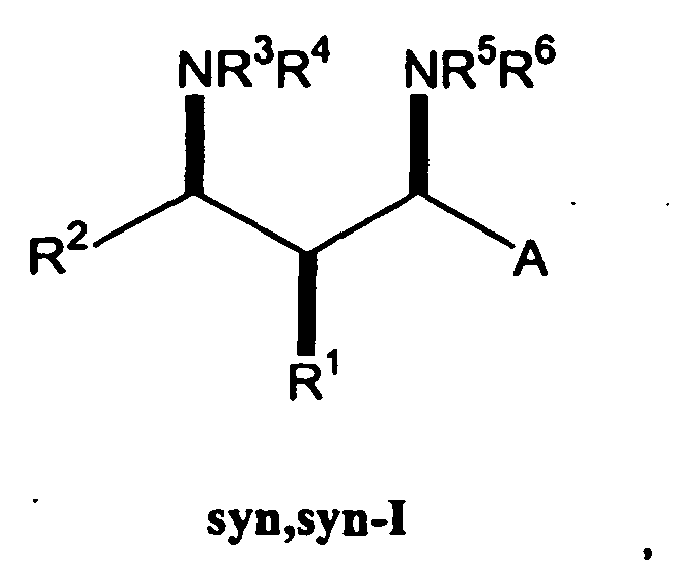
dadurch gekennzeichnet, daß
ein Imin der allgemeinen Struktur (anti-II)
mit einem geeigneten Reduktionsmittel, insbesondere L-Selectride oder Diisobutylaluminiumhydrid, in einem etherischen Lösungsmittel umgesetzt wird. - Verfahren nach Anspruch 11, dadurch gekennzeichnet, daß die Umsetzung mit L-Selectride oder Diisobutylaluminiumhydrid in 8 bis 24 h, vorzugsweise über 10 bis 14 h, durchgeführt wird.
- Verfahren nach einem der Ansprüche 7 bis 12, dadurch gekennzeichnet, daß das Imin der allgemeinen Struktur (II) bzw. (anti-II) durch Umsetzung der Mannich-Base (III) bzw. (anti-III)

mit einem Amin der Formel R3NH2, wenn R3 in Formel (II) bzw. (anti-II) nicht H bedeutet, und mit Ammoniumacetat, wenn R3 in Formel (II) bzw. (anti-II) H bedeutet, in einem etherischen oder alkoholischen Lösungsmittel hergestellt wird. - Verfahren zur Herstellung einer Verbindung der allgemeinen Struktur (I), oder eines ihrer pharmazeutisch annehmbaren Salze,
 R1 Methyl oder Ethyl bedeutet,R2 Methyl, Ethyl oder Phenyl bedeutet, oderR1 und R2 zusammen -(CH2)4- bilden;R3 und R4 H bedeuten;R5 und R6 jeweils Methyl bedeuten oder zusammen -(CH2)2-O-(CH2)2- bilden; undA Phenyl, 2-Chlorphenyl, 2-Methoxyphenyl, 2-Nitrophenyl oder Pyridin-3-yl bedeutet,gekennzeichnet durch die Verfahrensschritte:(a) Überführung eines Aminoalkohols der allgemeinen Struktur (IV)
in die Verbindung der allgemeinen Struktur (V) (b) Überführung der Verbindung der allgemeinen Struktur (V) in ein Azid der allgemeinen Struktur (VI)
 (c) Reduktion des Azids der allgemeinen Struktur (VI) zu dem Diamin der allgemeinen Struktur (I).
 - Verfahren nach Anspruch 14 zur diastereoselektiven Herstellung einer Verbindung der allgemeinen Struktur (syn,anti-I) bzw. (anti,anti-I), oder eines ihrer pharmazeutisch annehmbaren Salze,
 (a') Überführung eines Aminoalkohols der allgemeinen Struktur (anti,anti-IV) bzw. (syn,anti-IV)
in die Verbindung der allgemeinen Struktur (anti,anti-V) bzw. (syn,anti-V) (b') Überführung der Verbindung der allgemeinen Struktur (anti,anti-V) bzw. (syn,anti-V) in ein Azid der allgemeinen Struktur (syn,anti-VI) bzw. (anti,anti-VI)
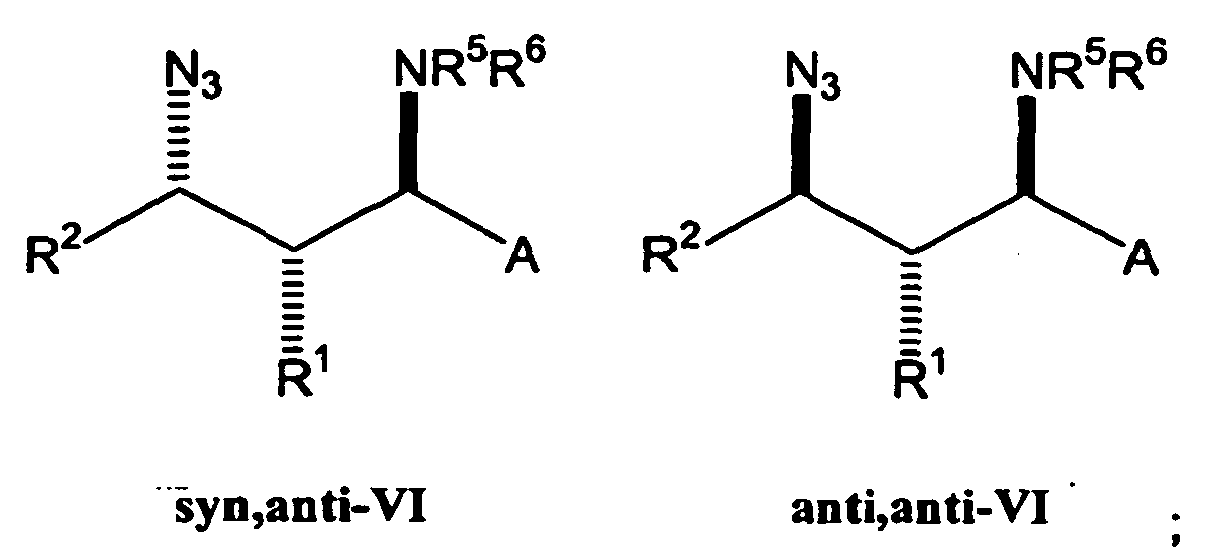 (c') Reduktion des Azids der allgemeinen Struktur (syn,anti-VI) bzw. (anti,anti-VI) zu dem Diamin der allgemeinen Struktur (syn,anti-I) bzw. (anti,anti-I).
 - Verfahren zur Herstellung einer Verbindung der allgemeinen Struktur (syn,anti-l), oder eines ihrer pharmazeutisch annehmbaren Salze,
 R1 Methyl oder Ethyl bedeutet,R2 Methyl, Ethyl oder Phenyl bedeutet, oderR1 und R2 zusammen -(CH2)4- bilden;R3 H, n-Propyl oder -CH2-Phenyl bedeutet;R4 H bedeutet;R5 und R6 jeweils Methyl bedeuten oder zusammen -(CH2)2-O-(CH2)2- bilden; undA Phenyl, 2-Chlorphenyl, 2-Methoxyphenyl, 2-Nitrophenyl oder Pyridin-3-yl bedeutet,gekennzeichnet durch die Verfahrensschritte(aa) Umsetzung eines Imins der allgemeinen Struktur (VII)

und(bb) anschließende Reduktion. - Verfahren nach Anspruch 16 zur Herstellung einer Verbindung der allgemeinen Struktur (syn,anti-I)
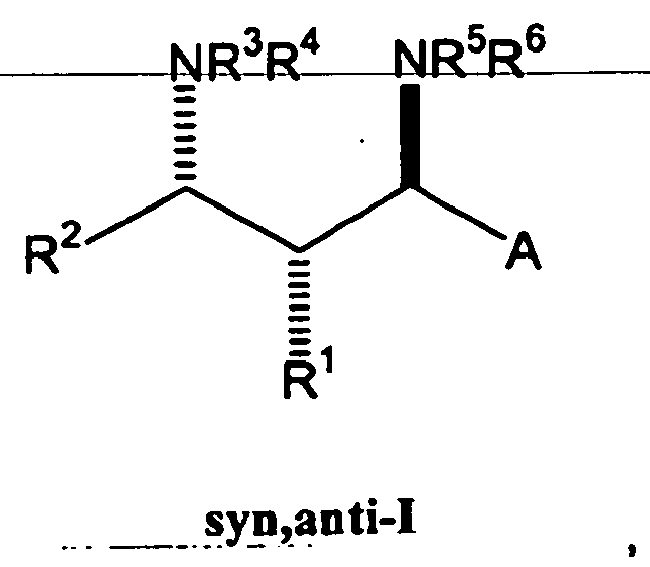
dadurch gekennzeichnet, daß in einem weiteren Verfahrensschritt (cc) eine Verbindung der allgemeinen Struktur (syn,anti-1), worin R1, R2, R4, R5, R6 und A wie in Anspruch 16 definiert sind und R3 -(CH2)-Phenyl bedeutet, wobei Phenyl mit C1-6-Alkyl substituiert sein kann, in Gegenwart eines Übergangmetalls, das aus Platin, Palladium und Nickel ausgewählt ist, mit Wasserstoff (H2) umgesetzt wird. - Verfahren zur Herstellung einer Verbindung der allgemeinen Struktur (I), oder eines ihrer pharmazeutisch annehmbaren Salze,
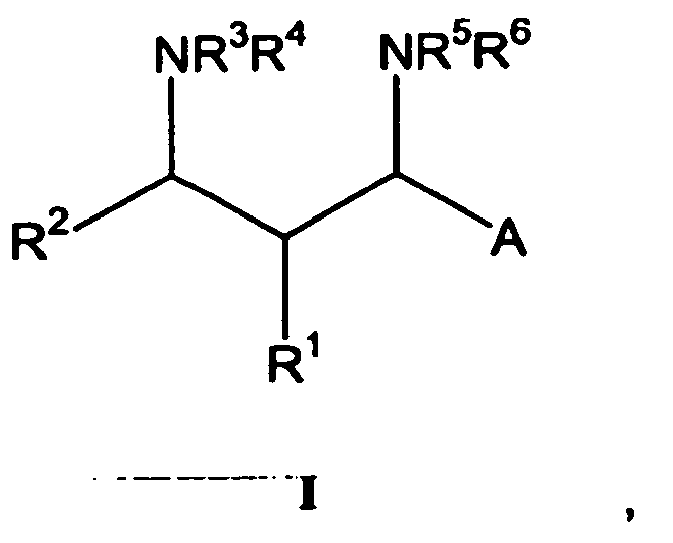 R1 Methyl oder Ethyl bedeutet,R2 Methyl, Ethyl oder Phenyl bedeutet, oderR1 und R2 zusammen -(CH2)4- bilden;R3 C(=O)-R7 bedeutet;R4 H bedeutet;R5 und R6 jeweils Methyl bedeuten oder zusammen -(CH2)2-O-(CH2)2- bilden;A Phenyl, 2-Chlorphenyl, 2-Methoxyphenyl, 2-Nitrophenyl oder Pyridin-3-yl bedeutet; undR7 Methyl, Phenyl, 2-Fluorphenyl, 2-Chlorphenyl oder 2-Methylphenyl bedeutet,und die als Racemat, in Form eines oder mehrerer Diastereomeren oder eines oder mehrerer Enantiomeren vorliegt,
dadurch gekennzeichnet, daß eine Verbindung der allgemeinen Struktur (I), worin R1, R2, R4, R5, R6 und A wie oben in diesem Anspruch definiert sind und R3 H bedeutet, und die als Racemat, in Form eines oder mehrerer Diastereomeren oder eines oder mehrerer Enantiomeren vorliegt, mit einem Acylierungsreagenz umgesetzt wird. - Verfahren nach Anspruch 18, dadurch gekennzeichnet, daß das Acylierungsreagenz ein Säurechlorid der allgemeinen Formel R7-C(=O)-Cl ist, worin R7 Methyl, Phenyl, 2-Fluorphenyl, 2-Chlorphenyl oder 2-Methylphenyl bedeutet.
- Arzneimittel, enthaltend eine Verbindung der allgemeinen Struktur (1) oder eines ihrer pharmazeutisch annehmbaren Salze, die/das als Racemat, in Form eines oder mehrerer Diastereomeren oder eines oder mehrerer Enantiomeren vorliegt,
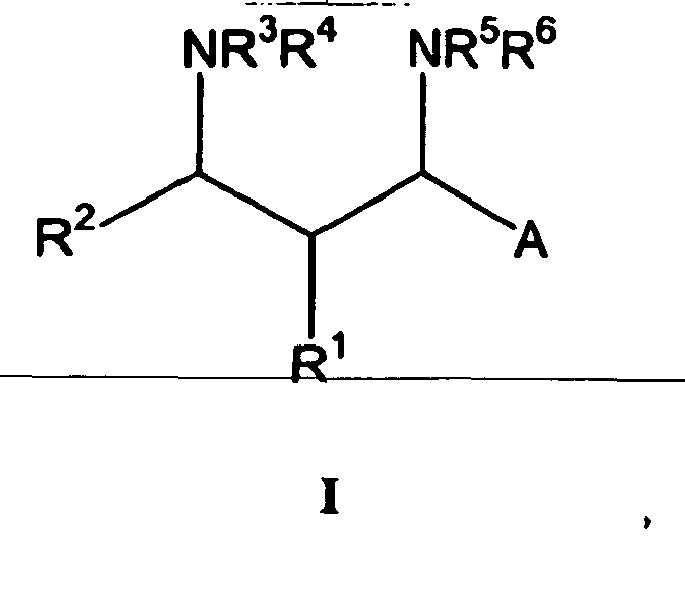 R1 Methyl oder Ethyl bedeutet,R2 Methyl, Ethyl oder Phenyl bedeutet, oderR1 und R2 zusammen -(CH2)4- bilden;R3 H, n-Propyl, -CH2-Phenyl oder C(=O)-R7 bedeutet;R4 H bedeutet;R5 und R6 jeweils Methyl bedeuten oder zusammen -(CH2)2-O-(CH2)2- bilden;A Phenyl, 2-Chlorphenyl, 2-Methoxyphenyl, 2-Nitrophenyl oder Pyridin-3-yl bedeutet; undR7 Methyl, Phenyl, 2-Fluorphenyl, 2-Chlorphenyl oder 2-Methylphenyl bedeutet.
 - Verwendung einer Verbindung der allgemeinen Struktur (l) oder eines ihrer pharmazeutisch annehmbaren Salze, die/das als Racemat, in Form eines oder mehrerer Diastereomeren oder eines oder mehrerer Enantiomeren vorliegt,
 R1 Methyl oder Ethyl bedeutet,R2 Methyl, Ethyl oder Phenyl bedeutet, oderR1 und R2 zusammen -(CH2)4- bilden;R3 H, n-Propyl, -CH2-Phenyl oder C(=O)-R7 bedeutet;R4 H bedeutet;R5 und R6 jeweils Methyl bedeuten oder zusammen -(CH2)2-O-(CH2)2-bilden;A Phenyl, 2-Chlorphenyl, 2-Methoxyphenyl, 2-Nitrophenyl oder Pyridin-3-yl bedeutet; undR7 Methyl, Phenyl, 2-Fluorphenyl, 2-Chlorphenyl oder 2-Methylphenyl bedeutet,zur Herstellung eines Medikaments zur Therapie und/oder Prophylaxe von Schmerz.
 - Verwendung einer Verbindung der allgemeinen Struktur (I) oder eines ihrer pharmazeutisch annehmbaren Salze, die/das als als Racemat, in Form eines oder mehrerer Diastereomeren oder eines oder mehrerer Enantiomeren vorliegt,
 R1 Methyl oder Ethyl bedeutet,R2 Methyl, Ethyl oder Phenyl bedeutet, oderR1 und R2 zusammen -(CH2)4- bilden;R3 H, n-Propyl, -CH2-Phenyl oder C(=O)-R7 bedeutet;R4 H bedeutet;R5 und R6 jeweils Methyl bedeuten oder zusammen -(CH2)2-O-(CH2)2- bilden;A Phenyl, 2-Chlorphenyl, 2-Methoxyphenyl, 2-Nitrophenyl oder Pyridin-3-yl bedeutet; undR7 Methyl, Phenyl, 2-Fluorphenyl, 2-Chlorphenyl oder 2-Methylphenyl bedeutet,zur Herstellung eines Medikaments zur Therapie und/oder Prophylaxe von Harninkontinenz, Juckreiz, Tinnitus aurium und/oder Diarrhoe.
Priority Applications (1)
| Application Number | Priority Date | Filing Date | Title |
|---|---|---|---|
| SI200230563T SI1363885T1 (sl) | 2001-02-21 | 2002-02-20 | Substituirani derivati propan-1,3-diamina in njihova farmacevtska uporaba |
Applications Claiming Priority (3)
| Application Number | Priority Date | Filing Date | Title |
|---|---|---|---|
| DE10108307A DE10108307A1 (de) | 2001-02-21 | 2001-02-21 | Substituierte Propan-1,3-diamin-Derivate |
| DE10108307 | 2001-02-21 | ||
| PCT/EP2002/001765 WO2002066432A1 (de) | 2001-02-21 | 2002-02-20 | Substituierte propan- 1,3-diamin-derivate und ihre pharmazeutische verwendung |
Publications (2)
| Publication Number | Publication Date |
|---|---|
| EP1363885A1 EP1363885A1 (de) | 2003-11-26 |
| EP1363885B1 true EP1363885B1 (de) | 2007-05-23 |
Family
ID=7674965
Family Applications (1)
| Application Number | Title | Priority Date | Filing Date |
|---|---|---|---|
| EP02714169A Expired - Lifetime EP1363885B1 (de) | 2001-02-21 | 2002-02-20 | Substituierte propan- 1,3-diamin-derivate und ihre pharmazeutische verwendung |
Country Status (27)
| Country | Link |
|---|---|
| US (1) | US7230018B2 (de) |
| EP (1) | EP1363885B1 (de) |
| JP (1) | JP4447837B2 (de) |
| KR (1) | KR20030091995A (de) |
| CN (1) | CN100434421C (de) |
| AR (1) | AR035752A1 (de) |
| AT (1) | ATE362916T1 (de) |
| AU (1) | AU2002246095B2 (de) |
| CA (1) | CA2438704C (de) |
| CY (1) | CY1106711T1 (de) |
| CZ (1) | CZ20031968A3 (de) |
| DE (2) | DE10108307A1 (de) |
| DK (1) | DK1363885T3 (de) |
| EC (1) | ECSP034739A (de) |
| ES (1) | ES2286240T3 (de) |
| HU (1) | HUP0302746A3 (de) |
| IL (2) | IL157494A0 (de) |
| MX (1) | MXPA03006744A (de) |
| NO (1) | NO20033697L (de) |
| PE (1) | PE20021007A1 (de) |
| PL (1) | PL372089A1 (de) |
| PT (1) | PT1363885E (de) |
| RU (1) | RU2003127397A (de) |
| SI (1) | SI1363885T1 (de) |
| SK (1) | SK286980B6 (de) |
| WO (1) | WO2002066432A1 (de) |
| ZA (1) | ZA200307321B (de) |
Families Citing this family (4)
| Publication number | Priority date | Publication date | Assignee | Title |
|---|---|---|---|---|
| DE102005061428A1 (de) * | 2005-12-22 | 2007-08-16 | Grünenthal GmbH | Substituierte Cyclohexylmethyl-Derivate |
| ITMI20120536A1 (it) * | 2012-04-02 | 2013-10-03 | Carlo Angelo Ghisalberti | Composizioni per il trattamento dell¿incontinenza urinaria da stress in soggetti femminili |
| GB201601301D0 (en) * | 2016-01-25 | 2016-03-09 | Takeda Pharmaceutical | Novel compounds |
| CN110021156A (zh) * | 2018-01-10 | 2019-07-16 | 金宝电子工业股份有限公司 | 遥控系统以及遥控方法 |
Family Cites Families (3)
| Publication number | Priority date | Publication date | Assignee | Title |
|---|---|---|---|---|
| US4017637A (en) * | 1973-03-26 | 1977-04-12 | American Home Products Corporation | Benzylamine analgesics |
| DE19915601A1 (de) * | 1999-04-07 | 2000-10-19 | Gruenenthal Gmbh | 3-Amino-3-arylpropan-1-ol-Derivate, deren Herstellung und Verwendung |
| DE19915602A1 (de) * | 1999-04-07 | 2000-10-19 | Gruenenthal Gmbh | 3-Amino-4-arylpropan-1-ol-Derivate, deren Herstellung und Verwendung |
-
2001
- 2001-02-21 DE DE10108307A patent/DE10108307A1/de not_active Withdrawn
-
2002
- 2002-02-19 AR ARP020100567A patent/AR035752A1/es not_active Application Discontinuation
- 2002-02-20 HU HU0302746A patent/HUP0302746A3/hu unknown
- 2002-02-20 DE DE50210197T patent/DE50210197D1/de not_active Expired - Lifetime
- 2002-02-20 JP JP2002565949A patent/JP4447837B2/ja not_active Expired - Fee Related
- 2002-02-20 WO PCT/EP2002/001765 patent/WO2002066432A1/de not_active Ceased
- 2002-02-20 AU AU2002246095A patent/AU2002246095B2/en not_active Ceased
- 2002-02-20 PE PE2002000142A patent/PE20021007A1/es not_active Application Discontinuation
- 2002-02-20 CZ CZ20031968A patent/CZ20031968A3/cs unknown
- 2002-02-20 PL PL02372089A patent/PL372089A1/xx not_active Application Discontinuation
- 2002-02-20 KR KR10-2003-7011008A patent/KR20030091995A/ko not_active Withdrawn
- 2002-02-20 CN CNB028052463A patent/CN100434421C/zh not_active Expired - Fee Related
- 2002-02-20 SK SK1030-2003A patent/SK286980B6/sk not_active IP Right Cessation
- 2002-02-20 MX MXPA03006744A patent/MXPA03006744A/es active IP Right Grant
- 2002-02-20 SI SI200230563T patent/SI1363885T1/sl unknown
- 2002-02-20 PT PT02714169T patent/PT1363885E/pt unknown
- 2002-02-20 ES ES02714169T patent/ES2286240T3/es not_active Expired - Lifetime
- 2002-02-20 DK DK02714169T patent/DK1363885T3/da active
- 2002-02-20 IL IL15749402A patent/IL157494A0/xx unknown
- 2002-02-20 RU RU2003127397/04A patent/RU2003127397A/ru not_active Application Discontinuation
- 2002-02-20 AT AT02714169T patent/ATE362916T1/de active
- 2002-02-20 CA CA2438704A patent/CA2438704C/en not_active Expired - Fee Related
- 2002-02-20 EP EP02714169A patent/EP1363885B1/de not_active Expired - Lifetime
-
2003
- 2003-08-20 IL IL157494A patent/IL157494A/en not_active IP Right Cessation
- 2003-08-20 EC EC2003004739A patent/ECSP034739A/es unknown
- 2003-08-20 NO NO20033697A patent/NO20033697L/no not_active Application Discontinuation
- 2003-08-21 US US10/644,981 patent/US7230018B2/en not_active Expired - Fee Related
- 2003-09-18 ZA ZA200307321A patent/ZA200307321B/en unknown
-
2007
- 2007-07-09 CY CY20071100903T patent/CY1106711T1/el unknown
Also Published As
Similar Documents
| Publication | Publication Date | Title |
|---|---|---|
| EP0753506B1 (de) | 6-Dimethylaminomethyl-1-phenyl-cyclo-hexanverbindungen als pharmazeutische Wirkstoffe | |
| DE69920472T2 (de) | Therapeutische verwendung als histamin-h3-rezeptor liganden von alkylaminen, die kein imidazole enthalten | |
| DE60312998T2 (de) | 1-amido-4-phenyl-4-benzyloxymethyl-piperidin derivative und verwandte verbindungen als neurokinin-1 (nk-1) antagonsisten zur behandlung von erbrechen, depressionen, angstzustände und husten | |
| EP0983995B1 (de) | Dimethyl-(3-aryl-but-3-enyl)-aminverbindungen als pharmazeutische Wirkstoffe | |
| EP1891004B1 (de) | Pentafluorsulfanyl-substituierte verbindung und deren verwendung zur herstellung von arzneimitteln | |
| DE60222693T2 (de) | Nk1-antagonisten | |
| DE69116237T2 (de) | Derivate von Hexahydroazepine, Verfahren zu ihrer Herstellung und diese enthaltende Arzneimittel | |
| DE69628200T2 (de) | Diarylalkenylamin-derivate | |
| DE19520499C2 (de) | Neurokinin-Antagonisten, Verfahren zu ihrer Herstellung, diese Verbindungen enthaltende pharmazeutische Zusammensetzungen sowie ihre Verwendung | |
| EP1406623B1 (de) | Substituierte 1-phenethylpiperidinverbindungen, die unter anderem als analgetika verwendung finden | |
| EP1246791B1 (de) | Aminomethyl-phenyl-cyclohexanonderivate | |
| AT395972B (de) | Verfahren zur herstellung von neuen dichloranilinderivaten | |
| WO2002066432A1 (de) | Substituierte propan- 1,3-diamin-derivate und ihre pharmazeutische verwendung | |
| EP1043306B1 (de) | 3-Amino-3-arylpropan-1-ol-Derivate, deren Herstellung und Verwendung | |
| EP1406857B1 (de) | Substituierte 1-aryl-but-3-enylamin- und 1-aryl-but-2-enylaminverbindungen | |
| EP1572653B1 (de) | Gesättigte und ungesättigte heteroarylcycloalkymethyl-amine als antidepressiva | |
| EP1768948B1 (de) | Substituierte aminoverbindungen als 5-ht/na uptakehemmer | |
| DD149664A5 (de) | Verfahren zur herstellung von 1,1'-biphenyl-2-yl-alkylamin-derivaten | |
| HK1060730B (en) | Substituted propane-1,3-diamine derivatives and the pharmaceutical use thereof | |
| EP1497256A1 (de) | Substituierte 1,5-diaminopentan-3-ol-verbindungen | |
| DE4234198A1 (de) | Neue tertiäre Amine mit muskarinischen Eigenschaften |
Legal Events
| Date | Code | Title | Description |
|---|---|---|---|
| PUAI | Public reference made under article 153(3) epc to a published international application that has entered the european phase |
Free format text: ORIGINAL CODE: 0009012 |
|
| 17P | Request for examination filed |
Effective date: 20030613 |
|
| AK | Designated contracting states |
Kind code of ref document: A1 Designated state(s): AT BE CH CY DE DK ES FI FR GB GR IE IT LI LU MC NL PT SE TR |
|
| AX | Request for extension of the european patent |
Extension state: AL LT LV MK RO SI |
|
| 17Q | First examination report despatched |
Effective date: 20040420 |
|
| REG | Reference to a national code |
Ref country code: HK Ref legal event code: DE Ref document number: 1060730 Country of ref document: HK |
|
| GRAP | Despatch of communication of intention to grant a patent |
Free format text: ORIGINAL CODE: EPIDOSNIGR1 |
|
| GRAS | Grant fee paid |
Free format text: ORIGINAL CODE: EPIDOSNIGR3 |
|
| GRAA | (expected) grant |
Free format text: ORIGINAL CODE: 0009210 |
|
| AK | Designated contracting states |
Kind code of ref document: B1 Designated state(s): AT BE CH CY DE DK ES FI FR GB GR IE IT LI LU MC NL PT SE TR |
|
| AX | Request for extension of the european patent |
Extension state: LT LV RO SI |
|
| REG | Reference to a national code |
Ref country code: GB Ref legal event code: FG4D Free format text: NOT ENGLISH |
|
| REG | Reference to a national code |
Ref country code: PT Ref legal event code: SC4A Free format text: AVAILABILITY OF NATIONAL TRANSLATION Effective date: 20070531 |
|
| REG | Reference to a national code |
Ref country code: CH Ref legal event code: EP |
|
| REG | Reference to a national code |
Ref country code: IE Ref legal event code: FG4D Free format text: LANGUAGE OF EP DOCUMENT: GERMAN |
|
| REG | Reference to a national code |
Ref country code: CH Ref legal event code: NV Representative=s name: BRAUNPAT BRAUN EDER AG |
|
| REF | Corresponds to: |
Ref document number: 50210197 Country of ref document: DE Date of ref document: 20070705 Kind code of ref document: P |
|
| REG | Reference to a national code |
Ref country code: GR Ref legal event code: EP Ref document number: 20070401790 Country of ref document: GR |
|
| REG | Reference to a national code |
Ref country code: SE Ref legal event code: TRGR |
|
| REG | Reference to a national code |
Ref country code: DK Ref legal event code: T3 |
|
| GBT | Gb: translation of ep patent filed (gb section 77(6)(a)/1977) |
Effective date: 20070820 |
|
| ET | Fr: translation filed | ||
| REG | Reference to a national code |
Ref country code: ES Ref legal event code: FG2A Ref document number: 2286240 Country of ref document: ES Kind code of ref document: T3 |
|
| REG | Reference to a national code |
Ref country code: HK Ref legal event code: GR Ref document number: 1060730 Country of ref document: HK |
|
| PLBE | No opposition filed within time limit |
Free format text: ORIGINAL CODE: 0009261 |
|
| STAA | Information on the status of an ep patent application or granted ep patent |
Free format text: STATUS: NO OPPOSITION FILED WITHIN TIME LIMIT |
|
| 26N | No opposition filed |
Effective date: 20080226 |
|
| PG25 | Lapsed in a contracting state [announced via postgrant information from national office to epo] |
Ref country code: MC Free format text: LAPSE BECAUSE OF NON-PAYMENT OF DUE FEES Effective date: 20080228 |
|
| PGFP | Annual fee paid to national office [announced via postgrant information from national office to epo] |
Ref country code: DE Payment date: 20100228 Year of fee payment: 9 Ref country code: TR Payment date: 20100127 Year of fee payment: 9 |
|
| PGFP | Annual fee paid to national office [announced via postgrant information from national office to epo] |
Ref country code: DK Payment date: 20110210 Year of fee payment: 10 Ref country code: IE Payment date: 20110210 Year of fee payment: 10 |
|
| PGFP | Annual fee paid to national office [announced via postgrant information from national office to epo] |
Ref country code: FR Payment date: 20110218 Year of fee payment: 10 Ref country code: AT Payment date: 20110126 Year of fee payment: 10 Ref country code: FI Payment date: 20110211 Year of fee payment: 10 Ref country code: NL Payment date: 20110216 Year of fee payment: 10 Ref country code: CH Payment date: 20110214 Year of fee payment: 10 Ref country code: IT Payment date: 20110216 Year of fee payment: 10 Ref country code: LU Payment date: 20110330 Year of fee payment: 10 Ref country code: PT Payment date: 20110203 Year of fee payment: 10 Ref country code: SE Payment date: 20110211 Year of fee payment: 10 |
|
| PGFP | Annual fee paid to national office [announced via postgrant information from national office to epo] |
Ref country code: GR Payment date: 20110113 Year of fee payment: 10 |
|
| PGFP | Annual fee paid to national office [announced via postgrant information from national office to epo] |
Ref country code: GB Payment date: 20110216 Year of fee payment: 10 Ref country code: ES Payment date: 20110315 Year of fee payment: 10 |
|
| PGFP | Annual fee paid to national office [announced via postgrant information from national office to epo] |
Ref country code: CY Payment date: 20110112 Year of fee payment: 10 |
|
| PGFP | Annual fee paid to national office [announced via postgrant information from national office to epo] |
Ref country code: BE Payment date: 20110722 Year of fee payment: 10 |
|
| REG | Reference to a national code |
Ref country code: DE Ref legal event code: R119 Ref document number: 50210197 Country of ref document: DE Effective date: 20110901 |
|
| REG | Reference to a national code |
Ref country code: PT Ref legal event code: MM4A Free format text: LAPSE DUE TO NON-PAYMENT OF FEES Effective date: 20120820 |
|
| BERE | Be: lapsed |
Owner name: GRUNENTHAL G.M.B.H. Effective date: 20120228 |
|
| REG | Reference to a national code |
Ref country code: NL Ref legal event code: V1 Effective date: 20120901 |
|
| LTLA | Lt: lapse of european patent or patent extension |
Effective date: 20120220 |
|
| REG | Reference to a national code |
Ref country code: CH Ref legal event code: PL |
|
| GBPC | Gb: european patent ceased through non-payment of renewal fee |
Effective date: 20120220 |
|
| REG | Reference to a national code |
Ref country code: GR Ref legal event code: ML Ref document number: 20070401790 Country of ref document: GR Effective date: 20120905 |
|
| PG25 | Lapsed in a contracting state [announced via postgrant information from national office to epo] |
Ref country code: FI Free format text: LAPSE BECAUSE OF NON-PAYMENT OF DUE FEES Effective date: 20120220 Ref country code: CH Free format text: LAPSE BECAUSE OF NON-PAYMENT OF DUE FEES Effective date: 20120229 Ref country code: SE Free format text: LAPSE BECAUSE OF NON-PAYMENT OF DUE FEES Effective date: 20120221 Ref country code: LI Free format text: LAPSE BECAUSE OF NON-PAYMENT OF DUE FEES Effective date: 20120229 Ref country code: CY Free format text: LAPSE BECAUSE OF NON-PAYMENT OF DUE FEES Effective date: 20120220 |
|
| REG | Reference to a national code |
Ref country code: DK Ref legal event code: EBP |
|
| REG | Reference to a national code |
Ref country code: IE Ref legal event code: MM4A |
|
| REG | Reference to a national code |
Ref country code: FR Ref legal event code: ST Effective date: 20121031 |
|
| PG25 | Lapsed in a contracting state [announced via postgrant information from national office to epo] |
Ref country code: PT Free format text: LAPSE BECAUSE OF NON-PAYMENT OF DUE FEES Effective date: 20120820 Ref country code: IT Free format text: LAPSE BECAUSE OF NON-PAYMENT OF DUE FEES Effective date: 20120220 Ref country code: GR Free format text: LAPSE BECAUSE OF NON-PAYMENT OF DUE FEES Effective date: 20120905 |
|
| REG | Reference to a national code |
Ref country code: AT Ref legal event code: MM01 Ref document number: 362916 Country of ref document: AT Kind code of ref document: T Effective date: 20120220 |
|
| PG25 | Lapsed in a contracting state [announced via postgrant information from national office to epo] |
Ref country code: BE Free format text: LAPSE BECAUSE OF NON-PAYMENT OF DUE FEES Effective date: 20120228 |
|
| PG25 | Lapsed in a contracting state [announced via postgrant information from national office to epo] |
Ref country code: IE Free format text: LAPSE BECAUSE OF NON-PAYMENT OF DUE FEES Effective date: 20120220 Ref country code: AT Free format text: LAPSE BECAUSE OF NON-PAYMENT OF DUE FEES Effective date: 20120220 Ref country code: NL Free format text: LAPSE BECAUSE OF NON-PAYMENT OF DUE FEES Effective date: 20120901 Ref country code: FR Free format text: LAPSE BECAUSE OF NON-PAYMENT OF DUE FEES Effective date: 20120229 Ref country code: GB Free format text: LAPSE BECAUSE OF NON-PAYMENT OF DUE FEES Effective date: 20120220 |
|
| REG | Reference to a national code |
Ref country code: SI Ref legal event code: KO00 Effective date: 20121224 |
|
| REG | Reference to a national code |
Ref country code: ES Ref legal event code: FD2A Effective date: 20130708 |
|
| PG25 | Lapsed in a contracting state [announced via postgrant information from national office to epo] |
Ref country code: ES Free format text: LAPSE BECAUSE OF NON-PAYMENT OF DUE FEES Effective date: 20120221 |
|
| PG25 | Lapsed in a contracting state [announced via postgrant information from national office to epo] |
Ref country code: DK Free format text: LAPSE BECAUSE OF NON-PAYMENT OF DUE FEES Effective date: 20120229 Ref country code: TR Free format text: LAPSE BECAUSE OF NON-PAYMENT OF DUE FEES Effective date: 20120220 |
|
| PG25 | Lapsed in a contracting state [announced via postgrant information from national office to epo] |
Ref country code: LU Free format text: LAPSE BECAUSE OF NON-PAYMENT OF DUE FEES Effective date: 20120220 |
|
| PG25 | Lapsed in a contracting state [announced via postgrant information from national office to epo] |
Ref country code: DE Free format text: LAPSE BECAUSE OF NON-PAYMENT OF DUE FEES Effective date: 20110901 |