EP1361369A2 - Kolben-Zylinder-Aggregat als Kippbetätigungselement für die Kippbrücke eines Kipperfahrzeuges - Google Patents
Kolben-Zylinder-Aggregat als Kippbetätigungselement für die Kippbrücke eines Kipperfahrzeuges Download PDFInfo
- Publication number
- EP1361369A2 EP1361369A2 EP03008371A EP03008371A EP1361369A2 EP 1361369 A2 EP1361369 A2 EP 1361369A2 EP 03008371 A EP03008371 A EP 03008371A EP 03008371 A EP03008371 A EP 03008371A EP 1361369 A2 EP1361369 A2 EP 1361369A2
- Authority
- EP
- European Patent Office
- Prior art keywords
- piston
- cylinder unit
- guide recess
- shaft
- piston rod
- Prior art date
- Legal status (The legal status is an assumption and is not a legal conclusion. Google has not performed a legal analysis and makes no representation as to the accuracy of the status listed.)
- Granted
Links
Images
Classifications
-
- F—MECHANICAL ENGINEERING; LIGHTING; HEATING; WEAPONS; BLASTING
- F15—FLUID-PRESSURE ACTUATORS; HYDRAULICS OR PNEUMATICS IN GENERAL
- F15B—SYSTEMS ACTING BY MEANS OF FLUIDS IN GENERAL; FLUID-PRESSURE ACTUATORS, e.g. SERVOMOTORS; DETAILS OF FLUID-PRESSURE SYSTEMS, NOT OTHERWISE PROVIDED FOR
- F15B15/00—Fluid-actuated devices for displacing a member from one position to another; Gearing associated therewith
- F15B15/08—Characterised by the construction of the motor unit
- F15B15/14—Characterised by the construction of the motor unit of the straight-cylinder type
- F15B15/1423—Component parts; Constructional details
- F15B15/148—Lost-motion means between the piston and the output
-
- B—PERFORMING OPERATIONS; TRANSPORTING
- B60—VEHICLES IN GENERAL
- B60P—VEHICLES ADAPTED FOR LOAD TRANSPORTATION OR TO TRANSPORT, TO CARRY, OR TO COMPRISE SPECIAL LOADS OR OBJECTS
- B60P1/00—Vehicles predominantly for transporting loads and modified to facilitate loading, consolidating the load, or unloading
- B60P1/04—Vehicles predominantly for transporting loads and modified to facilitate loading, consolidating the load, or unloading with a tipping movement of load-transporting element
- B60P1/16—Vehicles predominantly for transporting loads and modified to facilitate loading, consolidating the load, or unloading with a tipping movement of load-transporting element actuated by fluid-operated mechanisms
- B60P1/162—Vehicles predominantly for transporting loads and modified to facilitate loading, consolidating the load, or unloading with a tipping movement of load-transporting element actuated by fluid-operated mechanisms the hydraulic system itself
-
- F—MECHANICAL ENGINEERING; LIGHTING; HEATING; WEAPONS; BLASTING
- F15—FLUID-PRESSURE ACTUATORS; HYDRAULICS OR PNEUMATICS IN GENERAL
- F15B—SYSTEMS ACTING BY MEANS OF FLUIDS IN GENERAL; FLUID-PRESSURE ACTUATORS, e.g. SERVOMOTORS; DETAILS OF FLUID-PRESSURE SYSTEMS, NOT OTHERWISE PROVIDED FOR
- F15B15/00—Fluid-actuated devices for displacing a member from one position to another; Gearing associated therewith
- F15B15/08—Characterised by the construction of the motor unit
- F15B15/14—Characterised by the construction of the motor unit of the straight-cylinder type
- F15B15/16—Characterised by the construction of the motor unit of the straight-cylinder type of the telescopic type
Definitions
- the invention relates to a piston-cylinder unit, in particular one Telescopic press as a tilt actuating element for the tipping bridge of a tipper vehicle, the piston-cylinder unit on its extendable Piston rod end a joint element for a joint connection between the piston-cylinder unit and the rocker bridge.
- Such a piston-cylinder unit is used for the structure or the tipping bridge as a drive unit, which is on the one hand on the tipping bridge and on the other hand on the frame of the tipper vehicle by means of articulated connections in question is articulated.
- the telescopic piston elements are in the normal driving position of the tipping bridge largely in their retracted position.
- the object of the present invention is a piston-cylinder unit to provide the type mentioned, which with simple means effective against increased wear due to vibration movements is protected during normal operation of the tipper vehicle.
- the invention proposes that Joint element for articulating the extendable piston rod end the tipping bridge has a shaft which is in an end guide recess of the extendable piston rod end relative to the piston rod is held axially displaceable.
- the joint element shaft with Axial play is coupled to the extendable piston rod end, so that relative movements between the vehicle frame and the tipper body at least in part by the axial play between the joint element shaft and piston rod end are included and that it is so far not for movement between the piston rod and the piston rod surrounding cylinder tube comes.
- the axial play bearing the joint element can be realized with simple means.
- an embodiment is particularly preferred in a space between the bottom of the guide recess and the end of the joint element shaft opposite the floor apart from any accumulation of lubricant, essentially only gas, especially air, is present.
- the guide recess can be a radial central axial bore in the extendable piston rod end, the joint element shaft for movement within its axial play is received in this hole.
- an air duct channel the free space with the atmosphere combines. According to a development of the invention, this extends Air duct through the joint element.
- the articulated element can be removed from the if necessary Piston rod fixed axially displaceable, so that in the event of a repair can be easily removed or replaced.
- the guide recess can have a substantially cylindrical axial bore or the like.
- the in this guide recess recorded joint element shaft an area reduced diameter with at least one in this area Has circumference of the joint element shaft adjacent securing element.
- the step acting as an axial stop for the securing element is according to a development of the invention on a detachable with the piston rod associated use trained.
- a securing ring e.g. Wire ring or snap ring, in question.
- Securing elements can also be provided, the radial extent of which can be adjusted by means of a spreading device or the like, to get them out of a neutral position in which they can be moved past the step are to be transferred to a safe position.
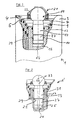
- Fig. 1 this is in the mounting arrangement on the tipper vehicle of the tipping bridge facing end of a piston-cylinder unit 1 after the Invention recognizable. It is the piston-cylinder unit 1 around a telescopic press with an outer tube 3 and telescopic therein nested telescopic elements (piston elements) 4, 5, 7, 9, 11.
- the radially central piston element 11 is within the scope of the present Application called piston rod and points to his extendable piston rod end 13 has a radially centered axial bore 15 in which a shaft 17 of a joint element 19 is received.
- the Shaft 17 is axially displaceably received in the guide bore 15, so that axial movements of the joint element 19 within a limited Axial play can take place without such movements are forcibly transferred to the piston elements 5, 7, 9, 11.
- the cause of increased wear explained above is therefore more conventional Tipper presses almost completely eliminated.
- Nontaxial components of Relative movements of the vehicle frame and tipper press are largely compensated at the articulated connections on both sides of the tipper press.
- FIG. 1 it is the tilting bridge side Hinge connection 21 around a ball joint connection, e.g. for a three-way tipper, wherein the joint element 19 has the spherical part.
- the the Joint socket 23 receiving the ball part is located on the tilting bridge.
- the clearance 24 between the bottom of the bore 15 and the bottom of shaft 17 contains, in addition to any lubricant accumulations just air. There are no prestressing elements or the like in the free space 24 provided.
- a Wire ring 25 is provided, which has an area of reduced diameter 27 of the shaft 17 surrounds at its periphery and in one area 29 enlarged diameter of the guide recess 15 locked is.
- the joint element 19 is captive in the guide receptacle 15 secured and the axial play of the movement of the shaft 17th essentially by the axial length of the area of reduced diameter of the shaft 17 minus the wire diameter of the safety wire defined in size.
- the wire ring 25 is first in the area 29 of the guide recess 15 introduced and then the shaft 17 in the Hole 15 introduced. As soon as the area 27 of the shaft 17 the Area 29 of the bore 15 reached, the snap ring snaps into the Area 27 of the shaft 17.
- Fig. 2 shows a variant of the embodiment of Fig. 1.
- a removable insert sleeve 31 on the extendable Piston rod end 13 e.g. fixed by screws which the in Fig. 2nd defines the upper part of the guide recess 15 and in particular the Contains area 29 of enlarged diameter of the bore 15.
- the solution 2 therefore allows the removal of the sleeve 31 and thus also the simplified removal of the joint element 19th
- Fig. 2 shows the joint element 19 in a detached from the ball socket Disassembly representation, it with the lower end of the shaft 17th almost touches the bottom of the guide recess.
- the shaft In the position corresponding to the travel position of the tipping bridge the shaft should be in the bore 15 be included, as shown in Fig. 1, namely that for both axial directions of movement is possible.
- an air duct 33 is provided, which during the axial extension of the shaft 17 resulting free space 24 between the floor the bore 15 and the underside of the shaft 17 with the atmosphere combines. This ensures that in the event of a sudden insertion of the shaft 17 into the free space 24 air through the air duct 33 can escape without causing undesirable strong temperature increases comes due to air compression in free space 24.
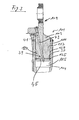
- Fig. 3 shows a second embodiment of the invention. Parts in Fig. 3, which correspond to parts in their effect in FIGS. 1 and 2 with corresponding reference numbers, increased by 100, marked that essentially according to the description of the embodiments Figures 1 and 2 can be referenced.
- the bearing element 119 is part of a Eye camp.
- the shaft 117 points at its lower, into the guide recess 15 introduced end an area 127 of reduced diameter and in this area 127 a circumferential groove 37 in which a Circlip 125 received with spring force acting radially inwards is.
- 3 is the locking ring 125 axially below a step 129 in the arrangement 115 and spread so radially outwards by means of a spreading device 39 that it strikes the step 129 when the shaft 117 moves upward.
- the joint element 119 is against axial pulling out of the Guide recess 115 secured.
- the spreading device 39 is shown rather schematically in FIG. 3, wherein a conical screw element 41 in one at its lower end is screwed with a threaded oblique bore 43.
- oblique bore 43 can be in a variant of the embodiment shown also an air duct duct corresponding to duct 33 from FIG. 2 be provided.
Landscapes
- Engineering & Computer Science (AREA)
- Mechanical Engineering (AREA)
- Physics & Mathematics (AREA)
- Fluid Mechanics (AREA)
- General Engineering & Computer Science (AREA)
- Transportation (AREA)
- Actuator (AREA)
- Fluid-Damping Devices (AREA)
- Pivots And Pivotal Connections (AREA)
- Pit Excavations, Shoring, Fill Or Stabilisation Of Slopes (AREA)
Abstract
Description
- Fig. 1
- zeigt eine teils geschnitten - teils gebrochen dargestellte Seitenansicht des einer Kippbrücke zugewandten Endes eines Kolben-Zylinder-Aggregates nach der Erfindung in einer der normalen Fahrtstellung der Kippbrücke entsprechenden Situation.
- Fig. 2
- zeigt eine Variante des Kolben-Zylinder-Aggregates aus Fig. 1 in einer teils geschnitten und teils gebrochen dargestellten Seitenansicht des im montierten Zustand der Kippbrücke zugewandten Endes des Kolben-Zylinder-Aggregates.
- Fig. 3
- zeigt ein zweites Ausführungsbeispiel der Erfindung in einer teils gebrochen und teils geschnitten dargestellten Seitenansicht des im montierten Zustand der Kippbrücke zugewandten Endes des Kolben-Zylinder-Aggregates.
Claims (8)
- Kolben-Zylinder-Aggregat, insbesondere Teleskoppresse als Kippbetätigungselement für die Kippbrücke eines Kipperfahrzeuges, wobei das Kolben-Zylinder-Aggregat (1; 101) an seinem ausfahrbaren Kolbenstangenende (13; 113) ein Gelenkelement (19; 119) für eine Gelenkverbindung zwischen dem Kolben-Zylinder-Aggregat (1; 101) und der Kippbrücke aufweist, wobei das Gelenkelement (19; 119) einen Schaft (17; 117) hat, der in einer stirnseitigen Führungsausnehmung (15; 115) des ausfahrbaren Kolbenstangenendes (13; 113) relativ zu der Kolbenstange (11; 111) axial verschiebbar gehalten ist.
- Kolben-Zylinder-Aggregat nach Anspruch 1, wobei in einem Freiraum (24; 124) zwischen dem Boden der Führungsausnehmung und dem dem Boden gegenüberliegenden Ende des Gelenkelementeschaftes (17; 117) außer etwaigen Schmiermittelansammlungen im Wesentlichen nur Gas, insbesondere Luft, vorhanden ist.
- Kolben-Zylinder-Aggregat nach Anspruch 2, wobei ein Luftleitungskanal (33) den Freiraum (24) mit der Atmosphäre verbindet.
- Kolben-Zylinder-Aggregat nach Anspruch 3, wobei sich der Luftleitungskanal (33) durch das Gelenkelement (19) erstreckt.
- Kolben-Zylinder-Aggregat nach einem der vorhergehenden Ansprüche, wobei das Gelenkelement (19; 119) bedarfsweise demontierbar an der Kolbenstange (11; 111) axial verschiebbar fixiert ist.
- Kolben-Zylinder-Aggregat nach einem der vorhergehenden Ansprüche, wobei die Führungsausnehmung (15; 115) eine vorzugsweise im Wesentlichen zylindrische Axialbohrung oder dgl. in dem Kolbenstangenende (13; 113) ist und wobei der in dieser Führungsausnehmung (15; 115) aufgenommene Gelenkelementschaft (17, 117) einen Bereich (27; 127) verkleinerten Durchmessers mit wenigstens einem in diesem Bereich am Umfang des Gelenkelementeschaftes (17; 117) vorgesehenen Sicherungselement (25; 125) aufweist, wobei ferner zwischen dem Sicherungselement (25; 125) und der stirnseitigen Mündung der Führungsausnehmung (15; 115) eine als Axialanschlag für das Sicherungselement (25; 125) wirkende Stufe (bei 29; 129) in der Führungsausnehmung (15; 115) vorhanden ist, so dass das Sicherungselement (25; 125) den Gelenkelementschaft (17; 117) gegen vollständiges Herausziehen aus der Führungsausnehmung (15; 115) sichert.
- Kolben-Zylinder-Aggregat nach Anspruch 6, wobei die als Axialanschlag für das Sicherungselement (25) wirkende Stufe (bei 29 in Fig. 2) an einem lösbar mit der Kolbenstange (11) verbundenen Einsatz (31) ausgebildet ist.
- Kolben-Zylinder-Aggregat nach Anspruch 6 oder 7, wobei das Sicherungselement (25; 125) ein Sicherungsring ist.
Applications Claiming Priority (2)
| Application Number | Priority Date | Filing Date | Title |
|---|---|---|---|
| DE20207383U DE20207383U1 (de) | 2002-05-10 | 2002-05-10 | Kolben-Zylinder-Aggregat als Kippbetätigungselement für die Kippbrücke eines Kipperfahrzeuges |
| DE20207383U | 2002-05-10 |
Publications (3)
| Publication Number | Publication Date |
|---|---|
| EP1361369A2 true EP1361369A2 (de) | 2003-11-12 |
| EP1361369A3 EP1361369A3 (de) | 2005-04-27 |
| EP1361369B1 EP1361369B1 (de) | 2007-05-16 |
Family
ID=28459055
Family Applications (1)
| Application Number | Title | Priority Date | Filing Date |
|---|---|---|---|
| EP03008371A Expired - Lifetime EP1361369B1 (de) | 2002-05-10 | 2003-04-10 | Kolben-Zylinder-Aggregat als Kippbetätigungselement für die Kippbrücke eines Kipperfahrzeuges |
Country Status (3)
| Country | Link |
|---|---|
| EP (1) | EP1361369B1 (de) |
| AT (1) | ATE362590T1 (de) |
| DE (2) | DE20207383U1 (de) |
Families Citing this family (1)
| Publication number | Priority date | Publication date | Assignee | Title |
|---|---|---|---|---|
| DE102008014770A1 (de) * | 2008-03-18 | 2009-09-24 | Tse Trailer-System-Engineering Gmbh & Co. Kg | Hydraulikzylinderanordnung und Kippmuldenfahrzeug mit einer Hydraulikzylinderanordnung |
Family Cites Families (4)
| Publication number | Priority date | Publication date | Assignee | Title |
|---|---|---|---|---|
| DK115660B (da) * | 1968-05-16 | 1969-10-27 | Forslund & Co Fabriks Ab | Overbelastningssikring til hydrauliske løfte- elle tippeaggregater. |
| DE3531823A1 (de) * | 1985-09-06 | 1987-03-19 | Georg Edgar Fa | Hydraulischer kippstempel zur betaetigung von kippbaren aufbauten an strassenfahrzeugen |
| SU1519937A1 (ru) * | 1987-06-12 | 1989-11-07 | Л.Д.Кухалашвили, А.А.Самадашвили и А.И, Самадашвили | Самосвальное транспортное средство |
| DE19959799A1 (de) * | 1999-12-11 | 2001-06-13 | Dautel Gmbh | Kolben-Zylinder-Vorrichtung |
-
2002
- 2002-05-10 DE DE20207383U patent/DE20207383U1/de not_active Expired - Lifetime
-
2003
- 2003-04-10 DE DE50307273T patent/DE50307273D1/de not_active Expired - Lifetime
- 2003-04-10 AT AT03008371T patent/ATE362590T1/de not_active IP Right Cessation
- 2003-04-10 EP EP03008371A patent/EP1361369B1/de not_active Expired - Lifetime
Also Published As
| Publication number | Publication date |
|---|---|
| ATE362590T1 (de) | 2007-06-15 |
| EP1361369B1 (de) | 2007-05-16 |
| DE50307273D1 (de) | 2007-06-28 |
| EP1361369A3 (de) | 2005-04-27 |
| DE20207383U1 (de) | 2003-09-18 |
Similar Documents
| Publication | Publication Date | Title |
|---|---|---|
| DE19882672B4 (de) | Sicheres Verbinden von Bauteilen mittels Federringen | |
| EP1763443B1 (de) | Luftfeder-schwingungsdämpferbaueinheit | |
| DE60209678T2 (de) | Schmierungsvorrichtung für Gelenklager | |
| CH691936A5 (de) | Betätigungsmittel mit Dichtung für eine Uhr. | |
| DE19580861B4 (de) | Hydraulisches Spielausgleichselement für die Ventilsteuerung von Brennkraftmaschinen | |
| DE102015009717A1 (de) | Ein- und ausfahrbare Stütze für schwenkbare Fahrzeugabdeckung | |
| EP2978995B1 (de) | Kugelgelagerter anschlagpunkt | |
| DE10300681A1 (de) | Kugelgelenk | |
| WO2004092612A1 (de) | Hydraulisch dämpfendes gummibuchsenlager für vertikale montage | |
| DE69909863T2 (de) | Dämpferbein mit in seinem oberen Bereich angebrachter Lenkvorrichtung | |
| AT522077B1 (de) | Längenverstellbare Pleuelstange mit Stützringmutter | |
| DE10301546B3 (de) | Federbein mit höhenverstellbarem Federteller | |
| DE19812472C2 (de) | Hebeeinrichtung zum Anheben schwerer Lasten, insbesondere entgleister Schienenfahrzeuge | |
| DE2951824A1 (de) | Anhaengerkupplung | |
| DE4105482A1 (de) | Schwenktuere fuer kundenfuehrungsanlagen | |
| DE102009002616B3 (de) | Kolbenstange mit einem montierbaren Zapfen | |
| DE3409078A1 (de) | Zapfenlagerung | |
| EP0640764B1 (de) | Kolbenkompressor | |
| EP1361369A2 (de) | Kolben-Zylinder-Aggregat als Kippbetätigungselement für die Kippbrücke eines Kipperfahrzeuges | |
| DE4032765A1 (de) | Zylinder-kolben-einheit mit einer vorrichtung zur begrenzung des kolbenhubes | |
| DE102004029581B4 (de) | Zentralgelenk für einen Dreieckslenker von Kraftfahrzeugen | |
| DE2808914C2 (de) | Leichtmetallhubkolben für Verbrennungsmotoren | |
| DE9405667U1 (de) | Kraftschrauber | |
| DE10026970B4 (de) | Elastomerfeder und Stoßdämpferanordnung mit einer solchen Elastomerfeder | |
| EP0285818A2 (de) | Selbstnachstellendes Drehzapfengelenk mit Axialspiel für Kraftfahrzeuge |
Legal Events
| Date | Code | Title | Description |
|---|---|---|---|
| PUAI | Public reference made under article 153(3) epc to a published international application that has entered the european phase |
Free format text: ORIGINAL CODE: 0009012 |
|
| AK | Designated contracting states |
Kind code of ref document: A2 Designated state(s): AT BE BG CH CY CZ DE DK EE ES FI FR GB GR HU IE IT LI LU MC NL PT RO SE SI SK TR |
|
| AX | Request for extension of the european patent |
Extension state: AL LT LV MK |
|
| PUAL | Search report despatched |
Free format text: ORIGINAL CODE: 0009013 |
|
| RIC1 | Information provided on ipc code assigned before grant |
Ipc: 7B 60P 1/16 B Ipc: 7F 15B 15/14 A Ipc: 7F 15B 15/16 B |
|
| AK | Designated contracting states |
Kind code of ref document: A3 Designated state(s): AT BE BG CH CY CZ DE DK EE ES FI FR GB GR HU IE IT LI LU MC NL PT RO SE SI SK TR |
|
| AX | Request for extension of the european patent |
Extension state: AL LT LV MK |
|
| 17P | Request for examination filed |
Effective date: 20051020 |
|
| AKX | Designation fees paid |
Designated state(s): AT BE BG CH CY CZ DE DK EE ES FI FR GB GR HU IE IT LI LU MC NL PT RO SE SI SK TR |
|
| GRAP | Despatch of communication of intention to grant a patent |
Free format text: ORIGINAL CODE: EPIDOSNIGR1 |
|
| GRAS | Grant fee paid |
Free format text: ORIGINAL CODE: EPIDOSNIGR3 |
|
| GRAA | (expected) grant |
Free format text: ORIGINAL CODE: 0009210 |
|
| AK | Designated contracting states |
Kind code of ref document: B1 Designated state(s): AT BE BG CH CY CZ DE DK EE ES FI FR GB GR HU IE IT LI LU MC NL PT RO SE SI SK TR |
|
| PG25 | Lapsed in a contracting state [announced via postgrant information from national office to epo] |
Ref country code: FI Free format text: LAPSE BECAUSE OF FAILURE TO SUBMIT A TRANSLATION OF THE DESCRIPTION OR TO PAY THE FEE WITHIN THE PRESCRIBED TIME-LIMIT Effective date: 20070516 |
|
| REG | Reference to a national code |
Ref country code: GB Ref legal event code: FG4D Free format text: NOT ENGLISH |
|
| REG | Reference to a national code |
Ref country code: CH Ref legal event code: EP |
|
| REG | Reference to a national code |
Ref country code: IE Ref legal event code: FG4D Free format text: LANGUAGE OF EP DOCUMENT: GERMAN |
|
| REF | Corresponds to: |
Ref document number: 50307273 Country of ref document: DE Date of ref document: 20070628 Kind code of ref document: P |
|
| PG25 | Lapsed in a contracting state [announced via postgrant information from national office to epo] |
Ref country code: SE Free format text: LAPSE BECAUSE OF FAILURE TO SUBMIT A TRANSLATION OF THE DESCRIPTION OR TO PAY THE FEE WITHIN THE PRESCRIBED TIME-LIMIT Effective date: 20070816 |
|
| PG25 | Lapsed in a contracting state [announced via postgrant information from national office to epo] |
Ref country code: ES Free format text: LAPSE BECAUSE OF FAILURE TO SUBMIT A TRANSLATION OF THE DESCRIPTION OR TO PAY THE FEE WITHIN THE PRESCRIBED TIME-LIMIT Effective date: 20070827 |
|
| GBV | Gb: ep patent (uk) treated as always having been void in accordance with gb section 77(7)/1977 [no translation filed] |
Effective date: 20070516 |
|
| REG | Reference to a national code |
Ref country code: IE Ref legal event code: FD4D |
|
| EN3 | Fr: translation not filed ** decision concerning opposition | ||
| PG25 | Lapsed in a contracting state [announced via postgrant information from national office to epo] |
Ref country code: SI Free format text: LAPSE BECAUSE OF FAILURE TO SUBMIT A TRANSLATION OF THE DESCRIPTION OR TO PAY THE FEE WITHIN THE PRESCRIBED TIME-LIMIT Effective date: 20070516 Ref country code: IE Free format text: LAPSE BECAUSE OF FAILURE TO SUBMIT A TRANSLATION OF THE DESCRIPTION OR TO PAY THE FEE WITHIN THE PRESCRIBED TIME-LIMIT Effective date: 20070516 Ref country code: DK Free format text: LAPSE BECAUSE OF FAILURE TO SUBMIT A TRANSLATION OF THE DESCRIPTION OR TO PAY THE FEE WITHIN THE PRESCRIBED TIME-LIMIT Effective date: 20070516 Ref country code: BG Free format text: LAPSE BECAUSE OF FAILURE TO SUBMIT A TRANSLATION OF THE DESCRIPTION OR TO PAY THE FEE WITHIN THE PRESCRIBED TIME-LIMIT Effective date: 20070816 Ref country code: PT Free format text: LAPSE BECAUSE OF FAILURE TO SUBMIT A TRANSLATION OF THE DESCRIPTION OR TO PAY THE FEE WITHIN THE PRESCRIBED TIME-LIMIT Effective date: 20071016 |
|
| PG25 | Lapsed in a contracting state [announced via postgrant information from national office to epo] |
Ref country code: SK Free format text: LAPSE BECAUSE OF FAILURE TO SUBMIT A TRANSLATION OF THE DESCRIPTION OR TO PAY THE FEE WITHIN THE PRESCRIBED TIME-LIMIT Effective date: 20070516 |
|
| PLBE | No opposition filed within time limit |
Free format text: ORIGINAL CODE: 0009261 |
|
| STAA | Information on the status of an ep patent application or granted ep patent |
Free format text: STATUS: NO OPPOSITION FILED WITHIN TIME LIMIT |
|
| 26N | No opposition filed |
Effective date: 20080219 |
|
| PG25 | Lapsed in a contracting state [announced via postgrant information from national office to epo] |
Ref country code: GB Free format text: LAPSE BECAUSE OF FAILURE TO SUBMIT A TRANSLATION OF THE DESCRIPTION OR TO PAY THE FEE WITHIN THE PRESCRIBED TIME-LIMIT Effective date: 20070516 Ref country code: GR Free format text: LAPSE BECAUSE OF FAILURE TO SUBMIT A TRANSLATION OF THE DESCRIPTION OR TO PAY THE FEE WITHIN THE PRESCRIBED TIME-LIMIT Effective date: 20070817 |
|
| PG25 | Lapsed in a contracting state [announced via postgrant information from national office to epo] |
Ref country code: RO Free format text: LAPSE BECAUSE OF FAILURE TO SUBMIT A TRANSLATION OF THE DESCRIPTION OR TO PAY THE FEE WITHIN THE PRESCRIBED TIME-LIMIT Effective date: 20070516 |
|
| PG25 | Lapsed in a contracting state [announced via postgrant information from national office to epo] |
Ref country code: FR Free format text: LAPSE BECAUSE OF FAILURE TO SUBMIT A TRANSLATION OF THE DESCRIPTION OR TO PAY THE FEE WITHIN THE PRESCRIBED TIME-LIMIT Effective date: 20080111 |
|
| BERE | Be: lapsed |
Owner name: FRANZ XAVER MEILLER FAHRZEUG- UND MASCHINENFABRIK Effective date: 20080430 |
|
| PG25 | Lapsed in a contracting state [announced via postgrant information from national office to epo] |
Ref country code: MC Free format text: LAPSE BECAUSE OF NON-PAYMENT OF DUE FEES Effective date: 20080430 |
|
| REG | Reference to a national code |
Ref country code: CH Ref legal event code: PL |
|
| PG25 | Lapsed in a contracting state [announced via postgrant information from national office to epo] |
Ref country code: CH Free format text: LAPSE BECAUSE OF NON-PAYMENT OF DUE FEES Effective date: 20080430 Ref country code: LI Free format text: LAPSE BECAUSE OF NON-PAYMENT OF DUE FEES Effective date: 20080430 Ref country code: EE Free format text: LAPSE BECAUSE OF FAILURE TO SUBMIT A TRANSLATION OF THE DESCRIPTION OR TO PAY THE FEE WITHIN THE PRESCRIBED TIME-LIMIT Effective date: 20070516 |
|
| PG25 | Lapsed in a contracting state [announced via postgrant information from national office to epo] |
Ref country code: BE Free format text: LAPSE BECAUSE OF NON-PAYMENT OF DUE FEES Effective date: 20080430 |
|
| PG25 | Lapsed in a contracting state [announced via postgrant information from national office to epo] |
Ref country code: CY Free format text: LAPSE BECAUSE OF FAILURE TO SUBMIT A TRANSLATION OF THE DESCRIPTION OR TO PAY THE FEE WITHIN THE PRESCRIBED TIME-LIMIT Effective date: 20070516 |
|
| PG25 | Lapsed in a contracting state [announced via postgrant information from national office to epo] |
Ref country code: AT Free format text: LAPSE BECAUSE OF NON-PAYMENT OF DUE FEES Effective date: 20080410 |
|
| PG25 | Lapsed in a contracting state [announced via postgrant information from national office to epo] |
Ref country code: LU Free format text: LAPSE BECAUSE OF NON-PAYMENT OF DUE FEES Effective date: 20080410 Ref country code: HU Free format text: LAPSE BECAUSE OF FAILURE TO SUBMIT A TRANSLATION OF THE DESCRIPTION OR TO PAY THE FEE WITHIN THE PRESCRIBED TIME-LIMIT Effective date: 20071117 |
|
| PG25 | Lapsed in a contracting state [announced via postgrant information from national office to epo] |
Ref country code: TR Free format text: LAPSE BECAUSE OF FAILURE TO SUBMIT A TRANSLATION OF THE DESCRIPTION OR TO PAY THE FEE WITHIN THE PRESCRIBED TIME-LIMIT Effective date: 20070516 |
|
| PGFP | Annual fee paid to national office [announced via postgrant information from national office to epo] |
Ref country code: NL Payment date: 20160420 Year of fee payment: 14 |
|
| REG | Reference to a national code |
Ref country code: NL Ref legal event code: MM Effective date: 20170501 |
|
| PG25 | Lapsed in a contracting state [announced via postgrant information from national office to epo] |
Ref country code: NL Free format text: LAPSE BECAUSE OF NON-PAYMENT OF DUE FEES Effective date: 20170501 |
|
| PGFP | Annual fee paid to national office [announced via postgrant information from national office to epo] |
Ref country code: IT Payment date: 20200430 Year of fee payment: 18 |
|
| PG25 | Lapsed in a contracting state [announced via postgrant information from national office to epo] |
Ref country code: CZ Free format text: LAPSE BECAUSE OF NON-PAYMENT OF DUE FEES Effective date: 20200410 |
|
| PGFP | Annual fee paid to national office [announced via postgrant information from national office to epo] |
Ref country code: DE Payment date: 20210430 Year of fee payment: 19 |
|
| REG | Reference to a national code |
Ref country code: DE Ref legal event code: R119 Ref document number: 50307273 Country of ref document: DE |
|
| PG25 | Lapsed in a contracting state [announced via postgrant information from national office to epo] |
Ref country code: DE Free format text: LAPSE BECAUSE OF NON-PAYMENT OF DUE FEES Effective date: 20221103 |
|
| PG25 | Lapsed in a contracting state [announced via postgrant information from national office to epo] |
Ref country code: IT Free format text: LAPSE BECAUSE OF NON-PAYMENT OF DUE FEES Effective date: 20200410 |
|
| PG25 | Lapsed in a contracting state [announced via postgrant information from national office to epo] |
Ref country code: IT Free format text: LAPSE BECAUSE OF NON-PAYMENT OF DUE FEES Effective date: 20210410 |