EP1359238B1 - Three-layer knitted fabric - Google Patents
Three-layer knitted fabric Download PDFInfo
- Publication number
- EP1359238B1 EP1359238B1 EP02711434A EP02711434A EP1359238B1 EP 1359238 B1 EP1359238 B1 EP 1359238B1 EP 02711434 A EP02711434 A EP 02711434A EP 02711434 A EP02711434 A EP 02711434A EP 1359238 B1 EP1359238 B1 EP 1359238B1
- Authority
- EP
- European Patent Office
- Prior art keywords
- knit
- knitted fabric
- yarns
- knit ply
- ply
- Prior art date
- Legal status (The legal status is an assumption and is not a legal conclusion. Google has not performed a legal analysis and makes no representation as to the accuracy of the status listed.)
- Expired - Lifetime
Links
- 239000004744 fabric Substances 0.000 title claims description 74
- 239000000835 fiber Substances 0.000 claims description 37
- 229920000728 polyester Polymers 0.000 claims description 14
- 229920002994 synthetic fiber Polymers 0.000 claims description 4
- 239000012209 synthetic fiber Substances 0.000 claims description 4
- 238000009413 insulation Methods 0.000 description 9
- 239000012510 hollow fiber Substances 0.000 description 8
- 238000010438 heat treatment Methods 0.000 description 7
- 238000009940 knitting Methods 0.000 description 7
- 229920000742 Cotton Polymers 0.000 description 6
- 229920001778 nylon Polymers 0.000 description 6
- 239000004677 Nylon Substances 0.000 description 4
- 229920000297 Rayon Polymers 0.000 description 4
- -1 polyethylene terephthalate Polymers 0.000 description 4
- 229920000139 polyethylene terephthalate Polymers 0.000 description 4
- 239000005020 polyethylene terephthalate Substances 0.000 description 4
- 239000002964 rayon Substances 0.000 description 4
- 230000000052 comparative effect Effects 0.000 description 3
- 239000002131 composite material Substances 0.000 description 3
- 238000005259 measurement Methods 0.000 description 3
- 229920002284 Cellulose triacetate Polymers 0.000 description 2
- NNLVGZFZQQXQNW-ADJNRHBOSA-N [(2r,3r,4s,5r,6s)-4,5-diacetyloxy-3-[(2s,3r,4s,5r,6r)-3,4,5-triacetyloxy-6-(acetyloxymethyl)oxan-2-yl]oxy-6-[(2r,3r,4s,5r,6s)-4,5,6-triacetyloxy-2-(acetyloxymethyl)oxan-3-yl]oxyoxan-2-yl]methyl acetate Chemical compound O([C@@H]1O[C@@H]([C@H]([C@H](OC(C)=O)[C@H]1OC(C)=O)O[C@H]1[C@@H]([C@@H](OC(C)=O)[C@H](OC(C)=O)[C@@H](COC(C)=O)O1)OC(C)=O)COC(=O)C)[C@@H]1[C@@H](COC(C)=O)O[C@@H](OC(C)=O)[C@H](OC(C)=O)[C@H]1OC(C)=O NNLVGZFZQQXQNW-ADJNRHBOSA-N 0.000 description 2
- 239000003570 air Substances 0.000 description 2
- 239000012080 ambient air Substances 0.000 description 2
- 230000001747 exhibiting effect Effects 0.000 description 2
- 230000002093 peripheral effect Effects 0.000 description 2
- 229920000642 polymer Polymers 0.000 description 2
- 210000002268 wool Anatomy 0.000 description 2
- 229920002972 Acrylic fiber Polymers 0.000 description 1
- 229920000178 Acrylic resin Polymers 0.000 description 1
- 239000004925 Acrylic resin Substances 0.000 description 1
- 238000010521 absorption reaction Methods 0.000 description 1
- 229920002301 cellulose acetate Polymers 0.000 description 1
- 230000006835 compression Effects 0.000 description 1
- 238000007906 compression Methods 0.000 description 1
- 238000010586 diagram Methods 0.000 description 1
- 239000002657 fibrous material Substances 0.000 description 1
- 239000011796 hollow space material Substances 0.000 description 1
- 239000003562 lightweight material Substances 0.000 description 1
- 238000004519 manufacturing process Methods 0.000 description 1
- 239000000463 material Substances 0.000 description 1
- 238000000034 method Methods 0.000 description 1
- 239000000126 substance Substances 0.000 description 1
- 239000004753 textile Substances 0.000 description 1
Images

Classifications
-
- D—TEXTILES; PAPER
- D04—BRAIDING; LACE-MAKING; KNITTING; TRIMMINGS; NON-WOVEN FABRICS
- D04B—KNITTING
- D04B1/00—Weft knitting processes for the production of fabrics or articles not dependent on the use of particular machines; Fabrics or articles defined by such processes
-
- D—TEXTILES; PAPER
- D04—BRAIDING; LACE-MAKING; KNITTING; TRIMMINGS; NON-WOVEN FABRICS
- D04B—KNITTING
- D04B1/00—Weft knitting processes for the production of fabrics or articles not dependent on the use of particular machines; Fabrics or articles defined by such processes
- D04B1/14—Other fabrics or articles characterised primarily by the use of particular thread materials
- D04B1/16—Other fabrics or articles characterised primarily by the use of particular thread materials synthetic threads
-
- D—TEXTILES; PAPER
- D10—INDEXING SCHEME ASSOCIATED WITH SUBLASSES OF SECTION D, RELATING TO TEXTILES
- D10B—INDEXING SCHEME ASSOCIATED WITH SUBLASSES OF SECTION D, RELATING TO TEXTILES
- D10B2401/00—Physical properties
- D10B2401/02—Moisture-responsive characteristics
- D10B2401/021—Moisture-responsive characteristics hydrophobic
-
- D—TEXTILES; PAPER
- D10—INDEXING SCHEME ASSOCIATED WITH SUBLASSES OF SECTION D, RELATING TO TEXTILES
- D10B—INDEXING SCHEME ASSOCIATED WITH SUBLASSES OF SECTION D, RELATING TO TEXTILES
- D10B2401/00—Physical properties
- D10B2401/02—Moisture-responsive characteristics
- D10B2401/022—Moisture-responsive characteristics hydrophylic
-
- D—TEXTILES; PAPER
- D10—INDEXING SCHEME ASSOCIATED WITH SUBLASSES OF SECTION D, RELATING TO TEXTILES
- D10B—INDEXING SCHEME ASSOCIATED WITH SUBLASSES OF SECTION D, RELATING TO TEXTILES
- D10B2403/00—Details of fabric structure established in the fabric forming process
- D10B2403/01—Surface features
- D10B2403/011—Dissimilar front and back faces
- D10B2403/0114—Dissimilar front and back faces with one or more yarns appearing predominantly on one face, e.g. plated or paralleled yarns
-
- D—TEXTILES; PAPER
- D10—INDEXING SCHEME ASSOCIATED WITH SUBLASSES OF SECTION D, RELATING TO TEXTILES
- D10B—INDEXING SCHEME ASSOCIATED WITH SUBLASSES OF SECTION D, RELATING TO TEXTILES
- D10B2403/00—Details of fabric structure established in the fabric forming process
- D10B2403/02—Cross-sectional features
- D10B2403/021—Lofty fabric with equidistantly spaced front and back plies, e.g. spacer fabrics
-
- D—TEXTILES; PAPER
- D10—INDEXING SCHEME ASSOCIATED WITH SUBLASSES OF SECTION D, RELATING TO TEXTILES
- D10B—INDEXING SCHEME ASSOCIATED WITH SUBLASSES OF SECTION D, RELATING TO TEXTILES
- D10B2501/00—Wearing apparel
- D10B2501/02—Underwear
Definitions
- the present invention relates to a knitted fabric having a triple knit ply structure. More particularly, the present invention relates to a knitted fabric having a the triple knit ply structure constituted from a front surface knit ply, a back surface knit ply and an intermediate knit ply arranged between the front and back surface knit plies and formed from hollow filament stitching yarns through which the front and back surface knit plies are tuck-stitched together.
- the knitted fabric having a triple knit ply structure of the present invention is appropriately used for underwear which a high lightness (light weight property) and must have a high warmth (warm-keeping property).
- a knitted fabric having a triple knit ply structure constituted by tuck-stitching front and back surface knit plies with stitching yarns has excellent bulkiness, warmth and a good appearance and thus is widely used for sport wear such as, for example, training wear, and casual clothes for children and women.
- the knitted fabric having a triple knit ply structure is used for underwear, it must have a further enhanced warmth and lightness.
- JP-5-148746-A describes a lightweight material, where filament yarns with a porosity of 3-50% are used as part of, or the whole of, the fibrous material, which comprises a thick knit fabric of high porosity with the ground textures on the surface and back surface connected to each other.
- Conventional knitted fabrics for underwear which are produced from knitting yarns comprising natural fibers such as cotton fibers or a combination of natural fibers and synthetic fibers (for example, polyester or nylon fibers) or regenerated fibers (for example, rayon fibers) or semisynthetic fibers (for example, cellulose triacetate fibers), are widely used.
- natural fibers such as cotton fibers or a combination of natural fibers and synthetic fibers (for example, polyester or nylon fibers) or regenerated fibers (for example, rayon fibers) or semisynthetic fibers (for example, cellulose triacetate fibers)
- synthetic fibers for example, polyester or nylon fibers
- regenerated fibers for example, rayon fibers
- semisynthetic fibers for example, cellulose triacetate fibers
- the front or back surface of the knitted fabric is nap-raised or, for knitting yarns, functional fibers, containing a substance capable of absorbing far infrared rays and/or near infrared rays and mixed into a fiber-forming polymer, or other functional fibers capable of generating heat by absorbing moisture in the ambient air, are used, to realize an enhancement of the warmth of the knitted fabric.
- functional fibers containing a substance capable of absorbing far infrared rays and/or near infrared rays and mixed into a fiber-forming polymer, or other functional fibers capable of generating heat by absorbing moisture in the ambient air, are used, to realize an enhancement of the warmth of the knitted fabric.
- the thickness of the knitted fabric may significantly increase.
- An object of the present invention is to provide a knitted fabric having a triple knit ply structure, exhibiting high lightness and warmth and useful for knitted clothes.
- the above-mentioned object can be attained by the knitted fabric having a triple knit ply structure of the present invention.
- the knitted fabric having a triple knit ply structure of the present invention comprises a front surface knit ply having a yarn knit structure, a back surface knit ply having a yarn knit structure and a binding intermediate knit ply formed from stitching yarns through which the yarn knit structure of the front surface knit ply and the yarn knit structure of the back surface knit ply are tuck-stitched together, the stitching yarns being constituted from hollow fibers.
- the stitching yarns are preferably polyester multifilament yarns having a thickness of 20 to 170 dtex, and a thickness of individual filaments of 1 to 10 dtex, the individual filaments preferably having a percentage of hollowness of 10 to 55%.
- the knitted fabric having a triple knit ply structure of the present invention preferably has a thickness of 0.5 to 1.5 mm and a basis mass of 80 to 200 g/m 2 .
- the binding intermediate knit ply preferably has a basis mass of 25 to 60 g/m 2 .
- the knitted fabric having a triple knit ply structure of the present invention preferably has a heat-insulation efficiency ( ⁇ ) of 18% or more.
- the yarns from which the front surface knit ply is formed are preferably bulky polyester multifilament yarns having a thickness of 20 to 17 dtex, and a thickness of individual filaments of 0.1 to 20 dtex.
- the yarns from which the back surface knit ply is formed are preferably constituted from at least one type of fibers selected from natural fibers, synthetic fibers, regenerated fibers and semisynthetic fibers.
- the knitted fabric having a triple knit ply structure of the present invention preferably has a tubular knit structure.
- the knitted fabric having a triple knit ply structure is constituted from front and back surface knit plies formed from yarns knitted into knit ply structures and a binding intermediate knit ply formed from stitching yarns through which the yarn knit structure of the front surface knit ply and the yarn knit structure of the back surface knit ply are tuck-stitched together, and the stitching yarn from which the binding intermediate knit ply is formed are constituted from hollow fibers.
- each of the hollow fibers comprises a peripheral shell portion extending along the longitudinal axis of the hollow fiber and having an annular cross-sectional profile and a hollow space surrounded by the peripheral shell and extending along the longitudinal axis of the hollow fiber.
- the resultant knitted underwear cloth having the triple knit ply structure is used in the manner such that the back surface knit ply faces the skin surface and the front surface knit ply is exposed to the ambient air atmosphere.
- the back surface knit ply in most cases, comes into contact with the skin of the user, and thus must have a good warmth and a high absorption of perspiration and moisture and must exhibit a good touch and hand; the front surface knit ply must exhibit a good appearance, and an appropriate sliding property on a coat superimposed on the underwear cloth; and the binding intermediate knit ply must have a firm tuck-stitching property, a good form-retaining property resistance to compression, and a high warmth.
- the knitted fabric 1 having a triple knit ply structure is constituted from
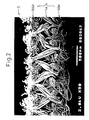
- Fig. 2 shows a photograph of a cross-section of an embodiment of the knitted fabric having a triple knit ply structure of the present invention.
- yarns 2a from which the knit structure of the front surface knit ply 2 is constituted and yarns 3a from which the knit structured the back surface knit ply 3 is constituted, are tuck stitched by stitching yarns 4a of the binding intermediate knit ply 4.
- the stitching yarn 4a constituted from filaments.
- the filaments are hollow filaments of which the hollow cross-sectional profiles clearly appears in Fig. 2.
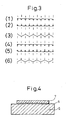
- Fig. 3 shows a knit design of an embodiment of the knitted fabric having a triple knit ply structure of the present invention.
- the knit designs (1) and (4) are of a front surface knit ply
- the knit designs (2) and (5) are of a back surface knit ply
- the knit designs (3) and (6) are of a binding intermediate knit ply.
- the stitching yarns are preferably hollow multi-filament yarns.
- the hollow multifilament yarns have a thickness of 20 to 170 dtex, more preferably 20 to 100 dtex; the individual filaments have a thickness of 1 to 10 dtex, more preferably 2 to 5 dtex, and a percentage of hollowness of 10 to 50%, more preferably 30 to 55%.
- the percentage of hollowness of the hollow filaments refers to a percentage of the cross-sectional area of hollow portion of an individual hollow filament on the basis of the whole cross-sectional area of the individual hollow filament.
- the stitching yarns may be spun yarns comprising hollow staple fibers (preferably having a thickness of 1 to 10 dtex and a percentage of hollowness of 10 to 55%) and preferably having a thickness of 20 to 170 dtex.
- the hollow fibers are preferably selected from organic fibers for clothes, for example, hollow polyester filaments, hollow nylon filaments, hollow polyester staple fibers, hollow nylon staple fibers and composite fibers of these polymers.
- hollow polyester filaments are preferably used for the present invention.
- the binding intermediate knit ply preferably has a basis mass of 25 to 60 g/m 2 , more preferably 30 to 50 g/m 2 .
- the basis mass is within the above-mentioned range, the resultant knitted fabric having a triple knit ply structure of the present invention exhibits high warmth and lightness.
- the front surface knit ply of the knitted fabric having a triple knit ply structure of the present invention is preferably formed from bulky yarns, for example, false twist-textured yarns, spun yarns, air jet-interlaced filament yarns and yarns comprising two or more types of fibers or filaments different in shrinkage from each other.
- the resultant knitted fabric exhibit a high warmth.
- the yarns for forming the front surface knit ply preferably have a thickness of 20 to 170 dtex, more preferably 50 to 150 dtex, and the individual fibers for the yarns preferably have a thickness of 0.1 to 20 dtex, more preferably 2 to 5 dtex.
- the type of the fibers from which the front surface knit ply is formed There is no limitation to the type of the fibers from which the front surface knit ply is formed.
- fibers of polyesters, nylons, cellulose acetates, acrylic resins, rayon, cotton, wool and/or silk or composite fibers thereof may be used for the front surface knit ply.
- the polyester fibers are preferably employed.
- the fiber yarns as mentioned above are preferably selected from false twist-textured multifilament yarns, more preferably false twist-textured polyester multifilament yarns.
- the front surface knit ply preferably has a basis mass of 20 to 60 g/m 2 , more preferably 30 to 50 g/m 2 .
- the yarns from which the knit structure of the back surface knit ply is formed preferably comprises at least one type of fibers selected from natural fibers (for example, wool and silk fibers), synthetic fibers (for example, polyester, nylon and acrylic fibers), regenerated fibers (for example, rayon and cupra fibers), and semisynthetic fibers (for example, cellulose triacetate fibers).
- natural fibers for example, wool and silk fibers
- synthetic fibers for example, polyester, nylon and acrylic fibers
- regenerated fibers for example, rayon and cupra fibers
- semisynthetic fibers for example, cellulose triacetate fibers
- the fiber yarns for the back surface knit ply are preferably selected from those exhibiting high comfort when the cloth is worn by a user, for example, cotton, rayon, polyester, and nylon yarns and composite yarns of the above-mentioned yarns.
- the yarns for the back surface knit ply may be selected from multifilament yarns and spun yarns.
- the multifilament yarns may be texturized bulky multifilament yarns.
- the yarns for the back surface knit ply preferably have a thickness of 40 to 300 dtex (130 to 20 yarn number count), more preferably 70 to 200 dtex.
- the back surface knit ply preferably has a basis mass of 30 to 100 g/m 2 , more preferably 40 to 70 g/m 2 .
- the knitted fabric having a triple knit ply structure of the present invention preferably has a thickness of 0.5 to 1.5 mm, more preferably 0.6 to 0.8 mm, and a basis mass of 80 to 200 g/m 2 , more preferably 110 to 150 g/m 2 .
- the knitted fabric having a triple knit ply structure of the present invention preferably exhibits a heat-insulation efficiency of 18% or more, more preferably 20% or more, determined by the following measurement.
- a heating device 5 (large size BT-box, made by KATOTEC K.K., model: THERMOLABO II) is placed in air controlled to a uniform temperature of 20°C, in which device only a heating surface (dimensions: 10 cm x 10 cm) is exposed to the atmosphere and other surface are heat-insulated, and the temperature of the heating surface is maintained at a uniform temperature of 65°C.
- a sample of a knitted fabric b having dimensions of 10 cm x 10 cm is placed on the heating surface.
- an electric power consumption W in W needed to maintain the temperature of the heating surface at 65°C for one minute is measured.
- an electric power consumption W 0 needed to maintain the temperature of the heating surface, on which no knitted fabric sample is placed, at 65°C for one minute is measured.
- the knitted fabric having a triple knit ply structure of the present invention for example, a circular knitting machine is used, yarns for forming the knit structure of the front surface knit ply and yarns for forming the knit structure of the back surface knit ply are respectively supplied into the circular knitting machine through a cylinder side and a dial side of the machine and knitted into, for example, knit structures, as shown in Fig. 3 and, simultaneously, the knit structures of the front and back surface knit plies are tuck-stitched with stitching yarns, to form a binding intermediate knit ply.
- the knitted fabric having a triple knit ply structure of the present invention will be further illustrated by the following examples, which are not intended to limit the scope of the present invention in any way.
- a 23G double circular knitting machine was employed to produce a knitted fabric having a triple knit ply structure of the present invention.
- the front surface knit ply was formed from false twist-textured polyethylene terephthalate filament yarns having a yarn count of 56 dtex/36 filaments, and the back surface knit ply was formed from spun cotton yarns having a thickness of 98 dtex (60 yarn number count).
- the binding intermediate knit ply was formed from stitching yarns consisting of hollow polyethylene terephthalate filament yarns having a percentage of hollow of hollow filaments of 35% and a yarn count of 40 dtex/12 filaments.
- the knit structures of the front and back surface knit piles are tuck-stitched by the stitching hollow filament yarns.
- a knitted fabric having a triple knit ply structure as shown in Fig. 3 was obtained. Table 1 shows the thickness, basis mass and heat-insulation efficiency ⁇ of the resultant knitted fabric.
- the resultant knitted fabric exhibited lightness, an excellent warmth and a soft surface touch. No projection or exposure of the stitching yarns of the binding intermediate layer to the outside of the front surface knit ply were found. Thus the resultant knitted fabric exhibited a good appearance and dignity.
- a knitted fabric having a triple knit ply structure as shown in Fig. 3 was produced by using the same 23G double circular knitting machine as in Example 1, from false twist-textured polyethylene terephthalate filament yarns having a yarn count of 56 dtex/36 filaments for the front surface knit ply, spun cotton yarns having a thickness of 98 dtex (60 yarn number count) for the back surface knit ply and non-hollow polyethylene terephthalate filament yarns, having a yarn count of 56 dtex/24 filaments as stitching yarns for the binding intermediate knit ply.
- Table 1 shows the thickness, basis mass and heat-insulation efficiency of the resultant knitted fabric.
- the knitted fabric having a triple knit ply structure of Comparative example 1 had similar appearance, elegance, thickness and basis mass to that of the Example 1, but had an insufficient heat-insulation efficiency ⁇ .
- a knitted fabric having a circular rib knit structure was produced from spun cotton yarns having a thickness of 147 dtex (40 yarn number count) by using a circular knitting machine.
- Table 1 shows the thickness, basis mass and heat-insulation efficiency ⁇ of the resultant knitted fabric.
- the resultant knitted fabric exhibited a significantly poor heat insulation efficiency ⁇ , while the thickness and the basis weight of the resultant knitted fabric were higher than those of Example 1.
- the knitted fabric having a triple knit ply structure of the present invention exhibits an excellent warmth in relation to the thickness and basis mass thereof, an excellent lightness in relation to the thickness and the warmth thereof and thus is an appropriate textile material for the use in underwear which need high lightness and warmth.
Landscapes
- Engineering & Computer Science (AREA)
- Textile Engineering (AREA)
- Knitting Of Fabric (AREA)
- Undergarments, Swaddling Clothes, Handkerchiefs Or Underwear Materials (AREA)
Applications Claiming Priority (3)
| Application Number | Priority Date | Filing Date | Title |
|---|---|---|---|
| JP2001031996 | 2001-02-08 | ||
| JP2001031996A JP3880320B2 (ja) | 2001-02-08 | 2001-02-08 | 軽量保温編地を用いてなる肌着衣料 |
| PCT/JP2002/001109 WO2002063082A1 (en) | 2001-02-08 | 2002-02-08 | Three-layer knitting fabric |
Publications (3)
| Publication Number | Publication Date |
|---|---|
| EP1359238A1 EP1359238A1 (en) | 2003-11-05 |
| EP1359238A4 EP1359238A4 (en) | 2004-03-17 |
| EP1359238B1 true EP1359238B1 (en) | 2007-04-04 |
Family
ID=18895996
Family Applications (1)
| Application Number | Title | Priority Date | Filing Date |
|---|---|---|---|
| EP02711434A Expired - Lifetime EP1359238B1 (en) | 2001-02-08 | 2002-02-08 | Three-layer knitted fabric |
Country Status (7)
| Country | Link |
|---|---|
| US (1) | US20040060328A1 (enExample) |
| EP (1) | EP1359238B1 (enExample) |
| JP (1) | JP3880320B2 (enExample) |
| KR (1) | KR100821114B1 (enExample) |
| CN (1) | CN1501996A (enExample) |
| DE (1) | DE60219284T2 (enExample) |
| WO (1) | WO2002063082A1 (enExample) |
Families Citing this family (32)
| Publication number | Priority date | Publication date | Assignee | Title |
|---|---|---|---|---|
| KR20030015099A (ko) * | 2001-08-14 | 2003-02-20 | 벤텍스 주식회사 | 흡한속건성을 갖는 보온원단 |
| JP5350696B2 (ja) * | 2008-07-10 | 2013-11-27 | 帝人株式会社 | 布帛および繊維製品 |
| JP5403598B2 (ja) * | 2009-05-11 | 2014-01-29 | 東洋紡Stc株式会社 | 吸湿保温編地 |
| WO2011009112A2 (en) * | 2009-07-17 | 2011-01-20 | Federal-Mogul Powertrain,Inc | Tri-layer knit fabric, thermal protective members formed therefrom and methods of construction thereof. |
| KR101261476B1 (ko) | 2010-11-05 | 2013-05-10 | (주)풍전티.티 | 침장용 쿠션포 |
| JP5916062B2 (ja) | 2011-10-17 | 2016-05-11 | 株式会社島精機製作所 | スペーサファブリックの編成方法及びスペーサファブリック |
| US20130291399A1 (en) * | 2012-02-09 | 2013-11-07 | Mx Orthopedics, Corp. | Insole and foot orthotics made of shape memory material (smm) three-dimensional spacer fabrics |
| CN102534974A (zh) * | 2012-02-17 | 2012-07-04 | 江苏联宏纺织有限公司 | 一种三层织物 |
| CN102619006A (zh) * | 2012-04-16 | 2012-08-01 | 无锡红豆居家服饰有限公司 | 粗细针距保暖针织面料 |
| CN102943338A (zh) * | 2012-11-28 | 2013-02-27 | 上海嘉麟杰纺织品股份有限公司 | 一种高弹挡风针织面料 |
| CN103859666A (zh) * | 2012-12-14 | 2014-06-18 | 东丽纤维研究所(中国)有限公司 | 一种针织外套用面料 |
| CN104389043B (zh) * | 2014-10-15 | 2016-06-08 | 浙江恒逸高新材料有限公司 | 一种保暖发热纤维及其加工方法与应用 |
| CN105734805A (zh) * | 2014-12-12 | 2016-07-06 | 东丽纤维研究所(中国)有限公司 | 一种仿棉针织面料 |
| EP3075893B1 (de) * | 2015-04-02 | 2018-09-12 | Karl Mayer Textilmaschinenfabrik GmbH | Wirkware und verfahren zum herstellen einer wirkware |
| CN106609411A (zh) * | 2015-10-23 | 2017-05-03 | 东丽纤维研究所(中国)有限公司 | 一种立体三层针织织物 |
| US20230160113A1 (en) * | 2015-11-24 | 2023-05-25 | bett1.de GmbH | Multilayer weft-knitted fabrics for mattress covers |
| CN105951481A (zh) * | 2016-06-29 | 2016-09-21 | 广东职业技术学院 | 一种生物能交织针织物的染色工艺 |
| CN105926145A (zh) * | 2016-06-30 | 2016-09-07 | 广东职业技术学院 | 一种生物能针织物及其编织方法 |
| CN105970458B (zh) * | 2016-07-19 | 2019-04-02 | 宁波大千纺织品有限公司 | 一种立体皱花保暖衬垫空气层面料及其制备方法 |
| JP2018021267A (ja) * | 2016-08-01 | 2018-02-08 | 富士紡ホールディングス株式会社 | 編地 |
| CN107268163A (zh) * | 2017-07-06 | 2017-10-20 | 苏州华德纺织有限公司 | 棉类针织布及其织造方法 |
| CN107988687A (zh) * | 2017-12-04 | 2018-05-04 | 佛山市亨特纺织有限公司 | 一种黏胶夹丝双面纬编针织面料 |
| WO2019199812A1 (en) * | 2018-04-13 | 2019-10-17 | Nike Innovate C.V. | Knitted component with inlaid cushioning |
| CN109097896B (zh) * | 2018-08-31 | 2020-04-21 | 闽江学院 | 一种导湿防水的纬编空气层织物生产方法 |
| CN109183261B (zh) * | 2018-09-19 | 2021-03-19 | 利郎(中国)有限公司 | 高保暖新型空气层毛呢面料的制备工艺 |
| CH716114A1 (de) * | 2019-04-24 | 2020-10-30 | Schoeller Tech Ag | Flächige Velourmaschenware. |
| US20230052244A1 (en) * | 2020-03-30 | 2023-02-16 | Mas Innovation (Private) Limited | Knitted functional fabric |
| IT202100008042A1 (it) | 2021-03-31 | 2022-10-01 | Essepi Srl | Tessuto lavorato a maglia imbottito e processo per la fabbricazione di tale tessuto |
| KR102570989B1 (ko) * | 2022-09-21 | 2023-08-30 | 이현명 | 매트용 입체구조 편물원단 및 이의 제조방법 |
| CN116607253A (zh) * | 2023-05-17 | 2023-08-18 | 青岛颐和针织有限公司 | 一种三维记忆性轻柔面料及编织方法 |
| FR3150819B1 (fr) * | 2023-07-06 | 2025-10-03 | Tricots Saint James | Etoffe tridimensionnelle réalisée par tricotage, vêtement réalisé à partir d’une telle étoffe, équipement comprenant un tel vêtement et procédé de tricotage d’une telle étoffe |
| CN120350475A (zh) * | 2025-05-29 | 2025-07-22 | 李于锋 | 一种基于针织圆机的无缝一体针织面料及其针织工艺 |
Family Cites Families (11)
| Publication number | Priority date | Publication date | Assignee | Title |
|---|---|---|---|---|
| FR2415682A1 (fr) * | 1978-01-27 | 1979-08-24 | Goutille Et Cie | Tissu maille reversible |
| JPS59169386U (ja) * | 1983-04-25 | 1984-11-13 | 東洋紡績株式会社 | 三層構造の布帛 |
| JPS6253454A (ja) * | 1985-08-27 | 1987-03-09 | 帝人株式会社 | 吸水保温性編地 |
| US5356582A (en) * | 1986-01-30 | 1994-10-18 | E. I. Du Pont De Nemours And Company | Continuous hollow filament, yarns, and tows |
| JPH0414470Y2 (enExample) * | 1987-03-24 | 1992-03-31 | ||
| US5192600A (en) * | 1990-12-27 | 1993-03-09 | E. I. Du Pont De Nemours And Company | Stitchbonded comfort fabric |
| JPH05148746A (ja) * | 1991-11-27 | 1993-06-15 | Unitika Ltd | 厚みのある軽量材 |
| DE9302039U1 (de) * | 1993-02-12 | 1993-04-01 | Trevira GmbH & Co KG, 60528 Frankfurt | Doppelflächige Rundstrickware |
| US5735145A (en) * | 1996-05-20 | 1998-04-07 | Monarch Knitting Machinery Corporation | Weft knit wicking fabric and method of making same |
| JP3558451B2 (ja) * | 1996-06-18 | 2004-08-25 | 旭化成せんい株式会社 | 多層構造布帛 |
| JPH11229228A (ja) * | 1998-02-20 | 1999-08-24 | Toray Ind Inc | 中空マルチフィラメントおよび織物 |
-
2001
- 2001-02-08 JP JP2001031996A patent/JP3880320B2/ja not_active Expired - Lifetime
-
2002
- 2002-02-08 WO PCT/JP2002/001109 patent/WO2002063082A1/ja not_active Ceased
- 2002-02-08 EP EP02711434A patent/EP1359238B1/en not_active Expired - Lifetime
- 2002-02-08 CN CNA028078802A patent/CN1501996A/zh active Pending
- 2002-02-08 DE DE60219284T patent/DE60219284T2/de not_active Expired - Lifetime
- 2002-02-08 US US10/467,085 patent/US20040060328A1/en not_active Abandoned
- 2002-02-08 KR KR1020037010367A patent/KR100821114B1/ko not_active Expired - Lifetime
Also Published As
| Publication number | Publication date |
|---|---|
| KR20030081428A (ko) | 2003-10-17 |
| CN1501996A (zh) | 2004-06-02 |
| DE60219284D1 (de) | 2007-05-16 |
| DE60219284T2 (de) | 2008-01-03 |
| JP2002235264A (ja) | 2002-08-23 |
| WO2002063082A1 (en) | 2002-08-15 |
| US20040060328A1 (en) | 2004-04-01 |
| JP3880320B2 (ja) | 2007-02-14 |
| EP1359238A1 (en) | 2003-11-05 |
| EP1359238A4 (en) | 2004-03-17 |
| KR100821114B1 (ko) | 2008-04-11 |
Similar Documents
| Publication | Publication Date | Title |
|---|---|---|
| EP1359238A1 (en) | Three-layer knitting fabric | |
| CA2579144C (en) | Woven or knitted fabric and clothes containing crimped composite filaments and having an air permeability which increases when the fabric is wetted with water | |
| JP3853175B2 (ja) | 保温編地 | |
| CN204351126U (zh) | 一种具有凉爽效应的针织面料 | |
| WO2005038112A1 (ja) | 伸縮性複合布帛及びその衣料製品 | |
| JP3239687U (ja) | 冷感軽量生地および冷感軽量衣料 | |
| JP2004052167A (ja) | 吸汗性とドレープ性を有する嵩高編物 | |
| JP2008297657A (ja) | キルテイング生地および寝具およびダウンジャケット | |
| JP2009144259A (ja) | 肌着衣料用編地 | |
| JP3774926B2 (ja) | 多層構造裏地 | |
| JP2000170061A (ja) | 防風性編地 | |
| JP4287292B2 (ja) | 感湿通気性向上衣服 | |
| JP3420083B2 (ja) | 二層構造布帛 | |
| JPH0768661B2 (ja) | 二重編地 | |
| JP2005232643A (ja) | ボンデイング布帛調起毛編地および衣料 | |
| CN223688552U (zh) | 一种挺括型提花面料及服饰 | |
| JP3856348B2 (ja) | 裏地 | |
| JP4902421B2 (ja) | 起毛編地およびその製造方法および衣料 | |
| JP7321740B2 (ja) | 丸編地 | |
| JP7120008B2 (ja) | 繊維構造物 | |
| JP2002013044A (ja) | かたさに異方性のある布帛 | |
| JPH0941246A (ja) | 複層丸編地 | |
| JPH0665829A (ja) | 複合多層構造糸の製造法 | |
| JPH0941245A (ja) | 複層丸編地 | |
| JP2001254249A (ja) | 厚地編物 |
Legal Events
| Date | Code | Title | Description |
|---|---|---|---|
| PUAI | Public reference made under article 153(3) epc to a published international application that has entered the european phase |
Free format text: ORIGINAL CODE: 0009012 |
|
| 17P | Request for examination filed |
Effective date: 20030806 |
|
| AK | Designated contracting states |
Kind code of ref document: A1 Designated state(s): AT BE CH CY DE DK ES FI FR GB GR IE IT LI LU MC NL PT SE TR |
|
| AX | Request for extension of the european patent |
Extension state: AL LT LV MK RO SI |
|
| A4 | Supplementary search report drawn up and despatched |
Effective date: 20040130 |
|
| RIC1 | Information provided on ipc code assigned before grant |
Ipc: 7D 04B 1/00 A Ipc: 7D 04B 1/24 B Ipc: 7D 04B 1/16 B |
|
| RTI1 | Title (correction) |
Free format text: THREE-LAYER KNITTED FABRIC |
|
| GRAP | Despatch of communication of intention to grant a patent |
Free format text: ORIGINAL CODE: EPIDOSNIGR1 |
|
| RBV | Designated contracting states (corrected) |
Designated state(s): DE FR GB IT |
|
| GRAS | Grant fee paid |
Free format text: ORIGINAL CODE: EPIDOSNIGR3 |
|
| GRAA | (expected) grant |
Free format text: ORIGINAL CODE: 0009210 |
|
| AK | Designated contracting states |
Kind code of ref document: B1 Designated state(s): DE FR GB IT |
|
| REG | Reference to a national code |
Ref country code: GB Ref legal event code: FG4D |
|
| REF | Corresponds to: |
Ref document number: 60219284 Country of ref document: DE Date of ref document: 20070516 Kind code of ref document: P |
|
| ET | Fr: translation filed | ||
| PLBE | No opposition filed within time limit |
Free format text: ORIGINAL CODE: 0009261 |
|
| STAA | Information on the status of an ep patent application or granted ep patent |
Free format text: STATUS: NO OPPOSITION FILED WITHIN TIME LIMIT |
|
| 26N | No opposition filed |
Effective date: 20080107 |
|
| REG | Reference to a national code |
Ref country code: DE Ref legal event code: R082 Ref document number: 60219284 Country of ref document: DE Representative=s name: HOEGER, STELLRECHT & PARTNER PATENTANWAELTE, DE |
|
| REG | Reference to a national code |
Ref country code: FR Ref legal event code: TP Owner name: TEIJIN FRONTIER CO., LTD., JP Effective date: 20130423 |
|
| REG | Reference to a national code |
Ref country code: GB Ref legal event code: 732E Free format text: REGISTERED BETWEEN 20130516 AND 20130522 |
|
| REG | Reference to a national code |
Ref country code: DE Ref legal event code: R082 Ref document number: 60219284 Country of ref document: DE Representative=s name: HOEGER, STELLRECHT & PARTNER PATENTANWAELTE, DE Effective date: 20130423 Ref country code: DE Ref legal event code: R081 Ref document number: 60219284 Country of ref document: DE Owner name: TEIJIN FRONTIER CO., LTD., JP Free format text: FORMER OWNER: TEIJIN LTD., OSAKA, JP Effective date: 20130423 Ref country code: DE Ref legal event code: R081 Ref document number: 60219284 Country of ref document: DE Owner name: TEIJIN FRONTIER CO., LTD., OSAKA-SHI, JP Free format text: FORMER OWNER: TEIJIN LTD., OSAKA, JP Effective date: 20130423 Ref country code: DE Ref legal event code: R082 Ref document number: 60219284 Country of ref document: DE Representative=s name: HOEGER, STELLRECHT & PARTNER PATENTANWAELTE MB, DE Effective date: 20130423 |
|
| REG | Reference to a national code |
Ref country code: DE Ref legal event code: R082 Ref document number: 60219284 Country of ref document: DE Representative=s name: HOEGER, STELLRECHT & PARTNER PATENTANWAELTE MB, DE |
|
| REG | Reference to a national code |
Ref country code: FR Ref legal event code: PLFP Year of fee payment: 15 |
|
| REG | Reference to a national code |
Ref country code: FR Ref legal event code: PLFP Year of fee payment: 16 |
|
| REG | Reference to a national code |
Ref country code: FR Ref legal event code: PLFP Year of fee payment: 17 |
|
| PGFP | Annual fee paid to national office [announced via postgrant information from national office to epo] |
Ref country code: DE Payment date: 20190228 Year of fee payment: 18 Ref country code: IT Payment date: 20190228 Year of fee payment: 18 Ref country code: GB Payment date: 20190226 Year of fee payment: 18 |
|
| PGFP | Annual fee paid to national office [announced via postgrant information from national office to epo] |
Ref country code: FR Payment date: 20190225 Year of fee payment: 18 |
|
| REG | Reference to a national code |
Ref country code: DE Ref legal event code: R082 Ref document number: 60219284 Country of ref document: DE Representative=s name: HOEGER, STELLRECHT & PARTNER PATENTANWAELTE MB, DE |
|
| REG | Reference to a national code |
Ref country code: DE Ref legal event code: R119 Ref document number: 60219284 Country of ref document: DE |
|
| GBPC | Gb: european patent ceased through non-payment of renewal fee |
Effective date: 20200208 |
|
| PG25 | Lapsed in a contracting state [announced via postgrant information from national office to epo] |
Ref country code: DE Free format text: LAPSE BECAUSE OF NON-PAYMENT OF DUE FEES Effective date: 20200901 Ref country code: GB Free format text: LAPSE BECAUSE OF NON-PAYMENT OF DUE FEES Effective date: 20200208 Ref country code: FR Free format text: LAPSE BECAUSE OF NON-PAYMENT OF DUE FEES Effective date: 20200229 |
|
| PG25 | Lapsed in a contracting state [announced via postgrant information from national office to epo] |
Ref country code: IT Free format text: LAPSE BECAUSE OF NON-PAYMENT OF DUE FEES Effective date: 20200208 |