EP1353062A2 - Kraftstoffeinspritzventil mit einer Düsenplatte und geneigten Auslassöffnungen - Google Patents
Kraftstoffeinspritzventil mit einer Düsenplatte und geneigten Auslassöffnungen Download PDFInfo
- Publication number
- EP1353062A2 EP1353062A2 EP03251498A EP03251498A EP1353062A2 EP 1353062 A2 EP1353062 A2 EP 1353062A2 EP 03251498 A EP03251498 A EP 03251498A EP 03251498 A EP03251498 A EP 03251498A EP 1353062 A2 EP1353062 A2 EP 1353062A2
- Authority
- EP
- European Patent Office
- Prior art keywords
- orifice
- fuel injector
- plate
- region
- longitudinal axis
- Prior art date
- Legal status (The legal status is an assumption and is not a legal conclusion. Google has not performed a legal analysis and makes no representation as to the accuracy of the status listed.)
- Granted
Links
Images




Classifications
-
- F—MECHANICAL ENGINEERING; LIGHTING; HEATING; WEAPONS; BLASTING
- F02—COMBUSTION ENGINES; HOT-GAS OR COMBUSTION-PRODUCT ENGINE PLANTS
- F02M—SUPPLYING COMBUSTION ENGINES IN GENERAL WITH COMBUSTIBLE MIXTURES OR CONSTITUENTS THEREOF
- F02M61/00—Fuel-injectors not provided for in groups F02M39/00 - F02M57/00 or F02M67/00
- F02M61/16—Details not provided for in, or of interest apart from, the apparatus of groups F02M61/02 - F02M61/14
- F02M61/18—Injection nozzles, e.g. having valve seats; Details of valve member seated ends, not otherwise provided for
- F02M61/1806—Injection nozzles, e.g. having valve seats; Details of valve member seated ends, not otherwise provided for characterised by the arrangement of discharge orifices, e.g. orientation or size
- F02M61/1846—Dimensional characteristics of discharge orifices
-
- B—PERFORMING OPERATIONS; TRANSPORTING
- B21—MECHANICAL METAL-WORKING WITHOUT ESSENTIALLY REMOVING MATERIAL; PUNCHING METAL
- B21D—WORKING OR PROCESSING OF SHEET METAL OR METAL TUBES, RODS OR PROFILES WITHOUT ESSENTIALLY REMOVING MATERIAL; PUNCHING METAL
- B21D53/00—Making other particular articles
- B21D53/84—Making other particular articles other parts for engines, e.g. connecting-rods
-
- B—PERFORMING OPERATIONS; TRANSPORTING
- B23—MACHINE TOOLS; METAL-WORKING NOT OTHERWISE PROVIDED FOR
- B23P—METAL-WORKING NOT OTHERWISE PROVIDED FOR; COMBINED OPERATIONS; UNIVERSAL MACHINE TOOLS
- B23P15/00—Making specific metal objects by operations not covered by a single other subclass or a group in this subclass
- B23P15/16—Making specific metal objects by operations not covered by a single other subclass or a group in this subclass plates with holes of very small diameter, e.g. for spinning or burner nozzles
-
- F—MECHANICAL ENGINEERING; LIGHTING; HEATING; WEAPONS; BLASTING
- F02—COMBUSTION ENGINES; HOT-GAS OR COMBUSTION-PRODUCT ENGINE PLANTS
- F02M—SUPPLYING COMBUSTION ENGINES IN GENERAL WITH COMBUSTIBLE MIXTURES OR CONSTITUENTS THEREOF
- F02M51/00—Fuel-injection apparatus characterised by being operated electrically
- F02M51/06—Injectors peculiar thereto with means directly operating the valve needle
- F02M51/061—Injectors peculiar thereto with means directly operating the valve needle using electromagnetic operating means
- F02M51/0625—Injectors peculiar thereto with means directly operating the valve needle using electromagnetic operating means characterised by arrangement of mobile armatures
- F02M51/0664—Injectors peculiar thereto with means directly operating the valve needle using electromagnetic operating means characterised by arrangement of mobile armatures having a cylindrically or partly cylindrically shaped armature, e.g. entering the winding; having a plate-shaped or undulated armature entering the winding
- F02M51/0671—Injectors peculiar thereto with means directly operating the valve needle using electromagnetic operating means characterised by arrangement of mobile armatures having a cylindrically or partly cylindrically shaped armature, e.g. entering the winding; having a plate-shaped or undulated armature entering the winding the armature having an elongated valve body attached thereto
-
- F—MECHANICAL ENGINEERING; LIGHTING; HEATING; WEAPONS; BLASTING
- F02—COMBUSTION ENGINES; HOT-GAS OR COMBUSTION-PRODUCT ENGINE PLANTS
- F02M—SUPPLYING COMBUSTION ENGINES IN GENERAL WITH COMBUSTIBLE MIXTURES OR CONSTITUENTS THEREOF
- F02M61/00—Fuel-injectors not provided for in groups F02M39/00 - F02M57/00 or F02M67/00
- F02M61/16—Details not provided for in, or of interest apart from, the apparatus of groups F02M61/02 - F02M61/14
- F02M61/168—Assembling; Disassembling; Manufacturing; Adjusting
-
- F—MECHANICAL ENGINEERING; LIGHTING; HEATING; WEAPONS; BLASTING
- F02—COMBUSTION ENGINES; HOT-GAS OR COMBUSTION-PRODUCT ENGINE PLANTS
- F02M—SUPPLYING COMBUSTION ENGINES IN GENERAL WITH COMBUSTIBLE MIXTURES OR CONSTITUENTS THEREOF
- F02M61/00—Fuel-injectors not provided for in groups F02M39/00 - F02M57/00 or F02M67/00
- F02M61/16—Details not provided for in, or of interest apart from, the apparatus of groups F02M61/02 - F02M61/14
- F02M61/18—Injection nozzles, e.g. having valve seats; Details of valve member seated ends, not otherwise provided for
- F02M61/1806—Injection nozzles, e.g. having valve seats; Details of valve member seated ends, not otherwise provided for characterised by the arrangement of discharge orifices, e.g. orientation or size
-
- F—MECHANICAL ENGINEERING; LIGHTING; HEATING; WEAPONS; BLASTING
- F02—COMBUSTION ENGINES; HOT-GAS OR COMBUSTION-PRODUCT ENGINE PLANTS
- F02M—SUPPLYING COMBUSTION ENGINES IN GENERAL WITH COMBUSTIBLE MIXTURES OR CONSTITUENTS THEREOF
- F02M61/00—Fuel-injectors not provided for in groups F02M39/00 - F02M57/00 or F02M67/00
- F02M61/16—Details not provided for in, or of interest apart from, the apparatus of groups F02M61/02 - F02M61/14
- F02M61/18—Injection nozzles, e.g. having valve seats; Details of valve member seated ends, not otherwise provided for
- F02M61/1853—Orifice plates
Definitions
- a first part of the present invention relates to a fuel injector having an orifice plate with offset coining angled orifices.
- An electro-magnetic fuel injector typically utilises a solenoid assembly to supply an actuating force to a fuel-metering valve.
- the fuel metering valve is a plunger-style needle valve which reciprocates between a closed position, where the needle is seated in a valve seat to prevent fuel from escaping through a metering orifice into the combustion chamber, and an open position, where the needle is lifted from the valve seat, allowing fuel to discharge through the metering orifice for introduction into the combustion chamber.
- Fuel flowing through a fuel injector typically exits at an outlet end of the fuel injector.
- the outlet end typically have a disk or plate with at least one orifice to control, in part, the spray pattern and the direction of the fuel exiting the fuel injector.
- An orifice extending along an axis perpendicular to a surface of a work piece is believed to be formed by drilling or by punching through the work piece.
- One method of drilling is by electric discharge machining (EDM) that can form orifices of 150 to 200 microns in diameter. It is believed that one of the many disadvantages of EDM is the fact that the holes are typically formed without any favourable entry or exit geometry for the orifices, thereby affecting the flow through the orifices.
- Another method is by laser machining the orifices on the work piece or the plate.
- Yet another method can be by stamping or punching the orifices and then coining each edge of the orifice.
- the orifices formed by these methods do not allow for spray targeting of the fuel as the fuel leaves the orifices of the injector.
- orifices can be angled to a desired angle relative to a longitudinal axis of the fuel injector. Such angled orifices can be formed by any of the above methods, albeit at, it is believed, a much greater cost than a straight orifice.
- Another method utilises dimpling a portion of the work piece on which a straight orifice has already been formed with a right circular cone.
- dimpled orifice plate increases a sac volume between the fuel injector closure tip and the orifice plate. This increased sac volume, during a non-injection event, causes fuel to remain in the sac that vaporises and causes rich/lean shifts and hot start issues, which are undesirable.
- the present invention provides a plurality of angled orifices on a work piece and a method of forming such angled orifices.
- the present invention also provides for a fuel injector.
- the fuel injector has a housing extending along a longitudinal axis, the housing including an inlet, an outlet and a passageway disposed between the inlet and the outlet.
- the fuel injector includes an electromagnetic actuator proximate the inlet and an orifice plate proximate the outlet.
- the electromagnetic actuator having an armature, an electromagnetic coil a closure member and a valve seat.
- the closure member is operable to occlude fuel flow to the outlet in a first position and is operable to permit fuel flow to the outlet in a second position.
- the orifice plate is located proximate the outlet, the orifice plate having first and second plate surfaces spaced at a predetermined distance along a longitudinal axis and an orifice.
- the orifice includes a first surface and a second surface being spaced from the first surface.
- the first surface includes a first region having a first surface characteristic being oriented in a first direction oblique to the longitudinal axis.
- the second surface includes a second region having second surface characteristic being oriented in a second direction oblique to longitudinal axis.
- the present invention also provides for a valve assembly for controlling fluid flow.
- the valve assembly comprises a body having a first end and a second end, an actuator disposed in the body, a closure member operable by the actuator to occlude fluid flow in one position and operable to permit flow in another position, a surface contiguous to the closure member in the one position so as to form a sealing surface, and an orifice plate proximate one of the first and second ends.
- the orifice plate includes first and second plate surfaces spaced at a predetermined distance from one another along a longitudinal axis, and an orifice. The orifice including a first orifice surface and a second orifice surface being spaced from the first orifice surface.
- the first orifice surface has a first region including a first surface characteristic being oriented in a first direction oblique to the longitudinal axis.
- the second orifice surface has a second region including a second surface characteristic being oriented in a second direction oblique to longitudinal axis.
- Fig 1 illustrates a fuel injector with an orifice of a preferred embodiment.
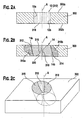
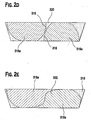
- Figs. 2a-2e illustrate the characteristics of an orifice and orifice plate in Fig. 1 prior to the formation of the angled orifice and after the formation of the angled orifice.
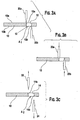
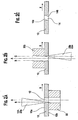
- Figs. 3a-3c illustrates the formation of an angled orifice in an orifice plate according to another preferred embodiment.
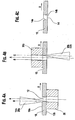
- Figs. 4a-4c illustrate the formation of an angled orifice in an orifice plate according to yet another preferred embodiment.
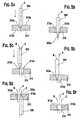
- Figs. 5a-5f illustrate the formation of an angled orifice in an orifice plate according to yet a further embodiment.
- Figs. 1-5 illustrate certain embodiments of the present invention.
- a fuel injector 100 comprising an embodiment of the orifice plate 10 is illustrated in Fig. 1.
- the fuel injector 100 includes a fuel inlet tube 110, an adjustment tube 112, a filter assembly 114, a coil assembly 118, a coil spring 116, an armature 124, a closure member 126, a non-magnetic shell 110a, a first overmould 118, a valve body 132, a valve body shell 132a, a second overmould 119, a coil assembly housing 121, a guide member 127 for the closure member 126, a valve seat 134, an orifice plate 10, a backup retainer member 136, and an O-ring seal 137.
- the guide member 127, the valve seat 134, the orifice plate 10, the backup retainer member 136, and the small O-ring seal 137 form a stack that is disposed at the outlet end of fuel injector 100, as shown in a number of commonly assigned patents, such as U.S. Pat. No. 5,174,505.
- Armature 124 and the closure member 126 are joined together to form an armature/needle valve assembly. It should be noted that one skilled in the art could form the assembly from a single component.
- Coil assembly 120 comprises a plastic bobbin on which an electromagnetic coil 122 is wound.
- Respective terminations of coil 122 connect to respective terminals 122a, 122b that are shaped and, in co-operation with a surround 118a formed as an integral part of overmould 118, to form an electrical connector for connecting the fuel injector to an electronic control circuit (not shown) that operates the fuel injector.
- Fuel inlet tube 110 can be ferromagnetic and comprises a fuel inlet opening at the exposed upper end.
- Filter assembly 114 can be fitted proximate to the open upper end of adjustment tube 112 to filter any particulate material larger than a certain size from fuel entering through inlet opening before the fuel enters adjustment tube 112.
- adjustment tube 112 has been positioned axially to an axial location within fuel inlet tube 110 that compresses preload spring 116 to a desired bias force that urges the armature/needle valve such that the rounded tip end of closure member 126 can be seated on valve seat 134 to close the central hole through the valve seat.
- tubes 110 and 112 are crimped together to maintain their relative axial positioning after adjustment calibration has been performed.
- Armature 124 comprises a passageway 128 that communicates volume 125 with a passageway 113 in valve body 130, and guide member 127 contains fuel passage holes 127a, 127b. This allows fuel to flow from volume 125 through passageways 113, 128 to valve seat 134.
- Non-ferromagnetic shell 110a can be telescopically fitted on and joined to the lower end of inlet tube 110, as by a hermetic laser weld.
- Shell 110a has a tubular neck that telescopes over a tubular neck at the lower end of fuel inlet tube 110.
- Shell 110a also has a shoulder that extends radially outwardly from neck.
- Valve body shell 132a can be ferromagnetic and can be joined in fluid-tight manner to non-ferromagnetic shell 110a, preferably also by a hermetic laser weld.
- valve body 130 fits closely inside the lower end of valve body shell 132a and these two parts are joined together in fluid-tight manner, preferably by laser welding.
- Armature 124 can be guided by the inside wall of valve body 130 for axial reciprocation. Further axial guidance of the armature/needle valve assembly can be provided by a central guide hole in member 127 through which closure member 126 passes.
- Non-ferromagnetic shell 110a assures that when electromagnetic coil 122 is energised, the magnetic flux will follow a path that includes armature 124.
- the magnetic circuit extends through valve body shell 132a, valve body 130 and eyelet to armature 124, and from armature 124 across working gap 72 to inlet tube 110, and back to housing 121.
- electromagnetic coil 122 When electromagnetic coil 122 is energised, the spring force on armature 124 can be overcome and the armature is attracted toward inlet tube 110 reducing working gap 72.
- the actuator may be mounted such that a portion of the actuator can disposed in the fuel injector and a portion can be disposed outside the fuel injector.
- preload spring 116 pushes the armature/needle valve closed on valve seat 134.
- Figures 2a and 2b show respective side view of an orifice 12 of a workpiece 300 and the transformation of orifice 12 into an angled orifice 14.
- the orifice 12 is formed in the work piece 300, shown in Fig. 2a.
- the orifice 12 is defined by orifice surfaces 12a and 12b having generally uniform surface characteristics throughout.
- materials on the orifice surfaces 12a and 12b are removed and sheared away, leaving behind generally parallel ridges or region 310 uniformly distributed about the circumferential surface of the orifice 12, shown in Fig. 2b.
- a transition region 320 is formed between a first area 318a bounded by partial sections of the plate surfaces 302a, 302b and line 316 and a second area 318a bounded by partial sections of surfaces 302a, 302b and line 318.
- the first bounded area 316a has surface characteristics oriented in a first direction due to the movement of the first tool head, which causes a change in the crystalline structure of the material of the orifice.
- the orifice is unrolled in Figs 2d and 2e. That is, Figs 2d and 2e illustrate a 360 degrees panoramic view of the surfaces of the orifice as viewed by an observer rotating about the longitudinal axis A-A within the orifice. As seen in the "virtual" unrolling of the orifice 14 in Figs.
- the second bounded area 318a has surface characteristics oriented in a second direction different from the first direction due to the movement of the second tool head, which also causes a change in the crystalline structures of the orifice plate. It should be noted that the crystalline structures of the transition region could be different from the crystalline structures of the first and second bounded areas. Similarly, the crystalline structures of the first bounded area can be different from the second bounded area.
- first and second bounded areas 316a, 318a are shown as being bounded by partial sections of the surfaces 302a, 302b and two lines 316 and 318, in certain cases, depending on the geometries of the cutting tool(s) and other dimensional parameters of the orifice, the line 316 can merge with line 318 so as to define a single continuous line 322 between the two contiguous first and second areas in place of the transition region 320, shown here in Fig. 2e.
- Figs 3a-3c illustrate one technique of how the perpendicular orifice 12 in Fig. 2a can be transformed into an angled orifice 14 in Fig. 2b.
- this technique illustrates a generally simultaneous formation of a right-angled orifice 12 to an angled orifice 14 for plate 10.
- Figs. 2a-2c illustrate another technique that allows sequential formation of a right-angled orifice 12 to an angled orifice 14 in the orifice plate.
- the term "orifice” denotes an "opening" that extends between a first surface 10a to a second surface 10b of a member, which is preferably is a plate.
- the "opening" can be of a suitable cross-section, such as, for example, circular, oval, rectangular, square or polygonal.
- the orifice has a circular opening with straight orifice surfaces 12a and 12b (of orifice 12) and an oval opening subsequent to the formation of angled orifice surfaces 14a and 14b (of orifice 14).
- the orifice plate 10 can include a member of a suitable cross-section, such as, for example, a plate with a first surface 10a that can be linear and preferably parallel to a linear second surface 10b; a plate having non-parallel first surface 10a (which can be a substantially planar surface) to the second surface 10b (which can also be a substantially planar surface); or a plate with a first surface 10a that can be curvilinear and preferably parallel to a curvilinear second surface 10b.
- the orifice 10 can include a right-angled orifice 12 pre-formed thereon or the right-angled orifice 12 can be formed prior to the formation of the angled orifice 14.
- the formations of the right-angled orifice can be done prior to the formation of an angled orifice.
- the right-angled orifice 12 can be formed by a suitable technique, such as, for example, electro-discharge-machining (EDM), laser drilling or by mechanical drilling/punching.
- EDM electro-discharge-machining
- the plate or metal sheet can be between approximately 0.003 - 0.010 inch (76.2-254.0 microns) in thickness.
- the plate can be any suitable material, such as, for example, metal, composite, monomer or polymer that deforms upon application of a compressive load.
- the orifice plate 10 can be a stainless steel plate or sheet having linearly parallel first and second surfaces 10a and 10b separated by a distance of approximately 0.006 inch (152.4 microns), which plate also has an orifice 12 pre-formed by a suitable technique such as, for example, by mechanical drilling, punching, laser drilling or by Electric Discharge Machining.
- an orifice plate 10 can be provided with a preformed orifice 12 of a first predetermined cross-sectional area A 1 .
- the first cross-sectional area A 1 is referenced as an area generally transverse to the axis A on either surface 302a or 302b.
- a first punch tool 20a and a second punch tool 20b are placed on opposite sides of the plate 10 such that a longitudinal axis extending along each of the tool is substantially parallel to the longitudinal axis A.
- the first punch tool 20a can be provided with a first tip 22 having a suitable cross-section, such as, for example, a cone, a right triangle, square, polygonal or a wedge.
- the second punch tool 20b can be provided with a second tip 24 having a suitable cross-section, such as, for example, a cone, a right triangle, square, polygonal or a wedge.
- the tips 22 and 24 are conic.
- the formation of the orifice 14 can be performed in sequence by the tool heads as a function of the speed of the press and size and progression of the die.
- Each of the tips 22 and 24 can be aligned such that, as each tip is moved towards the orifice 12, the respective tip can be contiguous to a portion of the edge of the orifice 12 (Figs. 3a and 4a). As each tip is further moved in a direction along the axis A (Fig. 3b), the orifice surfaces 12a and 12b are plastically deformed, resulting in a permanent deformation of the orifice surfaces 10a and 10b (Figs. 2b and 3c). Although the wall surfaces have been described as separate portions, it should be understood that each surface is part of an area defining the orifice.
- Each of the orifice surfaces 12a and 12b can be deformed into respective orifice surfaces 14a and 14b that are oblique with respect to the longitudinal axis, or at least one orifice surface is oblique to both the axis A and the other orifice surface (Fig. 2b).
- the walls surfaces 14a, 14b are deformed so as to define a second predetermined cross-sectional area A 2 (as referenced generally transverse to axis A) of the orifice 14 where A 2 >A 1 of the area of the orifice 12.
- some materials from the orifice surfaces 10a and 10b are removed while other materials of the orifice surfaces are plastically deformed.
- each tip can plastically deform the wall or orifice surfaces of the orifice 12
- an orifice plate 10 is again preferably provided with an orifice 12 having its surface extending along the axis A.
- One of the first and second surfaces 10a and 10b can be placed against a first die bushing 30a.
- the punch tool can be used to plastically deform the orifice surfaces 10a or 10b from the other of the first and second surfaces 10a, 10b (Figs. 4a and 4b) by moving the punch tool along a first axis B that can be parallel and offset to the axis A. This results in an orifice plate 10 having a orifice surface 14a oriented in an oblique direction relative to the axis A.
- the plate 10 is then moved along a direction X.
- a second die bushing 30b can be placed against the other of the first and second surfaces 10a and 10b (i.e. surface 10a) while the second punch tool 20b can be moved along a second axis C parallel to and offset to axis A.
- a first punch tool 200 can be used to punch a first surface 210a of a metal sheet 210, a first orifice 212 having orifice surfaces 212a and 212b perpendicular to one of the first and second substantially planar surfaces 210a and 210b of the metal sheet 210, which first punch tool can be used to deform the first surface 210a to a first oblique orifice surface 211 a of the orifice and a second punch tool 202 can be used to deform the second orifice surfaces 210b to a second oblique orifice surface 211b.
- the first punch tool 200 can be moved in a first axis A that can be perpendicular to one of the first and second surfaces 210a and 210b (Fig. 5a). As the first punch tool moves through the metal sheet 210, an orifice 212 having parallel orifice surfaces 212a and 212b are formed (Fig. 5b). The first punch tool is then withdrawn and is translated by a predetermined offset from the axis A, such that a tip 200a can be generally contiguous to one of edges 212c and 212d formed between the surfaces 210a, 210b and the orifice surfaces 212a and 212b (Fig. 5c).
- the first punch tool 200 can be moved along a second axis B, which axis B is preferably parallel to the first axis A, and can be also perpendicular to one of the surfaces 210a and 210b so as to plastically deform the first orifice surface 212a to a first oblique orifice surface 213a (Fig. 5d).
- the second punch tool 202 which could be an identical punch tool to the first punch tool 200, can be aligned with a third axis C such that, preferably, a tip 202a, is contiguous with the edge 212d of the orifice 212.
- the third axis C can be preferably parallel to and offset by a predetermined distance from the first axis A.
- the tip 202a plastically deforms the orifice surface 212b of the orifice 212 so as to form a second oblique orifice surface 213b.
- the first oblique orifice surface 213a and the second oblique orifice surface 213b are preferably parallel to each other and oblique with respect to the first axis A. It should be noted here that, instead of a second punch tool, the workpiece could be flipped 180 degrees such that the first punch tool can be used to also punch surface 210b.
- an area that is formed by an opening of the oblique orifice 213 could be greater than an area that is formed by an opening of the orifice 212. Further details of the processes involved in forming the angled orifice are described in later parts of the present description.
- plastic deformation indicates that a material 300 of the orifice plate 10, specifically the orifice 12, can be deformed beyond the elastic limit, thereby resulting in a permanent deformation of the material in a surrounding area 310 (Figs. 1a-1c).
- the permanently deformed material may provide a characteristic bulged or raised portion 312 or 314 of plastically deformed material bulging away from the planar surface near respective intersections between the orifice and the surfaces 302a or 302b of the orifice 14 or 213.
- the surrounding area 310 of the orifice 14 or 212 can be hardened by cold-working.
- Cold-worked metal results in new dislocations being produced when the metal is deformed. As the number of dislocations in the crystal change, they should become tangled or pinned and would not be able to move. This should strengthen the material near or surrounding the orifice plate, which should make the plate as whole harder to deform due to the cold working process.
- compressive stresses are beneficial in increasing resistance to fatigue failures, corrosion fatigue, stress corrosion cracking, hydrogen assisted cracking, fretting, galling and erosion caused by fluid flow cavitation.
- the orifice 14 or 213 may also benefit due to work hardening, intergranular corrosion resistance, surface texturing and closing of porosity in the metal.
- the cold working, or expansion, of the orifice 14 or 213 creates compressive stress zones around the orifice. These compressive stress zones around the orifice 14 or 213 should provide an increase in hardness and improved fatigue resistance of the material that the orifice is made of.
- the cold-worked metal plate or metal sheet used to form the orifice disc can also be heat treated by a suitable heat treatment such as, for example, annealing, process-annealing, normalising, patenting, spherodizing, or tempering for one or more purposes such as (1) to remove stresses; (2) to induce softness; (3) to alter ductility, toughness, electrical; magnetic or other physical properties; (4) to refine the crystalline structure; (5) to remove gases; or (6) to produce a desired micro-structure for the sheet metal or plate.
- a suitable heat treatment such as, for example, annealing, process-annealing, normalising, patenting, spherodizing, or tempering for one or more purposes such as (1) to remove stresses; (2) to induce softness; (3) to alter ductility, toughness, electrical; magnetic or other physical properties; (4) to refine the crystalline structure; (5) to remove gases; or (6) to produce a desired micro-structure for the sheet metal or plate.
- the following, second, part of the present invention relates to a method of forming angled orifices in an orifice plate.
- An electro-magnetic fuel injector typically utilises a solenoid assembly to supply an actuating force to a fuel-metering valve.
- the fuel metering valve is a plunger-style needle valve which reciprocates between a closed position, where the needle is seated in a valve seat to prevent fuel from escaping through a metering orifice into the combustion chamber, and an open position, where the needle is lifted from the valve seat, allowing fuel to discharge through the metering orifice for introduction into the combustion chamber.
- Fuel flowing through a fuel injector typically exits at an outlet end of the fuel injector.
- the outlet end is believed to have a disk or plate with at least one orifice to control, in part, the spray pattern and the direction of the fuel exiting the fuel injector.
- An orifice extending along an axis perpendicular to a surface of a work piece is believed to be formed by drilling or by punching through the work piece.
- One method of drilling is by electric discharge machining (EDM) that can form orifices of 150 to 200 microns in diameter. It is believed that one of the many disadvantages of EDM is the fact that the holes are typically formed without any favourable entry or exit geometry for the orifices, thereby affecting the flow through the orifices.
- Another method is by laser machining the orifices on the work piece or the plate.
- Yet another method can be by stamping or punching the orifices and then coining each edge of the orifice.
- the orifices formed by these methods do not allow for spray targeting of the fuel as the fuel leaves the orifices of the injector.
- orifices can be angled to a desired angle relative to a longitudinal axis of the fuel injector. Such angled orifices can be formed by any of the above methods, albeit at, it is believed, a much greater cost than a straight orifice.
- Another method utilises dimpling a portion of the work piece on which a straight orifice has already been formed with a right circular cone.
- dimpled orifice plate increases a sac volume between the fuel injector closure tip and the orifice plate. This increased sac volume, during a non-injection event, causes fuel to remains in the sac that vaporises and causes rich/lean shifts and hot start issues, which are undesirable.
- the second part of the present invention provides several methods of forming angled orifices in a workpiece with a plurality of angled orifices.
- the present invention provides for one method of forming orifices in a metal sheet, each having an oblique axis relative to at least one of a first surface and a second surface of a metal sheet.
- the method can be achieved by punching the metal sheet in a first direction along a first axis perpendicular to one of the first and second surfaces of the metal sheet with a first tool piece so as to form a first orifice, the first orifice defining an opening having wall surfaces parallel to the first axis; and punching the metal sheet with the first tool piece proximate the first orifice in the first direction along a second axis parallel and offset to the first axis so as to form a first wall surface of the first orifice extending between the first and second surfaces of the metal sheet oblique to the first axis.
- the present invention also provides for another method of forming a plurality of orifices for an orifice plate.
- the orifice plate has a first plate surface and a second plate surface spaced from the first plate surface.
- the method can be achieved by providing a first tool head, a second tool head, a plurality of orifices extending between the first and second plate surfaces of the plate along a longitudinal axis perpendicular to at least one of the first and second surfaces, each of the plurality of orifices having wall surfaces parallel to the longitudinal axis and intersecting the first and second plate surfaces so as to define an edge of the orifice; moving one of the first tool head and the plate in a first direction along the longitudinal axis into one of the first a second plate surfaces at a location proximate an edge of each of the plurality of orifices so as to cause a first portion of the wall surfaces to extend in a first oblique direction relative to the longitudinal axis; and moving the other of the second tool head and the
- Figs. 1'a-1'c illustrate two punches and a work plate involved in the process of a certain embodiment.
- Figs. 2'a-2'c illustrate two punches and a work plate in another embodiment.
- Fig. 3'a-3'f illustrate a process of forming an orifice with a single punch according to yet another embodiment.
- Fig. 4'a illustrates a cross-sectional cutaway of an orifice plate with a straight orifice.
- Fig. 4'b illustrates a cross-sectional cutaway of an angled orifice with plastic deformations.
- Fig. 4'c illustrates an orthogonal view of the oblique orifice of Fig. 4'b with exaggerated delineation of surface changes to due to certain embodiments.
- Figs. 4'd and 4'e illustrate a virtual oblique orifice being unrolled from the orifice of Figs. 4'b-4'c.
- Fig. 5' illustrates the orifice plate and the angled orifice in a fuel injector.
- Figs. 1'-5' illustrate certain embodiments of the second part of the present invention.
- Figs 1'a-1'c illustrate a generally simultaneous formation of an angled orifice 14 from a right-angled orifice 12 for an orifice plate 10.
- Figs. 2'a-2'c illustrate a sequential formation of the angled orifice 14 from a right-angled orifice 12 for an orifice plate.
- the term "orifice” denotes an "opening" that extends between a first surface 10a to a second surface 10b of a member, which preferably is a plate.
- the opening can be of a suitable cross-section, such as, for example, circular, oval, rectangular, square or polygonal.
- the orifice has a circular opening with straight wall surfaces 12a and 12b (of orifice 12) and an oval opening subsequent to the formation of angled wall surfaces 14a and 14b (of orifice 14).
- the orifice plate 10 can include a member of a suitable cross-section, such as, for example, a plate with a first surface 10a that can be linear and preferably parallel to a linear second surface 10b; a plate having non-parallel first surface 10a (which can be a substantially planar surface) to the second surface 10b (which can also be a substantially planar surface); or a plate with a first surface 10a that can be curvilinear and preferably parallel to a curvilinear second surface 10b.
- the orifice 10 can include a right-angled orifice 12 pre-formed thereon or the right-angled orifice 12 can be formed prior to the formation of the angled orifice 14.
- the formations of the right-angled orifice can be done prior to the formation of an angled orifice.
- the right-angled orifice 12 can be formed by a suitable technique, such as, for example, electro-discharge-machining (EDM), laser drilling or by mechanical drilling/punching.
- EDM electro-discharge-machining
- the plate or metal sheet can be between approximately 0.003 - 0.010 inch (76.2 - 254.0 microns) in thickness.
- the plate can be any suitable material, such as, for example, metal, composite, monomer or polymer that deforms upon application of a compressive load.
- the orifice plate 10 can be a stainless steel plate or sheet having linearly parallel first and second surfaces 10a and 10b separated by a distance of approximately 0.006 inch (152.4 microns), which plate also has an orifice 12 pre-formed by a suitable technique such as, for example, by mechanical drilling, punching, laser drilling or by Electric Discharge Machining.
- an orifice plate 10 can be provided with a preformed orifice 12 of a first predetermined cross-sectional area A 1 extending along a longitudinal axis A.
- the first cross-sectional area A 1 is referenced as an area generally transverse to the axis A on either surface 302a or 302b.
- a first punch tool 20a and a second punch tool 20b are placed on opposite sides of the plate 10 such that a longitudinal axis extending along each of the tool is substantially parallel to the longitudinal axis A.
- the first punch tool 20a can be provided with a first tip 22 having a suitable cross-section, such as, for example, a cone, a right triangle or a wedge.
- the second punch tool 20b can be provided with a second tip 24 having a suitable cross-section, such as, for example, a cone, a right triangle or a wedge.
- the tips 22 and 24 are conic.
- the formation of the orifice 14 can be performed in sequence by the tool heads depending the speed of the press and size and progression of the die.
- Each of the tips 22 and 24 can be aligned such that, as each tip is moved towards the orifice 12, the respective tip can be contiguous to a portion of the edge of the orifice 12 (Figs. 1'a and 3'). As each tip is further moved in a direction along the axis A (Fig. 1'b), the wall or orifice surfaces 12a and 12b are believed to be plastically deformed, resulting in a permanent deformation of the wall or orifice surfaces 10a and 10b (Figs. 1'c and 4'b). Although the wall surfaces have been described as separate portions, it should be understood that each surface is part of an area defining the orifice.
- Each of the wall or orifice surfaces 12a and 12b can be deformed into respective wall or orifice surfaces 14a and 14b that are oblique with respect to the longitudinal axis, or at least one wall surface can be oblique to both the axis A and the other wall surface (Fig. 4'b). Moreover, due to the punch tools, the walls surfaces 14a, 14b are deformed to a second predetermined cross-sectional area A 2 (as referenced generally transverse to axis A) of the orifice 14 where A 2 >A 1 of the area of the orifice 12. Furthermore, some materials from the wall or orifice surfaces 10a and 10b are removed while other materials of the wall or orifice surfaces are plastically deformed.
- each tip can plastically deform the wall or orifice surfaces of the orifice 12
- an angled orifice can be done in sequence in another preferred embodiment, shown here in Figs 2'a-2'c.
- an orifice plate 10 can be again preferably provided with an orifice 12 having a right circular opening with extends generally along the longitudinal axis to form the surfaces of the orifice.
- One of the first and second surfaces 10a and 10b can be placed against first die bushing 30a.
- the punch tool can be used to plastically deform the wall or orifice surfaces 10a or 10b from the other of the first and second surfaces 10a, 10b (Figs. 2'a and 2'b) by moving the punch tool along a first axis B that can be parallel and offset to the axis A.
- an orifice plate 10 having a wall surface 14a oriented in an oblique direction relative to the axis A.
- the plate 10 is then moved along a direction X.
- a second die bushing 30b can be placed against the other of the first and second surfaces 10a and 10b (i.e. surface 10a) while the second punch tool 20b can be moved along a second axis C parallel to and offset to axis A.
- a first punch tool 200 can be used to punch, in a metal sheet 210, a first orifice 212 having wall or orifice surfaces 212a and 212b perpendicular to one of the first and second surfaces 210a and 210b of the metal sheet 210, which first punch tool can be used to deform the first surface 210a to a first oblique wall surface 211a of the orifice and a second punch tool 202 can be used to deform the second wall or orifice surfaces 210b to a second oblique wall surface 211b.
- the first punch tool 200 can be moved in a first axis A that can be perpendicular to one of the first and second surfaces 210a and 210b (Fig. 3'a). As the first punch tool moves through the metal sheet 210, an orifice 212 having parallel wall or orifice surfaces 212a and 212b are formed (Fig. 3'b). The first punch tool can be withdrawn and can be preferably offset from the axis A by a predetermined distance such that a tip 200a can be generally contiguous to one of edges 212c and 212d formed between the surfaces 210a, 210b and the wall or orifice surfaces 212a and 212b (Fig. 3'c).
- the first punch tool 200 is then moved along a second axis B, which axis B can be preferably parallel to the first axis A, and is also perpendicular to one of the surfaces 210a and 210b so as to plastically deform the first wall surface 212a to a first oblique wall surface 213a (Fig. 3'd).
- the second punch tool 202 which could be an identical punch tool to the first punch tool 200, can be aligned with a third axis C such that, preferably, a tip 202a, can be contiguous with the edge 212d of the orifice 212.
- the third axis C can be preferably parallel to and offset by a predetermined distance from the first axis A.
- the tip 202a plastically deforms the wall surface 212b of the orifice 212 so as to form a second oblique wall surface 213b.
- the first oblique wall surface 213a and the second oblique wall surface 213b are preferably parallel to each other and oblique with respect to the first axis A.
- the workpiece could be flipped 180 degrees such that the first punch tool can be used to also punch surface 210b.
- an area that can be formed by an opening of the oblique orifice 213 can be now greater than an area that can be formed by an opening of the orifice 212.
- plastic deformation indicates that a material 300 of the orifice plate 10, specifically the orifice 12, can be deformed beyond the elastic limit, thereby resulting in a permanent deformation of the material in a surrounding area 310 (Figs. 4'a-4'c).
- the permanently deformed material may provide a characteristic bulged or raised portion 312 or 314 of plastically deformed material bulging away from the planar surface near respective intersections between the orifice and the surfaces 302a or 302b of the orifice 14 or 213.
- the surrounding area 310 of the orifice 14 or 212 can be hardened by cold-working.
- Cold-worked metal results in new dislocations being produced when the metal is deformed. As the number of dislocations in the crystal change, they should become tangled or pinned and would not be able to move. This should strengthen the material near or surrounding the orifice plate, which should make the plate as whole harder to deform due to the cold working process.
- compressive stresses are beneficial in increasing resistance to fatigue failures, corrosion fatigue, stress corrosion cracking, hydrogen assisted cracking, fretting, galling and erosion caused by fluid flow cavitation.
- the orifice 14 or 213 may also benefit due to work hardening, intergranular corrosion resistance, surface texturing and closing of porosity in the metal.
- the cold working, or expansion, of the orifice 14 or 213 creates compressive stress zones around the orifice. These compressive stress zones around the orifice 14 or 213 should provide an increase in hardness and improved fatigue resistance of the material that the orifice is made of.
- the cold-worked metal plate or metal sheet used to form the orifice disc can also be heat treated by a suitable heat treatment such as, for example, annealing, process-annealing, normalising, patenting, spherodizing, or tempering for one or more purposes such as (1) to remove stresses; (2) to induce softness; (3) to alter ductility, toughness, electrical, magnetic or other physical properties; (4) to refine the crystalline structure; (5) to remove gases; or (6) to produce a desired micro-structure for the sheet metal or plate.
- a suitable heat treatment such as, for example, annealing, process-annealing, normalising, patenting, spherodizing, or tempering for one or more purposes such as (1) to remove stresses; (2) to induce softness; (3) to alter ductility, toughness, electrical, magnetic or other physical properties; (4) to refine the crystalline structure; (5) to remove gases; or (6) to produce a desired micro-structure for the sheet metal or plate.
- a transition region 320 can be formed between a first area 318a bounded by partial sections of the plate surfaces 302a, 302b and line 316 and a second area 318a bounded by partial sections of surfaces 302a, 302b and line 318.
- the first bounded area 316a has surface characteristics oriented in a first direction due to the movement of the first tool head, which causes a change in the crystalline structure of the material of the orifice. To better illustrate the characteristics of the angled orifice, the orifice is unrolled in Figs 4'd and 4'e.
- Figs 4'd and 4'e illustrate a 360 degrees panoramic view of the surfaces of the orifice as viewed by an observer rotating about the longitudinal axis A within the orifice.
- the second bounded area 318a has surface characteristics oriented in a second direction different from the first direction due to the movement of the second tool head, which also causes a change in the crystalline structures of the orifice plate.
- a crystalline structure of the transition region could be different from a crystalline structure of the first and second bounded areas.
- the crystalline structure of the first bounded area can be different from that of the second bounded area.
- first and second bounded areas 316a, 318a are shown as being bounded by partial sections of the surfaces 302a, 302b and two lines 316 and 318, in certain cases, depending on the geometries of the cutting tool(s) and other dimensional parameters of the orifice, the line 316 can merge with line 318 so as to define a single continuous line 322 between the two contiguous first and second areas in place of the transition region 320, shown here in Fig. 4'e.
- one of several methods of forming an angled orifice can be performed by punching the metal sheet 210 in a first direction along a first axis A perpendicular to one of the first and second surfaces 210a, 210b of the metal sheet with a first tool piece 200 so as to form a first orifice.
- the first orifice 12 defines an opening having wall surfaces 212a, 212b parallel to the first axis.
- This method is further performed by punching the metal sheet 210 with the first tool piece 200 proximate the first orifice 210 in the first direction along a second axis B parallel and offset to the first axis so as to form a first wall surface 213a of the first orifice 213 extending between the first and second surfaces of the metal sheet and being oblique to the first axis A. Further, the method is also performed by punching the metal sheet 210 with the first tool piece 200 or with a second tool piece 202 proximate the first orifice in a second direction along a third axis parallel C and offset to the first axis A so as form a second wall surface 213b of the first orifice oblique to the first axis A.
- Another method of forming an angled orifice can also be performed by providing first and second tool heads 20a, 20b and a plurality of pre-formed orifices 12 extending between the first and second plate surfaces 10a, 10b along a longitudinal axis A.
- Each of the plurality of orifices has wall surfaces 12a, 12b parallel to the longitudinal axis A and intersecting the first and second plate surfaces 10a, 10b so as to define an edge of the orifice.
- This method is performed, in part, by moving one of the first tool head 20a and the plate 10 in a first direction along the longitudinal axis into one of the first a second plate surfaces 10a, 10b at a location proximate an edge (similar to edge 212c of Fig.
- this method is performed, in part, by moving the other of the second tool head 20b and the plate 10 in a second direction along the longitudinal axis A into the other of the first and second plate surfaces 10a, 10b at a location proximate an edge of each of the plurality of orifices 12 so as to cause a second portion of the wall surfaces to extend in a second oblique direction relative to the longitudinal axis A.
- the moving feature of this method can further include moving one of the first tool head 20a and the plate 10 in a first direction during a first predetermined time interval t1 and moving in the second direction further comprises moving one of the second tool head and the plate in a second direction opposite to the first direction during a second predetermined time interval t2.
- the method includes displacing the first portion of the wall surfaces of each of the plurality of orifices proximate one of the first and second surfaces in the first oblique direction to the longitudinal axis.
- the method includes displacing the second portion of the wall surfaces 12a, 12b of each of the plurality of orifices proximate the other of the first and second plate surfaces 10a, 10b in the second oblique direction relative to the longitudinal axis A.
- the displacing can also include causing the one of the first and second portions of the wall surfaces 12a, 12b to deform such that the one portion is generally parallel to a narrowed portion of the first tool head 20a, and causing the other of the first and second portions of the wall surfaces to deform such that the other portion is generally parallel to a narrowed portion of the second tool head 20b.
- the fuel injector illustrated here in Fig. 5' as injector 100, includes an inlet tube 110, electromagnetic actuator 120 and a valve assembly 130.
- the ) electromagnetic actuator 120 can include an electromagnetic coil 122, an armature 124 and a closure member 126 coupled thereto.
- the valve assembly 130 can include a valve body 132, a valve seat 134 and an orifice plate 10 or metal sheet 210.
- a plurality of orifices 14 1 and 14 2 can be formed for the orifice plate 10 or metal sheet 210 in accordance with the preferred embodiments discussed above. Thereafter, the orifice plate can be assembled with other components of the fuel injector 100. Additional details are set forth in U.S. Pat. No. 5,494,225 issued on Feb. 27, 1996, which is incorporated in its entirety herein by reference.
- a method of forming orifices in a metal sheet, each orifice having an oblique axis relative to at least one of a first surface and a second surface of a metal sheet comprising: punching the metal sheet in a first direction along a first axis perpendicular to one of the first and second surfaces of the metal sheet with a first tool piece so as to form a first orifice, the first orifice defining an opening having wall surfaces parallel to the first axis; and punching the metal sheet with the first tool piece proximate the first orifice in the first direction along a second axis parallel and offset to the first axis so as to form a first wall surface of the first orifice extending between the first and second surfaces of the metal sheet oblique to the first axis.
- each of the tool heads comprises a pointed tip punch.
- a method of forming a plurality of orifices for an orifice plate, the orifice plate having a first plate surface and a second plate surface spaced from the first plate surface comprising: providing first and second tool heads and a plurality of orifices extending between the first and second plate surfaces along a longitudinal axis, each of the plurality of orifices having wall surfaces parallel to the longitudinal axis and intersecting the first and second plate surfaces so as to define an edge of the orifice; moving one of the first tool head and the plate in a first direction along the longitudinal axis into one of the first a second plate surfaces at a location proximate an edge of each of the plurality of orifices so as to cause a first portion of the wall surfaces to extend in a first oblique direction relative to the longitudinal axis; and moving the other of the second tool head and the plate in a second direction along the longitudinal axis into the other of the first and second plate surfaces at a location proximate an edge of each of
- moving in the first direction further includes moving one of the first tool head and the plate in a first direction during a first predetermined time interval and moving in the second direction further comprises moving one of the second tool head and the plate in a second direction opposite to the first direction during a second predetermined time interval.
- the displacing further comprises causing the other of the first and second portions of the wall surfaces to deform such that the other portion is generally parallel to a surface of the second tool head.
- each of the tool heads comprises a pointed tip punch.
Landscapes
- Engineering & Computer Science (AREA)
- Mechanical Engineering (AREA)
- Chemical & Material Sciences (AREA)
- Combustion & Propulsion (AREA)
- General Engineering & Computer Science (AREA)
- Manufacturing & Machinery (AREA)
- Physics & Mathematics (AREA)
- Electromagnetism (AREA)
- Fuel-Injection Apparatus (AREA)
Priority Applications (1)
| Application Number | Priority Date | Filing Date | Title |
|---|---|---|---|
| EP04012412A EP1466681B1 (de) | 2002-03-15 | 2003-03-12 | Kraftstoffeinspritzventil mit einer Düsenplatte und geneigten Auslassöffnungen |
Applications Claiming Priority (4)
| Application Number | Priority Date | Filing Date | Title |
|---|---|---|---|
| US97387 | 2002-03-15 | ||
| US10/097,387 US6789406B2 (en) | 2002-03-15 | 2002-03-15 | Methods of forming angled orifices in an orifice plate |
| US97628 | 2002-03-15 | ||
| US10/097,628 US6945478B2 (en) | 2002-03-15 | 2002-03-15 | Fuel injector having an orifice plate with offset coining angled orifices |
Related Child Applications (1)
| Application Number | Title | Priority Date | Filing Date |
|---|---|---|---|
| EP04012412A Division EP1466681B1 (de) | 2002-03-15 | 2003-03-12 | Kraftstoffeinspritzventil mit einer Düsenplatte und geneigten Auslassöffnungen |
Publications (3)
| Publication Number | Publication Date |
|---|---|
| EP1353062A2 true EP1353062A2 (de) | 2003-10-15 |
| EP1353062A3 EP1353062A3 (de) | 2003-10-22 |
| EP1353062B1 EP1353062B1 (de) | 2004-10-06 |
Family
ID=28456564
Family Applications (2)
| Application Number | Title | Priority Date | Filing Date |
|---|---|---|---|
| EP20030251498 Expired - Lifetime EP1353062B1 (de) | 2002-03-15 | 2003-03-12 | Kraftstoffeinspritzventil mit einer Düsenplatte und geneigten Auslassöffnungen |
| EP04012412A Expired - Lifetime EP1466681B1 (de) | 2002-03-15 | 2003-03-12 | Kraftstoffeinspritzventil mit einer Düsenplatte und geneigten Auslassöffnungen |
Family Applications After (1)
| Application Number | Title | Priority Date | Filing Date |
|---|---|---|---|
| EP04012412A Expired - Lifetime EP1466681B1 (de) | 2002-03-15 | 2003-03-12 | Kraftstoffeinspritzventil mit einer Düsenplatte und geneigten Auslassöffnungen |
Country Status (2)
| Country | Link |
|---|---|
| EP (2) | EP1353062B1 (de) |
| DE (2) | DE60302332T2 (de) |
Cited By (1)
| Publication number | Priority date | Publication date | Assignee | Title |
|---|---|---|---|---|
| EP1600628A1 (de) * | 2004-05-19 | 2005-11-30 | Siemens VDO Automotive Corporation | Einspritzventil mit einer Lochscheibe sowie deren Herstellungsverfahren |
Families Citing this family (1)
| Publication number | Priority date | Publication date | Assignee | Title |
|---|---|---|---|---|
| DE102004005526B4 (de) | 2003-02-05 | 2022-03-31 | Denso Corporation | Kraftstoffeinspritzvorrichtung einer Brennkraftmaschine mit innerer Verbrennung |
Family Cites Families (6)
| Publication number | Priority date | Publication date | Assignee | Title |
|---|---|---|---|---|
| DE4104019C1 (de) * | 1991-02-09 | 1992-04-23 | Robert Bosch Gmbh, 7000 Stuttgart, De | |
| JPH07289953A (ja) * | 1994-03-03 | 1995-11-07 | Nippondenso Co Ltd | 流体噴射ノズル |
| JP3750126B2 (ja) * | 1996-03-26 | 2006-03-01 | 株式会社デンソー | 燃料噴射弁 |
| JP2000343144A (ja) * | 1999-06-04 | 2000-12-12 | Denso Corp | プレス成形品の製造方法 |
| US6439484B2 (en) * | 2000-02-25 | 2002-08-27 | Denso Corporation | Fluid injection nozzle |
| JP3629698B2 (ja) * | 2000-10-03 | 2005-03-16 | 株式会社デンソー | 流体噴射ノズルの噴孔加工装置、および流体噴射ノズルの噴孔加工方法 |
-
2003
- 2003-03-12 EP EP20030251498 patent/EP1353062B1/de not_active Expired - Lifetime
- 2003-03-12 DE DE2003602332 patent/DE60302332T2/de not_active Expired - Lifetime
- 2003-03-12 DE DE2003600074 patent/DE60300074T2/de not_active Expired - Lifetime
- 2003-03-12 EP EP04012412A patent/EP1466681B1/de not_active Expired - Lifetime
Cited By (1)
| Publication number | Priority date | Publication date | Assignee | Title |
|---|---|---|---|---|
| EP1600628A1 (de) * | 2004-05-19 | 2005-11-30 | Siemens VDO Automotive Corporation | Einspritzventil mit einer Lochscheibe sowie deren Herstellungsverfahren |
Also Published As
| Publication number | Publication date |
|---|---|
| DE60302332T2 (de) | 2006-06-22 |
| DE60300074D1 (de) | 2004-11-11 |
| EP1466681A1 (de) | 2004-10-13 |
| EP1353062B1 (de) | 2004-10-06 |
| DE60300074T2 (de) | 2005-03-03 |
| DE60302332D1 (de) | 2005-12-22 |
| EP1466681B1 (de) | 2005-11-16 |
| EP1353062A3 (de) | 2003-10-22 |
Similar Documents
| Publication | Publication Date | Title |
|---|---|---|
| US6945478B2 (en) | Fuel injector having an orifice plate with offset coining angled orifices | |
| EP0953108B1 (de) | Ventil mit kombiniertem ventilsitzkörper und spritzlochscheibe | |
| KR100573185B1 (ko) | 전자기 작동 밸브 | |
| JP4627783B2 (ja) | 燃料噴射弁及びオリフィスの加工方法 | |
| EP0720691B1 (de) | Ventilnadel für ein elektromagnetisch betätigbares ventil und verfahren zur herstellung | |
| EP1236888B1 (de) | Flüssigkeitseinspritzdüse | |
| JP2003506626A (ja) | 燃料噴射弁及び、弁の吐出開口を製造するための方法 | |
| WO1992003653A1 (de) | Einspritzventil und verfahren zur herstellung eines einspritzventils | |
| US8567063B2 (en) | Method of machining orifice and press-working method | |
| EP1001863A1 (de) | Verfahren zur herstellung eines ventilsitzkörpers für ein brennstoffeinspritzventil und brennstoffeinspritzventil | |
| JP4038047B2 (ja) | 衝突面が表面処理された電磁的アクチュエータを有しかつ電磁的アクチュエータと相互接続する端子コネクタを有するモジュラー燃料インジェクタ | |
| JP2002213321A (ja) | 電磁アクチュエータの衝突面に表面処理を有しかつリフトセットスリーブを有するモジューラ燃料インジェクタ | |
| US6789406B2 (en) | Methods of forming angled orifices in an orifice plate | |
| JP2002213323A (ja) | 衝突面が表面処理された電磁アクチュエータを有しかつ一体的なフィルタと動的調節アセンブリとを有するモジュラー燃料インジェクタ | |
| JP4576369B2 (ja) | 噴射弁及びオリフィスの加工方法 | |
| US5626295A (en) | Injection valve | |
| EP1353062B1 (de) | Kraftstoffeinspritzventil mit einer Düsenplatte und geneigten Auslassöffnungen | |
| EP1762723B1 (de) | Brennstoffeinspritzventil und verfahren zur herstellung von austrittsöffnungen | |
| JP5033735B2 (ja) | ノズルの加工方法 | |
| EP1771654A1 (de) | Asymmetrische stanze | |
| JP5097725B2 (ja) | オリフィスの加工方法 | |
| JP3934547B2 (ja) | 噴孔部材の製造方法 | |
| JP5298048B2 (ja) | オリフィス加工方法 |
Legal Events
| Date | Code | Title | Description |
|---|---|---|---|
| PUAI | Public reference made under article 153(3) epc to a published international application that has entered the european phase |
Free format text: ORIGINAL CODE: 0009012 |
|
| PUAL | Search report despatched |
Free format text: ORIGINAL CODE: 0009013 |
|
| AK | Designated contracting states |
Kind code of ref document: A2 Designated state(s): AT BE BG CH CY CZ DE DK EE ES FI FR GB GR HU IE IT LI LU MC NL PT RO SE SI SK TR |
|
| AX | Request for extension of the european patent |
Extension state: AL LT LV MK |
|
| AK | Designated contracting states |
Kind code of ref document: A3 Designated state(s): AT BE BG CH CY CZ DE DK EE ES FI FR GB GR HU IE IT LI LU MC NL PT RO SE SI SK TR |
|
| AX | Request for extension of the european patent |
Extension state: AL LT LV MK |
|
| 17P | Request for examination filed |
Effective date: 20031031 |
|
| 17Q | First examination report despatched |
Effective date: 20031212 |
|
| GRAP | Despatch of communication of intention to grant a patent |
Free format text: ORIGINAL CODE: EPIDOSNIGR1 |
|
| AKX | Designation fees paid |
Designated state(s): DE FR IT |
|
| GRAS | Grant fee paid |
Free format text: ORIGINAL CODE: EPIDOSNIGR3 |
|
| GRAA | (expected) grant |
Free format text: ORIGINAL CODE: 0009210 |
|
| AK | Designated contracting states |
Kind code of ref document: B1 Designated state(s): DE FR IT |
|
| REF | Corresponds to: |
Ref document number: 60300074 Country of ref document: DE Date of ref document: 20041111 Kind code of ref document: P |
|
| ET | Fr: translation filed | ||
| PLBE | No opposition filed within time limit |
Free format text: ORIGINAL CODE: 0009261 |
|
| STAA | Information on the status of an ep patent application or granted ep patent |
Free format text: STATUS: NO OPPOSITION FILED WITHIN TIME LIMIT |
|
| 26N | No opposition filed |
Effective date: 20050707 |
|
| PGFP | Annual fee paid to national office [announced via postgrant information from national office to epo] |
Ref country code: FR Payment date: 20070320 Year of fee payment: 5 |
|
| REG | Reference to a national code |
Ref country code: FR Ref legal event code: ST Effective date: 20081125 |
|
| PG25 | Lapsed in a contracting state [announced via postgrant information from national office to epo] |
Ref country code: FR Free format text: LAPSE BECAUSE OF NON-PAYMENT OF DUE FEES Effective date: 20080331 |
|
| PGFP | Annual fee paid to national office [announced via postgrant information from national office to epo] |
Ref country code: DE Payment date: 20160331 Year of fee payment: 14 |
|
| PGFP | Annual fee paid to national office [announced via postgrant information from national office to epo] |
Ref country code: IT Payment date: 20160324 Year of fee payment: 14 |
|
| REG | Reference to a national code |
Ref country code: DE Ref legal event code: R119 Ref document number: 60300074 Country of ref document: DE |
|
| PG25 | Lapsed in a contracting state [announced via postgrant information from national office to epo] |
Ref country code: DE Free format text: LAPSE BECAUSE OF NON-PAYMENT OF DUE FEES Effective date: 20171003 |
|
| PG25 | Lapsed in a contracting state [announced via postgrant information from national office to epo] |
Ref country code: IT Free format text: LAPSE BECAUSE OF NON-PAYMENT OF DUE FEES Effective date: 20170312 |