EP1339734B1 - Verfahren zur herstellung von 4-(17alpha-substituierten-3-oxoestra-4,9-dien-11beta-yl) benzaldehyd-(1e oder 1z)-oximen - Google Patents
Verfahren zur herstellung von 4-(17alpha-substituierten-3-oxoestra-4,9-dien-11beta-yl) benzaldehyd-(1e oder 1z)-oximen Download PDFInfo
- Publication number
- EP1339734B1 EP1339734B1 EP01993608A EP01993608A EP1339734B1 EP 1339734 B1 EP1339734 B1 EP 1339734B1 EP 01993608 A EP01993608 A EP 01993608A EP 01993608 A EP01993608 A EP 01993608A EP 1339734 B1 EP1339734 B1 EP 1339734B1
- Authority
- EP
- European Patent Office
- Prior art keywords
- oxoestra
- benzaldehyde
- dien
- group
- oxime
- Prior art date
- Legal status (The legal status is an assumption and is not a legal conclusion. Google has not performed a legal analysis and makes no representation as to the accuracy of the status listed.)
- Expired - Lifetime
Links
- 238000000034 method Methods 0.000 title claims abstract description 16
- 238000004519 manufacturing process Methods 0.000 title claims abstract 3
- 150000001875 compounds Chemical class 0.000 claims abstract description 25
- -1 C1-6-alkyl radical Chemical class 0.000 claims description 30
- 239000000203 mixture Substances 0.000 claims description 11
- LPNYRYFBWFDTMA-UHFFFAOYSA-N potassium tert-butoxide Chemical compound [K+].CC(C)(C)[O-] LPNYRYFBWFDTMA-UHFFFAOYSA-N 0.000 claims description 10
- 238000004587 chromatography analysis Methods 0.000 claims description 7
- 125000004435 hydrogen atom Chemical group [H]* 0.000 claims description 7
- 150000003254 radicals Chemical class 0.000 claims description 7
- 150000001299 aldehydes Chemical group 0.000 claims description 6
- 239000003513 alkali Substances 0.000 claims description 6
- FYYHWMGAXLPEAU-UHFFFAOYSA-N Magnesium Chemical compound [Mg] FYYHWMGAXLPEAU-UHFFFAOYSA-N 0.000 claims description 5
- 239000002585 base Substances 0.000 claims description 5
- 238000006243 chemical reaction Methods 0.000 claims description 5
- 239000012442 inert solvent Substances 0.000 claims description 5
- 239000011777 magnesium Substances 0.000 claims description 5
- 229910052749 magnesium Inorganic materials 0.000 claims description 5
- 125000002887 hydroxy group Chemical group [H]O* 0.000 claims description 4
- 125000002496 methyl group Chemical group [H]C([H])([H])* 0.000 claims description 4
- 125000002023 trifluoromethyl group Chemical group FC(F)(F)* 0.000 claims description 4
- ZRYZBQLXDKPBDU-UHFFFAOYSA-N 4-bromobenzaldehyde Chemical compound BrC1=CC=C(C=O)C=C1 ZRYZBQLXDKPBDU-UHFFFAOYSA-N 0.000 claims description 3
- 238000005903 acid hydrolysis reaction Methods 0.000 claims description 3
- 238000003776 cleavage reaction Methods 0.000 claims description 3
- 230000007017 scission Effects 0.000 claims description 3
- AVXURJPOCDRRFD-UHFFFAOYSA-N Hydroxylamine Chemical class ON AVXURJPOCDRRFD-UHFFFAOYSA-N 0.000 claims description 2
- 150000001350 alkyl halides Chemical class 0.000 claims description 2
- 239000003153 chemical reaction reagent Substances 0.000 claims description 2
- 125000000219 ethylidene group Chemical group [H]C(=[*])C([H])([H])[H] 0.000 claims description 2
- 125000004705 ethylthio group Chemical group C(C)S* 0.000 claims description 2
- WCYWZMWISLQXQU-UHFFFAOYSA-N methyl Chemical compound [CH3] WCYWZMWISLQXQU-UHFFFAOYSA-N 0.000 claims description 2
- 125000000325 methylidene group Chemical group [H]C([H])=* 0.000 claims description 2
- 125000006239 protecting group Chemical group 0.000 claims description 2
- 230000000707 stereoselective effect Effects 0.000 claims description 2
- VMQMZMRVKUZKQL-UHFFFAOYSA-N Cu+ Chemical compound [Cu+] VMQMZMRVKUZKQL-UHFFFAOYSA-N 0.000 claims 1
- 229910001854 alkali hydroxide Inorganic materials 0.000 claims 1
- 150000008044 alkali metal hydroxides Chemical class 0.000 claims 1
- 238000001953 recrystallisation Methods 0.000 claims 1
- 125000000876 trifluoromethoxy group Chemical group FC(F)(F)O* 0.000 claims 1
- 125000000217 alkyl group Chemical group 0.000 abstract description 8
- HUMNYLRZRPPJDN-UHFFFAOYSA-N benzaldehyde Chemical compound O=CC1=CC=CC=C1 HUMNYLRZRPPJDN-UHFFFAOYSA-N 0.000 description 47
- QNGNSVIICDLXHT-UHFFFAOYSA-N para-ethylbenzaldehyde Natural products CCC1=CC=C(C=O)C=C1 QNGNSVIICDLXHT-UHFFFAOYSA-N 0.000 description 24
- YXFVVABEGXRONW-UHFFFAOYSA-N Toluene Chemical compound CC1=CC=CC=C1 YXFVVABEGXRONW-UHFFFAOYSA-N 0.000 description 21
- CSCPPACGZOOCGX-UHFFFAOYSA-N Acetone Chemical compound CC(C)=O CSCPPACGZOOCGX-UHFFFAOYSA-N 0.000 description 20
- 125000004184 methoxymethyl group Chemical group [H]C([H])([H])OC([H])([H])* 0.000 description 19
- WYURNTSHIVDZCO-UHFFFAOYSA-N Tetrahydrofuran Chemical compound C1CCOC1 WYURNTSHIVDZCO-UHFFFAOYSA-N 0.000 description 18
- VLKZOEOYAKHREP-UHFFFAOYSA-N n-Hexane Chemical compound CCCCCC VLKZOEOYAKHREP-UHFFFAOYSA-N 0.000 description 17
- 238000005160 1H NMR spectroscopy Methods 0.000 description 14
- WQDUMFSSJAZKTM-UHFFFAOYSA-N Sodium methoxide Chemical compound [Na+].[O-]C WQDUMFSSJAZKTM-UHFFFAOYSA-N 0.000 description 14
- XEKOWRVHYACXOJ-UHFFFAOYSA-N Ethyl acetate Chemical compound CCOC(C)=O XEKOWRVHYACXOJ-UHFFFAOYSA-N 0.000 description 12
- 238000002360 preparation method Methods 0.000 description 10
- OKKJLVBELUTLKV-UHFFFAOYSA-N Methanol Chemical compound OC OKKJLVBELUTLKV-UHFFFAOYSA-N 0.000 description 9
- ZMXDDKWLCZADIW-UHFFFAOYSA-N N,N-Dimethylformamide Chemical compound CN(C)C=O ZMXDDKWLCZADIW-UHFFFAOYSA-N 0.000 description 9
- YLQBMQCUIZJEEH-UHFFFAOYSA-N tetrahydrofuran Natural products C=1C=COC=1 YLQBMQCUIZJEEH-UHFFFAOYSA-N 0.000 description 9
- NLXLAEXVIDQMFP-UHFFFAOYSA-N Ammonia chloride Chemical compound [NH4+].[Cl-] NLXLAEXVIDQMFP-UHFFFAOYSA-N 0.000 description 8
- IAZDPXIOMUYVGZ-UHFFFAOYSA-N Dimethylsulphoxide Chemical compound CS(C)=O IAZDPXIOMUYVGZ-UHFFFAOYSA-N 0.000 description 8
- WTDHULULXKLSOZ-UHFFFAOYSA-N Hydroxylamine hydrochloride Chemical compound Cl.ON WTDHULULXKLSOZ-UHFFFAOYSA-N 0.000 description 8
- JUJWROOIHBZHMG-UHFFFAOYSA-N Pyridine Chemical compound C1=CC=NC=C1 JUJWROOIHBZHMG-UHFFFAOYSA-N 0.000 description 8
- 239000012043 crude product Substances 0.000 description 8
- JOXIMZWYDAKGHI-UHFFFAOYSA-N toluene-4-sulfonic acid Chemical compound CC1=CC=C(S(O)(=O)=O)C=C1 JOXIMZWYDAKGHI-UHFFFAOYSA-N 0.000 description 8
- XLYOFNOQVPJJNP-UHFFFAOYSA-N water Substances O XLYOFNOQVPJJNP-UHFFFAOYSA-N 0.000 description 7
- XKRFYHLGVUSROY-UHFFFAOYSA-N Argon Chemical compound [Ar] XKRFYHLGVUSROY-UHFFFAOYSA-N 0.000 description 6
- RTZKZFJDLAIYFH-UHFFFAOYSA-N Diethyl ether Chemical compound CCOCC RTZKZFJDLAIYFH-UHFFFAOYSA-N 0.000 description 6
- KWYUFKZDYYNOTN-UHFFFAOYSA-M Potassium hydroxide Chemical compound [OH-].[K+] KWYUFKZDYYNOTN-UHFFFAOYSA-M 0.000 description 6
- 230000007935 neutral effect Effects 0.000 description 6
- 239000012074 organic phase Substances 0.000 description 6
- LFQSCWFLJHTTHZ-UHFFFAOYSA-N Ethanol Chemical compound CCO LFQSCWFLJHTTHZ-UHFFFAOYSA-N 0.000 description 5
- BZLVMXJERCGZMT-UHFFFAOYSA-N Methyl tert-butyl ether Chemical compound COC(C)(C)C BZLVMXJERCGZMT-UHFFFAOYSA-N 0.000 description 5
- VYPSYNLAJGMNEJ-UHFFFAOYSA-N Silicium dioxide Chemical compound O=[Si]=O VYPSYNLAJGMNEJ-UHFFFAOYSA-N 0.000 description 5
- 239000000741 silica gel Substances 0.000 description 5
- 229910002027 silica gel Inorganic materials 0.000 description 5
- 0 COC(CC1)(CC2(CCC3C4CC5)OC12C3=CC[C@]4(*)[C@]5O*)OC Chemical compound COC(CC1)(CC2(CCC3C4CC5)OC12C3=CC[C@]4(*)[C@]5O*)OC 0.000 description 4
- 235000019270 ammonium chloride Nutrition 0.000 description 4
- 125000005745 ethoxymethyl group Chemical group [H]C([H])([H])C([H])([H])OC([H])([H])* 0.000 description 4
- 239000005457 ice water Substances 0.000 description 4
- 150000002923 oximes Chemical class 0.000 description 4
- 239000002244 precipitate Substances 0.000 description 4
- UMJSCPRVCHMLSP-UHFFFAOYSA-N pyridine Natural products COC1=CC=CN=C1 UMJSCPRVCHMLSP-UHFFFAOYSA-N 0.000 description 4
- QTBSBXVTEAMEQO-UHFFFAOYSA-N Acetic acid Chemical compound CC(O)=O QTBSBXVTEAMEQO-UHFFFAOYSA-N 0.000 description 3
- 229910021591 Copper(I) chloride Inorganic materials 0.000 description 3
- YMWUJEATGCHHMB-UHFFFAOYSA-N Dichloromethane Chemical compound ClCCl YMWUJEATGCHHMB-UHFFFAOYSA-N 0.000 description 3
- DGAQECJNVWCQMB-PUAWFVPOSA-M Ilexoside XXIX Chemical compound C[C@@H]1CC[C@@]2(CC[C@@]3(C(=CC[C@H]4[C@]3(CC[C@@H]5[C@@]4(CC[C@@H](C5(C)C)OS(=O)(=O)[O-])C)C)[C@@H]2[C@]1(C)O)C)C(=O)O[C@H]6[C@@H]([C@H]([C@@H]([C@H](O6)CO)O)O)O.[Na+] DGAQECJNVWCQMB-PUAWFVPOSA-M 0.000 description 3
- PMZURENOXWZQFD-UHFFFAOYSA-L Sodium Sulfate Chemical compound [Na+].[Na+].[O-]S([O-])(=O)=O PMZURENOXWZQFD-UHFFFAOYSA-L 0.000 description 3
- ZMANZCXQSJIPKH-UHFFFAOYSA-N Triethylamine Chemical compound CCN(CC)CC ZMANZCXQSJIPKH-UHFFFAOYSA-N 0.000 description 3
- 150000001336 alkenes Chemical class 0.000 description 3
- 229910052786 argon Inorganic materials 0.000 description 3
- 239000006227 byproduct Substances 0.000 description 3
- OXBLHERUFWYNTN-UHFFFAOYSA-M copper(I) chloride Chemical compound [Cu]Cl OXBLHERUFWYNTN-UHFFFAOYSA-M 0.000 description 3
- 125000001495 ethyl group Chemical group [H]C([H])([H])C([H])([H])* 0.000 description 3
- 239000006260 foam Substances 0.000 description 3
- 239000012071 phase Substances 0.000 description 3
- 229910052708 sodium Inorganic materials 0.000 description 3
- 239000011734 sodium Substances 0.000 description 3
- QDRKDTQENPPHOJ-UHFFFAOYSA-N sodium ethoxide Chemical compound [Na+].CC[O-] QDRKDTQENPPHOJ-UHFFFAOYSA-N 0.000 description 3
- 229910052938 sodium sulfate Inorganic materials 0.000 description 3
- 235000011152 sodium sulphate Nutrition 0.000 description 3
- ZYIMHOWVWWHLDN-UHFFFAOYSA-N 2-(4-bromophenyl)-1,3-dioxolane Chemical compound C1=CC(Br)=CC=C1C1OCCO1 ZYIMHOWVWWHLDN-UHFFFAOYSA-N 0.000 description 2
- UXVMQQNJUSDDNG-UHFFFAOYSA-L Calcium chloride Chemical compound [Cl-].[Cl-].[Ca+2] UXVMQQNJUSDDNG-UHFFFAOYSA-L 0.000 description 2
- 238000003747 Grignard reaction Methods 0.000 description 2
- 238000005481 NMR spectroscopy Methods 0.000 description 2
- UFWIBTONFRDIAS-UHFFFAOYSA-N Naphthalene Chemical compound C1=CC=CC2=CC=CC=C21 UFWIBTONFRDIAS-UHFFFAOYSA-N 0.000 description 2
- 229910052783 alkali metal Inorganic materials 0.000 description 2
- 230000000380 anti-gestagenic effect Effects 0.000 description 2
- 239000001110 calcium chloride Substances 0.000 description 2
- 229910001628 calcium chloride Inorganic materials 0.000 description 2
- 239000010949 copper Substances 0.000 description 2
- 238000000354 decomposition reaction Methods 0.000 description 2
- ZUOUZKKEUPVFJK-UHFFFAOYSA-N diphenyl Chemical compound C1=CC=CC=C1C1=CC=CC=C1 ZUOUZKKEUPVFJK-UHFFFAOYSA-N 0.000 description 2
- 125000006351 ethylthiomethyl group Chemical group [H]C([H])([H])C([H])([H])SC([H])([H])* 0.000 description 2
- 125000002485 formyl group Chemical group [H]C(*)=O 0.000 description 2
- 150000003839 salts Chemical class 0.000 description 2
- 239000002904 solvent Substances 0.000 description 2
- 150000003431 steroids Chemical class 0.000 description 2
- VFJYIHQDILEQNR-UHFFFAOYSA-M trimethylsulfanium;iodide Chemical compound [I-].C[S+](C)C VFJYIHQDILEQNR-UHFFFAOYSA-M 0.000 description 2
- VTWKXBJHBHYJBI-VURMDHGXSA-N (nz)-n-benzylidenehydroxylamine Chemical class O\N=C/C1=CC=CC=C1 VTWKXBJHBHYJBI-VURMDHGXSA-N 0.000 description 1
- TWFNGPDYMFEHOB-UHFFFAOYSA-N 1-bromo-4-(dimethoxymethyl)benzene Chemical compound COC(OC)C1=CC=C(Br)C=C1 TWFNGPDYMFEHOB-UHFFFAOYSA-N 0.000 description 1
- 125000005916 2-methylpentyl group Chemical group 0.000 description 1
- 125000005917 3-methylpentyl group Chemical group 0.000 description 1
- BVKZGUZCCUSVTD-UHFFFAOYSA-M Bicarbonate Chemical compound OC([O-])=O BVKZGUZCCUSVTD-UHFFFAOYSA-M 0.000 description 1
- 201000009273 Endometriosis Diseases 0.000 description 1
- 239000005977 Ethylene Substances 0.000 description 1
- 102000003676 Glucocorticoid Receptors Human genes 0.000 description 1
- 108090000079 Glucocorticoid Receptors Proteins 0.000 description 1
- RSWGJHLUYNHPMX-ONCXSQPRSA-N abietic acid Chemical compound C([C@@H]12)CC(C(C)C)=CC1=CC[C@@H]1[C@]2(C)CCC[C@@]1(C)C(O)=O RSWGJHLUYNHPMX-ONCXSQPRSA-N 0.000 description 1
- 150000001340 alkali metals Chemical class 0.000 description 1
- 239000008346 aqueous phase Substances 0.000 description 1
- 230000009286 beneficial effect Effects 0.000 description 1
- 150000003935 benzaldehydes Chemical class 0.000 description 1
- 230000015572 biosynthetic process Effects 0.000 description 1
- 239000004305 biphenyl Substances 0.000 description 1
- 235000010290 biphenyl Nutrition 0.000 description 1
- 125000004432 carbon atom Chemical group C* 0.000 description 1
- 238000004140 cleaning Methods 0.000 description 1
- 238000002425 crystallisation Methods 0.000 description 1
- 230000008025 crystallization Effects 0.000 description 1
- 230000001419 dependent effect Effects 0.000 description 1
- 125000000118 dimethyl group Chemical group [H]C([H])([H])* 0.000 description 1
- 208000037265 diseases, disorders, signs and symptoms Diseases 0.000 description 1
- 230000000694 effects Effects 0.000 description 1
- 150000002170 ethers Chemical class 0.000 description 1
- 238000002474 experimental method Methods 0.000 description 1
- 230000003152 gestagenic effect Effects 0.000 description 1
- 125000001188 haloalkyl group Chemical group 0.000 description 1
- 125000001475 halogen functional group Chemical group 0.000 description 1
- 125000006341 heptafluoro n-propyl group Chemical group FC(F)(F)C(F)(F)C(F)(F)* 0.000 description 1
- 239000005556 hormone Substances 0.000 description 1
- 229940088597 hormone Drugs 0.000 description 1
- HVTICUPFWKNHNG-UHFFFAOYSA-N iodoethane Chemical compound CCI HVTICUPFWKNHNG-UHFFFAOYSA-N 0.000 description 1
- INQOMBQAUSQDDS-UHFFFAOYSA-N iodomethane Chemical compound IC INQOMBQAUSQDDS-UHFFFAOYSA-N 0.000 description 1
- 125000000959 isobutyl group Chemical group [H]C([H])([H])C([H])(C([H])([H])[H])C([H])([H])* 0.000 description 1
- 125000001449 isopropyl group Chemical group [H]C([H])([H])C([H])(*)C([H])([H])[H] 0.000 description 1
- 125000004108 n-butyl group Chemical group [H]C([H])([H])C([H])([H])C([H])([H])C([H])([H])* 0.000 description 1
- 125000001280 n-hexyl group Chemical group C(CCCCC)* 0.000 description 1
- 125000000740 n-pentyl group Chemical group [H]C([H])([H])C([H])([H])C([H])([H])C([H])([H])C([H])([H])* 0.000 description 1
- 125000004123 n-propyl group Chemical group [H]C([H])([H])C([H])([H])C([H])([H])* 0.000 description 1
- JRZJOMJEPLMPRA-UHFFFAOYSA-N olefin Natural products CCCCCCCC=C JRZJOMJEPLMPRA-UHFFFAOYSA-N 0.000 description 1
- 125000006340 pentafluoro ethyl group Chemical group FC(F)(F)C(F)(F)* 0.000 description 1
- 239000000583 progesterone congener Substances 0.000 description 1
- 102000005962 receptors Human genes 0.000 description 1
- 108020003175 receptors Proteins 0.000 description 1
- LMHHRCOWPQNFTF-UHFFFAOYSA-N s-propan-2-yl azepane-1-carbothioate Chemical compound CC(C)SC(=O)N1CCCCCC1 LMHHRCOWPQNFTF-UHFFFAOYSA-N 0.000 description 1
- REYHXKZHIMGNSE-UHFFFAOYSA-M silver monofluoride Chemical class [F-].[Ag+] REYHXKZHIMGNSE-UHFFFAOYSA-M 0.000 description 1
- 239000007787 solid Substances 0.000 description 1
- 239000000126 substance Substances 0.000 description 1
- 125000000999 tert-butyl group Chemical group [H]C([H])([H])C(*)(C([H])([H])[H])C([H])([H])[H] 0.000 description 1
- 125000003652 trifluoroethoxy group Chemical group FC(CO*)(F)F 0.000 description 1
- 238000010626 work up procedure Methods 0.000 description 1
Classifications
-
- C—CHEMISTRY; METALLURGY
- C07—ORGANIC CHEMISTRY
- C07J—STEROIDS
- C07J71/00—Steroids in which the cyclopenta(a)hydrophenanthrene skeleton is condensed with a heterocyclic ring
-
- C—CHEMISTRY; METALLURGY
- C07—ORGANIC CHEMISTRY
- C07J—STEROIDS
- C07J1/00—Normal steroids containing carbon, hydrogen, halogen or oxygen, not substituted in position 17 beta by a carbon atom, e.g. estrane, androstane
- C07J1/0051—Estrane derivatives
- C07J1/0059—Estrane derivatives substituted in position 17 by a keto group
-
- C—CHEMISTRY; METALLURGY
- C07—ORGANIC CHEMISTRY
- C07J—STEROIDS
- C07J1/00—Normal steroids containing carbon, hydrogen, halogen or oxygen, not substituted in position 17 beta by a carbon atom, e.g. estrane, androstane
- C07J1/0051—Estrane derivatives
- C07J1/0081—Substituted in position 17 alfa and 17 beta
- C07J1/0085—Substituted in position 17 alfa and 17 beta the substituent in position 17 alfa being a saturated hydrocarbon group
-
- C—CHEMISTRY; METALLURGY
- C07—ORGANIC CHEMISTRY
- C07J—STEROIDS
- C07J21/00—Normal steroids containing carbon, hydrogen, halogen or oxygen having an oxygen-containing hetero ring spiro-condensed with the cyclopenta(a)hydrophenanthrene skeleton
-
- C—CHEMISTRY; METALLURGY
- C07—ORGANIC CHEMISTRY
- C07J—STEROIDS
- C07J41/00—Normal steroids containing one or more nitrogen atoms not belonging to a hetero ring
- C07J41/0033—Normal steroids containing one or more nitrogen atoms not belonging to a hetero ring not covered by C07J41/0005
- C07J41/0077—Normal steroids containing one or more nitrogen atoms not belonging to a hetero ring not covered by C07J41/0005 substituted in position 11-beta by a carbon atom, further substituted by a group comprising at least one further carbon atom
- C07J41/0083—Normal steroids containing one or more nitrogen atoms not belonging to a hetero ring not covered by C07J41/0005 substituted in position 11-beta by a carbon atom, further substituted by a group comprising at least one further carbon atom substituted in position 11-beta by an optionally substituted phenyl group not further condensed with other rings
-
- C—CHEMISTRY; METALLURGY
- C07—ORGANIC CHEMISTRY
- C07J—STEROIDS
- C07J71/00—Steroids in which the cyclopenta(a)hydrophenanthrene skeleton is condensed with a heterocyclic ring
- C07J71/0005—Oxygen-containing hetero ring
- C07J71/001—Oxiranes
- C07J71/0015—Oxiranes at position 9(11)
-
- Y—GENERAL TAGGING OF NEW TECHNOLOGICAL DEVELOPMENTS; GENERAL TAGGING OF CROSS-SECTIONAL TECHNOLOGIES SPANNING OVER SEVERAL SECTIONS OF THE IPC; TECHNICAL SUBJECTS COVERED BY FORMER USPC CROSS-REFERENCE ART COLLECTIONS [XRACs] AND DIGESTS
- Y02—TECHNOLOGIES OR APPLICATIONS FOR MITIGATION OR ADAPTATION AGAINST CLIMATE CHANGE
- Y02P—CLIMATE CHANGE MITIGATION TECHNOLOGIES IN THE PRODUCTION OR PROCESSING OF GOODS
- Y02P20/00—Technologies relating to chemical industry
- Y02P20/50—Improvements relating to the production of bulk chemicals
- Y02P20/55—Design of synthesis routes, e.g. reducing the use of auxiliary or protecting groups
Definitions
- the 5 ⁇ , 10 ⁇ -epoxide of the formula (IIa) is replaced by a Grignard reaction catalyzed by Cu (I) salts with a 4-bromobenzaldehyde ketal, preferably the 4-bromobenzaldehyde dimethyl ketal, to give 11 ⁇ -aryl-substituted 5 ⁇ -hydroxysteroids of the formula (II) IIIa) open.
- the yields of the process are not optimal, since a part (3 to 10%) of the 17-oxo group is attacked.
- 11 ⁇ , 17 ⁇ -bisaryl-substituted steroids of the formula (IVa) are formed. which can only be separated by chromatography from the desired 11 ⁇ -monoaryl-substituted compounds of formula (IIIa) consuming.
- the mixture of the compounds of the formula (IIIa) and (IVa) can be prepared according to COREY and CHAYKOWSKY (J. Amer., Chem.
- the object of the present invention is therefore a more effective and technically simpler process for the preparation of 4- (17 ⁇ -substituted-3-oxoestra-4,9-dien-11 ⁇ -yl) benzaldehyde (1E or 1Z) -oximes of the general formula ( I), which prevents the attack of the Grignard compound at C-17 and thereby results in higher yield and purity to compounds of formula (I).
- the aldehyde (VIIb) can be prepared in about 5.6% yield and correspondingly the oxime (Ic) in about 3.8% yield.
- the aldehyde (VIIb) can now in about 25% yield or the oxime (Ic) in about 17% yield from the olefin (IX) without special chromatographic conditions must be applied for cleaning ,
- Preferred embodiments of the invention are specified in the subclaims. For further advantages of the invention, reference is made to the following description and the embodiments.
- alkyl radical in the present invention is meant a branched or straight-chain alkyl radical.
- C 1-4 or C 1-6 -alkyl radicals for example, a methyl, ethyl, n-propyl, i-propyl, n-butyl, i-butyl or tert-butyl, n-pentyl , i-pentyl, n-hexyl, 2-methylpentyl, 3-methylpentyl, 2,2-dimethylbutyl or 2,3-dimethylbutyl group.
- C n F 2n + 1 radical is meant a branched or straight-chain fluoroalkyl radical having 1 to 3 carbon atoms, examples being a trifluoromethyl, pentafluoroethyl, heptafluoro-n-propyl or heptafluoro-iso-propyl group.
- the compounds are well bound to the progestagen receptor, show in animal experiments a strong antigestagenic activity, have a partial gestagenic activity and have only a low glucocorticoid receptor binding (DE 4332283 A1 (EP 0 648 778 B1)).
- step b 29.5 g of the 3,3-dimethoxy-17 ⁇ -methoxymethyl-5 ⁇ , 10 ⁇ -epoxy-estr-9 (11) -en-17 ⁇ -ol (Xa) prepared in Example 1, step b are dissolved under argon in 650 ml of toluene dissolved, treated with 110 g of potassium tert-butoxide and stirred at room temperature. 70 ml of methyl iodide in 30 ml of toluene are added dropwise within 2 hours. It is then diluted with water, the phases are separated, the organic phase is washed until neutral and dried in vacuo.
- reaction solution is allowed to warm to room temperature, the reaction is decomposed with aqueous ammonium chloride solution, the solution is extracted with ethyl acetate and the organic phase is washed with water, dried with sodium sulfate and the solution concentrated in vacuo.
- the crude product, 4- (3,3-dimethoxy-5 ⁇ -hydroxy-17 ⁇ -methoxy-17 ⁇ -methoxymethyl-estr-9-en-1,1 ⁇ -yl) benzaldehyde 1,1-ethylene ketal (XIb), (15 g) will be used directly in the next stage.
- step b 4.16 g of the 3,3-dimethoxy-17 ⁇ -methoxymethyl-5 ⁇ , 10 ⁇ -epoxy-estr-9 (11) -en-17 ⁇ -ol (Xa) prepared in Example 1, step b are added in portions with a total of 15.6 g of potassium tert-butoxide and 76 ml of iodoethane in 405 ml of toluene at 35 ° C within 14 h.
- the mixture is cooled to room temperature and water is added, salts being dissolved.
- the phases are separated and the aqueous phase is back-extracted with toluene.
- the solution is washed dried and evaporated.
- reaction solution is then allowed to warm to room temperature, the reaction is decomposed with aqueous ammonium chloride solution and, after customary work-up, the 4- [3,3-dimethoxy-5 ⁇ -hydroxy-17 ⁇ -ethoxy-17 ⁇ - (methoxymethyl) -estr-9- en-11 ⁇ -yl] benzaldehyde 1,1-ethylene ketal (XIc) (4.5 g), which is used directly in the next step
- step 1b The preparation of the compound (Ij) is carried out according to Example 1, step 1b, 1 c, 1d and 1 e, wherein in step 1b sodium thioethylate is used instead of sodium methylate.
- step 1b sodium thioethylate is used instead of sodium methylate.
Landscapes
- Chemical & Material Sciences (AREA)
- Organic Chemistry (AREA)
- General Health & Medical Sciences (AREA)
- Health & Medical Sciences (AREA)
- Steroid Compounds (AREA)
- Pharmaceuticals Containing Other Organic And Inorganic Compounds (AREA)
- Organic Low-Molecular-Weight Compounds And Preparation Thereof (AREA)
- Low-Molecular Organic Synthesis Reactions Using Catalysts (AREA)
- Saccharide Compounds (AREA)
- Epoxy Compounds (AREA)
- Studio Devices (AREA)
- Nitrogen And Oxygen Or Sulfur-Condensed Heterocyclic Ring Systems (AREA)
- Heterocyclic Carbon Compounds Containing A Hetero Ring Having Oxygen Or Sulfur (AREA)
Description
- Es wird ein Verfahren zur Herstellung von 4-(17α-substituierten-3-oxoestra-4,9-dien-11β-yl)benzaldehyd-(1E oder 1Z)-oximen der allgemeinen Formel (I)

4-(17α-substituierte-3-oxoestra-4,9-dien-11β-yl)benzaldehyd-(1E oder 1 Z)-oxime sind bereits bekannt. Substanzen dieser Art sind in der Patentschrift DE 4332283 A1 (EP 0 648 778 B1) beschrieben. Die Verbindungen sind wegen der günstigen antigestagenen und geringen antiglucocorticoiden Wirkung von allgemeinem Interesse für die Behandlung einer Reihe von hormonabhängigen Erkrankungen der Frau wie beispielsweise der Endometriose.
Das bisherige Verfahren zu ihrer Herstellung geht von einem am C-3 als Ketal,
vorzugsweise dem als Dimethylketal geschützten 5α,10α-Epoxy-estr-9(11)-en-17-on (IIa)
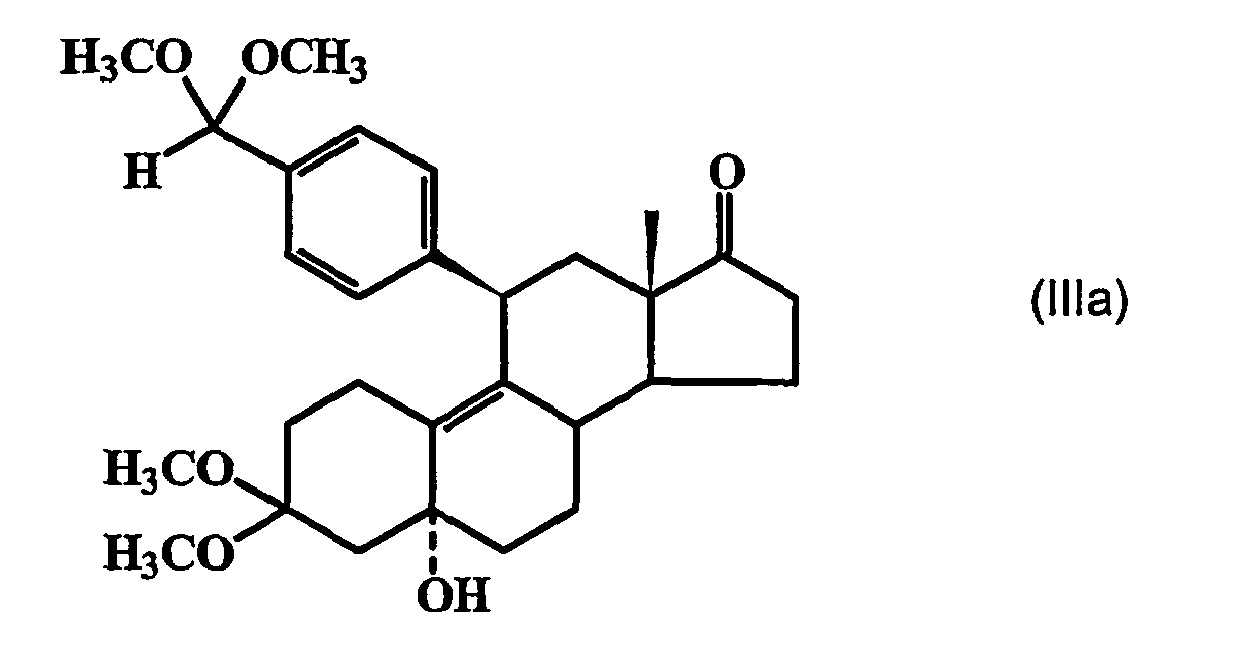
- Es entstehen 11β,17α-Bisaryl-substituierte Steroide der Formel (IVa)

Das Gemisch der Verbindungen der Formel (IIIa) und (IVa) kann nach COREY und CHAYKOWSKY (J. Amer. chem. Soc. 84, 3782 [1962]) hauptsächlich in das Spiroepoxid der Formel (Va)


- Aufgabe der vorliegenden Erfindung ist deshalb ein effektiveres und technisch einfacheres Verfahren zur Herstellung von 4-(17α-substituierten-3-oxoestra-4,9-dien-11β-yl)benzaldehyd-(1E oder 1 Z)-oximen der allgemeinen Formel (I) zur Verfügung zu stellen, das den Angriff des Grignard-Verbindung am C-17 verhindert und dadurch mit höherer Ausbeute und Reinheit zu Verbindungen der Formel (I) führt.
- Diese Aufgabe wird gemäß dem Verfahren nach Anspruch 1 gelöst.
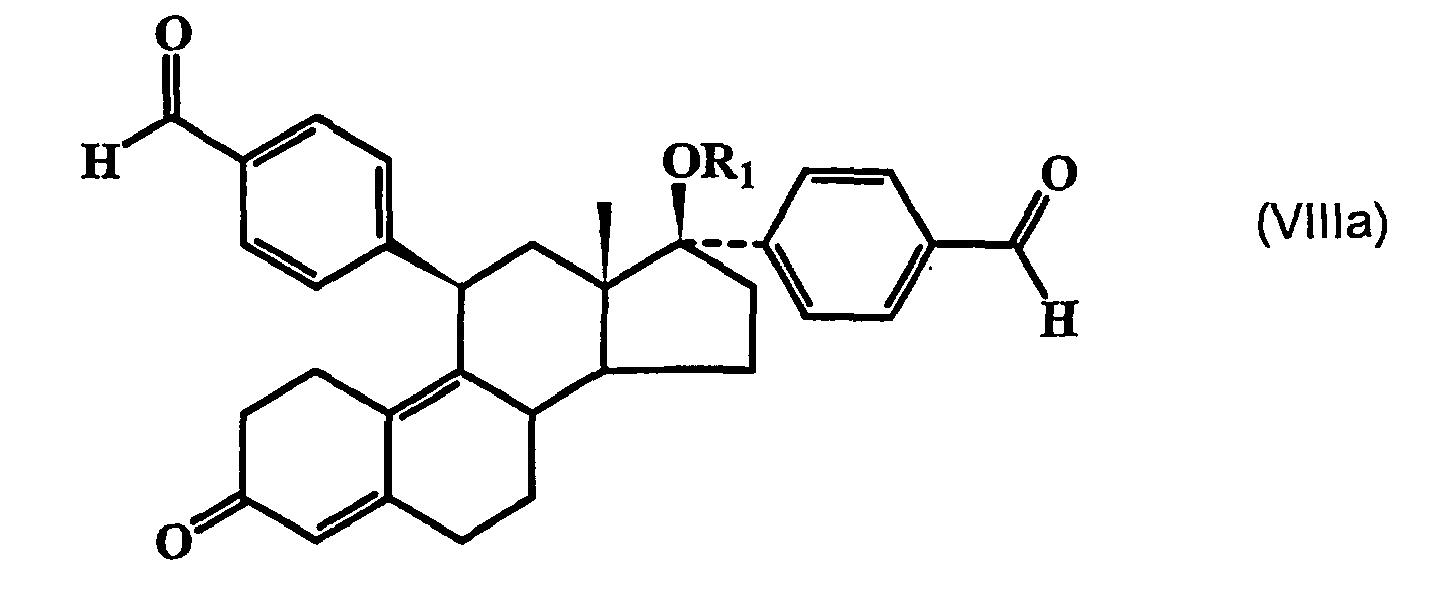
- Dadurch, daß die 17-Oxogruppe vor der Grignardierung in die gewünschte 17α-substituierte Verbindung überführt wird, wird die Bildung des Nebenprodukts der Formel (VIIIa) verhindert, wodurch die Zielverbindungen mit höherer Ausbeute und Reinheit erhalten werden. So kann beispielsweise ausgehend von der Verbindung (II) nach dem Verfahren gemäß DE 43 32 283 A1 der Aldehyd (VIIb) in ca. 5,6 % Ausbeute und entsprechend das Oxim (Ic) in ca. 3,8 % Ausbeute hergestellt werden. Durch das erfindungsgemäße Verfahren läßt sich der Aldehyd (Vllb) nunmehr in ca. 25 % Ausbeute bzw. das Oxim (Ic) in ca. 17 % Ausbeute aus dem Olefin (IX) herstellen, ohne daß spezielle chromatographische Bedingungen für die Reinigung angewendet werden müssen.
Bevorzugte Ausführungsformen der Erfindung sind in den Unteransprüchen angegeben. Wegen weiterer Vorteile der Erfindung wird auf die folgende Beschreibung und die Ausführungsbeispiele verwiesen. - Erfindungsgemäß werden die 3,3-Dimethoxy-5α,10α-epoxy-estr-9(11)-en-17-one der Formel (II)


- Unter "Alkylrest" wird in der vorliegenden Erfindung ein verzweigter oder geradkettiger Alkylrest verstanden. Als C1-4- bzw C1-6-Alkylreste seien beispielsweise eine Methyl-, Ethyl-, n-Propyl-, i-Propyl-, n-Butyl, i-Butyl- oder tert.Butyl-, n-Pentyl-, i-Pentyl-, n-Hexyl-, 2-Methylpentyl-, 3-Methylpentyl-, 2,2-Dimethylbutyl- oder 2,3-Dimethylbutylgruppe genannt. Unter CnF2n+1-Rest wird ein verzweigter oder geradkettiger Fluoralkylrest mit 1 bis 3 Kohlenstoffatomen verstanden, wobei Beispiele eine Trifluormethyl-, Pentafluorethyl-, Heptafluor-n-propyl- oder Heptafluor-iso-propylgruppe sind.
- Bevorzugt bedeuten R1 und R2 einen C1-3-Alkylrest, besonders bevorzugt eine Methylgruppe oder eine Trifluormethylgruppe. Y bedeutet bevorzugt einen OC1-3-Alkyl- oder SC1-3-Alkylrest, besonders bevorzugt eine Methoxy-, Ethoxy-, Isopropyloxy-, Methylthio- oder Ethylthiogruppe, oder Trifluorethoxygruppe. Die Verbindungen der Formel (I), in denen R1 ein CnF2n+1-Rest ist und/oder Y eine OCH2CnF2n+1-Gruppe ist, sind neu.
Am stärksten bevorzugt sind im Rahmen von Verbindungen der Formel (I) die folgenden Verbindungen: - 4-[17β-Hydroxy-17α-(methoxymethyl)-3-oxoestra-4,9-dien-11β-yl]benzaldehyd-1 E-oxim,
- 4-[17β-Hydroxy-17α-(methoxymethyl)-3-oxoestra-4,9-dien-11β-yl]benzaldehyd-1 Z-oxim,
- 4-[17β-Methoxy-17α-(methoxymethyl)-3-oxoestra-4,9-dien-11β-yl]benzaldehyd-1 E-oxim,
- 4-[17β-Methoxy-17α-(methoxymethyl)-3-oxoestra-4,9-dien-11β-yl]benzaldehyd-1 Z-oxim,
- 4-[17β-Ethoxy-17α-(methoxymethyl)-3-oxoestra-4,9-dien-11β-yl]benzaldehyd-1 E-oxim,
- 4-[17β-Hydroxy-17α-(ethoxymethyl)-3-oxoestra-4,9-dien-11β-yl]benzaldehyd-1 E-oxim,
- 4-[17β-Methoxy-17α-(ethoxymethyl)-3-oxoestra-4,9-dien-11β-yl]benzaldehyd-1 E-oxim,
- 4-[17β-Hydroxy-17α-(isopropyloxymethyl)-3-oxoestra-4,9-dien-11β-yl]benzaldehyd-1 E-oxim,
- 4-[17β-Methoxy-17α-(isopropyloxymethyl)-3-oxoestra-4,9-dien-11β-yl]benzaldehyd-1E-oxim,
- 4-[17β-Hydroxy-17α-(ethylthiomethyl)-3-oxoestra-4,9-dien-11β-yl]benzaldehyd-1 E-oxim und
- 4-[17β-Hydroxy-17α-(1,1,1-trifluorethoxymethyl)-3-oxoestra-4,9-dien-11 β-yl]benzaldehyd-1E-oxim.
- Die Verbindungen werden gut am Gestagenrezeptor gebunden, zeigen im Tierexperiment eine starke antigestagene Aktivität, besitzen eine partielle gestagene Aktivität und weisen nur eine geringe glucocorticoide Rezeptorbindung auf (DE 4332283 A1 (EP 0 648 778 B1)).
- Die nachfolgenden Beispiele dienen zur näheren Beschreibung der Erfindung.
- 25 g 3,3-Dimethoxy-5α,10α-epoxy-estr-9(11)-en-17-on (IIa) werden in 200 ml DMSO gelöst und mit 34 g Trimethylsulfoniumjodid versetzt. Anschließend gibt man 24 g festes Kalium-tert.-butanolat hinzu und rührt 3 Stunden bei Raumtemperatur, gießt in eiskalte wäßrige Ammoniumchlorid-Lösung ein, extrahiert mit Essigester, wäscht neutral, trocknet die organische Phase mit Natriumsulfat und engt im Vakuum ein. Man erhält 27 g 3,3-Dimethoxy-5α,10α-epoxy-estr-9(11)-en-17(S)-spiroepoxid (IXa) als klebrigen Schaum, der direkt in der nächsten Stufe eingesetzt wird.
- 27 g 3,3-Dimethoxy-5α,10α-epoxy-estr-9(11)-en-17(S)-spiroepoxid (IXa) werden in 100 ml Methanol gelöst, unter Argon werden 100 ml 3N Natriummethylat-Lösung zugesetzt und die Mischung wird 2 Stunden unter Rückfluß erhitzt. Es wird abgekühlt, die Hälfte des Methanols wird abdestilliert und der Rest in Essigester aufgenommen, die Lösung wird mit Wasser versetzt und die Phasen werden getrennt. Die organische Phase wird neutral gewaschen, über Natriumsulfat getrocknet und im Vakuum eingeengt. Man erhält 29,5 g 3,3-Dimethoxy-17α-(methoxymethyl)-5α,10α-epoxy-estr-9(11)-en-17β-ol (Xa) als einen klebrigen Schaum, der direkt in der nächsten Stufe eingesetzt wird.
- 10 g 3,3-Dimethoxy-17α-methoxymethyl-5α,10α-epoxy-estr-9(11)-en-17β-ol (Xa) in 50 ml abs. THF werden bei -35°C zu einer Grignard-Lösung, hergestellt aus 2,7 g Magnesium, 25 g 4-Brombenzaldehydethylenketal in 130 ml THF und 0,65 g Kupfer(I)chlorid, zugetropft. Man läßt nach 2 Stunden auf Raumtemperatur erwärmen, zersetzt mit wäßriger Ammoniumchlorid-Lösung und extrahiert die Lösung mit tert.-Butylmethylether. Die organische Phase wird neutral gewaschen, getrocknet und im Vakuum eingedampft. Man erhält 16 g eines Rohproduktes aus dem durch Chromatographie an Kieselgel das 4-(3,3-Dimethoxy-5α,17β-dihydroxy-17α-methoxymethyl-estr-9-en-11β-yl)benzaldehyd-1,1-ethylenketal (XIa) isoliert wird.
Schmp. 111 bis 116 °C. αD = -5 ° (CHCl3). 1H-NMR: 7,36 (d, 2H, J=8,1, H3'), 7,24 (d, 2H, J=8,1, H2'), 5,76 (s,1H, PhCH), 4,67 (s, 1H, OH), 4,27 (d, 1H, J= 8,1, H-11α), 4,02-4,14 (m, 4H, Etylenketal), 3,38 (s, 3H, OCH3), 3,22 (s, 3H, OCH3), 3,21 (s, 3H, OCH3), 3,17 (d, 1 H, J=9,0, CH2O), 2,55 (s, 1H, OH), 0,46 (s, 3H, H-18), - 45 g 4-(3,3-Dimethoxy-17α-methoxymethyl-5α-hydroxy-estr-9-en-11β-yl)benzaldehyd-1,1-ethylenketal (Xla) werden in 100 ml tert.-Butylmethylether gelöst, mit 1,2 g p-Toluolsulfonsäure versetzt und 1 Stunde bei Raumtemperatur gerührt. Nach Zugabe von 15 ml Bicarbonat-Lösung wird mit Methylenchlorid extrahiert, die organische Phase neutral gewaschen, getrocknet und im Vakuum eingeengt. Nach Zugabe von tert.-Butylmethylether fällt der 4-[17β-Hydroxy-(17α-(methoxymethyl)-3-oxoestra-4,9-dien-11β-yl]benzaldehyd (VIIa) als Rohprodukt aus, das durch Chromatographie an Kieselgel gereinigt und aus Essigester umkristallisiert wird.
Schmp. 235 bis 240° C. αD = +209° (CHCl3). 1H-NMR: 9,97 (s, 1H, - CHO), 7,80 (d, 2H, J = 8,1, H-3'), 7,38 (d, 2H, J = 8,1, H-2'), 5,80 (s, 1 H, H-4), 4,45 (d, 1 H, J = 7,5, H-11), 3,57 (d, 1H, J = 9,2, CH2O), 3,42 (d, 1H, J = 10,8, CH2O), 3,41 (s, 3H, OCH3), 0,51 (s, 3H, H-18). - 33g 4-[17β-Hydroxy-17α-(methoxymethyl)-3-oxoestra-4,9-dien-11β-yl]benzaldehyd (Vlla) werden unter Argonschutz in 250 ml Pyridin gelöst und mit 5,8 g Hydroxylaminhydrochlorid versetzt. Nach 2 Stunden wird in Eiswasser eingerührt, der Niederschlag wird abgesaugt, gewaschen und getrocknet. Das Rohprodukt (40 g) wird durch Chromatographie an Kieselgel gereinigt. Man erhält 20 g 4-[17β-Hydroxy-(17α-(methoxymethyl)-3-oxoestra-4,9-dien-11β-yl]benzaldehyd-1E-oxim (la) [Schmp. 135 bis 145°C (EtOH/Wasser). αD = +236° (CHCl3). 1H-NMR: 9,00 (s, 1H, NOH), 8,11 (s, 1H, HC=N), 7,45 (d, 2H, J = 8,2 , H-3'), 7,17 (d, 2H, J = 8,2 , H-2'), 5,79 (s, 1 H, H-4), 4,38 (d, 1H, J = 7,1, H-11), 3,58 (d, 1H, J = 9,0, CH2O), 3,43 (s, 3H, OCH2), 3,25 (d, 1H , J = 9,0, CH2O), 0,48 (s, 3H, H-18)] und 1,5 g 4-[17β-Hydroxy-17α-(methoxymethyl)-3-oxoestra-4,9-dien-11β-yl]benzaldehyd-1Z-oxim (Ib) [Schmp. 135 bis 146°C (Aceton). αD = +192°. 1H-NMR: 8,56 (s, 1H, NOH), 7,86 (d, 2H, J = 8,4 , H-3'), 7,33 (s, 1 H, HC=N), 7,26 (d, 2H, J = 8,4 , H-2'), 5,79 (s, 1 H, H-4), 4,41 (d, 1 H, J = 7,2 , H-11), 3,57 (d, 1 H, J = 9,1 , CH2O), 3,42 (s, 3H, OCH3), 3,23 (d, 1H, J = 9,1, CH2O), 0,54 (s, 3H, H-18).
- 29,5 g des in Beispiel 1, Stufe b hergestellten 3,3-Dimethoxy-17α-methoxymethyl-5α,10α-epoxy-estr-9(11)-en-17β-ols (Xa) werden unter Argon in 650 ml Toluol gelöst, mit 110 g Kalium-tert.-butanolat versetzt und bei Raumtemperatur gerührt. Man tropft 70 ml Methyljodid in 30 ml Toluol innerhalb von 2 Stunden zu. Danach wird mit Wasser verdünnt, die Phasen werden getrennt, die organische Phase neutral gewaschen getrocknet und im Vakuum eingedampft. Man erhält 30 g 3,3,17β-Trimethoxy-5α,10α-epoxy-estr-9(11)-en-17α-methoxy-methylether (Xb) als gelbes Harz, das mit Hexan behandelt wird.
Schmp. 114 bis 118°C (Hexan). αD = +7° (CHCl3). 1H-NMR: 6,00 (m, 1H, H-11), 3,57 (d, 1 H, J = 10,3 , CH2O), 3,36 (s, 3H, OCH3), 3,30 (d, 1H, J = 10,3, CH2O), 3,28 (s, 3H, OCH3), 3,19 (s, 3H, OCH3), 3,13 (s, 3H, OCH3), 0,88 (s, 1 H, H-18). - Zu einer Grignard-Lösung, hergestellt aus 24 g 4-Brombenzaldehydethylenketal und 2,0 g Magnesium in 140 ml THF, werden bei -35 °C 500 mg Kupfer(I)chlorid zugegeben. Man rührt 20 Minuten bei dieser Temperatur und tropft eine Lösung von 10 g 3,3,17β-Trimethoxy-5α,10α-epoxy-estr-9(11)-en-17α-methoxymethylether (Xb) in 40 ml THF zu. Anschließend läßt man die Reaktionslösung auf Raumtemperatur erwärmen, zersetzt den Ansatz mit wäßriger Ammoniumchlorid-Lösung, extrahiert die Lösung mit Essigester und wäscht die organische Phase mit Wasser, trocknet sie mit Natriumsulfat und engt die Lösung im Vakuum ein. Das Rohprodukt, 4-(3,3-Dimethoxy-5α-hydroxy-17β-methoxy-17α-methoxymethyl-estr-9-en-1 1β-yl)benzaldehyd-1,1-ethylenketal (XIb), (15 g) wird direkt in der nächsten Stufe eingesetzt.
- 15 g Rohprodukt 4-(3,3-Dimethoxy-5α-hydroxy-17β-methoxy-17α-methoxymethyl-estr-9-en-11β-yl)benzaldehyd-1,1-ethylenketal (Xlb) werden in 120 ml Aceton gelöst und mit 1,3 g p-Toluolsulfonsäure versetzt. Nach 1 Stunde wird neutralisiert und mit Wasser verdünnt. Dabei fällt der 4-[17β-Methoxy-17α-methoxymethyl)-3-oxoestra-4,9-dien-11β-yl]benzaldehyd (VIIb) aus, der abgesaugt und in Aceton umkristallisiert wird.
Schmp. 245 bis 250 °C (Aceton). αD = +193° (CHCl3). 1H-NMR: 9,97 (s, 1H, CHO), 7,79 (d, 2H, J = 8,1, H-3'), 7,37 (d, 2H, J = 8,1, H-2'), 5,79 (s, 1 H, H-4), 4,44 (d, 1 H, J = 7,5, H-11), 3,56 (d, 1 H, J = 10,8, CH2O), 3,42 (d, 1H, J = 10,8, -CH2O), 3,41 (s, 3H, OCH3), 3,25 (s, 3H, OCH3), 0,51 (s, 3H, H-18). - Zu einer Lösung von 10 g 4-[17β-Methoxy-17α-(methoxymethyl)-3-oxoestra-4,9-dien-11β-yl]benzaldehyd (Vllb) in 100 ml Pyridin werden bei Raumtemperatur 1,75 g Hydroxylaminhydrochlorid zugegeben und die Mischung wird 2 Stunden gerührt. Man gießt in Eiswasser ein, saugt den Niederschlag ab, trocknet mit Calciumchlorid und chromatographiert das Rohprodukt an Kieselgel. Man isoliert 7g 4-[17β-Methoxy-17α-(methoxymethyl)-3-oxoestra-4,9-dien-11β-yl]benzaldehyd-1E-oxim (Ic) [Schmp. 196 bis 198 °C (EtOH/H2O). αD = +220° (CHCl3). 1H-NMR: 8,38 (s, 1H, NOH), 8,10 (s, 1H, HC=N), 7,47 (d, 2H, J = 8,1, H-3'), 7,20 (d, 2H, J = 8,1, H-2'), 5,79 (s, 1H, H-4), 4,38 (d, 1 H, J = 7,3, H-11), 3,58 (d, 1H, J = 10,8, CH2O), 3,41 (s, 3H, OCH3), 3,41 (d, 1H, J = 10,8, CH2O), 3,25 (s, 3H, OCH3), 0,54 (s, 3H, H-18)] und 300 mg 4-[17β-Methoxy-17α-(methoxymethyl)-3-oxoestra-4,9-dien-11β-yl]benzaldehyde-1Z-oxim (Id) [Schmp. 120 bis 138 °C (Aceton/n-Hexan). αD = +217° (CHCl3). 1H-NMR: 9,38 (s, 1 H, NOH), 7,88 (d, 2H, J = 8,9, H-3'), 7,33 (s, 1H, HC=N), 7,26 (d, 2H, J = 8,9, H-2'), 5,79 (s, 1 H, H-4), 4,39 (d, 1 H, J = 7,3, H-11), 3,58 (d, 1 H, J = 10,5, CH2O), 3,42 (d, 1 H, J = 10,5, CH2O), 3,41 (s, 3H, OCH3), 3,26 (s, 3H, OCH3), 0,54 (s, 3H, H-18).
- 4,16 g des in Beispiel 1, Stufe b hergestellten 3,3-Dimethoxy-17α-methoxymethyl-5α,10α-epoxy-estr-9(11)-en-17β-ols (Xa) werden portionsweise mit insgesamt 15,6 g Kalium-tert.-butanolat und 76 ml lodethan in 405 ml Toluol bei 35 °C innerhalb von 14 h umgesetzt. Zur Aufarbeitung wird auf Raumtemperatur gekühlt und Wasser zugesetzt, wobei sich Salze lösen. Die Phasen werden getrennt und die wäßrige Phase mit Toluol nachextrahiert. Die Lösung wird gewaschen, getrocknet und eingedampft. Man erhält 4,2 g 3,3,-Dimethoxy-5α,10α-epoxy-17β-ethoxy-estr-9(11)-en-17α-methoxymethylether (Xc) als Rohprodukt, das direkt in der nächsten Stufe eingesetzt wird.
- Zu einer Grignard-Lösung, hergestellt aus 5 g 4-Brombenzaldehydethylenketal und 0,45 g Magnesium in 60 ml THF, wird bei -35 °C 0,1 g Kupfer(I)chlorid zugegeben. Man rührt 30 Minuten bei dieser Temperatur und tropft eine Lösung von 2,5 g 3,3-Dimethoxy-5α,10α-epoxy-17β-ethoxy-estr-9(11)-en-17α-methoxymethylether (Xc) in 15 ml THF zu. Anschließend läßt man die Reaktionslösung auf Raumtemperatur erwärmen, zersetzt den Ansatz mit wäßriger Ammoniumchlorid-Lösung und isoliert nach üblicher Aufarbeitung das 4-[3,3-Dimethoxy-5α-hydroxy-17β-ethoxy-17α-(methoxymethyl)-estr-9-en-11β-yl]benzaldehyd-1,1-ethylenketal (XIc) (4,5 g), das direkt in der nächsten Stufe eingesetzt wird
- 4,5 g 4-[3,3-Dimethoxy-5α-hydroxy-17β-ethoxy-17α-(methoxymethyl)-estr-9-en-11β-yl]benzaldehyd-1,1-ethylenketal (Xlc) werden in 60 ml Aceton gelöst. Man fügt 1,6 g p-Toluolsulfonsäure zu und gießt nach 1 Stunde in Eiswasser ein. Der dabei ausfallende 4-[17β-Ethoxy-17α-methoxymethyl)-3-oxoestra-4,9-dien-11β-yl]benzaldehyd (VIIc) wird abgesaugt, getrocknet und aus Aceton/Hexan und erneut aus tert.-Butylmethylether umkristallisiert.
Schmp. 164 bis 167 °C. αD = +199° (CHCl3). 1H-NMR: 9,97 (s, 1H, CHO), 7,80 (d, 2H, J = 8,1, H-3'), 7,37 (d, 2H, J = 8,1, H-2'), 5,79 (s, 1H, H-4), 4,43 (d, 1H, J = 7,5, H-11), 3,58 (d, 1H, J = 10,8, CH2O), 3,41 (m, 2H, CH2O), 3,40 (s, 3H, OCH3), 1,10 (t, 3H, Ethyl), 0,51 (s, 3H, H-18). - 1,7 g 4-[17β-Ethoxy(17α-methoxymethyl)-3-oxoestra-4,9-dien-11β-yl]benzaldehyd (VIIc) werden in 25 ml Pyridin mit 250 mg Hydroxylaminhydrochlorid 1 Stunde bei Raumtemperatur gerührt. Danach gießt man in 100 ml Eiswasser ein, saugt den Niederschlag ab, wäscht mit Wasser neutral und trocknet mit Calciumchlorid. Das Rohprodukt (1,7 g) wird durch Chromatographie an Kieselgel gereinigt. Man erhält 890 mg 4-[17β-Ethoxy-17α-(methoxymethyl)-3-oxoestra-4,9-dien-11β-yl]benzaldehyd-1E-oxim (Ie).
Schmp. 184 bis 187 °C (Aceton/Hexan). αD = +214° (CHCl3). 1H-NMR: 9,10 (s, 1H, CH=N), 7,58 (s, 1H, OH), 7,49 (d, 2H, J = 8,4, H-3'), 7,21 (d, 2H, J = 8,4, H-2'), 5,78 (s, 1H, H-4), 4,38 (d, 1 H, J = 6,9, H-11), 3,62 (d, 1 H, J = 10,8, CH2O), 3,40 (s, 3H, OCH3), 3,36 (d, 1H, J = 10,8, CH2O), 1,11 (t, 3H, CH2CH3), 0,54 (s, 3H, H-18). - Die Herstellung erfolgt gemäß Beispiel 1, Stufen 1b 1 c, 1d und 1 e, wobei in Stufe 1b Natriumethylat anstelle von Natriummethylat verwendet wird. Die Verbindung (If) wird als farbloser Schaum isoliert. αD = +226° (CHCl3). 1H-NMR: 8,10 (s, 1H, HC=N), 7,71 (s, 1H, NOH), 7,47 (d, 2H, J = 8,2 , H-3'), 7,19 (d, 2H, J = 8,2 , H-2'), 5,78 (s, 1 H, H-4), 4,38 (d, 1H, J = 7,1, H-11), 3,58 (d, 1H, J = 9,3, CH2O), 3,55 (m, 2H, CH2H5), 3,25 (d, 1H, J = 9,3, CH2O), 2,17 (s, 1 H, OH), 1,25 (t, 3H, CH2H5), 0,52 (s, 3H, H-18).
- Die Herstellung der Verbindung (Ig) erfolgt gemäß Beispiel 1, Stufe b, wobei Natriumethylat anstelle von Natriummethylat verwendet wird, und gemäß Beispiel 2, Stufen 2a, 2b, 2c und 2d.
Schmp. 90 bis 95 °C tert.-Butylmethylether). αD = +177° (CHCl3). 1H-NMR: 8,10 (s, 1H, HC=N), 7,60 (s, 1 H, NOH), 7,47 (d, 2H, J = 8,1, H-3'), 7,24 (d, 2H, J = 8,1, H-2'), 5,79 (s, 1H, H-4), 4,37 (d, 1H, J = 7,3, H-11), 3,63 (d, 1H, J = 10,8, CH2O), 3,55 (m, 2H, C2H5), 3,44 (d, 1H, J = 10,8 , CH2O), 3,26, 3,22 (2s, je 3H, OCH3), 1,27 (t, 3H, C2H5), 0,54 (s, 3H, H-18). - Die Herstellung der Verbindung (Ih) erfolgt gemäß Beispiel 1, Stufen 1b, 1 c, 1d und 1 e, wobei in Stufe 1b Natriumisopropylat anstelle von Natriummethylat verwendet wird.
Schmp. 192 bis 196 °C (Zersetzung; Diethylether). αD = +186° (CHCl3). 1H-NMR: 8,10 (s, 1 H, HC=N), 8,08 (s, 1 H, NOH), 7,48 (d, 2H, J = 8,1 , H-3'), 7,19 (d, 2H, J = 8,1 , H-2'), 5,79 (s, 1H, H-4), 4,38 (d, 1 H, J = 6,6, H-11), 3,6 (m, CH2), 3,59 (d, 1 H, J = 9,3, CH2O), 3,23 (d, 1 H, J = 9,3, CH2O), 3,02 (s, 1 H, OH), 1,21 (m, 6H, 2xCH3), 0,52 (s, 3H, H-18). - Die Herstellung der Verbindung (Ii) erfolgt gemäß Beispiel 1, Stufe b mit Natriumethylat anstelle von Natriummethylat und gemäß Beispiel 2, Stufen 2a, 2b, 2c und 2d.
Schmp. 143°C (Zersetzung; Aceton/Hexan). αD = +199° (CHCl3). 1H-NMR: 8,10 (s, 1 H, HC=N), 8,0 (s, 1 H, NOH), 7,48 (d, 2H, J = 8,4, H-3'), 7,21 (d, 2H, J = 8,1, H-2'), 5,79 (s, 1H, H-4), 4,37 (d, 1 H, J = 6,9, H-11), 3,62 (d, 1 H, J = 10,5, CH2O), 3,59 (m, 2H, OCH(CH3)2), 3,43 (d, 1H, J = 10,2 , CH2O), 3,26 (s, 3H, OCH3), 1,22 (t, 3H, C2H5), 0,54 (s, 3H, H-18). - Die Herstellung der Verbindung (Ij) erfolgt gemäß Beispiel 1, Stufe 1b, 1 c, 1d und 1 e, wobei in Stufe 1b Natriumthioethylat anstelle von Natriummethylat verwendet wird.
Schmp. 132 bis 137°C. αD = +165° (CHCl3). 1H-NMR: 8,10 (s, 1H, HC=N), 7,93 (s, 1 H, NOH), 7,49 (d, 2H, J = 8,4 , H-3'), 7,19 (d, 2H, J = 8,4 , H-2'), 5,79 (s, 1 H, H-4), 4,42 (d, 1 H, J = 7,2, H-11), 2,95 (d, 1 H, J = 13,2, CH2S), 2,90 (s, 3H, OH), 2,71 (d, 1 H, J = 12,9, CH2S), 2,6 (m, 2H, SCH2-), 1,29 (t, 3H, SCH2CH3),0,56 (s, 3H, H-18). - Die Herstellung der Verbindung (Ik) erfolgt gemäß Beispiel 1, Stufe 1b, 1c, 1d und 1e, wobei in Stufe 1b 1,1,1-Trifluorethanol und Kalium-tert.-butanolat anstelle von Natriummethylat verwendet wird.
Schmp. 132 bis 136°C (Diethylether). αD = +182° (CHCl3). 1H-NMR: 8,10 (s, 1 H, HC=N), 7,60 (s, 1 H, NOH), 7,49 (d, 2H, J = 8,4 , H-3'), 7,20 (d, 2H, J = 8,1 , H-2'), 5,79 (s, 1 H, H-4), 4,41 (d, 1 H, J = 7,2, H-11), 3,95 (m, 2H, OCH2CF3 ), 3,92 (d, 1 H, J = 8,7, CH2O), 3,82 (d, 1 H, J = 9,0, CH2O), 0,55 (s, 3H, H-18).
Claims (6)
- Verfahren zur Herstellung von 4-(17α-substituierten-3-oxoestra-4,9-dien-11β-yl)benzaldehyd-(1E oder 1Z)-oximen der allgemeinen Formel (I),


- Verfahren nach Anspruch 1, dadurch gekennzeichnet, daß es den zusätzlichen Verfahrensschritt umfaßt, das Gemisch der E/Z-Benzaldoxime der allgemeinen Formel (I) durch Umkristallisation oder durch Chromatographie in die Einzelkomponenten zu trennen.
- Verfahren nach Anspruch 1 oder 2, dadurch gekennzeichnet, daß R1 einen C1-3-Alkylrest, vorzugsweise eine Methylgruppe, oder Trifluormethylgruppe bedeutet.
- Verfahren nach einem der Ansprüche 1 bis 3, dadurch gekennzeichnet, daß R2 einen C1-3-Alkylrest, vorzugsweise eine Methylgruppe, oder Trifluormethylgruppe bedeutet.
- Verfahren nach einem der Ansprüche 1 bis 4, dadurch gekennzeichnet, daß Y einen OC1-3-Alkyl- oder SC1-3-Alkylrest, vorzugsweise eine Methoxy-, Ethoxy-, Isopropyloxy-, Methylthio- oder Ethylthiogruppe, oder Trifluormethoxygruppe bedeutet.
- Verfahren nach einem der Ansprüche 3 bis 5, dadurch gekennzeichnet, daß die Verbindungen
4-[17β-Hydroxy-17α-(methoxymethyl)-3-oxoestra-4,9-dien-11β-yl]benzaldehyd-1 E-oxim,
4-[17β-Hydroxy-17α-(methoxymethyl)-3-oxoestra-4,9-dien-11β-yl]benzaldehyd-1Z-oxim,
4-[17β-Methoxy-17α-(methoxymethyl)-3-oxoestra-4,9-dien-11β-yl]benzaldehyd-1 E-oxim,
4-[17β-Methoxy-17α-(methoxymethyl)-3-oxoestra-4,9-dien-11β-yl]benzaldehyd-1 Z-oxim,
4-[17β-Ethoxy-17α-(methoxymethyl)-3-oxoestra-4,9-dien-11β-yl]benzaldehyd-1 E-oxim,
4-[17β-Hydroxy-17α-(ethoxymethyl)-3-oxoestra-4,9-dien-11β-yl]benzaldehyd-1 E-oxim,
4-[17β-Methoxy-17α-(ethoxymethyl)-3-oxoestra-4,9-dien-11β-yl]benzaldehyd-1 E-oxim,
4-[17β-Hydroxy-17α-(isopropyloxymethyl)-3-oxoestra-4,9-dien-11 β-yl]benzaldehyd-1E-oxim,
4-[17β-Methoxy-17α-(isopropyloxymethyl)-3-oxoestra-4,9-dien-11 β-yl]benzaldehyd-1E-oxim,
4-[17β-Hydroxy-17α-(ethylthiomethyl)-3-oxoestra-4,9-dien-11β-yl]benzaldehyd-1E-oxim und
4-{17β-Hydroxy-17α-(1,1,1-trifluorethoxymethyl)-3-oxoestra-4,9-dien-11β-yl]benzaldehyd-1E-oxim hergestellt werden.
Applications Claiming Priority (3)
| Application Number | Priority Date | Filing Date | Title |
|---|---|---|---|
| DE10056676A DE10056676A1 (de) | 2000-11-10 | 2000-11-10 | Verfahren zur Herstellung von 4-/17alpha-substituierten-3-oxoestra-4,9-dien-11beta-yl)benzaldehyd-(1E oder 1Z)-oximen |
| DE10056676 | 2000-11-10 | ||
| PCT/DE2001/004218 WO2002038582A2 (de) | 2000-11-10 | 2001-11-09 | Verfahren zur herstellung von 4-(17alpha-(substituierten-methyl)-3-oxoestra-4,9 dien-11-yl)benzaldehyd-(1e oder 1z)-oximen |
Publications (2)
| Publication Number | Publication Date |
|---|---|
| EP1339734A2 EP1339734A2 (de) | 2003-09-03 |
| EP1339734B1 true EP1339734B1 (de) | 2006-08-23 |
Family
ID=7663441
Family Applications (1)
| Application Number | Title | Priority Date | Filing Date |
|---|---|---|---|
| EP01993608A Expired - Lifetime EP1339734B1 (de) | 2000-11-10 | 2001-11-09 | Verfahren zur herstellung von 4-(17alpha-substituierten-3-oxoestra-4,9-dien-11beta-yl) benzaldehyd-(1e oder 1z)-oximen |
Country Status (25)
| Country | Link |
|---|---|
| US (1) | US7214808B2 (de) |
| EP (1) | EP1339734B1 (de) |
| JP (1) | JP4263478B2 (de) |
| KR (1) | KR100836323B1 (de) |
| CN (1) | CN100368427C (de) |
| AT (1) | ATE337328T1 (de) |
| AU (2) | AU1691102A (de) |
| BG (1) | BG107886A (de) |
| BR (1) | BR0115249A (de) |
| CA (1) | CA2427632C (de) |
| CZ (1) | CZ301425B6 (de) |
| DE (2) | DE10056676A1 (de) |
| EA (1) | EA005530B1 (de) |
| EE (1) | EE200300222A (de) |
| HR (1) | HRP20030458A2 (de) |
| HU (1) | HUP0301765A2 (de) |
| IL (2) | IL155680A0 (de) |
| MX (1) | MXPA03004109A (de) |
| NO (1) | NO20032080L (de) |
| NZ (1) | NZ525962A (de) |
| PL (1) | PL205091B1 (de) |
| SK (1) | SK286601B6 (de) |
| WO (1) | WO2002038582A2 (de) |
| YU (1) | YU34303A (de) |
| ZA (1) | ZA200304480B (de) |
Families Citing this family (2)
| Publication number | Priority date | Publication date | Assignee | Title |
|---|---|---|---|---|
| DE102006018888A1 (de) * | 2006-04-18 | 2007-10-25 | Bayer Schering Pharma Ag | Verfahren zur Herstellung von 4-[17beta-Methoxy-17alpha-methoxymethyl-3-oxoestra-4,9-dien-11beta-yl]benzaldehyd-(E)-oxims (Asoprisnil) |
| JP4843372B2 (ja) * | 2006-05-09 | 2011-12-21 | 株式会社リコー | 画像処理装置 |
Family Cites Families (3)
| Publication number | Priority date | Publication date | Assignee | Title |
|---|---|---|---|---|
| DE4332283A1 (de) * | 1993-09-20 | 1995-04-13 | Jenapharm Gmbh | Neue 11-Benzaldoximestradien-Derivate, Verfahren zu ihrer Herstellung und diese Verbindungen enthaltende Arzneimittel |
| DE4332284C2 (de) * | 1993-09-20 | 1997-05-28 | Jenapharm Gmbh | 11-Benzaldoxim-17beta-methoxy-17alpha-methoxymethyl-estradien-Derivate, Verfahren zu ihrer Herstellung und diese Verbindungen enthaltende Arzneimittel |
| US5576310A (en) * | 1994-09-20 | 1996-11-19 | Jenapharm Gmbh | 11-benzaldoxime-17β-methoxy-17α-methoxymethyl-estrasdiene derivatives, methods for their production and pharmaceuticals containing such compounds |
-
2000
- 2000-11-10 DE DE10056676A patent/DE10056676A1/de not_active Withdrawn
-
2001
- 2001-11-09 AU AU1691102A patent/AU1691102A/xx active Pending
- 2001-11-09 AU AU2002216911A patent/AU2002216911B2/en not_active Ceased
- 2001-11-09 MX MXPA03004109A patent/MXPA03004109A/es active IP Right Grant
- 2001-11-09 DE DE50110829T patent/DE50110829D1/de not_active Expired - Lifetime
- 2001-11-09 JP JP2002541114A patent/JP4263478B2/ja not_active Expired - Fee Related
- 2001-11-09 EP EP01993608A patent/EP1339734B1/de not_active Expired - Lifetime
- 2001-11-09 EA EA200300506A patent/EA005530B1/ru not_active IP Right Cessation
- 2001-11-09 YU YU34303A patent/YU34303A/sh unknown
- 2001-11-09 IL IL15568001A patent/IL155680A0/xx unknown
- 2001-11-09 CN CNB018186785A patent/CN100368427C/zh not_active Expired - Fee Related
- 2001-11-09 EE EEP200300222A patent/EE200300222A/xx unknown
- 2001-11-09 WO PCT/DE2001/004218 patent/WO2002038582A2/de not_active Ceased
- 2001-11-09 BR BR0115249-1A patent/BR0115249A/pt not_active IP Right Cessation
- 2001-11-09 SK SK551-2003A patent/SK286601B6/sk not_active IP Right Cessation
- 2001-11-09 US US10/416,029 patent/US7214808B2/en not_active Expired - Lifetime
- 2001-11-09 PL PL361399A patent/PL205091B1/pl not_active IP Right Cessation
- 2001-11-09 CZ CZ20031282A patent/CZ301425B6/cs not_active IP Right Cessation
- 2001-11-09 HR HR20030458A patent/HRP20030458A2/hr not_active Application Discontinuation
- 2001-11-09 CA CA2427632A patent/CA2427632C/en not_active Expired - Lifetime
- 2001-11-09 KR KR1020037006317A patent/KR100836323B1/ko not_active Expired - Fee Related
- 2001-11-09 AT AT01993608T patent/ATE337328T1/de not_active IP Right Cessation
- 2001-11-09 HU HU0301765A patent/HUP0301765A2/hu unknown
- 2001-11-09 NZ NZ525962A patent/NZ525962A/en unknown
-
2003
- 2003-04-30 IL IL155680A patent/IL155680A/en not_active IP Right Cessation
- 2003-05-09 NO NO20032080A patent/NO20032080L/no unknown
- 2003-06-06 BG BG107886A patent/BG107886A/bg unknown
- 2003-06-09 ZA ZA200304480A patent/ZA200304480B/en unknown
Also Published As
Similar Documents
| Publication | Publication Date | Title |
|---|---|---|
| EP0411733A2 (de) | 11 Beta-Aryl-gona-4,9-dien-3-one | |
| DE60021422T2 (de) | Verfahren zur Herstellung von 17α-acetoxy-11β-[4-n,n-(dimethylamino)phenyl]-21-methoxy-19-norpregna-4,9-dien-3,20-dion, für das Verfahren nützliche Zwischenprodukte und Verfahren zur Herstellung derartiger Zwischenprodukte | |
| DE3231827A1 (de) | 11ss-aryl-17(alpha)-alkinyl-17ss-hydroxy-4,9(10)- estradien-3-on-derivate, deren herstellung und diese enthaltende pharmazeutische praeparate | |
| EP0532562A1 (de) | VERFAHREN ZUR HERSTELLUNG VON 10-g(b)-H-STEROIDEN. | |
| EP0187847A1 (de) | VERFAHREN ZUR HERSTELLUNG VON 6$g(A)-METHYLSTEROIDEN | |
| EP1339733B1 (de) | Verfahren zur herstellung von 4-(17alpha-methyl-substituierten)3-oxoestra-4,9-dien-11beta-yl)benzaldehyd-(1e oder 1z)-oximen | |
| EP1339734A2 (de) | Verfahren zur herstellung von 4-(17alpha-substituierten-3-oxoestra-4,9-dien-11-yl benzaldehyd-(1e oder 1z)-oximen | |
| EP0567472A1 (de) | D-homo-(16-en)-11 beta-aryl-4-estrene,verfahren zu ihrer herstellung sowie deren verwendung als arzneimittel. | |
| DE4301461A1 (de) | Verfahren zur Herstellung von Derivaten des Estra-1,3,5(10),14-tetraen-3,17alpha-diols | |
| HU187382B (en) | Process for producing 17-beta-ethnyl-steroides | |
| DE4319998A1 (de) | Verfahren zur Herstellung von Derivaten des Estra-1,3,5(10),14-tetraen-3,17alpha-diols | |
| HK1063187B (en) | PROCESS FOR THE PRODUCTION OF 4-(17α-SUBSTITUTED-3-OXOESTRA-4, 9-DIEN-11β-YL)BENZALDEHYDE-(1E OR 1Z)-OXIMES | |
| DD289536A5 (de) | Verfahren zur herstellung von 17-alkoxy-11beta-aryl-16alpha, 17alpha-methylen-gona-4,9-dienen | |
| DE102006018869A1 (de) | 17alpha-substituierte 4-(3-Oxoestra-4,9-dien-11beta-yl)-benzoesäure, deren Derivate und Verfahren zu ihrer Herstellung |
Legal Events
| Date | Code | Title | Description |
|---|---|---|---|
| PUAI | Public reference made under article 153(3) epc to a published international application that has entered the european phase |
Free format text: ORIGINAL CODE: 0009012 |
|
| 17P | Request for examination filed |
Effective date: 20030605 |
|
| AK | Designated contracting states |
Kind code of ref document: A2 Designated state(s): AT BE CH CY DE DK ES FI FR GB GR IE IT LI LU MC NL PT SE TR |
|
| AX | Request for extension of the european patent |
Extension state: AL LT LV MK RO |
|
| RTI1 | Title (correction) |
Free format text: METHOD FOR THE PRODUCTION OF 4-(17ALPHA SUBSTITUTED 3-OXOESTRA-4,9-DIEN-11BETA-YL)BENZALDEHYD-(1E OR 1Z)-OXIMES |
|
| RIN1 | Information on inventor provided before grant (corrected) |
Inventor name: RING, SVEN Inventor name: SCHUBERT, GERD Inventor name: ERHART, BERND |
|
| GRAP | Despatch of communication of intention to grant a patent |
Free format text: ORIGINAL CODE: EPIDOSNIGR1 |
|
| GRAS | Grant fee paid |
Free format text: ORIGINAL CODE: EPIDOSNIGR3 |
|
| GRAA | (expected) grant |
Free format text: ORIGINAL CODE: 0009210 |
|
| RIN1 | Information on inventor provided before grant (corrected) |
Inventor name: ERHART, BERND Inventor name: SCHUBERT, GERD Inventor name: RING, SVEN |
|
| AK | Designated contracting states |
Kind code of ref document: B1 Designated state(s): AT BE CH CY DE DK ES FI FR GB GR IE IT LI LU MC NL PT SE TR |
|
| AX | Request for extension of the european patent |
Extension state: LT LV RO |
|
| PG25 | Lapsed in a contracting state [announced via postgrant information from national office to epo] |
Ref country code: IT Free format text: LAPSE BECAUSE OF FAILURE TO SUBMIT A TRANSLATION OF THE DESCRIPTION OR TO PAY THE FEE WITHIN THE PRESCRIBED TIME-LIMIT;WARNING: LAPSES OF ITALIAN PATENTS WITH EFFECTIVE DATE BEFORE 2007 MAY HAVE OCCURRED AT ANY TIME BEFORE 2007. THE CORRECT EFFECTIVE DATE MAY BE DIFFERENT FROM THE ONE RECORDED. Effective date: 20060823 Ref country code: NL Free format text: LAPSE BECAUSE OF FAILURE TO SUBMIT A TRANSLATION OF THE DESCRIPTION OR TO PAY THE FEE WITHIN THE PRESCRIBED TIME-LIMIT Effective date: 20060823 Ref country code: FI Free format text: LAPSE BECAUSE OF FAILURE TO SUBMIT A TRANSLATION OF THE DESCRIPTION OR TO PAY THE FEE WITHIN THE PRESCRIBED TIME-LIMIT Effective date: 20060823 Ref country code: IE Free format text: LAPSE BECAUSE OF FAILURE TO SUBMIT A TRANSLATION OF THE DESCRIPTION OR TO PAY THE FEE WITHIN THE PRESCRIBED TIME-LIMIT Effective date: 20060823 |
|
| REG | Reference to a national code |
Ref country code: GB Ref legal event code: FG4D Free format text: NOT ENGLISH |
|
| REG | Reference to a national code |
Ref country code: CH Ref legal event code: EP |
|
| REG | Reference to a national code |
Ref country code: IE Ref legal event code: FG4D Free format text: LANGUAGE OF EP DOCUMENT: GERMAN |
|
| REF | Corresponds to: |
Ref document number: 50110829 Country of ref document: DE Date of ref document: 20061005 Kind code of ref document: P |
|
| PG25 | Lapsed in a contracting state [announced via postgrant information from national office to epo] |
Ref country code: DK Free format text: LAPSE BECAUSE OF FAILURE TO SUBMIT A TRANSLATION OF THE DESCRIPTION OR TO PAY THE FEE WITHIN THE PRESCRIBED TIME-LIMIT Effective date: 20061123 Ref country code: SE Free format text: LAPSE BECAUSE OF FAILURE TO SUBMIT A TRANSLATION OF THE DESCRIPTION OR TO PAY THE FEE WITHIN THE PRESCRIBED TIME-LIMIT Effective date: 20061123 |
|
| PG25 | Lapsed in a contracting state [announced via postgrant information from national office to epo] |
Ref country code: BE Free format text: LAPSE BECAUSE OF NON-PAYMENT OF DUE FEES Effective date: 20061130 Ref country code: CH Free format text: LAPSE BECAUSE OF NON-PAYMENT OF DUE FEES Effective date: 20061130 Ref country code: LI Free format text: LAPSE BECAUSE OF NON-PAYMENT OF DUE FEES Effective date: 20061130 Ref country code: MC Free format text: LAPSE BECAUSE OF NON-PAYMENT OF DUE FEES Effective date: 20061130 |
|
| PG25 | Lapsed in a contracting state [announced via postgrant information from national office to epo] |
Ref country code: ES Free format text: LAPSE BECAUSE OF FAILURE TO SUBMIT A TRANSLATION OF THE DESCRIPTION OR TO PAY THE FEE WITHIN THE PRESCRIBED TIME-LIMIT Effective date: 20061204 |
|
| GBT | Gb: translation of ep patent filed (gb section 77(6)(a)/1977) |
Effective date: 20061129 |
|
| PG25 | Lapsed in a contracting state [announced via postgrant information from national office to epo] |
Ref country code: PT Free format text: LAPSE BECAUSE OF FAILURE TO SUBMIT A TRANSLATION OF THE DESCRIPTION OR TO PAY THE FEE WITHIN THE PRESCRIBED TIME-LIMIT Effective date: 20070124 |
|
| LTIE | Lt: invalidation of european patent or patent extension |
Effective date: 20060823 |
|
| NLV1 | Nl: lapsed or annulled due to failure to fulfill the requirements of art. 29p and 29m of the patents act | ||
| REG | Reference to a national code |
Ref country code: IE Ref legal event code: FD4D |
|
| ET | Fr: translation filed | ||
| RAP2 | Party data changed (patent owner data changed or rights of a patent transferred) |
Owner name: BAYER SCHERING PHARMA AG |
|
| RAP2 | Party data changed (patent owner data changed or rights of a patent transferred) |
Owner name: BAYER SCHERING PHARMA AKTIENGESELLSCHAFT |
|
| PLBE | No opposition filed within time limit |
Free format text: ORIGINAL CODE: 0009261 |
|
| STAA | Information on the status of an ep patent application or granted ep patent |
Free format text: STATUS: NO OPPOSITION FILED WITHIN TIME LIMIT |
|
| REG | Reference to a national code |
Ref country code: CH Ref legal event code: PL |
|
| 26N | No opposition filed |
Effective date: 20070524 |
|
| BERE | Be: lapsed |
Owner name: SCHERING A.G. Effective date: 20061130 |
|
| PG25 | Lapsed in a contracting state [announced via postgrant information from national office to epo] |
Ref country code: AT Free format text: LAPSE BECAUSE OF NON-PAYMENT OF DUE FEES Effective date: 20061109 |
|
| PG25 | Lapsed in a contracting state [announced via postgrant information from national office to epo] |
Ref country code: GR Free format text: LAPSE BECAUSE OF FAILURE TO SUBMIT A TRANSLATION OF THE DESCRIPTION OR TO PAY THE FEE WITHIN THE PRESCRIBED TIME-LIMIT Effective date: 20061124 |
|
| PG25 | Lapsed in a contracting state [announced via postgrant information from national office to epo] |
Ref country code: LU Free format text: LAPSE BECAUSE OF NON-PAYMENT OF DUE FEES Effective date: 20061109 Ref country code: TR Free format text: LAPSE BECAUSE OF FAILURE TO SUBMIT A TRANSLATION OF THE DESCRIPTION OR TO PAY THE FEE WITHIN THE PRESCRIBED TIME-LIMIT Effective date: 20060823 |
|
| PG25 | Lapsed in a contracting state [announced via postgrant information from national office to epo] |
Ref country code: CY Free format text: LAPSE BECAUSE OF FAILURE TO SUBMIT A TRANSLATION OF THE DESCRIPTION OR TO PAY THE FEE WITHIN THE PRESCRIBED TIME-LIMIT Effective date: 20060823 |
|
| PGFP | Annual fee paid to national office [announced via postgrant information from national office to epo] |
Ref country code: DE Payment date: 20091120 Year of fee payment: 9 |
|
| PGFP | Annual fee paid to national office [announced via postgrant information from national office to epo] |
Ref country code: FR Payment date: 20091201 Year of fee payment: 9 Ref country code: GB Payment date: 20091119 Year of fee payment: 9 |
|
| GBPC | Gb: european patent ceased through non-payment of renewal fee |
Effective date: 20101109 |
|
| REG | Reference to a national code |
Ref country code: FR Ref legal event code: ST Effective date: 20110801 |
|
| REG | Reference to a national code |
Ref country code: DE Ref legal event code: R119 Ref document number: 50110829 Country of ref document: DE Effective date: 20110601 Ref country code: DE Ref legal event code: R119 Ref document number: 50110829 Country of ref document: DE Effective date: 20110531 |
|
| PG25 | Lapsed in a contracting state [announced via postgrant information from national office to epo] |
Ref country code: FR Free format text: LAPSE BECAUSE OF NON-PAYMENT OF DUE FEES Effective date: 20101130 |
|
| PG25 | Lapsed in a contracting state [announced via postgrant information from national office to epo] |
Ref country code: GB Free format text: LAPSE BECAUSE OF NON-PAYMENT OF DUE FEES Effective date: 20101109 |
|
| PG25 | Lapsed in a contracting state [announced via postgrant information from national office to epo] |
Ref country code: DE Free format text: LAPSE BECAUSE OF NON-PAYMENT OF DUE FEES Effective date: 20110531 |