EP1339733B1 - Verfahren zur herstellung von 4-(17alpha-methyl-substituierten)3-oxoestra-4,9-dien-11beta-yl)benzaldehyd-(1e oder 1z)-oximen - Google Patents
Verfahren zur herstellung von 4-(17alpha-methyl-substituierten)3-oxoestra-4,9-dien-11beta-yl)benzaldehyd-(1e oder 1z)-oximen Download PDFInfo
- Publication number
- EP1339733B1 EP1339733B1 EP01993607A EP01993607A EP1339733B1 EP 1339733 B1 EP1339733 B1 EP 1339733B1 EP 01993607 A EP01993607 A EP 01993607A EP 01993607 A EP01993607 A EP 01993607A EP 1339733 B1 EP1339733 B1 EP 1339733B1
- Authority
- EP
- European Patent Office
- Prior art keywords
- dien
- oxoestra
- benzaldehyde
- formula
- oxime
- Prior art date
- Legal status (The legal status is an assumption and is not a legal conclusion. Google has not performed a legal analysis and makes no representation as to the accuracy of the status listed.)
- Expired - Lifetime
Links
- 238000000034 method Methods 0.000 title claims abstract description 15
- 238000004519 manufacturing process Methods 0.000 title claims abstract 3
- 150000001875 compounds Chemical class 0.000 claims abstract description 29
- 125000004435 hydrogen atom Chemical group [H]* 0.000 claims abstract description 7
- 125000002887 hydroxy group Chemical group [H]O* 0.000 claims abstract description 4
- -1 trifluoroalkyl alcohols Chemical class 0.000 claims description 25
- 239000000203 mixture Substances 0.000 claims description 19
- JUJWROOIHBZHMG-UHFFFAOYSA-N Pyridine Chemical compound C1=CC=NC=C1 JUJWROOIHBZHMG-UHFFFAOYSA-N 0.000 claims description 18
- UMJSCPRVCHMLSP-UHFFFAOYSA-N pyridine Natural products COC1=CC=CN=C1 UMJSCPRVCHMLSP-UHFFFAOYSA-N 0.000 claims description 9
- 238000006243 chemical reaction Methods 0.000 claims description 8
- 239000002585 base Substances 0.000 claims description 6
- 238000004587 chromatography analysis Methods 0.000 claims description 6
- LPNYRYFBWFDTMA-UHFFFAOYSA-N potassium tert-butoxide Chemical compound [K+].CC(C)(C)[O-] LPNYRYFBWFDTMA-UHFFFAOYSA-N 0.000 claims description 6
- FYYHWMGAXLPEAU-UHFFFAOYSA-N Magnesium Chemical compound [Mg] FYYHWMGAXLPEAU-UHFFFAOYSA-N 0.000 claims description 5
- 150000001299 aldehydes Chemical group 0.000 claims description 5
- 238000002425 crystallisation Methods 0.000 claims description 5
- 230000008025 crystallization Effects 0.000 claims description 5
- 239000011777 magnesium Substances 0.000 claims description 5
- 229910052749 magnesium Inorganic materials 0.000 claims description 5
- 125000002023 trifluoromethyl group Chemical group FC(F)(F)* 0.000 claims description 5
- 239000003513 alkali Substances 0.000 claims description 4
- 239000012442 inert solvent Substances 0.000 claims description 4
- 125000002496 methyl group Chemical group [H]C([H])([H])* 0.000 claims description 4
- 238000001953 recrystallisation Methods 0.000 claims description 4
- YEOAIJNHLPFTRM-AOIWGVFYSA-N (8s,13s,14s)-3,3-dimethoxy-13-methyl-1,2,4,6,7,8,12,14,15,16-decahydrocyclopenta[a]phenanthren-17-one Chemical compound C1C=C2C(CCC(C3)(OC)OC)=C3CC[C@H]2[C@@H]2CCC(=O)[C@]21C YEOAIJNHLPFTRM-AOIWGVFYSA-N 0.000 claims description 3
- ZRYZBQLXDKPBDU-UHFFFAOYSA-N 4-bromobenzaldehyde Chemical compound BrC1=CC=C(C=O)C=C1 ZRYZBQLXDKPBDU-UHFFFAOYSA-N 0.000 claims description 3
- 238000005903 acid hydrolysis reaction Methods 0.000 claims description 3
- 150000001350 alkyl halides Chemical class 0.000 claims description 3
- AVXURJPOCDRRFD-UHFFFAOYSA-N Hydroxylamine Chemical class ON AVXURJPOCDRRFD-UHFFFAOYSA-N 0.000 claims description 2
- 239000003153 chemical reaction reagent Substances 0.000 claims description 2
- 238000003776 cleavage reaction Methods 0.000 claims description 2
- 125000004705 ethylthio group Chemical group C(C)S* 0.000 claims description 2
- 125000000325 methylidene group Chemical group [H]C([H])=* 0.000 claims description 2
- 125000006239 protecting group Chemical group 0.000 claims description 2
- 230000007017 scission Effects 0.000 claims description 2
- 125000003652 trifluoroethoxy group Chemical group FC(CO*)(F)F 0.000 claims description 2
- VMQMZMRVKUZKQL-UHFFFAOYSA-N Cu+ Chemical compound [Cu+] VMQMZMRVKUZKQL-UHFFFAOYSA-N 0.000 claims 1
- 150000003573 thiols Chemical class 0.000 claims 1
- CSCPPACGZOOCGX-UHFFFAOYSA-N Acetone Chemical compound CC(C)=O CSCPPACGZOOCGX-UHFFFAOYSA-N 0.000 description 35
- HUMNYLRZRPPJDN-UHFFFAOYSA-N benzaldehyde Chemical compound O=CC1=CC=CC=C1 HUMNYLRZRPPJDN-UHFFFAOYSA-N 0.000 description 35
- 125000004184 methoxymethyl group Chemical group [H]C([H])([H])OC([H])([H])* 0.000 description 31
- 239000000243 solution Substances 0.000 description 19
- WYURNTSHIVDZCO-UHFFFAOYSA-N Tetrahydrofuran Chemical compound C1CCOC1 WYURNTSHIVDZCO-UHFFFAOYSA-N 0.000 description 18
- 238000005160 1H NMR spectroscopy Methods 0.000 description 17
- VLKZOEOYAKHREP-UHFFFAOYSA-N n-Hexane Chemical compound CCCCCC VLKZOEOYAKHREP-UHFFFAOYSA-N 0.000 description 17
- YMWUJEATGCHHMB-UHFFFAOYSA-N Dichloromethane Chemical compound ClCCl YMWUJEATGCHHMB-UHFFFAOYSA-N 0.000 description 15
- OKKJLVBELUTLKV-UHFFFAOYSA-N Methanol Chemical compound OC OKKJLVBELUTLKV-UHFFFAOYSA-N 0.000 description 15
- XLYOFNOQVPJJNP-UHFFFAOYSA-N water Substances O XLYOFNOQVPJJNP-UHFFFAOYSA-N 0.000 description 15
- QNGNSVIICDLXHT-UHFFFAOYSA-N para-ethylbenzaldehyde Natural products CCC1=CC=C(C=O)C=C1 QNGNSVIICDLXHT-UHFFFAOYSA-N 0.000 description 14
- 239000012043 crude product Substances 0.000 description 13
- 238000002360 preparation method Methods 0.000 description 13
- XEKOWRVHYACXOJ-UHFFFAOYSA-N Ethyl acetate Chemical compound CCOC(C)=O XEKOWRVHYACXOJ-UHFFFAOYSA-N 0.000 description 12
- 239000012074 organic phase Substances 0.000 description 10
- YXFVVABEGXRONW-UHFFFAOYSA-N Toluene Chemical compound CC1=CC=CC=C1 YXFVVABEGXRONW-UHFFFAOYSA-N 0.000 description 9
- YLQBMQCUIZJEEH-UHFFFAOYSA-N tetrahydrofuran Natural products C=1C=COC=1 YLQBMQCUIZJEEH-UHFFFAOYSA-N 0.000 description 9
- HEVMDQBCAHEHDY-UHFFFAOYSA-N (Dimethoxymethyl)benzene Chemical compound COC(OC)C1=CC=CC=C1 HEVMDQBCAHEHDY-UHFFFAOYSA-N 0.000 description 8
- LFQSCWFLJHTTHZ-UHFFFAOYSA-N Ethanol Chemical compound CCO LFQSCWFLJHTTHZ-UHFFFAOYSA-N 0.000 description 8
- MHAJPDPJQMAIIY-UHFFFAOYSA-N Hydrogen peroxide Chemical compound OO MHAJPDPJQMAIIY-UHFFFAOYSA-N 0.000 description 7
- BZLVMXJERCGZMT-UHFFFAOYSA-N Methyl tert-butyl ether Chemical compound COC(C)(C)C BZLVMXJERCGZMT-UHFFFAOYSA-N 0.000 description 7
- ZMXDDKWLCZADIW-UHFFFAOYSA-N N,N-Dimethylformamide Chemical compound CN(C)C=O ZMXDDKWLCZADIW-UHFFFAOYSA-N 0.000 description 7
- QTBSBXVTEAMEQO-UHFFFAOYSA-N Acetic acid Chemical compound CC(O)=O QTBSBXVTEAMEQO-UHFFFAOYSA-N 0.000 description 6
- NLXLAEXVIDQMFP-UHFFFAOYSA-N Ammonia chloride Chemical compound [NH4+].[Cl-] NLXLAEXVIDQMFP-UHFFFAOYSA-N 0.000 description 6
- 0 BC(*)(c1ccc(C(C2)[C@](*)[C@@](C)(C[C@@]3c4ccc([C@@](*)(OC)S)cc4)C2C(CC2)C3=C(CCC(C3)(OC)OC)C23IO)cc1)OC Chemical compound BC(*)(c1ccc(C(C2)[C@](*)[C@@](C)(C[C@@]3c4ccc([C@@](*)(OC)S)cc4)C2C(CC2)C3=C(CCC(C3)(OC)OC)C23IO)cc1)OC 0.000 description 6
- RTZKZFJDLAIYFH-UHFFFAOYSA-N Diethyl ether Chemical compound CCOCC RTZKZFJDLAIYFH-UHFFFAOYSA-N 0.000 description 6
- IAZDPXIOMUYVGZ-UHFFFAOYSA-N Dimethylsulphoxide Chemical compound CS(C)=O IAZDPXIOMUYVGZ-UHFFFAOYSA-N 0.000 description 6
- WTDHULULXKLSOZ-UHFFFAOYSA-N Hydroxylamine hydrochloride Chemical compound Cl.ON WTDHULULXKLSOZ-UHFFFAOYSA-N 0.000 description 6
- 241001465754 Metazoa Species 0.000 description 6
- UIIMBOGNXHQVGW-UHFFFAOYSA-M Sodium bicarbonate Chemical compound [Na+].OC([O-])=O UIIMBOGNXHQVGW-UHFFFAOYSA-M 0.000 description 6
- 239000012071 phase Substances 0.000 description 6
- JOXIMZWYDAKGHI-UHFFFAOYSA-N toluene-4-sulfonic acid Chemical compound CC1=CC=C(S(O)(=O)=O)C=C1 JOXIMZWYDAKGHI-UHFFFAOYSA-N 0.000 description 6
- TWFNGPDYMFEHOB-UHFFFAOYSA-N 1-bromo-4-(dimethoxymethyl)benzene Chemical compound COC(OC)C1=CC=C(Br)C=C1 TWFNGPDYMFEHOB-UHFFFAOYSA-N 0.000 description 5
- PMZURENOXWZQFD-UHFFFAOYSA-L Sodium Sulfate Chemical compound [Na+].[Na+].[O-]S([O-])(=O)=O PMZURENOXWZQFD-UHFFFAOYSA-L 0.000 description 5
- 125000000217 alkyl group Chemical group 0.000 description 5
- 239000002244 precipitate Substances 0.000 description 5
- 102000005962 receptors Human genes 0.000 description 5
- 108020003175 receptors Proteins 0.000 description 5
- 229910052938 sodium sulfate Inorganic materials 0.000 description 5
- 235000011152 sodium sulphate Nutrition 0.000 description 5
- 239000002904 solvent Substances 0.000 description 5
- XKRFYHLGVUSROY-UHFFFAOYSA-N Argon Chemical compound [Ar] XKRFYHLGVUSROY-UHFFFAOYSA-N 0.000 description 4
- 125000005745 ethoxymethyl group Chemical group [H]C([H])([H])C([H])([H])OC([H])([H])* 0.000 description 4
- 125000001495 ethyl group Chemical group [H]C([H])([H])C([H])([H])* 0.000 description 4
- 239000005457 ice water Substances 0.000 description 4
- 150000002923 oximes Chemical class 0.000 description 4
- GEHJYWRUCIMESM-UHFFFAOYSA-L sodium sulfite Chemical compound [Na+].[Na+].[O-]S([O-])=O GEHJYWRUCIMESM-UHFFFAOYSA-L 0.000 description 4
- 229910021591 Copper(I) chloride Inorganic materials 0.000 description 3
- 102000003676 Glucocorticoid Receptors Human genes 0.000 description 3
- 108090000079 Glucocorticoid Receptors Proteins 0.000 description 3
- 238000003747 Grignard reaction Methods 0.000 description 3
- KWYUFKZDYYNOTN-UHFFFAOYSA-M Potassium hydroxide Chemical compound [OH-].[K+] KWYUFKZDYYNOTN-UHFFFAOYSA-M 0.000 description 3
- VYPSYNLAJGMNEJ-UHFFFAOYSA-N Silicium dioxide Chemical compound O=[Si]=O VYPSYNLAJGMNEJ-UHFFFAOYSA-N 0.000 description 3
- ZMANZCXQSJIPKH-UHFFFAOYSA-N Triethylamine Chemical compound CCN(CC)CC ZMANZCXQSJIPKH-UHFFFAOYSA-N 0.000 description 3
- 235000019270 ammonium chloride Nutrition 0.000 description 3
- 230000027455 binding Effects 0.000 description 3
- 239000006227 byproduct Substances 0.000 description 3
- OXBLHERUFWYNTN-UHFFFAOYSA-M copper(I) chloride Chemical compound [Cu]Cl OXBLHERUFWYNTN-UHFFFAOYSA-M 0.000 description 3
- 210000000172 cytosol Anatomy 0.000 description 3
- 229960003957 dexamethasone Drugs 0.000 description 3
- 230000000694 effects Effects 0.000 description 3
- 125000002485 formyl group Chemical group [H]C(*)=O 0.000 description 3
- 125000001449 isopropyl group Chemical group [H]C([H])([H])C([H])(*)C([H])([H])[H] 0.000 description 3
- 230000007935 neutral effect Effects 0.000 description 3
- 150000002924 oxiranes Chemical class 0.000 description 3
- 150000003254 radicals Chemical class 0.000 description 3
- 239000000741 silica gel Substances 0.000 description 3
- 229910002027 silica gel Inorganic materials 0.000 description 3
- 229910000030 sodium bicarbonate Inorganic materials 0.000 description 3
- 235000017557 sodium bicarbonate Nutrition 0.000 description 3
- 239000007858 starting material Substances 0.000 description 3
- VTWKXBJHBHYJBI-VURMDHGXSA-N (nz)-n-benzylidenehydroxylamine Chemical class O\N=C/C1=CC=CC=C1 VTWKXBJHBHYJBI-VURMDHGXSA-N 0.000 description 2
- VAIZVCMDJPBJCM-UHFFFAOYSA-N 1,1,1,3,3,3-hexafluoropropan-2-one;trihydrate Chemical compound O.O.O.FC(F)(F)C(=O)C(F)(F)F.FC(F)(F)C(=O)C(F)(F)F VAIZVCMDJPBJCM-UHFFFAOYSA-N 0.000 description 2
- UXVMQQNJUSDDNG-UHFFFAOYSA-L Calcium chloride Chemical compound [Cl-].[Cl-].[Ca+2] UXVMQQNJUSDDNG-UHFFFAOYSA-L 0.000 description 2
- HEDRZPFGACZZDS-UHFFFAOYSA-N Chloroform Chemical compound ClC(Cl)Cl HEDRZPFGACZZDS-UHFFFAOYSA-N 0.000 description 2
- GSNUFIFRDBKVIE-UHFFFAOYSA-N DMF Natural products CC1=CC=C(C)O1 GSNUFIFRDBKVIE-UHFFFAOYSA-N 0.000 description 2
- 239000004593 Epoxy Substances 0.000 description 2
- VEXZGXHMUGYJMC-UHFFFAOYSA-N Hydrochloric acid Chemical compound Cl VEXZGXHMUGYJMC-UHFFFAOYSA-N 0.000 description 2
- UFWIBTONFRDIAS-UHFFFAOYSA-N Naphthalene Chemical compound C1=CC=CC2=CC=CC=C21 UFWIBTONFRDIAS-UHFFFAOYSA-N 0.000 description 2
- RJKFOVLPORLFTN-LEKSSAKUSA-N Progesterone Chemical compound C1CC2=CC(=O)CC[C@]2(C)[C@@H]2[C@@H]1[C@@H]1CC[C@H](C(=O)C)[C@@]1(C)CC2 RJKFOVLPORLFTN-LEKSSAKUSA-N 0.000 description 2
- WQDUMFSSJAZKTM-UHFFFAOYSA-N Sodium methoxide Chemical compound [Na+].[O-]C WQDUMFSSJAZKTM-UHFFFAOYSA-N 0.000 description 2
- 229910052783 alkali metal Inorganic materials 0.000 description 2
- 150000001336 alkenes Chemical class 0.000 description 2
- 230000000380 anti-gestagenic effect Effects 0.000 description 2
- 229910052786 argon Inorganic materials 0.000 description 2
- SESFRYSPDFLNCH-UHFFFAOYSA-N benzyl benzoate Chemical compound C=1C=CC=CC=1C(=O)OCC1=CC=CC=C1 SESFRYSPDFLNCH-UHFFFAOYSA-N 0.000 description 2
- 239000000872 buffer Substances 0.000 description 2
- 239000001110 calcium chloride Substances 0.000 description 2
- 229910001628 calcium chloride Inorganic materials 0.000 description 2
- 239000000460 chlorine Substances 0.000 description 2
- 239000010949 copper Substances 0.000 description 2
- UREBDLICKHMUKA-CXSFZGCWSA-N dexamethasone Chemical compound C1CC2=CC(=O)C=C[C@]2(C)[C@]2(F)[C@@H]1[C@@H]1C[C@@H](C)[C@@](C(=O)CO)(O)[C@@]1(C)C[C@@H]2O UREBDLICKHMUKA-CXSFZGCWSA-N 0.000 description 2
- ZUOUZKKEUPVFJK-UHFFFAOYSA-N diphenyl Chemical compound C1=CC=CC=C1C1=CC=CC=C1 ZUOUZKKEUPVFJK-UHFFFAOYSA-N 0.000 description 2
- 125000006351 ethylthiomethyl group Chemical group [H]C([H])([H])C([H])([H])SC([H])([H])* 0.000 description 2
- 230000035935 pregnancy Effects 0.000 description 2
- 102000003998 progesterone receptors Human genes 0.000 description 2
- 108090000468 progesterone receptors Proteins 0.000 description 2
- 239000000700 radioactive tracer Substances 0.000 description 2
- 239000013558 reference substance Substances 0.000 description 2
- 238000000926 separation method Methods 0.000 description 2
- 235000010265 sodium sulphite Nutrition 0.000 description 2
- 150000003431 steroids Chemical class 0.000 description 2
- VFJYIHQDILEQNR-UHFFFAOYSA-M trimethylsulfanium;iodide Chemical compound [I-].C[S+](C)C VFJYIHQDILEQNR-UHFFFAOYSA-M 0.000 description 2
- 125000005916 2-methylpentyl group Chemical group 0.000 description 1
- SDTMFDGELKWGFT-UHFFFAOYSA-N 2-methylpropan-2-olate Chemical compound CC(C)(C)[O-] SDTMFDGELKWGFT-UHFFFAOYSA-N 0.000 description 1
- 125000005917 3-methylpentyl group Chemical group 0.000 description 1
- ZCYVEMRRCGMTRW-UHFFFAOYSA-N 7553-56-2 Chemical compound [I] ZCYVEMRRCGMTRW-UHFFFAOYSA-N 0.000 description 1
- VHUUQVKOLVNVRT-UHFFFAOYSA-N Ammonium hydroxide Chemical compound [NH4+].[OH-] VHUUQVKOLVNVRT-UHFFFAOYSA-N 0.000 description 1
- WKBOTKDWSSQWDR-UHFFFAOYSA-N Bromine atom Chemical compound [Br] WKBOTKDWSSQWDR-UHFFFAOYSA-N 0.000 description 1
- ZAMOUSCENKQFHK-UHFFFAOYSA-N Chlorine atom Chemical compound [Cl] ZAMOUSCENKQFHK-UHFFFAOYSA-N 0.000 description 1
- KCXVZYZYPLLWCC-UHFFFAOYSA-N EDTA Chemical compound OC(=O)CN(CC(O)=O)CCN(CC(O)=O)CC(O)=O KCXVZYZYPLLWCC-UHFFFAOYSA-N 0.000 description 1
- 201000009273 Endometriosis Diseases 0.000 description 1
- 239000007818 Grignard reagent Substances 0.000 description 1
- DOJXGHGHTWFZHK-UHFFFAOYSA-N Hexachloroacetone Chemical compound ClC(Cl)(Cl)C(=O)C(Cl)(Cl)Cl DOJXGHGHTWFZHK-UHFFFAOYSA-N 0.000 description 1
- DGAQECJNVWCQMB-PUAWFVPOSA-M Ilexoside XXIX Chemical compound C[C@@H]1CC[C@@]2(CC[C@@]3(C(=CC[C@H]4[C@]3(CC[C@@H]5[C@@]4(CC[C@@H](C5(C)C)OS(=O)(=O)[O-])C)C)[C@@H]2[C@]1(C)O)C)C(=O)O[C@H]6[C@@H]([C@H]([C@@H]([C@H](O6)CO)O)O)O.[Na+] DGAQECJNVWCQMB-PUAWFVPOSA-M 0.000 description 1
- ZTNPVKRJZDCDIG-AJTLQJAISA-N NO[C@]1(C(CC2)C(CCC(C3)=C4CCC3(O)O)C4=CC1)[C@@]21OC1 Chemical compound NO[C@]1(C(CC2)C(CCC(C3)=C4CCC3(O)O)C4=CC1)[C@@]21OC1 ZTNPVKRJZDCDIG-AJTLQJAISA-N 0.000 description 1
- 241000283973 Oryctolagus cuniculus Species 0.000 description 1
- 229930006000 Sucrose Natural products 0.000 description 1
- CZMRCDWAGMRECN-UGDNZRGBSA-N Sucrose Chemical compound O[C@H]1[C@H](O)[C@@H](CO)O[C@@]1(CO)O[C@@H]1[C@H](O)[C@@H](O)[C@H](O)[C@@H](CO)O1 CZMRCDWAGMRECN-UGDNZRGBSA-N 0.000 description 1
- 239000007983 Tris buffer Substances 0.000 description 1
- 230000002378 acidificating effect Effects 0.000 description 1
- 150000001340 alkali metals Chemical class 0.000 description 1
- QGZKDVFQNNGYKY-UHFFFAOYSA-N ammonia Natural products N QGZKDVFQNNGYKY-UHFFFAOYSA-N 0.000 description 1
- 230000009286 beneficial effect Effects 0.000 description 1
- 150000003935 benzaldehydes Chemical class 0.000 description 1
- 229960002903 benzyl benzoate Drugs 0.000 description 1
- 230000015572 biosynthetic process Effects 0.000 description 1
- 239000004305 biphenyl Substances 0.000 description 1
- 235000010290 biphenyl Nutrition 0.000 description 1
- GDTBXPJZTBHREO-UHFFFAOYSA-N bromine Substances BrBr GDTBXPJZTBHREO-UHFFFAOYSA-N 0.000 description 1
- 229910052794 bromium Inorganic materials 0.000 description 1
- 229910052799 carbon Inorganic materials 0.000 description 1
- 125000004432 carbon atom Chemical group C* 0.000 description 1
- 239000004359 castor oil Substances 0.000 description 1
- 235000019438 castor oil Nutrition 0.000 description 1
- 230000003197 catalytic effect Effects 0.000 description 1
- 238000012512 characterization method Methods 0.000 description 1
- 229910052801 chlorine Inorganic materials 0.000 description 1
- 238000004140 cleaning Methods 0.000 description 1
- 230000009137 competitive binding Effects 0.000 description 1
- 238000001816 cooling Methods 0.000 description 1
- 229940045803 cuprous chloride Drugs 0.000 description 1
- 230000001419 dependent effect Effects 0.000 description 1
- 235000013681 dietary sucrose Nutrition 0.000 description 1
- 208000037265 diseases, disorders, signs and symptoms Diseases 0.000 description 1
- VHJLVAABSRFDPM-QWWZWVQMSA-N dithiothreitol Chemical compound SC[C@@H](O)[C@H](O)CS VHJLVAABSRFDPM-QWWZWVQMSA-N 0.000 description 1
- 238000001035 drying Methods 0.000 description 1
- 238000006735 epoxidation reaction Methods 0.000 description 1
- 238000006266 etherification reaction Methods 0.000 description 1
- 150000002170 ethers Chemical class 0.000 description 1
- 229940071106 ethylenediaminetetraacetate Drugs 0.000 description 1
- 238000002474 experimental method Methods 0.000 description 1
- 239000006260 foam Substances 0.000 description 1
- 230000003152 gestagenic effect Effects 0.000 description 1
- ZEMPKEQAKRGZGQ-XOQCFJPHSA-N glycerol triricinoleate Natural products CCCCCC[C@@H](O)CC=CCCCCCCCC(=O)OC[C@@H](COC(=O)CCCCCCCC=CC[C@@H](O)CCCCCC)OC(=O)CCCCCCCC=CC[C@H](O)CCCCCC ZEMPKEQAKRGZGQ-XOQCFJPHSA-N 0.000 description 1
- 150000004795 grignard reagents Chemical class 0.000 description 1
- 229910052736 halogen Inorganic materials 0.000 description 1
- 150000002367 halogens Chemical class 0.000 description 1
- 125000006341 heptafluoro n-propyl group Chemical group FC(F)(F)C(F)(F)C(F)(F)* 0.000 description 1
- VBZWSGALLODQNC-UHFFFAOYSA-N hexafluoroacetone Chemical compound FC(F)(F)C(=O)C(F)(F)F VBZWSGALLODQNC-UHFFFAOYSA-N 0.000 description 1
- 239000005556 hormone Substances 0.000 description 1
- 229940088597 hormone Drugs 0.000 description 1
- 239000001257 hydrogen Substances 0.000 description 1
- 229910052739 hydrogen Inorganic materials 0.000 description 1
- 230000005764 inhibitory process Effects 0.000 description 1
- 229910052740 iodine Inorganic materials 0.000 description 1
- 239000011630 iodine Substances 0.000 description 1
- HVTICUPFWKNHNG-UHFFFAOYSA-N iodoethane Chemical compound CCI HVTICUPFWKNHNG-UHFFFAOYSA-N 0.000 description 1
- INQOMBQAUSQDDS-UHFFFAOYSA-N iodomethane Chemical compound IC INQOMBQAUSQDDS-UHFFFAOYSA-N 0.000 description 1
- 125000000959 isobutyl group Chemical group [H]C([H])([H])C([H])(C([H])([H])[H])C([H])([H])* 0.000 description 1
- 238000002955 isolation Methods 0.000 description 1
- 125000004108 n-butyl group Chemical group [H]C([H])([H])C([H])([H])C([H])([H])C([H])([H])* 0.000 description 1
- 125000001280 n-hexyl group Chemical group C(CCCCC)* 0.000 description 1
- 125000004123 n-propyl group Chemical group [H]C([H])([H])C([H])([H])C([H])([H])* 0.000 description 1
- JRZJOMJEPLMPRA-UHFFFAOYSA-N olefin Natural products CCCCCCCC=C JRZJOMJEPLMPRA-UHFFFAOYSA-N 0.000 description 1
- 210000000056 organ Anatomy 0.000 description 1
- 125000006340 pentafluoro ethyl group Chemical group FC(F)(F)C(F)(F)* 0.000 description 1
- 238000005191 phase separation Methods 0.000 description 1
- 239000000186 progesterone Substances 0.000 description 1
- 229960003387 progesterone Drugs 0.000 description 1
- 239000000583 progesterone congener Substances 0.000 description 1
- 238000000746 purification Methods 0.000 description 1
- 238000010992 reflux Methods 0.000 description 1
- 150000003839 salts Chemical class 0.000 description 1
- REYHXKZHIMGNSE-UHFFFAOYSA-M silver monofluoride Chemical class [F-].[Ag+] REYHXKZHIMGNSE-UHFFFAOYSA-M 0.000 description 1
- 229910052708 sodium Inorganic materials 0.000 description 1
- 239000011734 sodium Substances 0.000 description 1
- AKHNMLFCWUSKQB-UHFFFAOYSA-L sodium thiosulfate Chemical compound [Na+].[Na+].[O-]S([O-])(=O)=S AKHNMLFCWUSKQB-UHFFFAOYSA-L 0.000 description 1
- 235000019345 sodium thiosulphate Nutrition 0.000 description 1
- 230000009870 specific binding Effects 0.000 description 1
- 230000003637 steroidlike Effects 0.000 description 1
- 238000003756 stirring Methods 0.000 description 1
- 238000007920 subcutaneous administration Methods 0.000 description 1
- 239000000126 substance Substances 0.000 description 1
- 229960004793 sucrose Drugs 0.000 description 1
- 125000000999 tert-butyl group Chemical group [H]C([H])([H])C(*)(C([H])([H])[H])C([H])([H])[H] 0.000 description 1
- 150000003512 tertiary amines Chemical class 0.000 description 1
- 210000001541 thymus gland Anatomy 0.000 description 1
- LENZDBCJOHFCAS-UHFFFAOYSA-N tris Chemical compound OCC(N)(CO)CO LENZDBCJOHFCAS-UHFFFAOYSA-N 0.000 description 1
- 210000004291 uterus Anatomy 0.000 description 1
Classifications
-
- C—CHEMISTRY; METALLURGY
- C07—ORGANIC CHEMISTRY
- C07J—STEROIDS
- C07J1/00—Normal steroids containing carbon, hydrogen, halogen or oxygen, not substituted in position 17 beta by a carbon atom, e.g. estrane, androstane
- C07J1/0051—Estrane derivatives
- C07J1/0059—Estrane derivatives substituted in position 17 by a keto group
-
- C—CHEMISTRY; METALLURGY
- C07—ORGANIC CHEMISTRY
- C07J—STEROIDS
- C07J1/00—Normal steroids containing carbon, hydrogen, halogen or oxygen, not substituted in position 17 beta by a carbon atom, e.g. estrane, androstane
- C07J1/0051—Estrane derivatives
- C07J1/0081—Substituted in position 17 alfa and 17 beta
- C07J1/0085—Substituted in position 17 alfa and 17 beta the substituent in position 17 alfa being a saturated hydrocarbon group
-
- C—CHEMISTRY; METALLURGY
- C07—ORGANIC CHEMISTRY
- C07J—STEROIDS
- C07J21/00—Normal steroids containing carbon, hydrogen, halogen or oxygen having an oxygen-containing hetero ring spiro-condensed with the cyclopenta(a)hydrophenanthrene skeleton
-
- C—CHEMISTRY; METALLURGY
- C07—ORGANIC CHEMISTRY
- C07J—STEROIDS
- C07J41/00—Normal steroids containing one or more nitrogen atoms not belonging to a hetero ring
- C07J41/0033—Normal steroids containing one or more nitrogen atoms not belonging to a hetero ring not covered by C07J41/0005
- C07J41/0077—Normal steroids containing one or more nitrogen atoms not belonging to a hetero ring not covered by C07J41/0005 substituted in position 11-beta by a carbon atom, further substituted by a group comprising at least one further carbon atom
- C07J41/0083—Normal steroids containing one or more nitrogen atoms not belonging to a hetero ring not covered by C07J41/0005 substituted in position 11-beta by a carbon atom, further substituted by a group comprising at least one further carbon atom substituted in position 11-beta by an optionally substituted phenyl group not further condensed with other rings
-
- C—CHEMISTRY; METALLURGY
- C07—ORGANIC CHEMISTRY
- C07J—STEROIDS
- C07J71/00—Steroids in which the cyclopenta(a)hydrophenanthrene skeleton is condensed with a heterocyclic ring
- C07J71/0005—Oxygen-containing hetero ring
- C07J71/001—Oxiranes
- C07J71/0015—Oxiranes at position 9(11)
-
- Y—GENERAL TAGGING OF NEW TECHNOLOGICAL DEVELOPMENTS; GENERAL TAGGING OF CROSS-SECTIONAL TECHNOLOGIES SPANNING OVER SEVERAL SECTIONS OF THE IPC; TECHNICAL SUBJECTS COVERED BY FORMER USPC CROSS-REFERENCE ART COLLECTIONS [XRACs] AND DIGESTS
- Y02—TECHNOLOGIES OR APPLICATIONS FOR MITIGATION OR ADAPTATION AGAINST CLIMATE CHANGE
- Y02P—CLIMATE CHANGE MITIGATION TECHNOLOGIES IN THE PRODUCTION OR PROCESSING OF GOODS
- Y02P20/00—Technologies relating to chemical industry
- Y02P20/50—Improvements relating to the production of bulk chemicals
- Y02P20/55—Design of synthesis routes, e.g. reducing the use of auxiliary or protecting groups
Definitions
- the invention relates to a process for the preparation of 4- (17 ⁇ -methyl-substituted 3-oxoestra-4,9-dien-11 ⁇ -yl) benzaldehyde (1E or 1Z) -oximes of the general formula (I) wherein R 1 is hydrogen, C 1-6 alkyl or C n F 2n + 1 where n is 1, 2 or 3, R 2 is C 1-4 alkyl or trifluoromethyl, X is one Is an E or Z continuous OH group and Y is an OC 1-6 alkyl group, SC 1-6 alkyl group or OCH 2 C n F 2n + 1 group, where n is 1, 2 or 3.
- the previous process for their preparation is based on a at the C-3 as ketal, preferably protected as dimethylketal 5 ⁇ , 10 ⁇ -epoxy-estr-9 (11) -en-17-one of the formula (II) out.
- a first step in a manner known per se, the 5 ⁇ , 10 ⁇ -epoxide of the formula (II) is converted to 11 ⁇ by a Grignard reaction catalyzed by Cu (I) salts with a 4-bromobenzaldehyde ketal, preferably the 4-bromobenzaldehyde dimethyl ketal. aryl-substituted 5 ⁇ -hydroxysteroids of the formula (III) open.
- the compound of formula (IV) is prepared either directly or after etherification of the 17 ⁇ -hydroxyl group with alkyl halides in the presence of bases to give compounds of general formula (VI) wherein R 1 is C 1-6 alkyl by acid hydrolysis to the benzaldehydes of the formula (VII) wherein R 1 is a hydrogen atom or a C 1-6 alkyl radical.
- the 11 ⁇ , 17 ⁇ -bisaryl-steroids of the formula (IV) which are by-produced during the Grignard reaction are continuously carried under the conditions mentioned and are ultimately added to the bis-aldehydes of the formula (VIII) hydrolyzed.
- the object of the present invention is therefore a technically simpler and more effective process for the preparation of 4- (17 ⁇ -methyl-substituted 3-oxoestra-4,9-dien-11 ⁇ -yl) benzaldehyde (1 E or 1Z) -oximes of the formula ( 1), which prevents attack of the Grignard compound at C-17 and results in higher yield and selectivity to the target compounds of formula (I).
- the formation of the by-product of formula (VIII) can be prevented to give the target compounds in higher yield and Purity can be obtained.
- the aldehyde (VIIb) in about 5.6% yield and corresponding to the oxime (Ic) are prepared in about 3.8% yield.
- the aldehyde (VIIb) can now in about 33% yield or the oxime (lc) in about 23% yield from the olefin (IX) without the special chromatographic conditions must be applied for cleaning.
- the 17 ⁇ -ethers of formula (XI) are formed, wherein R 1 is a C 1-6 alkyl radical or a C n F 2n + 1 radical, where n 1, 2 or 3 and R 2 and Y have the meaning given above.
- the compounds of general formula (XI) are epoxidized regioselectively at the 5 (10) double bond.
- the epoxidation with hydrogen peroxide and hexachloro- or hexafluoroacetone is preferably carried out in the presence of catalytic amounts of a tertiary amine, such as triethylamine or pyridine, with a mixture of 5 ⁇ , 10 ⁇ -epoxy and 5 ⁇ , 10 ⁇ -epoxy-17 ⁇ -methyl-substituted estr-9 (11) -en-3,3-dimethylketal of the formula (XII) is formed, wherein R 1 , R 2 and Y have the meaning given above, which is preferably not separated into the individual components, but directly with a 4-bromobenzaldehyde ketal, such as 4-bromobenzaldehyde dimethyl ketal, magnesium and Cu (I) Cl at temperatures between -35 ° C.
- a tertiary amine such
- alkyl radical in the present invention is meant a branched or straight-chain alkyl radical.
- C 1-4 or C 1-6 -alkyl radicals for example, a methyl, ethyl, n-propyl, i-propyl, n-butyl, i-butyl or tert-butyl, n- Pentyl, i-pentyl, n-hexyl, 2-methylpentyl, 3-methylpentyl, 2,2-dimethylbutyl or 2,3-dimethylbutyl group.
- C n F 2n + 1 radical is meant a branched or straight-chain fluoroalkyl radical having 1 to 3 carbon atoms, examples being a trifluoromethyl, pentafluoroethyl, heptafluoro-n-propyl or heptafluoro-iso-propyl group.
- R 1 and R 2 are preferably a C 1-3 -alkyl radical, particularly preferably a methyl group or a trifluoromethyl group.
- Y is preferably an OC 1-3 -alkyl or SC 1-3 -alkyl radical, particularly preferably a methoxy, ethoxy, isopropyloxy, methylthio or ethylthio group, or trifluoroethoxy group.
- R 1 is a C n F 2n + 1 radical and / or Y is an OCH 2 C n F 2n + 1 group are novel.
- the compounds are well bound to the progestagen receptor, show a strong antigestagenic activity in animal experiments, have a partial gestagenic activity and have only a slight glucocorticoid receptor binding [see Table 1 and cf. DE 43 32 283 A1 ( EP 0 648 778 B1 )].
- Receptor binding affinity was determined by competitive binding of a specific binding 3 H-labeled tracer and that to be tested Compound at receptors in the cytosol determined from animal target organs. In this case, receptor saturation and reaction equilibrium were aimed for under the following reaction conditions:
- the early abortive effect was determined in the rat after subcutaneous application from the 5th to the 7th day of pregnancy [application 0.2 ml / animal / day in benzyl benzoate / castor oil (1 + 4 v / v)].
- the dose indicates the amount that must be given to at least 4 animals each in comparison to untreated animals in order to achieve complete pregnancy inhibition.
- 0.3 ml of pyridine and 0.25 ml of hexaflucraceton sesquihydrate are added to 2 g (XIb) in 20 ml of methylene chloride.
- 2.5 ml of hydrogen peroxide are added dropwise at room temperature, after 4 hours sodium sulphite solution is added, the phases are separated and the washed organic phase with sodium bicarbonate and water, dried over sodium sulfate and evaporated under vacuum.
- the epoxide mixture (XIIb) is used directly in the next step.
Landscapes
- Chemical & Material Sciences (AREA)
- Organic Chemistry (AREA)
- Health & Medical Sciences (AREA)
- General Health & Medical Sciences (AREA)
- Steroid Compounds (AREA)
- Low-Molecular Organic Synthesis Reactions Using Catalysts (AREA)
- Saccharide Compounds (AREA)
- Organic Low-Molecular-Weight Compounds And Preparation Thereof (AREA)
- Acyclic And Carbocyclic Compounds In Medicinal Compositions (AREA)
Description
- Die Erfindung betrifft ein Verfahren zur Herstellung von 4-(17α-Methyl-substituierten 3-Oxoestra-4,9-dien-11β-yl)benzaldehyd-(1E oder 1Z)-oximen der allgemeinen Formel (I)

- 4-(17α-Methyl-substituierte 3-Oxoestra-4,9-dien-11β-yl)benzaldehyd-(1E oder 1Z)-oxime sind bereits bekannt. Substanzen dieser Art sind in
DE 4332283 A1 (EP 0 648 778 B1 ) beschrieben. Die Verbindungen sind wegen der günstigen antigestagenen und geringen antiglucocorticoiden Wirkung von allgemeinem Interesse für die Behandlung einer Reihe von hormonabhängigen Erkrankungen der Frau, wie beispielsweise der Endometriose. - Das bisherige Verfahren zu ihrer Herstellung geht von einem am C-3 als Ketal, vorzugsweise dem als Dimethylketal geschützten 5α,10α-Epoxy-estr-9(11)-en-17-on der Formel (II)


- Das Gemisch der Verbindungen der Formel (III) und (IV) wird nach COREY und CHAYKOWSKY [J. Amer. Chem. Soc. 84, 3782 (1962)] hauptsächlich in das Spiroepoxid der Formel (V)


- Aufgabe der vorliegenden Erfindung ist deshalb ein technisch einfacheres und effektiveres Verfahren zur Herstellung von 4-(17α-Methyl-substituierten 3-Oxoestra-4,9-dien-11β-yl)benzaldehyd-(1 E oder 1Z)-oximen der Formel (1) zur Verfügung zu stellen, das den Angriff der Grignard-Verbindung am C-17 verhindert und mit höherer Ausbeute und Selektivität zu den Zielverbindungen der Formel (I) führt.
- Diese Aufgabe wird gemäß dem Verfahren nach Anspruch 1 gelöst.
- Dadurch, daß die 17-Ketogruppe vor der Grignardierung in die gewünschte 17α-Methyl-substituierte Verbindung überführt wird, kann die Bildung des Nebenprodukts der Formel (VIII) verhindert werden, wodurch die Zielverbindungen mit höherer Ausbeute und Reinheit erhalten werden. So kann beispielsweise ausgehend von der Verbindung (II) nach dem Verfahren gemäß
DE 43 32 283 A1 der Aldehyd (VIIb) in ca. 5,6 % Ausbeute und entsprechend das Oxim (Ic) in ca. 3,8 % Ausbeute hergestellt werden. Durch das erfindungsgemäße Verfahren läßt sich der Aldehyd (VIIb) nunmehr in ca. 33 % Ausbeute bzw. das Oxim (lc) in ca 23 % Ausbeute aus dem Olefin (IX) herstellen, ohne das spezielle chromatographische Bedingungen für die Reinigung angewendet werden müssen. - Bevorzugte Ausführungsformen der Erfindung sind in den Unteransprüchen angegeben. Wegen weiterer Vorteile der Erfindung wird auf die folgende Beschreibung und die Ausführungsbeispiele verwiesen.
- Erfindungsgemäß wird das 3,3-Dimethoxy-estra-5(10),9(11)-en-17-on der Formel (IX)

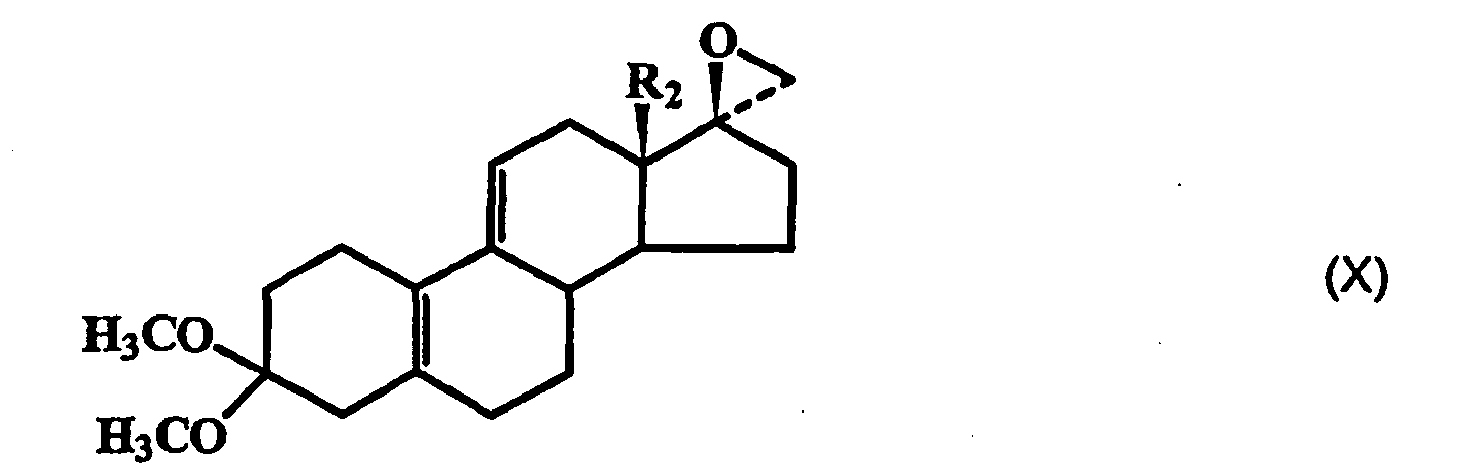

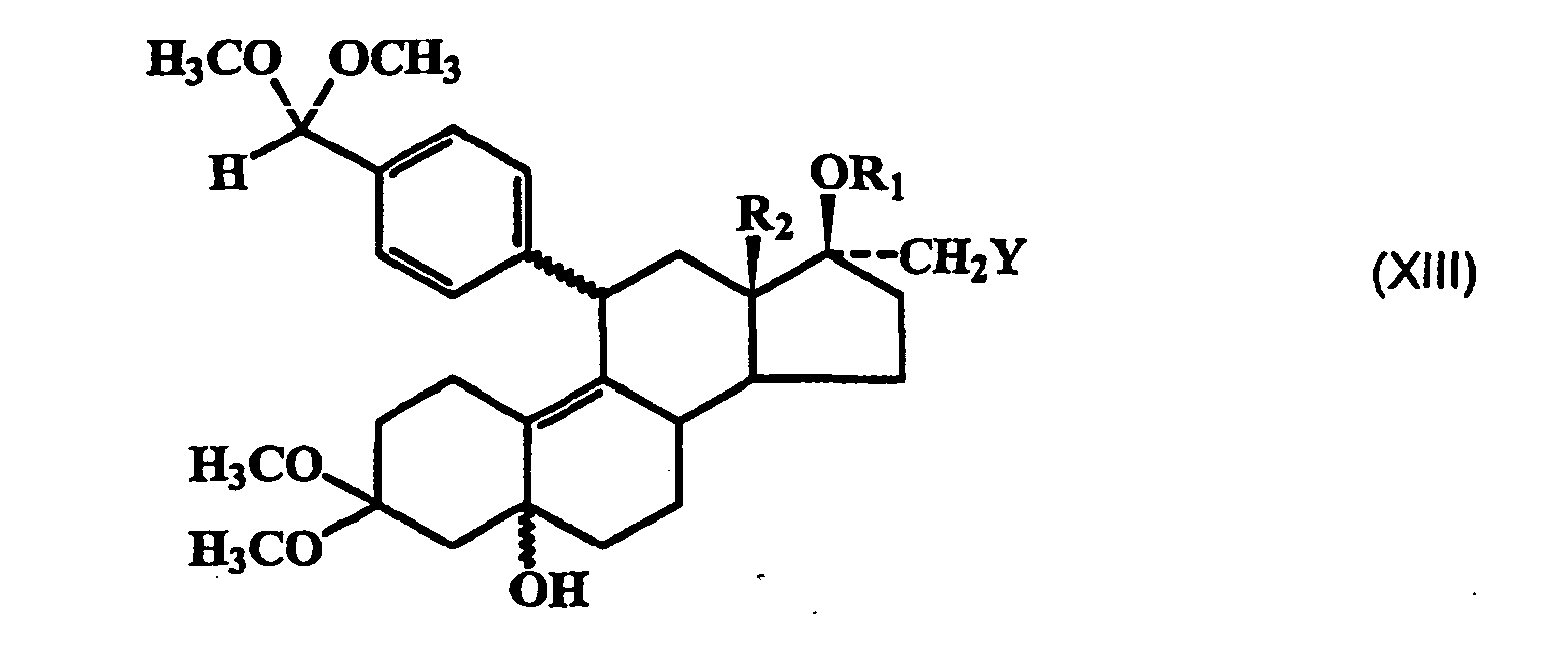
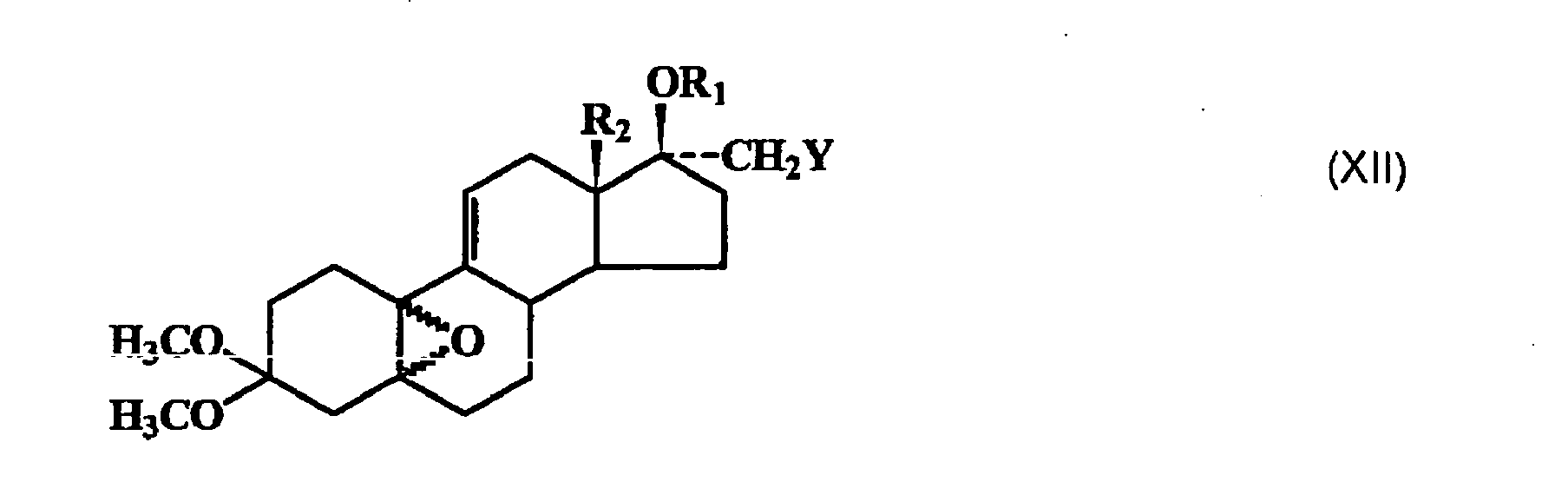
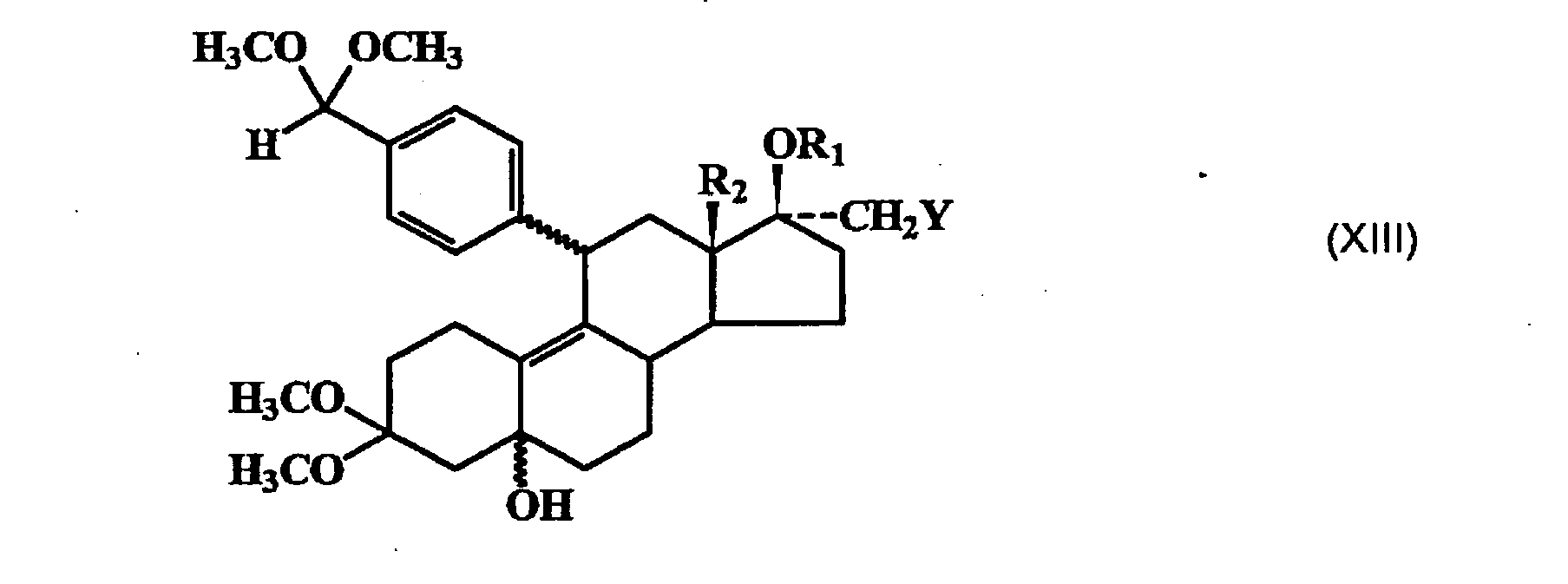
- Durch Umsetzung der 17β-Hydroxylgruppe mit Alkylhalogeniden oder Fluoralkylhalogeniden (Halogen = Chlor, Brom oder lod), wie Fluoralkyliodid, in Gegenwart von starken Basen, wie Kaliumhydroxid, Alkoholaten, wie Kalium-tert.-butanolat, Silberfluoriden, Alkalimetallen und Naphthalin oder Biphenyl, in inerten Lösungsmitteln, wie Ethern, Tetrahydrofuran (THF) oder Toluol, werden die 17β-Ether der Formel (XI) gebildet, worin R1 ein C1-6-Alkylrest oder ein CnF2n+1-Rest ist, wobei n 1, 2 oder 3 darstellt und R2 und Y die vorstehend gegebene Bedeutung haben. Die Verbindungen der allgemeinen Formel (XI) werden regioselektiv an der 5(10)-Doppelbindung epoxidiert. Die Epoxidation mit Wasserstoffperoxid und Hexachlor- oder Hexafluoraceton erfolgt vorzugsweise in Gegenwart von katalytischen Mengen eines tertiären Amins, wie Triethylamin oder Pyridin, wobei ein Gemisch aus 5α,10α-Epoxy- und 5β,10β-Epoxy-17α-Methyl-substituierten Estr-9(11)-en-3,3-dimethylketal der Formel (XII)


- Unter "Alkylrest" wird in der vorliegenden Erfindung ein verzweigter oder geradkettiger Alkylrest verstanden. Als C1-4- bzw C1-6-Alkylreste seien beispielsweise eine Methyl-, Ethyl-, n-Propyl-, i-Propyl-, n-Butyl- , i-Butyl- oder tert.-Butyl-, n-Pentyl-, i-Pentyl-, n-Hexyl-, 2-Methylpentyl-, 3-Methylpentyl-, 2,2-Dimethylbutyl- oder 2,3-Dimethylbutylgruppe genannt. Unter CnF2n+1-Rest wird ein verzweigter oder geradkettiger Fluoralkylrest mit 1 bis 3 Kohlenstoffatomen verstanden, wobei Beispiele eine Trifluormethyl-, Pentafluorethyl-, Heptafluor-n-propyl- oder Heptafluor-iso-propylgruppe sind. Bevorzugt bedeuten R1 und R2 einen C1-3-Alkylrest, besonders bevorzugt eine Methylgruppe oder eine Trifluormethylgruppe.
- Y bedeutet bevorzugt einen OC1-3-Alkyl- oder SC1-3-Alkylrest, besonders bevorzugt eine Methoxy-, Ethoxy-, Isopropyloxy-, Methylthio- oder Ethylthiogruppe, oder Trifluorethoxygruppe. Die Verbindungen der Formel (I), in denen R1 ein CnF2n+1-Rest ist und/oder Y eine OCH2CnF2n+1-Gruppe ist, sind neu.
- Am stärksten bevorzugt sind im Rahmen von Verbindungen der Formel (I) die folgenden Verbindungen:
- 4-[17β-Hydroxy-17α-(methoxymethyl)-3-oxoestra-4,9-dien-11β-yl]benzaldehyd-1 E-oxim,
- 4-[17β-Hydroxy-17α-(methoxymethyl)-3-oxoestra-4,9-dien-11β-yl]benzaldehyd-1Z-oxim,
- 4-[17β-Methoxy-17α-(methoxymethyl)-3-oxoestra-4,9-dien-11β-yi]benzaidehyd-1E-oxim,
- 4-[17β-Methoxy-17α-(methoxymethyl)-3-oxoestra-4,9-dien-11β-yl]benzaldehyd-1Z-oxim,
- 4-[17β-Ethoxy-17α-(methoxymethyl)-3-oxoestra-4,9-dien-11β-yl]benzaldehyd-1E-oxim,
- 4-[17β-Hydroxy-17α-(ethoxymethyl)-3-oxoestra-4,9-dien-11β-yl]benzaldehyd-1E-oxim,
- 4-[17β-Methoxy-17α-(ethoxymethyl)-3-oxoestra-4,9-dien-11β-yl]benzaldehyd-1 E-oxim,
- 4-[17β-Hydroxy-17α-(isopropyloxymethyl)-3-oxoestra-4,9-dien-11β-yl]benzaldehyd-1 E-oxim,
- 4-[17β-Methoxy-17α-(isopropyloxy-methyl)-3-oxoestra-4,9-dien-11β-yl]benzaldehyd-1E-oxim,
- 4-[17β-Hydroxy-17α-(ethylthiomethyl)-3-oxoestra-4,9-dien-11β-yl]benzaldehyd-1 E-oxim und
- 4-[17β-Hydroxy-17α-(1,1,1-trifluorethoxymethyl)-3-oxoestra-4,9-dien-11 β-yl]benzaldehyd-1 E-oxim.
- Die Verbindungen werden gut am Gestagenrezeptor gebunden, zeigen im Tierexperiment eine starke antigestagene Aktivität, besitzen eine partielle gestagene Aktivität und weisen nur eine geringe glucocorticoide Rezeptorbindung auf [siehe Tabelle 1 und vgl.
DE 43 32 283 A1 (EP 0 648 778 B1 )]. - Die Rezeptorbindungsaffinität wurde durch kompetitive Bindung eines spezifisch bindenden 3H-markierten Tracers und der zu testenden Verbindung an Rezeptoren im Cytosol aus tierischen Target-Organen bestimmt. Dabei wurden Rezeptorsättigung und Reaktionsgleichgewicht bei folgenden Reaktionsbedingungen angestrebt:
- Uterus-Cytosol des Estradiol geprimten Kaninchens, aufbewahrt bei - 30 °C, in TED-Puffer (20 mM Tris/HCl, pH 7,4; 1 mMol Ethylendiamintetraacetat, 2 mMol Dithiothreitol) mit 250 mMol Saccharose.
Tracer: 3H -ORG 2058
Refernzsubstanz : Progesteron - Thymus-Cytosol der adrenalektomierten Ratte, Thymi aufbewahrt bei -30°C; Puffer TED
Tracer: 3H-Dexamethason, 20 nM
Referenzsubstanz: Dexamethason - Die frühabortive Wirkung wurde bei der Ratte nach subcutaner Applikation vom 5. bis 7. Graviditätstag [Applikation 0,2 ml / Tier/ Tag in Benzylbenzoat / Rizinusöl (1 + 4 v/v)] ermittelt. Die Dosis gibt an, welche Menge mindestens je 4 Tieren im Vergleich zu unbehandelten Tieren gegeben werden muß, damit eine komplette Graviditätshemmung erreicht wird.
Tabelle 1 Rezeptorbindung von ausgewählten Verbindungen Verbindung Progester on-rezeptor [Progester -on =100 %] Glucocorticoid-rezeptor [Dexamethason = 100 %] 100 % frühabortive Wirkung bei der Ratte [mg/Tier/Tag] 4-[17β-Hydroxy-(17α-(methoxymethyl)-3-oxoestra-4,9-dien-11β-yl]benzaldehyd-1 E-oxim 165 76 1,0 4-[17β-Hydroxy-(17α-(methoxymethyl)-3-oxoestra-4,9-dien-11β-yl]benzalde-hyd-1 Z-oxim 75 67 1,0 4-[17β-Methoxy-(17α-(methoxymethyl)-3-oxoestra-4,9-dien-11β-yl]benzaldehyd-1E-oxim 302 78 1 ,0 4-[17β-Methoxy-17α-(methoxymethyl)-3-oxoestra-4,9-dien-11β-yl]benzaldehyde-1Z-oxime 126 52 1,0 4-{17β-Hydroxy-17α-(1,1,1-trifluorethoxymethyl)-3-oxoestra-4,9-dien-11β-yl]benzaldehyd-1E-oxim 177 94 3,0 Ru 38 486 (Referenz) 685 506 3,0 - 33 g 4-[17β-Hydroxy-17α-(methoxymethyl)-3-oxoestra-4,9-dien-11β-yl]benzaldehyd (VIIa) werden unter Argon in 250 ml Pyridin gelöst und mit 5,8 g Hydroxylsminhydrochlorid versetzt. Nach 2 Stunden wird in Eiswasser eingerührt, der Niederschlag wird abgesaugt, gewaschen und getrocknet. Das Rohprodukt (40 g) wird durch Chromatographie an Kieselgel gereinigt. Man erhält 20 g 4-[17β-Hydroxy-(17α-(methoxymethyl)-3-oxoestra-4,9-dien-11β-yl]benzaldehyd-1E-oxim (la) [Schmp. 135 bis 145°C (EtOH/Wasser); αD = + 236° (CHCl3); 1H-NMR: 9,00 (s, 1H, NOH), 8,11 (s, 1H, HC=N), 7,45 (d, 2H, J = 8,2 , H-3'), 7,17 (d, 2H, J = 8,2 , H-2'), 5,79 (s, 1H, H-4), 4,38 (d, 1H, J = 7,1, H-11), 3,58 (d, 2H, J = 9,0, CH2O), 3,43 (s, 3H, OCH3), 3,25 (d, 2H, J = 9,0, CH2O), 0,48 (s, 3H, H-18)] und 1,5 g 4-[17β-Hydroxy-17α-(methoxymethyl)-3-oxoestra-4,9-dien-11β-yl]benzaldehyd-1Z-oxim (Ib) [Schmp. 135 bis 146°C (Aceton); αD = +192°; 1H-NMR: 8,56 (s, 1H, NOH), 7,86 (d, 2H, J = 8,4 , H-3'), 7,33 (s, 1H, HC=N), 7,26 (d, 2H, J = 8,4 , H-2'), 5,79 (s, 1 H, H-4), 4,41 (d, 1 H, J = 7,2 , H-11), 3,57 (d, 2H, J = 9,1 , CH2O), 3,42 (s, 3H, OCH3), 3,23 (d, 2H, J = 9,1, CH2O), 0,54 (s, 3H, H-18).
- 12 g 3,3-Dimethoxy-estra-5(10), 9(11)-dien-17-on (IXa) und 9 g Trimethylsulfoniumjodid in 60 ml Dimethylformamid werden unter Rühren und leichter Kühlung mit 5,5 g Kalium-tert.-butylat versetzt. Nach 60 Minuten setzt man 50 ml n-Hexan und 30 ml Wasser zu, trennt die Phasen und wäscht die organische Phase mit Wasser. Die Lösung wird mit Natriumsulfat getrocknet und im Vakuum bis zur Kristallisation eingeengt. Die Umkristallisation erfolgt aus n-Hexan. Ausbeute: 11 g. Schmp. 94 bis 97°C; αD = + 164° (CHCl3); 1H-NMR (δ, ppm, 300 MHz, CDCl3/TMS): 5,51 (d, J = 5,6 Hz, H-11), 3,24 (s, 3H, OCH3), 3,23 (s, 3H, OCH3), 2,93 (d, 1H, J = 5,0 Hz, H-20), 2,66 (d, 1 H, J = 5,0 Hz, H-20), 0,87 (s, 2H, H-18).
- 11 g der 3,3-Dimethoxy-estra-5(10),9(11)-diene-17(S)-spiro-1',2'-oxirane (Xa) werden in 40 ml Methanol suspendiert und mit 40 ml 3N Natriummethylatlösung versetzt und 2 Stunden am Rückfluß gekocht. Nach Zugabe von Wasser destilliert man das Methanol ab, extrahiert mit tert.-Butylmethylether und engt ein. Die Umkristallisation erfolgt aus einem Ethanol/Wasser-Gemisch. Schmp. 73 bis 76°C; αD = +135° (CHCl3); 1H-NMR (δ, ppm), 5,56 (m, 1H, H-11), 3,47 (d, 1H, J = 9,1 Hz, OCH2), 3,37 (s, 3H,CH2OCH3), 3,24 (s, 3H, 3-OCH3), 3,23 (s, 3H, 3-OCH3), 3,20 (d, 1 H, J = 9,1 Hz, OCH2), 0,88 (s, 3H, H-18).
- Zu einer Lösung von 30 g (Xla) in 300 ml Methylenchlorid werden nacheinander 4,2 ml Pyridin, 3,75 ml Hexafluoraceton-Sesquihydrat und 37,5 ml 50 %-ige Wasserstoffperoxid-Lösung zugegeben. Nach 4 Stunden bei Raumtemperatur wird Natriumthiosulfat-Lösung zugegeben, die Phasen werden getrennt, die organische Phase mit Natriumbicarbonat-Lösung und Wasser gewaschen, getrocknet und das Lösungsmittel im Vakuum verdampft. Man erhält 31 g Rohprodukt (XIIa), das direkt bei der Grignardreaktion eingesetzt wird.
- Zu einer Grignard-Lösung, die aus 7,6 g Magnesium, 72 g 4-Brombenzaldehyd-dimethylketal in 100 ml THF hergestellt wird, werden bei -35 °C 4,5 g Kupfer-I-chlorid zugegeben. Man rührt 20 Minuten bei dieser Temperatur und tropft dann eine Lösung von 28 g Epoxidgemisch (XIIa) in 70 ml THF zu. Anschließend läßt man auf Raumtemperatur erwärmen, versetzt mit wäßriger Ammoniumchlorid-Lösung und extrahiert das Steroid mit Essigester, wäscht die organische Phase neutral, trocknet sie und engt im Vakuum ein. Das Rohprodukt (XIIIa) wird direkt in der nächsten Stufe eingesetzt.
- 75 g Rohprodukt (XIIIa) werden in 250 ml 70 %-lger Essigsäure gelöst und unter Argon 2 Stunden bei 50 °C gerührt. Man kühlt ab, setzt Methylenchlorid zu, trennt die Phasen, wäscht neutral, fügt Methyl-tert.-butylether zu und engt die organische Phase im Vakuum ein. Man erhält 24 g eines blaßgelben Rohprodukts (XIVa), das nur noch einen kleinen Teil des 11α-Benzaldehyds enthält.
- 24 g Rohprodukt (XIVa) werden in Methylenchlorid gelöst, mit tert.-Butylmethylether versetzt und im Vakuum eingeengt. Dabei fällt der reine 11β-Benzaldehyd (VIIa) kristallin aus, der erneut in Essigester umkristallisiert wird.
- Schmp. 235 bis 240° C; αD = +209° (CHCl3); 1H-NMR: 9,97 (s, 1H, CHO), 7,80 (d, 2H, J = 8,1, H-3'), 7,38 (d, 2H, J = 8,1, H-2'), 5,80 (s, 1H, H-4), 4,45 (d, 1H, J = 7,5, H-11), 3,57 (d, 2H, J ,= 9,2, CH2O), 3,42 (d, 2H, J = 10,8, CH2O), 3,41 (s, 3H, OCH3), 0,51 (s, 3H, H-18).
- Zu einer Lösung von 10 g (VIIb) in 100 ml Pyridin werden bei Raumtemperatur 1,75 g Hydroxylaminhydrochlorid zugegeben und die Mischung wird 2 Stunden gerührt. Man gießt in Eiswasser ein, saugt den Niederschlag ab, trocknet über Calciumchlorid und chromatographiert das Rohprodukt an Kieselgel. Man isoliert 7g 4-[17β-Methoxy-17α-(methoxymethyl)-3-oxoestra-4,9-dien-11β-yl]benzaldehyd-1E-oxim (Ic). [Schmp. 196-198°C (EtOH/H2O); αD = + 220° (CHCl3); 1H-NMR: 8,38 (s, 1H, NOH), 8,10 (s, 1H, HC=N), 7,47 (d, 2H, J = 8,1, H-3'), 7,20 (d, 2H, J = 8,1, H-2'), 5,79 (s, 1H, H-4), 4,38 (d, 1H, J = 7,3, H-11), 3,58 (d, 2H, J = 10,8, CH2O), 3,41 (s, 3H, OCH3), 3,41 (d, 2H, J = 10,8 , CH2O), 3,25 (s, 3H, OCH3), 0,54 (s, 3H, H-18)] und 300 mg 4-[17β-Methoxy-17α-(methoxymethyl)-3-oxoestra-4,9-dien-11β-yl]benzaldehyd-1Z-oxim (Id) [Schmp. 120-138 °C (Aceton/n-Hexan); αD = +217° (CHCl3); 1H-NMR: 9,38 (s, 1H, NOH), 7,88 (d, 2H, J = 8,9, H-3'), 7,33 (s, 1H, HC=N), 7,26 (d, 2H, J = 8,9, H-2'), 5,79 (s, 1H, H-4), 4,39 (d, 1H, J = 7,3, H-11), 3,58 (d, 2H, J = 10,5, CH2O), 3,42 (d, 2H, J = 10,5, CH2O), 3,41 (s, 3H, OCH3), 3,26 (s, 3H, OCH3), 0,54 (s, 3H, H-18).
- 12 g (Xla), 5 ml Methyljodid und 10 g Kalium-tert.-butylat werden in 80 ml tert.-Butylmethylether 4 Stunden bei 30°C bis 40°C gerührt. Nach Zugabe von Wasser erfolgt die Phasentrennung, die organische Phase wird mit Wasser gewaschen, getrocknet und eingeengt. Das Rohprodukt (Xlb) wird in Methanol umkristallisiert.
- Schmp. 95 bis 97°C (MeOH); αD = +146° (CHCl3); 1H-NMR (δ, ppm): 5,52 (m, 1H, H-11), 3,63 (d, 1H, J = 10,7 Hz, OCH2), 3,38 (s, 3H, CH2OCH3), 3,31 (d, 1H, J = 10,7 Hz, OCH2), 3,29 (s, 3H, 17β-OCH3), 3,24 (s, 3H, 3-OCH3), 3,23 (s, 3H, 3-OCH3), 0,88 (s, 3H, H-18).
- Zu 2g (XIb) in 20 ml Methylenchlorid werden 0,3 ml Pyridin und 0,25 ml Hexaflucraceton-Sesquihydrat zugegeben, Bei Raumtemperatur werden 2,5 ml Wasserstoffperoxid zugetropft, nach 4 Stunden wird Natriumsulfit-Lösung zugegeben, die Phasen werden getrennt und die organische Phase mit Natriumbicarbonat und Wasser gewaschen, über Natriumsulfat getrocknet und unter Vakuum verdampft. Das Epoxidgemisch (XIIb) wird direkt in der nächsten Stufe eingesetzt.
- Zu einer Grignard-Lösung, die aus 2,4 g 4-Brombenzaldehyddimethylketal, 0,2 g Magnesium in 20 ml THF hergestellt wird, werden bei -35°C 60 mg Kupfer(I)chlorid zugegeben. Man rührt 20 Minuten bei dieser Temperatur und tropft eine Lösung von 1 g (XIIb) in 5 ml THF zu. Anschließend läßt man die Reaktion auf Raumtemperatur kommen, zersetzt den Ansatz mit wäßriger Ammoniumchlorid-Lösung, extrahiert die Lösung mit Essigester und wäscht die organische Phase mit Wasser, trocknet sie mit Natriumsulfat und engt im Vakuum ein. Das Rohprodukt (XIIIb) (1,5 g) wird direkt in der nächsten Stufe eingesetzt.
- 1,5 g Rohprodukt (XIIIb) werden in 20 ml Aceton gelöst und mit 180 mg p-Toluolsulfonsäure versetzt. Nach 1 Stunde wird mit wäßrigem Ammoniak neutralisiert und mit Wasser verdünnt. Dabei fällt das Aldehydgemisch (XIVB) aus, das aus Aceton umkristallisiert wird. Man erhält 0,7 g 4-[17β-Methoxy-17α-methoxymethyl)-3-oxoestra-4,9-dien-11β-yl]benzaldehyd (VIIb). Schmp. 245 bis 250°C (Aceton); αD = +193° (CHCl3); 1H-NMR: 9,97 (s, 1H, CHO), 7,79 (d, 2H, J = 8,1, H-3'), 7,37 (d, 2H, J = 8,1, H-2'), 5,79 (s, 1H, H-4), 4,44 (d, 1H, J = 7,5, H-11), 3,56 (d, 2H, J = 10,8, CH2O), 3,42 (d, 2H, J = 10,8, CH2O), 3,41 (s, 3H, OCH3), 3,25 (s, 3H, OCH3), 0,51 (s, 3H, H-18),
- 1,7 g (VIIc) werden in 25 ml Pyridin mit 250 mg Hydroxylaminhydrochlorid 1 Stunde bei Raumtemperatur gerührt. Danach gießt man in 100 ml Eiswasser ein, saugt den Niederschlag ab, wäscht mit Wasser neutral und trocknet mit Calciumchlorid. Das Rohprodukt (1,7g) wird durch Chromatographie an Kieselgel gereinigt. Man erhält 890 mg (le). Schmp. 184 bis 187 °C (Aceton/Hexan); αD = +214° (CHCl3); 1H-NMR: 9,10 (s, 1H, CH=N), 7,58 (s,1H, OH), 7,49 (d, 2H, J = 8,4, H-3'), 7,21 (d, 2H, J = 8,4, H-2'), 5,78 (s, 1 H, H-4), 4,38 (d, 1H, J = 6,9, H-11), 3,62 (d, 2H, J = 10,8, CH2O), 3,40 (s, 3H, OCH3), 3,36 (d, 2H, J = 10,8, CH2O), 1,11 (t, 3H, CH2CH3), 0,54 (s, 3H, H-18).
- 4,2 g (XIa) werden mit 15,6 g Kalium-tert.-butanolat und 76 ml lodethan in 400 ml Toluol bei 35°C innerhalb von 14 Stunden umgesetzt. Nach Zugabe von Wasser werden die Phasen getrennt, die organische Phase neutral aufgearbeitet und das Lösungsmittel nach Trocknung im Vakuum verdampft. Das Rohprodukt (XIc) wird direkt ohne Reinigung in der nächsten Stufe eingesetzt.
- Zu 3,3 g (Xlc) in 20 mi Methylenchlorid werden 0,5 mi Pyridin und ü,4 ml Hexafluoraceton-Sesquihydrat zugegeben. Bei Raumtemperatur werden 4,5 ml Wasserstoffperoxid zugetropft, nach 4 Stunden wird Natriumsulfit-Lösung zugegeben, die Phasen werden getrennt und die organische Phase mit Natriumbicarbonat und Wasser gewaschen, über Natriumsulfat getrocknet, und unter Vakuum verdampft. Das Epoxidgemisch (XIIc) wird direkt in der nächsten Stufe eingesetzt.
- Zu einer Grignard-Lösung, die aus 4,0 g 4-Brombenzaldehyddimethylketal, 0,3 g Magnesium in 20 ml THF hergestellt wird, werden bei -35 °C 60 mg Kupfer(I)chlorid zugegeben. Man rührt 20 Minuten bei dieser Temperatur und tropft eine Lösung von 2 g (XIIc) in 5 ml THF zu. Anschließend läßt man die Reaktion auf Raumtemperatur kommen, zersetzt den Ansatz mit wäßriger Ammoniumchlorid-Lösung, extrahiert die Lösung mit Essigester und wäscht die organische Phase mit Wasser, trocknet sie mit Natriumsulfat und engt im Vakuum ein. Das Rohprodukt (XIIIc) (4,5 g) wird direkt in der nächsten Stufe eingesetzt.
- 2,8 g (Xlllc) werden in 40 ml Aceton gelöst. Nach Zugabe von 1,0 ml Wasser werden 1,4 g p-Toluolsulfonsäure zugesetzt und nach 1 Stunde wird Eiswasser zugegeben. Der dabei ausfallende (VIIc) wird abgesaugt, getrocknet und in Aceton/Hexan und erneut in tert.-Butylmethylether umkristallisiert.
- Schmp. 164 bis 167 °C; αD = +199° (CHCl3); 1H-NMR: 9,97 (s, 1H, CHO), 7,80 (d, 2H, J = 8,1, H-3'), 7,37 (d, 2H, J = 8,1, H-2'), 5,79 (s, 1H, H-4), 4,43 (d, 1H, J = 7,5, H-11), 3,58 (d, 2H, J = 10,8, CH2O), 3,41 (m, 2H, CH2O), 3,40 (s, 3H, OCH3), 1,10 (t, 3H, Ethyl), 0,51 (s, 3H, H-18).
- Die Herstellung erfolgt analog Beispiel 2. Schmp. 90-95 °C (tert.-Butylmethylether) αD = + 177° (CHCl3); 1H-NMR: 8,10 (s, 1H, HC=N), 7,60 (s, 1H, NOH), 7,48 (d, 2H, J = 8,1, H-3'), 7,20 (d, 2H, J = 8,1, H-2'), 5,78 (s, 1H, H-4), 4,36 (d, 1H, J = 7,3, H-11), 3,61 (d, 2H, J = 10,8, CH2O), 3,42 (d, 2H, J = 10,8, CH2O), 3,26 (s, 3H, OCH3), 1,27 (t, 3H, Ethyl), 0,53 (s, 3H, H-18)
- Die Herstellung erfolgt analog Beispiel 1.
- Schaum (Hexan); αD = + 226° (CHCl3); 1H-NMR: 8,10 (s, 1H, HC=N), 7,70 (s, 1H, NOH), 7,48 (d, 2H, J = 8,1, H-3'), 7,20 (d, 2H, J = 8,1, H-2'), 5,78 (s, 1H, H-4), 4,38 (d, 1H, J = 7,2, H-11), 3,61 (d, 2H, J = 10,8, CH2O), 3,23 (d, 2H, J = 10,8 , CH2O), 3,26 (s, 3H, OCH3), 1,25 (t, 3H, Ethyl), 0,52 (s, 3H, H-18)
- Die Herstellung erfolgt analog Beispiel 1.
- Schmp. 192-196 °C Zers. (Diethylether); αD = + 215° (CHCl3); 1H-NMR: 8,10 (s, 1H, HC=N), 8,07 (s, 1H, NOH), 7,47 (d, 2H, J = 8,1, H-3'), 7,19 (d, 2H, J = 8,1, H-2'), 5,79 (s, 1H, H-4), 4,38 (d, 1H, J = 6,6, H-11), 3,62 (d, 2H, J = 10,8, CH2O), 3,22 (d, 2H, J = 10,8, CH2O), 3,02 (s, 1H, OH), 1,22 (m, 6H, Isopropyl), 0,52 (s, 3H, H-18)
- Die Herstellung erfolgt analog Beispiel 2. Schmp. 143 °C Zers. (Aceton/n-Hexan); αD = + 199° (CHCl3); 1H-NMR: 8,10 (s, 1H, HC=N), 8,00 (s, 1H, NOH), 7,48 (d, 2H, J = 8,4, H-3'), 7,21 (d, 2H, J = 8,4, H-2'), 5,79 (s, 1H, H-4), 4,37 (d, 1H, J = 6,9, H-11), 3,61 (d, 2H, J = 10,5, CH2O), 3,43 (d, 2H, J = 10,8, CH2O), 3,26 (s, 3H, OCH3), 1,22 (t, 6H, 6,0 Isopropyl), 0,54 (s, 3H, H-18)
- Die Herstellung erfolgt analog Beispiel 1.
- Schmp. 132 bis 137°C (Aceton); αD = + 165° (CHCl3); 1H-NMR: 8,10 (s, 1H, HC=N), 7,93 (s, 1 H, NOH), 7,49 (d, 2H, J = 8,4, H-3'), 7,20 (d, 2H, J = 8,4, H-2'), 5,79 (s, 1H, H-4), 4,42 (d, 1H, J = 7,2, H-11), 2,96 (d, 2H, J = 13,2, CH2S), 2,90 (s,1 H,OH), 2,70 (d, 2H, J = 12,9 , CH2 S), 1,29 (t, 3H, 10,2, SCH2CH3), 0,56 (s, 3H, H-18)
- Die Herstellung erfolgt analog Beispiel 1.
- Schmp. 132 bis 136°C (Diethylether), αD = + 182° (CHCl3); 1H-NMR: 8,11 (s, 1H, HC=N), 7,60 (s, 1H, NOH), 7,49 (d, 2H, J = 8,4, H-3'), 7,20 (d, 2H, J = 8,1, H-2'), 5,79 (s, 1H, H-4), 4,41 (d, 1H, J = 7,2, H-11), 3,93 (m, 2H, CH2CH3), 3,82 (d, 2H, J = 9,0, CH2O), 3,50 (m, CH2CF3+OH), 0,55 (s, 3H, H-18)
Claims (8)
- Verfahren zur Herstellung von 4-(17α-Methyl-substituierten 3-Oxoestra-4,9-dien-11β-yl)benzaldehyd-(1E oder 1Z)-oximen der allgemeinen Formel (I)



- Verfahren nach Anspruch 1, dadurch gekennzeichnet, daß das Gemisch der E/Z-Benzaldoxime der allgemeinen Formel (I) durch Umkristallisation und/oder durch Chromatographie, in die Einzelkomponenten getrennt wird.
- Verfahren nach einem der Ansprüche 1 oder 2, dadurch gekennzeichnet, daß R1 einen C1-3-Alkylrest, vorzugsweise eine Methylgruppe, oder Trifluormethylgruppe bedeutet.
- Verfahren nach einem der Ansprüche 1 bis 3, dadurch gekennzeichnet, daß R2 einen C1-3-Alkylrest, vorzugsweise eine Methylgruppe bedeutet.
- Verfahren nach einem der Ansprüche 1 bis 4, dadurch gekennzeichnet, daß Y einen OC1-3-Alkyl- oder SC1-3-Alkylrest, vorzugsweise eine Methoxy-, Ethoxy-, Isopropyloxy-, Methylthio- oder Ethylthiogruppe, oder 1, 1, 1- Trifluorethoxygruppe bedeutet.
- Verfahren nach einem der Ansprüche 3 bis 5, dadurch gekennzeichnet, daß die folgenden Verbindungen hergestellt werden:4-[17β-Hydroxy-17α-(methoxymethyl)-3-oxoestra-4,9-dien-11β-yl]benzaldehyd-1E-oxim,4-[17β-Hydroxy-17α-(methoxymethyl)-3-oxoestra-4,9-dien-11β-yl]benzaldehyd-1Z-oxim.4-[17β-Methoxy-17α-(methoxymethyl)-3-oxoestra-4,9-dien-11β-yl]benzaldehyd-1 E-oxim,4-[17β-Methoxy-17α-(methoxymethyl)-3-oxoestra-4,9-dien-11β-yl]benz-aldehyd-1Z-oxim,4-[17β-Ethoxy-(17α-(methoxymethyl)-3-oxoestra-4,9-dien-11β-yl]benzaldehyd-1E-oxim,4-[17β-Hydroxy-17α-(ethoxymethyl)-3-oxoestra-4,9-dien-11β-yl]benzaldehyd-1 E-oxim,4-[17β-Methoxy-17α-(ethoxymethyl)-3-oxoestra-4,9-dien-11β-yl]benzaldehyd-1 E-oxim,4-[17β-Hydroxy-17α-(isopropyloxymethyl)-3-oxoestra-4,9-dien-11 β-yl]benzaldehyd-1E-oxim,4-[17β-Methoxy-17α-(isopropyloxymethyl)-3-oxoestra-4,9-dien-11 β-yl]benzaldehyd-1E-oxim,4-[17β-Hydroxy-17α-(ethylthiomethyl)-3-oxoestra-4,9-dien-11β-yl]benzaldehyd-1 E-oxim und4-{17β-Hydroxy-17α-(1,1,1-trifluorethoxymethyl)-3-oxoestra-4,9-dien-11β-yl]benzaldehyd-1E-oxim.
- Verbindungen der Formel (I), dadurch gekennzeichnet, daß R1. ein CnF2n+1-Rest ist, wobei n 1, 2 oder 3 ist, R2, X und Y die in Anspruch 1 gegebene Bedeutung haben.
- Verbindungen der Formel (I), dadurch gekennzeichnet, daß Y eine OCH2CnF2n+1-Gruppe ist, wobei n 1, 2 oder 3 ist, R1, R2 und X die in Anspruch 1 gegebene Bedeutung haben.
Applications Claiming Priority (3)
| Application Number | Priority Date | Filing Date | Title |
|---|---|---|---|
| DE10056675 | 2000-11-10 | ||
| DE10056675A DE10056675A1 (de) | 2000-11-10 | 2000-11-10 | Verfahren zur Herstellung von 4-(17alpha-Methylsubstituierten 3-Oxoestra-4,9-dien-11ß-yl)-benzaldehyd-(1E oder 1Z)-oximen |
| PCT/DE2001/004217 WO2002038581A2 (de) | 2000-11-10 | 2001-11-09 | Verfahren zur herstellung von 4-(17alpha-substituierten-methyl) 3-oxoestra-4,9-dien-11beta-yl)benzaldehyd-(1e oder 1z)-oximen |
Publications (2)
| Publication Number | Publication Date |
|---|---|
| EP1339733A2 EP1339733A2 (de) | 2003-09-03 |
| EP1339733B1 true EP1339733B1 (de) | 2008-08-13 |
Family
ID=7663440
Family Applications (1)
| Application Number | Title | Priority Date | Filing Date |
|---|---|---|---|
| EP01993607A Expired - Lifetime EP1339733B1 (de) | 2000-11-10 | 2001-11-09 | Verfahren zur herstellung von 4-(17alpha-methyl-substituierten)3-oxoestra-4,9-dien-11beta-yl)benzaldehyd-(1e oder 1z)-oximen |
Country Status (9)
| Country | Link |
|---|---|
| US (1) | US7268241B2 (de) |
| EP (1) | EP1339733B1 (de) |
| JP (1) | JP4331478B2 (de) |
| AT (1) | ATE404579T1 (de) |
| AU (1) | AU2002216910A1 (de) |
| DE (2) | DE10056675A1 (de) |
| ES (1) | ES2311559T3 (de) |
| NO (1) | NO325338B1 (de) |
| WO (1) | WO2002038581A2 (de) |
Families Citing this family (3)
| Publication number | Priority date | Publication date | Assignee | Title |
|---|---|---|---|---|
| US20090054387A1 (en) | 2006-04-18 | 2009-02-26 | Detlef Grawe | Method for preparing 4-[17beta-methoxy-17alpha-methoxymethyl-3-oxestra-4,9-dien-11beta-yl]benzaldehyde (E)-oxime (asoprisnil) |
| DE102006018888A1 (de) * | 2006-04-18 | 2007-10-25 | Bayer Schering Pharma Ag | Verfahren zur Herstellung von 4-[17beta-Methoxy-17alpha-methoxymethyl-3-oxoestra-4,9-dien-11beta-yl]benzaldehyd-(E)-oxims (Asoprisnil) |
| CN119490551B (zh) * | 2024-11-15 | 2025-10-31 | 湖北葛店人福药业有限责任公司 | 一种地屈孕酮的制备方法 |
Family Cites Families (3)
| Publication number | Priority date | Publication date | Assignee | Title |
|---|---|---|---|---|
| DE289539C (de) * | ||||
| DD289539A5 (de) * | 1989-10-12 | 1991-05-02 | Zi F. Mikrobiologie U. Experimentelle Therapie,De | Verfahren zur herstellung von 11 beta-(4-acetylphenyl)-17alpha-alkoxy-methyl-estra-4,9-dien-3-onen |
| DE4332283A1 (de) * | 1993-09-20 | 1995-04-13 | Jenapharm Gmbh | Neue 11-Benzaldoximestradien-Derivate, Verfahren zu ihrer Herstellung und diese Verbindungen enthaltende Arzneimittel |
-
2000
- 2000-11-10 DE DE10056675A patent/DE10056675A1/de not_active Ceased
-
2001
- 2001-11-09 WO PCT/DE2001/004217 patent/WO2002038581A2/de not_active Ceased
- 2001-11-09 ES ES01993607T patent/ES2311559T3/es not_active Expired - Lifetime
- 2001-11-09 AU AU2002216910A patent/AU2002216910A1/en not_active Abandoned
- 2001-11-09 DE DE50114228T patent/DE50114228D1/de not_active Expired - Lifetime
- 2001-11-09 JP JP2002541113A patent/JP4331478B2/ja not_active Expired - Fee Related
- 2001-11-09 US US10/416,234 patent/US7268241B2/en not_active Expired - Lifetime
- 2001-11-09 AT AT01993607T patent/ATE404579T1/de not_active IP Right Cessation
- 2001-11-09 EP EP01993607A patent/EP1339733B1/de not_active Expired - Lifetime
-
2003
- 2003-05-09 NO NO20032079A patent/NO325338B1/no not_active IP Right Cessation
Also Published As
| Publication number | Publication date |
|---|---|
| WO2002038581A3 (de) | 2002-09-12 |
| JP4331478B2 (ja) | 2009-09-16 |
| ATE404579T1 (de) | 2008-08-15 |
| DE10056675A1 (de) | 2002-05-16 |
| US20040063172A1 (en) | 2004-04-01 |
| WO2002038581A2 (de) | 2002-05-16 |
| ES2311559T3 (es) | 2009-02-16 |
| AU2002216910A1 (en) | 2002-05-21 |
| EP1339733A2 (de) | 2003-09-03 |
| US7268241B2 (en) | 2007-09-11 |
| NO325338B1 (no) | 2008-03-31 |
| NO20032079L (no) | 2003-05-09 |
| JP2004513178A (ja) | 2004-04-30 |
| NO20032079D0 (no) | 2003-05-09 |
| DE50114228D1 (de) | 2008-09-25 |
Similar Documents
| Publication | Publication Date | Title |
|---|---|---|
| DE69603425T2 (de) | 11-Substituierte Phenyl-estra-4,9-dien Derivate | |
| EP0283428B1 (de) | 19,11beta-Überbrückte Steroide, deren Herstellung und diese enthaltende pharmazeutische Präparate | |
| EP0404283B1 (de) | 11-Beta-aryl-4-estrene, Verfahren zu ihrer Herstellung sowie deren Verwendung als Arzneimittel | |
| WO1990000174A1 (de) | 13-ALKYL-11β-PHENYLGONANE | |
| EP0277089A1 (de) | 11 Beta-alkinyl-estrene und -estradiene, deren Herstellung und diese enthaltende pharmezeutische Präparate | |
| EP0411733B1 (de) | 11 Beta-Aryl-gona-4,9-dien-3-one | |
| DE3820948A1 (de) | 10ss, 11ss-ueberbrueckte steroide | |
| DE60021422T2 (de) | Verfahren zur Herstellung von 17α-acetoxy-11β-[4-n,n-(dimethylamino)phenyl]-21-methoxy-19-norpregna-4,9-dien-3,20-dion, für das Verfahren nützliche Zwischenprodukte und Verfahren zur Herstellung derartiger Zwischenprodukte | |
| DE3231827A1 (de) | 11ss-aryl-17(alpha)-alkinyl-17ss-hydroxy-4,9(10)- estradien-3-on-derivate, deren herstellung und diese enthaltende pharmazeutische praeparate | |
| DE1152101B (de) | Verfahren zur Herstellung von mit einem Pyrazolring kondensierten Steroidverbindungen | |
| EP0411736B1 (de) | 11 Beta-substituierte 16 alpha, 17alpha-Methylen-estra-4,9-dien-3-one | |
| WO1993013122A1 (de) | 3-methylsulfonylhydrazono- und 3-oxyimino-steroide, ein verfahren zu deren herstellung, diese steroide enthaltende pharmazeutische präparate sowie ihre verwendung zur herstellung von arzneimitteln | |
| US5446178A (en) | Process for preparing 19,11β-bridged steroids | |
| EP0532562A1 (de) | VERFAHREN ZUR HERSTELLUNG VON 10-g(b)-H-STEROIDEN. | |
| WO1992011279A1 (de) | D-HOMO-(16-EN)-11β-ARYL-4-ESTRENE, VERFAHREN ZU IHRER HERSTELLUNG SOWIE DEREN VERWENDUNG ALS ARZNEIMITTEL | |
| DD238387A5 (de) | Verfahren zur herstellung von pregnan-derivaten | |
| EP1339733A2 (de) | Verfahren zur herstellung von 4-(17alpha-methyl-substituierten 3-oxoestra-4,9-dien-11-yl)benzaldehyd-(1e oder 1z)-oximen | |
| EP1339734B1 (de) | Verfahren zur herstellung von 4-(17alpha-substituierten-3-oxoestra-4,9-dien-11beta-yl) benzaldehyd-(1e oder 1z)-oximen | |
| DE1618871C3 (de) | Verfahren zur Herstellung eines Steroidketonderivates. Ausscheidung aus: 1468988 | |
| DE2158260C3 (de) | 11-Alkoxysteroide, Verfahren zu deren Herstellung sowie diese enthaltende pharmazeutische Zusammensetzungen | |
| CH531498A (de) | Verfahren zur Herstellung neuer Pyrazolo-steroide | |
| DD289539A5 (de) | Verfahren zur herstellung von 11 beta-(4-acetylphenyl)-17alpha-alkoxy-methyl-estra-4,9-dien-3-onen | |
| DE102006018869A1 (de) | 17alpha-substituierte 4-(3-Oxoestra-4,9-dien-11beta-yl)-benzoesäure, deren Derivate und Verfahren zu ihrer Herstellung | |
| WO2001005805A2 (de) | Neue c-19-halogensubstituierte, 5-substituierte, 5-substituierte oder 6,10-carbozyklisch-kondensierte steroide der androst-9(11)-en-reihe, verfahren zu ihrer herstellung sowie ihre verwendung | |
| DE2158260B2 (de) | 11 -Alkoxysteroide, Verfahren zu deren Herstellung sowie diese enthaltende pharmazeutische Zusammensetzungen |
Legal Events
| Date | Code | Title | Description |
|---|---|---|---|
| PUAI | Public reference made under article 153(3) epc to a published international application that has entered the european phase |
Free format text: ORIGINAL CODE: 0009012 |
|
| 17P | Request for examination filed |
Effective date: 20030605 |
|
| AK | Designated contracting states |
Kind code of ref document: A2 Designated state(s): AT BE CH CY DE DK ES FI FR GB GR IE IT LI LU MC NL PT SE TR |
|
| AX | Request for extension of the european patent |
Extension state: AL LT LV MK RO SI |
|
| RTI1 | Title (correction) |
Free format text: METHOD FOR THE PRODUCTION OF 4-(17ALPHA-METHYL SUBSTITUTED 3-OXOESTRA-4,9-DIEN-11BETA-YL)BENZALDEHYD-(1E OR 1Z)-OXIMES |
|
| RIN1 | Information on inventor provided before grant (corrected) |
Inventor name: SCHUBERT, GERD Inventor name: ERHART, BERND Inventor name: MUELLER, GERD Inventor name: RING, SVEN |
|
| RAP1 | Party data changed (applicant data changed or rights of an application transferred) |
Owner name: BAYER SCHERING PHARMA AG |
|
| RAP1 | Party data changed (applicant data changed or rights of an application transferred) |
Owner name: BAYER SCHERING PHARMA AKTIENGESELLSCHAFT |
|
| GRAP | Despatch of communication of intention to grant a patent |
Free format text: ORIGINAL CODE: EPIDOSNIGR1 |
|
| GRAS | Grant fee paid |
Free format text: ORIGINAL CODE: EPIDOSNIGR3 |
|
| GRAA | (expected) grant |
Free format text: ORIGINAL CODE: 0009210 |
|
| AK | Designated contracting states |
Kind code of ref document: B1 Designated state(s): AT BE CH CY DE DK ES FI FR GB GR IE IT LI LU MC NL PT SE TR |
|
| AX | Request for extension of the european patent |
Extension state: LT LV RO SI |
|
| REG | Reference to a national code |
Ref country code: GB Ref legal event code: FG4D Free format text: NOT ENGLISH |
|
| REG | Reference to a national code |
Ref country code: CH Ref legal event code: EP |
|
| REG | Reference to a national code |
Ref country code: IE Ref legal event code: FG4D Free format text: LANGUAGE OF EP DOCUMENT: GERMAN |
|
| REF | Corresponds to: |
Ref document number: 50114228 Country of ref document: DE Date of ref document: 20080925 Kind code of ref document: P |
|
| LTIE | Lt: invalidation of european patent or patent extension |
Effective date: 20080813 |
|
| PG25 | Lapsed in a contracting state [announced via postgrant information from national office to epo] |
Ref country code: NL Free format text: LAPSE BECAUSE OF FAILURE TO SUBMIT A TRANSLATION OF THE DESCRIPTION OR TO PAY THE FEE WITHIN THE PRESCRIBED TIME-LIMIT Effective date: 20080813 |
|
| REG | Reference to a national code |
Ref country code: ES Ref legal event code: FG2A Ref document number: 2311559 Country of ref document: ES Kind code of ref document: T3 |
|
| PG25 | Lapsed in a contracting state [announced via postgrant information from national office to epo] |
Ref country code: FI Free format text: LAPSE BECAUSE OF FAILURE TO SUBMIT A TRANSLATION OF THE DESCRIPTION OR TO PAY THE FEE WITHIN THE PRESCRIBED TIME-LIMIT Effective date: 20080813 |
|
| REG | Reference to a national code |
Ref country code: IE Ref legal event code: FD4D |
|
| PG25 | Lapsed in a contracting state [announced via postgrant information from national office to epo] |
Ref country code: IE Free format text: LAPSE BECAUSE OF FAILURE TO SUBMIT A TRANSLATION OF THE DESCRIPTION OR TO PAY THE FEE WITHIN THE PRESCRIBED TIME-LIMIT Effective date: 20080813 Ref country code: DK Free format text: LAPSE BECAUSE OF FAILURE TO SUBMIT A TRANSLATION OF THE DESCRIPTION OR TO PAY THE FEE WITHIN THE PRESCRIBED TIME-LIMIT Effective date: 20080813 |
|
| PG25 | Lapsed in a contracting state [announced via postgrant information from national office to epo] |
Ref country code: PT Free format text: LAPSE BECAUSE OF FAILURE TO SUBMIT A TRANSLATION OF THE DESCRIPTION OR TO PAY THE FEE WITHIN THE PRESCRIBED TIME-LIMIT Effective date: 20090113 |
|
| BERE | Be: lapsed |
Owner name: BAYER SCHERING PHARMA A.G. Effective date: 20081130 |
|
| PLBE | No opposition filed within time limit |
Free format text: ORIGINAL CODE: 0009261 |
|
| STAA | Information on the status of an ep patent application or granted ep patent |
Free format text: STATUS: NO OPPOSITION FILED WITHIN TIME LIMIT |
|
| PG25 | Lapsed in a contracting state [announced via postgrant information from national office to epo] |
Ref country code: MC Free format text: LAPSE BECAUSE OF NON-PAYMENT OF DUE FEES Effective date: 20081130 |
|
| REG | Reference to a national code |
Ref country code: CH Ref legal event code: PL |
|
| 26N | No opposition filed |
Effective date: 20090514 |
|
| PG25 | Lapsed in a contracting state [announced via postgrant information from national office to epo] |
Ref country code: BE Free format text: LAPSE BECAUSE OF NON-PAYMENT OF DUE FEES Effective date: 20081130 |
|
| PG25 | Lapsed in a contracting state [announced via postgrant information from national office to epo] |
Ref country code: CH Free format text: LAPSE BECAUSE OF NON-PAYMENT OF DUE FEES Effective date: 20081130 Ref country code: LI Free format text: LAPSE BECAUSE OF NON-PAYMENT OF DUE FEES Effective date: 20081130 |
|
| PG25 | Lapsed in a contracting state [announced via postgrant information from national office to epo] |
Ref country code: SE Free format text: LAPSE BECAUSE OF FAILURE TO SUBMIT A TRANSLATION OF THE DESCRIPTION OR TO PAY THE FEE WITHIN THE PRESCRIBED TIME-LIMIT Effective date: 20081113 Ref country code: AT Free format text: LAPSE BECAUSE OF NON-PAYMENT OF DUE FEES Effective date: 20081109 |
|
| PGFP | Annual fee paid to national office [announced via postgrant information from national office to epo] |
Ref country code: DE Payment date: 20091120 Year of fee payment: 9 Ref country code: ES Payment date: 20091123 Year of fee payment: 9 |
|
| PGFP | Annual fee paid to national office [announced via postgrant information from national office to epo] |
Ref country code: FR Payment date: 20091201 Year of fee payment: 9 Ref country code: GB Payment date: 20091119 Year of fee payment: 9 Ref country code: IT Payment date: 20091126 Year of fee payment: 9 |
|
| PG25 | Lapsed in a contracting state [announced via postgrant information from national office to epo] |
Ref country code: CY Free format text: LAPSE BECAUSE OF FAILURE TO SUBMIT A TRANSLATION OF THE DESCRIPTION OR TO PAY THE FEE WITHIN THE PRESCRIBED TIME-LIMIT Effective date: 20080813 Ref country code: LU Free format text: LAPSE BECAUSE OF NON-PAYMENT OF DUE FEES Effective date: 20081109 |
|
| PG25 | Lapsed in a contracting state [announced via postgrant information from national office to epo] |
Ref country code: TR Free format text: LAPSE BECAUSE OF FAILURE TO SUBMIT A TRANSLATION OF THE DESCRIPTION OR TO PAY THE FEE WITHIN THE PRESCRIBED TIME-LIMIT Effective date: 20080813 |
|
| PG25 | Lapsed in a contracting state [announced via postgrant information from national office to epo] |
Ref country code: GR Free format text: LAPSE BECAUSE OF FAILURE TO SUBMIT A TRANSLATION OF THE DESCRIPTION OR TO PAY THE FEE WITHIN THE PRESCRIBED TIME-LIMIT Effective date: 20081114 |
|
| GBPC | Gb: european patent ceased through non-payment of renewal fee |
Effective date: 20101109 |
|
| REG | Reference to a national code |
Ref country code: FR Ref legal event code: ST Effective date: 20110801 |
|
| REG | Reference to a national code |
Ref country code: DE Ref legal event code: R119 Ref document number: 50114228 Country of ref document: DE Effective date: 20110601 Ref country code: DE Ref legal event code: R119 Ref document number: 50114228 Country of ref document: DE Effective date: 20110531 |
|
| PG25 | Lapsed in a contracting state [announced via postgrant information from national office to epo] |
Ref country code: FR Free format text: LAPSE BECAUSE OF NON-PAYMENT OF DUE FEES Effective date: 20101130 |
|
| PG25 | Lapsed in a contracting state [announced via postgrant information from national office to epo] |
Ref country code: GB Free format text: LAPSE BECAUSE OF NON-PAYMENT OF DUE FEES Effective date: 20101109 |
|
| PG25 | Lapsed in a contracting state [announced via postgrant information from national office to epo] |
Ref country code: IT Free format text: LAPSE BECAUSE OF NON-PAYMENT OF DUE FEES Effective date: 20101109 |
|
| REG | Reference to a national code |
Ref country code: ES Ref legal event code: FD2A Effective date: 20120220 |
|
| PG25 | Lapsed in a contracting state [announced via postgrant information from national office to epo] |
Ref country code: ES Free format text: LAPSE BECAUSE OF NON-PAYMENT OF DUE FEES Effective date: 20101110 |
|
| PG25 | Lapsed in a contracting state [announced via postgrant information from national office to epo] |
Ref country code: DE Free format text: LAPSE BECAUSE OF NON-PAYMENT OF DUE FEES Effective date: 20110531 |