EP1309610B1 - Peptid- und peptidmimetika-derivate mit integrin-inhibitor-eigenschaften ii - Google Patents
Peptid- und peptidmimetika-derivate mit integrin-inhibitor-eigenschaften ii Download PDFInfo
- Publication number
- EP1309610B1 EP1309610B1 EP01960611A EP01960611A EP1309610B1 EP 1309610 B1 EP1309610 B1 EP 1309610B1 EP 01960611 A EP01960611 A EP 01960611A EP 01960611 A EP01960611 A EP 01960611A EP 1309610 B1 EP1309610 B1 EP 1309610B1
- Authority
- EP
- European Patent Office
- Prior art keywords
- arg
- lys
- phe
- gln
- ile
- Prior art date
- Legal status (The legal status is an assumption and is not a legal conclusion. Google has not performed a legal analysis and makes no representation as to the accuracy of the status listed.)
- Expired - Lifetime
Links
- 108090000765 processed proteins & peptides Proteins 0.000 title claims description 17
- 229940125798 integrin inhibitor Drugs 0.000 title 1
- 150000001875 compounds Chemical class 0.000 claims abstract description 43
- 239000007943 implant Substances 0.000 claims abstract description 29
- 238000000034 method Methods 0.000 claims abstract description 14
- 230000010354 integration Effects 0.000 claims abstract description 10
- 150000003839 salts Chemical class 0.000 claims abstract description 8
- 125000006850 spacer group Chemical group 0.000 claims abstract description 8
- 208000007536 Thrombosis Diseases 0.000 claims abstract description 7
- 230000000975 bioactive effect Effects 0.000 claims abstract description 7
- 206010003210 Arteriosclerosis Diseases 0.000 claims abstract description 6
- 206010061218 Inflammation Diseases 0.000 claims abstract description 6
- 208000001132 Osteoporosis Diseases 0.000 claims abstract description 6
- 208000011775 arteriosclerosis disease Diseases 0.000 claims abstract description 6
- 230000004054 inflammatory process Effects 0.000 claims abstract description 6
- 230000000010 osteolytic effect Effects 0.000 claims abstract description 6
- 230000000747 cardiac effect Effects 0.000 claims abstract description 4
- 206010061216 Infarction Diseases 0.000 claims abstract 3
- 230000001133 acceleration Effects 0.000 claims abstract 3
- 230000007574 infarction Effects 0.000 claims abstract 3
- 238000005728 strengthening Methods 0.000 claims abstract 3
- 125000003178 carboxy group Chemical group [H]OC(*)=O 0.000 claims description 23
- 125000003277 amino group Chemical group 0.000 claims description 10
- 208000037265 diseases, disorders, signs and symptoms Diseases 0.000 claims description 10
- 125000000876 trifluoromethoxy group Chemical group FC(F)(F)O* 0.000 claims description 10
- 239000011159 matrix material Substances 0.000 claims description 9
- 125000001997 phenyl group Chemical group [H]C1=C([H])C([H])=C(*)C([H])=C1[H] 0.000 claims description 9
- ZUOUZKKEUPVFJK-UHFFFAOYSA-N diphenyl Chemical class C1=CC=CC=C1C1=CC=CC=C1 ZUOUZKKEUPVFJK-UHFFFAOYSA-N 0.000 claims description 8
- 238000000576 coating method Methods 0.000 claims description 7
- 102000004196 processed proteins & peptides Human genes 0.000 claims description 7
- 125000000217 alkyl group Chemical group 0.000 claims description 6
- 125000004432 carbon atom Chemical group C* 0.000 claims description 6
- 239000011248 coating agent Substances 0.000 claims description 6
- 230000007547 defect Effects 0.000 claims description 6
- 229910052739 hydrogen Inorganic materials 0.000 claims description 6
- 230000000274 adsorptive effect Effects 0.000 claims description 5
- 125000003710 aryl alkyl group Chemical group 0.000 claims description 5
- 208000035475 disorder Diseases 0.000 claims description 5
- 239000003814 drug Substances 0.000 claims description 5
- 229920000642 polymer Polymers 0.000 claims description 5
- 125000006239 protecting group Chemical group 0.000 claims description 5
- 125000004434 sulfur atom Chemical group 0.000 claims description 5
- 210000001557 animal structure Anatomy 0.000 claims description 4
- 239000004305 biphenyl Substances 0.000 claims description 4
- 235000010290 biphenyl Nutrition 0.000 claims description 4
- 239000002184 metal Substances 0.000 claims description 4
- 229910052751 metal Inorganic materials 0.000 claims description 4
- 238000002360 preparation method Methods 0.000 claims description 4
- 125000002950 monocyclic group Chemical group 0.000 claims description 3
- 125000004433 nitrogen atom Chemical group N* 0.000 claims description 3
- 125000004430 oxygen atom Chemical group O* 0.000 claims description 3
- 229920003229 poly(methyl methacrylate) Polymers 0.000 claims description 3
- 239000004926 polymethyl methacrylate Substances 0.000 claims description 3
- 229920006395 saturated elastomer Polymers 0.000 claims description 3
- 239000002253 acid Substances 0.000 claims description 2
- 150000007513 acids Chemical class 0.000 claims description 2
- 150000007514 bases Chemical class 0.000 claims description 2
- 229920001577 copolymer Polymers 0.000 claims description 2
- 238000004519 manufacturing process Methods 0.000 claims description 2
- 229910044991 metal oxide Inorganic materials 0.000 claims description 2
- 150000004706 metal oxides Chemical class 0.000 claims description 2
- 229920002338 polyhydroxyethylmethacrylate Polymers 0.000 claims description 2
- 229910052717 sulfur Inorganic materials 0.000 claims description 2
- MDFFNEOEWAXZRQ-UHFFFAOYSA-N aminyl Chemical compound [NH2] MDFFNEOEWAXZRQ-UHFFFAOYSA-N 0.000 claims 1
- 108010044426 integrins Proteins 0.000 abstract description 12
- 102000006495 integrins Human genes 0.000 abstract description 12
- 239000003112 inhibitor Substances 0.000 abstract description 5
- FWMNVWWHGCHHJJ-SKKKGAJSSA-N 4-amino-1-[(2r)-6-amino-2-[[(2r)-2-[[(2r)-2-[[(2r)-2-amino-3-phenylpropanoyl]amino]-3-phenylpropanoyl]amino]-4-methylpentanoyl]amino]hexanoyl]piperidine-4-carboxylic acid Chemical compound C([C@H](C(=O)N[C@H](CC(C)C)C(=O)N[C@H](CCCCN)C(=O)N1CCC(N)(CC1)C(O)=O)NC(=O)[C@H](N)CC=1C=CC=CC=1)C1=CC=CC=C1 FWMNVWWHGCHHJJ-SKKKGAJSSA-N 0.000 abstract 1
- 230000004956 cell adhesive effect Effects 0.000 abstract 1
- 230000007812 deficiency Effects 0.000 abstract 1
- -1 Acetyl BOC Chemical class 0.000 description 37
- ZMXDDKWLCZADIW-UHFFFAOYSA-N N,N-Dimethylformamide Chemical compound CN(C)C=O ZMXDDKWLCZADIW-UHFFFAOYSA-N 0.000 description 25
- 210000004027 cell Anatomy 0.000 description 12
- 229920000728 polyester Polymers 0.000 description 10
- IAZDPXIOMUYVGZ-UHFFFAOYSA-N Dimethylsulphoxide Chemical compound CS(C)=O IAZDPXIOMUYVGZ-UHFFFAOYSA-N 0.000 description 8
- SLQJJFAVWSZLBL-BJDJZHNGSA-N Lys-Ile-Ala Chemical compound OC(=O)[C@H](C)NC(=O)[C@H]([C@@H](C)CC)NC(=O)[C@@H](N)CCCCN SLQJJFAVWSZLBL-BJDJZHNGSA-N 0.000 description 8
- KOUUGTKGEQZRHV-KKUMJFAQSA-N Phe-Gln-Arg Chemical compound [H]N[C@@H](CC1=CC=CC=C1)C(=O)N[C@@H](CCC(N)=O)C(=O)N[C@@H](CCCNC(N)=N)C(O)=O KOUUGTKGEQZRHV-KKUMJFAQSA-N 0.000 description 8
- 238000004128 high performance liquid chromatography Methods 0.000 description 8
- NDLHSJWPCXKOGG-VLCNGCBASA-N Thr-Trp-Tyr Chemical compound C[C@H]([C@@H](C(=O)N[C@@H](CC1=CNC2=CC=CC=C21)C(=O)N[C@@H](CC3=CC=C(C=C3)O)C(=O)O)N)O NDLHSJWPCXKOGG-VLCNGCBASA-N 0.000 description 7
- WEVYAHXRMPXWCK-UHFFFAOYSA-N Acetonitrile Chemical compound CC#N WEVYAHXRMPXWCK-UHFFFAOYSA-N 0.000 description 6
- RTZKZFJDLAIYFH-UHFFFAOYSA-N Diethyl ether Chemical compound CCOCC RTZKZFJDLAIYFH-UHFFFAOYSA-N 0.000 description 6
- DHMQDGOQFOQNFH-UHFFFAOYSA-N Glycine Chemical compound NCC(O)=O DHMQDGOQFOQNFH-UHFFFAOYSA-N 0.000 description 6
- KDXKERNSBIXSRK-UHFFFAOYSA-N Lysine Natural products NCCCCC(N)C(O)=O KDXKERNSBIXSRK-UHFFFAOYSA-N 0.000 description 6
- 239000012620 biological material Substances 0.000 description 6
- 230000015572 biosynthetic process Effects 0.000 description 6
- 239000000203 mixture Substances 0.000 description 6
- 125000002914 sec-butyl group Chemical group [H]C([H])([H])C([H])([H])C([H])(*)C([H])([H])[H] 0.000 description 6
- 210000001519 tissue Anatomy 0.000 description 6
- SLXKOJJOQWFEFD-UHFFFAOYSA-N 6-aminohexanoic acid Chemical compound NCCCCCC(O)=O SLXKOJJOQWFEFD-UHFFFAOYSA-N 0.000 description 5
- 239000007821 HATU Substances 0.000 description 5
- CKLJMWTZIZZHCS-REOHCLBHSA-N L-aspartic acid Chemical compound OC(=O)[C@@H](N)CC(O)=O CKLJMWTZIZZHCS-REOHCLBHSA-N 0.000 description 5
- 201000010099 disease Diseases 0.000 description 5
- 238000002330 electrospray ionisation mass spectrometry Methods 0.000 description 5
- 125000002496 methyl group Chemical group [H]C([H])([H])* 0.000 description 5
- 238000003786 synthesis reaction Methods 0.000 description 5
- 210000004881 tumor cell Anatomy 0.000 description 5
- DQTIWTULBGLJBL-DCAQKATOSA-N Asn-Arg-Lys Chemical compound C(CCN)C[C@@H](C(=O)O)NC(=O)[C@H](CCCN=C(N)N)NC(=O)[C@H](CC(=O)N)N DQTIWTULBGLJBL-DCAQKATOSA-N 0.000 description 4
- WHUUTDBJXJRKMK-UHFFFAOYSA-N Glutamic acid Natural products OC(=O)C(N)CCC(O)=O WHUUTDBJXJRKMK-UHFFFAOYSA-N 0.000 description 4
- AGPKZVBTJJNPAG-WHFBIAKZSA-N L-isoleucine Chemical compound CC[C@H](C)[C@H](N)C(O)=O AGPKZVBTJJNPAG-WHFBIAKZSA-N 0.000 description 4
- ROHFNLRQFUQHCH-YFKPBYRVSA-N L-leucine Chemical compound CC(C)C[C@H](N)C(O)=O ROHFNLRQFUQHCH-YFKPBYRVSA-N 0.000 description 4
- KDXKERNSBIXSRK-YFKPBYRVSA-N L-lysine Chemical compound NCCCC[C@H](N)C(O)=O KDXKERNSBIXSRK-YFKPBYRVSA-N 0.000 description 4
- AYFVYJQAPQTCCC-GBXIJSLDSA-N L-threonine Chemical compound C[C@@H](O)[C@H](N)C(O)=O AYFVYJQAPQTCCC-GBXIJSLDSA-N 0.000 description 4
- WYURNTSHIVDZCO-UHFFFAOYSA-N Tetrahydrofuran Chemical compound C1CCOC1 WYURNTSHIVDZCO-UHFFFAOYSA-N 0.000 description 4
- 238000006243 chemical reaction Methods 0.000 description 4
- 230000003993 interaction Effects 0.000 description 4
- 239000011541 reaction mixture Substances 0.000 description 4
- 230000036633 rest Effects 0.000 description 4
- 125000002221 trityl group Chemical group [H]C1=C([H])C([H])=C([H])C([H])=C1C([*])(C1=C(C(=C(C(=C1[H])[H])[H])[H])[H])C1=C([H])C([H])=C([H])C([H])=C1[H] 0.000 description 4
- PECYZEOJVXMISF-UHFFFAOYSA-N 3-aminoalanine Chemical compound [NH3+]CC(N)C([O-])=O PECYZEOJVXMISF-UHFFFAOYSA-N 0.000 description 3
- QTBSBXVTEAMEQO-UHFFFAOYSA-N Acetic acid Chemical compound CC(O)=O QTBSBXVTEAMEQO-UHFFFAOYSA-N 0.000 description 3
- CSCPPACGZOOCGX-UHFFFAOYSA-N Acetone Chemical compound CC(C)=O CSCPPACGZOOCGX-UHFFFAOYSA-N 0.000 description 3
- NIXOWILDQLNWCW-UHFFFAOYSA-M Acrylate Chemical compound [O-]C(=O)C=C NIXOWILDQLNWCW-UHFFFAOYSA-M 0.000 description 3
- ODKSFYDXXFIFQN-UHFFFAOYSA-N Arginine Chemical compound OC(=O)C(N)CCCNC(N)=N ODKSFYDXXFIFQN-UHFFFAOYSA-N 0.000 description 3
- UHOVQNZJYSORNB-UHFFFAOYSA-N Benzene Chemical compound C1=CC=CC=C1 UHOVQNZJYSORNB-UHFFFAOYSA-N 0.000 description 3
- YMWUJEATGCHHMB-UHFFFAOYSA-N Dichloromethane Chemical compound ClCCl YMWUJEATGCHHMB-UHFFFAOYSA-N 0.000 description 3
- QOSSAOTZNIDXMA-UHFFFAOYSA-N Dicylcohexylcarbodiimide Chemical compound C1CCCCC1N=C=NC1CCCCC1 QOSSAOTZNIDXMA-UHFFFAOYSA-N 0.000 description 3
- LFQSCWFLJHTTHZ-UHFFFAOYSA-N Ethanol Chemical compound CCO LFQSCWFLJHTTHZ-UHFFFAOYSA-N 0.000 description 3
- XEKOWRVHYACXOJ-UHFFFAOYSA-N Ethyl acetate Chemical compound CCOC(C)=O XEKOWRVHYACXOJ-UHFFFAOYSA-N 0.000 description 3
- 102000008946 Fibrinogen Human genes 0.000 description 3
- 108010049003 Fibrinogen Proteins 0.000 description 3
- ZDXPYRJPNDTMRX-UHFFFAOYSA-N Glutamine Chemical compound OC(=O)C(N)CCC(N)=O ZDXPYRJPNDTMRX-UHFFFAOYSA-N 0.000 description 3
- HNDVDQJCIGZPNO-UHFFFAOYSA-N Histidine Chemical compound OC(=O)C(N)CC1=CN=CN1 HNDVDQJCIGZPNO-UHFFFAOYSA-N 0.000 description 3
- DCXYFEDJOCDNAF-REOHCLBHSA-N L-asparagine Chemical compound OC(=O)[C@@H](N)CC(N)=O DCXYFEDJOCDNAF-REOHCLBHSA-N 0.000 description 3
- LRQKBLKVPFOOQJ-YFKPBYRVSA-N L-norleucine Chemical compound CCCC[C@H]([NH3+])C([O-])=O LRQKBLKVPFOOQJ-YFKPBYRVSA-N 0.000 description 3
- COLNVLDHVKWLRT-QMMMGPOBSA-N L-phenylalanine Chemical compound OC(=O)[C@@H](N)CC1=CC=CC=C1 COLNVLDHVKWLRT-QMMMGPOBSA-N 0.000 description 3
- OUYCCCASQSFEME-QMMMGPOBSA-N L-tyrosine Chemical compound OC(=O)[C@@H](N)CC1=CC=C(O)C=C1 OUYCCCASQSFEME-QMMMGPOBSA-N 0.000 description 3
- OKKJLVBELUTLKV-UHFFFAOYSA-N Methanol Chemical compound OC OKKJLVBELUTLKV-UHFFFAOYSA-N 0.000 description 3
- ONIBWKKTOPOVIA-UHFFFAOYSA-N Proline Chemical compound OC(=O)C1CCCN1 ONIBWKKTOPOVIA-UHFFFAOYSA-N 0.000 description 3
- YXFVVABEGXRONW-UHFFFAOYSA-N Toluene Chemical compound CC1=CC=CC=C1 YXFVVABEGXRONW-UHFFFAOYSA-N 0.000 description 3
- 229940024606 amino acid Drugs 0.000 description 3
- 235000001014 amino acid Nutrition 0.000 description 3
- 150000001413 amino acids Chemical class 0.000 description 3
- 239000005557 antagonist Substances 0.000 description 3
- 230000021164 cell adhesion Effects 0.000 description 3
- 125000001495 ethyl group Chemical group [H]C([H])([H])C([H])([H])* 0.000 description 3
- 229940012952 fibrinogen Drugs 0.000 description 3
- MHMNJMPURVTYEJ-UHFFFAOYSA-N fluorescein-5-isothiocyanate Chemical compound O1C(=O)C2=CC(N=C=S)=CC=C2C21C1=CC=C(O)C=C1OC1=CC(O)=CC=C21 MHMNJMPURVTYEJ-UHFFFAOYSA-N 0.000 description 3
- BTCSSZJGUNDROE-UHFFFAOYSA-N gamma-aminobutyric acid Chemical compound NCCCC(O)=O BTCSSZJGUNDROE-UHFFFAOYSA-N 0.000 description 3
- 125000004435 hydrogen atom Chemical group [H]* 0.000 description 3
- 125000000959 isobutyl group Chemical group [H]C([H])([H])C([H])(C([H])([H])[H])C([H])([H])* 0.000 description 3
- 208000010125 myocardial infarction Diseases 0.000 description 3
- VLKZOEOYAKHREP-UHFFFAOYSA-N n-Hexane Chemical compound CCCCCC VLKZOEOYAKHREP-UHFFFAOYSA-N 0.000 description 3
- COLNVLDHVKWLRT-UHFFFAOYSA-N phenylalanine Chemical compound OC(=O)C(N)CC1=CC=CC=C1 COLNVLDHVKWLRT-UHFFFAOYSA-N 0.000 description 3
- 239000011347 resin Substances 0.000 description 3
- 229920005989 resin Polymers 0.000 description 3
- MTCFGRXMJLQNBG-UHFFFAOYSA-N serine Chemical compound OCC(N)C(O)=O MTCFGRXMJLQNBG-UHFFFAOYSA-N 0.000 description 3
- 239000007787 solid Substances 0.000 description 3
- 239000002904 solvent Substances 0.000 description 3
- 241000894007 species Species 0.000 description 3
- GFYHSKONPJXCDE-UHFFFAOYSA-N sym-collidine Natural products CC1=CN=C(C)C(C)=C1 GFYHSKONPJXCDE-UHFFFAOYSA-N 0.000 description 3
- 150000003573 thiols Chemical group 0.000 description 3
- OUYCCCASQSFEME-UHFFFAOYSA-N tyrosine Chemical compound OC(=O)C(N)CC1=CC=C(O)C=C1 OUYCCCASQSFEME-UHFFFAOYSA-N 0.000 description 3
- UHPQFNXOFFPHJW-UHFFFAOYSA-N (4-methylphenyl)-phenylmethanamine Chemical compound C1=CC(C)=CC=C1C(N)C1=CC=CC=C1 UHPQFNXOFFPHJW-UHFFFAOYSA-N 0.000 description 2
- 125000003088 (fluoren-9-ylmethoxy)carbonyl group Chemical group 0.000 description 2
- FPIRBHDGWMWJEP-UHFFFAOYSA-N 1-hydroxy-7-azabenzotriazole Chemical compound C1=CN=C2N(O)N=NC2=C1 FPIRBHDGWMWJEP-UHFFFAOYSA-N 0.000 description 2
- 238000001644 13C nuclear magnetic resonance spectroscopy Methods 0.000 description 2
- 238000005160 1H NMR spectroscopy Methods 0.000 description 2
- BWZVCCNYKMEVEX-UHFFFAOYSA-N 2,4,6-Trimethylpyridine Chemical compound CC1=CC(C)=NC(C)=C1 BWZVCCNYKMEVEX-UHFFFAOYSA-N 0.000 description 2
- OGNSCSPNOLGXSM-UHFFFAOYSA-N 2,4-diaminobutyric acid Chemical compound NCCC(N)C(O)=O OGNSCSPNOLGXSM-UHFFFAOYSA-N 0.000 description 2
- ZWEHNKRNPOVVGH-UHFFFAOYSA-N 2-Butanone Chemical compound CCC(C)=O ZWEHNKRNPOVVGH-UHFFFAOYSA-N 0.000 description 2
- XNWFRZJHXBZDAG-UHFFFAOYSA-N 2-METHOXYETHANOL Chemical group COCCO XNWFRZJHXBZDAG-UHFFFAOYSA-N 0.000 description 2
- FPQQSJJWHUJYPU-UHFFFAOYSA-N 3-(dimethylamino)propyliminomethylidene-ethylazanium;chloride Chemical compound Cl.CCN=C=NCCCN(C)C FPQQSJJWHUJYPU-UHFFFAOYSA-N 0.000 description 2
- DLFVBJFMPXGRIB-UHFFFAOYSA-N Acetamide Chemical compound CC(N)=O DLFVBJFMPXGRIB-UHFFFAOYSA-N 0.000 description 2
- 239000004475 Arginine Substances 0.000 description 2
- GMRGSBAMMMVDGG-GUBZILKMSA-N Asn-Arg-Arg Chemical compound C(C[C@@H](C(=O)N[C@@H](CCCN=C(N)N)C(=O)O)NC(=O)[C@H](CC(=O)N)N)CN=C(N)N GMRGSBAMMMVDGG-GUBZILKMSA-N 0.000 description 2
- DCXYFEDJOCDNAF-UHFFFAOYSA-N Asparagine Chemical compound OC(=O)C(N)CC(N)=O DCXYFEDJOCDNAF-UHFFFAOYSA-N 0.000 description 2
- 108091003079 Bovine Serum Albumin Proteins 0.000 description 2
- QGJOPFRUJISHPQ-UHFFFAOYSA-N Carbon disulfide Chemical compound S=C=S QGJOPFRUJISHPQ-UHFFFAOYSA-N 0.000 description 2
- HEDRZPFGACZZDS-UHFFFAOYSA-N Chloroform Chemical compound ClC(Cl)Cl HEDRZPFGACZZDS-UHFFFAOYSA-N 0.000 description 2
- XTHFKEDIFFGKHM-UHFFFAOYSA-N Dimethoxyethane Chemical compound COCCOC XTHFKEDIFFGKHM-UHFFFAOYSA-N 0.000 description 2
- 108010012088 Fibrinogen Receptors Proteins 0.000 description 2
- 101000610640 Homo sapiens U4/U6 small nuclear ribonucleoprotein Prp3 Proteins 0.000 description 2
- KFZMGEQAYNKOFK-UHFFFAOYSA-N Isopropanol Chemical compound CC(C)O KFZMGEQAYNKOFK-UHFFFAOYSA-N 0.000 description 2
- AHLPHDHHMVZTML-BYPYZUCNSA-N L-Ornithine Chemical compound NCCC[C@H](N)C(O)=O AHLPHDHHMVZTML-BYPYZUCNSA-N 0.000 description 2
- QIVBCDIJIAJPQS-VIFPVBQESA-N L-tryptophane Chemical compound C1=CC=C2C(C[C@H](N)C(O)=O)=CNC2=C1 QIVBCDIJIAJPQS-VIFPVBQESA-N 0.000 description 2
- ROHFNLRQFUQHCH-UHFFFAOYSA-N Leucine Natural products CC(C)CC(N)C(O)=O ROHFNLRQFUQHCH-UHFFFAOYSA-N 0.000 description 2
- LRHPLDYGYMQRHN-UHFFFAOYSA-N N-Butanol Chemical compound CCCCO LRHPLDYGYMQRHN-UHFFFAOYSA-N 0.000 description 2
- 101001110823 Saccharomyces cerevisiae (strain ATCC 204508 / S288c) 60S ribosomal protein L6-A Proteins 0.000 description 2
- 101000712176 Saccharomyces cerevisiae (strain ATCC 204508 / S288c) 60S ribosomal protein L6-B Proteins 0.000 description 2
- DKGAVHZHDRPRBM-UHFFFAOYSA-N Tert-Butanol Chemical compound CC(C)(C)O DKGAVHZHDRPRBM-UHFFFAOYSA-N 0.000 description 2
- QIVBCDIJIAJPQS-UHFFFAOYSA-N Tryptophan Natural products C1=CC=C2C(CC(N)C(O)=O)=CNC2=C1 QIVBCDIJIAJPQS-UHFFFAOYSA-N 0.000 description 2
- 102100040374 U4/U6 small nuclear ribonucleoprotein Prp3 Human genes 0.000 description 2
- 230000001464 adherent effect Effects 0.000 description 2
- 150000001412 amines Chemical group 0.000 description 2
- 229960002684 aminocaproic acid Drugs 0.000 description 2
- HOPRXXXSABQWAV-UHFFFAOYSA-N anhydrous collidine Natural products CC1=CC=NC(C)=C1C HOPRXXXSABQWAV-UHFFFAOYSA-N 0.000 description 2
- 230000000845 anti-microbial effect Effects 0.000 description 2
- 125000001797 benzyl group Chemical group [H]C1=C([H])C([H])=C(C([H])=C1[H])C([H])([H])* 0.000 description 2
- 125000001584 benzyloxycarbonyl group Chemical group C(=O)(OCC1=CC=CC=C1)* 0.000 description 2
- 229940098773 bovine serum albumin Drugs 0.000 description 2
- 150000001732 carboxylic acid derivatives Chemical group 0.000 description 2
- 239000003153 chemical reaction reagent Substances 0.000 description 2
- UTBIMNXEDGNJFE-UHFFFAOYSA-N collidine Natural products CC1=CC=C(C)C(C)=N1 UTBIMNXEDGNJFE-UHFFFAOYSA-N 0.000 description 2
- 239000012634 fragment Substances 0.000 description 2
- 239000012442 inert solvent Substances 0.000 description 2
- 239000003446 ligand Substances 0.000 description 2
- 239000000463 material Substances 0.000 description 2
- BDAGIHXWWSANSR-UHFFFAOYSA-N methanoic acid Natural products OC=O BDAGIHXWWSANSR-UHFFFAOYSA-N 0.000 description 2
- 229930182817 methionine Natural products 0.000 description 2
- LQNUZADURLCDLV-UHFFFAOYSA-N nitrobenzene Chemical compound [O-][N+](=O)C1=CC=CC=C1 LQNUZADURLCDLV-UHFFFAOYSA-N 0.000 description 2
- 229910052757 nitrogen Inorganic materials 0.000 description 2
- 239000003921 oil Substances 0.000 description 2
- 210000000963 osteoblast Anatomy 0.000 description 2
- UYWQUFXKFGHYNT-UHFFFAOYSA-N phenylmethyl ester of formic acid Natural products O=COCC1=CC=CC=C1 UYWQUFXKFGHYNT-UHFFFAOYSA-N 0.000 description 2
- 239000004033 plastic Substances 0.000 description 2
- 229920003023 plastic Polymers 0.000 description 2
- BDERNNFJNOPAEC-UHFFFAOYSA-N propan-1-ol Chemical compound CCCO BDERNNFJNOPAEC-UHFFFAOYSA-N 0.000 description 2
- 125000001436 propyl group Chemical group [H]C([*])([H])C([H])([H])C([H])([H])[H] 0.000 description 2
- 238000000746 purification Methods 0.000 description 2
- 238000000926 separation method Methods 0.000 description 2
- 239000007790 solid phase Substances 0.000 description 2
- 238000010532 solid phase synthesis reaction Methods 0.000 description 2
- 239000011877 solvent mixture Substances 0.000 description 2
- 239000007858 starting material Substances 0.000 description 2
- 238000003756 stirring Methods 0.000 description 2
- 239000000126 substance Substances 0.000 description 2
- VZGDMQKNWNREIO-UHFFFAOYSA-N tetrachloromethane Chemical compound ClC(Cl)(Cl)Cl VZGDMQKNWNREIO-UHFFFAOYSA-N 0.000 description 2
- YLQBMQCUIZJEEH-UHFFFAOYSA-N tetrahydrofuran Natural products C=1C=COC=1 YLQBMQCUIZJEEH-UHFFFAOYSA-N 0.000 description 2
- 229960002898 threonine Drugs 0.000 description 2
- 230000002792 vascular Effects 0.000 description 2
- XLYOFNOQVPJJNP-UHFFFAOYSA-N water Substances O XLYOFNOQVPJJNP-UHFFFAOYSA-N 0.000 description 2
- 125000005919 1,2,2-trimethylpropyl group Chemical group 0.000 description 1
- WSLDOOZREJYCGB-UHFFFAOYSA-N 1,2-Dichloroethane Chemical compound ClCCCl WSLDOOZREJYCGB-UHFFFAOYSA-N 0.000 description 1
- AUHZEENZYGFFBQ-UHFFFAOYSA-N 1,3,5-Me3C6H3 Natural products CC1=CC(C)=CC(C)=C1 AUHZEENZYGFFBQ-UHFFFAOYSA-N 0.000 description 1
- RYHBNJHYFVUHQT-UHFFFAOYSA-N 1,4-Dioxane Chemical compound C1COCCO1 RYHBNJHYFVUHQT-UHFFFAOYSA-N 0.000 description 1
- LMDZBCPBFSXMTL-UHFFFAOYSA-N 1-Ethyl-3-(3-dimethylaminopropyl)carbodiimide Substances CCN=C=NCCCN(C)C LMDZBCPBFSXMTL-UHFFFAOYSA-N 0.000 description 1
- ASOKPJOREAFHNY-UHFFFAOYSA-N 1-Hydroxybenzotriazole Chemical compound C1=CC=C2N(O)N=NC2=C1 ASOKPJOREAFHNY-UHFFFAOYSA-N 0.000 description 1
- RMSGQZDGSZOJMU-UHFFFAOYSA-N 1-butyl-2-phenylbenzene Chemical group CCCCC1=CC=CC=C1C1=CC=CC=C1 RMSGQZDGSZOJMU-UHFFFAOYSA-N 0.000 description 1
- 125000006218 1-ethylbutyl group Chemical group [H]C([H])([H])C([H])([H])C([H])([H])C([H])(*)C([H])([H])C([H])([H])[H] 0.000 description 1
- 125000006219 1-ethylpentyl group Chemical group [H]C([H])([H])C([H])([H])C([H])([H])C([H])([H])C([H])(*)C([H])([H])C([H])([H])[H] 0.000 description 1
- DFPYXQYWILNVAU-UHFFFAOYSA-N 1-hydroxybenzotriazole Chemical compound C1=CC=C2N(O)N=NC2=C1.C1=CC=C2N(O)N=NC2=C1 DFPYXQYWILNVAU-UHFFFAOYSA-N 0.000 description 1
- YVOOPGWEIRIUOX-UHFFFAOYSA-N 2-azanyl-3-sulfanyl-propanoic acid Chemical compound SCC(N)C(O)=O.SCC(N)C(O)=O YVOOPGWEIRIUOX-UHFFFAOYSA-N 0.000 description 1
- 125000006276 2-bromophenyl group Chemical group [H]C1=C([H])C(Br)=C(*)C([H])=C1[H] 0.000 description 1
- 125000004182 2-chlorophenyl group Chemical group [H]C1=C([H])C(Cl)=C(*)C([H])=C1[H] 0.000 description 1
- ZNQVEEAIQZEUHB-UHFFFAOYSA-N 2-ethoxyethanol Chemical compound CCOCCO ZNQVEEAIQZEUHB-UHFFFAOYSA-N 0.000 description 1
- 125000006176 2-ethylbutyl group Chemical group [H]C([H])([H])C([H])([H])C([H])(C([H])([H])*)C([H])([H])C([H])([H])[H] 0.000 description 1
- 125000004198 2-fluorophenyl group Chemical group [H]C1=C([H])C(F)=C(*)C([H])=C1[H] 0.000 description 1
- 150000005726 2-fluoropyrimidines Chemical class 0.000 description 1
- 125000004493 2-methylbut-1-yl group Chemical group CC(C*)CC 0.000 description 1
- 125000005916 2-methylpentyl group Chemical group 0.000 description 1
- ISCMYZGMRHODRP-UHFFFAOYSA-N 3-(iminomethylideneamino)-n,n-dimethylpropan-1-amine Chemical compound CN(C)CCCN=C=N ISCMYZGMRHODRP-UHFFFAOYSA-N 0.000 description 1
- 125000006275 3-bromophenyl group Chemical group [H]C1=C([H])C(Br)=C([H])C(*)=C1[H] 0.000 description 1
- 125000004080 3-carboxypropanoyl group Chemical group O=C([*])C([H])([H])C([H])([H])C(O[H])=O 0.000 description 1
- 125000004179 3-chlorophenyl group Chemical group [H]C1=C([H])C(*)=C([H])C(Cl)=C1[H] 0.000 description 1
- 125000004180 3-fluorophenyl group Chemical group [H]C1=C([H])C(*)=C([H])C(F)=C1[H] 0.000 description 1
- 125000005917 3-methylpentyl group Chemical group 0.000 description 1
- OSWFIVFLDKOXQC-UHFFFAOYSA-N 4-(3-methoxyphenyl)aniline Chemical compound COC1=CC=CC(C=2C=CC(N)=CC=2)=C1 OSWFIVFLDKOXQC-UHFFFAOYSA-N 0.000 description 1
- 125000004800 4-bromophenyl group Chemical group [H]C1=C([H])C(*)=C([H])C([H])=C1Br 0.000 description 1
- 125000001255 4-fluorophenyl group Chemical group [H]C1=C([H])C(*)=C([H])C([H])=C1F 0.000 description 1
- 125000004172 4-methoxyphenyl group Chemical group [H]C1=C([H])C(OC([H])([H])[H])=C([H])C([H])=C1* 0.000 description 1
- 125000000590 4-methylphenyl group Chemical group [H]C1=C([H])C(=C([H])C([H])=C1*)C([H])([H])[H] 0.000 description 1
- QNAYBMKLOCPYGJ-UHFFFAOYSA-N Alanine Chemical compound CC([NH3+])C([O-])=O QNAYBMKLOCPYGJ-UHFFFAOYSA-N 0.000 description 1
- WWZKQHOCKIZLMA-UHFFFAOYSA-N Caprylic acid Natural products CCCCCCCC(O)=O WWZKQHOCKIZLMA-UHFFFAOYSA-N 0.000 description 1
- 102000008186 Collagen Human genes 0.000 description 1
- 108010035532 Collagen Proteins 0.000 description 1
- 102000001189 Cyclic Peptides Human genes 0.000 description 1
- 108010069514 Cyclic Peptides Proteins 0.000 description 1
- ZAFNJMIOTHYJRJ-UHFFFAOYSA-N Diisopropyl ether Chemical compound CC(C)OC(C)C ZAFNJMIOTHYJRJ-UHFFFAOYSA-N 0.000 description 1
- 102000010834 Extracellular Matrix Proteins Human genes 0.000 description 1
- 108010037362 Extracellular Matrix Proteins Proteins 0.000 description 1
- DLOHWQXXGMEZDW-CIUDSAMLSA-N Gln-Arg-Asn Chemical compound [H]N[C@@H](CCC(N)=O)C(=O)N[C@@H](CCCNC(N)=N)C(=O)N[C@@H](CC(N)=O)C(O)=O DLOHWQXXGMEZDW-CIUDSAMLSA-N 0.000 description 1
- 239000004471 Glycine Substances 0.000 description 1
- 102000003886 Glycoproteins Human genes 0.000 description 1
- 108090000288 Glycoproteins Proteins 0.000 description 1
- DPTBVFUDCPINIP-JURCDPSOSA-N Ile-Ala-Phe Chemical compound CC[C@H](C)[C@H](N)C(=O)N[C@@H](C)C(=O)N[C@H](C(O)=O)CC1=CC=CC=C1 DPTBVFUDCPINIP-JURCDPSOSA-N 0.000 description 1
- 102100025306 Integrin alpha-IIb Human genes 0.000 description 1
- 101710149643 Integrin alpha-IIb Proteins 0.000 description 1
- ONIBWKKTOPOVIA-BYPYZUCNSA-N L-Proline Chemical compound OC(=O)[C@@H]1CCCN1 ONIBWKKTOPOVIA-BYPYZUCNSA-N 0.000 description 1
- QNAYBMKLOCPYGJ-REOHCLBHSA-N L-alanine Chemical compound C[C@H](N)C(O)=O QNAYBMKLOCPYGJ-REOHCLBHSA-N 0.000 description 1
- ZGUNAGUHMKGQNY-ZETCQYMHSA-N L-alpha-phenylglycine zwitterion Chemical compound OC(=O)[C@@H](N)C1=CC=CC=C1 ZGUNAGUHMKGQNY-ZETCQYMHSA-N 0.000 description 1
- JTTHKOPSMAVJFE-VIFPVBQESA-N L-homophenylalanine Chemical compound OC(=O)[C@@H](N)CCC1=CC=CC=C1 JTTHKOPSMAVJFE-VIFPVBQESA-N 0.000 description 1
- FFEARJCKVFRZRR-BYPYZUCNSA-N L-methionine Chemical compound CSCC[C@H](N)C(O)=O FFEARJCKVFRZRR-BYPYZUCNSA-N 0.000 description 1
- 239000004472 Lysine Substances 0.000 description 1
- PEEHTFAAVSWFBL-UHFFFAOYSA-N Maleimide Chemical compound O=C1NC(=O)C=C1 PEEHTFAAVSWFBL-UHFFFAOYSA-N 0.000 description 1
- 206010027476 Metastases Diseases 0.000 description 1
- CERQOIWHTDAKMF-UHFFFAOYSA-M Methacrylate Chemical compound CC(=C)C([O-])=O CERQOIWHTDAKMF-UHFFFAOYSA-M 0.000 description 1
- FXHOOIRPVKKKFG-UHFFFAOYSA-N N,N-Dimethylacetamide Chemical compound CN(C)C(C)=O FXHOOIRPVKKKFG-UHFFFAOYSA-N 0.000 description 1
- NQTADLQHYWFPDB-UHFFFAOYSA-N N-Hydroxysuccinimide Chemical compound ON1C(=O)CCC1=O NQTADLQHYWFPDB-UHFFFAOYSA-N 0.000 description 1
- SECXISVLQFMRJM-UHFFFAOYSA-N N-Methylpyrrolidone Chemical compound CN1CCCC1=O SECXISVLQFMRJM-UHFFFAOYSA-N 0.000 description 1
- XUYPXLNMDZIRQH-LURJTMIESA-N N-acetyl-L-methionine Chemical compound CSCC[C@@H](C(O)=O)NC(C)=O XUYPXLNMDZIRQH-LURJTMIESA-N 0.000 description 1
- NPKSPKHJBVJUKB-UHFFFAOYSA-N N-phenylglycine Chemical compound OC(=O)CNC1=CC=CC=C1 NPKSPKHJBVJUKB-UHFFFAOYSA-N 0.000 description 1
- 206010028980 Neoplasm Diseases 0.000 description 1
- CTQNGGLPUBDAKN-UHFFFAOYSA-N O-Xylene Chemical compound CC1=CC=CC=C1C CTQNGGLPUBDAKN-UHFFFAOYSA-N 0.000 description 1
- AHLPHDHHMVZTML-UHFFFAOYSA-N Orn-delta-NH2 Natural products NCCCC(N)C(O)=O AHLPHDHHMVZTML-UHFFFAOYSA-N 0.000 description 1
- UTJLXEIPEHZYQJ-UHFFFAOYSA-N Ornithine Natural products OC(=O)C(C)CCCN UTJLXEIPEHZYQJ-UHFFFAOYSA-N 0.000 description 1
- 102000007079 Peptide Fragments Human genes 0.000 description 1
- 108010033276 Peptide Fragments Proteins 0.000 description 1
- 229920000954 Polyglycolide Polymers 0.000 description 1
- 239000004793 Polystyrene Substances 0.000 description 1
- 241001522306 Serinus serinus Species 0.000 description 1
- AYFVYJQAPQTCCC-UHFFFAOYSA-N Threonine Natural products CC(O)C(N)C(O)=O AYFVYJQAPQTCCC-UHFFFAOYSA-N 0.000 description 1
- 239000004473 Threonine Substances 0.000 description 1
- XSTXAVWGXDQKEL-UHFFFAOYSA-N Trichloroethylene Chemical group ClC=C(Cl)Cl XSTXAVWGXDQKEL-UHFFFAOYSA-N 0.000 description 1
- YCQKQFKXBPJXRY-PMVMPFDFSA-N Trp-Tyr-Lys Chemical compound C1=CC=C2C(=C1)C(=CN2)C[C@@H](C(=O)N[C@@H](CC3=CC=C(C=C3)O)C(=O)N[C@@H](CCCCN)C(=O)O)N YCQKQFKXBPJXRY-PMVMPFDFSA-N 0.000 description 1
- 239000008186 active pharmaceutical agent Substances 0.000 description 1
- 239000000853 adhesive Substances 0.000 description 1
- 230000001070 adhesive effect Effects 0.000 description 1
- 238000001042 affinity chromatography Methods 0.000 description 1
- 235000004279 alanine Nutrition 0.000 description 1
- 150000001298 alcohols Chemical class 0.000 description 1
- 125000001931 aliphatic group Chemical group 0.000 description 1
- 150000001408 amides Chemical class 0.000 description 1
- 125000000539 amino acid group Chemical group 0.000 description 1
- 238000004458 analytical method Methods 0.000 description 1
- 238000004873 anchoring Methods 0.000 description 1
- 230000033115 angiogenesis Effects 0.000 description 1
- 230000002421 anti-septic effect Effects 0.000 description 1
- 239000002257 antimetastatic agent Substances 0.000 description 1
- 229940058303 antinematodal benzimidazole derivative Drugs 0.000 description 1
- 108010062796 arginyllysine Proteins 0.000 description 1
- 235000009582 asparagine Nutrition 0.000 description 1
- 229960001230 asparagine Drugs 0.000 description 1
- 235000003704 aspartic acid Nutrition 0.000 description 1
- 125000003785 benzimidazolyl group Chemical class N1=C(NC2=C1C=CC=C2)* 0.000 description 1
- OQFSQFPPLPISGP-UHFFFAOYSA-N beta-carboxyaspartic acid Natural products OC(=O)C(N)C(C(O)=O)C(O)=O OQFSQFPPLPISGP-UHFFFAOYSA-N 0.000 description 1
- 210000000988 bone and bone Anatomy 0.000 description 1
- 239000002639 bone cement Substances 0.000 description 1
- 125000004106 butoxy group Chemical group [*]OC([H])([H])C([H])([H])C(C([H])([H])[H])([H])[H] 0.000 description 1
- 125000000484 butyl group Chemical group [H]C([*])([H])C([H])([H])C([H])([H])C([H])([H])[H] 0.000 description 1
- OWIUPIRUAQMTTK-UHFFFAOYSA-N carbazic acid Chemical class NNC(O)=O OWIUPIRUAQMTTK-UHFFFAOYSA-N 0.000 description 1
- 150000001735 carboxylic acids Chemical class 0.000 description 1
- 150000008280 chlorinated hydrocarbons Chemical class 0.000 description 1
- 229920001436 collagen Polymers 0.000 description 1
- 239000012230 colorless oil Substances 0.000 description 1
- 229940125904 compound 1 Drugs 0.000 description 1
- 229940125782 compound 2 Drugs 0.000 description 1
- 239000000470 constituent Substances 0.000 description 1
- 230000008878 coupling Effects 0.000 description 1
- 238000010168 coupling process Methods 0.000 description 1
- 238000005859 coupling reaction Methods 0.000 description 1
- XUJNEKJLAYXESH-UHFFFAOYSA-N cysteine Natural products SCC(N)C(O)=O XUJNEKJLAYXESH-UHFFFAOYSA-N 0.000 description 1
- 230000003111 delayed effect Effects 0.000 description 1
- SBZXBUIDTXKZTM-UHFFFAOYSA-N diglyme Chemical compound COCCOCCOC SBZXBUIDTXKZTM-UHFFFAOYSA-N 0.000 description 1
- UXGNZZKBCMGWAZ-UHFFFAOYSA-N dimethylformamide dmf Chemical compound CN(C)C=O.CN(C)C=O UXGNZZKBCMGWAZ-UHFFFAOYSA-N 0.000 description 1
- 230000000694 effects Effects 0.000 description 1
- 238000000119 electrospray ionisation mass spectrum Methods 0.000 description 1
- 239000003480 eluent Substances 0.000 description 1
- 210000002889 endothelial cell Anatomy 0.000 description 1
- 230000002708 enhancing effect Effects 0.000 description 1
- 150000002148 esters Chemical class 0.000 description 1
- 150000002170 ethers Chemical class 0.000 description 1
- 125000004494 ethyl ester group Chemical group 0.000 description 1
- LYCAIKOWRPUZTN-UHFFFAOYSA-N ethylene glycol Natural products OCCO LYCAIKOWRPUZTN-UHFFFAOYSA-N 0.000 description 1
- 235000019253 formic acid Nutrition 0.000 description 1
- 238000004108 freeze drying Methods 0.000 description 1
- 125000000524 functional group Chemical group 0.000 description 1
- 229960003692 gamma aminobutyric acid Drugs 0.000 description 1
- 235000013922 glutamic acid Nutrition 0.000 description 1
- 239000004220 glutamic acid Substances 0.000 description 1
- PCHJSUWPFVWCPO-UHFFFAOYSA-N gold Chemical compound [Au] PCHJSUWPFVWCPO-UHFFFAOYSA-N 0.000 description 1
- 239000010931 gold Substances 0.000 description 1
- 229910052737 gold Inorganic materials 0.000 description 1
- ZRALSGWEFCBTJO-UHFFFAOYSA-N guanidine group Chemical group NC(=N)N ZRALSGWEFCBTJO-UHFFFAOYSA-N 0.000 description 1
- 230000035876 healing Effects 0.000 description 1
- 150000002390 heteroarenes Chemical class 0.000 description 1
- NAQMVNRVTILPCV-UHFFFAOYSA-N hexane-1,6-diamine Chemical compound NCCCCCCN NAQMVNRVTILPCV-UHFFFAOYSA-N 0.000 description 1
- 125000003104 hexanoyl group Chemical group O=C([*])C([H])([H])C([H])([H])C([H])([H])C([H])([H])C([H])([H])[H] 0.000 description 1
- 125000004051 hexyl group Chemical group [H]C([H])([H])C([H])([H])C([H])([H])C([H])([H])C([H])([H])C([H])([H])* 0.000 description 1
- 125000003707 hexyloxy group Chemical group [H]C([H])([H])C([H])([H])C([H])([H])C([H])([H])C([H])([H])C([H])([H])O* 0.000 description 1
- 229930195733 hydrocarbon Natural products 0.000 description 1
- 150000002430 hydrocarbons Chemical class 0.000 description 1
- WGCNASOHLSPBMP-UHFFFAOYSA-N hydroxyacetaldehyde Natural products OCC=O WGCNASOHLSPBMP-UHFFFAOYSA-N 0.000 description 1
- NPZTUJOABDZTLV-UHFFFAOYSA-N hydroxybenzotriazole Substances O=C1C=CC=C2NNN=C12 NPZTUJOABDZTLV-UHFFFAOYSA-N 0.000 description 1
- 210000000987 immune system Anatomy 0.000 description 1
- 230000036039 immunity Effects 0.000 description 1
- 238000002513 implantation Methods 0.000 description 1
- 238000000338 in vitro Methods 0.000 description 1
- 238000011065 in-situ storage Methods 0.000 description 1
- 238000010348 incorporation Methods 0.000 description 1
- 238000011534 incubation Methods 0.000 description 1
- 208000015181 infectious disease Diseases 0.000 description 1
- 230000002401 inhibitory effect Effects 0.000 description 1
- 125000004491 isohexyl group Chemical group C(CCC(C)C)* 0.000 description 1
- 229960000310 isoleucine Drugs 0.000 description 1
- AGPKZVBTJJNPAG-UHFFFAOYSA-N isoleucine Natural products CCC(C)C(N)C(O)=O AGPKZVBTJJNPAG-UHFFFAOYSA-N 0.000 description 1
- 125000001972 isopentyl group Chemical group [H]C([H])([H])C([H])(C([H])([H])[H])C([H])([H])C([H])([H])* 0.000 description 1
- 150000002576 ketones Chemical class 0.000 description 1
- 230000007774 longterm Effects 0.000 description 1
- 235000019988 mead Nutrition 0.000 description 1
- 230000001404 mediated effect Effects 0.000 description 1
- 230000009401 metastasis Effects 0.000 description 1
- 150000004702 methyl esters Chemical class 0.000 description 1
- 238000012986 modification Methods 0.000 description 1
- 230000004048 modification Effects 0.000 description 1
- 125000004108 n-butyl group Chemical group [H]C([H])([H])C([H])([H])C([H])([H])C([H])([H])* 0.000 description 1
- FUZZWVXGSFPDMH-UHFFFAOYSA-N n-hexanoic acid Natural products CCCCCC(O)=O FUZZWVXGSFPDMH-UHFFFAOYSA-N 0.000 description 1
- 125000000740 n-pentyl group Chemical group [H]C([H])([H])C([H])([H])C([H])([H])C([H])([H])C([H])([H])* 0.000 description 1
- 125000004923 naphthylmethyl group Chemical group C1(=CC=CC2=CC=CC=C12)C* 0.000 description 1
- 125000001971 neopentyl group Chemical group [H]C([*])([H])C(C([H])([H])[H])(C([H])([H])[H])C([H])([H])[H] 0.000 description 1
- 150000002825 nitriles Chemical class 0.000 description 1
- 150000002828 nitro derivatives Chemical class 0.000 description 1
- LYGJENNIWJXYER-UHFFFAOYSA-N nitromethane Chemical compound C[N+]([O-])=O LYGJENNIWJXYER-UHFFFAOYSA-N 0.000 description 1
- 238000000655 nuclear magnetic resonance spectrum Methods 0.000 description 1
- 125000002801 octanoyl group Chemical group C(CCCCCCC)(=O)* 0.000 description 1
- 210000000056 organ Anatomy 0.000 description 1
- 229960003104 ornithine Drugs 0.000 description 1
- 210000002997 osteoclast Anatomy 0.000 description 1
- 125000003854 p-chlorophenyl group Chemical group [H]C1=C([H])C(*)=C([H])C([H])=C1Cl 0.000 description 1
- 125000000636 p-nitrophenyl group Chemical group [H]C1=C([H])C(=C([H])C([H])=C1*)[N+]([O-])=O 0.000 description 1
- 230000035515 penetration Effects 0.000 description 1
- 125000003538 pentan-3-yl group Chemical group [H]C([H])([H])C([H])([H])C([H])(*)C([H])([H])C([H])([H])[H] 0.000 description 1
- 125000004115 pentoxy group Chemical group [*]OC([H])([H])C([H])([H])C([H])([H])C(C([H])([H])[H])([H])[H] 0.000 description 1
- 239000003208 petroleum Substances 0.000 description 1
- 230000000144 pharmacologic effect Effects 0.000 description 1
- 125000000286 phenylethyl group Chemical group [H]C1=C([H])C([H])=C(C([H])=C1[H])C([H])([H])C([H])([H])* 0.000 description 1
- 125000004344 phenylpropyl group Chemical group 0.000 description 1
- 239000004633 polyglycolic acid Substances 0.000 description 1
- 229920002223 polystyrene Polymers 0.000 description 1
- 229920005990 polystyrene resin Polymers 0.000 description 1
- 239000002244 precipitate Substances 0.000 description 1
- 125000002924 primary amino group Chemical group [H]N([H])* 0.000 description 1
- 125000006308 propyl amino group Chemical group 0.000 description 1
- 125000003548 sec-pentyl group Chemical group [H]C([H])([H])C([H])([H])C([H])([H])C([H])(*)C([H])([H])[H] 0.000 description 1
- 239000012679 serum free medium Substances 0.000 description 1
- 150000003462 sulfoxides Chemical class 0.000 description 1
- 239000000725 suspension Substances 0.000 description 1
- 125000004213 tert-butoxy group Chemical group [H]C([H])([H])C(O*)(C([H])([H])[H])C([H])([H])[H] 0.000 description 1
- 125000000999 tert-butyl group Chemical group [H]C([H])([H])C(*)(C([H])([H])[H])C([H])([H])[H] 0.000 description 1
- 125000005942 tetrahydropyridyl group Chemical group 0.000 description 1
- JBWKIWSBJXDJDT-UHFFFAOYSA-N triphenylmethyl chloride Chemical compound C=1C=CC=CC=1C(C=1C=CC=CC=1)(Cl)C1=CC=CC=C1 JBWKIWSBJXDJDT-UHFFFAOYSA-N 0.000 description 1
- 238000000825 ultraviolet detection Methods 0.000 description 1
- 239000003643 water by type Substances 0.000 description 1
- 230000029663 wound healing Effects 0.000 description 1
- 239000008096 xylene Substances 0.000 description 1
Classifications
-
- C—CHEMISTRY; METALLURGY
- C07—ORGANIC CHEMISTRY
- C07K—PEPTIDES
- C07K7/00—Peptides having 5 to 20 amino acids in a fully defined sequence; Derivatives thereof
-
- C—CHEMISTRY; METALLURGY
- C07—ORGANIC CHEMISTRY
- C07K—PEPTIDES
- C07K7/00—Peptides having 5 to 20 amino acids in a fully defined sequence; Derivatives thereof
- C07K7/04—Linear peptides containing only normal peptide links
- C07K7/06—Linear peptides containing only normal peptide links having 5 to 11 amino acids
-
- A—HUMAN NECESSITIES
- A61—MEDICAL OR VETERINARY SCIENCE; HYGIENE
- A61P—SPECIFIC THERAPEUTIC ACTIVITY OF CHEMICAL COMPOUNDS OR MEDICINAL PREPARATIONS
- A61P19/00—Drugs for skeletal disorders
- A61P19/08—Drugs for skeletal disorders for bone diseases, e.g. rachitism, Paget's disease
- A61P19/10—Drugs for skeletal disorders for bone diseases, e.g. rachitism, Paget's disease for osteoporosis
-
- A—HUMAN NECESSITIES
- A61—MEDICAL OR VETERINARY SCIENCE; HYGIENE
- A61P—SPECIFIC THERAPEUTIC ACTIVITY OF CHEMICAL COMPOUNDS OR MEDICINAL PREPARATIONS
- A61P37/00—Drugs for immunological or allergic disorders
- A61P37/02—Immunomodulators
- A61P37/06—Immunosuppressants, e.g. drugs for graft rejection
-
- A—HUMAN NECESSITIES
- A61—MEDICAL OR VETERINARY SCIENCE; HYGIENE
- A61P—SPECIFIC THERAPEUTIC ACTIVITY OF CHEMICAL COMPOUNDS OR MEDICINAL PREPARATIONS
- A61P41/00—Drugs used in surgical methods, e.g. surgery adjuvants for preventing adhesion or for vitreum substitution
-
- A—HUMAN NECESSITIES
- A61—MEDICAL OR VETERINARY SCIENCE; HYGIENE
- A61P—SPECIFIC THERAPEUTIC ACTIVITY OF CHEMICAL COMPOUNDS OR MEDICINAL PREPARATIONS
- A61P9/00—Drugs for disorders of the cardiovascular system
- A61P9/10—Drugs for disorders of the cardiovascular system for treating ischaemic or atherosclerotic diseases, e.g. antianginal drugs, coronary vasodilators, drugs for myocardial infarction, retinopathy, cerebrovascula insufficiency, renal arteriosclerosis
-
- C—CHEMISTRY; METALLURGY
- C07—ORGANIC CHEMISTRY
- C07K—PEPTIDES
- C07K14/00—Peptides having more than 20 amino acids; Gastrins; Somatostatins; Melanotropins; Derivatives thereof
- C07K14/435—Peptides having more than 20 amino acids; Gastrins; Somatostatins; Melanotropins; Derivatives thereof from animals; from humans
- C07K14/78—Connective tissue peptides, e.g. collagen, elastin, laminin, fibronectin, vitronectin or cold insoluble globulin [CIG]
-
- A—HUMAN NECESSITIES
- A61—MEDICAL OR VETERINARY SCIENCE; HYGIENE
- A61K—PREPARATIONS FOR MEDICAL, DENTAL OR TOILETRY PURPOSES
- A61K38/00—Medicinal preparations containing peptides
-
- Y—GENERAL TAGGING OF NEW TECHNOLOGICAL DEVELOPMENTS; GENERAL TAGGING OF CROSS-SECTIONAL TECHNOLOGIES SPANNING OVER SEVERAL SECTIONS OF THE IPC; TECHNICAL SUBJECTS COVERED BY FORMER USPC CROSS-REFERENCE ART COLLECTIONS [XRACs] AND DIGESTS
- Y02—TECHNOLOGIES OR APPLICATIONS FOR MITIGATION OR ADAPTATION AGAINST CLIMATE CHANGE
- Y02P—CLIMATE CHANGE MITIGATION TECHNOLOGIES IN THE PRODUCTION OR PROCESSING OF GOODS
- Y02P20/00—Technologies relating to chemical industry
- Y02P20/10—Process efficiency
Definitions
- the invention had the object of finding new compounds with valuable properties, in particular those that can be used for the production of medicaments.
- the compounds of the formula I and their salts possess very valuable pharmacological properties with good compatibility. Above all, they act as integrin inhibitors, in particular inhibiting the interactions of the ⁇ v, ⁇ 3 or ⁇ 5 integrin receptors with ligands, such as e.g. B. the binding of fibrinogen to the ⁇ 3 integrin receptor.
- ligands such as e.g. B. the binding of fibrinogen to the ⁇ 3 integrin receptor.
- the compounds show particular effectiveness in the case of the integrins ⁇ v ⁇ 3 , ⁇ v ⁇ 5 , ⁇ IIb ⁇ 3 as well as ⁇ v ⁇ 1 , ⁇ v ⁇ 6 and ⁇ v ⁇ 8 .
- the (meth) acrylic radical serves to covalently or adsorptively bind the peptides and peptide mimetics to biocompatible surfaces of, for example, implants which have free acrylate or methacrylate radicals, for example polymethylmethacrylic shaped bodies (bone cements) or acrylate- or methacrylate-containing layers, for example metal surfaces.
- the thiol residue of the peptide bond serves, for example, to gold surfaces or to surfaces containing free amino groups, such as collagen (for example by means of maleimide), with plasma-treated polymer or metal surfaces (see DM Ferris, GD Moodie, PM Dimond, CWD Giovanni, MG Ehrlich, RF Valentini, Biomaterials 20, 2323-2331 (1999 ); Meyers, DF et al., J. Immunol. Methods 121, 129-142 (1989 )) or with CVD technique treated surfaces (see Lahann, J. et al., Macromol. Rapid Commun. 19, 441-444 (1998 ))
- the invention therefore relates to the compounds of formula I zue covalent or adsorptive bond via the functional group of the radical X 1 to biocompatible surfaces.
- the peptides and peptide mimetics according to the invention now allow the biofunctionalization of biomaterials, in particular implants for all imaginable organs by their coating, whereby mainly the adhesion of those cell species is stimulated, which are each to perform the tissue integration of the corresponding biomaterial.
- coatings accelerated and enhanced integration of various biomaterials / implants with improved long-term stability after incorporation into the body can be achieved.
- the peptides of the invention selectively bind to integrins. After immobilization on biocompatible surfaces, eg implants, they stimulate the adhesion of cells bearing integrins. After coating the compounds on the surfaces, those cell species can be selectively stimulated to bind, which should also perform the implant integration after implantation in natural tissue. For example, osteoblasts, osteoclasts and endothelial cells are ⁇ v-bearing cell species.
- the invention therefore relates to the compounds of the formula I as integrin inhibitors for selective cell enrichment on implants.
- the compounds of the formula I can be used after anchoring to a biocompatible surface as active pharmaceutical ingredients in human and veterinary medicine, in particular they can as Integrin inhibitors for the treatment of implant-induced diseases, defects and inflammations such as inadequate and delayed integration of biomaterials and implants, implant-induced thrombosis, bone and tooth defects, and osteolytic diseases such as osteoporosis, thrombosis, myocardial infarction, arteriosclerosis, wound healing be used to support the healing processes, as well as to accelerate and enhance the integration process of the implant or the biocompatible surface into the tissue.
- the compounds of the formula I can be used as antimicrobial substances in operations where biomaterials, implants, catheters or cardiac pacemakers are used. They have an antiseptic effect.
- the effectiveness of the antimicrobial activity can be improved by the by P. Valentin-Weigund et al., Infection and Immunity, 2851-2855 (1988 ) are detected.
- the invention thus relates to the compounds of formula I as integrin inhibitors for the treatment of implants caused by diseases, defects, inflammation and osteolytic diseases such as osteoporosis, thrombosis, myocardial infarction and arteriosclerosis, as well as to accelerate and enhance the integration process of the implant or the biocompatible surface into the tissue.
- the invention furthermore relates to the use of compounds of the formula I for the preparation of a medicament for the treatment of diseases, defects, inflammations and osteolytic disorders caused by implants, such as osteoporosis, thrombosis, myocardial infarction and arteriosclerosis, and for accelerating and enhancing the integration process of the implant or of the biocompatible surface into the tissue.
- implants such as osteoporosis, thrombosis, myocardial infarction and arteriosclerosis
- Corresponding thiol-bearing peptides can be covalently bound to gold-plated supports, such as implants, affinity chromatographies or microtiter plates.
- the invention also provides the use of compounds of the formula I for coating by means of covalent or adsorptive binding of implants for human and animal organs.
- amino acids can occur in several enantiomeric forms, then above and below, for. As part of the compounds of the formula, all of these forms and also their mixtures (eg the DL forms) included. Furthermore, amino acids or the free amino group (xi) or the free carboxyl group (xiv) may be provided as constituent of compounds of the formula, with corresponding protection groups known per se. Especially side chain modifications of arginine, as they were made for example in the non-peptidic ⁇ v ⁇ 3 antagonists (eg by R. Keenan et al., Abstr. Pap 211th ACS National Meeting (New Orleans, USA) 1996, MEDI 236 ) can also be used in cyclopeptides such as benzimidazole derivatives instead of the guanidine group.
- the invention furthermore relates to an implant suitable for human and animal organs, comprising a carrier matrix and a layer of a bioactive, cell adhesion-mediating molecule surrounding this matrix, wherein the enveloping layer is formed from a compound of the formula, and wherein between the carrier matrix and this compound a covalent or adsorptive bond is present.
- the carrier matrix and / or its surface preferably consists of a metal or metal oxide or a polymer.
- Preferred polymers are polymethyl methacrylate, polyhydroxyethyl methacrylate, polylactitol, polyglycolic acid or copolymers thereof.
- the invention further provides a process for the preparation of compounds of the formula I according to claim 1 and their salts, characterized in that a bioactive molecule B, which with Protective groups may be provided, and a protected spacer-anchor molecule (QX 1 ) or anchor molecule (X 1 ) peptide-linked together and then cleaved the protecting groups, and / or that a basic or acidic compound of formula converted into one of its salts by treatment with an acid or base.
- a bioactive molecule B which with Protective groups may be provided
- QX 1 protected spacer-anchor molecule
- X 1 anchor molecule
- the radicals B, Q and X 1 have the meaning given in the formula I, unless expressly stated otherwise.
- Q is missing or means an organic spacer molecule. This is preferably a [CO- (CH 2 ) x -NH-] m -, [CO-CH 2 - (O-CH 2 CH 2 ) y -NH-] m -, [CO- (CH 2 ) z - CO -] -, [NH- (CH 2 ) z -NH -] -, [CO-CH 2 - (OCH 2 CH 2 ) y -O-CH 2 -CO-] - or a [NH-CH 2 CH 2 - (OCH 2 CH 2 ) y -NH -] - radical and combinations thereof, wherein for the indices m, x, y and z the value ranges given in claim 2 apply.
- the abovementioned compounds which can assume values between 1 and 8 for m values, for x values between 1 and
- Y is preferably - (CH 2 ) n - or - (CH 2 ) s -CH (R 4 ) - (CH 2 ) t - or - (CH 2 ) p -Het 2 - (CH 2 ) q -Rest.
- Z is preferably NR 2 or CH-R 2 where R 2 may preferably be an H atom or alkyl radical having 1 to 4 C atoms.
- R 3 preferably denotes an H atom, Ar, Het or A radical, where A, Ar and Het have one of the meanings given above or below.
- R 4 preferably represents an H atom, A, Ar, OH, OA, OAr, arylalkyl, Hal, CN, NO 2 , CF 3 or OCF 3 radical.
- Arylalkyl is preferably benzyl, phenylethyl, phenylpropyl or naphthylmethyl, more preferably benzyl.
- A preferably denotes a COOH, NH 2 or alkyl radical having 1 to 6, preferably 1, 2, 3, 4, 5 or 6 C atoms, unsubstituted or substituted by COOH or NH 2 .
- A is preferably methyl, furthermore ethyl, propyl, n-butyl, isobutyl, sec-butyl or tert.
- Particularly preferred for A is methyl.
- Ar is preferably phenyl which is unsubstituted or monosubstituted, disubstituted or trisubstituted by A, OH, OA, CF 3 , OCF 3 , CN, NO 2 or Hal and is substituted by one, two or three times by A, OH, OA, NH 2 , OCF 3 , CN, NO 2 or Hal substituted phenyl may be substituted in such a way that an unsubstituted or substituted biphenyl is formed.
- Ar is therefore preferably phenyl, o-, m- or p-methylphenyl, o-, m- or p-ethylphenyl, o-, m- or p-propylphenyl, o-, m- or p-isopropylphenyl, o-, m - or p-tert.
- Het is a saturated, partially or fully unsaturated mono- or bicyclic heterocyclic radical having 5 to 10 ring members, where 1 to 3 N and / or 1S or O atoms may be present and the heterocyclic radical may be mono- or disubstituted by CN, Hal, OH, NH 2 , COOH, OA, CF 3 , A, NO 2 , Ar or OCF 3 .
- Het is preferably an o-, m-, p-substituted pyridyl, a 2-, 4-, 5- or 6-substituted pyrimidyl or a 3-, 4-, 5- or 6-substituted pyridazyl which is preferably unsubstituted or substituted by a methyl, ethyl, propyl or methylamino, ethylamino or propylamino group [refers to all of the three heteroaromatics mentioned], and a 2-substituted benzimidazolyl which is unsubstituted or substituted by a 3-methyl, 3-ethyl or 3-benzyl group, as well as a 2-substituted dihydroimidazolyl, tetrahydropyrimidyl or tetrahydropyridyl. Examples that are preferably included in Het:
- Het 1 represents a 5- or 6-membered aromatic heterocycle having 1 to 4 N and / or S atoms, which may be unsubstituted or monosubstituted or disubstituted by F, Cl, Br, A, OA or OCF 3 .
- Het 1 is preferably a 2,4-, 3,5-, 2,5-disubstituted pyridyl or a 2,4-, 2,5-, 2,6-, 4,6-disubstituted pyrimidyl, a 2,4- , 2,5-disubstituted 1,3-oxazolyl or 1,3-thiazolyl.
- OA is preferably methoxy, ethoxy, propoxy or butoxy, and also pentyloxy or hexyloxy.
- Hal is preferably F, Cl, or Br, but also I.
- indices n, m, o, p, q, s and t have the meaning given in claim 1, unless expressly stated otherwise.
- the compounds of formula 1 may possess one or more chiral centers and therefore exist in different stereoisomeric forms.
- Formula I encompasses all these forms.
- the invention relates in particular to those compounds of the formula I in which at least one of the radicals mentioned has one of the preferred meanings given above.
- the starting materials can, if desired, also be formed in situ, so that they are not isolated from the reaction mixture, but immediately further reacted to the compounds of formula I.
- Suitable inert solvents are e.g. Hydrocarbons, such as hexane, petroleum ether, benzene, toluene or xylene; chlorinated hydrocarbons such as trichlorethylene, 1,2-dichloroethane, carbon tetrachloride, chloroform or dichloromethane; Alcohols such as methanol, ethanol, isopropanol, n-propanol, n-butanol or tert-butanol; Ethers, such as diethyl ether, diisopropyl ether, tetrahydrofuran (THF) or dioxane; Glycol ethers such as ethylene glycol monomethyl or monoethyl ether (methyl glycol or ethyl glycol), ethylene glycol dimethyl ether (diglyme); Ketones such as acetone or butanone; Amides such as acetamide, N-methylpyrrolidone, dimethylace
- the reagents were purchased from Aldrich, Bachem, Fluka, Neosystem and Novabiochem and used without further purification.
- the trityl chloride polystyrene resin (TCP resin) was from PepChem.
- the solid phase syntheses were carried out in 10 ml plastic syringes with PP frits from Vetter-Labor office (Tübingen). The plastic syringes were rotated to mix the resin suspensions with about 15 rpm overhead. The reactions of the activated azaGly and the guanylations on the solid phase were carried out in the absence of atmospheric moisture.
- the following example describes the compounds of the invention based on the multistage synthesis of an aza-RGD mimetic with acrylate anchor.
- Asp (Bu) -TCP resin (1.00 g, 0.6 mmol / g, 0.6 mmol) gave by a multistage known synthesis (s. Gibson, C .; Goodman, SL; Hahn, D.; Hölzemann, G .; Kessler, H. Novel Solid-Phase Synthesis of Azapeptides and Azapeptoides via Fmoc Strategy and its Application in the Synthesis of RGD Mimetics. J. Org. Chem. 1999, 64, 7388-7394 and Gibson, C .; Kessler, H.
- mouse MC3T3 H1 osteoblast cultures were examined in vitro. In this case, 50,000 cells / cm 2 were sown and determined after one hour of incubation in serum-free medium at 37 ° C / 95% humidity, the proportion of adherent cells.
- bovine serum albumin precoated polystyrene culture surfaces with thiol peptides is well known in the art (see DE 198 18098 (Merck Patent GmbH), Ex. 2).
- the coating of PMMA surfaces with Acrylatpeptiden is in the DE 198 18098 , Example 3 described.
Landscapes
- Health & Medical Sciences (AREA)
- Chemical & Material Sciences (AREA)
- Organic Chemistry (AREA)
- Life Sciences & Earth Sciences (AREA)
- General Health & Medical Sciences (AREA)
- Medicinal Chemistry (AREA)
- Bioinformatics & Cheminformatics (AREA)
- Engineering & Computer Science (AREA)
- Proteomics, Peptides & Aminoacids (AREA)
- Genetics & Genomics (AREA)
- Molecular Biology (AREA)
- Biophysics (AREA)
- Biochemistry (AREA)
- General Chemical & Material Sciences (AREA)
- Veterinary Medicine (AREA)
- Public Health (AREA)
- Animal Behavior & Ethology (AREA)
- Pharmacology & Pharmacy (AREA)
- Nuclear Medicine, Radiotherapy & Molecular Imaging (AREA)
- Chemical Kinetics & Catalysis (AREA)
- Physical Education & Sports Medicine (AREA)
- Immunology (AREA)
- Rheumatology (AREA)
- Orthopedic Medicine & Surgery (AREA)
- Gastroenterology & Hepatology (AREA)
- Zoology (AREA)
- Toxicology (AREA)
- Transplantation (AREA)
- Surgery (AREA)
- Urology & Nephrology (AREA)
- Vascular Medicine (AREA)
- Cardiology (AREA)
- Heart & Thoracic Surgery (AREA)
- Medicines That Contain Protein Lipid Enzymes And Other Medicines (AREA)
- Peptides Or Proteins (AREA)
- Materials For Medical Uses (AREA)
Description
- Die Erfindung betrifft Verbindungen der Formel I
B-Q-X1 I
worin - B
- ein bioaktives, zelladhäsionsvermitteindes Molekül, ausgewählt aus der Gruppe
- X
- H2N-C(=NH)-NH, Het-NH-, H2N-C(=NH)-, A-C(=NH)-NH- oder Het-
- Y
- -(CH2)n- oder

- Z
- N-R2 oder CH-R2
- R2
- H oder Alkyl mit 1 bis 4 C-Atomen
- R3
- H, Ar, Het oder A
- R4
- H, A, Ar, OH,OA, OAr, Arylalkyl, Hal, CN, NO2, CF3 oder OCF3,
- A
- COOH, NH2 oder Alkyl mit 1-6 C-Atomen, unsubstituiert oder substituiert mit COOH oder NH2
- Ar
- unsubstituiertes oder ein-, zwei-oder dreifach durch A, OH, NH2, OA, CF3, OCF3, CN, NO2 oder Hal substituiertes Phenyl, welches durch ein ein-, zwei oder dreifach durch A, OH, OA, OCF3, CN, NO2 oder Hal substituiertes Phenyl in der Art substituiert sein kann, dass ein unsubstituiertes oder substituiertes Biphenyl entsteht,
- Hal
- F, Cl, Br oder I,
- Het
- einen gesättigten, teilweise oder vollständig ungesättigten mono- oder bicyclischen heterocyclischen Rest mit 5 bis 10 Ringgliedern, wobei 1 bis 3 N-und/oder ein S- oder O-Atome vorliegen können und der heterocyclische Rest ein- oder zweifach durch CN, Hal, OH, NH2, COOH, OA, CF3, A, NO2, Ar oder OCF3 substituiert sein kann,
- Het2
- einen 5- oder 6-gliedrigen aromatischen Heterocyclus mit 1 bis 4 N- und/oder S-Atomen, der unsubstituiert oder ein- oder zweifach durch F, Cl, Br, A, OA oder OCF3 substituiert sein kann,
- n
- 4, 5 oder 6,
- m, o, p, q
- 0, 1 oder 2
- s, t
- 0, 1, 2, 3, 4, 5
- Q
- fehlt oder ein organisches Spacer-Molekül und
- X 1
- ein Ankermolekül, ausgewählt aus der Gruppe
-CO-CH=CH2 (viii)
-CO-(CH2)1-20-CO-CH=CH2 (ix)
-CO-(CH2)1-20-SH (x)
-CO-CH(NH2)-CH2-SH (xi)
-NH-(CH2)1-20-CO-CH=CH2 (xii)
-NH-(CH2)2-20-SH (xiii)
-NH-CH(CO2H)-CH2-SH (xiv)
bedeutet, -
- Der Erfindung lag die Aufgabe zugrunde, neue Verbindungen mit wertvollen Eigenschaften aufzufinden, insbesondere solche, die zur Herstellung von Arzneimitteln verwendet werden können.
- Es wurde gefunden, daß die Verbindungen der Formel I und ihre Salze bei guter Verträglichkeit sehr wertvolle pharmakologische Eigenschaften besitzen. Vor allem wirken sie als Integrin-Inhibitoren, wobei sie insbesondere die Wechselwirkungen der αv-, β3- oder β5-Integrin-Rezeptoren mit Liganden hemmen, wie z. B. die Bindung von Fibrinogen an den β3-Integrinrezeptor. Besondere Wirksamkeit zeigen die Verbindungen im Fall der Integrine αvβ3, αvβ5, αIIbβ3 sowie αvβ1, αvβ6 und αvβ8.
- Diese Wirkung kann z.B. nach der Methode nachgewiesen werden, die von J.W. Smith et al. in J. Biol. Chem. 265, 12267-12271 (1990) beschrieben wird.
Die Abhängigkeit der Entstehung von Angiogenese von der Wechselwirkung zwischen vaskulären Integrinen und extrazellulären Matrixproteinen ist von P.C. Brooks, R.A. Clark und D.A. Cheresh in Science 264, 569-71 (1994) beschrieben. - Verbindungen der Formel 1, die die Wechselwirkung von Integrinrezeptoren und Liganden, wie z. B. von Fibrinogen an den Fibrinogenrezeptor (Glycoprotein IIb/IIIa) blockieren, verhindern als GPIIb/IIIa-Antagonisten die Ausbreitung von Tumorzellen durch Metastase. Dies wird durch folgende Beobachtungen belegt:
Die Verbreitung von Tumorzellen von einem lokalen Tumor in das vaskuläre System erfolgt durch die Bildung von Mikroaggregaten (Mikrothromben) durch Wechselwirkung der Tumorzellen mit Blutplättchen. Die Tumorzellen sind durch den Schutz im Mikroaggregat abgeschirmt und werden von den Zellen des Immunsystems nicht erkannt.
Die Mikroaggregate können sich an Gefäßwandungen festsetzen, wodurch ein weiteres Eindringen von Tumorzellen in das Gewebe erleichtert wird. Da die Bildung der Mikrothromben durch Fibrinogenbindung an die Fibrinogenrezeptoren auf aktivierten Blutplättchen vermittelt wird, können die GPIIa/IIIb-Antagonisten als wirksame Metastase-Hemmer angesehen werden. - Der (Meth-)acrylrest dient dazu, die Peptide und Peptidmimetika kovalent oder adsorptiv an biokompatible Oberflächen von z.B. Implantaten zu binden, die freie Acrylat- oder Methacrylatreste aufweisen, wie z.B. Polymethylmethacryl-Formkörper (Knochenzemente) oder acrylat- bzw. methacrylathaltige Schichten z.B. auf Metalloberflächen.
Entsprechend dient der Thiolrest der Peptidanbindung z.B. an Goldoberflächen oder an freie Aminogruppen-haltige Oberflächen wie z.B. Kollagen (z.B. mittels Maleinimid), mit Plasma-behandelte Polymer- oder Metalloberflächen (siehe D.M. Ferris, G.D. Moodie, P.M. Dimond, C.W.D. Giovanni, M.G. Ehrlich, R.F. Valentini, Biomaterials 20, 2323-2331(1999); D.F. Meyers et al., J. Immunol. Methods 121,129-142 (1989)) oder mit CVD-Technik behandelte Oberflächen (siehe Lahann, J. et al., Macromol. Rapid Commun. 19, 441-444 (1998)) - Gegenstand der Erfindung sind daher die Verbindungen der Formel I zue kovalenten oder adsorptiven Bindung über die funktionelle Gruppe des Restes X1 an biokompatible Oberflächen.
- Es wird in diesem Zusammenhang auf die am gleichen Tag von der Anmelderin eingereichte zweite Anmeldung verwiesen, in der der Rest X1 eine andere Bedeutung hat.
- Die erfindungsgemäßen Peptide und Peptidmimetika ermöglichen nun die Biofunktionalisierung von Biomaterialien, insbesondere Implantaten für alle denkbaren Organe durch deren Beschichtung, wobei vorwiegend die Adhäsion derjenigen Zellspezies stimuliert wird, die jeweils die Gewebeintegration des entsprechenden Biomaterials vollführen sollen. Mit der Verwendung solcher Beschichtungen ist eine beschleunigte und die verstärkte Integration verschiedener Biomaterialien/Implantate mit verbesserter Langzeitstabilität nach deren Einbringen in den Körper zu erzielen.
- Die erfindungsgemäßen Peptide binden selektiv an Integrine. Nach Immobilisierung an biokompatiblen Oberflächen, z.B. Implantaten, stimulieren sie die Adhäsion von Zellen, die Integrine tragen.
Nach Beschichtung der Verbindungen auf den Oberflächen, können selektiv diejenigen Zell-Spezies zur Bindung stimuliert werden, die auch nach Implantation im natürlichen Gewebe die Implantatintegration vollführen sollen. So handelt es sich z.B. bei Osteoblasten, Osteoclasten und Endothelzellen um αv-tragende Zellspezies. - Gegenstand der Erfindung sind daher die Verbindungen der Formel I als Integrininhibitoren zur selektiven Zellanreicherung an Implantaten.
- Die Verbindungen der Formel I können nach Verankerung an einer biokompatiblen Oberfläche als Arzneimittelwirkstoffe in der Human- und Veterinärmedizin eingesetzt werden, insbesondere können sie als Integrininhibitoren zur Behandlung von durch Implantate verursachten Erkrankungen, Defekten und Entzündungen wie ungenügender und verzögerter Integration von Biomaterialien und Implantaten, von durch Implantate verursachter Thrombose, von Knochen- und Zahndefekten, sowie von osteolytischen Erkrankungen wie Osteoporose, Thrombose, Herzinfarkt, Arteriosklerose, bei der Wundheilung zur Unterstützung der Heilungsprozesse, sowie zur Beschleunigung und Verstärkung des Integrationsprozesses des Implantats bzw. der biokompatiblen Oberfläche in das Gewebe, eingesetzt werden.
- Die Verbindungen der Formel I können als antimikrobiell wirkende Substanzen bei Operationen eingesetzt werden, wo Biomaterialien, Implantate, Katheter oder Herzschrittmacher verwendet werden.
Dabei wirken sie antiseptisch. Die Wirksamkeit der antimikrobiellen Aktivität kann durch das von P.Valentin-Weigund et al., in Infection and Immunity, 2851-2855 (1988) beschriebene Verfahren nachgewiesen werden. - Gegenstand der Erfindung sind somit die Verbindungen der Formel I als Integrininhibitoren zur Behandlung von durch Implantate verursachten Erkrankungen, Defekten, Entzündungen und von osteolytischen Erkrankungen wie Osteoporose, Thrombose, Herzinfarkt und Arteriosklerose, sowie zur Beschleunigung und Verstärkung des Integrationsprozesses des Implantats bzw. der biokompatiblen Oberfläche in das Gewebe.
- Gegenstand der Erfindung ist ferner die Verwendung von Verbindungen der Formel I zur Herstellung eines Arzneimittels zur Behandlung von durch Implantate verursachten Erkrankungen, Defekten, Entzündungen und von osteolytischen Erkrankungen wie Osteoporose, Thrombose, Herzinfarkt und Arteriosklerose, sowie zur Beschleunigung und Verstärkung des Integrationsprozesses des Implantats bzw. der biokompatiblen Oberfläche in das Gewebe.
- Entsprechende thiolankertragende Peptide können kovalent an vergoldete Träger, wie z.B. Implantate, Affinitätschromatographien oder Mikrotiterplatten gebunden werden.
- Gegenstand der Erfindung ist auch die Verwendung von Verbindungen der Formel I zur Beschichtung mittels kovalenter oder adsorptiver Bindung von Implantaten für humane und tierische Organe.
- Die vor- und nachstehend aufgeführten Abkürzungen von Aminosäureresten stehen für die Reste folgender Aminosäuren:
- Abu
- 4-Aminobuttersäure
- Aha
- 6-Aminohexansäure, 6-Aminocapronsäure
- Ala
- Alanin
- Asn
- Asparagin
- Asp
- Asparaginsäure
- Arg
- Arginin
- Cys
- Cystein
- Dab
- 2,4-Diaminobuttersäure
- Dap
- 2,3-Diaminopropionsäure
- Gln
- Glutamin
- Glp
- Pyroglutaminsäure
- Glu
- Glutaminsäure
- Gly
- Glycin
- His
- Histidin
- homo-Phe
- homo-Phenylalanin
- Ile
- Isoleucin
- Leu
- Leucin
- Lys
- Lysin
- Met
- Methionin
- Nle
- Norleucin
- Orn
- Ornithin
- Phe
- Phenylalanin
- Phg
- Phenylglycin
- 4-Hal-Phe
- 4-Halogen-phenylalanin
- Pro
- Prolin
- Ser
- Serin
- Thr
- Threonin
- Trp
- Tryptophan
- Tyr
- Tyrosin
- Val
- Valin.
- Ferner bedeuten nachstehend:
- Ac
- Acetyl
- BOC
- tert.-Butoxycarbonyl
- CBZ oder Z
- Benzyloxycarbonyl
- DCCl
- Dicyclohexylcarbodiimid
- DMF
- Dimethylformamid
- EDCl
- N-Ethyl-N,N'-(dimethylaminopropyl)-carbodiimid
- Et
- Ethyl
- FCA
- Fluoresceincarbonsäure
- FITC
- Fluoresceinisothiocyanat
- Fmoc
- 9-Fluorenylmethoxycarbonyl
- FTH
- Fluoresceinthioharnstoff
- HATU
- O-(7-Azabenzotriazol-1-yl)-N,N,N',N'-Tetramethyluronium-hexafluorophosphat
- HOBt
- 1-Hydroxybenzotriazol
- Me
- Methyl
- MBHA
- 4-Methyl-benzhydrylamin
- Mtr
- 4-Methoxy-2,3,6-trimethylphenyl-sulfonyl
- HONSu
- N-Hydroxysuccinimid
- OtBu
- tert.-Butylester
- Oct
- Octanoyl
- OMe
- Methylester
- OEt
- Ethylester
- POA
- Phenoxyacetyl
- Pbf
- Pentamethylbenzofuranyl
- Pmc
- 2,2,5,7,8-Pentamethylchroman-6-sulfonyl
- Sal
- Salicyloyl
- Su
- Succinyl
- TFA
- Trifluoressigsäure
- Trt
- Trityl (Triphenylmethyl).
- Sofern die vorstehend genannten Aminosäuren in mehreren enantiomeren Formen auftreten können, so sind vor- und nachstehend, z. B. als Bestandteil der Verbindungen der Formell, alle diese Formen und auch ihre Gemische (z. B. die DL-Formen) eingeschlossen. Ferner können Aminosäuren bzw. die freie Aminogruppe (xi) oder die freie Carboxylgruppe (xiv) als Bestandteil von Verbindungen der Formell, mit entsprechenden an sich bekannten Schutzgruppen versehen sein.
Vor allem Seitenkettenmodifikationen des Arginins, wie sie z.B. bei den nichtpeptidischen avβ3-Antagonisten vorgenommen wurden (z.B. durch R.Keenan et al., Abstr. Pap. 211th ACS National Meeting (New Orleans, USA) 1996, MEDI 236), können auch bei den Cyclopeptiden eingesetzt werden, wie z.B. Benzimidazolderivate anstelle der Guanidingruppe. - Gegenstand der Erfindung ist ferner ein Implantat, geeignet für humane und tierische Organe, bestehend aus einer Trägermatrix und einer diese Matrix umhüllenden Schicht eines bioaktiven, zelladhäsionsvermittelnden Moleküls, wobei die umhüllende Schicht aus einer Verbindung der Formell gebildet wird, und wobei zwischen Trägermatrix und dieser Verbindung eine kovalente oder adsorptive Bindung vorliegt. Vorzugsweise besteht die Trägermatrix undl oder deren Oberfläche aus einem Metall bzw. Metalloxid oder einem Polymer. Als Polymere kommen bevorzugt Polymethylmethacrylat, Polyhydroxyethylmethacrylat, Polylactit, Polyglycolsäure oder deren Copolymere in Betracht.
- Gegenstand der Erfindung ist ferner ein Verfahren zur Herstellung von Verbindungen der Formell nach Anspruch 1 sowie ihrer Salze, dadurch gekennzeichnet, daß man ein bioaktives Molekül B, welches mit Schutzgruppen versehen sein kann, und ein mit Schutzgruppen versehenes Spacer-Anker-Molekül (Q-X1) bzw. Anker-Molekül (X1) peptidisch miteinander verknüpft und anschließend die Schutzgruppen abspaltet, und/oder dass man eine basische oder saure Verbindung der Formel 1 durch Behandeln mit einer Säure oder Base in eines ihrer Salze überführt.
- Vor- und nachstehend haben die Reste B, Q und X1 die bei der Formel I angegebene Bedeutung, sofern nicht ausdrücklich etwas anderes angegeben ist.
Q fehlt oder bedeutet ein organisches Spacer-Molekül. Bevorzugt ist dieses ein [CO-(CH2)x-NH-]m-, [CO-CH2-(O-CH2CH2)y-NH-]m-, [CO-(CH2)z-CO-]-, [NH-(CH2)z-NH-]-, [CO-CH2-(OCH2CH2)y-O-CH2-CO-]-oder ein [NH-CH2CH2-(OCH2CH2)y-NH-]-Rest sowie deren Kombinationen, wobei für die Indices m, x, y und z die im Anspruch 2 angegebenen Wertebereiche gelten. Als besonders vorteilhaft haben sich die vorgenannten Verbindungen erwiesen, die für m Werte zwischen 1 und 8, für x Werte zwischen 1 und 5 und für y und z Werte zwischen 1 und 6 annehmen können. - X1 bedeutet ein Ankermolekül, vorzugsweise aus der Gruppe -CO-CH=CH2, -CO-(CH2)1-20-CO-CH=CH2, -CO-(CH2)1-20-SH, -CO-CH(NH2)-CH2-SH, -NH-(CH2)1-20-CO-CH=CH2, -NH-(CH2)2-20-SH, oder -NH-CH(CO2H)-CH2-SH X bedeutet vorzugsweise H2N-C(=NH)-NH-, Het-NH-, H2N-C(=NH)-, A-C(=NH)-NH oder ein Het-Rest.
Y bedeutet vorzugsweise -(CH2)n- oder
Z bedeutet vorzugsweise N-R2 oder CH-R2 wobei R2 vorzugsweise ein H-Atom oder Alkyl-Rest mit 1 bis 4 C-Atomen sein kann. - R3 bedeutet vorzugsweise ein H-Atom, Ar, Het oder A -Rest, wobei A, Ar und Het eine der zuvor oder nachstehend angegebenen Bedeutungen haben.
- R4 bedeutet vorzugsweise ein H-Atom, A, Ar, OH, OA, OAr, Arylalkyl, Hal, CN, NO2, CF3 oder OCF3 -Rest. Arylalkyl bedeutet bevorzugt Benzyl, Phenylethyl, Phenylpropyl oder Naphthylmethyl, besonders bevorzugt Benzyl.
- A bedeutet vorzugsweise ein COOH-, NH2- oder Alkyl-Rest mit 1 bis 6, vorzugsweise 1, 2, 3, 4, 5 oder 6 C-Atomen, unsubstituiert oder substituiert mit COOH oder NH2. A bedeutet vorzugsweise Methyl, weiterhin Ethyl, Propyl, n-Butyl, Isobutyl, sek.-Butyl oder tert. Butyl, ferner auch n-Pentyl, 1-,2- oder 3-Methylbutyl, 1,1-, 1,2- oder 2,2-Dimethylpropyl, 1-Ethylpropyl, Hexyl, 1-,2-,3- oder 4-Methylpentyl, 1,1-, 1,2-, 1,3-, 2,2-, 2,3- oder 3,3-Dimethylbutyl, 1- oder 2-Ethylbutyl, 1-Ethyl-1-methylpropyl, 1-Ethyl-2-methylpropyl, 1,1,2- oder 1,2,2-Trimethylpropyl. Besonders bevorzugt für A ist Methyl.
- Ar bedeutet vorzugsweise unsubstituiertes oder ein-, zwei- oder dreifach durch A, OH, OA, CF3, OCF3, CN, NO2 oder Hal substituiertes Phenyl, welches durch ein-, zwei- oder dreifach durch A, OH, OA, NH2, OCF3, CN, NO2 oder Hal substituiertes Phenyl in der Art substituiert sein kann, dass ein unsubstituiertes oder substituiertes Biphenyl entsteht.
- Ar bedeutet daher bevorzugt Phenyl, o-, m- oder p-Methylphenyl, o-, m-oder p-Ethylphenyl, o-, m- oder p-Propylphenyl, o-, m- oder p-Isopropylphenyl, o-, m- oder p-tert. Butylphenyl, o-, m- oder p-Hydroxyphenyl, o-, m- oder p-Methoxyphenyl, o-, m- oder p- Ethoxyphenyl, o-, m-, p-Trifluormethylphenyl, o-, m-, p-Trifluormethoxyphenyl, o-, m- oder p-Fluorphenyl, o-, m- oder p-Chlorphenyl, o-, m- oder p-Bromphenyl, o-, m-oder p-Nitrophenyl.
- Het bedeutet einen gesättigten, teilweise oder vollständig ungesättigten mono- oder bicyclischen heterocyclischen Rest mit 5 bis 10 Ringgliedern, wobei 1 bis 3 N- und/ oder 1S- oder O-Atome vorliegen können und der heterocyclische Rest ein- oder zweifach durch CN, Hal, OH, NH2, COOH, OA, CF3, A, NO2, Ar oder OCF3 substituiert sein kann.
- Het ist vorzugsweise ein o-, m-, p-substituiertes Pyridyl, ein 2-, 4-, 5- oder 6-substituiertes Pyrimidyl oder ein 3-, 4-, 5- oder 6-substituiertes Pyridazyl, das bevorzugt unsubstituiert oder substituiert durch eine Methyl-, Ethyl-, Propylgruppe oder eine Methylamino-, Ethylamino- oder Propylaminogruppe ist [bezieht sich auf alle der drei genannten Heteroaromaten], sowie ein 2- substituiertes Benzimidazolyl, das unsubstituiert oder durch eine 3-Methyl-, 3-Ethyl- oder 3-Benzylgruppe substituiert ist, sowie ein 2-substituiertes Dihydroimidazolyl, Tetrahydropyrimidyl oder Tetrahydropyridyl.
Beispiele, die in Het bevorzugt enthalten sind:


- Het1 bedeutet einen 5- oder 6-gliedrigen aromatischen Heterocyclus mit 1 bis 4 N- und/ oder S-Atomen, der unsubstituiert oder ein- oder zweifach durch F, Cl, Br, A, OA oder OCF3 substituiert sein kann.
- Het1 ist vorzugsweise ein 2,4-, 3,5-, 2,5-disubstituiertes Pyridyl oder ein 2,4-, 2,5-, 2,6-, 4,6-disubstituiertes Pyrimidyl, ein 2,4-, 2,5-disubstituiertes 1,3-Oxazolyl oder 1,3-Thiazolyl.
- OA bedeutet vorzugsweise Methoxy, Ethoxy, Propoxy oder Butoxy, ferner auch Pentyloxy oder Hexyloxy.
- Hal bedeutet vorzugsweise F, Cl, oder Br, aber auch I.
- Die Indices n, m, o, p, q, s und t haben die im Anspruch 1 angegebene Bedeutung, sofern nicht ausdrücklich etwas anderes angegeben ist.
- Die Verbindungen der Formel 1 können ein oder mehrere chirale Zentren besitzen und daher in verschiedenen stereoisomeren Formen vorkommen. Die Formel I umschließt alle diese Formen.
- Dementsprechend sind Gegenstand der Erfindung insbesondere diejenigen Verbindungen der Formel I, in denen mindestens einer der genannten Reste eine der vorstehend angegebenen bevorzugten Bedeutungen hat.
- Besonders bevorzugt sind folgende Verbindungen der Formel I:
- a)

- b) Thr-Trp-Tyr-Lys-Ile-Ala-Phe-Gln-Arg-Asn-Arg-Lys-Aca-Aca-Cys
- c) Cys-Aca-Aca-Thr-Trp-Tyr-Lys-Ile-Ala-Phe-Gln-Arg-Asn-Arg-Lys
- d) Lys-Ile-Ala-Phe-Gln-Arg-Asn-Arg-Lys-Aca-Aca-Cys
- e) Cys-Aca-Aca-Thr-Trp-Tyr-Lys-Ile-Ala-Phe-Gln-Arg
- f) Phe-Gln-Arg-Asn-Arg-Lys-Aca-Aca-Cys
- g) Cys-Aca-Aca-Thr-Trp-Tyr-Lys-Ile-Ala
- Die Verbindungen der Formel I und auch die Ausgangsstoffe zu ihrer Herstellung werden im übrigen nach an sich bekannten Methoden hergestellt, wie sie in der Literatur (z.B. in den Standardwerken wie Houben-Weyl, Methoden der organischen Chemie, Georg-Thieme-Verlag, Stuttgart oder The Journal of Biological Chemistry, Vol. 271, No. 44, pp. 27221 ff. (1996)) beschrieben sind, und zwar unter Reaktionsbedingungen, die für die genannten Umsetzungen bekannt und geeignet sind. Dabei kann man auch von an sich bekannten, hier nicht näher erwähnten Varianten Gebrauch machen.
- Die Ausgangsstoffe können, falls gewünscht, auch in situ gebildet werden, so dass man sie aus dem Reaktionsgemisch nicht isoliert, sondern sofort weiter zu den Verbindungen der Formel I umsetzt.
- Die Fragmentkupplung erfolgt in einem inerten Lösungsmittel, wobei ein Carbonsäurefragment (Acrylat- oder Thiollinker) mit HATU, HOAt und 2,4,6-Collidin in DMF gelöst wird und anschließend mit dem Aminfragment (lineares Peptid, Peptidmimetikum) versetzt wird bzw. auch umgekehrt (Linker = Aminfragment; Peptid/Mimetikum = Carbonsäurefragment).
- Als inerte Lösungsmittel eignen sich z.B. Kohlenwasserstoffe wie Hexan, Petrolether, Benzol, Toluol oder Xylol; chlorierte Kohlenwasserstoffe wie Trichlorethylen, 1,2-Dichlorethan, Tetrachlorkohlenstoff, Chloroform oder Dichlormethan; Alkohole wie Methanol, Ethanol, Isopropanol, n-Propanol, n-Butanol oder tert.-Butanol; Ether wie Diethylether, Diisopropylether, Tetrahydrofuran (THF) oder Dioxan; Glykolether wie Ethylenglykolmonomethyl- oder -monoethylether (Methylglykol oder Ethylglykol), Ethylenglykoldimethylether (Diglyme); Ketone wie Aceton oder Butanon; Amide wie Acetamid, N-Methylpyrrolidon, Dimethylacetamid oder Dimethylformamid (DMF); Nitrile wie Acetonitril; Sulfoxide wie Dimethylsulfoxid (DMSO); Schwefelkohlenstoff; Carbonsäuren wie Ameisensäure oder Essigsäure; Nitroverbindungen wie Nitromethan oder Nitrobenzol; Ester wie Ethylacetat, Wasser oder Gemische der genannten Lösungsmittel.
- Die Reagenzien wurden von den Firmen Aldrich, Bachem, Fluka, Neosystem und Novabiochem bezogen und ohne weitere Aufreinigung verwendet. Das Tritylchlorid-Polystyrol-Harz (TCP-Harz) stammte von der Firma PepChem.
- (RP9)-HPLC-Analytik und semipräparative Trennungen wurden an Geräten der Firmen Waters und Beckman mit UV-Detektor (Uvicord) von Knauer und Amersham Pharmacia Biotech durchgeführt. Die UV-Detektion erfolgte bei der Wellenlänge 220 nm. Folgende Säulenmaterialien wurden für die Analytik (Durchmesser 4 mm) und semipräparative Trennung (Durchmesser 21 mm bzw. 40 mm) benutzt: Nucleosil RP18 5µ, Nucleosil RP18 HD 5µ und Nucleosil RP 18 7µ von Macherey & Nagel). Als Eluent dienten Laufmittelgemische aus Acetonitril und Wasser mit jeweils 0.1 Vol-% TFA im Gradientenbetrieb.
- Die ESI-Massenspektren wurden mit einem Gerät der Fa. Finnigan vom Typ LCQ durchgeführt.
- NMR-Spektren wurden an einem Bruker DMX 500 aufgenommen. Interner Standard für chemische Verschiebungen von 1H und 13C war das Lösungsmittel von DMSO-d5: 2.49 ppm (1H-NMR) und 39.5 ppm (13C-NMR).
- Die Festphasensynthesen wurden in 10 ml-Kunststoffspritzen mit PP-Fritten der Firma Vetter-Laborbedarf (Tübingen) durchgeführt. Die Kunststoffspritzen wurden zur Durchmischung der Harzsuspensionen mit ca. 15 rpm über Kopf rotiert.
Die Umsetzungen des aktivierten azaGly und die Guanylierungen an der Festphase wurden unter Ausschluß von Luftfeuchtigkeit durchgeführt. - Das nachfolgende Beispiel beschreibt die erfindungsgemäßen Verbindungen anhand der mehrstufigen Synthese eines aza-RGD-Mimetikums mit Acrylatanker.
-

-

- Asp(Bu)-TCP-Harz (1.00 g, 0.6 mmol/g, 0.6 mmol) ergab nach einer mehrstufigen bekannten Synthese (s. Gibson, C.; Goodman, S.L.; Hahn, D. ; Hölzemann, G.; Kessler, H. Novel Solid-Phase Synthesis of Azapeptides and Azapeptoides via Fmoc-Strategy and its Application in the Synthesis of RGD-Mimetics. J. Org. Chem. 1999, 64, 7388-7394 und Gibson, C.; Kessler, H. 2-Fluoropyrimidine as an efficient reagent in solidphase synthesis of N-aryl- and N-alkyl-N-pyrimidin-2-ylamines. Tetrahydron Lett. 2000, 41, 1725-1728) die Verbindung 1 (75.5 mg, 21% Rohausbeute) als farbloses Öl.
- HPLC (10-90% in 30 min) Rt = 21.9 min; ESI-MS: m/z 1239.1 (30) [2M + Na+], 1217.0 (30) [2M + H+], 631.1 (30) [M + Na+], 609.0 (100) [M + H+].
-
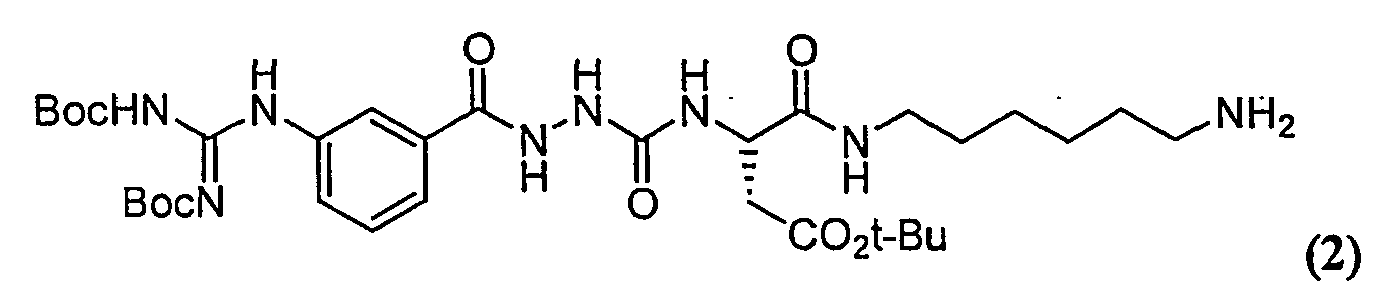
- Gua(Boc)2-Mab-azaGly-Asp(Bu)-OH (1) (75.2 mg, 0.123 mmol), HOAt (16.8 mg, 0.124 mmol, 1.0 Äquiv.) und HATU (56.5 mg, 0.148 mmol, 1.2 Äquiv.) wurden in wasserfreiem DMF (1.5 mL) gelöst und anschließend mit Collidin (163 µL, 149 mg, 1.23 mmol, 10 Äquiv.) versetzt. Nach 2 h wurde diese Lösung unter heftigem Rühren bei 10 °C innerhalb 5 min zu einer Lösung von 1,6-Diaminohexan (0.287 g, 2.47 mmol, 20 Äquiv.) in DMF (2 mL) getropft. Man beließ die Reaktion 10 min bei dieser Temperatur und rührte dann weitere 70 min bei Raumtemperatur. Anschließend wurde das Reaktionsgemisch im Ölpumpenvakuum eingeengt. Der Rückstand wurde in CH2Cl2 (15 mL) aufgenommen und mit H2O (2 × 15 mL) extrahiert. Einengen im Vakuum ergab die Verbindung 2 (82.2 mg, 95% Rohausbeute) als braunen Feststoff.
- HPLC (10-90% in 30 min) Rt = 20.1 min; ESI-MS: m/z 1435.2 (30) [2M + Na+], 1413.2 (30) [2M + H+], 729.2 (60) [M + Na+], 707.2 (100) [M + H+].
-

- 6-{[6-(allanoylamino)hexanoyl]amino}hexansäure (Aca-εAhx-εAhx-OH) (69 mg, 0.23 mmol, 2.0 Äquiv.) und HATU (97 mg, 0.26 mmol, 2.2 Äquiv) wurden in wasserfreiem DMF (2.5 mL) gelöst und anschließend mit Collidin (340 µL, 310 mg, 2.6 mmol, 22 Äquiv.) versetzt. Nach 1 h wurde unter Rühren innerhalb 5 min eine Lösung von Gua(Boc)2-Mab-azaGly-Asp(Bu)-Hda-H (2) (82.0 mg, 0.116 mmol) in DMF (1 mL) zugetropft. Nach 2 h wurde das Reaktionsgemisch im Ölpumpenvakuum eingeengt. Der Rückstand wurde in einem Lösungsmittelgemisch aus CH2Cl2 (1 mL) und TFE (250 µL) aufgenommen und langsam zu CH3CN (35 mL) getropft. Es bildete sich ein farbloser Niederschlag, der durch Zentrifugieren und Abdekandieren abgetrennt wurde. Entfernen des Lösungmittels im Vakuum und Reinigung per HPLC (30-80% in 30 min) ergab ein Gemisch von 3a und 3b im HPLC-Integralverhältnis von 2:1 (33.9 mg, 32%) als farblosen Feststoff.
- HPLC (10-90% in 20 min) Rt = 11.8 min; ESI-MS: m/z 909.3 (70) [M + Na+], 887.3 (40) [M + H+].
- HPLC (10-90% in 20 min) Rt = 16.8 min; ESI-MS: m/z 1009.3 (90) [M + Na+].
- Ein 2:1-Gemisch von 3a und 3b (33 mg, 36 µmol) wurde in CH2Cl2 (0.5 mL) suspendiert und anschließend mit einem 95:5 TFA/H2O-Gemisch versetzt. Nach 1 h wurde das Reaktionsgemisch im Vakuum eingeengt. Lyophilisieren aus H2O ergab die Verbindung 4 (29.0 mg, 95%, verunreinigt mit 10% der entguanylierten Verbindung) als farblosen Feststoff.
- 1H-NMR (500 MHz, DMSO): δ = 10.31 (s, 1H, Ar-CO-NH-NH), 10.02 (s, 1H, NH-Ar), 8.24 (s, 1H, Ar-CO-NH-NH), 8.04 (mc, 1H, CO-NH) 7.77 (d, J = 7.8 Hz, 1H, arom), 8.24-7.50 (m, 8H, 2 × Ar-H, H 2N-CNH Z-NH, 2 × CO-NH), 7.41 (d, J = 7.9 Hz, 1H, arom), 7.17-7.09 (m, 1H, CO-NH), 6.80 (br. s, 1H, NH-NH-CO-NH), 6.19 (dd, J = 17.2, 10.1 Hz, 1H, CO-CH=CH2), 6.04 (dd, J = 17.1, 2.1 Hz, 1H, CO-CH=CH cisHtrans), 5.54 (dd, J = 10.1, 2.1 Hz, 1H, CO-CH=CHcis H trans), 4.42 (dt, J = J' = 7.9 Hz, 1H, NH-CH-CO), 3.13-2.94 (m, 8H, 4 × CO-NH-CH 2) AB-Signal (δA = 2.63, δB = 2.55, J AB = 16.1, zusätzlich aufgespalten durch J A,H(α) = 5.4 Hz und J B,H(α) = 7.2 Hz, 2H, CH-CH 2-CO2H), 2.01 (t, J = 7.3 Hz, 4H, 2 × CO-CH2), 1.51-1.15 (m, 20H, aliphat.); 13C-NMR (125.0 MHz, DMSO): δ = 172.0, 171.83, 171.76, 170.6. 164.4, 157.6, 155.8, 135.6, 133.9, 131.9, 129.8, 127.6, 125.3, 124.7, 123.4, 50.1, 38.7, 38.4, 38.3, 38.2, 35.3, 29.0, 28.9, 28.8, 26.1, 25.9, 25.0; HPLC (10-80% in 30 min) Rt = 10.6 min; ESI-MS: m/z 753.3 (10) [M + Na+], 731.3 (100) [M + H+].
- Es wurde die Adhäsion von Maus-MC3T3 H1-Osteoblastenkulturen in vitro an Peptid-beschichteten Materialoberflächen untersucht. Dabei wurden 50.000 Zellen/cm2 angesät und nach einstündiger Inkubation in serumfreiem Medium bei 37°C / 95 % Luftfeuchte der Anteil adherierter Zellen bestimmt.
- Peptid: Zellanhaftungsrate [%]
Gua-Mab-azaGly-Asp-Hda-εAhx-εAhx-Aca: 75
Thr-Trp-Tyr-Lys-Ile-Ala-Phe-Gln-Arg-Asn-Arg-Lys-Aca-Aca-Cys: 105
Cys-Aca-Aca-Thr-Trp-Tyr-Lys-Ile-Ala-Phe-Gln-Arg-Asn-Arg-Lys: 101
Lys-Ile-Ala-Phe-Gln-Arg-Asn-Arg-Lys-Aca-Aca-Cys: 96
Cys-Aca-Aca-Thr-Trp-Tyr-Lys-Ile-Ala-Phe-Gln-Arg: 17
Phe-Gln-Arg-Asn-Arg-Lys-Aca-Aca-Cys: 13
Cys-Aca-Aca-Thr-Trp-Tyr-Lys-Ile-Ala: 7 - Die Beschichtung von mit Rinderserumalbumin (BSA) vorbeschichteten Kulturoberflächen aus Polystyrol mit Thiolpeptiden ist aus dem Stand der Technik bekannt (siehe
DE 198 18098 (Merck Patent GmbH), Bsp. 2). Auch die Beschichtung von PMMA-Oberflächen mit Acrylatpeptiden ist in derDE 198 18098 , Bsp. 3 beschrieben.

Thr-Trp-Tyr-Lys-Ile-Ala-Phe-Gln-Arg-Asn-Arg-Lys (ii)
Trp-Tyr-Lys-Ile-Ala-Phe-Gln-Arg-Asn-Arg-Lys (iii)
Tyr-Lys-Ile-Ala-Phe-Gln-Arg-Asn-Arg-Lys (iv)
Thr-Trp-Tyr-Lys-Ile-Ala-Phe-Gln-Arg-Asn-Arg (v)
Thr-Trp-Tyr-Lys-Ile-Ala-Phe-Gln-Arg-Asn (vi)
Thr-Trp-Tyr-Lys-Ile-Ala-Phe-Gln-Arg (vii),
wobei für (i)
Claims (13)
- Verbindung der Formel 1
B-Q-X1 1
worin
B ein bioaktives, zelladhäsionsvermittelndes Molekül, ausgewählt aus der Gruppe
Thr-Trp-Tyr-Lys-Ile-Ala-Phe-Gln-Arg-Asn-Arg-Lys (ii)
Trp-Tyr-Lys-Ile-Ala-Phe-Gln-Arg-Asn-Arg-Lys (iii)
Tyr-Lys-Ile-Ala-Phe-Gln-Arg-Asn-Arg-Lys (iv)
Thr-Trp-Tyr-Lys-Ile-Ala-Phe-Gln-Arg-Asn-Arg (v)
Thr-Trp-Tyr-Lys-Ile-Ala-Phe-Gln-Arg-Asn (vi)
Thr-Trp-Tyr-Lys-Ile-Ala-Phe-Gln-Arg (vii),
wobei für (i)
X H2N-C(=NH)-NH, Het-NH-, H2N-C(=NH)-, A-C(=NH)-NH- oder Het-
Y -(CH2)n- oder Z N-R2 oder CH-R2R2 H oder Alkyl mit 1 bis 4 C-AtomenR3 H, Ar, Het oder AR4 H, A, Ar, OH,OA, OAr, Arylalkyl, Hal ,CN, NO2, CF3 oder OCF3,A COOH, NH2 oder Alkyl mit 1-6 C-Atomen, unsubstituiert oder substituiert mit COOH oder NH2Ar unsubstituiertes oder ein-, zwei-oder dreifach durch A, OH, NH2, OA, CF3, OCF3, CN, NO2 oder Hal substituiertes Phenyl, welches durch ein ein-, zwei oder dreifach durch A, OH, OA, OCF3, CN, NO2 oder Hal substituiertes Phenyl in der Art substituiert sein kann, dass ein unsubstituiertes oder substituiertes Biphenyl entsteht,Hal F, Cl, Br oder I,Het einen gesättigten, teilweise oder vollständig ungesättigten mono- oder bicyclischen heterocyclischen Rest mit 5 bis 10 Ringgliedern, wobei 1 bis 3 N-und/oder ein S- oder O-Atome vorliegen können und der heterocyclische Rest ein- oder zweifach durch CN, Hal, OH, NH2, COOH, OA, CF3, A, NO2, Ar oder OCF3 substituiert sein kann,Het1 einen 5- oder 6-gliedrigen aromatischen Heterocyclus mit 1 bis 4 N- und/oder S-Atomen, der unsubstituiert oder ein- oder zweifach durch F, Cl, Br, A, OA oder OCF3 substituiert sein kann,n 4, 5 oder 6,m, o, p, q 0, 1 oder 2s, t 0, 1, 2, 3, 4, 5bedeuten;Q fehlt oder ein organisches Spacer-Molekül undX1 ein Ankermolekül, ausgewählt aus der Gruppebedeutet,
-CO-CH=CH2 (viii)
-CO-(CH2)1-20-CO-CH=CH2 (ix)
-CO-(CH2)1-20-SH (x)
-CO-CH(NH2)-CH2-SH (xi)
-NH-(CH2)1-20-CO-CH=CH2 (xii)
-NH-(CH2)2-20-SH (xiii)
-NH-CH(CO2H)-CH2-SH (xiv)
wobei im Falle der Verbindungen (viii) bis (xi) eine freie Aminogruppe der Gruppe B mit einer freien Carboxylgruppe des Spacer-Moleküls Q oder des Ankermoleküls X1 bzw. eine freie Aminogruppe des Restes Q mit einer freien Carboxylgruppe des Restes X1 peptidartig miteinander verknüpft ist, und im Falle der Verbindungen (xii) bis (xiv) eine freie Carboxylgruppe der Gruppe B mit einer freien Aminogruppe des Spacer-Moleküls Q oder des Ankermoleküls X1 bzw. eine freie Carboxylgruppe des Restes Q mit einer freien Aminogruppe des Restes X 1 peptidartig miteinander verknüpft ist,
sowie deren Salze. - Verbindung nach Anspruch 1 , worin Q ausgewählt ist aus der Gruppe
[CO-(CH2)x-NH-]m, (xvii)
[CO-CH2-(O-CH2CH2)y -NH-]m, (xviii)
[CO-(CH2)z-CO-] (xix)
[NH-(CH2)z-NH-] (xx)
[CO-CH2-(OCH2CH2)y-O-CH2-CO-] (xxi)
[NH-CH2CH2-(OCH2CH2)y-NH-] (xxii)
sowie deren Kombination
worinm jeweils unabhängig voneinander 1 bis 20x 1 bis 12y 1 bis 50z 1 bis 12 ist. - Verbindung nach Anspruch 1 , worin Q ausgewählt ist aus der Gruppe
[CO-(CH2)x-NH-]m, (xvii)
[CO-CH2-(O-CH2CH2)y-NH-]m, (xviii)
[CO-(CH2)z-CO-] (xix)
[NH-(CH2)z-NH-] (xx)
[CO-CH2-(OCH2CH2)y-O-CH2-CO-] (xxi)
[NH-CH2CH2-(OCH2CH2)y-NH-] (xxii)
sowie deren Kombination
worinm jeweils unabhängig voneinander 1 bis 8x 1 bis 5y 1 bis 6 undz 1 bis 6 ist. - Verbindungen der Formel 1 gemäß Anspruch 1a)
 b) Thr-Trp-Tyr-Lys-Ile-Ala-Phe-Gln-Arg-Asn-Arg-Lys-Aca-Aca-Cysc) Cys-Aca-Aca-Thr-Trp-Tyr-Lys-Ile-Ala-Phe-Gln-Arg-Asn-Arg-Lyse) Cys-Aca-Aca-Thr-Trp-Tyr-Lys-Ile-Ala-Phe-Gln-Arg.
 - Verbindungen der Formel 1 gemäß Anspruch 1, mit B ausgewählt aus (ii), (iv) oder (v):d) Lys-Ile-Ala-Phe-Gln-Arg-Asn-Arg-Lys-Aca-Aca-Cysf) Phe-Gln-Arg-Asn-Arg-Lys-Aca-Aca-Cysg) Cys-Aca-Aca-Thr-Trp-Tyr-Lys-Ile-Ala
- Verbindung nach einem der Ansprüche 1 bis 5 als Arzneimittel zur Behandlung von durch Implantate verursachten Erkrankungen, Defekten, Entzündungen und von osteolytischen Erkrankungen wie Osteoporose, Thrombose, Herzinfarkt und Arteriosklerose, sowie zur Beschleunigung und Verstärkung des Integrationsprozesses des Implantats bzw. der biokompatiblen Oberfläche in das Gewebe.
- Implantat, geeignet für humane und tierische Organe, bestehend im wesentlichen aus einer Trägermatrix und einer diese Matrix umhüllenden Schicht eines bioaktiven, zelladhäsionsvermittelnden Moleküls, dadurch gekennzeichnet, dass die umhüllende Schicht aus einer Verbindung gemäß der Ansprüche 1 bis 5 gebildet wird, wobei zwischen Trägermatrix und dieser Verbindung eine kovalente oder adsorptive Bindung vorliegt.
- Implantat nach Anspruch 7, dadurch gekennzeichnet, dass die Trägermatrix und/oder deren Oberfläche ein Metall oder ein Metalloxid ist.
- Implantat nach Anspruch 7, dadurch gekennzeichnet, dass die Trägermatrix und/oder deren Oberfläche ein Polymer ist.
- Implantat nach Anspruch 9, dadurch gekennzeichnet, dass das Polymer Polymethylmethacrylat, Polyhydroxyethylmethacrylat oder deren Copolymere ist.
- Verfahren zur Herstellung einer Verbindung der Formel 1 nach Anspruch 1 sowie ihrer Salze, dadurch gekennzeichnet, dass man ein bioaktives Molekül B, welches mit Schutzgruppen versehen sein kann, und ein mit Schutzgruppen versehenes Spacer-Anker-Molekül (Q-X1) bzw. Ankermolekül (X1) peptidisch miteinander verknüpft und anschließend die Schutzgruppen abspaltet, und/oder dass man eine basische oder saure Verbindung der Formel 1 durch Behandeln mit einer Säure oder Base in eines ihrer Salze überführt.
- Verwendung einer Verbindung nach einem der Ansprüche 1 bis 5 zur Herstellung eines Arzneimittels zur Behandlung von durch Implantate verursachten Erkrankungen, Defekten, Entzündungen und von osteolytischen Erkrankungen wie Osteoporose, Thrombose, Herzinfarkt und Arteriosklerose, sowie zur Beschleunigung und Verstärkung des Integrationsprozesses des Implantats bzw. der biokompatiblen Oberfläche in das Gewebe.
- Verwendung einer Verbindung nach einem der Ansprüche 1 bis 5 zur Beschichtung mittels kovalenter oder adsorptiver Bindung von Implantaten für humane und tierische Organe.
Priority Applications (1)
| Application Number | Priority Date | Filing Date | Title |
|---|---|---|---|
| CY20091100374T CY1108945T1 (el) | 2000-08-17 | 2009-03-31 | Παραγωγα πεπτιδιων και πεπτιδομιμητικων ενωσεων με ιδιοτητες αναστολεα ενσωματινης ιι |
Applications Claiming Priority (3)
| Application Number | Priority Date | Filing Date | Title |
|---|---|---|---|
| DE10040103A DE10040103A1 (de) | 2000-08-17 | 2000-08-17 | Peptid- und Peptidmimetika-Derivate mit Integrin-Inhibitor-Eigenschaften II |
| DE10040103 | 2000-08-17 | ||
| PCT/EP2001/008931 WO2002014350A2 (de) | 2000-08-17 | 2001-08-02 | Peptid- und peptidmimetika-derivate mit integrin-inhibitor-eigenschaften ii |
Publications (2)
| Publication Number | Publication Date |
|---|---|
| EP1309610A2 EP1309610A2 (de) | 2003-05-14 |
| EP1309610B1 true EP1309610B1 (de) | 2008-12-31 |
Family
ID=7652667
Family Applications (1)
| Application Number | Title | Priority Date | Filing Date |
|---|---|---|---|
| EP01960611A Expired - Lifetime EP1309610B1 (de) | 2000-08-17 | 2001-08-02 | Peptid- und peptidmimetika-derivate mit integrin-inhibitor-eigenschaften ii |
Country Status (17)
| Country | Link |
|---|---|
| US (1) | US7276482B2 (de) |
| EP (1) | EP1309610B1 (de) |
| JP (1) | JP4795620B2 (de) |
| KR (1) | KR20030062318A (de) |
| CN (1) | CN1446230A (de) |
| AT (1) | ATE419269T1 (de) |
| AU (1) | AU2001282058A1 (de) |
| CA (1) | CA2419469C (de) |
| CY (1) | CY1108945T1 (de) |
| CZ (1) | CZ2003719A3 (de) |
| DE (2) | DE10040103A1 (de) |
| DK (1) | DK1309610T3 (de) |
| ES (1) | ES2317926T3 (de) |
| MX (1) | MXPA03001427A (de) |
| PL (1) | PL366312A1 (de) |
| PT (1) | PT1309610E (de) |
| WO (1) | WO2002014350A2 (de) |
Families Citing this family (2)
| Publication number | Priority date | Publication date | Assignee | Title |
|---|---|---|---|---|
| AU2001221607A1 (en) | 2000-11-20 | 2002-05-27 | Ecole Polytechnique Federale De Lausanne (Epfl) | Endosseous implant |
| DE10325049A1 (de) * | 2003-06-02 | 2004-12-23 | Merck Patent Gmbh | Peptid- und Peptidmimetika-Derivate mit Integrin-Inhibitor-Eigenschaften III |
Family Cites Families (6)
| Publication number | Priority date | Publication date | Assignee | Title |
|---|---|---|---|---|
| EP0567578A1 (de) * | 1991-01-25 | 1993-11-03 | The Regents Of The University Of Minnesota | Polypeptide aus der laminin a-ketten domäne vi |
| ES2229499T3 (es) * | 1997-05-22 | 2005-04-16 | Biomet Deutschland Gmbh | Implantes recubiertos con peptidos y procedimiento para su fabricacion. |
| DE19755801A1 (de) * | 1997-12-16 | 2000-06-21 | Merck Patent Gmbh | Mit die Zelladhäsion vermittelnden Peptiden beschichtete Implantate und Verfahren zu ihrer Herstellung |
| DE19755800A1 (de) * | 1997-12-16 | 1999-06-17 | Merck Patent Gmbh | Cyclopeptidderivate |
| DE19831710A1 (de) | 1998-07-15 | 2000-01-20 | Merck Patent Gmbh | Diacylhydrazinderivate |
| DE19932796A1 (de) | 1999-07-14 | 2001-01-18 | Merck Patent Gmbh | Diacylhydrazinderivate |
-
2000
- 2000-08-17 DE DE10040103A patent/DE10040103A1/de not_active Withdrawn
-
2001
- 2001-08-02 ES ES01960611T patent/ES2317926T3/es not_active Expired - Lifetime
- 2001-08-02 DE DE50114621T patent/DE50114621D1/de not_active Expired - Lifetime
- 2001-08-02 PL PL01366312A patent/PL366312A1/xx unknown
- 2001-08-02 AU AU2001282058A patent/AU2001282058A1/en not_active Abandoned
- 2001-08-02 EP EP01960611A patent/EP1309610B1/de not_active Expired - Lifetime
- 2001-08-02 US US10/344,668 patent/US7276482B2/en not_active Expired - Fee Related
- 2001-08-02 AT AT01960611T patent/ATE419269T1/de active
- 2001-08-02 PT PT01960611T patent/PT1309610E/pt unknown
- 2001-08-02 JP JP2002519487A patent/JP4795620B2/ja not_active Expired - Fee Related
- 2001-08-02 MX MXPA03001427A patent/MXPA03001427A/es unknown
- 2001-08-02 CN CN01814101A patent/CN1446230A/zh active Pending
- 2001-08-02 CA CA2419469A patent/CA2419469C/en not_active Expired - Fee Related
- 2001-08-02 WO PCT/EP2001/008931 patent/WO2002014350A2/de not_active Ceased
- 2001-08-02 CZ CZ2003719A patent/CZ2003719A3/cs unknown
- 2001-08-02 DK DK01960611T patent/DK1309610T3/da active
- 2001-08-02 KR KR10-2003-7002263A patent/KR20030062318A/ko not_active Withdrawn
-
2009
- 2009-03-31 CY CY20091100374T patent/CY1108945T1/el unknown
Also Published As
| Publication number | Publication date |
|---|---|
| WO2002014350A3 (de) | 2002-09-19 |
| WO2002014350A2 (de) | 2002-02-21 |
| PT1309610E (pt) | 2009-03-16 |
| EP1309610A2 (de) | 2003-05-14 |
| DE10040103A1 (de) | 2002-02-28 |
| US20040043937A1 (en) | 2004-03-04 |
| CY1108945T1 (el) | 2014-07-02 |
| PL366312A1 (en) | 2005-01-24 |
| ATE419269T1 (de) | 2009-01-15 |
| JP2004506649A (ja) | 2004-03-04 |
| CA2419469A1 (en) | 2003-02-14 |
| CZ2003719A3 (cs) | 2003-06-18 |
| AU2001282058A1 (en) | 2002-02-25 |
| US7276482B2 (en) | 2007-10-02 |
| DE50114621D1 (de) | 2009-02-12 |
| KR20030062318A (ko) | 2003-07-23 |
| MXPA03001427A (es) | 2003-06-06 |
| CN1446230A (zh) | 2003-10-01 |
| JP4795620B2 (ja) | 2011-10-19 |
| ES2317926T3 (es) | 2009-05-01 |
| DK1309610T3 (da) | 2009-03-30 |
| CA2419469C (en) | 2013-05-14 |
Similar Documents
| Publication | Publication Date | Title |
|---|---|---|
| DE3827415A1 (de) | Peptidderivate, verfahren zu ihrer herstellung und ihre verwendung | |
| EP1309355B1 (de) | Peptid- und peptidmimetikakonjugate mit integrin-inhibitor-eigenschaften | |
| EP1037906B1 (de) | Cyclopeptidderivate mit integrin-inhibitor-eigenschaften | |
| DE69032258T2 (de) | Antikoagulierende Peptide | |
| EP1548029B1 (de) | Peptid- und Peptidmimetika-Derivate mit Integrin-Inhibitor-Eigenschaften III | |
| DE69304538T2 (de) | Aminosäure-derivate und deren verwendung | |
| EP1309610A2 (de) | Peptid- und peptidmimetika-derivate mit integrin-inhibitor-eigenschaften ii | |
| WO2007095659A1 (de) | Peptide und peptid-derivate, herstellun derselben sowie deren verwendung zur herstellung eines therapeutisch und/oder präventiv wirkenden arzneimittels | |
| EP0771818A2 (de) | Biotinderivate | |
| DE4342846A1 (de) | Tumor-Nekrose-Faktor-alpha inaktivierende Peptide |
Legal Events
| Date | Code | Title | Description |
|---|---|---|---|
| PUAI | Public reference made under article 153(3) epc to a published international application that has entered the european phase |
Free format text: ORIGINAL CODE: 0009012 |
|
| 17P | Request for examination filed |
Effective date: 20021219 |
|
| AK | Designated contracting states |
Designated state(s): AT BE CH CY DE DK ES FI FR GB GR IE IT LI LU MC NL PT SE TR |
|
| AX | Request for extension of the european patent |
Extension state: AL LT LV MK RO SI |
|
| RAP1 | Party data changed (applicant data changed or rights of an application transferred) |
Owner name: BIOMET DEUTSCHLAND GMBH |
|
| GRAP | Despatch of communication of intention to grant a patent |
Free format text: ORIGINAL CODE: EPIDOSNIGR1 |
|
| GRAS | Grant fee paid |
Free format text: ORIGINAL CODE: EPIDOSNIGR3 |
|
| GRAA | (expected) grant |
Free format text: ORIGINAL CODE: 0009210 |
|
| AK | Designated contracting states |
Kind code of ref document: B1 Designated state(s): AT BE CH CY DE DK ES FI FR GB GR IE IT LI LU MC NL PT SE TR |
|
| REG | Reference to a national code |
Ref country code: CH Ref legal event code: EP Ref country code: GB Ref legal event code: FG4D Free format text: NOT ENGLISH |
|
| REG | Reference to a national code |
Ref country code: CH Ref legal event code: NV Representative=s name: SCHMAUDER & PARTNER AG PATENTANWALTSBUERO |
|
| REF | Corresponds to: |
Ref document number: 50114621 Country of ref document: DE Date of ref document: 20090212 Kind code of ref document: P |
|
| REG | Reference to a national code |
Ref country code: IE Ref legal event code: FG4D Free format text: LANGUAGE OF EP DOCUMENT: GERMAN |
|
| REG | Reference to a national code |
Ref country code: PT Ref legal event code: SC4A Free format text: AVAILABILITY OF NATIONAL TRANSLATION Effective date: 20090305 |
|
| REG | Reference to a national code |
Ref country code: SE Ref legal event code: TRGR |
|
| REG | Reference to a national code |
Ref country code: DK Ref legal event code: T3 |
|
| REG | Reference to a national code |
Ref country code: GR Ref legal event code: EP Ref document number: 20090400850 Country of ref document: GR |
|
| REG | Reference to a national code |
Ref country code: ES Ref legal event code: FG2A Ref document number: 2317926 Country of ref document: ES Kind code of ref document: T3 |
|
| REG | Reference to a national code |
Ref country code: CH Ref legal event code: PCAR Free format text: SCHMAUDER & PARTNER AG PATENT- UND MARKENANWAELTE VSP;ZWAENGIWEG 7;8038 ZUERICH (CH) |
|
| PLBE | No opposition filed within time limit |
Free format text: ORIGINAL CODE: 0009261 |
|
| STAA | Information on the status of an ep patent application or granted ep patent |
Free format text: STATUS: NO OPPOSITION FILED WITHIN TIME LIMIT |
|
| 26N | No opposition filed |
Effective date: 20091001 |
|
| PGFP | Annual fee paid to national office [announced via postgrant information from national office to epo] |
Ref country code: CH Payment date: 20110824 Year of fee payment: 11 Ref country code: DK Payment date: 20110822 Year of fee payment: 11 |
|
| PGFP | Annual fee paid to national office [announced via postgrant information from national office to epo] |
Ref country code: LU Payment date: 20120824 Year of fee payment: 12 |
|
| PGFP | Annual fee paid to national office [announced via postgrant information from national office to epo] |
Ref country code: IE Payment date: 20120821 Year of fee payment: 12 Ref country code: SE Payment date: 20120821 Year of fee payment: 12 Ref country code: MC Payment date: 20120813 Year of fee payment: 12 Ref country code: FI Payment date: 20120813 Year of fee payment: 12 |
|
| PGFP | Annual fee paid to national office [announced via postgrant information from national office to epo] |
Ref country code: TR Payment date: 20120724 Year of fee payment: 12 Ref country code: GR Payment date: 20120821 Year of fee payment: 12 |
|
| PGFP | Annual fee paid to national office [announced via postgrant information from national office to epo] |
Ref country code: BE Payment date: 20120824 Year of fee payment: 12 |
|
| PGFP | Annual fee paid to national office [announced via postgrant information from national office to epo] |
Ref country code: PT Payment date: 20120202 Year of fee payment: 12 Ref country code: CY Payment date: 20120801 Year of fee payment: 12 |
|
| PGFP | Annual fee paid to national office [announced via postgrant information from national office to epo] |
Ref country code: AT Payment date: 20120813 Year of fee payment: 12 |
|
| REG | Reference to a national code |
Ref country code: PT Ref legal event code: MM4A Free format text: LAPSE DUE TO NON-PAYMENT OF FEES Effective date: 20140203 |
|
| BERE | Be: lapsed |
Owner name: BIOMET DEUTSCHLAND G.M.B.H. Effective date: 20130831 |
|
| REG | Reference to a national code |
Ref country code: CH Ref legal event code: PL Ref country code: DK Ref legal event code: EBP Effective date: 20130831 |
|
| REG | Reference to a national code |
Ref country code: SE Ref legal event code: EUG |
|
| REG | Reference to a national code |
Ref country code: AT Ref legal event code: MM01 Ref document number: 419269 Country of ref document: AT Kind code of ref document: T Effective date: 20130802 |
|
| REG | Reference to a national code |
Ref country code: GR Ref legal event code: ML Ref document number: 20090400850 Country of ref document: GR Effective date: 20140305 |
|
| PG25 | Lapsed in a contracting state [announced via postgrant information from national office to epo] |
Ref country code: FI Free format text: LAPSE BECAUSE OF NON-PAYMENT OF DUE FEES Effective date: 20130802 Ref country code: LI Free format text: LAPSE BECAUSE OF NON-PAYMENT OF DUE FEES Effective date: 20130831 Ref country code: MC Free format text: LAPSE BECAUSE OF NON-PAYMENT OF DUE FEES Effective date: 20130902 Ref country code: SE Free format text: LAPSE BECAUSE OF NON-PAYMENT OF DUE FEES Effective date: 20130803 Ref country code: CH Free format text: LAPSE BECAUSE OF NON-PAYMENT OF DUE FEES Effective date: 20130831 |
|
| REG | Reference to a national code |
Ref country code: IE Ref legal event code: MM4A |
|
| PG25 | Lapsed in a contracting state [announced via postgrant information from national office to epo] |
Ref country code: GR Free format text: LAPSE BECAUSE OF NON-PAYMENT OF DUE FEES Effective date: 20140305 Ref country code: BE Free format text: LAPSE BECAUSE OF NON-PAYMENT OF DUE FEES Effective date: 20130831 Ref country code: AT Free format text: LAPSE BECAUSE OF NON-PAYMENT OF DUE FEES Effective date: 20130802 |
|
| PG25 | Lapsed in a contracting state [announced via postgrant information from national office to epo] |
Ref country code: PT Free format text: LAPSE BECAUSE OF NON-PAYMENT OF DUE FEES Effective date: 20140203 |
|
| PG25 | Lapsed in a contracting state [announced via postgrant information from national office to epo] |
Ref country code: IE Free format text: LAPSE BECAUSE OF NON-PAYMENT OF DUE FEES Effective date: 20130802 |
|
| PG25 | Lapsed in a contracting state [announced via postgrant information from national office to epo] |
Ref country code: DK Free format text: LAPSE BECAUSE OF NON-PAYMENT OF DUE FEES Effective date: 20130831 |
|
| PG25 | Lapsed in a contracting state [announced via postgrant information from national office to epo] |
Ref country code: CY Free format text: LAPSE BECAUSE OF NON-PAYMENT OF DUE FEES Effective date: 20130802 |
|
| REG | Reference to a national code |
Ref country code: FR Ref legal event code: PLFP Year of fee payment: 15 |
|
| PG25 | Lapsed in a contracting state [announced via postgrant information from national office to epo] |
Ref country code: LU Free format text: LAPSE BECAUSE OF NON-PAYMENT OF DUE FEES Effective date: 20130802 |
|
| PG25 | Lapsed in a contracting state [announced via postgrant information from national office to epo] |
Ref country code: TR Free format text: LAPSE BECAUSE OF NON-PAYMENT OF DUE FEES Effective date: 20130802 |
|
| REG | Reference to a national code |
Ref country code: FR Ref legal event code: PLFP Year of fee payment: 16 |
|
| REG | Reference to a national code |
Ref country code: FR Ref legal event code: PLFP Year of fee payment: 17 |
|
| PGFP | Annual fee paid to national office [announced via postgrant information from national office to epo] |
Ref country code: FR Payment date: 20170628 Year of fee payment: 17 |
|
| PGFP | Annual fee paid to national office [announced via postgrant information from national office to epo] |
Ref country code: NL Payment date: 20170712 Year of fee payment: 17 |
|
| PGFP | Annual fee paid to national office [announced via postgrant information from national office to epo] |
Ref country code: ES Payment date: 20170901 Year of fee payment: 17 Ref country code: IT Payment date: 20170824 Year of fee payment: 17 Ref country code: DE Payment date: 20170725 Year of fee payment: 17 Ref country code: GB Payment date: 20170802 Year of fee payment: 17 |
|
| REG | Reference to a national code |
Ref country code: DE Ref legal event code: R119 Ref document number: 50114621 Country of ref document: DE |
|
| REG | Reference to a national code |
Ref country code: NL Ref legal event code: MM Effective date: 20180901 |
|
| GBPC | Gb: european patent ceased through non-payment of renewal fee |
Effective date: 20180802 |
|
| PG25 | Lapsed in a contracting state [announced via postgrant information from national office to epo] |
Ref country code: NL Free format text: LAPSE BECAUSE OF NON-PAYMENT OF DUE FEES Effective date: 20180901 |
|
| PG25 | Lapsed in a contracting state [announced via postgrant information from national office to epo] |
Ref country code: DE Free format text: LAPSE BECAUSE OF NON-PAYMENT OF DUE FEES Effective date: 20190301 Ref country code: IT Free format text: LAPSE BECAUSE OF NON-PAYMENT OF DUE FEES Effective date: 20180802 |
|
| PG25 | Lapsed in a contracting state [announced via postgrant information from national office to epo] |
Ref country code: FR Free format text: LAPSE BECAUSE OF NON-PAYMENT OF DUE FEES Effective date: 20180831 |
|
| REG | Reference to a national code |
Ref country code: ES Ref legal event code: FD2A Effective date: 20190918 |
|
| PG25 | Lapsed in a contracting state [announced via postgrant information from national office to epo] |
Ref country code: ES Free format text: LAPSE BECAUSE OF NON-PAYMENT OF DUE FEES Effective date: 20180803 Ref country code: GB Free format text: LAPSE BECAUSE OF NON-PAYMENT OF DUE FEES Effective date: 20180802 |