EP1309012A2 - Diode Schottky intégrée et procédé de fabrication - Google Patents
Diode Schottky intégrée et procédé de fabrication Download PDFInfo
- Publication number
- EP1309012A2 EP1309012A2 EP02024472A EP02024472A EP1309012A2 EP 1309012 A2 EP1309012 A2 EP 1309012A2 EP 02024472 A EP02024472 A EP 02024472A EP 02024472 A EP02024472 A EP 02024472A EP 1309012 A2 EP1309012 A2 EP 1309012A2
- Authority
- EP
- European Patent Office
- Prior art keywords
- schottky barrier
- barrier diode
- diode
- layer
- electrode
- Prior art date
- Legal status (The legal status is an assumption and is not a legal conclusion. Google has not performed a legal analysis and makes no representation as to the accuracy of the status listed.)
- Withdrawn
Links
Images

Classifications
-
- H—ELECTRICITY
- H10—SEMICONDUCTOR DEVICES; ELECTRIC SOLID-STATE DEVICES NOT OTHERWISE PROVIDED FOR
- H10D—INORGANIC ELECTRIC SEMICONDUCTOR DEVICES
- H10D84/00—Integrated devices formed in or on semiconductor substrates that comprise only semiconducting layers, e.g. on Si wafers or on GaAs-on-Si wafers
- H10D84/201—Integrated devices formed in or on semiconductor substrates that comprise only semiconducting layers, e.g. on Si wafers or on GaAs-on-Si wafers characterised by the integration of only components covered by H10D1/00 or H10D8/00, e.g. RLC circuits
- H10D84/204—Integrated devices formed in or on semiconductor substrates that comprise only semiconducting layers, e.g. on Si wafers or on GaAs-on-Si wafers characterised by the integration of only components covered by H10D1/00 or H10D8/00, e.g. RLC circuits of combinations of diodes or capacitors or resistors
- H10D84/221—Integrated devices formed in or on semiconductor substrates that comprise only semiconducting layers, e.g. on Si wafers or on GaAs-on-Si wafers characterised by the integration of only components covered by H10D1/00 or H10D8/00, e.g. RLC circuits of combinations of diodes or capacitors or resistors of only diodes
-
- H—ELECTRICITY
- H10—SEMICONDUCTOR DEVICES; ELECTRIC SOLID-STATE DEVICES NOT OTHERWISE PROVIDED FOR
- H10D—INORGANIC ELECTRIC SEMICONDUCTOR DEVICES
- H10D8/00—Diodes
- H10D8/01—Manufacture or treatment
- H10D8/051—Manufacture or treatment of Schottky diodes
-
- H—ELECTRICITY
- H10—SEMICONDUCTOR DEVICES; ELECTRIC SOLID-STATE DEVICES NOT OTHERWISE PROVIDED FOR
- H10D—INORGANIC ELECTRIC SEMICONDUCTOR DEVICES
- H10D8/00—Diodes
- H10D8/60—Schottky-barrier diodes
-
- H—ELECTRICITY
- H10—SEMICONDUCTOR DEVICES; ELECTRIC SOLID-STATE DEVICES NOT OTHERWISE PROVIDED FOR
- H10D—INORGANIC ELECTRIC SEMICONDUCTOR DEVICES
- H10D84/00—Integrated devices formed in or on semiconductor substrates that comprise only semiconducting layers, e.g. on Si wafers or on GaAs-on-Si wafers
- H10D84/01—Manufacture or treatment
-
- H10W72/90—
-
- H10W72/536—
-
- H10W72/5522—
-
- H10W72/59—
Definitions
- This invention relates to an integrated Schottky barrier diode chip made of a compound semiconductor for use in a high frequency circuit, specifically to an integrated Schottky barrier diode chip that includes an insulating region electrically separating portions of a diode of the chip, and a manufacturing method thereof.
- FET field effect transistor
- GaAs gallium arsenide
- MMIC monolithic microwave integrated circuit
- FIG. 1A is a plan view of a conventional integrated Schottky barrier diode chip, and FIG 1B is its equivalent circuit.
- This type of integrated Schottky barrier diode is referred to as a Tee type, and has two Schottky barrier diodes 40a, 40b integrated in a chip.
- This chip also has a common electrode 36a and its related terminal 34, a cathode electrode 36b and its related terminal 35, and an anode electrode 36c and its related terminal 32.
- These electrodes 36a, 36b, 36c are indicated by the areas encircled by unevenly broken lines in the figure.
- the two Schottky barrier diodes 40a, 40b share the common electrode 36a.
- the common electrode 36a serves as a cathode electrode of the Schottky barrier diode 40a, the anode of which is the anode electrode 36c, and serves as an anode of the Schottky barrier diode 40b, the cathode of which is the cathode electrode 36b.
- the terminals are the areas of the corresponding electrodes that are used for external connection. Typically, those are the areas for wire bonding, and indicated by the circles in FIG. 1A.
- This configuration provides a circuit shown in FIG. 1B. Namely, the cathode of the Schottky barrier diode 40a, the anode of which is the anode terminal 32, is connected to the anode of the Schottky barrier diode 40b, the cathode of which is the cathode terminal 35.
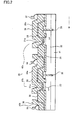
- FIG. 2 is a cross-sectional view of the integrated Schottky barrier diode chip of FIG. 1A. This cross-section is along the arrow in FIG. 1 and intersects operation areas of the two diodes.
- An n+ epitaxial layer 22 (Si + 5 x 10 18 cm -3 ) is disposed on an undoped GaAs substrate 21 and has a thickness of about 6 ⁇ m.
- An n epitaxial layer 23 (Si + 1.3 x 10 17 cm -3 ) is disposed on the n+ epitaxial layer 22 and has a thickness of about 350 nm. This n epitaxial layer 23 serves as an operation layer of the Schottky barrier diodes.
- An ohmic electrode 28 is a disposed directly on the n+ epitaxial layer 22 and forms an ohmic contact with the n+ epitaxial layer 22.
- This first metal layer is made of a AuGe/Ni/Au composite metal layer.
- a second metal layer 33 made of Ti/Pt/Au composite layer, forms a Schottky contact with the n epitaxial layer 23 in a Schottky contact region 31a of the anode portion of the diode, and forms a contact with the ohmic electrode 28 in the cathode portion of the diode.
- a third metal layer 36 is a Au metal layer, which is formed by plating using the second metal layer 33 as a base electrode, and completely covers the second metal layer 33. Portions 36a, 36b, 36c of the third metal layer 36 serve as the common electrode 36a, the cathode electrode 36b and the anode electrode 36c, respectively.
- the Schottky contact region 31a has a circular shape with a diameter of about 10 ⁇ m, as shown in FIG. 1.
- the first metal layer 28 surrounds the Schottky contact region 31a.
- the first and second metal layers are formed by vapor depositing the constituent metals separately.
- a lead wire is bonded to the electrode surface as shown by reference numerals 32, 34 and 35 in FIG. 2.
- the Schottky barrier diode on the left 40b has the cathode electrode 36b, which serves a cathode of this left diode and the common electrode 36a, which serves as an anode of this left diode
- the Schottky barrier diode on the right 40a has the anode electrode 36c, which serves an anode of this right diode and the common electrode 36a, which serves as a cathode of this right diode.
- the common electrode 36a works as an anode electrode of the diode 40b and a cathode electrode of the diode 40a.
- the second metal layer 33 on the Schottky contact regions 31a is at an anode voltage
- the n+ and n epitaxial layers are at a cathode voltage
- a polyimide layer 30 is required as an insulating layer under the second and third metal layers 33, 36, which are at the anode voltage, at locations in which the metal layers 33, 36 intersect the portions of the epitaxial layers 22, 23, which are at the cathode voltage.
- the thickness of the polyimide layer 30 needs to be as much as 6-7 ⁇ m because this intersection area is large and the resultant parasitic capacitance must be reduced by increasing the thickness.
- Polyimide is used as the insulating layer because it has a low dielectric constant and suitable for a thick layer formation.
- this configuration needs a trench 26 that separates the portions of the epitaxial layers 22, 23, which are at the cathode voltage, from the portions of the epitaxial layers 22, 23, which are at the anode voltage. This is an inevitable requirement when more than two diodes are formed in one chip.
- the trenches 26 reach the undoped gallium arsenide substrate 21, and are filled with the same polyimide used for the polyimide layer 30.
- the ohmic electrode 28 needs to form a direct contact with the n+ epitaxial layer for reducing the associated electric resistance. For this reason, a mesa etching is required to expose the n+ epitaxial layer 22 that is covered by the n epitaxial layer 23.
- the n epitaxial layer 23 at the Schottky contact region is also required to be etched to precisely the thickness of 250 nm for good electric characteristics.
- the Schottky barrier diode of the conventional configuration described above has a few disadvantages.
- the object of this invention is directed to an integrated Schottky barrier diode chip that is smaller and is fabricated by a simpler process than the conventional integrated Schottky barrier diode chip.
- the invention provides an integrated Schottky barrier diode chip including a compound semiconductor substrate, an operation layer formed on the substrate, and a plurality of Schottky barrier diodes formed on the substrate.
- the device also includes an insulating region formed in the operation layer, which electrically separates a first portion of the operation layer of one of the plurality of Schottky barrier diodes from a second portion of the operation layer of that Schottky barrier diodes.
- the device further includes an impurity region formed in the operation layer, which electrically communicates with one of the first and second portions of the operation layer of that Schottky barrier diode.
- the invention also provides an integrated Schottky barrier diode chip that has a first Schottky barrier diode and a second Schottky barrier diode each formed on a compound semiconductor substrate.
- the device includes an operation layer formed on the substrate, an anode electrode, a cathode electrode and a common electrode.
- a first insulating region and a first impurity region are formed in the operation layer for the first Schottky barrier diode.
- a second insulating region and a second impurity region are formed in the operation layer for the second Schottky barrier diode.
- the first insulating region electrically separates a portion of the operation layer of the first diode that is connected to the anode electrode from a portion of the operation layer of the first diode that is connected to the common electrode
- the second insulating region electrically separates a portion of the operation layer of the second diode that is connected to the common electrode from a portion of the operation layer of the second diode that is connected to the cathode electrode.
- the first impurity region electrically communicates with the operation layer of the first diode that is connected to the common electrode
- the second impurity region electrically communicates with the operation layer of the second diode that is that is connected to the cathode electrode.
- the invention further provides a method of manufacturing an integrated Schottky barrier diode chip having a plurality of Schottky barrier diodes.
- the method includes forming a plurality of insulating regions on a compound semiconductor substrate by an ion implantation, and forming a Schottky barrier diode on each of the plurality of the insulating regions so that each of the insulating regions electrically separates a first portion of the corresponding diode from a second portion of the corresponding diode.
- the invention also provides a method of manufacturing an integrated Schottky barrier diode chip having a plurality of Schottky barrier diodes.
- the method includes forming an epitaxial layer of a conduction type on an undoped compound semiconductor substrate, forming a plurality of insulating regions in the epitaxial layer by an ion implantation, and forming a Schottky barrier diode on each of the plurality of the insulating regions so that each of the insulating regions electrically separates a first portion of the epitaxial layer of the corresponding diode from a second portion of the epitaxial layer of the corresponding diode.
- Both of the embodiments include an undoped GaAs substrate 1, an anode electrode 16c, a cathode electrode 16b, a common electrode 16a, Schottky barrier diodes 20a, 20b and an insulating region 6.
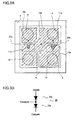
- FIG. 3A is a plan view of an integrated Schottky barrier diode chip of the first embodiment of this invention
- FIG. 3B is an equivalent circuit of the device of FIG. 3A.
- This integrated Schottky barrier diode is a Tee type device, and has two Schottky barrier diodes 20a, 20b integrated in a chip.
- This chip also has a common electrode 16a and its related terminal 14, a cathode electrode 16b and its related terminal 15, and an anode electrode 16c and its related terminal 12. These electrodes 16a, 16b, 16c are indicated by the areas encircled by unevenly broken lines in the figure.
- the two Schottky barrier diodes 20a, 20b share the common electrode 16a.
- the common electrode 16a serves as a cathode of the Schottky barrier diode 20a, the anode of which is the anode electrode 16c, and serves as an anode of the Schottky barrier diode 20b, the cathode of which is the cathode electrode 16b.
- the terminals are the areas of the corresponding electrodes that are used for external connection. Typically, those are the areas for wire bonding, and indicated by the circles in FIG. 3A.
- This configuration provides a circuit shown in FIG. 3B. Namely, the cathode of the Schottky barrier diode 20a, the anode of which is the anode terminal 12, is connected to the anode of the Schottky barrier diode 20b, the cathode of which is the cathode terminal 15.
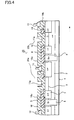
- FIG. 4 is a cross-sectional view of the integrated Schottky barrier diode chip of FIG. 3A. This cross-section is along the arrow in FIG. 3A and intersects operation areas of the two diodes.
- An n+ epitaxial layer 2 (Si + 5 x 10 18 cm -3 ) is disposed on an undoped GaAs substrate 1 and has a thickness of about 500 nm.
- An n epitaxial layer 3 (Si + 1.3 x 10 17 cm -3 ) is disposed on the n+ epitaxial layer 2 and has a thickness of about 250 nm. This n epitaxial layer 3 is an operation layer of the Schottky barrier diodes.
- Impurity region 7 of a high concentration (Si + 1 x 10 18 cm -3 ) is formed in the n epitaxial layer 3 under an ohmic electrode 8, and reaches the n+ epitaxial layer 2.
- the impurity region 7 surrounds a Schottky contact region 11a, which is circular as shown in FIG. 3A, and overlaps with the ohmic electrode 8, which is indicated by the area encircled by the broken lines in FIG. 3A.
- the impurity region 7 is larger than the ohmic electrode 8 and extends outside the area covered by the ohmic electrode 8.
- the distance between the edge of the Schottky contact region 11a and the edge of the impurity region 7 is about 1 ⁇ m, and the distance between the edge of the Schottky contact region 11a and the edge of the ohmic electrode 8 is about 2 ⁇ m. Because of this impurity region 7, which reaches the n+ epitaxial layer 2 form the surface of the n epitaxial layer 3, there is no need for forming a mesa structure, which is required for forming an ohmic contact with the n+ epitaxial layer in the conventional device as shown in FIG. 2. Accordingly, the device of the first embodiment has a planar configuration.
- the ohmic electrode 8 is a disposed directly on the impurity region 7 and forms an ohmic contact with the n+ epitaxial layer 2 through the impurity region 7.
- This first metal layer is made of a AuGe/Ni/Au composite metal layer and has a hole corresponding to the Schottky contact region 11a, as shown by the broken line in FIG. 3A.
- Portions 16a, 16b, 16c of second metal layer 16 serve as the common electrode 16a, the cathode electrode 16b and the anode electrode 16c, respectively.
- the Schottky contact region 11a has a circular shape with a diameter of about 10 ⁇ m, as shown in FIG. 3A.
- the thickness (250 nm) of the n epitaxial layer 3, which is an operation layer of the Schottky barrier diode, is determined so that proper device characteristics, including a high breakdown voltage, are obtained. Because of the planar configuration of this embodiment, the thickness control of the operation layer or the mesa etching is not needed. Then the device of the first embodiment is much easier to produce and more reliable than the conventional device that requires very precise etching control of the operation layer and complicated mesa etching. Accordingly, the integrated Schottky barrier diode chip of this embodiment has improved device characteristics.
- the common electrode 16a is disposed diagonally on the chip, and two areas for wire bonding are provided at both diagonal ends of the common electrode. Only one area needs to be wire-bonded for external connection and become a common terminal 14. This configuration makes it easier to mount the integrated Schottky barrier diode chip of this embodiment on a package frame, a print board or the like, because the common electrode 16a is accessible from two different directions for wire bonding.
- the Schottky barrier diode 20a on the left has the anode electrode 16c, which serves as an anode of this left diode and the common electrode 16a, which serves as a cathode of this left diode
- the Schottky diode 20b on the right has the cathode electrode 16b, which serves as a cathode of this right diode and the common electrode 16a, which serves as an anode of this right diode.
- the common electrode 16a works as a cathode electrode of the diode 20a and an anode electrode of the diode 20b.
- the second metal layer 16 on the Schottky contact regions 11a is at an anode voltage
- the n+ and n epitaxial layers are at a cathode voltage.
- An insulating region 6 is formed for each of the anode and cathode electrodes 16c, 16b, and surrounds the corresponding electrodes 16c, 16b.
- the insulating layer 6 electrically separates the portions of the n+ and n epitaxial layers 2, 3 that are at the anode voltage form the portions of the n+ and n epitaxial layers 2, 3 that are at the cathode voltage.
- each of the insulating regions 6 reaches the undoped GaAs substrate 1, which is essentially an insulating substrate.
- the insulating region 6 replaces the conventional trench structure of FIG. 2.
- This insulating film 5 replaces the conventional polyimide layer of FIG. 2.
- the silicon nitride insulating film 5 is thinner and has a higher dielectric constant than the polyimide layer of the conventional device, it can be used as an insulating layer because it occupies a smaller area than the conventional polyimide layer.
- the area of the intersection between the second metal layer 16 that is at the anode voltage and the portion of the n and n+ epitaxial layers 2, 3 and the corresponding impurity regions 6 that are at the cathode voltage are much smaller than that of the conventional device.
- This is made possible thanks to the smaller process error margin due to the planar configuration of this embodiment, which are free from the mesa structure and the tall polyimide insulating layer that require larger process error margin and, thus, a larger separation between the Schottky contact region and the ohmic electrode, which results in a larger area for generating parasitic capacitance.
- the distance between the edge of the Schottky contact region 11a and the edge of the ohmic electrode 8 in this embodiment is 2 ⁇ m, which is much shorter than 7 ⁇ m, the corresponding distance of the conventional device. Furthermore, the distance between the edge of the Schottky region 11a and the edge of the impurity region 7 is 1 ⁇ m. Since the impurity region 7, which serves as a carrier path, has the electronic conduction properties similar to the ohmic electrode 8, the effective separation in this embodiment is about one seventh of the conventional device. This shorter separation also contributes to reduction of the electric resistance between the Schottky contact region 11a and the ohmic electrode 8/impurity region 7, and thus improvement of high frequency device characteristics.
- the configuration described above does not have a deep trench or tall polyimide layer on the surface of the GaAs chip. Accordingly, the accuracy of positioning masks for patterning is improved and the large processing error margins for patterning is not required for manufacturing the integrated Schottky barrier diode chip of this invention. Furthermore, the absence of the polyimide layer removes the requirements for tapering the side of the polyimide layer and the related process error margin for the tapered side. Because of this reduction of the error margins, the chip size of this embodiment is significantly reduced. The reduced error margin also allows size reduction in the operation area of the diode, which includes the Schottky contact region 11a and the corresponding ohmic electrode 8. This, in turn, provides a more flexible device design, in which the location of the two diodes are determined based on other device design requirements. Taking advantage of this flexible design feature, the common electrode 16a is disposed diagonally on the chip in this embodiment, as described earlier.
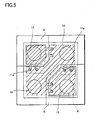
- FIG. 5 An integrated Schottky barrier diode chip of a second embodiment of this invention is described with reference to FIG. 5.
- This embodiment is similar to the first embodiment except that the second embodiment has a plurality of Schottky contact regions 11a for each of the Schottky contact barrier diodes on the chip.
- each of the two diodes has four Schottky contact regions 11a connected in parallel. Because the four Schottky contact regions 11a as a whole need to have the same Schottky contact area as the one contact area of the first embodiment, each of the Schottky contact region 11a in this embodiment has a smaller size (5 ⁇ m).
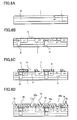
- n and n+ epitaxial layers are formed on an undoped GaAs substrate 1, as shown in FIG. 6A.
- the n+ epitaxial layer 2 (Si + 5 x 10 18 cm -3 ), which has a thickness of about 500 nm, is first formed on the undoped GaAs substrate 1 using metal-organic chemical vapor deposition (MOCVD) technique.
- MOCVD metal-organic chemical vapor deposition
- the n epitaxial layer 3 Si + 1.3 x 10 17 cm -3 ), which has a thickness of about 250 nm, is then formed on the n+ epitaxial layer using MOCVD.
- an insulating region 6 is formed in the n and n+ epitaxial layers by ion implantation technique, as shown in FIG. 6B.
- a photoresist layer (not shown) is formed on the nitride film 5. The photoresist layer is, then, exposed so that the portions of the photoresist layer that correspond to locations for formation of an insulating region 6 are removed during a subsequent developing process.
- impurities such as boron (B + ) and hydrogen (H + ) are ion-implanted into the n and n+ epitaxial layers 2, 3 using the photoresist layer as a mask.
- the ion implantation condition in this embodiment, is B + 160 KeV and 4 x 10 13 cm -2 .
- the insulating region 6 thus formed reaches the undoped GaAs substrate 1. Because the formation of the insulating region 6 does not require the trench formation of the conventional device of FIG. 2, a method of manufacturing a discrete diode device is applied to this manufacturing method without major modification.
- n type impurities are implanted into the n epitaxial layer 3 and the n+ epitaxial layer 2 to form the impurity regions 7.
- Si + impurities are implanted to provide an impurity concentration of about 1 x 10 18 cm -3 .
- the ion implantation should be performed over several implantation steps with different implantation conditions so that the impurity concentration is homogeneous along the depth direction of the impurity region 7.
- the first implantation is performed under Si + 180 KeV and 1 x 10 14 cm -2
- the second implantation is performed under Si + 30 KeV and 1 x 10 13 cm -2
- an additional nitride film 5 is formed on the nitride film 5 for annealing the impurity region 7 and the insulating region 6.
- an ohmic electrode 8 is formed on the impurity region 7 to form an ohmic contact with the impurity region 7.
- a photoresist layer is formed on the entire top surface of the device intermediate and is patterned to open portions of the photoresist layer that correspond to locations of formation of the ohmic electrode 8.
- the photoresist layer as a mask, the nitride film 5 that is exposed in the opening of the photoresist layer is removed to expose the impurity region 7.
- a first metal layer mad of AuGe/Ni/Au is deposited on the exposed surface of the impurity region 7 by vacuum-vapor depositing AuGe, Ni and Au in this order, and the photoresist layer is removed to leave the first metal layer only on the predetermined locations of the ohmic electrode 8.
- the device intermediate is, then, heated to alloy the first metal layer so that an ohmic contact is formed between the fist metal layer and the impurity region 7.
- a photoresist layer is formed on the nitride film 5 and patterned to open portions of the photoresist layer that correspond to locations of formation of Schottky contact regions 11a and the bonding pad regions.
- the portions of the nitride film 5, which is exposed in the opening of the photoresist layer, is removed by dry etching. After removal of the photoresist layer, a contact hole 9 emerges to expose the n epitaxial layer 3.
- a second metal layer 16 is formed to provide a common electrode 16a, an anode electrode 16c and a cathode electrode 16b.
- a photoresist layer is formed on the entire device intermediate and patterned to open portions of the photoresist layer that correspond to locations of formation of the electrodes 16a, 16b, 16c.
- the second metal layer 16 made of Ti/Pt/Au is, then, formed on the entire top surface of the device intermediate by vacuum-vapor depositing Ti, Pt and Au in this order. The photoresist layer is removed to leave the second metal layer 16 only at locations of the electrodes 16a, 16b, 16c.
- a Schottky contact is formed between the second metal layer 16 and the n epitaxial layer 3 at the anode portion of the diode, and an contact is formed between the second meal layer 16 and the ohmic electrode 8. Then, the backside of the substrate undergoes a back wrapping process.
- etching of the epitaxial layers 22, 23 and the GaAs substrate 21 is required to adjust the depth of the operation layer 23, to create the mesa structure and to create the trenches 26.
- the etching of the operation layer 23 is difficult to control because of the process parameters such as swing speed and swing amplitude of the device intermediate in an etching solution as well as maintenance of the etching solution.
- the planar configuration of the device of this embodiment removes the etching step of the epitaxial layers and the GaAs substrate, which is required in manufacturing the conventional integrated Schottky barrier diode chip. Accordingly, an integrated Schottky barrier diode chip with improved device characteristics is obtained.
- the conventional manufacturing method need to perform a plurality of polymer coatings for forming the polyimide layer 30 and an extended plating process for forming the tall Au plating layer 36 that is required to accommodate the low mechanical strength of the polyimide layer 30.
- the manufacturing method of this embodiment is simpler and more effective than the conventional method.
- the integrated Schottky barrier diode chips thus formed on the GaAs substrate are transferred to an assembly process.
- the GaAs wafer is diced to separate the individual chips.
- the wire bonding regions of the electrodes are connected to corresponding leads by stitch-bonding a thin gold wire line.
- a resin transfer molding of the chip and the frame completes packaging of the device.
Landscapes
- Electrodes Of Semiconductors (AREA)
- Element Separation (AREA)
Applications Claiming Priority (2)
| Application Number | Priority Date | Filing Date | Title |
|---|---|---|---|
| JP2001334087 | 2001-10-31 | ||
| JP2001334087A JP2003142697A (ja) | 2001-10-31 | 2001-10-31 | 集積型ショットキーバリアダイオードおよびその製造方法 |
Publications (2)
| Publication Number | Publication Date |
|---|---|
| EP1309012A2 true EP1309012A2 (fr) | 2003-05-07 |
| EP1309012A3 EP1309012A3 (fr) | 2005-04-20 |
Family
ID=19149274
Family Applications (1)
| Application Number | Title | Priority Date | Filing Date |
|---|---|---|---|
| EP20020024472 Withdrawn EP1309012A3 (fr) | 2001-10-31 | 2002-10-29 | Diode Schottky intégrée et procédé de fabrication |
Country Status (6)
| Country | Link |
|---|---|
| US (1) | US6787871B2 (fr) |
| EP (1) | EP1309012A3 (fr) |
| JP (1) | JP2003142697A (fr) |
| KR (1) | KR100620926B1 (fr) |
| CN (1) | CN100472814C (fr) |
| TW (1) | TW561623B (fr) |
Families Citing this family (8)
| Publication number | Priority date | Publication date | Assignee | Title |
|---|---|---|---|---|
| US7528459B2 (en) * | 2003-05-27 | 2009-05-05 | Nxp B.V. | Punch-through diode and method of processing the same |
| JP4637553B2 (ja) * | 2004-11-22 | 2011-02-23 | パナソニック株式会社 | ショットキーバリアダイオード及びそれを用いた集積回路 |
| DE102004056663A1 (de) * | 2004-11-24 | 2006-06-01 | Robert Bosch Gmbh | Halbleitereinrichtung und Gleichrichteranordnung |
| JP4567426B2 (ja) * | 2004-11-25 | 2010-10-20 | パナソニック株式会社 | ショットキーバリアダイオード及びダイオードアレイ |
| JP5044986B2 (ja) * | 2006-05-17 | 2012-10-10 | サンケン電気株式会社 | 半導体発光装置 |
| EP2454760A2 (fr) * | 2009-07-17 | 2012-05-23 | Lockheed Martin Corporation | Photodétecteur à déformation compensée et à barrière de longueur donde plus éloignée |
| KR101051578B1 (ko) * | 2009-09-08 | 2011-07-22 | 삼성전기주식회사 | 반도체 소자 및 그 제조 방법 |
| CN102184853B (zh) * | 2011-05-06 | 2015-12-02 | 上海华虹宏力半导体制造有限公司 | 肖特基二级管的制作方法 |
Family Cites Families (8)
| Publication number | Priority date | Publication date | Assignee | Title |
|---|---|---|---|---|
| US4254428A (en) * | 1979-12-28 | 1981-03-03 | International Business Machines Corporation | Self-aligned Schottky diode structure and method of fabrication |
| JPS59161836A (ja) * | 1983-03-04 | 1984-09-12 | Sanyo Electric Co Ltd | 半導体装置 |
| GB2137412B (en) * | 1983-03-15 | 1987-03-04 | Standard Telephones Cables Ltd | Semiconductor device |
| DE3620686C2 (de) * | 1986-06-20 | 1999-07-22 | Daimler Chrysler Ag | Strukturierter Halbleiterkörper |
| US5021840A (en) * | 1987-08-18 | 1991-06-04 | Texas Instruments Incorporated | Schottky or PN diode with composite sidewall |
| FR2650439B1 (fr) * | 1989-07-27 | 1991-11-15 | Sgs Thomson Microelectronics | Circuit integre vdmos/logique comprenant une diode |
| JP3093620B2 (ja) * | 1995-10-19 | 2000-10-03 | 日本電気株式会社 | 半導体装置の製造方法 |
| JP2003101036A (ja) * | 2001-09-25 | 2003-04-04 | Sanyo Electric Co Ltd | ショットキーバリアダイオードおよびその製造方法 |
-
2001
- 2001-10-31 JP JP2001334087A patent/JP2003142697A/ja active Pending
-
2002
- 2002-10-17 TW TW91123897A patent/TW561623B/zh not_active IP Right Cessation
- 2002-10-29 EP EP20020024472 patent/EP1309012A3/fr not_active Withdrawn
- 2002-10-30 CN CNB02147950XA patent/CN100472814C/zh not_active Expired - Fee Related
- 2002-10-30 KR KR20020066501A patent/KR100620926B1/ko not_active Expired - Fee Related
- 2002-10-30 US US10/283,331 patent/US6787871B2/en not_active Expired - Lifetime
Also Published As
| Publication number | Publication date |
|---|---|
| TW561623B (en) | 2003-11-11 |
| KR20030036047A (ko) | 2003-05-09 |
| CN100472814C (zh) | 2009-03-25 |
| US6787871B2 (en) | 2004-09-07 |
| KR100620926B1 (ko) | 2006-09-13 |
| JP2003142697A (ja) | 2003-05-16 |
| EP1309012A3 (fr) | 2005-04-20 |
| US20030094668A1 (en) | 2003-05-22 |
| CN1417867A (zh) | 2003-05-14 |
Similar Documents
| Publication | Publication Date | Title |
|---|---|---|
| US6627967B2 (en) | Schottky barrier diode | |
| US9887152B2 (en) | Method for manufacturing semiconductor devices having a metallisation layer | |
| US20030025175A1 (en) | Schottky barrier diode | |
| US6940157B2 (en) | High frequency semiconductor module, high frequency semiconductor device and manufacturing method for the same | |
| KR100738149B1 (ko) | 반도체 장치 및 그 제조 방법 | |
| US6787871B2 (en) | Integrated schottky barrier diode and manufacturing method thereof | |
| US20050179106A1 (en) | Schottky barrier diode | |
| KR100612188B1 (ko) | 쇼트키 배리어 다이오드 및 그의 제조 방법 | |
| KR100612189B1 (ko) | 쇼트키 배리어 다이오드 및 그 제조 방법 | |
| KR100612186B1 (ko) | 쇼트키 배리어 다이오드 및 그 제조 방법 | |
| CN100470845C (zh) | 肖特基势垒二极管及其制造方法 | |
| KR100616049B1 (ko) | 쇼트키 배리어 다이오드 및 그 제조 방법 | |
| US6682968B2 (en) | Manufacturing method of Schottky barrier diode | |
| KR100612187B1 (ko) | 쇼트키 배리어 다이오드의 제조 방법 | |
| EP1280210A2 (fr) | Diode Schottky et procédé de fabrication d'une diode Schottky | |
| CN118676005A (zh) | 形成半导体封装的方法和形成多个半导体封装的方法 |
Legal Events
| Date | Code | Title | Description |
|---|---|---|---|
| PUAI | Public reference made under article 153(3) epc to a published international application that has entered the european phase |
Free format text: ORIGINAL CODE: 0009012 |
|
| AK | Designated contracting states |
Designated state(s): AT BE BG CH CY CZ DE DK EE ES FI FR GB GR IE IT LI LU MC NL PT SE SK TR |
|
| AX | Request for extension of the european patent |
Extension state: AL LT LV MK RO SI |
|
| PUAL | Search report despatched |
Free format text: ORIGINAL CODE: 0009013 |
|
| AK | Designated contracting states |
Kind code of ref document: A3 Designated state(s): AT BE BG CH CY CZ DE DK EE ES FI FR GB GR IE IT LI LU MC NL PT SE SK TR |
|
| AX | Request for extension of the european patent |
Extension state: AL LT LV MK RO SI |
|
| AKX | Designation fees paid | ||
| STAA | Information on the status of an ep patent application or granted ep patent |
Free format text: STATUS: THE APPLICATION IS DEEMED TO BE WITHDRAWN |
|
| 18D | Application deemed to be withdrawn |
Effective date: 20051021 |
|
| REG | Reference to a national code |
Ref country code: DE Ref legal event code: 8566 |