EP1299218B1 - Method for in-mold coating a polyolefin article - Google Patents
Method for in-mold coating a polyolefin article Download PDFInfo
- Publication number
- EP1299218B1 EP1299218B1 EP01948715A EP01948715A EP1299218B1 EP 1299218 B1 EP1299218 B1 EP 1299218B1 EP 01948715 A EP01948715 A EP 01948715A EP 01948715 A EP01948715 A EP 01948715A EP 1299218 B1 EP1299218 B1 EP 1299218B1
- Authority
- EP
- European Patent Office
- Prior art keywords
- mold
- coating composition
- work piece
- coating
- temperature
- Prior art date
- Legal status (The legal status is an assumption and is not a legal conclusion. Google has not performed a legal analysis and makes no representation as to the accuracy of the status listed.)
- Expired - Lifetime
Links
- 238000000576 coating method Methods 0.000 title claims abstract description 87
- 239000011248 coating agent Substances 0.000 title claims abstract description 65
- 229920000098 polyolefin Polymers 0.000 title claims abstract description 57
- 238000000034 method Methods 0.000 title claims abstract description 47
- 239000008199 coating composition Substances 0.000 claims abstract description 55
- 230000008569 process Effects 0.000 claims abstract description 21
- 229920001187 thermosetting polymer Polymers 0.000 claims abstract description 20
- 238000002844 melting Methods 0.000 claims abstract description 4
- 230000008018 melting Effects 0.000 claims abstract description 4
- -1 alkylene polyol Chemical class 0.000 claims description 45
- 229920000728 polyester Polymers 0.000 claims description 30
- 239000003999 initiator Substances 0.000 claims description 27
- 150000003254 radicals Chemical class 0.000 claims description 26
- 239000000758 substrate Substances 0.000 claims description 25
- UHESRSKEBRADOO-UHFFFAOYSA-N ethyl carbamate;prop-2-enoic acid Chemical compound OC(=O)C=C.CCOC(N)=O UHESRSKEBRADOO-UHFFFAOYSA-N 0.000 claims description 21
- NIXOWILDQLNWCW-UHFFFAOYSA-M Acrylate Chemical compound [O-]C(=O)C=C NIXOWILDQLNWCW-UHFFFAOYSA-M 0.000 claims description 16
- 125000001931 aliphatic group Chemical group 0.000 claims description 16
- 229920006395 saturated elastomer Polymers 0.000 claims description 14
- 239000000203 mixture Substances 0.000 claims description 13
- 150000001875 compounds Chemical class 0.000 claims description 12
- 229920005862 polyol Polymers 0.000 claims description 11
- 239000000178 monomer Substances 0.000 claims description 9
- 150000001252 acrylic acid derivatives Chemical class 0.000 claims description 8
- 150000002978 peroxides Chemical class 0.000 claims description 8
- JOYRKODLDBILNP-UHFFFAOYSA-N Ethyl urethane Chemical compound CCOC(N)=O JOYRKODLDBILNP-UHFFFAOYSA-N 0.000 claims description 7
- 125000002768 hydroxyalkyl group Chemical group 0.000 claims description 7
- 239000004593 Epoxy Substances 0.000 claims description 6
- 150000002148 esters Chemical class 0.000 claims description 6
- 229920003232 aliphatic polyester Polymers 0.000 claims description 5
- 229920000058 polyacrylate Polymers 0.000 claims description 5
- 125000000391 vinyl group Chemical group [H]C([*])=C([H])[H] 0.000 claims description 5
- 229920002554 vinyl polymer Polymers 0.000 claims description 5
- 238000010438 heat treatment Methods 0.000 claims description 4
- 125000000484 butyl group Chemical group [H]C([*])([H])C([H])([H])C([H])([H])C([H])([H])[H] 0.000 claims description 3
- GJBRNHKUVLOCEB-UHFFFAOYSA-N tert-butyl benzenecarboperoxoate Chemical group CC(C)(C)OOC(=O)C1=CC=CC=C1 GJBRNHKUVLOCEB-UHFFFAOYSA-N 0.000 claims description 3
- 230000004913 activation Effects 0.000 claims 1
- 239000003822 epoxy resin Substances 0.000 claims 1
- 229920000647 polyepoxide Polymers 0.000 claims 1
- 229920001169 thermoplastic Polymers 0.000 abstract description 37
- 239000004416 thermosoftening plastic Substances 0.000 abstract description 37
- 238000000465 moulding Methods 0.000 abstract description 17
- 239000000463 material Substances 0.000 abstract description 15
- 239000012815 thermoplastic material Substances 0.000 abstract description 5
- 239000003973 paint Substances 0.000 description 17
- PPBRXRYQALVLMV-UHFFFAOYSA-N Styrene Chemical compound C=CC1=CC=CC=C1 PPBRXRYQALVLMV-UHFFFAOYSA-N 0.000 description 14
- 238000001746 injection moulding Methods 0.000 description 13
- 239000000543 intermediate Substances 0.000 description 12
- 229920005989 resin Polymers 0.000 description 12
- 239000011347 resin Substances 0.000 description 12
- 125000004432 carbon atom Chemical group C* 0.000 description 10
- 238000005530 etching Methods 0.000 description 9
- 125000003118 aryl group Chemical group 0.000 description 8
- 239000004743 Polypropylene Substances 0.000 description 7
- 238000002347 injection Methods 0.000 description 7
- 239000007924 injection Substances 0.000 description 7
- 239000000049 pigment Substances 0.000 description 7
- 229920001155 polypropylene Polymers 0.000 description 7
- 239000002904 solvent Substances 0.000 description 7
- LYCAIKOWRPUZTN-UHFFFAOYSA-N Ethylene glycol Chemical compound OCCO LYCAIKOWRPUZTN-UHFFFAOYSA-N 0.000 description 6
- QIGBRXMKCJKVMJ-UHFFFAOYSA-N Hydroquinone Chemical compound OC1=CC=C(O)C=C1 QIGBRXMKCJKVMJ-UHFFFAOYSA-N 0.000 description 6
- 239000002202 Polyethylene glycol Substances 0.000 description 6
- 239000003677 Sheet moulding compound Substances 0.000 description 6
- VYPSYNLAJGMNEJ-UHFFFAOYSA-N Silicium dioxide Chemical compound O=[Si]=O VYPSYNLAJGMNEJ-UHFFFAOYSA-N 0.000 description 6
- CJZGTCYPCWQAJB-UHFFFAOYSA-L calcium stearate Chemical class [Ca+2].CCCCCCCCCCCCCCCCCC([O-])=O.CCCCCCCCCCCCCCCCCC([O-])=O CJZGTCYPCWQAJB-UHFFFAOYSA-L 0.000 description 6
- 229920001223 polyethylene glycol Polymers 0.000 description 6
- 239000004698 Polyethylene Substances 0.000 description 5
- 239000000654 additive Substances 0.000 description 5
- 239000007795 chemical reaction product Substances 0.000 description 5
- 239000003086 colorant Substances 0.000 description 5
- 229920000573 polyethylene Polymers 0.000 description 5
- 239000005056 polyisocyanate Substances 0.000 description 5
- 229920001228 polyisocyanate Polymers 0.000 description 5
- PUPZLCDOIYMWBV-UHFFFAOYSA-N (+/-)-1,3-Butanediol Chemical compound CC(O)CCO PUPZLCDOIYMWBV-UHFFFAOYSA-N 0.000 description 4
- PSGCQDPCAWOCSH-UHFFFAOYSA-N (4,7,7-trimethyl-3-bicyclo[2.2.1]heptanyl) prop-2-enoate Chemical compound C1CC2(C)C(OC(=O)C=C)CC1C2(C)C PSGCQDPCAWOCSH-UHFFFAOYSA-N 0.000 description 4
- WNLRTRBMVRJNCN-UHFFFAOYSA-N adipic acid Chemical compound OC(=O)CCCCC(O)=O WNLRTRBMVRJNCN-UHFFFAOYSA-N 0.000 description 4
- ZQMIGQNCOMNODD-UHFFFAOYSA-N diacetyl peroxide Chemical compound CC(=O)OOC(C)=O ZQMIGQNCOMNODD-UHFFFAOYSA-N 0.000 description 4
- DOIRQSBPFJWKBE-UHFFFAOYSA-N dibutyl phthalate Chemical compound CCCCOC(=O)C1=CC=CC=C1C(=O)OCCCC DOIRQSBPFJWKBE-UHFFFAOYSA-N 0.000 description 4
- 239000004611 light stabiliser Substances 0.000 description 4
- 229920003023 plastic Polymers 0.000 description 4
- 239000004033 plastic Substances 0.000 description 4
- 238000004381 surface treatment Methods 0.000 description 4
- MMEDJBFVJUFIDD-UHFFFAOYSA-N 2-[2-(carboxymethyl)phenyl]acetic acid Chemical compound OC(=O)CC1=CC=CC=C1CC(O)=O MMEDJBFVJUFIDD-UHFFFAOYSA-N 0.000 description 3
- GNSFRPWPOGYVLO-UHFFFAOYSA-N 3-hydroxypropyl 2-methylprop-2-enoate Chemical compound CC(=C)C(=O)OCCCO GNSFRPWPOGYVLO-UHFFFAOYSA-N 0.000 description 3
- DNIAPMSPPWPWGF-UHFFFAOYSA-N Propylene glycol Chemical compound CC(O)CO DNIAPMSPPWPWGF-UHFFFAOYSA-N 0.000 description 3
- 150000001412 amines Chemical class 0.000 description 3
- 235000013539 calcium stearate Nutrition 0.000 description 3
- 238000010276 construction Methods 0.000 description 3
- 238000001816 cooling Methods 0.000 description 3
- 238000004132 cross linking Methods 0.000 description 3
- 125000004386 diacrylate group Chemical group 0.000 description 3
- MTHSVFCYNBDYFN-UHFFFAOYSA-N diethylene glycol Chemical compound OCCOCCO MTHSVFCYNBDYFN-UHFFFAOYSA-N 0.000 description 3
- 125000005442 diisocyanate group Chemical group 0.000 description 3
- 150000002009 diols Chemical class 0.000 description 3
- 125000001495 ethyl group Chemical group [H]C([H])([H])C([H])([H])* 0.000 description 3
- 238000011049 filling Methods 0.000 description 3
- 150000002334 glycols Chemical class 0.000 description 3
- 239000003112 inhibitor Substances 0.000 description 3
- 238000004519 manufacturing process Methods 0.000 description 3
- 229910052751 metal Inorganic materials 0.000 description 3
- 239000002184 metal Substances 0.000 description 3
- 238000002156 mixing Methods 0.000 description 3
- 238000012856 packing Methods 0.000 description 3
- 238000010422 painting Methods 0.000 description 3
- 229920000570 polyether Polymers 0.000 description 3
- 229920000642 polymer Polymers 0.000 description 3
- 150000003077 polyols Chemical class 0.000 description 3
- 239000004814 polyurethane Substances 0.000 description 3
- 229920002635 polyurethane Polymers 0.000 description 3
- 239000002987 primer (paints) Substances 0.000 description 3
- 239000000047 product Substances 0.000 description 3
- 239000000377 silicon dioxide Substances 0.000 description 3
- 239000000243 solution Substances 0.000 description 3
- 239000000454 talc Substances 0.000 description 3
- 229910052623 talc Inorganic materials 0.000 description 3
- 238000011282 treatment Methods 0.000 description 3
- XLYOFNOQVPJJNP-UHFFFAOYSA-N water Substances O XLYOFNOQVPJJNP-UHFFFAOYSA-N 0.000 description 3
- 229940058015 1,3-butylene glycol Drugs 0.000 description 2
- LEJBBGNFPAFPKQ-UHFFFAOYSA-N 2-(2-prop-2-enoyloxyethoxy)ethyl prop-2-enoate Chemical compound C=CC(=O)OCCOCCOC(=O)C=C LEJBBGNFPAFPKQ-UHFFFAOYSA-N 0.000 description 2
- XFCMNSHQOZQILR-UHFFFAOYSA-N 2-[2-(2-methylprop-2-enoyloxy)ethoxy]ethyl 2-methylprop-2-enoate Chemical compound CC(=C)C(=O)OCCOCCOC(=O)C(C)=C XFCMNSHQOZQILR-UHFFFAOYSA-N 0.000 description 2
- INQDDHNZXOAFFD-UHFFFAOYSA-N 2-[2-(2-prop-2-enoyloxyethoxy)ethoxy]ethyl prop-2-enoate Chemical compound C=CC(=O)OCCOCCOCCOC(=O)C=C INQDDHNZXOAFFD-UHFFFAOYSA-N 0.000 description 2
- HCLJOFJIQIJXHS-UHFFFAOYSA-N 2-[2-[2-(2-prop-2-enoyloxyethoxy)ethoxy]ethoxy]ethyl prop-2-enoate Chemical compound C=CC(=O)OCCOCCOCCOCCOC(=O)C=C HCLJOFJIQIJXHS-UHFFFAOYSA-N 0.000 description 2
- GTELLNMUWNJXMQ-UHFFFAOYSA-N 2-ethyl-2-(hydroxymethyl)propane-1,3-diol;prop-2-enoic acid Chemical class OC(=O)C=C.OC(=O)C=C.OC(=O)C=C.CCC(CO)(CO)CO GTELLNMUWNJXMQ-UHFFFAOYSA-N 0.000 description 2
- CWPKTBMRVATCBL-UHFFFAOYSA-N 3-[1-[1-[(2-methylphenyl)methyl]piperidin-4-yl]piperidin-4-yl]-1h-benzimidazol-2-one Chemical compound CC1=CC=CC=C1CN1CCC(N2CCC(CC2)N2C(NC3=CC=CC=C32)=O)CC1 CWPKTBMRVATCBL-UHFFFAOYSA-N 0.000 description 2
- 239000004412 Bulk moulding compound Substances 0.000 description 2
- NIQCNGHVCWTJSM-UHFFFAOYSA-N Dimethyl phthalate Chemical compound COC(=O)C1=CC=CC=C1C(=O)OC NIQCNGHVCWTJSM-UHFFFAOYSA-N 0.000 description 2
- OFOBLEOULBTSOW-UHFFFAOYSA-N Malonic acid Chemical compound OC(=O)CC(O)=O OFOBLEOULBTSOW-UHFFFAOYSA-N 0.000 description 2
- 239000004721 Polyphenylene oxide Substances 0.000 description 2
- GWEVSGVZZGPLCZ-UHFFFAOYSA-N Titan oxide Chemical compound O=[Ti]=O GWEVSGVZZGPLCZ-UHFFFAOYSA-N 0.000 description 2
- DAKWPKUUDNSNPN-UHFFFAOYSA-N Trimethylolpropane triacrylate Chemical compound C=CC(=O)OCC(CC)(COC(=O)C=C)COC(=O)C=C DAKWPKUUDNSNPN-UHFFFAOYSA-N 0.000 description 2
- HCHKCACWOHOZIP-UHFFFAOYSA-N Zinc Chemical compound [Zn] HCHKCACWOHOZIP-UHFFFAOYSA-N 0.000 description 2
- HVVWZTWDBSEWIH-UHFFFAOYSA-N [2-(hydroxymethyl)-3-prop-2-enoyloxy-2-(prop-2-enoyloxymethyl)propyl] prop-2-enoate Chemical compound C=CC(=O)OCC(CO)(COC(=O)C=C)COC(=O)C=C HVVWZTWDBSEWIH-UHFFFAOYSA-N 0.000 description 2
- 239000006096 absorbing agent Substances 0.000 description 2
- 239000001361 adipic acid Substances 0.000 description 2
- 235000011037 adipic acid Nutrition 0.000 description 2
- 125000000217 alkyl group Chemical group 0.000 description 2
- 150000008064 anhydrides Chemical class 0.000 description 2
- QVGXLLKOCUKJST-UHFFFAOYSA-N atomic oxygen Chemical compound [O] QVGXLLKOCUKJST-UHFFFAOYSA-N 0.000 description 2
- 235000019437 butane-1,3-diol Nutrition 0.000 description 2
- 239000008116 calcium stearate Substances 0.000 description 2
- 238000006243 chemical reaction Methods 0.000 description 2
- STVZJERGLQHEKB-UHFFFAOYSA-N ethylene glycol dimethacrylate Substances CC(=C)C(=O)OCCOC(=O)C(C)=C STVZJERGLQHEKB-UHFFFAOYSA-N 0.000 description 2
- 239000000835 fiber Substances 0.000 description 2
- 239000000945 filler Substances 0.000 description 2
- ACCCMOQWYVYDOT-UHFFFAOYSA-N hexane-1,1-diol Chemical compound CCCCCC(O)O ACCCMOQWYVYDOT-UHFFFAOYSA-N 0.000 description 2
- 125000004435 hydrogen atom Chemical group [H]* 0.000 description 2
- 125000002887 hydroxy group Chemical group [H]O* 0.000 description 2
- 239000012948 isocyanate Substances 0.000 description 2
- 150000002513 isocyanates Chemical class 0.000 description 2
- NIMLQBUJDJZYEJ-UHFFFAOYSA-N isophorone diisocyanate Chemical compound CC1(C)CC(N=C=O)CC(C)(CN=C=O)C1 NIMLQBUJDJZYEJ-UHFFFAOYSA-N 0.000 description 2
- 239000007788 liquid Substances 0.000 description 2
- 239000000314 lubricant Substances 0.000 description 2
- YDKNBNOOCSNPNS-UHFFFAOYSA-N methyl 1,3-benzoxazole-2-carboxylate Chemical compound C1=CC=C2OC(C(=O)OC)=NC2=C1 YDKNBNOOCSNPNS-UHFFFAOYSA-N 0.000 description 2
- 125000002496 methyl group Chemical group [H]C([H])([H])* 0.000 description 2
- SLCVBVWXLSEKPL-UHFFFAOYSA-N neopentyl glycol Chemical compound OCC(C)(C)CO SLCVBVWXLSEKPL-UHFFFAOYSA-N 0.000 description 2
- BDJRBEYXGGNYIS-UHFFFAOYSA-N nonanedioic acid Chemical compound OC(=O)CCCCCCCC(O)=O BDJRBEYXGGNYIS-UHFFFAOYSA-N 0.000 description 2
- 239000001301 oxygen Substances 0.000 description 2
- 229910052760 oxygen Inorganic materials 0.000 description 2
- 239000003504 photosensitizing agent Substances 0.000 description 2
- WLJVNTCWHIRURA-UHFFFAOYSA-N pimelic acid Chemical compound OC(=O)CCCCCC(O)=O WLJVNTCWHIRURA-UHFFFAOYSA-N 0.000 description 2
- IVDFJHOHABJVEH-UHFFFAOYSA-N pinacol Chemical compound CC(C)(O)C(C)(C)O IVDFJHOHABJVEH-UHFFFAOYSA-N 0.000 description 2
- 239000012462 polypropylene substrate Substances 0.000 description 2
- 229920002689 polyvinyl acetate Polymers 0.000 description 2
- 239000011118 polyvinyl acetate Substances 0.000 description 2
- 238000002360 preparation method Methods 0.000 description 2
- 125000001436 propyl group Chemical group [H]C([*])([H])C([H])([H])C([H])([H])[H] 0.000 description 2
- 239000011253 protective coating Substances 0.000 description 2
- CXMXRPHRNRROMY-UHFFFAOYSA-N sebacic acid Chemical compound OC(=O)CCCCCCCCC(O)=O CXMXRPHRNRROMY-UHFFFAOYSA-N 0.000 description 2
- 239000007787 solid Substances 0.000 description 2
- TYFQFVWCELRYAO-UHFFFAOYSA-N suberic acid Chemical compound OC(=O)CCCCCCC(O)=O TYFQFVWCELRYAO-UHFFFAOYSA-N 0.000 description 2
- 238000012360 testing method Methods 0.000 description 2
- 239000011701 zinc Substances 0.000 description 2
- 229910052725 zinc Inorganic materials 0.000 description 2
- XOOUIPVCVHRTMJ-UHFFFAOYSA-L zinc stearate Chemical compound [Zn+2].CCCCCCCCCCCCCCCCCC([O-])=O.CCCCCCCCCCCCCCCCCC([O-])=O XOOUIPVCVHRTMJ-UHFFFAOYSA-L 0.000 description 2
- WRXCBRHBHGNNQA-UHFFFAOYSA-N (2,4-dichlorobenzoyl) 2,4-dichlorobenzenecarboperoxoate Chemical compound ClC1=CC(Cl)=CC=C1C(=O)OOC(=O)C1=CC=C(Cl)C=C1Cl WRXCBRHBHGNNQA-UHFFFAOYSA-N 0.000 description 1
- FVQMJJQUGGVLEP-UHFFFAOYSA-N (2-methylpropan-2-yl)oxy 2-ethylhexaneperoxoate Chemical compound CCCCC(CC)C(=O)OOOC(C)(C)C FVQMJJQUGGVLEP-UHFFFAOYSA-N 0.000 description 1
- OXYKVVLTXXXVRT-UHFFFAOYSA-N (4-chlorobenzoyl) 4-chlorobenzenecarboperoxoate Chemical compound C1=CC(Cl)=CC=C1C(=O)OOC(=O)C1=CC=C(Cl)C=C1 OXYKVVLTXXXVRT-UHFFFAOYSA-N 0.000 description 1
- RIPYNJLMMFGZSX-UHFFFAOYSA-N (5-benzoylperoxy-2,5-dimethylhexan-2-yl) benzenecarboperoxoate Chemical compound C=1C=CC=CC=1C(=O)OOC(C)(C)CCC(C)(C)OOC(=O)C1=CC=CC=C1 RIPYNJLMMFGZSX-UHFFFAOYSA-N 0.000 description 1
- NALFRYPTRXKZPN-UHFFFAOYSA-N 1,1-bis(tert-butylperoxy)-3,3,5-trimethylcyclohexane Chemical compound CC1CC(C)(C)CC(OOC(C)(C)C)(OOC(C)(C)C)C1 NALFRYPTRXKZPN-UHFFFAOYSA-N 0.000 description 1
- VDYWHVQKENANGY-UHFFFAOYSA-N 1,3-Butyleneglycol dimethacrylate Chemical compound CC(=C)C(=O)OC(C)CCOC(=O)C(C)=C VDYWHVQKENANGY-UHFFFAOYSA-N 0.000 description 1
- AZQWKYJCGOJGHM-UHFFFAOYSA-N 1,4-benzoquinone Chemical compound O=C1C=CC(=O)C=C1 AZQWKYJCGOJGHM-UHFFFAOYSA-N 0.000 description 1
- UICXTANXZJJIBC-UHFFFAOYSA-N 1-(1-hydroperoxycyclohexyl)peroxycyclohexan-1-ol Chemical compound C1CCCCC1(O)OOC1(OO)CCCCC1 UICXTANXZJJIBC-UHFFFAOYSA-N 0.000 description 1
- ZDQNWDNMNKSMHI-UHFFFAOYSA-N 1-[2-(2-prop-2-enoyloxypropoxy)propoxy]propan-2-yl prop-2-enoate Chemical compound C=CC(=O)OC(C)COC(C)COCC(C)OC(=O)C=C ZDQNWDNMNKSMHI-UHFFFAOYSA-N 0.000 description 1
- UTHDGOQKIWLLCO-UHFFFAOYSA-N 1-hydroxyhexyl prop-2-enoate Chemical compound CCCCCC(O)OC(=O)C=C UTHDGOQKIWLLCO-UHFFFAOYSA-N 0.000 description 1
- RTBFRGCFXZNCOE-UHFFFAOYSA-N 1-methylsulfonylpiperidin-4-one Chemical compound CS(=O)(=O)N1CCC(=O)CC1 RTBFRGCFXZNCOE-UHFFFAOYSA-N 0.000 description 1
- PUGOMSLRUSTQGV-UHFFFAOYSA-N 2,3-di(prop-2-enoyloxy)propyl prop-2-enoate Chemical compound C=CC(=O)OCC(OC(=O)C=C)COC(=O)C=C PUGOMSLRUSTQGV-UHFFFAOYSA-N 0.000 description 1
- BJELTSYBAHKXRW-UHFFFAOYSA-N 2,4,6-triallyloxy-1,3,5-triazine Chemical compound C=CCOC1=NC(OCC=C)=NC(OCC=C)=N1 BJELTSYBAHKXRW-UHFFFAOYSA-N 0.000 description 1
- DMWVYCCGCQPJEA-UHFFFAOYSA-N 2,5-bis(tert-butylperoxy)-2,5-dimethylhexane Chemical compound CC(C)(C)OOC(C)(C)CCC(C)(C)OOC(C)(C)C DMWVYCCGCQPJEA-UHFFFAOYSA-N 0.000 description 1
- AVTLBBWTUPQRAY-UHFFFAOYSA-N 2-(2-cyanobutan-2-yldiazenyl)-2-methylbutanenitrile Chemical compound CCC(C)(C#N)N=NC(C)(CC)C#N AVTLBBWTUPQRAY-UHFFFAOYSA-N 0.000 description 1
- OZAIFHULBGXAKX-UHFFFAOYSA-N 2-(2-cyanopropan-2-yldiazenyl)-2-methylpropanenitrile Chemical compound N#CC(C)(C)N=NC(C)(C)C#N OZAIFHULBGXAKX-UHFFFAOYSA-N 0.000 description 1
- SMZOUWXMTYCWNB-UHFFFAOYSA-N 2-(2-methoxy-5-methylphenyl)ethanamine Chemical compound COC1=CC=C(C)C=C1CCN SMZOUWXMTYCWNB-UHFFFAOYSA-N 0.000 description 1
- NIXOWILDQLNWCW-UHFFFAOYSA-N 2-Propenoic acid Natural products OC(=O)C=C NIXOWILDQLNWCW-UHFFFAOYSA-N 0.000 description 1
- PFHOSZAOXCYAGJ-UHFFFAOYSA-N 2-[(2-cyano-4-methoxy-4-methylpentan-2-yl)diazenyl]-4-methoxy-2,4-dimethylpentanenitrile Chemical compound COC(C)(C)CC(C)(C#N)N=NC(C)(C#N)CC(C)(C)OC PFHOSZAOXCYAGJ-UHFFFAOYSA-N 0.000 description 1
- WYGWHHGCAGTUCH-UHFFFAOYSA-N 2-[(2-cyano-4-methylpentan-2-yl)diazenyl]-2,4-dimethylpentanenitrile Chemical compound CC(C)CC(C)(C#N)N=NC(C)(C#N)CC(C)C WYGWHHGCAGTUCH-UHFFFAOYSA-N 0.000 description 1
- YIJYFLXQHDOQGW-UHFFFAOYSA-N 2-[2,4,6-trioxo-3,5-bis(2-prop-2-enoyloxyethyl)-1,3,5-triazinan-1-yl]ethyl prop-2-enoate Chemical compound C=CC(=O)OCCN1C(=O)N(CCOC(=O)C=C)C(=O)N(CCOC(=O)C=C)C1=O YIJYFLXQHDOQGW-UHFFFAOYSA-N 0.000 description 1
- HWSSEYVMGDIFMH-UHFFFAOYSA-N 2-[2-[2-(2-methylprop-2-enoyloxy)ethoxy]ethoxy]ethyl 2-methylprop-2-enoate Chemical compound CC(=C)C(=O)OCCOCCOCCOC(=O)C(C)=C HWSSEYVMGDIFMH-UHFFFAOYSA-N 0.000 description 1
- LTHJXDSHSVNJKG-UHFFFAOYSA-N 2-[2-[2-[2-(2-methylprop-2-enoyloxy)ethoxy]ethoxy]ethoxy]ethyl 2-methylprop-2-enoate Chemical compound CC(=C)C(=O)OCCOCCOCCOCCOC(=O)C(C)=C LTHJXDSHSVNJKG-UHFFFAOYSA-N 0.000 description 1
- AGEXUCKZTAUZJM-UHFFFAOYSA-N 2-[4,6-bis[2-(2-methylprop-2-enoyloxy)ethyl]-1,3,5-triazin-2-yl]ethyl 2-methylprop-2-enoate Chemical compound CC(=C)C(=O)OCCC1=NC(CCOC(=O)C(C)=C)=NC(CCOC(=O)C(C)=C)=N1 AGEXUCKZTAUZJM-UHFFFAOYSA-N 0.000 description 1
- CKSAKVMRQYOFBC-UHFFFAOYSA-N 2-cyanopropan-2-yliminourea Chemical compound N#CC(C)(C)N=NC(N)=O CKSAKVMRQYOFBC-UHFFFAOYSA-N 0.000 description 1
- WFUGQJXVXHBTEM-UHFFFAOYSA-N 2-hydroperoxy-2-(2-hydroperoxybutan-2-ylperoxy)butane Chemical compound CCC(C)(OO)OOC(C)(CC)OO WFUGQJXVXHBTEM-UHFFFAOYSA-N 0.000 description 1
- DXIJHCSGLOHNES-UHFFFAOYSA-N 3,3-dimethylbut-1-enylbenzene Chemical compound CC(C)(C)C=CC1=CC=CC=C1 DXIJHCSGLOHNES-UHFFFAOYSA-N 0.000 description 1
- XOJWAAUYNWGQAU-UHFFFAOYSA-N 4-(2-methylprop-2-enoyloxy)butyl 2-methylprop-2-enoate Chemical compound CC(=C)C(=O)OCCCCOC(=O)C(C)=C XOJWAAUYNWGQAU-UHFFFAOYSA-N 0.000 description 1
- DBCAQXHNJOFNGC-UHFFFAOYSA-N 4-bromo-1,1,1-trifluorobutane Chemical compound FC(F)(F)CCCBr DBCAQXHNJOFNGC-UHFFFAOYSA-N 0.000 description 1
- OPPHXULEHGYZRW-UHFFFAOYSA-N 4-methoxy-2,4-dimethyl-2-phenyldiazenylpentanenitrile Chemical compound COC(C)(C)CC(C)(C#N)N=NC1=CC=CC=C1 OPPHXULEHGYZRW-UHFFFAOYSA-N 0.000 description 1
- JHWGFJBTMHEZME-UHFFFAOYSA-N 4-prop-2-enoyloxybutyl prop-2-enoate Chemical compound C=CC(=O)OCCCCOC(=O)C=C JHWGFJBTMHEZME-UHFFFAOYSA-N 0.000 description 1
- XESZUVZBAMCAEJ-UHFFFAOYSA-N 4-tert-butylcatechol Chemical compound CC(C)(C)C1=CC=C(O)C(O)=C1 XESZUVZBAMCAEJ-UHFFFAOYSA-N 0.000 description 1
- SAPGBCWOQLHKKZ-UHFFFAOYSA-N 6-(2-methylprop-2-enoyloxy)hexyl 2-methylprop-2-enoate Chemical compound CC(=C)C(=O)OCCCCCCOC(=O)C(C)=C SAPGBCWOQLHKKZ-UHFFFAOYSA-N 0.000 description 1
- HOSGXJWQVBHGLT-UHFFFAOYSA-N 6-hydroxy-3,4-dihydro-1h-quinolin-2-one Chemical group N1C(=O)CCC2=CC(O)=CC=C21 HOSGXJWQVBHGLT-UHFFFAOYSA-N 0.000 description 1
- DXPPIEDUBFUSEZ-UHFFFAOYSA-N 6-methylheptyl prop-2-enoate Chemical compound CC(C)CCCCCOC(=O)C=C DXPPIEDUBFUSEZ-UHFFFAOYSA-N 0.000 description 1
- FIHBHSQYSYVZQE-UHFFFAOYSA-N 6-prop-2-enoyloxyhexyl prop-2-enoate Chemical compound C=CC(=O)OCCCCCCOC(=O)C=C FIHBHSQYSYVZQE-UHFFFAOYSA-N 0.000 description 1
- LVGFPWDANALGOY-UHFFFAOYSA-N 8-methylnonyl prop-2-enoate Chemical compound CC(C)CCCCCCCOC(=O)C=C LVGFPWDANALGOY-UHFFFAOYSA-N 0.000 description 1
- OMPJBNCRMGITSC-UHFFFAOYSA-N Benzoylperoxide Chemical compound C=1C=CC=CC=1C(=O)OOC(=O)C1=CC=CC=C1 OMPJBNCRMGITSC-UHFFFAOYSA-N 0.000 description 1
- OKTJSMMVPCPJKN-UHFFFAOYSA-N Carbon Chemical compound [C] OKTJSMMVPCPJKN-UHFFFAOYSA-N 0.000 description 1
- VYZAMTAEIAYCRO-UHFFFAOYSA-N Chromium Chemical compound [Cr] VYZAMTAEIAYCRO-UHFFFAOYSA-N 0.000 description 1
- 208000015943 Coeliac disease Diseases 0.000 description 1
- 239000004641 Diallyl-phthalate Substances 0.000 description 1
- 239000005977 Ethylene Substances 0.000 description 1
- VZCYOOQTPOCHFL-OWOJBTEDSA-N Fumaric acid Chemical class OC(=O)\C=C\C(O)=O VZCYOOQTPOCHFL-OWOJBTEDSA-N 0.000 description 1
- 239000005057 Hexamethylene diisocyanate Substances 0.000 description 1
- 239000005058 Isophorone diisocyanate Substances 0.000 description 1
- CERQOIWHTDAKMF-UHFFFAOYSA-M Methacrylate Chemical compound CC(=C)C([O-])=O CERQOIWHTDAKMF-UHFFFAOYSA-M 0.000 description 1
- CERQOIWHTDAKMF-UHFFFAOYSA-N Methacrylic acid Chemical compound CC(=C)C(O)=O CERQOIWHTDAKMF-UHFFFAOYSA-N 0.000 description 1
- 229920001730 Moisture cure polyurethane Polymers 0.000 description 1
- 239000004677 Nylon Substances 0.000 description 1
- 239000004952 Polyamide Substances 0.000 description 1
- 239000004793 Polystyrene Substances 0.000 description 1
- KDYFGRWQOYBRFD-UHFFFAOYSA-N Succinic acid Natural products OC(=O)CCC(O)=O KDYFGRWQOYBRFD-UHFFFAOYSA-N 0.000 description 1
- OKKRPWIIYQTPQF-UHFFFAOYSA-N Trimethylolpropane trimethacrylate Chemical compound CC(=C)C(=O)OCC(CC)(COC(=O)C(C)=C)COC(=O)C(C)=C OKKRPWIIYQTPQF-UHFFFAOYSA-N 0.000 description 1
- 230000006750 UV protection Effects 0.000 description 1
- IAXXETNIOYFMLW-COPLHBTASA-N [(1s,3s,4s)-4,7,7-trimethyl-3-bicyclo[2.2.1]heptanyl] 2-methylprop-2-enoate Chemical compound C1C[C@]2(C)[C@@H](OC(=O)C(=C)C)C[C@H]1C2(C)C IAXXETNIOYFMLW-COPLHBTASA-N 0.000 description 1
- MQAUISQNOPASHJ-UHFFFAOYSA-N [1-(hydroxymethyl)cyclohexyl]methanol;2-(2-hydroxypropoxy)propan-1-ol Chemical compound CC(O)COC(C)CO.OCC1(CO)CCCCC1 MQAUISQNOPASHJ-UHFFFAOYSA-N 0.000 description 1
- ULQMPOIOSDXIGC-UHFFFAOYSA-N [2,2-dimethyl-3-(2-methylprop-2-enoyloxy)propyl] 2-methylprop-2-enoate Chemical compound CC(=C)C(=O)OCC(C)(C)COC(=O)C(C)=C ULQMPOIOSDXIGC-UHFFFAOYSA-N 0.000 description 1
- KYIKRXIYLAGAKQ-UHFFFAOYSA-N abcn Chemical compound C1CCCCC1(C#N)N=NC1(C#N)CCCCC1 KYIKRXIYLAGAKQ-UHFFFAOYSA-N 0.000 description 1
- 239000002253 acid Substances 0.000 description 1
- 150000007513 acids Chemical class 0.000 description 1
- 239000002318 adhesion promoter Substances 0.000 description 1
- 230000032683 aging Effects 0.000 description 1
- XYLMUPLGERFSHI-UHFFFAOYSA-N alpha-Methylstyrene Chemical compound CC(=C)C1=CC=CC=C1 XYLMUPLGERFSHI-UHFFFAOYSA-N 0.000 description 1
- 229910052782 aluminium Inorganic materials 0.000 description 1
- XAGFODPZIPBFFR-UHFFFAOYSA-N aluminium Chemical compound [Al] XAGFODPZIPBFFR-UHFFFAOYSA-N 0.000 description 1
- 150000001408 amides Chemical class 0.000 description 1
- 238000004873 anchoring Methods 0.000 description 1
- JFCQEDHGNNZCLN-UHFFFAOYSA-N anhydrous glutaric acid Natural products OC(=O)CCCC(O)=O JFCQEDHGNNZCLN-UHFFFAOYSA-N 0.000 description 1
- 150000001491 aromatic compounds Chemical class 0.000 description 1
- 230000008901 benefit Effects 0.000 description 1
- 239000012965 benzophenone Substances 0.000 description 1
- 150000008366 benzophenones Chemical class 0.000 description 1
- QRUDEWIWKLJBPS-UHFFFAOYSA-N benzotriazole Chemical class C1=CC=C2N[N][N]C2=C1 QRUDEWIWKLJBPS-UHFFFAOYSA-N 0.000 description 1
- 235000019400 benzoyl peroxide Nutrition 0.000 description 1
- 239000011230 binding agent Substances 0.000 description 1
- 230000015572 biosynthetic process Effects 0.000 description 1
- WPKWPKDNOPEODE-UHFFFAOYSA-N bis(2,4,4-trimethylpentan-2-yl)diazene Chemical compound CC(C)(C)CC(C)(C)N=NC(C)(C)CC(C)(C)C WPKWPKDNOPEODE-UHFFFAOYSA-N 0.000 description 1
- QUDWYFHPNIMBFC-UHFFFAOYSA-N bis(prop-2-enyl) benzene-1,2-dicarboxylate Chemical compound C=CCOC(=O)C1=CC=CC=C1C(=O)OCC=C QUDWYFHPNIMBFC-UHFFFAOYSA-N 0.000 description 1
- 238000005422 blasting Methods 0.000 description 1
- 230000000740 bleeding effect Effects 0.000 description 1
- CDQSJQSWAWPGKG-UHFFFAOYSA-N butane-1,1-diol Chemical compound CCCC(O)O CDQSJQSWAWPGKG-UHFFFAOYSA-N 0.000 description 1
- WERYXYBDKMZEQL-UHFFFAOYSA-N butane-1,4-diol Chemical compound OCCCCO WERYXYBDKMZEQL-UHFFFAOYSA-N 0.000 description 1
- KDYFGRWQOYBRFD-NUQCWPJISA-N butanedioic acid Chemical compound O[14C](=O)CC[14C](O)=O KDYFGRWQOYBRFD-NUQCWPJISA-N 0.000 description 1
- UPIWXMRIPODGLE-UHFFFAOYSA-N butyl benzenecarboperoxoate Chemical group CCCCOOC(=O)C1=CC=CC=C1 UPIWXMRIPODGLE-UHFFFAOYSA-N 0.000 description 1
- 150000001721 carbon Chemical class 0.000 description 1
- 229910052799 carbon Inorganic materials 0.000 description 1
- 239000006229 carbon black Substances 0.000 description 1
- BVKZGUZCCUSVTD-UHFFFAOYSA-N carbonic acid Chemical compound OC(O)=O BVKZGUZCCUSVTD-UHFFFAOYSA-N 0.000 description 1
- 150000007942 carboxylates Chemical class 0.000 description 1
- 239000003054 catalyst Substances 0.000 description 1
- 239000003795 chemical substances by application Substances 0.000 description 1
- 229910052804 chromium Inorganic materials 0.000 description 1
- 239000011651 chromium Substances 0.000 description 1
- 238000000748 compression moulding Methods 0.000 description 1
- XCJYREBRNVKWGJ-UHFFFAOYSA-N copper(II) phthalocyanine Chemical compound [Cu+2].C12=CC=CC=C2C(N=C2[N-]C(C3=CC=CC=C32)=N2)=NC1=NC([C]1C=CC=CC1=1)=NC=1N=C1[C]3C=CC=CC3=C2[N-]1 XCJYREBRNVKWGJ-UHFFFAOYSA-N 0.000 description 1
- 239000003431 cross linking reagent Substances 0.000 description 1
- YQHLDYVWEZKEOX-UHFFFAOYSA-N cumene hydroperoxide Chemical compound OOC(C)(C)C1=CC=CC=C1 YQHLDYVWEZKEOX-UHFFFAOYSA-N 0.000 description 1
- 238000000354 decomposition reaction Methods 0.000 description 1
- LSXWFXONGKSEMY-UHFFFAOYSA-N di-tert-butyl peroxide Chemical compound CC(C)(C)OOC(C)(C)C LSXWFXONGKSEMY-UHFFFAOYSA-N 0.000 description 1
- KHAHEULMLHIKKX-UHFFFAOYSA-N dibutyl benzene-1,2-dicarboxylate;dodecanoyl dodecaneperoxoate Chemical compound CCCCOC(=O)C1=CC=CC=C1C(=O)OCCCC.CCCCCCCCCCCC(=O)OOC(=O)CCCCCCCCCCC KHAHEULMLHIKKX-UHFFFAOYSA-N 0.000 description 1
- FBSAITBEAPNWJG-UHFFFAOYSA-N dimethyl phthalate Natural products CC(=O)OC1=CC=CC=C1OC(C)=O FBSAITBEAPNWJG-UHFFFAOYSA-N 0.000 description 1
- 229960001826 dimethylphthalate Drugs 0.000 description 1
- 239000006185 dispersion Substances 0.000 description 1
- GKCPCPKXFGQXGS-UHFFFAOYSA-N ditert-butyldiazene Chemical compound CC(C)(C)N=NC(C)(C)C GKCPCPKXFGQXGS-UHFFFAOYSA-N 0.000 description 1
- GMSCBRSQMRDRCD-UHFFFAOYSA-N dodecyl 2-methylprop-2-enoate Chemical compound CCCCCCCCCCCCOC(=O)C(C)=C GMSCBRSQMRDRCD-UHFFFAOYSA-N 0.000 description 1
- 230000009977 dual effect Effects 0.000 description 1
- 230000000694 effects Effects 0.000 description 1
- 125000003700 epoxy group Chemical group 0.000 description 1
- OBNCKNCVKJNDBV-UHFFFAOYSA-N ethyl butyrate Chemical compound CCCC(=O)OCC OBNCKNCVKJNDBV-UHFFFAOYSA-N 0.000 description 1
- MHCLJIVVJQQNKQ-UHFFFAOYSA-N ethyl carbamate;2-methylprop-2-enoic acid Chemical compound CCOC(N)=O.CC(=C)C(O)=O MHCLJIVVJQQNKQ-UHFFFAOYSA-N 0.000 description 1
- 210000003195 fascia Anatomy 0.000 description 1
- 239000011521 glass Substances 0.000 description 1
- VOZRXNHHFUQHIL-UHFFFAOYSA-N glycidyl methacrylate Chemical compound CC(=C)C(=O)OCC1CO1 VOZRXNHHFUQHIL-UHFFFAOYSA-N 0.000 description 1
- 239000008187 granular material Substances 0.000 description 1
- 229910002804 graphite Inorganic materials 0.000 description 1
- 239000010439 graphite Substances 0.000 description 1
- RRAMGCGOFNQTLD-UHFFFAOYSA-N hexamethylene diisocyanate Chemical compound O=C=NCCCCCCN=C=O RRAMGCGOFNQTLD-UHFFFAOYSA-N 0.000 description 1
- 238000007654 immersion Methods 0.000 description 1
- 239000004615 ingredient Substances 0.000 description 1
- UQSXHKLRYXJYBZ-UHFFFAOYSA-N iron oxide Inorganic materials [Fe]=O UQSXHKLRYXJYBZ-UHFFFAOYSA-N 0.000 description 1
- 229940119545 isobornyl methacrylate Drugs 0.000 description 1
- IQPQWNKOIGAROB-UHFFFAOYSA-N isocyanate group Chemical group [N-]=C=O IQPQWNKOIGAROB-UHFFFAOYSA-N 0.000 description 1
- PBOSTUDLECTMNL-UHFFFAOYSA-N lauryl acrylate Chemical compound CCCCCCCCCCCCOC(=O)C=C PBOSTUDLECTMNL-UHFFFAOYSA-N 0.000 description 1
- 238000012423 maintenance Methods 0.000 description 1
- 230000007246 mechanism Effects 0.000 description 1
- 239000000155 melt Substances 0.000 description 1
- ZQMHJBXHRFJKOT-UHFFFAOYSA-N methyl 2-[(1-methoxy-2-methyl-1-oxopropan-2-yl)diazenyl]-2-methylpropanoate Chemical compound COC(=O)C(C)(C)N=NC(C)(C)C(=O)OC ZQMHJBXHRFJKOT-UHFFFAOYSA-N 0.000 description 1
- 239000002480 mineral oil Substances 0.000 description 1
- 235000010446 mineral oil Nutrition 0.000 description 1
- 238000012986 modification Methods 0.000 description 1
- 230000004048 modification Effects 0.000 description 1
- 239000006082 mold release agent Substances 0.000 description 1
- 239000012778 molding material Substances 0.000 description 1
- 229920001778 nylon Polymers 0.000 description 1
- HMZGPNHSPWNGEP-UHFFFAOYSA-N octadecyl 2-methylprop-2-enoate Chemical compound CCCCCCCCCCCCCCCCCCOC(=O)C(C)=C HMZGPNHSPWNGEP-UHFFFAOYSA-N 0.000 description 1
- SRSFOMHQIATOFV-UHFFFAOYSA-N octanoyl octaneperoxoate Chemical compound CCCCCCCC(=O)OOC(=O)CCCCCCC SRSFOMHQIATOFV-UHFFFAOYSA-N 0.000 description 1
- RZFODFPMOHAYIR-UHFFFAOYSA-N oxepan-2-one;prop-2-enoic acid Chemical compound OC(=O)C=C.O=C1CCCCCO1 RZFODFPMOHAYIR-UHFFFAOYSA-N 0.000 description 1
- UWJJYHHHVWZFEP-UHFFFAOYSA-N pentane-1,1-diol Chemical compound CCCCC(O)O UWJJYHHHVWZFEP-UHFFFAOYSA-N 0.000 description 1
- 150000003008 phosphonic acid esters Chemical class 0.000 description 1
- IEQIEDJGQAUEQZ-UHFFFAOYSA-N phthalocyanine Chemical compound N1C(N=C2C3=CC=CC=C3C(N=C3C4=CC=CC=C4C(=N4)N3)=N2)=C(C=CC=C2)C2=C1N=C1C2=CC=CC=C2C4=N1 IEQIEDJGQAUEQZ-UHFFFAOYSA-N 0.000 description 1
- 238000009832 plasma treatment Methods 0.000 description 1
- 229920002647 polyamide Polymers 0.000 description 1
- 229920001748 polybutylene Polymers 0.000 description 1
- 239000004848 polyfunctional curative Substances 0.000 description 1
- 239000003505 polymerization initiator Substances 0.000 description 1
- 229920002223 polystyrene Polymers 0.000 description 1
- 239000000843 powder Substances 0.000 description 1
- 238000012545 processing Methods 0.000 description 1
- HJWLCRVIBGQPNF-UHFFFAOYSA-N prop-2-enylbenzene Chemical compound C=CCC1=CC=CC=C1 HJWLCRVIBGQPNF-UHFFFAOYSA-N 0.000 description 1
- 239000012763 reinforcing filler Substances 0.000 description 1
- 238000003860 storage Methods 0.000 description 1
- 239000000126 substance Substances 0.000 description 1
- MUTNCGKQJGXKEM-UHFFFAOYSA-N tamibarotene Chemical compound C=1C=C2C(C)(C)CCC(C)(C)C2=CC=1NC(=O)C1=CC=C(C(O)=O)C=C1 MUTNCGKQJGXKEM-UHFFFAOYSA-N 0.000 description 1
- CIHOLLKRGTVIJN-UHFFFAOYSA-N tert‐butyl hydroperoxide Chemical compound CC(C)(C)OO CIHOLLKRGTVIJN-UHFFFAOYSA-N 0.000 description 1
- 229920005992 thermoplastic resin Polymers 0.000 description 1
- 239000004634 thermosetting polymer Substances 0.000 description 1
- 239000004408 titanium dioxide Substances 0.000 description 1
- KEROTHRUZYBWCY-UHFFFAOYSA-N tridecyl 2-methylprop-2-enoate Chemical compound CCCCCCCCCCCCCOC(=O)C(C)=C KEROTHRUZYBWCY-UHFFFAOYSA-N 0.000 description 1
- XOALFFJGWSCQEO-UHFFFAOYSA-N tridecyl prop-2-enoate Chemical compound CCCCCCCCCCCCCOC(=O)C=C XOALFFJGWSCQEO-UHFFFAOYSA-N 0.000 description 1
Images
Classifications
-
- B—PERFORMING OPERATIONS; TRANSPORTING
- B29—WORKING OF PLASTICS; WORKING OF SUBSTANCES IN A PLASTIC STATE IN GENERAL
- B29C—SHAPING OR JOINING OF PLASTICS; SHAPING OF MATERIAL IN A PLASTIC STATE, NOT OTHERWISE PROVIDED FOR; AFTER-TREATMENT OF THE SHAPED PRODUCTS, e.g. REPAIRING
- B29C63/00—Lining or sheathing, i.e. applying preformed layers or sheathings of plastics; Apparatus therefor
- B29C63/22—Lining or sheathing, i.e. applying preformed layers or sheathings of plastics; Apparatus therefor using layers or sheathings having a shape adapted to the shape of the article
-
- C—CHEMISTRY; METALLURGY
- C09—DYES; PAINTS; POLISHES; NATURAL RESINS; ADHESIVES; COMPOSITIONS NOT OTHERWISE PROVIDED FOR; APPLICATIONS OF MATERIALS NOT OTHERWISE PROVIDED FOR
- C09D—COATING COMPOSITIONS, e.g. PAINTS, VARNISHES OR LACQUERS; FILLING PASTES; CHEMICAL PAINT OR INK REMOVERS; INKS; CORRECTING FLUIDS; WOODSTAINS; PASTES OR SOLIDS FOR COLOURING OR PRINTING; USE OF MATERIALS THEREFOR
- C09D175/00—Coating compositions based on polyureas or polyurethanes; Coating compositions based on derivatives of such polymers
- C09D175/04—Polyurethanes
- C09D175/14—Polyurethanes having carbon-to-carbon unsaturated bonds
- C09D175/16—Polyurethanes having carbon-to-carbon unsaturated bonds having terminal carbon-to-carbon unsaturated bonds
-
- B—PERFORMING OPERATIONS; TRANSPORTING
- B29—WORKING OF PLASTICS; WORKING OF SUBSTANCES IN A PLASTIC STATE IN GENERAL
- B29C—SHAPING OR JOINING OF PLASTICS; SHAPING OF MATERIAL IN A PLASTIC STATE, NOT OTHERWISE PROVIDED FOR; AFTER-TREATMENT OF THE SHAPED PRODUCTS, e.g. REPAIRING
- B29C37/00—Component parts, details, accessories or auxiliary operations, not covered by group B29C33/00 or B29C35/00
- B29C37/0025—Applying surface layers, e.g. coatings, decorative layers, printed layers, to articles during shaping, e.g. in-mould printing
- B29C37/0028—In-mould coating, e.g. by introducing the coating material into the mould after forming the article
-
- B—PERFORMING OPERATIONS; TRANSPORTING
- B29—WORKING OF PLASTICS; WORKING OF SUBSTANCES IN A PLASTIC STATE IN GENERAL
- B29C—SHAPING OR JOINING OF PLASTICS; SHAPING OF MATERIAL IN A PLASTIC STATE, NOT OTHERWISE PROVIDED FOR; AFTER-TREATMENT OF THE SHAPED PRODUCTS, e.g. REPAIRING
- B29C45/00—Injection moulding, i.e. forcing the required volume of moulding material through a nozzle into a closed mould; Apparatus therefor
- B29C45/16—Making multilayered or multicoloured articles
- B29C45/1679—Making multilayered or multicoloured articles applying surface layers onto injection-moulded substrates inside the mould cavity, e.g. in-mould coating [IMC]
-
- B—PERFORMING OPERATIONS; TRANSPORTING
- B29—WORKING OF PLASTICS; WORKING OF SUBSTANCES IN A PLASTIC STATE IN GENERAL
- B29C—SHAPING OR JOINING OF PLASTICS; SHAPING OF MATERIAL IN A PLASTIC STATE, NOT OTHERWISE PROVIDED FOR; AFTER-TREATMENT OF THE SHAPED PRODUCTS, e.g. REPAIRING
- B29C67/00—Shaping techniques not covered by groups B29C39/00 - B29C65/00, B29C70/00 or B29C73/00
- B29C67/24—Shaping techniques not covered by groups B29C39/00 - B29C65/00, B29C70/00 or B29C73/00 characterised by the choice of material
- B29C67/246—Moulding high reactive monomers or prepolymers, e.g. by reaction injection moulding [RIM], liquid injection moulding [LIM]
-
- B—PERFORMING OPERATIONS; TRANSPORTING
- B29—WORKING OF PLASTICS; WORKING OF SUBSTANCES IN A PLASTIC STATE IN GENERAL
- B29K—INDEXING SCHEME ASSOCIATED WITH SUBCLASSES B29B, B29C OR B29D, RELATING TO MOULDING MATERIALS OR TO MATERIALS FOR MOULDS, REINFORCEMENTS, FILLERS OR PREFORMED PARTS, e.g. INSERTS
- B29K2023/00—Use of polyalkenes or derivatives thereof as moulding material
-
- B—PERFORMING OPERATIONS; TRANSPORTING
- B29—WORKING OF PLASTICS; WORKING OF SUBSTANCES IN A PLASTIC STATE IN GENERAL
- B29K—INDEXING SCHEME ASSOCIATED WITH SUBCLASSES B29B, B29C OR B29D, RELATING TO MOULDING MATERIALS OR TO MATERIALS FOR MOULDS, REINFORCEMENTS, FILLERS OR PREFORMED PARTS, e.g. INSERTS
- B29K2023/00—Use of polyalkenes or derivatives thereof as moulding material
- B29K2023/10—Polymers of propylene
- B29K2023/12—PP, i.e. polypropylene
-
- Y—GENERAL TAGGING OF NEW TECHNOLOGICAL DEVELOPMENTS; GENERAL TAGGING OF CROSS-SECTIONAL TECHNOLOGIES SPANNING OVER SEVERAL SECTIONS OF THE IPC; TECHNICAL SUBJECTS COVERED BY FORMER USPC CROSS-REFERENCE ART COLLECTIONS [XRACs] AND DIGESTS
- Y10—TECHNICAL SUBJECTS COVERED BY FORMER USPC
- Y10T—TECHNICAL SUBJECTS COVERED BY FORMER US CLASSIFICATION
- Y10T428/00—Stock material or miscellaneous articles
- Y10T428/31504—Composite [nonstructural laminate]
- Y10T428/31551—Of polyamidoester [polyurethane, polyisocyanate, polycarbamate, etc.]
- Y10T428/31573—Next to addition polymer of ethylenically unsaturated monomer
-
- Y—GENERAL TAGGING OF NEW TECHNOLOGICAL DEVELOPMENTS; GENERAL TAGGING OF CROSS-SECTIONAL TECHNOLOGIES SPANNING OVER SEVERAL SECTIONS OF THE IPC; TECHNICAL SUBJECTS COVERED BY FORMER USPC CROSS-REFERENCE ART COLLECTIONS [XRACs] AND DIGESTS
- Y10—TECHNICAL SUBJECTS COVERED BY FORMER USPC
- Y10T—TECHNICAL SUBJECTS COVERED BY FORMER US CLASSIFICATION
- Y10T428/00—Stock material or miscellaneous articles
- Y10T428/31504—Composite [nonstructural laminate]
- Y10T428/31551—Of polyamidoester [polyurethane, polyisocyanate, polycarbamate, etc.]
- Y10T428/31573—Next to addition polymer of ethylenically unsaturated monomer
- Y10T428/31587—Hydrocarbon polymer [polyethylene, polybutadiene, etc.]
-
- Y—GENERAL TAGGING OF NEW TECHNOLOGICAL DEVELOPMENTS; GENERAL TAGGING OF CROSS-SECTIONAL TECHNOLOGIES SPANNING OVER SEVERAL SECTIONS OF THE IPC; TECHNICAL SUBJECTS COVERED BY FORMER USPC CROSS-REFERENCE ART COLLECTIONS [XRACs] AND DIGESTS
- Y10—TECHNICAL SUBJECTS COVERED BY FORMER USPC
- Y10T—TECHNICAL SUBJECTS COVERED BY FORMER US CLASSIFICATION
- Y10T428/00—Stock material or miscellaneous articles
- Y10T428/31504—Composite [nonstructural laminate]
- Y10T428/31855—Of addition polymer from unsaturated monomers
-
- Y—GENERAL TAGGING OF NEW TECHNOLOGICAL DEVELOPMENTS; GENERAL TAGGING OF CROSS-SECTIONAL TECHNOLOGIES SPANNING OVER SEVERAL SECTIONS OF THE IPC; TECHNICAL SUBJECTS COVERED BY FORMER USPC CROSS-REFERENCE ART COLLECTIONS [XRACs] AND DIGESTS
- Y10—TECHNICAL SUBJECTS COVERED BY FORMER USPC
- Y10T—TECHNICAL SUBJECTS COVERED BY FORMER US CLASSIFICATION
- Y10T428/00—Stock material or miscellaneous articles
- Y10T428/31504—Composite [nonstructural laminate]
- Y10T428/31855—Of addition polymer from unsaturated monomers
- Y10T428/31909—Next to second addition polymer from unsaturated monomers
- Y10T428/31913—Monoolefin polymer
-
- Y—GENERAL TAGGING OF NEW TECHNOLOGICAL DEVELOPMENTS; GENERAL TAGGING OF CROSS-SECTIONAL TECHNOLOGIES SPANNING OVER SEVERAL SECTIONS OF THE IPC; TECHNICAL SUBJECTS COVERED BY FORMER USPC CROSS-REFERENCE ART COLLECTIONS [XRACs] AND DIGESTS
- Y10—TECHNICAL SUBJECTS COVERED BY FORMER USPC
- Y10T—TECHNICAL SUBJECTS COVERED BY FORMER US CLASSIFICATION
- Y10T428/00—Stock material or miscellaneous articles
- Y10T428/31504—Composite [nonstructural laminate]
- Y10T428/31855—Of addition polymer from unsaturated monomers
- Y10T428/31909—Next to second addition polymer from unsaturated monomers
- Y10T428/31924—Including polyene monomers
-
- Y—GENERAL TAGGING OF NEW TECHNOLOGICAL DEVELOPMENTS; GENERAL TAGGING OF CROSS-SECTIONAL TECHNOLOGIES SPANNING OVER SEVERAL SECTIONS OF THE IPC; TECHNICAL SUBJECTS COVERED BY FORMER USPC CROSS-REFERENCE ART COLLECTIONS [XRACs] AND DIGESTS
- Y10—TECHNICAL SUBJECTS COVERED BY FORMER USPC
- Y10T—TECHNICAL SUBJECTS COVERED BY FORMER US CLASSIFICATION
- Y10T428/00—Stock material or miscellaneous articles
- Y10T428/31504—Composite [nonstructural laminate]
- Y10T428/31855—Of addition polymer from unsaturated monomers
- Y10T428/31909—Next to second addition polymer from unsaturated monomers
- Y10T428/31928—Ester, halide or nitrile of addition polymer
Definitions
- the present invention relates to a method for coating a thermoplastic work piece with an in-mold composition. More particularly, the present invention relates to a process for in-mold coating of thermoplastic work pieces, such as polyolefin work pieces made by injection molding, one step of which comprises injecting a specific thermoset in-mold coating into the mold after the polyolefin substrate is solidified, or partially solidified; to provide a polyolefin work piece having a topcoat with excellent adhesion and requisite surface qualities.
- the polyolefin work pieces of the present invention require fewer exterior protective coatings or additional steps to prepare the work piece surface and, depending on the in-mold coating selected, may be suitable for use as is in an end use application.
- the present invention also relates to a polyolefin work piece having in-mold thermoset coatings bonded thereto.
- thermoplastic materials including polyolefins
- molded thermoplastic materials are used in a variety of applications, such as the transportation, automotive, marine, recreation, construction, office products, and lawn and garden equipment manufacturing industries. Their use, however, is not without problems.
- molded thermoplastic work pieces may need to be coated to facilitate paint adhesion, or to satisfy other surface property requirements, such as durability and weather resistance.
- surface property requirements such as durability and weather resistance.
- thermoplastics generally, and in particular, polyolefins
- they are difficult to paint or coat.
- a method that works with one specific thermoplastic may not work with another.
- a variety of methods have been developed to achieve adhesion of coatings to the surface of molded thermoplastics materials, including materials such as polyolefins.
- One of the most common methods is to micro-etch the surface of the thermoplastic to generate micro-roughness that will provide adhesion-anchoring sites for the paint or other top and primer coatings. Etching may be done by solvents, which may be incorporated in the paint or coating being applied. The selection of solvent is critical because different solvents etch thermoplastics at different rates. Both over-etching and under-etching must be avoided. Insufficient etching does not provide proper adhesion; excessive etching can damage the thermoplastic. Excessive etching, exposing the coating to bleeding from the thermoplastic, or exposing the thermoplastic to attack by the solvent may warp thermoplastic parts. If thermoplastics have areas that are highly stressed by the molding process, use of etching solvents can form visible cracks in these areas.
- thermoplastic part for painting or coating Another method of preparing the surface of a thermoplastic part for painting or coating is through de-glazing.
- a highly crosslinked (glazed) skin is formed which is resistant to solvent etching.
- thermoplastic surface utilizes a chemical reaction to create polar oxidized groups on the thermoplastic surface.
- surface polarizing methods include coating with an adhesion promoter, or subjecting the polyolefin work piece to flame or plasma treatment, in order to make the thermoplastic surface chemically polar so it will bond with the coating.
- Low polarity thermoplastics can also be oxidatively surface treated using light sensitive chemicals called photosensitizers, followed by exposure to ultraviolet light. UV light cracks the molecules of the photosensitizers for form free radicals. Free radicals are extremely reactive species that combine with oxygen in the air. Oxygen free radicals, in turn, react with the thermoplastic to produce polar groups on the thermoplastic surface.
- thermoplastic work pieces were formed in a mold, the molded product removed, and a coating was then applied on the surface of the molded work piece by a coating process, such as a surface treatment, primer coating, top coating, painting, etc.
- a coating process such as a surface treatment, primer coating, top coating, painting, etc.
- thermoplastic work piece in the mold, resulting in a coated thermoplastic work piece the surface of which would be finished and suitable for use as is in an end use application, or which would require less surface preparation treatment than heretofore utilized.
- thermosetting resins such as SMC (sheet molding compound) and BMC (bulk molding compound)
- Typical in-mold coatings are set forth in U.S. Pat. No. 4,189,517 and U.S. Pat. No. 4,222,929, which have been applied to fiber reinforced thermoplastics (FRP), such as sheet molding compounds, and which are the reaction products of an unsaturated fumarate polyester diol, a saturated polyester diol flexibilizer, a crosslinking aliphatic polyol, having from 3 to 6 hydroxyl groups, a diisocyanate, and an ethylenically unsaturated crosslinking compound, such as styrene.
- FRP fiber reinforced thermoplastics
- 4,331,735 sets forth a liquid crosslinkable composition having an average molecular weight of up to about 5,000 and a plurality of polymerizable ethylenic double bonds, being essentially free of active hydrogen atoms or being essentially free of isocyanate groups; a material such as a polyisocyanate or a reaction product of a polyisocyanate and an ethylenically unsaturated compound having -NH2 groups, -NH and/or -OH groups, said reaction product being free of active hydrogen atoms; and an organic free radical peroxide initiator.
- coatings relate to those comprising at least one polymerizable epoxy-based oligomer having two acrylate groups thereon, at least one copolymerizable ethylenically unsaturated monomer such as styrene, and at least one copolymerizable monoethylenically unsaturated compound having a -CO- group and a -NH2, -NH-, and/or -OH group, as well as polyvinyl acetate, as set forth in U.S. Pat. No. 4,414,173 and 4,515,710 to Cobbledick et al.
- Still other coatings include a conductive, thermoset in-mold coating for molded FRP parts, the binder of which comprises at least one polymerizable epoxy-based oligomer having at least two acrylate groups and at least one copolymerizable ethylenically unsaturated monomer, which provides good flow and coverage during molding, good adhesion, uniform color, good surface quality, and good paintability, as set forth in U.S. Pat. No. 5,614,581.
- Still other in-mold coatings include free radical peroxide initiated thermosetting compositions comprising an epoxy - based oligomer having at least two acrylate end groups and a hydroxy or amide-containing monomer, as set forth in U.S. Pat. Nos. 5,391,399; 5,359,002; and 5,084,353 to Cobbledick et al.
- In-mold coating compositions which have appearance or paint-like properties, are also known. Appearance in-mold coating compositions are desirable because they eliminate the additional step, time and cost of applying paint to the surface of an in-mold coated work piece.
- U.S. Pat. No. 5,736,090 One such appearance in-mold coating is disclosed in U.S. Pat. No. 5,736,090.
- the '090 patent relates to a method of coating a polyamide work piece by utilizing an in-mold coating composition capable of providing a coating having sufficient durability with respect to adhesion, appearance, and weather resistance, and which functions as a top coating applicable to exterior parts of automobiles or other outdoor applications.
- the in-molding coating composition comprises, as a vehicle component, a urethane acrylate oligomer or a urethane methacrylate oligomer and a polymerizable unsaturated monomer; a polyisocyanate compound; and a polymerization initiator, where the oligomer itself is a reaction product of an organic polyisocyanate, an organic polyol, and a hydroxy alkyl acrylate and a hydroxy alkyl methacrylate.
- an appearance in-mold-coating is the cured in-mold coating composition suitable for use on fiber reinforced thermoplastic (FRP), which comprises a saturated polyester urethane acrylate made from a saturated aliphatic polyester intermediate, a saturated aliphatic urethane group and a saturated hydroxyl (alkyl) (meth) acrylate, as set forth in U.S. Pat. No. 5,777,053.
- FRP fiber reinforced thermoplastic
- the '053 patent relates to the use of a diacrylate ester of an alkylene diol, a saturated (cyclo) aliphatic (meth) acrylate, and a vinyl substituted aromatic to impart paint coating type properties to the in-mold coating composition, such as hardness, water resistance, low shrinkage, and high gloss.
- paint coating type properties such as hardness, water resistance, low shrinkage, and high gloss.
- crosslinking agents such as triallylcyanurate, ethoxylated trimethylolpropane triacrylate, pentaerythritol triacrylate and the like may be utilized.
- the components are reacted in the presence of an initiator, such as a peroxide, to chain extend and to form the thermoset saturated polyester urethane acrylate coating resin.
- the cured resin is a clear in-mold coating composition, which, if desired, may be pigmented using various pigments, colorants, etc., known to the art, to yield a desired end color and opacity. Appearance or paint-like properties of these in-mold coatings are achieved by avoiding various components, especially aromatic compounds such as aromatic polyesters and/or polyether urethane intermediates, aromatic epoxy-based resins and the like. These compositions have been used successfully to form a paint-free FRP end product laminate.
- the FRP molds were prepared in a closed mold from polyester SMC.
- Molding conditions for the SMC were 300° F (149° C), a 70 second cure time, and 70 bar (1000 psi) of pressure.
- the in-mold coating compositions were applied immediately following SMC cure by opening the mold, injection or otherwise applying the coating onto the FRP molding, followed by re-closing of the mold.
- the cure conditions for the IMC were 300° F (149° C), a 60 second cure time, and 70 bar (1000 psi) of pressure.
- U.S. Pat. No. 5,562,979 relates to a dual injection molding technique which involves heating a powdered plastic paint coating material to its plastic phase and then injecting it under pressure into a mold, followed by injecting a thermoplastic substrate material under pressure into the mold to cause the coating material to coat a surface of the mold, thus producing a work piece coated by the plastic paint coating material.
- the paint and substrate materials are selected so as to have an affinity for each other, and the method may include effecting cross-linking between the coating and substrate during molding and curing.
- the method is illustrated using a polypropylene substrate heated to a temperature of 230° C (446° F) to enable it to be extruded into the mold at a pressure of 1300 bar.
- the method is disadvantageous, however, because it requires additional time to grind the paint material, which is normally produced as a solid sheet, into a powder or into a granulated form, and to heat the ground or granulated material to its plastic phase.
- Another disadvantage of this method is that it requires the use of two separate extruders.
- Still another disadvantage of the method which is very limiting, is that requires that the materials selected have affinity for each other, or that the selected materials be chemically modified to work together.
- a process by which polyolefin substrates having in-molded coatings thereon has been developed.
- In-mold coating of polyolefin work pieces whereby the coating composition has good flow and coverage during molding, good adhesion, uniform color, good surface quality, and, if necessary, good paintability, may be successfully achieved during injection molding processes performed at a specific mold temperature, by increasing only slightly the temperature at which the polyolefin substrate is injection molded and through the use of the in-mold coating recited in claim 1, comprising a free radical initiator, such as a peroxide compound.
- a further object of the present invention is to provide a polyolefin work piece having an appearance in-mold coating thereon, which has paint-like properties, such as high gloss, hardness, good adhesion and good weatherability.
- a further object of the present invention is to provide a polyolefin work piece having an in-mold coating thereon, which has good flow and coverage during molding, good adhesion, uniform color, durability, weather resistance, good surface qualities, and good paintability.
- the present invention is a process for producing an injection-molded thermoplastic work piece having a thermoset coating bonded thereto, comprising the steps of introducing into a closed mold a polyolefin material, heated to a temperature above its melting point and molding said material in a mold of temperature of 93-121°C to form a work piece; followed by introducing a specific thermoset coating composition as recited in claim 1 capable of generating free radicals into the closed mold to contact at least a portion of a surface of the work piece, the temperature of which is at or above the temperature at which free radicals contained in the coating composition are generated. The mold is then opened and the work piece is removed after the coating composition has at least partially cured.
- compositions of the present invention which are thermoset in-mold coatings comprising an initiator capable of generating free radicals, such as, for example, a peroxide or an azo-initiator.
- thermoset coating composition comprising a saturated aliphatic polyester urethane intermediate, a saturated (cyclo)aliphatic (meth)acrylate, one or more hydroxy alkyl (meth) acr-ylates, a polyacrylate ester of an alkylene polyol, one or more vinyl substituted aromatics, and an initiator capable of generating free radicals in said coating composition.
- the present invention thus contemplates the use of peroxide initiators, or any other initiator or chain extending component capable of generating free radicals, such as an azo-initiator, in conjunction with the use of the known in-mold coatings.
- the selection of the initiator may depend upon the particular resin selected for the coating.
- the present invention utilizes appearance in-mold coatings comprising five components.
- One such component is a saturated aliphatic polyester intermediate urethane, which contains acrylate groups, generally at the terminal portions of the polymer.
- the polyester intermediate of the urethane can be made from aliphatic dicarboxylic acids or aliphatic anhydrides and glycols and such are well known to the art and to the literature, as is the preparation thereof, and are commercially available.
- the aliphatic dicarboxylic acids and anhydrides have from 1 to 15 carbon atoms and are desirably saturated (i.e., have no unsaturated carbon to carbon double bonds), with specific examples including carbonic acid, malonic acid, succinic acid, glutaric acid, adipic acid, pimelic acid, suberic acid, azelaic acid, sebacic acid, the anhydride counterparts thereof, and the like, with adipic acid generally being preferred. Mixtures of all of the above acids can be utilized as well.
- the glycols or diols generally have from 2 to 15 carbon atoms and are saturated, with specific examples including ethylene glycol, propylene glycol, 1,3-butylene glycol, 1,4-butylene glycol, pentane diol, hexane diol, cyclohexanedimethanol dipropylene glycol, 2,2-dimethyl-1,3-propane diol, diethylene glycol, pinacol, and the like.
- Preferred glycols include ethylene glycol and neopentyl glycol.
- the saturated aliphatic polyester intermediate generally has a number average molecular weight of from about 1,000 to about 5,000, and desirably from about 1,500 to about 2,500.
- An aliphatic polyisocyanate is reacted with the saturated polyester intermediate to form a polyurethane type resin.
- the aliphatic portion is saturated and has from about 5 to 18 carbon atoms such as isophorone diisocyanate (IPDI), hexamethylene diisocyanate, cyclohexyl diisocyanate, and the like, with isophorone diisocyanate being preferred.
- IPDI isophorone diisocyanate
- hexamethylene diisocyanate hexamethylene diisocyanate
- cyclohexyl diisocyanate cyclohexyl diisocyanate
- the average equivalent ratio of NCO groups to OH end groups of the intermediate is approximately from about 1.5 to about 2.5, desirably from about 1.9 to about 2.1, and preferably about 2.0.
- Such amounts are generally sufficient to form an isocyanate terminated polyurethane prepolymer which is then reacted with a hydroxyl alkyl acrylate to form the saturated polyester urethane contain an acrylate or methacrylate generally at the terminal portions of the polymer chain.
- the acrylates can generally have an ester portion containing from 2 to 10 carbon atoms, such as ethyl, propyl-n-butyl, ethylhexyl, and the like, with ethyl and propyl being preferred.
- An example of a preferred polyester urethane acrylate is Craynor CN 963, manufactured by Sartomer Corporation, which is a polyester urethane acrylate.
- Polyester urethane acrylates which contain unsaturated and/or aromatic polyester intermediates, are avoided, as are aromatic and/or unsaturated diisocyanates, inasmuch as they may yield a clear coating or a non-clear coating with a tendency to yellow and degrade on aging.
- the polyester urethane acrylates are substantially free of such compounds, meaning that they generally contain unsaturated and/or aromatic polyester intermediates in an amount less than 50 or 25 percent by weight, desirably less than 10 percent by weight, and preferably less than 5 percent by weight, or none at all, of such units or groups based upon the total weight of such polymer(s).
- the polyurethane intermediate generally contains less than 50 percent by weight and generally less than 25 percent by weight, and preferably less than 10 or 5 percent by weight, or none at all, of polyether and/or epoxy groups based upon the total weight of the polyester urethane acrylates.
- thermoset resin Various compounds or components are utilized to react with the polyester urethane acrylate and form a thermoset resin.
- One such component is an aliphatic or cycloaliphatic portion (meth) acrylate wherein the aliphatic and/or cycloaliphatic portion is saturated and contains from about 1 to about 50 carbon atoms and desirably from about 2 to about 20 carbon atoms.
- Representative examples include methyl (meth) acrylate, tetrahydrofurfuryl acrylate, lauryl methacrylate, stearyl methacrylate, lauryl acrylate, glycidyl methacrylate, isodecyl acrylate, isobornyl methacrylate, isooctyl acrylate, tridecyl acrylate, tridecyl methacrylate, and caprolactone acrylate, with isobornyl acrylate being preferred.
- the amount of the saturated (cyclo) aliphatic (meth)acrylate is generally from about 20 to about 100 parts by weight, desirably from about 35 to about 90 parts by weight, and preferably from about 50 to about 80 parts by weight per 100 total parts by weight of the polyester urethane acrylate.
- hydroxy alkyl (meth)acrylates Another component utilized in the resin of the present invention is one or more hydroxy alkyl (meth)acrylates, wherein the alkyl group can contain from 1 to 5 or 10 carbon atoms, such as methyl, ethyl, butyl, etc., with propyl being preferred.
- the amount of such hydroxy alkyl (meth)acrylates is generally from about 2 to about 20 parts by weight, desirably from about 6 to about 16 parts by weight, and preferably from about 8 to about 12 parts by weight per 100 parts by weight of the polyester urethane acrylate.
- These compounds are utilized in addition to the hydroxy alkyl methacrylates utilized to form the polyester urethane acrylate resins.
- Still another component utilized in the in-mold coating composition of the present invention are one or more vinyl substituted aromatics containing a total of from 8 to 12 carbon atoms such as styrene, a-methyl styrene, vinyl toluene, t-butyl styrene, and the like, with styrene being preferred.
- the amount of this component is generally from about 10 to about 70 parts by weight, and preferably from about 30 to about 50 parts by weight per 100 parts by weight of the polyester urethane acrylate.
- Still another component is a polyacrylate such as a triacrylate or preferably a diacrylate ester of an alkylene polyol wherein the polyol has from about 2 to about 30 carbon atoms and preferably from about 2 to about 10 carbon atoms such as ethylene diol, butane diol, and the like.
- An acrylate, which is contained on both ends of the alkylene polyol, is generally derived from acrylic acid or methacrylic acid.
- Examples of the preferred diacrylate ester of an alkylene diol include triethylene glycol dimethacrylate, ethylene glycol dimethacrylate, tetraethylene glycol dimethacrylate, polyethylene glycol dimethacrylate, 1,3 butylene glycol, 1,4-butanediol diacrylate, 1,4-butanediol dimethacrylate, diethylene glycol diacrylate, diethylene glycol dimethacrylate, 1,6 hexanediol diacrylate, 1,6 hexanediol dimethacrylate, neopentyl glycol diacrylate, neopentyl glycol dimethacrylate, polyethylene glycol (600) dimethacrylate, polyethylene glycol (200) diacrylate, tetraethylene glycol diacrylate, triethylene glycol diacrylate, 1,3 butylene glycol dimethacrylate, tripropylene glycol diacrylate, polyethylene glycol (400)diacrylate
- trifunctional acrylate esters of an alkylene polyol examples include tris (2-hydroxy ethyl) isocyanurate trimethacrylate, trimethylolpropane trimethacrylate, trimethylolpropane triacrylate, tris (2-hydroxy ethyl) isocyanurate triacrylate, ethoxylated trimethylolpropane triacrylate, pentaerythritol triacrylate, propoxylated trimethylolpropane triacrylate, and propoxylated glyceryl triacrylate.
- the amount of the polyacrylate ester of the alkylene polyol is generally from about 10 to about 40 parts by weight, desirably from about 15 to about 35 parts by weight, and preferably from about 20 to about 30 parts by weight for every 100 parts by weight of the polyester urethane acrylate.
- the amount of the optional triacrylate ester of the alkylene polyol is low and generally is less than 10 parts by weight and preferably less than 5 parts by weight for every 100 parts by weight of the polyester urethane acrylate.
- the above five components generally form the resin of the in-mold coating composition contemplated for use in the present invention, which is prepared as follows.
- the polyester urethane acrylate is mixed with the vinyl substituted aromatic monomers such as styrene, the saturated aliphatic or cycloaliphatic (meth) acrylates such as isobornyl acrylate, and the hydroxyalkyl methacrylate, such as hydroxypropyl methacrylate.
- fillers and additives such as cure inhibitors, light stabilizers, lubricants, etc.
- the free radical generating initiator is added last.
- the polyacrylate ester of a polyol can be present in the polyester urethane acrylate from the supplier.
- the above appearance in-mold coating composition is clear after curing.
- the coating contemplated for use in the present invention can be colored by utilizing a pigment, a colorant, etc., in a desired or effective amount to yield a desired color, tint, hue, or opacity.
- Pigments, pigment dispersions, colorants, etc. are well known to the art and include, for example, graphite, titanium dioxide, carbon black, phthalocyanine blue, phthalocyanine red, chromium and ferric oxides, aluminum or other metal flake, and the like.
- one or more pigments, colorants, etc. can be utilized in suitable amounts.
- a carrier for example, a polyester
- Any or suitable mixing vessel can be utilized, and the various components and additives mixed until the compounds are blended. Even if pigments are not contained in the blend, the mixture at this point is not clear.
- the above-described in-mold coating compositions that may be utilized in the present invention may contain other additives and fillers, etc., in amounts known to the art.
- various cure inhibitors such as benzoquinone, hydroquinone, methoxyhydroquinorie, p-t-butylcatechol, and the like, can also be utilized.
- Other additives may include an accelerator, such as cobalt octoate.
- Other classes of accelerators include zinc, or other metal carboxylates.
- Various light stabilizers can also be utilized such as, for example, the various hindered amines (HALS), substituted benzophenones, and substituted benztriazoles, and the like.
- Lubricants and mold release agents are generally utilized with specific examples including various metal stearates, such as zinc stearate or calcium stearate or phosphonic acid esters. Reinforcing fillers, such as talc, can be utilized. Other additives include hardeners, thixotropes, such as silica, and adhesion agents, such as polyvinyl acetate.
- the curing monomers or components of the coatings contemplated by the present invention are chain extended through the utilization of a free radical initiator, such as a peroxide.
- a free radical initiator such as a peroxide.
- suitable free radical initiators include tertiary butyl perbenzoate, tertiary butyl peroctoate in diallyl phthalate, diacetyl peroxide in dimethyl phthalate, dibenzoyl peroxide, di (p-chlorobenzoyl) peroxide in dibutyl phthalate, di (2,4-dichlorobenzoyl) peroxide in dibutyl phthalate dilauroyl peroxide, methyl ethyl ketone peroxide, cyclohexanone peroxide in dibutyl phthalate, 3,5-dihydroxy-3,4-dimethyl-1,2-dioxacyclopentante, t-butylperoxy (2-ethyl he
- Azo-initiators useful for the non-aqueous application of this invention include: 2,2'-azobis (2,4-Dimethylpentanenitrile); 2,2'-azobis (2-Methylpropanenitrile); 2,2'-azobis (2-Methylbutanenitrile); 1,1'-azobis (Cyclohexanecarbonitrile); 2,2'-azobis (4-Methoxy-2,4-dimethylvaleronitrile); Dimethyl-2,2'-azobisisobutyrate; 2-(Carbamoylazo)-isobutyronitrile; 2,2'-azobis (2,4,4-Trimethylpentane); 2-Phenylazo-2,4-dimethyl-4-methoxyvaleronitrile); and 2,2'azobis (2-methylpropane).
- the initiators should be used in an amount sufficient to overcome any effect of any inhibitors used and to cause curing of the ethylenically unsaturated compounds.
- the peroxide initiator is used in an amount of up to about 5% or from about 0.25 to about 5%, desirably from about 1 to about 4 %, and preferably from about 1 to about 2%, by weight, based on the total weight of all of the ethylenically unsaturated components employed in the in-mold coating compositions.
- the process of the present invention contemplates a reaction of the in-mold coating compositions, in the presence of a peroxide initiator, with the curing components of the polyolefin substrate at a temperature of from about 200° F (93° C) to about 330° F (165° C), and is desirably from about 270° F (132° C) to about 310° F (154° C).
- temperatures are less than the melt temperature of the polyolefin and are sufficient for the free radical initiator to work.
- the process of the present invention involves heating a polyolefin substrate to a temperature above its melting point, and maintaining a molding or tool temperature for a polyolefin substrate of 93-121°C.
- a molding temperature of 93-121°C (200-250° F), as compared to the standard 66-77°C (150-170°) F molding temperature for polypropylene is utilized.
- the heated polyolefin is injected into a closed mold to form a work piece.
- the in-mold coating composition is then injected into the mold containing the polyolefin substrate where it contacts the polyolefin substrate surface, which is at or above the temperature at which free radicals are generated in the in-mold coating composition and at which a cure of the coating composition will be effected.
- the cure temperatures will vary depending upon the particular curative or peroxide utilized, as well as the tooling and injection molding set-up. Suitable cure temperatures generally range from about 200° to about 330° F (from about 93° to about 165°C).
- cure of the in-mold coating composition and good adhesion to the polyolefin substrate may be obtained at molding temperatures, i.e., in the range of 93-121°C (200-250° F).
- the in-mold coating process applied to thermoplastic injection molding of polyolefins, as described herein, involves several steps.
- the process requires locating an IMC nozzle within the parting line of a mold cavity, preferably but not restricted to the surface of the part opposite the surface from the ejector pin mechanisms and thermoplastic injection sprues.
- a metering system is used to inject a specified volume of initiated liquid IMC through the nozzle under relatively high pressure (1000-5000 psi; 70-350 bar).
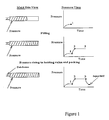
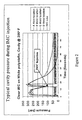
- thermoplastic injection molding cycle is usually represented graphically as shown in Figures 1 and 2.
- the three basic stages of the cycle are filling, packing, and cooling.
- the pressure rises at a relatively slow rate during the filling cycle.
- the packing stage is the one in which the shrinkage is offset by maintenance of very high pressure.
- the pressure in the mold falls.
- the decrease in the pressure during the cooling period depends on the PVT behavior for the thermoplastic material being processed.
- the in-mold coating should be injected during this period. The longer the time between the end of the filling stage and the coating injection, the lower the packing pressure, but the lower the substrate temperature. Thus, the ease of injection, must be balanced with the temperature required to obtain an adequate curing of the coating.
- the typical shelf life of an in-mold coating initiated with TBPB is approximately 10-14 days at room temperature. The shelf life is reduced when storage temperatures are elevated above room temperature.
- the present process utilizing the described in-mold coatings, provides a molded article having excellent appearance and surface properties.
- One such property is clarity.
- clarity can be measured by a subjective eye test, that is, the lack of any imparted color to any underlying substrate. Clarity can also be demonstrated by using other methods known to the art, such as measuring the color of a substrate with a color spectrophotometer, both before and after coating with the in-mold coating compositions.
- the appearance in-mold coating compositions utilized in the present invention have other advantageous properties in addition to high clarity. These include good adhesion to the polyolefin substrate, good hardness, good scratch resistance, good water resistance, as well as good ultraviolet resistance.
- the surface of the coated polyolefin work piece is smooth and has a high degree of glass. Such properties result in a polyolefin work piece having a finished surface, since it has good weatherability resistance and other good paint properties so that painting, which heretofore has been required is not needed.
- the in-mold coating composition when cured can be utilized as is with regard to a particular end use application and does not need, or is substantially free of any need for subsequent surface treatments, e.g., coating, another layer, etc., such as a paint, and the like.
- the in-mold coating composition surface is substantially treatment free meaning that generally less than 10 grams and preferably less that 5, 3, 2, or 1 grams by weight per sq. ft. (9.3 dm 2 ) of any protective coating, film, layer, or surface treatment is applied, and preferably is totally free thereof.
- the in-mold coatings of the present invention are generally flexible and can be utilized on any polyolefin surface.
- Polyolefins which may be coated using the process of the present invention include, among others, polypropylene, polyethylenes, polystyrenes, polybutylenes and substituted polyolefins.
- Other thermoplastic materials, such as nylon, are also contemplated by the invention.
- Suitable uses for the in-mold coated articles of the present invention include various automotive parts, such as bumpers and fascias, as well as marine and lawn and garden machine parts, and recreation, construction or office products.
- the polyurethane acrylate, diacrylate ester of hexane diol, styrene, isobornyl acrylate and hydroxypropyl methacrylate in the indicated amounts were added to a container and mixed thoroughly using mixing procedures for organic resin solutions.
- the hydroquinone, cobalt octoate, hindered amine light stabilizer (HALS), UV absorber and zinc and calcium stearates were weighed into the resin solution prepared above, and again mixed thoroughly to dissolve the organics and to disperse the stearates.
- the talc and silica were then weighed into the container with the organics and stearates, and mixed thoroughly to disperse the solids. All of the mixing occurred without external heating.
- the free radical generating initiator in this instance, tertiary butyl peroxybenzoate, was added to the in-mold coating solution prepared as set forth above, and mixed thoroughly.
- a polyolefin substrate, polypropylene was heated to an initial temperature of 204-260°C (400-500° F) and injected into a closed mold. Molding conditions for the polypropylene were a mold temperature of 93-121°C (200-250° F), a ⁇ 180 second cure time, and ⁇ 250 bar (3600 psi) pressure.
- the in-mold coating composition of Recipe A was injected into the mold, where it came into contact with the surface of the polypropylene substrate, the temperature of which was at or above the temperature at which free radicals are generated in the coating composition and at which cure was effected.
- the mold was opened after ⁇ 180 seconds and the polypropylene work piece having a partially cured coating composition adhered thereto was removed.
- a polyolefin substrate, polyethylene is heated to an initial temperature above its melt temperature and is injected into a closed mold. Molding conditions for the polyethylene are a mold temperature of 71-93°C (160-200° F), a cure time in the range of 100 to 200 seconds, and a pressure ranging from 200-250 bar.
- An in-mold coating composition of the type described herein, containing a suitable free radical source for the coating selected, also as described herein, is injected into the mold, where it will come into contact with the surface of the polyethylene substrate, the surface temperature of which is at or above the temperature at which free radicals are generated in the coating composition and at which cure is effected.
- the mold is opened after ⁇ 180 seconds and a polyethylene work piece having a partially cured coating composition adhered thereto is removed. A work piece having a single in-mold coating having excellent appearance and other surface properties will result.
- the present invention it is possible to form a polyolefin work piece having a single in-mold coating that has excellent adhesion, appearance, weather resistance, surface characteristics, and solvent resistance.
- the present invention makes such a polyolefin work piece possible without the necessity of applying a coating step to a molded work piece withdrawn from the mold.
Landscapes
- Engineering & Computer Science (AREA)
- Chemical & Material Sciences (AREA)
- Manufacturing & Machinery (AREA)
- Materials Engineering (AREA)
- Wood Science & Technology (AREA)
- Organic Chemistry (AREA)
- Life Sciences & Earth Sciences (AREA)
- Mechanical Engineering (AREA)
- Paints Or Removers (AREA)
- Injection Moulding Of Plastics Or The Like (AREA)
- Moulds For Moulding Plastics Or The Like (AREA)
- Application Of Or Painting With Fluid Materials (AREA)
- Addition Polymer Or Copolymer, Post-Treatments, Or Chemical Modifications (AREA)
Applications Claiming Priority (3)
| Application Number | Priority Date | Filing Date | Title |
|---|---|---|---|
| US09/614,953 US6617033B1 (en) | 2000-07-12 | 2000-07-12 | Method for in-mold coating a polyolefin article |
| US614953 | 2000-07-12 | ||
| PCT/US2001/020251 WO2002004187A2 (en) | 2000-07-12 | 2001-06-26 | Method for in-mold coating a polyolefin article |
Publications (2)
| Publication Number | Publication Date |
|---|---|
| EP1299218A2 EP1299218A2 (en) | 2003-04-09 |
| EP1299218B1 true EP1299218B1 (en) | 2007-05-23 |
Family
ID=24463397
Family Applications (1)
| Application Number | Title | Priority Date | Filing Date |
|---|---|---|---|
| EP01948715A Expired - Lifetime EP1299218B1 (en) | 2000-07-12 | 2001-06-26 | Method for in-mold coating a polyolefin article |
Country Status (9)
| Country | Link |
|---|---|
| US (2) | US6617033B1 (enExample) |
| EP (1) | EP1299218B1 (enExample) |
| JP (1) | JP4729141B2 (enExample) |
| KR (1) | KR20040002837A (enExample) |
| AT (1) | ATE362831T1 (enExample) |
| CA (1) | CA2438672C (enExample) |
| DE (1) | DE60128568T2 (enExample) |
| MX (1) | MXPA03000375A (enExample) |
| WO (1) | WO2002004187A2 (enExample) |
Families Citing this family (34)
| Publication number | Priority date | Publication date | Assignee | Title |
|---|---|---|---|---|
| US6887550B2 (en) | 2001-10-22 | 2005-05-03 | Omnova Solutions Inc. | Removable defined flange for in-mold coating containment |
| US7045213B2 (en) | 2001-10-22 | 2006-05-16 | Omnova Solutions Inc. | In-mold coating injection inlet flow control |
| US6676877B2 (en) | 2002-04-03 | 2004-01-13 | Omnova Solutions Inc. | Mold runner for prevention of in-mold coating flow |
| US6863981B2 (en) * | 2002-05-31 | 2005-03-08 | Omnova Solutions Inc. | In-mold appearance coatings for nylon and nylon based thermoplastic substrates |
| US20040092697A1 (en) * | 2002-08-09 | 2004-05-13 | Kia Sheila F. | Gel coat composition |
| WO2004014990A1 (en) * | 2002-08-10 | 2004-02-19 | Omnova Solutions Inc. | Method for coating molded thermoplastic articles |
| AU2003256632B2 (en) * | 2002-08-12 | 2008-03-06 | Valspar Sourcing, Inc. | Urethane acrylate gel coat resin and method of making |
| US20070001343A1 (en) * | 2002-08-12 | 2007-01-04 | Valspar Sourcing, Inc. | Blush-resistant marine gel coat composition |
| US7482063B2 (en) * | 2002-08-23 | 2009-01-27 | Prime Polymer Co., Ltd. | Molded object obtained by in-mold coating and process for producing the same |
| WO2004048076A2 (en) | 2002-11-22 | 2004-06-10 | Omnova Solutions Inc. | Method for modifying existing injection mould machines to utilize an in-mould coating apparatus |
| WO2004052615A1 (en) * | 2002-12-10 | 2004-06-24 | Omnova Solutions Inc. | Method of in-mould coating an injection-moulded article incorporating positioning of the article prior to coating |
| WO2004052616A1 (en) | 2002-12-12 | 2004-06-24 | Omnova Solutions Inc. | Method of designing and producing a mold |
| US20040148051A1 (en) * | 2003-01-28 | 2004-07-29 | Omnova Solutions, Inc. | Modeling method and program for in-mold coating an injection molded thermoplastic article |
| WO2004085549A2 (en) * | 2003-03-19 | 2004-10-07 | Omnova Solutions Inc. | Optical quality coating |
| CN1795083A (zh) * | 2003-03-27 | 2006-06-28 | 阿姆诺洼化学有限公司 | 在多个注射模制零件腔内的涂覆 |
| US20050156351A1 (en) * | 2004-01-20 | 2005-07-21 | Omnova Solutions, Inc. | Apparatus and method for in-mold coating an article by injecting an in-mold coating through the article |
| US7257520B2 (en) * | 2004-04-30 | 2007-08-14 | Omnova Solutions, Inc. | Method and system for in-mold coating flow simulation |
| US20060118999A1 (en) * | 2004-12-06 | 2006-06-08 | Bayer Materialscience Llc | Method of preparing a coated molded article |
| US7314590B2 (en) * | 2005-09-20 | 2008-01-01 | Bayer Materialscience Llc | Method of preparing a coated molded plastic article |
| US20080230949A1 (en) * | 2007-03-23 | 2008-09-25 | Paul Razgunas | Injection molding process for forming coated molded parts |
| JP5501957B2 (ja) * | 2007-04-27 | 2014-05-28 | エグザテック・リミテッド・ライアビリティー・カンパニー | モールド内被覆による耐摩耗性プラスチックの艶出し |
| CN101679656B (zh) | 2007-05-01 | 2012-10-03 | 埃克阿泰克有限责任公司 | 封装的塑料板及其制备方法 |
| WO2008141136A1 (en) * | 2007-05-09 | 2008-11-20 | Exatec. Llc | Pre-dry treatment of ink in decorative plastic glazing |
| US8088318B2 (en) * | 2007-06-05 | 2012-01-03 | Magna International Inc. | Method for processing an interior trim component |
| AU2009234514B2 (en) * | 2008-04-08 | 2014-05-01 | Formway Furniture Limited | Injection moulding method |
| DE102008001855A1 (de) * | 2008-05-19 | 2009-11-26 | Evonik Degussa Gmbh | Zweikomponenten-Zusammensetzung zur Herstellung von flexiblen Polyurethan-Gelcoats |
| JP5253200B2 (ja) * | 2009-01-22 | 2013-07-31 | 大日本塗料株式会社 | 型内被覆組成物及び型内被覆成形体 |
| DE102010025958A1 (de) * | 2010-07-02 | 2012-01-05 | Leibniz-Institut Für Polymerforschung Dresden E.V. | Verfahren zur Modifizierung von Kunststoffoberflächen |
| JP5771061B2 (ja) * | 2011-05-02 | 2015-08-26 | 帝人株式会社 | 皮膜を有する熱可塑性炭素繊維複合材料の製造方法 |
| WO2016153711A1 (en) * | 2015-03-23 | 2016-09-29 | Dow Global Technologies Llc | Photocurable compositions for three-dimensional printing |
| WO2020196075A1 (ja) * | 2019-03-28 | 2020-10-01 | 帝人株式会社 | プレス成形体の製造方法 |
| CN112029358B (zh) * | 2020-09-16 | 2022-01-07 | Ppg涂料(天津)有限公司 | 水性面漆组合物 |
| CN116261508B (zh) | 2020-12-23 | 2024-07-30 | 关西涂料株式会社 | 涂料组合物 |
| JP7370500B1 (ja) | 2022-03-10 | 2023-10-27 | 関西ペイント株式会社 | 熱硬化性塗料組成物、塗装物品及び型内被覆方法 |
Family Cites Families (38)
| Publication number | Priority date | Publication date | Assignee | Title |
|---|---|---|---|---|
| US4081578A (en) | 1974-06-27 | 1978-03-28 | The General Tire & Rubber Company | In-mold coating composition and method of applying same |
| US4076788A (en) | 1976-12-02 | 1978-02-28 | General Motors Corporation | Mold coating of freshly molded articles |
| US4242415A (en) * | 1978-12-26 | 1980-12-30 | Ici Americas Inc. | In-mold coating compositions containing functional group terminated liquid polymers |
| US4222929A (en) | 1978-11-08 | 1980-09-16 | The General Tire & Rubber Company | Low-shrink in-mold coating |
| US4189517A (en) | 1978-11-08 | 1980-02-19 | The General Tire & Rubber Company | Low-shrink in-mold coating |
| NL7903428A (nl) | 1979-05-02 | 1980-11-04 | Stamicarbon | Werkwijze voor het vervaardigen van uit thermohardende hars gevormde voorwerpen. |
| US4350739A (en) | 1979-07-30 | 1982-09-21 | International Telephone And Telegraph Corporation | Molded plastic part |
| US4245006A (en) * | 1979-05-18 | 1981-01-13 | The General Tire & Rubber Company | Low-pressure low-temperature in-mold coating method |
| US4239796A (en) | 1979-06-21 | 1980-12-16 | The General Tire & Rubber Company | In-mold coating of structural foams and resultant product |
| US4366109A (en) | 1980-05-01 | 1982-12-28 | Freeman Chemical Corporation | Method for making coated molded articles |
| US4331735A (en) | 1980-06-26 | 1982-05-25 | The General Tire & Rubber Company | One component in-mold coating |
| US4356230A (en) * | 1980-07-10 | 1982-10-26 | International Telephone And Telegraph Corporation | Molded plastic product having a plastic substrate containing a filler and an in-mold plastic coating firmly bonded thereon and a process for its manufacture |
| US4414173A (en) | 1981-11-02 | 1983-11-08 | The General Tire & Rubber Company | In-mold coating |
| US4515710A (en) | 1983-07-18 | 1985-05-07 | Gencorp Inc. | In-mold coating composition |
| US4668460A (en) | 1985-04-02 | 1987-05-26 | The Sherwin-Williams Company | Method of molding and coating a substrate in a mold. |
| JPS62227712A (ja) | 1986-03-31 | 1987-10-06 | Toyo Seikan Kaisha Ltd | オレフィン―ビニルアルコール共重合体の射出成形体及びその製法 |
| US4808361A (en) * | 1987-03-16 | 1989-02-28 | Gencorp Inc. | Method for forming an in-mold coated fiber reinforced part |
| DE3736280A1 (de) | 1987-10-27 | 1989-05-11 | Roehm Gmbh | Verfahren zur herstellung kratzfest beschichteter extrudierter kunststoffbahnen |
| DE3811112A1 (de) | 1988-03-31 | 1989-10-12 | Fritz Mueller | Spritzgussverfahren fuer kunststoffe und spritzgussform |
| DE3816855A1 (de) | 1988-05-18 | 1989-11-23 | Roehm Gmbh | Verfahren zur herstellung kratzfest beschichteter kunststoffbahnen |
| US5084353A (en) | 1989-05-12 | 1992-01-28 | Gencorp Inc. | Thermosetting in-mold coating compositions |
| JPH03178412A (ja) * | 1989-12-07 | 1991-08-02 | Mazda Motor Corp | インモールドコート方法 |
| US5132052A (en) | 1991-03-20 | 1992-07-21 | Gencorp Inc. | Fast cure in-mold coating |
| JP2686682B2 (ja) | 1991-10-16 | 1997-12-08 | いすゞ自動車株式会社 | 成形品の製造方法 |
| DE69223806T2 (de) | 1992-02-21 | 1998-07-23 | Du Pont | Wiederverwertbare geformte mit hochmodulfaser verstärkte thermoplastische strukturen und verfahren zu deren herstellung |
| GB9204730D0 (en) | 1992-03-05 | 1992-04-15 | Rover Group | A method of forming a moulding by dual injection and a moulding formed in accordance with such a method |
| JPH05301251A (ja) | 1992-04-24 | 1993-11-16 | Aisin Seiki Co Ltd | 熱可塑性樹脂の金型内塗装方法 |
| US5906788A (en) | 1992-10-05 | 1999-05-25 | Cook Composites And Polymers Co. | Dual cure, in-mold process for manufacturing abrasion resistant, coated thermoplastic articles |
| EP0622386B1 (en) | 1993-04-26 | 1998-01-28 | Gencorp Inc. | Conductive in-mold coatings |
| JPH08227637A (ja) | 1994-02-23 | 1996-09-03 | Matsushita Electric Works Ltd | コントロールスイッチ及びその製造方法 |
| DE4414258C2 (de) | 1994-04-23 | 1996-07-25 | Battenfeld Gmbh | Verfahren zum Spritzgießen von mindestens aus zwei unterschiedlichen Schichten bestehenden Gegenständen |
| US5902534A (en) | 1994-09-21 | 1999-05-11 | Mitsubishi Engineering-Plastics Corp. | Method of injection-molding thermoplastic resins |
| JP3406435B2 (ja) * | 1994-09-21 | 2003-05-12 | 三菱エンジニアリングプラスチックス株式会社 | 熱可塑性樹脂の射出成形方法 |
| JP3404546B2 (ja) | 1995-03-23 | 2003-05-12 | 大日本塗料株式会社 | 金型内被覆方法 |
| US5658672A (en) | 1995-05-08 | 1997-08-19 | Gencorp Inc. | In-mold coating composition |
| US5777053A (en) | 1997-01-17 | 1998-07-07 | Gencorp Inc. | In-mold coating compositions suitable as is for an end use application |
| US6180043B1 (en) | 1998-01-27 | 2001-01-30 | Dai Nippon Toryo Co., Ltd. | Method of in-mold coating |
| MXPA02010360A (es) | 2000-04-20 | 2004-09-10 | Omnova Solutions Inc | Metodo para moldear un panel. |
-
2000
- 2000-07-12 US US09/614,953 patent/US6617033B1/en not_active Expired - Lifetime
-
2001
- 2001-06-26 KR KR10-2003-7000426A patent/KR20040002837A/ko not_active Withdrawn
- 2001-06-26 WO PCT/US2001/020251 patent/WO2002004187A2/en not_active Ceased
- 2001-06-26 DE DE60128568T patent/DE60128568T2/de not_active Expired - Lifetime
- 2001-06-26 AT AT01948715T patent/ATE362831T1/de not_active IP Right Cessation
- 2001-06-26 CA CA2438672A patent/CA2438672C/en not_active Expired - Lifetime
- 2001-06-26 MX MXPA03000375A patent/MXPA03000375A/es unknown
- 2001-06-26 JP JP2002508623A patent/JP4729141B2/ja not_active Expired - Fee Related
- 2001-06-26 EP EP01948715A patent/EP1299218B1/en not_active Expired - Lifetime
-
2002
- 2002-05-02 US US10/137,981 patent/US6875389B2/en not_active Expired - Lifetime
Non-Patent Citations (1)
| Title |
|---|
| None * |
Also Published As
| Publication number | Publication date |
|---|---|
| MXPA03000375A (es) | 2004-05-05 |
| US6875389B2 (en) | 2005-04-05 |
| EP1299218A2 (en) | 2003-04-09 |
| JP4729141B2 (ja) | 2011-07-20 |
| WO2002004187A2 (en) | 2002-01-17 |
| US20020171171A1 (en) | 2002-11-21 |
| ATE362831T1 (de) | 2007-06-15 |
| CA2438672A1 (en) | 2003-07-13 |
| US6617033B1 (en) | 2003-09-09 |
| WO2002004187A3 (en) | 2002-03-14 |
| DE60128568T2 (de) | 2008-01-31 |
| CA2438672C (en) | 2010-07-27 |
| DE60128568D1 (de) | 2007-07-05 |
| KR20040002837A (ko) | 2004-01-07 |
| JP2004502570A (ja) | 2004-01-29 |
Similar Documents
| Publication | Publication Date | Title |
|---|---|---|
| US6617033B1 (en) | Method for in-mold coating a polyolefin article | |
| CA2224779C (en) | In-mold coating compositions suitable as is for an end use application | |
| CA2503311C (en) | Optimization of in-mold coating injection molded thermoplastic substrates | |
| GB2156835A (en) | In-mould coating composition | |
| JP6800392B1 (ja) | 型内被覆用組成物 | |
| US20040071980A1 (en) | Method for in-mold coating a polyolefin article | |
| US6863981B2 (en) | In-mold appearance coatings for nylon and nylon based thermoplastic substrates | |
| JP6468508B2 (ja) | 型内被覆組成物、型内被覆成形体及び塗装物品 | |
| EP1060878B1 (en) | Photocurable sheet, moldings thereof, and processes for producing the same | |
| EP1656429B1 (en) | Base-coat in-mold coating | |
| JP3086349B2 (ja) | 型内被覆組成物 | |
| JP2003137943A (ja) | 型内被覆組成物及び型内被覆成形品の製造方法 | |
| JP4420841B2 (ja) | 型内被覆用組成物及び型内被覆成形品の製造方法 | |
| JP3145144B2 (ja) | 型内被覆組成物 | |
| JP4456024B2 (ja) | 型内被覆成形用組成物及び型内被覆成形品の製造方法 | |
| JP4431514B2 (ja) | 型内被覆組成物及び型内被覆成形品の製造方法 | |
| WO2004085549A2 (en) | Optical quality coating | |
| US6630246B1 (en) | Photocurable sheet, moldings thereof, and processes for producing the same | |
| WO2005108512A1 (en) | In-mold coating with improved adhesion | |
| MXPA97010292A (en) | Coating compositions in adecuadastal mold as they are for an application of fi use |
Legal Events
| Date | Code | Title | Description |
|---|---|---|---|
| PUAI | Public reference made under article 153(3) epc to a published international application that has entered the european phase |
Free format text: ORIGINAL CODE: 0009012 |
|
| 17P | Request for examination filed |
Effective date: 20030116 |
|
| AK | Designated contracting states |
Kind code of ref document: A2 Designated state(s): AT BE CH CY DE DK ES FI FR GB GR IE IT LI LU MC NL PT SE TR |
|
| AX | Request for extension of the european patent |
Extension state: AL LT LV MK RO SI |
|
| 17Q | First examination report despatched |
Effective date: 20041006 |
|
| GRAP | Despatch of communication of intention to grant a patent |
Free format text: ORIGINAL CODE: EPIDOSNIGR1 |
|
| GRAS | Grant fee paid |
Free format text: ORIGINAL CODE: EPIDOSNIGR3 |
|
| GRAA | (expected) grant |
Free format text: ORIGINAL CODE: 0009210 |
|
| AK | Designated contracting states |
Kind code of ref document: B1 Designated state(s): AT BE CH CY DE DK ES FI FR GB GR IE IT LI LU MC NL PT SE TR |
|
| PG25 | Lapsed in a contracting state [announced via postgrant information from national office to epo] |
Ref country code: CH Free format text: LAPSE BECAUSE OF FAILURE TO SUBMIT A TRANSLATION OF THE DESCRIPTION OR TO PAY THE FEE WITHIN THE PRESCRIBED TIME-LIMIT Effective date: 20070523 Ref country code: LI Free format text: LAPSE BECAUSE OF FAILURE TO SUBMIT A TRANSLATION OF THE DESCRIPTION OR TO PAY THE FEE WITHIN THE PRESCRIBED TIME-LIMIT Effective date: 20070523 Ref country code: FI Free format text: LAPSE BECAUSE OF FAILURE TO SUBMIT A TRANSLATION OF THE DESCRIPTION OR TO PAY THE FEE WITHIN THE PRESCRIBED TIME-LIMIT Effective date: 20070523 |
|
| REG | Reference to a national code |
Ref country code: GB Ref legal event code: FG4D |
|
| REG | Reference to a national code |
Ref country code: CH Ref legal event code: EP |
|
| REG | Reference to a national code |
Ref country code: IE Ref legal event code: FG4D |
|
| REF | Corresponds to: |
Ref document number: 60128568 Country of ref document: DE Date of ref document: 20070705 Kind code of ref document: P |
|
| PG25 | Lapsed in a contracting state [announced via postgrant information from national office to epo] |
Ref country code: SE Free format text: LAPSE BECAUSE OF FAILURE TO SUBMIT A TRANSLATION OF THE DESCRIPTION OR TO PAY THE FEE WITHIN THE PRESCRIBED TIME-LIMIT Effective date: 20070823 |
|
| PG25 | Lapsed in a contracting state [announced via postgrant information from national office to epo] |
Ref country code: ES Free format text: LAPSE BECAUSE OF FAILURE TO SUBMIT A TRANSLATION OF THE DESCRIPTION OR TO PAY THE FEE WITHIN THE PRESCRIBED TIME-LIMIT Effective date: 20070903 |
|
| ET | Fr: translation filed | ||
| PG25 | Lapsed in a contracting state [announced via postgrant information from national office to epo] |
Ref country code: AT Free format text: LAPSE BECAUSE OF FAILURE TO SUBMIT A TRANSLATION OF THE DESCRIPTION OR TO PAY THE FEE WITHIN THE PRESCRIBED TIME-LIMIT Effective date: 20070523 |
|
| REG | Reference to a national code |
Ref country code: CH Ref legal event code: PL |
|
| PG25 | Lapsed in a contracting state [announced via postgrant information from national office to epo] |
Ref country code: BE Free format text: LAPSE BECAUSE OF FAILURE TO SUBMIT A TRANSLATION OF THE DESCRIPTION OR TO PAY THE FEE WITHIN THE PRESCRIBED TIME-LIMIT Effective date: 20070523 |
|
| PG25 | Lapsed in a contracting state [announced via postgrant information from national office to epo] |
Ref country code: MC Free format text: LAPSE BECAUSE OF NON-PAYMENT OF DUE FEES Effective date: 20070630 Ref country code: PT Free format text: LAPSE BECAUSE OF FAILURE TO SUBMIT A TRANSLATION OF THE DESCRIPTION OR TO PAY THE FEE WITHIN THE PRESCRIBED TIME-LIMIT Effective date: 20071023 Ref country code: DK Free format text: LAPSE BECAUSE OF FAILURE TO SUBMIT A TRANSLATION OF THE DESCRIPTION OR TO PAY THE FEE WITHIN THE PRESCRIBED TIME-LIMIT Effective date: 20070523 |
|
| PLBE | No opposition filed within time limit |
Free format text: ORIGINAL CODE: 0009261 |
|
| STAA | Information on the status of an ep patent application or granted ep patent |
Free format text: STATUS: NO OPPOSITION FILED WITHIN TIME LIMIT |
|
| 26N | No opposition filed |
Effective date: 20080226 |
|
| PG25 | Lapsed in a contracting state [announced via postgrant information from national office to epo] |
Ref country code: GR Free format text: LAPSE BECAUSE OF FAILURE TO SUBMIT A TRANSLATION OF THE DESCRIPTION OR TO PAY THE FEE WITHIN THE PRESCRIBED TIME-LIMIT Effective date: 20070824 Ref country code: IT Free format text: LAPSE BECAUSE OF FAILURE TO SUBMIT A TRANSLATION OF THE DESCRIPTION OR TO PAY THE FEE WITHIN THE PRESCRIBED TIME-LIMIT Effective date: 20070523 |
|
| PG25 | Lapsed in a contracting state [announced via postgrant information from national office to epo] |
Ref country code: IE Free format text: LAPSE BECAUSE OF NON-PAYMENT OF DUE FEES Effective date: 20070626 |
|
| PG25 | Lapsed in a contracting state [announced via postgrant information from national office to epo] |
Ref country code: CY Free format text: LAPSE BECAUSE OF FAILURE TO SUBMIT A TRANSLATION OF THE DESCRIPTION OR TO PAY THE FEE WITHIN THE PRESCRIBED TIME-LIMIT Effective date: 20070523 |
|
| PG25 | Lapsed in a contracting state [announced via postgrant information from national office to epo] |
Ref country code: LU Free format text: LAPSE BECAUSE OF NON-PAYMENT OF DUE FEES Effective date: 20070626 |
|
| PG25 | Lapsed in a contracting state [announced via postgrant information from national office to epo] |
Ref country code: TR Free format text: LAPSE BECAUSE OF FAILURE TO SUBMIT A TRANSLATION OF THE DESCRIPTION OR TO PAY THE FEE WITHIN THE PRESCRIBED TIME-LIMIT Effective date: 20070523 |
|
| REG | Reference to a national code |
Ref country code: FR Ref legal event code: PLFP Year of fee payment: 16 |
|
| REG | Reference to a national code |
Ref country code: FR Ref legal event code: PLFP Year of fee payment: 17 |
|
| REG | Reference to a national code |
Ref country code: FR Ref legal event code: PLFP Year of fee payment: 18 |
|
| PGFP | Annual fee paid to national office [announced via postgrant information from national office to epo] |
Ref country code: FR Payment date: 20200520 Year of fee payment: 20 Ref country code: DE Payment date: 20200518 Year of fee payment: 20 Ref country code: NL Payment date: 20200520 Year of fee payment: 20 |
|
| PGFP | Annual fee paid to national office [announced via postgrant information from national office to epo] |
Ref country code: GB Payment date: 20200529 Year of fee payment: 20 |
|
| REG | Reference to a national code |
Ref country code: DE Ref legal event code: R071 Ref document number: 60128568 Country of ref document: DE |
|
| REG | Reference to a national code |
Ref country code: NL Ref legal event code: MK Effective date: 20210625 |
|
| REG | Reference to a national code |
Ref country code: GB Ref legal event code: PE20 Expiry date: 20210625 |
|
| PG25 | Lapsed in a contracting state [announced via postgrant information from national office to epo] |
Ref country code: GB Free format text: LAPSE BECAUSE OF EXPIRATION OF PROTECTION Effective date: 20210625 |