EP1280812B1 - Cyclipostine, verfahren zu ihrer herstellung und verwendung derselben - Google Patents
Cyclipostine, verfahren zu ihrer herstellung und verwendung derselben Download PDFInfo
- Publication number
- EP1280812B1 EP1280812B1 EP01936275A EP01936275A EP1280812B1 EP 1280812 B1 EP1280812 B1 EP 1280812B1 EP 01936275 A EP01936275 A EP 01936275A EP 01936275 A EP01936275 A EP 01936275A EP 1280812 B1 EP1280812 B1 EP 1280812B1
- Authority
- EP
- European Patent Office
- Prior art keywords
- formula
- cyclipostin
- alkyl
- compound
- physiologically tolerable
- Prior art date
- Legal status (The legal status is an assumption and is not a legal conclusion. Google has not performed a legal analysis and makes no representation as to the accuracy of the status listed.)
- Expired - Lifetime
Links
- 0 C*(*)[N+](NCC(COC1=O)C1=C*)[O-] Chemical compound C*(*)[N+](NCC(COC1=O)C1=C*)[O-] 0.000 description 1
Classifications
-
- C—CHEMISTRY; METALLURGY
- C07—ORGANIC CHEMISTRY
- C07F—ACYCLIC, CARBOCYCLIC OR HETEROCYCLIC COMPOUNDS CONTAINING ELEMENTS OTHER THAN CARBON, HYDROGEN, HALOGEN, OXYGEN, NITROGEN, SULFUR, SELENIUM OR TELLURIUM
- C07F9/00—Compounds containing elements of Groups 5 or 15 of the Periodic Table
- C07F9/02—Phosphorus compounds
- C07F9/547—Heterocyclic compounds, e.g. containing phosphorus as a ring hetero atom
- C07F9/6564—Heterocyclic compounds, e.g. containing phosphorus as a ring hetero atom having phosphorus atoms, with or without nitrogen, oxygen, sulfur, selenium or tellurium atoms, as ring hetero atoms
- C07F9/6571—Heterocyclic compounds, e.g. containing phosphorus as a ring hetero atom having phosphorus atoms, with or without nitrogen, oxygen, sulfur, selenium or tellurium atoms, as ring hetero atoms having phosphorus and oxygen atoms as the only ring hetero atoms
- C07F9/6574—Esters of oxyacids of phosphorus
- C07F9/65744—Esters of oxyacids of phosphorus condensed with carbocyclic or heterocyclic rings or ring systems
-
- C—CHEMISTRY; METALLURGY
- C07—ORGANIC CHEMISTRY
- C07F—ACYCLIC, CARBOCYCLIC OR HETEROCYCLIC COMPOUNDS CONTAINING ELEMENTS OTHER THAN CARBON, HYDROGEN, HALOGEN, OXYGEN, NITROGEN, SULFUR, SELENIUM OR TELLURIUM
- C07F9/00—Compounds containing elements of Groups 5 or 15 of the Periodic Table
- C07F9/02—Phosphorus compounds
- C07F9/547—Heterocyclic compounds, e.g. containing phosphorus as a ring hetero atom
- C07F9/6564—Heterocyclic compounds, e.g. containing phosphorus as a ring hetero atom having phosphorus atoms, with or without nitrogen, oxygen, sulfur, selenium or tellurium atoms, as ring hetero atoms
- C07F9/6571—Heterocyclic compounds, e.g. containing phosphorus as a ring hetero atom having phosphorus atoms, with or without nitrogen, oxygen, sulfur, selenium or tellurium atoms, as ring hetero atoms having phosphorus and oxygen atoms as the only ring hetero atoms
- C07F9/6574—Esters of oxyacids of phosphorus
-
- A—HUMAN NECESSITIES
- A61—MEDICAL OR VETERINARY SCIENCE; HYGIENE
- A61P—SPECIFIC THERAPEUTIC ACTIVITY OF CHEMICAL COMPOUNDS OR MEDICINAL PREPARATIONS
- A61P3/00—Drugs for disorders of the metabolism
- A61P3/06—Antihyperlipidemics
-
- A—HUMAN NECESSITIES
- A61—MEDICAL OR VETERINARY SCIENCE; HYGIENE
- A61P—SPECIFIC THERAPEUTIC ACTIVITY OF CHEMICAL COMPOUNDS OR MEDICINAL PREPARATIONS
- A61P3/00—Drugs for disorders of the metabolism
- A61P3/08—Drugs for disorders of the metabolism for glucose homeostasis
- A61P3/10—Drugs for disorders of the metabolism for glucose homeostasis for hyperglycaemia, e.g. antidiabetics
-
- A—HUMAN NECESSITIES
- A61—MEDICAL OR VETERINARY SCIENCE; HYGIENE
- A61P—SPECIFIC THERAPEUTIC ACTIVITY OF CHEMICAL COMPOUNDS OR MEDICINAL PREPARATIONS
- A61P43/00—Drugs for specific purposes, not provided for in groups A61P1/00-A61P41/00
-
- C—CHEMISTRY; METALLURGY
- C12—BIOCHEMISTRY; BEER; SPIRITS; WINE; VINEGAR; MICROBIOLOGY; ENZYMOLOGY; MUTATION OR GENETIC ENGINEERING
- C12N—MICROORGANISMS OR ENZYMES; COMPOSITIONS THEREOF; PROPAGATING, PRESERVING, OR MAINTAINING MICROORGANISMS; MUTATION OR GENETIC ENGINEERING; CULTURE MEDIA
- C12N1/00—Microorganisms; Compositions thereof; Processes of propagating, maintaining or preserving microorganisms or compositions thereof; Processes of preparing or isolating a composition containing a microorganism; Culture media therefor
- C12N1/20—Bacteria; Culture media therefor
- C12N1/205—Bacterial isolates
-
- C—CHEMISTRY; METALLURGY
- C12—BIOCHEMISTRY; BEER; SPIRITS; WINE; VINEGAR; MICROBIOLOGY; ENZYMOLOGY; MUTATION OR GENETIC ENGINEERING
- C12P—FERMENTATION OR ENZYME-USING PROCESSES TO SYNTHESISE A DESIRED CHEMICAL COMPOUND OR COMPOSITION OR TO SEPARATE OPTICAL ISOMERS FROM A RACEMIC MIXTURE
- C12P9/00—Preparation of organic compounds containing a metal or atom other than H, N, C, O, S or halogen
-
- C—CHEMISTRY; METALLURGY
- C12—BIOCHEMISTRY; BEER; SPIRITS; WINE; VINEGAR; MICROBIOLOGY; ENZYMOLOGY; MUTATION OR GENETIC ENGINEERING
- C12R—INDEXING SCHEME ASSOCIATED WITH SUBCLASSES C12C - C12Q, RELATING TO MICROORGANISMS
- C12R2001/00—Microorganisms ; Processes using microorganisms
- C12R2001/01—Bacteria or Actinomycetales ; using bacteria or Actinomycetales
- C12R2001/465—Streptomyces
Definitions
- the invention relates to novel compounds, called cyclipostins, obtainable by culture of Streptomyces species HAG 004107 (DSM 13381), and their physiologically acceptable salts and chemical equivalents.
- the invention further relates to a process for the preparation of the cyclipostins, the microorganism HAG 004107 (DSM 13381), the use of the cyclipostins and their physiologically acceptable salts and chemical equivalents as medicaments, in particular as inhibitors of lipases, as well as pharmaceutical preparations containing cyclipostin or a physiologically acceptable salt or equivalent thereof.
- Diabetes mellitus is one Disease caused by increased blood sugar concentrations due to chronic metabolic disorders is characterized.
- the metabolic disorders are due to a lack of insulin or decreased insulin action.
- the lack of insulin action leads to poor recovery of the blood absorbed glucose by the body cells.
- glucose level As a result, as well as by new formation of glucose from proteins (gluconeogenesis) there is an increase of the Blood glucose level.
- the insulin-antagonistic hormones such as the glucagon, too Increased lipolysis and thus increased fatty acid concentrations in the blood. It comes to ketoacidosis, d. H.
- ketone bodies (Acetoacetic acid, ⁇ -hydroxybutyric acid, acetone). This is under acute conditions Extent of biochemical dysregulation life-threatening and leads untreated, to diabetic coma, finally to rapid death.
- the Diabetes is one of the most common chronic metabolic diseases In humans, it is estimated that over 3% of the population has one have diabetic or prediabetic disposition and are thus in acute danger.
- HSL hormone-sensitive lipase
- microorganism strain Streptomyces species HAG 004107, DSM 13381 is able to form highly effective new lipase inhibitors which inhibit the hormone-sensitive lipase even in very low concentrations.
- the new natural compounds are organophosphates, which consist of a double ring system (bicyclic) and a substituted carbon chain and specifically inhibit the lipases.
- the ring skeleton is for the first time - only with a methyl group in place of the carbon chain - as an acetylcholine estrase inhibitor, CGA 134 736, by R. Neumann & HH Peter in Experientia, vol.
- R 1 has a chain length of 10 to 18 carbon atoms.
- the chain may be saturated, for example -alkyl, wherein alkyl may be straight or branched, or unsaturated, for example -alkenyl or -alkynyl, wherein alkenyl or alkynyl is straight or branched.
- R 1 can be unsubstituted or monosubstituted or disubstituted by identical or different substituents with groups 1.1 to 1.15, as described above.
- the substituents on the carbon atoms 8 'to 16' are preferred, and the positions 10 'to 14' are particularly preferred.
- the substituents 1.1 to 1.15 can also be substituted by one or more groups selected from: alcohol, aldehyde, acetal, ketal, ether, carboxyl, ester, amino, nitrile, nitro, oxime , Oxime ethers and halogen.
- a carbocyclic carbon chain of 10 to 18 carbon atoms means one out 10 to 18-C atoms existing chain with one or more, preferably with one, with two or with three ring systems, preferably each of 4, 5, 6 or 7 carbon atoms.
- the rings can be mono-, di- or tricyclic, preferably monocyclic, and present at the beginning, in the middle and / or on Be positioned at the end of the carbon chain.
- the carbocycles can be aliphatic or of an aromatic nature. Examples are: substituted diphenyls or Alkylbenzenes.
- a heterocyclic carbon chain of 10 to 18 carbon atoms means a a chain of 10 to 18 carbon atoms with one or more, preferably with one to three ring systems in which at least one carbon atom by heteroatoms, e.g. O, S or N is replaced.
- the rings can be mono-, di- or tricyclic, preferably monocyclic, and present at the beginning, in the Center and / or positioned at the end of the carbon chain. It can preferably 4-, 5-, 6- or 7-membered rings, aliphatic or of aromatic nature. Examples are: alkyl-piperidines, substituted or unsubstituted.
- Halogen means chloride, bromide, fluoride or pseudohalides, such as cyanide (Nitrile).
- C 1 -C 6 -alkyl denotes a straight-chain or branched alkyl having 1, 2, 3, 4, 5 or 6 C atoms, such as, for example, methyl, ethyl, isopropyl, tert-butyl and hexyl.
- alkenyl is a straight-chain or branched alkenyl having 2, 3, 4, 5 or 6 C atoms, such as allyl, crotyl and pentenyl.
- C 2 -C 6 -alkynyl denotes a straight-chain or branched alkynyl having 2, 3, 4, 5 or 6 C atoms, such as, for example, propynyl, butynyl and pentynyl.
- R 2 is preferably C 1 -C 6 -alkyl, in particular methyl, ethyl or propyl.
- the ring system alone contains two asymmetrically substituted atoms, the C atoms 3 and the phosphorus atom. Both atoms may be in the R or S configuration. It has surprisingly been found that the strain Streptomyces species HAG 004107, DSM 13381, is able to form in each case a plurality of stereoisomers of the compounds of the general formula I, that is to say the strain synthesizes compounds in which the atoms C3 and P independently of one another can assume the R or S configuration. Isomers with the spatial form at carbon (3) in R- and phosphorus in S-configuration are increasingly present in cultures of Streptomyces species HAG 004107, DSM 13381.
- Formula IA Formula IA:
- the compound of the formula I or a physiologically acceptable salt or chemical equivalent thereof can be prepared by fermenting the microorganism Streptomyces species HAG 004107, DSM 13381, or one of its variants or mutants under suitable conditions in a culture medium until one or more compounds of the general Formula I accumulate in the culture medium and then isolated from the culture medium and optionally converted into chemical equivalents and physiologically acceptable salts.
- the cyclipostins of the invention may be produced by Actinomycetales species, preferably by Streptomyces species HAG 004107, DSM 13381.
- Streptomyces species HAG 004107, DSM 13381 has an ivory mycelium (RAL 1014) and is characterized by the conidiophores characteristic of streptomycetes.
- DSM 13381 and its mutants and variants can be used which synthesize one or more compounds of the cyclipostins invention.
- Such mutants can be prepared in a manner known per se by physical means, for example radiation, such as ultraviolet or X-rays, or chemical mutagens, such as, for example, ethyl methanesulfonate (EMS), 2-hydroxy-4-methoxybenzophenone (MOB) or N-methyl- N'-nitro-N-nitrosoguanidine (MNNG) can be produced.
- EMS ethyl methanesulfonate
- MOB 2-hydroxy-4-methoxybenzophenone
- MNNG N-methyl- N'-nitro-N-nitrosoguanidine
- the invention thus relates to a process for the preparation of a compound of formula I or a physiologically acceptable salt thereof, characterized in that the microorganism Streptomyces species HAG 004107, DSM 13381, or one of its variants or mutants is fermented under suitable conditions in a culture medium until one or more compounds of the general formula I accumulate in the culture medium and are subsequently isolated from the culture medium and, if appropriate, converted into chemical equivalents and physiologically tolerable salts.
- the strain Streptomyces species HAG 004107, DSM 13381, its mutants and / or variants in a nutrient solution (also referred to as culture medium) with carbon and nitrogen source and the usual inorganic salts are fermented until the new cyclipostins accumulate in the culture medium, then the cyclipostins isolated from the culture medium and optionally separated into the individual active components.
- a nutrient solution also referred to as culture medium
- carbon and nitrogen source and the usual inorganic salts are fermented until the new cyclipostins accumulate in the culture medium, then the cyclipostins isolated from the culture medium and optionally separated into the individual active components.
- the fermentation is preferably carried out under aerobic conditions, they runs particularly well at a temperature between 18 and 35 ° C and at one pH between 6 and 8.
- the process according to the invention can be used for fermentation on a laboratory scale (Milliliter to liter range) and for industrial scale (cubic meter scale) be used. All percentages are by weight unless otherwise stated is indicated on the weight. Refer to mixing ratios for liquids on the volume, if no other information is given.
- Preferred carbon sources for aerobic fermentation are assimilable carbohydrates and sugar alcohols, such as glucose, lactose, Sucrose or D-mannitol, as well as carbohydrate-containing natural products, e.g. Oatmeal, soy flour and malt extract.
- sugar alcohols such as glucose, lactose, Sucrose or D-mannitol
- carbohydrate-containing natural products e.g. Oatmeal, soy flour and malt extract.
- nitrogenous nutrients come in Consider: amino acids, peptides and proteins as well as their degradation products, such as Peptones or tryptones, also meat extracts, yeast extracts, ground seeds, for example, corn, wheat, beans, soy or the cotton plant, Distillation residues of alcohol production, meat flours or yeast extracts, but also ammonium salts and nitrates.
- the Nutrient solution for example, chlorides, carbonates, sulfates or phosphates of Alkalioder Alkaline earth metals, iron
- the formation of the cyclipostines of the formula II to XV A according to the invention proceeds especially good in a culture medium containing about 0.1 to 5%, preferably 0.3 to 3% Oatmeal and trace elements included. The percentages are each based on the weight of the entire culture medium.
- the preferred formation of the cyclipostines of the formula VIII to XV A can be particularly Well carried out in nutrient solutions containing about 0.1 to 5%, preferably 0.3 to 2 % Glycerol and 0.2 to 5%, preferably 0.5 to 3% soya flour and 0.05 to 1.0 g / l, preferably 0.1 to 1.0 g / l of sodium chloride.
- Streptomyces species HAG 004107, DSM 13381 forms a mixture of cyclipostins.
- the quantitative proportion of one or more of the cyclipostines according to the invention can vary.
- the synthesis of individual cyclipostins can be controlled by the media composition, so that one or more of the cyclipostins are not prepared at all or in an amount below the detection limit of the microorganism.
- the culture contains a detectable cyclipostin.
- the cyclipostins A or P or P 2 are formed.
- the cultivation of the microorganism is aerobic, so for example submerged with shaking or stirring in shake flasks or fermenters, if appropriate while introducing air or oxygen. It can be used in a temperature range of about 18 to 35 ° C, preferably at about 25 to 32 ° C, especially at 26 to 30 ° C. be performed.
- the pH range should be between 6 and 8, preferably between 6.5 and 7.8.
- One cultivates the microorganism among them Conditions generally over a period of 24 to 300 hours, preferably 30 to 90 hours.
- the main culture for example in volume ratio 1:10, to be vaccinated.
- the preculture is obtained, for example, by adding one Mycelium inoculated into a nutrient solution and about 36 to 120 hours, preferably 48 to 96 hours, grow.
- the mycelium can be obtained, for example, by one the trunk about 3 to 40 days, preferably 4 to 10 days, on a solid or liquid nutrient medium, for example malt-yeast agar or oatmeal agar grow.
- the course of fermentation can be determined by the pH of the cultures or the Mycelium volume and by chromatographic methods, e.g. Thin Layer Chromatography or High Pressure Liquid Chromatography or Monitoring the biological activity to be monitored.
- the invention Cyclipostins are contained in the mycelium, to the no part also in the culture filtrate.
- the im The following IsoltechniksverFahren described serves to purify the Cyclipostins of the invention, preferably for purifying the Cyclipostine A. and P.
- the isolation or purification of the cyclipostins according to the invention from the culture medium is carried out by known methods, taking into account the chemical, physical and biological properties of the natural substances.
- thin-layer chromatography for example on silica gel with methylene chloride-ethyl acetate or chloroform-methanol mixtures (for example in a quantitative ratio of 98: 1), can be used as eluant or HPLC.
- the detection in the thin-layer chromatographic separation can be carried out, for example, by dyeing agents such as molybdophosphoric acid or J 2 vapor, the amount of the substance formed being expediently compared with a calibration solution.
- the mycelium is first of the culture medium separated by the usual methods and then The cyclipostins are released from the cell mass with an optionally water extracted miscible organic solvent.
- the organic solvent phase contains the cyclipostins according to the invention, they are optionally in Concentrate vacuum and further purify as described below.
- the culture filtrate is optionally mixed with the concentrate of the mycelial extract combined and with a suitable, immiscible with water organic Solvent, for example with n-butanol or ethyl acetate.
- a suitable, immiscible with water organic Solvent for example with n-butanol or ethyl acetate.
- the subsequently separated organic phase is optionally concentrated in vacuo and dissolved in 1/30 of the original volume of water / methanol.
- the further purification of one or more of the cyclipostins according to the invention is carried out by chromatography on suitable materials, preferably e.g. at Molekularsieben, to normal phase carrier, such as. For example, silica gel, alumina Ion exchangers or adsorber or reverse phases (reversed phase, RP). With the help of these chromatography methods are the cyclipostins separated.
- the chromatography of the cyclipostins is carried out with organic solvents or with mixtures of aqueous and organic solutions.
- mixtures of aqueous or organic solutions is meant all with Water-miscible organic solvent, preferably methanol, propanol and Acetonitrile, in a concentration of 10 to 100% solvent, preferably 60 to 90% solvent or even all buffered aqueous solutions with organic solvents are miscible.
- the buffers to be used are the same as you can read above.
- the chromatography of the cyclipostins is carried out with buffered or acidified aqueous solutions or mixtures of aqueous solutions with alcohols or other, water-miscible organic solvents.
- organic Solvent is preferably used propanol and acetonitrile.
- Buffered or acidified aqueous solutions are understood as meaning e.g. Water, phosphate buffer, ammonium acetate, citrate buffer in a concentration of 1 mM to 0.5 M and formic acid, acetic acid, trifluoroacetic acid or all commercially available acids known to those skilled in the art, preferably in one Concentration of 0.01 to 3%, in particular 0.1%.
- Gel chromatography is carried out on polyacrylamide or mixed polymer gels performed, e.g. Biogel-P 2® (Biorad), Fractogel TSK HW 40® (Merck, Germany) Germany or Toso Haas, USA) or to Sephadex® (Pharmacia, Uppsala, Sweden).
- Biogel-P 2® Biorad
- Fractogel TSK HW 40® Merck, Germany
- Toso Haas, USA Toso Haas, USA
- Sephadex® Pharmacia, Uppsala, Sweden
- cyclipostins Another very effective purification step for cyclipostins is crystallization.
- the cyclipostins crystallize from solutions in organic solvents and from Mixtures of water with organic solvents.
- the crystallization is in in a known manner, for example by concentration or cooling saturated cyclipostin solutions.
- cyclipostins according to the invention are in the solid or liquid state and in Solutions in the pH range between 4 and 8, in particular 5 and 7, stable and let thus familiarize themselves with common galenic preparations.
- the present invention includes all stereoisomeric forms of the compounds of the formula I to XV A.
- the compounds of formula I to XV A contained Asymmetry centers can all independently the S configuration or have the R configuration.
- the invention includes all possible enantiomers and diastereomers, as well as mixtures of two or more stereoisomers Forms, for example mixtures of enantiomers and / or diastereomers, in all circumstances.
- Enantiomers are therefore in enantiomerically pure form, both as levorotatory as well as dextrorotatory antipodes, R and S configurations, in Form of racemates and in the form of mixtures of the two enantiomers in all circumstances subject of the invention.
- cis / trans isomerism are both the cis-form and the trans-form and mixtures of these Forms in all proportions subject of the invention.
- the compounds of the invention are the Compounds of the invention for use as drugs in the human and / or Veterinary medicine. They inhibit lipases and are used to treat metabolic diseases, their cause in the disturbance of lipid metabolism have, favorable properties.
- the compounds of the invention general formula I have a surprising inhibitory effect on the hormone-sensitive lipase, HSL, an allosteric enzyme in adipocytes, the is inhibited by insulin and for the breakdown of fats in fat cells and thus responsible for the transfer of fat components into the bloodstream.
- HSL hormone-sensitive lipase
- an allosteric enzyme in adipocytes the is inhibited by insulin and for the breakdown of fats in fat cells and thus responsible for the transfer of fat components into the bloodstream.
- a Inhibition of this enzyme thus corresponds to an insulin-like effect of compounds of the invention, which ultimately leads to a reduction of free Fatty acids in the blood and of blood sugar. So they can be used at Derailments of metabolism such as non-insulin dependent Diabetes mellitus, diabet
- the invention thus relates to pharmaceutical preparations containing one or more the cyclipostins of the invention and / or chemical equivalents thereof contain.
- the use is in admixture with suitable excipients or carrier material.
- suitable excipients or carrier material As a carrier material in humans all used pharmacologically acceptable carrier materials and / or excipients become.
- the invention further relates to a process for the preparation of a Medicament according to the invention, which is characterized in that at least one of the compounds of the invention with a pharmaceutically acceptable and physiologically acceptable carriers and optionally other suitable active ingredients, additives or excipients in one brings appropriate dosage form.
- the medicaments according to the invention are generally administered orally, locally or parenterally administered, but also a rectal application is possible in principle.
- Suitable solid or liquid galenic preparations are, for example Granules, powders, tablets, dragees, (micro-) capsules, suppositories, syrups, Emulsions, suspensions, aerosols, drops or injectable solutions in Ampoule form and preparations with protracted drug release in which Usually produces carriers and additives and / or auxiliaries such as explosive, Binding, coating, swelling, lubricants or lubricants, flavorings, Use sweeteners or solubilizers.
- Carriers or auxiliaries are e.g.
- the dosage units for oral administration be microencapsulated to delay the delivery or over a longer period Period, such as by coating or embedding the Particle active ingredient in suitable polymers, waxes or the like.
- the pharmaceutical preparations are in dosage units prepared and administered, each unit as an active ingredient certain dose of one or more compounds of the invention Contains cyclipostins and / or chemical derivatives thereof.
- dose units such as tablets, capsules and suppositories may take up to this dose to about 200 mg, but preferably about 0.1 to 100 mg, and for injection solutions in ampoule form up to about 200 mg, but preferably about 0.1 to 100 mg, per Day.
- the daily dose to be administered depends on the body weight, age, Sex and condition of the mammal. In some circumstances, however, too be higher or lower daily doses.
- the administration of the Daily dose can be given by single dose in the form of a single Dosage unit or in several smaller dosage units as well by multiple subdivided doses at specific intervals.
- the invention also relates to pharmaceutical preparations containing one or more the inventive cyclipostins and / or chemical derivatives thereof. Preferably, the use in admixture with suitable excipients or Support material.
- suitable excipients or Support material As a carrier material in humans all pharmacologically compatible carrier materials and / or auxiliaries.
- Isolated rat fat cells are made from epididymal fat from non-treated male rats (Wistar, 220-250 g) by collagenase treatment according to Published, for example, S. Nilsson et al., Anal. Biochem., 158, 1986, 399 - 407; Fredrikson et al., J. Biol. Chem. 256, 1981, 6311-6320; H. Tomquist et al., J. Biol. Chem. 251, 1976, 813-819).
- the fat cells will be out of 10 rats three times by flotation with 50 ml homogenization buffer (25 ml Tris / HCl, pH 7.4, 0.25 M sucrose, 1 mM EDTA, 1 mM DTT, 10 ⁇ g / ml leupeptin, 10 ⁇ g / ml Antipain, 20 ⁇ g / ml pepstatin) and finally in 10 ml Homogenization buffer recorded.
- the fat cells are in Teflon-in-glass Homogeniser (Braun Mels Institute) by 10 strokes at 1500 rpm and 15 ° C. homogenized. The homogenate is centrifuged (Sorvall SM24 tube, 5000 rpm, 10 min, 4 ° C).
- the shelter between the top layer of fat and The pellet is removed and the centrifugation repeated.
- the result resulting shelter is centrifuged again (Sorvall SM24 tube, 20000 rpm, 45 min, 4 ° C).
- the shelter is removed and with 1 g of heparin-Sepharose (Pharmacia Biotech, CL-6B, 5x washed with 25mM Tris / HCl, pH 7.4, 150 mM NaCl). After incubation for 60 min at 4 ° C (at intervals of 15 Shake min), the batch is centrifuged (Sorvall SM24 tube, 3000 rpm, 10 min, 4 ° C).
- the supernatant is brought to pH 5.2 by addition of glacial acetic acid and incubated at 4 ° C for 30 min.
- the precipitates are purified by centrifugation (Sorvall SS34, 12000 rpm, 10 min, 4 ° C) and in 2.5 ml of 20 mM Tris / HCl, pH 7.0, 1 mM EDTA, 65mM NaCl, 13% sucrose, 1mM DTT, 10 ⁇ g / ml Leupeptin / pepstatin / antipain suspended.
- the suspension is kept at 4 ° C overnight against 25 mM Tris / HCl, pH 7.4, 50% glycerol, 1 mM DTT, 10 ⁇ g / ml Leupeptin, Pepstvonin, antipain dialyzed and then applied to a hydroxyapatite column (0.1 g per 1 ml suspension, equilibrated with 10 mM potassium phosphate, pH 7.0, 30% Glycerol, 1 mM DTT). The column is supplemented with four volumes of equilibration buffer a flow rate of 20 to 30 ml / h.
- the HSL comes with a volume Equilibration buffer containing 0.5 M potassium phosphate eluted, then dialyzed (see above) and concentrated 5 to 10 times by ultrafiltration (Amicon Diaflo PM 10 Filter) at 4 ° C.
- the partially purified HSL may take 4 to 6 weeks at -70 ° C be kept.
- trioleoylglycerol in toluene
- 6.8 ⁇ M unlabelled trioleoylglycerol 0.6 mg phospholipids (phosphatidylcholine / phosphatidylinositol 3: 1 w / v) are mixed, dried over N 2 and therein in 2 ml 0.1 M KP i (pH 7.0) by sonication (Branson 250, microtip, setting 1-2, 2 x 1 min at 1-min interval).
- Substances are usually tested in four independent approaches.
- the inhibition of the enzymatic activity of HSL by a test substance is determined by comparison with a non-inhibited control reaction.
- the IC 50 value is calculated using an inhibition curve with at least 10 concentrations of the test substance.
- the software package GRAPHIT Elsevier-BIOSOFT, is used.
- the rat HSL is inhibited with NBD (4-chloro-7-nitrobenzo-2-oxa-1,3-diazole) as substrate in concentrations of 4 nM to 10 nM.
- the cyclipostins inhibit both the hormone-sensitive lipase (HSL), as well as the Mono-acyl-glycerol - lipase of the rat extract in submicromolar Concentrations.
- HSL hormone-sensitive lipase
- Mono-acyl-glycerol - lipase of the rat extract in submicromolar Concentrations.
- the fermentation is carried out without the addition of antifoaming agent.
- the Production maximum is reached after about 40 to 76 hours.
- the fermentation is carried out without the addition of means to suppress the Foaming performed.
- the production maximum will be after about 48 hours reached.
- DSM 13381 100 liters of culture broth of the fermenter obtained in Example 4, with the addition of about 2% filter aid (eg Celite®) are filtered and the cell mass (10 liters) with 40 liters of methanol extracted.
- the active substance-containing, methanolic solution is freed from the mycelium by filtration and concentrated in vacuo.
- the concentrate is applied to a prepared 7 liter ®MCl GEL, CHP20P column. It is eluted with a gradient of water to propanol-2.
- Fraction 19 contains the cyclipostin A to E and their isomers, fraction 20 the cyclipostin F and isomers thereof, fraction 21 the inhibitors cyclipostin N, P, P 2, Q, R, S and T and their isomers.
- High pressure liquid chromatographic (HPLC) analysis of the cyclipostins is performed in an HP 1100® system with YMC-Pack Pro C18® columns [AS-303, 250 x 4.6 mm, S-5 ⁇ m, 120 A °] , The flow rate is 1 ml / minute, the column temperature is 40 ° C. A gradient of 0.05% trifluoroacetic acid to acetonitrile is used. 100% acetonitrile are obtained as the eluent after 11 minutes and then eluted with this solvent is continued (isocratic) on. The detection is carried out by measuring the ultraviolet absorption at 210 nm.
- the cyclipostins have the following retention times: Cyclipostin A 12.7 minutes, Cyclipostin A 2 12.6 minutes, Cyclipostin F 13.2 minutes, Cyclipostin N 15.9 minutes, Cyclipostin P 17.7 minutes, Cyclipostin P 2 17.3 minutes, Cyclipostin Q 18.3 minutes, Cyclipostin R 16.7 minutes, Cyclipostin R2 16.4 minutes, Cyclipostin S 18.5 minutes, Cyclipostin T 19.1 minutes and Cyclipostin T2 18.7 minutes.
- Fraction 19 obtained according to Example 6 is concentrated in vacuo and 1 g of the concentrate, dissolved in water-methanol (1: 1), applied to a Nucleoprep 100-5 C 18 AB® column (21 x 250 mm). It is eluted with a gradient of 50% acetonitrile in 0.01% trifluoroacetic acid after 100% acetonitrile. The flow rate is 50 ml / minute. Column flow is controlled by measuring light absorption at 210 nm and testing the lipase inhibitory properties. Fractions are taken every 60 ml. In the fractions 34 and 35 is the Cyclipostin A, in the fractions 41 to 44 the Cyclipostin A 2.
- Cyclipostin B is described in Example 8 for cyclipostin A, isolated by repeated repetition of the chromatographic steps and characterized as in Example 9. Appearance: soluble in oxygen-containing organic solvents, however In water and petroleum ether only slightly soluble, neutral, colorless, waxy substance. UV maximum: 228 nm in methanol.
- ESI positive ionization mode
- the position of the silylated hydroxy group is due to the intense ions at 511 amu ( ⁇ -cleavage) and 145 amu ( ⁇ -cleavage).
- Cyclipostin C is described in Example 8 for cyclipostin A, isolated by repeated repetition of the chromatographic steps and characterized as in Example 9. Appearance: In oxygen-containing organic solvents soluble, but only slightly soluble in water and petroleum ether, neutral, colorless, waxy substance. UV maximum: 228 nm in methanol.
- ESI positive ionization mode
- the position of the silylated hydroxy group becomes 525 through the intense ions amu ( ⁇ -cleavage) and 131 amu ( ⁇ -cleavage).
- Example 6 The fraction 20 obtained in Example 6 is separated as described in Example 8 and the cyclipostin F isolated by repeated repetition of the chromatographic steps and characterized as in Example 9. Retention time: 13.2 minutes. Appearance: In oxygen-containing organic solvents soluble, but only slightly soluble in water and petroleum ether, neutral, colorless, waxy substance. UV maximum: 228 nm in methanol.
- ESI positive ionization mode
- the fraction 21 obtained according to Examples 5 and 6 is separated as described in Example 8 and the cyclipostin P is isolated by repeated repetition of the chromatographic steps (210 mg) and characterized as in Example 9.
- the cyclipostin P was crystallized by dissolving the 210 mg in 3 ml of 2-propanol and 13 ml of acetonitrile and adding 8 ml of water. After filtering off, washing with cold acetonitrile, 135 mg of cyclipostin were weighed out. Mp 58-59 ° C. Retention time: 17.7 minutes. Appearance: In oxygen-containing organic solvents soluble, but only slightly soluble in water and petroleum ether, neutral, colorless, waxy substance.
- Example 9 The fraction 21, obtained according to Example 5 and 6, is separated as described in Example 8, and the cyclipostin P 2 is isolated by repeated repetition of the chromatographic steps (130 mg) and characterized as in Example 9. Retention time: 17.1 minutes. Appearance: in oxygen-containing organic solvents soluble, but only slightly soluble in water and petroleum ether, neutral, colorless, oily substance. UV maximum: 228 nm in methanol. By high-resolution FAB mass spectrometry with a nitrobenzyl alcohol matrix, the following molecular weight is found: 445.2721 amu, corresponding to the (M + H) + for the cyclipostin P of C 23 H 42 O 6 P.
- the NMR data of the cyclipostin P 2 are shown in Table 3. Chemical shifts of cyclipostin P 2 in CD 3 OD at 300 K. 1 H 13 C 1 - 171.05 2 - 114.60 (3.2 Hz) ) 3 3.87 40.74 4 4.46 / 3.85 66.02 5 4.30 / 4.25 69.38 (6.0 Hz) 6 - 161.46 (8.0 Hz) 7 2:40 17.90 (4.6 Hz) 1' 4.24 71.60 (6.9 Hz) 2 ' 1.73 31.16 (6.3 Hz) 3 ' 1:41 26.39 4'-11 ' 1:34 to 1:29 31.04-30.11 12 ' 1.29 28.53 13 ' 1.17 40.25 14 ' 1:52 29.15 15 '. 16 ' 0.87 4.23
- Retention time 15.9 minutes. Appearance: soluble in oxygen-containing organic solvents, but sparingly soluble in water and petroleum ether, neutral, colorless, oily substance. UV maximum: 228 nm in methanol.
- mass spectrometry FAB conditions a quasi-molecular ion (M + H) was observed at 417.2405 according to a molecular formula of C 21 H 38 O 6 P (Theory: 417.2406). Characteristic fragment in ESI + mode: 221 amu. Chemical shifts of cyclipostin N in MeOD at 300 K.
- Example 8 The fraction 21 obtained according to Examples 5 and 6 is separated as described in Example 8 and the cyclipostin S isolated by repeated repetition of the chromatographic steps (0.7 mg) and characterized as in Example 9. Retention time: 18.5 minutes. Appearance: in organic solvents containing oxygen, but sparingly soluble in water and petroleum ether, neutral, colorless, solid substance. UV maximum: 228 nm in methanol. A quasi-molecular ion (M + H) at 459.2883 was observed corresponding to a molecular formula of C 24 H 44 O 6 P (theory: 459.2575) by high resolution mass spectrometry FAB conditions. Characteristic fragment in ESI + mode: 235 amu. Chemical shifts of cyclipostin S in MeOD at 300K.
- HSL hormone-sensitive lipase
- the hormone-sensitive lipase from rats is inhibited with trioleyl-glycerol as substrate in the following concentrations (IC 50 ): Cyclipostin A 20nM, Cyclipostin N 450nM, Cyclipostin P 30nM, Cyclipostin P2 40nM, Cyclipostin R 10nM, Cyclipostin R2 220nM, Cyclipostin S 20nM, Cyclipostin T 200nM, Cyclipostin T2 60 nM.
Landscapes
- Health & Medical Sciences (AREA)
- Chemical & Material Sciences (AREA)
- Organic Chemistry (AREA)
- Life Sciences & Earth Sciences (AREA)
- Engineering & Computer Science (AREA)
- General Health & Medical Sciences (AREA)
- Bioinformatics & Cheminformatics (AREA)
- Biochemistry (AREA)
- Diabetes (AREA)
- Chemical Kinetics & Catalysis (AREA)
- Medicinal Chemistry (AREA)
- Zoology (AREA)
- General Chemical & Material Sciences (AREA)
- Wood Science & Technology (AREA)
- Biotechnology (AREA)
- Public Health (AREA)
- Veterinary Medicine (AREA)
- Genetics & Genomics (AREA)
- Pharmacology & Pharmacy (AREA)
- Animal Behavior & Ethology (AREA)
- Nuclear Medicine, Radiotherapy & Molecular Imaging (AREA)
- Molecular Biology (AREA)
- Microbiology (AREA)
- General Engineering & Computer Science (AREA)
- Obesity (AREA)
- Hematology (AREA)
- Endocrinology (AREA)
- Emergency Medicine (AREA)
- Tropical Medicine & Parasitology (AREA)
- Virology (AREA)
- Biomedical Technology (AREA)
- Preparation Of Compounds By Using Micro-Organisms (AREA)
- Pharmaceuticals Containing Other Organic And Inorganic Compounds (AREA)
- Micro-Organisms Or Cultivation Processes Thereof (AREA)
Description
- Es steigert den Glucose-Transport in die Körperzellen,
- Es steigert die Glykogenbildung in der Leber und in den Muskeln,
- Es hemmt die Lipolyse,
- Es steigert die Aufnahme von Fettsäuren in das Fettgewebe und
- Es steigert die Aufnahme von Aminosäuren in die Körperzellen sowie die Protein-Synthese.
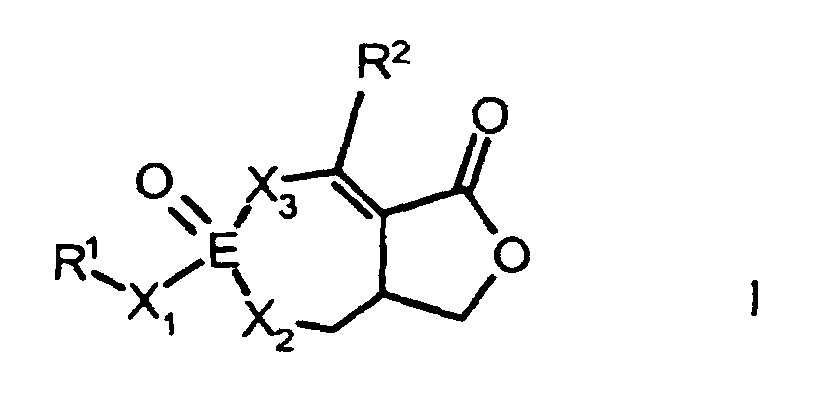
R1 für
- 1. C1-C6-Alkyl, worin Alkyl unsubstituiert oder ein- oder zweifach wie unter 1.1 bis 1.15 beschrieben substituiert ist ,
- 2. C2-C6-Alkenyl, worin Alkenyl unsubstituiert oder ein- oder zweifach wie unter 1.1 bis 1.15 beschrieben substituiert ist, oder
- 3. C2-C6-Alkinyl, worin Alkinyl unsubstituiert oder ein- oder zweifach wie unter 1.1 bis 1.15 beschrieben substituiert ist, steht,
X1, X2 und X3 unabhängig voneinander für
- 1. -O-.
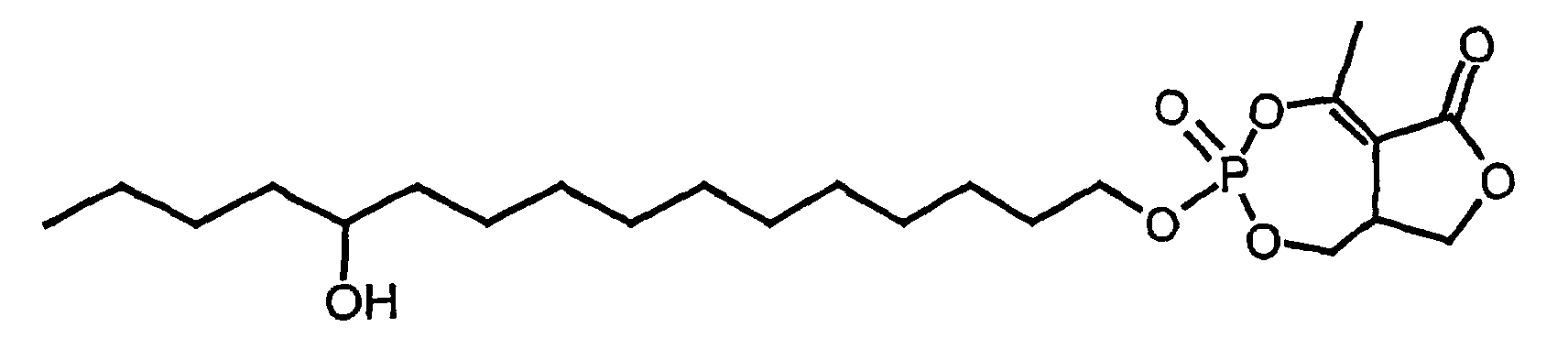
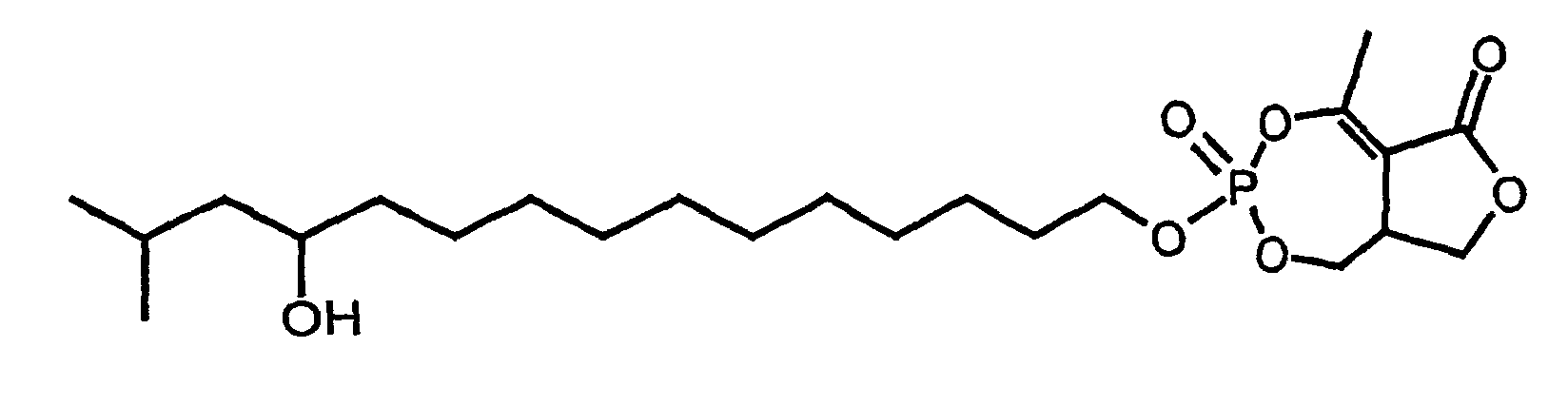


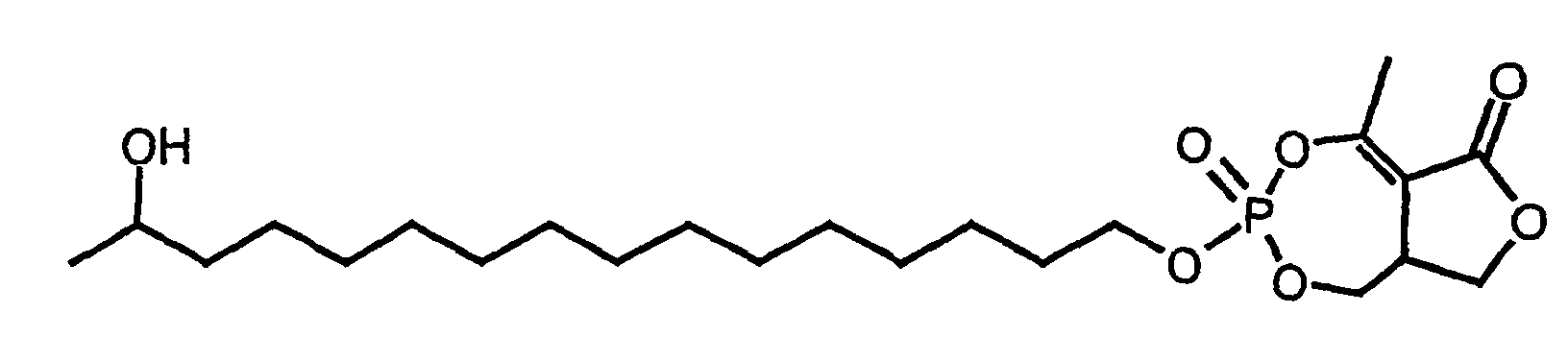


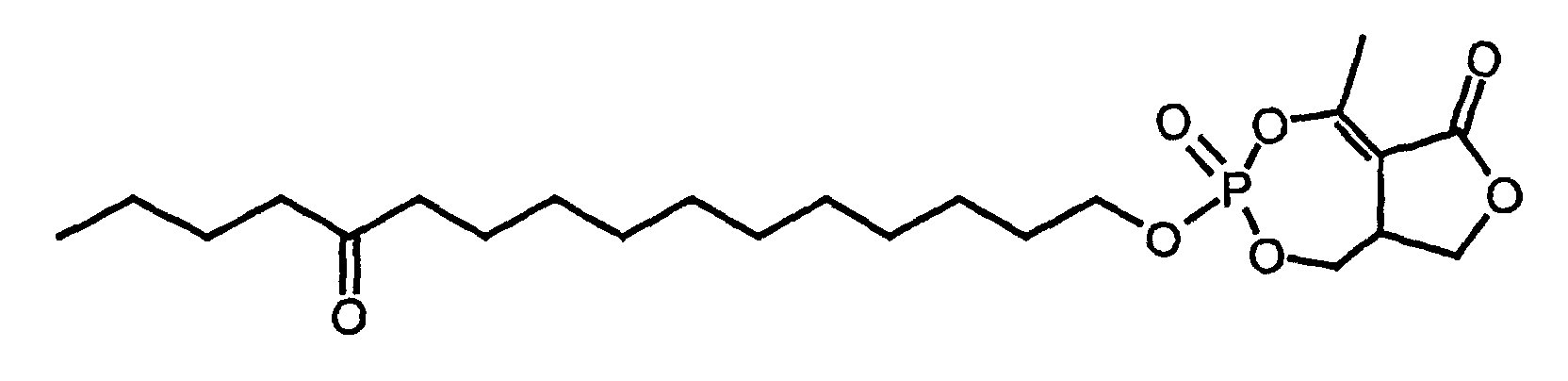




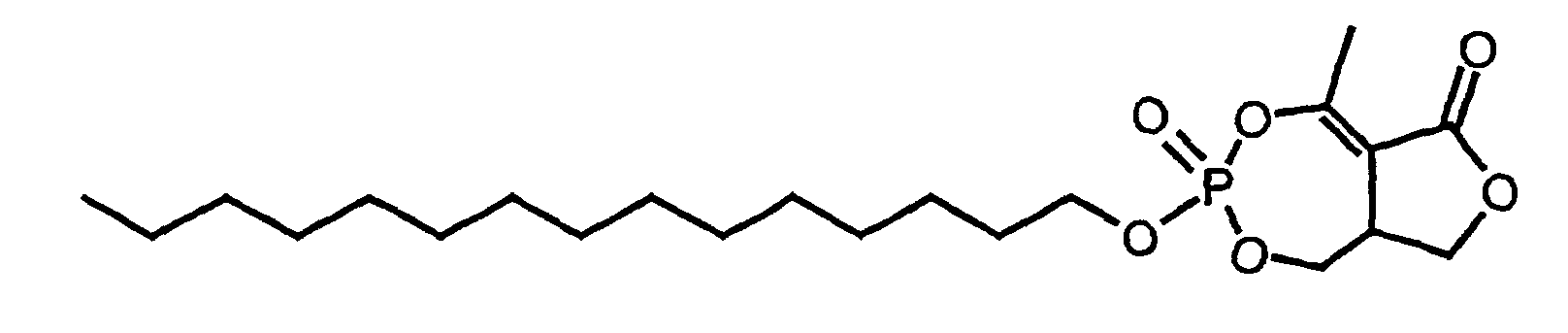
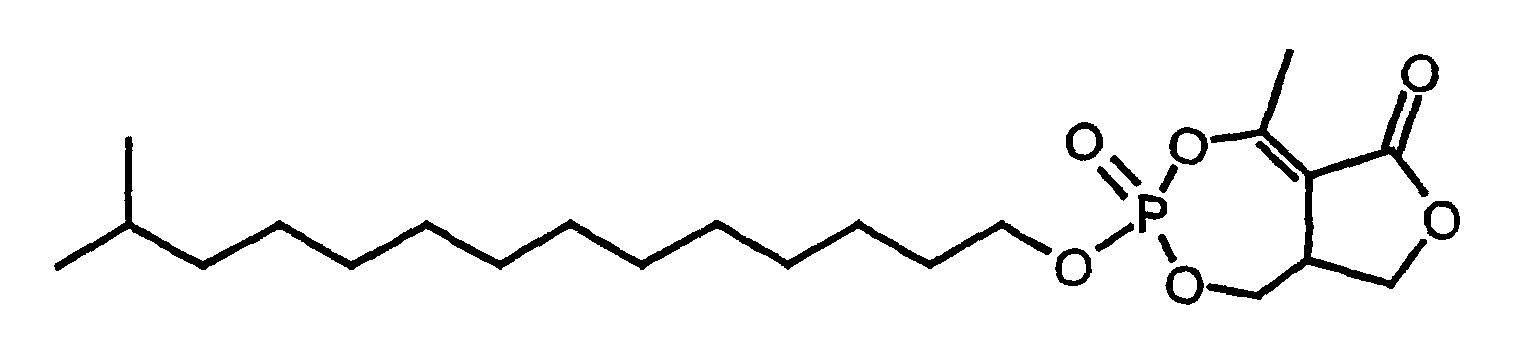


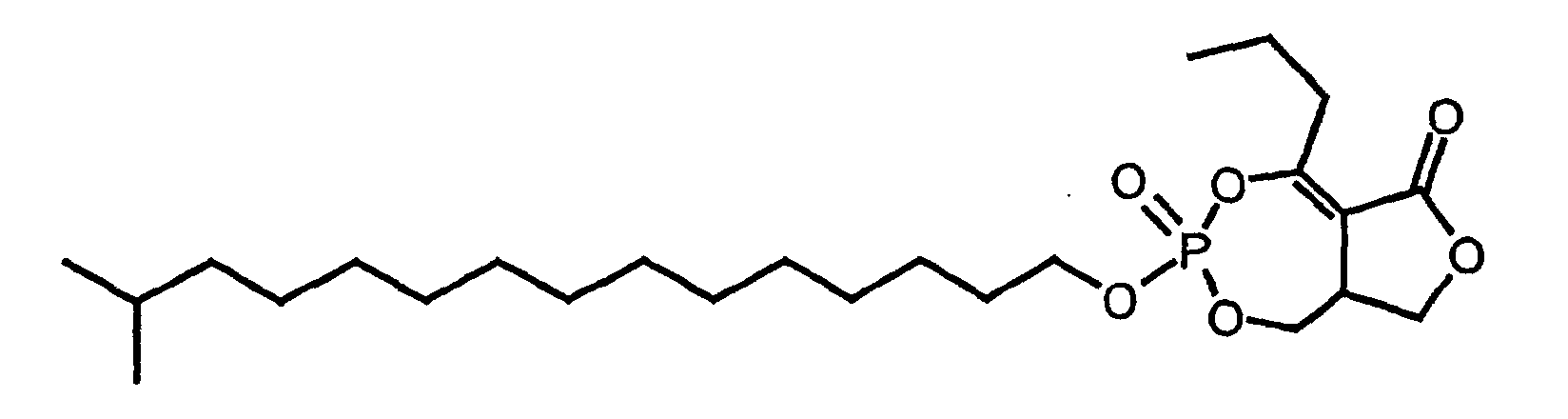

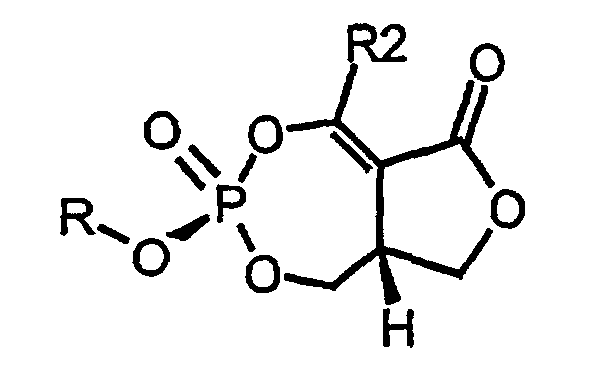
In diesem Test zeigten die Verbindungen die folgende Wirkung:
Die Cyclipostine A, P, P2 und R hemmen die Lipolyse in Ratten-Adipozyten mit IC50 = ~ 0.2 µM, sie inhibieren die humane hormon-sensitive Lipase (HSL) mit
Trioleylglycerol als Substrat: IC50 = ~ 0.07 bis 0.5 µM. Die HSL aus Ratten wird, mit NBD (4-Chloro-7-nitrobenzo-2-oxa-1,3-diazol) als Substrat, in Konzentrationen von 4 nM bis 10 nM gehemmt.
- 1 g/l Fe(III)-Citrat;
- 0.2 g/l MnSO4 x H20;
- 0.1 g/l ZnCl2;
- 0.025 g/l CuSO4 x 5H2O,
- 0.02 g/l Na-Tetraborat
- 0.004 g/l CoCl2 x 6H2O
- 0.01 g/l Na-Molybdat.
- Nährmedium:
- 20 g/l Haferflocken in Wasser;
2.5 ml/l Spurenelement.
pH 7.8 (vor der Sterilisation)
- Spurenelement-Lösung:
- 3 g/l CaCl2 x 2H2O
1 g/l Fe(III)-Citrat;
0.2 g/l MnSO4 x H20;
0.1 g/l ZnCl2;
0.025 g/l CUSO4 x 5H2O,
0.02 g/l Na-Tetraborat
0.004 g/l CoCl2 x 6H2O
0.01 g/l Na-Molybdat. - Prozessdauer:
- 72 Stunden
- Inkubationstemperatur:
- 28° C
- Rührergeschwindigkeit:
- 90 UpM
- Belüftung:
- 6 m3 Luft pro Stunde,
- Nährmedium:
- 5 g/l Glucose;
20 g/l Glycerin;
20 g/l Sojamehl;
5 g/l Hefeextrakt;
3 g/l NaCl;
2.5 ml/l Spurenelement-Lösung
pH 7.0 (vor der Sterilisation) - Prozessdauer:
- 72 Stunden,
- Inkubationstemperatur:
- 27° C,
- Rührergeschwindigkeit:
- 65 UpM,
- Belüftung:
- 6 m3 Luft pro Stunde.
| Cyclipostin A | 12.7 Minuten, |
| Cyclipostin A 2 | 12.6 Minuten, |
| Cyclipostin F | 13.2 Minuten, |
| Cyclipostin N | 15.9 Minuten, |
| Cyclipostin P | 17.7 Minuten, |
| Cyclipostin P 2 | 17.3 Minuten, |
| Cyclipostin Q | 18.3 Minuten, |
| Cyclipostin R | 16.7 Minuten, |
| Cyclipostin R2 | 16.4 Minuten, |
| Cyclipostin S | 18.5 Minuten, |
| Cyclipostin T | 19.1 Minuten und |
| Cyclipostin T2 | 18.7 Minuten. |
UV-Maximum: 228 nm in Methanol.
IR-Banden: 1752 und 1671 cm-1.
Durch hochauflösende FAB-Massenspektrometrie mit einer Nitrobenzylalkohol/LiCl-Matrix wird folgendes Molekulargewicht gefunden: 467.2757 amu, entsprechen der Summenformel für das Cyclipostinin A-Li von C23H41O7PLi. Daraus ergibt sich eine Summenformel für das Cyclipostin A von C23H41O7P, Molekulargewicht: 460. Durch Elektronenspray Massenspektrometrie wird im positivem lonisations-Modus (ES), positiv), ein Peak bei 461 amu, entsprechend (M + H)+ gefunden; darüber hinaus der charakteristische Peak bei 221 amu, entsprechend C7H10O6P. Im ESInegativ - Modus findet man 459 amu (M - H)-, 337 amu (C16H34O5P) und 219 amu (C7H8O6P). Zur Bestimmung der Position der Alkohol-Gruppe wird mit N-Methyl-N-trimethylsilyl-trifluoracetamid derivatisiert und die Probe mit Elekronen-lonisations - Massenspektrometrie untersucht. Es entsteht das Trimethylsilyl - Derivat:

| 1H- und 13C- chemische Verschiebungen von Cyclipostin A in Methanol-d4 bei 300K | ||
| 1H | 13C | |
| 1 | - | 171.08 (1.4 Hz) |
| 2 | - | 114.61 (3.4 HZ) |
| 3 | 3.87 | 40.75 |
| 4 | 4.46/3.86 | 66.04 |
| 5 | 4.31/4.25 | 69.39 (6.0 HZ) |
| 6 | - | 161.47 (8.0 HZ) |
| 7 | 2.40 | 17.89 (4.6 HZ) |
| 1' | 4.25 | 71.61 (6.6 HZ) |
| 2' | 1.73 | 31.16 (6.6 HZ) |
| 3' | 1.41 | 26.39 |
| n' | 3.49 | 72.45 |
| n±1 | 1.46-1.33 | 38.44,38.15 |
| 4'-14' | 1.37-1.26 | 30.85-30.58 |
| 15' | 1.34 | 23.84 |
| 16' | 0.91 | 14.43 |
Aussehen: in Sauerstoff enthaltenden organischen Lösungsmitteln lösliche, jedoch
in Wasser und Petrolether nur wenig lösliche, neutrale, farblose, wachsartige Substanz.
UV-Maximum: 228 nm in Methanol.
Durch Elektronenspray Massenspektrometrie wird im positivem lonisations-Modus (ESI, positiv) ein Peak bei 461 amu, entsprechend (M + H)+ gefunden; darüber hinaus der charakteristischen Peak bei 221 amu, entsprechend C7H10O6P. Im ESInegativ - Modus findet man 459 amu (M - H)-, 337 amu (C16H34O5P) und 219 amu (C7H8O6P). Zur Bestimmung der Position der Alkohol-Gruppe wird mit N-Methyl-N-trimethylsilyl-trifluoracetamid derivatisiert und die Probe mit Elekronen-lonisations - Massenspektrometrie untersucht. Es entsteht das Trimethylsilyl - Derivat der Masse 554 amu:

Aussehen: in Sauerstoff enthaltenden organischen Lösungsmitteln lösliche, jedoch in Wasser und Petrolether nur wenig lösliche, neutrale, farblose, wachsartige Substanz.
UV-Maximum: 228 nm in Methanol.
Durch Elektronenspray Massenspektrometrie wird im positivem lonisations-Modus (ESI, positiv) ein Peak bei 461 amu, entsprechend (M + H)+ gefunden; darüber hinaus der charakteristischen Peak bei 221 amu, entsprechend C7H10O6P. Im ESInegativ - Modus findet man 459 amu (M - H)-, 337 amu (C16H34O5P) und 219 amu (C7H8O6P). Zur Bestimmung der Position der Alkohol-Gruppe wird mit N-Methyl-N-trimethylsilyl-trifluoracetamid derivatisiert und die Probe mit Elekronen-Ionisations - Massenspektrometrie untersucht. Es entsteht das Trimethylsilyl - Derivat der Masse 554 amu:
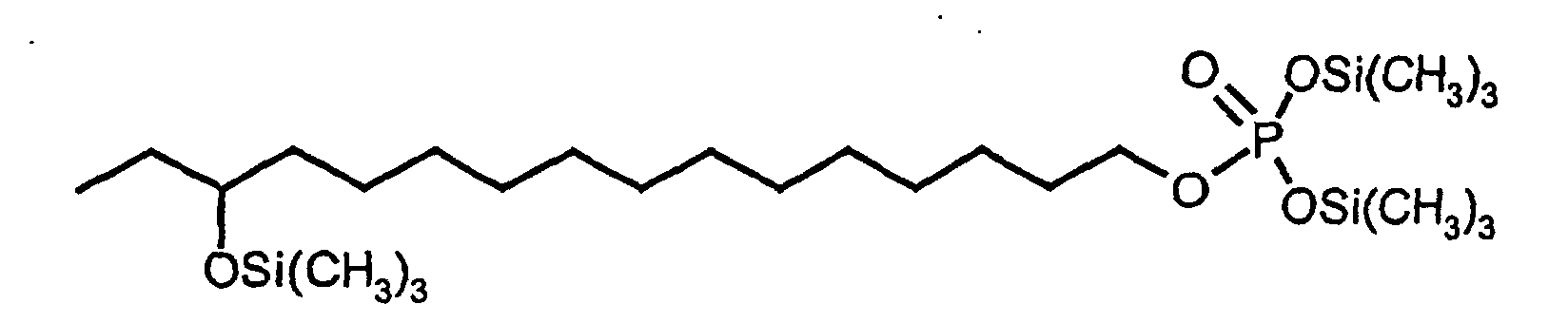
Aussehen: in Sauerstoff enthaltenden organischen Lösungsmitteln lösliche, jedoch in Wasser und Petrolether nur wenig lösliche, neutrale, farblose, wachsartige Substanz.
UV-Maximum: 228 nm in Methanol.
Durch Elektronenspray Massenspektrometrie wird im positivem lonisations-Modus (ESI, positiv) ein Peak bei 459 amu, entsprechend (M + H)+ gefunden; darüber hinaus der charakteristischen Peak bei 221 amu, entsprechend C7H10O6P. Im ESInegativ - Modus findet man 457.6 amu (M - H)-, 336 amu (C16H32O5P) und 219 amu (C7H8O6P).
Summenformel des Cyclipostin F: C23H39O7P, Molekulargewicht: 458.
Aussehen: in Sauerstoff enthaltenden organischen Lösungsmitteln lösliche, jedoch in Wasser und Petrolether nur wenig lösliche, neutrale, farblose, wachsartige Substanz.
UV-Maximum: 228 nm in Methanol.
IR-Banden: 2917, 2852, 1753, 1671, 1471, 1214, 996 und 832 cm-1.
Durch hochauflösende FAB-Massenspektrometrie mit einer Nitrobenzylalkohol-Matrix wird folgendes Molekulargewicht gefunden: 445.2717 amu, entsprechen dem (M + H)+ für das Cyclipostin P von C23H42O6P. Daraus ergibt sich eine Summenformel für das Cyclipostin P von C23H41O6P, Molekulargewicht:444. Durch Elektronenspray Massenspektrometrie wird im positivem Ionisations-Modus (ESI, positiv) ein Peak bei 445 amu, entsprechend (M + H)+ gefunden; darüber hinaus der charakteristischen Peak bei 221 amu, entsprechend C7H10O6P. Im ESlnegativ - Modus findet man 443 amu (M - H)-, 321 amu (C16H34O4P) und 219 amu (C7H8O6P).

| Chemische Verschiebungen von Cyclipostatin P in MeOD bei 300 K. | ||
| 1H | 13C | |
| 1 | - | 171.08 |
| 2 | - | 114.60 (3.0 Hz) |
| 3 | 3.87 | 40.74 |
| 4 | 4.47/3.85 | 66.05 |
| 5 | 4.30/4.25 | 69.40 (6.0 Hz) |
| 6 | - | 161.47 (8.0 Hz) |
| 7 | 2.40 | 17.90 (4.6 Hz) |
| 1' | 4.24 | 71.62 (6.9 Hz) |
| 2' | 1.73 | 31.16 (6.3 Hz) |
| 3' | 1.41 | 26.38 |
| 4'-13' | 1.34-1.29 | 30.76-30.11 |
| 14' | 1.34-1.29 | 33.07 |
| 15' | 1.31 | 23.72 |
| 16' | 0.89 | 14.42 |
Retentionszeit: 17.1 Minuten.
Aussehen: in Sauerstoff enthaltenden organischen Lösungsmitteln lösliche, jedoch in Wasser und Petrolether nur wenig lösliche, neutrale, farblose, ölige Substanz. UV-Maximum: 228 nm in Methanol.
Durch hochauflösende FAB-Massenspektrometrie mit einer Nitrobenzylalkohol-Matrix wird folgendes Molekulargewicht gefunden: 445.2721 amu, entsprechen dem (M + H)+ für das Cyclipostin P von C23H42O6P. Daraus ergibt sich eine Summenformel für das Cyclipostin P 2 von C23H41O6P, Molekulargewicht 444. Durch Elektronenspray Massenspektrometrie wird im positivem lonisations-Modus (ESI, positiv) ein Peak bei 445 amu, entsprechend (M + H)+ gefunden; darüber hinaus der charakteristischen Peak bei 221 amu, entsprechend C7H10O6P. Im ESInegativ - Modus findet man 443 amu (M - H)-, 321 amu (C16H34O4P) und 219 amu (C7H8O6P).
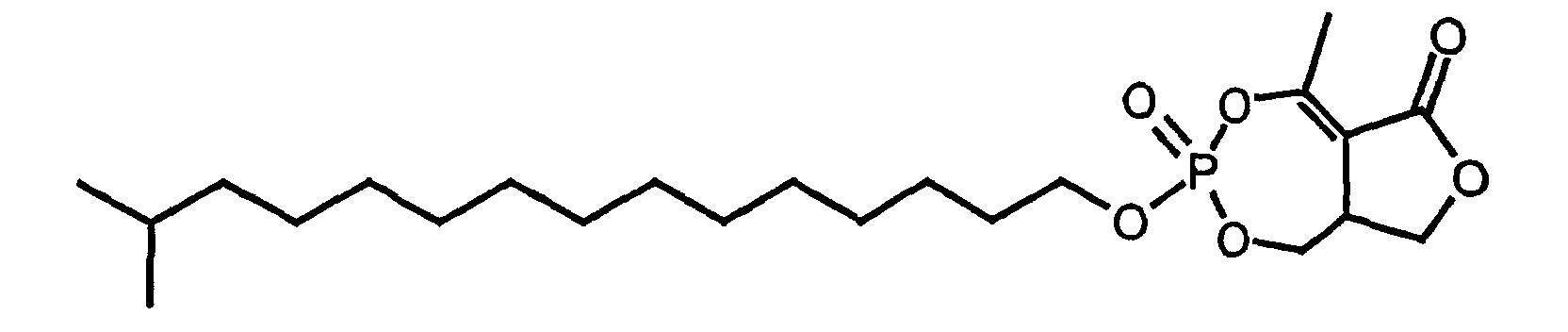
| Chemische Verschiebungen von Cyclipostin P 2 in CD3OD bei 300 K. | ||
| 1H | 13C | |
| 1 | - | 171.05 |
| 2 | - | 114.60 (3.2 Hz)) |
| 3 | 3.87 | 40.74 |
| 4 | 4.46/3.85 | 66.02 |
| 5 | 4.30/4.25 | 69.38 (6.0 Hz) |
| 6 | - | 161.46 (8.0 Hz) |
| 7 | 2.40 | 17.90 (4.6 Hz) |
| 1' | 4.24 | 71.60 (6.9 Hz) |
| 2' | 1.73 | 31.16 (6.3 Hz) |
| 3' | 1.41 | 26.39 |
| 4'-11' | 1.34-1.29 | 31.04-30.11 |
| 12' | 1.29 | 28.53 |
| 13' | 1.17 | 40.25 |
| 14' | 1.52 | 29.15 |
| 15'. 16' | 0.87 | 23.04 |
Aussehen: in Sauerstoff enthaltenden organischen Lösungsmittel lösliche, jedoch in Wasser und Petrolether nur wenig lösliche, neutrale, farblose, ölige Substanz. UV-Maximum: 228 nm in Methanol.
Durch hochauflösende Massenspektrometrie FAB-Bedingungen wurde ein Quasi-Molekülion (M + H) bei 417.2405 beobachtet entsprechend einer Summenformel von C21H38O6P (Theorie: 417.2406). Charakteristisches Fragment im ESI+-Modus: 221 amu.
| Chemische Verschiebungen von Cyclipostin N in MeOD bei 300 K. | ||
| 1H | 13C | |
| 1 | - | 171.07 |
| 2 | - | 114.60 (3.1 HZ) |
| 3 | 3.87 | 40.74 |
| 4 | 4.45/3.84 | 66.03 |
| 5 | 4.30/4.25 | 69.39 (5.9 Hz) |
| 6 | - | 161.47 (8.0 Hz) |
| 7 | 2.40 | 17.90 (4.9 Hz) |
| 1' | 4.24 | 71.60 (6.6 Hz) |
| 2' | 1.73 | 31.16 (6.2 Hz) |
| 3' | 1.41 | 26.38 |
| 4'-11' | 1.35-1.26 | 30.76-30.11 |
| 12' | 1.35-1.26 | 33.06 |
| 13' | 1.31 | 23.72 |
| 14' | 0.89 | 14.41 |
Aussehen: in Sauerstoff enthaltenden organischen Lösungsmitteln lösliche, jedoch in Wasser und Petrolether nur wenig lösliche, neutrale, farblose, kristalline Substanz. UV-Maximum: 228 nm in Methanol.
Durch hochauflösende Massenspektrometrie FAB-Bedingungen wurde ein Quasi-Molekülion (M + H) bei 431.2561 beobachtet entsprechend einer Summenformel von C22H40O6P (Theorie: 431.2562). Charakteristisches Fragment im ESI+-Modus: 221 amu.
| Chemische Verschiebungen von Cyclipostin R in MeOD bei 300 K. | ||
| 1H | 13C | |
| 1 | - | 171.06 |
| 2 | - | 114.58 (3.2 Hz) |
| 3 | 3.87 | 40.75 |
| 4 | 4.45/3.85 | 66.04 |
| 5 | 4.30/4.25 | 69.40 (6.0 HZ) |
| 6 | - | 161.48 (8.0 Hz) |
| 7 | 2.40 | 17.90 (5.0 HZ) |
| 1' | 4.24 | 71.61 (7.0 Hz) |
| 2' | 1.73 | 31.16 (6.2 HZ) |
| 3' | 1.41 | 26.38 |
| 4'-12' | 1.37-1.25 | 30.74-30.10 |
| 13' | 1.17 | 33.06 |
| 14' | 1.30 | 23.71 |
| 15' | 0.89 | 14.40 |
Aussehen: in Sauerstoff enthaltenden organischen Lösungsmitteln lösliche, jedoch in Wasser und Petrolether nur wenig lösliche, neutrale, farblose, ölige Substanz. UV-Maximum: 228 nm in Methanol.
Durch hochauflösende Massenspektrometrie FAB-Bedingungen wurde ein Quasi-Molekülion (M + H) bei 431.2564 beobachtet entsprechend einer Summenformel von C22H40O6P (Theorie: 431.2562). Charakteristisches Fragment im ESI+-Modus: 221 amu.
| Chemische Verschiebungen von Cyclipostin R2 in MeOD bei 300 K. | ||
| 1H | 13C | |
| 1 | - | 171.06 (1.7 HZ) |
| 2 | - | 114.58 (3.1 Hz) |
| 3 | 3.87 | 40.75 |
| 4 | 4.46/3.85 | 66.03 |
| 5 | 4.30/4.25 | 69.39 (6.0 Hz) |
| 6 | - | 161.47 (8.0 Hz) |
| 7 | 2.40 | 17.90 (4.9 Hz) |
| 1' | 4.24 | 71.60 (6.9 Hz) |
| 2' | 1.73 | 31.16 (6.6 Hz) |
| 3' | 1.41 | 26.38 |
| 4'-10' | 1.37-1.25 | 31.02-30.10 |
| 11' | 1.29 | 28.51 |
| 12' | 1.16 | 40.24 |
| 13' | 1.51 | 29.15 |
| 14'. 15' | 0.87 | 23.02 |
Aussehen: in Sauerstoff enthaltenden organischen Lösungsmitteln lösliche, jedoch in Wasser und Petrolether nur wenig lösliche, neutrale, farblose, feste Substanz.
UV-Maximum: 228 nm in Methanol.
Durch hochauflösende Massenspektrometrie FAB-Bedingungen wurde ein Quasi-Molekülion (M + H) bei 459.2883 beobachtet entsprechend einer Summenformel von C24H44O6P (Theorie: 459.2575). Charakteristisches Fragment im ESI+-Modus: 235 amu.
| Chemische Verschiebungen von Cyclipostin S in MeOD bei 300 K. | ||
| 1H | 13C | |
| 1 | - | 170.87 (1.4 Hz) |
| 2 | - | 113.66 (3.1 HZ) |
| 3 | 3.85 | 40.77 |
| 4 | 4.45/3.85 | 66.04 |
| 5 | 4.29/4.24 | 69.17 (6.0 HZ) |
| 6 | - | 165.80 (8.3 Hz) |
| 7 | 2.98/2.82 | 25.05 (4.6 Hz) |
| 8 | 1.16 | 10.86 |
| 1' | 4.25 | 71.57 (6.9 Hz) |
| 2' | 1.74 | 31.19 (6.3 Hz) |
| 3' | 1.42 | 26.41 |
| 4'-13' | 1.34-1.29 | 30.76-30.11 |
| 14' | 1.34-1.29 | 33.07 |
| 15' | 1.31 | 23.73 |
| 16' | 0.89 | 14.43 |
Retentionszeit: 19.1 Minuten.
Aussehen: in Sauerstoff enthaltenden organischen Lösungsmitteln lösliche, jedoch in Wasser und Petrolether nur wenig lösliche, neutrale, farblose, feste Substanz. UV-Maximum: 228 nm in Methanol.
Durch hochauflösende Massenspektrometrie FAB-Bedingungen wurde ein Quasi-Molekülion (M + H) bei 473.3030 beobachtet entsprechend einer Summenformel von C25H46O6P (Theorie: 473.3032). Charakteristisches Fragment im ESI+-Modus: 249 amu.
| Chemische Verschiebungen von Cyclipostin T in MeOD bei 300 K. | ||
| 1H | 13C | |
| 1 | - | 170.98 (1.7 Hz) |
| 2 | - | 114.39 (3.1 Hz) |
| 3 | 3.87 | 40.78 |
| 4 | 4.46/3.85 | 66.02 |
| 5 | 4.2914.26 | 69.23 (5.9 Hz) |
| 6 | - | 164.69 (8.7 Hz) |
| 7 | 2.89/2.83 | 33.35 (4.5 Hz) |
| 8 | 1.65 | 20.63 |
| 9 | 0.98 | 13.84 |
| 1' | 4.25 | 71.57 (6.6 Hz) |
| 2' | 1.74 | 31.18 (6.2 Hz) |
| 3' | 1.42 | 26.42 |
| 4'-13' | 1.34-1.29 | 30.78-30.11 |
| 14' | 1.34-1.29 | 33.06 |
| 15' | 1.31 | 23.72 |
| 16' | 0.89 | 14.42 |
Die Fraktion 21, gewonnen nach den Beispielen 5 und 6, wird wie in Beispiel 8 beschrieben, aufgetrennt und das Cyclipostin T2 durch mehrfache Wiederholung der chromatographischen Schritte isoliert (4 mg) und wie im Beispiel 9 charakterisiert.
Retentionszeit: 18.7 Minuten.
Aussehen: in Sauerstoff enthaltenden organischen Lösungsmitteln lösliche, jedoch in Wasser und Petrotether nur wenig lösliche, neutrale, farblose, feste Substanz. UV-Maximum: 228 nm in Methanol.
Durch hochauflösende Massenspektrometrie FAB-Bedingungen wurde ein Quasi-Molekülion (M + H) bei 473.3035 beobachtet entsprechend einer Summenformel von C25H46O6P (Theorie: 473.3032). Charakteristisches Fragment im ESI+-Modus: 249 amu.
| Chemische Verschiebungen von Cyclipostin T2 in MeOD bei 300 K. | ||
| 1H | 13C | |
| 1 | - | 170.98 (1.7 HZ) |
| 2 | - | 114.40 (3.1 Hz) |
| 3 | 3.87 | 40.78 |
| 4 | 4.46/3.85 | 66.02 |
| 5 | 4.29/4.25 | 69.23 (5.9 HZ) |
| 6 | - | 164.69 (8.7 Hz) |
| 7 | 2.90/2.83 | 33.35 (4.5 Hz) |
| 8 | 1.65 | 20.63 |
| 9 | 0.98 | 13.84 |
| 1' | 4.24 | 71.57 (6.9 HZ) |
| 2' | 1.74 | 31.18 (6.2 HZ) |
| 3' | 1.42 | 26.42 |
| 4'-11' | 1.37-1.25 | 31.03-30.11 |
| 12' | 1.29 | 28.52 |
| 13' | 1.17 | 40.25 |
| 14' | 1.52 | 29.15 |
| 15',16' | 0.87 | 23.03 |
| Cyclipostin A | 20 nM, |
| Cyclipostin N | 450 nM, |
| Cyclipostin P | 30 nM, |
| Cyclipostin P2 | 40 nM, |
| Cyclipostin R | 10 nM, |
| Cyclipostin R2 | 220 nM, |
| Cyclipostin S | 20 nM, |
| Cyclipostin T | 200 nM, |
| Cyclipostin T2 | 60 nM. |
Claims (13)
- Verbindung der allgemeinen Formel Iworin
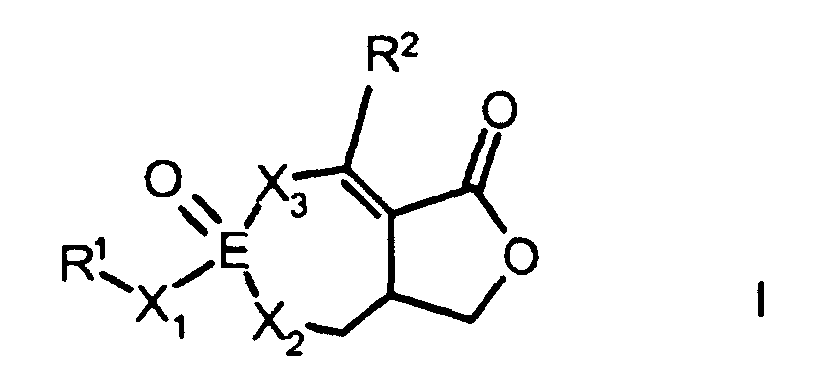
R1 fürworin die Substituenten 1.1 bis 1.15 auch noch substituiert sein können, steht;1. eine Kohlenstoff-Kette mit 10 bis 18 C - Atomen, die geradkettig, verzweigt, gesättigt oder ungesättigt, carbo- oder heterocyclisch sein kann und worin die Kohlenstoff-Kette gegebenenfalls ein- oder zweifach substituiert ist durch1.1 -OH,1.2 =O,1.3 -O-C1-C6-Alkyl, worin Alkyl gerade oder verzweigt ist,1.4 -O-C2-C6-Alkenyl, worin Alkenyl gerade oder verzweigt ist,1.5 -C1-C6-Alkyl, worin Alkyl gerade oder verzweigt ist,1.6 - Aryl,1.7 -C1-C6-Alkylbenzol,1.8 . - Diphenyl,1.9 -NH-C1-C6-Alkyl, worin Alkyl gerade oder verzweigt ist,1.10 -NH-C2-C6-Alkenyl, worin Alkenyl gerade oder verzweigt ist,1.11 -NH2,1.12 =S,1.13 -S-C1-C6-Alkyl, worin Alkyl gerade oder verzweigt ist, oder1.14 -S-C2-C6-Atkenyl, worin Alkenyl gerade oder verzweigt ist,1.15 Halogen,
R2 fürE für Phosphor- (P) und1.0 C1-C6-Alkyl, worin Alkyl unsubstituiert oder ein- oder zweifach wie unter 1.1 bis 1.15 beschrieben substituiert ist,2.0 C2-C6-Alkenyl, worin Alkenyl unsubstituiert oder ein- oder zweifach wie unter 1.1 bis 1.15 beschrieben substituiert ist,3.0 C2-C6-Alkinyl, worin Alkinyl unsubstituiert oder ein- oder zweifach wie unter 1.1 bis 1.15 beschrieben substituiert ist ,steht,
X1, X2 und X3 unabhängig voneinander für -O- stehen,
in allen ihren stereochemischen Formen und Gemische dieser Formen in jedem Verhältnis, sowie deren physiologisch verträglichen Salzen. - Verbindung der Formel I oder ein physiologisch verträgliches Salz davon gemäß Anspruch 1, dadurch gekennzeichnet, daß
R1 fürsteht.1.0 -(CH2)15CH3,2.0 -(CH2)13CH(CH3)2,3.0 -(CH2)11CH(OH)(CH2)3CH3.4.0 -(CH2)11CH(OH)CH2CH(CH3)2,5.0 -(CH2)12CH(OH)(CH2)2CH3,6.0 -(CH2)13CH(OH)CH2CH3,7.0 -(CH2)14CH(OH)CH3,8.0 -(CH2)15CH2(OH),9.0 -(CH2)16CH3,10.0 -(CH2)13C=OCH2CH311.0 -(CH2)12C=OCH2CH2CH312.0 -(CH2)11C=OCH2CH2CH2CH313.0 -(CH2)13CH314.0 -(CH2)11CH(CH3)215.0 -(CH2)14CH3 oder16.0 -(CH2)12CH(CH3)2 - Verbindung der Formel I oder ein physiologisch verträgliches Salz davon gemäß Anspruch 1 oder 2, dadurch gekennzeichnet, daß R2 für C1-C6-Alkyl steht.
- Verbindung der Formel I oder ein physiologisch verträgliches Salz davon gemäß Anspruch 3, dadurch gekennzeichnet daß R2 für -CH3, -CH2CH3 oder -CH2CH2CH3 steht.
- Verbindung der Formel I oder ein physiologisch verträgliches Salz davon gemäß einem oder mehreren der Ansprüche 1 bis 4, herstellbar indem der Mikroorganismus Streptomyces species HAG 004107, DSM 13381, oder einer seiner Varianten oder Mutanten unter geeigneten Bedingungen in einem Kulturmedium fermentiert wird, bis sich eine oder mehrere Verbindungen der allgemeinen Formel I in dem Kulturmedium anhäufen und anschließend aus dem Kulturmedium isoliert und gegebenenfalls in chemische Äquivalente und physiologisch verträgliche Salze überführt werden.
- Verfahren zur Herstellung einer Verbindung der Formel I oder ein physiologisch verträgliches Salz davon gemäß einem oder mehreren der Ansprüche 1-5, dadurch gekennzeichnet, daß der Mikroorganismus Streptomyces species HAG 004107, DSM 13381, oder einer seiner Varianten oder Mutanten unter geeigneten Bedingungen in einem Kulturmedium fermentiert wird, bis sich eine oder mehrere Verbindungen der allgemeinen Formel I in dem Kulturmedium anhäufen und anschließend aus dem Kulturmedium isoliert und gegebenenfalls in chemische Äquivalente und physiologisch verträgliche Salze überführt werden.
- Verfahren gemäß Anspruch 6, dadurch gekennzeichnet, daß die Fermentation unter aeroben Bedingunen bei einer Temperatur zwischen 18 und 35°C und bei einem pH zwischen 6 und 8 durchgeführt wird.
- Verbindung der Formel I oder ein physiologisch verträgliches Salz davon gemäß einem oder mehreren der Ansprüche 1-5 zur Verwendung als Arzneimittel.
- Verbindung der Formel I oder ein physiologisch verträgliches Salz davon gemäß einem oder mehreren der Ansprüche 1-5 zur Verwendung als Arzneimittel zur Hemmung von Lipasen.
- Verbindung der Formel I oder ein physiologisch verträgliches Salz davon gemäß einem oder mehreren der Ansprüche 1-5 zur Verwendung als Antidiabetikum.
- Pharmazeutische Zubereitung mit einem Gehalt an mindestens einer Verbindung der Formel I oder ein physiologisch verträgliches Salz davon gemäß einem oder mehreren der Ansprüche 1-5.
- Verfahren zur Herstellung von pharmazeutischen Zubereitungen gemäß Anspruch 11, dadurch gekennzeichnet, daß man mindestens eine Verbindung der Formel I oder ein verträgliches Salz davon gemäß einem oder mehreren der Ansprüche 1-5 mit geeigneten Hilfs- und/oder Trägerstoffen in eine geeignete Darreichungsform bringt.
- Streptomyces species HAG 004107, DSM 13381.
Priority Applications (1)
| Application Number | Priority Date | Filing Date | Title |
|---|---|---|---|
| SI200130323T SI1280812T1 (de) | 2000-05-04 | 2001-04-25 |
Applications Claiming Priority (3)
| Application Number | Priority Date | Filing Date | Title |
|---|---|---|---|
| DE10021731A DE10021731B4 (de) | 2000-05-04 | 2000-05-04 | Cyclipostine, Verfahren zu ihrer Herstellung und pharmazeutische Zubereitung derselben |
| DE10021731 | 2000-05-04 | ||
| PCT/EP2001/004652 WO2001083497A1 (de) | 2000-05-04 | 2001-04-25 | Cyclipostine, verfahren zu ihrer herstellung und verwendung derselben |
Publications (2)
| Publication Number | Publication Date |
|---|---|
| EP1280812A1 EP1280812A1 (de) | 2003-02-05 |
| EP1280812B1 true EP1280812B1 (de) | 2005-02-02 |
Family
ID=7640768
Family Applications (1)
| Application Number | Title | Priority Date | Filing Date |
|---|---|---|---|
| EP01936275A Expired - Lifetime EP1280812B1 (de) | 2000-05-04 | 2001-04-25 | Cyclipostine, verfahren zu ihrer herstellung und verwendung derselben |
Country Status (27)
| Country | Link |
|---|---|
| EP (1) | EP1280812B1 (de) |
| JP (1) | JP5038572B2 (de) |
| KR (1) | KR100779867B1 (de) |
| CN (1) | CN1216890C (de) |
| AR (1) | AR028398A1 (de) |
| AT (1) | ATE288442T1 (de) |
| AU (2) | AU2001262229B2 (de) |
| BR (1) | BR0110459A (de) |
| CA (1) | CA2407808C (de) |
| CZ (1) | CZ20023547A3 (de) |
| DE (2) | DE10021731B4 (de) |
| DK (1) | DK1280812T3 (de) |
| EE (1) | EE05090B1 (de) |
| ES (1) | ES2236234T3 (de) |
| HR (1) | HRP20020864A2 (de) |
| HU (1) | HUP0300306A3 (de) |
| IL (2) | IL152612A0 (de) |
| MX (1) | MXPA02010297A (de) |
| NO (1) | NO330438B1 (de) |
| NZ (1) | NZ522352A (de) |
| PL (1) | PL358328A1 (de) |
| PT (1) | PT1280812E (de) |
| RU (1) | RU2266911C2 (de) |
| SK (1) | SK15602002A3 (de) |
| WO (1) | WO2001083497A1 (de) |
| YU (1) | YU81502A (de) |
| ZA (1) | ZA200208928B (de) |
Families Citing this family (7)
| Publication number | Priority date | Publication date | Assignee | Title |
|---|---|---|---|---|
| US8110665B2 (en) | 2003-11-13 | 2012-02-07 | Hanmi Holdings Co., Ltd. | Pharmaceutical composition comprising an immunoglobulin FC region as a carrier |
| WO2005047337A1 (en) | 2003-11-13 | 2005-05-26 | Hanmi Pharmaceutical Co., Ltd. | A pharmaceutical composition comprising an immunoglobulin fc region as a carrier |
| KR100754667B1 (ko) | 2005-04-08 | 2007-09-03 | 한미약품 주식회사 | 비펩타이드성 중합체로 개질된 면역글로불린 Fc 단편 및이를 포함하는 약제학적 조성물 |
| EP1894601A1 (de) | 2006-08-29 | 2008-03-05 | sanofi-aventis | Behandlung mykobakterieller Infektionen mit Cyclipostinen |
| KR200453850Y1 (ko) * | 2008-04-23 | 2011-05-30 | 주식회사 에이티티알앤디 | 수질 관리 센서 내장형 수도미터기 |
| KR102073748B1 (ko) | 2013-01-31 | 2020-02-05 | 한미약품 주식회사 | 재조합 효모 형질전환체 및 이를 이용하여 면역글로불린 단편을 생산하는 방법 |
| AR096891A1 (es) | 2013-07-12 | 2016-02-03 | Hanmi Pharm Ind Co Ltd | Conjugado de monómero polipéptido biológicamente activo y conjugado de fragmento fc de inmunoglobulina, que muestra aclaramiento mediado por receptor reducido, y el método para la preparación del mismo |
Family Cites Families (4)
| Publication number | Priority date | Publication date | Assignee | Title |
|---|---|---|---|---|
| JPH04145089A (ja) * | 1990-10-05 | 1992-05-19 | Nippon Kayaku Co Ltd | 抗生物質nk901093、その製造法及びそれを有効成分として含有する殺虫・殺ダニ剤 |
| AU649116B2 (en) * | 1991-03-27 | 1994-05-12 | Sankyo Company Limited | New compounds, named the "Leustroducins", their preparation and their therapeutic uses |
| JPH0656859A (ja) * | 1991-07-25 | 1994-03-01 | Nippon Kayaku Co Ltd | 抗生物質nk901093a、その製造法及びそれを有効成分として含有する殺虫・殺ダニ剤 |
| RU2077204C1 (ru) * | 1995-05-12 | 1997-04-20 | Третьяков Анатолий Петрович | Способ производства микробиологических препаратов |
-
2000
- 2000-05-04 DE DE10021731A patent/DE10021731B4/de not_active Expired - Fee Related
-
2001
- 2001-04-25 IL IL15261201A patent/IL152612A0/xx unknown
- 2001-04-25 WO PCT/EP2001/004652 patent/WO2001083497A1/de not_active Ceased
- 2001-04-25 CZ CZ20023547A patent/CZ20023547A3/cs unknown
- 2001-04-25 AT AT01936275T patent/ATE288442T1/de active
- 2001-04-25 PT PT01936275T patent/PT1280812E/pt unknown
- 2001-04-25 KR KR1020027014691A patent/KR100779867B1/ko not_active Expired - Fee Related
- 2001-04-25 ES ES01936275T patent/ES2236234T3/es not_active Expired - Lifetime
- 2001-04-25 DE DE50105249T patent/DE50105249D1/de not_active Expired - Lifetime
- 2001-04-25 MX MXPA02010297A patent/MXPA02010297A/es active IP Right Grant
- 2001-04-25 DK DK01936275T patent/DK1280812T3/da active
- 2001-04-25 NZ NZ522352A patent/NZ522352A/en unknown
- 2001-04-25 AU AU2001262229A patent/AU2001262229B2/en not_active Ceased
- 2001-04-25 EP EP01936275A patent/EP1280812B1/de not_active Expired - Lifetime
- 2001-04-25 PL PL01358328A patent/PL358328A1/xx unknown
- 2001-04-25 YU YU81502A patent/YU81502A/sh unknown
- 2001-04-25 SK SK1560-2002A patent/SK15602002A3/sk unknown
- 2001-04-25 CN CN018088813A patent/CN1216890C/zh not_active Expired - Fee Related
- 2001-04-25 HU HU0300306A patent/HUP0300306A3/hu unknown
- 2001-04-25 EE EEP200200599A patent/EE05090B1/xx not_active IP Right Cessation
- 2001-04-25 JP JP2001580922A patent/JP5038572B2/ja not_active Expired - Fee Related
- 2001-04-25 RU RU2002132558/04A patent/RU2266911C2/ru not_active IP Right Cessation
- 2001-04-25 CA CA2407808A patent/CA2407808C/en not_active Expired - Fee Related
- 2001-04-25 AU AU6222901A patent/AU6222901A/xx active Pending
- 2001-04-25 BR BR0110459-4A patent/BR0110459A/pt not_active IP Right Cessation
- 2001-04-25 HR HRP20020864 patent/HRP20020864A2/xx not_active Application Discontinuation
- 2001-05-02 AR ARP010102068A patent/AR028398A1/es not_active Application Discontinuation
-
2002
- 2002-10-30 NO NO20025209A patent/NO330438B1/no not_active IP Right Cessation
- 2002-11-03 IL IL152612A patent/IL152612A/en not_active IP Right Cessation
- 2002-11-04 ZA ZA200208928A patent/ZA200208928B/en unknown
Also Published As
Similar Documents
| Publication | Publication Date | Title |
|---|---|---|
| CH638194A5 (de) | Esterastin, eine neue physiologisch wirksame substanz und deren herstellung. | |
| EP0864584B1 (de) | Lipopeptide aus Actinoplanes sp. mit pharmakologischer Wirkung, Verfahren zu ihrer Herstellung und Verwendung derselben | |
| EP1175435B1 (de) | Cephaibole, antiparasitika aus acremonium tubakii, verfahren zu ihrer herstellung und verwendung derselben | |
| DE10021731B4 (de) | Cyclipostine, Verfahren zu ihrer Herstellung und pharmazeutische Zubereitung derselben | |
| DE60110908T2 (de) | Antibiotische tripropeptine und verfahren ihrer herstellung | |
| EP0652205A2 (de) | Moenomycin-Abbauprodukte mit hydroxylierter oder oxidierter Lipidseitenkette und Moenomycin-Analoga, ein Verfahren zur Herstellung und die Verwendung dieser Verbindungen | |
| EP1372670B1 (de) | Caloporosid-derivate, verfahren zu deren herstellung und deren verwendung | |
| US6756402B2 (en) | Cyclipostins, process for their preparation and use thereof | |
| DE10351315A1 (de) | 2-Phenyl-benzofuran-Derivate, Verfahren zur ihrer Herstellung und ihre Verwendung | |
| DE4305249A1 (de) | Galaktosylbrefeldin A, ein neuer Metabolit mit pharmakologischer Wirkung, ein Verfahren zu seiner Herstellung und seine Verwendung | |
| EP0546474A1 (de) | Pseurotin F1/F2, neue Metabolite aus Aspergillus fumigatus, Verfahren zu ihrer Herstellung und ihre Verwendung als Apomorphin Antagonisten | |
| DE19740030A1 (de) | Ampullosporin, Verfahren zu dessen Herstellung und dessen Verwendung | |
| EP1519909B1 (de) | Polyencarbonsäure-derivate, verfahren zu ihrer herstellung und ihre verwendung | |
| CH637137A5 (en) | Antibiotic and process for its preparation | |
| EP0848064B1 (de) | Neues Antibiotikum, Feglymycin, Verfahren zu seiner Herstellung und Verwendung | |
| EP0546475A1 (de) | Biologisch aktives Pseurotin A und D, neue Metabolite aus Aspergillus fumigatus, Verfahren zu ihrer Herstellung und ihre Verwendung als Apomorphin Antagonisten | |
| DE60101313T2 (de) | Pluraflavine und derivate davon, verfahren zu ihrer herstellung und verwendung derselben | |
| DE10206849A1 (de) | Phenalenon-Derivate, Verfahren zur Herstellung und Verwendung derselben | |
| DE4225284A1 (de) | Clonostachydiol und Helmidiol, neue Makrodiolide mit pharmakologischer Wirkung, ein Verfahren zu ihrer Herstellung und ihre Verwendung | |
| DE10130890A1 (de) | Eurotinone und Derivate davon, Verfahren zu ihrer Herstellung und Verwendung derselben | |
| DE19649266A1 (de) | Neuer Peptidwirkstoff Lipohexin, Verfahren zu dessen Herstellung und dessen Verwendung | |
| DE4303684A1 (de) | Musacine, neue Metabolite aus Streptomyces sp., und chemische Derivate mit pharmakologischer Wirkung, ein Verfahren zu ihrer Herstellung und ihre Verwendung | |
| DE10065606A1 (de) | Altamiramycin, Verfahren zu dessen Herstellung und dessen Verwendung | |
| DE19740080A1 (de) | Neue Phthalaldehyd-Derivate, Verfahren zu deren Herstellung und deren Verwendung | |
| DE4305351A1 (de) | Aurantimycin, Peptidantibiotikum aus Streptomyces aurantiacus, und chemische Derivate mit pharmakologischer Wirkung, ein Verfahren zur Herstellung und Verwendung derselben |
Legal Events
| Date | Code | Title | Description |
|---|---|---|---|
| PUAI | Public reference made under article 153(3) epc to a published international application that has entered the european phase |
Free format text: ORIGINAL CODE: 0009012 |
|
| 17P | Request for examination filed |
Effective date: 20021204 |
|
| AK | Designated contracting states |
Designated state(s): AT BE CH CY DE DK ES FI FR GB GR IE IT LI LU MC NL PT SE TR |
|
| AX | Request for extension of the european patent |
Extension state: AL LT LV MK RO SI |
|
| 17Q | First examination report despatched |
Effective date: 20031119 |
|
| GRAP | Despatch of communication of intention to grant a patent |
Free format text: ORIGINAL CODE: EPIDOSNIGR1 |
|
| GRAS | Grant fee paid |
Free format text: ORIGINAL CODE: EPIDOSNIGR3 |
|
| GRAA | (expected) grant |
Free format text: ORIGINAL CODE: 0009210 |
|
| AK | Designated contracting states |
Kind code of ref document: B1 Designated state(s): AT BE CH CY DE DK ES FI FR GB GR IE IT LI LU MC NL PT SE TR |
|
| AX | Request for extension of the european patent |
Extension state: AL LT LV MK RO SI |
|
| REG | Reference to a national code |
Ref country code: GB Ref legal event code: FG4D Free format text: NOT ENGLISH |
|
| REG | Reference to a national code |
Ref country code: CH Ref legal event code: EP |
|
| REG | Reference to a national code |
Ref country code: IE Ref legal event code: FG4D Free format text: GERMAN |
|
| REF | Corresponds to: |
Ref document number: 50105249 Country of ref document: DE Date of ref document: 20050310 Kind code of ref document: P |
|
| REG | Reference to a national code |
Ref country code: GR Ref legal event code: EP Ref document number: 20050400937 Country of ref document: GR |
|
| PG25 | Lapsed in a contracting state [announced via postgrant information from national office to epo] |
Ref country code: MC Free format text: LAPSE BECAUSE OF NON-PAYMENT OF DUE FEES Effective date: 20050430 |
|
| GBT | Gb: translation of ep patent filed (gb section 77(6)(a)/1977) |
Effective date: 20050407 |
|
| REG | Reference to a national code |
Ref country code: SE Ref legal event code: TRGR |
|
| REG | Reference to a national code |
Ref country code: DK Ref legal event code: T3 |
|
| REG | Reference to a national code |
Ref country code: PT Ref legal event code: SC4A Free format text: AVAILABILITY OF NATIONAL TRANSLATION Effective date: 20050317 |
|
| REG | Reference to a national code |
Ref country code: ES Ref legal event code: FG2A Ref document number: 2236234 Country of ref document: ES Kind code of ref document: T3 |
|
| PLBE | No opposition filed within time limit |
Free format text: ORIGINAL CODE: 0009261 |
|
| STAA | Information on the status of an ep patent application or granted ep patent |
Free format text: STATUS: NO OPPOSITION FILED WITHIN TIME LIMIT |
|
| 26N | No opposition filed |
Effective date: 20051103 |
|
| ET | Fr: translation filed | ||
| REG | Reference to a national code |
Ref country code: SI Ref legal event code: SP73 Owner name: SANOFI-AVENTIS DEUTSCHLAND GMBH; DE Effective date: 20060109 Ref country code: CH Ref legal event code: PFA Owner name: SANOFI-AVENTIS DEUTSCHLAND GMBH Free format text: AVENTIS PHARMA DEUTSCHLAND GMBH#BRUENINGSTRASSE 50#65929 FRANKFURT AM MAIN (DE) -TRANSFER TO- SANOFI-AVENTIS DEUTSCHLAND GMBH#BRUENINGSTRASSE 50#65929 FRANKFURT AM MAIN (DE) |
|
| NLT1 | Nl: modifications of names registered in virtue of documents presented to the patent office pursuant to art. 16 a, paragraph 1 |
Owner name: SANOFI-AVENTIS DEUTSCHLAND GMBH |
|
| REG | Reference to a national code |
Ref country code: FR Ref legal event code: CD |
|
| BECN | Be: change of holder's name |
Owner name: *SANOFI-AVENTIS DEUTSCHLAND G.M.B.H. Effective date: 20050202 |
|
| PGFP | Annual fee paid to national office [announced via postgrant information from national office to epo] |
Ref country code: LU Payment date: 20080513 Year of fee payment: 8 |
|
| PGFP | Annual fee paid to national office [announced via postgrant information from national office to epo] |
Ref country code: CY Payment date: 20080321 Year of fee payment: 8 |
|
| LTLA | Lt: lapse of european patent or patent extension |
Effective date: 20090425 |
|
| REG | Reference to a national code |
Ref country code: SI Ref legal event code: KO00 Effective date: 20100125 |
|
| PG25 | Lapsed in a contracting state [announced via postgrant information from national office to epo] |
Ref country code: CY Free format text: LAPSE BECAUSE OF NON-PAYMENT OF DUE FEES Effective date: 20090425 |
|
| PG25 | Lapsed in a contracting state [announced via postgrant information from national office to epo] |
Ref country code: LU Free format text: LAPSE BECAUSE OF NON-PAYMENT OF DUE FEES Effective date: 20090425 |
|
| PGFP | Annual fee paid to national office [announced via postgrant information from national office to epo] |
Ref country code: GR Payment date: 20140313 Year of fee payment: 14 Ref country code: ES Payment date: 20140311 Year of fee payment: 14 Ref country code: TR Payment date: 20140321 Year of fee payment: 14 |
|
| PGFP | Annual fee paid to national office [announced via postgrant information from national office to epo] |
Ref country code: IE Payment date: 20140410 Year of fee payment: 14 Ref country code: GB Payment date: 20140423 Year of fee payment: 14 |
|
| PGFP | Annual fee paid to national office [announced via postgrant information from national office to epo] |
Ref country code: DE Payment date: 20140430 Year of fee payment: 14 Ref country code: IT Payment date: 20140416 Year of fee payment: 14 Ref country code: FR Payment date: 20140409 Year of fee payment: 14 Ref country code: PT Payment date: 20140424 Year of fee payment: 14 Ref country code: FI Payment date: 20140410 Year of fee payment: 14 Ref country code: SE Payment date: 20140411 Year of fee payment: 14 Ref country code: NL Payment date: 20140410 Year of fee payment: 14 Ref country code: CH Payment date: 20140414 Year of fee payment: 14 Ref country code: AT Payment date: 20140326 Year of fee payment: 14 |
|
| PGFP | Annual fee paid to national office [announced via postgrant information from national office to epo] |
Ref country code: BE Payment date: 20140414 Year of fee payment: 14 Ref country code: DK Payment date: 20140410 Year of fee payment: 14 |
|
| REG | Reference to a national code |
Ref country code: PT Ref legal event code: MM4A Free format text: LAPSE DUE TO NON-PAYMENT OF FEES Effective date: 20151026 Ref country code: DE Ref legal event code: R119 Ref document number: 50105249 Country of ref document: DE |
|
| REG | Reference to a national code |
Ref country code: DK Ref legal event code: EBP Effective date: 20150430 |
|
| REG | Reference to a national code |
Ref country code: CH Ref legal event code: PL |
|
| REG | Reference to a national code |
Ref country code: SE Ref legal event code: EUG Ref country code: AT Ref legal event code: MM01 Ref document number: 288442 Country of ref document: AT Kind code of ref document: T Effective date: 20150425 |
|
| GBPC | Gb: european patent ceased through non-payment of renewal fee |
Effective date: 20150425 |
|
| REG | Reference to a national code |
Ref country code: NL Ref legal event code: MM Effective date: 20150501 |
|
| REG | Reference to a national code |
Ref country code: IE Ref legal event code: MM4A |
|
| PG25 | Lapsed in a contracting state [announced via postgrant information from national office to epo] |
Ref country code: DE Free format text: LAPSE BECAUSE OF NON-PAYMENT OF DUE FEES Effective date: 20151103 Ref country code: FI Free format text: LAPSE BECAUSE OF NON-PAYMENT OF DUE FEES Effective date: 20150425 Ref country code: GB Free format text: LAPSE BECAUSE OF NON-PAYMENT OF DUE FEES Effective date: 20150425 Ref country code: GR Free format text: LAPSE BECAUSE OF NON-PAYMENT OF DUE FEES Effective date: 20151106 Ref country code: CH Free format text: LAPSE BECAUSE OF NON-PAYMENT OF DUE FEES Effective date: 20150430 Ref country code: IT Free format text: LAPSE BECAUSE OF NON-PAYMENT OF DUE FEES Effective date: 20150425 Ref country code: LI Free format text: LAPSE BECAUSE OF NON-PAYMENT OF DUE FEES Effective date: 20150430 |
|
| REG | Reference to a national code |
Ref country code: FR Ref legal event code: ST Effective date: 20151231 |
|
| REG | Reference to a national code |
Ref country code: GR Ref legal event code: ML Ref document number: 20050400937 Country of ref document: GR Effective date: 20151106 |
|
| PG25 | Lapsed in a contracting state [announced via postgrant information from national office to epo] |
Ref country code: PT Free format text: LAPSE BECAUSE OF NON-PAYMENT OF DUE FEES Effective date: 20151026 Ref country code: SE Free format text: LAPSE BECAUSE OF NON-PAYMENT OF DUE FEES Effective date: 20150426 Ref country code: AT Free format text: LAPSE BECAUSE OF NON-PAYMENT OF DUE FEES Effective date: 20150425 Ref country code: FR Free format text: LAPSE BECAUSE OF NON-PAYMENT OF DUE FEES Effective date: 20150430 |
|
| PG25 | Lapsed in a contracting state [announced via postgrant information from national office to epo] |
Ref country code: NL Free format text: LAPSE BECAUSE OF NON-PAYMENT OF DUE FEES Effective date: 20150501 |
|
| PG25 | Lapsed in a contracting state [announced via postgrant information from national office to epo] |
Ref country code: IE Free format text: LAPSE BECAUSE OF NON-PAYMENT OF DUE FEES Effective date: 20150425 Ref country code: DK Free format text: LAPSE BECAUSE OF NON-PAYMENT OF DUE FEES Effective date: 20150430 |
|
| REG | Reference to a national code |
Ref country code: ES Ref legal event code: FD2A Effective date: 20160527 |
|
| PG25 | Lapsed in a contracting state [announced via postgrant information from national office to epo] |
Ref country code: ES Free format text: LAPSE BECAUSE OF NON-PAYMENT OF DUE FEES Effective date: 20150426 |
|
| PG25 | Lapsed in a contracting state [announced via postgrant information from national office to epo] |
Ref country code: BE Free format text: LAPSE BECAUSE OF NON-PAYMENT OF DUE FEES Effective date: 20150430 |
|
| PG25 | Lapsed in a contracting state [announced via postgrant information from national office to epo] |
Ref country code: TR Free format text: LAPSE BECAUSE OF NON-PAYMENT OF DUE FEES Effective date: 20150425 |