EP1269179B1 - Chromatographiesäule, enthaltend monolithische sorbenzien mit faserverstärkter kunststoffummantelung und deren verwendung - Google Patents
Chromatographiesäule, enthaltend monolithische sorbenzien mit faserverstärkter kunststoffummantelung und deren verwendung Download PDFInfo
- Publication number
- EP1269179B1 EP1269179B1 EP01919385A EP01919385A EP1269179B1 EP 1269179 B1 EP1269179 B1 EP 1269179B1 EP 01919385 A EP01919385 A EP 01919385A EP 01919385 A EP01919385 A EP 01919385A EP 1269179 B1 EP1269179 B1 EP 1269179B1
- Authority
- EP
- European Patent Office
- Prior art keywords
- fiber
- column
- chromatography column
- monolithic
- plastics
- Prior art date
- Legal status (The legal status is an assumption and is not a legal conclusion. Google has not performed a legal analysis and makes no representation as to the accuracy of the status listed.)
- Expired - Lifetime
Links
- 229920002430 Fibre-reinforced plastic Polymers 0.000 title claims abstract description 10
- 239000011151 fibre-reinforced plastic Substances 0.000 title claims abstract description 10
- 238000004587 chromatography analysis Methods 0.000 title claims description 11
- 239000002594 sorbent Substances 0.000 title abstract description 19
- 238000000576 coating method Methods 0.000 title description 4
- 239000011248 coating agent Substances 0.000 title description 3
- 238000000465 moulding Methods 0.000 claims abstract description 21
- 238000000034 method Methods 0.000 claims abstract description 14
- 239000000835 fiber Substances 0.000 claims description 21
- 239000004696 Poly ether ether ketone Substances 0.000 claims description 18
- 229920002530 polyetherether ketone Polymers 0.000 claims description 18
- 239000000126 substance Substances 0.000 claims description 11
- 229920001169 thermoplastic Polymers 0.000 claims description 6
- 238000013375 chromatographic separation Methods 0.000 claims description 4
- 239000004416 thermosoftening plastic Substances 0.000 claims description 4
- 230000002787 reinforcement Effects 0.000 claims description 3
- OKTJSMMVPCPJKN-UHFFFAOYSA-N Carbon Chemical compound [C] OKTJSMMVPCPJKN-UHFFFAOYSA-N 0.000 claims 1
- 229910052799 carbon Inorganic materials 0.000 claims 1
- 239000004033 plastic Substances 0.000 description 32
- 229920003023 plastic Polymers 0.000 description 32
- 238000000926 separation method Methods 0.000 description 24
- 229920000642 polymer Polymers 0.000 description 18
- WEVYAHXRMPXWCK-UHFFFAOYSA-N Acetonitrile Chemical compound CC#N WEVYAHXRMPXWCK-UHFFFAOYSA-N 0.000 description 17
- MWPLVEDNUUSJAV-UHFFFAOYSA-N anthracene Chemical compound C1=CC=CC2=CC3=CC=CC=C3C=C21 MWPLVEDNUUSJAV-UHFFFAOYSA-N 0.000 description 8
- 239000002904 solvent Substances 0.000 description 8
- XLYOFNOQVPJJNP-UHFFFAOYSA-N water Substances O XLYOFNOQVPJJNP-UHFFFAOYSA-N 0.000 description 7
- OKKJLVBELUTLKV-UHFFFAOYSA-N Methanol Chemical compound OC OKKJLVBELUTLKV-UHFFFAOYSA-N 0.000 description 6
- VYPSYNLAJGMNEJ-UHFFFAOYSA-N Silicium dioxide Chemical compound O=[Si]=O VYPSYNLAJGMNEJ-UHFFFAOYSA-N 0.000 description 6
- 238000005253 cladding Methods 0.000 description 6
- 238000013329 compounding Methods 0.000 description 6
- 239000000463 material Substances 0.000 description 6
- 238000003860 storage Methods 0.000 description 6
- UMGDCJDMYOKAJW-UHFFFAOYSA-N thiourea Chemical compound NC(N)=S UMGDCJDMYOKAJW-UHFFFAOYSA-N 0.000 description 6
- RJKFOVLPORLFTN-LEKSSAKUSA-N Progesterone Chemical compound C1CC2=CC(=O)CC[C@]2(C)[C@@H]2[C@@H]1[C@@H]1CC[C@H](C(=O)C)[C@@]1(C)CC2 RJKFOVLPORLFTN-LEKSSAKUSA-N 0.000 description 4
- 239000000654 additive Substances 0.000 description 4
- 230000007423 decrease Effects 0.000 description 4
- 239000003480 eluent Substances 0.000 description 4
- 239000008187 granular material Substances 0.000 description 4
- 238000005259 measurement Methods 0.000 description 4
- 239000000843 powder Substances 0.000 description 4
- 239000000741 silica gel Substances 0.000 description 4
- 229910002027 silica gel Inorganic materials 0.000 description 4
- 239000003381 stabilizer Substances 0.000 description 4
- 229920000049 Carbon (fiber) Polymers 0.000 description 3
- IMNFDUFMRHMDMM-UHFFFAOYSA-N N-Heptane Chemical compound CCCCCCC IMNFDUFMRHMDMM-UHFFFAOYSA-N 0.000 description 3
- UFWIBTONFRDIAS-UHFFFAOYSA-N Naphthalene Chemical compound C1=CC=CC2=CC=CC=C21 UFWIBTONFRDIAS-UHFFFAOYSA-N 0.000 description 3
- 239000004917 carbon fiber Substances 0.000 description 3
- 238000001125 extrusion Methods 0.000 description 3
- 238000004519 manufacturing process Methods 0.000 description 3
- 230000008961 swelling Effects 0.000 description 3
- RYHBNJHYFVUHQT-UHFFFAOYSA-N 1,4-Dioxane Chemical compound C1COCCO1 RYHBNJHYFVUHQT-UHFFFAOYSA-N 0.000 description 2
- ROFVEXUMMXZLPA-UHFFFAOYSA-N Bipyridyl Chemical compound N1=CC=CC=C1C1=CC=CC=N1 ROFVEXUMMXZLPA-UHFFFAOYSA-N 0.000 description 2
- 229920000106 Liquid crystal polymer Polymers 0.000 description 2
- XSQUKJJJFZCRTK-UHFFFAOYSA-N Urea Natural products NC(N)=O XSQUKJJJFZCRTK-UHFFFAOYSA-N 0.000 description 2
- 150000001875 compounds Chemical class 0.000 description 2
- 230000006866 deterioration Effects 0.000 description 2
- 238000009792 diffusion process Methods 0.000 description 2
- 239000002657 fibrous material Substances 0.000 description 2
- 239000000203 mixture Substances 0.000 description 2
- 239000000178 monomer Substances 0.000 description 2
- 238000006116 polymerization reaction Methods 0.000 description 2
- 238000003825 pressing Methods 0.000 description 2
- 208000031872 Body Remains Diseases 0.000 description 1
- 239000004642 Polyimide Substances 0.000 description 1
- 239000004734 Polyphenylene sulfide Substances 0.000 description 1
- 230000000996 additive effect Effects 0.000 description 1
- 239000004760 aramid Substances 0.000 description 1
- 229920003235 aromatic polyamide Polymers 0.000 description 1
- 230000015572 biosynthetic process Effects 0.000 description 1
- 238000009529 body temperature measurement Methods 0.000 description 1
- 238000010276 construction Methods 0.000 description 1
- 238000001816 cooling Methods 0.000 description 1
- 238000004132 cross linking Methods 0.000 description 1
- 230000006378 damage Effects 0.000 description 1
- 230000003247 decreasing effect Effects 0.000 description 1
- 230000002939 deleterious effect Effects 0.000 description 1
- 238000001514 detection method Methods 0.000 description 1
- 239000012636 effector Substances 0.000 description 1
- 239000000945 filler Substances 0.000 description 1
- 238000010285 flame spraying Methods 0.000 description 1
- 229920002313 fluoropolymer Polymers 0.000 description 1
- 239000004811 fluoropolymer Substances 0.000 description 1
- -1 for example chalk Substances 0.000 description 1
- 239000003365 glass fiber Substances 0.000 description 1
- 238000010438 heat treatment Methods 0.000 description 1
- 238000004128 high performance liquid chromatography Methods 0.000 description 1
- 238000001746 injection moulding Methods 0.000 description 1
- 229910010272 inorganic material Inorganic materials 0.000 description 1
- 239000011147 inorganic material Substances 0.000 description 1
- 229910052809 inorganic oxide Inorganic materials 0.000 description 1
- 239000001023 inorganic pigment Substances 0.000 description 1
- 239000007788 liquid Substances 0.000 description 1
- 230000014759 maintenance of location Effects 0.000 description 1
- 239000000155 melt Substances 0.000 description 1
- 238000002844 melting Methods 0.000 description 1
- 230000008018 melting Effects 0.000 description 1
- VNWKTOKETHGBQD-UHFFFAOYSA-N methane Chemical compound C VNWKTOKETHGBQD-UHFFFAOYSA-N 0.000 description 1
- 239000010445 mica Substances 0.000 description 1
- 229910052618 mica group Inorganic materials 0.000 description 1
- 239000002245 particle Substances 0.000 description 1
- 229920001643 poly(ether ketone) Polymers 0.000 description 1
- 229920002480 polybenzimidazole Polymers 0.000 description 1
- 229920000728 polyester Polymers 0.000 description 1
- 229920006393 polyether sulfone Polymers 0.000 description 1
- 229920001721 polyimide Polymers 0.000 description 1
- 229920000069 polyphenylene sulfide Polymers 0.000 description 1
- 238000002360 preparation method Methods 0.000 description 1
- 229960003387 progesterone Drugs 0.000 description 1
- 239000000186 progesterone Substances 0.000 description 1
- 230000002035 prolonged effect Effects 0.000 description 1
- 239000002990 reinforced plastic Substances 0.000 description 1
- 239000000565 sealant Substances 0.000 description 1
- 238000007789 sealing Methods 0.000 description 1
- 238000007493 shaping process Methods 0.000 description 1
- 239000000377 silicon dioxide Substances 0.000 description 1
- 238000005245 sintering Methods 0.000 description 1
- 239000010935 stainless steel Substances 0.000 description 1
- 229910001220 stainless steel Inorganic materials 0.000 description 1
- 239000007858 starting material Substances 0.000 description 1
- 230000002522 swelling effect Effects 0.000 description 1
- 239000000454 talc Substances 0.000 description 1
- 229910052623 talc Inorganic materials 0.000 description 1
Images


Classifications
-
- B—PERFORMING OPERATIONS; TRANSPORTING
- B01—PHYSICAL OR CHEMICAL PROCESSES OR APPARATUS IN GENERAL
- B01J—CHEMICAL OR PHYSICAL PROCESSES, e.g. CATALYSIS OR COLLOID CHEMISTRY; THEIR RELEVANT APPARATUS
- B01J20/00—Solid sorbent compositions or filter aid compositions; Sorbents for chromatography; Processes for preparing, regenerating or reactivating thereof
- B01J20/281—Sorbents specially adapted for preparative, analytical or investigative chromatography
-
- B—PERFORMING OPERATIONS; TRANSPORTING
- B01—PHYSICAL OR CHEMICAL PROCESSES OR APPARATUS IN GENERAL
- B01J—CHEMICAL OR PHYSICAL PROCESSES, e.g. CATALYSIS OR COLLOID CHEMISTRY; THEIR RELEVANT APPARATUS
- B01J20/00—Solid sorbent compositions or filter aid compositions; Sorbents for chromatography; Processes for preparing, regenerating or reactivating thereof
- B01J20/28—Solid sorbent compositions or filter aid compositions; Sorbents for chromatography; Processes for preparing, regenerating or reactivating thereof characterised by their form or physical properties
- B01J20/28014—Solid sorbent compositions or filter aid compositions; Sorbents for chromatography; Processes for preparing, regenerating or reactivating thereof characterised by their form or physical properties characterised by their form
- B01J20/28042—Shaped bodies; Monolithic structures
-
- G—PHYSICS
- G01—MEASURING; TESTING
- G01N—INVESTIGATING OR ANALYSING MATERIALS BY DETERMINING THEIR CHEMICAL OR PHYSICAL PROPERTIES
- G01N30/00—Investigating or analysing materials by separation into components using adsorption, absorption or similar phenomena or using ion-exchange, e.g. chromatography or field flow fractionation
- G01N30/02—Column chromatography
- G01N30/60—Construction of the column
-
- B—PERFORMING OPERATIONS; TRANSPORTING
- B01—PHYSICAL OR CHEMICAL PROCESSES OR APPARATUS IN GENERAL
- B01J—CHEMICAL OR PHYSICAL PROCESSES, e.g. CATALYSIS OR COLLOID CHEMISTRY; THEIR RELEVANT APPARATUS
- B01J2220/00—Aspects relating to sorbent materials
- B01J2220/50—Aspects relating to the use of sorbent or filter aid materials
- B01J2220/54—Sorbents specially adapted for analytical or investigative chromatography
-
- B—PERFORMING OPERATIONS; TRANSPORTING
- B01—PHYSICAL OR CHEMICAL PROCESSES OR APPARATUS IN GENERAL
- B01J—CHEMICAL OR PHYSICAL PROCESSES, e.g. CATALYSIS OR COLLOID CHEMISTRY; THEIR RELEVANT APPARATUS
- B01J2220/00—Aspects relating to sorbent materials
- B01J2220/80—Aspects related to sorbents specially adapted for preparative, analytical or investigative chromatography
- B01J2220/82—Shaped bodies, e.g. monoliths, plugs, tubes, continuous beds
-
- G—PHYSICS
- G01—MEASURING; TESTING
- G01N—INVESTIGATING OR ANALYSING MATERIALS BY DETERMINING THEIR CHEMICAL OR PHYSICAL PROPERTIES
- G01N30/00—Investigating or analysing materials by separation into components using adsorption, absorption or similar phenomena or using ion-exchange, e.g. chromatography or field flow fractionation
- G01N30/02—Column chromatography
- G01N30/50—Conditioning of the sorbent material or stationary liquid
- G01N30/52—Physical parameters
- G01N2030/524—Physical parameters structural properties
- G01N2030/528—Monolithic sorbent material
Definitions
- the invention relates to a chromatograhiesäüle according to claim 1 and their use according to claim 4.
- the filler is filled in a stainless steel or plastic tube with precisely fitting ends. It is thereby achieved that the sorbent bed rests tightly against the jacket of the column and the particles are distributed homogeneously over the entire cross section of the column.
- the quality of a monolithic column for HPLC can be described by the separation efficiency (N / m) on the one hand and the peak symmetry on the other hand.
- a good analytical column has separations of 70,000 to 100,000 N / m.
- the peak shape ideally corresponds to a Gaussian bell shape. Deviations from this symmetrical shape lead to a "fronting" or to a "tailing".
- the inherent separation performance of the column body and the peak symmetry should not change after being jacketed with a solvent sealant polymer in the chromatographic application test.
- the polymer In unsuitable sheaths, the polymer is not dead volume low on the column body.
- the column shows from the beginning pre-peaks or at least a "peak fronting" due to faster sample run at the interface column body / polymer.
- Coatings with unsuitable polymers can still provide good separation performance and peak symmetry in the first chromatographic test, but with further use lead to a change / deterioration of the two quality parameters.
- One phenomenon is the increase in peak tailing when storing the column in the mobile phase (e.g., storage in acetonitrile / water, 60/40 for 4 weeks) because of the microporous structure of the sheath.
- Another phenomenon may be the increase in peak fronting with a concomitant decrease in separation efficiency due to a change in the geometry of the cladding.
- the present invention therefore relates to a chromatographic column comprising a monolithic shaped body which is coated with a low volume of dead volume with a fiber-reinforced thermoplastic, wherein the fiber-reinforced plastic has values between 40 and 100 ml / 10 min according to the MVI method.
- the fiber reinforcement is produced by carbon fibers.
- thermoplastic polymer is PEEK (polyetheretherketone).
- the present invention also relates to the use of a chromatographic column according to the invention for the chromatographic separation of at least two substances.
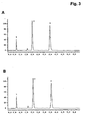
- Figures 1 to 3 show chromatograms of separations performed with differently coated moldings. Further details can be found in Examples 1 to 3.
- dead-volume-free sheathing means that the dead volume between the monolithic shaped body and the sheath is so small that it exerts no negative influence on the separation efficiency of the chromatography column.
- organic and inorganic moldings or inorganic-organic hybrid moldings can be coated, as used for example as sorbents for chromatographic purposes.
- the moldings are usually modified with separation effectors, but this generally has no influence on their other properties.
- Particularly suitable is the casing according to the invention for rigid, inflexible molded body.
- WO 95/03 256 or WO 98/29 350 are disclosed, according to the invention can coat low dead volume.
- Suitable plastics for the sheath according to the invention are thermoplastic polymers, such as, for example, polyaryls, polyether ketones, polyesters, aromatic polyamides, polyimides, polybenzimidazoles Fluoropolymers, polyphenylene sulfides, polyethersulfones or liquid crystalline polymers (LCP's) and mixtures of two or more of these materials. Particular preference is given to using PEEK (polyether ether ketone). In addition to different viscosities, these materials show above all a different chemical stability, such as solvent stability. Therefore, the choice of the plastic suitable for a jacket also depends on the later required chemical stability.
- PEEK shows sufficient chemical stability for most applications. Therefore, the following explanations are partly related to PEEK as a material example. One skilled in the art, however, will be able to apply the following disclosure to other plastics having different viscosity, chemical stability, etc.
- stabilizers such as fiber materials, inorganic materials or pigments, for example chalk, talc, mica or inorganic oxides, such as silica.
- fiber-reinforced plastics which contain as stabilizers fiber materials, such as glass or carbon fibers in particular. Fibers show next to one Reduction of the natural swelling and shrinkage properties of the polymer a particularly effective increase in mechanical stability.
- the fibers are preferably added a fiber content of 20-35%, particularly preferably 27-33%. In the coating of molded articles with fiber-reinforced plastics no or only slight decrease in the separation performance was observed even after prolonged storage in solvents or with frequent use.
- thermoplastics in the plastics processing industry is usually determined by the volume flow index (MVI) according to DIN ISO 1133. It is worked in a standardized apparatus. Its central components are a heatable, vertical cylinder (internal diameter 9.55 mm) with outlet nozzle (inner diameter 2.06 mm, length 8.00 mm) and a matching piston with (readable by the device) position markings (30.00 mm) which can be loaded with a weight.
- the apparatus contains precise measuring systems for Determination of the traveled path length of the piston and for time and temperature measurement.
- the apparatus is preheated to a predetermined temperature of 380 ° C.
- the pre-dried (150 ° C, 12h) plastic or plastic compound (6 g powder or granules) is filled into the cylinder and compacted. After reaching the measurement temperature (380 ° C) 240 s are still waiting. Then the weight (10 kg) is automatically applied and the melt is allowed to flow out. Measurements begin when the lower position mark on the piston is detected and end when the upper mark is detected.
- the volumetric flow index (MVI) is determined via a device software from the distance covered by the piston, the measuring time intervals (2 s) and the known piston area and output in the usual unit ml / 10 min.
- the predrying time and temperature (150 ° C, 12h), the sample mass (6 g), the measurement temperature (380 ° C), the weight (10 kg) and the measurement time intervals (2 s) are standards specific to the MVI determination of PEEK and PEEK compounds.
- the device geometry and the waiting time (240 s) are specified in DIN ISO 1133.
- Plastics have, inter alia, depending on their degree of crosslinking and their chain length different viscosities. By adding stabilizers, such as fibers, the viscosity of the substances is changed again. They become much tougher. These aspects must be taken into account when choosing a suitable plastic according to the invention.
- Plastics are generally available as granules or powders. Both forms can be used for the sheath according to the invention. It should be noted, however, that the viscosity of powders may still change in subsequent processing steps, whereas most of these do not occur with granules. The reason for this is that powders frequently originate directly from the polymerization batch and still contain a residual proportion of monomers and oligomers. During compounding, the monomers gase out and post-polymerization can take place. This increases the viscosity of the plastics easily.
- plastics with an initial viscosity of over 120 ml / 10 min by MVI method are suitable. At values below 120, the plastics become so tough after copounding that, although they can still be extruded into tubes, they can only be applied poorly to the shaped bodies.
- the upper limit of the MVI values of the plastics which are suitable according to the invention is essentially determined by the availability of the plastics. For example, PEEK is usually not available with more than 250 ml / 10 min by the MVI method. However, the plastics should not become too liquid when melting on the molding.
- the plastics are first compounded, ie they are mixed with additives such as fibers, Farbkörpem, etc. This is preferably done by controlled addition of the additives with simultaneous processing via an extruder screw. More precise process parameters are those skilled in the art known and found in manuals, such as in Hensen, Knappe and Potente, "Handbuch der Kunststoffextrusionstechnik, Karl Hanse Verlag, (1986/1989 ).
- the later viscosity of the plastic is influenced by the nature of the additives added and sometimes the time of addition.
- fibers having an initial length of 6 mm after compounding can only have an average length of a few ⁇ m.
- the length of the added fibers is of less importance, since the fibers are also comminuted by the subsequent processing steps. Therefore, the fiber additive is added mostly early.
- pipes are made from the material mixture by known methods such as extrusion or injection molding.
- Such shaping methods are known and can be found, for example, textbooks such as Knappe, Lampl and Heuel, "Kunststoff für und Anlagenbau” Karl Hanse Verlag (1992).
- the monolithic molded body is introduced into the plastic pipe.
- the tube is then brought into the closest possible contact with the molding.
- This step is crucial for a low dead volume shroud. Only materials with the According to the invention suitable viscosity can be sufficiently close attached to the molding.
- the advantage in this step is the use of homogeneous tubes which have a uniform wall thickness over their entire length.
- Suitable methods are known to those skilled in the art, e.g. known from the manufacture of insulated cables.
- One way of making such encased monolithic sorbents is by e.g. It is to extrude the plastic onto the molding. In this case, the monolithic molded body is fed parallel to the extrusion of a tube through a crosshead. The freshly extruded tube encloses (hot) the molding and is e.g. additionally pressed by a pressing device to the molding. It is also possible to heat a preformed tube instead of producing a tube by extrusion. By this mechanical pressing and the additional sintering during cooling creates a tight sheath.
- the plastic casing is produced by flame spraying or single or multiple shrinking.
- the monoliths coated according to the invention can then be provided with appropriate connecting pieces, filters, seals, etc.
- the sheath can finish flush with the sorbent or survive at the ends.
- Such constructions are known for chromatography columns with particulate or monolithic sorbents.
- the monolithic sorbents coated according to the invention show excellent release properties. Even after storage in solvents and frequent use shows no or only slight deterioration of the separation performance.
- the casing according to the invention for the first time ensures the production of chromatography columns, which are both mechanically and chemically stable, and rest with low dead volume on the monolithic moldings.
- the numbering of the analytes in the chromatograms corresponds to the numbering listed above.
- the abscissa of the chromatograms shows the retention time in minutes and the ordinate the intensity of the detector signal in mV.
- Figure 1 A shows the chromatogram of a separation on a column whose sorbent is a Chromolith ® SpeedROD RP-18e, 50 - 4.6 mm column (prepared according to WO 98/29 350 ) corresponds.
- the chromatogram of Figure 1 B was prepared on a column, the sorbent of which was a Chromolith ® Performance RP-18e, 100 - 4.6 mm column (prepared according to WO 98/29 350 ) corresponds.
- the viscosity of the fiber-reinforced PEEK used for encasing was 29.7 ml / 10 min by the MVI method and was therefore too high. As a result, the casing is not dead volume low on the sorbent. It comes to the typical pre-peaks, which are clearly visible in both chromatograms.
- Example 2 Wrapping with a non-fiber-reinforced plastic
- Figure 2 A and 2 B were on a column with a sorbent according Chromolith ® Performance RP-18e, 100 - created 4.6 mm.
- Figure 2 A shows the first chromatogram taken immediately after the sheath.
- Figure 2 B Figure 4 shows a separation taken on the same column after 3 weeks of storage (in acetonitrile / water, 60/40).
- a separation efficiency of 53,000 N / m and an asymmetry to USP of 0.96 resulted.
Landscapes
- Chemical & Material Sciences (AREA)
- Analytical Chemistry (AREA)
- Organic Chemistry (AREA)
- Chemical Kinetics & Catalysis (AREA)
- General Health & Medical Sciences (AREA)
- Pathology (AREA)
- Life Sciences & Earth Sciences (AREA)
- Biochemistry (AREA)
- Physics & Mathematics (AREA)
- General Physics & Mathematics (AREA)
- Immunology (AREA)
- Health & Medical Sciences (AREA)
- Solid-Sorbent Or Filter-Aiding Compositions (AREA)
- Compositions Of Macromolecular Compounds (AREA)
- Treatment Of Liquids With Adsorbents In General (AREA)
- Reinforced Plastic Materials (AREA)
- Laminated Bodies (AREA)
- Application Of Or Painting With Fluid Materials (AREA)
Description
- Die Erfindung betrifft eine chromatograhiesaüle gemäss Anspruch 1 und deren Verwendung gemäss Anspruch 4.
- Zur Herstellung konventioneller Chromatographiesäule mit partikulären Sorbenzien wird das Füllmaterial in ein Edelstahl- oder Kunststoffrohr mit passgenauen Enden gefüllt. Dabei wird erreicht, daß das Sorbensbett am Mantel der Säule dicht anliegt und die Partikel homogen über den gesamten Querschnitt der Säule verteilt sind.
- Ersetzt man, wie es z.B. in
WO 94/19 687 WO 95/03 256 - Verschiedene Möglichkeiten zur flüssigkeitsdichten Ummantelung von monolithischen Sorbenzien sind in
DE 197 26 164 offenbart. Dazu gehört beispielsweise eine Ummantelung mit druckstabilen Kunststoffen wie z.B. PEEK (Polyetheretherketon) oder faser unmanteltem PEEK. Versuche, monolithische Sorbenzien mit derartigen Materialien zu ummanteln, zeigten jedoch, daß nicht alleine die mechanische Stabilität der Ummantelung ausschlaggebend ist. - Die Güte einer monolithischen Säule für die HPLC kann über die Trennleistung (N/m) einerseits und über die Peaksymmetrie andererseits beschrieben werden. Eine gute analytische Säule besitzt Trennleistungen von 70.000 -100.000 N/m. Die Peakform entspricht im Idealfall einer Gauss'schen Glockenform. Abweichungen von dieser symmetrischen Form führen zu einem "fronting" oder zu einem "Tailing". Die inhärente Trennleistung des Säulenkörpers sowie die Peaksymmetrie sollte sich nach Ummantelung mit einem Polymer zum lösungsmitteldichten Abschluss im chromatographischen Anwendungstest nicht mehr ändern.
- Bei ungeeigneten Ummantelungen liegt das Polymer nicht totvolumenarm an dem Säulenkörper an. Die Säule zeigt von Beginn an Vorpeaks oder zumindest ein "Peakfronting" infolge schnelleren Probedurchlaufs an der Grenzfläche Säulenkörper/ Polymer.
- Ummantelungen mit ungeeigneten Polymeren können auch beim ersten chromatographischen Test noch gute Trennleistung und Peaksymmetrie liefern, aber bei weiterem Gebrauch zu einer Veränderung/ Verschlechterung der beiden Güteparameter führen.
- Ein Phänomen ist die Zunahme des Peaktailings beim Lagern der Säule in der mobilen Phase (z.B. Lagerung in Acetonitril / Wasser, 60/40 für 4 Wochen) wegen der mikroporösen Struktur der Ummantelung. Ein weiteres Phänomen kann die Zunahme eines Peakfrontings bei gleichzeitiger Abnahme der Trennleistung wegen einer Geometrieveränderung der Ummantelung sein.
- Es wurde gefunden, daß diese ungünstigen Phänomene durch die natürlichen Schrumpfungs- und Schwindungseigenschaften von Polymeren einerseits und durch die Quelleigenschaften in Lösungsmitteln andererseits hervorgerufen werden. Besonders problematisch ist die Ummantelung starrer, spröder anorganischer Formkörper, z.B. aus Kieselgel. Da das Polymer (beispielsweise PEEK) bei hohen Verarbeitungstemperaturen auf den Formkörper aufgeschmolzen wird, haftet es zunächst fest darauf. Beim Abkühlen des Polymers kommt es zu "Bewegungen" (Schrumpfen bzw. Schwinden) des Polymers, während der Formkörper starr in seiner Dimension bleibt. Dabei kommt es zum Aufbau von Spannungen. Kommt das Polymer nun in Berührung mit Lösungsmitteln, adsorbiert es diese und quillt. Hierbei werden die aufgebauten Spannungen in Längs- und Querrichtung abgebaut. Als Folge kommt es zu kleinen Zerstörungen des porösen Kieselgelkörpers an der Grenzfläche. Das Polymer, welches auf dem Kieselgel fest haftet, verursacht durch seine Eigenbewegung das Entstehen von Löchern durch "Mitnahme" von Kieselgel an der Grenzfläche. Hieraus resultiert eine Abnahme der Trennleistung, im extremen Fall ein starkes Peakfronting.
- Eine Zunahme von Peaktailing lässt sich durch eine Mikroporenstruktur in der Polymerummantelung erklären, durch die es zu unkontrollierten zusätzlichen Diffusionsvorgängen während des Chromatographieprozesses kommt.
- Diese Ergebnisse zeigen, daß eine Ummantelung für monolithische Sorbenzien idealerweise alle der folgenden Eigenschaften erfüllen sollte:
- lösungsmittelstabil gegenüber in der Chromatographie gebräuchlichen Lösungsmitteln, wie z.B. Acetonitril, MeOH, Wasser, Dioxan, Heptan usw., da die mobile Phase aus einem oder mehreren dieser Komponenten besteht.
- mechanisch stabil, um bei höheren Flussraten ohne Probleme schneller chromatographieren zu können. Bei höheren Flussraten baut sich ein Rückdruck innerhalb der Säule auf. Das Polymer sollte auch bei einem Rückdruck von bis zu 200 bar seine Geometrie nicht verändern.
- totvolumenarme Auflage auf dem monolithischen Säulenkörper, um Trennleistungsverlüste und ein Fronting der Substanz-Peaks bzw. Vorpeaks durch unkontrollierte Eluentenströme an der Grenzfläche Polymer-Säulenkörper zu vermeiden.
- porenfrei, um ein nachteiliges Tailing der Substanz-Peaks durch unkontrollierte Diffusionsvorgänge in Mikroporen der Ummantelung zu vermeiden.
- Aufgabe der vorliegenden Erfindung war es daher, geeignete Ummantelungen für monolithische Säulen zur Verfügung zu stellen, die die oben genannten Anforderungen erfüllen. Insbesondere sollte die totvolumenarme Auflage auf dem monolithischen Säulenkörper verbessert werden.
- Es wurde gefunden, daß insbesondere zur totvolumenarmen Auflage auf einem monolithischen Formkörper die Viskosität der zur Ummantelung verwendeten Polymere von großer Bedeutung ist. Die mechanische Stabilität läßt sich vor allem durch eine Faserverstärkung erreichen. Nur faserverstärkte Polymere in einem bestimmten Viskositätsbereich erfüllen demnach die Anforderungen bezüglich chemischer und mechanischer Stabilität und lassen sich zugleich totvolumenarm auf die Monolithen aufbringen.
- Gegenstand der vorliegenden Erfindung ist daher eine Chromatographiesäule enthaltend einen monolithischen Formkörper, der mit einem faserverstärkten thermoplastischen Kunststoff totvolumenarm ummantelt ist, wobei der faserverstärkte Kunststoff Werte zwischen 40 und 100 ml/ 10 min nach der MVI-Methode aufweist.
- In einer bevorzugten Ausführungsform der vorliegenden Erfindung wird die Faserverstärkung durch Kohlefasern erzeugt.
- In einer bevorzugten Ausführungsform der vorliegenden Erfindung ist das thermoplastische Polymer PEEK (Polyetheretherketon).
- Gegenstand der vorliegenden Erfindung ist auch die Verwendung einer erfindungsgemäßen Chromatographiesäule zur chromatographischen Auftrennung mindestens zweier Stoffe.
- Abbildungen 1 bis 3 zeigen Chromatogramme von Trennungen, die mit verschieden ummantelten Formkörpern durchgeführt wurden. Nähere Angaben finden sich in Beispiel 1 bis 3.
- Totvolumenarme Ummantelung bedeutet erfindungsgemäß, daß das Totvolumen zwischen monolithischem Formkörper und der Ummantelung so gering ist, daß es keinen negativen Einfluß auf die Trennleistung der Chromatographiesäule ausübt.
- Mit der erfindungsgemäßen Ummantelung können organische und anorganische Formkörper oder auch anorganisch-organische Hybrid-Formkörper ummantelt werden, wie sie z.B. als Sorbenzien für chromatographische Zwecke eingesetzt werden. Für chromatographische Auftrennungen sind die Formkörper zumeist mit Separationseffektoren modifiziert, was aber im Allgemeinen keinen Einfluß auf ihre sonstigen Eigenschaften hat. Besonders geeignet ist die erfindungsgemäße Ummantelung für starre, unflexible Formkörper. Vor allem spröde, anorganische Formkörper, wie sie in
WO 94/19 687 WO 95/03 256 WO 98/29 350 - Für die erfindungsgemäße Ummantelung geeignete Kunststoffe sind thermoplastische Polymere, wie z.B. Polyaryle, Polyetherketone, Polyester, aromatische Polyamide, Polyimide, Polybenzimidazole, bevorzugt Fluorpolymere, Polyphenylensulfide, Polyethersulfone oder Flüssigkristalline Polymere (LCP's) sowie Mischungen aus zwei oder mehreren dieser Materialien. Besonders bevorzugt wird PEEK (Polyetheretherketon) eingesetzt. Neben unterschiedlichen Viskositäten zeigen diese Materialien vor allem eine unterschiedliche chemische Stabilität, wie z.B. Lösungsmittelstabilität. Daher hängt die Wahl des für eine Ummantelung geeigneten Kunststoffs auch von der später geforderten chemischen Stabilität ab.
- PEEK zeigt für die meisten Anwendungen ausreichende chemische Stabilität. Daher werden die folgenden Ausführungen teilweise auf PEEK als Materialbeispiel bezogen. Ein Fachmann ist jedoch in der Lage, die nachfolgende Offenbarung auf andere Kunststoffe mit anderer Viskosität, chemischer Stabilität etc. zu übertragen.
- Es konnte gezeigt werden, daß eine Ummantelung aus reinem Kunststoff die Anforderungen an mechanische und chemische Stabilität nicht erfüllt. Insbesondere zeigen mit reinem Kunststoff ummantelte Formkörper eine nachlassende Trennleistung. Die anfänglich gute Trennleistung aufgrund einer zunächst totvolumenarmen Ummantelung sinkt, da durch Lösungsmittelkontakt das Polymer quillt und ein Ablösen der Ummantelung vom Formkörper erfolgt (s. Beispiel 2). Zudem kommt es beim Abkühlen des Kunststoffs nach dem Aufbringen auf den Formkörper zu Schwindungs- und Schrumpfungsvorgängen. Weiterhin ist die Druckstabilität mancher Kunststoffe nicht ausreichend.
- Diese Nachteile können durch den Zusatz von Stabilisatoren, wie Fasermaterialien, anorganischen Materialien oder Pigmenten, z.B. Kreide, Talkum, Glimmer oder anorganische Oxide, wie Siliziumdioxid, beseitigt werden. Erfindungsgemäß werden faserverstärkte Kunststoffe verwendet, die als Stabilisatoren Fasermaterialien, wie z.B. Glas- oder insbesondere Kohlefasern enthalten. Fasern zeigen neben einer Reduktion der natürlichen Quell- Schwindungs- und Schrumpfungseigenschaften des Polymers eine besonders effektive Erhöhung der mechanischen Stabilität.
- Je mehr Fasern den Kunststoffen als Stabilisatoren zugesetzt werden, umso spröder werden sie. Daher sind die meisten Kunststoffe nur bis zu einem Anteil von 40% Fasern flexibel genug, um zu Säulen verarbeitet zu werden. Je weniger Fasern zugesetzt werden, desto stärker treten die Quell- bzw. Schrumpf- und Schwindungseigenschaften der Polymere hervor. Da gerade diese Eigenschaften durch den Faserzusatz vermindert werden sollen, sollte der Faseranteil bei mindestens 15% liegen. Bevorzugt wird den Kunststoffen ein Faseranteil von 20-35%, besonders bevorzugt von 27-33% zugesetzt.
Bei der Ummantelung von Formkörpern mit faserverstärkten Kunststoffen wurde auch bei längerer Lagerung in Lösungsmitteln oder bei häufigem Gebrauch keine oder nur geringfügige Abnahme der Trennleistung beobachtet. - Allerdings können nicht alle Stabilisator-verstärkten Kunststoffe zur totvolumenarmen Ummantelung von Formkörpern verwendet werden. Um effektiv auf den Formkörper aufgebracht werden zu können, muß der Formkörper eine bestimmte Viskosität aufweisen.
- Die Viskosität von Thermoplasten wird in der kunststoffverarbeitenden Industrie zumeist nach dem Volumenfließindex (MVI) nach DIN ISO 1133 bestimmt. Es wird in einer normierten Apparatur gearbeitet. Deren zentrale Bestandteile sind ein heizbarer, senkrecht stehender Zylinder (Innendurchmesser 9,55 mm) mit Austrittsdüse (Innendurchmesser 2,06 mm, Länge 8,00 mm) und ein passender Kolben mit (von der Apparatur lesbaren) Positionsmarkierungen (30,00 mm), der mit einem Gewicht belastet werden kann. Die Apparatur enthält präzise Meßsysteme zur Bestimmung der zurückgelegten Weglänge des Kolbens sowie zur Zeit- und Temperaturmessung.
- Zur Bestimmung der Viskosität der Kunststoffe für eine erfindungsgemäße Säulenummantelung wurde ein an DIN ISO 1133 angelehntes Verfahren verwendet
Zur Durchführung der Bestimmung wird die Apparatur auf eine festgelegte Temperatur von 380°C vorgeheizt. Der vorgetrocknete (150°C,12h) Kunststoff bzw. Kunststoffcompound (6 g Pulver oder Granulat) wird in den Zylinder eingefüllt und verdichtet. Nach Erreichen der Messtemperatur (380°C) werden noch 240 s abgewartet. Anschließend wird das Gewicht (10 kg) automatisch aufgelegt und die Schmelze ausfließen lassen. Die Messungen beginnen, wenn die untere Positionsmarkierung auf dem Kolben erkannt wird, und enden, wenn die obere Markierung erkannt wird. Aus der zurückgelegten Weglänge des Kolbens, den Messzeitintervallen (2 s) sowie der bekannten Kolbenfläche wird nun der Volumenfließindex (MVI) über eine Gerätesoftware bestimmt und in der gebräuchlichen Einheit ml/10 min ausgegeben. - Die Vortrockenzeit und temperatur (150°C, 12h), die Probenmasse (6 g), die Messtemperatur (380°C), das Gewicht (10 kg) und die Messzeitintervalle (2 s) sind Standards, die speziell auf die MVI Bestimmung von PEEK und PEEK-Compounds ausgerichtet wurden. Die Gerätegeometrie und die Wartezeit (240 s) sind in der DIN ISO 1133 festgelegt.
- Kunststoffe weisen u.a. in Abhängigkeit ihres Vernetzungsgrades und ihrer Kettenlänge unterschiedliche Viskositäten auf. Durch einen Zusatz von Stabilisatoren, wie z.B. Fasern, wird die Viskosität der Stoffe nochmals verändert. Sie werden deutlich zäher. Diese Aspekte müssen bei der Wahl eines erfindungsgemäß geeigneten Kunststoffes berücksichtigt werden.
- Kunststoffe sind im Allgemeinen als Granulat oder Pulver erhältlich. Für die erfindungsgemäße Ummantelung können beide Formen eingesetzt werden. Es muß jedoch beachtet werden, daß sich die Viskosität von Pulvern bei nachfolgenden Verarbeitungsschritten noch verändern kann, während das bei Granulaten zumeist nicht vorkommt. Grund dafür ist, daß Pulver häufig direkt aus dem Polymerisationsansatz stammen und noch einen Restanteil an Monomeren und Oligomeren enthalten. Während der Compoundierung gasen die Monomeren aus und es kann eine Nachpolymerisation erfolgen. Dadurch erhöht sich die Viskosität der Kunststoffe leicht.
- Es zeigte sich, daß bei einem Zusatz von 30 % Fasern zur totvolumenarmen Ummantelung nur Kunststoffe mit einer Ausgangsviskosität von über 120 ml/10 min nach MVI-Methode geeignet sind. Bei Werten unter 120 werden die Kunststoffe nach der Copoundierung so zäh, daß sie zwar noch zu Rohren extrudiert werden können, aber nur noch schlecht auf die Formkörper aufgebracht werden können. Die Obergrenze der MVI-Werte der erfindungsgemäß geeigneten Kunststoffe wird im wesentlichen durch die Verfügbarkeit der Kunststoffe bestimmt. Beispielsweise ist PEEK mit mehr als 250 ml/10 min nach MVI-Methode zumeist nicht erhältlich. Allerdings sollten die Kunststoffe beim Aufschmelzen auf den Formkörper nicht zu flüssig werden.
- Bevorzugt werden daher pulverförmige Kunststoffe mit einem MVI von 150 bis 210, besonders bevorzugt zwischen 180 und 210 verwendet. Bei Granulaten werden bevorzugt Materialien mit einem MVI von 120 bis 200, besonders bevorzugt von 150 bis 170 eingesetzt.
- Zur erfindungsgemäßen Ummantelung der Formkörper werden die Kunststoffe zunächst compoundiert, d.h. sie werden mit Zusatzstoffen, wie z.B. Fasern, Farbkörpem, etc. versetzt. Dies erfolgt bevorzugt durch kontrollierte Zugabe der Zusatzstoffe bei gleichzeitiger Verarbeitung über eine Extruderschnecke. Genauere Prozeßparameter sind dem Fachmann bekannt und finden sich in Handbüchern, wie beispielsweise in Hensen, Knappe und Potente, "Handbuch der Kunststoffextrusionstechnik, Karl Hanse Verlag, (1986/1989).
- Beim Compoundieren wird die spätere Viskosität des Kunststoffes durch die Art der zugegebenen Zusatzstoffe und teilweise auch den Zeitpunkt der Zugabe beeinflußt. Bei einer frühen Zugabe von Fasern werden diese während der Compoundierung zerkleinert. Beispielsweise können Fasern mit einer Ausgangslänge von 6 mm nach der Compoundierung nur noch eine durchschnittliche Länge von wenigen µm aufweisen. Für die erfindungsgemäße Ummantelung ist die Länge der zugesetzten Fasern von geringerer Bedeutung, da auch durch die nachfolgenden Verarbeitungsschritte eine Zerkleinerung der Fasern erfolgt. Daher wird der Faserzusatz zumeist früh zugegeben.
- Typischerweise beträgt die Viskosität der erfindungsgemäß geeigneten faserverstärkten Kunststoffe nach der Compoundierung mit ca. 30 % Fasern zwischen 40 und 100 ml/10 min nach der MVI Methode, bevorzugt zwischen 50 und 70 ml/10 min nach MVI, wobei die Obergrenze wie schon bei den nicht faserverstärkten Ausgangsmaterialien hauptsächlich durch die Verfügbarkeit bestimmt wird.
- Nach der Compoundierung werden aus der Materialmischung nach bekannten Verfahren, wie Extrusion oder Spritzguß Rohre hergestellt. Derartige Formgebungsverfahren sind bekannt und können beispielsweise Lehrbüchern, wie Knappe, Lampl und Heuel, "Kunststoffverarbeitung und Werkzeugbau" Karl Hanse Verlag (1992), entnommen werden.
- Anschließend wird der monolithische Formkörper in das Kunststoffrohr eingeführt. Durch Erwärmung wird das Rohr dann in möglichst engen Kontakt mit dem Formkörper gebracht. Dieser Schritt ist ausschlaggebend für eine totvolumenarme Ummantelung. Nur Materialien mit der erfindungsgemäß geeigneten Viskosität lassen sich ausreichend dicht an den Formkörper anfügen. Vorteilhaft ist in diesem Schritt die Verwendung von homogenen Rohren, die über ihre gesamte Länge eine gleichmäßige Wandstärke aufweisen.
- Geeignete Verfahren sind dem Fachmann z.B. aus der Herstellung isolierter Kabel bekannt. Eine Möglichkeit, derartig ummantelte monolithische Sorbenzien herzustellen, besteht z.B. darin, den Kunststoff auf den Formkörper aufzuextrudieren. Dabei wird parallel zur Extrusion eines Schlauches durch einen Querkopf der monolithische Formkörper zugeführt. Der frisch extrudierte Schlauch umschließt (heiß) den Formkörper und wird z.B. durch eine Andrückvorrichtung zusätzlich an den Formkörper angedrückt. Dabei ist es auch möglich, einen vorgeformten Schlauch zu erwärmen, statt einen Schlauch durch Extrusion zu erzeugen. Durch dieses mechanische Andrücken und das zusätzliche Sintern beim Abkühlen entsteht eine dichte Ummantelung. Es ist auch möglich, den Formkörper in einen vorgefertigten Schlauch, dessen Innendurchmesser geringfügig größer ist, als der Außendurchmesser des Formkörpers einzubringen und dann den Kunststoff zu erwärmen, so daß der Schlauch auf den Enddurchmesser abgezogen werden kann und dabei den Formkörper dicht umschließt.
- Bei einer weiteren Variante wird die Kunststoffummantelung durch Flammspritzen oder ein- oder mehrfaches Aufschrumpfen erzeugt.
- Zur Verwendung als Chromatographiesäule können die erfindungsgemäß ummantelten Monolithen dann mit entsprechenden Anschlußstücken, Filtern, Dichtungen etc. versehen werden. Die Ummantelung kann plan mit dem Sorbens abschließen oder an den Enden überstehen. Derartige Konstruktionen sind für Chromatographiesäulen mit partikulären oder monolithischen Sorbenzien bekannt.
- Die erfindungsgemäß ummantelten monolithischen Sorbenzien zeigen hervorragende Trenneigenschaften. Auch nach Lagerung in Lösungsmitteln und häufiger Benutzung zeigt sich keine oder nur geringfügige Verschlechterung der Trennleistungen. Somit gewährleistet die erfindungsgemäße Ummantelung erstmals die Herstellung von Chromatographiesäulen, die sowohl mechanisch und chemisch stabil sind, als auch totvolumenarm auf den monolithischen Formkörpern aufliegen.
- Auch ohne weitere Ausführungen wird davon ausgegangen, daß ein Fachmann die obige Beschreibung im weitesten Umfang nutzen kann. Die bevorzugten Ausführungsformen und Beispiele sind deswegen lediglich als beschreibende, keineswegs als in irgendeiner Weise limitierende Offenbarung aufzufassen.
- Die Trennbeispiele wurden unter folgenden chromatographischen Bedingungen durchgeführt:
- Eluent: Acetonitril / Wasser 60/40 (v/v)
- Flussrate: 2 mL/min
- Temperatur: Raumtemperatur
- Inj.-Volumen: 10 µL
- Detektion: UV 254 nm
- Die in
Abbildung 1 A und 2 A und 2 B dargestellten Chromatogramme zeigen die Auftrennung folgender Probe: - 1. Thioharnstoff
- 2. 2,2-Bipyridin
- 3. Naphthalin
- 4. Anthracen
- Die Abbildungen 1 B, 3 A und 3 B zeigen die Auftrennung von:
- 1. Thioharnstoff
- 2. Progesteron
- 3. Anthracen
- Die Nummerierung der Analyten in den Chromatogrammen (Abbildungen 1 bis 3) entspricht der oben aufgeführten Nummerierung.
Auf der Abszisse der Chromatogramme ist jeweils die Retentionszeit in Minuten, auf der Ordinate die Intensität des Detektorsignals in mV angegeben. -
Abbildung 1 A zeigt das Chromatogramm einer Trennung auf einer Säule, deren Sorbens dem einer Chromolith® SpeedROD RP-18e, 50 - 4,6 mm Säule (hergestellt nachWO 98/29 350 Abbildung 1 B wurde auf einer Säule erstellt, deren Sorbens dem einer Chromolith® Performance RP-18e, 100 - 4,6 mm Säule (hergestellt nachWO 98/29 350 -
Abbildung 2 A und 2 B wurden auf einer Säule mit einem Sorbens entsprechend Chromolith® Performance RP-18e, 100 - 4,6 mm erstellt.Abbildung 2 A zeigt das erste Chromatogramm, das direkt nach der Ummantelung aufgenommen wurde. Für Peak 4 ergab sich eine Trennleistung von 96.900 N/m und eine Asymmetrie nach USP von 1,23.Abbildung 2 B zeigt eine Trennung, die auf derselben Säule nach 3 Wochen Lagerung (in Acetonitril/ Wasser, 60/40) aufgenommen wurde. Für Peak 4 ergab sich nun eine Trennleistung von 53.000 N/m und eine Asymmetrie nach USP von 0,96. - Dieses Ergebnis läßt sich darauf zurückführen, daß die Ummantelung aus nicht faserverstärktem PEEK besteht. Während der Lagerung entstehen durch Schrumpfungen, Schwindungen oder Quellungen Geometrieverändenrngen, die eine schlechtere Trennleistung bewirken.
- Die in
Abbildung 3 A und 3 B dargestellten Chromatogramme wurden auf einer Säule entsprechend Chromolith® Performance RP-18e 100-4,6mm aufgenommen. Das Ummantelungsrohr besteht aus PEEK mit 30% Kohlefaser, MVI = 70 mU 10min. -
Abbildung 3 A zeigt den ersten chromatographischen Test direkt nach der Ummantelung.Abbildung 3 B zeigt den Rücktest nach 4 Wochen Lagerung in Acetonitril / Wasser 60/40.
Die Trennleistung der Säule ist bei beiden Trennungen gleich gut. Für Peak Nr. 3 (Anthracen) wurden z.B. folgende Werte ermittelt: - Erster Test: Leistung = 105.000 N/m, Tailing (USP) = 1,19
- Rücktest: Leistung = 110.000 N/m, Tailing (USP) = 1,18
Claims (4)
- Chromatographiesäule enthaltend einen monolithischen Formkörper, der mit einem faserverstärkten thermoplastischen Kunststoff totvolumenarm ummantelt ist, dadurch gekennzeichnet, dass der faserverstärkte Kunststoff eine Viskosität zwischen 40 und 100 ml/ 10 min nach MVI-Methode aufweist.
- Chromatographiesäule nach Anspruch 1, dadurch gekennzeichnet, dass die Faserverstärkung durch Kohlefasern erzeugt wird.
- Chromatographiesäule nach einem der Ansprüche 1 oder 2, dadurch gekennzeichnet, dass der thermoplastische Kunststoff PEEK (Polyetheretherketon) ist.
- Verwendung einer Chromatographiesäule nach einem der Ansprüche 1 bis 3 zur chromatographischen Auftrennung mindestens zweier Stoffe.
Applications Claiming Priority (3)
| Application Number | Priority Date | Filing Date | Title |
|---|---|---|---|
| DE10016825A DE10016825A1 (de) | 2000-04-07 | 2000-04-07 | Monolithische Sorbentien mit faserverstärkter Kunststoffummantelung |
| DE10016825 | 2000-04-07 | ||
| PCT/EP2001/002775 WO2001077660A2 (de) | 2000-04-07 | 2001-03-13 | Monolithische sorbenzien mit faserverstärkter kunststoffummantelung |
Publications (2)
| Publication Number | Publication Date |
|---|---|
| EP1269179A2 EP1269179A2 (de) | 2003-01-02 |
| EP1269179B1 true EP1269179B1 (de) | 2009-04-29 |
Family
ID=7637614
Family Applications (1)
| Application Number | Title | Priority Date | Filing Date |
|---|---|---|---|
| EP01919385A Expired - Lifetime EP1269179B1 (de) | 2000-04-07 | 2001-03-13 | Chromatographiesäule, enthaltend monolithische sorbenzien mit faserverstärkter kunststoffummantelung und deren verwendung |
Country Status (8)
| Country | Link |
|---|---|
| US (1) | US6863820B2 (de) |
| EP (1) | EP1269179B1 (de) |
| JP (1) | JP2003530571A (de) |
| AT (1) | ATE430310T1 (de) |
| AU (1) | AU4650401A (de) |
| DE (2) | DE10016825A1 (de) |
| ES (1) | ES2322934T3 (de) |
| WO (1) | WO2001077660A2 (de) |
Families Citing this family (16)
| Publication number | Priority date | Publication date | Assignee | Title |
|---|---|---|---|---|
| DE10016825A1 (de) * | 2000-04-07 | 2001-10-11 | Merck Patent Gmbh | Monolithische Sorbentien mit faserverstärkter Kunststoffummantelung |
| US20050092685A1 (en) * | 2002-01-17 | 2005-05-05 | Spark Holland B.V. | Set comprising a pipette and a cartridge, as well as a method for applying a sample to the cartridge and an analytical method |
| US7648761B2 (en) * | 2002-10-31 | 2010-01-19 | Merck Patent Gmbh | Inorganic monolithic mouldings coated with organic polymers |
| US20050155933A1 (en) * | 2004-01-16 | 2005-07-21 | Archidex | Wallless monolith columns for chromatography |
| US8459101B2 (en) | 2005-09-29 | 2013-06-11 | Alltech Associates, Inc. | Composite chromatography column |
| EP1843155B1 (de) * | 2006-04-07 | 2016-06-29 | Merck Patent GmbH | Herstellung von monolithischen trennsäulen |
| ES2593478T3 (es) | 2006-04-07 | 2016-12-09 | Merck Patent Gmbh | Fabricación de columnas de separación monolíticas |
| EP1843154A1 (de) * | 2006-04-07 | 2007-10-10 | MERCK PATENT GmbH | Herstellung von monolithischen Trennsäulen |
| JP2008107176A (ja) | 2006-10-25 | 2008-05-08 | Hitachi High-Technologies Corp | 分離カラム及びそれを用いた液体クロマトグラフ |
| DE102007008360A1 (de) * | 2007-02-16 | 2008-08-21 | Merck Patent Gmbh | Ummantelung für monolithische Chromatographiesäulen |
| US8496819B2 (en) * | 2007-06-28 | 2013-07-30 | Hitachi High-Technologies Corporation | Separation column for liquid chromatograph apparatus and liquid chromatograph apparatus using thereof |
| WO2013152829A1 (de) | 2012-04-14 | 2013-10-17 | Merck Patent Gmbh | Halterung für monolithische sorbenzien |
| DE102014216500A1 (de) | 2014-08-20 | 2016-02-25 | Hochschule Offenburg | Poröse monolithische oder faserförmige Produkte aus anorganischen Polymeren und deren Herstellung |
| WO2016188606A1 (de) * | 2015-05-22 | 2016-12-01 | Merck Patent Gmbh | Vorrichtung für die stofftrennung |
| WO2017062526A1 (en) * | 2015-10-06 | 2017-04-13 | Wormser Energy Solutions, Inc. | Method and apparatus for adiabatic calcium looping |
| CN114729275A (zh) | 2019-11-25 | 2022-07-08 | 沃姆泽能源解决方案股份有限公司 | 带有碳捕集的用于全蒸汽气化的焦炭制备系统和气化器 |
Family Cites Families (9)
| Publication number | Priority date | Publication date | Assignee | Title |
|---|---|---|---|---|
| JPH03163356A (ja) * | 1989-11-22 | 1991-07-15 | Sumitomo Chem Co Ltd | 耐圧フューズドシリカキャピラリー空カラム及びその製法 |
| JPH03165260A (ja) * | 1989-11-22 | 1991-07-17 | Nissha Printing Co Ltd | 薄層クロマトグラフィー用プレート及びその製造方法 |
| CZ286859B6 (en) * | 1993-02-26 | 2000-07-12 | Merck Patent Gmbh | Stationary phase for chromatography |
| EP0710219B1 (de) * | 1993-07-19 | 1997-12-10 | MERCK PATENT GmbH | Anorganisches, poröses material und verfahren zu dessen herstellung |
| US5653875A (en) * | 1994-02-04 | 1997-08-05 | Supelco, Inc. | Nucleophilic bodies bonded to siloxane and use thereof for separations from sample matrices |
| JPH10197508A (ja) * | 1997-01-09 | 1998-07-31 | Chuko Kasei Kogyo Kk | 液体クロマトグラフィー用カラム及びその製造方法 |
| DE19726164A1 (de) * | 1997-06-20 | 1998-12-24 | Merck Patent Gmbh | Halterung für monolithische Sorbentien |
| JP2003504460A (ja) * | 1999-07-10 | 2003-02-04 | メルク パテント ゲゼルシャフト ミット ベシュレンクテル ハフトング | Hplcのための繊維強化プラスチック管 |
| DE10016825A1 (de) * | 2000-04-07 | 2001-10-11 | Merck Patent Gmbh | Monolithische Sorbentien mit faserverstärkter Kunststoffummantelung |
-
2000
- 2000-04-07 DE DE10016825A patent/DE10016825A1/de not_active Withdrawn
-
2001
- 2001-03-13 JP JP2001574867A patent/JP2003530571A/ja active Pending
- 2001-03-13 DE DE50114870T patent/DE50114870D1/de not_active Expired - Lifetime
- 2001-03-13 AT AT01919385T patent/ATE430310T1/de not_active IP Right Cessation
- 2001-03-13 ES ES01919385T patent/ES2322934T3/es not_active Expired - Lifetime
- 2001-03-13 US US10/240,921 patent/US6863820B2/en not_active Expired - Lifetime
- 2001-03-13 AU AU46504/01A patent/AU4650401A/en not_active Abandoned
- 2001-03-13 WO PCT/EP2001/002775 patent/WO2001077660A2/de not_active Ceased
- 2001-03-13 EP EP01919385A patent/EP1269179B1/de not_active Expired - Lifetime
Also Published As
| Publication number | Publication date |
|---|---|
| US6863820B2 (en) | 2005-03-08 |
| WO2001077660A2 (de) | 2001-10-18 |
| EP1269179A2 (de) | 2003-01-02 |
| WO2001077660A3 (de) | 2002-03-14 |
| ES2322934T3 (es) | 2009-07-02 |
| US20030098279A1 (en) | 2003-05-29 |
| DE10016825A1 (de) | 2001-10-11 |
| JP2003530571A (ja) | 2003-10-14 |
| AU4650401A (en) | 2001-10-23 |
| ATE430310T1 (de) | 2009-05-15 |
| DE50114870D1 (de) | 2009-06-10 |
Similar Documents
| Publication | Publication Date | Title |
|---|---|---|
| EP1269179A2 (de) | Monolithische sorbenzien mit faserverstärkter kunststoffummantelung | |
| EP2118646B1 (de) | Ummantelung für monolithische chromatographiesäulen | |
| EP3297757B1 (de) | Chromatographiesäule und ihre verwendung | |
| DE3545089C2 (de) | ||
| DE2108936C3 (de) | Verfahren und Vorrichtung zum Herstellen von Kunststoffhalbzeug mit Schaumstoffkern und ungeschäumtem Mantel | |
| DE1798208A1 (de) | Trennsaeule fuer die Fluessigkeitschromatographie und Verfahren zu ihrer Herstellung | |
| DE2141019B2 (de) | Wärmeaustauscher und Verfahren zur Herstellung von Kunststoff-Hohlfäden für einen solchen Wärmeaustauscher | |
| EP1194476A1 (de) | Langfaserverstärktes thermoplastisches material und verfahren zum herstellen desselben | |
| EP0613414B1 (de) | Verfahren und anlage zur herstellung von schreibstiften | |
| DE69901375T2 (de) | Optische Faser aus Kunststoff mit Gradientindex und deren kontinuierliches Herstellungsverfahren | |
| DE9405378U1 (de) | Trennsäule für die Chromatographie | |
| WO2000047304A1 (de) | Endstück für monolithische chromatographiesäulen | |
| DE1778471A1 (de) | Extrudierte Formkoerper und Verfahren und Vorrichtung zu ihrer Herstellung | |
| DE2359876B2 (de) | Verfahren zur Herstellung von HF-Koaxialkabeln | |
| DE69932426T2 (de) | In der Schmelze verarbeitbares Polytetrafluorethylen | |
| EP1194201B1 (de) | Faserverstärkte kunststoffrohre für die hplc | |
| WO2007147271A1 (de) | Hochfrequenzbauteil sowie ein verfahren zum herstellen eines solchen bauteils | |
| WO2017088948A1 (de) | Monolithische sorbenzien mit metall-ummantelung | |
| DE2825414C2 (de) | Verfahren zur schnellen Extrusion hochviskoser duroplastischer oder thermoplastischer Materialien | |
| DE2357112A1 (de) | Kontinuierliches strangpressverfahren und vorrichtung zur herstellung von formlingen aus faserverstaerktem, hitzehaertbarem harz | |
| DE2149668C3 (de) | Verfahren und Vorrichtung zum Herstellen von langgestrecktem Gut aus einer Elastomermischung | |
| EP1294649B1 (de) | Gelierform zur herstellung von formkörpern | |
| DE2833568A1 (de) | Faeden | |
| DE1769919A1 (de) | Verbesserung einer molekular orientierten Folie aus Polyester | |
| WO2008092702A1 (de) | Verfahren zur herstellung von faserverstärktem polyvinylchlorid (pvc) |
Legal Events
| Date | Code | Title | Description |
|---|---|---|---|
| PUAI | Public reference made under article 153(3) epc to a published international application that has entered the european phase |
Free format text: ORIGINAL CODE: 0009012 |
|
| 17P | Request for examination filed |
Effective date: 20020909 |
|
| AK | Designated contracting states |
Kind code of ref document: A2 Designated state(s): AT BE CH CY DE DK ES FI FR GB GR IE IT LI LU MC NL PT SE TR |
|
| AX | Request for extension of the european patent |
Free format text: AL;LT;LV;MK;RO;SI |
|
| 17Q | First examination report despatched |
Effective date: 20080527 |
|
| GRAP | Despatch of communication of intention to grant a patent |
Free format text: ORIGINAL CODE: EPIDOSNIGR1 |
|
| RTI1 | Title (correction) |
Free format text: CHROMATOGRAPHY COLUMN COMPRISING MONOLITHIC SORBENTS WITH A FIBER-REINFORCED PLASTIC COATING AND ITS USAGE |
|
| GRAS | Grant fee paid |
Free format text: ORIGINAL CODE: EPIDOSNIGR3 |
|
| GRAA | (expected) grant |
Free format text: ORIGINAL CODE: 0009210 |
|
| AK | Designated contracting states |
Kind code of ref document: B1 Designated state(s): AT BE CH CY DE DK ES FI FR GB GR IE IT LI LU MC NL PT SE TR |
|
| REG | Reference to a national code |
Ref country code: GB Ref legal event code: FG4D Free format text: NOT ENGLISH |
|
| REG | Reference to a national code |
Ref country code: CH Ref legal event code: EP |
|
| REF | Corresponds to: |
Ref document number: 50114870 Country of ref document: DE Date of ref document: 20090610 Kind code of ref document: P |
|
| REG | Reference to a national code |
Ref country code: IE Ref legal event code: FG4D |
|
| REG | Reference to a national code |
Ref country code: ES Ref legal event code: FG2A Ref document number: 2322934 Country of ref document: ES Kind code of ref document: T3 |
|
| REG | Reference to a national code |
Ref country code: SE Ref legal event code: TRGR |
|
| PG25 | Lapsed in a contracting state [announced via postgrant information from national office to epo] |
Ref country code: FI Free format text: LAPSE BECAUSE OF FAILURE TO SUBMIT A TRANSLATION OF THE DESCRIPTION OR TO PAY THE FEE WITHIN THE PRESCRIBED TIME-LIMIT Effective date: 20090429 Ref country code: PT Free format text: LAPSE BECAUSE OF FAILURE TO SUBMIT A TRANSLATION OF THE DESCRIPTION OR TO PAY THE FEE WITHIN THE PRESCRIBED TIME-LIMIT Effective date: 20090829 |
|
| REG | Reference to a national code |
Ref country code: IE Ref legal event code: FD4D |
|
| PG25 | Lapsed in a contracting state [announced via postgrant information from national office to epo] |
Ref country code: IE Free format text: LAPSE BECAUSE OF FAILURE TO SUBMIT A TRANSLATION OF THE DESCRIPTION OR TO PAY THE FEE WITHIN THE PRESCRIBED TIME-LIMIT Effective date: 20090429 Ref country code: DK Free format text: LAPSE BECAUSE OF FAILURE TO SUBMIT A TRANSLATION OF THE DESCRIPTION OR TO PAY THE FEE WITHIN THE PRESCRIBED TIME-LIMIT Effective date: 20090429 |
|
| PLBE | No opposition filed within time limit |
Free format text: ORIGINAL CODE: 0009261 |
|
| STAA | Information on the status of an ep patent application or granted ep patent |
Free format text: STATUS: NO OPPOSITION FILED WITHIN TIME LIMIT |
|
| 26N | No opposition filed |
Effective date: 20100201 |
|
| PG25 | Lapsed in a contracting state [announced via postgrant information from national office to epo] |
Ref country code: GR Free format text: LAPSE BECAUSE OF FAILURE TO SUBMIT A TRANSLATION OF THE DESCRIPTION OR TO PAY THE FEE WITHIN THE PRESCRIBED TIME-LIMIT Effective date: 20090730 Ref country code: MC Free format text: LAPSE BECAUSE OF NON-PAYMENT OF DUE FEES Effective date: 20100331 |
|
| PGFP | Annual fee paid to national office [announced via postgrant information from national office to epo] |
Ref country code: IT Payment date: 20110322 Year of fee payment: 11 |
|
| PG25 | Lapsed in a contracting state [announced via postgrant information from national office to epo] |
Ref country code: AT Free format text: LAPSE BECAUSE OF NON-PAYMENT OF DUE FEES Effective date: 20100313 |
|
| PG25 | Lapsed in a contracting state [announced via postgrant information from national office to epo] |
Ref country code: CY Free format text: LAPSE BECAUSE OF FAILURE TO SUBMIT A TRANSLATION OF THE DESCRIPTION OR TO PAY THE FEE WITHIN THE PRESCRIBED TIME-LIMIT Effective date: 20090429 |
|
| PG25 | Lapsed in a contracting state [announced via postgrant information from national office to epo] |
Ref country code: LU Free format text: LAPSE BECAUSE OF NON-PAYMENT OF DUE FEES Effective date: 20100313 |
|
| PG25 | Lapsed in a contracting state [announced via postgrant information from national office to epo] |
Ref country code: TR Free format text: LAPSE BECAUSE OF FAILURE TO SUBMIT A TRANSLATION OF THE DESCRIPTION OR TO PAY THE FEE WITHIN THE PRESCRIBED TIME-LIMIT Effective date: 20090429 |
|
| PG25 | Lapsed in a contracting state [announced via postgrant information from national office to epo] |
Ref country code: IT Free format text: LAPSE BECAUSE OF NON-PAYMENT OF DUE FEES Effective date: 20120313 |
|
| REG | Reference to a national code |
Ref country code: FR Ref legal event code: PLFP Year of fee payment: 16 |
|
| REG | Reference to a national code |
Ref country code: FR Ref legal event code: PLFP Year of fee payment: 17 |
|
| REG | Reference to a national code |
Ref country code: FR Ref legal event code: PLFP Year of fee payment: 18 |
|
| PGFP | Annual fee paid to national office [announced via postgrant information from national office to epo] |
Ref country code: DE Payment date: 20200303 Year of fee payment: 20 Ref country code: NL Payment date: 20200212 Year of fee payment: 20 Ref country code: GB Payment date: 20200304 Year of fee payment: 20 Ref country code: SE Payment date: 20200310 Year of fee payment: 20 |
|
| PGFP | Annual fee paid to national office [announced via postgrant information from national office to epo] |
Ref country code: BE Payment date: 20200217 Year of fee payment: 20 Ref country code: CH Payment date: 20200313 Year of fee payment: 20 |
|
| PGFP | Annual fee paid to national office [announced via postgrant information from national office to epo] |
Ref country code: FR Payment date: 20200214 Year of fee payment: 20 |
|
| PGFP | Annual fee paid to national office [announced via postgrant information from national office to epo] |
Ref country code: ES Payment date: 20200401 Year of fee payment: 20 |
|
| REG | Reference to a national code |
Ref country code: DE Ref legal event code: R071 Ref document number: 50114870 Country of ref document: DE |
|
| REG | Reference to a national code |
Ref country code: CH Ref legal event code: PL |
|
| REG | Reference to a national code |
Ref country code: NL Ref legal event code: MK Effective date: 20210312 |
|
| REG | Reference to a national code |
Ref country code: GB Ref legal event code: PE20 Expiry date: 20210312 |
|
| PG25 | Lapsed in a contracting state [announced via postgrant information from national office to epo] |
Ref country code: GB Free format text: LAPSE BECAUSE OF EXPIRATION OF PROTECTION Effective date: 20210312 |
|
| REG | Reference to a national code |
Ref country code: BE Ref legal event code: MK Effective date: 20210313 |
|
| REG | Reference to a national code |
Ref country code: SE Ref legal event code: EUG |
|
| REG | Reference to a national code |
Ref country code: ES Ref legal event code: FD2A Effective date: 20211207 |
|
| PG25 | Lapsed in a contracting state [announced via postgrant information from national office to epo] |
Ref country code: ES Free format text: LAPSE BECAUSE OF EXPIRATION OF PROTECTION Effective date: 20210314 |