EP1268850B1 - Detection de proteases ou peptidases par fluorescence - Google Patents
Detection de proteases ou peptidases par fluorescence Download PDFInfo
- Publication number
- EP1268850B1 EP1268850B1 EP01921512A EP01921512A EP1268850B1 EP 1268850 B1 EP1268850 B1 EP 1268850B1 EP 01921512 A EP01921512 A EP 01921512A EP 01921512 A EP01921512 A EP 01921512A EP 1268850 B1 EP1268850 B1 EP 1268850B1
- Authority
- EP
- European Patent Office
- Prior art keywords
- compound
- pya
- ece
- protease
- pnf
- Prior art date
- Legal status (The legal status is an assumption and is not a legal conclusion. Google has not performed a legal analysis and makes no representation as to the accuracy of the status listed.)
- Expired - Lifetime
Links
- 102000035195 Peptidases Human genes 0.000 title claims abstract description 24
- 108091005804 Peptidases Proteins 0.000 title claims abstract description 24
- 239000004365 Protease Substances 0.000 title claims abstract description 15
- 235000019833 protease Nutrition 0.000 title claims abstract description 10
- 238000001917 fluorescence detection Methods 0.000 title description 2
- 150000001875 compounds Chemical class 0.000 claims abstract description 58
- 239000000758 substrate Substances 0.000 claims abstract description 54
- 102000004190 Enzymes Human genes 0.000 claims abstract description 28
- 108090000790 Enzymes Proteins 0.000 claims abstract description 28
- 230000002401 inhibitory effect Effects 0.000 claims abstract description 24
- 230000003213 activating effect Effects 0.000 claims abstract description 10
- 108030001679 Endothelin-converting enzyme 1 Proteins 0.000 claims description 56
- 102000048186 Endothelin-converting enzyme 1 Human genes 0.000 claims description 55
- 108090000765 processed proteins & peptides Proteins 0.000 claims description 52
- 235000001014 amino acid Nutrition 0.000 claims description 29
- 150000001413 amino acids Chemical class 0.000 claims description 24
- 101800004490 Endothelin-1 Proteins 0.000 claims description 18
- 238000003776 cleavage reaction Methods 0.000 claims description 16
- 230000007017 scission Effects 0.000 claims description 16
- 239000003112 inhibitor Substances 0.000 claims description 14
- 235000019419 proteases Nutrition 0.000 claims description 12
- 238000000034 method Methods 0.000 claims description 11
- 102000005741 Metalloproteases Human genes 0.000 claims description 8
- 108010006035 Metalloproteases Proteins 0.000 claims description 8
- HZZGDPLAJHVHSP-GKHTVLBPSA-N big endothelin Chemical compound C([C@@H](C(=O)N[C@@H](CC(C)C)C(=O)N[C@@H](CC(O)=O)C(=O)N[C@@H]([C@@H](C)CC)C(=O)N[C@@H]([C@@H](C)CC)C(=O)N[C@@H](CC=1C2=CC=CC=C2NC=1)C(=O)N[C@@H](C(C)C)C(=O)N[C@@H](CC(N)=O)C(=O)N[C@@H]([C@@H](C)O)C(=O)N1[C@@H](CCC1)C(=O)N[C@@H](CCC(O)=O)C(=O)N[C@@H](CC=1NC=NC=1)C(=O)N[C@@H](C(C)C)C(=O)N[C@@H](C(C)C)C(=O)N1[C@@H](CCC1)C(=O)N[C@@H](CC=1C=CC(O)=CC=1)C(=O)NCC(=O)N[C@@H](CC(C)C)C(=O)NCC(=O)N[C@@H](CO)C(=O)N1[C@@H](CCC1)C(=O)N[C@@H](CCCNC(N)=N)C(=O)N[C@@H](CO)C(O)=O)NC(=O)[C@H]1NC(=O)[C@H](CC=2C=CC=CC=2)NC(=O)[C@H](CC=2C=CC(O)=CC=2)NC(=O)[C@H](C(C)C)NC(=O)[C@@H]2CSSC[C@@H](C(N[C@@H](CO)C(=O)N[C@@H](CO)C(=O)N[C@@H](CC(C)C)C(=O)N[C@@H](CCSC)C(=O)N[C@@H](CC(O)=O)C(=O)N[C@@H](CCCCN)C(=O)N[C@@H](CCC(O)=O)C(=O)N2)=O)NC(=O)[C@H](CO)NC(=O)[C@@H](N)CSSC1)C1=CN=CN1 HZZGDPLAJHVHSP-GKHTVLBPSA-N 0.000 claims description 8
- 102000007055 Endothelin-3 Human genes 0.000 claims description 7
- 108010072844 Endothelin-3 Proteins 0.000 claims description 7
- 102000004580 Aspartic Acid Proteases Human genes 0.000 claims description 6
- 108010017640 Aspartic Acid Proteases Proteins 0.000 claims description 6
- 108010005843 Cysteine Proteases Proteins 0.000 claims description 6
- 102000005927 Cysteine Proteases Human genes 0.000 claims description 6
- 102000012479 Serine Proteases Human genes 0.000 claims description 6
- 108010022999 Serine Proteases Proteins 0.000 claims description 6
- 125000001151 peptidyl group Chemical group 0.000 claims description 4
- 102400000687 Big endothelin-1 Human genes 0.000 claims description 3
- 101800001398 Big endothelin-1 Proteins 0.000 claims description 3
- 230000007170 pathology Effects 0.000 claims description 3
- 108010016626 Dipeptides Proteins 0.000 claims description 2
- 230000002159 abnormal effect Effects 0.000 claims description 2
- 125000002777 acetyl group Chemical group [H]C([H])([H])C(*)=O 0.000 claims description 2
- 108010060185 big endothelin 2 Proteins 0.000 claims description 2
- 229910052740 iodine Inorganic materials 0.000 claims description 2
- 230000036470 plasma concentration Effects 0.000 claims description 2
- 238000005558 fluorometry Methods 0.000 abstract 1
- KJBQBMRKSLAQHG-NSHDSACASA-N (2s)-2-(pyren-1-ylamino)propanoic acid Chemical compound C1=C2C(N[C@@H](C)C(O)=O)=CC=C(C=C3)C2=C2C3=CC=CC2=C1 KJBQBMRKSLAQHG-NSHDSACASA-N 0.000 description 27
- 229940088598 enzyme Drugs 0.000 description 26
- 238000012360 testing method Methods 0.000 description 24
- 239000002207 metabolite Substances 0.000 description 14
- 102000004196 processed proteins & peptides Human genes 0.000 description 14
- 102100033902 Endothelin-1 Human genes 0.000 description 13
- 108050009340 Endothelin Proteins 0.000 description 7
- 238000003556 assay Methods 0.000 description 7
- 102000002045 Endothelin Human genes 0.000 description 6
- 238000006243 chemical reaction Methods 0.000 description 6
- 101100536354 Drosophila melanogaster tant gene Proteins 0.000 description 5
- DTQVDTLACAAQTR-UHFFFAOYSA-N Trifluoroacetic acid Chemical compound OC(=O)C(F)(F)F DTQVDTLACAAQTR-UHFFFAOYSA-N 0.000 description 5
- ZGOVYTPSWMLYOF-QEADGSHQSA-N chembl1790180 Chemical compound C([C@@H](C(=O)N[C@@H](CC(C)C)C(=O)N[C@@H](CC(O)=O)C(=O)N[C@@H]([C@@H](C)CC)C(=O)N[C@@H]([C@@H](C)CC)C(=O)N[C@@H](CC=1C2=CC=CC=C2NC=1)C(O)=O)NC(=O)[C@H]1NC(=O)[C@H](CC=2C=CC(O)=CC=2)NC(=O)[C@@H](CC=2C=CC(O)=CC=2)NC(=O)[C@H](C(C)C)NC(=O)[C@H]2CSSC[C@@H](C(N[C@H](CC=3C=CC=CC=3)C(=O)N[C@H](C(=O)N[C@H](CCC=3C=CC(O)=CC=3)C(=O)N[C@@H](CCCCN)C(=O)N[C@H](CC(O)=O)C(=O)N[C@@H](CCCCN)C(=O)N[C@@H](CCC(O)=O)C(=O)N2)[C@H](C)O)=O)NC(=O)[C@@H]([C@@H](C)O)NC(=O)[C@H](N)CSSC1)C1=CNC=N1 ZGOVYTPSWMLYOF-QEADGSHQSA-N 0.000 description 5
- 239000012634 fragment Substances 0.000 description 5
- 238000004128 high performance liquid chromatography Methods 0.000 description 5
- 238000002360 preparation method Methods 0.000 description 5
- 239000007790 solid phase Substances 0.000 description 5
- UUUHXMGGBIUAPW-UHFFFAOYSA-N 1-[1-[2-[[5-amino-2-[[1-[5-(diaminomethylideneamino)-2-[[1-[3-(1h-indol-3-yl)-2-[(5-oxopyrrolidine-2-carbonyl)amino]propanoyl]pyrrolidine-2-carbonyl]amino]pentanoyl]pyrrolidine-2-carbonyl]amino]-5-oxopentanoyl]amino]-3-methylpentanoyl]pyrrolidine-2-carbon Chemical compound C1CCC(C(=O)N2C(CCC2)C(O)=O)N1C(=O)C(C(C)CC)NC(=O)C(CCC(N)=O)NC(=O)C1CCCN1C(=O)C(CCCN=C(N)N)NC(=O)C1CCCN1C(=O)C(CC=1C2=CC=CC=C2NC=1)NC(=O)C1CCC(=O)N1 UUUHXMGGBIUAPW-UHFFFAOYSA-N 0.000 description 4
- RTZKZFJDLAIYFH-UHFFFAOYSA-N Diethyl ether Chemical group CCOCC RTZKZFJDLAIYFH-UHFFFAOYSA-N 0.000 description 4
- 102000003965 Endothelin-2 Human genes 0.000 description 4
- 108090000387 Endothelin-2 Proteins 0.000 description 4
- 102000004270 Peptidyl-Dipeptidase A Human genes 0.000 description 4
- 108090000882 Peptidyl-Dipeptidase A Proteins 0.000 description 4
- 230000009471 action Effects 0.000 description 4
- 230000000694 effects Effects 0.000 description 4
- MLFJHYIHIKEBTQ-IYRKOGFYSA-N endothelin 2 Chemical compound C([C@@H](C(=O)N[C@@H](CC(C)C)C(=O)N[C@@H](CC(O)=O)C(=O)N[C@@H]([C@@H](C)CC)C(=O)N[C@@H]([C@@H](C)CC)C(=O)N[C@@H](CC=1C2=CC=CC=C2NC=1)C(O)=O)NC(=O)[C@H]1NC(=O)[C@H](CC=2C=CC=CC=2)NC(=O)[C@H](CC=2C=CC(O)=CC=2)NC(=O)[C@H](C(C)C)NC(=O)[C@@H]2CSSC[C@@H](C(N[C@@H](CO)C(=O)N[C@@H](CO)C(=O)N[C@@H](CC=3C4=CC=CC=C4NC=3)C(=O)N[C@@H](CC(C)C)C(=O)N[C@@H](CC(O)=O)C(=O)N[C@@H](CCCCN)C(=O)N[C@@H](CCC(O)=O)C(=O)N2)=O)NC(=O)[C@H](CO)NC(=O)[C@@H](N)CSSC1)C1=CNC=N1 MLFJHYIHIKEBTQ-IYRKOGFYSA-N 0.000 description 4
- ZUBDGKVDJUIMQQ-UBFCDGJISA-N endothelin-1 Chemical compound C([C@@H](C(=O)N[C@@H](CC(C)C)C(=O)N[C@@H](CC(O)=O)C(=O)N[C@@H]([C@@H](C)CC)C(=O)N[C@@H]([C@@H](C)CC)C(=O)N[C@@H](CC=1C2=CC=CC=C2NC=1)C(O)=O)NC(=O)[C@H]1NC(=O)[C@H](CC=2C=CC=CC=2)NC(=O)[C@@H](CC=2C=CC(O)=CC=2)NC(=O)[C@H](C(C)C)NC(=O)[C@H]2CSSC[C@@H](C(N[C@H](CO)C(=O)N[C@@H](CO)C(=O)N[C@H](CC(C)C)C(=O)N[C@@H](CCSC)C(=O)N[C@H](CC(O)=O)C(=O)N[C@@H](CCCCN)C(=O)N[C@@H](CCC(O)=O)C(=O)N2)=O)NC(=O)[C@@H](CO)NC(=O)[C@H](N)CSSC1)C1=CNC=N1 ZUBDGKVDJUIMQQ-UBFCDGJISA-N 0.000 description 4
- 230000035945 sensitivity Effects 0.000 description 4
- 239000000243 solution Substances 0.000 description 4
- 125000003088 (fluoren-9-ylmethoxy)carbonyl group Chemical group 0.000 description 3
- 238000004458 analytical method Methods 0.000 description 3
- 238000013459 approach Methods 0.000 description 3
- 230000015572 biosynthetic process Effects 0.000 description 3
- 239000000872 buffer Substances 0.000 description 3
- 210000004027 cell Anatomy 0.000 description 3
- 238000010438 heat treatment Methods 0.000 description 3
- 238000010647 peptide synthesis reaction Methods 0.000 description 3
- 230000002285 radioactive effect Effects 0.000 description 3
- 230000002829 reductive effect Effects 0.000 description 3
- RYHBNJHYFVUHQT-UHFFFAOYSA-N 1,4-Dioxane Chemical compound C1COCCO1 RYHBNJHYFVUHQT-UHFFFAOYSA-N 0.000 description 2
- JMTMSDXUXJISAY-UHFFFAOYSA-N 2H-benzotriazol-4-ol Chemical compound OC1=CC=CC2=C1N=NN2 JMTMSDXUXJISAY-UHFFFAOYSA-N 0.000 description 2
- 102000004400 Aminopeptidases Human genes 0.000 description 2
- 108090000915 Aminopeptidases Proteins 0.000 description 2
- 101001044245 Arabidopsis thaliana Insulin-degrading enzyme-like 1, peroxisomal Proteins 0.000 description 2
- 102000005367 Carboxypeptidases Human genes 0.000 description 2
- 108010006303 Carboxypeptidases Proteins 0.000 description 2
- QOSSAOTZNIDXMA-UHFFFAOYSA-N Dicylcohexylcarbodiimide Chemical compound C1CCCCC1N=C=NC1CCCCC1 QOSSAOTZNIDXMA-UHFFFAOYSA-N 0.000 description 2
- 102100029112 Endothelin-converting enzyme 1 Human genes 0.000 description 2
- ZPHBZEQOLSRPAK-UHFFFAOYSA-N Phosphoramidon Natural products C=1NC2=CC=CC=C2C=1CC(C(O)=O)NC(=O)C(CC(C)C)NP(O)(=O)OC1OC(C)C(O)C(O)C1O ZPHBZEQOLSRPAK-UHFFFAOYSA-N 0.000 description 2
- FAPWRFPIFSIZLT-UHFFFAOYSA-M Sodium chloride Chemical compound [Na+].[Cl-] FAPWRFPIFSIZLT-UHFFFAOYSA-M 0.000 description 2
- 239000012190 activator Substances 0.000 description 2
- 230000036772 blood pressure Effects 0.000 description 2
- 230000000747 cardiac effect Effects 0.000 description 2
- 230000015556 catabolic process Effects 0.000 description 2
- 239000003153 chemical reaction reagent Substances 0.000 description 2
- 230000008878 coupling Effects 0.000 description 2
- 238000010168 coupling process Methods 0.000 description 2
- 238000005859 coupling reaction Methods 0.000 description 2
- 238000006731 degradation reaction Methods 0.000 description 2
- 238000001514 detection method Methods 0.000 description 2
- 238000005516 engineering process Methods 0.000 description 2
- 230000007062 hydrolysis Effects 0.000 description 2
- 238000006460 hydrolysis reaction Methods 0.000 description 2
- NPZTUJOABDZTLV-UHFFFAOYSA-N hydroxybenzotriazole Substances O=C1C=CC=C2NNN=C12 NPZTUJOABDZTLV-UHFFFAOYSA-N 0.000 description 2
- 230000005764 inhibitory process Effects 0.000 description 2
- 238000005259 measurement Methods 0.000 description 2
- 239000012528 membrane Substances 0.000 description 2
- 239000000203 mixture Substances 0.000 description 2
- 239000003960 organic solvent Substances 0.000 description 2
- 108010072906 phosphoramidon Proteins 0.000 description 2
- BWSDNRQVTFZQQD-AYVHNPTNSA-N phosphoramidon Chemical compound O([P@@](O)(=O)N[C@H](CC(C)C)C(=O)N[C@H](CC=1[C]2C=CC=CC2=NC=1)C(O)=O)[C@H]1O[C@@H](C)[C@H](O)[C@@H](O)[C@@H]1O BWSDNRQVTFZQQD-AYVHNPTNSA-N 0.000 description 2
- 239000002243 precursor Substances 0.000 description 2
- 238000003786 synthesis reaction Methods 0.000 description 2
- POSZUTFLHGNLHX-KSBRXOFISA-N tris maleate Chemical compound OCC(N)(CO)CO.OCC(N)(CO)CO.OC(=O)\C=C/C(O)=O POSZUTFLHGNLHX-KSBRXOFISA-N 0.000 description 2
- XLYOFNOQVPJJNP-UHFFFAOYSA-N water Substances O XLYOFNOQVPJJNP-UHFFFAOYSA-N 0.000 description 2
- GTVVZTAFGPQSPC-QMMMGPOBSA-N (2s)-2-azaniumyl-3-(4-nitrophenyl)propanoate Chemical class OC(=O)[C@@H](N)CC1=CC=C([N+]([O-])=O)C=C1 GTVVZTAFGPQSPC-QMMMGPOBSA-N 0.000 description 1
- CUKWUWBLQQDQAC-VEQWQPCFSA-N (3s)-3-amino-4-[[(2s)-1-[[(2s)-1-[[(2s)-1-[[(2s,3s)-1-[[(2s)-1-[(2s)-2-[[(1s)-1-carboxyethyl]carbamoyl]pyrrolidin-1-yl]-3-(1h-imidazol-5-yl)-1-oxopropan-2-yl]amino]-3-methyl-1-oxopentan-2-yl]amino]-3-(4-hydroxyphenyl)-1-oxopropan-2-yl]amino]-3-methyl-1-ox Chemical compound C([C@@H](C(=O)N[C@@H]([C@@H](C)CC)C(=O)N[C@@H](CC=1NC=NC=1)C(=O)N1[C@@H](CCC1)C(=O)N[C@@H](C)C(O)=O)NC(=O)[C@@H](NC(=O)[C@H](CCCN=C(N)N)NC(=O)[C@@H](N)CC(O)=O)C(C)C)C1=CC=C(O)C=C1 CUKWUWBLQQDQAC-VEQWQPCFSA-N 0.000 description 1
- CJTNQOINDCUPHE-FZONESBBSA-N 133752-35-9 Chemical compound C([C@@H](C(=O)N[C@@H](CC(C)C)C(=O)N[C@@H](CC(O)=O)C(=O)N[C@@H]([C@@H](C)CC)C(=O)NC([C@@H](C)CC)C(=O)N[C@@H](CC=1C2=CC=CC=C2NC=1)C(=O)N[C@@H](C(C)C)C(=O)N[C@@H](CC(N)=O)C(=O)N[C@@H]([C@@H](C)O)C(=O)N1[C@@H](CCC1)C(=O)N[C@@H](CCC(=O)NCCNC=1C2=CC=CC(=C2C=CC=1)S(O)(=O)=O)C(=O)N[C@@H](CC=1NC=NC=1)C(=O)NCC(O)=O)NC(C)=O)C1=CN=CN1 CJTNQOINDCUPHE-FZONESBBSA-N 0.000 description 1
- GOJUJUVQIVIZAV-UHFFFAOYSA-N 2-amino-4,6-dichloropyrimidine-5-carbaldehyde Chemical group NC1=NC(Cl)=C(C=O)C(Cl)=N1 GOJUJUVQIVIZAV-UHFFFAOYSA-N 0.000 description 1
- ZOOGRGPOEVQQDX-UUOKFMHZSA-N 3',5'-cyclic GMP Chemical compound C([C@H]1O2)OP(O)(=O)O[C@H]1[C@@H](O)[C@@H]2N1C(N=C(NC2=O)N)=C2N=C1 ZOOGRGPOEVQQDX-UUOKFMHZSA-N 0.000 description 1
- REPVVNYZORKKPQ-UHFFFAOYSA-N 3-oxo-3-[(1-phenyl-3-sulfanylpropan-2-yl)amino]propanoic acid Chemical group OC(=O)CC(=O)NC(CS)CC1=CC=CC=C1 REPVVNYZORKKPQ-UHFFFAOYSA-N 0.000 description 1
- ALYNCZNDIQEVRV-UHFFFAOYSA-N 4-aminobenzoic acid Chemical compound NC1=CC=C(C(O)=O)C=C1 ALYNCZNDIQEVRV-UHFFFAOYSA-N 0.000 description 1
- ZCYVEMRRCGMTRW-UHFFFAOYSA-N 7553-56-2 Chemical compound [I] ZCYVEMRRCGMTRW-UHFFFAOYSA-N 0.000 description 1
- 206010002383 Angina Pectoris Diseases 0.000 description 1
- 101800000733 Angiotensin-2 Proteins 0.000 description 1
- 102400000345 Angiotensin-2 Human genes 0.000 description 1
- 101800001288 Atrial natriuretic factor Proteins 0.000 description 1
- 102400001282 Atrial natriuretic peptide Human genes 0.000 description 1
- 101800001890 Atrial natriuretic peptide Proteins 0.000 description 1
- 102400000967 Bradykinin Human genes 0.000 description 1
- 101800004538 Bradykinin Proteins 0.000 description 1
- 208000024172 Cardiovascular disease Diseases 0.000 description 1
- 206010008111 Cerebral haemorrhage Diseases 0.000 description 1
- 102000005593 Endopeptidases Human genes 0.000 description 1
- 108010059378 Endopeptidases Proteins 0.000 description 1
- 241000282324 Felis Species 0.000 description 1
- 206010016654 Fibrosis Diseases 0.000 description 1
- QXZGBUJJYSLZLT-UHFFFAOYSA-N H-Arg-Pro-Pro-Gly-Phe-Ser-Pro-Phe-Arg-OH Natural products NC(N)=NCCCC(N)C(=O)N1CCCC1C(=O)N1C(C(=O)NCC(=O)NC(CC=2C=CC=CC=2)C(=O)NC(CO)C(=O)N2C(CCC2)C(=O)NC(CC=2C=CC=CC=2)C(=O)NC(CCCN=C(N)N)C(O)=O)CCC1 QXZGBUJJYSLZLT-UHFFFAOYSA-N 0.000 description 1
- 206010019280 Heart failures Diseases 0.000 description 1
- 101000841259 Homo sapiens Endothelin-converting enzyme 1 Proteins 0.000 description 1
- 206010061598 Immunodeficiency Diseases 0.000 description 1
- 208000029462 Immunodeficiency disease Diseases 0.000 description 1
- 102000001399 Kallikrein Human genes 0.000 description 1
- 108060005987 Kallikrein Proteins 0.000 description 1
- 108010007859 Lisinopril Proteins 0.000 description 1
- 102000003843 Metalloendopeptidases Human genes 0.000 description 1
- 108090000131 Metalloendopeptidases Proteins 0.000 description 1
- 241001465754 Metazoa Species 0.000 description 1
- 208000007101 Muscle Cramp Diseases 0.000 description 1
- SECXISVLQFMRJM-UHFFFAOYSA-N N-Methylpyrrolidone Chemical compound CN1CCCC1=O SECXISVLQFMRJM-UHFFFAOYSA-N 0.000 description 1
- 102000003729 Neprilysin Human genes 0.000 description 1
- 108090000028 Neprilysin Proteins 0.000 description 1
- 108090000526 Papain Proteins 0.000 description 1
- 102000057297 Pepsin A Human genes 0.000 description 1
- 108090000284 Pepsin A Proteins 0.000 description 1
- 208000001647 Renal Insufficiency Diseases 0.000 description 1
- 241000283984 Rodentia Species 0.000 description 1
- MTCFGRXMJLQNBG-UHFFFAOYSA-N Serine Natural products OCC(N)C(O)=O MTCFGRXMJLQNBG-UHFFFAOYSA-N 0.000 description 1
- 208000005392 Spasm Diseases 0.000 description 1
- 241000473945 Theria <moth genus> Species 0.000 description 1
- 108010036928 Thiorphan Proteins 0.000 description 1
- LWFWZRANSFAJDR-JSGCOSHPSA-N Trp-Val Chemical compound C1=CC=C2C(C[C@H](N)C(=O)N[C@@H](C(C)C)C(O)=O)=CNC2=C1 LWFWZRANSFAJDR-JSGCOSHPSA-N 0.000 description 1
- 102000026557 Urotensins Human genes 0.000 description 1
- 108010011107 Urotensins Proteins 0.000 description 1
- 206010047139 Vasoconstriction Diseases 0.000 description 1
- 206010047163 Vasospasm Diseases 0.000 description 1
- 241000700605 Viruses Species 0.000 description 1
- 239000002253 acid Substances 0.000 description 1
- 238000005917 acylation reaction Methods 0.000 description 1
- 230000004075 alteration Effects 0.000 description 1
- 229960004050 aminobenzoic acid Drugs 0.000 description 1
- 229950006323 angiotensin ii Drugs 0.000 description 1
- -1 aspartyl Chemical group 0.000 description 1
- 238000013096 assay test Methods 0.000 description 1
- 208000006673 asthma Diseases 0.000 description 1
- 238000011914 asymmetric synthesis Methods 0.000 description 1
- QXZGBUJJYSLZLT-FDISYFBBSA-N bradykinin Chemical compound NC(=N)NCCC[C@H](N)C(=O)N1CCC[C@H]1C(=O)N1[C@H](C(=O)NCC(=O)N[C@@H](CC=2C=CC=CC=2)C(=O)N[C@@H](CO)C(=O)N2[C@@H](CCC2)C(=O)N[C@@H](CC=2C=CC=CC=2)C(=O)N[C@@H](CCCNC(N)=N)C(O)=O)CCC1 QXZGBUJJYSLZLT-FDISYFBBSA-N 0.000 description 1
- 210000004556 brain Anatomy 0.000 description 1
- FAKRSMQSSFJEIM-RQJHMYQMSA-N captopril Chemical compound SC[C@@H](C)C(=O)N1CCC[C@H]1C(O)=O FAKRSMQSSFJEIM-RQJHMYQMSA-N 0.000 description 1
- 229960000830 captopril Drugs 0.000 description 1
- 150000007942 carboxylates Chemical class 0.000 description 1
- NSQLIUXCMFBZME-MPVJKSABSA-N carperitide Chemical compound C([C@H]1C(=O)NCC(=O)NCC(=O)N[C@@H](CCCNC(N)=N)C(=O)N[C@@H](CCSC)C(=O)N[C@@H](CC(O)=O)C(=O)N[C@@H](CCCNC(N)=N)C(=O)N[C@H](C(NCC(=O)N[C@@H](C)C(=O)N[C@@H](CCC(N)=O)C(=O)N[C@@H](CO)C(=O)NCC(=O)N[C@@H](CC(C)C)C(=O)NCC(=O)N[C@@H](CSSC[C@@H](C(=O)N1)NC(=O)[C@H](CO)NC(=O)[C@H](CO)NC(=O)[C@H](CCCNC(N)=N)NC(=O)[C@H](CCCNC(N)=N)NC(=O)[C@H](CC(C)C)NC(=O)[C@@H](N)CO)C(=O)N[C@@H](CC(N)=O)C(=O)N[C@@H](CO)C(=O)N[C@@H](CC=1C=CC=CC=1)C(=O)N[C@@H](CCCNC(N)=N)C(=O)N[C@@H](CC=1C=CC(O)=CC=1)C(O)=O)=O)[C@@H](C)CC)C1=CC=CC=C1 NSQLIUXCMFBZME-MPVJKSABSA-N 0.000 description 1
- 210000000170 cell membrane Anatomy 0.000 description 1
- 230000001413 cellular effect Effects 0.000 description 1
- 238000007796 conventional method Methods 0.000 description 1
- 238000001816 cooling Methods 0.000 description 1
- 210000004351 coronary vessel Anatomy 0.000 description 1
- 239000007822 coupling agent Substances 0.000 description 1
- 125000004122 cyclic group Chemical group 0.000 description 1
- XUJNEKJLAYXESH-UHFFFAOYSA-N cysteine Natural products SCC(N)C(O)=O XUJNEKJLAYXESH-UHFFFAOYSA-N 0.000 description 1
- 230000001086 cytosolic effect Effects 0.000 description 1
- 230000001419 dependent effect Effects 0.000 description 1
- 238000010511 deprotection reaction Methods 0.000 description 1
- 206010012601 diabetes mellitus Diseases 0.000 description 1
- 208000037265 diseases, disorders, signs and symptoms Diseases 0.000 description 1
- 208000035475 disorder Diseases 0.000 description 1
- 230000002526 effect on cardiovascular system Effects 0.000 description 1
- 238000002330 electrospray ionisation mass spectrometry Methods 0.000 description 1
- 230000008030 elimination Effects 0.000 description 1
- 238000003379 elimination reaction Methods 0.000 description 1
- 238000000295 emission spectrum Methods 0.000 description 1
- 210000002889 endothelial cell Anatomy 0.000 description 1
- 108010030240 endothelin converting enzyme substrate Proteins 0.000 description 1
- 230000002255 enzymatic effect Effects 0.000 description 1
- 150000002148 esters Chemical group 0.000 description 1
- 230000005284 excitation Effects 0.000 description 1
- 238000002474 experimental method Methods 0.000 description 1
- 230000004761 fibrosis Effects 0.000 description 1
- 238000002189 fluorescence spectrum Methods 0.000 description 1
- 238000004108 freeze drying Methods 0.000 description 1
- 238000013095 identification testing Methods 0.000 description 1
- 230000007813 immunodeficiency Effects 0.000 description 1
- 238000011534 incubation Methods 0.000 description 1
- 230000003834 intracellular effect Effects 0.000 description 1
- 239000011630 iodine Substances 0.000 description 1
- 201000006370 kidney failure Diseases 0.000 description 1
- 230000000670 limiting effect Effects 0.000 description 1
- 239000007788 liquid Substances 0.000 description 1
- RLAWWYSOJDYHDC-BZSNNMDCSA-N lisinopril Chemical compound C([C@H](N[C@@H](CCCCN)C(=O)N1[C@@H](CCC1)C(O)=O)C(O)=O)CC1=CC=CC=C1 RLAWWYSOJDYHDC-BZSNNMDCSA-N 0.000 description 1
- 210000004072 lung Anatomy 0.000 description 1
- 238000004519 manufacturing process Methods 0.000 description 1
- 238000004949 mass spectrometry Methods 0.000 description 1
- 239000000463 material Substances 0.000 description 1
- 208000010125 myocardial infarction Diseases 0.000 description 1
- 235000019834 papain Nutrition 0.000 description 1
- 229940055729 papain Drugs 0.000 description 1
- 229940111202 pepsin Drugs 0.000 description 1
- 230000000737 periodic effect Effects 0.000 description 1
- 230000002093 peripheral effect Effects 0.000 description 1
- 230000003389 potentiating effect Effects 0.000 description 1
- 239000000843 powder Substances 0.000 description 1
- 230000002265 prevention Effects 0.000 description 1
- 125000001501 propionyl group Chemical group O=C([*])C([H])([H])C([H])([H])[H] 0.000 description 1
- 208000002815 pulmonary hypertension Diseases 0.000 description 1
- 238000010791 quenching Methods 0.000 description 1
- 230000000171 quenching effect Effects 0.000 description 1
- 238000003127 radioimmunoassay Methods 0.000 description 1
- 239000002464 receptor antagonist Substances 0.000 description 1
- 229940044551 receptor antagonist Drugs 0.000 description 1
- 238000001525 receptor binding assay Methods 0.000 description 1
- 102000005962 receptors Human genes 0.000 description 1
- 108020003175 receptors Proteins 0.000 description 1
- 230000004044 response Effects 0.000 description 1
- 208000037803 restenosis Diseases 0.000 description 1
- 108700016891 retrothiorphan Proteins 0.000 description 1
- 238000004007 reversed phase HPLC Methods 0.000 description 1
- 238000000926 separation method Methods 0.000 description 1
- 210000002460 smooth muscle Anatomy 0.000 description 1
- 239000011780 sodium chloride Substances 0.000 description 1
- 238000010532 solid phase synthesis reaction Methods 0.000 description 1
- 239000002904 solvent Substances 0.000 description 1
- 241000894007 species Species 0.000 description 1
- 239000007858 starting material Substances 0.000 description 1
- 238000003756 stirring Methods 0.000 description 1
- 239000011550 stock solution Substances 0.000 description 1
- 125000000999 tert-butyl group Chemical group [H]C([H])([H])C(*)(C([H])([H])[H])C([H])([H])[H] 0.000 description 1
- 150000003573 thiols Chemical class 0.000 description 1
- LJJKNPQAGWVLDQ-SNVBAGLBSA-N thiorphan Chemical group OC(=O)CNC(=O)[C@@H](CS)CC1=CC=CC=C1 LJJKNPQAGWVLDQ-SNVBAGLBSA-N 0.000 description 1
- 210000001519 tissue Anatomy 0.000 description 1
- 125000002221 trityl group Chemical group [H]C1=C([H])C([H])=C([H])C([H])=C1C([*])(C1=C(C(=C(C(=C1[H])[H])[H])[H])[H])C1=C([H])C([H])=C([H])C([H])=C1[H] 0.000 description 1
- 239000000780 urotensin Substances 0.000 description 1
- 230000002792 vascular Effects 0.000 description 1
- 230000025033 vasoconstriction Effects 0.000 description 1
- 239000005526 vasoconstrictor agent Substances 0.000 description 1
- 229940124549 vasodilator Drugs 0.000 description 1
- 239000003071 vasodilator agent Substances 0.000 description 1
- 230000003612 virological effect Effects 0.000 description 1
- 238000001262 western blot Methods 0.000 description 1
Images


Classifications
-
- C—CHEMISTRY; METALLURGY
- C12—BIOCHEMISTRY; BEER; SPIRITS; WINE; VINEGAR; MICROBIOLOGY; ENZYMOLOGY; MUTATION OR GENETIC ENGINEERING
- C12Q—MEASURING OR TESTING PROCESSES INVOLVING ENZYMES, NUCLEIC ACIDS OR MICROORGANISMS; COMPOSITIONS OR TEST PAPERS THEREFOR; PROCESSES OF PREPARING SUCH COMPOSITIONS; CONDITION-RESPONSIVE CONTROL IN MICROBIOLOGICAL OR ENZYMOLOGICAL PROCESSES
- C12Q1/00—Measuring or testing processes involving enzymes, nucleic acids or microorganisms; Compositions therefor; Processes of preparing such compositions
- C12Q1/34—Measuring or testing processes involving enzymes, nucleic acids or microorganisms; Compositions therefor; Processes of preparing such compositions involving hydrolase
- C12Q1/37—Measuring or testing processes involving enzymes, nucleic acids or microorganisms; Compositions therefor; Processes of preparing such compositions involving hydrolase involving peptidase or proteinase
-
- G—PHYSICS
- G01—MEASURING; TESTING
- G01N—INVESTIGATING OR ANALYSING MATERIALS BY DETERMINING THEIR CHEMICAL OR PHYSICAL PROPERTIES
- G01N2333/00—Assays involving biological materials from specific organisms or of a specific nature
- G01N2333/435—Assays involving biological materials from specific organisms or of a specific nature from animals; from humans
- G01N2333/575—Hormones
- G01N2333/5754—Endothelin, vasoactive intestinal contractor [VIC]
-
- G—PHYSICS
- G01—MEASURING; TESTING
- G01N—INVESTIGATING OR ANALYSING MATERIALS BY DETERMINING THEIR CHEMICAL OR PHYSICAL PROPERTIES
- G01N2333/00—Assays involving biological materials from specific organisms or of a specific nature
- G01N2333/90—Enzymes; Proenzymes
- G01N2333/914—Hydrolases (3)
- G01N2333/948—Hydrolases (3) acting on peptide bonds (3.4)
- G01N2333/95—Proteinases, i.e. endopeptidases (3.4.21-3.4.99)
- G01N2333/964—Proteinases, i.e. endopeptidases (3.4.21-3.4.99) derived from animal tissue
- G01N2333/96425—Proteinases, i.e. endopeptidases (3.4.21-3.4.99) derived from animal tissue from mammals
- G01N2333/96427—Proteinases, i.e. endopeptidases (3.4.21-3.4.99) derived from animal tissue from mammals in general
- G01N2333/9643—Proteinases, i.e. endopeptidases (3.4.21-3.4.99) derived from animal tissue from mammals in general with EC number
- G01N2333/96486—Metalloendopeptidases (3.4.24)
-
- Y—GENERAL TAGGING OF NEW TECHNOLOGICAL DEVELOPMENTS; GENERAL TAGGING OF CROSS-SECTIONAL TECHNOLOGIES SPANNING OVER SEVERAL SECTIONS OF THE IPC; TECHNICAL SUBJECTS COVERED BY FORMER USPC CROSS-REFERENCE ART COLLECTIONS [XRACs] AND DIGESTS
- Y10—TECHNICAL SUBJECTS COVERED BY FORMER USPC
- Y10S—TECHNICAL SUBJECTS COVERED BY FORMER USPC CROSS-REFERENCE ART COLLECTIONS [XRACs] AND DIGESTS
- Y10S435/00—Chemistry: molecular biology and microbiology
- Y10S435/968—High energy substrates, e.g. fluorescent, chemiluminescent, radioactive
Definitions
- the present invention relates generally to the use of a PyA- (Z) x -pNF residue in peptidase or protease substrates for the purpose of identifying and / or characterizing compounds capable of inhibiting this. It aims in particular the use of such a residue and more particularly the Pya-pNF residue in a sequence for assaying the endothelin converting enzyme and / or identifying inhibitors of this enzyme.
- the control of the blood pressure is dependent on several peptides which possess either vasoconstriction actions of the vessels (this is the case in particular of angiotensin II, endothelin, urotensin), or vasodilator actions (this is particularly the case of bradykinin or atrial natriuretic peptide which also plays a role in the elimination of water and sodium chloride).
- ET-1 endothelin-1
- Figure 1 a short linear part
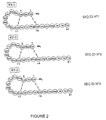
- Endothelin-1 is part of an isopeptide family where endothelin-2 (ET-2) and endothelin-3 (ET-3) are found which differ from ET-1 only in by some occasional changes of amino acids ( Figures 2).
- Endothelins are secreted by the endothelial cells as inactive precursors, the "big endothelins", which are cleaved by zinc metallopeptidases called endothelin converting enzyme (ECE) to give rise to the active peptides.
- ECE endothelin converting enzyme
- ET-1 hydrolyzes the Trp 21 -Val 22 binding of big-endothelin-1 which comprises 38 amino acids to generate two fragments, one of which, N-terminal, constitutes active endothelin-1.
- ET-3 it is the Trp 21 -Ile 22 bond which is cleaved.
- ECE is a cytosolic or membrane enzyme characterized in this case by a short intracellular fragment followed by a transmembrane helix of approximately 25 amino acids and a very large extracellular domain that contains the active site.
- the enzyme consists of two identical subunits connected by a disulfide bridge ( Shimada et al., Biochem J. (1996) 315, 863-867).
- certain cardiovascular pathologies could therefore be prevented or at least reduced by a decrease in the circulating endothelin concentration by inhibiting the enzyme that gives rise to them, that is to say the ECE.
- the 125I-labeled big-ET cleavage test resulting in the 125 I ET-1 and its receptor binding assay can not be used for high-flux assays (Fawzi, A, B. Clemen, RM & Wright, DL (1994) Anal Biochem 222, 342-350). The same is true of cellular tests measuring the increase in cGMP induced by the binding of ET-1 on its receptor.
- the RIA radioimmunoassays require a very complex series of successive experiments, are relatively non-selective and require the use of both big-ET and 125 I ET-1. These complex assays do not lend themselves to high-throughput sorting of very large series of potential inhibitors with robotization of the test and require the synthesis or the purchase of endothelin iodine radioactive, whose time of use is limited.
- the object of the present invention is precisely to propose a new assay test which makes it possible to overcome the disadvantages encountered with the tests mentioned above.
- the present invention is based more particularly on the demonstration by the inventors that the use of pyrenylalanine (PyA) associated with the modified L-paranitrophenylalanine acid (pNF) was of particular interest for diagnostic purposes.
- PyA pyrenylalanine
- pNF modified L-paranitrophenylalanine acid
- Pyrenylalanine is a synthetic amino acid that has a high fluorescence capacity.
- this fluorescence of the PyA residue is almost completely extinguished when PyA is placed near and preferably attached to the rest pNF.
- a PyA-pNF residue therefore appears to be a particularly interesting tool when it is introduced at a substrate and more particularly a peptide or pseudopeptide sequence, to fluoresce the manifestation of a cleavage.
- a first aspect of the invention therefore relates to the use of a remainder PyA- (Z) x -pNF, with Z representing a sequence comprising up to 4 L-series amino acids, natural or non-natural, and x representing 1 or 0, in a substrate for the purposes of detecting, identifying and / or fluorescence assaying a protease or peptidase capable of cleave or a binding established between PyA and pNF and / or compounds with inhibitory or activating activity against a protease or peptidase capable of cleaving this link.
- the claimed use is particularly advantageous for detecting, identifying and / or fluorescence assaying of peptidase or protease compounds whatever the group to which they belong, that is to say serine proteases, cysteine proteases, aspartyl proteases and metalloproteinases.
- the present invention is based on the appearance of a fluorescence caused by the separation of PyA and pNF by cleavage of a bond established between them.
- Z comprises up to 4 identical or different amino acids preferably selected from the list of 20 natural amino acids.
- the length of the amino acid sequence represented by Z is in fact to be adjusted according to the substrate specificity of the peptidase and in such a way that the distance separating PyA and pNF is compatible with the manifestation of the repressor effect. of pNF on fluorescence naturally emitted by PyA.
- a second criterion for this adjustment is related to the need to preserve the specificity and affinity of the naturally occurring substrate-cleaving compound including PyA- (Z) x -pNF.
- the choice of the remainder PyA- (Z) x -pNF is therefore carried out taking these two criteria into account.
- the substrate into which the peptidyl PyA- (Z) x -pNF residue is introduced is peptidic.
- a particular embodiment of the invention relates to the inclusion of a PyA- (Z) x -pNF residue and preferably PyA-pNF in the peptide sequences recognized by the ECE. It is thus possible to identify, detect and / or dose ECE or inhibitors or activators of ECE. Hydrolysis of the PyA-pNF residue produced a very intense increase in fluorescence (approximately 150 to 800 times for a 5% degradation of the substrate).
- the dipeptidyl PyA-pNF residue is present, in the peptide sequence recognized by the ECE, at the level of the natural cleavage site to which it is substituted.
- the dipeptidyl PyA-pNF residue is found to be cleavable by ECE and does not alter the affinity and specificity of this enzyme with respect to the peptide sequence that includes it.
- the substituted bond is the Trp 21 -Val 22 bond and the big-endothelin-3, Trp 21 -Ile 22 bond.
- the big-ET-1 (19-35) used as starting material can be prepared according to the usual methods such as in particular by a solid phase automatic synthesizer such as the model, for example, Applied Biosystems 431A using Fmoc technology, as described in ATHERTON, E. and SHEPPARD, RC (1989) Solid Phase Peptide Synthesis: A Practical Approach, IRL Press, Oxford.
- a solid phase automatic synthesizer such as the model, for example, Applied Biosystems 431A using Fmoc technology, as described in ATHERTON, E. and SHEPPARD, RC (1989) Solid Phase Peptide Synthesis: A Practical Approach, IRL Press, Oxford.
- the extreme sensitivity of the claimed use makes it possible to operate in very low volumes, of the order of 50 to 100 ⁇ l, with reduced substrate concentrations of the order of 2 ⁇ M to 50 ⁇ M.
- x represents 0 in formulas (I) and (II).
- the compounds of formula (I) correspond to the general formula (IA) in which Z 1 , Z 2 , Z 4 , Z 5 and Z 6 , which may be identical or different, represent an amino acid.
- this general formula (IA) covers substrates recognized by the ECE.
- SEQ ID No. 2 is also in accordance with the general formula IA
- the compounds of general formula I correspond to the general formula (IB) with Z and x being as defined in general formula I
- the metabolite generated corresponds to the general formula IIa with Z 'and x as defined in general formula II.
- the claimed compounds can be obtained by the usual solid phase synthesis methods according to the Merrifield method on an automatic synthesizer such as the Applied Biosystems Appliance 431A.
- the chemistry used corresponds to Fmoc technology and the protection of side chains allowing their cleavage with trifluoroacetic acid as described by E. Atherlon and RC Sheppard (1989) in “Solid Phase Peptide Synthesis: a practical approach, IRL Press, Oxford ".
- L-pyrenylalanine is obtained according to an asymmetric synthesis method described in the publication Soleilhac, JM et al. Anal. Biochem. (1996) 241, 120-127.
- the purity of the final peptides is estimated greater than 99% by reverse phase HPLC and the identity of the peptides by electrospray mass spectrometry.
- the couplings are carried out according to conventional techniques using coupling agent such as HIGH, PyBrop and preferably using dicyclohexylcarbodiimide / hydroxybenzotriazole.
- Another aspect of the present invention relates to the use of a compound of general formula I as defined above for the detection, identification and / or assay of a protease selected from the family Serine proteases, Cysteine proteases, Aspartyl proteases, and metallopeptidases and more preferably ECE and the study of compounds capable of inhibiting or activating said enzyme.
- a protease selected from the family Serine proteases, Cysteine proteases, Aspartyl proteases, and metallopeptidases and more preferably ECE and the study of compounds capable of inhibiting or activating said enzyme.
- the compound to be assayed is either the ECE or a compound capable of inhibiting or activating the endothelin converting enzyme.
- the compound of general formula I can first be brought into contact with ECE and then the presumed inhibitor or activator can be introduced in a subsequent step.
- the compound of general formula I is first brought into contact with the compound to be assayed and the ECE.
- the compound as defined above to which the test defined above is applied to determine its ECE inhibitory activity may be of various nature, without limitation, and for example may be chosen from phosphonimides, phosphamides and phosphonimides. derivatives of these products, or the inhibitors of metalloproteinases such as thiol derivatives, carboxylates or hydroxamates.
- Phosphoramidon and N- (phenyl-ethylphosphonyl) -Leu-Trp (TAKEDA), whose inhibitory activities of ECE are known, may also be mentioned as the compound.
- test compound may be in an isolated form, known or unknown and / or present in a compound library, biological extract or water.
- the substrate is: or
- a compound capable of inhibiting the enzymatic activity of ECE with respect to the substrate of general formula I, for example, will result in a decrease in the intensity of the fluorescence due to the metabolite.
- ECE formed by ECE, of formula Ac-Ile-Ile-PyA, (peptide 1m), Ac-Arg-Pro-Lys-Gln-Gln-PyA (SEQ ID No. 5) (peptide 2m) or Ac-Ser -Gly-PyA-Lys-Ala (SEQ ID No. 9) (3m peptide) whose fluorescence is not modified for several hours.
- the extreme sensitivity of the assay makes it possible to operate in very low volumes (100 ⁇ l) with concentrations of the order of 20 ⁇ M of the substrate 1 s (ie 2 nmole corresponding to 4.43 ⁇ g per test) or 5 ⁇ M of the substrate 2s .
- the test is therefore very easy to use in plates with 96 wells or more, allowing its robotization with automatic determination of K l , when the reading fluorimeter is connected to a computer with appropriate commercial software.
- the peptides 1s, 2s and 3s only lead to two metabolites as shown by the analysis of the reaction by HPLC and corresponding to the unique cleavage at the level of the peptide bond PyA-pNF.
- these substrates are extremely selective since no cleavage is observed by HPLC after incubation for 2 h at 37 ° C. with purified zinc metallopeptidases belonging to the same family as ECE, such as for example neprilysine (NEP). or angiotensin converting enzyme (ACE).
- ECE zinc metallopeptidases belonging to the same family as ECE, such as for example neprilysine (NEP). or angiotensin converting enzyme (ACE).
- the sensitivity and specificity of the test is such that one can use both purified ECEs (Takahashi et al., J. Biol Chem (1993) 268, 21395-21398) , and a cell membrane preparation.
- CHO in which the ECE was transfected Xu et al., Cell (1994) 78, 473-485) or even a membrane preparation of animal tissue rich in ECE (lung or rat brain).
- the sequence and the structure of the ECE being very conserved from one species to another, it is in particular the case of the rat and the man, the results (K l of inhibitors for example), obtained on ECE purified rodent or not, are identical to those obtained on the recombinant human enzyme.
- the present invention thus proposes a test for identifying inhibitors of ECE as well as the determination of their inhibitory powers by a fluorimetric test, very fast, reproducible and allowing robotizable and very numerous tests that can therefore be adapted to a selection. high throughput inhibitory molecules.
- the present invention also proposes the production of new industrial products, which may optionally be used in the form of kits comprising ready-to-use plates of 96, 192 and 384 wells and containing either the lyophilized ECE or a substrate as defined in the formula General I and illustrated in the case of 1s, 2s and 3s, to which is added, optionally using a robot, the reagents necessary for the determination of the inhibitory powers of series of molecules.
- Another aspect of the invention relates to a method for diagnosing a pathology related to an abnormal plasma level of endothelin converting enzyme, characterized in that it implements a compound of formula I as defined above.
- the peptides identified below, 1s and 2s, and the corresponding fluorescent metabolites containing the pyrenylalanine residue, are prepared in the solid phase by the Merrifield method on a synthesizer. Automatically using the Fmoc strategy and side chain protection generally as a t-butyl, ether or ester, trityl or Boc residue as already described in "Solid Phase Peptide Synthesis: A Practical Approach IRL Press Oxford”.
- the couplings are carried out using dicyclohexylcarbodiimide / hydroxybenzotriazole in N-methylpyrrolidone.
- the final peptide is obtained after cleavage and deprotection of the side chains with trifluoroacetic acid.
- the solution is evaporated under vacuum, the peptide precipitated with ether and purified by HPLC on a Vydac C 18 column.
- peptides can be preserved after lyophilization in powder form, protected from light and at 4 ° C or -20 ° C for more than 6 months without alteration.
- stock solutions of the substrates (10 -3 -10 -4 M) can be stored at 4 ° C and protected from light for several weeks.
- ECE-1c expressed in Cos-1 cells (Shimada et al., J. Biol Chem (1994) 269, 18275-18278) or CHO ( Xu et al., Cell (1994) 78, 473-485).
- the presence of the enzyme is tested by Western blotting using an antibody and its concentration evaluated by comparison with the purified enzyme.
- ECE activity is determined in 96 well plates generally under the following conditions:
- the use of a network fluorimeter greatly increases the sensitivity of the fluorescence reading assay at 377 nm.
- the controls are carried out in the presence of all the reagents but without the ECE or with the ECE previously inactivated by heating at 90 ° C, 5 minutes.
- Inhibitor K 1 values can be automatically determined from percentages of degradation at different concentrations and compared with a standard range.
- FIGS. 3a and 3b respectively show the fluorescence emission spectra of the 1s peptide and its 1m metabolite and the 2s peptide and its 2m metabolite.
- the specific conditions selected for the tests are as follows: White * Witness Test Tris maleate pH 6.5 90 ⁇ l 80 ⁇ l 70 ⁇ l Inhibitor / / 10 ⁇ l Enzyme / 10 ⁇ l 10 ⁇ l
- the use of enzyme, denatured by 6N HCl or by heating at 80 ° C. for 10 minutes, does not modify the residual fluorescence of the white.
- the mixture is preincubated for 10 minutes at 37.degree.
- the ECE substrate is then added at a rate of 10 ° C.
- the whole is incubated between 20 minutes and 1 hour at 37 ° C. and the reaction then stopped either by cooling or adding dioxane (20 ⁇ l).
- the reading on cytofluor is carried out at 4 ° C. with the following specificities: Excitation 340 nm, Emission 400 nm and with a Gain 85.
- the tests are carried out on a 96-well microplate.
- Table I reports for each well of the nature of the test compound and its concentration. The compounds were tested at two concentrations.
- Table II is the fluorescence intensity measured for each well. A low fluorescence value indicates a strong inhibitory activity of the test compound. The inhibitory behavior of the compound P is perfectly verified.
Landscapes
- Chemical & Material Sciences (AREA)
- Organic Chemistry (AREA)
- Life Sciences & Earth Sciences (AREA)
- Health & Medical Sciences (AREA)
- Wood Science & Technology (AREA)
- Proteomics, Peptides & Aminoacids (AREA)
- Zoology (AREA)
- Engineering & Computer Science (AREA)
- Immunology (AREA)
- General Engineering & Computer Science (AREA)
- Microbiology (AREA)
- Molecular Biology (AREA)
- Analytical Chemistry (AREA)
- Biotechnology (AREA)
- Physics & Mathematics (AREA)
- Biochemistry (AREA)
- Bioinformatics & Cheminformatics (AREA)
- Biophysics (AREA)
- General Health & Medical Sciences (AREA)
- Genetics & Genomics (AREA)
- Peptides Or Proteins (AREA)
- Measuring Or Testing Involving Enzymes Or Micro-Organisms (AREA)
- Investigating Or Analysing Materials By The Use Of Chemical Reactions (AREA)
- Investigating Or Analysing Biological Materials (AREA)
- Polysaccharides And Polysaccharide Derivatives (AREA)
Description
- La présente invention concerne d'une manière générale l'utilisation d'un reste PyA-(Z)x-pNF dans des substrats de peptidases ou protéases à des fins d'identification et/ou de caractérisation de composés capables d'inhiber celles-çi. Elle vise notamment l'utilisation d'un tel reste et plus particulièrement le reste Pya-pNF dans une séquence pour doser l'enzyme de conversion de l'endothéline et/ou identifier des inhibiteurs de cette enzyme.
- Le contrôle de la pression artérielle est sous la dépendance de plusieurs peptides qui possèdent soit des actions de vasoconstriction des vaisseaux (c'est le cas en particulier de l'angiotensine II, des endothélines, de l'urotensine), soit des actions vasodilatatrices (c'est le cas en particulier de la bradykinine ou du peptide atrial natriurétique qui joue de plus un rôle sur l'élimination d'eau et de chlorure de sodium).
- Parmi tous ces peptides, l'endothéline-1 (ET-1) qui est un peptide possédant une partie cyclique, assurée par deux ponts disulfure, et une courte partie linéaire (Figure 1) est considérée comme un très puissant vasoconstricteur par action sur les muscles lisses des parois des vaisseaux, en particulier au niveau cardiaque (artères coronaires).
- L'endothéline-1 fait partie d'une famille d'isopeptides où l'on trouve l'endothéline-2 (ET-2) et l'endothéline-3 (ET-3) qui ne diffèrent de l'ET-1 que par quelques changements ponctuels d'acides aminés (Figures 2).
- Les endothélines sont sécrétées par les cellules endothéliales sous forme de précurseurs inactifs, les "big-endothélines", qui sont clivées par des métallopeptidases à zinc dénommées enzyme de conversion de l'endothéline (ECE) pour donner naissance aux peptides actifs. Ainsi, si on prend l'exemple de l'ET-1, l'ECE-1 hydrolyse la liaison Trp21-Val22 de la big-endothéline-1 qui comporte 38 acides aminés pour générer deux fragments dont l'un, N-terminal, constitue l'endothéline-1 active. Dans le cas de l'ET-3, c'est la liaison Trp21-Ile22 qui est clivée.
- La big-ET-1 et l'ET-1 sont détectées dans le plasma et l'ECE est une enzyme cytosolique ou membranaire caractérisée dans ce cas par un court fragment intracellulaire suivi d'une hélice transmembranaire d'environ 25 acides aminés et d'un domaine extracellulaire très important qui contient le site actif. L'enzyme est constituée par deux sous-unités identiques reliées par un pont disulfure (Shimada et al., Biochem. J. (1996) 315, 863-867).
- L'administration de faibles doses de big-endothéline provoque une forte augmentation de la pression artérielle démontrant le clivage du précurseur avec formation d'endothéline. Cette réponse peut être bloquée par un antagoniste du récepteur à l'ET-1.
- Il existe donc un intérêt considérable dans l'inhibition de l'ECE par des composés dont les applications sont potentiellement très nombreuses dans les affections cardiovasculaires. On peut citer en particulier le traitement de l'infarctus du myocarde, de l'angor, des spasmes vasculaires consécutifs à une hémorragie cérébrale, des spasmes des vaisseaux périphériques, de l'hypertension pulmonaire, de l'insuffisance cardiaque et/ou rénale, de troubles liés au diabète, de l'asthme, de la prévention des resténoses, des fibroses cardiaques et vasculaires.
- En l'espèce, certaines pathologies cardiovasculaires pourraient par conséquent être prévenues ou au moins réduites par une diminution de la concentration circulante d'endothélines en inhibant l'enzyme qui leur donne naissance, c'est-à-dire l'ECE.
- Toutefois, la recherche intensive de tels inhibiteurs exige de disposer d'un test d'identification simple et robotisable, de manière à permettre la réalisation d'un grand nombre d'essais en un temps réduit.
- Or, les tests actuels sont soit difficiles, longs, peu spécifiques et/ou onéreux.
- Les tests, où les deux fragments produits par action de l'ECE sur la big-ET sont dosés par HPLC, ont pour inconvénient majeur de nécessiter de grandes quantités d'enzyme et de big-ET.
- Le test basé sur le clivage de la big-ET marquée à l'iode 125 et donnant naissance à la 125I ET-1 et sa détermination par fixation sur son récepteur n'est pas utilisable pour des essais à haut-flux (Fawzi, A.B. ; Clemen, R.M. & Wright, D.L. (1994) Anal. Biochem. 222, 342-350). Il en est de même de tests cellulaires mesurant l'augmentation de GMPc induite par la fixation d'ET-1 sur son récepteur.
- Les dosages radioimmunologiques RIA nécessitent pour leur part une série très complexe d'expériences successives, sont relativement peu sélectifs et exigent l'utilisation, à la fois de big-ET et de 125I ET-1. Ces dosages complexes ne se prêtent pas au tri à haut-flux de très grandes séries d'inhibiteurs potentiels avec robotisation du test et demandent la synthèse ou l'achat d'endothéline iodée radioactive, dont le temps d'utilisation est limité.
- Plus récemment, il a été proposé un test basé sur !'utilisation d'un substrat radioactif obtenu par fixation sur la partie N-terminale de peptides de 21 acides aminés contenant le site de clivage Trp-Val d'un reste propionyl tritié (FR n° 96 02673). Le métabolite N-terminal radioactif formé est extrait par un solvant organique sous agitation et un échantillon de ce solvant est prélevé, mélangé à un liquide de scintillation puis la radioactivité mesurée à l'aide d'un compteur. La succession d'étapes ne permet pas là encore de robotiser l'essai et de plus exige l'utilisation d'un radioélément et donc la synthèse périodique du substrat tritié.
- Fitzgerald et al (Anal Biochem, 254, 226-230, 1997) divulgue l'utilisation d'un substrat à fluorescence éteinte contenant Ab2 (aminobenzoic acid) et pNF, séparés de 2 acides aminés, pour la détection de la protéase du virus d' immunodéficience féline (FIV).
- La présente invention a précisément pour objet de proposer un nouveau test de dosage permettant de s'affranchir des inconvénients rencontrés avec les tests évoqués précédemment.
- La présente invention repose plus particulièrement sur la mise en évidence par les inventeurs que l'utilisation de la pyrenylalanine (PyA) associée à l'acide modifié L-paranitrophénylalanine (pNF) était particulièrement intéressante à des fins de diagnostic.
- La pyrenylalanine est un acide aminé synthétique qui possède une capacité de fluorescence importante. Avantageusement, cette fluorescence du reste PyA est quasi totalement éteinte lorsque PyA est placé à proximité et de préférence accolé au reste pNF.
- En conséquence, cette fluorescence naturelle du PyA ne peut se manifester qu'à partir du moment où ce reste n'est plus soumis à l'effet répresseur du reste pNF, par exemple lorsqu'il en est physiquement séparé, notamment par clivage par une protéase ou peptidase quelle que soit la classe (métallopeptidase, serine protéase, aspartyl-protéase, cystéine protéase) à laquelle elle appartient.
- Un reste de type PyA-pNF apparaît donc comme un outil particulièrement intéressant lorsqu'il est introduit au niveau d'un substrat et plus particulièrement d'une séquence peptidique ou pseudopeptidique, pour visualiser par fluorescence la manifestation d'un clivage.
- Un premier aspect de l'invention concerne donc l'utilisation d'un reste
PyA-(Z)x-pNF,
avec Z représentant un enchaînement comprenant jusqu'à 4 acides aminés de série L, naturels ou non et x représentant 1 ou 0, dans un substrat à des fins de détection, identification et/ou dosage par fluorescence d'une protéase ou peptidase susceptible de cliver la ou une liaison établie entre PyA et pNF et/ou de composés à activité inhibitrice ou activatrice vis-à-vis d'une protease ou peptidase capable de cliver cette liaison. - L'utilisation revendiquée est tout particulièrement intéressante pour détecter, identifier et/ou doser par fluorescence des composés de type peptidases ou protéases quelque soit le groupe auquel elles appartiennent, c'est-à-dire des sérine protéases, cystéines protéases, aspartyl protéases et métalloprotéases.
- La présente invention est basée sur l'apparition d'une fluorescence provoquée par la séparation de PyA et pNF par clivage d'une liaison établie entre eux.
- Z comprend jusqu'à 4 acides aminés identiques ou différents de préférence choisis dans la liste des 20 acides aminés naturels. La longueur de l'enchaînement d'acides aminés figurée par Z est en fait à ajuster en fonction de la spécificité de substrat de la peptidase et de manière à ce que la distance séparant PyA et pNF soit compatible avec la manifestation de l'effet répresseur de pNF sur la fluorescence naturellement émise par PyA.
- Un second critère pour cet ajustement est lié à la nécessité de préserver la spécificité et l'affinité du composé clivant naturellement le substrat incluant PyA-(Z)x-pNF. Le choix du reste PyA-(Z)x-pNF est par conséquent effectué en prenant en compte ces deux critères.
- Le substrat dans lequel est introduit le reste peptidyle PyA-(Z)x-pNF est peptidique.
- Un mode de réalisation particulier de l'invention concerne l'inclusion d'un reste PyA-(Z)x-pNF et de préférence PyA-pNF dans les séquences peptidiques reconnues par l'ECE. On peut ainsi identifier, détecter et/ou doser l'ECE ou des inhibiteurs ou activateurs de l'ECE. L'hydrolyse du reste PyA-pNF produit une très intense augmentation de fluorescence (environ de 150 à 800 fois pour une dégradation de 5% du substrat).
- Selon un mode de réalisation préféré de l'invention, le reste dipeptidyle PyA-pNF est présent, dans la séquence peptidique reconnue par l'ECE, au niveau du site de clivage naturel auquel il se substitue.
- De manière inattendue, le reste dipeptidyle PyA-pNF se révèle clivable par l'ECE et n'altère pas l'affinité et la spécificité de cette enzyme vis-à-vis de la séquence peptidique qui l'inclue.
- Dans le cas particulier où la séquence peptidique correspond à celle de la big-endothéline-1 ou 2, la liaison substituée est la liaison Trp21-Val22 et de la big-endothéline-3, Trp21-Ile22.
- La big-ET-1 (19-35) utilisée comme produit de départ peut être préparée selon les méthodes usuelles telles que notamment par un synthétiseur automatique en phase solide tel que le modèle, par exemple, 431A de Applied Biosystems utilisant la technologie Fmoc, tel que décrit dans la référence ATHERTON, E. et SHEPPARD, R.C. (1989) Solid Phase Peptide Synthesis : a practical approach, IRL Press, Oxford.
- L'extrême sensibilité de l'utilisation revendiquée permet d'opérer dans des volumes très faibles, de l'ordre de 50 à 100 µl, avec des concentrations réduites en substrat de l'ordre de 2 µM à 50 µM.
- Un second aspect de l'invention concerne des produits de formule I :
Ac-(X1)n PyA-(Z)x-pNF-(X'1)m-R (I)
dans laquelle - les symboles X1, et X'1 représentent des acides aminés,
- Z représente un enchaînement d'acides aminés de série L, naturels ou non et x représente 1 ou 0,
- R représente un groupement OH ou NH2,
- Ac représente un groupement acétyle,
- n est un entier variant de 2 à 6 et m de 0 à 16 et de préférence de 3 à 13.
Le test de la présente invention est ainsi basé sur l'utilisation de peptides de formule (I) dont la partie N-terminale est acylée ce qui présente au moins deux avantages : protéger du clivage par les aminopeptidases et renforcer l'hydrophobicité du fragment N-terminal qui sera généré par l'hydrolyse.
Cette manifestation de fluorescence est liée à la génération dans le clivage d'un métabolite de formule générale II :
Ac-(X1)n-PyA-(Z')x (II)
dans laquelle - X1 et n sont tels que définis précédemment,
- Z' représente un ou plusieurs acides aminés de série L, naturels ou non et
- x représente 1 ou 0.
- Plus préférentiellement, x représente 0 dans les formules (I) et (II).
- Selon une première variante de l'invention, les composés de formule (I) répondent à la formule générale (IA)dans laquelle Z1, Z2, Z4, Z5 et Z6, identiques ou différents, représentent un acide aminé.

- Plus particulièrement, les composés de formules I ou IA sont tels que :
- Z1 et Z2 sont tels que :
- soit Z1 et Z2 représentent une simple liaison,
- soit Z1 représente une simple liaison et Z2 représente l'acide aminé Asp,
- soit Z1 et Z2 représentent respectivement les acides aminés Leu et Asp,
- Z4, Z5 et Z6 sont tels que :
- soit Z4, Z5 et Z6 représentent une simple liaison,
- soit Z5 et Z6 représentent une simple liaison et Z4 représente l'acide aminé Pro,
- soit Z6 représente une simple liaison et Z4 et Z5 représentent respectivement les acides aminés Pro et Arg,
- soit Z4, Z5 et Z6 représentent respectivement les acides aminés Pro, Arg et Ser.
- Sont notamment couverts par cette formule générale (IA) des substrats reconnus par l'ECE.
- A titre représentatif des substrats reconnus par l'ECE et conformes à la formule générale I on peut tout particulièrement citer :
 ou
ou

- La SEQ ID N°2 est par ailleurs conforme à la formule générale IA
- De même, à titre représentatif des métabolites de formule II, on peut notamment mentionner :
 ou
ou

- Selon une seconde variante de l'invention, les composés de formule générale I répondent à la formule générale (IB)avec Z et x étant tels que définis en formule générale I

- Selon cette variante particulière, le métabolite généré répond à la formule générale IIaavec Z' et x tels que définis en formule générale II.

- A titre illustratif des substrats conformes à la formule IB de l'invention on peut notamment citer :
- . comme substrat de la kallikréine en tant que modèle d'une enzyme de la famille serine protéase


- . comme substrat de la papaïne en tant que modèle d'une enzyme de la famille cystéine protéase


- . comme substrat de la pepsine en tant que modèle d'une enzyme de la famille aspartyl protéase


- . comme substrat de la néprilysine en tant que modèle d'une enzyme de la famille métallo endo peptidase


- . comme substrat d'ACE en tant que modèle d'une enzyme de la famille Métallo di peptidyl carboxy peptidase)


- La préparation des composés conformes à la présente invention relève des compétences de l'homme de l'art.
- Les composés revendiqués peuvent être obtenus par les méthodes usuelles de synthèse en phase solide selon la méthode de Merrifield sur un synthétiseur automatique comme par exemple l'appareil 431A de Applied Biosystems. La chimie utilisée correspond à la technologie Fmoc et la protection des chaînes latérales permettant leur clivage par l'acide trifluoroacétique tel que décrit par E. Atherlon et R.C. Sheppard (1989) dans "Solid Phase Peptide Synthesis : a practical approach, IRL Press, Oxford ".
- La réaction d'acylation pour conduire aux composés de formule I peut être réalisée dans les conditions usuelles connues de l'homme du métier.
- La L-pyrenylalanine est obtenue selon un procédé de synthèse asymétrique décrit dans la publication Soleilhac, J.M. et al. Anal. Biochem. (1996) 241, 120-127. La pureté des peptides finaux est estimée supérieure à 99% par HPLC en phase inverse et l'identité des peptides par spectrométrie de masse electrospray.
- Les couplages sont effectués selon des techniques conventionnelles à l'aide d'agent de couplage comme HAUT, PyBrop et de préférence en utilisant dicyclohexylcarbodiimide / hydroxybenzotriazole.
- Un autre aspect de la présente invention concerne l'utilisation d'un composé de formule générale I tel que défini ci-dessus pour la détection, l'identification et/ou le dosage d'une protéase choisie parmi la famille des Sérine protéases, Cystéine protéases, Aspartyl protéases, et métallopeptidases et plus préférentiellement l'ECE et l'étude de composés capables d'inhiber ou d'activer ladite enzyme.
- Selon une variante préférée de l'invention, le composé à doser est soit l'ECE soit un composé capable d'inhiber ou d'activer l'enzyme de conversion de l'endothéline.
- La présente invention a également pour objet un procédé pour détecter, identifier et/ou doser un composé capable d'inhiber ou d'activer l'enzyme de conversion de l'endothéline, caractérisé en ce qu'il comprend :
- la mise en présence en solution d'un composé de formule générale I, et reconnue par l'enzyme de conversion de l'endothéline avec ladite enzyme de conversion de l'endothéline, et au moins un composé susceptible d'inhiber ou activer l'ECE,
- la mesure de la fluorescence émise en présence, et le cas échéant en absence, du composé à détecter, identifier et/ou doser et
- en ce que l'absence ou une diminution de fluorescence indique la présence d'un composé inhibiteur de l'enzyme de conversion de l'endothéline.
- En fait, l'ordre de mise en présence des trois composés n'est pas déterminant. On peut tout d'abord mettre en présence le composé de formule générale I avec l'ECE puis introduire en une étape ultérieure le présumé inhibiteur ou activateur.
- Selon une autre variante, le composé de formule générale I est d'abord mis en présence du composé à doser puis l'ECE.
- Le composé tel que défini ci-dessus auquel on applique le test défini ci-dessus pour déterminer son activité inhibitrice de l'ECE peut être de nature diverse, sans limitation, et par exemple, peut être choisi parmi les phosphonimides, les phosphamides et les dérivés de ces produits, ou encore les inhibiteurs de métalloprotéinases tels que les dérivés thiol, carboxylates ou hydroxamates.
- On peut également citer comme composé le phosphoramidon et le N-(phényl-éthylphosphonyl)-Leu-Trp (TAKEDA), dont les activités inhibitrices de l'ECE sont connues.
- Le composé à tester peut se présenter sous une forme isolée, être connu ou non et/ou être présent dans une banque de composés, un extrait biologique ou de l'eau.
- Selon une variante préférée, le substrat est :
 ou
ou L'addition de doses croissantes d'un composé, capable d'inhiber l'activité enzymatique de l'ECE vis à vis du substrat de formule générale I par exemple, se traduira par une diminution de l'intensité de la fluorescence due au métabolite, formé par l'ECE, de formule Ac-Ile-Ile-PyA, (peptide 1m), Ac-Arg-Pro-Lys-Gln-Gln-PyA (SEQ ID N°5) (peptide 2m) ou Ac-Ser-Gly-PyA-Lys-Ala (SEQ ID N°9) (peptide 3m) dont la fluorescence n'est pas modifiée durant plusieurs heures. La mesure de cette intensité rapportée à une courbe étalon établie par mélanges du substrat et du métabolite fluorescent formé permet donc soit d'évaluer le pouvoir inhibiteur en pourcentage d'inhibition à une concentration donnée fixe du produit P, soit de déterminer précisément son IC50 puis son Kl à l'aide du Km du substrat et de plusieurs concentrations du produit P.
- L'extrême sensibilité du dosage permet d'opérer dans des volumes très faibles (100 µl) avec des concentrations de l'ordre de 20 µM du substrat 1 s (soit 2 nmole correspondant à 4.43 µg par essai) ou 5 µM du substrat 2s. Le test est donc très facilement utilisable en plaques à 96 puits ou plus, permettant sa robotisation avec détermination automatique des Kl, lorsque le fluorimètre de lecture est relié à un ordinateur possédant un logiciel commercial approprié.
- Incubés avec l'ECE, les peptides 1s, 2s et 3s ne conduisent qu'à deux métabolites comme le montre l'analyse de la réaction par HPLC et correspondant au clivage unique au niveau de la liaison peptidique PyA-pNF.
- Avantageusement, ces substrats sont extrêmement sélectifs puisque aucun clivage n'est observé par HPLC après incubation durant 2 h à 37°C avec des métallopeptidases à zinc purifiées appartenant à la même famille que l'ECE, telles que par exemple la néprilysine (NEP) ou l'enzyme de conversion de l'angiotensine (ACE).
- Enfin, la sensibilité et la spécificité du test est telle que l'on peut utiliser aussi bien des ECE purifiées (Takahashi et al. J. Biol. Chem. (1993) 268, 21395-21398), qu'une préparation membranaire de cellules CHO dans lesquelles l'ECE a été transfectée (Xu et al. Cell (1994) 78, 473-485) ou même une préparation membranaire d'un tissu animal riche en ECE (poumon ou cerveau de rat). La séquence et la structure de l'ECE étant très conservées d'une espèce à l'autre, c'est en particulier le cas du rat et de l'homme, les résultats (Kl d'inhibiteurs par exemple), obtenus sur des ECE de rongeurs purifiées ou non, sont identiques à ceux obtenus sur l'enzyme humaine recombinante.
- La présente invention propose donc un test d'identification d'inhibiteurs de l'ECE ainsi que la détermination de leur pouvoirs inhibiteurs par un essai fluorimétrique, très rapide, reproductible et permettant des tests robotisables et très nombreux pouvant donc s'adapter à une sélection à haut débit de molécules inhibitrices.
- La présente invention propose également la production de produits industriels nouveaux, éventuellement utilisables sous forme de kits comprenant des plaques de 96, 192 et 384 puits prêts à l'emploi et contenant soit l'ECE lyophilisée, soit un substrat tel que défini dans la formule générale I et illustré dans le cas de 1s, 2s et 3s, auxquels on ajoute, éventuellement par utilisation d'un robot, les réactifs nécessaires à la détermination des pouvoirs inhibiteurs de séries de molécules.
- Un autre aspect de l'invention concerne une méthode de diagnostic d'une pathologie liée à un taux plasmatique anormal en enzyme de conversion de l'endothéline, caractérisé en ce qu'elle met en oeuvre un composé de formule I tel que défini précédemment.
- Les figures et exemples ci-après sont présentés à titre illustratif et non limitatif de la présente invention.
- Figure 1 : séquence peptidique de la big-endothéline.
- Figure 2 : séquences peptidiques endothélines ET-1, ET-2 et ET-3.
- Figure 3 : graphes représentant le spectre d'émission fluorescente du peptide 1s et de son métabolite 1 m (figure 3a) et du peptide 2s et de son métabolite 2m (figure 3b).
- Les peptides identifiés ci-après 1s et 2s et les métabolites fluorescents correspondants contenant le reste pyrenylalanine, sont préparés en phase solide par la méthode de Merrifield sur un synthétiseur automatique en utilisant la stratégie Fmoc et la protection des chaînes latérales généralement sous forme de reste t-butyl, ether ou ester, trityl ou Boc comme déjà décrit dans "Solid Phase Peptide Synthesis : A practical approach IRL Press Oxford ".
- Les couplages sont effectués par utilisation de dicyclohexylcarbodiimide/hydroxybenzotriazole dans la N-méthylpyrrolidone. Le peptide final est obtenu après clivage et déprotection des chaînes latérales par l'acide trifluoroacétique. La solution est évaporée sous vide, le peptide précipité par l'éther et purifié par HPLC sur une colonne Vydac C18.
- Les peptides sont analysés par spectrométrie de masse et RMN 1H (400 ou 600 MHz).
Composé 1sMH+ (exp) : 2101.1 ; MH+ (theo) : 2102.7
Composé 2sMH+ (exp) : 1558.8 ; MH+ (theo) : 1559.7
- Ces peptides peuvent se conserver après lyophilisation sous forme de poudre, à l'abri de la lumière et à 4°C ou à -20°C pendant plus de 6 mois sans altération. De même les solutions mères des substrats (10-3-10-4 M) peuvent être conservées à 4°C et à l'abri de la lumière durant plusieurs semaines.
- On peut utiliser diverses préparations contenant l'ECE comme par exemple l'ECE-1c humaine recombinante exprimée dans des cellules Cos-1 (Shimada et al., J. Biol. Chem. (1994) 269, 18275-18278) ou CHO (Xu et al. Cell (1994) 78, 473-485).
- Dans tous les cas, la présence de l'enzyme est testée par Western blot à l'aide d'un anticorps et sa concentration évaluée par comparaison avec l'enzyme purifiée.
- L'activité ECE est déterminée dans des plaques à 96 puits généralement dans les conditions suivantes :
- 100 µl de tampon 50 mM Tris-maleate, pH 6.5, 20 µM ou 5 µM de peptide fluorescent 1s ou 2s et 10 µl d'une solution de ECE diluée en fonction de sa pureté et de manière à ce que le clivage du substrat fluorescent reste inférieur à 5%. On incube de 20 minutes à 1 h selon le substrat utilisé de 20°C à 37°C, en présence ou en absence d'un inhibiteur potentiel en concentrations fixes (par exemple 5x10⁻⁶ M et 10-6 M) ou à des concentrations croissantes de 10-11 à 10-5 M pour déterminer un Kl. La réaction est stoppée de diverses manières, par exemple chauffage à 90°C, refroidissement brutal à 4°C, en addition d'un solvant organique comme le dioxane à 20% du volume final puis la lecture est effectuée à l'aide d'un fluorimètre (λex = 340 nm ; λem = 400 nm) éventuellement couplé au système d'analyse robotisé. L'utilisation d'un fluorimètre à réseau accroît encore considérablement la sensibilité du dosage par lecture de la fluorescence à 377 nm. Les contrôles sont effectués en présence de tous les réactifs mais sans l'ECE ou avec l'ECE préalablement inactivée par chauffage à 90°C, 5 minutes. Les Km des substrats (constante d'affinité de l'enzyme pour un substrat) calculés par utilisation du programme ENZFITTER sont :


- Les valeurs de Kl des inhibiteurs peuvent être déterminées automatiquement à partir des pourcentages de dégradation à différentes concentrations et comparaison avec une gamme étalon. La fluorescence observée fournit directement après linéarisation, une valeur de IC50, elle-même transformée en Kl à partir de la relation de Cheng-Prussof, Kl = IC50/1 + ([S]/Km), avec [S] étant la concentration en substrat.
- La fluorescence des substrats 1s et 2s ainsi que celle de leurs métabolites a été appréciée en absence d'inhibiteurs. Le protocole retenu est celui décrit précédemment.
- Les figures 3a et 3b rendent compte respectivement des spectres d'émission de fluorescence du peptide 1s et de son métabolite 1 m et du peptide 2s et de son métabolite 2 m.
- En ce qui concerne les produits formés, leur analyse a été effectuée pour s'assurer de la sélectivité du substrat par HPLC sur colonne nucléosyl C18, 7 µm/300 Å (4.6 x 70 mm) en utilisant un tampon B (0.038% de TFA dans CH3CN/H2O, 9/1 en vol.) et un gradient de 40-47% de tampon B en 10 minutes (débit 1 ml/min).
- Dans tous les cas, un seul site de clivage au niveau du dipeptide L.PyA-Lp.NF a été observé, générant uniquement deux métabolites.
- En reproduisant le protocole décrit en exemple 2, il a été procédé à l'évaluation du comportement inhibiteur de plusieurs composés.
- Les composés testés sont :
Témoins négatifs R = Rétrothiorphan T = Thiorphan C = Captopril L = Lysinopril Témoin positif P = Phosphoramidon - Les conditions spécifiques retenues pour les essais figurent ci-après :
Blanc * Témoin Test Tris maléate pH 6.5 90 µl 80 µl 70 µl Inhibiteur / / 10 µl Enzyme / 10 µl 10 µl * L'utilisation d'enzyme, dénaturée par HCl 6N ou par chauffage à 80°C, 10 minutes, ne modifie pas la fluorescence résiduelle du blanc. - On préincube 10 minutes à 37°C. Le substrat ECE est ensuite rajouté à raison de 10°C. L'ensemble est incubé entre 20 minutes et 1 heure à 37°C et la réaction ensuite stoppée soit par refroidissement ou ajout de dioxane (20 µl).
- La lecture sur cytofluor est réalisée à 4°C avec les spécificités suivantes : Excitation 340 nm, Emission 400 nm et avec un Gain 85.
- Les essais sont réalisés sur une microplaque de 96 puits.
- Le tableau I rend compte pour chaque puit de la nature du composé testé ainsi que de sa concentration. Les composés ont été testés à deux concentrations.

- En tableau Il figure l'intensité de fluorescence mesurée pour chaque puits. Une valeur de fluorescence faible, témoigne d'une activité inhibitrice forte du composé testé. Le comportement inhibiteur du composé P est parfaitement vérifié.

-
- <110> INSERM
- <120> Utilisation d'un reste PyA-(Z)x-pNF à des fins de détection, identification et/ou dosage par fluorescence.
- <130> BET01/0363
- <140>
<141> - <160> 17
- <170> PatentIn Ver. 2.1
- <210> 1
<211> 22
<212> PRT
<213> Séquence artificielle - <220>
<223> Description de la séquence artificielle:substrat peptidique, Xaa en position 1 = Z1 ; Xaa en position 2 Z2 Xaa en position 5 PyA ; Xaa en position 6 = pNF ; Xaa en position 20 = Z4 ; Xaa en position 21 = Z5 ; Xaa en position 22 = Z6. - <400> 1

- <210> 2
<211> 16
<212> PRT
<213> Séquence artificielle - <220>
<223> Description de la séquence artificielle:substrat peptidique, Xaa en position 3 = pNF. - <400> 2

- <210> 3
<211> 11
<212> PRT
<213> Séquence artificielle - <220>
<223> Description de la séquence artificielle:substrat peptidique, Xaa en position 7 = PyA ; Xaa en position 8 = pNF. - <400> 3

- <210> 4
<211> 3
<212> PRT
<213> Séquence artificielle - <220>
<223> Description de la séquence artificielle:substrat peptidique, Xaa en position 3 = PyA. - <400> 4

- <210> 5
<211> 6
<212> PRT
<213> Séquence artificielle - <220>
<223> Description de la séquence artificielle:substrat peptidique, Xaa en position 6 = PyA. - <400> 5

- <210> 6
<211> 9
<212> PRT
<213> Séquence artificielle - <220>
<223> Description de la séquence artificielle:substrat peptidique, Xaa en position 4 = PyA ; Xaa en position 5 = Z; Xaa en position 7 = pNF - <400> 6

- <210> 7
<211> 5
<212> PRT
<213> Séquence artificielle - <220>
<223> Description de la séquence artificielle:substrat peptidique, Xaa en position 4 = PyA ; Xaa en position 5 = Z'. - <400> 7

- <210> 8
<211> 10
<212> PRT
<213> Séquence artificielle - <220>
<223> Description de la séquence artificielle:substrat peptidique, Xaa en position 3 = PyA ; Xaa en position 9 = pNF. - <400> 8

- <210> 9
<211> 5
<212> PRT
<213> Séquence artificielle - <220>
<223> Description de la séquence artificielle:substrat peptidique, Xaa en position 3 = PyA. - <400> 9

- <210> 10
<211> 10
<212> PRT
<213> Séquence artificielle - <220>
<223> Description de la séquence artificielle:substrat peptidique, Xaa en position 4 = PyA ; Xaa en position 7 = pNF. - <400> 10

- <210> 11
<211> 5
<212> PRT
<213> Séquence artificielle - <220>
<223> Description de la séquence artificielle:substrat peptidique, Xaa en position 4 = PyA. - <400> 11

- <210> 12
<211> 10
<212> PRT
<213> Séquence artificielle - <220>
<223> Description de la séquence artificielle:substrat peptidique, Xaa en position 4 = PyA ; Xaa en position 7 = pNF. - <400> 12

- <210> 13
<211> 5
<212> PRT
<213> Séquence artificielle - <220>
<223> Description de la séquence artificielle:substrat peptidique, Xaa en position 4 = PyA. - <400> 13

- <210> 14
<211> 9
<212> PRT
<213> Séquence artificielle - <220>
<223> Description de la séquence artificielle:substrat peptidique, Xaa en position 4 = PyA ; Xaa en position 8 = pNF. - <400> 14

- <210> 15
<211> 10
<212> PRT
<213> Séquence artificielle - <220>
<223> Description de la séquence artificielle:substrat peptidique, Xaa en position 4 = PyA ; Xaa en position 7 = pNF. - <400> 15

- <210> 16
<211> 8
<212> PRT
<213> Séquence artificielle - <220>
<223> Description de la séquence artificielle:substrat peptidique, Xaa en position 4 = PyA ; Xaa en position 8 = pNF. - <400> 16

- <210> 17
<211> 6
<212> PRT
<213> Séquence artificielle - <220>
<223> Description de la séquence artificielle:substrat peptidique, Xaa en position 4 = PyA. - <400> 17

Claims (22)
- Utilisation d'un reste PyA-(Z)x-pNF,
avec Z représentant un enchaînement comprenant jusqu'à 4 acides aminés de série L, naturels ou non, et x représentant 1 ou 0, dans un substrat à des fins de détection, identification et/ou dosage par fluorescence d'une protéase ou peptidase susceptible de cliver la ou une liaison établie entre PyA et pNF et/ou de composés à activité inhibitrice ou activatrice vis-à-vis d'une protéase ou peptidase capable de cliver cette liaison. - Utilisation selon la revendication 1 caractérisée en ce que la protéase est choisie parmi les familles des sérine protéases, cystéines protéases, aspartyl protéases et métalloprotéases.
- Utilisation selon la revendication 2, caractérisée en ce que la protéase est une métalloprotéase.
- Utilisation selon l'une des revendications 1 à 3, caractérisée en ce que le substrat est une séquence peptidique reconnue par l'enzyme de conversion de l'endothéline (ECE) et en ce que l'on détecte, identifie et/ou dose l'ECE ou des inhibiteurs de l'ECE.
- Utilisation selon l'une des revendications 1 à 4, caractérisée en ce que dans le reste peptidyle PyA-(Z)x-pNF, x représente 0.
- Utilisation selon l'une des revendications 4 ou 5, caractérisée en ce que le dipeptide PyA-pNF est présent dans la séquence peptidique reconnue par l'ECE au niveau du site de clivage naturel auquel il se substitue.
- Utilisation selon la revendication 6, caractérisée en ce que la liaison substituée est la liaison Trp21-Val22 de la big-endothéline-1 ou big-endothéline-2.
- Utilisation selon la revendication 6, caractérisée en ce que la liaison substituée est la liaison Trp21-Ile22 de la big-endothéline 3.
- Composé de formule (I) :
Ac(X1)n PyA-(Z)x-pNF-(X'1)m-R (I)
dans laquelle :- X1 et X'1 représentent indépendamment l'un de l'autre un acide aminé,- Z représente un enchaînement comprenant jusqu'à 4 acides aminés de série L, naturels ou non et x représente 1 ou 0,- R représente OH ou NH2,- Ac un groupement acétyle et- n un entier variant de 2 à 6 et m de 0 à 16. - Composé selon la revendication 9, caractérisé en ce que x est égal à 0.
- Composé selon la revendication 9 ou 10, de formule (la) :dans laquelle Z1, Z2, Z4, Z5 et Z6, identiques ou différents, représentent un acide aminé.

- Composé selon la revendication 11, caractérisé en ce que- Z1 et Z2 sont tels que :soit Z1 et Z2 représentent une simple liaison,soit Z1 représente une simple liaison et Z2 représente l'acide aminé Asp,soit Z1 et Z2 représentent respectivement les acides aminés Leu et Asp,- Z4, Z5 et Z6 sont tels que :soit Z4, Z5 et Z6 représentent une simple liaison,soit Z5 et Z6 représentent une simple liaison et Z4 représente l'acide aminé Pro,soit Z6 représente une simple liaison et Z4 et Z5 représentent respectivement les acides aminés Pro et Arg,soit Z4, Z5 et Z6 représentent respectivement les acides aminés Pro, Arg et Ser.
- Composé selon l'une des revendications 10 à 12, caractérisé en ce qu'il s'agit de :
 ou
ou

- Composé selon la revendication 9, caractérisé en ce qu'il répond à la formule (IB) :dans laquelle
 - Z représente un enchaînement comprenant jusqu'à 4 acides aminés de série L, naturels ou non et x représente 1 ou 0.
 - Composé selon la revendication 14, caractérisé en ce qu'il s'agit de :


 ou
ou

- Composé de formule générale II :
Ac(X1)nPyA(Z')x (II)
dans laquelle- X1, identiques ou différents, représentent un acide aminé et- n un entier variant de 2 à 6 et- x représente 0 ou 1, et- Z' représente un enchaînement comprenant jusqu'à 4 acides aminés de série L, naturels ou non. - Composé selon la revendication 16, caractérisé en ce qu'il s'agit de :





- Utilisation d'un composé tel que défini en revendications 9 à 15 pour la détection, l'identification et/ou le dosage d'une protéase choisie parmi la famille des sérine protéases, cystéines protéases, aspartyl protéases et métalloprotéases ou d'un composé capable d'inhiber ou d'activer ladite enzyme.
- Utilisation selon la revendication 18 pour la détection, l'identification et/ou le dosage de métalloprotéases.
- Procédé pour détecter, identifier et/ou doser un composé capable d'inhiber ou d'activer l'enzyme de conversion de l'endothéline (ECE), caractérisé en ce qu'il comprend :- la mise en présence en solution d'un composé de formule générale I, tel que défini en revendications 9 à 15 et reconnu par l'enzyme de conversion de l'endothéline avec ladite enzyme de conversion de l'endothéline et au moins un composé susceptible d'inhiber ou activer l'ECE,- la mesure de la fluorescence émise en présence, et le cas échéant en absence, du composé à détecter, identifier et/ou doser et- en ce que l'absence ou une diminution de fluorescence indique la présence d'un composé inhibiteur de l'enzyme de conversion de l'endothéline.
- Procédé selon la revendication 20, caractérisé en ce que le composé de formule générale I est :
 ou
ou

- Méthode de diagnostic d'une pathologie liée à un taux plasmatique anormal en enzyme de conversion de l'endothéline, caractérisé en ce qu'elle met en oeuvre un composé selon l'une des revendications 9 à 15.
Applications Claiming Priority (3)
| Application Number | Priority Date | Filing Date | Title |
|---|---|---|---|
| FR0004507A FR2807523B1 (fr) | 2000-04-07 | 2000-04-07 | UTILISATION D'UN RESTE PyA-(Z)x-pNF A DES FINS DE DETECTION, IDENTIFICATION ET/OU DOSAGE PAR FLUORESCENCE |
| FR0004507 | 2000-04-07 | ||
| PCT/FR2001/001058 WO2001077369A1 (fr) | 2000-04-07 | 2001-04-06 | Detection de proteases ou peptidases par fluorescence |
Publications (2)
| Publication Number | Publication Date |
|---|---|
| EP1268850A1 EP1268850A1 (fr) | 2003-01-02 |
| EP1268850B1 true EP1268850B1 (fr) | 2006-03-29 |
Family
ID=8849025
Family Applications (1)
| Application Number | Title | Priority Date | Filing Date |
|---|---|---|---|
| EP01921512A Expired - Lifetime EP1268850B1 (fr) | 2000-04-07 | 2001-04-06 | Detection de proteases ou peptidases par fluorescence |
Country Status (9)
| Country | Link |
|---|---|
| US (1) | US7169574B2 (fr) |
| EP (1) | EP1268850B1 (fr) |
| JP (1) | JP4966469B2 (fr) |
| AT (1) | ATE321877T1 (fr) |
| CA (1) | CA2405183C (fr) |
| DE (1) | DE60118350T2 (fr) |
| ES (1) | ES2256224T3 (fr) |
| FR (1) | FR2807523B1 (fr) |
| WO (1) | WO2001077369A1 (fr) |
Families Citing this family (4)
| Publication number | Priority date | Publication date | Assignee | Title |
|---|---|---|---|---|
| FR2903495A1 (fr) * | 2006-07-06 | 2008-01-11 | Pharmaleads Soc Par Actions Si | PROCEDE DE DETECTION D'INTERACTIONS A L'AIDE DU RAPPORTEUR DE FLUORESCENCE Pya |
| FR2931151A1 (fr) * | 2008-05-13 | 2009-11-20 | Pharmaleads Soc Par Actions Si | Nouveaux derives d'amino-acides, leur procede de preparation et leur utilisation therapeutique |
| FR2963022B1 (fr) * | 2010-07-21 | 2012-08-31 | Pharmaleads | Nouveaux substrats a fluorescence reprimee, leur preparation et leur utilisation pour l'identification, la detection et le dosage de legionella pneumophila |
| CN115047092B (zh) * | 2022-04-07 | 2023-10-20 | 济宁医学院 | 一种血管紧张素转移酶ii抑制剂的筛选方法 |
Family Cites Families (6)
| Publication number | Priority date | Publication date | Assignee | Title |
|---|---|---|---|---|
| US4966848A (en) * | 1988-02-08 | 1990-10-30 | The General Hospital Corporation | Isolation, purification, characterization, cloning and sequencing of N α-acetyltransferase |
| US5223421A (en) * | 1989-10-25 | 1993-06-29 | The General Hospital Corporation | Identification of methionine Nα-acetyltransferase |
| DE4313232A1 (de) * | 1993-04-22 | 1994-10-27 | Basf Ag | Methode zur Bestimmung der Aktivität des Endothelin-Konversionsenzyms (ECE) |
| US5506115A (en) * | 1994-04-29 | 1996-04-09 | G. D. Searle & Co. | Reagent and method for determining activity of herpes protease |
| US5688489A (en) * | 1995-09-15 | 1997-11-18 | Resolution Pharmaceuticals, Inc. | Non-receptor mediated imaging agents |
| FR2745576B1 (fr) * | 1996-03-04 | 1998-06-19 | Inst Nat Sante Rech Med | Nouveaux peptides radioactifs, leur preparation, et leur utilisation pour le test de selection d'inhibiteurs de l'enzyme de conversion de l'endotheline |
-
2000
- 2000-04-07 FR FR0004507A patent/FR2807523B1/fr not_active Expired - Lifetime
-
2001
- 2001-04-06 ES ES01921512T patent/ES2256224T3/es not_active Expired - Lifetime
- 2001-04-06 DE DE60118350T patent/DE60118350T2/de not_active Expired - Lifetime
- 2001-04-06 JP JP2001575223A patent/JP4966469B2/ja not_active Expired - Fee Related
- 2001-04-06 US US10/240,923 patent/US7169574B2/en not_active Expired - Fee Related
- 2001-04-06 AT AT01921512T patent/ATE321877T1/de not_active IP Right Cessation
- 2001-04-06 EP EP01921512A patent/EP1268850B1/fr not_active Expired - Lifetime
- 2001-04-06 CA CA2405183A patent/CA2405183C/fr not_active Expired - Fee Related
- 2001-04-06 WO PCT/FR2001/001058 patent/WO2001077369A1/fr not_active Ceased
Also Published As
| Publication number | Publication date |
|---|---|
| CA2405183C (fr) | 2012-06-05 |
| FR2807523A1 (fr) | 2001-10-12 |
| EP1268850A1 (fr) | 2003-01-02 |
| WO2001077369A1 (fr) | 2001-10-18 |
| US20040214256A1 (en) | 2004-10-28 |
| CA2405183A1 (fr) | 2001-10-18 |
| FR2807523B1 (fr) | 2002-08-30 |
| JP2003530370A (ja) | 2003-10-14 |
| US7169574B2 (en) | 2007-01-30 |
| DE60118350D1 (de) | 2006-05-18 |
| ATE321877T1 (de) | 2006-04-15 |
| ES2256224T3 (es) | 2006-07-16 |
| DE60118350T2 (de) | 2006-10-19 |
| JP4966469B2 (ja) | 2012-07-04 |
Similar Documents
| Publication | Publication Date | Title |
|---|---|---|
| Ogilvie et al. | Peptidomimetic inhibitors of the human cytomegalovirus protease | |
| JP3727269B2 (ja) | メチオニンアミノペプチダーゼ阻害剤の同定方法 | |
| US9932621B2 (en) | Modulators for Sirt5 and assays for screening same | |
| CA2212669A1 (fr) | Composes dioxetane pour la detection par chimiluminescence de proteases, procedes et coffrets de reactifs associes | |
| Abid et al. | Kinetic study of neuropeptide Y (NPY) proteolysis in blood and identification of NPY3–35: a new peptide generated by plasma kallikrein | |
| EP1743034B1 (fr) | Substrats peptidiques reconnus par la toxine botulique de type a, bont/a et leurs utilisations | |
| CA2405183C (fr) | Utilisation d'un reste pya-(z)x-pnf a des fins de detection, identification et/ou dosage par proteases ou peptidases par fluorescence | |
| EP0280610B1 (fr) | Dipeptides, procédé de préparation et utilisation dans le dosage de protéases | |
| Kokubu et al. | Statine-containing dipeptide and tripeptide inhibitors of human renin. | |
| FR2809733A1 (fr) | Substrat peptidique reconnu par la toxine botulique de type bont/b et son utilisation pour doser et/ou detecter ladite toxine ou des inhibiteurs correspondants | |
| Voget et al. | Development of an active-site titrant for SARS-CoV-2 main protease as an indispensable tool for evaluating enzyme kinetics | |
| CN1969046B (zh) | 由A型肉毒杆菌毒素BoNT/A识别的肽底物及其用途 | |
| EP1406920B1 (fr) | Nouveaux substrats chromogenes et leur utilisation pour le dosage de l'activite de carboxypeptidases | |
| JP6497683B2 (ja) | プロテアーゼの基質ペプチド及びプロテアーゼの活性測定方法 | |
| WO2010133806A2 (fr) | Peptides marques et leur utilisation pour le dosage d'irap circulant | |
| JP3095787B2 (ja) | IXa因子の触媒活性の測定方法 | |
| KR20110086087A (ko) | 디펩티딜 펩티다제 i 활성을 평가하기 위한 고처리율 에세이 | |
| US20090149332A1 (en) | Methods for determining the activity of adam-ts proteases using thiopeptolides | |
| JPH1112297A (ja) | 新規なペプチド誘導体 | |
| WO1997032897A1 (fr) | Peptides radioactifs utiles pour le criblage d'inhibiteurs de l'enzyme de conversion de l'endotheline | |
| Williams | Assay of Neuropeptidases Using Fluorogenic Substrates | |
| GACZYNSKA et al. | Proteasome Activity |
Legal Events
| Date | Code | Title | Description |
|---|---|---|---|
| PUAI | Public reference made under article 153(3) epc to a published international application that has entered the european phase |
Free format text: ORIGINAL CODE: 0009012 |
|
| 17P | Request for examination filed |
Effective date: 20021007 |
|
| AK | Designated contracting states |
Kind code of ref document: A1 Designated state(s): AT BE CH CY DE DK ES FI FR GB GR IE IT LI LU MC NL PT SE TR |
|
| RIN1 | Information on inventor provided before grant (corrected) |
Inventor name: ROQUES, BERNARD, PIERRE Inventor name: DE ROCQUIGNY, HUGUES Inventor name: LUCIANI, NATHALIE Inventor name: FOURNIE-ZALUSKI, MARIE-CLAUDE |
|
| 17Q | First examination report despatched |
Effective date: 20030902 |
|
| GRAP | Despatch of communication of intention to grant a patent |
Free format text: ORIGINAL CODE: EPIDOSNIGR1 |
|
| GRAS | Grant fee paid |
Free format text: ORIGINAL CODE: EPIDOSNIGR3 |
|
| GRAA | (expected) grant |
Free format text: ORIGINAL CODE: 0009210 |
|
| AK | Designated contracting states |
Kind code of ref document: B1 Designated state(s): AT BE CH CY DE DK ES FI FR GB GR IE IT LI LU MC NL PT SE TR |
|
| PG25 | Lapsed in a contracting state [announced via postgrant information from national office to epo] |
Ref country code: NL Free format text: LAPSE BECAUSE OF FAILURE TO SUBMIT A TRANSLATION OF THE DESCRIPTION OR TO PAY THE FEE WITHIN THE PRESCRIBED TIME-LIMIT Effective date: 20060329 Ref country code: AT Free format text: LAPSE BECAUSE OF FAILURE TO SUBMIT A TRANSLATION OF THE DESCRIPTION OR TO PAY THE FEE WITHIN THE PRESCRIBED TIME-LIMIT Effective date: 20060329 |
|
| REG | Reference to a national code |
Ref country code: GB Ref legal event code: FG4D Free format text: NOT ENGLISH |
|
| REG | Reference to a national code |
Ref country code: CH Ref legal event code: EP |
|
| GBT | Gb: translation of ep patent filed (gb section 77(6)(a)/1977) |
Effective date: 20060329 |
|
| PG25 | Lapsed in a contracting state [announced via postgrant information from national office to epo] |
Ref country code: MC Free format text: LAPSE BECAUSE OF NON-PAYMENT OF DUE FEES Effective date: 20060430 |
|
| REG | Reference to a national code |
Ref country code: IE Ref legal event code: FG4D Free format text: LANGUAGE OF EP DOCUMENT: FRENCH |
|
| REF | Corresponds to: |
Ref document number: 60118350 Country of ref document: DE Date of ref document: 20060518 Kind code of ref document: P |
|
| PG25 | Lapsed in a contracting state [announced via postgrant information from national office to epo] |
Ref country code: DK Free format text: LAPSE BECAUSE OF FAILURE TO SUBMIT A TRANSLATION OF THE DESCRIPTION OR TO PAY THE FEE WITHIN THE PRESCRIBED TIME-LIMIT Effective date: 20060629 |
|
| REG | Reference to a national code |
Ref country code: ES Ref legal event code: FG2A Ref document number: 2256224 Country of ref document: ES Kind code of ref document: T3 |
|
| REG | Reference to a national code |
Ref country code: SE Ref legal event code: TRGR |
|
| PG25 | Lapsed in a contracting state [announced via postgrant information from national office to epo] |
Ref country code: PT Free format text: LAPSE BECAUSE OF FAILURE TO SUBMIT A TRANSLATION OF THE DESCRIPTION OR TO PAY THE FEE WITHIN THE PRESCRIBED TIME-LIMIT Effective date: 20060829 |
|
| NLV1 | Nl: lapsed or annulled due to failure to fulfill the requirements of art. 29p and 29m of the patents act | ||
| PLBE | No opposition filed within time limit |
Free format text: ORIGINAL CODE: 0009261 |
|
| STAA | Information on the status of an ep patent application or granted ep patent |
Free format text: STATUS: NO OPPOSITION FILED WITHIN TIME LIMIT |
|
| 26N | No opposition filed |
Effective date: 20070102 |
|
| REG | Reference to a national code |
Ref country code: FR Ref legal event code: ST Effective date: 20070228 |
|
| PG25 | Lapsed in a contracting state [announced via postgrant information from national office to epo] |
Ref country code: FR Free format text: LAPSE BECAUSE OF NON-PAYMENT OF DUE FEES Effective date: 20060502 Ref country code: GR Free format text: LAPSE BECAUSE OF FAILURE TO SUBMIT A TRANSLATION OF THE DESCRIPTION OR TO PAY THE FEE WITHIN THE PRESCRIBED TIME-LIMIT Effective date: 20060630 |
|
| PG25 | Lapsed in a contracting state [announced via postgrant information from national office to epo] |
Ref country code: FI Free format text: LAPSE BECAUSE OF FAILURE TO SUBMIT A TRANSLATION OF THE DESCRIPTION OR TO PAY THE FEE WITHIN THE PRESCRIBED TIME-LIMIT Effective date: 20060329 |
|
| PG25 | Lapsed in a contracting state [announced via postgrant information from national office to epo] |
Ref country code: LU Free format text: LAPSE BECAUSE OF NON-PAYMENT OF DUE FEES Effective date: 20060406 Ref country code: TR Free format text: LAPSE BECAUSE OF FAILURE TO SUBMIT A TRANSLATION OF THE DESCRIPTION OR TO PAY THE FEE WITHIN THE PRESCRIBED TIME-LIMIT Effective date: 20060329 |
|
| PG25 | Lapsed in a contracting state [announced via postgrant information from national office to epo] |
Ref country code: CY Free format text: LAPSE BECAUSE OF FAILURE TO SUBMIT A TRANSLATION OF THE DESCRIPTION OR TO PAY THE FEE WITHIN THE PRESCRIBED TIME-LIMIT Effective date: 20060329 |
|
| PGFP | Annual fee paid to national office [announced via postgrant information from national office to epo] |
Ref country code: IE Payment date: 20170327 Year of fee payment: 17 |
|
| PGFP | Annual fee paid to national office [announced via postgrant information from national office to epo] |
Ref country code: CH Payment date: 20170424 Year of fee payment: 17 Ref country code: DE Payment date: 20170412 Year of fee payment: 17 Ref country code: GB Payment date: 20170420 Year of fee payment: 17 |
|
| PGFP | Annual fee paid to national office [announced via postgrant information from national office to epo] |
Ref country code: ES Payment date: 20170508 Year of fee payment: 17 Ref country code: BE Payment date: 20170425 Year of fee payment: 17 Ref country code: SE Payment date: 20170502 Year of fee payment: 17 Ref country code: IT Payment date: 20170411 Year of fee payment: 17 |
|
| REG | Reference to a national code |
Ref country code: DE Ref legal event code: R119 Ref document number: 60118350 Country of ref document: DE |
|
| REG | Reference to a national code |
Ref country code: CH Ref legal event code: PL |
|
| REG | Reference to a national code |
Ref country code: SE Ref legal event code: EUG |
|
| REG | Reference to a national code |
Ref country code: BE Ref legal event code: MM Effective date: 20180430 |
|
| GBPC | Gb: european patent ceased through non-payment of renewal fee |
Effective date: 20180406 |
|
| REG | Reference to a national code |
Ref country code: IE Ref legal event code: MM4A |
|
| PG25 | Lapsed in a contracting state [announced via postgrant information from national office to epo] |
Ref country code: DE Free format text: LAPSE BECAUSE OF NON-PAYMENT OF DUE FEES Effective date: 20181101 Ref country code: SE Free format text: LAPSE BECAUSE OF NON-PAYMENT OF DUE FEES Effective date: 20180407 |
|
| PG25 | Lapsed in a contracting state [announced via postgrant information from national office to epo] |
Ref country code: BE Free format text: LAPSE BECAUSE OF NON-PAYMENT OF DUE FEES Effective date: 20180430 Ref country code: CH Free format text: LAPSE BECAUSE OF NON-PAYMENT OF DUE FEES Effective date: 20180430 Ref country code: GB Free format text: LAPSE BECAUSE OF NON-PAYMENT OF DUE FEES Effective date: 20180406 Ref country code: LI Free format text: LAPSE BECAUSE OF NON-PAYMENT OF DUE FEES Effective date: 20180430 |
|
| PG25 | Lapsed in a contracting state [announced via postgrant information from national office to epo] |
Ref country code: IE Free format text: LAPSE BECAUSE OF NON-PAYMENT OF DUE FEES Effective date: 20180406 Ref country code: IT Free format text: LAPSE BECAUSE OF NON-PAYMENT OF DUE FEES Effective date: 20180406 |
|
| REG | Reference to a national code |
Ref country code: ES Ref legal event code: FD2A Effective date: 20190911 |
|
| PG25 | Lapsed in a contracting state [announced via postgrant information from national office to epo] |
Ref country code: ES Free format text: LAPSE BECAUSE OF NON-PAYMENT OF DUE FEES Effective date: 20180407 |