EP1267342B1 - Informationsaufzeichnungsgerät, Verfahren zur Korrigierung des Wiedergabeprogrammes und Informationsaufzeichnungsmedium - Google Patents
Informationsaufzeichnungsgerät, Verfahren zur Korrigierung des Wiedergabeprogrammes und Informationsaufzeichnungsmedium Download PDFInfo
- Publication number
- EP1267342B1 EP1267342B1 EP02254144A EP02254144A EP1267342B1 EP 1267342 B1 EP1267342 B1 EP 1267342B1 EP 02254144 A EP02254144 A EP 02254144A EP 02254144 A EP02254144 A EP 02254144A EP 1267342 B1 EP1267342 B1 EP 1267342B1
- Authority
- EP
- European Patent Office
- Prior art keywords
- correction data
- information
- recorded
- reproducing program
- reproducing
- Prior art date
- Legal status (The legal status is an assumption and is not a legal conclusion. Google has not performed a legal analysis and makes no representation as to the accuracy of the status listed.)
- Expired - Lifetime
Links
- 238000000034 method Methods 0.000 title claims description 50
- 238000012937 correction Methods 0.000 claims description 166
- 238000012790 confirmation Methods 0.000 claims description 5
- 230000003287 optical effect Effects 0.000 description 54
- 230000015654 memory Effects 0.000 description 24
- 238000012545 processing Methods 0.000 description 7
- 230000001419 dependent effect Effects 0.000 description 5
- 230000005856 abnormality Effects 0.000 description 4
- 230000002159 abnormal effect Effects 0.000 description 3
- 238000013459 approach Methods 0.000 description 3
- 238000010586 diagram Methods 0.000 description 3
- 238000006243 chemical reaction Methods 0.000 description 2
- 230000000717 retained effect Effects 0.000 description 2
- 230000015572 biosynthetic process Effects 0.000 description 1
- 238000004590 computer program Methods 0.000 description 1
- 230000010485 coping Effects 0.000 description 1
- 230000006378 damage Effects 0.000 description 1
- 238000013500 data storage Methods 0.000 description 1
- 230000009977 dual effect Effects 0.000 description 1
- 230000010365 information processing Effects 0.000 description 1
- 238000012986 modification Methods 0.000 description 1
- 230000004048 modification Effects 0.000 description 1
- 238000007493 shaping process Methods 0.000 description 1
Images



Classifications
-
- G—PHYSICS
- G11—INFORMATION STORAGE
- G11B—INFORMATION STORAGE BASED ON RELATIVE MOVEMENT BETWEEN RECORD CARRIER AND TRANSDUCER
- G11B20/00—Signal processing not specific to the method of recording or reproducing; Circuits therefor
- G11B20/10—Digital recording or reproducing
-
- G—PHYSICS
- G11—INFORMATION STORAGE
- G11B—INFORMATION STORAGE BASED ON RELATIVE MOVEMENT BETWEEN RECORD CARRIER AND TRANSDUCER
- G11B19/00—Driving, starting, stopping record carriers not specifically of filamentary or web form, or of supports therefor; Control thereof; Control of operating function ; Driving both disc and head
- G11B19/02—Control of operating function, e.g. switching from recording to reproducing
- G11B19/04—Arrangements for preventing, inhibiting, or warning against double recording on the same blank or against other recording or reproducing malfunctions
Definitions
- the present invention relates generally to an information recording medium such as an optical disk on which various content objects are already recorded and an information reproducing apparatus that reproduces such content objects from the information recording medium. More particularly, the invention is directed to a method of correcting a reproducing program executed by the information reproducing apparatus using correction data recorded on the information recording medium.
- Prior-art optical disk players that play an optical disk such as a DVD on which various content objects are already recorded sometimes encounter, after shipped from factories, trouble caused by bugs in their playing program.
- a user facing such trouble when trying to play a DVD on his or her optical disk player contacts the maker of the optical disk player to have the player troubleshooted so that the maker will take effective measures to fix the trouble. It usually takes a considerable time before the optical disk player is fixed, to both the user's and maker's disadvantage, probably more to the maker's disadvantage in that the maker has to accommodate similar complaints from many users spending its time and money.
- trouble likely to be encountered by these optical disk players tends to become increasingly complicated due to differences in content data, incompatibility among various specifications and standards, and problems associated with authoring tools, etc., to such an extent that a drastic measure seems difficult.
- JP-A-7-85638 proposes one solution to eliminate trouble such as mentioned above.
- patch data for the playing program is produced, then an optical disk is distributed, on which the generated patch data is recorded in its predetermined area so that an optical disk player reads the recorded patch data to correct its playing program.
- This solution permits the optical disk player to automatically correct its playing program upon placing of the optical disk in the optical disk player.
- a region code is recorded in DVD, etc.
- the reproduction is executed if a region where an optical disk player is used matches one which the region code of an optical disk indicates.
- US-A-5608910 discloses a method for updating a control program for an information processing apparatus and an apparatus for updating a control program of an associated rewritable memory.
- US-A-5978916 discloses a method, system and computerprogram products for updating region-dependent software, using a common update module for multiple regions.
- the invention has been made to satisfy the above need. It is, therefore, an object of the invention to provide an information reproducing apparatus and a method of correcting a reproducing program which upon occurrence of trouble in the reproducing program, are capable of properly coping with trouble whose occurrence is dependent on regions as well as correcting the reproducing program quickly based on correction data recorded in an information recording medium.
- an information reproducing apparatus that corrects a reproducing program using correction data recorded on an information recording medium to reproduce record information recorded on the information recording medium, characterized in that the apparatus comprises:
- the information reproducing apparatus if the information reproducing apparatus encounters trouble associated with the reproducing program when reproducing the record information recorded on the information recording medium, the information reproducing apparatus acquires the region information to determine the correction data to be used for correction and correct the reproducing program based on the determined correction data, so that the information reproducing apparatus can thereafter reproduce the information recording medium using the latest version of the reproducing program.
- the maker of the information reproducing apparatus no longer needs to recall its product to reduce its cost and time that would otherwise be incurred for fixing the trouble. The user can also stop worrying about correction to his or her advantage.
- correction data is recorded in the lead out area in which a larger size can be reserved therefor than in the lead in area where various control information is usually recorded, so that various types of correction data can be used to properly correct different reproducing programs dependent upon different information reproducing apparatuses.
- the information reproducing apparatus is further provided with a nonvolatile storage device for storing the correction data, wherein the correction control device records the correction data in a predetermined location of the storage device, and the reproduction control device executes a corrected version of the reproducing program after confirmation that the correction data is recorded normally.
- the information reproducing apparatus upon locating the correction data on the information recording medium, the information reproducing apparatus records the correction data at a predetermined position of the nonvolatile storage device, and executes the corrected version of the reproducing program after confirmation that the correction data is normally recorded.
- the information reproducing apparatus allows the corrected version of the reproducing program to reside in the nonvolatile storage device, and hence the information reproducing apparatus can automatically execute the corrected version of the reproducing program thereafter without involving any complicated control.
- the correction control device records a start position of the correction data as a start position address, and the reproduction control device executes the corrected version of the reproducing program by searching the start position address.
- the information reproducing apparatus when recording the correction data in the nonvolatile storage device, the information reproducing apparatus records a start position address corresponding to the head of the correction data, to use the recorded start position address for execution of the corrected version of the reproducing program.
- the position where the correction data is recorded can be accurately located, to allow the reproducing program to be executed reliably.
- the information reproducing apparatus is prohibited from being turned off during the recording of the located correction data in the nonvolatile storage device.
- This arrangement thus prevents destruction of the corresponding type of correction data due to inadvertent turning off of the power of the information reproducing apparatus.
- the correction data is provided with difference data between an original version of the reproducing program and a corrected version of the reproducing program, and the correction control device corrects the reproducing program based on the original version of the reproducing program and the difference data.
- a corrected version of the reproducing program can be obtained from the correction data given as difference data and the original version of the reproducing program.
- the size of the correction data can be reduced, to leave the size of user data unreduced.
- the above object of the present invention can be achieved by a method of correcting a reproducing program using correction data recorded on an information recording medium, the method comprising:
- the reproducing program requiring measures to eliminate trouble can be corrected based on the correction data, by similar operations to the above invention.
- the method is provided with: the process of recording the correction data at a predetermined position of a nonvolatile storage device; and the process of recording a start position of the correction data as a start position address.
- the correction data is allowed to reside in the nonvolatile storage device for subsequent effective use without involving any complicated control, by similar operations to the above invention.
- the correction data is provided with difference data between an original version of the reproducing program and a corrected version of the reproducing program, and the reproducing program is corrected based on the original version of the reproducing program and the difference data.
- the size of the correction data as the difference data can be reduced, by similar operations to the above invention.
- the above object of the present invention can be achieved by an information recording medium of the present invention on which recorded information as well as correction data for correcting a reproducing program executed by an information reproducing apparatus are recorded, wherein region information is recorded.
- the correction data are recorded together with region information in the information recording medium to correct the reproducing program by using the correction data as mentioned above.
- different reproducing programs can be corrected as the information recording medium encounters such different reproducing programs when put on a general distribution channel, to both the user's and maker's advantage.
- the correction data is recorded in a recording format different from a recording format in which the recorded information is recorded.
- the user data and the correction data are recorded on the information recording medium in different data formats, respectively.
- This arrangement thus prevents any third party from abusing the correction data by making it hard to analyze the correction data or by encrypting the correction data, for example.
- the correction data each comprises difference data between an original version of the reproducing program and a corrected version of the reproducing program.
- the correction data are recorded in the form of difference data which is small in size, by similar operations to the above invention.
- an information recording medium having an unreduced user data storage area can be provided.
- the preferred embodiment refers to the case where the invention is applied to an optical disk player as an information reproducing apparatus that plays an information recording medium on which data are already recorded.
- the optical disk player in which a ROM disk 10 as a read-only information recording medium is placed to play user data corresponding to content, is generally provided with a pickup 11, a data demodulator 12, an MPEG demodulator 13, an NTSC video modulator 14, a CPU 15, a ROM loader 16, a first RAM 17, a second RAM 18, a first flash memory 19, and a second flash memory 20.
- the data structure of the disk 10 placed in the optical disk player will be described.
- the disk 10 is marketed with data already recorded thereon, the data being MPEG or similarly coded data corresponding to content such as, for example, films.
- the disk 10 has three recording areas, i.e., a lead-in area, a user data area, and a lead-out area laid out from the inner toward the outer side.
- the lead-in area includes cryptographic information used to encrypt the content for copyright protection, and disk information indicative of the physical characteristics of the disk 10.
- the user data area includes file system information indicative of the data structure for recording the content by conversion into files, navigation information used to display menus and sequences necessary for playback control, and user data such as video/audio data corresponding to the body of the content already recorded at the factory.
- the lead-out area defines the end of the data recorded on the disk 10.
- the correction data necessary for correcting a playing program in the optical disk player is already recorded. Specifically, in order to take care of trouble associated with the optical disk player in playing a specific content object, correction data are embedded in the disk 10 in a manner usable by the optical disk player. While the correction data may be embedded in any of the lead-in area, user data area, and lead-out area. How the playing program is corrected using the correction data by the optical disk player will be described below.
- the pickup 11 irradiates a recording track of the rotating disk 10 with an optical beam through optics, and also receives reflected light from the information recorded surface of the disk 10 to output photoelectrically converted read signals.
- the data demodulator 12 subjects the received read signals from the pickup 11 to signal processing including waveform shaping, demodulation, and analog-to-digital conversion, to output digital signals corresponding to the content.
- the demodulator 12 also outputs the above-mentioned correction data, which is required to correct the playing program as will be described below.
- the MPEG demodulator 13 demodulates the digital signals demodulated by the data demodulator 12, in a manner compatible with an MPEG format to separately generate video and audio data outputs corresponding to the content.
- the video data output is fed to the NTSC video modulator 14 to generate an NTSC-compatible video output for an external device.
- the audio data which is generated as stereophonic L/R signals, is also output to an external device.
- the CPU 15 performs general control over the operations of the optical disk player shown in FIG. 1 .
- the CPU 15 is coupled to various memory means and the ROM loader 16 via a data bus.
- the memory means usable by the CPU 15 are the first and second RAMs 17 and 18 for temporarily retaining data, and the first and second flash memories 19 and 20 as nonvolatile memories.
- the CPU 15 serves as a determination device, a correction control device and a reproduction control device of the invention in cooperation with other components.
- the ROM loader 16 performs load processing under the control of the CPU 15 prior to playing the disk 10 loaded in the optical disk player. At the playing start, the ROM loader 16 loads, to the first or second RAM 17 or 18, the playing program to be finally stored in the first or second flash memory 19 or 20.
- the first and second RAMs 17 and 18 are volatile memory devices used by the CPU 15 for its control processing, and temporarily retain the playing program, which needs to be loaded every time the optical disk player is turned on.
- the first and second flash memories 19 and 20 are nonvolatile memory devices used to make resident therein the playing program temporarily retained in the first and second RAMs.
- step S11 whether or not the disk 10 is placed in the optical disk player is determined. If so ("YES" in step S11), the disk 10 is driven to rotate (step S12).
- a focus servo is activated (step S13).
- a tracking servo is then activated (step S15).
- the rpm of the disk 10 is checked (step S17). If the rpm has reached a predetermined value after a predetermined time has elapsed (“YES" in step S17), then the head of the disk information is searched in order to read various information recorded in the lead in area of the disk 10 (step S18).
- step S14 If it is not confirmed that the focus servo is locked ("NO” in step S14), if it is not confirmed that the tracking servo is locked ("NO” in step S16), or the rpm has not reached the predetermined value after the predetermined time has elapsed ("NO” in step S17), the process of FIG. 3 proceeds to an abnormal end routine.
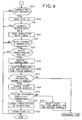
- step S19 if it is determined that the disk 10 has correction data based on information read in step S18 ("YES” in step S19), then a disk ID as an identifier contained in the disk information is read from the lead in area (step S20). Otherwise (“NO” in step S19), the process of FIG. 4 is brought to an end.
- step S21 Successively, if it is determined that the playing program in the optical disk player has never been corrected by a type of correction data corresponding to the disk 10 based on the disk ID read in step S20 ("NO" in step S21), then the start address of a correction data table located in a predetermined area of the disk 10 is searched to read the correction data table (step S22). If, on the other hand, the playing program has been corrected by the corresponding type of correction data ("YES" in step S21), then the process of FIG. 4 is brought to an end.
- the correction data table contains, as information relevant to the type of correction data corresponding to the disk 10 to be read in step S22, a company name, a product ID No., a correction data version, a corresponding region, a correction data start address, and a correction data size.
- a correction data table contains as many correction data start addresses, correction data sizes, etc. as a plurality of types of correction data which are recorded to fix trouble dependent upon different models, etc. of optical disk players.
- the company name, product ID No. and correction data version contained in the correction data table are compared with the company name, product ID No. and playing program version stored in the optical disk player to make a first determination as to whether or not correction is necessary (step S23). If these items of information in the optical disk player do not match the equivalents on the disk 10 ("NO" in step S23) so that no correction is necessary, the process of FIG. 4 is terminated immediately. If the first determination indicates that correction is necessary ("YES" in step S23), then the "corresponding region" contained in the correction data table of the disk 10 is compared with regional information about where the optical disk player is sold which is stored in the optical disk player to make a second determination as to whether or not correction is necessary (step S24).
- the "region” corresponding to the corresponding type of correction data serves as the basis for determining necessity of correction in terms of "regional aspects" of the playing program to be corrected.
- the "corresponding region” corresponding to the corresponding type of correction data on the disk 10 helps determine necessity of correction in order to eliminate trouble associated with factors suggestive of region such as the model of a particular maker and the language of a particular country, for example. This multi-stage determination configuration narrows the aspects of the trouble to be fixed by correction down to the "region" specified by the "corresponding region” in order to obviate wasteful correction.
- step S24 If the regional aspect of the optical disk player does not match the corresponding region through the second determination ("NO” in step S24), then the process of FIG. 4 is immediately terminated. Otherwise (“YES” in step S24), various operations such as turning off the optical disk player and giving user commands are prohibited (step S25). Successively, the corresponding correction data is read from the lead out area or its outer region on the disk 10, and the read correction data is recorded in the second RAM 18 and the second flash memory 20 (step S26). The prohibition of various operations in step S25 is to prevent abnormality from occurring during the reading and recording of the correction data in step S26.
- step S26 the correction data start address and correction data size contained in the correction data table are read, and the start address is then searched to read a predetermined size of the corresponding type of correction data. Thereafter, the corresponding type of correction data which has been read is developed in both the volatile second RAM 18 and the nonvolatile second flash memory 20.
- the correction data according to this embodiment be recorded on the disk 10 in a format different from that of the user data. If the correction data were recorded using the same format as that of the user data, the correction data could be easily read, analyzed, copied, and distributed. In order to prevent the correction data-recorded disk 10 from being delivered to any willful third party, it is required that a recording format different from typical recording formats be used in recording the correction data to keep anyone from accessing the correction data.
- the correction data may alternatively be encrypted upon recording on the disk 10.
- the correction data according to this embodiment can be embedded as watermarks in the video and audio data corresponding to the user data.
- it may be effective to embed correction data for fixing trouble associated with a particular one of a plurality of content objects, in the video and audio data of any of the content objects other than that particular content object as a watermark.
- This technique permits such correction data to be read during the playing of the watermarked content object based on the watermark to correct the playing program.
- This technique which would make it harder for anyone to locate correction data by embedding the correction data in user data which is large in size, is effective in protecting correction data.
- the correction data according to this embodiment may be used to directly record a corrected playing program, i.e., replacing an entire original playing program with a corrected playing program, or record only difference data between an original playing program and a corrected playing program.
- the corrected playing program needs to be generated using both the difference data indicated by the correction data and the original playing program.
- the difference data approach is more advantageous over the entire recording approach in reducing the size of the correction data.
- step S28 a start position address is changed (step S28).
- the start position address is given to indicate the head of a playing program corresponding to the corresponding type of correction data, and recorded in a predetermined area of the first flash memory 19 or the second flash memory 20, for example.
- the start position for executing the playing program corrected by the corresponding type of correction data can be located.
- a flag indicating that the recording has been performed normally may be appended to the start of the playing program corresponding to the corresponding type of correction data, instead of changing the start position address in step S28.
- the flag should be detected to locate the start position for executing the corrected playing program.
- step S29 Successively, if the playing program has been corrected normally by the above process ("YES" in step S29), then the prohibition of the various operations in step S25 is cancelled (step S30), so that the optical disk player will be ready to accept the operations such as turning off the power and giving user commands. Additionally, the disk ID is stored in a memory within the CPU 15 so that the above correcting process will not be repeated on the disk 10 (step S31). In this way, the process of FIGS. 3 and 4 are brought to a normal end.
- step S26 If, on the other hand, the reading and recording have not been completed normally in step S26 ("NO" in step S27), then the process branches to the abnormal end routine. If the playing program has not been corrected normally ("NO" in step S29), the process resets the start position address to the last address before the change in step S28 (step S32), and then proceeds to the abnormal end routine.
- the corrected playing program is recorded in the second RAM 18 and the second flash memory 20. From then on, the optical disk player continuously plays the disk 10 using the corrected playing program stored in the volatile second RAM 18. Furthermore, once the optical disk player is turned off, the user can load the corrected playing program resident in the nonvolatile second flash memory 20 using the ROM loader 16 to play the disk 10. To further correct the corrected playing program under this condition, another corresponding type of correction data needs to be recorded in the first flash memory 19 in step S26 since the previously used type of correction data is resident in the second flash memory 20. That is, in the above process, every time the playing program is corrected, the latest corrected version of the playing program is stored alternately in the first flash memory 19 and the second flash memory 20 to be resident therein.
- step S26 Even if any abnormality, such as sudden interruption of power during the reading of the corresponding type of correction data in step S26, has occurred to cause failure in normal reading, this will create no problem in the next playback. In this case, the start position address will not be changed in step S28 so that the disk 10 can be played normally using the original playing program recorded in one of the pair of RAM-flash memory systems.
- an optical disk recorder as the information recording/reproducing apparatus performs recording on a recordable disk 10.
- correction data for correcting a recording/playing program executed by the optical disk recorder are recorded on the disk 10.
- a basic flow of correcting process steps performed by the optical disk recorder is generally common to that performed by the optical disk player described above.
- correction data to be recorded is relevant to trouble associated with the recording/playing program inherent in the optical disk recorder, not relevant to trouble associated with a particular content object.
- each of recording tracks alternates with each of wobbling guide tracks in the radial direction, to record user data on the recording tracks and extract a rotation reference signal from the guide tracks.
- the correction data is modulated along the guide tracks during the formation of the guide tracks, so that the correction data can be extracted during playback. This configuration prevents any willful third party from tampering the correction data on the disk 10.
- the optical disk recorder uses a push-pull method for tracking, so that the correction data is extracted from push-pull signals. That is, the correction data on the recordable disk 10 can be read by a method different from a DPD method typically used by a DVD optical disk player, and hence enhanced security can be provided.
- correction data pits may be formed on land tracks to be read by the push-pull method.
- the correction data can be read by the method different from typical reading methods used by optical disk players.
- the information reproducing apparatus reads correction data determined on the basis of at least region information and corrects the reproducing program using the read correction data, when reproducing an information recording medium.
- the trouble of the reproducing program can be corrected quickly, so that the apparatus has advantages to both manufacturers and users.
- the region information as well as the correction data is recorded in an information recording medium, it is possible to properly cope with trouble whose occurrence is dependent on regions or models of the apparatus.
Landscapes
- Engineering & Computer Science (AREA)
- Signal Processing (AREA)
- Signal Processing For Digital Recording And Reproducing (AREA)
- Stored Programmes (AREA)
- Optical Recording Or Reproduction (AREA)
Claims (11)
- Informations-Wiedergabegerät, das ein Wiedergabeprogramm unter Verwendung von Korrekturdaten korrigiert, die auf einem Informations-Aufzeichnungsmedium (10) aufgezeichnet sind, um Aufzeichnungsinformationen wiederzugeben, die auf dem Informations-Aufzeichnungsmedium aufgezeichnet sind, enthaltend:eine Bestimmungsvorrichtung zum Beziehen einer Geografiebereichsinformation vom Informations-Aufzeichnungsmedium, um die Korrekturdaten zu bestimmen, die verwendet werden sollen, um das Wiedergabeprogramm auf der Basis der Geografiebereichsinformation zu korrigieren;eine Korrektursteuervorrichtung (15), die dazu eingerichtet ist, aus dem Ausleitungsbereich des Informations-Aufzeichnungsmediums (10) die bestimmten Korrekturdaten zu lesen, die im Ausleitungsbereich aufgezeichnet sind, um das Wiedergabeprogramm auf der Basis der gelesenen Korrekturdaten zu korrigieren; undeine Wiedergabesteuervorrichtung (15) zum Wiedergeben der Aufzeichnungsinformationen, die auf dem Informations-Aufzeichnungsmedium aufgezeichnet sind, gemäß einer jüngsten Version des Wiedergabeprogramms, das durch die Korrektursteuervorrichtung korrigiert wird.
- Informations-Wiedergabegerät nach Anspruch 1, weiterhin enthaltend eine nicht flüchtige Speichervorrichtung (20) zum Speichern der Korrekturdaten, wobei die Korrektursteuervorrichtung die Korrekturdaten an einer vorbestimmten Stelle der Speichervorrichtung aufzeichnet und die Wiedergabesteuervorrichtung eine korrigierte Version des Wiedergabeprogramms nach der Bestätigung ausführt, dass die Korrekturdaten normal aufgezeichnet sind.
- Informations-Wiedergabegerät nach Anspruch 2, bei dem die Korrektursteuervorrichtung (15) eine Startposition der Korrekturdaten als Startpositionsadresse aufzeichnet, und
die Wiedergabesteuervorrichtung (15) die korrigierte Version des Wiedergabeprogramms durch Suchen der Startpositionsadresse ausführt. - Informations-Wiedergabegerät nach Anspruch 2, bei dem, während die Korrekturdaten in der Speichervorrichtung aufgezeichnet werden, ein Vorgang zum Abschalten des Stroms verhindert wird.
- Informations-Wiedergabegerät nach Anspruch 1, bei dem die Korrekturdaten Differenzdaten zwischen einer Ursprungsversion des Wiedergabeprogramms und einer korrigierten Version des Wiedergabeprogramms beinhalten und
die Korrektursteuervorrichtung (15) das Wiedergabeprogramm auf der Basis der Ursprungsversion des Wiedergabeprogramms und der Differenzdaten korrigiert. - Verfahren zum Korrigieren eines Wiedergabeprogramms unter Verwendung von Korrekturdaten, die auf einem Informations-Aufzeichnungsmedium (10) aufgezeichnet sind, wobei das Verfahren enthält:den Vorgang des Beziehens einer Geografiebereichsinformation vom Informations-Aufzeichnungsmedium;den Vorgang des Bestimmens der Korrekturdaten, die verwendet werden sollen, um das Wiedergabeprogramm auf der Basis der Geografiebereichsinformation zu korrigieren;den Vorgang des Lesens der bestimmten Korrekturdaten aus dem Ausleitungsbereich des Informations-Aufzeichnungsmediums; undden Vorgang des Korrigierens des Wiedergabeprogramms auf der Basis der gelesenen Korrekturdaten.
- Verfahren zum Korrigieren eines Wiedergabeprogramms nach Anspruch 6, weiterhin enthaltend:den Vorgang des Aufzeichnens der Korrekturdaten an einer vorbestimmten Position einer nicht flüchtigen Speichervorrichtung (20);und den Vorgang des Aufzeichnens einer Startposition der Korrekturdaten als Startpositionsadresse.
- Verfahren zum Korrigieren eines Wiedergabeprogramms nach Anspruch 6, bei dem die Korrekturdaten Differenzdaten zwischen einer Ursprungsversion des Wiedergabeprogramms und einer korrigierten Version des Wiedergabeprogramms enthalten und
das Wiedergabeprogramm auf der Basis der Ursprungsversion des Wiedergabeprogramms und der Differenzdaten korrigiert wird. - Informations-Aufzeichnungsmedium (10), auf dem aufgezeichnete Informationen wie auch Korrekturdaten zum Korrigieren eines Wiedergabeprogramms, das von einem Informations-Wiedergabegerät ausgeführt wird, aufgezeichnet sind, wobei die Geografiebereichsinformationen aufgezeichnet sind und die Korrekturdaten im Ausleitungsbereich des Informationsaufzeichnungsmediums (10) aufgezeichnet sind.
- Informations-Aufzeichnungsmedium (10) nach Anspruch 9, bei dem die Korrekturdaten in einem Aufzeichnungsformat aufgezeichnet sind, das sich von einem Aufzeichnungsformat unterscheidet, in dem die aufgezeichneten Informationen aufgezeichnet sind.
- Informations-Aufzeichnungsmedium nach Anspruch 9, bei dem die Korrekturdaten jeweils Differenzdaten zwischen einer Ursprungsversion des Wiedergabeprogramms und einer korrigierten Version des Wiedergabeprogramms enthalten.
Applications Claiming Priority (2)
| Application Number | Priority Date | Filing Date | Title |
|---|---|---|---|
| JP2001180694A JP2002373083A (ja) | 2001-06-14 | 2001-06-14 | 情報再生装置、再生プログラムの修正方法及び情報記録媒体 |
| JP2001180694 | 2001-06-14 |
Publications (3)
| Publication Number | Publication Date |
|---|---|
| EP1267342A2 EP1267342A2 (de) | 2002-12-18 |
| EP1267342A3 EP1267342A3 (de) | 2003-05-21 |
| EP1267342B1 true EP1267342B1 (de) | 2008-02-27 |
Family
ID=19021072
Family Applications (1)
| Application Number | Title | Priority Date | Filing Date |
|---|---|---|---|
| EP02254144A Expired - Lifetime EP1267342B1 (de) | 2001-06-14 | 2002-06-13 | Informationsaufzeichnungsgerät, Verfahren zur Korrigierung des Wiedergabeprogrammes und Informationsaufzeichnungsmedium |
Country Status (7)
| Country | Link |
|---|---|
| US (1) | US7162681B2 (de) |
| EP (1) | EP1267342B1 (de) |
| JP (1) | JP2002373083A (de) |
| KR (1) | KR100551102B1 (de) |
| CN (1) | CN1232978C (de) |
| DE (1) | DE60225209T2 (de) |
| TW (1) | TWI226042B (de) |
Families Citing this family (10)
| Publication number | Priority date | Publication date | Assignee | Title |
|---|---|---|---|---|
| JP4197585B2 (ja) * | 2001-06-14 | 2008-12-17 | パイオニア株式会社 | 情報再生装置、再生プログラムの修正方法及び情報記録媒体 |
| EP1580658A1 (de) * | 2003-10-24 | 2005-09-28 | Deutsche Thomson-Brandt GmbH | Abnehmbares Speichergerät für audiovisuellen Daten |
| CN1296937C (zh) * | 2004-04-23 | 2007-01-24 | 建兴电子科技股份有限公司 | 产生校正资料至电路板的方法及实施此种方法的光盘机 |
| JP2006011647A (ja) * | 2004-06-23 | 2006-01-12 | Fujitsu Ten Ltd | ソフトウェア管理装置 |
| US7391694B2 (en) * | 2004-07-07 | 2008-06-24 | Dell Products L.P. | System and method for embedding optical drive compatibility information in optical media |
| KR100589813B1 (ko) * | 2004-12-03 | 2006-06-14 | 엘지전자 주식회사 | 손상 디스크 복구 및 복사 방법 |
| JP4715189B2 (ja) * | 2004-12-16 | 2011-07-06 | 船井電機株式会社 | ディスク装置およびファームウェアの判定方法 |
| JP2006189974A (ja) * | 2004-12-28 | 2006-07-20 | Sony Corp | 電子機器及びそのプログラムアップデート方法 |
| JP2010117997A (ja) * | 2008-11-14 | 2010-05-27 | Shantery Corp | 赤外線アップデート |
| CN102890969B (zh) * | 2011-07-20 | 2015-06-10 | 群联电子股份有限公司 | 数据处理方法、存储器控制器及存储器储存装置 |
Family Cites Families (32)
| Publication number | Priority date | Publication date | Assignee | Title |
|---|---|---|---|---|
| US44933A (en) * | 1864-11-08 | Improvement in faucets | ||
| US5434991A (en) * | 1990-03-20 | 1995-07-18 | Sharp Kabushiki Kaisha | Method and apparatus for recording and reproducing information in black on a rewritable recording medium |
| EP0449530A3 (en) * | 1990-03-23 | 1993-09-01 | Canon Kabushiki Kaisha | A memory medium having a control program memorized therein and an information processing method and an information processing apparatus using the same medium |
| JPH03276328A (ja) * | 1990-03-27 | 1991-12-06 | Canon Inc | 可換記憶媒体の記録再生装置 |
| JP2961922B2 (ja) | 1991-03-28 | 1999-10-12 | ソニー株式会社 | データレコーダ |
| JP3102203B2 (ja) * | 1993-04-15 | 2000-10-23 | 日本ビクター株式会社 | デジタル信号記録媒体の情報配置方法及びその再生装置 |
| JPH0785638A (ja) * | 1993-09-17 | 1995-03-31 | Matsushita Electric Ind Co Ltd | ディスク装置及びディスク再生方法 |
| JPH07160431A (ja) * | 1993-12-03 | 1995-06-23 | Hudson Soft Co Ltd | コマンド拡張cd−rom装置 |
| JP3007523B2 (ja) * | 1994-01-26 | 2000-02-07 | ブラザー工業株式会社 | 映像再生装置 |
| JPH07248914A (ja) | 1994-03-09 | 1995-09-26 | Ricoh Co Ltd | ディスク装置 |
| JP3350242B2 (ja) * | 1994-09-21 | 2002-11-25 | 株式会社日立製作所 | 追加プログラムのロード方式 |
| KR0136025B1 (ko) * | 1994-12-30 | 1998-05-15 | 배순훈 | 캡션기능을 갖춘 비디오 디스크와 그 재생장치(video compact disc with caption data recorded thereon and system for handling the same) |
| JP3265527B2 (ja) * | 1995-04-27 | 2002-03-11 | 株式会社ニコン | 情報記録媒体 |
| JPH113219A (ja) * | 1997-06-13 | 1999-01-06 | Sony Corp | ファームウェアの変更方法およびディスク装置 |
| JPH1115654A (ja) | 1997-06-23 | 1999-01-22 | Pioneer Electron Corp | ファームウエアのバージョンアップ方法 |
| JPH1145496A (ja) * | 1997-07-26 | 1999-02-16 | Victor Co Of Japan Ltd | 記録再生装置 |
| JPH1188965A (ja) * | 1997-09-12 | 1999-03-30 | Matsushita Electric Ind Co Ltd | 機器制御装置 |
| JPH11102343A (ja) * | 1997-09-26 | 1999-04-13 | Sanyo Electric Co Ltd | 情報表示装置 |
| US5978916A (en) * | 1997-11-25 | 1999-11-02 | International Business Machines Corporation | Method, system and computer program product for updating region-dependent software using a common update module for multiple regions |
| JPH11175323A (ja) | 1997-12-12 | 1999-07-02 | Hitachi Ltd | ディスクシステムプログラムダウンロード方法 |
| JPH11212791A (ja) * | 1998-01-23 | 1999-08-06 | Brother Ind Ltd | データ書換装置 |
| JP3495242B2 (ja) * | 1998-02-06 | 2004-02-09 | 富士通株式会社 | 情報処理装置、モード制御方法及び記憶媒体 |
| DE29806161U1 (de) * | 1998-04-06 | 1998-07-30 | AFG-Elektronik GmbH, 90765 Fürth | Uhr |
| JP2000099271A (ja) * | 1998-09-17 | 2000-04-07 | Alps Electric Co Ltd | 制御情報書き換え可能なディスク駆動装置及びその書き換え方法 |
| TW392109B (en) * | 1998-11-06 | 2000-06-01 | Mediatek Inc | IC chip for controlling optical disk system and program update method of the same |
| JP2000331416A (ja) * | 1999-05-21 | 2000-11-30 | Matsushita Electric Ind Co Ltd | オーディオ・ビデオ再生装置とファームウェア変更方式 |
| JP2000358222A (ja) * | 1999-06-15 | 2000-12-26 | Toshiba Corp | 表示表現装置および情報伝送方式 |
| JP2001005667A (ja) * | 1999-06-21 | 2001-01-12 | Sony Corp | デジタル信号処理装置及びその制御プログラム書き換え方法 |
| ATE453289T1 (de) | 1999-09-10 | 2010-01-15 | Pioneer Corp | Verfahren und vorrichtung zur informationsaufzeichnung und -wiedergabe |
| JP2001084134A (ja) * | 1999-09-16 | 2001-03-30 | Mitsubishi Electric Corp | 車載用電子制御装置とプログラム書換装置 |
| JP2001312852A (ja) | 2000-04-28 | 2001-11-09 | Victor Co Of Japan Ltd | 記録再生装置 |
| JP4197585B2 (ja) * | 2001-06-14 | 2008-12-17 | パイオニア株式会社 | 情報再生装置、再生プログラムの修正方法及び情報記録媒体 |
-
2001
- 2001-06-14 JP JP2001180694A patent/JP2002373083A/ja active Pending
-
2002
- 2002-06-12 KR KR1020020032894A patent/KR100551102B1/ko not_active Expired - Fee Related
- 2002-06-12 US US10/166,718 patent/US7162681B2/en not_active Expired - Fee Related
- 2002-06-13 EP EP02254144A patent/EP1267342B1/de not_active Expired - Lifetime
- 2002-06-13 DE DE60225209T patent/DE60225209T2/de not_active Expired - Lifetime
- 2002-06-14 TW TW091113013A patent/TWI226042B/zh not_active IP Right Cessation
- 2002-06-14 CN CNB021233500A patent/CN1232978C/zh not_active Expired - Fee Related
Also Published As
| Publication number | Publication date |
|---|---|
| KR20020095441A (ko) | 2002-12-26 |
| US7162681B2 (en) | 2007-01-09 |
| KR100551102B1 (ko) | 2006-02-09 |
| DE60225209D1 (de) | 2008-04-10 |
| JP2002373083A (ja) | 2002-12-26 |
| EP1267342A2 (de) | 2002-12-18 |
| EP1267342A3 (de) | 2003-05-21 |
| US20030037286A1 (en) | 2003-02-20 |
| DE60225209T2 (de) | 2009-04-16 |
| CN1232978C (zh) | 2005-12-21 |
| TWI226042B (en) | 2005-01-01 |
| CN1393870A (zh) | 2003-01-29 |
Similar Documents
| Publication | Publication Date | Title |
|---|---|---|
| US7149175B2 (en) | Recording medium, recording medium recording method, output control method, reproducing apparatus, recording/reproducing control method, recording method, recording/reproducing method, and recording and/or reproducing method | |
| EP1267342B1 (de) | Informationsaufzeichnungsgerät, Verfahren zur Korrigierung des Wiedergabeprogrammes und Informationsaufzeichnungsmedium | |
| JPH1145508A (ja) | データ記録装置および方法、データ再生装置および方法、並びに伝送媒体 | |
| EP1267343B1 (de) | Informationsaufzeichnungsgerät, Verfahren zur Korrigierung des Wiedergabeprogrammes und Informationsaufzeichnungsmedium | |
| US8090103B2 (en) | Method of managing copy protection information of a recording medium, recording medium with copy protection information for contents recorded thereon, and reproducing method for the recording medium | |
| US7609597B2 (en) | Apparatus for recording or reproducing record medium and method for controlling data output | |
| JP3871007B2 (ja) | 記憶媒体およびプログラム起動方法 | |
| KR20010110348A (ko) | 저작권 보호 방법, 재생 방법, 재생 장치, 기록 방법 및기록 장치 | |
| CN100530394C (zh) | 记录方法、记录装置、再现方法以及再现装置 | |
| JP3890737B2 (ja) | ディジタル映像信号または音声信号の再生装置及び再生方法 | |
| US20060077771A1 (en) | Information recording method and optical disk | |
| JPH1139220A (ja) | データ記録装置および方法、データ再生装置および方法、並びに伝送媒体 | |
| JP4501318B2 (ja) | データ記録媒体、データ記録方法および装置、データ再生方法および装置、データ記録再生方法および装置 | |
| JP2002197674A (ja) | 光ディスク及び光ディスク再生装置 | |
| US7751587B2 (en) | Data production method and apparatus | |
| JP2005523545A (ja) | 規格外のtoc入力を利用した複製検出及び保護方法 | |
| EP2093768B1 (de) | Aufzeichnungsmedium und Verfahren und Vorrichtung zum Aufzeichnen von Daten | |
| KR20010055061A (ko) | 복제방지용 광 디스크 및 그의 복제 방지 방법 | |
| JP4188903B2 (ja) | 原本性確認方法、原本性確認装置、及びプログラム | |
| JP2001332025A (ja) | 光ディスクの製造方法 | |
| JP2006313618A (ja) | 記録方法、記録装置、再生方法及び再生装置 | |
| JP2007018706A (ja) | ディジタル映像信号または音声信号の再生装置及び再生方法 | |
| JPWO2001075871A1 (ja) | コピープロテクションに対応した情報記録媒体及び記録再生装置 | |
| KR20040003288A (ko) | 고밀도 광디스크와, 그에 따른 광디스크 장치에서의 재생제한방법 | |
| JP2007087555A (ja) | 光ディスク記録再生装置 |
Legal Events
| Date | Code | Title | Description |
|---|---|---|---|
| PUAI | Public reference made under article 153(3) epc to a published international application that has entered the european phase |
Free format text: ORIGINAL CODE: 0009012 |
|
| AK | Designated contracting states |
Kind code of ref document: A2 Designated state(s): AT BE CH CY DE DK ES FI FR GB GR IE IT LI LU MC NL PT SE TR |
|
| AX | Request for extension of the european patent |
Free format text: AL;LT;LV;MK;RO;SI |
|
| PUAL | Search report despatched |
Free format text: ORIGINAL CODE: 0009013 |
|
| AK | Designated contracting states |
Designated state(s): AT BE CH CY DE DK ES FI FR GB GR IE IT LI LU MC NL PT SE TR |
|
| AX | Request for extension of the european patent |
Extension state: AL LT LV MK RO SI |
|
| 17P | Request for examination filed |
Effective date: 20030528 |
|
| AKX | Designation fees paid |
Designated state(s): DE FR GB |
|
| 17Q | First examination report despatched |
Effective date: 20040326 |
|
| GRAP | Despatch of communication of intention to grant a patent |
Free format text: ORIGINAL CODE: EPIDOSNIGR1 |
|
| RIN1 | Information on inventor provided before grant (corrected) |
Inventor name: KURODA, KAZUO,C |
|
| GRAS | Grant fee paid |
Free format text: ORIGINAL CODE: EPIDOSNIGR3 |
|
| GRAA | (expected) grant |
Free format text: ORIGINAL CODE: 0009210 |
|
| AK | Designated contracting states |
Kind code of ref document: B1 Designated state(s): DE FR GB |
|
| REG | Reference to a national code |
Ref country code: GB Ref legal event code: FG4D |
|
| REF | Corresponds to: |
Ref document number: 60225209 Country of ref document: DE Date of ref document: 20080410 Kind code of ref document: P |
|
| REG | Reference to a national code |
Ref country code: GB Ref legal event code: 746 Effective date: 20080527 |
|
| ET | Fr: translation filed | ||
| PLBE | No opposition filed within time limit |
Free format text: ORIGINAL CODE: 0009261 |
|
| STAA | Information on the status of an ep patent application or granted ep patent |
Free format text: STATUS: NO OPPOSITION FILED WITHIN TIME LIMIT |
|
| 26N | No opposition filed |
Effective date: 20081128 |
|
| PGFP | Annual fee paid to national office [announced via postgrant information from national office to epo] |
Ref country code: FR Payment date: 20110621 Year of fee payment: 10 |
|
| PGFP | Annual fee paid to national office [announced via postgrant information from national office to epo] |
Ref country code: GB Payment date: 20110608 Year of fee payment: 10 |
|
| PGFP | Annual fee paid to national office [announced via postgrant information from national office to epo] |
Ref country code: DE Payment date: 20110608 Year of fee payment: 10 |
|
| GBPC | Gb: european patent ceased through non-payment of renewal fee |
Effective date: 20120613 |
|
| REG | Reference to a national code |
Ref country code: FR Ref legal event code: ST Effective date: 20130228 |
|
| REG | Reference to a national code |
Ref country code: DE Ref legal event code: R119 Ref document number: 60225209 Country of ref document: DE Effective date: 20130101 |
|
| PG25 | Lapsed in a contracting state [announced via postgrant information from national office to epo] |
Ref country code: GB Free format text: LAPSE BECAUSE OF NON-PAYMENT OF DUE FEES Effective date: 20120613 Ref country code: DE Free format text: LAPSE BECAUSE OF NON-PAYMENT OF DUE FEES Effective date: 20130101 Ref country code: FR Free format text: LAPSE BECAUSE OF NON-PAYMENT OF DUE FEES Effective date: 20120702 |