EP1266396B1 - Verfahren und vorrichtung zum nachweis von verbindungen in einem gasstrom - Google Patents
Verfahren und vorrichtung zum nachweis von verbindungen in einem gasstrom Download PDFInfo
- Publication number
- EP1266396B1 EP1266396B1 EP01962408A EP01962408A EP1266396B1 EP 1266396 B1 EP1266396 B1 EP 1266396B1 EP 01962408 A EP01962408 A EP 01962408A EP 01962408 A EP01962408 A EP 01962408A EP 1266396 B1 EP1266396 B1 EP 1266396B1
- Authority
- EP
- European Patent Office
- Prior art keywords
- laser
- laser pulse
- mass spectrometer
- ionization
- ionization chamber
- Prior art date
- Legal status (The legal status is an assumption and is not a legal conclusion. Google has not performed a legal analysis and makes no representation as to the accuracy of the status listed.)
- Expired - Lifetime
Links
- 238000000034 method Methods 0.000 title claims abstract description 38
- 150000001875 compounds Chemical class 0.000 title claims abstract description 24
- 238000001514 detection method Methods 0.000 claims abstract description 7
- 150000002500 ions Chemical class 0.000 claims abstract description 7
- 230000003287 optical effect Effects 0.000 claims description 10
- 238000002156 mixing Methods 0.000 claims description 4
- 238000011049 filling Methods 0.000 claims description 3
- 238000010894 electron beam technology Methods 0.000 claims description 2
- 230000001788 irregular Effects 0.000 claims 1
- 238000001561 resonance enhanced multiphoton ionisation spectroscopy Methods 0.000 description 28
- 239000007789 gas Substances 0.000 description 17
- 230000005855 radiation Effects 0.000 description 13
- 238000004458 analytical method Methods 0.000 description 11
- UFWIBTONFRDIAS-UHFFFAOYSA-N Naphthalene Chemical compound C1=CC=CC2=CC=CC=C21 UFWIBTONFRDIAS-UHFFFAOYSA-N 0.000 description 10
- 239000000126 substance Substances 0.000 description 8
- MVPPADPHJFYWMZ-UHFFFAOYSA-N chlorobenzene Chemical compound ClC1=CC=CC=C1 MVPPADPHJFYWMZ-UHFFFAOYSA-N 0.000 description 7
- 238000002485 combustion reaction Methods 0.000 description 6
- 239000013078 crystal Substances 0.000 description 6
- 238000001819 mass spectrum Methods 0.000 description 6
- 238000000752 ionisation method Methods 0.000 description 5
- 239000010453 quartz Substances 0.000 description 5
- VYPSYNLAJGMNEJ-UHFFFAOYSA-N silicon dioxide Inorganic materials O=[Si]=O VYPSYNLAJGMNEJ-UHFFFAOYSA-N 0.000 description 5
- UHOVQNZJYSORNB-UHFFFAOYSA-N Benzene Chemical compound C1=CC=CC=C1 UHOVQNZJYSORNB-UHFFFAOYSA-N 0.000 description 3
- -1 O 2 Chemical class 0.000 description 3
- 238000012512 characterization method Methods 0.000 description 3
- 239000003546 flue gas Substances 0.000 description 3
- 238000004949 mass spectrometry Methods 0.000 description 3
- 238000005259 measurement Methods 0.000 description 3
- 239000000203 mixture Substances 0.000 description 3
- CSCPPACGZOOCGX-UHFFFAOYSA-N Acetone Chemical compound CC(C)=O CSCPPACGZOOCGX-UHFFFAOYSA-N 0.000 description 2
- UGFAIRIUMAVXCW-UHFFFAOYSA-N Carbon monoxide Chemical compound [O+]#[C-] UGFAIRIUMAVXCW-UHFFFAOYSA-N 0.000 description 2
- 150000001299 aldehydes Chemical class 0.000 description 2
- 238000010276 construction Methods 0.000 description 2
- 238000005516 engineering process Methods 0.000 description 2
- 235000013305 food Nutrition 0.000 description 2
- 238000013467 fragmentation Methods 0.000 description 2
- 238000006062 fragmentation reaction Methods 0.000 description 2
- 150000002576 ketones Chemical class 0.000 description 2
- 239000000047 product Substances 0.000 description 2
- BBEAQIROQSPTKN-UHFFFAOYSA-N pyrene Chemical compound C1=CC=C2C=CC3=CC=CC4=CC=C1C2=C43 BBEAQIROQSPTKN-UHFFFAOYSA-N 0.000 description 2
- 238000001269 time-of-flight mass spectrometry Methods 0.000 description 2
- 238000004056 waste incineration Methods 0.000 description 2
- HGUFODBRKLSHSI-UHFFFAOYSA-N 2,3,7,8-tetrachloro-dibenzo-p-dioxin Chemical compound O1C2=CC(Cl)=C(Cl)C=C2OC2=C1C=C(Cl)C(Cl)=C2 HGUFODBRKLSHSI-UHFFFAOYSA-N 0.000 description 1
- 238000001069 Raman spectroscopy Methods 0.000 description 1
- 238000010521 absorption reaction Methods 0.000 description 1
- 239000000443 aerosol Substances 0.000 description 1
- HSFWRNGVRCDJHI-UHFFFAOYSA-N alpha-acetylene Natural products C#C HSFWRNGVRCDJHI-UHFFFAOYSA-N 0.000 description 1
- 150000001491 aromatic compounds Chemical class 0.000 description 1
- 150000004945 aromatic hydrocarbons Chemical class 0.000 description 1
- 239000008280 blood Substances 0.000 description 1
- 210000004369 blood Anatomy 0.000 description 1
- 229910052799 carbon Inorganic materials 0.000 description 1
- 239000006229 carbon black Substances 0.000 description 1
- 239000007795 chemical reaction product Substances 0.000 description 1
- 238000012569 chemometric method Methods 0.000 description 1
- 230000000295 complement effect Effects 0.000 description 1
- 238000010411 cooking Methods 0.000 description 1
- 238000001816 cooling Methods 0.000 description 1
- 230000008878 coupling Effects 0.000 description 1
- 238000010168 coupling process Methods 0.000 description 1
- 238000005859 coupling reaction Methods 0.000 description 1
- 239000002781 deodorant agent Substances 0.000 description 1
- 238000013461 design Methods 0.000 description 1
- 150000004827 dibenzo-1,4-dioxins Chemical class 0.000 description 1
- 150000004826 dibenzofurans Chemical class 0.000 description 1
- 239000010791 domestic waste Substances 0.000 description 1
- 238000001035 drying Methods 0.000 description 1
- 125000002534 ethynyl group Chemical group [H]C#C* 0.000 description 1
- 238000011156 evaluation Methods 0.000 description 1
- 238000000605 extraction Methods 0.000 description 1
- GVEPBJHOBDJJJI-UHFFFAOYSA-N fluoranthrene Natural products C1=CC(C2=CC=CC=C22)=C3C2=CC=CC3=C1 GVEPBJHOBDJJJI-UHFFFAOYSA-N 0.000 description 1
- 150000002240 furans Chemical class 0.000 description 1
- 238000010348 incorporation Methods 0.000 description 1
- 239000011261 inert gas Substances 0.000 description 1
- 150000002484 inorganic compounds Chemical class 0.000 description 1
- 239000007788 liquid Substances 0.000 description 1
- 239000002480 mineral oil Substances 0.000 description 1
- 235000010446 mineral oil Nutrition 0.000 description 1
- 238000012544 monitoring process Methods 0.000 description 1
- IJGRMHOSHXDMSA-UHFFFAOYSA-N nitrogen Substances N#N IJGRMHOSHXDMSA-UHFFFAOYSA-N 0.000 description 1
- 229910052757 nitrogen Inorganic materials 0.000 description 1
- 229910017464 nitrogen compound Inorganic materials 0.000 description 1
- 150000002830 nitrogen compounds Chemical class 0.000 description 1
- 150000002894 organic compounds Chemical class 0.000 description 1
- 238000003909 pattern recognition Methods 0.000 description 1
- 239000002304 perfume Substances 0.000 description 1
- 125000003367 polycyclic group Chemical group 0.000 description 1
- 238000000513 principal component analysis Methods 0.000 description 1
- 238000000197 pyrolysis Methods 0.000 description 1
- 238000003908 quality control method Methods 0.000 description 1
- 239000002994 raw material Substances 0.000 description 1
- 230000029058 respiratory gaseous exchange Effects 0.000 description 1
- 229910052594 sapphire Inorganic materials 0.000 description 1
- 239000010980 sapphire Substances 0.000 description 1
- 238000007789 sealing Methods 0.000 description 1
- 230000001953 sensory effect Effects 0.000 description 1
- 238000000926 separation method Methods 0.000 description 1
- 239000007787 solid Substances 0.000 description 1
- 238000010561 standard procedure Methods 0.000 description 1
- 230000001629 suppression Effects 0.000 description 1
- 231100000331 toxic Toxicity 0.000 description 1
- 230000002588 toxic effect Effects 0.000 description 1
- 230000001052 transient effect Effects 0.000 description 1
- 210000002700 urine Anatomy 0.000 description 1
Images

Classifications
-
- H—ELECTRICITY
- H01—ELECTRIC ELEMENTS
- H01J—ELECTRIC DISCHARGE TUBES OR DISCHARGE LAMPS
- H01J49/00—Particle spectrometers or separator tubes
- H01J49/02—Details
- H01J49/10—Ion sources; Ion guns
- H01J49/107—Arrangements for using several ion sources
-
- H—ELECTRICITY
- H01—ELECTRIC ELEMENTS
- H01J—ELECTRIC DISCHARGE TUBES OR DISCHARGE LAMPS
- H01J49/00—Particle spectrometers or separator tubes
- H01J49/02—Details
- H01J49/10—Ion sources; Ion guns
- H01J49/16—Ion sources; Ion guns using surface ionisation, e.g. field-, thermionic- or photo-emission
- H01J49/161—Ion sources; Ion guns using surface ionisation, e.g. field-, thermionic- or photo-emission using photoionisation, e.g. by laser
- H01J49/162—Direct photo-ionisation, e.g. single photon or multi-photon ionisation
Definitions
- the invention relates to a method and an apparatus for detecting compounds in a gas stream according to the preambles of claims 1 and 8, as known from the publication 3.
- the resonance-enhanced multiphoton ionization technique (REMPI), the UV laser pulses for the selective ionization of z. B. aromatics is used as a selective and soft ionization method for mass spectrometry.
- the selectivity is determined, inter alia, by the UV spectroscopic properties and the position of the ionization potentials.
- a typical application is the on-line detection of aromatic compounds from combustion exhaust gases 1 .
- a disadvantage of the REMPI method is that it is limited to some classes of substances and the ionization cross-section can also be extremely different for similar compounds.
- Single photon ionization (SPI) with VUV laser light allows for a partially selective and soft ionization 2 .
- the selectivity is determined by the position of the ionization potentials.
- a typical application is the detection of compounds that can not be detected by REMPI.
- a disadvantage of the SPI method is that some substance classes can not be detected.
- the selectivity is smaller than in the REMPI method, so that interference can occur more intensively with complex samples.
- Electron impact ionization (EI) with an electron beam is the standard technique for ionization in the mass spectrometry of volatile inorganic and organic compounds. It is very universal (ie non-selective) and results in many molecules often leads to a very strong fragmentation, but is very well suited for a direct measurement of compounds such as O 2, N 2, CO 2, SO 2, CO, C 2 H 2, etc., which can not be detected so well with VUV or REMPI.
- the object of the invention is to design a method and a device of the generic type such that a multiplicity of compounds in the analysis gas can be characterized almost simultaneously. This object is achieved by the features of claims 1 and 8.
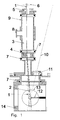
- FIG. 1 shows by way of example the ionization region of the mass spectrometer 14 and the gas cell 9.
- FIG. 2 schematically shows an optical delegation for generating a UV laser pulse 10 and a VUV laser pulse.
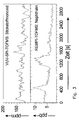
- FIG. 3 shows an on-line measurement of NO and naphthalene in the flue gas of a waste incineration plant taken with alternating SPI ionization (VUV for NO) and REMPI ionization (UV for naphthalene).
- FIG. 1 shows the ionization region of the time of flight (TOF) mass spectrometer.
- TOF time of flight
- the gas stream to be analyzed flows effusively through the inlet needle 12 into the ionization chamber 14 1 .
- supersonic molecular beam inlet systems (described, for example, in Figure 3 ) may also be employed.
- Analytes from the gas stream are irradiated directly below the inlet needle 12 alternately with UV laser pulses (266 nm) 10 and VUV laser pulses (118 nm) 2.
- the laser pulse length can be between 1 fs and 100 ns.
- the ions produced by multiphoton ionization (REMPI, 266 nm) or one-photon ionization (SPI, 118 nm) are drawn off through the opening of the discharge aperture 13 into the TOF mass spectrometer and mass analyzed there.
- REMPI, 266 nm multiphoton ionization
- SPI, 118 nm one-photon ionization
- the VUV laser beams (118 nm) 2 are generated in the gas cell 9, which is filled with inert gas (Xe and Ar) 3, by frequency tripling 355 nm laser pulses 1.
- the 355 nm laser pulses 1 are focused with a quartz lens 6 and through a quartz window 5 into the gas cell 9.
- the resulting VUV radiation and the remaining 355 nm Radiation 1 enters the ionization cube 14 of the TOF mass spectrometer through the MgF 2 lens 4.
- the offset irradiation of the 355 nm laser beam 1 relative to the center of the MgF 2 lens 4 causes a local separation of the 355 nm laser radiation 1 and 118 nm radiation in the ionization chamber 14.
- the 355 nm radiation can be intercepted before the ionization. This leads to fragmented SPI mass spectra.
- the alternating generation of the 266 nm 10 and 118 nm 1 ionization laser pulses is carried out with a special optical structure, as it FIG. 2 is shown.
- the Nd: YAG laser 15 generates 1064 nm laser radiation 23, which are guided via two dichroic mirrors 16 through a frequency doubling crystal 17.
- the resulting laser beam 24 consists of 1064 nm 23 and 532 nm 25 laser radiation.
- a movably mounted on an arm dichroid mirror 18, which can be computer controlled via a galvanometer quickly and precisely swung in the beam path is used to redirect the laser pulses alternately or pass.
- the laser radiation 24 is passed through the sum difference mixed crystal 19 and generates 355 nm laser light 1 separated by the dichroic mirror 20 from the collinear 532nm and 1064nm radiation and into the gas cell 9 to produce the 118 nm VUV laser radiation 2 is used. If the mirror arm 18 is in the beam path, the 532 nm portion of the radiation 24 is directed through the dichroic mirror by a doubling crystal 17. The resulting 266 nm laser radiation 10 is separated from the 532 nm radiation by the dichroic mirrors 22 and then used for REMPI ionization in the inlet block 14 of the TOF mass spectrometer.
- the data acquisition system records the REMPI and VUV-SPI mass spectra separately. If a sufficiently intense YAG laser is used, then a partially transparent mirror (dichroid beam splitter) can be used instead of a folding mirror. The suppression of the respectively unneeded beam can be realized via a Pockels cell or a chopper wheel. In addition to the Nd: YAG laser, other pulsed third-party lasers such as Ti: sapphire lasers can be used.
- naphthalene and its methylated derivatives can be detected particularly efficiently at 213 nm.
- chemometric methods for pattern recognition eg principal component analysis
- Raman shifters e.g., Raman shifters, with optical parametric Oscillator crystal, with dye laser unit
- a frequency can also be converted to a desired frequency for a selective REMPI detection of a particular substance, for example, one wavelength can be tuned to a resonance of monochlorobenzene (eg at about 266 nm or at about 269.82 nm 4 ).
- Monochlorobenzene is an indicator of the presence of toxic polychlorinated dibenzo-p-dioxins and -furans (PCDD / F) and may be associated with REMPI on-line in flue gases from z. B. technical combustion processes are detected 5 . With a wavelength of about 269.82 nm is a detection of monochlorobenzene (MCB) and a number of other aromatics such. As benzene, naphthalene or pyrene possible. Alternatively, MCB can be detected at a resonance that is close to four times the Nd: YAG wavelength 4 . For this purpose, it may be sufficient in certain cases, the fundamental wave of the Nd: YAG laser, z. B. by manipulation of the laser resonator, easy to detune.
- MCB monochlorobenzene
- VUV laser wavelength parallel compounds such as NH3, NO many aldehydes and ketones etc. can be detected, which are not detectable with the REMPI at the MCB resonance.
- An analytical laser mass spectrometer can also be advantageously designed for certain applications with an inlet system for generating a supersonic molecular beam (jet).
- the resulting adiabatic cooling increases the selectivity of the REMPI-TOFMS method 6 and reduces the fragmentation in SPI and EI ionization.
- the EI ionization achieves only much smaller cross sections than the laser ionization (with common pulse energies), however, the repetition rate of the laser ionization processes, which are indeed pulsed, limited in many compact laser systems to 10-20 Hz. Since the absorption of a mass spectrum after the ionization pulse takes only a few 10 ⁇ s, the mass spectrometer is not used for most of the time.
- the EI ionization uses an electron gun that accelerates electrons with kinetic energies of 2-200 eV to the sample molecules. Using pulsed electron guns and pulsed extraction fields, the normally continuous EI method can also be used with time-of-flight mass spectrometry. This is also possible in parallel with the use of laser ionization methods (REMPI, SPI).
- the information of the laser ionization methods is recorded via a transient recorder while the information from the EI ionization is done via counting cards.
- the incorporation of electron impact ionization allows direct on-line measurement of the higher concentration compounds that can not be detected by REMPI or SPI.
- REMPI has proven to be a very powerful analytical method for on-line analysis of aromatic hydrocarbons, dioxin indicators (MCB) and other compounds. 1. In parallel, information such as nitrogen compounds such as NO, NH3 or aldehydes would be important. These compounds can be detected with VUV. Thus, the VUV, SPI and REMPI ionization methods complement each other and together can be used advantageously for a good characterization of the combustion process.
- FIG. 3 shows the concentration curves of naphthalene and NO in the flue gas of a household waste incineration plant (raw gas at 700 ° C) recorded with parallel VUV-SPI and REMPI ionization.
- Application example 2 On-line analysis of process gases in food technology
- the method can be used with a device of the generic type for the analysis of complex substance mixture (solid, solution / liquid, gas phase).
- Suitable auxiliary devices headspace samples, thermal desorbers, etc.
- process solutions from the chemical industry, mineral oil products but also end products such as perfume or deodorant can be analyzed and monitored.
- the method can be used with a device of the generic type for analyzing the breathing air (exhaled breath) of patients and control persons. Certain volatile substances, such as acetone, indicate illness or general health out. Furthermore, the headspace can be analyzed via medical samples (blood, urine, etc.).
Landscapes
- Physics & Mathematics (AREA)
- Engineering & Computer Science (AREA)
- Plasma & Fusion (AREA)
- Chemical & Material Sciences (AREA)
- Analytical Chemistry (AREA)
- Optics & Photonics (AREA)
- Other Investigation Or Analysis Of Materials By Electrical Means (AREA)
- Electron Tubes For Measurement (AREA)
- Investigating Or Analyzing Materials By The Use Of Fluid Adsorption Or Reactions (AREA)
- Investigating Or Analyzing Non-Biological Materials By The Use Of Chemical Means (AREA)
Description
- Die Erfindung betrifft ein Verfahren und eine Vorrichtung zum Nachweis von Verbindungen in einem Gasstrom nach den Oberbegriffen der Patentansprüche 1 und 8, wie sie aus der Veröffentlichung 3 bekannt ist.
- Die resonanzverstärkte Multiphotonenionisations-Technik (resonance-enhanced multiphoton ionization - REMPI), die UV-Laserpulse zur selektiven Ionisation von z. B. Aromaten einsetzt, wird als selektive und weiche Ionisationsmethode für die Massenspektrometrie verwendet. Die Selektivität wird u.a. durch die UV spektroskopischen Eigenschaften und die Lage der Ionisationspotentiale bestimmt. Eine typische Anwendung ist der on-line Nachweis aromatischer Verbindungen aus Verbrennungsabgasen1. Nachteilig bei der REMPI-Methode ist, dass es auf einige Substanzklassen beschränkt ist und der Ionisationsquerschnitt auch für ähnliche Verbindungen teilweise extrem unterschiedlich sein kann.
- Die Einphotonenionisation (single photon ionization -SPI) mit VUV-Laserlicht erlaubt eine teilselektive und weiche Ionisation2. Die Selektivität wird durch die Lage der Ionisationspotentiale bestimmt. Eine typische Anwendung ist der Nachweis von Verbindungen, die nicht mit REMPI nachgewiesen werden können. Nachteilig bei der SPI Methode ist, dass einige Substanzklassen nicht nachgewiesen werden können. Weiterhin ist die Selektivität kleiner als bei der REMPI-Methode, sodass bei komplexen Proben verstärkt Interferenzen auftreten können.
- Die Elektronenstoßionisation (EI) mit einem Elektronenstrahl ist die Standardtechnik zur Ionisation in der Massenspektrometrie flüchtiger anorganischer und organischer Verbindungen. Sie ist sehr universell (d.h. nicht selektiv) und führt bei vielen Molekülen häufig zu einer sehr starken Fragmentierung, ist aber sehr gut für eine direkte Messung von Verbindungen wie 02, N2, CO2, SO2, CO, C2H2 etc. geeignet, die mit VUV oder REMPI nicht so gut erfaßt werden können.
- Aufgabe der Erfindung ist es, ein Verfahren und eine Vorrichtung der gattungsgemäßen Art so auszugestalten, dass eine Vielzahl von Verbindungen im Analysengas nahezu gleichzeitig charakterisiert werden können. Gelöst wird diese Aufgabe durch die Merkmale der Patentansprüche 1 und 8. Die Unteransprüche beschrieben vorteilhafte Ausgestaltungen der Erfindung.
- Die Kombination von (quasi-) simultan durchgeführter SPI- und REMPI-Ionisation in einem Massenspektrometer bringt eine Reihe von Vorteilen. Beide Methoden erfassen mit einer unterschiedlichen Selektivität unterschiedliche Teilmengen des komplexen Analysengases. Insgesamt können so mehr Verbindungen aus der Probe identifiziert werden.
- Wird die EI-Ionisationstechnik noch hinzugezogen, so können noch weitere Verbindungen wie CO2, H2O oder CH4 nachgewiesen werden, die weder mit SPI- noch mit REMPI sinnvoll nachgewiesen werden können. Die Vereinigung der Methoden und die Vorrichtung zum quasi- parallelen Gebrauch derselben in einem Gerät erlaubt den Bau besonders kompakter analytischer MS-Systeme für z. B. on-line analytische Feldanwendungen (Prozeßanalyse), die trotzdem eine sehr große Leistungsfähigkeit aufweisen. Die parallel erhaltenen REMPI- und/oder VUV- und/oder EI- massenspektropmetrische Daten können auch einer chemometrischen Analyse durch mustererkennende Verfahren (z. B. einer Hauptkomponenentanalyse) zugeführt werden.
- Die Erfindung wird im folgenden anhand von Ausführungsbeispielen mit Hilfe der Figuren näher erläutert.
- Die
Figur 1 zeigt beispielhaft die Ionisationsregion des Massenspektrometer 14 und die Gaszelle 9. - Die
Figur 2 zeigt schematisch eine optische Abordnung zur Erzeugung eines UV-Laserpulses 10 und eines VUV-Laserpulses 2. - Die
Figur 3 zeigt eine on-line Messung von NO und Naphthalin im Rauchgas einer Müllverbrennungsanlage aufgenommen mit alternierender SPI-Ionisierung (VUV für NO) und REMPI-Ionisierung (UV für Naphthalin). - Die (quasi-)parallele Nutzung der Ionisierung mit REMPI und SPI erlaubt somit die gleichzeitige Verfolgung komplexer chemischer Proben. Aufgrund der unterschiedlichen Selektivität der beiden Methoden werden verschiedene Massenspektren mit den jeweiligen Methoden erhalten. Die
Figur 1 zeigt dabei die Ionisationsregion des Flugzeit (TOF) Massenspektrometers. Der zu analysierende Gasstrom strömt effusiv durch die Einlaßnadel 12 in die Ionisationskammer 14 1. Alternativ können auch Überschallmolkularstrahleneinlaßsysteme (beschrieben z. B. in 3) eingesetzt werden. Analyte aus dem Gasstrom werden direkt unterhalb der Einlaßnadel 12 abwechselnd mit UV-Laserpulsen (266 nm) 10 und VUV-Laserpulsen (118 nm) 2 bestrahlt. Die Laserpulslänge kann zwischen 1 fs und 100 ns liegen. Die durch Mehrphotonenionisation (REMPI, 266 nm) oder Einphotonenionisation (SPI, 118 nm) erzeugten Ionen werden durch die Öffnung der Abzugsblende 13 in das TOF- Massenspektrometer abgezogen und dort massenanalysiert. Alternativ zum abwechselnden Umschalten zwischen UV-Laserpulsen (266 nm) und VUV-Laserpulsen (118 nm) können auch mehrere Pulse einer Wellenlänge nacheinander eingestrahlt werden bevor auf die andere Wellenlänge umgeschaltet wird. Die VUV-Laserstrahlen (118 nm) 2 werden in der Gaszelle 9, die mit Edelgas gefüllt (Xe und Ar) 3 gefüllt ist, durch Frequenzverdreifachung von 355 nm Laserpulsen 1 erzeugt. Die 355 nm Laserpulse 1 werden mit einer Quarzlinse 6 und durch ein Quarzfenster 5 in die Gaszelle 9 fokussiert. Die entstehende VUV-Strahlung und die restliche 355 nm Strahlung 1 treten durch die MgF2 Linse 4 in den Ionisationswürfel 14 des TOF-Massenspektrometers ein. Die versetzte Einstrahlung der 355 nm Laserstrahls 1 relativ zum Zentrum der MgF2 Linse 4 bewirkt eine örtliche Separation der 355 nm Laserstrahlung 1 und 118 nm Strahlung in der die Ionisationskammer 14. Durch eine Blende kann die 355 nm Strahlung vor dem Ionisationsort abgefangen werden. Dies führt zu fragmentärmeren SPI-Massenspektren. - Die abwechselnde Erzeugung der 266 nm 10 und 118 nm 1 Ionisationslaserpulse erfolgt mit einem speziellen optischen Aufbau, wie er in
Figur 2 dargestellt ist. Der Nd:YAG Laser 15 erzeugt 1064 nm Laserstrahlung 23 die über zwei dichroide Spiegel 16 durch einen Frequenzverdopplungskristall 17 geführt werden. Der resultierende Laserstrahl 24 besteht aus 1064 nm 23 und 532 nm 25 Laserstrahlung. Ein beweglich auf einem Arm angebrachter dichroider Spiegel 18, der computergesteuert über ein Galvanometer schnell und präzise in den Strahlengang eingeschwenkt werden kann, wird verwendet um die Laserpulse alternierend umzuleiten oder durchzulassen. Wenn der Spiegelarm 18 aus dem Strahlengang geschwenkt wird die Laserstrahlung 24 durch den Summendifferenz-Mischkristall 19 geleitet und 355 nm Laserlicht 1 erzeugt, dass durch die dichroiden Spiegel 20 von der kolinearen 532nm und 1064nm Strahlung separiert und in die Gaszelle 9 zur Erzeugung der 118 nm VUV-Laserstrahlung 2 eingesetzt wird. Ist der Spiegelarm 18 im Strahlengang so wird der 532 nm Anteil der Strahlung 24 über den dichroiden Spiegel durch einen Verdopplungskristall 17 gelenkt. Die entstehende 266 nm Laserstrahlung 10 wird durch die dichroiden Spiegel 22 von der 532 nm Strahlung separiert und dann zur REMPI Ionisation im Einlaßblock 14 des TOF-Massenspektrometers eingesetzt. - Das Datenaufnahmesystem nimmt die REMPI und VUV-SPI Massenspektren getrennt auf. Wenn ein genügend intensiver YAG Laser angewendet wird so kann anstatt eines Umklappspiegels auch ein teildurchlässiger Spiegel (dichroider Strahlteiler) verwendet werden. Die Ausblendung des jeweils nicht benötigten Strahls kann über eine Pockelszelle oder ein Chopperrad realisiert werden. Neben dem Nd:YAG Laser sind auch andere gepulst betreibare Festkörperlaser wie z.B. Ti:Saphir-Laser einsetzbar.
- Aus der Primärwelle des Nd:YAG Lasers (1064 nm) können folgende harmonischen Frequenzen erzeugt werden: 523 nm (verdoppelt), 355 nm (verdreifacht), 266 nm (vervierfacht), 213 nm (verfünffacht) und 118 nm (verneunfacht). In Erweiterung zum oben beschrieben Zweistrahlverfahren (266 nm für REMPI und 118 nm für VUV) können auch mehrere Wellenlängen alternierend eingestrahlt werden. Bei einer Kombination von 266, 213 und 118 nm werden beispielsweise neben der VUV-Selektivität simultan (d.h. leicht versetzt) noch zwei unterschiedliche REMPI-Selektivitäten ausgenutzt. Beispielsweise können Naphthalin und seine methylierten Derivate (diese Verbindungen sind Indikatoren für die Effizienz von Verbrennungsprozessen) besonders effizient mit 213 nm nachgewiesen werden. Je nach Festkörperlasertyp lassen sich somit 2, 3 oder mehr Wellenlängen parallel zur Ionisation von Verbindungen aus der Probe einsetzen. Die unterschiedlichen Selektivitäten die durch die verschiedenen REMPI und oder VUV Wellenlängen induziert werden führen zu jeweils verscheiden Massenspektren (d.h. jeweils andere Verbindungen kommen hinzu oder verschwinden aus dem Massenspektrum. Falls bei sehr komplexen Proben oder unbekannten Proben keine Zuordnung der jeweils beobachteten Verbindungen möglich ist, kann ein Einsatz von chemometrischen Verfahren zur Mustererkennung (z. B. Hauptkomponentenanalyse) und damit z. B. zur phänomenologischen Charakterisierung eingesetzt werden. Durch Einsatz von fest eingestellten Frequenzverschiebeeinheiten (z. B. über optoakustische Kopplung, mit Raman-Shifter, mit Optischer-Parametrischem-Oszillator Kristall, mit Farbstofflasereinheit) kann eine Frequenz auch in eine gewünschte Frequenz für einen selektiven REMPI-Nachweis einer bestimmten Substanz umgewandelt werden. Beispielsweise kann eine Wellenlänge auf eine Resonanz von Monochlorbenzol abgestimmt werden (z. B. bei ca. 266 nm oder bei etwa 269,82 nm 4). Monochlorbenzol ist ein Indikator für das Vorkommen toxischer polychlorierter Dibenzo-p-dioxine und -furane (PCDD/F) und kann mit REMPI on-line in Rauchgasen von z. B. technischen Verbrennungsprozessen nachgewiesen werden 5. Mit einer Wellenlänge von ca. 269.82 nm ist eine Nachweis von Monochlorbenzol (MCB) sowie einer Reihe weiterer Aromaten wie z. B. Benzol, Naphthalin oder Pyren möglich. Alternativ kann MCB bei einer Resonanz die ganz knapp neben der vervierfachten Nd:YAG Wellenlänge liegt nachgewiesen werden 4. Hierzu kann es in bestimmten Fällen ausreichend sein, die Grundwelle des Nd:YAG Lasers, z. B. durch Manipulation des Laserresonators, leicht zu verstimmen.
- Mit den VUV-Laserwellenlänge können dann parallel Verbindungen wie NH3, NO viele Aldehyde und Ketone etc. nachgewiesen werden, die mit REMPI bei der MCB Resonanz nicht nachweisbar sind.
- Ein analytischer Lasermassenspektrometer kann weiterhin für bestimmte Anwendungen vorteilhaft mit einem Einlaßsystem zur Erzeugung eines Überschallmolekularstrahles (Jet) ausgestaltet werden. Die dadurch erreichbare adiabatische Kühlung erhöht die Selektivität der REMPI-TOFMS Methode 6 und verringert die Fragmentation bei SPI und EI-Ionisierung.
- Die EI-Ionisierung erreicht nur viel geringere Wirkungsquerschnitte als die Laserionisation (bei üblichen Pulsenergien) allerdings ist die Wiederholrate der Laserionisationsprozesse, die ja gepulst ablaufen, bei vielen kompakten Lasersystemen auf 10-20 Hz. beschränkt. Da die Aufnahme eines Massenspektrums nach dem Ionisationspuls nur einige 10 µs dauert ist das Massenspektrometer für die meiste Zeit nicht genutzt. Die EI-Ionisation verwendet eine Elektronenkanone die Elektronen mit kinetischen Energien von 2-200 eV zu den Probenmolekülen beschleunigt. Über gepulste Elektronenkanonen und gepulste Abzugsfelder kann die normalerweise kontinuierlich arbeitende EI-Methode auch mit der Flugzeitmassenspektrometrie verwendet werden. Dies ist auch parallel mit der Verwendung der Laserionisationsmethoden (REMPI, SPI) möglich. Typischerweise wird die Information der Laserionisationsmethoden über einen Transientenrekorder aufgezeichnet währen die Information aus der EI-Ionisation über Zählkarten erfolgt. Die Einbindung der Elektronenstoßionisation erlaubt die direkte on-line Messung der in höheren Konzentrationen vorliegenden Verbindungen die nicht mit REMPI oder SPI erfaßt werden können.
- Das oben beschriebene Verfahren und die Vorrichtung kann prinzipiell für eine Vielzahl von Anwendungen eingesetzt werde. Im folgenden sind vier Anwendungsbeispiele gegeben:
- REMPI hat sich als sehr mächtiges analytisches Verfahren zur on-line Analyse von aromatischen Kohlenwasserstoffen, Dioxin-Indikatoren (MCB) und anderen Verbindungen erwiesen 1. Parallel wären Information z.B. über Stickstoffverbindungen wie NO, NH3 oder über Aldehyde von Bedeutung. Diese Verbindungen können mit VUV nachgewiesen werden. Somit ergänzen sich die VUV-, SPI- und REMPI-Ionisationsmethoden und können zusammen vorteilhaft für eine gute Charakterisierung des Verbrennungsprozesses eingesetzt werden. Wird die parallele EI-Ionisierung implementiert, so kommt man schließlich zu einer sehr umfassenden Charakterisierung, da einige chemische Hauptparameter, wie z.B. Konzentrationen an CO2, 02 und kleineren organischen Molekülen wie Acetylen (wichtig für den Aufbau von polyzyklischen Aromaten und Ruß-Aerosolen) nicht mit den üblichen SPI VUV-Wellenlängen oder mit 2 Photonen-REMPI Prozessen erfaßt werden können. Das Verfahren mit einer Vorrichtung der gattungsgemäßen Art ist geeignet um Verbrennungs- und Pyrolyseprozesse aller Art zu charakterisieren und analysieren. Die
Figur 3 zeigt die Konzentrationsverläufe von Naphthalin und NO im Rauchgas einer Hausmüllverbrennungsanlage (Rohgas bei 700 °C) aufgenommen mit paralleler VUV-SPI und REMPI-Ionisierung. - In zur Überwachung lebensmitteltechnologischer Prozesse (Trocknungsprozesse, Röst- oder Garprozesse etc.) sowie zur Qualitätskontrolle von Rohstoffen (Schimmelbefall, Qualität) oder Evaluierung der sensorischen Qualität können on-line massenspektrometrische Verfahren eingesetzt werden. Erste Erfahrungen wurden mit der REMPI Methode auf dem Gebiet der Kaffeeröstung bereits gemacht 7. Mit REMPI (266 nm) kann der Röstgrad über die Zusammensetzung unterschiedlich substituierter ermittelt werden. Viele aromarelevante Verbindungen (aliphatische Aldehyde und Ketone, Furanderivate, Stickstoffheterozyklen etc.) können hingegen sehr gut mit VUV-Ionisierung nachgewiesen werden. Die Elektronenstoßionisation erlaubt die Verfolgung der primären Kaffeeröstprodukte CO2 und H2O. Eine Vielzahl solcher Prozesse sind prinzipiell mit dem Verfahren und einer Vorrichtung der gattungsgemäßen Art umfassend zu kontrollieren und validieren.
- Das Verfahren kann mit einer Vorrichtung der gattungsgemäßen Art zur Analyse komplexer Substanzmischung eingesetzt werden (Feststoff, Lösung/Flüssigkeit, Gasphase). Geeignete Hilfsgeräte (Headspaceprobeneahme, Thermodesorber etc.) können zur Gewinnung einer repräsentativen Gasprobe eingesetzt werden. Beispielhaft können Prozeßlösungen aus der chemischen Industrie, Mineralölprodukte aber auch Endprodukte wie Parfüm oder Deodorant analysiert und überwacht werden.
- Das Verfahren kann mit einer Vorrichtung der gattungsgemäßen Art zur Analyse der Atemluft (ausgeatmet) von Patienten und Kontrollpersonen verwendet werden. Bestimmte flüchtige Stoffe wie Aceton/weisen auf Erkrankungen oder den allgemeine Gesundheitszustand hin. Ferner kann der Gasraum (Headspace) über medizinischen Proben (Blut, Urin etc.) analysiert werden.
-
- 1
- 55 nm Laserstrahl
- 2
- 18 nm Laserstrahl
- 3
- asfüllung (z.B. 0.001 bar Xe)
- 4
- Sammellinse aus MgF2
- 5
- Eintrittsfenster für 355 nm aus Quarz
- 6
- Sammellinse aus Quarz
- 7
- Dichtungsring
- 8
- Stutzen zur Befüllung/Evakuierung der Gaszelle 9
- 9
- Gaszelle
- 10
- 266 nm Laser
- 11
- Eintrittsfenster für 266 nm aus Quarz
- 12
- Gaseinlaß (Nadel)
- 13
- Abzugsblende des TOF-Massenspektrometers
- 14
- Ionisationswürfel des TOF-Massenspektrometers
- 15
- Nd:YAG Laser
- 16
- Dichroider Spiegel für 1064 nm
- 17
- Kristall zur Frequenzverdopplung
- 18
- Computergesteuerter klappbarer Arm mit dichroidem Spiegel für 532 nm
- 19
- Kristall zur Summenfrequenzmischung
- 20
- Dichroider Spiegel für 355 nm
- 21
- Dichroider Spiegel für 532 nm
- 22
- Dichroider Spiegel für 266 nm
- 23
- 1064 nm Laserstrahl
- 24
- Colineare 1064 nm und 532 nm Laserstrahlen
- 25
- 532 nm Laserstrahl
-
- (1) Heger, H. J.; Zimmermann, R.; Dorfner, R.; Beckmann, M.; Griebel, H.; Kettrup, A.; Boesl, U. Anal. Chem. 1999, 71, 46-57.
- (2) Butcher, D. J.; Goeringer, D. E.; Hurst, G. B. Anal. Chem. 1999, 71, 489-496.
- (3) Rohlfing, E. A. In 22nd Symposium (International) on Combustion; The Combustion Institute: Pittsburgh, 1988, pp 1843-1850.
- (4) Heger, H. J.; Boesl, U.; Zimmermann, R.; Dorfner, R.; Kettrup, A. Eur. Mass Spectrom. 1999, 5, 51-57.
- (5) Zimmermann, R.; Heger, H. J.; Blumeristock, M.; Dorfner, R.; Schramm, K.-W.; Boesl, U.; Kettrup, A. Rapid Comm. Mass. Spectrom. 1999, 13, 307-314.
- (6) Tembreull, R.; Lubman, D. M. Anal. Chem. 1984, 56, 1962-1967.
- (7) Zimmermann, R.; Heger, H. J.; Yeretzian, C.; Nagel, H.; Boesl, U. Rapid Comm. Mass. Spectrom. 1996, 10, 1975-1979.
Claims (10)
- Verfahren zum Nachweis von Verbindungen in einem Gasstrom, bei dema) der Gasstrom mit den Verbindungen in den Ionisationsraum (14) eines Massenspektrometers geleitet wird,b) der Gasstrom im Ionisationsraum (14) mit einem UV-Laserpuls (10) bestrahlt wird undc) die dabei entstandenen Ionen im Massenspektrometer nachgewiesen werden, dadurch gekennzeichnet dass,d) alternierend zur Bestrahlung mit UV-Laserpulsen (10) in regelmäßigen oder unregelmäßigen Abständen der Gasstrom im Ionisationsraum mit einem Vakuum-Ultraviolett (VUV) Laserpuls (2) bestrahlt wird und die dabei entstandenen Ionen im Massenspektrometer nachgewiesen werden.
- Verfahren nach Anspruch 1, dadurch gekennzeichnet, dass der UV-Laserpuls (10) und der VUV-Laserpuls (2) mit Hilfe eines Festkörperlasers (15) erzeugt werden.
- Verfahren nach Anspruch 1 oder 2, dadurch gekennzeichnet, dass der UV-Laserpuls aus dem Festkörperlaserpuls durch Frequenzmischung und/oder -vervielfachung erzeugt wird.
- Verfahren nach Anspruch 3, dadurch gekennzeichnet, dass der UV-Laserpuls (10) durch Verwendung eines Farbstofflasers oder eines optischen parametrischen Oszillators abgestimmt wird.
- Verfahren nach einem der Ansprüche 1 bis 4, dadurch gekennzeichnet, dass der VUV-Laserpuls (2) aus dem Festkörperlaserpuls (23, 24) durch Frequenzmischung und/oder -verdopplung mit einer anschließenden Frequenzverdreifachung in einer Gaszelle (9) erzeugt wird.
- Verfahren nach einem der Ansprüche 1 bis 5, dadurch gekennzeichnet, dass die Wellenlänge des VUV-Laserpulses (2) durch Verwendung eines Farbstofflasers oder eines optischen parametrischen Oszillators vor der Frequenzverdreifachung in der Gaszelle (9) abgestimmt werden kann.
- Verfahren nach einem der Ansprüche 1 bis 6, dadurch gekennzeichnet, dass im Zeitraum zwischen den VUV- Laserpulsen (2) bzw. UV-Laserpulsen (10) der Gasstrom im Ionisationsraum (14) mit einem Elektronenstrahl zur Elektronenstoßionisation bestrahlt wird und die dabei entstandenen Ionen im Massenspektrometer nachgewiesen werden.
- Vorrichtung zum Nachweis von Verbindungen in einem Gasstrom bestehend ausa) einem Massenspektrometer mit Gaseinlaß welcher im Ionisationsraum (14) der Ionenquelle des Massenspektrometers mündet,b) einem Festkörperlaser (15) mit optischen Elementen zum Mischen und/oder Vervielfachen einer Grundfrequenz des Festkörperlasers (23), wobei aus der Grundfrequenz (23) ein UV-Laserpuls (10) erzeugt und in den Bereich vor dem Gaseinlaß (12) im Ionisationsraum (14) eingestrahlt wird,c) einem Datenaufnahme und -verarbeitungssystem für das Massenspektrometer undd) ein optisches Bauteil (18) zur Aufteilung des Laserpulses in zwei Teilstrahlen (24, 25), wobei aus dem einen Teilstrahl (25) der UV-Laserpuls (10) mit Hilfe von weiteren optischen Elementen (21, 17, 22) erzeugt und in den Bereich vor dem Gaseinlaß (12) im Ionisationsraum (14) eingestrahlt wird, gekennzeichnet durch,e) weitere optische Bauteile (19, 20) und eine Gaszelle (9) mit geeigneter Füllung (3), wobei aus dem frequenzverdoppelten und geführten Teilstrahl (24) in der Gaszelle (9) durch Frequenzverdreifachung ein VUV-Laserpuls (2) erzeugt und in den Bereich vor dem Gaseinlaß (12) im Ionisationsraum (14) eingestrahlt wird.
- Vorrichtung nach Anspruch 8, gekennzeichnet durch einen Farbstofflaser oder einen optischen parametrischen Oszillator in einem oder mehreren der Strahlengänge (23), (24) oder (25).
- Vorrichtung nach Anspruch 8 oder 9, gekennzeichnet durch eine pulsbare Elektronenkanone zur Elektronenstoßionisierung der Verbindungen im Gasstrahl vor dem Gaseinlaß (12) im Ionisationsraum (14) des Massenspektrometers.
Applications Claiming Priority (3)
| Application Number | Priority Date | Filing Date | Title |
|---|---|---|---|
| DE10014847A DE10014847A1 (de) | 2000-03-24 | 2000-03-24 | Verfahren und Vorrichtung zum Nachweis von Verbindungen in einem Gasstrom |
| DE10014847 | 2000-03-24 | ||
| PCT/EP2001/000848 WO2001073816A1 (de) | 2000-03-24 | 2001-01-26 | Verfahren und vorrichtung zum nachweis von verbindungen in einem gasstrom |
Publications (2)
| Publication Number | Publication Date |
|---|---|
| EP1266396A1 EP1266396A1 (de) | 2002-12-18 |
| EP1266396B1 true EP1266396B1 (de) | 2008-04-16 |
Family
ID=7636327
Family Applications (1)
| Application Number | Title | Priority Date | Filing Date |
|---|---|---|---|
| EP01962408A Expired - Lifetime EP1266396B1 (de) | 2000-03-24 | 2001-01-26 | Verfahren und vorrichtung zum nachweis von verbindungen in einem gasstrom |
Country Status (9)
| Country | Link |
|---|---|
| US (1) | US6727499B2 (de) |
| EP (1) | EP1266396B1 (de) |
| JP (1) | JP3764680B2 (de) |
| AT (1) | ATE392708T1 (de) |
| CA (1) | CA2401967C (de) |
| DE (2) | DE10014847A1 (de) |
| DK (1) | DK1266396T3 (de) |
| ES (1) | ES2304392T3 (de) |
| WO (1) | WO2001073816A1 (de) |
Cited By (1)
| Publication number | Priority date | Publication date | Assignee | Title |
|---|---|---|---|---|
| CN102103971B (zh) * | 2009-12-18 | 2012-11-07 | 中国科学院大连化学物理研究所 | 微型质谱仪中空心阴极放电真空紫外光电离源 |
Families Citing this family (19)
| Publication number | Priority date | Publication date | Assignee | Title |
|---|---|---|---|---|
| US6803563B2 (en) | 2002-08-02 | 2004-10-12 | Flender Service Gmbh | Method and apparatus for monitoring the quality of lubricant |
| DE10235612B4 (de) * | 2002-08-02 | 2012-06-21 | Siemens Aktiengesellschaft | Verfahren und Vorrichtung zur Überwachung der Qualität von Schmieröl |
| US7161145B2 (en) * | 2004-04-21 | 2007-01-09 | Sri International | Method and apparatus for the detection and identification of trace organic substances from a continuous flow sample system using laser photoionization-mass spectrometry |
| US20070187591A1 (en) * | 2004-06-10 | 2007-08-16 | Leslie Bromberg | Plasma ion mobility spectrometer |
| US7829843B2 (en) * | 2004-07-09 | 2010-11-09 | The Trustees Of Dartmouth College | Electronic time-of-flight mass selector |
| DE102005039269B4 (de) * | 2005-08-19 | 2011-04-14 | Helmholtz Zentrum München Deutsches Forschungszentrum Für Gesundheit Und Umwelt (Gmbh) | Verfahren und Vorrichtung zum massenspektrometrischen Nachweis von Verbindungen |
| JP4825028B2 (ja) | 2006-03-17 | 2011-11-30 | 浜松ホトニクス株式会社 | イオン化装置 |
| JP4958258B2 (ja) * | 2006-03-17 | 2012-06-20 | 株式会社リガク | ガス分析装置 |
| CN101752174B (zh) * | 2008-12-19 | 2011-11-30 | 中国科学院大连化学物理研究所 | 一种真空紫外灯电离装置 |
| JP5278130B2 (ja) * | 2009-04-15 | 2013-09-04 | 新日鐵住金株式会社 | イオン化分析装置及びイオン化分析方法 |
| EP2302372A1 (de) * | 2009-09-18 | 2011-03-30 | Helmholtz Zentrum München Deutsches Forschungszentrum für Gesundheit und Umwelt GmbH | Verfahren und Vorrichtung zur wiederholten chemischen Analyse eines Gasstroms |
| CN102479661B (zh) | 2010-11-30 | 2014-01-29 | 中国科学院大连化学物理研究所 | 用于质谱分析的真空紫外光电离和化学电离的复合电离源 |
| JP5541232B2 (ja) * | 2011-06-02 | 2014-07-09 | 新日鐵住金株式会社 | 真空紫外光発生及び紫外光分離装置並びに方法 |
| DE102012209324A1 (de) * | 2012-06-01 | 2013-12-05 | Helmholtz Zentrum München | Lichtleitervorrichtung für ein Ionisierungsgerät und Verfahren zum Ionisieren von Atomen und/oder Molekülen |
| CN105552694B (zh) * | 2016-02-18 | 2018-10-23 | 绍兴文理学院 | 一种真空光波导校准装置 |
| CN105762054B (zh) * | 2016-04-07 | 2017-11-28 | 绍兴文理学院 | 一种真空腔外可控的静态气体靶装置及其使用方法 |
| JP7527018B2 (ja) * | 2018-10-03 | 2024-08-02 | ザ・リージェンツ・オブ・ザ・ユニバーシティ・オブ・ミシガン | 超薄紫外線透過窓を有する集積型マイクロ光イオン化検出器 |
| WO2026019451A1 (en) * | 2024-02-02 | 2026-01-22 | University Of Georgia Research Foundation, Inc. | Two-dimensional spectrometer for trace gas detection of complex mixtures |
| WO2026033297A1 (en) * | 2024-08-07 | 2026-02-12 | Inl - International Iberian Nanotechnology Laboratory | Device for detecting volatile organic compounds |
Family Cites Families (10)
| Publication number | Priority date | Publication date | Assignee | Title |
|---|---|---|---|---|
| DE2942386C2 (de) * | 1979-10-19 | 1984-01-12 | Ulrich Dr. 8000 München Boesl | Ionenquelle |
| US5206594A (en) * | 1990-05-11 | 1993-04-27 | Mine Safety Appliances Company | Apparatus and process for improved photoionization and detection |
| DE4108462C2 (de) * | 1991-03-13 | 1994-10-13 | Bruker Franzen Analytik Gmbh | Verfahren und Vorrichtung zum Erzeugen von Ionen aus thermisch instabilen, nichtflüchtigen großen Molekülen |
| FR2720747B1 (fr) | 1994-06-02 | 1996-07-12 | Roussel Uclaf | Nouveau procédé de préparation d'un stéroïde 16béta-méthyl et nouveaux intermédiaires. |
| DE19608963C2 (de) * | 1995-03-28 | 2001-03-22 | Bruker Daltonik Gmbh | Verfahren zur Ionisierung schwerer Moleküle bei Atmosphärendruck |
| US5940418A (en) * | 1996-06-13 | 1999-08-17 | Jmar Technology Co. | Solid-state laser system for ultra-violet micro-lithography |
| DE19754161C2 (de) * | 1997-12-06 | 1999-11-25 | Gsf Forschungszentrum Umwelt | Verfahren zum Nachweis von Substanzen und Substanzklassen |
| DE19756444C1 (de) * | 1997-12-18 | 1999-07-08 | Deutsch Zentr Luft & Raumfahrt | Verfahren und Vorrichtung zum Nachweis von Probenmolekülen in einem Trägergas |
| US6002697A (en) * | 1998-04-03 | 1999-12-14 | Lambda Physik Gmbh | Diode pumped laser with frequency conversion into UV and DUV range |
| DE19820626C2 (de) * | 1998-05-08 | 2000-09-07 | Deutsch Zentr Luft & Raumfahrt | Verfahren und Vorrichtung zum Nachweis von Probenmolekülen |
-
2000
- 2000-03-24 DE DE10014847A patent/DE10014847A1/de not_active Ceased
-
2001
- 2001-01-26 CA CA2401967A patent/CA2401967C/en not_active Expired - Fee Related
- 2001-01-26 ES ES01962408T patent/ES2304392T3/es not_active Expired - Lifetime
- 2001-01-26 DK DK01962408T patent/DK1266396T3/da active
- 2001-01-26 WO PCT/EP2001/000848 patent/WO2001073816A1/de not_active Ceased
- 2001-01-26 JP JP2001571447A patent/JP3764680B2/ja not_active Expired - Fee Related
- 2001-01-26 AT AT01962408T patent/ATE392708T1/de active
- 2001-01-26 EP EP01962408A patent/EP1266396B1/de not_active Expired - Lifetime
- 2001-01-26 DE DE50113862T patent/DE50113862D1/de not_active Expired - Lifetime
-
2002
- 2002-09-14 US US10/243,536 patent/US6727499B2/en not_active Expired - Lifetime
Non-Patent Citations (1)
| Title |
|---|
| BUTCHER D.J.; GOERINGER D.E.; HURST G.B.: "REAL-TIME DETERMINATION OF AROMATICS IN AUTOMOBILE EXHAUST BY SINGLE-PHOTON IONIZATION ION TRAP MASS SPECTROMETRY", ANALYTICAL CHEMISTRY, vol. 71, no. 2, 15 January 1999 (1999-01-15), AMERICAN CHEMICAL SOCIETY. COLUMBUS, US, pages 489 - 496, XP000825702 * |
Cited By (1)
| Publication number | Priority date | Publication date | Assignee | Title |
|---|---|---|---|---|
| CN102103971B (zh) * | 2009-12-18 | 2012-11-07 | 中国科学院大连化学物理研究所 | 微型质谱仪中空心阴极放电真空紫外光电离源 |
Also Published As
| Publication number | Publication date |
|---|---|
| US20030020014A1 (en) | 2003-01-30 |
| ES2304392T3 (es) | 2008-10-16 |
| CA2401967A1 (en) | 2001-10-04 |
| US6727499B2 (en) | 2004-04-27 |
| EP1266396A1 (de) | 2002-12-18 |
| WO2001073816A1 (de) | 2001-10-04 |
| DE10014847A1 (de) | 2001-10-04 |
| DK1266396T3 (da) | 2008-08-11 |
| JP2004502136A (ja) | 2004-01-22 |
| ATE392708T1 (de) | 2008-05-15 |
| JP3764680B2 (ja) | 2006-04-12 |
| CA2401967C (en) | 2010-11-02 |
| DE50113862D1 (de) | 2008-05-29 |
Similar Documents
| Publication | Publication Date | Title |
|---|---|---|
| EP1266396A1 (de) | Verfahren und vorrichtung zum nachweis von verbindungen in einem gasstrom | |
| JP2024069340A (ja) | 複雑な有機maldiマトリックスを使用せずにエアロゾル粒子を検出するための方法およびシステム | |
| DE19822672B4 (de) | Verfahren und Vorrichtung zur Erzeugung eines gerichteten Gasstrahls | |
| DE102013103954A1 (de) | Verfahren und Vorrichtung zur Detektion und Identifizierung von Gefahrstoffen mit mindestens einem optischen System | |
| DE10392663T5 (de) | Foto-akustisches Erfassungsverfahren zum Messen der Konzentration von Nicht-Kolenwasserstoff-Komponenten einer methanhaltigen Gasmischung | |
| EP0465720B1 (de) | Analysenvorrichtung mit elektrothermischem Atomisator und Massenspektrometer zur Atom- und Molekülanalyse | |
| EP2511703A1 (de) | Verfahren zum Messen von emittierenden flüchtigen Stoffen aus Holzwerkstoffen und Vorrichtung zum Messen von emittierenden flüchtigen Stoffen aus Holzwerkstoffen | |
| DE102004031643A1 (de) | Nichtdispersiver Infrarot-Gasanalysator | |
| Hunt et al. | Analysis of ultrafine and organic particles by aerosol mass spectrometry | |
| DE102009048063A1 (de) | Ionisationsverfahren, Ionenerzeugungsvorrichtung sowie Verwendung derselben bei der Ionenmobilitätsspektronomie | |
| EP2220485B1 (de) | Laser-multisensorsystem zur selektiven spurenanalyse organischer stoffe | |
| DE102009004398A1 (de) | Gasanalyse-Verfahren sowie Gasanalyse-Vorrichtung | |
| EP1220285B1 (de) | Ionenquelle, bei der UV/VUV-Licht zur Ionisation verwendet wird | |
| EP3457125B1 (de) | Vorrichtung und verfahren zur detektion gasförmiger schadstoffe | |
| US11923182B2 (en) | Substantially simultaneous resonance-enhanced multiphoton and laser desorption ionization for single particle mass spectroscopy | |
| DE102008048085A1 (de) | Unterscheidung von Enantiomeren mit Hilfe der breitbandigen Femtosekunden-Circulardichroismus-Massenspektrometrie | |
| DE102005039269B4 (de) | Verfahren und Vorrichtung zum massenspektrometrischen Nachweis von Verbindungen | |
| DE10306900B4 (de) | Spektrometer mit Laseranordnung zur Gasanalyse | |
| EP0499277A2 (de) | Verfahren zum Nachweis gasförmiger Substanzen | |
| EP4413609B1 (de) | Vorrichtung zur aufnahme eines feststoff-probenmaterials und system und verfahren mit dieser | |
| DE10132735A1 (de) | Verfahren und Vorrichtung zum Nachweis der chemischen Zusammensetzung von Aerosolpartikeln | |
| JP2003121416A (ja) | 微量成分の分子濃度の測定方法及び装置 | |
| JP2007171064A (ja) | ガス分析用Jet−REMPI装置 | |
| DE102011121669B9 (de) | Identifizierung von Analyten mit einem Ionen-Mobilitäts-Spektrometer unter Bildung von Dimer-Analyten | |
| EP2256479A2 (de) | Verfahren zum Nachweisen mehrerer Substanzen eines Gasgemischs durch eine zeitlich aufeinanderfolgende Bestimmung der Einzelkonzentration der Substanzen |
Legal Events
| Date | Code | Title | Description |
|---|---|---|---|
| PUAI | Public reference made under article 153(3) epc to a published international application that has entered the european phase |
Free format text: ORIGINAL CODE: 0009012 |
|
| 17P | Request for examination filed |
Effective date: 20020618 |
|
| AK | Designated contracting states |
Kind code of ref document: A1 Designated state(s): AT BE CH CY DE DK ES FI FR GB GR IE IT LI LU MC NL PT SE TR |
|
| RIN1 | Information on inventor provided before grant (corrected) |
Inventor name: HAFNER, KLAUS Inventor name: MUEHLBERGER, FABIAN Inventor name: KETTRUP, ANTONIUS Inventor name: HEGER, JOERG Inventor name: BOESL, ULRICH Inventor name: ZIMMERMANN, RALF |
|
| RIN1 | Information on inventor provided before grant (corrected) |
Inventor name: KETTRUP, ANTONIUS Inventor name: ZIMMERMANN, RALF Inventor name: MUEHLBERGER, FABIAN Inventor name: BOESL, ULRICH Inventor name: HAFNER, KLAUS Inventor name: HEGER, JOERG |
|
| GRAP | Despatch of communication of intention to grant a patent |
Free format text: ORIGINAL CODE: EPIDOSNIGR1 |
|
| GRAS | Grant fee paid |
Free format text: ORIGINAL CODE: EPIDOSNIGR3 |
|
| GRAA | (expected) grant |
Free format text: ORIGINAL CODE: 0009210 |
|
| RAP1 | Party data changed (applicant data changed or rights of an application transferred) |
Owner name: HELMHOLTZ ZENTRUM MUENCHEN DEUTSCHES F |
|
| AK | Designated contracting states |
Kind code of ref document: B1 Designated state(s): AT BE CH CY DE DK ES FI FR GB GR IE IT LI LU MC NL PT SE TR |
|
| REG | Reference to a national code |
Ref country code: CH Ref legal event code: EP |
|
| REG | Reference to a national code |
Ref country code: IE Ref legal event code: FG4D Free format text: LANGUAGE OF EP DOCUMENT: GERMAN |
|
| REF | Corresponds to: |
Ref document number: 50113862 Country of ref document: DE Date of ref document: 20080529 Kind code of ref document: P |
|
| REG | Reference to a national code |
Ref country code: SE Ref legal event code: TRGR |
|
| REG | Reference to a national code |
Ref country code: CH Ref legal event code: NV Representative=s name: ROTTMANN, ZIMMERMANN + PARTNER AG |
|
| REG | Reference to a national code |
Ref country code: DK Ref legal event code: T3 |
|
| REG | Reference to a national code |
Ref country code: ES Ref legal event code: FG2A Ref document number: 2304392 Country of ref document: ES Kind code of ref document: T3 |
|
| PG25 | Lapsed in a contracting state [announced via postgrant information from national office to epo] |
Ref country code: FI Free format text: LAPSE BECAUSE OF FAILURE TO SUBMIT A TRANSLATION OF THE DESCRIPTION OR TO PAY THE FEE WITHIN THE PRESCRIBED TIME-LIMIT Effective date: 20080416 Ref country code: PT Free format text: LAPSE BECAUSE OF FAILURE TO SUBMIT A TRANSLATION OF THE DESCRIPTION OR TO PAY THE FEE WITHIN THE PRESCRIBED TIME-LIMIT Effective date: 20080916 |
|
| ET | Fr: translation filed | ||
| RAP2 | Party data changed (patent owner data changed or rights of a patent transferred) |
Owner name: HELMHOLTZ ZENTRUM MUENCHEN DEUTSCHES F |
|
| PLBE | No opposition filed within time limit |
Free format text: ORIGINAL CODE: 0009261 |
|
| STAA | Information on the status of an ep patent application or granted ep patent |
Free format text: STATUS: NO OPPOSITION FILED WITHIN TIME LIMIT |
|
| 26N | No opposition filed |
Effective date: 20090119 |
|
| NLT2 | Nl: modifications (of names), taken from the european patent patent bulletin |
Owner name: HELMHOLTZ ZENTRUM MUENCHEN DEUTSCHES Effective date: 20090218 |
|
| PG25 | Lapsed in a contracting state [announced via postgrant information from national office to epo] |
Ref country code: MC Free format text: LAPSE BECAUSE OF NON-PAYMENT OF DUE FEES Effective date: 20090131 |
|
| PG25 | Lapsed in a contracting state [announced via postgrant information from national office to epo] |
Ref country code: CY Free format text: LAPSE BECAUSE OF FAILURE TO SUBMIT A TRANSLATION OF THE DESCRIPTION OR TO PAY THE FEE WITHIN THE PRESCRIBED TIME-LIMIT Effective date: 20080416 |
|
| PG25 | Lapsed in a contracting state [announced via postgrant information from national office to epo] |
Ref country code: GR Free format text: LAPSE BECAUSE OF FAILURE TO SUBMIT A TRANSLATION OF THE DESCRIPTION OR TO PAY THE FEE WITHIN THE PRESCRIBED TIME-LIMIT Effective date: 20080717 |
|
| PG25 | Lapsed in a contracting state [announced via postgrant information from national office to epo] |
Ref country code: LU Free format text: LAPSE BECAUSE OF NON-PAYMENT OF DUE FEES Effective date: 20090126 |
|
| PG25 | Lapsed in a contracting state [announced via postgrant information from national office to epo] |
Ref country code: TR Free format text: LAPSE BECAUSE OF FAILURE TO SUBMIT A TRANSLATION OF THE DESCRIPTION OR TO PAY THE FEE WITHIN THE PRESCRIBED TIME-LIMIT Effective date: 20080416 |
|
| REG | Reference to a national code |
Ref country code: CH Ref legal event code: PFA Owner name: HELMHOLTZ ZENTRUM MUENCHEN DEUTSCHES FORSCHUNGSZE Free format text: HELMHOLTZ ZENTRUM MUENCHEN DEUTSCHES FORSCHUNGSZENTRUM FUER GESUNDHEIT UND UMWELT GMBH#INGOLSTAEDTER LANDSTRASSE 1#85764 NEUHERBERG (DE) -TRANSFER TO- HELMHOLTZ ZENTRUM MUENCHEN DEUTSCHES FORSCHUNGSZENTRUM FUER GESUNDHEIT UND UMWELT GMBH#INGOLSTAEDTER LANDSTRASSE 1#85764 NEUHERBERG (DE) |
|
| PGFP | Annual fee paid to national office [announced via postgrant information from national office to epo] |
Ref country code: IE Payment date: 20140128 Year of fee payment: 14 Ref country code: NL Payment date: 20140121 Year of fee payment: 14 Ref country code: BE Payment date: 20140121 Year of fee payment: 14 Ref country code: DK Payment date: 20140121 Year of fee payment: 14 Ref country code: SE Payment date: 20140121 Year of fee payment: 14 |
|
| PGFP | Annual fee paid to national office [announced via postgrant information from national office to epo] |
Ref country code: IT Payment date: 20140129 Year of fee payment: 14 Ref country code: ES Payment date: 20140129 Year of fee payment: 14 |
|
| PG25 | Lapsed in a contracting state [announced via postgrant information from national office to epo] |
Ref country code: BE Free format text: LAPSE BECAUSE OF NON-PAYMENT OF DUE FEES Effective date: 20150131 |
|
| REG | Reference to a national code |
Ref country code: NL Ref legal event code: V1 Effective date: 20150801 |
|
| REG | Reference to a national code |
Ref country code: DK Ref legal event code: EBP Effective date: 20150131 |
|
| REG | Reference to a national code |
Ref country code: SE Ref legal event code: EUG |
|
| PG25 | Lapsed in a contracting state [announced via postgrant information from national office to epo] |
Ref country code: NL Free format text: LAPSE BECAUSE OF NON-PAYMENT OF DUE FEES Effective date: 20150801 |
|
| REG | Reference to a national code |
Ref country code: IE Ref legal event code: MM4A |
|
| PG25 | Lapsed in a contracting state [announced via postgrant information from national office to epo] |
Ref country code: SE Free format text: LAPSE BECAUSE OF NON-PAYMENT OF DUE FEES Effective date: 20150127 |
|
| PG25 | Lapsed in a contracting state [announced via postgrant information from national office to epo] |
Ref country code: IT Free format text: LAPSE BECAUSE OF NON-PAYMENT OF DUE FEES Effective date: 20150126 |
|
| REG | Reference to a national code |
Ref country code: FR Ref legal event code: PLFP Year of fee payment: 16 |
|
| PG25 | Lapsed in a contracting state [announced via postgrant information from national office to epo] |
Ref country code: IE Free format text: LAPSE BECAUSE OF NON-PAYMENT OF DUE FEES Effective date: 20150126 Ref country code: DK Free format text: LAPSE BECAUSE OF NON-PAYMENT OF DUE FEES Effective date: 20150131 |
|
| REG | Reference to a national code |
Ref country code: ES Ref legal event code: FD2A Effective date: 20160226 |
|
| PG25 | Lapsed in a contracting state [announced via postgrant information from national office to epo] |
Ref country code: ES Free format text: LAPSE BECAUSE OF NON-PAYMENT OF DUE FEES Effective date: 20150127 |
|
| PGFP | Annual fee paid to national office [announced via postgrant information from national office to epo] |
Ref country code: AT Payment date: 20160121 Year of fee payment: 16 |
|
| REG | Reference to a national code |
Ref country code: CH Ref legal event code: PCAR Free format text: NEW ADDRESS: GARTENSTRASSE 28 A, 5400 BADEN (CH) |
|
| REG | Reference to a national code |
Ref country code: FR Ref legal event code: PLFP Year of fee payment: 17 |
|
| REG | Reference to a national code |
Ref country code: AT Ref legal event code: MM01 Ref document number: 392708 Country of ref document: AT Kind code of ref document: T Effective date: 20170126 |
|
| PG25 | Lapsed in a contracting state [announced via postgrant information from national office to epo] |
Ref country code: AT Free format text: LAPSE BECAUSE OF NON-PAYMENT OF DUE FEES Effective date: 20170126 |
|
| REG | Reference to a national code |
Ref country code: FR Ref legal event code: PLFP Year of fee payment: 18 |
|
| PGFP | Annual fee paid to national office [announced via postgrant information from national office to epo] |
Ref country code: GB Payment date: 20200123 Year of fee payment: 20 Ref country code: DE Payment date: 20200131 Year of fee payment: 20 |
|
| PGFP | Annual fee paid to national office [announced via postgrant information from national office to epo] |
Ref country code: CH Payment date: 20200121 Year of fee payment: 20 |
|
| PGFP | Annual fee paid to national office [announced via postgrant information from national office to epo] |
Ref country code: FR Payment date: 20200121 Year of fee payment: 20 |
|
| REG | Reference to a national code |
Ref country code: DE Ref legal event code: R071 Ref document number: 50113862 Country of ref document: DE |
|
| REG | Reference to a national code |
Ref country code: CH Ref legal event code: PL |
|
| REG | Reference to a national code |
Ref country code: GB Ref legal event code: PE20 Expiry date: 20210125 |
|
| PG25 | Lapsed in a contracting state [announced via postgrant information from national office to epo] |
Ref country code: GB Free format text: LAPSE BECAUSE OF EXPIRATION OF PROTECTION Effective date: 20210125 |