EP1265874B1 - Verfahren zur herstellung von (3-chlor-4-fluor-phenyl)-[7-(3-morpholin-4-yl-propoxy)-6-nitro-chinazolin-4-yl]-amin bzw. (3-chlor-4-fluor-phenyl)-[7-(3-morpholin-4-yl-propoxy)-6-amino -chinazolin-4-yl]-amin - Google Patents
Verfahren zur herstellung von (3-chlor-4-fluor-phenyl)-[7-(3-morpholin-4-yl-propoxy)-6-nitro-chinazolin-4-yl]-amin bzw. (3-chlor-4-fluor-phenyl)-[7-(3-morpholin-4-yl-propoxy)-6-amino -chinazolin-4-yl]-amin Download PDFInfo
- Publication number
- EP1265874B1 EP1265874B1 EP01953631A EP01953631A EP1265874B1 EP 1265874 B1 EP1265874 B1 EP 1265874B1 EP 01953631 A EP01953631 A EP 01953631A EP 01953631 A EP01953631 A EP 01953631A EP 1265874 B1 EP1265874 B1 EP 1265874B1
- Authority
- EP
- European Patent Office
- Prior art keywords
- chloro
- morpholin
- amine
- fluorophenyl
- reaction
- Prior art date
- Legal status (The legal status is an assumption and is not a legal conclusion. Google has not performed a legal analysis and makes no representation as to the accuracy of the status listed.)
- Expired - Lifetime
Links
- UYQMNEZWVKRWMS-UHFFFAOYSA-N [O-][N+](c(c(F)cc1ncn2)cc1c2Cl)=O Chemical compound [O-][N+](c(c(F)cc1ncn2)cc1c2Cl)=O UYQMNEZWVKRWMS-UHFFFAOYSA-N 0.000 description 1
Classifications
-
- C—CHEMISTRY; METALLURGY
- C07—ORGANIC CHEMISTRY
- C07D—HETEROCYCLIC COMPOUNDS
- C07D239/00—Heterocyclic compounds containing 1,3-diazine or hydrogenated 1,3-diazine rings
- C07D239/70—Heterocyclic compounds containing 1,3-diazine or hydrogenated 1,3-diazine rings condensed with carbocyclic rings or ring systems
- C07D239/72—Quinazolines; Hydrogenated quinazolines
- C07D239/86—Quinazolines; Hydrogenated quinazolines with hetero atoms directly attached in position 4
- C07D239/94—Nitrogen atoms
Definitions
- the invention is therefore the summary of the individual Reaction steps to a one-pot reaction.
- the product obtained in the reaction mixture was (I) of such a high purity that the reaction solution without isolation of (I) could be used directly for the subsequent hydrogenation.
- the reaction mixture is allowed to come slowly to room temperature and then stir for at least 24 hours at room temperature.
- reaction mixture is immediately in a Mixture of 5.4 kg of ice, 6.0 L of ethanol and 1.8 L hydrochloric acid stirred (pH of Solution approx. 8). This initially creates a yellow-orange solution. To After stirring briefly, a yellow product crystallizes out. The resulting Suspension is stirred for about 5 hours at about 0 ° C and then aspirated. The filter cake is washed 2 times with 500 mL of ice-cold ethanol rewashed.
- the reaction mixture is allowed to come slowly to room temperature and then stir for at least 24 hours at room temperature.
- reaction mixture After about 30 minutes of stirring, the reaction mixture at 0 ° C - 5 ° C with a mixture of 20 mL hydrochloric acid and 30 mL of water and diluted with a further 200 mL of THF. After stirring for 20 minutes in an ice bath, the reaction mixture is clear filtered over 50 g of Celite. The filter cake is washed out with 100 mL THF. The filtrate is mixed with 31 g of Raney nickel and hydrogenated at room temperature for 3 hours at 3.5 bar with hydrogen. After aspirating the catalyst, the filtrate is concentrated to dryness and the residue is stirred with 80 mL of ethanol at about 2 ° C. The precipitated product is filtered off with suction and washed with a little cold ethanol. After drying in a circulating air drying oven at 60 ° C., 32.1 g (77.7%) of product are obtained.
Landscapes
- Chemical & Material Sciences (AREA)
- Organic Chemistry (AREA)
- Pharmaceuticals Containing Other Organic And Inorganic Compounds (AREA)
- Plural Heterocyclic Compounds (AREA)
- Heterocyclic Carbon Compounds Containing A Hetero Ring Having Nitrogen And Oxygen As The Only Ring Hetero Atoms (AREA)
- Low-Molecular Organic Synthesis Reactions Using Catalysts (AREA)
Abstract
Description




Claims (1)
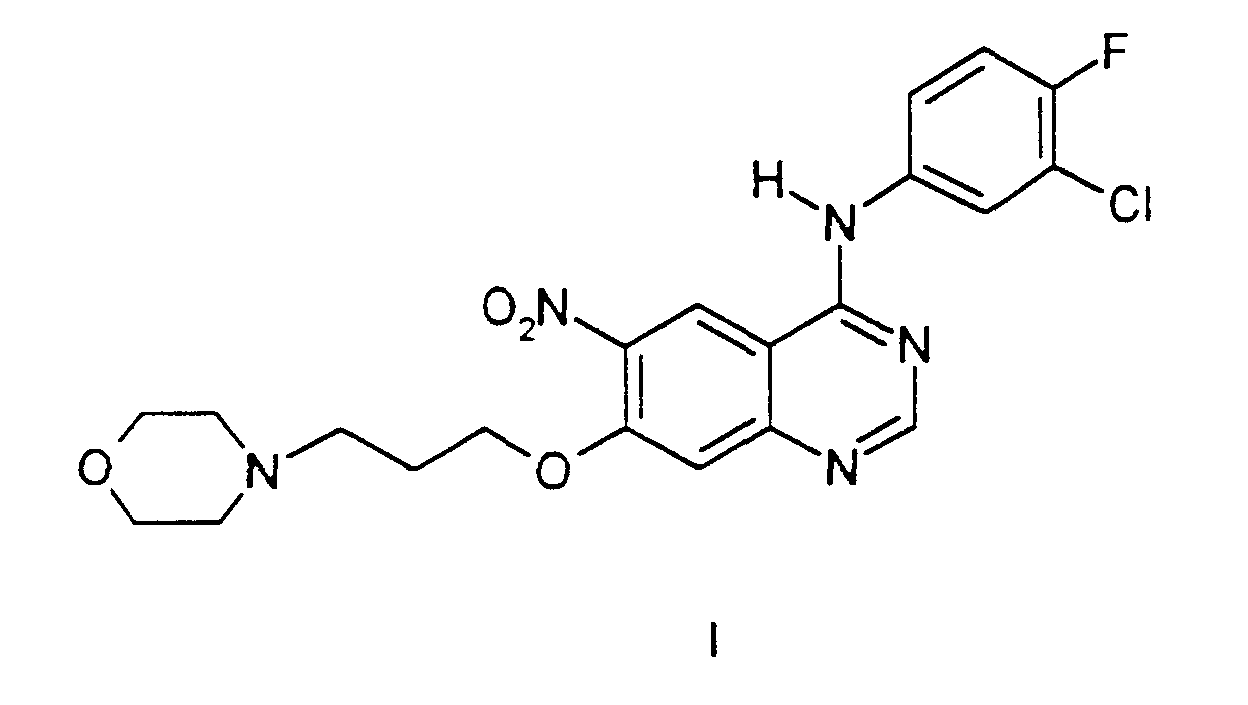
- Verfahren zur Herstellung von (3-Chlor-4-fluor-phenyl)-[7-(3-morpholin-4-yl-propoxy)-6-nitro-chinazolin-4-yl]-amin (I)bzw. von (3-Chlor-4-fluor-phenyl)-[7-(3-morpholin-4-yl-propoxy)-6-amino-chinazolin-4-yl]-amin (VII)
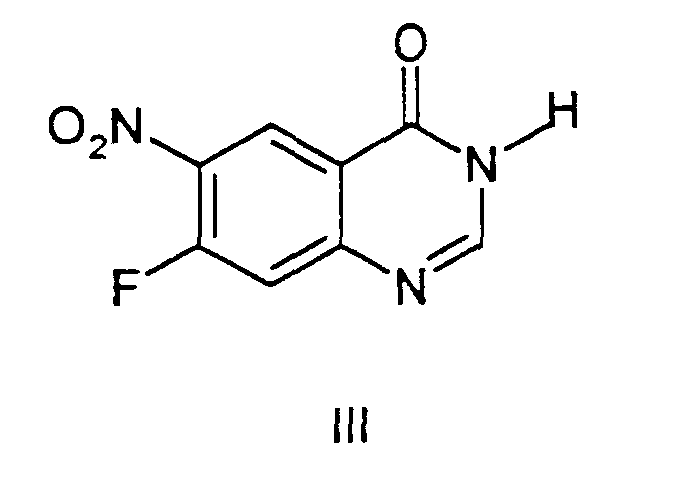
 dadurch gekennzeichnet, daß man in einer Eintopf-Reaktion in 3 bzw. 4 Reaktionsschritten zunächst 7-Fluor-6-nitrochinazolin-4(3H)-on (III),
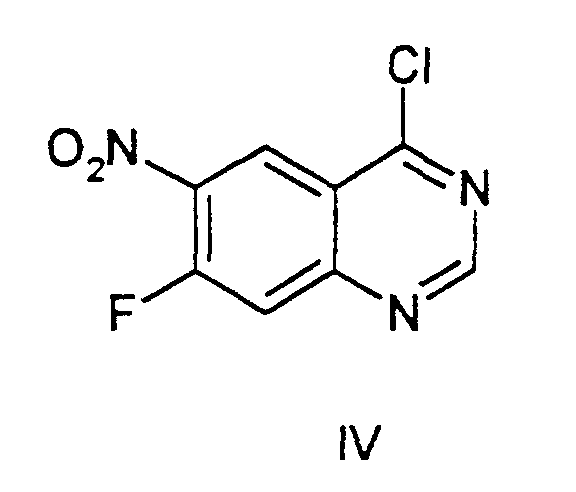
 mit Thionylchlorid zu 4-Chlor-7-fluor-6-nitrochinazolin (IV),
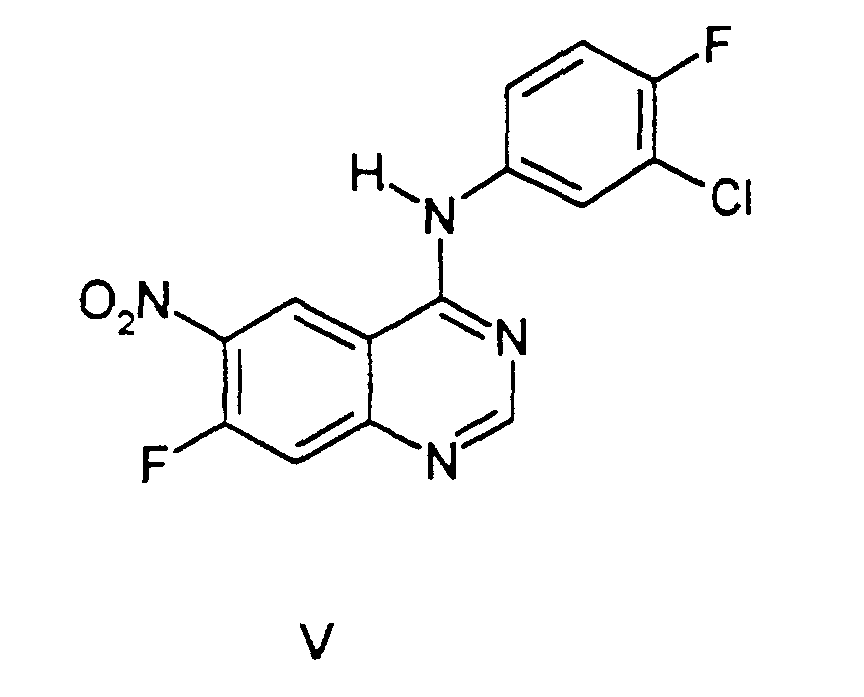
 dieses mit 3-Chlor-4-fluoranilin zu 4-(3-Chlor-4-fluoranilino)-7-fluoro-6-nitrochinazolin (V),
 das anschließend mit 3-Morpholin-4-yl-propan-1-ol (VI)
 zu (I) umsetzt und gegebenfalls (I) in der Reaktionslösung direkt zu (VII) hydriert.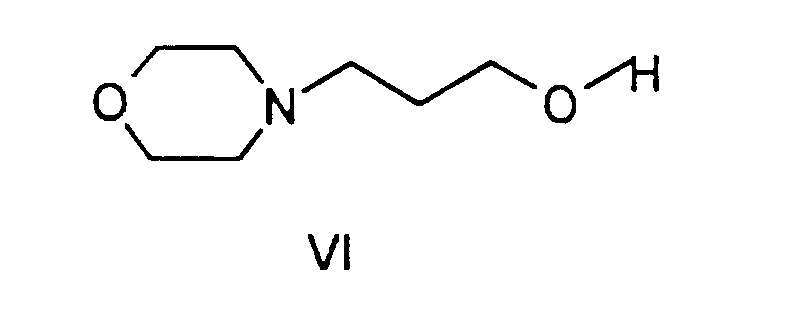
Priority Applications (1)
| Application Number | Priority Date | Filing Date | Title |
|---|---|---|---|
| DK01953631T DK1265874T3 (da) | 2000-02-26 | 2001-01-23 | Fremgangsmåde til fremstilling af (3-chlor-4-fluor-phenyl)-[7-(3-morpholin-4-yl-propoxy)-6-nitro-quinazolin-4-yl]-amin eller (3-chlor-4-fluor-phenyl)-[7-(3-morpholin-4-yl-propoxy)-6-amino-quinazolin-4-yl]-amin |
Applications Claiming Priority (3)
| Application Number | Priority Date | Filing Date | Title |
|---|---|---|---|
| DE10009267A DE10009267A1 (de) | 2000-02-26 | 2000-02-26 | Verfahren zur einfachen Herstellung von (3-Chlor-4-fluor-phenyl)-[7-(3-morpholin-4-yl-propoxy)-6-nitro-quinazolin-4-yl]-amin bzw. (3-Chlor-4-fluor-phenyl)-[7-(3-morpholin-4-yl-propoxy)-6-amino-quinazolin-4-yl]-amin |
| DE10009267 | 2000-02-26 | ||
| PCT/EP2001/000695 WO2001062743A2 (de) | 2000-02-26 | 2001-01-23 | Verfahren zur einfachen herstellung von (3-chlor-4-fluor-phenyl)-[7-(3-morpholin-4-yl-propoxy)-6-nitro-quinazolin-4-yl]-amin bzw. (3-chlor-4-fluor-phenyl)-[7-(3-morpholin-4-yl-propoxy)-6-amino -quinazolin-4-yl]-amin |
Publications (2)
| Publication Number | Publication Date |
|---|---|
| EP1265874A2 EP1265874A2 (de) | 2002-12-18 |
| EP1265874B1 true EP1265874B1 (de) | 2005-06-01 |
Family
ID=7632648
Family Applications (1)
| Application Number | Title | Priority Date | Filing Date |
|---|---|---|---|
| EP01953631A Expired - Lifetime EP1265874B1 (de) | 2000-02-26 | 2001-01-23 | Verfahren zur herstellung von (3-chlor-4-fluor-phenyl)-[7-(3-morpholin-4-yl-propoxy)-6-nitro-chinazolin-4-yl]-amin bzw. (3-chlor-4-fluor-phenyl)-[7-(3-morpholin-4-yl-propoxy)-6-amino -chinazolin-4-yl]-amin |
Country Status (32)
| Country | Link |
|---|---|
| US (1) | US20030050313A1 (de) |
| EP (1) | EP1265874B1 (de) |
| JP (1) | JP2003524006A (de) |
| KR (1) | KR20030011773A (de) |
| CN (1) | CN1171877C (de) |
| AR (1) | AR027377A1 (de) |
| AT (1) | ATE296810T1 (de) |
| AU (1) | AU2001228478A1 (de) |
| BR (1) | BR0108695A (de) |
| CA (1) | CA2401171A1 (de) |
| CO (1) | CO5280058A1 (de) |
| DE (2) | DE10009267A1 (de) |
| EA (1) | EA005213B1 (de) |
| EG (1) | EG23221A (de) |
| ES (1) | ES2240483T3 (de) |
| GT (1) | GT200100025A (de) |
| HK (1) | HK1054551B (de) |
| HU (1) | HUP0204510A3 (de) |
| IL (1) | IL151206A0 (de) |
| MX (1) | MXPA02008301A (de) |
| MY (1) | MY133846A (de) |
| PA (1) | PA8512701A1 (de) |
| PE (1) | PE20011073A1 (de) |
| PL (1) | PL357774A1 (de) |
| PT (1) | PT1265874E (de) |
| PY (1) | PY0102711A (de) |
| SV (1) | SV2002000320A (de) |
| TN (1) | TNSN01031A1 (de) |
| UY (1) | UY26594A1 (de) |
| WO (1) | WO2001062743A2 (de) |
| YU (1) | YU62502A (de) |
| ZA (1) | ZA200206107B (de) |
Cited By (1)
| Publication number | Priority date | Publication date | Assignee | Title |
|---|---|---|---|---|
| RU2506261C2 (ru) * | 2008-05-09 | 2014-02-10 | Хатчисон Медифарма Энтерпрайзис Лимитед | Производные хиназолина |
Families Citing this family (4)
| Publication number | Priority date | Publication date | Assignee | Title |
|---|---|---|---|---|
| PE20040945A1 (es) * | 2003-02-05 | 2004-12-14 | Warner Lambert Co | Preparacion de quinazolinas substituidas |
| WO2006081741A1 (en) * | 2005-02-05 | 2006-08-10 | Piaoyang Sun | Quinazoline compounds or their medical salts and preparation and medical usage thereof |
| JP5250901B2 (ja) * | 2007-02-23 | 2013-07-31 | 学校法人慶應義塾 | アニリノキナゾリン系化合物及びその用途 |
| CN105399688A (zh) * | 2015-12-02 | 2016-03-16 | 西南科技大学 | 一种吉非替尼的制备方法 |
Family Cites Families (1)
| Publication number | Priority date | Publication date | Assignee | Title |
|---|---|---|---|---|
| JP3370340B2 (ja) * | 1996-04-12 | 2003-01-27 | ワーナー―ランバート・コンパニー | チロシンキナーゼの不可逆的阻害剤 |
-
2000
- 2000-02-26 DE DE10009267A patent/DE10009267A1/de not_active Withdrawn
-
2001
- 2001-01-23 JP JP2001562525A patent/JP2003524006A/ja active Pending
- 2001-01-23 CN CNB018056288A patent/CN1171877C/zh not_active Expired - Fee Related
- 2001-01-23 KR KR1020027010713A patent/KR20030011773A/ko not_active Withdrawn
- 2001-01-23 HK HK03106705.0A patent/HK1054551B/zh not_active IP Right Cessation
- 2001-01-23 US US10/204,911 patent/US20030050313A1/en not_active Abandoned
- 2001-01-23 AT AT01953631T patent/ATE296810T1/de not_active IP Right Cessation
- 2001-01-23 CA CA002401171A patent/CA2401171A1/en not_active Abandoned
- 2001-01-23 EP EP01953631A patent/EP1265874B1/de not_active Expired - Lifetime
- 2001-01-23 IL IL15120601A patent/IL151206A0/xx unknown
- 2001-01-23 BR BR0108695-2A patent/BR0108695A/pt not_active IP Right Cessation
- 2001-01-23 PL PL01357774A patent/PL357774A1/xx not_active Application Discontinuation
- 2001-01-23 AU AU2001228478A patent/AU2001228478A1/en not_active Abandoned
- 2001-01-23 WO PCT/EP2001/000695 patent/WO2001062743A2/de not_active Ceased
- 2001-01-23 HU HU0204510A patent/HUP0204510A3/hu unknown
- 2001-01-23 EA EA200200885A patent/EA005213B1/ru not_active IP Right Cessation
- 2001-01-23 PT PT01953631T patent/PT1265874E/pt unknown
- 2001-01-23 YU YU62502A patent/YU62502A/sh unknown
- 2001-01-23 DE DE50106391T patent/DE50106391D1/de not_active Expired - Fee Related
- 2001-01-23 MX MXPA02008301A patent/MXPA02008301A/es active IP Right Grant
- 2001-01-23 ES ES01953631T patent/ES2240483T3/es not_active Expired - Lifetime
- 2001-02-07 AR ARP010100547A patent/AR027377A1/es unknown
- 2001-02-08 GT GT200100025A patent/GT200100025A/es unknown
- 2001-02-08 PY PY200100102711A patent/PY0102711A/es unknown
- 2001-02-08 PE PE2001000137A patent/PE20011073A1/es not_active Application Discontinuation
- 2001-02-22 PA PA20018512701A patent/PA8512701A1/es unknown
- 2001-02-23 TN TNTNSN01031A patent/TNSN01031A1/en unknown
- 2001-02-23 SV SV2001000320A patent/SV2002000320A/es not_active Application Discontinuation
- 2001-02-23 MY MYPI20010826A patent/MY133846A/en unknown
- 2001-02-23 CO CO01014681A patent/CO5280058A1/es unknown
- 2001-02-23 UY UY26594A patent/UY26594A1/es not_active Application Discontinuation
- 2001-02-24 EG EG20010176A patent/EG23221A/xx active
-
2002
- 2002-07-31 ZA ZA200206107A patent/ZA200206107B/en unknown
Cited By (1)
| Publication number | Priority date | Publication date | Assignee | Title |
|---|---|---|---|---|
| RU2506261C2 (ru) * | 2008-05-09 | 2014-02-10 | Хатчисон Медифарма Энтерпрайзис Лимитед | Производные хиназолина |
Also Published As
Similar Documents
| Publication | Publication Date | Title |
|---|---|---|
| DE69918528T2 (de) | Bicyclische heteroaromatische verbindungen als protein tyrosine kinase inhibitoren | |
| KR102773538B1 (ko) | 타피나로프의 제조 방법 | |
| DE69818248T2 (de) | Chinolin- und chinazolin-derivate als crf antagonisten | |
| DE69628712T2 (de) | Verfahren zur Herstellung von Dihalogenazolopyrimidinen | |
| SU1306473A3 (ru) | Способ получени 2,4-диамино-5-(замещенных) пиримидинов | |
| DE3241102A1 (de) | Imidazolylalkylthienyl-tetrahydropyridazine und verfahren zu ihrer herstellung | |
| DE1670694B2 (de) | Verfahren zur herstellung von tetrahydroisochinolinen | |
| EP0018151B1 (de) | 6-Substituierte Arylpyrido(2,3-d)pyrimidin-7-amine, deren Derivate und Salze, diese enthaltende pharmazeutische Zusammensetzungen und Verfahren zu deren Herstellung | |
| DE1670274A1 (de) | Neues Verfahren zur Herstellung von 2-Arylamino-1,3-diazacycloalkenen-(2) | |
| DE1620035A1 (de) | 3-Amino-5-X-6-halogenpyrazinonitrile und Verfahren zu deren Herstellung | |
| DE69706981T2 (de) | Verfahren zur herstellung von pyrimidin-derivaten | |
| EP0167121B1 (de) | Neue substituierte Phenylpiperazinyl-propanole, Verfahren zu ihrer Herstellung und ihre Vewendung sowei diese Verbindungen enthaltende Zubereitungen | |
| EP0288431B1 (de) | 3H-1,2,3-Triazolo[4,5-d]pyrimidine | |
| DE2424334A1 (de) | Verfahren zur herstellung neuer heterocyclischer verbindungen | |
| DE60316047T2 (de) | Verfahren zur Herstellung von Olanzapine und ein Zwischenprodukt dafür | |
| DE10009267A1 (de) | Verfahren zur einfachen Herstellung von (3-Chlor-4-fluor-phenyl)-[7-(3-morpholin-4-yl-propoxy)-6-nitro-quinazolin-4-yl]-amin bzw. (3-Chlor-4-fluor-phenyl)-[7-(3-morpholin-4-yl-propoxy)-6-amino-quinazolin-4-yl]-amin | |
| US6664390B2 (en) | Method for the simplified production of (3-chloro-4-fluorophenyl)-[7-(3-morpholin-4-yl-propoxy)-6-nitro-quinazoline-4-yl]-amine or (3-chloro-4-fluorophenyl)-[7-(3-morpholin-4-yl-propoxy)-6-amino-quinazoline-4-yl]-amine | |
| EP0253171A1 (de) | Pyrido [1,8] naphthyridinone, Verfahren zu ihrer Herstellung und ihre Verwendung sowie diese Verbindungen enthaltende Zubereitungen | |
| EP0331093A1 (de) | Neue Benzimidazo[1,2-c] chinazoline, ihre Herstellung und Verwendung | |
| DE2943286C2 (de) | ||
| CH638516A5 (en) | Process for preparing substituted aminoquinazoline derivatives | |
| DE69702955T2 (de) | Bis-Imide Derivate, Verfahren zu ihrer Herstellung und diese enthaltende pharmazeutische Zubereitung | |
| EP0377437B1 (de) | Verfahren zur Herstellung von 2,4-Diamino-6-piperidinyl-pyrimidin-3-N-oxid | |
| EP0167045A1 (de) | Benzo (c)(1,8)naphthyridine, Verfahren zu ihrer Herstellung und ihre Verwendung sowie diese Verbindungen enthaltende Zubereitungen | |
| US3979468A (en) | 4'-Chloro-4-ethynylbiphenyl and method of preparing same |
Legal Events
| Date | Code | Title | Description |
|---|---|---|---|
| PUAI | Public reference made under article 153(3) epc to a published international application that has entered the european phase |
Free format text: ORIGINAL CODE: 0009012 |
|
| 17P | Request for examination filed |
Effective date: 20020926 |
|
| AK | Designated contracting states |
Kind code of ref document: A2 Designated state(s): AT BE CH CY DE DK ES FI FR GB GR IE IT LI LU MC NL PT SE TR |
|
| AX | Request for extension of the european patent |
Free format text: AL PAYMENT 20020926;LT PAYMENT 20020926;LV PAYMENT 20020926;MK PAYMENT 20020926;RO PAYMENT 20020926;SI PAYMENT 20020926 |
|
| GRAP | Despatch of communication of intention to grant a patent |
Free format text: ORIGINAL CODE: EPIDOSNIGR1 |
|
| RTI1 | Title (correction) |
Free format text: METHOD FOR THE PRODUCTION OF (3-CHLORO-4-FLUOROPHENYL)-(7-(3-MORPHOLIN-4-YLPROPOXY)-6-NITROQUINAZOLIN-4-YL)-AMINE OR (3-C |
|
| GRAS | Grant fee paid |
Free format text: ORIGINAL CODE: EPIDOSNIGR3 |
|
| GRAA | (expected) grant |
Free format text: ORIGINAL CODE: 0009210 |
|
| AK | Designated contracting states |
Kind code of ref document: B1 Designated state(s): AT BE CH CY DE DK ES FI FR GB GR IE IT LI LU MC NL PT SE TR |
|
| AX | Request for extension of the european patent |
Extension state: AL LT LV MK RO SI |
|
| REG | Reference to a national code |
Ref country code: GB Ref legal event code: FG4D Free format text: NOT ENGLISH |
|
| REG | Reference to a national code |
Ref country code: CH Ref legal event code: EP |
|
| PGFP | Annual fee paid to national office [announced via postgrant information from national office to epo] |
Ref country code: NL Payment date: 20050630 Year of fee payment: 6 |
|
| REG | Reference to a national code |
Ref country code: CH Ref legal event code: NV Representative=s name: SCHMAUDER & PARTNER AG PATENTANWALTSBUERO |
|
| REF | Corresponds to: |
Ref document number: 50106391 Country of ref document: DE Date of ref document: 20050707 Kind code of ref document: P |
|
| REG | Reference to a national code |
Ref country code: GR Ref legal event code: EP Ref document number: 20050402000 Country of ref document: GR |
|
| REG | Reference to a national code |
Ref country code: IE Ref legal event code: FG4D Free format text: LANGUAGE OF EP DOCUMENT: GERMAN |
|
| REG | Reference to a national code |
Ref country code: DK Ref legal event code: T3 |
|
| PGFP | Annual fee paid to national office [announced via postgrant information from national office to epo] |
Ref country code: PT Payment date: 20050726 Year of fee payment: 6 |
|
| GBT | Gb: translation of ep patent filed (gb section 77(6)(a)/1977) |
Effective date: 20050804 |
|
| REG | Reference to a national code |
Ref country code: PT Ref legal event code: SC4A Effective date: 20050628 |
|
| REG | Reference to a national code |
Ref country code: ES Ref legal event code: FG2A Ref document number: 2240483 Country of ref document: ES Kind code of ref document: T3 |
|
| PG25 | Lapsed in a contracting state [announced via postgrant information from national office to epo] |
Ref country code: IE Free format text: LAPSE BECAUSE OF NON-PAYMENT OF DUE FEES Effective date: 20060123 Ref country code: GB Free format text: LAPSE BECAUSE OF NON-PAYMENT OF DUE FEES Effective date: 20060123 Ref country code: FI Free format text: LAPSE BECAUSE OF NON-PAYMENT OF DUE FEES Effective date: 20060123 Ref country code: CY Free format text: LAPSE BECAUSE OF NON-PAYMENT OF DUE FEES Effective date: 20060123 Ref country code: AT Free format text: LAPSE BECAUSE OF NON-PAYMENT OF DUE FEES Effective date: 20060123 |
|
| PG25 | Lapsed in a contracting state [announced via postgrant information from national office to epo] |
Ref country code: ES Free format text: LAPSE BECAUSE OF NON-PAYMENT OF DUE FEES Effective date: 20060124 |
|
| PG25 | Lapsed in a contracting state [announced via postgrant information from national office to epo] |
Ref country code: MC Free format text: LAPSE BECAUSE OF NON-PAYMENT OF DUE FEES Effective date: 20060131 Ref country code: LU Free format text: LAPSE BECAUSE OF NON-PAYMENT OF DUE FEES Effective date: 20060131 Ref country code: LI Free format text: LAPSE BECAUSE OF NON-PAYMENT OF DUE FEES Effective date: 20060131 Ref country code: FR Free format text: LAPSE BECAUSE OF NON-PAYMENT OF DUE FEES Effective date: 20060131 Ref country code: DK Free format text: LAPSE BECAUSE OF NON-PAYMENT OF DUE FEES Effective date: 20060131 Ref country code: CH Free format text: LAPSE BECAUSE OF NON-PAYMENT OF DUE FEES Effective date: 20060131 Ref country code: BE Free format text: LAPSE BECAUSE OF NON-PAYMENT OF DUE FEES Effective date: 20060131 |
|
| PGFP | Annual fee paid to national office [announced via postgrant information from national office to epo] |
Ref country code: IT Payment date: 20060131 Year of fee payment: 6 |
|
| ET | Fr: translation filed | ||
| PLBE | No opposition filed within time limit |
Free format text: ORIGINAL CODE: 0009261 |
|
| STAA | Information on the status of an ep patent application or granted ep patent |
Free format text: STATUS: NO OPPOSITION FILED WITHIN TIME LIMIT |
|
| 26N | No opposition filed |
Effective date: 20060302 |
|
| PG25 | Lapsed in a contracting state [announced via postgrant information from national office to epo] |
Ref country code: DE Free format text: LAPSE BECAUSE OF NON-PAYMENT OF DUE FEES Effective date: 20060801 |
|
| REG | Reference to a national code |
Ref country code: DK Ref legal event code: EBP |
|
| REG | Reference to a national code |
Ref country code: CH Ref legal event code: PL |
|
| LTLA | Lt: lapse of european patent or patent extension |
Effective date: 20060123 |
|
| GBPC | Gb: european patent ceased through non-payment of renewal fee |
Effective date: 20060123 |
|
| REG | Reference to a national code |
Ref country code: IE Ref legal event code: MM4A |
|
| REG | Reference to a national code |
Ref country code: FR Ref legal event code: ST Effective date: 20060929 |
|
| REG | Reference to a national code |
Ref country code: ES Ref legal event code: FD2A Effective date: 20060124 |
|
| PG25 | Lapsed in a contracting state [announced via postgrant information from national office to epo] |
Ref country code: PT Free format text: LAPSE BECAUSE OF NON-PAYMENT OF DUE FEES Effective date: 20070723 |
|
| REG | Reference to a national code |
Ref country code: PT Ref legal event code: MM4A Free format text: LAPSE DUE TO NON-PAYMENT OF FEES Effective date: 20070723 |
|
| NLV4 | Nl: lapsed or anulled due to non-payment of the annual fee |
Effective date: 20070801 |
|
| BERE | Be: lapsed |
Owner name: *GODECKE G.M.B.H. Effective date: 20060131 |
|
| PG25 | Lapsed in a contracting state [announced via postgrant information from national office to epo] |
Ref country code: NL Free format text: LAPSE BECAUSE OF NON-PAYMENT OF DUE FEES Effective date: 20070801 |
|
| PG25 | Lapsed in a contracting state [announced via postgrant information from national office to epo] |
Ref country code: SE Free format text: LAPSE BECAUSE OF NON-PAYMENT OF DUE FEES Effective date: 20050601 |
|
| PG25 | Lapsed in a contracting state [announced via postgrant information from national office to epo] |
Ref country code: GR Free format text: LAPSE BECAUSE OF NON-PAYMENT OF DUE FEES Effective date: 20060802 |
|
| PG25 | Lapsed in a contracting state [announced via postgrant information from national office to epo] |
Ref country code: IT Free format text: LAPSE BECAUSE OF NON-PAYMENT OF DUE FEES Effective date: 20070123 Ref country code: TR Free format text: LAPSE BECAUSE OF FAILURE TO SUBMIT A TRANSLATION OF THE DESCRIPTION OR TO PAY THE FEE WITHIN THE PRESCRIBED TIME-LIMIT Effective date: 20050601 |