EP1258013B1 - Schlagfestes selbstlöschendes elektrisches kabel - Google Patents
Schlagfestes selbstlöschendes elektrisches kabel Download PDFInfo
- Publication number
- EP1258013B1 EP1258013B1 EP01925340A EP01925340A EP1258013B1 EP 1258013 B1 EP1258013 B1 EP 1258013B1 EP 01925340 A EP01925340 A EP 01925340A EP 01925340 A EP01925340 A EP 01925340A EP 1258013 B1 EP1258013 B1 EP 1258013B1
- Authority
- EP
- European Patent Office
- Prior art keywords
- self
- cable
- flame
- extinguishing cable
- extinguishing
- Prior art date
- Legal status (The legal status is an assumption and is not a legal conclusion. Google has not performed a legal analysis and makes no representation as to the accuracy of the status listed.)
- Expired - Lifetime
Links
- 239000003063 flame retardant Substances 0.000 claims abstract description 107
- RNFJDJUURJAICM-UHFFFAOYSA-N 2,2,4,4,6,6-hexaphenoxy-1,3,5-triaza-2$l^{5},4$l^{5},6$l^{5}-triphosphacyclohexa-1,3,5-triene Chemical compound N=1P(OC=2C=CC=CC=2)(OC=2C=CC=CC=2)=NP(OC=2C=CC=CC=2)(OC=2C=CC=CC=2)=NP=1(OC=1C=CC=CC=1)OC1=CC=CC=C1 RNFJDJUURJAICM-UHFFFAOYSA-N 0.000 claims abstract description 103
- 239000011248 coating agent Substances 0.000 claims abstract description 81
- 238000000576 coating method Methods 0.000 claims abstract description 81
- 239000000463 material Substances 0.000 claims abstract description 52
- 239000003795 chemical substances by application Substances 0.000 claims abstract description 33
- 239000004020 conductor Substances 0.000 claims abstract description 18
- 239000000203 mixture Substances 0.000 claims description 58
- -1 nitrogen-containing compound Chemical class 0.000 claims description 32
- VGGSQFUCUMXWEO-UHFFFAOYSA-N Ethene Chemical compound C=C VGGSQFUCUMXWEO-UHFFFAOYSA-N 0.000 claims description 31
- 239000005977 Ethylene Substances 0.000 claims description 31
- 238000001125 extrusion Methods 0.000 claims description 31
- 238000000034 method Methods 0.000 claims description 28
- 150000001875 compounds Chemical class 0.000 claims description 26
- IJGRMHOSHXDMSA-UHFFFAOYSA-N Atomic nitrogen Chemical compound N#N IJGRMHOSHXDMSA-UHFFFAOYSA-N 0.000 claims description 25
- 229920001577 copolymer Polymers 0.000 claims description 25
- 239000000945 filler Substances 0.000 claims description 22
- 229920000642 polymer Polymers 0.000 claims description 22
- OAICVXFJPJFONN-UHFFFAOYSA-N Phosphorus Chemical compound [P] OAICVXFJPJFONN-UHFFFAOYSA-N 0.000 claims description 19
- 229910052698 phosphorus Inorganic materials 0.000 claims description 19
- 239000011574 phosphorus Substances 0.000 claims description 19
- 239000004743 Polypropylene Substances 0.000 claims description 18
- 229920001155 polypropylene Polymers 0.000 claims description 18
- 239000004711 α-olefin Substances 0.000 claims description 17
- ZRALSGWEFCBTJO-UHFFFAOYSA-N Guanidine Chemical compound NC(N)=N ZRALSGWEFCBTJO-UHFFFAOYSA-N 0.000 claims description 12
- NBIIXXVUZAFLBC-UHFFFAOYSA-N Phosphoric acid Chemical compound OP(O)(O)=O NBIIXXVUZAFLBC-UHFFFAOYSA-N 0.000 claims description 12
- 229910052757 nitrogen Inorganic materials 0.000 claims description 12
- VTYYLEPIZMXCLO-UHFFFAOYSA-L Calcium carbonate Chemical compound [Ca+2].[O-]C([O-])=O VTYYLEPIZMXCLO-UHFFFAOYSA-L 0.000 claims description 10
- 229910019142 PO4 Inorganic materials 0.000 claims description 10
- 235000021317 phosphate Nutrition 0.000 claims description 10
- FYYHWMGAXLPEAU-UHFFFAOYSA-N Magnesium Chemical compound [Mg] FYYHWMGAXLPEAU-UHFFFAOYSA-N 0.000 claims description 9
- 150000001993 dienes Chemical class 0.000 claims description 9
- 239000012764 mineral filler Substances 0.000 claims description 9
- 229920000877 Melamine resin Polymers 0.000 claims description 8
- 239000007789 gas Substances 0.000 claims description 8
- 239000011777 magnesium Substances 0.000 claims description 8
- 229910052749 magnesium Inorganic materials 0.000 claims description 8
- VTHJTEIRLNZDEV-UHFFFAOYSA-L magnesium dihydroxide Chemical compound [OH-].[OH-].[Mg+2] VTHJTEIRLNZDEV-UHFFFAOYSA-L 0.000 claims description 8
- 239000000347 magnesium hydroxide Substances 0.000 claims description 8
- 229910001862 magnesium hydroxide Inorganic materials 0.000 claims description 8
- JDSHMPZPIAZGSV-UHFFFAOYSA-N melamine Chemical compound NC1=NC(N)=NC(N)=N1 JDSHMPZPIAZGSV-UHFFFAOYSA-N 0.000 claims description 8
- 150000003013 phosphoric acid derivatives Chemical class 0.000 claims description 7
- 229920000728 polyester Polymers 0.000 claims description 7
- 229920000089 Cyclic olefin copolymer Polymers 0.000 claims description 6
- CHJJGSNFBQVOTG-UHFFFAOYSA-N N-methyl-guanidine Natural products CNC(N)=N CHJJGSNFBQVOTG-UHFFFAOYSA-N 0.000 claims description 6
- GLUUGHFHXGJENI-UHFFFAOYSA-N Piperazine Chemical compound C1CNCCN1 GLUUGHFHXGJENI-UHFFFAOYSA-N 0.000 claims description 6
- 229920000388 Polyphosphate Polymers 0.000 claims description 6
- 229910000147 aluminium phosphate Inorganic materials 0.000 claims description 6
- SWSQBOPZIKWTGO-UHFFFAOYSA-N dimethylaminoamidine Natural products CN(C)C(N)=N SWSQBOPZIKWTGO-UHFFFAOYSA-N 0.000 claims description 6
- 150000002148 esters Chemical class 0.000 claims description 6
- 239000001205 polyphosphate Substances 0.000 claims description 6
- 235000011176 polyphosphates Nutrition 0.000 claims description 6
- BVKZGUZCCUSVTD-UHFFFAOYSA-L Carbonate Chemical compound [O-]C([O-])=O BVKZGUZCCUSVTD-UHFFFAOYSA-L 0.000 claims description 5
- 229910000019 calcium carbonate Inorganic materials 0.000 claims description 5
- DDYDBBBQYLFRJE-UHFFFAOYSA-N (diaminomethylideneamino)urea Chemical compound NC(=N)NNC(N)=O DDYDBBBQYLFRJE-UHFFFAOYSA-N 0.000 claims description 4
- OYPRJOBELJOOCE-UHFFFAOYSA-N Calcium Chemical compound [Ca] OYPRJOBELJOOCE-UHFFFAOYSA-N 0.000 claims description 4
- 239000011575 calcium Substances 0.000 claims description 4
- 229910052791 calcium Inorganic materials 0.000 claims description 4
- 238000004132 cross linking Methods 0.000 claims description 4
- ZQKXQUJXLSSJCH-UHFFFAOYSA-N melamine cyanurate Chemical compound NC1=NC(N)=NC(N)=N1.O=C1NC(=O)NC(=O)N1 ZQKXQUJXLSSJCH-UHFFFAOYSA-N 0.000 claims description 4
- QQONPFPTGQHPMA-UHFFFAOYSA-N propylene Natural products CC=C QQONPFPTGQHPMA-UHFFFAOYSA-N 0.000 claims description 4
- 125000004805 propylene group Chemical group [H]C([H])([H])C([H])([*:1])C([H])([H])[*:2] 0.000 claims description 4
- 150000003863 ammonium salts Chemical class 0.000 claims description 3
- 235000011180 diphosphates Nutrition 0.000 claims description 3
- 239000001095 magnesium carbonate Substances 0.000 claims description 3
- 229910000021 magnesium carbonate Inorganic materials 0.000 claims description 3
- 150000002895 organic esters Chemical class 0.000 claims description 3
- 239000000126 substance Substances 0.000 claims description 3
- 239000005995 Aluminium silicate Substances 0.000 claims description 2
- XSQUKJJJFZCRTK-UHFFFAOYSA-N Urea Chemical compound NC(N)=O XSQUKJJJFZCRTK-UHFFFAOYSA-N 0.000 claims description 2
- PNEYBMLMFCGWSK-UHFFFAOYSA-N aluminium oxide Inorganic materials [O-2].[O-2].[O-2].[Al+3].[Al+3] PNEYBMLMFCGWSK-UHFFFAOYSA-N 0.000 claims description 2
- 235000012211 aluminium silicate Nutrition 0.000 claims description 2
- ZSTLPJLUQNQBDQ-UHFFFAOYSA-N azanylidyne(dihydroxy)-$l^{5}-phosphane Chemical class OP(O)#N ZSTLPJLUQNQBDQ-UHFFFAOYSA-N 0.000 claims description 2
- 239000004202 carbamide Substances 0.000 claims description 2
- 229920001198 elastomeric copolymer Polymers 0.000 claims description 2
- 239000003365 glass fiber Substances 0.000 claims description 2
- NLYAJNPCOHFWQQ-UHFFFAOYSA-N kaolin Chemical compound O.O.O=[Al]O[Si](=O)O[Si](=O)O[Al]=O NLYAJNPCOHFWQQ-UHFFFAOYSA-N 0.000 claims description 2
- ZLNQQNXFFQJAID-UHFFFAOYSA-L magnesium carbonate Chemical compound [Mg+2].[O-]C([O-])=O ZLNQQNXFFQJAID-UHFFFAOYSA-L 0.000 claims description 2
- 150000008039 phosphoramides Chemical class 0.000 claims description 2
- 150000004684 trihydrates Chemical class 0.000 claims description 2
- QGZKDVFQNNGYKY-UHFFFAOYSA-N Ammonia Chemical compound N QGZKDVFQNNGYKY-UHFFFAOYSA-N 0.000 claims 2
- 229910021529 ammonia Inorganic materials 0.000 claims 1
- 150000003016 phosphoric acids Chemical class 0.000 claims 1
- OJMIONKXNSYLSR-UHFFFAOYSA-N phosphorous acid Chemical class OP(O)O OJMIONKXNSYLSR-UHFFFAOYSA-N 0.000 claims 1
- 230000005540 biological transmission Effects 0.000 abstract description 13
- 238000009826 distribution Methods 0.000 abstract description 5
- 239000010410 layer Substances 0.000 description 36
- 229910052751 metal Inorganic materials 0.000 description 28
- 239000002184 metal Substances 0.000 description 28
- 230000008569 process Effects 0.000 description 19
- 238000012360 testing method Methods 0.000 description 18
- 238000004519 manufacturing process Methods 0.000 description 16
- 238000011049 filling Methods 0.000 description 15
- 150000003839 salts Chemical class 0.000 description 14
- 239000004698 Polyethylene Substances 0.000 description 11
- 239000000654 additive Substances 0.000 description 11
- 229920000573 polyethylene Polymers 0.000 description 11
- 238000002485 combustion reaction Methods 0.000 description 10
- 239000003517 fume Substances 0.000 description 10
- 230000009471 action Effects 0.000 description 7
- 238000009863 impact test Methods 0.000 description 7
- QJGQUHMNIGDVPM-UHFFFAOYSA-N nitrogen group Chemical group [N] QJGQUHMNIGDVPM-UHFFFAOYSA-N 0.000 description 7
- 239000000047 product Substances 0.000 description 7
- 241000196324 Embryophyta Species 0.000 description 6
- HQQADJVZYDDRJT-UHFFFAOYSA-N ethene;prop-1-ene Chemical group C=C.CC=C HQQADJVZYDDRJT-UHFFFAOYSA-N 0.000 description 6
- 239000011159 matrix material Substances 0.000 description 6
- 229920000098 polyolefin Polymers 0.000 description 6
- 230000001681 protective effect Effects 0.000 description 6
- 229920001169 thermoplastic Polymers 0.000 description 6
- 239000007822 coupling agent Substances 0.000 description 5
- 239000004416 thermosoftening plastic Substances 0.000 description 5
- BAPJBEWLBFYGME-UHFFFAOYSA-N Methyl acrylate Chemical compound COC(=O)C=C BAPJBEWLBFYGME-UHFFFAOYSA-N 0.000 description 4
- UIIMBOGNXHQVGW-UHFFFAOYSA-M Sodium bicarbonate Chemical compound [Na+].OC([O-])=O UIIMBOGNXHQVGW-UHFFFAOYSA-M 0.000 description 4
- 150000001336 alkenes Chemical class 0.000 description 4
- 239000004411 aluminium Substances 0.000 description 4
- 229910052782 aluminium Inorganic materials 0.000 description 4
- XAGFODPZIPBFFR-UHFFFAOYSA-N aluminium Chemical compound [Al] XAGFODPZIPBFFR-UHFFFAOYSA-N 0.000 description 4
- ADCOVFLJGNWWNZ-UHFFFAOYSA-N antimony trioxide Chemical compound O=[Sb]O[Sb]=O ADCOVFLJGNWWNZ-UHFFFAOYSA-N 0.000 description 4
- 239000003963 antioxidant agent Substances 0.000 description 4
- 230000015572 biosynthetic process Effects 0.000 description 4
- 230000000052 comparative effect Effects 0.000 description 4
- 229920001971 elastomer Polymers 0.000 description 4
- CGPRUXZTHGTMKW-UHFFFAOYSA-N ethene;ethyl prop-2-enoate Chemical compound C=C.CCOC(=O)C=C CGPRUXZTHGTMKW-UHFFFAOYSA-N 0.000 description 4
- 238000009434 installation Methods 0.000 description 4
- 239000011133 lead Substances 0.000 description 4
- 125000001997 phenyl group Chemical group [H]C1=C([H])C([H])=C(*)C([H])=C1[H] 0.000 description 4
- AQSJGOWTSHOLKH-UHFFFAOYSA-N phosphite(3-) Chemical class [O-]P([O-])[O-] AQSJGOWTSHOLKH-UHFFFAOYSA-N 0.000 description 4
- 238000012545 processing Methods 0.000 description 4
- 239000005060 rubber Substances 0.000 description 4
- 238000011179 visual inspection Methods 0.000 description 4
- RYGMFSIKBFXOCR-UHFFFAOYSA-N Copper Chemical compound [Cu] RYGMFSIKBFXOCR-UHFFFAOYSA-N 0.000 description 3
- YMWUJEATGCHHMB-UHFFFAOYSA-N Dichloromethane Chemical compound ClCCl YMWUJEATGCHHMB-UHFFFAOYSA-N 0.000 description 3
- 244000043261 Hevea brasiliensis Species 0.000 description 3
- 229910000831 Steel Inorganic materials 0.000 description 3
- XTXRWKRVRITETP-UHFFFAOYSA-N Vinyl acetate Chemical compound CC(=O)OC=C XTXRWKRVRITETP-UHFFFAOYSA-N 0.000 description 3
- 239000002671 adjuvant Substances 0.000 description 3
- 239000003570 air Substances 0.000 description 3
- 125000003118 aryl group Chemical group 0.000 description 3
- 229920005549 butyl rubber Polymers 0.000 description 3
- 229910052799 carbon Inorganic materials 0.000 description 3
- KRKNYBCHXYNGOX-UHFFFAOYSA-N citric acid Chemical compound OC(=O)CC(O)(C(O)=O)CC(O)=O KRKNYBCHXYNGOX-UHFFFAOYSA-N 0.000 description 3
- 239000010949 copper Substances 0.000 description 3
- 229910052802 copper Inorganic materials 0.000 description 3
- 230000000694 effects Effects 0.000 description 3
- 238000010292 electrical insulation Methods 0.000 description 3
- 238000011156 evaluation Methods 0.000 description 3
- 239000012796 inorganic flame retardant Substances 0.000 description 3
- 238000002156 mixing Methods 0.000 description 3
- 229920003052 natural elastomer Polymers 0.000 description 3
- 229920001194 natural rubber Polymers 0.000 description 3
- QIQXTHQIDYTFRH-UHFFFAOYSA-N octadecanoic acid Chemical compound CCCCCCCCCCCCCCCCCC(O)=O QIQXTHQIDYTFRH-UHFFFAOYSA-N 0.000 description 3
- 150000002894 organic compounds Chemical class 0.000 description 3
- 239000002245 particle Substances 0.000 description 3
- 229920002635 polyurethane Polymers 0.000 description 3
- 239000004814 polyurethane Substances 0.000 description 3
- 230000009467 reduction Effects 0.000 description 3
- 150000004756 silanes Chemical class 0.000 description 3
- 239000000243 solution Substances 0.000 description 3
- 239000010959 steel Substances 0.000 description 3
- 230000002195 synergetic effect Effects 0.000 description 3
- 229920002725 thermoplastic elastomer Polymers 0.000 description 3
- 231100000331 toxic Toxicity 0.000 description 3
- 230000002588 toxic effect Effects 0.000 description 3
- 231100000419 toxicity Toxicity 0.000 description 3
- 230000001988 toxicity Effects 0.000 description 3
- 125000004178 (C1-C4) alkyl group Chemical group 0.000 description 2
- LIKMAJRDDDTEIG-UHFFFAOYSA-N 1-hexene Chemical compound CCCCC=C LIKMAJRDDDTEIG-UHFFFAOYSA-N 0.000 description 2
- KWKAKUADMBZCLK-UHFFFAOYSA-N 1-octene Chemical compound CCCCCCC=C KWKAKUADMBZCLK-UHFFFAOYSA-N 0.000 description 2
- XDOFQFKRPWOURC-UHFFFAOYSA-N 16-methylheptadecanoic acid Chemical compound CC(C)CCCCCCCCCCCCCCC(O)=O XDOFQFKRPWOURC-UHFFFAOYSA-N 0.000 description 2
- KAKZBPTYRLMSJV-UHFFFAOYSA-N Butadiene Chemical compound C=CC=C KAKZBPTYRLMSJV-UHFFFAOYSA-N 0.000 description 2
- OKTJSMMVPCPJKN-UHFFFAOYSA-N Carbon Chemical compound [C] OKTJSMMVPCPJKN-UHFFFAOYSA-N 0.000 description 2
- CURLTUGMZLYLDI-UHFFFAOYSA-N Carbon dioxide Chemical compound O=C=O CURLTUGMZLYLDI-UHFFFAOYSA-N 0.000 description 2
- ABLZXFCXXLZCGV-UHFFFAOYSA-N Phosphorous acid Chemical class OP(O)=O ABLZXFCXXLZCGV-UHFFFAOYSA-N 0.000 description 2
- 239000004952 Polyamide Substances 0.000 description 2
- ATUOYWHBWRKTHZ-UHFFFAOYSA-N Propane Chemical compound CCC ATUOYWHBWRKTHZ-UHFFFAOYSA-N 0.000 description 2
- 235000021355 Stearic acid Nutrition 0.000 description 2
- PPBRXRYQALVLMV-UHFFFAOYSA-N Styrene Chemical compound C=CC1=CC=CC=C1 PPBRXRYQALVLMV-UHFFFAOYSA-N 0.000 description 2
- 230000000996 additive effect Effects 0.000 description 2
- 125000000217 alkyl group Chemical group 0.000 description 2
- 238000004458 analytical method Methods 0.000 description 2
- 238000013459 approach Methods 0.000 description 2
- 229920005601 base polymer Polymers 0.000 description 2
- CQEYYJKEWSMYFG-UHFFFAOYSA-N butyl acrylate Chemical compound CCCCOC(=O)C=C CQEYYJKEWSMYFG-UHFFFAOYSA-N 0.000 description 2
- 125000004432 carbon atom Chemical class C* 0.000 description 2
- 239000003054 catalyst Substances 0.000 description 2
- 238000006555 catalytic reaction Methods 0.000 description 2
- 239000011247 coating layer Substances 0.000 description 2
- 238000001816 cooling Methods 0.000 description 2
- 238000000354 decomposition reaction Methods 0.000 description 2
- 229920003244 diene elastomer Polymers 0.000 description 2
- POULHZVOKOAJMA-UHFFFAOYSA-N dodecanoic acid Chemical compound CCCCCCCCCCCC(O)=O POULHZVOKOAJMA-UHFFFAOYSA-N 0.000 description 2
- IPCSVZSSVZVIGE-UHFFFAOYSA-N hexadecanoic acid Chemical compound CCCCCCCCCCCCCCCC(O)=O IPCSVZSSVZVIGE-UHFFFAOYSA-N 0.000 description 2
- BHEPBYXIRTUNPN-UHFFFAOYSA-N hydridophosphorus(.) (triplet) Chemical compound [PH] BHEPBYXIRTUNPN-UHFFFAOYSA-N 0.000 description 2
- 150000004679 hydroxides Chemical class 0.000 description 2
- 125000002887 hydroxy group Chemical group [H]O* 0.000 description 2
- 230000003116 impacting effect Effects 0.000 description 2
- 150000002739 metals Chemical class 0.000 description 2
- OQCDKBAXFALNLD-UHFFFAOYSA-N octadecanoic acid Natural products CCCCCCCC(C)CCCCCCCCC(O)=O OQCDKBAXFALNLD-UHFFFAOYSA-N 0.000 description 2
- JRZJOMJEPLMPRA-UHFFFAOYSA-N olefin Natural products CCCCCCCC=C JRZJOMJEPLMPRA-UHFFFAOYSA-N 0.000 description 2
- ZQPPMHVWECSIRJ-KTKRTIGZSA-N oleic acid Chemical compound CCCCCCCC\C=C/CCCCCCCC(O)=O ZQPPMHVWECSIRJ-KTKRTIGZSA-N 0.000 description 2
- 239000013307 optical fiber Substances 0.000 description 2
- 229920002647 polyamide Polymers 0.000 description 2
- 229920001707 polybutylene terephthalate Polymers 0.000 description 2
- 229920000570 polyether Polymers 0.000 description 2
- 229920000139 polyethylene terephthalate Polymers 0.000 description 2
- 239000005020 polyethylene terephthalate Substances 0.000 description 2
- 239000004800 polyvinyl chloride Substances 0.000 description 2
- 150000003254 radicals Chemical class 0.000 description 2
- 230000003014 reinforcing effect Effects 0.000 description 2
- 229920006395 saturated elastomer Polymers 0.000 description 2
- 239000011265 semifinished product Substances 0.000 description 2
- 239000004718 silane crosslinked polyethylene Substances 0.000 description 2
- 229910000030 sodium bicarbonate Inorganic materials 0.000 description 2
- 235000017557 sodium bicarbonate Nutrition 0.000 description 2
- 239000008117 stearic acid Substances 0.000 description 2
- 125000001424 substituent group Chemical group 0.000 description 2
- VXUYXOFXAQZZMF-UHFFFAOYSA-N titanium(IV) isopropoxide Chemical compound CC(C)O[Ti](OC(C)C)(OC(C)C)OC(C)C VXUYXOFXAQZZMF-UHFFFAOYSA-N 0.000 description 2
- XZZNDPSIHUTMOC-UHFFFAOYSA-N triphenyl phosphate Chemical compound C=1C=CC=CC=1OP(OC=1C=CC=CC=1)(=O)OC1=CC=CC=C1 XZZNDPSIHUTMOC-UHFFFAOYSA-N 0.000 description 2
- XLYOFNOQVPJJNP-UHFFFAOYSA-N water Substances O XLYOFNOQVPJJNP-UHFFFAOYSA-N 0.000 description 2
- OJOWICOBYCXEKR-APPZFPTMSA-N (1S,4R)-5-ethylidenebicyclo[2.2.1]hept-2-ene Chemical compound CC=C1C[C@@H]2C[C@@H]1C=C2 OJOWICOBYCXEKR-APPZFPTMSA-N 0.000 description 1
- PRBHEGAFLDMLAL-GQCTYLIASA-N (4e)-hexa-1,4-diene Chemical compound C\C=C\CC=C PRBHEGAFLDMLAL-GQCTYLIASA-N 0.000 description 1
- WRIDQFICGBMAFQ-UHFFFAOYSA-N (E)-8-Octadecenoic acid Natural products CCCCCCCCCC=CCCCCCCC(O)=O WRIDQFICGBMAFQ-UHFFFAOYSA-N 0.000 description 1
- KOMNUTZXSVSERR-UHFFFAOYSA-N 1,3,5-tris(prop-2-enyl)-1,3,5-triazinane-2,4,6-trione Chemical compound C=CCN1C(=O)N(CC=C)C(=O)N(CC=C)C1=O KOMNUTZXSVSERR-UHFFFAOYSA-N 0.000 description 1
- KJOIQMXGNUKOLD-UHFFFAOYSA-N 1-[diacetyl(ethenyl)silyl]ethanone Chemical compound CC(=O)[Si](C=C)(C(C)=O)C(C)=O KJOIQMXGNUKOLD-UHFFFAOYSA-N 0.000 description 1
- BHNZEZWIUMJCGF-UHFFFAOYSA-N 1-chloro-1,1-difluoroethane Chemical compound CC(F)(F)Cl BHNZEZWIUMJCGF-UHFFFAOYSA-N 0.000 description 1
- ZNRLMGFXSPUZNR-UHFFFAOYSA-N 2,2,4-trimethyl-1h-quinoline Chemical compound C1=CC=C2C(C)=CC(C)(C)NC2=C1 ZNRLMGFXSPUZNR-UHFFFAOYSA-N 0.000 description 1
- BJELTSYBAHKXRW-UHFFFAOYSA-N 2,4,6-triallyloxy-1,3,5-triazine Chemical compound C=CCOC1=NC(OCC=C)=NC(OCC=C)=N1 BJELTSYBAHKXRW-UHFFFAOYSA-N 0.000 description 1
- XMNIXWIUMCBBBL-UHFFFAOYSA-N 2-(2-phenylpropan-2-ylperoxy)propan-2-ylbenzene Chemical compound C=1C=CC=CC=1C(C)(C)OOC(C)(C)C1=CC=CC=C1 XMNIXWIUMCBBBL-UHFFFAOYSA-N 0.000 description 1
- VFBJXXJYHWLXRM-UHFFFAOYSA-N 2-[2-[3-(3,5-ditert-butyl-4-hydroxyphenyl)propanoyloxy]ethylsulfanyl]ethyl 3-(3,5-ditert-butyl-4-hydroxyphenyl)propanoate Chemical compound CC(C)(C)C1=C(O)C(C(C)(C)C)=CC(CCC(=O)OCCSCCOC(=O)CCC=2C=C(C(O)=C(C=2)C(C)(C)C)C(C)(C)C)=C1 VFBJXXJYHWLXRM-UHFFFAOYSA-N 0.000 description 1
- LQJBNNIYVWPHFW-UHFFFAOYSA-N 20:1omega9c fatty acid Natural products CCCCCCCCCCC=CCCCCCCCC(O)=O LQJBNNIYVWPHFW-UHFFFAOYSA-N 0.000 description 1
- WPMYUUITDBHVQZ-UHFFFAOYSA-M 3-(3,5-ditert-butyl-4-hydroxyphenyl)propanoate Chemical compound CC(C)(C)C1=CC(CCC([O-])=O)=CC(C(C)(C)C)=C1O WPMYUUITDBHVQZ-UHFFFAOYSA-M 0.000 description 1
- RYUJRXVZSJCHDZ-UHFFFAOYSA-N 8-methylnonyl diphenyl phosphate Chemical compound C=1C=CC=CC=1OP(=O)(OCCCCCCCC(C)C)OC1=CC=CC=C1 RYUJRXVZSJCHDZ-UHFFFAOYSA-N 0.000 description 1
- QSBYPNXLFMSGKH-UHFFFAOYSA-N 9-Heptadecensaeure Natural products CCCCCCCC=CCCCCCCCC(O)=O QSBYPNXLFMSGKH-UHFFFAOYSA-N 0.000 description 1
- NLHHRLWOUZZQLW-UHFFFAOYSA-N Acrylonitrile Chemical compound C=CC#N NLHHRLWOUZZQLW-UHFFFAOYSA-N 0.000 description 1
- QGZKDVFQNNGYKY-UHFFFAOYSA-O Ammonium Chemical compound [NH4+] QGZKDVFQNNGYKY-UHFFFAOYSA-O 0.000 description 1
- BVKZGUZCCUSVTD-UHFFFAOYSA-M Bicarbonate Chemical class OC([O-])=O BVKZGUZCCUSVTD-UHFFFAOYSA-M 0.000 description 1
- DKPFZGUDAPQIHT-UHFFFAOYSA-N Butyl acetate Natural products CCCCOC(C)=O DKPFZGUDAPQIHT-UHFFFAOYSA-N 0.000 description 1
- 229920003345 Elvax® Polymers 0.000 description 1
- 239000005639 Lauric acid Substances 0.000 description 1
- 229920003346 Levapren® Polymers 0.000 description 1
- MXRIRQGCELJRSN-UHFFFAOYSA-N O.O.O.[Al] Chemical compound O.O.O.[Al] MXRIRQGCELJRSN-UHFFFAOYSA-N 0.000 description 1
- CGSLYBDCEGBZCG-UHFFFAOYSA-N Octicizer Chemical compound C=1C=CC=CC=1OP(=O)(OCC(CC)CCCC)OC1=CC=CC=C1 CGSLYBDCEGBZCG-UHFFFAOYSA-N 0.000 description 1
- 239000005642 Oleic acid Substances 0.000 description 1
- ZQPPMHVWECSIRJ-UHFFFAOYSA-N Oleic acid Natural products CCCCCCCCC=CCCCCCCCC(O)=O ZQPPMHVWECSIRJ-UHFFFAOYSA-N 0.000 description 1
- 235000021314 Palmitic acid Nutrition 0.000 description 1
- ISWSIDIOOBJBQZ-UHFFFAOYSA-N Phenol Chemical compound OC1=CC=CC=C1 ISWSIDIOOBJBQZ-UHFFFAOYSA-N 0.000 description 1
- 239000004721 Polyphenylene oxide Substances 0.000 description 1
- 239000004793 Polystyrene Substances 0.000 description 1
- YSMRWXYRXBRSND-UHFFFAOYSA-N TOTP Chemical compound CC1=CC=CC=C1OP(=O)(OC=1C(=CC=CC=1)C)OC1=CC=CC=C1C YSMRWXYRXBRSND-UHFFFAOYSA-N 0.000 description 1
- HCHKCACWOHOZIP-UHFFFAOYSA-N Zinc Chemical compound [Zn] HCHKCACWOHOZIP-UHFFFAOYSA-N 0.000 description 1
- 229920000122 acrylonitrile butadiene styrene Polymers 0.000 description 1
- 239000000853 adhesive Substances 0.000 description 1
- 230000001070 adhesive effect Effects 0.000 description 1
- 125000002877 alkyl aryl group Chemical group 0.000 description 1
- 150000008064 anhydrides Chemical class 0.000 description 1
- 230000003466 anti-cipated effect Effects 0.000 description 1
- QVGXLLKOCUKJST-UHFFFAOYSA-N atomic oxygen Chemical compound [O] QVGXLLKOCUKJST-UHFFFAOYSA-N 0.000 description 1
- XOZUGNYVDXMRKW-AATRIKPKSA-N azodicarbonamide Chemical compound NC(=O)\N=N\C(N)=O XOZUGNYVDXMRKW-AATRIKPKSA-N 0.000 description 1
- 230000004888 barrier function Effects 0.000 description 1
- 238000009835 boiling Methods 0.000 description 1
- 239000001273 butane Substances 0.000 description 1
- 239000001569 carbon dioxide Substances 0.000 description 1
- 229910002092 carbon dioxide Inorganic materials 0.000 description 1
- 150000004649 carbonic acid derivatives Chemical class 0.000 description 1
- 150000001732 carboxylic acid derivatives Chemical class 0.000 description 1
- 230000015556 catabolic process Effects 0.000 description 1
- 238000013329 compounding Methods 0.000 description 1
- 238000010276 construction Methods 0.000 description 1
- 238000010924 continuous production Methods 0.000 description 1
- 238000007334 copolymerization reaction Methods 0.000 description 1
- 239000003431 cross linking reagent Substances 0.000 description 1
- 230000007423 decrease Effects 0.000 description 1
- 230000003247 decreasing effect Effects 0.000 description 1
- 238000006731 degradation reaction Methods 0.000 description 1
- 230000001627 detrimental effect Effects 0.000 description 1
- 150000001991 dicarboxylic acids Chemical class 0.000 description 1
- 238000010790 dilution Methods 0.000 description 1
- 239000012895 dilution Substances 0.000 description 1
- 229910001873 dinitrogen Inorganic materials 0.000 description 1
- YDICVVYPXSZSFA-UHFFFAOYSA-N diphenyl propan-2-yl phosphate Chemical compound C=1C=CC=CC=1OP(=O)(OC(C)C)OC1=CC=CC=C1 YDICVVYPXSZSFA-UHFFFAOYSA-N 0.000 description 1
- XPPKVPWEQAFLFU-UHFFFAOYSA-J diphosphate(4-) Chemical compound [O-]P([O-])(=O)OP([O-])([O-])=O XPPKVPWEQAFLFU-UHFFFAOYSA-J 0.000 description 1
- 230000007613 environmental effect Effects 0.000 description 1
- 150000002118 epoxides Chemical class 0.000 description 1
- FWDBOZPQNFPOLF-UHFFFAOYSA-N ethenyl(triethoxy)silane Chemical compound CCO[Si](OCC)(OCC)C=C FWDBOZPQNFPOLF-UHFFFAOYSA-N 0.000 description 1
- 238000009472 formulation Methods 0.000 description 1
- 150000004820 halides Chemical class 0.000 description 1
- 150000008282 halocarbons Chemical class 0.000 description 1
- 238000010438 heat treatment Methods 0.000 description 1
- FUZZWVXGSFPDMH-UHFFFAOYSA-N hexanoic acid Chemical compound CCCCCC(O)=O FUZZWVXGSFPDMH-UHFFFAOYSA-N 0.000 description 1
- 229920001519 homopolymer Polymers 0.000 description 1
- 229930195733 hydrocarbon Natural products 0.000 description 1
- 150000002430 hydrocarbons Chemical class 0.000 description 1
- 230000002401 inhibitory effect Effects 0.000 description 1
- 239000003999 initiator Substances 0.000 description 1
- 239000011256 inorganic filler Substances 0.000 description 1
- 229910003475 inorganic filler Inorganic materials 0.000 description 1
- 229910052500 inorganic mineral Inorganic materials 0.000 description 1
- 238000009413 insulation Methods 0.000 description 1
- 239000012212 insulator Substances 0.000 description 1
- 230000003993 interaction Effects 0.000 description 1
- 230000002452 interceptive effect Effects 0.000 description 1
- 230000005865 ionizing radiation Effects 0.000 description 1
- 230000001678 irradiating effect Effects 0.000 description 1
- QXJSBBXBKPUZAA-UHFFFAOYSA-N isooleic acid Natural products CCCCCCCC=CCCCCCCCCC(O)=O QXJSBBXBKPUZAA-UHFFFAOYSA-N 0.000 description 1
- 238000011068 loading method Methods 0.000 description 1
- 230000005923 long-lasting effect Effects 0.000 description 1
- 229920001684 low density polyethylene Polymers 0.000 description 1
- 239000004702 low-density polyethylene Substances 0.000 description 1
- 239000000314 lubricant Substances 0.000 description 1
- 238000012423 maintenance Methods 0.000 description 1
- FPYJFEHAWHCUMM-UHFFFAOYSA-N maleic anhydride Chemical compound O=C1OC(=O)C=C1 FPYJFEHAWHCUMM-UHFFFAOYSA-N 0.000 description 1
- 239000012968 metallocene catalyst Substances 0.000 description 1
- 239000011707 mineral Substances 0.000 description 1
- 235000010755 mineral Nutrition 0.000 description 1
- 238000012986 modification Methods 0.000 description 1
- 230000004048 modification Effects 0.000 description 1
- TVMXDCGIABBOFY-UHFFFAOYSA-N n-Octanol Natural products CCCCCCCC TVMXDCGIABBOFY-UHFFFAOYSA-N 0.000 description 1
- WQEPLUUGTLDZJY-UHFFFAOYSA-N n-Pentadecanoic acid Natural products CCCCCCCCCCCCCCC(O)=O WQEPLUUGTLDZJY-UHFFFAOYSA-N 0.000 description 1
- IJDNQMDRQITEOD-UHFFFAOYSA-N n-butane Chemical compound CCCC IJDNQMDRQITEOD-UHFFFAOYSA-N 0.000 description 1
- OFBQJSOFQDEBGM-UHFFFAOYSA-N n-pentane Natural products CCCCC OFBQJSOFQDEBGM-UHFFFAOYSA-N 0.000 description 1
- YCWSUKQGVSGXJO-NTUHNPAUSA-N nifuroxazide Chemical group C1=CC(O)=CC=C1C(=O)N\N=C\C1=CC=C([N+]([O-])=O)O1 YCWSUKQGVSGXJO-NTUHNPAUSA-N 0.000 description 1
- 239000000615 nonconductor Substances 0.000 description 1
- 239000003921 oil Substances 0.000 description 1
- 229940049964 oleate Drugs 0.000 description 1
- 235000021313 oleic acid Nutrition 0.000 description 1
- 238000011017 operating method Methods 0.000 description 1
- 230000003287 optical effect Effects 0.000 description 1
- 150000007524 organic acids Chemical class 0.000 description 1
- 235000005985 organic acids Nutrition 0.000 description 1
- 150000001451 organic peroxides Chemical class 0.000 description 1
- 150000002903 organophosphorus compounds Chemical class 0.000 description 1
- 239000007800 oxidant agent Substances 0.000 description 1
- 230000001590 oxidative effect Effects 0.000 description 1
- 239000001301 oxygen Substances 0.000 description 1
- 229910052760 oxygen Inorganic materials 0.000 description 1
- 238000005453 pelletization Methods 0.000 description 1
- 150000002978 peroxides Chemical class 0.000 description 1
- 229920001568 phenolic resin Polymers 0.000 description 1
- 239000005011 phenolic resin Substances 0.000 description 1
- NBIIXXVUZAFLBC-UHFFFAOYSA-K phosphate Chemical compound [O-]P([O-])([O-])=O NBIIXXVUZAFLBC-UHFFFAOYSA-K 0.000 description 1
- 239000010452 phosphate Substances 0.000 description 1
- 150000003014 phosphoric acid esters Chemical class 0.000 description 1
- 239000000049 pigment Substances 0.000 description 1
- 229920002492 poly(sulfone) Polymers 0.000 description 1
- 229920002589 poly(vinylethylene) polymer Polymers 0.000 description 1
- 239000004417 polycarbonate Substances 0.000 description 1
- 229920000515 polycarbonate Polymers 0.000 description 1
- 238000010094 polymer processing Methods 0.000 description 1
- 229920002223 polystyrene Polymers 0.000 description 1
- 230000001737 promoting effect Effects 0.000 description 1
- 239000001294 propane Substances 0.000 description 1
- 230000002829 reductive effect Effects 0.000 description 1
- 229920005989 resin Polymers 0.000 description 1
- 239000011347 resin Substances 0.000 description 1
- 235000003441 saturated fatty acids Nutrition 0.000 description 1
- 150000004671 saturated fatty acids Chemical class 0.000 description 1
- 239000007787 solid Substances 0.000 description 1
- 230000008961 swelling Effects 0.000 description 1
- 229920001897 terpolymer Polymers 0.000 description 1
- KHLAZQIVJFSQDS-UHFFFAOYSA-N tert-butyl diphenyl phosphate Chemical compound C=1C=CC=CC=1OP(=O)(OC(C)(C)C)OC1=CC=CC=C1 KHLAZQIVJFSQDS-UHFFFAOYSA-N 0.000 description 1
- 125000000999 tert-butyl group Chemical group [H]C([H])([H])C(*)(C([H])([H])[H])C([H])([H])[H] 0.000 description 1
- 239000002341 toxic gas Substances 0.000 description 1
- 238000002834 transmittance Methods 0.000 description 1
- CYRMSUTZVYGINF-UHFFFAOYSA-N trichlorofluoromethane Chemical compound FC(Cl)(Cl)Cl CYRMSUTZVYGINF-UHFFFAOYSA-N 0.000 description 1
- 229940029284 trichlorofluoromethane Drugs 0.000 description 1
- 235000021122 unsaturated fatty acids Nutrition 0.000 description 1
- 150000004670 unsaturated fatty acids Chemical class 0.000 description 1
- 229920001567 vinyl ester resin Polymers 0.000 description 1
- 238000004804 winding Methods 0.000 description 1
- 239000011701 zinc Substances 0.000 description 1
- 229910052725 zinc Inorganic materials 0.000 description 1
- XOOUIPVCVHRTMJ-UHFFFAOYSA-L zinc stearate Chemical compound [Zn+2].CCCCCCCCCCCCCCCCCC([O-])=O.CCCCCCCCCCCCCCCCCC([O-])=O XOOUIPVCVHRTMJ-UHFFFAOYSA-L 0.000 description 1
Images

Classifications
-
- H—ELECTRICITY
- H01—ELECTRIC ELEMENTS
- H01B—CABLES; CONDUCTORS; INSULATORS; SELECTION OF MATERIALS FOR THEIR CONDUCTIVE, INSULATING OR DIELECTRIC PROPERTIES
- H01B3/00—Insulators or insulating bodies characterised by the insulating materials; Selection of materials for their insulating or dielectric properties
- H01B3/18—Insulators or insulating bodies characterised by the insulating materials; Selection of materials for their insulating or dielectric properties mainly consisting of organic substances
- H01B3/30—Insulators or insulating bodies characterised by the insulating materials; Selection of materials for their insulating or dielectric properties mainly consisting of organic substances plastics; resins; waxes
- H01B3/44—Insulators or insulating bodies characterised by the insulating materials; Selection of materials for their insulating or dielectric properties mainly consisting of organic substances plastics; resins; waxes vinyl resins; acrylic resins
- H01B3/441—Insulators or insulating bodies characterised by the insulating materials; Selection of materials for their insulating or dielectric properties mainly consisting of organic substances plastics; resins; waxes vinyl resins; acrylic resins from alkenes
-
- H—ELECTRICITY
- H01—ELECTRIC ELEMENTS
- H01B—CABLES; CONDUCTORS; INSULATORS; SELECTION OF MATERIALS FOR THEIR CONDUCTIVE, INSULATING OR DIELECTRIC PROPERTIES
- H01B7/00—Insulated conductors or cables characterised by their form
- H01B7/17—Protection against damage caused by external factors, e.g. sheaths or armouring
- H01B7/29—Protection against damage caused by extremes of temperature or by flame
- H01B7/295—Protection against damage caused by extremes of temperature or by flame using material resistant to flame
Definitions
- the present invention relates to a self-extinguishing cable, in particular to a cable for low-voltage or medium-voltage power transmission or distribution, as well as to a cable for data transmission or for telecommunications, for example a telephone cable.
- the present invention relates to a self-extinguishing cable which has, in a position radially external to at least one conductive element, a polymer coating which has self-extinguishing properties with a low level of fume production, as well as mechanical properties capable of giving this cable excellent protection against accidental impacts.
- the expression “low-voltage” means a voltage of less than about 1 kV, while the expression “medium-voltage” means a voltage of between about 1 kV and about 30 kV.
- core of the cable means a semi-finished structure consisting of a conductive element coated externally with at least one layer of electrical insulator.
- core In the case in which a cable has only one "core”, it is defined as being unipolar, when there are two cores the cable is defined as being bipolar, and so on.
- a self-extinguishing electrical cable is produced by extruding over the abovementioned core or even directly over the conductor itself, i.e. over the uninsulated conductor, a flame-retardant coating obtained from a polymer composition which has been given flame-resistance properties by means of addition of a suitable additive.
- a polymer composition for example a composition based on polyolefin (such as polyethylene or ethylene/vinyl acetate copolymers), a flame-retardant additive of halogenated type, for example an organic halide combined with antimony trioxide.
- polyolefin such as polyethylene or ethylene/vinyl acetate copolymers
- a flame-retardant additive of halogenated type for example an organic halide combined with antimony trioxide.
- flame-retardant additives of halogenated' type have numerous drawbacks since, during processing of the polymer, they decompose partially, generating halogenated gases which are toxic to the operatives and corrosive to the metal parts of the polymer-processing machines. In addition, when subjected to the direct action of a flame, the combustion of said additives generates very large amounts of fumes containing toxic gases. Similar drawbacks are also encountered when polyvinyl chloride (PVC) is used as polymeric base with antimony trioxide added.
- PVC polyvinyl chloride
- halogen-free compositions in which a polymeric base, generally of polyolefin type, is mixed with flame-retardant inorganic fillers, generally hydroxides, oxide-hydrates or hydrated salts of metals, in particular of aluminium or magnesium, such as magnesium hydroxide or aluminium trihydrate or mixtures thereof (see, for example, patents US-4 145 404 , US-4 673 620 , EP-328 051 and EP-530 940 ).
- Magnesium hydroxide is particularly preferred, since it has a relatively high decomposition temperature (about 340°C) and satisfactory thermal stability (see, for example, patent application WO 99/05688 in the name of the Applicant).
- inorganic substances such as, for example, glass fibres, calcinated kaolin, calcium carbonate
- these substances are used as inert fillers to produce a "dilution effect" in the polymeric material (see, for example, the volume “ Compounding Materials for the Polymer Industries", J.S. Dick. 1987, Noyes publ., in particular pages 63 and 144 ), with the result that the combustibility of the compound is reduced as a consequence of the fact that there is less polymeric material which can burn per unit volume.
- Typical compounds containing phosphorus which are suitable for use as flame-retardant additives may be salts of phosphorous or phosphoric acid (phosphites, phosphates or polyphosphates), organic esters or polyesters of phosphoric acid (mono-, di- or tri-alkyl or -aryl phosphates or polyphosphates), phosphites (mono-, di-or tri-alkyl or -aryl phosphites), phosphonates or polyphosphonates (mono- or di-alkyl or -aryl phosphonates or polyphosphonates).
- flame-retardant additives for polymeric compositions which can also be used are mixtures of phosphorus-containing and nitrogen-containing compounds, said mixtures generally being referred to as "P-N mixtures" (see “ The chemistry and uses of Fire Retardants", J.W. Lyons, Wiley-Interscience (1970), page 20 and chapter 2 ).
- the nitrogen-containing compounds may include, for example, inorganic salts such as ammonium salts, or organic compounds and salts thereof, such as, for example, guanidine, melamine and derivatives thereof, for example melamine cyanurate or guanidylurea, and the salts thereof.
- P-N mixtures see, for example, patent EP-831 120 in the name of the Applicant.
- this cable may suffer accidental impacts which may cause damage, even considerable damage, to its structure (for example deformations of the insulating layer, detachment between the layers constituting the cable), this damage possibly resulting in variations in the electrical gradient of the insulating coating, with a consequent reduction in the insulating capacity of this coating.
- metal armouring capable of imparting suitable mechanical strength.
- This armouring may be in the form of metal strips or wires (generally made of steel) or in the form of a metal sheath (generally made of lead or aluminium) and, usually, this armouring is in turn coated with an outer polymeric sheath.
- An example of this cable structure is described in US patent 5,153,381 .
- This armouring can also be envisaged for cables of self-extinguishing type, i.e. cables which have a flame-retardant coating as described above.
- the Applicant has perceived the need to prepare a self-extinguishing cable which, besides guaranteeing the required flame-retardant properties, is endowed with high impact resistance, i.e. an impact resistance at least equal to that of cables provided with metal armouring.
- cables need to be installed, in view or in suitable tunnel locations, in highly frequented environments that are extremely critical in the event of a fire (such as, for example, enclosed underground environments such as subway, railway tunnels and the like) it should be ensured, firstly, that these cables are self-extinguishing, produce a low level of fumes and do not emit toxic or corrosive gases, and, secondly, they should be given a plurality of mechanical properties and resistance to external agents (heat, oils), making them easy to install and ensuring that they have good performance qualities and are long-lasting.
- external agents heat, oils
- the Applicant has thus perceived the need to produce a new type of self-extinguishing cable which is capable of combining high mechanical properties with the required flame-retardant properties, while ensuring, at the same time, an inexpensive, simple and fast production process.
- halogen-free self-extinguishing cables which, in the event of a fire, do not generate toxic or corrosive gases, produce a low level of fumes and are endowed with high flame resistance and excellent impact resistance, by providing these cables with a layer of coating produced from an expanded polymeric composition incorporating at least one swelling agent as defined below.
- the flame-retardant expanded coating layer according to the present invention is capable in certain cases of giving the cable mechanical resistance to impacts which may even be greater than that of a similar cable of armoured type.
- a self-extinguishing cable having an expanded polymeric coating with flame-retardant properties does not require, as mentioned above, metal armouring to protect it against accidental impacts.
- the cable according to the present invention is significantly lighter than conventional armoured cables, for a mechanical strength of equal value and occasionally greater than that of said armoured cables.
- the possibility of using a lighter cable makes its installation and transportation easier and consequently reduces its costs.
- the layer made of expanded material with flame-retardant properties according to the present invention is extruded directly onto the cable continuously, optionally also in co-extrusion with another layer of coating of the cable, such as the filler and/or the outer polymeric sheath.
- the present invention allows a simpler production process to be carried out, based on an operating procedure of continuous type.
- the armouring stage inevitably introduces a discontinuity into the cable production process, the effect of which is felt both in terms of a reduction in production efficiency and in terms of an increase in the plant engineering costs.
- the flame-retardant coating made of expanded polymeric material according to the invention consists of a continuous layer distributed uniformly along the entire length of the cable.
- the self-extinguishing cable according to the present invention is also particularly advantageous in the stage of producing a junction between two cables or if it is desired to make a connection between a cable and an electrical device.
- the expanded polymeric coating which replaces the metal armouring allows this junction or connection to be produced more simply and quickly since it is less difficult and demanding to remove a portion of expanded coating (i.e. the portion of coating which covers the length of cable to be joined or connected) rather than a portion of armouring.
- the present invention can be applied advantageously not only to electrical cables for power transmission or distribution, but also to cables for data transmission or to telecommunication cables, as well as to cables of mixed power/telecommunications type.
- conductor means a conductor of metal type, of circular or sector-shaped configuration, or an optical fibre, or an optical fibre or of mixed electrical/optical type.
- the present invention relates to a self-extinguishing cable comprising at least one conductor and at least one flame-retardant coating in a position radially external to said at least one conductor, characterized in that said at least one flame-retardant coating comprises an expanded polymeric material which includes at least one intumescent agent as defined hereinbelow in the present description.
- the self-extinguishing cable of the present invention comprises a polymeric sheath in a position radially external to said flame-retardant coating.
- said intumescent agent comprises at least one phosphorus-containing compound and/or at least one nitrogen-containing compound or one or more compounds containing both phosphorus and nitrogen.
- the expanded polymeric material of the flame-retardant coating of the self-extinguishing cable of the present invention includes, together with the intumescent agent, at least one mineral filler, preferably a flame-retardant mineral filler.
- the present invention relates to a method for giving a cable flame-retardant and impact-resistance properties, said method including a stage of giving said cable at least one coating comprising an expanded polymeric material including at least one intumescent agent.
- intumescent agent means a compound comprising phosphorus and/or nitrogen, which, once combined with a base polymeric material, in the event of exposure to high temperatures or to the direct action of a flame, is capable of bringing about the formation of an expanded carbon-based residue (char) which inhibits the combustion propagation.
- the nitrogen on the one hand, generates nitrogen gas which expands the polymeric material
- the phosphorus on the other hand, contributes towards increasing the amount of carbon-based residue ("char") from the combustion (i.e. the combustion ash) and towards giving this residue high tenacity.
- char carbon-based residue
- said layer by acting as a physical barrier placed between the polymeric material still to be burnt and the flame, protects said material and prevents fresh oxygen from reaching the material and further feeding the flame.
- the expansion due to the action of the nitrogen generates a thermal insulation for the layers of material which are still intact, i.e. not affected by the action of the flame, by virtue of the fact that the thermal conductivity of the expanded material is considerably less than the thermal conductivity of the non-expanded material. A synergistic action between phosphorus and nitrogen is thus produced.
- the intumescent agent can consist solely of a compound of phosphorus-containing type since, during the combustion, the nitrogen required for the intumescent action is supplied by the base polymeric composition.
- expanded polymeric material means a polymeric material with a predetermined percentage of "free" space inside the material, i.e. a space not occupied by the polymeric material, but rather by gas or air.
- the expanded polymeric coating with flame-retardant properties according to the present invention is obtained from an expandable polymer optionally subjected to crosslinking, after expansion, as indicated in greater detail hereinbelow in the present description.
- This expandable polymer can be selected from the group comprising: polyolefins, copolymers of various olefins, olefin/unsaturated ester copolymers, polyesters, polycarbonates, polysulphones, phenolic resins, ureic resins, and mixtures thereof.
- polyethylene in particular low-density PE (LDPE), medium-density PE (MDPE), high-density PE (HDPE) and linear low-density PE (LLDPE); polypropylene (PP); elastomeric ethylene/propylene copolymers (EPM) or ethylene/propylene/diene terpolymers (EPDM); natural rubber; butyl rubber; ethylene/vinyl ester copolymers, for example ethylene/vinyl acetate (EVA); ethylene/acrylate copolymers, in particular ethylene/methyl acrylate (EMA), ethylene/ethyl acrylate (EEA), ethylene/butyl acrylate (EBA); ethylene/ ⁇ -olefin thermoplastic copolymers; polystyrene; acrylonitrile/butadiene/styrene (ABS) resins; halogenated polymers, in particular polyvinyl chloride (PVC); polyurethane (PE), polyurethane (
- the polymeric material is a polyolefinic polymer or copolymer based on ethylene and/or propylene, and in particular chosen from:
- products which fall within class (a) are the commercial products Elvax® (Du Pont), Levapren® (Bayer) and Lotryl® (Elf-Atochem), those which fall in class (b) are the products Dutral® (Enichem) and Nordel® (Dow-Du Pont) and those which fall in class.
- (c) are the products Engage® (Dow-Du Pont) and Exact® (Exxon), while polypropylene modified with ethylene/ ⁇ -olefin copolymers can be found on the market under the brand names Moplen® or Hifax® (Montell), or Fina-Pro® (Fina), and the like.
- thermoplastic elastomers comprising a continuous matrix of a thermoplastic polymer, for example polypropylene, and small particles (generally with a diameter of about 1-10 ⁇ m) of a vulcanized elastomeric polymer, for example crosslinked EPR or EPDM, dispersed in the thermoplastic matrix.
- the elastomeric polymer can be incorporated into the thermoplastic matrix in non-vulcanized form and then dynamically crosslinked during the process by means of addition of a suitable amount of a crosslinking agent.
- the elastomeric polymer can be vulcanized separately and then dispersed in the thermoplastic matrix in the form of small particles.
- Thermoplastic elastomers of this type are described, for example, in documents US-4 104 210 and EP-324 430 .
- polypropylene with high mechanical strength in the molten state (high melt strength polypropylene), as described, for example, in US patent 4 915 198 , which is commercially available under the brand name Profax ® (Montell S.p.A.).
- That document explains a process for producing said polypropylene via a step of irradiating a linear polypropylene, carried out using high-energy ionizing radiation for a period of time which is sufficient to result in the formation of a large amount of long branchings of the chain, a suitable treatment of the irradiated material being moreover envisaged at the end of said step so as to deactivate essentially all of the free radicals present in the irradiated material.
- a polymeric composition comprising the abovementioned highly-branched polypropylene, in an amount generally of between 30% and 70% by weight, blended with a thermoplastic elastomer of the type belonging to class (d) above, in an amount generally of between 30% and 70% by weight, said percentages being expressed relative to the total weight of the polymeric composition.
- This polymeric composition is particularly advantageous since the intumescent agent can be easily and efficiently incorporated into said composition, which, once said agent has been added, presents no problems during the expansion process envisaged for formation of the flame-retardant coating of the present invention.
- the use of this polymeric coating moreover makes it possible to prepare a continuous and uniform flame-retardant coating along the length of the cable.
- the expanded polymeric composition incorporates an intumescent agent as defined above in the present description.
- phosphorus-containing compounds constituting said intumescent agent which may be mentioned are, for example, phosphorous or phosphoric acid (phosphites, phosphates or polyphosphates), organic esters or polyesters of phosphoric acid (mono-, di- or tri-alkyl or -aryl phosphates or polyphosphates), phosphites (mono-, di- or tri-alkyl or -aryl phosphites), phosphonates or polyphosphonates (mono- or di-alkyl or -aryl phosphonates or polyphosphonates) in which the alkyl groups are preferably (C 2 -C 12 )alkyl groups while the aryl groups are preferably phenyl, mono-, di- or trisubstituted phenyl, in which the substituent is chosen, independently, from (C 1 -C 4 )al
- organophosphorus compounds which have plasticizing properties, such as, for example, the abovementioned phosphoric acid esters; among these, the preferred esters are dialkyl, diaryl, alkylaryl, trialkyl, triaryl, dialkylaryl or alkyldiaryl phosphates, in which the alkyl groups are preferably (C 2 -C 12 )alkyl groups while the aryl groups are preferably phenyl or mono-, di- or trisubstituted phenyl, in which the substituent is chosen, independently, from (C 1 -C 4 )alkyl and hydroxyl; triaryl or alkyldiaryl phosphates being particularly preferred.
- the preferred esters are dialkyl, diaryl, alkylaryl, trialkyl, triaryl, dialkylaryl or alkyldiaryl phosphates, in which the alkyl groups are preferably (C 2 -C 12 )alkyl groups while the aryl groups are preferably phen
- Examples of these compounds are isopropyl diphenyl phosphate, t-butyl diphenyl phosphate, 2-ethylhexyl diphenyl phosphate, isodecyl diphenyl phosphate, triphenyl phosphate, trixylyl phosphate or tricresyl phosphate. Triphenyl phosphate is preferably used.
- the ones which can preferably be used are those capable of giving the desired synergistic effect with the phosphorus-containing compounds described above.
- examples of such compounds are: inorganic salts, for example ammonium salts, or organic compounds and the organic salts thereof, such as guanidine, melamine and derivatives thereof, for example melamine cyanurate or guanidylurea, and salts thereof.
- inorganic salts for example ammonium salts, or organic compounds and the organic salts thereof, such as guanidine, melamine and derivatives thereof, for example melamine cyanurate or guanidylurea, and salts thereof.
- nitrogen-containing compounds whenever it is necessary to coat the conductor with a coating which ensures adequate electrical insulation, it is preferable to avoid the use of nitrogen-containing derivatives in the form of water-soluble salts.
- simple organic compounds with a high content of nitrogen such as, for example, melamine, guanidine, urea and derivatives thereof (melamine cyanurate or guanidylurea), the use of melamine being particularly preferred.
- nitrogen such as, for example, melamine, guanidine, urea and derivatives thereof (melamine cyanurate or guanidylurea)
- melamine cyanurate or guanidylurea
- the amount of said compounds should be maintained at the lowest level which is compatible with the desired synergistic effect.
- the intumescent agent according to the present invention can also consist of compounds containing both phosphorus and nitrogen, such as, for example: phosphates polyphosphates or pyrophosphates of ammonium, of guanidine, of melamine or of piperazine, or corresponding mixed phosphates; as well as phosphoramides, phosphorylamides, amidophosphonates and phosphonitrile compounds, or mixtures thereof.
- the amount by weight of intumescent agent, relative to the total weight of the base composition is generally between 1% and 60%, preferably between 2% and 50% and even more preferably between 5% and 30%.
- the expanded polymeric material for making the flame-retardant coating according to the present invention also incorporates one or more mineral fillers of known type, said fillers advantageously being of flame-retardant type.
- these mineral fillers coupled with the intumescent agent are introduced in an amount of not more than 60 phr (parts by weight per 100 parts by weight of rubber) so as not to have a detrimental effect on the desired expansion degree.
- said mineral fillers consist of magnesium hydroxide and/or calcium carbonate.
- FIG. 1 An electrical cable (10) for medium-voltage power transmission according to the prior art is illustrated in cross section in Fig. 1 .
- This cable (10) is of the tripolar type and comprises three conductors (1), each coated with a layer (2) which functions as electrical insulation. As mentioned above, this semi-finished structure (1, 2) has been defined by the term "core".
- Said insulating layer (2) can consist of a halogen-free, crosslinked or non-crosslinked polymeric composition with electrical insulating properties, which is known in the art, chosen, for example, from: polyolefins (homopolymers or copolymers of various olefins), ethylenically unsaturated olefin/ester copolymers, polyesters, polyethers, polyether/polyester copolymers, and blends thereof.
- polyolefins homopolymers or copolymers of various olefins
- ethylenically unsaturated olefin/ester copolymers polyesters
- polyethers polyether/polyester copolymers
- polyethylene in particular linear low-density PE (LLDPE); polypropylene (PP); propylene/ethylene thermoplastic copolymers; ethylene/propylene rubbers (EPR) or ethylene/propylene/diene rubbers (EPDM); natural rubbers; butyl rubbers; ethylene/vinyl acetate (EVA) copolymers; ethylene/methyl acrylate (EMA) copolymers; ethylene/ethyl acrylate (EEA) copolymers; ethylene/butyl acrylate (EBA) copolymers; ethylene/ ⁇ -olefin copolymers, and the like.
- PE polyethylene
- LLDPE linear low-density PE
- PP polypropylene
- EPR ethylene/propylene rubbers
- EPDM ethylene/propylene/diene rubbers
- EVA ethylene/vinyl acetate copolymers
- EMA ethylene/methyl acrylate
- EAA ethylene/ethyl acryl
- the three cores are roped together and the star-shaped areas thus obtained between said cores are filled with a flame-retardant composition of known type (generally comprising a polymeric base to which is added a flame-retardant filler of mineral type) to define a filling layer (3) having a structure of essentially circular cross-section.
- a flame-retardant composition of known type generally comprising a polymeric base to which is added a flame-retardant filler of mineral type
- metal armouring (4) which, as mentioned above, can consist of metal wires, for example steel wires, a metal screen in the form of a continuous tube, made of aluminium, lead or copper, or a metal band in the form of a tube and welded or sealed with a suitable adhesive in order to ensure adequate leaktightness.
- said metal armouring (4) is obtained by means of armouring apparatus with wires or strips of known type.
- said metal armouring (4) is coated with an outer polymeric sheath (5) produced from a flame-retardant composition of known type.
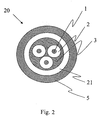
- Fig. 2 illustrates, in cross section, a first embodiment of a self-extinguishing electrical cable (20) according to the present invention, of tripolar type, for low-voltage power transmission.
- the cable (20) of the invention comprises three conductors (1), each coated with an insulating coating' (2) to form three separate "cores" roped together.
- the star-shaped areas obtained between said cores are filled with a flame-retardant composition of known type to constitute an insulating filling layer (3), outside which is placed a flame-retardant coating made of expanded polymeric material (21) according to the invention.
- the latter is, in turn, coated with an outer polymeric sheath (5) produced from a flame-retardant composition of known type comprising a polymeric base and an inorganic flame-retardant filler.
- Inorganic flame-retardant fillers which can be used are hydroxides, hydrated oxides, salts or hydrated salts of metals, in particular of calcium, aluminium or magnesium, such as: magnesium hydroxide, alumina trihydrate, magnesium hydrated carbonate, magnesium carbonate, mixed hydrated carbonate of magnesium and calcium, mixed magnesium and calcium carbonate, or mixtures thereof.
- the flame-retardant filler is generally used in the form of particles which are untreated or surface-treated with saturated or unsaturated fatty acids containing from 8 to 24 carbon atoms, or metal salts thereof, such as, for example: oleic acid, palmitic acid, stearic acid, isostearic acid, lauric acid; stearate or oleate of magnesium or zinc; and the like.
- the flame-retardant filler can also be surface-treated with suitable coupling agents, for example organic silanes or titanates such as vinyltriethoxysilane, vinyltriacetylsilane, tetraisopropyl titanate, tetra-n-butyl titanate, and the like.
- suitable coupling agents for example organic silanes or titanates such as vinyltriethoxysilane, vinyltriacetylsilane, tetraisopropyl titanate, tetra-n-butyl titanate, and the like.
- the amount of flame-retardant filler to be added is predetermined so as to obtain a cable which is capable of satisfying the typical flame-resistance tests, for example the test according to standards IEC 332-1 and IEC 332.3 A,B,C. In general, this amount is between 10% and 90% by weight, preferably between 30% and 80% by weight, relative to the total weight of the flame-retardant composition.
- LDPE low-density polyethylene
- PP polypropylene
- EPR ethylene/ ⁇ -olefin rubbers
- EPDM ethylere/propylene/diene rubbers
- natural rubber butyl rubbers
- butyl rubbers and blends thereof.
- copolymers which can be obtained by copolymerization of ethylene with at least one ⁇ -olefin containing from 3 to 12 carbon atoms, and optionally with a diene, in the presence of a "single-site" catalyst, in particular a metallocene catalyst or a Constrained Geometry Catalyst.
- a "single-site" catalyst in particular a metallocene catalyst or a Constrained Geometry Catalyst.
- a coupling agent capable of increasing the interaction between the active groups of the flame-retardant filler and the polymeric chains can be added, as is known, to the compound.
- This coupling agent can be chosen from those known in the prior art, for example: silane compounds which are saturated or which contain at least one ethylenic unsaturation; epoxides containing an ethylenic unsaturation; monocarboxylic or, preferably, dicarboxylic acids containing at least one ethylenic unsaturation, or derivatives thereof, in particular anhydrides or esters, for example maleic anhydride.
- the amount of coupling agent to be added to the compound can vary mainly as a function of the type of coupling agent used and of the amount of flame-retardant filler added, and is generally between 0.01% and 5%, preferably between 0.05% and 2%, by weight relative to the total weight of the base polymeric blend.
- antioxidants which are suitable for this purpose are, for example: polymerized trimethyldihydroquinoline, 4,4'-thiobis(3-methyl-6-tert-butyl)phenol; pentaerythrityl tetra [3-(3,5-di-tert-butyl-4-hydroxyphenyl) propionate], 2,2'-thiodiethylenebis[3-(3,5-di-tert-butyl-4-hydroxyphenyl) propionate], and the like, or mixtures thereof.
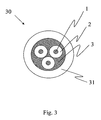
- Fig. 3 illustrates, in cross section, a second embodiment of a self-extinguishing electrical cable (30) according to the present invention, in which the flame-retardant coating made of expanded material (31) represents the radially outermost layer of said cable (30).
- the cable (30) of this second embodiment is not provided with any outer polymeric sheath (5), and, by virtue of its flame-retardant and mechanical-strength properties, the flame-retardant coating (31) represents the interface between this cable (30) and the external environment surrounding it.
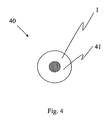
- Fig. 4 illustrates, in cross section, a further embodiment of a self-extinguishing electrical cable (40) according to the present invention, of unipolar type, for example a telecommunication cable or a data transmission cable.
- This cable (40) consists of only one conductor (1), outside which is positioned a flame-retardant expanded polymeric coating (41) according to the invention.
- the self-extinguishing cable (40) does not have any insulating layer between the conductor (1) and the flame-retardant coating made of expanded polymeric material (41), and likewise, in a similar manner to that illustrated in Fig. 3 , it is not provided with an outer protective sheath (5).
- the flame-retardant coating (41) provides, besides the desired flame-retardant action, both the electrical insulation function and a function of protection against the outside, in particular with respect to accidental impacts.
- said flame-retardant coating (11) can be coated externally with a protective sheath which has a flame-retardant formulation of known type.
- the main stages which characterize said process when a unipolar cable is to be prepared are given hereinbelow.
- the process described for a unipolar cable may be suitably modified on the basis of the indications given and of the technical knowledge of a person skilled in the art.
- the insulating layer (2) preferably obtained from a polyolefin chosen from those mentioned above, in particular polyethylene, polypropylene, ethylene/propylene copolymers and the like, is applied by extrusion over a conductor element (1) unwound from a suitable reel.
- the material is preferably crosslinked according to known techniques, for example using peroxides or via silanes.
- the flame-retardant coating made of expanded polymeric material is then prepared.
- Said polymeric material is premixed with the intumescent agent, and with optional additives (for example antioxidants and co-adjuvants for processing the polymeric material), according to methods known in the art.
- the mixing can be carried out in an internal mixer of the type with tangential rotors (Banbury mixer) or with interpenetrating rotors, or alternatively in continuous mixers such as those of the Ko-kneader type (Buss mixer) or of the type with co-rotating or counterrotating twin screws.
- the extrusion operation of the flame-retardant coating directly over the insulating layer (2) mentioned above is carried out, and the stage of expanding the polymeric material is carried out during said extrusion operation.
- This expansion can take place either chemically, by adding a suitable expanding agent, i.e. an agent capable of generating a gas under predetermined pressure and temperature conditions, or physically, by injecting a gas at high pressure directly into the extruder cylinder.
- suitable expanding agents are: azodicarbamide, para-toluenesulphonyl hydrazide, mixtures of organic acids (for example citric acid) with carbonates and/or bicarbonates (for example sodium bicarbonate), and the like.
- gases which can be injected at high pressure into the extruder cylinder are: nitrogen, carbon dioxide, air, low-boiling hydrocarbons, for example propane or butane, halogenated hydrocarbons, for example methylene chloride, trichlorofluoromethane, 1-chloro-1,1-difluoroethane, and the like, or mixtures thereof.
- the aperture of the extruder head has a diameter which is less than the final diameter of the cable provided with the desired flame-retardant coating, such that the expansion of the polymer outside the extruder results in the desired diameter being reached.
- the extrusion temperature is the extrusion temperature.
- the extrusion temperature is preferably at least 140°C, in particular about 180°C. Normally, increasing the extrusion temperature results in a greater expansion degree.
- the expansion degree of the polymer it is possible to control the expansion degree of the polymer to a certain extent by modifying the cooling rate. Specifically, by appropriately slowing down or advancing the cooling of the polymer which forms the expanded coating at the extruder outlet, the expansion degree of said polymeric material can be increased or decreased.
- the expansion degree can range from 5% to 500%, preferably from 10% to 200%, and even more preferably from 20% to 150%.
- the expanded polymeric material can be crosslinked or non-crosslinked.
- the crosslinking is carried out, after the stage of extrusion and expansion, according to known techniques, in particular by heating in the presence of a radical initiator, for example an organic peroxide such as dicumyl peroxide, optionally in the presence of a crosslinking co-agent such as, for example, 1,2-polybutadiene, triallyl cyanurate or triallyl isocyanurate.
- a radical initiator for example an organic peroxide such as dicumyl peroxide
- a crosslinking co-agent such as, for example, 1,2-polybutadiene, triallyl cyanurate or triallyl isocyanurate.
- the thickness of the flame-retardant coating according to the present invention is preferably between 0.5 mm and 6 mm, more preferably between 1 mm and 4 mm.
- the production process described above envisages several successive extrusion stages.
- this process can be carried out in a single pass, for example by means of the "tandem" technique, in which three separate extruders arranged in series are used.
- said process is carried out by co-extrusion using only one extrusion head.
- a compound capable of producing a flame-retardant coating according to the present invention i.e. a layer of expanded polymeric material incorporating inside of it an intumescent agent as defined above, was prepared.
- the composition of said compound is given in Table 1 (expressed in parts by weight per 100 parts by weight of base polymer, i.e. in phr).
- HIGRAN SD 817 ® high melt strength polypropylene
- SPINFLAM MF 83 ® (Montell): mixed pyrophosphate of melamine and piperazine, containing 22% by weight of nitrogen and 19% by weight of phosphorus.
- a low-voltage cable was prepared according to a construction scheme similar to that given in Fig. 2 , the only difference being that the cable prepared was of bipolar type (rather than of tripolar type like the one illustrated in said Fig. 2 ).
- Each of the two cores possessed by said cable consisted of a copper conductor (of cross section equal to 2.5 mm 2 ) coated on the extrusion line with a 0.7 mm thick insulating layer based on silane-crosslinked polyethylene.
- a layer of filling having a flame-retardant composition of known type was deposited, by extrusion, on said cores (each having an outside diameter of about 3.3 mm). More specifically, a flame-retardant composition comprising Engage 8452 ® (ethylene/octene copolymer from metallocene catalysis), Hydrofy G5 ® (ground natural magnesium hydroxide) and zinc stearate was used in this example. The thickness of said filling layer was equal to about 0.6 mm in the portion radially external to said cores, i.e. on the extrados regions of these cores. A Bandera 80 mm single-screw extruder in configuration 25 D was used to deposit the filling layer.
- a flame-retardant coating having the composition given in Table 1 of Example 1 was deposited on the filling layer thus obtained.
- Said coating layer had a thickness equal to 1 mm, and the extrusion was carried out using the same extruder mentioned above.
- Expansion of the flame-retardant coating was obtained chemically, by adding into a hopper 2% by weight (relative to the total weight) of the expanding agent Hydrocerol ® CF 70 (carboxylic acid/sodium bicarbonate), produced by Boehringer Ingelheim.
- Hydrocerol ® CF 70 carboxylic acid/sodium bicarbonate
- the material constituting the flame-retardant coating had a final density equal to 0.55 kg/dm 2 and an expansion degree equal to about 80%.
- an outer protective sheath having a flame-retardant composition of known type was deposited over the flame-retardant coating. More specifically, a flame-retardant composition comprising Engage 8003 ® (ethylene/octene copolymer from metallocene catalysis), Hydrofy GS 2.5 ® (ground natural magnesium hydroxide) and stearic acid was used. The thickness of said sheath was equal to about 1.4 mm and, in this case too, the extrusion was carried out using the same extruder as mentioned above. Tables 2 and 3 give the temperature profile and the operating parameters of the extruder used to obtain the filling layer, the flame-retardant coating and the outer sheath, respectively.
- the self-extinguishing cable of Example 2 was subjected to the flame resistance test according to standard IEC 332/3C (second edition, 1992-03) and satisfied the abovementioned test demonstrating that it has the required-flame-retardant properties.
- a plurality of analyses was also carried out on the fumes evolved on combustion of a self-extinguishing cable of Example 2. These analyses were performed in order to evaluate the hazardousness (see, for example, the toxicity index) of a cable especially in the event of a fire developing in a closed or underground environment, as mentioned previously. The results of the tests are given in Table 4 and show that the cable according to the invention satisfies the standards in force.
- Toxicity index of the fumes (CEI 20-37/7) (Maximum permitted value: 2) 1.4 (weighted average) pH of the fumes (CEI 20-37/3) (Minimum permitted value: 4.3) 5.6 (logarithmic weighted average) Conductivity of the fumes (CEI 20-37/3) (Maximum permitted value: 100 ⁇ S/cm) 15 ⁇ S/cm (weighted average) Opacity of the fumes (CEI 20-37/4) (Minimum permitted transmittance: 70%) 93%
- This impact test was carried out by imposing an impact energy of about 9.3 Joules (J) on the cable by dropping, from a height of 35 mm, a 27 kg impacting wedge whose V-shaped end has a slightly rounded shape (radius of curvature equal to 1 mm).
- J Joules
- the outer polymeric sheath, the flame-retardant coating of the invention and the filling layer were removed from the zone of impact so as to evaluate the residual deformation on the insulating coating.
- a low-voltage cable of quadripolar type was prepared by means of a production process similar to that described in Example 2.
- Each of the four cores possessed by said cable consisted of a copper conductor (of cross section equal to 120 mm 2 ) coated on an extrusion line with a 1.2 mm thick insulating layer based on silane-crosslinked polyethylene.
- a flame-retardant coating having the composition given in Table 1 and a thickness equal to 2 mm was deposited on the filling layer thus obtained.
- the expansion of the flame-retardant coating was obtained by adding into a hopper 2% by weight (relative to the total weight) of the expanding agent Hydrocerol ® CF70 and producing an expansion degree equal to about 60%.
- the cable was then cooled in water and wound on a reel.
- Example 2 In a similar manner to that of Example 2, the self-extinguishing cable was subjected to the flame-resistance test according to standard IEC 332/3C, and satisfied the test.
- the cable of Example 4 was given conventional metal armouring equal to 2.5 mm in thickness. Said armouring was obtained by helically winding together steel wires 2.5 mm in diameter.
- the cable of Example 5 was subjected to the same impact tests as the cable of Example 4 by using the same energy values in both cases.
- the invention presents a plurality of important advantages over the prior art.
- the first is, as already suggested, considerably simpler than the second, especially when the cable of the invention is produced by co-extrusion.
- the reason for this is that, since the cable of the invention does not require a protective armoured coating, this being replaced, as mentioned, by the flame-retardant coating made of expanded polymeric material, the additional independent stage required for the production of the abovementioned armouring is not needed. Specifically, this stage introduces a discontinuity in the production process, thereby necessarily entailing higher investments in terms of plant engineering, higher maintenance costs, greater complexity of the plant logistics, as well as a considerable reduction in the production efficiency of this process.
- the self-extinguishing cable according to the present invention is advantageously lighter than the armoured cable of the prior art and the flame-retardant expanded coating has mechanical performance properties (especially as regards the impact resistance) that are better than those of a known cable which has a conventional flame-retardant coating.
- the Applicant has found that, in certain types of cable, the cable according to the invention has impact resistance which is even higher than that of a similar cable provided with a protective metal armouring.
Landscapes
- Physics & Mathematics (AREA)
- Spectroscopy & Molecular Physics (AREA)
- Insulated Conductors (AREA)
- Compositions Of Macromolecular Compounds (AREA)
- Organic Insulating Materials (AREA)
- Communication Cables (AREA)
Claims (30)
- Selbstlöschendes Kabel (20, 30, 40), umfassend mindestens einen Leiter (1) und mindestens eine flammenhemmende Beschichtung (21, 31, 41) in einer Position radial außerhalb des mindestens einen Leiters (1), dadurch gekennzeichnet, dass die mindestens eine flammenhemmende Beschichtung (21, 31, 41) ein expandiertes Polymermaterial umfasst, das mindestens ein intumeszentes Mittel enthält.
- Selbstlöschendes Kabel (20, 30, 40) nach Anspruch 1, dadurch gekennzeichnet, dass das Kabel (20, 30, 40) eine Polymerummantelung (5) in einer Position radial außerhalb zur mindestens einen flammenhemmenden Beschichtung (21, 31, 41) umfasst.
- Selbstlöschendes Kabel (20, 30, 40) nach Anspruch 1, dadurch gekennzeichnet, dass intumeszente Mittel mindestens eine Phosphor enthaltende Verbindung umfasst.
- Selbstlöschendes Kabel (20, 30, 40) nach Anspruch 3, dadurch gekennzeichnet, dass die mindestens eine Phosphor enthaltende Verbindung ausgewählt ist aus der Gruppe: Salze der phosphorigen Säure, Salze der Phosphorsäure, organische Ester der Phosphorsäure, organische Polyester der Phosphorsäure oder Mischungen davon.
- Selbstlöschendes Kabel (20, 30, 40) nach Anspruch 1, dadurch gekennzeichnet, dass das intumeszente Mittel mindestens eine Stickstoff enthaltende Verbindung umfasst.
- Selbstlöschendes Kabel (20, 30, 40) nach Anspruch 5, dadurch gekennzeichnet, dass die mindestens eine Stickstoff enthaltende Verbindung ausgewählt ist aus der Gruppe: Ammoniumsalze, Melamin, Guanidin, Melamincyanurat, Guanidyl-Harnstoff, Harnstoff oder Mischungen davon.
- Selbstlöschendes Kabel (20, 30, 40) nach Anspruch 1, dadurch gekennzeichnet, dass das intumeszente Mittel Verbindungen umfasst, die sowohl Phosphor als auch Stickstoff enthalten.
- Selbstlöschendes Kabel (20, 30, 40) nach Anspruch 7, dadurch gekennzeichnet, dass die Verbindungen ausgewählt sind aus: Phosphaten, Polyphosphaten oder Pyrophosphaten von Ammonium, von Guanidin, von Melamin oder von Piperazin; Phosphoramide, Phosphorylamide, Amido-Phosphonate, Phosphonitrilverbindungen oder Mischungen davon.
- Selbstlöschendes Kabel (20, 30, 40) nach einem der vorangehenden Ansprüche, dadurch gekennzeichnet, dass das Polymermaterial ein polyolefinisches Polymer oder Copolymer ist, das auf Ethylen und/oder Propylen basiert.
- Selbstlöschendes Kabel (20, 30, 40) nach Anspruch 9, dadurch gekennzeichnet, dass das Polymermaterial ausgewählt ist aus:a) Copolymere von Ethylen mit einem ethylenisch ungesättigten Ester, in dem die Menge des ungesättigten Esters zwischen 5 und 80 Gewichtsprozent, bevorzugt zwischen 10 und 50 Gewichtsprozent beträgt;b) elastomerische Copolymere von Ethylen mit mindestens einem C3-C12 α-Olefin und wahlweise einem Dien mit der folgenden Zusammensetzung: 35 Mol% bis 90 Mol% Ethylen, 10 Mol% bis 65 Mol% α-Olefin, 0 Mol% bis 10 Mol% Dien;c) Copolymere von Ethylen mit mindestens einem C4-C12 α-Olefin und wahlweise einem Dien, allgemein mit einer Dichte zwischen 0,86 und 0,90 g/cm3;d) mit Ethylen/C3-C12 α-Olefin-Copolymeren modifiziertes Polypropylen, in dem das Gewichtsverhältnis zwischen dem Polypropylen und dem Ethlyen/C3-C12 α-Olefin-Copolymer zwischen 90/10 und 30/70, bevorzugt zwischen 50/50 und 30/70 beträgt.
- Selbstlöschendes Kabel (20, 30, 40) nach einem der vorangehenden Ansprüche, dadurch gekennzeichnet, dass der Expansionsgrad der flammenhemmenden Beschichtung (21, 31, 41) zwischen 5% und 500% beträgt.
- Selbstlöschendes Kabel (20, 30, 40) nach Anspruch 11, dadurch gekennzeichnet, dass der Expansionsgrad zwischen 10% und 200% beträgt.
- Selbstlöschendes Kabel (20, 30, 40) nach Anspruch 12, dadurch gekennzeichnet, dass der Expansionsgrad zwischen 20% und 150% beträgt.
- Selbstlöschendes Kabel (20, 30, 40) nach einem der vorangehenden Ansprüche, dadurch gekennzeichnet, dass die Dicke der flammenhemmenden Beschichtung (21, 31, 41) zwischen 0,5 mm und 6 mm beträgt.
- Selbstlöschendes Kabel (20, 30, 40) nach Anspruch 14, dadurch gekennzeichnet, dass die Dicke zwischen 1 mm und 4 mm beträgt.
- Selbstlöschendes Kabel (20, 30, 40) nach einem der vorangehenden Ansprüche, dadurch gekennzeichnet, dass die Menge des intumeszenten Mittels zwischen einem und 60 Gewichtsprozent relativ zum Gesamtgewicht der Basisverbindung beträgt.
- Selbstlöschendes Kabel (20, 30, 40) nach Anspruch 16, dadurch gekennzeichnet, dass die Menge zwischen 2 und 50 Gewichtsprozent beträgt.
- Selbstlöschendes Kabel (20, 30, 40) nach Anspruch 17, dadurch gekennzeichnet, dass die Menge zwischen 5 und 30 Gewichtsprozent beträgt.
- Selbstlöschendes Kabel (20, 30, 40) nach einem der vorangehenden Ansprüche, dadurch gekennzeichnet, dass das expandierte Polymermaterial mindestens einen Mineralfüllstoff enthält.
- Selbstlöschendes Kabel (20, 30, 40) nach Anspruch 19, dadurch gekennzeichnet, dass die Menge des Mineralfüllstoffs nicht größer als 60 Gewichtsteile pro hundert Gewichtsteile Basispolymer ist.
- Selbstlöschendes Kabel (20, 30, 40) nach Anspruch 19, dadurch gekennzeichnet, dass der Mineralfüllstoff ein flammenhemmender Füllstoff ist.
- Selbstlöschendes Kabel (20, 30, 40) nach Anspruch 21, dadurch gekennzeichnet, dass der flammenhemmende Füllstoff ausgewählt ist aus der Gruppe: Magnesiumhydroxid, Aluminiumtrihydrat, Magnesiumhydriertes Carbonat, Magnesiumcarbonat, gemischte hydrierte Carbonate von Magnesium und Calcium, gemischte Carbonate von Magnesium und Calcium sowie Mischungen davon.
- Selbstlöschendes Kabel (20, 30, 40) nach Anspruch 19, dadurch gekennzeichnet, dass der Mineralfüllstoff eine anorganische Substanz ist, die ausgewählt ist aus: Glasfasern, calciniertem Kaolin, Calciumcarbonat oder Mischungen davon.
- Selbstlöschendes Kabel (20, 30, 40) nach einem der vorangehenden Ansprüche, dadurch gekennzeichnet, dass die flammenhemmende Beschichtung (21, 31, 41) die Flammenbeständigkeitscharakteristiken nach dem IEC-Standard 332/3C erfüllt.
- Selbstlöschendes Kabel (20, 30, 40) nach einem der vorangehenden Ansprüche, dadurch gekennzeichnet, dass die flammenhemmende Beschichtung (21, 31, 41) durch Extrusion erhalten wird.
- Selbstlöschendes Kabel (20, 30, 40) nach Anspruch 25, dadurch gekennzeichnet, dass das Stadium der Expansion der flammenhemmenden Beschichtung (21, 31, 41) während der Extrusion durch Hinzufügen eines Schäummittels durchgeführt wird.
- Selbstlöschendes Kabel (20, 30, 40) nach Anspruch 26, dadurch gekennzeichnet, dass die Expansion durch Einspritzen eines Gases unter hohem Druck erhalten wird.
- Selbstlöschendes Kabel (20, 30, 40) nach einem der vorangehenden Ansprüche, dadurch gekennzeichnet, dass das Polymermaterial nach der Expansion einem Quervernetzungsstadium unterzogen wird.
- Verfahren zum Versehen eines Kabels (20, 30, 40) mit flammenhemmenden und Schlagfestigkeitseigenschaften, dadurch gekennzeichnet, dass das Kabel (20, 30, 40) mit mindestens einer flammenhemmenden Beschichtung (21, 31, 41) versehen wird, die ein expandiertes Polymermaterial umfasst, das mindestens ein intumeszentes Mittel enthält.
- Verfahren nach Anspruch 29, dadurch gekennzeichnet, dass die flammenhemmende Beschichtung (21, 31, 41) durch Extrusion erhalten wird.
Priority Applications (1)
| Application Number | Priority Date | Filing Date | Title |
|---|---|---|---|
| EP01925340A EP1258013B1 (de) | 2000-02-21 | 2001-02-20 | Schlagfestes selbstlöschendes elektrisches kabel |
Applications Claiming Priority (6)
| Application Number | Priority Date | Filing Date | Title |
|---|---|---|---|
| EP00103593 | 2000-02-21 | ||
| EP00103593 | 2000-02-21 | ||
| US18512000P | 2000-02-25 | 2000-02-25 | |
| US185120P | 2000-02-25 | ||
| EP01925340A EP1258013B1 (de) | 2000-02-21 | 2001-02-20 | Schlagfestes selbstlöschendes elektrisches kabel |
| PCT/EP2001/001874 WO2001061711A1 (en) | 2000-02-21 | 2001-02-20 | Impact-resistant self-extinguishing cable |
Publications (2)
| Publication Number | Publication Date |
|---|---|
| EP1258013A1 EP1258013A1 (de) | 2002-11-20 |
| EP1258013B1 true EP1258013B1 (de) | 2008-07-30 |
Family
ID=26070574
Family Applications (1)
| Application Number | Title | Priority Date | Filing Date |
|---|---|---|---|
| EP01925340A Expired - Lifetime EP1258013B1 (de) | 2000-02-21 | 2001-02-20 | Schlagfestes selbstlöschendes elektrisches kabel |
Country Status (10)
| Country | Link |
|---|---|
| US (1) | US7049524B2 (de) |
| EP (1) | EP1258013B1 (de) |
| CN (1) | CN1231924C (de) |
| AT (1) | ATE403223T1 (de) |
| AU (2) | AU2001252133B2 (de) |
| BR (1) | BR0108530B1 (de) |
| CA (1) | CA2400866C (de) |
| DE (1) | DE60135095D1 (de) |
| ES (1) | ES2311515T3 (de) |
| WO (1) | WO2001061711A1 (de) |
Cited By (1)
| Publication number | Priority date | Publication date | Assignee | Title |
|---|---|---|---|---|
| EP3182419A1 (de) * | 2015-12-18 | 2017-06-21 | Borealis AG | Kabel mit einer geschäumten schicht mit einem polyolefin und treibmittel |
Families Citing this family (46)
| Publication number | Priority date | Publication date | Assignee | Title |
|---|---|---|---|---|
| DE20205505U1 (de) * | 2002-04-09 | 2003-08-28 | HTI Maschinen- und Apparatebau GmbH, 76855 Annweiler | Schutzhülle für langgestreckte Gegenstände wie elektrische Kabel, Rohrleitungen o.dgl. gegen Einwirkung oder Ausbreitung von Hitze und/oder Feuer |
| WO2004003939A1 (en) * | 2002-06-28 | 2004-01-08 | Sergio Belli | Impact resistant compact cable |
| JP2004043546A (ja) * | 2002-07-09 | 2004-02-12 | Sumitomo Wiring Syst Ltd | オレフィン系樹脂組成物および被覆電線 |
| CA2520458C (en) * | 2003-03-31 | 2012-08-28 | Ceram Polymerik Pty Ltd | Cable and article design for fire performance |
| EP1665479A4 (de) | 2003-08-21 | 2008-01-23 | Hill Rom Services Inc | Stecker und aufnahme mit verdrahteter und drahtloser kopplung |
| US20050045368A1 (en) * | 2003-09-02 | 2005-03-03 | Keogh Michael John | Dual layer wire and cable |
| RU2313841C1 (ru) * | 2003-12-03 | 2007-12-27 | Призмиан Кави Э Системи Энергиа С.Р.Л. | Кабель, устойчивый к ударам |
| US20050265673A1 (en) * | 2004-05-28 | 2005-12-01 | Mumm Jeffrey H | Buffer tubes with improved flexibility |
| FR2875067B1 (fr) * | 2004-09-06 | 2006-12-15 | Peugeot Citroen Automobiles Sa | Dispositif permettant de securiser un appareil de chauffage electrique additionnel de l'habitacle d'un vehicule automobile |
| DE502004010810D1 (de) * | 2004-11-29 | 2010-04-08 | Nexans | Elektrisches Kabel |
| US7166802B2 (en) | 2004-12-27 | 2007-01-23 | Prysmian Cavi E Sistemi Energia S.R.L. | Electrical power cable having expanded polymeric layers |
| WO2007014983A1 (fr) * | 2005-07-29 | 2007-02-08 | Prysmian Energie Cables Et Systemes France | Cable de securite resistant au feu a une seule enveloppe isolante |
| US20070089898A1 (en) * | 2005-10-22 | 2007-04-26 | Reno Agriculture And Electronics | Multi-sheath multi-conductor cable |
| AU2006344002B2 (en) * | 2006-05-22 | 2013-01-31 | Prysmian S.P.A. | Cable and process for manufacturing the same |
| US7709740B2 (en) * | 2007-05-07 | 2010-05-04 | Jji Technologies, Llc | Flame retardant wire and cable |
| ES2328000A1 (es) * | 2007-09-12 | 2009-11-05 | Nexans Iberia S.L. | Cable electrico resistente al fuego. |
| US8089000B2 (en) * | 2007-10-12 | 2012-01-03 | General Cable Technologies Corporation | Waterproof data cable with foam filler and water blocking material |
| CN101649081B (zh) * | 2008-08-14 | 2011-05-04 | 中国石化扬子石油化工有限公司 | 无卤阻燃聚乙烯材料的制造方法 |
| DE202008011737U1 (de) * | 2008-09-03 | 2010-01-14 | Coroplast Fritz Müller Gmbh & Co. Kg | Ummantelte elektrische Leitung |
| JP4816719B2 (ja) * | 2008-12-16 | 2011-11-16 | 住友電気工業株式会社 | 難燃ケーブル |
| EP2521753B1 (de) * | 2009-12-31 | 2016-01-13 | Dow Global Technologies LLC | Halogenfreie, flammhemmende thermoplastische zusammensetzungen für draht- und kabelanwendungen |
| JP5516456B2 (ja) * | 2011-02-24 | 2014-06-11 | 日立金属株式会社 | シールド付き電気絶縁ケーブル |
| CN103748639B (zh) * | 2011-06-21 | 2017-03-01 | 陶氏环球技术有限责任公司 | 含有基于哌嗪的泡沸阻燃剂的无卤素阻燃聚合物组合物 |
| WO2013029249A1 (en) * | 2011-08-31 | 2013-03-07 | Dow Global Technologies Llc | Halogen-free, flame retardant tpu composition for wire and cable |
| DE102012021711A1 (de) | 2011-10-31 | 2013-06-06 | Gt Elektrotechnische Produkte Gmbh | Verfahren zur Herstellung von flexibilisierten und flammgeschützten, thermoplastischen Kunststoffen |
| WO2013064252A1 (de) | 2011-10-31 | 2013-05-10 | Gt Elektrotechnische Produkte Gmbh | Verfahren zur herstellung von oligomeren, oligomere und ihre verwendung |
| CN102543293A (zh) * | 2011-12-08 | 2012-07-04 | 上海摩恩电气股份有限公司 | 大长度防潮防火软电缆 |
| US9627100B2 (en) * | 2013-04-24 | 2017-04-18 | Wireco World Group Inc. | High-power low-resistance electromechanical cable |
| US9536635B2 (en) | 2013-08-29 | 2017-01-03 | Wire Holdings Llc | Insulated wire construction for fire safety cable |
| ES2658220T3 (es) * | 2013-09-23 | 2018-03-08 | Prysmian S.P.A. | Cable de alimentación ligero y flexible resistente a impactos y procedimiento de producción del mismo |
| JP6043331B2 (ja) * | 2014-11-21 | 2016-12-14 | 株式会社フジクラ | 難燃性樹脂組成物、及び、これを用いたケーブル並びに光ファイバケーブル |
| MX2017008015A (es) | 2014-12-22 | 2017-10-20 | Sabic Global Technologies Bv | Composicion de polipropileno reforzada con fibra de vidrio larga, retardante de llama. |
| CN104681165A (zh) * | 2015-01-31 | 2015-06-03 | 安徽长风电缆集团有限公司 | 一种双铠装电缆 |
| CN104861387A (zh) * | 2015-04-28 | 2015-08-26 | 安徽顺驰电缆有限公司 | 一种新型电缆填充料 |
| AU2016389384B2 (en) * | 2016-01-26 | 2021-03-04 | Prysmian S.P.A. | Fire resistive cable system |
| JP6715177B2 (ja) * | 2016-12-12 | 2020-07-01 | 矢崎総業株式会社 | ワイヤハーネス |
| JP2019010695A (ja) * | 2017-06-29 | 2019-01-24 | 株式会社安川電機 | ロボット |
| JP6756693B2 (ja) * | 2017-11-07 | 2020-09-16 | 日立金属株式会社 | 絶縁電線 |
| JP6756692B2 (ja) * | 2017-11-07 | 2020-09-16 | 日立金属株式会社 | 絶縁電線 |
| JP6795481B2 (ja) | 2017-11-07 | 2020-12-02 | 日立金属株式会社 | 絶縁電線 |
| JP7124723B2 (ja) * | 2019-01-16 | 2022-08-24 | 株式会社オートネットワーク技術研究所 | 融着層付き絶縁電線 |
| FR3108913B1 (fr) * | 2020-04-06 | 2022-07-29 | Nexans | Cable comportant une composition résistante et/ou retardante au feu |
| US12186241B2 (en) | 2021-01-22 | 2025-01-07 | Hill-Rom Services, Inc. | Time-based wireless pairing between a medical device and a wall unit |
| US12279999B2 (en) | 2021-01-22 | 2025-04-22 | Hill-Rom Services, Inc. | Wireless configuration and authorization of a wall unit that pairs with a medical device |
| CN114316413B (zh) * | 2022-01-22 | 2022-10-28 | 中东线缆制造有限责任公司 | 一种低烟无卤热塑性弹性体耐火线缆及生产工艺 |
| WO2025137748A1 (pt) * | 2023-12-29 | 2025-07-03 | Triforce Blindagens E Instalações Ltda-Me | Composto polimérico autoextinguível de alta densidade, processo para obtenção de composto polimérico autoextinguível de alta densidade, e produto |
Family Cites Families (33)
| Publication number | Priority date | Publication date | Assignee | Title |
|---|---|---|---|---|
| US3576940A (en) * | 1968-12-03 | 1971-05-04 | Cerro Corp | Flame-retardant wire and cable |
| US4145404A (en) | 1975-05-30 | 1979-03-20 | Kyowa Chemical Industry Co., Ltd. | Magnesium hydroxides having novel structure, process for production thereof, and resin compositions containing them |
| US4104210A (en) | 1975-12-17 | 1978-08-01 | Monsanto Company | Thermoplastic compositions of high unsaturation diene rubber and polyolefin resin |
| JPS54113630A (en) * | 1978-02-24 | 1979-09-05 | Hitachi Cable Ltd | Fireproof coating material and metal structures coated with it |
| JPS55157640A (en) * | 1979-05-26 | 1980-12-08 | Plus Teku Kk | Flame-retardant resin composition |
| DE3041731A1 (de) * | 1980-11-05 | 1982-06-09 | Bayer Ag, 5090 Leverkusen | Gegebenenfalls geschaeumte intumeszenzmassen und ihre verwendung |
| US4510348A (en) * | 1983-03-28 | 1985-04-09 | At&T Technologies, Inc. | Non-shielded, fire-resistant plenum cable |
| US4513173A (en) * | 1983-06-07 | 1985-04-23 | Minnesota Mining And Manufacturing Company | Intumescent fire protective sheaths |
| US4673620A (en) | 1984-02-27 | 1987-06-16 | Exxon Research & Engineering Co. | Elastomeric thermoplastic low voltage insulation on conductive substrate |
| JPS60202165A (ja) * | 1984-03-26 | 1985-10-12 | Hitachi Cable Ltd | 発泡性防火組成物 |
| ZA86528B (en) | 1985-01-31 | 1986-09-24 | Himont Inc | Polypropylene with free-end long chain branching,process for making it,and use thereof |
| SE460670B (sv) | 1988-01-15 | 1989-11-06 | Abb Cables Ab | Termoplastiskt bearbetbar komposition omfattande en matris av ett termoplastiskt polymermaterial och i denna matris foerdelade fina partiklar av ett vulkaniserat gummi samt saett att framstaella kompositionen |
| US4948669A (en) | 1988-02-08 | 1990-08-14 | E. I. Du Pont De Nemours And Company | Flame retardant ethylene polymer blends |
| JPH02187434A (ja) * | 1989-01-17 | 1990-07-23 | Hitachi Cable Ltd | 難燃性発泡シート |
| IT1271797B (it) * | 1994-12-23 | 1997-06-09 | Pirelli Cavi Spa | Cavo autoestinguente ed a bassa emissione di fumi e gas e tossici e corrosivi e procedimento per la sua produzione |
| JP2978524B2 (ja) * | 1990-03-19 | 1999-11-15 | 日本石油化学株式会社 | 難燃性発泡組成物 |
| US5153381A (en) | 1990-03-20 | 1992-10-06 | Alcan Aluminum Corporation | Metal clad cable and method of making |
| DE4023310A1 (de) * | 1990-07-21 | 1992-01-23 | Bayer Ag | Intumeszenztraeger und deren verwendung |
| IE920241A1 (en) | 1991-08-23 | 1993-02-24 | Hitachi Cable | Non-halogenated fire retardant resin composition and wires¹and cables coated therewith |
| EP0540803A1 (de) * | 1991-11-07 | 1993-05-12 | Monsanto Europe S.A./N.V. | Kunststoffgegenstand mit flammhemmenden Eigenschaften |
| US5462803A (en) * | 1993-05-21 | 1995-10-31 | Comm/Scope | Dual layer fire-resistant plenum cable |
| DE4339474A1 (de) * | 1993-11-19 | 1995-05-24 | Bayer Ag | Umsetzungsprodukte aus einer Aluminiumverbindung, einer Bor enthaltenden Säure, einer Phosphor enthaltenden Säure und eines Amins |
| US5578666A (en) * | 1994-07-29 | 1996-11-26 | Polytechnic University | Flame retardant composition |
| US5597981A (en) * | 1994-11-09 | 1997-01-28 | Hitachi Cable, Ltd. | Unshielded twisted pair cable |
| US5670748A (en) * | 1995-02-15 | 1997-09-23 | Alphagary Corporation | Flame retardant and smoke suppressant composite electrical insulation, insulated electrical conductors and jacketed plenum cable formed therefrom |
| US5770820A (en) * | 1995-03-15 | 1998-06-23 | Belden Wire & Cable Co | Plenum cable |
| CA2157322C (en) | 1995-08-31 | 1998-02-03 | Gilles Gagnon | Dual insulated data communication cable |
| IT1284574B1 (it) | 1996-09-23 | 1998-05-21 | Pirelli Cavi S P A Ora Pirelli | Composizione antifiamma per mescole polimeriche |
| CZ293006B6 (cs) | 1997-05-15 | 2004-01-14 | Pirelli Cavi E Sistemi S. P. A. | Kabel opatřený opláštěním s odolností proti působení rázů |
| NZ502081A (en) | 1997-07-23 | 2002-05-31 | Pirelli Cavi E Sistemi Spa | Low-smoke self-extinguishing cable and flame-retardant composition used therein |
| JP3267228B2 (ja) * | 1998-01-22 | 2002-03-18 | 住友電気工業株式会社 | 発泡電線 |
| US6153668A (en) * | 1998-01-30 | 2000-11-28 | 3M Innovative Properties Company | Low density fire barrier material and method of making |
| GB2341186A (en) * | 1998-09-03 | 2000-03-08 | Fire & Vision Limited | Fire protection composition |
-
2001
- 2001-02-20 ES ES01925340T patent/ES2311515T3/es not_active Expired - Lifetime
- 2001-02-20 CN CNB018071082A patent/CN1231924C/zh not_active Expired - Lifetime
- 2001-02-20 DE DE60135095T patent/DE60135095D1/de not_active Expired - Lifetime
- 2001-02-20 BR BRPI0108530-1A patent/BR0108530B1/pt not_active IP Right Cessation
- 2001-02-20 AT AT01925340T patent/ATE403223T1/de active
- 2001-02-20 CA CA2400866A patent/CA2400866C/en not_active Expired - Lifetime
- 2001-02-20 AU AU2001252133A patent/AU2001252133B2/en not_active Expired
- 2001-02-20 US US10/203,834 patent/US7049524B2/en not_active Expired - Lifetime
- 2001-02-20 WO PCT/EP2001/001874 patent/WO2001061711A1/en not_active Ceased
- 2001-02-20 AU AU5213301A patent/AU5213301A/xx active Pending
- 2001-02-20 EP EP01925340A patent/EP1258013B1/de not_active Expired - Lifetime
Cited By (3)
| Publication number | Priority date | Publication date | Assignee | Title |
|---|---|---|---|---|
| EP3182419A1 (de) * | 2015-12-18 | 2017-06-21 | Borealis AG | Kabel mit einer geschäumten schicht mit einem polyolefin und treibmittel |
| WO2017102341A1 (en) * | 2015-12-18 | 2017-06-22 | Borealis Ag | Cable comprising a foamed layer comprising a polyolefin polymer and a blowing agent |
| EA036148B1 (ru) * | 2015-12-18 | 2020-10-05 | Бореалис Аг | Кабель, содержащий вспененный слой, включающий полимер полиолефина и пенообразователь |
Also Published As
| Publication number | Publication date |
|---|---|
| ATE403223T1 (de) | 2008-08-15 |
| CA2400866A1 (en) | 2001-08-23 |
| EP1258013A1 (de) | 2002-11-20 |
| DE60135095D1 (de) | 2008-09-11 |
| US20030141097A1 (en) | 2003-07-31 |
| CN1419698A (zh) | 2003-05-21 |
| ES2311515T3 (es) | 2009-02-16 |
| US7049524B2 (en) | 2006-05-23 |
| AU2001252133B2 (en) | 2005-10-27 |
| AU5213301A (en) | 2001-08-27 |
| CA2400866C (en) | 2010-07-20 |
| BR0108530B1 (pt) | 2011-05-31 |
| WO2001061711A1 (en) | 2001-08-23 |
| CN1231924C (zh) | 2005-12-14 |
| BR0108530A (pt) | 2003-04-22 |
Similar Documents
| Publication | Publication Date | Title |
|---|---|---|
| EP1258013B1 (de) | Schlagfestes selbstlöschendes elektrisches kabel | |
| AU768890B2 (en) | Electric cable resistant to water penetration | |
| EP1700318B1 (de) | Prozess zur herstellung eines selbstlöschenden kabels | |
| US8901426B2 (en) | Flame-retardant electrical cable | |
| EP3646351B1 (de) | Flammhemmendes elektrisches kabel | |
| US6797200B2 (en) | Self-extinguishing cable and fire retardant composition used therein | |
| US4600806A (en) | Electric cable with covering preventing fire spreading | |
| GB2156825A (en) | Flame-retardant cross-linked composition and flame-retardant cable using same | |
| EP1149390B1 (de) | Verfahren zur herstellung von selbstverlöschenden kabeln mit niedriger rauchabgabe und flammhemmende zusammensetzungen dafür | |
| EP4207219B1 (de) | Flammwidriges kabel mit selbstlöschender schicht | |
| DE69617373T2 (de) | Nachrichtenkabel für Plenum | |
| Wasserman et al. | Wire and cable applications of polyethylene | |
| RU226565U1 (ru) | Огнезащитная оболочка для кабеля | |
| EP1236764A1 (de) | Flammhemmendes Kabel mit einem Schutz gegen Nager und/oder Termiten | |
| KR20240147112A (ko) | 비가교 절연 조성물 및 이로부터 형성된 절연층을 포함하는 전력 케이블 | |
| EP1273014B1 (de) | Selbstlöschendes elektrisches kabel und flammwidrige zusammensetzung | |
| Bremner et al. | A Review of the Approaches to Improving the Flame Resistance of Wire and Cable Insulating and Jacketing Materials | |
| JP2016177874A (ja) | 耐火ケーブル |
Legal Events
| Date | Code | Title | Description |
|---|---|---|---|
| PUAI | Public reference made under article 153(3) epc to a published international application that has entered the european phase |
Free format text: ORIGINAL CODE: 0009012 |
|
| 17P | Request for examination filed |
Effective date: 20020902 |
|
| AK | Designated contracting states |
Kind code of ref document: A1 Designated state(s): AT BE CH CY DE DK ES FI FR GB GR IE IT LI LU MC NL PT SE TR |
|
| AX | Request for extension of the european patent |
Free format text: AL;LT;LV;MK;RO;SI |
|
| RAP1 | Party data changed (applicant data changed or rights of an application transferred) |
Owner name: PIRELLI S.P.A. |
|
| RAP1 | Party data changed (applicant data changed or rights of an application transferred) |
Owner name: PIRELLI & C. S.P.A. |
|
| RAP1 | Party data changed (applicant data changed or rights of an application transferred) |
Owner name: PRYSMIAN CAVI E SISTEMI ENERGIA S.R.L. |
|
| 111Z | Information provided on other rights and legal means of execution |
Free format text: ATBECHCYDEDKESFIFRGBGRIEITLUMCNLPTSETR Effective date: 20060512 |
|
| GRAP | Despatch of communication of intention to grant a patent |
Free format text: ORIGINAL CODE: EPIDOSNIGR1 |
|
| GRAS | Grant fee paid |
Free format text: ORIGINAL CODE: EPIDOSNIGR3 |
|
| GRAA | (expected) grant |
Free format text: ORIGINAL CODE: 0009210 |
|
| AK | Designated contracting states |
Kind code of ref document: B1 Designated state(s): AT BE CH CY DE DK ES FI FR GB GR IE IT LI LU MC NL PT SE TR |
|
| REG | Reference to a national code |
Ref country code: GB Ref legal event code: FG4D |
|
| REG | Reference to a national code |
Ref country code: CH Ref legal event code: EP |
|
| REF | Corresponds to: |
Ref document number: 60135095 Country of ref document: DE Date of ref document: 20080911 Kind code of ref document: P |
|
| REG | Reference to a national code |
Ref country code: IE Ref legal event code: FG4D |
|
| PG25 | Lapsed in a contracting state [announced via postgrant information from national office to epo] |
Ref country code: PT Free format text: LAPSE BECAUSE OF FAILURE TO SUBMIT A TRANSLATION OF THE DESCRIPTION OR TO PAY THE FEE WITHIN THE PRESCRIBED TIME-LIMIT Effective date: 20081230 Ref country code: NL Free format text: LAPSE BECAUSE OF FAILURE TO SUBMIT A TRANSLATION OF THE DESCRIPTION OR TO PAY THE FEE WITHIN THE PRESCRIBED TIME-LIMIT Effective date: 20080730 |
|
| REG | Reference to a national code |
Ref country code: ES Ref legal event code: FG2A Ref document number: 2311515 Country of ref document: ES Kind code of ref document: T3 |
|
| PG25 | Lapsed in a contracting state [announced via postgrant information from national office to epo] |
Ref country code: FI Free format text: LAPSE BECAUSE OF FAILURE TO SUBMIT A TRANSLATION OF THE DESCRIPTION OR TO PAY THE FEE WITHIN THE PRESCRIBED TIME-LIMIT Effective date: 20080730 |
|
| PG25 | Lapsed in a contracting state [announced via postgrant information from national office to epo] |
Ref country code: DK Free format text: LAPSE BECAUSE OF FAILURE TO SUBMIT A TRANSLATION OF THE DESCRIPTION OR TO PAY THE FEE WITHIN THE PRESCRIBED TIME-LIMIT Effective date: 20080730 |
|
| PLBE | No opposition filed within time limit |
Free format text: ORIGINAL CODE: 0009261 |
|
| STAA | Information on the status of an ep patent application or granted ep patent |
Free format text: STATUS: NO OPPOSITION FILED WITHIN TIME LIMIT |
|
| 26N | No opposition filed |
Effective date: 20090506 |
|
| PG25 | Lapsed in a contracting state [announced via postgrant information from national office to epo] |
Ref country code: MC Free format text: LAPSE BECAUSE OF NON-PAYMENT OF DUE FEES Effective date: 20090228 |
|
| REG | Reference to a national code |
Ref country code: CH Ref legal event code: PL |
|
| PG25 | Lapsed in a contracting state [announced via postgrant information from national office to epo] |
Ref country code: LI Free format text: LAPSE BECAUSE OF NON-PAYMENT OF DUE FEES Effective date: 20090228 Ref country code: CH Free format text: LAPSE BECAUSE OF NON-PAYMENT OF DUE FEES Effective date: 20090228 |
|
| REG | Reference to a national code |
Ref country code: IE Ref legal event code: MM4A |
|
| PG25 | Lapsed in a contracting state [announced via postgrant information from national office to epo] |
Ref country code: SE Free format text: LAPSE BECAUSE OF FAILURE TO SUBMIT A TRANSLATION OF THE DESCRIPTION OR TO PAY THE FEE WITHIN THE PRESCRIBED TIME-LIMIT Effective date: 20081030 Ref country code: IE Free format text: LAPSE BECAUSE OF NON-PAYMENT OF DUE FEES Effective date: 20090220 |
|
| PG25 | Lapsed in a contracting state [announced via postgrant information from national office to epo] |
Ref country code: GR Free format text: LAPSE BECAUSE OF FAILURE TO SUBMIT A TRANSLATION OF THE DESCRIPTION OR TO PAY THE FEE WITHIN THE PRESCRIBED TIME-LIMIT Effective date: 20081031 |
|
| PG25 | Lapsed in a contracting state [announced via postgrant information from national office to epo] |
Ref country code: LU Free format text: LAPSE BECAUSE OF NON-PAYMENT OF DUE FEES Effective date: 20090220 |
|
| PG25 | Lapsed in a contracting state [announced via postgrant information from national office to epo] |
Ref country code: TR Free format text: LAPSE BECAUSE OF FAILURE TO SUBMIT A TRANSLATION OF THE DESCRIPTION OR TO PAY THE FEE WITHIN THE PRESCRIBED TIME-LIMIT Effective date: 20080730 |
|
| PG25 | Lapsed in a contracting state [announced via postgrant information from national office to epo] |
Ref country code: CY Free format text: LAPSE BECAUSE OF FAILURE TO SUBMIT A TRANSLATION OF THE DESCRIPTION OR TO PAY THE FEE WITHIN THE PRESCRIBED TIME-LIMIT Effective date: 20080730 |
|
| REG | Reference to a national code |
Ref country code: FR Ref legal event code: PLFP Year of fee payment: 16 |
|
| REG | Reference to a national code |
Ref country code: FR Ref legal event code: PLFP Year of fee payment: 17 |
|
| REG | Reference to a national code |
Ref country code: FR Ref legal event code: PLFP Year of fee payment: 18 |
|
| PGFP | Annual fee paid to national office [announced via postgrant information from national office to epo] |
Ref country code: DE Payment date: 20200227 Year of fee payment: 20 Ref country code: IT Payment date: 20200220 Year of fee payment: 20 Ref country code: ES Payment date: 20200302 Year of fee payment: 20 Ref country code: GB Payment date: 20200227 Year of fee payment: 20 Ref country code: AT Payment date: 20200203 Year of fee payment: 20 |
|
| PGFP | Annual fee paid to national office [announced via postgrant information from national office to epo] |
Ref country code: BE Payment date: 20200227 Year of fee payment: 20 |
|
| PGFP | Annual fee paid to national office [announced via postgrant information from national office to epo] |
Ref country code: FR Payment date: 20200225 Year of fee payment: 20 |
|
| REG | Reference to a national code |
Ref country code: DE Ref legal event code: R071 Ref document number: 60135095 Country of ref document: DE |
|
| REG | Reference to a national code |
Ref country code: GB Ref legal event code: PE20 Expiry date: 20210219 |
|
| REG | Reference to a national code |
Ref country code: AT Ref legal event code: MK07 Ref document number: 403223 Country of ref document: AT Kind code of ref document: T Effective date: 20210220 |
|
| REG | Reference to a national code |
Ref country code: BE Ref legal event code: MK Effective date: 20210220 |
|
| PG25 | Lapsed in a contracting state [announced via postgrant information from national office to epo] |
Ref country code: GB Free format text: LAPSE BECAUSE OF EXPIRATION OF PROTECTION Effective date: 20210219 |
|
| REG | Reference to a national code |
Ref country code: ES Ref legal event code: FD2A Effective date: 20220110 |
|
| PG25 | Lapsed in a contracting state [announced via postgrant information from national office to epo] |
Ref country code: ES Free format text: LAPSE BECAUSE OF EXPIRATION OF PROTECTION Effective date: 20210221 |