EP1245453A2 - Steuerungssystem und Verfahren zur Steuerung von Kraftfahrzeugkomponenten - Google Patents
Steuerungssystem und Verfahren zur Steuerung von Kraftfahrzeugkomponenten Download PDFInfo
- Publication number
- EP1245453A2 EP1245453A2 EP02002907A EP02002907A EP1245453A2 EP 1245453 A2 EP1245453 A2 EP 1245453A2 EP 02002907 A EP02002907 A EP 02002907A EP 02002907 A EP02002907 A EP 02002907A EP 1245453 A2 EP1245453 A2 EP 1245453A2
- Authority
- EP
- European Patent Office
- Prior art keywords
- transmitter
- receiver
- messages
- message
- bus
- Prior art date
- Legal status (The legal status is an assumption and is not a legal conclusion. Google has not performed a legal analysis and makes no representation as to the accuracy of the status listed.)
- Granted
Links
Images


Classifications
-
- B—PERFORMING OPERATIONS; TRANSPORTING
- B60—VEHICLES IN GENERAL
- B60R—VEHICLES, VEHICLE FITTINGS, OR VEHICLE PARTS, NOT OTHERWISE PROVIDED FOR
- B60R16/00—Electric or fluid circuits specially adapted for vehicles and not otherwise provided for; Arrangement of elements of electric or fluid circuits specially adapted for vehicles and not otherwise provided for
- B60R16/02—Electric or fluid circuits specially adapted for vehicles and not otherwise provided for; Arrangement of elements of electric or fluid circuits specially adapted for vehicles and not otherwise provided for electric constitutive elements
- B60R16/03—Electric or fluid circuits specially adapted for vehicles and not otherwise provided for; Arrangement of elements of electric or fluid circuits specially adapted for vehicles and not otherwise provided for electric constitutive elements for supply of electrical power to vehicle subsystems or for
- B60R16/0315—Electric or fluid circuits specially adapted for vehicles and not otherwise provided for; Arrangement of elements of electric or fluid circuits specially adapted for vehicles and not otherwise provided for electric constitutive elements for supply of electrical power to vehicle subsystems or for using multiplexing techniques
-
- H—ELECTRICITY
- H04—ELECTRIC COMMUNICATION TECHNIQUE
- H04L—TRANSMISSION OF DIGITAL INFORMATION, e.g. TELEGRAPHIC COMMUNICATION
- H04L1/00—Arrangements for detecting or preventing errors in the information received
- H04L1/12—Arrangements for detecting or preventing errors in the information received by using return channel
- H04L1/14—Arrangements for detecting or preventing errors in the information received by using return channel in which the signals are sent back to the transmitter to be checked ; echo systems
-
- H—ELECTRICITY
- H04—ELECTRIC COMMUNICATION TECHNIQUE
- H04L—TRANSMISSION OF DIGITAL INFORMATION, e.g. TELEGRAPHIC COMMUNICATION
- H04L43/00—Arrangements for monitoring or testing data switching networks
- H04L43/08—Monitoring or testing based on specific metrics, e.g. QoS, energy consumption or environmental parameters
- H04L43/0805—Monitoring or testing based on specific metrics, e.g. QoS, energy consumption or environmental parameters by checking availability
- H04L43/0811—Monitoring or testing based on specific metrics, e.g. QoS, energy consumption or environmental parameters by checking availability by checking connectivity
-
- H—ELECTRICITY
- H04—ELECTRIC COMMUNICATION TECHNIQUE
- H04L—TRANSMISSION OF DIGITAL INFORMATION, e.g. TELEGRAPHIC COMMUNICATION
- H04L12/00—Data switching networks
- H04L12/28—Data switching networks characterised by path configuration, e.g. LAN [Local Area Networks] or WAN [Wide Area Networks]
- H04L12/40—Bus networks
- H04L2012/40267—Bus for use in transportation systems
- H04L2012/40273—Bus for use in transportation systems the transportation system being a vehicle
Definitions
- the invention relates to a control system and method for control of motor vehicle components, in particular electronically controllable Motor vehicle components.
- the control unit becomes a receiver for the individual Components controlled, then the functions of the components execute or initiate.
- the recipients can either directly into the Components may be provided or elements connected to them represent.
- DE 195 30 727 describes a method for operating a control system Control of electronically controllable motor vehicle components known the one central processor and the motor vehicle components has assigned satellite processors, the satellite processors are connected to the central processor via a multiplex single-conductor bus, where control and control signals over the multiplex single-conductor bus back and forth be transmitted here.
- the object of the invention is therefore to provide a control system and method create that allows safe operation, with a third party none Has the possibility to access the system via external feed, and at the same time it ensures that functions performed by one Authorized persons are to be triggered in the system via the sender, run reliably.
- the invention is based on the finding that this object is achieved by a Control system and a method can be solved in which the Communication between the receiver and transmitter is monitored.
- a control system Control of motor vehicle components solved the system comprises at least one transmitter and at least one receiver which Sender essentially serves to send messages to the recipient send, the recipient essentially serves to send messages receive and perform functions according to the message block, and the at least one transmitter and the at least one Receivers are interconnected by at least one bus, characterized in that the transmitter is also capable of receiving over messages sent on the bus is designed and this transmitter Has devices by means of which the transmitter sends and received messages are monitored.
- all motor vehicle components are Designated electronically controllable components, especially those Components such as door locks and window regulators.
- Messages are in the Understanding signals, in particular digital signals, within the meaning of this invention, the corresponding connections between the receiver and transmitter and can be sent here or through an external feed into it Connection can be introduced.
- Messages include in the sense this invention at least one message content or an instruction and a message identifier or a message identifier.
- One of the transmitter's tasks is to receive signals from one User.
- the transmitter can also be operated directly by the user to enter commands into the system.
- the Sender to send messages to the recipient on the one hand generated by the input from the user or that in the transmitter be generated.
- the receiver on the other hand, essentially serves that Receiving the sender's messages and triggering or blocking a function of a motor vehicle component. Executing and locking a function can be performed by the recipient directly or via other Devices or connections downstream of the receiver respectively.
- the ones provided for this monitoring are preferably used Devices of the transmitter for comparing sent and received Messages in the transmitter.
- the comparison is preferably made with respect to Message identifier, the so-called identifier instead.
- the messages regarding their content or the time of transmission can compare.
- the sender can use the Bus sent messages from the messages that are not from the transmitter were placed on the bus, distinguish and thus externally fed Identify messages.
- the transmitter devices are used for Processing the messages received by the transmitter.
- the Processing of the message takes place preferably after comparing the messages sent and received take place when the Comparison shows an irregularity.
- the processing can be a be just sending the message back to the recipient.
- Preferably provides the processing of the message but processing the content of the Message. In the latter case, the content of a Message that the sender received, but which he did not get on the bus had laid, vice versa.
- Does the message include, for example, the Instruction to operate the window regulators will be the content of the message converted into instructions by the facilities of the transmitter Lock window regulators.
- the facilities for processing the messages can be provided in the transmitter itself, or connected to it his.
- the receiver preferably also has devices by means of which the Receipt of messages is monitored. These facilities can do this serve to monitor the messages received, i.e. the Arrival of messages regarding the interval in between to check. These facilities preferably provide one Receive timer.
- the object underlying the invention is further achieved by a Method for controlling motor vehicle components solved, in which a Sender monitors the messages placed on the bus and with those of compares messages placed on the bus to the transmitter.
- Messages can be emitted in the transmitter that trigger a function Instruction, such as "central locking off", be monitored by the function triggering message in the Communication matrix of the transmitter also as a message to be received is entered. This entry enables the broadcaster to: Messages that were not sent by the transmitter by comparison with identify messages sent by the broadcaster.
- a function Instruction such as "central locking off”
- the transmitter preferably negates depending on the result of the Compare the instruction in a message that is not from the sender was sent, is contained, and puts this processed message on the Bus via which it is sent to the at least one recipient.
- negating is the correction of the message content, i.e. to understand the instruction contained in the message. Is that externally fed, i.e. not stored on the bus by the transmitter, Instruction, for example, "Central locking off”, this is the instruction negated in the "Central locking on” instruction.
- the receiver starts in a preferred embodiment of the method according to the invention upon receipt of a message Reception timer.
- This reception timer is preferably used in such a way that the recipient only follows an instruction contained in a message runs without reception of the reception timer.
- This temporal Delay allows the function to be executed after the Checking the message in the transmitter is complete.
- the recipient can receive a message via the Send a control signal to the bus.
- the system shown in Figure 1 comprises one transmitter 1, several Receiver 2, and a bus 3 connecting these elements.
- the receivers 2 each Motor vehicle component 4 downstream.
- a device 5 for sending and receiving messages one Device 6 for comparing sent and received messages and a device 7 for correcting messages are shown.
- This Devices 5, 6 and 7 do not have to be spatially separated from one another. It is also within the scope of the invention that one device has several of the Functions of devices 5, 6 or 7 takes over.
- the system continues to function as an external transmitter 8 shown, which is intended to illustrate a third-party intervention in the system.
- SEND_ID is placed on bus 3.
- SEND_ID is a message that is an instruction, i.e. contains a message content, which can be, for example, FUNKTION_EIN, where the function in the Message can be specified as a window regulator, for example.
- the transmitter 1 and the receiver 2 both have means by which they Receive messages via bus 3. With transmitter 1, the SEND_ID entered in the communication matrix as a message to receive his.
- the sender 1 receives the SEND_ID via the bus 3, then the Sender 1 compared whether this received SEND_ID with one of the Sender 1 sent SEND_ID matches. Through this comparison can externally fed messages, by means of which third party messages in want to feed the system, be identified. Will in the comparison found that the received SEND_ID was a message acts that was actually sent by the transmitter 1, there is no further processing of the SEND_ID in the transmitter 1. As explained later the function is then carried out on the receiver 2, e.g. the corresponding component 4 activated.
- the received SEND_ID is processed by the Message content is changed, preferably negated or reversed.
- an unauthorized person e.g. about one system-external transmitter 8 gain access to the system and this wants to influence.
- the content was that of the unauthorized third party on the bus 3 brought and received from transmitter 1 SEND_ID for example "FUNKTION_EIN”, this is changed in transmitter 1 to "FUNKTION_AUS".
- the SEND_ID changed in this way is placed on bus 3 and achieved because only the content of the message, but not that Message identifier or the message identifier was changed, the same receiver 2, which previously fed the original Had received message.
- the Receiver 2 initially receives the SEND_ID that was originally on the bus 3 was discontinued. Upon receipt of any SEND_ID that contains the content "FUNKTION_EIN", the receiver 2 starts a reception or Input timer. The timer is limited to a certain time, e.g. 5ms set and is used for the time monitoring of incoming Embassies. While the timer is running, the function of the receiver 2 not yet executed. Simultaneously with or immediately after starting of the timer, the receiver 2 issues a CHECK_ID on the bus 3. This CHECK_ID can be a special ID or an application message.
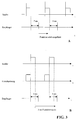
- the recipient 2 checks whether he has another SEND_ID same message identifier as the original SEND_ID, but with changed message content. Is not such a SEND_ID received, it is checked whether the reception timer has already expired. If this is not the case, the system continues to check whether a SEND_ID is included changed content was received until the timer expired. Is after Expiration of the timer no SEND_ID with a content that is opposite to the content of the original SEND_ID has been received, the Receiver 2 deactivates the function or initializes the execution of the function on the affected component 4. This procedure is also in the Figure 3A shown, with the signals at the transmitter and receiver the time is reproduced. This course represents the normal case, i.e. the case that the message received by the recipient 2 from the Sender 1 originates and it is therefore an authorized signal.
- recipient 2 determines that he has a SEND_ID with has received contrary content, it leads the changed, i.e. from Sender 1 edited SEND_ID.
- the content of the changed SEND_ID in this example is "FUNKTION_AUS".
- the receiver 2 blocks preferably for a certain time, e.g. 5 seconds, this function and does not give them for renewed SEND_ID instructions until this time has expired free, but then again the previously described control in the transmitter 1 and the recipient 2. This procedure is shown in Figure 3B reproduced, the signals at the transmitter 1 and receiver 2 over the time is reproduced.
- the transmitter in which he determines that the SEND_ID he received is not his was sent, the SEND_ID unchanged to the recipient returns.
- the transmitter monitors in the Time interval in which the reception timer runs, not whether a SEND_ID is included opposite content is received, which he then executes, but only monitors the prompt receipt of the same SEND_IDs. receives the receiver runs two identical SEND_IDs during the receive timer, so he ignores the content contained in the messages and blocks it affected function for a certain time. The one included in the SEND_ID Instruction is therefore not executed.
- time for the timer it is also possible to set the time for the timer to a different time than the one above specified 5ms. So it is e.g. possible that span of time is selected for the timer so that it corresponds to an entire cycle, that normally occurs, i.e. the duration between normally successively sent messages from the broadcaster.
- the A possible reaction of the transmitter e.g. a changed one SEND_ID within the time that the receive timer is running this time is also set according to the circumstances, or be adjusted. This can be particularly important when on the bus or in the CAN messages with different priorities to be dispatched. In such a case, an unauthorized third party could Fill the bus with high priority messages and thereby achieve that Receiver does not correct the timer within the specified time Message received by the sender. This can be counteracted be monitored by monitoring the load on the bus or the CAN and adjusted the time for the timer to the workload, e.g. is extended.
- the system and method according to the invention have the advantage that through this an access by unauthorized persons to the control of Vehicle components can be reliably prevented.
- Continues to take the implementation of the system and method uses little resources Claim.
- the need for storage capacity such as ROM or RAM is low.
- the system and procedure are also easy implement.
Landscapes
- Engineering & Computer Science (AREA)
- Computer Networks & Wireless Communication (AREA)
- Signal Processing (AREA)
- Small-Scale Networks (AREA)
- Mechanical Engineering (AREA)
- Environmental & Geological Engineering (AREA)
- Electric Propulsion And Braking For Vehicles (AREA)
- Selective Calling Equipment (AREA)
Abstract
Description
Claims (10)
- Steuerungssystem zur Steuerung von Kraftfahrzeugkomponenten (4), wobei das System mindestens einen Sender (1) und mindestens einen Empfänger (2) umfasst, der Sender (1) im wesentlichen dazu dient, Botschaften an den Empfänger (2) zu senden, der Empfänger (2) im wesentlichen dazu dient, Botschaften zu empfangen und Funktionen entsprechend der Botschaft auszuführen oder zu sperren, und der mindestens eine Sender (1) und der mindestens eine Empfänger (2) durch mindestens einen Bus (3) miteinander verbunden sind, dadurch gekennzeichnet, dass der Sender (1) auch für den Empfang von über den Bus (3) gesandten Nachrichten ausgelegt ist, und dieser Sender (1) Einrichtungen (5, 6, 7) aufweist, mittels derer von dem Sender (1) gesandte und empfangene Botschaften überwacht werden.
- Steuerungssystem nach Anspruch 1, dadurch gekennzeichnet, dass die Einrichtungen (6) des Senders (1) dem Vergleich von Botschaften, die vom Sender (1) gesandt wurden, und Botschaften, die vom Sender (1) empfangen wurden, dienen.
- Steuerungssystem nach Anspruch 1 oder 2, dadurch gekennzeichnet, dass die Einrichtungen (7) des Senders (1) zum Bearbeiten der durch den Sender (1) empfangenen Botschaften dienen.
- Steuerungssystem nach Anspruch 1, 2 oder 3, dadurch gekennzeichnet, dass der Empfänger (2) Einrichtungen aufweist, mittels derer der Erhalt von Botschaften überwacht wird.
- Steuerungssystem nach Anspruch 4, dadurch gekennzeichnet, dass die Einrichtungen des Empfängers (2) eine zeitliche Überwachung der empfangenen Botschaften durchführen.
- Verfahren zur Steuerung von Kraftfahrzeugkomponenten mittels eines Systems, das mindestens einen Sender (1) und mindestens einen Empfänger (2) umfasst, der Sender (1) im wesentlichen dazu dient, Botschaften an den Empfänger (2) zu senden, der Empfänger (2) im wesentlichen dazu dient, Botschaften zu empfangen und Funktionen entsprechend der Botschaft auszuführen oder zu sperren, und der mindestens eine Sender (1) und der mindestens eine Empfänger (2) durch mindestens einen Bus (3) miteinander verbunden sind, dadurch gekennzeichnet, dass ein Sender (1) die auf den Bus (3) gelegten Botschaften überwacht und mit denen von dem Sender (1) auf den Bus (3) gelegten Botschaften vergleicht.
- Verfahren nach Anspruch 6, dadurch gekennzeichnet, dass der Sender abhängig von dem Ergebnis des Vergleiches die Anweisung, die in einer Botschaft, die nicht von dem Sender gesandt wurde, enthalten ist, negiert und diese so bearbeitete Botschaft auf den Bus legt, über den sie an den mindestens einen Empfänger gesandt wird.
- Verfahren nach einem der Ansprüche 6 oder 7, dadurch gekennzeichnet, dass der Empfänger (2) bei Erhalt einer Botschaft einen Empfangstimer startet.
- Verfahren nach Anspruch 8, dadurch gekennzeichnet, dass der Empfänger (2) eine in einer Botschaft enthaltene Anweisung erst nach eingangslosem Ablauf des Empfangstimers ausführt.
- Verfahren nach einem der Ansprüche 6 bis 9, dadurch gekennzeichnet, dass der Empfänger nach dem Erhalt einer Botschaft über den Bus ein Kontrollsignal auf den Bus ablegt.
Applications Claiming Priority (2)
| Application Number | Priority Date | Filing Date | Title |
|---|---|---|---|
| DE2001111286 DE10111286B4 (de) | 2001-03-09 | 2001-03-09 | Steuerungssystem und Verfahren zur Steuerung von Kraftfahrzeugkomponenten |
| DE10111286 | 2001-03-09 |
Publications (3)
| Publication Number | Publication Date |
|---|---|
| EP1245453A2 true EP1245453A2 (de) | 2002-10-02 |
| EP1245453A3 EP1245453A3 (de) | 2006-01-04 |
| EP1245453B1 EP1245453B1 (de) | 2008-09-03 |
Family
ID=7676806
Family Applications (1)
| Application Number | Title | Priority Date | Filing Date |
|---|---|---|---|
| EP20020002907 Expired - Lifetime EP1245453B1 (de) | 2001-03-09 | 2002-02-09 | Steuerungssystem und Verfahren zur Steuerung von Kraftfahrzeugkomponenten |
Country Status (2)
| Country | Link |
|---|---|
| EP (1) | EP1245453B1 (de) |
| DE (2) | DE10111286B4 (de) |
Cited By (3)
| Publication number | Priority date | Publication date | Assignee | Title |
|---|---|---|---|---|
| WO2007042366A1 (de) * | 2005-10-11 | 2007-04-19 | Endress+Hauser Gmbh+Co.Kg | Verfahren zum sicheren versenden von daten eines feldgerätes der prozessautomatisierungstechnik |
| WO2008063452A3 (en) * | 2006-11-13 | 2008-07-17 | Lutron Electronics Co | Method of communicating a command for load shedding of a load control system |
| WO2017211730A1 (en) * | 2016-06-06 | 2017-12-14 | Delphi International Operations Luxembourg S.À R.L. | Method to control unauthorised hacking of fuel injector operation control |
Families Citing this family (3)
| Publication number | Priority date | Publication date | Assignee | Title |
|---|---|---|---|---|
| DE102008006529B4 (de) * | 2008-01-29 | 2010-05-06 | Continental Automotive Gmbh | Zeitgesteuerte Kommunikation von Fahrzeug und ID-Gebern |
| DE102009052323A1 (de) * | 2009-11-07 | 2011-05-12 | Volkswagen Ag | Verfahren zum Diebstahlschutz für eine Fahrzeugkomponente sowie Fahrzeugkomponente und Fahrzeug |
| DE102012224194B4 (de) * | 2012-12-21 | 2018-08-02 | Continental Automotive Gmbh | Steuersystem für ein Kraftfahrzeug |
Family Cites Families (12)
| Publication number | Priority date | Publication date | Assignee | Title |
|---|---|---|---|---|
| JPS5837736B2 (ja) * | 1979-09-04 | 1983-08-18 | ファナック株式会社 | 直列デ−タ伝送方式 |
| US5077670A (en) * | 1988-12-28 | 1991-12-31 | Nissan Motor Company, Limited | System and method applicable to vehicles for communicating between data processing stations |
| JP2904283B2 (ja) * | 1989-05-22 | 1999-06-14 | マツダ株式会社 | 車両用多重伝送装置 |
| DE3928537A1 (de) * | 1989-08-29 | 1991-03-07 | Bosch Gmbh Robert | Verfahren zur fehlererkennung und/oder fehlerlokalisation bei datenuebertragungen |
| DE4301436C2 (de) * | 1993-01-20 | 1996-06-13 | Kaiser Hans Christian | Sicherungssystem |
| DE4310475C2 (de) * | 1993-03-31 | 1995-10-19 | Webasto Thermosysteme Gmbh | Fernwirkanlage |
| DE4333474C2 (de) * | 1993-08-20 | 1995-09-21 | Siemens Ag | Wegfahrsperre für ein Kraftfahrzeug |
| DE4414644A1 (de) * | 1993-10-29 | 1995-05-04 | Bosch Gmbh Robert | Fahrzeugsicherungsanordnung |
| DE19530727B4 (de) * | 1995-08-18 | 2012-09-20 | Kiekert Ag | Verfahren zum Betrieb eines Steuersystems zur Steuerung von Kraftfahrzeugkomponenten |
| DE19728841C2 (de) * | 1997-07-05 | 2000-07-20 | Bosch Gmbh Robert | Verfahren und Vorrichtung zur Überwachung einer Datenübertragung in einem Kraftfahrzeug |
| DE19815715C2 (de) * | 1998-04-08 | 2003-09-25 | Daimler Chrysler Ag | Elektronisches, datenbusfähiges Fahrzeugsteuergerät |
| CA2280571A1 (en) * | 1998-11-30 | 2000-05-30 | Daimlerchrysler Corporation | J1850 application specific integrated circuit (asic) and messaging technique |
-
2001
- 2001-03-09 DE DE2001111286 patent/DE10111286B4/de not_active Expired - Lifetime
-
2002
- 2002-02-09 DE DE50212717T patent/DE50212717D1/de not_active Expired - Lifetime
- 2002-02-09 EP EP20020002907 patent/EP1245453B1/de not_active Expired - Lifetime
Cited By (5)
| Publication number | Priority date | Publication date | Assignee | Title |
|---|---|---|---|---|
| WO2007042366A1 (de) * | 2005-10-11 | 2007-04-19 | Endress+Hauser Gmbh+Co.Kg | Verfahren zum sicheren versenden von daten eines feldgerätes der prozessautomatisierungstechnik |
| WO2008063452A3 (en) * | 2006-11-13 | 2008-07-17 | Lutron Electronics Co | Method of communicating a command for load shedding of a load control system |
| US7747357B2 (en) | 2006-11-13 | 2010-06-29 | Lutron Electronics Co., Inc. | Method of communicating a command for load shedding of a load control system |
| US8031049B2 (en) | 2006-11-13 | 2011-10-04 | Lutron Electronics Co., Inc. | Method of communicating a command for load shedding of a load control system |
| WO2017211730A1 (en) * | 2016-06-06 | 2017-12-14 | Delphi International Operations Luxembourg S.À R.L. | Method to control unauthorised hacking of fuel injector operation control |
Also Published As
| Publication number | Publication date |
|---|---|
| DE50212717D1 (de) | 2008-10-16 |
| DE10111286A1 (de) | 2002-09-19 |
| EP1245453A3 (de) | 2006-01-04 |
| DE10111286B4 (de) | 2005-04-21 |
| EP1245453B1 (de) | 2008-09-03 |
Similar Documents
| Publication | Publication Date | Title |
|---|---|---|
| DE69218016T2 (de) | Verfahren zum Verarbeiten von Steueraufträgen | |
| DE60020096T2 (de) | Verfahren und vorrichtung zur bereitstellung von fairem zugriff für teilnehmer mit unterschiedlichen signalisierungsverzögerungen in einem gruppenkommunikationssystem | |
| EP1298850B1 (de) | Verfahren und Vorrichtung zur Überwachung eines Bussystems und Bussystem | |
| DE3702520C2 (de) | ||
| DE2745295A1 (de) | Steuerschaltung fuer ein mobiles duplex-funkuebertragungssystem mit kombinierter sprach/daten-uebertragung | |
| DE10136035A1 (de) | Elektronisches Steuersystem mit Verwendung eines einzelnen Empfängers für unterschiedliche Steuermodi | |
| EP1547405A1 (de) | Fernsteuerung einer fahrzeugfunktion über ein mobilfunknetz | |
| EP2171585B1 (de) | Verfahren zum betreiben eines mikrocontrollers und einer ausführungseinheit sowie ein mikrocontroller und eine ausführungseinheit | |
| EP1245453B1 (de) | Steuerungssystem und Verfahren zur Steuerung von Kraftfahrzeugkomponenten | |
| EP0989701A2 (de) | Datenbus | |
| EP2907119A1 (de) | Anordnung mit einem aktuator | |
| DE10339861A1 (de) | Schloßsteuerungsvorrichtung zum Gebrauch in Fahrzeugen | |
| DE112017005878B4 (de) | Fahrzeug-Telematik-Nachrichtenübermittlung | |
| DE102006025949A1 (de) | Mehrkanal-Empfängersystem und entsprechendes Verfahren | |
| EP1108630B1 (de) | Vorrichtung zur Aktivierung und/oder Deaktivierung einer Sicherheitseinrichtung | |
| DE4210094A1 (de) | Multiplexes uebertragungsverfahren | |
| DE69112086T2 (de) | System zur Verwaltung und Steuerung von mehreren unabhängigen Apparaten. | |
| EP1108629B1 (de) | Vorrichtung zur Aktivierung und/oder Deaktivierung einer Sicherheitseinrichtung | |
| AT504018A1 (de) | Verfahren und einrichtung zum aufbau eines kommunikationssystems auf der basis von can kommunikationskontrollern mit erhöhtem datendurchsatz | |
| WO2009098174A1 (de) | Synchronisation der kommunikation zwischen identifikationsgeber und fahrzeugstation einer zugangsvorrichtung | |
| DE102020110708A1 (de) | Vorrichtung und Verfahren zum Versenden einer Nachricht an zumindest zwei Empfänger für ein Kraftfahrzeug | |
| DE3050171C1 (de) | Vorrichtung zur Steuerung von Vermittlungen in einem Duplex-UEbertragungsnetz | |
| DE102019133662A1 (de) | System zum Steuern von Kraftfahrzeugfunktionen | |
| DE102007031738B4 (de) | Verfahren und System zur Sicherung der Datenübertragung zwischen mindestens zwei Bordelektronikkomponenten eines Kraftfahrzeugs | |
| DE10211930B4 (de) | Verfahren zur Kommunikation zwischen einer Basiseinheit und mehreren Identifikationsgebern eines Zugangskontrollsystems und Zugangskontrollsystem |
Legal Events
| Date | Code | Title | Description |
|---|---|---|---|
| PUAI | Public reference made under article 153(3) epc to a published international application that has entered the european phase |
Free format text: ORIGINAL CODE: 0009012 |
|
| AK | Designated contracting states |
Kind code of ref document: A2 Designated state(s): AT BE CH CY DE DK ES FI FR GB GR IE IT LI LU MC NL PT SE TR |
|
| AX | Request for extension of the european patent |
Free format text: AL;LT;LV;MK;RO;SI |
|
| PUAL | Search report despatched |
Free format text: ORIGINAL CODE: 0009013 |
|
| AK | Designated contracting states |
Kind code of ref document: A3 Designated state(s): AT BE CH CY DE DK ES FI FR GB GR IE IT LI LU MC NL PT SE TR |
|
| AX | Request for extension of the european patent |
Extension state: AL LT LV MK RO SI |
|
| 17P | Request for examination filed |
Effective date: 20060704 |
|
| AKX | Designation fees paid |
Designated state(s): DE FR GB IT |
|
| 17Q | First examination report despatched |
Effective date: 20070122 |
|
| GRAP | Despatch of communication of intention to grant a patent |
Free format text: ORIGINAL CODE: EPIDOSNIGR1 |
|
| GRAS | Grant fee paid |
Free format text: ORIGINAL CODE: EPIDOSNIGR3 |
|
| GRAA | (expected) grant |
Free format text: ORIGINAL CODE: 0009210 |
|
| AK | Designated contracting states |
Kind code of ref document: B1 Designated state(s): DE FR GB IT |
|
| REG | Reference to a national code |
Ref country code: GB Ref legal event code: FG4D Free format text: NOT ENGLISH |
|
| REF | Corresponds to: |
Ref document number: 50212717 Country of ref document: DE Date of ref document: 20081016 Kind code of ref document: P |
|
| PLBE | No opposition filed within time limit |
Free format text: ORIGINAL CODE: 0009261 |
|
| STAA | Information on the status of an ep patent application or granted ep patent |
Free format text: STATUS: NO OPPOSITION FILED WITHIN TIME LIMIT |
|
| 26N | No opposition filed |
Effective date: 20090604 |
|
| PGFP | Annual fee paid to national office [announced via postgrant information from national office to epo] |
Ref country code: DE Payment date: 20150228 Year of fee payment: 14 |
|
| REG | Reference to a national code |
Ref country code: FR Ref legal event code: PLFP Year of fee payment: 15 |
|
| PGFP | Annual fee paid to national office [announced via postgrant information from national office to epo] |
Ref country code: IT Payment date: 20160226 Year of fee payment: 15 |
|
| PGFP | Annual fee paid to national office [announced via postgrant information from national office to epo] |
Ref country code: GB Payment date: 20160223 Year of fee payment: 15 Ref country code: FR Payment date: 20160224 Year of fee payment: 15 |
|
| REG | Reference to a national code |
Ref country code: DE Ref legal event code: R119 Ref document number: 50212717 Country of ref document: DE |
|
| PG25 | Lapsed in a contracting state [announced via postgrant information from national office to epo] |
Ref country code: DE Free format text: LAPSE BECAUSE OF NON-PAYMENT OF DUE FEES Effective date: 20160901 |
|
| GBPC | Gb: european patent ceased through non-payment of renewal fee |
Effective date: 20170209 |
|
| REG | Reference to a national code |
Ref country code: FR Ref legal event code: ST Effective date: 20171031 |
|
| PG25 | Lapsed in a contracting state [announced via postgrant information from national office to epo] |
Ref country code: FR Free format text: LAPSE BECAUSE OF NON-PAYMENT OF DUE FEES Effective date: 20170228 |
|
| PG25 | Lapsed in a contracting state [announced via postgrant information from national office to epo] |
Ref country code: GB Free format text: LAPSE BECAUSE OF NON-PAYMENT OF DUE FEES Effective date: 20170209 Ref country code: IT Free format text: LAPSE BECAUSE OF NON-PAYMENT OF DUE FEES Effective date: 20170209 |