EP1242627B1 - Verfahren und vorrichtung zum nachweis und zur quantifizierung von biomolekülen - Google Patents
Verfahren und vorrichtung zum nachweis und zur quantifizierung von biomolekülen Download PDFInfo
- Publication number
- EP1242627B1 EP1242627B1 EP00990530A EP00990530A EP1242627B1 EP 1242627 B1 EP1242627 B1 EP 1242627B1 EP 00990530 A EP00990530 A EP 00990530A EP 00990530 A EP00990530 A EP 00990530A EP 1242627 B1 EP1242627 B1 EP 1242627B1
- Authority
- EP
- European Patent Office
- Prior art keywords
- biomolecule
- electrode
- bound
- stranded
- binding
- Prior art date
- Legal status (The legal status is an assumption and is not a legal conclusion. Google has not performed a legal analysis and makes no representation as to the accuracy of the status listed.)
- Expired - Lifetime
Links
Images


Classifications
-
- C—CHEMISTRY; METALLURGY
- C12—BIOCHEMISTRY; BEER; SPIRITS; WINE; VINEGAR; MICROBIOLOGY; ENZYMOLOGY; MUTATION OR GENETIC ENGINEERING
- C12Q—MEASURING OR TESTING PROCESSES INVOLVING ENZYMES, NUCLEIC ACIDS OR MICROORGANISMS; COMPOSITIONS OR TEST PAPERS THEREFOR; PROCESSES OF PREPARING SUCH COMPOSITIONS; CONDITION-RESPONSIVE CONTROL IN MICROBIOLOGICAL OR ENZYMOLOGICAL PROCESSES
- C12Q1/00—Measuring or testing processes involving enzymes, nucleic acids or microorganisms; Compositions therefor; Processes of preparing such compositions
- C12Q1/68—Measuring or testing processes involving enzymes, nucleic acids or microorganisms; Compositions therefor; Processes of preparing such compositions involving nucleic acids
- C12Q1/6813—Hybridisation assays
- C12Q1/6816—Hybridisation assays characterised by the detection means
- C12Q1/6825—Nucleic acid detection involving sensors
-
- G—PHYSICS
- G01—MEASURING; TESTING
- G01N—INVESTIGATING OR ANALYSING MATERIALS BY DETERMINING THEIR CHEMICAL OR PHYSICAL PROPERTIES
- G01N33/00—Investigating or analysing materials by specific methods not covered by groups G01N1/00 - G01N31/00
- G01N33/48—Biological material, e.g. blood, urine; Haemocytometers
- G01N33/50—Chemical analysis of biological material, e.g. blood, urine; Testing involving biospecific ligand binding methods; Immunological testing
- G01N33/53—Immunoassay; Biospecific binding assay; Materials therefor
- G01N33/543—Immunoassay; Biospecific binding assay; Materials therefor with an insoluble carrier for immobilising immunochemicals
- G01N33/54366—Apparatus specially adapted for solid-phase testing
- G01N33/54373—Apparatus specially adapted for solid-phase testing involving physiochemical end-point determination, e.g. wave-guides, FETS, gratings
- G01N33/5438—Electrodes
Definitions
- the invention relates to a method and an apparatus for Detection and quantification of one contained in a solution first biomolecule.
- WO 96/01836 describes a so-called chip for the detection of Polynucleotide sequences known.
- the chip is made of e.g. Silicon made substrate formed.
- Are on the chip a variety of miniaturized reaction fields are provided. In each of the reaction fields is a special polynucleotide sequence bound.
- WO 95/12808 also relates to a method for the detection of Polynucleotide sequences using a chip. It is about the chip a voltage is applied like an electrode. Loaded in The polynucleotide sequences in solution are thereby on the surface of the chip or the miniaturized ones provided there Reaction fields enriched.
- US 5,783,063 discloses a method for estimating Parameters for the characterization of nucleic acid samples.
- a microtiter plate is described in DE 198 11 732. This is coated with covalently bound oligonucleotides.
- the microtiter plate can be used for detection by means of PCR Products are used.
- WO 99/47700 relates to a method for detection of a nucleotide sequence using fluorescence. Doing so a molecule with a fluorophore group on a fixed one Phase bound. If the target sequence is available, a second fluorophoric group bound in such a way that a radiation-free or direct energy transfer between the fluorophores Groups can take place.
- WO 99/47701 describes a method for the detection of a nucleotide sequence known by PCR.
- PCR uses three primers, with the third primer on is bound to a solid phase. It is used for enrichment of the reaction product and shortening the reaction time.
- WO 98/20162 discloses the use of nucleic acids with electron-transferring ones Share as probes. Both electron-transmitting parts are attached to the first probe. Once these probes are contacted with a solution containing a target sequence there is a hybridization of this target sequence with the complementary one Probe. The double-stranded DNA molecule formed has a significantly higher electrical Conductivity on than the single-stranded probe.
- US 5,770,369 discloses similar methods for the detection of nucleic acids.
- nucleic acids become covalent with an electron donor and an electron acceptor connected, after which the electrical conductivity is measured.
- the Electron-transferring parts are on the first probe or on two separate probes attached which hybridize alone or together with a target sequence.
- WO 98/31839 discloses methods for the detection of bonds between different ones Biomolecules. These biomolecules are attached to various electrodes.
- the object of the invention is to overcome the disadvantages of the prior art of technology to eliminate.
- the proposed method is particularly sensitive. In the event of the formation of e.g. formed from the first and second biomolecule double-stranded complex, it is possible through the bridge formed between the first and second electrodes detect a change in electrical properties. It single biomolecules are therefore detectable in the solution. This also enables the quantification of the smallest quantities.
- biomolecule is understood to mean molecules which a specific affinity for each other, at least in sections have and with the formation of a mutual bond changed electrical along the bonded portion Show properties.
- a biomolecule is in particular understood a molecule formed from nucleic acids. On such a molecule has at least two covalently bound nucleotides on.
- the nucleic acid usually contains phosphodiester bonds. But it can also, for example, phosphoramide, Phosphorothionate, phosphorodithionate, O-methylphosphoroamidite bonds or have petit nucleic acid bonds.
- the nucleic acids can be single or double-stranded his. It can be DNA, RNA or a hybrid, at the nucleic acid is a combination of deoxiribo and ribonucleic acids contains. Proteins, PNA and the like are also understood by the term "biomolecule”.
- two molecules then point have a "specific" affinity for one another when based on attractive interactions, e.g. Hydrogen bonds, van der Waals forces of ionic or covalent Binding, a bond or at least one Have tendency to find out about weak interactions, such as e.g. Hydrogen bonds or the like, mutually tie.
- Such specific affinity e.g. molecules such as antigen / antibody, streptavidin / biotin, ligand / receptor and complementary nucleic acid sequences.
- complex is an association of at least understood two biomolecules, which in consequence of their affinity form a construct with each other.
- the second biomolecule is in front of the Step lit. a at least with one end to one of the electrodes bound.
- the binding of at least one end of the second biomolecule to which an electrode can be connected directly Binding mediates a spacer and / or a linker molecule become.
- the second Biomolecule before or after step lit. a with the other End bound to the second electrode. In the latter case can tie the other end by applying a potential get supported.
- At the free end of the second biomolecule can be a charged in the appropriate potential range Molecule, hereinafter called charge carrier, be bound. This makes it possible in particular for uncharged second biomolecules, to form a bridge through electrostatic forces.
- a load carrier can it e.g. a metal cluster, an organic molecule or act as a complexing agent.
- step lit. a between the third the first end of the second biomolecule to the first Electrode and binding the second end of the second biomolecule to the second electrode.
- a can bind the first biomolecule to the second biomolecule be accelerated by an electric field.
- the electric field can e.g. by applying a potential the electrodes are generated.
- the stringency Changes in potential vary.
- the choice of the respective design variants is based according to the type of the first biomolecule.
- the first and the second electrode are expediently on applied an electrically insulating substrate. After a Another process variant, the substrate before Step lit. b rinsed and / or dried and / or evacuated become.
- the electrical Conductivity of between the first and the second Electrode bound complex measured.
- conductivity can also change the capacitance and / or impedance of the complex bound between the first and second electrodes be measured. Measurement of the aforementioned electrical Sizes enable detection and / or quantification of a biomolecule, which at least in sections has an affinity for the second biomolecule.
- the distance between the first and the second electrode 3 nm to 1 ⁇ m, preferably 50nm.
- the first biomolecule can be complementary to the second biomolecule be single stranded DNA or RNA. Furthermore, that second biomolecule also partially double-stranded with the double-stranded section (s) preferably is / are formed from DNA and / or RNA.
- a single-stranded one can also enter the second biomolecule Section be on; the single-stranded section can be formed from DNA, RNA or PNA.
- second biomolecule turned on a protein or peptide his. This enables, for example, the detection of antibodies, provided they are the first biomolecule in the solution are.
- the sensitivity of the detection of the first biomolecules can be by setting the respective stringency conditions.
- the Stringency conditions can be changed, for example the voltage applied to the electrodes changed and be adapted to the respective conditions.
- first biomolecules can be used to remove the first biomolecule from the second biomolecule after step lit. b a force on the first biomolecule be exercised by means of an applied voltage. Further after step lit. b rinsed and / or heated. Heating can cause a thermal Denaturation of the first biomolecules can be achieved. Certain first biomolecules preferably bind to a particular one given temperature. By heating or adjusting The temperature can further increase the specificity of the process increase. The specificity can also be varied of the pH of the solution increased or by a certain Salt concentration can be set.
- the electrodes can be made of electrically conductive materials such as. Gold, a conductive plastic or graphite. Furthermore, the electrodes can also be in the form of Microelectrodes, e.g. Nanotubes.
- the electrode (s) are in the area of the selected voltages coated redox-inactive molecules. Such a coating contributes to suppression of contamination-related conductivity phenomena.
- first and second electrodes on the substrate appropriate.
- the first electrodes are advantageous bound second biomolecules different from each other, so that simultaneous detection and / or quantification a large number of first biomolecules is possible.
- the Chip according to the invention has the advantage that it is simple Evidence and / or quantification in a solution contained first biomolecules is possible. The quantification can be done digitally. You can do this advantageously take advantage of the fact that every bridge is a delivers a special signal. It can particularly affect some Optical detection devices requiring high equipment expenditure to be dispensed with.
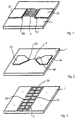
- 1 is a e.g. made of silicon, silicon made with oxide layer, quartz crystal, glass or mica referred to essentially electrically insulating substrate.
- 1 and 2 are the electrical Connections of the electrodes 2a, 2b with a (here measuring device (not shown) for the sake of clarity not shown separately.
- a single stranded DNA 3 is with one end E1 to the first electrode 2a and with its other end E2 bound to the second electrode 2b. she thus forms a bridge-like connection between the two Electrodes 2a and 2b.
- FIG. 3 shows a chip according to the invention. Here lies a plurality of discrete first electrodes 2a of a common one second electrode at 2b opposite. Each of the first electrodes 2a is provided with a separate feed line 4.
- the Chip is manufactured using conventional lithographic technology.
- the connecting the first 2a and the second electrode 2b Biomolecules are here for clarity not shown.
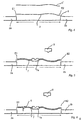
- FIG. 4 schematically shows a first variant for detection of a single-stranded first DNA molecule 5 is shown.
- On the first electrode 2a is via one labeled S. Spacer molecule the second single-stranded DNA molecule 3 bound.
- At the other end E2 of the second DNA molecule 3 is one Gold cluster 6 provided.
- the gold cluster 6 accelerates the binding of the other end E2 to the second electrode 2 B.
- the first DNA molecule 5 in solution is complementary to the second DNA molecule 3. Once the shown Device is brought into contact with the solution, the second DNA molecule 3 hybridizes with the complementary first DNA molecule 5.
- the formed double-stranded DNA molecule exhibits a significantly higher electrical conductivity than that of the first 2a and single-stranded second connecting the second electrode 2b DNA molecule. This particular increased electrical conductivity occurs in particular only if a largely complete hybridization is present.
- the second method variant shown in FIG. 5 is suitable especially for the detection of antibodies 8.
- the connection between the first 2a and the second electrode 2b is here formed by a section-wise double-stranded biomolecule 7, whose ends E1 and E2 each by means of a Spacer molecule S to the first 2a and the second electrode 2b are bound.
- the second biomolecule 7 there is a single strand Peptide sequence 7a turned on. If there is a the corresponding antibody in the solution binds it to the single-stranded peptide sequence 7a.
- the conductivity of the construct formed is increased. So it works a simple way of proof of those in solution Antibodies 8.
- a hairpin loop 9 is formed in one strand of the biomolecule 7.
- the area of the hairpin loop 9 is the opposite one Strand interrupted.
- the construct that is formed contracts.
- the hairpin bow 9 is stretched. The ones that limit the interruption Ends of the opposite strand move apart.
- a previously observable conductivity decreases during binding of antibody 8 to the single-stranded peptide section 7a. This is a simple proof of in Solution antibodies 8 possible.
- a fourth method variant is shown in FIGS. 7a to 7c.
- One to a first biomolecule, e.g. a first DNA molecule 5, complementary second biomolecule, e.g. a second DNA molecule 3 is via a linker L to the first Electrode 2a bound.
- At the other end of the second DNA molecule 3 is a charged molecule 10 bound.
- the first DNA molecule 5 hybridizes with the second DNA molecule 3. Then it is rinsed. Then one Voltage between the first 2a and the second electrode 2b created. A force is exerted on the charged molecule 10.
- the charged molecule 10 is attached to the second electrode 2b attracted (see Fig. 7c).
- a bridge is formed. about the bridge formed can be the conductivity of the double-stranded Complexes directly using a simple current-voltage measurement be determined. The measurement can also in the absence of the solution, i.e. done in a dry state.
- FIGS. 8a to 8c show a fifth method variant; 8d schematically shows a measurement result observed.
- FIGS. 8a to 8c show a section of an array which contains a plurality of first 2a and second electrodes 2b.
- Different second biomolecules for example second DNA molecules 3, 3 ′ and 3 ′′, are bound to the first electrodes 2a by means of a linker.
- first biomolecules including first DNA molecules 5, 5 x and 5 '' containing solution it is depending on the affinity of the first DNA molecules 5, 5 x and 5 '' to the second DNA molecules 3, 3 'and 3''for hybridization.
- the first DNA molecule 5 hybridizes with the second DNA molecule 3 and the first DNA molecule 5 ′′ with the second DNA molecule 3 ′′.
- the second DNA molecule 3 ' is not complementary to the first DNA molecule 5 x contained in the solution.
- a voltage is applied between the first 2a and the second electrode 2b, so that the biomolecules form a bridge between the two electrodes 2a, 2b.
- the conductivity between each pair of electrodes 2a, 2b is now measured.
- the measurement result obtained is shown schematically in FIG. 8d.
- the highest conductivity shows the pair of electrodes, which has two bridges with hybridized DNA molecules 3, 5.
- the conductivity when only one bridge is formed is about half as large. It can be observed in the 3 '' and 5 '' DNA molecules.
- the bridge formed solely by the second DNA molecule 3 ' hardly leads to direct conductivity between the electrodes 2a, 2b.
- the proposed method can be highly sensitive in one Solution contained first biomolecules can be detected.
- the sensitivity can in particular also be due to the occupancy density of the first electrode 2a can be increased.
Landscapes
- Health & Medical Sciences (AREA)
- Chemical & Material Sciences (AREA)
- Life Sciences & Earth Sciences (AREA)
- Immunology (AREA)
- Engineering & Computer Science (AREA)
- Analytical Chemistry (AREA)
- Organic Chemistry (AREA)
- Molecular Biology (AREA)
- Urology & Nephrology (AREA)
- Biotechnology (AREA)
- Microbiology (AREA)
- Proteomics, Peptides & Aminoacids (AREA)
- Biomedical Technology (AREA)
- Wood Science & Technology (AREA)
- Zoology (AREA)
- Biochemistry (AREA)
- Physics & Mathematics (AREA)
- Hematology (AREA)
- General Health & Medical Sciences (AREA)
- Bioinformatics & Cheminformatics (AREA)
- General Physics & Mathematics (AREA)
- Cell Biology (AREA)
- General Engineering & Computer Science (AREA)
- Biophysics (AREA)
- Food Science & Technology (AREA)
- Medicinal Chemistry (AREA)
- Genetics & Genomics (AREA)
- Pathology (AREA)
- Investigating Or Analyzing Materials By The Use Of Electric Means (AREA)
- Apparatus Associated With Microorganisms And Enzymes (AREA)
- Measuring Or Testing Involving Enzymes Or Micro-Organisms (AREA)
- Investigating Or Analysing Biological Materials (AREA)
- Investigating Or Analyzing Materials By The Use Of Fluid Adsorption Or Reactions (AREA)
Description
- Fig. 1
- ein erstes Ausführungsbeispiel einer erfindungsgemäßen Vorrichtung,
- Fig. 2
- ein zweites Ausführungsbeispiel einer erfindungsgemäßen Vorrichtung,
- Fig. 3
- ein drittes Ausführungsbeispiel einer erfindungsgemäßen Vorrichtung,
- Fig. 4
- schematisch eine erste Verfahrensvariante,
- Fig. 5
- schematisch eine zweite Verfahrensvariante,
- Fig. 6
- schematisch eine dritte Verfahrensvariante,
- Fig. 7a - c
- schematisch die Teilschritte einer vierten Verfahrensvariante und
- Fig. 8a - d
- schematisch die Teilschritte und das Meßergebnis einer fünften Verfahrensvariante.
- 1
- Substrat
- 2a, 2b
- erste, zweite Elektrode
- 3, 3',3''
- zweite DNA-Moleküle
- 4
- Zuleitung
- 5, 5', 5''
- erste DNA-Moleküle
- 6
- Goldcluster
- 7
- Biomolekül
- 7a
- einzelsträngiger Peptidabschnitt
- 8
- Antikörper
- 9
- Haarnadelschleife
- 10
- geladenes Molekül
- E1
- Ende
- E2
- zweites Ende
- S
- Spacer
- L
- Linker
Claims (37)
- Verfahren zum Nachweis und/oder zur Quantifizierung eines in einer Lösung enthaltenen ersten Biomoleküls (5, 8), mit folgenden Schritten:a) Binden des ersten Biomoleküls (5, 8) an ein zweites Biomolekül (3, 7), welches zum ersten Biomolekül (5, 8) zumindest abschnittsweise eine spezifische Affinität aufweist, so dass das erste (5,8) und das zweite Biomolekül (3,7) einen Komplex bilden, undb) Bildung einer Brücke zwischen einer ersten (2a) und einer zweiten Elektrode (2b) mittels des zweiten Biomoleküls (3, 7), undc) Messen der elektrischen Leitfähigkeit des aus dem ersten (5,8) und dem zweiten Biomolekül (3,7) gebildeten Komplexes unmittelbar mittels einer Strom-/Spannungmessung.
- Verfahren nach Anspruch 1, wobei das zweite Biomolekül (3,7) vor dem Schritt lit. a zumindest mit einem Ende (E1) an eine der Elektroden (2a, 2b) gebunden wird.
- Verfahren nach einem der vorhergehenden Ansprüche, wobei die Bindung mindestens eines Endes (E1) des zweiten Biomoleküls (3,7) an die eine Elektrode (2a, 2b) über einen Spacer-(S) und/oder ein Linker-Molekül vermittelt wird.
- Verfahren nach einem der vorhergehenden Ansprüche, wobei das zweite Biomolekül (3,7) vor oder nach dem Schritt lit. a mit dem anderen Ende (E2) an die zweite Elektrode (2b) gebunden wird.
- Verfahren nach Anspruch 3, wobei das Binden des anderen Endes (E2) durch Anlegen eines Potentials unterstützt wird.
- Verfahren nach einem der vorhergehenden Ansprüche, wobei an das andere Ende (E2) des zweiten Biomoleküls (3, 7) ein Ladungsträger (6) gebunden ist.
- Verfahren nach Anspruch 6, wobei der Ladungsträger (6) ein Metallcluster, ein organisches Molekül oder ein Komplexbildner ist, der die Bindung des anderen Endes (E2) an die zweite Elektrode (2b) über den Ladungsträger (6) vermittelt.
- Verfahren nach einem der vorhergehenden Ansprüche, wobei der Schritt lit. a zwischen den Binden des einen Endes (E1) des zweiten Biomoleküls (3, 7) an die erste Elektrode (2a) und dem Binden des anderen Endes (E2) des zweiten Biomoleküls (3, 7) an die zweite Elektrode (2b) erfolgt.
- Verfahren nach einem der vorhergehenden Ansprüche, wobei die erste (2a) und die zweite Elektrode (2b) auf einem elektrisch isolierenden Substrat (1) aufgebracht sind.
- Verfahren nach einem der vorhergehenden Ansprüche, wobei das Substrat (1) vor dem Schritt lit. b gespült und/oder getrocknet und/oder evakuiert wird.
- Verfahren nach einem der vorhergehenden Ansprüche, wobei die elektrische Leitfähigkeit des zwischen der ersten (2a) und der zweiten Elektrode (2b) gebundenen Komplexes gemessen wird.
- Verfahren nach einem der vorhergehenden Ansprüche, wobei anstatt der Leitfähigkeit die Kapazität des zwischen der ersten (2a) und der zweiten Elektrode (2b) gebundenen Komplexes gemessen wird.
- Verfahren nach einem der vorhergehenden Ansprüche, wobei anstatt der Leitfähigkeit die Impedanz des zwischen der ersten (2a) und der zweiten Elektrode (2b) gebundenen Konstrukts gemessen wird.
- Verfahren nach einem der vorhergehenden Ansprüche, wobei der Abstand zwischen der ersten (2a) und der zweiten Elektrode (2b) 3 nm bis 1 µm, vorzugsweise 50 nm, ist.
- Verfahren nach einem der vorhergehenden Ansprüche, wobei das erste Biomolekül (5, 8) eine zum zweiten Biomolekül (3,7) komplementäre einzelsträngige DNA oder RNA ist.
- Verfahren nach einem der vorhergehenden Ansprüche, wobei das zweite Biomolekül (3,7) abschnittsweise doppelsträngig ausgebildet ist, wobei der/die doppelsträngige/n Abschnitt/e vorzugsweise aus DNA und/oder RNA gebildet ist/sind.
- Verfahren nach einem der vorhergehenden Ansprüche, wobei in das zweite Biomolekül (3,7) ein einzelsträngiger Abschnitt eingeschaltet ist.
- Verfahren nach einem der vorhergehenden Ansprüche, wobei der einzelsträngige Abschnitt aus DNA, RNA oder PNA gebildet ist.
- Verfahren nach einem der vorhergehenden Ansprüche, wobei das zweite Biomolekül (3,7) mit einem Protein oder einem Peptid assoziiert ist.
- Verfahren nach einem der vorhergehenden Ansprüche, wobei zum Entfernen des ersten Biomoleküls (5, 8) vom zweiten Biomolekül (3, 7) nach dem Schritt lit. b eine Kraft auf das erste Biomolekül (5, 8) mittels einer angelegten Spannung ausgeübt wird.
- Verfahren nach einem der vorhergehenden Ansprüche, wobei zum Entfernen des ersten Biomoleküls (5, 8) vom zweiten Biomolekül (3, 7) das Substrat (1) nach dem Schritt lit. b gespült wird.
- Vorrichtung zum Nachweis und/oder zur Quantifizierung eines in einer Lösung enthaltenen ersten Biomoleküls (5, 8), wobeiaa) eine erste (2a) und eine zweite Elektrode (2b) auf einem elektrisch isolierenden Substrat (1) aufgebracht sind,bb) zumindest an der ersten Elektrode (2a) mit seinem einen Ende (E1) ein zweites Biomolekül (3, 7) gebunden ist, welches zum ersten Biomolekül (5, 8) zumindest abschnittsweise eine spezifische Affinität aufweist, und wobeicc) der Abstand zwischen der ersten (2a) und der zweiten Elektrode (2b) so gewählt ist, daß durch Binden des anderen Endes (E2) des zweiten Biomoleküls (3, 7) eine Brücke zwischen der ersten (2a) und der zweiten Elektrode (2b) herstellbar ist.
- Vorrichtung nach Anspruch 22, wobei der Abstand zwischen der ersten (2a) und der zweiten Elektrode (2b) 3 nm bis 1 µm, vorzugsweise 50 nm, ist.
- Vorrichtung nach Anspruch 22 oder 23, wobei zumindest das eine Ende (E1) des zweiten Biomoleküls (3,7) an die eine Elektrode (2a, 2b) über eine direkte Kopplung, einen Spacer-(S) und/oder ein Linker-Molekül (L) gebunden ist.
- Vorrichtung nach einem der Ansprüche 22 bis 24, wobei an das andere Ende (E2) des zweiten Biomoleküls (3, 7) ein Ladungsträger (6) gebunden ist.
- Vorrichtung nach einem der Ansprüche 22 bis 25, wobei der Ladungsträger (6) ein Metallcluster, ein organisches Molekül oder ein Komplexbildner ist und die Bindung des anderen Endes (E2) an die zweite Elektrode (2b) über den Ladungsträger (6) vermittelbar ist.
- Vorrichtung nach einem der Ansprüche 22 bis 26, wobei das Substrat (1) aus Keramik, aus Siliziumverbindungen, vorzugsweise Silizium mit Oxidschicht, aus Glimmer oder aus einer elektrisch isolierenden Polymermatrix hergestellt ist.
- Vorrichtung nach einem der Ansprüche 22 bis 27, wobei eine mit der ersten (2a) und der zweiten Elektrode (2b) verbundene Einrichtung zum Messen der elektrischen Leitfähigkeit des aus dem ersten (5,8) und dem zweiten Biomolekül (3,7) gebildeten Konstrukts vorgesehen ist.
- Vorrichtung nach Anspruch 28, wobei mittels der Einrichtung anstatt der Leitfähigkeit die Kapazität des aus dem ersten (5, 8) und dem zweiten Biomolekül (3, 7) gebildeten Konstrukts meßbar ist.
- Vorrichtung nach Anspruch 28, wobei mittels der Einrichtung anstatt der Leitfähigkeit die Impedanz des aus dem ersten (5, 8) und dem zweiten Biomolekül (3, 7) gebildeten Konstrukts meßbar ist.
- Vorrichtung nach einem der Ansprüche 22 bis 30, wobei das erste Biomolekül (5, 8) eine zum zweiten Biomolekül (3, 7) komplementäre einzelsträngige DNA oder RNA ist.
- Vorrichtung nach Anspruch 31, wobei das zweite Biomolekül (3, 7) abschnittsweise doppelsträngig ausgebildet ist, wobei die doppelsträngigen Abschnitte vorzugsweise aus DNA und/oder RNA gebildet ist/sind.
- Vorrichtung nach Anspruch 32, wobei in das zweite Biomolekül (3, 7) ein einzelsträngiger Abschnitt eingeschaltet ist.
- Vorrichtung nach einem der Ansprüche 22 bis 33, wobei der einzelsträngige Abschnitt aus DNA, RNA oder PNA gebildet ist.
- Vorrichtung nach einem der Ansprüche 22 bis 34, wobei in das zweite Biomolekül (3, 7) ein Protein oder ein Peptid eingeschaltet ist.
- Vorrichtung nach einem der Ansprüche 22 bis 35, wobei eine Vielzahl erster (2a) und zweiter Elektroden (2b) auf dem Substrat (1) angebracht sind.
- Vorrichtung nach einem der Ansprüche 22 bis 36, wobei die an die ersten Elektroden (2a) gebundenen zweiten Biomoleküle (3, 7) voneinander verschieden sind, so daß ein gleichzeitiger Nachweis und/oder Quantifizierung einer Vielzahl erster Biomoleküle (5, 8) möglich ist.
Applications Claiming Priority (3)
| Application Number | Priority Date | Filing Date | Title |
|---|---|---|---|
| DE19960076A DE19960076C2 (de) | 1999-12-13 | 1999-12-13 | Verfahren und Vorrichtung zum Nachweis und zur Quantifizierung von Biomolekülen |
| DE19960076 | 1999-12-13 | ||
| PCT/DE2000/004438 WO2001044501A2 (de) | 1999-12-13 | 2000-12-13 | Verfahren und vorrichtung zum nachweis und zur quantifizierung von biomolekülen |
Publications (2)
| Publication Number | Publication Date |
|---|---|
| EP1242627A2 EP1242627A2 (de) | 2002-09-25 |
| EP1242627B1 true EP1242627B1 (de) | 2003-09-17 |
Family
ID=7932484
Family Applications (1)
| Application Number | Title | Priority Date | Filing Date |
|---|---|---|---|
| EP00990530A Expired - Lifetime EP1242627B1 (de) | 1999-12-13 | 2000-12-13 | Verfahren und vorrichtung zum nachweis und zur quantifizierung von biomolekülen |
Country Status (8)
| Country | Link |
|---|---|
| US (1) | US20030064390A1 (de) |
| EP (1) | EP1242627B1 (de) |
| JP (1) | JP2003522936A (de) |
| AT (1) | ATE250143T1 (de) |
| AU (1) | AU3000701A (de) |
| CA (1) | CA2394126A1 (de) |
| DE (2) | DE19960076C2 (de) |
| WO (1) | WO2001044501A2 (de) |
Families Citing this family (38)
| Publication number | Priority date | Publication date | Assignee | Title |
|---|---|---|---|---|
| WO2002023185A2 (en) * | 2000-09-15 | 2002-03-21 | Engeneos, Inc. | Devices and methods for direct electronic readout of biomolecular interactions |
| JP3670972B2 (ja) | 2001-02-01 | 2005-07-13 | 日立ソフトウエアエンジニアリング株式会社 | 生体高分子検出装置 |
| US6824974B2 (en) | 2001-06-11 | 2004-11-30 | Genorx, Inc. | Electronic detection of biological molecules using thin layers |
| US20040023253A1 (en) * | 2001-06-11 | 2004-02-05 | Sandeep Kunwar | Device structure for closely spaced electrodes |
| EP1417352A4 (de) * | 2001-06-11 | 2006-11-08 | Genorx Inc | Elektronischer nachweis biologischer moleküle mittels dünnschichten |
| US20040048241A1 (en) * | 2001-06-11 | 2004-03-11 | Freeman Beverly Annette | Methods for attaching molecules |
| US7135728B2 (en) * | 2002-09-30 | 2006-11-14 | Nanosys, Inc. | Large-area nanoenabled macroelectronic substrates and uses therefor |
| EP2194026A1 (de) | 2002-09-30 | 2010-06-09 | Nanosys, Inc. | Nano-bereite grossflächige makroelektronische Substraten und Verwendung davon |
| DE10247679A1 (de) * | 2002-10-12 | 2004-04-22 | Fujitsu Ltd., Kawasaki | Halbleitergrundstruktur für Molekularelektronik und Molekularelektronik-basierte Biosensorik |
| WO2005045409A1 (ja) * | 2003-11-07 | 2005-05-19 | Osaka Prefecture | 電気抵抗型検出センサおよび検出方法 |
| US20060194198A1 (en) * | 2004-06-29 | 2006-08-31 | Carlo Licata | Use of fibrous protein fibers for chemical sensing and radiation detection |
| US20060174385A1 (en) * | 2005-02-02 | 2006-08-03 | Lewis Gruber | Method and apparatus for detecting targets |
| KR100772519B1 (ko) | 2005-12-08 | 2007-11-01 | 한국전자통신연구원 | 생체분자 검출용 센서, 그를 포함하는 생체분자 검출 장치,및 그를 이용한 생체분자 검출 방법 |
| US7595150B2 (en) * | 2006-06-30 | 2009-09-29 | Searete Llc | Method of applying an elongated molecule to a surface |
| ITTO20070341A1 (it) * | 2007-05-15 | 2008-11-16 | Consiglio Nazionale Ricerche | Procedimento e dispositivo a trasduzione elettrica per la rivelazione di eventi di bio-riconoscimento in processi di interazione biomolecolare per analisi genomiche/proteomiche |
| CN103119429B (zh) * | 2010-05-06 | 2016-01-20 | 首尔大学校产学协力团 | 电容性元件传感器及其制造方法 |
| CA3021580A1 (en) * | 2015-06-25 | 2016-12-29 | Barry L. Merriman | Biomolecular sensors and methods |
| US10422787B2 (en) | 2015-12-11 | 2019-09-24 | Arizona Board Of Regents On Behalf Of Arizona State University | System and method for single molecule detection |
| US10379102B2 (en) | 2015-12-11 | 2019-08-13 | Arizona Board Of Regents On Behalf Of Arizona State University | System and method for single molecule detection |
| CN113985017A (zh) | 2016-01-14 | 2022-01-28 | 罗斯韦尔生物技术股份有限公司 | 分子传感器及相关方法 |
| EP3408219B1 (de) | 2016-01-28 | 2022-08-17 | Roswell Biotechnologies, Inc | Massiv parallele dna-sequenzierungsvorrichtung |
| JP7280590B2 (ja) | 2016-01-28 | 2023-05-24 | ロズウェル バイオテクノロジーズ,インコーポレイテッド | 大スケールの分子電子工学センサアレイを使用する被分析物を測定するための方法および装置 |
| KR20240170584A (ko) | 2016-02-09 | 2024-12-03 | 로스웰 엠이 아이엔씨. | 전자 비표지 dna 및 게놈 시퀀싱 |
| US10597767B2 (en) | 2016-02-22 | 2020-03-24 | Roswell Biotechnologies, Inc. | Nanoparticle fabrication |
| US9829456B1 (en) | 2016-07-26 | 2017-11-28 | Roswell Biotechnologies, Inc. | Method of making a multi-electrode structure usable in molecular sensing devices |
| KR102622275B1 (ko) | 2017-01-10 | 2024-01-05 | 로스웰 바이오테크놀로지스 인코포레이티드 | Dna 데이터 저장을 위한 방법들 및 시스템들 |
| CA3052140A1 (en) | 2017-01-19 | 2018-07-26 | Roswell Biotechnologies, Inc. | Solid state sequencing devices comprising two dimensional layer materials |
| US10508296B2 (en) | 2017-04-25 | 2019-12-17 | Roswell Biotechnologies, Inc. | Enzymatic circuits for molecular sensors |
| EP3615685B1 (de) | 2017-04-25 | 2025-02-19 | Roswell Biotechnologies, Inc | Enzymatische schaltungen für molekulare sensoren |
| EP4023764A3 (de) * | 2017-05-09 | 2022-09-21 | Roswell Biotechnologies, Inc. | Bindungssondenschaltungen für molekulare sensoren |
| CN111373049A (zh) | 2017-08-30 | 2020-07-03 | 罗斯威尔生命技术公司 | 用于dna数据存储的进行性酶分子电子传感器 |
| CN111373051A (zh) | 2017-10-10 | 2020-07-03 | 罗斯威尔生命技术公司 | 用于无扩增dna数据存储的方法、装置和系统 |
| IL278769B2 (en) | 2018-05-17 | 2025-06-01 | Stuart Lindsay | Device, system and method for direct electrical measurement of enzyme activity |
| AU2020214334A1 (en) | 2019-01-30 | 2021-08-12 | Arizona Board Of Regents On Behalf Of Arizona State University | Bioelectronic circuits, systems and methods for preparing and using them |
| CN113994013A (zh) | 2019-04-12 | 2022-01-28 | 罗斯威尔生命技术公司 | 用于分子电子学传感器的多环芳族桥 |
| US12146852B2 (en) | 2019-09-06 | 2024-11-19 | Roswell Biotechnologies, Inc. | Methods of fabricating nanoscale structures usable in molecular sensors and other devices |
| AU2021263432A1 (en) | 2020-04-30 | 2022-12-01 | Arizona Board Of Regents On Behalf Of Arizona State University | Methods for sequencing biopolymers |
| US12624389B2 (en) | 2021-06-07 | 2026-05-12 | Arizona Board Of Regents On Behalf Of Arizona State University | Methods for sequencing biopolymers |
Family Cites Families (14)
| Publication number | Priority date | Publication date | Assignee | Title |
|---|---|---|---|---|
| DE4123933A1 (de) * | 1991-07-19 | 1993-01-21 | Krupp Corpoplast Masch | Vorformling, verfahren zur herstellung des vorformlings sowie verfahren zur beheizung des vorformlings |
| US6017696A (en) * | 1993-11-01 | 2000-01-25 | Nanogen, Inc. | Methods for electronic stringency control for molecular biological analysis and diagnostics |
| US5605662A (en) * | 1993-11-01 | 1997-02-25 | Nanogen, Inc. | Active programmable electronic devices for molecular biological analysis and diagnostics |
| US5591578A (en) * | 1993-12-10 | 1997-01-07 | California Institute Of Technology | Nucleic acid mediated electron transfer |
| US5824473A (en) * | 1993-12-10 | 1998-10-20 | California Institute Of Technology | Nucleic acid mediated electron transfer |
| US5871918A (en) * | 1996-06-20 | 1999-02-16 | The University Of North Carolina At Chapel Hill | Electrochemical detection of nucleic acid hybridization |
| GB9604292D0 (en) * | 1996-02-29 | 1996-05-01 | Hybaid Ltd | Estimation of a nucleic acid |
| US5874046A (en) * | 1996-10-30 | 1999-02-23 | Raytheon Company | Biological warfare agent sensor system employing ruthenium-terminated oligonucleotides complementary to target live agent DNA sequences |
| AU739375B2 (en) * | 1996-11-05 | 2001-10-11 | Clinical Micro Sensors, Inc. | Electrodes linked via conductive oligomers to nucleic acids |
| US6306584B1 (en) * | 1997-01-21 | 2001-10-23 | President And Fellows Of Harvard College | Electronic-property probing of biological molecules at surfaces |
| DE19808884A1 (de) * | 1998-03-03 | 1999-09-16 | November Ag Molekulare Medizin | Vorrichtung und Verfahren zum Nachweis chemischer Substanzen |
| DE19811729C2 (de) * | 1998-03-18 | 2000-05-18 | November Ag Molekulare Medizin | Verfahren und Vorrichtung zum Nachweis einer Nukleotidsequenz |
| DE19811732A1 (de) * | 1998-03-18 | 1999-09-30 | November Ag Molekulare Medizin | Mikrotiterplatte und Verfahren zum Nachweis von Biomolekülen |
| CA2367405A1 (en) * | 1999-04-07 | 2000-10-12 | Dennis Michael Connolly | High resolution dna detection methods and devices |
-
1999
- 1999-12-13 DE DE19960076A patent/DE19960076C2/de not_active Expired - Fee Related
-
2000
- 2000-12-13 WO PCT/DE2000/004438 patent/WO2001044501A2/de not_active Ceased
- 2000-12-13 DE DE50003766T patent/DE50003766D1/de not_active Expired - Fee Related
- 2000-12-13 JP JP2001545578A patent/JP2003522936A/ja active Pending
- 2000-12-13 CA CA002394126A patent/CA2394126A1/en not_active Abandoned
- 2000-12-13 US US10/149,873 patent/US20030064390A1/en not_active Abandoned
- 2000-12-13 AU AU30007/01A patent/AU3000701A/en not_active Abandoned
- 2000-12-13 AT AT00990530T patent/ATE250143T1/de not_active IP Right Cessation
- 2000-12-13 EP EP00990530A patent/EP1242627B1/de not_active Expired - Lifetime
Also Published As
| Publication number | Publication date |
|---|---|
| CA2394126A1 (en) | 2001-06-21 |
| WO2001044501A3 (de) | 2002-07-18 |
| ATE250143T1 (de) | 2003-10-15 |
| JP2003522936A (ja) | 2003-07-29 |
| WO2001044501A2 (de) | 2001-06-21 |
| DE19960076A1 (de) | 2001-07-05 |
| US20030064390A1 (en) | 2003-04-03 |
| AU3000701A (en) | 2001-06-25 |
| DE50003766D1 (de) | 2003-10-23 |
| DE19960076C2 (de) | 2002-12-05 |
| EP1242627A2 (de) | 2002-09-25 |
Similar Documents
| Publication | Publication Date | Title |
|---|---|---|
| EP1242627A2 (de) | Verfahren und vorrichtung zum nachweis und zur quantifizierung von biomolekülen | |
| DE19610115C2 (de) | Detektion von Molekülen und Molekülkomplexen | |
| DE19916921A1 (de) | Elektrisches Sensorarray | |
| DE10113550A1 (de) | Verfahren zum Erfassen von makromolekularen Biopolymeren mittels einer Elektrodenanordnung | |
| EP1141378A2 (de) | Affinitätssensor für den nachweis spezifischer molekularer bindungsereignisse und dessen verwendung | |
| DE10049901C2 (de) | Vorrichtung und Verfahren zur elektrisch beschleunigten Immobilisierung und zur Detektion von Molekülen | |
| DE19938138C2 (de) | Verfahren und Vorrichtung zur Identifikation einer Biopolymersequenz auf Festkörperoberflächen | |
| DE10259819B4 (de) | Verfahren zur PCR-Amplifikation und Detektion von Nucleotidsequenzen | |
| WO2001065246A1 (de) | Quantifizierung von in einer flüssigkeit enthaltenen zielmolekülen | |
| DE102005039726B3 (de) | Verfahren zur Markierung und Analyse von Nukleinsäuren | |
| WO2006000207A1 (de) | Vorrichtung und verfahren zur emulation einer gegenelektrode in einem monolithisch integrierten elektrochemischen analysesystem | |
| DE10319155B4 (de) | Elektrisch auslesbare Bindungen von Analytmolekülen an immobilisierten Sondenmolekülen | |
| DE10211358B4 (de) | Vertikal-Impedanz-Sensor-Anordnung und Verfahren zum Herstellen einer Vertikal-Impedanz-Sensor-Anordnung | |
| DE10137342A1 (de) | Biosensor und Verfahren zum Erfassen von makromolekularen Biopolymeren mittels mindestens einer Einheit zum Immobilisieren von makromolekularen Biopolymeren | |
| DE10214719A1 (de) | Sensor zur qualitativen und quantitativen Bestimmung von (bio)organischen Oligomeren und Polymeren, Analyseverfahren hierzu sowie Verfahren zur Herstellung des Sensors | |
| DE19960398B4 (de) | Verfahren und elektrochemischer Sensor mit geheizten Elektroden für die biochemische Analytik, insbesondere zur Untersuchung von Hybridisierungsvorgängen der Nucleinsäuren | |
| DE10332804A1 (de) | Biosensor | |
| DE19950969A1 (de) | Doppelstrang-Nukleinsäure-Sonden und deren Verwendung | |
| WO1999042827A2 (de) | Vorrichtung zur detektion von oligo- und/oder polynukleotid-hybridisierungen | |
| DE10156433A1 (de) | Verfahren und Vorrichtungen zur elektronischen Bestimmung von Analyten | |
| WO2002064823A2 (de) | Verfahren zum nachweis und/oder zur quantifizierung eines analyten | |
| EP1200817B1 (de) | Sensoranordnung mit elektrisch ansteuerbaren arrays | |
| DE10036072A1 (de) | Vorrichtung zur Detektion der Änderung des elektronischen Zustandes einer Grenzfläche, insbesondere zur Detektion seltener Einzelmolekülbindungsereignisse | |
| DE10307402A1 (de) | Vorrichtung zum elektrochemischen Nachweis von Ligat-Ligand-Assoziationsereignissen | |
| WO2003095672A1 (de) | Secm zur detektion von nukleinsäure-oligomer-hybridisierungsereignissen |
Legal Events
| Date | Code | Title | Description |
|---|---|---|---|
| PUAI | Public reference made under article 153(3) epc to a published international application that has entered the european phase |
Free format text: ORIGINAL CODE: 0009012 |
|
| 17P | Request for examination filed |
Effective date: 20020625 |
|
| AK | Designated contracting states |
Kind code of ref document: A2 Designated state(s): AT BE CH CY DE DK ES FI FR GB GR IE IT LI LU MC NL PT SE TR |
|
| AX | Request for extension of the european patent |
Free format text: AL;LT;LV;MK;RO;SI |
|
| GRAH | Despatch of communication of intention to grant a patent |
Free format text: ORIGINAL CODE: EPIDOS IGRA |
|
| GRAH | Despatch of communication of intention to grant a patent |
Free format text: ORIGINAL CODE: EPIDOS IGRA |
|
| RAP1 | Party data changed (applicant data changed or rights of an application transferred) |
Owner name: NOVEMBER AKTIENGESELLSCHAFT GESELLSCHAFT FUER MOLE |
|
| RAP1 | Party data changed (applicant data changed or rights of an application transferred) |
Owner name: NOVEMBER AKTIENGESELLSCHAFT GESELLSCHAFT FUER MOLE |
|
| GRAA | (expected) grant |
Free format text: ORIGINAL CODE: 0009210 |
|
| AK | Designated contracting states |
Kind code of ref document: B1 Designated state(s): AT BE CH CY DE DK ES FI FR GB GR IE IT LI LU MC NL PT SE TR |
|
| PG25 | Lapsed in a contracting state [announced via postgrant information from national office to epo] |
Ref country code: TR Free format text: LAPSE BECAUSE OF FAILURE TO SUBMIT A TRANSLATION OF THE DESCRIPTION OR TO PAY THE FEE WITHIN THE PRESCRIBED TIME-LIMIT Effective date: 20030917 Ref country code: NL Free format text: LAPSE BECAUSE OF FAILURE TO SUBMIT A TRANSLATION OF THE DESCRIPTION OR TO PAY THE FEE WITHIN THE PRESCRIBED TIME-LIMIT Effective date: 20030917 Ref country code: IT Free format text: LAPSE BECAUSE OF FAILURE TO SUBMIT A TRANSLATION OF THE DESCRIPTION OR TO PAY THE FEE WITHIN THE PRE;WARNING: LAPSES OF ITALIAN PATENTS WITH EFFECTIVE DATE BEFORE 2007 MAY HAVE OCCURRED AT ANY TIME BEFORE 2007. THE CORRECT EFFECTIVE DATE MAY BE DIFFERENT FROM THE ONE RECORDED.SCRIBED TIME-LIMIT Effective date: 20030917 Ref country code: IE Free format text: LAPSE BECAUSE OF FAILURE TO SUBMIT A TRANSLATION OF THE DESCRIPTION OR TO PAY THE FEE WITHIN THE PRESCRIBED TIME-LIMIT Effective date: 20030917 Ref country code: FR Free format text: LAPSE BECAUSE OF FAILURE TO SUBMIT A TRANSLATION OF THE DESCRIPTION OR TO PAY THE FEE WITHIN THE PRESCRIBED TIME-LIMIT Effective date: 20030917 Ref country code: FI Free format text: LAPSE BECAUSE OF FAILURE TO SUBMIT A TRANSLATION OF THE DESCRIPTION OR TO PAY THE FEE WITHIN THE PRESCRIBED TIME-LIMIT Effective date: 20030917 |
|
| REG | Reference to a national code |
Ref country code: GB Ref legal event code: FG4D Free format text: NOT ENGLISH |
|
| REG | Reference to a national code |
Ref country code: CH Ref legal event code: EP |
|
| REF | Corresponds to: |
Ref document number: 50003766 Country of ref document: DE Date of ref document: 20031023 Kind code of ref document: P |
|
| REG | Reference to a national code |
Ref country code: IE Ref legal event code: FG4D Free format text: GERMAN |
|
| PG25 | Lapsed in a contracting state [announced via postgrant information from national office to epo] |
Ref country code: LU Free format text: LAPSE BECAUSE OF NON-PAYMENT OF DUE FEES Effective date: 20031213 Ref country code: CY Free format text: LAPSE BECAUSE OF FAILURE TO SUBMIT A TRANSLATION OF THE DESCRIPTION OR TO PAY THE FEE WITHIN THE PRESCRIBED TIME-LIMIT Effective date: 20031213 |
|
| PG25 | Lapsed in a contracting state [announced via postgrant information from national office to epo] |
Ref country code: SE Free format text: LAPSE BECAUSE OF FAILURE TO SUBMIT A TRANSLATION OF THE DESCRIPTION OR TO PAY THE FEE WITHIN THE PRESCRIBED TIME-LIMIT Effective date: 20031217 Ref country code: GR Free format text: LAPSE BECAUSE OF FAILURE TO SUBMIT A TRANSLATION OF THE DESCRIPTION OR TO PAY THE FEE WITHIN THE PRESCRIBED TIME-LIMIT Effective date: 20031217 Ref country code: DK Free format text: LAPSE BECAUSE OF FAILURE TO SUBMIT A TRANSLATION OF THE DESCRIPTION OR TO PAY THE FEE WITHIN THE PRESCRIBED TIME-LIMIT Effective date: 20031217 |
|
| PGFP | Annual fee paid to national office [announced via postgrant information from national office to epo] |
Ref country code: AT Payment date: 20031223 Year of fee payment: 4 |
|
| PG25 | Lapsed in a contracting state [announced via postgrant information from national office to epo] |
Ref country code: ES Free format text: LAPSE BECAUSE OF FAILURE TO SUBMIT A TRANSLATION OF THE DESCRIPTION OR TO PAY THE FEE WITHIN THE PRESCRIBED TIME-LIMIT Effective date: 20031228 |
|
| PG25 | Lapsed in a contracting state [announced via postgrant information from national office to epo] |
Ref country code: PT Free format text: LAPSE BECAUSE OF FAILURE TO SUBMIT A TRANSLATION OF THE DESCRIPTION OR TO PAY THE FEE WITHIN THE PRESCRIBED TIME-LIMIT Effective date: 20031229 |
|
| PG25 | Lapsed in a contracting state [announced via postgrant information from national office to epo] |
Ref country code: MC Free format text: LAPSE BECAUSE OF NON-PAYMENT OF DUE FEES Effective date: 20031231 Ref country code: BE Free format text: LAPSE BECAUSE OF NON-PAYMENT OF DUE FEES Effective date: 20031231 |
|
| GBT | Gb: translation of ep patent filed (gb section 77(6)(a)/1977) |
Effective date: 20031220 |
|
| LTIE | Lt: invalidation of european patent or patent extension |
Effective date: 20030917 |
|
| NLV1 | Nl: lapsed or annulled due to failure to fulfill the requirements of art. 29p and 29m of the patents act | ||
| REG | Reference to a national code |
Ref country code: IE Ref legal event code: FD4D |
|
| BERE | Be: lapsed |
Owner name: *NOVEMBER A.G. G.- FUR MOLEKULARE MEDIZIN Effective date: 20031231 |
|
| PLBE | No opposition filed within time limit |
Free format text: ORIGINAL CODE: 0009261 |
|
| STAA | Information on the status of an ep patent application or granted ep patent |
Free format text: STATUS: NO OPPOSITION FILED WITHIN TIME LIMIT |
|
| 26N | No opposition filed |
Effective date: 20040618 |
|
| EN | Fr: translation not filed | ||
| PGFP | Annual fee paid to national office [announced via postgrant information from national office to epo] |
Ref country code: DE Payment date: 20041124 Year of fee payment: 5 |
|
| PG25 | Lapsed in a contracting state [announced via postgrant information from national office to epo] |
Ref country code: GB Free format text: LAPSE BECAUSE OF NON-PAYMENT OF DUE FEES Effective date: 20041213 Ref country code: AT Free format text: LAPSE BECAUSE OF NON-PAYMENT OF DUE FEES Effective date: 20041213 |
|
| PG25 | Lapsed in a contracting state [announced via postgrant information from national office to epo] |
Ref country code: LI Free format text: LAPSE BECAUSE OF NON-PAYMENT OF DUE FEES Effective date: 20041231 Ref country code: CH Free format text: LAPSE BECAUSE OF NON-PAYMENT OF DUE FEES Effective date: 20041231 |
|
| GBPC | Gb: european patent ceased through non-payment of renewal fee |
Effective date: 20041213 |
|
| REG | Reference to a national code |
Ref country code: CH Ref legal event code: PL |
|
| PG25 | Lapsed in a contracting state [announced via postgrant information from national office to epo] |
Ref country code: DE Free format text: LAPSE BECAUSE OF NON-PAYMENT OF DUE FEES Effective date: 20060701 |