EP1237954B1 - Catalyseur de polymerisation d'olefines actif, heterogene, supporte et bi- ou tridente - Google Patents
Catalyseur de polymerisation d'olefines actif, heterogene, supporte et bi- ou tridente Download PDFInfo
- Publication number
- EP1237954B1 EP1237954B1 EP00972276A EP00972276A EP1237954B1 EP 1237954 B1 EP1237954 B1 EP 1237954B1 EP 00972276 A EP00972276 A EP 00972276A EP 00972276 A EP00972276 A EP 00972276A EP 1237954 B1 EP1237954 B1 EP 1237954B1
- Authority
- EP
- European Patent Office
- Prior art keywords
- catalyst composition
- transition metal
- inorganic oxide
- mmol
- aluminum
- Prior art date
- Legal status (The legal status is an assumption and is not a legal conclusion. Google has not performed a legal analysis and makes no representation as to the accuracy of the status listed.)
- Expired - Lifetime
Links
Classifications
-
- C—CHEMISTRY; METALLURGY
- C08—ORGANIC MACROMOLECULAR COMPOUNDS; THEIR PREPARATION OR CHEMICAL WORKING-UP; COMPOSITIONS BASED THEREON
- C08F—MACROMOLECULAR COMPOUNDS OBTAINED BY REACTIONS ONLY INVOLVING CARBON-TO-CARBON UNSATURATED BONDS
- C08F4/00—Polymerisation catalysts
- C08F4/42—Metals; Metal hydrides; Metallo-organic compounds; Use thereof as catalyst precursors
- C08F4/44—Metals; Metal hydrides; Metallo-organic compounds; Use thereof as catalyst precursors selected from light metals, zinc, cadmium, mercury, copper, silver, gold, boron, gallium, indium, thallium, rare earths or actinides
- C08F4/60—Metals; Metal hydrides; Metallo-organic compounds; Use thereof as catalyst precursors selected from light metals, zinc, cadmium, mercury, copper, silver, gold, boron, gallium, indium, thallium, rare earths or actinides together with refractory metals, iron group metals, platinum group metals, manganese, rhenium technetium or compounds thereof
- C08F4/602—Component covered by group C08F4/60 with an organo-aluminium compound
-
- C—CHEMISTRY; METALLURGY
- C08—ORGANIC MACROMOLECULAR COMPOUNDS; THEIR PREPARATION OR CHEMICAL WORKING-UP; COMPOSITIONS BASED THEREON
- C08F—MACROMOLECULAR COMPOUNDS OBTAINED BY REACTIONS ONLY INVOLVING CARBON-TO-CARBON UNSATURATED BONDS
- C08F10/00—Homopolymers and copolymers of unsaturated aliphatic hydrocarbons having only one carbon-to-carbon double bond
- C08F10/02—Ethene
-
- C—CHEMISTRY; METALLURGY
- C08—ORGANIC MACROMOLECULAR COMPOUNDS; THEIR PREPARATION OR CHEMICAL WORKING-UP; COMPOSITIONS BASED THEREON
- C08F—MACROMOLECULAR COMPOUNDS OBTAINED BY REACTIONS ONLY INVOLVING CARBON-TO-CARBON UNSATURATED BONDS
- C08F10/00—Homopolymers and copolymers of unsaturated aliphatic hydrocarbons having only one carbon-to-carbon double bond
Definitions
- the present invention relates to catalyst compositions suitable for olefinic polymerization, to methods of forming said catalyst compositions and to processes of forming polyolefinic products using the subject catalyst compositions. More particularly, the present invention is directed to a catalyst composition composed of a mixture of a non-alumoxane aluminum compound, an inorganic oxide and a bidentate or tridentate ligand/transition metal complex.
- the composition is formed by substantially simultaneously mixing the aluminum compound with an inorganic oxide and with the bidentate and/or tridentate ligand/transition metal complex in certain prescribed proportions, as fully described herein below.
- the subject catalyst compositions have unexpectedly been found to have high catalytic activity and, in the polymerization of olefinic compounds, can produce, without reactor fouling, high molecular weight products having desired granular polymer morphology.
- Ziegler-Natta and metallocene catalyst systems are well established in the prior art for their use in the polymerization of olefins.
- the use of Ziegier-Natta catalysts for example, those produced by activating a titanium halide with an organometallic compound (e.g., trialkyl aluminum), are fundamental to many commercial processes for manufacturing polyolefins.
- the active components of the Ziegler-Natta catalyst have been impregnated into a support, such as an inorganic oxide (e.g., silica) prior to introduction into the reaction zone (see Macromol. Symp., 1995, 89 , 563).
- metallocene olefin polymerization catalyst systems typically use a Group IV-B metal contain compound having at least one cyclopentadienyl group coordinated to a transition metal atom as, for example cyclopentadiene and bis(cyclopentadienyl) transition metal compounds and an activator, such as an aluminoxane, or a boron or borate compound.
- Metallocene catalysts can be employed either as so-called “neutral metallocenes” in which case an alumoxane, such as methylalumoxane, is used as a cocatalyst, or they can be employed as so-called “cationic metallocenes” which incorporate a stable and loosely bound non-coordinating anion as a counter ion to a cationic metal metallocene center.
- Cationic metallocenes are disclosed in U.S. Patent Nbs. 5.064.802; 5.225,500; 5,243,002; 5,321,106: 5,427,991; and 5.643.847; and EP 426 637 and EP 426 638.
- U.S. Patent 5,241,025 teaches a catalyst system having an activator component formed from a Group III-A element activator. This activator reacts with a ligand of the Group IV-B metallocene complex and an anion which is bulky and non-coordinatable with the Group IV-B transition metal cation produced.
- U.S. Patent 5,198,401 teaches the formation of an ionic catalyst composition using a bis(cyclopentadienyl) Group IV-B metal complex and a boron containing activator. Both of the above teachings are directed to homogeneous metallocene polyolefin catalyst systems.
- aluminoxanes Another widely used activator for metallocene catalyst systems are aluminoxanes. These compounds are olgimers or polymeric aluminum oxy compounds containing chains of alternating aluminum and oxygen atoms with alkyl groups pendent from the aluminum atoms.
- the aluminoxanes are normally formed by the reaction of water and an aluminum alkyl which may also contain a halo or alkoxy group, as disclosed in EP-A-338,044.
- the most preferred aluminoxane is methylaluminoxane (MAO).
- transition metal catalysts require large quantities (e.g., Al to transition metal molar ratio of about 500 or greater) of activator (e.g.. aluminoxane) to achieve commercially suitable activity.
- these activators are normally separately formed and then combined with the catalyst precursor compound. Such activators are expensive and difficult to handle due to their pyrophoric properties and unstable character. Further, catalyst systems formed with these activators are difficult to effectively anchor or immobilize onto a support and, therefore, the catalysts tend to resolubilize from or leach out of the support causing fouling within the polymerization reactor.
- U.S. Patent 4,904,631 teaches the formation of an aluminoxane activator from a trialkyl aluminum with silica having 6 to 20 wt percent water. The initially formed activator is subsequently used with an early transition metal compound to provide a catalyst composition of low activity.
- U.S. Patent 5,008,228 forms its aluminoxane cocatalyst from an aluminum alkyl and a silica having 10 to 50 weight percent water. The formed aluminoxane is added to a metallocene compound to provide a heterogeneous catalyst for the polymerization of olefins.
- late transition metal e.g., Fe, Co, Ni or Pd
- bidentate and tridentate based catalyst compositions because of their low electrophilicity and consequent improved tolerance to polar functionalities.
- Representative disclosures of such late transition metal catalysts are found in U.S. Patent No. 5,880,241 and its divisional counterparts U.S. Patent Nos. 5,880,323; 5,866.663; 5,886,224: and 5,891,963, and PCT International Application Nos. PCT/US98/00316; PCT/US97/23556; PCT/GB99/00714; PCT/GB99/00715; and PCT/GB99/00716.
- metal compounds typically exhibit good activity when they are used with large amounts of aluminoxane activators to generate the cationic catalyst specie.
- aluminoxane activators typically exhibit good activity when they are used with large amounts of aluminoxane activators to generate the cationic catalyst specie.
- the presence of large amounts of aluminoxane in such systems cause chain transfer reaction to occur and thereby predominately produce low molecular weight oligomer products.
- a catalyst system there are a number of factors used to evaluate a catalyst system, such as its activity, that is to say the amount of catalyst required for economic conversion of a given amount of olefin, the product conversion time and the product yield. Further, the stability and ease of handling of catalyst components and the resultant system are other factors which effect the choice of commercial embodiments. For example, coordination catalysts are known to be extremely sensitive to moisture and air and their activity is greatly reduced or destroyed by such elements. Still further, the ability of a catalyst system, especially a coordination catalyst, to be utilized as a heterogeneous catalyst is of commercial consideration. Such systems are utilized in slurry polymerization processes where the monomer, catalyst and diluent are continuously fed into the reactor and the solid polymer product so produced is periodically withdrawn.
- a coordination catalyst system preferably a heterogeneous coordination catalyst system, which demonstrates high catalyst activity, is free of reactor fouling, produces polymer products having good resin morphology while simultaneously being very process friendly (e.g., easy to make) and inexpensive to make.
- heterogeneous polymerization catalyst compositions with high catalytic activity for the production of olefinic polymers and copolymers. It would be also desirable to provide such a catalyst composition of high catalytic activity which does not require the use of aluminoxane. It would be further desirable to produce said heterogeneous catalyst compositions by a single step process. It would still further be desirable to provide a process for the polymerization of olefins, such as ethylene alone or with higher olefins or functional olefins, using said heterogeneous catalyst composition.
- the present invention is directed to a new and novel catalyst composition, to a process for forming said catalyst composition and to polymerization processes utilizing said catalyst composition. More specifically, the present invention is directed to a catalyst composition formed by contacting together in an inert liquid i) at least one bidentate or tridentate ligand/transition metal complex of mixtures thereof, ii) an aluminum compound, and iii) an inorganic oxide in certain ratios.
- the resultant mixture provides a catalyst composition exhibiting high catalytic activity suitable to produce high molecular weight olefinic homopolymers and copolymers including copolymers having some monomeric units composed of pendant functional groups.
- the present invention partly relies on the discovery that activation of a bidentate and/or tridentate ligand/transition metal complex is very sensitive to the level of aluminum compound used according to the present invention and that said activation is induced by extremely low amounts of said compound. This has the benefit of further reducing the cost of the catalyst system and eliminates the need for expensive and difficult to handle aluminoxanes or borate activators of the prior art.
- the present invention partly relies on the discovery that immobilization of the transition metal complex occurs by the present process without any special impregnation step and the slurry of the present invention having the activated catalyst can be used directly or formed in situ in an olefin polymerization process.
- the present invention is directed to a catalyst composition formed of a mixture of at least one bidentate or tridentate ligand/transition metal complex or mixtures thereof,an aluminum compound and an inorganic oxide, as fully disclosed herein below.
- the terms "bidentate” and “tridentate”, as used in this specification and the claims appended hereto, refer to compounds which are free from a cyclopentadienyl group, or a plurality of such groups, which is associated with a transition metal atom.
- the present catalyst composition is formed by substantially simultaneously contacting the above components at prescribed ratios in an inert liquid to produce a catalytically active mixture.
- the aluminum compounds (Component I) which are useful in the present invention can be represented by the formula: Al(R) a (Q) b (D) c I wherein Al represents an aluminum atom, each R independently represents a hydrocarbyl group (R) having one to twenty-four, preferably one to eight, more preferably three to five, carbon atoms as, for example, alkyl groups such as methyl, ethyl, propyl, isopropyl, butyl (all isomers), pentyl (all isomers), hexyl (all isomers), heptyl (all isomers) or octyl (all isomers); aryl such as phenyl; and alkyl substituted aryl, such as toluyl, 2,6-dimethylphenyl; and the like and mixtures thereof; each Q independently represents a hydrocarbyloxy group -OR wherein R is as defined above and O represents an oxygen atom; each D independently represents a hydrogen or
- the preferred aluminum compounds have at least one hydrocarbyl group ("a” has a value of at least 1), more preferably, two hydrocarbyl groups ("a” has a value of 2), and most preferably all substituents are hydrocarbyl groups ("a” has a value of 3).
- aluminum compounds examples include alkyl aluminum compounds, including trialkyl aluminum compounds, such as trimethyl aluminum, triethyl aluminum, triisopropyl aluminum, triisobutyl aluminum, and the like; alkyl aluminum alkoxides [(R) a Al(OR) b ] such as ethyl aluminum diethoxide, diisobutyl aluminum ethoxide, di(tert-butyl) aluminum butoxide, diisopropyl aluminum ethoxide, and the like: aluminum alkoxides [Al(OR) b (H) c ] such as aluminum ethoxide, aluminum propoxide, aluminum butoxide and the like; alkyl or aryl aluminum halide [Al(R) a (X) c ] such as diethyl aluminum chloride, ethyl aluminum dichloride, diisopropyl aluminum choride and the like; aluminum halides such as aluminum trichloride, aluminum dichloride and the like
- the preferred aluminum compounds have at least one hydrocarbyl group (where "a” is at least 1) and more preferably all substituents are hydrocarbyl groups (where "a” is 3). Of the hydrocarbyl groups, it is preferred that each be selected from C 1 -C 5 (most preferred C 3 -C 5 ) alkyl groups.
- the aluminum compound should have at least one hydrocarbyl group ("a" is a value of 1 to 3, most preferably 3), when the bidentate or tridentate ligand/transition metal complex described below used to form the present catalyst composition has at least one ligand group L selected from a halogen atom.
- the aluminum compound used herein may, in such instance, be composed of only hydrocarbyloxy ("b" is at least one) or halogen ("c" is at least one) or both. It is most preferred that the aluminum compound be selected from aluminum trihydrocarbyl compounds and the L groups be selected from halogens.
- the second component (Component II) required to form the present catalyst composition is an inorganic oxide particulate selected from silica, alumina, magnesia, titania, zirconia, chromia or aluminaphosphate or mixtures thereof with silica or alumina being preferred and silica being most preferred.
- the particulate should have a surface area in the range of from 10 m 2 /g to 1000 m 2 /g (BET nitrogen porisimetry) with from 100 to 800 m 2 /g being preferred and from 200 to 600 m 2 /g being most preferred.
- the pore volume of the particles may range from 0.1 cc/g to 3 cc/g (nitrogen absorption) with from 0.2 to 2 cc/g being preferred.
- the particle size of inorganic oxide may range from 0.1 ⁇ to 200 ⁇ .
- the inorganic oxide is substantialy free form absorbed water, it should have residual hydroxyl groups on its surface in from 0.01 to 12 mmol/g, preferably from 0. 1 to 5 mmol/g and most preferably from 0.5 to 4 mmol/g.
- the hydroxyl functionality can be determined by the technique of Fourier Transform Infrared Speciracopy, as described by Griffiths et al 83. Chemical Analysis 544, Wiley Interscience (1986).
- the inorganic oxide may have an associated volatile component such as a low boiling liquid.
- the total volatile of the inorganic oxide may range from 0.1 to 10 weight percent (the total volatile is determined by weight loss after heating a sample at a rate of 10°C/min until it attains 955°C and then calcining at 1750°F (955°C) for 40 minutes).
- the preferred inorganic oxide is selected from silica or alumina having low total volatile content ranging from 0. 1 to about 4 weight percent with from 0.5 to 3 weight percent being most preferred. Such low total volatile content can be achieved by calcining the inorganic oxide at elevated temperatures prior to use. It has been found that the preferred inorganic oxides with low total volatile content provide highly active catalyst composition when utilized according to the present invention. Further, such inorganic oxides do not promote unwanted exothermic reaction with the aluminum compounds as is commonly encountered when the volatile content is high and mainly composed of water.
- the aluminum compound and the silica should be introduced into the mixture in a ratio of from 0.001 mmol to 2.1 mmol of A1 per gram of inorganic oxide (e.g. SiO 2 or Al 2 O 3 ), preferably from 0.01 to 1.9 mmol, more preferably from 0.01 to 1.5 mmol, and most preferably form 0.01 to 1mmol Al per gram of inorganic oxide (e.g., SiO 2 or Al 2 O 3 as appropriate).
- inorganic oxide e.g. SiO 2 or Al 2 O 3
- the catalyst composition of the present invention is formed with at least one bidentate ligand/late transition metal complex or at least one tridentate ligand/late transition metal complex or a mixture of said complexes (Component III).
- Such complexes, as employed to form the present catalyst composition can be viewed as a non-metallocene, non-constrained geometry neutral transition metal complex and as a pre-catalyst component of the subject application.
- the bidentate ligand/transition metal complex pre-catalyst can be generically represented by the formula: and the tridentate ligand/transition metal complex pre-catalyst can be generically represented by the formula: wherein in each of formulas II and III above:
- hydrocarbon-based radical or group denotes a radical or group having a carbon atom directly attached to the remainder of the molecule and having a predominantly hydrocarbon character within the context of this invention.
- group and “radical” are used interchangeably.
- radicals include the following.
- no more than three substituents or hetero atoms, and preferably no more than one, will be present for each 10 carbon atoms in the hydrocarbon based radical.
- the hydrocarbon based radical or group of L and L' can be substituted or unsubstituted, cyclic or non-cyclic, linear or branched, aliphatic, aromatic, or mixed aliphatic and aromatic including hydrocarbyl, hydrocarbylene, hydrocarbyloxy, hydrocarbylsilyl, hydrocarbylamino, and hydrocarbylsiloxy radicals having up to 50 nbn-hydrogen atoms.
- the preferred L and L' groups are independently selected from halo, hydrocarbyl, and substituted hydrocarbyl radicals. More specifically, the halo group may be chloro, bromo, or fluoro with chloro being preferred.
- the hydrocarbon based radical may typically contain from 1 to 24 carbon atoms, preferably from 1 to 12 carbon atoms and the substituent group is preferably a halogen atom.
- the lines joining each A to each other A represent a hydrocarbon based radical, (typically a C 2 to C 20 (e.g., C 2 to C 20 ) preferably C 3 to C 30 (e.o., C 3 to C 12 ) hydrocarbon based radical, such as a hydrocarbylene radical providing a ring or fused ring hydrocarbylene structure or substituted hydrocarbylene structure.
- a hydrocarbon based radical typically a C 2 to C 20 (e.g., C 2 to C 20 ) preferably C 3 to C 30 (e.o., C 3 to C 12 ) hydrocarbon based radical, such as a hydrocarbylene radical providing a ring or fused ring hydrocarbylene structure or substituted hydrocarbylene structure.
- Portions of the structure may be comprised of carbon-carbon double bonds, carbon-carbon single bonds, carbon-A atom double bonds and carbon-A atom single bonds.
- A. Z and the carbons includable in the lines connecting the (A) groups collectively can be joined to typically make a 4 to 7. preferably 5 to 7 member ring structures.
- bonds between each A atom of the pre-catalyst and the transition metal Z and between L and Z can be either dative or covalent. Dative bonds merely represent a relationship between an electron rich A atom and the metal Z whereby the electron density of the metal is increased by providing electrons to the empty orbitals of the metal and do not induce any change in the oxidation state of the metal Z. Similar considerations apply to the relationship between Z and L.
- each L and L' group is preferably a halogen atom, an unsubstituted hydrocarbyl or a hydrocarbyloxy group.
- the most preferred compounds are those having each L being halogen.
- Preferred bidentate ligand/transition metal pre-catalyst complexes may, for example be represented as compounds of the formula: wherein n is an integer which can vary from 0 to 3, preferably 0 or 1; a, b, c, and d each independently represents a 1 or 0 to indicate whether its associated L or R group is present (1) or not (0).
- R 1 and R 4 are each independently selected from an unsubstituted or substituted C 1 -C 20 , preferably C 3 -C 20 hydrocarbyl, such as alkyl, aryl, alkaryl or aralkyl group, as for example, i-propyl; t-butyl; 2,4,6-trimethylphenyl; 2-methylphenyl; 2,6-diisopropylphenyl; their fluorinated derivatives and the like; or with adjacent groups, together, may represent a C 3 -C 20 hydrocarbylene group; R 2 , R 3 , R 5 , R 6 , R 7 , and R 8 are each independently selected from hydrogen, an unsubstituted or substituted C 1 -C 20 hydrocarbyl group such as an alkyl, aryl, alkaryl or aralkyl group, as for example, methyl, ethyl, i-propyl, butyl (all isomers), phenyl, tolu
- Z, A and each L and L' are as defined above in connection with Formula II. It is preferred that Z be selected from nickel or palladium and that each L and L' be independently selected from chlorine, bromine, iodine or a C 1 -C 8 (more preferably C 1 -C 4 ) alkyl.
- the bonds depicted by a dotted line signify the possibility that the atoms bridged by said dotted line may be bridged by a single or double bond.
- a 1 in Formula IIa when A 1 in Formula IIa is nitrogen it will always have at least 3 available vacancies for bonding. If the bond between such N and its adjacent ring carbon is a double covalent bond, the b for R 5 will be zero, and only one further vacancy will be available in the N for either a covalent bond with Z, in which case c and d are zero, or if the bond with Z is dative, the N can covalently bond with its associated R 1 or R 7 group in which case either d or c is 1. Similarly, if the bonds between the N and the adjacent ring carbon and between N and Z are single covalent, the b of R 5 can be 1, and either d or the c of R 7 will be 1. Alternatively if the bond between N and Z is dative in this scenario, both d. and the c of R 7 can be I.
- Phosphorous typically has 3 available vacancies for 3 single covalent bonds or I double covalent bond and 1 single covalent bond. Phosphorous will typically not covalently bond with Z, its association with Z being that of a dative bond.
- bidentate ligand/transition metal complex pre-catalyst compounds which are useful in providing the catalyst composition of the present invention are compounds of IIa having the following combination of groups:
- the typical tridentate ligand/transition metal complex pre-catalyst compounds may, for example, be represented by the formula: wherein:
- Preferred compounds of III(a) are those wherein each R 9 , R 10 and R 11 are hydrogen; b is 0, c is 1, and R 7 and R 8 are each independently selected from halogen, hydrogen or a C 1 -C 6 alkyl, preferably each is independently selected from methyl or hydrogen; and wherein R 5 and R 6 of IIa are each an aryl or substituted aryl group, preferably wherein the aryl contains substitution in the 2 position, the 2,6 positions or the 2.4,6 positions which is selected from a C 1 -C 6 (most preferably C 1 -C 3 ) alkyl and the remaining positions are each independently selected from hydrogen (most preferred), halogen or a C 1 -C 6 (preferably C 1 -C 3 ) alkyl.
- tridentate ligand/transition metal complex pre-catalyst compounds which are useful in providing the catalyst composition of the present invention are compounds of Formula IIIa having the following combination of groups shown in Table II below:
- the asterisk (*) in Table II above represents both anionic ligand groups (L) of the above preferred tridentate compounds II(a) and for each of the above compounds both L groups are, respectively, chlorine: bromine: methyl (-CH 3 ); ethyl (-C 2 H 5 ); propyl (-C 3 H 5 , each of the isomers): butyl (-C 4 H 9 . each of the isomers): dimethylamine; 1,3-butadiene-1,4 diyl; 1,4-pentadiene-1,5 diyl; C 4 alkylene; and C 5 alkylene.
- the transition metal complex or complexes used to provide the present catalyst composition is introduced into the mixture in an amount to provide from 1 to 1000 (preferably from 5 to 500 and most preferably from 10 to 100) ⁇ mol of transition metal per gram of inorganic oxide used.
- the present active catalyst composition is formed by mixing the components described above in certain related amounts.
- the aluminum compound to be used in the present invention is a non-alumoxane compound defined according to Formula I above. This aluminum compound is made part of the mixture in a ratio of from 0.001 to 2.1 mmol of Al per gram of inorganic oxide used. Preferably from 0.01 to 1.9. more preferably from 0.01 to 1.5 and most preferably from 0.01 to 1 mmol Al per gram of inorganic oxide used.
- the transition metal complex described above which is used to provide the present catalyst composition is used in from 1 to 1000 ⁇ mole of transition metal (preferably from 5 to 500 and most preferably from 10 to 100 ⁇ mole) per gram of inorganic oxide.
- the mole ratio of aluminum to transition metal should be within the range of from 1:1 to 25:1 and from 1:1 to 20:1 being preferred.
- the above-described aluminum compound, inorganic oxide and at least one bidentate or tridentate ligand/transition metal complex can be formed into a polymerization catalyst composition by a single-step process. This process merely requires the mixing of the three components together in a single stage reaction vessel.
- the aluminum compound is used to initially act as a scavenger for the polymerization reaction vessel, the inorganic oxide and transition metal complex can be introduced together into the reaction vessel to provide the catalyst composition.
- the mixing of the components of the present catalyst composition can be readily accomplished by introducing the components into an inert (to chemical reaction with the components I, II and III) liquid such as a hydrocarbon liquid, preferably a C 5 -C 10 aliphatic or cycloaliphatic hydrocarbon or a C 6 -C 12 aromatic or alkyl substituted aromatic hydrocarbon.
- a hydrocarbon liquid preferably a C 5 -C 10 aliphatic or cycloaliphatic hydrocarbon or a C 6 -C 12 aromatic or alkyl substituted aromatic hydrocarbon.
- the concentration of the Components I, II and III can very greatly, but preferably is from 0.1 to 25 wt. percent, more preferably from 0.5 to 20 wt. percent and most preferably from I to 15 wt. percent.
- the temperature may range from 0° to about 75°C with from 0° to 50° being preferred and from 10° to about 35°C being most preferred.
- the components can be contacted at reduced, atmospheric or elevated pressure, with atmospheric pressure being preferred. Ambient conditions are preferred.
- the atmospheric condition of the reaction zone should preferably be substantially anaerobic and anhydrous.
- the components are mixed for a period, preferably from 0.5 minute to 60 minutes (more preferably from 1 to 10 minutes), to provide a substantially uniform mixed catalyst composition.
- the formed mixture can remain as a slurry or be separated from the inert liquid, by filtration, vacuum distillation or the like to provide a solid catalyst composition.
- This composition should be stored under anaerobic conditions until being introduced into a polymerization reaction zone for use in forming polyolefin products.
- the resultant catalyst composition is storage stable for about 3 to 6 months or longer.
- the Components I, II and III can be introduced into the inert liquid in any order or substantially simultaneously. It is preferred that, when the components are introduced sequentially, they are introduced in rapid order; that is, without a substantial period of delay between each components introduction. When sequential introduction is conducted, it is preferred that the components be added in the sequence of Component I, then Component II followed by Component III.
- the mixture of Components I, II and III in the inert liquid can be used directly as a polymerization catalyst composition.
- the present catalyst composition can be formed by the single-step of mixing the readily available components in an inert liquid and then directly transferring the formed liquid dispersion to the polymerization reaction zone.
- the inert liquid used to form the dispersion should be chosen from those liquids which are miscible with the liquids used in the polymerization reaction zone and which are inert with respect to the solvents, monomer(s) and polymer products contemplated.
- the present polymerization catalyst composition can be formed in situ in the polymerization reaction zone.
- the aluminum compound can be introduced neat or as a solution in an inert liquid, which may be the same liquid as that of the polymerization media.
- the other components may be introduced into the polymerization zone either as solids or as slurries in inert liquids. In all cases, the liquid(s) used to introdue the components forming the present catalyst composition should be missible with the liquid used as the polymerization media.
- the Components I, II and III may be introduced into the polymerization zone in any order or simultaneously (preferred). If introduced sequentially, it is preferred that they be introduced in rapid order; that is, without a substantial period of delay between each components introduction.
- excess aluminum compound may be introduced first and used as a scavenger agent prior to formation of the polymerization catalyst. The small excess over that needed to scavenge will, provide the Component 1 of the subject composition.
- the components forming the present catalyst composition may be introduced prior to, concurrently with or subsequent to the introduction of the olefinic monomer feed. It has been found that the present catalyst composition forms rapidly under normal polymerization conditions to exhibit high catalytic activity, to provide high molecular polymer product and to yield a polymer with superior morphology, without reactor fouling.
- the aluminum compound described herein reacts with a hydroxyl group present on the surface of the inorganic oxide to form a group having a single aluminum atom which has two substituents pendant therefrom.
- the bound aluminum atom has hydrocarbyl substituents and the transition metal has halogen labile groups (L)
- these groups may exchange to provide a halo substituted aluminum atom with the hydrocarbyl group(s) becoming associated with the transition metal.
- the halogen substituted aluminum group may have sufficient Lewis acidity with respect to the bidentate or tridentate compound to extract one of the transition metal associated groups and thereby provide an active catalytic specie.
- the subject composition is formed with a transition metal bidentate or tridentate which has hydrocarbyl labile group(s) (L)
- the aluminum moiety once bound to the silica, may exhibit sufficient Lewis acidity to extract the labile hydrocarbyl group to provide the cationic active catalyst specie.
- the mechanism of the present mixture it is believed that it does not entail the presence of an oligomeric and/or polymeric aluminoxane activator nor the separate formation of same to provide the formation of the present catalyst composition.
- the catalyst composition of the present invention can be used in addition polymerization processes wherein one or more monomers are contacted with the heterogeneous catalyst composition (either in its original inert liquid or as separated solid product, as described above) introduced into the polymerization zone under addition polymerization conditions.
- Suitable addition polymerizable monomers include ethylenically unsaturated monomers, acetylenic compounds, conjugated or non-conjugated dienes, and polyenes.
- Preferred monomers include olefins, for example alpha-olefins having from 2 to 20,000, preferably from 2 to 20, more preferably from 2 to 8 carbon atoms and combinations of two or more of such alpha-olefins.
- alpha-olefins include, for example, ethylene, propylene, 1-butene, 1-pentene, 4-methylpentene-1, 1-hexene, 1-heptene, 1-octene, 1-nonene, 1-decene, 1-undecene, 1-dodecene, 1-tridecene, 1-tetradecene, 1-pentadecene or combinations thereof, as well as long chain vinyl terminated oligomeric or polymeric reaction products formed during the polymerization and C 10-30 ⁇ -olefins specifically added to the reaction mixture in order to produce relatively long chain branches in the resulting polymers.
- the alpha-olefins are ethylene, propene, 1-butene, 4-methyl-pentene-1, 1-hexene, 1-octene, and combinations of ethylene and/or propylene with one or more of such other alpha-olefins.
- the most preferred is ethylene alone or with other alpha-olefins.
- Other preferred monomers include styrene, halo- or alkyl substituted styrenes, tetrafluoroethylene, vinylcyclobutene, 1,4-hexadiene, dicyclopentadiene, ethylidene norbormene, and 1,7-octadiene. Mixtures of the above-mentioned monomers may also be employed.
- the polymerization monomers may include functionalized ethylenically unsaturated monomers wherein the functional group is selected from hydroxyl, carboxylic acid, carboxylic acid esters, acetates, ethers, amides, amines and the like.
- the present heterogeneous catalyst composition can be advantageously employed in a high pressure, solution, slurry or gas phase polymerization process.
- polymerization of monomers can be carried out in the gas phase by fluidizing, under polymerization conditions, a bed comprising the target polyolefin powder and particulate of catalyst composition using a fluidizing gas stream comprising gaseous monomer.
- a solution process the (co)polymerization is conducted by introducing the monomer into a solution or suspension of the catalyst composition in a liquid hydrocarbon under conditions of temperature and pressure such that the produced polyolefin forms as a solution in the hydrocarbon diluent.
- the temperature, pressure and choice of diluent are such that the produced polymer forms as a suspension in a liquid hydrocarbon diluent. Because the present catalyst composition is formed by a one step process in a liquid media, it can be directly transferred and used in solution and slurry processes.
- the polymerization of olefins are generally conducted at relatively low pressures of from 1 to 100, preferably 10 to 50 bar and low temperature of from -30 to 450°C, preferably from 50° to 150°C.
- the present catalyst composition can exhibit, when formed in the manner described herein, very high catalytic activity.
- catalytic activity of from about 300 to 6000 grams and higher of polyolefin per gram of catalyst per hour, is commonly achieved. This activity is several fold higher than achieved when using the same transition metal bidentate or tridentate compound in systems comprising silica and aluminoxane (MAO) for the heterogeneous polymerization of the same monomer.
- MAO aluminoxane
- the present one step process can be formed and used without the need for filtration and separation, and without the need for multi-step formation of the active composition.
- the liquid used in the catalyst formation can be readily recycled for further production of catalyst and/or used as part of the polymerization liquid medium.
- any range of numbers recited in the specification or claims, such as that representing a particular set of properties, carbon number, conditions, physical states or percentages, is intended to literally incorporate expressly herein any number falling within such range, including any subset of numbers within any range so recited.
- a suspension was formed by introducing to 25 parts of toluene (i) an aliquot of Al i Bu 3 in toluene (1M of Al i Bu 3 in toluene from Aldrich Chemical) to provide the specific amounts indicated in the Tables of the Examples below, (2) solid tridentate ligand/transition metal complex in the specific amounts indicated in the Tables of the Examples below and (3) 1 part solid inorganic oxide particulate.
- the components were added under an argon atmosphere at room temperature (RT). (The symbol i Bu represents isobutyl ⁇ throughout the examples).
- the resulting suspension was then sealed, agitated and stored in an argon-filled drybox.
- the values given in each Table herein below relative to Component I, II and II is with respect to amounts used to form the catalyst composition.
- the ethylene gas was shut off and the reaction temperature was cooled to RT.
- the resulting PE slurry was filtered, washed with MeOH and acetone, and the PE was dried in a vacuum oven at -50°C for at least 3 h. Unless mentioned otherwise, there was no reactor fouling observed.
- the following Table I below displays the catalyst composition (Al i Bu 3 and Fe tridentate compound loadings) and performance (i.e; catalyst activity, Fe metal efficiency, and bulk density of the resulting polymer particles).
- the catalysts listed in Table 1 below were prepared by adding Grace Davison 955 silica (10 ⁇ m, 300 m 2 /g, 1.6cc/g, 3.5% TV @ 1750°F).
- Al i Bu 3 solution (1 M in toluene), and a tridentate ligand/transition metal complex, 2,6-bis(2,4,6-trimethylarylimino)pyridyl iron dichloride. These components were added sequentially into a 25 ml toluene solution under argon atmosphere in the manner described in Section A above.
- the Al i Bu 3 and Fe compound loadings were based on per gram of silica in the 25-ml toluene solution. A portion of this catalyst slurry was then used for polymerization testing according to the polymerization method described in Section B above. The polymerization conditions were at 70°C, 200 psig and the H 2 /ethylene ratio was -0.05. Table 1.
- Table 1 illustrates that the subject catalyst composition exhibits high catalytic activity and that this activity drops sharply when the concentration of aluminum alkyl component approached the upper limit (See Catalyst No. 3 of Table 1).
- Example 2 The catalyst compositions and polymerization conditions were the same as those of Example 1 except that different silicas were used in this example.
- the silicas used for the following examples were based on Grace Davison SP9-263 silica (10 or 20 ⁇ , 500 m 2 /g, 1.5 cc/g, 8.6 or 2.9 % TV @ 1750°F). The results are given in Table 3 below. Table 3.
- Table 3 illustrate that the total volatile content (TV) of the silica used did not aid in the activity of the formed catalyst composition.
- the higher TV silicas used in catalyst 1 and 2 actually provided catalyst compositions with lower activity when compared to the back-to-back example (see Catalyst 2 and 4 of Table 3).
- Catalysts 3, 4 and 5 were further dried to provide very low TV of only 2.9% yet these samples produce catalyst compositions exhibiting very high activity even though the particle size of the silica was substantially larger than Catalyst I and 2 (smaller particle size normally yields higher activity).
- Catalyst 4 and 5 of Table 3 illustrates that lower amounts of aluminum compound did not detract from the resultant product. On the contrary. Catalyst 5 had similar activity and produced a polymer of even higher bulk density (BD) than that of Catalyst 4.
- BD bulk density
- Table 4 shows catalysts prepared by mixing Al i Bu 3 (1 M in toluene), tridentate ligand/transiton metal complex 2,6-bis(2,4,6-trimethylarylimino)pyridyl iron dichloride and Grace Davison loose aggregate silica (28 or 47 ⁇ ) in a toluene solution (25 ml) at RT according to the procedure described in Section A above. The resulting solutions were capped, agitated, and stored under argon atmosphere. Table 4.
- the following catalyst mixture was prepared by using a similar catalyst preparation procedure as described in Example 4 except that the silica was replaced by alumina.
- This 42 ⁇ alumina had a surface area of 359 m 2 /g and the pore volume (PV) is 1.10 cc/g.
- This Comparative Example utilized an aluminoxane in lieu of the aluminum compound required by the present invention.
- These samples when compared to Catalyst 1 of Table 3, formed from the same Components II and III and Al i Bu 3 in the same Al/Fe ratio, supports the premise that an aluminoxane is not formed nor does it provide activation to achieve a catalyst composition of high activity.
- Catalyst 1 of Table 3 illustrates a catalyst composition of very high activity suitable to produce a polymer product of high BD without fouling.
- Runs 1 and 2 of Table 6 show that IBAO activated catalyst at same Al/Fe ratio had no or very low activity.
Landscapes
- Chemical & Material Sciences (AREA)
- Health & Medical Sciences (AREA)
- Chemical Kinetics & Catalysis (AREA)
- Medicinal Chemistry (AREA)
- Polymers & Plastics (AREA)
- Organic Chemistry (AREA)
- Engineering & Computer Science (AREA)
- Materials Engineering (AREA)
- Transition And Organic Metals Composition Catalysts For Addition Polymerization (AREA)
- Low-Molecular Organic Synthesis Reactions Using Catalysts (AREA)
- Organic Low-Molecular-Weight Compounds And Preparation Thereof (AREA)
- Saccharide Compounds (AREA)
- Catalysts (AREA)
Claims (63)
- Composition de catalyseur utile dans la polymérisation d'oléfines, constituée essentiellement d'un mélange dea) un composé d'aluminium représenté par la formule
Al(R)a(Q)b(D)c
dans laquelle
Al est un atome d' aluminium ;
R est un groupe hydrocarbyle ;
Q est un groupe hydrocarbyloxy ;
D est un hydrogène ou un halogène ;
et a, b et c sont chacun un entier valant de 0 à 3 à condition que la somme de a+b+c vaille 3 ;b) un oxyde inorganique renfermant de 0,01 à 12 mmoles/gramme de groupes hydroxyle en surface, choisi parmi la silice, l'alumine, l'oxyde de magnésium, l'oxyde de titane, l'oxyde de zirconium, l'oxyde de chrome, le phosphate d'alumine ou leurs mélanges ; etc) un complexe de métal de transition choisi parmi un complexe de métal de transition à ligand bidenté, un complexe de métal de transition à ligand tridenté et leurs mélanges, et où ledit métal de transition dudit complexe est choisi parmi Fe, Co, Ni, Ru, Rh, Pd, Os, Ir, Pt, Ti, Zr ou Hf ;
lesdits composants étant présents en quantités procurant de 0,001 à 2,1 mmoles d'aluminium et de 1 à 1000 µmoles de métal de transition par gramme d'oxyde inorganique et un rapport molaire entre l'aluminium de a) et le métal de transition de c) de 1:1 à 25:1. - Composition de catalyseur selon la revendication 1, dans laquelle le complexe de métal de transition est un complexe de métal de transition à ligand bidenté représenté par la formule

dans laquellei) chaque A représente indépendamment un atome d'oxygène, de soufre, de phosphore ou d'azote ;ii) Z représente un métal de transition choisi parmi Fe, Co, Ni, Ru, Rh, Pd, Os, Ir ou Pt à l'état d'oxydation +2 ou +3 ou Ti, Zr ou Hf à l'état d'oxydation +2, +3 ou +4 ;iii) chaque L et L' représente indépendamment un groupe ligand anionique choisi parmi le groupe constitué d'un hydrogène, d'un halogène, d'un radical à base d'hydrocarbure non substitué ou substitué, ou les deux L, conjointement avec Z, représentent une structure métallocyclique d'hydrocarbylène en C3-C24. - Composition de catalyseur selon la revendication 1, dans laquelle le complexe de métal de transition est un complexe de métal de transition à ligand tridenté représenté par la formule
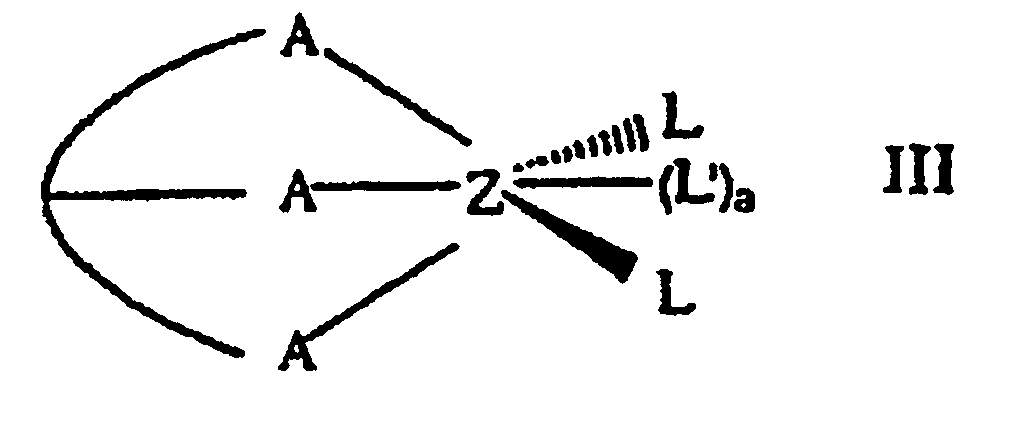
dans laquellei) chaque A représente indépendamment un atome d'oxygène, de soufre, de phosphore ou d'azote ;ii) Z représente un métal de transition choisi parmi Fe, Co, Ni, Ru, Rh, Pd, Os, Ir ou Pt à l'état d'oxydation +2 ou +3 ou Ti, Zr ou Hf à l'état d'oxydation +2, +3 ou +4 ;iii) chaque L et L' représente indépendamment un groupe ligand anionique choisi parmi le groupe constitué d'un hydrogène, d'un halogène, d'un radical à base d'hydrocarbure non substitué ou substitué, ou les deux L, conjointement avec Z, représentent une structure métallocyclique d'hydrocarbylène en C3-C24. - Composition de catalyseur selon la revendication 2 ou 3, dans laquelle chaque A représente un atome d'azote, chaque L et L' est choisi indépendamment parmi un atome d'halogène, ou un hydrocarbyle ou leurs mélanges, ou les deux L forment conjointement un groupe métallocyclique hydrocarbylène qui, avec Z, forme une structure cyclique à 3-7 chaînons.
- Composition de catalyseur selon la revendication 2 ou 3, dans laquelle "a" du composé d'aluminium vaut de 1 à 3 et chaque L du composé de métal de transition est un atome d'halogène.
- Composition de catalyseur selon la revendication 2 ou 3, dans laquelle au moins un L du complexe de métal de transition est choisi parmi un hydrocarbyle.
- Composition de catalyseur selon la revendication 4, dans laquelle Z est Ni, Pd, Fe ou Co.
- Composition de catalyseur selon la revendication 2, dans laquelle Z est Ni ou Pd et chaque L est indépendamment un chlore, un brome, un iode ou un groupe alkyle en C1-C8.
- Composition de catalyseur selon la revendication 3, dans laquelle Z est le fer ou le cobalt et chaque L est indépendamment un chlore, un brome, un iode ou un groupe alkyle en C1-C8.
- Composition de catalyseur selon la revendication 1, dans laquelle "a" du composé d'aluminium vaut 3.
- Composition de catalyseur selon la revendication 2, dans laquelle "a" du composé d'aluminium vaut 3.
- Composition de catalyseur selon la revendication 3, dans laquelle "a" du composé d'aluminium vaut 3.
- Composition de catalyseur selon la revendication 4, dans laquelle "a" du composé d'aluminium vaut 3.
- Composition de catalyseur selon la revendication 5, dans laquelle "a" du composé d'aluminium vaut 3.
- Composition de catalyseur selon la revendication 7, dans laquelle "a" du composé d'aluminium vaut 3.
- Composition de catalyseur selon la revendication 8, dans laquelle "a" du composé d'aluminium vaut 3.
- Composition de catalyseur selon la revendication 9, dans laquelle "a" du composé d'aluminium vaut 3.
- Composition de catalyseur selon la revendication 1, dans laquelle l'oxyde inorganique présente une teneur totale en matières volatiles de 0,1 à environ 4 pour cent en poids, une teneur en groupes hydroxyle en surface de 0,1 à 5 mmoles/g et une surface spécifique de 10 à 1000 m2/g.
- Composition de catalyseur selon la revendication 10, dans laquelle l'oxyde inorganique présente une teneur totale en matières volatiles de 0,1 à environ 4 pour cent en poids, une teneur en groupes hydroxyle en surface de 0,1 à 5 mmoles/g et une surface spécifique de 10 à 1000 m2/g.
- Composition de catalyseur selon la revendication 11, dans laquelle l'oxyde inorganique présente une teneur totale en matières volatiles de 0,1 à environ 4 pour cent en poids, une teneur en groupes hydroxyle en surface de 0,1 à 5 mmoles/g et une surface spécifique de 10 à 1000 m2/g.
- Composition de catalyseur selon la revendication 12, dans laquelle l'oxyde inorganique présente une teneur totale en matières volatiles de 0,1 à environ 4 pour cent en poids, une teneur en groupes hydroxyle en surface de 0,1 à 5 mmoles/g et une surface spécifique de 10 à 1000 m2/g.
- Composition de catalyseur selon la revendication 13, dans laquelle l'oxyde inorganique présente une teneur totale en matières volatiles de 0,1 à environ 4 pour cent en poids, une teneur en groupes hydroxyle en surface de 0,1 à 5 mmoles/g et une surface spécifique de 10 à 1000 m2/g.
- Composition de catalyseur selon la revendication 14, dans laquelle l'oxyde inorganique présente une teneur totale en matières volatiles de 0,1 à environ 4 pour cent en poids, une teneur en groupes hydroxyle en surface de 0,1 à 5 mmoles/g et une surface spécifique de 10 à 1000 m2/g.
- Composition de catalyseur selon la revendication 15, dans laquelle l'oxyde inorganique présente une teneur totale en matières volatiles de 0,1 à environ 4 pour cent en poids, une teneur en groupes hydroxyle en surface de 0,1 à 5 mmoles/g et une surface spécifique de 10 à 1000 m2/g.
- Composition de catalyseur selon la revendication 16, dans laquelle l'oxyde inorganique présente une teneur totale en matières volatiles de 0,1 à environ 4 pour cent en poids, une teneur en groupes hydroxyle en surface de 0,1 à 5 mmoles/g et une surface spécifique de 10 à 1000 m2/g.
- Composition de catalyseur selon la revendication 17, dans laquelle l'oxyde inorganique présente une teneur totale en matières volatiles de 0,1 à environ 4 pour cent en poids, une teneur en groupes hydroxyle en surface de 0,1 à 5 mmoles/g et une surface spécifique de 10 à 1000 m2/g.
- Composition de catalyseur selon la revendication 1, 10 ou 18 dans laquelle l'oxyde inorganique est la silice.
- Composition de catalyseur selon la revendication 1, 10 ou 18, dans laquelle ledit composé d'aluminium est présent en une quantité procurant d'environ 0,01 à 1,9 mmoles de Al par gramme d'oxyde inorganique ; ledit complexe de métal de transition est présent en une quantité procurant de 5 à 500 µmoles de métal de transition par gramme d'oxyde inorganique et le rapport molaire entre lesdits aluminium et métal de transition est de 1:1 à 20:1.
- Composition de catalyseur selon la revendication 27, dans laquelle ledit composé d'aluminium est présent en une quantité procurant d'environ 0,01 à 1,9 mmoles de Al par gramme d'oxyde inorganique ; ledit complexe de métal de transition est présent en une quantité procurant de 5 à 500 µmoles de métal de transition par gramme d'oxyde inorganique et le rapport molaire entre lesdits aluminium et métal de transition est de 1:1 à 20:1.
- Composition de catalyseur utile dans la polymérisation d'oléfines, formée par mise en contact, dans une seule zone de réaction et dans un liquide inerte, des composants comprenant :a) un composé d'aluminium représenté par la formule
AI(R)a(Q)b(D)c
dans laquelle
Al est un atome d'aluminium ;
R est un groupe hydrocarbyle ;
Q est un groupe hydrocarbyloxy ;
D est un hydrogène ou un halogène ;
et a, b et c sont chacun un entier valant de 0 à 3 à condition que la somme de a+b+c vaille 3 ;b) un oxyde inorganique renfermant de 0,01 à 12 mmoles/gramme de groupes hydroxyle en surface, choisi parmi la silice, l'alumine, l'oxyde de magnésium, l'oxyde de titane, l'oxyde de zirconium, l'oxyde de chrome, le phosphate d'alumine ou leurs mélanges ; etc) un complexe de métal de transition choisi parmi un complexe de métal de transition à ligand bidenté, un complexe de métal de transition à ligand tridenté et leurs mélanges, et où ledit métal de transition est choisi parmi Fe, Co, Ni, Ru, Rh, Pd, Os, Ir, Pt, Ti, Zr ou Hf ;lesdits composants étant présents en quantités procurant de 0,001 à 2,1 mmoles d'aluminium et de 1 à 1000 µmoles de métal de transition par gramme d'oxyde inorganique et un rapport molaire entre l'aluminium de a) et le métal de transition de c) de 1:1 à25:1. - Composition de catalyseur selon la revendication 30, dans laquelle le complexe de métal de transition est un complexe de métal de transition à ligand bidenté représenté par la formule

dans laquellei) chaque A représente indépendamment un atome d'oxygène, de soufre, de phosphore ou d'azote ;ii) Z représente un métal de transition choisi parmi Fe, Co, Ni, Ru, Rh, Pd, Os, Ir ou Pt à l'état d'oxydation +2 ou +3 ou Ti, Zr ou Hf à l'état d'oxydation +2, +3 ou +4 ;iii) chaque L et L' représente indépendamment un groupe ligand anionique choisi parmi le groupe constitué d'un hydrogène, d'un halogène, d'un radical à base d'hydrocarbure non substitué ou substitué, ou les deux L, conjointement avec Z, représentent une structure métallocyclique d'hydrocarbylène en C3-C24. - Composition de catalyseur selon la revendication 30, dans laquelle le complexe de métal de transition est un complexe de métal de transition à ligand tridenté représenté par la formule
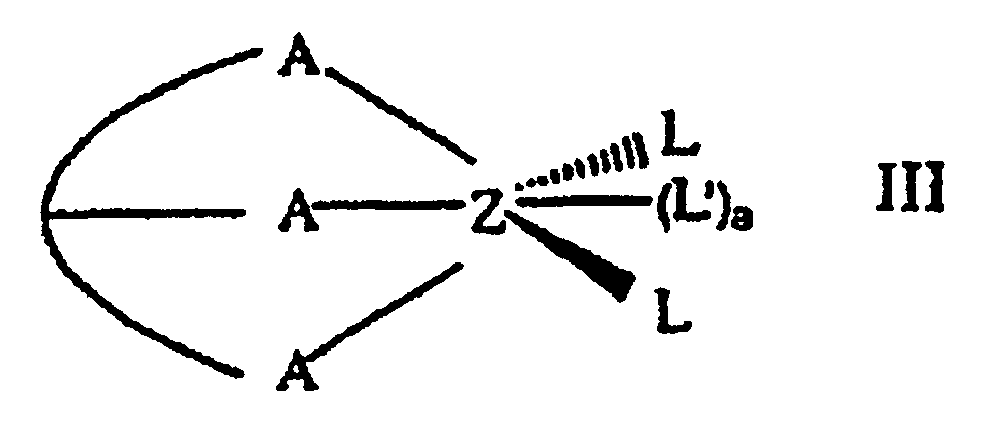
dans laquellei) chaque A représente indépendamment un atome d'oxygène, de soufre, de phosphore ou d'azote ;ii) Z représente un métal de transition choisi parmi Fe, Co, Ni, Ru, Rh, Pd, Os, Ir ou Pt à l'état d'oxydation +2 ou +3 ou Ti, Zr ou Hf à l'état d'oxydation +2, +3 ou +4 ;iii) chaque L et L' représente indépendamment un groupe ligand anionique choisi parmi le groupe constitué d'un hydrogène, d'un halogène, d'un radical à base d'hydrocarbure non substitué ou substitué, ou les deux L, conjointement avec Z, représentent une structure métallocyclique d'hydrocarbylène en C3-C24. - Composition de catalyseur selon la revendication 31 ou 32, dans laquelle chaque A représente un atome d'azote, chaque L et L' est choisi indépendamment parmi un atome d'halogène, ou un hydrocarbyle ou leurs mélanges, ou les deux L forment conjointement un groupe métallocyclique hydrocarbylène qui, avec Z, forme une structure cyclique à 3-7 chaînons.
- Composition de catalyseur selon la revendication 31 ou 32, dans laquelle "a" du composé d'aluminium vaut de 1 à 3 et chaque L du complexe de métal de transition est choisi parmi un atome d'halogène.
- Composition de catalyseur selon la revendication 31 ou 32, dans laquelle au moins un L du complexe de métal de transition est choisi parmi un hydrocarbyle.
- Composition de catalyseur selon la revendication 30, dans laquelle Z est Ni, Pd, Fe ou Co.
- Composition de catalyseur selon la revendication 31, dans laquelle Z est Ni ou Pd et chaque L est indépendamment un chlore, un brome, un iode ou un groupe alkyle en C1-C8.
- Composition de catalyseur selon la revendication 32, dans laquelle Z est le fer ou le cobalt et chaque L est indépendamment un chlore, un brome, un iode ou un groupe alkyle en C1-C8.
- Composition de catalyseur selon la revendication 30, dans laquelle "a" du composé d'aluminium vaut 3.
- Composition de catalyseur selon la revendication 31, dans laquelle "a" du composé d'aluminium vaut 3.
- Composition de catalyseur selon la revendication 32, dans laquelle "a" du composé d'aluminium vaut 3.
- Composition de catalyseur selon la revendication 33, dans laquelle "a" du composé d'aluminium vaut 3.
- Composition de catalyseur selon la revendication 34, dans laquelle "a" du composé d'aluminium vaut 3.
- Composition de catalyseur selon la revendication 35, dans laquelle "a" du composé d'aluminium vaut 3.
- Composition de catalyseur selon la revendication 36, dans laquelle "a" du composé d'aluminium vaut 3.
- Composition de catalyseur selon la revendication 38, dans laquelle "a" du composé d'aluminium vaut 3.
- Composition de catalyseur selon la revendication 30, dans laquelle l'oxyde inorganique présente une teneur totale en matières volatiles de 0,1 à environ 4 pour cent en poids, une teneur en groupes hydroxyle en surface de 0,1 à 5 mmoles/g et une surface spécifique de 10 à 1000 m2/g.
- Composition de catalyseur selon la revendication 39, dans laquelle l'oxyde inorganique présente une teneur totale en matières volatiles de 0,1 à environ 4 pour cent en poids, une teneur en groupes hydroxyle en surface de 0,1 à 5 mmoles/g et une surface spécifique de 10 à 1000 m2/g.
- Composition de catalyseur selon la revendication 40, dans laquelle l'oxyde inorganique présente une teneur totale en matières volatiles de 0,1 à environ 4 pour cent en poids, une teneur en groupes hydroxyle en surface de 0,1 à 5 mmoles/g et une surface spécifique de 10 à 1000 m2/g.
- Composition de catalyseur selon la revendication 41, dans laquelle l'oxyde inorganique présente une teneur totale en matières volatiles de 0,1 à environ 4 pour cent en poids, une teneur en groupes hydroxyle en surface de 0,1 à 5 mmoles/g et une surface spécifique de 10 à 1000 m2/g.
- Composition de catalyseur selon la revendication 42, dans laquelle l'oxyde inorganique présente une teneur totale en matières volatiles de 0,1 à environ 4 pour cent en poids, une teneur en groupes hydroxyle en surface de 0,1 à 5 mmoles/g et une surface spécifique de 10 à 1000 m2/g.
- Composition de catalyseur selon la revendication 43, dans laquelle l'oxyde inorganique présente une teneur totale en matières volatiles de 0,1 à environ 4 pour cent en poids, une teneur en groupes hydroxyle en surface de 0,1 à 5 mmoles/g et une surface spécifique de 10 à 1000 m2/g.
- Composition de catalyseur selon la revendication 44, dans laquelle l'oxyde inorganique présente une teneur totale en matières volatiles de 0,1 à environ 4 pour cent en poids, une teneur en groupes hydroxyle en surface de 0,1 à 5 mmoles/g et une surface spécifique de 10 à 1000 m2/g.
- Composition de catalyseur selon la revendication 45, dans laquelle l'oxyde inorganique présente une teneur totale en matières volatiles de 0,1 à environ 4 pour cent en poids, une teneur en groupes hydroxyle en surface de 0,1 à 5 mmoles/g et une surface spécifique de 10 à 1000 m2/g.
- Composition de catalyseur selon la revendication 46, dans laquelle l'oxyde inorganique présente une teneur totale en matières volatiles de 0,1 à environ 4 pour cent en poids, une teneur en groupes hydroxyle en surface de 0,1 à 5 mmoles/g et une surface spécifique de 10 à 1000 m2/g.
- Composition selon la revendication 30, 39 ou 47 dans laquelle l'oxyde inorganique est la silice.
- Composition de catalyseur selon la revendication 30, 39 ou 47, dans laquelle ledit composé d'aluminium est présent en une quantité procurant d'environ 0,01 à 1,9 mmoles de Al par gramme d'oxyde inorganique ; ledit complexe de métal de transition est présent en une quantité procurant de 5 à 500 µmoles de métal de transition par gramme d'oxyde inorganique et le rapport molaire entre lesdits aluminium et métal de transition est de 1:1 à 20:1.
- Composition de catalyseur selon la revendication 56, dans laquelle ledit composé d'aluminium est présent en une quantité procurant d'environ 0,01 à 1,9 mmole de Al par gramme d'oxyde inorganique ; ledit complexe de métal de transition est présent en une quantité procurant de 5 à 500 µmoles de métal de transition par gramme d'oxyde inorganique et le rapport molaire entre lesdits aluminium et métal de transition est de 1:1 à 20:1.
- Composition de catalyseur selon l'une quelconque des revendications 30 à 56, dans laquelle les composants sont introduits séquentiellement dans le liquide inerte dans l'ordre du premier composant a) suivi du composant b), puis suivi du composant c), puis un mélange solide est récupéré à partir du liquide.
- Composition de catalyseur selon l'une quelconque des revendications 30 à 56 dans laquelle les composants a), b), et c) sont introduits essentiellement simultanément dans le liquide inerte et y sont maintenus à des températures de 0° à 50°C et à la pression atmosphérique.
- Composition de catalyseur selon l'une quelconque des revendications 30 à 56, dans laquelle les composants a), b) et c) sont introduits directement dans une zone de réaction de polymérisation d'oléfines.
- Procédé de formation d'un catalyseur utile dans la polymérisation d'oléfines, comprenant la mise en contact, dans une zone de réaction et dans un liquide inerte, des composants :a) un composé d'aluminium représenté par la formule
Al(R)a(Q)b(D)c
dans laquelle
Al est un atome d'aluminium ;
R est un groupe hydrocarbyle ;
Q est un groupe hydrocarbyloxy ;
D est un hydrogène ou un halogène ;
et a, b et c sont chacun un entier valant de 0 à 3 à condition que la somme de a+b+c vaille 3 ;b) un oxyde inorganique renfermant de 0,01 à 12 mmoles/gramme de groupes hydroxyle en surface, choisi parmi la silice, l'alumine, l'oxyde de magnésium, l'oxyde de titane, l'oxyde de zirconium, l'oxyde de chrome, le phosphate d'alumine ou leurs mélanges ; etc) un complexe de métal de transition choisi parmi un complexe de métal de transition à ligand bidenté, un complexe de métal de transition à ligand tridenté et leurs mélanges, et où ledit métal de transition est choisi parmi Fe, Co, Ni, Ru, Rh, Pd, Os, Ir, Pt, Ti, Zr ou Hf ;lesdits composants étant présents en quantités procurant de 0,001 à 2,1 mmoles d'aluminium et de 1 à 1000 µmoles de métal de transition par gramme d'oxyde inorganique et un rapport molaire entre l'aluminium de a) et le métal de transition de c) de 1:1 à 25:1. - Procédé selon la revendication 62, dans lequel les composants a), b) et c) sont mis en contact essentiellement simultanément.
Applications Claiming Priority (3)
| Application Number | Priority Date | Filing Date | Title |
|---|---|---|---|
| US43180399A | 1999-11-01 | 1999-11-01 | |
| US431803 | 1999-11-01 | ||
| PCT/US2000/028920 WO2001032723A1 (fr) | 1999-11-01 | 2000-10-19 | Catalyseur de polymerisation d'olefines actif, heterogene, supporte et bi- ou tridente |
Publications (2)
| Publication Number | Publication Date |
|---|---|
| EP1237954A1 EP1237954A1 (fr) | 2002-09-11 |
| EP1237954B1 true EP1237954B1 (fr) | 2006-01-04 |
Family
ID=23713487
Family Applications (1)
| Application Number | Title | Priority Date | Filing Date |
|---|---|---|---|
| EP00972276A Expired - Lifetime EP1237954B1 (fr) | 1999-11-01 | 2000-10-19 | Catalyseur de polymerisation d'olefines actif, heterogene, supporte et bi- ou tridente |
Country Status (13)
| Country | Link |
|---|---|
| US (1) | US7291575B2 (fr) |
| EP (1) | EP1237954B1 (fr) |
| JP (2) | JP5258077B2 (fr) |
| KR (1) | KR100710963B1 (fr) |
| CN (1) | CN1178964C (fr) |
| AT (1) | ATE315053T1 (fr) |
| AU (1) | AU1096001A (fr) |
| BR (1) | BR0015192B1 (fr) |
| CA (1) | CA2389587C (fr) |
| DE (1) | DE60025386T2 (fr) |
| MX (1) | MXPA02004322A (fr) |
| SG (1) | SG97961A1 (fr) |
| WO (1) | WO2001032723A1 (fr) |
Families Citing this family (8)
| Publication number | Priority date | Publication date | Assignee | Title |
|---|---|---|---|---|
| EP1426385B1 (fr) * | 2001-07-23 | 2012-08-22 | Shanghai Institute Of Organic Chemistry, Chinese Academy Of Sciences | Catalyseurs de polymerisation ou de copolymerisation d'olefines, leur procede de preparation et leur utilisation |
| EP2174928B1 (fr) * | 2007-07-04 | 2015-03-11 | Mitsui Chemicals, Inc. | Composé complexe de métal de transition, catalyseur de oligomérisation d'oléfines contenant le composé et procédé servant à produire un oligomère d'oléfine effectué en présence du catalyseur |
| ES2409707T3 (es) | 2011-02-16 | 2013-06-27 | Linde Ag | Procedimiento de preparación de una composición catalítica para oligomerización de etileno y unidad de preformación de composición de catalizador respectiva |
| WO2016183006A1 (fr) | 2015-05-11 | 2016-11-17 | W.R. Grace & Co.-Conn. | Procédé de production d'une argile modifiée, catalyseur de polymérisation métallocène supporté, catalyseur produit et son utilisation |
| CN107864635B (zh) | 2015-05-11 | 2021-06-25 | 格雷斯公司 | 制备改性粘土的方法、所制备的改性粘土及其用途 |
| RU2749592C2 (ru) | 2016-12-30 | 2021-06-15 | Сабик Глобал Текнолоджис Б.В. | Способ получения раствора катализатора для селективного производства 1-гексена |
| ES2962319T3 (es) * | 2016-12-30 | 2024-03-18 | Sabic Global Technologies Bv | Método de preparación de un catalizador homogéneo para la producción selectiva de 1-hexeno |
| WO2020128668A1 (fr) * | 2018-12-17 | 2020-06-25 | King Abdullah University Of Science And Technology | Catalyseurs hétérogènes de type ru amine ou imine pour la production d'hydrogène à partir d'acide formique |
Family Cites Families (50)
| Publication number | Priority date | Publication date | Assignee | Title |
|---|---|---|---|---|
| US4234453A (en) * | 1976-09-20 | 1980-11-18 | National Petro Chemicals Corporation | Olefin polymerization catalyst |
| US4367992A (en) * | 1980-08-07 | 1983-01-11 | Westinghouse Electric Corp. | Broaching machine |
| US4375406A (en) * | 1981-01-21 | 1983-03-01 | Chevron Research Company | Fibrous clay compositions containing precalcined oxides |
| US4629712A (en) * | 1984-08-17 | 1986-12-16 | Michigan State University | Delaminated clay materials |
| US4637992A (en) | 1984-12-17 | 1987-01-20 | Shell Oil Company | Intercalated clay compositions |
| US4716205A (en) * | 1985-10-15 | 1987-12-29 | E. I. Du Pont De Nemours And Company | Nickel-catalyzed polymerization of ethylene |
| US4701432A (en) * | 1985-11-15 | 1987-10-20 | Exxon Chemical Patents Inc. | Supported polymerization catalyst |
| US4761391A (en) * | 1986-06-30 | 1988-08-02 | Union Oil Company Of California | Delaminated clays and their use in hydrocarbon conversion processes |
| US4995964A (en) * | 1987-03-05 | 1991-02-26 | Uop | Midbarrel hydrocracking process employing rare earth pillared clays |
| US5008228A (en) * | 1988-03-29 | 1991-04-16 | Exxon Chemical Patents Inc. | Method for preparing a silica gel supported metallocene-alumoxane catalyst |
| US4904631A (en) * | 1988-11-08 | 1990-02-27 | Exxon Chemical Patents, Inc. | Supported vanadium catalyst for polymerization of olefins and a process of preparing and using the same |
| US4981825A (en) * | 1989-09-12 | 1991-01-01 | Board Of Trustees Operating Michigan State University | Dried metal oxide and clay particle compositions and method for the preparation thereof |
| US5824297A (en) | 1990-06-25 | 1998-10-20 | Oncogene Science, Inc. | Tissue-derived tumor growth inhibitors, methods of preparation and uses thereof |
| US5038811A (en) * | 1990-11-26 | 1991-08-13 | Yvonne Johnson | Self-opening cuff for crutch |
| TW218884B (fr) | 1991-05-01 | 1994-01-11 | Mitsubishi Kakoki Kk | |
| US5399636A (en) * | 1993-06-11 | 1995-03-21 | Phillips Petroleum Company | Metallocenes and processes therefor and therewith |
| US5852148A (en) * | 1991-07-10 | 1998-12-22 | Minnesota Mining & Manufacturing Company | Perfluoroalkyl halides and derivatives |
| US5438027A (en) * | 1991-12-13 | 1995-08-01 | Phillips Petroleum Company | Chromium compounds and uses thereof |
| US5240894A (en) * | 1992-05-18 | 1993-08-31 | Exxon Chemical Patents Inc. | Method for making and using a supported metallocene catalyst system |
| US5238892A (en) * | 1992-06-15 | 1993-08-24 | Exxon Chemical Patents Inc. | Supported catalyst for 1-olefin(s) (co)polymerization |
| NL9201482A (nl) * | 1992-08-20 | 1994-03-16 | Dsm Nv | Epoxidatie Katalysator. |
| JP3289058B2 (ja) * | 1992-09-11 | 2002-06-04 | 工業技術院長 | 酵素を用いたエステル製造方法 |
| US5403809A (en) * | 1992-12-21 | 1995-04-04 | W. R. Grace & Co.-Conn. | Composite inorganic supports containing carbon for bioremediation |
| US5395808A (en) | 1992-12-21 | 1995-03-07 | W. R. Grace & Co.-Conn. | Inorganic supports for bioremediation |
| US5403799A (en) | 1992-12-21 | 1995-04-04 | W. R. Grace & Co.-Conn. | Process upset-resistant inorganic supports for bioremediation |
| EP0617052B1 (fr) * | 1993-03-23 | 1998-06-03 | Asahi Kasei Kogyo Kabushiki Kaisha | Catalyseur de polymérisation d'oléfines possédant un ligand multidenté |
| US5395805A (en) * | 1993-03-25 | 1995-03-07 | Regents Of The University Of California | Method for making monolithic metal oxide aerogels |
| EP0658576B1 (fr) * | 1993-12-17 | 1998-07-29 | Tosoh Corporation | Catalyseur de polymérisation d'oléfines et procédé de polymérisation d'oléfines |
| US5629253A (en) * | 1994-04-26 | 1997-05-13 | Exxon Chemical Patents, Inc. | Polymerization catalyst systems, their production and use |
| US5707913A (en) * | 1994-06-15 | 1998-01-13 | Basf Aktiengesellschaft | Amidinato catalyst systems for the polymerization of olefins |
| US5661097A (en) * | 1994-08-12 | 1997-08-26 | The Dow Chemical Company | Supported olefin polymerization catalyst |
| US5529965A (en) * | 1994-10-28 | 1996-06-25 | Exxon Chemical Patents Inc. | Polymerization catalyst systems, their production and use |
| US5880241A (en) * | 1995-01-24 | 1999-03-09 | E. I. Du Pont De Nemours And Company | Olefin polymers |
| EP0727443B1 (fr) * | 1995-02-20 | 2001-01-17 | Tosoh Corporation | Catalyseur pour la polymérisation des oléfines et méthode pour la préparation de polymères des oléfines |
| US5637660A (en) * | 1995-04-17 | 1997-06-10 | Lyondell Petrochemical Company | Polymerization of α-olefins with transition metal catalysts based on bidentate ligands containing pyridine or quinoline moiety |
| US5753577A (en) * | 1996-02-23 | 1998-05-19 | Tosoh Corporation | Olefin polymerization catalyst based on organometallic complexes and process for production of polyolefins using the catalyst |
| US5852146A (en) | 1996-06-27 | 1998-12-22 | Union Carbide Chemicals & Plastics Technology Corporation | Catalyst for the production of olefin polymers |
| IL129929A0 (en) | 1996-12-17 | 2000-02-29 | Du Pont | Polymerization of ethylene with specific iron or cobalt complexes novel pyridinebis (imines) and novel complexes of pyridinebis(imines) with iron and cobalt |
| US5807800A (en) * | 1997-02-11 | 1998-09-15 | Fina Technology, Inc. | Process for producing stereospecific polymers |
| US6103658A (en) * | 1997-03-10 | 2000-08-15 | Eastman Chemical Company | Olefin polymerization catalysts containing group 8-10 transition metals, processes employing such catalysts and polymers obtained therefrom |
| DE69802529T2 (de) * | 1997-06-09 | 2002-05-23 | E.I. Du Pont De Nemours And Co., Wilmington | Olefinpolymerisation |
| DE19746280A1 (de) * | 1997-10-20 | 1999-04-22 | Basf Ag | Verfahren zur Herstellung von geträgerten Übergangsmetallkatalysatoren |
| US6228792B1 (en) * | 1998-02-27 | 2001-05-08 | W. R. Grace & Co.-Conn. | Donor-modified olefin polymerization catalysts |
| US6521561B1 (en) * | 1998-05-01 | 2003-02-18 | President And Fellows Of Harvard College | Main-group metal based asymmetric catalysts and applications thereof |
| US6117959A (en) * | 1998-09-02 | 2000-09-12 | Eastman Chemical Company | Polyolefin catalysts |
| US6184171B1 (en) * | 1998-10-05 | 2001-02-06 | W.R. Grace & Co. -Conn | Supported bidentate and tridentate catalyst compositions and olefin polymerization using same |
| US6559090B1 (en) * | 1999-11-01 | 2003-05-06 | W. R. Grace & Co.-Conn. | Metallocene and constrained geometry catalyst systems employing agglomerated metal oxide/clay support-activator and method of their preparation |
| US6399535B1 (en) * | 1999-11-01 | 2002-06-04 | W. R. Grace & Co.-Conn. | Coordination catalyst systems employing agglomerated metal oxide/clay support-activator and method of their preparation |
| US6710007B2 (en) * | 2001-01-26 | 2004-03-23 | E. I. Du Pont De Nemours And Company | Polymerization of olefinic compounds |
| US6686306B2 (en) * | 2001-04-30 | 2004-02-03 | W.R. Grace & Co.- Conn. | Supported dual transition metal catalyst systems |
-
2000
- 2000-10-19 KR KR1020027005582A patent/KR100710963B1/ko not_active Expired - Fee Related
- 2000-10-19 AT AT00972276T patent/ATE315053T1/de not_active IP Right Cessation
- 2000-10-19 DE DE60025386T patent/DE60025386T2/de not_active Expired - Lifetime
- 2000-10-19 BR BRPI0015192-0A patent/BR0015192B1/pt not_active IP Right Cessation
- 2000-10-19 MX MXPA02004322A patent/MXPA02004322A/es active IP Right Grant
- 2000-10-19 CN CNB008180296A patent/CN1178964C/zh not_active Expired - Fee Related
- 2000-10-19 WO PCT/US2000/028920 patent/WO2001032723A1/fr not_active Ceased
- 2000-10-19 CA CA2389587A patent/CA2389587C/fr not_active Expired - Fee Related
- 2000-10-19 EP EP00972276A patent/EP1237954B1/fr not_active Expired - Lifetime
- 2000-10-19 AU AU10960/01A patent/AU1096001A/en not_active Abandoned
- 2000-10-19 JP JP2001535421A patent/JP5258077B2/ja not_active Expired - Fee Related
- 2000-10-27 SG SG200006183A patent/SG97961A1/en unknown
-
2003
- 2003-08-05 US US10/633,509 patent/US7291575B2/en not_active Expired - Fee Related
-
2011
- 2011-02-28 JP JP2011041986A patent/JP2011149025A/ja active Pending
Also Published As
| Publication number | Publication date |
|---|---|
| CA2389587A1 (fr) | 2001-05-10 |
| SG97961A1 (en) | 2003-08-20 |
| KR20020091051A (ko) | 2002-12-05 |
| JP2011149025A (ja) | 2011-08-04 |
| JP2003513165A (ja) | 2003-04-08 |
| AU1096001A (en) | 2001-05-14 |
| BR0015192B1 (pt) | 2010-11-03 |
| US20040029719A1 (en) | 2004-02-12 |
| CA2389587C (fr) | 2010-05-25 |
| BR0015192A (pt) | 2003-06-17 |
| CN1178964C (zh) | 2004-12-08 |
| KR100710963B1 (ko) | 2007-04-24 |
| WO2001032723A1 (fr) | 2001-05-10 |
| DE60025386T2 (de) | 2006-09-21 |
| ATE315053T1 (de) | 2006-02-15 |
| CN1414982A (zh) | 2003-04-30 |
| DE60025386D1 (de) | 2006-03-30 |
| EP1237954A1 (fr) | 2002-09-11 |
| MXPA02004322A (es) | 2002-11-07 |
| JP5258077B2 (ja) | 2013-08-07 |
| US7291575B2 (en) | 2007-11-06 |
Similar Documents
| Publication | Publication Date | Title |
|---|---|---|
| EP1169361B1 (fr) | Catalyseur de polymerisation pyridine-imine | |
| US6461994B1 (en) | Polymerization catalyst | |
| EP1091968B1 (fr) | Procede permettant de produire des precurseurs de catalyseurs demi-sandwich substitues | |
| US6184171B1 (en) | Supported bidentate and tridentate catalyst compositions and olefin polymerization using same | |
| JP2011149025A (ja) | オレフィン重合用の活性をもった二配座不均一担持触媒 | |
| CN102059154A (zh) | 负载型非茂金属催化剂、其制备方法及其应用 | |
| JP4405157B2 (ja) | 重合触媒 | |
| EP1099714A1 (fr) | Catalyseur de polymérisation | |
| US20030216248A1 (en) | Catalyst composition and method of polymerization | |
| US20010044374A1 (en) | Catalyst preparation method | |
| US6492293B1 (en) | Polymerisation catalyst | |
| EP1246850A1 (fr) | Procede de preparation de polyolefines | |
| JP2004518780A (ja) | カチオン触媒系 | |
| WO2000047586A1 (fr) | Complexes metalliques utiles en tant que catalyseur de polymerisation | |
| WO1999015569A1 (fr) | Catalyseurs de polymerisation et procedes correspondants |
Legal Events
| Date | Code | Title | Description |
|---|---|---|---|
| PUAI | Public reference made under article 153(3) epc to a published international application that has entered the european phase |
Free format text: ORIGINAL CODE: 0009012 |
|
| 17P | Request for examination filed |
Effective date: 20020531 |
|
| AK | Designated contracting states |
Kind code of ref document: A1 Designated state(s): AT BE CH CY DE DK ES FI FR GB GR IE IT LI LU MC NL PT SE |
|
| AX | Request for extension of the european patent |
Free format text: AL;LT;LV;MK;RO;SI |
|
| 17Q | First examination report despatched |
Effective date: 20030704 |
|
| GRAP | Despatch of communication of intention to grant a patent |
Free format text: ORIGINAL CODE: EPIDOSNIGR1 |
|
| GRAS | Grant fee paid |
Free format text: ORIGINAL CODE: EPIDOSNIGR3 |
|
| GRAA | (expected) grant |
Free format text: ORIGINAL CODE: 0009210 |
|
| AK | Designated contracting states |
Kind code of ref document: B1 Designated state(s): AT BE CH CY DE DK ES FI FR GB GR IE IT LI LU MC NL PT SE |
|
| PG25 | Lapsed in a contracting state [announced via postgrant information from national office to epo] |
Ref country code: CH Free format text: LAPSE BECAUSE OF FAILURE TO SUBMIT A TRANSLATION OF THE DESCRIPTION OR TO PAY THE FEE WITHIN THE PRESCRIBED TIME-LIMIT Effective date: 20060104 Ref country code: IT Free format text: LAPSE BECAUSE OF FAILURE TO SUBMIT A TRANSLATION OF THE DESCRIPTION OR TO PAY THE FEE WITHIN THE PRESCRIBED TIME-LIMIT;WARNING: LAPSES OF ITALIAN PATENTS WITH EFFECTIVE DATE BEFORE 2007 MAY HAVE OCCURRED AT ANY TIME BEFORE 2007. THE CORRECT EFFECTIVE DATE MAY BE DIFFERENT FROM THE ONE RECORDED. Effective date: 20060104 Ref country code: FI Free format text: LAPSE BECAUSE OF FAILURE TO SUBMIT A TRANSLATION OF THE DESCRIPTION OR TO PAY THE FEE WITHIN THE PRESCRIBED TIME-LIMIT Effective date: 20060104 Ref country code: AT Free format text: LAPSE BECAUSE OF FAILURE TO SUBMIT A TRANSLATION OF THE DESCRIPTION OR TO PAY THE FEE WITHIN THE PRESCRIBED TIME-LIMIT Effective date: 20060104 Ref country code: BE Free format text: LAPSE BECAUSE OF FAILURE TO SUBMIT A TRANSLATION OF THE DESCRIPTION OR TO PAY THE FEE WITHIN THE PRESCRIBED TIME-LIMIT Effective date: 20060104 Ref country code: LI Free format text: LAPSE BECAUSE OF FAILURE TO SUBMIT A TRANSLATION OF THE DESCRIPTION OR TO PAY THE FEE WITHIN THE PRESCRIBED TIME-LIMIT Effective date: 20060104 |
|
| REG | Reference to a national code |
Ref country code: GB Ref legal event code: FG4D |
|
| REG | Reference to a national code |
Ref country code: CH Ref legal event code: EP |
|
| REG | Reference to a national code |
Ref country code: IE Ref legal event code: FG4D |
|
| REF | Corresponds to: |
Ref document number: 60025386 Country of ref document: DE Date of ref document: 20060330 Kind code of ref document: P |
|
| PG25 | Lapsed in a contracting state [announced via postgrant information from national office to epo] |
Ref country code: DK Free format text: LAPSE BECAUSE OF FAILURE TO SUBMIT A TRANSLATION OF THE DESCRIPTION OR TO PAY THE FEE WITHIN THE PRESCRIBED TIME-LIMIT Effective date: 20060404 Ref country code: SE Free format text: LAPSE BECAUSE OF FAILURE TO SUBMIT A TRANSLATION OF THE DESCRIPTION OR TO PAY THE FEE WITHIN THE PRESCRIBED TIME-LIMIT Effective date: 20060404 |
|
| PG25 | Lapsed in a contracting state [announced via postgrant information from national office to epo] |
Ref country code: ES Free format text: LAPSE BECAUSE OF FAILURE TO SUBMIT A TRANSLATION OF THE DESCRIPTION OR TO PAY THE FEE WITHIN THE PRESCRIBED TIME-LIMIT Effective date: 20060415 |
|
| PG25 | Lapsed in a contracting state [announced via postgrant information from national office to epo] |
Ref country code: PT Free format text: LAPSE BECAUSE OF FAILURE TO SUBMIT A TRANSLATION OF THE DESCRIPTION OR TO PAY THE FEE WITHIN THE PRESCRIBED TIME-LIMIT Effective date: 20060605 |
|
| REG | Reference to a national code |
Ref country code: CH Ref legal event code: PL |
|
| ET | Fr: translation filed | ||
| PG25 | Lapsed in a contracting state [announced via postgrant information from national office to epo] |
Ref country code: IE Free format text: LAPSE BECAUSE OF NON-PAYMENT OF DUE FEES Effective date: 20061019 |
|
| PG25 | Lapsed in a contracting state [announced via postgrant information from national office to epo] |
Ref country code: MC Free format text: LAPSE BECAUSE OF NON-PAYMENT OF DUE FEES Effective date: 20061031 |
|
| PLBE | No opposition filed within time limit |
Free format text: ORIGINAL CODE: 0009261 |
|
| STAA | Information on the status of an ep patent application or granted ep patent |
Free format text: STATUS: NO OPPOSITION FILED WITHIN TIME LIMIT |
|
| 26N | No opposition filed |
Effective date: 20061005 |
|
| PG25 | Lapsed in a contracting state [announced via postgrant information from national office to epo] |
Ref country code: GR Free format text: LAPSE BECAUSE OF FAILURE TO SUBMIT A TRANSLATION OF THE DESCRIPTION OR TO PAY THE FEE WITHIN THE PRESCRIBED TIME-LIMIT Effective date: 20060405 |
|
| PG25 | Lapsed in a contracting state [announced via postgrant information from national office to epo] |
Ref country code: LU Free format text: LAPSE BECAUSE OF NON-PAYMENT OF DUE FEES Effective date: 20061019 |
|
| PG25 | Lapsed in a contracting state [announced via postgrant information from national office to epo] |
Ref country code: CY Free format text: LAPSE BECAUSE OF FAILURE TO SUBMIT A TRANSLATION OF THE DESCRIPTION OR TO PAY THE FEE WITHIN THE PRESCRIBED TIME-LIMIT Effective date: 20060104 |
|
| REG | Reference to a national code |
Ref country code: FR Ref legal event code: PLFP Year of fee payment: 16 |
|
| PGFP | Annual fee paid to national office [announced via postgrant information from national office to epo] |
Ref country code: GB Payment date: 20151027 Year of fee payment: 16 |
|
| PGFP | Annual fee paid to national office [announced via postgrant information from national office to epo] |
Ref country code: NL Payment date: 20151026 Year of fee payment: 16 |
|
| REG | Reference to a national code |
Ref country code: FR Ref legal event code: PLFP Year of fee payment: 17 |
|
| PGFP | Annual fee paid to national office [announced via postgrant information from national office to epo] |
Ref country code: DE Payment date: 20161027 Year of fee payment: 17 Ref country code: FR Payment date: 20161025 Year of fee payment: 17 |
|
| PGFP | Annual fee paid to national office [announced via postgrant information from national office to epo] |
Ref country code: IT Payment date: 20161024 Year of fee payment: 17 |
|
| REG | Reference to a national code |
Ref country code: NL Ref legal event code: MM Effective date: 20161101 |
|
| GBPC | Gb: european patent ceased through non-payment of renewal fee |
Effective date: 20161019 |
|
| PG25 | Lapsed in a contracting state [announced via postgrant information from national office to epo] |
Ref country code: GB Free format text: LAPSE BECAUSE OF NON-PAYMENT OF DUE FEES Effective date: 20161019 |
|
| PG25 | Lapsed in a contracting state [announced via postgrant information from national office to epo] |
Ref country code: NL Free format text: LAPSE BECAUSE OF NON-PAYMENT OF DUE FEES Effective date: 20161101 |
|
| REG | Reference to a national code |
Ref country code: DE Ref legal event code: R119 Ref document number: 60025386 Country of ref document: DE |
|
| REG | Reference to a national code |
Ref country code: FR Ref legal event code: ST Effective date: 20180629 |
|
| PG25 | Lapsed in a contracting state [announced via postgrant information from national office to epo] |
Ref country code: DE Free format text: LAPSE BECAUSE OF NON-PAYMENT OF DUE FEES Effective date: 20180501 |
|
| PG25 | Lapsed in a contracting state [announced via postgrant information from national office to epo] |
Ref country code: FR Free format text: LAPSE BECAUSE OF NON-PAYMENT OF DUE FEES Effective date: 20171031 |
|
| PG25 | Lapsed in a contracting state [announced via postgrant information from national office to epo] |
Ref country code: IT Free format text: LAPSE BECAUSE OF NON-PAYMENT OF DUE FEES Effective date: 20171019 |