EP1232167B1 - Synthetisches oligomannosid, seine herstellung und verwendung - Google Patents
Synthetisches oligomannosid, seine herstellung und verwendung Download PDFInfo
- Publication number
- EP1232167B1 EP1232167B1 EP00985310A EP00985310A EP1232167B1 EP 1232167 B1 EP1232167 B1 EP 1232167B1 EP 00985310 A EP00985310 A EP 00985310A EP 00985310 A EP00985310 A EP 00985310A EP 1232167 B1 EP1232167 B1 EP 1232167B1
- Authority
- EP
- European Patent Office
- Prior art keywords
- man
- group
- manα
- oligomannoside
- gem
- Prior art date
- Legal status (The legal status is an assumption and is not a legal conclusion. Google has not performed a legal analysis and makes no representation as to the accuracy of the status listed.)
- Expired - Lifetime
Links
- 0 **[C@](*C(COCc1ccccc1)[C@](C1*)OCc2ccccc2)C1O[C@@](*C(COCc1ccccc1)[C@@](*)C1OCc2ccccc2)C1C=O Chemical compound **[C@](*C(COCc1ccccc1)[C@](C1*)OCc2ccccc2)C1O[C@@](*C(COCc1ccccc1)[C@@](*)C1OCc2ccccc2)C1C=O 0.000 description 2
Images


Classifications
-
- C—CHEMISTRY; METALLURGY
- C07—ORGANIC CHEMISTRY
- C07H—SUGARS; DERIVATIVES THEREOF; NUCLEOSIDES; NUCLEOTIDES; NUCLEIC ACIDS
- C07H3/00—Compounds containing only hydrogen atoms and saccharide radicals having only carbon, hydrogen, and oxygen atoms
- C07H3/06—Oligosaccharides, i.e. having three to five saccharide radicals attached to each other by glycosidic linkages
-
- A—HUMAN NECESSITIES
- A61—MEDICAL OR VETERINARY SCIENCE; HYGIENE
- A61P—SPECIFIC THERAPEUTIC ACTIVITY OF CHEMICAL COMPOUNDS OR MEDICINAL PREPARATIONS
- A61P31/00—Antiinfectives, i.e. antibiotics, antiseptics, chemotherapeutics
- A61P31/10—Antimycotics
-
- A—HUMAN NECESSITIES
- A61—MEDICAL OR VETERINARY SCIENCE; HYGIENE
- A61P—SPECIFIC THERAPEUTIC ACTIVITY OF CHEMICAL COMPOUNDS OR MEDICINAL PREPARATIONS
- A61P31/00—Antiinfectives, i.e. antibiotics, antiseptics, chemotherapeutics
- A61P31/12—Antivirals
-
- C—CHEMISTRY; METALLURGY
- C07—ORGANIC CHEMISTRY
- C07K—PEPTIDES
- C07K16/00—Immunoglobulins [IG], e.g. monoclonal or polyclonal antibodies
- C07K16/18—Immunoglobulins [IG], e.g. monoclonal or polyclonal antibodies against material from animals or humans
Definitions
- compositions comprising synthetic oligomannosides, their preparation, and their use for the preparation of a medicament and the prevention of infections.
- Candida albicans as in all fungi, a considerable part of the metabolism is derived towards the synthesis of parietal polysaccharides, the organization of which finely modulates the adaptation of the cell to the medium.
- Many groups have established the preponderance of C. albicans mannan in the pathophysiology of candidiasis. It has thus been shown that the various interactions of mannan with the humoral and cellular components of the host depend on a specificity that is dependent on the oligomannoside sequences synthesized by the yeast. It is the anomeric binding of mannose residues and the length of the oligomannoside chain that determines the nature of the interaction that conditions the outcome of the infection.
- synthetic oligomannosides mimic the biological properties of the natural sugars of C. albicans in particular as regards the antigenicity and the adhesion to the mammalian cells and molecules and the stimulation cellular.
- synthetic oligomannosides could be used successfully for the sensitization of microtitration plates. by covalent coupling for the detection of antibodies specific for each structure whose diagnostic and prognostic significance is different ( Jouault, T., 1997, Clin. Diagn. Lab. Immunol. 4 (3): 328-33 ).
- the present invention therefore relates to a pharmaceutical composition
- a pharmaceutical composition comprising at least one oligomannoside produced by chemical synthesis homologous to an oligomannoside of the wall of an infectious or pathogenic organism.
- said organism is a yeast, a fungus, a virus, a bacterium whose cell envelope contains oligomannosides.
- cell envelope is meant both the membrane, the wall, the cell capsule.
- the invention particularly relates to yeast, and specifically Candida albicans or Saccharomyces cerevisiae.
- homologue means that the synthetic oligomannosides of the invention have the same mannose units according to the same sequence of ⁇ or ⁇ bonds, (1-2), (1-3), (1-6), than the natural oligomannosides of yeasts, in particular Candida albicans or Saccharomyces cerevisiae, but are devoid of other cellular components, in particular proteins, sugars, lipids, which are inevitably associated with the natural oligomannosides described in the prior art.
- oligomannoside of the invention By derivative of a synthetic oligomannoside of the invention is meant an oligomannoside in which one or more of the functional groups are substituted, for example by a protective group, or else synthetic oligomannosides conjugated to a group of binding, also referred to as a connector, for grafting onto a support such as a microtiter plate.
- R group representing a connector is useful for the preparation of tests for detecting the presence in a subject of antibodies specific for certain oligomannosides for the diagnosis of infection with C. albicans or chronic inflammatory diseases of the subject. intestine and including Crohn's disease as will be described later.
- the connector can be any chemical group which can couple, preferably covalently but also by other bonds, for example of the hydrophobic type, the synthetic oligomannosides on a support such as a microtiter plate.
- the covalent coupling offers the advantage of using a robust surface adapted to the immunoassay test, it allows a better orientation of the synthetic oligomannosides and also to have a higher density of epitopes and avoids the problems of recognition of the antibody because the antigenic sites are easily accessible.
- Connectors having a carboxylic acid function which can be activated for coupling on a surface which is itself activated to react with the synthetic oligomannosides are preferred.
- a connector mention may be made of the Lemieux RU connector ( Lemieux, RU et al., 1975, J. Am. Chem. Soc. 97, 4076-4083 ), where R represents a group of formula: -CH 2 - (CH 2 ) 7 -CO 2 H.
- Connectors carrying a carboxylic acid group can be activated by a carbodiimide to provide an activated ester that allows the formation of amide linkages with primary amine groups at the surface of the support.
- the water-soluble carbodiimide (EDC: 1-ethyl-3- (3-dimethylaminopropyl) carbodiimide) is used to activate the -COOH groups of the synthetic oligomannoside in the presence of sulfo-N-hydroxy succinimide (sulfo-NHS: N -hydroxysuccinimidine).
- sulfo-NHS effectively suppresses the hydrolysis of the activated product and allows the attachment of the synthetic oligomannoside to the surface of the plate already sensitized by the -NH 2 group.
- the synthetic oligomannosides of the invention may be prepared by condensation of monosaccharides or disaccharides protected, preferably by condensation of protected dimannosides according to a diblock strategy.
- dimannosides above can be used for the preparation of tetramannosides of the invention.
- the tetramanoside D-Man ⁇ (1-2) D-Man ⁇ (1-2) D-Man ⁇ (1-2) D-Man, of formula (II) can be prepared from Man ⁇ blocks (1-2) Man of formula (IV), one of which is a intermediate diblock wherein R2 is a leaving group, for example R2 is -C (NH) -CCl 3 , and the other is a terminal diblock wherein R2 is -SPh.
- the tetramanoside D-Man ⁇ (1-3) D-Man ⁇ (1-2) D-Man ⁇ (1-2) D-Man ⁇ (1-2), of formula (III) can be prepared from a Man ⁇ diblock (1-3) Man of formula (VI) and diblock Man ⁇ (1-2) Man of formula (IV), the intermediate diblock is Man ⁇ (1-3) Man of formula (VI) in which R2 is a leaving group, for example R2 is -SPh, and the terminal diblock is Man ⁇ (1-2) Man in which R2 represents the group R defined in formula (III).
- compositions comprising at least one synthetic oligomannoside of the invention are useful for the in vitro detection on a sample of a patient of the presence of an infection by an infectious or pathogenic organism, in particular a yeast, a fungus, a virus, a bacterium whose cell envelope contains oligomannosides.
- a method consists in contacting at least one composition comprising a previously defined synthetic oligomannoside advantageously previously fixed on a solid support with a biological sample capable of containing antibodies directed against the infectious or pathogenic organism, and then the detection by any means appropriate antigen-antibody complex.
- the invention relates more particularly to the diagnosis of infection with C. albicans and S. cerevisiae, or in the case of Crohn's disease, the development of anti- S. cerevisiae antibodies .
- D-Man ⁇ (1-2) D-Man ⁇ (1-2) D-Man ⁇ (1-2) D-Man of formula (I) and D-Man ⁇ (1- 2) D-Man ⁇ (1-2) D-Man ⁇ (1-2) D-Man, of formula (II) allow specific detection of infection with C. albicans, thus the diagnosis of candidiasis.
- the inventors have also surprisingly demonstrated the tetramannoside D-Man ⁇ (1-3) D-Man ⁇ (1-2) D-Man ⁇ (1-2) D-Man ⁇ (1-2) of formula ( III) could be used in ASCA tests for the diagnosis or prediction of viral hepatitis, autoimmune diseases or inflammatory diseases.
- the subject of the invention is therefore a method for detecting anti-oligomannoside antibodies for the diagnosis or the prediction of an infectious and / or inflammatory pathology, characterized in that at least one synthetic oligomannoside described is brought into contact with one another. previously with a biological sample.
- the invention relates to a method for detecting S. cerevisiae antibodies for the diagnosis of Crohn's disease or viral hepatitis characterized in that at least one oligomannoside of at least one oligomannoside is contacted. synthesis described above with a biological sample.
- the synthetic oligomannoside is the tetramannoside D-Man ⁇ (1-3) D-Man ⁇ (1-2) D-Man ⁇ (1-2) D-Man ⁇ (1-2) of formula (III ).
- the invention also relates to a kit for the diagnosis on a biological sample of a patient of an infection by an infectious or pathogenic organism, in particular a yeast, a fungus, a virus, a bacterium whose cell envelope is dominated by oligomannosides.
- a kit for the diagnosis on a biological sample of a patient of an infection by an infectious or pathogenic organism, in particular a yeast, a fungus, a virus, a bacterium whose cell envelope is dominated by oligomannosides.
- a kit comprises a composition comprising at least one synthetic oligomannoside defined above, advantageously fixed on a support solid, such as an ELISA plate, means for detecting the formation of antigen-antibody complexes, and possibly control reagents.
- the research work carried out in the context of the invention has made it possible to discover that the synthetic oligomannosides defined above can be used to inhibit colonization by infectious or pathogenic agents whose membranes contain oligomannosides.
- yeasts of the genus Candida use surface sugars of their wall to attach to the cells of their host, cells of the vagina or the digestive tract.
- sugars in particular yeasts, protect against infections, in particular those determined by C. albicans, or even other microbes expressing the same sugars, for example LPS of Salmonella, E. coli).
- tetramannoside D-Man ⁇ (1-2) D-Man ⁇ (1-2) D-Man ⁇ (1-2) D-Man of formula (I) reduces colonization by C. albicans in a very significant way.
- tetramannoside D-Man ⁇ (1-2) D-Man ⁇ (1-2) D-Man ⁇ (1-2) D-Man of formula (I) has proved very protective in experimental models of digestive colonization by C. albicans.
- Therapeutic applications of the synthetic oligomannosides described above or conjugates formed of a synthetic oligomannoside coupled to a substance capable of rendering immunogenic sugars, such as, for example, tetanus toxoid, as well as monoclonal or polyclonal antibodies directed specifically against said conjugates are also described. These antibodies are useful as research tools but also for the development of diagnostic tools.
- the invention relates to pharmaceutical compositions comprising as active agent at least one synthetic oligomannoside defined above, conjugated or otherwise, associated in the composition with a pharmaceutically acceptable vehicle.
- These pharmaceutical compositions may be applied locally or generally so as to induce colonization inhibition or protection by local or general immunization depending on the type of infection observed.
- the invention more specifically contemplates conjugates formed from D-Man ⁇ (1-2) D-Man ⁇ (1-2) D-Man ⁇ (1-2) D-Man.
- the inventors have demonstrated the inhibitory properties of non-conjugated oligomannosides, particularly in cases of intestinal colonization by C. albicans and in vaginal candidiasis cases.
- the Figures 5 and 6 report the tests performed respectively with D-Man ⁇ (1-2) D-Man ⁇ (1-2) D-Man ⁇ (1-2) D-Man ⁇ (1-2) and D-Man ⁇ ( 1-2) D-Man ⁇ (1-2) D-Man ⁇ (1-2) D-Man on factor-5 specific for ⁇ -1,2 oligomannosides and factor-1 reacting with ⁇ -1,2 oligomannosides with respect to mannotetraoses of synthesis of anomers ⁇ and ⁇ -1,2.
- the figure 7 represents the reactivity of D-Man ⁇ (1-2) D-Man ⁇ (1-2) D-Man ⁇ (1-2) D-Man with several monoclonal antibodies.
- the figure 8 represents the antigenic reactivity of the synthetic mannotetraose D-Man ⁇ (1-3) D-Man ⁇ (1-2) D-Man ⁇ (1-2) D-Man with respect to the antigenic factor 34.
- the figure 9 represents the serological reactivity of a pool of sera from patients with Crohn's disease to synthetic mannotetraosis.
- the figure 10 reports the inhibition of colonization in a model of experimental vaginal candidiasis of the spleen by the tetramannosides of the invention.
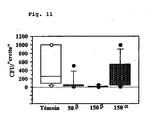
- the figure 11 represents the comparison of digestive colonization with strain 10261 as a function of the prior administration of synthetic sugar. Digestive colonization was evaluated 7 days after inoculation by measuring CFU / poop for young mice that received water (control), 50 ⁇ g (50 ⁇ ) or 150 ⁇ g (150 ⁇ ) of ⁇ Man or 150 ⁇ g of ⁇ Man (50 ⁇ ).
- Reaction (a) is carried out under the following conditions: BnBr, Bu 2 SnO, NBu 4 Br, toluene, 110 ° C.
- Reaction (b) is carried out under the following conditions: TBDMSOTf, and 3 N, CH 2 Cl 2 .
- Reaction (c) is carried out under the following conditions: MCPBA, CH 2 Cl 2 , -40 ° C.
- Disaccharides and tetrasaccharides carrying a thiophenyl are first prepared by condensing the compounds 2 and 4.
- the condensation between 2 and 4 gives the disaccharide 5, it can be activated sulfoxide to give the compound 7 or deprotect in position 2 ' to give the acceptor 6.
- the condensation of compounds 6 and 7 gives the key tetrasaccharide 8.
- Reaction (d) is carried out under the following conditions: Tf 2 O, 2,6-diterbutyl-pyridine or 2,6-diterbutyl-4-methylpyridine (DBMP), CH 2 Cl 2 , -78 ° C.
- Reaction (e) is carried out under the following conditions: b) NBu 4 F.3H 2 O, THF.
- Reaction (f) is carried out under the following conditions: MCPBA, -40 ° C, CH 2 Cl 2 .
- Reaction (g) is carried out under the following conditions: Tf 2 O, DBMP, CH 2 Cl 2 , -0 ° C.
- 8-methoxycarbonyloctanol was chosen as the connector.
- the latter can be prepared according to Lemieux ( Lemieux, RU et al. 1975, J. Am. Chem. Soc., 97, 4076-4083 ) from azelaic acid or better by ozonolysis of methyl oleate and in situ reduction of the aldehyde formed by NaBH 4 ( Gerlach, H. et al. 1978, Helv. Chim. Acta, 61, 1226-1231 )
- This compound 8 is then converted to 9 by removal of the silyl by NBu4NF, reaction with water in the presence of NBS, and then the tetramannoside of formula (I) in which R is H by deprotection of benzyls and benzylidenes.
- Reaction (h) is carried out under the following conditions: NBu 4 F.3H 2 O, THF; then NBS, H 2 O, acetone.
- Reaction (i) is carried out under the following conditions: NBS, TfOH, 8-methoxycarbonyloctanol, 4 Angstrom molecular sieve, CH 2 Cl 2 .
- Reaction (j) is carried out under the following conditions: H 2 , Pd / C, MeOH, AcOEt.
- the reaction (k) is carried out under the following conditions: 1-NBu 4 NF 3 H 2 O, THF; 2-H 2 , Pd / C, MeOH, AcOEt, 3-NaOH, THF, H 2 O.
- the figure 2 in the appendix represents the reaction scheme of the preparation of D-Man ⁇ (1-2) D-Man ⁇ (1-2) D-Man ⁇ (1-2) D-Man of formula (II).
- a block strategy was used.
- a thiophenyl group intermediately protects the anomeric carbon.
- the compound 11 conducts according to the reaction carried out with the compounds 12 or 13, which are condensed to the disaccharide 14 .
- reaction (a ') is carried out under the following conditions: CH 3 COOH, H 2 O (80/20) and then CCl 3 CN, DBU, CH 2 Cl 2 , 0 ° C.
- Reaction (b ') is carried out under the following conditions: PhSH, HgBr 2 , CH 3 CN, 80 ° C then CH 3 0Na, CH 3 OH.
- reaction (c ') is carried out under the following conditions: TMSOTf, 4 Angstrom molecular sieve, CH 2 Cl 2 .
- the disaccharide 14 is converted to disaccharides 15 and 16 which are condensed to obtain the key tetrasaccharide 17.
- reaction (d ') is performed under the following conditions: NBS, water, acetone, and CCl 3 CN, DBU, CH 2 Cl 2.
- reaction (e ') is carried out under the following conditions: MeONa, MeOH.
- the reaction (f ') is carried out under the following conditions: 1) BF 3 . And 2 O, 4 Angstrom molecular sieve, CH 2 Cl 2 ; 2) MeONa / MeOH.
- the key tetrasaccharide 17 may or may not be functionalized in one of the compounds 18 or 19 and gives after deprotection tetramannoside of formula (II) wherein R is H or - (CH 2 ) 8 -Co 2 Me.
- reaction (g ') is carried out under the following conditions: NBS, TfOH, 8-methoxycarbonyloctanol, 4 Angstrom molecular sieve, CH 2 Cl 2 , -15 ° C.
- reaction (h ') is carried out under the following conditions: NBS, water, acetone.
- Reaction (I ') is carried out under the following conditions: 1-NaOH, THF, water, 2-H 2 , Pd / C, MeOH.
- Reaction (j ') is carried out under the following conditions: H 2 , Pd / C, MeOH.
- the figure 3 in the appendix represents the reaction scheme of the preparation of D-Man ⁇ (1-3) D-Man ⁇ (1-2) D-Man ⁇ (1-2) D-Man ⁇ (1-2) of formula (III) ). This is prepared by condensation of an ⁇ (1-3) block with a leaving group SPh and an ⁇ (1-2) block, one of which with a connector according to the reactions (a "') to (d"'). ) below.
- Reaction (a "') is performed under the following conditions: TfOTMS, molecular sieve 4 Angstrom, CH 2 Cl 2, -20 ° C.
- reaction (b "') is carried out under the following conditions: MeONa, MeOH.
- reaction (c "') is carried out under the conditions NIS, TfOH, 4 Angstrom molecular sieve, CH 2 Cl 2 , -20 ° C.
- reaction (d "') is carried out under the following conditions: 1-NaOH, THF, water, 2-H 2 , Pd / C, MeOH, AcOEt.
- This method consists in activating the carboxylic acid groups of the biomolecules themselves for carbodiimide, which leads to an activated ester and then to the formation of amide bonds with the primary amine groups of the surface ( Nunc TechNote Vol. 4 N ° 27-28 ).
- the water-soluble carbodiimide (etc.: 1-ethyl-3- (3-dimethylaminopropyl) carbodiimide) is used to activate the -COOH groups of the biomolecule in the presence of sulfo-N-hydroxy succinimide (sulfo-NHS: N-hydroxysuccinimide) ( Timkovich, R., 1977, Anal. Biochem.
- the sulfo-NHS effectively suppresses the hydrolysis of the activated product and allows the attachment of the synthetic sugar to the surface of the plate already sensitized by the NH 2 group.
- Synthetic tetramannoside is used on two different plates.
- the monospecific polyclonal antibodies marketed by Iatron are prepared by immunization of rabbits with whole yeasts and then adsorbed by yeasts of heterologous species. They allow, used in battery, an identification by agglutination of the main Candida species involved in human pathology. Each of these "factors" reacts with specific epitopes that have been identified by a whole series of immunochemical studies conducted in Japan. The results of these studies are summarized in the publication by S. Suzuki ( Suzuki, S. et al., 1997, Curr. Top. Med. Mycol. 8: 57-70 ).
- FIGS. 5 and 6 report the tests performed on factor 5 ( ), specific for ⁇ -1,2 oligomannosides and factor 1 ( ) reacting with the ⁇ -1,2 oligomannosides with respect to mannotetraoses of ⁇ and ⁇ -1,2 anomer synthesis.
- the antibody 5B2 ( Cailliez, JC et al. 1988, Ann. Inst. Pastor. Microbiol. 139: 171-88 ; Hopwood, V. et al. 1986, Infect. Immun. 54: 222-227 ; Foal, D. et al. 1991, Mycoses 34: 221-226 ; Trinel, PA, 1992, Infect. Immun. 60: 3845-3851 ) generated by our team (Dr. Poulain).
- This antibody detects circulating oligomannnosides in the sera of animals and patients infected with C. albicans.
- the AF1 antibody generated by A. Cassone ( From Bernardis, F. et al., 1993, J. Clin. Microbiol. 31: 3142-3146 ; From Bernardis, F. et al. 1994, Infect. Immun. 62: 509-519 ; Girmenia, C. et al., 1997, J. Clin. Microbiol. 35: 903-906 ; Torosantucci, A. et al., 1990, J. Gen. Microbiol. 136: 2155-2263 ).
- This antibody protects female rats in experimental models of vaginal candidiasis.
- CA1 monoclonal antibody
- the figure 9 reports that the use of the pool of patient sera, which serves to standardize the ASCA test, shows that these antibodies bind to according to a dose-dependent reaction of synthetic antigen used to sensitize the plaques.
- Example 7 Inhibition of colonization in a model of experimental vaginal candidiasis of the spleen ( F. de Bernardis et al. Infection and Immunity 1998, 66 3317-3325 ).
- Ovarectomized rats are maintained in pseudo-oestrus by subcutaneous injection of 0.5 mg of estradiol benzoate every 2 days for the duration of the experiments.
- Animals are inoculated with 0.1 mL of a solution than 10 7 yeasts.
- the kinetics of the infection is monitored by determining the number of yeasts present in the vaginal secretions. 1 .mu.l of secretions are collected using a calibrated plastic loop, spread on saberaud agar plate plus antibiotics, colony forming units are counted after 48 hours of incubation at 28 ° C.
- the graph of the figure 10 reports the results observed on 4 sets of 5 rats each.
- Example 8 Inhibition of intestinal colonization by C. albicans with ⁇ -1,2 synthetic oligomannosides.
- systemic candidiasis is a major medical and economic problem in hospitals. These candidiasis are mainly determined by yeasts whose natural habitat is the human digestive tract. It is estimated that 40 to 80% of individuals carry C. albicans or C. glabrata, the two most pathogenic species of the genus. During systemic candidiasis it is usually the strain hosted by the patient that disseminates. In intensive care or clinical hematology patients the intensity of colonization has been established as an independent risk factor for the development of systemic candidiasis.
- the inventors have been able to show that particular sugars of the parietal surface of C. albicans, ⁇ -1,2 oligomannosides, bind to macrophage cells via galectin-3.
- the ⁇ -1,2 oligomannosides are massively expressed on the surface of the wall associated with several types of molecules, mannan, mannoproteins and a glycolipid, PLM.
- Galectin-3 is best known as a lectin expressed on polarized epithelial cells.
- ⁇ -1,2 oligomannosides likely had a role in the pathogenesis of candidiasis.
- antibodies specific for these residues have been protective in contrast to antibodies directed against ⁇ -linked mannose residues, which are much more ubiquitous.
- the mechanisms underlying the protection are not clear.
- no study has examined correlations between phenotypic surface expression of ⁇ -1,2 oligomannosides and pathogenicity of strains of C. albicans.
- older studies using an anti-glycoprotein monoclonal antibody from C. albicans had shown that this antibody reacted more with strains isolated in pathogenic position than those isolated in the saprophyte position.
- this antibody reacts specifically with ⁇ -1,2 oligomannoside epitopes.
- the experimental model that was developed to explore the role of ⁇ -1,2 oligomannosides in intestinal colonization first aimed to involve strains of C. albicans selected to present different levels of phenotypic expression of ⁇ -1,2 oligomannosides, and then explore the effect of administering ⁇ -1,2 oligomannosides on intestinal colonization.
- the strains were selected based on work that had shown reproducible pathogenicity differences between C. albicans strains in two experimental models of systemic infection in rats and mice.
- the co-agglutination of yeasts with latex particles sensitized by several monoclonal antibodies anti- ⁇ -1,2 oligomannosides has shown that the most virulent strains expressed more faith-1,2 oligomannosides on their surface.
- the intestinal colonization model used was that of the newborn mouse developed by Cole et al. Two strains were involved, one "virulent", expressing more ⁇ -1,2 oligomannosides on the surface than an "avirulent" strain. ".
- ⁇ -1,2 oligomannosides obtained by chemical synthesis according to the invention were administered to the young mice, prior to inoculation of the strain. This procedure makes it possible to have large quantities of pure products by avoiding the long procedures of purification of biological materials.
- the monoclonal antibody AF1 provided by Pr. A Cassone [Cassone, 1988 # 3333] and the monoclonal antibody DF9-3, provided by Dr. M. Borg-von-Zepelin [Borg-von-Zepelin, 1993] 283].
- These monoclonal antibodies are specific for ⁇ -1,2 oligomannoside epitopes. They react specifically with mannan-derived ⁇ -1,2 oligomannosides converted to neoglycolpides and used to sensitize microtiter plates, and secondly with C. albicans PLM, which only expresses this type of protein. epitopes. [Trinel, 1992 # 3603; Trinel, 1993 # 3292; Trinel, 1999 # 3692].
- the latex particles sensitized according to the method previously described, are of the bichro-latex® type. They are stained and suspended in a complementary color buffer facilitating reading and containing a solution that inhibits the spontaneous agglutination of yeasts [Quindos, 1997 # 3321].
- 15 ⁇ l of a suspension of 6 yeasts per ml (Mc farland scale) obtained after 48 hours of culture at 24 ° C. on Sabouraud medium is placed in the presence of 15 ⁇ l of Bichro-latex and stirred on Kline agitator.
- the agglutination scores are evaluated with the naked eye after 1 min, 2 min and 3 min of agitation on a scale of 0.5 to 2 and cumulative. This method has demonstrated excellent reproducibility.
- the agglutinations were performed blindly on the strains provided by Schmidt with arbitrary numbers and the results were decrypted later.
- mice / litter The mothers and their litters (10 to 15 mice / litter) were delivered at the 4 th day of life (CD1® line (Crl: CD-1® (ICR) BR, Charles River, Saint Aubin les Elbeuf, France). animals were inoculated on the 6th day of life. a separation of the mother during feeding 3 hours before and one hour wait after inoculation were always observed.
- CD1® line Crl: CD-1® (ICR) BR, Charles River, Saint Aubin les Elbeuf, France.
- strain 4276 Two strains of C. albicans were used, strain 4276 expressing few ⁇ 1-2 oligomannosides on its surface, and strain 4277 expressing many.
- SC Sabouraud-chloramphenicol
- the strains were subcultured on Sabouraud-chloramphenicol (SC) agar from culture stored at -80 ° C in 40% PBS-glycerol. After incubation for 24 hours at 35 ° C., the yeasts were washed 3 times in sterile physiological saline (0.9% NaCl, water ( ⁇ ) and the suspension adjusted to 2 ⁇ 10 9 / ml.) Viability of the inoculum was verified at each experiment by inoculation of appropriate dilutions of yeast suspensions on SC agar in Petri dishes.
- the digestive colonizations according to the infecting strain and according to the treatment preceding the inoculation were compared by a non-parametric test (test of Mann-Whitney or Kruskall-Wallis, according to the number of group) thanks to the software Statview 4.5 for Macintosh. The percentage of positive cultures or deaths on day 1 was compared with the Fisher exact test.
- agglutination scores observed on the 7 serotype A strains by bichro-latex particles sensitized with anti- ⁇ -1,2 oligomannoside monoclonal antibodies are reported in Table 1, according to their virulence observed in the experimental models. systemic candidiasis. All avirulent strains had a lower agglutination score than either virulent strains or intermediate virulence.
- Table 1 shows the agglutination scores using bichro-latex particles sensitized by the DF9-3 and AF1 antibodies as a function of the virulence of C. albicans strains.
- Table 1 shows the agglutination scores using bichro-latex particles sensitized by the DF9-3 and AF1 antibodies as a function of the virulence of C. albicans strains.
- Table 1 shows the agglutination scores using bichro-latex particles sensitized by the DF9-3 and AF1 antibodies as a function of the virulence of C. albicans strains.
- Table 1 shows the agglutination scores using bichro-latex particles sensitized by the DF9-3 and AF1 antibodies as a function of the virulence of C. albicans strains.
- Table 1 shows the agglutination scores using bichro-latex particles sensitized by the DF9-3 and AF1 antibodies as a function of the
- yeast molecules with a role in adhesion such as ⁇ -1,2 oligomannosides
- ⁇ -1,2 oligomannosides are molecules which, with the yeasts that express them naturally on their surface, are normally present in the intestine and are therefore normally tolerated by the oganism.
- biochemically prepared material from yeasts according to long procedures to achieve and standardize with all the risks inherent in the preparation or even the contamination of biological materials.
- One of the original features of this study is the use of synthetic sugars with a structure perfectly similar to that of C sugars. albicans. The procedure followed for this synthesis is easily transposable to obtaining in large quantities.
- This strategy could, in addition to others already in use, help to solve a major infectious problem related to the natural presence in the digestive tract of hospitalized patients of an opportunistic agent whose infectious capacities grow in parallel with the progress of medical techniques. surgical procedures affecting patients' homeostasis.
- Vaginal candidiasis are opportunistic infections caused mainly by C. albicans, a yeast in the harmless rule. Its natural habitat is the human digestive tract (about 50% of individuals) as well as the vagina in about 10% of women. Yeasts multiply in the vagina without any pathological manifestation. Their presence is however related to the physiological state of the woman. Thus, during pregnancy, the percentage of women whose vaginas are colonized by C. albicans increases to 30%. Apart from these simple surface-carrying relationships C. albicans can invade the vaginal sphere causing very troublesome infections with itching, burning, white discharge. The causes of their occurrence are unclear. Their mechanism is complex and the symptoms of the infection are most certainly enhanced by the defense reactions.
- Invenetrus was able to identify molecules by which C. albicans adheres to cells and is able to modulate the immune response. These molecules have the common point of expressing sugars particular to certain species of Candida and more particularly to C. albicans: ⁇ -1,2 oligomannosides.
- results obtained in two experimental series are perfectly concordant. They demonstrate a dose-dependent relationship of inhibition of colonization / infection by administration of ⁇ -1, 2 synthetic oligomannosides 1h, 24h, 48h after inoculation. Even at the maximum dose, ⁇ -1,2 oligomannosides administered in the same way as a control have no effect as shown in Table 3 below. Thus the animals to which the ⁇ -1,2 oligomannosides have been administered have their colonization decrease by almost half from the first day of administration and are the only ones to no longer carry C. albicans at the end of the experiments.
Landscapes
- Chemical & Material Sciences (AREA)
- Health & Medical Sciences (AREA)
- Organic Chemistry (AREA)
- Life Sciences & Earth Sciences (AREA)
- General Health & Medical Sciences (AREA)
- Molecular Biology (AREA)
- Biochemistry (AREA)
- Genetics & Genomics (AREA)
- Medicinal Chemistry (AREA)
- Oncology (AREA)
- Pharmacology & Pharmacy (AREA)
- Biophysics (AREA)
- Biotechnology (AREA)
- Communicable Diseases (AREA)
- Immunology (AREA)
- Chemical Kinetics & Catalysis (AREA)
- General Chemical & Material Sciences (AREA)
- Nuclear Medicine, Radiotherapy & Molecular Imaging (AREA)
- Proteomics, Peptides & Aminoacids (AREA)
- Animal Behavior & Ethology (AREA)
- Public Health (AREA)
- Veterinary Medicine (AREA)
- Engineering & Computer Science (AREA)
- Virology (AREA)
- Saccharide Compounds (AREA)
- Pharmaceuticals Containing Other Organic And Inorganic Compounds (AREA)
- Silicon Polymers (AREA)
- Medicines Containing Antibodies Or Antigens For Use As Internal Diagnostic Agents (AREA)
Claims (32)
- Pharmazeutische Zusammensetzung mit mindestens einem synthetischen Oligomannosiden, der die gleichen Mannosemotive mit derselben Verkettung der α oder β Bindungen, (1-2), (1-3), (1-6) aufweist wie die natürlichen Oligomannoside der Hefe und folgender Formel entspricht:

wobei :- R ein C15 bis C20 Alkyl, eine gegebenenfalls markierte Verbindungsgruppe darstellt,- p, q, und r ganze Zahlen zwischen 0 und 19 sind und die Summe von p+q+r zwischen 1 und 19 liegt,- die drei Teile des Polymers [Manα(1-3)]p[Manα(1-2)]q[Manβ(1-2)]r umgekehrt oder wiederholt auftreten können. - Pharmazeutische Zusammensetzung nach Anspruch 1, wobei p, q, und r ganze Zahlen zwischen 0 und 11 sind und die Summe von p+q+r zwischen 1 und 11 liegt.
- Pharmazeutische Zusammensetzung nach Anspruch 1 oder 2, in der die Verbindung aus einer chemischen Gruppe besteht, durch die ein synthetischer Oligomannosid und ein Träger, zum Beispiel eine Mikrotitrationsplatte, kovalent oder hydrophobisch gekoppelt werden können.
- Pharmazeutische Zusammensetzung nach einem beliebigen der Ansprüche 1 bis 3, wobei die Verbindung des Typs ist, der eine Carbonsäuregruppe enthält, die zur Kupplung an einer selbst aktivierten Oberfläche aktiviert werden kann.
- Pharmazeutische Zusammensetzung nach einem beliebigen der Ansprüche 1 bis 4, wobei der synthetische Oligomannosid homolog zu einem Oligomannosiden der Wand einer Hefe, eines Pilzes, eines Virus oder einer Bakterie ist, deren Zellhülle Oligomannoside enthält.
- Pharmazeutische Zusammensetzung nach einem beliebigen der Ansprüche 1 bis 5, wobei der synthetische Oligomannosid homolog zu einem Oligomannosiden der Zellhülle von Candida albicans oder Saccharomyces cerevisiae ist.
- Pharmazeutische Zusammensetzung nach einem beliebigen der vorhergehenden Ansprüche, wobei der synthetische Oligomannosid folgender Formel (I) entspricht:

- Pharmazeutische Zusammensetzung nach einem beliebigen der vorhergehenden Ansprüche, wobei der synthetische Oligomannosid folgender Formel (II) entspricht:

in der R dieselbe Bedeutung wie in Formel (I) hat. - Pharmazeutische Zusammensetzung nach einem beliebigen der vorhergehenden Ansprüche, wobei der synthetische Oligomannosid folgender Formel (III) entspricht:

- Verwendung einer pharmazeutischen Zusammensetzung mit mindestens einem synthetischen Oligomannosiden, der die gleichen Mannosemotive mit derselben Verkettung der α- oder β- Bindungen, (1-2), (1-3), (1-6) aufweist, wie die natürlichen Oligomannoside der Hefe und folgender Formel entspricht:

wobei:- R ein C15 bis C20 Alkyl, ein Wasserstoffatom, eine gegebenenfalls markierte Verbindungsgruppe darstellt,- p, q, und r ganze Zahlen zwischen 0 und 19 sind und die Summe von p+q+r zwischen 1 und 19 liegt,- die drei Teile des Polymers [Manα(1-3)]p[Manα(1-2)]q[Manβ(1-2)]r umgekehrt oder wiederholt auftreten können,
zur Herstellung eines Medikaments, das die Kolonisation durch infektiöse oder pathogene Krankheitserreger, deren Membranen Oligomannoside enthalten, vermeiden soll. - Verwendung einer pharmazeutischen Zusammensetzung nach Anspruch 10, in der R ein C15 bis C20 Alkyl ist.
- Verwendung einer pharmazeutischen Zusammensetzung nach Anspruch 10 oder 11, wobei p, q, und r ganze Zahlen zwischen 0 und 11 sind und die Summe von p+q+r zwischen 1 und 11 liegt.
- Verfahren zur Herstellung eines synthetischen Oligomannosiden wie in einem beliebigen der Ansprüchen 1 bis 9 definiert, dadurch gekennzeichnet, dass er darin besteht, geschützte Disaccharide und Monosaccharide zu kondensieren.
- Verfahren zur Herstellung eines synthetischen Oligomannosiden nach Anspruch 13, wobei die Kondensation geschützter Dimannoside gemäss einer Diblockstrategie durchgeführt wird.
- Verfahren nach Anspruch 13 oder 14 mit folgenden :a) Herstellung eines Diblocks :- von dem mindestens einer der beiden Blöcke den mittleren Block darstellt, in dem die freien Hydroxylfunktionen jedes Monosacchariden durch eine oder mehrere identische oder unterschiedliche Schutzgruppen ersetzt werden, ausser jener, die zur Kondensation mit einem anderen Diblock erforderlich ist, die durch eine abgehende Gruppe aktiviert wird,- von dem, einer der beiden Blöcke einen Endblock darstellt, in dem die freien Hydroxylfunktionen jedes Monosacchariden durch eine oder mehrere identische oder unterschiedliche Schutzgruppen ersetzt werden, ausser jener, die zur Kondensation mit einem anderen Diblock erforderlich ist, und gegebenenfalls jener, welche durch eine Verbindungsgruppe zur Bindung des Oligomannosiden an einen Träger ersetzt wird,b) Kondensierung der besagten Diblöcke, dann Aufhebung des Schutzes des so erhaltenen Oligomannsiden.
- Verfahren nach Anspruch 15, wobei im Schritt (a), mindestens ein Dimannosid Manα(1-2)Man mit folgender Formel (IV) hergestellt wird :
 - R eine permanente Schutzgruppe ist,- R1 eine vorübergehende Schutzgruppe ist,- R2 ist :. im Falle eines mittleren Blocks, eine abgehende Gruppe und in diesem Fall kann der Block mit dem Rest des Polymers an α oder β verbunden sein;. im Falle eines Endblocks, eine Gruppe unter folgenden, eine Alkylgruppe, eine Benzylgruppe oder auch eine Verbindung an α oder β.
 - Ein Verfahren nach Anspruch 15, wobei im Schritt (a), mindestens ein Dimannosid Manβ(1-2)Man mit folgender Formel (V) hergestellt wird :
 - R1 eine vorübergehende Schutzgruppe ist,- R2 ist :. im Falle eines mittleren Blocks, eine abgehende Gruppe und in diesem Fall kann der Block mit dem Rest des Polymers an α oder β verbunden sein;. im Falle eines Endblocks, eine Gruppe unter folgenden, eine Alkylgruppe, eine Benzylgruppe oder auch eine Verbindung an α oder β.
 - Ein Verfahren nach Anspruch 15, wobei im Schritt (a), mindestens ein Dimannosid Manβ(1-3)Man mit folgender Formel (VI) hergestellt wird :
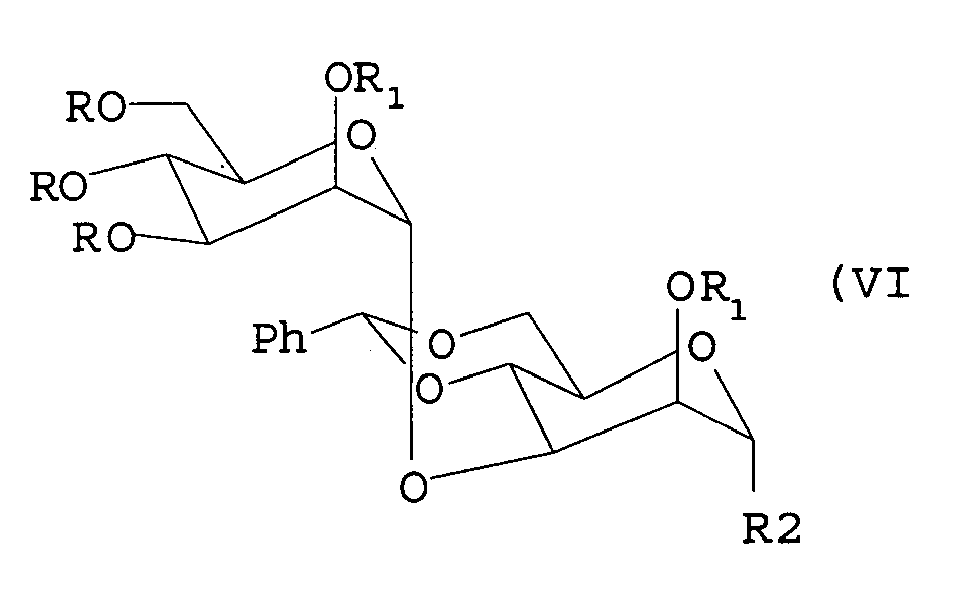 - R eine permanente Schutzgruppe ist,- R1 eine vorübergehende Schutzgruppe ist,- R2 ist :. im Falle eines mittleren Blocks, eine abgehende Gruppe und in diesem Fall kann der Block mit dem Rest des Polymers an α verbunden sein;. im Falle eines Endblocks, eine Gruppe unter folgenden, eine Alkylgruppe, eine Benzylgruppe oder auch eine Verbindung an α oder β.
 - Verfahren zur Herstellung eines Tetramannosiden D-Man β(1-2) D-Man β(1-2) D-Man β(1-2) D-Man entsprechend Formel (I) nach Anspruch 15, wobei zwei Blöcke Manβ(1-2) der Formel (V) kondensiert werden, von denen einer ein mittlerer Diblock ist, in dem R2 eine abgehende Gruppe ist, die eine Verbindung β bildet, und der andere ein End-Diblock ist, in dem R2 eine -SPh Gruppe ist.
- Verfahren zur Herstellung eines Tetramannosiden D-Manα(1-2)D-Manα(1-2)D-Manα(1-2)D-Man der Formel (II) nach Anspruch 15, wobei zwei Blöcke Manα(1-2)Man der Formel (IV) kondensiert werden, von denen einer ein mittlerer Diblock ist, in dem R2 eine abgehende Gruppe ist, und der andere ein End-Diblock ist, indem R2 eine -SPh Gruppe ist.
- Verfahren zur Herstellung eines Tetramannosiden D-Manα(1-3) D-Manα(1-2) D-Manα(1-2) D-Manα(1-2) der Formel (III) nach Anspruch 15, wobei ein Diblock Manα(1-3)Man der Formel (VI) und ein Diblock Manα(1-2)Man der Formel (IV) kondensiert werden, wobei der mittlere Diblock ein Manα(1-3)Man der Formel (VI) ist, in der R2 eine abgehende Gruppe ist, und der End-Diblock ein Manα(1-2)Man ist, in dem R2 eine R-Gruppe wie in Formel (III) definiert darstellt.
- Ein Verfahren zur Herstellung eines festen Trägers mit folgenden Schritten:- Synthese eines Oligomannosiden, der das gleiche Mannosemotif mit derselben Verkettung der α- oder β- Bindungen (1-2), (1-3), (1-6) wie die natürlichen Oligomannoside von Hefe aufweist, und folgender Formel entspricht :wobei:
 - R eine gegebenenfalls markierte Verbindungsgruppe darstellt,- p, q, und r ganze Zahlen zwischen 0 und 19 sind und die Summe von p+q+r zwischen 1 und 19 liegt,- die drei Teile des Polymers [Manα(1-3)]p[Manα (1-2)]q[Manβ(1-2)]r umgekehrt oder wiederholt auftreten können, und- das Propfen des besagten Oligomannosiden an einen festen Träger.
 - Ein Verfahren zur Herstellung eines festen Trägers nach Anspruch 22, wobei p, q, und r - p, q, und r ganze Zahlen zwischen 0 und 11 sind und die Summe von p+q+r zwischen 1 und 11 liegt.
- Verfahren zum in vitro Nachweis des Vorhandenseins einer Infektion durch einen infektiösen oder pathogenen Erreger in einer Probe eines Patienten, dadurch gekennzeichnet, dass mindestens eine Verbindung nach einem beliebigen der Ansprüche 1 bis 9 mit der biologischen Probe in Kontakt gebracht wird, die gegen infektiöse oder pathogene Organismen gerichtete Antikörper enthalten kann, worauf die Bildung von Antigen-Antikörper-Komplexen nachgewiesen wird.
- Verfahren zum spezifischen Nachweis einer C. albicans Infektion nach Anspruch 24, wobei eine Verbindung nach einem beliebigen der Ansprüche 1 bis 9 zuvor auf einem festen Träger fixiert wird.
- Verfahren zum spezifischen Nachweis einer C. albicans Infektion nach Anspruch 24 oder 25, wobei mindestens eine Verbindung mit mindestens einem der Tetramannosiden D-Manβ(1-2)D-Manβ(1-2)D-Manβ(1-2)D-Man der Formel (I) und D-Manα(1-2)D-Man α(1-2)D-Manα(1-2)D-Man der Formel (II) mit einer biologischen Probe in Kontakt gebracht wird.
- Verfahren zum Nachweis von antisynthethischen Oligomannosiden Antikörpern entsprechend der Definition in einem beliebigen der Ansprüche 1 bis 9 zur Diagnose oder Vorhersage einer infektiösen und/oder entzündlichen Pathologie, dadurch gekennzeichnet, dass mindestens ein synhetischer Oligomannosid mit einer biologischen Probe in Kontakt gebracht wird.
- Verfahren zum Nachweis von anti-S cerevisiae Antikörpern für die Diagnose der Morbus Chron oder viraler Hepatitis, dadurch gekennzeichnet, dass mindestens ein synthetischer Oligomannosid entsprechend der Definition in einem beliebigen der Ansprüche 1 bis 9 mit einer biologischen Probe in Kontakt gebracht wird.
- Verfahren zum spezifischen Nachweis einer S. cerevisiae Infektion nach Anspruch 24, wobei eine Verbindung mit einem Tetramonnosiden D-Man α(1-3) D-Man α(1-2) D-Man α(1-2) D-Man α (1-2) der Formel (III) mit einer biologischen Probe in Kontakt gebracht wird.
- Ein Kit zur Durchführung eines Verfahrens nach einem beliebigen der Ansprüche 24 bis 29, dadurch gekennzeichnet, dass er mindestens einen synthetischen Oligomannosiden, gemäss einem beliebigen der Ansprüche 1 bis 9 enthält, Mittel zum Nachweis der Bildung von Antigen-Antikörper-Komplexen und gegebenenfalls Kontrollreagenzien.
- Verwendung eines Oligomannosiden nach der Definition in einem beliebigen der Ansprüche 1 bis 9 zur Herstellung eines Medikaments zur Behandlung oder Vorbeugung von Candidiasen.
- Kit nach Anspruch 30, wobei ein synthetischer Oligomannosid auf einem festen Träger fixiert wird.
Applications Claiming Priority (3)
| Application Number | Priority Date | Filing Date | Title |
|---|---|---|---|
| FR9914747 | 1999-11-23 | ||
| FR9914747A FR2802536B1 (fr) | 1999-11-23 | 1999-11-23 | Oligomannosides de synthese, leur preparation et leur utilisation a la detection d'anticorps et a la prevention d'infections |
| PCT/FR2000/003265 WO2001038338A1 (fr) | 1999-11-23 | 2000-11-23 | Oligomannosides de synthese, leur preparation et leurs utilisations |
Publications (2)
| Publication Number | Publication Date |
|---|---|
| EP1232167A1 EP1232167A1 (de) | 2002-08-21 |
| EP1232167B1 true EP1232167B1 (de) | 2010-05-05 |
Family
ID=9552457
Family Applications (1)
| Application Number | Title | Priority Date | Filing Date |
|---|---|---|---|
| EP00985310A Expired - Lifetime EP1232167B1 (de) | 1999-11-23 | 2000-11-23 | Synthetisches oligomannosid, seine herstellung und verwendung |
Country Status (9)
| Country | Link |
|---|---|
| US (2) | US7109182B2 (de) |
| EP (1) | EP1232167B1 (de) |
| JP (1) | JP2003527346A (de) |
| AT (1) | ATE466866T1 (de) |
| AU (1) | AU783486B2 (de) |
| CA (1) | CA2392375A1 (de) |
| DE (1) | DE60044369D1 (de) |
| FR (1) | FR2802536B1 (de) |
| WO (1) | WO2001038338A1 (de) |
Families Citing this family (25)
| Publication number | Priority date | Publication date | Assignee | Title |
|---|---|---|---|---|
| US7138531B2 (en) * | 2001-10-15 | 2006-11-21 | Kemin Pharma B.V.B.A. | Preparation and use of carbohydrate-based bicyclic ring structures with antimicrobial and cytostatic activity |
| AU2003269389A1 (en) * | 2002-09-20 | 2004-04-08 | Stichting Katholieke Universiteit | Antigen uptake receptor for candida albicans on dendritic cells |
| AU2004294526A1 (en) * | 2003-12-03 | 2005-06-16 | Glycominds, Ltd | Method for diagnosing diseases based on levels of anti-glycan antibodies |
| US7592150B2 (en) * | 2003-12-03 | 2009-09-22 | Glycominds, Ltd | Method for diagnosing diseases based on levels of anti-glycan antibodies |
| US20060205022A1 (en) * | 2003-12-03 | 2006-09-14 | Nir Dotan | Method for diagnosing and prognosing inflammatory bowel disease and crohn's disease |
| JP5026070B2 (ja) * | 2004-03-31 | 2012-09-12 | 住友ベークライト株式会社 | ポリマー粒子 |
| US20060154276A1 (en) | 2004-05-13 | 2006-07-13 | Prometheus Laboratories Inc. | Methods of diagnosing inflammatory bowel disease |
| SI2037937T1 (sl) * | 2006-05-30 | 2015-09-30 | Nutrition Sciences N.V./S.A. | Tri in tetra-oligosaharidi za uporabo kot aglutinacijska sredstva za enterične patogene |
| DE102006043767A1 (de) | 2006-09-13 | 2008-03-27 | Henkel Kgaa | Extrakt aus Apium graveleons zur Stimulierung des Haarwuchses |
| US20110136255A1 (en) * | 2007-11-30 | 2011-06-09 | Nir Dotan | Composition and method for prediction of complicated disease course in crohn's disease |
| WO2010056682A2 (en) | 2008-11-11 | 2010-05-20 | Prometheus Laboratories Inc. | Methods for prediction of inflammatory bowel disease (ibd) using serologic markers |
| NZ595471A (en) | 2009-04-14 | 2014-01-31 | Nestec Sa | Inflammatory bowel disease prognostics |
| CA2766157A1 (en) | 2009-06-25 | 2010-12-29 | Hua Gong | Methods for diagnosing irritable bowel syndrome |
| WO2011060098A1 (en) | 2009-11-10 | 2011-05-19 | Prometheus Laboratories Inc. | Methods for predicting post-surgery risk associated with ileal pouch-anal anastomosis |
| US9011909B2 (en) | 2010-09-03 | 2015-04-21 | Wisconsin Pharmacal Company, Llc | Prebiotic suppositories |
| ES2530175T3 (es) | 2011-02-17 | 2015-02-26 | Nestec S.A. | Ensayos para la detección de autoanticuerpos contra fármacos anti-TNF |
| WO2012138698A1 (en) * | 2011-04-08 | 2012-10-11 | Ancora Pharmaceuticals Inc. | Synthesis of beta-mannuronic acid oligosaccharides |
| WO2012154987A1 (en) | 2011-05-10 | 2012-11-15 | Nestec Sa | Methods of disease activity profiling for personalized therapy management |
| EP2710383B1 (de) | 2011-05-16 | 2017-01-11 | The University of Newcastle | Leistungsfähigkeit eines Biomarkerpanels für Reizdarmsyndrom |
| EP2769321B1 (de) | 2011-10-21 | 2016-06-01 | Nestec S.A. | Verfahren zur verbesserung der diagnose einer entzündlichen darmerkrankung |
| ES2638971T3 (es) | 2012-10-05 | 2017-10-24 | Nestec S.A. | Métodos para predecir y monitorizar la cicatrización de la mucosa |
| CA2932571A1 (en) | 2013-12-03 | 2015-06-11 | Nestec S.A. | Methods for predicting post-operative recurrence of crohn's disease |
| AU2016349703A1 (en) | 2015-11-06 | 2018-11-01 | Vetica Labs, Inc. | Methods of detecting inflammatory markers and treating inflammatory conditions in companion animals |
| CN109884308A (zh) * | 2017-12-15 | 2019-06-14 | 苏州和锐生物科技有限公司 | 甘露多糖半抗原、偶联物及应用 |
| WO2025240894A1 (en) * | 2024-05-16 | 2025-11-20 | Northwestern University | Functionalized cyclodextrin polymer for adsorption of perfluoroalkyl and polyfluoroalkyl substances in water |
Family Cites Families (10)
| Publication number | Priority date | Publication date | Assignee | Title |
|---|---|---|---|---|
| JPS5754199A (ja) * | 1980-09-19 | 1982-03-31 | Rikagaku Kenkyusho | Shinkiorigomannoshidooyobisonoseizoho |
| JPS5772997A (en) * | 1980-10-23 | 1982-05-07 | Rikagaku Kenkyusho | Novel oligomannoside and its preparation |
| JPS5772996A (en) * | 1980-10-23 | 1982-05-07 | Rikagaku Kenkyusho | Novel oligomannoside and its preparation |
| JPS5936691A (ja) * | 1982-08-24 | 1984-02-28 | Rikagaku Kenkyusho | 新規オリゴマンノシド及びその製造法 |
| JPS5936690A (ja) * | 1982-08-24 | 1984-02-28 | Rikagaku Kenkyusho | 新規オリゴマンノシド及びその製造法 |
| JPS6045588A (ja) * | 1983-08-23 | 1985-03-12 | Rikagaku Kenkyusho | 新規オリゴマンノシドおよびその製造法 |
| JPS6045589A (ja) * | 1983-08-23 | 1985-03-12 | Rikagaku Kenkyusho | 新規オリゴマンノシドおよびその製造法 |
| JPS6045587A (ja) * | 1983-08-23 | 1985-03-12 | Rikagaku Kenkyusho | 新規オリゴマンノシドおよびその製造法 |
| CH660557A5 (fr) * | 1984-10-26 | 1987-05-15 | Nestle Sa | Composition anti-bacterienne et procede de preparation de ses constituants actifs. |
| FR2573656B1 (fr) * | 1984-11-29 | 1987-02-27 | Sanofi Sa | Medicament comportant en tant qu'association au moins une immunotoxine et au moins un polymere contenant du mannose |
-
1999
- 1999-11-23 FR FR9914747A patent/FR2802536B1/fr not_active Expired - Fee Related
-
2000
- 2000-11-23 JP JP2001540101A patent/JP2003527346A/ja not_active Withdrawn
- 2000-11-23 WO PCT/FR2000/003265 patent/WO2001038338A1/fr not_active Ceased
- 2000-11-23 EP EP00985310A patent/EP1232167B1/de not_active Expired - Lifetime
- 2000-11-23 DE DE60044369T patent/DE60044369D1/de not_active Expired - Lifetime
- 2000-11-23 AU AU21771/01A patent/AU783486B2/en not_active Ceased
- 2000-11-23 CA CA002392375A patent/CA2392375A1/fr not_active Abandoned
- 2000-11-23 AT AT00985310T patent/ATE466866T1/de not_active IP Right Cessation
-
2002
- 2002-05-23 US US10/153,936 patent/US7109182B2/en not_active Expired - Fee Related
-
2006
- 2006-08-01 US US11/496,988 patent/US20060270627A1/en not_active Abandoned
Non-Patent Citations (1)
| Title |
|---|
| CHANTAL F. ET AL.: "BETA-1,2-LINKED OLIGOMANNOSIDES INHIBIT CANDIDA ALBICANS BINDING TO MURINE MACROPHAGE", JOURNAL OF LEUKOCYTE BIOLOGY, vol. 60, July 1996 (1996-07-01), pages 81 - 87, XP009064245 * |
Also Published As
| Publication number | Publication date |
|---|---|
| WO2001038338A1 (fr) | 2001-05-31 |
| US20060270627A1 (en) | 2006-11-30 |
| CA2392375A1 (fr) | 2001-05-31 |
| DE60044369D1 (de) | 2010-06-17 |
| ATE466866T1 (de) | 2010-05-15 |
| AU783486B2 (en) | 2005-11-03 |
| AU2177101A (en) | 2001-06-04 |
| JP2003527346A (ja) | 2003-09-16 |
| EP1232167A1 (de) | 2002-08-21 |
| US20030105060A1 (en) | 2003-06-05 |
| FR2802536A1 (fr) | 2001-06-22 |
| US7109182B2 (en) | 2006-09-19 |
| FR2802536B1 (fr) | 2003-06-13 |
Similar Documents
| Publication | Publication Date | Title |
|---|---|---|
| WO2001038338A1 (fr) | Oligomannosides de synthese, leur preparation et leurs utilisations | |
| US9446109B2 (en) | Glycoconjugates and their use as potential vaccines against infection by Shigella flexneri | |
| EP1232168B1 (de) | Synthetische lipid-a analogen und verwendungen davon | |
| US20100221269A1 (en) | Synthetic lipid a derivative | |
| EP3474890B1 (de) | Pneumokokken-polysaccharid-proteinkonjugatzusammensetzung | |
| US5721115A (en) | DNA encoding a novel Haemophilus influenzae protein | |
| EP0069678A2 (de) | 3-Fucosyl-N-Acetyl Lactosamin Derivate, ihre Herstellung und ihre biologische Anwendung | |
| US11603416B2 (en) | Method for preparation of derivatives of gram-positive bacteria surface capsular polysaccharide | |
| CN107709343A (zh) | 针对肺炎链球菌血清型5的疫苗 | |
| EP2164521B1 (de) | Glycokonjugate und ihre verwendung als impfstoff gegen die shigella flexneri-serotypen 3a und x | |
| US20240024489A1 (en) | Protected disaccharides, their process of preparation and their use in the synthesis of zwitterionic oligosaccharides, and conjugates thereof | |
| EP0089939A1 (de) | Oligosaccharide umfassende Zusammensetzung für therapeutische oder diagnostische Verwendung | |
| EP2911698B1 (de) | Glycokonjugate und deren verwendung als potentielle impfstoffe gegen infektion durch shigella flexneri | |
| EP3269385A1 (de) | Pneumokokken-polysaccharid-proteinkonjugatzusammensetzung | |
| Kosma | Chemical synthesis of core structures | |
| EP4729073A1 (de) | Synthetische impfstoffe gegen francisella tularensis | |
| EP4682154A1 (de) | Geschützte tetrasaccharide, verfahren zu ihrer herstellung und ihre verwendung zur synthese von oligosacchariden, die o-antigensegmente verschiedener shigella flexneri serotypen darstellen | |
| JP3156135B2 (ja) | 免疫賦活用活性物質及びその製造法 | |
| WO2018155051A1 (ja) | リピドa | |
| WO1999052922A1 (en) | ANTIMICROBIAL βGalNAc(1→4)βGal DERIVATIVES AND METHODS OF USE | |
| CA2434685A1 (en) | Novel approach to design glycopeptides based on o-specific polysaccharide of shigella flexneri serotype 2a | |
| HK40113822A (zh) | 预防/治疗铜绿假单胞菌感染 | |
| Cheng | Development of alkyl imidate glycosylation method and application to allyl Lewis A synthesis | |
| CA2531023A1 (en) | Glycoconjugates and their use as potential vaccines against infection by shigella flexneri | |
| WO2005095428A1 (ja) | バクテリアの効率的表面修飾方法 |
Legal Events
| Date | Code | Title | Description |
|---|---|---|---|
| PUAI | Public reference made under article 153(3) epc to a published international application that has entered the european phase |
Free format text: ORIGINAL CODE: 0009012 |
|
| 17P | Request for examination filed |
Effective date: 20020528 |
|
| AK | Designated contracting states |
Kind code of ref document: A1 Designated state(s): AT BE CH CY DE DK ES FI FR GB GR IE IT LI LU MC NL PT SE TR |
|
| AX | Request for extension of the european patent |
Free format text: AL;LT;LV;MK;RO;SI |
|
| RIN1 | Information on inventor provided before grant (corrected) |
Inventor name: COLOMBEL, JEAN-FREDERIC Inventor name: MALLET, JEAN-MAURICE Inventor name: CHEVALIER, REYNALD Inventor name: JOUAULT, THIERRY Inventor name: SENDID, BOUALEM Inventor name: POULAIN, DANIEL Inventor name: ESNAULT, JACQUES Inventor name: SINAY, PIERRE |
|
| 17Q | First examination report despatched |
Effective date: 20021104 |
|
| 17Q | First examination report despatched |
Effective date: 20021104 |
|
| GRAP | Despatch of communication of intention to grant a patent |
Free format text: ORIGINAL CODE: EPIDOSNIGR1 |
|
| GRAS | Grant fee paid |
Free format text: ORIGINAL CODE: EPIDOSNIGR3 |
|
| GRAA | (expected) grant |
Free format text: ORIGINAL CODE: 0009210 |
|
| AK | Designated contracting states |
Kind code of ref document: B1 Designated state(s): AT BE CH CY DE DK ES FI FR GB GR IE IT LI LU MC NL PT SE TR |
|
| REG | Reference to a national code |
Ref country code: GB Ref legal event code: FG4D Free format text: NOT ENGLISH |
|
| REG | Reference to a national code |
Ref country code: CH Ref legal event code: EP |
|
| REG | Reference to a national code |
Ref country code: IE Ref legal event code: FG4D Free format text: LANGUAGE OF EP DOCUMENT: FRENCH |
|
| REF | Corresponds to: |
Ref document number: 60044369 Country of ref document: DE Date of ref document: 20100617 Kind code of ref document: P |
|
| REG | Reference to a national code |
Ref country code: NL Ref legal event code: VDEP Effective date: 20100505 |
|
| PG25 | Lapsed in a contracting state [announced via postgrant information from national office to epo] |
Ref country code: SE Free format text: LAPSE BECAUSE OF FAILURE TO SUBMIT A TRANSLATION OF THE DESCRIPTION OR TO PAY THE FEE WITHIN THE PRESCRIBED TIME-LIMIT Effective date: 20100505 Ref country code: NL Free format text: LAPSE BECAUSE OF FAILURE TO SUBMIT A TRANSLATION OF THE DESCRIPTION OR TO PAY THE FEE WITHIN THE PRESCRIBED TIME-LIMIT Effective date: 20100505 Ref country code: ES Free format text: LAPSE BECAUSE OF FAILURE TO SUBMIT A TRANSLATION OF THE DESCRIPTION OR TO PAY THE FEE WITHIN THE PRESCRIBED TIME-LIMIT Effective date: 20100816 |
|
| PG25 | Lapsed in a contracting state [announced via postgrant information from national office to epo] |
Ref country code: FI Free format text: LAPSE BECAUSE OF FAILURE TO SUBMIT A TRANSLATION OF THE DESCRIPTION OR TO PAY THE FEE WITHIN THE PRESCRIBED TIME-LIMIT Effective date: 20100505 Ref country code: AT Free format text: LAPSE BECAUSE OF FAILURE TO SUBMIT A TRANSLATION OF THE DESCRIPTION OR TO PAY THE FEE WITHIN THE PRESCRIBED TIME-LIMIT Effective date: 20100505 |
|
| REG | Reference to a national code |
Ref country code: IE Ref legal event code: FD4D |
|
| PG25 | Lapsed in a contracting state [announced via postgrant information from national office to epo] |
Ref country code: CY Free format text: LAPSE BECAUSE OF FAILURE TO SUBMIT A TRANSLATION OF THE DESCRIPTION OR TO PAY THE FEE WITHIN THE PRESCRIBED TIME-LIMIT Effective date: 20100505 Ref country code: GR Free format text: LAPSE BECAUSE OF FAILURE TO SUBMIT A TRANSLATION OF THE DESCRIPTION OR TO PAY THE FEE WITHIN THE PRESCRIBED TIME-LIMIT Effective date: 20100806 |
|
| PG25 | Lapsed in a contracting state [announced via postgrant information from national office to epo] |
Ref country code: IE Free format text: LAPSE BECAUSE OF FAILURE TO SUBMIT A TRANSLATION OF THE DESCRIPTION OR TO PAY THE FEE WITHIN THE PRESCRIBED TIME-LIMIT Effective date: 20100505 Ref country code: DK Free format text: LAPSE BECAUSE OF FAILURE TO SUBMIT A TRANSLATION OF THE DESCRIPTION OR TO PAY THE FEE WITHIN THE PRESCRIBED TIME-LIMIT Effective date: 20100505 Ref country code: PT Free format text: LAPSE BECAUSE OF FAILURE TO SUBMIT A TRANSLATION OF THE DESCRIPTION OR TO PAY THE FEE WITHIN THE PRESCRIBED TIME-LIMIT Effective date: 20100906 |
|
| PLBE | No opposition filed within time limit |
Free format text: ORIGINAL CODE: 0009261 |
|
| STAA | Information on the status of an ep patent application or granted ep patent |
Free format text: STATUS: NO OPPOSITION FILED WITHIN TIME LIMIT |
|
| PG25 | Lapsed in a contracting state [announced via postgrant information from national office to epo] |
Ref country code: IT Free format text: LAPSE BECAUSE OF FAILURE TO SUBMIT A TRANSLATION OF THE DESCRIPTION OR TO PAY THE FEE WITHIN THE PRESCRIBED TIME-LIMIT Effective date: 20100505 |
|
| 26N | No opposition filed |
Effective date: 20110208 |
|
| REG | Reference to a national code |
Ref country code: DE Ref legal event code: R097 Ref document number: 60044369 Country of ref document: DE Effective date: 20110207 Ref country code: DE Ref legal event code: R097 Ref document number: 60044369 Country of ref document: DE Effective date: 20110208 |
|
| BERE | Be: lapsed |
Owner name: CENTRE HOSPITALIER REGIONAL ET UNIVERSITAIRE DE L Effective date: 20101130 |
|
| PG25 | Lapsed in a contracting state [announced via postgrant information from national office to epo] |
Ref country code: MC Free format text: LAPSE BECAUSE OF NON-PAYMENT OF DUE FEES Effective date: 20101130 |
|
| REG | Reference to a national code |
Ref country code: CH Ref legal event code: PL |
|
| GBPC | Gb: european patent ceased through non-payment of renewal fee |
Effective date: 20101123 |
|
| PG25 | Lapsed in a contracting state [announced via postgrant information from national office to epo] |
Ref country code: CH Free format text: LAPSE BECAUSE OF NON-PAYMENT OF DUE FEES Effective date: 20101130 Ref country code: LI Free format text: LAPSE BECAUSE OF NON-PAYMENT OF DUE FEES Effective date: 20101130 |
|
| REG | Reference to a national code |
Ref country code: FR Ref legal event code: ST Effective date: 20110801 |
|
| PG25 | Lapsed in a contracting state [announced via postgrant information from national office to epo] |
Ref country code: BE Free format text: LAPSE BECAUSE OF NON-PAYMENT OF DUE FEES Effective date: 20101130 |
|
| REG | Reference to a national code |
Ref country code: DE Ref legal event code: R119 Ref document number: 60044369 Country of ref document: DE Effective date: 20110601 Ref country code: DE Ref legal event code: R119 Ref document number: 60044369 Country of ref document: DE Effective date: 20110531 |
|
| PG25 | Lapsed in a contracting state [announced via postgrant information from national office to epo] |
Ref country code: FR Free format text: LAPSE BECAUSE OF NON-PAYMENT OF DUE FEES Effective date: 20101130 |
|
| PG25 | Lapsed in a contracting state [announced via postgrant information from national office to epo] |
Ref country code: GB Free format text: LAPSE BECAUSE OF NON-PAYMENT OF DUE FEES Effective date: 20101123 |
|
| PG25 | Lapsed in a contracting state [announced via postgrant information from national office to epo] |
Ref country code: LU Free format text: LAPSE BECAUSE OF NON-PAYMENT OF DUE FEES Effective date: 20101123 |
|
| PG25 | Lapsed in a contracting state [announced via postgrant information from national office to epo] |
Ref country code: TR Free format text: LAPSE BECAUSE OF FAILURE TO SUBMIT A TRANSLATION OF THE DESCRIPTION OR TO PAY THE FEE WITHIN THE PRESCRIBED TIME-LIMIT Effective date: 20100505 |
|
| PG25 | Lapsed in a contracting state [announced via postgrant information from national office to epo] |
Ref country code: DE Free format text: LAPSE BECAUSE OF NON-PAYMENT OF DUE FEES Effective date: 20110531 |