EP1221356B1 - Eyeglass lens processing apparatus - Google Patents
Eyeglass lens processing apparatus Download PDFInfo
- Publication number
- EP1221356B1 EP1221356B1 EP02000351A EP02000351A EP1221356B1 EP 1221356 B1 EP1221356 B1 EP 1221356B1 EP 02000351 A EP02000351 A EP 02000351A EP 02000351 A EP02000351 A EP 02000351A EP 1221356 B1 EP1221356 B1 EP 1221356B1
- Authority
- EP
- European Patent Office
- Prior art keywords
- lens
- processing
- abrasive wheel
- eyeglass
- processing apparatus
- Prior art date
- Legal status (The legal status is an assumption and is not a legal conclusion. Google has not performed a legal analysis and makes no representation as to the accuracy of the status listed.)
- Expired - Lifetime
Links
- 238000012545 processing Methods 0.000 title claims description 148
- 239000000463 material Substances 0.000 claims description 12
- 239000011521 glass Substances 0.000 claims description 7
- 238000001514 detection method Methods 0.000 claims description 6
- 230000006866 deterioration Effects 0.000 description 8
- 229910003460 diamond Inorganic materials 0.000 description 6
- 239000010432 diamond Substances 0.000 description 6
- 238000010586 diagram Methods 0.000 description 5
- 238000005259 measurement Methods 0.000 description 4
- 238000000034 method Methods 0.000 description 3
- 239000002245 particle Substances 0.000 description 3
- 238000012958 reprocessing Methods 0.000 description 3
- 230000006870 function Effects 0.000 description 2
- 101000643890 Homo sapiens Ubiquitin carboxyl-terminal hydrolase 5 Proteins 0.000 description 1
- 102100021017 Ubiquitin carboxyl-terminal hydrolase 5 Human genes 0.000 description 1
- 238000010276 construction Methods 0.000 description 1
- 238000011161 development Methods 0.000 description 1
- 230000018109 developmental process Effects 0.000 description 1
- 239000002184 metal Substances 0.000 description 1
- 230000003287 optical effect Effects 0.000 description 1
- 239000000843 powder Substances 0.000 description 1
Images


Classifications
-
- B—PERFORMING OPERATIONS; TRANSPORTING
- B24—GRINDING; POLISHING
- B24B—MACHINES, DEVICES, OR PROCESSES FOR GRINDING OR POLISHING; DRESSING OR CONDITIONING OF ABRADING SURFACES; FEEDING OF GRINDING, POLISHING, OR LAPPING AGENTS
- B24B9/00—Machines or devices designed for grinding edges or bevels on work or for removing burrs; Accessories therefor
- B24B9/02—Machines or devices designed for grinding edges or bevels on work or for removing burrs; Accessories therefor characterised by a special design with respect to properties of materials specific to articles to be ground
- B24B9/06—Machines or devices designed for grinding edges or bevels on work or for removing burrs; Accessories therefor characterised by a special design with respect to properties of materials specific to articles to be ground of non-metallic inorganic material, e.g. stone, ceramics, porcelain
- B24B9/08—Machines or devices designed for grinding edges or bevels on work or for removing burrs; Accessories therefor characterised by a special design with respect to properties of materials specific to articles to be ground of non-metallic inorganic material, e.g. stone, ceramics, porcelain of glass
- B24B9/14—Machines or devices designed for grinding edges or bevels on work or for removing burrs; Accessories therefor characterised by a special design with respect to properties of materials specific to articles to be ground of non-metallic inorganic material, e.g. stone, ceramics, porcelain of glass of optical work, e.g. lenses, prisms
-
- B—PERFORMING OPERATIONS; TRANSPORTING
- B24—GRINDING; POLISHING
- B24B—MACHINES, DEVICES, OR PROCESSES FOR GRINDING OR POLISHING; DRESSING OR CONDITIONING OF ABRADING SURFACES; FEEDING OF GRINDING, POLISHING, OR LAPPING AGENTS
- B24B47/00—Drives or gearings; Equipment therefor
- B24B47/22—Equipment for exact control of the position of the grinding tool or work at the start of the grinding operation
- B24B47/225—Equipment for exact control of the position of the grinding tool or work at the start of the grinding operation for bevelling optical work, e.g. lenses
-
- B—PERFORMING OPERATIONS; TRANSPORTING
- B24—GRINDING; POLISHING
- B24B—MACHINES, DEVICES, OR PROCESSES FOR GRINDING OR POLISHING; DRESSING OR CONDITIONING OF ABRADING SURFACES; FEEDING OF GRINDING, POLISHING, OR LAPPING AGENTS
- B24B53/00—Devices or means for dressing or conditioning abrasive surfaces
Definitions
- the present invention relates to an eyeglass lens processing apparatus for processing a periphery of an eyeglass lens, as per the preamble of claim 1.
- An example of such an apparatus is disclosed by EP 0 839 604 A .
- An eyeglass lens processing apparatus for processing a periphery of an eyeglass lens comprises a circular abrasive wheel (grindstone) having a diamond layer formed of a fine diamond particle and metal powder and serves to carry out processing by causing the periphery of the lens to come in contact with the rotating abrasive wheel by pressure.
- EP 0 839 604 A1 describes an apparatus and a method for grinding eyeglass lenses.
- the apparatus processes the periphery of an eyeglass lens to be fitted in an eyeglass frame. The processing is based on processing data.
- the eyeglass lens grinding machine includes lens rotating means for rotating a lens as well as an abrasive wheel for grinding the lens. Furthermore, there is provided an abrasive wheel's rotational state detecting section as well as a rotation control section which variably changes the rotation of the lens rotating section on the basis of the result of the detection.
- the rotation control is based upon the determination of the load on the rotation of the abrasive wheel.
- the rotation control section issues a command to either stop or slowdown the rotation of the lens if the load exceeds a predetermined reference level.
- EP 0 566 853 A2 discloses a dressing control apparatus for a general NC grinding machine. Circularity of a work piece is measured based on signal output from a measuring detector which detects a diameter of the work piece. A time from spark-out till the circularity becomes a predetermined allowable value is monitored, and a determination is made as to whether the measured time is a setting value or not. If the measured time exceeds the setting value, the grinding wheel is dressed by a dresser. That is, the measuring detector monitors the time from the spark-out till the circularity becomes the allowable value.
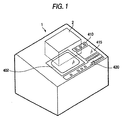
- FIG. 1 is a diagram illustrating the external configuration of an eyeglass-lens processing apparatus in accordance with the invention.
- Aneyeglass-frame-shapemeasuring device 2 is incorporated in an upper right-hand rear portion of a main body 1 of the apparatus.
- the frame-shape measuring device 2 ones that disclosed in USP 5,228,242 , 5,333,412 , USP5, 347,762 (Re. 35,898) and so on, the assignee of which is the same as the present application, can be used.
- a switch panel section 410 having switches for operating the frame-shape measuring device 2 and a display 415 for displaying processing information and the like are disposed in front of the frame-shape measuring device 2.
- reference numeral 420 denotes a switch panel section having various switches for inputting processing conditions and the like and for giving instructions for processing
- numeral 402 denotes an openable window for a processing chamber.
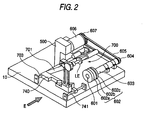
- Fig. 2 is a perspective view illustrating the arrangement of a lens processing section disposed in the casing of the main body 1.
- a carriage section 700 is mounted on a base 10, and a subject lens LE clamped by a pair of lens rotation shafts (lens chuck shafts) 702L and 702R of a carriage 701 is ground by a group of abrasive wheels 602 attached to an abrasive wheel rotating shaft 601.
- the group of abrasive wheels 602 include a rough abrasive wheel 602a for plastic lenses, a rough abrasive wheel 602b for glass lenses, and a finishing abrasive wheel 602c for beveling processing and flat processing.
- the rotating shaft 601 is rotatably attached to the base 10 by a spindle 603.
- a pulley 604 is attached to an end of the rotating shaft 601, and is linked through a belt 605 to a pulley 607 which is attached to a rotating shaft of an abrasive-wheel rotating motor 606.
- a lens-shape measuring section 500 is provided in the rear of the carriage 701. As the lens-shape measuring section 500, not only one that is disclosed by Japanese patent publication No. 2000-317796 , but also other conventional devices can be used.
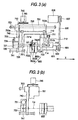
- Fig. 3 is a schematic diagram of essential portions of the carriage section 700
- Fig. 4 is a view, taken from the direction of arrow E in Fig. 2, of the carriage section 700.
- the carriage 701 is capable of rotating the lens LE while chucking it with two shafts 702L and 702R, and is rotatably slidable with respect to a carriage shaft 703 that is fixed to the base 10 and that extends in parallel to the shaft 601.
- a description will be given of a lens chuck mechanism and a lens rotating mechanism as well as an X-axis moving mechanism and a Y-axis moving mechanism of the carriage 701 by assuming that the direction in which the carriage 701 is moved in parallel to the abrasive-wheel rotating shaft 601 is the X axis, and the direction for changing the axis-to-axis distance between the shafts (702L, 702R) and the shaft 601 by the rotation of the carriage 701 is the Y axis.
- the shaft 702L and the shaft 702R are rotatably held coaxially by a left arm 701L and a right arm 701R, respectively, of the carriage 701.
- a chucking motor 710 is fixed to the center of the upper surface of the right arm 701R, and the rotation of a pulley 711 attached to a rotating shaft of the motor 710 rotates a feed screw 713, which is rotatably held inside the right arm 701R, by means of a belt 712.
- a feed nut 714 is moved in the axial direction by the rotation of the feed screw 713.
- the shaft 702R connected to the nut 714 can be moved in the axial direction, so that the lens LE is clamped by the shafts 702L and 702R.
- a rotatable block 720 for attaching a motor which is rotatable about the axis of the shaft 702L, is attached to a left-side end portion of the left arm 701L, and the chuck shaft 702L is passed through the block 720, a gear 721 being secured to the left end of the shaft 702L.
- a pulse motor 722 for lens rotation is fixed to the block 720, and as the motor 722 rotates the gear 721 through a gear 724, the rotation of the motor 720 is transmitted to the shaft 702L.
- a pulley 726 is attached to the shaft 702L inside the left arm 701L.
- the pulley 726 is linked by means of a timing belt 731a to a pulley 703a secured to a left end of a rotating shaft 728, which is held rotatably in the rear of the carriage 701. Further, a pulley 703b secured to a right end of the shaft 728 is linked by means of a timing belt 731b to a pulley 733 which is attached to the shaft 702R in such a manner as to be slidable in the axial direction of the shaft 702R inside the right arm 701R. By virtue of this arrangement, the shaft 702L and the shaft 702R are rotated synchronously.
- the shaft 703 is provided with a movable arm 740 which is slidable in its axial direction so that the arm 740 is movable in the X-axis direction (in the axial direction of the shaft 703) together with the carriage 701. Further, the arm 740 at its front portion is slidable on and along a guide shaft 741 that is secured to the base 10 in a parallel positional relation to the shaft 703.
- a rack 743 extending in parallel to the shaft 703 is attached to a rear portion of the arm 740, and this rack 743 meshes with a pinion 746 attached to a rotating shaft of a motor 745 for moving the carriage in the X-axis direction, the motor 745 being secured to the base 10.
- the motor 745 is able to move the carriage 701 together with the arm 740 in the axial direction (in the X-axis direction).
- a swingable block 750 is attached to the arm 740 in such a manner as to be rotatable about the axis La which is in alignment with the rotational center of the shaft 601.
- the distance from the center of the shaft 703 to the axis La and the distance from the center of the shaft 703 to the rotational center of the shaft (702L, 702R) are set to be identical.
- a Y-axis moving motor 751 is attached to the block 750, and the rotation of the motor 751 is transmitted by means of a pulley 752 and a belt 753 to a female screw 755 held rotatably in the block 750.
- a feed screw 756 is inserted in a threaded portion of the screw 755 in mesh therewith, and the screw 756 is moved vertically by the rotation of the screw 755.
- a guide block 760 which abuts against a lower end surface of the block 720 is fixed to an upper end of the screw 756, and the block 760 moves along two guide shafts 758a and 758b implanted on the block 750. Accordingly, as the block 760 is vertically moved together with the screw 756 by the rotation of the motor 751, it is possible to change the vertical position of the block 720 abutting against the block 760. As a result, the vertical position of the carriage 701 attached to the block 720 can be also changed (namely, the carriage 701 rotates about the shaft 703 to change the axis-to-axis distance between the shafts (702L, 702R) and the shaft 601).
- a spring 762 is stretched between the left arm 701L and the arm 740, so that the carriage 701 is constantly urged downward to impart processing pressure onto the lens LE. Although the downward urging force acts on the carriage 701, the downward movement of the carriage 701 is restricted such that the carriage 701 can only be lowered down to the position in which the block 720 abuts against the block 760.
- a sensor 764 for detecting an end of processing is attached to the block 720, and the sensor 764 detects the end of processing at each radius vector angle of the lens LE (each rotation angle) by detecting the position of a sensor plate 765 attached to the block 760.
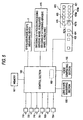
- the shape of an eyeglass frame (or a template) for fitting is measured by the frame shape measuring device 2, and data thus obtained by the measurement are input to a data memory 161 by pressing a switch 421.
- a switch 421 By operating each switch of a switch panel section 420, an operator inputs necessary layout data such as the PD of a wearer and the height of an optical center, the material of the lens and a processing mode. The material of the lens is specified with a switch 426. If the necessary input is completed, the lens LE is chucked and processed through the shaft 702L and the shaft 702R.
- a control section 160 When the apparatus is operated by pressing a start switch 423, a control section 160 operates the lens shape measuring section 500 to measure the shapes of the front and rear surfaces of the lens. By the measurement, the thickness of a lens having a processing radius vector shape is obtained.
- the control section 160 operates each data on rough processing and finishing processing for each radius vector angle in accordance with a predetermined program based on the input data. In order of the rough processing and the finishing processing, the processing is automatically executed.
- the control section 160 drives the motor 745 such that the lens LE comes to a portion above the rough abrasive wheel 602b for glass, and thus moves the carriage 701. Based on rough processing data, then, the motor 751 is rotated to move the carriage 701 in a Y-axis direction and the lens LE is rotated by the motor 722 to carry out the rough processing. The movement of the carriage 701 in the Y-axis direction and the rotation of the lens LE are repeated until the end of the processing is detected by the sensor 764 over the whole radius vector angle of the lens LE. When the end of the processing is detected, the rough processing is completed.
- the finishing processing is successively executed automatically after the lens LE is removed from the rough abrasive wheel 602b.
- finishing processing for beveling after the lens LE is moved to a beveling groove portion of the finishing abrasive wheel 602c, the rotation of the lens LE and the movement of the carriage 701 in the Y-axis and X-axis directions are controlled based on the finishing processing data.
- the end of the processing is detected over the whole periphery of the lens LE through the sensor 764, the finishing processing is completed.
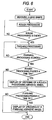
- the control section 160 measures times required from the start of the rough processing and the finishing processing by means of a counting function 162 provided therein. By the result of the measurement, a deterioration in the processing performance of each abrasive wheel is detected and a notice that dressing is required is given to an operator based on the result of the detection (see a flow chart of Fig. 6).
- the control section 160 causes the display 415 to display a message that the dressing is required for the rough abrasive wheel 602b. While the display is carried out when all processing including the finishing processing is completed, it may be performed when the time TR1 passes.
- a preset reference time TR1 for example, 5 minutes
- a preset reference time TF1 for example, 5 minutes
- a message that the dressing of the finishing abrasive wheel 602c is required is displayed on the display 415 after the processing is completed.
- the notice that the dressing is required may be given in a voice or an alarm by a voice generating section 165.
- a stop switch 424 is pressed to erase the display of the message, thereby carrying out the necessary dressing.
- Fig. 7 is a flow chart showing an operation to be carried out with such a structure.
- the control section 160 measures a time required from the start of the rough processing.
- a preset reference time TR2 for example, 10 minutes
- the carriage 701 is raised to separate the lens LE from the rough abrasive wheel 602b and the rotation of the lens LE and that of the abrasive wheel are stopped to interrupt the processing.
- a message that the processing is interrupted and the dressing of the rough abrasive wheel 602b is required is displayed on the display 415.
- the operator presses the switch 424 to erase the display of the message and sets a dress mode with a switch 425, thereby carrying out the dressing over the rough abrasive wheel 602b in a predetermined procedure.
- the switch 423 is pressed to restart the rough processing.
- the control section 160 measures the time required from the start of the finishing processing.
- a predetermined reference time TF2 for example, 10 minutes
- the processing to be carried out by the finishing abrasive wheel 602c is once interrupted.
- the switch 423 is pressed to restart the finishing processing.
- suitable times are predetermined in consideration of a time required for processing a thick lens (a lens having a large processing amount) in a state in which the diamond layers of the abrasive wheels 602b and 602c are normally arranged or an increase in the processing time with an increase in the number of lenses to be processed.
- TR2 and TF2 are set to be longer than TR1 and TF1 respectively, it is preferable that the lens should be completely processed and the dressing should be carried out before the measured times (processing times) TR2 and TF2 are reached. Therefore, it is possible to eliminate a great deal of time and labor of the reprocessing and a processing error caused by the reprocessing. It is effective to set the times TR2 and TF2 that the processing is once interrupted in that the processing time can be prevented from being excessively increased and a state in which the end of the processing is not detected can be avoided.
- the number of rotations of the lens LE can also be employed. The reason is that a time required for completing the processing and the number of rotations of the lens LE are almost proportional to each other in the case in which the lens LE is to be processed by a rotation at an almost equal speed.
- the number of rotations of the lens LE can be known from the number of rotations of the motor 722.
- the lens processing moreover, when the end of the processing is detected at a predetermined radius vector angle, the lens is rotated every minute angle and such an operation is repeated over the whole periphery. Thus, processing control is carried out. In this case, it is also possible to detect a deterioration in the processing performance of each abrasive wheel by a comparison of a time required for the end of the processing at an angle for the start of the processing with a preset reference time.
- the detection of a deterioration in the processing performance is not always carried out every time the lens is to be processed.
- a time required for the end of the processing for each lens or the number of rotations of the lens may be stored in a memory and, for example, a mean value of 10 lenses which is stored may be compared with a reference value.
- a parameter setting screen for changing a dress reference such as the time TR1 is called over the display 415 with the switch 426.
- Fig. 8 shows an example of the screen obtained at that time.
- control section 160 changes a decision reference value corresponding to the data on the lens thickness such that a reference time is increased if the lens thickness is great and is reduced if the lens thickness is small.
- Fig. 9 is a view illustrating another embodiment. Only different portions from those of the embodiment described above are shown and the structures shown according to the embodiment described above are employed for the same functions.
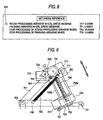
- an encoder 770 is fixed to a block 720' for motor attachment and a pinion 771 attached to a rotating shaft of the encoder 770 meshes with a rack formed on a guide shaft 758a' extended in parallel with a feed screw 756.
- the output of the encoder 770 is input to the control section 160 and the moving distance of elevation (Y-axis movement) of the carriage 701 is detected.
- a processing distance within a predetermined time at an angle for the start of the processing is compared with the reference processing distance. If the progress of the processing is slow, it is decided that the processing performance is deteriorated. In the case of a variant, furthermore, it is preferable that the operator can optionally change each reference value.
- control section 160 decides whether the material of the processed lens is glass or not.
- the control section 160 resets a count number.
Landscapes
- Engineering & Computer Science (AREA)
- Mechanical Engineering (AREA)
- Chemical & Material Sciences (AREA)
- Ceramic Engineering (AREA)
- Inorganic Chemistry (AREA)
- Grinding And Polishing Of Tertiary Curved Surfaces And Surfaces With Complex Shapes (AREA)
- Constituent Portions Of Griding Lathes, Driving, Sensing And Control (AREA)
Applications Claiming Priority (2)
| Application Number | Priority Date | Filing Date | Title |
|---|---|---|---|
| JP2001000433A JP4288012B2 (ja) | 2001-01-05 | 2001-01-05 | 眼鏡レンズ加工装置 |
| JP2001000433 | 2001-01-05 |
Publications (2)
| Publication Number | Publication Date |
|---|---|
| EP1221356A1 EP1221356A1 (en) | 2002-07-10 |
| EP1221356B1 true EP1221356B1 (en) | 2007-09-05 |
Family
ID=18869220
Family Applications (1)
| Application Number | Title | Priority Date | Filing Date |
|---|---|---|---|
| EP02000351A Expired - Lifetime EP1221356B1 (en) | 2001-01-05 | 2002-01-04 | Eyeglass lens processing apparatus |
Country Status (5)
| Country | Link |
|---|---|
| US (1) | US6592431B2 (OSRAM) |
| EP (1) | EP1221356B1 (OSRAM) |
| JP (1) | JP4288012B2 (OSRAM) |
| DE (1) | DE60222192T2 (OSRAM) |
| ES (1) | ES2292646T3 (OSRAM) |
Families Citing this family (8)
| Publication number | Priority date | Publication date | Assignee | Title |
|---|---|---|---|---|
| JP4267228B2 (ja) * | 2001-12-03 | 2009-05-27 | 株式会社トプコン | レンズ枠形状測定装置 |
| JP4290673B2 (ja) * | 2005-04-28 | 2009-07-08 | 株式会社ニデック | 眼鏡レンズ周縁加工方法 |
| JP4895656B2 (ja) | 2006-04-03 | 2012-03-14 | 株式会社ニデック | 眼鏡レンズ周縁加工装置の砥石ドレッシング方法及び砥石ドレス器具 |
| JP4975469B2 (ja) * | 2007-02-02 | 2012-07-11 | 株式会社ニデック | 眼鏡レンズ加工装置 |
| CA2735704C (en) * | 2008-08-29 | 2020-05-05 | Nikon-Essilor Co., Ltd. | Lens processing management system |
| EP2624998A1 (de) * | 2010-10-04 | 2013-08-14 | Schneider GmbH & Co. KG | Vorrichtung und verfahren zum bearbeiten einer optischen linse sowie transportbehältnis für optische linsen |
| JP6236787B2 (ja) | 2013-01-17 | 2017-11-29 | 株式会社ニデック | 眼鏡レンズ加工装置 |
| JP7563040B2 (ja) * | 2020-08-17 | 2024-10-08 | 株式会社ニデック | 眼鏡レンズ加工情報処理プログラムおよび眼鏡レンズ加工装置 |
Family Cites Families (14)
| Publication number | Priority date | Publication date | Assignee | Title |
|---|---|---|---|---|
| US4555873A (en) | 1981-03-30 | 1985-12-03 | Energy-Adaptive Grinding, Inc. | Method and apparatus for wheel conditioning in a grinding machine |
| CH651773A5 (fr) * | 1983-03-31 | 1985-10-15 | Comadur Sa | Procede pour former une lentille convergente dans une plaque d'un materiau mineral transparent. |
| JPH02109671A (ja) * | 1988-10-20 | 1990-04-23 | Olympus Optical Co Ltd | レンズ研削機およびレンズ加工方法 |
| JPH085011B2 (ja) * | 1989-07-10 | 1996-01-24 | オリンパス光学工業株式会社 | 研削装置 |
| JP3011526B2 (ja) | 1992-02-04 | 2000-02-21 | 株式会社ニデック | レンズ周縁加工機及びレンズ周縁加工方法 |
| JPH05277934A (ja) | 1992-03-26 | 1993-10-26 | Toyoda Mach Works Ltd | 研削砥石のドレッシング制御装置 |
| FR2691663B1 (fr) | 1992-05-26 | 1996-10-11 | Essilor Int | Procede de ravivage de meules, disque et machine pour sa mise en óoeuvre. |
| JPH0647664A (ja) | 1992-07-31 | 1994-02-22 | Nikon Corp | 砥石のドレッシング装置およびそれに用いるドレッシング用部材 |
| JPH0929632A (ja) | 1995-07-17 | 1997-02-04 | Topcon Corp | レンズ研削砥石ドレッシング方法及びこれに用いるドレッシング装置 |
| JPH10138108A (ja) | 1996-10-31 | 1998-05-26 | Nidek Co Ltd | 眼鏡レンズ研削加工機及び眼鏡レンズ研削加工方法 |
| DE19750428B4 (de) * | 1997-11-14 | 2007-06-21 | Optotech Optikmaschinen Gmbh | Verfahren und Vorrichtung zum Bearbeiten von Linsen |
| JP3730410B2 (ja) | 1998-05-29 | 2006-01-05 | 株式会社ニデック | 眼鏡レンズ加工装置 |
| JP3730409B2 (ja) | 1998-05-29 | 2006-01-05 | 株式会社ニデック | 眼鏡レンズ加工装置 |
| JP2000015549A (ja) | 1998-06-30 | 2000-01-18 | Nidek Co Ltd | 眼鏡レンズ加工装置 |
-
2001
- 2001-01-05 JP JP2001000433A patent/JP4288012B2/ja not_active Expired - Lifetime
-
2002
- 2002-01-03 US US10/034,074 patent/US6592431B2/en not_active Expired - Lifetime
- 2002-01-04 DE DE60222192T patent/DE60222192T2/de not_active Expired - Lifetime
- 2002-01-04 ES ES02000351T patent/ES2292646T3/es not_active Expired - Lifetime
- 2002-01-04 EP EP02000351A patent/EP1221356B1/en not_active Expired - Lifetime
Non-Patent Citations (1)
| Title |
|---|
| None * |
Also Published As
| Publication number | Publication date |
|---|---|
| US20020115381A1 (en) | 2002-08-22 |
| ES2292646T3 (es) | 2008-03-16 |
| JP2002205251A (ja) | 2002-07-23 |
| DE60222192D1 (de) | 2007-10-18 |
| DE60222192T2 (de) | 2008-06-05 |
| JP4288012B2 (ja) | 2009-07-01 |
| US6592431B2 (en) | 2003-07-15 |
| EP1221356A1 (en) | 2002-07-10 |
Similar Documents
| Publication | Publication Date | Title |
|---|---|---|
| JP5405720B2 (ja) | 眼鏡レンズ加工装置 | |
| JP5073345B2 (ja) | 眼鏡レンズ加工装置 | |
| EP1310326B1 (en) | Eyeglass lens processing apparatus | |
| EP1266722B1 (en) | Eyeglass lens processing apparatus | |
| EP1155775B1 (en) | Eyeglass lens processing apparatus | |
| US8235770B2 (en) | Eyeglass lens processing apparatus | |
| EP2191935B1 (en) | Eyeglass lens processing apparatus for processing periphery of eyeglass lens | |
| KR101516432B1 (ko) | 안경 렌즈 가공 장치 | |
| EP1815941B1 (en) | Eyeglass lens processing apparatus | |
| EP1221356B1 (en) | Eyeglass lens processing apparatus | |
| EP1510290A1 (en) | Eyeglass lens processing apparatus | |
| JP5265127B2 (ja) | 眼鏡レンズ加工装置 | |
| EP1445065A1 (en) | Eyeglass lens processing apparatus | |
| EP1034884A2 (en) | Device for the display of engravement shape of eyeglass lens and method and apparatus for machining lens peripheral edge using the display device | |
| EP1852216B1 (en) | Eyeglass lens processing apparatus | |
| EP1852217B1 (en) | Facetting area setting device and eyeglass lens processing apparatus | |
| JP4431413B2 (ja) | 眼鏡レンズ加工装置 | |
| JP2001252854A (ja) | ドレッシング装置及びそれを備えたレンズ研削装置 | |
| EP1366857B1 (en) | Eyeglass lens processing apparatus | |
| JPH0929632A (ja) | レンズ研削砥石ドレッシング方法及びこれに用いるドレッシング装置 | |
| JP4036942B2 (ja) | 眼鏡レンズ研削装置 |
Legal Events
| Date | Code | Title | Description |
|---|---|---|---|
| PUAI | Public reference made under article 153(3) epc to a published international application that has entered the european phase |
Free format text: ORIGINAL CODE: 0009012 |
|
| AK | Designated contracting states |
Kind code of ref document: A1 Designated state(s): AT BE CH CY DE DK ES FI FR GB GR IE IT LI LU MC NL PT SE TR |
|
| AX | Request for extension of the european patent |
Free format text: AL;LT;LV;MK;RO;SI |
|
| 17P | Request for examination filed |
Effective date: 20021121 |
|
| AKX | Designation fees paid |
Designated state(s): DE ES FR GB |
|
| 17Q | First examination report despatched |
Effective date: 20030311 |
|
| GRAP | Despatch of communication of intention to grant a patent |
Free format text: ORIGINAL CODE: EPIDOSNIGR1 |
|
| GRAS | Grant fee paid |
Free format text: ORIGINAL CODE: EPIDOSNIGR3 |
|
| GRAA | (expected) grant |
Free format text: ORIGINAL CODE: 0009210 |
|
| AK | Designated contracting states |
Kind code of ref document: B1 Designated state(s): DE ES FR GB |
|
| REG | Reference to a national code |
Ref country code: GB Ref legal event code: FG4D |
|
| REF | Corresponds to: |
Ref document number: 60222192 Country of ref document: DE Date of ref document: 20071018 Kind code of ref document: P |
|
| ET | Fr: translation filed | ||
| REG | Reference to a national code |
Ref country code: ES Ref legal event code: FG2A Ref document number: 2292646 Country of ref document: ES Kind code of ref document: T3 |
|
| PLBE | No opposition filed within time limit |
Free format text: ORIGINAL CODE: 0009261 |
|
| STAA | Information on the status of an ep patent application or granted ep patent |
Free format text: STATUS: NO OPPOSITION FILED WITHIN TIME LIMIT |
|
| 26N | No opposition filed |
Effective date: 20080606 |
|
| PGFP | Annual fee paid to national office [announced via postgrant information from national office to epo] |
Ref country code: GB Payment date: 20081231 Year of fee payment: 8 |
|
| GBPC | Gb: european patent ceased through non-payment of renewal fee |
Effective date: 20100104 |
|
| PG25 | Lapsed in a contracting state [announced via postgrant information from national office to epo] |
Ref country code: GB Free format text: LAPSE BECAUSE OF NON-PAYMENT OF DUE FEES Effective date: 20100104 |
|
| PGFP | Annual fee paid to national office [announced via postgrant information from national office to epo] |
Ref country code: DE Payment date: 20130103 Year of fee payment: 12 |
|
| REG | Reference to a national code |
Ref country code: DE Ref legal event code: R119 Ref document number: 60222192 Country of ref document: DE |
|
| REG | Reference to a national code |
Ref country code: DE Ref legal event code: R119 Ref document number: 60222192 Country of ref document: DE Effective date: 20140801 |
|
| PG25 | Lapsed in a contracting state [announced via postgrant information from national office to epo] |
Ref country code: DE Free format text: LAPSE BECAUSE OF NON-PAYMENT OF DUE FEES Effective date: 20140801 |
|
| REG | Reference to a national code |
Ref country code: FR Ref legal event code: PLFP Year of fee payment: 14 |
|
| PGFP | Annual fee paid to national office [announced via postgrant information from national office to epo] |
Ref country code: ES Payment date: 20141211 Year of fee payment: 14 |
|
| PGFP | Annual fee paid to national office [announced via postgrant information from national office to epo] |
Ref country code: FR Payment date: 20150108 Year of fee payment: 14 |
|
| REG | Reference to a national code |
Ref country code: FR Ref legal event code: ST Effective date: 20160930 |
|
| PG25 | Lapsed in a contracting state [announced via postgrant information from national office to epo] |
Ref country code: FR Free format text: LAPSE BECAUSE OF NON-PAYMENT OF DUE FEES Effective date: 20160201 |
|
| REG | Reference to a national code |
Ref country code: ES Ref legal event code: FD2A Effective date: 20170224 |
|
| PG25 | Lapsed in a contracting state [announced via postgrant information from national office to epo] |
Ref country code: ES Free format text: LAPSE BECAUSE OF NON-PAYMENT OF DUE FEES Effective date: 20160105 |