EP1217518A2 - Prozessoreinheit zur Echtzeitsausführung eines Ereignissprozesses als Antwort auf ein Ereignis - Google Patents
Prozessoreinheit zur Echtzeitsausführung eines Ereignissprozesses als Antwort auf ein Ereignis Download PDFInfo
- Publication number
- EP1217518A2 EP1217518A2 EP01130193A EP01130193A EP1217518A2 EP 1217518 A2 EP1217518 A2 EP 1217518A2 EP 01130193 A EP01130193 A EP 01130193A EP 01130193 A EP01130193 A EP 01130193A EP 1217518 A2 EP1217518 A2 EP 1217518A2
- Authority
- EP
- European Patent Office
- Prior art keywords
- event
- task
- event process
- response
- occurrence
- Prior art date
- Legal status (The legal status is an assumption and is not a legal conclusion. Google has not performed a legal analysis and makes no representation as to the accuracy of the status listed.)
- Ceased
Links
Images


Classifications
-
- G—PHYSICS
- G06—COMPUTING OR CALCULATING; COUNTING
- G06F—ELECTRIC DIGITAL DATA PROCESSING
- G06F9/00—Arrangements for program control, e.g. control units
- G06F9/06—Arrangements for program control, e.g. control units using stored programs, i.e. using an internal store of processing equipment to receive or retain programs
- G06F9/46—Multiprogramming arrangements
- G06F9/48—Program initiating; Program switching, e.g. by interrupt
- G06F9/4806—Task transfer initiation or dispatching
- G06F9/4812—Task transfer initiation or dispatching by interrupt, e.g. masked
Definitions
- the present invention relates to a task switching technique involved in a real time operating system (RTOS).
- RTOS real time operating system
- the control program is composed of tasks to each of which a priority level is assigned, and a RTOS performs switching among the tasks during execution of the control program so that processes of a higher priority are executed in real time.
- an activation request program requests activation of a task which includes a process (event process) corresponding to the event.
- the RTOS activates the task in response to the request, and the activated task executes the event process.
- a priority level is assigned to each of the tasks as described above based on the priority of execution.
- a process that is strongly required to be executed in real time is included in a higher priority task.
- the RTOS activates the task if the priority level of the task is higher than the priority level of an active task.
- a task switching technique that creates tasks corresponding to the respective priority levels is proposed.
- all the event processes of the same priority level are included in the task corresponding to the priority level as follows.
- a higher priority task A, a moderate priority task B, and a lower priority task C are created as shown in Fig. 5.
- a 1 ms process, a 30° CA (crank angle) process and the like are included in the task A.
- the 1 ms process is executed every 1 ms
- the 30° CA process is executed for every 30° rotation of the crankshaft.
- a 4 ms process, an 8 ms process, a Tdc process, an engine stall process, a fault detection process and the like are included in the task B.
- the 4 ms process is executed every 4 ms
- the 8 ms process is executed every 8 ms.
- the Tdc process is executed whenever the piston of a specific cylinder reaches the top dead center (TDC).
- the engine stall process is executed when the engine of the vehicle stalls.
- the fault detection process is executed for detecting a fault for self-diagnosis.
- a 16 ms process, a 32 ms process and the like are included in the task C.
- the 16 ms process is executed every 16 ms
- the 32 ms process is executed every 32 ms.
- This task switching technique thus creates the tasks corresponding to the respective priority levels, because the RTOS performs switching among the tasks based on the priority levels of the tasks.
- the number of the tasks equals the number of the priority levels, that is, it is not very large. Further the amount of management information which should be held by the RTOS is relatively small, and consequently the capacity of memory such as RAM required for storing the management information is also relatively low.
- each of the tasks should select the event process to be executed from the event processes included therein.
- the activation request program requests the RTOS to activate the task which includes the event process corresponding to the event and simultaneously stores identification (ID) information on the event process in a queue (storage area).
- ID identification
- the activated task retrieves the ID of the event process to be executed from the queue and executes the event process corresponding to the retrieved ID.
- a FIFO (first-in first-out) queue which is a buffer from which the IDs are retrieved in the same order they were stored, is employed for storing the IDs of the event processes in consideration of the case that various events occur in quick succession.
- the ID of the corresponding event process should be stored in the queue and retrieved from the queue, that is, a queuing operation should be executed. Further, it should be determined for queuing whether at least one ID is stored in the queue and whether the queue is full. Therefore the CPU load is heavy when the various events occur in quick succession.
- a processor unit executes event processes in response to occurrence of a plurality of predetermined events.
- the processor unit includes a program which includes a plurality of tasks, an activation request program, and an RTOS.
- Each of the tasks includes at least one event process which is executed in response to occurrence of one of the plurality of predetermined events.
- At least one specific event is selected from the plurality of predetermined events, and a dedicated task for executing only one event process is prepared for an event process corresponding to the specific event.
- the activation request program requests activation of the task which includes the event process corresponding to the event. Further the activation request program stores the ID of the event process in a storage area if the task includes an event process other than the event process.
- the RTOS activates the task in response to the request.
- the activated task obtains the ID of the event process from the storage area and identifies the event process based on the obtained ID, if the task includes a plurality of event processes. If the activated task is a dedicated task, it can identify the event process without obtaining ID from the storage area.
- the activated task executes the identified event process.
- one of a plurality of priority levels is assigned to each of the plurality of tasks and each of the event processes.
- the same priority level is assigned to a task and event processes included therein.
- the RTOS activates a task in response to the request for activation of the task, if the priority level of the task is higher than the priority level of an active task.
- a cyclic event which occurs in a cycle is selected from the plurality of predetermined events as the specific event for which a dedicated task is prepared.
- a processor unit is incorporated in a vehicle as an engine control unit (ECU).
- the ECU controls an internal combustion engine installed in the vehicle.
- the ECU 1 includes a microcomputer 10, an input circuit 21 and an output circuit 22.
- the input circuit 21 receives analog signals from various sensors 30 that detect the operating state of the engine.
- the sensors 30 include a crank angle sensor, a reference point sensor, a coolant temperature sensor, an oxygen sensor and the like.
- the crank angle sensor generates a pulse signal whenever the crankshaft further turns for a predetermined angle.
- the reference point sensor generates a pulse signal whenever the piston of a specific cylinder reaches a predetermined point (e.g., TDC).
- the coolant temperature sensor detects the temperature of coolant.
- the oxygen sensor measures the oxygen concentration in exhaust gas.
- the input circuit 21 shapes the waveform of the received analog signals, and converts the shaped analog signals into digital signals.
- the resultant signals are outputted to the microcomputer 10.
- the microcomputer 10 includes a CPU 11, ROM 12, RAM 13 and an I/O subsystem 14.
- the CPU 11 executes various programs based on the signals received from the input circuit 21 for controlling the engine.
- the ROM 12 stores the programs executed by the CPU 11.
- the RAM 13 stores the results of operations and the like during the execution of the programs.
- the I/O subsystem 14 enables the microcomputer 10 to receive signals from the input circuit 21 and outputs signals to the output circuit 22.
- the microcomputer 10 further includes various registers, a free running counter and the like.
- the microcomputer 10 outputs control data as a result of the execution of the programs to the output circuit 22.
- the output circuit 22 activates actuators 40 installed in the engine in response to the control data received from the microcomputer 10.
- the actuators 40 include that for an injector (fuel injection system), that for an igniter (ignition device) and the like.
- the ECU 1 controls the engine based on the signals from the sensors 30.
- the programs stored in the ROM 12 include an engine control program that involves task scheduling and task switching.
- the engine control program includes an activation request program 12a, an RTOS 12b, and tasks 12c, 12d.
- One of a plurality of priority levels is assigned to each of the tasks 12c, 12d.
- the activation request program 12a detects occurrence of one of predetermined events, and executes an activation request process in response to the occurrence of the event.
- the occurrence of the event is detected based on, for example, the signals from the sensors 30. Further the occurrence of the event may be detected based on the value of the free running counter in the microcomputer 10, or based on information from an in-vehicle LAN or the like.
- the activation request process selects the task 12c, 12d corresponding the detected event, and requests the RTOS 12b to activate the selected task 12c, 12d.
- the RTOS 12b activates the selected task 12c, 12d in response to the activation request, only when the priority level of the selected task 12c, 12d is higher than the priority level of an active task.
- the RTOS 12b performs switching among the tasks 12c, 12d, so that the task 12c, 12d which is strongly required to be executed in real time is preferentially executed.
- the tasks 12c, 12d includes three shared tasks 12c and seven dedicated tasks 12d.
- Each of the dedicated tasks 12d is prepared for executing only one event process corresponding to a specific event. An event which occurs in synchronous with the engine cycle or an event which occurs regularly at predetermined time intervals is selected as the specific event.
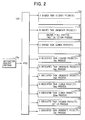
- the dedicated tasks D-J are provided for a 1ms process, a 4ms process, an 8ms process, a 16ms process, a 32ms process, a 30° CA process, and a Tdc process, respectively. These processes are the same as the above-described processes of FIG. 5.
- the shared tasks A-C are prepared for the respective priority level, that is, higher priority, moderate priority, and lower priority.
- Each of event processes corresponding to events other than the events selected as the specific processes is included in the shared task 12c whose priority level is the same as that of the event process.
- an engine stall process and a fault detection process of moderate priority level is included in the shared task B of moderate priority level.
- a trigger signal for triggering off execution of the event process corresponding to the event is generated. Further the message which includes event-related data which should be passed to the task 12c, 12d for execution of the corresponding event process is generated if necessary.
- the activation request process of the activation request program requests activation of the task which includes the event process corresponding to the event as follows, if the task is a shared task 12c.
- the shared task 12c which includes the event process corresponding to the event is selected based on the ID of the event process at step 100.
- the ID of the event process is stored in a queue at step 110. Further the event-related data is also stored in the queue at step 110, if such data is required to be passed to the selected shared task 12c.
- activation of the selected shared task 12c is requested. Then the activation request process terminates.
- the shared task 12c executes an event process as follows. Referring to FIG. 3B, the ID of the event process to be executed next is retrieved from the queue at step 200. If the event-related data corresponding to the event process is stored in the queue, the data is also retrieved from the queue at step 200. The event process to be executed next is selected based on the retrieved ID at step 210. The selected event process is executed at step 220. Then the shared task 12c terminates the process for execution of the event process.
- each of the shared tasks 12c includes a plurality of event processes, queuing of the ID of the event process should be performed at steps 110, 220, and further the event process to be executed next should be selected based on the ID at step 210.
- the activation request process of the activation request program requests activation of the task which includes the event process corresponding to the detected event as follows, if the task is a dedicated task 12d.
- the dedicated task 12d which includes the event process corresponding to the detected event is selected based on the ID of the event process at step 300 similarly to step 100 of FIG. 3A.
- activation of the selected dedicated task 12d is requested. Then the activation request process terminates.
- the dedicated task 12d When the RTOS 12b activates the dedicated task 12d, the dedicated task 12d simply executes the event process included therein as shown FIG. 4B and then terminates the process for execution of the event process.
- each of the dedicated tasks 12d includes only one event process, queuing of the ID of the event process or ID-based selection of the event process, which are executed at steps 110, 200, 210 in the case of the shared task 12c, is not required to be performed in the case of the dedicated task 12d.
- the ID of the event process should be stored and retrieved. Further it should be determined whether at least one ID is stored in the queue and whether the queue is full. If queuing operation need to be performed in response to the occurrence of a cyclic event which occurs in synchronous with the engine cycle or occurs at regular time intervals, the CPU load is very heavy.
- the dedicated tasks 12d are provided for the cyclic events. Accordingly, queuing operation does not need to be performed in response to a cyclic event, and therefore the CPU load is greatly reduced. The queuing operation needs to be performed in response to an occasional event such as an engine stall or a fault according to the present embodiment. However, this does not cause the heavy load on the CPU.
- the shared tasks 12c corresponding to the respective priority levels are prepared for the event processes corresponding to the occasional events for which the dedicated tasks 12d are not provided.
- the number of tasks is minimized so that task switching can be performed based on the priority levels. Therefore the amount of management information which should be held by the RTOS 12b is relatively small, and consequently the capacity of the RAM required for storing the management information is also relatively low.
- events other than the cyclic events may be selected as the specific events for which the dedicated tasks 12d are provided.
- events corresponding to event processes, which are more immune to elimination as a part of modification of the engine control program may be selected as the specific events. If the specific events are thus selected, the engine control program can be more readily modified if necessary.
- events in response to which a message that includes the event-related data is not generated may be selected as the specific events.
- the event-related data included therein should be passed to the task 12c, 12d. That is, the queuing operation should be performed for passing the event-related data in this case, even if the dedicated task 12d is provided for the event process corresponding to the event.
- the CPU load is reduced very little if the dedicated tasks 12d are provided for events in response to which the event-related data needs to be passed to the task 12c, 12d. Therefore it is preferable that events in response to which the event-related data does not need to be passed to the task 12c, 12d are selected as the specific events.
- the engine control program may be stored in computer readable medium such as FD, MO, CD-ROM, DVD, or a hard disk.
- the engine control program is loaded from the computer readable medium into the RAM 13, and then executed.
- the engine control program may be stored in computer readable medium such as ROM or backup RAM.
- the computer readable medium is incorporated in the ECU 1.
- the processor unit according the present invention is used as a unit, in which an RTOS executes programs involving task scheduling and task switching, other than the ECU 1 which controls the engine of the vehicle.
- a processor unit (1) is incorporated in a vehicle as an engine control unit (ECU).
- ECU engine control unit
- an activation request program (12a) requests a real time operating system (12b) to activate a task (12c, 12d) that includes an event process corresponding to the event.
- the event processes corresponding to cyclic events, which occur in synchronous with the engine cycle or at regular intervals, are included in dedicated tasks each of which is created as one of the tasks for executing only one event process. Therefore the activation request program does not need to store the ID of the event process in a queue when it requests activation of a dedicated task. Further, when a dedicated task is activated by the RTOS, it can identify an event process to be executed without retrieving the ID of the event process from the queue.
Landscapes
- Engineering & Computer Science (AREA)
- Software Systems (AREA)
- Theoretical Computer Science (AREA)
- Physics & Mathematics (AREA)
- General Engineering & Computer Science (AREA)
- General Physics & Mathematics (AREA)
- Combined Controls Of Internal Combustion Engines (AREA)
- Debugging And Monitoring (AREA)
Applications Claiming Priority (2)
| Application Number | Priority Date | Filing Date | Title |
|---|---|---|---|
| JP2000387120A JP3578082B2 (ja) | 2000-12-20 | 2000-12-20 | 処理実行装置及び記録媒体 |
| JP2000387120 | 2000-12-20 |
Publications (2)
| Publication Number | Publication Date |
|---|---|
| EP1217518A2 true EP1217518A2 (de) | 2002-06-26 |
| EP1217518A3 EP1217518A3 (de) | 2005-08-24 |
Family
ID=18854111
Family Applications (1)
| Application Number | Title | Priority Date | Filing Date |
|---|---|---|---|
| EP01130193A Ceased EP1217518A3 (de) | 2000-12-20 | 2001-12-19 | Prozessoreinheit zur Echtzeitsausführung eines Ereignissprozesses als Antwort auf ein Ereignis |
Country Status (3)
| Country | Link |
|---|---|
| US (1) | US6968552B2 (de) |
| EP (1) | EP1217518A3 (de) |
| JP (1) | JP3578082B2 (de) |
Cited By (1)
| Publication number | Priority date | Publication date | Assignee | Title |
|---|---|---|---|---|
| TWI412996B (zh) * | 2009-08-25 | 2013-10-21 | Htc Corp | 應用程序管理方法及系統,及其電腦程式產品 |
Families Citing this family (29)
| Publication number | Priority date | Publication date | Assignee | Title |
|---|---|---|---|---|
| US7099855B1 (en) | 2000-01-13 | 2006-08-29 | International Business Machines Corporation | System and method for electronic communication management |
| US6408277B1 (en) * | 2000-06-21 | 2002-06-18 | Banter Limited | System and method for automatic task prioritization |
| US8290768B1 (en) | 2000-06-21 | 2012-10-16 | International Business Machines Corporation | System and method for determining a set of attributes based on content of communications |
| US9699129B1 (en) | 2000-06-21 | 2017-07-04 | International Business Machines Corporation | System and method for increasing email productivity |
| US7644057B2 (en) | 2001-01-03 | 2010-01-05 | International Business Machines Corporation | System and method for electronic communication management |
| JP3879514B2 (ja) | 2002-01-11 | 2007-02-14 | 株式会社デンソー | 電子制御装置及びプログラム |
| JP3882666B2 (ja) * | 2002-04-19 | 2007-02-21 | 株式会社デンソー | 送信装置及び電子制御装置 |
| DE10228064B4 (de) * | 2002-06-17 | 2005-08-11 | Robert Bosch Gmbh | Verfahren, Echtzeit-Rechengerät und Initialisierungs-Programm zur Teilinitialisierung eines auf dem Rechengerät ablauffähigen Computerprogramms |
| JP3882760B2 (ja) | 2003-02-18 | 2007-02-21 | 株式会社デンソー | タスク間通信方法、プログラム、記録媒体、電子機器 |
| US7389230B1 (en) | 2003-04-22 | 2008-06-17 | International Business Machines Corporation | System and method for classification of voice signals |
| US8495002B2 (en) | 2003-05-06 | 2013-07-23 | International Business Machines Corporation | Software tool for training and testing a knowledge base |
| US20050187913A1 (en) | 2003-05-06 | 2005-08-25 | Yoram Nelken | Web-based customer service interface |
| US7912820B2 (en) * | 2003-06-06 | 2011-03-22 | Microsoft Corporation | Automatic task generator method and system |
| EP1653354A4 (de) | 2003-08-04 | 2008-03-26 | Hitachi Ltd | Echtzeit-steuersystem |
| US7784062B2 (en) * | 2004-06-18 | 2010-08-24 | General Electric Company | Event based operating system, method, and apparatus for instrumentation and control systems |
| US8677377B2 (en) * | 2005-09-08 | 2014-03-18 | Apple Inc. | Method and apparatus for building an intelligent automated assistant |
| US7433986B2 (en) * | 2005-11-14 | 2008-10-07 | Fujitsu Limited | Minimizing ISR latency and overhead |
| JP4609381B2 (ja) | 2006-06-14 | 2011-01-12 | 株式会社デンソー | 異常監視用プログラム、記録媒体及び電子装置 |
| US20080235658A1 (en) * | 2007-03-21 | 2008-09-25 | Asaf Adi | Code generation for real-time event processing |
| JP5128972B2 (ja) * | 2008-01-25 | 2013-01-23 | 学校法人日本大学 | 保安処理装置 |
| FR2927438B1 (fr) * | 2008-02-08 | 2010-03-05 | Commissariat Energie Atomique | Methode de prechargement dans une hierarchie de memoires des configurations d'un systeme heterogene reconfigurable de traitement de l'information |
| RU2569127C2 (ru) * | 2011-09-12 | 2015-11-20 | Тойота Дзидося Кабусики Кайся | Устройство управления для двигателя внутреннего сгорания |
| JP2013058228A (ja) * | 2012-11-01 | 2013-03-28 | Nihon Univ | 保安処理装置 |
| US9875149B2 (en) * | 2013-04-29 | 2018-01-23 | Microsoft Technology Licensing, Llc | Preventing sync interruptions |
| JP6207238B2 (ja) * | 2013-05-31 | 2017-10-04 | 富士通テン株式会社 | 車両用装置、通信システム、及び、アプリケーションの実行方法 |
| CN105900025A (zh) * | 2014-01-07 | 2016-08-24 | 三菱电机株式会社 | 控制装置、开发装置、以及开发程序 |
| JP7127300B2 (ja) * | 2018-03-02 | 2022-08-30 | 株式会社デンソー | 噴射制御装置 |
| RU2758418C1 (ru) * | 2019-12-30 | 2021-10-28 | федеральное государственное бюджетное образовательное учреждение высшего образования "Московский государственный технический университет имени Н.Э. Баумана (национальный исследовательский университет)" (МГТУ им. Н.Э. Баумана) | Стенд для исследования цифровой системы управления комбинированной энергетической установки |
| US20240092220A1 (en) * | 2022-09-15 | 2024-03-21 | GM Global Technology Operations LLC | Key-off electrical load management for a vehicle |
Family Cites Families (24)
| Publication number | Priority date | Publication date | Assignee | Title |
|---|---|---|---|---|
| DE3072043D1 (en) * | 1979-04-06 | 1987-11-19 | Hitachi Ltd | Electronic type engine control method and apparatus |
| JPS5638542A (en) * | 1979-09-05 | 1981-04-13 | Hitachi Ltd | Controlling method for engine |
| JPS60253397A (ja) | 1984-05-30 | 1985-12-14 | Fujitsu Ltd | 呼処理タスク制御方式 |
| US4658351A (en) * | 1984-10-09 | 1987-04-14 | Wang Laboratories, Inc. | Task control means for a multi-tasking data processing system |
| US4768149A (en) * | 1985-08-29 | 1988-08-30 | International Business Machines Corporation | System for managing a plurality of shared interrupt handlers in a linked-list data structure |
| US4954948A (en) * | 1986-12-29 | 1990-09-04 | Motorola, Inc. | Microprocessor operating system for sequentially executing subtasks |
| DE3826526A1 (de) * | 1988-08-04 | 1990-02-08 | Bosch Gmbh Robert | Verfahren und vorrichtung zum einstellen von betriebsgroessen einer brennkraftmaschine |
| JPH0378034A (ja) | 1989-08-21 | 1991-04-03 | Yoshinori Takahashi | プログラム並行実行装置 |
| US5390329A (en) * | 1990-06-11 | 1995-02-14 | Cray Research, Inc. | Responding to service requests using minimal system-side context in a multiprocessor environment |
| JP2914580B2 (ja) | 1990-09-10 | 1999-07-05 | 日産自動車株式会社 | イベント駆動型車両制御用コンピュータ |
| JPH04195577A (ja) * | 1990-11-28 | 1992-07-15 | Hitachi Ltd | マルチプロセッサにおけるタスクスケジューリング方式 |
| FR2696259A1 (fr) * | 1992-09-30 | 1994-04-01 | Apple Computer | Organisation en tâches et en modules d'une exécution dans un processeur. |
| JPH06139121A (ja) | 1992-10-28 | 1994-05-20 | Toyota Motor Corp | 情報処理方法 |
| EP0636955B1 (de) * | 1993-07-26 | 1998-11-04 | Hitachi, Ltd. | Steuerungseinheit für ein Fahrzeug und ein gesamtes Steuerungssystem hierfür |
| DE19500957A1 (de) * | 1994-07-19 | 1996-01-25 | Bosch Gmbh Robert | Verfahren zur Steuerung von technischen Vorgängen oder Prozessen |
| US5636124A (en) * | 1995-03-08 | 1997-06-03 | Allen-Bradley Company, Inc. | Multitasking industrial controller |
| US5627745A (en) * | 1995-05-03 | 1997-05-06 | Allen-Bradley Company, Inc. | Parallel processing in a multitasking industrial controller |
| US6148321A (en) * | 1995-05-05 | 2000-11-14 | Intel Corporation | Processor event recognition |
| US5606703A (en) * | 1995-12-06 | 1997-02-25 | International Business Machines Corporation | Interrupt protocol system and method using priority-arranged queues of interrupt status block control data structures |
| JPH10105416A (ja) | 1996-09-26 | 1998-04-24 | Fujitsu Ten Ltd | リアルタイムオペレーティングシステムを用いたタスク起動制御装置 |
| JP2000047883A (ja) * | 1998-07-31 | 2000-02-18 | Denso Corp | タスク制御方法および記録媒体 |
| JP3460593B2 (ja) * | 1998-09-17 | 2003-10-27 | 株式会社デンソー | 車両用制御装置 |
| JP4427860B2 (ja) * | 2000-03-24 | 2010-03-10 | 株式会社デンソー | 車両用制御装置及び記録媒体 |
| JP3879514B2 (ja) * | 2002-01-11 | 2007-02-14 | 株式会社デンソー | 電子制御装置及びプログラム |
-
2000
- 2000-12-20 JP JP2000387120A patent/JP3578082B2/ja not_active Expired - Fee Related
-
2001
- 2001-12-18 US US10/020,437 patent/US6968552B2/en not_active Expired - Lifetime
- 2001-12-19 EP EP01130193A patent/EP1217518A3/de not_active Ceased
Non-Patent Citations (2)
| Title |
|---|
| MARSH D: "Automotive design sets RTOS cost and performance challenges", EDN EUROPE - CAHNERS PUBLISHING, September 1999 (1999-09-01), USA, pages 32-34, 36, 38, 40, 42, ISSN: 0012-7515 * |
| ZAHIR A: "An integrated concept of handling preemptions and interrupts for automotive real-time operating systems", REAL-TIME MAGAZINE - JULY-SEPT. 1999 - REAL-TIME CONSULT - BELGIUM, July 1999 (1999-07-01), pages 25-26, 28 - 30, 32, ISSN: 1018-0303 * |
Cited By (1)
| Publication number | Priority date | Publication date | Assignee | Title |
|---|---|---|---|---|
| TWI412996B (zh) * | 2009-08-25 | 2013-10-21 | Htc Corp | 應用程序管理方法及系統,及其電腦程式產品 |
Also Published As
| Publication number | Publication date |
|---|---|
| US20020078257A1 (en) | 2002-06-20 |
| JP3578082B2 (ja) | 2004-10-20 |
| US6968552B2 (en) | 2005-11-22 |
| EP1217518A3 (de) | 2005-08-24 |
| JP2002189606A (ja) | 2002-07-05 |
Similar Documents
| Publication | Publication Date | Title |
|---|---|---|
| US6968552B2 (en) | Processor unit for executing event process in real time in response to occurrence of event | |
| US7086056B2 (en) | Processor unit for executing event processes in real time without causing process interference | |
| US8195885B2 (en) | Electronic unit for saving state of task to be run in stack | |
| JP7147615B2 (ja) | タスク管理装置 | |
| JP4241462B2 (ja) | 制御ユニットおよびマイクロコンピュータ | |
| JP2000047883A (ja) | タスク制御方法および記録媒体 | |
| JP2003063327A (ja) | 車両用電子制御装置 | |
| US20050235085A1 (en) | Digital controller and engine controller using the same | |
| JPH11232148A (ja) | 計算機の負荷率計測方法及び計測システム | |
| US6208930B1 (en) | Engine control system and method having control routines of different execution priorities | |
| US6754576B2 (en) | Electronic control unit having different mask return processes | |
| JP3882760B2 (ja) | タスク間通信方法、プログラム、記録媒体、電子機器 | |
| US20200005561A1 (en) | Method for setting an iumpr of a vehicle, computer program, memory means, control unit and vehicle | |
| JP2008276674A (ja) | タスクの実行時間を特定することのできる電子計算装置、および当該電子計算装置用のプログラム | |
| JP2002049498A (ja) | タスク起動制御方法 | |
| JP2014137695A (ja) | 情報処理装置 | |
| JP2013245601A (ja) | 半導体データ処理装置及びエンジン制御装置 | |
| US20020147761A1 (en) | Processing execution apparatus having data reference limiting function | |
| JP4419338B2 (ja) | 処理負荷測定方法および装置 | |
| JP2021152338A (ja) | 制御装置 | |
| JP2003167601A (ja) | 車両用電子制御装置 | |
| JP2008520874A (ja) | 機能モジュールの管理システムを動作させる方法 | |
| JP3195069B2 (ja) | エンジンの制御装置 | |
| JP2006235924A (ja) | プログラムの実行アドレス異常を検出する電子制御装置 | |
| JPH09275602A (ja) | 自動車の駆動力制御装置 |
Legal Events
| Date | Code | Title | Description |
|---|---|---|---|
| PUAI | Public reference made under article 153(3) epc to a published international application that has entered the european phase |
Free format text: ORIGINAL CODE: 0009012 |
|
| AK | Designated contracting states |
Kind code of ref document: A2 Designated state(s): AT BE CH CY DE DK ES FI FR GB GR IE IT LI LU MC NL PT SE TR |
|
| AX | Request for extension of the european patent |
Free format text: AL;LT;LV;MK;RO;SI |
|
| PUAL | Search report despatched |
Free format text: ORIGINAL CODE: 0009013 |
|
| RIC1 | Information provided on ipc code assigned before grant |
Ipc: 7G 06F 9/54 B Ipc: 7G 06F 9/46 A |
|
| AK | Designated contracting states |
Kind code of ref document: A3 Designated state(s): AT BE CH CY DE DK ES FI FR GB GR IE IT LI LU MC NL PT SE TR |
|
| AX | Request for extension of the european patent |
Extension state: AL LT LV MK RO SI |
|
| 17P | Request for examination filed |
Effective date: 20050923 |
|
| AKX | Designation fees paid |
Designated state(s): DE GB SE |
|
| APBN | Date of receipt of notice of appeal recorded |
Free format text: ORIGINAL CODE: EPIDOSNNOA2E |
|
| APBR | Date of receipt of statement of grounds of appeal recorded |
Free format text: ORIGINAL CODE: EPIDOSNNOA3E |
|
| APAF | Appeal reference modified |
Free format text: ORIGINAL CODE: EPIDOSCREFNE |
|
| APAF | Appeal reference modified |
Free format text: ORIGINAL CODE: EPIDOSCREFNE |
|
| APBT | Appeal procedure closed |
Free format text: ORIGINAL CODE: EPIDOSNNOA9E |
|
| STAA | Information on the status of an ep patent application or granted ep patent |
Free format text: STATUS: THE APPLICATION HAS BEEN REFUSED |
|
| 18R | Application refused |
Effective date: 20111012 |