EP1165310B1 - Faltwabe aus wellpappe, verfahren und vorrichtung zu deren herstellung - Google Patents
Faltwabe aus wellpappe, verfahren und vorrichtung zu deren herstellung Download PDFInfo
- Publication number
- EP1165310B1 EP1165310B1 EP00920578A EP00920578A EP1165310B1 EP 1165310 B1 EP1165310 B1 EP 1165310B1 EP 00920578 A EP00920578 A EP 00920578A EP 00920578 A EP00920578 A EP 00920578A EP 1165310 B1 EP1165310 B1 EP 1165310B1
- Authority
- EP
- European Patent Office
- Prior art keywords
- corrugated core
- corrugated
- strips
- cover layer
- strip
- Prior art date
- Legal status (The legal status is an assumption and is not a legal conclusion. Google has not performed a legal analysis and makes no representation as to the accuracy of the status listed.)
- Expired - Lifetime
Links
- 238000000034 method Methods 0.000 title claims abstract description 36
- 239000011087 paperboard Substances 0.000 title 1
- 239000011162 core material Substances 0.000 claims description 148
- 239000000463 material Substances 0.000 claims description 51
- 238000005520 cutting process Methods 0.000 claims description 16
- 239000000853 adhesive Substances 0.000 claims description 9
- 230000001070 adhesive effect Effects 0.000 claims description 9
- 238000010924 continuous production Methods 0.000 claims description 5
- 238000011144 upstream manufacturing Methods 0.000 claims 1
- 238000004519 manufacturing process Methods 0.000 abstract description 39
- 241000264877 Hippospongia communis Species 0.000 description 79
- 239000011111 cardboard Substances 0.000 description 42
- 239000010410 layer Substances 0.000 description 36
- 239000012792 core layer Substances 0.000 description 15
- 230000001427 coherent effect Effects 0.000 description 13
- 210000004027 cell Anatomy 0.000 description 11
- 210000002421 cell wall Anatomy 0.000 description 7
- 238000004806 packaging method and process Methods 0.000 description 6
- 239000000123 paper Substances 0.000 description 6
- 238000004026 adhesive bonding Methods 0.000 description 3
- 229920002472 Starch Polymers 0.000 description 2
- 208000012886 Vertigo Diseases 0.000 description 2
- 239000002313 adhesive film Substances 0.000 description 2
- 238000005452 bending Methods 0.000 description 2
- 230000002860 competitive effect Effects 0.000 description 2
- 239000002131 composite material Substances 0.000 description 2
- 238000004049 embossing Methods 0.000 description 2
- 239000000835 fiber Substances 0.000 description 2
- 239000004033 plastic Substances 0.000 description 2
- 238000007639 printing Methods 0.000 description 2
- 230000035939 shock Effects 0.000 description 2
- 235000019698 starch Nutrition 0.000 description 2
- 239000008107 starch Substances 0.000 description 2
- 238000010521 absorption reaction Methods 0.000 description 1
- 229910052782 aluminium Inorganic materials 0.000 description 1
- XAGFODPZIPBFFR-UHFFFAOYSA-N aluminium Chemical compound [Al] XAGFODPZIPBFFR-UHFFFAOYSA-N 0.000 description 1
- 229920006231 aramid fiber Polymers 0.000 description 1
- 230000001680 brushing effect Effects 0.000 description 1
- 239000007795 chemical reaction product Substances 0.000 description 1
- 230000007613 environmental effect Effects 0.000 description 1
- 239000004744 fabric Substances 0.000 description 1
- 238000007654 immersion Methods 0.000 description 1
- 238000003780 insertion Methods 0.000 description 1
- 230000037431 insertion Effects 0.000 description 1
- 229910052751 metal Inorganic materials 0.000 description 1
- 239000002184 metal Substances 0.000 description 1
- 239000005022 packaging material Substances 0.000 description 1
- ISWSIDIOOBJBQZ-UHFFFAOYSA-N phenol group Chemical group C1(=CC=CC=C1)O ISWSIDIOOBJBQZ-UHFFFAOYSA-N 0.000 description 1
- 238000003825 pressing Methods 0.000 description 1
- 239000000047 product Substances 0.000 description 1
- 238000004080 punching Methods 0.000 description 1
- 239000002994 raw material Substances 0.000 description 1
- 238000005096 rolling process Methods 0.000 description 1
- 238000007493 shaping process Methods 0.000 description 1
- 238000005507 spraying Methods 0.000 description 1
- 239000003351 stiffener Substances 0.000 description 1
- 239000002937 thermal insulation foam Substances 0.000 description 1
Images



Classifications
-
- B—PERFORMING OPERATIONS; TRANSPORTING
- B31—MAKING ARTICLES OF PAPER, CARDBOARD OR MATERIAL WORKED IN A MANNER ANALOGOUS TO PAPER; WORKING PAPER, CARDBOARD OR MATERIAL WORKED IN A MANNER ANALOGOUS TO PAPER
- B31D—MAKING ARTICLES OF PAPER, CARDBOARD OR MATERIAL WORKED IN A MANNER ANALOGOUS TO PAPER, NOT PROVIDED FOR IN SUBCLASSES B31B OR B31C
- B31D3/00—Making articles of cellular structure, e.g. insulating board
- B31D3/005—Making cellular structures from corrugated webs or sheets
-
- Y—GENERAL TAGGING OF NEW TECHNOLOGICAL DEVELOPMENTS; GENERAL TAGGING OF CROSS-SECTIONAL TECHNOLOGIES SPANNING OVER SEVERAL SECTIONS OF THE IPC; TECHNICAL SUBJECTS COVERED BY FORMER USPC CROSS-REFERENCE ART COLLECTIONS [XRACs] AND DIGESTS
- Y10—TECHNICAL SUBJECTS COVERED BY FORMER USPC
- Y10T—TECHNICAL SUBJECTS COVERED BY FORMER US CLASSIFICATION
- Y10T156/00—Adhesive bonding and miscellaneous chemical manufacture
- Y10T156/10—Methods of surface bonding and/or assembly therefor
- Y10T156/1002—Methods of surface bonding and/or assembly therefor with permanent bending or reshaping or surface deformation of self sustaining lamina
-
- Y—GENERAL TAGGING OF NEW TECHNOLOGICAL DEVELOPMENTS; GENERAL TAGGING OF CROSS-SECTIONAL TECHNOLOGIES SPANNING OVER SEVERAL SECTIONS OF THE IPC; TECHNICAL SUBJECTS COVERED BY FORMER USPC CROSS-REFERENCE ART COLLECTIONS [XRACs] AND DIGESTS
- Y10—TECHNICAL SUBJECTS COVERED BY FORMER USPC
- Y10T—TECHNICAL SUBJECTS COVERED BY FORMER US CLASSIFICATION
- Y10T156/00—Adhesive bonding and miscellaneous chemical manufacture
- Y10T156/10—Methods of surface bonding and/or assembly therefor
- Y10T156/1002—Methods of surface bonding and/or assembly therefor with permanent bending or reshaping or surface deformation of self sustaining lamina
- Y10T156/1005—Methods of surface bonding and/or assembly therefor with permanent bending or reshaping or surface deformation of self sustaining lamina by inward collapsing of portion of hollow body
-
- Y—GENERAL TAGGING OF NEW TECHNOLOGICAL DEVELOPMENTS; GENERAL TAGGING OF CROSS-SECTIONAL TECHNOLOGIES SPANNING OVER SEVERAL SECTIONS OF THE IPC; TECHNICAL SUBJECTS COVERED BY FORMER USPC CROSS-REFERENCE ART COLLECTIONS [XRACs] AND DIGESTS
- Y10—TECHNICAL SUBJECTS COVERED BY FORMER USPC
- Y10T—TECHNICAL SUBJECTS COVERED BY FORMER US CLASSIFICATION
- Y10T156/00—Adhesive bonding and miscellaneous chemical manufacture
- Y10T156/10—Methods of surface bonding and/or assembly therefor
- Y10T156/1002—Methods of surface bonding and/or assembly therefor with permanent bending or reshaping or surface deformation of self sustaining lamina
- Y10T156/1007—Running or continuous length work
- Y10T156/1015—Folding
-
- Y—GENERAL TAGGING OF NEW TECHNOLOGICAL DEVELOPMENTS; GENERAL TAGGING OF CROSS-SECTIONAL TECHNOLOGIES SPANNING OVER SEVERAL SECTIONS OF THE IPC; TECHNICAL SUBJECTS COVERED BY FORMER USPC CROSS-REFERENCE ART COLLECTIONS [XRACs] AND DIGESTS
- Y10—TECHNICAL SUBJECTS COVERED BY FORMER USPC
- Y10T—TECHNICAL SUBJECTS COVERED BY FORMER US CLASSIFICATION
- Y10T156/00—Adhesive bonding and miscellaneous chemical manufacture
- Y10T156/10—Methods of surface bonding and/or assembly therefor
- Y10T156/1002—Methods of surface bonding and/or assembly therefor with permanent bending or reshaping or surface deformation of self sustaining lamina
- Y10T156/1007—Running or continuous length work
- Y10T156/1016—Transverse corrugating
-
- Y—GENERAL TAGGING OF NEW TECHNOLOGICAL DEVELOPMENTS; GENERAL TAGGING OF CROSS-SECTIONAL TECHNOLOGIES SPANNING OVER SEVERAL SECTIONS OF THE IPC; TECHNICAL SUBJECTS COVERED BY FORMER USPC CROSS-REFERENCE ART COLLECTIONS [XRACs] AND DIGESTS
- Y10—TECHNICAL SUBJECTS COVERED BY FORMER USPC
- Y10T—TECHNICAL SUBJECTS COVERED BY FORMER US CLASSIFICATION
- Y10T156/00—Adhesive bonding and miscellaneous chemical manufacture
- Y10T156/10—Methods of surface bonding and/or assembly therefor
- Y10T156/1002—Methods of surface bonding and/or assembly therefor with permanent bending or reshaping or surface deformation of self sustaining lamina
- Y10T156/1007—Running or continuous length work
- Y10T156/1016—Transverse corrugating
- Y10T156/102—Transverse corrugating with deformation or cutting of corrugated lamina
-
- Y—GENERAL TAGGING OF NEW TECHNOLOGICAL DEVELOPMENTS; GENERAL TAGGING OF CROSS-SECTIONAL TECHNOLOGIES SPANNING OVER SEVERAL SECTIONS OF THE IPC; TECHNICAL SUBJECTS COVERED BY FORMER USPC CROSS-REFERENCE ART COLLECTIONS [XRACs] AND DIGESTS
- Y10—TECHNICAL SUBJECTS COVERED BY FORMER USPC
- Y10T—TECHNICAL SUBJECTS COVERED BY FORMER US CLASSIFICATION
- Y10T156/00—Adhesive bonding and miscellaneous chemical manufacture
- Y10T156/10—Methods of surface bonding and/or assembly therefor
- Y10T156/1002—Methods of surface bonding and/or assembly therefor with permanent bending or reshaping or surface deformation of self sustaining lamina
- Y10T156/1025—Methods of surface bonding and/or assembly therefor with permanent bending or reshaping or surface deformation of self sustaining lamina to form undulated to corrugated sheet and securing to base with parts of shaped areas out of contact
-
- Y—GENERAL TAGGING OF NEW TECHNOLOGICAL DEVELOPMENTS; GENERAL TAGGING OF CROSS-SECTIONAL TECHNOLOGIES SPANNING OVER SEVERAL SECTIONS OF THE IPC; TECHNICAL SUBJECTS COVERED BY FORMER USPC CROSS-REFERENCE ART COLLECTIONS [XRACs] AND DIGESTS
- Y10—TECHNICAL SUBJECTS COVERED BY FORMER USPC
- Y10T—TECHNICAL SUBJECTS COVERED BY FORMER US CLASSIFICATION
- Y10T156/00—Adhesive bonding and miscellaneous chemical manufacture
- Y10T156/10—Methods of surface bonding and/or assembly therefor
- Y10T156/1002—Methods of surface bonding and/or assembly therefor with permanent bending or reshaping or surface deformation of self sustaining lamina
- Y10T156/1026—Methods of surface bonding and/or assembly therefor with permanent bending or reshaping or surface deformation of self sustaining lamina with slitting or removal of material at reshaping area prior to reshaping
-
- Y—GENERAL TAGGING OF NEW TECHNOLOGICAL DEVELOPMENTS; GENERAL TAGGING OF CROSS-SECTIONAL TECHNOLOGIES SPANNING OVER SEVERAL SECTIONS OF THE IPC; TECHNICAL SUBJECTS COVERED BY FORMER USPC CROSS-REFERENCE ART COLLECTIONS [XRACs] AND DIGESTS
- Y10—TECHNICAL SUBJECTS COVERED BY FORMER USPC
- Y10T—TECHNICAL SUBJECTS COVERED BY FORMER US CLASSIFICATION
- Y10T156/00—Adhesive bonding and miscellaneous chemical manufacture
- Y10T156/10—Methods of surface bonding and/or assembly therefor
- Y10T156/1002—Methods of surface bonding and/or assembly therefor with permanent bending or reshaping or surface deformation of self sustaining lamina
- Y10T156/1051—Methods of surface bonding and/or assembly therefor with permanent bending or reshaping or surface deformation of self sustaining lamina by folding
-
- Y—GENERAL TAGGING OF NEW TECHNOLOGICAL DEVELOPMENTS; GENERAL TAGGING OF CROSS-SECTIONAL TECHNOLOGIES SPANNING OVER SEVERAL SECTIONS OF THE IPC; TECHNICAL SUBJECTS COVERED BY FORMER USPC CROSS-REFERENCE ART COLLECTIONS [XRACs] AND DIGESTS
- Y10—TECHNICAL SUBJECTS COVERED BY FORMER USPC
- Y10T—TECHNICAL SUBJECTS COVERED BY FORMER US CLASSIFICATION
- Y10T156/00—Adhesive bonding and miscellaneous chemical manufacture
- Y10T156/10—Methods of surface bonding and/or assembly therefor
- Y10T156/1052—Methods of surface bonding and/or assembly therefor with cutting, punching, tearing or severing
-
- Y—GENERAL TAGGING OF NEW TECHNOLOGICAL DEVELOPMENTS; GENERAL TAGGING OF CROSS-SECTIONAL TECHNOLOGIES SPANNING OVER SEVERAL SECTIONS OF THE IPC; TECHNICAL SUBJECTS COVERED BY FORMER USPC CROSS-REFERENCE ART COLLECTIONS [XRACs] AND DIGESTS
- Y10—TECHNICAL SUBJECTS COVERED BY FORMER USPC
- Y10T—TECHNICAL SUBJECTS COVERED BY FORMER US CLASSIFICATION
- Y10T156/00—Adhesive bonding and miscellaneous chemical manufacture
- Y10T156/10—Methods of surface bonding and/or assembly therefor
- Y10T156/1052—Methods of surface bonding and/or assembly therefor with cutting, punching, tearing or severing
- Y10T156/1082—Partial cutting bonded sandwich [e.g., grooving or incising]
-
- Y—GENERAL TAGGING OF NEW TECHNOLOGICAL DEVELOPMENTS; GENERAL TAGGING OF CROSS-SECTIONAL TECHNOLOGIES SPANNING OVER SEVERAL SECTIONS OF THE IPC; TECHNICAL SUBJECTS COVERED BY FORMER USPC CROSS-REFERENCE ART COLLECTIONS [XRACs] AND DIGESTS
- Y10—TECHNICAL SUBJECTS COVERED BY FORMER USPC
- Y10T—TECHNICAL SUBJECTS COVERED BY FORMER US CLASSIFICATION
- Y10T428/00—Stock material or miscellaneous articles
- Y10T428/23—Sheet including cover or casing
- Y10T428/234—Sheet including cover or casing including elements cooperating to form cells
- Y10T428/236—Honeycomb type cells extend perpendicularly to nonthickness layer
-
- Y—GENERAL TAGGING OF NEW TECHNOLOGICAL DEVELOPMENTS; GENERAL TAGGING OF CROSS-SECTIONAL TECHNOLOGIES SPANNING OVER SEVERAL SECTIONS OF THE IPC; TECHNICAL SUBJECTS COVERED BY FORMER USPC CROSS-REFERENCE ART COLLECTIONS [XRACs] AND DIGESTS
- Y10—TECHNICAL SUBJECTS COVERED BY FORMER USPC
- Y10T—TECHNICAL SUBJECTS COVERED BY FORMER US CLASSIFICATION
- Y10T428/00—Stock material or miscellaneous articles
- Y10T428/24—Structurally defined web or sheet [e.g., overall dimension, etc.]
- Y10T428/24149—Honeycomb-like
-
- Y—GENERAL TAGGING OF NEW TECHNOLOGICAL DEVELOPMENTS; GENERAL TAGGING OF CROSS-SECTIONAL TECHNOLOGIES SPANNING OVER SEVERAL SECTIONS OF THE IPC; TECHNICAL SUBJECTS COVERED BY FORMER USPC CROSS-REFERENCE ART COLLECTIONS [XRACs] AND DIGESTS
- Y10—TECHNICAL SUBJECTS COVERED BY FORMER USPC
- Y10T—TECHNICAL SUBJECTS COVERED BY FORMER US CLASSIFICATION
- Y10T428/00—Stock material or miscellaneous articles
- Y10T428/24—Structurally defined web or sheet [e.g., overall dimension, etc.]
- Y10T428/24479—Structurally defined web or sheet [e.g., overall dimension, etc.] including variation in thickness
- Y10T428/24562—Interlaminar spaces
-
- Y—GENERAL TAGGING OF NEW TECHNOLOGICAL DEVELOPMENTS; GENERAL TAGGING OF CROSS-SECTIONAL TECHNOLOGIES SPANNING OVER SEVERAL SECTIONS OF THE IPC; TECHNICAL SUBJECTS COVERED BY FORMER USPC CROSS-REFERENCE ART COLLECTIONS [XRACs] AND DIGESTS
- Y10—TECHNICAL SUBJECTS COVERED BY FORMER USPC
- Y10T—TECHNICAL SUBJECTS COVERED BY FORMER US CLASSIFICATION
- Y10T428/00—Stock material or miscellaneous articles
- Y10T428/24—Structurally defined web or sheet [e.g., overall dimension, etc.]
- Y10T428/24479—Structurally defined web or sheet [e.g., overall dimension, etc.] including variation in thickness
- Y10T428/2457—Parallel ribs and/or grooves
-
- Y—GENERAL TAGGING OF NEW TECHNOLOGICAL DEVELOPMENTS; GENERAL TAGGING OF CROSS-SECTIONAL TECHNOLOGIES SPANNING OVER SEVERAL SECTIONS OF THE IPC; TECHNICAL SUBJECTS COVERED BY FORMER USPC CROSS-REFERENCE ART COLLECTIONS [XRACs] AND DIGESTS
- Y10—TECHNICAL SUBJECTS COVERED BY FORMER USPC
- Y10T—TECHNICAL SUBJECTS COVERED BY FORMER US CLASSIFICATION
- Y10T428/00—Stock material or miscellaneous articles
- Y10T428/24—Structurally defined web or sheet [e.g., overall dimension, etc.]
- Y10T428/24744—Longitudinal or transverse tubular cavity or cell
-
- Y—GENERAL TAGGING OF NEW TECHNOLOGICAL DEVELOPMENTS; GENERAL TAGGING OF CROSS-SECTIONAL TECHNOLOGIES SPANNING OVER SEVERAL SECTIONS OF THE IPC; TECHNICAL SUBJECTS COVERED BY FORMER USPC CROSS-REFERENCE ART COLLECTIONS [XRACs] AND DIGESTS
- Y10—TECHNICAL SUBJECTS COVERED BY FORMER USPC
- Y10T—TECHNICAL SUBJECTS COVERED BY FORMER US CLASSIFICATION
- Y10T428/00—Stock material or miscellaneous articles
- Y10T428/24—Structurally defined web or sheet [e.g., overall dimension, etc.]
- Y10T428/24752—Laterally noncoextensive components
-
- Y—GENERAL TAGGING OF NEW TECHNOLOGICAL DEVELOPMENTS; GENERAL TAGGING OF CROSS-SECTIONAL TECHNOLOGIES SPANNING OVER SEVERAL SECTIONS OF THE IPC; TECHNICAL SUBJECTS COVERED BY FORMER USPC CROSS-REFERENCE ART COLLECTIONS [XRACs] AND DIGESTS
- Y10—TECHNICAL SUBJECTS COVERED BY FORMER USPC
- Y10T—TECHNICAL SUBJECTS COVERED BY FORMER US CLASSIFICATION
- Y10T428/00—Stock material or miscellaneous articles
- Y10T428/24—Structurally defined web or sheet [e.g., overall dimension, etc.]
- Y10T428/24752—Laterally noncoextensive components
- Y10T428/2476—Fabric, cloth or textile component
-
- Y—GENERAL TAGGING OF NEW TECHNOLOGICAL DEVELOPMENTS; GENERAL TAGGING OF CROSS-SECTIONAL TECHNOLOGIES SPANNING OVER SEVERAL SECTIONS OF THE IPC; TECHNICAL SUBJECTS COVERED BY FORMER USPC CROSS-REFERENCE ART COLLECTIONS [XRACs] AND DIGESTS
- Y10—TECHNICAL SUBJECTS COVERED BY FORMER USPC
- Y10T—TECHNICAL SUBJECTS COVERED BY FORMER US CLASSIFICATION
- Y10T83/00—Cutting
- Y10T83/04—Processes
- Y10T83/0581—Cutting part way through from opposite sides of work
-
- Y—GENERAL TAGGING OF NEW TECHNOLOGICAL DEVELOPMENTS; GENERAL TAGGING OF CROSS-SECTIONAL TECHNOLOGIES SPANNING OVER SEVERAL SECTIONS OF THE IPC; TECHNICAL SUBJECTS COVERED BY FORMER USPC CROSS-REFERENCE ART COLLECTIONS [XRACs] AND DIGESTS
- Y10—TECHNICAL SUBJECTS COVERED BY FORMER USPC
- Y10T—TECHNICAL SUBJECTS COVERED BY FORMER US CLASSIFICATION
- Y10T83/00—Cutting
- Y10T83/04—Processes
- Y10T83/0586—Effecting diverse or sequential cuts in same cutting step
Definitions
- the invention relates to honeycomb core layers as in Sandwich materials used for packaging and structural applications be, as well as on methods and devices for producing them Honeycomb layers.
- Honeycomb cores In the aerospace industry, the core material for buckling and Bending-resistant sandwich trays and sheets have been preferred for many decades Honeycomb cores used. These, mostly hexagonal or overexpanded Honeycomb cores mainly consist of aluminum or phenolic resin-soaked Aramid fiber paper and are usually manufactured in the expansion process. A sandwich structure with two, usually glued on top layers offers extremely high rigidity and strength-weight ratios. The Interest of other large industries in light sandwich core materials with good weight-specific material parameters grows constantly, so that meanwhile more than half of the honeycomb core materials in other areas be used.
- honeycombs for packaging, in the automotive industry and comparable markets requires a rapid continuous production of the Honeycomb core layer, so that one for corrugated cardboard and other inexpensive Competitive product can be manufactured.
- a sandwich with a honeycomb core has high specific compressive strengths in the material level, due to the optimal almost independent of direction Support of the top layers.
- corrugated core e.g. Corrugated cardboard
- edge crush resistance and bending stiffness particularly in the machine direction This makes it clear Weight and material savings possible.
- perpendicular to the material plane are, due to the vertical mutually supporting cell walls, the Characteristics significantly better.
- a honeycomb sandwich also has one better surface quality what especially for printing on Packaging materials is important. Because of these advantages and the There was increasing demand for inexpensive sandwich cores in the Past diverse efforts to reduce high levels Manufacturing costs for honeycomb cores.
- honeycombs and methods are known in which one Corrugated cardboard web (US 3,912,573 Kunz) or a single corrugated web (WO 91/00803 Kunz) with the shafts across the production direction in strips is cut. After cutting the web is then through the Sticking the individual strips together creates a honeycomb core layer.
- This Procedure requires a certain size of each strip or special Positioning tapes so that their handling is guaranteed. Through the The size of the strips reduces the web width after turning the strips strong.
- the Strips cut in a further production step and into one Honeycomb block glued, which is then significantly slower across the production direction is further promoted. This honeycomb block must be used for small honeycomb heights be cut if necessary.
- honeycombs have between corrugated or trapezoidal shaped cell wall strips also single straight strips.
- Such reinforced Honeycombs are also from manual production using a block known (WO 95/10412 Darfler). There are individual flat layers between the individual corrugated layers are laid and glued to them.
- Honeycombs and methods for their production are also known, in which a coherent material web is first corrugated or trapezoidally shaped after the cuts have been made, before the coherent cell walls are folded and glued to one another (WO 97/03816 plow).
- very light paper 40 g / m 2 to 80 g / m 2
- a top layer a so-called liner
- the corrugated web alone cannot absorb the tensile stress necessary for the rapid conveying of the material web.
- the invention has for its object a honeycomb core layer Method and apparatus to specify the continuous Production of honeycombs with relatively small cell widths, with one of the corrugated cardboard production comparable production speed. Furthermore is a good surface quality as well as a reliable and fast Connection of the top layers desired.
- a corrugated or trapezoidal material web is preferably fed with at least one, but preferably with two cover layers.
- This can be corrugated cardboard, but also a plastic, fiber composite or metal corrugated core plate.
- a web with several corrugated cores, for example a double-corrugated cardboard (BC-Flute, AA-Flute) can also be used.
- the cover layers preferably consist of very thin material (basis weight between 60 g / m 2 and 100 g / m 2 ) and the corrugated core layer consists of material that is up to twice as thick, since the cover layers in the preferred variant of the folding honeycomb come to lie twice , Very little demands are made on the quality of the top layers, as well as on the thickness tolerance and surface quality of the corrugated core web, since these factors have little influence on the surface quality of the end product.
- the thickness of the corrugated cardboard web determines the width of the honeycomb cells.
- cell widths of 4.7 mm (A-Flute), or at very low grammages of 3.6 mm (C-Flute) are sufficient, as the flat Corrugated core top layer strips offer an additional layer and the risk of Reduce bulging of the cover layers in the cells (dimpling).
- honeycomb cores with smaller or larger cell widths from corrugated core webs with lower or higher shaft heights (e.g. K-Flute).
- the fold lines can be Example can be introduced by pressing or longitudinally cutting the web.
- the cuts do not completely cut through the web in the thickness direction, but rather leave a cover layer (or the cover layer and the wave crests) contiguous.
- the cuts on the top are as possible right between the cuts of the bottom.
- the usual for corrugated cardboard Unevenness of the cover layers and the different cutting forces between the wave crests can cause the top layer to is partially or completely intersected in individual places. It is quite desirable as long as the corrugated core strips in the transverse direction stay connected.
- the required folding force can be easily achieved with this Cutting or perforating the cover layers or an additional one Pre-embossing of the fold line can be reduced.
- the corrugated core strips can also first cut completely and simultaneously or immediately afterwards be glued together using adhesive films. This material can be compared be easier to bend or fold to the material of the web. Accordingly, not only does the word combination "formed in one piece" include wavy stripes, which are connected to each other by a cover layer but also separate ones Wavy stripes that are connected to each other by adhesive film.
- the Relationship between the width and the height of the contiguous Corrugated core strips are preferably in the range from 0.5 to 2.0.
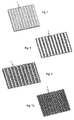
- the connected corrugated core strips are then each 90 ° rotated so that the cuts open and the contiguous Fold the top layers of adjacent strips by 180 °. Because the stripes is no alignment in the thickness or length direction necessary.
- the strips lay with the coherent top layers flat against each other and form the folded honeycomb. They can be glued, otherwise connected or only when the new cover layers are glued on by them get connected.
- the adhesive can be applied by rollers, nozzles or Brushing takes place, an application is preferred that is relatively low Constant amount of adhesive applied.
- a corrugated core with the corrugated core strips are much more stable than with only one layer Top layer and can be glued with some pressure. Any Deformations of the corrugated core, which in the production of corrugated cardboard Often impairing surface quality, they occur here in the width direction and have none on the surface quality and thickness tolerance of the folded honeycomb Influence.
- the flat corrugated core top layer strips standing vertically in the honeycomb can absorb the tensile stresses in the production direction and enable fast transport of the material web. You increase that later Shear and pressure characteristics of the honeycomb, so that all material of the corrugated cardboard in the folded honeycomb core is used.
- New cover layers can be used to manufacture a honeycomb panel material directly onto the honeycomb core layer immediately after honeycomb production be stuck on.
- the high compressive strength of the honeycomb is very useful.
- a good connection of the cover layers to the honeycomb can be achieved with a light shredding of the edges can be achieved when making the longitudinal cuts.
- the edges of the corrugated core layer are the small side surfaces of the folded Corrugated core top layer strips in addition to connecting the top layers Available.
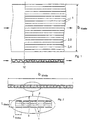
- Fig. 1 shows the supplied corrugated core web with the waves transverse to Production direction and the position of the longitudinal incisions in the top view and the side view.
- the wave core track can be based on plastic, Fabric, fiber composite, paper, cardboard or similar materials.
- the corrugated core strips 1 are each delimited by two incisions 2 and 3.
- the Corrugated core web is through these cuts, which the material web in Do not completely cut through the thickness direction, alternately from above and below cut.
- the remaining material (a top layer or / and the Wave crests of the corrugated core) will later be shown at this point around fold lines 4 and 5 folded.
- Fig. 2 shows the position of the longitudinal incisions and the fold lines in the Front view.
- the ratio between the width and the height of each The wave core strip is preferably in the range 0.5 to 2.
- FIGS. 7 to 10 show the same intermediate steps in production in FIG perspective view.
- 11 shows the process for producing the folded honeycomb from corrugated cardboard in the top view.
- 12 shows the positions of the individual process steps located. First, at position 10, the longitudinal incisions in the Material web introduced. Then the rotation of the from 11 to 13 Strip of material. Optionally, an adhesive can only be used during the Twisting can be introduced (about 12). At 14 then Cover layers are applied to the folded honeycomb.
- FIG. 13 shows the guidance of the material web out of the web plane in the side view.
- the contiguous corrugated core strips can during the 90 ° twist can be bent slightly.
- a bend in the twisted corrugated core strips however requires a greater length of the torsion area. Therefore, it is it makes sense to slightly undulate the web across the width in order to avoid the deformations limit the track level.
- 14 to 16 show the individual Steps in a possible deformation of the coherent corrugated core strips out of the web level to avoid the web width change.
- the change in width can be greatly reduced if the Corrugated core strips are rotated one after the other. It is special advantageous to first twist every third corrugated core strip. In three stages All corrugated core strips can be twisted without any noticeable Change in width results. 17 shows the three-stage twist every third Corrugated core strip and the resulting small deformations from the Track level out in individual front views. Single or multiple Corrugated core strips can also be twisted one after the other in a different order to limit the change in width.
- FIG. 18 shows a device for making the longitudinal incisions. This device can consist of simple longitudinal cutting knives 20 which rotate on an upper 21 and a lower axis 22 or on a plurality of separate axes.
- the distance between the upper and lower cutting blades to each other and to each other should be as even as possible in order to achieve a high cutting accuracy and thus a very constant honeycomb core thickness. Furthermore, the material web (for example by rolling) should be guided as precisely as possible so that an exact depth of the incisions is achieved.
- the quick and exact cutting of corrugated cores in the production direction is already carried out during the production of corrugated cardboard. In addition to the preferred use of rotating knives, cutting with stationary knives is also conceivable.
- the coherent corrugated core strips form a relatively stable path, therefore the corrugated core path can be conveyed behind the slitting knives with rollers or belts after the incisions have been made.
- variable device 24 for making the longitudinal incisions.
- a honeycomb core layers can be made with different thickness. It is also a fast one Exchange of the complete cutting rollers (e.g. with so-called turret systems) conceivable.
- Fig. 20 shows a device for rotating and folding the contiguous corrugated core strips.
- the device can be simple fixed guides 23, made of rotating rollers or Conveyor belts exist.
- the geometry of these guides determines like that contiguous corrugated core strips twisted during transport and against each other be folded. There is either a sequential turning in which there is a very small step-like wave across the width or simultaneous rotation with a larger corrugation across the width possible.
- Fig. 21 shows a variable devices for simultaneous rotation and Fold the coherent corrugated core strips together with a corrugation across the width.
- Fig. 17 shows how the guides of the individual strips of material must lead in three stages when turning every third corrugated core strip. at this variant is advantageous in that it is sufficient that the two are not rotating Guide the corrugated core strips upwards or downwards in order to put the one in between to lay the corrugated core strips 90 °.
- This corrugated cardboard honeycomb, the process described and the Devices allow the production of one of the corrugated cardboards in all Material characteristics of clearly superior honeycomb material.
- the honeycomb core layer thickness should preferably be over 4 mm, since the Material savings compared to corrugated cardboard with two on top of each other lying corrugated cores are particularly large. But even at lower altitudes the honeycomb offers significantly better material properties.
- the material can be made from the same, albeit lighter papers (Kraftliner or Testliner) and the usual, based on starch or PVA adhesive produced on systems the essential components of the well-developed corrugated cardboard lines same.
- the two additional process steps (making the longitudinal incisions and folding the coherent corrugated cardboard strips) be carried out by the simple devices described and do not reduce the production speed.
- Rollers and components can be a plant for single-wall corrugated cardboard Flexible folding honeycombs with different thicknesses.
- the production cost are expected to be lower than in the production of two-ply Corrugated.
- the production speed, this on a single-wall corrugated cardboard plant based honeycomb plant probably be larger than the conventional twin-wall corrugated cardboard systems.
- honeycomb cardboard has clearly in comparison to the corrugated cardboard better compressive strengths in the material plane (edge crush resistance, ECT), especially in the direction of production (machine direction). It also offers perpendicular to the material plane (flat crush resistant, FCT) considerably better Characteristic pressure values and a larger shock energy absorption.
- ECT edge crush resistance
- FCT flat crush resistant
- the folded honeycomb can be laminated without covering layers can be further processed into sandwich components.
- the honeycomb cells can also use a. for better acoustic and thermal insulation Foam or similar material can be filled.
- the Honeycomb cell walls impregnated by an immersion bath or by spraying or be coated. The good material properties and the low Production costs suggest that this material, in addition to the Packaging applications also in other areas such as in Interior trim components for vehicles, in furniture, floor coverings and Wall coverings, etc. are used.
Landscapes
- Laminated Bodies (AREA)
- Making Paper Articles (AREA)
- Catalysts (AREA)
- Cartons (AREA)
Description
- Fig. 1
- die Wellkernbahn und die Position der Längseinschnitte in der Draufsicht und der Seitenansicht,
- Fig. 2
- die Position der Längseinschnitte in der Wellkernbahn in der Frontansicht,
- Fig. 3
- die leicht gefalteten zusammenhängenden Wellkernstreifen,
- Fig. 4
- die 30° gefalteten zusammenhängenden Wellkernstreifen,
- Fig. 5
- die 60° gefalteten zusammenhängenden Wellkernstreifen,
- Fig. 6
- die nahezu ganz gefalteten zusammenhängenden Wellkernstreifen,
- Fig. 7
- eine perspektivische Darstellung der leicht gefalteten Wellkernbahn,
- Fig. 8
- eine perspektivische Darstellung der 30° gefalteten Wellkembahn,
- Fig. 9
- eine perspektivische Darstellung der 60° gefalteten Wellkernbahn,
- Fig. 10
- eine perspektivische Darstellung der nahezu ganz gefalteten Faltwabe aus Wellpappe,
- Fig. 11
- das Verfahren zur Herstellung der Faltwabe aus Wellpappe in der Draufsicht,
- Fig. 12
- eine perspektivische Darstellung des Verfahrens zur Herstellung der Faltwabe aus Wellpappe,
- Fig. 13
- die Führung der Materialbahn aus der Bahnebene in der Seitenansicht,
- Fig. 14
- die noch ebene Wellkernbahn in der Frontansicht,
- Fig. 15
- die Verformung aus der Bahnebene bei 5° gefalteter Wellkernbahn,
- Fig. 16
- die Verformung aus der Bahnebene bei 45° gefalteter Wellkembahn,
- Fig. 17
- die Verformung aus der Bahnebene bei dreistufiger Verdrehung jedes dritten Wellkernstreifens,
- Fig. 18
- die Vorrichtung zum Einbringen der Längseinschnitte zur Herstellung der Faltwabe in der Frontansicht,
- Fig. 19
- die Vorrichtung zum variablen Einbringen der Längseinschnitte in der Frontansicht,
- Fig. 20
- die Vorrichtung zum Drehen und Zusammenfalten der zusammen hängenden Wellkernstreifen zur Herstellung der Faltwabe aus Wellpappe im Schnitt.
- Fig. 21
- die Vorrichtung zum variablen Drehen und Zusammenfalten der zusammenhängenden Wellkernstreifen im Schnitt.
Claims (24)
- Faltwabe, mit einer Vielzahl von nebeneinander und in einer Ebene liegenden Welikernstreifen, die jeweils aus einem wellenförmigen oder einem trapezförmigen Kern mit mindestens einer Decklage bestehen, wobei die Decklagen der Wellkernstreifen parallel zueinander und quer zur Ebene angeordnet sind und sich die Längsrichtung der Wellen des Wellenkerns bei jedem Wellkernstreifen quer zu diesem erstreckt, und wobei die Wellkernstreifen miteinander verbunden sind, dadurch gekennzeichnet, daß bei mindestens jedem zweiten Wellkernstreifen die Decklage des einen Wellkernstreifens mit der Decklage eines der benachbarten Wellkernstreifen einstückig gebildet und mit dieser über eine Falte von 180° verbunden ist und die Verbindungen zwischen benachbarten Wellkernstreifen abwechselnd auf einer Seite und der anderen Seite der Faltwabe angeordnet sind.
- Faltwabe nach Anspruch 1, dadurch gekennzeichnet, daß das Verhältnis zwischen der Breite und der Höhe jedes Wellenkernstreifens im Bereich von 0.5 bis 2 liegt.
- Faltwabe nach Anspruch 1 oder 2,
dadurch gekennzeichnet, daß das Verhältnis der Flächengewichte des Wellkernmaterials zu dem Decklagenmaterial jedes Wellkernstreifens im Bereich von 1 bis 2 liegt. - Faltwabe nach einem der Ansprüche 1 bis 3,
dadurch gekennzeichnet, daß die Decklage des wellförmigen oder trapezförmigen Kerns mindestens jedes zweiten Wellkernstreifens mit der Decklage des wellförmigen oder trapezförmigen Kerns mindestens eines benachbarten Wellkernstreifens ganz oder teilweise flächig verbunden ist. - Faltwabe nach einem der vorhergehenden Ansprüche,
dadurch gekennzeichnet, daß jeder Wellkernstreifen aus zwei Decklagen und einem dazwischen angeordneten wellförmigen oder trapezförmigen Kern besteht und die eine Decklage jedes Wellkernstreifens mit einer Decklage eines benachbarten Wellkernstreifens einstückig gebildet und mit dieser über eine Falte von 180° verbunden ist, und die andere Decklage mit einer Decklage eines anderen benachbarten Wellkernstreifens einstückig gebildet und mit dieser über eine Falts von 180° verbunden ist. - Faltwabe nach einem der vorhergehenden Ansprüche,
weiterhin dadurch gekennzeichnet, daß mindestens auf einer Seite der Vielzahl von nebeneinander liegenden Wellkernstreifen eine Deckschicht angeordnet ist. - Verfahren zur kontinuierlichen Herstellung einer Faltwabe mit den folgenden Schritten :a) Bilden von zusammenhängenden, aus einem wellenförmigen oder einem trapezförmigen Kern mit mindestens einer Decklage bestehenden Wellkernstreifen, wobei die Wellkernstreifen miteinander verbunden sind und die Verbindungen zwischen benachbarten Wellkernstreifen abwechselnd auf einer Seite und der anderen Seite der Faltwabe angeordnet sind und wobei bei mindestens jedem zweiten Wellkernstreifen die Decklage des einen Wellkernstreifens mit der Decklage eines benachbarten Wellkernstreifens verbunden ist; undb) Drehen der zusammenhängenden Wellkernstreifen gegeneinander um etwa 90°, wodurch die Decklagen der Wellkernstreifen an den Verbindungslinien um etwa 180° gefaltet werden.
- Verfahren nach Anspruch 7,
dadurch gekennzeichnet, daß das Verhältnis zwischen der Breite und der Höhe jedes Wellenkernstreifens im Bereich von 0.5 bis 2 liegt. - Verfahren nach Anspruch 7 oder 8,
dadurch gekennzeichnet, daß das Verhältnis der Flächengewichte des Wellkernmaterials zu dem Decklagenmaterial jedes Wellkernstreifens im Bereich von 1 bis 2 liegt. - Verfahren nach einem der Ansprüche 7 bis 8,
dadurch gekennzeichnet, daß die sich berührenden Flächen, entweder mit Klebstoff der zuvor aufgebracht wird oder anderweitig, fest miteinander verbunden werden. - Verfahren nach einem der Ansprüche 7 bis 10,
dadurch gekennzeichnet, daß mindestens eine Deckschicht auf die Faltwabe auflaminiert wird. - Verfahren nach einem der Ansprüche 7 bis 11,
dadurch gekennzeichnet, daß der Schritt des Bildens der zusammenhängenden Wellkernstreifen das komplette Durchschneiden der Wellkernbahn zu einzelnen Wellkernstreifen enthält. - Verfahren nach einem der Ansprüche 7 bis 11,
dadurch gekennzeichnet, daß der Schritt des Bildens der zusammenhängenden Wellkernsfreifen das Längselnschneiden einer Wellkernbahn zu zusammenhängenden Wellkernstreifen enthält. - Anlage zum Herstellen einer Faltwabe, umfassend:a) eine erste Vorrichtung zum Bilden von zusammenhängenden, aus einem wellenförmigen oder einem trapezförmigen Kern mit mindestens einer Decklage bestehenden und in einer Ebene liegenden Wellkernstreifen, wobei die Wellkernstreifen miteinander verbunden sind und die Verbindungen zwischen benachbarten Wellkernstreifen abwechselnd auf einer Seite und der anderen Seite der Faltwabe angeordnet sind wobei bei mindestens jedem zweiten Wellkernstreifen die Decklage des einen Wellkernstreifens mit der Decklage eines der benachbarten Wellkernstreifen verbunden ist; undb) eine zweite Vorrichtung zum Drehen der zusammenhängenden Wellkernstreifen gegeneinander um etwa 90°, wodurch die Decklagen an den Verbindungslinien um etwa 190° gefaltet werden.
- Vorrichtung nach dem Anspruch 14,
dadurch gekennzeichnet, daß die Vorrichtung zum Bilden der zusammenhängenden Wellkernstreifen eine Vorrichtung zum kompletten Durchschneiden einer Wellkernbahn zu einzelnen Wellkernstreifen enthält. - Vorrichtung nach dem Anspruch 14,
dadurch gekennzeichnet, daß die Vorrichtung zum Bilden der zusammenhängenden Wellkernstreifen eine Vorrichtung zum Längseinschneiden einer Wellkernbahn zu zusammenhängenden Wellkernstreifen enthält. - Vorrichtung nach einem der Ansprüche 14 bis 16,
dadurch gekennzeichnet, daß das Verhältnis zwischen der Breite und der Höhe jedes Wellenkernstreifens im Bereich von 0.5 bis 2 liegt. - Vorrichtung nach einem der Ansprüche 14 bis 17,
dadurch gekennzeichnet, daß das Verhältnis der Flächengewichte des Wellkernmaterials zu dem Decklagenmaterial jedes Wellkernstreifens im Bereich von 1 bis 2 liegt. - Vorrichtung nach einem der Ansprüche 16 bis 18,
dadurch gekennzeichnet, daß die Vorrichtung zum Längseinschneiden der Wellkernbahn eine Mehrzahl von rotierenden oder feststehenden Messern besitzt. - Vorrichtung nach einem der Ansprüche 14 bis 19,
dadurch gekennzeichnet, daß die Vorrichtung zum verdrehen eine Längswellung aufweist und die Wellkernstreifen dadurch zeitweise aus der Ebene führt oder so führt daß einzelne oder mehrere Wellkernstreifen nacheinander gedreht werden. - Vorrichtung nach einem der Ansprüche 14 bis 20,
dadurch gekennzeichnet, daß sich vor oder im Bereich der Drehung der Wellkernstreifen eine Vorrichtung zum Aufbringen von Klebstoff auf die Decklagen der Wellkernstreifen befindet. - Vorrichtung nach einem der Ansprüche 16 bis 21,
dadurch gekennzeichnet, daß, die Vorrichtung zum Schneiden und zum Verdrehen jeweils Verstellvorrichtungen zur variablen Einstellung des Abstandes der Messer und Führungselemente in Breitenrichtung besitzen. - Eine Vielzahl von nebeneinander, zusammenhängenden und in einer Ebene liegenden Wellkernstreifen, die jeweils aus einem wellenförmigen oder einem trapezförmigen Kern mit mindestens einer Decklage bestehen, wobei die Decklagen der Wellkernstreifen parallel zueinander sind und sich die Längsrichtung der Wellen des Wellenkerns bei jedem Wellkernstreifen quer zu diesem erstreckt, und wobei die Wellkernstreifen miteinander verbunden sind, dadurch gekennzeichnet, daß bei mindestens jedem zweiten Wellkernstreifen die Decklage des einen Wellkernstreifens mit der Decklage eines der benachbarten Wellkernstreifen einstückig gebildet ist und mit dieser durch Falten durch 180° zu einer Faltwabe verbindbar ist, so daß die Verbindungen zwischen benachbarten Wellkernstreifen abwechselnd auf einer Seite und der anderen Seite der Faltwabe angeordnet sind.
- Die Vielzahl nach Anspruch 23, dadurch gekennzeichnet, daß das Verhältnis zwischen der Breite und der Höhe jedes Wellenkernstreifens im Bereich von 0.5 bis 2 liegt.
Applications Claiming Priority (3)
| Application Number | Priority Date | Filing Date | Title |
|---|---|---|---|
| DE19913830 | 1999-03-26 | ||
| DE19913830A DE19913830A1 (de) | 1999-03-26 | 1999-03-26 | Faltwabe aus Wellpappe, Verfahren und Vorrichtung zu deren Herstellung |
| PCT/EP2000/002646 WO2000058080A1 (de) | 1999-03-26 | 2000-03-25 | Faltwabe aus wellpappe, verfahren und vorrichtung zu deren herstellung |
Publications (3)
| Publication Number | Publication Date |
|---|---|
| EP1165310A1 EP1165310A1 (de) | 2002-01-02 |
| EP1165310B1 true EP1165310B1 (de) | 2003-01-15 |
| EP1165310B2 EP1165310B2 (de) | 2007-02-14 |
Family
ID=7902566
Family Applications (1)
| Application Number | Title | Priority Date | Filing Date |
|---|---|---|---|
| EP00920578A Expired - Lifetime EP1165310B2 (de) | 1999-03-26 | 2000-03-25 | Faltwabe aus wellpappe, verfahren und vorrichtung zu deren herstellung |
Country Status (10)
| Country | Link |
|---|---|
| US (1) | US6800351B1 (de) |
| EP (1) | EP1165310B2 (de) |
| JP (1) | JP4740459B2 (de) |
| CN (1) | CN1238182C (de) |
| AT (1) | ATE231067T1 (de) |
| AU (1) | AU762081B2 (de) |
| CA (1) | CA2366504C (de) |
| DE (2) | DE19913830A1 (de) |
| ES (1) | ES2190410T5 (de) |
| WO (1) | WO2000058080A1 (de) |
Families Citing this family (55)
| Publication number | Priority date | Publication date | Assignee | Title |
|---|---|---|---|---|
| WO2002052985A1 (de) * | 2001-01-05 | 2002-07-11 | Penio Stolarov | Verfahren zum herstellen von objektion, volumina, möbelmodulen und möbel sowie nach diesem verfahren erzeugte gegenstände |
| DE10164559B4 (de) * | 2001-01-05 | 2004-01-29 | Stolarov, Penio, Dr.-Ing. | Verfahren zum Herstellen von Objekten, Volumina, Möbelmodulen und Möbel sowie nach diesem Verfahren erzeugte Gegenstände |
| US7288164B2 (en) | 2004-06-30 | 2007-10-30 | Cascades Canada Inc. | Process and apparatus for manufacturing a honeycomb composite material |
| RU2373057C2 (ru) * | 2004-11-19 | 2009-11-20 | К.Ю.Левен Рисерч Энд Дивелопмент | Полузакрытая термопластичная сотовая структура, способ ее изготовления и оборудование для ее производства |
| DE102004062264A1 (de) | 2004-12-23 | 2006-07-06 | Fraunhofer-Gesellschaft zur Förderung der angewandten Forschung e.V. | Bauelement, insbesondere Wandverkleidung, und Verfahren zu dessen Herstellung |
| DE602007007585D1 (de) * | 2006-03-08 | 2010-08-19 | Recticel Automobilsysteme Gmbh | Verfahren zur herstellung einer dreidimensional geformten sandwichstruktur |
| CN101073933B (zh) * | 2006-05-19 | 2010-09-29 | 淄博豪特集成房屋制造有限公司 | 工程用阻燃防火防霉型瓦楞蜂窝的制作工艺 |
| US7896999B2 (en) * | 2006-06-28 | 2011-03-01 | Carl R. Marschke | Method of forming open core web elements |
| US20080078495A1 (en) * | 2006-06-28 | 2008-04-03 | Carl Marschke | Web Fluting Apparatus and method of Forming Open Core Web Elements |
| US7459049B2 (en) * | 2006-06-28 | 2008-12-02 | Marschke Carl R | Method and apparatus for manufacturing open core elements from web material |
| US20080053022A1 (en) * | 2006-07-13 | 2008-03-06 | Marschke Carl R | Hollow core floor and deck element |
| US7837144B2 (en) * | 2006-08-11 | 2010-11-23 | Techno-Sciences, Inc. | Fluid-driven artificial muscles as mechanisms for controlled actuation |
| US7931240B2 (en) * | 2006-08-11 | 2011-04-26 | Techno-Sciences, Inc. | Cellular support structures used for controlled actuation of fluid contact surfaces |
| US20080075916A1 (en) * | 2006-09-27 | 2008-03-27 | Bradford Company | Strength to Weight Folded Honeycomb Product |
| US8668855B2 (en) | 2006-12-05 | 2014-03-11 | Bradford Company | Method of making core for sandwich-like product starting with extruded profile |
| US9550318B2 (en) | 2006-12-05 | 2017-01-24 | Bradford Company | Method of making sandwich-like product starting with extruded profile |
| US20080131654A1 (en) | 2006-12-05 | 2008-06-05 | Bradford Company | Folded Product Made From Extruded Profile and Method of Making Same |
| US20080202672A1 (en) * | 2007-02-23 | 2008-08-28 | Bradford Company | Method of Making Product From Fusible Sheets and/or Elements |
| CN101254669B (zh) * | 2008-03-14 | 2011-03-16 | 杨军 | 横纤维蜂窝纸芯及纸板 |
| US20100048078A1 (en) * | 2008-08-21 | 2010-02-25 | E. I. Du Pont De Nemours And Company | Folded Core Having a High Compression Modulus and Articles Made from the Same |
| DE102009045157A1 (de) | 2009-09-30 | 2011-04-07 | Voith Patent Gmbh | Packstoff, Verfahren zur Erzeugung von Packstoff und Packstofferzeugnis |
| US20110281080A1 (en) | 2009-11-20 | 2011-11-17 | E. I. Du Pont De Nemours And Company | Folded Core Based on Carbon Fiber Paper and Articles Made from Same |
| US8610029B2 (en) * | 2010-04-22 | 2013-12-17 | Apple Inc. | Systems and methods for using a portion of a housing in a button assembly |
| US8308885B2 (en) | 2010-10-20 | 2012-11-13 | Bradford Company | Method of making multi-layered product having spaced honeycomb core sections |
| JP5890683B2 (ja) * | 2011-01-28 | 2016-03-22 | キヤノン株式会社 | 情報処理装置およびその方法 |
| US8303744B2 (en) | 2011-02-10 | 2012-11-06 | Bradford Company | Method of making multilayer product having honeycomb core |
| US8454781B2 (en) | 2011-04-13 | 2013-06-04 | Bradford Company | Method of making multilayer product having honeycomb core of improved strength |
| US20130157001A1 (en) | 2011-12-19 | 2013-06-20 | E I Du Pont De Nemours And Company | Structural core |
| DE102013000149A1 (de) | 2012-01-06 | 2013-09-05 | Bradford Co. | Verfahren zur Herstellung eines Kerns für ein sandwichähnliches Produkt ausgehend von einem extrudierten Profil |
| US20130183484A1 (en) | 2012-01-12 | 2013-07-18 | E I Du Pont De Nemours And Company | Core structures comprising tannin resin |
| US9434142B2 (en) | 2012-01-26 | 2016-09-06 | E I Du Pont De Nemours And Company | Method of making a sandwich panel |
| US20140113104A1 (en) | 2012-02-23 | 2014-04-24 | E I Du Pont De Nemours And Company | Fiber-resin composite sheet and article comprising the same |
| DE102012218686A1 (de) | 2012-10-15 | 2014-04-17 | Zf Friedrichshafen Ag | Bauteil für ein Fahrwerk eines Fahrzeugs |
| US9393450B2 (en) * | 2013-03-27 | 2016-07-19 | Kyle Schueller | Fire suppression aerial delivery system |
| JP2015058536A (ja) * | 2013-09-17 | 2015-03-30 | 株式会社森傳 | ハニカム構造体の製造方法 |
| EP3077193A1 (de) * | 2013-12-03 | 2016-10-12 | Alfred Iseli | Aus einer gefalteten mehrschichtigen wellpappe hergestellte, lasttragende wabenstrukturen |
| US20150190981A1 (en) | 2014-01-08 | 2015-07-09 | E I Du Pont De Nemours And Company | Metallic core having a high compression strength and articles made from same |
| US9976258B2 (en) | 2014-10-03 | 2018-05-22 | E I Du Pont De Nemours And Company | Honeycomb core having a high compression strength |
| DE102014117078B4 (de) * | 2014-11-21 | 2022-02-03 | Technische Universität Dresden | Faltkern für eine Sandwichstruktur, Verfahren zur Herstellung eines Faltkerns und Sandwichstruktur |
| DE102015010092A1 (de) | 2015-08-03 | 2017-02-09 | Sinecell Corrugated Technologies GmbH | Verfahren und Vorrichtung zur Herstellung von Wabenplatten |
| IL240450A (en) * | 2015-08-09 | 2016-09-29 | Sitton Oren | A system and method for the production of vertical multi-layer flutes with a vertically oriented center |
| USD810452S1 (en) | 2015-08-20 | 2018-02-20 | Furnitury Ltd. | Stool |
| JP2018043381A (ja) * | 2016-09-13 | 2018-03-22 | 株式会社アサヒテクニカ | 積層ダンボールの製造方法、積層ダンボールの製造装置、積層ダンボールおよびダンボール |
| CN106739146B (zh) * | 2016-12-12 | 2019-02-19 | 芜湖市天申新材料科技有限公司 | 一种齿形纸进给用活动分流架 |
| CN106827674A (zh) * | 2016-12-12 | 2017-06-13 | 芜湖市天申新材料科技有限公司 | 一种包装用齿形纸分流架 |
| CN107364188B (zh) * | 2017-07-27 | 2023-04-28 | 寻乌县天源包装有限公司 | 一种高强度竖瓦楞纸板的连续生产系统 |
| CA3090953C (en) * | 2018-02-16 | 2021-06-29 | Econcore N.V. | Hierarchical honeycomb core with sandwich cell walls |
| US12102233B2 (en) | 2018-04-23 | 2024-10-01 | Elephant in a Box, Inc. | Flexible foldable furniture using honeycomb technology |
| WO2019206390A2 (en) | 2018-04-23 | 2019-10-31 | Kamal El Din Mohamed El Sayed Ahmed | A flexible foldable furniture by using honeycomb technology |
| WO2020020587A1 (en) * | 2018-07-24 | 2020-01-30 | Low & Bonar Germany Gmbh & Co. Kg | Folded core structure and process for providing a folded core structure |
| DE102020120558A1 (de) | 2020-08-04 | 2022-02-10 | Technische Universität Dresden | Verfahren zur Herstellung eines Wellstegwabenkerns, Wellstegwabenkern, Verwendung und Bauteil |
| JP7371600B2 (ja) * | 2020-10-05 | 2023-10-31 | トヨタ自動車株式会社 | ハニカムコアの製造方法 |
| CN117900347B (zh) * | 2024-03-15 | 2024-05-24 | 常州弘建新材料有限公司 | 一种蜂窝铝板边角压型设备 |
| WO2026008752A1 (en) | 2024-07-05 | 2026-01-08 | Teijin Aramid B.V. | Recycling of aramid honeycombs |
| EP4703131A1 (de) | 2024-09-03 | 2026-03-04 | Teijin Aramid B.V. | Verfahren und vorrichtung zur herstellung einer anordnung von wabenstrukturen sowie gegenstände die diese wabenstrukturen umfassen |
Family Cites Families (10)
| Publication number | Priority date | Publication date | Assignee | Title |
|---|---|---|---|---|
| GB1395801A (en) * | 1972-08-11 | 1975-05-29 | Honshu Paper Co Ltd | Method and apparatus for producing a corrugated paper block |
| JPS5220918B1 (de) * | 1975-04-17 | 1977-06-07 | ||
| JPS5822150A (ja) * | 1981-08-03 | 1983-02-09 | 吉沢工業株式会社 | 段ボ−ル素板を原料とする芯材,パツトの製造方法 |
| JPS6273934A (ja) * | 1985-09-27 | 1987-04-04 | 丹羽 孝人 | 曲面加工可能な芯材 |
| US4948445A (en) | 1988-10-28 | 1990-08-14 | Hees Ronald D | Method and apparatus for making a corrugated fiberboard honeycomb structure |
| US5132156A (en) * | 1990-03-07 | 1992-07-21 | Down River International, Inc. | Void filler |
| NL9300503A (nl) * | 1993-03-22 | 1994-10-17 | Honicel Nederland | Werkwijze alsmede inrichting voor het vervaardigen van een paneel. |
| JPH0852829A (ja) * | 1994-05-18 | 1996-02-27 | Yoshimasa Yokoyama | 積層用段ボール素材 |
| JPH08324568A (ja) * | 1995-05-26 | 1996-12-10 | Hisashi Yoshii | 桁材とこれを用いたパレット、並びに桁材の製造方法 |
| US5690601A (en) * | 1996-06-10 | 1997-11-25 | Marquip, Inc. | Method and apparatus for slitting and scoring corrugated paperboard sheets for folding |
-
1999
- 1999-03-26 DE DE19913830A patent/DE19913830A1/de not_active Withdrawn
-
2000
- 2000-03-25 AT AT00920578T patent/ATE231067T1/de active
- 2000-03-25 CN CNB008055602A patent/CN1238182C/zh not_active Expired - Fee Related
- 2000-03-25 EP EP00920578A patent/EP1165310B2/de not_active Expired - Lifetime
- 2000-03-25 DE DE50001100T patent/DE50001100D1/de not_active Expired - Lifetime
- 2000-03-25 WO PCT/EP2000/002646 patent/WO2000058080A1/de not_active Ceased
- 2000-03-25 JP JP2000607814A patent/JP4740459B2/ja not_active Expired - Fee Related
- 2000-03-25 ES ES00920578T patent/ES2190410T5/es not_active Expired - Lifetime
- 2000-03-25 US US09/937,635 patent/US6800351B1/en not_active Expired - Fee Related
- 2000-03-25 AU AU41104/00A patent/AU762081B2/en not_active Ceased
- 2000-03-25 CA CA002366504A patent/CA2366504C/en not_active Expired - Fee Related
Also Published As
| Publication number | Publication date |
|---|---|
| AU762081B2 (en) | 2003-06-19 |
| CN1238182C (zh) | 2006-01-25 |
| ES2190410T5 (es) | 2007-10-01 |
| ES2190410T3 (es) | 2003-08-01 |
| WO2000058080A1 (de) | 2000-10-05 |
| DE19913830A1 (de) | 2000-09-28 |
| US6800351B1 (en) | 2004-10-05 |
| CA2366504A1 (en) | 2000-10-05 |
| ATE231067T1 (de) | 2003-02-15 |
| AU4110400A (en) | 2000-10-16 |
| EP1165310A1 (de) | 2002-01-02 |
| CN1345269A (zh) | 2002-04-17 |
| JP4740459B2 (ja) | 2011-08-03 |
| CA2366504C (en) | 2008-07-22 |
| JP2002539991A (ja) | 2002-11-26 |
| EP1165310B2 (de) | 2007-02-14 |
| DE50001100D1 (de) | 2003-02-20 |
Similar Documents
| Publication | Publication Date | Title |
|---|---|---|
| EP1165310B2 (de) | Faltwabe aus wellpappe, verfahren und vorrichtung zu deren herstellung | |
| EP1603740B1 (de) | Verfahren und vorrichtung zur herstellung einer kernstruktur für einen kernverbund | |
| EP2991822B1 (de) | Verfahren zur herstellung von formbaren wabenkernen | |
| DE1114374B (de) | Materialstapel fuer einen Zellenkoerper aus Folienbaendern von Papier, Metall, Kunststoffen od. dgl. sowie Verfahren zum Herstellen desselben | |
| DE102008022805A1 (de) | Wellfurnierplatte und daraus aufgebaute Leichtbauplatte sowie Verfahren zu deren Herstellung | |
| DE112012001685T5 (de) | Verfahren zum Herstellen eines mehrschichtigen Produkts mit einem Wabenkern mit verbesserter Festigkeit | |
| DE4431755A1 (de) | Sandwichplatte aus Stärkeschaum | |
| EP2688722B1 (de) | Verfahren zum bekanten von holzwerkstoffplatten | |
| EP2531348B1 (de) | Expandierbarer wabenkern, verfahren zu dessen kontinuierlicher herstellung sowie sandwichverbund | |
| DE69003694T2 (de) | Wellmaschine. | |
| DE102008022806A1 (de) | Leichtbauplatte sowie Verfahren zu deren Herstellung | |
| DE102005052691B3 (de) | Verfahren und Vorrichtung zur Herstellung einer Wabenstruktur | |
| DE10305747A1 (de) | Werkstück mehrlagigen Längsschnitts, Verfahren und Vorrichtung zu seiner Herstellung | |
| EP3995304A1 (de) | Formteil, polstermittel, kernschicht und verfahren zur herstellung eines formteils | |
| DE112011103551T5 (de) | Verfahren zum Anfertigen eines mehrschichtigen Produkts mit beabstandet angeordneten Wabenkernbereichen | |
| EP0826555B1 (de) | Flächiges Auskleidungsteil aus mehrlagigem Fasermaterial, insbesondere Kraftfahrzeug-Innenverkleidungsteil | |
| DE3117095C2 (de) | Verfahren zur Herstellung von Teilen beidseitig gedeckter Wellpappe sowie preß- oder prägeverformbares Wellpappe-Halbzeug zur Erzeugung formstabiler Fertigproduktteile | |
| AT208047B (de) | Netzartige Zellenanordnung und Verfahren zur Herstellung derselben | |
| AT526583B1 (de) | Verfahren zur Herstellung eines Verpackungsmaterials | |
| DE19529511A1 (de) | Flächiges Auskleidungsteil aus mehrlagigem Fasermaterial, insbesondere Kraftfahrzeug-Innenverkleidungsteil | |
| DE102022102916A1 (de) | Zellstruktur, Verfahren zur Herstellung einer Zellstruktur und Zellstützkern | |
| DE202023106805U1 (de) | Pfosten, insbesondere für den Trockenbau | |
| DE102023132140A1 (de) | Pfosten, insbesondere für den Trockenbau, und Verfahren zu dessen Herstellung | |
| EP4192689A1 (de) | Verfahren zur herstellung eines wellstegwabenkerns, wellstegwabenkern und verwendung | |
| DE102024107249A1 (de) | Verfahren und Vorrichtung zur Verringerung der Biegesteifigkeit von Wellpappe und flexibilisierte Wellpappe |
Legal Events
| Date | Code | Title | Description |
|---|---|---|---|
| PUAI | Public reference made under article 153(3) epc to a published international application that has entered the european phase |
Free format text: ORIGINAL CODE: 0009012 |
|
| 17P | Request for examination filed |
Effective date: 20010920 |
|
| AK | Designated contracting states |
Kind code of ref document: A1 Designated state(s): AT BE CH CY DE DK ES FI FR GB GR IE IT LI LU MC NL PT SE |
|
| GRAG | Despatch of communication of intention to grant |
Free format text: ORIGINAL CODE: EPIDOS AGRA |
|
| GRAG | Despatch of communication of intention to grant |
Free format text: ORIGINAL CODE: EPIDOS AGRA |
|
| GRAG | Despatch of communication of intention to grant |
Free format text: ORIGINAL CODE: EPIDOS AGRA |
|
| GRAH | Despatch of communication of intention to grant a patent |
Free format text: ORIGINAL CODE: EPIDOS IGRA |
|
| 17Q | First examination report despatched |
Effective date: 20020524 |
|
| GRAH | Despatch of communication of intention to grant a patent |
Free format text: ORIGINAL CODE: EPIDOS IGRA |
|
| GRAA | (expected) grant |
Free format text: ORIGINAL CODE: 0009210 |
|
| AK | Designated contracting states |
Kind code of ref document: B1 Designated state(s): AT BE CH CY DE DK ES FI FR GB GR IE IT LI LU MC NL PT SE |
|
| PG25 | Lapsed in a contracting state [announced via postgrant information from national office to epo] |
Ref country code: IE Free format text: LAPSE BECAUSE OF FAILURE TO SUBMIT A TRANSLATION OF THE DESCRIPTION OR TO PAY THE FEE WITHIN THE PRESCRIBED TIME-LIMIT Effective date: 20030115 Ref country code: GR Free format text: LAPSE BECAUSE OF FAILURE TO SUBMIT A TRANSLATION OF THE DESCRIPTION OR TO PAY THE FEE WITHIN THE PRESCRIBED TIME-LIMIT Effective date: 20030115 Ref country code: FI Free format text: LAPSE BECAUSE OF FAILURE TO SUBMIT A TRANSLATION OF THE DESCRIPTION OR TO PAY THE FEE WITHIN THE PRESCRIBED TIME-LIMIT Effective date: 20030115 |
|
| REG | Reference to a national code |
Ref country code: CH Ref legal event code: EP Ref country code: GB Ref legal event code: FG4D Free format text: NOT ENGLISH |
|
| REG | Reference to a national code |
Ref country code: IE Ref legal event code: FG4D Free format text: GERMAN |
|
| REF | Corresponds to: |
Ref document number: 50001100 Country of ref document: DE Date of ref document: 20030220 Kind code of ref document: P |
|
| PG25 | Lapsed in a contracting state [announced via postgrant information from national office to epo] |
Ref country code: LU Free format text: LAPSE BECAUSE OF NON-PAYMENT OF DUE FEES Effective date: 20030325 Ref country code: CY Free format text: LAPSE BECAUSE OF FAILURE TO SUBMIT A TRANSLATION OF THE DESCRIPTION OR TO PAY THE FEE WITHIN THE PRESCRIBED TIME-LIMIT Effective date: 20030325 |
|
| PG25 | Lapsed in a contracting state [announced via postgrant information from national office to epo] |
Ref country code: MC Free format text: LAPSE BECAUSE OF NON-PAYMENT OF DUE FEES Effective date: 20030331 |
|
| PG25 | Lapsed in a contracting state [announced via postgrant information from national office to epo] |
Ref country code: DK Free format text: LAPSE BECAUSE OF FAILURE TO SUBMIT A TRANSLATION OF THE DESCRIPTION OR TO PAY THE FEE WITHIN THE PRESCRIBED TIME-LIMIT Effective date: 20030415 Ref country code: PT Free format text: LAPSE BECAUSE OF FAILURE TO SUBMIT A TRANSLATION OF THE DESCRIPTION OR TO PAY THE FEE WITHIN THE PRESCRIBED TIME-LIMIT Effective date: 20030415 |
|
| REG | Reference to a national code |
Ref country code: SE Ref legal event code: TRGR |
|
| GBT | Gb: translation of ep patent filed (gb section 77(6)(a)/1977) |
Effective date: 20030515 |
|
| REG | Reference to a national code |
Ref country code: ES Ref legal event code: FG2A Ref document number: 2190410 Country of ref document: ES Kind code of ref document: T3 |
|
| REG | Reference to a national code |
Ref country code: IE Ref legal event code: FD4D Ref document number: 1165310E Country of ref document: IE |
|
| 111L | Licence recorded |
Free format text: 0200 KAPPA PACKAGNG B.V. Effective date: 20020924 Free format text: 0100 ASSIDOMAN AB Effective date: 20020924 |
|
| ET | Fr: translation filed | ||
| PLBQ | Unpublished change to opponent data |
Free format text: ORIGINAL CODE: EPIDOS OPPO |
|
| PLBI | Opposition filed |
Free format text: ORIGINAL CODE: 0009260 |
|
| PLAX | Notice of opposition and request to file observation + time limit sent |
Free format text: ORIGINAL CODE: EPIDOSNOBS2 |
|
| 26 | Opposition filed |
Opponent name: SCA PACKAGING MARKETING NV Effective date: 20031015 |
|
| 111L | Licence recorded |
Free format text: 0100 KAPPA PACKAGNG B.V. Effective date: 20020924 |
|
| NLR1 | Nl: opposition has been filed with the epo |
Opponent name: SCA PACKAGING MARKETING NV |
|
| REG | Reference to a national code |
Ref country code: ES Ref legal event code: GD2A Effective date: 20020224 |
|
| PLBB | Reply of patent proprietor to notice(s) of opposition received |
Free format text: ORIGINAL CODE: EPIDOSNOBS3 |
|
| PLAY | Examination report in opposition despatched + time limit |
Free format text: ORIGINAL CODE: EPIDOSNORE2 |
|
| REG | Reference to a national code |
Ref country code: CH Ref legal event code: PL |
|
| NLUE | Nl: licence registered with regard to european patents |
Effective date: 20040820 |
|
| REG | Reference to a national code |
Ref country code: CH Ref legal event code: AEN Free format text: DAS PATENT IST AUFGRUND DES WEITERBEHANDLUNGSANTRAGS VOM 21.12.2004 REAKTIVIERT WORDEN. |
|
| ZE | Nl: corrections to earlier entries in headings pe - xe |
Free format text: PAT. BUL. 12/2004, HEADING UE, PAGE 1865, PATENT NO. 1165310: THE NAME OF THE LICENCEE "KAPPA PACKAGING B.V." SHOULD BE MODIFIED INTO; "KAPPA PACKAGING B.V." |
|
| PLBC | Reply to examination report in opposition received |
Free format text: ORIGINAL CODE: EPIDOSNORE3 |
|
| PLAY | Examination report in opposition despatched + time limit |
Free format text: ORIGINAL CODE: EPIDOSNORE2 |
|
| PLBC | Reply to examination report in opposition received |
Free format text: ORIGINAL CODE: EPIDOSNORE3 |
|
| PUAH | Patent maintained in amended form |
Free format text: ORIGINAL CODE: 0009272 |
|
| STAA | Information on the status of an ep patent application or granted ep patent |
Free format text: STATUS: PATENT MAINTAINED AS AMENDED |
|
| 27A | Patent maintained in amended form |
Effective date: 20070214 |
|
| AK | Designated contracting states |
Kind code of ref document: B2 Designated state(s): AT BE CH CY DE DK ES FI FR GB GR IE IT LI LU MC NL PT SE |
|
| REG | Reference to a national code |
Ref country code: CH Ref legal event code: AEN Free format text: AUFRECHTERHALTUNG DES PATENTES IN GEAENDERTER FORM |
|
| NLR2 | Nl: decision of opposition |
Effective date: 20070214 |
|
| NLR3 | Nl: receipt of modified translations in the netherlands language after an opposition procedure | ||
| REG | Reference to a national code |
Ref country code: SE Ref legal event code: RPEO |
|
| GBTA | Gb: translation of amended ep patent filed (gb section 77(6)(b)/1977) |
Effective date: 20070418 |
|
| ET3 | Fr: translation filed ** decision concerning opposition | ||
| REG | Reference to a national code |
Ref country code: ES Ref legal event code: DC2A Date of ref document: 20070425 Kind code of ref document: T5 |
|
| PGFP | Annual fee paid to national office [announced via postgrant information from national office to epo] |
Ref country code: NL Payment date: 20110228 Year of fee payment: 12 Ref country code: SE Payment date: 20110330 Year of fee payment: 12 Ref country code: AT Payment date: 20110318 Year of fee payment: 12 Ref country code: CH Payment date: 20110223 Year of fee payment: 12 Ref country code: IT Payment date: 20110328 Year of fee payment: 12 |
|
| PGFP | Annual fee paid to national office [announced via postgrant information from national office to epo] |
Ref country code: DE Payment date: 20110329 Year of fee payment: 12 Ref country code: ES Payment date: 20110321 Year of fee payment: 12 Ref country code: GB Payment date: 20110224 Year of fee payment: 12 Ref country code: BE Payment date: 20110228 Year of fee payment: 12 |
|
| BERE | Be: lapsed |
Owner name: *KATHOLIEKE UNIVERSTEIT LEUVEN RESEARCH & DEVELOPM Effective date: 20120331 Owner name: *PFLUG JOCHEN Effective date: 20120331 |
|
| REG | Reference to a national code |
Ref country code: NL Ref legal event code: V1 Effective date: 20121001 |
|
| REG | Reference to a national code |
Ref country code: SE Ref legal event code: EUG |
|
| PG25 | Lapsed in a contracting state [announced via postgrant information from national office to epo] |
Ref country code: SE Free format text: LAPSE BECAUSE OF NON-PAYMENT OF DUE FEES Effective date: 20120326 |
|
| REG | Reference to a national code |
Ref country code: CH Ref legal event code: PL |
|
| GBPC | Gb: european patent ceased through non-payment of renewal fee |
Effective date: 20120325 |
|
| REG | Reference to a national code |
Ref country code: AT Ref legal event code: MM01 Ref document number: 231067 Country of ref document: AT Kind code of ref document: T Effective date: 20120325 |
|
| REG | Reference to a national code |
Ref country code: FR Ref legal event code: ST Effective date: 20121130 |
|
| REG | Reference to a national code |
Ref country code: DE Ref legal event code: R119 Ref document number: 50001100 Country of ref document: DE Effective date: 20121002 |
|
| PG25 | Lapsed in a contracting state [announced via postgrant information from national office to epo] |
Ref country code: LI Free format text: LAPSE BECAUSE OF NON-PAYMENT OF DUE FEES Effective date: 20120331 Ref country code: GB Free format text: LAPSE BECAUSE OF NON-PAYMENT OF DUE FEES Effective date: 20120325 Ref country code: CH Free format text: LAPSE BECAUSE OF NON-PAYMENT OF DUE FEES Effective date: 20120331 Ref country code: FR Free format text: LAPSE BECAUSE OF NON-PAYMENT OF DUE FEES Effective date: 20120402 Ref country code: AT Free format text: LAPSE BECAUSE OF NON-PAYMENT OF DUE FEES Effective date: 20120325 Ref country code: BE Free format text: LAPSE BECAUSE OF NON-PAYMENT OF DUE FEES Effective date: 20120331 |
|
| REG | Reference to a national code |
Ref country code: GB Ref legal event code: S28 Free format text: APPLICATION FILED |
|
| PG25 | Lapsed in a contracting state [announced via postgrant information from national office to epo] |
Ref country code: IT Free format text: LAPSE BECAUSE OF NON-PAYMENT OF DUE FEES Effective date: 20120325 |
|
| REG | Reference to a national code |
Ref country code: FR Ref legal event code: RN Effective date: 20130212 |
|
| PG25 | Lapsed in a contracting state [announced via postgrant information from national office to epo] |
Ref country code: NL Free format text: LAPSE BECAUSE OF NON-PAYMENT OF DUE FEES Effective date: 20121001 |
|
| REG | Reference to a national code |
Ref country code: FR Ref legal event code: FC Effective date: 20130527 |
|
| REG | Reference to a national code |
Ref country code: ES Ref legal event code: FD2A Effective date: 20130710 |
|
| PG25 | Lapsed in a contracting state [announced via postgrant information from national office to epo] |
Ref country code: ES Free format text: LAPSE BECAUSE OF NON-PAYMENT OF DUE FEES Effective date: 20120326 |
|
| PGFP | Annual fee paid to national office [announced via postgrant information from national office to epo] |
Ref country code: FR Payment date: 20130529 Year of fee payment: 14 |
|
| PGRI | Patent reinstated in contracting state [announced from national office to epo] |
Ref country code: FR Effective date: 20130529 |
|
| REG | Reference to a national code |
Ref country code: GB Ref legal event code: S28 Free format text: APPLICATION WITHDRAWN Effective date: 20140212 |
|
| PG25 | Lapsed in a contracting state [announced via postgrant information from national office to epo] |
Ref country code: DE Free format text: LAPSE BECAUSE OF NON-PAYMENT OF DUE FEES Effective date: 20121002 |
|
| REG | Reference to a national code |
Ref country code: FR Ref legal event code: ST Effective date: 20141128 |
|
| PG25 | Lapsed in a contracting state [announced via postgrant information from national office to epo] |
Ref country code: FR Free format text: LAPSE BECAUSE OF NON-PAYMENT OF DUE FEES Effective date: 20140331 |