EP1152182B1 - Stativ mit einem Operationsmikroskop - Google Patents
Stativ mit einem Operationsmikroskop Download PDFInfo
- Publication number
- EP1152182B1 EP1152182B1 EP00108786A EP00108786A EP1152182B1 EP 1152182 B1 EP1152182 B1 EP 1152182B1 EP 00108786 A EP00108786 A EP 00108786A EP 00108786 A EP00108786 A EP 00108786A EP 1152182 B1 EP1152182 B1 EP 1152182B1
- Authority
- EP
- European Patent Office
- Prior art keywords
- microscope
- stand according
- sensors
- stand
- axis
- Prior art date
- Legal status (The legal status is an assumption and is not a legal conclusion. Google has not performed a legal analysis and makes no representation as to the accuracy of the status listed.)
- Expired - Lifetime
Links
- 230000003287 optical effect Effects 0.000 claims abstract description 7
- 238000006073 displacement reaction Methods 0.000 claims description 3
- 230000001939 inductive effect Effects 0.000 claims description 2
- 230000004913 activation Effects 0.000 claims 1
- 230000007246 mechanism Effects 0.000 claims 1
- 230000000694 effects Effects 0.000 description 5
- 230000005484 gravity Effects 0.000 description 5
- 230000007935 neutral effect Effects 0.000 description 3
- 238000001356 surgical procedure Methods 0.000 description 3
- 239000000725 suspension Substances 0.000 description 3
- 230000008859 change Effects 0.000 description 2
- 230000008901 benefit Effects 0.000 description 1
- 230000005540 biological transmission Effects 0.000 description 1
- 210000004556 brain Anatomy 0.000 description 1
- 238000005516 engineering process Methods 0.000 description 1
- 238000011156 evaluation Methods 0.000 description 1
- 230000002349 favourable effect Effects 0.000 description 1
- 238000000034 method Methods 0.000 description 1
- 230000008569 process Effects 0.000 description 1
- 230000004044 response Effects 0.000 description 1
- 230000000630 rising effect Effects 0.000 description 1
- 210000000278 spinal cord Anatomy 0.000 description 1
- 230000001360 synchronised effect Effects 0.000 description 1
Images

Classifications
-
- F—MECHANICAL ENGINEERING; LIGHTING; HEATING; WEAPONS; BLASTING
- F16—ENGINEERING ELEMENTS AND UNITS; GENERAL MEASURES FOR PRODUCING AND MAINTAINING EFFECTIVE FUNCTIONING OF MACHINES OR INSTALLATIONS; THERMAL INSULATION IN GENERAL
- F16M—FRAMES, CASINGS OR BEDS OF ENGINES, MACHINES OR APPARATUS, NOT SPECIFIC TO ENGINES, MACHINES OR APPARATUS PROVIDED FOR ELSEWHERE; STANDS; SUPPORTS
- F16M11/00—Stands or trestles as supports for apparatus or articles placed thereon ; Stands for scientific apparatus such as gravitational force meters
- F16M11/42—Stands or trestles as supports for apparatus or articles placed thereon ; Stands for scientific apparatus such as gravitational force meters with arrangement for propelling the support stands on wheels
-
- A—HUMAN NECESSITIES
- A61—MEDICAL OR VETERINARY SCIENCE; HYGIENE
- A61B—DIAGNOSIS; SURGERY; IDENTIFICATION
- A61B90/00—Instruments, implements or accessories specially adapted for surgery or diagnosis and not covered by any of the groups A61B1/00 - A61B50/00, e.g. for luxation treatment or for protecting wound edges
- A61B90/20—Surgical microscopes characterised by non-optical aspects
- A61B90/25—Supports therefor
-
- A—HUMAN NECESSITIES
- A61—MEDICAL OR VETERINARY SCIENCE; HYGIENE
- A61B—DIAGNOSIS; SURGERY; IDENTIFICATION
- A61B90/00—Instruments, implements or accessories specially adapted for surgery or diagnosis and not covered by any of the groups A61B1/00 - A61B50/00, e.g. for luxation treatment or for protecting wound edges
- A61B90/50—Supports for surgical instruments, e.g. articulated arms
-
- F—MECHANICAL ENGINEERING; LIGHTING; HEATING; WEAPONS; BLASTING
- F16—ENGINEERING ELEMENTS AND UNITS; GENERAL MEASURES FOR PRODUCING AND MAINTAINING EFFECTIVE FUNCTIONING OF MACHINES OR INSTALLATIONS; THERMAL INSULATION IN GENERAL
- F16M—FRAMES, CASINGS OR BEDS OF ENGINES, MACHINES OR APPARATUS, NOT SPECIFIC TO ENGINES, MACHINES OR APPARATUS PROVIDED FOR ELSEWHERE; STANDS; SUPPORTS
- F16M11/00—Stands or trestles as supports for apparatus or articles placed thereon ; Stands for scientific apparatus such as gravitational force meters
- F16M11/02—Heads
- F16M11/18—Heads with mechanism for moving the apparatus relatively to the stand
-
- F—MECHANICAL ENGINEERING; LIGHTING; HEATING; WEAPONS; BLASTING
- F16—ENGINEERING ELEMENTS AND UNITS; GENERAL MEASURES FOR PRODUCING AND MAINTAINING EFFECTIVE FUNCTIONING OF MACHINES OR INSTALLATIONS; THERMAL INSULATION IN GENERAL
- F16M—FRAMES, CASINGS OR BEDS OF ENGINES, MACHINES OR APPARATUS, NOT SPECIFIC TO ENGINES, MACHINES OR APPARATUS PROVIDED FOR ELSEWHERE; STANDS; SUPPORTS
- F16M11/00—Stands or trestles as supports for apparatus or articles placed thereon ; Stands for scientific apparatus such as gravitational force meters
- F16M11/20—Undercarriages with or without wheels
- F16M11/2007—Undercarriages with or without wheels comprising means allowing pivoting adjustment
- F16M11/2014—Undercarriages with or without wheels comprising means allowing pivoting adjustment around a vertical axis
-
- F—MECHANICAL ENGINEERING; LIGHTING; HEATING; WEAPONS; BLASTING
- F16—ENGINEERING ELEMENTS AND UNITS; GENERAL MEASURES FOR PRODUCING AND MAINTAINING EFFECTIVE FUNCTIONING OF MACHINES OR INSTALLATIONS; THERMAL INSULATION IN GENERAL
- F16M—FRAMES, CASINGS OR BEDS OF ENGINES, MACHINES OR APPARATUS, NOT SPECIFIC TO ENGINES, MACHINES OR APPARATUS PROVIDED FOR ELSEWHERE; STANDS; SUPPORTS
- F16M11/00—Stands or trestles as supports for apparatus or articles placed thereon ; Stands for scientific apparatus such as gravitational force meters
- F16M11/20—Undercarriages with or without wheels
- F16M11/2092—Undercarriages with or without wheels comprising means allowing depth adjustment, i.e. forward-backward translation of the head relatively to the undercarriage
-
- F—MECHANICAL ENGINEERING; LIGHTING; HEATING; WEAPONS; BLASTING
- F16—ENGINEERING ELEMENTS AND UNITS; GENERAL MEASURES FOR PRODUCING AND MAINTAINING EFFECTIVE FUNCTIONING OF MACHINES OR INSTALLATIONS; THERMAL INSULATION IN GENERAL
- F16M—FRAMES, CASINGS OR BEDS OF ENGINES, MACHINES OR APPARATUS, NOT SPECIFIC TO ENGINES, MACHINES OR APPARATUS PROVIDED FOR ELSEWHERE; STANDS; SUPPORTS
- F16M11/00—Stands or trestles as supports for apparatus or articles placed thereon ; Stands for scientific apparatus such as gravitational force meters
- F16M11/20—Undercarriages with or without wheels
- F16M11/24—Undercarriages with or without wheels changeable in height or length of legs, also for transport only, e.g. by means of tubes screwed into each other
-
- G—PHYSICS
- G02—OPTICS
- G02B—OPTICAL ELEMENTS, SYSTEMS OR APPARATUS
- G02B7/00—Mountings, adjusting means, or light-tight connections, for optical elements
- G02B7/001—Counterbalanced structures, e.g. surgical microscopes
-
- A—HUMAN NECESSITIES
- A61—MEDICAL OR VETERINARY SCIENCE; HYGIENE
- A61B—DIAGNOSIS; SURGERY; IDENTIFICATION
- A61B90/00—Instruments, implements or accessories specially adapted for surgery or diagnosis and not covered by any of the groups A61B1/00 - A61B50/00, e.g. for luxation treatment or for protecting wound edges
- A61B90/50—Supports for surgical instruments, e.g. articulated arms
- A61B2090/502—Headgear, e.g. helmet, spectacles
-
- A—HUMAN NECESSITIES
- A61—MEDICAL OR VETERINARY SCIENCE; HYGIENE
- A61B—DIAGNOSIS; SURGERY; IDENTIFICATION
- A61B90/00—Instruments, implements or accessories specially adapted for surgery or diagnosis and not covered by any of the groups A61B1/00 - A61B50/00, e.g. for luxation treatment or for protecting wound edges
- A61B90/50—Supports for surgical instruments, e.g. articulated arms
- A61B2090/506—Supports for surgical instruments, e.g. articulated arms using a parallelogram linkage, e.g. panthograph
-
- A—HUMAN NECESSITIES
- A61—MEDICAL OR VETERINARY SCIENCE; HYGIENE
- A61B—DIAGNOSIS; SURGERY; IDENTIFICATION
- A61B90/00—Instruments, implements or accessories specially adapted for surgery or diagnosis and not covered by any of the groups A61B1/00 - A61B50/00, e.g. for luxation treatment or for protecting wound edges
- A61B90/20—Surgical microscopes characterised by non-optical aspects
-
- F—MECHANICAL ENGINEERING; LIGHTING; HEATING; WEAPONS; BLASTING
- F16—ENGINEERING ELEMENTS AND UNITS; GENERAL MEASURES FOR PRODUCING AND MAINTAINING EFFECTIVE FUNCTIONING OF MACHINES OR INSTALLATIONS; THERMAL INSULATION IN GENERAL
- F16M—FRAMES, CASINGS OR BEDS OF ENGINES, MACHINES OR APPARATUS, NOT SPECIFIC TO ENGINES, MACHINES OR APPARATUS PROVIDED FOR ELSEWHERE; STANDS; SUPPORTS
- F16M2200/00—Details of stands or supports
- F16M2200/04—Balancing means
- F16M2200/044—Balancing means for balancing rotational movement of the undercarriage
-
- F—MECHANICAL ENGINEERING; LIGHTING; HEATING; WEAPONS; BLASTING
- F16—ENGINEERING ELEMENTS AND UNITS; GENERAL MEASURES FOR PRODUCING AND MAINTAINING EFFECTIVE FUNCTIONING OF MACHINES OR INSTALLATIONS; THERMAL INSULATION IN GENERAL
- F16M—FRAMES, CASINGS OR BEDS OF ENGINES, MACHINES OR APPARATUS, NOT SPECIFIC TO ENGINES, MACHINES OR APPARATUS PROVIDED FOR ELSEWHERE; STANDS; SUPPORTS
- F16M2200/00—Details of stands or supports
- F16M2200/06—Arms
- F16M2200/063—Parallelogram arms
Definitions
- the invention relates to a surgical microscope with a tripod, wherein the microscope has a total of up to six degrees of freedom and is attached via elements of the tripod to the microscope suspension, wherein the stand two vertical pivot axes, which are not subject to influence by gravity, and for the height adjustment a parallelogram linkage having weight compensation, which are designed with smooth movement and with brakes for locking.
- the microscope can be brought by means of the tripod in the position desired for the operation. It has a counterbalance, so that it remains in this position even with weakly braked joints. But it is very expensive to effect this weight balance. Subsequent adjustment of the microscope to change the image field must be done by hand.
- the axes are moved by motor actuation of an operating handle.
- the object of the invention is to provide a microscope with a tripod, in which the adjustment of the location of the microscope can be done quickly by hand, but then a fine adjustment of the observable image field can be made without this handling by gravitational forces or moments caused thereby is disturbed.
- the solution according to the invention consists in that the microscope is mounted on the stand via a third vertical axis, which is not subjected to any influence by gravity, a first axis perpendicular thereto and a second further to the first further vertical axis to the first, wherein the other axes in are formed substantially perpendicular to the optical axis of the microscope objective and motor adjustable and closer to the microscope further axis a lateral Pivoting the viewing direction (X-direction) allows and arranged between the third vertical axis and the microscope closer to another axis further axis pivoting the viewing direction forward / backward or up / down (Y-direction) allows.
- the invention is not exhausted in that the movement about these axes can be made quickly by hand and then the axes can be blocked in this position. Rather, the invention is characterized by a combination of this adjustment by hand with a motor setting.
- the larger adjustment of the tripod are the user / surgeon in a conventional manner weight balanced in the so-called "free floating mode" released. He leads the device to a handle, for example, with an integrated button, with the movement can be released.
- a fine weight balance has been made on Parallelogrammarm. This total weight balance must be as accurate as possible, so that only very small forces are required for the settings.
- An imbalance in the two existing directly on the microscope adjustment axes does not interfere if these axes, a motor adjustment is provided and the motors are powerful enough to absorb the corresponding forces of imbalance.
- the surgeon can adapt the field of view to the requirements.
- the other two axes is given a very convenient adjustability for different operating conditions. Namely, the optical axis of the surgical microscope is used for different operations (eg brain surgery, Spinal cord surgery, eye surgery) completely different to the vertical aligned. If one chooses the order of the other axis differently, then this favorable change of the field of vision is no longer possible.
- the motor drives are designed as servo drives.
- the default for these servo functions is preferably done by electrical force or torque sensors between the microscope and the control element for the respective directions.
- the sensors are designed to emit a signal rising from the user with the torque exerted on the control element about an axis and changing sign when the direction changes.
- the controls are adjustable so that the user can adjust them to the most comfortable position for him, without causing the position of the sensors to the microscope and thus the relationship between the signals and effective direction is changed.
- the sensors are arranged in pairs so that when a force exerted by an operator on the control element relieves one sensor, the other is loaded. Both sensors are arranged on both sides of a neutral line with respect to the torque to be detected or the force to be detected. Both sensor elements are under pressure and are connected in a bridge circuit against each other, so that the signals cancel each other by the pressure. If a moment or force is introduced into the control element which attempts to effect a rotation about this line, pressure will increase on one side of the neutral line and falling pressure on the other side. Accordingly, the bridge is detuned and provides an instantaneous output signal. Piezo elements, inductive sensors, capacitive sensors, resistive and optical force / displacement sensors can be used as sensors.
- the signals are processed further in terms of control technology in order to make the adjustments via motor drivers and servomotors.
- the response times are reduced. While the user adjusts the microscope in the four degrees of freedom released for movement, at the same time the moments introduced for the direction adjustment of the microscope axis act on the operating element and effect the corresponding adjustment with the servo controls. Due to the synchronous free adjustment of the microscope with larger paths and the servo tracking of the small rotational movements eliminates the well-known from pure servo systems effect that the user must wait long until the adjustment is completed.
- the arrangement is such that the possible movements about the individual axes or degrees of freedom are limited so that the microscope can not abut against parts of the tripod.
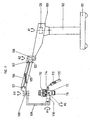
- Fig. 1 the arrangement of a surgical microscope is shown on a floor stand.
- the stand stands on a base or foot 101, which is generally equipped with rollers for the process.
- the base part 101 may also be designed for ceiling or wall mounting.
- a column 102 is mounted, about whose axis A1, the patch fixed arm 103 can rotate.
- a parallelogram arm 105 with axle 107 is attached thereto by a joint which is rotatable about the axis A2.
- the height adjustment of the microscope port 108 on the parallelogram 105 is weight balanced with a gas spring or a spring package 106.
- the microscope consists of a microscope body 111, the view 112 and the lens 116 and is rotatably mounted with the arms 110 and 109 about the axis A3 on the microscope port of the tripod. It can be with the rotations about the axes A1, A2 and A3 and by the weight-balanced height adjustment with the Parallelogrammarm 105 in the mechanically predetermined space to move to frictional resistance free from the influence of gravity.
- FIG. 6 schematically and by way of example shows a force and moment sensor for the Y adjustment.
- an elastic plate 403 is strained.
- two pressure sensors S1 and S2 are arranged.
- the elastic plate 403 on the two sides of a neutral phase 404 has increased and weakened compressive forces which cause resistance changes in the sensors S1 and S2.
- the further processing of the signals takes place with the bridge circuit 405, the amplifier 406, the analog / digital converter 407, control processing 408 and a driver 409 for the stepper motor 410 for servo adjustment of the axis A4.
Landscapes
- Engineering & Computer Science (AREA)
- General Engineering & Computer Science (AREA)
- Health & Medical Sciences (AREA)
- Mechanical Engineering (AREA)
- Life Sciences & Earth Sciences (AREA)
- Surgery (AREA)
- Molecular Biology (AREA)
- Animal Behavior & Ethology (AREA)
- Oral & Maxillofacial Surgery (AREA)
- Pathology (AREA)
- Veterinary Medicine (AREA)
- Public Health (AREA)
- Biomedical Technology (AREA)
- Heart & Thoracic Surgery (AREA)
- Medical Informatics (AREA)
- Physics & Mathematics (AREA)
- Nuclear Medicine, Radiotherapy & Molecular Imaging (AREA)
- General Health & Medical Sciences (AREA)
- General Physics & Mathematics (AREA)
- Optics & Photonics (AREA)
- Microscoopes, Condenser (AREA)
Description
- Die Erfindung betrifft ein Operationsmikroskop mit einem Stativ, wobei das Mikroskop insgesamt bis zu sechs Freiheitsgrade aufweist und über Elemente des Stativs an der Mikroskopaufhängung befestigt ist, wobei das Stativ zwei vertikale Schwenkachsen, die keinem Einfluß durch Schwerkraft unterworfen sind, und für die Höhenverstellung ein Parallelogrammgestänge mit Gewichtsausgleich aufweist, die mit leichtgängiger Beweglichkeit und mit Bremsen für die Arretierung ausgebildet sind.
- Bei einem solchen Stativ (US 5,213,293 A) kann das Mikroskop mit Hilfe des Stativs in die für die Operation gewünschte Stellung gebracht werden. Es weist einen Gewichtsausgleich auf, so daß es auch bei schwach gebremsten Gelenken in dieser Stellung verbleibt. Es ist aber sehr aufwendig, diesen Gewichtsausgleich zu bewirken. Eine anschließende Verstellung des Mikroskops, um das Bildfeld zu ändern, muß per Hand erfolgen.
- Bei einem anderen bekannten Mikroskop (US 5,332,181) findet die Verstellung um alle Achsen motorisch statt. Dazu ist nur ein grober Gewichtsausgleich erforderlich, was selbstverständlich leichter zu bewirken ist, als der feine Ausgleich der erstgenannten Anordnung. Das Problem bei der Einstellung des Mikroskops auf eine neue Aufgabe bzw. neue Bedingungen erfolgt durch die Motoren nur sehr langsam, da schnelle automatische Bewegungen um die einzelnen Freiheitsgrade zu große Motoren erfordern würden und insbesondere auch gefährlich sind. Der Operateur muß daher sehr lange warten, bis die von ihm gewünschte Einstellung erreicht worden ist. Dadurch wird der Vorteil, daß nur eine grobe Ausbalancierung erforderlich ist, zunichte gemacht.
- Zur manuellen Handhabung eines OP-Mikroskops an einem Stativ ist eine Ausbalancierung immer erforderlich. Es ist nicht nur ein Gewichtsausgleich durch Gegengewichte, Federn und Gasfedern notwendig, da die Arme des Stativs ein gewisses Gewicht haben, das natürlich immer den gleichen Wert hat. Bei Verstellungen an Zubehörteilen des Mikroskops, die bei der Ausführung von Operationen notwendig werden, verschiebt sich aber der Schwerpunkt am Mikroskop. Es muß dann eine erneute Gewichtskompensation um die Drehachsen vorgenommen werden. Der mechanische Aufwand bei mehreren Drehachsen ist unter Berücksichtigung der notwendigen Steifigkeit der Mikroskopaufhängung erheblich und wird durch motorische Antriebe noch erhöht, wenn man dem Anwender die Gewichtskompensation erleichtern will. Es sind sogar Ausführungen bekannt (DE 4320443 A, DE 43 34 069 A), bei denen die Gewichtskompensation mit Sensoren, Reglern und Stellgliedern auf Abruf automatisch durchgeführt werden.
- Es ist ein Stativ 8 mit einem Operationsmikroskop bekannt (EP 849 053 A), wobei das Mikroskop 2 insgesamt bis zu sechs Freiheitsgrade aufweist und über Elemente A1-A7 des Stativs 8 an der Mikroskopaufhängung befestigt ist, die zwei vertikale Schwenkachsen C1, C4, die keinem Einfluss durch Schwerkraft unterworfen sind, und für die Höhenverstellung ein Parallelogrammgestänge A3 mit Gewichtsausgleich aufweist, wobei das Mikroskop 2 über eine dritte vertikale Achse C5, die keinen Einfluss durch Schwerkraft unterworfen ist, und eine erste weitere dazu senkrechte Achse C6 am Stativ 8 gelagert ist, wobei die weitere Achse C6 im wesentlichen senkrecht zur optischen Achse des Mikroskopobjektivs und motorisch verstellbar ausgebildet ist und eine Schwenkung der Blickrichtung vor/zurück oder nach oben/unten ermöglicht. Bei diesem Mikroskop werden die Achsen motorisch durch Betätigung eines Bedienungshandgriffs bewegt.
- Die Aufgabe der Erfindung besteht in der Schaffung eines Mikroskops mit einem Stativ, bei dem die Einstellung des Ortes des Mikroskops schnell von Hand vorgenommen werden kann, anschließend aber eine Feineinstellung des beobachtbaren Bildfeldes vorgenommen werden kann, ohne daß diese Handhabung durch Schwerkräfte oder dadurch verursachte Momente gestört wird.
- Die erfindungsgemäße Lösung ist in Anspruch 1 angegeben.
- Die erfindungsgemäße Lösung besteht darin, daß das Mikroskop über eine dritte vertikale Achse, die keinem Einfluß durch Schwerkraft unterworfen ist, eine erste dazu senkrechte Achse und eine zweite weitere zur ersten weiteren zur ersten weiteren senkrechte Achse am Stativ gelagert ist, wobei die weiteren Achsen im wesentlichen senkrecht zur optischen Achse des Mikroskopobjektivs und motorisch verstellbar ausgebildet sind und die dem Mikroskop nähere weitere Achse eine seitliche Schwenkung der Blickrichtung (X-Richtung) ermöglicht und die zwischen der dritten vertikalen Achse und der dem Mikroskop näheren weiteren Achse angeordnete weitere Achse eine Schwenkung der Blickrichtung vor/zurück oder nach oben/ unten (Y-Richtung) ermöglicht.
- Es ist zwar bekannt, die Beweglichkeit von Operationsmikroskopen an Trägereinheiten mit Tasten an Handgriffen freizuschalten, die am Mikroskop angeordnet sind. Bei Betätigung der Tasten werden elektromotorische Bremsen der Stativgelenke gelöst. Die Erfindung erschöpft sich aber nicht darin, daß die Bewegung um diese Achsen schnell von Hand vorgenommen werden kann und dann die Achsen in dieser Stellung blockiert werden können. Die Erfindung zeichnet sich vielmehr durch eine Kombination dieser Verstellmöglichkeit von Hand mit einer motorischen Einstellung aus.
- Die größeren Verstellwege des Stativs werden dem Anwender/Operateur in an sich bekannter Weise gewichtsausgeglichen im sogenannten "free floating modus" freigegeben. Er führt das Gerät an einem Handgriff bspw. mit einer integrierten Taste, mit der die Bewegung freigegeben werden kann. Dabei ist ein feiner Gewichtsausgleich am Parallelogrammarm vorgenommen worden. Dieser Gesamtgewichtsausgleich muß möglichst genau sein, so daß für die Einstellungen nur sehr geringe Kräfte erforderlich sind. Ein Ungleichgewicht an den beiden direkt am Mikroskop vorhandenen Einstellachsen stört dann nicht, wenn bei diesen Achsen eine motorische Verstellung vorgesehen ist und die Motoren kräftig genug sind, die entsprechenden Kräfte des Ungleichgewichts aufzunehmen.
- Durch die Drehungen um die dritte vertikale Achse sowie die beiden weiteren Achsen kann der Operateur das Blickfeld an die Erfordernisse anpassen. Durch die besondere Reihenfolge der beiden weiteren Achsen ist dabei eine sehr zweckmäßige Verstellbarkeit für unterschiedliche Operationsbedingungen gegeben. Die optische Achse des Operationsmikroskops wird nämlich für unterschiedliche Operationen (z. B. Gehirnoperationen, Rückenmarkoperationen, Augenoperationen) völlig unterschiedlich zur Vertikalen ausgerichtet. Wählt man die Reihenfolge der weiteren Achse anders, so ist diese günstige Veränderung des Blickfeldes nicht mehr möglich.
- Zweckmäßigerweise sind die motorischen Antriebe als Servoantriebe ausgebildet. Die Vorgabe für diese Servofunktionen erfolgt in bevorzugter Weise von elektrischen Kraft- oder Momentensensoren zwischen dem Mikroskop und dem Bedienungselement für die entsprechenden Richtungen. Die Sensoren sind so ausgeführt, daß sie ein vom Benutzer mit dem am Bedienungselement um eine Achse ausgeübtes Moment steigendes und bei Richtungswechsel im Vorzeichen wechselndes Signal abgeben. Zweckmäßigerweise sind die Bedienungselemente verstellbar, so daß der Benutzer sie in die für ihn bequemste Lage verstellen kann, ohne daß dabei die Lage der Sensoren zum Mikroskop und damit der Bezug zwischen den Signalen und Wirkrichtung verändert wird.
- Bei Längs- und Querkräften und bei Momenten senkrecht zur Sensorachse wird kein Signal abgegeben. Bei einer besonders zwechmäßigen Ausführungsform sind die Sensoren paarweise so angeordnet, daß, wenn durch eine von einer Bedienungsperson auf das Bedienungselement ausgeübte Kraft der eine Sensor entlastet wird, der andere belastet wird. Beide Sensoren sind bezüglich des zu detektierenden Moments bzw. der zu detektierenden Kraft beiderseits einer neutralen Linie angeordnet. Beide Sensorelemente stehen unter einem Druck und sind in einer Brückenschaltung gegeneinander geschaltet, so daß sich die Signale durch den Druck gegenseitig aufheben. Wird ein Moment oder eine Kraft in das Bedienungselement eingeleitet, das bzw. die eine Drehung um diese Linie zu bewirken versucht, entsteht auf der einen Seite der neutralen Linie steigender Druck, auf der anderen Seite fallender Druck. Entsprechend wird die Brücke verstimmt und liefert ein dem Moment entsprechendes Ausgangssignal. Als Sensoren können Piezoelemente, induktive Sensoren, kapazitive Aufnehmer, resistive und optische Kraft/Wegaufnehmer verwendet werden.
- Die Signale werden steuerungstechnisch weiterverarbeitet, um über Motortreiber und Servomotoren die Verstellungen vorzunehmen. Bei einer ausreichenden Dynamik der beiden Servosteuerungen zusammen mit dem "free floating" der anderen vier Freiheitsgrade werden die Einstellzeiten verkleinert. Während der Anwender das Mikroskop in den vier zur Bewegung freigegebenen Freiheitsgraden verstellt, wirken gleichzeitig die zur Richtungseinstellung der Mikroskopachse eingeleiteten Momente am Bedienungselement und bewirken mit den Servosteuerungen die entsprechende Verstellung. Durch die synchrone freie Verstellung des Mikroskops mit größeren Wegen und den Servonachlauf der kleinen Drehbewegungen entfällt der von reinen Servosystemen bekannte Effekt, daß der Anwender lange warten muß, bis die Verstellung beendet ist.
- Zweckmäßigerweise ist die Anordnung so getroffen, daß die möglichen Bewegungen um die einzelnen Achsen bzw. Freiheitsgrade so begrenzt sind, daß das Mikroskop nicht gegen Teile des Stativs anstoßen kann.
- Die Erfindung wird im folgenden anhand vorteilhafter Ausführungsformen unter Bezugnahme auf die beigefügten Zeichnungen beschrieben. Es zeigen:
- Fig. 1
- den prinzipiellen Aufbau des erfindungsgemäßen Sta-tivs in einer Seitenansicht;
- Fig. 2
- in Seitenansicht das Mikroskop;
- Fig. 3
- in Frontansicht das Mikroskop;
- Fig. 4
- in ähnlicher Darstellung wie in Fig. 2 das Mikroskop, nachdem es um 90° gedreht ist;
- Fig. 5
- in ähnlicher Darstellung wie in Fig. 3 das Mikroskop, nachdem es um 90° gedreht ist; und
- Fig. 6
- den prinzipiellen Aufbau der Sensoren und elektrischen Auswertungsschaltungen.
- In Fig. 1 ist die Anordnung eines Operationsmikroskops an einem Fußbodenstativ dargestellt. Das Stativ steht auf einem Basisteil oder Fuß 101, der im allgemeinen mit Rollen zum Verfahren ausgestattet ist. Selbstverständlich kann der Basisteil 101 auch für Decken- oder Wandbefestigung ausgebildet sein. Auf diesem Basisteil 101 ist eine Säule 102 angebracht, um deren Achse A1 sich der aufgesetzte feste Arm 103 drehen läßt. Mit einem um die Achse A2 drehbaren Gelenk ist daran ein Parallelogrammarm 105 mit Achser 107 befestigt. Die Höhenverstellung des Mikroskopanschlusses 108 am Parallelogramm 105 ist mit einer Gasfeder oder einem Federpaket 106 gewichtsausgeglichen.
- Das Mikroskop besteht aus einem Mikroskopkörper 111, dem Einblick 112 und dem Objektiv 116 und ist mit den Armen 110 und 109 drehbar um die Achse A3 am Mikroskopanschluß des Stativs befestigt. Es läßt sich mit den Drehungen um die Achsen A1, A2 und A3 sowie durch die gewichtsausgeglichene Höhenverstellung mit dem Parallelogrammarm 105 im mechanisch vorgegebenen Raum bis auf Reibungswiderstände frei von Schwerkrafteinfluß bewegen.
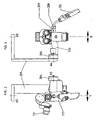
- Wie dies in den Fig. 1-3 dargestellt ist, ist das dort dargestellte Mikroskop 111 mit dem Servoantrieb 204 um die Achse A5 drehbar. Dies entspricht einer Drehung im Sehfeld in seitlicher Richtung (X-Richtung). Zusammen mit dem Arm 110 kann das Mikroskop 111 vom Servoantrieb 206 um die Achse A4 gedreht werden. Dies entspricht einer Bewegung im Sehfeld nach oben/unten (Y-Richtung).
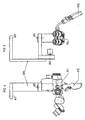
- In den Fig. 4 und 5 ist die Anordnung in ähnlicher Darstellung wie in den Fig. 2 und 3 gezeigt, wobei das Mikroskop 111 allerdings um die Achse A4 um 90° gedreht ist, so daß die Objektivachse waagerecht ist.
- In Fig. 6 ist schematisch und beispielhaft ein Kraft- und Momentsensor für die Y-Verstellung dargestellt. Zwischen den Körpern 401 und 402 ist eine elastische Platte 403 angespannt. Darin sind zwei Drucksensoren S1 und S2 angeordnet. Wenn zwischen den beiden Körpern 401 und 402 ein Moment M zur Wirkung kommt, so ergeben sich in der elastischen Platte 403 auf den beiden Seiten einer neutralen Phase 404 verstärkte und abgeschwächte Druckkräfte, die in den Sensoren S1 und S2 Widerstandsänderungen hervorrufen. Die Weiterverarbeitung der Signale erfolgt mit der Brückenschaltung 405, dem Verstärker 406, dem Analog/Digitalwandler 407, regelungstechnischer Bearbeitung 408 und einem Treiber 409 für den Schrittmotor 410 zur Servoverstellung der Achse A4.
- Wie dies erwähnt wurde, ist die Bewegung um die Achsen A1, A2 und A3 sowie diejenige des Parallelogrammgestänges 105 leichtgängig, so daß einfach eine Verstellung vorgenommen werden kann. Arretierung findet dann durch die Bremsen 120 statt, die in Fig. 1 gestrichelt angedeutet sind. Diese Bremsen können für die Grobverstellung gelöst werden, indem eine entsprechende Taste 113 am Bedienungselement 115 betätigt wird. Der Antrieb der Motoren kann direkt auf die entsprechenden Achsen wirken. Es ist jedoch auch möglich, ein Getriebe zwischenzuschalten.
Claims (14)
- Stativ mit einem Operationsmikroskop, wobei das Mikroskop (111) insgesamt bis zu sechs Freiheitsgrade aufweist und über Elemente des Stativs (102, 103, 106, 108) an einer Mikroskopaufhängung (109, 110) befestigt ist, die zwei vertikale Schwenkachsen (A1, A2), die keinem Einfluß durch Schwerkraft unterworfen sind, und für die Höhenverstellung ein Parallelogrammgestänge (105) mit Gewichtsausgleich aufweist, die mit leichtgängiger Beweglichkeit und, mit Bremsen für die Arretierung ausgebildet sind, wobei das Mikroskop über eine dritte vertikale Achse (A3), die keinem Einfluß durch Schwerkraft unterworfen ist, eine erste weitere dazu senkrechte Achse (A4), und eine zweite weitere zur ersten weiteren senkrechte Achse (A5) am Stativ gelagert ist, wobei die weiteren Achsen (A4, A5) im wesentlichen senkrecht zur optischen Achse des Mikroskopobjektivs (116) und motorisch verstellbar ausgebildet sind und die dem Mikroskop (111) nähere weitere Achse (A5) eine seitliche Schwenkung der Blickrichtung (X-Richtung) ermöglicht und die zwischen der dritten vertikalen Achse (A3) und der dem Mikroskop (111) näheren weitere Achse (A5) angeordnete weitere Achse (A4) eine Schwenkung der Blickrichtung vor/zurück oder nach oben/unten (Y-Richtung) ermöglicht,
- Stativ nach Anspruch 1, dadurch gekennzeichnet, daß die motorischen Antriebe (410) als Servoantriebe ausgebildet sind.
- Stativ nach Anspruch 2, dadurch gekennzeichnet, daß zur Steuerung der Servoantriebe zwischen Mikroskop (111) und mindestens einem Bedienungselement (115) Kraft- oder Drehmomentsensoren (S1, S2) angeordnet sind, die entsprechend der Größe und Richtung der auf die Bedienungselemente ausgeübten Kraft bzw. des ausgeübten Drehmoments Signale für die entsprechende Steuerung der Motoren (410) erzeugen.
- Stativ nach Anspruch 3, dadurch gekennzeichnet, daß die Bedienungselemente (115) verstellbar sind, ohne daß die Lage der Sensoren (S1, S2) zum Mikroskop (111) verändert wird.
- Stativ nach Anspruch 3 oder 4, dadurch gekennzeichnet, daß die Sensoren (S1, S2) paarweise so angeordnet sind, daß, wenn durch eine von einer Bedienungsperson auf das Bedienungselement (115) ausgeübte Kraft ein Sensor (S1, S2) entlastet wird, der andere (S2, S1) belastet wird.
- Stativ nach Anspruch 5, dadurch gekennzeichnet, daß die Sensoren (S1, S2) in einer Brückenschaltung (405) angeordnet sind, die eine Richtung und Geschwindigkeit der motorischen Verstellung bestimmende Spannung abgibt.
- Stativ nach Anspruch 6, dadurch gekennzeichnet, daß es Schaltungen (406-409) zum Umwandeln der Spannung in eine Versorungsspannung für den Servoantrieb (204, 206) aufweist.
- Stativ nach Anspruch 6, dadurch gekennzeichnet, daß es Schrittmotoren (410) für den Servoantrieb (204, 206), Analog/Digitalwandler (407) für die Spannung und Signalaufbereitungsschaltungen (408, 409) für die Ausgangssignale der Analog/Digitalwandler (407) zur Erzeugung der Ansteuerungssignale für die Schrittmotoren (410) aufweist.
- Stativ nach einem der Ansprüche 1 bis 8, dadurch gekennzeichnet, daß die Antriebe Getriebe aufweisen.
- Stativ nach einem der Ansprüche 1 bis 9, dadurch gekennzeichnet, daß die möglichen Bewegungen um die einzelnen Achsen begrenzt sind.
- Stativ nach einem der Ansprüche 3 bis 10, dadurch gekennzeichnet, daß die Sensoren (S1, S2) optische Aufnehmer mit kleinen Wegen aufweisen.
- Stativ nach einem der Ansprüche 3 bis 10, dadurch gekennzeichnet, daß die Sensoren (S1, S2) kapazitive Aufnehmer aufweisen.
- Stativ nach einem der Ansprüche 3 bis 10, dadurch gekennzeichnet, daß die Sensoren (S1, S2) induktive Aufnehmer mit kleinen Wegen aufweisen.
- Stativ nach einem der Ansprüche 3 bis 10, dadurch gekennzeichnet, daß die Sensoren (S1, S2) Piezoelemente aufweisen.
Priority Applications (5)
| Application Number | Priority Date | Filing Date | Title |
|---|---|---|---|
| AT00108786T ATE315762T1 (de) | 2000-04-25 | 2000-04-25 | Stativ mit einem operationsmikroskop |
| DE50012038T DE50012038D1 (de) | 2000-04-25 | 2000-04-25 | Stativ mit einem Operationsmikroskop |
| EP00108786A EP1152182B1 (de) | 2000-04-25 | 2000-04-25 | Stativ mit einem Operationsmikroskop |
| US09/841,338 US6471165B2 (en) | 2000-04-25 | 2001-04-24 | Surgical microscope and stand assembly |
| JP2001128182A JP2001309928A (ja) | 2000-04-25 | 2001-04-25 | 外科用顕微鏡 |
Applications Claiming Priority (1)
| Application Number | Priority Date | Filing Date | Title |
|---|---|---|---|
| EP00108786A EP1152182B1 (de) | 2000-04-25 | 2000-04-25 | Stativ mit einem Operationsmikroskop |
Publications (2)
| Publication Number | Publication Date |
|---|---|
| EP1152182A1 EP1152182A1 (de) | 2001-11-07 |
| EP1152182B1 true EP1152182B1 (de) | 2006-01-11 |
Family
ID=8168548
Family Applications (1)
| Application Number | Title | Priority Date | Filing Date |
|---|---|---|---|
| EP00108786A Expired - Lifetime EP1152182B1 (de) | 2000-04-25 | 2000-04-25 | Stativ mit einem Operationsmikroskop |
Country Status (5)
| Country | Link |
|---|---|
| US (1) | US6471165B2 (de) |
| EP (1) | EP1152182B1 (de) |
| JP (1) | JP2001309928A (de) |
| AT (1) | ATE315762T1 (de) |
| DE (1) | DE50012038D1 (de) |
Cited By (1)
| Publication number | Priority date | Publication date | Assignee | Title |
|---|---|---|---|---|
| DE102007006891A1 (de) * | 2007-02-13 | 2008-08-14 | University Of Dundee | Haltevorrichtung für medizinische Zwecke |
Families Citing this family (80)
| Publication number | Priority date | Publication date | Assignee | Title |
|---|---|---|---|---|
| US4663375A (en) * | 1984-05-15 | 1987-05-05 | Mitsubishi Petrochemical Co., Ltd. | Process for producing heat-resisting moldings |
| US20040189847A1 (en) * | 2000-03-08 | 2004-09-30 | Dazor Manufacturing Corp. | Video magnification inspection system |
| USD503732S1 (en) * | 2003-07-31 | 2005-04-05 | Dazor Manufacturing Corp. | Video magnification system |
| US20030101677A1 (en) * | 2000-07-12 | 2003-06-05 | Hewett Frank W. | Joining system for tubular members |
| EP1191379B1 (de) * | 2000-09-22 | 2008-03-19 | Leica Microsystems Schweiz AG | Mikrosokop mit einer Handhabe bzw. Handgriff für ein Mikroskop |
| EP1193438B1 (de) * | 2000-09-28 | 2006-11-15 | Leica Microsystems Schweiz AG | Stativ |
| DE10133018A1 (de) * | 2001-07-06 | 2003-01-16 | Leica Mikroskopie Systeme Ag H | Stativ |
| JP4065840B2 (ja) * | 2001-10-03 | 2008-03-26 | ステリス インコーポレイテッド | モニターサスペンションアームのためのビデオ/データ接続迅速システム |
| US6539333B1 (en) * | 2002-01-04 | 2003-03-25 | Leica Microsystems Ag | Stand having an automatic balancing device |
| DE10300620B4 (de) * | 2002-05-18 | 2017-04-13 | Carl Zeiss Meditec Ag | Trägervorrichtung für ein medizinisch-optisches Gerät |
| US7207531B2 (en) * | 2002-12-17 | 2007-04-24 | Piontkowski Paul K | Head manipulable binocular microscope support |
| JP4270889B2 (ja) * | 2003-01-15 | 2009-06-03 | オリンパス株式会社 | 医療用器具保持装置 |
| US7109678B2 (en) * | 2003-06-30 | 2006-09-19 | Carl-Zeiss-Stiftung | Holding arrangement having an apparatus for balancing a load torque |
| US7170250B2 (en) * | 2003-06-30 | 2007-01-30 | Carl Zeiss Surgical Gmbh | Holding arrangement having a device for actively damping vibration |
| DE102004008381B4 (de) * | 2003-06-30 | 2014-09-25 | Carl Zeiss Meditec Ag | Haltevorrichtung, insbesondere für ein medizinisch-optisches Instrument, mit Mitteln zum Ausgleich eines Last-Drehmoments sowie ein Verfahren zum Einstellen eines Gleichgewichtszustandes in einer Haltevorrichtung |
| DE102004063606B4 (de) * | 2004-02-20 | 2015-10-22 | Carl Zeiss Meditec Ag | Haltevorrichtung, insbesondere für ein medizinisch-optisches Instrument, mit einer Einrichtung zur aktiven Schwingungsdämpfung |
| KR20060057603A (ko) * | 2003-08-06 | 2006-05-26 | 인테스트 코포레이션 | 테스트 헤드 위치지정 시스템 |
| US20050052531A1 (en) * | 2003-09-04 | 2005-03-10 | Chapman/Leonard Studio Equipment | Stabilized camera platform system |
| WO2005037166A2 (en) * | 2003-10-13 | 2005-04-28 | Hill-Rom Services, Inc. | Brake system for patient care equipment support arm |
| JP4486381B2 (ja) * | 2004-02-27 | 2010-06-23 | 株式会社コーナン・メディカル | 耳鼻科診察設備用の顕微鏡アーム |
| US7420731B2 (en) * | 2004-12-14 | 2008-09-02 | Piontkowski Paul K | Surgical microscope support system |
| US7770247B2 (en) | 2005-05-02 | 2010-08-10 | Hill-Rom Services, Inc. | Brake system for wall arm |
| US7364127B2 (en) * | 2005-06-07 | 2008-04-29 | Ming-Hua Huang | Support arm for a monitor |
| DE102005031557B4 (de) | 2005-07-06 | 2021-08-05 | Carl Zeiss Meditec Ag | Operationsmikroskop-Trägersystem |
| DE102007009543A1 (de) * | 2007-02-27 | 2008-08-28 | Leica Microsystems (Schweiz) Ag | Mikroskopgerät mit Positionserfassung |
| US8025078B2 (en) | 2008-04-29 | 2011-09-27 | Illinois Tool Works Inc. | Vehicle mountable arm for valve operating machine |
| DE102008059331B4 (de) * | 2008-11-27 | 2012-05-31 | Siemens Aktiengesellschaft | Stativ, insbesondere Bodenstativ |
| EP2430436A1 (de) * | 2009-05-14 | 2012-03-21 | Westinghouse Electric Company LLC | Verbindungsloses röhreninspektionssystem |
| USD637219S1 (en) * | 2009-06-26 | 2011-05-03 | Carl Zeiss Surgical Gmbh | Assembly of an XY-coupling supporting a carrier arm holding a housing containing one or two microscope bodies |
| USD649992S1 (en) * | 2009-12-22 | 2011-12-06 | Carl Zeiss Meditec Ag | Stand for microscope assembly |
| DE102010010133A1 (de) * | 2010-03-04 | 2011-09-08 | Leica Microsystems (Schweiz) Ag | Stativ für ein Mikroskop, insbesondere für ein Operationsmikroskop |
| WO2011116812A1 (en) * | 2010-03-22 | 2011-09-29 | Brainlab Ag | Controlling a surgical microscope |
| TW201200316A (en) * | 2010-06-21 | 2012-01-01 | Univ Nat Taiwan | Sustaining manipulator arm |
| US8922884B2 (en) | 2010-10-07 | 2014-12-30 | Global Surgical Corporation | Flexible objective lens assembly and microscope |
| US8851121B2 (en) | 2010-12-06 | 2014-10-07 | Illlinois Tool Works Inc. | Torque multiplier for valve turning machine |
| DE102011003589B4 (de) * | 2011-02-03 | 2017-10-26 | Carl Zeiss Meditec Ag | Stativ für eine medizinische Vorrichtung |
| DE102011004926A1 (de) | 2011-03-01 | 2012-09-06 | Karl Storz Gmbh & Co. Kg | Einstellbare Haltevorrichtung für ein Endoskop |
| US8960632B2 (en) | 2011-07-05 | 2015-02-24 | Mediamounts, Ltd. | Dual bar linkage monitor support with adustment feature |
| USD685405S1 (en) * | 2011-10-21 | 2013-07-02 | Endure Medical, Inc. | Floor stand with angled arm for microscope |
| US8584994B2 (en) * | 2011-10-21 | 2013-11-19 | Endure Medical, Inc. | Floor stand with angled arm for microscope |
| DE102012209594B3 (de) * | 2012-06-06 | 2013-06-06 | Leica Microsystems (Schweiz) Ag | Stativ |
| US8817352B2 (en) * | 2012-09-05 | 2014-08-26 | Raytheon Company | Optical switching assembly with over-center lock |
| US9487100B2 (en) * | 2012-09-14 | 2016-11-08 | General Electric Company | Electrical vehicle charging device having a brake to prevent extension and retraction of the power conduit |
| US10082240B2 (en) | 2013-09-25 | 2018-09-25 | Brunson Instrument Company | Four bar linkage imaging stand assembly system and method |
| DE102013016369A1 (de) * | 2013-09-30 | 2015-04-02 | Karl Kaps Gmbh & Co. Kg | Verstellbares Stativ für ein optisches Beobachtungsgerät |
| KR102378585B1 (ko) * | 2014-03-17 | 2022-03-25 | 인튜어티브 서지컬 오퍼레이션즈 인코포레이티드 | 관절방식 암에서 브레이크어웨이 클러칭을 위한 시스템 및 방법 |
| USD836692S1 (en) | 2014-06-30 | 2018-12-25 | Carl Zeiss Meditec Ag | Surgical microscope |
| USD836693S1 (en) * | 2014-06-30 | 2018-12-25 | Carl Zeiss Meditec Ag | Stand for a surgical microscope |
| CN106572892B (zh) * | 2014-08-01 | 2020-04-14 | 索尼奥林巴斯医疗解决方案公司 | 医用观察装置 |
| EP3212105B1 (de) | 2014-10-27 | 2025-09-24 | Intuitive Surgical Operations, Inc. | System zur überwachung von kontrollpunkten während reaktiver bewegung |
| WO2016069650A1 (en) | 2014-10-27 | 2016-05-06 | Intuitive Surgical Operations, Inc. | System and method for integrated surgical table icons |
| EP3741345A1 (de) | 2014-10-27 | 2020-11-25 | Intuitive Surgical Operations, Inc. | System zur bewegung eines integrierten operationstisches |
| KR102574095B1 (ko) * | 2014-10-27 | 2023-09-06 | 인튜어티브 서지컬 오퍼레이션즈 인코포레이티드 | 기기 교란 보상을 위한 시스템 및 방법 |
| CN107072864B (zh) | 2014-10-27 | 2019-06-14 | 直观外科手术操作公司 | 用于配准到手术台的系统及方法 |
| CN107072727B (zh) | 2014-10-27 | 2020-01-24 | 直观外科手术操作公司 | 具有主动制动器释放控制装置的医疗装置 |
| WO2016069648A1 (en) | 2014-10-27 | 2016-05-06 | Intuitive Surgical Operations, Inc. | System and method for integrated surgical table |
| CN105982679A (zh) * | 2015-02-04 | 2016-10-05 | 深圳迈瑞生物医疗电子股份有限公司 | X线摄影系统及其摇摆臂机构 |
| CN107407863A (zh) * | 2015-04-07 | 2017-11-28 | 加勒特·W·布朗 | 用于负载稳定器的平衡支撑接口 |
| DE102016200214B4 (de) | 2016-01-11 | 2021-06-10 | Carl Zeiss Meditec Ag | Stativ und Verfahren für die Drehmomentkompensation |
| US10767811B2 (en) * | 2016-02-24 | 2020-09-08 | Stryker Corporation | Brake control system for suspensions |
| DE102016206541A1 (de) * | 2016-04-19 | 2017-10-19 | Carl Zeiss Meditec Ag | Ophthalmologische Untersuchungs- und/oder Therapievorrichtung mit koppelbaren Gelenkarmen |
| US10203064B2 (en) | 2016-04-29 | 2019-02-12 | GCX Corporation | Locking release mechanism for an articulated support arm |
| US9772497B1 (en) * | 2016-09-23 | 2017-09-26 | Robert Troy Hewlett | Customized viewing system for an optical device |
| US11864958B2 (en) | 2017-05-03 | 2024-01-09 | Lsi Solutions, Inc. | Surgical equipment holder |
| US11103126B2 (en) * | 2017-05-03 | 2021-08-31 | Lsi Solutions, Inc. | Surgical equipment holder |
| USD881965S1 (en) * | 2018-02-13 | 2020-04-21 | Carl Zeiss Meditec Ag | Stand for a surgical microscope |
| CN108591791B (zh) * | 2018-07-13 | 2023-06-23 | 桂林智神信息技术股份有限公司 | 稳定器用机架组件及稳定器 |
| ES2932563T3 (es) * | 2018-07-25 | 2023-01-20 | American Sterilizer Co | Sistema de soporte de dispositivos médicos con abertura de acceso al cubo |
| USD947918S1 (en) * | 2018-09-18 | 2022-04-05 | Carl Zeiss Meditec Ag | Surgical microscope with stand |
| EP3693642B1 (de) | 2019-01-17 | 2022-06-15 | Illinois Tool Works, Inc. | Ventilbetätigungsvorrichtung mit einem beweglichen arm zur verwendung in übungsventilen |
| USD1010315S1 (en) | 2019-09-06 | 2024-01-09 | Carl Zeiss Meditec Ag | Surgical microscope |
| CN113040905B (zh) * | 2019-12-27 | 2025-06-27 | 重庆海扶医疗科技股份有限公司 | 用于控制手术器械末端执行器的操作器 |
| CN113040911B (zh) * | 2019-12-27 | 2022-08-19 | 重庆海扶医疗科技股份有限公司 | 一种手术系统、手术系统控制及手术系统的控制方法 |
| USD934327S1 (en) | 2020-03-11 | 2021-10-26 | Carl Zeiss Meditec Ag | Surgical microscope |
| USD934937S1 (en) | 2020-03-11 | 2021-11-02 | Carl Zeiss Meditec Ag | Surgical microscope |
| CN111772823B (zh) * | 2020-06-23 | 2021-05-11 | 苏州昊信精密机械有限公司 | 手术显微镜支撑臂 |
| CN112013217A (zh) * | 2020-08-25 | 2020-12-01 | 杭州新汉杰科技有限公司 | 一种计算机显示器支架调节机构 |
| JP2023544317A (ja) * | 2020-09-30 | 2023-10-23 | オーリス ヘルス インコーポレイテッド | ロボット手術において術中の患者を位置決めするためのガイド付きの協調されたベッド運動 |
| US20240197433A1 (en) * | 2022-12-20 | 2024-06-20 | Johnson & Johnson Surgical Vision, Inc. | Real-time 3d anatomical mapping of the eye |
| EP4673285A1 (de) * | 2023-03-02 | 2026-01-07 | Alcon Inc. | Visualisierungsroboter mit augenchirurgieoptimierter kinematik |
Family Cites Families (17)
| Publication number | Priority date | Publication date | Assignee | Title |
|---|---|---|---|---|
| DE7930125U1 (de) * | 1979-07-24 | 1980-01-24 | Contraves Ag, Zuerich (Schweiz) | Zusatzvorrichtung an einem stativ fuer ein optisches beobachtungsgeraet |
| DE7930126U1 (de) * | 1979-07-24 | 1980-01-24 | Contraves Ag, Zuerich (Schweiz) | Stativ fuer ein optisches beobachtungsgeraet |
| US4548373A (en) * | 1983-03-22 | 1985-10-22 | Tokyo Kogaku Kikai Kabushiki Kaisha | Medical equipment supporting device |
| JPS63296743A (ja) * | 1987-05-29 | 1988-12-02 | Mitaka Koki Kk | 医療用光学機器のスタンド装置 |
| DE3921857A1 (de) | 1989-07-04 | 1991-01-17 | Wild Leitz Ag | Mit zusatzvorrichtungen ausgestattetes stativ fuer die halterung eines frei positionierbaren geraetes |
| US5273039A (en) * | 1989-10-16 | 1993-12-28 | Olympus Optical Co., Ltd. | Surgical microscope apparatus having a function to display coordinates of observation point |
| US5186422A (en) * | 1992-01-17 | 1993-02-16 | Kesanori Sahara | Stand apparatus for medical optical instrument |
| DE4202922A1 (de) | 1992-02-01 | 1993-08-05 | Zeiss Carl Fa | Motorisches stativ |
| DE4320443C2 (de) | 1993-06-21 | 2001-08-02 | Zeiss Carl | Ausbalancierbares Stativ |
| DE4334069A1 (de) | 1993-06-21 | 1995-04-13 | Zeiss Carl Fa | Ausbalancierbares Stativ |
| US5609316A (en) * | 1995-09-05 | 1997-03-11 | Tigliev; George S. | Suspension system for surgical microscope |
| JP3022760B2 (ja) * | 1996-02-26 | 2000-03-21 | 三鷹光器株式会社 | 医療用スタンド装置の機器支持構造 |
| JP3377740B2 (ja) * | 1996-12-16 | 2003-02-17 | 株式会社三協精機製作所 | 力補助装置の制御方法及びこの方法を利用した制御装置 |
| DE69716018T2 (de) * | 1996-12-16 | 2003-02-06 | Kabushiki Kaisha Sankyo Seiki Seisakusho, Nagano | Verfahren und Steuerungsgerät zur Steuerung einer Krafthilfeeinrichtung |
| DE19732212B4 (de) * | 1997-07-26 | 2011-12-29 | Carl Zeiss | Operationsmikroskop und Stativ zur Aufnahme des Operationsmikroskopes |
| JP4083316B2 (ja) * | 1998-10-01 | 2008-04-30 | オリンパス株式会社 | 手術用顕微鏡 |
| DE50014939D1 (de) * | 1999-07-03 | 2008-03-20 | Leica Microsystems | Deckenstativ |
-
2000
- 2000-04-25 EP EP00108786A patent/EP1152182B1/de not_active Expired - Lifetime
- 2000-04-25 AT AT00108786T patent/ATE315762T1/de not_active IP Right Cessation
- 2000-04-25 DE DE50012038T patent/DE50012038D1/de not_active Expired - Lifetime
-
2001
- 2001-04-24 US US09/841,338 patent/US6471165B2/en not_active Expired - Lifetime
- 2001-04-25 JP JP2001128182A patent/JP2001309928A/ja active Pending
Cited By (1)
| Publication number | Priority date | Publication date | Assignee | Title |
|---|---|---|---|---|
| DE102007006891A1 (de) * | 2007-02-13 | 2008-08-14 | University Of Dundee | Haltevorrichtung für medizinische Zwecke |
Also Published As
| Publication number | Publication date |
|---|---|
| DE50012038D1 (de) | 2006-04-06 |
| ATE315762T1 (de) | 2006-02-15 |
| US6471165B2 (en) | 2002-10-29 |
| US20020014562A1 (en) | 2002-02-07 |
| JP2001309928A (ja) | 2001-11-06 |
| EP1152182A1 (de) | 2001-11-07 |
Similar Documents
| Publication | Publication Date | Title |
|---|---|---|
| EP1152182A1 (de) | Operationsmikroskop | |
| DE69716018T2 (de) | Verfahren und Steuerungsgerät zur Steuerung einer Krafthilfeeinrichtung | |
| EP0433426B1 (de) | Mit zusatzvorrichtungen ausgestattetes stativ für die halterung eines frei positionierbaren gerätes | |
| DE69514739T2 (de) | Chirurgische Mikroskop-Einheit | |
| DE102004063606B4 (de) | Haltevorrichtung, insbesondere für ein medizinisch-optisches Instrument, mit einer Einrichtung zur aktiven Schwingungsdämpfung | |
| DE102008011638B4 (de) | Balanciervorrichtung für Operations-Mikroskop | |
| DE3728527C2 (de) | ||
| DE10140608A1 (de) | Vorrichtung zur Justage eines optischen Elements | |
| DE602005000651T2 (de) | Mechanismus zum Gewichtsausgleich für ein Operationsmikroskop | |
| EP0476552A1 (de) | Schwenkeinrichtung für Tragvorrichtungen für optische Beobachtungsgeräte | |
| DE69104486T2 (de) | Halte und positionierungsvorrichtung für ein mikroskop. | |
| EP1336884B1 (de) | Mikrochirurgisches Mikroskopsystem | |
| EP1336885B1 (de) | Mikrochirurgisches Mikroskopsystem | |
| CH688161A5 (de) | Ausbalancierbares Stativ. | |
| EP1324094B1 (de) | Stativ mit Operationsmikroskop | |
| DE69827160T2 (de) | Medizinische bilderzeugungsvorrichtung mit bewegungsmechanismus | |
| DE102015225183B4 (de) | Medizinische Vorrichtung mit einem medizinisch-optischen Gerät und einer Haltevorrichtung und Verfahren zum Betrieb der medizinischen Vorrichtung | |
| DE10155719A1 (de) | Operations-Mikroskop | |
| WO2000077589A1 (de) | Vorrichtung zum steuern einer einrichtung | |
| CH685653A5 (de) | Stativ mit einer mechanischen Steuereinheit für ein damit verbundenes Operationsmikroskop. | |
| WO2003081337A2 (de) | Vorrichtung zur manipulation der winkellage eines gegenstands gegenüber einer festen struktur | |
| DE10347733A1 (de) | Motorisch verstellbares Röntgengerät | |
| EP1037085B1 (de) | Aufhängung für ein Operationsmikroskop | |
| DE10314156B9 (de) | Schwenkhalterungsanordnung und Verfahren zum Steuern einer solchen | |
| DE3637311C2 (de) | Anordnung zur Richtungsverstellung eines Binokularmikroskopes |
Legal Events
| Date | Code | Title | Description |
|---|---|---|---|
| PUAI | Public reference made under article 153(3) epc to a published international application that has entered the european phase |
Free format text: ORIGINAL CODE: 0009012 |
|
| AK | Designated contracting states |
Kind code of ref document: A1 Designated state(s): AT BE CH CY DE DK ES FI FR GB GR IE IT LI LU MC NL PT SE |
|
| AX | Request for extension of the european patent |
Free format text: AL;LT;LV;MK;RO;SI |
|
| 17P | Request for examination filed |
Effective date: 20011213 |
|
| AKX | Designation fees paid |
Free format text: AT BE CH CY DE DK ES FI FR GB GR IE IT LI LU MC NL PT SE |
|
| 17Q | First examination report despatched |
Effective date: 20041110 |
|
| GRAP | Despatch of communication of intention to grant a patent |
Free format text: ORIGINAL CODE: EPIDOSNIGR1 |
|
| RTI1 | Title (correction) |
Free format text: STAND WITH A SURGICAL MICROSCOPE |
|
| GRAS | Grant fee paid |
Free format text: ORIGINAL CODE: EPIDOSNIGR3 |
|
| GRAA | (expected) grant |
Free format text: ORIGINAL CODE: 0009210 |
|
| AK | Designated contracting states |
Kind code of ref document: B1 Designated state(s): AT BE CH CY DE DK ES FI FR GB GR IE IT LI LU MC NL PT SE |
|
| PG25 | Lapsed in a contracting state [announced via postgrant information from national office to epo] |
Ref country code: NL Free format text: LAPSE BECAUSE OF FAILURE TO SUBMIT A TRANSLATION OF THE DESCRIPTION OR TO PAY THE FEE WITHIN THE PRESCRIBED TIME-LIMIT Effective date: 20060111 Ref country code: FI Free format text: LAPSE BECAUSE OF FAILURE TO SUBMIT A TRANSLATION OF THE DESCRIPTION OR TO PAY THE FEE WITHIN THE PRESCRIBED TIME-LIMIT Effective date: 20060111 Ref country code: IE Free format text: LAPSE BECAUSE OF FAILURE TO SUBMIT A TRANSLATION OF THE DESCRIPTION OR TO PAY THE FEE WITHIN THE PRESCRIBED TIME-LIMIT Effective date: 20060111 |
|
| REG | Reference to a national code |
Ref country code: CH Ref legal event code: EP |
|
| REG | Reference to a national code |
Ref country code: IE Ref legal event code: FG4D Free format text: LANGUAGE OF EP DOCUMENT: GERMAN |
|
| REG | Reference to a national code |
Ref country code: CH Ref legal event code: NV Representative=s name: TROESCH SCHEIDEGGER WERNER AG |
|
| REF | Corresponds to: |
Ref document number: 50012038 Country of ref document: DE Date of ref document: 20060406 Kind code of ref document: P |
|
| PG25 | Lapsed in a contracting state [announced via postgrant information from national office to epo] |
Ref country code: SE Free format text: LAPSE BECAUSE OF FAILURE TO SUBMIT A TRANSLATION OF THE DESCRIPTION OR TO PAY THE FEE WITHIN THE PRESCRIBED TIME-LIMIT Effective date: 20060411 Ref country code: DK Free format text: LAPSE BECAUSE OF FAILURE TO SUBMIT A TRANSLATION OF THE DESCRIPTION OR TO PAY THE FEE WITHIN THE PRESCRIBED TIME-LIMIT Effective date: 20060411 |
|
| PG25 | Lapsed in a contracting state [announced via postgrant information from national office to epo] |
Ref country code: ES Free format text: LAPSE BECAUSE OF FAILURE TO SUBMIT A TRANSLATION OF THE DESCRIPTION OR TO PAY THE FEE WITHIN THE PRESCRIBED TIME-LIMIT Effective date: 20060422 |
|
| PG25 | Lapsed in a contracting state [announced via postgrant information from national office to epo] |
Ref country code: AT Free format text: LAPSE BECAUSE OF NON-PAYMENT OF DUE FEES Effective date: 20060425 |
|
| GBT | Gb: translation of ep patent filed (gb section 77(6)(a)/1977) |
Effective date: 20060405 |
|
| PG25 | Lapsed in a contracting state [announced via postgrant information from national office to epo] |
Ref country code: MC Free format text: LAPSE BECAUSE OF NON-PAYMENT OF DUE FEES Effective date: 20060430 Ref country code: BE Free format text: LAPSE BECAUSE OF NON-PAYMENT OF DUE FEES Effective date: 20060430 |
|
| PG25 | Lapsed in a contracting state [announced via postgrant information from national office to epo] |
Ref country code: PT Free format text: LAPSE BECAUSE OF FAILURE TO SUBMIT A TRANSLATION OF THE DESCRIPTION OR TO PAY THE FEE WITHIN THE PRESCRIBED TIME-LIMIT Effective date: 20060612 |
|
| NLV1 | Nl: lapsed or annulled due to failure to fulfill the requirements of art. 29p and 29m of the patents act | ||
| ET | Fr: translation filed | ||
| REG | Reference to a national code |
Ref country code: IE Ref legal event code: FD4D |
|
| PLBE | No opposition filed within time limit |
Free format text: ORIGINAL CODE: 0009261 |
|
| STAA | Information on the status of an ep patent application or granted ep patent |
Free format text: STATUS: NO OPPOSITION FILED WITHIN TIME LIMIT |
|
| 26N | No opposition filed |
Effective date: 20061012 |
|
| BERE | Be: lapsed |
Owner name: MOLLER-WEDEL G.M.B.H. Effective date: 20060430 |
|
| PG25 | Lapsed in a contracting state [announced via postgrant information from national office to epo] |
Ref country code: GR Free format text: LAPSE BECAUSE OF FAILURE TO SUBMIT A TRANSLATION OF THE DESCRIPTION OR TO PAY THE FEE WITHIN THE PRESCRIBED TIME-LIMIT Effective date: 20060412 |
|
| PG25 | Lapsed in a contracting state [announced via postgrant information from national office to epo] |
Ref country code: LU Free format text: LAPSE BECAUSE OF NON-PAYMENT OF DUE FEES Effective date: 20060425 |
|
| PG25 | Lapsed in a contracting state [announced via postgrant information from national office to epo] |
Ref country code: CY Free format text: LAPSE BECAUSE OF FAILURE TO SUBMIT A TRANSLATION OF THE DESCRIPTION OR TO PAY THE FEE WITHIN THE PRESCRIBED TIME-LIMIT Effective date: 20060111 |
|
| REG | Reference to a national code |
Ref country code: DE Ref legal event code: R082 Ref document number: 50012038 Country of ref document: DE Representative=s name: GLAWE DELFS MOLL PARTNERSCHAFT MBB VON PATENT-, DE |
|
| REG | Reference to a national code |
Ref country code: DE Ref legal event code: R082 Ref document number: 50012038 Country of ref document: DE Representative=s name: GLAWE DELFS MOLL PARTNERSCHAFT MBB VON PATENT-, DE Effective date: 20140211 Ref country code: DE Ref legal event code: R081 Ref document number: 50012038 Country of ref document: DE Owner name: MOELLER-WEDEL GMBH & CO. KG, DE Free format text: FORMER OWNER: MOELLER-WEDEL GMBH, 22880 WEDEL, DE Effective date: 20140211 |
|
| PGFP | Annual fee paid to national office [announced via postgrant information from national office to epo] |
Ref country code: IT Payment date: 20140428 Year of fee payment: 15 Ref country code: FR Payment date: 20140416 Year of fee payment: 15 |
|
| PGFP | Annual fee paid to national office [announced via postgrant information from national office to epo] |
Ref country code: DE Payment date: 20150623 Year of fee payment: 16 Ref country code: GB Payment date: 20150423 Year of fee payment: 16 Ref country code: CH Payment date: 20150422 Year of fee payment: 16 |
|
| PG25 | Lapsed in a contracting state [announced via postgrant information from national office to epo] |
Ref country code: IT Free format text: LAPSE BECAUSE OF NON-PAYMENT OF DUE FEES Effective date: 20150425 |
|
| REG | Reference to a national code |
Ref country code: FR Ref legal event code: ST Effective date: 20151231 |
|
| PG25 | Lapsed in a contracting state [announced via postgrant information from national office to epo] |
Ref country code: FR Free format text: LAPSE BECAUSE OF NON-PAYMENT OF DUE FEES Effective date: 20150430 |
|
| REG | Reference to a national code |
Ref country code: DE Ref legal event code: R119 Ref document number: 50012038 Country of ref document: DE |
|
| REG | Reference to a national code |
Ref country code: CH Ref legal event code: PL |
|
| GBPC | Gb: european patent ceased through non-payment of renewal fee |
Effective date: 20160425 |
|
| PG25 | Lapsed in a contracting state [announced via postgrant information from national office to epo] |
Ref country code: DE Free format text: LAPSE BECAUSE OF NON-PAYMENT OF DUE FEES Effective date: 20161101 Ref country code: GB Free format text: LAPSE BECAUSE OF NON-PAYMENT OF DUE FEES Effective date: 20160425 Ref country code: LI Free format text: LAPSE BECAUSE OF NON-PAYMENT OF DUE FEES Effective date: 20160430 Ref country code: CH Free format text: LAPSE BECAUSE OF NON-PAYMENT OF DUE FEES Effective date: 20160430 |