EP1145470B1 - Synchronization of ofdm signals - Google Patents
Synchronization of ofdm signals Download PDFInfo
- Publication number
- EP1145470B1 EP1145470B1 EP00909936A EP00909936A EP1145470B1 EP 1145470 B1 EP1145470 B1 EP 1145470B1 EP 00909936 A EP00909936 A EP 00909936A EP 00909936 A EP00909936 A EP 00909936A EP 1145470 B1 EP1145470 B1 EP 1145470B1
- Authority
- EP
- European Patent Office
- Prior art keywords
- symbol
- phases
- subject matter
- correlation
- determining
- Prior art date
- Legal status (The legal status is an assumption and is not a legal conclusion. Google has not performed a legal analysis and makes no representation as to the accuracy of the status listed.)
- Expired - Lifetime
Links
- 230000002123 temporal effect Effects 0.000 claims abstract description 29
- 230000010363 phase shift Effects 0.000 claims abstract description 19
- 230000005540 biological transmission Effects 0.000 claims abstract description 18
- 238000000034 method Methods 0.000 claims abstract description 13
- 230000006870 function Effects 0.000 claims description 27
- 238000006073 displacement reaction Methods 0.000 claims description 10
- 230000003595 spectral effect Effects 0.000 claims description 6
- 230000001747 exhibiting effect Effects 0.000 claims 1
- 239000000523 sample Substances 0.000 description 17
- 238000012545 processing Methods 0.000 description 6
- 230000008901 benefit Effects 0.000 description 5
- 230000000737 periodic effect Effects 0.000 description 4
- 230000001360 synchronised effect Effects 0.000 description 4
- 238000007792 addition Methods 0.000 description 3
- 238000013459 approach Methods 0.000 description 2
- 230000001419 dependent effect Effects 0.000 description 2
- 238000010586 diagram Methods 0.000 description 2
- 230000002452 interceptive effect Effects 0.000 description 2
- 238000001228 spectrum Methods 0.000 description 2
- 238000012546 transfer Methods 0.000 description 2
- 240000000359 Triticum dicoccon Species 0.000 description 1
- 239000000969 carrier Substances 0.000 description 1
- 239000013078 crystal Substances 0.000 description 1
- 238000012986 modification Methods 0.000 description 1
- 230000004048 modification Effects 0.000 description 1
- 239000013074 reference sample Substances 0.000 description 1
- 238000005070 sampling Methods 0.000 description 1
Images








Classifications
-
- H—ELECTRICITY
- H04—ELECTRIC COMMUNICATION TECHNIQUE
- H04L—TRANSMISSION OF DIGITAL INFORMATION, e.g. TELEGRAPHIC COMMUNICATION
- H04L27/00—Modulated-carrier systems
- H04L27/26—Systems using multi-frequency codes
- H04L27/2601—Multicarrier modulation systems
- H04L27/2647—Arrangements specific to the receiver only
- H04L27/2655—Synchronisation arrangements
- H04L27/2662—Symbol synchronisation
-
- H—ELECTRICITY
- H04—ELECTRIC COMMUNICATION TECHNIQUE
- H04L—TRANSMISSION OF DIGITAL INFORMATION, e.g. TELEGRAPHIC COMMUNICATION
- H04L27/00—Modulated-carrier systems
- H04L27/26—Systems using multi-frequency codes
- H04L27/2601—Multicarrier modulation systems
- H04L27/2647—Arrangements specific to the receiver only
- H04L27/2655—Synchronisation arrangements
- H04L27/2668—Details of algorithms
- H04L27/2673—Details of algorithms characterised by synchronisation parameters
- H04L27/2676—Blind, i.e. without using known symbols
- H04L27/2679—Decision-aided
Definitions
- the invention relates to broadband transmission of information. More specifically, the invention relates to time synchronization of a received OFDM signal with a reference.
- Orthogonal Frequency Division Multiplexing is a spread spectrum technology wherein the available bandwidth is subdivided into a number of discrete channels or subcarriers that are overlapping and orthogonal to each other. Each channel has a well defined frequency. Data are transmitted in the form of symbols that encompass the subcarrier frequencies. The amplitude and/or phase of the subcarriers represents the encoded information. Before a received OFDM symbol can be decoded, frequency and time synchronization of the signal have to be determined. This process is referred to as synchronization.
- Frequency synchronization In OFDM transmission across power lines, the frequencies are low and crystals that provide good frequency control and stability are readily available. Frequency synchronization, however, may become more difficult at higher frequencies, e.g., in radio transmission.
- Time synchronization of the received OFDM signals is more difficult to achieve, in particular in the presence of narrow band interference in the OFDM channels.
- OFDM signals are typically synchronized using a time domain correlator, i.e. a correlator operating in the time domain.
- An OFDM transmitter and a corresponding OFDM receiver typically operate at identical and stable subcarrier frequencies, but the clock cycle defining the symbol times in the transmitter and receiver may be offset with respect to each other by a certain symbol time offset. Time synchronization between the transmitter and receiver clock cycles is accomplished by determining this offset.
- the receiver monitors the OFDM transmission channels for a predetermined synchronization symbol. Once the offset is established, all subsequently received symbols are shifted by the amount of the so determined offset and thereby aligned.
- the time domain correlator computes cross-correlation values between a stored temporal symbol pattern and a received temporal symbol by shifting the stored symbol pattern in small time steps relative to the received symbol until a maximum correlation value is found.
- the subsequently received OFDM symbols are then shifted in time by the total time shift that produced the initial alignment between the received symbol and the stored or reference symbol.
- This method requires computation of a large number of digitized values of the received symbol. Correlation is also difficult to establish if the received signal is corrupted by narrowband interference.
- a received symbol is incrementally time-shifted in small time steps over the time duration of the reference symbol.
- the received symbol is Fourier-transformed (FFT) into the frequency domain.
- FFT Fourier-transformed
- a cross-correlation is carried out in the frequency domain, wherein a correlation maximum is obtained when the FFT operation is performed at exactly the correct time shift.
- the invention features a frequency domain synchronization, in which the phases of the subcarriers are displaced relative to the phases of a reference until correlation is achieved, and temporal alignment is determined from the amount of phase displacement required to achieve correlation.
- the invention features determining phases of a first received symbol for the orthogonal transmission channels; comparing the phases of the first symbol with phases of a reference to determine a correlation between the phases of the first symbol and the phases of the reference; displacing the phases of the first symbol relative to the phases of the reference by a phase displacement and repeating the comparing; choosing a phase displacement based on the correlation between the phases of the first symbol and the phases of the reference; and determining the temporal alignment from the chosen phase displacement.
- Embodiments of the invention may include one or more of the following features.
- the predetermined phase shift may depend on the frequency of the transmission channel and may preferably be proportional to the frequency of the transmission channel.
- the phases of the reference may be stored in a memory.
- the reference may be a symbol that was received prior to receiving the first symbol. Transmission channels which exhibit temporal variations exceeding a predefined fluctuation value may be excluded from the phase comparison.
- the correlation result may be formed by computing absolute differences between the phases of the first symbol and the reference for the orthogonal channels and adding the absolute differences to obtain an error signal.
- the temporal alignment computed for the first symbol may be used to synchronize at least one symbol following the first symbol.
- the chosen phase displacement may be that which maximizes the correlation between the phases of the first symbol and the phases of the reference.
- the received phases may be computed by applying a window function.
- the window function may be a rectangular window or an apodizing window function, such as a Gaussian, Hanning, Hamming, Blackman and Kaiser-Bessel window.
- the window function may be applied to the first symbol either before or after the spectral content of the first symbol is determined.
- Each symbol has a predetermined time duration or symbol time T s .
- Each symbol is comprised of N sinusoidal waveforms that are orthogonal to each other and form the OFDM channels or subcarriers.
- Each subcarrier has a frequency f i and a phase ⁇ i measured from the beginning of the symbol.
- Orthogonality of the subcarriers requires that a whole number of periods of each waveform are contained within the symbol time T s .
- the phases ⁇ i of the waveforms can be set arbitrarily without affecting the orthogonality of the waveforms.
- the OFDM subcarriers occupy a frequency range between frequencies f 1 and f N referred to as OFDM bandwidth.
- Each subcarrier frequency f i has a uniform frequency spacing ⁇ f from the adjacent subcarrier frequency f i ⁇ 1 .
- ⁇ f is inversely proportional to the symbol time T s .
- the amplitude A i i.e., the signal power, in each channel is selected to be uniform.
- the phases of the 84 subcarriers are selected to be random and independent of each other. However, any other set of phases may be selected without affecting the scope of the invention.
- the symbol is sampled during the symbol time T s at 256 sample points at a clock rate of 40 MHz.
- the unmodulated amplitudes A i of each of the 84 OFDM channels are identical.
- OFDM channels may experience interference noise.
- noise can arise from two sources: Random noise wherein the noise energy is randomly distributed in both the time and frequency domain; and narrowband noise generated, for example, by a jammer emitting a narrowband signal at one or several frequencies that are localized within the frequency range of the OFDM channels.
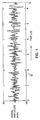
- the first symbol 32 is a "dummy" symbol having a zero signal amplitude.
- the first symbol 32 is followed by waveform 34 including four consecutive symbols 10 of FIG. 1 .
- the fifth symbol 36 has also the form of symbol 10, except that the phases of all subcarriers are inverted.
- the last symbol 38 is another "dummy" symbol with zero signal amplitude.
- the jammer-to-signal amplitude ratio is 31.7 dB, i.e., the jammer amplitude is 500 times stronger than the signal amplitude in each of the N OFDM channels.
- the jammer completely masks the OFDM symbols 34, 36 of waveform 30.
- symbol data may be extracted from received OFDM waveforms having superimposed noise with a conventional time-based correlator, if the signal-to noise ratio exceeds a certain value. This is particularly true for random noise. Separating the OFDM symbols from noise, however, becomes more difficult when the noise is narrowband, i.e., confined to a specific frequency or frequency range. Correlation output signals from the time-based correlator are illustrated in FIGS. 5 to 7 and will now be described.
- a correlator operating in the time domain performs a correlation between two symbols.
- Correlation can, for example, be established between the OFDM symbol 10 and a predetermined reference symbol stored in a memory.
- correlation can be established between a received OFDM symbol 10 and another OFDM symbol 10 received at an earlier time.
- the correlator multiplies the sample points, if necessary after adjusting their amplitude, with 256 corresponding reference sample points that may be stored in a memory of the time domain correlator.
- the sample is then successively time-shifted by a time shift corresponding to the time difference between two or more sample points and another correlation is computed.
- the correlator produces a peak output value when the symbol is temporally aligned with the reference.
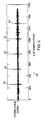
- a time domain correlator correlates the waveform 30 with a reference corresponding to symbol 10.
- the waveform 30 includes superimposed random noise with a signal-to-noise ratio of 4.1 dB.
- the output signal 50 of the time domain correlator exhibits five distinct correlation peaks 52, 54 located at the sample points 256, 512, 768, 1024 and 1280, respectively. Note that the correlation peak 54 is inverted with respect to the four preceding correlation peaks 52 because the phase of the fifth symbol 36 is inverted relative to the phase of the preceding symbols 34.
- the correlation peaks coincide with the beginning of sampling period which indicates that the symbols 34 are temporally aligned with the reference 10.
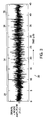
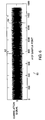
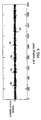
- the jammer waveform 40 of FIG. 4 is applied to the signal input of the time domain correlator which then performs the same correlation as in FIG. 5 .
- the jammer-to-signal amplitude ratio is 23.77 dB.
- the time domain correlator output signal 60 exhibits a peak 62 at sample point 768 and another peak 64 at sample point 1280. None of the other expected peaks are discernable.
- the peaks 62, 64 may not be reliable since none of the other expected peaks are discernable.
- no correlation peaks are visible when the jammer-to-signal amplitude ratio increases to 31.73 dB.
- a time domain correlator may therefore not be able to reliably synchronize OFDM symbols even at moderate jammer signal levels.
- the received OFDM symbols can still be synchronized in the presence of much stronger jammer by correlation in the frequency domain.
- a temporal shift between two symbols corresponds to a phase shift of the OFDM subcarriers.
- the phase shifts are typically proportional to the subcarrier frequencies (modulo 2 ⁇ ). Consequently, instead of synchronizing the OFDM symbols in the time domain, the OFDM symbols can be synchronized in the frequency domain by correlating the phases of the subcarriers with the phases of a reference symbol. Alternatively or in addition, autocorrelation can be performed by correlating the phases of a received symbol with those of an earlier received symbol.
- Phase correlation has several advantages: it is more robust than time domain correlation since it is significantly less affected by amplitude variations; phase correlation may also require les computations and less complex hardware.
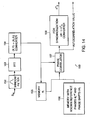
- the temporal waveform S in is received by phase correlator module 150.
- the waveform S in is filtered by a window filter 152 which can be placed either before a FFT module 153, as illustrated in FIG. 14 , or after the FFT module 153 (not shown).
- the FFT module 153 then transforms the filtered waveform to extract the information encoded on the OFDM subcarriers.
- Window filter 152 operates on the temporal waveform and multiplies the received waveform S in preferably with an apodizing filter function, e.g., a Hanning window.
- a window filter placed after the FFT module 153 operates on the OFDM subcarriers in the frequency domain.
- a convolution in the frequency domain is equivalent to multiplication in the time domain.
- convolution is more computationally intensive than multiplication, and so time domain multiplication is employed.
- time domain multiplication is employed.
- the "windowed" amplitude in the frequency domain can be obtained by relatively simple convolution computation.
- an accurate approximation can be achieved by subtracting for each subcarrier f i one half of the sum of the amplitudes at the two adjacent carriers, i.e., 1 ⁇ 2 (f i-1 + f i+2 ).
- Converter 154 converts the Fourier-transformed (FFT) data to polar coordinates representing the amplitudes A i and the phases ⁇ i of the received symbol at the N subcarrier frequencies f 1 , ... f N .
- the phases ⁇ i may be stored in memory 155 for computing autocorrelation values for comparison with a symbol received at a later time.
- phase correlator 157 For computing phase correlation between a received symbol and a reference, phase correlator 157 compares the phases ⁇ i of the received symbol with known reference phases ⁇ i ref that are stored in memory 156. Phase correlator 157 adds the absolute values of the difference between the phases ⁇ i and ⁇ i ref at the frequencies f i to produce a sum ⁇
- . The phases ⁇ i or the difference ⁇ i ref - ⁇ i , respectively, are then successively incremented by predetermined frequency-dependent phase shifts ⁇ i . ⁇ i is proportional to the subcarrier frequency f i (modulo 2 ⁇ ) with the following functional dependence: ⁇ i 2 ⁇ ⁇ * T s * f i # of sample points
- are computed for each increment in the phase shifts and stored in a memory 169 ( FIG. 15 ). The respective sum ⁇
- a second converter 158 computes from the sum ⁇
- phase correlator compares the phases ⁇ i of the received symbol with the phases ⁇ i prec of the preceding symbol that are stored in memory 155, and computes the respective sum ⁇
- phase correlation in the frequency domain with a rectangular window is still superior to conventional time domain correlation.
- a rectangular window is applied before the FFT unit 153.
- each temporal sample point of input waveform S in is multiplied with the respective value of the window function at the sample point.
- the received waveform 30 (i.e., the received signal contains only superimposed random noise) is "processed", i.e., filtered, with the rectangular window of Eq. (1).
- the phase correlator circuit 160 distinctly resolves the five correlation peaks 82, 84 and their temporal position corresponds exactly to that of the correlation peaks 52, 54 obtained with the time domain correlator of FIG. 5 . This result demonstrates that the phase correlator performs at least as well as the time domain correlator in the presence of random noise.
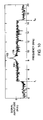
- the input waveform 40 (the received signal contains both the random noise and the jammer with a jammer-to-signal amplitude ratio of 27.3 dB) is processed with the rectangular window of Eq. (1).
- the output 90 of the phase correlator of the invention resolves five correlation peaks 92, 94. Although the peaks are significantly weaker than those of FIG. 8 , correlation can still be established. This result compares favorably with the correlation signal of FIG. 6 obtained with the time domain correlator which showed essentially no correlation at a significantly lower jammer power of 23.8 dB. Correlation with the phase correlator of the invention can be improved even further by replacing the rectangular window with an apodizing function, or apodizing window.
- processing the signal waveform 40 with the rectangular window of Eq. (1) produces a broad peak 102.
- the interfering jammer signal extends to both sides 104, 106 of the jammer's center frequency f j , affecting a large percentage of the OFDM subcarriers.
- the affected OFDM subcarriers may have to be excluded from the phase correlation for improved performance and also from the OFDM bandwidth.
- the Hanning window and other apodizing functions will be discussed below.
- the jammer With the Hanning window and depending on the jammer-to-signal amplitude ratio, the jammer essentially affects only a limited number of subcarriers having frequencies adjacent to the jammer frequency f j .
- the jammer amplitude at the more distant frequencies is reduced by more than 26 dB from its peak amplitude 112.
- FIG. 11 processing the received OFDM signal with the Hanning window of Eq. (2) instead of the rectangular window at the same jammer power, produces a peak 112 that is considerably narrower than the peak 102 of FIG. 10 .
- the jammer With the Hanning window and depending on the jammer-to-signal amplitude ratio, the jammer essentially affects only a limited number of subcarriers having frequencies
- an "apodizing" function i.e., a function that has smoother “edges” than the rectangular window, is used as window filter 152 ( FIG. 14 ).
- Apodizing functions of this type are commonly employed in signal processing applications; examples are Hanning, Hamming and Blackman and Kaiser-Bessel windows.
- the input waveform 40 with a jammer-to-signal amplitude ratio of 27.3 dB is processed in window filter 152 with the Hanning window of Eq. (2).
- Phase correlator 157 clearly resolves five correlation peaks 122, 124, 126.
- a comparison between the peak signal amplitudes 122, 124, 126 obtained with the Hanning window and the amplitudes 92, 94 ( FIG. 9 ) obtained with the rectangular window demonstrates the advantages of using an apodizing filter function.
- a time domain correlator did not produce reliable correlation at all ( FIG. 6 ).
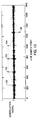
- the input waveform 40 with a jammer-to-signal amplitude ratio of 31.3 dB is processed in window filter 152 with the Hanning window of Eq. (2).
- the output peaks 132, 134, 136 in both correlation and autocorrelation are resolved, albeit with a smaller signal-to-noise ratio than that of the peaks of FIG. 12 .
- FIGS. 12 and 13 connect the autocorrelation peak signal values.
- Autocorrelation represents correlation between a signal and the immediately preceding signal. No autocorrelation peak is observed at peak positions 122 of FIG. 12 and 132 of FIG. 13 since the first symbol 32 ( FIG. 3 ) is a "dummy" symbol with zero amplitude.
- the autocorrelation peaks of FIG. 12 are actually stronger than the correlation peaks with the reference signal.
- One explanation for this result is that two received symbols are likely to contain the same artifacts caused, e.g., by inter-symbol interference, and therefore correlate better with each other than with the reference that does not contain those artifacts.
- the presence of symbols on OFDM transmission channels may first be established by autocorrelation. Only after the symbols have been found, are the symbols synchronized relative to the reference.
- apodizing window function such as the Hamming, Blackman and Kaiser-Bessel windows (not shown), produce phase correlator output peaks that are essentially identical to those obtained with the Hanning window.
- phase correlator module 150 includes an window filter 152 and a FFT module 153 to transform the temporal symbol waveform into the frequency domain.
- First convener 154 converts the output of the FFT module 153 to respective amplitude values A i and phase values ⁇ i at each of the OFDM subcarrier frequencies f i .
- Phase correlator 157 compares the phases ⁇ i to known reference phases ⁇ i ref that may be stored in a memory 156, or to the phases ⁇ i of a symbol that was received earlier. The phases ⁇ i of the earlier received symbol may be stored in a memory 155 that may be identical to memory 156.
- Phase correlator 157 then either compares the phases to produce an autocorrelation value or aligns the phases with the reference phases, as discussed above.
- a corresponding time shift ⁇ T s which represents the temporal shift between the received symbols and the reference, is computed from the aligned phases and used for synchronization.
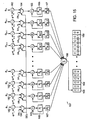
- the phase correlator 157 includes a subtractor 162 that receives from the first converter 154 a respective symbol phase ⁇ i .
- Each subtractor 156 also receives a respective reference phase ⁇ i ref stored in memory 165. Instead of the reference phase ⁇ i ref , the phase of an earlier received symbol may be inputted to subtractor 162 for computing autocorrelation. To simplify the following discussion, only correlation relative to the reference phase ⁇ i ref will be described.
- a second input of the multiplexer 164 receives from memory device 156 respective phase shift constants ⁇ i that may be different for each subcarrier i. Depending on the logical state of select line SEL, the multiplexer 164 transfers either ⁇ i or ⁇ i to a respective adder 165.
- Absolute value circuit 167 computes the absolute value
- Adder 168 adds the output values produced by the N absolute value circuits 167 to form a first correlation value C 1 which is stored in a first output register 169.
- select line SEL enables each multiplexer 164 to transfer a respective phase shift constant ⁇ i to each of the adders 165 which then adds the respective phase shift constant ⁇ i to the previous (old) difference value ⁇ i old stored in register 166 to form a new difference value ⁇ i new .
- Additions are always modulo(2 ⁇ ), with the result between -n and + ⁇ .
- Absolute value circuit 167 then computes new absolute values
- this process also repeats 256 times until the total phase shift ⁇ ( ⁇ i ) produced by adding the phase shift constants ⁇ i spans the symbol time T s .
- the maximum (or minimum) value of all correlation values C 1 , C 2 , ..., C max is determined and used to compute the time shift ⁇ T s between the symbol and the reference for synchronization.
- the received symbol waveform is processed by applying a window function which can be a rectangular window or an apodizing window function, e.g., a Hanning window, step 212 and
- the processed waveform is then Fourier-transformed, step 214.
- the window function 212' can be applied following the Fourier transform 214'.
- the frequency coordinates are converted to polar coordinates, step 216, to obtain the amplitudes A i and, more particularly, the phases ⁇ i of the symbol waveform at the OFDM subcarrier frequencies f i .
- the phases ⁇ i may be stored in a memory for subsequent autocorrelation of the received symbols, step 218.
- step 220 the phase shift constants ⁇ i at each subcarrier frequency f i are fetched from memory, step 226.
- the difference ⁇ i ⁇ i ref - ⁇ i is computed at the frequencies f i , step 230.
- are computed, step 232, and summed over all frequencies to form sum ⁇
- is stored as a correlator output value in the next available output memory location, step 234.
- step 248 which represents the autocorrelation value, step 250.
- phase correlator of the invention With the phase correlator of the invention, only a single FFT operation is required for each received OFDM symbol. Moreover, the phase correlator 157 advantageously performs only additions and can readily be implemented in hardware with a reasonable number of gates, with the number depending on the number of subcarriers and waveform sample points. The phase correlator does not require expensive hardware and is extremely fast and it shares the same FFT processor implemented for OFDM modulation and demodulation. The number of computations is proportional to the number of subcarrier frequencies. The computation of the phase angles is also independent of the amplitudes A i so that phase correlation can be performed before automatic gain control (AGC).
- AGC automatic gain control
Landscapes
- Engineering & Computer Science (AREA)
- Computer Networks & Wireless Communication (AREA)
- Signal Processing (AREA)
- Synchronisation In Digital Transmission Systems (AREA)
- Mobile Radio Communication Systems (AREA)
Applications Claiming Priority (3)
| Application Number | Priority Date | Filing Date | Title |
|---|---|---|---|
| US234289 | 1981-02-17 | ||
| US09/234,289 US6111919A (en) | 1999-01-20 | 1999-01-20 | Synchronization of OFDM signals |
| PCT/US2000/001399 WO2000044120A1 (en) | 1999-01-20 | 2000-01-20 | Synchronization of ofdm signals |
Publications (3)
| Publication Number | Publication Date |
|---|---|
| EP1145470A1 EP1145470A1 (en) | 2001-10-17 |
| EP1145470A4 EP1145470A4 (en) | 2006-01-11 |
| EP1145470B1 true EP1145470B1 (en) | 2010-11-03 |
Family
ID=22880748
Family Applications (1)
| Application Number | Title | Priority Date | Filing Date |
|---|---|---|---|
| EP00909936A Expired - Lifetime EP1145470B1 (en) | 1999-01-20 | 2000-01-20 | Synchronization of ofdm signals |
Country Status (8)
| Country | Link |
|---|---|
| US (1) | US6111919A (enExample) |
| EP (1) | EP1145470B1 (enExample) |
| JP (1) | JP4751986B2 (enExample) |
| AT (1) | ATE487295T1 (enExample) |
| AU (1) | AU3211300A (enExample) |
| CA (1) | CA2358931C (enExample) |
| DE (1) | DE60045186D1 (enExample) |
| WO (1) | WO2000044120A1 (enExample) |
Families Citing this family (57)
| Publication number | Priority date | Publication date | Assignee | Title |
|---|---|---|---|---|
| US6374312B1 (en) * | 1998-09-25 | 2002-04-16 | Intel Corporation | System for dedicating a host processor to running one of a plurality of modem programs and dedicating a DSP to running another one of the modem programs |
| US6560276B1 (en) * | 1998-09-25 | 2003-05-06 | Intel Corporation | Synchronization techniques using an interpolation filter |
| US6502138B2 (en) * | 1998-09-25 | 2002-12-31 | Intel Corporation | Modem with code execution adapted to symbol rate |
| US6711206B1 (en) | 1998-09-25 | 2004-03-23 | Intel Corporation | Modem using a digital signal processor and separate transmit and receive sequencers |
| US6711205B1 (en) | 1998-09-25 | 2004-03-23 | Intel Corporation | Tone detector for use in a modem |
| US6625208B2 (en) * | 1998-09-25 | 2003-09-23 | Intel Corporation | Modem using batch processing of signal samples |
| US6490628B2 (en) * | 1998-09-25 | 2002-12-03 | Intel Corporation | Modem using a digital signal processor and a signal based command set |
| US6661848B1 (en) | 1998-09-25 | 2003-12-09 | Intel Corporation | Integrated audio and modem device |
| US6631143B1 (en) * | 1999-11-12 | 2003-10-07 | Lucent Technologies Inc. | Methods and apparatus for frame synchronization in a digital audio broadcasting system |
| DE10000008A1 (de) * | 2000-01-03 | 2001-07-12 | Alcatel Sa | Verfahren zur aufwandsarmen Signal-, Ton- und Phasenwechseldetektion |
| ES2188372B1 (es) * | 2001-05-23 | 2004-11-16 | Diseño De Sistemas En Silicio, S.A. | Procedimiento para la sincronizacion de la comunicacion mediante modulacion ofdm de multiples equipos de usuario con un equipo de cabecera (canal ascendente). |
| US6711221B1 (en) * | 2000-02-16 | 2004-03-23 | Thomson Licensing S.A. | Sampling offset correction in an orthogonal frequency division multiplexing system |
| DE60021524T2 (de) * | 2000-04-18 | 2006-06-01 | Sony International (Europe) Gmbh | OFDM Diversity-Übertragung |
| NZ506558A (en) | 2000-08-25 | 2003-04-29 | Ind Res Ltd | A broadband indoor communication system using ofdm |
| US6870808B1 (en) | 2000-10-18 | 2005-03-22 | Adaptix, Inc. | Channel allocation in broadband orthogonal frequency-division multiple-access/space-division multiple-access networks |
| US6950475B1 (en) * | 2000-12-11 | 2005-09-27 | Cisco Technology, Inc. | OFDM receiver clock synchronization system |
| KR100688107B1 (ko) * | 2000-12-15 | 2007-03-02 | 아답틱스, 인코포레이티드 | 직교 주파수 분할 다중 접속을 이용하는 시스템에 대한서브캐리어 선택 방법 |
| US6947748B2 (en) | 2000-12-15 | 2005-09-20 | Adaptix, Inc. | OFDMA with adaptive subcarrier-cluster configuration and selective loading |
| US7139237B2 (en) * | 2000-12-29 | 2006-11-21 | Motorola, Inc. | Method and system for multirate multiuser modulation |
| NZ509688A (en) | 2001-02-01 | 2003-06-30 | Ind Res Ltd | Maximum likelihood sychronisation (estimating time delay) for wireless digital communications system using a pilot symbol |
| US7218691B1 (en) | 2001-03-05 | 2007-05-15 | Marvell International Ltd. | Method and apparatus for estimation of orthogonal frequency division multiplexing symbol timing and carrier frequency offset |
| US8619922B1 (en) | 2002-02-04 | 2013-12-31 | Marvell International Ltd. | Method and apparatus for acquisition and tracking of orthogonal frequency division multiplexing symbol timing, carrier frequency offset and phase noise |
| KR100866781B1 (ko) * | 2001-03-09 | 2008-11-04 | 콸콤 인코포레이티드 | 통신 시스템들 내의 심볼 타이밍 동기화 방법 |
| DE10112773B4 (de) * | 2001-03-16 | 2012-09-20 | Rohde & Schwarz Gmbh & Co Kg | Verfahren zur Frequenz- und Zeit-Synchronisation eines OFDM-Empfängers |
| US6912262B1 (en) | 2001-04-30 | 2005-06-28 | Maxim Integrated Products, Inc. | Wideband symbol synchronization in the presence of multiple strong narrowband interference |
| US7020218B2 (en) * | 2001-06-18 | 2006-03-28 | Arnesen David M | Sliding-window transform with integrated windowing |
| JP3798656B2 (ja) * | 2001-06-22 | 2006-07-19 | 株式会社ケンウッド | 直交周波数分割多重信号受信装置、受信装置、直交周波数分割多重信号受信方法及び受信方法 |
| US6985531B2 (en) * | 2001-07-13 | 2006-01-10 | Cyntrust Communications, Inc. | Dual domain differential encoder/decoder |
| US7116745B2 (en) | 2002-04-17 | 2006-10-03 | Intellon Corporation | Block oriented digital communication system and method |
| US7327794B2 (en) * | 2002-06-24 | 2008-02-05 | Intellon Corporation | Method and apparatus for detecting a jammed channel in a block oriented digital communication system |
| US7623542B2 (en) * | 2002-10-21 | 2009-11-24 | Intellon Corporation | Contention-free access intervals on a CSMA network |
| GB0303546D0 (en) * | 2003-02-15 | 2003-03-19 | 4I2I Comm Ltd | Synchronisation method for ofdm symbols |
| JP4472692B2 (ja) * | 2003-02-19 | 2010-06-02 | パナソニック株式会社 | ディジタルマルチキャリア伝送用受信装置及び方法 |
| US6950387B2 (en) * | 2003-02-28 | 2005-09-27 | Wisair Ltd. | Communication method, system, and apparatus that combines aspects of cyclic prefix and zero padding techniques |
| ES2221803B1 (es) * | 2003-06-18 | 2006-03-01 | Diseño De Sistemas En Silicio, S.A. | Procedimiento de acceso al medio de transmision de multiples nodos de comunicaciones sobre red electrica. |
| US7684568B2 (en) * | 2003-11-24 | 2010-03-23 | Intellon Corporation | Encrypting data in a communication network |
| US8090857B2 (en) | 2003-11-24 | 2012-01-03 | Qualcomm Atheros, Inc. | Medium access control layer that encapsulates data from a plurality of received data units into a plurality of independently transmittable blocks |
| FR2868656B1 (fr) * | 2004-04-06 | 2006-06-02 | Wavecom Sa | Signal de radiotelephonie cellulaire permettant une synchronisation au niveau d'une entite d'un canal supplementaire par numerotation des symboles, procede, terminal et station de base correspondants |
| DE102004044957B4 (de) * | 2004-09-16 | 2007-04-19 | Infineon Technologies Ag | Medium-Zugriffs-Steuerungs-Einheit, Mobilfunkeinrichtung und Verfahren zum Abbilden mittels einer Mobilfunkeinrichtung zu übertragender Daten |
| US7573851B2 (en) | 2004-12-07 | 2009-08-11 | Adaptix, Inc. | Method and system for switching antenna and channel assignments in broadband wireless networks |
| US7756005B2 (en) * | 2005-03-11 | 2010-07-13 | Qualcomm Incorporated | Coarse timing/frame acquisition of OFDM system using time division multiplexed pilot symbol |
| US7590183B2 (en) * | 2005-05-12 | 2009-09-15 | Intellon Corporation | Generating signals for transmission of information |
| US7688904B2 (en) * | 2005-05-12 | 2010-03-30 | Intellon Corporation | Generating signals for transmission of information |
| US7729372B2 (en) | 2005-07-27 | 2010-06-01 | Sharp Corporation | Communicating in a network that includes a medium having varying transmission characteristics |
| US8175190B2 (en) | 2005-07-27 | 2012-05-08 | Qualcomm Atheros, Inc. | Managing spectra of modulated signals in a communication network |
| US7558294B2 (en) * | 2005-07-27 | 2009-07-07 | Intellon Corporation | Time synchronization in a network |
| US7822059B2 (en) | 2005-07-27 | 2010-10-26 | Atheros Communications, Inc. | Managing contention-free time allocations in a network |
| JP4949738B2 (ja) * | 2006-05-29 | 2012-06-13 | 富士通セミコンダクター株式会社 | デジタル放送受信機、移動端末およびチャネルサーチ方法 |
| RU2463746C2 (ru) * | 2007-04-30 | 2012-10-10 | Телефонактиеболагет Лм Эрикссон (Пабл) | Измерения разности времени синхронизации в системах ofdm |
| US8493995B2 (en) | 2007-05-10 | 2013-07-23 | Qualcomm Incorporated | Managing distributed access to a shared medium |
| US9413686B2 (en) * | 2007-06-04 | 2016-08-09 | Qualcomm Incorporated | Establishing a unique end-to-end management key |
| JP4470994B2 (ja) * | 2007-12-14 | 2010-06-02 | トヨタ自動車株式会社 | 車両用オーディオ装置 |
| WO2011130292A1 (en) | 2010-04-12 | 2011-10-20 | Qualcomm Atheros, Inc. | Detecting delimiters for low-overhead communication in a network |
| JP5649877B2 (ja) | 2010-08-30 | 2015-01-07 | ラピスセミコンダクタ株式会社 | 相関器及びそれを含む復調装置 |
| US10091044B2 (en) | 2014-07-17 | 2018-10-02 | Conversant Intellectual Property Management Inc. | System and method for frequency synchronization of Doppler-shifted subcarriers |
| CN111106923B (zh) * | 2017-02-05 | 2021-11-19 | 广东百德朗科技有限公司 | 窄带无线通信终端中的同步装置 |
| US11855683B2 (en) * | 2021-06-29 | 2023-12-26 | Raytheon Company | Configurable acquisition engine for receiver of spread spectrum signals |
Family Cites Families (39)
| Publication number | Priority date | Publication date | Assignee | Title |
|---|---|---|---|---|
| US4438511A (en) * | 1980-11-10 | 1984-03-20 | Telebit Corporation | Packetized ensemble modem |
| DE69120401T2 (de) * | 1990-03-30 | 1997-01-02 | Digi Media Vision Ltd | Sendung und empfang bei einer störenden interferenzumgebung |
| SG44771A1 (en) * | 1991-02-28 | 1997-12-19 | Philips Electronics Nv | System for broadcasting and receiving digital data receiver and transmitter for use in such system |
| US5282222A (en) * | 1992-03-31 | 1994-01-25 | Michel Fattouche | Method and apparatus for multiple access between transceivers in wireless communications using OFDM spread spectrum |
| US5555268A (en) * | 1994-01-24 | 1996-09-10 | Fattouche; Michel | Multicode direct sequence spread spectrum |
| GB9218874D0 (en) * | 1992-09-07 | 1992-10-21 | British Broadcasting Corp | Improvements relating to the transmission of frequency division multiplex signals |
| DE69434306T2 (de) * | 1993-01-20 | 2005-11-10 | Koninklijke Philips Electronics N.V. | Verfahren zur Abtrennung einer Blockfrequenz aus einem blockformattierten Signal |
| SE500986C2 (sv) * | 1993-07-20 | 1994-10-17 | Telia Ab | Förfarande och anordning för synkronisering i digitalt transmissionssystem av typen OFDM |
| JPH0746217A (ja) * | 1993-07-26 | 1995-02-14 | Sony Corp | ディジタル復調装置 |
| JPH0746218A (ja) * | 1993-07-28 | 1995-02-14 | Sony Corp | ディジタル復調装置 |
| US5444697A (en) * | 1993-08-11 | 1995-08-22 | The University Of British Columbia | Method and apparatus for frame synchronization in mobile OFDM data communication |
| US5596604A (en) * | 1993-08-17 | 1997-01-21 | Amati Communications Corporation | Multicarrier modulation transmission system with variable delay |
| JP3041175B2 (ja) * | 1993-11-12 | 2000-05-15 | 株式会社東芝 | Ofdm同期復調回路 |
| US5450456A (en) * | 1993-11-12 | 1995-09-12 | Daimler Benz Ag | Method and arrangement for measuring the carrier frequency deviation in a multi-channel transmission system |
| JP3074103B2 (ja) * | 1993-11-16 | 2000-08-07 | 株式会社東芝 | Ofdm同期復調回路 |
| SE501608C2 (sv) * | 1994-01-18 | 1995-03-27 | Telia Ab | Förfarande och arrangemang för synkronisering vid OFDM- modulering |
| JP2989742B2 (ja) * | 1994-05-20 | 1999-12-13 | 株式会社日立製作所 | ディジタル放送システムおよび該ディジタル放送用の送信システムならびに該ディジタル放送用の受信システム |
| JP2731722B2 (ja) * | 1994-05-26 | 1998-03-25 | 日本電気株式会社 | クロック周波数自動制御方式及びそれに用いる送信装置と受信装置 |
| US5627863A (en) * | 1994-07-15 | 1997-05-06 | Amati Communications Corporation | Frame synchronization in multicarrier transmission systems |
| JP3421879B2 (ja) * | 1994-10-05 | 2003-06-30 | ソニー株式会社 | 復調装置 |
| JP3447823B2 (ja) * | 1994-11-11 | 2003-09-16 | アルパイン株式会社 | デジタル放送受信方法 |
| US5682376A (en) * | 1994-12-20 | 1997-10-28 | Matsushita Electric Industrial Co., Ltd. | Method of transmitting orthogonal frequency division multiplex signal, and transmitter and receiver employed therefor |
| US5774450A (en) * | 1995-01-10 | 1998-06-30 | Matsushita Electric Industrial Co., Ltd. | Method of transmitting orthogonal frequency division multiplexing signal and receiver thereof |
| JP3116764B2 (ja) * | 1995-02-15 | 2000-12-11 | 株式会社日立製作所 | ディジタル伝送信号の受信器ならびにディジタル伝送方式 |
| JP3130752B2 (ja) * | 1995-02-24 | 2001-01-31 | 株式会社東芝 | Ofdm伝送受信方式及び送受信装置 |
| SE514986C2 (sv) * | 1995-03-01 | 2001-05-28 | Telia Ab | Metod och anordning för synkronisering vid OFDM-system |
| US5636224A (en) * | 1995-04-28 | 1997-06-03 | Motorola Inc. | Method and apparatus for interleave/de-interleave addressing in data communication circuits |
| FI99252C (fi) * | 1995-07-03 | 1997-12-29 | Nokia Mobile Phones Ltd | Yhdistetty radiosignaalin modulointi- ja monikäyttömenetelmä |
| JP2875976B2 (ja) * | 1996-01-29 | 1999-03-31 | 三星電子株式会社 | 直交周波数分割多重の方法及び同期方法と、直交周波数分割多重用変調器及び復調器 |
| US5802117A (en) * | 1996-02-08 | 1998-09-01 | Philips Electronics North America Corporation | Method and apparatus for joint frequency offset and timing estimation of a multicarrier modulation system |
| KR100186930B1 (ko) * | 1996-03-13 | 1999-05-15 | (소장)배문한 | 직교성 주파수 분할 다중화 방식 신호를 이용한초기프레임동기화방법 |
| US5802044A (en) * | 1996-04-26 | 1998-09-01 | Motorola, Inc. | Multicarrier reverse link timing synchronization system, device and method |
| JP3556047B2 (ja) * | 1996-05-22 | 2004-08-18 | 三菱電機株式会社 | ディジタル放送受信機 |
| US5732113A (en) * | 1996-06-20 | 1998-03-24 | Stanford University | Timing and frequency synchronization of OFDM signals |
| CA2183140C (en) * | 1996-08-12 | 2001-11-20 | Grant Mcgibney | Ofdm timing and frequency recovery system |
| GB2319935B (en) * | 1996-11-29 | 2001-10-24 | Daewoo Electronics Co Ltd | Apparatus for correcting frequency offset in ofdm receiving system |
| JP3563231B2 (ja) * | 1997-04-04 | 2004-09-08 | 株式会社デノン | 周波数制御装置および方法、受信装置、ならびに、通信装置 |
| US5991289A (en) * | 1997-08-05 | 1999-11-23 | Industrial Technology Research Institute | Synchronization method and apparatus for guard interval-based OFDM signals |
| JP3946893B2 (ja) * | 1998-12-28 | 2007-07-18 | 株式会社東芝 | ディジタル通信装置 |
-
1999
- 1999-01-20 US US09/234,289 patent/US6111919A/en not_active Expired - Lifetime
-
2000
- 2000-01-20 DE DE60045186T patent/DE60045186D1/de not_active Expired - Lifetime
- 2000-01-20 AT AT00909936T patent/ATE487295T1/de not_active IP Right Cessation
- 2000-01-20 AU AU32113/00A patent/AU3211300A/en not_active Abandoned
- 2000-01-20 CA CA002358931A patent/CA2358931C/en not_active Expired - Fee Related
- 2000-01-20 EP EP00909936A patent/EP1145470B1/en not_active Expired - Lifetime
- 2000-01-20 WO PCT/US2000/001399 patent/WO2000044120A1/en not_active Ceased
- 2000-01-20 JP JP2000595449A patent/JP4751986B2/ja not_active Expired - Fee Related
Also Published As
| Publication number | Publication date |
|---|---|
| EP1145470A1 (en) | 2001-10-17 |
| WO2000044120A1 (en) | 2000-07-27 |
| US6111919A (en) | 2000-08-29 |
| AU3211300A (en) | 2000-08-07 |
| ATE487295T1 (de) | 2010-11-15 |
| EP1145470A4 (en) | 2006-01-11 |
| CA2358931A1 (en) | 2000-07-27 |
| CA2358931C (en) | 2009-09-08 |
| DE60045186D1 (de) | 2010-12-16 |
| JP4751986B2 (ja) | 2011-08-17 |
| WO2000044120A8 (en) | 2001-06-21 |
| JP2002535919A (ja) | 2002-10-22 |
Similar Documents
| Publication | Publication Date | Title |
|---|---|---|
| EP1145470B1 (en) | Synchronization of ofdm signals | |
| US6074086A (en) | Synchronization of OFDM signals with improved windowing | |
| US5652772A (en) | Method and apparatus for synchronization in digital transmisison systems of the OFDM type | |
| EP0884878B1 (en) | Synchronization of frame, symbol clock, and carrier in multicarrier receivers | |
| KR100528332B1 (ko) | Ofdm 시스템에서의 초기 주파수 동기 방법 및 장치 | |
| US6459744B1 (en) | Multi-carrier symbol synchronization | |
| US7388921B2 (en) | Method for processing an OFDM signal | |
| US6363131B1 (en) | Method and apparatus for joint timing synchronization and frequency offset estimation | |
| US6628606B1 (en) | Coarse frequency offset estimator in orthogonal frequency division multiplexing receiver and method thereof | |
| EP2782307A1 (en) | Synchronisation of digital communication systems | |
| WO1995005042A1 (en) | Method and apparatus for frame synchronization in mobile ofdm data communication | |
| US7116745B2 (en) | Block oriented digital communication system and method | |
| US10855494B2 (en) | Transmitter and receiver and corresponding methods | |
| EP1441463A1 (en) | A method and device for carrier frequency synchronization | |
| US20050180533A1 (en) | Method and device for synchronization upon reception of a signal and echoes | |
| US7606139B2 (en) | Preamble detection using frequency based correlation | |
| KR20020086161A (ko) | 직교 주파수 분할 다중 전송 시스템의 훈련 심볼 결정방법 및 주파수 옵셋 추정과 동기를 위한 장치 및 방법 | |
| JP3793534B2 (ja) | Ofdm受信装置およびofdm信号の受信方法 | |
| EP4645716A1 (en) | Methods for synchronization in a non-terrestrial network | |
| JP2000041019A (ja) | マルチキャリア伝送システム及び受信装置 | |
| KR100226700B1 (ko) | Ofdm 수신 시스템의 동기 검출 회로 |
Legal Events
| Date | Code | Title | Description |
|---|---|---|---|
| PUAI | Public reference made under article 153(3) epc to a published international application that has entered the european phase |
Free format text: ORIGINAL CODE: 0009012 |
|
| 17P | Request for examination filed |
Effective date: 20010706 |
|
| AK | Designated contracting states |
Kind code of ref document: A1 Designated state(s): AT BE CH CY DE DK ES FI FR GB GR IE IT LI LU MC NL PT SE |
|
| AX | Request for extension of the european patent |
Free format text: AL;LT;LV;MK;RO;SI |
|
| A4 | Supplementary search report drawn up and despatched |
Effective date: 20051125 |
|
| GRAP | Despatch of communication of intention to grant a patent |
Free format text: ORIGINAL CODE: EPIDOSNIGR1 |
|
| GRAJ | Information related to disapproval of communication of intention to grant by the applicant or resumption of examination proceedings by the epo deleted |
Free format text: ORIGINAL CODE: EPIDOSDIGR1 |
|
| 17Q | First examination report despatched |
Effective date: 20060117 |
|
| GRAP | Despatch of communication of intention to grant a patent |
Free format text: ORIGINAL CODE: EPIDOSNIGR1 |
|
| GRAS | Grant fee paid |
Free format text: ORIGINAL CODE: EPIDOSNIGR3 |
|
| RAP1 | Party data changed (applicant data changed or rights of an application transferred) |
Owner name: ATHEROS POWERLINE LLC |
|
| RAP1 | Party data changed (applicant data changed or rights of an application transferred) |
Owner name: ATHEROS COMUNICATIONS, INC. |
|
| GRAA | (expected) grant |
Free format text: ORIGINAL CODE: 0009210 |
|
| AK | Designated contracting states |
Kind code of ref document: B1 Designated state(s): AT BE CH CY DE DK ES FI FR GB GR IE IT LI LU MC NL PT SE |
|
| REG | Reference to a national code |
Ref country code: GB Ref legal event code: FG4D |
|
| REG | Reference to a national code |
Ref country code: CH Ref legal event code: EP |
|
| REG | Reference to a national code |
Ref country code: IE Ref legal event code: FG4D |
|
| REF | Corresponds to: |
Ref document number: 60045186 Country of ref document: DE Date of ref document: 20101216 Kind code of ref document: P |
|
| REG | Reference to a national code |
Ref country code: NL Ref legal event code: VDEP Effective date: 20101103 |
|
| REG | Reference to a national code |
Ref country code: DE Ref legal event code: R081 Ref document number: 60045186 Country of ref document: DE Owner name: ATHEROS COMMUNICATIONS, INC., SANTA CLARA, US Free format text: FORMER OWNER: ATHEROS COMUNICATIONS, INC., SANTA CLARA, CALIF., US Effective date: 20110202 Ref country code: DE Ref legal event code: R081 Ref document number: 60045186 Country of ref document: DE Owner name: ATHEROS COMMUNICATIONS, INC., US Free format text: FORMER OWNER: ATHEROS COMUNICATIONS, INC., SANTA CLARA, US Effective date: 20110202 |
|
| PG25 | Lapsed in a contracting state [announced via postgrant information from national office to epo] |
Ref country code: AT Free format text: LAPSE BECAUSE OF FAILURE TO SUBMIT A TRANSLATION OF THE DESCRIPTION OR TO PAY THE FEE WITHIN THE PRESCRIBED TIME-LIMIT Effective date: 20101103 Ref country code: SE Free format text: LAPSE BECAUSE OF FAILURE TO SUBMIT A TRANSLATION OF THE DESCRIPTION OR TO PAY THE FEE WITHIN THE PRESCRIBED TIME-LIMIT Effective date: 20101103 Ref country code: NL Free format text: LAPSE BECAUSE OF FAILURE TO SUBMIT A TRANSLATION OF THE DESCRIPTION OR TO PAY THE FEE WITHIN THE PRESCRIBED TIME-LIMIT Effective date: 20101103 Ref country code: FI Free format text: LAPSE BECAUSE OF FAILURE TO SUBMIT A TRANSLATION OF THE DESCRIPTION OR TO PAY THE FEE WITHIN THE PRESCRIBED TIME-LIMIT Effective date: 20101103 |
|
| PG25 | Lapsed in a contracting state [announced via postgrant information from national office to epo] |
Ref country code: GR Free format text: LAPSE BECAUSE OF FAILURE TO SUBMIT A TRANSLATION OF THE DESCRIPTION OR TO PAY THE FEE WITHIN THE PRESCRIBED TIME-LIMIT Effective date: 20110204 |
|
| PG25 | Lapsed in a contracting state [announced via postgrant information from national office to epo] |
Ref country code: BE Free format text: LAPSE BECAUSE OF FAILURE TO SUBMIT A TRANSLATION OF THE DESCRIPTION OR TO PAY THE FEE WITHIN THE PRESCRIBED TIME-LIMIT Effective date: 20101103 Ref country code: ES Free format text: LAPSE BECAUSE OF FAILURE TO SUBMIT A TRANSLATION OF THE DESCRIPTION OR TO PAY THE FEE WITHIN THE PRESCRIBED TIME-LIMIT Effective date: 20110214 |
|
| PG25 | Lapsed in a contracting state [announced via postgrant information from national office to epo] |
Ref country code: MC Free format text: LAPSE BECAUSE OF NON-PAYMENT OF DUE FEES Effective date: 20110131 Ref country code: DK Free format text: LAPSE BECAUSE OF FAILURE TO SUBMIT A TRANSLATION OF THE DESCRIPTION OR TO PAY THE FEE WITHIN THE PRESCRIBED TIME-LIMIT Effective date: 20101103 |
|
| REG | Reference to a national code |
Ref country code: CH Ref legal event code: PL |
|
| PLBE | No opposition filed within time limit |
Free format text: ORIGINAL CODE: 0009261 |
|
| STAA | Information on the status of an ep patent application or granted ep patent |
Free format text: STATUS: NO OPPOSITION FILED WITHIN TIME LIMIT |
|
| 26N | No opposition filed |
Effective date: 20110804 |
|
| REG | Reference to a national code |
Ref country code: IE Ref legal event code: MM4A |
|
| PG25 | Lapsed in a contracting state [announced via postgrant information from national office to epo] |
Ref country code: CH Free format text: LAPSE BECAUSE OF NON-PAYMENT OF DUE FEES Effective date: 20110131 Ref country code: LI Free format text: LAPSE BECAUSE OF NON-PAYMENT OF DUE FEES Effective date: 20110131 |
|
| REG | Reference to a national code |
Ref country code: DE Ref legal event code: R097 Ref document number: 60045186 Country of ref document: DE Effective date: 20110804 |
|
| REG | Reference to a national code |
Ref country code: DE Ref legal event code: R119 Ref document number: 60045186 Country of ref document: DE Effective date: 20110802 |
|
| PG25 | Lapsed in a contracting state [announced via postgrant information from national office to epo] |
Ref country code: IT Free format text: LAPSE BECAUSE OF FAILURE TO SUBMIT A TRANSLATION OF THE DESCRIPTION OR TO PAY THE FEE WITHIN THE PRESCRIBED TIME-LIMIT Effective date: 20101103 |
|
| PG25 | Lapsed in a contracting state [announced via postgrant information from national office to epo] |
Ref country code: IE Free format text: LAPSE BECAUSE OF NON-PAYMENT OF DUE FEES Effective date: 20110120 |
|
| PG25 | Lapsed in a contracting state [announced via postgrant information from national office to epo] |
Ref country code: CY Free format text: LAPSE BECAUSE OF FAILURE TO SUBMIT A TRANSLATION OF THE DESCRIPTION OR TO PAY THE FEE WITHIN THE PRESCRIBED TIME-LIMIT Effective date: 20101103 Ref country code: LU Free format text: LAPSE BECAUSE OF NON-PAYMENT OF DUE FEES Effective date: 20110120 |
|
| PG25 | Lapsed in a contracting state [announced via postgrant information from national office to epo] |
Ref country code: DE Free format text: LAPSE BECAUSE OF NON-PAYMENT OF DUE FEES Effective date: 20110802 |
|
| REG | Reference to a national code |
Ref country code: FR Ref legal event code: TP Owner name: QUALCOMM INCORPORATED, US Effective date: 20130610 |
|
| PG25 | Lapsed in a contracting state [announced via postgrant information from national office to epo] |
Ref country code: PT Free format text: LAPSE BECAUSE OF NON-PAYMENT OF DUE FEES Effective date: 20101103 |
|
| REG | Reference to a national code |
Ref country code: GB Ref legal event code: 732E Free format text: REGISTERED BETWEEN 20130711 AND 20130717 |
|
| REG | Reference to a national code |
Ref country code: FR Ref legal event code: PLFP Year of fee payment: 17 |
|
| REG | Reference to a national code |
Ref country code: FR Ref legal event code: PLFP Year of fee payment: 18 |
|
| REG | Reference to a national code |
Ref country code: FR Ref legal event code: PLFP Year of fee payment: 19 |
|
| PGFP | Annual fee paid to national office [announced via postgrant information from national office to epo] |
Ref country code: FR Payment date: 20171220 Year of fee payment: 19 |
|
| PGFP | Annual fee paid to national office [announced via postgrant information from national office to epo] |
Ref country code: GB Payment date: 20171228 Year of fee payment: 19 |
|
| GBPC | Gb: european patent ceased through non-payment of renewal fee |
Effective date: 20190120 |
|
| PG25 | Lapsed in a contracting state [announced via postgrant information from national office to epo] |
Ref country code: GB Free format text: LAPSE BECAUSE OF NON-PAYMENT OF DUE FEES Effective date: 20190120 |
|
| PG25 | Lapsed in a contracting state [announced via postgrant information from national office to epo] |
Ref country code: FR Free format text: LAPSE BECAUSE OF NON-PAYMENT OF DUE FEES Effective date: 20190131 |