EP1134818B1 - Sicherheitsvorrichtung für abgedichtete batterien und abgedichtete batterie bei der diese verwendet wird - Google Patents
Sicherheitsvorrichtung für abgedichtete batterien und abgedichtete batterie bei der diese verwendet wird Download PDFInfo
- Publication number
- EP1134818B1 EP1134818B1 EP99972790A EP99972790A EP1134818B1 EP 1134818 B1 EP1134818 B1 EP 1134818B1 EP 99972790 A EP99972790 A EP 99972790A EP 99972790 A EP99972790 A EP 99972790A EP 1134818 B1 EP1134818 B1 EP 1134818B1
- Authority
- EP
- European Patent Office
- Prior art keywords
- plate
- shield plate
- pressure
- safety device
- lid
- Prior art date
- Legal status (The legal status is an assumption and is not a legal conclusion. Google has not performed a legal analysis and makes no representation as to the accuracy of the status listed.)
- Expired - Lifetime
Links
Images


Classifications
-
- H—ELECTRICITY
- H01—ELECTRIC ELEMENTS
- H01M—PROCESSES OR MEANS, e.g. BATTERIES, FOR THE DIRECT CONVERSION OF CHEMICAL ENERGY INTO ELECTRICAL ENERGY
- H01M50/00—Constructional details or processes of manufacture of the non-active parts of electrochemical cells other than fuel cells, e.g. hybrid cells
- H01M50/50—Current conducting connections for cells or batteries
- H01M50/572—Means for preventing undesired use or discharge
-
- H—ELECTRICITY
- H01—ELECTRIC ELEMENTS
- H01M—PROCESSES OR MEANS, e.g. BATTERIES, FOR THE DIRECT CONVERSION OF CHEMICAL ENERGY INTO ELECTRICAL ENERGY
- H01M50/00—Constructional details or processes of manufacture of the non-active parts of electrochemical cells other than fuel cells, e.g. hybrid cells
- H01M50/30—Arrangements for facilitating escape of gases
- H01M50/342—Non-re-sealable arrangements
- H01M50/3425—Non-re-sealable arrangements in the form of rupturable membranes or weakened parts, e.g. pierced with the aid of a sharp member
-
- H—ELECTRICITY
- H01—ELECTRIC ELEMENTS
- H01M—PROCESSES OR MEANS, e.g. BATTERIES, FOR THE DIRECT CONVERSION OF CHEMICAL ENERGY INTO ELECTRICAL ENERGY
- H01M10/00—Secondary cells; Manufacture thereof
- H01M10/05—Accumulators with non-aqueous electrolyte
- H01M10/052—Li-accumulators
-
- H—ELECTRICITY
- H01—ELECTRIC ELEMENTS
- H01M—PROCESSES OR MEANS, e.g. BATTERIES, FOR THE DIRECT CONVERSION OF CHEMICAL ENERGY INTO ELECTRICAL ENERGY
- H01M2200/00—Safety devices for primary or secondary batteries
- H01M2200/10—Temperature sensitive devices
- H01M2200/106—PTC
-
- H—ELECTRICITY
- H01—ELECTRIC ELEMENTS
- H01M—PROCESSES OR MEANS, e.g. BATTERIES, FOR THE DIRECT CONVERSION OF CHEMICAL ENERGY INTO ELECTRICAL ENERGY
- H01M2200/00—Safety devices for primary or secondary batteries
- H01M2200/20—Pressure-sensitive devices
-
- Y—GENERAL TAGGING OF NEW TECHNOLOGICAL DEVELOPMENTS; GENERAL TAGGING OF CROSS-SECTIONAL TECHNOLOGIES SPANNING OVER SEVERAL SECTIONS OF THE IPC; TECHNICAL SUBJECTS COVERED BY FORMER USPC CROSS-REFERENCE ART COLLECTIONS [XRACs] AND DIGESTS
- Y02—TECHNOLOGIES OR APPLICATIONS FOR MITIGATION OR ADAPTATION AGAINST CLIMATE CHANGE
- Y02E—REDUCTION OF GREENHOUSE GAS [GHG] EMISSIONS, RELATED TO ENERGY GENERATION, TRANSMISSION OR DISTRIBUTION
- Y02E60/00—Enabling technologies; Technologies with a potential or indirect contribution to GHG emissions mitigation
- Y02E60/10—Energy storage using batteries
Definitions
- the present invention relates to a safety device for explosion-proof of a closed battery and a closed battery with the safety device.
- the secondary battery has a high electro motive force, the secondary battery would explode in case of an increased inner pressure caused by chemical reaction in an electrode member with a positive electrode and a negative electrode installed in an outer container.
- a non-water electrolytic solution battery such as a lithium secondary battery is in an overcharge condition or a large amount of electric current is flown into the battery in a short circuit condition caused by a wrong operation
- non-water electrolytic solution is solved in the electrode member and gas is produced.
- the gas is continuously produced in the outer container and an inner pressure of the outer container increases, the battery would explode in finally.
- a positive electrode lid provided at an edge of an outer container comprises a porous metallic plate effected as the innermost lid and connected to a positive electrode of an electrode member through a positive electrode lead, a metallic explosion-proof valve effected as an intermediate lid electrically connected to the porous metallic plate through a central adhered portion, and a metallic cap terminal electrically connected to the metallic explosion-proof valve.
- the porous metallic plate and the metallic explosion-proof valve are electrically isolated by breaking the central adhered portion and gas produced in the inside of the battery is discharged by breaking a part of the metallic explosion-proof valve so as to avoid an explosion of the battery.
- JP-A-9-199105 describes a sealed battery safety device having an intermediate lid with a thin portion provided to be deformed if an inner pressure of the battery increases.
- a purpose of the present invention is to provide a safety device for a closed battery in which a pressure plate and a shield plate can be isolated and a safety of the closed battery can be maintained even if an inner pressure of the battery exceeds a predetermined level, and a closed battery with the safety device.
- a safety device of a closed battery comprises a positive electrode lid attached at one end of an outer container, said positive electrode lid including a pressure plate effected as the innermost lid and electrically connected to a positive electrode of an electrode member through a positive electrode lead, a shield plate effected as an intermediate lid and electrically connected to said pressure plate through a central contacting portion, and a sealing plate effected as the outermost lid and electrically connected to said shield plate wherein at least one gas flow hole is provided at said pressure plate so as to communicate an internal space of said outer container with a contacting space between said pressure plate and said shield plate a central contacting portion includes a protrusion protrud from a central portion of said pressure plate toward said shield plate and having a first flat contacting surface and a second contacting surface provided at a central portion of said shield plate and contacting with said first flat contacting surface of said protrusion, and said pressure plate and said shield plate are electrically isolated when the inner pressure level of said outer container exceeds a pre
- a safety device comprises a positive electrode lid attached at one end of an outer container, said positive electrode lid including a pressure plate effected as the innermost lid and electrically connected to a positive electrode of an electrode member through a positive electrode lead, a shield plate effected as an intermediate lid and electrically connected to said pressure plate through a central contacting portion, and a sealing plate effected as the outermost lid and electrically connected to said shield plate, wherein at least one gas flow hole is provided at said pressure plate so as to communicate an internal portion of said outer container with a contacting space between said pressure plate and said shield plate, a plurality of circular grooves are coaxially formed at a substantially central portion of said shield plate except connecting tab portions alternatively arranged with an angle of 180 ° so as to oppose the adjacent grooves each other; a diameter of said grooves is gradually increasing from an inner side to an outer side and said pressure plate and said shield plate are electrically isolated when an inner pressure level of said outer container exceeds a predetermined electric current isolation pressure.
- a safety device comprises a positive electrode lid attached at one end of an outer container, said positive electrode lid including a pressure plate effected as the innermost lid and electrically connected to a positive electrode of a electrode member through a positive electrode lead, a shield plate effected as an intermediate lid and electrically connected to said pressure plate through a central contacting portion, and a sealing plate effected as the outermost lid and electrically connected to said shield plate wherein at last one gas flow hole is provided at said pressure plate so as to communicate an internal space of said outer container with a contacting space between said pressure plate and said shield plate, said central contacting portion includes a protrusion protruding from a central portion of said pressure plate toward said shield plate and having a first flat contacting surface, and a second contacting surface provided at a central portion of said shield plate and contacting with said first flat contacting surface of said protrusion, a plurality of circular grooves are provided coaxially at a portion surrounding said second flat contacting surface of said shield plate except connecting tab portions alternatively
- a circular shaped PTC thermister element is provided between the shield plate and the sealing plate.
- a closed battery comprises the above described safety device.
- an electric communication between the pressure plate and the shield plate in a closed space is securely maintained by contacting the first flat contacting surface provided on the protrusion of the pressure plate and the second flat contacting surface of the shield plate.
- the shield plate, particularly the second flat contacting surface of the shield plate is released or detached from the first flat contacting surface by producing gas so as to interrupt the electric communication between the pressure plate and the shield plate.
- the second flat contacting surface is provided at a central portion of a plurality of circular grooves coaxially and alternatively arranged with an angle of 180, so that the second flat contacting surface can be released from the first contacting surface quickly.
- the electric communication between the pressure plate and the shield plate can be quickly interrupted by providing the predetermined electric current isolation pressure.
- the second flat contacting surface is plastically deformed so that the second flat contacting surface is avoided to contact the first flat contacting surface again. If even numbers of circular grooves are formed, the second flat contacting surface can be removed from the first flat contacting surface while both surfaces are maintained in a parallel relation.
- the gas can be discharged to an exterior of the battery through at least one gas flow hole formed at the pressure plate, the contacting space, at least one circular groove (valve layer) and at least one gas discharging hole by breaking the circular groove (valve layer) formed at the shield plate.
- the predetermined electric current isolation pressure is preferably 4 to 5 kg/cm 2 and the predetermined layer breaking pressure is preferably 20 kg/cm 2 .
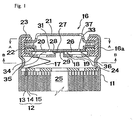
- FIG. 1 A structure of an embodiment of a safety device of a closed battery according to the present invention is explained with reference to Fig. 1 to Fig. 3.
- an electrode member 12 is installed in an outer container 11 used as a negative terminal.
- a positive electrode, a separator 14 and a negative electrode 15 are laminated as the electrode and formed into a roll.
- a safety device of a closed battery used for both an explosion-proof and a terminal is provided at an upper opening portion of the outer container 11.
- the safety device is actually constituted by a positive electrode lid 16 caulked at the upper opening portion of the outer container 11 through an isolate gasket 16a.
- the positive electrode lid 16 comprises a pressure plate 18 actually effected as the innermost lid and connected to the positive electrode 13 of the electrode member 12 through a positive electrode lead 17, a shield plate 20 effected as an intermediate lid and electrically connected to the pressure plate 18 through a central contact portion 19 and a sealing plate 21 effected as an outermost lid and electrically connected to the shield plate 20.
- the positive electrode lid 16 comprises a circular isolating plate 22 sandwiched between the pressure plate 18 and the shield plate 20, and a circular PTC thermister element 23 sandwiched between the shield plate 20 and the sealing plate 21.
- the pressure plate 18 has a plurality of gas flow holes 24.
- An internal space 25 of the outer container is connected to a contacting space 26 located between the pressure plate 18 and the shield plate 20 through the gas flow holes 24.
- the central contact portion 19 electrically connecting the pressure plate 18 and the shield plate 20 is constituted by a protrusion 28 having a first flat contact surface 27 and protruding from a central portion toward the shield plate 20, and a second flat contact surface 29 located at the central portion of the shield plate 20 and contacting the first flat surface of the protrusion 28.
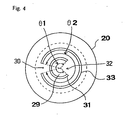
- an inner circular groove 31 having a horse shoe shape is formed except a portion for a first connecting tab portion 30.
- an outer circular groove 33 having a horse shoe shape and the diameter of which is larger than that of the inner circular groove 31 is formed except a portion of a second connecting tab 32 opposing the first connecting tab portion 30 at an angle of 180°.
- an angle of circumference ⁇ 1 of the inner circular groove 31 is smaller than an angle of circumference ⁇ 2 of the outer circular groove 33.
- the angle ⁇ 1 is preferably larger than the angle of the first connecting tab 30.
- the horseshoe shaped inner circular groove 31 and outer circular groove 33 may be formed along a circle line, an oval line, other undefined circles and an outline of polygons.
- a metallic foil piece 34 is attached on a surface of the shield plate 20 at a side confronting the pressure plate 18.
- Valve layers 35 and 36 are formed by the covering the inner circular groove 31 and the outer circular groove 33 with the metallic foil 34, respectively.
- the valve layers 35 and 36 are designed to be broken when a pressure exceeding the predetermined rupture pressure (for example, 20 kg/cm 2 ) is applied to the valve layers 35 and 36.
- a clad metal plate is formed by cladding a metallic foil piece 34 on the shield plate 20 made of an aluminum metal substrate with a thickness (i.e., 50 ⁇ m)
- a copper foil piece having a thickness of 10 ⁇ m may be used as the metallic foil 34.
- valve films for covering the inner circular groove and the outer circular groove with a metallic foil piece by adhering the metallic foil piece 34 on the surface of the shield plate 20 confronting the pressure plate as described above are not essential.
- notches having a V-shaped cross section may be formed at a part of the shield plate 20 by score processing along a thickness direction. When such a score is formed, adhering a metallic foil piece is unnecessary at a side of the shield plate 20 confronting the pressure plate, since a groove having a thinner wall is provided.
- the shield plate 20 can be released from the pressure plate 18 by providing the inner and outer circular grooves 31 and 33.
- the second flat contacting surface 29 is released in parallel with respect to the first contacting surface 27. Even if a central portion of the shield plate 20 is slightly risen, the shield plate 20 is completely released from the pressure plate 18. Thus, an electric communication between the pressure plate 18 and the shield plate 20 can be interrupted quickly.
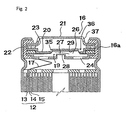
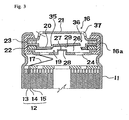
- Fig. 2 and Fig. 3 shows a condition in which the electric communication is interrupted by releasing the second flat contacting surface 29 and the first flat contacting surface 27, respectively.
- a side surface of the protrusion 28 is torn so as to be broken as shown in Figs. 7 and 8.
- a wall portion of the side surface of the protrusion 28 may be partly thinner so that the thinner wall portion can be easily tom by rising the shield plate 20 so as to interrupt the electric communication.
- valve layers 35 and 36 have not been broken so that gas harmful against a human body can be prevented from flowing to the exterior of the battery and an environment can be prevented from being contaminated.
- the safety device for a closed battery accomplishes the electric isolation and discharging of gas to the exterior of the battery so as to avoid exploding of the closed battery securely.
- the gas is discharged to the exterior in an emergency case.
- a baneful influence to a human body and an environment can be controlled to be as small as possible.
- the PTC thermister element 23 in a circular plate shape is provided between the shield plate 20 and the sealing plate 21 so that the thermister element 23 can act to lower electric current when a temperature of the safety device of the closed battery is increased by producing gas. Thus, an explosion caused by excess current can be prevented.
- the number of the grooves may be three and more (without regard to even number or odd number).
- a closed battery when normal electric current flows, a closed battery can be operated normally by contacting a pressure plate and a shield plate in a sealed space in a pressure-tight condition.
- a second flat contacting surface formed at a central portion of a plurality of circular grooves coaxially arranged is quickly released from a first flat contacting surface formed on a protrusion at a central portion of a pressure plate by utilizing the pressure of gas so as to interrupt an electric communication between the pressure plate and the shield plate rapidly.
- a valve layer is quickly broken so as to discharge the gas.
- an electric isolation and discharging the gas to an exterior of the battery can be performed in order to avoid exploding of the closed battery. Baneful influences against a human body and an environment can be controlled to be as small as possible since a discharge of the gas to the exterior of the battery is in an emergency case.
- cladding a metallic foil piece on a metallic substrate on which inner- and outer- circular grooves are formed is provided so that a shield plate with a valve layer securely actuated by the predetermined layer break pressure can be manufactured economically.
- a safety device for a closed battery By providing a safety device for a closed battery according to the present invention, a high safety closed battery with high performance can be manufactured economically.
Landscapes
- Chemical & Material Sciences (AREA)
- Chemical Kinetics & Catalysis (AREA)
- Electrochemistry (AREA)
- General Chemical & Material Sciences (AREA)
- Engineering & Computer Science (AREA)
- Manufacturing & Machinery (AREA)
- Gas Exhaust Devices For Batteries (AREA)
- Connection Of Batteries Or Terminals (AREA)
- Sealing Battery Cases Or Jackets (AREA)
Claims (6)
- Sicherheitsvorrichtung einer abgedichteten Batterie mit einem positiven Elektrodendeckel (16), der an einem Ende eines äußeren Behälters (11) befestigt ist, wobei der positive Elektrodendeckel (16) aufweist:eine Druckplatte (18), die als innerster Deckel ausgeführt ist und mit einer positiven. Elektrode (13) eines Elektrodenteils (12) über eine positive Elektrodenleitung (17) elektrisch verbunden ist,eine Schutzplatte (20) mit mehreren Nuten (31, 33), die mit einer Metallfolie (34) überzogen sind, wobei die Schutzplatte (20) als ein Zwischendeckel ausgeführt ist und mit der Druckplatte (18) über einen Mittelkontaktabschnitt (19) elektrisch verbunden ist, undeine Dichtplatte (21), die als der äußerste Deckel ausgeführt ist und mit der Schutzplatte (20) elektrisch verbunden ist,wobei zumindest ein Gasstromloch (24) in der Druckplatte (18) vorgesehen ist, um einen Innenraum (25) des äußeren Behälters (11) mit dem Kontaktraum (26) zwischen der Druckplatte (18) und der Schutzplatte (20) zu verbinden,
wobei der Mittelkontaktabschnitt (19) einen Vorsprung (28), der von einem Mittelabschnitt der Druckplatte (18) in Richtung der Schutzplatte (20) vorsteht und eine erste ebene Kontaktfläche (27) hat, und eine zweite Kontaktfläche (29) aufweist, die in einem Mittelabschnitt der Schutzplatte (20) vorgesehen ist und mit der ersten ebenen Kontaktfläche (27) des Vorsprungs (28) Kontakt hat, und
wobei die Druckplatte (18) und die Schutzplatte (20) elektrisch getrennt werden, wenn ein Innendruckpegel des äußeren Behälters (11) einen vorbestimmten Druck zum Abschalten des elektrischen Stroms überschreitet. - Sicherheitsvorrichtung nach Anspruch 1, wobei
mehrere Kreisnuten (31, 33) in einem im wesentlichen mittleren Abschnitt der Schutzplatte (20) koaxial ausgebildet sind, mit Ausnahme von Kontaktfahnenabschnitten (30, 32), die alternierend mit einem Winkel von 180° so angeordnet sind, daß sie den benachbarten Nuten (31, 33) jeweils gegenüberliegen,
ein Durchmesser der Nuten (31, 33) von einer Innenseite zu einer Außenseite schrittweise größer wird, und
die Druckplatte (18) und die Schutzplatte (20) elektrisch getrennt sind, wenn ein Innendruckpegel des äußeren Behälters (11) einen vorbestimmten Druck zum Abschalten des elektrischen Stroms überschreitet. - Sicherheitsvorrichtung nach Anspruch 1 oder 2, wobei
mehrere. Kreisnuten (31, 33) in einem Abschnitt koaxial vorgesehen sind, der die zweite ebene Kontaktfläche (29) der Schutzplatte (20) umgibt, mit Ausnahme von Kontaktfahnenabschnitten (30, 32), die alternierend mit einem Winkel von 180° so angeordnet sind, daß sie den benachbarten Nuten (31, 33) jeweils gegenüberliegen,
ein Durchmesser der Nuten (31, 33) von einer Innenseite zu einer Außenseite schrittweise größer wird, und
eine Ventilschicht (35, 36) an jeder der Kreisnuten (31, 33) durch Haftbefestigung eines Metallfolienstücks (34) auf einer Seitenfläche der Schutzplatte (20), die der Druckplatte (18) gegenüberliegt, ausgebildet ist, und
wenn ein Innendruckpegel des äußeren Behälters (11) einen vorbestimmten Druck zum elektrischen Abschalten überschreitet, die zweite ebene Kontaktfläche (29) der Schutzplatte (20) von der ersten ebenen Kontaktfläche (27) der Druckplatte (18) gelöst wird, um eine elektrische Verbindung zwischen der Druckplatte (18) und der Schutzplatte (20) zu trennen, und
wenn der Druckpegel des äußeren Behälters (11) einen vorbestimmten Schichtzerstörungsdruck überschreitet, jede der Ventilschichten (35, 36) zerstört wird. - Sicherheitsvorrichtung nach einem der Ansprüche 1 bis 3, wobei die Schutzplatte (20) und das Metallfolienstück (34) jeweils aus Plattierungsblechen bestehen.
- Sicherheitsvorrichtung nach einem der Ansprüche 1 bis 4, wobei ein PTC-Thermistorelement (23) kreisförmig zwischen der Schutzplatte (20) und der Dichtplatte (21) vorgesehen ist.
- Abgedichtete Batterie mit einer Sicherheitsvorrichtung nach einem der Ansprüche 1 bis 5.
Applications Claiming Priority (3)
| Application Number | Priority Date | Filing Date | Title |
|---|---|---|---|
| JP32907198 | 1998-11-19 | ||
| JP32907198 | 1998-11-19 | ||
| PCT/JP1999/006495 WO2000031810A1 (fr) | 1998-11-19 | 1999-11-19 | Dispositif de securite pour batterie etanche et batterie etanche l'utilisant |
Publications (3)
| Publication Number | Publication Date |
|---|---|
| EP1134818A1 EP1134818A1 (de) | 2001-09-19 |
| EP1134818A4 EP1134818A4 (de) | 2004-09-08 |
| EP1134818B1 true EP1134818B1 (de) | 2007-01-17 |
Family
ID=18217301
Family Applications (1)
| Application Number | Title | Priority Date | Filing Date |
|---|---|---|---|
| EP99972790A Expired - Lifetime EP1134818B1 (de) | 1998-11-19 | 1999-11-19 | Sicherheitsvorrichtung für abgedichtete batterien und abgedichtete batterie bei der diese verwendet wird |
Country Status (9)
| Country | Link |
|---|---|
| US (1) | US6632559B1 (de) |
| EP (1) | EP1134818B1 (de) |
| KR (1) | KR100636589B1 (de) |
| CN (1) | CN1187847C (de) |
| AU (1) | AU1185200A (de) |
| DE (1) | DE69934904T2 (de) |
| MY (1) | MY123287A (de) |
| TW (1) | TW472411B (de) |
| WO (1) | WO2000031810A1 (de) |
Families Citing this family (25)
| Publication number | Priority date | Publication date | Assignee | Title |
|---|---|---|---|---|
| JP4608719B2 (ja) * | 2000-01-14 | 2011-01-12 | ソニー株式会社 | 非水電解液二次電池 |
| JP2004247059A (ja) * | 2003-02-10 | 2004-09-02 | Toyota Motor Corp | リチウムイオン二次電池 |
| JP4590856B2 (ja) * | 2003-11-14 | 2010-12-01 | 新神戸電機株式会社 | 密閉型電池 |
| KR100578805B1 (ko) * | 2004-03-24 | 2006-05-11 | 삼성에스디아이 주식회사 | 캡 조립체와 이를 구비한 이차 전지 |
| CN101176220A (zh) * | 2005-05-16 | 2008-05-07 | 泰科电子雷伊化学株式会社 | 封口体以及使用该封口体的电池组 |
| JP2007012803A (ja) * | 2005-06-29 | 2007-01-18 | Sanyo Electric Co Ltd | 電気化学素子 |
| KR20080072443A (ko) * | 2007-02-02 | 2008-08-06 | 삼성에스디아이 주식회사 | 용접식 고정 캡 및 이를 구비한 전지 모듈 |
| US7851077B2 (en) * | 2007-03-13 | 2010-12-14 | Dell Products L.P. | System and method for enhanced information handling system battery safety |
| KR100882916B1 (ko) | 2007-08-27 | 2009-02-10 | 삼성에스디아이 주식회사 | 이차전지 |
| KR100922351B1 (ko) * | 2007-10-02 | 2009-10-21 | 삼성에스디아이 주식회사 | 이차 전지 |
| US8486546B2 (en) | 2008-12-01 | 2013-07-16 | Samsung Sdi Co., Ltd. | Cap assembly and secondary battery using the same with notched vent member |
| KR20100065670A (ko) | 2008-12-08 | 2010-06-17 | 삼성에스디아이 주식회사 | 이차 전지 |
| KR101086359B1 (ko) | 2008-12-10 | 2011-11-23 | 삼성에스디아이 주식회사 | 이차 전지용 캡 조립체 및 이를 이용한 이차 전지 |
| KR101050535B1 (ko) | 2008-12-18 | 2011-07-20 | 삼성에스디아이 주식회사 | 캡 조립체 및 이를 구비하는 이차 전지 |
| US8241772B2 (en) | 2009-06-12 | 2012-08-14 | Tesla Motors, Inc. | Integrated battery pressure relief and terminal isolation system |
| KR102190851B1 (ko) * | 2013-04-16 | 2020-12-14 | 가부시키가이샤 소오데 나가노 | 전지 케이스 |
| KR101826879B1 (ko) | 2013-11-04 | 2018-02-07 | 주식회사 엘지화학 | 전류차단부재 및 이를 구비한 이차전지 |
| JP5910624B2 (ja) * | 2013-12-26 | 2016-04-27 | 株式会社豊田自動織機 | 電池パック |
| CN205141056U (zh) * | 2015-08-17 | 2016-04-06 | 汕头市毅和电源科技有限公司 | 一种锂电池的防爆装置 |
| KR200493141Y1 (ko) * | 2016-04-11 | 2021-02-05 | 비메드 테크니크 알레틀러 사나이 베 티카렛 에이.에스. | 압력 밸런싱 장치 |
| US20210203047A1 (en) * | 2017-10-23 | 2021-07-01 | Sanyo Electric Co., Ltd. | Cylindrical batteries |
| CN112952303B (zh) * | 2018-04-23 | 2023-07-11 | 比亚迪股份有限公司 | 电池盖板组件、电池、电池模组、动力电池和电动汽车 |
| DE102020131594A1 (de) * | 2020-11-30 | 2022-06-02 | Mann+Hummel Gmbh | Druckausgleichseinrichtung und Verfahren zum Druckausgleich |
| CN113241499B (zh) * | 2021-05-10 | 2023-09-19 | 宁德新能源科技有限公司 | 电化学装置及电子设备 |
| EP4564540A1 (de) * | 2023-12-01 | 2025-06-04 | Automotive Cells Company SE | Energiespeicherzelle mit vorgeschnittener entlüftungsmembran |
Family Cites Families (8)
| Publication number | Priority date | Publication date | Assignee | Title |
|---|---|---|---|---|
| JP3233679B2 (ja) * | 1992-05-14 | 2001-11-26 | 旭化成株式会社 | 電池の安全弁装置の製造方法 |
| JPH06333548A (ja) * | 1993-05-19 | 1994-12-02 | Matsushita Electric Ind Co Ltd | 防爆型電池 |
| EP1458038B1 (de) * | 1995-10-31 | 2005-10-05 | Matsushita Electric Industrial Co., Ltd. | Explosionssichere Dichtungsplatte für hermetische Zelle und Herstellungsverfahren |
| JPH09199105A (ja) * | 1996-01-19 | 1997-07-31 | Matsushita Electric Ind Co Ltd | 2次電池用防爆封口板 |
| KR100386394B1 (ko) * | 1996-02-16 | 2003-08-14 | 후지 덴키 가가쿠 가부시키가이샤 | 방폭기능을갖는전지 |
| KR100357843B1 (ko) * | 1996-07-09 | 2002-12-26 | 마쯔시다덴기산교 가부시키가이샤 | 2차전지및2차전지용실링판조립체 |
| MY124164A (en) * | 1997-05-09 | 2006-06-30 | Fukuda Metal Foil Powder | Closed battery and closing member |
| KR100277655B1 (ko) * | 1998-09-22 | 2001-02-01 | 김순택 | 이차전지의 캡 어셈블리 및 그 제조방법 |
-
1999
- 1999-11-18 TW TW088120191A patent/TW472411B/zh not_active IP Right Cessation
- 1999-11-18 MY MYPI99005043A patent/MY123287A/en unknown
- 1999-11-19 DE DE69934904T patent/DE69934904T2/de not_active Expired - Fee Related
- 1999-11-19 KR KR1020017006323A patent/KR100636589B1/ko not_active Expired - Fee Related
- 1999-11-19 EP EP99972790A patent/EP1134818B1/de not_active Expired - Lifetime
- 1999-11-19 CN CNB998134333A patent/CN1187847C/zh not_active Expired - Fee Related
- 1999-11-19 US US09/856,047 patent/US6632559B1/en not_active Expired - Fee Related
- 1999-11-19 WO PCT/JP1999/006495 patent/WO2000031810A1/ja not_active Ceased
- 1999-11-19 AU AU11852/00A patent/AU1185200A/en not_active Abandoned
Also Published As
| Publication number | Publication date |
|---|---|
| EP1134818A1 (de) | 2001-09-19 |
| DE69934904T2 (de) | 2007-05-31 |
| US6632559B1 (en) | 2003-10-14 |
| WO2000031810A1 (fr) | 2000-06-02 |
| EP1134818A4 (de) | 2004-09-08 |
| MY123287A (en) | 2006-05-31 |
| DE69934904D1 (de) | 2007-03-08 |
| TW472411B (en) | 2002-01-11 |
| KR100636589B1 (ko) | 2006-10-19 |
| CN1348612A (zh) | 2002-05-08 |
| AU1185200A (en) | 2000-06-13 |
| KR20010101035A (ko) | 2001-11-14 |
| CN1187847C (zh) | 2005-02-02 |
Similar Documents
| Publication | Publication Date | Title |
|---|---|---|
| US6632559B1 (en) | Safety device for sealed battery and sealed battery using it | |
| EP1458038B1 (de) | Explosionssichere Dichtungsplatte für hermetische Zelle und Herstellungsverfahren | |
| EP2380226B1 (de) | Modulare cid-baugruppe für eine lithiumionenbatterie | |
| CN100411235C (zh) | 可再充电电池 | |
| JP2010238672A (ja) | 二次電池 | |
| JP2006012831A (ja) | 二次電池,二次電池のキャップ組立体,及び二次電池の安全バルブの取り付け方法 | |
| KR100525533B1 (ko) | 방폭밸브군 및 그것을 이용한 밀폐형 이차전지 | |
| EP4254579A1 (de) | Sekundärbatterie | |
| CA2318183C (en) | Enclosed cell and sealer | |
| JP2000082457A (ja) | 電気電子機器・部品用安全装置、それを用いた密閉型電池の安全装置及びそれを用いた密閉型電池 | |
| KR20050110461A (ko) | 이차 전지와 이차 전지의 캡 조립체 및 이에 사용되는안전밸브 | |
| WO2010088332A1 (en) | Modular cid assembly for a lithium ion battery | |
| KR100599748B1 (ko) | 이차 전지와 이차 전지의 캡 조립체 및 이에 사용되는안전밸브 설치 방법 | |
| KR20040110156A (ko) | 안전변을 구비한 파우치형 이차전지 | |
| KR20030032540A (ko) | 안전변 장치와 이를 채용한 이차 전지 | |
| US6303246B1 (en) | Hermetically sealed cell and sealing body | |
| JP3983050B2 (ja) | 密閉型電池の安全装置及びそれを用いた密閉型電池 | |
| KR100889765B1 (ko) | 리튬 이온 폴리머 전지 | |
| KR20010045030A (ko) | 밀폐전지 | |
| JP3322566B2 (ja) | 密閉型電池用防爆封口板 | |
| JPWO2001011701A1 (ja) | 密閉型電池の安全装置及びそれを用いた密閉型電池 | |
| KR20020021887A (ko) | 이차전지의 안전장치 | |
| JP2001102038A (ja) | 密閉型電池の安全装置及び同装置におけるリード取付板 | |
| KR20040043041A (ko) | 안전장치를 구비한 이차전지 | |
| JPH11238494A (ja) | 密閉型電池用封口装置 |
Legal Events
| Date | Code | Title | Description |
|---|---|---|---|
| PUAI | Public reference made under article 153(3) epc to a published international application that has entered the european phase |
Free format text: ORIGINAL CODE: 0009012 |
|
| 17P | Request for examination filed |
Effective date: 20010601 |
|
| AK | Designated contracting states |
Kind code of ref document: A1 Designated state(s): AT BE CH CY DE DK ES FI FR GB GR IE IT LI LU MC NL PT SE |
|
| AX | Request for extension of the european patent |
Free format text: AL;LT;LV;MK;RO;SI |
|
| RBV | Designated contracting states (corrected) |
Designated state(s): BE DE FR GB IT NL |
|
| A4 | Supplementary search report drawn up and despatched |
Effective date: 20040727 |
|
| 17Q | First examination report despatched |
Effective date: 20041214 |
|
| GRAP | Despatch of communication of intention to grant a patent |
Free format text: ORIGINAL CODE: EPIDOSNIGR1 |
|
| GRAS | Grant fee paid |
Free format text: ORIGINAL CODE: EPIDOSNIGR3 |
|
| GRAA | (expected) grant |
Free format text: ORIGINAL CODE: 0009210 |
|
| AK | Designated contracting states |
Kind code of ref document: B1 Designated state(s): BE DE FR GB IT NL |
|
| REG | Reference to a national code |
Ref country code: GB Ref legal event code: FG4D |
|
| REF | Corresponds to: |
Ref document number: 69934904 Country of ref document: DE Date of ref document: 20070308 Kind code of ref document: P |
|
| ET | Fr: translation filed | ||
| PLBE | No opposition filed within time limit |
Free format text: ORIGINAL CODE: 0009261 |
|
| STAA | Information on the status of an ep patent application or granted ep patent |
Free format text: STATUS: NO OPPOSITION FILED WITHIN TIME LIMIT |
|
| 26N | No opposition filed |
Effective date: 20071018 |
|
| PGFP | Annual fee paid to national office [announced via postgrant information from national office to epo] |
Ref country code: NL Payment date: 20071128 Year of fee payment: 9 |
|
| PGFP | Annual fee paid to national office [announced via postgrant information from national office to epo] |
Ref country code: IT Payment date: 20071121 Year of fee payment: 9 |
|
| PGFP | Annual fee paid to national office [announced via postgrant information from national office to epo] |
Ref country code: BE Payment date: 20071127 Year of fee payment: 9 |
|
| PGFP | Annual fee paid to national office [announced via postgrant information from national office to epo] |
Ref country code: GB Payment date: 20071122 Year of fee payment: 9 Ref country code: FR Payment date: 20071116 Year of fee payment: 9 |
|
| PGFP | Annual fee paid to national office [announced via postgrant information from national office to epo] |
Ref country code: DE Payment date: 20071228 Year of fee payment: 9 |
|
| BERE | Be: lapsed |
Owner name: TOYO KOHAN CO., LTD. Effective date: 20081130 |
|
| GBPC | Gb: european patent ceased through non-payment of renewal fee |
Effective date: 20081119 |
|
| PG25 | Lapsed in a contracting state [announced via postgrant information from national office to epo] |
Ref country code: NL Free format text: LAPSE BECAUSE OF NON-PAYMENT OF DUE FEES Effective date: 20090601 |
|
| NLV4 | Nl: lapsed or anulled due to non-payment of the annual fee |
Effective date: 20090601 |
|
| PG25 | Lapsed in a contracting state [announced via postgrant information from national office to epo] |
Ref country code: IT Free format text: LAPSE BECAUSE OF NON-PAYMENT OF DUE FEES Effective date: 20081119 |
|
| REG | Reference to a national code |
Ref country code: FR Ref legal event code: ST Effective date: 20090731 |
|
| PG25 | Lapsed in a contracting state [announced via postgrant information from national office to epo] |
Ref country code: BE Free format text: LAPSE BECAUSE OF NON-PAYMENT OF DUE FEES Effective date: 20081130 |
|
| PG25 | Lapsed in a contracting state [announced via postgrant information from national office to epo] |
Ref country code: DE Free format text: LAPSE BECAUSE OF NON-PAYMENT OF DUE FEES Effective date: 20090603 |
|
| PG25 | Lapsed in a contracting state [announced via postgrant information from national office to epo] |
Ref country code: GB Free format text: LAPSE BECAUSE OF NON-PAYMENT OF DUE FEES Effective date: 20081119 |
|
| PG25 | Lapsed in a contracting state [announced via postgrant information from national office to epo] |
Ref country code: FR Free format text: LAPSE BECAUSE OF NON-PAYMENT OF DUE FEES Effective date: 20081130 |