EP1134253A1 - Polyether enthaltende Kautschukmischungen - Google Patents
Polyether enthaltende Kautschukmischungen Download PDFInfo
- Publication number
- EP1134253A1 EP1134253A1 EP01104521A EP01104521A EP1134253A1 EP 1134253 A1 EP1134253 A1 EP 1134253A1 EP 01104521 A EP01104521 A EP 01104521A EP 01104521 A EP01104521 A EP 01104521A EP 1134253 A1 EP1134253 A1 EP 1134253A1
- Authority
- EP
- European Patent Office
- Prior art keywords
- weight
- parts
- rubber
- rubber mixtures
- range
- Prior art date
- Legal status (The legal status is an assumption and is not a legal conclusion. Google has not performed a legal analysis and makes no representation as to the accuracy of the status listed.)
- Granted
Links
Classifications
-
- C—CHEMISTRY; METALLURGY
- C08—ORGANIC MACROMOLECULAR COMPOUNDS; THEIR PREPARATION OR CHEMICAL WORKING-UP; COMPOSITIONS BASED THEREON
- C08K—Use of inorganic or non-macromolecular organic substances as compounding ingredients
- C08K5/00—Use of organic ingredients
- C08K5/04—Oxygen-containing compounds
- C08K5/06—Ethers; Acetals; Ketals; Ortho-esters
-
- C—CHEMISTRY; METALLURGY
- C08—ORGANIC MACROMOLECULAR COMPOUNDS; THEIR PREPARATION OR CHEMICAL WORKING-UP; COMPOSITIONS BASED THEREON
- C08L—COMPOSITIONS OF MACROMOLECULAR COMPOUNDS
- C08L21/00—Compositions of unspecified rubbers
-
- C—CHEMISTRY; METALLURGY
- C08—ORGANIC MACROMOLECULAR COMPOUNDS; THEIR PREPARATION OR CHEMICAL WORKING-UP; COMPOSITIONS BASED THEREON
- C08L—COMPOSITIONS OF MACROMOLECULAR COMPOUNDS
- C08L7/00—Compositions of natural rubber
-
- C—CHEMISTRY; METALLURGY
- C08—ORGANIC MACROMOLECULAR COMPOUNDS; THEIR PREPARATION OR CHEMICAL WORKING-UP; COMPOSITIONS BASED THEREON
- C08L—COMPOSITIONS OF MACROMOLECULAR COMPOUNDS
- C08L71/00—Compositions of polyethers obtained by reactions forming an ether link in the main chain; Compositions of derivatives of such polymers
-
- C—CHEMISTRY; METALLURGY
- C08—ORGANIC MACROMOLECULAR COMPOUNDS; THEIR PREPARATION OR CHEMICAL WORKING-UP; COMPOSITIONS BASED THEREON
- C08L—COMPOSITIONS OF MACROMOLECULAR COMPOUNDS
- C08L9/00—Compositions of homopolymers or copolymers of conjugated diene hydrocarbons
-
- C—CHEMISTRY; METALLURGY
- C08—ORGANIC MACROMOLECULAR COMPOUNDS; THEIR PREPARATION OR CHEMICAL WORKING-UP; COMPOSITIONS BASED THEREON
- C08L—COMPOSITIONS OF MACROMOLECULAR COMPOUNDS
- C08L9/00—Compositions of homopolymers or copolymers of conjugated diene hydrocarbons
- C08L9/06—Copolymers with styrene
-
- C—CHEMISTRY; METALLURGY
- C08—ORGANIC MACROMOLECULAR COMPOUNDS; THEIR PREPARATION OR CHEMICAL WORKING-UP; COMPOSITIONS BASED THEREON
- C08L—COMPOSITIONS OF MACROMOLECULAR COMPOUNDS
- C08L2205/00—Polymer mixtures characterised by other features
- C08L2205/03—Polymer mixtures characterised by other features containing three or more polymers in a blend
- C08L2205/035—Polymer mixtures characterised by other features containing three or more polymers in a blend containing four or more polymers in a blend
-
- Y—GENERAL TAGGING OF NEW TECHNOLOGICAL DEVELOPMENTS; GENERAL TAGGING OF CROSS-SECTIONAL TECHNOLOGIES SPANNING OVER SEVERAL SECTIONS OF THE IPC; TECHNICAL SUBJECTS COVERED BY FORMER USPC CROSS-REFERENCE ART COLLECTIONS [XRACs] AND DIGESTS
- Y02—TECHNOLOGIES OR APPLICATIONS FOR MITIGATION OR ADAPTATION AGAINST CLIMATE CHANGE
- Y02T—CLIMATE CHANGE MITIGATION TECHNOLOGIES RELATED TO TRANSPORTATION
- Y02T10/00—Road transport of goods or passengers
- Y02T10/80—Technologies aiming to reduce greenhouse gasses emissions common to all road transportation technologies
- Y02T10/86—Optimisation of rolling resistance, e.g. weight reduction
Definitions
- the present invention relates to rubber compounds with improved processing behavior containing special polyethers and the use of rubber compounds for the production of vulcanizates, in particular for the production of highly reinforced, abrasion-resistant moldings, particularly preferred for production of tires that have low rolling resistance and high abrasion resistance exhibit.
- EP-A1-0 670 347 and US-A-4,709,065 are certain polysulfidic silanes as Reinforcement additives for siliceous rubber vulcanizates have been described.
- additives such as fatty acid esters, fatty acid salts or mineral oils.
- the additives mentioned have the disadvantage that they Increase fluidity, but at the same time the stress values with greater elongation (e.g. 100 to 300%) so that the reinforcing effect of the filler Suffered.
- the object of the present invention was to find additives which have flowability of rubber compounds improve and vulcanizates with improved Deliver properties, especially with regard to abrasion, rolling resistance and Wet slip resistance for tires.
- filler as well as in the range from 1 to 500 parts by weight of filler and optionally further Rubber auxiliaries and / or crosslinking agents.
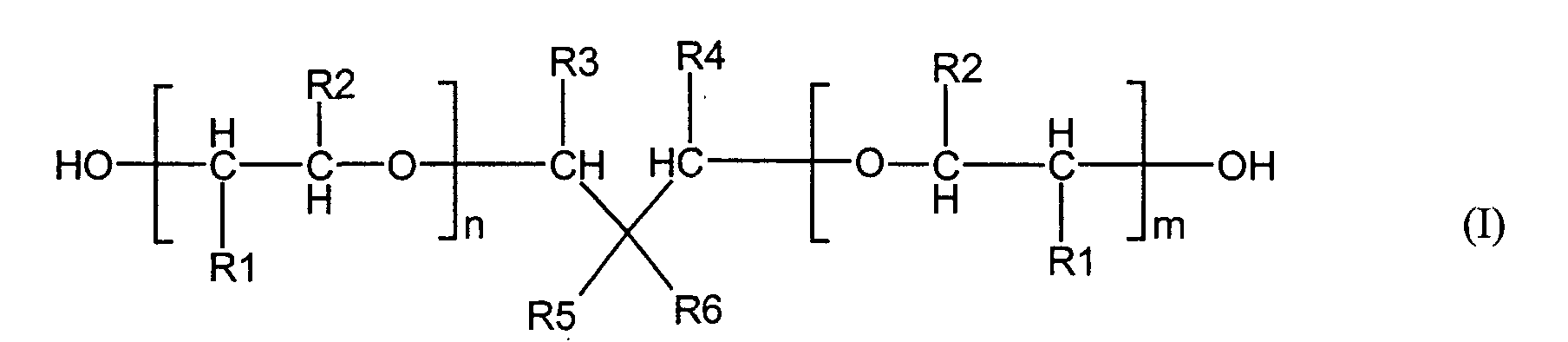
- Preferred representatives of the polyethers (I) are addition and polyaddition compounds of neopentyl glycol or trimethylol propane in the range of 0.7 to 10 mol Ethylene oxide and / or propylene oxide per hydroxyl group with molecular weights in Range from 192 to 1,500, preferably in the range from 192 to about 700.
- addition and polyaddition compounds are preferred in the range from 0.7 to 7 moles of ethylene oxide and / or propylene oxide per mole of hydroxyl group Neopentyl glycol or trimethylol propane, the corresponding ones are very particularly preferred Addition and polyaddition products from in the range from in the range from 0.7 to 3 moles of ethylene oxide and / or propylene oxide per mole of hydroxyl group Trimethylolpropane.
- Such polyethers are also commercially available. Suitable polyethers are, for example, Desmophen® 550 U and Desmophen® 4011 T from Bayer AG. The polyethylene oxides and polypropylene oxides or their mixed polyethers are preferred as Mixtures used.
- An amount in the rubber mixtures according to the invention is preferred Range from 0.3 to 15 parts by weight, particularly preferably 1 to 10 parts by weight, based on 100 parts by weight of the total amount of rubbers used, Polyether (I) added.
- Solution SBR and polybutadiene rubbers with an additional content of bound functional groups, especially hydroxyl and / or carboxyl groups.
- Preferred levels of hydroxyl and / or carboxyl groups are in the Range from 0.05 to 3% by weight based on rubber.
- Particularly preferred according to the invention Rubbers are e.g. in German patent applications DE-A1-198 32549, DE-A1-198 52 648, DE-A1-199 14 848, DE-A1-199 20 788, DE-A1-199 20 814 as well as DE-A-2,653,144 and EP-A1-0 464 478, which are also for US practice is included in the application as a reference.
- the rubber mixtures according to the invention can range from 0.1 to 300 parts by weight of various fillers, based on 100 parts by weight of the Total amount of rubber included.
- Oxidic fillers are particularly suitable and / or silicate fillers and / or carbon blacks. Oxidic are preferred and / or silicate fillers.
- the fillers mentioned are preferred in amounts in the range from in the range from 5 to 200 parts by weight, in particular in amounts in the range from 10 to 150 parts by weight, based on 100 parts by weight of rubbers used.
- carbon blacks are also suitable as fillers. They are produced using the flame black, furnace or gas black process and generally have BET surface areas of 20 to 200 m 2 / g, such as SAF, ISAF, HAF, FEF or GPF carbon blacks.
- Rubber mixtures in addition to at least one rubber from in the range from 1 to 10 parts by weight of polyhydroxyl compound (I), in the range of 10 to 100 parts by weight of oxidic or silicate filler and in the range of 5 to 50 parts by weight on carbon black, in each case based on 100 parts by weight of rubbers used.
- vulcanization accelerators especially vulcanization accelerators, anti-aging agents, Heat stabilizers, light stabilizers, ozone protection agents, processing aids, Plasticizers, tackifiers, blowing agents, dyes, pigments, waxes, extenders, organic acids, retarders, metal oxides, crosslinkers and activators.
- vulcanization accelerators especially vulcanization accelerators, anti-aging agents, Heat stabilizers, light stabilizers, ozone protection agents, processing aids, Plasticizers, tackifiers, blowing agents, dyes, pigments, waxes, extenders, organic acids, retarders, metal oxides, crosslinkers and activators.
- the rubber auxiliaries are in usual amounts, which can be found in, among others judge the intended use. Common amounts are e.g. Quantities in Range of 0.1 - 50 wt .-%, based on the total amount of rubbers used.
- crosslinkers such as sulfur, sulfur donors or peroxides are used.
- vulcanization accelerators such as Mercaptobenzthiazoles, guanidines, thiurams, dithiocarbamates, thioureas and / or thiocarbonates are added to the rubber mixtures according to the invention become.
- the vulcanization accelerators and crosslinkers are used in quantities of Range of 0.1-10% by weight, preferably in the range of 0.1 to 5% by weight on the total amount of rubbers used.
- the rubber mixtures according to the invention contain, in addition to the rubbers mentioned, the fillers, the polyethers (I), the rubber auxiliaries and crosslinking agents, in the range from 0.2 to 4 parts by weight of zinc salts of aliphatic, cycloaliphatic and / or aromatic C. 6 -C 36 carboxylic acids, for example zinc salts of tallow fatty acid, oleic acid or benzoic acid.
- sulfur-containing silyl ethers are added as filler activators, in particular bis- (trialkoxisilyl-alkyl) polysulfides, as described in DE-A-2 141 159 and DE-A-2 255 577, oligomeric and / or polymeric sulfur-containing silyl ethers as described in DE-A-4 425 311 and EP-A1-0 670 347 as well as mercaptoalkyltrialkoxisilanes, mercaptopropyltriethoxisilane and / or thiocyanatoalkylsilyl ether, as described in DE-A-195 44 469.
- bis- (trialkoxisilyl-alkyl) polysulfides as described in DE-A-2 141 159 and DE-A-2 255 577
- oligomeric and / or polymeric sulfur-containing silyl ethers as described in DE-A-4 425 311 and EP-A1-0 670 347 as well as mercapto
- the rubber mixtures according to the invention can be used in the usual equipment are produced, such as mixing units, in particular rollers, internal mixers and Mixing extruders.
- the vulcanization of the rubber mixtures according to the invention can usually at temperatures in the range of 100 to 200 ° C, preferably in the range of 130 to 180 ° C, optionally at pressures in the range of 10 to 200 bar.
- shaped bodies cable sheaths, hoses, drive belts, Conveyor belts, roller coverings, tires, shoe soles, sealing rings and damping elements.
- the use of the invention is very particularly preferred Rubber compounds for the production of low rolling resistance tire treads.
- the polyethers can be prepared from the corresponding alcohols or phenols Houben-Weyl, Methods of Organic Chemistry, Volume XIV / 2, Thieme Verlag, Stuttgart, 1963, pages 436 - 440, 450. Obtain the specified quantities parts by weight.
- the Mooney measurements were carried out in accordance with DIN 53 523.
- the following rubber mixtures were produced in a 300 ml internal mixer (55 rpm, start temperature 100 ° C., 7 minutes mixing time, end temperature 130 ° C.).
- the hydroxyl-L-SBR used was obtained in accordance with EP-A1-0 974 616 by reacting 100 parts by weight of Buna® VSL 5020-0 solution SBR with 2 parts by weight of mercaptoethanol and 0.233 part by weight of dilauroyl peroxide at 80 ° C. in cyclohexane obtained and stretched with 37.5 parts by weight of aromatic mineral oil Mobilsol K (from Mobil Oil).
- the resulting rubber mixtures had the following viscosities: ML 1 + 4 (100 ° C) 118 111 115 117 94 100
- a polypropylene glycol polyether with a molecular weight of 1,000 (comparison polyether B) and a polyfunctional polypropylene glycol / ethylene glycol polyether with a molecular weight of 12,000 and PPG to PEG weight ratio 87:13 (comparison polyether C) started on sorbitol served as reference polyethers: Comparative examples example 3.A 3.B 3.C 3.1 Hydroxyl-L-SBR (0.25% OH, 21 phr oil content) 91 91 91 91 Buna® CB 25 (Bayer AG) 30th 30th 30th 30th 30th 30th 30th 30th 30th 30th Mineral oil Enerthene 1849-1 (BP) 16.5 16.5 16.5 16.5 Silica Vulkasil S (Bayer AG) 80 80 80 80 80 80 80 80 80 80 80 80 80 80 80 80 80 80 80 80 80 80 80 80 80 80 80 80 ZnO 2.5 2.5 2.5 2.5 2.5 Silane Si 69 (Degussa Hüls AG) 6.4 6.4
Landscapes
- Chemical & Material Sciences (AREA)
- Health & Medical Sciences (AREA)
- Chemical Kinetics & Catalysis (AREA)
- Medicinal Chemistry (AREA)
- Polymers & Plastics (AREA)
- Organic Chemistry (AREA)
- Compositions Of Macromolecular Compounds (AREA)
- Tires In General (AREA)
Abstract
Description
- BR -
- Polybutadien
- ABR -
- Butadien/Acrylsäure-C1-C4-alkylester-Copolymere
- CR -
- Polychloropren
- IR -
- Polyisopren
- SBR -
- Styrol/Butadien-Copolymerisate mit Styrolgehalten von im Bereich von 1 - 60, vorzugsweise im Bereich von 20 - 50 Gew.-%
- IIR -
- Isobutylen/Isopren-Copolymerisate
- NBR -
- Butadien/Acrylnitril-Copolymere mit Acrylnitrilgehalten von im Bereich von 5 - 60, vorzugsweise im Bereich von 10 - 40 Gew.-%
- HNBR-
- teilhydrierter oder vollständig hydrierter NBR-Kautschuk
- EPDM -
- Ethylen/Propylen/Dien-Copolymerisate
- hochdisperse Kieselsäure, hergestellt z.B. durch Fällung von Lösungen von Silikaten oder Flammenhydrolyse, von Siliciumhalogeniden mit spezifischen Oberflächen im Bereich von 5 - 1000, vorzugsweise im Bereich von 20-400 m2/g (BET-Oberfläche) und mit Primärteilchengröße von im Bereich von 10 - 400 nm. Die Kieselsäuren können gegebenenfalls auch als Mischoxide mit anderen Metalloxiden, wie Al-, Mg-, Ca-, Ba-, Zn-, Zr-, Ti-oxiden vorliegen.
- Synthetische Silikate, wie Aluminiumsilikat, Erdalkalisilikate, wie Magnesiumsilikat oder Calciumsilikat, mit BET-Oberflächen von im Bereich von 20 - 400 m2/g und Primärteilchendurchmessern von im Bereich von 10 - 400 nm.
- Natürliche Silikate, wie Kaolin und andere natürlich vorkommende Kieselsäuren
- Glasfasern und Glasfaserprodukte (Matten, Stränge) oder Mikroglaskugeln
- Metalloxide, wie Zinkoxid, Calciumoxid, Magnesiumoxid, Aluminiumoxid
- Metallcarbonate, wie Magnesiumcarbonat, Calciumcarbonat, Zinkcarbonat
- Metallhydroxide, wie Aluminiumhydroxid, Magnesiumhydroxid.

| Vergleichsbeispiele | Beispiele | |||||
| 2.A | 2.B | 2.C | 2.D | 2.1 | 2.2 | |
| Hydroxyl-L-SBR (0,4 % OH,, 37,5 phr Ölgehalt) | 54 | 54 | 54 | 54 | 54 | 54 |
| Buna® CB 24 | 45 | 45 | 45 | 45 | 45 | 45 |
| Naturkautschuk TSR 5 | 10 | 10 | 10 | 10 | 10 | 10 |
| Vulkasil® S | 70 | 70 | 70 | 70 | 70 | 70 |
| Enerthene 1849-1 | 28,5 | 28,5 | 28,5 | 28,5 | 28,5 | 28,5 |
| ZnO | 2,5 | 2,5 | 2,5 | 2,5 | 2,5 | 2,5 |
| Stearinsäure | 1 | 1 | 1 | 1 | 1 | 1 |
| Vulkanox® 4020 (Bayer AG) | 1,5 | 1,5 | 1,5 | 1,5 | 1,5 | 1,5 |
| Silan Si 69 (Degussa AG) | 5,6 | 5,6 | 5,6 | 5,6 | 5,6 | 5,6 |
| ohne Zusatz | 0 | 0 | 0 | 0 | 0 | 0 |
| polyethoxylierter Laurylalkohol | ||||||
| (7 mol Ethylexoxid / OH) | 0 | 4 | 0 | 0 | 0 | 0 |
| polyethoxylierters Nonylphenol | ||||||
| (12 mol Ethylexoxid / OH) | 0 | 0 | 4 | 0 | 0 | 0 |
| polyethoxylierte Ölsäure | ||||||
| (6,5 mol Ethylenoxid / COOH) | 0 | 0 | 0 | 4 | 0 | 0 |
| ethoxyliertes Trimethylolpropan | ||||||
| (2,4 mol Ethylenoxid / OH) | 0 | 0 | 0 | 0 | 4 | 0 |
| propoxyliertes Trimethylolpropan | ||||||
| (1 mol Propylenoxid / OH) | 0 | 0 | 0 | 0 | 0 | 4 |
| ML 1+4(100°C) | 118 | 111 | 115 | 117 | 94 | 100 |
| Vergleichsbeispiele | Beispiel | |||
| 3.A | 3.B | 3.C | 3.1 | |
| Hydroxyl-L-SBR (0,25 % OH, 21 phr Ölgehalt) | 91 | 91 | 91 | 91 |
| Buna® CB 25 (Bayer AG) | 30 | 30 | 30 | 30 |
| Mineralöl Enerthene 1849-1 (BP) | 16,5 | 16,5 | 16,5 | 16,5 |
| Kieselsäure Vulkasil S (Bayer AG) | 80 | 80 | 80 | 80 |
| ZnO | 2,5 | 2,5 | 2,5 | 2,5 |
| Silan Si 69 (Degussa Hüls AG) | 6,4 | 6,4 | 6,4 | 6,4 |
| Wachs Antilux 654 (Rheinchemie) | 1,5 | 1,5 | 1,5 | 1,5 |
| Stearinsäure | 1 | 1 | 1 | 1 |
| Vulkanox® 4020 (Bayer AG) | 1 | 1 | 1 | 1 |
| Vergleichspolyether B | 0 | 8 | 0 | 0 |
| Vergleichspolyether C | 0 | 0 | 8 | 0 |
| erfindungsgemäßer Polyether (ethoxiliertes Trimethylolpropan, MG 310) | 0 | 0 | 0 | 8 |
| Beschleuniger Vulkacit CZ (Bayer AG) | 1,8 | 1,8 | 1,8 | 1,8 |
| Beschleuniger Vulkacit D (Bayer AG) | 2 2 | 2 | 2 | |
| Schwefel | 1,5 | 1,5 | 1,5 | 1,5 |
| Mischungsviskosität ML 1+4 (100°C) | 100 | 117 | 126 | 88 |
- Vergleichsbeispiele 3.A, 3.B und 3.C:
- zackige Kanten, rauhe, unregelmäßig gewölbte Oberfläche
- erfindungsgemäßes Beispiel 3.1.
- glatte Kanten, gleichmäßige glatte Oberfläche
| (Fortsetzung) | Vergleichsbeispiele | Beispiel | ||
| 3.A | 3.B | 3.C | 3.1 | |
| Zugfestigkeit (MPa) | 17,6 | 16 | 16,3 | 19,9 |
| Bruchdehnung (%) | 365 | 440 | 425 | 455 |
| Spannungswert bei 300 % Dehnung (MPa) | 13,3 | 9,4 | 10,4 | 11,5 |
| Härte bei 23°C (Shore A) | 66 | 66 | 68 | 69 |
| Rückprallelastizität bei 70°C (%) | 57 | 57 | 56 | 58 |
Claims (7)
- Kautschukmischungen, enthaltend im Bereich von 0,05 bis 25 Gew. Teilen, bezogen auf 100 Gew. Teile der Gesamtmenge an eingesetzten Kautschuken, eines Polyethers (I) der Struktur (I)worin
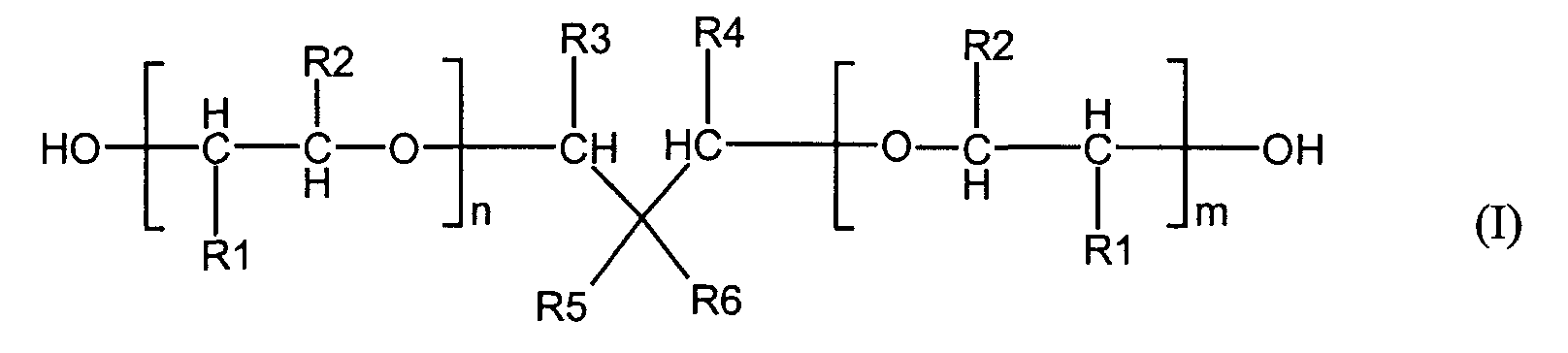 sowie im Bereich von 1 bis 500 Gew. Teilen Füllstoff sowie gegebenenfalls weitere Kautschukhilfsmittel und/oder Vernetzer.R1 und R2 unabhängig voneinander für Wasserstoff oder einen C1 bis C4-Alkylrest stehen undR3 und R4unabhängig voneinander für Wasserstoff oder einen C1 bis C6-Alkylrest stehen undR5 und R6unabhängig voneinander für Wasserstoff, einen C1 bis C18-Alkylrest, einen C7 bis C22-Alkylarylrest, einen C7 bis C22-Arylakylrest, den Rest -CH2-OH oder den Rest -CHR4-(-O-CHR1-CHR2-)m-OH steht, mit der Bedingung, dass mindestens einer der Reste R5 und R6 ein C1 bis C18-Alkylrest, ein C7 bis C22-Alkylarylrest oder ein C7 bis C22-Arylakylrest ist, sowien und m unabhängig voneinander für ganze Zahlen von 1 bis 10 stehen,
 - Kautschukmischungen nach Anspruch 1, dadurch gekennzeichnet, dass sie im Bereich von 0,1 bis 300 Gew.-Teile an anorganischen und/oder organischen Füllstoffen, bezogen auf 100 Gew.-Teile an eingesetzten Kautschuken, enthalten.
- Kautschukmischungen nach Anspruch 1 und/oder Anspruch 2, dadurch gekennzeichnet, dass die Füllstoffe ausgewählt werden aus der Gruppe oxidische, silikatische Füllstoffe und Ruße oder deren Mischungen.
- Kautschukmischungen nach Anspruch 3, dadurch gekennzeichnet, dass als Füllstoff eine oder mehrere gefällte Kieselsäuren und/oder gefällte Silikate mit einer spezifischen Oberfläche von 20 bis 400 m2/g oder aber eine Mischung enthaltend diese eingesetzt wird.
- Kautschukmischungen, dadurch gekennzeichnet, dass sie im Bereich von 0,3 bis 15 Gew.-Teilen einer Additions- und Polyadditionsverbindung von 0,7 bis 7 mol Ethylenoxid und/oder Propylenoxid pro mol Hydroxylgruppe an Neopentylglykol und/oder Trimethylolpropan, bezogen auf 100 Gew. Teile der Gesamtmenge an eingesetzten Kautschuken, enthalten.
- Verwendung der Kautschukmischungen nach Anspruch 1 oder 5 zur Herstellung von Vulkanisaten.
- Verwendung der Kautschukmischungen nach Anspruch 1 oder 5 zur Herstellung von Reifen, insbesondere Reifenlaufflächen.
Applications Claiming Priority (2)
| Application Number | Priority Date | Filing Date | Title |
|---|---|---|---|
| DE10012407A DE10012407A1 (de) | 2000-03-15 | 2000-03-15 | Polyether enthaltende Kautschukmischungen |
| DE10012407 | 2000-03-15 |
Publications (2)
| Publication Number | Publication Date |
|---|---|
| EP1134253A1 true EP1134253A1 (de) | 2001-09-19 |
| EP1134253B1 EP1134253B1 (de) | 2005-01-12 |
Family
ID=7634690
Family Applications (1)
| Application Number | Title | Priority Date | Filing Date |
|---|---|---|---|
| EP01104521A Expired - Lifetime EP1134253B1 (de) | 2000-03-15 | 2001-03-02 | Polyether enthaltende Kautschukmischungen |
Country Status (5)
| Country | Link |
|---|---|
| US (1) | US6521684B2 (de) |
| EP (1) | EP1134253B1 (de) |
| JP (1) | JP5072143B2 (de) |
| CA (1) | CA2340797C (de) |
| DE (2) | DE10012407A1 (de) |
Cited By (8)
| Publication number | Priority date | Publication date | Assignee | Title |
|---|---|---|---|---|
| EP1277791A1 (de) * | 2001-07-18 | 2003-01-22 | Bayer Aktiengesellschaft | 1,4-Butendiol(polyether) enthaltende Kautschukmischungen |
| WO2010049356A1 (de) * | 2008-10-30 | 2010-05-06 | Lanxess Deutschland Gmbh | Verfahren zur herstellung von polybutadien-haltigen formteilen |
| EP2517899A1 (de) | 2011-04-29 | 2012-10-31 | Lanxess Deutschland GmbH | Verfahren zur Herstellung von Kautschukmischungen |
| EP2517898A1 (de) | 2011-04-29 | 2012-10-31 | Lanxess Deutschland GmbH | Kieselsäurehaltige Kautschukmischungen mit schwefelhaltigen Additiven |
| EP2671727A1 (de) | 2012-06-06 | 2013-12-11 | LANXESS Deutschland GmbH | Kieselsäurehaltige Kautschukmischungen mit schwefelhaltigen Additiven |
| EP2671726A1 (de) | 2012-06-06 | 2013-12-11 | LANXESS Deutschland GmbH | Kieselsäurehaltige Kautschukmischungen mit schwefelhaltigen Additiven |
| EP2684912A1 (de) | 2012-07-09 | 2014-01-15 | LANXESS Deutschland GmbH | Kieselsäurehaltige Kautschukmischungen enthaltend w-Mercaptocarbonsäureester von mehrwertigen Alkoholen |
| EP2376556A4 (de) * | 2008-12-12 | 2014-12-24 | Styron Europe Gmbh | Ölgestreckte kautschukzusammensetzungen |
Families Citing this family (10)
| Publication number | Priority date | Publication date | Assignee | Title |
|---|---|---|---|---|
| DE10057508A1 (de) * | 2000-11-21 | 2002-05-23 | Bayer Ag | Polyether/Diolefin-Kautschuke enthaltende Kautschukmischungen und deren Verwendung zur Herstellung von insbesondere rollwiderstandsarmen Reifen |
| ITTO20060139A1 (it) * | 2006-02-27 | 2007-08-28 | Bridgestone Corp | Mescola di gomma vulcanizzabile contenente silice |
| JP2008150435A (ja) * | 2006-12-14 | 2008-07-03 | Toyo Tire & Rubber Co Ltd | タイヤ用ゴム組成物及び空気入りタイヤ |
| JP5074077B2 (ja) * | 2007-04-04 | 2012-11-14 | 住友ゴム工業株式会社 | ゴム組成物 |
| JP5271042B2 (ja) * | 2008-11-06 | 2013-08-21 | 住友ゴム工業株式会社 | ブレーカークッション用ゴム組成物、プライトッピング用ゴム組成物及びタイヤ |
| DE102009023915A1 (de) * | 2009-05-27 | 2010-12-02 | Rhein-Chemie Rheinau Gmbh | Mischungen aus funktionalisierten Dienkautschuken mit Trimethylolpropan und Fettsäure, ein Verfahren zu deren Herstellung und deren Verwendung |
| JP5515461B2 (ja) * | 2009-07-07 | 2014-06-11 | 横浜ゴム株式会社 | コンベヤベルト用ゴム組成物およびコンベヤベルト |
| JP2012229279A (ja) * | 2011-04-22 | 2012-11-22 | Sumitomo Rubber Ind Ltd | ゴム組成物及び空気入りタイヤ |
| JP7067468B2 (ja) * | 2016-10-26 | 2022-05-16 | 住友ゴム工業株式会社 | タイヤ用ゴム組成物、及び空気入りタイヤ |
| US20250206922A1 (en) * | 2022-03-21 | 2025-06-26 | Schill + Seilacher Struktol Gmbh | Rubber composition containing additive and use thereof |
Citations (3)
| Publication number | Priority date | Publication date | Assignee | Title |
|---|---|---|---|---|
| EP0738755A1 (de) * | 1995-04-17 | 1996-10-23 | Sumitomo Chemical Company, Limited | Kautschukmischung |
| EP0761734A1 (de) * | 1995-09-07 | 1997-03-12 | Semperit Reifen Aktiengesellschaft | Kautschukmischung |
| EP0947548A1 (de) * | 1998-04-01 | 1999-10-06 | Bayer Ag | Trimethylolpropan-Destillationsrückstände enthaltende Kautschukmischungen |
Family Cites Families (20)
| Publication number | Priority date | Publication date | Assignee | Title |
|---|---|---|---|---|
| US3978103A (en) | 1971-08-17 | 1976-08-31 | Deutsche Gold- Und Silber-Scheideanstalt Vormals Roessler | Sulfur containing organosilicon compounds |
| BE787691A (fr) | 1971-08-17 | 1973-02-19 | Degussa | Composes organosiliciques contenant du soufre |
| BG25805A3 (en) | 1972-11-13 | 1978-12-12 | Degussa Ag | A rubber mixture |
| DE2653144C2 (de) | 1976-11-23 | 1984-12-20 | Bayer Ag, 5090 Leverkusen | Verfahren zur Herstellung von modifiziertem Polybutadien |
| US4182898A (en) * | 1978-01-20 | 1980-01-08 | Anderson Development Company | Stable and storable polyester-polyether co-prepolymers |
| US4539367A (en) * | 1982-02-17 | 1985-09-03 | General Electric Company | Low modulus one-component RTV compositions and processes |
| JPS6267092A (ja) | 1985-09-20 | 1987-03-26 | Shin Etsu Chem Co Ltd | ポリスルフィド基含有オルガノシリコーン化合物 |
| US4929769A (en) * | 1989-04-28 | 1990-05-29 | Hoechst Celanese Corporation | Novel polyether containing at least one 2-halomethyloxyethylene unit and 2,3-dihydroxypropyl end groups |
| US5070150A (en) | 1990-07-02 | 1991-12-03 | The Goodyear Tire & Rubber Company | Process for the solid state (solventless) hydroxylation of vinyl-containing rubbers using a hydroxymercaptan |
| DE4406947A1 (de) | 1994-03-03 | 1995-09-07 | Bayer Ag | Schwefel-/Silizium-haltige Verstärkungsadditive enthaltende Kautschukmischungen |
| DE4435311A1 (de) | 1994-10-01 | 1996-04-04 | Huels Silicone Gmbh | Verstärkungsadditive |
| JPH08183887A (ja) * | 1994-12-28 | 1996-07-16 | Showa Denko Kk | ポリプロピレン系樹脂組成物及びその製造方法 |
| JP3546586B2 (ja) * | 1995-04-17 | 2004-07-28 | 住友化学工業株式会社 | ゴム組成物、ゴム組成物の製造方法及びタイヤトレッド |
| MX9603304A (es) | 1995-09-23 | 1997-03-29 | Degussa | Proceso para la produccion de mezclas de caucho vulcanizables. |
| US6130277A (en) | 1997-03-31 | 2000-10-10 | Bridgestone Corporation | Rubber composition improved in anti-static property and pneumatic tire using the same |
| DE19818552A1 (de) * | 1998-04-24 | 1999-10-28 | Bayer Ag | Mischungen aus Kautschuken und aktivierten und hydrophobierten exidischen und silikatischen Füllstoffen und ein Verfahren zur Herstellung |
| DE19832549A1 (de) | 1998-07-21 | 2000-02-03 | Fkt Tech Produkte Gmbh | Behälter |
| DE19914848A1 (de) | 1999-04-01 | 2000-10-05 | Bayer Ag | Hydroxylgruppenhaltige Lösungskautschuke |
| DE19920788A1 (de) | 1999-05-06 | 2000-11-09 | Bayer Ag | Carboxylgruppen-haltige Dienkautschuke |
| JP3530088B2 (ja) * | 1999-10-25 | 2004-05-24 | 住友ゴム工業株式会社 | ゴム組成物およびその製造方法 |
-
2000
- 2000-03-15 DE DE10012407A patent/DE10012407A1/de not_active Withdrawn
-
2001
- 2001-03-02 DE DE50105044T patent/DE50105044D1/de not_active Expired - Lifetime
- 2001-03-02 EP EP01104521A patent/EP1134253B1/de not_active Expired - Lifetime
- 2001-03-08 US US09/801,885 patent/US6521684B2/en not_active Expired - Lifetime
- 2001-03-12 CA CA002340797A patent/CA2340797C/en not_active Expired - Fee Related
- 2001-03-14 JP JP2001072007A patent/JP5072143B2/ja not_active Expired - Fee Related
Patent Citations (3)
| Publication number | Priority date | Publication date | Assignee | Title |
|---|---|---|---|---|
| EP0738755A1 (de) * | 1995-04-17 | 1996-10-23 | Sumitomo Chemical Company, Limited | Kautschukmischung |
| EP0761734A1 (de) * | 1995-09-07 | 1997-03-12 | Semperit Reifen Aktiengesellschaft | Kautschukmischung |
| EP0947548A1 (de) * | 1998-04-01 | 1999-10-06 | Bayer Ag | Trimethylolpropan-Destillationsrückstände enthaltende Kautschukmischungen |
Cited By (17)
| Publication number | Priority date | Publication date | Assignee | Title |
|---|---|---|---|---|
| EP1277791A1 (de) * | 2001-07-18 | 2003-01-22 | Bayer Aktiengesellschaft | 1,4-Butendiol(polyether) enthaltende Kautschukmischungen |
| WO2010049356A1 (de) * | 2008-10-30 | 2010-05-06 | Lanxess Deutschland Gmbh | Verfahren zur herstellung von polybutadien-haltigen formteilen |
| RU2542226C2 (ru) * | 2008-10-30 | 2015-02-20 | ЛЕНКСЕСС Дойчланд ГмбХ | Способ изготовления формованных изделий, содержащих полибутадиен |
| EP2376556A4 (de) * | 2008-12-12 | 2014-12-24 | Styron Europe Gmbh | Ölgestreckte kautschukzusammensetzungen |
| CN103596772A (zh) * | 2011-04-29 | 2014-02-19 | 朗盛德国有限责任公司 | 生产橡胶混合物的方法 |
| EP2517899A1 (de) | 2011-04-29 | 2012-10-31 | Lanxess Deutschland GmbH | Verfahren zur Herstellung von Kautschukmischungen |
| EP2517898A1 (de) | 2011-04-29 | 2012-10-31 | Lanxess Deutschland GmbH | Kieselsäurehaltige Kautschukmischungen mit schwefelhaltigen Additiven |
| WO2012146762A1 (de) | 2011-04-29 | 2012-11-01 | Lanxess Deutschland Gmbh | Kieselsäurehaltige kautschukmischungen mit schwefelhaltigen additiven |
| WO2012146755A1 (de) | 2011-04-29 | 2012-11-01 | Lanxess Deutschland Gmbh | Kieselsäurehaltige kautschukmischungen mit schwefelhaltigen additiven |
| WO2012146759A1 (de) | 2011-04-29 | 2012-11-01 | Lanxess Deutschland Gmbh | Verfahren zur herstellung von kautschukmischungen |
| CN103596772B (zh) * | 2011-04-29 | 2016-04-13 | 朗盛德国有限责任公司 | 生产橡胶混合物的方法 |
| EP2671726A1 (de) | 2012-06-06 | 2013-12-11 | LANXESS Deutschland GmbH | Kieselsäurehaltige Kautschukmischungen mit schwefelhaltigen Additiven |
| WO2013182594A2 (de) | 2012-06-06 | 2013-12-12 | Lanxess Deutschland Gmbh | Kieselsäurehaltige kautschukmischungen mit schwefelhaltigen additiven |
| WO2013182610A2 (de) | 2012-06-06 | 2013-12-12 | Lanxess Deutschland Gmbh | Kieselsäurehaltige kautschukmischungen mit schwefelhaltigen additiven |
| EP2671727A1 (de) | 2012-06-06 | 2013-12-11 | LANXESS Deutschland GmbH | Kieselsäurehaltige Kautschukmischungen mit schwefelhaltigen Additiven |
| WO2014009373A1 (de) | 2012-07-09 | 2014-01-16 | Lanxess Deutschland Gmbh | Kieselsäurehaltige kautschukmischungen enthaltend omega-mercaptocarbonsäureester von mehrwertigen alkoholen |
| EP2684912A1 (de) | 2012-07-09 | 2014-01-15 | LANXESS Deutschland GmbH | Kieselsäurehaltige Kautschukmischungen enthaltend w-Mercaptocarbonsäureester von mehrwertigen Alkoholen |
Also Published As
| Publication number | Publication date |
|---|---|
| CA2340797A1 (en) | 2001-09-15 |
| US6521684B2 (en) | 2003-02-18 |
| US20010031822A1 (en) | 2001-10-18 |
| DE10012407A1 (de) | 2001-09-20 |
| JP2001261890A (ja) | 2001-09-26 |
| DE50105044D1 (de) | 2005-02-17 |
| EP1134253B1 (de) | 2005-01-12 |
| CA2340797C (en) | 2009-10-20 |
| JP5072143B2 (ja) | 2012-11-14 |
Similar Documents
| Publication | Publication Date | Title |
|---|---|---|
| EP1134253B1 (de) | Polyether enthaltende Kautschukmischungen | |
| EP0964021B1 (de) | Neue oligomere Organosilanpolysulfane, deren Verwendung in Kautschukmischungen und zur Herstellung von Formkörpern | |
| EP0864608B1 (de) | Polysulfidische Polyethersilane enthaltende Kautschukmischungen | |
| DE69903563T2 (de) | Haftvermittlerzusammensetzung (weisser füllstoff/dienrubber) die ein alkoxysilanpolysulfid, ein zinkdithiophosphat und ein guanidinderivat enthält | |
| EP2701927B1 (de) | Kieselsäurehaltige kautschukmischungen mit schwefelhaltigen additiven | |
| EP1533336A1 (de) | Kautschukmischungen | |
| EP1298163A1 (de) | Geblockte Mercaptosilane, Verfahren zu deren Herstellung und die enthaltenden Kautschukmischungen | |
| EP3294574A1 (de) | Verbesserung des rollwiderstands von dienkautschukreifen durch silanmodifizierte polybutadiene | |
| DE102009023915A1 (de) | Mischungen aus funktionalisierten Dienkautschuken mit Trimethylolpropan und Fettsäure, ein Verfahren zu deren Herstellung und deren Verwendung | |
| EP1367059B1 (de) | Organosiliciumverbindungen, Verfahren zu ihrer Herstellung und ihre Verwendung | |
| EP0890600A1 (de) | Verfahren zur Herstellung von füllstoffhaltigen Kautschukmischungen | |
| EP3622015B1 (de) | Kautschukmischungen enthaltend schwefelhaltige organosiliciumverbindungen | |
| DE102006033310A1 (de) | Gemische aus siliciumhaltigen Kopplungsreagentien | |
| EP1277791A1 (de) | 1,4-Butendiol(polyether) enthaltende Kautschukmischungen | |
| EP0977805B1 (de) | Oberflächenmodifizierte, oxidische oder silikatische füllstoffe und ihre verwendung | |
| DE102012200166A1 (de) | Kautschukmischungen | |
| EP0947548B1 (de) | Trimethylolpropan-Destillationsrückstände enthaltende Kautschukmischungen | |
| EP0761742B1 (de) | Verfahren zur Herstellung von immobilisierten polysulfidischen Silanen | |
| EP0747429B1 (de) | Kautschukmischungen enthaltend schwefelhaltige Polyester | |
| EP0931812A1 (de) | Verfahren zur Herstellung von hydrophobierten oxidischen oder silikatischen Füllstoffen enthaltenden Kautschukmischungen sowie deren Verwendung zur Herstellung von Reifen | |
| EP1626062A1 (de) | Neuartige Verarbeitungswirkstoffe für Kautschuk-Mischungen | |
| EP2858832B1 (de) | Kieselsäurehaltige kautschukmischungen mit schwefelhaltigen additiven | |
| EP1341822A1 (de) | Polyether/diolefin-kautschuke enthaltende kautschukmischungen und deren verwendung zur herstellung von insbesondere rollwiderstandsarmen reifen |
Legal Events
| Date | Code | Title | Description |
|---|---|---|---|
| PUAI | Public reference made under article 153(3) epc to a published international application that has entered the european phase |
Free format text: ORIGINAL CODE: 0009012 |
|
| AK | Designated contracting states |
Kind code of ref document: A1 Designated state(s): AT BE CH CY DE DK ES FI FR GB GR IE IT LI LU MC NL PT SE TR Kind code of ref document: A1 Designated state(s): DE FR GB IT |
|
| AX | Request for extension of the european patent |
Free format text: AL;LT;LV;MK;RO;SI |
|
| 17P | Request for examination filed |
Effective date: 20020319 |
|
| AKX | Designation fees paid |
Free format text: DE FR GB IT |
|
| 17Q | First examination report despatched |
Effective date: 20030917 |
|
| GRAP | Despatch of communication of intention to grant a patent |
Free format text: ORIGINAL CODE: EPIDOSNIGR1 |
|
| GRAA | (expected) grant |
Free format text: ORIGINAL CODE: 0009210 |
|
| GRAS | Grant fee paid |
Free format text: ORIGINAL CODE: EPIDOSNIGR3 |
|
| AK | Designated contracting states |
Kind code of ref document: B1 Designated state(s): DE FR GB IT |
|
| REG | Reference to a national code |
Ref country code: GB Ref legal event code: FG4D Free format text: NOT ENGLISH |
|
| REF | Corresponds to: |
Ref document number: 50105044 Country of ref document: DE Date of ref document: 20050217 Kind code of ref document: P |
|
| GBT | Gb: translation of ep patent filed (gb section 77(6)(a)/1977) |
Effective date: 20050331 |
|
| PLBE | No opposition filed within time limit |
Free format text: ORIGINAL CODE: 0009261 |
|
| STAA | Information on the status of an ep patent application or granted ep patent |
Free format text: STATUS: NO OPPOSITION FILED WITHIN TIME LIMIT |
|
| ET | Fr: translation filed | ||
| 26N | No opposition filed |
Effective date: 20051013 |
|
| REG | Reference to a national code |
Ref country code: GB Ref legal event code: 732E |
|
| REG | Reference to a national code |
Ref country code: FR Ref legal event code: TP |
|
| REG | Reference to a national code |
Ref country code: DE Ref legal event code: R081 Ref document number: 50105044 Country of ref document: DE Owner name: LANXESS DEUTSCHLAND GMBH, DE Free format text: FORMER OWNER: LANXESS DEUTSCHLAND GMBH, 51373 LEVERKUSEN, DE Effective date: 20131113 |
|
| REG | Reference to a national code |
Ref country code: FR Ref legal event code: PLFP Year of fee payment: 16 |
|
| REG | Reference to a national code |
Ref country code: FR Ref legal event code: PLFP Year of fee payment: 17 |
|
| REG | Reference to a national code |
Ref country code: FR Ref legal event code: PLFP Year of fee payment: 18 |
|
| PGFP | Annual fee paid to national office [announced via postgrant information from national office to epo] |
Ref country code: DE Payment date: 20180220 Year of fee payment: 18 Ref country code: GB Payment date: 20180228 Year of fee payment: 18 |
|
| PGFP | Annual fee paid to national office [announced via postgrant information from national office to epo] |
Ref country code: IT Payment date: 20180321 Year of fee payment: 18 |
|
| PGFP | Annual fee paid to national office [announced via postgrant information from national office to epo] |
Ref country code: FR Payment date: 20190111 Year of fee payment: 19 |
|
| REG | Reference to a national code |
Ref country code: DE Ref legal event code: R119 Ref document number: 50105044 Country of ref document: DE |
|
| GBPC | Gb: european patent ceased through non-payment of renewal fee |
Effective date: 20190302 |
|
| PG25 | Lapsed in a contracting state [announced via postgrant information from national office to epo] |
Ref country code: DE Free format text: LAPSE BECAUSE OF NON-PAYMENT OF DUE FEES Effective date: 20191001 Ref country code: GB Free format text: LAPSE BECAUSE OF NON-PAYMENT OF DUE FEES Effective date: 20190302 |
|
| PG25 | Lapsed in a contracting state [announced via postgrant information from national office to epo] |
Ref country code: IT Free format text: LAPSE BECAUSE OF NON-PAYMENT OF DUE FEES Effective date: 20190302 |
|
| PG25 | Lapsed in a contracting state [announced via postgrant information from national office to epo] |
Ref country code: FR Free format text: LAPSE BECAUSE OF NON-PAYMENT OF DUE FEES Effective date: 20200331 |