EP1131281B1 - Derivatisierung von trägeroberflächen - Google Patents
Derivatisierung von trägeroberflächen Download PDFInfo
- Publication number
- EP1131281B1 EP1131281B1 EP99962063A EP99962063A EP1131281B1 EP 1131281 B1 EP1131281 B1 EP 1131281B1 EP 99962063 A EP99962063 A EP 99962063A EP 99962063 A EP99962063 A EP 99962063A EP 1131281 B1 EP1131281 B1 EP 1131281B1
- Authority
- EP
- European Patent Office
- Prior art keywords
- biopolymers
- process according
- mmol
- support
- amine
- Prior art date
- Legal status (The legal status is an assumption and is not a legal conclusion. Google has not performed a legal analysis and makes no representation as to the accuracy of the status listed.)
- Expired - Lifetime
Links
- 0 *1C2(CC3)OC3CC12 Chemical compound *1C2(CC3)OC3CC12 0.000 description 1
- RINCXYDBBGOEEQ-UHFFFAOYSA-N O=C(CC1)OC1=O Chemical compound O=C(CC1)OC1=O RINCXYDBBGOEEQ-UHFFFAOYSA-N 0.000 description 1
Images


Classifications
-
- B—PERFORMING OPERATIONS; TRANSPORTING
- B01—PHYSICAL OR CHEMICAL PROCESSES OR APPARATUS IN GENERAL
- B01J—CHEMICAL OR PHYSICAL PROCESSES, e.g. CATALYSIS OR COLLOID CHEMISTRY; THEIR RELEVANT APPARATUS
- B01J20/00—Solid sorbent compositions or filter aid compositions; Sorbents for chromatography; Processes for preparing, regenerating or reactivating thereof
- B01J20/30—Processes for preparing, regenerating, or reactivating
- B01J20/32—Impregnating or coating ; Solid sorbent compositions obtained from processes involving impregnating or coating
- B01J20/3231—Impregnating or coating ; Solid sorbent compositions obtained from processes involving impregnating or coating characterised by the coating or impregnating layer
- B01J20/3242—Layers with a functional group, e.g. an affinity material, a ligand, a reactant or a complexing group
- B01J20/3244—Non-macromolecular compounds
- B01J20/3246—Non-macromolecular compounds having a well defined chemical structure
- B01J20/3248—Non-macromolecular compounds having a well defined chemical structure the functional group or the linking, spacer or anchoring group as a whole comprising at least one type of heteroatom selected from a nitrogen, oxygen or sulfur, these atoms not being part of the carrier as such
- B01J20/3255—Non-macromolecular compounds having a well defined chemical structure the functional group or the linking, spacer or anchoring group as a whole comprising at least one type of heteroatom selected from a nitrogen, oxygen or sulfur, these atoms not being part of the carrier as such comprising a cyclic structure containing at least one of the heteroatoms nitrogen, oxygen or sulfur, e.g. heterocyclic or heteroaromatic structures
-
- B—PERFORMING OPERATIONS; TRANSPORTING
- B01—PHYSICAL OR CHEMICAL PROCESSES OR APPARATUS IN GENERAL
- B01J—CHEMICAL OR PHYSICAL PROCESSES, e.g. CATALYSIS OR COLLOID CHEMISTRY; THEIR RELEVANT APPARATUS
- B01J20/00—Solid sorbent compositions or filter aid compositions; Sorbents for chromatography; Processes for preparing, regenerating or reactivating thereof
- B01J20/30—Processes for preparing, regenerating, or reactivating
- B01J20/32—Impregnating or coating ; Solid sorbent compositions obtained from processes involving impregnating or coating
- B01J20/3202—Impregnating or coating ; Solid sorbent compositions obtained from processes involving impregnating or coating characterised by the carrier, support or substrate used for impregnation or coating
- B01J20/3204—Inorganic carriers, supports or substrates
-
- B—PERFORMING OPERATIONS; TRANSPORTING
- B01—PHYSICAL OR CHEMICAL PROCESSES OR APPARATUS IN GENERAL
- B01J—CHEMICAL OR PHYSICAL PROCESSES, e.g. CATALYSIS OR COLLOID CHEMISTRY; THEIR RELEVANT APPARATUS
- B01J20/00—Solid sorbent compositions or filter aid compositions; Sorbents for chromatography; Processes for preparing, regenerating or reactivating thereof
- B01J20/30—Processes for preparing, regenerating, or reactivating
- B01J20/32—Impregnating or coating ; Solid sorbent compositions obtained from processes involving impregnating or coating
- B01J20/3202—Impregnating or coating ; Solid sorbent compositions obtained from processes involving impregnating or coating characterised by the carrier, support or substrate used for impregnation or coating
- B01J20/3206—Organic carriers, supports or substrates
- B01J20/3208—Polymeric carriers, supports or substrates
- B01J20/321—Polymeric carriers, supports or substrates consisting of a polymer obtained by reactions involving only carbon to carbon unsaturated bonds
-
- B—PERFORMING OPERATIONS; TRANSPORTING
- B01—PHYSICAL OR CHEMICAL PROCESSES OR APPARATUS IN GENERAL
- B01J—CHEMICAL OR PHYSICAL PROCESSES, e.g. CATALYSIS OR COLLOID CHEMISTRY; THEIR RELEVANT APPARATUS
- B01J20/00—Solid sorbent compositions or filter aid compositions; Sorbents for chromatography; Processes for preparing, regenerating or reactivating thereof
- B01J20/30—Processes for preparing, regenerating, or reactivating
- B01J20/32—Impregnating or coating ; Solid sorbent compositions obtained from processes involving impregnating or coating
- B01J20/3202—Impregnating or coating ; Solid sorbent compositions obtained from processes involving impregnating or coating characterised by the carrier, support or substrate used for impregnation or coating
- B01J20/3206—Organic carriers, supports or substrates
- B01J20/3208—Polymeric carriers, supports or substrates
- B01J20/3212—Polymeric carriers, supports or substrates consisting of a polymer obtained by reactions otherwise than involving only carbon to carbon unsaturated bonds
-
- B—PERFORMING OPERATIONS; TRANSPORTING
- B01—PHYSICAL OR CHEMICAL PROCESSES OR APPARATUS IN GENERAL
- B01J—CHEMICAL OR PHYSICAL PROCESSES, e.g. CATALYSIS OR COLLOID CHEMISTRY; THEIR RELEVANT APPARATUS
- B01J20/00—Solid sorbent compositions or filter aid compositions; Sorbents for chromatography; Processes for preparing, regenerating or reactivating thereof
- B01J20/30—Processes for preparing, regenerating, or reactivating
- B01J20/32—Impregnating or coating ; Solid sorbent compositions obtained from processes involving impregnating or coating
- B01J20/3231—Impregnating or coating ; Solid sorbent compositions obtained from processes involving impregnating or coating characterised by the coating or impregnating layer
- B01J20/3242—Layers with a functional group, e.g. an affinity material, a ligand, a reactant or a complexing group
- B01J20/3244—Non-macromolecular compounds
- B01J20/3246—Non-macromolecular compounds having a well defined chemical structure
- B01J20/3248—Non-macromolecular compounds having a well defined chemical structure the functional group or the linking, spacer or anchoring group as a whole comprising at least one type of heteroatom selected from a nitrogen, oxygen or sulfur, these atoms not being part of the carrier as such
-
- B—PERFORMING OPERATIONS; TRANSPORTING
- B01—PHYSICAL OR CHEMICAL PROCESSES OR APPARATUS IN GENERAL
- B01J—CHEMICAL OR PHYSICAL PROCESSES, e.g. CATALYSIS OR COLLOID CHEMISTRY; THEIR RELEVANT APPARATUS
- B01J20/00—Solid sorbent compositions or filter aid compositions; Sorbents for chromatography; Processes for preparing, regenerating or reactivating thereof
- B01J20/30—Processes for preparing, regenerating, or reactivating
- B01J20/32—Impregnating or coating ; Solid sorbent compositions obtained from processes involving impregnating or coating
- B01J20/3231—Impregnating or coating ; Solid sorbent compositions obtained from processes involving impregnating or coating characterised by the coating or impregnating layer
- B01J20/3242—Layers with a functional group, e.g. an affinity material, a ligand, a reactant or a complexing group
- B01J20/3244—Non-macromolecular compounds
- B01J20/3246—Non-macromolecular compounds having a well defined chemical structure
- B01J20/3248—Non-macromolecular compounds having a well defined chemical structure the functional group or the linking, spacer or anchoring group as a whole comprising at least one type of heteroatom selected from a nitrogen, oxygen or sulfur, these atoms not being part of the carrier as such
- B01J20/3251—Non-macromolecular compounds having a well defined chemical structure the functional group or the linking, spacer or anchoring group as a whole comprising at least one type of heteroatom selected from a nitrogen, oxygen or sulfur, these atoms not being part of the carrier as such comprising at least two different types of heteroatoms selected from nitrogen, oxygen or sulphur
-
- B—PERFORMING OPERATIONS; TRANSPORTING
- B01—PHYSICAL OR CHEMICAL PROCESSES OR APPARATUS IN GENERAL
- B01J—CHEMICAL OR PHYSICAL PROCESSES, e.g. CATALYSIS OR COLLOID CHEMISTRY; THEIR RELEVANT APPARATUS
- B01J20/00—Solid sorbent compositions or filter aid compositions; Sorbents for chromatography; Processes for preparing, regenerating or reactivating thereof
- B01J20/30—Processes for preparing, regenerating, or reactivating
- B01J20/32—Impregnating or coating ; Solid sorbent compositions obtained from processes involving impregnating or coating
- B01J20/3231—Impregnating or coating ; Solid sorbent compositions obtained from processes involving impregnating or coating characterised by the coating or impregnating layer
- B01J20/3242—Layers with a functional group, e.g. an affinity material, a ligand, a reactant or a complexing group
- B01J20/3244—Non-macromolecular compounds
- B01J20/3246—Non-macromolecular compounds having a well defined chemical structure
- B01J20/3248—Non-macromolecular compounds having a well defined chemical structure the functional group or the linking, spacer or anchoring group as a whole comprising at least one type of heteroatom selected from a nitrogen, oxygen or sulfur, these atoms not being part of the carrier as such
- B01J20/3253—Non-macromolecular compounds having a well defined chemical structure the functional group or the linking, spacer or anchoring group as a whole comprising at least one type of heteroatom selected from a nitrogen, oxygen or sulfur, these atoms not being part of the carrier as such comprising a cyclic structure not containing any of the heteroatoms nitrogen, oxygen or sulfur, e.g. aromatic structures
Definitions
- the present invention relates to a method for Surface modification of substrates as well the use of such produced Carrier.
- Tsubokawa et al. (Reactive and Functional Polymers, Vol. 37, No. 1-3, pp. 75-82 (1998) describe the derivatization of silica surfaces by the surface-bonded NH 2 function having the vinyl function of an acrylic acid derivative in a Michael addition reaction Then, in the second step, the ester function reacts with another amine, and the amine used is exclusively ethylenediamine.
- US-A-5,624,711 describes a process for the derivatization of solid phase surfaces and methods for oligomer synthesis. But there are no dendrimer structures but it becomes a simple surface modification reached.
- the object of the present invention is now a To provide a method that provides an optimal connection of a large number of biopolymers allowed on carrier surfaces.
- the object further consists in a carrier surface produced in this way to provide their binding capacity many times over increased by performing a surface modification has been.
- R 1 and R 2 may be the same or different.
- the meanings of R 1 and R 2 are not limited and can be H or any organic radical (eg a straight or branched alkyl radical having 1-30 carbon atoms, a straight or branched alkenyl radical having 2 to 30 carbon atoms, a mono- or polycyclic alkyl radical with 3 to 30 carbon atoms or a mono- or polycyclic alkenyl radical having 4 to 30 carbon atoms or a mono- or polycyclic radical having 6 to 30 carbon atoms, where the radicals are optionally substituted by one or more substituents (eg OH, carboxyl, carbonyl, phosphate) may be substituted).
- the base may be any basic compound, eg diisopropylethylamine.
- Any straight or branched C 1-30 alkyl radical can be used. Examples of these are methyl, ethyl, propyl, isopropyl, butyl, isobutyl, tert-butyl, n-butyl, n-hexyl, 2-methylpentyl, 2,3-dimethylbutyl, n Heptyl, 2-methylhexyl, 2,2-dimethylpentyl, 3,3-dimethylpentyl, 3-ethylpentyl, n-octyl, 2,2-dimethylhexyl, 3,3-dimethylhexyl, 3-methyl -3-ethylpentyl deficit.
- Preferred are short alkyl chains, such as methyl, ethyl, propyl and isopropyl.
- Any straight or branched C 2-30 alkenyl radical can be used.
- examples of these are vinyl, propenyl, isopropenyl, allyl, 2-methylallyl, butenyl or isobutenyl, hexenyl or isohexenyl, heptenyl or isoheptenyl, octenyl or isooctenyl groups. Preference is given to vinyl, propenyl and isopropenyl.
- the cycloalkyl group of 3 to 30 carbon atoms may be any be any cycloalkyl.
- Examples are one Cyclopropyl, cyclobutyl, cyclopentyl or cyclohexyl, Cycloheptyl, Cxclooctyl-, cyclononyl- or cyclodecyl groups.
- Preferred are cyclopropyl, cyclobutyl, cyclopentyl and Cyclohexyl.
- the cycloalkenyl radical of 4 to 30 carbon atoms may be any be any cycloalkenyl radical. Examples are one Cyclobutenyl, cyclopentenyl or cyclohexenyl, Cycloheptenyl, cxclooctenyl, cyclononenyl or cyclodecenyl groups. Preference is given to cyclobutenyl, cyclopentenyl or cyclohexenyl.
- polycyclic alkyl or alkenyl radicals examples include Norbornane, adamantane or benzvalen.
- R 1 and R 2 may also be any mono- or polycyclic C 6-30 aryl radicals. Examples of these are a carbocyclic, monocyclic radical, for example the phenyl group, a heterocyclic, monocyclic radical, for example the groups thienyl, furyl, pyranyl, pyrrolyl, imidazolyl, pyrazolyl, pyridyl, pyrazinyl, pyrimidinyl, pyrazinyl, thiazolyl, oxazolyl, furazannyl, pyrrolinyl, Imidazolinyl, pyrazolinyl, thiazolinyl, triazolyl, tetrazolyl, and the positional isomers of the heteroatom (s) that may comprise these groups.
- a carbocyclic, monocyclic radical for example the phenyl group
- a heterocyclic, monocyclic radical for example the groups thienyl, furyl,
- the inventive method arise at the Carrier surface more or less cross-linked linker systems, the connection of a possibly large number of biopolymers allow the support surface.
- Preferred biopolymers are DNA, RNA, nucleic acid analogs; Peptides, proteins, antibodies Etc.
- a functional group on a carrier surface located chemical grouping such as e.g. an amino group, hydroxyl group, carboxyl group, Carbonyl group, thiol, amide or phosphate group understood become.
- Carrier or matrix can be used. These are especially glass, Films or membranes of polypropylene, nylon, cellulose, Cellulose derivatives (e.g., cellulose acetate, mixed cellulose esters), Polyethersulfones, polyamides, polyvinyl chloride, Polyvinylidene fluoride, polyester, Teflon or polyethylene.
- an activating reagent is used Reagent can be understood on the support surface functional groups in a ready for coupling Condition offset.
- the inventive method is a flexible Linker system created. Flexible in that for any Application (e.g., attachment of DNA, RNA, proteins, antibodies) ideally prepared carrier surfaces provided become.
- the invention is suitable Procedures suitable for the DNA / biochip technology To provide surfaces (carrier). The degree of positive Charge on the surface can be determined by the number of protonatable amine functions, especially through the incorporation of Polyamines, control.
- Branching points e.g., polyamines
- the increase the positive surface charge for example, by the Incorporation of protonatable amino functions done
- the Variation of the distance between biomolecule and surface can controlled by using amines of different chain length become.
- the method according to the invention for surface modification is characterized by the following steps.
- activating reagent
- the implementation will be in case of Acryloyl chloride and 4-nitrophenyl chloroformate by addition from about 0.5 to 5 mmol, preferably 1-3 mmol, most preferably 1 mmol, diisopropylethylamine (or another not nucleophilic base such as triethylamine, pyridine, collidine, Lutidine or triisopropylamine).
- anhydrous solvent e.g., dichloroethane, carbon tetrachloride, etc.
- aminated PP control piece following subjected to the bromophenol blue test described. Is not Blue color compared to unreacted sample recognize, activation has been successful. kick a blue color, the reaction is repeated.
- the now activated carrier materials are in about 5-100 ml (depending on Size), preferably 10-50 ml, more preferably 20 ml of an amine and anhydrous solvent (e.g., DMF, acetonitrile, THF, DMSO, HMPT (HMPA) or dichloromethane) with ca. 0.5-5 mmol, preferably 1-3 mmol, preferably 1 mmol, amine component added and about 5 - 20 hours, preferably overnight, panned.
- anhydrous solvent e.g., DMF, acetonitrile, THF, DMSO, HMPT (HMPA) or dichloromethane
- a method based on the blue color of Amino functions by bromophenol blue i. the detection takes place via the disappearance or presence of the Blue coloration upon activation or reaction with amines.
- PP control piece Polypropylene film
- the success of the respective reaction step is checked.
- a piece of Control strip taken and 2 minutes in a 1% bromophenol blue solution swung in amine-free DMF and then with Washed ethanol. Amino functions and other basic ones Groups result in an intense adsorptive blue color.
- the derivatized amino-terminated support surfaces or hydroxyl functions require no further Modification for the connection of the first oligonucleotide building block according to the phosphoramidite or phosphorus triester method. It is after the reaction of the first nucleotide reagent with the aminated surface phosphoramidate-type bonds generated. Hydroxylated surfaces lead to bonds of Phosphodiester type.
- R 1 - R 3 analogous R 1 and R 2 above
- bonds of the phosphodiester type are desired, it is sufficient at the last step in the linker system synthesis to react an amino-alcohol.
- the possibility of using a promoting agent (catalyst) to produce the covalent bond between the surface and the biomolecule essentially represents a 3-component reaction.
- a promoting agent catalyst
- possibilities are sought which should permit highly parallel, large numbers of biopolymers To fix at exactly predetermined positions on a support, this can only be made more difficult with a 3-component system on flat surfaces (films, glass or similar) due to cross-contamination. Therefore, the promotion means method is a special case for the covalent attachment of biopolymers on surfaces of the membrane type. Only here, the promoter in the pores of the membrane can be made available locally to the biomolecule to be bound without cross-contamination with is calculated (see Example 4).
- carbodiimide type reagents such as diisopropylcarbodiimide, EDC or DCC (dicyclohexylcarbodiimide) are useful as the promoting agent.
- the terminal groups on the support and on the biomolecule should preferably be orthogonal to one another, ie they should be able to form a chemical bond.
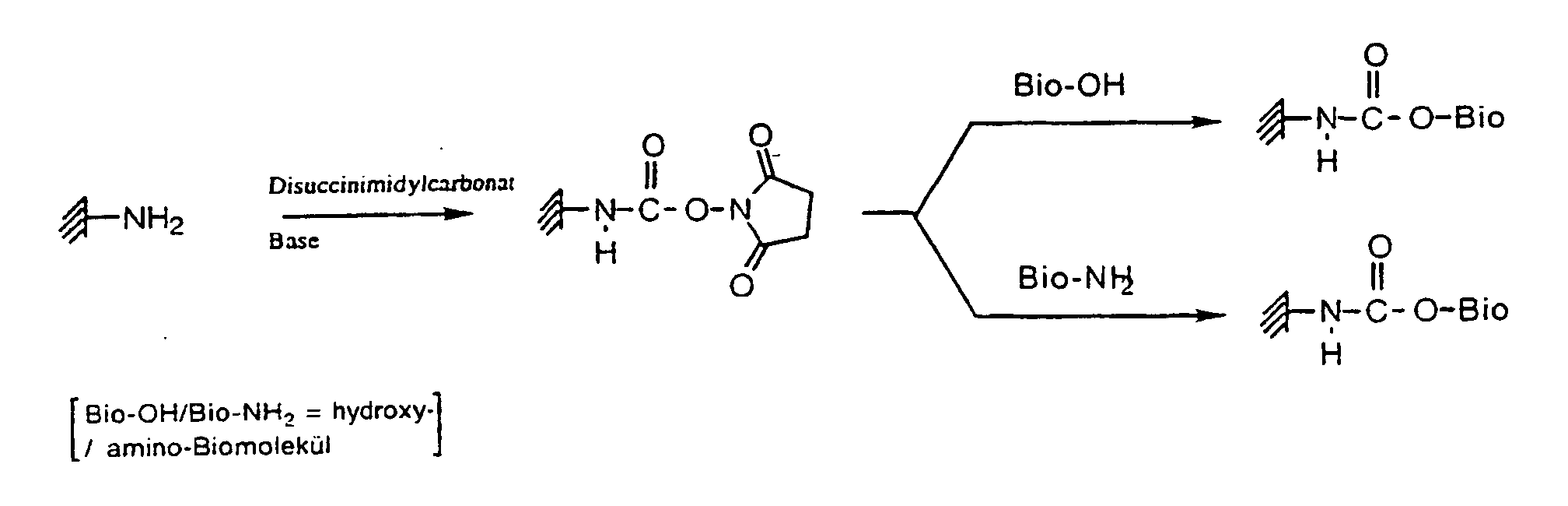
- a covalent surface activation is to be understood as one in which crosslinkers were grafted on, as it were, as an end group onto the previously constructed linker system (flexible linker system). These are, in particular, activated ester, aldehyde, imidoester or isothiocyanate functions, which are able to covalently bond with biopolymers dissolved in aqueous systems without further chemical interventions.
- the reagents of choice here are, in particular, dissocidinimidyl carbonate, dissuccinimidyl oxalate, glutaraldehyde, dimethylsuberimidate dihydrochloride or phenylene diisothiocyanate.
- the reaction is preferably carried out under basic conditions, ie with the addition of diisopropylethylamine or NaCO 3 .
- Example 1 Derivatization of a glass slide
- the starting point is aminated glass carriers (40 x 48 mm), the either commercially available or after the usual Methods of silanization can be represented.
- the amino functions are the aminated glass slides in 20 ml Anhydrous dichloroethane with 200 mg of 4-nitrophenyl chloroformate (1 mmol) and 171 ⁇ l diisopropylethylamine (1 mmol) placed and shaken for 2 hours on the shaker. Of the BPB control test shows no blue coloration.
- the glass carriers are administered overnight in 20 ml of amine-free DMF with 223 ⁇ l Tetraethylenepentamine (1 mmol) reacted.
- the BPB control test shows a blue color.
- the derivatized glass supports have on their surface now via linkers to the biopolymers (e.g., nucleic acids) can be coupled.
- biopolymers e.g., nucleic acids
- the starting point is an aminated glass carrier (40 x 48 mm), either commercially available or after the usual Methods on silanization can be represented.
- the amino functions are the aminated glass slides in 20 ml anhydrous dichloroethane with 81 ⁇ l acryloyl chloride (1 mmol) and 171 ul diisopropylethylamine (1 mmol) and for 2 Hours on the shaker.
- the BPB control test shows no blue color.
- the glass slides are about 2 nights in 20 ml of amine-free DMF with 223 ⁇ l of tetraethylenepentamine (1 mmol) reacted.
- the BPB control test shows a blue coloration.
- the glass slides in 20 ml anhydrous dichloroethane with 81 ⁇ l acryloyl chloride (1 mmol) and 171 ul diisopropylethylamine (1 mmol) and for 2 Hours on the shaker.
- the BPB control test shows no blue color.
- the glass slides are about 2 nights in 20 ml of amine-free DMF with 140 ⁇ l of 1,4-bis (3-aminopropoxy) butane (1 mmol) reacted.
- the BPB test shows a blue coloration.
- the derivatized glass supports have on their surface now via linkers to the biopolymers (e.g., nucleic acids) can be coupled.
- biopolymers e.g., nucleic acids
- the starting point is a commercially available hydrophilized Polypropylene membrane (8 x 12 cm).
- the activated membrane is 2 days with 560 ul of 1,6-bis (3-aminopropyloxy) butane (4 mmol) in 30 moles of amine-free DMF panned on the shaker. Then the reaction solution is decanted off and the membrane several times carefully with DMF and then washed with dichloroethane and dried. Of the Bromophenol blue test (BPB test) shows blue staining.
- a derivatized according to Example 3 Polypropylene membrane (8 x 12 cm) is placed on a Whatman filter paper 5 min. With a solution of 54 mg N- (3-dimethylaminopropyl) -N'-ethyl-carbodiimide hydrochloride and 24 ml of N-methylimidazole in 10 ml of water incubated. The reaction solution is decanted off. The so activated, still wet polypropylene membrane can now for the covalent application of biopolymers (Nucleic acids) can be used. After application the biopolymers (e.g., by spotting robots or Nano plotter), incubate the samples through 2 hr fixed at 65 ° C on the membrane; subsequently Wash the membrane thoroughly with water.
- biopolymers Nucleic acids
- Example 3 A derivatized analogously to Example 3 Polypropylene membrane (8x12 cm) is placed on a Moisten filter paper with water. The damp Diaphragm can now be used for applying Biopolymers are used. After applying the Biopolymers (for example by means of a spotting robot) The samples are incubated at 65 ° C for 2 hours fixed on the membrane. Subsequently, the membrane thoroughly washed with water.
- biopolymers can also be applied directly to a dry membrane can be applied.
- An amino-functionalized polypropylene membrane (Omnitray size) according to Example 3 is in 30 ml of anhydrous Dichloroethane with 400 mg of 4-nitrophenyl chloroformate (2 mmol) and 342 ul diisopropylethylamine (2 mmol) for 2 hr on panned the shaker. It is washed twice each 5 min with 50 ml Dichloromethane and dried in a stream of nitrogen. The way activated PP membrane is now filled with 200 ml of 2- (2-aminoethoxy) ethanol (2 mmol) in 30 ml of amine-free DMF on the Shakers panned, whereupon the reaction solution decanted off becomes.
- the PP membrane is again with 200 ⁇ l of 2- (2-aminoethoxy) ethanol (2 mmol) in 30 ml amine-free DMF and overnight on the shaker pivoted. From the reaction solution is decanted, and the PP membrane 2x 5 min each with 50 ml DMF and then 2 x with 50 ml Washed acetone and dried.
- An amino-functionalized polypropylene membrane (Omnitray size) according to Example 3 is in 30 ml of anhydrous Dichloroethane with 162 ⁇ l acryloyl chloride (2 mmol) and 342 ⁇ l Diisopropylethylamine (2 mmol) for 2 hr on the shaker pivoted. It is washed twice each 5 min with 50 ml of dichloromethane and dried in a stream of nitrogen. The thus activated PP membrane Now with 200 ul of 2- (2-aminoethoxy) ethanol (2 mmol) in 30 ml amine-free DMF for 30 min on the shaker, whereupon the Reaction solution is decanted off.
- the PP membrane is again with 200 ul 2- (2-aminoethoxy) ethanol (2 mmol) in 30 ml of amine-free DMF and overnight panned the shaker. From the reaction solution is decanted off, and the PP membrane 2x 5 min each with 50 ml of DMF and then washed twice with 50 ml of acetone and dried.
- An amino-functionalized polypropylene membrane (Omnitray size) according to Example 3 is in 30 ml of dry Dichloroethane with 400 mg succinic anhydride (4 mmol), 1 ml Pyridine (24 mmol) and 488 mg DMAP (4 mmol) overnight on the Shakers reacted.
- the Decanted reaction solution and the PP membrane sequentially with 30 ml of dichloromethane, 30 ml of acetone, 30 ml of 1% HCl, 2 x 30 ml of water and 2 x with 30 ml of acetone for 5 min. washed and dried.
- Example 9 Methylation of a glass carrier for Improvement of the properties for the Immobilization of biomolecules by electrostatic interaction
Landscapes
- Chemical & Material Sciences (AREA)
- Analytical Chemistry (AREA)
- Organic Chemistry (AREA)
- Chemical Kinetics & Catalysis (AREA)
- Inorganic Chemistry (AREA)
- Addition Polymer Or Copolymer, Post-Treatments, Or Chemical Modifications (AREA)
- Materials For Medical Uses (AREA)
- Peptides Or Proteins (AREA)
- Immobilizing And Processing Of Enzymes And Microorganisms (AREA)
- External Artificial Organs (AREA)
- Developing Agents For Electrophotography (AREA)
Description



- x = (m-1)n
- (im Falle der Aktivierung mit 4-Nitrophenyl-Chloroformiat oder Carbonyldiimidazol)
- x = mn
- (im Falle der Aktivierung mit Acryloylchlorid)
- bevorzugte Struktur nach Aktivierung mit
Acryloylchlorid

- X =
- O, NHR1
- Y, Z =
- können gleich oder verschieden sein und
können ausgewählt sein aus
-(CH2)n-
-(CH2CH2O)n-CH2CH2
-(CH2CH2CH2O)n-CH2CH2CH2- usw. - R1-R5 =
- können gleich oder verschieden sein analog R1 und R2 vorstehend
- n =
- 1-50, bevorzugt 1-20, ganz bevorzugt 1-10
- bevorzugte Struktur nach Aktivierung mit
Chlorameisensäure-nitrophenylester bzw.
Carbonyldiimidazol

- X =
- O, NHR1
- Y, Z =
- können gleich oder verschieden sein und
können ausgewählt sein aus
-(CH2)n-
-(CH2CH2O)n-CH2CH2
-(CH2CH2CH2O)n-CH2CH2CH2- usw. - R1-R5 =
- können gleich oder verschieden sein analog R1 und R2 vorstehend
- n =
- 1-50, bevorzugt 1-20, ganz bevorzugt 1-10




- (A) Zugabe eines Förderungsmittels
- (B) Aktivierung einer der beiden Reaktanden (Biomolekül oder Oberfläche). Allerdings ist eine Aktivierung der Trägeroberfläche gegenüber einer Aktivierung des Biomoleküls vorzuziehen, da bei der Aktivierung des Biomoleküls selbst unerwünschte Kreuzreaktionen zwischen den aktivierten Biomolekülen - aufgrund des meist poly-funktionellen Charakters des Biomoleküls - nicht auszuschliessen sind. Diese Aktivierung der Oberfläche erfolgt vorzugsweise mittels Crosslinker.
| Träger-Oberfläche | Biomolekül | resultierender Bindungs-Typ |
| Amino (-NHR) | Carboxy (-COOH) | Amid-Bindung |
| Amino (-NHR) | Phosphat (-PO4 2-) | Phosporamidat |
| Hydroxyl (-OH) | Carboxy (-COOH) | Ester |
| Hydroxyl (-OH) | Phosphat (-PO4 2-) | Phosphordiester |
| Carboxy (-COOH) | Amino (-NHR) | Amid-Bindung |
| Carboxy (-COOH) | Hydroxyl (-OH) | Ester |
| Phosphat (-PO4 2-) | Amino (-NHR) | Phosporamidat |
| Phosphat (-PO4 2-) | Hydroxyl (-OH) | Phosphordiester |







- Fig. 1:
- Generierung von Dendrimerstrukturen nach Aktivierung mit Acryloylchlorid
- Fig. 2;
- Generierung von Dendrimerstrukturen nach Aktivierung mit 4-Nitrophenylchloroformiat
Claims (10)
- Verfahren zur Oberflächenmodifizierung von Trägermaterialien geeignet zum Einsatz in der DNA-/Bio-Chip-Technologie, wobei auf der Oberfläche der Trägermaterialien mindestens eine funktionelle Gruppe durch Umsetzung mit einem Aktivierungsreagenz aktiviert wird und nachfolgend mit einer Polyamin-Komponente mit mehr als 2 Amino-Funktionen zum Aufbau einer dendrimeren Trägeroberflächen-Struktur umgesetzt wird, wobei das Aktivierungsreagenz Acryloylchlorid, 4-Nitrophenylchloroformiat, Carbonyldiimidazol, Phenylchloroformiat, Phosgen, Diphosgen, Triphosgen, EDC (N-(3-dimethylaminopropyl)-N'-ethyl-carbodiimid-hydrochlorid), N,N'-Diisopropyl-carbodiimid, Dicylohexyl-carbodiimid, Disuccinimidyl-carbonat, Disuccinimidyl-oxalat, Dimethylsuberimidat-Dihydrochlorid oder Phenylendiisothiocyanat ist.
- Verfahren nach Anspruch 1, wobei die Trägermatrix ausgewählt ist aus Glas, Folien bzw. Membranen aus Polypropylen, Nylon, Cellulose, Cellulosederivate (z.B. Celluloseacetat, Cellulose-Mischester), Polyethersulfonen, Polyamiden, Polyvinylchlorid, Polyvinylidenfluorid, Polyester, Polyethylen oder Teflon.
- Verfahren nach Anspruch 1 oder 2, wobei die funktionelle Gruppe eine Amin-, Hydroxyl-, Phosphat-, Carboxyl-, Carbonyl-, Thiol- oder Amid-Gruppe ist.
- Verfahren nach einem der Ansprüche 1 bis 3, wobei das Polyamin Tetraethylenpentamin, Spermin, Spermidin, 4,7,10-Trioxa-1.13-tridecandiamin oder 4-Aminomethyl-1,8-octandiamin ist.
- Verfahren nach einem der Ansprüche 1 bis 4, wobei die Schritte der Umsetzung mit einem Aktivierungsreagenz und einer Polyamin-Komponente mehrmals durchgeführt werden.
- Verfahren nach einem der vorhergehenden Ansprüche, wobei es zum gesteuerten Aufbau von positiver Ladung an der Trägeroberfläche kommt.
- Verfahren nach einem der Ansprüche 1-6, wobei zusätzlich die gemäß einem Ansprüche 1-6 derivatisierte Trägeroberfläche vor dem Anbinden von Biopolymeren aktiviert wird.
- Verfahren nach Anspruch 7, wobei als Aktivierungsmittel Disuccinimidylcarbonat, Disuccinimidyloxalat, Glutaraldehyd, Dimethylsuberimidat-Dihydrochlorid oder Phenylendiisothiocyanat verwendet wird.
- Verwendung eines nach einem der Ansprüche 1-6 hergestellten Trägers zur Anbindung von Biopolymeren.
- Verwendung nach Anspruch 9, wobei die Biopolymere aus DNA, RNA, Nukleotidanaloga, Peptiden, Proteinen oder Antikörpern ausgewählt sind.
Applications Claiming Priority (3)
| Application Number | Priority Date | Filing Date | Title |
|---|---|---|---|
| DE19853242 | 1998-11-18 | ||
| DE19853242A DE19853242B4 (de) | 1998-11-18 | 1998-11-18 | Derivatisierung von Trägeroberflächen |
| PCT/DE1999/003692 WO2000029373A2 (de) | 1998-11-18 | 1999-11-17 | Derivatisierung von trägeroberflächen |
Publications (2)
| Publication Number | Publication Date |
|---|---|
| EP1131281A2 EP1131281A2 (de) | 2001-09-12 |
| EP1131281B1 true EP1131281B1 (de) | 2005-07-27 |
Family
ID=7888252
Family Applications (1)
| Application Number | Title | Priority Date | Filing Date |
|---|---|---|---|
| EP99962063A Expired - Lifetime EP1131281B1 (de) | 1998-11-18 | 1999-11-17 | Derivatisierung von trägeroberflächen |
Country Status (6)
| Country | Link |
|---|---|
| US (1) | US6905724B1 (de) |
| EP (1) | EP1131281B1 (de) |
| AT (1) | ATE300516T1 (de) |
| AU (1) | AU1856300A (de) |
| DE (2) | DE19853242B4 (de) |
| WO (1) | WO2000029373A2 (de) |
Families Citing this family (11)
| Publication number | Priority date | Publication date | Assignee | Title |
|---|---|---|---|---|
| EP1212338B1 (de) | 1999-04-08 | 2012-11-21 | Deutsches Krebsforschungszentrum Stiftung des öffentlichen Rechts | Nucleosid-Derivate mit photolabilen Schutzgruppen |
| CA2397091A1 (en) | 2000-01-11 | 2001-07-19 | Markus Schweitzer | Biomolecules having multiple attachment moieties for binding to a substrate surface |
| US7129229B2 (en) | 2000-08-11 | 2006-10-31 | Nanogen Recognomics Gmbh | Hydrazide building blocks and hydrazide modified biomolecules |
| EP1309730B1 (de) * | 2000-08-11 | 2008-11-26 | Nanogen Recognomics GmbH | Hydrazidbausteine und hydratin-modifizierte biomoleküle |
| KR100383080B1 (ko) * | 2000-09-05 | 2003-05-12 | 주식회사 포스코 | 조절된 아민기 밀도와 공간을 제공하는 분자층을 표면에포함하는 기질 및 이의 제조방법 |
| KR100379720B1 (ko) * | 2000-10-14 | 2003-04-11 | 주식회사 마크로젠 | 덴드리머 단일층 지지체 및 그의 제조방법 |
| US7358417B2 (en) | 2001-10-16 | 2008-04-15 | Posco | Transgenic organism expressing fungal MRP-like ABC transporters |
| EP2316331B1 (de) | 2003-12-09 | 2016-06-29 | Dexcom, Inc. | Signalverarbeitung in einem durchgehenden Analytsensor |
| US20050260653A1 (en) * | 2004-04-14 | 2005-11-24 | Joshua Labaer | Nucleic-acid programmable protein arrays |
| US7556858B2 (en) | 2004-09-30 | 2009-07-07 | 3M Innovative Properties Company | Substrate with attached dendrimers |
| US8178316B2 (en) * | 2006-06-29 | 2012-05-15 | President And Fellows Of Harvard College | Evaluating proteins |
Family Cites Families (8)
| Publication number | Priority date | Publication date | Assignee | Title |
|---|---|---|---|---|
| CA1221307A (en) * | 1982-12-02 | 1987-05-05 | Nobutaka Tani | Adsorbent and process for preparing the same |
| US4693985A (en) * | 1984-08-21 | 1987-09-15 | Pall Corporation | Methods of concentrating ligands and active membranes used therefor |
| US4837348A (en) | 1986-04-30 | 1989-06-06 | Varian Associates, Inc. | Bonded phase chromatographic supports |
| US5624711A (en) * | 1995-04-27 | 1997-04-29 | Affymax Technologies, N.V. | Derivatization of solid supports and methods for oligomer synthesis |
| US5672638A (en) * | 1995-08-22 | 1997-09-30 | Medtronic, Inc. | Biocompatability for solid surfaces |
| US5607475A (en) * | 1995-08-22 | 1997-03-04 | Medtronic, Inc. | Biocompatible medical article and method |
| EP1102634B1 (de) | 1998-07-10 | 2005-02-09 | Dupont Canada Inc. | Geträgerter dendrimer-katalysator und seine verwendung in der hydroformylierung oder bei der kohlenstoff-kohlenstoff verbindung herstellung |
| US6326083B1 (en) * | 1999-03-08 | 2001-12-04 | Calipher Technologies Corp. | Surface coating for microfluidic devices that incorporate a biopolymer resistant moiety |
-
1998
- 1998-11-18 DE DE19853242A patent/DE19853242B4/de not_active Expired - Fee Related
-
1999
- 1999-11-17 AT AT99962063T patent/ATE300516T1/de not_active IP Right Cessation
- 1999-11-17 WO PCT/DE1999/003692 patent/WO2000029373A2/de not_active Ceased
- 1999-11-17 EP EP99962063A patent/EP1131281B1/de not_active Expired - Lifetime
- 1999-11-17 AU AU18563/00A patent/AU1856300A/en not_active Abandoned
- 1999-11-17 US US09/856,341 patent/US6905724B1/en not_active Expired - Fee Related
- 1999-11-17 DE DE59912342T patent/DE59912342D1/de not_active Expired - Fee Related
Also Published As
| Publication number | Publication date |
|---|---|
| AU1856300A (en) | 2000-06-05 |
| DE19853242A1 (de) | 2000-05-25 |
| DE19853242B4 (de) | 2006-06-29 |
| WO2000029373A2 (de) | 2000-05-25 |
| DE59912342D1 (de) | 2005-09-01 |
| WO2000029373A3 (de) | 2000-12-28 |
| US6905724B1 (en) | 2005-06-14 |
| EP1131281A2 (de) | 2001-09-12 |
| ATE300516T1 (de) | 2005-08-15 |
Similar Documents
| Publication | Publication Date | Title |
|---|---|---|
| EP1027379B1 (de) | Verfahren zur herstellung polymerer festphasenträger | |
| DE69133235T2 (de) | Verfahren zur Herstellung von Harzen für die Feststoff-Peptidsynthese | |
| DE69632989T2 (de) | Matrize für die Synthese kombinatorischer Bibliotheken in Lösung | |
| DE19853242B4 (de) | Derivatisierung von Trägeroberflächen | |
| DE60224685T2 (de) | Herstellung von ionenaustauschermedien | |
| DE60124637T2 (de) | Neues Reagens zur Markierung von Nukleinsäuren | |
| EP0445604A2 (de) | Trennmaterialien für die Chromatographie | |
| DE3789812T2 (de) | Poröser wafer zur segmentierten herstellung von bipolymeren. | |
| EP1005495B1 (de) | Aminoalkyltrialkylsilylcellulosen und ein verfahren zur beschichtung von oberflächen | |
| DE102013005184A1 (de) | Verfahren zur Funktionalisierung einer Oberfläche | |
| EP1141038A1 (de) | Verfahren zur herstellung eines polymeren netzwerkes | |
| AT413102B (de) | Verfahren zur herstellung von polymeren trägermaterialien auf basis von kohlenhydrat-bis-(meth)acrylamiden | |
| DE69132656T2 (de) | Organische polymerverbindung und ihre herstellung | |
| DE2061009A1 (de) | Verfahren zur Fixierung von Polymeren | |
| EP1230213A1 (de) | Artikel mit aktivierter oberfläche zur immobilisierung von makromolekülen und verfahren zur herstellung solcher artikel | |
| WO2003074510A1 (de) | Dithiolan-derivate zur immobilisierung von biomolekülen auf edelmetallen und halbleitern | |
| DE602005001414T2 (de) | Photolabile Schutzgruppen | |
| EP1049678A2 (de) | Cyclohexyl- und heterocyclyl-nukleosid derivate, die herstellung und verwendung dieser derivate, deren oligomere bzw. konjugate in paarungs- und/oder testsystemen | |
| EP1373167B1 (de) | Festfasensynthese und -verfahren | |
| AT408150B (de) | Verfahren zur immobilisierung eines analyten an einer festen oberfläche | |
| DE102007062154A1 (de) | Verfahren zur Herstellung und Anwendung von stochastisch angeordneten Arrays von Testsubstanzen | |
| EP1054960A1 (de) | Heteroaromatische oligoamide als affinitätsliganden | |
| EP1245238B1 (de) | Exotoxin-Ligand | |
| DE60118901T2 (de) | Immobilisierung von Oligonukleotiden durch kovalente Bindung | |
| DE102009029173B4 (de) | Immobilisierte Rhodium(III)-, Ruthenium(II)-oder Iridium (III)-Katalysatoren für asymmetrische Hydrierreaktionen |
Legal Events
| Date | Code | Title | Description |
|---|---|---|---|
| PUAI | Public reference made under article 153(3) epc to a published international application that has entered the european phase |
Free format text: ORIGINAL CODE: 0009012 |
|
| 17P | Request for examination filed |
Effective date: 20010613 |
|
| AK | Designated contracting states |
Kind code of ref document: A2 Designated state(s): AT BE CH CY DE DK ES FI FR GB GR IE IT LI LU MC NL PT SE |
|
| AX | Request for extension of the european patent |
Free format text: AL;LT;LV;MK;RO;SI |
|
| 17Q | First examination report despatched |
Effective date: 20020920 |
|
| GRAP | Despatch of communication of intention to grant a patent |
Free format text: ORIGINAL CODE: EPIDOSNIGR1 |
|
| GRAS | Grant fee paid |
Free format text: ORIGINAL CODE: EPIDOSNIGR3 |
|
| GRAA | (expected) grant |
Free format text: ORIGINAL CODE: 0009210 |
|
| AK | Designated contracting states |
Kind code of ref document: B1 Designated state(s): AT BE CH CY DE DK ES FI FR GB GR IE IT LI LU MC NL PT SE |
|
| PG25 | Lapsed in a contracting state [announced via postgrant information from national office to epo] |
Ref country code: NL Free format text: LAPSE BECAUSE OF FAILURE TO SUBMIT A TRANSLATION OF THE DESCRIPTION OR TO PAY THE FEE WITHIN THE PRESCRIBED TIME-LIMIT Effective date: 20050727 Ref country code: IT Free format text: LAPSE BECAUSE OF FAILURE TO SUBMIT A TRANSLATION OF THE DESCRIPTION OR TO PAY THE FEE WITHIN THE PRESCRIBED TIME-LIMIT;WARNING: LAPSES OF ITALIAN PATENTS WITH EFFECTIVE DATE BEFORE 2007 MAY HAVE OCCURRED AT ANY TIME BEFORE 2007. THE CORRECT EFFECTIVE DATE MAY BE DIFFERENT FROM THE ONE RECORDED. Effective date: 20050727 Ref country code: IE Free format text: LAPSE BECAUSE OF FAILURE TO SUBMIT A TRANSLATION OF THE DESCRIPTION OR TO PAY THE FEE WITHIN THE PRESCRIBED TIME-LIMIT Effective date: 20050727 Ref country code: GB Free format text: LAPSE BECAUSE OF FAILURE TO SUBMIT A TRANSLATION OF THE DESCRIPTION OR TO PAY THE FEE WITHIN THE PRESCRIBED TIME-LIMIT Effective date: 20050727 Ref country code: FI Free format text: LAPSE BECAUSE OF FAILURE TO SUBMIT A TRANSLATION OF THE DESCRIPTION OR TO PAY THE FEE WITHIN THE PRESCRIBED TIME-LIMIT Effective date: 20050727 |
|
| REG | Reference to a national code |
Ref country code: GB Ref legal event code: FG4D Free format text: NOT ENGLISH |
|
| REG | Reference to a national code |
Ref country code: CH Ref legal event code: EP |
|
| REG | Reference to a national code |
Ref country code: IE Ref legal event code: FG4D Free format text: LANGUAGE OF EP DOCUMENT: GERMAN |
|
| REF | Corresponds to: |
Ref document number: 59912342 Country of ref document: DE Date of ref document: 20050901 Kind code of ref document: P |
|
| PG25 | Lapsed in a contracting state [announced via postgrant information from national office to epo] |
Ref country code: SE Free format text: LAPSE BECAUSE OF FAILURE TO SUBMIT A TRANSLATION OF THE DESCRIPTION OR TO PAY THE FEE WITHIN THE PRESCRIBED TIME-LIMIT Effective date: 20051027 Ref country code: GR Free format text: LAPSE BECAUSE OF FAILURE TO SUBMIT A TRANSLATION OF THE DESCRIPTION OR TO PAY THE FEE WITHIN THE PRESCRIBED TIME-LIMIT Effective date: 20051027 Ref country code: DK Free format text: LAPSE BECAUSE OF FAILURE TO SUBMIT A TRANSLATION OF THE DESCRIPTION OR TO PAY THE FEE WITHIN THE PRESCRIBED TIME-LIMIT Effective date: 20051027 |
|
| PG25 | Lapsed in a contracting state [announced via postgrant information from national office to epo] |
Ref country code: ES Free format text: LAPSE BECAUSE OF FAILURE TO SUBMIT A TRANSLATION OF THE DESCRIPTION OR TO PAY THE FEE WITHIN THE PRESCRIBED TIME-LIMIT Effective date: 20051107 |
|
| PG25 | Lapsed in a contracting state [announced via postgrant information from national office to epo] |
Ref country code: CY Free format text: LAPSE BECAUSE OF FAILURE TO SUBMIT A TRANSLATION OF THE DESCRIPTION OR TO PAY THE FEE WITHIN THE PRESCRIBED TIME-LIMIT Effective date: 20051117 Ref country code: AT Free format text: LAPSE BECAUSE OF NON-PAYMENT OF DUE FEES Effective date: 20051117 |
|
| PG25 | Lapsed in a contracting state [announced via postgrant information from national office to epo] |
Ref country code: MC Free format text: LAPSE BECAUSE OF NON-PAYMENT OF DUE FEES Effective date: 20051130 Ref country code: LU Free format text: LAPSE BECAUSE OF NON-PAYMENT OF DUE FEES Effective date: 20051130 Ref country code: LI Free format text: LAPSE BECAUSE OF NON-PAYMENT OF DUE FEES Effective date: 20051130 Ref country code: CH Free format text: LAPSE BECAUSE OF NON-PAYMENT OF DUE FEES Effective date: 20051130 Ref country code: BE Free format text: LAPSE BECAUSE OF NON-PAYMENT OF DUE FEES Effective date: 20051130 |
|
| PG25 | Lapsed in a contracting state [announced via postgrant information from national office to epo] |
Ref country code: PT Free format text: LAPSE BECAUSE OF FAILURE TO SUBMIT A TRANSLATION OF THE DESCRIPTION OR TO PAY THE FEE WITHIN THE PRESCRIBED TIME-LIMIT Effective date: 20051227 |
|
| NLV1 | Nl: lapsed or annulled due to failure to fulfill the requirements of art. 29p and 29m of the patents act | ||
| GBV | Gb: ep patent (uk) treated as always having been void in accordance with gb section 77(7)/1977 [no translation filed] |
Effective date: 20050727 |
|
| REG | Reference to a national code |
Ref country code: IE Ref legal event code: FD4D |
|
| PG25 | Lapsed in a contracting state [announced via postgrant information from national office to epo] |
Ref country code: DE Free format text: LAPSE BECAUSE OF NON-PAYMENT OF DUE FEES Effective date: 20060601 |
|
| PLBE | No opposition filed within time limit |
Free format text: ORIGINAL CODE: 0009261 |
|
| STAA | Information on the status of an ep patent application or granted ep patent |
Free format text: STATUS: NO OPPOSITION FILED WITHIN TIME LIMIT |
|
| 26N | No opposition filed |
Effective date: 20060428 |
|
| REG | Reference to a national code |
Ref country code: CH Ref legal event code: PL |
|
| EN | Fr: translation not filed | ||
| PG25 | Lapsed in a contracting state [announced via postgrant information from national office to epo] |
Ref country code: FR Free format text: LAPSE BECAUSE OF FAILURE TO SUBMIT A TRANSLATION OF THE DESCRIPTION OR TO PAY THE FEE WITHIN THE PRESCRIBED TIME-LIMIT Effective date: 20060922 |
|
| BERE | Be: lapsed |
Owner name: DEUTSCHES KREBSFORSCHUNGSZENTRUM STIFTUNG DES OFFE Effective date: 20051130 |
|
| PG25 | Lapsed in a contracting state [announced via postgrant information from national office to epo] |
Ref country code: FR Free format text: LAPSE BECAUSE OF FAILURE TO SUBMIT A TRANSLATION OF THE DESCRIPTION OR TO PAY THE FEE WITHIN THE PRESCRIBED TIME-LIMIT Effective date: 20051130 |
|
| PG25 | Lapsed in a contracting state [announced via postgrant information from national office to epo] |
Ref country code: FR Free format text: LAPSE BECAUSE OF FAILURE TO SUBMIT A TRANSLATION OF THE DESCRIPTION OR TO PAY THE FEE WITHIN THE PRESCRIBED TIME-LIMIT Effective date: 20050727 |