EP1120404A2 - Herstellung von Hydroxypropionitril - Google Patents
Herstellung von Hydroxypropionitril Download PDFInfo
- Publication number
- EP1120404A2 EP1120404A2 EP01101050A EP01101050A EP1120404A2 EP 1120404 A2 EP1120404 A2 EP 1120404A2 EP 01101050 A EP01101050 A EP 01101050A EP 01101050 A EP01101050 A EP 01101050A EP 1120404 A2 EP1120404 A2 EP 1120404A2
- Authority
- EP
- European Patent Office
- Prior art keywords
- acrylonitrile
- hydroxypropionitrile
- mixture
- bis
- phase
- Prior art date
- Legal status (The legal status is an assumption and is not a legal conclusion. Google has not performed a legal analysis and makes no representation as to the accuracy of the status listed.)
- Granted
Links
Classifications
-
- C—CHEMISTRY; METALLURGY
- C07—ORGANIC CHEMISTRY
- C07C—ACYCLIC OR CARBOCYCLIC COMPOUNDS
- C07C253/00—Preparation of carboxylic acid nitriles
- C07C253/32—Separation; Purification; Stabilisation; Use of additives
-
- C—CHEMISTRY; METALLURGY
- C07—ORGANIC CHEMISTRY
- C07C—ACYCLIC OR CARBOCYCLIC COMPOUNDS
- C07C253/00—Preparation of carboxylic acid nitriles
- C07C253/30—Preparation of carboxylic acid nitriles by reactions not involving the formation of cyano groups
-
- A—HUMAN NECESSITIES
- A61—MEDICAL OR VETERINARY SCIENCE; HYGIENE
- A61P—SPECIFIC THERAPEUTIC ACTIVITY OF CHEMICAL COMPOUNDS OR MEDICINAL PREPARATIONS
- A61P1/00—Drugs for disorders of the alimentary tract or the digestive system
- A61P1/04—Drugs for disorders of the alimentary tract or the digestive system for ulcers, gastritis or reflux esophagitis, e.g. antacids, inhibitors of acid secretion, mucosal protectants
-
- A—HUMAN NECESSITIES
- A61—MEDICAL OR VETERINARY SCIENCE; HYGIENE
- A61P—SPECIFIC THERAPEUTIC ACTIVITY OF CHEMICAL COMPOUNDS OR MEDICINAL PREPARATIONS
- A61P17/00—Drugs for dermatological disorders
-
- Y—GENERAL TAGGING OF NEW TECHNOLOGICAL DEVELOPMENTS; GENERAL TAGGING OF CROSS-SECTIONAL TECHNOLOGIES SPANNING OVER SEVERAL SECTIONS OF THE IPC; TECHNICAL SUBJECTS COVERED BY FORMER USPC CROSS-REFERENCE ART COLLECTIONS [XRACs] AND DIGESTS
- Y02—TECHNOLOGIES OR APPLICATIONS FOR MITIGATION OR ADAPTATION AGAINST CLIMATE CHANGE
- Y02P—CLIMATE CHANGE MITIGATION TECHNOLOGIES IN THE PRODUCTION OR PROCESSING OF GOODS
- Y02P20/00—Technologies relating to chemical industry
- Y02P20/50—Improvements relating to the production of bulk chemicals
- Y02P20/582—Recycling of unreacted starting or intermediate materials
Definitions
- the present invention relates to a process for the preparation of 3-hydroxypropionitrile, which is an important intermediate in the process of manufacturing Represents panthenol.
- the end product, especially its d (+) isomer, is a valuable one Agents for the treatment of dermatoses, burns and infectious ulcers as well as a valuable additive in hair lotions and other cosmetics.
- 3-hydroxypropionitrile Various methods for producing 3-hydroxypropionitrile are known from the literature. For example, the conversion of 2-chloroethanol with an alkali metal cyanide to 3-hydroxypropionitrile (also known as "ethylene cyanohydrin") was described as early as 1863 [Annalen der Chemie und Pharmacie 128 , 1 (1863)]. Later publications, such as Org. Synth. 3 , 57 (1923), J. Soc. Chem. Ind. 67 , 458 (1948) and US Pat. No. 2,311,636 relate to the optimization of this basic synthesis. Despite the allegedly high yield, the process is commercially uninteresting because of the relatively high purchase price of the starting material 2-chloroethanol and the difficult to control reaction exotherm.
- German Patent 2,655,794 to react aqueous formaldehyde with acrylonitrile in the presence of strongly basic Amberlyst® IRA-400, OH - form, at about 40 ° C .; however, the stated 75% yield of 3-hydroxypropionitrile is also moderate in this case.
- a strong base for example sodium hydroxide
- a strongly basic Amberlyst catalyst such as Amberlyst IRA-400, OH - form
- Amberlyst IRA-400 OH - form
- yields of up to about 77% could be achieved according to this prior art.
- the cleavage of the bis (cyanoethyl) ether described in the above-mentioned Japanese patent publications is carried out using a basic catalyst, in particular aqueous or aqueous methanolic potassium hydroxide / dipotassium phosphate at 72-100 ° C./5 mm Hg in about 85% yield (JP 160.949 / 1989, JP 90.160 / 1989) or of tetraethylammonium acetate at 100-105 ° C / 10 mm Hg with about 86% yield (JP 185.550 / 1983).
- a basic catalyst in particular aqueous or aqueous methanolic potassium hydroxide / dipotassium phosphate at 72-100 ° C./5 mm Hg in about 85% yield (JP 160.949 / 1989, JP 90.160 / 1989) or of tetraethylammonium acetate at 100-105 ° C / 10 mm Hg with about 8
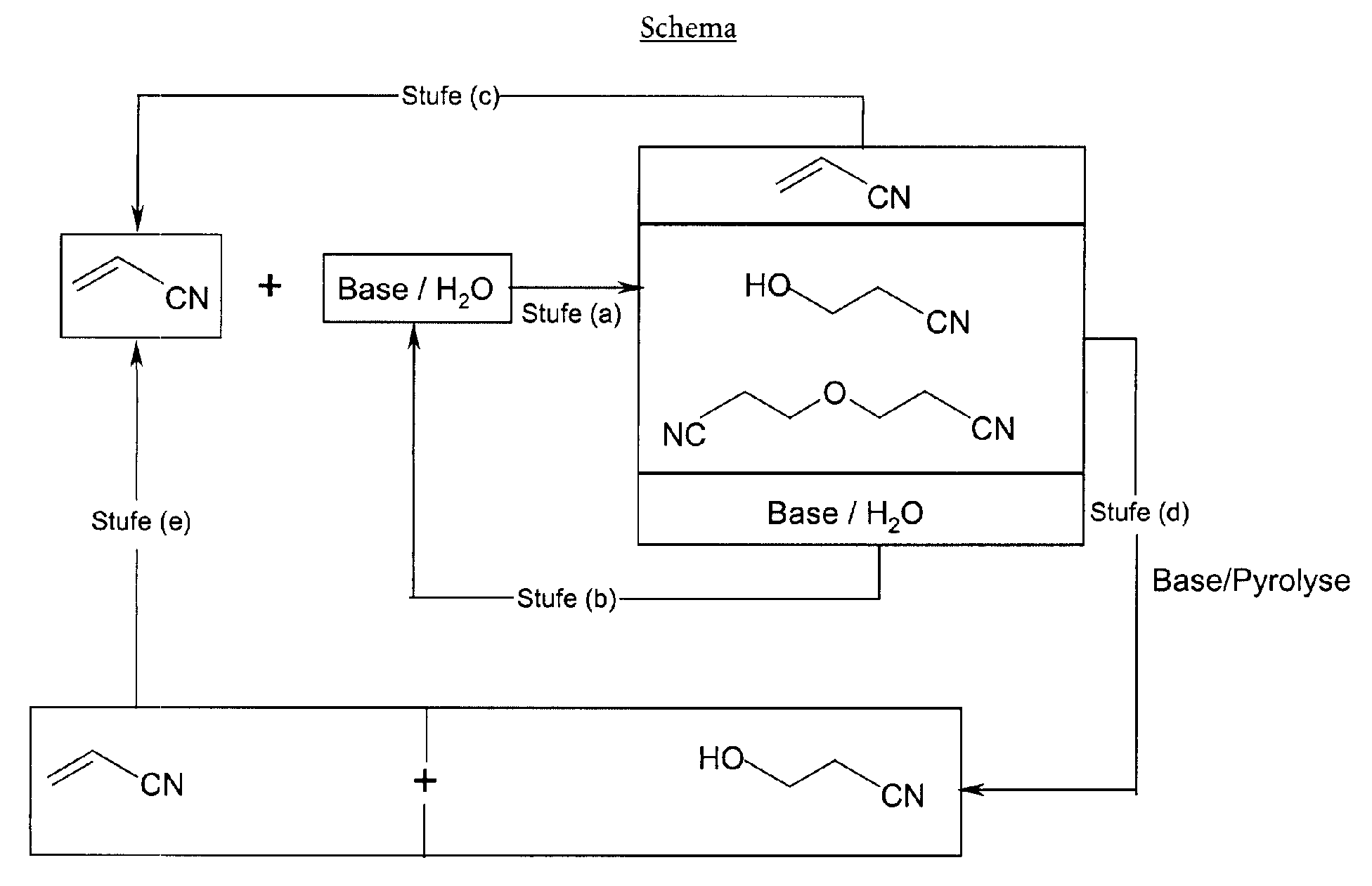
- a new process for the production of 3-hydroxypropionitrile has now been found been, which the reaction of water with acrylonitrile to a mixture of desired product and the condensation product bis (cyanoethyl) ether and the Pyrolysis of this mixed product to further 3-hydroxypropionitrile includes, wherein both the mentioned implementation as well as the pyrolysis under very special base catalytic and other conditions are carried out and unreacted reactants, in particular acrylonitrile and the water containing the catalyst, if desired, returned to the reaction system for reuse can be.
- the whole multi-stage process enables one overall Surprisingly economical production of 3-hydroxypropionitrile, especially since this product only partially formed in the first process stage, but in the penultimate (pyrolysis) Stage is obtained in high yield.
- the aqueous phase separated off in process step (b), which contains the majority of the base used in step (a), is returned to step (a) of an overall process carried out continuously, in order to add further acrylonitrile there react.
- the acrylonitrile distilled off in process step (c) and / or in process step (e) is likewise returned to step (a) of such a process.
- the expression “weak base” occurring in the definition of process step (a) is to be understood in particular as an inorganic or organic base, the pK a value of which is approximately 8 to approximately 12.
- the inorganic base is expediently an alkali metal carbonate, for example sodium or potassium carbonate, an alkali metal bicarbonate, for example sodium or potassium bicarbonate, or a mixture of two or more of these inorganic bases, for example a mixture of sodium carbonate and bicarbonate
- the organic base is expediently one lower trialkylamine or a 4-dialkylaminopyridine.
- alkyl is to be understood in particular as a C 1-6 alkyl group.
- lower trialkylamines and 4-dialkylamino-pyridines are triethylamine and Ethyldiisopropylamine or 4-dimethylamino-pyridine
- sodium carbonate, potassium carbonate, a mixture of sodium carbonate and bicarbonate, or a mixture of potassium carbonate and bicarbonate is used as the weak base.
- the amount used weak base suitably about 0.1 to about 5 mol%, preferably about 0.5 to about 2 mole%.
- the reaction of the acrylonitrile with the water takes place in process step (a) generally in the temperature range from about 80 ° C to about 150 ° C, preferably at Temperatures in the range of about 100 ° C to about 130 ° C, and generally at one Pressure from about 1 bar (0.1 MPa) to about 5 bar (0.5 MPa), preferably from about 1 bar (0.1 MPa) to about 3 bar (0.3 MPa).
- the acrylonitrile: water molar ratio is generally about 1: 0.5 to about 1:20, preferably about 1: 3 to about 1: 8, most preferably about 1: 2 to about 1: 4.
- the reaction (condensation) of acrylonitrile with water in the presence of the weak base is technically expedient by using the acrylonitrile with a Bring solution of the base in water together at room temperature in an autoclave and the (two-phase) mixture thus obtained is heated with stirring. In the locked Autoclaves build up a pressure which, depending on the temperature (80 ° C to 150 ° C) Is 1 to 5 bar (0.1 to 0.5 MPa).
- Sales at process stage (a) is intentionally in the range of approximately 40% to about 80% limited, because too high sales lead to excessive production of unwanted polymeric by-products as well as increasingly from leads to undesirable by-product acrylamide. That there is unreacted acrylonitrile is in the product is not problematic, since this starting material is very easy [in process step (c)] can be recovered and recycled, namely especially in stage (a).
- Process step (a) is usually ended after about 1 to 2 hours.
- stage (a) of the entire process according to the invention is under among other things the extensive suppression of the formation of undesirable polymers By-products and the also undesirable by-product acrylamide.
- Process stage (b) involves the separation of the aqueous phase of the two-phase organic-aqueous obtained in process step (a) Mixture. This mixture is expediently reduced to a prior to separation Temperature cooled in the range from room temperature to about + 10 ° C, either without active cooling or by cooling with cold water, for example water about + 5 ° C. The two phases are very separate in this temperature range light.
- the aqueous phase, which used most of the catalyst contains weak base, can then be separated, which is expedient takes place according to known methods.
- the aqueous phase thus separated off is preferably subsequently carried out in step (a) returned to after further supplementation with a weak base with further optionally also partially recycled acrylonitrile in a second or further Cycle of process stage (a) to be implemented.
- process step (c) Phase consisting mainly of bis (cyanoethyl) ether, 3-hydroxypropionitrile and not reacted acrylonitrile, is then distilled in process step (c) in order to Separate acrylonitrile from the bis (cyanoethyl) ether and 3-hydroxypropionitrile.
- the acrylonitrile thus separated is preferably returned to step (a) after any addition with further acrylonitrile with water in the presence of a weak base implemented in a second or further cycle of process step (a) to become.
- Alkali metal means lithium, sodium or potassium, respectively. If as basic Catalyst a high-boiling trialkylamine is used, this is a trialkylamine, whose boiling point at normal pressure is higher than about 150 ° C; Examples are trioctylamine and tridodecylamine.
- the basic catalysts that can be used are calcium oxide, magnesium oxide, the alkali metal acetates, the alkali metal formates, the alkali metal carbonates, barium carbonate, the alkali metal bicarbonates, calcium hydroxide, trisodium phosphate and Sodium fluoride preferred.
- Particularly preferred basic catalysts are calcium oxide, Sodium acetate and potassium acetate.
- the amount of the basic catalyst used is expediently about 0.05 to about 10 weight percent, preferably about 0.1 to about 3 weight percent.
- Process stage (d) is generally pyrolysed in the temperature range from about 120 ° C to about 160 ° C, preferably at temperatures in the range of about 130 ° C to about 150 ° C, and generally at a reduced pressure of about 5 mbar (0.5 kPa) to about 500 mbar (50 kPa), preferably from about 10 mbar (1 kPa) to about 400 mbar (40 kPa).
- the pyrolysis produces a mixture of mainly 3-hydroxypropionitrile and acrylonitrile in a molar ratio of about 1: 1.
- the duration of the pyrolysis, by which such a mixture is obtained depends on the batch size and is usually at least one hour. Very little acrylamide and polymeric products produced as by-products, which is a further advantage of the inventive Represents procedure.
- the pyrolysis can be carried out in such a way that, simultaneously with the Pyrolysis taking the 3-hydroxypropionitrile and acrylonitrile products formed Using a distillation column, distilled off continuously and in a cooled Original fields.
- you can use the one that takes place simultaneously with the pyrolysis Perform distillation selectively by going through the two products individually suitable cooling selectively condensed, namely only the 3-hydroxypropionitrile and then the acrylonitrile.
- the fractional distillation of the process stage (e) effectively brought forward, which is a combination of process steps (d) and (e) acts. This represents a modification of the method according to the invention.
- step (d) If you in process step (d) the mixture of 3-hydroxypropionitrile and Acrylonitrile has received, in the last process step, (e), the desired 3-hydroxypropionitrile isolated by fractional distillation. If desired - and preferably - the acrylonitrile obtained is returned to step (a) and reused, analogous to the situation described above in connection with the Carrying out the earlier stage (c) is described.
- the fractional distillation according to process stage (e) is expediently carried out first of all at a bath temperature of about 50 ° C to about 120 ° C and one Pressure from about 180 mbar (18 kPa) to about 10 mbar (1 kPa), with the majority of the Acrylonitrile is distilled off, and then at a bath temperature of about 120 ° C to about 150 ° C and a pressure of about 10 mbar (1 kPa) and below, the Main part of the desired 3-hydroxypropionitrile [boiling point about 99-102 ° C / 10 mbar (1 kPa)] is obtained.
- a mirrored distillation column can be used Packed column can be used.
- 3-hydroxypropionitrile is obtained in very good purity and in a yield based on the amount of the originally [in process step (a)] consumed more than 85% of acrylonitrile, more under optimal conditions than 90%.
- Another aspect of the present invention is that according to Reaching the approximately 40 to 80% conversion in process stage (a) the weak base neutralized by adding a weak acid to even in this case to obtain two-phase organic-aqueous mixture, which instead of the initial weak base contains, inter alia, the base formed by the neutralization; this Base already represents the basic used in the later process stage (d) Catalyst, so that a special addition of a basic catalyst for the Process stage (d) is avoided.
- process stages (a '), (c'), (d ') and (e') correspond to in general those conditions which are mentioned above in connection with the Process stages (a), (c), (d) and. (e) are described.
- This also applies to the procedural level (c ') compared to process step (c), although not only in the first step Acrylonitrile, but also water are distilled off, as well as for the process step (d ') compared to process step (d), although in the first step the base which serves as a basic catalyst, after carrying out process step (c ') already in Mixture of bis (cyanoethyl) ether and acrylonitrile is present.
- a weak (C 1-3 ) carboxylic acid for example formic acid, acetic acid or propionic acid, is used in particular as the weak acid which is used to neutralize the weak base in process step (b ').
- the weak acid which is used to neutralize the weak base in process step (b ').
- the base sodium acetate is formed by the neutralization.
- a mixture of sodium carbonate and bicarbonate as the weak base and acetic acid as the weak acid are used in the process according to this aspect of the present invention.
- the 3-hydroxypropionitrile obtained can be subjected to hydrogenation to 3-aminopropanol.
- Methods known per se can be used for this purpose, for example using Raney nickel as a catalyst in methanol or ethanol and in the presence of anhydrous ammonia (see, for example, Swiss Patent 244,837, J. Chem. Soc. 1946, 94 and JP-Kokai 9963/1989).
- Ammonia largely prevents the formation of secondary amines.
- the hydrogenation is expediently carried out at temperatures around 100 ° C. and at pressures from about 25 to about 100 bar H 2 (about 2.5 to about 10.0 MPa).
- OP 1 (184.65 g): content according to GC: 49 g (0.94 mol) acrylonitrile 15.9 g (0.22 mol) of 3-hydroxypropionitrile 94.7 g (0.7 mol) of bis (cyanoethyl) ether 0.9 g (12 mmol) of acrylamide
- WP 1 (71.5 g): content according to GC: 1.0 g (19 mmol) acrylonitrile 4.3 g (60 mmol) 3-hydroxypropionitrile 3.2 g (25 mmol) bis (cyanoethyl) ether 0.2 g (3 mmol) acrylamide
- WP 2 (22.3 g): content according to GC: 0.9 g (16 mmol) acrylonitrile 2.1 g (29 mmol) 3-hydroxypropionitrile 1.7 g (14 mmol) bis (cyanoethyl) ether
- OP 1 (166.65 g): content according to GC: 64.9 g (1.2 mol) acrylonitrile 11.4 g (0.16 mol) of 3-hydroxypropionitrile 74.1 g (0.60 mol) of bis (cyanoethyl) ether 1.0 g (14 mmol) acrylamide
- WP 1 (77.6 g): content according to GC: 3.1 g (58 mmol) acrylonitrile 7.2 g (0.1 mmol) 3-hydroxypropionitrile 3.1 g (24 mmol) bis (cyanoethyl) ether 1.35 g (19 mmol) acrylamide
- WP 2 (23.8 g): content according to GC: 1.1 g (21 mmol) acrylonitrile 2.0 g (28 mmol) 3-hydroxypropionitrile 1.0 g (18 mmol) bis (cyanoethyl)
Landscapes
- Chemical & Material Sciences (AREA)
- Organic Chemistry (AREA)
- Health & Medical Sciences (AREA)
- Chemical Kinetics & Catalysis (AREA)
- Nuclear Medicine, Radiotherapy & Molecular Imaging (AREA)
- Life Sciences & Earth Sciences (AREA)
- General Chemical & Material Sciences (AREA)
- Medicinal Chemistry (AREA)
- Bioinformatics & Cheminformatics (AREA)
- Engineering & Computer Science (AREA)
- Pharmacology & Pharmacy (AREA)
- Veterinary Medicine (AREA)
- Animal Behavior & Ethology (AREA)
- General Health & Medical Sciences (AREA)
- Public Health (AREA)
- Dermatology (AREA)
- Organic Low-Molecular-Weight Compounds And Preparation Thereof (AREA)
- Low-Molecular Organic Synthesis Reactions Using Catalysts (AREA)
- Acyclic And Carbocyclic Compounds In Medicinal Compositions (AREA)
Abstract
Description
| 54% | Acrylnitril |
| 5% | 3-Hydroxypropionitril |
| 38% | Bis(cyanoethyl)ether |
| 1% | Acrylamid |
| 60% | Acrylnitril |
| 38% | 3-Hydroxypropionitril |
| 1% | Acrylamid |
| 96,6% | 3-Hydroxypropionitril |
| 2,6% | Acrylamid |
| 41% | Acrylnitril |
| 8,5% | 3-Hydroxypropionitril |
| 50% | Bis(cyanoethyl)ether |
| 0,5% | Acrylamid |
| 53% | Acrylnitril |
| 46% | 3-Hydroxypropionitril |
| 0,7% | Acrylamid |
| 97,8% | 3-Hydroxypropionitril |
| 1,8% | Acrylamid |
| 49,5% | Acrylnitril |
| 18,5% | 3-Hydroxypropionitril |
| 31% | Bis(cyanoethyl)ether |
| 0,7% | Acrylamid |
| 46,5% | Acrylnitril |
| 52,5% | 3-Hydroxypropionitril + Acrylamid |
| 97,5% | 3-Hydroxypropionitril |
| 2,3% | Acrylamid |
| OP 1 (184,65 g): Gehalt nach GC: | 49 g (0,94 Mol) Acrylnitril |
| 15,9 g (0,22 Mol) 3-Hydroxypropionitril | |
| 94,7 g (0,7 Mol) Bis(cyanoethyl)ether | |
| 0,9 g (12 mmol) Acrylamid | |
| WP 1 (71,5 g): Gehalt nach GC: | 1,0 g (19 mmol) Acrylnitril |
| 4,3 g (60 mmol) 3-Hydroxypropionitril | |
| 3,2 g (25 mmol) Bis(cyanoethyl)ether | |
| 0,2 g (3 mmol) Acrylamid | |
| WP 2 (22,3 g): Gehalt nach GC: | 0,9 g (16 mmol) Acrylnitril |
| 2,1 g (29 mmol) 3-Hydroxypropionitril | |
| 1,7 g (14 mmol) Bis(cyanoethyl)ether | |
| 0,2 g (3 mmol) Acrylamid |
| 43,3 g (0,82 Mol) | Acrylnitril |
| 61,6 g (0,87 Mol) | 3-Hydroxypropionitril |
| 0,8 g (12 mmol) | Acrylamid |
| 98,4% (61 g) | 3-Hydroxypropionitril |
| 1,6% | Acrylamid |
| OP 1 (192,8 g): Gehalt nach GC: | 56 g (1,1 Mol) Acrylnitril |
| 14,6 g (0,21 Mol) 3-Hydroxypropionitril | |
| 87 g (0,70 Mol) Bis(cyanoethyl)ether | |
| 1,0 g (13 mmol) Acrylamid | |
| WP 1 (71,1 g): Gehalt nach GC | 1,3 g (25 mmol) Acrylnitril |
| 4,4 g (61 mmol) 3-Hydroxypropionitil | |
| 3,0 g (24 mmol) Bis(cyanoethyl)ether | |
| 0,5 g (6 mmol) Acrylamid | |
| WP 2 (23,6 g): Gehalt nach GC: | 0,9 g (16 mmol) Acrylnitril |
| 2,0 g (27 mmol) 3-Hydroxypropionitril | |
| 1,5 g (11 mmol) Bis(cyanoethyl)ether | |
| 0,3 g (3 mmol) Acrylamid |
- Obere Phase: 63,1 g Acrylnitril
- Untere, wässrige Phase: 13,9 g Wasser.
| 46,5 g (0,87 Mol) | Acrylnitril |
| 59,8 (0,84 Mol) | 3-Hydroxypropionitril |
| 0,8 g (11 mmol) | Acrylamid |
| 98, 5% | 3-Hydroxypropionitril |
| 1,5% | Acrylamid |
| OP 1 (166,65 g): Gehalt nach GC: | 64,9 g (1,2 Mol) Acrylnitril |
| 11,4 g (0,16 Mol) 3-Hydroxypropionitril | |
| 74,1 g (0,60 Mol) Bis(cyanoethyl)ether | |
| 1,0 g (14 mmol) Acrylamid | |
| WP 1 (77,6 g): Gehalt nach GC: | 3,1 g (58 mmol) Acrylnitril |
| 7,2 g (0,1 mmol) 3-Hydroxypropionitril | |
| 3,1 g (24 mmol) Bis(cyanoethyl)ether | |
| 1,35 g (19 mmol) Acrylamid | |
| WP 2 (23,8 g): Gehalt nach GC: | 1,1 g (21 mmol) Acrylnitril |
| 2,0 g (28 mmol) 3-Hydroxypropionitril | |
| 1,0 g (18 mmol) Bis(cyanoethyl)ether | |
| 0,4 g (35 mmol) Acrylamid |
| OP 1 (181,6 g): Gehalt nach GC: | 79,7 g (1,5 Mol) Acrylnitril |
| 9,8 g (0,14 Mol) 3-Hydroxypropionitril | |
| 75,2 g (0,61 Mol) Bis(cyanoethyl)ether | |
| 1,8 g (25 mmol) Acrylamid | |
| WP 1 (87,2 g): Gehalt nach GC: | 4,8 g (9 mmol) Acrylnitril |
| 6,3 g (88 mmol) 3-Hydroxypropionitril | |
| 3,2 g (25 mmol) Bis(cyanoethyl)ether | |
| 2,6 g (36 mmol) Acrylamid | |
| WP 2 (24,5 g): Gehalt nach GC: | 1,3 g (24 mmol) Acrylnitril |
| 1,6 g (22 mmol) 3-Hydroxypropionitril | |
| 1,0 g (7 mmol) Bis(cyanoethyl)ether | |
| 0,7 g (9 mmol) Acrylamid |
| 36,4 g (0,69 Mol) | Acrylnitril |
| 47,5 g (0,67 Mol) | 3-Hydroxypropionitril |
| 2,0 g (24 mmol) | Acrylamid |
| Mikroanalyse | ||
| Ber.: C 50,69% | H 7,09% | N 19,71% |
| Gef.: C 50,85% | H 7,10% | N 19,98% |
| Mikroanalyse | ||
| Ber.: C 47,97% | H 12,08 | N 18,65% |
| Gef.: C 47,77% | H 11,89% | N 18,52% |
| (H2O: 0,61%) |
| Mikroanalyse | ||
| Ber.: C 47,97% | H 12,08% | N 18,65% |
| Gef.: C 48,43% | H 11,94% | N 18,76% |
| (H2O: 1,53%) |
| Mikroanalyse | ||
| Ber.: C 47,97% | H 12,08% | N 18,65% |
| Gef.: C 48,14% | H 11,97% | N 18,87% |
| (H2O: 1,17%) |
Claims (11)
- Verfahren zur Herstellung von 3-Hydroxypropionitril, dadurch gekennzeichnet, dass man(a) in einem Temperaturbereich von etwa 80°C bis etwa 150°C und bei einem Druck von etwa 1 bar (0,1 MPa) bis etwa 5 bar (0,5 MPa) Acrylnitril mit Wasser in einem Molverhältnis von etwa 1 : 0,5 bis etwa 1 : 20 in Gegenwart einer schwachen Base solange umsetzt, bis ein Umsatz im Bereich von etwa 40% bis etwa 80% erreicht worden ist, um ein zweiphasiges organisch-wässriges Gemisch zu erhalten, dessen organische Phase hauptsächlich aus Bis(cyanoethyl)ether, 3-Hydroxypropionitril sowie unreagiertem Acrylnitril besteht, und dessen wässrige Phase hauptsächlich aus einer wässrigen Lösung der schwachen Base besteht;(b) nach Abkühlung des in (a) erhaltenen Gemisches dessen wässrige Phase abtrennt;(c) von der nach (b) verbleibenden organischen Phase das Acrylnitril abdestilliert, um ein hauptsächlich aus Bis(cyanoethyl)ether und 3-Hydroxypropionitril bestehendes Gemisch zu erhalten;(d) das in (c) erhaltene Gemisch einer Pyrolyse in einem Temperaturbereich von etwa 120°C bis etwa 160°C und bei einem vermindertem Druck von etwa 5 mbar (0,5 kPa) bis etwa 500 mbar (50 kPa) in Gegenwart eines basischen Katalysators unterwirft, welcher von der Gruppe Calcium-, Magnesium-, Strontium-, Titan-, Eisen- und Zinkoxide; Alkalimetallacetate; Alkalimetallformiate; Alkalimetall- und Bariumcarbonate; Alkalimetallbicarbonate; Calcium- und Kupferhydroxide; Di- und Trinatriumphosphate; Natriumfluorid; Natriumsilikat; und hochsiedende Trialkylamine ausgewählt ist, um ein hauptsächlich aus 3-Hydroxypropionitril und Acrylnitril bestehendes Gemisch zu erhalten; und(e) von dem in (d) erhaltenen Gemisch das gewünschte 3-Hydroxypropionitril durch fraktionierte Destillation isoliert.
- Verfahren nach Anspruch 1, dadurch gekennzeichnet, dass man die in der Verfahrensstufe (b) abgetrennte wässrige Phase, welche den Hauptteil der in der Verfahrensstufe (a) verwendeten Base enthält, in die Verfahrensstufe (a) eines kontinuierlich durchgeführten Gesamtverfahrens zurückführt, um dort mit weiterem Acrylnitril reagieren zu lassen.
- Verfahren nach Anspruch 1 oder 2, dadurch gekennzeichnet, dass man das in der Verfahrensstufe (c) und/oder (e) abdestillierte bzw. zurückbleibende Acrylnitril in die Verfahrensstufe (a) eines kontinuierlich durchgeführten Gesamtverfahrens zurückführt, um dort mit weiterem Wasser in Gegenwart einer schwachen Base reagieren zu lassen.
- Verfahren nach einem der Ansprüche 1 bis 3, dadurch gekennzeichnet, dass die in der Verfahrensstufe (a) verwendete schwache Base ein Alkalimetallcarbonat, ein Alkalimetallbicarbonat, ein Gemisch von zwei oder mehreren dieser anorganischen Basen, oder eine schwache organische Base, vorzugsweise Natriumcarbonat, Kaliumcarbonat, ein Gemisch von Natriumcarbonat und -bicarbonat oder ein Gemisch von Kaliumcarbonat und -bicarbonat ist.
- Verfahren nach einem der Ansprüche 1 bis 4, dadurch gekennzeichnet, dass die auf die Menge eingesetzten Acrylnitrils bezogene Menge der schwachen Base etwa 0,1 bis etwa 5 Mol%, vorzugsweise etwa 0,5 bis etwa 2 Mol%, beträgt.
- Verfahren nach einem der Ansprüche 1 bis 5, dadurch gekennzeichnet, dass das Molverhältnis Acrylnitril: Wasser in der Verfahrensstufe (a) etwa 1 : 3 bis etwa 1 : 8, vorzugsweise etwa 1 : 2 bis etwa 1 : 4, beträgt.
- Verfahren nach einem der Ansprüche 1 bis 6, dadurch gekennzeichnet, dass die Umsetzung des Acrylnitrils mit dem Wasser in der Verfahrensstufe (a) bei Temperaturen im Bereich von etwa 100°C bis etwa 130°C und bei einem Druck von etwa 1 bar (0,1 MPa) bis etwa 3 bar (0,3 MPa) erfolgt.
- Verfahren nach einem der Ansprüche 1 bis 7, dadurch gekennzeichnet, dass als basischer Katalysator in der Verfahrensstufe (d) Calciumoxid, Magnesiumoxid, Natriumacetat, Kaliumacetat, Natriumformiat, Kaliumformiat, Natriumcarbonat, Kaliumcarbonat, Bariumcarbonat, Natriumbicarbonat, Kaliumbicarbonat, Calciumhydroxid, Trinatriumphosphat oder Natriumfluorid, insbesondere Calciumoxid, Natriumacetat oder Kaliumacetat, verwendet wird.
- Verfahren nach einem der Ansprüche 1 bis 8, dadurch gekennzeichnet, dass die auf die Gesamtmenge des in der Verfahrensstufe (c) erhaltenen und in der Verfahrensstufe (d) eingesetzten Gemisches von Bis(cyanoethyl)ether und 3-Hydroxypropionitril bezogene Menge des basischen Katalysators etwa 0,05 bis etwa 10 Gewichtsprozent, vorzugsweise etwa 0,1 bis etwa 3 Gewichtsprozent, beträgt.
- Verfahren nach einem der Ansprüche 1 bis 9, dadurch gekennzeichnet, dass die Pyrolyse der Verfahrensstufe (d) bei Temperaturen im Bereich von etwa 130°C bis etwa 150°C und bei einem Druck von etwa 10 mbar (1 kPa) bis etwa 400 mbar (40 kPa) erfolgt.
- Verfahren zur Herstellung von 3-Hydroxypropionitril, dadurch gekennzeichnet, dass man(a') in einem Temperaturbereich von etwa 80°C bis etwa 150°C und bei einem Druck von etwa 1 bar (0,1 MPa) bis etwa 5 bar (0,5 MPa) Acrylnitril mit Wasser in einem Molverhältnis von etwa 1 : 0,5 bis etwa 1 : 20 in Gegenwart einer schwachen Base solange umsetzt, bis ein Umsatz im Bereich von etwa 40% bis etwa 80% erreicht worden ist, um ein zweiphasiges organisch-wässriges Gemisch zu erhalten, dessen organische Phase hauptsächlich aus Bis(cyanoethyl)ether, 3-Hydroxypropionitril sowie unreagiertem Acrylnitril besteht, und dessen wässrige Phase hauptsächlich aus einer wässrigen Lösung der schwachen Base besteht;(b') nach Abkühlung des in (a') erhaltenen Gemisches die schwache Base durch Zugabe einer schwachen Säure neutralisiert;(c') von dem in (b') erhaltenen Gemisch das Acrylnitril und das Wasser abdestilliert, um ein hauptsächlich aus Bis(cyanoethyl)ether, 3-Hydroxypropionitril und der durch die Neutralisierung gebildeter Base bestehendes Gemisch zu erhalten;(d') das in (c') erhaltene Gemisch einer Pyrolyse in einem Temperaturbereich von etwa 120°C bis etwa 160°C und bei einem vermindertem Druck von etwa 5 mbar (0,5 kPa) bis etwa 500 mbar (50 kPa) in Gegenwart der bereits vorhandenen, durch die Neutralisierung gebildeten Base unterwirft, um ein hauptsächlich aus 3-Hydroxypropionitril und Acrylnitril bestehendes Gemisch zu erhalten; und(e') von dem in (d') erhaltenen Gemisch das gewünschte 3-Hydroxypropionitril durch fraktionierte Destillation isoliert.
Applications Claiming Priority (2)
| Application Number | Priority Date | Filing Date | Title |
|---|---|---|---|
| CH1442000 | 2000-01-25 | ||
| CH1442000 | 2000-01-25 |
Publications (3)
| Publication Number | Publication Date |
|---|---|
| EP1120404A2 true EP1120404A2 (de) | 2001-08-01 |
| EP1120404A3 EP1120404A3 (de) | 2003-05-14 |
| EP1120404B1 EP1120404B1 (de) | 2005-04-06 |
Family
ID=4400682
Family Applications (1)
| Application Number | Title | Priority Date | Filing Date |
|---|---|---|---|
| EP01101050A Expired - Lifetime EP1120404B1 (de) | 2000-01-25 | 2001-01-18 | Herstellung von Hydroxypropionitril |
Country Status (10)
| Country | Link |
|---|---|
| US (1) | US6462219B2 (de) |
| EP (1) | EP1120404B1 (de) |
| JP (1) | JP4703012B2 (de) |
| KR (1) | KR100664826B1 (de) |
| CN (1) | CN1189449C (de) |
| AT (1) | ATE292617T1 (de) |
| BR (1) | BR0100818A (de) |
| CA (1) | CA2332155A1 (de) |
| DE (1) | DE50105797D1 (de) |
| ES (1) | ES2239071T3 (de) |
Cited By (2)
| Publication number | Priority date | Publication date | Assignee | Title |
|---|---|---|---|---|
| WO2003087041A1 (en) * | 2002-04-18 | 2003-10-23 | Dsm Ip Assets B.V. | Continuous process for the manufacture of 3-hydroxy propionitrile |
| EP2465844A1 (de) * | 2010-12-14 | 2012-06-20 | Basf Se | Verfahren zur Herstellung und Aufreinigung von 3-Aminopropanol |
Families Citing this family (8)
| Publication number | Priority date | Publication date | Assignee | Title |
|---|---|---|---|---|
| FR2983195B1 (fr) * | 2011-11-30 | 2014-01-10 | IFP Energies Nouvelles | Procede ameliore de synthese de bis[3-(n,n-dialkylamino)propyl)ethers |
| CN110950776A (zh) * | 2019-10-31 | 2020-04-03 | 兄弟科技股份有限公司 | 有机碱催化丙烯腈水合制备3-羟基丙腈的方法 |
| CN111100035B (zh) * | 2019-11-29 | 2021-03-16 | 山东新和成精化科技有限公司 | 一种3-羟基丙腈的制备方法 |
| MX2023006125A (es) * | 2020-12-08 | 2023-06-02 | Evonik Operations Gmbh | Metodo para la purificacion de cianohidrina de etileno. |
| CN114085164A (zh) * | 2021-11-30 | 2022-02-25 | 上海应用技术大学 | 一种采用强碱性离子交换树脂催化丙烯腈制备羟丙腈的方法 |
| CN117682970B (zh) * | 2022-09-03 | 2025-10-10 | 安徽华恒生物科技股份有限公司 | 一种高选择性合成3-羟基丙腈的方法 |
| CN116162043A (zh) * | 2022-12-23 | 2023-05-26 | 大连理工大学 | 一种3-羟基丙腈的连续化制备方法 |
| CN118344259A (zh) * | 2024-03-22 | 2024-07-16 | 安庆市鑫富化工有限责任公司 | 一种3-氨基丙醇的工业化生产方法 |
Family Cites Families (5)
| Publication number | Priority date | Publication date | Assignee | Title |
|---|---|---|---|---|
| DE1189975B (de) * | 1962-10-12 | 1965-04-01 | Lentia Gmbh | Verfahren zur Herstellung von beta, beta'-Dicyandiaethylaether |
| DE2655794C2 (de) | 1976-12-09 | 1985-02-28 | Basf Ag, 6700 Ludwigshafen | Verfahren zur Herstellung von Äthylencyanhydrin |
| JPS58185550A (ja) | 1982-04-23 | 1983-10-29 | Daicel Chem Ind Ltd | エチレンシアノヒドリンの製造法 |
| JPS6490160A (en) | 1987-09-30 | 1989-04-06 | Mitsui Toatsu Chemicals | Production of ethylene cyanohydrin |
| JPH0791253B2 (ja) | 1987-12-17 | 1995-10-04 | 三井東圧化学株式会社 | エチレンシアンヒドリンの製造方法 |
-
2001
- 2001-01-17 US US09/764,549 patent/US6462219B2/en not_active Expired - Lifetime
- 2001-01-18 ES ES01101050T patent/ES2239071T3/es not_active Expired - Lifetime
- 2001-01-18 AT AT01101050T patent/ATE292617T1/de not_active IP Right Cessation
- 2001-01-18 DE DE50105797T patent/DE50105797D1/de not_active Expired - Lifetime
- 2001-01-18 EP EP01101050A patent/EP1120404B1/de not_active Expired - Lifetime
- 2001-01-22 KR KR1020010003526A patent/KR100664826B1/ko not_active Expired - Fee Related
- 2001-01-23 CN CNB011017368A patent/CN1189449C/zh not_active Expired - Fee Related
- 2001-01-24 CA CA002332155A patent/CA2332155A1/en not_active Abandoned
- 2001-01-25 JP JP2001016566A patent/JP4703012B2/ja not_active Expired - Fee Related
- 2001-01-25 BR BR0100818-8A patent/BR0100818A/pt not_active Application Discontinuation
Cited By (4)
| Publication number | Priority date | Publication date | Assignee | Title |
|---|---|---|---|---|
| WO2003087041A1 (en) * | 2002-04-18 | 2003-10-23 | Dsm Ip Assets B.V. | Continuous process for the manufacture of 3-hydroxy propionitrile |
| EP2465844A1 (de) * | 2010-12-14 | 2012-06-20 | Basf Se | Verfahren zur Herstellung und Aufreinigung von 3-Aminopropanol |
| WO2012080233A1 (de) * | 2010-12-14 | 2012-06-21 | Basf Se | Verfahren zur herstellung und aufreinigung von 3-aminopropanol |
| EP2468712A1 (de) * | 2010-12-14 | 2012-06-27 | Basf Se | Verfahren zur Herstellung und Aufreinigung von 3-Aminopropanol |
Also Published As
| Publication number | Publication date |
|---|---|
| KR100664826B1 (ko) | 2007-01-04 |
| DE50105797D1 (de) | 2005-05-12 |
| JP4703012B2 (ja) | 2011-06-15 |
| CA2332155A1 (en) | 2001-07-25 |
| CN1189449C (zh) | 2005-02-16 |
| US6462219B2 (en) | 2002-10-08 |
| EP1120404B1 (de) | 2005-04-06 |
| CN1324791A (zh) | 2001-12-05 |
| EP1120404A3 (de) | 2003-05-14 |
| BR0100818A (pt) | 2001-09-11 |
| KR20010074521A (ko) | 2001-08-04 |
| ATE292617T1 (de) | 2005-04-15 |
| ES2239071T3 (es) | 2005-09-16 |
| JP2001233844A (ja) | 2001-08-28 |
| US20020040163A1 (en) | 2002-04-04 |
Similar Documents
| Publication | Publication Date | Title |
|---|---|---|
| EP1472210B1 (de) | Verfahren zur herstellung substituierter acrylsäureester und deren einsatz zur herstellung von substituierten gamma-aminosäuren | |
| EP1562885A1 (de) | Kontinuierliches verfahren zur herstellung von pseudojononen und jononen | |
| EP1120404B1 (de) | Herstellung von Hydroxypropionitril | |
| DE69710052T2 (de) | Verfahren zur herstellung von zwischenprodukten für pestizide | |
| EP3655413B1 (de) | Herstellung von glufosinat durch umsetzung von 3-[n-butoxy(methyl)phosphoryl]-1-cyanopropylacetat zu einer mischung aus n-butyl(3-amino-3-cyanopropyl)-methylphosphinat und (3-amino-3-cyanopropyl)-methylphosphinsäure ammoniumsalz | |
| EP0001980B1 (de) | Verfahren zur Herstellung von Halogenvinyl-gamma-butyrolactonen, sowie Zwischenprodukte und ihre Herstellung | |
| EP0352504B1 (de) | Verfahren zur gemeinschaftlichen Herstellung von 3-Dialkylaminopropionitrilen, Bis-(2-cyanoethyl)-ether und gewünschtenfalls Ethylencyanhydrin | |
| CH702298B1 (de) | Verfahren zur Herstellung von Cyanoalkylpropionat-Derivaten. | |
| EP1914218A1 (de) | Verfahren zur Herstellung von 1,2-Diolen aus Carbonylverbindungen | |
| EP0087585A1 (de) | Verfahren zur Herstellung von 3-Alkoxi-acrylnitrilen | |
| DE2249993A1 (de) | Verfahren zur spaltung von ketonen | |
| EP1658259B1 (de) | VERFAHREN ZUR HERSTELLUNG VON a-FLUOR-MALONSÄUREDIALKYLESTERN | |
| EP0006180B1 (de) | 3-Phenoxybenzylidenamine und 3-Benzylbenzylidenamine, ein Verfahren zu deren Herstellung sowie deren Verwendung zur Herstellung der entsprechenden Aldehyde | |
| EP0048914A1 (de) | Verfahren zur Herstellung von 3-Brom-4-fluor-benzylalkohol, neue Zwischenprodukte hierfür und Verfahren zur Herstellung dieser Zwischenprodukte | |
| DE10222330A1 (de) | Verfahren zur katalysatorfreien Herstellung von Alkoxybenzonitrilen | |
| EP0171046B1 (de) | Verfahren zur Herstellung von Pantolacton | |
| DE10021413A1 (de) | Verfahren zur Herstellung von 2-Alkyl-3-chlorphenolen | |
| EP1019356B1 (de) | Verfahren zur herstellung von 3-hydroxy-2-methylbenzoesäure | |
| DE1272914B (de) | Verfahren zur Herstellung von Cyanessigsaeureestern | |
| EP1316546A1 (de) | Verfahren zur Herstellung von Beta-Ketonitrilen | |
| EP0697399B1 (de) | Verfahren zur Herstellung von N-Alkenylcarbonsäureamiden | |
| EP1343752B1 (de) | Verfahren zur herstellung von n-substituierten hydroxylaminen und deren salzen | |
| EP0436860A1 (de) | Verfahren zur Herstellung von 2-(4-Chlorphenyl)-3-methyl-buttersäure | |
| EP1384706A1 (de) | Verfahren zur Monoalkylierung C-H-acider Methylengruppen | |
| DE2121635C3 (de) |
Legal Events
| Date | Code | Title | Description |
|---|---|---|---|
| PUAI | Public reference made under article 153(3) epc to a published international application that has entered the european phase |
Free format text: ORIGINAL CODE: 0009012 |
|
| AK | Designated contracting states |
Kind code of ref document: A2 Designated state(s): AT BE CH CY DE DK ES FI FR GB GR IE IT LI LU MC NL PT SE TR |
|
| AX | Request for extension of the european patent |
Free format text: AL;LT;LV;MK;RO;SI |
|
| PUAL | Search report despatched |
Free format text: ORIGINAL CODE: 0009013 |
|
| AK | Designated contracting states |
Designated state(s): AT BE CH CY DE DK ES FI FR GB GR IE IT LI LU MC NL PT SE TR |
|
| AX | Request for extension of the european patent |
Extension state: AL LT LV MK RO SI |
|
| 17P | Request for examination filed |
Effective date: 20031114 |
|
| AKX | Designation fees paid |
Designated state(s): AT BE CH CY DE DK ES FI FR GB GR IE IT LI LU MC NL PT SE TR |
|
| RAP1 | Party data changed (applicant data changed or rights of an application transferred) |
Owner name: DSM IP ASSETS B.V. |
|
| 17Q | First examination report despatched |
Effective date: 20040330 |
|
| GRAP | Despatch of communication of intention to grant a patent |
Free format text: ORIGINAL CODE: EPIDOSNIGR1 |
|
| GRAS | Grant fee paid |
Free format text: ORIGINAL CODE: EPIDOSNIGR3 |
|
| GRAA | (expected) grant |
Free format text: ORIGINAL CODE: 0009210 |
|
| AK | Designated contracting states |
Kind code of ref document: B1 Designated state(s): AT BE CH CY DE DK ES FI FR GB GR IE IT LI LU MC NL PT SE TR |
|
| PG25 | Lapsed in a contracting state [announced via postgrant information from national office to epo] |
Ref country code: IE Free format text: LAPSE BECAUSE OF FAILURE TO SUBMIT A TRANSLATION OF THE DESCRIPTION OR TO PAY THE FEE WITHIN THE PRESCRIBED TIME-LIMIT Effective date: 20050406 Ref country code: NL Free format text: LAPSE BECAUSE OF FAILURE TO SUBMIT A TRANSLATION OF THE DESCRIPTION OR TO PAY THE FEE WITHIN THE PRESCRIBED TIME-LIMIT Effective date: 20050406 Ref country code: FI Free format text: LAPSE BECAUSE OF FAILURE TO SUBMIT A TRANSLATION OF THE DESCRIPTION OR TO PAY THE FEE WITHIN THE PRESCRIBED TIME-LIMIT Effective date: 20050406 |
|
| REG | Reference to a national code |
Ref country code: GB Ref legal event code: FG4D Free format text: NOT ENGLISH |
|
| REG | Reference to a national code |
Ref country code: CH Ref legal event code: NV Representative=s name: DSM NUTRITIONAL PRODUCTS LTD Ref country code: CH Ref legal event code: EP |
|
| REG | Reference to a national code |
Ref country code: IE Ref legal event code: FG4D Free format text: LANGUAGE OF EP DOCUMENT: GERMAN |
|
| REF | Corresponds to: |
Ref document number: 50105797 Country of ref document: DE Date of ref document: 20050512 Kind code of ref document: P |
|
| GBT | Gb: translation of ep patent filed (gb section 77(6)(a)/1977) |
Effective date: 20050518 |
|
| PG25 | Lapsed in a contracting state [announced via postgrant information from national office to epo] |
Ref country code: SE Free format text: LAPSE BECAUSE OF FAILURE TO SUBMIT A TRANSLATION OF THE DESCRIPTION OR TO PAY THE FEE WITHIN THE PRESCRIBED TIME-LIMIT Effective date: 20050706 Ref country code: GR Free format text: LAPSE BECAUSE OF FAILURE TO SUBMIT A TRANSLATION OF THE DESCRIPTION OR TO PAY THE FEE WITHIN THE PRESCRIBED TIME-LIMIT Effective date: 20050706 Ref country code: DK Free format text: LAPSE BECAUSE OF FAILURE TO SUBMIT A TRANSLATION OF THE DESCRIPTION OR TO PAY THE FEE WITHIN THE PRESCRIBED TIME-LIMIT Effective date: 20050706 |
|
| PG25 | Lapsed in a contracting state [announced via postgrant information from national office to epo] |
Ref country code: PT Free format text: LAPSE BECAUSE OF FAILURE TO SUBMIT A TRANSLATION OF THE DESCRIPTION OR TO PAY THE FEE WITHIN THE PRESCRIBED TIME-LIMIT Effective date: 20050908 |
|
| REG | Reference to a national code |
Ref country code: ES Ref legal event code: FG2A Ref document number: 2239071 Country of ref document: ES Kind code of ref document: T3 |
|
| NLV1 | Nl: lapsed or annulled due to failure to fulfill the requirements of art. 29p and 29m of the patents act | ||
| REG | Reference to a national code |
Ref country code: IE Ref legal event code: FD4D |
|
| PG25 | Lapsed in a contracting state [announced via postgrant information from national office to epo] |
Ref country code: AT Free format text: LAPSE BECAUSE OF NON-PAYMENT OF DUE FEES Effective date: 20060118 |
|
| PG25 | Lapsed in a contracting state [announced via postgrant information from national office to epo] |
Ref country code: MC Free format text: LAPSE BECAUSE OF NON-PAYMENT OF DUE FEES Effective date: 20060131 Ref country code: LU Free format text: LAPSE BECAUSE OF NON-PAYMENT OF DUE FEES Effective date: 20060131 Ref country code: BE Free format text: LAPSE BECAUSE OF NON-PAYMENT OF DUE FEES Effective date: 20060131 |
|
| PLBE | No opposition filed within time limit |
Free format text: ORIGINAL CODE: 0009261 |
|
| STAA | Information on the status of an ep patent application or granted ep patent |
Free format text: STATUS: NO OPPOSITION FILED WITHIN TIME LIMIT |
|
| ET | Fr: translation filed | ||
| 26N | No opposition filed |
Effective date: 20060110 |
|
| BERE | Be: lapsed |
Owner name: DSM IP ASSETS B.V. Effective date: 20060131 |
|
| PG25 | Lapsed in a contracting state [announced via postgrant information from national office to epo] |
Ref country code: TR Free format text: LAPSE BECAUSE OF FAILURE TO SUBMIT A TRANSLATION OF THE DESCRIPTION OR TO PAY THE FEE WITHIN THE PRESCRIBED TIME-LIMIT Effective date: 20050406 |
|
| PG25 | Lapsed in a contracting state [announced via postgrant information from national office to epo] |
Ref country code: CY Free format text: LAPSE BECAUSE OF FAILURE TO SUBMIT A TRANSLATION OF THE DESCRIPTION OR TO PAY THE FEE WITHIN THE PRESCRIBED TIME-LIMIT Effective date: 20050406 |
|
| REG | Reference to a national code |
Ref country code: FR Ref legal event code: PLFP Year of fee payment: 16 |
|
| REG | Reference to a national code |
Ref country code: FR Ref legal event code: PLFP Year of fee payment: 17 |
|
| REG | Reference to a national code |
Ref country code: FR Ref legal event code: PLFP Year of fee payment: 18 |
|
| PGFP | Annual fee paid to national office [announced via postgrant information from national office to epo] |
Ref country code: FR Payment date: 20181213 Year of fee payment: 19 |
|
| PGFP | Annual fee paid to national office [announced via postgrant information from national office to epo] |
Ref country code: CH Payment date: 20190115 Year of fee payment: 19 Ref country code: ES Payment date: 20190201 Year of fee payment: 19 Ref country code: IT Payment date: 20190121 Year of fee payment: 19 Ref country code: GB Payment date: 20190116 Year of fee payment: 19 Ref country code: DE Payment date: 20190108 Year of fee payment: 19 |
|
| REG | Reference to a national code |
Ref country code: DE Ref legal event code: R119 Ref document number: 50105797 Country of ref document: DE |
|
| REG | Reference to a national code |
Ref country code: CH Ref legal event code: PL |
|
| GBPC | Gb: european patent ceased through non-payment of renewal fee |
Effective date: 20200118 |
|
| PG25 | Lapsed in a contracting state [announced via postgrant information from national office to epo] |
Ref country code: GB Free format text: LAPSE BECAUSE OF NON-PAYMENT OF DUE FEES Effective date: 20200118 Ref country code: DE Free format text: LAPSE BECAUSE OF NON-PAYMENT OF DUE FEES Effective date: 20200801 Ref country code: FR Free format text: LAPSE BECAUSE OF NON-PAYMENT OF DUE FEES Effective date: 20200131 |
|
| PG25 | Lapsed in a contracting state [announced via postgrant information from national office to epo] |
Ref country code: CH Free format text: LAPSE BECAUSE OF NON-PAYMENT OF DUE FEES Effective date: 20200131 Ref country code: LI Free format text: LAPSE BECAUSE OF NON-PAYMENT OF DUE FEES Effective date: 20200131 |
|
| PG25 | Lapsed in a contracting state [announced via postgrant information from national office to epo] |
Ref country code: IT Free format text: LAPSE BECAUSE OF NON-PAYMENT OF DUE FEES Effective date: 20200118 |
|
| PG25 | Lapsed in a contracting state [announced via postgrant information from national office to epo] |
Ref country code: ES Free format text: LAPSE BECAUSE OF NON-PAYMENT OF DUE FEES Effective date: 20200119 |