EP1098262A2 - Apparat und Verfahren zur Auswahl von auf Autofahrer abgezielten Informationen mit der Absicht Werbung auszuwählen unter Berücksichtigung des Geschmacks des Autofahrers, Laufzeit und Standort des Autos und Ort des angepriesenen Händlers, und Speichermedium - Google Patents
Apparat und Verfahren zur Auswahl von auf Autofahrer abgezielten Informationen mit der Absicht Werbung auszuwählen unter Berücksichtigung des Geschmacks des Autofahrers, Laufzeit und Standort des Autos und Ort des angepriesenen Händlers, und Speichermedium Download PDFInfo
- Publication number
- EP1098262A2 EP1098262A2 EP00123927A EP00123927A EP1098262A2 EP 1098262 A2 EP1098262 A2 EP 1098262A2 EP 00123927 A EP00123927 A EP 00123927A EP 00123927 A EP00123927 A EP 00123927A EP 1098262 A2 EP1098262 A2 EP 1098262A2
- Authority
- EP
- European Patent Office
- Prior art keywords
- advertisement
- data
- evaluation value
- providing
- taste
- Prior art date
- Legal status (The legal status is an assumption and is not a legal conclusion. Google has not performed a legal analysis and makes no representation as to the accuracy of the status listed.)
- Withdrawn
Links
Images


Classifications
-
- G—PHYSICS
- G06—COMPUTING OR CALCULATING; COUNTING
- G06Q—INFORMATION AND COMMUNICATION TECHNOLOGY [ICT] SPECIALLY ADAPTED FOR ADMINISTRATIVE, COMMERCIAL, FINANCIAL, MANAGERIAL OR SUPERVISORY PURPOSES; SYSTEMS OR METHODS SPECIALLY ADAPTED FOR ADMINISTRATIVE, COMMERCIAL, FINANCIAL, MANAGERIAL OR SUPERVISORY PURPOSES, NOT OTHERWISE PROVIDED FOR
- G06Q30/00—Commerce
- G06Q30/02—Marketing; Price estimation or determination; Fundraising
Definitions
- the present invention relates to an information selecting apparatus, an information selecting method and a recording medium. More particularly, the present invention relates to an information selecting apparatus and an information selecting method which are targeted for a car user and intended to rank an advertisement information, depending on a time, a location and a taste, for the car user, and a recording medium.
- a car navigation system has been well known for calculating a current position of a car running on a road, displaying it on a screen such as a liquid crystal display or the like, and displaying a guide route for a road which the car must travel toward a goal.
- the current position of the car is calculated in accordance with a travel direction of the car measured by using an azimuth sensor such as a gyro or the like, and a travel distance of the car measured by using a car speed sensor or a distance sensor.
- the travel distance of the car is determined by measuring a rotation number of an output shaft of a transmission or the like, and then multiplying the rotation number by a distance coefficient which implies a car travel distance for each rotation of a tire.
- the car navigation system can display a current position of the car and a facility (a gasoline stand, a restaurant or the like) located in the travel direction of the car when the car is running along the guide route or a proper road (for example, inventions disclosed in Japanese Laid Open Patent Application (JP-A-Heisei, 6-250586) and Japanese Laid Open Patent Application (JP-A-Heisei, 5-216404). Also, an invention disclosed in Japanese Laid Open Patent Application (JP-A-Heisei, 10-30932) can display a desirable guide spot (a sightseeing spot and the like) located around the road on which the car is running, through an operation of the user, depending on the taste of the user.
- a desirable guide spot a sightseeing spot and the like
- JP-A-Heisei, 9-214875 provides a television receiver and a radio receiver which have a function of picking up and selecting only commercial programs required by a viewer from the broadcasted commercial programs, and arranging and sorting them, making into a database, and then using them.
- this receiver satisfies only a request from the viewer, and it does not satisfy a request from a sponsor providing the commercial program.
- the advertisement information is a data stored on a memory medium, such as CD-ROM or the like, in the car navigation system.
- the advertisement information may give an uncomfortable feeling to the user, since it is broken into and displayed in a typical broadcast.
- the sponsor of the advertisement has a demand to check the number of providing advertisement and accordingly specify the number of times.
- JP-A-Heisei, 10-505441 discloses a dual-channel advertisement method in relation to a position of a car.
- a car information device collects an information with regard to a point of a special interest.
- a user calls and indicates the information, including a display indicative of a distance and a movement direction to the interested point specified for a current position of the car at that time.
- a dual-channel advertisement is sent through a voice broadcast and a data broadcast.
- the user captures a related data broadcast including a position of an advertiser from detailed text message information containing other items.
- a relative direction and a movement distance from the current position of the car to the interested point are provided.
- a large number of interested points are stored for the sake of selective review.
- the user establishes a database including a point in which a particular person is very interested.
- an object of the present invention is to enable an advertisement considering a taste of a car user, a time such as a run time or the like, and a location and a position of a car and a shop to be provided for the car user, and to satisfy a request from a sponsor of the advertisement with regard to the number of times of providing.
- an information selecting method includes: (a) providing a plurality of advertisement data, wherein each of the plurality of advertisement data includes a advertisement information and a minimum providing frequency, the minimum providing frequency indicating of a minimum number of times the advertisement information is provided to a user of a vehicle; (b) counting a previous number of times the advertisement information has been provided to the user during a past period; (c) setting a plurality of advertisement providing position data, each of the plurality of advertisement position data indicating of a specific position where the advertisement information is provided to the user; (d) evaluating each of the plurality of advertisement data at the specific position corresponding to each of the plurality of advertisement position data; (e) generating a specific evaluation value based on the result of the (d); (f) selecting a predetermined number of the advertisement data based on the specific evaluation value; (g) determining a schedule number of times the advertisement information is provided to the user during a next period based on the result of the (f); (h) judging whether
- an information selecting method further includes: (j) evaluating each of the plurality of advertisement data with regard to a position at the specific position corresponding to each of the plurality of advertisement position data to generate a position evaluation value, and wherein the (e) includes generating the specific evaluation value based on the position evaluation value, and wherein the (i) includes controlling the schedule number based on the position evaluation value.
- an information selecting method further includes: (k) evaluating each of the plurality of advertisement data with regard to a time at the specific position corresponding to each of the plurality of advertisement position data to generate a time evaluation value, and wherein the (e) includes generating the specific evaluation value based on the time evaluation value.
- the (a) includes providing the plurality of advertisement data, the each advertisement data including an attribute in addition to the advertisement information and the minimum providing frequency
- the information selecting method further includes: (l) providing a taste data indicating a taste of the user; and (m) evaluating each of the plurality of advertisement data with regard to a taste at the specific position corresponding to each of the plurality of advertisement position data to generate a taste evaluation value based on the taste data and the attribute, and wherein the (e) includes generating the specific evaluation value based on the taste evaluation value.
- the (a) includes providing the plurality of advertisement data, the each advertisement data including an attribute in addition to the advertisement information and the minimum providing frequency
- the information selecting method further includes: (n) providing a taste data indicating a taste of the user; and (o) evaluating each of the plurality of advertisement data with regard to a taste at the specific position corresponding to each of the plurality of advertisement position data to generate a taste evaluation value based on the taste data and the attribute, and (p) evaluating each of the plurality of advertisement data with regard to a position at the specific position corresponding to each of the plurality of advertisement position data to generate a position evaluation value, and (q) evaluating each of the plurality of advertisement data with regard to a time at the specific position corresponding to each of the plurality of advertisement position data to generate a time evaluation value
- the (e) includes generating the specific evaluation value based on the position evaluation value, the time evaluation value and the taste evaluation value.
- the (c) includes setting the plurality of advertisement providing position data based on a route data indicating of a running route of the vehicle, a vehicle position data indicating of a current position of the vehicle and an advertisement providing timing data indicating of a timing when the advertisement information is provided.
- the advertisement providing timing data corresponds to one of a predetermined time, a predetermined length and a predetermined dividing number of a distance.
- the (a) includes providing the plurality of advertisement data, the each advertisement data including a shop position data indicating of a position of a shop of which the advertisement information is provided in addition to the advertisement information and the minimum providing frequency, and wherein the (j) includes: (r) calculating a distance from the shop to the specific position corresponding to each of the plurality of advertisement position data based on the shop position data and each of the plurality of advertisement providing position data; and (s) generating the position evaluation value based on the distance.
- the (a) includes providing the plurality of advertisement data, the each advertisement data including a shop position data indicating of a position of a shop of which the advertisement information is provided and a providing recommendation period which is recommended for providing the advertisement information in addition to the advertisement information and the minimum providing frequency
- the (k) includes: (t) calculating a distance from the shop to the specific position corresponding to each of the plurality of advertisement position data based on the shop position data and each of the plurality of advertisement providing position data; (u) calculating a arrival expectation time when the vehicle arrives at the shop based on the distance and a current time; and (v) generating the time evaluation value based on the providing recommendation period and the arrival expectation time.
- each of the attribute and the taste data is represented by a keyword vector and wherein the (m) includes generating the taste evaluation value based on a distance between the keyword vector of the attribute and the keyword vector of the taste data.
- an information selecting apparatus includes: a advertisement database including a plurality of advertisement data, wherein each of the plurality of advertisement data includes a advertisement information and a minimum providing frequency, the minimum providing frequency indicating of a minimum number of times the advertisement information is provided to a user of a vehicle; an output history memory counting a previous number of times the advertisement information has been provided to the user during a past period; an advertisement ranking generator setting a plurality of advertisement providing position data, each of the plurality of advertisement position data indicating of a specific position where the advertisement information is provided to the user and evaluating each of the plurality of advertisement data at the specific position corresponding to each of the plurality of advertisement position data to generate a specific evaluation value and selecting a predetermined number of the advertisement data based on the specific evaluation value to determine a schedule number of times the advertisement information is provided to the user during a next period and judging whether or not the minimum providing frequency is satisfied in each advertisement data; and controlling the schedule number such that the minimum providing frequency is satisfied in each advertisement data.
- the advertisement ranking generator evaluates each of the plurality of advertisement data with regard to a position at the specific position corresponding to each of the plurality of advertisement position data to generate a position evaluation value, and wherein the advertisement ranking generator generates the specific evaluation value based on the position evaluation value, and controls the schedule number based on the position evaluation value.
- the advertisement ranking generator evaluates each of the plurality of advertisement data with regard to a time at the specific position corresponding to each of the plurality of advertisement position data to generate a time evaluation value, and generates the specific evaluation value based on the time evaluation value.
- the each advertisement data includes an attribute in addition to the advertisement information and the minimum providing frequency
- the information selecting apparatus further includes: a taste obtainer providing a taste data indicating a taste of the user; and wherein the advertisement ranking generator evaluates each of the plurality of advertisement data with regard to a taste at the specific position corresponding to each of the plurality of advertisement position data to generate a taste evaluation value based on the taste data and the attribute, and generates the specific evaluation value based on the taste evaluation value.
- the each advertisement data includes an attribute in addition to the advertisement information and the minimum providing frequency
- the information selecting apparatus further includes: a taste obtainer providing a taste data indicating a taste of the user; and wherein the advertisement ranking generator evaluates each of the plurality of advertisement data with regard to a taste at the specific position corresponding to each of the plurality of advertisement position data to generate a taste evaluation value based on the taste data and the attribute, and evaluates each of the plurality of advertisement data with regard to a position at the specific position corresponding to each of the plurality of advertisement position data to generate a position evaluation value, and evaluates each of the plurality of advertisement data with regard to a time at the specific position corresponding to each of the plurality of advertisement position data to generate a time evaluation value, and wherein the advertisement ranking generator generates the specific evaluation value based on the position evaluation value, the time evaluation value and the taste evaluation value.
- the advertisement ranking generator sets the plurality of advertisement providing position data based on a route data indicating of a running route of the vehicle, a vehicle position data indicating of a current position of the vehicle and an advertisement providing timing data indicating of a timing when the advertisement information is provided.
- the timing of the advertisement providing timing data corresponds to one of a predetermined time, a predetermined length and a predetermined dividing number of a distance.
- the each advertisement data includes a shop position data indicating of a position of a shop of which the advertisement information is provided in addition to the advertisement information and the minimum providing frequency
- the advertisement ranking generator calculates a distance from the shop to the specific position corresponding to each of the plurality of advertisement position data based on the shop position data and each of the plurality of advertisement providing position data; and generates the position evaluation value based on the distance.
- the each advertisement data includes a shop position data indicating of a position of a shop of which the advertisement information is provided and a providing recommendation period which is recommended for providing the advertisement information in addition to the advertisement information and the minimum providing frequency
- the advertisement ranking generator calculates a distance from the shop to the specific position corresponding to each of the plurality of advertisement position data based on the shop position data and each of the plurality of advertisement providing position data, and calculates a arrival expectation time when the vehicle arrives at the shop based on the distance and a current time and generates the time evaluation value based on the providing recommendation period and the arrival expectation time.
- each of the attribute and the taste data is represented by a keyword vector and wherein the advertisement ranking generator generates the taste evaluation value based on a distance between the keyword vector of the attribute and the keyword vector of the taste data.
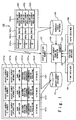
- Fig. 1 is a block diagram showing the configuration of an information selecting apparatus 100 targeted for a car user, in the first embodiment of the present invention.
- the information selecting apparatus 100 targeted for the car user in the first embodiment of the present invention is provided with an advertisement database 101, a time obtainer 104, a position obtainer 105, a taste obtainer 106, an advertisement ranking generator 102, a schedule table database 103 and an output history memory 107.
- the advertisement database 101 stores therein advertisement data 1011 to 1013 including advertisement information.
- the time obtainer 104 obtains a current time.
- the position obtainer 105 obtains a current position of a car.
- the taste obtainer 106 obtains a taste of a user.
- the advertisement ranking generator 102 evaluates the advertisement data in accordance with the current time, the current position of the car and the taste information of the user.
- the schedule table database 103 accumulates run schedule data 1031 to 1033 of the car.
- the output history memory 107 stores a providing history of the advertisement.
- a memory 1021 is built in the advertisement ranking generator 102.
- the advertisement database 101 stores therein a plurality of kinds of advertisement data 1011 to 1013.
- the advertisement data 1011 which is one of the plurality of advertisement data 1011 to 1013, is composed of an advertisement ID number 1011a of the advertisement data, an advertisement information 1011b, a shop information 1011c, a minimum providing frequency (the minimum number of times to provide advertisement within a certain period) 1011d, a providing recommendation period 1011e and an advertisement information attribute (for example, a keyword indicative of a kind of an advertisement or the like) 1011f.
- the data configurations are similar in the other advertisement data 1012, 1013 in the plurality of advertisement data 1011 to 1013.
- the plurality of run schedule data 1031 to 1033 are stored in advance in the schedule table database 103 by the user.
- the run schedule data 1031 which is one of the plurality of run schedule data 1031 to 1033, is composed of a schedule ID 1031a that is an identifier, a goal 1031b, a route (a pass point from a start point to the goal is set as a list of a data represented by a combination of a latitude, a longitude and a road name, for example, for each branch of a road) 1031c and a timing of advertisement providing 1031d.
- the data configuration is similar in the other run schedule data 1032, 1033 in the plurality of run schedule data 1031 to 1033.
- the time obtainer 104 is a device for obtaining a current time.
- it is a watch.
- it is not limited to the watch.
- the position obtainer 105 is a device for obtaining a current position of the car.
- it is a GPS receiver for outputting a position information of a latitude and a longitude in accordance with a signal from a satellite.
- it is not limited to the GPS receiver.
- the taste obtainer 106 is a device for obtaining a taste of a driver.
- a device may be considered for receiving a keyword indicative of the taste of the driver through a screen or a voice recognizing unit, and storing therein the keyword data and then outputting in response to a request.
- it is not limited to such a device.
- the output history memory 107 is a memory for storing therein the number of times of advertisement providing until that time. Actually, if an advertisement is displayed (provided) on a display (not shown), the output history memory 107 recognizes the advertisement providing, counts the number of times of providing and holds the number of times of providing.
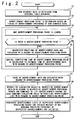
- Fig. 2 is a schematic flowchart showing the operations of the information selecting apparatus 100 targeted for the car user in the first embodiment of the present invention.
- Fig. 3 is a flowchart showing the operations in evaluating an advertisement information based on a position information in the first embodiment of the present invention (a detailed description of a step S5 in Fig. 2).
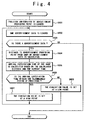
- Fig. 4 is a flowchart showing the operations in evaluating an advertisement information based on a time information in the first embodiment of the present invention (a detailed description of a step S6 in Fig. 2).
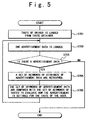
- Fig. 5 is a flowchart showing the operations in evaluating an advertisement information based on a taste information in the first embodiment of the present invention (a detailed description of a step S7 in Fig. 2).
- Fig. 3 is a flowchart showing the operations in evaluating an advertisement information based on a position information in the first embodiment of the present invention (a detailed description of a step S5 in Fig. 2).
- Fig. 4 is a flowchart
- FIG. 6 is a flowchart showing the operations in investigating the number of times of advertisement providing and modifying an evaluation value, in the first embodiment of the present invention (a detailed description of a step S9 in Fig. 2).
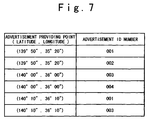
- Fig. 7 is an explanation view illustrating an providing advertisement list.
- the advertisement ranking generator 102 retrieves the run schedule data 1031 from the schedule table database 103 (Step S1 of Fig. 2).
- Step S2 of Fig. 2 It extracts the timing of advertisement providing 1031d in the run schedule data 1031, and determines an advertisement providing point on the route 1031c in the run schedule data 1031 (Step S2 of Fig. 2), and stores the determined result in the memory 1021.
- the advertisement providing point implies a set of points (latitudes and longitudes) at which the advertisement is provided.
- the information (a latitude and a longitude) of the current position of the car obtained from the position obtainer 105 is used in determining the advertisement providing point.
- the timing of advertisement providing 1031d is specified, for example, depending on a time (for each X minute or the like).
- a position (a latitude and a longitude) for each timing of advertisement providing (X minute) 1031d is determined as an advertisement providing point, in accordance with an expectation time of an arrival at a goal and an arrival expectation position.
- the timing of advertisement providing 1031d is specified, for example, for each certain distance (for each X (km)).
- a position (a latitude and a longitude) for each specified distance (X (km)) on the route 1031c is determined as the advertisement providing point.
- the timing of advertisement providing 1031d is specified, for example, depending on a rate of a distance to a goal (for each 1/X).
- the route 1031c is divided for each timing of advertisement providing (1/X), and its division point (position) is determined as the advertisement providing point.
- the advertisement ranking generator 102 loads one advertisement providing point stored in the memory 1021 at the step S2, from the memory 1021 (Step S3 of Fig. 2).
- the advertisement ranking generator 102 evaluates the positions of the respective advertisement data 1011 to 1013, at the advertisement providing point loaded at the step S3 (Step S5 of Fig. 2).
- a position information of an advertisement providing point is loaded from the memory 1021 (Step S501 of Fig. 3).
- the shop information 1011c includes a shop name and a shop position (a latitude and a longitude).
- a distance to the advertisement providing point from the shop position included in the shop information 1011c is calculated (Step S504 of Fig. 3).
- An evaluation value fs with regard to a position is calculated in accordance with the distance calculated at the step S504 (Step S505 of Fig. 3). A method for calculating the evaluation value fs at the step S505 will be described below.
- each advertisement data at each advertisement providing point it is limited to, for example, only an advertisement of a shop located at an area within a circle of a certain radius from each advertisement providing point, for the convenience of a calculation.
- a location of a shop in an advertisement is assumed to be A (a latitude and a longitude).
- An evaluation value fs (A,P) with regard to a position of an advertisement data in an advertisement providing point is represented by: 0 ⁇ fs ( A , P ) ⁇ 1
- r denotes a distance from P, and corresponds to the radius of the circle used in the above-mentioned limitation. In short, it is limited to a shop whose location A exists within the circle of the radius r from P.
- ⁇ is a coefficient indicative of a degree in which the evaluation value fs is reduced depending on the distance. The larger the ⁇ , the smaller the evaluation value fs. For example, an integer "2" may be used as ⁇ .
- the advertisement ranking generator 102 evaluates the times of the respective advertisement data 1011 to 1013, at the advertisement providing point loaded at the step S3 (Step S6 of Fig. 2).
- a position information of an advertisement providing point is loaded from the memory 1021 (Step S601 of Fig. 4).
- an advertisement data 1011 is loaded from the advertisement database 101 (Step S602 of Fig. 4) to then extract a shop information 1011c.
- the shop information 1011c includes a shop name and a shop position (a latitude and a longitude).
- a distance to the advertisement providing point from the shop position included in the shop information 1011c is calculated (Step S604 of Fig. 4).
- a current position of the car and a current time are loaded from the position obtainer 105 and the time obtainer 104, respectively.
- An average speed of the car is calculated in accordance with the loaded information of the current position of the car and the current time (not shown).
- a time at a certain point is stored in the memory 1021 to then measure an advancement distance after an elapse of a certain period from the time.
- the average speed of the car is calculated in accordance with the elapse time and the movement distance.
- an expectedly necessary time from the current point to the position of the advertisement shop is calculated in accordance with the distance calculated at the step S604 and the average speed at the current point of the car.
- an arrival expectation time with regard to the arrival at the advertisement shop is calculated in accordance with the expectedly necessary time calculated at the step S604 and the current time data obtained from the time obtainer 104 (Step S605 of Fig. 4).
- the advertisement ranking generator 102 extracts the providing recommendation period 1011e of the advertisement data 1011, and judges whether or not the arrival expectation time determined at the step S605 is within the providing recommendation period 1011e (Step S606 of Fig. 4).
- an evaluation value ft with regard to the time of the advertisement data at the advertisement providing point has a value between 0 and 1. If the arrival expectation time is within the providing recommendation period 1011e as the judged result at the step S606, the evaluation value ft of the advertisement at the advertisement providing point is set at a high point (for example, a value close to 1) (Step S607 of Fig. 4). If it is not within the providing recommendation period 1011e, the evaluation value ft is set at a low point (for example, a value close to 0) (Step S608 of Fig. 4).
- a start time of the providing recommendation period 1011e with regard to the advertisement of the shop located at the location A is tAs and an end time thereof is tAe.
- the arrival expectation time determined at the step S605 is assumed to be T. Strictly, this arrival expectation time T is an expectation value. Thus, it includes an error e (this is a numeral between 0 and 1, and arbitrarily set as a percent value).
- the evaluation value ft (A,P) is equivalent to a calculation of a probability that the arrival expectation time T is present in the providing recommendation period 1011e of the shop existing at A. However, if the arrival expectation time T is present prior to the start time tAs, it is recommendable that the ft (A,P) is not made uniformly small. This is because the arrival expectation time T belongs to the providing recommendation period 1011e of the shop located at A, if it waits until the start time tAs, even in the case of the arrival before the start time tAs. This allowable wait time is defined as m.
- the evaluation function ft(A,P) with regard to the time of the advertisement data at the advertisement providing point can be defined by the following equation:
- the advertisement ranking generator 102 repeats the processes at the steps S3 to S6 of Fig. 2 for each advertisement providing point.
- the advertisement ranking generator 102 evaluates the tastes of the respective advertisement data 1011 to 1013 (Step S7 of Fig. 2).
- the taste obtainer 106 extracts a taste of a driver from the taste obtainer 106 (Step S701 of Fig. 5).
- the taste data is represented by a set of keywords or a keyword vector (a set of a keyword and its weighting).
- Step S704 compares the attribute data 1011f of the advertisement data 1011 retrieved at the step S704 with the taste data of the driver extracted at the step S701, and evaluates how its advertisement is suitable for the taste of the driver, in accordance with the compared result (Step S705 of Fig. 5). Its evaluation result is determined as an evaluation value fu with regard to the taste.
- the evaluation value fu can be determined as a similar degree, in accordance with a distance between both keywords.
- an attribute keyword vector of the advertisement data 1011 is ( ⁇ VA) and a taste keyword vector of the driver is ( ⁇ VU).
- the distance of the keywords is represented by a cos ⁇ .
- ⁇ is an angle from the attribute keyword vector to the taste keyword vector.
- the total evaluation value f with regard to each shop is calculated at each advertisement providing point. That is, the evaluation value fs with regard to the position, the evaluation value ft with regard to the time and the evaluation value fu with regard to the taste are combined, and the total point is calculated as the evaluation value f (Step S8 of Fig. 2).
- ws denotes a weighting of a term with regard to a position
- wt denotes a weighting of a term with regard to a time
- wu denotes a weighting of a term with regard to a taste of a drier.
- This total evaluation value f is calculated for the number of times equal to (the number of shops ⁇ the number of advertisement providing points).
- an advertisement having a higher evaluation value f is assumed to be a providing advertisement list at its advertisement providing point (Step S8 of Fig. 2).
- the providing advertisement list is represented by a combination of an advertisement providing point and an advertisement ID number, as shown in Fig. 7.
- the number of times (providing frequency) of advertisements (shops) to be provided at each advertisement providing point is already determined, they are sorted in the order of decreasing the evaluation value f. As the sorted result, only those corresponding to the higher providing frequency are determined as the providing advertisement list.
- the number of times of providing at each advertisement providing point is limited to 2, in Fig. 7.
- the advertisement ID numbers having the higher two evaluation values at the first advertisement providing point are assumed to be (001) and (002).
- the advertisement ID number (001) corresponds to an advertisement ID number 1011a of the advertisement data 1011
- the advertisement ID number (002) corresponds to an advertisement ID number 1012a of the advertisement data 1012.
- the generated providing advertisement list is stored in the memory 1021.
- the advertisement ranking generator 102 checks the providing advertisement list generated at the step S8 to judge whether or not the minimum providing frequencies 1011d, 1012d, ... of the respective advertisement data 1011, 1012, ... are satisfied (Step S9 of Fig. 2).
- It accesses the output history memory 107 to investigate the number of times of previous providing in the advertisement data 1011. Also, it loads the providing advertisement list (Fig. 7) from the memory 1021, and refers to it to investigate how many advertisement ID numbers 1011a of the advertisement data 1011 are present in the providing advertisement list, and then uses its number as the number of schedule providing. The total number of the number of previous providing and the number of schedule providing are used as the number of times of providing in the advertisement data 1011 (Step S903 of Fig. 6).
- Step S904 of Fig. 6 / YES If the number of times of providing in the advertisement data 1011 is greater than or equal to the minimum providing frequency 1011d of the advertisement data 1011 (Step S904 of Fig. 6 / YES), the similar processes (on and after the step S901 of Fig. 6) are repeated for the next advertisement data 1012, 1013, ... .
- Step S904 of Fig. 6 / NO If the number of times of providing in the advertisement data 1011 is smaller than the minimum providing frequency 1011d of the advertisement data 1011 (Step S904 of Fig. 6 / NO), the following operations are done.
- Step S906 of Fig. 6/ exist retrieves the advertisement providing points from the point list, in turn, one by one.
- a column of the advertisement ID number used as a set in the advertisement providing point retrieved at the step S906 includes the advertisement ID number 1011a of the advertisement data 1011 (Step S907 of Fig. 6).
- the advertisement ID number 1011a of the advertisement data 1011 is not included in the providing advertisement list (Step S907 of Fig. 6 / NO)
- the advertisement ID number 1011a of the advertisement data 1011 is added to the providing advertisement list (Step S908 of Fig. 6).
- Step S904 it is judged whether or not a value in which 1 is added to the number of times of providing in the advertisement data 1011 is greater than or equal to the minimum providing frequency 1011d of the advertisement data 1011.
- the similar processes (on and after the steps S905 of Fig. 6) are done in accordance with its judged result.
- Step S907 if the advertisement ID number 1011a of the advertisement data 1011 is included in the providing advertisement list (Step S907 of Fig. 6 / YES), a next advertisement providing point is retrieved from the point list. Then, the similar processes (from the step S906 to the step S908 of Fig. 6) are repeated.
- Step S904 of Fig. 6 / NO If the number of times of providing in the advertisement data 1011 is smaller than the minimum providing frequency 1011d of the advertisement data 1011 (Step S904 of Fig. 6 / NO), after the judgment as to whether or not the advertisement data 1011 can be added to all the advertisement providing points in the point list (Step S906 of Fig. 6 / NO), the similar processes (on and after the step S901 of Fig. 6) are repeated for the next advertisement data 1012, 1013, ... .
- the providing advertisement list at each advertisement providing point is finally generated as mentioned above.
- the sponsor of the advertisement can easily investigate the effect of the advertisement by analyzing the providing advertisement list.
- the second embodiment of the present invention is an information selecting method targeted for a car user, which includes:
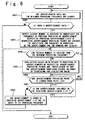
- Fig. 8 is a diagrammatic view illustrating the third embodiment of the present invention.
- the third embodiment of the present invention is a recording medium 220 for recording a program through which the respective procedures of the second embodiment of the present invention are executed by a computer 200 (for example, the information selecting apparatus 100 targeted for the car user).
- the program is loaded from the recording medium 220 to the computer 200, and executed.
- the third embodiment of the present invention is the recording medium 220 for recording the program through which the computer 200 executes the following procedures:
- the first effect of the present invention lies in the reduction in the uncomfortable feeling caused by the advertisement providing, for the car user.
- the advertisement is extracted by considering the taste of the user, the running time, the position of the car, and the location of the advertised shop, for the car user.
- the second effect of the present invention lies in the satisfaction with the request of the sponsor with regard to the number of times of providing.
- the providing list of the advertisement is generated by considering the minimum providing frequency of advertisements required by the sponsor of the advertisement.
Landscapes
- Business, Economics & Management (AREA)
- Strategic Management (AREA)
- Engineering & Computer Science (AREA)
- Accounting & Taxation (AREA)
- Development Economics (AREA)
- Finance (AREA)
- Economics (AREA)
- Game Theory and Decision Science (AREA)
- Entrepreneurship & Innovation (AREA)
- Marketing (AREA)
- Physics & Mathematics (AREA)
- General Business, Economics & Management (AREA)
- General Physics & Mathematics (AREA)
- Theoretical Computer Science (AREA)
- Navigation (AREA)
- Management, Administration, Business Operations System, And Electronic Commerce (AREA)
- Information Retrieval, Db Structures And Fs Structures Therefor (AREA)
- Traffic Control Systems (AREA)
Applications Claiming Priority (2)
| Application Number | Priority Date | Filing Date | Title |
|---|---|---|---|
| JP31438099A JP3573031B2 (ja) | 1999-11-04 | 1999-11-04 | 車利用者向け情報選択装置、情報選択方法、および記録媒体 |
| JP31438099 | 1999-11-04 |
Publications (2)
| Publication Number | Publication Date |
|---|---|
| EP1098262A2 true EP1098262A2 (de) | 2001-05-09 |
| EP1098262A3 EP1098262A3 (de) | 2004-03-17 |
Family
ID=18052653
Family Applications (1)
| Application Number | Title | Priority Date | Filing Date |
|---|---|---|---|
| EP00123927A Withdrawn EP1098262A3 (de) | 1999-11-04 | 2000-11-03 | Apparat und Verfahren zur Auswahl von auf Autofahrer abgezielten Informationen mit der Absicht Werbung auszuwählen unter Berücksichtigung des Geschmacks des Autofahrers, Laufzeit und Standort des Autos und Ort des angepriesenen Händlers, und Speichermedium |
Country Status (2)
| Country | Link |
|---|---|
| EP (1) | EP1098262A3 (de) |
| JP (1) | JP3573031B2 (de) |
Cited By (1)
| Publication number | Priority date | Publication date | Assignee | Title |
|---|---|---|---|---|
| EP2199967A1 (de) * | 2008-12-08 | 2010-06-23 | Electronics and Telecommunications Research Institute | Vorrichtung zur Bereitstellung digitaler Inhalte mittels DMB-Kanal und Verfahren dafür |
Families Citing this family (7)
| Publication number | Priority date | Publication date | Assignee | Title |
|---|---|---|---|---|
| JP5233655B2 (ja) * | 2008-12-22 | 2013-07-10 | 日本電気株式会社 | 追従対象車検索システム、追従対象車検索方法および追従対象車検索用プログラム |
| JP4920718B2 (ja) * | 2009-04-27 | 2012-04-18 | ヤフー株式会社 | 広告表示システム及び広告表示方法 |
| JP2013149073A (ja) * | 2012-01-19 | 2013-08-01 | Toshiba Corp | 拡張現実装置、方法、及びプログラム |
| JP6132531B2 (ja) * | 2012-12-06 | 2017-05-24 | 日本ユニシス株式会社 | 情報提供装置および情報提供用プログラム |
| JP6362647B2 (ja) * | 2016-08-12 | 2018-07-25 | ヤフー株式会社 | 経路案内方法、経路案内装置、および経路案内プログラム |
| JP6625508B2 (ja) * | 2016-10-24 | 2019-12-25 | クラリオン株式会社 | 制御装置、制御システム |
| JP6490155B2 (ja) * | 2017-07-05 | 2019-03-27 | ヤフー株式会社 | ナビゲーションプログラム、広告管理サーバ、および広告管理方法 |
Family Cites Families (5)
| Publication number | Priority date | Publication date | Assignee | Title |
|---|---|---|---|---|
| JPH1030932A (ja) * | 1996-07-16 | 1998-02-03 | Zanavy Informatics:Kk | 車載用ナビゲーション装置 |
| JPH10319840A (ja) * | 1997-05-19 | 1998-12-04 | Sumitomo Electric Ind Ltd | 経路関連情報提供システム及び車載情報通信装置 |
| JPH1196451A (ja) * | 1997-09-17 | 1999-04-09 | Fuji Electric Co Ltd | 自動販売機の広告出力装置、及びスケジューリング方法 |
| JP3427707B2 (ja) * | 1997-12-05 | 2003-07-22 | 三菱電機株式会社 | 車両用情報配信装置 |
| JPH11296537A (ja) * | 1998-04-09 | 1999-10-29 | Hitachi Ltd | 情報検索システム、情報提供装置、情報検索端末装置、情報検索方法および記憶媒体 |
-
1999
- 1999-11-04 JP JP31438099A patent/JP3573031B2/ja not_active Expired - Fee Related
-
2000
- 2000-11-03 EP EP00123927A patent/EP1098262A3/de not_active Withdrawn
Non-Patent Citations (1)
| Title |
|---|
| No Search * |
Cited By (1)
| Publication number | Priority date | Publication date | Assignee | Title |
|---|---|---|---|---|
| EP2199967A1 (de) * | 2008-12-08 | 2010-06-23 | Electronics and Telecommunications Research Institute | Vorrichtung zur Bereitstellung digitaler Inhalte mittels DMB-Kanal und Verfahren dafür |
Also Published As
| Publication number | Publication date |
|---|---|
| EP1098262A3 (de) | 2004-03-17 |
| JP3573031B2 (ja) | 2004-10-06 |
| JP2001133276A (ja) | 2001-05-18 |
Similar Documents
| Publication | Publication Date | Title |
|---|---|---|
| US7640104B2 (en) | Vehicle navigation system and method for displaying waypoint information | |
| US7103368B2 (en) | Apparatus and method for delivery of advertisement information to mobile units | |
| EP0772856B1 (de) | Zweikanal-werbung mit fahrzeugortungsreferenz | |
| US9261376B2 (en) | Route computation based on route-oriented vehicle trajectories | |
| JP4910000B2 (ja) | リスティング広告送出装置及び方法 | |
| US20020107027A1 (en) | Targeted advertising for commuters with mobile IP terminals | |
| US7636629B2 (en) | Map information display apparatus and method thereof | |
| US20100321206A1 (en) | Road-vehicle communication system | |
| KR20030049538A (ko) | 이동통신 단말기를 이용한 지능형 광고시스템 및 광고방법 | |
| US20100030645A1 (en) | Advertisement distributing system, advertising distributing server, advertisement distributing method, program and recording medium | |
| EP1635143A2 (de) | Navigationsgerät, Verfahren zur Fahrtrichtungsführung, und Navigationssystem | |
| US20100262486A1 (en) | Network Advertisement Transmission Device and Method | |
| CN107421555B (zh) | 确定导航路径的方法和装置 | |
| WO2009052245A2 (en) | Method and apparatus for geographic specific search results including a map-based display | |
| DE102012203433A1 (de) | In Erfahrung bringen der Fahrerdemographie aus Fahrzeugspurdaten | |
| US20060106531A1 (en) | Information gathering systems, methods, and programs | |
| JP6638579B2 (ja) | 情報提供装置及びコンピュータプログラム | |
| EP1098262A2 (de) | Apparat und Verfahren zur Auswahl von auf Autofahrer abgezielten Informationen mit der Absicht Werbung auszuwählen unter Berücksichtigung des Geschmacks des Autofahrers, Laufzeit und Standort des Autos und Ort des angepriesenen Händlers, und Speichermedium | |
| JP2005208943A (ja) | サービス候補提供システム及びユーザ側通信装置並びにサービス候補提供サーバ | |
| EP2104835B1 (de) | Verfahren zur erfassung des abdeckzustands gemäss geschwindigkeit und system zur bereitstellung von verkehrsinformationen unter verwendung selbigen verfahrens | |
| EP1100219A2 (de) | Verfahren und Vorrichtung zur Übertragung von fahrwegabhängigen Rundfunkprogrammen auf Anfrage an einen Autofahrer, sowie Speichermedium zur Speicherung eines Programms für die Durchführung dieses Verfahrens | |
| EP2096595A2 (de) | Unbestimmtheitsidentifizierung für aktivitätsbasierte Werbung | |
| JP2004301547A (ja) | ナビゲーション装置 | |
| US9702720B2 (en) | Navigation server for determining location-based advertisement effectiveness | |
| JP7117775B2 (ja) | 情報処理装置、情報処理システム、情報処理方法、及びプログラム |
Legal Events
| Date | Code | Title | Description |
|---|---|---|---|
| PUAI | Public reference made under article 153(3) epc to a published international application that has entered the european phase |
Free format text: ORIGINAL CODE: 0009012 |
|
| AK | Designated contracting states |
Kind code of ref document: A2 Designated state(s): AT BE CH CY DE DK ES FI FR GB GR IE IT LI LU MC NL PT SE TR |
|
| AX | Request for extension of the european patent |
Free format text: AL;LT;LV;MK;RO;SI |
|
| PUAL | Search report despatched |
Free format text: ORIGINAL CODE: 0009013 |
|
| AK | Designated contracting states |
Kind code of ref document: A3 Designated state(s): AT BE CH CY DE DK ES FI FR GB GR IE IT LI LU MC NL PT SE TR |
|
| AX | Request for extension of the european patent |
Extension state: AL LT LV MK RO SI |
|
| AKX | Designation fees paid | ||
| REG | Reference to a national code |
Ref country code: DE Ref legal event code: 8566 |
|
| STAA | Information on the status of an ep patent application or granted ep patent |
Free format text: STATUS: THE APPLICATION IS DEEMED TO BE WITHDRAWN |
|
| 18D | Application deemed to be withdrawn |
Effective date: 20040918 |