EP1080119B1 - Emulsible polyolefin wax - Google Patents
Emulsible polyolefin wax Download PDFInfo
- Publication number
- EP1080119B1 EP1080119B1 EP99919892A EP99919892A EP1080119B1 EP 1080119 B1 EP1080119 B1 EP 1080119B1 EP 99919892 A EP99919892 A EP 99919892A EP 99919892 A EP99919892 A EP 99919892A EP 1080119 B1 EP1080119 B1 EP 1080119B1
- Authority
- EP
- European Patent Office
- Prior art keywords
- polyolefin wax
- emulsible
- wax
- emulsion
- starting material
- Prior art date
- Legal status (The legal status is an assumption and is not a legal conclusion. Google has not performed a legal analysis and makes no representation as to the accuracy of the status listed.)
- Expired - Lifetime
Links
- 229920000098 polyolefin Polymers 0.000 title claims abstract description 82
- 239000000839 emulsion Substances 0.000 claims abstract description 61
- 239000000155 melt Substances 0.000 claims abstract description 10
- 238000002834 transmittance Methods 0.000 claims abstract description 8
- 239000012736 aqueous medium Substances 0.000 claims abstract description 6
- 239000007858 starting material Substances 0.000 claims description 43
- FPYJFEHAWHCUMM-UHFFFAOYSA-N maleic anhydride Chemical compound O=C1OC(=O)C=C1 FPYJFEHAWHCUMM-UHFFFAOYSA-N 0.000 claims description 34
- 238000006243 chemical reaction Methods 0.000 claims description 24
- 238000000034 method Methods 0.000 claims description 20
- -1 polypropylene Polymers 0.000 claims description 20
- 239000000203 mixture Substances 0.000 claims description 18
- 239000000126 substance Substances 0.000 claims description 17
- 239000004743 Polypropylene Substances 0.000 claims description 16
- 229920001155 polypropylene Polymers 0.000 claims description 15
- 150000003254 radicals Chemical class 0.000 claims description 14
- 238000007127 saponification reaction Methods 0.000 claims description 11
- XLYOFNOQVPJJNP-UHFFFAOYSA-N water Substances O XLYOFNOQVPJJNP-UHFFFAOYSA-N 0.000 claims description 8
- 239000004094 surface-active agent Substances 0.000 claims description 7
- 239000003999 initiator Substances 0.000 claims description 6
- 238000002156 mixing Methods 0.000 claims description 6
- 229920001577 copolymer Polymers 0.000 claims description 5
- 150000001451 organic peroxides Chemical group 0.000 claims 2
- 238000010923 batch production Methods 0.000 claims 1
- 239000001993 wax Substances 0.000 description 98
- KWYUFKZDYYNOTN-UHFFFAOYSA-M Potassium hydroxide Chemical compound [OH-].[K+] KWYUFKZDYYNOTN-UHFFFAOYSA-M 0.000 description 33
- 150000001875 compounds Chemical class 0.000 description 8
- 239000002245 particle Substances 0.000 description 8
- 238000007306 functionalization reaction Methods 0.000 description 7
- 239000000047 product Substances 0.000 description 7
- IJGRMHOSHXDMSA-UHFFFAOYSA-N Atomic nitrogen Chemical compound N#N IJGRMHOSHXDMSA-UHFFFAOYSA-N 0.000 description 5
- LSXWFXONGKSEMY-UHFFFAOYSA-N di-tert-butyl peroxide Chemical compound CC(C)(C)OOC(C)(C)C LSXWFXONGKSEMY-UHFFFAOYSA-N 0.000 description 5
- 239000007787 solid Substances 0.000 description 5
- 239000007844 bleaching agent Substances 0.000 description 4
- 239000003054 catalyst Substances 0.000 description 4
- 238000000576 coating method Methods 0.000 description 4
- 238000004945 emulsification Methods 0.000 description 4
- 150000002978 peroxides Chemical class 0.000 description 4
- 238000006116 polymerization reaction Methods 0.000 description 4
- 238000013459 approach Methods 0.000 description 3
- 239000011248 coating agent Substances 0.000 description 3
- 230000001419 dependent effect Effects 0.000 description 3
- 238000009472 formulation Methods 0.000 description 3
- 238000002844 melting Methods 0.000 description 3
- 230000008018 melting Effects 0.000 description 3
- 230000000704 physical effect Effects 0.000 description 3
- 239000011541 reaction mixture Substances 0.000 description 3
- VGGSQFUCUMXWEO-UHFFFAOYSA-N Ethene Chemical compound C=C VGGSQFUCUMXWEO-UHFFFAOYSA-N 0.000 description 2
- 239000005977 Ethylene Substances 0.000 description 2
- PPBRXRYQALVLMV-UHFFFAOYSA-N Styrene Chemical compound C=CC1=CC=CC=C1 PPBRXRYQALVLMV-UHFFFAOYSA-N 0.000 description 2
- 230000015572 biosynthetic process Effects 0.000 description 2
- 239000006227 byproduct Substances 0.000 description 2
- 239000003795 chemical substances by application Substances 0.000 description 2
- 239000003085 diluting agent Substances 0.000 description 2
- 238000005227 gel permeation chromatography Methods 0.000 description 2
- 239000000463 material Substances 0.000 description 2
- 229910052757 nitrogen Inorganic materials 0.000 description 2
- 239000004014 plasticizer Substances 0.000 description 2
- 229920000058 polyacrylate Polymers 0.000 description 2
- 230000035484 reaction time Effects 0.000 description 2
- 239000000758 substrate Substances 0.000 description 2
- 239000004711 α-olefin Substances 0.000 description 2
- XSZYESUNPWGWFQ-UHFFFAOYSA-N 1-(2-hydroperoxypropan-2-yl)-4-methylcyclohexane Chemical compound CC1CCC(C(C)(C)OO)CC1 XSZYESUNPWGWFQ-UHFFFAOYSA-N 0.000 description 1
- PAOHAQSLJSMLAT-UHFFFAOYSA-N 1-butylperoxybutane Chemical class CCCCOOCCCC PAOHAQSLJSMLAT-UHFFFAOYSA-N 0.000 description 1
- DMWVYCCGCQPJEA-UHFFFAOYSA-N 2,5-bis(tert-butylperoxy)-2,5-dimethylhexane Chemical compound CC(C)(C)OOC(C)(C)CCC(C)(C)OOC(C)(C)C DMWVYCCGCQPJEA-UHFFFAOYSA-N 0.000 description 1
- OZAIFHULBGXAKX-UHFFFAOYSA-N 2-(2-cyanopropan-2-yldiazenyl)-2-methylpropanenitrile Chemical compound N#CC(C)(C)N=NC(C)(C)C#N OZAIFHULBGXAKX-UHFFFAOYSA-N 0.000 description 1
- ZSLUVFAKFWKJRC-IGMARMGPSA-N 232Th Chemical compound [232Th] ZSLUVFAKFWKJRC-IGMARMGPSA-N 0.000 description 1
- FRIBMENBGGCKPD-UHFFFAOYSA-N 3-(2,3-dimethoxyphenyl)prop-2-enal Chemical compound COC1=CC=CC(C=CC=O)=C1OC FRIBMENBGGCKPD-UHFFFAOYSA-N 0.000 description 1
- 239000004698 Polyethylene Substances 0.000 description 1
- OFOBLEOULBTSOW-UHFFFAOYSA-N Propanedioic acid Natural products OC(=O)CC(O)=O OFOBLEOULBTSOW-UHFFFAOYSA-N 0.000 description 1
- 229910052776 Thorium Inorganic materials 0.000 description 1
- 229910052770 Uranium Inorganic materials 0.000 description 1
- 230000002378 acidificating effect Effects 0.000 description 1
- NIXOWILDQLNWCW-UHFFFAOYSA-N acrylic acid group Chemical group C(C=C)(=O)O NIXOWILDQLNWCW-UHFFFAOYSA-N 0.000 description 1
- 238000013019 agitation Methods 0.000 description 1
- 150000001298 alcohols Chemical class 0.000 description 1
- 150000001336 alkenes Chemical class 0.000 description 1
- 239000007864 aqueous solution Substances 0.000 description 1
- QVGXLLKOCUKJST-UHFFFAOYSA-N atomic oxygen Chemical compound [O] QVGXLLKOCUKJST-UHFFFAOYSA-N 0.000 description 1
- 229910052799 carbon Inorganic materials 0.000 description 1
- 125000004432 carbon atom Chemical group C* 0.000 description 1
- 238000002144 chemical decomposition reaction Methods 0.000 description 1
- 238000001311 chemical methods and process Methods 0.000 description 1
- 239000003153 chemical reaction reagent Substances 0.000 description 1
- 239000010941 cobalt Substances 0.000 description 1
- 229910017052 cobalt Inorganic materials 0.000 description 1
- GUTLYIVDDKVIGB-UHFFFAOYSA-N cobalt atom Chemical compound [Co] GUTLYIVDDKVIGB-UHFFFAOYSA-N 0.000 description 1
- 239000012969 di-tertiary-butyl peroxide Substances 0.000 description 1
- 238000010790 dilution Methods 0.000 description 1
- 239000012895 dilution Substances 0.000 description 1
- 229910001873 dinitrogen Inorganic materials 0.000 description 1
- 239000002270 dispersing agent Substances 0.000 description 1
- 230000002708 enhancing effect Effects 0.000 description 1
- LYCAIKOWRPUZTN-UHFFFAOYSA-N ethylene glycol Natural products OCCO LYCAIKOWRPUZTN-UHFFFAOYSA-N 0.000 description 1
- 238000002474 experimental method Methods 0.000 description 1
- 239000007789 gas Substances 0.000 description 1
- 239000011521 glass Substances 0.000 description 1
- 238000010438 heat treatment Methods 0.000 description 1
- WGCNASOHLSPBMP-UHFFFAOYSA-N hydroxyacetaldehyde Natural products OCC=O WGCNASOHLSPBMP-UHFFFAOYSA-N 0.000 description 1
- 239000011261 inert gas Substances 0.000 description 1
- 239000004615 ingredient Substances 0.000 description 1
- 239000007788 liquid Substances 0.000 description 1
- 239000011976 maleic acid Substances 0.000 description 1
- 239000012764 mineral filler Substances 0.000 description 1
- 238000012544 monitoring process Methods 0.000 description 1
- 239000000178 monomer Substances 0.000 description 1
- 230000007935 neutral effect Effects 0.000 description 1
- 238000005457 optimization Methods 0.000 description 1
- 239000001301 oxygen Substances 0.000 description 1
- 229910052760 oxygen Inorganic materials 0.000 description 1
- 229930004008 p-menthane Natural products 0.000 description 1
- 238000011056 performance test Methods 0.000 description 1
- 239000000049 pigment Substances 0.000 description 1
- 239000004033 plastic Substances 0.000 description 1
- 229920003023 plastic Polymers 0.000 description 1
- 229920000573 polyethylene Polymers 0.000 description 1
- 229920000642 polymer Polymers 0.000 description 1
- 229920005606 polypropylene copolymer Polymers 0.000 description 1
- 238000012545 processing Methods 0.000 description 1
- 230000001681 protective effect Effects 0.000 description 1
- 238000010926 purge Methods 0.000 description 1
- 239000000376 reactant Substances 0.000 description 1
- HRZFUMHJMZEROT-UHFFFAOYSA-L sodium disulfite Chemical compound [Na+].[Na+].[O-]S(=O)S([O-])(=O)=O HRZFUMHJMZEROT-UHFFFAOYSA-L 0.000 description 1
- 229940001584 sodium metabisulfite Drugs 0.000 description 1
- 235000010262 sodium metabisulphite Nutrition 0.000 description 1
- 238000000638 solvent extraction Methods 0.000 description 1
- 229920001909 styrene-acrylic polymer Polymers 0.000 description 1
- FBWNMEQMRUMQSO-UHFFFAOYSA-N tergitol NP-9 Chemical compound CCCCCCCCCC1=CC=C(OCCOCCOCCOCCOCCOCCOCCOCCOCCO)C=C1 FBWNMEQMRUMQSO-UHFFFAOYSA-N 0.000 description 1
- 150000003512 tertiary amines Chemical class 0.000 description 1
- CIHOLLKRGTVIJN-UHFFFAOYSA-N tert‐butyl hydroperoxide Chemical compound CC(C)(C)OO CIHOLLKRGTVIJN-UHFFFAOYSA-N 0.000 description 1
- 238000012360 testing method Methods 0.000 description 1
- VZCYOOQTPOCHFL-UHFFFAOYSA-N trans-butenedioic acid Natural products OC(=O)C=CC(O)=O VZCYOOQTPOCHFL-UHFFFAOYSA-N 0.000 description 1
- CFJYNSNXFXLKNS-UHFFFAOYSA-N trans-p-menthane Natural products CC(C)C1CCC(C)CC1 CFJYNSNXFXLKNS-UHFFFAOYSA-N 0.000 description 1
- DNYWZCXLKNTFFI-UHFFFAOYSA-N uranium Chemical compound [U][U][U][U][U][U][U][U][U][U][U][U][U][U][U][U][U][U][U][U][U][U][U][U][U][U][U][U][U][U][U][U][U][U][U][U][U][U][U][U][U][U][U][U][U][U][U][U][U][U][U][U][U][U][U][U][U][U][U][U][U][U][U][U][U][U][U][U][U][U][U][U][U][U][U][U][U][U][U][U][U][U][U][U][U][U][U][U][U][U][U][U][U][U][U][U][U][U][U][U][U][U][U][U][U][U][U][U][U][U][U][U][U][U] DNYWZCXLKNTFFI-UHFFFAOYSA-N 0.000 description 1
- 230000002087 whitening effect Effects 0.000 description 1
Images
Classifications
-
- C—CHEMISTRY; METALLURGY
- C08—ORGANIC MACROMOLECULAR COMPOUNDS; THEIR PREPARATION OR CHEMICAL WORKING-UP; COMPOSITIONS BASED THEREON
- C08F—MACROMOLECULAR COMPOUNDS OBTAINED BY REACTIONS ONLY INVOLVING CARBON-TO-CARBON UNSATURATED BONDS
- C08F110/00—Homopolymers of unsaturated aliphatic hydrocarbons having only one carbon-to-carbon double bond
- C08F110/04—Monomers containing three or four carbon atoms
- C08F110/06—Propene
-
- C—CHEMISTRY; METALLURGY
- C08—ORGANIC MACROMOLECULAR COMPOUNDS; THEIR PREPARATION OR CHEMICAL WORKING-UP; COMPOSITIONS BASED THEREON
- C08F—MACROMOLECULAR COMPOUNDS OBTAINED BY REACTIONS ONLY INVOLVING CARBON-TO-CARBON UNSATURATED BONDS
- C08F255/00—Macromolecular compounds obtained by polymerising monomers on to polymers of hydrocarbons as defined in group C08F10/00
- C08F255/02—Macromolecular compounds obtained by polymerising monomers on to polymers of hydrocarbons as defined in group C08F10/00 on to polymers of olefins having two or three carbon atoms
- C08F255/023—On to modified polymers, e.g. chlorinated polymers
-
- C—CHEMISTRY; METALLURGY
- C08—ORGANIC MACROMOLECULAR COMPOUNDS; THEIR PREPARATION OR CHEMICAL WORKING-UP; COMPOSITIONS BASED THEREON
- C08F—MACROMOLECULAR COMPOUNDS OBTAINED BY REACTIONS ONLY INVOLVING CARBON-TO-CARBON UNSATURATED BONDS
- C08F210/00—Copolymers of unsaturated aliphatic hydrocarbons having only one carbon-to-carbon double bond
- C08F210/16—Copolymers of ethene with alpha-alkenes, e.g. EP rubbers
-
- C—CHEMISTRY; METALLURGY
- C08—ORGANIC MACROMOLECULAR COMPOUNDS; THEIR PREPARATION OR CHEMICAL WORKING-UP; COMPOSITIONS BASED THEREON
- C08F—MACROMOLECULAR COMPOUNDS OBTAINED BY REACTIONS ONLY INVOLVING CARBON-TO-CARBON UNSATURATED BONDS
- C08F8/00—Chemical modification by after-treatment
- C08F8/46—Reaction with unsaturated dicarboxylic acids or anhydrides thereof, e.g. maleinisation
-
- C—CHEMISTRY; METALLURGY
- C08—ORGANIC MACROMOLECULAR COMPOUNDS; THEIR PREPARATION OR CHEMICAL WORKING-UP; COMPOSITIONS BASED THEREON
- C08J—WORKING-UP; GENERAL PROCESSES OF COMPOUNDING; AFTER-TREATMENT NOT COVERED BY SUBCLASSES C08B, C08C, C08F, C08G or C08H
- C08J3/00—Processes of treating or compounding macromolecular substances
- C08J3/02—Making solutions, dispersions, lattices or gels by other methods than by solution, emulsion or suspension polymerisation techniques
- C08J3/03—Making solutions, dispersions, lattices or gels by other methods than by solution, emulsion or suspension polymerisation techniques in aqueous media
- C08J3/05—Making solutions, dispersions, lattices or gels by other methods than by solution, emulsion or suspension polymerisation techniques in aqueous media from solid polymers
Definitions
- the present invention relates to a functionalized polyolefin wax. More specifically, this invention relates to an emulsible polyolefin wax from which high clarity emulsions can be prepared.
- Emulsible polyolefin waxes are well known and are commonly used in glossy, protective substrates such as floor polish and the like.
- the term "wax” refers to a substance having the following properties: (a) solid at room temperature; (b) low melting point; (c) solidifies when cooled; (d) low viscosity at just above the melting point; and (e) insoluble in water.
- a "polyolefin wax” as used herein is a substance having the aforementioned properties and is prepared either from thermal or chemical degradation of a polyolefin or from partial polymerization of olefins.
- the polyolefin wax is emulsified.
- the wax must be functionalized to make it emulsible in an aqueous medium.
- the polyolefin wax emulsion be clear and colorless so as not to obscure or otherwise tinge the surface which it coats and protects.
- US-A-4613679 describes emulsible polyolefin waxes prepared by reacting low molecular weight homo- and copolymers containing at least one ⁇ -olefin having at least three carbon atoms with a maleic acid diester, in the presence of a free radical source.
- the emulsiable polyolefin waxes so-formed have a Gardner colour of less than 2, and a saponification number of at least 20.
- the waxes form nonionic emulsions which are useful in floor polishes.
- US-A-3481910 describes emulsible polyolefins prepared by reacting polypropylene and higher ⁇ -olefins with an unsaturated polycarboxylic compound at temperatures above 200°C, in the absence of oxygen or catalyst.
- the emulsible polyolefins so-formed have a melt viscosity of 250 to 5000 cps at 190°C, and a saponification number of at least 6, preferably 7 to 14.
- WO-A-9404577 describes an emulsible polypropylene wax having a melt viscosity from 1000 to 5000 cps at 190°C.
- the wax is formed by reacting a thermally-degraded polypropylene wax having a melt viscosity of below 1000 cps with maleic anhydride, in the presence of a free radical source.
- the wax so-formed is useful in floor polishes.
- the present invention provides for a highly-emulsible, functionalized polyolefin wax as defined in claim 1, which has exceptionally high emulsion clarity. More specifically, an approach has been developed to functionalize a commercially-available, exceptionally low color polyolefin wax starting material without substantially altering its aesthetic properties.
- the highly emulsible polyolefin wax produced not only forms high clarity emulsions for a variety of uses, but also acts as a carrier to emulsify other more difficult to emulsify substances.
- One aspect of the present invention is the provision of the above-described a high-clarity, emulsible polyolefin wax (herein “emulsible polyolefin wax”).
- Another aspect of the invention is the provision of a process as defined in claim 6, in which a polyolefin wax starting material (herein “starting material”) is functionalized to produce the emulsible polyolefin wax above.
- starting material a polyolefin wax starting material
- the process comprises reacting a starting material having a Gardner color of no greater than about two with maleic anhydride.
- the process comprises blending the starting material with a second polyolefin wax having a molecular weight greater than that of the starting material, and functionalizing the blend by slowly adding maleic anhydride to an agitated reactor charged with the blend.
- Yet another aspect of the present invention is the provision of an emulsion comprising the emulsible polyolefin wax above, the emulsion being as defined in claim 9.
- Still another aspect of the invention is the provision of a floor polish comprising the emulsion above.
- Yet still another aspect of the invention is a method of using the emulsible polyolefin wax to emulsify substances.
- the method comprises mixing the functionalized polyolefin with a second substance, which is not ordinarily emulsible, in an aqueous medium under conditions sufficient to form an emulsion.
- the above aspects of the present invention relate to an emulsible polyolefin wax which has adequate functionality to be emulsible in water and having relatively high emulsion clarity and low color compared to prior art waxes.
- the emulsible polyolefin wax has an emulsion % transmittance at 525 nm with a 20 mm light pathlength of at least 35%, preferably at least 40%, and even more preferably at least 50%.
- the wax has an emulsion % transmittance of at least 55%.
- the emulsible polyolefin wax of the present invention has a Gardner color index of no greater than 9 and, more preferably, it is no greater than 8. In the most preferred embodiment, the wax has a Gardner color of no greater than 7.
- the emulsible polyolefin wax of the present invention has a Klett number of preferably no greater than 75, more preferably no greater than 50, and even more preferably no greater than 30.
- the emulsible polyolefin wax should have sufficient functionality to be emulsible in an aqueous medium.
- the type and degree of functionalization may vary according to the application and desired ease of emulsification. That is, although more functionalized waxes tend to be more readily emulsified, they also tend to increase in color and drop in molecular weight (Mw) and emulsion clarity. The degree of functionalization therefore is an optimization of color, emulsion clarity, Mw and the ease of emulsification.
- the emulsible polyolefin wax has a saponification number from 20 to 150 KOH/g, and preferably from about 40 to about 85 KOH/g.
- the emulsible polyolefin wax of the present invention should have a melt point/peak (T m ) such that it is a solid at room temperature but melts at a temperature which is convenient for processing.
- T m melt point/peak
- the wax has a T m of 50 to 200°C, more preferably, from 100 to 150°C, and even more preferably from 130 to 145°C.
- the viscosity and Mw of the present invention can vary depending upon the desired properties as required by the application.
- Mw is based on gel permeation chromatography (GPC) unless otherwise indicated. It has been found that satisfactory results have been obtained in a variety of application using an emulsible polyolefin wax having a Mw of no greater than 50,000 and a viscosity of less than 1,000 cps at 190°C.
- the wax has a Mw of no greater than 25,000. More preferably, the wax has a Mw of 10,000 to 20,000 and a viscosity of 200 to 800 cps at 190°C.
- a highly preferred embodiment of the emulsible polyolefin wax has the following physical properties: Mw about 14,000; Mz about 36,000; Mn about 3,100; saponification number 75 to 85 KOH/g; Gardner color of below 7 to 8; viscosity 300 to 800 cps @ 190°C; drop point 142-148°C; melt point about 133 Tm DSC °C; and hardness 0.1 to 0.3 DMM.
- the emulsible polyolefin wax of the present invention is prepared by functionalizing a starting material selected from polypropylene or ethylene-propylene copolymer with maleic anhydride without substantially altering the aesthetic properties of the starting material. Therefore, the properties of the functionalized wax, other than its ability to emulsify, are, in large part, dependent upon the polyolefin wax starting material. In other words, it is important that the starting material have excellent color and clarity.
- the starting material has a Gardner color of no more than 2, and preferably no more than 1.
- the concentration by weight of ethylene is less than 10%, and more preferably less than 2%.
- the starting material of the present invention is commercially available, for example, through AlliedSignal (Morristown, NJ) under the name ACX1089.
- a highly preferred starting material has the following physical properties: Mw about 7,500; Mz about 11,200; Mn about 3,000; and Gardner color of below 1.
- the starting material is functionalized with maleic anhydride, enabling the wax to be emulsified.
- Maleic anhydride is commercially available, for example, though Monsanto Company (St. Louis, NO) as Maleic Anhydride, and Huntsman Petrochemical Corporation (Chesterfield, MO) as Manbri Maleic Anhydride.
- the amount of maleic anhydride used in functionalizing the polyolefin wax can vary from 0.1% to 25 wt % of the polyolefin wax, and is preferably 5 to 15 wt %, more preferably 8 to 12 wt %, and most preferably about 10 wt %. Amounts of maleic anhydride much over 10 wt % tend to cause the color of the resulting functionalized polyolefin wax to be dark, whereas lower amounts tend to not adequately react with the polypropylene wax to provide a clear emulsion or tend to react very slowly.
- the maleic anhydride In addition to monitoring the amount of maleic anhydride added to the reaction, it is important to monitor the concentration of unreacted maleic anhydride in the reaction. That is, in concentration, the maleic anhydride tends to undergo undesirable homopolymerization polymerization.
- the polymerization product is highly objectionable since it has a dark color, and tends to become dispersed in the functionalized polyolefin wax.
- the process of the present invention minimizes the concentration of maleic anhydride through several approaches.
- the maleic anhydride should be added slowly to a much larger mass of polyolefin starting material.
- the larger mass of starting material is believed to serve as a diluent to the unreacted maleic anhydride, minimizing its concentration, and thereby minimizing its polymerization.
- superior results are achieved when the maleic anhydride is fed slowly to the reaction. It is generally preferred to feed the maleic anhydride as slowly as economically practical.
- the feed rate is preferably 1 to 5 wt % of starting material per hour, more preferably 2 to 4 wt % of starting material per hour, and even more preferably about 3 wt % of starting material per hour.
- concentration of unreacted maleic anhydride is to ensure that there are no concentrated "pockets" of unreacted polycarboxylic compound in the reaction mass.
- reaction mass refers to the totality of the materials in the reactor including unreacted starting material, unreacted maleic anhydride, initiators, catalysts, reagents, diluents, product and by-products. To ensure a homogeneous reaction mass, it is important that the reaction mass be mixed uniformly in an agitated reactor. An impeller type agitator is preferred.
- reaction duration is dependent upon the feed rate and the desired degree of functionalization. Generally, longer reaction times are preferred to minimize feed concentrations of polycarboxylic compound as discussed above. Reaction times, however, are constrained in length by economic/productivity considerations. It has been found that adequate product/productivity is achieved with a reaction period of 0.5 to 10 hours, preferably 1 to 5 hours, and more preferably 2 to 4 hours.
- Functionalization according to the present invention is conducted at a temperature above the melting point of the starting material but no greater than about 200°C.
- the temperature is dependent upon the type of polyolefin and class of free radical initiators. At temperatures much below about 150°C, the starting material will not be in the molten form and therefore will not adequately react with the maleic anhydride. However, at temperatures above about 200°C, the ease of emulsification and melt viscosity of the resulting emulsible polyolefin wax is not as high as preferred. Therefore, reaction temperature is generally between 150 and 200°C, and preferably between 180 and 190°C. At the aforesaid temperatures, the polycarboxylic compound is a gas or liquid with little solubility in the starting material.
- the reaction pressure depends, among other things, upon the reaction temperature and desired rate of reaction. Generally, the reaction is conducted under a pressures preferably from 5 to 100 psi, more preferably from 2 to 25 psi, and most preferably at around atmospheric. Reactions conducted at or around atmospheric pressure avoid expensive high pressure equipment.
- Enhancing free radical formation is known in the art and includes, for example, heating the reaction, or, preferably, employing a free radical source.
- Suitable free radical sources include, for example, dialkyl peroxides, tertiary butyl hydroperoxide, cumene hydroperoxide, p-menthane peroxide, p-menthane hydroperoxide or axo compounds, such as azobis (isobutyronitrile), or irradiation sources.
- Suitable irradiation sources include, for example, those from cobalt, uranium, thorium sources, and the like and ultraviolet light.
- the preferred free radical sources are the peroxides with the butyl peroxides being more preferred.
- the most preferred peroxide due to availability and suitable good results obtained thereby, is ditertiary butyl peroxide (di-t-butyl peroxide).
- di-t-butyl peroxide ditertiary butyl peroxide
- These compounds are commercially available through, for example, Elf Atochem as Lupersol 101 or Di-t-Butyl Peroxide, and Akzo Nobel Chemicals Inc. as Trigonox B.
- the amount of peroxide or free radical agent used is generally quite low, being of the order of 0.01 to 5 wt % based on the starting material, preferably 0.1 to 3 wt % with 0.75 to 1.25 wt % being most preferred. Amounts much 5 wt % are not needed for good properties whereas amounts below 0.01 wt % provide reactions that are too slow and incomplete.
- the free radical initiator be added to the reaction mass slowly.
- the free radical initiator is added to the reaction at a rate of preferably 0.01 to 3 wt % of the starting material per hour, more preferably 0.1 to 1 wt % of the starting material per hour, and even more preferably about 0.3 wt % of the starting material per hour.
- the functionalization process can be conducted either in a batchwise or continuous manner, however, batchwise reactions are generally preferred due to reproducibility, and superior product quality.
- the unreacted maleic anhydride can be separated from the reaction mixture by purging the reaction mixture with an inert gas, such as nitrogen, while the reaction mixture is at the reaction temperature. After the unreacted maleic anhydride has been removed, the functionalized polypropylene wax can be further purified by a vacuum stripping or solvent extraction.
- the starting material as disclosed herein produces an emulsible polyolefin wax having excellent clarity and color
- the present invention provides for the blending of at least a second polyolefin wax to the starting material, and then functionalizing the blend thereof accordingly.
- the second polyolefin wax preferably has a Mw higher than that of the starting material even though its clarity and color may be less. This way, the user can blend the waxes together to optimize clarity and toughness of the resulting functionalized blend.
- Waxes having higher Mw than the starting material of the present invention are well known and many will be apparent to one skilled in the art. It has been found though that good results have been obtained by blending ACX1089 with ACX1172 (also available through AlliedSignal). The mixing ratios of the two waxes can vary considerably depending upon the properties desired. Suitable results, however, have been obtained with an ACX1089 to ACX1172 weight ratio of 20:80 to 80:20, with a 50:50 ratio being more preferred.
- a highly preferred embodiment of the functionalized blend of polyolefin waxes has the following properties: Mw about 20,600; Mz about 41,700; Mn about 4,200; saponification number 42 to 44 KOH/g; Gardner color of below 3 to 6; viscosity about 1,000 cps @ 190°C; drop point about 150°C; meit point about 138 Tm DSC °C; and hardness 0.1 to 0.3 DMM.
- the emulsible polyolefin wax produced according to the present invention are more readily formed into emulsions than traditional waxes. More specifically, it has been found that the emulsible polyolefin wax can be emulsified at lower temperatures than conventional used.
- the emulsion temperature is preferably between 140 and 190° C, more preferably between 150 and 175 ° C with a temperature of 160 to 170° C being most preferred.
- the emulsion may be prepared at acidic, neutral or basic pH, it is preferred that the pH be between 7 and 12, preferably between 8 and 11 with a pH between 9 and 10 being most preferred.
- the emulsions prepared according to the present invention contain 20 to 40 wt % of emulsible polyolefin wax, with a weight percent of functionalized polypropylene wax of about 25 to about 35 wt % being most preferred.
- the amount of surfactant, used in the emulsions of the present invention is 8 to 12 wt%.
- suitable surfactants include Igepal's CO series such as Igepal CO-630, and Igepal CO-710; nonylphenyl and ethoxylated alcohols such as Tergitol 15-S-9 and Tergitol 15-S-12.
- the amount of water generally varies depending upon the desired concentration of the emulsion, but is in the range 60 to 65 wt %.
- a base is included in the emulsion to render the aqueous solution basic, and is typically selected from standard bases such as tertiary amines and potassium hydroxide.
- the amount of base is in the range 3 to 4 wt %.
- the emulsion can also contain other ingredients such as bleaching agents or whitening agents such as sodium metabisulfite. Although the bleaching agent or whitening agent is generally not needed, minor amounts often do decrease the color.
- concentration of the bleaching agent may be as high as 1 wt %, but is preferably 0.1 to 0.5 wt %, and more preferably 0.2 to 0.4 wt %.
- emulsions of the present invention are wide spread and include, for example, coatings in specific applications such as in floor polishes where the emulsion imparts gloss, slip and mar resistance, in coating inorganic substrates such as glass or mineral fillers, or in "overprint” coating where high clarity is required, or as pigment dispersants in plastics.
- Floor waxes of the present invention comprise emulsions of the emulsible polyolefin wax as well as additional materials used in standard floor polishes such as coalescing aids, acrylic polymers, plasticizers and polyethylene waxes.
- coalescing aids such as glycol ethers can vary from 1 to 10 wt %, preferably 1 to 8 wt % with an amount of about 4 wt % being most preferred.
- the amount of acrylic polymers such as styrene acrylic copolymers can vary from 10 to 20 wt %, preferably 8 to 15 wt % with an amount of 6 to 12 wt % being most preferred.
- the plasticizers can vary from 1 to 5 wt % preferably 1 to 4 wt % with an amount of 1.5 to 3 wt % being most preferred.
- the amount of wax can vary from 0.4 to 3 wt %, preferably 0.5 to 2 wt % with an amount of 1.2 to 1.5 wt % being most preferred.
- the readily-emulsified, functionalized wax of the present invention can also act as a "carrier" to emulsify other substances which tend to be difficult or impossible to emulsify individually.
- the functionalized wax of the present invention can be mixed with at least a second substance in an aqueous medium under conditions described above for forming an emulsion.
- the second substance in this case usually has a higher Mw and imparts toughness to compositions of the emulsion.
- the emulsible polyolefin wax of the present invention can introduce into a composition one or more substances and thereby their properties, which otherwise have been unavailable due to the inability to emulsify the substances.
- This example shows the superior physical properties of emulsions of the present invention over emulsions prepared from prior art waxes.
- the thermally degraded polypropylenes (ACX1089, ACX1172, or blends thereof) from AlliedSignal, Inc., were melted at a temperature of 190° C., sparged with nitrogen gas, and agitated.
- the reactant monomer, maleic anhydride, and catalyst DTBP were fed into the reaction mass at very precise rates over a period of 1 hour with the catalyst feed rate exceeding the maleic anhydride feed rate by 25%.
- the products were sparged with nitrogen to remove by-products and discharged.
- the resultant products 597 and 1221 Waxes had a saponification number from 30 to 90 mg KOH/g depending on the amount of maleic anhydride charged, grafting efficiency typically 70-75%, viscosity 300 to 900 cps at 190° C., and Gardner color 8 or less.
- the MW of the products were typically less than 25,000 and Mw/Mn less than 5.
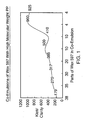
- Emulsions (b) of the above were made by adding 200 g of the polypropylene wax to a high pressure reactor, with "x" grams of KOH and “y” grams of surfactant (see table 1) and the appropriate amount of water for the solids desired. Designed experiments were used to specify x and y. A typical commercial, maleated PP, Epolene E43 from Eastman Chemical Comp., was used as the control. This is nearly equivalent in MW and viscosity to Wax 597 but made by a different chemical process with different feedstock. Emulsion clarity data is provided below in Table 1, and emulsion particle size data is provided below in Table 2.
- Emulsion Clarity Data Run gm KOH (a) gm Surf Agitation (RPM) Solids % pH Klett (c, d) %T (d) Wax 597 25 60 30 41 10 28 55 8.9 27 52.4 Wax 1221 11 60 300 40 8.7 55 32.5 E43 19 50 200 40 9.5 510 0.1 E43 25 60 300 40 12.8 380 0
Landscapes
- Chemical & Material Sciences (AREA)
- Health & Medical Sciences (AREA)
- Chemical Kinetics & Catalysis (AREA)
- Medicinal Chemistry (AREA)
- Polymers & Plastics (AREA)
- Organic Chemistry (AREA)
- Dispersion Chemistry (AREA)
- General Chemical & Material Sciences (AREA)
- Addition Polymer Or Copolymer, Post-Treatments, Or Chemical Modifications (AREA)
- Compositions Of Macromolecular Compounds (AREA)
- Paints Or Removers (AREA)
- Graft Or Block Polymers (AREA)
- Processes Of Treating Macromolecular Substances (AREA)
- Colloid Chemistry (AREA)
Applications Claiming Priority (3)
| Application Number | Priority Date | Filing Date | Title |
|---|---|---|---|
| US09/067,355 US6362280B1 (en) | 1998-04-27 | 1998-04-27 | Emulsible polyolefin wax |
| US67355 | 1998-04-27 | ||
| PCT/US1999/008531 WO1999055744A1 (en) | 1998-04-27 | 1999-04-16 | Emulsible polyolefin wax |
Publications (2)
| Publication Number | Publication Date |
|---|---|
| EP1080119A1 EP1080119A1 (en) | 2001-03-07 |
| EP1080119B1 true EP1080119B1 (en) | 2004-06-09 |
Family
ID=22075460
Family Applications (1)
| Application Number | Title | Priority Date | Filing Date |
|---|---|---|---|
| EP99919892A Expired - Lifetime EP1080119B1 (en) | 1998-04-27 | 1999-04-16 | Emulsible polyolefin wax |
Country Status (10)
| Country | Link |
|---|---|
| US (2) | US6362280B1 (enExample) |
| EP (1) | EP1080119B1 (enExample) |
| JP (1) | JP4371581B2 (enExample) |
| KR (1) | KR100552572B1 (enExample) |
| AU (1) | AU3751099A (enExample) |
| CA (1) | CA2330306A1 (enExample) |
| DE (1) | DE69917900T2 (enExample) |
| MY (1) | MY133168A (enExample) |
| TW (1) | TW445268B (enExample) |
| WO (1) | WO1999055744A1 (enExample) |
Families Citing this family (20)
| Publication number | Priority date | Publication date | Assignee | Title |
|---|---|---|---|---|
| US6362280B1 (en) * | 1998-04-27 | 2002-03-26 | Honeywell International Inc. | Emulsible polyolefin wax |
| DE60019172T3 (de) † | 2000-08-29 | 2008-05-21 | E.I. Dupont De Nemours And Co., Wilmington | Propylenpropfpolymer mit hohem propfungsgrad und mit hohem schmelzfluss |
| US7256236B1 (en) * | 2001-05-06 | 2007-08-14 | Honeywell International Inc. | Maleated polypropylenes and processes for the preparation thereof |
| US20060223945A1 (en) * | 2003-01-21 | 2006-10-05 | Hollingshurst Claire L | Low color polyisobutylene succinic anhydride-derived emulsifiers |
| CN1813008B (zh) * | 2003-06-30 | 2010-12-01 | 日本瑞翁株式会社 | 酸改性石油树脂以及热熔融型路面标记线标示用材料 |
| US6774181B1 (en) * | 2003-07-01 | 2004-08-10 | Crompton Corporation | Process for the preparation of a self-emulsifiable polyolefin emulsion and hybrid polyolefin-polyurethane dispersion derived therefrom |
| US20060069209A1 (en) * | 2004-09-29 | 2006-03-30 | Klosiewicz Daniel W | Heat stable functionalized polyolefin emulsions |
| JP5011668B2 (ja) * | 2005-07-22 | 2012-08-29 | 東洋紡績株式会社 | 水性樹脂組成物およびその製造方法 |
| US7750078B2 (en) * | 2005-12-07 | 2010-07-06 | Exxonmobil Chemical Patents Inc. | Systems and methods used for functionalization of polymeric material and polymeric materials prepared therefrom |
| ES2803224T3 (es) | 2006-06-15 | 2021-01-25 | Dow Global Technologies Llc | Interpolímeros de olefina funcionalizados, composiciones y artículos preparados a partir de ellos, y procedimientos para obtener los mismos |
| EP2061573A2 (en) * | 2006-10-10 | 2009-05-27 | Dow Corning Corporation | Silicone foam control agent |
| US7622031B2 (en) * | 2007-01-15 | 2009-11-24 | Honeywell International Inc | Method for preparing oxidized polyolefin waxes |
| DE102007056440A1 (de) * | 2007-11-23 | 2009-05-28 | Clariant International Limited | Ionomere aus Poly-1-Olefinwachsen |
| US8853284B2 (en) | 2008-06-02 | 2014-10-07 | Honeywell International Inc. | Wax dispersion formulations, method of producing same, and uses |
| KR101664816B1 (ko) | 2009-03-10 | 2016-10-11 | 다우 코닝 도레이 캄파니 리미티드 | 수중유 실리콘 에멀젼 조성물 |
| GB0905502D0 (en) * | 2009-03-31 | 2009-05-13 | Dow Corning | Organopolysiloxane emulsions and their production |
| GB0905507D0 (en) | 2009-03-31 | 2009-05-13 | Dow Corning | Organopol Ysiloxane Compositions Containing An Active Material |
| EP2589627B1 (en) | 2010-07-02 | 2016-10-12 | Dow Corning Toray Co., Ltd. | Oil-in-water silicone emulsion composition |
| WO2018176298A1 (en) * | 2017-03-30 | 2018-10-04 | Rohm And Haas Company | Formaldehyde-free curable composition |
| JP7758594B2 (ja) * | 2022-02-16 | 2025-10-22 | 三井化学株式会社 | 水分散体、表面処理剤、処理繊維および処理フィラー |
Family Cites Families (51)
| Publication number | Priority date | Publication date | Assignee | Title |
|---|---|---|---|---|
| IT574913A (enExample) | 1957-01-09 | 1900-01-01 | ||
| US2973344A (en) | 1957-12-11 | 1961-02-28 | Exxon Research Engineering Co | Modified polymers |
| US3284380A (en) | 1961-07-14 | 1966-11-08 | Hercules Inc | Polar polymer modified-ethylene-propylene copolymer latices |
| US3414551A (en) | 1965-06-24 | 1968-12-03 | Hercules Inc | Modification of crystalline propylene polymers |
| US3481910A (en) | 1965-10-04 | 1969-12-02 | Eastman Kodak Co | Reaction products of unsaturated dicarboxylic acids,anhydrides,esters with degraded poly - alpha - olefin polymers |
| US3484403A (en) | 1966-03-14 | 1969-12-16 | Eastman Kodak Co | Preparation of polyamide-carboxylated polyolefin melt blends |
| US3642722A (en) | 1967-11-29 | 1972-02-15 | Eastman Kodak Co | Process for preparing modified polyolefins |
| US3658948A (en) | 1970-11-23 | 1972-04-25 | Eastman Kodak Co | Hot melt composition comprising maleated polyethylene and polyolefin |
| US3862265A (en) | 1971-04-09 | 1975-01-21 | Exxon Research Engineering Co | Polymers with improved properties and process therefor |
| US3856889A (en) | 1972-09-11 | 1974-12-24 | Eastman Kodak Co | Blends containing polyethylene and an unsaturated polycarboxylic acid modified polyolefin |
| JPS5239636B2 (enExample) | 1973-05-01 | 1977-10-06 | ||
| US4028436A (en) | 1975-04-01 | 1977-06-07 | Eastman Kodak Company | Melt phase process for the preparation of emulsifiable polyethylene waxes |
| JPS6016442B2 (ja) | 1976-03-08 | 1985-04-25 | 日石三菱株式会社 | 変性ポリオレフインワツクスの製造法 |
| US4147740A (en) | 1976-09-15 | 1979-04-03 | General Electric Company | Graft modified polyethylene process and product |
| US4613679A (en) * | 1977-08-01 | 1986-09-23 | Eastman Kodak Company | Emulsifiable modified polymers |
| US4177336A (en) | 1977-12-12 | 1979-12-04 | Allied Chemical Corporation | Preparation of polyolefin containing multiple olefinic unsaturation and carboxylic acid groups and polyolefin so prepared |
| JPS5626915A (en) | 1979-08-10 | 1981-03-16 | Mitsui Petrochem Ind Ltd | Highly maleinized wax and preparation of the same |
| US4382128A (en) | 1980-07-28 | 1983-05-03 | Standard Oil Company | Polyolefin grafted with polycarboxylic acid, ester or anhydride and modified with polyhydroxy compound |
| US4358564A (en) | 1981-05-29 | 1982-11-09 | Eastman Kodak Company | Process for controlling the viscosity during the preparation of grafted polyethylene and ethylene/alpha olefin waxes |
| US4376855A (en) | 1981-06-22 | 1983-03-15 | Eastman Kodak Company | Emulsifiable ethylene containing polyolefin waxes having improved emulsifiability and process for their preparation |
| US4639495A (en) | 1981-12-21 | 1987-01-27 | E. I. Du Pont De Nemours And Company | Extruding process for preparing functionalized polyolefin polymers |
| US4506056A (en) | 1982-06-07 | 1985-03-19 | Gaylord Research Institute Inc. | Maleic anhydride-modified polymers and process for preparation thereof |
| US4927888A (en) | 1986-09-05 | 1990-05-22 | The Dow Chemical Company | Maleic anhydride graft copolymers having low yellowness index and films containing the same |
| US4762890A (en) | 1986-09-05 | 1988-08-09 | The Dow Chemical Company | Method of grafting maleic anhydride to polymers |
| DE3585777D1 (de) | 1984-11-30 | 1992-05-07 | Mitsui Petrochemical Ind | Waermefixierbarer elektrophotographischer toner. |
| US4670349A (en) | 1984-12-20 | 1987-06-02 | Mitsui Petrochemical Industries, Ltd. | Adhesive resin composition |
| US4880470A (en) | 1985-02-15 | 1989-11-14 | Eastman Kodak Company | Aqueous additive systems, methods and polymeric particles |
| US5190579A (en) | 1985-02-15 | 1993-03-02 | Eastman Kodak Company | Aqueous additive systems, methods and polymeric particles |
| JPS61266411A (ja) | 1985-05-20 | 1986-11-26 | Mitsubishi Petrochem Co Ltd | 無水マレイン酸変性ポリオレフインの精製方法 |
| JPH0621132B2 (ja) | 1985-07-08 | 1994-03-23 | 三菱化成株式会社 | 変性ポリオレフイン樹脂およびその組成物 |
| US5096493A (en) | 1986-02-07 | 1992-03-17 | Eastman Kodak Company | Aqueous additive systems, methods and polymeric particles |
| JPS63117008A (ja) | 1986-11-05 | 1988-05-21 | Idemitsu Petrochem Co Ltd | 変性ポリエチレンの製造方法 |
| US4767806A (en) | 1987-01-05 | 1988-08-30 | Uniroyal Chemical Company, Inc. | Carboxyl modified olefinic copolymer composition |
| JPS63291905A (ja) | 1987-05-25 | 1988-11-29 | Kao Corp | オレフィン−無水マレイン酸共重合体粒子の製造方法 |
| US4849489A (en) | 1987-08-11 | 1989-07-18 | S. C. Johnson & Son, Inc. | Continuous process and system for producing polymers comprising maleic anhydride and certain alpha-olefins |
| US4859752A (en) | 1987-09-11 | 1989-08-22 | S. C. Johnson & Son, Inc. | Alkene/excess maleic anhydride polymer manufacture |
| US5059658A (en) | 1989-04-07 | 1991-10-22 | Tonen Sekiyagaku Kabushiki Kaisha | Method of producing modified polypropylene |
| FR2646164B1 (fr) | 1989-04-19 | 1992-12-11 | Saint Gobain Vetrotex | Emulsion aqueuse a base de polyolefines greffees procede d'obtention et emploi, notamment dans les compositions d'appret |
| US5001197A (en) | 1989-05-10 | 1991-03-19 | Exxon Chemical Patents Inc. | Polypropylene composition and method for functionalization of polypropylene |
| EP0408470A1 (en) | 1989-07-06 | 1991-01-16 | Eastman Kodak Company | Maleated polypropylene blends for melt-bonding applications |
| US5153029A (en) | 1989-08-11 | 1992-10-06 | Eastman Kodak Company | Solid-form additive systems dispersible in aqueous media, methods for the preparation and application thereof to polymeric particles |
| US5204022A (en) | 1989-08-11 | 1993-04-20 | Eastman Kodak Company | Solid-form additive systems dispersible in aqueous media |
| DE4030564A1 (de) | 1990-09-27 | 1992-04-02 | Hoechst Ag | Pfropfpolymer auf basis von ultrahochmolekularem polyethylen |
| US5310806A (en) | 1991-05-22 | 1994-05-10 | Quantum Chemical Corporation | Process for preparing an ethylene-unsaturated polycarboxylic compound graft copolymer |
| US5367022A (en) | 1991-11-27 | 1994-11-22 | Quantum Chemical Corporation | Grafted polymeric products, and adhesive blends |
| US5290954A (en) | 1992-08-13 | 1994-03-01 | Eastman Kodak Company | High clarity emulsions containing high melt viscosity maleated polypropylene wax |
| DE4308591A1 (de) | 1993-03-18 | 1994-09-22 | Basf Ag | Gepfropfte Propylencopolymerisate |
| US5420303A (en) | 1993-12-16 | 1995-05-30 | Eastman Chemical Company | Process for the maleation of polyethylene waxes |
| US5492976A (en) | 1994-01-03 | 1996-02-20 | The Sherwin-Williams Company | Anhydride-functional polymers comprising ene reaction products of unsaturated anhydrides and polyolefins |
| KR970705587A (ko) | 1994-08-25 | 1997-10-09 | 그윈넬 해리 제이 | 고산가 고분자량 저색도 말레화 폴리프로필렌(maleated high acid number high molecular weight polypropylene of low color) |
| US6362280B1 (en) * | 1998-04-27 | 2002-03-26 | Honeywell International Inc. | Emulsible polyolefin wax |
-
1998
- 1998-04-27 US US09/067,355 patent/US6362280B1/en not_active Expired - Lifetime
-
1999
- 1999-04-16 CA CA002330306A patent/CA2330306A1/en not_active Abandoned
- 1999-04-16 JP JP2000545902A patent/JP4371581B2/ja not_active Expired - Lifetime
- 1999-04-16 AU AU37510/99A patent/AU3751099A/en not_active Abandoned
- 1999-04-16 WO PCT/US1999/008531 patent/WO1999055744A1/en not_active Ceased
- 1999-04-16 DE DE69917900T patent/DE69917900T2/de not_active Expired - Lifetime
- 1999-04-16 KR KR1020007011889A patent/KR100552572B1/ko not_active Expired - Lifetime
- 1999-04-16 EP EP99919892A patent/EP1080119B1/en not_active Expired - Lifetime
- 1999-04-21 MY MYPI99001560A patent/MY133168A/en unknown
- 1999-06-15 TW TW088106743A patent/TW445268B/zh not_active IP Right Cessation
-
2002
- 2002-02-05 US US10/067,513 patent/US6784251B2/en not_active Expired - Lifetime
Also Published As
| Publication number | Publication date |
|---|---|
| US20030069361A1 (en) | 2003-04-10 |
| AU3751099A (en) | 1999-11-16 |
| JP4371581B2 (ja) | 2009-11-25 |
| KR100552572B1 (ko) | 2006-02-20 |
| US6784251B2 (en) | 2004-08-31 |
| JP2002513050A (ja) | 2002-05-08 |
| DE69917900T2 (de) | 2005-06-09 |
| DE69917900D1 (de) | 2004-07-15 |
| EP1080119A1 (en) | 2001-03-07 |
| CA2330306A1 (en) | 1999-11-04 |
| WO1999055744A1 (en) | 1999-11-04 |
| MY133168A (en) | 2007-10-31 |
| KR20010043028A (ko) | 2001-05-25 |
| TW445268B (en) | 2001-07-11 |
| US6362280B1 (en) | 2002-03-26 |
Similar Documents
| Publication | Publication Date | Title |
|---|---|---|
| EP1080119B1 (en) | Emulsible polyolefin wax | |
| JP4526603B2 (ja) | 極性変性されたポリプロピレンワックス | |
| US5290954A (en) | High clarity emulsions containing high melt viscosity maleated polypropylene wax | |
| RU2138524C1 (ru) | Концентрат, пригодный для получения функционализированных полиолефинов, способ получения концентрата, способы функционализации гомополимеров и сополимеров олефинов, функционализированный полиолефин | |
| JP2001521049A5 (enExample) | ||
| EP0225186A2 (en) | Process for grafting maleic anhydride or styrene-maleic anhydride onto polyolefins | |
| MXPA05001730A (es) | Copolimeros de propileno injertado mejorados y mezclas adhesivas. | |
| US4028436A (en) | Melt phase process for the preparation of emulsifiable polyethylene waxes | |
| US4358564A (en) | Process for controlling the viscosity during the preparation of grafted polyethylene and ethylene/alpha olefin waxes | |
| US20070287805A1 (en) | Maleated polypropylenes and processes for the preparation thereof | |
| US4613679A (en) | Emulsifiable modified polymers | |
| EP0734399B1 (en) | Process for the maleation of polyethylene waxes | |
| US3859386A (en) | Emulsifiable polyolefin compositions compositions prepared from thermally degraded low molecular weight polyolefin and crotonic acid | |
| US20030162887A1 (en) | Aqueous dispersion, process for producing the same, and use thereof | |
| US5891539A (en) | Colorant resin composition | |
| DE10340640A1 (de) | Verfahren zur Herstellung eines modifizierten Polyolefinharzes | |
| JPS6128685B2 (enExample) | ||
| EP0268240A2 (en) | Unsaturated copolymer resin composite | |
| JP2686891B2 (ja) | 水性樹脂組成物 | |
| EP0261786A1 (en) | Modification of crystalline propylene polymers | |
| JPH0665429A (ja) | 樹脂組成物 | |
| NL7906065A (nl) | Werkwijze ter bereiding van latices van copolymeren van butylacrylaat en 1-methacrylaat-1-tert.butylperoxye- thaan. |
Legal Events
| Date | Code | Title | Description |
|---|---|---|---|
| PUAI | Public reference made under article 153(3) epc to a published international application that has entered the european phase |
Free format text: ORIGINAL CODE: 0009012 |
|
| 17P | Request for examination filed |
Effective date: 20001024 |
|
| AK | Designated contracting states |
Kind code of ref document: A1 Designated state(s): BE CH DE FR LI NL |
|
| 17Q | First examination report despatched |
Effective date: 20021016 |
|
| GRAP | Despatch of communication of intention to grant a patent |
Free format text: ORIGINAL CODE: EPIDOSNIGR1 |
|
| GRAS | Grant fee paid |
Free format text: ORIGINAL CODE: EPIDOSNIGR3 |
|
| GRAA | (expected) grant |
Free format text: ORIGINAL CODE: 0009210 |
|
| AK | Designated contracting states |
Kind code of ref document: B1 Designated state(s): BE CH DE FR LI NL |
|
| REG | Reference to a national code |
Ref country code: CH Ref legal event code: EP |
|
| REF | Corresponds to: |
Ref document number: 69917900 Country of ref document: DE Date of ref document: 20040715 Kind code of ref document: P |
|
| ET | Fr: translation filed | ||
| PLBE | No opposition filed within time limit |
Free format text: ORIGINAL CODE: 0009261 |
|
| STAA | Information on the status of an ep patent application or granted ep patent |
Free format text: STATUS: NO OPPOSITION FILED WITHIN TIME LIMIT |
|
| 26N | No opposition filed |
Effective date: 20050310 |
|
| PGFP | Annual fee paid to national office [announced via postgrant information from national office to epo] |
Ref country code: CH Payment date: 20050613 Year of fee payment: 7 |
|
| PG25 | Lapsed in a contracting state [announced via postgrant information from national office to epo] |
Ref country code: LI Free format text: LAPSE BECAUSE OF NON-PAYMENT OF DUE FEES Effective date: 20060430 Ref country code: CH Free format text: LAPSE BECAUSE OF NON-PAYMENT OF DUE FEES Effective date: 20060430 |
|
| REG | Reference to a national code |
Ref country code: CH Ref legal event code: PL |
|
| REG | Reference to a national code |
Ref country code: FR Ref legal event code: PLFP Year of fee payment: 18 |
|
| REG | Reference to a national code |
Ref country code: FR Ref legal event code: PLFP Year of fee payment: 19 |
|
| REG | Reference to a national code |
Ref country code: FR Ref legal event code: PLFP Year of fee payment: 20 |
|
| PGFP | Annual fee paid to national office [announced via postgrant information from national office to epo] |
Ref country code: NL Payment date: 20180423 Year of fee payment: 20 |
|
| PGFP | Annual fee paid to national office [announced via postgrant information from national office to epo] |
Ref country code: BE Payment date: 20180420 Year of fee payment: 20 Ref country code: FR Payment date: 20180426 Year of fee payment: 20 |
|
| PGFP | Annual fee paid to national office [announced via postgrant information from national office to epo] |
Ref country code: DE Payment date: 20180629 Year of fee payment: 20 |
|
| REG | Reference to a national code |
Ref country code: DE Ref legal event code: R071 Ref document number: 69917900 Country of ref document: DE |
|
| REG | Reference to a national code |
Ref country code: NL Ref legal event code: MK Effective date: 20190415 |
|
| REG | Reference to a national code |
Ref country code: BE Ref legal event code: MK Effective date: 20190416 |