EP1069106B1 - Dimethyl-(3-aryl-but-3-enyl)-amin-verbindungen mit analgetischer Wirkung - Google Patents
Dimethyl-(3-aryl-but-3-enyl)-amin-verbindungen mit analgetischer Wirkung Download PDFInfo
- Publication number
- EP1069106B1 EP1069106B1 EP00116745A EP00116745A EP1069106B1 EP 1069106 B1 EP1069106 B1 EP 1069106B1 EP 00116745 A EP00116745 A EP 00116745A EP 00116745 A EP00116745 A EP 00116745A EP 1069106 B1 EP1069106 B1 EP 1069106B1
- Authority
- EP
- European Patent Office
- Prior art keywords
- hydrochloride
- enyl
- alkyl
- dimethyl
- formula
- Prior art date
- Legal status (The legal status is an assumption and is not a legal conclusion. Google has not performed a legal analysis and makes no representation as to the accuracy of the status listed.)
- Expired - Lifetime
Links
- 0 CC(*)=C([C@](*)CN(C)C)c1c(*)c(C)c(*)cc1 Chemical compound CC(*)=C([C@](*)CN(C)C)c1c(*)c(C)c(*)cc1 0.000 description 3
Classifications
-
- C—CHEMISTRY; METALLURGY
- C07—ORGANIC CHEMISTRY
- C07D—HETEROCYCLIC COMPOUNDS
- C07D333/00—Heterocyclic compounds containing five-membered rings having one sulfur atom as the only ring hetero atom
- C07D333/50—Heterocyclic compounds containing five-membered rings having one sulfur atom as the only ring hetero atom condensed with carbocyclic rings or ring systems
- C07D333/52—Benzo[b]thiophenes; Hydrogenated benzo[b]thiophenes
- C07D333/54—Benzo[b]thiophenes; Hydrogenated benzo[b]thiophenes with only hydrogen atoms, hydrocarbon or substituted hydrocarbon radicals, directly attached to carbon atoms of the hetero ring
-
- A—HUMAN NECESSITIES
- A61—MEDICAL OR VETERINARY SCIENCE; HYGIENE
- A61P—SPECIFIC THERAPEUTIC ACTIVITY OF CHEMICAL COMPOUNDS OR MEDICINAL PREPARATIONS
- A61P25/00—Drugs for disorders of the nervous system
- A61P25/04—Centrally acting analgesics, e.g. opioids
-
- A—HUMAN NECESSITIES
- A61—MEDICAL OR VETERINARY SCIENCE; HYGIENE
- A61P—SPECIFIC THERAPEUTIC ACTIVITY OF CHEMICAL COMPOUNDS OR MEDICINAL PREPARATIONS
- A61P29/00—Non-central analgesic, antipyretic or antiinflammatory agents, e.g. antirheumatic agents; Non-steroidal antiinflammatory drugs [NSAID]
-
- A—HUMAN NECESSITIES
- A61—MEDICAL OR VETERINARY SCIENCE; HYGIENE
- A61P—SPECIFIC THERAPEUTIC ACTIVITY OF CHEMICAL COMPOUNDS OR MEDICINAL PREPARATIONS
- A61P43/00—Drugs for specific purposes, not provided for in groups A61P1/00-A61P41/00
-
- C—CHEMISTRY; METALLURGY
- C07—ORGANIC CHEMISTRY
- C07C—ACYCLIC OR CARBOCYCLIC COMPOUNDS
- C07C211/00—Compounds containing amino groups bound to a carbon skeleton
- C07C211/01—Compounds containing amino groups bound to a carbon skeleton having amino groups bound to acyclic carbon atoms
- C07C211/26—Compounds containing amino groups bound to a carbon skeleton having amino groups bound to acyclic carbon atoms of an unsaturated carbon skeleton containing at least one six-membered aromatic ring
- C07C211/28—Compounds containing amino groups bound to a carbon skeleton having amino groups bound to acyclic carbon atoms of an unsaturated carbon skeleton containing at least one six-membered aromatic ring having amino groups linked to the six-membered aromatic ring by unsaturated carbon chains
-
- C—CHEMISTRY; METALLURGY
- C07—ORGANIC CHEMISTRY
- C07C—ACYCLIC OR CARBOCYCLIC COMPOUNDS
- C07C211/00—Compounds containing amino groups bound to a carbon skeleton
- C07C211/01—Compounds containing amino groups bound to a carbon skeleton having amino groups bound to acyclic carbon atoms
- C07C211/26—Compounds containing amino groups bound to a carbon skeleton having amino groups bound to acyclic carbon atoms of an unsaturated carbon skeleton containing at least one six-membered aromatic ring
- C07C211/29—Compounds containing amino groups bound to a carbon skeleton having amino groups bound to acyclic carbon atoms of an unsaturated carbon skeleton containing at least one six-membered aromatic ring the carbon skeleton being further substituted by halogen atoms or by nitro or nitroso groups
-
- C—CHEMISTRY; METALLURGY
- C07—ORGANIC CHEMISTRY
- C07C—ACYCLIC OR CARBOCYCLIC COMPOUNDS
- C07C215/00—Compounds containing amino and hydroxy groups bound to the same carbon skeleton
- C07C215/46—Compounds containing amino and hydroxy groups bound to the same carbon skeleton having hydroxy groups bound to carbon atoms of at least one six-membered aromatic ring and amino groups bound to acyclic carbon atoms or to carbon atoms of rings other than six-membered aromatic rings of the same carbon skeleton
- C07C215/48—Compounds containing amino and hydroxy groups bound to the same carbon skeleton having hydroxy groups bound to carbon atoms of at least one six-membered aromatic ring and amino groups bound to acyclic carbon atoms or to carbon atoms of rings other than six-membered aromatic rings of the same carbon skeleton with amino groups linked to the six-membered aromatic ring, or to the condensed ring system containing that ring, by carbon chains not further substituted by hydroxy groups
- C07C215/54—Compounds containing amino and hydroxy groups bound to the same carbon skeleton having hydroxy groups bound to carbon atoms of at least one six-membered aromatic ring and amino groups bound to acyclic carbon atoms or to carbon atoms of rings other than six-membered aromatic rings of the same carbon skeleton with amino groups linked to the six-membered aromatic ring, or to the condensed ring system containing that ring, by carbon chains not further substituted by hydroxy groups linked by carbon chains having at least three carbon atoms between the amino groups and the six-membered aromatic ring or the condensed ring system containing that ring
-
- C—CHEMISTRY; METALLURGY
- C07—ORGANIC CHEMISTRY
- C07C—ACYCLIC OR CARBOCYCLIC COMPOUNDS
- C07C215/00—Compounds containing amino and hydroxy groups bound to the same carbon skeleton
- C07C215/46—Compounds containing amino and hydroxy groups bound to the same carbon skeleton having hydroxy groups bound to carbon atoms of at least one six-membered aromatic ring and amino groups bound to acyclic carbon atoms or to carbon atoms of rings other than six-membered aromatic rings of the same carbon skeleton
- C07C215/64—Compounds containing amino and hydroxy groups bound to the same carbon skeleton having hydroxy groups bound to carbon atoms of at least one six-membered aromatic ring and amino groups bound to acyclic carbon atoms or to carbon atoms of rings other than six-membered aromatic rings of the same carbon skeleton with rings other than six-membered aromatic rings being part of the carbon skeleton
-
- C—CHEMISTRY; METALLURGY
- C07—ORGANIC CHEMISTRY
- C07C—ACYCLIC OR CARBOCYCLIC COMPOUNDS
- C07C217/00—Compounds containing amino and etherified hydroxy groups bound to the same carbon skeleton
- C07C217/54—Compounds containing amino and etherified hydroxy groups bound to the same carbon skeleton having etherified hydroxy groups bound to carbon atoms of at least one six-membered aromatic ring and amino groups bound to acyclic carbon atoms or to carbon atoms of rings other than six-membered aromatic rings of the same carbon skeleton
- C07C217/56—Compounds containing amino and etherified hydroxy groups bound to the same carbon skeleton having etherified hydroxy groups bound to carbon atoms of at least one six-membered aromatic ring and amino groups bound to acyclic carbon atoms or to carbon atoms of rings other than six-membered aromatic rings of the same carbon skeleton with amino groups linked to the six-membered aromatic ring, or to the condensed ring system containing that ring, by carbon chains not further substituted by singly-bound oxygen atoms
- C07C217/62—Compounds containing amino and etherified hydroxy groups bound to the same carbon skeleton having etherified hydroxy groups bound to carbon atoms of at least one six-membered aromatic ring and amino groups bound to acyclic carbon atoms or to carbon atoms of rings other than six-membered aromatic rings of the same carbon skeleton with amino groups linked to the six-membered aromatic ring, or to the condensed ring system containing that ring, by carbon chains not further substituted by singly-bound oxygen atoms linked by carbon chains having at least three carbon atoms between the amino groups and the six-membered aromatic ring or the condensed ring system containing that ring
-
- C—CHEMISTRY; METALLURGY
- C07—ORGANIC CHEMISTRY
- C07C—ACYCLIC OR CARBOCYCLIC COMPOUNDS
- C07C217/00—Compounds containing amino and etherified hydroxy groups bound to the same carbon skeleton
- C07C217/54—Compounds containing amino and etherified hydroxy groups bound to the same carbon skeleton having etherified hydroxy groups bound to carbon atoms of at least one six-membered aromatic ring and amino groups bound to acyclic carbon atoms or to carbon atoms of rings other than six-membered aromatic rings of the same carbon skeleton
- C07C217/74—Compounds containing amino and etherified hydroxy groups bound to the same carbon skeleton having etherified hydroxy groups bound to carbon atoms of at least one six-membered aromatic ring and amino groups bound to acyclic carbon atoms or to carbon atoms of rings other than six-membered aromatic rings of the same carbon skeleton with rings other than six-membered aromatic rings being part of the carbon skeleton
-
- C—CHEMISTRY; METALLURGY
- C07—ORGANIC CHEMISTRY
- C07C—ACYCLIC OR CARBOCYCLIC COMPOUNDS
- C07C219/00—Compounds containing amino and esterified hydroxy groups bound to the same carbon skeleton
- C07C219/26—Compounds containing amino and esterified hydroxy groups bound to the same carbon skeleton having esterified hydroxy groups bound to carbon atoms of at least one six-membered aromatic ring and amino groups bound to acyclic carbon atoms or to carbon atoms of rings other than six-membered aromatic rings of the same carbon skeleton
- C07C219/28—Compounds containing amino and esterified hydroxy groups bound to the same carbon skeleton having esterified hydroxy groups bound to carbon atoms of at least one six-membered aromatic ring and amino groups bound to acyclic carbon atoms or to carbon atoms of rings other than six-membered aromatic rings of the same carbon skeleton having amino groups bound to acyclic carbon atoms of the carbon skeleton
-
- C—CHEMISTRY; METALLURGY
- C07—ORGANIC CHEMISTRY
- C07B—GENERAL METHODS OF ORGANIC CHEMISTRY; APPARATUS THEREFOR
- C07B2200/00—Indexing scheme relating to specific properties of organic compounds
- C07B2200/07—Optical isomers
-
- C—CHEMISTRY; METALLURGY
- C07—ORGANIC CHEMISTRY
- C07C—ACYCLIC OR CARBOCYCLIC COMPOUNDS
- C07C2601/00—Systems containing only non-condensed rings
- C07C2601/06—Systems containing only non-condensed rings with a five-membered ring
- C07C2601/10—Systems containing only non-condensed rings with a five-membered ring the ring being unsaturated
-
- C—CHEMISTRY; METALLURGY
- C07—ORGANIC CHEMISTRY
- C07C—ACYCLIC OR CARBOCYCLIC COMPOUNDS
- C07C2601/00—Systems containing only non-condensed rings
- C07C2601/12—Systems containing only non-condensed rings with a six-membered ring
- C07C2601/16—Systems containing only non-condensed rings with a six-membered ring the ring being unsaturated
Definitions
- the invention relates to dimethyl (3-aryl-but-3-enyl) amine compounds, Process for their preparation and their use Compounds in drugs.
- Opioids have been used as analgesics for pain relief for many years used, although they have a number of side effects, for example Addiction and dependency, respiratory depression, gastrointestinal inhibitory effects and constipation. You can therefore only under special Precautions such as special regulations on given for a longer period or in higher doses (Goodman, Gilman, The Pharmacological Basis of Therapeutics, Pergamon Press, New York 1990).
- Tramadol is a racemate and consists of equal amounts of (+) - and (-) - enantiomer. In vivo, the active ingredient forms the metabolite O-desmethyltramadol, which is also present as a mixture of enantiomers.
- the object underlying the invention was to develop of analgesic substances that are used to treat strong Pain is suitable without the side effects typical of opioids cause.
- the invention accordingly relates to dimethyl (3-aryl-but-3-enyl) amine compounds of the formula I.
- R 1 and R 2 together represent - (CH 2 ) 2-4 -, - (CH 2 ) 2 -CHR 7 or -CH 2 -CHR 7 -CH 2 -
- R 3 is H or C 1-5 -alkyl
- the reaction of a ⁇ -dimethylamine ketone with a Grignard compound of the formula III, in which Z is MgCl, MgBr or MgJ, or with one organolithium compound of formula III can in an aliphatic Ethers, for example diethyl ether and / or tetrahydrofuran Temperatures between -70 ° and + 60 ° C are carried out.
- the Implementation with a Grignard connection can be done with or without addition a carry-along reagent, preferably 1,2-dibromoethane.
- lithium Organic Compounds of formula III can be implemented a compound of the formula III in which Z is Cl, Br or J, with for example an n-butyllithium / hexane solution by halogen / lithium exchange receive.
- the tertiary alcohols of the formula IV obtained can be reacted with acids, especially formic acid or hydrochloric acid, at temperatures between Dehydrate at 0 ° and 100 ° C.
- the compounds of the formula can be physiologically tolerated Acids, for example hydrochloric acid, hydrobromic acid, sulfuric acid, Methanesulfonic acid, formic acid, acetic acid, oxalic acid, Succinic acid, tartaric acid, mandelic acid, fumaric acid, lactic acid, citric acid, Glutamic acid and / or aspartic acid, known per se Transfer them to their salts.
- Salt formation is preferably carried out in a solvent, for example diethyl ether, diisopropyl ether, Performed alkyl acetate, acetone and / or 2-butanone.
- the production of the hydrochloride is also suitable Trimethylchlorosilane in aqueous solution.
- the compounds according to the invention have a pronounced analgesic Effect and are toxicologically harmless. They are suitable therefore as active pharmaceutical ingredients. Is accordingly Subject of the invention also the use of a dimethyl (3-aryl-but-3-enyl) amine compound of formula I as an active ingredient in pharmaceuticals, preferably as an active ingredient in pain relievers.
- Medicaments according to the invention contain at least one Dimethyl- (3-aryl-but-3-enyl) amine compound of the formula I.
- Carrier materials, fillers, solvents, diluents, dyes and / or binders The selection of auxiliary materials and the ones to be used Amounts depend on whether the drug is oral, intravenous, intraperitoneal, intradermal, intramuscular, intranasal, buccal or local to Example for infections on the skin, on the mucous membranes or on the Eyes to be applied.
- the amount of active ingredient to be administered to the patient varies in Depends on the weight of the patient, on the type of application, the Indication and the severity of the disease. Usually will 10 to 500 mg per kg of at least one dimethyl (3-aryl-but-3-enyl) amine compound of formula I applied.
- the indication ether means diethyl ether.
- Silica gel 60 (0.040-0.063 mm) from E. Merck, Darmstadt, was used as the stationary phase for column chromatography. The thin-layer chromatographic examinations were carried out with ready-made HPTLC plates, silica gel 60 F 254, from E. Merck, Darmstadt. Racemate separations were carried out on a Chiracel OD column from Daicel Chemical Industries, LTD.
- hydrochloride (2) 200 g (0.69 mol) of hydrochloride (2) were concentrated in one liter Hydrochloric acid dissolved and left at room temperature. The hydrochloric acid was removed by distillation in vacuo. The residue was dissolved in 1 liter Dissolved ice water and adjusted to a pH of 13 with 10 molar sodium hydroxide solution. After extraction with ether, drying of the organic phase and 162 g of crude product were removed by distillation of the solvent obtained, which was purified by recrystallization. There were 79 g (42% of theory) hydrochloride (1) with a melting point of Get 169 - 170 ° C.
- Example 2 The base obtained after stage 1 was converted to the base in Example 2 specified conditions the hydrochloride (7) in a yield of 79% of theory and a melting point of 203 ° C.
- Example 2 The base obtained after stage 1 was converted to the base in Example 2 specified conditions the hydrochloride (24) in a yield of 84% of theory and a melting point of 176 - 177 ° C obtained.
- the methoxy compounds (-37) and (+37) from the 2nd stage were under the conditions given in Example 5 into the hydrochloride (+38) and (-38) in a yield of 87% of theory and with a melting point transferred from 122 - 123 ° C.
- the analgesic activity was in phenylquinone-induced writhing on the mouse, modified according to IC Hendershot, J. Forsaith, J. Pharmacol. Exp. Ther. 125 , 237-240 (1959).
- Male NMRI mice weighing 25-30 g were used for this.
- Groups of 10 animals per substance dose were given 10 minutes after intravenous administration of a compound according to the invention to 0.3 ml / mouse of a 0.02% aqueous solution of phenylquinone (phenylbenzoquinone, Sigma, Deisenhofen; preparation of the solution with the addition of 5% ethanol and Storage in a water bath at 45 ° C) applied intraperitoneally.
- the animals were placed individually in observation cages.
Landscapes
- Chemical & Material Sciences (AREA)
- Organic Chemistry (AREA)
- Health & Medical Sciences (AREA)
- General Health & Medical Sciences (AREA)
- Veterinary Medicine (AREA)
- General Chemical & Material Sciences (AREA)
- Medicinal Chemistry (AREA)
- Nuclear Medicine, Radiotherapy & Molecular Imaging (AREA)
- Chemical Kinetics & Catalysis (AREA)
- Pharmacology & Pharmacy (AREA)
- Life Sciences & Earth Sciences (AREA)
- Animal Behavior & Ethology (AREA)
- Public Health (AREA)
- Engineering & Computer Science (AREA)
- Bioinformatics & Cheminformatics (AREA)
- Pain & Pain Management (AREA)
- Biomedical Technology (AREA)
- Neurology (AREA)
- Neurosurgery (AREA)
- Rheumatology (AREA)
- Organic Low-Molecular-Weight Compounds And Preparation Thereof (AREA)
- Acyclic And Carbocyclic Compounds In Medicinal Compositions (AREA)
- Pharmaceuticals Containing Other Organic And Inorganic Compounds (AREA)
- Nitrogen Condensed Heterocyclic Rings (AREA)
Description

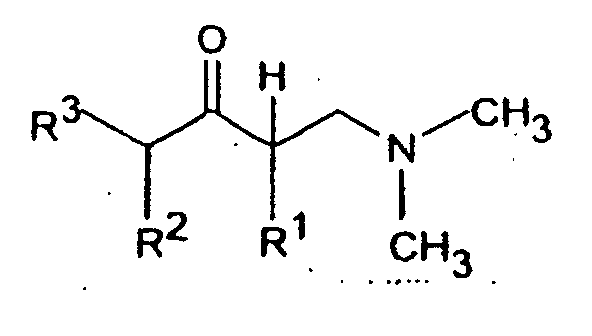

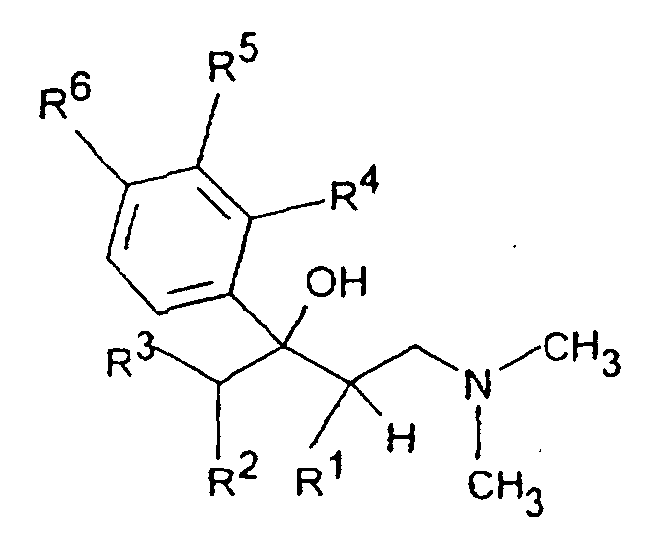
Als stationäre Phase für die Säulenchromatographie wurde Kieselgel 60 (0,040 - 0,063 mmm) der Firma E. Merck, Darmstadt, eingesetzt.
Die dünnschicht-chromatographischen Untersuchungen wurden mit HPTLC-Fertigplatten, Kieselgel 60 F 254, der Firma E. Merck, Darmstadt, durchgeführt.
Racemattrennungen wurden auf einer Chiracel OD Säule der Firma Daicel Chemical Industries, LTD durchgeführt.
und
- (+3):
- Ausbeute: 42 % der Theorie
[α] RT / D = +3,6° (c = 1,04; Methanol) - (-3):
- Ausbeute: 44 % der Theorie
[α] RT / D = -3,6° (c = 1,04; Methanol)
und
- (+6):
- Ausbeute: 42 % der Theorie
[α] RT / D = +36,3° (c = 0,96; Methanol) - (-6):
- Ausbeute: 44 % der Theorie
[α] RT / D = -33,7° (c = 1,07; Methanol)
und
- (14)
- Ausbeute: 5,9 g (21 % der Theorie)
Schmelzpunkt: 154° C - (15)
- Ausbeute: 15,8 g (56 % der Theorie)
Schmelzpunkt: 110 - 112° C
und
- (+27):
- Ausbeute: 42 % der Theorie
[α] RT / D = +33,8° (c = 1,00; Methanol) - (-27):
- Ausbeute: 44 % der Theorie
[α] RT / D = -34,3° (c = 1,06; Methanol)
und
- (+29):
- Ausbeute: 43 % der Theorie
[α] RT / D = +24,1° (c = 0,96; Methanol) - (-29):
- Ausbeute: 44 % der Theorie
[α] RT / D = -23,5° (c = 0,94; Methanol)
und
und
- (+37):
- Ausbeute: 43 % der Theorie
[α] RT / D = +36,4° (c = 1,01; Methanol) - (-37):
- Ausbeute: 44 % der Theorie
[α] Rt / D = -37,7° (c = 1.01; Methanol)
und
und
- (-36):
- [α] RT / D = -75,5° (c = 0,96; Methanol)
- (+36):
- [α] RT / D = + 77,7° (c = 1,08; Methanol)
- (-39):
- [α] RT / D = -96,6° (c = 1,04; Methanol)
- (+39):
- [α] RT / D = +89,0° (c = 0,99; Methanol)
| Analgesieprüfung im Writhing-Test an der Maus | |
| erfindungsgemäße Verbindung hergestellt nach Beispiel | ED50 (mg/kg) |
| 2 | 1,37 |
| 3 (+)-Enantiomer | 2,25 |
| 3 (-)-Enantiomer | 0,98 |
| 4 | 1,64 |
| 12 | 0,97 |
| 13 | 2,96 |
| 15 | 1,33 |
| 18 | 2,07 |
| 20 (+)-Enantiomer | 1,40 |
| 22 (-)-Enantiomer | 2,12 |
| 24 (ERFINDUNGSGEMÄSS) | 1,35 |
| 25 (-)-Enantiomer | 0,90 |
| 26 (-)-Enantiomer | 1,04 |
| 27 (+)-Enantiomer | 1,60 |
| zum Vergleich: Tramadol | 3,68 |
Claims (7)
- Dimethyl-(3-aryl-but-3-enyl)-aminverbindungen der Formel Iin der R1 und R2 zusammen -(CH2)2-4-, -(CH2)2-CHR7 oder -CH2-CHR7-CH2- darstellen,
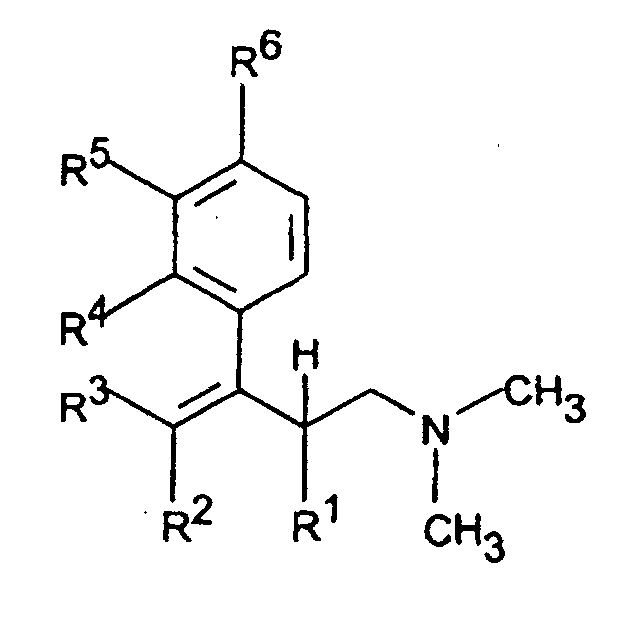
R3 H oder C1-5-Alkyl bedeutet,
R4 und R5 zusammen -CH=C(R9)-O- oder -CH=C(R9)-S- bedeuten, mit der Maßgabe, daß R6 H ist, oder
R5 und R6 zusammen -CH=CH-C(OR10)=CH- bedeuten, mit der Maßgabe, daß R4 H ist,
R7 C1-8-Alkyl, C3-8-Cycloalkyl, O-C1-4-Alkyl, O-Benzyl, CF3, Cl oder F bedeutet,
R9 H oder C1-4-Alkyl bedeutet,
R10 H oder C1-3-Alkyl bedeutet,
in Form ihrer Basen und/oder Salze von physiologisch verträglichen Säuren, als Enantiomere oder Racemate. - Dimethyl-(3-aryl-but-3-enyl)-aminverbindungen gemäß Anspruch 1, dadurch gekennzeichnet, daß
R1 und R2 zusammen -(CH2)2-4- oder -(CH2)2-CHR7 bedeuten,
R3 H oder C1-3-Alkyl bedeutet,
R4 und R5 zusammen -CH=C(R9)-O- oder -CH=C(R9)-S- bedeuten, mit der Maßgabe, daß R6 H ist, oder
R5 und R6 zusammen -CH=CH-C(OR10)=CH- bedeuten, mit der Maßgabe, daß R4 H ist, und
R7 C1-4-Alkyl, CF3, Cl oder F bedeutet. - Dimethyl-(3-aryl-but-3-enyl)-aminverbindungen gemäß Anspruch 1 oder 2, dadurch gekennzeichnet, daß
R1 und R2 zusammen -(CH2)2-3- oder -(CH2)2-CHR7 bedeuten,
R3 H, CH3 oder CH2CH3 bedeutet,
R4 und R5 zusammen -CH=C(CH3)-S- darstellen, mit der Maßgabe, daß R6 H ist, oder
R5 und R6 zusammen -CH=CH-C(OH)=CH- bedeuten, mit der Maßgabe, daß R4 H ist. - Verfahren zur Herstellung einer Dimethyl-(3-aryl-but-3-enyl)-aminverbindung der Formel IR1 und R2 zusammen -(CH2)2-4-, -(CH2)2-CHR7 oder -CH2-CHR7-CH2- darstellen,

R3 H oder C1-5-Alkyl bedeutet,
R4 und R5 zusammen -CH=C(R9)-O- oder -CH=C(R9)-S- bedeuten mit der Maßgabe, daß R6 H ist, oder
R5 und R6 zusammen -CH=CH-C(OR10)=CH- bedeuten, mit der Maßgabe, daß R4 H ist,
R7 C1-8-Alkyl, C3-8-Cycloalkyl, O-C1-4-Alkyl, O-Benzyl, CF3, Cl oder F bedeutet,
R9 H oder C1-4-Alkyl und R10 H oder C1-3-Alkyl bedeuten, dadurch gekennzeichnet, daß
man ein β-Dimethylaminoketon der Formel IImit einer metallorganischen Verbindung der Formel II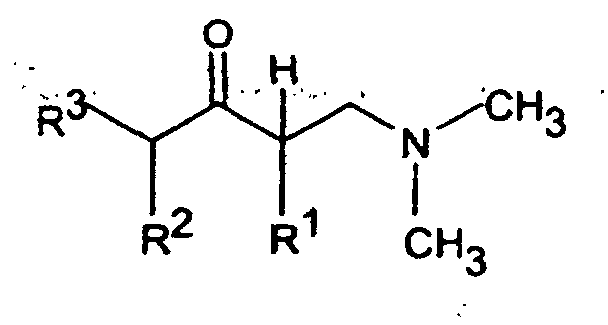 in der Z MgCl, MgBr, Mgl oder Li bedeutet, zu einem tertiären Alkohol der Formel IV
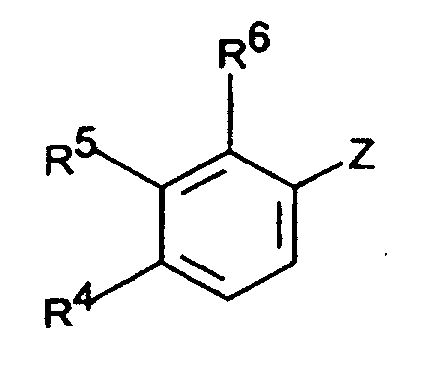 umsetzt, welcher anschließend zu einer Verbindung der Formel I dehydratisiert wird.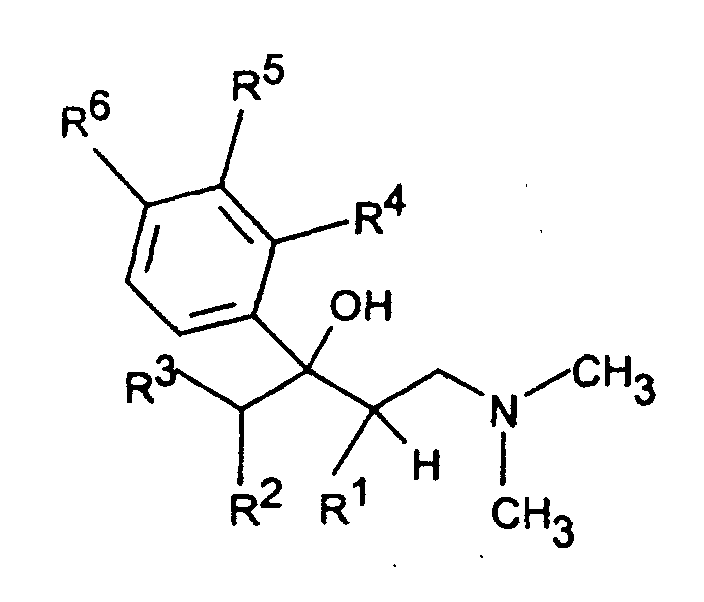
- Arzneimittel enthaltend als pharmazeutischen Wirkstoff wenigstens eine Dimethyl-(3-aryl-but-3-enyl)-aminverbindung der Formel I gemäß Anspruch 1 in Form ihrer Base und/oder ihres Salzes einer physiologisch verträglichen Säure, als Enantiomer oder Racemat und gegebenfalls weitere Wirkstoffe und/oder Hilfsstoffe.
- Arzneimittel nach Anspruch 5 zur Bekämpfung von Schmerz.
- Verwendung wenigstens einer Dimethyl-(3-aryl-but-3-enyl)-aminverbindung der Formel I gemäß Anspruch 1 in Form ihrer Base und/oder ihres Salzes einer physiologisch verträglichen Säure als Enantiomer oder Racemat zur Herstellung eines Arzneimittels zur Bekämpfung von Schmerzen.
Priority Applications (1)
| Application Number | Priority Date | Filing Date | Title |
|---|---|---|---|
| SI9730618T SI1069106T1 (en) | 1996-03-13 | 1997-02-22 | Dimethyl-(3-aryl-but-3-enyl) amine derivatives with analgesic activity |
Applications Claiming Priority (3)
| Application Number | Priority Date | Filing Date | Title |
|---|---|---|---|
| DE19609847A DE19609847A1 (de) | 1996-03-13 | 1996-03-13 | Dimethyl-(3-aryl-but-3-enyl)-aminverbindungen als pharmazeutische Wirkstoffe |
| DE19609847 | 1996-03-13 | ||
| EP97102923A EP0799819B1 (de) | 1996-03-13 | 1997-02-22 | 1-Dimethylaminomethyl-2-phenyl-cycloalk-2-enverbindungen mit analgetischer Wirkung |
Related Parent Applications (1)
| Application Number | Title | Priority Date | Filing Date |
|---|---|---|---|
| EP97102923A Division EP0799819B1 (de) | 1996-03-13 | 1997-02-22 | 1-Dimethylaminomethyl-2-phenyl-cycloalk-2-enverbindungen mit analgetischer Wirkung |
Publications (3)
| Publication Number | Publication Date |
|---|---|
| EP1069106A2 EP1069106A2 (de) | 2001-01-17 |
| EP1069106A3 EP1069106A3 (de) | 2001-01-24 |
| EP1069106B1 true EP1069106B1 (de) | 2004-01-28 |
Family
ID=7788151
Family Applications (4)
| Application Number | Title | Priority Date | Filing Date |
|---|---|---|---|
| EP97102923A Expired - Lifetime EP0799819B1 (de) | 1996-03-13 | 1997-02-22 | 1-Dimethylaminomethyl-2-phenyl-cycloalk-2-enverbindungen mit analgetischer Wirkung |
| EP99119108A Withdrawn EP0983994A3 (de) | 1996-03-13 | 1997-02-22 | Dimethyl-(3-aryl-but-3-enyl)-aminverbindungen als pharmazeutische Wirkstoffe |
| EP00116745A Expired - Lifetime EP1069106B1 (de) | 1996-03-13 | 1997-02-22 | Dimethyl-(3-aryl-but-3-enyl)-amin-verbindungen mit analgetischer Wirkung |
| EP99119109A Expired - Lifetime EP0983995B1 (de) | 1996-03-13 | 1997-02-22 | Dimethyl-(3-aryl-but-3-enyl)-aminverbindungen als pharmazeutische Wirkstoffe |
Family Applications Before (2)
| Application Number | Title | Priority Date | Filing Date |
|---|---|---|---|
| EP97102923A Expired - Lifetime EP0799819B1 (de) | 1996-03-13 | 1997-02-22 | 1-Dimethylaminomethyl-2-phenyl-cycloalk-2-enverbindungen mit analgetischer Wirkung |
| EP99119108A Withdrawn EP0983994A3 (de) | 1996-03-13 | 1997-02-22 | Dimethyl-(3-aryl-but-3-enyl)-aminverbindungen als pharmazeutische Wirkstoffe |
Family Applications After (1)
| Application Number | Title | Priority Date | Filing Date |
|---|---|---|---|
| EP99119109A Expired - Lifetime EP0983995B1 (de) | 1996-03-13 | 1997-02-22 | Dimethyl-(3-aryl-but-3-enyl)-aminverbindungen als pharmazeutische Wirkstoffe |
Country Status (27)
| Country | Link |
|---|---|
| US (1) | US5811582A (de) |
| EP (4) | EP0799819B1 (de) |
| JP (2) | JP4205182B2 (de) |
| KR (2) | KR100538662B1 (de) |
| CN (1) | CN1157366C (de) |
| AR (1) | AR008991A1 (de) |
| AT (3) | ATE263140T1 (de) |
| AU (1) | AU725430B2 (de) |
| BR (1) | BR9700369B1 (de) |
| CA (1) | CA2199679C (de) |
| CO (1) | CO4520279A1 (de) |
| CZ (1) | CZ293971B6 (de) |
| DE (4) | DE19609847A1 (de) |
| DK (3) | DK1069106T3 (de) |
| ES (3) | ES2213526T3 (de) |
| HU (1) | HU224819B1 (de) |
| IL (1) | IL120430A (de) |
| NO (1) | NO308294B1 (de) |
| NZ (1) | NZ314384A (de) |
| PE (1) | PE55798A1 (de) |
| PL (1) | PL186050B1 (de) |
| PT (3) | PT983995E (de) |
| RU (1) | RU2167146C2 (de) |
| SI (3) | SI0983995T1 (de) |
| SK (1) | SK284328B6 (de) |
| UA (1) | UA55373C2 (de) |
| ZA (1) | ZA972147B (de) |
Families Citing this family (30)
| Publication number | Priority date | Publication date | Assignee | Title |
|---|---|---|---|---|
| DE4426245A1 (de) * | 1994-07-23 | 1996-02-22 | Gruenenthal Gmbh | 1-Phenyl-3-dimethylamino-propanverbindungen mit pharmakologischer Wirkung |
| DE19732928C2 (de) * | 1997-07-31 | 2000-05-18 | Gruenenthal Gmbh | Verwendung substituierter Imidazolidin-2,4-dion-Verbindungen als Schmerzmittel |
| DE19830105C1 (de) * | 1998-07-06 | 2000-02-17 | Gruenenthal Gmbh | Acridinderivate |
| ES2141688B1 (es) * | 1998-11-06 | 2001-02-01 | Vita Invest Sa | Nuevos esteres derivados de compuestos fenil-ciclohexil sustituidos. |
| DE10000311A1 (de) * | 2000-01-05 | 2001-07-12 | Gruenenthal Gmbh | Aminomethyl-Phonyl-Cyclohexanonderivate |
| DE10025948A1 (de) * | 2000-05-26 | 2001-11-29 | Gruenenthal Gmbh | Wirkstoffkombination |
| DE10049483A1 (de) † | 2000-09-29 | 2002-05-02 | Gruenenthal Gmbh | Substituierte 1-Aminobutan-3-ol-Derivate |
| DE10049481A1 (de) * | 2000-09-29 | 2002-05-02 | Gruenenthal Gmbh | Substituierte C-Cyclohexylmethylamin-Derivate |
| DE10059413A1 (de) * | 2000-11-30 | 2002-06-20 | Gruenenthal Gmbh | Verwendung von substituierten 6-Dimethylaminomethyl-1-phenyl-cyclohexanverbindungen zur Therapie der Harninkontinenz |
| DE10059411A1 (de) * | 2000-11-30 | 2002-06-13 | Gruenenthal Gmbh | Verwendung von 6-Dimethylaminomethyl-1-phenyl-cyclohexanverbindungen zur Therapie der Harninkontinenz |
| US20050176790A1 (en) | 2001-02-28 | 2005-08-11 | Johannes Bartholomaus | Pharmaceutical salts |
| NZ528935A (en) | 2001-03-16 | 2004-10-29 | Dmi Biosciences Inc | Method of delaying ejaculation |
| DE10132747A1 (de) * | 2001-07-05 | 2003-01-23 | Gruenenthal Gmbh | Substituierte 1-Aryl-but-3-enylamin- und 1-Aryl-but-2-enylaminverbindungen |
| DE10146275A1 (de) * | 2001-09-18 | 2003-04-24 | Gruenenthal Gmbh | Kombination ausgewählter Opioide mit Muscarin-Antagonisten zur Therapie der Harninkontinenz |
| PE20030527A1 (es) | 2001-10-24 | 2003-07-26 | Gruenenthal Chemie | Formulacion farmaceutica con liberacion retardada que contiene 3-(3-dimetilamino-1-etil-2-metil-propil) fenol o una sal farmaceuticamente aceptable del mismo y tabletas para administracion oral que la contienen |
| DE10224624A1 (de) * | 2002-05-30 | 2003-12-11 | Gruenenthal Gmbh | Metabolite und Prodrugs von 1-Dimethylamino-3-(3-methoxy-phenyl)-2-methyl-pentan-3-ol |
| DE10225315A1 (de) * | 2002-06-06 | 2003-12-24 | Gruenenthal Gmbh | Wirkstoffsalze und Ester von 1-Dimethylamino-3-(3-methoxy-phenyl)-2-methyl- pentan-3-ol und 3-(3-Dimethylamino-1-ethyl-1-hydroxy-2-methyl- propyl)-phenol |
| DE10261091A1 (de) * | 2002-12-20 | 2004-07-01 | Grünenthal GmbH | Gesättigte und ungesättigte Heteroarylcycloalkylmethyl-Amine |
| DE10315917A1 (de) * | 2003-04-08 | 2004-11-18 | Schwarz Pharma Ag | Hochreine Basen von 3,3-Diphenylpropylaminmonoestern |
| DE10326097A1 (de) | 2003-06-06 | 2005-01-05 | Grünenthal GmbH | Verfahren zur Herstellung von Dimethyl-(3-aryl-butyl)-aminverbindungen |
| DE10328316A1 (de) * | 2003-06-23 | 2005-01-20 | Grünenthal GmbH | Verfahren zur Herstellung von Dimethyl-(3-aryl-buthyl)-aminverbindungen als pharmazeutische Wirkstoffe |
| DE102004034619A1 (de) * | 2004-07-16 | 2006-02-23 | Grünenthal GmbH | Substituierte Aminoverbindungen als 5-HT/NA Uptakehemmer |
| DE102005033732B4 (de) * | 2005-05-27 | 2014-02-13 | Grünenthal GmbH | Trennung stereoisomerer N,N-Dialkylamino-2-alkyl-3-hydroxy-3-phenyl-alkane |
| DE102005052588A1 (de) | 2005-11-02 | 2007-05-10 | Grünenthal GmbH | Verfahren zur Herstellung substituierter Dimethyl-(3-aryl-butyl)-amin-Verbindungen mittels homogener Katalyse |
| DE102005061429A1 (de) * | 2005-12-22 | 2007-06-28 | Grünenthal GmbH | Substituierte Oxazol-Derivate |
| SI2046726T1 (sl) * | 2006-07-24 | 2010-05-31 | Janssen Pharmaceutica Nv | Priprava R R metoksifenil N N trimetilpentanamina |
| TWI496762B (zh) * | 2006-07-24 | 2015-08-21 | 歌林達股份有限公司 | 製備(1r,2r)-3-(3-二甲胺基-1-乙基-2-甲基-丙基)-酚之方法 |
| CN101948397A (zh) * | 2010-09-07 | 2011-01-19 | 天津泰普药品科技发展有限公司 | 镇痛药他喷他多重要中间体的制备方法 |
| US8552219B2 (en) | 2010-09-20 | 2013-10-08 | Ind-Swift Laboratories Limited | Process for preparing L-phenyl-3-dimethylaminopropane derivative |
| EP2674414A1 (de) | 2012-06-15 | 2013-12-18 | Siegfried AG | Verfahren zur Herstellung von 1-aryl-1-alkyl-3-dialkylaminopropan-Verbindungen |
Family Cites Families (13)
| Publication number | Priority date | Publication date | Assignee | Title |
|---|---|---|---|---|
| DE1518663A1 (de) * | 1965-08-02 | 1969-12-18 | Gruenenthal Chemie | Basisch substituierte Cycloalken-derivate und Verfahren zu ihrer Herstellung |
| US3652589A (en) * | 1967-07-27 | 1972-03-28 | Gruenenthal Chemie | 1-(m-substituted phenyl)-2-aminomethyl cyclohexanols |
| US3978129A (en) * | 1972-01-28 | 1976-08-31 | A. H. Robins Company, Incorporated | Alkenyl- and alkanylamines |
| NL7403348A (de) * | 1973-03-19 | 1974-09-23 | ||
| GB1502635A (en) * | 1974-02-27 | 1978-03-01 | Schering Ag | Process for splitting steroid ethers |
| DE2409990C2 (de) * | 1974-02-27 | 1982-11-25 | Siemens AG, 1000 Berlin und 8000 München | Meßwandler für Hochspannungsschaltanlagen mit Metallkapselung |
| JPS598259B2 (ja) * | 1976-01-01 | 1984-02-23 | 武田薬品工業株式会社 | 新規シクロヘキセン誘導体 |
| US4173649A (en) * | 1978-02-27 | 1979-11-06 | E. R. Squibb & Sons, Inc. | 5-Phenyl-2,4-pentadien-1-amines and method for inhibiting prostaglandin dehydrogenase |
| FR2559765B1 (fr) * | 1984-02-16 | 1986-06-13 | Rhone Poulenc Sante | Nouveaux derives de la phenyl-3 propene-2 amine, leur preparation et les medicaments qui les contiennent |
| IT1213219B (it) * | 1984-09-28 | 1989-12-14 | Consiglio Nazionale Ricerche | Derivati amminoalchilnaftalenici ad attivita' farmacologica. |
| US5430044A (en) * | 1987-02-06 | 1995-07-04 | Fisons Corporation | Arylalkyl-amines and -amides having anticonvulsant and neuroprotective properties |
| SE9202218D0 (sv) * | 1992-07-22 | 1992-07-22 | Kabi Pharmacia Ab | Pharmacologically active alfa-(tertiary-aminomethyl)-benzenemethanol derivatives, pharmaceutical composition containing them, therapeutical use thereof and processes for their preparation |
| DE4426245A1 (de) * | 1994-07-23 | 1996-02-22 | Gruenenthal Gmbh | 1-Phenyl-3-dimethylamino-propanverbindungen mit pharmakologischer Wirkung |
-
1996
- 1996-03-13 DE DE19609847A patent/DE19609847A1/de not_active Withdrawn
-
1997
- 1997-02-22 ES ES00116745T patent/ES2213526T3/es not_active Expired - Lifetime
- 1997-02-22 DK DK00116745T patent/DK1069106T3/da active
- 1997-02-22 DK DK99119109T patent/DK0983995T3/da active
- 1997-02-22 EP EP97102923A patent/EP0799819B1/de not_active Expired - Lifetime
- 1997-02-22 EP EP99119108A patent/EP0983994A3/de not_active Withdrawn
- 1997-02-22 DE DE59711477T patent/DE59711477D1/de not_active Expired - Lifetime
- 1997-02-22 SI SI9730653T patent/SI0983995T1/xx unknown
- 1997-02-22 SI SI9730428T patent/SI0799819T1/xx unknown
- 1997-02-22 PT PT99119109T patent/PT983995E/pt unknown
- 1997-02-22 DE DE59708160T patent/DE59708160D1/de not_active Expired - Lifetime
- 1997-02-22 PT PT97102923T patent/PT799819E/pt unknown
- 1997-02-22 DK DK97102923T patent/DK0799819T3/da active
- 1997-02-22 AT AT99119109T patent/ATE263140T1/de active
- 1997-02-22 EP EP00116745A patent/EP1069106B1/de not_active Expired - Lifetime
- 1997-02-22 ES ES99119109T patent/ES2218924T3/es not_active Expired - Lifetime
- 1997-02-22 ES ES97102923T patent/ES2183030T3/es not_active Expired - Lifetime
- 1997-02-22 AT AT00116745T patent/ATE258544T1/de active
- 1997-02-22 AT AT97102923T patent/ATE223888T1/de active
- 1997-02-22 PT PT00116745T patent/PT1069106E/pt unknown
- 1997-02-22 DE DE59711267T patent/DE59711267D1/de not_active Expired - Lifetime
- 1997-02-22 SI SI9730618T patent/SI1069106T1/xx unknown
- 1997-02-22 EP EP99119109A patent/EP0983995B1/de not_active Expired - Lifetime
- 1997-03-07 PE PE1997000175A patent/PE55798A1/es not_active Application Discontinuation
- 1997-03-07 BR BRPI9700369-7A patent/BR9700369B1/pt not_active IP Right Cessation
- 1997-03-11 KR KR1019970008046A patent/KR100538662B1/ko not_active Expired - Fee Related
- 1997-03-11 CA CA002199679A patent/CA2199679C/en not_active Expired - Fee Related
- 1997-03-11 AR ARP970100969A patent/AR008991A1/es active IP Right Grant
- 1997-03-11 NZ NZ314384A patent/NZ314384A/xx unknown
- 1997-03-12 US US08/820,377 patent/US5811582A/en not_active Expired - Lifetime
- 1997-03-12 SK SK321-97A patent/SK284328B6/sk not_active IP Right Cessation
- 1997-03-12 RU RU97103580/04A patent/RU2167146C2/ru active
- 1997-03-12 CO CO97013358A patent/CO4520279A1/es unknown
- 1997-03-12 PL PL97318922A patent/PL186050B1/pl not_active IP Right Cessation
- 1997-03-12 AU AU16251/97A patent/AU725430B2/en not_active Ceased
- 1997-03-12 CN CNB971034877A patent/CN1157366C/zh not_active Expired - Fee Related
- 1997-03-12 HU HU9700574A patent/HU224819B1/hu not_active IP Right Cessation
- 1997-03-12 CZ CZ1997759A patent/CZ293971B6/cs not_active IP Right Cessation
- 1997-03-12 IL IL12043097A patent/IL120430A/xx not_active IP Right Cessation
- 1997-03-12 UA UA97031138A patent/UA55373C2/uk unknown
- 1997-03-12 JP JP05769597A patent/JP4205182B2/ja not_active Expired - Fee Related
- 1997-03-12 NO NO971137A patent/NO308294B1/no not_active IP Right Cessation
- 1997-03-12 ZA ZA9702147A patent/ZA972147B/xx unknown
-
2005
- 2005-06-03 KR KR1020050047916A patent/KR100602810B1/ko not_active Expired - Fee Related
-
2008
- 2008-03-17 JP JP2008066934A patent/JP4846750B2/ja not_active Expired - Fee Related
Also Published As
Similar Documents
| Publication | Publication Date | Title |
|---|---|---|
| EP0799819B1 (de) | 1-Dimethylaminomethyl-2-phenyl-cycloalk-2-enverbindungen mit analgetischer Wirkung | |
| EP0753506B1 (de) | 6-Dimethylaminomethyl-1-phenyl-cyclo-hexanverbindungen als pharmazeutische Wirkstoffe | |
| EP0693475B1 (de) | 1-Phenyl-3-dimethylamino-propanverbindungen mit pharmakologischer Wirkung | |
| EP0780369B1 (de) | 1-Phenyl-2-dimethylaminomethyl-cyclohexan-1-olverbindungen als pharmazeutische Wirkstoffe | |
| EP0786450B1 (de) | Verfahren zur Herstellung der Enantiomeren von O-Demethyltramadol | |
| EP1202953B1 (de) | Substituierte 2-dialkylaminoalkylbiphenyl-derivate | |
| EP1246793B1 (de) | Substituierte aminomethyl-phenyl-cyclohexanderivate | |
| EP1043306B1 (de) | 3-Amino-3-arylpropan-1-ol-Derivate, deren Herstellung und Verwendung | |
| HK1031864B (en) | Dimethyl-(3-aryl-but-3-enyl) amine derivatives with analgesic activity | |
| HK1026197B (en) | Pharmaceutically-active dimethyl-(3-aryl-but-3-enyl)-amine compounds | |
| MXPA97001865A (en) | Compounds of dimethyl- (3-aril-but-3-enil) -amino as active ingredients farmaceuti |
Legal Events
| Date | Code | Title | Description |
|---|---|---|---|
| PUAI | Public reference made under article 153(3) epc to a published international application that has entered the european phase |
Free format text: ORIGINAL CODE: 0009012 |
|
| PUAL | Search report despatched |
Free format text: ORIGINAL CODE: 0009013 |
|
| 17P | Request for examination filed |
Effective date: 20000803 |
|
| AC | Divisional application: reference to earlier application |
Ref document number: 799819 Country of ref document: EP |
|
| AK | Designated contracting states |
Kind code of ref document: A2 Designated state(s): AT BE CH DE DK ES FI FR GB GR IE IT LI LU MC NL PT SE |
|
| AX | Request for extension of the european patent |
Free format text: LT PAYMENT 20000803;LV PAYMENT 20000803;SI PAYMENT 20000803 |
|
| AK | Designated contracting states |
Kind code of ref document: A3 Designated state(s): AT BE CH DE DK ES FI FR GB GR IE IT LI LU MC NL PT SE |
|
| AX | Request for extension of the european patent |
Free format text: LT PAYMENT 20000803;LV PAYMENT 20000803;SI PAYMENT 20000803 |
|
| AKX | Designation fees paid |
Free format text: AT BE CH DE DK ES FI FR GB GR IE IT LI LU MC NL PT SE |
|
| AXX | Extension fees paid |
Free format text: LT PAYMENT 20000803;LV PAYMENT 20000803;SI PAYMENT 20000803 |
|
| 17Q | First examination report despatched |
Effective date: 20010905 |
|
| GRAP | Despatch of communication of intention to grant a patent |
Free format text: ORIGINAL CODE: EPIDOSNIGR1 |
|
| GRAS | Grant fee paid |
Free format text: ORIGINAL CODE: EPIDOSNIGR3 |
|
| GRAA | (expected) grant |
Free format text: ORIGINAL CODE: 0009210 |
|
| AC | Divisional application: reference to earlier application |
Ref document number: 0799819 Country of ref document: EP Kind code of ref document: P |
|
| AK | Designated contracting states |
Kind code of ref document: B1 Designated state(s): AT BE CH DE DK ES FI FR GB GR IE IT LI LU MC NL PT SE |
|
| AX | Request for extension of the european patent |
Extension state: LT LV SI |
|
| REG | Reference to a national code |
Ref country code: GB Ref legal event code: FG4D Free format text: NOT ENGLISH |
|
| REG | Reference to a national code |
Ref country code: CH Ref legal event code: EP |
|
| REG | Reference to a national code |
Ref country code: CH Ref legal event code: NV Representative=s name: BRAUN & PARTNER PATENT-, MARKEN-, RECHTSANWAELTE |
|
| GBT | Gb: translation of ep patent filed (gb section 77(6)(a)/1977) |
Effective date: 20040204 |
|
| REG | Reference to a national code |
Ref country code: IE Ref legal event code: FG4D Free format text: GERMAN |
|
| REF | Corresponds to: |
Ref document number: 59711267 Country of ref document: DE Date of ref document: 20040304 Kind code of ref document: P |
|
| REG | Reference to a national code |
Ref country code: DK Ref legal event code: T3 |
|
| REG | Reference to a national code |
Ref country code: GR Ref legal event code: EP Ref document number: 20040400896 Country of ref document: GR |
|
| REG | Reference to a national code |
Ref country code: SE Ref legal event code: TRGR |
|
| REG | Reference to a national code |
Ref country code: PT Ref legal event code: SC4A Free format text: AVAILABILITY OF NATIONAL TRANSLATION Effective date: 20040423 |
|
| ET | Fr: translation filed | ||
| REG | Reference to a national code |
Ref country code: ES Ref legal event code: FG2A Ref document number: 2213526 Country of ref document: ES Kind code of ref document: T3 |
|
| REG | Reference to a national code |
Ref country code: HK Ref legal event code: GR Ref document number: 1031864 Country of ref document: HK |
|
| PLBE | No opposition filed within time limit |
Free format text: ORIGINAL CODE: 0009261 |
|
| STAA | Information on the status of an ep patent application or granted ep patent |
Free format text: STATUS: NO OPPOSITION FILED WITHIN TIME LIMIT |
|
| REG | Reference to a national code |
Ref country code: SI Ref legal event code: IF |
|
| 26N | No opposition filed |
Effective date: 20041029 |
|
| REG | Reference to a national code |
Ref country code: CH Ref legal event code: NV Representative=s name: BRAUNPAT BRAUN EDER AG |
|
| PGFP | Annual fee paid to national office [announced via postgrant information from national office to epo] |
Ref country code: IT Payment date: 20120218 Year of fee payment: 16 |
|
| PGFP | Annual fee paid to national office [announced via postgrant information from national office to epo] |
Ref country code: MC Payment date: 20121231 Year of fee payment: 17 |
|
| PGFP | Annual fee paid to national office [announced via postgrant information from national office to epo] |
Ref country code: DE Payment date: 20130228 Year of fee payment: 17 Ref country code: DK Payment date: 20130212 Year of fee payment: 17 Ref country code: ES Payment date: 20130215 Year of fee payment: 17 Ref country code: GB Payment date: 20130220 Year of fee payment: 17 Ref country code: FI Payment date: 20130212 Year of fee payment: 17 Ref country code: SE Payment date: 20130212 Year of fee payment: 17 Ref country code: FR Payment date: 20130301 Year of fee payment: 17 Ref country code: CH Payment date: 20130212 Year of fee payment: 17 Ref country code: LU Payment date: 20130301 Year of fee payment: 17 Ref country code: IE Payment date: 20130212 Year of fee payment: 17 |
|
| PGFP | Annual fee paid to national office [announced via postgrant information from national office to epo] |
Ref country code: NL Payment date: 20130209 Year of fee payment: 17 Ref country code: BE Payment date: 20130212 Year of fee payment: 17 Ref country code: GR Payment date: 20130124 Year of fee payment: 17 |
|
| PGFP | Annual fee paid to national office [announced via postgrant information from national office to epo] |
Ref country code: PT Payment date: 20130222 Year of fee payment: 17 Ref country code: AT Payment date: 20130110 Year of fee payment: 17 |
|
| REG | Reference to a national code |
Ref country code: PT Ref legal event code: MM4A Free format text: LAPSE DUE TO NON-PAYMENT OF FEES Effective date: 20140822 |
|
| BERE | Be: lapsed |
Owner name: *GRUNENTHAL G.M.B.H. Effective date: 20140228 |
|
| REG | Reference to a national code |
Ref country code: DE Ref legal event code: R119 Ref document number: 59711267 Country of ref document: DE |
|
| REG | Reference to a national code |
Ref country code: NL Ref legal event code: V1 Effective date: 20140901 |
|
| REG | Reference to a national code |
Ref country code: LT Ref legal event code: MM9D Effective date: 20140222 |
|
| REG | Reference to a national code |
Ref country code: DK Ref legal event code: EBP Effective date: 20140228 |
|
| PG25 | Lapsed in a contracting state [announced via postgrant information from national office to epo] |
Ref country code: MC Free format text: LAPSE BECAUSE OF NON-PAYMENT OF DUE FEES Effective date: 20140228 Ref country code: LU Free format text: LAPSE BECAUSE OF NON-PAYMENT OF DUE FEES Effective date: 20140222 |
|
| REG | Reference to a national code |
Ref country code: CH Ref legal event code: PL Ref country code: SE Ref legal event code: EUG |
|
| REG | Reference to a national code |
Ref country code: AT Ref legal event code: MM01 Ref document number: 258544 Country of ref document: AT Kind code of ref document: T Effective date: 20140222 |
|
| REG | Reference to a national code |
Ref country code: GR Ref legal event code: ML Ref document number: 20040400896 Country of ref document: GR Effective date: 20140903 |
|
| GBPC | Gb: european patent ceased through non-payment of renewal fee |
Effective date: 20140222 |
|
| PG25 | Lapsed in a contracting state [announced via postgrant information from national office to epo] |
Ref country code: LI Free format text: LAPSE BECAUSE OF NON-PAYMENT OF DUE FEES Effective date: 20140228 Ref country code: GR Free format text: LAPSE BECAUSE OF NON-PAYMENT OF DUE FEES Effective date: 20140903 Ref country code: NL Free format text: LAPSE BECAUSE OF NON-PAYMENT OF DUE FEES Effective date: 20140901 Ref country code: CH Free format text: LAPSE BECAUSE OF NON-PAYMENT OF DUE FEES Effective date: 20140228 Ref country code: FI Free format text: LAPSE BECAUSE OF NON-PAYMENT OF DUE FEES Effective date: 20140222 |
|
| REG | Reference to a national code |
Ref country code: FR Ref legal event code: ST Effective date: 20141031 |
|
| PG25 | Lapsed in a contracting state [announced via postgrant information from national office to epo] |
Ref country code: SE Free format text: LAPSE BECAUSE OF NON-PAYMENT OF DUE FEES Effective date: 20140223 Ref country code: AT Free format text: LAPSE BECAUSE OF NON-PAYMENT OF DUE FEES Effective date: 20140222 |
|
| REG | Reference to a national code |
Ref country code: SI Ref legal event code: KO00 Effective date: 20141007 |
|
| REG | Reference to a national code |
Ref country code: IE Ref legal event code: MM4A |
|
| REG | Reference to a national code |
Ref country code: DE Ref legal event code: R119 Ref document number: 59711267 Country of ref document: DE Effective date: 20140902 |
|
| PG25 | Lapsed in a contracting state [announced via postgrant information from national office to epo] |
Ref country code: PT Free format text: LAPSE BECAUSE OF NON-PAYMENT OF DUE FEES Effective date: 20140822 |
|
| PG25 | Lapsed in a contracting state [announced via postgrant information from national office to epo] |
Ref country code: BE Free format text: LAPSE BECAUSE OF NON-PAYMENT OF DUE FEES Effective date: 20140228 Ref country code: GB Free format text: LAPSE BECAUSE OF NON-PAYMENT OF DUE FEES Effective date: 20140222 Ref country code: DE Free format text: LAPSE BECAUSE OF NON-PAYMENT OF DUE FEES Effective date: 20140902 Ref country code: FR Free format text: LAPSE BECAUSE OF NON-PAYMENT OF DUE FEES Effective date: 20140228 Ref country code: IE Free format text: LAPSE BECAUSE OF NON-PAYMENT OF DUE FEES Effective date: 20140222 Ref country code: DK Free format text: LAPSE BECAUSE OF NON-PAYMENT OF DUE FEES Effective date: 20140228 |
|
| REG | Reference to a national code |
Ref country code: ES Ref legal event code: FD2A Effective date: 20150327 |
|
| PG25 | Lapsed in a contracting state [announced via postgrant information from national office to epo] |
Ref country code: ES Free format text: LAPSE BECAUSE OF NON-PAYMENT OF DUE FEES Effective date: 20140223 |
|
| PG25 | Lapsed in a contracting state [announced via postgrant information from national office to epo] |
Ref country code: IT Free format text: LAPSE BECAUSE OF NON-PAYMENT OF DUE FEES Effective date: 20140222 |