EP1069057B1 - Behälter zur Aufnahme kompostierbarer Materialien - Google Patents
Behälter zur Aufnahme kompostierbarer Materialien Download PDFInfo
- Publication number
- EP1069057B1 EP1069057B1 EP20000114614 EP00114614A EP1069057B1 EP 1069057 B1 EP1069057 B1 EP 1069057B1 EP 20000114614 EP20000114614 EP 20000114614 EP 00114614 A EP00114614 A EP 00114614A EP 1069057 B1 EP1069057 B1 EP 1069057B1
- Authority
- EP
- European Patent Office
- Prior art keywords
- receptacle
- container
- grid
- receptacle according
- tube
- Prior art date
- Legal status (The legal status is an assumption and is not a legal conclusion. Google has not performed a legal analysis and makes no representation as to the accuracy of the status listed.)
- Expired - Lifetime
Links
- 239000000463 material Substances 0.000 title claims description 8
- XLYOFNOQVPJJNP-UHFFFAOYSA-N water Substances O XLYOFNOQVPJJNP-UHFFFAOYSA-N 0.000 claims abstract description 11
- 239000007788 liquid Substances 0.000 claims description 15
- 239000002184 metal Substances 0.000 claims description 5
- 238000009833 condensation Methods 0.000 claims description 2
- 230000005494 condensation Effects 0.000 claims description 2
- 238000005273 aeration Methods 0.000 claims 2
- 238000010276 construction Methods 0.000 claims 1
- 239000012780 transparent material Substances 0.000 claims 1
- 238000009264 composting Methods 0.000 abstract description 10
- 238000009423 ventilation Methods 0.000 abstract description 9
- 238000000034 method Methods 0.000 abstract description 8
- JEIPFZHSYJVQDO-UHFFFAOYSA-N iron(III) oxide Inorganic materials O=[Fe]O[Fe]=O JEIPFZHSYJVQDO-UHFFFAOYSA-N 0.000 description 5
- 239000010813 municipal solid waste Substances 0.000 description 3
- 239000002361 compost Substances 0.000 description 2
- 239000012530 fluid Substances 0.000 description 2
- 230000015572 biosynthetic process Effects 0.000 description 1
- 238000009795 derivation Methods 0.000 description 1
- 235000013399 edible fruits Nutrition 0.000 description 1
- 230000000694 effects Effects 0.000 description 1
- 230000004720 fertilization Effects 0.000 description 1
- 239000003337 fertilizer Substances 0.000 description 1
- 239000010921 garden waste Substances 0.000 description 1
- 238000005259 measurement Methods 0.000 description 1
- 230000009965 odorless effect Effects 0.000 description 1
- 239000011368 organic material Substances 0.000 description 1
- 230000000630 rising effect Effects 0.000 description 1
- 238000007789 sealing Methods 0.000 description 1
- 238000007493 shaping process Methods 0.000 description 1
- 235000013311 vegetables Nutrition 0.000 description 1
Images
Classifications
-
- B—PERFORMING OPERATIONS; TRANSPORTING
- B65—CONVEYING; PACKING; STORING; HANDLING THIN OR FILAMENTARY MATERIAL
- B65F—GATHERING OR REMOVAL OF DOMESTIC OR LIKE REFUSE
- B65F1/00—Refuse receptacles; Accessories therefor
- B65F1/14—Other constructional features; Accessories
- B65F1/16—Lids or covers
-
- C—CHEMISTRY; METALLURGY
- C05—FERTILISERS; MANUFACTURE THEREOF
- C05F—ORGANIC FERTILISERS NOT COVERED BY SUBCLASSES C05B, C05C, e.g. FERTILISERS FROM WASTE OR REFUSE
- C05F17/00—Preparation of fertilisers characterised by biological or biochemical treatment steps, e.g. composting or fermentation
- C05F17/90—Apparatus therefor
- C05F17/907—Small-scale devices without mechanical means for feeding or discharging material, e.g. garden compost bins
-
- C—CHEMISTRY; METALLURGY
- C05—FERTILISERS; MANUFACTURE THEREOF
- C05F—ORGANIC FERTILISERS NOT COVERED BY SUBCLASSES C05B, C05C, e.g. FERTILISERS FROM WASTE OR REFUSE
- C05F17/00—Preparation of fertilisers characterised by biological or biochemical treatment steps, e.g. composting or fermentation
- C05F17/90—Apparatus therefor
- C05F17/964—Constructional parts, e.g. floors, covers or doors
- C05F17/971—Constructional parts, e.g. floors, covers or doors for feeding or discharging materials to be treated; for feeding or discharging other material
- C05F17/986—Constructional parts, e.g. floors, covers or doors for feeding or discharging materials to be treated; for feeding or discharging other material the other material being liquid
-
- B—PERFORMING OPERATIONS; TRANSPORTING
- B65—CONVEYING; PACKING; STORING; HANDLING THIN OR FILAMENTARY MATERIAL
- B65F—GATHERING OR REMOVAL OF DOMESTIC OR LIKE REFUSE
- B65F1/00—Refuse receptacles; Accessories therefor
- B65F1/14—Other constructional features; Accessories
- B65F2001/1489—Refuse receptacles adapted or modified for gathering compostable domestic refuse
-
- B—PERFORMING OPERATIONS; TRANSPORTING
- B65—CONVEYING; PACKING; STORING; HANDLING THIN OR FILAMENTARY MATERIAL
- B65F—GATHERING OR REMOVAL OF DOMESTIC OR LIKE REFUSE
- B65F2210/00—Equipment of refuse receptacles
- B65F2210/181—Ventilating means, e.g. holes
-
- Y—GENERAL TAGGING OF NEW TECHNOLOGICAL DEVELOPMENTS; GENERAL TAGGING OF CROSS-SECTIONAL TECHNOLOGIES SPANNING OVER SEVERAL SECTIONS OF THE IPC; TECHNICAL SUBJECTS COVERED BY FORMER USPC CROSS-REFERENCE ART COLLECTIONS [XRACs] AND DIGESTS
- Y02—TECHNOLOGIES OR APPLICATIONS FOR MITIGATION OR ADAPTATION AGAINST CLIMATE CHANGE
- Y02P—CLIMATE CHANGE MITIGATION TECHNOLOGIES IN THE PRODUCTION OR PROCESSING OF GOODS
- Y02P20/00—Technologies relating to chemical industry
- Y02P20/141—Feedstock
- Y02P20/145—Feedstock the feedstock being materials of biological origin
-
- Y—GENERAL TAGGING OF NEW TECHNOLOGICAL DEVELOPMENTS; GENERAL TAGGING OF CROSS-SECTIONAL TECHNOLOGIES SPANNING OVER SEVERAL SECTIONS OF THE IPC; TECHNICAL SUBJECTS COVERED BY FORMER USPC CROSS-REFERENCE ART COLLECTIONS [XRACs] AND DIGESTS
- Y02—TECHNOLOGIES OR APPLICATIONS FOR MITIGATION OR ADAPTATION AGAINST CLIMATE CHANGE
- Y02W—CLIMATE CHANGE MITIGATION TECHNOLOGIES RELATED TO WASTEWATER TREATMENT OR WASTE MANAGEMENT
- Y02W30/00—Technologies for solid waste management
- Y02W30/40—Bio-organic fraction processing; Production of fertilisers from the organic fraction of waste or refuse
Definitions
- the invention relates to a container according to the preamble of the main claim.
- a generic container is known from FR 27 18 435 A.
- This well-known container like the container, is on which the invention relates to as a standard container for Household application running and this container can be on be emptied in the usual way by a delivery service, for what Household garbage trucks are used that are equipped with lifting equipment that can attack at the top of the container.
- the generic container is intended for composting organic material such as vegetables, fruit and garden waste or Like. Be used. Via air supply and air discharge openings air circulation can be achieved, which is necessary for the good course of the composting process is necessary. A lockable Opening in the area of the bottom of the container makes it possible to take out the compost.
- DE 44 27 729 discloses a connecting device with at least one two connections, the parallel and at the same time to the corresponding connections of a biocontainer can be connected with a high sealing effect can. From this reference it is known to the drain opening connect a hose to a biocontainer, So instead of or in addition to that in the generic Literature described drain cock provided can be. With such a hose, the hygienic Reasons also provided with a closure member must be, but is not controllable how high the water level in the collection container of the biocontainer.
- the amount of moisture that is released depends heavily on the amount and the type of material to be composted and the prevailing Temperatures. It is therefore not always clear when the moisture needs to be drained and the user can forget the drainage of moisture so that the Composting process by the rising within the container Liquid is interrupted.
- the present invention has for its object the generic To improve the container so that the Liquid level in the container is controllable and draining the fluid is relieved.
- the training of Rust to a good discharge in the lower area of the compostable liquid is preferable.
- the Outflow opening known from the prior art there is a flexible hose that is transparent and that can be raised and clamped outside the container.
- This hose must of course be open at its upper end to be with the one located in the lower area of the container Fluid level to a communicating tube create.
- the container with a Hollow pin equipped by the upper end of the Hose can be overlapped, so that on the one hand the Hose is set, on the other hand, the hose opening after is open at the top and continues to ensure that itself then when the liquid level in the hose up to the top the liquid has not risen to the outside can, but is returned to the container.
- This is just a safety measure that contaminates the Prevents the environment of the container, but the composting process would be interrupted.
- a preferred feature of the invention is that the bottom of the lid closing the container so inclined or is designed so that the collecting condensation is discharged to the outside of the container. While in normal organic bins one strives to be at the bottom the lid collecting moisture into the container and return to the material in the container, In the present case, the aim is to get the moisture out lead away, this condensed water usually is odorless, making it easy to drain off to the outside of the container appears possible.
- rust is preferably made of metal trained and a metal plate is used, which with Flow openings are provided, which face downwards Connects ring flange in each case, d. H. these flow openings are punched out from top to bottom and the amount of material is formed into a ring flange. It turned out that with such an arrangement the drainage of the liquid done much better than if the metal plate only is provided with simple flow openings.
- the rust is preferably profiled and based on the container bottom arranged supports from and preferably still on shoulders molded from the wall of the container and is either on the shoulders and / or on the supports set using appropriate tools so that when dumping of the container, for example in a garbage truck, the rust is secured in position in the container.
- ventilation openings are preferably at the device according to the invention is designed as ventilation pipes, which cross the container, these pipes with Air passage openings are provided, which makes it possible sufficient over the entire lower side of the container Ensure air supply.
- These pipes can be made of metal or also consist of plastic.
- the one preferably provided in the rear wall of the container The removal opening is closed by a slide which can be lifted upwards so that the removal opening is released.
- a slide has opposite a conventional flap has the advantage that joints are avoided and that only a partial opening of the actual removal opening depending on the flowability of the compost formed can be adjusted.
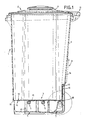
- a container 1 which has a lid 2 and a grate 3 in the lower region, wherein the container is closed at the bottom by the container bottom 4 is.
- the container is made in a manner known per se a moldable material, for example plastic.
- ventilation openings in the lower area of the container 5 and ventilation pipes 15 indicated a plurality of such ventilation openings can be provided, which is provided below the grate 3 become. It could also be above the grate Ventilation openings are provided in the lower area of the container his.
- the container bottom 4 is with a Drain opening 7 equipped, the bottom of the container, as from the drawing is recognizable, designed so that the collecting Liquid is guided to this drain opening 7.
- the drawing shows the inclination of the container bottom 4, which leads from the front wall of the container to the rear, whereby continue to be roof-shaped container bottom can, so that the liquid from the side walls Drain opening 7 is performed, the drain opening 7 is not in middle part of the container bottom 4 can be formed, but for example in the area of a side wall, so that only a cross slope of the container bottom is required.
- the back of the container is designated as side wall 9 and has a removal opening 8 through a slide 16 is closable, which can be moved upwards can, so that a partial opening of the large removal opening 8 becomes possible.
- a transparent hose 10 closes on which led upwards on the side wall 9 to a hollow pin 19 leads from a shoulder recess of the side wall 9 is formed.
- the hose mouth can be on this Hollow pin 19 are pushed on and is thereby determined but is open in terms of ventilation, so that a communicating Pipe system with the area of the tank bottom below the grate 3 is reached.
- Grid 3 through openings 12 are provided, which face downwards open into an annular flange 14 which either - as in the middle Part of the grate shown as an embodiment - rectilinear, i.e. cylindrical or - as with the two outer ones Through openings 12 shown - down again broaden out.
- This type of formation of the passage opening improves the discharge of the accumulated on the grate Water.
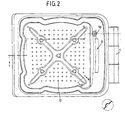
- the grate is - as shown in Fig. 2 - profiled to to have the necessary load-bearing capacity, whereby in the 2, which shows a section through the grate which represents line AA in FIG. 2, is curved upwards, so that a good derivation of the accumulating on the profiles Water is accessible to the side.
- the pressure in the hose 10 always corresponds to the pressure in the container 1, so that an undisturbed function based on the principle of the communicating tubes is reached.
- the compostable material comes in the lower area in contact with the liquid, causing the composting process comes to a standstill.
- the container 1 can simply be offered for emptying, then after filling the container 1 and again in motion bring the composting process back to work can be.
- the container body is like this trained that by shaping the sufficient strength of the container is achieved, on the other hand, a good emptying of the Container in case of garbage truck emptying is ensured.
- the liquid collecting in the lower part of the container can also be used as fertilizer (in contrast to the one that collects on the underside of the container lid Condensed water), can also be provided that at the Hose, d. H. a suction pump or. Like. Can be connected so that the water in the garden specifically Fertilization can be used.
Landscapes
- Chemical & Material Sciences (AREA)
- Engineering & Computer Science (AREA)
- General Chemical & Material Sciences (AREA)
- Microbiology (AREA)
- Health & Medical Sciences (AREA)
- Biochemistry (AREA)
- Biotechnology (AREA)
- Chemical Kinetics & Catalysis (AREA)
- Organic Chemistry (AREA)
- Life Sciences & Earth Sciences (AREA)
- Molecular Biology (AREA)
- Mechanical Engineering (AREA)
- Fertilizers (AREA)
- Processing Of Solid Wastes (AREA)
- Glass Compositions (AREA)
- Packging For Living Organisms, Food Or Medicinal Products That Are Sensitive To Environmental Conditiond (AREA)
Description
- Fig. 1
- einen Behälter im Schnitt gemäß der Linie 1 - 1 in Fig. 2 und in
- Fig. 2
- eine Draufsicht in den Behälter bei abgenommenem Behälterdeckel.
Claims (15)
- Behälter (1) zur Aufnahme kompostierbarer Materialien mit an der Oberseite vorgesehenem Deckel (2), einem im Abstand vom Behälterboden (4) vorgesehenen Rost (3), Belüftungsöffnungen (5, 6) im unteren und oberen Bereich des Behälters (1) sowie einer Ablaßöffnung (7) für die sich sammelnde Flüssigkeit im unteren Bereich des Behälters (1) sowie einer verschließbaren Entnahmeöffnung (8) in Höhe des Rostes (3) in einer Seitenwand (9) des Behälters (1), dadurch gekennzeichnet, daß an die Ablaßöffnung (7) nach außen hin ein flexibler Schlauch (10) anschließt, der außerhalb des Behälters (1) hochführbar und festklemmbar ist und aus durchsichtigem Werkstoff besteht.
- Behälter nach Anspruch 1, dadurch gekennzeichnet, daß der Schlauch (10) an der Seitenwand (9) angeordnet ist, an die sich im oberen Bereich ein Handgriff (11) zur Handhabe des Behälters befindet.
- Behälter nach Anspruch 1 oder 2, dadurch gekennzeichnet, daß der nach außen hin außerhalb des Behälters hochführbare Schlauch mit seinem offenen Schlauchende einen in der Behälteraußenwand ausgeformten Hohlzapfen (19) übergreift und hierdurch festgelegt ist.
- Behälter nach einem der vorhergehenden Ansprüche, dadurch gekennzeichnet, daß der Behälterboden (4) zur Ablaßöffnung (7) hin geneigt ist.
- Behälter nach einem der vorhergehenden Ansprüche, dadurch gekennzeichnet, daß der Rost (3) aus Metall besteht.
- Behälter nach Anspruch 5, dadurch gekennzeichnet, daß die im Rost (3) vorgesehenen Durchlauföffnungen (12) einen sich nach unten erstreckenden Ringflansch (14) aufweisen.
- Behälter nach Anspruch 5 oder 6, dadurch gekennzeichnet, daß der Rost (3) profiliert ausgebildet ist.
- Behälter nach einem der vorhergehenden Ansprüche 5 bis 7, dadurch gekennzeichnet, daß sich der Rost auf Stützen (17) abstützt, die sich am Behälterboden (4) abstützen.
- Behälter nach einem der vorhergehenden Ansprüche 5 bis 8, dadurch gekennzeichnet, daß der Rost (3) auf im Randbereich des Behälters (1) vorgesehenen, ausgeformten Schultern (18) aufliegt.
- Behälter nach Anspruch 8 oder 9, dadurch gekennzeichnet, daß der Rost (3) auf den Schultern (18) und/oder den Stützen (17) gegen Bewegungen nach oben festgelegt ist.
- Behälter nach einem der vorhergehenden Ansprüche, gekennzeichnet durch sich über die Breite des Behälters (1) unterhalb des Rostes (3) erstreckende Belüftungsrohre (15).
- Behälter nach einem der vorhergehenden Ansprüche, dadurch gekennzeichnet, daß die die Entnahmeöffnung (8) verschließende Verschlußvorrichtung als in der Höhe verstellbarer Schieber (16) ausgebildet ist.
- Behälter nach einem der vorhergehenden Ansprüche, dadurch gekennzeichnet, daß an den sich an die Ablaßöffnung (7) anschließenden Schlauch (10) eine Saugpumpe anschließbar ist.
- Behälter nach einem der vorhergehenden Ansprüche, dadurch gekennzeichnet, daß die Unterseite des Deckels (2) so geneigt ist und so ausgebildet ist, daß das sich sammelnde Kondenswasser zur Außenseite des Behälters (1) abgeleitet wird.
- Behälter nach Anspruch 14, dadurch gekennzeichnet, daß die Ableitung des sich unter dem Deckel (2) sammelnden Wassers zur Rückseite des Behälters (1) erfolgt.
Applications Claiming Priority (2)
| Application Number | Priority Date | Filing Date | Title |
|---|---|---|---|
| DE19932305 | 1999-07-10 | ||
| DE1999132305 DE19932305A1 (de) | 1999-07-10 | 1999-07-10 | Behälter zur Aufnahme kompostierbarer Materialien |
Publications (2)
| Publication Number | Publication Date |
|---|---|
| EP1069057A1 EP1069057A1 (de) | 2001-01-17 |
| EP1069057B1 true EP1069057B1 (de) | 2002-12-11 |
Family
ID=7914342
Family Applications (1)
| Application Number | Title | Priority Date | Filing Date |
|---|---|---|---|
| EP20000114614 Expired - Lifetime EP1069057B1 (de) | 1999-07-10 | 2000-07-07 | Behälter zur Aufnahme kompostierbarer Materialien |
Country Status (6)
| Country | Link |
|---|---|
| EP (1) | EP1069057B1 (de) |
| AT (1) | ATE229462T1 (de) |
| DE (2) | DE19932305A1 (de) |
| DK (1) | DK1069057T3 (de) |
| ES (1) | ES2188460T3 (de) |
| PT (1) | PT1069057E (de) |
Families Citing this family (3)
| Publication number | Priority date | Publication date | Assignee | Title |
|---|---|---|---|---|
| ITBG20080053A1 (it) * | 2008-10-30 | 2010-04-30 | Eurosintex S R L | Grande pattumiera a ridotta emissione di odori e suo mezzo di rovesciamento |
| DE202022001026U1 (de) | 2021-04-30 | 2022-07-11 | Pierre P.G.M. Bus | Abstandhalter für einen Deckel eines Behälters |
| NL1044020B1 (nl) | 2021-04-30 | 2022-11-09 | P G M Bus Pierre | Afstandshouder voor een deksel van een container |
Family Cites Families (5)
| Publication number | Priority date | Publication date | Assignee | Title |
|---|---|---|---|---|
| DE3939511A1 (de) * | 1989-06-05 | 1990-12-20 | Bartholomaeus Bitsch | Muellsammelgefaess mit entlueftungseinrichtung |
| DE4105778A1 (de) * | 1991-02-23 | 1992-08-27 | Herrmann Gmbh & Co Kg | Verfahren und vorrichtung zur behandlung organischer abfaelle |
| NL9400500A (nl) * | 1994-03-30 | 1995-11-01 | P A Van Schaijk | Bak voor het composteren van organisch materiaal. |
| DE9405953U1 (de) * | 1994-04-09 | 1994-06-16 | Schaijk, Petrus Adrianus van, Nijmwegen | Behälter für die Kompostierung von organischem Material |
| DE4427729A1 (de) * | 1994-08-05 | 1996-02-15 | Metallgesellschaft Ag | Anschließvorrichtung |
-
1999
- 1999-07-10 DE DE1999132305 patent/DE19932305A1/de not_active Withdrawn
-
2000
- 2000-07-07 PT PT00114614T patent/PT1069057E/pt unknown
- 2000-07-07 DE DE50000902T patent/DE50000902D1/de not_active Expired - Lifetime
- 2000-07-07 DK DK00114614T patent/DK1069057T3/da active
- 2000-07-07 EP EP20000114614 patent/EP1069057B1/de not_active Expired - Lifetime
- 2000-07-07 AT AT00114614T patent/ATE229462T1/de not_active IP Right Cessation
- 2000-07-07 ES ES00114614T patent/ES2188460T3/es not_active Expired - Lifetime
Also Published As
| Publication number | Publication date |
|---|---|
| ATE229462T1 (de) | 2002-12-15 |
| EP1069057A1 (de) | 2001-01-17 |
| ES2188460T3 (es) | 2003-07-01 |
| DK1069057T3 (da) | 2003-03-03 |
| PT1069057E (pt) | 2003-04-30 |
| DE50000902D1 (de) | 2003-01-23 |
| DE19932305A1 (de) | 2001-01-18 |
Similar Documents
| Publication | Publication Date | Title |
|---|---|---|
| CH673823A5 (de) | ||
| EP0386568A1 (de) | Müllbehälter mit Durchlüftungssystem | |
| EP0299540A1 (de) | Einbauspüle | |
| EP0271719B1 (de) | Müllbehälter zur Aufnahme von kompostierfähigen Abfällen | |
| DE3925661A1 (de) | Spundfass | |
| EP1069057A1 (de) | Behälter zur Aufnahme kompostierbarer Materialien | |
| DE202004017744U1 (de) | Unterflurmüllsammelbehälter | |
| DE3313366C2 (de) | ||
| DE202011002907U1 (de) | Lagereinrichtung für Biomasse mit Ablaufschacht und Ablaufschacht | |
| DE9000829U1 (de) | Abscheider | |
| DE102013009795A1 (de) | Vorrichtung zum Befüllen von Gießkannen | |
| CH686702A5 (de) | Vorrichtung zum Auffangen von Kaffeesatz aus einem Abwasserstrom einer Kaffeemaschine. | |
| DE69503789T2 (de) | Abfallbehälter | |
| DE29702661U1 (de) | Stapelbehälter | |
| DE9405953U1 (de) | Behälter für die Kompostierung von organischem Material | |
| DE10307057B4 (de) | Transportabler Behälter zum Filtern von Schmutzwasser | |
| DE202005019806U1 (de) | Vorrichtung zum Fangen/Sammeln von Aböl eines Kraftwagens/-rads | |
| DE9102660U1 (de) | Abfallsammelbehälter | |
| DE102018120318A1 (de) | Rollhilfe für einen zwei Tragräder aufweisenden Müllbehälter | |
| DE8701429U1 (de) | Sammelbehälter mit Auffangwanne | |
| DE2245089A1 (de) | Absauggeraet zum reinigen von werkzeugmaschinen und dergleichen | |
| DE19836068A1 (de) | Kanne, insbesondere für Kaffee, Tee und dergleichen | |
| DE8907247U1 (de) | Sammelbehälter für flüssige Altstoffe | |
| DE2033864A1 (de) | Pneumatische Hebeeinrichtung , vor zugsweise fur häusliche Abwasser | |
| EP1637509A1 (de) | Rottecontainer |
Legal Events
| Date | Code | Title | Description |
|---|---|---|---|
| PUAI | Public reference made under article 153(3) epc to a published international application that has entered the european phase |
Free format text: ORIGINAL CODE: 0009012 |
|
| AK | Designated contracting states |
Kind code of ref document: A1 Designated state(s): AT BE CH CY DE DK ES FI FR GB GR IE IT LI LU MC NL PT SE |
|
| AX | Request for extension of the european patent |
Free format text: AL;LT;LV;MK;RO;SI |
|
| 17P | Request for examination filed |
Effective date: 20001212 |
|
| RAP1 | Party data changed (applicant data changed or rights of an application transferred) |
Owner name: KLIKO ENTSORGUNGSSYSTEME GMBH |
|
| RAP1 | Party data changed (applicant data changed or rights of an application transferred) |
Owner name: PAUL CRAEMER GMBH |
|
| AKX | Designation fees paid |
Free format text: AT BE CH CY DE DK ES FI FR GB GR IE IT LI LU MC NL PT SE |
|
| GRAG | Despatch of communication of intention to grant |
Free format text: ORIGINAL CODE: EPIDOS AGRA |
|
| 17Q | First examination report despatched |
Effective date: 20011221 |
|
| GRAG | Despatch of communication of intention to grant |
Free format text: ORIGINAL CODE: EPIDOS AGRA |
|
| GRAH | Despatch of communication of intention to grant a patent |
Free format text: ORIGINAL CODE: EPIDOS IGRA |
|
| GRAH | Despatch of communication of intention to grant a patent |
Free format text: ORIGINAL CODE: EPIDOS IGRA |
|
| GRAA | (expected) grant |
Free format text: ORIGINAL CODE: 0009210 |
|
| AK | Designated contracting states |
Kind code of ref document: B1 Designated state(s): AT BE CH CY DE DK ES FI FR GB GR IE IT LI LU MC NL PT SE |
|
| PG25 | Lapsed in a contracting state [announced via postgrant information from national office to epo] |
Ref country code: IE Free format text: LAPSE BECAUSE OF FAILURE TO SUBMIT A TRANSLATION OF THE DESCRIPTION OR TO PAY THE FEE WITHIN THE PRESCRIBED TIME-LIMIT Effective date: 20021211 Ref country code: FI Free format text: LAPSE BECAUSE OF FAILURE TO SUBMIT A TRANSLATION OF THE DESCRIPTION OR TO PAY THE FEE WITHIN THE PRESCRIBED TIME-LIMIT Effective date: 20021211 Ref country code: GR Free format text: LAPSE BECAUSE OF FAILURE TO SUBMIT A TRANSLATION OF THE DESCRIPTION OR TO PAY THE FEE WITHIN THE PRESCRIBED TIME-LIMIT Effective date: 20021211 |
|
| REF | Corresponds to: |
Ref document number: 229462 Country of ref document: AT Date of ref document: 20021215 Kind code of ref document: T |
|
| REG | Reference to a national code |
Ref country code: GB Ref legal event code: FG4D Free format text: NOT ENGLISH |
|
| REG | Reference to a national code |
Ref country code: CH Ref legal event code: EP |
|
| REG | Reference to a national code |
Ref country code: IE Ref legal event code: FG4D Free format text: GERMAN |
|
| REF | Corresponds to: |
Ref document number: 50000902 Country of ref document: DE Date of ref document: 20030123 |
|
| REG | Reference to a national code |
Ref country code: DK Ref legal event code: T3 |
|
| PG25 | Lapsed in a contracting state [announced via postgrant information from national office to epo] |
Ref country code: SE Free format text: LAPSE BECAUSE OF FAILURE TO SUBMIT A TRANSLATION OF THE DESCRIPTION OR TO PAY THE FEE WITHIN THE PRESCRIBED TIME-LIMIT Effective date: 20030311 |
|
| GBT | Gb: translation of ep patent filed (gb section 77(6)(a)/1977) |
Effective date: 20030408 |
|
| REG | Reference to a national code |
Ref country code: PT Ref legal event code: SC4A Free format text: AVAILABILITY OF NATIONAL TRANSLATION Effective date: 20030311 |
|
| REG | Reference to a national code |
Ref country code: ES Ref legal event code: FG2A Ref document number: 2188460 Country of ref document: ES Kind code of ref document: T3 |
|
| PG25 | Lapsed in a contracting state [announced via postgrant information from national office to epo] |
Ref country code: LU Free format text: LAPSE BECAUSE OF NON-PAYMENT OF DUE FEES Effective date: 20030707 Ref country code: CY Free format text: LAPSE BECAUSE OF FAILURE TO SUBMIT A TRANSLATION OF THE DESCRIPTION OR TO PAY THE FEE WITHIN THE PRESCRIBED TIME-LIMIT Effective date: 20030707 Ref country code: AT Free format text: LAPSE BECAUSE OF NON-PAYMENT OF DUE FEES Effective date: 20030707 |
|
| ET | Fr: translation filed | ||
| REG | Reference to a national code |
Ref country code: IE Ref legal event code: FD4D Ref document number: 1069057E Country of ref document: IE |
|
| PG25 | Lapsed in a contracting state [announced via postgrant information from national office to epo] |
Ref country code: MC Free format text: LAPSE BECAUSE OF NON-PAYMENT OF DUE FEES Effective date: 20030731 |
|
| PLBE | No opposition filed within time limit |
Free format text: ORIGINAL CODE: 0009261 |
|
| STAA | Information on the status of an ep patent application or granted ep patent |
Free format text: STATUS: NO OPPOSITION FILED WITHIN TIME LIMIT |
|
| 26N | No opposition filed |
Effective date: 20030912 |
|
| PG25 | Lapsed in a contracting state [announced via postgrant information from national office to epo] |
Ref country code: LI Free format text: LAPSE BECAUSE OF NON-PAYMENT OF DUE FEES Effective date: 20040731 Ref country code: CH Free format text: LAPSE BECAUSE OF NON-PAYMENT OF DUE FEES Effective date: 20040731 |
|
| REG | Reference to a national code |
Ref country code: CH Ref legal event code: PL |
|
| PGFP | Annual fee paid to national office [announced via postgrant information from national office to epo] |
Ref country code: DK Payment date: 20070725 Year of fee payment: 8 Ref country code: ES Payment date: 20070725 Year of fee payment: 8 |
|
| PGFP | Annual fee paid to national office [announced via postgrant information from national office to epo] |
Ref country code: IT Payment date: 20070726 Year of fee payment: 8 |
|
| REG | Reference to a national code |
Ref country code: PT Ref legal event code: MM4A Free format text: LAPSE DUE TO NON-PAYMENT OF FEES Effective date: 20090107 |
|
| REG | Reference to a national code |
Ref country code: DK Ref legal event code: EBP |
|
| REG | Reference to a national code |
Ref country code: GB Ref legal event code: 732E Free format text: REGISTERED BETWEEN 20090312 AND 20090318 |
|
| PG25 | Lapsed in a contracting state [announced via postgrant information from national office to epo] |
Ref country code: PT Free format text: LAPSE BECAUSE OF NON-PAYMENT OF DUE FEES Effective date: 20090107 |
|
| PG25 | Lapsed in a contracting state [announced via postgrant information from national office to epo] |
Ref country code: DK Free format text: LAPSE BECAUSE OF NON-PAYMENT OF DUE FEES Effective date: 20080731 |
|
| REG | Reference to a national code |
Ref country code: FR Ref legal event code: TP |
|
| PG25 | Lapsed in a contracting state [announced via postgrant information from national office to epo] |
Ref country code: IT Free format text: LAPSE BECAUSE OF NON-PAYMENT OF DUE FEES Effective date: 20080707 |
|
| REG | Reference to a national code |
Ref country code: ES Ref legal event code: FD2A Effective date: 20080708 |
|
| PG25 | Lapsed in a contracting state [announced via postgrant information from national office to epo] |
Ref country code: ES Free format text: LAPSE BECAUSE OF NON-PAYMENT OF DUE FEES Effective date: 20080708 |
|
| PGFP | Annual fee paid to national office [announced via postgrant information from national office to epo] |
Ref country code: PT Payment date: 20070703 Year of fee payment: 8 |
|
| PGFP | Annual fee paid to national office [announced via postgrant information from national office to epo] |
Ref country code: NL Payment date: 20100726 Year of fee payment: 11 |
|
| PGFP | Annual fee paid to national office [announced via postgrant information from national office to epo] |
Ref country code: DE Payment date: 20100616 Year of fee payment: 11 Ref country code: FR Payment date: 20100802 Year of fee payment: 11 |
|
| PGFP | Annual fee paid to national office [announced via postgrant information from national office to epo] |
Ref country code: GB Payment date: 20100726 Year of fee payment: 11 |
|
| PGFP | Annual fee paid to national office [announced via postgrant information from national office to epo] |
Ref country code: BE Payment date: 20100726 Year of fee payment: 11 |
|
| BERE | Be: lapsed |
Owner name: KLAUS-DIETER BRANDENBURG Effective date: 20110731 |
|
| REG | Reference to a national code |
Ref country code: NL Ref legal event code: V1 Effective date: 20120201 |
|
| GBPC | Gb: european patent ceased through non-payment of renewal fee |
Effective date: 20110707 |
|
| REG | Reference to a national code |
Ref country code: FR Ref legal event code: ST Effective date: 20120330 |
|
| PG25 | Lapsed in a contracting state [announced via postgrant information from national office to epo] |
Ref country code: BE Free format text: LAPSE BECAUSE OF NON-PAYMENT OF DUE FEES Effective date: 20110731 Ref country code: FR Free format text: LAPSE BECAUSE OF NON-PAYMENT OF DUE FEES Effective date: 20110801 Ref country code: DE Free format text: LAPSE BECAUSE OF NON-PAYMENT OF DUE FEES Effective date: 20120201 |
|
| REG | Reference to a national code |
Ref country code: DE Ref legal event code: R119 Ref document number: 50000902 Country of ref document: DE Effective date: 20120201 |
|
| PG25 | Lapsed in a contracting state [announced via postgrant information from national office to epo] |
Ref country code: NL Free format text: LAPSE BECAUSE OF NON-PAYMENT OF DUE FEES Effective date: 20120201 |
|
| PG25 | Lapsed in a contracting state [announced via postgrant information from national office to epo] |
Ref country code: GB Free format text: LAPSE BECAUSE OF NON-PAYMENT OF DUE FEES Effective date: 20110707 |