EP1066143B1 - Method and apparatus for seamless microreplication using an expandable mold - Google Patents
Method and apparatus for seamless microreplication using an expandable mold Download PDFInfo
- Publication number
- EP1066143B1 EP1066143B1 EP99903390A EP99903390A EP1066143B1 EP 1066143 B1 EP1066143 B1 EP 1066143B1 EP 99903390 A EP99903390 A EP 99903390A EP 99903390 A EP99903390 A EP 99903390A EP 1066143 B1 EP1066143 B1 EP 1066143B1
- Authority
- EP
- European Patent Office
- Prior art keywords
- mold
- interior
- molded article
- expandable
- curable material
- Prior art date
- Legal status (The legal status is an assumption and is not a legal conclusion. Google has not performed a legal analysis and makes no representation as to the accuracy of the status listed.)
- Expired - Lifetime
Links
- 238000000034 method Methods 0.000 title claims abstract description 73
- 238000005286 illumination Methods 0.000 claims abstract description 45
- 238000000605 extraction Methods 0.000 claims abstract description 40
- 239000000463 material Substances 0.000 claims description 115
- 238000000465 moulding Methods 0.000 claims description 14
- 239000012530 fluid Substances 0.000 claims description 9
- 229920002379 silicone rubber Polymers 0.000 claims description 9
- 229920000642 polymer Polymers 0.000 claims description 8
- 229920001296 polysiloxane Polymers 0.000 claims description 8
- 239000007788 liquid Substances 0.000 claims description 7
- 238000003754 machining Methods 0.000 claims description 7
- 239000002243 precursor Substances 0.000 claims description 7
- PXHVJJICTQNCMI-UHFFFAOYSA-N Nickel Chemical compound [Ni] PXHVJJICTQNCMI-UHFFFAOYSA-N 0.000 claims description 4
- 229920001971 elastomer Polymers 0.000 claims description 4
- 239000000806 elastomer Substances 0.000 claims description 4
- BASFCYQUMIYNBI-UHFFFAOYSA-N platinum Chemical compound [Pt] BASFCYQUMIYNBI-UHFFFAOYSA-N 0.000 claims description 4
- 239000004417 polycarbonate Substances 0.000 claims description 4
- 229920000515 polycarbonate Polymers 0.000 claims description 4
- 229910052782 aluminium Inorganic materials 0.000 claims description 3
- XAGFODPZIPBFFR-UHFFFAOYSA-N aluminium Chemical compound [Al] XAGFODPZIPBFFR-UHFFFAOYSA-N 0.000 claims description 3
- 238000010438 heat treatment Methods 0.000 claims description 3
- 239000000178 monomer Substances 0.000 claims description 3
- 229910052709 silver Inorganic materials 0.000 claims description 3
- 239000004332 silver Substances 0.000 claims description 3
- RYGMFSIKBFXOCR-UHFFFAOYSA-N Copper Chemical compound [Cu] RYGMFSIKBFXOCR-UHFFFAOYSA-N 0.000 claims description 2
- JOYRKODLDBILNP-UHFFFAOYSA-N Ethyl urethane Chemical compound CCOC(N)=O JOYRKODLDBILNP-UHFFFAOYSA-N 0.000 claims description 2
- BQCADISMDOOEFD-UHFFFAOYSA-N Silver Chemical compound [Ag] BQCADISMDOOEFD-UHFFFAOYSA-N 0.000 claims description 2
- 229910045601 alloy Inorganic materials 0.000 claims description 2
- 239000000956 alloy Substances 0.000 claims description 2
- 229910052802 copper Inorganic materials 0.000 claims description 2
- 239000010949 copper Substances 0.000 claims description 2
- 229910052759 nickel Inorganic materials 0.000 claims description 2
- 229910052697 platinum Inorganic materials 0.000 claims description 2
- 239000012780 transparent material Substances 0.000 claims description 2
- NIXOWILDQLNWCW-UHFFFAOYSA-M Acrylate Chemical compound [O-]C(=O)C=C NIXOWILDQLNWCW-UHFFFAOYSA-M 0.000 claims 1
- 229920000058 polyacrylate Polymers 0.000 claims 1
- 239000000835 fiber Substances 0.000 abstract description 31
- 239000011162 core material Substances 0.000 description 29
- 229920005862 polyol Polymers 0.000 description 18
- -1 dibutyltin dilaurate Chemical compound 0.000 description 17
- 150000003077 polyols Chemical class 0.000 description 17
- 239000000203 mixture Substances 0.000 description 16
- 239000004814 polyurethane Substances 0.000 description 16
- 229920002635 polyurethane Polymers 0.000 description 16
- 239000004970 Chain extender Substances 0.000 description 11
- 125000001931 aliphatic group Chemical group 0.000 description 10
- LYCAIKOWRPUZTN-UHFFFAOYSA-N Ethylene glycol Chemical compound OCCO LYCAIKOWRPUZTN-UHFFFAOYSA-N 0.000 description 9
- 238000005253 cladding Methods 0.000 description 9
- 150000002009 diols Chemical class 0.000 description 9
- 239000005056 polyisocyanate Substances 0.000 description 9
- 229920001228 polyisocyanate Polymers 0.000 description 9
- 125000005442 diisocyanate group Chemical group 0.000 description 8
- 229910001369 Brass Inorganic materials 0.000 description 6
- 239000010951 brass Substances 0.000 description 6
- 238000005459 micromachining Methods 0.000 description 6
- 229920005906 polyester polyol Polymers 0.000 description 6
- 150000002334 glycols Chemical class 0.000 description 5
- 230000002411 adverse Effects 0.000 description 4
- 239000003570 air Substances 0.000 description 4
- 238000007516 diamond turning Methods 0.000 description 4
- MTHSVFCYNBDYFN-UHFFFAOYSA-N diethylene glycol Chemical class OCCOCCO MTHSVFCYNBDYFN-UHFFFAOYSA-N 0.000 description 4
- 238000009472 formulation Methods 0.000 description 4
- 230000003287 optical effect Effects 0.000 description 4
- 229920000728 polyester Polymers 0.000 description 4
- 239000000243 solution Substances 0.000 description 4
- IAYPIBMASNFSPL-UHFFFAOYSA-N Ethylene oxide Chemical compound C1CO1 IAYPIBMASNFSPL-UHFFFAOYSA-N 0.000 description 3
- PEDCQBHIVMGVHV-UHFFFAOYSA-N Glycerine Chemical compound OCC(O)CO PEDCQBHIVMGVHV-UHFFFAOYSA-N 0.000 description 3
- MHAJPDPJQMAIIY-UHFFFAOYSA-N Hydrogen peroxide Chemical compound OO MHAJPDPJQMAIIY-UHFFFAOYSA-N 0.000 description 3
- 239000000853 adhesive Substances 0.000 description 3
- 230000001070 adhesive effect Effects 0.000 description 3
- 238000005520 cutting process Methods 0.000 description 3
- 238000013461 design Methods 0.000 description 3
- KORSJDCBLAPZEQ-UHFFFAOYSA-N dicyclohexylmethane-4,4'-diisocyanate Chemical compound C1CC(N=C=O)CCC1CC1CCC(N=C=O)CC1 KORSJDCBLAPZEQ-UHFFFAOYSA-N 0.000 description 3
- 239000012153 distilled water Substances 0.000 description 3
- WGCNASOHLSPBMP-UHFFFAOYSA-N hydroxyacetaldehyde Natural products OCC=O WGCNASOHLSPBMP-UHFFFAOYSA-N 0.000 description 3
- ZFSLODLOARCGLH-UHFFFAOYSA-N isocyanuric acid Chemical group OC1=NC(O)=NC(O)=N1 ZFSLODLOARCGLH-UHFFFAOYSA-N 0.000 description 3
- 238000004519 manufacturing process Methods 0.000 description 3
- 238000005259 measurement Methods 0.000 description 3
- 229910052751 metal Inorganic materials 0.000 description 3
- 239000002184 metal Substances 0.000 description 3
- 238000003801 milling Methods 0.000 description 3
- 238000002360 preparation method Methods 0.000 description 3
- 239000000126 substance Substances 0.000 description 3
- 238000012360 testing method Methods 0.000 description 3
- 229920001187 thermosetting polymer Polymers 0.000 description 3
- XLYOFNOQVPJJNP-UHFFFAOYSA-N water Chemical compound O XLYOFNOQVPJJNP-UHFFFAOYSA-N 0.000 description 3
- 229940008841 1,6-hexamethylene diisocyanate Drugs 0.000 description 2
- OAKJQQAXSVQMHS-UHFFFAOYSA-N Hydrazine Chemical compound NN OAKJQQAXSVQMHS-UHFFFAOYSA-N 0.000 description 2
- QIGBRXMKCJKVMJ-UHFFFAOYSA-N Hydroquinone Chemical compound OC1=CC=C(O)C=C1 QIGBRXMKCJKVMJ-UHFFFAOYSA-N 0.000 description 2
- 239000005058 Isophorone diisocyanate Substances 0.000 description 2
- OKKJLVBELUTLKV-UHFFFAOYSA-N Methanol Chemical class OC OKKJLVBELUTLKV-UHFFFAOYSA-N 0.000 description 2
- GLUUGHFHXGJENI-UHFFFAOYSA-N Piperazine Chemical compound C1CNCCN1 GLUUGHFHXGJENI-UHFFFAOYSA-N 0.000 description 2
- 229920003171 Poly (ethylene oxide) Polymers 0.000 description 2
- XSTXAVWGXDQKEL-UHFFFAOYSA-N Trichloroethylene Chemical compound ClC=C(Cl)Cl XSTXAVWGXDQKEL-UHFFFAOYSA-N 0.000 description 2
- ZJCCRDAZUWHFQH-UHFFFAOYSA-N Trimethylolpropane Chemical compound CCC(CO)(CO)CO ZJCCRDAZUWHFQH-UHFFFAOYSA-N 0.000 description 2
- 239000002253 acid Substances 0.000 description 2
- WNLRTRBMVRJNCN-UHFFFAOYSA-N adipic acid Chemical compound OC(=O)CCCCC(O)=O WNLRTRBMVRJNCN-UHFFFAOYSA-N 0.000 description 2
- 125000002947 alkylene group Chemical group 0.000 description 2
- 125000003118 aryl group Chemical group 0.000 description 2
- 230000009286 beneficial effect Effects 0.000 description 2
- 230000015572 biosynthetic process Effects 0.000 description 2
- 239000003054 catalyst Substances 0.000 description 2
- 238000000576 coating method Methods 0.000 description 2
- 238000007796 conventional method Methods 0.000 description 2
- 150000004985 diamines Chemical class 0.000 description 2
- AYOHIQLKSOJJQH-UHFFFAOYSA-N dibutyltin Chemical compound CCCC[Sn]CCCC AYOHIQLKSOJJQH-UHFFFAOYSA-N 0.000 description 2
- 230000000694 effects Effects 0.000 description 2
- RRAMGCGOFNQTLD-UHFFFAOYSA-N hexamethylene diisocyanate Chemical compound O=C=NCCCCCCN=C=O RRAMGCGOFNQTLD-UHFFFAOYSA-N 0.000 description 2
- 239000011796 hollow space material Substances 0.000 description 2
- 238000002347 injection Methods 0.000 description 2
- 239000007924 injection Substances 0.000 description 2
- NIMLQBUJDJZYEJ-UHFFFAOYSA-N isophorone diisocyanate Chemical compound CC1(C)CC(N=C=O)CC(C)(CN=C=O)C1 NIMLQBUJDJZYEJ-UHFFFAOYSA-N 0.000 description 2
- 238000000608 laser ablation Methods 0.000 description 2
- 239000011344 liquid material Substances 0.000 description 2
- 229920001451 polypropylene glycol Polymers 0.000 description 2
- YPFDHNVEDLHUCE-UHFFFAOYSA-N propane-1,3-diol Chemical compound OCCCO YPFDHNVEDLHUCE-UHFFFAOYSA-N 0.000 description 2
- 230000010076 replication Effects 0.000 description 2
- GHMLBKRAJCXXBS-UHFFFAOYSA-N resorcinol Chemical compound OC1=CC=CC(O)=C1 GHMLBKRAJCXXBS-UHFFFAOYSA-N 0.000 description 2
- CXMXRPHRNRROMY-UHFFFAOYSA-N sebacic acid Chemical compound OC(=O)CCCCCCCCC(O)=O CXMXRPHRNRROMY-UHFFFAOYSA-N 0.000 description 2
- SQGYOTSLMSWVJD-UHFFFAOYSA-N silver(1+) nitrate Chemical compound [Ag+].[O-]N(=O)=O SQGYOTSLMSWVJD-UHFFFAOYSA-N 0.000 description 2
- 229920001169 thermoplastic Polymers 0.000 description 2
- 239000004416 thermosoftening plastic Substances 0.000 description 2
- 150000003673 urethanes Chemical class 0.000 description 2
- 125000000391 vinyl group Chemical group [H]C([*])=C([H])[H] 0.000 description 2
- 229920002554 vinyl polymer Polymers 0.000 description 2
- ZWVMLYRJXORSEP-UHFFFAOYSA-N 1,2,6-Hexanetriol Chemical compound OCCCCC(O)CO ZWVMLYRJXORSEP-UHFFFAOYSA-N 0.000 description 1
- ROHUXHMNZLHBSF-UHFFFAOYSA-N 1,4-bis(isocyanatomethyl)cyclohexane Chemical compound O=C=NCC1CCC(CN=C=O)CC1 ROHUXHMNZLHBSF-UHFFFAOYSA-N 0.000 description 1
- CDMDQYCEEKCBGR-UHFFFAOYSA-N 1,4-diisocyanatocyclohexane Chemical compound O=C=NC1CCC(N=C=O)CC1 CDMDQYCEEKCBGR-UHFFFAOYSA-N 0.000 description 1
- XIIHTVOIRWYVJC-UHFFFAOYSA-N 1,5-diisocyanato-1,3,3-trimethylcyclohexane Chemical compound CC1(C)CC(N=C=O)CC(C)(N=C=O)C1 XIIHTVOIRWYVJC-UHFFFAOYSA-N 0.000 description 1
- VLVVSHOQIJBJAG-UHFFFAOYSA-N 1,6-diisocyanato-2,2,4,4-tetramethylhexane Chemical compound O=C=NCCC(C)(C)CC(C)(C)CN=C=O VLVVSHOQIJBJAG-UHFFFAOYSA-N 0.000 description 1
- ATOUXIOKEJWULN-UHFFFAOYSA-N 1,6-diisocyanato-2,2,4-trimethylhexane Chemical compound O=C=NCCC(C)CC(C)(C)CN=C=O ATOUXIOKEJWULN-UHFFFAOYSA-N 0.000 description 1
- QGLRLXLDMZCFBP-UHFFFAOYSA-N 1,6-diisocyanato-2,4,4-trimethylhexane Chemical compound O=C=NCC(C)CC(C)(C)CCN=C=O QGLRLXLDMZCFBP-UHFFFAOYSA-N 0.000 description 1
- WXIOQJUEBPUFHH-UHFFFAOYSA-N 1-isocyanato-4-(2-isocyanatopropan-2-yl)-1-methylcyclohexane Chemical compound O=C=NC(C)(C)C1CCC(C)(N=C=O)CC1 WXIOQJUEBPUFHH-UHFFFAOYSA-N 0.000 description 1
- OKWLUBCSBVYYTC-UHFFFAOYSA-N 1-phenylbutane-1,4-diol Chemical compound OCCCC(O)C1=CC=CC=C1 OKWLUBCSBVYYTC-UHFFFAOYSA-N 0.000 description 1
- QWGRWMMWNDWRQN-UHFFFAOYSA-N 2-methylpropane-1,3-diol Chemical compound OCC(C)CO QWGRWMMWNDWRQN-UHFFFAOYSA-N 0.000 description 1
- BPBDZXFJDMJLIB-UHFFFAOYSA-N 2-phenylpropane-1,3-diol Chemical compound OCC(CO)C1=CC=CC=C1 BPBDZXFJDMJLIB-UHFFFAOYSA-N 0.000 description 1
- WDGCBNTXZHJTHJ-UHFFFAOYSA-N 2h-1,3-oxazol-2-id-4-one Chemical class O=C1CO[C-]=N1 WDGCBNTXZHJTHJ-UHFFFAOYSA-N 0.000 description 1
- WJIOHMVWGVGWJW-UHFFFAOYSA-N 3-methyl-n-[4-[(3-methylpyrazole-1-carbonyl)amino]butyl]pyrazole-1-carboxamide Chemical compound N1=C(C)C=CN1C(=O)NCCCCNC(=O)N1N=C(C)C=C1 WJIOHMVWGVGWJW-UHFFFAOYSA-N 0.000 description 1
- BXZMYXFIMCKTTQ-UHFFFAOYSA-N 4-methylbenzene-1,2,3,5-tetrol Chemical compound CC1=C(O)C=C(O)C(O)=C1O BXZMYXFIMCKTTQ-UHFFFAOYSA-N 0.000 description 1
- FBPFZTCFMRRESA-FSIIMWSLSA-N D-Glucitol Natural products OC[C@H](O)[C@H](O)[C@@H](O)[C@H](O)CO FBPFZTCFMRRESA-FSIIMWSLSA-N 0.000 description 1
- FBPFZTCFMRRESA-KVTDHHQDSA-N D-Mannitol Chemical compound OC[C@@H](O)[C@@H](O)[C@H](O)[C@H](O)CO FBPFZTCFMRRESA-KVTDHHQDSA-N 0.000 description 1
- FBPFZTCFMRRESA-JGWLITMVSA-N D-glucitol Chemical compound OC[C@H](O)[C@@H](O)[C@H](O)[C@H](O)CO FBPFZTCFMRRESA-JGWLITMVSA-N 0.000 description 1
- XTJFFFGAUHQWII-UHFFFAOYSA-N Dibutyl adipate Chemical compound CCCCOC(=O)CCCCC(=O)OCCCC XTJFFFGAUHQWII-UHFFFAOYSA-N 0.000 description 1
- 229920002121 Hydroxyl-terminated polybutadiene Polymers 0.000 description 1
- 229930195725 Mannitol Natural products 0.000 description 1
- ALQSHHUCVQOPAS-UHFFFAOYSA-N Pentane-1,5-diol Chemical compound OCCCCCO ALQSHHUCVQOPAS-UHFFFAOYSA-N 0.000 description 1
- 239000005062 Polybutadiene Substances 0.000 description 1
- 239000004698 Polyethylene Substances 0.000 description 1
- 239000004721 Polyphenylene oxide Substances 0.000 description 1
- GOOHAUXETOMSMM-UHFFFAOYSA-N Propylene oxide Chemical compound CC1CO1 GOOHAUXETOMSMM-UHFFFAOYSA-N 0.000 description 1
- UWHCKJMYHZGTIT-UHFFFAOYSA-N Tetraethylene glycol, Natural products OCCOCCOCCOCCO UWHCKJMYHZGTIT-UHFFFAOYSA-N 0.000 description 1
- WYURNTSHIVDZCO-UHFFFAOYSA-N Tetrahydrofuran Chemical compound C1CCOC1 WYURNTSHIVDZCO-UHFFFAOYSA-N 0.000 description 1
- ATJFFYVFTNAWJD-UHFFFAOYSA-N Tin Chemical compound [Sn] ATJFFYVFTNAWJD-UHFFFAOYSA-N 0.000 description 1
- YIMQCDZDWXUDCA-UHFFFAOYSA-N [4-(hydroxymethyl)cyclohexyl]methanol Chemical compound OCC1CCC(CO)CC1 YIMQCDZDWXUDCA-UHFFFAOYSA-N 0.000 description 1
- UKLDJPRMSDWDSL-UHFFFAOYSA-L [dibutyl(dodecanoyloxy)stannyl] dodecanoate Chemical compound CCCCCCCCCCCC(=O)O[Sn](CCCC)(CCCC)OC(=O)CCCCCCCCCCC UKLDJPRMSDWDSL-UHFFFAOYSA-L 0.000 description 1
- 150000007513 acids Chemical class 0.000 description 1
- 150000001252 acrylic acid derivatives Chemical class 0.000 description 1
- 229920006397 acrylic thermoplastic Polymers 0.000 description 1
- 239000000654 additive Substances 0.000 description 1
- 235000011037 adipic acid Nutrition 0.000 description 1
- 239000001361 adipic acid Substances 0.000 description 1
- 239000012080 ambient air Substances 0.000 description 1
- 150000001408 amides Chemical class 0.000 description 1
- 125000004202 aminomethyl group Chemical group [H]N([H])C([H])([H])* 0.000 description 1
- 239000003963 antioxidant agent Substances 0.000 description 1
- 239000007864 aqueous solution Substances 0.000 description 1
- 238000000149 argon plasma sintering Methods 0.000 description 1
- 230000005540 biological transmission Effects 0.000 description 1
- DZYFUUQMKQBVBY-UHFFFAOYSA-N bis(2-isocyanatoethyl) carbonate Chemical compound O=C=NCCOC(=O)OCCN=C=O DZYFUUQMKQBVBY-UHFFFAOYSA-N 0.000 description 1
- IISBACLAFKSPIT-UHFFFAOYSA-N bisphenol A Chemical compound C=1C=C(O)C=CC=1C(C)(C)C1=CC=C(O)C=C1 IISBACLAFKSPIT-UHFFFAOYSA-N 0.000 description 1
- 229920001400 block copolymer Polymers 0.000 description 1
- OWBTYPJTUOEWEK-UHFFFAOYSA-N butane-2,3-diol Chemical compound CC(O)C(C)O OWBTYPJTUOEWEK-UHFFFAOYSA-N 0.000 description 1
- 125000004432 carbon atom Chemical group C* 0.000 description 1
- 150000004649 carbonic acid derivatives Chemical class 0.000 description 1
- 238000006243 chemical reaction Methods 0.000 description 1
- 239000007795 chemical reaction product Substances 0.000 description 1
- 239000003795 chemical substances by application Substances 0.000 description 1
- PMMYEEVYMWASQN-IMJSIDKUSA-N cis-4-Hydroxy-L-proline Chemical compound O[C@@H]1CN[C@H](C(O)=O)C1 PMMYEEVYMWASQN-IMJSIDKUSA-N 0.000 description 1
- 239000011248 coating agent Substances 0.000 description 1
- 150000001875 compounds Chemical class 0.000 description 1
- 230000008602 contraction Effects 0.000 description 1
- 238000001816 cooling Methods 0.000 description 1
- 238000002425 crystallisation Methods 0.000 description 1
- 230000008025 crystallization Effects 0.000 description 1
- VKONPUDBRVKQLM-UHFFFAOYSA-N cyclohexane-1,4-diol Chemical compound OC1CCC(O)CC1 VKONPUDBRVKQLM-UHFFFAOYSA-N 0.000 description 1
- KQWGXHWJMSMDJJ-UHFFFAOYSA-N cyclohexyl isocyanate Chemical compound O=C=NC1CCCCC1 KQWGXHWJMSMDJJ-UHFFFAOYSA-N 0.000 description 1
- VSSAZBXXNIABDN-UHFFFAOYSA-N cyclohexylmethanol Chemical compound OCC1CCCCC1 VSSAZBXXNIABDN-UHFFFAOYSA-N 0.000 description 1
- 229940100539 dibutyl adipate Drugs 0.000 description 1
- 239000012975 dibutyltin dilaurate Substances 0.000 description 1
- SZXQTJUDPRGNJN-UHFFFAOYSA-N dipropylene glycol Chemical compound OCCCOCCCO SZXQTJUDPRGNJN-UHFFFAOYSA-N 0.000 description 1
- 238000001035 drying Methods 0.000 description 1
- 239000002657 fibrous material Substances 0.000 description 1
- PCHJSUWPFVWCPO-UHFFFAOYSA-N gold Chemical compound [Au] PCHJSUWPFVWCPO-UHFFFAOYSA-N 0.000 description 1
- 229910052737 gold Inorganic materials 0.000 description 1
- 239000010931 gold Substances 0.000 description 1
- 229910052736 halogen Inorganic materials 0.000 description 1
- 150000002367 halogens Chemical class 0.000 description 1
- 125000001072 heteroaryl group Chemical group 0.000 description 1
- XXMIOPMDWAUFGU-UHFFFAOYSA-N hexane-1,6-diol Chemical compound OCCCCCCO XXMIOPMDWAUFGU-UHFFFAOYSA-N 0.000 description 1
- 238000010348 incorporation Methods 0.000 description 1
- 238000003780 insertion Methods 0.000 description 1
- 230000037431 insertion Effects 0.000 description 1
- IQPQWNKOIGAROB-UHFFFAOYSA-N isocyanate group Chemical group [N-]=C=O IQPQWNKOIGAROB-UHFFFAOYSA-N 0.000 description 1
- 239000010410 layer Substances 0.000 description 1
- 239000000594 mannitol Substances 0.000 description 1
- 235000010355 mannitol Nutrition 0.000 description 1
- 150000002739 metals Chemical class 0.000 description 1
- AYLRODJJLADBOB-QMMMGPOBSA-N methyl (2s)-2,6-diisocyanatohexanoate Chemical compound COC(=O)[C@@H](N=C=O)CCCCN=C=O AYLRODJJLADBOB-QMMMGPOBSA-N 0.000 description 1
- 238000002156 mixing Methods 0.000 description 1
- 239000012778 molding material Substances 0.000 description 1
- SYSQUGFVNFXIIT-UHFFFAOYSA-N n-[4-(1,3-benzoxazol-2-yl)phenyl]-4-nitrobenzenesulfonamide Chemical class C1=CC([N+](=O)[O-])=CC=C1S(=O)(=O)NC1=CC=C(C=2OC3=CC=CC=C3N=2)C=C1 SYSQUGFVNFXIIT-UHFFFAOYSA-N 0.000 description 1
- SLCVBVWXLSEKPL-UHFFFAOYSA-N neopentyl glycol Chemical compound OCC(C)(C)CO SLCVBVWXLSEKPL-UHFFFAOYSA-N 0.000 description 1
- OEIJHBUUFURJLI-UHFFFAOYSA-N octane-1,8-diol Chemical compound OCCCCCCCCO OEIJHBUUFURJLI-UHFFFAOYSA-N 0.000 description 1
- 238000005580 one pot reaction Methods 0.000 description 1
- 239000013307 optical fiber Substances 0.000 description 1
- WXZMFSXDPGVJKK-UHFFFAOYSA-N pentaerythritol Chemical compound OCC(CO)(CO)CO WXZMFSXDPGVJKK-UHFFFAOYSA-N 0.000 description 1
- 238000005191 phase separation Methods 0.000 description 1
- 239000004014 plasticizer Substances 0.000 description 1
- 229920003229 poly(methyl methacrylate) Polymers 0.000 description 1
- 229920002857 polybutadiene Polymers 0.000 description 1
- 229920001748 polybutylene Polymers 0.000 description 1
- 229920001610 polycaprolactone Polymers 0.000 description 1
- 239000004632 polycaprolactone Substances 0.000 description 1
- 229920000570 polyether Polymers 0.000 description 1
- 229920001223 polyethylene glycol Polymers 0.000 description 1
- 229920000139 polyethylene terephthalate Polymers 0.000 description 1
- 239000005020 polyethylene terephthalate Substances 0.000 description 1
- 229920001522 polyglycol ester Polymers 0.000 description 1
- 239000002685 polymerization catalyst Substances 0.000 description 1
- 239000002954 polymerization reaction product Substances 0.000 description 1
- 229920000909 polytetrahydrofuran Polymers 0.000 description 1
- 239000004800 polyvinyl chloride Substances 0.000 description 1
- 239000000047 product Substances 0.000 description 1
- 230000002035 prolonged effect Effects 0.000 description 1
- 230000001681 protective effect Effects 0.000 description 1
- 239000011241 protective layer Substances 0.000 description 1
- 230000005855 radiation Effects 0.000 description 1
- 229920005604 random copolymer Polymers 0.000 description 1
- 230000003362 replicative effect Effects 0.000 description 1
- 230000000717 retained effect Effects 0.000 description 1
- 238000007789 sealing Methods 0.000 description 1
- 229910001961 silver nitrate Inorganic materials 0.000 description 1
- 239000007787 solid Substances 0.000 description 1
- 239000000600 sorbitol Substances 0.000 description 1
- 238000001228 spectrum Methods 0.000 description 1
- 239000003381 stabilizer Substances 0.000 description 1
- ANOBYBYXJXCGBS-UHFFFAOYSA-L stannous fluoride Chemical compound F[Sn]F ANOBYBYXJXCGBS-UHFFFAOYSA-L 0.000 description 1
- 229960002799 stannous fluoride Drugs 0.000 description 1
- ISXSCDLOGDJUNJ-UHFFFAOYSA-N tert-butyl prop-2-enoate Chemical compound CC(C)(C)OC(=O)C=C ISXSCDLOGDJUNJ-UHFFFAOYSA-N 0.000 description 1
- 239000012815 thermoplastic material Substances 0.000 description 1
- ZIBGPFATKBEMQZ-UHFFFAOYSA-N triethylene glycol Chemical compound OCCOCCOCCO ZIBGPFATKBEMQZ-UHFFFAOYSA-N 0.000 description 1
- QXJQHYBHAIHNGG-UHFFFAOYSA-N trimethylolethane Chemical compound OCC(C)(CO)CO QXJQHYBHAIHNGG-UHFFFAOYSA-N 0.000 description 1
- UONOETXJSWQNOL-UHFFFAOYSA-N tungsten carbide Chemical compound [W+]#[C-] UONOETXJSWQNOL-UHFFFAOYSA-N 0.000 description 1
Images


Classifications
-
- G—PHYSICS
- G02—OPTICS
- G02B—OPTICAL ELEMENTS, SYSTEMS OR APPARATUS
- G02B6/00—Light guides; Structural details of arrangements comprising light guides and other optical elements, e.g. couplings
- G02B6/0001—Light guides; Structural details of arrangements comprising light guides and other optical elements, e.g. couplings specially adapted for lighting devices or systems
- G02B6/0005—Light guides; Structural details of arrangements comprising light guides and other optical elements, e.g. couplings specially adapted for lighting devices or systems the light guides being of the fibre type
- G02B6/001—Light guides; Structural details of arrangements comprising light guides and other optical elements, e.g. couplings specially adapted for lighting devices or systems the light guides being of the fibre type the light being emitted along at least a portion of the lateral surface of the fibre
-
- B—PERFORMING OPERATIONS; TRANSPORTING
- B29—WORKING OF PLASTICS; WORKING OF SUBSTANCES IN A PLASTIC STATE IN GENERAL
- B29C—SHAPING OR JOINING OF PLASTICS; SHAPING OF MATERIAL IN A PLASTIC STATE, NOT OTHERWISE PROVIDED FOR; AFTER-TREATMENT OF THE SHAPED PRODUCTS, e.g. REPAIRING
- B29C33/00—Moulds or cores; Details thereof or accessories therefor
- B29C33/38—Moulds or cores; Details thereof or accessories therefor characterised by the material or the manufacturing process
- B29C33/40—Plastics, e.g. foam or rubber
- B29C33/405—Elastomers, e.g. rubber
-
- B—PERFORMING OPERATIONS; TRANSPORTING
- B29—WORKING OF PLASTICS; WORKING OF SUBSTANCES IN A PLASTIC STATE IN GENERAL
- B29C—SHAPING OR JOINING OF PLASTICS; SHAPING OF MATERIAL IN A PLASTIC STATE, NOT OTHERWISE PROVIDED FOR; AFTER-TREATMENT OF THE SHAPED PRODUCTS, e.g. REPAIRING
- B29C33/00—Moulds or cores; Details thereof or accessories therefor
- B29C33/44—Moulds or cores; Details thereof or accessories therefor with means for, or specially constructed to facilitate, the removal of articles, e.g. of undercut articles
- B29C33/48—Moulds or cores; Details thereof or accessories therefor with means for, or specially constructed to facilitate, the removal of articles, e.g. of undercut articles with means for collapsing or disassembling
- B29C33/50—Moulds or cores; Details thereof or accessories therefor with means for, or specially constructed to facilitate, the removal of articles, e.g. of undercut articles with means for collapsing or disassembling elastic or flexible
-
- B—PERFORMING OPERATIONS; TRANSPORTING
- B29—WORKING OF PLASTICS; WORKING OF SUBSTANCES IN A PLASTIC STATE IN GENERAL
- B29D—PRODUCING PARTICULAR ARTICLES FROM PLASTICS OR FROM SUBSTANCES IN A PLASTIC STATE
- B29D11/00—Producing optical elements, e.g. lenses or prisms
- B29D11/00663—Production of light guides
-
- B—PERFORMING OPERATIONS; TRANSPORTING
- B29—WORKING OF PLASTICS; WORKING OF SUBSTANCES IN A PLASTIC STATE IN GENERAL
- B29C—SHAPING OR JOINING OF PLASTICS; SHAPING OF MATERIAL IN A PLASTIC STATE, NOT OTHERWISE PROVIDED FOR; AFTER-TREATMENT OF THE SHAPED PRODUCTS, e.g. REPAIRING
- B29C59/00—Surface shaping of articles, e.g. embossing; Apparatus therefor
- B29C59/02—Surface shaping of articles, e.g. embossing; Apparatus therefor by mechanical means, e.g. pressing
- B29C59/022—Surface shaping of articles, e.g. embossing; Apparatus therefor by mechanical means, e.g. pressing characterised by the disposition or the configuration, e.g. dimensions, of the embossments or the shaping tools therefor
- B29C2059/023—Microembossing
-
- B—PERFORMING OPERATIONS; TRANSPORTING
- B29—WORKING OF PLASTICS; WORKING OF SUBSTANCES IN A PLASTIC STATE IN GENERAL
- B29C—SHAPING OR JOINING OF PLASTICS; SHAPING OF MATERIAL IN A PLASTIC STATE, NOT OTHERWISE PROVIDED FOR; AFTER-TREATMENT OF THE SHAPED PRODUCTS, e.g. REPAIRING
- B29C33/00—Moulds or cores; Details thereof or accessories therefor
- B29C33/56—Coatings, e.g. enameled or galvanised; Releasing, lubricating or separating agents
- B29C33/565—Consisting of shell-like structures supported by backing material
-
- B—PERFORMING OPERATIONS; TRANSPORTING
- B29—WORKING OF PLASTICS; WORKING OF SUBSTANCES IN A PLASTIC STATE IN GENERAL
- B29K—INDEXING SCHEME ASSOCIATED WITH SUBCLASSES B29B, B29C OR B29D, RELATING TO MOULDING MATERIALS OR TO MATERIALS FOR MOULDS, REINFORCEMENTS, FILLERS OR PREFORMED PARTS, e.g. INSERTS
- B29K2883/00—Use of polymers having silicon, with or without sulfur, nitrogen, oxygen, or carbon only, in the main chain, as mould material
-
- G—PHYSICS
- G02—OPTICS
- G02B—OPTICAL ELEMENTS, SYSTEMS OR APPARATUS
- G02B6/00—Light guides; Structural details of arrangements comprising light guides and other optical elements, e.g. couplings
- G02B6/0001—Light guides; Structural details of arrangements comprising light guides and other optical elements, e.g. couplings specially adapted for lighting devices or systems
-
- G—PHYSICS
- G02—OPTICS
- G02B—OPTICAL ELEMENTS, SYSTEMS OR APPARATUS
- G02B6/00—Light guides; Structural details of arrangements comprising light guides and other optical elements, e.g. couplings
- G02B6/02—Optical fibres with cladding with or without a coating
- G02B6/02033—Core or cladding made from organic material, e.g. polymeric material
-
- G—PHYSICS
- G02—OPTICS
- G02B—OPTICAL ELEMENTS, SYSTEMS OR APPARATUS
- G02B6/00—Light guides; Structural details of arrangements comprising light guides and other optical elements, e.g. couplings
- G02B6/02—Optical fibres with cladding with or without a coating
- G02B6/02057—Optical fibres with cladding with or without a coating comprising gratings
- G02B6/02066—Gratings having a surface relief structure, e.g. repetitive variation in diameter of core or cladding
-
- G—PHYSICS
- G02—OPTICS
- G02B—OPTICAL ELEMENTS, SYSTEMS OR APPARATUS
- G02B6/00—Light guides; Structural details of arrangements comprising light guides and other optical elements, e.g. couplings
- G02B6/24—Coupling light guides
- G02B6/26—Optical coupling means
- G02B6/28—Optical coupling means having data bus means, i.e. plural waveguides interconnected and providing an inherently bidirectional system by mixing and splitting signals
- G02B6/2804—Optical coupling means having data bus means, i.e. plural waveguides interconnected and providing an inherently bidirectional system by mixing and splitting signals forming multipart couplers without wavelength selective elements, e.g. "T" couplers, star couplers
- G02B6/2852—Optical coupling means having data bus means, i.e. plural waveguides interconnected and providing an inherently bidirectional system by mixing and splitting signals forming multipart couplers without wavelength selective elements, e.g. "T" couplers, star couplers using tapping light guides arranged sidewardly, e.g. in a non-parallel relationship with respect to the bus light guides (light extraction or launching through cladding, with or without surface discontinuities, bent structures)
-
- Y—GENERAL TAGGING OF NEW TECHNOLOGICAL DEVELOPMENTS; GENERAL TAGGING OF CROSS-SECTIONAL TECHNOLOGIES SPANNING OVER SEVERAL SECTIONS OF THE IPC; TECHNICAL SUBJECTS COVERED BY FORMER USPC CROSS-REFERENCE ART COLLECTIONS [XRACs] AND DIGESTS
- Y10—TECHNICAL SUBJECTS COVERED BY FORMER USPC
- Y10S—TECHNICAL SUBJECTS COVERED BY FORMER USPC CROSS-REFERENCE ART COLLECTIONS [XRACs] AND DIGESTS
- Y10S264/00—Plastic and nonmetallic article shaping or treating: processes
- Y10S264/50—Use of fluid pressure in molding
-
- Y—GENERAL TAGGING OF NEW TECHNOLOGICAL DEVELOPMENTS; GENERAL TAGGING OF CROSS-SECTIONAL TECHNOLOGIES SPANNING OVER SEVERAL SECTIONS OF THE IPC; TECHNICAL SUBJECTS COVERED BY FORMER USPC CROSS-REFERENCE ART COLLECTIONS [XRACs] AND DIGESTS
- Y10—TECHNICAL SUBJECTS COVERED BY FORMER USPC
- Y10S—TECHNICAL SUBJECTS COVERED BY FORMER USPC CROSS-REFERENCE ART COLLECTIONS [XRACs] AND DIGESTS
- Y10S264/00—Plastic and nonmetallic article shaping or treating: processes
- Y10S264/78—Processes of molding using vacuum
-
- Y—GENERAL TAGGING OF NEW TECHNOLOGICAL DEVELOPMENTS; GENERAL TAGGING OF CROSS-SECTIONAL TECHNOLOGIES SPANNING OVER SEVERAL SECTIONS OF THE IPC; TECHNICAL SUBJECTS COVERED BY FORMER USPC CROSS-REFERENCE ART COLLECTIONS [XRACs] AND DIGESTS
- Y10—TECHNICAL SUBJECTS COVERED BY FORMER USPC
- Y10S—TECHNICAL SUBJECTS COVERED BY FORMER USPC CROSS-REFERENCE ART COLLECTIONS [XRACs] AND DIGESTS
- Y10S425/00—Plastic article or earthenware shaping or treating: apparatus
- Y10S425/044—Rubber mold
-
- Y—GENERAL TAGGING OF NEW TECHNOLOGICAL DEVELOPMENTS; GENERAL TAGGING OF CROSS-SECTIONAL TECHNOLOGIES SPANNING OVER SEVERAL SECTIONS OF THE IPC; TECHNICAL SUBJECTS COVERED BY FORMER USPC CROSS-REFERENCE ART COLLECTIONS [XRACs] AND DIGESTS
- Y10—TECHNICAL SUBJECTS COVERED BY FORMER USPC
- Y10S—TECHNICAL SUBJECTS COVERED BY FORMER USPC CROSS-REFERENCE ART COLLECTIONS [XRACs] AND DIGESTS
- Y10S425/00—Plastic article or earthenware shaping or treating: apparatus
- Y10S425/06—Vacuum
Definitions
- the present invention relates generally to a method and apparatus for molding using an expandable mold.
- Molding using such conventional techniques often results in a build-up of excess material on the molded article coincident with the seam between the two halves of the mold. This is especially true when highly detailed articles are to be molded since in such cases the entire molding process is geared towards accurate reproduction of very small features. Unintended but unavoidable small gaps that exist at the seam between the two halves of the mold are thus reproduced along with the desired features of the mold.
- a method of seamless article molding is disclosed in U.S. Pat. No. 3,841,822 to Putzer et al. There, a generally hollow, one-piece, distensible mold was provided. The inner surface of the mold is formed to give the molded article its final shape. The walls of the mold are designed to be thick enough to support the weight of the material poured into the mold without distortion, and yet thin enough to remain flexible.
- the mold can be radially expanded by applying a pressure differential between the inside and outside of the mold. This is done either by placing the mold in a vacuum pot to create a low pressure outside the mold or by injecting fluid into the mold to create a high pressure inside the mold. Using either method, the mold is expanded sufficiently to remove the finished article.
- the Putzer mold while allowing seamless molding of fairly complex shapes, addresses only the problems with reproducing macroscopic details from molds to molded articles.
- Fabricating such an illumination device may begin by forming a transparent elongated fiber core.
- the fiber core is designed such that light that is injected into the fiber at one end travels to the other end without loss of light due to transmission at the surface of the fiber. This well-known phenomenon is called total internal reflection.
- features may be imparted onto the surface of the fiber that allow a controlled "extraction" of light through the walls of the fiber. Appropriate design of such features will produce a precise pattern of extracted light.
- the present invention provides a method and apparatus for microreplication using a one-piece expandable mold to thereby produce molded articles having microstructured surfaces and having no molding seams.
- the present invention provides an apparatus for seamless microreplication using an expandable mold.
- the apparatus includes an expandable one-piece mold having a generally hollow portion of flexible material.
- the hollow flexible portion of the mold includes an inner surface and an outer surface.
- the inner surface is characterized by a plurality of microstructured features and is accessible through an opening in the outer surface of the hollow flexible mold.
- the apparatus also includes a means for expanding the flexible mold.
- the present invention provides a process for making a one-piece expandable mold for seamless microreplication.
- the process begins with providing a stock material which is machined to form a mold master. During machining of the mold master, a plurality of microstructured features are imparted into the surface of the mold master.
- the mold master is then covered with a curable material that, when cured, forms an expandable mold. Also, during the curing process when the material is hardened, the material is imparted with a replica of the plurality of microstructured features from the mold master so that the inner surface of the mold contains the microstructured features.
- the expandable mold is separated from the mold master by expanding the mold relative to the mold master and removing the master from the mold.
- the present invention provides a method for seamless microreplication using a one-piece expandable mold.
- an expandable one-piece mold is provided.
- the one-piece mold has an inner surface characterized by a plurality of microstructured features.
- the one-piece mold is then filled with a curable material which is hardened to form a molded article.
- the step of curing the curable material substantially replicates the microstructured features of the inner surface of the mold into the surface of the molded article.
- the molded article may be removed from the mold by elastically expanding the mold.
- the step of elastically expanding the mold preferably takes place by injecting a fluid under pressure between the mold and the molded article.
- the method for seamless microreplication using the one-piece expandable mold of the present invention may be employed to make an illumination device.
- a curable material is chosen such that, when hardened, it forms a substantially optically transparent article.
- the microstructured features of the inner surface of the mold are designed such that, when replicated into the surface of the molded article, the microstructured features form a plurality of light extraction structures on the transparent molded article. The mold is then elastically expanded to remove the illumination device.
- microreplication refers to a process whereby microstructured features are imparted from a master or a mold onto an article.
- the master is provided with a microstructure by micro-machining techniques such as diamond turning or laser ablation.
- the surface or surfaces of the master having the microstructure may be covered with a hardenable material so that when the material is hardened, an article is formed that has a negative replica of the desired microstructured features.
- microstructured refers to features having characteristic dimensions measured in micrometers ( ⁇ m) or sub-micrometers.
- microstructured features may have characteristic dimensions ranging from less than 0.01 ⁇ m to more than 100 ⁇ m. What constitutes a characteristic dimension of a feature depends on the type of feature. Examples include the width of trough-like features in a surface, the height of post-like protrusions on a surface, and the radius of curvature at the point of sharp protrusions or indentions on a surface. Thus, even a macroscopic feature can be said to be microstructured if a characteristic dimension of the feature, such as an angle between two surfaces of the feature, has dimensions with sub-micrometer tolerances.
- one-piece mold refers to a generally hollow mold having an inner surface and an outer surface where the inner surface is accessible through at least one opening. Material is hardened inside the mold so that the inner surface of the mold determines the shape of the finished article.
- expandable mold refers to a mold whose walls are flexible in at least one direction so that by applying a pressure differential between the inside and the outside of the mold, the walls of the mold will distend to facilitate removal of the molded article.
- elastic expansion refers to expansion or stretching of a flexible material such that when the expansion force is released, the material relaxes back into its original position and is not permanently distorted. Thus, the material may be repeatedly elastically expanded over many cycles.
- light guide refers to an article that receives light at an input end and propagates the light to an output end or to a light extractor without significant losses.
- light guides operate on the principle of total internal reflection whereby light traveling through the light guide is reflected at the surfaces of the light guide with minimal losses. To achieve this state, it is necessary that the index of refraction of the light guide is higher than the index of refraction of the medium immediately surrounding the light guide.
- illumination device refers to a light guide having one or more output portions arranged in such a fashion as to provide a desired pattern of illumination at a desired intensity.
- light extraction structure refers to an element on the surface of a light guide placed there by design to direct light out of the light guide. As such, these structures serve as areas where light rays are directed, or "extracted,” out of the light guide.
- front extracting refers to light extraction structures that cause light to be transmitted out of the light guide at the surface containing the extraction structures.
- back extracting refers to light extraction structures that cause light to be transmitted out of the light guide at a surface opposing the extraction structures.
- optically transparent refers to a material that is a substantial transmitter of light having wavelengths in at least a portion of the visible optical spectrum.
- cured used interchangeably herein to describe a curing process by which a liquid composition, comprising, for example, a monomer, polymer precursors, or mixtures thereof, is solidified.
- curable used interchangeably to describe materials that, when in liquid form, may be solidified by a curing process.
- the present invention includes an apparatus for seamless microreplication using a one-piece expandable mold, a method of making an apparatus for seamless closed mold microreplication, and a method of seamless microreplication using an expandable one-piece mold.
- the apparatus for microreplication of the present invention comprises an expandable one-piece mold 10 as shown in Fig. 1(a) and in cross-section in Fig. 1(b).
- the mold comprises a generally hollow portion 12 characterized by an inner surface 14 and an outer surface 16. Furthermore, inner surface 14 is imparted with a plurality of microstructured features 18. The inner portion of mold 10 is accessible through at least one opening 20.
- Mold 10 is formed so that at least hollow portion 12 comprises an elastically expandable material.
- the material making up the hollow portion should allow expansion of hollow portion 12 in all directions perpendicular to opening 20. Expansion in all directions perpendicular to the opening constitutes radial expansion of the mold.
- the expandable material should also be chosen to minimize adherence with the molded article so as to promote facile release of the molded article from the mold.
- elastomers are useful for their elastic expansion capabilities.
- a preferred elastomer is a silicone elastomer due to its enhanced release properties.
- Particular silicone elastomers that may be employed are those sold by Dow Corning Corporation, Midland, MI, under the trade designation SylgardTM, as, for example, Sylgard #184.
- SylgardTM trade designation for example, Sylgard #184.
- the specific formulation of the expandable material of the mold will depend on the desired elasticity properties and release properties. Other materials such as polyvinylchloride (PVC) or silicone-elastomer
- the thickness of the walls of hollow portion 12, given by the perpendicular distance between inner surface 14 and outer surface 16, should be thin enough to allow the mold to be elastically expanded to facilitate removal of a finished molded article from the inside of the mold, and yet thick enough to resist deformation against the weight of a material placed inside the mold to be hardened into a finished article.
- the wall thickness is preferably in the range of about 0.2 cm to about 5 cm, and more preferably in the range of about 0.5 cm to about 1 cm.
- the macroscopic profile of outer surface 16 preferably closely matches the macroscopic profile of inner surface 14 so that, when elastically expanded to release a molded article, the mold expands relatively uniformly around its center.
- microstructured features 18 are imparted on inside surface 14 of hollow portion 12.
- Microstructured features 18 may substantially cover the entire inner surface 14, or they may be limited to one or more particular areas of inner surface 14.
- microstructured features 18 may be protrusions from inner surface 14 or indentions into inner surface 14, or combinations thereof.
- microstructured features 18 shown in Fig. 1(b) comprise a series of parallel ridges protruding from inner surface 14 and spaced at uniform distances.
- Opening 20 in the generally hollow portion 12 of mold 10 should be large enough to allow facile introduction of material into mold 10 for hardening and large enough to allow facile removal of a finished article from mold 10 upon expansion of hollow portion 12.
- the cross-sectional shape of opening 20 conforms to the general or average cross-sectional shape of the final molded article.
- mold 10 While the general shape of mold 10 shown in Fig. 1 is elongated and cylindrical, it should be emphasized that mold 10 may be any shape desired.
- the cylindrical shape of mold 10 in Fig. 1 and the examples given below are merely illustrative and are not meant to limit the scope of the present invention and the claims recited hereinafter.
- the apparatus for seamless microreplication of the present invention also comprises a means for expanding the expandable hollow portion of the mold.
- the means for expanding the mold should operate by creating a pressure differential between the inner and outer surfaces of the hollow portion of the mold.
- the pressure inside the mold must be greater than the pressure outside the mold. This may be accomplished either by creating a low pressure outside the mold or by creating a high pressure inside the mold.
- Figure 2(a) shows a means for expanding the mold by creating a low pressure outside the mold.
- an expandable mold 10' having a hollow portion 12 is provided.
- the mold is inserted into vacuum pot 30.
- mold 10' is provided with a rigid portion 34 extended outwardly from opening 20.
- a large enough gap should exist between the walls of vacuum pot 30 and mold 10' to allow mold 10' enough room to radially expand to permit release of a molded article.
- a conventional vacuum pump 32 is connected to vacuum pot 30 by a tube 35 and a valve 37. When vacuum pump 30 operates, a differential pressure is created between outer surface 16 and inner surface 14 of mold 10'.
- the low pressure in vacuum pot 30 causes mold 10' to distend outwardly.
- the pressure differential required to elastically expand the mold in this fashion will depend on the shape of mold 10', the thickness of the walls of mold 10', and the material out of which mold 10' is made.
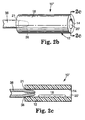
- FIG. 2(b) A means for expanding a mold 10" by creating a high internal pressure is shown in Fig. 2(b) and in cross-section in Fig. 2(c).
- mold 10" is preferably shaped like a sleeve having a first opening 20' for removal of the molded article and a second opening 21 at an opposing end of mold 10" to allow insertion of a nozzle 36.
- Nozzle 36 in turn may be part of a tube 38 that carries compressed air or liquid from a source (not shown).
- nozzle 36 is inserted into opening 21 such that a sufficient seal is formed between nozzle 36 and mold 10". Injection of compressed air, for example, at a pressure appropriate for the thickness and elasticity of the mold being used radially expands mold 10" and forces the molded article towards opening 20'.
- a mold 10 having a single opening 20 as shown in Fig. 1 may be affixed with a tube capable of carrying high pressure fluid into mold 10 between a molded article and inner surface 14.
- the tube may be positioned at any point on mold 10, but preferably is positioned far enough away from the microstructured features of the mold so as not to interfere with their replication.
- the method for making the mold of the present invention is shown in Figs. 3(a) through 3(c).
- the first step is to provide a machineable stock material 50.
- the stock material should have substantially the same macroscopic shape as the final articles to be molded.
- the stock material is then micro-machined to provide a plurality of microstructures 52 on its surface.
- the stock material is called a mold master.
- the mold master represents the shape of the articles to be molded.
- the mold master is then covered with a curable material. When the curable material is hardened, it forms a mold such as that shown in Figs. 1(a) and (b).
- the mold is then removed from the mold master by expanding the mold.
- the stock material may be of any machineable material capable of being separated from the mold material after the mold material has been cured.
- the stock material may comprise a machineable metal or a hard polymer.
- Suitable metals include copper, nickel, aluminum, silver, gold, and platinum, and alloys such as brass.
- Suitable polymers include acrylics, carbonates, and any other polymer that may be machined and retain its shape.
- Micro-machining stock material to form the mold master may be performed by any known technique such as diamond turning or laser ablation. Typically, micro-machining is performed using a diamond- or carbide-tipped tool.
- the profile of the tip will be determined by the shape and dimensions of the structures desired in the mold master. For example, if simple grooves having inverted triangular profiles, as shown in the Figures, are desired, the tip may be a triangular tip whose apex has the same angle as the grooves. Some structures may require multiple passes to form the profile of a single feature.
- Known micro-machining techniques will reproduce surface structures accurately with precisions approaching 0.001 ⁇ m.
- the material used for the mold is preferably flexible when cured so that the mold is elastically expandable.
- Suitable curable materials include elastomers.
- the curable material is a silicone elastomer, for its elastic and release properties.
- the mold master When covering the mold master with a curable material to form the mold, it may be advantageous to place the mold master inside a mandrel. If this is done, the mandrel should have an interior that has dimensions somewhat larger than the dimensions of the exterior of the mold master. The gap that exists between the inside of the mandrel and the surface of the mold master will then define the wall thickness of the mold.
- the curable material can then be injected into the mandrel around the mold master. The curable material is then hardened around the mold master. When the material is cured, the mandrel may be removed.
- the mold master must be separated and removed from the cured mold.
- the same techniques described for removing a molded article from a mold may be used to remove the mold master.
- the mold master and mold may be separated by heating or cooling them sufficiently. Typically, this will only be possible if the mold master is metallic.
- FIG. 4(a) shows a one-piece expandable mold 10.
- Mold 10 has a generally hollow portion 12 that has an outer surface 16 and an inner surface 14.
- the inner surface of the mold has a plurality of microstructured features 18.
- the inside of the mold is accessible through an opening 20.
- the mold provided as shown in Fig. 4(a) is in all ways analogous to the mold shown in Figs. 1(a) and 1(b) and described above.
- the next step is to fill the inside of the mold with a curable material 60 as in Fig. 4(b).
- curable material 60 is in liquid form when introduced into mold 10 so that material 60 flows around microstructured features 18 inside mold 10.
- Curable material 60 may be any material that can be introduced into the mold and hardened at temperature and/or pressure conditions that do not adversely affect mold 10.
- the curable material comprises a polymerizable compound or mixture.
- Curable material 60 may be curable by heat, radiation, or other known processes.
- the method of introduction of the curable material into the mold may be affected by the shape of the mold itself. For example, if the mold has a relatively high aspect ratio (height of the mold to the cross-sectional width of the hollow portion of the mold), care may be required to prevent the formation of bubbles in the curable material while it is being poured. If bubbles form, they may nucleate or become trapped near the microstructured features of the mold. This will adversely affect the ability to replicate the microstructures. Bubble formation may generally be avoided simply by reducing the rate at which liquid material is introduced into the mold. Curable material 60 is then hardened inside the mold to form finished article 62.
- Curable material 60 is preferably chosen to be a type of material that does not significantly shrink upon hardening. If the curable material tends to contract upon hardening, the material may potentially pull away from microstructured features 18 while hardening. This "pulling away” may result in poor replication of the microstructures from the mold into the finished article. If a curable material that tends to contract significantly upon hardening is chosen, however, accurate and precise microreplication may still be obtained. If curable material 60 is of a type that contracts upon curing, the operator may inject curable material 60 into mold 10 under pressure. The amount of material and pressure used will preferably cause expansion of the mold by the same amount that curable material 60 is expected to contract upon hardening. In this manner, when the curable material is hardened, the mold relaxes into its original position as the curable material contracts to counteract the effects of pulling away during hardening.
- finished article 62 may be removed from mold 10.
- mold 10 is elastically expanded to separate inner surface 14 from finished article 62.
- Mold 10 may be expanded by any method of elastic expansion as discussed previously.
- the plurality of microstructured features 64 on the finished article substantially replicate the plurality of microstructured features 18 of the inner surface of mold 10.
- the method of seamless closed mold microreplication of the present invention is particularly useful for imparting microstructures on articles without directly machining the microstructures into the articles.
- the method of the present invention also provides the beneficial ability to mold articles having microstructures without creating seams which may adversely affect the functionality of the article.
- the method of seamless microreplication of the present invention may be used to make an illumination device comprising a fiber core having a plurality of light extraction structures extending into the core.
- a typical illumination device includes a light guide.
- a light guide may be likened to a length of conventional optical fiber.
- Such a fiber generally has a core fiber with a particular cross-sectional geometry (i.e., circular, elliptical, etc.) and a cladding around the core.
- the refractive index of the core is greater than the refractive index of the cladding.
- the cladding may include a protective layer of material, or, in its simplest form, may even be ambient air.
- a beam of electromagnetic energy, such as visible light introduced into the core at one end of the fiber will always strike the core/cladding interface at an angle greater than the critical angle and so will be totally internally reflected. As a result, the light will be transmitted to the other end of the fiber without significant losses.
- An illumination device also includes structures on or in the core that cause the light traveling through the core to be transmitted outside of the fiber in controlled areas and at controlled intensities. Such structures are called extraction structures.
- U.S. Pat. No. 5,432,876 to Appeldorn et al. discloses illumination devices having extraction structures directly on or in the fiber core; and
- U.S. Pat. No. 5,631,994 to Appleldorn et al. discloses extraction structures formed on external overlays that may be attached to light guides to form illumination devices.
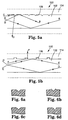
- FIG. 5(a) shows a side view of an illumination device 100 having a core 102 and an optional cladding 104 (represented by the dashed lines in Fig. 5(a)).
- Core 102 has been imparted with a plurality of back extraction structures 106 comprising a series of precise grooves in the surface of the core.
- the illumination device functions as shown by the light rays A, B, and C.
- ray A is reflected at the core/cladding interface and continues to propagate down the fiber core.
- Ray B is incident at the core/cladding interface between extraction structures and is likewise reflected by total internal reflection.
- Ray C is incident at the core/cladding interface on the surface of a back extracting structure.
- the surface of the extraction structure is angled relative to the surface of the core so that when light rays such as ray C are incident at the surface of the structure, the rays are reflected through the cross-section of the core and transmitted through the surface of the fiber opposite the structure.
- extraction structures 106 are termed back extraction structures because they direct light out of the core on the side opposite the structures themselves.
- Fig. 5(b) shows an illumination device 110 having a core 112, optional cladding 114, and front extraction structures 116 on the core.
- Illumination device 110 functions in much the same manner as illumination device 100 shown in Fig. 5(a).
- Rays D and E are reflected internally and continue to propagate down the core of the fiber.
- Ray F is incident on the surface of light extraction structure 116 and is reflected at such an angle that it is transmitted through an adjacent surface of the extraction structure and out of the fiber.
- extraction structures 116 direct light out of the core on the side including the structures, they are termed front extraction structures.
- Both front extraction structures and back extraction structures may be formed as indentions (as in Fig. 5(a)) or as protrusions (as in Fig. 5(b)).
- the method of seamless closed mold microreplication of the present invention may be used to make an illumination device having a plurality of light extraction structures.
- the material of the mold is preferably a silicone elastomer such as Sylgard 184 sold by Dow Corning Corporation, Midland, MI.
- the microstructured features of the inner surface of the mold may generally be indentions, protrusions, or a combination thereof.
- the type of extraction structures and the dimensions and geometry of the extraction structures are chosen based on the desired illumination properties of the final device.
- Various extraction structure dimensions and arrangements are disclosed in detail in U.S. Pat. No. 5,432,876 to Appeldorn et al.
- the curable material used to make the finished light guide preferably hardens into a substantially optically transparent material.
- acrylates are preferred for their transparency properties.
- urethanes may preferably be employed. Urethanes are also desirable because their contraction during hardening tends to be minimal, although the transparency properties of certain formulations may be less that desired.
- curable polymeric materials include polyurethanes comprising the polymerization reaction product of one or more polyisocyanates with one or more polyols.
- polyurethanes useful in the present invention are thermoplastics and thermosets, and are substantially optically transparent and/or capable of transmitting visible light.
- Preferred polyurethanes comprise flexible or rigid, thermoplastic or thermoset aliphatic polyurethanes.
- Useful aliphatic polyurethanes can be formed from reactions of polyester polyols with polyisocyanates and, optionally, chain extenders.
- the mole ratio of polyol: polyisocyanate: chain extender can be from about 1:1:0 to about 1:15:14.
- the preferred polyurethanes useful in the invention exhibit excellent stability under prolonged exposure to light, particularly ultraviolet light.
- aliphatic polyurethanes useful in the invention comprise:
- Hard segments may improve the strength and may increasing the refractive index of the polyurethane waveguide, as needed, provided that they do not adversely affect the light transmissive properties of the waveguide of the invention.
- urethane linkage optionally there may be various amounts of other linkages such as isocyanurates, biurets, allophonates, amides, or oxazolidones present in the waveguide.
- additional polyisocyanate beyond the amount previously described would be required, but the additional linkages cannot be present to such an extent that they would cause phase separation resulting in light scattering, thereby reducing the effectiveness of the waveguide.
- plasticizers such as dibutyl adipate, catalysts such as dibutyltin dilaurate, and other additives such as stabilizers and antioxidants may be added in amounts necessary to assure satisfactory product performance.
- Aliphatic polyurethanes useful in the invention may be blended with other optically clear polymers, provided that the blend is compatible, or that the domains formed are small and do not scatter light which would reduce the effectiveness of the resulting waveguide.
- Preferred glycols include glycols predominantly derivable from branched C 3 -C 6 alkylene oxides, although some units derived from ethylene oxide may be included, providing the essential effect of branched units on the character of the pre-and final polymers is retained and phase crystallization does not occur.
- the amount of ethylene oxide units is preferably less than about 20 weight percent of the total amount of alkylene oxide units. More preferred are glycols predominantly derivable from propylene oxide and/or butylene oxide, including, for example, poly(oxypropyleneoxyethylene) glycol, (commercially available under the trade designation VORANOLTM 5287 and sold by Dow Chemical Company, Midland, MI) with a molecular weight of about 2000, and poly(oxybutyleneoxyethylene) glycol.
- Additional preferred higher molecular weight polyols include the polyethylene and polypropylene oxide polymers in the molecular weight range of from about 200 to about 20,000 such as the series of poly(ethylene oxide) compounds available from Union Carbide Corp., Danbury, CT and sold under the trade designations CarbowaxTM 400, 600, 800, 1000, 3350, 8000 and 20000; the polyether polyols available from Hercules Chemical Specialties Co., Wilmington, DE under the trade designation StructonTM HPOR 0100 NCB; and poly(tetramethylene ether) glycols in the molecular weight range of from about 200 to about 4000, such as the series of polyols available from DuPont Co., Wilmington, DE and sold under the trade designations TerethaneTM 1000 and 2000.
- poly(ethylene oxide) compounds available from Union Carbide Corp., Danbury, CT and sold under the trade designations CarbowaxTM 400, 600, 800, 1000, 3350, 8000 and 20000
- the polyether polyols available
- polyester polyols particularly preferred polyols useful in preparing optical elements of the invention include polyester polyols.
- polyester polyols include polycaprolactone polyols in the molecular weight range of from about 200 to about 5000, such as the series of polyols sold under the trade designations ToneTM 200, 210, 230, 240, 260, 301, 305, and 310 as available from Union Carbide; hydroxy-terminated polybutadiene materials, such as the series of polyols sold under the Poly bdTM trade designation as available from Elf Atochem, Philadelphia, PA; hydrogenated polybutadiene polyols, such as those sold under the trade designations Polytail H and Polytail HA by Mitsubishi Gas Chemical America Inc., New York, NY; aliphatic block co-polymer polyols, such as poly(ethylene-butylene) diols as sold by Shell Chemical Co., Houston, TX under the trade designation KratonTM HPVM 2201; polyglycol est
- Preferred diisocyanates are free of aromatic moieties and comprise only aliphatic and/or cycloaliphatic moieties.
- Preferred diisocyanates include polymethylene diisocyanates such as 1,6-hexamethylene diisocyanate and 1,12-dodecane diisocyanate, methylene bis(4-isocyanatocyclohexane), 1,3- and 1,4-bis(isocyanatomethyl)cyclohexane, cyclohexane-1,4-diisocyanate, cyclohexane-1,3-diisocyanate, 2,2,4-trimethylhexamethylene diisocyanate, cyclobutane-1,3-diisocyanate, isophorone diisocyanate (1-isocyanato-3,3,5-trimethyl-5-isocyanato)cyclohexane, IPDI), 2,4- and 2,6-hexahydrotolylene diisocyanate
- Preferred chain extenders include aliphatic C 2 -C 4 straight chain and branched chain diols, diamines, and hydroxy amines; hydrazine and piperazine, cyclo- and cycloaliphatic diols, diamines or hydroxy amines having up to 12 carbon atoms, hydroquinone and resorcinol (as such or as the bis(2-hydroxyethyl)ethers), and aromatic and heteroaromatic nuclei (and their fully-hydrogenated counterparts) substituted with two groups that are methylol and/or aminomethyl.
- More preferred chain extenders include aliphatic C 2 -C 4 straight and branched chain diols and cycloalkyl diols, such as ethylene glycol, 1,2- and 1,3-propylene glycol, 1,4- and 2,3-butylene glycol, 1,5-pentanediol, 1,6-hexanediol, 1,8-octanediol, neopentyl glycol, 1,4-cyclohexane dimethanol, 1,4-cyclohexanediol, trimethylolpropane, 1,4-bis(hydroxymethyl cyclohexane), 2-methyl-1,3-propanediol, glycerol, trimethylolpropane, 1,2,6-hexanetriol, trimethylolethane, pentaerythritol, quinitol, mannitol, sorbitol, diethylene glycol, triethylene glycol, tetraethylene glyco
- chain extenders include fluorine-substituted difunctional diols such as 1,2,3,4,4-hexafluoropentane-1,5-diol and phenyl-substituted C 2 -C 5 diols such as 2-phenyl-1,3-propylene glycol and phenyl-1,4-butylene glycol.
- fluorine-substituted difunctional diols such as 1,2,3,4,4-hexafluoropentane-1,5-diol
- phenyl-substituted C 2 -C 5 diols such as 2-phenyl-1,3-propylene glycol and phenyl-1,4-butylene glycol.
- mixtures and combinations of the above diols can be used as chain extenders.
- the mole ratio of polyol: polyisocyanate: chain extender is preferably in the range of from about 1:1:0 to about 1:15:14, more preferably from about 1:1:0 to about 1:6:5.
- Aliphatic polyurethanes useful in the invention can be prepared by first reacting the polyol and diisocyanate to form a prepolymer, then reacting the prepolymer with the chain extender, in a two-step process.
- the polyurethane may also be prepared by first blending the polyol and chain extender followed by addition of diisocyanate, in a one-pot method.
- the polyurethane can be a thermoplastic material having a weight-average molecular weight preferably in the range of from about 60,000 to about 200,000 or it can be a thermoset material, i.e ., crosslinked.
- the microstructures were generally either directly machined into the fiber, or a thin strip of material having the microstructures was adhered to the surface of the fiber. With direct machining, only indentions, or grooves, can be made in the fiber. When an extra strip of microstructured material is used an extra interface is added. Such an interface may lead to degraded optical performance such as losses at the extra interface.
- Direct machining may take the form of diamond turning where small sections of the fiber are repeatedly removed using a precise diamond-tipped element until the desired groove shape and size are attained. This method, while highly accurate, requires multiple passes for each groove and is thus inefficient. In addition, when softer materials are used for the light guide, it may be difficult to machine precise grooves due to the elastic nature of the fiber material.
- Direct machining may also take the form of a stamping process.
- This process is described in detail in U.S. Pat. No. 5,432,876 to Appeldorn et al.
- the stamping process involves providing a stamping tool comprising a die having a series of ridges.
- the ridges are designed to have the shape and dimensions of the grooves to be imparted in the surface of the fiber.
- the surface of the fiber is then indented with the stamping tool.
- This method has the advantage of being more efficient than direct diamond turning because multiple passes are not required.
- stamping displaces material rather than remove it from the fiber, extra material is displaced, causing surface deformations in the fiber.
- this method may only be employed to create surface indentions.
- a brass rod 12 mm diameter and 50 cm long, polished to a smooth, optical finish i.e ., features less than 200 nm (8 microinches), RMS roughness
- a tungsten carbide cutting tip having an angle profile required for one or more notches to be cut in the brass rod e.g. , 90°
- the cutting tip cut notches (microstructures) in the brass rod at precisely indexed intervals, as required for light extraction from the final molded polymeric article, such as described in copending application USSN 08/789,808.
- the brass rod referred hereinafter as the mold master
- the mold master was removed from the milling machine and cleaned thoroughly to remove traces of metal chips. It is within the scope of the invention that notches of different dimensions and different angles can be cut in the same brass rod by use of more than one cutting tip and multiple passes along the rod.
- the mold master was heated at 160 °C for 4 hours then cooled to 23 °C (room temperature).
- the mold master was then placed vertically on the end cap of a two-piece hollow, round mold, called a "chase," one piece of which is aluminum and the other of which is transparent polycarbonate.
- the pieces represent halves of the chase splitting the diameter.
- the chase is 25 cm in diameter and 56 cm long.
- the end cap is countersunk so as to provide a means to center the rod in the hollow mold.
- the two halves of the chase were closed and sealed with tape and clamped near the top and bottom, using laboratory hose clamps.
- a silicone molding material Sylgard 184 (Dow Coming Corp., Midland, MI) was mixed with a curing agent sold by Dow Corning under the trade designation Sylgard in a 10:1 volume ratio under pump vacuum for a time sufficient to remove essentially all of the bubbles.
- the mixed material was slowly poured into the top of the chase to cover the entire length of the chase master.
- a countersunk top end cap was placed over the free end of the mold master and fitted into the open top of the chase, thereby centering the mold master in the chase cavity and sealing the chase.
- the silicone mold material was allowed to cure overnight at 23°C (alternatively, the silicone could be cured for 8 hours at 50°C), after which the chase was removed.
- the mold master was removed from the mold by first gently separating the silicone from the mold master, then applying air pressure to the inside of the mold and pulling the mold master out of the expanded silicone mold. A hollow, flexible mold, having on its inner surface the requisite microstructured features, was obtained.
- a polyurethane-precursor mixture comprising 39.6 parts by weight bis(4-isocyanatocyclohexyl)methane (for example, that sold under the trade designation DesmodurTM W, from Bayer Corp., Pittsburgh, PA), 39.3 parts by weight isocyanurate-containing polyisocyanate (for example, that sold under the trade designation DesmodurTM N-3300, by Bayer Corp.), 80 parts polyester diol (for example, that sold under the trade designation CAPATM 200, M w 550, by Solvay Interox, Houston, TX), 20 parts by weight polyester triol (for example, that sold under the trade designation CAPATM 301, M w 300, by Solvay Interox) was stirred at 23°C under pump vacuum for 30 minutes, after which vacuum was released and 0.3 parts by weight dibutyltin dimercaptide polymerization catalyst (for example, that sold under the trade designation FoamrezTM UL-1, by Witco Corp., Greenwich, CT) was added
- Example 2 The chase containing the hollow mold obtained in Example 1 was clamped vertically and the polyurethane-precursor mixture was slowly poured into the silicone mold in a manner so as to avoid generating bubbles in the liquid polyurethane precursor mixture. Curing of the polyurethane illumination device was accomplished at 23 °C for one hour. If necessary, the cured device could be further post-cured by heating at 100 °C for one hour.
- the soft, flexible illumination device was removed from the expandable silicone mold by gently flexing the mold to separate it from the device, after which one end of the mold was covered and compressed air was introduced into the other end.
- the mold was slightly expanded and the illumination device was grasped and pulled from the mold without damage to the mold or loss of precision of the microstructured notches in the illumination device.
- the coated device was then covered with white vinyl tape (in this case, the white vinyl tape sold under Cat. No. 471 by 3M Company, St. Paul, MN was used) over approximately 270° of its circumference so that only the molded notches remained exposed.
- the exposed notches were coated with a thin layer of elemental silver using a kit and method supplied by Lilly Industries, Inc., Woodbridge, CT. The exposed notches were washed thoroughly with distilled water, then, while still wet, sprayed with a dilute aqueous solution of stannous fluoride.
- Illumination characteristics of the resulting device, having silvered notches, were measured in comparison to SAE Standard J1957 JUN93 for Center High Mounted Stop Lamp (CHMSL) devices.
- the illumination device of the invention was lit from one end with 95 lumens from a light source (Type 20500, Fostec Inc., Auburn, NY), employing a 150W halogen bulb (Ushio KK, Tokyo, Japan).
- the data set resulting from single-ended illumination was added to a mirror image of itself to indicate the performance of a CHMSL illuminated from both ends. The results of this measurement and calculation are shown in Table 1.
- the data of Table 1 show that the molded and demolded illumination device of the invention provided light at SAE Standard test points for a CHMSL greater than the minimum and less than the maximum candelas for each test point.
- the mold design was, therefore, validated, and the method of making a CHMSL was shown to be satisfactory.
- a hard-formula polyurethane precursor formulation was prepared as described in Example 2, comprising 39 parts by weight Desmodur W, 38.7 parts by weight Desmodur N-3300, 80 parts by weight polyester diol (for example, that sold under the trade designation Tone 0201, M w 530, by Union Carbide Corp., Danbury, CT), 20 parts by weight polyester triol (for example, that sold under the trade designation Tone 0301, M w 300, by Union Carbide Corp.), and 1.7 parts by weight dibutyltin dimercaptide catalyst (for example, that sold under the trade designation FoamrezTM UL-1, by Witco Corp.).
- an optically clear, flexible polyurethane illumination device was obtained.
Landscapes
- Engineering & Computer Science (AREA)
- Mechanical Engineering (AREA)
- Manufacturing & Machinery (AREA)
- Physics & Mathematics (AREA)
- Health & Medical Sciences (AREA)
- Ophthalmology & Optometry (AREA)
- General Physics & Mathematics (AREA)
- Optics & Photonics (AREA)
- Moulds For Moulding Plastics Or The Like (AREA)
- Light Guides In General And Applications Therefor (AREA)
- Heating, Cooling, Or Curing Plastics Or The Like In General (AREA)
- Casting Or Compression Moulding Of Plastics Or The Like (AREA)
Applications Claiming Priority (3)
| Application Number | Priority Date | Filing Date | Title |
|---|---|---|---|
| US26836 | 1987-03-17 | ||
| US09/026,836 US6077462A (en) | 1998-02-20 | 1998-02-20 | Method and apparatus for seamless microreplication using an expandable mold |
| PCT/US1999/001566 WO1999042270A1 (en) | 1998-02-20 | 1999-01-25 | Method and apparatus for seamless microreplication using an expandable mold |
Publications (2)
| Publication Number | Publication Date |
|---|---|
| EP1066143A1 EP1066143A1 (en) | 2001-01-10 |
| EP1066143B1 true EP1066143B1 (en) | 2002-04-10 |
Family
ID=21834068
Family Applications (1)
| Application Number | Title | Priority Date | Filing Date |
|---|---|---|---|
| EP99903390A Expired - Lifetime EP1066143B1 (en) | 1998-02-20 | 1999-01-25 | Method and apparatus for seamless microreplication using an expandable mold |
Country Status (6)
| Country | Link |
|---|---|
| US (2) | US6077462A (enExample) |
| EP (1) | EP1066143B1 (enExample) |
| JP (1) | JP4295432B2 (enExample) |
| AU (1) | AU733436B2 (enExample) |
| DE (1) | DE69901240T2 (enExample) |
| WO (1) | WO1999042270A1 (enExample) |
Cited By (1)
| Publication number | Priority date | Publication date | Assignee | Title |
|---|---|---|---|---|
| EP2574451A1 (en) | 2011-09-29 | 2013-04-03 | 3M Innovative Properties Company | Method of manufacturing an optically transparent light guide |
Families Citing this family (34)
| Publication number | Priority date | Publication date | Assignee | Title |
|---|---|---|---|---|
| US6077462A (en) * | 1998-02-20 | 2000-06-20 | 3M Innovative Properties Company | Method and apparatus for seamless microreplication using an expandable mold |
| EP1127381B1 (en) | 1998-11-02 | 2015-09-23 | 3M Innovative Properties Company | Transparent conductive oxides for plastic flat panel displays |
| JP4394839B2 (ja) | 1999-02-24 | 2010-01-06 | スリーエム イノベイティブ プロパティズ カンパニー | 所定の強度パターンを産み出す照明装置 |
| US6623667B2 (en) | 2001-02-28 | 2003-09-23 | 3M Innovative Properties Company | Method for continuous fabrication of structured surface light guides |
| US6749792B2 (en) * | 2001-07-09 | 2004-06-15 | Lifescan, Inc. | Micro-needles and methods of manufacture and use thereof |
| US6957904B2 (en) * | 2001-07-30 | 2005-10-25 | 3M Innovative Properties Company | Illumination device utilizing displaced radiation patterns |
| JP3445587B2 (ja) * | 2001-09-13 | 2003-09-08 | コナミ株式会社 | 対戦型ラリーゲームプログラム |
| US6707974B2 (en) * | 2002-01-31 | 2004-03-16 | Visteon Global Technologies, Inc. | Clamshell design for an optical light manifold and method of production |
| US7140812B2 (en) * | 2002-05-29 | 2006-11-28 | 3M Innovative Properties Company | Diamond tool with a multi-tipped diamond |
| US6899838B2 (en) * | 2002-07-12 | 2005-05-31 | Becton, Dickinson And Company | Method of forming a mold and molding a micro-device |
| US20040045419A1 (en) * | 2002-09-10 | 2004-03-11 | Bryan William J. | Multi-diamond cutting tool assembly for creating microreplication tools |
| GB0226576D0 (en) * | 2002-11-14 | 2002-12-18 | Spinox Ltd | Apparatus and method for forming materials |
| DE10253725B3 (de) * | 2002-11-19 | 2004-05-06 | Benecke-Kaliko Ag | Verfahren zur Herstellung eines mit einer genarbten oder strukturierten Formhaut fest verbundenen Formkörpers sowie Vorrichtung zur Durchführung eines solchen Verfahrens |
| US20060157875A1 (en) * | 2002-12-13 | 2006-07-20 | Koninklijke Philips Electronics N.V. | Method of manufacturing a replica, as well as a replica obtained by carring out a uv light-initiated or thermal curing treatment of a reactive mixture |
| US20040241049A1 (en) * | 2003-04-04 | 2004-12-02 | Carvalho Bruce L. | Elastomeric tools for the fabrication of elastomeric devices and uses thereof |
| WO2006063414A1 (en) | 2004-12-17 | 2006-06-22 | Poly Optics Australia Pty Ltd | Polyurethane light guides |
| DE102005025121B3 (de) * | 2005-05-27 | 2006-10-26 | Siemens Ag | Verfahren zum Herstellen eines Bandes mit mehreren parallel verlaufenden Lichtleitern |
| JP2007210323A (ja) * | 2006-01-10 | 2007-08-23 | Mazda Motor Corp | 樹脂成形品の成形方法及び成形装置 |
| KR20080004983A (ko) * | 2006-07-07 | 2008-01-10 | 삼성전자주식회사 | 도광판 패턴 형성 장치 및 도광판의 제조 방법 |
| GB0615854D0 (en) * | 2006-08-10 | 2006-09-20 | 3M Innovative Properties Co | Light guide for a lighting device |
| WO2008048547A2 (en) * | 2006-10-16 | 2008-04-24 | Ebs Concepts, Llc | Castable mass reduced machinable mold material |
| US7677780B2 (en) * | 2007-02-20 | 2010-03-16 | 3M Innovative Properties Company | Light guide orientation connector |
| US20090041553A1 (en) * | 2007-08-06 | 2009-02-12 | 3M Innovative Properties Company | Fly-cutting system and method, and related tooling and articles |
| CN102016656A (zh) * | 2008-04-02 | 2011-04-13 | 3M创新有限公司 | 用于制备具有叠加特征的光学膜的方法和系统 |
| TWI483013B (zh) | 2008-04-02 | 2015-05-01 | 3M Innovative Properties Co | 光導膜及其製造方法 |
| JP5643750B2 (ja) | 2008-04-30 | 2014-12-17 | スリーエム イノベイティブ プロパティズ カンパニー | 照明システム及びそのための光注入カプラ |
| GB0813186D0 (en) * | 2008-07-18 | 2008-08-27 | 3M Innovative Properties Co | Lighting device comprising a light guide and a support |
| NL2002718C2 (nl) * | 2009-04-06 | 2010-10-07 | Peritech B V | Reparatie van ribben op treden van een roltrap of rolpad. |
| US20110005533A1 (en) * | 2009-07-07 | 2011-01-13 | Evans Douglas J | Mold For a Smoking Device |
| EP2354818A1 (en) | 2010-02-09 | 2011-08-10 | 3M Innovative Properties Company | Elongated lighting device and method of making same |
| JP5971860B2 (ja) * | 2013-03-06 | 2016-08-17 | 新電元工業株式会社 | 樹脂封止モジュールの製造方法、樹脂封止モジュール |
| DE102013007938B4 (de) * | 2013-05-07 | 2019-05-23 | Motherson Innovations Lights GmbH & Co. KG | Flexibler Lichtleiter und Verfahren zur Herstellung eines flexiblen Lichtleiters |
| EP3173690A1 (en) * | 2015-11-30 | 2017-05-31 | Embedded Nano Europe AB | Method and template for producing a light out-coupling portion on a surface of a light guide |
| WO2022091617A1 (ja) * | 2020-10-26 | 2022-05-05 | ソニーグループ株式会社 | 画像表示装置及び導光板の製造方法 |
Family Cites Families (22)
| Publication number | Priority date | Publication date | Assignee | Title |
|---|---|---|---|---|
| US3641332A (en) * | 1969-10-30 | 1972-02-08 | Ebert Michael | Fiber optics illumination system |
| BE794780A (fr) * | 1972-01-31 | 1973-05-16 | Precision Flexmold | Appareil pour le moulage d'objets |
| US3841822A (en) * | 1972-01-31 | 1974-10-15 | Precision Flexmold | Seamless article molding apparatus |
| US3982721A (en) * | 1975-01-20 | 1976-09-28 | Precision Flexmold, Inc. | Molding apparatus including a one-piece flexible mold deformable by fluid pressure differential |
| US4045153A (en) * | 1975-01-20 | 1977-08-30 | Precision Flexmold, Inc. | Molding apparatus including one-piece flexible mold and means to restrict the deformation of the mold |
| US4055620A (en) * | 1976-09-07 | 1977-10-25 | Conrad Jack R | Flexible mold and process |
| US4170616A (en) * | 1978-05-30 | 1979-10-09 | Rca Corporation | Method of fabrication of a Fresnel lens |
| US4389428A (en) * | 1982-03-15 | 1983-06-21 | International Telephone And Telegraph Corporation | Method of rejacketing a fusion splice in an ultraviolet light curable resin jacketed optical fiber |
| JPS59156730A (ja) * | 1983-02-25 | 1984-09-06 | Ngk Insulators Ltd | ゴム状弾性成形体の内部金型離型方法 |
| JPS6211614A (ja) * | 1985-07-09 | 1987-01-20 | Maruwa Kasei Kk | 合成樹脂製薄板の立体模様成形用金型 |
| US4871487A (en) * | 1987-01-16 | 1989-10-03 | The Dow Chemical Company | Method of making a polymeric optical waveguide by coextrusion |
| JPH0614162Y2 (ja) * | 1987-06-19 | 1994-04-13 | 三菱レイヨン株式会社 | 光フアイバ粗面加工装置 |
| US4909597A (en) * | 1989-02-23 | 1990-03-20 | The Dow Chemical Company | Flexible optical waveguide containing a thermoplastic aliphatic segmented polyurethane core |
| US5023042A (en) * | 1989-06-29 | 1991-06-11 | Gary Efferding | Flexible mold for making seamless sailboards |
| US5106289A (en) * | 1991-03-14 | 1992-04-21 | Hughes Aircraft Company | Elastomeric mold for optical fiber buffer |
| US5244485A (en) * | 1991-04-30 | 1993-09-14 | The Furukawa Electric Co., Ltd. | Method of manufacturing a silica glass preform |
| US5432876C1 (en) * | 1992-10-19 | 2002-05-21 | Minnesota Mining & Mfg | Illumination devices and optical fibres for use therein |
| BR9406750A (pt) * | 1993-06-11 | 1996-02-27 | Minnesota Mining & Mfg | Processo para a fabricaçao de artigo ferramental mestre para replicaçao e artigo obtido |
| US5679739A (en) * | 1995-04-10 | 1997-10-21 | Dow Corning Corporation | Organosiloxane compositions exhibiting increased penetration into porous substrates |
| US5631994A (en) * | 1995-08-23 | 1997-05-20 | Minnesota Mining And Manufacturing Company | Structured surface light extraction overlay and illumination system |
| JP3772243B2 (ja) * | 1996-09-25 | 2006-05-10 | 湘南デザイン株式会社 | 複製製品の成形方法 |
| US6077462A (en) * | 1998-02-20 | 2000-06-20 | 3M Innovative Properties Company | Method and apparatus for seamless microreplication using an expandable mold |
-
1998
- 1998-02-20 US US09/026,836 patent/US6077462A/en not_active Expired - Lifetime
-
1999
- 1999-01-25 AU AU23425/99A patent/AU733436B2/en not_active Ceased
- 1999-01-25 JP JP2000532256A patent/JP4295432B2/ja not_active Expired - Lifetime
- 1999-01-25 DE DE69901240T patent/DE69901240T2/de not_active Expired - Lifetime
- 1999-01-25 EP EP99903390A patent/EP1066143B1/en not_active Expired - Lifetime
- 1999-01-25 WO PCT/US1999/001566 patent/WO1999042270A1/en not_active Ceased
-
2000
- 2000-01-05 US US09/477,947 patent/US6379592B1/en not_active Expired - Lifetime
Cited By (2)
| Publication number | Priority date | Publication date | Assignee | Title |
|---|---|---|---|---|
| EP2574451A1 (en) | 2011-09-29 | 2013-04-03 | 3M Innovative Properties Company | Method of manufacturing an optically transparent light guide |
| WO2013049478A1 (en) | 2011-09-29 | 2013-04-04 | 3M Innovative Properties Company | Method of manufacturing a molded article |
Also Published As
| Publication number | Publication date |
|---|---|
| US6379592B1 (en) | 2002-04-30 |
| JP4295432B2 (ja) | 2009-07-15 |
| US6077462A (en) | 2000-06-20 |
| EP1066143A1 (en) | 2001-01-10 |
| AU2342599A (en) | 1999-09-06 |
| AU733436B2 (en) | 2001-05-17 |
| DE69901240D1 (de) | 2002-05-16 |
| US20020056928A1 (en) | 2002-05-16 |
| WO1999042270A1 (en) | 1999-08-26 |
| JP2002503565A (ja) | 2002-02-05 |
| DE69901240T2 (de) | 2002-12-19 |
Similar Documents
| Publication | Publication Date | Title |
|---|---|---|
| US6077462A (en) | Method and apparatus for seamless microreplication using an expandable mold | |
| US6491851B1 (en) | Method for obtaining an ophthalmic lens comprising a surface utility microstructure and resulting ophthalmic lenses | |
| US7553544B2 (en) | Precursor composition for optical resin, resin for optical use, optical element, and optical article | |
| AU758276B2 (en) | Illumination device and method for making the same | |
| KR100853160B1 (ko) | 구조화된 표면 광 가이드의 연속 제조 방법 | |
| JPH045681B2 (enExample) | ||
| GB1575694A (en) | Process and apparatus for moulding contact lenses | |
| US3380718A (en) | Process for molding high quality plastic lenses | |
| JPH02248215A (ja) | 実用的微細構造を有する複合プラスチック物品の製造方法 | |
| AU757291B2 (en) | Method for molding light extraction structures onto a light guide | |
| JP2004524998A5 (enExample) | ||
| EP1332383B1 (en) | Elastical optical structure | |
| KR100600661B1 (ko) | 광 안내부 상에 광 추출 구조물을 성형하기 위한 장치 | |
| EP0145516B1 (en) | Cutting device and method for the precision trimming of the edge of a cast contact lens | |
| JP2796331B2 (ja) | プラスチック成形レンズ | |
| JP5080905B2 (ja) | 型内被覆成形体及び型内被覆成形体の製造方法 | |
| JP2010091689A (ja) | 複合光学素子 | |
| EP2354818A1 (en) | Elongated lighting device and method of making same | |
| JP3999305B2 (ja) | 光学用熱可塑性ウレタン樹脂レンズの製造方法とそのレンズ | |
| JPH11106456A (ja) | フレネルレンズ及び透過型スクリーン | |
| JPS63128308A (ja) | 石英ガラス系光フアイバ | |
| JPH06155489A (ja) | プラスチックレンズ製造方法およびプラスチックレンズ製造用鋳型のスペーサ | |
| KR100975308B1 (ko) | 몰드, 몰드의 제조방법과, 그것의 용도 | |
| JPH10319252A (ja) | プラスチック光ファイバ母材の製造方法 |
Legal Events
| Date | Code | Title | Description |
|---|---|---|---|
| PUAI | Public reference made under article 153(3) epc to a published international application that has entered the european phase |
Free format text: ORIGINAL CODE: 0009012 |
|
| 17P | Request for examination filed |
Effective date: 20000908 |
|
| AK | Designated contracting states |
Kind code of ref document: A1 Designated state(s): DE GB |
|
| GRAG | Despatch of communication of intention to grant |
Free format text: ORIGINAL CODE: EPIDOS AGRA |
|
| 17Q | First examination report despatched |
Effective date: 20010504 |
|
| GRAG | Despatch of communication of intention to grant |
Free format text: ORIGINAL CODE: EPIDOS AGRA |
|
| GRAG | Despatch of communication of intention to grant |
Free format text: ORIGINAL CODE: EPIDOS AGRA |
|
| GRAH | Despatch of communication of intention to grant a patent |
Free format text: ORIGINAL CODE: EPIDOS IGRA |
|
| REG | Reference to a national code |
Ref country code: GB Ref legal event code: IF02 |
|
| GRAH | Despatch of communication of intention to grant a patent |
Free format text: ORIGINAL CODE: EPIDOS IGRA |
|
| GRAA | (expected) grant |
Free format text: ORIGINAL CODE: 0009210 |
|
| AK | Designated contracting states |
Kind code of ref document: B1 Designated state(s): DE GB |
|
| REF | Corresponds to: |
Ref document number: 69901240 Country of ref document: DE Date of ref document: 20020516 |
|
| PLBE | No opposition filed within time limit |
Free format text: ORIGINAL CODE: 0009261 |
|
| STAA | Information on the status of an ep patent application or granted ep patent |
Free format text: STATUS: NO OPPOSITION FILED WITHIN TIME LIMIT |
|
| 26N | No opposition filed |
Effective date: 20030113 |
|
| PGFP | Annual fee paid to national office [announced via postgrant information from national office to epo] |
Ref country code: GB Payment date: 20080129 Year of fee payment: 10 |
|
| GBPC | Gb: european patent ceased through non-payment of renewal fee |
Effective date: 20090125 |
|
| PG25 | Lapsed in a contracting state [announced via postgrant information from national office to epo] |
Ref country code: GB Free format text: LAPSE BECAUSE OF NON-PAYMENT OF DUE FEES Effective date: 20090125 |
|
| PGFP | Annual fee paid to national office [announced via postgrant information from national office to epo] |
Ref country code: DE Payment date: 20180110 Year of fee payment: 20 |
|
| REG | Reference to a national code |
Ref country code: DE Ref legal event code: R071 Ref document number: 69901240 Country of ref document: DE |