EP1048732A1 - Verfahren zur Herstellung von natürlich gefalteten und sekretierten Proteinen - Google Patents
Verfahren zur Herstellung von natürlich gefalteten und sekretierten Proteinen Download PDFInfo
- Publication number
- EP1048732A1 EP1048732A1 EP99107412A EP99107412A EP1048732A1 EP 1048732 A1 EP1048732 A1 EP 1048732A1 EP 99107412 A EP99107412 A EP 99107412A EP 99107412 A EP99107412 A EP 99107412A EP 1048732 A1 EP1048732 A1 EP 1048732A1
- Authority
- EP
- European Patent Office
- Prior art keywords
- polypeptide
- arginine
- signal sequence
- expression
- prokaryotic
- Prior art date
- Legal status (The legal status is an assumption and is not a legal conclusion. Google has not performed a legal analysis and makes no representation as to the accuracy of the status listed.)
- Withdrawn
Links
Images


Classifications
-
- C—CHEMISTRY; METALLURGY
- C12—BIOCHEMISTRY; BEER; SPIRITS; WINE; VINEGAR; MICROBIOLOGY; ENZYMOLOGY; MUTATION OR GENETIC ENGINEERING
- C12P—FERMENTATION OR ENZYME-USING PROCESSES TO SYNTHESISE A DESIRED CHEMICAL COMPOUND OR COMPOSITION OR TO SEPARATE OPTICAL ISOMERS FROM A RACEMIC MIXTURE
- C12P21/00—Preparation of peptides or proteins
-
- C—CHEMISTRY; METALLURGY
- C12—BIOCHEMISTRY; BEER; SPIRITS; WINE; VINEGAR; MICROBIOLOGY; ENZYMOLOGY; MUTATION OR GENETIC ENGINEERING
- C12N—MICROORGANISMS OR ENZYMES; COMPOSITIONS THEREOF; PROPAGATING, PRESERVING, OR MAINTAINING MICROORGANISMS; MUTATION OR GENETIC ENGINEERING; CULTURE MEDIA
- C12N9/00—Enzymes; Proenzymes; Compositions thereof; Processes for preparing, activating, inhibiting, separating or purifying enzymes
- C12N9/14—Hydrolases (3)
- C12N9/48—Hydrolases (3) acting on peptide bonds (3.4)
- C12N9/50—Proteinases, e.g. Endopeptidases (3.4.21-3.4.25)
- C12N9/64—Proteinases, e.g. Endopeptidases (3.4.21-3.4.25) derived from animal tissue
- C12N9/6421—Proteinases, e.g. Endopeptidases (3.4.21-3.4.25) derived from animal tissue from mammals
- C12N9/6424—Serine endopeptidases (3.4.21)
- C12N9/6456—Plasminogen activators
- C12N9/6459—Plasminogen activators t-plasminogen activator (3.4.21.68), i.e. tPA
-
- C—CHEMISTRY; METALLURGY
- C07—ORGANIC CHEMISTRY
- C07K—PEPTIDES
- C07K1/00—General methods for the preparation of peptides, i.e. processes for the organic chemical preparation of peptides or proteins of any length
- C07K1/107—General methods for the preparation of peptides, i.e. processes for the organic chemical preparation of peptides or proteins of any length by chemical modification of precursor peptides
- C07K1/113—General methods for the preparation of peptides, i.e. processes for the organic chemical preparation of peptides or proteins of any length by chemical modification of precursor peptides without change of the primary structure
- C07K1/1133—General methods for the preparation of peptides, i.e. processes for the organic chemical preparation of peptides or proteins of any length by chemical modification of precursor peptides without change of the primary structure by redox-reactions involving cystein/cystin side chains
-
- C—CHEMISTRY; METALLURGY
- C12—BIOCHEMISTRY; BEER; SPIRITS; WINE; VINEGAR; MICROBIOLOGY; ENZYMOLOGY; MUTATION OR GENETIC ENGINEERING
- C12N—MICROORGANISMS OR ENZYMES; COMPOSITIONS THEREOF; PROPAGATING, PRESERVING, OR MAINTAINING MICROORGANISMS; MUTATION OR GENETIC ENGINEERING; CULTURE MEDIA
- C12N1/00—Microorganisms; Compositions thereof; Processes of propagating, maintaining or preserving microorganisms or compositions thereof; Processes of preparing or isolating a composition containing a microorganism; Culture media therefor
- C12N1/20—Bacteria; Culture media therefor
-
- C—CHEMISTRY; METALLURGY
- C12—BIOCHEMISTRY; BEER; SPIRITS; WINE; VINEGAR; MICROBIOLOGY; ENZYMOLOGY; MUTATION OR GENETIC ENGINEERING
- C12N—MICROORGANISMS OR ENZYMES; COMPOSITIONS THEREOF; PROPAGATING, PRESERVING, OR MAINTAINING MICROORGANISMS; MUTATION OR GENETIC ENGINEERING; CULTURE MEDIA
- C12N15/00—Mutation or genetic engineering; DNA or RNA concerning genetic engineering, vectors, e.g. plasmids, or their isolation, preparation or purification; Use of hosts therefor
- C12N15/09—Recombinant DNA-technology
- C12N15/11—DNA or RNA fragments; Modified forms thereof; Non-coding nucleic acids having a biological activity
- C12N15/52—Genes encoding for enzymes or proenzymes
-
- C—CHEMISTRY; METALLURGY
- C12—BIOCHEMISTRY; BEER; SPIRITS; WINE; VINEGAR; MICROBIOLOGY; ENZYMOLOGY; MUTATION OR GENETIC ENGINEERING
- C12P—FERMENTATION OR ENZYME-USING PROCESSES TO SYNTHESISE A DESIRED CHEMICAL COMPOUND OR COMPOSITION OR TO SEPARATE OPTICAL ISOMERS FROM A RACEMIC MIXTURE
- C12P21/00—Preparation of peptides or proteins
- C12P21/02—Preparation of peptides or proteins having a known sequence of two or more amino acids, e.g. glutathione
-
- C—CHEMISTRY; METALLURGY
- C12—BIOCHEMISTRY; BEER; SPIRITS; WINE; VINEGAR; MICROBIOLOGY; ENZYMOLOGY; MUTATION OR GENETIC ENGINEERING
- C12Y—ENZYMES
- C12Y304/00—Hydrolases acting on peptide bonds, i.e. peptidases (3.4)
- C12Y304/21—Serine endopeptidases (3.4.21)
- C12Y304/21069—Protein C activated (3.4.21.69)
-
- C—CHEMISTRY; METALLURGY
- C07—ORGANIC CHEMISTRY
- C07K—PEPTIDES
- C07K2319/00—Fusion polypeptide
-
- C—CHEMISTRY; METALLURGY
- C07—ORGANIC CHEMISTRY
- C07K—PEPTIDES
- C07K2319/00—Fusion polypeptide
- C07K2319/01—Fusion polypeptide containing a localisation/targetting motif
- C07K2319/02—Fusion polypeptide containing a localisation/targetting motif containing a signal sequence
-
- Y—GENERAL TAGGING OF NEW TECHNOLOGICAL DEVELOPMENTS; GENERAL TAGGING OF CROSS-SECTIONAL TECHNOLOGIES SPANNING OVER SEVERAL SECTIONS OF THE IPC; TECHNICAL SUBJECTS COVERED BY FORMER USPC CROSS-REFERENCE ART COLLECTIONS [XRACs] AND DIGESTS
- Y10—TECHNICAL SUBJECTS COVERED BY FORMER USPC
- Y10S—TECHNICAL SUBJECTS COVERED BY FORMER USPC CROSS-REFERENCE ART COLLECTIONS [XRACs] AND DIGESTS
- Y10S435/00—Chemistry: molecular biology and microbiology
- Y10S435/8215—Microorganisms
- Y10S435/822—Microorganisms using bacteria or actinomycetales
- Y10S435/848—Escherichia
- Y10S435/849—Escherichia coli
-
- Y—GENERAL TAGGING OF NEW TECHNOLOGICAL DEVELOPMENTS; GENERAL TAGGING OF CROSS-SECTIONAL TECHNOLOGIES SPANNING OVER SEVERAL SECTIONS OF THE IPC; TECHNICAL SUBJECTS COVERED BY FORMER USPC CROSS-REFERENCE ART COLLECTIONS [XRACs] AND DIGESTS
- Y10—TECHNICAL SUBJECTS COVERED BY FORMER USPC
- Y10S—TECHNICAL SUBJECTS COVERED BY FORMER USPC CROSS-REFERENCE ART COLLECTIONS [XRACs] AND DIGESTS
- Y10S435/00—Chemistry: molecular biology and microbiology
- Y10S435/8215—Microorganisms
- Y10S435/822—Microorganisms using bacteria or actinomycetales
- Y10S435/874—Pseudomonas
- Y10S435/877—Pseudomonas putida
Definitions
- the invention relates to a method for producing water-soluble, naturally folded and secreted polypeptides after expression in prokaryotic cells.
- Protein synthesis also called translation, is found in prokaryotic organisms the ribosomes in the cytoplasm.
- prokaryotic Host organisms it is often desirable that the recombinant obtained Gene product or protein from the cytoplasm through the inner bacterial Membrane secreted in the periplasmic space between the inner and outer membrane becomes. Proteins secreted by the periplasm can then e.g. through an osmotic Shock can be released into the nutrient medium.
- a disadvantage of this method is that the secreted polypeptides often do not form the native, biologically active conformation (Hockney, TIBTECH 12 (1994) 456-463).
- Protein disulfide isomerase (PDI; Glockshuber et al., EP-A 0 510 658) or Peptidyl prolyl cis / trans isomerases or Dsb proteins (Knappik et al., Bio / Technology 11 (1993) 77-83; Qiu et al., Appl. Environm. Microbiol. 64 (1998) 4891-4896 and Schmidt et al., Prot. Engin. 11 (1998) 601-607.
- PDI Protein disulfide isomerase
- EP-A 0 510 658 Peptidyl prolyl cis / trans isomerases or Dsb proteins
- urea or urea derivatives, formamide, acetamide or L-arginine are used in processes for the in vitro renaturation of insoluble protein aggregates (Inclusion bodies) used in cytoplasmic expression of recombinant DNA in prokaryotic cells.
- L-arginine can be used as an additive significantly improve the yield of natively folded proteins during renaturation in vitro (Rudolph et al., U.S. Patent No. 5,593,865; Buchner & Rudolph, Bio / Technology 9 (1991) 157-162; Brinkmann et al., Proc. Natl. Acad. Sci USA 89: 3075-3079 (1992); Lin & Traugh, Prot. Express. Purif. 4 (1993) 256-264).
- the object of the invention is to provide a process for the production of water-soluble, of course folded eukaryotic polypeptides after expression in prokaryotes to provide, which is easy to carry out and in which a complex in vitro after-treatment, such as dissolution of inclusion bodies, reduction and naturation, is not required.
- the concentration of arginine or the compound of the general is Formula I at least 0.1 mol / l, but can also be significantly higher as long as the solubility is guaranteed by arginine or the compound mentioned.
- Arginine are preferred or the compounds of the general formula I in a concentration of 0.1 to 1.5 mol / l used.
- Arginine can be used, for example, as a hydrochloride or as another titrated form of the base Arginine can be used.
- L-arginine is preferred, particularly preferred is Hydrochloride form of L-arginine used.
- nutrient medium used to cultivate the prokaryotic cells additionally reducing thiol reagents which contain SH groups are added, wherein the yield of recombinantly obtained protein is further increased.
- reducing thiol reagents which contain SH groups are added.
- thiol reagent is either a reducing (reduced) thiol reagent SH groups or a mixture of reducing thiol reagents with SH groups and understand oxidizing thiol reagents with disulfide groups.
- Preferred substances are reduced glutathione (GSH), cysteine, N-acetylcysteine, cysteamine, ⁇ -mercaptoethanol and similar compounds.
- the thiol reagents can be used both individually and can be used in mixtures.
- Thiol reagents such as, for example, are particularly suitable Glutathione (GSH), which have a single SH group per molecule.
- GSH Glutathione
- Thiol reagents like glutathione are used to improve the yield of native folded proteins the expression of recombinant DNA in prokaryotic cells (Glockshuber et al., EP-A 0 510 658).
- molecular chaperones are overexpressed and co-secreted.
- Chaperones according to the invention are understood to be proteins that are other, non-native Protect proteins from aggregation in vivo and the formation of their native conformation promote.
- Molecular chaperones are used in the prior art to convert proteins stabilize and thus protect against aggregation and inactivation (Buchner et al., EP-A 0 556 726 A1).
- ATP-independent chaperones of the HSP40 type are preferred (Molecular weight approx. 40 kDa) or a small heat shock protein (sHSP).
- DnaJ is a 40 kDa heat shock protein, which occurs in the cytoplasm of E.
- Hsp70 Hsp70 chaperone
- This system also includes DnaK (Hsp70) and GrpE.
- DnaK Hsp70
- GrpE DnaK
- Certain proteins are through the DnaK system in an ATP-dependent process for native conformation folded (Schröder et al., EMBO J. 12 (1993) 4137-4144; Langer et al., Nature 356 (1992) 683-689). This system also requires ATP to refold denatured proteins.
- DnaJ protects non-native proteins from aggregation in the absence of DnaK and ATP and conveys a folding-competent state (Schröder et al., EMBO J. 12 (1993) 4137-4144).
- Co-secretion of an N-terminal fragment of is also preferred DnaJ, which comprises amino acids 1-108 and hereinafter referred to as the "J domain" (Kelley, TIBS 23 (1998) 222-227). In this area are the J domain and a G / F-rich domain that interacts with DnaK (Wall et al., J. Biol. Chem. 270 (1995) 2139-2144). It has been shown that the co-expression of DnaJ in Cytosol can increase the yield of soluble protein (Yokoyama et al., Microbiol. Ferment. Technol. 62 (1998) 1205-1210).
- Hsp25 (e.g. from the mouse) is a representative of the small heat shock proteins (Gaestel et al., Eur. J. Biochem. 179 (1989) 209-213), a class of chaperones that is ubiquitous is. The molecular weight of these proteins is between 15 and 30 kDa. In case of heat shock the sHsps are highly enriched in the cell (up to 1% of the total cell protein - Arrigo & Landry (1994), In Morimoto (ed.): The Biology of Heat Shock Proteins and Molecular Chaperones, Cold Spring Harbor Press, 335-373).
- sHsps Like DnaJ proteins, sHsps have that Property to prevent the aggregation of non-native proteins and these in one maintain folding-competent state (Jakob et al., J. Biol. Chem. 268 (1993) 1517-1520; Ehrsperger et al., EMBO J. 16 (1997) 221-229).
- overexpression means an increase in Expression of the secreted proteins such as DnaJ- and Hsp25 (preferably by at least 100%) compared to wild type expression of the prokaryotic used in each case Host organism.
- overexpression can e.g. by doing that the genes (for the protein, chaperone and / or signal peptide) are under the control of one strong prokaryotic, preferably inducible expression signal (e.g. a lac- or T7 promoter or a derivative thereof).
- the secretion construct for the overexpression of the polypeptides (proteins) together with regulatory regions (promoter and terminator) on the recombinant DNA is preferably integrated into a vector which additionally encodes the arginine tRNA AGA / AGG , which is rare in prokaryotes, or is combined with a vector which does this tRNA encoded, co-expressed (Brinkmann et al., Gene 85 (1989) 109-114). This enables both the co-overexpression of the respective proteins in the bacterial periplasm and the transcription of the rare tRNA Arg AGA / AGG , which results in an increased synthesis of the desired protein in the bacterial host organism.
- a prokaryotic signal sequence in the sense of the invention is a nucleic acid fragment to understand which of prokaryotes, preferably Gram-negative bacteria, and the penetration of proteins bound to the signal peptide guaranteed by the inner bacterial membranes. As a result, the proteins in the Periplasm or localized in the cell supernatant.
- Such signal sequences usually have a length of 18-30 amino acids and are described for example in Murphy & Beckwith: Export of Proteins to the Cell Envelope in Escherichia coli and in Neidhardt et al. (Ed.): Escherichia coli and Salmonella, Second Edition, Vol. 1, ASM Press, Washington, 1996, pp. 967-978.
- the cleavage of bacterial signal sequences can e.g. following a sequence Ala-X-Ala (von Heijne et al., J. Mol. Biol. 184 (1985) 99-105).
- the structure of the bacterial signal peptidase is described in Paetzel et al., Nature 396 (1998) 186-190.
- Signal sequences are preferably used, which are characterized by im Periplasm of prokaryotic cells localized proteases from the desired protein be split off again. Alternatively, by adding such proteases to the Cell supernatant or to the isolated protein the cleavage of the signal sequence take place.
- the heterologous expression of a variety of eukaryotic proteins such as Proteases, interferons, protein hormones, antibodies or fragments thereof are improved.
- the method is particularly suitable for heterologous production of proteins which, in their native state, have at least two over one Contain disulfide-linked cysteines and then when they have no N-terminal have fused prokaryotic signal sequence in prokaryotic expression arise as insoluble inclusion bodies.
- the method is particularly suitable for proteins that contain more than 5 disulfide bridges in their native state.
- One such protein is for example a recombinant plasminogen activator (hereinafter called rPA, Martin et al., Cardiovasc. Drug Rev. 11 (1993) 299-311, U.S. Patent No. 5,223,256).
- rPA has 9 disulfide bridges that are not formed in the reducing cytosol of E. coli become.
- Secreted protein can then fold in the periplasm.
- the oxidizing conditions of this compartment enable the formation of disulfide bridges.
- polypeptides according to the invention are antibodies or antibody fragments, for example a single-chain F V fragment (ScF v , for example against the thyroid stimulating hormone (thyroid stimulating hormone, TSH).
- ScFvs are shortened antibodies, which can only be obtained from the variable sections (F V ) of the heavy and light chain of an antibody, which are artificially fused via a short (mostly Gly 4 Ser 3 ) linker (Hudson, Curr. Opin Biotechnol. 9 (1998) 395-402).
- ScF V s usually have the same affinity to the antigen like the paternal Fv strands, however, can be overexpressed in E.
- ScF V s can be determined by random mutations and subsequent phage display selection be specifically optimized for binding desired antigens (review article: Allen et al., TIBS 20 (1995) 511-516).
- Allen et al., TIBS 20 (1995) 511-516 By adding 5 mM GSH and 0.4 M L-arginine, the yield of functional ScFv-TSH in the periplasm could be improved 10-fold and in the media supernatant by 40-fold compared to a culture without additives.
- SEQ ID NO: 1 and 2 show the sequence of the part of the expression plasmid pUBS520-pIN-dnaJ, which codes for the fusion protein from OmpA signal sequence and DnaJ with the regulatory sequences (promoter, terminator) which consist of pIN III ompA3-dnaJ were amplified.
- SEQ ID NO: 3 and 4 show the sequence of the part of the expression plasmid pUBS520-pIN-J-Domain, which codes for the fusion protein of OmpA signal sequence and J domain, together with the regulatory sequences (promoter, terminator) which result from pIN III ompA3-dnaJ were amplified.
- SEQ ID NO: 5 and 6 show the sequence of the part of the expression plasmid pUBS520-pIN-hsp25, which codes for the fusion protein from OmpA signal sequence and Hsp25 with the regulatory sequences (promoter, terminator) which consist of pIN III ompA3-hsp25 were amplified.
- SEQ ID NO: 7 and 8 show the sequence of the part of the expression plasmid pUBS520-ScFvOx, which codes for the fusion protein from PelB signal sequence and ScFvOxazolon, together with the regulatory sequences (promoter, terminator) which result from pHEN-ScFv or pIN III ompA3 were amplified.
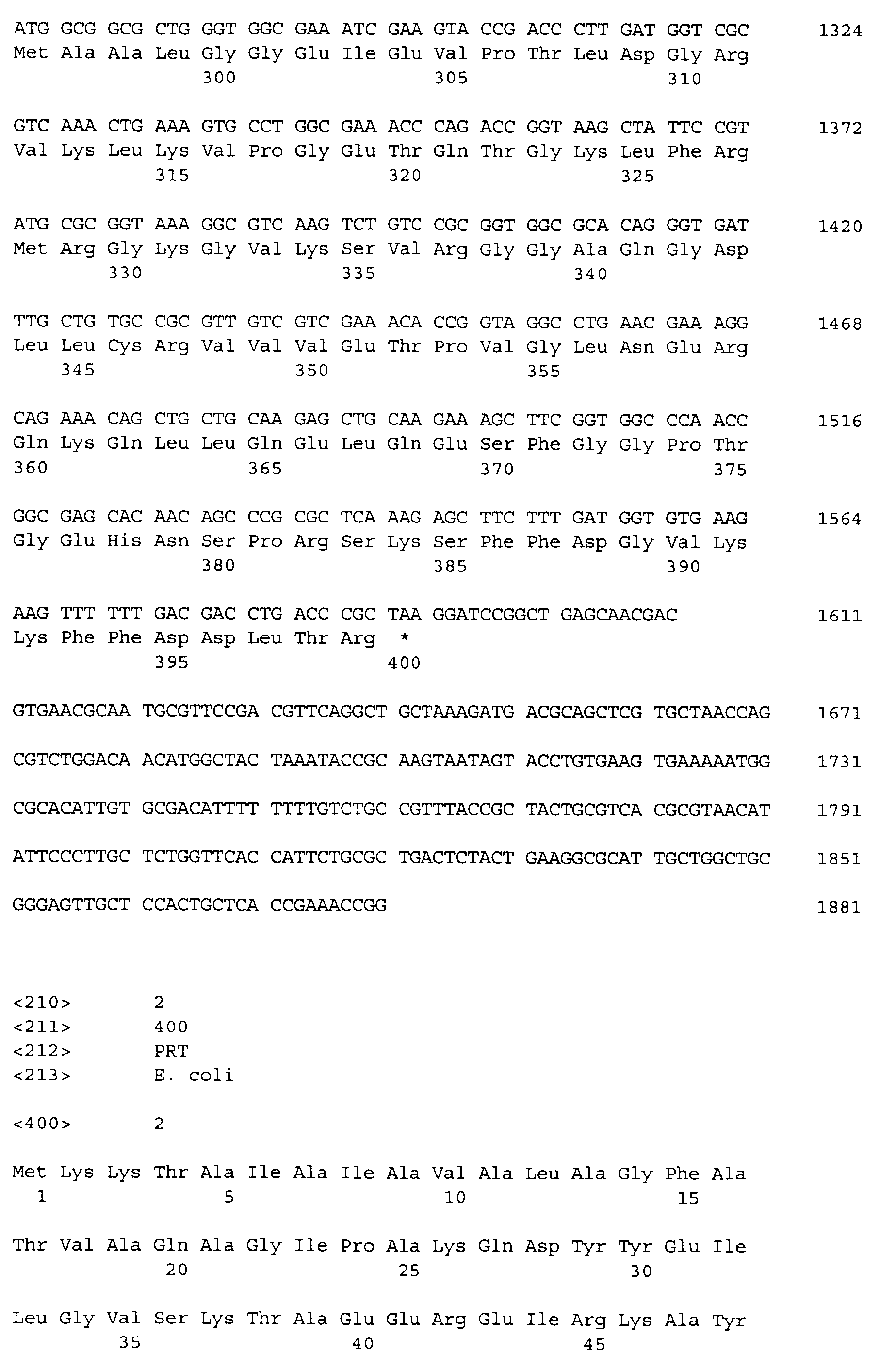
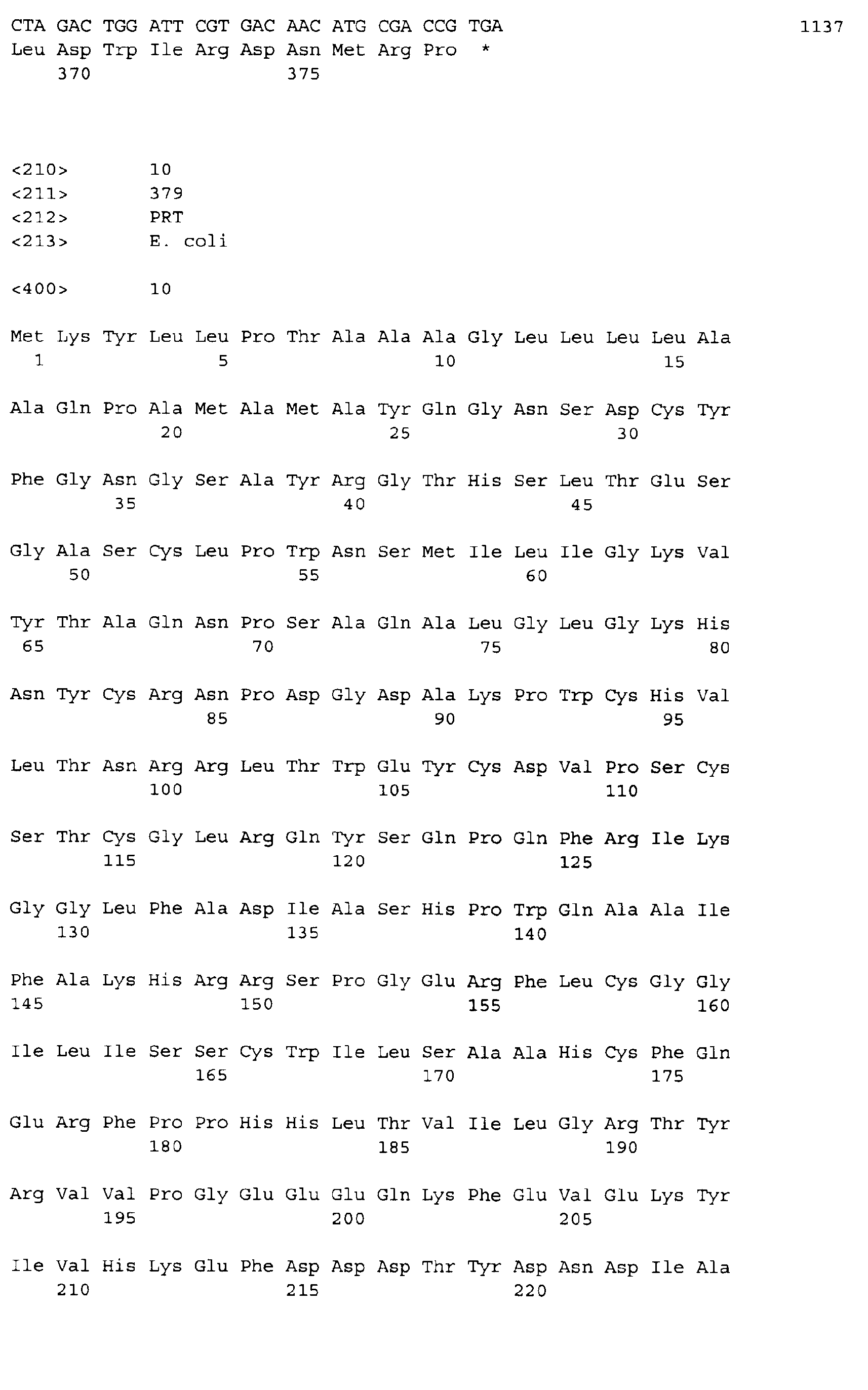
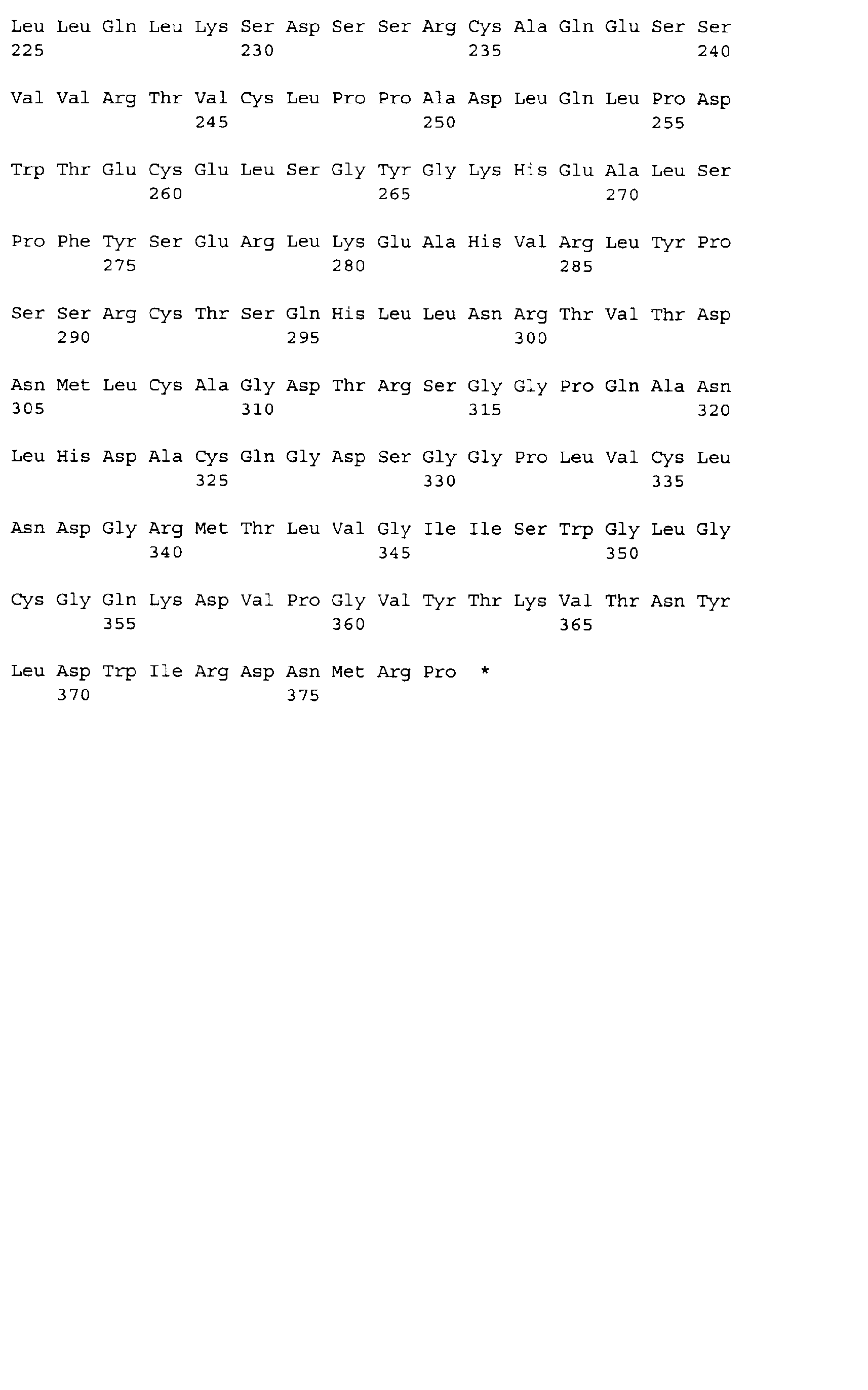
- SEQ ID NO: 9 and 10 show the sequence of the part of the expression plasmid pET20b (+) - rPA, which codes for the fusion protein from the PelB signal sequence and rPA.
- FIG. 2 shows a comparison of the expression of rPA in the periplasm of E. coli BL21 (DE3) with co-secretion of DnaJ and with the addition of GSH and various low molecular weight folding-improving substances to the medium.
- FIG. 3 shows a schematic representation of the expression plasmid pUBS520-pIN-dnaJ.
- FIG. 4 shows a schematic representation of the expression plasmid pUBS520-pIN-J-Domain.
- FIG. 5 shows a schematic representation of the expression plasmid pUBS520-pIN-hsp25.
- FIG. 6 shows a schematic representation of the expression plasmid pUBS520-ScFvOx.
- FIG. 7 shows a schematic representation of the expression plasmid pET20b (+) - rPA.
- the DNA coding for these proteins has been genetically engineered to the Signal sequence of the outer membrane protein A (OmpA) from E. coli fused and the Fusion on a recombinant plasmid under the control of the lac-lpp promoter in E. coli expressed.
- OmpA outer membrane protein A
- the resulting plasmid was named pIN III ompA3-dnaJ.
- the sequence of the periplasmic expressed DnaJ differs from the wild type protein in that the polypeptide sequence starts with Gly-Ile-Pro instead of Met, es the N-terminus was thus extended by 2 amino acids. DnaJ is located thus under the control of the lac-lpp promoter, which with IPTG (isopropyl- ⁇ -D-thiogalactoside) is induced.
- the region from the plasmid pIN III ompA3-dnaJ was amplified by means of PCR the lac-lpp operon, the signal sequence, the dnaJ gene and the terminator region of the Operons coded (SEQ ID NO: 1).
- the PCR product was with the restriction endonuclease BglII cut and linearized with the BamHI restriction endonuclease Vector pUBS520 cloned.
- the resulting plasmid became pUBS520-pIN-dnaJ designated (Fig. 3).
- the QuikChange mutagenesis system (Promega, Mannheim, DE) was used in the Plasmid pUBS 520-pIN-dnaJ inserted two stop codons after nucleotide 324 so that only the first 108 amino acids are expressed.
- the sequence of the mutagenized The range was determined by dideoxy sequencing (LiCor DNA Sequencer 4000, MWG Biotech, Ebersberg) and the expression of the truncated protein fragment by Western Blotting and detection with an anti-DnaJ antibody detected.
- the resulting Plasmid was designated pUBS 520-pIN-J domain (Fig. 4).
- the sequence of the periplasmic expressed Hsp25 differs from the wild-type protein in that the polypeptide sequence begins with Gly-Ile-Leu instead of Met, so the N-terminus was extended by 2 amino acids. Hsp25 is thus under the control of the lac-lpp promoter, which is induced with IPTG (isopropyl- ⁇ -D-thiogalactoside).
- the region from the plasmid pIN III ompA3-hsp25 was amplified by PCR, and the region for the lac-lpp operon, the signal sequence, the hsp25 gene and the terminator region of the Operons coded (SEQ ID NO: 5).
- the PCR product was with the restriction endonuclease BglII cut and linearized with the BamHI restriction endonuclease Vector pUBS520 cloned.
- the resulting plasmid became pUBS520-pIN-hsp25 referred to (Fig. 5).
- the region from the plasmid pHEN-ScFvOx was amplified by means of PCR, that for the lac promoter, encoding the signal sequence pelB and the scfvox gene.
- a second PCR the region from the plasmid pIN III ompA3 was amplified, that for the lpp terminator coded. The two fragments were fused in a subsequent PCR.
- the resulting PCR product (SEQ ID NO: 7) was with the restriction endonuclease BglII cut and linearized with the BamHI restriction endonuclease Vector pUBS520 cloned.
- the resulting plasmid was named pUBS520-ScFvOx (Fig. 6).
- the gene of a plasminogen activator (rPA) from the Plasmid vector pA27fd7 was amplified.
- the PCR product was digested with the restriction endonucleases NcoI and BamHI and cloned into the plasmid vector pET20b (+) (Novagen Inc., Madison, USA).
- the Plasmid codes for a fusion protein which is derived from the signal sequence of PelB (pectate lyase consists of Erwinia amylovora) and rPA and the secretion of rPA into the periplasm Dideoxy sequencing (LiCor DNA Sequencer 4000, MWG Biotech, Ebersberg, DE) checked.
- the construct was named pET20b (+) - rPA (Fig. 7).
- the T7 RNA polymerase in the Strain E. coli BL21 (DE3) is under the control of the lacUV5 promoter.
- the induction is done by adding IPTG.
- the periplasmic expressed rPA differs of the plasminogen activator described in Kohnert et al by exchanging the second amino acid (Ser) against Ala.
- E. coli BL21 (DE3) (Studier & Moffat, J. Mol. Biol. 189 (1986) 113-130), which was transformed with pET20b (+) - rPA and pUBS520-pIN-dnaJ (Co- Expression of DnaJ), an overnight culture of E. coli BL21 (DE3), which was transformed with pET20b (+) - rPA and pUBS520-pIN-J domain (co-expression of the J domain), an overnight culture of E. coli BL21 (DE3) transformed with pET20b (+) - rPA and pUBS520-pIN-hsp25 (co-expression of Hsp25), an overnight culture of E.
- coli BL21 (DE3) transformed with pET20b (+) - rPA and pUBS520 -ScFvOx was transformed (co-expression of ScFvOx), an overnight culture of E. coli BL21 (DE3), which was transformed with pET20b (+) - rPA and pUBS520 or an overnight culture of E.
- coli BL21 (DE3), which with pET20b (+) and pUBS520 was transformed (control culture), was diluted 1:50 in 100 ml LB medium with ampicillin (100 ⁇ g / ml) and kanamycin (50 ⁇ g / ml, Fluka Chemica, Neu-Ulm, DE) and protected at 24 ° C and 170 rpm feeds.
- rPA The activity of rPA was essentially determined by the method by Verheijen et al. Thromb. Haemostasis 48 (1982) 266-269).
- Example 8 A stationary overnight culture of E. coli BL21 (DE3) with pET20b (+) - rPA and pUBS520-pIN-dnaJ was transformed (co-expression of DnaJ) as in Example 8 indicated cultivated.
- compounds of formula I and 5 mM each Glutathione added to the culture medium.
- a control culture was made in LB with no additives cultured.
- the compounds of formula I and their concentration are in Table 3 listed. Sample preparation, periplasm fractionation and the enzyme test for tPA activity were carried out as in Example 8.
- the cultivation was carried out in the presence of 5 mM GSH.
- Expression of native rPA in the periplasm of E. coli with co-secretion of DnaJ and addition of various small molecular folding enhancers additive Concentration in the culture medium Amount of rPA in ng / ml * OD 600 in the periplasm Stimulation factor OD 600 during cell harvest Concentration of GSH in the medium without additives - 0.153 24th 4.52 0 mM Arginine 0.2 m 0.560 21 4.45 5 mM 0.4M 3,880 17th 1.78 5 mM Formamide 0.6 m 0.208 17th 4.96 5 mM 1.0 M 0.219 10th 4.71 5 mM Methylformamide 0.3M 0.141 15 4.57 5 mM 0.6 m 0.790 17th 1.04 5 mM Acetamide 0.6 m 0.150 24th 5.34 5 mM 1.0 M 1,321 16 1.57 5 mM Methyl urea
Landscapes
- Chemical & Material Sciences (AREA)
- Life Sciences & Earth Sciences (AREA)
- Health & Medical Sciences (AREA)
- Organic Chemistry (AREA)
- Engineering & Computer Science (AREA)
- Genetics & Genomics (AREA)
- Wood Science & Technology (AREA)
- Zoology (AREA)
- Bioinformatics & Cheminformatics (AREA)
- General Health & Medical Sciences (AREA)
- Biochemistry (AREA)
- General Engineering & Computer Science (AREA)
- Biotechnology (AREA)
- Molecular Biology (AREA)
- Biomedical Technology (AREA)
- Microbiology (AREA)
- Chemical Kinetics & Catalysis (AREA)
- Medicinal Chemistry (AREA)
- General Chemical & Material Sciences (AREA)
- Proteomics, Peptides & Aminoacids (AREA)
- Biophysics (AREA)
- Analytical Chemistry (AREA)
- Tropical Medicine & Parasitology (AREA)
- Virology (AREA)
- Physics & Mathematics (AREA)
- Plant Pathology (AREA)
- Preparation Of Compounds By Using Micro-Organisms (AREA)
- Micro-Organisms Or Cultivation Processes Thereof (AREA)
Abstract
Ein Verfahren zur Herstellung eines wasserlöslichen, natürlich gefalteten eukaryontischen Polypeptids, enthaltend zwei oder mehrere über Disulfidbrücken verknüpfte Cysteine, durch Kultivierung prokaryontischer Zellen, a) wobei die genannten prokaryontischen Zellen einen Expressionsvektor enthalten, der für das genannte Polypeptid, das am N-Terminus eine prokaryontische Signalsequenz enthält, codiert, b) unter Bedingungen, bei denen das Polypeptid in das Periplasma oder das Medium sekretiert wird, c) Abspaltung der Signalsequenz und Isolierung des Polypeptids aus dem Periplasma oder dem Medium, dadurch gekennzeichnet, daß die Kultivierung in Gegenwart von Arginin oder einer Verbindung der allgemeinen Formel I R2-CO-NRR1 (I) erfolgt, wobei R und R1 Wasserstoff oder eine gesättigte oder ungesättigte verzweigte oder unverzweigte C1 - C4-Alkylkette und R2 Wasserstoff, NHR1 oder eine gesättigte oder ungesättigte verzweigte oder unverzweigte C1 - C3-Alkylkette darstellen, ist zur rekombinanten Herstellung von Polypeptiden in Prokaryonten mit hoher Ausbeute geeignet. <IMAGE>
Description
Die Erfindung betrifft ein Verfahren zur Herstellung von wasserlöslichen, natürlich gefalteten
und sekretrierten Polypeptiden nach Expression in prokaryontischen Zellen.
In prokaryontischen Organismen findet die Proteinsynthese, auch Translation genannt, an
den Ribosomen im Cytoplasma statt. Bei einer Expression rekombinanter DNA in prokaryontischen
Wirtsorganismen ist es oft wünschenswert, daß das dabei erhaltene rekombinante
Genprodukt bzw. Protein aus dem Cytoplasma durch die innere bakterielle
Membran in den periplasmatischen Raum zwischen innerer und äußerer Membran sekretiert
wird. Vom Periplasma können sekretierte Proteine dann z.B. durch einen osmotischen
Schock in das Nährmedium freigesetzt werden. Ein Nachteil dieses Verfahrens ist, daß die
sezernierten Polypeptide häufig nicht die native, biologisch aktive Konformation ausbilden
(Hockney, TIBTECH 12 (1994) 456 - 463).
In jüngster Zeit wurden molekulare Chaperone und Faltungskatalysatoren, wie Peptidyl-Prolyl-cis/trans-Isomerasen
oder Proteindisulfidisomerasen (Glockshuber et al., EP-A 0
510 658) eingesetzt, um die Ausbeute an nativem rekombinanten Protein bei der Faltung in
vivo zu erhöhen (Thomas et al., Appl. Biochem. Biotechnol. 66 (1997) 197-238). Dies
führte teilweise zu erheblichen Verbesserungen bei der Expression z.B. von Ribulosebisphosphat-Carboxylase
(RUBISCO; Goloubinoff et al., Nature 337 (1989) 44-47),
humaner Procollagenase (Lee & Olins, J. Biol. Chem. 267 (1992) 2849-2852) oder neuronaler
Stickstoffoxidsynthase aus Ratten (Roman et al., Proc. Natl. Acad. Sci. USA 92 (1995)
8428-8432). In diesen Beispielen wurden GroEL/ES bzw. das DnaK-System aus E. coli im
Cytosol co-überexprimiert. Der positive Effekt liegt dabei meist in einer erhöhten Anreicherung
des gewünschten Proteins in löslicher Form.
Auch bei der Sekretion rekombinanter Proteine ins Periplasma von E. coli wurde die Co-Expression
von Chaperone untersucht. Hier wurde jedoch nur eine cytosolische Überexpression
von Chaperone erprobt, um die Sekretion ins Periplasma zu optimieren (Perez-Perez
et al., Biochem. Biophys. Res. Commun. 210 (1995) 524-529; Sato et al., Biochem.
Biophys. Res. Commun. 202 (1994) 258-264; Berges et al., Appl. Environ. Microbiol. 62
(1996) 55-60). Bisherige Versuche zur Co-Sekretion in E. coli betrafen nur Faltungshelfer-Proteine,
wie z. B. Proteindisulfidisomerase (PDI; Glockshuber et al., EP-A 0 510 658) oder
Peptidyl-Prolyl-cis/trans-Isomerasen oder Dsb-Proteine (Knappik et al., Bio/Technology
11(1993) 77-83; Qiu et al., Appl. Environm. Microbiol. 64 (1998) 4891-4896 und Schmidt
et al., Prot. Engin. 11 (1998) 601 - 607.
Verbindungen wie Harnstoff oder Harnstoffderivate, Formamid, Acetamid oder L-Arginin
werden bei Verfahren zur in vitro Renaturierung von unlöslichen Proteinaggregaten
(Inclusion bodies - Einschlußkörper) eingesetzt, die bei der cytoplasmatischen Expression
von rekombinanter DNA in prokaryontischen Zellen entstehen. L-Arginin kann als Zusatz
bei der Renaturierung in vitro die Ausbeute an nativ gefalteten Proteinen erheblich verbessern
(Rudolph et al., US-Patent Nr. 5,593,865; Buchner & Rudolph, Bio/Technology 9
(1991)157-162; Brinkmann et al., Proc. Natl. Acad. Sci USA 89 (1992) 3075-3079; Lin &
Traugh, Prot. Express. Purif. 4 (1993) 256-264).
Aufgabe der Erfindung ist es, ein Verfahren zur Herstellung von wasserlöslichen, natürlich
gefalteten eukaryontischen Polypeptiden nach Expression in Prokaryonten zur Verfügung
zu stellen, welches auf einfache Weise durchführbar ist und bei dem eine aufwendige in
vitro-Nachbehandlung, wie Auflösung von inclusion bodies, Reduktion und Naturierung,
nicht erforderlich ist.
Die Aufgabe wird gelöst durch ein Verfahren zur Herstellung eines wasserlöslichen, natürlich
gefalteten eukaryontischen Polypeptids, enthaltend zwei oder mehrere über Disulfidbrücken
verknüpfte Cysteine, durch Kultivierung prokaryontischer Zellen,
- R und R1 Wasserstoff oder eine gesättigte oder ungesättigte verzweigte oder unverzweigte C1-C4-Alkylkette und
- R2 Wasserstoff, NHR1 oder eine gesättigte oder ungesättigte verzweigte oder unverzweigte C1-C3-Alkylkette darstellen.
Vorzugsweise beträgt die Konzentration von Arginin oder der Verbindung der allgemeinen
Formel I mindestens 0,1 mol/l, kann aber auch deutlich höher sein, solange die Löslichkeit
von Arginin oder der genannten Verbindung gewährleistet ist. Bevorzugt werden Arginin
oder die Verbindungen der allgemeinen Formel I in einer Konzentration von 0,1 bis 1,5
mol/l verwendet.
Als Verbindungen der allgemeinen Formel I werden vorzugsweise Formamid, Acetamid,
Harnstoff oder Harnstoffderivate, wie Ethylharnstoff oder Methylharnstoff zum Nährmedium,
welches für die Kultivierung der prokaryontischen Zellen verwendet wird, zugesetzt.
Arginin kann beispielsweise als Hydrochlorid oder als andere titrierte Form der Base
Arginin verwendet werden. Vorzugsweise wird jedoch L-Arginin, besonders bevorzugt die
Hydrochloridform von L-Arginin, verwendet.
In einer bevorzugten Ausführungsform des erfindungsgemäßen Verfahrens werden dem
zur Kultivierung der prokaryontischen Zellen verwendeten Nährmedium (Fermentationsmedium)
zusätzlich reduzierende Thiolreagenzien, welche SH-Gruppen enthalten, zugesetzt,
wobei die Ausbeute an rekombinant gewonnenem Protein weiter erhöht wird. Vorzugsweise
werden 0,1-15 mmol/l Thiolreagenz zugesetzt. Erfindungsgemäß ist unter dem
Begriff "Thiolreagenz" entweder ein reduzierendes (reduziertes) Thiolreagenz mit
SH-Gruppen oder ein Gemisch von reduzierenden Thiolreagenzien mit SH-Gruppen und
oxidierenden Thiolreagenzien mit Disulfidgruppen zu verstehen. Bevorzugte Substanzen
sind reduziertes Glutathion (GSH), Cystein, N-Acetylcystein, Cysteamin, β-Mercaptoethanol
und ähnliche Verbindungen. Die Thiolreagenzien können sowohl einzeln als auch
in Gemischen verwendet werden. Besonders geeignet sind Thiolreagenzien wie beispielsweise
Glutathion (GSH), die eine einzige SH-Gruppe pro Molekül aufweisen. Thiolreagenzien
wie Glutathion, sind für die Verbesserung der Ausbeute nativ gefalteter Proteine bei
der Expression rekombinanter DNA in prokaryontischen Zellen bekannt (Glockshuber et
al., EP-A 0 510 658).
In einer weiteren bevorzugten Ausführungsform des erfindungsgemäßen Verfahrens
werden zusätzlich molekulare Chaperone überexprimiert und cosekretiert. Unter
Chaperonen gemäß der Erfindung sind Proteine zu verstehen, die andere, nicht-native
Proteine in vivo vor Aggregation schützen und die Ausbildung ihrer nativen Konformation
fördern. Molekulare Chaperone werden im Stand der Technik eingesetzt, um Proteine zu
stabilisieren und damit vor Aggregation und Inaktivierung zu schützen (Buchner et al., EP-A
0 556 726 A1). Vorzugsweise werden ATP-unabhängige Chaperone des HSP40-Typs
(Molmasse ca. 40 kDa) oder ein kleines Hitzeschockprotein (sHSP) verwendet. DnaJ ist ein
40 kDa Hitzeschockprotein, das im Cytoplasma von E. coli vorkommt und Teil des sogenannten
Hsp70-Chaperonsystems ist (Bukau, B. & Horwich, A., Cell 92 (1998) 351-366).
Zu diesem System gehören außerdem DnaK (Hsp70) und GrpE. Bestimmte Proteine werden
durch das DnaK-System in einem ATP-abhängigen Prozeß zur nativen Konformation
gefaltet (Schröder et al., EMBO J. 12 (1993) 4137-4144; Langer et al., Nature 356 (1992)
683 - 689). Zur Rückfaltung denaturierter Proteine benötigt dieses System zusätzlich ATP.
DnaJ schützt in Abwesenheit von DnaK und ATP nicht-native Proteine vor Aggregation
und vermittelt einen Faltungs-kompetenten Zustand (Schröder et al., EMBO J. 12 (1993)
4137-4144). Weiterhin bevorzugt ist die Co-Sekretion eines N-terminalen Fragmentes von
DnaJ, das die Aminosäuren 1-108 umfaßt und im Folgenden als "J-Domäne" (Kelley, TIBS
23 (1998) 222-227) bezeichnet wird. In diesem Bereich befinden sich die J-Domäne und
eine G/F-reiche Domäne, die Wechselwirkungen mit DnaK ausüben (Wall et al., J. Biol.
Chem. 270 (1995) 2139-2144). Es wurde gezeigt, daß die Co-Expression von DnaJ im
Cytosol zur Erhöhung der Ausbeute an löslichem Protein führen kann (Yokoyama et al.,
Microbiol. Ferment. Technol. 62 (1998) 1205-1210).
Hsp25 (z.B. aus der Maus) ist ein Vertreter der kleinen Hitzeschockproteine (Gaestel et al.,
Eur. J. Biochem. 179 (1989) 209-213), einer Klasse von Chaperonen, die ubiquitär verbreitet
ist. Die Molmasse dieser Proteine liegt zwischen 15 und 30 kDa. Bei Hitzeschock werden
die sHsps in der Zelle stark angereichert (bis zu 1% des Gesamtzellproteins - Arrigo &
Landry (1994), In Morimoto (Hrsg.): The Biology of Heat Shock Proteins and Molecular
Chaperones, Cold Spring Harbour Press, 335-373). Wie DnaJ-Proteine besitzen sHsps die
Eigenschaft, die Aggregation von nichtnativen Proteinen zu verhindern und diese in einem
faltungskompetenten Zustand zu halten (Jakob et al., J. Biol. Chem. 268 (1993) 1517-1520;
Ehrsperger et al., EMBO J. 16 (1997) 221-229).
Der Begriff "Überexpression" gemäß vorliegender Erfindung bedeutet eine Steigerung der
Expression der sekretierten Proteine wie z.B. DnaJ- und Hsp25 (vorzugsweise um mindestens
100%) im Vergleich zur Expression im Wildtyp des jeweils verwendeten prokaryontischen
Wirtsorganismus. Eine solche Überexpression läßt sich z.B. dadurch erreichen, daß
sich die Gene (für das Protein, Chaperon und/oder Signalpeptid) unter Kontrolle eines
starken prokaryontischen, vorzugsweise induzierbaren Expressionssignals (z.B. eines lac-
oder T7-Promotors oder eines Derivates davon) befinden.
Das Sekretionskonstrukt für die Überexpression der Polypeptide (Proteine) samt regulatorischer
Regionen (Promotor und Terminator) auf der rekombinanten DNA ist vorzugsweise
in einen Vektor, welcher zusätzlich die in Prokaryonten seltene Arginin-tRNA AGA/AGG
codiert integriert oder wird mit einem Vektor, welcher diese tRNA codiert, co-exprimiert
(Brinkmann et al., Gene 85 (1989) 109-114). Dies ermöglicht sowohl die Co-Überexpression
der jeweiligen Proteine ins bakterielle Periplasma als auch die Transkription der
seltenen tRNAArg AGA/AGG, was eine erhöhte Synthese des gewünschten Proteins im bakteriellen
Wirtsorganismus zur Folge hat.
Unter einer prokaryontischen Signalsequenz im Sinne der Erfindung ist ein Nukleinsäurefragment
zu verstehen, welches aus Prokaryonten, vorzugsweise aus gramnegativen Bakterien,
abgeleitet ist und das Durchdringen von an das Signalpeptid gebundenen Proteinen
durch die inneren bakteriellen Membranen gewährleistet. Dadurch werden die Proteine im
Periplasma bzw. im Zellüberstand lokalisiert. Solche Signalsequenzen haben üblicherweise
eine Länge von 18 - 30 Aminosäuren und sind beispielsweise beschrieben in Murphy &
Beckwith: Export of Proteins to the Cell Envelope in Escherichia coli und in Neidhardt et
al. (Hrsg.): Escherichia coli and Salmonella, Second Edition, Vol. 1, ASM Press,
Washington, 1996, S. 967-978. Die Abspaltung von bakteriellen Signalsequenzen kann z.B.
nach einer Sequenz Ala-X-Ala stattfinden (von Heijne et al., J. Mol. Biol. 184 (1985) 99-105).
Die Struktur der bakteriellen Signalpeptidase ist beschrieben in Paetzel et al., Nature
396 (1998) 186-190. Vorzugweise werden Signalsequenzen verwendet, welche durch im
Periplasma von prokaryontischen Zellen lokalisierten Proteasen vom gewünschten Protein
wieder abgespalten werden. Alternativ kann durch Zugabe solcher Proteasen zum
Zellüberstand oder zum isolierten Protein die Abspaltung der Signalsequenz erfolgen.
Mit dem erfindungsgemäßen Verfahren kann die heterologe Expression einer Vielzahl von
eukaryontischen Proteinen wie z.B. Proteasen, Interferone, Proteinhormone, Antikörper
oder Fragmenten davon verbessert werden. Besonders geeignet ist das Verfahren für die
heterologe Herstellung von Proteinen, die im nativen Zustand mindestens zwei über eine
Disulfidbrücke verknüpfte Cysteine enthalten und dann, wenn sie N-terminal keine
fusionierte prokaryontische Signalsequenz besitzen, bei der prokaryontischen Expression
als unlösliche inclusion bodies entstehen. Besonders geeignet ist das Verfahren für Proteine,
die mehr als 5 Disulfidbrücken in nativem Zustand enthalten. Ein solches Protein ist
beispielsweise ein rekombinanter Plasminogenaktivator (im folgenden rPA genannt,
Martin et al., Cardiovasc. Drug Rev. 11 (1993) 299-311, US-Patent Nr. 5,223,256). rPA
besitzt 9 Disulfidbrücken, die im reduzierenden Cytosol von E. coli nicht ausgebildet
werden.
Dabei wird die periplasmatische Lokalisation des Proteins, und gegebenenfalls des
Chaperons, durch "operative Verknüpfung" mit einem Signalpeptid zum Durchdringen
innerer bakterieller Membranen gewährleistet.
Bei der Expression eines solchen Plasminogenaktivators stellte sich eine Konzentration von
0,4 mol/l L-Arginin und 5 mmol/l Glutathion (bei Co-Sekretion von DnaJ, J-Domäne,
Hsp25 sowie ScFv) bzw. 0,4 mol/l L-Arginin ohne Glutathion (ohne Co-Sekretion von
DnaJ) als optimal heraus.
Zur Gewinnung des sekretorischen rPA-Proteins in funktionaler Form in E. coli wurde das
Gen für dieses Protein aus dem Plasmid pA27fd7 (Kohnert et al., Protein Engineering 5
(1992) 93-100) mit gentechnologischen Mitteln an eine prokaryontische Signalsequenz
gramnegativer Bakterien, beispielsweise an die Signalsequenz von Pectatlyase B (PelB) von
Erwinia amylovora, fusioniert. Die Genfusion wurde durch Klonierung in den Vektor
pET20b(+) (Novagen Inc., Madison, USA) hergestellt. Damit unterliegt die Genexpression
der Kontrolle des T7-Promotors. Die im Fusionsprotein vorhandene Signalsequenz bewirkt
die Sekretion ins Periplasma. Während oder nach der Sekretion wird die Signalsequenz
durch eine in der inneren Membran lokalisierte Peptidase abgespalten. Sezerniertes Protein
kann dann im Periplasma falten. Die oxidierenden Bedingungen dieses Kompartiments
ermöglichen die Ausbildung von Disulfidbrücken. Durch den erfindungsgemäßen Zusatz
von niedermolekularen faltungsverbessernden Proteinen und Thiolragenzien im
Nährmedium und gleichzeitiger Co-Überexpression von DnaJ, J-Domäne oder Hsp25 im
Periplasma gelingt es, die Ausbeute an funktionalen Protein um mehr als das 100-fache zu
steigern.
Weitere Beispiele von erfindungsgemäßen Polypeptiden sind Antikörper oder Antikörperfragmente,
beispielsweise ein Single-Chain FV-Fragment (ScFv, z.B. gegen das Schilddrüsenstimulierende
Hormon (thyroide stimulating hormone, TSH). ScFvs sind verkürzte
Antikörper, die nur aus den variablen Abschnitten (FV) der schweren und leichten Kette
eines Antikörpers bestehen, die über einen kurzen (meist Gly4Ser3) Linker künstlich fusioniert
sind (Hudson, Curr. Opin Biotechnol. 9 (1998) 395-402). ScFVs haben normalerweise
die gleiche Affinität zum Antigen wie die paternalen Fv-Stränge, können jedoch in E. coli
überexprimiert werden. Da sie stabilisierende Intradomänen-Disulfidbrücken besitzen, die
essentiell für die Stabilität sind, führt eine Expression im Cytosol meist zur Bildung von
Inclusion Bodies (Übersichtsartikel: Shibui et al., Appl. Microbiol. Biotechnol. 37 (1992)
352-357). ScFVs können durch Zufallsmutationen und anschließende Phage-Display-Selektion
auf Bindung gewünschter Antigene gezielt optimiert werden (Übersichtsartikel:
Allen et al., TIBS 20 (1995) 511-516). Durch Zugabe von 5 mM GSH und 0,4 M L-Arginin
konnte die Ausbeute an funktionellem ScFv-TSH im Periplasma um das 10-fache und im
Medienüberstand um das 40-fache gegenüber einer Kultivierung ohne Zusätze verbessert
werden.
Die folgenden Beispiele, Publikationen, das Sequenzprotokoll und die Abbildungen erläutern
die Erfindung, deren Schutzumfang sich aus den Patentansprüchen ergibt, weiter. Die
beschriebenen Verfahren sind als Beispiele zu verstehen, die auch noch nach Modifikationen
den Gegenstand der Erfindung beschreiben.
SEQ ID NO: 1 und 2 zeigen die Sequenz des Teils des Expressionsplasmides pUBS520-pIN-dnaJ,
der für das Fusionsprotein aus OmpA-Signalsequenz und DnaJ codiert, zusammen
mit den regulatorischen Sequenzen (Promotor, Terminator), die aus pIN III ompA3-dnaJ
amplifiziert wurden.
SEQ ID NO: 3 und 4 zeigen die Sequenz des Teils des Expressionsplasmides pUBS520-pIN-J-Domain,
der für das Fusionsprotein aus OmpA-Signalsequenz und J-Domäne codiert,
zusammen mit den regulatorischen Sequenzen (Promotor, Terminator), die aus pIN III
ompA3-dnaJ amplifiziert wurden.
SEQ ID NO: 5 und 6 zeigen die Sequenz des Teils des Expressionsplasmides pUBS520-pIN-hsp25,
der für das Fusionsprotein aus OmpA-Signalsequenz und Hsp25 codiert, zusammen
mit den regulatorischen Sequenzen (Promotor, Terminator), die aus pIN III ompA3-hsp25
amplifiziert wurden.
SEQ ID NO: 7 und 8 zeigen die Sequenz des Teils des Expressionsplasmides pUBS520-ScFvOx,
der für das Fusionsprotein aus PelB-Signalsequenz und ScFvOxazolon codiert,
zusammen mit den regulatorischen Sequenzen (Promotor, Terminator), die aus pHEN-ScFv
bzw. pIN III ompA3 amplifiziert wurden.
SEQ ID NO: 9 und 10 zeigen die Sequenz des Teils des Expressionsplasmides pET20b(+)-rPA,
der für das Fusionsprotein aus PelB-Signalsequenz und rPA codiert.
Fig. 1 zeigt die Abhängigkeit der Expression von nativem rPA im Periplasma von E. coli bei
5 mM GSH in Abhängigkeit von der L-Argininkonzentration und verschiedener Co-Sekretionskonstrukte.
Fig. 2 zeigt einen Vergleich der Expression von rPA im Periplasma von E. coli BL21(DE3)
bei Co-Sekretion von DnaJ und bei Zusatz von GSH und verschiedenen niedermolekularen
faltungsverbessernden Stoffen zum Medium.
Fig. 3 zeigt eine schematische Darstellung des Expressionsplasmides pUBS520-pIN-dnaJ.
Fig. 4 zeigt eine schematische Darstellung des Expressionsplasmides pUBS520-pIN-J-Domain.
Fig. 5 zeigt eine schematische Darstellung des Expressionsplasmides pUBS520-pIN-hsp25.
Fig. 6 zeigt eine schematische Darstellung des Expressionsplasmides pUBS520-ScFvOx.
Fig. 7 zeigt eine schematische Darstellung des Expressionsplasmides pET20b(+)-rPA.
Fig. 8 zeigt die Abhängigkeit der Expression von funktionellem ScFv-TSH von der Konzentration
von L-Arginin und GSH im Kulturmedium.
(Werte wurden als relative Mengen bezüglich der Probe ohne Medienzusätze (:1)
berechnet.)
Fig. 9 zeigt die Abhängigkeit der Expression von funktionellem ScFv-TSH von der Konzentration
von L-Arginin und GSH im Periplasma von E. coli.
(Werte wurden als relative Mengen bezüglich der Probe ohne Medienzusätze (:1)
berechnet.)
Zur periplasmatischen Überexpression von DnaJ, der J-Domäne sowie Hsp25 in E. coli
wurde die DNA, die für diese Proteine codiert, mit gentechnologischen Mitteln an die
Signalsequenz des Outer Membrane Proteins A (OmpA) von E. coli fusioniert und die
Fusion auf einem rekombinanten Plasmid unter Kontrolle des lac-lpp-Promotors in E. coli
exprimiert. Somit werden die Polypeptidkette von DnaJ und Hsp25 ins Periplasma des
prokaryontischen Wirtsorganismus transportiert und dort nativ gefaltet. Die Lokalisation
und native Faltung konnte dabei durch limitierte Proteolyse mit Trypsin und Western Blot
nachgewiesen werden.
Molekulargenetische Techniken beruhten auf Ausubel et al. (Hrsg.), J. Wiley & Sons, 1997,
Curr. Protocols of Molecular Biology. Oligonucleotide wurden von den Firmen MWG
Biotech, Ebersberg oder GIBCO Life Sciences, Eggenstein, DE bezogen.
Das Gen, das für DnaJ codiert, Gene Bank Accession No. M 12565, wurde über die Restriktionsschnittstellen
EcoRI und BamHI in das Expressionsplasmid pIN III ompA3 (Ghayreb
et al., EMBO J. 3 (1984) 2437-2442) kloniert. Die Sequenz des klonierten PCR-Fragments
wurde durch Didesoxy-Sequenzierung (LiCor DNA-Sequencer 4000, MWG Biotech,
Ebersberg) überprüft. Das resultierende Plasmid wurde pIN III ompA3-dnaJ bezeichnet.
Die Sequenz des periplasmatisch exprimierten DnaJ unterscheidet sich von dem Wildtyp-Protein
dahingehend, daß die Polypeptidsequenz mit Gly-Ile-Pro beginnt statt mit Met, es
fand somit eine Verlängerung des N-Terminus um 2 Aminosäuren statt. DnaJ befindet sich
damit unter Kontrolle des lac-lpp-Promotors, der mit IPTG (Isopropyl-β-D-Thiogalactosid)
induziert wird.
Mittels PCR wurde der Bereich aus dem Plasmid pIN III ompA3-dnaJ amplifiziert, der für
das lac-lpp Operon, die Signalsequenz, das dnaJ-Gen und die Terminator-Region des
Operons codiert (SEQ ID NO: 1). Das PCR-Produkt wurde mit der Restriktionsendonuclease
BglII geschnitten und in den mit der Restriktionsendonuclease BamHI linearisierten
Vektor pUBS520 kloniert. Das resultierende Plasmid wurde pUBS520-pIN-dnaJ
bezeichnet (Fig. 3).
Mittels des QuikChange-Mutagenese-Systems (Promega, Mannheim, DE) wurden im
Plasmid pUBS 520-pIN-dnaJ nach dem Nucleotid 324 zwei Stop-Codone eingefügt, so daß
nur noch die ersten 108 Aminosäuren exprimiert werden. Die Sequenz des mutagenisierten
Bereiches wurde durch Didesoxy-Sequenzierung (LiCor DNA-Sequencer 4000, MWG
Biotech, Ebersberg) und die Expression des verkürzten Proteinfragments durch Western
Blotting und Detektion mit einem Anti-DnaJ-Antikörper nachgewiesen. Das entstandene
Plasmid wurde mit pUBS 520-pIN-J-Domain (Fig. 4) bezeichnet.
Das Gen, das für Hsp25 codiert, Gene Bank Accession No.: L 07577, wurde über die
Restriktionsschnittstellen EcoRI und BamHI in das Expressionsplasmid pIN III ompA3
(Ghayreb et al., EMBO J. 3 (1984) 2437-2442) kloniert. Die Sequenz des klonierten PCR-Fragments
wurde durch Didesoxy-Sequenzierung (LiCor DNA-Sequencer 4000, MWG
Biotech, Ebersberg) überprüft. Das resultierende Plasmid wurde pIN III ompA3-hsp25
bezeichnet. Die Sequenz des periplasmatisch exprimierten Hsp25 unterscheidet sich von
dem Wildtyp-Protein dahingehend, daß die Polypeptidsequenz mit Gly-Ile-Leu beginnt
statt mit Met, es fand somit eine Verlängerung des N-Terminus um 2 Aminosduren statt.
Hsp25 befindet sich damit unter Kontrolle des lac-lpp-Promotors, der mit IPTG (Isopropyl-β-D-Thiogalactosid)
induziert wird.
Mittels PCR wurde der Bereich aus dem Plasmid pIN III ompA3-hsp25 amplifiziert, der für
das lac-lpp Operon, die Signalsequenz, das hsp25-Gen und die Terminator-Region des
Operons codiert (SEQ ID NO: 5). Das PCR-Produkt wurde mit der Restriktionsendonuclease
BglII geschnitten und in den mit der Restriktionsendonuclease BamHI linearisierten
Vektor pUBS520 kloniert. Das resultierende Plasmid wurde pUBS520-pIN-hsp25
bezeichnet (Fig. 5).
Als negativ-Kontrolle wurde die Co-Expression eines Single-Chain-Fv-Fragmentes, das
gegen das Hapten Oxazolon gerichtet ist (ScFvOxazolon; Fiedler und Conrad,
Bio/Technology 13 (1995) 1090-1093 untersucht, das keine Chaperon-Eigenschaften
besitzt.
Mittels PCR wurde der Bereich aus dem Plasmid pHEN-ScFvOx amplifiziert, der für den
lac-Promotor, die Signalsequenz pelB und das scfvox-Gen codiert. In einer zweiten PCR
wurde der Bereich aus dem Plasmid pIN III ompA3 amplifiziert, der für den lpp-Terminator
codiert. In einer anschließenden PCR wurden die beiden Fragmente fusioniert. Das
so entstandene PCR-Produkt (SEQ ID NO: 7) wurde mit der Restriktionsendonuclease
BglII geschnitten und in den mit der Restriktionsendonuclease BamHI linearisierten
Vektor pUBS520 kloniert. Das resultierende Plasmid wurde pUBS520-ScFvOx bezeichnet
(Fig. 6).
Mit Hilfe der PCR-Methode wurde das Gen eines Plasminogenaktivators (rPA) aus dem
Plasmidvektor pA27fd7 (Kohnert et al., Protein Engineering 5 (1992) 93-100) amplifiziert.
Das PCR-Produkt wurde mit den Restriktionsendonucleasen NcoI und BamHI gespalten
und in den Plasmidvektor pET20b(+) (Novagen Inc., Madison, USA) kloniert. Das
Plasmid codiert für ein Fusionsprotein, welches aus der Signalsequenz von PelB (Pectatlyase
aus Erwinia amylovora) und rPA besteht und die Sekretion von rPA ins Periplasma
Didesoxy-Sequenzierung (LiCor DNA-Sequencer 4000, MWG Biotech, Ebersberg, DE)
überprüft. Das Konstrukt wurde als pET20b(+)-rPA bezeichnet (Fig. 7). In dem Plasmid
wird rPA unter Kontrolle des T7-Promotors exprimiert, wobei die T7-RNA-Polymerase im
Stamm E. coli BL21(DE3) der Kontrolle des lacUV5-Promotors unterliegt. Die Induktion
erfolgt durch Zugabe von IPTG. Das periplasmatisch exprimierte rPA unterscheidet sich
von dem bei Kohnert et al beschriebenen Plasminogenaktivator durch Austausch der
zweiten Aminosäure (Ser) gegen Ala.
Eine stationäre Übernachtkultur von E. coli BL21(DE3) (Studier & Moffat, J. Mol. Biol. 189
(1986) 113-130), die mit pET20b(+)-rPA und pUBS520-pIN-dnaJ transformiert wurde
(Co-Expression von DnaJ), eine Übernachtkultur von E. coli BL21(DE3), die mit
pET20b(+)-rPA und pUBS520-pIN-J-Domain transformiert wurde (Co-Expression der J-Domäne),
eine Übernachtkultur von E. coli BL21(DE3), die mit pET20b(+)-rPA und
pUBS520-pIN-hsp25 transformiert wurde (Co-Expression von Hsp25), eine Übernachtkultur
von E. coli BL21(DE3), die mit pET20b(+)-rPA und pUBS520-ScFvOx transformiert
wurde (Co-Expression von ScFvOx), eine Übernachtkultur von E. coli BL21(DE3), die mit
pET20b(+)-rPA und pUBS520 transformiert wurde bzw. eine Übernachtkultur von E. coli
BL21(DE3), die mit pET20b(+) und pUBS520 transformiert wurde (Kontrollkultur),
wurde im Verhältnis 1:50 in 100 ml LB-Medium mit Ampicillin (100 µg/ml) und
Kanamycin (50 µg/ml, Fluka Chemica, Neu-Ulm, DE) verdünnt und bei 24°C und 170 rpm
geschüttelt. Nach 3 h Wachstum wurden je 5ml der Kultur zu je 10 ml LB-Medium mit o.g.
Mengen an Ampicillin und Kanamycin und verschiedenen Konzentrationen von GSH (0-10
mM, Fluka, DE) und L-Arginin HCl (0-0,4 M, ICN) gegeben und mit jeweils 1mM
IPTG (Isopropyl-β-D-Thiogalactosid, AppliChem, Darmstadt, DE) induziert. Die Zellen
wurden weitere 21 h bei 24 °C und 170 rpm geschüttelt und nach Bestimmung der OD600
eine 1 ml-Probe genommen. Diese 1ml-Zellproben wurden nach einer modifizierten
Vorschrift nach Jacobi et al. (J. Biol. Chem. 272 (1997) 21692-21699) in 2 ml-Eppendorf-Reaktionsgefäßen
fraktioniert. Im Detail wurde das Zellpellet mit 500 µl Fraktionierungspuffer
(150 mM NaCl (Roth GmbH), 50 mM Tris/HCl (Roth GmbH, 5mM EDTA
(Biomol) und 1 mg/ml Polymyxin-B-Sulfat (Sigma), pH 7,5) versetzt, 1 h bei 10 °C auf
einem Eppendorf-Thermoschüttler bei 1400 rpm geschüttelt und dann 15 min bei 14 000
rpm in einer auf 10°C gekühlten Eppendorf-Mikrozentrifuge zentrifugiert, so daß eine
Fraktion mit den löslichen periplasmatischen Proteinen (Überstand) und eine Restfraktion
(Pellet) entstand.
Die Bestimmung von der Aktivität von rPA erfolgte im wesentlichen nach der Methode
von Verheijen et al. Thromb. Haemostasis 48 (1982) 266-269).
Alle ermittelten rPA-Konzentrationen in den Zellextrakten wurden auf Zellsuspensionen
von OD600=1 normiert, um den Fehler, der bei der Messung in verschiedenen Puffern auftritt,
zu korrigieren.
Eine stationäre Übernachtkultur von E. coli BL21(DE3), die mit pET20b(+)-rPA und
pUBS520-pIN-dnaJ transformiert wurde (Co-Expression von DnaJ), wurde wie in Beispiel
8 angegeben kultiviert. Zusätzlich wurden Verbindungen der Formel I und jeweils 5 mM
Glutathion dem Kulturmedium zugesetzt. Eine Kontrollkultur wurde in LB ohne Zusätze
kultiviert. Die Verbindungen der Formel I und ihre eingesetzte Konzentration sind in
Tabelle 3 aufgeführt. Die Probenaufbereitung, Periplasmafraktionierung und der Enzymtest
auf tPA-Aktivität wurden wie in Beispiel 8 ausgeführt.
Die Ergebnisse zur rPA Expression zeigen die Tabellen 1 und 2 sowie die Figuren 1 und 2.
| Effekt von L-Arginin im Fermentationsmedium auf die Ausbildung von nativem rPA im Periplasma | ||||||
| Co-sekretiertes Protein | OM L-Arginin | 0,2 M L-Arginin | 0,4 M L-Arginin | |||
| rPA in ng/ml*OD600 | Stimulationsfaktor | rPA in ng/ml*OD600 | Stimulationsfaktor | rPA in ng/ml*OD600 | Stimulationsfaktor | |
| - | 0,030 ± 0,001 | 29 | 0,044 ± 0,090 | 20 | 0,170 ± 0,005 | 23 |
| DnaJ | 0,197 ± 0,019 | 29 | 0,730 ± 0,150 | 27 | 3,978 ± 1,000 | 18 |
| J-Domäne | 0,339 ± 0,007 | 16 | 0,625 ± 0,213 | 17 | 4,398 ± 0,165 | 15 |
| Hsp25 | 0,053 ± 0,002 | 27 | 0,140 ± 0,001 | 17 | 2,850 ± 0,214 | 17 |
| ScFvOxazolon | 0,041 ± 0,003 | 13 | 0,144 ± 0,047 | 8 | 0,713 ± 0,113 | 10 |
Die Kultivierung erfolgte in Gegenwart von 5 mM GSH.
| Expression von nativem rPA im Periplasma von E. coli bei Co-Sekretion von DnaJ und Zusatz verschiedener niedermolekularer faltungsverbessernder Zusätze | |||||
| Zusatz | Konzentration im Kulturmedium | Menge rPA in ng/ml*OD600 im Periplasma | Stimulationsfaktor | OD600 bei Zellernte | Konzentration GSH im Medium |
| ohne Zusätze | - | 0,153 | 24 | 4,52 | 0 mM |
| Arginin | 0,2 M | 0,560 | 21 | 4,45 | 5 mM |
| 0,4 M | 3,880 | 17 | 1,78 | 5 mM | |
| Formamid | 0,6 M | 0,208 | 17 | 4,96 | 5 mM |
| 1,0 M | 0,219 | 10 | 4,71 | 5 mM | |
| Methylformamid | 0,3 M | 0,141 | 15 | 4,57 | 5 mM |
| 0,6 M | 0,790 | 17 | 1,04 | 5 mM | |
| Acetamid | 0,6 M | 0,150 | 24 | 5,34 | 5 mM |
| 1,0 M | 1,321 | 16 | 1,57 | 5 mM | |
| Methylharnstoff | 0,3 M | 0,168 | 24 | 4,67 | 5 mM |
| 0,6 M | 0,830 | 22 | 4,59 | 5 mM | |
| Ethylharnstoff | 0,3 M | 0,266 | 23 | 4,20 | 5 mM |
| 0,6 M | 1,209 | 17 | 0,82 | 5 mM |
Eine stationäre Übernachtkultur von E. coli BL21(DE3), die mit einem Plasmid, welches
für ein Single-chain-Fv-Fragment eines anti-TSH Antikörpers codiert und pUBS520 transformiert
wurde, wurde im Verhältnis 1:50 in 100 ml LB-Medium mit Ampicillin (100
µg/ml) und Kanamycin (50 µg/ml, Fluka Chemica, Neu-Ulm) verdünnt und bei 24°C und
170 rpm geschüttelt. Nach 3 h Wachstum wurden je 5ml der Kultur zu je 10 ml LB-Medium
mit o.g. Mengen an Ampicillin und Kanamycin und verschiedenen Konzentrationen
von GSH (0-10 mM, Fluka) und L-Arginin HCl (0-0,4 M, ICN) gegeben und mit
jeweils 1mM IPTG (Isopropyl-β-D-Thiogalactosid, AppliChem, Darmstadt) induziert. Die
Zellen wurden weitere 21 h bei 24 °C und 170 rpm geschüttelt und nach Bestimmung der
OD600 eine 1 ml-Probe genommen. Diese 1 ml-Zellproben wurden nach einer modifizierten
Vorschrift nach Jacobi et al. (J. Biol. Chem. 272 (1997) 21692-21699) in 2 ml-Eppendorf-Reaktionsgefäßen
fraktioniert (s. Beispiel 8). Weiterhin wurde eine Probe des Medienüberstandes
(1 ml) genommen. Zur Analyse der Proben auf funktionellen Antikörpern
wurden sie einem ELISA-Test unterzogen.
Der Zusatz von L-Arginin und GSH zum Kulturmedium im Falle der Expression von ScFv-TSH
hatte ebenfalls einen positiven Einfluß auf die Ausbeute an nativem ScFv-TSH im
Periplasma und im Medium-Überstand von E. coli. Bei Zugabe von 0,4 M L-Arginin und 5
mM GSH konnte die Menge an mittels ELISA detektiertem Antikörperfragment im
Medien-Überstand um das 39-fache (Fig. 8) und in der periplasmatischen Fraktion um das
10-fache (Fig. 9) gegenüber einer Kultivierung ohne Medienzusätze gesteigert werden.




Claims (10)
- Verfahren zur Herstellung eines wasserlöslichen, natürlich gefalteten eukaryontischen Polypeptids, enthaltend zwei oder mehrere über Disulfidbrücken verknüpfte Cysteine,
durch Kultivierung prokaryontischer Zellen,dadurch gekennzeichnet, daß die Kultivierung in Gegenwart von Arginin oder einer Verbindung der allgemeinen Formel Ia) wobei die genannten prokaryontischen Zellen einen Expressionsvektor enthalten, der für das genannte Polypeptid, das am N-Terminus eine prokaryontische Signalsequenz enthält, codiert,b) unter Bedingungen, bei denen das Polypeptid in das Periplasma oder das Medium sekretiert wird,c) Abspaltung der Signalsequenz und Isolierung des Polypeptids aus dem Periplasma oder dem Medium,
R2 Wasserstoff, NHR1 oder eine gesättigte oder ungesättigte verzweigte oder unverzweigte C1-C3-Alkylkette darstellen. - Verfahren nach Anspruch 1, dadurch gekennzeichnet, daß Arginin als Hydrochlorid oder als andere titrierte Form verwendet wird.
- Verfahren nach den Ansprüchen 1 bis 2, dadurch gekennzeichnet, daß dem Nährmedium ein reduzierendes Thiolreagenz zugesetzt wird.
- Verfahren nach Anspruch 3, dadurch gekennzeichnet, daß als reduzierendes Thiolreagenz Glutathion (GSH) verwendet wird.
- Verfahren nach den Ansprüchen 1 bis 4, dadurch gekennzeichnet, daß die Signalsequenz aus gramnegativen Bakterien stammt.
- Verfahren nach einem der Ansprüche 1 bis 5, dadurch gekennzeichnet, daß die prokaryontische Zelle einen weiteren Expressionsvektor, der für ein molekulares Chaperon codiert, enthält.
- Verfahren nach Anspruch 6, dadurch gekennzeichnet, daß das molekulare Chaperon DNAJ aus E. coli oder HSP25 ist.
- Verfahren nach einem der Ansprüche 6 oder 7, dadurch gekennzeichnet, daß die für das molekulare Chaperon codierende rekombinante DNA in operativer Verknüpfung mit einem DNA-Fragment steht, das ein Signalpeptid zum Durchdringen der inneren bakteriellen Membran codiert.
- Verfahren nach einem der Ansprüche 6 bis 8, dadurch gekennzeichnet, daß sich die für das sekretierte molekulare Chaperon und/oder für das sekretierte Protein codierende DNA unter Kontrolle eines induzierbaren Expressionssignals befindet.
- Verfahren nach einem der Ansprüche 1 bis 9, dadurch gekennzeichnet, daß das Polypeptid ein Antikörper, Antikörperfragment, Interferon, Proteinhormon oder eine Protease ist.
Priority Applications (13)
| Application Number | Priority Date | Filing Date | Title |
|---|---|---|---|
| EP99107412A EP1048732A1 (de) | 1999-04-26 | 1999-04-26 | Verfahren zur Herstellung von natürlich gefalteten und sekretierten Proteinen |
| DE60013689T DE60013689T3 (de) | 1999-04-26 | 2000-04-19 | Verfahren zur Herstellung natürlich gefalteter und sekretierter Proteine |
| AT00108505T ATE276369T1 (de) | 1999-04-26 | 2000-04-19 | Verfahren zur herstellung natürlich gefalteter und sekretierter proteine |
| ES00108505T ES2228331T5 (es) | 1999-04-26 | 2000-04-19 | Procedimiento para la producción de proteinas secretadas y plegadas naturalmente. |
| EP00108505A EP1054063B2 (de) | 1999-04-26 | 2000-04-19 | Verfahren zur Herstellung natürlich gefalteter und sekretierter Proteine |
| DK00108505.9T DK1054063T4 (da) | 1999-04-26 | 2000-04-19 | Fremgangsmåde til fremstilling af naturligt foldende og secernerede proteiner |
| US09/553,498 US6309861B1 (en) | 1999-04-26 | 2000-04-20 | Process for the production of naturally folded and secreted proteins |
| JO200060A JO2253B1 (en) | 1999-04-26 | 2000-04-23 | Method for producing naturally wrapped and hidden proteins |
| CNB001059742A CN1231594C (zh) | 1999-04-26 | 2000-04-24 | 天然折叠和分泌型蛋白质的制备方法 |
| MXPA00004007A MXPA00004007A (es) | 1999-04-26 | 2000-04-25 | Procedimiento para la produccion de proteinas plegadas y secretadas en forma natural. |
| JP2000123913A JP3691722B2 (ja) | 1999-04-26 | 2000-04-25 | 自然に折りたたまれかつ分泌されるタンパク質を生産するための方法 |
| CA002304437A CA2304437C (en) | 1999-04-26 | 2000-04-25 | Process for the production of naturally folded and secreted proteins |
| KR1020000022151A KR100361049B1 (ko) | 1999-04-26 | 2000-04-26 | 천연적으로 폴딩 및 분비되는 단백질의 제조방법 |
Applications Claiming Priority (1)
| Application Number | Priority Date | Filing Date | Title |
|---|---|---|---|
| EP99107412A EP1048732A1 (de) | 1999-04-26 | 1999-04-26 | Verfahren zur Herstellung von natürlich gefalteten und sekretierten Proteinen |
Publications (1)
| Publication Number | Publication Date |
|---|---|
| EP1048732A1 true EP1048732A1 (de) | 2000-11-02 |
Family
ID=8237962
Family Applications (2)
| Application Number | Title | Priority Date | Filing Date |
|---|---|---|---|
| EP99107412A Withdrawn EP1048732A1 (de) | 1999-04-26 | 1999-04-26 | Verfahren zur Herstellung von natürlich gefalteten und sekretierten Proteinen |
| EP00108505A Expired - Lifetime EP1054063B2 (de) | 1999-04-26 | 2000-04-19 | Verfahren zur Herstellung natürlich gefalteter und sekretierter Proteine |
Family Applications After (1)
| Application Number | Title | Priority Date | Filing Date |
|---|---|---|---|
| EP00108505A Expired - Lifetime EP1054063B2 (de) | 1999-04-26 | 2000-04-19 | Verfahren zur Herstellung natürlich gefalteter und sekretierter Proteine |
Country Status (12)
| Country | Link |
|---|---|
| US (1) | US6309861B1 (de) |
| EP (2) | EP1048732A1 (de) |
| JP (1) | JP3691722B2 (de) |
| KR (1) | KR100361049B1 (de) |
| CN (1) | CN1231594C (de) |
| AT (1) | ATE276369T1 (de) |
| CA (1) | CA2304437C (de) |
| DE (1) | DE60013689T3 (de) |
| DK (1) | DK1054063T4 (de) |
| ES (1) | ES2228331T5 (de) |
| JO (1) | JO2253B1 (de) |
| MX (1) | MXPA00004007A (de) |
Cited By (5)
| Publication number | Priority date | Publication date | Assignee | Title |
|---|---|---|---|---|
| WO2002040696A3 (en) * | 2000-11-14 | 2002-09-19 | Boehringer Ingelheim Int | Methods for large scale protein production in prokaryotes |
| WO2002040650A3 (en) * | 2000-11-14 | 2003-12-31 | Boehringer Ingelheim Int | Methods for large scale production of recombinant dna-derived tpa or k2s molecules |
| US6955910B2 (en) | 2000-11-14 | 2005-10-18 | Boehringer Ingelheim International Gmbh | Method for large scale production of recombinant DNA-derived TPA or K2S molecules |
| US7087412B2 (en) | 2000-11-14 | 2006-08-08 | Boehringer Ingelheim International Gmbh | Methods for large scale protein production in prokaryotes |
| EP2905342A4 (de) * | 2012-10-03 | 2016-03-16 | Kyowa Hakko Kirin Co Ltd | Verfahren zur verhinderung von polypeptidreduktion durch zusatz von aminosäure zu einem flüssigen kulturmedium |
Families Citing this family (12)
| Publication number | Priority date | Publication date | Assignee | Title |
|---|---|---|---|---|
| EP1077263A1 (de) | 1999-07-29 | 2001-02-21 | F.Hoffmann-La Roche Ag | Verfahren zur Herstellung von natürlich gefalteten und sekretierten Proteinen durch Co-Sekretion von Chaperonen |
| JP2002306163A (ja) * | 2001-04-11 | 2002-10-22 | Chemo Sero Therapeut Res Inst | 大腸菌を宿主とする遺伝子組換えヒトトロンビンの調製方法 |
| HUE037162T2 (hu) | 2007-07-09 | 2018-08-28 | Genentech Inc | Diszulfidkötés redukciójának megelõzése polipeptidek rekombináns elõállítása során |
| JP6362543B2 (ja) | 2012-02-23 | 2018-07-25 | ジュノ セラピューティクス ゲーエムベーハー | 細胞および他の複雑な生物学的材料のクロマトグラフィーによる単離 |
| HK1258932A1 (zh) | 2015-10-22 | 2019-11-22 | Juno Therapeutics Gmbh | 用於转导的方法、反应剂盒、反应剂和设备 |
| CN108474791B (zh) | 2015-10-22 | 2022-07-08 | 朱诺治疗学有限公司 | 培养细胞的方法及用于该方法的试剂盒和设备 |
| MA49288A (fr) | 2017-04-27 | 2020-03-04 | Juno Therapeutics Gmbh | Reactifs particulaires oligomères et leurs méthodes d'utilisation |
| EP3874024A1 (de) | 2018-10-31 | 2021-09-08 | Juno Therapeutics GmbH | Verfahren zur selektion und stimulation von zellen und vorrichtung dafür |
| CN111320700B (zh) * | 2018-12-15 | 2022-12-06 | 上海渔霁生物技术有限公司 | 一种重组金黄色葡萄球菌a蛋白及其制备方法与应用 |
| CN110734480B (zh) * | 2019-11-07 | 2021-08-24 | 中国科学院遗传与发育生物学研究所 | 大肠杆菌分子伴侣GroEL/ES在协助合成植物Rubisco中的应用 |
| US10973908B1 (en) | 2020-05-14 | 2021-04-13 | David Gordon Bermudes | Expression of SARS-CoV-2 spike protein receptor binding domain in attenuated salmonella as a vaccine |
| US12537071B1 (en) | 2020-07-22 | 2026-01-27 | David Gordon Bermudes | Bacteria having boolean control pathways expressing therapeutic proteins including immunotherapeutic cytotoxins |
Citations (9)
| Publication number | Priority date | Publication date | Assignee | Title |
|---|---|---|---|---|
| EP0219874A2 (de) * | 1985-10-23 | 1987-04-29 | Roche Diagnostics GmbH | Verfahren zur Aktivierung von gentechnologisch hergestellten, heterologen, Disulfidbrücken aufweisenden eukaryontischen Proteinen nach Expression in Prokaryonten |
| US4757013A (en) * | 1983-07-25 | 1988-07-12 | The Research Foundation Of State University Of New York | Cloning vehicles for polypeptide expression in microbial hosts |
| WO1989006283A1 (en) * | 1988-01-11 | 1989-07-13 | Ingene (International Genetic Engineering, Inc.) | Novel plasmid vector with pectate lyase signal sequence |
| EP0510658A2 (de) * | 1991-04-26 | 1992-10-28 | Roche Diagnostics GmbH | Verbesserung der Ausbeute bei der Sekretion von disulfidverbrückten Proteinen |
| WO1996014422A1 (en) * | 1994-11-03 | 1996-05-17 | Genentech, Inc. | Process for bacterial production of heterologous polypeptides with disulphide bonds |
| EP0725140A1 (de) * | 1995-01-31 | 1996-08-07 | Sanofi | Verfahren zur Extraktion von periplasmatischen Proteinen aus prokaryotischen Mikroorganismen in der Anwesenheit von Arginin |
| EP0774512A2 (de) * | 1995-09-14 | 1997-05-21 | Tadayuki Imanaka | Methode zur Herstellung von Protein mittels einem molekularen Chaperon |
| WO1998018946A1 (en) * | 1996-10-31 | 1998-05-07 | Genentech, Inc. | Process for bacterial production of polypeptides |
| EP0885967A2 (de) * | 1997-06-20 | 1998-12-23 | Hsp Research Institute, Inc. | Expressionsplasmide für Chaperon (Molekulärkappe) |
Family Cites Families (2)
| Publication number | Priority date | Publication date | Assignee | Title |
|---|---|---|---|---|
| US5453363A (en) | 1985-10-23 | 1995-09-26 | Boehringer Mannheim Gmbh | Process for the activation of t-PA or Ing after genetic expression in prokaryotes |
| AU2660397A (en) † | 1996-04-05 | 1997-10-29 | Board Of Regents, The University Of Texas System | Methods for producing soluble, biologically-active disulfide bond-containing eukaryotic proteins in bacterial cells |
-
1999
- 1999-04-26 EP EP99107412A patent/EP1048732A1/de not_active Withdrawn
-
2000
- 2000-04-19 EP EP00108505A patent/EP1054063B2/de not_active Expired - Lifetime
- 2000-04-19 ES ES00108505T patent/ES2228331T5/es not_active Expired - Lifetime
- 2000-04-19 DK DK00108505.9T patent/DK1054063T4/da active
- 2000-04-19 DE DE60013689T patent/DE60013689T3/de not_active Expired - Lifetime
- 2000-04-19 AT AT00108505T patent/ATE276369T1/de active
- 2000-04-20 US US09/553,498 patent/US6309861B1/en not_active Expired - Fee Related
- 2000-04-23 JO JO200060A patent/JO2253B1/en active
- 2000-04-24 CN CNB001059742A patent/CN1231594C/zh not_active Expired - Fee Related
- 2000-04-25 JP JP2000123913A patent/JP3691722B2/ja not_active Expired - Fee Related
- 2000-04-25 CA CA002304437A patent/CA2304437C/en not_active Expired - Fee Related
- 2000-04-25 MX MXPA00004007A patent/MXPA00004007A/es active IP Right Grant
- 2000-04-26 KR KR1020000022151A patent/KR100361049B1/ko not_active Expired - Fee Related
Patent Citations (9)
| Publication number | Priority date | Publication date | Assignee | Title |
|---|---|---|---|---|
| US4757013A (en) * | 1983-07-25 | 1988-07-12 | The Research Foundation Of State University Of New York | Cloning vehicles for polypeptide expression in microbial hosts |
| EP0219874A2 (de) * | 1985-10-23 | 1987-04-29 | Roche Diagnostics GmbH | Verfahren zur Aktivierung von gentechnologisch hergestellten, heterologen, Disulfidbrücken aufweisenden eukaryontischen Proteinen nach Expression in Prokaryonten |
| WO1989006283A1 (en) * | 1988-01-11 | 1989-07-13 | Ingene (International Genetic Engineering, Inc.) | Novel plasmid vector with pectate lyase signal sequence |
| EP0510658A2 (de) * | 1991-04-26 | 1992-10-28 | Roche Diagnostics GmbH | Verbesserung der Ausbeute bei der Sekretion von disulfidverbrückten Proteinen |
| WO1996014422A1 (en) * | 1994-11-03 | 1996-05-17 | Genentech, Inc. | Process for bacterial production of heterologous polypeptides with disulphide bonds |
| EP0725140A1 (de) * | 1995-01-31 | 1996-08-07 | Sanofi | Verfahren zur Extraktion von periplasmatischen Proteinen aus prokaryotischen Mikroorganismen in der Anwesenheit von Arginin |
| EP0774512A2 (de) * | 1995-09-14 | 1997-05-21 | Tadayuki Imanaka | Methode zur Herstellung von Protein mittels einem molekularen Chaperon |
| WO1998018946A1 (en) * | 1996-10-31 | 1998-05-07 | Genentech, Inc. | Process for bacterial production of polypeptides |
| EP0885967A2 (de) * | 1997-06-20 | 1998-12-23 | Hsp Research Institute, Inc. | Expressionsplasmide für Chaperon (Molekulärkappe) |
Non-Patent Citations (1)
| Title |
|---|
| K.-ICHI YOKOYAMA ET AL.: "Overproduction of DnaJ in Escherichia coli improves in vivo solubility of the recombinant Fish-derived transglutaminase", BIOSCIENCE BIOTECHNOLOGY BIOCHEMISTRY, vol. 62, no. 6, June 1998 (1998-06-01), TOKYO JP, pages 1205 - 1210, XP002114992 * |
Cited By (9)
| Publication number | Priority date | Publication date | Assignee | Title |
|---|---|---|---|---|
| WO2002040696A3 (en) * | 2000-11-14 | 2002-09-19 | Boehringer Ingelheim Int | Methods for large scale protein production in prokaryotes |
| WO2002040650A3 (en) * | 2000-11-14 | 2003-12-31 | Boehringer Ingelheim Int | Methods for large scale production of recombinant dna-derived tpa or k2s molecules |
| US6955910B2 (en) | 2000-11-14 | 2005-10-18 | Boehringer Ingelheim International Gmbh | Method for large scale production of recombinant DNA-derived TPA or K2S molecules |
| US7087412B2 (en) | 2000-11-14 | 2006-08-08 | Boehringer Ingelheim International Gmbh | Methods for large scale protein production in prokaryotes |
| AU2002221815B2 (en) * | 2000-11-14 | 2007-08-23 | Boehringer Ingelheim International Gmbh | Methods for large scale production of recombinant DNA-derived tPA or K2S molecules |
| KR100856346B1 (ko) * | 2000-11-14 | 2008-09-04 | 베링거 인겔하임 인터내셔날 게엠베하 | 재조합체 DNA-유도된 tPA 또는 K2S 분자의 대규모제조 방법 |
| KR100857402B1 (ko) * | 2000-11-14 | 2008-09-08 | 베링거 인겔하임 인터내셔날 게엠베하 | 원핵세포에서의 단백질 대량 생산 방법 |
| US7462476B2 (en) | 2000-11-14 | 2008-12-09 | Boehringer Ingelheim International Gmbh | Methods for large scale production of recombinant DNA-derived tPA or K2S molecules |
| EP2905342A4 (de) * | 2012-10-03 | 2016-03-16 | Kyowa Hakko Kirin Co Ltd | Verfahren zur verhinderung von polypeptidreduktion durch zusatz von aminosäure zu einem flüssigen kulturmedium |
Also Published As
| Publication number | Publication date |
|---|---|
| DE60013689T2 (de) | 2005-09-29 |
| US6309861B1 (en) | 2001-10-30 |
| KR100361049B1 (ko) | 2002-11-18 |
| ATE276369T1 (de) | 2004-10-15 |
| EP1054063B2 (de) | 2010-09-22 |
| DE60013689D1 (de) | 2004-10-21 |
| DK1054063T3 (da) | 2004-12-13 |
| KR20010029665A (ko) | 2001-04-06 |
| CA2304437C (en) | 2004-11-09 |
| EP1054063A3 (de) | 2001-01-10 |
| CN1231594C (zh) | 2005-12-14 |
| ES2228331T5 (es) | 2011-01-27 |
| MXPA00004007A (es) | 2002-06-04 |
| DK1054063T4 (da) | 2010-11-29 |
| JO2253B1 (en) | 2004-10-07 |
| DE60013689T3 (de) | 2011-02-17 |
| CA2304437A1 (en) | 2000-10-26 |
| ES2228331T3 (es) | 2005-04-16 |
| EP1054063A2 (de) | 2000-11-22 |
| JP2000316591A (ja) | 2000-11-21 |
| EP1054063B1 (de) | 2004-09-15 |
| JP3691722B2 (ja) | 2005-09-07 |
| CN1272550A (zh) | 2000-11-08 |
Similar Documents
| Publication | Publication Date | Title |
|---|---|---|
| DE60021318T2 (de) | Verfahren zur Herstellung von natürlich gefalteten Proteinen durch Co-Sekretion von molekularen Chaperonen | |
| DE60013689T2 (de) | Verfahren zur Herstellung natürlich gefalteter und sekretierter Proteine | |
| Khushoo et al. | Extracellular expression and single step purification of recombinant Escherichia coli L-asparaginase II | |
| EP0510658B1 (de) | Verbesserung der Ausbeute bei der Sekretion von disulfidverbrückten Proteinen | |
| DE69228705T2 (de) | Methode zur rückfaltung von igf-i in eine aktive konformation | |
| US10287330B2 (en) | Methods and compositions relating to CRM197 | |
| RU2094439C1 (ru) | Рекомбинантный полипептид pgh(a) с n-концевым аланином | |
| Ito et al. | Role of the mature protein sequence of maltose-binding protein in its secretion across the E. coli cytoplasmic membrane | |
| EP2855676B1 (de) | Zusammensetzungen und verfahren für peptidexpression und -reinigung mit einem typ-iii-sekretionssystem | |
| Ponniah et al. | The production of soluble and correctly folded recombinant bovine β-lactoglobulin variants A and B in Escherichia coli for NMR studies | |
| DE60029968T2 (de) | Proteinherstellung | |
| Jin et al. | Soluble periplasmic production of human granulocyte colony-stimulating factor (G-CSF) in Pseudomonas fluorescens | |
| Liu et al. | N-terminal cysteinyl proteins can be prepared using thrombin cleavage | |
| CN109071611A (zh) | 产生重组蛋白的方法 | |
| DE3687112T2 (de) | Verfahren zur ausscheidung von genprodukten in das wachstumsmedium von gram-negativen bakterien. | |
| Muesing et al. | High-level expression in Escherichia coli of calcium-binding domains of an embryonic sea urchin protein | |
| EP0621899A1 (de) | Expression signalpeptid-freier staphilokinasen. | |
| EP3827085A1 (de) | Neue bakterielle lpp-mutante und deren verwendung zur sekretorischen herstellung von rekombinanten proteinen | |
| EP3904520A1 (de) | Genexpressionskassette zur expression von n-terminalem methionintrunkiertem protein von interesse und verfahren zur herstellung von n-terminalem methionintrunkiertem protein von interesse unter verwendung davon | |
| EP4010500B1 (de) | Bakterienstamm zur freisetzung eines rekombinanten proteins in einem fermentationsverfahren | |
| US12371482B2 (en) | Cloning and expression of in vivo refolded antibody fragment | |
| Bassetti et al. | Exploring Elastin-Like Polypeptide Tags and Mini-intein for Recombinant Protein Purification in Leishmania tarentolae | |
| DE10145694A1 (de) | Verfahren zur Erhöhung der Löslichkeit, der Expressionsrate und der Aktivität von Proteinen während der rekombinanten Herstellung | |
| Forberger | Biogenesis of the Core Components SpaP, SpaQ and SpaR of the Salmonella Type III Secretion System | |
| CN120350044A (zh) | 一种大肠表达重组a型肉毒素的制备方法及其应用 |
Legal Events
| Date | Code | Title | Description |
|---|---|---|---|
| PUAI | Public reference made under article 153(3) epc to a published international application that has entered the european phase |
Free format text: ORIGINAL CODE: 0009012 |
|
| AK | Designated contracting states |
Kind code of ref document: A1 Designated state(s): AT BE CH CY DE DK ES FI FR GB GR IE IT LI LU MC NL PT SE |
|
| AX | Request for extension of the european patent |
Free format text: AL;LT;LV;MK;RO;SI |
|
| STAA | Information on the status of an ep patent application or granted ep patent |
Free format text: STATUS: THE APPLICATION IS DEEMED TO BE WITHDRAWN |
|
| AKX | Designation fees paid | ||
| 18D | Application deemed to be withdrawn |
Effective date: 20001202 |
|
| REG | Reference to a national code |
Ref country code: DE Ref legal event code: 8566 |