EP1047262A2 - Verfahren und Faxgerät zur Anrufweiterschaltung eines eingehenden Faxrufes - Google Patents
Verfahren und Faxgerät zur Anrufweiterschaltung eines eingehenden Faxrufes Download PDFInfo
- Publication number
- EP1047262A2 EP1047262A2 EP00106383A EP00106383A EP1047262A2 EP 1047262 A2 EP1047262 A2 EP 1047262A2 EP 00106383 A EP00106383 A EP 00106383A EP 00106383 A EP00106383 A EP 00106383A EP 1047262 A2 EP1047262 A2 EP 1047262A2
- Authority
- EP
- European Patent Office
- Prior art keywords
- fax machine
- fax
- call forwarding
- control signal
- call
- Prior art date
- Legal status (The legal status is an assumption and is not a legal conclusion. Google has not performed a legal analysis and makes no representation as to the accuracy of the status listed.)
- Withdrawn
Links
- 238000000034 method Methods 0.000 title claims abstract description 24
- 238000012544 monitoring process Methods 0.000 claims abstract description 4
- 101100311554 Saccharomyces cerevisiae (strain ATCC 204508 / S288c) SWC7 gene Proteins 0.000 claims description 6
- 238000012360 testing method Methods 0.000 claims description 6
- 230000003213 activating effect Effects 0.000 claims description 5
- 230000009849 deactivation Effects 0.000 claims 1
- 230000006870 function Effects 0.000 description 5
- 238000012546 transfer Methods 0.000 description 5
- 238000004891 communication Methods 0.000 description 4
- 230000004913 activation Effects 0.000 description 2
- 230000005540 biological transmission Effects 0.000 description 2
- 238000011156 evaluation Methods 0.000 description 2
- 241001136792 Alle Species 0.000 description 1
- 230000001419 dependent effect Effects 0.000 description 1
- 238000010586 diagram Methods 0.000 description 1
- 230000000977 initiatory effect Effects 0.000 description 1
- 230000007257 malfunction Effects 0.000 description 1
- 238000011017 operating method Methods 0.000 description 1
- 230000011664 signaling Effects 0.000 description 1
Images

Classifications
-
- H—ELECTRICITY
- H04—ELECTRIC COMMUNICATION TECHNIQUE
- H04N—PICTORIAL COMMUNICATION, e.g. TELEVISION
- H04N1/00—Scanning, transmission or reproduction of documents or the like, e.g. facsimile transmission; Details thereof
- H04N1/32—Circuits or arrangements for control or supervision between transmitter and receiver or between image input and image output device, e.g. between a still-image camera and its memory or between a still-image camera and a printer device
- H04N1/32358—Circuits or arrangements for control or supervision between transmitter and receiver or between image input and image output device, e.g. between a still-image camera and its memory or between a still-image camera and a printer device using picture signal storage, e.g. at transmitter
- H04N1/324—Circuits or arrangements for control or supervision between transmitter and receiver or between image input and image output device, e.g. between a still-image camera and its memory or between a still-image camera and a printer device using picture signal storage, e.g. at transmitter intermediate the transmitter and receiver terminals, e.g. at an exchange
- H04N1/32406—Circuits or arrangements for control or supervision between transmitter and receiver or between image input and image output device, e.g. between a still-image camera and its memory or between a still-image camera and a printer device using picture signal storage, e.g. at transmitter intermediate the transmitter and receiver terminals, e.g. at an exchange in connection with routing or relaying, e.g. using a fax-server or a store-and-forward facility
-
- H—ELECTRICITY
- H04—ELECTRIC COMMUNICATION TECHNIQUE
- H04N—PICTORIAL COMMUNICATION, e.g. TELEVISION
- H04N1/00—Scanning, transmission or reproduction of documents or the like, e.g. facsimile transmission; Details thereof
- H04N1/32—Circuits or arrangements for control or supervision between transmitter and receiver or between image input and image output device, e.g. between a still-image camera and its memory or between a still-image camera and a printer device
- H04N1/32609—Fault detection or counter-measures, e.g. original mis-positioned, shortage of paper
-
- H—ELECTRICITY
- H04—ELECTRIC COMMUNICATION TECHNIQUE
- H04N—PICTORIAL COMMUNICATION, e.g. TELEVISION
- H04N1/00—Scanning, transmission or reproduction of documents or the like, e.g. facsimile transmission; Details thereof
- H04N1/32—Circuits or arrangements for control or supervision between transmitter and receiver or between image input and image output device, e.g. between a still-image camera and its memory or between a still-image camera and a printer device
- H04N1/32609—Fault detection or counter-measures, e.g. original mis-positioned, shortage of paper
- H04N1/32614—Fault detection or counter-measures, e.g. original mis-positioned, shortage of paper related to a single-mode communication, e.g. at the transmitter or at the receiver
-
- H—ELECTRICITY
- H04—ELECTRIC COMMUNICATION TECHNIQUE
- H04N—PICTORIAL COMMUNICATION, e.g. TELEVISION
- H04N1/00—Scanning, transmission or reproduction of documents or the like, e.g. facsimile transmission; Details thereof
- H04N1/32—Circuits or arrangements for control or supervision between transmitter and receiver or between image input and image output device, e.g. between a still-image camera and its memory or between a still-image camera and a printer device
- H04N1/32609—Fault detection or counter-measures, e.g. original mis-positioned, shortage of paper
- H04N1/32625—Fault detection
-
- H—ELECTRICITY
- H04—ELECTRIC COMMUNICATION TECHNIQUE
- H04N—PICTORIAL COMMUNICATION, e.g. TELEVISION
- H04N1/00—Scanning, transmission or reproduction of documents or the like, e.g. facsimile transmission; Details thereof
- H04N1/32—Circuits or arrangements for control or supervision between transmitter and receiver or between image input and image output device, e.g. between a still-image camera and its memory or between a still-image camera and a printer device
- H04N1/32609—Fault detection or counter-measures, e.g. original mis-positioned, shortage of paper
- H04N1/32625—Fault detection
- H04N1/32635—Fault detection of reproducing apparatus or receiver, e.g. out of paper
-
- H—ELECTRICITY
- H04—ELECTRIC COMMUNICATION TECHNIQUE
- H04N—PICTORIAL COMMUNICATION, e.g. TELEVISION
- H04N1/00—Scanning, transmission or reproduction of documents or the like, e.g. facsimile transmission; Details thereof
- H04N1/32—Circuits or arrangements for control or supervision between transmitter and receiver or between image input and image output device, e.g. between a still-image camera and its memory or between a still-image camera and a printer device
- H04N1/32609—Fault detection or counter-measures, e.g. original mis-positioned, shortage of paper
- H04N1/32625—Fault detection
- H04N1/32641—Fault detection of transmission or transmitted data, e.g. interruption or wrong number of pages
-
- H—ELECTRICITY
- H04—ELECTRIC COMMUNICATION TECHNIQUE
- H04N—PICTORIAL COMMUNICATION, e.g. TELEVISION
- H04N1/00—Scanning, transmission or reproduction of documents or the like, e.g. facsimile transmission; Details thereof
- H04N1/32—Circuits or arrangements for control or supervision between transmitter and receiver or between image input and image output device, e.g. between a still-image camera and its memory or between a still-image camera and a printer device
- H04N1/32609—Fault detection or counter-measures, e.g. original mis-positioned, shortage of paper
- H04N1/32646—Counter-measures
Definitions
- the invention relates to a method and a fax machine to forward an incoming fax call to Ensuring immediate printing and / or internal Storage of an incoming fax document if it is in the called fax machine cannot be printed or saved can.
- Communication terminals such as telephone or Fax machines or appropriately equipped personal computers (PC) that support such functions are in themselves known. They are available in different versions each to different tasks and different Communication networks, such as the analog T-Net GermanInstitut or the digital network ISDN, are adapted.
- the tasks are, for example, how common for comfort telephones that the Telephone subscriber (customer) the target connection and Requirements under which a connection is forwarded should be determined by self-entry. He hands over to it his keyboard or dial, depending on the device that Connection number of the desired target subscriber and the code the desired type of switching, e.g. not reachability or the desire not to be disturbed, one who is for Transfer agency, stored there and, in the case of an incoming call, the corresponding reversal of the Activate routing.
- Such call forwarding or transfer are worldwide to all T-Net connections, cell phone connections as well as to a voicebox.
- Euro ISDN connections can forward calls for the entire line and with multi-device connection also per MSN / system connection for the Trunk groups can be set up.
- the initiation of a Call forwarding requires on the part of the Switching center (VSt) the provision of a corresponding hardware and software and on the end device side the support from the end device or the PBX, if the terminal is connected there.
- a special feature of call forwarding is Forwarding an incoming call during the call phase, which gives a participant the opportunity during the Connection request of a caller by entering on Terminal forwarding to one already to initiate a pre-programmed goal.
- This requires however special hardware and software engineering Requirements that are only available in ISDN networks with their Control and signaling channel (D channel) are possible.
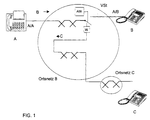
- Examples of existing call forwarding systems 1 and 2 show the T-Net and the ISDN network.
- First is a suitable for the T-Net in Fig. 1
- Call forwarding in the exchange VSt shown with the connections of a participant in Local area network B to a subscriber line C in another Local area network C can be forwarded. It plays for them
- System planning doesn't matter whether it's for route control required voters electromechanical voters or as pure electronic switching fields are realized.
- the calling subscriber A is via a Connection line AlA with the assigned switching center VSt connected. He wants a connection with participant B. This had previously its exchange agency VSt the condition by input via its connection line AlB for call forwarding and the extension number of the Subscriber C to whom the call is to be forwarded, communicated.
- the condition and destination number for the Call forwarding was saved in the Vst and can call a subscriber B in one Evaluation circuit AW in the VSt are checked whether the desired condition for call forwarding exists. If this is the case, then the evaluation circuit switches on Switch U via the dashed control line so set that a forwarding circuit W the desired Establishes connection to target subscriber C in local area network C.
- the fax machine has enough paper and ink. Furthermore, the paper transport must be in order, i.e. it may there is no paper jam and the reception memory of the Fax machine must still have enough storage capacity to Cache fax transmissions. If a connected Personal computer the function of receiving and printing of a fax document to be received, then must this also in terms of its reception and Willingness to print will be checked.
- Some fax machines are already known to be via sensors for paper jam and paper and ink shortage dispose of when a corresponding criterion is reached address and a corresponding warning message LEDs, beeps and / or indicators in a display produce.
- Fax machines are also known appropriate sensors for paper jam, paper and Lack of ink and the like have, but only the fax reception, however, do not ensure instant printing by using the incoming pages in a local store or in a connected personal computer (PC) (see T-Fax 362 PC from DeutscheInstitut).
- PC personal computer
- warning signals mentioned above are directed at the Users of a fax machine to indicate to them that currently a fax printout from his fax machine is not possible. Is the user is not present when a fax is transmitted then no expression can be made, and the Message is lost at least if none Buffer tank available or it is full.
- the printout or the internal storage of a Fax document is also in the case of the above permanent Call forwarding not possible if the destination fax machine is to Print and not ready for internal storage.
- third control signal FXS1 generates one in one internal memory of the fax machine stored first Notification text that a call forwarding done, addressed, reads out and sent as a fax to calls end fax machine and / or transmits to the destination terminal
- a fourth control signal FXS2 after Deactivating call forwarding generates one in internal memory of the fax machine stored second Notification text that the call forwarding is canceled, addressed, reads out and as Fax message to the calling fax machine and / or to Transmits destination terminal.
- the process is characterized in that for monitoring of the status sensors for reporting paper shortage, for Ink shortage notification, paper jam notification, S4 Message as to whether the receive memory is still sufficient Storage capacity and / or at an interface too a PC to report whether the PC is ready to receive faxes, cyclically with a certain repetition rate WL1, WL2 can be queried in parallel or sequentially.
- the call forwarding is in a switching center, a PBX or in the Fax machine carried out in the event that the Destination terminal is connected directly to the fax machine.
- the call forwarding is in the fax machine assigned switching center or the PBX the fax machine transmits the control signals to activate and deactivate call forwarding there.
- the fax machine includes one Interface for connecting the fax machine to a Network termination device or a PBX, at least one Sensor for detecting a predetermined state of the Fax machine, a programmable microprocessor for Generating a first control signal for automatic Activate a facility to advance a Fax calls to at least one predetermined destination if the sensor detects a first device status, and for Generate a second control signal for automatic Deactivating the facility for forwarding a Fax calls when the sensor detects a second device status.
- a memory for storing a is advantageous first information about the start of call forwarding and a second information about the end of the Call forwarding provided.
- the microprocessor can ensure that after generation of the first control signal first information read out and a calling Transfer terminal and / or to the target terminal and after generation of the second control signal, the second Information read out about the calling and / or Destination terminal is transmitted.
- a sensor to report a paper shortage To ensure that the fax machine is ready to receive To be able to monitor the necessary conditions is a sensor to report a paper shortage, a sensor to report a Out of ink, a paper jam sensor, and a sensor for reporting an overflow of the receiving memory intended.
- the present invention thus has the advantage accomplished a printout and / or internal storage of fax documents is ensured even if that Fax machine for which a fax call is received, not for printing and / or storage is ready, for example because certain device-internal states do not allow such printouts.
- the present Invention always serve instant prints and / or one internal storage of incoming fax documents ensure. Faults due to certain internal states of the fax machine, mostly sporadically, occur, such as lack of ink and paper, as well Paper jam in the paper transport device in the fax machine, and if the internal memory is full, should not cause that an instant printout and / or an internal storage are no longer possible.
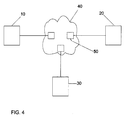
- the fax machine 10 functions as the fax machine that wants to send a fax document to the fax machine 20. Fax calls are forwarded to the fax machine 30 when the fax machine 20 is not ready to receive.
- the fax machine 20 is connected via a subscriber line to the switching center 50, which contains a device for forwarding fax calls. The device for forwarding fax calls is automatically activated and deactivated by the fax machine 20.
- the fax machine 20 has a programmable microprocessor which has control signals for activating and deactivating the performance feature
- the destination address of the fax machine 30 can be entered on the fax machine 20 and transmitted from there to the switching center 50 in order to enable call forwarding to the fax machine 30.
- the microprocessor is connected to a number of sensors which detect, for example, a lack of paper, lack of ink, Paper jam or an overflow of the receiving memory of the fax machine 20 can report.
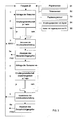
- the process of call forwarding is as follows It is therefore one shown in FIG. 3 Method provided, for example in the fax machine 20 a predeterminable repetition rate expires automatically and Control signals are generated that correspond to the existing hardware and Software resources of the corresponding network components of the Routing for the implementation of Set up call forwarding and thus automatically, one Call forwarding to fax machine 30, for example, if the facsimile machine 20 is due to the particular one mentioned internal states the immediate printout and / or the internal Storage of a fax document coming from the fax machine 10 no longer makes possible.
- step 1 of this procedure parallel or sequentially the internal sensors (together with the associated Actuators) of the fax machine 20 and checked whether a There is a shortage of paper, a lack of ink or a paper jam, or whether the receive memory is full. Is to the fax machine 20th a personal computer for output and storage of incoming Another fax is connected, another sensor checks, whether the personal computer is ready to work.
- step 2 in which the test result with regard to the output signals of the sensors mentioned, which in previous step is formed, it is determined whether the fax machine 20 is ready to receive. If if this is the case, the process sequence enters Repeat steps 1 and 2 with a specific one Repetition rate WL1 on until a malfunction of the mentioned type occurs. In this case the Operation continues with step 3.
- a first control signal AWS1 generated and transmitted to the switching center 50, where it is the Call forwarding, for example consisting of Aw and W in Figure 1 activated.
- step 3a is carried out after step 3, in which after activation of call forwarding a third Control signal FXS1 is generated.
- This signal controls the Address control of the memory contained in the fax machine 20 to which the storage field in which the notification text is stored, addressed and reading this text prompted. With the readout there is also a transmission of the Text on the connection line to the calling fax machine 10 and the fax machine 30.
- step 1 very similar step for testing the sensors and checked whether one or more sensors S1 to S5 deliver appropriate output signals. If this is the case steps 4 and 5 must be repeated WL2 continue to run until none of the Sensors provide a corresponding output signal that indicates a fault in the fax machine 20.
- step 5 it is determined in step 5 that is again ready to receive and in the fax machine 20 Immediate printing of a fax document is possible again.
- step 6 in which the second Control signal AWS2 is generated. This is about the Transfer line to the switching center 50 and deactivates the device for Call forwarding for subscriber 20.
- step 6a is carried out, in which after the Deactivating call forwarding a fourth control signal FXS2 is generated which, as already explained in step 3a, the notification text from the memory of the fax machine 20 reads out and to the calling fax machine 10 and the fax machine 30 transmits via the connecting line.
- step 6 After executing the last procedural step Flow control, that's step 6, if none Notification fax should be sent, or step 6a, if the call forwarding is canceled Fax machine 10 and the fax machine 30 should be communicated, then The flow control returns to step 1 and begins a new run. This procedure can last as long happen until an intentional shutdown of this function by interrupting the execution cycles.
- Call forwarding according to the invention is not only in large analog and digital networks Network operators can be used, but also in private PBXs, provided that these are generally call forwarding in their mediation architecture and network support.
Landscapes
- Engineering & Computer Science (AREA)
- Multimedia (AREA)
- Signal Processing (AREA)
- Computer Networks & Wireless Communication (AREA)
- Facsimiles In General (AREA)
- Facsimile Transmission Control (AREA)
Abstract
Description
- Fig. 1 und 2
- Prinzipdarstellungen bekannter Anrufweiterschaltungen, die in der Vermittlungsstelle eines analogen oder digitalen Fernsprechnetzes an Hand der vom Teilnehmer eingegebenen Zielrufnummer und Weiterschalteart eine Anrufweiterschaltung durchführen,
- Fig. 3
- eine Darstellung des erfindungsgemäßen Verfahrensablaufs zur Aktivierung der Anrufweiterschaltung für ein Faxgerät, das auf Grund bestimmter interner Zustände zu einem Sofortausdruck und/oder zu einer internen Speicherung eines eingehenden Faxdokumentes nicht fähig ist, und
- Fig. 4
- eine vereinfachte Ansicht eines Kommunikationsnetzes mit drei angeschalteten Faxgeräten.

Claims (8)
- Verfahren zur Anrufweiterschaltung eines für ein Faxgerät (20) bestimmten Faxrufes zu wenigstens einer vorbestimmten Zieleinrichtung (30) mit folgenden Verfahrensschritten:a) Überwachen vorbestimmter Zustände des Faxgerätes (20);b) das Faxgerät (20) erzeugt automatisch ein erstes Steuersignal (ASW1) zur Aktivierung der Anrufweiterschaltung, um einen für das Faxgerät (20) bestimmten Faxruf zu der oder jeder vorbestimmten Zieleinrichtung (30) weiterzuleiten, wenn aufgrund der überwachten Zustände festgestellt wird, daß das Faxgerät (20) nicht empfangsbereit ist;c) das Faxgerät (20) erzeugt automatisch ein zweites Steuersignal (AWS2) zur Deaktivierung der Anrufweiterschaltung, wenn aufgrund der überwachten Zustände festgestellt wird, daß das Faxgerät (20) wieder empfangsbereit.
- Verfahren nach Anspruch 1,
dadurch gekennzeichnet, daß bei aktivierter Anrufweiterschaltung ein drittes Steuersignal (FXS1) erzeugt wird, das einen ersten in einem internen Speicher des Faxgerätes (20) gespeicherten Benachrichtigungstext darüber, daß eine Anrufweiterschaltung erfolgt, adressiert, ausliest und als Faxnachricht zu einem rufenden Faxgerät (10) und/oder zur Zielendeinrichtung (30) überträgt, und daß ein viertes Steuersignal (FXS2) nach erfolgter Deaktivierung der Anrufweiterschaltung erzeugt wird, das einen zweiten im internen Speicher des Faxgerätes (20) gespeicherten Benachrichtigungstext darüber, daß die Anrufweiterschaltung wieder aufgehoben ist, adressiert, ausliest und als Faxnachricht zum rufenden Faxgerät (10) und/oder zur Zielendeinrichtung (30) überträgt. - Verfahren nach Anspruch 1, dadurch gekennzeichnet, daß zur Überwachung der Zustände des Faxgerätes (20) Sensoren (S1-S5) zur Meldung von Papiermangel, zur Meldung von Tintenmangel, zur Meldung von Papierstau, zur Meldung, ob der Empfangsspeicher noch über ausreichend Speicherkapazität verfügt und/oder an der Schnittstelle zu einem PC zur Meldung, ob der PC zum Faxempfang bereit ist, zyklisch mit einer bestimmten Wiederholungsrate (WL1,WL2) parallel oder sequentiel abgefragt werden.
- Verfahren nach einem der Ansprüche 1 bis 3, dadurch gekennzeichnet, daß die Anrufweiterschaltung in einer Vermittlungsstelle (50), einer TK-Anlage oder in dem Faxgerät (20) durchgeführt wird.
- Verfahren nach einem der Ansprüche 1 bis 4
dadurch gekennzeichnet, daß zur Erzeugung des ersten (AWS1) und zweiten Steuersignals (AWS2) folgende Verfahrensschritte ausgeführt werden:a) es werden parallel oder sequentiell die Meldungen der Sensoren (S1 bis S5) des Faxgerätes (20) abgefragt und auf Korrektheit geprüft;b) es wird aus dem Prüfergebnis nach Schritt a) festgestellt, ob das Faxgerät (20) empfangsbereit ist;c) wenn dies der Fall ist, wird die Wiederholung der Schritte a) und b) mit der Wiederholungsrate (WL1) vorgenommen, und wenn dies nicht der Fall ist, wird das Verfahren mit Schritt d) fortgesetzt;d) das erste Steuersignal (AWS1) wird erzeugt und zur Aktivierung der Anrufweiterschaltung weitergeleitet;e) analog zu Schritt a) werden die Sensoren (S1 bis S5) abgefragt und deren Meldungen überprüft;f) es wird aus den Prüfergebnissen festgestellt, ob die Empfangsbereitschaft des Faxgerätes (20) wieder hergestellt ist;g) ist dies nicht der Fall, werden die Schritte e) und f) mit der Wiederholungsrate (WL2) solange durchgeführt, bis die Empfangsbereitschaft festgestellt wird;h) wenn das Faxgerät (20) wieder empfangsbereit ist, wird das zweite Steuersignal (AWS2) erzeugt und weitergeleitet, um die Anrufweiterschaltung wieder zu deaktivieren; undi) wiederholen der Schritte a) bis i). - Faxgerät zur Durchführung des Verfahrens nach einem der Ansprüche 1 bis 5,
gekennzeichnet durcha) eine Schnittstelle zum Anschalten des Faxgerätes an eine Netzabschlußeinrichtung oder eine TK-Anlage;b) wenigstens einen Sensor zum Erfassen eines vorbestimmten Zustandes des Faxgerätes;c) ein programmierbarer Mikroprozessor zum Erzeugen eines ersten Steuersignals zum automatischen Aktivieren einer Einrichtung zur Weiterschaltung eines Faxrufs an wenigstens eine vorbestimmte Zielendeinrichtung, wenn der Sensor einen ersten Gerätezustand erfasst, und zum Erzeugen eines zweiten Steuersignals zum automatischen Deaktivieren der Einrichtung zur Weiterschaltung eines Faxrufs, wenn der Sensor einen zweiten Gerätezustand erfasst. - Faxgerät nach Anspruch 6,
gekennzeichnet durcheinen Speicher zum Ablegen einer ersten Information über den Beginn der Anrufweiterschaltung und einer zweiten Information über das Ende der Anrufweiterschaltung, wobei der Mikroprozessor nach Erzeugung des ersten Steuersignals die erste Information ausliest und zu einer rufenden Endeinrichtung und/oder zur Zielendeinrichtung überträgt und nach Erzeugung des zweiten Steuersignals die zweite Information ausliest und zur rufenden und/oder Zielendeinrichtung überträgt. - Faxgerät nach Anspruch 6 oder 7,
gekennzeichnet durcheinen Empfangsspeicher,einen Sensor zur Meldung eines Papiermangels,einen Sensor zum Melden eines Tintenmangels,einen Sensor zur Meldung eines Papierstaus undeinen Sensor zur Meldung eines Überlaufs des Empfangsspeichers.
Applications Claiming Priority (2)
| Application Number | Priority Date | Filing Date | Title |
|---|---|---|---|
| DE1999118117 DE19918117A1 (de) | 1999-04-22 | 1999-04-22 | Verfahren und Faxgerät zur Anrufweiterschaltung eines eingehenden Faxrufes |
| DE19918117 | 1999-04-22 |
Publications (2)
| Publication Number | Publication Date |
|---|---|
| EP1047262A2 true EP1047262A2 (de) | 2000-10-25 |
| EP1047262A3 EP1047262A3 (de) | 2002-08-21 |
Family
ID=7905375
Family Applications (1)
| Application Number | Title | Priority Date | Filing Date |
|---|---|---|---|
| EP00106383A Withdrawn EP1047262A3 (de) | 1999-04-22 | 2000-03-24 | Verfahren und Faxgerät zur Anrufweiterschaltung eines eingehenden Faxrufes |
Country Status (2)
| Country | Link |
|---|---|
| EP (1) | EP1047262A3 (de) |
| DE (1) | DE19918117A1 (de) |
Family Cites Families (3)
| Publication number | Priority date | Publication date | Assignee | Title |
|---|---|---|---|---|
| JPH01318456A (ja) * | 1988-06-20 | 1989-12-22 | Fujitsu Ltd | ファクシミリ通信方式 |
| JPH0252542A (ja) * | 1988-08-16 | 1990-02-22 | Nec Corp | 蓄績型ファクシミリ交換方式 |
| JPH03263971A (ja) * | 1990-03-14 | 1991-11-25 | Fujitsu Ltd | ファクシミリ装置 |
-
1999
- 1999-04-22 DE DE1999118117 patent/DE19918117A1/de not_active Withdrawn
-
2000
- 2000-03-24 EP EP00106383A patent/EP1047262A3/de not_active Withdrawn
Also Published As
| Publication number | Publication date |
|---|---|
| EP1047262A3 (de) | 2002-08-21 |
| DE19918117A1 (de) | 2000-10-26 |
Similar Documents
| Publication | Publication Date | Title |
|---|---|---|
| DE69028883T2 (de) | Übertragungseinheit mit einer Funktion und einem Verfahren zur Anruferidentifizierung in einem digitalen Fernmeldenetz | |
| DE68918907T2 (de) | Kommunikationsendgerät. | |
| DE1803780C3 (de) | Schaltungsanordnung zur Abtastung von Zustanden in einer Fernmelde- oder Datenverarbeitungsanordnung | |
| DE4440545C2 (de) | Verfahren zur Verarbeitung von Rufen bei einer Telefonanlage | |
| DE19542122B4 (de) | Lokales Kommunikations-Serversystem | |
| DE69420759T2 (de) | Übertragungsgerät, das eine öffentliche Leitung nutzt | |
| DE3038952A1 (de) | Nachrichtenvermittlungs-konferenzsystem | |
| DE3912078C2 (de) | ||
| DE10056823A1 (de) | Verfahren zur Durchführung eines Dienstes zur automatischen Übermittlung von Paketdaten sowie Kommunikationsnetz, Informationsrechner und Programmmodul dafür | |
| DE19624103C2 (de) | Kommunikationsvorrichtung zur Verwendung in einer direkten Verbindung zwischen einer Faksimilemodemvorrichtung und einer Faksimilevorrichtung | |
| WO2002011411A1 (de) | Anrufübernahme mit benachrichtigung über datennetze | |
| DE19918117A1 (de) | Verfahren und Faxgerät zur Anrufweiterschaltung eines eingehenden Faxrufes | |
| CH656276A5 (de) | Verfahren und schaltungsanordnung zum uebertragen von datensignalen zwischen datenvermittlungseinrichtungen einer datenvermittlungsanlage. | |
| EP0805581B1 (de) | Verfahren und Applikationseinrichtung zum Einrichten von Leistungsmerkmalen im privaten Kommunikationssystem von einem öffentlichen Kommunikationsnetz | |
| DE2938982C2 (de) | Schaltungsanordnung für eine eigenprüfbare Teilnehmeranschlußschaltung mit Erkennung des Schaltzustandes einer Teilnehmerleitung | |
| EP0111114A2 (de) | Schaltungsanordnung für eine Fernsprechvermittlungsanlage, insbesondere Fernsprechnebenstellenanlage mit zusätzlichem Datenverkehr | |
| DE3240999A1 (de) | Schaltungsanordnung fuer eine fernsprechvermittlungsanlage, insbesondere fernsprechnebenstellenanlage mit zusaetzlichem datenverkehr | |
| DE3027113C2 (de) | Schaltungsanordnung für Fernmeldevermittlungsanlagen, insbesondere Fernsprechvermittlungsanlagen mit vorübergehend nicht erreichbaren Teilnehmerstellen | |
| DE3724847C2 (de) | ||
| DE3131343C2 (de) | ||
| DE3131360C2 (de) | ||
| EP0339432B1 (de) | Verfahren für eine rechnergesteuerte Vermittlungseinrichtung, insbesondere Key-Fernsprechvermittlungseinrichtung, bei der Datenendgeräte und Fernsprechendgeräte alternativ anschaltbar sind | |
| DE3732832A1 (de) | Verfahren und anordnung zur abspeicherung von fernmeldenachrichten | |
| EP0969648B1 (de) | Verfahren und System zur Sicherstellung einer Kommunikationsverbindung | |
| DE2937553C2 (de) | Schaltungsanordnung zur Überwachung einer Sendeeinrichtung für Mehrfrequenzcode-Zeichen in Fernsprechvermittlungsanlagen |
Legal Events
| Date | Code | Title | Description |
|---|---|---|---|
| PUAI | Public reference made under article 153(3) epc to a published international application that has entered the european phase |
Free format text: ORIGINAL CODE: 0009012 |
|
| AK | Designated contracting states |
Kind code of ref document: A2 Designated state(s): AT BE CH CY DE DK ES FI FR GB GR IE IT LI LU MC NL PT SE |
|
| AX | Request for extension of the european patent |
Free format text: AL;LT;LV;MK;RO;SI |
|
| PUAL | Search report despatched |
Free format text: ORIGINAL CODE: 0009013 |
|
| AK | Designated contracting states |
Kind code of ref document: A3 Designated state(s): AT BE CH CY DE DK ES FI FR GB GR IE IT LI LU MC NL PT SE |
|
| AX | Request for extension of the european patent |
Free format text: AL;LT;LV;MK;RO;SI |
|
| 17P | Request for examination filed |
Effective date: 20030221 |
|
| AKX | Designation fees paid |
Designated state(s): AT BE CH CY DE DK ES FI FR GB GR IE IT LI LU MC NL PT SE |
|
| 17Q | First examination report despatched |
Effective date: 20060714 |
|
| STAA | Information on the status of an ep patent application or granted ep patent |
Free format text: STATUS: THE APPLICATION IS DEEMED TO BE WITHDRAWN |
|
| 18D | Application deemed to be withdrawn |
Effective date: 20070125 |