EP1046391A2 - Verwendung von aminosubstituierten Hydroxybenzophenonen als photostabile UV-Filter in kosmetischen und pharmazeutischen Zubereitungen - Google Patents
Verwendung von aminosubstituierten Hydroxybenzophenonen als photostabile UV-Filter in kosmetischen und pharmazeutischen Zubereitungen Download PDFInfo
- Publication number
- EP1046391A2 EP1046391A2 EP00105806A EP00105806A EP1046391A2 EP 1046391 A2 EP1046391 A2 EP 1046391A2 EP 00105806 A EP00105806 A EP 00105806A EP 00105806 A EP00105806 A EP 00105806A EP 1046391 A2 EP1046391 A2 EP 1046391A2
- Authority
- EP
- European Patent Office
- Prior art keywords
- alkyl
- cosmetic
- compounds
- cycloalkyl
- hydrogen
- Prior art date
- Legal status (The legal status is an assumption and is not a legal conclusion. Google has not performed a legal analysis and makes no representation as to the accuracy of the status listed.)
- Granted
Links
- 0 *c1cc(O)ccc1 Chemical compound *c1cc(O)ccc1 0.000 description 2
- LGRFSURHDFAFJT-UHFFFAOYSA-N O=C(c1c2cccc1)OC2=O Chemical compound O=C(c1c2cccc1)OC2=O LGRFSURHDFAFJT-UHFFFAOYSA-N 0.000 description 2
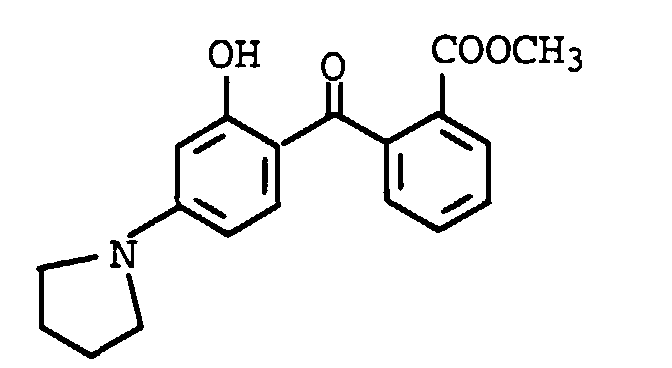
- QKMVZMHODAXFOS-UHFFFAOYSA-N COC(c(cccc1)c1C(c(ccc(N1CCCC1)c1)c1O)=O)=O Chemical compound COC(c(cccc1)c1C(c(ccc(N1CCCC1)c1)c1O)=O)=O QKMVZMHODAXFOS-UHFFFAOYSA-N 0.000 description 1
- BMTDPXOFINIBGC-UHFFFAOYSA-N Oc1cccc(N2CCCC2)c1 Chemical compound Oc1cccc(N2CCCC2)c1 BMTDPXOFINIBGC-UHFFFAOYSA-N 0.000 description 1
Classifications
-
- C—CHEMISTRY; METALLURGY
- C07—ORGANIC CHEMISTRY
- C07D—HETEROCYCLIC COMPOUNDS
- C07D295/00—Heterocyclic compounds containing polymethylene-imine rings with at least five ring members, 3-azabicyclo [3.2.2] nonane, piperazine, morpholine or thiomorpholine rings, having only hydrogen atoms directly attached to the ring carbon atoms
- C07D295/04—Heterocyclic compounds containing polymethylene-imine rings with at least five ring members, 3-azabicyclo [3.2.2] nonane, piperazine, morpholine or thiomorpholine rings, having only hydrogen atoms directly attached to the ring carbon atoms with substituted hydrocarbon radicals attached to ring nitrogen atoms
- C07D295/10—Heterocyclic compounds containing polymethylene-imine rings with at least five ring members, 3-azabicyclo [3.2.2] nonane, piperazine, morpholine or thiomorpholine rings, having only hydrogen atoms directly attached to the ring carbon atoms with substituted hydrocarbon radicals attached to ring nitrogen atoms substituted by doubly bound oxygen or sulphur atoms
- C07D295/112—Heterocyclic compounds containing polymethylene-imine rings with at least five ring members, 3-azabicyclo [3.2.2] nonane, piperazine, morpholine or thiomorpholine rings, having only hydrogen atoms directly attached to the ring carbon atoms with substituted hydrocarbon radicals attached to ring nitrogen atoms substituted by doubly bound oxygen or sulphur atoms with the ring nitrogen atoms and the doubly bound oxygen or sulfur atoms separated by carbocyclic rings or by carbon chains interrupted by carbocyclic rings
-
- A—HUMAN NECESSITIES
- A61—MEDICAL OR VETERINARY SCIENCE; HYGIENE
- A61K—PREPARATIONS FOR MEDICAL, DENTAL OR TOILETRY PURPOSES
- A61K8/00—Cosmetics or similar toiletry preparations
- A61K8/18—Cosmetics or similar toiletry preparations characterised by the composition
- A61K8/30—Cosmetics or similar toiletry preparations characterised by the composition containing organic compounds
- A61K8/40—Cosmetics or similar toiletry preparations characterised by the composition containing organic compounds containing nitrogen
- A61K8/41—Amines
- A61K8/411—Aromatic amines, i.e. where the amino group is directly linked to the aromatic nucleus
-
- A—HUMAN NECESSITIES
- A61—MEDICAL OR VETERINARY SCIENCE; HYGIENE
- A61K—PREPARATIONS FOR MEDICAL, DENTAL OR TOILETRY PURPOSES
- A61K8/00—Cosmetics or similar toiletry preparations
- A61K8/18—Cosmetics or similar toiletry preparations characterised by the composition
- A61K8/30—Cosmetics or similar toiletry preparations characterised by the composition containing organic compounds
- A61K8/40—Cosmetics or similar toiletry preparations characterised by the composition containing organic compounds containing nitrogen
- A61K8/44—Aminocarboxylic acids or derivatives thereof, e.g. aminocarboxylic acids containing sulfur; Salts; Esters or N-acylated derivatives thereof
- A61K8/445—Aminocarboxylic acids or derivatives thereof, e.g. aminocarboxylic acids containing sulfur; Salts; Esters or N-acylated derivatives thereof aromatic, i.e. the carboxylic acid directly linked to the aromatic ring
-
- A—HUMAN NECESSITIES
- A61—MEDICAL OR VETERINARY SCIENCE; HYGIENE
- A61K—PREPARATIONS FOR MEDICAL, DENTAL OR TOILETRY PURPOSES
- A61K8/00—Cosmetics or similar toiletry preparations
- A61K8/18—Cosmetics or similar toiletry preparations characterised by the composition
- A61K8/30—Cosmetics or similar toiletry preparations characterised by the composition containing organic compounds
- A61K8/49—Cosmetics or similar toiletry preparations characterised by the composition containing organic compounds containing heterocyclic compounds
- A61K8/4906—Cosmetics or similar toiletry preparations characterised by the composition containing organic compounds containing heterocyclic compounds with one nitrogen as the only hetero atom
- A61K8/4913—Cosmetics or similar toiletry preparations characterised by the composition containing organic compounds containing heterocyclic compounds with one nitrogen as the only hetero atom having five membered rings, e.g. pyrrolidone carboxylic acid
-
- A—HUMAN NECESSITIES
- A61—MEDICAL OR VETERINARY SCIENCE; HYGIENE
- A61P—SPECIFIC THERAPEUTIC ACTIVITY OF CHEMICAL COMPOUNDS OR MEDICINAL PREPARATIONS
- A61P17/00—Drugs for dermatological disorders
- A61P17/16—Emollients or protectives, e.g. against radiation
-
- A—HUMAN NECESSITIES
- A61—MEDICAL OR VETERINARY SCIENCE; HYGIENE
- A61P—SPECIFIC THERAPEUTIC ACTIVITY OF CHEMICAL COMPOUNDS OR MEDICINAL PREPARATIONS
- A61P43/00—Drugs for specific purposes, not provided for in groups A61P1/00-A61P41/00
-
- A—HUMAN NECESSITIES
- A61—MEDICAL OR VETERINARY SCIENCE; HYGIENE
- A61Q—SPECIFIC USE OF COSMETICS OR SIMILAR TOILETRY PREPARATIONS
- A61Q1/00—Make-up preparations; Body powders; Preparations for removing make-up
- A61Q1/02—Preparations containing skin colorants, e.g. pigments
- A61Q1/04—Preparations containing skin colorants, e.g. pigments for lips
-
- A—HUMAN NECESSITIES
- A61—MEDICAL OR VETERINARY SCIENCE; HYGIENE
- A61Q—SPECIFIC USE OF COSMETICS OR SIMILAR TOILETRY PREPARATIONS
- A61Q17/00—Barrier preparations; Preparations brought into direct contact with the skin for affording protection against external influences, e.g. sunlight, X-rays or other harmful rays, corrosive materials, bacteria or insect stings
- A61Q17/04—Topical preparations for affording protection against sunlight or other radiation; Topical sun tanning preparations
-
- C—CHEMISTRY; METALLURGY
- C07—ORGANIC CHEMISTRY
- C07C—ACYCLIC OR CARBOCYCLIC COMPOUNDS
- C07C225/00—Compounds containing amino groups and doubly—bound oxygen atoms bound to the same carbon skeleton, at least one of the doubly—bound oxygen atoms not being part of a —CHO group, e.g. amino ketones
- C07C225/22—Compounds containing amino groups and doubly—bound oxygen atoms bound to the same carbon skeleton, at least one of the doubly—bound oxygen atoms not being part of a —CHO group, e.g. amino ketones having amino groups bound to carbon atoms of six-membered aromatic rings of the carbon skeleton
-
- C—CHEMISTRY; METALLURGY
- C07—ORGANIC CHEMISTRY
- C07C—ACYCLIC OR CARBOCYCLIC COMPOUNDS
- C07C229/00—Compounds containing amino and carboxyl groups bound to the same carbon skeleton
- C07C229/52—Compounds containing amino and carboxyl groups bound to the same carbon skeleton having amino and carboxyl groups bound to carbon atoms of six-membered aromatic rings of the same carbon skeleton
-
- A—HUMAN NECESSITIES
- A61—MEDICAL OR VETERINARY SCIENCE; HYGIENE
- A61K—PREPARATIONS FOR MEDICAL, DENTAL OR TOILETRY PURPOSES
- A61K2800/00—Properties of cosmetic compositions or active ingredients thereof or formulation aids used therein and process related aspects
- A61K2800/40—Chemical, physico-chemical or functional or structural properties of particular ingredients
- A61K2800/52—Stabilizers
-
- C—CHEMISTRY; METALLURGY
- C07—ORGANIC CHEMISTRY
- C07C—ACYCLIC OR CARBOCYCLIC COMPOUNDS
- C07C2601/00—Systems containing only non-condensed rings
- C07C2601/12—Systems containing only non-condensed rings with a six-membered ring
- C07C2601/14—The ring being saturated
Definitions
- the invention relates to the use of amino-substituted Hydroxybenzophenones as photostable UV filters in cosmetics and pharmaceutical preparations for protecting human Epidermis or human hair against UV radiation, especially in the Range from 320 to 400 nm.
- Light protection agents have the task of damaging influences to prevent sunlight from reaching human skin or at least to reduce their impact. Serve alongside these light stabilizers also protect other ingredients before destruction or degradation by UV radiation. In hair cosmetics Formulations are said to damage the keratin fiber can be reduced by UV rays.
- UV-B 280 to 320 nm
- UV-A radiation > 320 nm
- UV-A radiation can cause skin damage and allergies can, for example, by the keratin or elastin is damaged. This increases elasticity and water retention of the skin, i.e. the skin becomes less supple and tends to wrinkle.
- the remarkably high incidence of skin cancer in areas of strong sunlight shows that apparently also damage to the genetic information in the cells caused by sunlight, especially by UV-A radiation become. All of these findings therefore make development more efficient Filter substances for the UV-A range appear necessary.
- light stabilizers for cosmetics and pharmaceutical preparations mainly used as UV-A filters can serve and therefore their absorption maxima in Range from approx. 320 to 380 nm.
- Such light stabilizers should also have a highly specific Have absorbance.
- light stabilizers for cosmetic preparations have a variety of other requirements fulfill, for example good solubility in cosmetic oils, high stability of the emulsions produced with them, toxicological Harmlessness, low odor and low Self-coloring.
- UV-A filter when used alone or in combination used with UV-B filters, not photochemically stable enough to provide lasting skin protection during a longer sunbath to ensure what repeated applications required at regular and short intervals if one effective protection of the skin against all UV rays want to achieve.
- EP-A-0 251 398 and EP-A-0 416 837 proposed chromophores absorbing UV-A and UV-B radiation to unite in a molecule through a link. This has the Disadvantage that on the one hand no free combination of UV-A and UV-B filters in cosmetic preparation are more possible and that difficulties in chemically linking the chromophores allow only certain combinations.
- R 1 to R 7 are branched or unbranched C 1 -C 20 alkyl chains, preferably methyl, ethyl, n-propyl, 1-methylethyl, n-butyl, 1-methylpropyl, 2-methylpropyl, 1,1-dimethylethyl , n-pentyl, 1-methylbutyl, 2-methylbutyl, 3-methylbutyl, 2, 2-dimethylpropyl, 1-ethylpropyl, n-hexyl, 1,1-dimethylpropyl, 1, 2-dimethylpropyl, 1-methylpentyl, 2-methylpentyl , 3-methylpentyl, 4-methylpentyl, 1, 1-dimethylbutyl, 1, 2-dimethylbutyl, 1, 3-dimethylbutyl, 2, 2-dimethylbutyl, 2, 3-dimethylbutyl, 3, 3-dimethylbutyl, 1-ethylbutyl, 2 -Ethyl
- alkenyl radicals R 1 to R 7 are branched or unbranched C 2 -C 10 alkenyl chains, preferably vinyl, propenyl, isopropenyl, 1-butenyl, 2-butenyl, 1-pentenyl, 2-pentenyl, 2-methyl-1-butenyl, 2-methyl-2-butenyl, 3-methyl-1-butenyl, 1-hexenyl, 2-hexenyl, 1-heptenyl, 2-heptenyl, 1-octenyl or 2-octenyl.
- the preferred cycloalkyl radicals for R 1 to R 7 are branched or unbranched C 3 -C 10 cycloalkyl chains such as cyclopropyl, cyclobutyl, cyclopentyl, cyclohexyl, cycloheptyl, 1-methylcyclopropyl, 1-ethylcyclopropyl, 1-propylcyclopropyl, 1-butylcyclopropyl, 1-pentylcyclopropyl Called 1-methyl-1-butylcyclopropyl, 1, 2-dimethylcyclypropyl, 1-methyl-2-ethylcyclopropyl, cyclooctyl, cyclononyl or cyclodecyl.
- Preferred cycloalkenyl radicals for R 1 to R 7 are branched or unbranched, C 3 -C 10 cycloalkenyl chains with one or more double bonds, such as cyclopropenyl, cyclobutenyl, cyclopentenyl, cyclopentadienyl, cyclohexenyl, 1, 3-cyclohexadienyl, 1, 4-cyclohexadienyl, cycloheptenyl , Cycloheptatrienyl, Cyclooctenyl, 1,5-Cyclooctadienyl, Cyclooctatetraenyl, Cyclononenyl or Cyclodecyl called.
- the cycloalkenyl and cycloalkyl radicals can optionally with one or more, for example 1 to 3 radicals such as halogen, for example fluorine, chlorine or bromine, cyano, nitro, amino, C 1 -C 4 -alkylamino, C 1 -C 4 -dialkylamino, hydroxy , C 1 -C 4 alkyl, C 1 -C 4 alkoxy or other radicals may be substituted or 1 to 3 heteroatoms such as sulfur, nitrogen, the free valences of which may be saturated by hydrogen or C 1 -C 4 alkyl or oxygen in Ring included.
- 1 to 3 radicals such as halogen, for example fluorine, chlorine or bromine, cyano, nitro, amino, C 1 -C 4 -alkylamino, C 1 -C 4 -dialkylamino, hydroxy , C 1 -C 4 alkyl, C 1 -C 4 alkoxy or other radicals may be substituted or 1 to
- Suitable alkoxy radicals for R 3 and R 4 are those having 1 to 12 carbon atoms, preferably having 1 to 8 carbon atoms.
- Examples include: Methoxy Ethoxy Isopropoxy n-propoxy 1-methylpropoxy n-butoxy n-pentoxy 2-methyl propoxy 3-methylbutoxy 1, 1-dimethylpropoxy 2,2-dimethylpropoxy Hexoxy 1-methyl-1-ethylpropoxy Heptoxy Octoxy 2 -ethylhexoxy-
- Alkoxycarbonyl radicals for R 3 and R 4 are, for example, esters which contain the abovementioned alkoxy radicals or radicals of higher alcohols, for example having up to 20 C atoms, such as iso-C 15 alcohol.
- Suitable mono- or dialkylamino radicals for R 3 and R 4 are those which contain alkyl radicals having 1 to 12 carbon atoms, such as methyl, n-propyl, n-butyl, 2-methylpropyl, 1, 1 -Dimethylpropyl-, hexyl-, heptyl-, 2-ethylhexyl-, isopropyl-, 1-methylpropyl-, n-pentyl-, 3-methylbutyl-, 2, 2-dimethylpropyl-, 1-methyl-1-ethylpropyl- and octyl .
- Aryl is to be understood as meaning aromatic rings or ring systems with 6 to 18 carbon atoms in the ring system, for example phenyl or naphthyl, which may optionally contain one or more radicals such as halogen, for example fluorine, chlorine or bromine, cyano, nitro, amino, C 1 -C 4 Alkylamino, C 1 -C 4 -dialkylamino, hydroxy, C 1 -C 4 -alkyl, C 1 -C 4 -alkoxy or other radicals can be substituted.
- halogen for example fluorine, chlorine or bromine
- cyano nitro, amino, C 1 -C 4 Alkylamino, C 1 -C 4 -dialkylamino, hydroxy, C 1 -C 4 -alkyl, C 1 -C 4 -alkoxy or other radicals
- phenyl, methoxyphenyl and naphthyl are preferred.
- Heteroaryl residues are advantageously simple or condensed aromatic ring systems with one or more heteroaromatic 3- to 7-membered rings.
- heteroatoms one can or more nitrogen, sulfur and / or oxygen atoms in the Ring or ring system may be included.
- Hydrophilic radicals for R 3 and R 4 which enable the water solubility of the compounds of the formula I are, for example, the nitrile group and carboxy and sulfoxy radicals and in particular their salts with any physiologically compatible cations, such as the alkali metal salts or as the trialkylammonium salts, such as tri (hydroxyalkyl) -ammonium salts or the 2-methylpropan-1-ol-2-ammonium salts. Ammonium residues, in particular alkylammonium residues with any physiologically compatible anions, are also suitable.
- the substituents R 1 and R 2 together with the nitrogen atom to which they are attached can form a 5- or 6-ring, for example a pyrrolidine or piperidine ring.
- the amino group can be in the ortho, meta or para position, relative to the carbonyl group.
- R 1 , R 2 and R 5 are branched or unbranched C 1 -C 12 alkyl chains, preferably methyl, ethyl, n-propyl, 1-methylethyl, n-butyl, 1-methylpropyl, 2-methylpropyl, 1, 1-dimethylethyl, n-pentyl, 1-methylbutyl, 2-methylbutyl, 3-methylbutyl, 2, 2-dimethylpropyl, 1-ethylpropyl, n-hexyl, 1,1-dimethylpropyl, 1, 2-dimethylpropyl, 1-methylpentyl, 2-methylpentyl, 3-methylpentyl, 4-methylpentyl, 1, 1-dimethylbutyl, 1,2-dimethylbutyl, 1, 3-dimethylbutyl, 2, 2-dimethylbutyl, 2, 3-dimethylbutyl, 3, 3-dimethylbutyl, 1- Ethylbutyl, 2-ethyl, 2-ethy
- Particularly preferred alkyl radicals for R 1 , R 2 and R 5 are methyl, ethyl, n-propyl, 1-methylethyl, n-butyl, 1-methylpropyl, 2-methylpropyl, 1, 1-dimethylethyl, n-pentyl, 1 -Methylbutyl, 2 -Methylbutyl, 3 -Methylbutyl, 2, 2-Dimethylpropyl, 2-ethylhexyl called.
- R 5 is particularly preferably cyclopropyl, cyclopentyl and cyclohexyl.
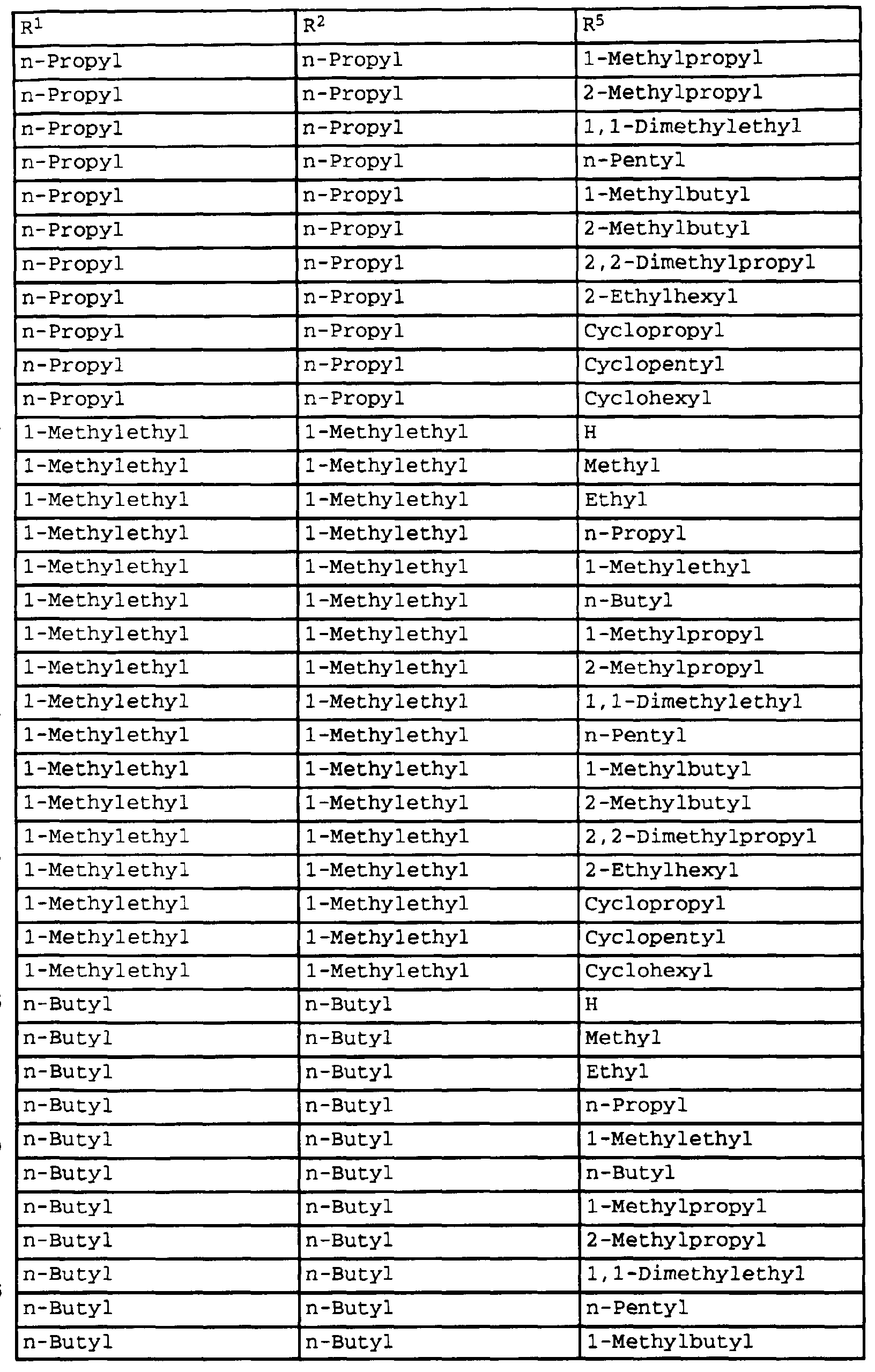
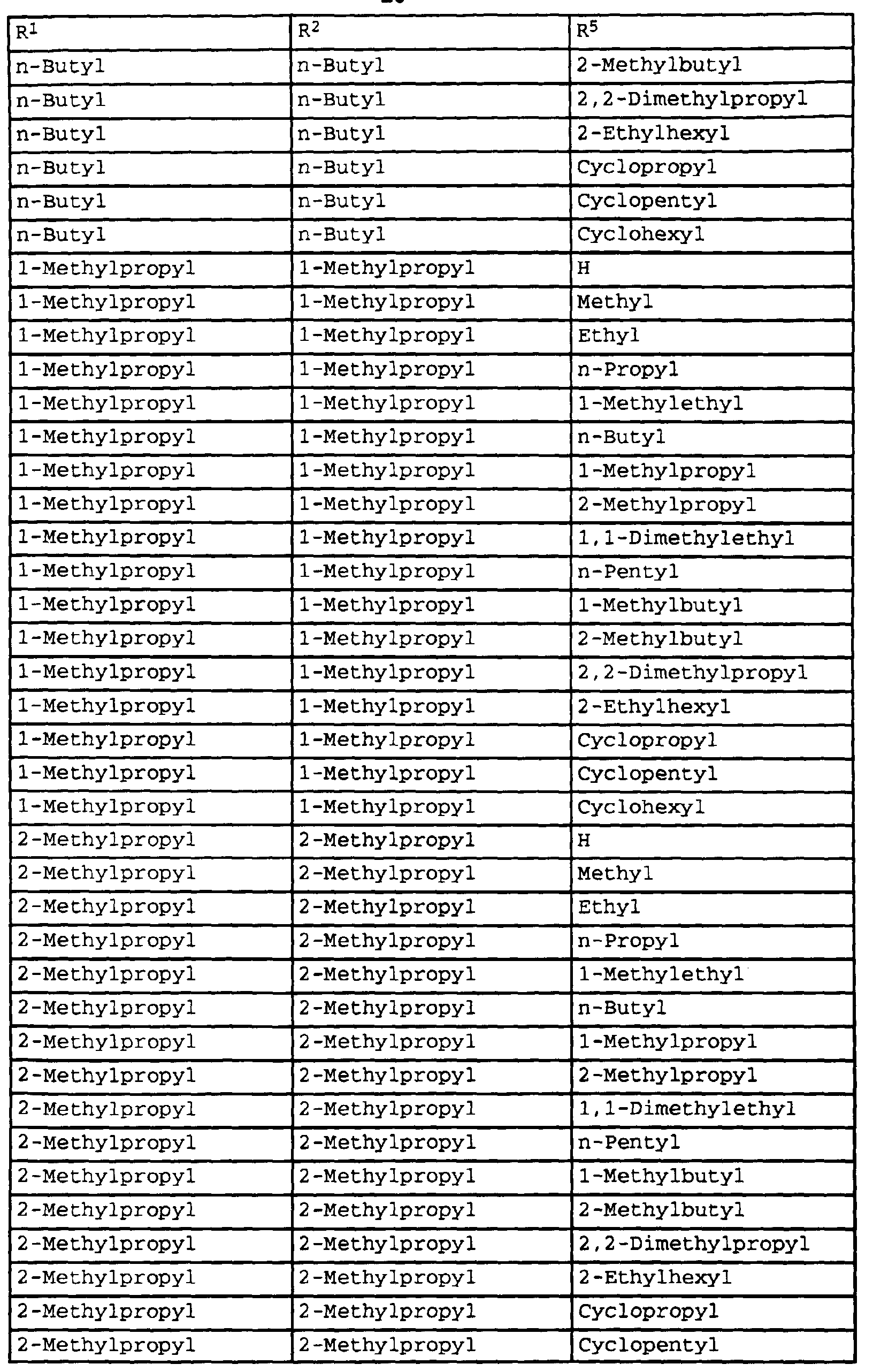
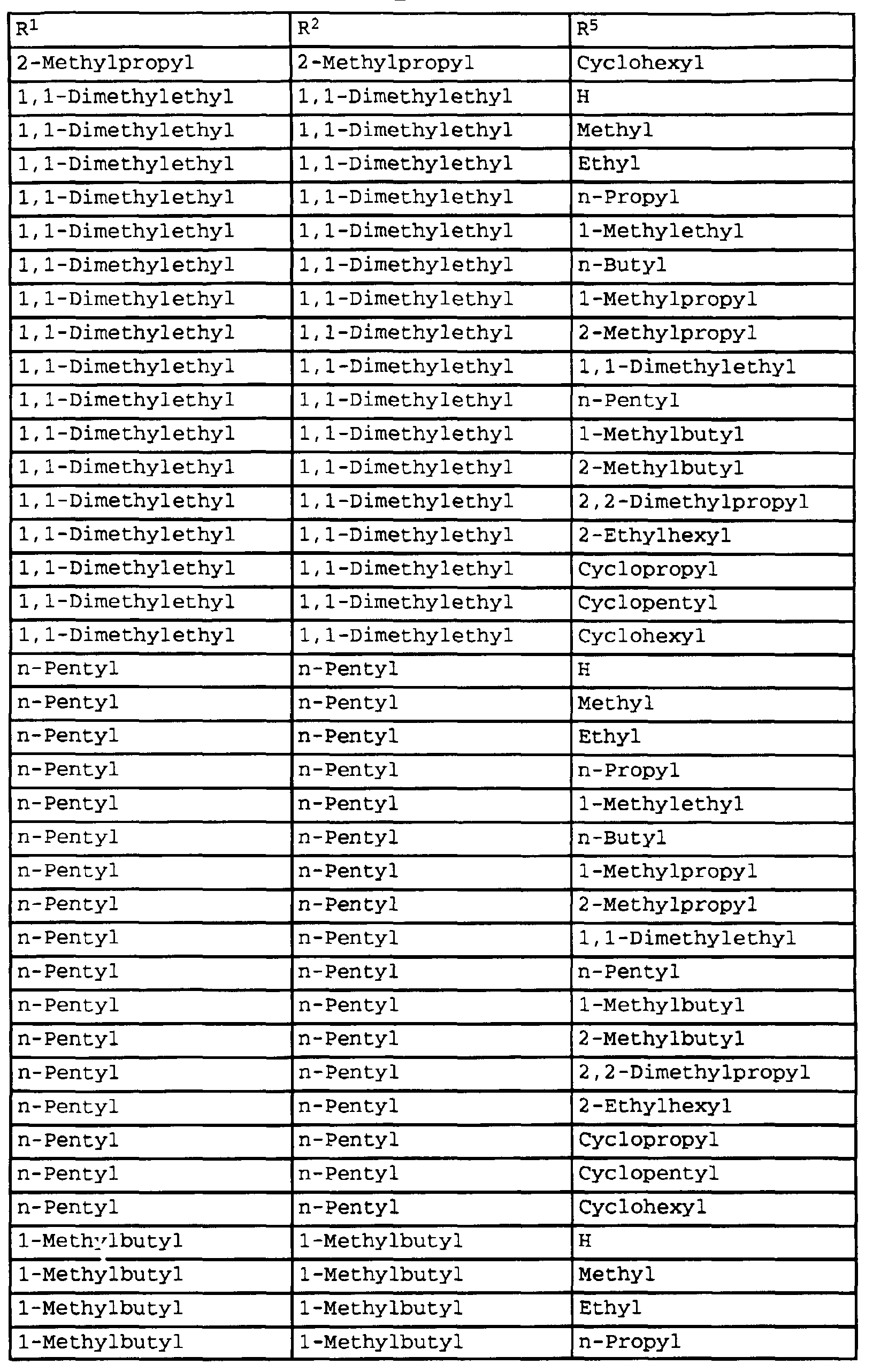
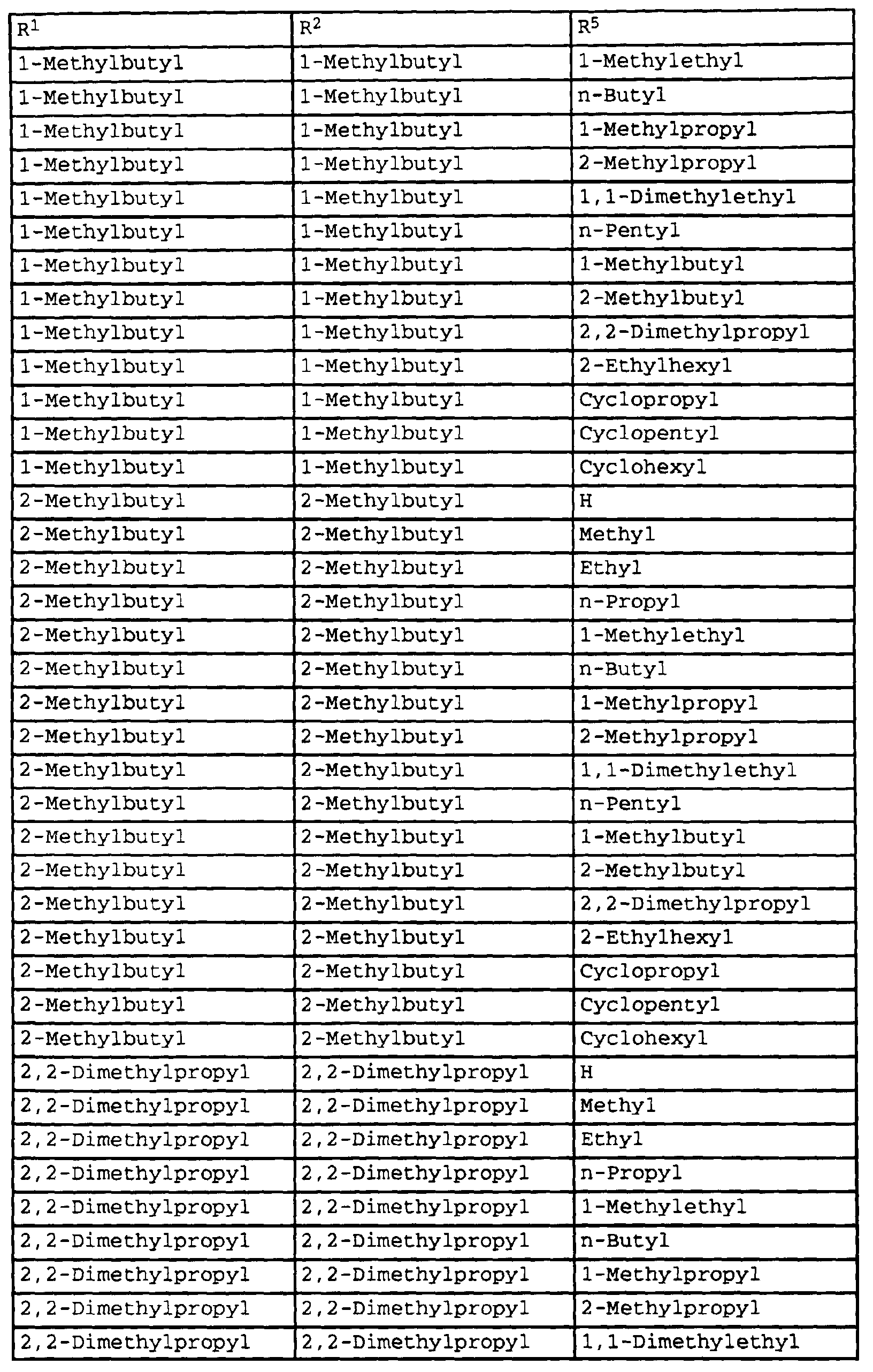
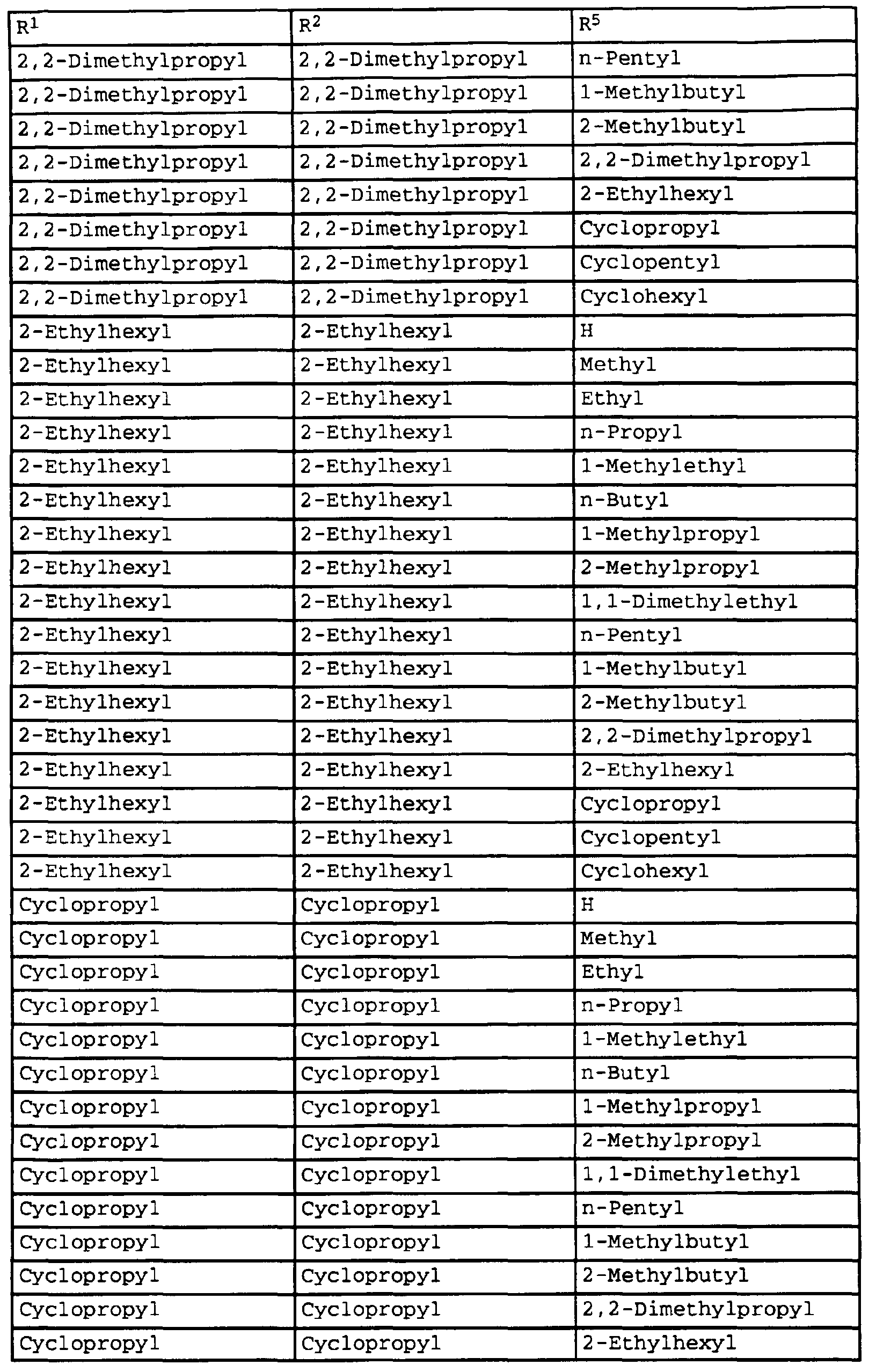
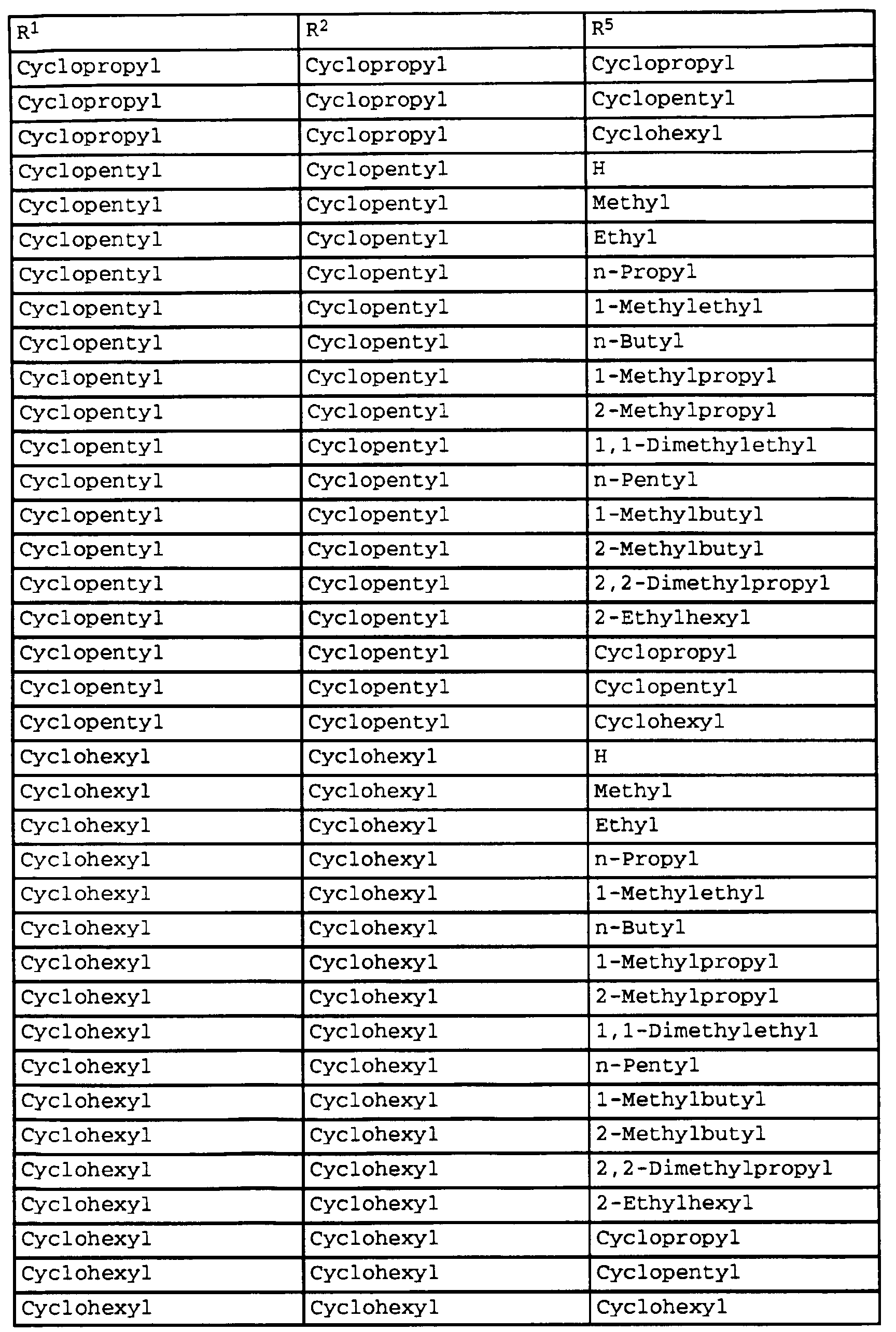
- compounds of the formula Ib have special photostable properties in which the substituents R 1 , R 2 and R 5 are present in the combination given in Table 1.
- the compounds listed in Table I show photostability of> 95%, preferably> 98%.
- R 1 and R 2 are branched or unbranched C 1 -C 8 alkyl chains, preferably methyl, ethyl, n-propyl, 1-methylethyl, n-butyl, 1-methylpropyl, 2-methylpropyl, 1,1-dimethylethyl , n-pentyl, 1-methylbutyl, 2-methylbutyl, 3-methylbutyl, 2, 2-dimethylpropyl, 1-ethylpropyl, n-hexyl, 1,1-dimethylpropyl, 1, 2-dimethylpropyl, 1-methylpentyl, 2-methylpentyl , 3-methylpentyl, 4-methylpentyl, 1, 1-dimethylbutyl, 1, 2-dimethylbutyl, 1, 3-dimethylbutyl, 2, 2-dimethylbutyl, 2, 3-dimethylbutyl, 3, 3-dimethylbutyl, 1-ethylbutyl, 2 -Ethyl
- alkyl radicals R 5 are branched or unbranched C 2 -C 12 alkyl chains, preferably ethyl, n-propyl, 1-methylethyl, n-butyl, 1-methylpropyl, 2-methylpropyl, 1, 1-dimethylethyl, n-pentyl, 1-methylbutyl, 2-methylbutyl, 3-methylbutyl, 2,2-dimethylpropyl, 1-ethylpropyl, n-hexyl, 1, 1-dimethylpropyl, 1, 2-dimethylpropyl, 1-methylpentyl, 2-methylpentyl, 3-methylpentyl, 4-methylpentyl, 1, 1-dimethylbutyl, 1, 2-dimethylbutyl, 1, 3-dimethylbutyl, 2, 2-dimethylbutyl, 2, 3-dimethylbutyl, 3, 3-dimethylbutyl, 1-ethylbutyl, 2-ethylbutyl, 1, 1, 2-trimethylpropy
- alkyl radicals R 6 and R 7 are branched or unbranched C 1 -C 12 alkyl chains, preferably methyl, ethyl, n-propyl, 1-methylethyl, n-butyl, 1-methylpropyl, 2-methylpropyl, 1,1-dimethylethyl , n-pentyl, 1-methylbutyl, 2-methylbutyl, 3-methylbutyl, 2, 2-dimethylpropyl, 1-ethylpropyl, n-hexyl, 1,1-dimethylpropyl, 1, 2-dimethylpropyl, 1-methylpentyl, 2-methylpentyl , 3-methylpentyl, 4-methylpentyl, 1,1-dimethylbutyl, 1,2-dimethylbutyl, 1, 3-dimethylbutyl, 2, 2-dimethylbutyl, 2, 3-dimethylbutyl, 3, 3-dimethylbutyl, 1-ethylbutyl, 2 -Eth
- Preferred cycloalkyl radicals for R 5 to R 7 are branched or unbranched C 5 -C 6 cycloalkyl chains such as cyclopentyl or cyclohexyl.
- R 1 and R 2 are independently C 1 -C 4 -alkyl, R 5 C 3 -C 8 -alkyl and R 6 and R 7 are C 1 -C 8 -alkyl.
- R 1 and R 2 are independently ethyl
- R 5 is C 5 -C 8 -alkyl
- R 6 and R 7 are C 1 -C 8 -alkyl from the lists of the substituents present above .
- the compounds of formula I to be used according to the invention can by direct acylation of the corresponding amino-substituted Phenols are made.
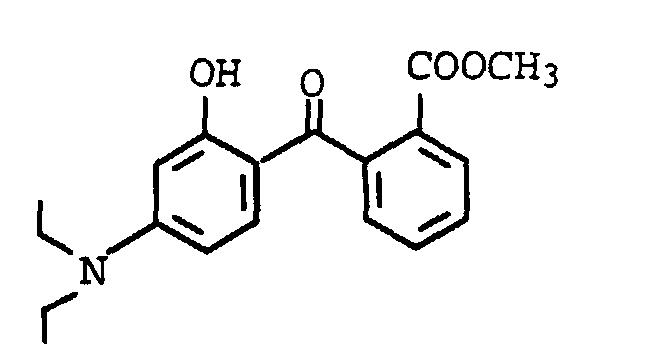
- (4-diethylamino-2-hydroxylbenzoyl) phenylmethanone (3) can be prepared, for example, by reacting meta-diethylaminophenol with benzoyl chloride and subsequent Fries rearrangement with AlCl 3 .
- the present invention furthermore relates to cosmetic and pharmaceutical preparations, preferably 0.1 to 10% by weight 1 to 7% by weight, based on the total amount of cosmetic and pharmaceutical preparation, one or more of the Compounds of formula I together with for cosmetic and pharmaceutical preparations known, in the UV-A and UV-B range contain absorbent compounds as light stabilizers, the compounds of the formula I generally being less Amount used as the UV-B absorbing compounds become.
- Cosmetic and pharmaceutical containing light stabilizers Preparations are usually based on a carrier, that contains at least one oil phase. But there are also Water-based preparations alone when using compounds possible with hydrophilic substituents. Come accordingly Oils, oil-in-water and water-in-oil emulsions, creams and pastes, Lip protection stick masses or grease-free gels can be considered.
- the emulsions include also O / W macroemulsions, O / W microemulsions or O / W / O emulsions with dispersed form amino-substituted hydroxybenzophenones of the formula I in Question where the emulsions by phase inversion technology, according to DE-A-197 26 121 are available.
- Common cosmetic auxiliaries that are considered as additives can be e.g. Co-emulsifiers, fats and waxes, stabilizers, Thickeners, biogenic agents, film formers, Fragrances, dyes, pearlescent agents, preservatives, Pigments, electrolytes (e.g. magnesium sulfate) and pH regulators.
- Known W / O and in addition come preferably as co-emulsifiers also O / W emulsifiers such as polyglycerol esters, sorbitan esters or partially esterified glycerides.
- Typical examples of Fats are glycerides; as waxes include Beeswax, paraffin wax or micro waxes optionally in combination with hydrophilic To call growing.
- Metal salts can be used as stabilizers of fatty acids such as Magnesium, aluminum and / or zinc stearate be used.
- Suitable thickeners are, for example cross-linked polyacrylic acids and their derivatives, polysaccharides, in particular xanthan gum, guar guar, agar agar, alginates and tyvant, carboxymethyl cellulose and hydroxyethyl cellulose, also fatty alcohols, monoglycerides and fatty acids, polycrylates, Polyvinyl alcohol and polyvinyl pyrrolidone.
- biogenic Active ingredients are, for example, plant extracts, protein hydrolyzates and understand vitamin complexes.
- Common film formers are hydrocolloids such as chitosan, microcrystalline Chitosan or quaternized chitosan, polyvinylpyrrolidone, vinylpyrrolidone-vinyl acetate copolymers, Polymers of the acrylic acid series, quaternary cellulose derivatives and similar compounds.
- Suitable preservatives are, for example, formaldehyde solution, p-hydroxybenzoate or sorbic acid.
- a pearlescent agent come, for example, glycol distearic acid esters such as ethylene glycol distearate, but also fatty acids and fatty acid monoglycol esters into consideration.
- the dyes can be used for cosmetic purposes suitable and approved substances are used as they for example in the publication "Cosmetic Colorants” of Dye Commission of the German Research Foundation, published published by Verlag Chemie, Weinheim, 1984 are. These dyes are usually in a concentration of 0.001 to 0.1% by weight, based on the mixture as a whole.
- antioxidants An additional level of antioxidants is generally prefers. So as cheap antioxidants all for cosmetic and / or dermatological applications suitable or customary Antioxidants are used.
- the antioxidants are advantageously selected from the group consisting of amino acids (eg glycine, histidine, tyrosine, tryptophan) and their derivatives, imidazoles (eg urocanic acid) and their derivatives, peptides such as D, L-carnosine, D-carnosine, L-carnosine and their derivatives (e.g. anserine), carotenoids, carotenes (e.g. ⁇ -carotene, lycopene) and their derivatives, chlorogenic acid and their derivatives, lipoic acid and their derivatives (e.g. dihydroliponic acid), aurothioglucose, propylthiouracil and other thiols (e.g.
- amino acids eg glycine, histidine, tyrosine, tryptophan
- imidazoles eg urocanic acid
- peptides such as D, L-carnosine, D-carnosine, L
- thiorodoxine glutathione, cysteine , Cystine, cystamine and their glycosyl, N-acetyl, methyl, ethyl, propyl, amyl, butyl, and lauryl, palmitoyl, oleyl, ⁇ -linoleyl, cholesteryl and glyceryl esters) and their salts, dilauryl thiodipropionate, distearyl thiodipropionate, thiodipropionic acid and their derivatives (esters, ethers, peptides, lipids, nucleotides, nucleosides and salts) as well as sulfoximine compounds (e.g.
- buthioninsulfoximines homocysteine sulfoximines, buthioninsulfones, penta-, hexa-, hep tathionine sulfoximine) in very low tolerable doses (e.g. pmol to ⁇ mol / kg), also (metal) chelators (e.g. ⁇ -hydroxy fatty acids, palmitic acid, phytic acid, lactoferrin), ⁇ -hydroxy acids (e.g. citric acid, lactic acid, malic acid), humic acid, bile acid , Biliary extracts, biliburin, biliverdin, EDTA and their derivatives, unsaturated fatty acids and their derivatives (e.g.
- metal chelators e.g. ⁇ -hydroxy fatty acids, palmitic acid, phytic acid, lactoferrin
- ⁇ -hydroxy acids e.g. citric acid, lactic acid, malic acid
- humic acid
- ⁇ -linolenic acid linoleic acid, oleic acid
- folic acid and their derivatives ubiquinone and ubiquinol and their derivatives
- vitamin C and their derivatives e.g. ascorbyl palmitate, Mg -Ascorbyl phosphate, ascorbyl acetate
- tocopherol and derivatives e.g.
- vitamin E acetate, tocotrienol
- vitamin A and derivatives vitamin A palmitate
- the amount of the aforementioned antioxidants (one or more compounds) in the preparations is preferably 0.001 to 30 % By weight, particularly preferably 0.05 to 20% by weight, in particular 1 up to 10% by weight, based on the total weight of the preparation.
- vitamin E and / or its derivatives, the antioxidant (s) represent, it is advantageous to their respective concentration from the range of 0.001 to 10% by weight, based on the Total weight of the formulation to choose.
- vitamin A and / or its derivatives or carotenoids or which are antioxidants it is advantageous to use them respective concentration from the range from 0.001 to 10% by weight, based on the total weight of the formulation.
- Common oil components in cosmetics are, for example, paraffin oil, Glyceryl stearate, isopropyl myristate, diisopropyl adipate, 2-ethylhexanoic acid, cetylstearyl ester, hydrogenated polyisobutene, petroleum jelly, Caprylic acid / capric acid triglycerides, microcrystalline Wax, lanolin and stearic acid.
- the total proportion of auxiliaries and additives can be 1 to 80, preferably 6 to 40% by weight and the non-aqueous portion ("active substance") 20 to 80, preferably 30 to 70 wt .-% - based on the means - amount.
- active substance non-aqueous portion
- the preparation of the means in itself known way, i.e. for example by hot, cold, hot-hot / cold or PIT emulsification. This is it to a purely mechanical process, a chemical reaction takes place not instead.
- sunscreen preparations can accordingly in liquid, pasty or in solid form, for example as water-in-oil creams, Oil-in-water creams and lotions, aerosol foam creams, Gels, oils, fat sticks, powders, sprays or alcoholic-aqueous Lotions.
- Most of the light stabilizers used to protect the human epidermis serving cosmetic and pharmaceutical Preparations consists of compounds that contain UV light in the UV-B range absorb i.e. in the range from 280 to 320 nm.
- UV-A absorber 10 to 90% by weight, preferably 20 to 50% by weight based on the total amount of UV-B and UV-A absorbing substances.
- UV-A and UV-B filter substances are suitable as UV filter substances which are used in combination with the compounds of formula I to be used according to the invention.
- the cosmetic and dermatological preparations according to the invention can advantageously also contain inorganic pigments based on metal oxides and / or other metal compounds which are sparingly soluble or insoluble in water, in particular the oxides of titanium (TiO 2 ), zinc (ZnO), iron (eg Fe 2 O 3 ), Contain zirconium (ZrO 2 ), silicon (SiO 2 ), manganese (eg MnO), aluminum (Al 2 O 3 ), cerium (eg Ce 2 O 3 ), mixed oxides of the corresponding metals and mixtures of such oxides. Pigments based on TiO 2 and ZnO are particularly preferred.
- the inorganic pigments are in present in a hydrophobic form, i.e. that they are water-repellent on the surface are treated.
- This surface treatment can be in it exist that the pigments in a manner known per se, as in DE-A-33 14 742 described, with a thin hydrophobic layer are provided.
- the inventive Light stabilizers of formula I in shampoos, lotions, Gels, hair sprays, aerosol foam creams or emulsions in concentrations from 0.1 to 10% by weight, preferably 1 to 7% by weight be incorporated.
- the respective formulations can i.a. used for washing, dyeing and styling the hair become.
- the compounds to be used according to the invention stand out usually through a particularly high absorption capacity in the Range of UV-A radiation with a sharp band structure. Farther they are easily soluble in cosmetic oils and can be easily incorporate into cosmetic formulations.
- the one with the Compounds I prepared emulsions are particularly noteworthy through their high stability, the compounds I themselves through their high photostability, and the preparations made with I. by their pleasant skin feeling.
- UV filter effect of the compounds of the formula according to the invention I karin also for the stabilization of active substances and auxiliary substances in cosmetic and pharmaceutical formulations can be used.
- the combined ether extracts were three times with 50 ml of water each washed and three times with 50 ml of saturated sodium bicarbonate solution extracted.
- the combined aqueous extracts were acidified to pH ⁇ 2 and three times with 50 ml of diethyl ether extracted.
- the organic phases were combined with 50 ml Washed water, dried over magnesium sulfate, filtered and the solvent removed in vacuo.
- a 5% by weight alcoholic solution of the light stabilizer to be tested is applied to the. using an Eppendorf pipette (20 ⁇ l) Milled on a small glass plate. By the presence the alcohol is distributed evenly on the roughened glass surface. The amount applied corresponds to the Amount of sunscreen to achieve in sunscreens an average sun protection factor is required.
- glass plates are irradiated. The evaporation time and the Irradiation is 30 minutes each. The glass plates are during of irradiation by a water cooling system that is on the ground of the sun testers, slightly chilled. The temperature inside of the Suntest device is 40 ° C during the irradiation.
- samples After the samples have been irradiated, they are washed with ethanol washed in a dark 50 ml volumetric flask and with the photometer measured. The blank samples are also applied to glass slides and evaporated at room temperature for 30 minutes. Like the others Samples are washed off with ethanol and made up to 100 ml diluted and measured.
- composition for sunblock with micropigments Composition for sunblock with micropigments
- composition for sunblock with micropigments Composition for sunblock with micropigments
Landscapes
- Health & Medical Sciences (AREA)
- Chemical & Material Sciences (AREA)
- Organic Chemistry (AREA)
- Life Sciences & Earth Sciences (AREA)
- Animal Behavior & Ethology (AREA)
- Veterinary Medicine (AREA)
- Public Health (AREA)
- General Health & Medical Sciences (AREA)
- Epidemiology (AREA)
- Birds (AREA)
- Dermatology (AREA)
- General Chemical & Material Sciences (AREA)
- Pharmacology & Pharmacy (AREA)
- Nuclear Medicine, Radiotherapy & Molecular Imaging (AREA)
- Medicinal Chemistry (AREA)
- Engineering & Computer Science (AREA)
- Chemical Kinetics & Catalysis (AREA)
- Bioinformatics & Cheminformatics (AREA)
- Toxicology (AREA)
- Cosmetics (AREA)
- Organic Low-Molecular-Weight Compounds And Preparation Thereof (AREA)
- Pharmaceuticals Containing Other Organic And Inorganic Compounds (AREA)
- Acyclic And Carbocyclic Compounds In Medicinal Compositions (AREA)
Abstract
Description
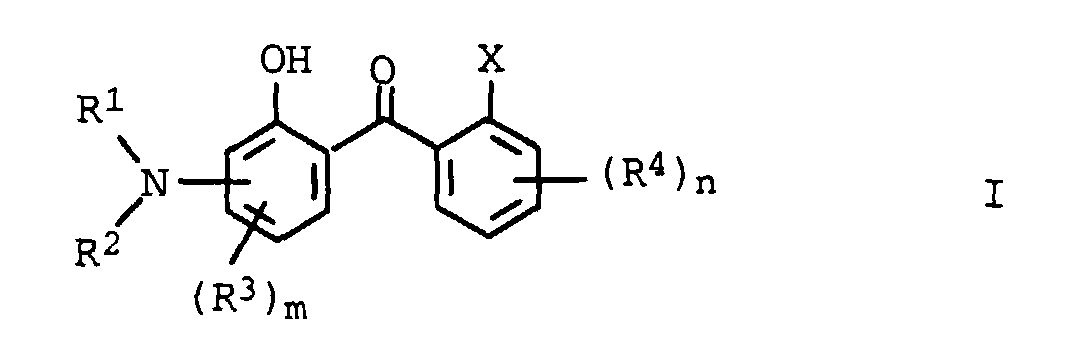
- R1 und R2
- Wasserstoff, C1-C20-Alkyl, C2-C10-Alkenyl, C3-C10-Cycloalkyl, C3-C10-cycloalkenyl, wobei die Substituenten R1 und R2 gemeinsam mit dem Stickstoffatom, an dem sie gebunden sind, einen 5- oder 6-Ring bilden können;
- R3 und R4
- C1-C20-Alkyl, C2-C10-Alkenyl, C3-C10-Cycloalkyl, C3-C10-Cycloalkenyl, C1-C12-Alkoxy, C1-C20-Alkoxycarbonyl, C1-C12-Alkylamino, C1-C12-Dialkylamino, Aryl, Heteroaryl, gegebenenfalls substituiert, wasserlöslich machende Substituenten, ausgewählt aus der Gruppe bestehend aus einer Nitrilgruppe, Carboxylat-, Sulfonat- oder Ammoniumresten;
- X
- Wasserstoff, COOR5, CONR6R7;
- R5 bis R7
- Wasserstoff, C1-C20-Alkyl, C2-C10-Alkenyl, C3-C10-Cycloalkyl, C3-C10-Cycloalkenyl, - (Y-O)o-Z, Aryl;
- Y
- -(CH2)2-, -(CH2)3-, -(CH2)4-, -CH(CH3)-CH2-;
- Z
- -CH2-CH3, -CH2-CH2-CH3, -CH2-CH2-CH2-CH3, -CH(CH3) -CH3;
- m
- 0 bis 3;
- n
- 0 bis 4;
- o
- 1 bis 20
| Methoxy- | Ethoxy- |
| Isopropoxy- | n-Propoxy- |
| 1-Methylpropoxy- | n-Butoxy- |
| n-Pentoxy- | 2 -Methylpropoxy- |
| 3-Methylbutoxy- | 1, 1-Dimethylpropoxy- |
| 2, 2-Dimethylpropoxy- | Hexoxy- |
| 1-Methyl-1-ethylpropoxy- | Heptoxy- |
| Octoxy- | 2 -Ethylhexoxy- |
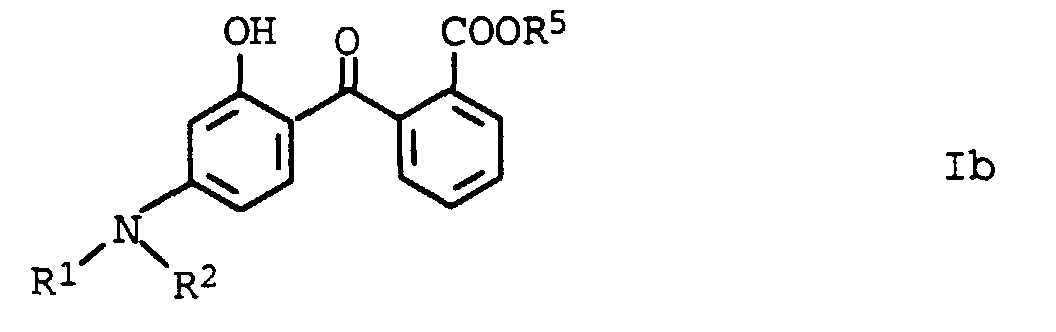
- R1 und R2
- Wasserstoff, C1-C12-Alkyl, wobei die Substituenten R1 und R2 gemeinsam mit dem Stickstoffatom, an dem sie gebunden sind, einen 5- oder 6-Ring bilden können;
- R5
- Wasserstoff, C1-C12-Alkyl, C3-C6-Cycloalkyl.


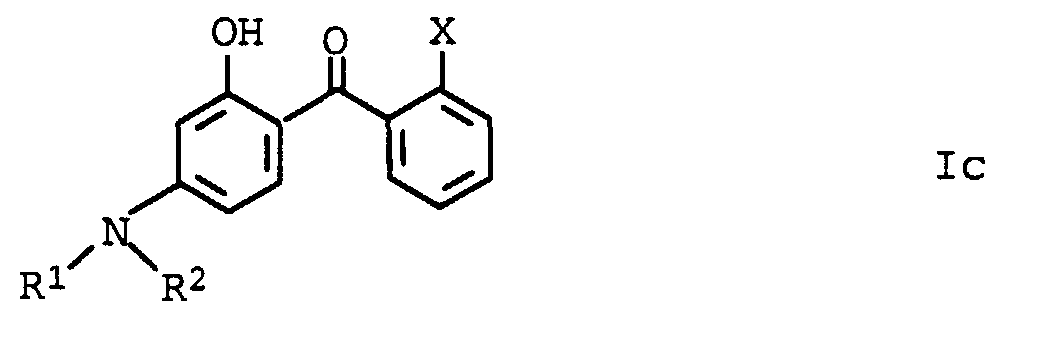
- R1 und R2
- Wasserstoff, C1-C8-Alkyl, wobei die Substituenten R1 und R2 gemeinsam mit dem Stickstoffatom, an dem sie gebunden sind, einen 5- oder 6-Ring bilden können;
- X
- COOR5, CONR6R7;
- R5
- C2-C12-Alkyl, C5-C6-Cycloalkyl;
- R6 und R7
- Wasserstoff, C1-C12-Alkyl, C5-C6-Cycloalkyl.


| Nr. | Stoff | CAS-Nr. ( =Säure) |
| 1 | 4 -Aminobenzoesäure | 150-13-0 |
| 2 | 3- (4'Trimethylammonium) -benzylidenbornan-2-on-methylsulfat | 52793-97-2 |
| 3 | 3, 3, 5-Trimethyl-cyclohexyl-salicylat (Homosalatum) | 118-56-9 |
| 4 | 2-Hydroxy-4-methoxy-benzophenon (Oxybenzonum) | 131-57-7 |
| 5 | 2-Phenylbenzimidazol-5-sulfonsäure und ihre Kalium-, Natrium- u. Triethanolaminsalze | 27503-81-7 |
| 6 | 3,3'-(1,4-Phenylendimethin)-bis (7,7-dimethyl-2 -oxobicyclo [2.2.1] heptan-1-methansulfonsäure) und ihre Salze | 90457-82-2 |
| 7 | 4-Bis (polyethoxy)amino-benzoesäurepolyethoxyethylester | 113010-52-9 |
| 8 | 4-Dimethylamino-benzoesäure-2-ethylhexylester | 21245-02-3 |
| 9 | Salicylsäure-2-ethylhexylester | 118-60-5 |
| 10 | 4-Methoxy-zimtsäure-2-isoamylester | 71617-10-2 |
| 11 | 4-Methoxy-zimtsäure-2-ethylhexylester | 5466-77-3 |
| 12 | 2-Hydroxy-4-methoxy-benzophenon-5-sulfon-(Sulisobenzonum) und das Natriumsalz | 4065-45-6 |
| 13 | 3-(4'-Sulfo)benzyliden-bornan-2-on und Salze | 58030-58-6 |
| 14 | 3-Benzylidenbornan-2-on | 16087-24-8 |
| 15 | 1-(4'-Isopropylphenyl)-3-phenylpropan-1,3-dion | 63260-25-9 |
| 16 | 4-Isopropylbenzylsalicylat | 94134-93-7 |
| 17 | 2,4, 6-Trianilin-(o-carbo-2'-ethylhexyl-1'-oxy)-1,3, 5-triazin | 88122-99-0 |
| 18 | 3-Imidazol-4-yl-acrylsäure und ihr Ethylester | 104-98-3 |
| 19 | 2-Cyano-3, 3-diphenylacrylsäureethylester | 5232-99-5 |
| 20 | 2-Cyano-3, 3-diphenylacrylsäure-2'-ethylhexylester | 6197-30-4 |
| 21 | Menthyl-o-aminobenzoate oder: 5-Methyl-2- (1-methylethyl) -2-aminobenzoate | 134-09-8 |
| 22 | Glyceryl p-aminobenzoat oder: 4-Aminobenzoesäure-1 -glyceryl-ester | 136-44-7 |
| 23 | 2,2' -Dihydroxy-4-methoxybenzophenon (Dioxybenzone) | 131-53 -3 |
| 24 | 2-Hydroxy-4-methoxy-4-methylbenzophenon (Mexonon) | 1641-17-4 |
| 25 | Triethanolamin Salicylat | 2174-16-5 |
| 26 | Dimethoxyphenylglyoxalsäure oder: 3, 4-dimethoxy-phenyl-glyoxal-saures Natrium | 4732-70-1 |
| 27 | 3-(4'Sulfo)benzyliden-bornan-2-on und seine Salze | 56039-58-8 |
| 28 | 4-tert.-Butyl-4 '-methoxy-dibenzoylmethan | 70356-09-1 |
| 29 | 2,2', 4,4 '-Tetrahydroxybenzophenon | 131-55-5 |
| 30 | 2,2'-Methylen-bis-[6(2H-benzotriazol-2-y1)-4-(1,1,3,3,-tetramethylbutyl)phenol] | 103597-45-1 |
| 31 | 2,2'-(1,4-Phenylen)-bis-1H-benzimidazol-4,6-disulfonsäure, Na-Salz | 180898-37-7 |
| 32 | 2,4-bis-[4-(2-Ethylhexyloxy)-2-hydroxy]phenyl-6-(4-methoxyphenyl)-(1,3,5)-triazin | 187393-00-6 |



- ad 100
- Eucerinum anhydricum
- 10,00
- Glycerin
- 10,00
- Titanium Dioxid, mikronisiert
- 5,00
- Verbindung Nr. 2 der Tabelle 2
- 8,00
- Octyl Methoxycinnamat
- 5,00
- Zink Oxid
- 4,00
- Castoröl
- 4,00
- Pentaerythrithil Stearat/caprat/Caprylat Adipat
- 3,00
- Glyceryl Stearat SE
- 2,00
- Bienenwachs
- 2,00
- Microkristallines Wachs
- 2,00
- Quaternium-18 Bentonit
- 1,50
- PEG-45/Dodecyl Glycol Copolymer
- ad 100
- Eucerinum anhydricum
- 10,00
- Glycerin
- 10,00
- Titanium Dioxid, mikronisiert
- 5,00
- Verbindung Nr. 3 der Tabelle 2
- 8,00
- Octyl Methoxycinnamat
- 5,00
- Zink Oxid
- 4,00
- Castoröl
- 4,00
- Pentaerythrithil Stearat/caprat/Caprylat Adipat
- 3,00
- Glyceryl Stearat SE
- 2,00
- Bienenwachs
- 2,00
- Microkristallines Wachs
- 2,00
- Quaternium-18 Bentonit
- 1,50
- PEG-45/Dodecyl Glycol Copolymer
- ad 100
- Wasser
- 10,00
- Octyl Methoxcinnamat
- 6,00
- PEG-7-Hydrogenated Castor Öl
- 6,00
- Titanium Dioxid, mikronisiert
- 5,00
- Verbindung Nr. 2 der Tabelle 2
- 5,00
- Mineral Öl
- 5,00
- Isoamyl p-Methoxycinnamat
- 5,00
- Propylen Glycol
- 3,00
- Jojoba Öl
- 3,00
- 4-Methylbenzyliden Campher
- 2,00
- PEG-45/Dodecyl Glycol Copolymer
- 1,00
- Dimethicon
- 0,50
- PEC-40-Hydrogenated Castor Öl
- 0,50
- Tocopheryl Acetat
- 0,50
- Phenoxyethanol
- 0,20
- EDTA
- ad 100
- Wasser
- 10,00
- Octyl Methoxcinnamat
- 6,00
- PEG-7-Hydrogenated Castor Öl
- 6,00
- Titanium Dioxid, mikronisiert
- 5,00
- Verbindung Nr. 3 der Tabelle 2
- 5,00
- Mineral Öl
- 5,00
- Isoamyl p-Methoxycinnamat
- 5,00
- Propylen Glycol
- 3,00
- Jojoba Öl
- 3,00
- 4-Methylbenzyliden Campher
- 2,00
- PEG-45/Dodecyl Glycol Copolymer
- 1,00
- Dimethicon
- 0,50
- PEG-40-Hydrogenated Castor Öl
- 0,50
- Tocopheryl Acetat
- 0,50
- Phenoxyethanol
- 0,20
- EDTA
- ad 100
- Wasser
- 8,00
- Octyl Methoxycinnamat
- 7,00
- Titanium Dioxid, mikronisiert
- 5,00
- Verbindung Nr. 2 der Tabelle 2
- 5,00
- Glycerin
- 5,00
- PEG-25 PABA
- 1,00
- 4-Methylbenzyliden Campher
- 0,40
- Acrylate C10-C30 Alkyl Acrylat Crosspolymer
- 0,30
- Imidazolidinyl Urea
- 0,25
- Hydroxyethyl Cellulose
- 0,25
- Sodium Methylparaben
- 0,20
- Disodium EDTA
- 0,15
- Fragrance
- 0,15
- Sodium Propylparaben
- 0,10
- Sodium Hydroxid
- ad 100
- Wasser
- 8,00
- Octyl Methoxycinnamat
- 7,00
- Titanium Dioxid, mikronisiert
- 5,00
- Verbindung Nr. 3 der Tabelle 2
- 5,00
- Glycerin
- 5,00
- PEG-25 PABA
- 1,00
- 4-Methylbenzyliden Campher
- 0,40
- Acrylate C10-C30 Alkyl Acrylat Crosspolymer
- 0,30
- Imidazolidinyl Urea
- 0,25
- Hydroxyethyl Cellulose
- 0,25
- Sodium Methylparaben
- 0,20
- Disodium EDTA
- 0,15
- Fragrance
- 0,15
- Sodium Propylparaben
- 0,10
- Sodium Hydroxid
- ad 100
- Wasser
- 8,00
- Octyl Methoxycinnamat
- 8,00
- Titanium Dioxid, mikronisiert
- 6,00
- PEG-7-Hydrogenated Castor Öl
- 5,00
- Verbindung Nr. 2 der Tabelle 2
- 6,00
- Mineral Öl
- 5,00
- Zink Oxid
- 5,00
- Isopropyl Palmitat
- 0,30
- Imidazolidinyl Urea
- 3,00
- Jojoba Öl
- 2,00
- PEG-45/Dodecyl Glycol Copolymer
- 1,00
- 4-Methylbenzyliden Campher
- 0,60
- Magnesium Stearat
- 0,50
- Tocopheryl Acetat
- 0,25
- Methylparaben
- 0,20
- Disodium EDTA
- 0,15
- Propylparaben
- ad 100
- Wasser
- 8,00
- Octyl Methoxycinnamat
- 8,00
- Titanium Dioxid, mikronisiert
- 6,00
- PEG-7-Hydrogenated Castor Öl
- 5,00
- Verbindung Nr. 3 der Tabelle 2
- 6,00
- Mineral Öl
- 5,00
- Zink Oxid
- 5,00
- Isopropyl Palmitat
- 0,30
- Imidazolidinyl Urea
- 3,00
- Jojoba Öl
- 2,00
- PEG-45/Dodecyl Glycol Copolymer
- 1,00
- 4-Methylbenzyliden Campher
- 0,60
- Magnesium Stearat
- 0,50
- Tocopheryl Acetat
- 0,25
- Methylparaben
- 0,20
- Disodium EDTA
- 0,15
- Propylparaben
- ad 100
- Wasser
- 8,00
- Octyl Methoxycinnamat
- 5,00
- PEG-7-Hydrogenated Castor Öl
- 5,00
- Propylene Glycol
- 4,00
- Isopropyl Palmitat
- 4,00
- Caprylic/Capric Triglycerid
- 5,00
- Verbindung Nr. 2 der Tabelle 2
- 4,00
- Glycerin
- 3,00
- Jojoba Öl
- 2,00
- 4-Methylbenzyliden Campher
- 2,00
- Titanium Dioxid, mikronisiert
- 1,50
- PEG-45/Dodecyl Glycol Copolymer
- 1,50
- Dimethicon
- 0,70
- Magnesium Sulfat
- 0,50
- Magnesium Stearat
- 0,15
- Fragrance
- ad 100
- Wasser
- 8,00
- Octyl Methoxycinnamat.
- 5,00
- PEG-7-Hydrogenated Castor Öl
- 5,00
- Propylene Glycol
- 4,00
- Isopropyl Palmitat
- 4,00
- Caprylic/Capric Triglycerid
- 5,00
- Verbindung Nr. 3 der Tabelle 2
- 4,00
- Glycerin
- 3,00
- Jojoba Öl
- 2,00
- 4-Methylbenzyliden Campher
- 2,00
- Titanium Dioxid, mikronisiert
- 1,50
- PEG-45/Dodecyl Glycol Copolymer
- 1,50
- Dimethicon
- 0,70
- Magnesium Sulfat
- 0,50
- Magnesium Stearat
- 0,15
- Fragrance
- ad 100
- Wasser
- 10,00
- Mineral Öl
- 6,00
- PEG-7-Hydrogenated Castor Öl
- 5,00
- Isopropyl Palmitat
- 3,50
- Octyl Methoxycinnamat
- 5,00
- Verbindung Nr. 2 der Tabelle 2
- 3,00
- Caprylic/Capric Triglycerid
- 3,00
- Jojoba Öl
- 2,00
- PEG-45/Dodecyl Glycol Copolymer
- 0,70
- Magnesium Sulfat
- 0,60
- Magnesium Stearat
- 0,50
- Tocopheryl Acetat
- 3,00
- Glycerin
- 0,25
- Methylparaben
- 0,15
- Propylparaben
- 0,05
- Tocopherol
- ad 100
- Wasser
- 10,00
- Mineral Öl
- 6,00
- PEG-7-Hydrogenated Castor Öl
- 5,00
- Isopropyl Palmitat
- 3,50
- Octyl Methoxycinnamat
- 5,00
- Verbindung Nr. 3 der Tabelle 2
- 3,00
- Caprylic/Capric Triglycerid
- 3,00
- Jojoba Öl
- 2,00
- PEG-45/Dodecyl Glycol Copolymer
- 0,70
- Magnesium Sulfat
- 0,60
- Magnesium Stearat
- 0,50
- Tocopheryl Acetat
- 3,00
- Glycerin
- 0,25
- Methylparaben
- 0,15
- Propylparaben
- 0,05
- Tocopherol
Claims (7)
- Verwendung von aminosubstituierten Hydroxybenzophenonen der allgemeinen Formel I,in der die Variablen unabhängig voneinander folgende Bedeutung haben:
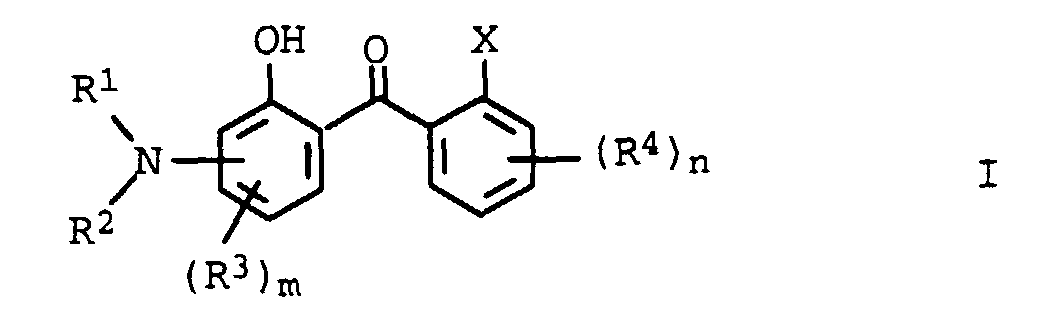
- R1 und R2
- Wasserstoff, C1-C20-Alkyl, C2-C10-Alkenyl, C3-C10-Cycloalkyl, C3-C10-Cycloalkenyl, wobei die Substituenten R1 und R2 gemeinsam mit dem Stickstoffatom, an dem sie gebunden sind, einen 5- oder 6-Ring bilden können;
- R3 und R4
- C1-C20-Alkyl, C2-C10-Alkenyl, C3-C10-Cycloalkyl, C3-C10-Cycloalkenyl, C1-C12-Alkoxy, C1-C20-Alkoxycarbonyl, C1-C12-Alkylamino, C1-C12-Dialkylamino, Aryl, Heteroaryl, gegebenenfalls substituiert, wasserlöslich machende Substituenten, ausgewählt aus der Gruppe bestehend aus einer Nitrilgruppe, Carboxylat-, Sulfonat- oder Ammoniumresten;
- X
- Wasserstoff, COOR5, CONR6R7;
- R5 bis R7
- Wasserstoff , C1-C20-Alkyl, C2-C10-Alkenyl, C3-C10-Cycloalkyl, C3-C10-Cycloalkenyl, -(Y-O)0-Z, Aryl;
- Y
- -(CH2)2-, -(CH2)3-, -(CH2)4-, -CH(CH3)-CH2-;
- Z
- -CH2-CH3, -CH2-CH2-CH3, -CH2-CH2-CH2-CH3, -CH (CH3) -CH3;
- m
- 0 bis 3;
- n
- 0 bis 4;
- o
- 1 bis 20
- Verwendung von Verbindungen der Formel I nach Anspruch 1 als photostabile UV-A-Filter.
- Verwendung von Verbindungen der Formel I nach einem der Ansprüche 1 oder 2 als UV-Stabilisator in kosmetischen und pharmazeutischen Formulierungen.
- Verwendung nach einem der Ansprüche 1 bis 3, dadurch gekennzeichnet, daß die aminosubstituierten Hydroxybenzophenone die allgemeine Formel Ib aufweisen,in der die Substituenten unabhängig voneinander folgende Bedeutung haben:
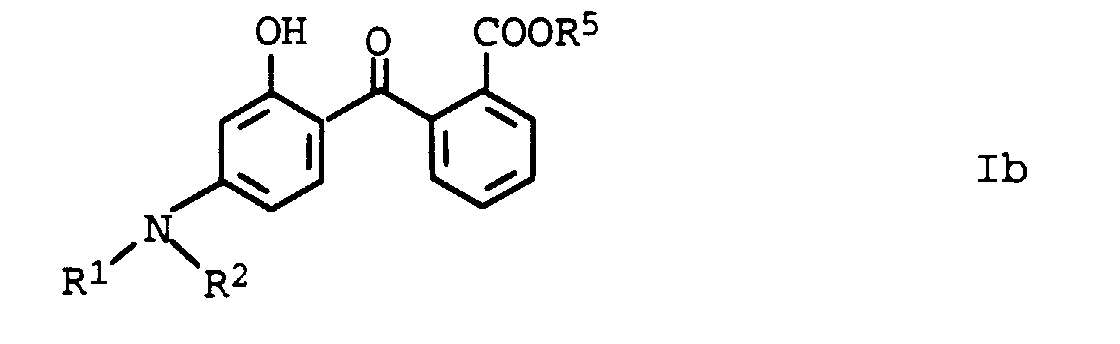
- R1 und R2
- Wasserstoff, C1-C12-Alkyl, wobei die Substituenten R1 und R2 gemeinsam mit dem Stickstoffatom, an dem sie gebunden sind, einen 5- oder 6-Ring bilden können;
- R5
- Wasserstoff, C1-C12-Alkyl, C3-C6-Cycloalkyl.
- Lichtschutzmittel enthaltende kosmetische und pharmazeutische Zubereitungen zum Schutz der menschlichen Epidermis oder menschlichen Haare gegen UV-Licht im Bereich von 280 bis 400 nm, dadurch gekennzeichnet, daß sie in einem kosmetisch und pharmazeutisch geeigneten Träger, allein oder zusammen mit an sich für kosmetische und pharmazeutische Zubereitungen bekannten im UV-Bereich absorbierenden Verbindungen, als photostabile UV-Filter wirksame Mengen von Verbindungen der Formel Ienthalten, in der die Variablen die Bedeutung definiert gemäß Anspruch 1 haben.

- Lichtschutzmittel enthaltende kosmetische und pharmazeutische Zubereitungen gemäß Anspruch 5, enthaltend als UV-A-Filter Verbindungen der Formel Ib, in der die Variablen die Bedeutung definiert gemäß Anspruch 4 haben.
- Aminosubstituierte Hydroxybenzophenone der allgemeinen Formel Ic,in der die Variablen unabhängig voneinander folgende Bedeutung haben:
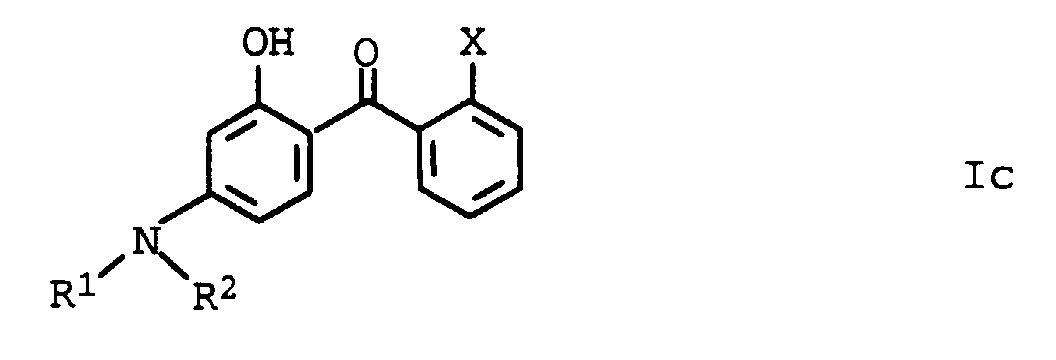
- R1 und R2
- Wasserstoff, C1-C8-Alkyl, wobei die Substituenten R1 und R2 gemeinsam mit dem Stickstoffatom, an dem sie gebunden sind, einen 5- oder 6-Ring bilden können;
- X
- COOR5, CONR6R7;
- R5
- C2-C12-Alkyl, C5-C6-Cycloalkyl;
- R6 und R7
- Wasserstoff, C1-C12-Alkyl, C5-C6-Cycloalkyl.
Priority Applications (3)
| Application Number | Priority Date | Filing Date | Title |
|---|---|---|---|
| DK00105806T DK1046391T3 (da) | 1999-04-20 | 2000-03-18 | Anvendelse af aminosubstituerede hydroxybenzophenoner som fotostabile UV-filtre i kosmetiske og farmaceutiske præparater |
| SI200030535T SI1046391T1 (en) | 1999-04-20 | 2000-03-18 | Use of aminosubstituted hydroxybenzophenones as photostable UV-filters in cosmetic and pharmaceutical preparations |
| EP20040009762 EP1466585A3 (de) | 1999-04-20 | 2000-03-18 | Verwendung von aminosubstituierten Hydroxybenzophenonen als photostabile UV-Filter in kosmetischen und pharmazeutischen Zubereitungen |
Applications Claiming Priority (2)
| Application Number | Priority Date | Filing Date | Title |
|---|---|---|---|
| DE19917906 | 1999-04-20 | ||
| DE19917906A DE19917906A1 (de) | 1999-04-20 | 1999-04-20 | Verwendung von aminosubstituierten Hydroxybenzophenonen als photostabile UV-Filter in kosmetischen und pharmazeutischen Zubereitungen |
Related Child Applications (1)
| Application Number | Title | Priority Date | Filing Date |
|---|---|---|---|
| EP20040009762 Division EP1466585A3 (de) | 1999-04-20 | 2000-03-18 | Verwendung von aminosubstituierten Hydroxybenzophenonen als photostabile UV-Filter in kosmetischen und pharmazeutischen Zubereitungen |
Publications (3)
| Publication Number | Publication Date |
|---|---|
| EP1046391A2 true EP1046391A2 (de) | 2000-10-25 |
| EP1046391A3 EP1046391A3 (de) | 2000-11-08 |
| EP1046391B1 EP1046391B1 (de) | 2004-09-15 |
Family
ID=7905241
Family Applications (2)
| Application Number | Title | Priority Date | Filing Date |
|---|---|---|---|
| EP00105806A Expired - Lifetime EP1046391B1 (de) | 1999-04-20 | 2000-03-18 | Verwendung von aminosubstituierten Hydroxybenzophenonen als photostabile UV-Filter in kosmetischen und pharmazeutischen Zubereitungen |
| EP20040009762 Withdrawn EP1466585A3 (de) | 1999-04-20 | 2000-03-18 | Verwendung von aminosubstituierten Hydroxybenzophenonen als photostabile UV-Filter in kosmetischen und pharmazeutischen Zubereitungen |
Family Applications After (1)
| Application Number | Title | Priority Date | Filing Date |
|---|---|---|---|
| EP20040009762 Withdrawn EP1466585A3 (de) | 1999-04-20 | 2000-03-18 | Verwendung von aminosubstituierten Hydroxybenzophenonen als photostabile UV-Filter in kosmetischen und pharmazeutischen Zubereitungen |
Country Status (11)
| Country | Link |
|---|---|
| US (1) | US6409995B1 (de) |
| EP (2) | EP1046391B1 (de) |
| JP (1) | JP4705220B2 (de) |
| CN (2) | CN1160052C (de) |
| AT (1) | ATE275929T1 (de) |
| AU (1) | AU773111B2 (de) |
| DE (2) | DE19917906A1 (de) |
| DK (1) | DK1046391T3 (de) |
| ES (1) | ES2228322T3 (de) |
| PT (1) | PT1046391E (de) |
| SI (1) | SI1046391T1 (de) |
Cited By (82)
| Publication number | Priority date | Publication date | Assignee | Title |
|---|---|---|---|---|
| EP1240894A3 (de) * | 2001-03-15 | 2002-11-06 | Basf Aktiengesellschaft | Verwendung von Lichtschutzmittelkombinationen in kosmetischen und pharmazeutischen Zubereitungen |
| EP1291007A1 (de) * | 2001-09-07 | 2003-03-12 | Basf Aktiengesellschaft | Emulgatorarme oder emulgatorfreie Systeme vom Typ Öl-in-Wasser mit einem Gehalt an Stabilisatoren und einem aminosubstituierten Hydroxybenzophenon |
| EP1291009A3 (de) * | 2001-09-07 | 2003-05-02 | Basf Aktiengesellschaft | Kosmetische und dermatologische Zubereitungen in Form von W/O-Emulsionen, enthaltend ein aminosubstituiertes Hydroxybenzophenon |
| EP1290999A3 (de) * | 2001-09-07 | 2003-05-02 | Basf Aktiengesellschaft | Kosmetische und dermatologische Zubereitungen in Stiftform, enthaltend ein aminosubstituiertes Hydroxybenzophenon |
| EP1291010A3 (de) * | 2001-09-07 | 2003-05-02 | Basf Aktiengesellschaft | Kosmetische und dermatologische Zubereitungen in Form von O/W-Emulsionen, enthaltend ein aminosubstituiertes Hydroxybenzophenon |
| EP1310236A1 (de) * | 2001-11-09 | 2003-05-14 | Beiersdorf AG | Kosmetische und dermatologische Lichtschutzformulierungen mit einem Gehalt an Hydroxybenzophenonen und Iminodibernsteinsäure und/oder ihren Salzen |
| EP1310239A1 (de) * | 2001-11-09 | 2003-05-14 | Beiersdorf AG | Kosmetische und dermatologische Lichtschutzformulierungen mit einem Gehalt an Hydroxybenzophenonen und Pentanatrium-Ethylendiamintetramethylenphosphonat |
| WO2003039507A1 (de) * | 2001-11-09 | 2003-05-15 | Beiersdorf Ag | Kosmetische und dermatologische lichtschutzformulierungen mit einem gehalt an hydroxybenzophenonen, triazin- und/oder benzotriazol-derivaten |
| DE10155962A1 (de) * | 2001-11-09 | 2003-05-22 | Beiersdorf Ag | Kosmetische und dermatologische Lichtschutzformulierungen mit einem Gehalt an Hydroxybenzophenonen und Acrylamid-Polymeren |
| DE10155959A1 (de) * | 2001-11-09 | 2003-05-22 | Beiersdorf Ag | Kosmetische und/oder dermatologische Wirkstoffkombination |
| DE10155865A1 (de) * | 2001-11-14 | 2003-05-28 | Beiersdorf Ag | Kosmetische und/oder dermatologische Lichtschutzzubereitung |
| EP1317918A1 (de) * | 2001-12-07 | 2003-06-11 | L'oreal | Kosmetische Sonnenschutzmittel auf Basis einer synergistischen Mischung von Filtern und deren Verwendungen |
| EP1317920A1 (de) * | 2001-12-07 | 2003-06-11 | L'oreal | Selbstbräunende Zusammensetzung enthaltend ein Amino-2-hydroxybenzophenon-Derivat und ein Selbstbräunendes Mittel |
| EP1317919A1 (de) * | 2001-12-07 | 2003-06-11 | l'Oreal SA | Kosmetische Sonnenschutzmittel auf Basis einer synergistischen Mischung von Filtern und deren Verwendungen |
| FR2833169A1 (fr) * | 2001-12-07 | 2003-06-13 | Oreal | Composition filtrante contenant un derive de 1,3,5-triazine, un derive du dibenzoylmethane, et un derive de 2-hydroxybenzophenone aminosubstitue |
| FR2833168A1 (fr) * | 2001-12-07 | 2003-06-13 | Oreal | Composition filtrante contenant un filtre du type derive du dibenzoylmethane et un derive de 2-hydroxybenzophenone aminosubstitue |
| WO2003053393A1 (de) * | 2001-12-20 | 2003-07-03 | Beiersdorf Ag | Komestiche und dermatologische lichtschutzformulierungen mit einem gehalt an hydroxybenzophenonen und benzoxazol-derivaten |
| DE10249367A1 (de) * | 2001-12-20 | 2003-07-17 | Beiersdorf Ag | Kosmetische und dermatologische Lichtschutzformulierungen mit einem Gehalt an Hydroxybenzophenonen und Benzoxazol-Derivaten |
| WO2003086340A1 (en) * | 2002-04-12 | 2003-10-23 | Dsm Ip Assets B.V. | Organosilicone derivatives of amino hydroxybenzophenones and their use as uv-a filters in cosmetic preparations |
| DE10216508A1 (de) * | 2002-04-11 | 2003-10-23 | Beiersdorf Ag | Kosmetische und dermatologische Formulierungen mit einem Gehalt an Hydroxybenzophenonen und einem oder mehreren vorgelatinisierten, quervernetzten Stärkederivaten |
| EP1310235A3 (de) * | 2001-11-09 | 2003-11-05 | Beiersdorf AG | Emulgatorfreie kosmetische und dermatologische Lichtschutzformulierungen mit einem Gehalt an Hydroxybenphenonen |
| WO2003097578A1 (de) * | 2002-05-15 | 2003-11-27 | Basf Aktiengesellschaft | Verfahren zur herstellung von 2-(4-n, n-dialkylamino-2-hydroxybenzoyl)benzoesäureestern |
| EP1133980A3 (de) * | 2000-03-15 | 2004-01-02 | Basf Aktiengesellschaft | Verwendung von Lichtschutzmittelkombinationen, die als wesentlichen Bestandteil aminosubstituierte Hydroxybenzophenone enthalten als photostabile UV-Filter in kosmetischen und pharmazeutischen Zubereitungen |
| US6740313B2 (en) | 2001-10-16 | 2004-05-25 | L'oreal S.A. | Compositions for giving the skin a coloration similar to that of a natural tan, based on a pigment of the monascus type, and uses thereof |
| EP1448157A1 (de) * | 2001-11-09 | 2004-08-25 | Beiersdorf AG | Kosmetische und/ oder dermatologische zubereitung enthaltend octadecendicarbons aeure und uv-filtersubstanzen |
| WO2004052837A3 (en) * | 2002-12-12 | 2004-09-10 | Ciba Sc Holding Ag | Amino substituted hydroxyphenyl benzophenone derivatives |
| DE10327468A1 (de) * | 2003-06-18 | 2005-01-05 | Beiersdorf Ag | Wässrig-alkoholische kosmetische und dermatologische Zubereitungen mit einem Gehalt an UV-A-Filtersubstanzen |
| WO2005053631A1 (en) | 2003-12-04 | 2005-06-16 | Dsm Ip Assets B.V. | Microcapsules with uv filter activity and process for producing them |
| WO2005025521A3 (de) * | 2003-09-15 | 2005-08-11 | Basf Ag | Pulverförmiger zubereitungen, enthaltend eine mischung von 2,4,6-trianilino-p-(carbo-2'-ethylhexyl-1'-oxi)-1,3,5-triazin und diethylamino-hydroxybenzoyl-hexyl-benzoat |
| WO2005092282A1 (en) | 2004-03-25 | 2005-10-06 | Dsm Ip Assets B.V. | Uv absorbing chromophores covalently bonded to hyperbranched polymers |
| WO2005092283A1 (en) | 2004-03-26 | 2005-10-06 | Dsm Ip Assets B.V. | Composition comprising an hdac inhibitor in combination with a retinoid |
| WO2006000350A2 (en) | 2004-06-28 | 2006-01-05 | Dsm Ip Assets B.V. | Cosmetic compositions containing protein hydrolysates |
| WO2007039059A1 (en) | 2005-09-20 | 2007-04-12 | Dsm Ip Assets B.V. | Novel carboxylic acid derivatives |
| WO2007065574A2 (en) | 2005-12-09 | 2007-06-14 | Dsm Ip Assets B.V. | Cosmetic or dermatological compositions comprising modified titanium dioxide particles |
| WO2007093252A1 (de) * | 2006-02-13 | 2007-08-23 | Merck Patent Gmbh | Uv-filter-kapsel enthaltend ein aminosubstituiertes hydroxybenzophenon |
| WO2007121916A2 (en) | 2006-04-21 | 2007-11-01 | Dsm Ip Assets B.V. | Use of opioid receptor antagonists |
| WO2007144189A2 (en) | 2006-06-16 | 2007-12-21 | Dsm Ip Assets B.V. | Compositions based on hyperbranched condensation polymers and novel hyperbranched condensation polymers |
| WO2007147785A1 (de) * | 2006-06-23 | 2007-12-27 | Basf Se | Verfahren zur erhöhung des lichtschutzfaktors einer kosmetischen und/ oder dermatologischen zubereitung |
| WO2008006589A2 (en) | 2006-07-14 | 2008-01-17 | Dsm Ip Assets B.V. | Compositions comprising rosehip and other active agents for the treatment of inflammatory disorders |
| US7435438B1 (en) | 2003-05-16 | 2008-10-14 | Pure Bioscience | Disinfectant and method of use |
| EP1994921A1 (de) | 2007-05-21 | 2008-11-26 | L'Oreal | Eine Kombination von einem Filter A Hydroxyaminobenzophenon mit einem Filter B Zimsäureester und mit einer Verbindung C Piperidinole, Benzotriazole oder Dibenzoylmethan enthaltende Parfümzusammensetzung |
| DE102007024342A1 (de) * | 2007-05-22 | 2008-11-27 | Beiersdorf Ag | Kosmetische Zubereitung mit spezieller UV-Filterkombination |
| WO2008107347A3 (en) * | 2007-03-07 | 2009-05-07 | Ciba Holding Inc | Use of amines and amides for the stabilization of organic micronized uv absorbers |
| EP2070525A1 (de) | 2007-12-11 | 2009-06-17 | DSM IP Assets B.V. | Zusammensetzung enthaltend Magnolol und/oder Honokiol und Chondroitin und deren Verwendung zur Behandlung, Mitbehandlung oder Vorbeugung von Entzündungserkrankungen |
| EP2070524A1 (de) | 2007-12-11 | 2009-06-17 | DSM IP Assets B.V. | Neuartige Zusammensetzung enthalted Magnolol und/oder Honokiol und Glucosamin und deren Verwendung zur Behandlung, Mitbehandlung oder Vorbeugung von Entzündungserkrankungen |
| US7601755B2 (en) | 2000-04-06 | 2009-10-13 | Pure Bioscience | Process for treating water |
| WO2009129924A1 (de) * | 2008-04-25 | 2009-10-29 | Beiersdorf Ag | Lichtschutzfilterkombination mit 2,4,6-tris-(biphenyl)-1,3,5-triazin |
| US7732486B2 (en) | 2003-08-28 | 2010-06-08 | Pure Bioscience | Anhydrous silver dihydrogen citrate compositions |
| WO2010094760A1 (en) | 2009-02-23 | 2010-08-26 | Dsm Ip Assets B.V. | Cajanus extracts and glucosamine for inflammatory disorders |
| US7803407B2 (en) | 1997-10-10 | 2010-09-28 | Pure Bioscience | Disinfectant and method of making |
| WO2010125092A1 (en) * | 2009-04-28 | 2010-11-04 | Interquim, S.A. | 3-dialkylaminophenyl 2-alkoxycarbonylbenzoic compounds |
| EP2276452A2 (de) | 2008-04-11 | 2011-01-26 | Beiersdorf AG | Parfümierte kosmetische zubereitung mit citronellol |
| WO2011023886A2 (fr) | 2009-08-28 | 2011-03-03 | L'oreal | Composition contenant au moins un filtre du type 2- hydroxybenzophenone lipophile et une s-triazine siliciee substituee par au moins deux groupes alkylaminobenzoates |
| FR2949327A1 (fr) * | 2009-08-28 | 2011-03-04 | Oreal | Composition contenant un filtre du type 2-hydroxybenzophenone lipophile et une s-triazine siliciee substituee par au moins deux groupes alkylaminobenzoates |
| EP2301519A1 (de) | 2009-09-07 | 2011-03-30 | Fujifilm Corporation | Ultraviolettlicht absorbierende Zusammensetzung |
| WO2011070050A1 (en) | 2009-12-09 | 2011-06-16 | Dsm Ip Assets B.V. | Uv absorbing dentritic polyether prepared by polymerization of oxetanes |
| WO2011121093A1 (en) | 2010-03-31 | 2011-10-06 | Dsm Ip Assets B.V. | Use of organic compounds in hair care |
| WO2011128339A1 (en) | 2010-04-12 | 2011-10-20 | Dsm Ip Assets B.V. | Hair treatment composition containing gambogic acid, ester or amide |
| WO2011070071A3 (en) * | 2009-12-09 | 2011-11-24 | Dsm Ip Assets B.V. | Novel compound |
| WO2011070068A3 (en) * | 2009-12-09 | 2011-12-01 | Dsm Ip Assets B.V. | Novel compounds |
| WO2012010624A2 (en) | 2010-07-23 | 2012-01-26 | Dsm Ip Assets B.V. | Topical use of steviol or derivatives in hair care |
| EP2522332A1 (de) | 2011-05-09 | 2012-11-14 | DSM IP Assets B.V. | Verwendung von Resveratrol und Magnesiumascorbylphosphat |
| EP2522329A1 (de) | 2011-05-09 | 2012-11-14 | DSM IP Assets B.V. | Verwendung von Resveratrol und Arbutin |
| EP2522328A1 (de) | 2011-05-09 | 2012-11-14 | DSM IP Assets B.V. | Verwendung von Resveratrol und Ascorbyl-2-Glucosid |
| EP2522335A1 (de) | 2011-05-09 | 2012-11-14 | DSM IP Assets B.V. | Verwendung von Resveratrol und Natriumascorbylphosphat |
| EP2522330A1 (de) | 2011-05-09 | 2012-11-14 | DSM IP Assets B.V. | Verwendung von Rsveratrol und einem Edelweiss-Extrakt |
| EP2522331A1 (de) | 2011-05-09 | 2012-11-14 | DSM IP Assets B.V. | Verwendung von Resveratrol und Niacinamid |
| WO2012168286A2 (en) | 2011-06-08 | 2012-12-13 | Dsm Ip Assets B.V. | Topical composition |
| WO2012168289A2 (en) | 2011-06-08 | 2012-12-13 | Dsm Ip Assets B.V. | Topical composition |
| WO2013104526A1 (en) | 2012-01-09 | 2013-07-18 | Dsm Ip Assets B.V. | Use of danielone and derivatives thereof in skin care |
| EP2623094A1 (de) | 2012-02-02 | 2013-08-07 | DSM IP Assets B.V. | Verwendung von Edelweiss-Extrakt |
| WO2014111574A1 (en) | 2013-01-21 | 2014-07-24 | L'oreal | Cosmetic or dermatological composition comprising a merocyanine, an organic uvb-screening agent and an additional organic uva-screening agent |
| WO2014111567A2 (en) | 2013-01-21 | 2014-07-24 | L'oreal | Cosmetic or dermatological composition comprising a merocyanine and a uva-screening agent of the amino-substituted 2-hydroxybenzophenone type and/or a hydrophilic organic uva-screening agent |
| US8802887B2 (en) | 2007-05-02 | 2014-08-12 | Basf Se | Method for the crystallization of 2-(4-N,N-diethyl amino-2-hydroxy benzoyl)-benzoic acid-N-hexyl ester |
| EP2873440A1 (de) | 2013-11-19 | 2015-05-20 | DSM IP Assets B.V. | Verwendung eines Edelweissextrakts in der Haarpflege zur Stimulierung des Haarwuchses |
| EP2873414A1 (de) | 2013-11-19 | 2015-05-20 | DSM IP Assets B.V. | Verwendung eines Edelweissextrakts in der Haarpflege zur Vorbeugung von Haarergrauung |
| WO2016059169A1 (en) | 2014-10-17 | 2016-04-21 | Dsm Ip Assets B.V. | Use of a cosmetic composition comprising 10-hydroxystearic acid |
| WO2016090081A1 (en) | 2014-12-04 | 2016-06-09 | Lubrizol Advanced Materials, Inc. | Viscosity modification of organic phase containing compositions |
| EP3421096A1 (de) | 2017-06-30 | 2019-01-02 | Athenion AG | Verfahren zur solubilisierung von schwer wasserlöslichen kosmetischen mitteln |
| WO2019091992A1 (en) | 2017-11-13 | 2019-05-16 | Dsm Ip Assets B.V. | Cosmetic or dermatological compositions |
| DE112020004927T5 (de) | 2019-10-11 | 2022-06-23 | Astech. Co., Ltd. | Herstellungsverfahren für Diethylaminohydroxybenzoylhexylbenzoat |
| FR3168512A1 (fr) | 2024-11-21 | 2026-05-22 | L'oreal | Composition cosmétique ou dermatologique comprenant un composé 2-hydroxybenzophénone et un composé Thiopyridinone |
Families Citing this family (31)
| Publication number | Priority date | Publication date | Assignee | Title |
|---|---|---|---|---|
| US7261905B2 (en) * | 1999-04-07 | 2007-08-28 | Pure Bioscience | Disinfectant and method of making |
| DE10063946A1 (de) | 2000-12-20 | 2002-07-04 | Basf Ag | Verwendung von Lichtschutzmittelkombinationen, die als wesentlichen Bestandteil 2,2'-p-Phenylen-bis(3,1-benzoxazin-4-on) enthalten als photostabile UV-Filter in kosmetischen und pharmazeutischen Zubereitungen |
| JP2005508919A (ja) * | 2001-09-29 | 2005-04-07 | バイヤースドルフ・アクチエンゲゼルシヤフト | 化粧用および皮膚科学用スティック |
| DE10155960A1 (de) * | 2001-11-09 | 2003-05-22 | Beiersdorf Ag | Kosmetische und dermatologische Stifte |
| DE10155956A1 (de) * | 2001-11-09 | 2003-05-22 | Beiersdorf Ag | Selbstschäumende, schaumförmige, nachschäumende oder schäumbare kosmetische oder dermatologische Zubereitungen |
| DE10155958A1 (de) | 2001-11-09 | 2003-05-22 | Beiersdorf Ag | Kosmetische und dermatologische Lichtschutzformulierungen mit einem Gehalt an Hydroxybenzophenonen und Alkylnaphthalaten |
| DE10157489A1 (de) * | 2001-11-23 | 2003-06-12 | Beiersdorf Ag | Kosmetische und/oder dermatologische Lichtschutzzubereitung |
| DE10162840A1 (de) * | 2001-12-20 | 2003-07-03 | Beiersdorf Ag | Kosmetische und dermatologische Lichtschutzformulierungen mit einem Gehalt an wasserlöslichen UV-Filtersubstanzen und Benzoxazol-Derivaten |
| DE10162842A1 (de) * | 2001-12-20 | 2003-07-03 | Beiersdorf Ag | Kosmetische und dermatologische Lichtschutzformulierungen mit einem Gehalt an Benzotriazolen und Benzoxazol-Derivaten |
| US20050142080A1 (en) * | 2001-12-20 | 2005-06-30 | Beiersdorf Ag | Cosmetic or dermatological light protection formulation with a benzoxazole derivative |
| DE10162844A1 (de) * | 2001-12-20 | 2003-07-03 | Beiersdorf Ag | Kosmetische und dermatologische Lichtschutzformulierungen mit einem Gehalt an Bis-Resorcinyltriazinderivaten und Benzoxazol-Derivaten |
| US7041278B2 (en) * | 2002-07-31 | 2006-05-09 | Coty Inc | Cosmetic compositions with improved thermal stability and wear |
| US20040044073A1 (en) * | 2002-08-31 | 2004-03-04 | Innovative Medical Services | Composition and process for treating acne |
| DE10240863A1 (de) * | 2002-09-04 | 2004-03-18 | Basf Ag | Verwendung von 2-(4-Diethylamino-2-hydroxybenzoyl)-benzoesäure-n-hexylester in kosmetischen oder dermatologischen Zubereitungen zur Behandlung von Haaren |
| ES2435512T3 (es) * | 2003-03-24 | 2013-12-20 | Basf Se | Derivados simétricos de triazina |
| DE10328547A1 (de) * | 2003-06-24 | 2005-01-13 | Basf Ag | Mischung bestehend aus einem UV-A- und einem UV-B-Filter |
| GB2412866A (en) * | 2004-04-02 | 2005-10-12 | Ciba Sc Holding Ag | Amino-benzophenone UV filter formulations for the prevention of tanning |
| DE102004028629A1 (de) * | 2004-06-15 | 2006-06-08 | Basf Ag | Stabilisierung von Farbstoffen in kosmetischen und dermatologischen Zubereitungen |
| US20060051430A1 (en) * | 2004-09-07 | 2006-03-09 | Arata Andrew B | Silver dihydrogen citrate compositions |
| DE112006000415T5 (de) * | 2005-02-17 | 2007-12-27 | Idemitsu Kosan Co. Ltd. | Thermoplastische transparente Zusammensetzung mit Fähigkeit zur Absorption von Licht mit Wellenlänge von 410 nm und daraus pressgeformter Körper |
| US20090029172A1 (en) * | 2005-02-17 | 2009-01-29 | Idemitsu Kosan Co., Ltd. | Thermoplastic resin composition having ability to absorb light with wavelength of 420 nm and molded body thereof |
| EP1707558A1 (de) | 2005-03-21 | 2006-10-04 | Ferrer Internacional, S.A. | Benzosäuresestern, diesbezüglichen zusammensetzungen, verwendungen und methoden |
| DE602005019236D1 (de) * | 2005-08-12 | 2010-03-25 | Procter & Gamble | Haarfärbemittel enthaltent m-Aminophenolderivate |
| WO2007090832A1 (en) * | 2006-02-09 | 2007-08-16 | Ciba Holding Inc. | Hydroxybenzophenone derivatives |
| DE102008018788A1 (de) | 2008-04-11 | 2009-10-15 | Beiersdorf Ag | Parfümierte kosmetische Zubereitung |
| CN105339344B (zh) * | 2013-06-27 | 2018-04-20 | 帝斯曼知识产权资产管理有限公司 | 生产2‑(4‑n,n‑二烷基氨基‑2‑羟基苯甲酰基)苯甲酸酯的方法 |
| CN115667206B (zh) * | 2020-05-19 | 2025-01-03 | 巴斯夫欧洲公司 | 2-(4′-二乙氨基-2′-羟基苯甲酰基)苯甲酸己酯的纯化方法 |
| KR20230058682A (ko) * | 2020-09-03 | 2023-05-03 | 바스프 에스이 | 마이크로화된 트리스-비페닐 트리아진을 포함하는 선스크린 또는 데일리 케어 조성물 |
| CN112010771B (zh) * | 2020-09-08 | 2023-05-02 | 河北建新化工股份有限公司 | 一种2-(4-二乙氨基-2-羟基苯甲酰基)苯甲酸正己酯的制备方法 |
| EP4015500A1 (de) * | 2020-12-18 | 2022-06-22 | Basf Se | Verfahren zur isolierung von 2-(4-diethylamino-2 -hydroxybenzoyl)-benzoesäurehexylester |
| CN117658836A (zh) * | 2023-11-07 | 2024-03-08 | 利安隆(中卫)新材料有限公司 | 二乙基氨基羟基苯甲酰基苯甲酸己酯的制备方法 |
Family Cites Families (13)
| Publication number | Priority date | Publication date | Assignee | Title |
|---|---|---|---|---|
| BE617032A (de) * | 1961-04-29 | |||
| US3883557A (en) * | 1973-07-27 | 1975-05-13 | Ncr Co | Trimethylfluoran compounds |
| NL190101C (nl) * | 1978-11-13 | 1993-11-01 | Givaudan & Cie Sa | Dibenzoylmethaanverbinding en tegen licht beschermend preparaat. |
| DE3505285A1 (de) * | 1985-02-15 | 1986-08-21 | Ciba-Geigy Ag, Basel | Verfahren zur herstellung von basisch substituierten fluoranverbindungen |
| EP0251398B1 (de) | 1986-06-27 | 1992-08-12 | The Procter & Gamble Company | Chromophore, Sonnenschutzpräparate und Verfahren zur Verhütung des Sonnenbrandes |
| JPS63139158A (ja) * | 1986-11-29 | 1988-06-10 | Kanebo Ltd | 4−ジメチルアミノベンゾフエノン誘導体 |
| JPH0794655B2 (ja) * | 1987-12-10 | 1995-10-11 | ケミプロ化成株式会社 | 紫外線安定剤 |
| US5087445A (en) | 1989-09-08 | 1992-02-11 | Richardson-Vicks, Inc. | Photoprotection compositions having reduced dermal irritation |
| FR2658075B1 (fr) | 1990-02-14 | 1992-05-07 | Oreal | Composition cosmetique filtrante photostable contenant un filtre uv-a et un beta,beta-diphenylacrylate ou alpha-cyano-beta,beta-diphenylacrylate d'alkyle. |
| US5587150A (en) * | 1990-02-14 | 1996-12-24 | L'oreal | Photostable cosmetic screening composition containing a UV-A screening agent and an alkyl β, β-diphenylacrylate or α-cyano-β,β-diphenylacrylate |
| DE59107052D1 (de) * | 1990-03-30 | 1996-01-25 | Ciba Geigy Ag | Lackzusammensetzungen |
| JPH05163275A (ja) * | 1991-12-12 | 1993-06-29 | Mitsui Toatsu Chem Inc | 新規なフルオラン化合物 |
| DE19726121A1 (de) | 1997-06-20 | 1998-12-24 | Beiersdorf Ag | Kosmetische und dermatologische Lichtschutzformulierungen in Form von Emulsionen, insbesondere O/W-Makroemulsionen, O/W-Mikroemulsionen oder O/W/O-Emulsionen, mit einem Gehalt an Bis-Resorcinyltriazinderivaten |
-
1999
- 1999-04-20 DE DE19917906A patent/DE19917906A1/de not_active Withdrawn
-
2000
- 2000-03-18 EP EP00105806A patent/EP1046391B1/de not_active Expired - Lifetime
- 2000-03-18 AT AT00105806T patent/ATE275929T1/de not_active IP Right Cessation
- 2000-03-18 SI SI200030535T patent/SI1046391T1/xx unknown
- 2000-03-18 ES ES00105806T patent/ES2228322T3/es not_active Expired - Lifetime
- 2000-03-18 EP EP20040009762 patent/EP1466585A3/de not_active Withdrawn
- 2000-03-18 DE DE50007725T patent/DE50007725D1/de not_active Expired - Lifetime
- 2000-03-18 DK DK00105806T patent/DK1046391T3/da active
- 2000-03-18 PT PT00105806T patent/PT1046391E/pt unknown
- 2000-04-17 JP JP2000115373A patent/JP4705220B2/ja not_active Expired - Lifetime
- 2000-04-18 AU AU28869/00A patent/AU773111B2/en not_active Expired
- 2000-04-20 CN CNB001068601A patent/CN1160052C/zh not_active Expired - Lifetime
- 2000-04-20 US US09/553,897 patent/US6409995B1/en not_active Expired - Lifetime
- 2000-04-20 CN CNB2004100493113A patent/CN100566713C/zh not_active Expired - Lifetime
Cited By (113)
| Publication number | Priority date | Publication date | Assignee | Title |
|---|---|---|---|---|
| US7803407B2 (en) | 1997-10-10 | 2010-09-28 | Pure Bioscience | Disinfectant and method of making |
| EP1133980A3 (de) * | 2000-03-15 | 2004-01-02 | Basf Aktiengesellschaft | Verwendung von Lichtschutzmittelkombinationen, die als wesentlichen Bestandteil aminosubstituierte Hydroxybenzophenone enthalten als photostabile UV-Filter in kosmetischen und pharmazeutischen Zubereitungen |
| US7601755B2 (en) | 2000-04-06 | 2009-10-13 | Pure Bioscience | Process for treating water |
| EP1240894A3 (de) * | 2001-03-15 | 2002-11-06 | Basf Aktiengesellschaft | Verwendung von Lichtschutzmittelkombinationen in kosmetischen und pharmazeutischen Zubereitungen |
| EP1291010A3 (de) * | 2001-09-07 | 2003-05-02 | Basf Aktiengesellschaft | Kosmetische und dermatologische Zubereitungen in Form von O/W-Emulsionen, enthaltend ein aminosubstituiertes Hydroxybenzophenon |
| EP1290999A3 (de) * | 2001-09-07 | 2003-05-02 | Basf Aktiengesellschaft | Kosmetische und dermatologische Zubereitungen in Stiftform, enthaltend ein aminosubstituiertes Hydroxybenzophenon |
| EP1291007A1 (de) * | 2001-09-07 | 2003-03-12 | Basf Aktiengesellschaft | Emulgatorarme oder emulgatorfreie Systeme vom Typ Öl-in-Wasser mit einem Gehalt an Stabilisatoren und einem aminosubstituierten Hydroxybenzophenon |
| EP1291009A3 (de) * | 2001-09-07 | 2003-05-02 | Basf Aktiengesellschaft | Kosmetische und dermatologische Zubereitungen in Form von W/O-Emulsionen, enthaltend ein aminosubstituiertes Hydroxybenzophenon |
| US6740313B2 (en) | 2001-10-16 | 2004-05-25 | L'oreal S.A. | Compositions for giving the skin a coloration similar to that of a natural tan, based on a pigment of the monascus type, and uses thereof |
| DE10155963A1 (de) * | 2001-11-09 | 2003-05-22 | Beiersdorf Ag | Kosmetische und dermatologische Lichtschutzformulierungen mit einem Gehalt an Hydroxybenzophenonen, Triazin- und/oder Benzotriazol-Derivaten |
| DE10155959A1 (de) * | 2001-11-09 | 2003-05-22 | Beiersdorf Ag | Kosmetische und/oder dermatologische Wirkstoffkombination |
| EP1310237A3 (de) * | 2001-11-09 | 2003-11-05 | Beiersdorf AG | Kosmetische und dermatologische Lichtschutzformulierungen mit einem Gehalt an Hydroxybenzophenonen und Acrylamid-Polymeren |
| DE10155962A1 (de) * | 2001-11-09 | 2003-05-22 | Beiersdorf Ag | Kosmetische und dermatologische Lichtschutzformulierungen mit einem Gehalt an Hydroxybenzophenonen und Acrylamid-Polymeren |
| EP1310236A1 (de) * | 2001-11-09 | 2003-05-14 | Beiersdorf AG | Kosmetische und dermatologische Lichtschutzformulierungen mit einem Gehalt an Hydroxybenzophenonen und Iminodibernsteinsäure und/oder ihren Salzen |
| EP1448157A1 (de) * | 2001-11-09 | 2004-08-25 | Beiersdorf AG | Kosmetische und/ oder dermatologische zubereitung enthaltend octadecendicarbons aeure und uv-filtersubstanzen |
| WO2003039507A1 (de) * | 2001-11-09 | 2003-05-15 | Beiersdorf Ag | Kosmetische und dermatologische lichtschutzformulierungen mit einem gehalt an hydroxybenzophenonen, triazin- und/oder benzotriazol-derivaten |
| EP1310239A1 (de) * | 2001-11-09 | 2003-05-14 | Beiersdorf AG | Kosmetische und dermatologische Lichtschutzformulierungen mit einem Gehalt an Hydroxybenzophenonen und Pentanatrium-Ethylendiamintetramethylenphosphonat |
| EP1310235A3 (de) * | 2001-11-09 | 2003-11-05 | Beiersdorf AG | Emulgatorfreie kosmetische und dermatologische Lichtschutzformulierungen mit einem Gehalt an Hydroxybenphenonen |
| DE10155865A1 (de) * | 2001-11-14 | 2003-05-28 | Beiersdorf Ag | Kosmetische und/oder dermatologische Lichtschutzzubereitung |
| FR2833169A1 (fr) * | 2001-12-07 | 2003-06-13 | Oreal | Composition filtrante contenant un derive de 1,3,5-triazine, un derive du dibenzoylmethane, et un derive de 2-hydroxybenzophenone aminosubstitue |
| US6703002B2 (en) | 2001-12-07 | 2004-03-09 | Societe L′Oreal S.A. | Synergistically UV-photoprotecting sunscreen compositions comprising camphorsulfonic acid/benzophenone compounds |
| KR20030047810A (ko) * | 2001-12-07 | 2003-06-18 | 로레알 | 디벤조일메탄 유도체형의 차단제 및 아미노 치환2-히드록시벤조페논 유도체를 함유하는 차단 조성물 |
| KR20030047808A (ko) * | 2001-12-07 | 2003-06-18 | 로레알 | 아미노 치환 2-히드록시벤조페논 유도체 및 셀프 태닝제를함유하는 셀프 태닝 조성물 |
| KR20030047771A (ko) * | 2001-12-07 | 2003-06-18 | 로레알 | 차단제의 상승효과성 혼합물을 기재로 하는 일광차단 화장조성물, 및 그것의 용도 |
| EP1323413A1 (de) * | 2001-12-07 | 2003-07-02 | L'oreal | Ein 1,3,5-Triazin-Derivat, ein Dibenzoylmethan-Derivat und ein amino-substituiertes 2-Hydroxy-benzophenon-Derivat enthaltende Lichtschutzmittelzusammensetzung |
| EP1323412A1 (de) * | 2001-12-07 | 2003-07-02 | L'oreal | Ein Lichtschutzmittel vom Dibenzoylmethan-Typ und ein amino-substituiertes 2-Hydroxybenzophenon-Derivat enthaltende Lichtschutzmittelzusammensetzung |
| EP2196189B1 (de) | 2001-12-07 | 2019-03-06 | L'Oréal | Kosmetische Sonnenschutzmittel auf Basis einer synergistischen Mischung von Filtern und deren Verwendungen |
| EP1323413B1 (de) | 2001-12-07 | 2016-12-21 | L'Oréal | Ein 1,3,5-Triazin-Derivat, ein Dibenzoylmethan-Derivat und ein amino-substituiertes 2-Hydroxy-benzophenon-Derivat enthaltende Lichtschutzmittelzusammensetzung |
| US6627180B2 (en) | 2001-12-07 | 2003-09-30 | Societe L'oreal S.A. | Synergistically UV-photoprotecting compositions comprising mixed screening agents |
| US6635239B2 (en) | 2001-12-07 | 2003-10-21 | Societe L'oreal S.A. | Stable/improvedly self-tanning compositions comprising amino-substituted 2-hydroxybenzophenone compounds |
| EP1317918A1 (de) * | 2001-12-07 | 2003-06-11 | L'oreal | Kosmetische Sonnenschutzmittel auf Basis einer synergistischen Mischung von Filtern und deren Verwendungen |
| KR20030047807A (ko) * | 2001-12-07 | 2003-06-18 | 로레알 | 1,3,5-트리아진 유도체, 디벤조일메탄 유도체 및 아미노치환 2-히드록시벤조페논 유도체를 함유하는 차단 조성물 |
| FR2833168A1 (fr) * | 2001-12-07 | 2003-06-13 | Oreal | Composition filtrante contenant un filtre du type derive du dibenzoylmethane et un derive de 2-hydroxybenzophenone aminosubstitue |
| FR2833164A1 (fr) * | 2001-12-07 | 2003-06-13 | Oreal | Compositions cosmetiques antisolaires a base d'un melange synergique de filtres et utilisations |
| EP2196189A1 (de) | 2001-12-07 | 2010-06-16 | L'oreal | Kosmetische Sonnenschutzmittel auf Basis einer synergistischen Mischung von Filtern und deren Verwendungen |
| FR2833170A1 (fr) * | 2001-12-07 | 2003-06-13 | Oreal | Compositions cosmetiques antisolaires a base d'un melange synergique de filtres et utilisations |
| US6699461B2 (en) | 2001-12-07 | 2004-03-02 | Societe L'oreal S.A. | UV-photostabilized sunscreen compositions comprising dibenzoylmethane/benzophenone compounds |
| US6699460B2 (en) | 2001-12-07 | 2004-03-02 | Societe L'oreal S.A. | UV-photostabilized sunscreen compositions comprising dibenzoylmethane/triazine/benzophenone compounds |
| EP1317919A1 (de) * | 2001-12-07 | 2003-06-11 | l'Oreal SA | Kosmetische Sonnenschutzmittel auf Basis einer synergistischen Mischung von Filtern und deren Verwendungen |
| AU2002302125B2 (en) * | 2001-12-07 | 2004-03-11 | L'oreal | Antisun cosmetic compositions based on a synergistic mixture of screening agents, and uses |
| AU2002306202B2 (en) * | 2001-12-07 | 2004-05-20 | L'oreal | Screening composition comprising a 1,3,5-triazine derivative, a dibenzoylmethane derivative and an amino-substituted 2-hydroxybenzophenone derivative |
| EP1317920A1 (de) * | 2001-12-07 | 2003-06-11 | L'oreal | Selbstbräunende Zusammensetzung enthaltend ein Amino-2-hydroxybenzophenon-Derivat und ein Selbstbräunendes Mittel |
| FR2833166A1 (fr) * | 2001-12-07 | 2003-06-13 | Oreal | Composition autobronzante contenant un derive du 2-hydroxybenzophenone aminosubstitue et un agent autobronzant |
| EP1323412B1 (de) | 2001-12-07 | 2016-10-19 | L'Oréal | Ein Lichtschutzmittel vom Dibenzoylmethan-Typ und ein amino-substituiertes 2-Hydroxybenzophenon-Derivat enthaltende Lichtschutzmittelzusammensetzung |
| DE10249367A1 (de) * | 2001-12-20 | 2003-07-17 | Beiersdorf Ag | Kosmetische und dermatologische Lichtschutzformulierungen mit einem Gehalt an Hydroxybenzophenonen und Benzoxazol-Derivaten |
| WO2003053393A1 (de) * | 2001-12-20 | 2003-07-03 | Beiersdorf Ag | Komestiche und dermatologische lichtschutzformulierungen mit einem gehalt an hydroxybenzophenonen und benzoxazol-derivaten |
| DE10216508A1 (de) * | 2002-04-11 | 2003-10-23 | Beiersdorf Ag | Kosmetische und dermatologische Formulierungen mit einem Gehalt an Hydroxybenzophenonen und einem oder mehreren vorgelatinisierten, quervernetzten Stärkederivaten |
| US7388102B2 (en) | 2002-04-12 | 2008-06-17 | Dsm Ip Assets B.V. | Organosilicone derivatives of amino hydroxybenzophenones and their use as UV-A filters in cosmetic preparations |
| WO2003086340A1 (en) * | 2002-04-12 | 2003-10-23 | Dsm Ip Assets B.V. | Organosilicone derivatives of amino hydroxybenzophenones and their use as uv-a filters in cosmetic preparations |
| KR100929303B1 (ko) * | 2002-04-12 | 2009-11-27 | 디에스엠 아이피 어셋츠 비.브이. | 아미노 하이드록시벤조페논의 유기실리콘 유도체 및 이의 화장품 제조에서 uv-a 필터로서의 용도 |
| WO2003097578A1 (de) * | 2002-05-15 | 2003-11-27 | Basf Aktiengesellschaft | Verfahren zur herstellung von 2-(4-n, n-dialkylamino-2-hydroxybenzoyl)benzoesäureestern |
| WO2004052837A3 (en) * | 2002-12-12 | 2004-09-10 | Ciba Sc Holding Ag | Amino substituted hydroxyphenyl benzophenone derivatives |
| CN100349857C (zh) * | 2002-12-12 | 2007-11-21 | 西巴特殊化学品控股有限公司 | 氨基取代的羟苯基二苯甲酮衍生物 |
| US7763297B2 (en) | 2003-05-16 | 2010-07-27 | Pure Bioscience | Disinfectant and method of use |
| US7435438B1 (en) | 2003-05-16 | 2008-10-14 | Pure Bioscience | Disinfectant and method of use |
| DE10327468A1 (de) * | 2003-06-18 | 2005-01-05 | Beiersdorf Ag | Wässrig-alkoholische kosmetische und dermatologische Zubereitungen mit einem Gehalt an UV-A-Filtersubstanzen |
| US7732486B2 (en) | 2003-08-28 | 2010-06-08 | Pure Bioscience | Anhydrous silver dihydrogen citrate compositions |
| WO2005025521A3 (de) * | 2003-09-15 | 2005-08-11 | Basf Ag | Pulverförmiger zubereitungen, enthaltend eine mischung von 2,4,6-trianilino-p-(carbo-2'-ethylhexyl-1'-oxi)-1,3,5-triazin und diethylamino-hydroxybenzoyl-hexyl-benzoat |
| WO2005053631A1 (en) | 2003-12-04 | 2005-06-16 | Dsm Ip Assets B.V. | Microcapsules with uv filter activity and process for producing them |
| WO2005092282A1 (en) | 2004-03-25 | 2005-10-06 | Dsm Ip Assets B.V. | Uv absorbing chromophores covalently bonded to hyperbranched polymers |
| WO2005092283A1 (en) | 2004-03-26 | 2005-10-06 | Dsm Ip Assets B.V. | Composition comprising an hdac inhibitor in combination with a retinoid |
| WO2006000350A2 (en) | 2004-06-28 | 2006-01-05 | Dsm Ip Assets B.V. | Cosmetic compositions containing protein hydrolysates |
| WO2007039059A1 (en) | 2005-09-20 | 2007-04-12 | Dsm Ip Assets B.V. | Novel carboxylic acid derivatives |
| WO2007065574A2 (en) | 2005-12-09 | 2007-06-14 | Dsm Ip Assets B.V. | Cosmetic or dermatological compositions comprising modified titanium dioxide particles |
| WO2007093252A1 (de) * | 2006-02-13 | 2007-08-23 | Merck Patent Gmbh | Uv-filter-kapsel enthaltend ein aminosubstituiertes hydroxybenzophenon |
| WO2007121916A2 (en) | 2006-04-21 | 2007-11-01 | Dsm Ip Assets B.V. | Use of opioid receptor antagonists |
| WO2007144189A2 (en) | 2006-06-16 | 2007-12-21 | Dsm Ip Assets B.V. | Compositions based on hyperbranched condensation polymers and novel hyperbranched condensation polymers |
| WO2007147785A1 (de) * | 2006-06-23 | 2007-12-27 | Basf Se | Verfahren zur erhöhung des lichtschutzfaktors einer kosmetischen und/ oder dermatologischen zubereitung |
| WO2008006589A2 (en) | 2006-07-14 | 2008-01-17 | Dsm Ip Assets B.V. | Compositions comprising rosehip and other active agents for the treatment of inflammatory disorders |
| WO2008107347A3 (en) * | 2007-03-07 | 2009-05-07 | Ciba Holding Inc | Use of amines and amides for the stabilization of organic micronized uv absorbers |
| US8802887B2 (en) | 2007-05-02 | 2014-08-12 | Basf Se | Method for the crystallization of 2-(4-N,N-diethyl amino-2-hydroxy benzoyl)-benzoic acid-N-hexyl ester |
| US9550727B2 (en) | 2007-05-02 | 2017-01-24 | Basf Se | Method for the crystallization of 2-(4-N,N-diethyl amino-2-hydroxy-benzoyl)-benzoic acid-n-hexyl ester |
| EP1994921A1 (de) | 2007-05-21 | 2008-11-26 | L'Oreal | Eine Kombination von einem Filter A Hydroxyaminobenzophenon mit einem Filter B Zimsäureester und mit einer Verbindung C Piperidinole, Benzotriazole oder Dibenzoylmethan enthaltende Parfümzusammensetzung |
| DE102007024342A1 (de) * | 2007-05-22 | 2008-11-27 | Beiersdorf Ag | Kosmetische Zubereitung mit spezieller UV-Filterkombination |
| EP2070525A1 (de) | 2007-12-11 | 2009-06-17 | DSM IP Assets B.V. | Zusammensetzung enthaltend Magnolol und/oder Honokiol und Chondroitin und deren Verwendung zur Behandlung, Mitbehandlung oder Vorbeugung von Entzündungserkrankungen |
| EP2070524A1 (de) | 2007-12-11 | 2009-06-17 | DSM IP Assets B.V. | Neuartige Zusammensetzung enthalted Magnolol und/oder Honokiol und Glucosamin und deren Verwendung zur Behandlung, Mitbehandlung oder Vorbeugung von Entzündungserkrankungen |
| EP2276452A2 (de) | 2008-04-11 | 2011-01-26 | Beiersdorf AG | Parfümierte kosmetische zubereitung mit citronellol |
| WO2009129924A1 (de) * | 2008-04-25 | 2009-10-29 | Beiersdorf Ag | Lichtschutzfilterkombination mit 2,4,6-tris-(biphenyl)-1,3,5-triazin |
| WO2010094760A1 (en) | 2009-02-23 | 2010-08-26 | Dsm Ip Assets B.V. | Cajanus extracts and glucosamine for inflammatory disorders |
| WO2010125092A1 (en) * | 2009-04-28 | 2010-11-04 | Interquim, S.A. | 3-dialkylaminophenyl 2-alkoxycarbonylbenzoic compounds |
| WO2011023886A2 (fr) | 2009-08-28 | 2011-03-03 | L'oreal | Composition contenant au moins un filtre du type 2- hydroxybenzophenone lipophile et une s-triazine siliciee substituee par au moins deux groupes alkylaminobenzoates |
| FR2949327A1 (fr) * | 2009-08-28 | 2011-03-04 | Oreal | Composition contenant un filtre du type 2-hydroxybenzophenone lipophile et une s-triazine siliciee substituee par au moins deux groupes alkylaminobenzoates |
| US9526924B2 (en) | 2009-08-28 | 2016-12-27 | L'oreal | Composition comprising a screening agent of the lipophilic 2-hydroxybenzophenone type and a silicon-compromising s-triazine substituted by at least two alkylaminobenzoate groups |
| WO2011023886A3 (fr) * | 2009-08-28 | 2012-03-29 | L'oreal | Composition contenant au moins un filtre du type 2- hydroxybenzophenone lipophile et une s-triazine siliciee substituee par au moins deux groupes alkylaminobenzoates |
| EP2301519A1 (de) | 2009-09-07 | 2011-03-30 | Fujifilm Corporation | Ultraviolettlicht absorbierende Zusammensetzung |
| WO2011070050A1 (en) | 2009-12-09 | 2011-06-16 | Dsm Ip Assets B.V. | Uv absorbing dentritic polyether prepared by polymerization of oxetanes |
| WO2011070068A3 (en) * | 2009-12-09 | 2011-12-01 | Dsm Ip Assets B.V. | Novel compounds |
| WO2011070071A3 (en) * | 2009-12-09 | 2011-11-24 | Dsm Ip Assets B.V. | Novel compound |
| WO2011121093A1 (en) | 2010-03-31 | 2011-10-06 | Dsm Ip Assets B.V. | Use of organic compounds in hair care |
| WO2011128339A1 (en) | 2010-04-12 | 2011-10-20 | Dsm Ip Assets B.V. | Hair treatment composition containing gambogic acid, ester or amide |
| WO2012010624A2 (en) | 2010-07-23 | 2012-01-26 | Dsm Ip Assets B.V. | Topical use of steviol or derivatives in hair care |
| EP2522331A1 (de) | 2011-05-09 | 2012-11-14 | DSM IP Assets B.V. | Verwendung von Resveratrol und Niacinamid |
| EP2522330A1 (de) | 2011-05-09 | 2012-11-14 | DSM IP Assets B.V. | Verwendung von Rsveratrol und einem Edelweiss-Extrakt |
| EP2522332A1 (de) | 2011-05-09 | 2012-11-14 | DSM IP Assets B.V. | Verwendung von Resveratrol und Magnesiumascorbylphosphat |
| EP2522329A1 (de) | 2011-05-09 | 2012-11-14 | DSM IP Assets B.V. | Verwendung von Resveratrol und Arbutin |
| EP2522328A1 (de) | 2011-05-09 | 2012-11-14 | DSM IP Assets B.V. | Verwendung von Resveratrol und Ascorbyl-2-Glucosid |
| EP2522335A1 (de) | 2011-05-09 | 2012-11-14 | DSM IP Assets B.V. | Verwendung von Resveratrol und Natriumascorbylphosphat |
| WO2012168286A2 (en) | 2011-06-08 | 2012-12-13 | Dsm Ip Assets B.V. | Topical composition |
| WO2012168289A2 (en) | 2011-06-08 | 2012-12-13 | Dsm Ip Assets B.V. | Topical composition |
| WO2013104526A1 (en) | 2012-01-09 | 2013-07-18 | Dsm Ip Assets B.V. | Use of danielone and derivatives thereof in skin care |
| EP2623094A1 (de) | 2012-02-02 | 2013-08-07 | DSM IP Assets B.V. | Verwendung von Edelweiss-Extrakt |
| WO2014111567A2 (en) | 2013-01-21 | 2014-07-24 | L'oreal | Cosmetic or dermatological composition comprising a merocyanine and a uva-screening agent of the amino-substituted 2-hydroxybenzophenone type and/or a hydrophilic organic uva-screening agent |
| WO2014111574A1 (en) | 2013-01-21 | 2014-07-24 | L'oreal | Cosmetic or dermatological composition comprising a merocyanine, an organic uvb-screening agent and an additional organic uva-screening agent |
| EP2873414A1 (de) | 2013-11-19 | 2015-05-20 | DSM IP Assets B.V. | Verwendung eines Edelweissextrakts in der Haarpflege zur Vorbeugung von Haarergrauung |
| EP2873440A1 (de) | 2013-11-19 | 2015-05-20 | DSM IP Assets B.V. | Verwendung eines Edelweissextrakts in der Haarpflege zur Stimulierung des Haarwuchses |
| WO2016059169A1 (en) | 2014-10-17 | 2016-04-21 | Dsm Ip Assets B.V. | Use of a cosmetic composition comprising 10-hydroxystearic acid |
| WO2016090081A1 (en) | 2014-12-04 | 2016-06-09 | Lubrizol Advanced Materials, Inc. | Viscosity modification of organic phase containing compositions |
| WO2019001770A1 (en) | 2017-06-30 | 2019-01-03 | Athenion Ag | METHOD OF SOLUBILIZING LOW WATER-SOLUBLE COSMETIC PRODUCTS |
| EP3421096A1 (de) | 2017-06-30 | 2019-01-02 | Athenion AG | Verfahren zur solubilisierung von schwer wasserlöslichen kosmetischen mitteln |
| WO2019091992A1 (en) | 2017-11-13 | 2019-05-16 | Dsm Ip Assets B.V. | Cosmetic or dermatological compositions |
| DE112020004927T5 (de) | 2019-10-11 | 2022-06-23 | Astech. Co., Ltd. | Herstellungsverfahren für Diethylaminohydroxybenzoylhexylbenzoat |
| FR3168512A1 (fr) | 2024-11-21 | 2026-05-22 | L'oreal | Composition cosmétique ou dermatologique comprenant un composé 2-hydroxybenzophénone et un composé Thiopyridinone |
| WO2026109440A1 (en) | 2024-11-21 | 2026-05-28 | L'oreal | Cosmetic or dermatological composition comprising a 2-hydroxybenzophenone compound and a thiopyridinone compound |
Also Published As
| Publication number | Publication date |
|---|---|
| JP2000319628A (ja) | 2000-11-21 |
| EP1466585A2 (de) | 2004-10-13 |
| CN100566713C (zh) | 2009-12-09 |
| CN1160052C (zh) | 2004-08-04 |
| AU773111B2 (en) | 2004-05-20 |
| US6409995B1 (en) | 2002-06-25 |
| JP4705220B2 (ja) | 2011-06-22 |
| DE50007725D1 (de) | 2004-10-21 |
| SI1046391T1 (en) | 2005-04-30 |
| AU2886900A (en) | 2000-10-26 |
| ES2228322T3 (es) | 2005-04-16 |
| ATE275929T1 (de) | 2004-10-15 |
| CN1273088A (zh) | 2000-11-15 |
| EP1046391A3 (de) | 2000-11-08 |
| EP1046391B1 (de) | 2004-09-15 |
| PT1046391E (pt) | 2005-01-31 |
| EP1466585A3 (de) | 2007-05-02 |
| DK1046391T3 (da) | 2004-10-18 |
| DE19917906A1 (de) | 2000-10-26 |
| CN1554325A (zh) | 2004-12-15 |
Similar Documents
| Publication | Publication Date | Title |
|---|---|---|
| EP1046391B1 (de) | Verwendung von aminosubstituierten Hydroxybenzophenonen als photostabile UV-Filter in kosmetischen und pharmazeutischen Zubereitungen | |
| EP0916335B1 (de) | Photostabile UV-Filter enthaltende kosmetsche und pharmazeutische Zubereitungen | |
| EP1005855B1 (de) | Dimere Alpha-Alkyl-Styrolderivate als photostabile UV-Filter in kosmetischen und pharmazeutischen Zubereitungen | |
| EP0967200B1 (de) | 4,4-Diarylbutadiene als wasserlösliche photostabile UV-Filter für kosmetische und pharmazeutische Zubereitungen | |
| EP1133980A2 (de) | Verwendung von Lichtschutzmittelkombinationen, die als wesentlichen Bestandteil aminosubstituierte Hydroxybenzophenone enthalten als photostabile UV-Filter in kosmetischen und pharmazeutischen Zubereitungen | |
| EP1133981A2 (de) | Verwendung von Lichtschutzmittelkombinationen, die als wesentlichen Bestandteil 4,4-Diarylbutadiene enthalten als photostabile UV-Filter in kosmetischen und pharmazeutischen Zubereitungen | |
| EP0852137A2 (de) | Photostabile UV-A-Filter enthaltende kosmetische Zubereitungen | |
| DE19755649A1 (de) | Photostabile UV-Filter enthaltende kosmetische und pharmazeutische Zubereitungen | |
| EP1008586A1 (de) | Oligomere Diarylbutadiene | |
| DE19746654A1 (de) | Photostabile UV-Filter enthaltende kosmetische und pharmazeutische Zubereitungen | |
| EP1129695A1 (de) | Kosmestische oder dermatologische Lichtschutzmittelzubereitungen | |
| EP1240894A2 (de) | Verwendung von Lichtschutzmittelkombinationen in kosmetischen und pharmazeutischen Zubereitungen | |
| EP1219287A2 (de) | Lichtschutzmittelkombinationen enthaltend 2,2'-p-Phenylen-bis(3,1-benzoxazin-4-on) als photostabile UV-Filter in kosmetischen und pharmazeutischen Zubereitungen | |
| DE10238144A1 (de) | Verwendung von Diketopiperazin-Derivaten als photostabile UV-Filter in kosmetischen und pharmazeutischen Zubereitungen | |
| EP0826361B1 (de) | Photostabile UV-A-Filter enthaltende kosmetische Zubereitungen | |
| EP1060734A2 (de) | Verwendung von cyclischen Enaminen als Lichtschutzmittel | |
| EP0911020B1 (de) | Methyl-Styrol derivate als UV-filter und diese enthaltende kosmetische und pharmazeutische Zubereitungen | |
| EP0945125B1 (de) | Photostabile UV-Filter enthaltende kosmetische und pharmazeutische Zubereitungen | |
| EP1660030B1 (de) | Mischung bestehend aus einem uv-a- und einem uv-b-filter | |
| EP0858318B1 (de) | Photostabile uv-a-filter enthaltende kosmetische zubereitungen | |
| EP1258481B1 (de) | Enaminotriazine als UV-Filter | |
| DE19755650A1 (de) | Photostabile UV-Filter enthaltende kosmetische und pharmazeutische Zubereitungen | |
| DE10009442A1 (de) | Kosmetische oder dermatologische Lichtschutzmittelzubereitung | |
| DE10044351A1 (de) | Kosmetische oder dermatologische Lichtschutzmittelzubereitungen |
Legal Events
| Date | Code | Title | Description |
|---|---|---|---|
| PUAI | Public reference made under article 153(3) epc to a published international application that has entered the european phase |
Free format text: ORIGINAL CODE: 0009012 |
|
| PUAL | Search report despatched |
Free format text: ORIGINAL CODE: 0009013 |
|
| AK | Designated contracting states |
Kind code of ref document: A2 Designated state(s): AT BE CH CY DE DK ES FI FR GB GR IE IT LI LU MC NL PT SE |
|
| AX | Request for extension of the european patent |
Free format text: AL;LT;LV;MK;RO;SI |
|
| AK | Designated contracting states |
Kind code of ref document: A3 Designated state(s): AT BE CH CY DE DK ES FI FR GB GR IE IT LI LU MC NL PT SE |
|
| AX | Request for extension of the european patent |
Free format text: AL;LT;LV;MK;RO;SI |
|
| 17P | Request for examination filed |
Effective date: 20001006 |
|
| AKX | Designation fees paid |
Free format text: AT BE CH CY DE DK ES FI FR GB GR IE IT LI LU MC NL PT SE |
|
| AXX | Extension fees paid |
Free format text: RO PAYMENT 20001006;SI PAYMENT 20001006 |
|
| 17Q | First examination report despatched |
Effective date: 20030814 |
|
| GRAP | Despatch of communication of intention to grant a patent |
Free format text: ORIGINAL CODE: EPIDOSNIGR1 |
|
| GRAS | Grant fee paid |
Free format text: ORIGINAL CODE: EPIDOSNIGR3 |
|
| GRAA | (expected) grant |
Free format text: ORIGINAL CODE: 0009210 |
|
| AK | Designated contracting states |
Kind code of ref document: B1 Designated state(s): AT BE CH CY DE DK ES FI FR GB GR IE IT LI LU MC NL PT SE |
|
| AX | Request for extension of the european patent |
Extension state: RO SI |
|
| REG | Reference to a national code |
Ref country code: CH Ref legal event code: EP Ref country code: CH Ref legal event code: NV Representative=s name: SCHMAUDER & PARTNER AG PATENTANWALTSBUERO Ref country code: GB Ref legal event code: FG4D Free format text: NOT ENGLISH |
|
| REG | Reference to a national code |
Ref country code: DK Ref legal event code: T3 |
|
| REG | Reference to a national code |
Ref country code: IE Ref legal event code: FG4D Free format text: GERMAN |
|
| REF | Corresponds to: |
Ref document number: 50007725 Country of ref document: DE Date of ref document: 20041021 Kind code of ref document: P |
|
| GBT | Gb: translation of ep patent filed (gb section 77(6)(a)/1977) | ||
| REG | Reference to a national code |
Ref country code: GR Ref legal event code: EP Ref document number: 20040403560 Country of ref document: GR |
|
| REG | Reference to a national code |
Ref country code: SE Ref legal event code: TRGR |
|
| REG | Reference to a national code |
Ref country code: PT Ref legal event code: SC4A Effective date: 20041119 |
|
| PG25 | Lapsed in a contracting state [announced via postgrant information from national office to epo] |
Ref country code: CY Free format text: LAPSE BECAUSE OF FAILURE TO SUBMIT A TRANSLATION OF THE DESCRIPTION OR TO PAY THE FEE WITHIN THE PRESCRIBED TIME-LIMIT Effective date: 20050318 |
|
| PG25 | Lapsed in a contracting state [announced via postgrant information from national office to epo] |
Ref country code: MC Free format text: LAPSE BECAUSE OF NON-PAYMENT OF DUE FEES Effective date: 20050331 |
|
| REG | Reference to a national code |
Ref country code: ES Ref legal event code: FG2A Ref document number: 2228322 Country of ref document: ES Kind code of ref document: T3 |
|
| PLBE | No opposition filed within time limit |
Free format text: ORIGINAL CODE: 0009261 |
|
| STAA | Information on the status of an ep patent application or granted ep patent |
Free format text: STATUS: NO OPPOSITION FILED WITHIN TIME LIMIT |
|
| ET | Fr: translation filed | ||
| 26N | No opposition filed |
Effective date: 20050616 |
|
| REG | Reference to a national code |
Ref country code: CH Ref legal event code: PCAR Free format text: SCHMAUDER & PARTNER AG PATENT- UND MARKENANWAELTE VSP;ZWAENGIWEG 7;8038 ZUERICH (CH) |
|
| PGFP | Annual fee paid to national office [announced via postgrant information from national office to epo] |
Ref country code: LU Payment date: 20100312 Year of fee payment: 11 Ref country code: IE Payment date: 20100318 Year of fee payment: 11 Ref country code: PT Payment date: 20100302 Year of fee payment: 11 |
|
| PGFP | Annual fee paid to national office [announced via postgrant information from national office to epo] |
Ref country code: FI Payment date: 20100315 Year of fee payment: 11 |
|
| PGFP | Annual fee paid to national office [announced via postgrant information from national office to epo] |
Ref country code: AT Payment date: 20100312 Year of fee payment: 11 |
|
| REG | Reference to a national code |
Ref country code: PT Ref legal event code: MM4A Free format text: LAPSE DUE TO NON-PAYMENT OF FEES Effective date: 20110919 |
|
| PG25 | Lapsed in a contracting state [announced via postgrant information from national office to epo] |
Ref country code: PT Free format text: LAPSE BECAUSE OF NON-PAYMENT OF DUE FEES Effective date: 20110919 |
|
| PG25 | Lapsed in a contracting state [announced via postgrant information from national office to epo] |
Ref country code: AT Free format text: LAPSE BECAUSE OF NON-PAYMENT OF DUE FEES Effective date: 20110318 Ref country code: FI Free format text: LAPSE BECAUSE OF NON-PAYMENT OF DUE FEES Effective date: 20110318 |
|
| REG | Reference to a national code |
Ref country code: SI Ref legal event code: KO00 Effective date: 20111019 |
|
| REG | Reference to a national code |
Ref country code: IE Ref legal event code: MM4A |
|
| PG25 | Lapsed in a contracting state [announced via postgrant information from national office to epo] |
Ref country code: IE Free format text: LAPSE BECAUSE OF NON-PAYMENT OF DUE FEES Effective date: 20110318 |
|
| PGFP | Annual fee paid to national office [announced via postgrant information from national office to epo] |
Ref country code: DK Payment date: 20130325 Year of fee payment: 14 |
|
| PG25 | Lapsed in a contracting state [announced via postgrant information from national office to epo] |
Ref country code: LU Free format text: LAPSE BECAUSE OF NON-PAYMENT OF DUE FEES Effective date: 20110318 |
|
| PGFP | Annual fee paid to national office [announced via postgrant information from national office to epo] |
Ref country code: BE Payment date: 20130430 Year of fee payment: 14 Ref country code: SE Payment date: 20130327 Year of fee payment: 14 |
|
| PGFP | Annual fee paid to national office [announced via postgrant information from national office to epo] |
Ref country code: NL Payment date: 20130322 Year of fee payment: 14 |
|
| REG | Reference to a national code |
Ref country code: DK Ref legal event code: EBP Effective date: 20140331 |
|
| REG | Reference to a national code |
Ref country code: NL Ref legal event code: V1 Effective date: 20141001 |
|
| REG | Reference to a national code |
Ref country code: SE Ref legal event code: EUG |
|
| PG25 | Lapsed in a contracting state [announced via postgrant information from national office to epo] |
Ref country code: SE Free format text: LAPSE BECAUSE OF NON-PAYMENT OF DUE FEES Effective date: 20140319 |
|
| PG25 | Lapsed in a contracting state [announced via postgrant information from national office to epo] |
Ref country code: NL Free format text: LAPSE BECAUSE OF NON-PAYMENT OF DUE FEES Effective date: 20141001 |
|
| REG | Reference to a national code |
Ref country code: FR Ref legal event code: PLFP Year of fee payment: 16 |
|
| PG25 | Lapsed in a contracting state [announced via postgrant information from national office to epo] |
Ref country code: DK Free format text: LAPSE BECAUSE OF NON-PAYMENT OF DUE FEES Effective date: 20140331 |
|
| REG | Reference to a national code |
Ref country code: FR Ref legal event code: PLFP Year of fee payment: 17 |
|
| PG25 | Lapsed in a contracting state [announced via postgrant information from national office to epo] |
Ref country code: IT Free format text: LAPSE BECAUSE OF NON-PAYMENT OF DUE FEES Effective date: 20160318 |
|
| REG | Reference to a national code |
Ref country code: FR Ref legal event code: PLFP Year of fee payment: 18 |
|
| PG25 | Lapsed in a contracting state [announced via postgrant information from national office to epo] |
Ref country code: BE Free format text: LAPSE BECAUSE OF NON-PAYMENT OF DUE FEES Effective date: 20140331 |
|
| PG25 | Lapsed in a contracting state [announced via postgrant information from national office to epo] |
Ref country code: IT Free format text: LAPSE BECAUSE OF NON-PAYMENT OF DUE FEES Effective date: 20160318 |
|
| PGRI | Patent reinstated in contracting state [announced from national office to epo] |
Ref country code: IT Effective date: 20170710 |
|
| REG | Reference to a national code |
Ref country code: FR Ref legal event code: PLFP Year of fee payment: 19 |
|
| PGFP | Annual fee paid to national office [announced via postgrant information from national office to epo] |
Ref country code: GB Payment date: 20190327 Year of fee payment: 20 Ref country code: CH Payment date: 20190328 Year of fee payment: 20 Ref country code: IT Payment date: 20190321 Year of fee payment: 20 |
|
| PGFP | Annual fee paid to national office [announced via postgrant information from national office to epo] |
Ref country code: GR Payment date: 20190328 Year of fee payment: 20 |
|
| PGFP | Annual fee paid to national office [announced via postgrant information from national office to epo] |
Ref country code: DE Payment date: 20190531 Year of fee payment: 20 Ref country code: ES Payment date: 20190425 Year of fee payment: 20 |
|
| PGFP | Annual fee paid to national office [announced via postgrant information from national office to epo] |
Ref country code: FR Payment date: 20190401 Year of fee payment: 20 |
|
| REG | Reference to a national code |
Ref country code: GB Ref legal event code: PE20 Expiry date: 20200317 |
|
| PG25 | Lapsed in a contracting state [announced via postgrant information from national office to epo] |
Ref country code: GB Free format text: LAPSE BECAUSE OF EXPIRATION OF PROTECTION Effective date: 20200317 |
|
| REG | Reference to a national code |
Ref country code: ES Ref legal event code: FD2A Effective date: 20200806 |
|
| PG25 | Lapsed in a contracting state [announced via postgrant information from national office to epo] |
Ref country code: ES Free format text: LAPSE BECAUSE OF EXPIRATION OF PROTECTION Effective date: 20200319 |