EP1033389A1 - Verfahren zur kontinuierlichen Herstellung hochviskoser füllstoffhaltiger Siliconmassen - Google Patents
Verfahren zur kontinuierlichen Herstellung hochviskoser füllstoffhaltiger Siliconmassen Download PDFInfo
- Publication number
- EP1033389A1 EP1033389A1 EP00102290A EP00102290A EP1033389A1 EP 1033389 A1 EP1033389 A1 EP 1033389A1 EP 00102290 A EP00102290 A EP 00102290A EP 00102290 A EP00102290 A EP 00102290A EP 1033389 A1 EP1033389 A1 EP 1033389A1
- Authority
- EP
- European Patent Office
- Prior art keywords
- silicone
- mass
- filler
- htv
- masses
- Prior art date
- Legal status (The legal status is an assumption and is not a legal conclusion. Google has not performed a legal analysis and makes no representation as to the accuracy of the status listed.)
- Granted
Links
- 229920001296 polysiloxane Polymers 0.000 title claims abstract description 94
- 238000000034 method Methods 0.000 title claims description 48
- 150000001875 compounds Chemical class 0.000 title description 27
- 238000010924 continuous production Methods 0.000 title description 8
- 239000000945 filler Substances 0.000 claims abstract description 56
- 238000002156 mixing Methods 0.000 claims abstract description 42
- 239000000203 mixture Substances 0.000 claims abstract description 42
- 238000004519 manufacturing process Methods 0.000 claims abstract description 23
- 239000000463 material Substances 0.000 claims description 17
- 229920001187 thermosetting polymer Polymers 0.000 claims description 4
- 238000004132 cross linking Methods 0.000 abstract description 4
- 229920002379 silicone rubber Polymers 0.000 description 22
- 239000004945 silicone rubber Substances 0.000 description 21
- VYPSYNLAJGMNEJ-UHFFFAOYSA-N Silicium dioxide Chemical compound O=[Si]=O VYPSYNLAJGMNEJ-UHFFFAOYSA-N 0.000 description 14
- 239000012071 phase Substances 0.000 description 12
- 229920001971 elastomer Polymers 0.000 description 11
- 239000004014 plasticizer Substances 0.000 description 11
- 229920000642 polymer Polymers 0.000 description 11
- -1 polydimethylsiloxanes Polymers 0.000 description 10
- 239000007787 solid Substances 0.000 description 10
- 238000003860 storage Methods 0.000 description 10
- 241001441571 Hiodontidae Species 0.000 description 7
- XUIMIQQOPSSXEZ-UHFFFAOYSA-N Silicon Chemical compound [Si] XUIMIQQOPSSXEZ-UHFFFAOYSA-N 0.000 description 6
- 238000004898 kneading Methods 0.000 description 6
- 239000004033 plastic Substances 0.000 description 6
- 229920003023 plastic Polymers 0.000 description 6
- 239000000654 additive Substances 0.000 description 5
- 239000000377 silicon dioxide Substances 0.000 description 5
- XKRFYHLGVUSROY-UHFFFAOYSA-N Argon Chemical compound [Ar] XKRFYHLGVUSROY-UHFFFAOYSA-N 0.000 description 4
- IJGRMHOSHXDMSA-UHFFFAOYSA-N Atomic nitrogen Chemical compound N#N IJGRMHOSHXDMSA-UHFFFAOYSA-N 0.000 description 4
- 239000003795 chemical substances by application Substances 0.000 description 4
- 239000007791 liquid phase Substances 0.000 description 4
- 239000000843 powder Substances 0.000 description 4
- 150000003254 radicals Chemical class 0.000 description 4
- 238000005096 rolling process Methods 0.000 description 4
- 229910052710 silicon Inorganic materials 0.000 description 4
- 125000000391 vinyl group Chemical group [H]C([*])=C([H])[H] 0.000 description 4
- 125000003342 alkenyl group Chemical group 0.000 description 3
- 235000019241 carbon black Nutrition 0.000 description 3
- 239000006229 carbon black Substances 0.000 description 3
- 238000007872 degassing Methods 0.000 description 3
- 238000013461 design Methods 0.000 description 3
- 239000006185 dispersion Substances 0.000 description 3
- 238000002474 experimental method Methods 0.000 description 3
- 238000011049 filling Methods 0.000 description 3
- 239000007788 liquid Substances 0.000 description 3
- 239000002245 particle Substances 0.000 description 3
- 238000004064 recycling Methods 0.000 description 3
- SCPYDCQAZCOKTP-UHFFFAOYSA-N silanol Chemical compound [SiH3]O SCPYDCQAZCOKTP-UHFFFAOYSA-N 0.000 description 3
- 239000010703 silicon Substances 0.000 description 3
- 238000012360 testing method Methods 0.000 description 3
- 229920002554 vinyl polymer Polymers 0.000 description 3
- 125000003903 2-propenyl group Chemical group [H]C([*])([H])C([H])=C([H])[H] 0.000 description 2
- 241001136792 Alle Species 0.000 description 2
- OKTJSMMVPCPJKN-UHFFFAOYSA-N Carbon Chemical compound [C] OKTJSMMVPCPJKN-UHFFFAOYSA-N 0.000 description 2
- 239000004215 Carbon black (E152) Substances 0.000 description 2
- 125000001931 aliphatic group Chemical group 0.000 description 2
- 229910052786 argon Inorganic materials 0.000 description 2
- 229910052799 carbon Inorganic materials 0.000 description 2
- 125000004432 carbon atom Chemical group C* 0.000 description 2
- CREMABGTGYGIQB-UHFFFAOYSA-N carbon carbon Chemical compound C.C CREMABGTGYGIQB-UHFFFAOYSA-N 0.000 description 2
- 239000011203 carbon fibre reinforced carbon Substances 0.000 description 2
- 239000003054 catalyst Substances 0.000 description 2
- 230000001427 coherent effect Effects 0.000 description 2
- 238000007796 conventional method Methods 0.000 description 2
- 125000004122 cyclic group Chemical group 0.000 description 2
- 235000013870 dimethyl polysiloxane Nutrition 0.000 description 2
- 229910021485 fumed silica Inorganic materials 0.000 description 2
- 125000000524 functional group Chemical group 0.000 description 2
- 239000007789 gas Substances 0.000 description 2
- 229930195733 hydrocarbon Natural products 0.000 description 2
- 238000010348 incorporation Methods 0.000 description 2
- 230000003993 interaction Effects 0.000 description 2
- 239000002184 metal Substances 0.000 description 2
- WCYWZMWISLQXQU-UHFFFAOYSA-N methyl Chemical compound [CH3] WCYWZMWISLQXQU-UHFFFAOYSA-N 0.000 description 2
- 125000002496 methyl group Chemical group [H]C([H])([H])* 0.000 description 2
- 229910052757 nitrogen Inorganic materials 0.000 description 2
- 150000003961 organosilicon compounds Chemical class 0.000 description 2
- 125000005702 oxyalkylene group Chemical group 0.000 description 2
- 150000002978 peroxides Chemical class 0.000 description 2
- 125000001997 phenyl group Chemical group [H]C1=C([H])C([H])=C(*)C([H])=C1[H] 0.000 description 2
- 229920000435 poly(dimethylsiloxane) Polymers 0.000 description 2
- 238000012545 processing Methods 0.000 description 2
- 230000001698 pyrogenic effect Effects 0.000 description 2
- 239000012763 reinforcing filler Substances 0.000 description 2
- 235000012239 silicon dioxide Nutrition 0.000 description 2
- XLYOFNOQVPJJNP-UHFFFAOYSA-N water Substances O XLYOFNOQVPJJNP-UHFFFAOYSA-N 0.000 description 2
- 125000006017 1-propenyl group Chemical group 0.000 description 1
- 125000006043 5-hexenyl group Chemical group 0.000 description 1
- 239000004971 Cross linker Substances 0.000 description 1
- 239000005909 Kieselgur Substances 0.000 description 1
- 239000006057 Non-nutritive feed additive Substances 0.000 description 1
- 229910020175 SiOH Inorganic materials 0.000 description 1
- 238000005299 abrasion Methods 0.000 description 1
- 238000007259 addition reaction Methods 0.000 description 1
- 239000002318 adhesion promoter Substances 0.000 description 1
- 230000002411 adverse Effects 0.000 description 1
- 239000004964 aerogel Substances 0.000 description 1
- 239000003570 air Substances 0.000 description 1
- HSFWRNGVRCDJHI-UHFFFAOYSA-N alpha-acetylene Natural products C#C HSFWRNGVRCDJHI-UHFFFAOYSA-N 0.000 description 1
- 239000003963 antioxidant agent Substances 0.000 description 1
- 230000015572 biosynthetic process Effects 0.000 description 1
- 150000004649 carbonic acid derivatives Chemical class 0.000 description 1
- 238000006243 chemical reaction Methods 0.000 description 1
- 230000000052 comparative effect Effects 0.000 description 1
- 238000013329 compounding Methods 0.000 description 1
- 238000006482 condensation reaction Methods 0.000 description 1
- 239000000470 constituent Substances 0.000 description 1
- 239000003431 cross linking reagent Substances 0.000 description 1
- 125000000596 cyclohexenyl group Chemical group C1(=CCCCC1)* 0.000 description 1
- 125000000058 cyclopentadienyl group Chemical group C1(=CC=CC1)* 0.000 description 1
- 125000002433 cyclopentenyl group Chemical group C1(=CCCC1)* 0.000 description 1
- 230000006378 damage Effects 0.000 description 1
- 238000001514 detection method Methods 0.000 description 1
- 125000000118 dimethyl group Chemical group [H]C([H])([H])* 0.000 description 1
- 239000002270 dispersing agent Substances 0.000 description 1
- ZSWFCLXCOIISFI-UHFFFAOYSA-N endo-cyclopentadiene Natural products C1C=CC=C1 ZSWFCLXCOIISFI-UHFFFAOYSA-N 0.000 description 1
- 125000002534 ethynyl group Chemical group [H]C#C* 0.000 description 1
- 230000002349 favourable effect Effects 0.000 description 1
- 239000010419 fine particle Substances 0.000 description 1
- 230000009969 flowable effect Effects 0.000 description 1
- 239000008187 granular material Substances 0.000 description 1
- 229910052736 halogen Inorganic materials 0.000 description 1
- 150000002367 halogens Chemical class 0.000 description 1
- 238000013007 heat curing Methods 0.000 description 1
- 239000012760 heat stabilizer Substances 0.000 description 1
- 238000010438 heat treatment Methods 0.000 description 1
- 150000002430 hydrocarbons Chemical group 0.000 description 1
- 239000000017 hydrogel Substances 0.000 description 1
- 238000006459 hydrosilylation reaction Methods 0.000 description 1
- 239000011261 inert gas Substances 0.000 description 1
- 239000003112 inhibitor Substances 0.000 description 1
- 235000021190 leftovers Nutrition 0.000 description 1
- 229910044991 metal oxide Inorganic materials 0.000 description 1
- 150000004706 metal oxides Chemical class 0.000 description 1
- 125000005394 methallyl group Chemical group 0.000 description 1
- 239000010445 mica Substances 0.000 description 1
- 229910052618 mica group Inorganic materials 0.000 description 1
- 150000004767 nitrides Chemical class 0.000 description 1
- 238000000655 nuclear magnetic resonance spectrum Methods 0.000 description 1
- 125000005515 organic divalent group Chemical group 0.000 description 1
- 125000000962 organic group Chemical group 0.000 description 1
- 239000000049 pigment Substances 0.000 description 1
- 238000006116 polymerization reaction Methods 0.000 description 1
- 238000002360 preparation method Methods 0.000 description 1
- 238000003825 pressing Methods 0.000 description 1
- 230000002035 prolonged effect Effects 0.000 description 1
- 238000000425 proton nuclear magnetic resonance spectrum Methods 0.000 description 1
- 230000005855 radiation Effects 0.000 description 1
- 239000002994 raw material Substances 0.000 description 1
- 230000002787 reinforcement Effects 0.000 description 1
- 239000005871 repellent Substances 0.000 description 1
- 230000002940 repellent Effects 0.000 description 1
- RMAQACBXLXPBSY-UHFFFAOYSA-N silicic acid Chemical compound O[Si](O)(O)O RMAQACBXLXPBSY-UHFFFAOYSA-N 0.000 description 1
- 229920005573 silicon-containing polymer Polymers 0.000 description 1
- 229920002050 silicone resin Polymers 0.000 description 1
- 239000007790 solid phase Substances 0.000 description 1
- 239000000126 substance Substances 0.000 description 1
- 150000003467 sulfuric acid derivatives Chemical class 0.000 description 1
- 238000004381 surface treatment Methods 0.000 description 1
- 239000004094 surface-active agent Substances 0.000 description 1
- 238000005496 tempering Methods 0.000 description 1
- 125000000725 trifluoropropyl group Chemical group [H]C([H])(*)C([H])([H])C(F)(F)F 0.000 description 1
- 125000000026 trimethylsilyl group Chemical group [H]C([H])([H])[Si]([*])(C([H])([H])[H])C([H])([H])[H] 0.000 description 1
- 238000011144 upstream manufacturing Methods 0.000 description 1
- ORGHESHFQPYLAO-UHFFFAOYSA-N vinyl radical Chemical compound C=[CH] ORGHESHFQPYLAO-UHFFFAOYSA-N 0.000 description 1
- 230000000007 visual effect Effects 0.000 description 1
Images
Classifications
-
- C—CHEMISTRY; METALLURGY
- C08—ORGANIC MACROMOLECULAR COMPOUNDS; THEIR PREPARATION OR CHEMICAL WORKING-UP; COMPOSITIONS BASED THEREON
- C08J—WORKING-UP; GENERAL PROCESSES OF COMPOUNDING; AFTER-TREATMENT NOT COVERED BY SUBCLASSES C08B, C08C, C08F, C08G or C08H
- C08J3/00—Processes of treating or compounding macromolecular substances
- C08J3/20—Compounding polymers with additives, e.g. colouring
- C08J3/201—Pre-melted polymers
-
- C—CHEMISTRY; METALLURGY
- C08—ORGANIC MACROMOLECULAR COMPOUNDS; THEIR PREPARATION OR CHEMICAL WORKING-UP; COMPOSITIONS BASED THEREON
- C08J—WORKING-UP; GENERAL PROCESSES OF COMPOUNDING; AFTER-TREATMENT NOT COVERED BY SUBCLASSES C08B, C08C, C08F, C08G or C08H
- C08J2383/00—Characterised by the use of macromolecular compounds obtained by reactions forming in the main chain of the macromolecule a linkage containing silicon with or without sulfur, nitrogen, oxygen, or carbon only; Derivatives of such polymers
- C08J2383/04—Polysiloxanes
Definitions
- the invention relates to a continuous process for Production of highly viscous filler-containing silicone materials.
- filler-containing silicone compositions i.e. the Production of liquid-phase homogeneous masses, which are in the essentially from finely divided solids and Composing polyorganosiloxanes is a significant one in large-scale process, for example to crosslinkable silicone elastomer compositions, such as those under the expert the masses known to HTV, LSR, RTV-2 and RTV-1, Silicon masterbatches, silicone pastes, etc.
- Continuous processes are characterized in that one Mixing unit, e.g. a pilgrim kneader who Feedstocks continuously in the ratio according to the recipe fed, mixed and optionally degassed and simultaneous continuous removal of the finished Silicone mass from the mixing unit takes place, whereby a dynamic balance between input materials and discharged silicone mass.
- one Mixing unit e.g. a pilgrim kneader who Feedstocks continuously in the ratio according to the recipe fed, mixed and optionally degassed and simultaneous continuous removal of the finished Silicone mass from the mixing unit takes place, whereby a dynamic balance between input materials and discharged silicone mass.
- the mixing unit In order to compact the pulverulent mass, the mixing unit be constructed so that the powder Mass pent up and extremely compacted to sufficient To be able to introduce shear energy in order to compact it to reach. In terms of equipment, this can be done by installing so-called Baffle rings, which have the cross-section of the (tubular) Reduce mixing unit, take place.
- Baffle rings which have the cross-section of the (tubular) Reduce mixing unit.
- the high required Pressing pressure to which the pulverulent mass is exposed must, as well as the simultaneous shear are with a very high dry friction between the particles of the powdery mass connected. This leads to mechanode destruction of the high molecular weight polyorganosiloxanes, whereby the Final properties of those made from these silicone compositions Finished products are adversely changed.
- the intense shear under high pressure also leads to increased device wear, with metal abrasion the silicone masses contaminated.
- the problems associated with phase inversion are the more serious the higher the filler content to be achieved the silicone mass, the higher the specific surface of the Filler and the stronger the filler-polyorganosiloxane interaction is.
- EP-A-849.331 describes a process for the production highly filled silicone polymer solid premixes, which the disintegration of the silicone mass when mixed by addition of volatile, no hydrolyzable groups having low molecular weight organosilicon Avoids connections, whereby after the incorporation of the Solid the low molecular weight organosilicon Connections are removed again.
- This process is used to manufacture highly filled silicone compounds not very suitable since the low molecular weight organosilicon Compounds in a very large amount the polyorganosiloxane must be added to prevent phase inversion; in addition, the subsequent removal of large quantities low molecular weight organosilicon compounds complex and critical in terms of safety.
- the task was to make it easy to do continuous process for the production of storage-stable Provide filler-containing silicone materials.
- the invention relates to a continuous process for Production of filler-containing silicone compositions (P), in which one Filler (F1) containing silicone mass (E) with filler (F2) is mixed.
- the inventive method is characterized in that it the phase inversion-free continuous production highly filled silicone compounds (P), such as thermosetting HTV silicone rubber compounds, enabled by unlike the conventional method of filling not in that (Filled free) polyorganosiloxane metered in and mixed in becomes, but the filler to an already filled Silicone mass (E) continuously metered in and into this is mixed in.
- P phase inversion-free continuous production highly filled silicone compounds
- composition of the input material gives way acting silicone mass (E) of that of the desired Silicone mass (P), this can be done by an appropriate Dosing of polyorganosiloxane and / or filler (F2) are taken into account, so that a Silicone mass (P) of predetermined composition can be produced.
- the method according to the invention can serve only the filler content of one that already contains filler Silicone mass (E), optionally in another Mixing unit was manufactured in one continuous working mixing unit to increase; in this case the Need to mix polyorganosiloxane of course not applicable.
- E filler Silicone mass
- the method according to the invention is preferred thereby realized by a subset of the silicone mass discharged (P) as a silicone mass (E) in the front part of the Mixing unit is returned so that the rest Feedstocks, the polyorganosiloxane and filler (F2) include, metered in according to the formula and in these recycled volume flow can be mixed.
- this preferred embodiment of the method represents a cycle, the preferably larger part of the finished silicone mass (P) is discharged and the rest, preferably smaller part of the finished silicone mass (P) continuous mixing unit again as silicone mass (E) is supplied to prevent phase inversion.
- the Recycle of silicone mass (P) can, for example, in the form a liquid, as an endless strand, bar or granulate respectively.
- the order of addition of the polyorganosiloxane and Filler (F2) in the silicone mass (E) is not specified. In a preferred embodiment, this is first Polyorganosiloxane mixed into the silicone mass (E) and then the filler (F2), as this increases the risk of The compact silicone mass decays to a powdery form Material is counteracted particularly well. It can also be more advantageous to mix in the filler (F2) first, to get a particularly viscous mass, what with regard to the dispersion quality of the filler particles the high shear stresses that occur can be advantageous, and only afterwards a redilution Add the polyorganosiloxane. Polyorganosiloxane and filler (F2) and optionally further additives can also be added and quasi simultaneously to be mixed in.
- silicone mass (P) stationary operation 1 to 99 parts by weight as silicone mass (E) recycled, preferably 5 to 50 parts by weight, especially preferably 10 to 30 parts by weight.
- Silicone compounds (E) can be used, for example Agitators, sigma kneaders, stamp kneaders, internal mixers, Single screw extruder, twin screw extruder, oscillating Pilgrim step kneader, dissolver, mixing turbine, press mixer and Mixing mills in various designs.
- the process according to the invention is preferred in one continuously working mixing unit, such as Pilgrim step kneader, single or twin screw extruder, realized. There is the during the mixing process Total mass increasingly removed from the dosing unit.
- thermolabile feedstocks preferably at a temperature of -40 ° C to + 300 ° C.
- Mixing the feed materials with the silicone mass (E) can at normal pressure, increased or reduced pressure. It is preferred to apply a vacuum to the mixing unit, to remove volatile components from the mass (degassing) and / or the addition of constituents to the mass facilitate. Pressures of at most 950 mbar are preferred, particularly preferably from 900 to 1 mbar. Also regarding the Pressure builds up in the mixing unit general a profile. If necessary, an inert gas (Nitrogen, argon) can be used, e.g. to meet safety requirements. Furthermore, a gas stream (air, nitrogen, argon, etc.) is specifically supplied in order to better remove volatile components (Trailing gas).
- Suitable fillers (F1, F2) are all fillers conventionally used in silicone compositions, mixtures of different fillers also being able to be used and fillers (F1) and (F2) being different.
- Suitable fillers (F1, F2) are, for example, silicas, carbon blacks, metal oxides, carbonates, sulfates, nitrides, diatomaceous earth, clays, chalks, mica, metal powders, activated carbon, powders of organic plastics, etc. It is important that the viscosity of the filler-containing silicone mass due to the filler content is significantly higher than the viscosity of the polyorganosiloxane, which is to be mixed in this filler-containing silicone mass in a continuous manner.
- Reinforcing fillers are preferred, i.e. fillers with a BET specific surface area of at least 50 m 2 / g, preferably 50-500 m 2 / g, such as fumed silica, while maintaining the structure of dehydrated silica hydrogels, so-called aerogels, other types of precipitated silicon dioxide and carbon black.
- the particularly preferred pyrogenic silicas, precipitated silicas and carbon blacks may optionally have been subjected to a surface treatment in order, for example, to improve their dispersibility.
- the silicone resins of the M w D x T y Q z type which are solid in pure form at room temperature, can also be contained.
- R 1 is preferably an alkenyl group which is amenable to reaction with an SiH-functional crosslinking agent or with a peroxide.
- Alkenyl groups with 2 to 6 carbon atoms such as vinyl, allyl, methallyl, 1-propenyl, 5-hexenyl, ethynyl, butadienyl, hexadienyl, cyclopentenyl, cyclopentadienyl, cyclohexenyl, preferably vinyl and allyl, are usually used.
- the radicals R 1 can be bonded in any position in the polymer chain, in particular on the terminal silicon atoms.
- R 2 preferably has 1 to 6 carbon atoms. Methyl and phenyl are particularly preferred.
- the structure of the polyorganosiloxanes of the general formula (1) can be linear, cyclic or branched.
- the content of tri- and / or leading to branched polyorganosiloxanes tetrafunctional units, is typically very small, namely preferably at most 20 mol%, in particular at most 0.1 mole%.
- the silicone compositions (E) and (P) can contain further additives, which are used to set special properties, in particular processing aids, such as plasticizers, for example silanol-containing oligosiloxanes, trimethylsilyl endblocked Dimethyl (oligo- or poly) siloxanes; Surfactants; Dispersing agents; Water repellents, for example Silazanes, silanol-containing oligosiloxanes; Destructuring agents, soft rolling agents as well as color and Pigment additives, inhibitors, accelerators, catalysts, for example Pt-containing hydrosilylation catalysts; Crosslinkers, for example SiH-containing siloxanes, peroxides; Adhesion promoters, heat stabilizers, antioxidants etc.
- processing aids such as plasticizers, for example silanol-containing oligosiloxanes, trimethylsilyl endblocked Dimethyl (oligo- or poly) siloxanes; Surfactants; Dispersing agents; Water repellents, for example Sil
- Particularly preferred additives are those of incorporation hydrophilic fillers (F2), such as hydrophilic or pyrogenic precipitated silica, serving hydrophobizing agents, such as silanol-containing oligosiloxanes and organodisilazanes, and trimethylsilyl-terminated oligodimethylsiloxanes.
- incorporation hydrophilic fillers such as hydrophilic or pyrogenic precipitated silica
- serving hydrophobizing agents such as silanol-containing oligosiloxanes and organodisilazanes, and trimethylsilyl-terminated oligodimethylsiloxanes.
- the metering and mixing in of the input materials namely the Fillers (F2), polyorganosiloxanes and additives in the Silicone mass (E) can be in any order Feedstocks happen; also the metering can e.g. the Fillers (s) at one or more points of the Mixing units take place.
- the metering is preferably carried out the polyorganosiloxanes at one point.
- Silicone masses (P) are preferably more viscous Silicone compounds with a viscosity of 25 ° C measured at at least 500 Pa.s.
- the method according to the invention is suitable especially for the production of higher viscosity silicone masses (P) a Brabender plasticity of 100 to measured at 25 ° C 1,000 daN.m, as well as highly viscous masses with one according to Mooney determined viscosity from 10 to 200 Mooney units (Mooney final value, ML (1 + 4), 23 ° C, DIN 53523).
- the method according to the invention is particularly suitable for Production of highly filled, highly viscous silicone masses, such as the thermosetting HTV compounds, highly viscous silicone pastes and highly filled silicone masterbatches.
- thermosetting HTV compounds can also be basic mixtures that the Production of cross-linkable HTV ready-made materials.
- the HTV masses produced can e.g. of the kind of peroxidically cross-linking, Pt-catalyzed Addition reaction crosslinking or by condensation reaction or high-energy radiation crosslinking HTV masses.
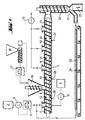
- a kneader from the company was used for the experiments Buss Compounding Systems AG LR 100 / 19D.
- gear pumps or metering screws are suitable for polymer metering, they are capable of absorbing the poorly flowable polymer on the suction side and are also able to build up the higher pressures required for product conveying.
- a heatable gear pump ( 4 ) was used and the gravimetric metering was carried out using a differential metering scale ( 5 ).
- a gear pump ( 6 ) is also used to add plasticizer, combined with a mass flow meter.
- the metering of liquid, low-viscosity components is not critical and can also be carried out using other types of pumps, coupled with a detection of the volume or mass flow.
- the kneader ( 1 ) is divided into 5 zones, the shots ( 7 ), ( 8 ), ( 9 ), ( 10 ) and ( 11 ), (3D / 4D / 4D / 4D / 4D), each of which is formed by retaining rings ( 12 ), ( 13 ), ( 14 ) and ( 15 ) are separated from each other.
- highly disperse silica (HDK) ( 16 ) is also fed to the kneader ( 1 ) with the aid of a differential metering weigher ( 17 ) via an inlet screw (ELS) ( 18 ).
- ELS inlet screw
- other dosing systems such as sidefeeders, can also be used. Reference is also made to the possibility of gravimetric dosing with the help of diaphragm pumps.
- a vacuum is created, generated with the aid of a water ring pump ( 19 ).
- Rotary lobe pumps or jet pumps are also suitable.
- the product is discharged from the kneader via a downstream short discharge screw ( 20 ) or gear pump.
- a wide slot nozzle ( 21 ) is connected upstream on the pressure side and is divided via a welded-in web, so that the product is discharged ( 22 ) in the form of two belts in a mass ratio of about 1: 3.
- the mass flow can also be divided using suitable extruder tools or throttle devices in a branch downstream of the extruder.
- the return of the silicone rubber compound ( 23 ) to be fed into the first shot ( 7 ) of the kneader takes place with the aid of a conveyor belt ( 24 ).
- a single or twin-screw extruder or a gear pump could advantageously be used to re-meter the recycled silicone rubber compound.
- the kneader is equipped with three temperature measuring points ( 25 ), ( 26 ) and ( 27 ).
- a HTV solid polymer which has a viscosity of approx. 20,000 Pa.s at a temperature of 25 ° C. and a shear rate of 0.81 1 / sec and which has the following number average composition according to the 1 H-NMR spectrum: Vi-Si (Me) 2 - [OSi (Me) 2 ] m - [OSiMeVi] n -OSi (Me) 2 -Vi, where Me is the methyl radical and Vi is the vinyl radical, n + m is approximately 6,000 and m / n is approximately 3,000.
- a plasticizer which, according to the 29 Si NMR spectrum, has the following number average composition: HO-Si (Me) 2 - [OSi (Me) 2 ] m -OSi (Me) 2 -OH, where m is approx. 14 and the viscosity measured at a temperature of 25 ° C. is 41 mm 2 / s.
- Example 1 (co-metering of a finished silicone rubber composition with return)
- the kneader was fed 30 kg / h of the solid polymer and 5 kg / h of the plasticizer in the weft ( 7 ).
- the shot ( 8 ) was dosed with 15 kg / h of HDK.
- the temperature of the silicone rubber composition at a shaft speed of 180 rpm was designed by tempering the shaft and the individual sections of the cylinder in such a way that at the temperature measuring points ( 25 ), ( 26 ) and ( 27 ) approx. 150 ° C / 200 ° C / 180 ° C were measured.
- Example 2 (co-metering of a finished silicone rubber composition without return)
- a temperature profile comparable to the previous experiment can be set.
- Example 3 (not according to the invention; there is neither Return another additional dosage of Silicone rubber compound in weft 1)
- Feedstocks HTV solid polymer, plasticizer, silica
- the setting of an example 1 according to the invention and 2 comparable temperature profiles took place over a appropriate jacket and shaft temperature control.
- the retaining rings ( 13 ), ( 14 ) and ( 15 ) were narrowed.
- the maximum possible throughput was about 45 kg / h silicone rubber mass.
- Example 5 (not according to the invention; there is neither Return another additional dosage of Silicone rubber compound in weft 1)
- Zone 1 Zone 2 Zone 3 Zone 4 Zone 5 1 soft rubber compound bulbous, largely coherent rubber compound transparent, plastic, compact silicone rubber compound 2nd soft rubber compound bulbous, largely coherent rubber compound transparent, plastic, compact silicone rubber compound 3rd Polymer-plasticizer mixture dry, powdery mixture milky, relatively crumbly rubber mass almost transparent rubber compound transparent, plastic rubber compound 4th Polymer-plasticizer mixture dry, powdery mixture milky, relatively crumbly rubber mass transparent, plastic, compact silicone rubber compound
- the kneading fill levels in zones 3 and 4 of samples 1 and 2 correspond to sample 4; in the case of sample 3 is a lower degree of filling found.
- Samples 1 produced by the method according to the invention and 2 have a significantly better storage stability; she are characterized by a dry grip and better Rolling behavior.
Landscapes
- Chemical & Material Sciences (AREA)
- Health & Medical Sciences (AREA)
- Chemical Kinetics & Catalysis (AREA)
- Medicinal Chemistry (AREA)
- Polymers & Plastics (AREA)
- Organic Chemistry (AREA)
- Compositions Of Macromolecular Compounds (AREA)
- Processes Of Treating Macromolecular Substances (AREA)
Abstract
Description
- Das Kompaktieren nach herkömmlichen Verfahren ist entweder zeitintensiv oder macht eine spezielle apparative Gestaltung des Mischaggregates erforderlich, z.B. um die Masse unter hohem Preßdruck wiederholt anstauen zu können. Das erfindungsgemäße Verfahren ermöglicht ein schnelleres Kompaktieren und stellt geringere Anforderungen an die apparative Gestaltung des Mischaggregates.
- Während des Mischens tritt keine trockene Reibung auf, wodurch der Materialverschleiß am Mischaggregat vermindert wird.
- Das Einziehen und Einmischen des Füllstoffs (F2) erfolgt verglichen mit einer herkömmlichen Polyorganosiloxan-Vorlage wesentlich schneller.
- Die mit der trockenen Reibung herkömmlicher Verfahren verknüpfte Mechanodestruktion des Polyorganosiloxanes wird vermieden.
- Die nach dem erfindungsgemäßen Verfahren hergestellten Siliconmassen (P) zeichen sich durch bessere Lagerstabilität aus, insbesondere werden Verstrammung und Brüchigkeit vermieden.
- Das erfindungsgemäße Verfahren ermöglicht eine höhere Dispergiergüte des feinteiligen Füllstoffes (F2), da im Mischaggregat keine trockene Reibung, sondern die mit einem Knetvorgang verbundenen hohen Scherspannungen ein intensives laminares und dispersives Mischen bewirken.
- Die Länge rohrförmiger kontinuierlich arbeitender Mischaggregate kann wesentlich reduziert werden, da die jederzeit kompakte Siliconmasse über die gesamte Länge des Mischaggregates einem intensiven Knetprozeß unterworfen wird.
- Das erfindungsgemäße Verfahren ermöglicht die Herstellung solcher Siliconmassen (P), die sich bisher nur diskontinuierlich im Kneter herstellen ließen und einer kontinuierlichen Herstellbarkeit entzogen, da mit dem erfindungsgemäßen Verfahren die im Kneter herrschenden Scherverhältnisse wesentlich besser nachgestellt werden können.
- Da bei dem erfindungsgemäßen Verfahren stets eine kompakte Phase vorhanden ist, deren Oberfläche infolge des Knetens ständig erneuert wird, sind wesentlich günstigere Voraussetzungen für das sorfältige Entfernen flüchtiger. Bestandteile, insbesondere dem Entgasen unter Vakuum, gegeben.
- Aufgrund der besseren Vermischbarkeit des Polyorganosiloxanes bzw. des Füllstoffes (F2) mit der Siliconmasse (E) kann der Zusatz von Dispergierhilfsmitteln etc. auf ein Minumum reduziert werden
- Die Qualität der Siliconmasse (P) ist geringeren Schwankungen unterworfen, weil Fluktuationen, z.B. in der Füllstoffdosierung, ausgeglichen werden.
- Das erfindungsgemäße Verfahren bietet die Möglichkeit, durch Erhöhung des Verhältnisses von rückgeführter zu ausgetragener Siliconmasse (P) die effektive Verweilzeit beliebig zu verändern, insbesondere zu erhöhen, so daß auch Siliconmassen (P) hergestellt werden können, an die äußerst hohe Anforderungen hinsichtlich der Dispergiergüte des Füllstoffes gestellt werden.
- Das erfindungsgemäße Verfahren garantiert die Herstellbarkeit
ultimativ hochgefüllter Siliconmassen (P): Zum einen kann bei
vollständiger Rückführung eine quasi stufenlose Erhöhung des
Füllstoffgehaltes der Siliconmasse (P) vorgenommen werden.
Zum anderen kann das Verhältnis von rückgeführter zu ausgetragener Siliconmasse (P) beliebig eingestellt werden, so bei vollständiger Rückführung der ausgetragenen Siliconmasse (P) eine batchartige Fahrweise möglich wird.
- R1
- gleiche oder verschiedene einwertige Si-gebundene Reste darstellen, ausgewählt aus -H -OH, -OR, wobei R einen C1-C10-Kohlenwasserstoffrest bezeichnet, sowie gegebenenfalls halogen- oder cyanosubstituierte, gegebenenfalls über eine zweiwertige organische Gruppe an Silicium gebundene C1-C10-Kohlenwasserstoffreste, die mindestens eine aliphatische Kohlenstoff-Kohlenstoff Mehrfachbindung enthalten,
- R2
- gleiche oder verschiedene einwertige Si-gebundene, gegebenenfalls halogen- oder cyanosubstituierte C1-C10-Kohlenwasserstoffreste sind, die keine aliphatischen Kohlenstoff-Kohlenstoff Mehrfachbindungen enthalten.
- a
- eine nicht negative Zahl von 0 bis 1 ist, und
- b
- eine nicht negative Zahl von 1 bis 2.1 ist.
- p
- die Werte 0 oder 1, insbesondere 0,
- q
- Werte von 1 bis 4, insbesondere 1 oder 2 und
- r
- Werte von 1 bis 20, insbesondere von 1 bis 5 bedeuten.

| Visuelle Beurteilung der Siliconkautschukmasse im aufgeklappten Kneter nach einem Notstopp | |||||
| Probe | Zone 1 | Zone 2 | Zone 3 | Zone 4 | Zone 5 |
| 1 | weiche Kautschukmasse | knollenförmige, weitgehend zusammenhängende Kautschukmasse | transparente, plastische, kompakte Siliconkautschukmasse | ||
| 2 | weiche Kautschukmasse | knollenförmige, weitgehend zusammenhängende Kautschukmasse | transparente, plastische, kompakte Siliconkautschukmasse | ||
| 3 | Polymer- Weichmacher- Gemisch | trockene, pulverförmige Mischung | milchige, relativ bröselige Kautschukmasse | nahezu transparente Kautschukmasse | transparente, plastische Kautschukmasse |
| 4 | Polymer- Weichmacher- Gemisch | trockene, pulverförmige Mischung | milchige, relativ bröselige Kautschukmasse | transparente, plastische, kompakte Siliconkautschukmasse |
| Abhängigkeit der Mooney-Viskosität der Proben von der Lagerzeit | ||||||||||||
| Lagerdauer bei RT | Probe 1 | Probe 2 | Probe 3 | Probe 4 | ||||||||
| A | B | C | A | B | C | A | B | C | A | B | C | |
| 1 Tag | 67 | 57 | 10 | 70 | 59 | 11 | 68 | 60 | 08 | 65 | 55 | 10 |
| 1 Woche | 70 | 57 | 13 | 73 | 59 | 14 | 80 | 60 | 20 | 76 | 55 | 21 |
| 2 Wochen | 72 | 57 | 15 | 74 | 59 | 15 | 83 | 59 | 24 | 78 | 54 | 24 |
| 1 Monat | 73 | 57 | 16 | 74 | 59 | 15 | 87 | 57 | 30 | 83 | 53 | 30 |
| 2 Monate | 73 | 57 | 16 | 76 | 59 | 17 | 91 | 56 | 37 | 88 | 52 | 36 |
| 3 Monate | 74 | 57 | 17 | 77 | 59 | 18 | nicht meßbar; Proben bröseln | |||||
| 6 Monate | 75 | 56 | 19 | 78 | 58 | 20 | nicht meßbar; Proben bröseln |
Claims (6)
- Kontinuierliches Verfahren zur Herstellung füllstoffhaltiger Siliconmassen (P), bei dem eine Füllstoft (F1) enthaltende Siliconmasse (E) mit Füllstoff (F2) vermischt wird.
- Verfahren nach Anspruch 1, bei dem eine Teilmenge der Siliconmasse (P) als Siliconmasse (E) zurückgeführt wird.
- Verfahren nach Anspruch 1 und 2, bei dem zunächst Polyorganosiloxan und anschließend der Füllstoff (F2) in die Siliconmasse (E) eingemischt wird.
- Verfahren nach Anspruch 1 bis 3, bei dem der Mischvorgang bei 50°C bis 250°C erfolgt.
- Verfahren nach Anspruch 1 bis 4, bei dem die Siliconmassen (P) eine bei 25°C gemessene Viskosität von mindestens 500 Pa.s. aufweisen.
- Verfahren nach Anspruch 1 bis 5, bei dem die Siliconmassen (P) hitzehärtbare HTV-Fertigmassen oder Basismischungen, die der Herstellung von vernetzungsfähigen HTV-Fertigmassen dienen, sind.
Applications Claiming Priority (2)
| Application Number | Priority Date | Filing Date | Title |
|---|---|---|---|
| DE19909338A DE19909338A1 (de) | 1999-03-03 | 1999-03-03 | Verfahren zur kontinuierlichen Herstellung hochviskoser füllstoffhaltiger Siliconmassen |
| DE19909338 | 1999-03-03 |
Publications (2)
| Publication Number | Publication Date |
|---|---|
| EP1033389A1 true EP1033389A1 (de) | 2000-09-06 |
| EP1033389B1 EP1033389B1 (de) | 2004-07-28 |
Family
ID=7899580
Family Applications (1)
| Application Number | Title | Priority Date | Filing Date |
|---|---|---|---|
| EP00102290A Expired - Lifetime EP1033389B1 (de) | 1999-03-03 | 2000-02-17 | Verfahren zur kontinuierlichen Herstellung hochviskoser füllstoffhaltiger Siliconmassen |
Country Status (4)
| Country | Link |
|---|---|
| US (1) | US6323262B1 (de) |
| EP (1) | EP1033389B1 (de) |
| JP (1) | JP2000256469A (de) |
| DE (2) | DE19909338A1 (de) |
Cited By (3)
| Publication number | Priority date | Publication date | Assignee | Title |
|---|---|---|---|---|
| US7671125B2 (en) | 2003-03-27 | 2010-03-02 | Wacker-Chemie Gmbh | Process for the continuous preparation of high-viscosity silicone compositions |
| DE102008054536A1 (de) | 2008-12-11 | 2010-06-17 | Wacker Chemie Ag | Verfahren zur kontinuierlichen Herstellung von hochviskosen Siliconmassen |
| WO2012146240A3 (de) * | 2011-04-27 | 2012-12-20 | Troester Gmbh & Co. Kg | Verfahren und vorrichtung zur herstellung einer kautschukkomponente |
Families Citing this family (11)
| Publication number | Priority date | Publication date | Assignee | Title |
|---|---|---|---|---|
| UA72189C2 (uk) | 1997-11-17 | 2005-02-15 | Янссен Фармацевтика Н.В. | Фармацевтична композиція, що містить водну суспензію субмікронних ефірів 9-гідроксирисперидон жирних кислот |
| DE10242798A1 (de) * | 2002-09-14 | 2004-04-01 | Degussa Ag | Silikonkautschuk |
| DE102004005222A1 (de) * | 2004-02-03 | 2005-08-18 | Degussa Ag | Silikonkautschuk |
| DE102004010756A1 (de) * | 2004-03-05 | 2005-09-22 | Degussa Ag | Silanisierte Kieselsäuren |
| WO2009063941A1 (ja) * | 2007-11-16 | 2009-05-22 | Dow Corning Toray Co., Ltd. | シリカマスターバッチ |
| WO2009063940A1 (ja) * | 2007-11-16 | 2009-05-22 | Dow Corning Toray Co., Ltd. | シリカマスターバッチ |
| EP2538416B1 (de) * | 2011-06-24 | 2017-08-30 | ContiTech Elastomer-Beschichtungen GmbH | Isolationsmaterial |
| WO2019226842A1 (en) * | 2018-05-24 | 2019-11-28 | Momentive Performance Materials Inc. | Oil-bleed self-bonding liquid silicone rubber composition |
| CN113460934B (zh) * | 2021-07-30 | 2022-03-15 | 梧州科润润滑科技有限公司 | 一种高粘度物料灌装系统及方法 |
| CN113861691A (zh) * | 2021-09-23 | 2021-12-31 | 深圳市汉嵙新材料技术有限公司 | 一种导热硅胶片及其制备方法 |
| CN113866249B (zh) * | 2021-10-27 | 2024-03-08 | 西安热工研究院有限公司 | 一种煤炭库仑测硫仪用硅胶干燥剂的自动再生装置及方法 |
Citations (3)
| Publication number | Priority date | Publication date | Assignee | Title |
|---|---|---|---|---|
| EP0258159A1 (de) * | 1986-08-12 | 1988-03-02 | Rhone-Poulenc Chimie | Verfahren zur Aufbereitung von Grundmischungen für wärmevulkanisierbare Elastomere |
| WO1992013694A1 (de) * | 1991-02-07 | 1992-08-20 | Wacker-Chemie Gmbh | Verfahren zur kontinuierlichen herstellung von htv-siliconmassen |
| EP0909777A2 (de) * | 1997-10-17 | 1999-04-21 | Dow Corning Toray Silicone Company, Ltd. | Verfahren zur kontinuierlichen Herstellung von Silikongummi-Zusammensetzungen |
Family Cites Families (2)
| Publication number | Priority date | Publication date | Assignee | Title |
|---|---|---|---|---|
| US3745200A (en) * | 1969-01-10 | 1973-07-10 | P Geyer | Extrusion method |
| DE19653993A1 (de) | 1996-12-21 | 1998-06-25 | Huels Silicone Gmbh | Verfahren zur Herstellung von hochgefüllten Siliconpolymer-Feststoff-Vormischungen |
-
1999
- 1999-03-03 DE DE19909338A patent/DE19909338A1/de not_active Withdrawn
-
2000
- 2000-02-17 EP EP00102290A patent/EP1033389B1/de not_active Expired - Lifetime
- 2000-02-17 DE DE50007165T patent/DE50007165D1/de not_active Expired - Fee Related
- 2000-02-25 US US09/514,027 patent/US6323262B1/en not_active Expired - Fee Related
- 2000-03-02 JP JP2000057558A patent/JP2000256469A/ja active Pending
Patent Citations (3)
| Publication number | Priority date | Publication date | Assignee | Title |
|---|---|---|---|---|
| EP0258159A1 (de) * | 1986-08-12 | 1988-03-02 | Rhone-Poulenc Chimie | Verfahren zur Aufbereitung von Grundmischungen für wärmevulkanisierbare Elastomere |
| WO1992013694A1 (de) * | 1991-02-07 | 1992-08-20 | Wacker-Chemie Gmbh | Verfahren zur kontinuierlichen herstellung von htv-siliconmassen |
| EP0909777A2 (de) * | 1997-10-17 | 1999-04-21 | Dow Corning Toray Silicone Company, Ltd. | Verfahren zur kontinuierlichen Herstellung von Silikongummi-Zusammensetzungen |
Cited By (3)
| Publication number | Priority date | Publication date | Assignee | Title |
|---|---|---|---|---|
| US7671125B2 (en) | 2003-03-27 | 2010-03-02 | Wacker-Chemie Gmbh | Process for the continuous preparation of high-viscosity silicone compositions |
| DE102008054536A1 (de) | 2008-12-11 | 2010-06-17 | Wacker Chemie Ag | Verfahren zur kontinuierlichen Herstellung von hochviskosen Siliconmassen |
| WO2012146240A3 (de) * | 2011-04-27 | 2012-12-20 | Troester Gmbh & Co. Kg | Verfahren und vorrichtung zur herstellung einer kautschukkomponente |
Also Published As
| Publication number | Publication date |
|---|---|
| DE50007165D1 (de) | 2004-09-02 |
| DE19909338A1 (de) | 2000-09-07 |
| US6323262B1 (en) | 2001-11-27 |
| EP1033389B1 (de) | 2004-07-28 |
| JP2000256469A (ja) | 2000-09-19 |
Similar Documents
| Publication | Publication Date | Title |
|---|---|---|
| DE69810869T2 (de) | Verfahren zur kontinuierlichen Herstellung von Silikongummi-Zusammensetzungen | |
| EP1033389B1 (de) | Verfahren zur kontinuierlichen Herstellung hochviskoser füllstoffhaltiger Siliconmassen | |
| EP0570387B1 (de) | Verfahren zur kontinuierlichen herstellung von htv-siliconmassen | |
| EP0490056B1 (de) | Verfahren und Vorrichtung zur einstufigen, kontinuierlichen Herstellung einer Kautschukgrund- und -fertigmischung für Fahrzeugreifen, Antriebsriemen, Transportbänder sowie für technische Gummiartikel in nur einer Mischung | |
| DE69221435T2 (de) | Methode zur Herstellung einer lagerstabilen Organosiloxanmasse | |
| EP0774337B1 (de) | Verfahren zum Herstellen von Formkörpern aus Kunststoff-Füllstoff-Mischungen mit einem hohen Gehalt an Füllstoffen | |
| DE69116443T2 (de) | Verfahren zur Herstellung von RTV SiH/SiVi-Paste mit einem Doppelschraubenextruder | |
| DE69701614T2 (de) | Verfahren zur Herstellung einer Siliconkautschukzusammensetzung | |
| DE69410525T2 (de) | Verfahren zur kontinuierlichen Herstellung von hitzehärtenden Silikonkautschukmischungen | |
| EP1717002B1 (de) | Verfahren zur kontinuierlichen Herstellung von hochviskosen vernetzbaren Siliconmassen | |
| EP1884541B1 (de) | Kontinuierliches Verfahren zur Herstellung von vernetzbaren Organopolysiloxanmassen | |
| EP1468803B1 (de) | Verfahren zur kontinuierlichen Herstellung von hochviskosen HTV-Siliconmassen | |
| DE60225057T2 (de) | Verfahren und vorrichtung zur kontinuierlichen herstellung einer elastomeren zusammensetzung | |
| EP2199316B1 (de) | Kontinuierliches Verfahren zur Herstellung von Grundmassen für Siliconzusammensetzungen mit verbesserter Stabilität | |
| EP1375567B1 (de) | Verfahren zur kontinuierlichen Herstellung von aus zwei Komponenten bestehenden additionsvernetzenden Siliconmassen | |
| DE69703337T2 (de) | Verfahren zur Herstellung einer flüssigen Silikongummi-Zusammensetzung | |
| DE60131454T2 (de) | Mischen | |
| EP0807509B1 (de) | Kontinuierliches Verfahren zur Herstellung lagerstabiler Organopolysiloxanzusammensetzungen | |
| DE102021209543A1 (de) | Vorrichtung und Verfahren zur Herstellung einer Kautschukfertigmischung, insbesondere für Fahrzeugreifen | |
| DE2125339A1 (de) | Pelletisierter Siliconkautschuk | |
| EP2199345B1 (de) | Kontinuierliches Verfahren zur Herstellung von Organopolysiloxanzusammensetzungen | |
| EP3184579B1 (de) | Verfahren zur herstellung von organopolysiloxanzusammensetzungen | |
| DE2549027A1 (de) | Verfahren zum herstellen von silikonkautschuk | |
| DE19653993A1 (de) | Verfahren zur Herstellung von hochgefüllten Siliconpolymer-Feststoff-Vormischungen | |
| DE102004005156A1 (de) | Verfahren zur Herstellung von Siliconpolymer-Mischungen |
Legal Events
| Date | Code | Title | Description |
|---|---|---|---|
| PUAI | Public reference made under article 153(3) epc to a published international application that has entered the european phase |
Free format text: ORIGINAL CODE: 0009012 |
|
| 17P | Request for examination filed |
Effective date: 20000217 |
|
| AK | Designated contracting states |
Kind code of ref document: A1 Designated state(s): BE DE FR GB IT NL |
|
| AX | Request for extension of the european patent |
Free format text: AL;LT;LV;MK;RO;SI |
|
| AKX | Designation fees paid |
Free format text: BE DE FR GB IT NL |
|
| 17Q | First examination report despatched |
Effective date: 20030820 |
|
| GRAP | Despatch of communication of intention to grant a patent |
Free format text: ORIGINAL CODE: EPIDOSNIGR1 |
|
| GRAS | Grant fee paid |
Free format text: ORIGINAL CODE: EPIDOSNIGR3 |
|
| GRAA | (expected) grant |
Free format text: ORIGINAL CODE: 0009210 |
|
| AK | Designated contracting states |
Kind code of ref document: B1 Designated state(s): BE DE FR GB IT NL |
|
| REG | Reference to a national code |
Ref country code: GB Ref legal event code: FG4D Free format text: NOT ENGLISH |
|
| REF | Corresponds to: |
Ref document number: 50007165 Country of ref document: DE Date of ref document: 20040902 Kind code of ref document: P |
|
| GBT | Gb: translation of ep patent filed (gb section 77(6)(a)/1977) | ||
| ET | Fr: translation filed | ||
| PLBE | No opposition filed within time limit |
Free format text: ORIGINAL CODE: 0009261 |
|
| STAA | Information on the status of an ep patent application or granted ep patent |
Free format text: STATUS: NO OPPOSITION FILED WITHIN TIME LIMIT |
|
| 26N | No opposition filed |
Effective date: 20050429 |
|
| PGFP | Annual fee paid to national office [announced via postgrant information from national office to epo] |
Ref country code: NL Payment date: 20060129 Year of fee payment: 7 |
|
| PGFP | Annual fee paid to national office [announced via postgrant information from national office to epo] |
Ref country code: FR Payment date: 20060217 Year of fee payment: 7 |
|
| PGFP | Annual fee paid to national office [announced via postgrant information from national office to epo] |
Ref country code: IT Payment date: 20060228 Year of fee payment: 7 |
|
| PGFP | Annual fee paid to national office [announced via postgrant information from national office to epo] |
Ref country code: BE Payment date: 20060316 Year of fee payment: 7 |
|
| PGFP | Annual fee paid to national office [announced via postgrant information from national office to epo] |
Ref country code: DE Payment date: 20060331 Year of fee payment: 7 |
|
| GBPC | Gb: european patent ceased through non-payment of renewal fee |
Effective date: 20070217 |
|
| NLV4 | Nl: lapsed or anulled due to non-payment of the annual fee |
Effective date: 20070901 |
|
| REG | Reference to a national code |
Ref country code: FR Ref legal event code: ST Effective date: 20071030 |
|
| BERE | Be: lapsed |
Owner name: *WACKER-CHEMIE G.M.B.H. Effective date: 20070228 |
|
| PG25 | Lapsed in a contracting state [announced via postgrant information from national office to epo] |
Ref country code: BE Free format text: LAPSE BECAUSE OF NON-PAYMENT OF DUE FEES Effective date: 20070228 |
|
| PG25 | Lapsed in a contracting state [announced via postgrant information from national office to epo] |
Ref country code: NL Free format text: LAPSE BECAUSE OF NON-PAYMENT OF DUE FEES Effective date: 20070901 Ref country code: DE Free format text: LAPSE BECAUSE OF NON-PAYMENT OF DUE FEES Effective date: 20070901 |
|
| PG25 | Lapsed in a contracting state [announced via postgrant information from national office to epo] |
Ref country code: GB Free format text: LAPSE BECAUSE OF NON-PAYMENT OF DUE FEES Effective date: 20070217 Ref country code: FR Free format text: LAPSE BECAUSE OF NON-PAYMENT OF DUE FEES Effective date: 20070228 |
|
| PGFP | Annual fee paid to national office [announced via postgrant information from national office to epo] |
Ref country code: GB Payment date: 20060223 Year of fee payment: 7 |
|
| PG25 | Lapsed in a contracting state [announced via postgrant information from national office to epo] |
Ref country code: IT Free format text: LAPSE BECAUSE OF NON-PAYMENT OF DUE FEES Effective date: 20070217 |