EP1028094A2 - Alkali-Ionen leitende Glaskeramiken und damit hergestellte elektrische Zellen und Gassensoren - Google Patents
Alkali-Ionen leitende Glaskeramiken und damit hergestellte elektrische Zellen und Gassensoren Download PDFInfo
- Publication number
- EP1028094A2 EP1028094A2 EP00110476A EP00110476A EP1028094A2 EP 1028094 A2 EP1028094 A2 EP 1028094A2 EP 00110476 A EP00110476 A EP 00110476A EP 00110476 A EP00110476 A EP 00110476A EP 1028094 A2 EP1028094 A2 EP 1028094A2
- Authority
- EP
- European Patent Office
- Prior art keywords
- glass
- solid electrolyte
- ceramics
- lithium ion
- ion conductive
- Prior art date
- Legal status (The legal status is an assumption and is not a legal conclusion. Google has not performed a legal analysis and makes no representation as to the accuracy of the status listed.)
- Granted
Links
Images


Classifications
-
- H—ELECTRICITY
- H01—ELECTRIC ELEMENTS
- H01M—PROCESSES OR MEANS, e.g. BATTERIES, FOR THE DIRECT CONVERSION OF CHEMICAL ENERGY INTO ELECTRICAL ENERGY
- H01M10/00—Secondary cells; Manufacture thereof
- H01M10/05—Accumulators with non-aqueous electrolyte
- H01M10/056—Accumulators with non-aqueous electrolyte characterised by the materials used as electrolytes, e.g. mixed inorganic/organic electrolytes
- H01M10/0561—Accumulators with non-aqueous electrolyte characterised by the materials used as electrolytes, e.g. mixed inorganic/organic electrolytes the electrolyte being constituted of inorganic materials only
- H01M10/0562—Solid materials
-
- C—CHEMISTRY; METALLURGY
- C03—GLASS; MINERAL OR SLAG WOOL
- C03C—CHEMICAL COMPOSITION OF GLASSES, GLAZES OR VITREOUS ENAMELS; SURFACE TREATMENT OF GLASS; SURFACE TREATMENT OF FIBRES OR FILAMENTS MADE FROM GLASS, MINERALS OR SLAGS; JOINING GLASS TO GLASS OR OTHER MATERIALS
- C03C10/00—Devitrified glass ceramics, i.e. glass ceramics having a crystalline phase dispersed in a glassy phase and constituting at least 50% by weight of the total composition
-
- C—CHEMISTRY; METALLURGY
- C03—GLASS; MINERAL OR SLAG WOOL
- C03C—CHEMICAL COMPOSITION OF GLASSES, GLAZES OR VITREOUS ENAMELS; SURFACE TREATMENT OF GLASS; SURFACE TREATMENT OF FIBRES OR FILAMENTS MADE FROM GLASS, MINERALS OR SLAGS; JOINING GLASS TO GLASS OR OTHER MATERIALS
- C03C10/00—Devitrified glass ceramics, i.e. glass ceramics having a crystalline phase dispersed in a glassy phase and constituting at least 50% by weight of the total composition
- C03C10/0018—Devitrified glass ceramics, i.e. glass ceramics having a crystalline phase dispersed in a glassy phase and constituting at least 50% by weight of the total composition containing SiO2, Al2O3 and monovalent metal oxide as main constituents
- C03C10/0027—Devitrified glass ceramics, i.e. glass ceramics having a crystalline phase dispersed in a glassy phase and constituting at least 50% by weight of the total composition containing SiO2, Al2O3 and monovalent metal oxide as main constituents containing SiO2, Al2O3, Li2O as main constituents
-
- C—CHEMISTRY; METALLURGY
- C03—GLASS; MINERAL OR SLAG WOOL
- C03C—CHEMICAL COMPOSITION OF GLASSES, GLAZES OR VITREOUS ENAMELS; SURFACE TREATMENT OF GLASS; SURFACE TREATMENT OF FIBRES OR FILAMENTS MADE FROM GLASS, MINERALS OR SLAGS; JOINING GLASS TO GLASS OR OTHER MATERIALS
- C03C4/00—Compositions for glass with special properties
- C03C4/18—Compositions for glass with special properties for ion-sensitive glass
-
- G—PHYSICS
- G01—MEASURING; TESTING
- G01N—INVESTIGATING OR ANALYSING MATERIALS BY DETERMINING THEIR CHEMICAL OR PHYSICAL PROPERTIES
- G01N27/00—Investigating or analysing materials by the use of electric, electrochemical, or magnetic means
- G01N27/26—Investigating or analysing materials by the use of electric, electrochemical, or magnetic means by investigating electrochemical variables; by using electrolysis or electrophoresis
- G01N27/403—Cells and electrode assemblies
- G01N27/406—Cells and probes with solid electrolytes
- G01N27/407—Cells and probes with solid electrolytes for investigating or analysing gases
- G01N27/4073—Composition or fabrication of the solid electrolyte
- G01N27/4074—Composition or fabrication of the solid electrolyte for detection of gases other than oxygen
-
- H—ELECTRICITY
- H01—ELECTRIC ELEMENTS
- H01M—PROCESSES OR MEANS, e.g. BATTERIES, FOR THE DIRECT CONVERSION OF CHEMICAL ENERGY INTO ELECTRICAL ENERGY
- H01M10/00—Secondary cells; Manufacture thereof
- H01M10/05—Accumulators with non-aqueous electrolyte
- H01M10/052—Li-accumulators
- H01M10/0525—Rocking-chair batteries, i.e. batteries with lithium insertion or intercalation in both electrodes; Lithium-ion batteries
-
- Y—GENERAL TAGGING OF NEW TECHNOLOGICAL DEVELOPMENTS; GENERAL TAGGING OF CROSS-SECTIONAL TECHNOLOGIES SPANNING OVER SEVERAL SECTIONS OF THE IPC; TECHNICAL SUBJECTS COVERED BY FORMER USPC CROSS-REFERENCE ART COLLECTIONS [XRACs] AND DIGESTS
- Y02—TECHNOLOGIES OR APPLICATIONS FOR MITIGATION OR ADAPTATION AGAINST CLIMATE CHANGE
- Y02E—REDUCTION OF GREENHOUSE GAS [GHG] EMISSIONS, RELATED TO ENERGY GENERATION, TRANSMISSION OR DISTRIBUTION
- Y02E60/00—Enabling technologies; Technologies with a potential or indirect contribution to GHG emissions mitigation
- Y02E60/10—Energy storage using batteries
Definitions
- This invention relates to an alkali ion conductive glass-ceramics and, more particularly, to a lithium ion conductive glass-ceramics suitable for use as wholly solid electric cells, gas sensors and electrochemical devices of various types, and electric cells and gas sensors using such glass-ceramics.
- Lithium has the highest oxidation-reduction potential of Li/Li + of all metal elements and has the smallest mass per 1 mol and, therefore, lithium cell can provide a higher energy density than other types of cells. Moreover, if a lithium ion conductive solid electrolyte is used, this electrolyte can be made very thin and, therefore, a cell of a thin film can be formed and increase in energy density per unit volume can thereby be realized.
- a lithium ion cell which has been realized to date uses an organic electrolyte solution as its electrolyte and this makes it difficult to achieve a cell of a compact design such as a thin film design.
- This lithium ion cell has additional disadvantages that it has likelihood of leakage of electrolyte solution and likelihood of spontaneous combustion. If this lithium ion cell is replaced by a cell employing an inorganic solid electrolyte, a wholly solid cell of a high reliability will be realized. For this reason, studies and developments of a solid electrolyte having a high conductivity have been vigorously made for realizing a wholly solid lithium cell.
- Carbon dioxide gas detection systems which are currently in use are generally of a type utilizing absorption of infrared ray. These systems however are large and costly and besides are very susceptible to contamination. For these reasons, studies have recently been actively made to develop a compact carbon dioxide gas sensor using a solid electrolyte. Particularly, many reports have been made about studies using a lithium ion sold electrolyte.
- Li 3 N single crystal (Applied Physics letter, 30(1977) 621-22) and LiI-Li 2 S-P 2 S 5 , LiI-Li 2 S-SiS 4 and LiI-Li 2 S-B 2 S 3 glasses (Mat. Res. Bull., 18(1983) 189) have high conductivity of 10 -3 S/cm or over.
- These materials however, have the disadvantages that preparation and handling of these materials are difficult and these materials are not sufficiently heat proof. Particularly, these materials have the fatal disadvantage that decomposition voltage of these materials is so low that, when they are used for an electrolyte of a solid cell, a sufficiently high terminal voltage cannot be obtained.
- An oxide lithium solid electrolyte does not have the above described disadvantages and has a decomposition voltage which is higher than 3V and, therefore, it has possibility of usage as a wholly solid lithium cell if it exhibits a high conductivity at room temperature. It is known in the art that conductivity in an oxide glass can be increased by increasing lithium ion concentration. However, there is limitation in increase in the lithium ion concentration even if rapid quenching is employed for glass formation and conductivity of this glass at room temperature is below 10 -6 S/cm at the highest.
- Japanese Patent Application Laid-open Publication No. Hei-8-2239218 discloses a gas sensor using a thin film of a lithium ion conductive glass.
- the conductivity of this lithium ion conductive glass thin film is between 1.7 x 10 -7 and 6.1 x 10 -7 . This is not a sufficiently high value and a solid electrolyte having a higher conductivity is desired for.
- Oxide ceramic having the highest conductivity at room temperature is Li 1+X Al X Ti 2-X (PO 4 ) 3 .
- X is 0.3
- the conductivity thereof is 7 x 10 -4 S/cm at room temperature (J. Electrochem. Soc., 137 (1990) 1023).
- Oxide ceramics are superior in conductivity to glasses but have the disadvantages that they require a troublesome process for manufacturing and that they are difficult to form, particularly to a thin film.
- the prior art lithium ion solid electrolytes have the problems that they are either low in coductivity, hard to handle, hard to form to a compact design such as a thin film.
- Li 1+X Al X Ti 2-X (PO 4 ) 3 ceramics exhibit conductivity of 10 -4 S/cm or over at room temperature. These ceramics, however, have pores and a large grain boundary which can not be eliminated completely and existence of these pores and grain boundary results in a decrease in conductivity. If, therefore, glass-ceramics including the above crystal are provided, there will be no pores and the grain boundary will be improved and, as a result, a solid electrolyte having a higher conductivity is expected to be provided. Besides, glass-ceramics which share a feature of glass can be easily formed into various shapes including a thin film by utilizing this feature of glass. For these reasons, glass-ceramics are considered to have practical advantages over ceramics made by sintering.
- the inventor has succeeded in obtaining glass-ceramics having a very high lithium ion conductivity in the order of 10 -3 S/cm at room temperature by producing glasses including the ingredients of the above described crystal and causing the crystal phase to grow from these glasses by heat treating these glasses.
- a lithium ion conductive glass-ceramics achieving the above object of the invention comprise in mol %: P 2 O 5 38 - 40% TiO 2 25 - 45% M 2 O 3 (where M is Al or Ga) 5 - 15% Li 2 O 10 - 20% and contains Li 1+x (Al, Ga) X Ti 2-X (PO 4 ) 3 (where 0 ⁇ X ⁇ 0.8) as a main crystal phase.
- said glass-ceramics comprise in mol %: P 2 O 5 38 - 40% TiO 2 30 - 45% Al 2 O 3 5 - 15% Li 2 O 10 - 16%.
- said glass-ceramics comprise in mol %: P 2 O 5 38 - 40% TiO 2 25 - 45% Ga 2 O 3 5 - 12% Li 2 O 10 - 20%.
- the inventor of the present invention has further succeeded in obtaining glass-ceramics having the high lithium ion conductivity in the order of 10 -3 S/cm at room temperature by producing glasses including ingredients of P 2 O 5 , SiO 2 , TiO 2 , M 2 O 3 (where M is Al or Ga) and Li 2 O and causing a crystal phase of a conductive crystal Li 1-X+Y M X Ti 2-X Si Y P 3-Y O 12 to grow from the glasses by heat treating these glasses.
- a lithium ion conductive glass-ceramics comprising in mol %: P 2 O 5 26 - 40% SiO 2 0.5-12% TiO 2 30 - 45% M 2 O 3 (where M is Al or Ga) 5 - 10% Li 2 O 10 - 18% and containing Li 1+X+Y M X Ti 2-X Si Y P 3-y O 12 (where 0 ⁇ x ⁇ 0.4 and 0 ⁇ Y ⁇ 0.6) as a main crystal phase.
- said glass-ceramics comprise in mol %: P 2 O 5 26 - 40% SiO 2 0.5-12% TiO 2 32 - 45% Al 2 O 3 5 - 10% Li 2 O 10 - 18%.
- said glass-ceramics comprise in mol %: P 2 O 5 26 - 40% SiO 2 0.5-12% TiO 2 32 - 45% Ga 2 O 3 5 - 10% Li 2 O 10 - 18%.
- lithium ion conductive glass-ceramics which exhibit a very high conductivity in the order of 10 -3 S/cm at room temperature.
- the glass-ceramics made according to the invention have such an excellent formability that they can be easily formed into various shapes including a thin film, and they are thermally and chemically stable so that they are suitable for use as electrolytes of wholly solid cells, sensors and other various electrochemical devices.
- a solid electrolyte for an electric cell characterized in that an alkali ion conductive glass-ceramic is used as said solid electrolyte.
- a solid electrolyte for an electric cell characterized in that a lithium ion conductive glass-ceramic is used as said solid electrolyte.
- a solid electrolyte for an electric cell characterized in that a lithium ion conductive glass-ceramic as defined in any of claims 1 - 6 is used as said solid electrolyte.
- a solid electric cell characterized in that an alkali ion conductive glass-ceramic is used as a solid electrolyte.
- a solid electric cell characterized in that a lithium ion conductive glass-ceramic is used as a solid electrolyte.
- a solid electric cell characterized in that a lithium ion conductive glass-ceramic as defined in any of claims 1 - 6 is used as a solid electrolyte.
- a solid electrolyte for a gas sensor characterized in that an alkali ion conductive glass-ceramic is used as said solid electrolyte.
- a solid electrolyte for a gas sensor characterized in that a lithium ion conductive glass-ceramic is used as said solid electrolyte.
- a solid electrolyte for a gas sensor characterized in that a lithium ion conductive glass-ceramic as defined in any of claims 1 - 6 is used as said electrolyte.
- a gas sensor characterized in that an alkali ion conductive glass-ceramic is used as a solid electrolyte.
- a gas sensor characterized in that a lithium ion conductive glass-ceramic is used as a solid electrolyte.
- a gas sensor characterized in that a lithium ion conductive glass-ceramic as defined in any of claims 1 - 6 is used as a solid electrolyte.
- the compoisitions of the glass-ceramics made according to the invention are expressed on the basis of compositions of oxides as in their base glasses.
- the above described content ranges of the respective ingredients have been selected for the reasons stated below.
- the inventor of the present invention has examined the glass forming range of the P 2 O 5 -TiO 2 -(Al 2 O 3 , Ga 2 O 3 )-Li 2 O system by employing a conventional glass melting method and obtained lithium ion solid electrolytes of a high conductivity which can be glassified within the following composition ranges (expressed in mol %) and can grow, as a result of heat treatment, Li 1+X (Al, Ga) X Ti 2-X (PO 4 ) 3 as a main crystal phase.
- a part of Al or Ga ingredient may be replaced by one of such trivalent metal elements as B, In, Sc, Fe and Cr.
- the amount of Al or Ga replaced by such metal element should not exceed 5%. If the amount of the replaced metal element exceeds 5%, conductivity will drop significantly.
- Starting materials are weighed at a predetermined ratio and mixed uniformly and the mixed materials are thereafter put in a platinum crucible and heated and melted in an electric furnace.
- gas components coming from the raw materials are evaporated at 700 °C and then the temperature is raised to 1400 °C to 1450°C and the materials are melted at this temperature for about one to two hours.
- the melt is cast onto a stainless steel plate to form a sheet glass.
- the resultant glass is subjected to heat treatment within the temperature range from 800°C to 1000°C for 10 to 72 hours and lithium ion conductive glass-ceramics containing Li 1+X (Al, Ga) X Ti 2-X (PO 4 ) 3 as a main crystal phase were thereby produced.
- a heat treatment at a higher temperature within the above described temperature range will be desirable if micro cracks are not produced because a heat treatment at a higher temperature will reduce the heat treating time.
- a heat treatment performed at a temperature which is higher by about 300°C than a crystallization temperature of the glass will be most effective because it will provide the highest conductivity.
- the above described composition ranges have been selected because, within these composition ranges, dense glass-ceramics containing Li 1+X+Y M X Ti 2-X Si Y P 3-Y O 12 (where 0 ⁇ X ⁇ 0.4, 0 ⁇ Y ⁇ 0.6) as a main crystal phase and exhibiting a high lithium ion conductivity at room temperature were obtained by heat treating glasses of the same composition ranges. It has been found that the same crystal can be precipitated even in a composition range outside of the above described composition ranges but this crystal does not constitute a main crystal phase of a glass-ceramic produced and conductivity of this glass-ceramic is not sufficiently high.
- SiO 2 is a very important ingredient.
- the glass forming range is broadened and, moreover, melting property and thermal stability of the glass are improved and an excellent conductivity in the order of 10 -3 S/cm can be obtained.
- a part of Al or Ga may be replaced by one of such trivalent metal elements such as B, In, Sc, Fe and Cr or one of such divalent metal elements as Mg and Zn.
- a part of Ti may be replaced by Zr and a part of Si may be replaced by Ge.
- the amount of Al, Ga, Ti or Si replaced by such metal element should not exceed 5%. If the amount of the replaced metal element exceeds 5%, conductivity will drop significantly.
- As 2 O 3 , Sb 2 O 3 , Ta 2 O 5 , CdO or PbO may be added.
- the amount of such ingredient however should not exceed 3%. If the amount of such ingredient exceeds 3%, conductivity of the glass-ceramic will decrease as the amount of addition of the ingredient increases.
- Starting materials are weighed at a predetermined ratio and mixed uniformly and the mixed materials are thereafter put in a platinum crucible and heated and melted in an electric furnace.
- gas components coming from the raw materials are evaporated at 700 °C and then the temperature is raised to 1400 °C to 1500 °C and the materials are melted at this temperature for about one to two hours. Then the melt is cast onto a stainless steel plate to form a sheet glass.
- the glass thus produced is thereafter subjected to heat treatment by heating it under a temperature ranging from 680°C to 800°C for about twelve hours and subsequently heating it under a temperature which is higher by 200 °C to 350 °C for about twenty-four hours and glass-ceramics containing Li 1+X+Y M X Ti 2-X Si Y P 3-Y O 12 as a main crystal phase and having a high lithium ion conductivity is produced.
- This two-step heat treatment method is applicable also to the production of the glass-ceramics of the P 2 O 5 -TiO 2 -(Al 2 O 3 , Ga 2 O 3 )-Li 2 O system.
- the glass-ceramics of the P 2 O 5 -SiO 2 -TiO 2 -(Al 2 O 3 , Ga 2 O 3 )-Li 2 O system can be produced by employing the one step heat treatment method described above with respect to the glass-ceramics of the P 2 O 5 -TiO 2 -(Al 2 O 3 , Ga 2 O 3 )-Li 2 O system.
- NH 4 H 2 PO 4 , TiO 2 , Al(OH) 3 and Li 2 CO 3 were used as starting materials. These starting materials were weighed to constitute a composition of 39P 2 O 5 -8.5Al 2 O 3 -39TiO 2 -13.5Li 2 O in mol %. The materials were mixed uniformly and then put in a platinum crucible and heated and melted in an electric furnace. First, CO 2 , NH 3 and H 2 O coming from the raw materials were evaporated at 700°C. Then the temperature was raised to 1450 °C and the materials were melted by heating them at this temperature for 1.5 hour. Thereafter, the melt was cast onto a stainless steel plate to form a uniform sheet glass. The glass was annealed at 550°C for two hours for removing thermal stress of the glass.
- the glass thus produced was cut into specimens each having the size of 20 x 20 mm.
- the specimens of glass were polished on both surfaces and subjected to heat treatment under various heat conditions.
- the crystal phase which precipitated in the specimens was determined by the powder X-ray diffraction method. As a result, it was found that the precipitated crystal phase under all heat conditions was Li 1+X Al X Ti 2-X (PO 4 ) 3 . Electrical conductivity of the glass-ceramic was measured within a range from 10 -2 - 3 x 10 +7 Hz by the complex impedance.
- Example 1 As the starting materials, NH 4 H 2 PO 4 , TiO 2 , Al(OH) 3 , Ga 2 O 3 and Li 2 CO 3 were used to produce a glass-ceramic by employing the same manner as in Example 1.
- the crystal phase which grew in specimens of this glass-ceramic was determined to be Li 1+X (Al, Ga) X Ti 2-X (PO 4 ) 3 .
- the specimen which was heat treated at 950°C for 12 hours exhibited the highest conductivity of 1.0 x 10 -3 S/cm (Table 1, Example No.2). (composition in mol %) Examples No.
- NH 4 H 2 PO 4 , SiO 2 , TiO 2 , Al(OH) 3 and Li 2 CO 3 were used. These starting materials were weighed to constitute a composition of 32P 2 O 5 -8SiO 2- 41TiO 2 -5Al 2 O 3 -14Li 2 O in mol %. The materials were mixed uniformly and then put in a platinum crucible and heated and melted in an electrical furnace. First, CO 2 , NH 3 and H 2 O coming from the raw materials were evaporated at 700°C. Then the temperature was raised to 1450 °C and the materials were melted by heating them at this temperature for 1.5 hour. Thereafter, the melt was cast onto a stainless steel plate to form a uniform sheet glass. The glass was annealed at 550°C for two hours for removing thermal stress of the glass.
- the glass thus produced was cut into specimens each having the size of 20 x 20 mm.
- the specimens of glass were polished on both surfaces and subjected to heat treatment at a temperature of 800 °C for 12 hours and then at 1000°C for 24 hours to produce a dense glass-ceramic.
- the crystal phase precipitated in the specimens was determined by the powder X-ray diffraction to be Li 1+X+Y Al X Ti 2-X Si Y P 3-Y O 12 .
- the glass-ceramic exhibited a very high conductivity of 1.5 x 10 -3 S/cm at room temperature (Table 2, Example No. 3).
- Fig. 1 shows an X-ray diffraction pattern of the glass-ceramic of Example 3.
- compositions and conductivities of these specimens as well as the composition and conductivity of Example 1 are shown in the following Tables 2 and 3. (composition in mol %) Examples No. 3 4 5 P 2 O 5 32 33.5 30 SiO 2 8 6 10 TiO 2 41 42 40 Al 2 O 3 5 5 5 Ga 2 O 3 Li 2 O 14 13.5 15 conductivity at room temperature (S/cm) 1.5 x 10 -3 1.0 x 10 -3 1.2 x 10 -3 (composition in mol %) Examples No.
- FIG. 2 As a typical example of a lithium electric cell, an example of flat type cell is shown in the sectional view of Fig. 2.
- the cell is composed of a negative electrode container 6, a negative electrode collector 4 constructed of a conductive thin film or a thin film made of aluminum or stainless steel, a negative electrode 2, a lithim ion conductive glass-ceramic layer 1, a positive electrode 3, a positive electrode collector 5 constructed of a conductive thin film or a thin film made of aluminum or stainless steel, a positive electrode container 7 and an insulating filler 8 made of an insulating material such as polypropylene.
- the positive and negative electrodes 2 and 3 are received in the case formed by the positive and negative electrode containers 6 and 7 in such a manner that these electrodes 2 and 3 oppose each other through the lithim ion conductive glass-ceramic layer 1.
- the positive electrode 3 is connected to the positive electrode container 7 through the positive electrode collector 5 and the negative electrode 2 is connected to the negative electrode container 6 through the negative electrode collector 4.
- Chemical energy produced in the cell can be collected as electric energy from terminals of the negative electrode container 6 and the positive electrode container 7.
- the lithium ion conductive glass-ceramic layer must be sufficiently thin, i.e., 1 mm or less and preferably 0.5 mm or less.
- Many reports and proposals have been made about the material of the positive electrode 3 and it is typically made of LiCoO 2 or Li 1+X V 3 O 8 .
- reports and proposals have been made about the material of the negative electrode 2 and it is typically made of Li 4 Ti 5 O 12 or carbon.
- the positive and negative electrodes 2 and 3 and the collectors 4 and 5 may be formed sequentially by any of suitable known methods including ion spattering, CVD, screen printing, coating, sol-gel method, ion plating, ion beam evaporation and electron beam evaporation.
- a cell is composed in the same manner as in the above example except that the solid electrolyte is formed by mixing 1.7 mol of titanium oxide, 0.7 mol of lithium carbonate, 3.0 mol of ammonium phosphate and 0.2 mol of aluminum oxide in an agate mortar, press-forming the mixture to pellets and sintering the pellets at 900°C for two hours, crushing the sintered pellets again in an agate mortar, press-forming the crushed material which has passed a shieve of 400 mesh to pellets again, sintering the pellets at 1000°C for two hours and processing the sintered pellets to a thin plate.
- the solid electrolyte is formed by mixing 1.7 mol of titanium oxide, 0.7 mol of lithium carbonate, 3.0 mol of ammonium phosphate and 0.2 mol of aluminum oxide in an agate mortar, press-forming the mixture to pellets and sintering the pellets at 900°C for two hours, crushing the sintered pellets again in an agate mortar, press-
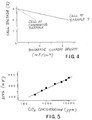
- a carbon dioxide gas sensor As a typical example of a gas sensor, an example of a carbon dioxide gas sensor is shown in section in Fig. 3.
- the upper and lower surfaces of a lithium ion conductive glass-ceramic layer 11 are polished to provide the layer 11 having a thickness of 1 mm to 2 mm, preferably 1 mm or below and more preferably 0.5 mm or below.
- a layer of metal carbonate On one of the surfaces of the layer 11 (the upper surface in the illustrated example) is formed, by ion spattering, a layer of metal carbonate, preferably lithium carbonate or a mixture of lithium carbonate and other carbonate.
- a platinum mesh 10 to which a lead 14 is connected is disposed on the surface of this metal carbonate layer to form an electrode.
- a layer 9 of metal carbonate is formed on the upper surface of the electrode 10 to fix the electrode 10.
- a layer 9 of metal carbonate is formed on the other surface (the lower surface in the illustrated example) of the lithium ion conductive layer 11 is formed, by evaporation, a platinum thin film to form an electrode 12 and a lead 13 is connected to the electrode 12.
- an electromotive force corresponding to the concentration of carbon dioxide gas is produced between the two electrodes due to dissociation equilibrium of the carbonate by the carbon dioxide gas in a mixture gas including the carbon dioxide gas and, therefore, the concentration of the carbon dioxide gas can be detected by measuring this electromotive force.
- Forming of the carbonate layer and the electrode layers is not limited to the above method but these layers may be formed by other known methods including CVD, screen printing, sol-gel method, ion plating, ion beam evaporation, MBE, vacuum evaporation and electron beam evaporation.
- Lithium ion conductive glass-ceramics comprising in mol %: P 2 O 5 38 - 40% TiO 2 25 - 45% M 2 O 3 (where M is Al or Ga) 5 - 15% Li 2 O 10 - 20% and containing Li 1+X (Al, Ga) X Ti 2-X (PO 4 ) 3 (where 0 ⁇ X ⁇ 0.8) as a main crystal phase.
- Glass-ceramics wherein said glass-ceramics comprise in mol %: P 2 O 5 38 - 40% TiO 2 30 - 45% Al 2 O 3 5 - 15% Li 2 O 10 - 16%.
- Glass-ceramics wherein said glass-ceramics comprise in mol %: P 2 O 5 38 - 40% TiO 2 25 - 45% Ga 2 O 3 5 - 12% Li 2 O 10 - 20%
- Lithium ion conductive glass-ceramics comprising in mol %: P 2 O 5 26 - 40% SiO 2 0.5-12% TiO 2 30 - 45% M 2 O 3 (where M is Al or Ga) 5 - 10% Li 2 O 10 - 18% and containing Li 1+X+Y M X Ti 2-X Si Y P 3-Y O 12 (where 0 ⁇ x ⁇ 0.4 and 0 ⁇ Y ⁇ 0.6) as a main crystal phase.
- Glass-ceramics wherein said glass-ceramics comprise in mol %: P 2 O 5 26 - 40% SiO 2 0.5-12% TiO 2 32 - 45% Al 2 O 3 5 - 10% Li 2 O 10 - 18%.
- Glass-ceramics wherein said glass-ceramics comprise in mol %: P 2 O 5 26 - 40% SiO 2 0.5-12% TiO 2 32 - 45% Ga 2 O 3 5 - 10% Li 2 O 10 - 18%.
- a solid electrolyte for an electric cell characterized in that a lithium ion conductive glass-ceramic is used as said solid electrolyte.
- a solid electrolyte for an electric cell characterized in that a lithium ion conductive glass-ceramic is used as said solid electrolyte.
- a solid electric cell characterized in that a lithium ion conductive glass-ceramic is used as a solid electrolyte.
- a solid electric cell characterized in that a lithium ion conductive glass-ceramic is used as a solid electrolyte.
Landscapes
- Chemical & Material Sciences (AREA)
- Engineering & Computer Science (AREA)
- Life Sciences & Earth Sciences (AREA)
- Chemical Kinetics & Catalysis (AREA)
- General Chemical & Material Sciences (AREA)
- Materials Engineering (AREA)
- Geochemistry & Mineralogy (AREA)
- Organic Chemistry (AREA)
- Dispersion Chemistry (AREA)
- Crystallography & Structural Chemistry (AREA)
- Electrochemistry (AREA)
- Physics & Mathematics (AREA)
- Health & Medical Sciences (AREA)
- General Physics & Mathematics (AREA)
- Ceramic Engineering (AREA)
- Inorganic Chemistry (AREA)
- Manufacturing & Machinery (AREA)
- Condensed Matter Physics & Semiconductors (AREA)
- Molecular Biology (AREA)
- Analytical Chemistry (AREA)
- Biochemistry (AREA)
- General Health & Medical Sciences (AREA)
- Immunology (AREA)
- Pathology (AREA)
- Secondary Cells (AREA)
- Conductive Materials (AREA)
- Glass Compositions (AREA)
- Measuring Oxygen Concentration In Cells (AREA)
Applications Claiming Priority (3)
| Application Number | Priority Date | Filing Date | Title |
|---|---|---|---|
| JP9038303A JP3012211B2 (ja) | 1996-02-09 | 1997-02-06 | リチウムイオン伝導性ガラスセラミックスおよびこれを用いた電池、ガスセンサー |
| JP3830397 | 1997-02-06 | ||
| EP97110106A EP0857699A3 (de) | 1997-02-06 | 1997-06-20 | Alkali-Ionen leitende Glaskeramiken und damit hergestellte elektrische Zellen und Gassensoren |
Related Parent Applications (1)
| Application Number | Title | Priority Date | Filing Date |
|---|---|---|---|
| EP97110106A Division EP0857699A3 (de) | 1997-02-06 | 1997-06-20 | Alkali-Ionen leitende Glaskeramiken und damit hergestellte elektrische Zellen und Gassensoren |
Publications (3)
| Publication Number | Publication Date |
|---|---|
| EP1028094A2 true EP1028094A2 (de) | 2000-08-16 |
| EP1028094A3 EP1028094A3 (de) | 2000-09-20 |
| EP1028094B1 EP1028094B1 (de) | 2003-05-21 |
Family
ID=12521542
Family Applications (2)
| Application Number | Title | Priority Date | Filing Date |
|---|---|---|---|
| EP97110106A Withdrawn EP0857699A3 (de) | 1997-02-06 | 1997-06-20 | Alkali-Ionen leitende Glaskeramiken und damit hergestellte elektrische Zellen und Gassensoren |
| EP00110476A Expired - Lifetime EP1028094B1 (de) | 1997-02-06 | 1997-06-20 | Lithium-Ionen leitende Glaskeramiken und damit hergestellte elektrische Zellen und Gassensoren |
Family Applications Before (1)
| Application Number | Title | Priority Date | Filing Date |
|---|---|---|---|
| EP97110106A Withdrawn EP0857699A3 (de) | 1997-02-06 | 1997-06-20 | Alkali-Ionen leitende Glaskeramiken und damit hergestellte elektrische Zellen und Gassensoren |
Country Status (2)
| Country | Link |
|---|---|
| EP (2) | EP0857699A3 (de) |
| DE (1) | DE69722272T2 (de) |
Families Citing this family (6)
| Publication number | Priority date | Publication date | Assignee | Title |
|---|---|---|---|---|
| US6203946B1 (en) | 1998-12-03 | 2001-03-20 | Valence Technology, Inc. | Lithium-containing phosphates, method of preparation, and uses thereof |
| JP4745472B2 (ja) * | 1998-07-16 | 2011-08-10 | 株式会社オハラ | リチウムイオン伝導性ガラスセラミックスおよびこれを用いた電池、ガスセンサー |
| JP3643289B2 (ja) * | 1999-04-30 | 2005-04-27 | 株式会社オハラ | ガラスセラミックス複合電解質、及びリチウム二次電池 |
| US7482097B2 (en) | 2002-04-03 | 2009-01-27 | Valence Technology, Inc. | Alkali-transition metal phosphates having a +3 valence non-transition element and related electrode active materials |
| JP5486253B2 (ja) * | 2008-10-31 | 2014-05-07 | 株式会社オハラ | ガラスおよび結晶化ガラス |
| WO2010149265A1 (de) | 2009-06-25 | 2010-12-29 | Schott Ag | Batterieseparator |
Family Cites Families (5)
| Publication number | Priority date | Publication date | Assignee | Title |
|---|---|---|---|---|
| US4985317A (en) * | 1988-11-30 | 1991-01-15 | Japan Synthetic Rubber Co., Ltd. | Lithium ion-conductive solid electrolyte containing lithium titanium phosphate |
| JPH02302307A (ja) * | 1989-05-15 | 1990-12-14 | Matsushita Electric Ind Co Ltd | リチウム導電性固体電解質の合成法および電気化学素子の製造法 |
| JP2656415B2 (ja) * | 1991-11-22 | 1997-09-24 | 科学技術振興事業団 | リチウム系結晶化ガラス |
| CA2169350A1 (en) * | 1994-06-13 | 1995-12-21 | Mitsui Chemicals, Incorporated | Lithium ionic conducting glass thin film and carbon dioxide sensor comprising the glass thin film |
| JP3126306B2 (ja) * | 1995-11-15 | 2001-01-22 | 株式会社オハラ | リチウムイオン伝導性ガラスセラミックス及びその製造方法 |
-
1997
- 1997-06-20 DE DE69722272T patent/DE69722272T2/de not_active Expired - Lifetime
- 1997-06-20 EP EP97110106A patent/EP0857699A3/de not_active Withdrawn
- 1997-06-20 EP EP00110476A patent/EP1028094B1/de not_active Expired - Lifetime
Also Published As
| Publication number | Publication date |
|---|---|
| EP1028094A3 (de) | 2000-09-20 |
| EP0857699A2 (de) | 1998-08-12 |
| DE69722272T2 (de) | 2004-04-01 |
| EP0857699A3 (de) | 1998-09-16 |
| DE69722272D1 (de) | 2003-06-26 |
| EP1028094B1 (de) | 2003-05-21 |
Similar Documents
| Publication | Publication Date | Title |
|---|---|---|
| US7211532B2 (en) | Alkali ion conductive glass-ceramics and electric cells and gas sensors using the same | |
| US6315881B1 (en) | Electric cells and gas sensors using alkali ion conductive glass ceramic | |
| EP0838441B1 (de) | Lithium-Ionen leitende Glaskeramiken und damit hergestellte elektrische Zellen und Glassensoren | |
| EP1088796B1 (de) | Lithiumionen-leitende Glaskeramiken und damit hergestellte elektrische Zellen und Gassensoren | |
| US5702995A (en) | Lithium ion conductive glass-ceramics | |
| JP3012211B2 (ja) | リチウムイオン伝導性ガラスセラミックスおよびこれを用いた電池、ガスセンサー | |
| JP3197246B2 (ja) | リチウムイオン伝導性ガラスセラミックスおよびこれを用いた電池、ガスセンサー | |
| EP2103573B1 (de) | Lithiumionenleitender festelektrolyt und verfahren zu dessen herstellung | |
| KR102006118B1 (ko) | 이온 전도성 잔여 유리상을 갖는 유리 세라믹 및 이의 제조 방법 | |
| US20100028782A1 (en) | Method for producing lithium ion conductive glass-ceramic | |
| JP3126306B2 (ja) | リチウムイオン伝導性ガラスセラミックス及びその製造方法 | |
| JP4090148B2 (ja) | リチウムイオン伝導性ガラスセラミックスの製造方法 | |
| CN109075389A (zh) | 固体电解质及全固体电池 | |
| JP7684286B2 (ja) | リチウムイオン伝導性ガラスセラミックス | |
| EP1028094B1 (de) | Lithium-Ionen leitende Glaskeramiken und damit hergestellte elektrische Zellen und Gassensoren | |
| US4223077A (en) | Na+ -conducting glass, glass-ceramic and crystalline cubic composition | |
| KR20220072737A (ko) | 고체 이온 전도체, 그 제조방법, 이를 포함하는 전기화학셀용 콤포넌트, 전극, 리튬전지용 세퍼레이터, 전기화학셀 및 그 제조방법 | |
| JP3098212B2 (ja) | リチウムイオン伝導性ガラスセラミックスおよびこれを用いた電池、ガスセンサー | |
| DE69926506T2 (de) | Lithiumionen-leitende Glaskeramiken und damit hergestellte elektrische Zellen und Gassensoren | |
| US20220177359A1 (en) | Ceramic materials | |
| JP2026512762A (ja) | 全固体電池用固体電解質粉末 | |
| KR20260036786A (ko) | 전고체 전지용 고체 전해질 및 이를 포함하는 전고체 전지 | |
| KR20230157235A (ko) | 리튬 이온 전도체 및 이를 포함하는 전고체 전지 | |
| WO2023194527A1 (en) | Lithium-ion conductive glass-ceramics and their production | |
| JPS6361722B2 (de) |
Legal Events
| Date | Code | Title | Description |
|---|---|---|---|
| PUAI | Public reference made under article 153(3) epc to a published international application that has entered the european phase |
Free format text: ORIGINAL CODE: 0009012 |
|
| PUAL | Search report despatched |
Free format text: ORIGINAL CODE: 0009013 |
|
| 17P | Request for examination filed |
Effective date: 20000517 |
|
| AC | Divisional application: reference to earlier application |
Ref document number: 857699 Country of ref document: EP |
|
| AK | Designated contracting states |
Kind code of ref document: A2 Designated state(s): DE FR GB |
|
| AK | Designated contracting states |
Kind code of ref document: A3 Designated state(s): DE FR GB |
|
| AKX | Designation fees paid |
Free format text: DE FR GB |
|
| 17Q | First examination report despatched |
Effective date: 20020227 |
|
| GRAH | Despatch of communication of intention to grant a patent |
Free format text: ORIGINAL CODE: EPIDOS IGRA |
|
| RTI1 | Title (correction) |
Free format text: LITHIUM ION CONDUCTIVE GLASS-CERAMICS AND ELECTRIC CELLS AND GAS SENSORS USING THE SAME |
|
| GRAH | Despatch of communication of intention to grant a patent |
Free format text: ORIGINAL CODE: EPIDOS IGRA |
|
| GRAA | (expected) grant |
Free format text: ORIGINAL CODE: 0009210 |
|
| AC | Divisional application: reference to earlier application |
Ref document number: 0857699 Country of ref document: EP Kind code of ref document: P |
|
| AK | Designated contracting states |
Designated state(s): DE FR GB |
|
| REG | Reference to a national code |
Ref country code: GB Ref legal event code: FG4D |
|
| REF | Corresponds to: |
Ref document number: 69722272 Country of ref document: DE Date of ref document: 20030626 Kind code of ref document: P |
|
| ET | Fr: translation filed | ||
| PLBE | No opposition filed within time limit |
Free format text: ORIGINAL CODE: 0009261 |
|
| STAA | Information on the status of an ep patent application or granted ep patent |
Free format text: STATUS: NO OPPOSITION FILED WITHIN TIME LIMIT |
|
| 26N | No opposition filed |
Effective date: 20040224 |
|
| PGFP | Annual fee paid to national office [announced via postgrant information from national office to epo] |
Ref country code: GB Payment date: 20120412 Year of fee payment: 16 |
|
| GBPC | Gb: european patent ceased through non-payment of renewal fee |
Effective date: 20130620 |
|
| PG25 | Lapsed in a contracting state [announced via postgrant information from national office to epo] |
Ref country code: GB Free format text: LAPSE BECAUSE OF NON-PAYMENT OF DUE FEES Effective date: 20130620 |
|
| REG | Reference to a national code |
Ref country code: FR Ref legal event code: PLFP Year of fee payment: 20 |
|
| PGFP | Annual fee paid to national office [announced via postgrant information from national office to epo] |
Ref country code: DE Payment date: 20160421 Year of fee payment: 20 |
|
| PGFP | Annual fee paid to national office [announced via postgrant information from national office to epo] |
Ref country code: FR Payment date: 20160425 Year of fee payment: 20 |
|
| REG | Reference to a national code |
Ref country code: DE Ref legal event code: R071 Ref document number: 69722272 Country of ref document: DE |