EP1024208B1 - Sägeblatt-Werkstoff einer Metall-Bandsäge und damit hergestellte Metall- Bandsäge - Google Patents
Sägeblatt-Werkstoff einer Metall-Bandsäge und damit hergestellte Metall- Bandsäge Download PDFInfo
- Publication number
- EP1024208B1 EP1024208B1 EP99115119A EP99115119A EP1024208B1 EP 1024208 B1 EP1024208 B1 EP 1024208B1 EP 99115119 A EP99115119 A EP 99115119A EP 99115119 A EP99115119 A EP 99115119A EP 1024208 B1 EP1024208 B1 EP 1024208B1
- Authority
- EP
- European Patent Office
- Prior art keywords
- band saw
- content
- less
- metallic band
- blade material
- Prior art date
- Legal status (The legal status is an assumption and is not a legal conclusion. Google has not performed a legal analysis and makes no representation as to the accuracy of the status listed.)
- Expired - Lifetime
Links
- 239000000463 material Substances 0.000 title claims abstract description 68
- 229910000997 High-speed steel Inorganic materials 0.000 claims abstract description 17
- 229910052799 carbon Inorganic materials 0.000 claims abstract description 10
- 239000012535 impurity Substances 0.000 claims abstract description 5
- 238000010791 quenching Methods 0.000 claims description 13
- 230000000171 quenching effect Effects 0.000 claims description 13
- 239000000203 mixture Substances 0.000 claims description 11
- 229910052720 vanadium Inorganic materials 0.000 claims description 11
- 229910045601 alloy Inorganic materials 0.000 claims description 9
- 239000000956 alloy Substances 0.000 claims description 9
- 229910052748 manganese Inorganic materials 0.000 claims description 8
- 229910052710 silicon Inorganic materials 0.000 claims description 8
- 238000005496 tempering Methods 0.000 claims description 8
- 230000005496 eutectics Effects 0.000 claims description 6
- 238000004519 manufacturing process Methods 0.000 claims description 5
- 238000005520 cutting process Methods 0.000 abstract description 41
- 229910052804 chromium Inorganic materials 0.000 abstract description 4
- LEONUFNNVUYDNQ-UHFFFAOYSA-N vanadium atom Chemical compound [V] LEONUFNNVUYDNQ-UHFFFAOYSA-N 0.000 abstract description 3
- -1 SKD11 Substances 0.000 abstract description 2
- 229910052751 metal Inorganic materials 0.000 abstract description 2
- 239000002184 metal Substances 0.000 abstract description 2
- 239000010935 stainless steel Substances 0.000 abstract description 2
- 229910001220 stainless steel Inorganic materials 0.000 abstract description 2
- 229910000831 Steel Inorganic materials 0.000 description 17
- 239000010959 steel Substances 0.000 description 17
- 230000000052 comparative effect Effects 0.000 description 15
- 239000011651 chromium Substances 0.000 description 14
- 239000011159 matrix material Substances 0.000 description 11
- 150000001247 metal acetylides Chemical class 0.000 description 9
- 239000013078 crystal Substances 0.000 description 8
- 238000010438 heat treatment Methods 0.000 description 8
- XEEYBQQBJWHFJM-UHFFFAOYSA-N iron Substances [Fe] XEEYBQQBJWHFJM-UHFFFAOYSA-N 0.000 description 5
- 229910052750 molybdenum Inorganic materials 0.000 description 5
- 150000001875 compounds Chemical class 0.000 description 4
- 229910052721 tungsten Inorganic materials 0.000 description 4
- OKTJSMMVPCPJKN-UHFFFAOYSA-N Carbon Chemical compound [C] OKTJSMMVPCPJKN-UHFFFAOYSA-N 0.000 description 3
- UDHXJZHVNHGCEC-UHFFFAOYSA-N Chlorophacinone Chemical compound C1=CC(Cl)=CC=C1C(C=1C=CC=CC=1)C(=O)C1C(=O)C2=CC=CC=C2C1=O UDHXJZHVNHGCEC-UHFFFAOYSA-N 0.000 description 3
- 230000007423 decrease Effects 0.000 description 3
- 239000002244 precipitate Substances 0.000 description 3
- 239000006104 solid solution Substances 0.000 description 3
- 230000015572 biosynthetic process Effects 0.000 description 2
- 230000003247 decreasing effect Effects 0.000 description 2
- 230000001747 exhibiting effect Effects 0.000 description 2
- 239000007769 metal material Substances 0.000 description 2
- 229910052758 niobium Inorganic materials 0.000 description 2
- 238000001556 precipitation Methods 0.000 description 2
- 230000009467 reduction Effects 0.000 description 2
- 238000005482 strain hardening Methods 0.000 description 2
- 229910052719 titanium Inorganic materials 0.000 description 2
- GPPXJZIENCGNKB-UHFFFAOYSA-N vanadium Chemical compound [V]#[V] GPPXJZIENCGNKB-UHFFFAOYSA-N 0.000 description 2
- 229910000975 Carbon steel Inorganic materials 0.000 description 1
- VYZAMTAEIAYCRO-UHFFFAOYSA-N Chromium Chemical compound [Cr] VYZAMTAEIAYCRO-UHFFFAOYSA-N 0.000 description 1
- 229910020598 Co Fe Inorganic materials 0.000 description 1
- 229910000746 Structural steel Inorganic materials 0.000 description 1
- 239000000654 additive Substances 0.000 description 1
- 230000000996 additive effect Effects 0.000 description 1
- 238000005452 bending Methods 0.000 description 1
- 230000008901 benefit Effects 0.000 description 1
- 239000010962 carbon steel Substances 0.000 description 1
- 238000005266 casting Methods 0.000 description 1
- 230000008859 change Effects 0.000 description 1
- 238000001816 cooling Methods 0.000 description 1
- 238000002425 crystallisation Methods 0.000 description 1
- 230000008025 crystallization Effects 0.000 description 1
- 230000006866 deterioration Effects 0.000 description 1
- 230000000694 effects Effects 0.000 description 1
- 238000005242 forging Methods 0.000 description 1
- 229910052742 iron Inorganic materials 0.000 description 1
- 102220005308 rs33960931 Human genes 0.000 description 1
- 150000003839 salts Chemical class 0.000 description 1
- 238000004904 shortening Methods 0.000 description 1
- 239000000126 substance Substances 0.000 description 1
- 230000009466 transformation Effects 0.000 description 1
- 238000003466 welding Methods 0.000 description 1
Images
Classifications
-
- C—CHEMISTRY; METALLURGY
- C22—METALLURGY; FERROUS OR NON-FERROUS ALLOYS; TREATMENT OF ALLOYS OR NON-FERROUS METALS
- C22C—ALLOYS
- C22C38/00—Ferrous alloys, e.g. steel alloys
- C22C38/18—Ferrous alloys, e.g. steel alloys containing chromium
- C22C38/30—Ferrous alloys, e.g. steel alloys containing chromium with cobalt
-
- B—PERFORMING OPERATIONS; TRANSPORTING
- B23—MACHINE TOOLS; METAL-WORKING NOT OTHERWISE PROVIDED FOR
- B23D—PLANING; SLOTTING; SHEARING; BROACHING; SAWING; FILING; SCRAPING; LIKE OPERATIONS FOR WORKING METAL BY REMOVING MATERIAL, NOT OTHERWISE PROVIDED FOR
- B23D61/00—Tools for sawing machines or sawing devices; Clamping devices for these tools
- B23D61/12—Straight saw blades; Strap saw blades
- B23D61/127—Straight saw blades; Strap saw blades of special material
-
- C—CHEMISTRY; METALLURGY
- C22—METALLURGY; FERROUS OR NON-FERROUS ALLOYS; TREATMENT OF ALLOYS OR NON-FERROUS METALS
- C22C—ALLOYS
- C22C38/00—Ferrous alloys, e.g. steel alloys
- C22C38/18—Ferrous alloys, e.g. steel alloys containing chromium
- C22C38/22—Ferrous alloys, e.g. steel alloys containing chromium with molybdenum or tungsten
-
- C—CHEMISTRY; METALLURGY
- C22—METALLURGY; FERROUS OR NON-FERROUS ALLOYS; TREATMENT OF ALLOYS OR NON-FERROUS METALS
- C22C—ALLOYS
- C22C38/00—Ferrous alloys, e.g. steel alloys
- C22C38/18—Ferrous alloys, e.g. steel alloys containing chromium
- C22C38/24—Ferrous alloys, e.g. steel alloys containing chromium with vanadium
-
- Y—GENERAL TAGGING OF NEW TECHNOLOGICAL DEVELOPMENTS; GENERAL TAGGING OF CROSS-SECTIONAL TECHNOLOGIES SPANNING OVER SEVERAL SECTIONS OF THE IPC; TECHNICAL SUBJECTS COVERED BY FORMER USPC CROSS-REFERENCE ART COLLECTIONS [XRACs] AND DIGESTS
- Y10—TECHNICAL SUBJECTS COVERED BY FORMER USPC
- Y10T—TECHNICAL SUBJECTS COVERED BY FORMER US CLASSIFICATION
- Y10T83/00—Cutting
- Y10T83/707—By endless band or chain knife
-
- Y—GENERAL TAGGING OF NEW TECHNOLOGICAL DEVELOPMENTS; GENERAL TAGGING OF CROSS-SECTIONAL TECHNOLOGIES SPANNING OVER SEVERAL SECTIONS OF THE IPC; TECHNICAL SUBJECTS COVERED BY FORMER USPC CROSS-REFERENCE ART COLLECTIONS [XRACs] AND DIGESTS
- Y10—TECHNICAL SUBJECTS COVERED BY FORMER USPC
- Y10T—TECHNICAL SUBJECTS COVERED BY FORMER US CLASSIFICATION
- Y10T83/00—Cutting
- Y10T83/929—Tool or tool with support
- Y10T83/9317—Endless band or belt type
Definitions
- the present invention relates to a blade material of a metallic band saw, which is used for cutting metallic materials and like materials, and more particularly to a blade material comprising high-speed steel and used for a metallic band saw having a body material and a blade material joined in parallel to the body material; and to a metallic band saw made therefrom.
- Most metallic band saws used for cutting metallic materials and like materials are constructed of a body material exhibiting toughness and a blade material comprising, for example, high-speed steel exhibiting high hardness, wherein the blade material is joined in parallel to the body material.
- Blade materials for such a metallic band saw include SKH59 (equivalent to AISI M42, DIN W Nr 13247, SS SWEDEN 2716 and AFNOR HS2-9-1-8 ZIIODKCWV09-08-04-02-01) and SKH51 (equivalent to AISI M2, DIN W Nr 13343, SS SWEDEN 2722 and AFNOR HS6-5-2 Z85WDCV06-05-04-02).
- SKH59 is mainly used to cut cutting-resistant materials such as SKD11 (equivalent toAISI D2, DIN 12379, SS SWEDEN 2310 and AFNOR X160CrMoV12 Z160CDV12) and stainless steel, and SKH51 is used for cutting, for example, structural steel.
- SKH59 contains an additive of Co, and in addition, a slightly greater amount of a W equivalent (W + 2Mo), to thereby attain enhanced heat resistance and wear resistance and find use in cutting cutting-resistant materials.
- W + 2Mo a slightly greater amount of a W equivalent
- the cutting edge of a metallic band saw made of SKH59 undergoes considerable wear when used to cut cutting-resistant materials, and thus is not completely satisfactory.
- JP-A-9 279 306 discloses a hig-speed steel suitable for a blade material of a metallic band saw.
- the blade material is joined in parallel to a body material and comprises 0.6 to 1.5 wt.-% C, 4.5 to 7.0 wt.-%d Cr, 4.5 to 11 wt.-%Mo, ⁇ 1.5 wt.-% V, ⁇ 2 wt.-% Si, ⁇ 2 wt.-% Mn and the balance Fe.
- This Japanese Document does not disclose a carbide content and a special carbide grain structure.
- V-rich high-speed steel In order to reduce wear of the cutting edge, a V-rich high-speed steel has been used as a blade material. Although addition of a large amount of V (vanadium) provides reduced wear of the cutting edge, it sometimes leads to chipping of the cutting edge, thereby limiting the service life of the blade.
- V vanadium
- Chipping of a cutting edge has been elucidated to be caused by hard and large carbide grains precipitated in the blade material.
- a high V content permits formation of hard and large carbide grains, and due to the attendant reduction of C content in the matrix, hardness of the matrix decreases to thereby simultaneously cause deterioration in wear resistance of the matrix.
- the object of the present invention is to provide a blade material for a metallic band saw, which blade material exhibits chipping resistance and excellent wear resistance.
- the blade material of the present invention is defined in claim 1, a metallic band saw using this material in claim 4 and a manufacturing process in claim 7.
- the entirety of carbide grains account for 4 to 18 area %.
- carbide grains having a major diameter of at least 3 ⁇ m account for not more than 10 area %.
- the sum of the W equivalent and the Co content, and the V content are preferably 20 to 33%, and 1.46 to 2% inclusive, respectively.
- a primary advantage of the present invention is excellent prolongation of service life of a metallic band saw, and this has been attained by restricting the V content to not more than 2% in a metallic band saw blade material comprising high-speed steel, and simultaneously by increasing the size of carbide grains existing in the metallographic structure.
- V content is restricted to 1 to 2%, because when V content is in excess of 2%, large VC grains exist and therefore chipping of the cutting edge occurs, resulting in shortening of the service life.
- the carbide grains are large, as defined such that carbide grains having a major diameter of 3 ⁇ m or more account for 3 area % or more of the metallographic structure.
- the major diameter of 3 ⁇ m is critical, because a carbide size less than 3 ⁇ m does not provide an effect of prolonging service life.
- the most important factor is selection of the composition, although manufacturing conditions for the material such as conditions for casting, forging, working, etc. also have influence.
- the composition of the high-speed steel used for a blade material for the metallic band saw of the present invention is as follows (% refers to % by weight): W: 1.98% or more, W equivalent (W + 2Mo): 20% or more, Cr: 3-6%, V: 1 to 2%, Si: 2% or less, Mn: 2% or less, and C: 1-1.4%, with the remainder being Fe and unavoidable impurities.
- Co may be contained and when Co is contained, the sum of the W equivalent and the Co content is 20-33 %.
- W or Mo is an essential element for increasing hardness of the blade material.
- W equivalent is less than 20%, the amount of hard carbides precipitated after quenching is reduced, resulting in poor wear resistance.
- total of W equivalent and Co content is less than 20%, the amount of hard carbides precipitated after quenching is also reduced, resulting in poor wear resistance.
- W content is not less than 1%, crystal grains in the matrix become large at the quenching temperature and toughness is decreased, resulting in the tendency for chipping of the cutting edge. Also, excessive solid solution of carbon (C) tends to be caused in the matrix and toughness is decreased. Therefore, W content is not less than 1.98%.
- Co is not an essential element in the present invention, but Co content is preferably not less than 5%. When Co content is not less than 5%, hardness of the blade material is increased, resulting in improved wear resistance.
- V is a basic element as mentioned above. Combination of V and C produces precipitation of hard VC compound and therefore increases hardness of the blade material, resulting in improving wear resistance of the blade material.
- V content is over 2%, VC crystallizes as a primary crystal and C is present as VC instead of as solid solution in the matrix, resulting in poor hardness of the matrix. Further when VC crystallizes as a primary crystal, the crystal grows, resulting in low toughness.
- V content is not more than 2%
- VC does not crystallize as a primary crystal and M 2 C carbide crystallizes.
- the M 2 C compound has a characteristic of decomposing into microscopic MC or M 6 C under hot working.
- W equivalent is high, as in the present invention, M 2 C content increases and therefore M 6 C is stabilized.
- the M 6 C compound has a major diameter of 3 ⁇ m or more and improves cutting performance.
- V content is 1% or more.
- V content of more than 2 wt.% tends to cause large carbide grains as a primary crystal, resulting in poor toughness and in low hardness in the matrix due to the reduction of carbon content solid-soluted in the matrix.
- V content tends to cause large carbide grains as a primary crystal, resulting in poor toughness and in low hardness in the matrix due to the reduction of carbon content solid-soluted in the matrix.
- M 2 C grains are crystallized due to a large amount of W-equivalent and change to stabilized M 6 C compound.
- the amount of large carbide grains that are primary VC crystals is reduced and the amount of large carbide that are M 6 C compound is increased to improve cutting properties of the band saw and to prolong its edge life.
- the V content should be limited to 2 wt. % or less to suppress a growth of VC grains as a primary crystal and to ensure the large carbide grain amount of 3 area % or more in the metallographic structure.
- the total carbide content is 18 area % or less, more preferable that the carbide content with a major diameter of 3 ⁇ m or more is 10 area % or less.
- Such a microscopic structure can be obtained, based on the large content of W-equivalent, that is, 20 % or more as in the invention.
- Cr, Si, Mn, and C are contained in order to attain high hardness and long service life of the blade material.
- the following contents are preferable; Cr: 3-6%, Si: 2% or less, Mn: 2% or less, and C: 1-1.4%; but specific contents are determined with relation to amounts of other elements.
- the metallic band saw of this invention can be obtained by heat-treating the high speed steel alloy having the composition described above.
- the heat-treatment is accomplished by heating the alloy to a temperature of 20 to 60 degrees below the eutectic temperature of the alloy, followed by quenching it from the heating temperature and tempering it.
- the quenching should be done from a temperature below 20 degrees lower than the eutectic temperature, since the toughness is rapidly reduced or the alloy tends to melt if the alloy is heated more than 20 degrees lower than the eutectic temperature.
- the quenching is carried out by cooling within 5 minutes from the heating temperature to half of the temperature, preferably within 3 minutes.
- the tempering should be done by holding the alloy for about 0.5 to 3 hours at a temperature of 10 to 20 degrees above a tempering temperature at which a maximum tempered hardness can be obtained.
- the heat treatment preferably includes quenching at a temperature of about 40°C lower than the eutectic temperature, followed by tempering at about 550°C.
- service life is further improved when 4-18 area % of total carbides is observed in the metallographic structure.
- carbides account for less than 4 area % while carbide grains having a major diameter of 3 ⁇ m or more account for 3 area % or more, carbides having a very small size scarcely exist, resulting in easy wearing of the cutting edge.
- carbides account for over 18 area %, chipping of the cutting edge occurs easily.
- carbide grains having a major diameter of not less than 3 ⁇ m preferably account for 10 area % or less in the metallographic structure; in the event where carbide grains grow excessively large, chipping of the cutting edge occurs.
- the body material holds the blade material and is durable under bending stress and tensile stress applied during use of a metallic band saw, and is economical as well.
- a steel which has hardness of 53HRC or less after heat treatment is preferable. When a steel having hardness in excess of 53HRC is chosen, the amount of alloy elements must be increased, which is incompatible with the object of using an economical material for the metallic band saw.
- a steel having the following composition (% refers to % by weight); C: not more than 0.6%, Cr: not more than 7%, and carbide-forming elements of groups 4A, 5A, or 6A other than Cr, e.g., one or more species selected from among W, Mo, V, Nb, and Ti: not more than 3% in total, with the remainder being substantially iron.
- C content is limited to 0.6% or less, because C is an essential element for maintaining basic hardness and toughness of the steel, but when the C content is in excess of 0.6%, toughness is deteriorated and therefore carbon (C) is preferably used up to a maximum content of 0.6%.
- Cr is used for its contribution to good quenching characteristics of the body material and to high resistance to temper softening due to the formation of Cr carbide through bonding with C.
- Cr chromium
- W and Mo, and carbide-forming elements of Groups 4A, 5A, or 6A other than Cr are elements used for their contribution to high wear resistance of the body material and are also effective for ensuring hardness required of the body material and for improving toughness.
- Si and Mn which are used as deoxidizers in the production process of steel, may be contained, but when their respective contents are in excess of 2%, toughness is deteriorated. Therefore, their respective contents are preferably 2% or less.
- JIS G 4051 S50C carbon steel
- AISI6150 may also be used as a body material.
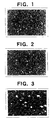
- FIGs. 1, 2, and 3 are photographs of a metallographic structure of 400 magnifications showing Example Nos. 1 and 8 according to the present invention and Comparative Example C6, respectively.
- No. C Si Mn Cr W Mo V Co Fe Steels of the present invention 1 1.17 0.24 0.30 4.21 6.96 7.45 1.56 8.10 Bal. 2 1.22 0.56 0.34 4.54 1.98 9.69 1.65 8.21 Bal. 3 1.10 0.43 0.43 4.29 7.21 7.42 1.46 - Bal.
- FIGs. 1 and 2 showing microstructures of the steels of the present invention carbide grains having a size of 3 ⁇ m or more disperse homogeneously.
- FIG. 3 showing microstructure of a comparative steel large-sized carbide precipitates are observed, but the remainder of the precipitates are in the form of microscopic carbide, the large-sized carbide grains being VC.
- Each of the above-described high-speed steel samples was joined to a body material by welding, and subjected to quenching and tempering to thereby obtain a metallic band saw blade having a size of 1 mm x 45 mm x 4500 mm.
- the composition by weight of the body material was as follows; C: 0.53, Si: 0.40, Mn: 1.12, Ni: 0.68. Cr: 5.18, W: 0.89, Mo: 0.56, V: 0.09, Al: 0.0073, N: 0.033, and Fe: balance, and hardness was HRC 52.1.
- This band saw blade was subjected to a cutting test in which SKD11 material having a diameter of 100 mm and a hardness of HB180 was cut under the following conditions: wet cutting; a cutting speed of 20/min; and a metal remnoval rate of 20 cm 2 /min.
- Table 2 shows the results of the cutting test, in terms of service life and the cause of failure.
- Service life is normalized with respect to the service life of Comparative Example C1 (SKH59), which is regarded as 100.
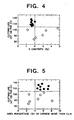
- FIG. 4 shows correlation between service life determined from the cutting test and V content (%);
- FIG. 5 shows correlation between service life and content of carbide grains having a size of not less than 3 ⁇ m (area %);
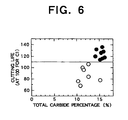
- FIG. 6 shows correlation between service life and total carbide content (area %).
- the steels of the present invention are plotted as black dots and the comparative steels are plotted as white dots.
- Example Nos. 1-8 have V contents of 2% by weight or less and service lives longer than that of Comparative Example C1 (SKH59).
- Examples No. 1, 2, and 5-7 which contain a large amount of Co, have excellent service life; i.e., 120% of that of Comparative Example C1.
- none of the Examples of the present invention generated chips on the cutting edge, and failure occurred due to wear on the cutting edge.
- Comparative Examples C4-C7 contain more than 2% of vanadium (V) and all generated chips on their cutting edges.
- Comparative Example C2 contains more than 2% of vanadium (V) but no chips were observed on the cutting edge. The reason for this is considered that fast wear of the cutting edge resulting in rapid failure and therefore no chips on a cutting edge were observed.
- the metallic band saw blade material of the present invention which is formed of high-speed steel comprising vanadium in an amount of no more than 2 wt.% and having 3 area % or more of carbide grains having a major diameter of 3 ⁇ m or more as observed in the metallographic structure is excellent in wear resistance, has an extremely long service life, and tends to generate no chips on the cutting edge, as compared with SKH 59 which conventionally has been widely used for cutting cutting-resistant materials.
Landscapes
- Chemical & Material Sciences (AREA)
- Engineering & Computer Science (AREA)
- Mechanical Engineering (AREA)
- Materials Engineering (AREA)
- Metallurgy (AREA)
- Organic Chemistry (AREA)
- Heat Treatment Of Steel (AREA)
- Heat Treatment Of Articles (AREA)
- Cutting Tools, Boring Holders, And Turrets (AREA)
- Accessories And Tools For Shearing Machines (AREA)
Claims (8)
- Blattmaterial einer metallischen Bandsäge, das aus einem Hochgeschwindigkeitsstahl mit der folgenden Zusammensetzung, in Gewichts- %, besteht:
W 1,98 % oder mehr, W-äquivalent (W + 2Mo) 20 % oder mehr, Cr 3 bis 6 %, V 1 bis 2 %, Si 2 % oder weniger, Mn 2 % oder weniger, C 1,0 bis 1,4 %, optional Co, und Summe aus dem W-äquivalent und dem Co Gehalt 20 bis 33 %, Rest Fe und unvermeidbare Verunreinigungen, - Blattmaterial nach Anspruch 1,
dadurch gekennzeichnet, dass
die Gesamtmenge der Karbidkörner 4 bis 18 Flächen-% in der metallographischen Beobachtungszone beträgt. - Blattmaterial nach Anspruch 1 oder 2,
dadurch gekennzeichnet, dass
der V-Gehalt 1,46 bis einschließlich 2 % beträgt. - Metallische Bandsäge mit einem bandförmigen Körpermaterial und einem Blattmaterial aus Hochgeschwindigkeitsstahl das mit dem Körpermaterial verschweißt ist, wobei der Hochgeschwindigkeitsstahl die folgende Zusammensetzung aufweist, in Gewichts-%:
W 1,98 % oder mehr, W-äquivalent (W + 2Mo) 20 % oder mehr, Cr , 3 bis 6 %, V 1 bis 2 %, Si 2 % oder weniger, Mn 2 % oder weniger, C 1,0 bis 1,4 % optional Co, Summe aus dem W-äquivalent und dem Co Gehalt Rest Fe und unvermeidbare Verunreinigungen, 20 bis 33 %, - Metallische Bandsäge nach Anspruch 4,
dadurch gekennzeichnet, dass
die Gesamtmenge der Karbidkörner 4 bis 18 Flächen-% in der metallographischen Beobachtungszone beträgt. - Metallische Bandsäge nach Anspruch 4 oder 5,
dadurch gekennzeichnet, dass
der V-Gehalt 1,46 bis einschließlich 2 % beträgt. - Herstellungsverfahren für ein Blattmaterial für eine metallische Bandsäge, das Karbidkörner mit einem Hauptdurchmesser von mindestens 3 Mikrometern enthält, wobei in einer metallographischen Beobachtungszone die Karbidkörner mindestens 3 Flächen-% einnehmen, mit den Schritten
Abschrecken einer Legierung der Zusammensetzung, in Gewichts-%,W 1,98 % oder mehr, W-äquivalent (W + 2Mo) 20 % oder mehr, Cr 3 bis 6 %, V 1 bis 2 %, Si 2 % oder weniger, Mn 2 % oder weniger, C 1,0 bis 1,4 %, optional Co Summe aus dem W-äquivalent und dem Co Gehalt Rest Fe und unvermeidbare Verunreinigungen 20 bis 33 %,
Tempern des Bandmaterials. - Herstellungsverfahren nach Anspruch 7,
dadurch gekennzeichnet, dass
der V-Gehalt 1,46 bis einschließlich 2 % beträgt.
Applications Claiming Priority (2)
| Application Number | Priority Date | Filing Date | Title |
|---|---|---|---|
| JP1974799 | 1999-01-28 | ||
| JP01974799A JP4144094B2 (ja) | 1999-01-28 | 1999-01-28 | メタルバンドソー用刃材 |
Publications (2)
| Publication Number | Publication Date |
|---|---|
| EP1024208A1 EP1024208A1 (de) | 2000-08-02 |
| EP1024208B1 true EP1024208B1 (de) | 2004-05-19 |
Family
ID=12007942
Family Applications (1)
| Application Number | Title | Priority Date | Filing Date |
|---|---|---|---|
| EP99115119A Expired - Lifetime EP1024208B1 (de) | 1999-01-28 | 1999-08-10 | Sägeblatt-Werkstoff einer Metall-Bandsäge und damit hergestellte Metall- Bandsäge |
Country Status (5)
| Country | Link |
|---|---|
| US (1) | US6272963B1 (de) |
| EP (1) | EP1024208B1 (de) |
| JP (1) | JP4144094B2 (de) |
| CN (1) | CN1100892C (de) |
| AT (1) | ATE267273T1 (de) |
Families Citing this family (10)
| Publication number | Priority date | Publication date | Assignee | Title |
|---|---|---|---|---|
| DE10202770B4 (de) * | 2002-01-25 | 2006-06-14 | Stahlwerk Ergste Westig Gmbh | Bimetall-Sägeband |
| DE10205403B4 (de) * | 2002-02-09 | 2007-03-29 | Stahlwerk Ergste Westig Gmbh | Bimetall-Sägeband |
| FI116044B (fi) * | 2002-05-28 | 2005-09-15 | Metso Paper Inc | Paperi- tai kartonkirainan pituussuuntaisessa leikkauksessa käytettävä terä |
| AT507956B1 (de) * | 2009-02-16 | 2011-01-15 | Boehler Edelstahl Gmbh & Co Kg | Bimetallsäge |
| CN103121312A (zh) * | 2011-11-19 | 2013-05-29 | 大连得达科技发展有限公司 | 一种用于刀具制造的合金材料 |
| CN103849814A (zh) * | 2012-11-28 | 2014-06-11 | 大连圣特金属新材料研发有限公司 | 一种军用刀具用高速钢 |
| CN103264192B (zh) * | 2013-05-21 | 2015-04-29 | 江阴金缘锯业有限公司 | 一种分散型带锯条 |
| WO2015110366A1 (en) * | 2014-01-22 | 2015-07-30 | Aktiebolaget Skf | Bearing steel |
| EP3392360B1 (de) * | 2015-12-17 | 2020-09-02 | Hitachi Metals, Ltd. | Schnellarbeitsstahl, material für werkzeuge und verfahren zur herstellung von material für werkzeuge |
| CN113512687B (zh) * | 2021-06-17 | 2024-04-09 | 湖南工程学院 | 一种复合稀土增强粉末冶金高速钢的制备方法 |
Family Cites Families (18)
| Publication number | Priority date | Publication date | Assignee | Title |
|---|---|---|---|---|
| US1876411A (en) * | 1932-09-06 | of columbus | ||
| US1729154A (en) * | 1920-06-26 | 1929-09-24 | Monroe S Clawson | Alloy for high-speed steel |
| US2183014A (en) * | 1937-04-22 | 1939-12-12 | Cleveland Twist Drill Co | Ferrous alloy composition |
| US2809109A (en) * | 1955-02-11 | 1957-10-08 | Bethlehem Steel Corp | Treatment of hypereutectoid steel |
| US4469514A (en) * | 1965-02-26 | 1984-09-04 | Crucible, Inc. | Sintered high speed tool steel alloy composition |
| SE344968C (sv) * | 1970-08-28 | 1976-02-02 | Hoeganaes Ab | Pulvermaterial for framstellning av hoglegerat stal med god anlopningsbestendighet och varmhardhet |
| US4140524A (en) * | 1974-02-04 | 1979-02-20 | Carpenter Technology Corporation | Low alloy band saw steel and method of making the same |
| JPS52111411A (en) * | 1976-03-17 | 1977-09-19 | Hitachi Metals Ltd | High speed tool steel |
| US4036640A (en) | 1977-01-06 | 1977-07-19 | Carpenter Technology Corporation | Alloy steel |
| US4318733A (en) * | 1979-11-19 | 1982-03-09 | Marko Materials, Inc. | Tool steels which contain boron and have been processed using a rapid solidification process and method |
| JPS56158845A (en) * | 1980-05-12 | 1981-12-07 | Mitsubishi Steel Mfg Co Ltd | Bit material |
| JPS62294152A (ja) | 1986-06-12 | 1987-12-21 | Hitachi Metals Ltd | 耐摩耗部材 |
| JP2710941B2 (ja) * | 1988-02-08 | 1998-02-10 | 日立金属株式会社 | 転造ダイス用鋼 |
| JPH07116553B2 (ja) * | 1988-10-21 | 1995-12-13 | 日立金属株式会社 | 高疲労強度メタルバンドソー胴材 |
| JPH0788555B2 (ja) * | 1989-04-21 | 1995-09-27 | 関東特殊製鋼株式会社 | 高耐摩耗性冷間圧延用ロール材 |
| AT393387B (de) * | 1989-10-23 | 1991-10-10 | Boehler Gmbh | Kaltarbeitsstahl mit hoher druckfestigkeit und verwendung dieses stahles |
| JP3257649B2 (ja) * | 1993-05-13 | 2002-02-18 | 日立金属株式会社 | 高靭性高速度鋼部材およびその製造方法 |
| JPH09279306A (ja) | 1996-04-15 | 1997-10-28 | Hitachi Metals Ltd | メタルバンドソー用刃材、メタルバンドソーおよびその製造方法 |
-
1999
- 1999-01-28 JP JP01974799A patent/JP4144094B2/ja not_active Expired - Lifetime
- 1999-08-10 CN CN99117522A patent/CN1100892C/zh not_active Expired - Lifetime
- 1999-08-10 US US09/371,500 patent/US6272963B1/en not_active Expired - Lifetime
- 1999-08-10 AT AT99115119T patent/ATE267273T1/de active
- 1999-08-10 EP EP99115119A patent/EP1024208B1/de not_active Expired - Lifetime
Non-Patent Citations (1)
| Title |
|---|
| Ernst C. et al., HTM Härterei-Techn.Mitteil., 50(1995), p.229-237 * |
Also Published As
| Publication number | Publication date |
|---|---|
| ATE267273T1 (de) | 2004-06-15 |
| HK1029144A1 (en) | 2001-03-23 |
| JP2000219935A (ja) | 2000-08-08 |
| CN1100892C (zh) | 2003-02-05 |
| CN1262339A (zh) | 2000-08-09 |
| JP4144094B2 (ja) | 2008-09-03 |
| US6272963B1 (en) | 2001-08-14 |
| EP1024208A1 (de) | 2000-08-02 |
Similar Documents
| Publication | Publication Date | Title |
|---|---|---|
| JP3838216B2 (ja) | オーステナイト系ステンレス鋼 | |
| KR0175075B1 (ko) | 증기터빈용 회전자 및 그 제조방법 | |
| EP2138597B1 (de) | Heiss bearbeitetes stahlmaterial mit herausragender verarbeitbarkeit und herausragendem schlagwert | |
| KR20060047819A (ko) | 냉간공구강 | |
| KR19990071731A (ko) | 피삭성이우수한고강도고인성비조질강 | |
| US6053991A (en) | Production of cold working tool steel | |
| US6841122B2 (en) | Hot working die steel excelling in molten corrosion resistance and strength at elevated temperature and member for high temperature use formed of the hot working die steel | |
| CA2405278C (en) | Hot-working steel article | |
| US6723182B1 (en) | Martensitic alloy steels having intermetallic compounds and precipitates as a substitute for cobalt | |
| EP1024208A1 (de) | Blätterwerkstoff für metallische Bandsäge und damit hergestellte metallische Bandsäge | |
| US6641681B1 (en) | Steel material and its manufacture | |
| JPH0978199A (ja) | 高硬度、高靭性冷間工具鋼 | |
| JP2614659B2 (ja) | 耐遅れ破壊性及び冷間鍛造性を備えた高強度ボルト用鋼 | |
| EP1197571A1 (de) | Stahlprodukt für eine ölbohrlochwand mit hoher festigkeit und ausgezeichneter schwefel induzierter spannungsrisskorossionsbeständig | |
| JP3587719B2 (ja) | 耐食性と切れ味持続性および加工性に優れた刃物用ステンレス鋼 | |
| JP2000226635A (ja) | 高温強度と靱性に優れた熱間工具鋼 | |
| JPH0555585B2 (de) | ||
| JP7532824B2 (ja) | 熱間加工用金型用鋼、熱間加工用金型およびその製造方法 | |
| JP2005336553A (ja) | 熱間工具鋼 | |
| US6096262A (en) | Martensitic heat resisting steel | |
| JPS5925026B2 (ja) | 金型用鋼 | |
| JP2576857B2 (ja) | 高強度非調質強靭鋼 | |
| US20220316038A1 (en) | Steel for hot stamp die, hot stamp die and manufacturing method thereof | |
| JPS62250154A (ja) | 合金工具鋼 | |
| JP2563164B2 (ja) | 高強度非調質強靭鋼 |
Legal Events
| Date | Code | Title | Description |
|---|---|---|---|
| PUAI | Public reference made under article 153(3) epc to a published international application that has entered the european phase |
Free format text: ORIGINAL CODE: 0009012 |
|
| AK | Designated contracting states |
Kind code of ref document: A1 Designated state(s): AT FR SE |
|
| AX | Request for extension of the european patent |
Free format text: AL;LT;LV;MK;RO;SI |
|
| 17P | Request for examination filed |
Effective date: 20001123 |
|
| AKX | Designation fees paid |
Free format text: AT FR SE |
|
| 17Q | First examination report despatched |
Effective date: 20011219 |
|
| REG | Reference to a national code |
Ref country code: DE Ref legal event code: 8566 |
|
| GRAP | Despatch of communication of intention to grant a patent |
Free format text: ORIGINAL CODE: EPIDOSNIGR1 |
|
| GRAS | Grant fee paid |
Free format text: ORIGINAL CODE: EPIDOSNIGR3 |
|
| RAP1 | Party data changed (applicant data changed or rights of an application transferred) |
Owner name: HITACHI METALS, LTD. |
|
| GRAA | (expected) grant |
Free format text: ORIGINAL CODE: 0009210 |
|
| RTI1 | Title (correction) |
Free format text: BLADE MATERIAL OF A METALLIC BAND SAW AND METALLIC BAND SAW MADE THEREFROM |
|
| AK | Designated contracting states |
Kind code of ref document: B1 Designated state(s): AT FR SE |
|
| REG | Reference to a national code |
Ref country code: SE Ref legal event code: TRGR |
|
| ET | Fr: translation filed | ||
| PLBE | No opposition filed within time limit |
Free format text: ORIGINAL CODE: 0009261 |
|
| STAA | Information on the status of an ep patent application or granted ep patent |
Free format text: STATUS: NO OPPOSITION FILED WITHIN TIME LIMIT |
|
| 26N | No opposition filed |
Effective date: 20050222 |
|
| REG | Reference to a national code |
Ref country code: FR Ref legal event code: PLFP Year of fee payment: 18 |
|
| REG | Reference to a national code |
Ref country code: FR Ref legal event code: PLFP Year of fee payment: 19 |
|
| REG | Reference to a national code |
Ref country code: FR Ref legal event code: PLFP Year of fee payment: 20 |
|
| PGFP | Annual fee paid to national office [announced via postgrant information from national office to epo] |
Ref country code: FR Payment date: 20180712 Year of fee payment: 20 |
|
| PGFP | Annual fee paid to national office [announced via postgrant information from national office to epo] |
Ref country code: SE Payment date: 20180810 Year of fee payment: 20 Ref country code: AT Payment date: 20180725 Year of fee payment: 20 |
|
| REG | Reference to a national code |
Ref country code: AT Ref legal event code: MK07 Ref document number: 267273 Country of ref document: AT Kind code of ref document: T Effective date: 20190810 |
|
| REG | Reference to a national code |
Ref country code: SE Ref legal event code: EUG |