EP0991616B1 - VERFAHREN ZUR HERSTELLUNG VON ARZNEIMITTELN, ENTHALTEND HMG-CoA- REDUKTASEINHIBITOREN - Google Patents
VERFAHREN ZUR HERSTELLUNG VON ARZNEIMITTELN, ENTHALTEND HMG-CoA- REDUKTASEINHIBITOREN Download PDFInfo
- Publication number
- EP0991616B1 EP0991616B1 EP98933586A EP98933586A EP0991616B1 EP 0991616 B1 EP0991616 B1 EP 0991616B1 EP 98933586 A EP98933586 A EP 98933586A EP 98933586 A EP98933586 A EP 98933586A EP 0991616 B1 EP0991616 B1 EP 0991616B1
- Authority
- EP
- European Patent Office
- Prior art keywords
- process according
- dihydroxy
- active compound
- fluorophenyl
- employed
- Prior art date
- Legal status (The legal status is an assumption and is not a legal conclusion. Google has not performed a legal analysis and makes no representation as to the accuracy of the status listed.)
- Expired - Lifetime
Links
- 0 **C(CC(*)C1)OC1=O Chemical compound **C(CC(*)C1)OC1=O 0.000 description 1
Classifications
-
- C—CHEMISTRY; METALLURGY
- C07—ORGANIC CHEMISTRY
- C07C—ACYCLIC OR CARBOCYCLIC COMPOUNDS
- C07C51/00—Preparation of carboxylic acids or their salts, halides or anhydrides
- C07C51/09—Preparation of carboxylic acids or their salts, halides or anhydrides from carboxylic acid esters or lactones
-
- A—HUMAN NECESSITIES
- A61—MEDICAL OR VETERINARY SCIENCE; HYGIENE
- A61K—PREPARATIONS FOR MEDICAL, DENTAL OR TOILETRY PURPOSES
- A61K9/00—Medicinal preparations characterised by special physical form
- A61K9/14—Particulate form, e.g. powders, Processes for size reducing of pure drugs or the resulting products, Pure drug nanoparticles
- A61K9/16—Agglomerates; Granulates; Microbeadlets ; Microspheres; Pellets; Solid products obtained by spray drying, spray freeze drying, spray congealing,(multiple) emulsion solvent evaporation or extraction
- A61K9/1682—Processes
- A61K9/1694—Processes resulting in granules or microspheres of the matrix type containing more than 5% of excipient
-
- A—HUMAN NECESSITIES
- A61—MEDICAL OR VETERINARY SCIENCE; HYGIENE
- A61K—PREPARATIONS FOR MEDICAL, DENTAL OR TOILETRY PURPOSES
- A61K31/00—Medicinal preparations containing organic active ingredients
- A61K31/185—Acids; Anhydrides, halides or salts thereof, e.g. sulfur acids, imidic, hydrazonic or hydroximic acids
- A61K31/19—Carboxylic acids, e.g. valproic acid
- A61K31/20—Carboxylic acids, e.g. valproic acid having a carboxyl group bound to a chain of seven or more carbon atoms, e.g. stearic, palmitic, arachidic acids
-
- A—HUMAN NECESSITIES
- A61—MEDICAL OR VETERINARY SCIENCE; HYGIENE
- A61K—PREPARATIONS FOR MEDICAL, DENTAL OR TOILETRY PURPOSES
- A61K31/00—Medicinal preparations containing organic active ingredients
- A61K31/185—Acids; Anhydrides, halides or salts thereof, e.g. sulfur acids, imidic, hydrazonic or hydroximic acids
- A61K31/19—Carboxylic acids, e.g. valproic acid
- A61K31/20—Carboxylic acids, e.g. valproic acid having a carboxyl group bound to a chain of seven or more carbon atoms, e.g. stearic, palmitic, arachidic acids
- A61K31/201—Carboxylic acids, e.g. valproic acid having a carboxyl group bound to a chain of seven or more carbon atoms, e.g. stearic, palmitic, arachidic acids having one or two double bonds, e.g. oleic, linoleic acids
-
- A—HUMAN NECESSITIES
- A61—MEDICAL OR VETERINARY SCIENCE; HYGIENE
- A61K—PREPARATIONS FOR MEDICAL, DENTAL OR TOILETRY PURPOSES
- A61K31/00—Medicinal preparations containing organic active ingredients
- A61K31/33—Heterocyclic compounds
- A61K31/335—Heterocyclic compounds having oxygen as the only ring hetero atom, e.g. fungichromin
- A61K31/365—Lactones
- A61K31/366—Lactones having six-membered rings, e.g. delta-lactones
-
- A—HUMAN NECESSITIES
- A61—MEDICAL OR VETERINARY SCIENCE; HYGIENE
- A61P—SPECIFIC THERAPEUTIC ACTIVITY OF CHEMICAL COMPOUNDS OR MEDICINAL PREPARATIONS
- A61P3/00—Drugs for disorders of the metabolism
- A61P3/06—Antihyperlipidemics
-
- A—HUMAN NECESSITIES
- A61—MEDICAL OR VETERINARY SCIENCE; HYGIENE
- A61P—SPECIFIC THERAPEUTIC ACTIVITY OF CHEMICAL COMPOUNDS OR MEDICINAL PREPARATIONS
- A61P43/00—Drugs for specific purposes, not provided for in groups A61P1/00-A61P41/00
-
- A—HUMAN NECESSITIES
- A61—MEDICAL OR VETERINARY SCIENCE; HYGIENE
- A61P—SPECIFIC THERAPEUTIC ACTIVITY OF CHEMICAL COMPOUNDS OR MEDICINAL PREPARATIONS
- A61P9/00—Drugs for disorders of the cardiovascular system
- A61P9/10—Drugs for disorders of the cardiovascular system for treating ischaemic or atherosclerotic diseases, e.g. antianginal drugs, coronary vasodilators, drugs for myocardial infarction, retinopathy, cerebrovascula insufficiency, renal arteriosclerosis
Definitions
- the invention relates to a process for the manufacture of medicaments containing HMG-CoA reductase inhibitors, in particular in the form of granules, tablets and pellets.
- statin series actives in the form of their salts be used.
- these active ingredients are usually in aqueous solution first from the corresponding esters or acids as a precursor by treatment prepared with bases and then this solution to obtain the actual Active ingredient lyophilized (EP 547 000).
- the method according to the invention thus describes the production of medicaments, without the active substance being isolated in its solid form or as a pure substance, but processed directly as a solution.
- Bases are generally used as bases, the alkali and alkaline earth ions contain. Hydroxides, carbonates or hydrogen carbonates are preferred Alkali or alkaline earth ions such as Sodium, potassium, lithium, berrylium, Contain calcium or magnesium ions. Sodium hydroxide is particularly preferred or potassium hydroxide, depending on whether it is Actual active ingredient is a sodium or a potassium salt.
- the amount of base is at least equimolar, based on the Amount of active ingredient precursor.
- lactones of the formula (III) are preferably used as precursors, the actual active ingredients by cleavage of the lactone ring by the base immediately be made in the solution.
- Cerivastatin lactone which is mixed with sodium hydroxide, is particularly preferred Active ingredient cerivastatin is implemented in solution.
- the process according to the invention is suitable for the production of solid and liquid, in particular of solid pharmaceutical forms such as those containing active ingredients Powders, granules, tablets or pellets. It is possible to use the powder, Press granules or pellets into tablets or fill in capsules.
- Binders used, e.g. Polyvinylpyrrolidone, gelatin, starch and cellulose derivatives (natural or synthetic).
- auxiliaries can be used as further auxiliaries e.g. as fillers cellulose derivatives (e.g. micro-crystalline cellulose), Sugar (e.g. lactose), sugar alcohols (e.g. mannitol, sorbitol), inorganic fillers (e.g. calcium phosphates) as well as all other auxiliaries that are used to manufacture
- cellulose derivatives e.g. micro-crystalline cellulose
- Sugar e.g. lactose
- sugar alcohols e.g. mannitol, sorbitol
- inorganic fillers e.g. calcium phosphates
- Pharmaceutical formulations of the desired properties are required, e.g. lubricant (e.g. magnesium stearate), e.g. Disintegrants (e.g. cross-linked polyvinyl pyrrolidone, Sodium carboxymethyl cellulose), e.g. Wetting agents (e.g. sodium lauryl sulfate), e.g
- Lactose, mannitol and microcrystalline cellulose are preferred as fillers used.
- the proportion of binder in the overall mixture is preferably 0 to 20%.
- the proportion of fillers and auxiliaries in the overall mixture is preferably 70 to 99%.
- the drying temperature is generally 40 to 120 ° C, preferably 60 to 100 ° C.
- the process according to the invention is particularly suitable for active compounds of the formula (I) in which the substituent R is an optionally substituted pyrimidine, indole, Indolizine, pyrrolo-pyridine, quinoline, dihydroquinoline, pyrazolo-pyridine, Pyridazine, imidazole, pyrrolo-isoquinoline, pyridine, pyrrole, tetrazole radical means.
- R is an optionally substituted pyrimidine, indole, Indolizine, pyrrolo-pyridine, quinoline, dihydroquinoline, pyrazolo-pyridine, Pyridazine, imidazole, pyrrolo-isoquinoline, pyridine, pyrrole, tetrazole radical means.
- the process according to the invention is particularly suitable for 3R, 5S- (E) -7- [4- (4-fluorophenyl) -2,6-bis (1-methylethyl) -5-methoxymethyl-pyridin-3-yl] -3, 5-dihydroxy-6- heptenic acid sodium salt;
- the method described is also particularly suitable if the active ingredient in only very small amounts, e.g. less than 5%, preferably less than 1% (weight fraction in the final formulation) is used.
- pharmaceutical preparations can be produced which are distinguished by excellent Characterize uniformity of drug distribution.
- polyvinylpyrrolidone 25 and water are added.
- the following composition may be mentioned as an example (given in [mg] with regard to the final formulation): cerivastatin 0.1 Polyvinyl pyrrolidone 25 1.8 water qs
- a suitable carrier material e.g. mannitol
- mannitol which, according to the current state of the art, can take place either in mixer granulation, e.g. with the aid of a high-speed mixer or in a fluidized bed granulation (specification in [mg] with regard to the final formulation): mannitol 83,95
- the resulting granulate can e.g. even after sieving with the addition of suitable lubricants (e.g. magnesium stearate) and disintegrants (e.g. cross-linked Polyvinylpyrrolidone) mixed, processed into tablets (weight 90 mg; Diameter 6 mm) and then painted (light protection of the active ingredient) become.
- suitable lubricants e.g. magnesium stearate
- disintegrants e.g. cross-linked Polyvinylpyrrolidone
- liquid is not on a powdered carrier granulated, but in suitable equipment, e.g. Fluid bed devices with Wurster insert on pellets.
- the powder base is used in suitable equipment, e.g. Fluid bed systems, rotor granulators or similar devices to contain active substances Rounded pellets.
- suitable equipment e.g. Fluid bed systems, rotor granulators or similar devices to contain active substances Rounded pellets.
- liquid in powder coats is powdered Carrier material drawn up, thereby producing powder coated with active ingredient.
- the concentration of the active ingredient per dose unit is up to 0.01 mg decreased or increased to 5.0 mg.
- the granulation liquid is a stabilizer, e.g. Sodium hydroxide added.
- the stabilizer e.g. Sodium carbonate
- the carrier material added.
Landscapes
- Health & Medical Sciences (AREA)
- Chemical & Material Sciences (AREA)
- Animal Behavior & Ethology (AREA)
- Pharmacology & Pharmacy (AREA)
- Life Sciences & Earth Sciences (AREA)
- Medicinal Chemistry (AREA)
- General Health & Medical Sciences (AREA)
- Public Health (AREA)
- Veterinary Medicine (AREA)
- Engineering & Computer Science (AREA)
- Epidemiology (AREA)
- Bioinformatics & Cheminformatics (AREA)
- Organic Chemistry (AREA)
- Nuclear Medicine, Radiotherapy & Molecular Imaging (AREA)
- General Chemical & Material Sciences (AREA)
- Chemical Kinetics & Catalysis (AREA)
- Vascular Medicine (AREA)
- Hematology (AREA)
- Obesity (AREA)
- Urology & Nephrology (AREA)
- Diabetes (AREA)
- Cardiology (AREA)
- Heart & Thoracic Surgery (AREA)
- Oil, Petroleum & Natural Gas (AREA)
- Pharmaceuticals Containing Other Organic And Inorganic Compounds (AREA)
- Acyclic And Carbocyclic Compounds In Medicinal Compositions (AREA)
- Enzymes And Modification Thereof (AREA)
- Medicinal Preparation (AREA)
- Organic Low-Molecular-Weight Compounds And Preparation Thereof (AREA)
Description

- R
- für einen organischen Rest steht,
- X
- für eine Gruppe -CH2-CH2- oder -CH=CH-; insbesondere in der (E)-Form steht und
- M
- ein physiologisch akzeptables Kation bedeutet, beispielsweise aus der Reihe der Alkalikationen, bevorzugt Natrium oder Kalium sowie für ein Ammonium- ion steht.

- R
- für einen organischen Rest steht,
- X
- für eine Gruppe -CH2-CH2- oder -CH=CH steht und
- M
- für ein pharmakologisch akzeptables Kation steht,
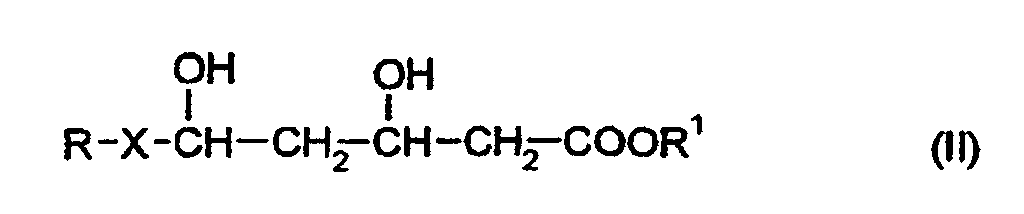
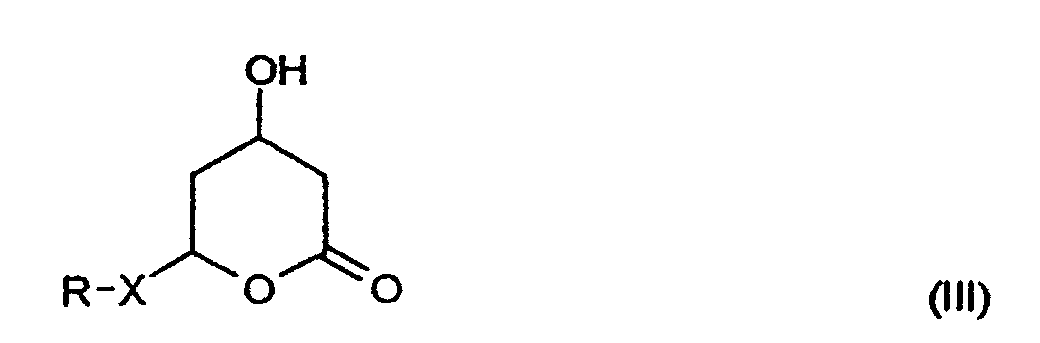
- R
- einen organischen Rest bedeutet,
- X
- eine Gruppe der Formel -CH2-CH2- oder -CH=CH- bedeutet und
- R1
- für eine C1-C4-Alkylgruppe oder Wasserstoff steht
| Cerivastatin | 0,1 |
| Polyvinylpyrrolidon 25 | 1,8 |
| Wasser | q.s. |
| Mannitol | 83,95 |
Claims (9)
- Verfahren zur Herstellung von Arzneimitteln enthaltend HMG-CoA-Reduktaseinhibitoren der Statinreihe der allgemeinen Formel Iworin

- R
- für einen organischen Rest steht,
- X
- für eine Gruppe -CH2-CH2- oder -CH=CH- steht und
- M
- für ein pharmakologisch akzeptables Kation steht,
oder die entsprechenden Lactone der Formel (III einsetzt, in welchen
- R
- einen organischen Rest bedeutet,
- X
- eine Gruppe der Formel -CH2-CH2- oder -CH=CH- bedeutet und
- R1
- für eine C1-C4-Alkylgruppe oder Wasserstoff steht,
- Verfahren nach Anspruch 1 , dadurch gekennzeichnet, daß man als Base Natriumhydroxid oder Kaliumhydroxid einsetzt.
- Verfahren nach Anspruch 1 bis 2, dadurch gekennzeichnet, daß man als Bindemittel Polyvinylpyrrolidon, Gelatine, Stärke- und Cellulosederivate einsetzt.
- Verfahren nach Anspruch 1 bis 3, dadurch gekennzeichnet, daß man als Hilfsstoffe Cellulosederivate, Zucker, Zuckeralkohole oder anorganische Füllstoffe.
- Verfahren nach Anspruch 1 bis 4, dadurch gekennzeichnet, daß man als Hilfsstoff Mannit oder Sorbit einsetzt.
- Verfahren nach Anspruch 1 bis 5, dadurch gekennzeichnet, daß der Anteil an Bindemittel in der Gesamtmischung 0-20 % beträgt.
- Verfahren nach Anspruch 1 bis 6, dadurch gekennzeichnet, daß der Anteil an Füll- und Hilfsstoffen in der Gesamtmischung 70-99% beträgt.
- Verfahren nach Anspruch 1 bis 7, dadurch gekennzeichnet, daß man mindestens äquimolare Menge an Base gerechnet auf die Wirkstoffvorstufe einsetzt.
- Verfahren nach Anspruch 1 bis 8, dadurch gekennzeichnet, daß die Wirkstoffmenge weniger als 5 % von der Gesamtmenge der endgültigen Arzneiform beträgt.
Applications Claiming Priority (3)
| Application Number | Priority Date | Filing Date | Title |
|---|---|---|---|
| DE19725391A DE19725391A1 (de) | 1997-06-16 | 1997-06-16 | Verfahren zur Herstellung von Arzneimittel, enthaltend HMG-CoA-Reduktase-Inhibitoren |
| DE19725391 | 1997-06-16 | ||
| PCT/EP1998/003294 WO1998057917A1 (de) | 1997-06-16 | 1998-06-03 | VERFAHREN ZUR HERSTELLUNG VON ARZNEIMITTELN, ENTHALTEND HMG-CoA- REDUKTASEINHIBITOREN |
Publications (2)
| Publication Number | Publication Date |
|---|---|
| EP0991616A1 EP0991616A1 (de) | 2000-04-12 |
| EP0991616B1 true EP0991616B1 (de) | 2003-05-21 |
Family
ID=7832616
Family Applications (1)
| Application Number | Title | Priority Date | Filing Date |
|---|---|---|---|
| EP98933586A Expired - Lifetime EP0991616B1 (de) | 1997-06-16 | 1998-06-03 | VERFAHREN ZUR HERSTELLUNG VON ARZNEIMITTELN, ENTHALTEND HMG-CoA- REDUKTASEINHIBITOREN |
Country Status (23)
| Country | Link |
|---|---|
| US (2) | US20020146454A1 (de) |
| EP (1) | EP0991616B1 (de) |
| JP (1) | JP2002504126A (de) |
| KR (1) | KR20010013792A (de) |
| CN (1) | CN1260774A (de) |
| AR (1) | AR012963A1 (de) |
| AT (1) | ATE240925T1 (de) |
| AU (1) | AU734787B2 (de) |
| BG (1) | BG103931A (de) |
| BR (1) | BR9810129A (de) |
| CA (1) | CA2294724A1 (de) |
| DE (2) | DE19725391A1 (de) |
| ES (1) | ES2198728T3 (de) |
| HU (1) | HUP0002720A3 (de) |
| ID (1) | ID23179A (de) |
| IL (1) | IL132987A0 (de) |
| NO (1) | NO996183L (de) |
| NZ (1) | NZ501760A (de) |
| PL (1) | PL337343A1 (de) |
| SK (1) | SK171199A3 (de) |
| TR (1) | TR199902871T2 (de) |
| WO (1) | WO1998057917A1 (de) |
| ZA (1) | ZA985179B (de) |
Families Citing this family (3)
| Publication number | Priority date | Publication date | Assignee | Title |
|---|---|---|---|---|
| USRE44578E1 (en) | 2000-04-10 | 2013-11-05 | Teva Pharmaceutical Industries, Ltd. | Stable pharmaceutical compositions containing 7-substituted-3,5-dihydroxyheptanoic acids or 7-substituted-3,5-dihydroxyheptenoic acids |
| CA2406574C (en) * | 2000-04-10 | 2006-12-05 | Teva Pharmaceutical Industries, Ltd. | Stable pharmaceutical compositions containing 7-substituted-3,5-dihydroxyheptanoic acids or 7-substituted-3,5-dihydroxyheptenoic acids |
| EP1810667A1 (de) * | 2006-01-20 | 2007-07-25 | KRKA, tovarna zdravil, d.d., Novo mesto | Pharmazeutische Zusammensetzung enthaltend amorphes Atorvastatin |
Family Cites Families (2)
| Publication number | Priority date | Publication date | Assignee | Title |
|---|---|---|---|---|
| HU9203780D0 (en) * | 1991-12-12 | 1993-03-29 | Sandoz Ag | Stabilized pharmaceutical products of hmg-coa reductase inhibitor and method for producing them |
| ES2133158T3 (es) * | 1993-01-19 | 1999-09-01 | Warner Lambert Co | Formulacion ci-981 oral, estable y proceso de preparacion del mismo. |
-
1997
- 1997-06-16 DE DE19725391A patent/DE19725391A1/de not_active Withdrawn
-
1998
- 1998-06-03 EP EP98933586A patent/EP0991616B1/de not_active Expired - Lifetime
- 1998-06-03 IL IL13298798A patent/IL132987A0/xx unknown
- 1998-06-03 CN CN98806270A patent/CN1260774A/zh active Pending
- 1998-06-03 JP JP50365499A patent/JP2002504126A/ja not_active Ceased
- 1998-06-03 DE DE59808476T patent/DE59808476D1/de not_active Expired - Fee Related
- 1998-06-03 ES ES98933586T patent/ES2198728T3/es not_active Expired - Lifetime
- 1998-06-03 AT AT98933586T patent/ATE240925T1/de not_active IP Right Cessation
- 1998-06-03 SK SK1711-99A patent/SK171199A3/sk unknown
- 1998-06-03 CA CA002294724A patent/CA2294724A1/en not_active Abandoned
- 1998-06-03 NZ NZ501760A patent/NZ501760A/en unknown
- 1998-06-03 ID IDW991494A patent/ID23179A/id unknown
- 1998-06-03 WO PCT/EP1998/003294 patent/WO1998057917A1/de not_active Ceased
- 1998-06-03 US US09/446,342 patent/US20020146454A1/en not_active Abandoned
- 1998-06-03 PL PL98337343A patent/PL337343A1/xx unknown
- 1998-06-03 TR TR1999/02871T patent/TR199902871T2/xx unknown
- 1998-06-03 AU AU83353/98A patent/AU734787B2/en not_active Ceased
- 1998-06-03 KR KR1019997011810A patent/KR20010013792A/ko not_active Withdrawn
- 1998-06-03 HU HU0002720A patent/HUP0002720A3/hu unknown
- 1998-06-03 BR BR9810129-3A patent/BR9810129A/pt not_active IP Right Cessation
- 1998-06-10 AR ARP980102754A patent/AR012963A1/es not_active Application Discontinuation
- 1998-06-15 ZA ZA985179A patent/ZA985179B/xx unknown
-
1999
- 1999-11-30 BG BG103931A patent/BG103931A/xx unknown
- 1999-12-14 NO NO996183A patent/NO996183L/no not_active Application Discontinuation
-
2003
- 2003-06-05 US US10/456,222 patent/US20030203964A1/en not_active Abandoned
Also Published As
| Publication number | Publication date |
|---|---|
| AU8335398A (en) | 1999-01-04 |
| NO996183D0 (no) | 1999-12-14 |
| HUP0002720A3 (en) | 2001-12-28 |
| HUP0002720A2 (hu) | 2000-12-28 |
| US20020146454A1 (en) | 2002-10-10 |
| BG103931A (en) | 2000-07-31 |
| NZ501760A (en) | 2001-05-25 |
| AR012963A1 (es) | 2000-11-22 |
| US20030203964A1 (en) | 2003-10-30 |
| IL132987A0 (en) | 2001-03-19 |
| ES2198728T3 (es) | 2004-02-01 |
| CA2294724A1 (en) | 1998-12-23 |
| PL337343A1 (en) | 2000-08-14 |
| NO996183L (no) | 1999-12-14 |
| KR20010013792A (ko) | 2001-02-26 |
| DE59808476D1 (de) | 2003-06-26 |
| CN1260774A (zh) | 2000-07-19 |
| JP2002504126A (ja) | 2002-02-05 |
| BR9810129A (pt) | 2000-08-08 |
| SK171199A3 (en) | 2000-07-11 |
| AU734787B2 (en) | 2001-06-21 |
| DE19725391A1 (de) | 1998-12-17 |
| ZA985179B (en) | 1999-01-08 |
| TR199902871T2 (xx) | 2000-02-21 |
| ID23179A (id) | 2000-03-23 |
| EP0991616A1 (de) | 2000-04-12 |
| WO1998057917A1 (de) | 1998-12-23 |
| ATE240925T1 (de) | 2003-06-15 |
Similar Documents
| Publication | Publication Date | Title |
|---|---|---|
| AT401870B (de) | Stabilisiertes pharmazeutisches mittel, enthaltend einen hmg-coa-reduktase-inhibitor wirkstoff | |
| DE69917750T2 (de) | Oral verabreichbare galenische form mit rascher freisetzung und mit verzögerter freisetzung, enthaltend ein absorbtionspromoter und verwendung dieses absorbtionspromoters | |
| DE68905161T2 (de) | Den blutcholesterinspiegel senkende arzneimittel. | |
| DE3872739T2 (de) | Arzneimittel mit langsamer freisetzung. | |
| DE69207799T2 (de) | Pharmazeutische Zubereitung mit verzögerter Wirkstoffreigabe und Verfahren zur Herstellung derselben | |
| EP0250648B1 (de) | Pharmazeutisches Präparat zur verzögerten Freigabe von Ibuprofen | |
| DE10232113A1 (de) | Vardenafil Hydrochlorid Trihydrat enthaltende Arzneimittel | |
| EP2170272B1 (de) | Extrudate mit verbesserter geschmacksmaskierung | |
| WO2008034655A1 (de) | Perorale feste schmerzmittelzubereitung | |
| DE69023989T2 (de) | Verwendung von Vitamin B6 zur Verminderung von hohem Serotoninspiegel. | |
| DE60001266T2 (de) | Betahistin-hältige formulierung mit kontrollierter wirkstofffreisetzung | |
| DE19725391A1 (de) | Verfahren zur Herstellung von Arzneimittel, enthaltend HMG-CoA-Reduktase-Inhibitoren | |
| EP1216039B1 (de) | Kombinationpräparat zur behandlung von sexueller dysfunktion | |
| DE69713505T2 (de) | Arzneimittel enthaltend mizolastin mit verzögerter wirkstoffabgabe | |
| EP1121109B1 (de) | Zweiphasige Zusammensetzung mit Tramadol | |
| DE2630326C2 (de) | Präparat zur Behandlung der Osteoporose und seine Herstellung | |
| EP1259227A1 (de) | Verfahren zur herstellung von pharmazeutischen darreichungsformen | |
| HK1029102A (en) | Method for producing medicaments containing hmg-coa-reductase inhibitors | |
| DE3880579T2 (de) | Pharmazeutische zusammensetzungen zur behandlung der verstopfung der luftwege. | |
| CH648208A5 (de) | Pharmazeutisches mittel zur herabsetzung der endogenen oxalatbildung. | |
| CZ459499A3 (cs) | Způsob výroby léčiv, obsahujících inhibitory HMG-CoA-reduktasy | |
| DE69116123T2 (de) | Azaribine enthaltende Zusammensetzung | |
| DE10140421A1 (de) | Neue Kombination | |
| MXPA99011748A (en) | METHOD FOR PRODUCING MEDICAMENTS CONTAINING HMG-CoA-REDUCTASE INHIBITORS | |
| DE20023538U1 (de) | Zubereitung eines HMG-COA Reduktase-Inhibitors mit verlängerter Freisetzungsdauer |
Legal Events
| Date | Code | Title | Description |
|---|---|---|---|
| PUAI | Public reference made under article 153(3) epc to a published international application that has entered the european phase |
Free format text: ORIGINAL CODE: 0009012 |
|
| 17P | Request for examination filed |
Effective date: 20000117 |
|
| AK | Designated contracting states |
Kind code of ref document: A1 Designated state(s): AT BE CH CY DE DK ES FI FR GB GR IE IT LI LU MC NL PT SE |
|
| AX | Request for extension of the european patent |
Free format text: LT PAYMENT 20000117;LV PAYMENT 20000117;RO PAYMENT 20000117;SI PAYMENT 20000117 |
|
| 17Q | First examination report despatched |
Effective date: 20011115 |
|
| GRAH | Despatch of communication of intention to grant a patent |
Free format text: ORIGINAL CODE: EPIDOS IGRA |
|
| GRAH | Despatch of communication of intention to grant a patent |
Free format text: ORIGINAL CODE: EPIDOS IGRA |
|
| GRAA | (expected) grant |
Free format text: ORIGINAL CODE: 0009210 |
|
| AK | Designated contracting states |
Designated state(s): AT BE CH CY DE DK ES FI FR GB GR IE IT LI LU MC NL PT SE |
|
| AX | Request for extension of the european patent |
Extension state: LT LV RO SI |
|
| PG25 | Lapsed in a contracting state [announced via postgrant information from national office to epo] |
Ref country code: NL Free format text: LAPSE BECAUSE OF FAILURE TO SUBMIT A TRANSLATION OF THE DESCRIPTION OR TO PAY THE FEE WITHIN THE PRESCRIBED TIME-LIMIT Effective date: 20030521 Ref country code: IE Free format text: LAPSE BECAUSE OF FAILURE TO SUBMIT A TRANSLATION OF THE DESCRIPTION OR TO PAY THE FEE WITHIN THE PRESCRIBED TIME-LIMIT Effective date: 20030521 Ref country code: FI Free format text: LAPSE BECAUSE OF FAILURE TO SUBMIT A TRANSLATION OF THE DESCRIPTION OR TO PAY THE FEE WITHIN THE PRESCRIBED TIME-LIMIT Effective date: 20030521 |
|
| REG | Reference to a national code |
Ref country code: GB Ref legal event code: FG4D Free format text: NOT ENGLISH |
|
| REG | Reference to a national code |
Ref country code: CH Ref legal event code: EP |
|
| PG25 | Lapsed in a contracting state [announced via postgrant information from national office to epo] |
Ref country code: LU Free format text: LAPSE BECAUSE OF NON-PAYMENT OF DUE FEES Effective date: 20030603 Ref country code: CY Free format text: LAPSE BECAUSE OF FAILURE TO SUBMIT A TRANSLATION OF THE DESCRIPTION OR TO PAY THE FEE WITHIN THE PRESCRIBED TIME-LIMIT Effective date: 20030603 Ref country code: AT Free format text: LAPSE BECAUSE OF NON-PAYMENT OF DUE FEES Effective date: 20030603 |
|
| REG | Reference to a national code |
Ref country code: IE Ref legal event code: FG4D Free format text: GERMAN |
|
| REF | Corresponds to: |
Ref document number: 59808476 Country of ref document: DE Date of ref document: 20030626 Kind code of ref document: P |
|
| PG25 | Lapsed in a contracting state [announced via postgrant information from national office to epo] |
Ref country code: MC Free format text: LAPSE BECAUSE OF NON-PAYMENT OF DUE FEES Effective date: 20030630 Ref country code: LI Free format text: LAPSE BECAUSE OF NON-PAYMENT OF DUE FEES Effective date: 20030630 Ref country code: CH Free format text: LAPSE BECAUSE OF NON-PAYMENT OF DUE FEES Effective date: 20030630 Ref country code: BE Free format text: LAPSE BECAUSE OF NON-PAYMENT OF DUE FEES Effective date: 20030630 |
|
| GBT | Gb: translation of ep patent filed (gb section 77(6)(a)/1977) | ||
| PG25 | Lapsed in a contracting state [announced via postgrant information from national office to epo] |
Ref country code: SE Free format text: LAPSE BECAUSE OF FAILURE TO SUBMIT A TRANSLATION OF THE DESCRIPTION OR TO PAY THE FEE WITHIN THE PRESCRIBED TIME-LIMIT Effective date: 20030821 Ref country code: PT Free format text: LAPSE BECAUSE OF FAILURE TO SUBMIT A TRANSLATION OF THE DESCRIPTION OR TO PAY THE FEE WITHIN THE PRESCRIBED TIME-LIMIT Effective date: 20030821 Ref country code: GR Free format text: LAPSE BECAUSE OF FAILURE TO SUBMIT A TRANSLATION OF THE DESCRIPTION OR TO PAY THE FEE WITHIN THE PRESCRIBED TIME-LIMIT Effective date: 20030821 Ref country code: DK Free format text: LAPSE BECAUSE OF FAILURE TO SUBMIT A TRANSLATION OF THE DESCRIPTION OR TO PAY THE FEE WITHIN THE PRESCRIBED TIME-LIMIT Effective date: 20030821 |
|
| LTIE | Lt: invalidation of european patent or patent extension |
Effective date: 20030521 |
|
| NLV1 | Nl: lapsed or annulled due to failure to fulfill the requirements of art. 29p and 29m of the patents act | ||
| BERE | Be: lapsed |
Owner name: *BAYER A.G. Effective date: 20030630 |
|
| REG | Reference to a national code |
Ref country code: IE Ref legal event code: FD4D Ref document number: 0991616E Country of ref document: IE |
|
| ET | Fr: translation filed | ||
| REG | Reference to a national code |
Ref country code: ES Ref legal event code: FG2A Ref document number: 2198728 Country of ref document: ES Kind code of ref document: T3 |
|
| REG | Reference to a national code |
Ref country code: CH Ref legal event code: PL |
|
| PLBE | No opposition filed within time limit |
Free format text: ORIGINAL CODE: 0009261 |
|
| STAA | Information on the status of an ep patent application or granted ep patent |
Free format text: STATUS: NO OPPOSITION FILED WITHIN TIME LIMIT |
|
| 26N | No opposition filed |
Effective date: 20040224 |
|
| PGFP | Annual fee paid to national office [announced via postgrant information from national office to epo] |
Ref country code: DE Payment date: 20060520 Year of fee payment: 9 |
|
| PGFP | Annual fee paid to national office [announced via postgrant information from national office to epo] |
Ref country code: FR Payment date: 20060522 Year of fee payment: 9 |
|
| PGFP | Annual fee paid to national office [announced via postgrant information from national office to epo] |
Ref country code: GB Payment date: 20060531 Year of fee payment: 9 |
|
| PGFP | Annual fee paid to national office [announced via postgrant information from national office to epo] |
Ref country code: ES Payment date: 20060614 Year of fee payment: 9 |
|
| PGFP | Annual fee paid to national office [announced via postgrant information from national office to epo] |
Ref country code: IT Payment date: 20060630 Year of fee payment: 9 |
|
| GBPC | Gb: european patent ceased through non-payment of renewal fee |
Effective date: 20070603 |
|
| REG | Reference to a national code |
Ref country code: FR Ref legal event code: ST Effective date: 20080229 |
|
| PG25 | Lapsed in a contracting state [announced via postgrant information from national office to epo] |
Ref country code: DE Free format text: LAPSE BECAUSE OF NON-PAYMENT OF DUE FEES Effective date: 20080101 |
|
| PG25 | Lapsed in a contracting state [announced via postgrant information from national office to epo] |
Ref country code: GB Free format text: LAPSE BECAUSE OF NON-PAYMENT OF DUE FEES Effective date: 20070603 |
|
| REG | Reference to a national code |
Ref country code: ES Ref legal event code: FD2A Effective date: 20070604 |
|
| PG25 | Lapsed in a contracting state [announced via postgrant information from national office to epo] |
Ref country code: FR Free format text: LAPSE BECAUSE OF NON-PAYMENT OF DUE FEES Effective date: 20070702 |
|
| PG25 | Lapsed in a contracting state [announced via postgrant information from national office to epo] |
Ref country code: ES Free format text: LAPSE BECAUSE OF NON-PAYMENT OF DUE FEES Effective date: 20070604 |
|
| PG25 | Lapsed in a contracting state [announced via postgrant information from national office to epo] |
Ref country code: IT Free format text: LAPSE BECAUSE OF NON-PAYMENT OF DUE FEES Effective date: 20070603 |