EP0983249B1 - Verfahren und zwischenprodukte zur herstellung substituierter indazolderivate - Google Patents
Verfahren und zwischenprodukte zur herstellung substituierter indazolderivate Download PDFInfo
- Publication number
- EP0983249B1 EP0983249B1 EP98913997A EP98913997A EP0983249B1 EP 0983249 B1 EP0983249 B1 EP 0983249B1 EP 98913997 A EP98913997 A EP 98913997A EP 98913997 A EP98913997 A EP 98913997A EP 0983249 B1 EP0983249 B1 EP 0983249B1
- Authority
- EP
- European Patent Office
- Prior art keywords
- compound
- formula
- alkyl
- optionally substituted
- salt
- Prior art date
- Legal status (The legal status is an assumption and is not a legal conclusion. Google has not performed a legal analysis and makes no representation as to the accuracy of the status listed.)
- Expired - Lifetime
Links
- 238000000034 method Methods 0.000 title claims description 45
- 239000000543 intermediate Substances 0.000 title description 9
- 125000003453 indazolyl group Chemical class N1N=C(C2=C1C=CC=C2)* 0.000 title 1
- 150000001875 compounds Chemical class 0.000 claims description 160
- 150000003839 salts Chemical class 0.000 claims description 75
- -1 -OR4 Chemical group 0.000 claims description 27
- OKKJLVBELUTLKV-UHFFFAOYSA-N Methanol Chemical group OC OKKJLVBELUTLKV-UHFFFAOYSA-N 0.000 claims description 27
- 239000002585 base Substances 0.000 claims description 26
- 239000002904 solvent Substances 0.000 claims description 24
- 125000001424 substituent group Chemical group 0.000 claims description 24
- HEMHJVSKTPXQMS-UHFFFAOYSA-M Sodium hydroxide Chemical compound [OH-].[Na+] HEMHJVSKTPXQMS-UHFFFAOYSA-M 0.000 claims description 21
- ZMANZCXQSJIPKH-UHFFFAOYSA-N Triethylamine Chemical group CCN(CC)CC ZMANZCXQSJIPKH-UHFFFAOYSA-N 0.000 claims description 21
- 125000001153 fluoro group Chemical group F* 0.000 claims description 21
- VEXZGXHMUGYJMC-UHFFFAOYSA-N Hydrochloric acid Chemical compound Cl VEXZGXHMUGYJMC-UHFFFAOYSA-N 0.000 claims description 20
- 125000000217 alkyl group Chemical group 0.000 claims description 19
- 125000001997 phenyl group Chemical group [H]C1=C([H])C([H])=C(*)C([H])=C1[H] 0.000 claims description 19
- 239000002253 acid Substances 0.000 claims description 18
- LFQSCWFLJHTTHZ-UHFFFAOYSA-N Ethanol Chemical compound CCO LFQSCWFLJHTTHZ-UHFFFAOYSA-N 0.000 claims description 16
- 239000003153 chemical reaction reagent Substances 0.000 claims description 16
- 125000001246 bromo group Chemical group Br* 0.000 claims description 15
- 125000000113 cyclohexyl group Chemical group [H]C1([H])C([H])([H])C([H])([H])C([H])(*)C([H])([H])C1([H])[H] 0.000 claims description 14
- 125000001309 chloro group Chemical group Cl* 0.000 claims description 13
- 125000004169 (C1-C6) alkyl group Chemical group 0.000 claims description 12
- KWYUFKZDYYNOTN-UHFFFAOYSA-M Potassium hydroxide Chemical compound [OH-].[K+] KWYUFKZDYYNOTN-UHFFFAOYSA-M 0.000 claims description 11
- SRSXLGNVWSONIS-UHFFFAOYSA-M benzenesulfonate Chemical group [O-]S(=O)(=O)C1=CC=CC=C1 SRSXLGNVWSONIS-UHFFFAOYSA-M 0.000 claims description 11
- FYYHWMGAXLPEAU-UHFFFAOYSA-N Magnesium Chemical compound [Mg] FYYHWMGAXLPEAU-UHFFFAOYSA-N 0.000 claims description 9
- 125000005843 halogen group Chemical group 0.000 claims description 9
- 125000001979 organolithium group Chemical group 0.000 claims description 9
- 125000002023 trifluoromethyl group Chemical group FC(F)(F)* 0.000 claims description 9
- 125000000008 (C1-C10) alkyl group Chemical group 0.000 claims description 8
- 125000004178 (C1-C4) alkyl group Chemical group 0.000 claims description 8
- MZRVEZGGRBJDDB-UHFFFAOYSA-N N-Butyllithium Chemical group [Li]CCCC MZRVEZGGRBJDDB-UHFFFAOYSA-N 0.000 claims description 8
- 125000002346 iodo group Chemical group I* 0.000 claims description 8
- AFVFQIVMOAPDHO-UHFFFAOYSA-M methanesulfonate group Chemical group CS(=O)(=O)[O-] AFVFQIVMOAPDHO-UHFFFAOYSA-M 0.000 claims description 8
- 125000000449 nitro group Chemical group [O-][N+](*)=O 0.000 claims description 8
- LPNYRYFBWFDTMA-UHFFFAOYSA-N potassium tert-butoxide Chemical group [K+].CC(C)(C)[O-] LPNYRYFBWFDTMA-UHFFFAOYSA-N 0.000 claims description 8
- 239000012359 Methanesulfonyl chloride Substances 0.000 claims description 7
- 229910021627 Tin(IV) chloride Inorganic materials 0.000 claims description 7
- 125000004093 cyano group Chemical group *C#N 0.000 claims description 7
- 125000001511 cyclopentyl group Chemical group [H]C1([H])C([H])([H])C([H])([H])C([H])(*)C1([H])[H] 0.000 claims description 7
- 239000012458 free base Substances 0.000 claims description 7
- 125000001449 isopropyl group Chemical group [H]C([H])([H])C([H])(*)C([H])([H])[H] 0.000 claims description 7
- 229910052749 magnesium Inorganic materials 0.000 claims description 7
- 239000011777 magnesium Substances 0.000 claims description 7
- HPGGPRDJHPYFRM-UHFFFAOYSA-J tin(iv) chloride Chemical compound Cl[Sn](Cl)(Cl)Cl HPGGPRDJHPYFRM-UHFFFAOYSA-J 0.000 claims description 7
- GQHTUMJGOHRCHB-UHFFFAOYSA-N 2,3,4,6,7,8,9,10-octahydropyrimido[1,2-a]azepine Chemical compound C1CCCCN2CCCN=C21 GQHTUMJGOHRCHB-UHFFFAOYSA-N 0.000 claims description 6
- 125000000882 C2-C6 alkenyl group Chemical group 0.000 claims description 6
- KFZMGEQAYNKOFK-UHFFFAOYSA-N Isopropanol Chemical compound CC(C)O KFZMGEQAYNKOFK-UHFFFAOYSA-N 0.000 claims description 6
- AFVFQIVMOAPDHO-UHFFFAOYSA-N Methanesulfonic acid Chemical compound CS(O)(=O)=O AFVFQIVMOAPDHO-UHFFFAOYSA-N 0.000 claims description 6
- JGFZNNIVVJXRND-UHFFFAOYSA-N N,N-Diisopropylethylamine (DIPEA) Chemical compound CCN(C(C)C)C(C)C JGFZNNIVVJXRND-UHFFFAOYSA-N 0.000 claims description 6
- JUJWROOIHBZHMG-UHFFFAOYSA-N Pyridine Chemical compound C1=CC=NC=C1 JUJWROOIHBZHMG-UHFFFAOYSA-N 0.000 claims description 6
- WQDUMFSSJAZKTM-UHFFFAOYSA-N Sodium methoxide Chemical compound [Na+].[O-]C WQDUMFSSJAZKTM-UHFFFAOYSA-N 0.000 claims description 6
- 230000001476 alcoholic effect Effects 0.000 claims description 6
- SCVFZCLFOSHCOH-UHFFFAOYSA-M potassium acetate Chemical group [K+].CC([O-])=O SCVFZCLFOSHCOH-UHFFFAOYSA-M 0.000 claims description 6
- LCHWKMAWSZDQRD-UHFFFAOYSA-N silylformonitrile Chemical compound [SiH3]C#N LCHWKMAWSZDQRD-UHFFFAOYSA-N 0.000 claims description 6
- JOXIMZWYDAKGHI-UHFFFAOYSA-N toluene-4-sulfonic acid Chemical compound CC1=CC=C(S(O)(=O)=O)C=C1 JOXIMZWYDAKGHI-UHFFFAOYSA-N 0.000 claims description 6
- WJKHJLXJJJATHN-UHFFFAOYSA-N triflic anhydride Chemical compound FC(F)(F)S(=O)(=O)OS(=O)(=O)C(F)(F)F WJKHJLXJJJATHN-UHFFFAOYSA-N 0.000 claims description 6
- JIAARYAFYJHUJI-UHFFFAOYSA-L zinc dichloride Chemical compound [Cl-].[Cl-].[Zn+2] JIAARYAFYJHUJI-UHFFFAOYSA-L 0.000 claims description 6
- USFZMSVCRYTOJT-UHFFFAOYSA-N Ammonium acetate Chemical compound N.CC(O)=O USFZMSVCRYTOJT-UHFFFAOYSA-N 0.000 claims description 5
- 239000005695 Ammonium acetate Substances 0.000 claims description 5
- 239000002841 Lewis acid Substances 0.000 claims description 5
- 235000019257 ammonium acetate Nutrition 0.000 claims description 5
- 229940043376 ammonium acetate Drugs 0.000 claims description 5
- CSKNSYBAZOQPLR-UHFFFAOYSA-N benzenesulfonyl chloride Chemical compound ClS(=O)(=O)C1=CC=CC=C1 CSKNSYBAZOQPLR-UHFFFAOYSA-N 0.000 claims description 5
- 125000001995 cyclobutyl group Chemical group [H]C1([H])C([H])([H])C([H])(*)C1([H])[H] 0.000 claims description 5
- 150000007517 lewis acids Chemical class 0.000 claims description 5
- 238000004519 manufacturing process Methods 0.000 claims description 5
- QARBMVPHQWIHKH-UHFFFAOYSA-N methanesulfonyl chloride Chemical compound CS(Cl)(=O)=O QARBMVPHQWIHKH-UHFFFAOYSA-N 0.000 claims description 5
- 125000002524 organometallic group Chemical group 0.000 claims description 5
- 239000001632 sodium acetate Substances 0.000 claims description 5
- 235000017281 sodium acetate Nutrition 0.000 claims description 5
- ITMCEJHCFYSIIV-UHFFFAOYSA-M triflate Chemical group [O-]S(=O)(=O)C(F)(F)F ITMCEJHCFYSIIV-UHFFFAOYSA-M 0.000 claims description 5
- 125000004191 (C1-C6) alkoxy group Chemical group 0.000 claims description 4
- 229910052684 Cerium Inorganic materials 0.000 claims description 4
- CPELXLSAUQHCOX-UHFFFAOYSA-N Hydrogen bromide Chemical compound Br CPELXLSAUQHCOX-UHFFFAOYSA-N 0.000 claims description 4
- VMHLLURERBWHNL-UHFFFAOYSA-M Sodium acetate Chemical compound [Na+].CC([O-])=O VMHLLURERBWHNL-UHFFFAOYSA-M 0.000 claims description 4
- 229910052744 lithium Inorganic materials 0.000 claims description 4
- LMBFAGIMSUYTBN-MPZNNTNKSA-N teixobactin Chemical compound C([C@H](C(=O)N[C@@H]([C@@H](C)CC)C(=O)N[C@@H](CO)C(=O)N[C@H](CCC(N)=O)C(=O)N[C@H]([C@@H](C)CC)C(=O)N[C@@H]([C@@H](C)CC)C(=O)N[C@@H](CO)C(=O)N[C@H]1C(N[C@@H](C)C(=O)N[C@@H](C[C@@H]2NC(=N)NC2)C(=O)N[C@H](C(=O)O[C@H]1C)[C@@H](C)CC)=O)NC)C1=CC=CC=C1 LMBFAGIMSUYTBN-MPZNNTNKSA-N 0.000 claims description 4
- KYVBNYUBXIEUFW-UHFFFAOYSA-N 1,1,3,3-tetramethylguanidine Chemical compound CN(C)C(=N)N(C)C KYVBNYUBXIEUFW-UHFFFAOYSA-N 0.000 claims description 3
- QCQCHGYLTSGIGX-GHXANHINSA-N 4-[[(3ar,5ar,5br,7ar,9s,11ar,11br,13as)-5a,5b,8,8,11a-pentamethyl-3a-[(5-methylpyridine-3-carbonyl)amino]-2-oxo-1-propan-2-yl-4,5,6,7,7a,9,10,11,11b,12,13,13a-dodecahydro-3h-cyclopenta[a]chrysen-9-yl]oxy]-2,2-dimethyl-4-oxobutanoic acid Chemical compound N([C@@]12CC[C@@]3(C)[C@]4(C)CC[C@H]5C(C)(C)[C@@H](OC(=O)CC(C)(C)C(O)=O)CC[C@]5(C)[C@H]4CC[C@@H]3C1=C(C(C2)=O)C(C)C)C(=O)C1=CN=CC(C)=C1 QCQCHGYLTSGIGX-GHXANHINSA-N 0.000 claims description 3
- KEAYESYHFKHZAL-UHFFFAOYSA-N Sodium Chemical compound [Na] KEAYESYHFKHZAL-UHFFFAOYSA-N 0.000 claims description 3
- LINDOXZENKYESA-UHFFFAOYSA-N TMG Natural products CNC(N)=NC LINDOXZENKYESA-UHFFFAOYSA-N 0.000 claims description 3
- VSCWAEJMTAWNJL-UHFFFAOYSA-K aluminium trichloride Chemical compound Cl[Al](Cl)Cl VSCWAEJMTAWNJL-UHFFFAOYSA-K 0.000 claims description 3
- 230000003301 hydrolyzing effect Effects 0.000 claims description 3
- 150000003891 oxalate salts Chemical class 0.000 claims description 3
- 235000011056 potassium acetate Nutrition 0.000 claims description 3
- RPDAUEIUDPHABB-UHFFFAOYSA-N potassium ethoxide Chemical compound [K+].CC[O-] RPDAUEIUDPHABB-UHFFFAOYSA-N 0.000 claims description 3
- UMJSCPRVCHMLSP-UHFFFAOYSA-N pyridine Natural products COC1=CC=CN=C1 UMJSCPRVCHMLSP-UHFFFAOYSA-N 0.000 claims description 3
- QDRKDTQENPPHOJ-UHFFFAOYSA-N sodium ethoxide Chemical compound [Na+].CC[O-] QDRKDTQENPPHOJ-UHFFFAOYSA-N 0.000 claims description 3
- 239000012312 sodium hydride Substances 0.000 claims description 3
- 229910000104 sodium hydride Inorganic materials 0.000 claims description 3
- FAQYAMRNWDIXMY-UHFFFAOYSA-N trichloroborane Chemical compound ClB(Cl)Cl FAQYAMRNWDIXMY-UHFFFAOYSA-N 0.000 claims description 3
- LEIMLDGFXIOXMT-UHFFFAOYSA-N trimethylsilyl cyanide Chemical compound C[Si](C)(C)C#N LEIMLDGFXIOXMT-UHFFFAOYSA-N 0.000 claims description 3
- 239000011592 zinc chloride Substances 0.000 claims description 3
- 235000005074 zinc chloride Nutrition 0.000 claims description 3
- ROIPBPWWXWOVSW-UHFFFAOYSA-N bromo(chloro)methanesulfonic acid Chemical group OS(=O)(=O)C(Cl)Br ROIPBPWWXWOVSW-UHFFFAOYSA-N 0.000 claims description 2
- 238000010438 heat treatment Methods 0.000 claims description 2
- QARBMVPHQWIHKH-KHWXYDKHSA-N methanesulfonyl chloride Chemical group C[35S](Cl)(=O)=O QARBMVPHQWIHKH-KHWXYDKHSA-N 0.000 claims description 2
- JRZJOMJEPLMPRA-UHFFFAOYSA-N olefin Natural products CCCCCCCC=C JRZJOMJEPLMPRA-UHFFFAOYSA-N 0.000 claims description 2
- 229910052760 oxygen Inorganic materials 0.000 claims description 2
- 229910052717 sulfur Inorganic materials 0.000 claims description 2
- 125000001495 ethyl group Chemical group [H]C([H])([H])C([H])([H])* 0.000 claims 9
- 125000006373 (C2-C10) alkyl group Chemical group 0.000 claims 1
- ZMIGMASIKSOYAM-UHFFFAOYSA-N cerium Chemical compound [Ce][Ce][Ce][Ce][Ce][Ce][Ce][Ce][Ce][Ce][Ce][Ce][Ce][Ce][Ce][Ce][Ce][Ce][Ce][Ce][Ce][Ce][Ce][Ce][Ce][Ce][Ce][Ce][Ce][Ce][Ce][Ce][Ce][Ce][Ce][Ce][Ce][Ce] ZMIGMASIKSOYAM-UHFFFAOYSA-N 0.000 claims 1
- 125000004356 hydroxy functional group Chemical group O* 0.000 claims 1
- 125000002496 methyl group Chemical group [H]C([H])([H])* 0.000 claims 1
- YXFVVABEGXRONW-UHFFFAOYSA-N Toluene Chemical compound CC1=CC=CC=C1 YXFVVABEGXRONW-UHFFFAOYSA-N 0.000 description 57
- HEDRZPFGACZZDS-MICDWDOJSA-N Trichloro(2H)methane Chemical compound [2H]C(Cl)(Cl)Cl HEDRZPFGACZZDS-MICDWDOJSA-N 0.000 description 44
- YMWUJEATGCHHMB-UHFFFAOYSA-N Dichloromethane Chemical compound ClCCl YMWUJEATGCHHMB-UHFFFAOYSA-N 0.000 description 42
- XEKOWRVHYACXOJ-UHFFFAOYSA-N Ethyl acetate Chemical compound CCOC(C)=O XEKOWRVHYACXOJ-UHFFFAOYSA-N 0.000 description 33
- VLKZOEOYAKHREP-UHFFFAOYSA-N n-Hexane Chemical class CCCCCC VLKZOEOYAKHREP-UHFFFAOYSA-N 0.000 description 24
- 239000000243 solution Substances 0.000 description 22
- 239000000203 mixture Substances 0.000 description 18
- CSNNHWWHGAXBCP-UHFFFAOYSA-L Magnesium sulfate Chemical compound [Mg+2].[O-][S+2]([O-])([O-])[O-] CSNNHWWHGAXBCP-UHFFFAOYSA-L 0.000 description 16
- 239000011541 reaction mixture Substances 0.000 description 13
- 238000001644 13C nuclear magnetic resonance spectroscopy Methods 0.000 description 12
- 238000005160 1H NMR spectroscopy Methods 0.000 description 12
- 238000006243 chemical reaction Methods 0.000 description 11
- VYPSYNLAJGMNEJ-UHFFFAOYSA-N Silicium dioxide Chemical compound O=[Si]=O VYPSYNLAJGMNEJ-UHFFFAOYSA-N 0.000 description 10
- 238000004458 analytical method Methods 0.000 description 9
- 239000008096 xylene Substances 0.000 description 9
- 150000003738 xylenes Chemical class 0.000 description 9
- 0 *C(CC1)(CCC1(c1ccc(c(*)n[n]2*)c2c1)C#N)I Chemical compound *C(CC1)(CCC1(c1ccc(c(*)n[n]2*)c2c1)C#N)I 0.000 description 8
- WYURNTSHIVDZCO-UHFFFAOYSA-N Tetrahydrofuran Chemical compound C1CCOC1 WYURNTSHIVDZCO-UHFFFAOYSA-N 0.000 description 8
- 229910052943 magnesium sulfate Inorganic materials 0.000 description 8
- 235000019341 magnesium sulphate Nutrition 0.000 description 8
- 239000000741 silica gel Substances 0.000 description 8
- 229910002027 silica gel Inorganic materials 0.000 description 8
- XLYOFNOQVPJJNP-UHFFFAOYSA-N water Substances O XLYOFNOQVPJJNP-UHFFFAOYSA-N 0.000 description 8
- NPZPQOOJVQIHKV-UHFFFAOYSA-N 6-bromo-1-cyclohexyl-3-ethylindazole Chemical compound C12=CC(Br)=CC=C2C(CC)=NN1C1CCCCC1 NPZPQOOJVQIHKV-UHFFFAOYSA-N 0.000 description 7
- 239000012043 crude product Substances 0.000 description 7
- 239000010410 layer Substances 0.000 description 7
- 239000007787 solid Substances 0.000 description 7
- OTYZMSGPZHZGGI-UHFFFAOYSA-N (5-bromo-2-propanoylphenyl) methanesulfonate Chemical compound CCC(=O)C1=CC=C(Br)C=C1OS(C)(=O)=O OTYZMSGPZHZGGI-UHFFFAOYSA-N 0.000 description 6
- QTBSBXVTEAMEQO-UHFFFAOYSA-N Acetic acid Chemical compound CC(O)=O QTBSBXVTEAMEQO-UHFFFAOYSA-N 0.000 description 6
- RTZKZFJDLAIYFH-UHFFFAOYSA-N Diethyl ether Chemical compound CCOCC RTZKZFJDLAIYFH-UHFFFAOYSA-N 0.000 description 6
- IAZDPXIOMUYVGZ-UHFFFAOYSA-N Dimethylsulphoxide Chemical compound CS(C)=O IAZDPXIOMUYVGZ-UHFFFAOYSA-N 0.000 description 6
- DGAQECJNVWCQMB-PUAWFVPOSA-M Ilexoside XXIX Chemical compound C[C@@H]1CC[C@@]2(CC[C@@]3(C(=CC[C@H]4[C@]3(CC[C@@H]5[C@@]4(CC[C@@H](C5(C)C)OS(=O)(=O)[O-])C)C)[C@@H]2[C@]1(C)O)C)C(=O)O[C@H]6[C@@H]([C@H]([C@@H]([C@H](O6)CO)O)O)O.[Na+] DGAQECJNVWCQMB-PUAWFVPOSA-M 0.000 description 6
- BZLVMXJERCGZMT-UHFFFAOYSA-N Methyl tert-butyl ether Chemical compound COC(C)(C)C BZLVMXJERCGZMT-UHFFFAOYSA-N 0.000 description 6
- 239000000284 extract Substances 0.000 description 6
- 229910052708 sodium Inorganic materials 0.000 description 6
- 235000011121 sodium hydroxide Nutrition 0.000 description 6
- 238000004587 chromatography analysis Methods 0.000 description 5
- 150000002473 indoazoles Chemical class 0.000 description 5
- 239000011734 sodium Substances 0.000 description 5
- ZLMJMSJWJFRBEC-UHFFFAOYSA-N Potassium Chemical compound [K] ZLMJMSJWJFRBEC-UHFFFAOYSA-N 0.000 description 4
- 150000007513 acids Chemical class 0.000 description 4
- 150000001768 cations Chemical class 0.000 description 4
- VYLVYHXQOHJDJL-UHFFFAOYSA-K cerium trichloride Chemical compound Cl[Ce](Cl)Cl VYLVYHXQOHJDJL-UHFFFAOYSA-K 0.000 description 4
- YFQVGIOCBQEVGB-UHFFFAOYSA-N ethyl 4-cyano-4-(1-cyclohexyl-3-ethylindazol-6-yl)cyclohexane-1-carboxylate Chemical compound C1CC(C(=O)OCC)CCC1(C#N)C1=CC=C(C(CC)=NN2C3CCCCC3)C2=C1 YFQVGIOCBQEVGB-UHFFFAOYSA-N 0.000 description 4
- 150000007522 mineralic acids Chemical class 0.000 description 4
- 150000007524 organic acids Chemical class 0.000 description 4
- BWHMMNNQKKPAPP-UHFFFAOYSA-L potassium carbonate Chemical compound [K+].[K+].[O-]C([O-])=O BWHMMNNQKKPAPP-UHFFFAOYSA-L 0.000 description 4
- YLQBMQCUIZJEEH-UHFFFAOYSA-N tetrahydrofuran Natural products C=1C=COC=1 YLQBMQCUIZJEEH-UHFFFAOYSA-N 0.000 description 4
- BMYNFMYTOJXKLE-UHFFFAOYSA-N 3-azaniumyl-2-hydroxypropanoate Chemical compound NCC(O)C(O)=O BMYNFMYTOJXKLE-UHFFFAOYSA-N 0.000 description 3
- ONAJQOSVVPGNAZ-UHFFFAOYSA-N 6-bromo-1-cyclohexyl-3-ethylindazole;hydrobromide Chemical compound Br.C12=CC(Br)=CC=C2C(CC)=NN1C1CCCCC1 ONAJQOSVVPGNAZ-UHFFFAOYSA-N 0.000 description 3
- HBAQYPYDRFILMT-UHFFFAOYSA-N 8-[3-(1-cyclopropylpyrazol-4-yl)-1H-pyrazolo[4,3-d]pyrimidin-5-yl]-3-methyl-3,8-diazabicyclo[3.2.1]octan-2-one Chemical class C1(CC1)N1N=CC(=C1)C1=NNC2=C1N=C(N=C2)N1C2C(N(CC1CC2)C)=O HBAQYPYDRFILMT-UHFFFAOYSA-N 0.000 description 3
- OYPRJOBELJOOCE-UHFFFAOYSA-N Calcium Chemical compound [Ca] OYPRJOBELJOOCE-UHFFFAOYSA-N 0.000 description 3
- ZAFNJMIOTHYJRJ-UHFFFAOYSA-N Diisopropyl ether Chemical compound CC(C)OC(C)C ZAFNJMIOTHYJRJ-UHFFFAOYSA-N 0.000 description 3
- 102000004861 Phosphoric Diester Hydrolases Human genes 0.000 description 3
- 108090001050 Phosphoric Diester Hydrolases Proteins 0.000 description 3
- 108060008682 Tumor Necrosis Factor Proteins 0.000 description 3
- 230000002378 acidificating effect Effects 0.000 description 3
- 229910052783 alkali metal Inorganic materials 0.000 description 3
- 229910052791 calcium Inorganic materials 0.000 description 3
- 239000011575 calcium Substances 0.000 description 3
- GWXLDORMOJMVQZ-UHFFFAOYSA-N cerium Chemical compound [Ce] GWXLDORMOJMVQZ-UHFFFAOYSA-N 0.000 description 3
- OWXKXNHGEFUVOF-UHFFFAOYSA-N ethyl 4-(1-cyclohexyl-3-ethylindazol-6-yl)-4-hydroxycyclohexane-1-carboxylate Chemical compound C1CC(C(=O)OCC)CCC1(O)C1=CC=C(C(CC)=NN2C3CCCCC3)C2=C1 OWXKXNHGEFUVOF-UHFFFAOYSA-N 0.000 description 3
- 238000001704 evaporation Methods 0.000 description 3
- 231100000252 nontoxic Toxicity 0.000 description 3
- 230000003000 nontoxic effect Effects 0.000 description 3
- 229910052700 potassium Inorganic materials 0.000 description 3
- 239000011591 potassium Substances 0.000 description 3
- 238000002360 preparation method Methods 0.000 description 3
- 102000003390 tumor necrosis factor Human genes 0.000 description 3
- SCYULBFZEHDVBN-UHFFFAOYSA-N 1,1-Dichloroethane Chemical compound CC(Cl)Cl SCYULBFZEHDVBN-UHFFFAOYSA-N 0.000 description 2
- PTINMYFLLIUAIX-UHFFFAOYSA-N 1-benzyl-6-bromo-3-ethylindazole Chemical compound C12=CC(Br)=CC=C2C(CC)=NN1CC1=CC=CC=C1 PTINMYFLLIUAIX-UHFFFAOYSA-N 0.000 description 2
- BAXOFTOLAUCFNW-UHFFFAOYSA-N 1H-indazole Chemical compound C1=CC=C2C=NNC2=C1 BAXOFTOLAUCFNW-UHFFFAOYSA-N 0.000 description 2
- AFOVOWKDWWLQER-UHFFFAOYSA-N 6-bromo-3-ethyl-1-(4-methoxyphenyl)indazole Chemical compound C12=CC(Br)=CC=C2C(CC)=NN1C1=CC=C(OC)C=C1 AFOVOWKDWWLQER-UHFFFAOYSA-N 0.000 description 2
- YEMQBIFFMIZONT-UHFFFAOYSA-N 6-bromo-3-ethyl-1-methylindazole Chemical compound BrC1=CC=C2C(CC)=NN(C)C2=C1 YEMQBIFFMIZONT-UHFFFAOYSA-N 0.000 description 2
- CIWBSHSKHKDKBQ-JLAZNSOCSA-N Ascorbic acid Chemical compound OC[C@H](O)[C@H]1OC(=O)C(O)=C1O CIWBSHSKHKDKBQ-JLAZNSOCSA-N 0.000 description 2
- 229910004664 Cerium(III) chloride Inorganic materials 0.000 description 2
- KRKNYBCHXYNGOX-UHFFFAOYSA-K Citrate Chemical compound [O-]C(=O)CC(O)(CC([O-])=O)C([O-])=O KRKNYBCHXYNGOX-UHFFFAOYSA-K 0.000 description 2
- 241000124008 Mammalia Species 0.000 description 2
- 229910019142 PO4 Inorganic materials 0.000 description 2
- CDBYLPFSWZWCQE-UHFFFAOYSA-L Sodium Carbonate Chemical compound [Na+].[Na+].[O-]C([O-])=O CDBYLPFSWZWCQE-UHFFFAOYSA-L 0.000 description 2
- UIIMBOGNXHQVGW-UHFFFAOYSA-M Sodium bicarbonate Chemical compound [Na+].OC([O-])=O UIIMBOGNXHQVGW-UHFFFAOYSA-M 0.000 description 2
- QAOWNCQODCNURD-UHFFFAOYSA-N Sulfuric acid Chemical compound OS(O)(=O)=O QAOWNCQODCNURD-UHFFFAOYSA-N 0.000 description 2
- 150000001340 alkali metals Chemical class 0.000 description 2
- 229910052784 alkaline earth metal Inorganic materials 0.000 description 2
- 150000001412 amines Chemical class 0.000 description 2
- 150000008064 anhydrides Chemical class 0.000 description 2
- 150000001450 anions Chemical class 0.000 description 2
- 238000009835 boiling Methods 0.000 description 2
- 125000004432 carbon atom Chemical group C* 0.000 description 2
- 125000004122 cyclic group Chemical group 0.000 description 2
- 150000002148 esters Chemical class 0.000 description 2
- 150000002429 hydrazines Chemical class 0.000 description 2
- 229910052739 hydrogen Inorganic materials 0.000 description 2
- 239000001257 hydrogen Substances 0.000 description 2
- 125000004435 hydrogen atom Chemical class [H]* 0.000 description 2
- 125000002887 hydroxy group Chemical group [H]O* 0.000 description 2
- 229910052500 inorganic mineral Inorganic materials 0.000 description 2
- AUHZEENZYGFFBQ-UHFFFAOYSA-N mesitylene Substances CC1=CC(C)=CC(C)=C1 AUHZEENZYGFFBQ-UHFFFAOYSA-N 0.000 description 2
- 125000001827 mesitylenyl group Chemical group [H]C1=C(C(*)=C(C([H])=C1C([H])([H])[H])C([H])([H])[H])C([H])([H])[H] 0.000 description 2
- 235000010755 mineral Nutrition 0.000 description 2
- 239000011707 mineral Substances 0.000 description 2
- 235000005985 organic acids Nutrition 0.000 description 2
- 239000003960 organic solvent Substances 0.000 description 2
- 125000002734 organomagnesium group Chemical group 0.000 description 2
- NBIIXXVUZAFLBC-UHFFFAOYSA-K phosphate Chemical compound [O-]P([O-])([O-])=O NBIIXXVUZAFLBC-UHFFFAOYSA-K 0.000 description 2
- 239000010452 phosphate Substances 0.000 description 2
- 229910000027 potassium carbonate Inorganic materials 0.000 description 2
- 235000011181 potassium carbonates Nutrition 0.000 description 2
- 235000011118 potassium hydroxide Nutrition 0.000 description 2
- 159000000001 potassium salts Chemical class 0.000 description 2
- 239000000047 product Substances 0.000 description 2
- 238000000746 purification Methods 0.000 description 2
- 229920006395 saturated elastomer Polymers 0.000 description 2
- 239000007858 starting material Substances 0.000 description 2
- 239000000126 substance Substances 0.000 description 2
- VZCYOOQTPOCHFL-UHFFFAOYSA-N trans-butenedioic acid Natural products OC(=O)C=CC(O)=O VZCYOOQTPOCHFL-UHFFFAOYSA-N 0.000 description 2
- OSALWGXOGJQCSU-UHFFFAOYSA-N triphenylsilylformonitrile Chemical compound C=1C=CC=CC=1[Si](C=1C=CC=CC=1)(C#N)C1=CC=CC=C1 OSALWGXOGJQCSU-UHFFFAOYSA-N 0.000 description 2
- FQHCPFMTXFJZJS-UHFFFAOYSA-N (4-methoxyphenyl)hydrazine;hydrochloride Chemical compound Cl.COC1=CC=C(NN)C=C1 FQHCPFMTXFJZJS-UHFFFAOYSA-N 0.000 description 1
- GHOKWGTUZJEAQD-ZETCQYMHSA-N (D)-(+)-Pantothenic acid Chemical compound OCC(C)(C)[C@@H](O)C(=O)NCCC(O)=O GHOKWGTUZJEAQD-ZETCQYMHSA-N 0.000 description 1
- CPZPNEVIZAJTDT-UHFFFAOYSA-N 1-(4-bromo-2-hydroxyphenyl)propan-1-one Chemical compound CCC(=O)C1=CC=C(Br)C=C1O CPZPNEVIZAJTDT-UHFFFAOYSA-N 0.000 description 1
- WXTMDXOMEHJXQO-UHFFFAOYSA-N 2,5-dihydroxybenzoic acid Chemical compound OC(=O)C1=CC(O)=CC=C1O WXTMDXOMEHJXQO-UHFFFAOYSA-N 0.000 description 1
- PJAIMBYNTXNOCN-UHFFFAOYSA-N 3,6-dibromo-1h-indole Chemical compound BrC1=CC=C2C(Br)=CNC2=C1 PJAIMBYNTXNOCN-UHFFFAOYSA-N 0.000 description 1
- FEWJPZIEWOKRBE-UHFFFAOYSA-M 3-carboxy-2,3-dihydroxypropanoate Chemical compound OC(=O)C(O)C(O)C([O-])=O FEWJPZIEWOKRBE-UHFFFAOYSA-M 0.000 description 1
- QTBSBXVTEAMEQO-UHFFFAOYSA-M Acetate Chemical compound CC([O-])=O QTBSBXVTEAMEQO-UHFFFAOYSA-M 0.000 description 1
- 206010002556 Ankylosing Spondylitis Diseases 0.000 description 1
- OKTJSMMVPCPJKN-UHFFFAOYSA-N Carbon Chemical compound [C] OKTJSMMVPCPJKN-UHFFFAOYSA-N 0.000 description 1
- 239000004215 Carbon black (E152) Substances 0.000 description 1
- DSLZVSRJTYRBFB-LLEIAEIESA-N D-glucaric acid Chemical compound OC(=O)[C@@H](O)[C@@H](O)[C@H](O)[C@@H](O)C(O)=O DSLZVSRJTYRBFB-LLEIAEIESA-N 0.000 description 1
- RGHNJXZEOKUKBD-SQOUGZDYSA-M D-gluconate Chemical compound OC[C@@H](O)[C@@H](O)[C@H](O)[C@@H](O)C([O-])=O RGHNJXZEOKUKBD-SQOUGZDYSA-M 0.000 description 1
- FEWJPZIEWOKRBE-JCYAYHJZSA-N Dextrotartaric acid Chemical compound OC(=O)[C@H](O)[C@@H](O)C(O)=O FEWJPZIEWOKRBE-JCYAYHJZSA-N 0.000 description 1
- BDAGIHXWWSANSR-UHFFFAOYSA-M Formate Chemical compound [O-]C=O BDAGIHXWWSANSR-UHFFFAOYSA-M 0.000 description 1
- VZCYOOQTPOCHFL-OWOJBTEDSA-N Fumaric acid Chemical compound OC(=O)\C=C\C(O)=O VZCYOOQTPOCHFL-OWOJBTEDSA-N 0.000 description 1
- 201000005569 Gout Diseases 0.000 description 1
- 206010018634 Gouty Arthritis Diseases 0.000 description 1
- WHUUTDBJXJRKMK-VKHMYHEASA-N L-glutamic acid Chemical compound OC(=O)[C@@H](N)CCC(O)=O WHUUTDBJXJRKMK-VKHMYHEASA-N 0.000 description 1
- JVTAAEKCZFNVCJ-UHFFFAOYSA-M Lactate Chemical compound CC(O)C([O-])=O JVTAAEKCZFNVCJ-UHFFFAOYSA-M 0.000 description 1
- WHXSMMKQMYFTQS-UHFFFAOYSA-N Lithium Chemical compound [Li] WHXSMMKQMYFTQS-UHFFFAOYSA-N 0.000 description 1
- 229910002651 NO3 Inorganic materials 0.000 description 1
- NHNBFGGVMKEFGY-UHFFFAOYSA-N Nitrate Chemical compound [O-][N+]([O-])=O NHNBFGGVMKEFGY-UHFFFAOYSA-N 0.000 description 1
- XBDQKXXYIPTUBI-UHFFFAOYSA-M Propionate Chemical compound CCC([O-])=O XBDQKXXYIPTUBI-UHFFFAOYSA-M 0.000 description 1
- 229940124639 Selective inhibitor Drugs 0.000 description 1
- UIIMBOGNXHQVGW-DEQYMQKBSA-M Sodium bicarbonate-14C Chemical compound [Na+].O[14C]([O-])=O UIIMBOGNXHQVGW-DEQYMQKBSA-M 0.000 description 1
- QAOWNCQODCNURD-UHFFFAOYSA-L Sulfate Chemical compound [O-]S([O-])(=O)=O QAOWNCQODCNURD-UHFFFAOYSA-L 0.000 description 1
- KXKVLQRXCPHEJC-UHFFFAOYSA-N acetic acid trimethyl ester Natural products COC(C)=O KXKVLQRXCPHEJC-UHFFFAOYSA-N 0.000 description 1
- 125000003342 alkenyl group Chemical group 0.000 description 1
- 125000003545 alkoxy group Chemical group 0.000 description 1
- 239000007864 aqueous solution Substances 0.000 description 1
- 239000003125 aqueous solvent Substances 0.000 description 1
- 150000004945 aromatic hydrocarbons Chemical class 0.000 description 1
- 230000002917 arthritic effect Effects 0.000 description 1
- 206010003246 arthritis Diseases 0.000 description 1
- 125000003118 aryl group Chemical group 0.000 description 1
- 229940072107 ascorbate Drugs 0.000 description 1
- 235000010323 ascorbic acid Nutrition 0.000 description 1
- 239000011668 ascorbic acid Substances 0.000 description 1
- 208000006673 asthma Diseases 0.000 description 1
- 125000004429 atom Chemical group 0.000 description 1
- 150000007514 bases Chemical class 0.000 description 1
- 229940077388 benzenesulfonate Drugs 0.000 description 1
- WPYMKLBDIGXBTP-UHFFFAOYSA-N benzoic acid Chemical compound OC(=O)C1=CC=CC=C1 WPYMKLBDIGXBTP-UHFFFAOYSA-N 0.000 description 1
- MSJHOJKVMMEMNX-UHFFFAOYSA-N benzylhydrazine;hydron;dichloride Chemical compound Cl.Cl.NNCC1=CC=CC=C1 MSJHOJKVMMEMNX-UHFFFAOYSA-N 0.000 description 1
- 239000012455 biphasic mixture Substances 0.000 description 1
- 229910052799 carbon Inorganic materials 0.000 description 1
- 239000011203 carbon fibre reinforced carbon Substances 0.000 description 1
- 125000003178 carboxy group Chemical group [H]OC(*)=O 0.000 description 1
- 150000001732 carboxylic acid derivatives Chemical class 0.000 description 1
- 238000012512 characterization method Methods 0.000 description 1
- 229940001468 citrate Drugs 0.000 description 1
- 238000007796 conventional method Methods 0.000 description 1
- LHQRDAIAWDPZGH-UHFFFAOYSA-N cyclohexylhydrazine Chemical compound NNC1CCCCC1 LHQRDAIAWDPZGH-UHFFFAOYSA-N 0.000 description 1
- 238000000354 decomposition reaction Methods 0.000 description 1
- 201000010099 disease Diseases 0.000 description 1
- 208000037265 diseases, disorders, signs and symptoms Diseases 0.000 description 1
- 239000012039 electrophile Substances 0.000 description 1
- 238000006345 epimerization reaction Methods 0.000 description 1
- CCIVGXIOQKPBKL-UHFFFAOYSA-M ethanesulfonate Chemical compound CCS([O-])(=O)=O CCIVGXIOQKPBKL-UHFFFAOYSA-M 0.000 description 1
- ZXYAWONOWHSQRU-UHFFFAOYSA-N ethyl 4-oxocyclohexanecarboxylate Chemical compound CCOC(=O)C1CCC(=O)CC1 ZXYAWONOWHSQRU-UHFFFAOYSA-N 0.000 description 1
- 230000008020 evaporation Effects 0.000 description 1
- 239000000706 filtrate Substances 0.000 description 1
- 238000001914 filtration Methods 0.000 description 1
- 239000012467 final product Substances 0.000 description 1
- 238000001640 fractional crystallisation Methods 0.000 description 1
- 229940050410 gluconate Drugs 0.000 description 1
- 229930195712 glutamate Natural products 0.000 description 1
- 229930195733 hydrocarbon Natural products 0.000 description 1
- XMBWDFGMSWQBCA-UHFFFAOYSA-N hydrogen iodide Chemical compound I XMBWDFGMSWQBCA-UHFFFAOYSA-N 0.000 description 1
- QAOWNCQODCNURD-UHFFFAOYSA-M hydrogensulfate Chemical compound OS([O-])(=O)=O QAOWNCQODCNURD-UHFFFAOYSA-M 0.000 description 1
- 230000007062 hydrolysis Effects 0.000 description 1
- 238000006460 hydrolysis reaction Methods 0.000 description 1
- TWBYWOBDOCUKOW-UHFFFAOYSA-M isonicotinate Chemical compound [O-]C(=O)C1=CC=NC=C1 TWBYWOBDOCUKOW-UHFFFAOYSA-M 0.000 description 1
- 208000018937 joint inflammation Diseases 0.000 description 1
- VZCYOOQTPOCHFL-UPHRSURJSA-N maleic acid Chemical compound OC(=O)\C=C/C(O)=O VZCYOOQTPOCHFL-UPHRSURJSA-N 0.000 description 1
- 230000004060 metabolic process Effects 0.000 description 1
- 238000002156 mixing Methods 0.000 description 1
- HDZGCSFEDULWCS-UHFFFAOYSA-N monomethylhydrazine Chemical compound CNN HDZGCSFEDULWCS-UHFFFAOYSA-N 0.000 description 1
- 125000001624 naphthyl group Chemical group 0.000 description 1
- 150000002825 nitriles Chemical class 0.000 description 1
- KPADFPAILITQBG-UHFFFAOYSA-N non-4-ene Chemical compound CCCCC=CCCC KPADFPAILITQBG-UHFFFAOYSA-N 0.000 description 1
- 230000003287 optical effect Effects 0.000 description 1
- 239000012044 organic layer Substances 0.000 description 1
- 201000008482 osteoarthritis Diseases 0.000 description 1
- 229940014662 pantothenate Drugs 0.000 description 1
- 235000019161 pantothenic acid Nutrition 0.000 description 1
- 239000011713 pantothenic acid Substances 0.000 description 1
- 125000003170 phenylsulfonyl group Chemical group C1(=CC=CC=C1)S(=O)(=O)* 0.000 description 1
- 239000011736 potassium bicarbonate Substances 0.000 description 1
- 235000015497 potassium bicarbonate Nutrition 0.000 description 1
- 229910000028 potassium bicarbonate Inorganic materials 0.000 description 1
- TYJJADVDDVDEDZ-UHFFFAOYSA-M potassium hydrogencarbonate Chemical compound [K+].OC([O-])=O TYJJADVDDVDEDZ-UHFFFAOYSA-M 0.000 description 1
- 238000000159 protein binding assay Methods 0.000 description 1
- 150000003254 radicals Chemical class 0.000 description 1
- 206010039073 rheumatoid arthritis Diseases 0.000 description 1
- YGSDEFSMJLZEOE-UHFFFAOYSA-M salicylate Chemical compound OC1=CC=CC=C1C([O-])=O YGSDEFSMJLZEOE-UHFFFAOYSA-M 0.000 description 1
- 229960001860 salicylate Drugs 0.000 description 1
- 239000000377 silicon dioxide Substances 0.000 description 1
- 229910000030 sodium bicarbonate Inorganic materials 0.000 description 1
- 229910000029 sodium carbonate Inorganic materials 0.000 description 1
- 235000017550 sodium carbonate Nutrition 0.000 description 1
- 241000894007 species Species 0.000 description 1
- KDYFGRWQOYBRFD-UHFFFAOYSA-L succinate(2-) Chemical compound [O-]C(=O)CCC([O-])=O KDYFGRWQOYBRFD-UHFFFAOYSA-L 0.000 description 1
- 229940095064 tartrate Drugs 0.000 description 1
- 150000003509 tertiary alcohols Chemical class 0.000 description 1
- 125000000026 trimethylsilyl group Chemical group [H]C([H])([H])[Si]([*])(C([H])([H])[H])C([H])([H])[H] 0.000 description 1
- 238000001665 trituration Methods 0.000 description 1
Classifications
-
- C—CHEMISTRY; METALLURGY
- C07—ORGANIC CHEMISTRY
- C07D—HETEROCYCLIC COMPOUNDS
- C07D231/00—Heterocyclic compounds containing 1,2-diazole or hydrogenated 1,2-diazole rings
- C07D231/54—Heterocyclic compounds containing 1,2-diazole or hydrogenated 1,2-diazole rings condensed with carbocyclic rings or ring systems
- C07D231/56—Benzopyrazoles; Hydrogenated benzopyrazoles
-
- A—HUMAN NECESSITIES
- A61—MEDICAL OR VETERINARY SCIENCE; HYGIENE
- A61P—SPECIFIC THERAPEUTIC ACTIVITY OF CHEMICAL COMPOUNDS OR MEDICINAL PREPARATIONS
- A61P11/00—Drugs for disorders of the respiratory system
- A61P11/06—Antiasthmatics
-
- A—HUMAN NECESSITIES
- A61—MEDICAL OR VETERINARY SCIENCE; HYGIENE
- A61P—SPECIFIC THERAPEUTIC ACTIVITY OF CHEMICAL COMPOUNDS OR MEDICINAL PREPARATIONS
- A61P19/00—Drugs for skeletal disorders
- A61P19/02—Drugs for skeletal disorders for joint disorders, e.g. arthritis, arthrosis
-
- A—HUMAN NECESSITIES
- A61—MEDICAL OR VETERINARY SCIENCE; HYGIENE
- A61P—SPECIFIC THERAPEUTIC ACTIVITY OF CHEMICAL COMPOUNDS OR MEDICINAL PREPARATIONS
- A61P29/00—Non-central analgesic, antipyretic or antiinflammatory agents, e.g. antirheumatic agents; Non-steroidal antiinflammatory drugs [NSAID]
-
- A—HUMAN NECESSITIES
- A61—MEDICAL OR VETERINARY SCIENCE; HYGIENE
- A61P—SPECIFIC THERAPEUTIC ACTIVITY OF CHEMICAL COMPOUNDS OR MEDICINAL PREPARATIONS
- A61P43/00—Drugs for specific purposes, not provided for in groups A61P1/00-A61P41/00
Definitions
- This invention relates to the preparation of substituted indazole derivatives and to intermediates that may be used in said preparation.
- the substituted indazole derivatives that may be prepared in accord with the present invention are disclosed in United States provisional patent application serial number 60/016,861 (filed May 3, 1996), entitled “Substituted Indazole Derivatives And Related Compounds.” The foregoing United States provisional patent application is incorporated herein by reference in its entirety.
- the substituted indazole derivatives that may be prepared in accord with the present invention are selective inhibitors of phosphodiesterase (PDE) type IV and the production of tumor necrosis factor (TNF), as disclosed in United States provisional patent application serial number 60/016,861, referred to above.
- PDE phosphodiesterase
- TNF tumor necrosis factor
- the substituted indazole derivatives that may be prepared in accord with the present invention are useful in the treatment of asthma, joint inflammation, rheumatoid arthritis, gouty arthritis, rheumatoid spondylitis, osteoarthritis and other arthritic conditions, as well as other conditions or diseases involving PDE type IV or the production of TNF.
- the present invention relates to a process for preparing a compound of the formula or a pharmaceutically acceptable salt of said compound, wherein:
- the cyano moiety and R 3 in formula I are preferably cis to each other as shown below:
- R is preferably cyclohexyl, cyclopentyl, cyclobutyl, methylene cyclopropyl or isopropyl
- R 1 is preferably C 1 -C 2 alkyl optionally substituted by 1 to 3 fluoro substituents
- R 2 is preferably H
- R 3 is preferably -C(O)O(C 1 -C 2 alkyl), -CH 2 OH, or -C(O)NH 2 .
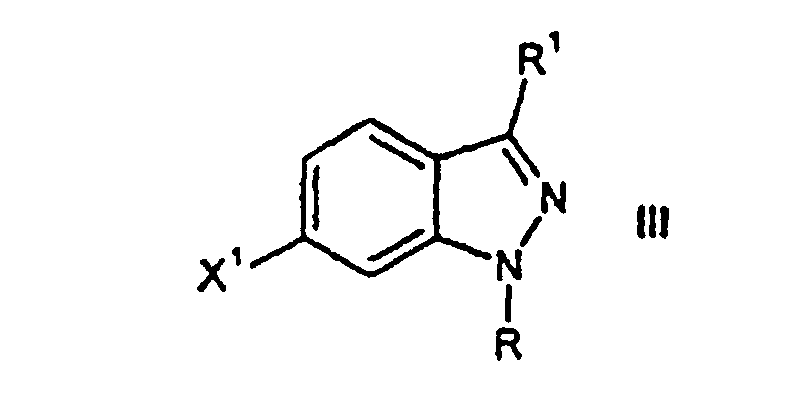
- the above compound of the formula II, or a salt of said compound is prepared by treating a compound of the formula or a salt of said compound, wherein R and R 1 are as defined for the above compound of formula I and X 1 is iodo, chloro, or bromo, preferably bromo, with an organolithium, cerium or magnesium reagent, such as C 1 -C 10 alkyl lithium, magnesium metal or cerium(III) chloride in combination with an organomagnesium or organolithium reagent, preferably an organolithium reagent such as n-butyllithium, to provide an organometallic intermediate and then treating said organometallic intermediate with a compound of the formula wherein R 2 and R 3 are as defined for the above compound of formula I.
- organolithium, cerium or magnesium reagent such as C 1 -C 10 alkyl lithium, magnesium metal or cerium(III) chloride in combination with an organomagnesium or organolithium reagent, preferably an organolith
- the above compound of formula III, or a salt of said compound is prepared by heating a compound of the formula or a salt of said compound, wherein X 1 , R, and R 1 are as defined for said compound of formula III, and X 2 is iodo, fluoro, bromo, chloro, methanesulfonate, trifluoromethanesulfonate, or phenylsulfonate wherein the phenyl moiety of said phenylsulfonate is optionally substituted by 1 or 2 substituents independently selected from halo, nitro and C 1 -C 4 alkyl, preferably methanesulfonate, to a temperature within the range of about 100°C to about 200°C.
- the above compound of formula XI, or a salt of said compound is prepared by treating a compound of the formula wherein X 2 and X 1 are as defined above for said compound of formula XI and R 1 is C 2 -C 10 alkyl, C 2 -C 6 alkenyl or phenyl optionally substituted as defined above for compounds of formula I with a compound of the formula or a salt of said compound, wherein R is as defined for the above compound of formula I, and either an acid, such as ammonium acetate, in which case said compound of formula V is treated with the free base of said compound of formula VI, or a base, such as potassium acetate or sodium acetate, in which case said compound of formula V is treated with a salt of said compound of formula VI.
- preferred R and R 1 substituents are as indicated above for the process of preparing a compound of formula I.
- Preferred salts of the compound of formula VI are the hydrochloride, hydrobromide, mesylate, tosylate, and oxalate salts of said compound, most preferably the hydrochloride salt of said compound.
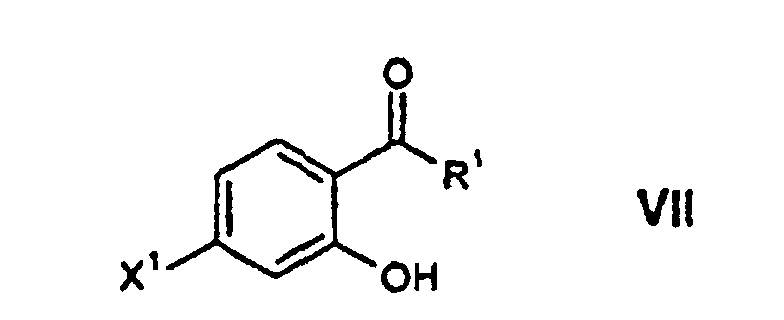
- the above compound of formula V is prepared by treating a compound of the formula wherein X 1 is as defined above for said compound of formula III and R 1 is as defined for the above compound of formula I, with a base, such as triethylamine, diisopropylethylamine, pyridine optionally substituted by 1 to 3 C 1 -C 6 alkyl groups, potassium hydroxide, or sodium hydroxide, preferably triethylamine, and a second reagent selected from methanesulfonyl chloride, methanesulfonyl anhydride, trifluoromethanesulfonic anhydride, phenylsulfonyl chloride, and phenylsulfonyl anhydride wherein the phenyl moieties of said phenylsulfonyl chloride and phenylsulfonyl anhydride are optionally substituted by 1 or 2 substituents independently selected from halo,
- a base such as trieth
- a compound of the formula or a pharmaceutically acceptable salt of said compound, wherein R and R 1 are as defined for the above compound of formula I is prepared by treating a compound of the formula or a salt of said compound, wherein R and R 1 are as defined for the above compound of formula I and R 6 is -C(O)O(C 1 -C 6 alkyl), CN, -C(O)NR 4 R 5 or -C(O)NR 4 OR 5 wherein R 4 and R 5 are as defined for the above compound of formula I, with a base, such as potassium tert-butoxide, sodium ethoxide, sodium hydride, 1,1,3,3-tetramethylguanidine, 1,8-diazabicyclo[5.4.0]undec-7-ene, 1,5-diazabicylo[4.3.0]non-5-ene, potassium ethoxide or sodium methoxide, preferably potassium tert-butoxide, in an alcoholic solvent of
- the invention also relates to a compound of the formula wherein R 1 is as defined above for the process of preparing the compound of formula III, X 1 is iodo or bromo, preferably bromo, and X 2 is methanesulfonate, trifluoromethanesulfonate, or phenylsulfonate wherein the phenyl moiety of said phenylsulfonate is optionally substituted by 1 or 2 substituents independently selected from halo, nitro and C 1 -C 4 alkyl, preferably methanesulfonate.
- Preferred R 1 substituents are as indicated above for the process of preparing a compound of the formula III.
- the invention also relates to a compound of the formula or a salt of said compound, wherein X 1 , R, and R 1 are as defined above for the process of preparing the compound of formula III and X 2 is as defined above for the compound of formula V. Preferred substituents are as indicated above for the process of preparing a compound of the formula III and the above compound of formula V.
- alkyl as used herein, unless otherwise indicated, includes saturated monovalent hydrocarbon radicals having straight, cyclic or branched moieties, or combinations thereof. It is understood that for cyclic moieties at least three carbon atoms are required in said alkyl group.
- alkoxy as used herein, unless otherwise indicated, includes -O-alkyl groups wherein “alkyl” is as defined above.
- alkenyl as used herein, unless otherwise indicated, includes alkyl groups, as defined above, which include one or more carbon-carbon double bonds.
- aryl as used herein, unless otherwise indicated, includes an organic radical derived from an aromatic hydrocarbon by removal of one hydrogen, such as phenyl or naphthyl.
- halo as used herein, unless otherwise indicated, includes chloro, fluoro, bromo and iodo.
- phrases "pharmaceutically acceptable salt(s)" or “salt(s)”, as used herein, unless otherwise indicated, includes salts of acidic or basic groups which may be present in the compounds of formulas I-XI, referred to above. Where term “salt(s)" alone is used, it is to be understood that both pharmaceutically acceptable and unacceptable salts are included.
- the compounds of formulas I-XI that are basic in nature are capable of forming a wide variety of salts with various inorganic and organic acids.
- the acids that may be used to prepare pharmaceutically acceptable acid addition salts of such basic compounds of formula I-XI are those that form non-toxic acid addition salts, i.e.
- salts containing pharmacologically acceptable anions such as the hydrochloride, hydrobromide, hydroiodide, nitrate, sulfate, bisulfate, phosphate, acid phosphate, isonicotinate, acetate, lactate, salicylate, citrate, acid citrate, tartrate, pantothenate, bitartrate, ascorbate, succinate, maleate, gentisinate, fumarate, gluconate, glucaronate, saccharate, formate, benzoate, glutamate, methanesulfonate, ethanesulfonate, benzenesulfonate, p-toluenesulfonate and pamoate [ i.e. , 1,1'-methylene-bis-(2-hydroxy-3-naphthoate)] salts.
- pharmacologically acceptable anions such as the hydrochloride, hydrobromide, hydroiodide, nitrate,
- Those compounds of formulas I-XI that are acidic in nature are capable of forming base salts with various pharmaceutically acceptable cations.
- Examples of such salts include the alkali metal or alkaline earth metal salts and, particularly, the calcium, magnesium, amine, sodium and potassium salts of the compounds of formulas I-XI.
- Certain compounds of formulas I-XI may have asymmetric centers and therefore exist in different enantiomeric and diastereomic forms.
- This invention relates to all optical Isomers and stereoisomers of the compounds of formulas I-XI, and mixtures thereof, and to the use or preparation of all such isomers and stereoisomers.
- the present invention also includes the compounds of formulas I-XI, and the salts or pharmaceutically acceptable salts thereof, wherein one or more hydrogen, carbon or other atom is replaced by an isotope thereof.
- Such compounds may be useful as research and diagnostic tools in metabolism pharmacokinetic studies and in binding assays.
- step 1 of Scheme 1 the hydroxy group of the compound of formula VII is converted to a leaving group.
- the compound of formula VII is treated with a base such as triethylamine, diisopropylethylamine, pyridine optionally substituted by 1 to 3 alkyl groups, potassium or sodium hydroxide, preferably triethylamine, in a solvent such as dichloromethane, dichloroethane, water, or toluene, or a mixture of two or more of the foregoing solvents, preferably dichloromethane, and reacted with an electrophile such as methanesulfonyl chloride or anhydride, phenylsulfonyl chloride or anhydride wherein the phenyl moiety of said phenylsulfonyl optionally includes 1 or 2 substituents selected from halo, nitro and C 1 -C 4 alkyl, or trifluoromethanesulfonic anhydride, preferably methanesulfonyl chloride, at a temperature ranging from about 0°C to room temperature
- step 2 of Scheme 1 the compound of formula V is reacted with a hydrazine derivative of formula VI and an acid, preferably ammonium acetate, in a solvent, preferably a solvent having a high boiling point such as xylenes, toluene, or mesitylene, or a mixture of two or more of the foregoing solvents, preferably xylenes, to provide the compound of formula XI.
- a solvent preferably a solvent having a high boiling point such as xylenes, toluene, or mesitylene, or a mixture of two or more of the foregoing solvents, preferably xylenes
- the compound of formula XI need not be separated or isolated from the reaction mixture.
- step 3 of Scheme 1 the reaction mixture containing the compound of formula XI is heated at a temperature between about 100°C and about 200°C, preferably between about 100°C and about 140°C, for a period of about ten hours to about five days, preferably two days, to provide the compound of formula III.
- step 2 of Scheme 1 may be accomplished using a salt of the hydrazine derivative of formula VI, such as the hydrochloride, hydrobromide, mesylate, tosylate, or oxalate salt of said compound, preferably the hydrochloride salt, which is reacted with a base, such as sodium or potassium acetate, in a solvent, preferably a solvent having a high boiling point such as xylenes, toluene, or mesitylene, or a mixture of two or more of the foregoing solvents, preferably xylenes.
- a salt of the hydrazine derivative of formula VI such as the hydrochloride, hydrobromide, mesylate, tosylate, or oxalate salt of said compound, preferably the hydrochloride salt, which is reacted with a base, such as sodium or potassium acetate, in a solvent, preferably a solvent having a high boiling point such as xylenes, toluene,
- the compound of formula III is converted to an organometallic intermediate such as the lithium, cerium or magnesium intermediate of said compound of formula III, which may be formed by treating the compound of formula III with an organolithium, magnesium, or cerium reagent, such as C 1 -C 10 alkyl lithium, magnesium metal or cerium(III) chloride in combination with an organomagnesium or organolithium reagent, preferably an organolithium reagent such as n-butyllithium, in a solvent such as tetrahydrofuran, diethyl ether, methyl tert-butyl ether, diisopropyl ether, or toluene, or a mixture of two or more of the foregoing solvents, preferably toluene containing tetrahydrofuran, at a temperature between about -100°C to about 0°C, preferably -78°C, for a period of about 10 minutes to about 1 hour, preferably 30 minutes.
- the organometallic intermediate is then reacted with a compound of formula IV in a solvent such as tetrahydrofuran, diethyl ether, methyl tert-butyl ether, diisopropyl ether, or toluene, or a mixture of two or more of the foregoing solvents, preferably toluene, at a temperature ranging from about -100°C to about 0°C, preferably -78°C, for a period of about 10 minutes to about 2 hours, preferably 45 minutes, to provide the compound of formula II.
- a solvent such as tetrahydrofuran, diethyl ether, methyl tert-butyl ether, diisopropyl ether, or toluene, or a mixture of two or more of the foregoing solvents, preferably toluene, at a temperature ranging from about -100°C to about 0°C, preferably -78°C, for a period of
- Step 5 of Scheme 1 represents the conversion of a tertiary alcohol to a nitrile.
- the compound of formula II is treated with a Lewis acid, such as tin tetrachloride, aluminum trichloride, zinc chloride, or boron trichloride, preferably tin tetrachloride, and tri-(C 6 -C 10 aryl)silyl cyanide, such as triphenylsilyl cyanide, or tri-(C 1 -C 6 alkyl)silyl cyanide, preferably trimethylsilyl, in a solvent such as dichloromethane, dichloroethane, or toluene, or a mixture of two or more of the foregoing solvents, preferably dichloromethane, at a temperature ranging from about 0°C to room temperature (20-25°C) for a period of about 1 to 48 hours, preferably 24 hours, to provide the compound of formula I.
- a Lewis acid such as t
- Scheme 2 illustrates the epimerization of a stereocenter followed by hydrolysis of an ester to an acid.
- the compound of formula IX wherein R 6 is an epimerizable moiety as defined above, is treated with a base such as potassium tert-butoxide, sodium ethoxide, sodium hydride, 1,1,3,3-tetramethylguanidine, 1,8-diazabicyclo[5.4.0]undec-7-ene, 1,5-diazabicylo-[4.3.0]non-5-ene, potassium ethoxide, or sodium methoxide, preferably potassium tert-butoxide, in an alcoholic solvent of the formula R 7 -OH, wherein R 7 is C 1 -C 6 alkyl, such as methanol, ethanol, or isopropanol, preferably methanol, to provide the compound of formula X.
- a base such as potassium tert-butoxide, sodium ethoxide, sodium hydride, 1,1,3,3-t
- a mixture of cis and trans diastereomers will generally form, but the cis diastereomer (the compound of formula X) may predominate over the trans diastereomer as the thermodynamically favored species.
- Water or sodium hydroxide is then added to the reaction mixture which is stirred for a period of about 1 to 48 hours, preferably 12 hours, to hydrolyze the R 7 ester moiety to a carboxylic acid and thus provide the compound of formula VIII.
- the sodium or potassium base salt of the acid moiety may form with the compound of formula VII This salt may be converted to the carboxy moiety as shown for the compound of formula VIII through the addition of an acid such as hydrochloric acid.
- Scheme 3 illustrates a procedure to facilitate the handling and purification of the indazole intermediate of formula III which is described above in reference to Scheme 1.
- the indazole of formula III is treated with an acid, such as hydrobromic, hydrochloric, or sulfuric acid, preferably hydrobromic acid, in a solvent such as toluene, xylenes, acetic acid, or ethyl acetate, preferably toluene, at a temperature ranging from 0°C to ambient temperature (20-25°C), preferably ambient temperature, to form a salt of the compound of formula III, wherein HX 3 indicates the acid used to prepare the salt and X 3 is the anion of said acid.
- an acid such as hydrobromic, hydrochloric, or sulfuric acid, preferably hydrobromic acid
- a solvent such as toluene, xylenes, acetic acid, or ethyl acetate, preferably toluene
- HX 3 indicates the acid used to prepare the salt
- the salt may be separated and purified according to methods familiar to those skilled in the art.
- step 2 of Scheme 3 the salt is converted back to the free base.
- the salt of the compound of formula III is treated with an aqueous base, such as sodium hydroxide, potassium hydroxide, sodium carbonate, sodium bicarbonate, potassium carbonate, or potassium bicarbonate, preferably sodium hydroxide, in a solvent such as hexanes, toluene, dichloromethane, diisopropyl ether, methyl tert-butyl ether, or ethyl acetate, preferably toluene, at a temperature ranging from 0°C to ambient temperature (20-25°C), preferably ambient temperature, for a period of 5 minutes to 1 hour, preferably 10 minutes, to provide the compound of formula III.
- an aqueous base such as sodium hydroxide, potassium hydroxide, sodium carbonate, sodium bicarbonate, potassium carbonate, or potassium bicarbonate, preferably sodium hydroxide
- the compounds of the formulas I-X may have asymmetric carbon atoms and therefore exist in different enantiomeric and diastereomeric forms.
- Diastereomeric mixtures can be separated into their individual diastereomers on the basis of their physical chemical differences by methods known to those skilled in the art, for example, by chromatography or fractional crystallization.
- Enantiomers may be separated by converting the enantiomeric mixtures into a diastereomeric mixture by reaction with an appropriate optically active compound (e.g., alcohol), separating the diastereomers and converting (e.g., hydrolyzing) the individual diastereomers to the corresponding pure enantiomers.
- an appropriate optically active compound e.g., alcohol
- the compounds of formulas I-X that are basic in nature are capable of forming a wide variety of different salts with various inorganic and organic acids. Although such salts must be pharmaceutically acceptable for administration to mammals, it is often desirable in practice to initially isolate the compound of formula I-X from the reaction mixture as a pharmaceutically unacceptable salt and then simply convert the latter back to the free base compound by treatment with an alkaline reagent and subsequently convert the latter free base to a pharmaceutically acceptable acid addition salt.
- the acid addition salts of the base compounds of this invention are readily prepared by treating the base compound with a substantially equivalent amount of the chosen mineral or organic acid in an aqueous solvent medium or in a suitable organic solvent, such as methanol or ethanol. Upon careful evaporation of the solvent, the desired solid salt is readily obtained.
- the desired salt can also be precipitated from a solution of the free base in an organic solvent by adding to the solution an appropriate mineral or organic acid.
- Those compounds of formula I-X that are acidic in nature are capable of forming base salts with various cations.
- such salts must be pharmaceutically acceptable.
- base salts include the alkali metal or alkaline-earth metal salts and particularly the sodium, amine and potassium salts. These salts are all prepared by conventional techniques.
- the chemical bases which are used as reagents to prepare the pharmaceutically acceptable base salts of this invention are those which form non-toxic base salts with the acidic compounds of formulas I-X.
- Such non-toxic base salts include those derived from such pharmacologically acceptable cations as sodium, potassium, calcium, magnesium, various amine cations, etc.
- These salts can easily be prepared by treating the corresponding acidic compounds with an aqueous solution containing the desired pharmacologically acceptable bases with cations such as sodium, potassium, calcium, magnesium, various amine cations, etc., and then evaporating the resulting solution to dryness, preferably under reduced pressure.
- they may also be prepared by mixing lower alkanolic solutions of the acidic compounds and the desired alkali metal alkoxide together, and then evaporating the resulting solution to dryness in the same manner as before.
- stoichiometric quantities of reagents are preferably employed in order to ensure completeness of reaction and maximum yields of the desired final product.
- Methanesulfonic acid 5-bromo-2-propionyl-phenyl ester (36.6g, 119 mmol) was combined with cyclohexylhydrazine (27.2g, 238 mmol) and ammonium acetate (23.0g, 299 mmol) in xylenes (220 mL).
- the reaction mixture was heated to 135°C in a Dean-Stark apparatus for 48 hours.
- the reaction was cooled to room temperature and concentrated to a low volume under reduced pressure.
- the crude product was filtered through a pad of silica gel (weight ratio product/silica gel 1/5) eluting first with hexanes then with a 10/90 mixture of ethyl acetate and hexanes.
- Methanesulfonic acid 5-bromo-2-propionyl-phenyl ester (2.00g, 6.51 mmol) was combined with methylhydrazine (0.69 mL, 13 mmol) and ammonium acetate (1.30g, 16.9 mmol) in xylenes (12 mL). The reaction mixture was heated to 135°C for 18 hours using a Dean Stark apparatus. The reaction was cooled to room temperature, diluted with dichloromethane (50 mL), and washed with water (50 mL) and 1N aqueous hydrochloric acid (50 mL). The organic extracts were dried over magnesium sulfate and concentrated.
- Methanesulfonic acid 5-bromo-2-propionyl-phenyl ester (5.00g, 16.3 mmol) was combined with benzylhydrazine dihydrochloride (4.45g, 22.8 mmol) and sodium acetate (4.01g, 48.9 mmol) in xylenes (30 mL). The reaction mixture was heated to 135°C for two days using a Dean Stark apparatus. The reaction was cooled to room temperature, diluted with dichloromethane (75 mL), and washed with water (75 mL) and 1N aqueous hydrochloric acid (75mL). The organic extracts were dried over magnesium sulfate and concentrated.
- Methanesulfonic acid 5-bromo-2-propionyl-phenyl ester (5.00g, 16.3 mmol) was combined with 4-methoxyphenylhydrazine hydrochloride (4.00g, 22.9 mmol) and sodium acetate (4.01g, 48.9 mmol) in xylenes (30 mL). The reaction mixture was heated to 135°C for 36 hours using a Dean Stark apparatus. The reaction was cooled to room temperature, diluted with dichloromethane (50 mL), and washed with water (50 mL) and 1N aqueous hydrochloric acid (50 mL). The organic extract were dried over magnesium sulfate and concentrated.
- reaction mixture was stirred for 15 minutes and poured into 1N aqueous hydrochloric acid (200 mL). The layers were separated and the aqueous layer was reextracted with toluene (60 mL). The organic extracts were combined and dried over magnesium sulfate, filtered, and concentrated to an oil which was purified by filtration through a pad of silica gel eluting with 4:1 hexanes/ethyl acetate.
- the reaction mixture was stirred until consumption of the starting material (14 hours)
- the solvent was evaporated under reduced pressure and the crude product was dissolved in dichloromethane (100 mL) and washed with 1N aqueous hydrochloric acid (100 mL). The layers were separated and the organic extract was dried over magnesium sulfate, filtered, and concentrated.
- the crude product was dissolved in toluene (50 mL) and p-toluenesulfonic acid (100 mg) was added. The solution was stirred at 100°C for 4 hours, cooled to room temperature, and concentrated.
- the crude product was dissolved in hot ethyl acetate (35 mL) and hexanes (35 mL) was added.
- 6-Bromo-1-cyclohexyl-3-ethyl-1H-indazole (1.015g, 3.304 mmol) was dissolved in toluene (10 mL) and to the solution was added hydrobromic acid (1.5 mL of a 30% solution in acetic acid). The solution was stirred at room temperature 30 minutes and concentrated to low volume. Ethyl acetate (10 mL) was added, the solids were filtered and washed with additional ethyl acetate (10 mL) to provide 6-bromo-1-cyclohexyl-3-ethyl-1H-indazole hydrobromide (1.612g, 80%) as a white solid (mp 170-172°C (decomposition)).
- 6-bromo-1-cyclohexyl-3-ethyl-1H-indazole hydrobromide 0.90g, 2.30 mmol
- 1N aqueous sodium hydroxide 20 mL
- toluene 20 mL
- the biphasic mixture was stirred for one hour and the layers separated.
- the aqueous layer was reextracted with toluene (10 mL), and the organic extracts were combined, dried over magnesium sulfate, and concentrated to provide 6-bromo-1-cyclohexyl-3-ethyl-1H-indazole (0.660g, 94% yield).
Landscapes
- Health & Medical Sciences (AREA)
- Chemical & Material Sciences (AREA)
- Organic Chemistry (AREA)
- General Health & Medical Sciences (AREA)
- Veterinary Medicine (AREA)
- General Chemical & Material Sciences (AREA)
- Medicinal Chemistry (AREA)
- Nuclear Medicine, Radiotherapy & Molecular Imaging (AREA)
- Chemical Kinetics & Catalysis (AREA)
- Pharmacology & Pharmacy (AREA)
- Life Sciences & Earth Sciences (AREA)
- Animal Behavior & Ethology (AREA)
- Public Health (AREA)
- Engineering & Computer Science (AREA)
- Bioinformatics & Cheminformatics (AREA)
- Rheumatology (AREA)
- Pulmonology (AREA)
- Pain & Pain Management (AREA)
- Immunology (AREA)
- Orthopedic Medicine & Surgery (AREA)
- Physical Education & Sports Medicine (AREA)
- Pharmaceuticals Containing Other Organic And Inorganic Compounds (AREA)
- Organic Low-Molecular-Weight Compounds And Preparation Thereof (AREA)
- Heterocyclic Carbon Compounds Containing A Hetero Ring Having Nitrogen And Oxygen As The Only Ring Hetero Atoms (AREA)
Claims (25)
- Verfahren zur Herstellung einer Verbindung der Formeloder eines pharmazeutischen Salzes der Verbindung, worin:
 R C1-C10-Alkyl oder -(CH2)n-(Phenyl) darstellt, wobei n eine ganze Zahl im Bereich von 0 bis 2 ist und wobei die Gruppen R gegebenenfalls mit 1 bis 3 Substituenten, unabhängig ausgewählt aus Chlor, Fluor, C1-C6-Alkoxy und Trifluormethyl, substituiert sind;R1 C1-C10-Alkyl, C2-C6-Alkenyl oder Phenyl darstellt, wobei die Gruppen R1 gegebenenfalls mit 1 bis 3 Substituenten, unabhängig ausgewählt aus Trifluormethyl, Chlor und Fluor, substituiert sind;R2 H, -C(Y)R4, -C(O)OR4, -C(Y)NR5R4, -C(Y)NR5OR4 oder -CN darstellt;R3 H, C1-C6-Alkyl, gegebenenfalls substituiert mit Hydroxy, -OR4, -CN, -C(Y)R4, -C(O)OR4, -C(Y)NR4R5, -C(Y)NR4OR5, -NR4OR5 oder -NR4R5, darstellt;oder R2 und R3 zusammen genommen =O bilden, wobeijeder Rest R4 und R5 unabhängig voneinander H oder C1-C6-Alkyl darstellt undjeder Rest Y O oder S darstellt;das Behandeln einer Verbindung der Formeloder eines Salzes der Verbindung, worin R, R1, R2 und R3 wie für die Verbindung der Formel I definiert sind, mit einer Lewis-Säure und Tri-(C6-C10-aryl)silylcyanid oder Tri-(C1-C6-alkyl)silylcyanid umfasst.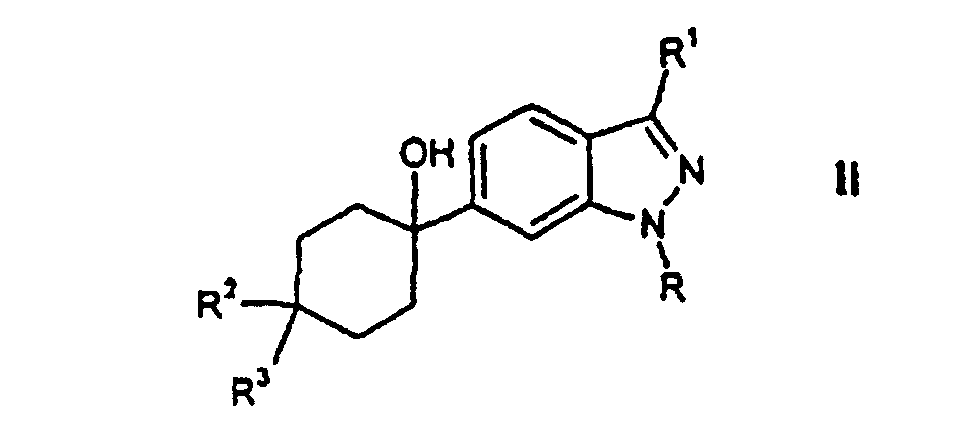
- Verfahren nach Anspruch 1, wobei die Cyanoeinheit und R3 in Formel I in cis-Stellung zueinander sind wie nachstehend:und die Lewis-Säure aus Zinntetrachlorid, Aluminiumtrichlorid, Zinkchlorid und Bortrichlorid ausgewählt ist, wobei die Verbindung der Formel II oder ein Salz davon mit Trimethylsilylcyanid behandelt wird, R aus Cyclohexyl, Cyclobutyl, Cyclopentyl, Methylencyclopropyl und Isopropyl ausgewählt ist, R1 C1-C2-Alkyl, gegebenenfalls substituiert mit 1 bis 3 Fluorsubstituenten, darstellt, R2 H darstellt und R3 -C(O)O(C1-C2-Alkyl), -CH2OH oder -C(O)NH2 darstellt.

- Verfahren nach Anspruch 2, wobei die Lewis-Säure Zinntetrachlorid darstellt, R Cyclohexyl darstellt, R1 Ethyl darstellt und R3 -C(O)O(C1-C2-Alkyl) darstellt.
- Verfahren nach Anspruch 1, wobei die Verbindung der Formel II oder ein Salz der Verbindung durch Behandeln einer Verbindung der Formeloder eines Salzes der Verbindung, wobei X1 Jod, Chlor oder Brom darstellt und R und R1 wie in Anspruch 1 definiert sind, mit einem Magnesium-, Cer- oder Organlithiumreagenz und dann Behandeln des erhaltenen Organometall-Zwischenprodukts mit einer Verbindung der Formel
 worin R2 und R3 wie in Anspruch 1 definiert sind, hergestellt wird.
- Verfahren nach Anspruch 4, wobei die Verbindung der Formel III mit einem Organolithiumreagenz behandelt wird, das C1-C10-Alkyllithium darstellt, X1 Brom darstellt, R aus Cyclohexyl, Cyclobutyl, Cyclopentyl, Methylencyclopropyl und Isopropyl ausgewählt ist, R1 C1-C2-Alkyl, gegebenenfalls substituiert mit 1 bis 3 Fluorsubstituenten, darstellt, R2 H darstellt, R3 -C(O)O(C1-C2-Alkyl), -CH2OH oder -C(O)NH2 darstellt.
- Verfahren nach Anspruch 5, wobei das Organolithiumreagenz n-Butyllithium darstellt, R Cyclohexyl darstellt, R1 Ethyl darstellt und R3 -C(O)O(C1-C2-Alkyl) darstellt.
- Verfahren nach Anspruch 4, wobei die Verbindung der Formel III oder ein Salz der Verbindung durch Erhitzen einer Verbindung der Formeloder eines Salzes der Verbindung, worin X1, R und R1 wie in Anspruch 4 definiert sind, und X2 Jod, Fluor, Brom, Chlor, Methansulfonat, Trifluormethansulfonat oder Phenylsulfonat darstellt, worin die Phenyleinheit des Phenylsulfonats gegebenenfalls mit 1 oder 2 Substituenten, unabhängig ausgewählt aus Halogen, Nitro und C1-C4-Alkyl, substituiert ist, auf eine Temperatur im Bereich von etwa 100°C bis etwa 200°C hergestellt wird.

- Verfahren nach Anspruch 7, wobei X2 Methansulfonat darstellt, X1 Brom darstellt, R aus Cyclohexyl, Cyclopentyl, Methylencyclopropyl und Isopropyl ausgewählt ist, R1 C1-C2-Alkyl, gegebenenfalls substituiert mit 1 bis 3 Fluorsubstituenten, darstellt und die Verbindung der Formel XI oder ein Salz der Verbindung, auf eine Temperatur im Bereich von etwa 100°C bis etwa 140°C erhitzt wird.
- Verfahren nach Anspruch 8, wobei R Cyclohexyl darstellt und R1 Ethyl darstellt.
- Verfahren nach Anspruch 7, wobei die Verbindung der Formel XI oder ein Salz der Verbindung durch Behandeln einer Verbindung der Formelworin X1, X2 und R1 wie in Anspruch 7 definiert sind, mit einer Verbindung der Formel
 oder einem Salz der Verbindung, worin R wie in Anspruch 7 definiert ist und entweder einer Säure, wenn die Verbindung der Formel V mit der freien Base der Verbindung der Formel VI behandelt wird, oder einer Base, wenn die Verbindung der Formel V mit einem Salz der Verbindung der Formel VI behandelt wird, hergestellt wird.
- Verfahren nach Anspruch 10, wobei die Verbindung der Formel V mit dem Hydrochlorid-, Hydrobromid-, Mesylat-, Tosylat- oder Oxalatsalz der Verbindung der Formel VI behandelt wird, X2 Methansulfonat darstellt, die Base Kaliumacetat oder Natriumacetat darstellt, X1 Brom darstellt, R aus Cyclohexyl, Cyclopentyl, Methylencyclopropyl und Isopropyl ausgewählt ist und R1 C1-C2-Alkyl, gegebenenfalls substituiert mit 1 bis 3 Fluorsubstituenten, darstellt.
- Verfahren nach Anspruch 10, wobei die Verbindung der Formel V mit der freien Base der Verbindung der Formel VI behandelt wird, X2 Methansulfonat darstellt, die Säure Ammoniumacetat darstellt, X1 Brom darstellt, R aus Cyclohexyl, Cyclobutyl, Cyclopentyl, Methylencyclopropyl und Isopropyl ausgewählt ist, und R1 C1-C2-Alkyl, gegebenenfalls substituiert mit 1 bis 3 Fluorsubstituenten, darstellt.
- Verfahren nach Anspruch 12, wobei R Cyclohexyl darstellt und R1 Ethyl darstellt.
- Verfahren nach Anspruch 11, wobei R Cyclohexyl darstellt, R1 Ethyl darstellt und die Verbindung der Formel V mit dem Hydrochloridsalz der Verbindung der Formel VI behandelt wird.
- Verfahren nach Anspruch 10, wobei die Verbindung der Formel V durch Behandeln einer Verbindung der Formelworin X1 und R1 wie in Anspruch 10 definiert sind, mit einer Base und einem zweiten Reagenz, ausgewählt aus Methansulfonylchlorid, Methansulfonylanhydrid, Trifluormethansulfonsäureanhydrid, Phenylsulfonylchlorid und Phenylsulfonylanhydrid, wobei die Phenyleinheiten des Phenylsulfonylchlorids und des Phenylsulfonylanhydrids gegebenenfalls mit 1 oder 2 Substituenten, unabhängig ausgewählt aus Halogen, Nitro und C1-C4-Alkyl, substituiert sind, hergestellt wird.
- Verfahren nach Anspruch 15, wobei das zweite Reagenz Methansulfonylchlorid darstellt, die Base Triethylamin, Diisopropylethylamin, Pyridin, gegebenenfalls substituiert mit 1 bis 3 C1-C6-Alkylgruppen, Kaliumhydroxid oder Natriumhydroxid darstellt, X1 Brom darstellt und R1 C1-C2-Alkyl, gegebenenfalls substituiert mit 1 bis 3 Fluorsubstituenten, darstellt.
- Verfahren nach Anspruch 16, wobei die Base Triethylamin darstellt und R1 Ethyl darstellt.
- Verfahren zur Herstellung einer Verbindung der Formeloder eines pharmazeutisch verträglichen Salzes der Verbindung, wobei
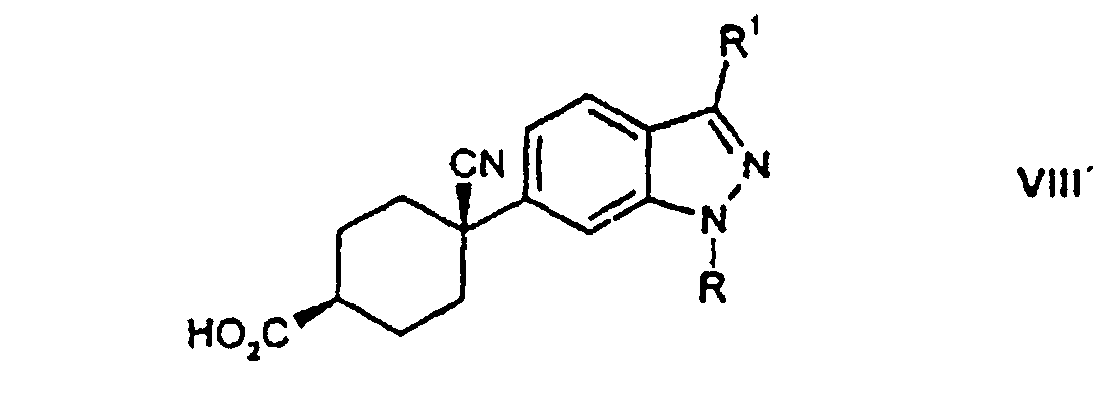 R C1-C10-Alkyl oder-(CH2)n-(Phenyl) darstellt, wobei n eine ganze Zahl im Bereich von 0 bis 2 ist und wobei die Gruppen R gegebenenfalls mit 1 bis 3 Substituenten, unabhängig ausgewählt aus Chlor, Fluor, C1-C6-Alkoxy und Trifluormethyl, substituiert sind;R1 C1-C10-Alkyl, C2-C6-Alkenyl oder Phenyl darstellt, wobei die Gruppen R1 gegebenenfalls mit 1 bis 3 Substituenten, unabhängig voneinander ausgewählt aus Trifluormethyl, Chlor und Fluor, substituiert sind, das Behandeln einer Verbindung der Formeloder eines Salzes der Verbindung, worin R und R1 wie für die Verbindung der Formel VIII definiert sind, und R6 -C(O)O(C1-C6-Alkyl), -CN, -C(O)NR4R5 oder -C(O)NR4OR5 darstellt, wobei R4 und R5 jeweils unabhängig voneinander H oder C1-C6-Alkyl darstellen, mit einer Base in einem alkoholischen Lösungsmittel der Formel R7-OH, worin R7 C1-C6-Alkyl darstellt, unter Bereitstellung einer Verbindung der Formel
 worin R und R1 wie für die Verbindung der Formel IX definiert sind und R7 wie für das alkoholische Lösungsmittel definiert ist und Hydrolysieren der Verbindung der Formel X zur Bereitstellung der Verbindung der Formel XIII oder eines pharmazeutisch verträglichen Salzes davon, umfasst.
- Verfahren nach Anspruch 18, wobei die Base Kalium-tert-butoxid, Natriumethoxid, Natriumhydrid, 1,1,3,3-Tetramethylguanidin, 1,8-Diazabicyclo[5.4.0]undec-7-en, 1,5-Diazabicyclo[4.3.0]non-5-en, Kaliumethoxid oder Natriummethoxid darstellt, das alkoholische Lösungsmittel Methanol, Ethanol oder Isopropanol darstellt, R aus Cyclohexyl, Cyclopentyl, Cyclobutyl, Methylencyclopropyl und Isopropyl ausgewählt ist, und R1 C1-C2-Alkyl, gegebenenfalls substituiert mit 1 bis 3 Fluorsubstituenten, darstellt.
- Verfahren nach Anspruch 19, wobei die Base Kalium-tert-butoxid darstellt, das alkoholische Lösungsmittel Methanol darstellt, R7 Methyl darstellt, R Cyclohexyl darstellt und R1 Ethyl darstellt.
- Verbindung der Formel (V):worin
 X1 Jod oder Brom darstellt, R1 (C2-C10)Alkyl, C2-C6-Alkenyl oder Phenyl darstellt, worin die Gruppen R1 gegebenenfalls mit 1 bis 3 Substituenten, unabhängig ausgewählt aus der Gruppe, bestehend aus Trifluormethyl, Chlor und Fluor, substituiert sind, darstellen, undX2 Methansulfonat, Trifluormethansulfonat oder Phenylsulfonat darstellt, wobei die Phenyleinheit des Phenylsulfonats gegebenenfalls mit 1 oder 2 Substituenten, unabhängig voneinander ausgewählt aus der Gruppe, bestehend aus Halogen, Nitro und C1-C4-Alkyl, substituiert ist.
 - Verbindung nach Anspruch 21, worin X1 Brom darstellt, X2 Methansulfonat darstellt und R1 C1-C2-Alkyl, gegebenenfalls substituiert mit 1 bis 3 Fluorsubstituenten, darstellt.
- Verbindung nach Anspruch 22, worin R1 Ethyl darstellt.
- Verbindung der Formeloder eines Salzes der Verbindung, worin
 X1 Jod, Chlor oder Brom darstellt;R C1-C10-Alkyl oder -(CH2)n-(Phenyl) darstellt, worin n eine ganze Zahl im Bereich von 0 bis 2 ist und wobei die Gruppen R gegebenenfalls mit 1 bis 3 Substituenten, unabhängig voneinander ausgewählt aus Chlor, Fluor, C1-C6-Alkoxy und Trifluormethyl, substituiert sind;R1 C1-C10-Alkyl, C2-C6-Alkenyl oder Phenyl darstellt, wobei die Gruppen R1 gegebenenfalls mit 1 bis 3 Substituenten, unabhängig voneinander ausgewählt aus Trifluormethyl, Chlor und Fluor, substituiert sind undX2 Methansulfonat, Trifluormethansulfonat oder Phenylsulfonat darstellt, wobei die Phenyleinheit des Phenylsulfonats gegebenenfalls mit ein oder zwei Substituenten, unabhängig ausgewählt aus Halogen, Nitro und C1-C4-Alkyl, substituiert ist.
 - Verbindung nach Anspruch 24, worin X1 Brom darstellt, X2 Methansulfonat darstellt, R Cyclohexyl darstellt und R1 Ethyl darstellt.
Applications Claiming Priority (3)
| Application Number | Priority Date | Filing Date | Title |
|---|---|---|---|
| US4685897P | 1997-05-08 | 1997-05-08 | |
| US46858P | 1997-05-08 | ||
| PCT/IB1998/000647 WO1998050367A1 (en) | 1997-05-08 | 1998-04-28 | Processes and intermediates for preparing substituted indazole derivatives |
Publications (2)
| Publication Number | Publication Date |
|---|---|
| EP0983249A1 EP0983249A1 (de) | 2000-03-08 |
| EP0983249B1 true EP0983249B1 (de) | 2002-03-13 |
Family
ID=21945777
Family Applications (1)
| Application Number | Title | Priority Date | Filing Date |
|---|---|---|---|
| EP98913997A Expired - Lifetime EP0983249B1 (de) | 1997-05-08 | 1998-04-28 | Verfahren und zwischenprodukte zur herstellung substituierter indazolderivate |
Country Status (12)
| Country | Link |
|---|---|
| US (1) | US6011159A (de) |
| EP (1) | EP0983249B1 (de) |
| JP (1) | JP3399546B2 (de) |
| AR (2) | AR015648A1 (de) |
| AT (1) | ATE214373T1 (de) |
| AU (1) | AU6849798A (de) |
| DE (1) | DE69804212T2 (de) |
| DK (1) | DK0983249T3 (de) |
| ES (1) | ES2172882T3 (de) |
| PT (1) | PT983249E (de) |
| WO (1) | WO1998050367A1 (de) |
| ZA (1) | ZA983842B (de) |
Families Citing this family (10)
| Publication number | Priority date | Publication date | Assignee | Title |
|---|---|---|---|---|
| AP1147A (en) * | 1996-05-03 | 2003-02-25 | Pfizer | Substituted indazole derivatives and related compounds. |
| IL126745A (en) * | 1997-11-04 | 2003-09-17 | Pfizer Prod Inc | Methods of preparing 4-cyano-4- (substituted indazole) cyclohexanecarboxylic acids useful as pde4 inhibitors |
| IL135714A0 (en) * | 1997-11-04 | 2001-05-20 | Pfizer Prod Inc | Therapeutically active compounds based on indazole bioisostere replacement of catechol in pde4 inhibitors |
| JP2000198734A (ja) * | 1998-12-30 | 2000-07-18 | Pfizer Inc | 胃運動性減弱および関連疾患の治療のための運動性増強薬 |
| KR100423899B1 (ko) * | 2000-05-10 | 2004-03-24 | 주식회사 엘지생명과학 | 세포 증식 억제제로 유용한 1,1-디옥소이소티아졸리딘을갖는 인다졸 |
| DE102004005172A1 (de) * | 2004-02-02 | 2005-08-18 | Aventis Pharma Deutschland Gmbh | Indazolderivate als Inhibitoren der Hormon Sensitiven Lipase |
| US7459469B2 (en) | 2004-11-10 | 2008-12-02 | Targacept, Inc. | Hydroxybenzoate salts of metanicotine compounds |
| UA88792C2 (ru) * | 2004-11-10 | 2009-11-25 | Таргасепт, Інк. | Гидроксибензоатные соли метаникотиновых соединений |
| TWI389889B (zh) | 2006-05-09 | 2013-03-21 | Targacept Inc | (2s)-(4e)-n-甲基-5-〔3-(5-異丙氧基吡啶)基〕-4-戊烯-2-胺之新穎多晶型 |
| US8017785B2 (en) | 2006-05-09 | 2011-09-13 | Astrazeneca Ab | Salt forms of (2S)-(4E)-N-methyl-5-[3-(5-isopropoxypyridin)y1]-4-penten 2-amine |
Family Cites Families (2)
| Publication number | Priority date | Publication date | Assignee | Title |
|---|---|---|---|---|
| KR970707124A (ko) * | 1994-10-20 | 1997-12-01 | 스피겔 알렌 제이 | 비사이클릭 테트라하이드로 피라졸로피리딘 및 약제로서 이의 용도(bicyclic tetrahydro pyrazolopyridines and their use as medicaments) |
| AP1147A (en) | 1996-05-03 | 2003-02-25 | Pfizer | Substituted indazole derivatives and related compounds. |
-
1998
- 1998-04-28 US US09/308,954 patent/US6011159A/en not_active Expired - Fee Related
- 1998-04-28 AU AU68497/98A patent/AU6849798A/en not_active Abandoned
- 1998-04-28 DK DK98913997T patent/DK0983249T3/da active
- 1998-04-28 JP JP54786398A patent/JP3399546B2/ja not_active Expired - Fee Related
- 1998-04-28 PT PT98913997T patent/PT983249E/pt unknown
- 1998-04-28 EP EP98913997A patent/EP0983249B1/de not_active Expired - Lifetime
- 1998-04-28 DE DE69804212T patent/DE69804212T2/de not_active Expired - Fee Related
- 1998-04-28 WO PCT/IB1998/000647 patent/WO1998050367A1/en not_active Ceased
- 1998-04-28 AT AT98913997T patent/ATE214373T1/de not_active IP Right Cessation
- 1998-04-28 ES ES98913997T patent/ES2172882T3/es not_active Expired - Lifetime
- 1998-05-07 AR ARP980102142A patent/AR015648A1/es unknown
- 1998-05-07 ZA ZA9803842A patent/ZA983842B/xx unknown
-
1999
- 1999-08-03 AR ARP990103861A patent/AR016737A1/es active IP Right Grant
Also Published As
| Publication number | Publication date |
|---|---|
| AR015648A1 (es) | 2001-05-16 |
| EP0983249A1 (de) | 2000-03-08 |
| JP3399546B2 (ja) | 2003-04-21 |
| AU6849798A (en) | 1998-11-27 |
| ZA983842B (en) | 1999-11-08 |
| AR016737A1 (es) | 2001-07-25 |
| WO1998050367A1 (en) | 1998-11-12 |
| DE69804212T2 (de) | 2002-07-25 |
| DE69804212D1 (de) | 2002-04-18 |
| PT983249E (pt) | 2002-08-30 |
| JP2000513019A (ja) | 2000-10-03 |
| ES2172882T3 (es) | 2002-10-01 |
| US6011159A (en) | 2000-01-04 |
| ATE214373T1 (de) | 2002-03-15 |
| DK0983249T3 (da) | 2002-07-08 |
Similar Documents
| Publication | Publication Date | Title |
|---|---|---|
| US5091525A (en) | Monohydrate and DMF solvates of a new carbacephem antibiotic | |
| EP0983249B1 (de) | Verfahren und zwischenprodukte zur herstellung substituierter indazolderivate | |
| JP2001505198A (ja) | Pde阻害剤としての置換ジヒドロベンゾフラン | |
| CN101160286B (zh) | 制备ccr-2拮抗剂的方法 | |
| DE69522642T2 (de) | Hymenialdisin und seine derivate, verfahren zur herstellung von zwischenprodukten zu ihrer synthese und besagte zwischenprodukte | |
| HK78895A (en) | Substituted 1H-imidazoles | |
| DE69231350T2 (de) | Indolizinderivate, Verfahren zu ihrer Herstellung und diese enthaltende pharmazeutische Zubereitungen | |
| US6005118A (en) | Methods of preparing 4-cyano-4 (substituted indazole) cyclohexane-carboxylic acids useful as PDE4 inhibitors | |
| US5322942A (en) | Synthesis of optically active lactones from L-aspartic acid and intermediates thereof | |
| JP3029424B2 (ja) | Pde4阻害剤として有用な4−シアノ−4−(置換インダゾール)シクロヘキサン−カルボン酸類を製造する改良法 | |
| DE69414586T2 (de) | Verfahren zur herstellung von indolizinderivaten | |
| JP2617960B2 (ja) | 光学活性カルボン酸をつくる立体異性化方法 | |
| US4022792A (en) | Methylidenepiperidines | |
| EP2212313A2 (de) | Synthese und kristalline formen eines cb-1-antagonisten/inversen agonisten | |
| EP0213080B1 (de) | Hydropyridin-Derivate | |
| JPH08501306A (ja) | キラルなキノロン誘導体 | |
| JPH0342276B2 (de) | ||
| US7057047B2 (en) | Methods for making 2-(7-chloro-1,8-naphthyridine-2-yl)-3-(5-methyl-2oxo-hexyl)-1-isoidolinone | |
| JP5247817B2 (ja) | ピリド[2,1−a]イソキノリン誘導体の製造方法 | |
| US4873328A (en) | Process for preparing alkoxyalkylidenehydrazinopyridazine derivatives | |
| JP3209679B2 (ja) | ジスルフィド化合物およびその製造法 | |
| JPS6153272A (ja) | グルタル酸誘導体の製法 | |
| TW202515552A (zh) | 製備4-(3,3-二氟-2,2-二甲基-丙醯基)-3,5-二氫-2h-吡啶并[3,4-f][1,4]氧雜氮呯-9-腈之方法 | |
| JPS6183161A (ja) | ピリジン誘導体 | |
| JPH05155882A (ja) | 新規なイミダゾール誘導体 |
Legal Events
| Date | Code | Title | Description |
|---|---|---|---|
| PUAI | Public reference made under article 153(3) epc to a published international application that has entered the european phase |
Free format text: ORIGINAL CODE: 0009012 |
|
| 17P | Request for examination filed |
Effective date: 19991104 |
|
| AK | Designated contracting states |
Kind code of ref document: A1 Designated state(s): AT BE CH CY DE DK ES FI FR GB GR IE IT LI LU NL PT SE |
|
| GRAG | Despatch of communication of intention to grant |
Free format text: ORIGINAL CODE: EPIDOS AGRA |
|
| GRAG | Despatch of communication of intention to grant |
Free format text: ORIGINAL CODE: EPIDOS AGRA |
|
| GRAH | Despatch of communication of intention to grant a patent |
Free format text: ORIGINAL CODE: EPIDOS IGRA |
|
| 17Q | First examination report despatched |
Effective date: 20010529 |
|
| GRAH | Despatch of communication of intention to grant a patent |
Free format text: ORIGINAL CODE: EPIDOS IGRA |
|
| REG | Reference to a national code |
Ref country code: GB Ref legal event code: IF02 |
|
| GRAA | (expected) grant |
Free format text: ORIGINAL CODE: 0009210 |
|
| AK | Designated contracting states |
Kind code of ref document: B1 Designated state(s): AT BE CH CY DE DK ES FI FR GB GR IE IT LI LU NL PT SE |
|
| REF | Corresponds to: |
Ref document number: 214373 Country of ref document: AT Date of ref document: 20020315 Kind code of ref document: T |
|
| REG | Reference to a national code |
Ref country code: CH Ref legal event code: EP |
|
| REG | Reference to a national code |
Ref country code: CH Ref legal event code: NV Representative=s name: E. BLUM & CO. PATENTANWAELTE |
|
| REF | Corresponds to: |
Ref document number: 69804212 Country of ref document: DE Date of ref document: 20020418 |
|
| ET | Fr: translation filed | ||
| REG | Reference to a national code |
Ref country code: DK Ref legal event code: T3 |
|
| REG | Reference to a national code |
Ref country code: PT Ref legal event code: SC4A Free format text: AVAILABILITY OF NATIONAL TRANSLATION Effective date: 20020516 |
|
| REG | Reference to a national code |
Ref country code: GR Ref legal event code: EP Ref document number: 20020402004 Country of ref document: GR |
|
| REG | Reference to a national code |
Ref country code: ES Ref legal event code: FG2A Ref document number: 2172882 Country of ref document: ES Kind code of ref document: T3 |
|
| PLBE | No opposition filed within time limit |
Free format text: ORIGINAL CODE: 0009261 |
|
| STAA | Information on the status of an ep patent application or granted ep patent |
Free format text: STATUS: NO OPPOSITION FILED WITHIN TIME LIMIT |
|
| 26N | No opposition filed |
Effective date: 20021216 |
|
| PGFP | Annual fee paid to national office [announced via postgrant information from national office to epo] |
Ref country code: DK Payment date: 20050314 Year of fee payment: 8 Ref country code: GB Payment date: 20050314 Year of fee payment: 8 Ref country code: AT Payment date: 20050314 Year of fee payment: 8 |
|
| PGFP | Annual fee paid to national office [announced via postgrant information from national office to epo] |
Ref country code: NL Payment date: 20050316 Year of fee payment: 8 |
|
| PGFP | Annual fee paid to national office [announced via postgrant information from national office to epo] |
Ref country code: FR Payment date: 20050401 Year of fee payment: 8 |
|
| PGFP | Annual fee paid to national office [announced via postgrant information from national office to epo] |
Ref country code: SE Payment date: 20050404 Year of fee payment: 8 |
|
| PGFP | Annual fee paid to national office [announced via postgrant information from national office to epo] |
Ref country code: PT Payment date: 20050406 Year of fee payment: 8 |
|
| PGFP | Annual fee paid to national office [announced via postgrant information from national office to epo] |
Ref country code: FI Payment date: 20050413 Year of fee payment: 8 |
|
| PGFP | Annual fee paid to national office [announced via postgrant information from national office to epo] |
Ref country code: IE Payment date: 20050414 Year of fee payment: 8 |
|
| PGFP | Annual fee paid to national office [announced via postgrant information from national office to epo] |
Ref country code: GR Payment date: 20050421 Year of fee payment: 8 Ref country code: ES Payment date: 20050421 Year of fee payment: 8 |
|
| PGFP | Annual fee paid to national office [announced via postgrant information from national office to epo] |
Ref country code: BE Payment date: 20050428 Year of fee payment: 8 |
|
| PGFP | Annual fee paid to national office [announced via postgrant information from national office to epo] |
Ref country code: DE Payment date: 20050429 Year of fee payment: 8 |
|
| PGFP | Annual fee paid to national office [announced via postgrant information from national office to epo] |
Ref country code: LU Payment date: 20050603 Year of fee payment: 8 |
|
| PGFP | Annual fee paid to national office [announced via postgrant information from national office to epo] |
Ref country code: CH Payment date: 20050613 Year of fee payment: 8 |
|
| PGFP | Annual fee paid to national office [announced via postgrant information from national office to epo] |
Ref country code: CY Payment date: 20050621 Year of fee payment: 8 |
|
| PG25 | Lapsed in a contracting state [announced via postgrant information from national office to epo] |
Ref country code: IE Free format text: LAPSE BECAUSE OF NON-PAYMENT OF DUE FEES Effective date: 20060428 Ref country code: GB Free format text: LAPSE BECAUSE OF NON-PAYMENT OF DUE FEES Effective date: 20060428 Ref country code: FI Free format text: LAPSE BECAUSE OF NON-PAYMENT OF DUE FEES Effective date: 20060428 Ref country code: CY Free format text: LAPSE BECAUSE OF NON-PAYMENT OF DUE FEES Effective date: 20060428 Ref country code: AT Free format text: LAPSE BECAUSE OF NON-PAYMENT OF DUE FEES Effective date: 20060428 |
|
| PG25 | Lapsed in a contracting state [announced via postgrant information from national office to epo] |
Ref country code: SE Free format text: LAPSE BECAUSE OF NON-PAYMENT OF DUE FEES Effective date: 20060429 Ref country code: ES Free format text: LAPSE BECAUSE OF NON-PAYMENT OF DUE FEES Effective date: 20060429 |
|
| PG25 | Lapsed in a contracting state [announced via postgrant information from national office to epo] |
Ref country code: LU Free format text: LAPSE BECAUSE OF NON-PAYMENT OF DUE FEES Effective date: 20060430 Ref country code: LI Free format text: LAPSE BECAUSE OF NON-PAYMENT OF DUE FEES Effective date: 20060430 Ref country code: CH Free format text: LAPSE BECAUSE OF NON-PAYMENT OF DUE FEES Effective date: 20060430 Ref country code: BE Free format text: LAPSE BECAUSE OF NON-PAYMENT OF DUE FEES Effective date: 20060430 |
|
| PGFP | Annual fee paid to national office [announced via postgrant information from national office to epo] |
Ref country code: IT Payment date: 20060430 Year of fee payment: 9 |
|
| PG25 | Lapsed in a contracting state [announced via postgrant information from national office to epo] |
Ref country code: DK Free format text: LAPSE BECAUSE OF NON-PAYMENT OF DUE FEES Effective date: 20060501 |
|
| PG25 | Lapsed in a contracting state [announced via postgrant information from national office to epo] |
Ref country code: PT Free format text: LAPSE BECAUSE OF NON-PAYMENT OF DUE FEES Effective date: 20061030 |
|
| PG25 | Lapsed in a contracting state [announced via postgrant information from national office to epo] |
Ref country code: NL Free format text: LAPSE BECAUSE OF NON-PAYMENT OF DUE FEES Effective date: 20061101 Ref country code: DE Free format text: LAPSE BECAUSE OF NON-PAYMENT OF DUE FEES Effective date: 20061101 |
|
| REG | Reference to a national code |
Ref country code: DK Ref legal event code: EBP |
|
| REG | Reference to a national code |
Ref country code: CH Ref legal event code: PL |
|
| EUG | Se: european patent has lapsed | ||
| GBPC | Gb: european patent ceased through non-payment of renewal fee |
Effective date: 20060428 |
|
| REG | Reference to a national code |
Ref country code: PT Ref legal event code: MM4A Free format text: LAPSE DUE TO NON-PAYMENT OF FEES Effective date: 20061030 |
|
| NLV4 | Nl: lapsed or anulled due to non-payment of the annual fee |
Effective date: 20061101 |
|
| REG | Reference to a national code |
Ref country code: IE Ref legal event code: MM4A |
|
| REG | Reference to a national code |
Ref country code: FR Ref legal event code: ST Effective date: 20061230 |
|
| REG | Reference to a national code |
Ref country code: ES Ref legal event code: FD2A Effective date: 20060429 |
|
| BERE | Be: lapsed |
Owner name: *PFIZER PRODUCTS INC. Effective date: 20060430 |
|
| PG25 | Lapsed in a contracting state [announced via postgrant information from national office to epo] |
Ref country code: FR Free format text: LAPSE BECAUSE OF NON-PAYMENT OF DUE FEES Effective date: 20060502 |
|
| PG25 | Lapsed in a contracting state [announced via postgrant information from national office to epo] |
Ref country code: GR Free format text: LAPSE BECAUSE OF NON-PAYMENT OF DUE FEES Effective date: 20061102 |
|
| PG25 | Lapsed in a contracting state [announced via postgrant information from national office to epo] |
Ref country code: IT Free format text: LAPSE BECAUSE OF NON-PAYMENT OF DUE FEES Effective date: 20070428 |