EP0959622B1 - Procédé de connexion à un serveur pour réseau utilisant un navigateur - Google Patents
Procédé de connexion à un serveur pour réseau utilisant un navigateur Download PDFInfo
- Publication number
- EP0959622B1 EP0959622B1 EP99303393A EP99303393A EP0959622B1 EP 0959622 B1 EP0959622 B1 EP 0959622B1 EP 99303393 A EP99303393 A EP 99303393A EP 99303393 A EP99303393 A EP 99303393A EP 0959622 B1 EP0959622 B1 EP 0959622B1
- Authority
- EP
- European Patent Office
- Prior art keywords
- server device
- server
- register
- devices
- identification information
- Prior art date
- Legal status (The legal status is an assumption and is not a legal conclusion. Google has not performed a legal analysis and makes no representation as to the accuracy of the status listed.)
- Expired - Lifetime
Links
Images


Classifications
-
- H—ELECTRICITY
- H04—ELECTRIC COMMUNICATION TECHNIQUE
- H04N—PICTORIAL COMMUNICATION, e.g. TELEVISION
- H04N21/00—Selective content distribution, e.g. interactive television or video on demand [VOD]
- H04N21/40—Client devices specifically adapted for the reception of or interaction with content, e.g. set-top-box [STB]; Operations thereof
- H04N21/41—Structure of client; Structure of client peripherals
- H04N21/4104—Peripherals receiving signals from specially adapted client devices
- H04N21/4108—Peripherals receiving signals from specially adapted client devices characterised by an identification number or address, e.g. local network address
-
- G—PHYSICS
- G06—COMPUTING OR CALCULATING; COUNTING
- G06F—ELECTRIC DIGITAL DATA PROCESSING
- G06F15/00—Digital computers in general; Data processing equipment in general
- G06F15/16—Combinations of two or more digital computers each having at least an arithmetic unit, a program unit and a register, e.g. for a simultaneous processing of several programs
-
- H—ELECTRICITY
- H04—ELECTRIC COMMUNICATION TECHNIQUE
- H04L—TRANSMISSION OF DIGITAL INFORMATION, e.g. TELEGRAPHIC COMMUNICATION
- H04L9/00—Cryptographic mechanisms or cryptographic arrangements for secret or secure communications; Network security protocols
- H04L9/40—Network security protocols
-
- H—ELECTRICITY
- H04—ELECTRIC COMMUNICATION TECHNIQUE
- H04N—PICTORIAL COMMUNICATION, e.g. TELEVISION
- H04N21/00—Selective content distribution, e.g. interactive television or video on demand [VOD]
- H04N21/40—Client devices specifically adapted for the reception of or interaction with content, e.g. set-top-box [STB]; Operations thereof
- H04N21/43—Processing of content or additional data, e.g. demultiplexing additional data from a digital video stream; Elementary client operations, e.g. monitoring of home network or synchronising decoder's clock; Client middleware
- H04N21/436—Interfacing a local distribution network, e.g. communicating with another STB or one or more peripheral devices inside the home
- H04N21/43615—Interfacing a Home Network, e.g. for connecting the client to a plurality of peripherals
-
- H—ELECTRICITY
- H04—ELECTRIC COMMUNICATION TECHNIQUE
- H04N—PICTORIAL COMMUNICATION, e.g. TELEVISION
- H04N21/00—Selective content distribution, e.g. interactive television or video on demand [VOD]
- H04N21/40—Client devices specifically adapted for the reception of or interaction with content, e.g. set-top-box [STB]; Operations thereof
- H04N21/43—Processing of content or additional data, e.g. demultiplexing additional data from a digital video stream; Elementary client operations, e.g. monitoring of home network or synchronising decoder's clock; Client middleware
- H04N21/436—Interfacing a local distribution network, e.g. communicating with another STB or one or more peripheral devices inside the home
- H04N21/4363—Adapting the video stream to a specific local network, e.g. a Bluetooth® network
- H04N21/43632—Adapting the video stream to a specific local network, e.g. a Bluetooth® network involving a wired protocol, e.g. IEEE 1394
-
- H—ELECTRICITY
- H04—ELECTRIC COMMUNICATION TECHNIQUE
- H04N—PICTORIAL COMMUNICATION, e.g. TELEVISION
- H04N21/00—Selective content distribution, e.g. interactive television or video on demand [VOD]
- H04N21/40—Client devices specifically adapted for the reception of or interaction with content, e.g. set-top-box [STB]; Operations thereof
- H04N21/45—Management operations performed by the client for facilitating the reception of or the interaction with the content or administrating data related to the end-user or to the client device itself, e.g. learning user preferences for recommending movies, resolving scheduling conflicts
- H04N21/462—Content or additional data management e.g. creating a master electronic programme guide from data received from the Internet and a Head-end or controlling the complexity of a video stream by scaling the resolution or bit-rate based on the client capabilities
- H04N21/4622—Retrieving content or additional data from different sources, e.g. from a broadcast channel and the Internet
-
- H—ELECTRICITY
- H04—ELECTRIC COMMUNICATION TECHNIQUE
- H04N—PICTORIAL COMMUNICATION, e.g. TELEVISION
- H04N21/00—Selective content distribution, e.g. interactive television or video on demand [VOD]
- H04N21/40—Client devices specifically adapted for the reception of or interaction with content, e.g. set-top-box [STB]; Operations thereof
- H04N21/47—End-user applications
-
- H—ELECTRICITY
- H04—ELECTRIC COMMUNICATION TECHNIQUE
- H04N—PICTORIAL COMMUNICATION, e.g. TELEVISION
- H04N21/00—Selective content distribution, e.g. interactive television or video on demand [VOD]
- H04N21/40—Client devices specifically adapted for the reception of or interaction with content, e.g. set-top-box [STB]; Operations thereof
- H04N21/47—End-user applications
- H04N21/478—Supplemental services, e.g. displaying phone caller identification, shopping application
- H04N21/4782—Web browsing, e.g. WebTV
-
- H—ELECTRICITY
- H04—ELECTRIC COMMUNICATION TECHNIQUE
- H04L—TRANSMISSION OF DIGITAL INFORMATION, e.g. TELEGRAPHIC COMMUNICATION
- H04L67/00—Network arrangements or protocols for supporting network services or applications
- H04L67/01—Protocols
- H04L67/02—Protocols based on web technology, e.g. hypertext transfer protocol [HTTP]
-
- H—ELECTRICITY
- H04—ELECTRIC COMMUNICATION TECHNIQUE
- H04N—PICTORIAL COMMUNICATION, e.g. TELEVISION
- H04N21/00—Selective content distribution, e.g. interactive television or video on demand [VOD]
- H04N21/40—Client devices specifically adapted for the reception of or interaction with content, e.g. set-top-box [STB]; Operations thereof
- H04N21/41—Structure of client; Structure of client peripherals
- H04N21/426—Internal components of the client ; Characteristics thereof
Definitions
- the present invention relates to a home network, and more particularly, to a method for connecting to server devices through browsers in a browser-based home network.
- FIG. 1 shows a protocol stack that general IEEE 1394 devices have.
- a physical layer 100 which is the lowest layer receives a bit stream from a link layer 110 which is an upper layer during transmission and acquires the right to use a serial bus.
- the physical layer encodes the bit stream, converts the encoded bit stream into an electrical signal, and transmits data to the bus. During reception, the process is reversed.
- the link layer 110 manages data in units of a packet, integrates and disintegrates a packet, detects errors, and manages a bus cycle.
- a transaction layer 120 provides a transaction such as read, write, and lock and performs asynchronous communications with other nodes on a 1394 bus using services provided by lower layers.
- a function control protocol FCP 130 and a connection management protocol CMP 130 are defined.
- the CMP defines the structure of software for managing the isochronous connection between devices.
- the FCP provides a framework for transmitting commands such as an A/V control command and transaction set AV/C CTS.
- Another characteristic of the IEC 61883 is to define a common isochronous packet CIP header structure.
- the CIP header has information on a source stream included in the isochronous packet.
- a control command is used in order to control the devices in a conventional specification meeting the specification of the IEEE 1394 and the specification of the IEC 61883.
- the AV/C CTS is a representative control command. Every function of devices is defined by a code of a hexadecimal number system. For example, a play command of the VCR is defined as "0xC8".
- one device may be used as a control center for controlling other devices.
- the device for controlling other devices is called a controller and the devices to be controlled are called target devices.
- the controller should include all the command sets with respect to the respective target devices, which is a considerable burden on the target devices in respect of software and hardware.
- the target devices do not know commands other than the commands included when products are brought to market, they cannot control new client devices. Therefore, it is not possible to easily conform to a digitized home device market which rapidly changes.
- it is not easy to provide a graphical user interface. It is difficult to define a unified type of GUI which can be applied to all kinds of devices. Also, defining the type of GUI with respect to each group of products has its limitations. Such problems are due to inconsistency of architecture. The problems can be easily solved by selecting a client/server method as in the widely applied TCP/IP architecture.
- FIG. 2 shows a protocol stack to which the present invention is applied.
- Each device operates like a web server on the Internet.
- the IEEE 1394 is used as a network interface.
- a TCP/IP layer is put on the IEEE 1394.
- Every device operates as an HTTP server, i.e., a web server, and has an HTML document hierarchy which describes its own function.
- a device which has a display device such as a DTV or a PC includes the web server and operates as a web client.
- a user accesses the respective home pages from web server devices using web browsers built into the client device, thus controlling corresponding devices.
- a server device which has a web browser accesses a web server device by the browsers thereof and controls the server device which operates as the web server.
- connection to the server device should be made by the web browser.
- the method for contacting the server devices through web browsers should be convenient to the user.
- the server devices desired by the user should be distinguished from the server devices which are not desired by the user during the connection.
- the connection should be performed considering compatibility among the server devices with respect to data formats.
- EP 0838768 describes a web interfacing device in which web access functionality is embedded in a device comprising a web server providing access to the user interface functions for the device through a device web page, and a network interface in the device enabling access to the web page by a web browser such that a user of the web browser accesses the user interface functions of the device through the web page.
- a method for connecting to server devices of a browser-based network the network having at least one server device for performing the function of a web server and at least one client device for performing the function of a web browser, the at least one server device being controllable through the web browser of the at least one client device, the method comprising the steps of: preparing a home page of the client device so as to display server device icons corresponding to each server device; selecting the server device to be connected to in the home page; reading from the selected server device a first register (OPCR) in which the operation state and the channel information of the selected server device are recorded; the method characterised by the step of: performing connecting to the selected server device by recording the channel number of the server device in a second state register (IPCR) of an IEEE 1394 node when the read operation state is active, or checking the operation state of the server device by reading the first register (OPCR) at predetermined time intervals when the read operation state is inactive, wherein the first register (OPCR) is the output plug cozatrol
- the method further comprises the steps of preparing the home page of the client device including an identification information storing unit of the server devices to be connected to; checking whether the server device selected in the step of selecting the server device is registered in the identification information storing portion; and reading the first register (OPCR) only when the selected server device is registered in the identification information storing unit and not connecting to the server device when the selected server device is not registered in the identification information storing unit.
- OPCR first register
- FIG. 3 shows an example of a home network to which the present invention is applied.
- a digital TV (DTV) 300, a DVCR 310, and a set-top box 320 are connected to each other through an IEEE 1394 bus, thus forming a home network system for use in a domestic environment or any other suitable environment.
- DTV digital TV
- DVCR digital TV
- set-top box 320 are connected to each other through an IEEE 1394 bus, thus forming a home network system for use in a domestic environment or any other suitable environment.
- the home network system has a protocol stack of the structure shown in Figure 2.
- the DTV 300 is a client device into which web browsers are loaded. Any digital device including a display device, into which a web browser is loaded, such as a personal computer (PC) can be used as the DTV 300.
- the DVCR 310 and the set-top box 320 into which web servers are loaded are the server device.
- a user can control the server device by accessing web pages provided by the web servers loaded into the server device such as the DVCR 310 and the set-top box 320 using the web browsers loaded into the client device such as the DTV.
- Figure 4 shows an example of the architecture of the home page of the DTV 300 having a web browser in the browser-based home network according to the present invention.
- a DTV 410, a DVCR 420, and a set-top box (STB) 430 are displayed as icons on a web browser window 400.
- the above architecture of the screen is only an example and can vary.
- 'Vol[100]' indicates that the volume level is set to 100.
- the volume can be increased by pressing the '+' button 502 and decreased by pressing the '-' button 504.
- 'CH[4]' indicates that the current channel is 4.
- the '+' button 512 is pressed to change the channel to a higher channel.
- the '-' button 514 is pressed to change the channel to a lower channel.
- 'SRC[STB]' shows the server device which currently providing data. Here, it means that the server device is the set-top box.
- 'SRC' 522 is a button for selecting the server device to be displayed.
- the server device is changed by pressing the SRC button 522.
- SRC [DVCR] is displayed in the source device 520 by pressing the SRC button 522 once more.
- the SEL button 524 is a button for confirming that the Vol[100], the CH[4], and the SRC[STB] are set as the user wishes.
- the SEL button 524 is pressed, the above setting is performed and is displayed. Namely, under the conditions shown in Figure 5, connection to the set-top box is performed. The loudness of the volume becomes 100.
- the channel number 4 of the set-top box is displayed.
- the architecture of the screen shown in Figure 5 and the information on the STB when the STB 430 is clicked are examples only and many additions and alterations are envisaged.
- the displayed menu screen can be operated, for example, by using a mouse or by a touch screen.
- any suitable user interface may be employed.
- a power screen 600 is displayed in a way in which 'POWER ON' alternates with 'POWER OFF'.
- contents 700 corresponding to the currently set channel here, CH 11 are displayed as shown in Figure 7.
- Figure 8 is a flowchart describing a method of connecting to the server devices without pressing the SEL button 524.
- the client device in which the web browsers are installed i.e., the DTV 300 shown in Figure 3, include an identification information storing unit for storing the identification information of the server devices for identifying the server devices available for connection on the network.
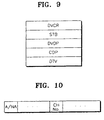
- Figure 9 shows an example of the identification information storing unit.
- the identification information storing unit suitably stores the ID of the server device.
- the identification information storing unit is for limiting the device a user wishes to connect to when various servers exist and for connecting to only a compatible server device, considering the compatibility of the server devices.
- a user prepares an identification information storing unit on which the server device which the user wishes to connect to is registered in the web browser of the DTV 300.
- the web browser of the DTV 300 displays the icon of the server device.
- an icon corresponding to the server device to be connected to is selected (step 800).
- the process is terminated (step 860).
- the output plug control register OPCR of the server device is read from the web browser (step 820).
- the OPCR is a register located in the server device for storing information related to data output to the IEEE 1394 bus of the server device.
- FIG 10 shows an example of the OPCR.
- the OPCR includes information A/NA) showing whether the server device outputs data to the IEEE 1394 bus and a channel number (CH No.) when the server device outputs data to the IEEE 1394 bus. If it is noted from the information A/NA on the state of the server device that the state of the server device is active by reading the OPCR of the server device (step 830), the channel number (CH No.) of the server device is read out, the CH No. is recorded in IPCR, and the connection to the server device is performed (step 840). When the state of the server device is inactive, it is checked whether the selection of the server device to be connected to is cancelled (step 850). When the selection is cancelled, the process is terminated. When the selection is not cancelled, the step 820 is performed.
- the architecture of the home network shown in Figure 3 shows only a small part of the home network.
- the DTV can be replaced by any suitable digital device that includes a user interface such as a display device, into which the web browsers are loaded.
- the web browser may be operated via a PC.
- the architecture of the home network can vary considerably from that described herein.
- the home device includes every digital device suitable for use in a domestic or other similar environment, including but not limited to a TV, a VCR, an audio device, a digital satellite service device, a sprinkler system, a lighting system, or conventional home appliances such as a refrigerator, oven, or range.
- the above embodiment of the present invention can be written as a program which can be executed by a computer and can be realized in a generally used digital computer for operating the program from media used in a computer.
- the media includes storing media such as magnetic storing media, for example, ROM, a floppy disk, and a hard disk, optical reading media, for example, a CD-ROM and a DVD, and a carrier wave transmitted by Internet.
- the recording media stores a program code for executing the steps of preparing the home page of the client device so as to display server device icons for selecting server devices to be connected to, selecting the server devices to be connected to from the home page, reading a state register OPCR for recording the operation state and the channel information of the selected server device from the server device, and completing connection to the server device by recording the channel number of the server device in the state register IPCR when the read operation state is active and checking the operation state of the server device by reading the state register OPCR at predetermined time intervals when the read operation state is inactive in a method for contacting the server device in the browser-based home network having server devices including the function of a web server and client devices into which the web browsers are loaded for controlling the server devices through the web browsers.
- the program further includes a program code for executing the steps of preparing the home page of the client device including the identification information storing unit of the server devices to be connected to, checking whether the server device selected in the step of selecting the server device is registered in the identification information storing unit, and reading the state register OPCR only when the selected server device is registered in the identification information storing unit and not connecting to the server device when the server device is not registered in the identification information storing unit, in the computer.
- a user can easily and rapidly connect to the server devices through browsers in the browser-based home network.
Landscapes
- Engineering & Computer Science (AREA)
- Signal Processing (AREA)
- Multimedia (AREA)
- Computer Security & Cryptography (AREA)
- Computer Networks & Wireless Communication (AREA)
- Databases & Information Systems (AREA)
- General Engineering & Computer Science (AREA)
- Theoretical Computer Science (AREA)
- Computer Hardware Design (AREA)
- General Physics & Mathematics (AREA)
- Physics & Mathematics (AREA)
- Software Systems (AREA)
- Computer And Data Communications (AREA)
- Small-Scale Networks (AREA)
- Selective Calling Equipment (AREA)
Claims (3)
- Procédé de connexion à des dispositifs serveurs d'un réseau utilisant un navigateur, le réseau ayant au moins un dispositif serveur (310, 320) pour remplir la fonction d'un serveur Web et au moins un dispositif client (300) pour remplir la fonction d'un navigateur Web, l'au moins un dispositif serveur (310, 320) pouvant être commandé par l'intermédiaire du navigateur Web de l'au moins un dispositif client (300), le procédé comprenant les étapes consistant à :préparer une page d'accueil du dispositif client (300) de manière à afficher des icones de dispositif serveur (420, 430) correspondant à chaque dispositif serveur (310, 320) ;sélectionner le dispositif serveur (310) auquel se connecter dans la page d'accueil ;lire depuis le dispositif serveur sélectionné (310) un premier registre (OPCR) dans lequel l'état opérationnel et les informations de canal du dispositif serveur sélectionné sont enregistrés ; le procédé étant caractérisé par l'étape consistant à :établir une connexion au dispositif serveur sélectionné (310) en enregistrant le numéro de canal du dispositif serveur dans un second registre d'état (IPCR) d'un noeud IEEE 1394 lorsque l'état opérationnel lu est actif, ou vérifier l'état opérationnel du dispositif serveur (310) en lisant le premier registre (OPCR) à des intervalles de temps prédéterminés lorsque l'état opérationnel lu est inactif, le premier registre (OPCR) étant le registre de commande de branchement de sortie d'un noeud IEEE 1394 et le second registre d'état (IPCR) étant le registre de commande de branchement d'entrée d'un noeud IEEE 1394.
- Procédé selon la revendication 1, comprenant en outre les étapes consistant à:préparer la page d'accueil du dispositif client (300) comprenant une unité de stockage d'informations d'identification des dispositifs serveurs auxquels se connecter ;déterminer si le dispositif serveur (310, 320) sélectionné dans l'étape de sélection du dispositif serveur est enregistré dans la partie de stockage d'informations d'identification ; etlire le premier registre (OPCR) uniquement lorsque le dispositif serveur sélectionné (310) est enregistré dans l'unité de stockage d'informations d'identification et ne pas se connecter au dispositif serveur lorsque le dispositif serveur sélectionné (310) n'est pas enregistré dans l'unité de stockage d'informations d'identification.
- Procédé selon la revendication 2, dans lequel il est déterminé si le dispositif serveur (310, 320) est enregistré en se référant à l'identifiant du dispositif serveur.
Applications Claiming Priority (2)
| Application Number | Priority Date | Filing Date | Title |
|---|---|---|---|
| KR9818661 | 1998-05-23 | ||
| KR1019980018661A KR100385967B1 (ko) | 1998-05-23 | 1998-05-23 | 네트웍상에서의서버기기접속방법 |
Publications (3)
| Publication Number | Publication Date |
|---|---|
| EP0959622A2 EP0959622A2 (fr) | 1999-11-24 |
| EP0959622A3 EP0959622A3 (fr) | 2004-01-02 |
| EP0959622B1 true EP0959622B1 (fr) | 2006-03-29 |
Family
ID=36274110
Family Applications (1)
| Application Number | Title | Priority Date | Filing Date |
|---|---|---|---|
| EP99303393A Expired - Lifetime EP0959622B1 (fr) | 1998-05-23 | 1999-04-29 | Procédé de connexion à un serveur pour réseau utilisant un navigateur |
Country Status (5)
| Country | Link |
|---|---|
| US (1) | US6785720B1 (fr) |
| EP (1) | EP0959622B1 (fr) |
| JP (1) | JP3133036B2 (fr) |
| KR (1) | KR100385967B1 (fr) |
| DE (1) | DE69930585T2 (fr) |
Families Citing this family (27)
| Publication number | Priority date | Publication date | Assignee | Title |
|---|---|---|---|---|
| CN1867068A (zh) | 1998-07-14 | 2006-11-22 | 联合视频制品公司 | 交互式电视节目导视系统及其方法 |
| AR020608A1 (es) | 1998-07-17 | 2002-05-22 | United Video Properties Inc | Un metodo y una disposicion para suministrar a un usuario acceso remoto a una guia de programacion interactiva por un enlace de acceso remoto |
| US7032024B1 (en) * | 1999-07-29 | 2006-04-18 | Samsung Electronics Co., Ltd. | Connection management method for devices connected digital interface and command structure therefor |
| US6823399B2 (en) * | 1999-12-06 | 2004-11-23 | Sony Corporation | Apparatus control method and transmission device |
| US20010046231A1 (en) * | 2000-04-20 | 2001-11-29 | Masahide Hirasawa | Communication control apparatus |
| US7603301B1 (en) * | 2000-04-26 | 2009-10-13 | Accenture Llp | Verification and printing of a tax return in a network-based tax architecture |
| US7234103B1 (en) | 2000-04-26 | 2007-06-19 | Accenture Llp | Network-based tax framework database |
| JP2001359176A (ja) * | 2000-06-13 | 2001-12-26 | Sanyo Electric Co Ltd | 遠隔操作可能な情報処理装置 |
| US20010053274A1 (en) * | 2000-06-20 | 2001-12-20 | Koninklijke Philips Electronics N.V. | System and method for remote control of consumer electronics over data network with visual feedback |
| KR100672348B1 (ko) * | 2000-07-31 | 2007-01-24 | 엘지전자 주식회사 | 디바이스간의 데이터 리드\라이트 방법 |
| US7620703B1 (en) * | 2000-08-10 | 2009-11-17 | Koninklijke Philips Electronics N.V. | Topical service provides context information for a home network |
| KR100667742B1 (ko) | 2000-08-23 | 2007-01-11 | 삼성전자주식회사 | 제어기기의 적어도 하나 이상의 피제어기기 제어 방법 |
| ES2312475T3 (es) | 2000-10-11 | 2009-03-01 | United Video Properties, Inc. | Sistemas y metodos para proporcionar el almacenamiento de datos en servidores de un sistema de entrega de medios bajo demanda. |
| KR20020047625A (ko) * | 2000-12-13 | 2002-06-22 | 구자홍 | 가정용기기 원격제어장치 |
| KR100434270B1 (ko) * | 2001-05-30 | 2004-06-04 | 엘지전자 주식회사 | 가전기기 네트워크 제어시스템 |
| US6834313B1 (en) * | 2001-06-19 | 2004-12-21 | Advanced Micro Devices, Inc. | Performing a two-step read on a MAC register in a home network as an atomic read |
| JP3844218B2 (ja) * | 2002-04-03 | 2006-11-08 | ソニー株式会社 | 信号処理システム、信号入力装置及び通信制御方法 |
| JP3730599B2 (ja) * | 2002-06-27 | 2006-01-05 | 株式会社東芝 | サーバ装置および状態制御方法 |
| KR100911074B1 (ko) * | 2002-10-01 | 2009-08-06 | 엘지전자 주식회사 | 홈 네트웍에서 기기 특성 데이터의 전송 가능 판별 장치및 그 방법 |
| US8346902B2 (en) * | 2003-07-31 | 2013-01-01 | International Business Machines Corporation | Performing device configuration rediscovery |
| US20050138546A1 (en) * | 2003-12-23 | 2005-06-23 | Microsoft Corporation | Personalized web page on a home network for viewing on a television |
| JP2005327183A (ja) * | 2004-05-17 | 2005-11-24 | Fujitsu Ltd | 情報提供装置 |
| US20060112171A1 (en) * | 2004-11-19 | 2006-05-25 | Rader Shawn T | System and method to control devices using a remote control device via hypertext transfer protocol (HTTP) |
| US20100037252A1 (en) * | 2008-08-06 | 2010-02-11 | Ravikiran Pasupuleti Sureshbabu | Secured-tele-micro-browser for enabling internet browsing on a television |
| JP5310007B2 (ja) * | 2008-10-16 | 2013-10-09 | ソニー株式会社 | 情報処理システム、表示装置、出力装置および情報処理装置 |
| US10063934B2 (en) | 2008-11-25 | 2018-08-28 | Rovi Technologies Corporation | Reducing unicast session duration with restart TV |
| US9769538B2 (en) * | 2012-12-17 | 2017-09-19 | Cox Communications, Inc. | Systems and methods for content delivery |
Family Cites Families (40)
| Publication number | Priority date | Publication date | Assignee | Title |
|---|---|---|---|---|
| JPS57176476A (en) * | 1981-04-24 | 1982-10-29 | Hitachi Ltd | Transaction processing system |
| DE3735631A1 (de) | 1987-10-21 | 1989-05-03 | Bosch Gmbh Robert | Zuendeinrichtung fuer eine brennkraftmaschine |
| EP0435344B1 (fr) | 1989-12-28 | 1995-10-25 | Canon Kabushiki Kaisha | Appareil terminal multimédia |
| GB9011700D0 (en) | 1990-05-25 | 1990-07-18 | Inmos Ltd | Communication interface |
| JP3251640B2 (ja) * | 1992-06-18 | 2002-01-28 | 株式会社東芝 | データ伝送方法とその装置 |
| EP1085701A3 (fr) * | 1994-03-09 | 2001-07-04 | Matsushita Electric Industrial Co., Ltd. | Système et procédé de transmission de données |
| US5655148A (en) * | 1994-05-27 | 1997-08-05 | Microsoft Corporation | Method for automatically configuring devices including a network adapter without manual intervention and without prior configuration information |
| US5689244A (en) | 1994-06-24 | 1997-11-18 | Sony Corporation | Communication system and electronic apparatus |
| US5657221A (en) * | 1994-09-16 | 1997-08-12 | Medialink Technologies Corporation | Method and apparatus for controlling non-computer system devices by manipulating a graphical representation |
| DE69634500T2 (de) | 1995-06-15 | 2006-04-13 | Koninklijke Philips Electronics N.V. | Datenbussystem mit Mitteln zur Ressourcensteuerung und Übertragungsstation |
| US5828899A (en) | 1996-01-04 | 1998-10-27 | Compaq Computer Corporation | System for peripheral devices recursively generating unique addresses based on the number of devices connected dependent upon the relative position to the port |
| US5787259A (en) * | 1996-03-29 | 1998-07-28 | Microsoft Corporation | Digital interconnects of a PC with consumer electronics devices |
| US5745109A (en) * | 1996-04-30 | 1998-04-28 | Sony Corporation | Menu display interface with miniature windows corresponding to each page |
| US5898780A (en) * | 1996-05-21 | 1999-04-27 | Gric Communications, Inc. | Method and apparatus for authorizing remote internet access |
| JP3735942B2 (ja) * | 1996-06-04 | 2006-01-18 | ソニー株式会社 | 通信制御方法、通信システムおよびそれに用いる電子機器 |
| US5793366A (en) * | 1996-11-12 | 1998-08-11 | Sony Corporation | Graphical display of an animated data stream between devices on a bus |
| US5922050A (en) * | 1996-07-02 | 1999-07-13 | Sun Microsystems, Inc. | Method and apparatus for controlling a device on a network |
| JP4110583B2 (ja) * | 1996-07-23 | 2008-07-02 | ソニー株式会社 | 操作方法及び電子機器 |
| JPH1065718A (ja) * | 1996-08-23 | 1998-03-06 | Sony Corp | データ伝送方法及び装置 |
| JP3719789B2 (ja) * | 1996-10-04 | 2005-11-24 | 株式会社東芝 | 通信端末装置及び中継装置 |
| JPH10124418A (ja) * | 1996-10-22 | 1998-05-15 | Nippon Telegr & Teleph Corp <Ntt> | Wwwサーバを用いた遠隔制御方法 |
| US5956487A (en) * | 1996-10-25 | 1999-09-21 | Hewlett-Packard Company | Embedding web access mechanism in an appliance for user interface functions including a web server and web browser |
| US5984498A (en) * | 1996-11-21 | 1999-11-16 | Quantum Conveyor Systems, Inc. | Device controller with intracontroller communication capability, conveying system using such controllers for controlling conveying sections and methods related thereto |
| JP3382118B2 (ja) * | 1996-12-26 | 2003-03-04 | 株式会社日立製作所 | 情報機器、情報機器システム制御方法及び情報機器システム |
| JPH10224424A (ja) * | 1997-02-12 | 1998-08-21 | Matsushita Electric Ind Co Ltd | データ送信装置、データ受信装置、及び媒体 |
| US6131119A (en) * | 1997-04-01 | 2000-10-10 | Sony Corporation | Automatic configuration system for mapping node addresses within a bus structure to their physical location |
| US5935224A (en) * | 1997-04-24 | 1999-08-10 | Microsoft Corporation | Method and apparatus for adaptively coupling an external peripheral device to either a universal serial bus port on a computer or hub or a game port on a computer |
| DE69838439T2 (de) * | 1997-06-25 | 2008-06-12 | Samsung Electronics Co., Ltd., Suwon | Verfahren und Vorrichtung zur Überwachung von Geräten in einem Hausnetzwerk |
| US6012103A (en) * | 1997-07-02 | 2000-01-04 | Cypress Semiconductor Corp. | Bus interface system and method |
| US6009480A (en) * | 1997-09-12 | 1999-12-28 | Telxon Corporation | Integrated device driver wherein the peripheral downloads the device driver via an I/O device after it is determined that the I/O device has the resources to support the peripheral device |
| US5978807A (en) * | 1997-09-30 | 1999-11-02 | Sony Corporation | Apparatus for and method of automatically downloading and storing internet web pages |
| US5889965A (en) * | 1997-10-01 | 1999-03-30 | Micron Electronics, Inc. | Method for the hot swap of a network adapter on a system including a dynamically loaded adapter driver |
| US6032191A (en) * | 1997-10-28 | 2000-02-29 | International Business Machines Corporation | Direct coupling for data transfers |
| US6160796A (en) * | 1998-01-06 | 2000-12-12 | Sony Corporation Of Japan | Method and system for updating device identification and status information after a local bus reset within a home audio/video network |
| US6085265A (en) * | 1998-01-09 | 2000-07-04 | Toshiba America Information Systems, Inc. | System for handling an asynchronous interrupt a universal serial bus device |
| US6058441A (en) * | 1998-02-19 | 2000-05-02 | Shu; Han | USB multi-function connecting device |
| US6061746A (en) * | 1998-04-30 | 2000-05-09 | Compaq Computer Corporation | Device bay system without 1394 PHY/Link interface to device bay controller having a software intercepting a GUID query and returning a stored unique identifier |
| US6286052B1 (en) * | 1998-12-04 | 2001-09-04 | Cisco Technology, Inc. | Method and apparatus for identifying network data traffic flows and for applying quality of service treatments to the flows |
| GB2442009B (en) | 2006-09-21 | 2011-11-09 | Survitec Group Ltd | Conditioning garments |
| EP2078719A4 (fr) | 2006-09-28 | 2009-11-11 | Dainippon Sumitomo Pharma Co | Composé ayant une structure de pyrimidine bicyclique et composition pharmaceutique comprenant le composé |
-
1998
- 1998-05-23 KR KR1019980018661A patent/KR100385967B1/ko not_active Expired - Fee Related
-
1999
- 1999-04-22 JP JP11115361A patent/JP3133036B2/ja not_active Expired - Fee Related
- 1999-04-29 EP EP99303393A patent/EP0959622B1/fr not_active Expired - Lifetime
- 1999-04-29 DE DE69930585T patent/DE69930585T2/de not_active Expired - Fee Related
- 1999-05-06 US US09/306,410 patent/US6785720B1/en not_active Expired - Fee Related
Also Published As
| Publication number | Publication date |
|---|---|
| EP0959622A3 (fr) | 2004-01-02 |
| DE69930585D1 (de) | 2006-05-18 |
| JP2000036826A (ja) | 2000-02-02 |
| DE69930585T2 (de) | 2006-11-02 |
| KR19990085943A (ko) | 1999-12-15 |
| EP0959622A2 (fr) | 1999-11-24 |
| JP3133036B2 (ja) | 2001-02-05 |
| KR100385967B1 (ko) | 2003-07-16 |
| US6785720B1 (en) | 2004-08-31 |
Similar Documents
| Publication | Publication Date | Title |
|---|---|---|
| EP0959622B1 (fr) | Procédé de connexion à un serveur pour réseau utilisant un navigateur | |
| CN100531077C (zh) | 家庭网络系统及其控制方法 | |
| JP4260366B2 (ja) | ネットワークにおける機器のアップグレード及び拡張方法 | |
| KR101168248B1 (ko) | 분산 지국의 네트워크내의 기기를 제어하기 위한 사용자인터페이스를 제공하는 방법 및 상기 방법을 수행하기위한 네트워크 기기 | |
| JP4301731B2 (ja) | デバイス制御を備えたホームオーディオ/ビデオネットワーク | |
| CN1842044B (zh) | 用于改进的设备互用性的装置和方法 | |
| US7343427B2 (en) | Method and an apparatus for the integration of IP devices into a HAVi network | |
| WO2000044146A1 (fr) | Systeme de gestion de reseau, controleur, cible et consommateur destines a etre utilises dans ledit systeme de gestion de reseau | |
| WO2000026876A1 (fr) | Dispositif et procede concernant les connexions internes d'un systeme audio/video | |
| KR20010033849A (ko) | 오디오 비디오 네트워크 | |
| KR20030082903A (ko) | 비-HAVi 디바이스의 제어를 위해 HAVi 디바이스위에 유저 인터페이스를 생성하기 위한 방법 | |
| WO2001059959A9 (fr) | SOLUTION POUR LA FORMATION D'UN PONT HAVi-VHN | |
| JP2001285309A (ja) | ゲートウェイ装置、媒体および情報集合体 | |
| KR100644575B1 (ko) | 홈네트웍 시스템에서의 웹서버를 내장하지 않은 디지털기기의 제어방법 | |
| KR100385966B1 (ko) | 홈 네트웍에서의 디지털 기기 제어명령권 부여방법 및 그 장치 | |
| JP3952053B2 (ja) | 接続管理プログラム | |
| KR100672558B1 (ko) | 홈네트워크 시스템의 연결 기기 이름 설정 방법 | |
| KR19990085048A (ko) | 브라우저 기반 홈 네트웍에서의 서버기기 간 상호동작 방법 및장치 | |
| MXPA00002742A (en) | Digital television apparatus for controlling a peripheral device via a digital bus |
Legal Events
| Date | Code | Title | Description |
|---|---|---|---|
| PUAI | Public reference made under article 153(3) epc to a published international application that has entered the european phase |
Free format text: ORIGINAL CODE: 0009012 |
|
| 17P | Request for examination filed |
Effective date: 19990524 |
|
| AK | Designated contracting states |
Kind code of ref document: A2 Designated state(s): AT BE CH CY DE DK ES FI FR GB GR IE IT LI LU MC NL PT SE |
|
| AX | Request for extension of the european patent |
Free format text: AL;LT;LV;MK;RO;SI |
|
| PUAL | Search report despatched |
Free format text: ORIGINAL CODE: 0009013 |
|
| AK | Designated contracting states |
Kind code of ref document: A3 Designated state(s): AT BE CH CY DE DK ES FI FR GB GR IE IT LI LU MC NL PT SE |
|
| AX | Request for extension of the european patent |
Extension state: AL LT LV MK RO SI |
|
| RIC1 | Information provided on ipc code assigned before grant |
Ipc: 7G 06F 9/44 B Ipc: 7H 04L 29/06 B Ipc: 7H 04L 12/28 B Ipc: 7H 04N 5/00 B Ipc: 7H 04N 7/00 A |
|
| AKX | Designation fees paid |
Designated state(s): DE FR GB NL |
|
| 17Q | First examination report despatched |
Effective date: 20041223 |
|
| GRAP | Despatch of communication of intention to grant a patent |
Free format text: ORIGINAL CODE: EPIDOSNIGR1 |
|
| GRAS | Grant fee paid |
Free format text: ORIGINAL CODE: EPIDOSNIGR3 |
|
| GRAA | (expected) grant |
Free format text: ORIGINAL CODE: 0009210 |
|
| AK | Designated contracting states |
Kind code of ref document: B1 Designated state(s): DE FR GB NL |
|
| REG | Reference to a national code |
Ref country code: GB Ref legal event code: FG4D |
|
| REF | Corresponds to: |
Ref document number: 69930585 Country of ref document: DE Date of ref document: 20060518 Kind code of ref document: P |
|
| ET | Fr: translation filed | ||
| PLBE | No opposition filed within time limit |
Free format text: ORIGINAL CODE: 0009261 |
|
| STAA | Information on the status of an ep patent application or granted ep patent |
Free format text: STATUS: NO OPPOSITION FILED WITHIN TIME LIMIT |
|
| 26N | No opposition filed |
Effective date: 20070102 |
|
| PGFP | Annual fee paid to national office [announced via postgrant information from national office to epo] |
Ref country code: FR Payment date: 20080312 Year of fee payment: 10 Ref country code: DE Payment date: 20080508 Year of fee payment: 10 |
|
| PGFP | Annual fee paid to national office [announced via postgrant information from national office to epo] |
Ref country code: NL Payment date: 20080403 Year of fee payment: 10 |
|
| PGFP | Annual fee paid to national office [announced via postgrant information from national office to epo] |
Ref country code: GB Payment date: 20080430 Year of fee payment: 10 |
|
| GBPC | Gb: european patent ceased through non-payment of renewal fee |
Effective date: 20090429 |
|
| NLV4 | Nl: lapsed or anulled due to non-payment of the annual fee |
Effective date: 20091101 |
|
| REG | Reference to a national code |
Ref country code: FR Ref legal event code: ST Effective date: 20091231 |
|
| PG25 | Lapsed in a contracting state [announced via postgrant information from national office to epo] |
Ref country code: DE Free format text: LAPSE BECAUSE OF NON-PAYMENT OF DUE FEES Effective date: 20091103 |
|
| PG25 | Lapsed in a contracting state [announced via postgrant information from national office to epo] |
Ref country code: NL Free format text: LAPSE BECAUSE OF NON-PAYMENT OF DUE FEES Effective date: 20091101 |
|
| PG25 | Lapsed in a contracting state [announced via postgrant information from national office to epo] |
Ref country code: GB Free format text: LAPSE BECAUSE OF NON-PAYMENT OF DUE FEES Effective date: 20090429 Ref country code: FR Free format text: LAPSE BECAUSE OF NON-PAYMENT OF DUE FEES Effective date: 20091222 |